
How you might observe learning in classrooms.
Find out about:
- Why and how you might observe learning rather than teaching.
- A simple observation tool for capturing learning behaviours.
Why go into classrooms?
Looking at classrooms through the lens of learning behaviours rather than teaching behaviours.
Classrooms are where the school conducts its core activity of building learning behaviours. It is where all of our values, policies and procedures are made real and communicated to learners, minute by minute, hour by hour, day by day. It is where all of our intentions become reality, or not.
A key leadership responsibility
It is a key leadership responsibility to ensure that what happens in classrooms accurately reflects the school’s vision and values for learning, and as a consequence leaders need to have a very clear understanding of what is happening in classrooms rooted in first-hand experience.
Assessment for Learning offers us much to ponder. We know that there is more to assessment than grades; we know about comment only marking; we understand that feedback needs to be formative and developmental. Most schools / teachers have incorporated these ideas into their day to day assessment practice to the benefit of their learners. The same principles should, of course, apply to lesson observations.
Classroom observations of learning will succeed if and only if they stimulate a professional conversation about how students are learning and how the school might further support this. The way we do observation is critical to its success. As Carol Dweck observes:
“In fact, every word and action can send a message. It tells children—or students, or athletes [or teachers !] —how to think about themselves. It can be a fixed-mindset message that says: You have permanent traits and I’m judging them. Or it can be a growth-mindset message that says: You are a developing person and I am interested in your development.”
― Carol S. Dweck, Mindset: The New Psychology Of Success
The observation strategy suggested here is based on that simple premise.
BUT IN THINKING ABOUT THIS THIS WHEEL DOESN’T DO THAT. IT ONLY CAPTURES IF THE BEHAVIOUR IS BEING USED.IS THERE A WAY…MAYBE USING THE CIRCLES OF DIFFERENTIATING HOW USED BY TEACHER..LANGUAGE, ACTIVITY,PRAISE, RELATIONSHIPS. OR DO WE NEED ANOTHER INSTRUMENT FOR THAT?
Review learning in classrooms
Getting into classrooms to look at the learning behaviours that students are being enabled to exercise.
Firstly, remember that in any lesson, no matter how sensational, not all learning behaviours will be enabled. Different subject matter and different learning activities will exercise a unique blend of behaviours. Indeed some fantastic lessons may exercise only a few of these behaviours – sometimes a few behaviours exercised extensively is preferable to many behaviours exercised fleetingly, or a few behaviours exercised skilfully trump many behaviours exercised simplistically.
However, we would hope that over time students get to practise all of these behaviours in various aspects of their learning.
So, the question becomes, ‘Are you confident that your students are being enabled to exercise the full range of learning behaviours ?’ And the subsidiary, ‘How are you going to find out ?’
Traditional observation tools are highly unlikely to provide sufficient evidence. Why not try going in to classrooms with this Rating Wheel as your observation tool ?
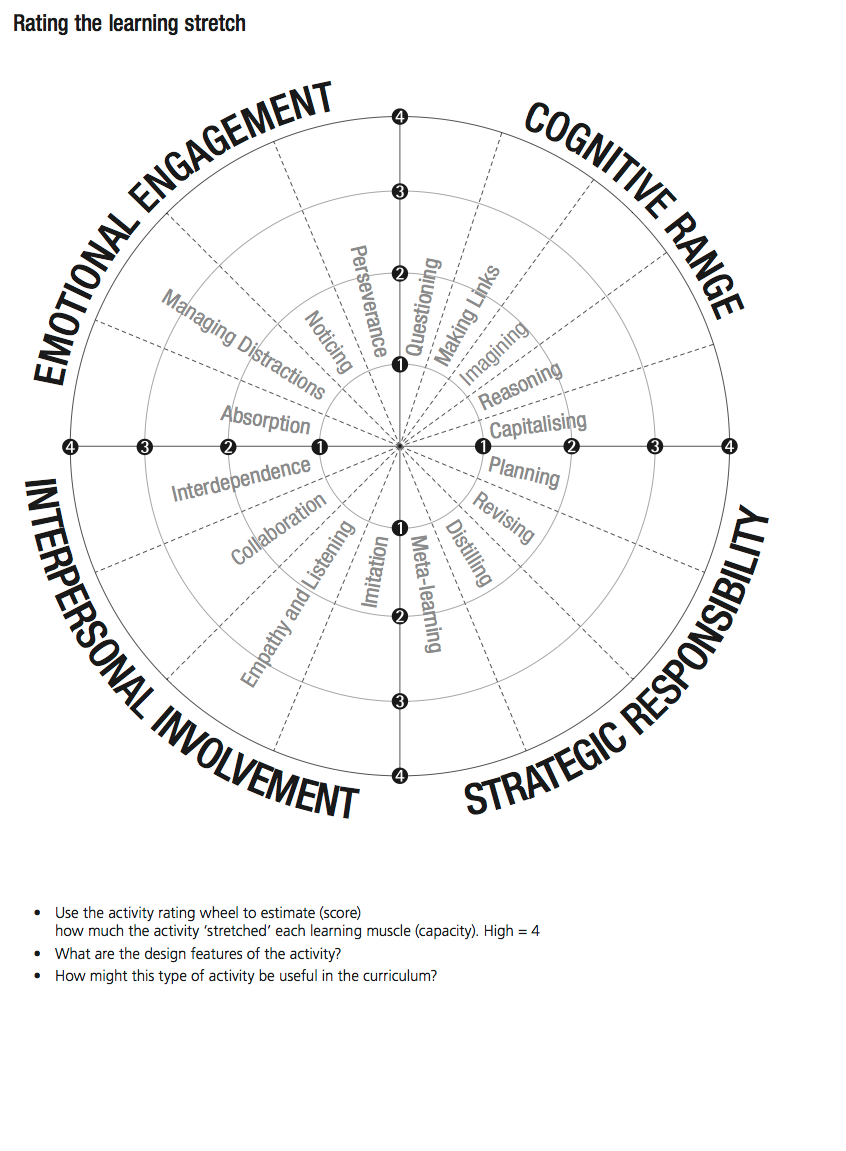 How to use it:
- Spend around 20/30 minutes in a classroom,
- Towards the end of your time in the lesson, colour in the spokes of the wheel in line with the frequency with which the behaviour has been exercised. If, for example, students have used their planning skills extensively, then colour in most of the planning spoke. If only a bit, then colour in the inner bit of the spoke. If they have not been required to plan, simply leave the spoke blank.
- Repeat for all of the spokes.
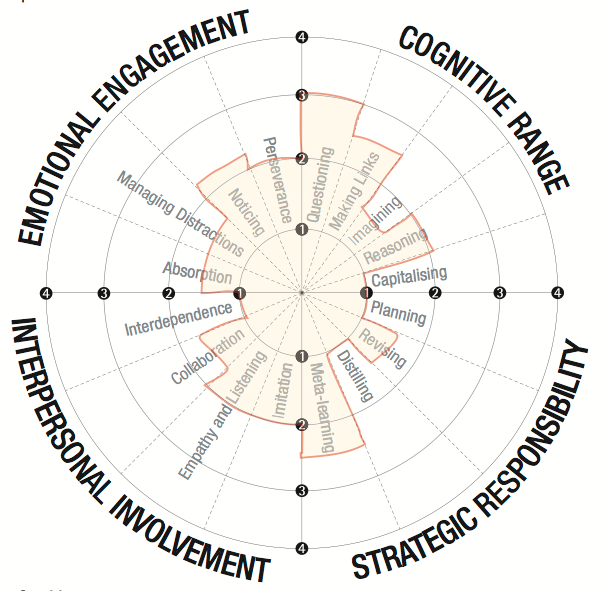
You end up with a ‘picture’ of which behaviours were (and were not) exercised. On its own, one of these completed wheels tells us little of the bigger picture. It is a useful document on which to base a discussion with the teacher, but beyond that it has minimal meaning.
However, once you have completed a sufficient number of these, clear patterns begin to emerge – some behaviours are getting regular exposure, others less so. Indeed, some of the 4 domains of learning may be gaining more attention than others.
Once you know which behaviours are and are not being exercised, you can begin to ask how you might better foreground the ones gaining less exposure.
Moreover, such research done early in your involvement with Building Better Learners will give a baseline measure that you can re-visit later to track the progress you make in expanding the range of behaviours that students are currently being enabled to exercise.

Ask yourself:
- how will you introduce this proforma to colleagues?
- how will you ensure that the observations are developmental rather than judgemental?
- how will you analyse and share the outcomes?
Original below needs deleting
Lesson observation has had a chequered history, too often judgemental and resented, too infrequently developmental and welcomed. Most observations look at teaching, and even schools that do ‘learning walks’ sometimes lapse into ‘behaviour for learning walks’ or even, ‘management by walking about‘! Senior leaders have a responsibility for gathering evidence of how teachers are teaching, but the observations envisaged here are, as you might imagine, quite different.
This section introduces a different range of strategies for viewing classrooms….. through the lens of learning behaviours rather than teaching behaviours. Tools provided here will enable senior leaders to be analytical in assessing which learning behaviours are regularly exercised in classrooms.
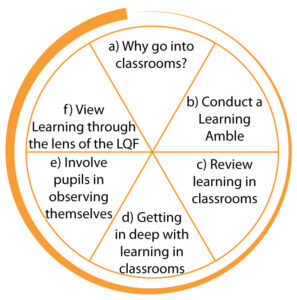
How can we assure ourselves that our classrooms are building better learners?
a) Why go into classrooms?
Classrooms are where the school conducts its core activity of building learning behaviours. It is where all of our values, policies and procedures are made real and communicated to learners, minute by minute, hour by hour, day by day. It is where all of our intentions become reality, or not.
A key leadership responsibility
It is a key leadership responsibility to ensure that what happens in classrooms accurately reflects the school’s vision and values for learning, and as a consequence leaders need to have a very clear understanding of what is happening in classrooms rooted in first-hand experience.
Assessment for Learning offers us much to ponder. We know that there is more to assessment than grades; we know about comment only marking; we understand that feedback needs to be formative and developmental. Most schools / teachers have incorporated these ideas into their day to day assessment practice to the benefit of their learners. The same principles should, of course, apply to lesson observations.
Classroom observations of learning will succeed if and only if they stimulate a professional conversation about how students are learning and how the school might further support this. The way we do observation is critical to its success. As Carol Dweck observes:
“In fact, every word and action can send a message. It tells children—or students, or athletes [or teachers !] —how to think about themselves. It can be a fixed-mindset message that says: You have permanent traits and I’m judging them. Or it can be a growth-mindset message that says: You are a developing person and I am interested in your development.”
― Carol S. Dweck, Mindset: The New Psychology Of Success
All of the observation strategies suggested here are based on that simple premise.
The ‘why’ of observation

b) Conduct a Learning Amble

Let’s start slowly with an amble around your school. No need to leave your office (yet !), just allow your mind to amble through classrooms with learning in mind. The Amble encourages you to consider to what extent your students are:
- emotionally engaged (statements 1 and 2),
- cognitively skilled (3, 4, and 5),
- socially adept (6 and 7), and
- strategically aware (8, 9, and 10).
These statements describe high quality learning behaviours, so expect to find that your students will be, at this stage, adrift of a number of these statements. However, the Amble does give a view of where you are going and hints at how you might get there.
Download the Amble Tool below, and off you go !
Download as a pdf
A learning amble through your school
c) Review learning in classrooms
Getting into classrooms . . .
Now we turn to actually going in to classrooms to look at the learning behaviours that students are being enabled to exercise.
Firstly, remember that in any lesson, no matter how sensational, not all of the learning behaviours outlined in sections 2.3 to 2.6 will be enabled. Different subject matter and different learning activities will exercise a unique blend of behaviours. Indeed some fantastic lessons may exercise only a few of these behaviours – sometimes a few behaviours exercised extensively is preferable to many behaviours exercised fleetingly, or a few behaviours exercised skilfully trump many behaviours exercised simplistically.
However, we would hope that over time students get to practise all of these behaviours in various aspects of their learning.
So, the question becomes, ‘Are you confident that your students are being enabled to exercise the full range of learning behaviours ?’ And the subsidiary, ‘How are you going to find out ?’
Traditional observation tools are highly unlikely to provide sufficient evidence. Why not try going in to classrooms with this Rating Wheel as your observation tool ?
How to use it:
- Spend around 20/30 minutes in a classroom,
- Towards the end of your time in the lesson, colour in the spokes of the wheel in line with the frequency with which the behaviour has been exercised. If, for example, students have used their planning skills extensively, then colour in most of the planning spoke. If only a bit, then colour in the inner bit of the spoke. If they have not been required to plan, simply leave the spoke blank.
- Repeat for all of the spokes.

You end up with a ‘picture’ of which behaviours were (and were not) exercised. On its own, one of these completed wheels tells us little of the bigger picture. It is a useful document on which to base a discussion with the teacher, but beyond that it has minimal meaning.
However, once you have completed a sufficient number of these, clear patterns begin to emerge – some behaviours are getting regular exposure, others less so. Indeed, some of the 4 domains of learning may be gaining more attention than others.
[Do be sure not to visit only predominantly the early parts or later parts of lessons – reflection, for example, frequently occurs towards the end of lessons and hence you need a good balance between 1st half and 2nd half of lessons to avoid bias.]Once you know which behaviours are and are not being exercised, you can begin to ask how you might better foreground the ones gaining less exposure.
Moreover, such research done early in your involvement with Building Better Learners will give a baseline measure that you can re-visit later to track the progress you make in expanding the range of behaviours that students are currently being enabled to exercise.
The in-house learning review
d) Getting in deep with learning in classrooms
Suppose you hear from teachers that they feel students exhibit poor, let’s say, listening skills. What does this really mean ? What do good listening skills look like ? What might we hope to see that would convince us that listening is alive and well within a school ? And if we suspect that listening is indeed a problem, what questions might we ask ourselves during a learning walk, beyond ‘Are they listening ?’
You might go in to classrooms with the intention of asking yourself:
Do our students
- Maintain eye contact with the teacher ?
- Maintain eye contact with their peers ?
- Encourage others to speak ?
- Offer positive feedback ?
- Re-cast / paraphrase to check understanding ?
- Consider how others might be feeling ?
Do our students listen for:
- For facts and information ?
- For the main points ?
- For the speaker’s intentions, emotions and values ?
- For what is not being said ?
Do our students listen to:
- Their teacher during whole class teaching ?
- Each other during whole class discussions ?
- Their talk partner ?
- Others when learning in a small group ?
Observing lessons with only the above questions in mind would go a long way to identifying what students do and do not do in terms of listening, and point the way forward for further developing learning skills.
Would it be worth doing a series of observations looking only at listening in your own school ?
Going deeper, seeking more detail
 Think about . . .
- What you would look for if you were concerned about your students’ perseverance skills ?
- Or their curiosity ?
e) Involve students in observing themselves
It is an irony, is it not, that teachers and their professional associations spend time and energy trying to limit the number of hours of formal ‘observations’ that they are obliged to have each year ? After all, lessons are observed, frequently by 25 or more discerning consumers, amounting to well over 10,000 hours of observations per teacher per year !
If we really want to know what is happening in our classrooms, we would be well-advised to consult the very people who experience them minute by minute, hour by hour basis – the students themselves.
Make learners partners in the observation process.
Rating Wheel … Did I?
The Rating Wheel below has been amended to make it more personal to them. Hence ‘Questioning’ changes to ‘Did I ask lots of questions’, ‘Collaboration’ to ‘Did I work with others’ etc. This is a tool that learners could fill in themselves. How would / could you use the outcomes of these reflections ?
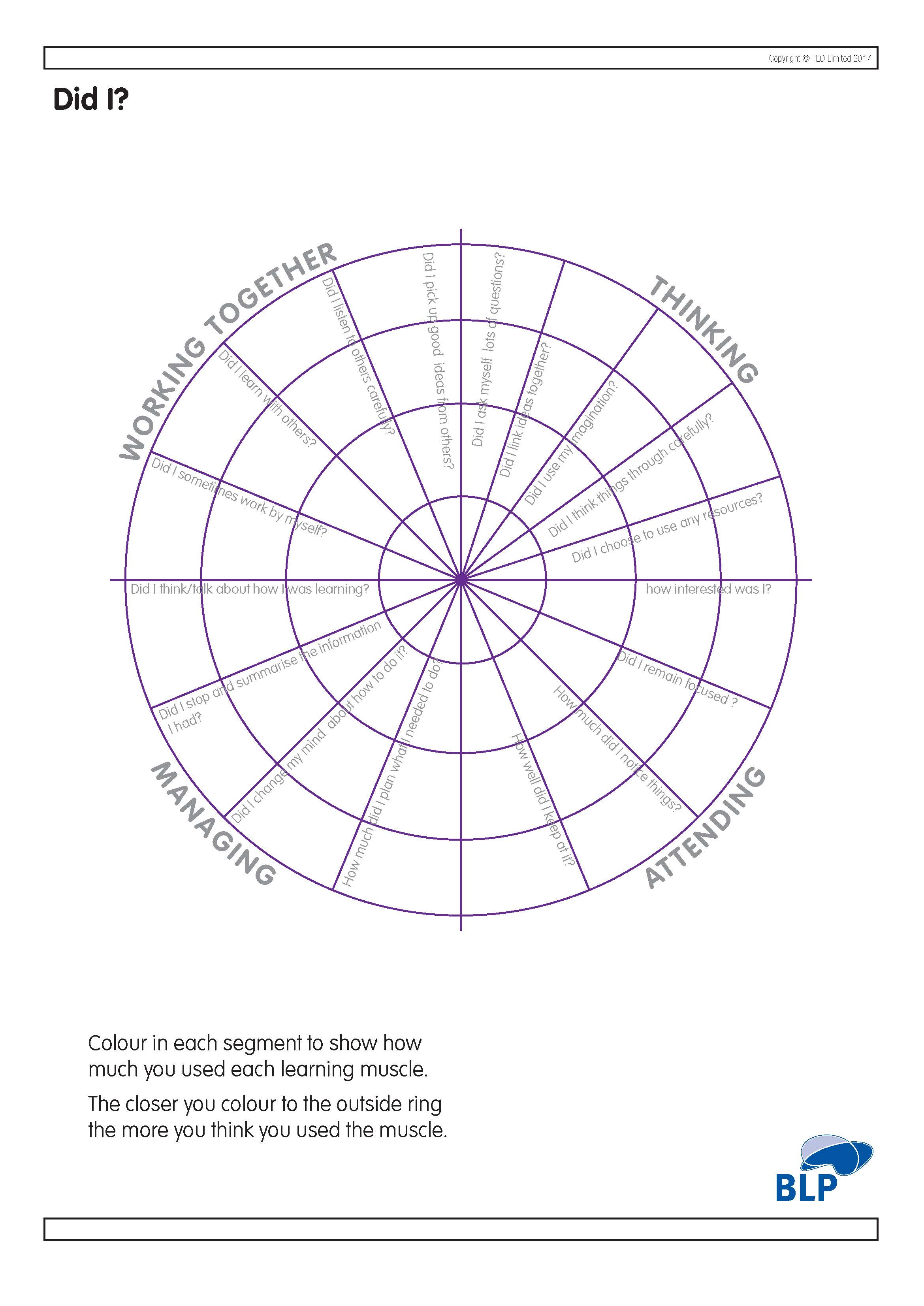
Rating Wheel … Did they?
This tool changes to ‘Did they ask lots of questions’ and ‘Did they work with others’ etc to become a tool for teachers to analyse the behaviours that they believe the students exercised.

What an interesting thing to compare…. how my students think they are learning with how I think they are learning. The start of an interesting conversation, perhaps ?
Alternatively, you could take students along with you when you do your own learning walks – would they be able to offer insights from their own experience to confirm, or otherwise, your observations ? Equally, think how much they would learn from the experience. Worth a go ?
Capturing learners’ views
f) View learners and learning through the lens of the Learning Quality Framework
The Learning Quality Framework was introduced in section 5.2, and here we offer a more detailed ‘Amble’, looking just at learning and learners.
Use it as:
- A reflective tool for leaders ?
- Or the basis of a whole-school discussion ?
- Or a tool for seeking differences between phases / subjects ?
Where are your learners when viewed through the lens of the Learning Quality Framework ?
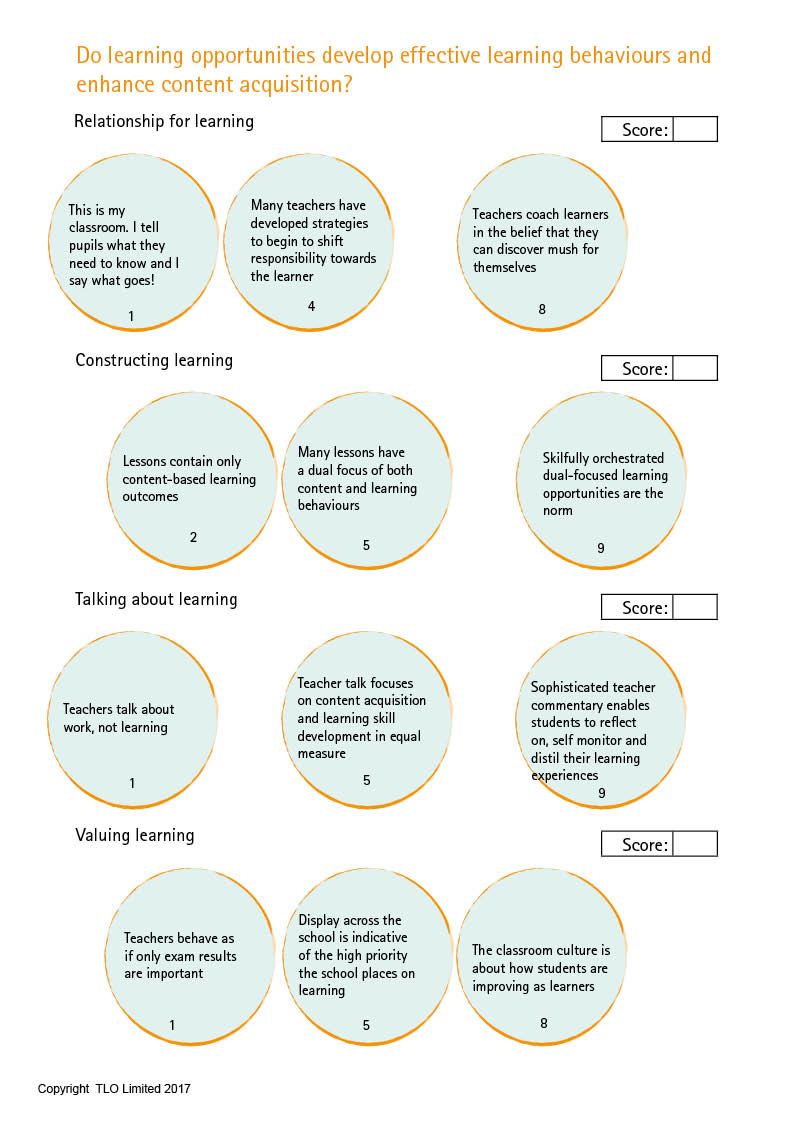
Looking at learners and learning
As a result of your Ambles, observations and discussions . . .
- What are the three most important things you have learned about learning in your school ?
- What might be most in need of attention ?
- What will you tackle first ?
- Might you need to seek support from TLO to keep learning under review in your school ?
Comments are closed.