

Building a classroom culture that celebrates learning
Welcome to Building Powerful Learners Phase 2. This four unit online programme looks at how your development as a teacher can enable and strengthen the development of a learning-friendly classroom culture.
The programme combines three types of action to help you to experiment, analyse and understand how you can create an increasingly learning-friendly classroom culture.
1 Understand by using Read abouts…of which there are two types
- Essential Read …essential must read text.
- Extended Read …interesting, good to know, absorb when you can.
2 Analyse by using Find outs…tools to help you discover and analyse essential information.
3 Experiment with Try outs…practical activities for you to try, check and perfect in your classroom.
This unit explores how your development can create a classroom culture that celebrates learning and the growth of learning behaviours.
- What are the key aspects of celebrating learning? (Essential and Extended Read about 1)
- With regards to celebrating learning, is my classroom currently more teacher focused, or more learning focused? (Find out 1)
- How are my students responding to the changes I have made in my classroom culture? (Find out 2)
- What sort of approaches will be useful in moving this forward? (Try out 1 to 4)
- Take a deeper look at the anticipated outcomes for learners of developing a celebrating-friendly classroom culture (Find out 3)
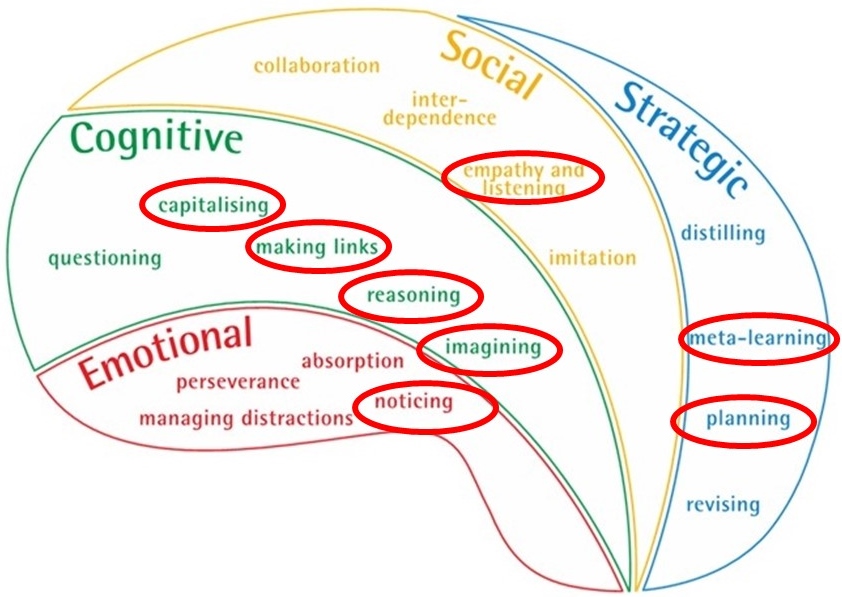
- Find out about 8 further learning behaviours that will, in time, be added to the key behaviours of Perseverance, Questioning, Collaborating and Revising (Find Out 4)
Structuring and using the ideas below in your classroom over the next few months or so will edge your classroom culture towards celebrating the growth of learning.

Essential Read about 1
Unpacking Celebrating Learning
From this…
In many classrooms responsibility for learning rests almost exclusively with the teacher. Teachers decide the what and how of learning, but also what is valued as useful. Failure, making mistakes, being stuck or applying effort in learning tend not to be seen as opportunities to learn how to learn. The main focus is on students getting things right, and without any emphasis on ‘how to’. Hence students come to believe and accept that responsibility for learning lies with their teacher and thus become increasingly dependent on them.
To this …
The Celebrating aspect of learning is about making learning itself the object of attention. This includes what you, as a teacher, attend to, what you recognise, what you praise, what you display and celebrate. In learning friendly classrooms failure, mistakes, being stuck and applying effort are re-framed so that learners come to view these old adversaries as valuable, interesting and essential. What is considered worthy of display or praise speaks volumes about the underlying, unspoken, classroom culture so the growth of learning behaviours themselves is given attention, praise and recognition.
The success of this shift depends on consistency and strong emphasis. You have to make these ideas/values obvious, big and overblown. Whispering them quietly doesn’t work. Because these ideas are new they need to be shouted about and put ‘in-your-face’ if they are to stick, be believed, be understood and capitalised on.
In short:
- The process of learning is being made the object of attention;
- The underlying values about learning become visible through what is enabled, recognised, praised, displayed.
- For example:-
- Being stuck being recognised as an interesting – not shameful – place to be;
- Mistakes being recognised as invaluable in learning;
- Effort being unpacked to show how it is channelled;
- Good questions being as important as good answers;
- Metacognitive behaviours being given a place in the learning process.
- Learning behaviours being used more often and more skilfully, being nudged and recognised . . . .
- So that the growth of learning habits is being attended to closely.

Extended Read about Celebrating Learning. ⬇️
There are three aspects to celebrating learning:
- growing learning habits;
- re-defining failure;
- putting learning on display.
Aspect 1: Growing Learning habits – finding ways to notice, track, record and celebrate learning behaviour growth. It implies that teachers and learners have a good understanding of themselves as learners and of what ‘getting better’ at learning looks and feels like. In the same way that attainment is routinely tracked, recorded and celebrated, so is learning itself.
Growing learning habits
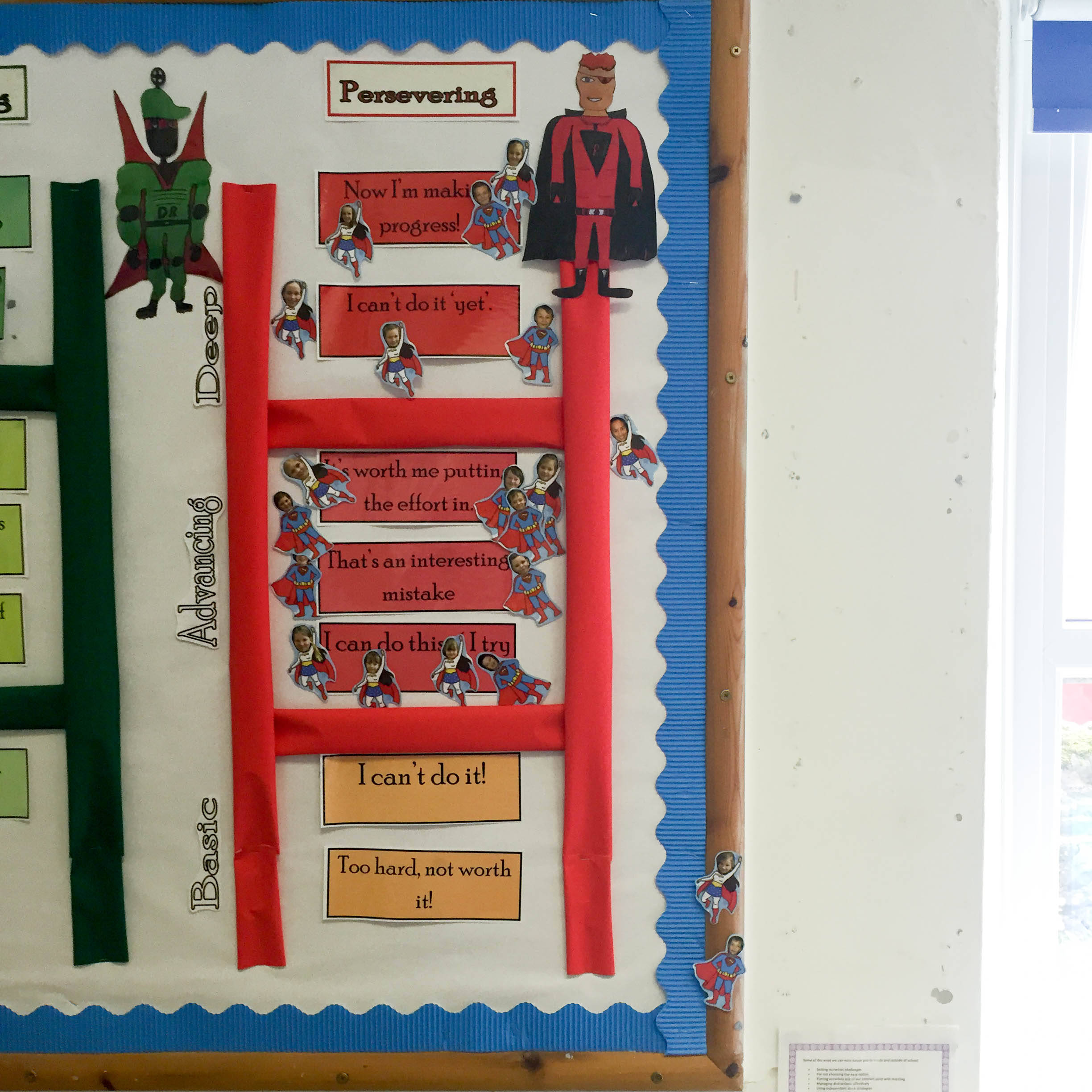 The whole point of focusing attention on the ‘how’ of learning is to enable young people to become better learners, to grow a supple learning mind, to become a lifelong learner. So the growth of learning behaviours is attended to closely. Successful growth or progression means that not only can students make use of reflection, or imagination, or managing their distractions, but that over time they spontaneously make more and better use of these learning skills and tools and secure them as habits. It is this type of growth and improvement that is acknowledged, recognised, celebrated or praised in some way.
Teachers look out for and celebrate three dimensions of progress:
- the frequency and strength of the habit – how often it is used spontaneously as the need arises;
- the scope of its use – the range of contexts within which the skill is used (from the familiar to new uncharted territory);
- the skilfulness of the habit – how the skill becomes more subtle, more appropriate to circumstances, more sophisticated.
In other words, students ask more and more questions not only in one subject but across all subjects and moreover they ask increasingly better, more searching, more generative questions. They take a questioning approach to learning.
Learning behaviours take time to recognise and grow, and it’s important to develop maps or progression ‘trajectories’ that show/unpick the steps between, for example, the natural curiosity of a three-year-old and the sophisticated skill-set of the consummate questioner. The trajectories allow teachers to identify, nudge and design activity to help students build progressively the fine grain learning behaviours of the effective learner.
What is being celebrated here is how young people are getting better at how, when and where they are using their learning behaviours. It’s the Building bit of Building Learning Power. There would be little point in introducing such learning behaviours if we didn’t attend to having them grow.
Ask yourself:
- Are students in our school becoming increasingly skilful as learners during their time with us?
- What evidence do we have for this?
Aspect 2: Re-defining failure – turning the lens around: mistakes become learning opportunities; difficulty is when learning happens; struggle is to be expected; asking questions shows curiosity, not a lack of intelligence; effort not just talent is what leads to success. It is about ensuring that hard won gains over the difficult are preferable to effortless success over the easy.
Re-defining classroom learning: new ways to view learning
“The hallmark of successful individuals is that they love learning, they seek challenges, they value effort, and they persist in the face of obstacles.” (Carol Dweck, 2000)
Mistakes or errors
 ‘Errors represent invaluable aids with the potential to help us learn. When we see failure in a new light, success becomes a new and exhilarating concept’. Black Box Thinking: The Surprising Truth About Success. Matthew Syed
Making mistakes, and more importantly covering them up – or rubbing them out – is now viewed as wasteful. Mistakes are a natural part of learning and recognised as valuable; something to learn from, something to improve on, something to change and try new ways, taking a risk and then learning from it if it doesn’t work. Mistakes are having a makeover not just in classrooms but in a wide range of progressive institutions.
Redefining failure is and will be an essential part of reversing students’ fixed mindsets
Stuck
Similarly, ‘stuck’ is promoted as an interesting place to be rather than a place of shame. Getting stuck, coming against a brick wall, not knowing what to do next is a natural part of learning. If you don’t get stuck, the learning is probably not challenging enough. Being stuck is where real learning begins. Students who never experience being stuck or struggle with learning can become fragile learners unable to cope emotionally with the inevitable difficulty of learning and life.
Viewing learning as interesting, challenging, stimulating and worthy of effort needs to feed into changing students’ fixed mindsets
Effort
Effort is a word we use often without really thinking about what it means. What do children understand by ‘effort’ or ‘try harder’? Using a learning language helps teachers to be much more specific about what sort of effort they suggest students make. As one teacher put it;
‘I often used to just tell students to make more effort, and got blank stares back. But when I started using Building Learning Power language I realised I could be much more specific about “making more effort.” I could turn my prompts and nudges into really useful statements. So now I watch students carefully through the Building Learning Power lens and say things like “how could you use your imagination to…?”, Or, “what questions might be helpful to take you further with this?”. I’ve started defining the sort of effort I want them to make’
Praise
The negative value of too much general ability praise, uncovered by Carole Dweck in her research into Growth Mindsets, has caused teachers to think differently about giving praise. Suggested shifts in giving praise include:
- Praise the effort, not the ‘ability’;
- Praise the process not the outcome;
- Praise in specifics of learning behaviours, not generalities;
- Praise privately;
- Praise authentically, and not too much;
- Praise should be seen as separate from feedback; (praise is evaluation)
- If using stickers, awards, treats etc (concrete tokens of recognition), make sure they’re given for accomplishing specific process or product goals.
Ask yourself:
- How do I treat ‘stuck’, ‘mistakes’ and praise in my classroom?
- How much have we re-defined failure?
Aspect 3: Displaying values – the process of learning (as opposed to the finished outcomes of learning) are on display. Annotated work in progress, first attempts, revisions, failed lines of enquiry, leading, of course, to the finished article. What we choose to display tells students a lot about what we truly believe: displaying/praising only the finished article suggests that whatever we might say, we are more interested in the outcome than the process. In such ways are the underlying values of the classroom revealed to learners.
Learning on display
In a learning powered classroom learning will be on display in what you will see, hear and feel. In other words, learning is visible in all sorts of ways.
You might find several ways of acknowledging learning on the walls:
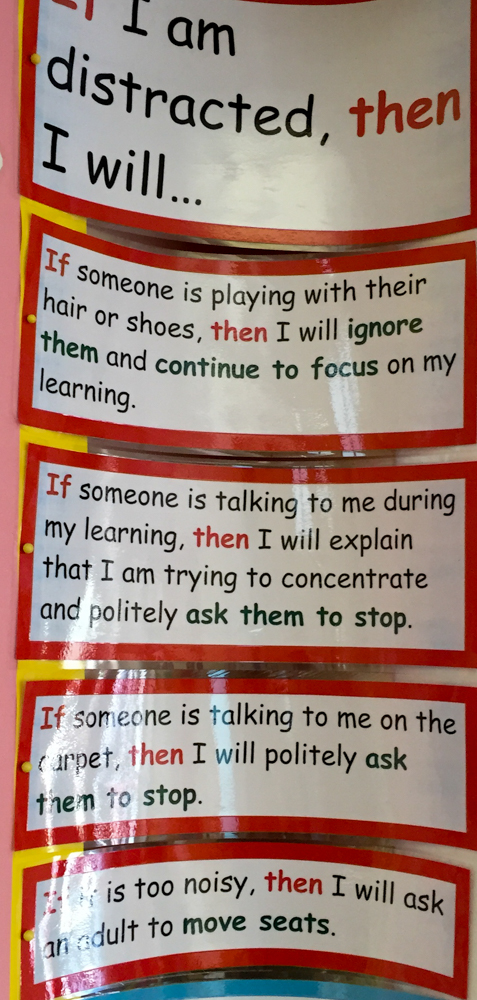
‘If – then’ display example, Heathcoat Primary school Tiverton
- useful prompts for use when stuck;
- a list of agreed ground rules for the social habits the class have created and are focusing on;
- displays of students’ efforts showing drafts and examples of work in progress to emphasise the idea of learning as a process;
- a humorous display of mistakes of the week;
- a display showing a partly completed class plan for their next school assembly;
- a five point scale students have devised about levels of distraction;
- some If -Then statements to encourage habit formation;
- whiteboard display of icons showing the learning behaviours they are focusing just now;
- photographs taken by some of the students which capture their peers displaying some learning behaviours;
- statements showing what superpower learners say;
- a ladder or learning line showing descriptions of how students might feel about the activities and their learning stretch just completed (low, good, high, overstretched) around which the students gather at the end of a session to reflect on their efforts.
- a review table for students to park their exercise books with the intention of coming back to review and improve it later
There may be a pile of ‘learning journals’ which students use to illustrate and record the difficulties they are having, or indeed the triumphs.
You will see students moving freely around the classroom selecting resources they think they may need for their tasks. On the flip chart is today’s selection of tasks at different levels of challenge, but all challenging, for students to choose from. Some children are working on their own, some with their teacher, some in teams. They are focused, engaged, enthusiastic and excited about what they are doing. There’s no hint of anxiety or pressure or boredom. They are learning to handle uncertainty, learn together and embrace challenge. No one has told them ‘this is hard’, they are knowingly using their imagination, generative questioning, different sorts of resources, listening for the key points and so forth.
The language is enquiring, propelling the learning forward…what if, how come, now what.; every so often a group will stop and check if they are on track and if they need to try another way to tackle their task; at the end of the session one group reflects on their learning process and its outcomes with their teacher, other groups do this for themselves.
The classroom is humming with the language and imagery of learning. The natural process of learning has been unearthed and given high status. Attention to the environment can be a powerful culture builder. An environment that provokes curiosity and stimulates learning becomes a ‘teacher’ in itself.
Ask yourself:
- What does the display in my classroom reveal about my priorities and my commitment to keeping the process of learning in the foreground?
Find out 1
How do teachers celebrate the growth of productive learning behaviours and so change their classroom culture?
The chart alongside shows how the classroom culture for the three aspects of Celebrating Learning:
- growing learning habits
- re-defining failure
- putting learning on display
may grow as the culture moves from being teacher centred towards being learning centred.
Download and print a copy.
Look over these trajectories. For each of the 3 columns, ask yourself the key question:
- Which cell in each column do you think best describes your current classroom culture?
It is worth taking your time over this. The outcomes from this self-reflection, coupled with the outcomes from Find Out 2, will help to identify the teaching strategies that will move your current classroom culture towards a learning centred classroom culture.
Growing learning, from a teacher centred classroom culture towards a learning centred classroom culture.
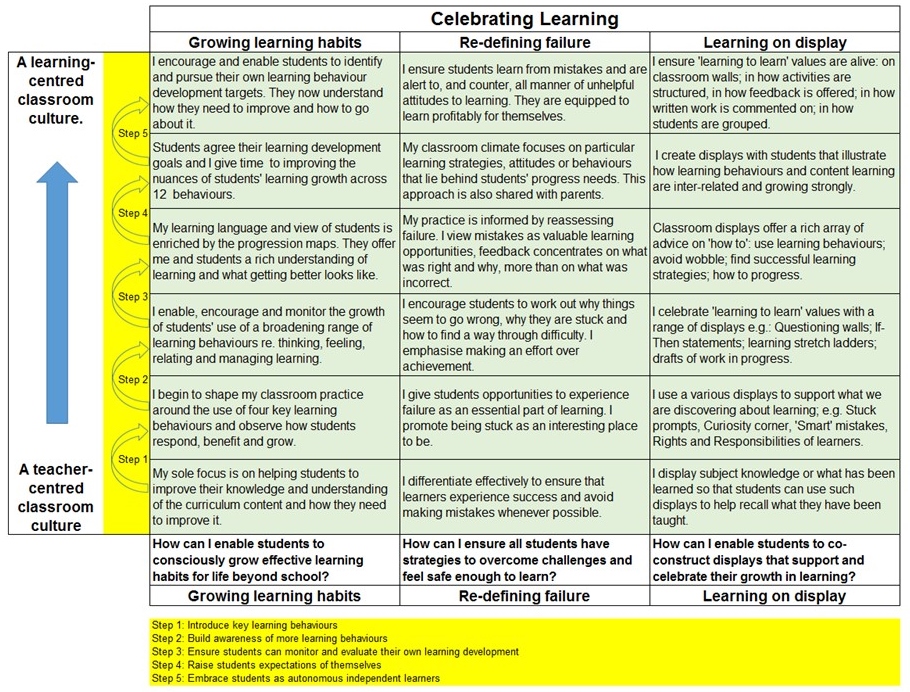
Which cells best describe your classroom culture now?
Download as a pdfFind out 2
How are your students responding to changes in classroom culture?
Culture is the minute by minute, hour by hour, day by day way that learners come to understand their role as a learner; it’s always all too evident to learners. Culture is sometimes seen as your enacted values in the classroom – what you do and what you do not do, what you say and do not say, what you believe and do not believe, what you value and do not value.
How are your students reacting to the learning climate of your classroom? How are they reacting to the changes you are making celebrate and display their growth as learners?
Download and print a copy.
Look over these three groups of statements.
The first 5 statements are about Growing learning habits, the second about Redefining failure, and the third about Displaying learning.
For each of the 3 groups, ask yourself the key question:
- Which statement in each set do you think best describes the majority of your learners at this time?
It is worth taking your time over this. The outcomes from this, coupled with the outcomes from Find Out 1, will help to identify the teaching strategies that will move your current classroom culture towards a learning centred classroom culture.

Try out 1
A range of little culture shifts
Teachers are in the habit forming business
As a teacher you are an influential character builder and so need to be mindful of how your classroom culture helps students to form, replace, re-form and strengthen their learning habits. Which aspects of your classroom culture are helpful in this respect, and which are perhaps less so? After all, if you are unable or unwilling to make changes to your classroom culture, learners are unlikely to change how they respond to it!
What to stop and start
Here are a few ideas you might want to try. Take it steady, this way of teaching can be a big but exciting shift so it’s worth doing it slowly and thoughtfully.
Begin with the ‘stop/avoid’ box – if any of these teaching behaviours are still in evidence in your classroom it would be worth thinking through how they can be eliminated, since failure to do so will undermine the changes you are hoping to achieve for your learners
Then cast your eye over the other 3 boxes. Which ideas appeal to you? Which do you think will have the greatest impact on your students?
Now seek out teaching ideas below in Try Outs 2/3/4 that you can use to move your classroom culture forward.
Try Out 2 focuses on ideas for growing learning habits;
Try Out 3 focuses on re-defining failure;
Try Out 4 focuses on celebrating learning through display.
.
Try out 2
Build the growth of learning behaviours into classroom culture
Growing Learning habits – finding ways to notice, track, record and celebrate learning behaviour growth. It implies that teachers and learners have a good understanding of themselves as learners and of what ‘getting better’ at learning looks and feels like. In the same way that attainment is routinely tracked, recorded and celebrated, so is learning itself.
Use what you have found out about your classroom culture in Find Out 1 (the green tables) and how your students are responding to it in Find Out 2 (the blue quiz) to identify the best place to start to celebrate the growth of learning behaviours. There are five possible growth stages to consider.
Explore ideas for understanding the growth of learning habits here

Try out 3
Re-defining failure in the classroom
Re-defining failure – turning the lens around: mistakes become learning opportunities; difficulty is when learning happens; struggle is to be expected; asking questions shows curiosity, not a lack of intelligence; effort not just talent is what leads to success. It is about ensuring that hard won gains over the difficult are preferable to effortless success over the easy.
Use what you have found out about your classroom culture in Find Out 1 (the green tables) and how your students are responding to it in Find Out 2 (the blue quiz) to identify the best place to start on redefining failure. There are five possible growth stages to consider.
Explore the teaching ideas for re-defining failure here

Try out 4
Displaying the learning values of the classroom
Displaying values – the process of learning (as opposed to the finished outcomes of learning) are on display. Annotated work in progress, first attempts, revisions, failed lines of enquiry, leading, of course, to the finished article. What we choose to display tells students a lot about what we truly believe: displaying/praising only the finished article suggests that whatever we might say, we are more interested in the outcome than the process. In such ways are the underlying values of the classroom revealed to learners.
Use what you have found out about your classroom culture in Find Out 1 (the green tables) and how your students are responding to it in Find Out 2 (the blue quiz) to identify the best place to start on displaying the learning values of your classroom. There are five possible growth stages to consider.
Explore the teaching ideas for displaying learning values here

Find out 3
Developing a deeper understanding of how learner behaviours may respond to the changes you have made in your classroom culture.
We have thus far, with the exception of Find Out 2, focused on changes you can make to your classroom culture, focusing on the three ‘Means’ of Celebrating Learning:
- Growing learning habits;
- Re-defining failure;
- Learning on display.
Here we turn our attention to the two ‘Ends’, the anticipated outcomes for learners, and how these are linked to the changes you are making / have made:
- Growing self-awareness;
- Growing a growth mindset.
Ask yourself:
- Which cell in each column best describes my learners at present?
- Is there a good match with the Steps I have been working on in Try Outs 2/3/4?
- Are they responding in the ways anticipated?
- Are they ready to be challenged to become increasingly self-aware as learners and increasingly positive, or is there a need for a period of consolidation while the changes you have made take full effect?
And critically – what next? You should probably choose to turn your attention to one of the other units so as to maintain a degree of consistency of approach across the four aspects of classroom culture (Relating, Talking, Constructing, and Celebrating).
But, do not forget – you can always return to this unit in the future with the intention of further progressing your classroom culture and their responses.


Find out 4
Finding out about 8 further learning behaviours to broaden the range of behaviours you are actively promoting in your classroom.
This Find Out, which appears in all units, is a reference tool to be accessed when / if you need it.
It gives a short introduction to 8 additional learning behaviours: Noticing; Reasoning; Imagining; Making Links; Capitalising; Listening; Planning; Meta Learning.
Each contains 5 short sections:
- What do we mean by this learning behaviour?
- How do teachers create a classroom culture for it.
- How does the behaviour grow?
- Some teaching ideas to encourage the behaviour.
- How to develop your learning language to support the behaviour.
You will find these introductions most useful as you begin to tackle Steps 2 and 3 in the Try Outs (above).
Review and Evaluate
Suggested termly review activity
Suppose that your main focus over the Spring term was on Celebrating Learning:
- You were working mostly on Step 3, with a focus on developing and displaying some learning trajectories and on using the displays to stimulate target setting;
- You worked with a colleague to simplify the progression charts for Reasoning and Imagining and make the language age-appropriate;
- You are encouraging students to reflect on which behaviours they do and do not do, and to consider how they might improve their learning behaviours;
- You may well also have had some associated actions in the other 3 aspects of classroom culture;
- You have noticed that students have a deeper understanding of their own Reasoning and Imagining behaviours, and are better able to talk about these learning behaviours;
- And in the future you suggest that the school should agree trajectories for all 12 learning behaviours so that they can be used consistently across all classrooms.
Your review and evaluation sheet might well look like the one opposite.
Download and complete your own review and evaluation sheet. Keep it as an ongoing record of what you have done, and pass a copy to senior leaders so that they can keep an eye on developments across the school.
Download a blank copy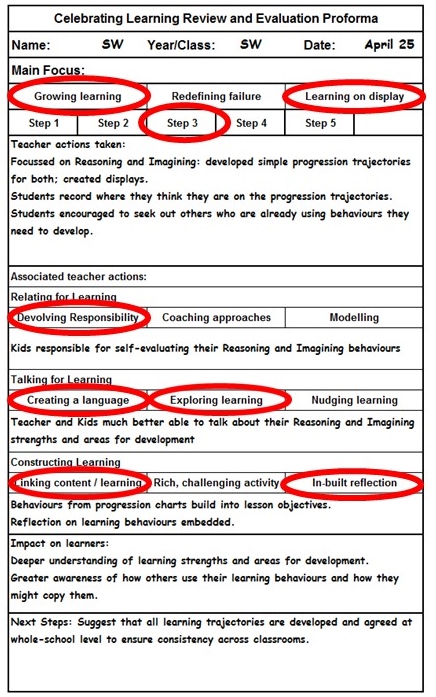
Comments are closed.