
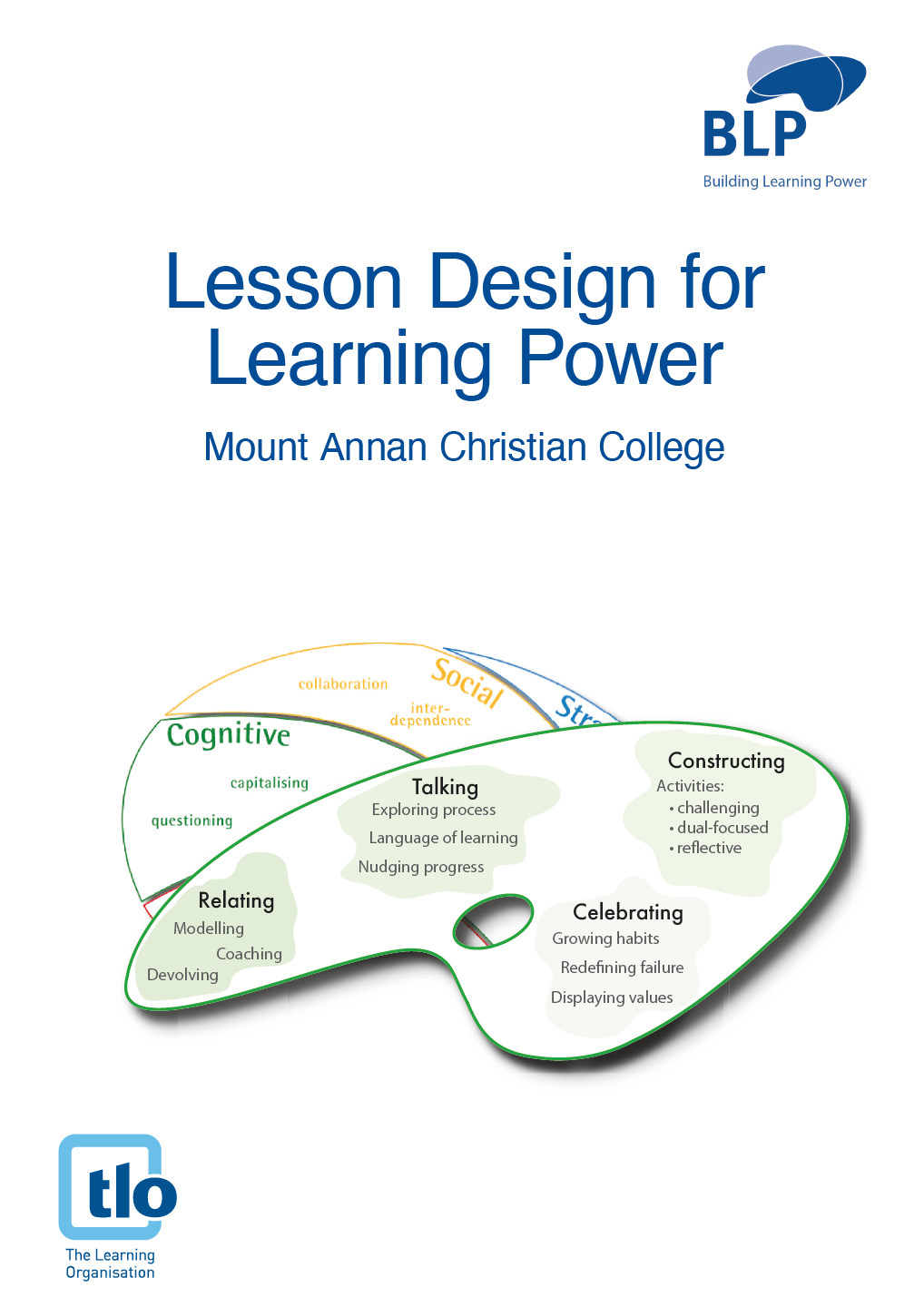
Professional development day for all staff: Lesson design for learning power
This resource has been compiled to ensure the ambitious training day with all staff of Mount Annan Christian College goes as smoothly as possible. Below you will find lots of information relating to the professional development day training which concentrates on the design of dual focused lessons.
The resource includes:
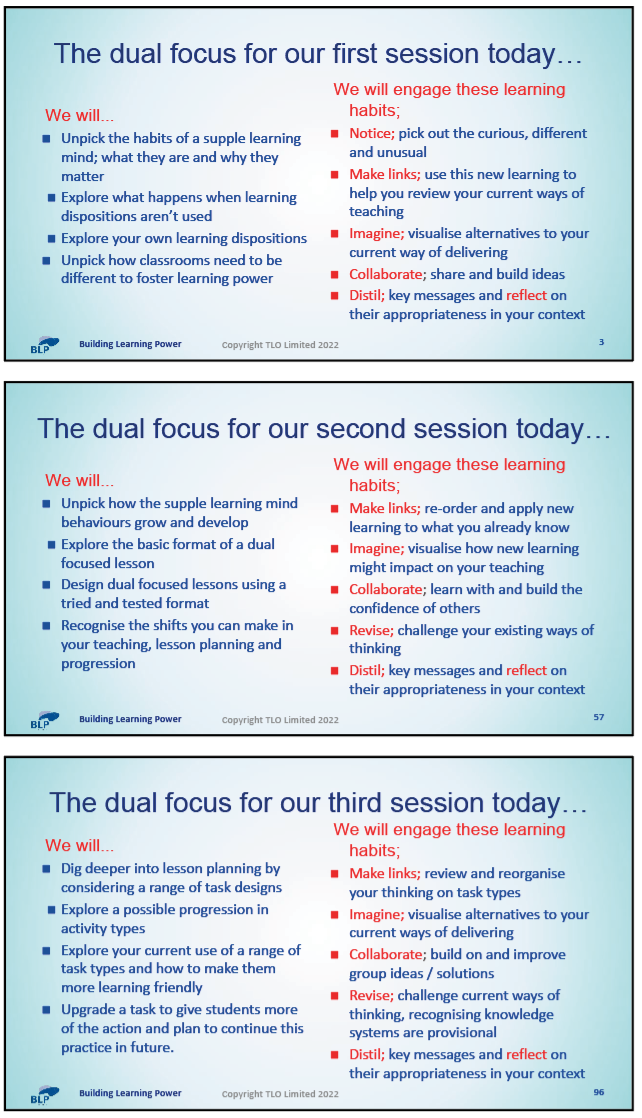
- the content and learning objectives of the day’s three sessions
- copies of all the resources that will need to be printed
- an indication of the nature of the activities to be undertaken

1. What the training aims to achieve
The nature of the training
The full day training has been constructed as a result of discussions with Andrew Toovey, Director of Teaching and Learning. It is designed to briefly remind or introduce staff to the two frameworks that underpin Learning Power, and then moves on to the more practical skill of designing lessons that engage students’ learning power. The sessions look at the growth of learning behaviours, a plan for incorporating them into lessons and a close-up dissection of task design. Alongside the theory and practice we have added complementary examples and stories from schools to show how the ideas actually work in the field.
- Session 1 8.30 to 10.30.
- Unpicks the habits of a supple learning mind; what they are and why they matter
- Explores what happens when learning dispositions aren’t used
- Explores staffs’ own learning dispositions
- Unpicks how classrooms need to be different to foster learning power
- Session 2 11.00 to 12.30
- Unpicks how the supple learning mind behaviours grow and develop
- Explores the basic format of a dual focused lesson
- Offers opportunities to design dual focused lessons using a tried and tested format
- Session 3 1.15 to 3.30
- Digs deeper into lesson planning by considering activity/task designs and reflection practice
- Explores a possible progression in activity/task types
- Explores staffs’ current use of a range of activity/task types and how to make them more learning friendly
- Offers opportunities to upgrade an activity to give students more of the action.
Each session knits together interesting knowledge based inputs, with engaging interactive activities that serve to reinforce new ideas by applying them to the practical reality of the classroom.
From the start staff are encouraged to contribute aspects of their own learning habits to ensure the session is a rich learning opportunity for everyone.
2. Preparing for the session
We would be grateful of your help in making the session work to best advantage. We have designed and made available the essential resources for the session, namely Resource books and activity resources (see below). We ask you to print sufficient copies for the number of staff attending.
2a The Resource Book
The session is supported by a 23 page Resource Book of training material.
The Resource Book is made available as PDFs (colour) for the school to print for staff. It works best when bound with comb binders or similar. It contains the key PPt slides used in the presentations, and the resources for group session tasks. Please ensure that every member of staff has a copy of the Resource Book at the start of the morning session…but not before!
2b Other resources needed
- We’d be grateful if you could provide one pack of Tin Tin cards per 8 members of staff
- Please print the Tin Tin pictures below
- cut to form 23 separate pictures.
- make up one complete set of pictures per 6 participants.
- put sets into envelopes or small plastic bags for safe keeping.
- We’d be grateful if you could provide one pack of the Progression cards per 4-5 staff.
- cut up to form 28 separate small cards
- shuffle the cards to break up the order
- make up one complete set per 4-5 staff
- put sets into envelopes or small plastic bags for safe keeping

2c Equipment and room organisation
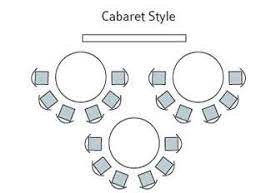
Room setup for training & presentations
3. The learning activities throughout the day
Session 1
During session one there will be 9 activities interspersed with inputs, pair chats and whole school discussion.
Activity 1 (only 1 min per group of behaviours )
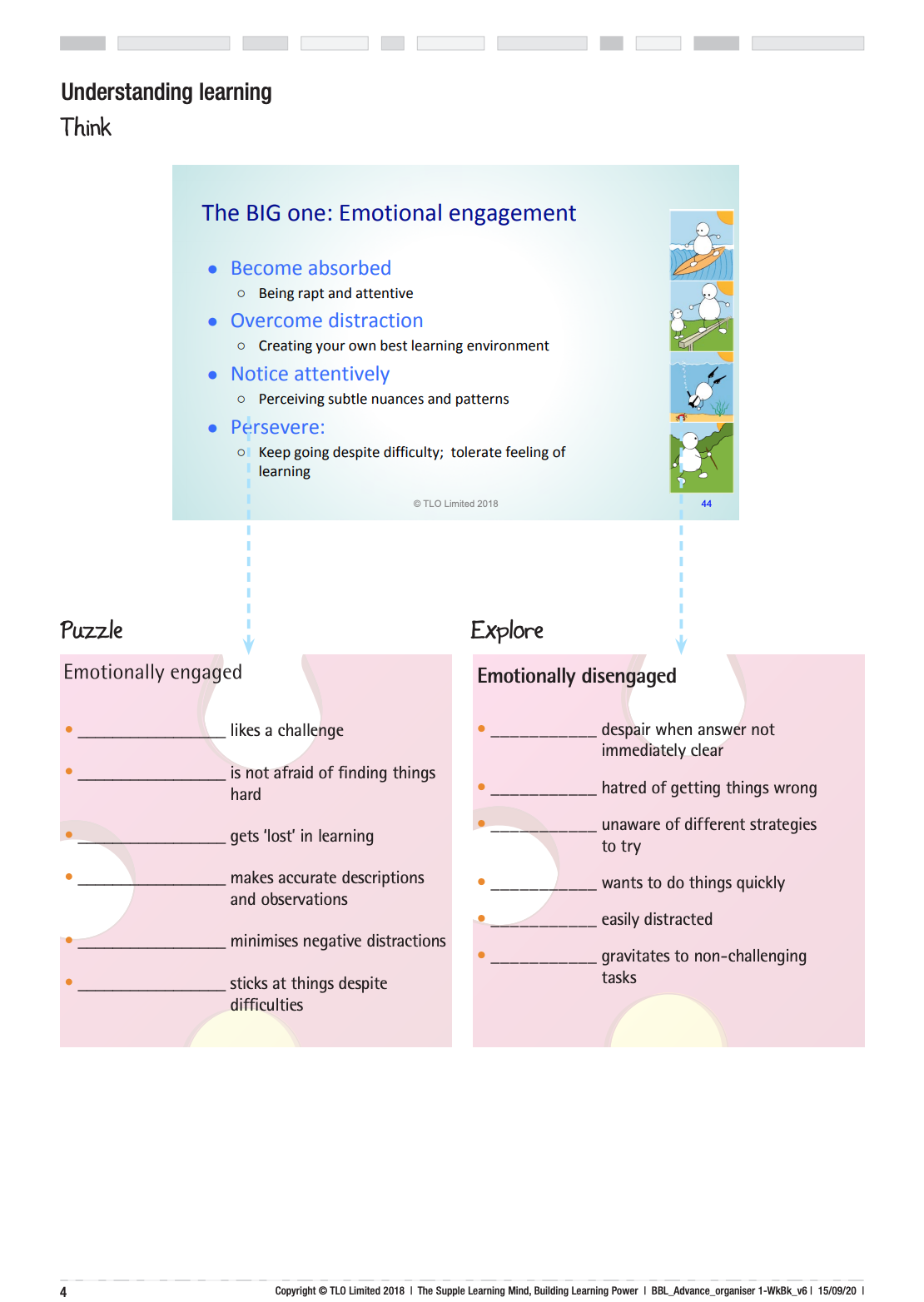
Although this is a very useful activity, which aims to help staff become more aware of their students as learners, we will have to whizz through it and leave staff to continue this as a piece of ‘homework’; thinking about students’ tendencies, dispositions and habits and muse on their students’ positive and negative characteristics. Participants will be invited to;
- Think about the learning behaviours associated with the emotional, cognitive, social and strategic domains of learning
- Puzzle over what it means to be without these learning behaviours, how not having them gets in the way of learning
- Note the names of students who appear to use or not use each behaviour.
For each of the tasks below it would help if a specific member of staff was assigned to distil the feedback/findings and report back on behalf of a group. We won’t be able to take feedback from all groups because of time but the spokesperson will have at least captured the groups’ learning.
Activity 2 (25 Mins including discussion on solutions and patterns of habits used)
This activity involves staff looking at comic book pictures, considering clues and putting them into an order to make a credible story line. This task is about staff applying their own learning habits to reason and imagine a solution. Each group of 7 teachers will require a complete pack of 23 pictures.
We will ask for at least one teacher in each group to act as an observer, using the Rating wheel provided in the Resource book.

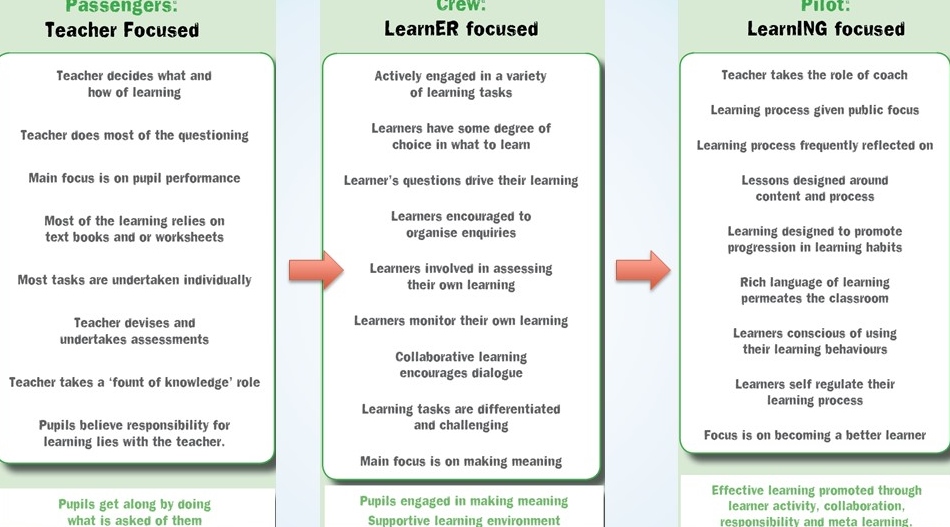
Activity 3 Learning culture tool 1 (10 mins including whole group discussion)
This activity sees a shift in focus from students’ learning behaviours to classroom cultures. It highlights 3 different learning cultures and emphasises the teachers’ and students’ role in each one. Participants are invited to;
- Highlight all aspects of culture that are a regular feature in their classroom.
- Discuss with their neighbour
- Ask what is this telling them about their teaching
- Similarities / differences
- Surprises
- Delights
- Shortfalls
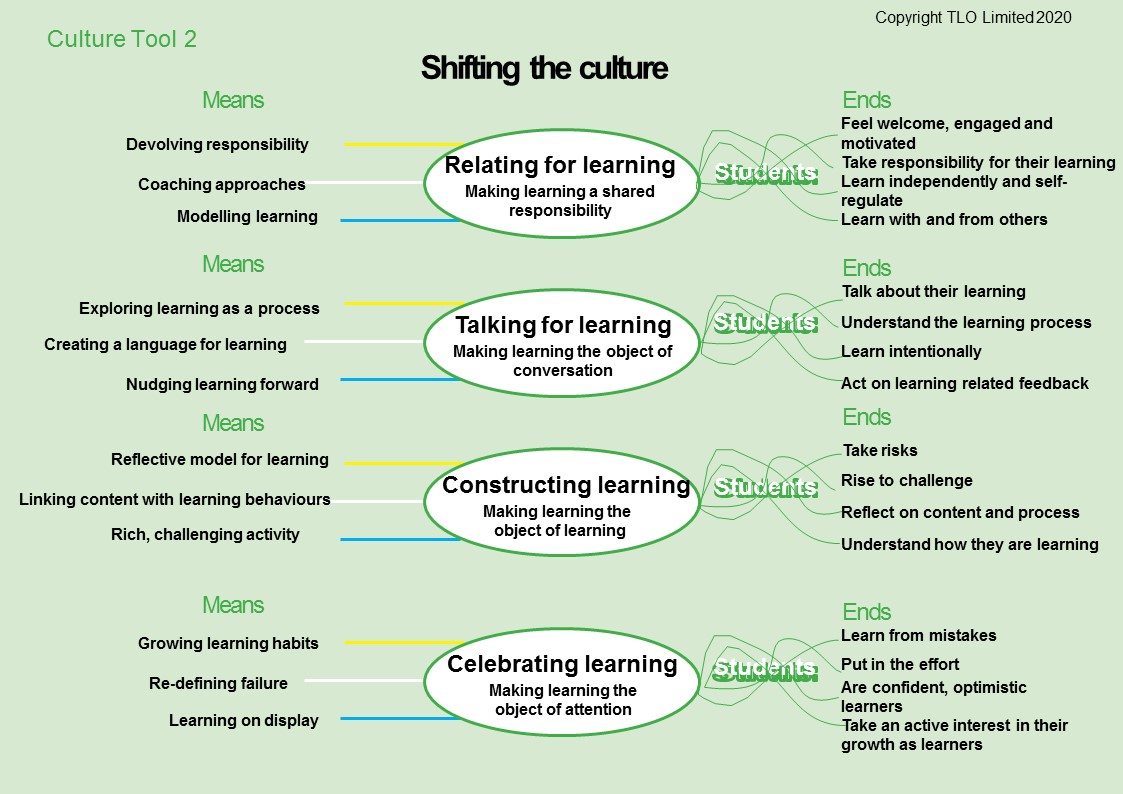
Activity 4 Learning culture tool 2 (10 mins including whole group discussion)
As the one above, this activity centres on the research of Chris Watkins (London Institute of Education). The diagram emphasises the outcomes or ends schools might aspire to in the 21st century, and the means/ways teachers will need to use to ensure these outcomes. Participants are invited to;
- Discuss together;
- What they understand by each of the ‘Ends` statements
- If they want their students to be like this? Why?
- Whether students become more like this as they pass through the school? How do they know?
- How do the Ends statements chime with the school’s values/vision?
Session 2
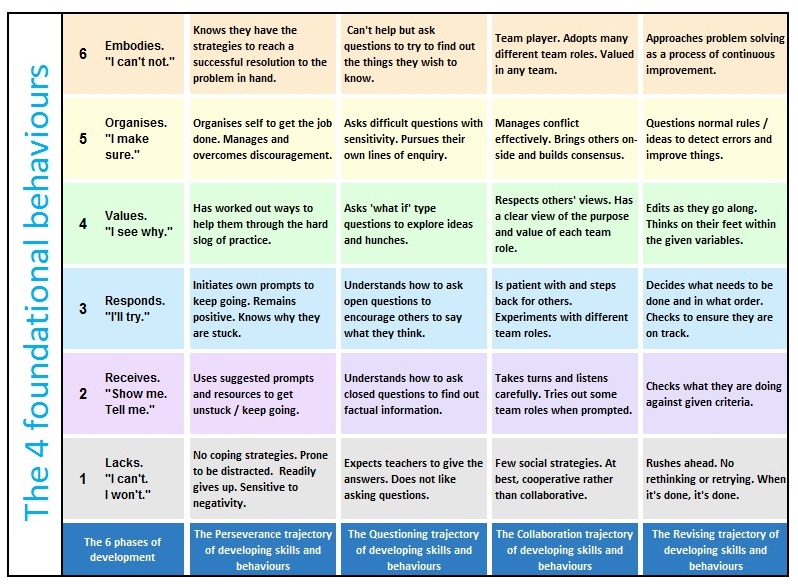
Activity 5 Learning Poles apart– filling in the gaps (15 mins to both build progression charts and discuss more widely.)
This activity embraces a number of actions and discussions which look at how learning behaviours grow and how this will influence lesson design.
5.1 Having been given a set of 28 mixed up cards staff are invited to discuss and build their own trajectories for the 4 key learning behaviours with 7 in each column.
5.2 Having done so staff are asked to think where the majority of their learners are now. Are they moving up these trajectories as they move through the school? Why do you think this is happening?
5.3 Staff are asked to consider where their higher attaining students are on the charts and what is that telling them?
5.4 Staff are asked which chart colour best describes the majority of their youngest and oldest learners? How high up these trajectories might they expect / hope their students will get by the time they leave the school? And finally, to think about their role as a teacher and how their role as a teacher changes as students move up the trajectories.

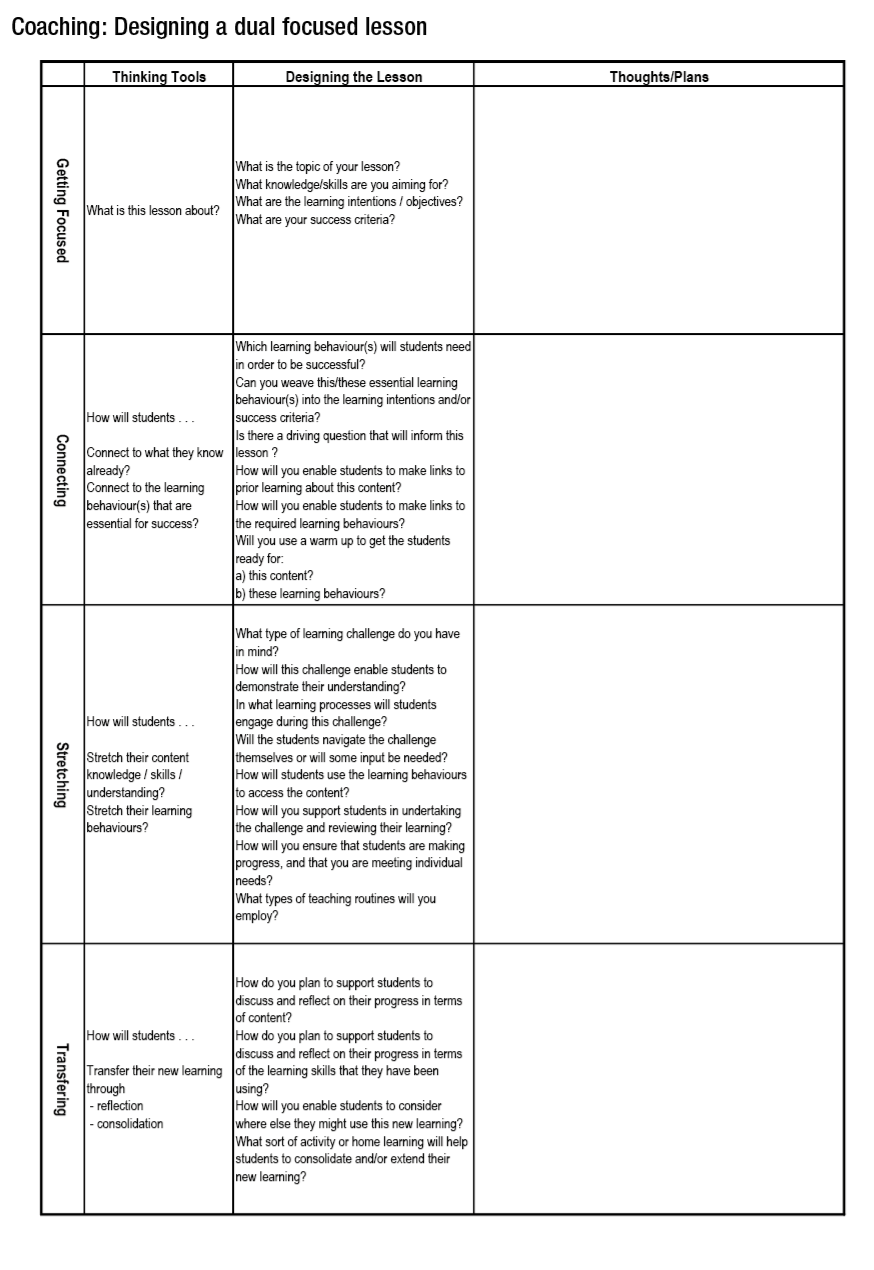
Activity 6 Using 9 thinks to make your lesson dual focused (30 mins plus whole group discussion)
After a significant input on a method of designing dual focused lessons (content and process) staff are invited to form a coaching pair and, with the help of prompts, coach each other to apply the 9 Thinks approach to a lesson they have taught recently or are about to teach. Pairs made up of teachers from different phases might be most interesting.
As a pair they have 30 minutes, 15 minutes each.
This is perhaps the most significant activity of the day.
Activity 7 Looking closely at Thinks 7 & 9 (15 mins plus whole group discussion)
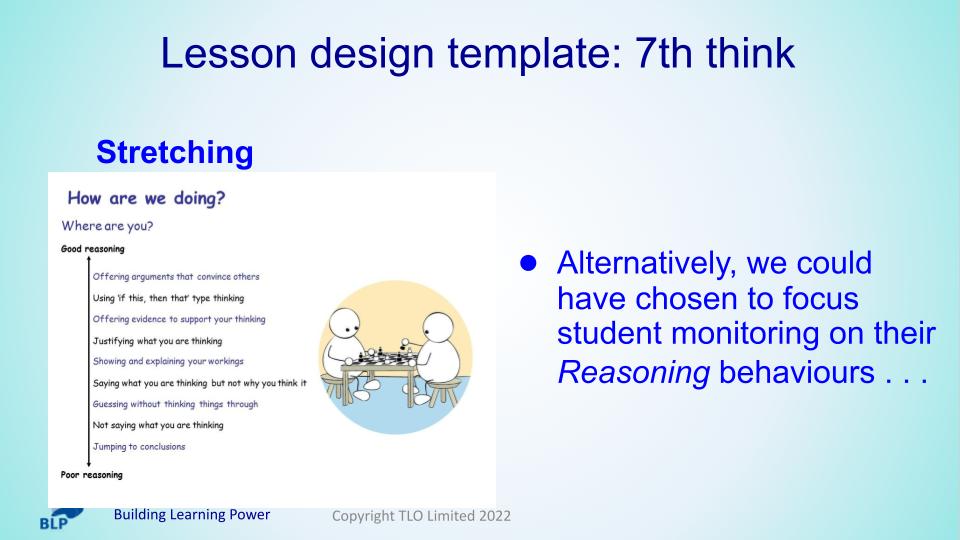
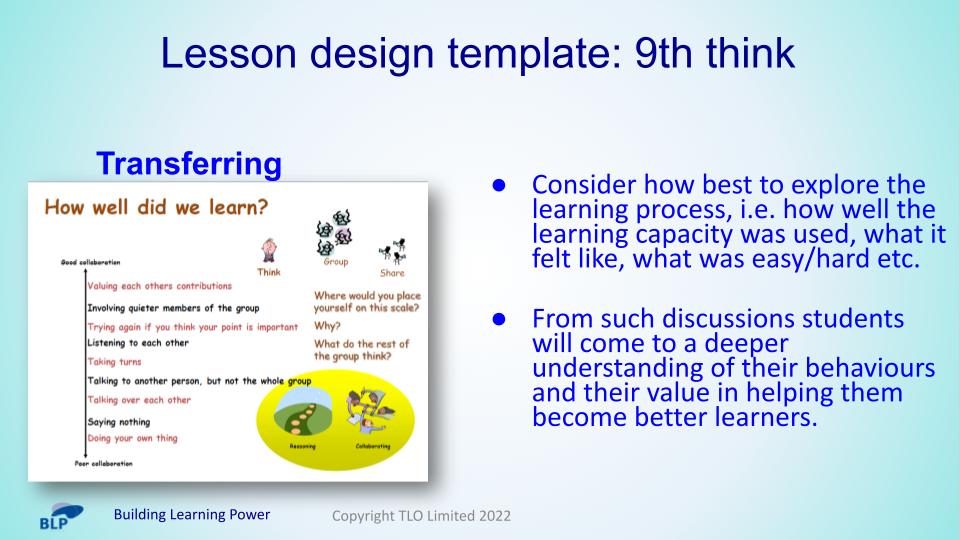
This activity draws attention to Thinks 7 and 9 where students are being asked to monitor their own behaviours and to review how they got on with them.
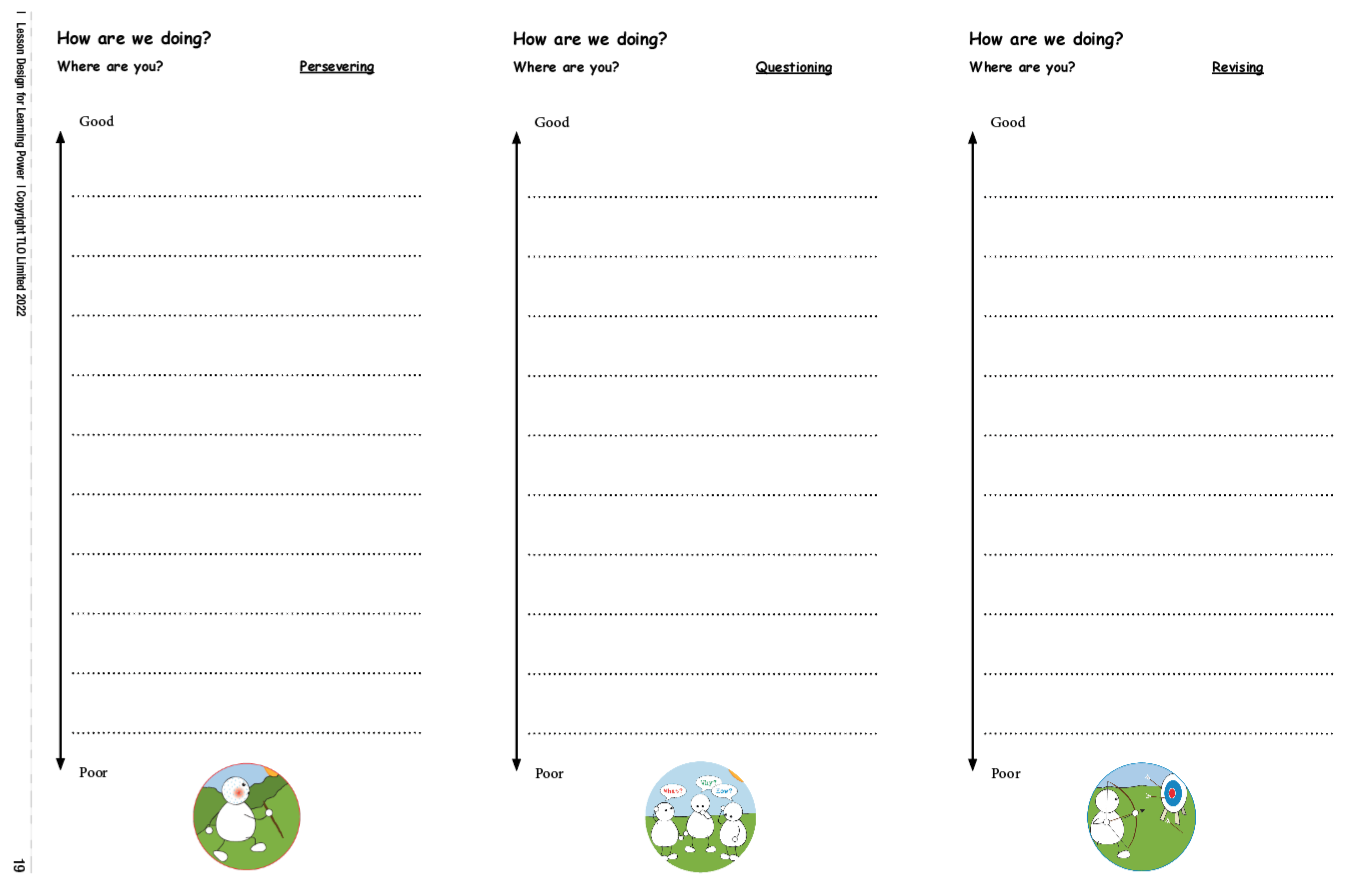
Participants are invited to create a set of behaviours for perseverance / questioning / revising.
This is a demanding task which draws on specific aspects of the behaviours being brought into play. It covers how these may be expressed so that students;
- become aware of them
- monitor how and when they use them
- reflect on how they use them
- develop them as useful learning behaviours.
Participants are invited to look back to the progression ladders they created earlier for inspiration.
And a provocative question to consider – will you need different statements for different phases?
Session 3
Activity 8 Upgrade your tasks giving students more control (15 mins plus whole group discussion)
After a significant input of activity types we return to the coaching pair of Activity 6 they are asked to look at the learning challenge they designed for Think 5 earlier, to assess what task type it is and then try to lift the task type by one level.
We ask that they’re prepared to share the results and difficulties of their discussion.

Activity 9 Surveying your curriculum for task types (xx mins plus whole group discussion)
This is the final activity of the day and it’s a challenging one which we hope will cause much discussion about curriculum structure and lesson design long after the end of the day.
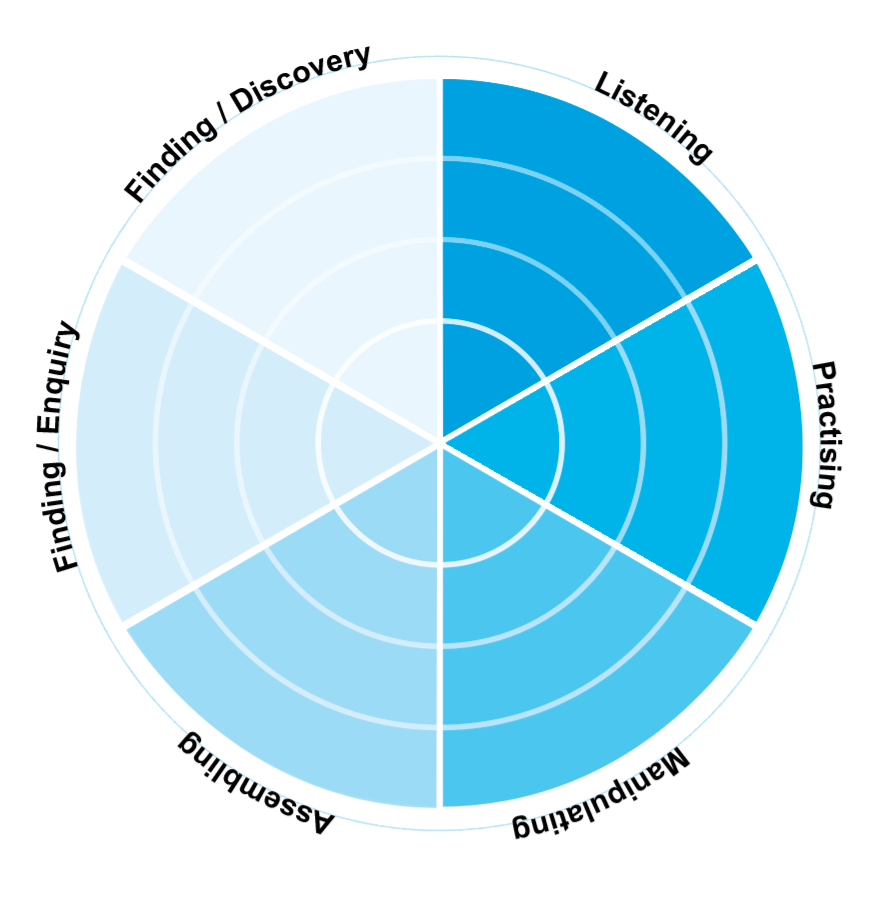
Participants are asked to take a look at a unit of work. One that they have recently taught or are about to teach. Then, using the Task Type wheel (shown in the resource book), try to estimate how/if / where they are making use of the different task types.
This may be a good opportunity for subject or phase teams to work together after the course if not on the day. The challenge is to consider what might need to change in order to bring more of these task types into play across the curriculum.
In a sense it’s a cliff hanger activity which we leave with the school to resolve.
Comments are closed.