
Module 1 is designed to assist senior leaders to gain a deep understanding of the the purpose and nature of the principles and practice of the approach. It offers you information, questions and activities to aid understanding and explains the innate potential of the approach when implemented in your school.
Sections Archive
1. The big picture of making Building Learning Power happen.
Developing students as better learners is a long term innovation. It requires far more than an Inservice training day and ‘away you go’, it has implications not just for student learning, but for staff learning too. Teachers’ habits as learners have to become part of the picture; how they go about changing is as relevant as what changes they want to bring about.
Here’s a brief overview of how the development of staff mirrors the development of students as learners, involving not just new knowledge but changes in teaching habits.
Key Learning Question:
Why can’t we just have a training day and read a book?
a) What it takes to grow innovative practice
For the school to take on wholeheartedly the new roles and paradigms that minute-to-minute and day-by-day build better learning requires far more than just a quick exposure to its principles and methods. Development of this magnitude asks a lot of teachers. Teachers have to go through a process of un-knowing, re-learning, unpacking and re-adjusting.
The programme the school is about to embark on is a careful blend of:
- online learning sessions….that faithfully disseminate the researched content for Building Better Learners;
- professional learning team sessions ……actioned by the school that provide sustained, meaningful assistance; learning with and from colleagues;
- trying things out for themselves in classrooms……because “learning by doing” is integral to the development of expertise and expertise cannot be developed quickly. It can only be developed if teachers have ample opportunity for practice, reflection, and adjustment.
This trio of learning opportunities work together to help teachers replace long-standing habituated practices with more effective ones.
This is how it works

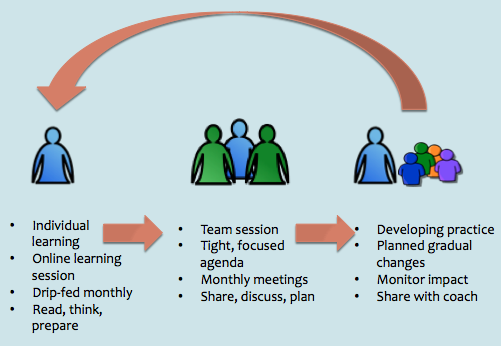
Growing new practice

- Have you learned with and alongside colleagues in this way before?
- What excites you about the prospect?
- What worries you?

b) Why online learning ?
There’s more to it than you think.
The first aspect of this carefully blended learning programme is the online learning. This provides the content of the Building Learning Power approach based on over 20 years of research and development in schools.
You might well wonder why such content merits online modules and why you can’t just read a book about it and get on with it. We’ve discovered over time that:
- this level of innovation in classroom culture, which in some sense is working against the grain of current requirements, is harder, more complicated than it appears;
- schools in the past have had a tendency to think of the approach as merely a few tweaks in classroom practice, to make light of its potential and translate lite versions of it in schools, that fizzle out;
- research has revealed just what it takes to shift classroom cultures to being more learning friendly. This has given the approach a richer, more concrete vision of how to implement it across a school;
- unique research into how learners grow and progress as learners…what the ‘better’ bit of better learners looks like at different phases. This has made the approach more purposeful. Not an approach but a way of being. All this new research has added purpose and rigour.
The rich ideas now embedded in Building Learning Power are far too extensive and deep to be dealt with in a single training day for a school. The different facets and levels need to be focused and grouped into digestible pieces to help schools take them on board and make the most of them in action.
So, what the online courses and sessions are attempting to do is:
- to cut the big complex innovation into more bite size chunks for schools;
- to order those chunks in a way that schools and teachers can make sense of and implement over time;
- to faithfully offer the researched content in a do-able form i.e. so that schools only get the bits we know work which saves you time twiddling about with stuff that may sound good but doesn’t do the job;
- coupling the researched online content with professional learning team sessions in schools because these are the best ways of supporting and delivering changes in classroom practice.
You see, there is:
- no point in just knowing more stuff unless you can use it to change/improve your practice
- AND
- no point in changing your practice unless you know more about what sort of change is likely to work
The blended learning programmes will enable the school to build better learners right not lite, make a complex set of ideas work on a practical level and, achieve the outcomes you want for your learners efficiently and effectively.
Researched content to turn into practice

- Have you tried learning online before?
- If so, what was the experience like?
- What time of day would be good for you to engage with the online element of the programme?
- Can you appreciate the point of this online element of the programme?
- If not online, what might be a better way for you to engage with the content of Building Learning Power?
c) Changing professional habits
The second aspect of this carefully blended programme is the professional learning team; designed to turn researched ideas into practice in classrooms.
When teachers want or need to improve it actually involves them in changing their teaching habits. It’s not just about knowing new stuff, it is about doing what you do differently. That’s much harder. It involves changes to;
- what you know – knowledge
- what you believe – feelings or attitudes
- what you can do – your skills
- what you actually do – putting it all into practice
So changing how you teach is a delicate, complex process……...that’s why it’s hard!
And the hardest thing isn’t getting new ideas into teachers’ heads
It’s getting the old ones out…….that’s why it takes time and effort.
It takes time and practice to undo old habits and become graceful at new ones……that’s why this learning programme is based on how adults learn and the researched professional development approach of teacher learning communities.
Changing practice takes time and effort
- How are you feeling now about what you have read about Building Learning Power?
- Does developing staff’s teaching around the characteristics of effective learners appeal to you?
- What difficulties do you think there might be?
d) Why learning communities work
Professional Learning Teams, or more generically, teacher learning communities have the potential to provide teachers and support staff, with the information and support they need to develop their practice in deep and lasting ways. Furthermore these communities are designed to build school capacity to support individual and whole school change over time.
Teacher learning communities provide a forum for supporting staff in converting the information and ideas in the online learning sessions into “lived” practices within specific subjects and classrooms. They provide a safe forum in which to;
- kick around ideas from the online content,
- unpack it’s meaning when it’s unclear,
- consider what’s do-able and appropriate for your students
- make plans for what and how you might incorporate the ideas into your practice
- share and unpack what you have tried in the classroom
- relate your triumphs and tribulations
- reflect on what you hope you might do differently
Because teacher learning communities are embedded in the day-to-day realities of classrooms they provide a time and place where staff can hear real-life stories from colleagues that show the benefits of adopting these techniques in situations similar to your own. They provide local reassurances. As staff adjust their practice, they are risking both disorder and less-than-accomplished performance on the part of their studets and themselves. Being a member of a community of teacher-learners, engaged together in a change process, provides the support they need to take such risks.
See section 2 for more detail about how teacher learning communities operate.
Essential support
- What sort of picture do you have of teacher learning communities?
- Do you like the sound of them?
- What makes you say that?
- Have you ever belonged to one before?
- To what extent did you find the experience useful in helping to advance your teaching style?
e) A Professional Learning Team at work
Here’s a glimpse of a new learning team at work. It shows a short section of only the second monthly meeting of this Professional Learning Team. Here staff talk excitedly about how their students are responding to learning about how to persevere. The teachers are genuinely surprised about just how quickly and profoundly their young learners are responding, changing and improving. One story leads on to another.
Professional teams at work
- Why might it be useful to share such stories about changes in how students are approaching learning?
- How will these sorts of conversations help schools to become more learning friendly?
- What question would you like to ask this team if you could?
f) The whole school learns together
Heathcoat Primary school in Tiverton embarked on the Stepping Stones course a while ago. Deputy Head Damelza Higginson talks about how the online sessions are enabling the whole school to learn together; something that has never happened to this extent previously. They organise the school’s development process like this;
The third week of a month staff are given time to work through the online material individually.
Team meetings take place during the fourth week.
This pattern continues throughout the year and everyone is clear about the expectations and commitments.
How one school is making it work
2. How does a Professional Learning Team work?
Changing the habits of a professional lifetime is not simple. It involves un-learning and re-learning; unpicking, readjusting, trying things out and seeing what works. It’s about staff using their own learning power to affect changes in themselves.
In this section we look at the nature of Professional Learning Teams; their purpose and typical agenda; their culture and their outputs.
Key Learning Question:
How can we make the most of being part of a learning team?
a) An overview
Changing or developing your working practices is hard and delicate work. It works best when you can meet in a safe professional environment in which to explore and plan how you could change and then share and probe the triumphs, tribulations and outcomes of your classroom experiments. Research into teacher learning communities by Dylan Wiliam, of Assessment for Learning (AfL) fame, describes such teams as:
- a small group of teachers who meet together regularly
- to deepen their understanding of an approach,
- to commit to trying out new things,
- to reflect on and share their experiments with each other.
Teacher learning communities are the engines of teacher development. They work best with 6-8 teachers and, in secondary schools with similar subjects or age groups, who meet for about an hour regularly over a period of a couple of years.
Professional Learning Teams in a nutshell
b) A typical learning team agenda
Team sessions are built into every unit of the online programmes. These sessions are carefully structured and timed to ensure the main purposes of the meeting are accomplished. This structure and timing isn’t a casual stab in the dark but is informed by significant research into such groups.
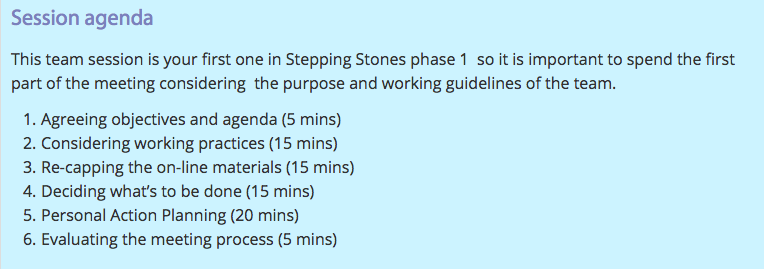
Introduction
Firstly the group members agree aims for the meeting, and quickly off-load irritations or frustrations about work that otherwise could hinder the progress and feel of the meeting.
Agreeing the agenda (5mins)
Although the agenda is usually fixed there is often discussion about particular things the group wants to achieve
Sharing classroom practice experiments… how things are going (20mins)
Each member gives a summary of what he or she has tried to achieve since the last meeting. Everyone is expected to report back to every meeting. The group question and probe their colleagues’ summaries to encourage analysis and deeper reflection. They use questions such as ‘What do you think is getting in the way? What would make this better? How could this technique be modified to make it work for you? What do you think made that work so well?’ This is not a simple show-and-tell session but rather a professional discussion based on concrete classroom reality.
Re-capping the latest online material.…new learning (20mins)
The middle section of the meeting is where the group explore new ideas that were introduced in the latest online session. These may include—the language of learning, classroom organisation, culture ideas, tracking progression—and the group works on these according to need. So this part of the meeting might include some discussion about where pupils are now according to the progression chart or whether to introduce visible thinking routines, or how to design activities to stretch the particular learning habit.
The discussion might also include identifying the ideas that are sufficiently strategic that they should be included in everyone’s plan; they become a whole school approach adopted in one form or another by all classes.
This changing middle section keeps the meetings fresh, but importantly aims to progress the breadth and depth of the approach.
Personal action planning (20mins)
In this part every member plans what they intend to try over the next month. This gives people time to think and discuss ideas perhaps with a partner. Then they design their enquiry questions and complete an action plan. Through this plan everyone is committing to do something. This part of the meeting is considered in more detail in sections d below)
Review of the meeting (5mins)
Finally the group reflect on the original objectives of the meeting to see if they have been achieved.
This structured meeting nevertheless offers you choice in what you do in your classroom and the flexibility to adapt ideas to meet the needs of your students.
A closely focused agenda
- Would you be prepared to make time for supportive meetings like this?’
- What would be likely to happen if such meetings didn’t have a focused agenda?
- Which agenda item would you think is the most valuable?
- What’s the point of everyone making a plan of action?
c) The culture of learning teams
The overall climate of the meeting has be described as ‘supportive accountability’ Emphasising these two concepts together, conveys that your ongoing learning as a teacher is worthy and necessary, that teachers are expected to work on improving their practice on an ongoing basis, and that they will be supported to do so. Supportive – to ensure you feel safe enough to share your data, tell your stories and be open to probing discussion. Accountability – to cover your commitment to undertake to develop your practice.
Hence, in the sharing practice part of the meeting:
- The group is careful to follow their agreed ground rules which might include;
- No group member can ‘pass’
- Listening between the lines when it’s not your turn
- Actively discussing everyone’s input
- Using only constructive criticism – developmental not judgemental
- Everyone fully engaged in the group
- What is said is confidential to the group
- Respecting others’ views and encouraging others’ ideas
- No-put downs
- Maintaining an open mind
The group question and probe each other’s summaries of their classroom experiments in order to encourage analysis and deeper reflection. They use questions such as:
- What do you think is getting in the way?
- What would make this even better?
- How could this technique be modified to make it work for you?
- What do you think made that happen?
In this way they support each other in changing and developing their practice.
Supportive accountability
- What else would you want to add to this list of ground rules?
- Would such ground rules make you comfortable to share and probe your classroom experiments?
d) Creating learning enquiry plans
Building personal enquiry plans is a vital part of the meeting and the resulting Action Plans are important documents that can of course be used as evidence in Performance Management.
The creation of a learning enquiry plan has two parts:
- creating your enquiry question;
- deciding what to do to make it happen.
1. When creating an enquiry question, consider:
- Where your students are now in their development of the learning behaviour;
- How you would like your students to be different;
- What aspects of your learning culture might be stopping this happen?;
- Think of the practical ideas for ways of doing something different;
- How you want your students to improve/develop/enhance in …………?.
Think of it like this:
If I do XXXX will it improve/develop/enhance YYYY?
This is the crunch question. Your students are unlikely to change unless you change!
Visualise how you want your students to be and think about what you might do, or say, or model, or value, or whatever…. differently to bring about this change in students.
Capture your learning enquiry as a question

2. Deciding what to do to make things happen
and record this in a short enquiry plan
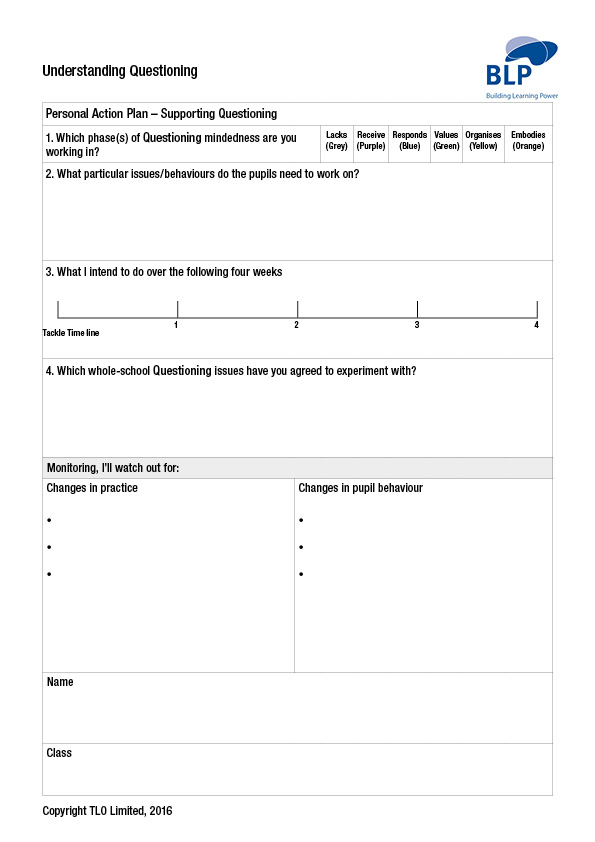
The key to such plans is to:
- keep them manageable;
- focus on a small number of things in any one plan (3 is good);
- always keep your goal (enquiry question) in mind;
- think about things you could do less of to accommodate these changes;
- make sure all aspects of the plan are completed;
- structure your action over four weeks;
- include what you will monitor…
- About yourself:
- How your actions change;
- How your motivation changes over the 4 weeks and why;
- Challenges – anything that didn’t go to plan, things you are finding tricky etc.
- About pupils:
- What they are doing/saying differently;
- Any changes in their behaviour;
- Any reactions, responses to new ways of working.
- About yourself:
The online team session offers you a range of indicators to look out for and these can be used as part of your plan.
For example:
- displaying increased curiosity;
- increased attention to detail;
- reduction in the ‘please tell me’ outlook;
- greater inclination to find things out for oneself;
- improved internet search skills;
- more precise questions that uncover the required information;
- reduction in ill-directed questions;
- increased sensitivity to the likely impact of questions;
- more ‘what if’ type questions;
- others you may have observed…
AND… it’s a good idea to share plans with the whole group to make sure you are all on the right lines.
A do-able plan
e) A learning team in action
A group of eight teachers and two learning assistants are exploring what they have been doing in their classrooms over the last month to build students’ learning power. Each one relates a story of changing practice and its impact on students.
- Kristina is excited by the wall display she has made with students about the learning muscles they are concentrating on in their split-screen lessons.
- Arnie speaks movingly about how he is adapting the way he praises students and how this is having a positive effect on how his students see themselves as learners.
- Henry speaks of his first attempts at using a split-screen approach in a couple of lessons and how he decided which learning muscle to couple with the content. He had felt a bit daunted by the prospect of teaching in a new way, but was relieved to find that students cottoned on quickly and seemed to benefit from concentrating on their individual learning habits.
- Sheena, a learning assistant, talks hesitantly about how she is trying hard not to tell students what to do, but to ask questions like ‘How else could you do that? What else might you try? What would help you to get this better?’ She says it felt as though she wasn’t doing her job to start with but over a couple of weeks she has seen the children taking more control of their learning and becoming more interested.
And so it goes on, everyone taking the opportunity to share what’s been happening—triumphs and difficulties alike. Kirsten, who is facilitating the session, helps her colleagues to tease out some of the knotty issues and explore more deeply—not just what happened, but to mull over why and how and why not.
The session moves from a familiar ‘show and tell’ format to a deeper analysis of what makes practice work and what might be needed next. It is a spirited engagement of professional colleagues who are deeply interested in what helps them to adopt new habits of teaching. They move on to planning what they will do over the coming month, and commit to meeting again to share and explore their endeavours.
A stimulating and supportive hour.
3. What are the essentials of running a learning team?
Teacher learning communities have been described as the engine of change in staff development. Effective facilitation of such teams is critical in the early stages; causing the team to work harmoniously and to greater effect.
In this section we consider the role of the team leaders; those people who have been invited to facilitate a professional learning team. The success of the whole development enterprise is often invested in learning team facilitators hence this time and space to explore it.
Key Learning Question:
What are the key functions of a Professional Learning Team leader and what makes them effective?
a) The role of team leader
Well established learning teams can work perfectly happily without a leader, but in the early stages of forming a team the leader, or facilitator, sets the scene; the expectations, the ground rules, and the emotional climate.
There’s no blueprint for a leader’s job description but basically it is to guide the team through the sessions, making sure the agenda is covered, keeping team members emotionally engaged and cognitively stretched. But how the role is accomplished can mean make or break for individual and team success.
Characteristics of a person spec might include:
- an interest in developing their own practice;
- a belief that continuous change is the new normal;
- a belief in the principles of the approach that’s being embedded into practice (whatever that might be);
- an interest in how adults learn;
- an open, inquisitive nature;
- an experienced coaching approach.
Appointing team leaders will be a critical task and sight of the notes in this section may be useful to potential candidates.
And whoever ends up leading a team it’s very, very important for the team to constantly keep in mind the big moral imperative…the why you are all doing this….i.e.to benefit children by building their learning habits so as to improve their real life chances and enable them to contribute more effectively to society. While it is important for teachers to develop and recognise small changes in students’ behaviour week by week it really helps to turbo charge the change by keep re-connecting to the moral imperative. If you don’t you’ll lose sight of the bigger picture that is inspiring the approach and that’s when a lack of focus and lethal mutations can creep in.
Over time, as the team absorbs the values and systems the role of leadership becomes more diffused. Everyone takes on those characteristics; there’s a feeling of shared responsibility to each other and the team. The learning culture of this team moves to a greater shared responsibility for learning just as classroom cultures have/are.
A key facilitator role
- What sort of close knit teams have you been a member of previously?
- What made that team(s) effective or ineffective?
- What sort of characteristics do you think a team leader should have?
- What do you think is the point of the team always re-connecting to the moral imperative of the innovation?
b) Managing the learning team agenda and culture
In section 2 we briefly considered the team agenda and what happens at each stage. Here we look at the same agenda through the role of the facilitator.
The agenda remains the same for all team meetings and it’s important to keep this rhythm. The length, the content, and the order of events etc. are all the result of research.
The culture can be described as ‘Supportive accountability’ where everyone should be supportive and feel supported. The accountability bit has to do with making the team feel serious and legitimate rather than casual, here today gone tomorrow. People need to feel accountable to themselves, to each other and to the school.
Session agenda
- Agreeing objectives and agenda (5mins)
- Sharing learning enquiries (20mins)
- Re-capping the on-line materials (15mins)
- Deciding what’s to be done (15mins)
- Personal Action Planning (20mins)
- Evaluating the meeting process (5mins)
The flow of the meeting moves from ‘settling down'(1) to ‘ how have you been doing?'(2) to ‘what did we learn online that we can use?'(3&4) to ‘ what am I planning to do next?'(5) to ‘how did our meeting go?'(6) It’s a logical flow that scaffolds the work of the team.
In the first meeting agenda item 2 is replaced with discussing the role and function of the team, how it will operate and drawing up its ground rules. There is a short paper about this.
Paperwork for the meeting. It’s useful to ensure everyone has printed and brought along their Learning Enquiry Question and Action Plan formats to complete later in the meeting. (downloadable from the online materials.)
What-Why-How-of-PLT.pdfA tight agenda to scaffold and focus change
1. Session objectives
In the initial part of the meeting the team thinks about what it wants to achieve in the time available and within the constraints of the agenda. For example:
- Feel able to apply the on-line materials in the classroom;
- Decide the strategic cultural issues that everyone needs to apply in their classroom;
- Plan some do-able shifts in classroom practice.
Five minutes or less should deal with this part of the agenda. You will need to come back to them at the end to clarify if they have been met well enough, how this was achieved and how the meeting process could be improved.
Agendas item 1. Session objectives, what you want to achieve
2. Sharing classroom experiments [ learning enquiries]
In item 2 of the agenda team members give a distilled account of their last month’s classroom activities. i.e. how their action plan played out. This isn’t a simple ‘show and tell’ session. It helps if the account covers:
- what was done;
- what was the impact on pupils:
- improvements in behaviour;
- more/renewed interest in the subject;
- greater harmony in the classroom;
- more willingness to try, and try different ways;
- Avoidance of…..
- Improvements in……
- Increases in…….
- Little of no changes in…
- There is a list of suggested indicators to look out for in each team meeting agenda:
- what the teacher learned about themselves and their students;
- What they see as the next steps.
It’s important to check that plans are being put into action; that people have time to carry them through and collect the evidence.
Some useful questions to encourage deeper thinking include:
- What do you think is getting in the way?
- What would make this better?
- How could this technique be modified to make it work for you?
- What do you think made that work so well?’
- What new mistakes did you make?
- What did you learn from them?
Agenda item 2. Sharing classroom experiments. Learning with and from each other
3. Recapping on-line materials
This middle bit of the meeting is where the team discusses what they have learned from the online session and explore together the key tasks they were asked to complete in that online session. Discussion might include:
- Where teachers feel students are secure on the learning behaviour progression chart;
- Where could students be secure by the time they leave the school;
- Classroom culture ideas;
- Activities and talk ideas;
Exploring:
- What was interesting?
- Was it understandable?
- What was tricky to understand?
- How well did we understand the Progression chart?
- Where are most of our students?
- Share coloured-in Progression charts;
- What have we learned about our students that we hadn’t considered previously?
- Are some students off the scale?
- Does anything stand out?
- What reactions did we have to the suggested Actions?
- Did we understand our role in nurturing the phases?
- Which activities feel possible/doable, impactful?
- Explore briefly which Actions we are each favouring.
It’s important to make sure that the ideas from the online materials have been understood conceptually and linked to one or more of the learning friendly classroom shifts…relationships, talk, construction, celebration.
Agenda item 3. Recapping on-line materials. Making sure it’s understood. Being excited by possibilities.
4. Deciding what’s to be done
This part of the meeting has two important functions:
- Talking through ‘what I fancy trying with my students’ based on where students are at, the culture shifts that might help and any appropriate actions/activities from those suggested;
- Decide which of the ideas will have most impact if they were done by everyone as a whole school approach? In other words they become strategic.
The point here is to recognise that some of the ideas are more strategic than others as they make more impact if they are adopted and adapted by everyone. For example in this early phase of establishing perseverance understanding being ‘stuck’ is a interesting place for a learner to be should become a strategic approach attended to in every classroom.
So the point is to decide which approaches you want to make strategic (everyone does it in some form), and those that will remain with particular teachers.
Making these discussions open ensures everyone has an idea of what people want to try and also has a hand in suggesting ideas that everyone should do. These ideas need later to be discussed with senior managers since putting them into practice across the school is a significant management decision and possibly a policy issue.
Agenda item 4. Deciding what’s to be done. Deciding what to do, personally and whole school.
5. Personal action planning
This item falls in to two parts:
- creating an enquiry question;
- making a learning plan.
Both of these items are dealt with in the next tab box section.
5. Personal action planning
5.1 Helping sort out enquiry questions
Rather than simply deciding to introduce something new into the classroom because it sounds interesting, the plan is given specific focus through the creation of a question. Why a question? Because this is an enquiry, you want to find out if something will change (student behaviour) if you change something specific.
The facilitator will guide team members through questions like:
- Where are your studens now in their development of the learning behaviour?
- How would you like your students to be different?
- What aspects of your learning culture might be stopping this happen?
- Think of the practical ideas for ways of doing something different
- How you want your students to improve/develop/enhance in …………?.
Think of it like this:
If I do XXXX will it improve/develop/enhance YYYY?
This is the crunch question. Students are unlikely to change unless the teacher’s behaviour changes!
Suggest team members visualise how they want their students to be and then think about what they might do, or say, or model, or celebrate, or whatever…. differently to bring about this change in students. You could think of them as If/ THEN statements.
- If I create stuck prompts with my class, then will their reliance on me be reduced ?
- If I allow students to ask only one question of me in any lesson, then will their willingness to seek answers for themselves improve ?
- If I unpack the meaning of ‘effort’, then will pupils adopt the ideas and make more effort?
- If I re-frame mistakes as valuable aids to learning, then will their fearfulness diminish or disappear?


Learning enquiry questions can be captured in this format

5.1 Helping sort out enquiry questions to focus the plan.
5.2 Do-able learning plans
The learning enquiry plan creates a record of what will be done and as such is an important document.
Research has shown that it is important to allow teachers:
- choice about what they do within the suggested range;
- flexibility to adapt a suggested activity to meet the needs of their students;
- make the plan specifically focus on development;
- concentrate on a small number of actions (3 is good);
- shrink overblown plans – keep the change manageable.
It’s useful to ask members what they are going to do less of in order to accommodate the changes.
The plan represents a promise to do it. This promise keeps the plan as a priority in the mind of the teacher.
The plan should also record what the teacher will watch out for over the next four weeks. What they will monitor about themselves as they change their practice and what they will monitor about changes in their pupils. Noting such change motivates teachers to continue with their experiments since the changes in pupils are almost always positive.
The learning enquiry plan can be recorded on this format.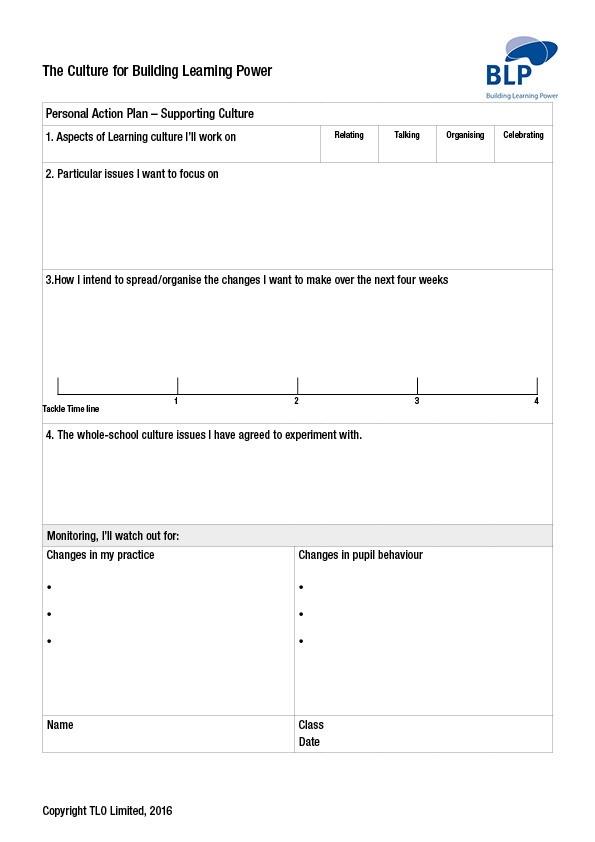
5.2 Ensuring do-able learning plans
6. Evaluate team session
Finally at the end of the session the team needs to evaluate their team process.
- did we meet the objectives?.
- how well did we keep to the ground rules?
- how could we have managed x or Y more productively?
- is everyone feeling okay?
- reminder of date of the next meeting.
Having this item ensures the team is itself managing its learning process.
6. Evaluate team session. Could we improve our team working practice?
- Does the ‘flow’ of the meeting make sense to you?
- Which agenda item will be the trickiest to facilitate?
- Which agenda item will staff need most help with?
- Which facilitation skills might you need to brush up on to support your colleagues effectively?
- Can you prepare more ‘If I do XXXX will it improve/develop/enhance YYYY’ enquiry questions in order to better illustrate this aspect of the action plan?
- How might you help colleagues who are finding it hard to develop their own enquiry question?
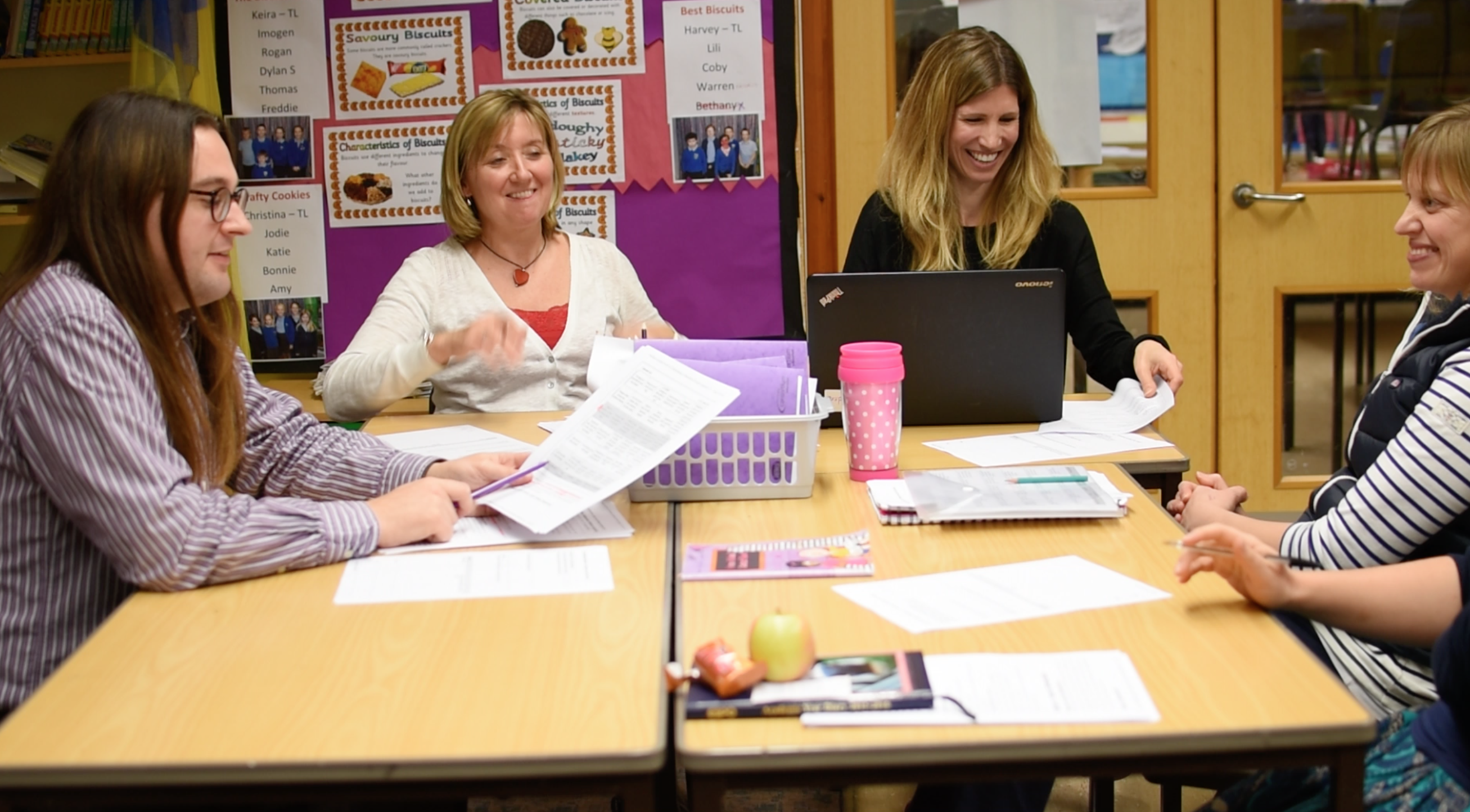
c) Learning teams at work
This Professional Learning team are thoroughly engaged in their second meeting as a team. They have been able to work productively by following the agenda. Here they are discussing agenda item 4. They are working out which whole school strategies they are already using and what more they have to add to improve things. They go on to sort out what they each want to try next before making more detailed plans.
A team at work
4. What does the blended learning programme consist of?
Guided by best practice thinking in professional development, the blended learning programmes support a consistent school-wide approach to developing students’ learning behaviours. The success of these core programmes depends on a genuine working partnership.
Our contribution is to organise learning research from schools into practical, do-able online sessions that teachers and support staff learn from to guide their changing practice. The school’s contribution is to recognise the need for culture change and to support regular Professional Learning Team sessions; offering staff time to discuss, share and plan learning enquiries and changing practice.
This section is about the content of the online course(s) and what we hope you will be able to achieve over time.
Key Learning Question:
How is the content organised and how can I make the most of it?
a) Content of the online Stepping Stones Phase 1 programme
This Stepping Stones programme attempts to solve the challenge of designing a professional development model that can faithfully disseminate the content of building better learners, while also providing sustained, meaningful assistance to teachers who are attempting to replace long-standing habituated practices with more effective ones. Hence it is a blended programme of online content and in-school support for learning teams.
The first phase of the programme is titled Stepping Stones Phase 1 Introducing Key Learning Behaviours. It consists of nine sessions and is expected to take about a year to complete. The programme aims to enable your pupils to make deep and solid progress in four key learning behaviours…perseverance, collaboration, questioning and revising[also known as refining]
The course covers;
learning friendly classroom cultures
four key learning habits
reviewing your progress
What is in Stepping Stones 1?
The course covers four key Learning Habits:

Perseverance
Perseverance is key to the learning journey. It is vital that pupils are able to get to grips with the knotty emotions of learning, and can view and use them positively as aids to the journey, not as setbacks.

Collaboration
At its least sophisticated, collaboration is little more than being cooperative. At its most sophisticated and complex levels it goes beyond learning ‘in a team’ and becomes learning ‘as a team’. It is an invaluable life skill.

Questioning
The desire to ask questions to satisfy innate curiosity is alive and well in very young children, as any parent of a 3 year old will readily confirm! Explore how we can ensure that questioning remains alive and builds into a full blown inclination to explore and learn about the world.

Revising
Pupils need to learn how to deal with change, emotionally and practically. With an inflexible frame of mind they are unlikely to recognise the need to change their ideas or the way they do something. They also need to know what ‘good’ looks like; how to keep an eye on how things are going and evaluate how things went against external standards.
How the online programme works
The Stepping Stones Phase 1 programme consists of nine online sessions, each expected to take about a month to implement in classrooms. Each online session is divided into four sections:
Three individual teacher sections
Teachers work their way through the materials at a time and place to suit them. Each session will usually take about 30-45 minutes to work through and think about. The materials introduce new thinking and practical ideas for staff to get their heads around prior to their team session.
A Professional Learning Team meeting section
This brings staff together as a learning team at monthly intervals (typically six to eight staff per team), convened and led by a learning champion from your school. Staff share and discuss how they have moved their practice to incorporate learning behaviours, consider new material introduced in the individual online learning sessions, and plan their learning enquiries to be implemented in the next month. Each team session is planned to last about an hour.
The online sessions consist of:

a) A Culture for building Powerful Learners
Best used as the first session, this module is designed to guide you through a process of understanding, assessing and improving your classroom learning culture; making it more learning friendly in order to build your students’ learning power. Unpick the meaning of classroom cultures; use a learning power culture instrument to assess where your classroom culture is now; ready your culture for learning.
Unpick the meaning of classroom cultures; use a learning power culture instrument to assess where your classroom culture is now; ready your culture for learning.
- Learning cultures. A big shift? Unpick the meaning of classroom cultures, what they might consist of and the big shifts that may be needed to develop better learning. Use the culture tool to estimate where your classroom culture is now.
- Learning friendly cultures; Lots of little shifts. Find out about the four big dimensions of culture and use the culture tool 2 to estimate the sorts of shifts your classroom culture would benefit from.
- Your classroom culture. Some ideas to get you started. Look for ideas to strengthen your learner/learning classroom culture.
- Team reflection and planning. Share the results of your culture analysis with colleagues. Make plans for what everyone needs to do and what you will each do individually.
b) Progress in Perseverance
Perseverance is key to the learning journey. It is vital that pupils are able to get to grips with the knotty emotions of learning, and can view and use them positively as aids to the journey, not as setbacks.
This mini-unit is an information unit, it does not suggest practical ideas for improvement. As such it should be coupled with one of the four perseverance sessions below.
The Unit aims to:
- help teachers to explore the components of the big picture of perseverance, how it’s made up
- analyse where their students currently function in relation to progress in perseverance
- look briefly at their own practice in developing a perseverant friendly culture
The following sessions delve deeper into Perseverance helping pupils to improve their attitudes to learning.
The following four sessions delve deeper into each aspect of perseverance, helping you to develop and grow pupils’ learning-friendly attitudes.
b1) Engage students in unsticking their learning.
This session aims to:
- help teachers to analyse how their students’ behave and feel about being stuck;
- help teachers to analyse how their students’ behave and feel about being stuck;
- look at their own classroom practice in developing a ‘stuck’-friendly culture;
- suggest practical strategies to increase students’ skill and confidence in dealing with being stuck;
- assist teachers to adapt their practice using a learning enquiry method (Team reflection and planning).
b2) Engage students in rising to the Challenge.
This session aims to:
- help teachers to analyse how their students feel and behave when faced with challenge
- help teachers to analyse how their students feel and behave when faced with challenge
- look at their own classroom practice in developing a learning-challenge-friendly culture
- suggest practical strategies to increase students’ skill and confidence in dealing with challenge• assist teachers to adapt their practice using a learning enquiry method (Team reflection and planning).
b3) Engage students in Managing Distractions.
This session aims to:
- help teachers to analyse their students’ awareness of and strategies for being distracted
- help teachers to analyse their students’ awareness of and strategies for being distracted
- look at their own practice in developing a learning culture that helps students to maintain focus
- suggest practical strategies to increase students’ skill and confidence in dealing with internal and external distractions
- assist teachers to adapt their practice using a learning enquiry method (Team reflection and planning).
b4) Engage students in achieving Goals.
This session aims to:

- help teachers to analyse how their students’ think and feel about pursuing goals
- help teachers to analyse how their students’ think and feel about pursuing goals
- look at their own classroom practice in developing a goal friendly culture
- suggest practical strategies to increase students’ skill and confidence in pursuing goals
- assist teachers to adapt their practice using a learning enquiry method (Team reflection and planning).
The following sessions explore how build on and grow the key learning behaviours:
c) Putting Collaboration into Learning.

At its least sophisticated, collaboration is little more than being cooperative. At its most sophisticated and complex level it goes beyond learning ‘in a team’ and becomes learning ‘as a team’. It is an invaluable life skill.
This session is designed to guide you through a process of building the habit of Collaboration in your pupils. Sections 1 – 4 consider:
- Collaboration and how it develops. Unpick the meaning of Collaboration, how it develops over time and use the Collaboration chart to plot where your pupils are now.
- Taking Collaboration into classroom culture. An introduction to the classroom culture that nurtures Collaboration. Check what you do now.
- Introducing activities and routines that will build Collaboration into learning activities/tasks.
- Team reflection and planning. Share the impact of your experiments with colleagues and plan what you need to do next.
d) Putting Questioning into Learning

The desire to ask questions to satisfy innate curiosity is alive and well in very young children, as any parent of a 3 year old will readily confirm! Explore how we can ensure that questioning remains alive and builds into a full-blown inclination to explore and learn about the world.
This session is designed to guide you through a process of building the habit of Questioning in your pupils.
- Questioning and how it develops. Unpick the meaning of Questioning, how it develops over time and use the Questioning chart to plot where your pupils are now.
- Taking Questioning into classroom culture. An introduction to the classroom that nurtures Questioning. Check what you do now.
- Introducing activities and routinesthat will build Questioning into learning activities/tasks.
- Team reflection and planning. Share the impact of your experiments with colleagues and plan what you need to do next.
e) Putting Revising into Learning
 Pupils need to learn how to deal with change, emotionally and practically. With an inflexible frame of mind they are unlikely to recognise the need to change their ideas or the way they do something. They also need to know what ‘good’ looks like; how to keep an eye on how things are going and evaluate how things went against external standards. This session is designed to guide you through a process of building the habit of Revising in your students.
Sections 1 – 4 consider:
- Revising and how it develops. Unpick the revising chart and plot where your pupils are now
- Taking revising into classroom culture. Think about how to improve your classroom culture to better support revising.
- Teaching for learning; activities and talk. Look for ways of building revising into learning activities/tasks and the learning language.
- Team reflection and planning. Share the impact of your experiments with colleagues and plan what you need to do next.
The final session in Phase 1 is designed to enable you to review your progress so far.
f) Reviewing our progress
 A rich variety of tools help you review your progress in developing a learning culture in your classrooms. This review will provide you with relevant information on which to base your approach in the next phase of building pupils’ learning powers. Sections 1 – 4 consider:
- Reflecting on your changing practice. Looking at what you have done and how your classroom has changed. This section answers the question “How far have you come?”
- Giving pupils a voice. Finding out how your pupils have benefitted. This section answers the question “How well have the pupils taken to this way of learning?”
- Learning with and from colleagues. Learning from learning walks and observations. This section answers the question “What are the variations on the theme and what can I learn from these variations?”
- Team session: Learning together. Putting your heads together and thinking “what next?” This team session answers the questions “How are we doing, how are our pupils doing and where do we need to go next?”
As a result of working through these nine sessions you can expect your pupils to make solid progress in learning habits, have a working learning vocabulary, purposefully use their learning behaviours and have adopted some of the strategies of powerful learners.
The sessions vary slightly in amount or difficulty of content but you can expect to have to spend about an hour reading, thinking, absorbing and linking the content.
Each monthly session is divided into;
Three individual teacher sections
Section 1: How the learning habit develops
Section 2: A learning friendly classroom culture
Section 3: Teaching for learning; activities and talk
And one Professional Learning Team meeting section
Section 4: Team reflection and planning
Teachers work their way through the materials in sections 1 – 3 at a time and place to suit them. The material will usually take about 45-60 minutes to work through. They introduce new thinking and practical ideas for you to get your head around prior to the team session.
Here’s what you will find in the four sections:
Section 1: How the learning habit develops
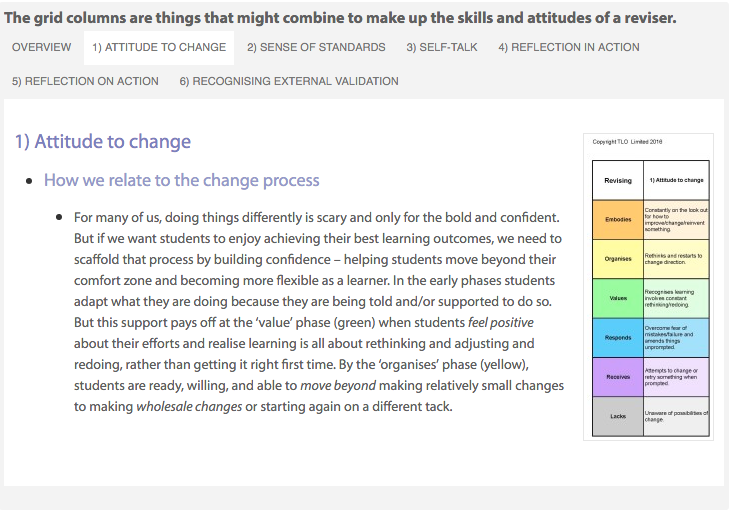
Section 1 introduces you to what the learning behaviour is about and what progress in that learning behaviour looks like, what a habit looks like in its early stages and what it looks like as it improves through time….given the right encouragement and culture. You are asked to plot where your pupils are now in their use of the behaviour.
This section offers a concise way of getting to grips with the learning behaviour and how it progresses. It’s likely to take about 20 mins to get your head around it.
Section 2: A learning friendly classroom culture
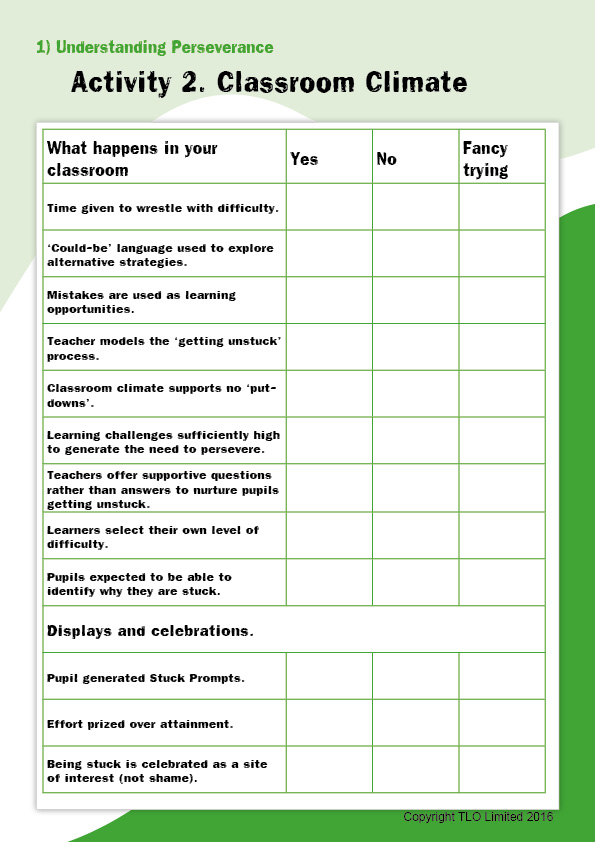
This 2nd section invites you to think about your classroom culture and how you might shift it to making it more learning friendly for the particular learning habit. This section should take about 10 minutes.
Section 3: Teaching for learning; activities and talk
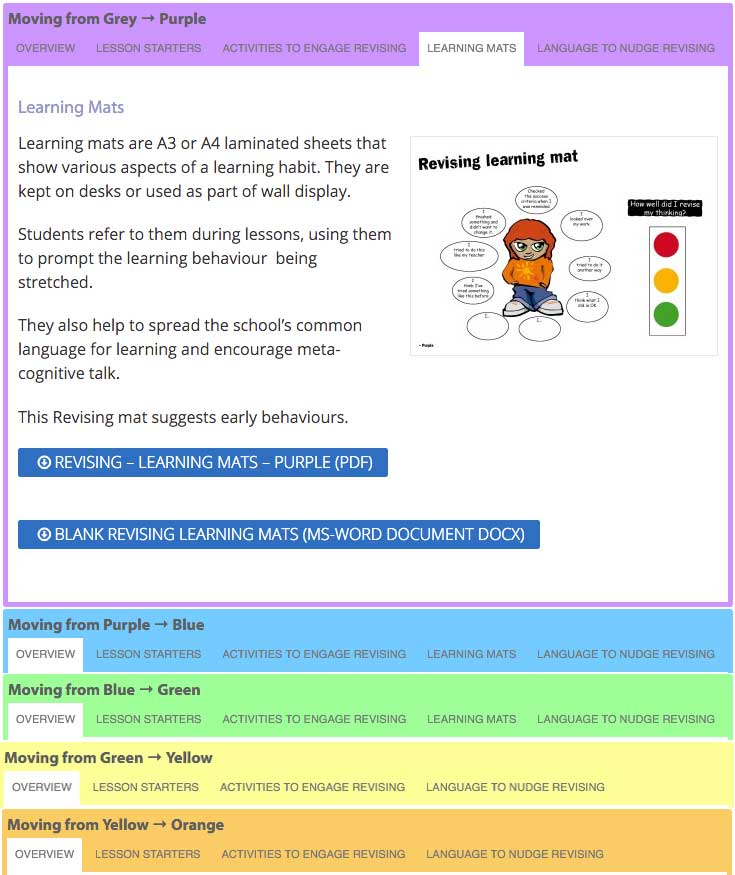
This 3rd section offers; ideas for lesson starters/quick wins; classroom activities; learning reflection tools; ideas for the appropriate learning language for each phase progression in the learning habit. You are likely to browse in this section for about 30 minutes in preparation for the team meeting.
Section 4: Professional Learning Team meeting
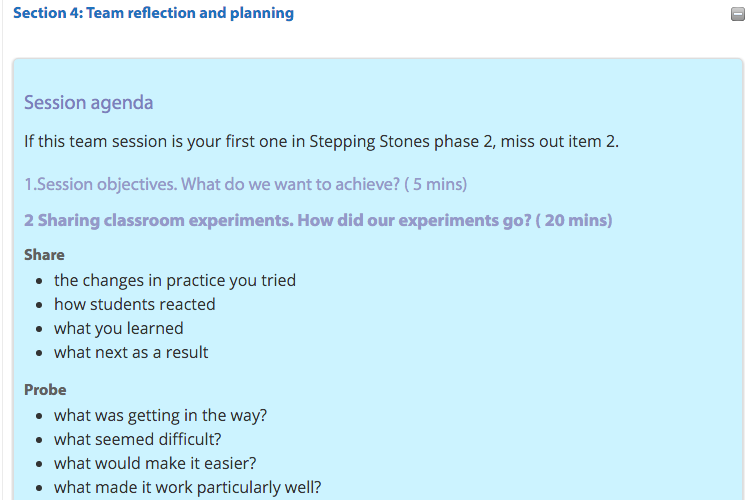
The final section gives a skeleton plan for the Professional Learning Team session (usually undertaken about a week after the individual online sessions) It includes downloadable enquiry question and planning formats. In team sessions you are invited to share the impact of your classroom experiments with colleagues, discuss the online materials, and plan how you might use these to change your classroom practice. All the activities are designed to help you bring the learning behaviour into active use in the classroom. The section also includes a range of indicators that you could start looking for to begin to measure the impact of teacher development across the school. The team sessions are timed to last about 75 minutes.
You can actually view a session here
b) Content of the online Stepping Stones Phase 2 programme
The second distance learning programme in the Stepping Stones series again consists of nine online sessions, each expected to take about a month to put into practice. The sessions give easy to access information about one learning behaviour, suggestions for making classrooms learning friendly and lots of activities to try out. Staff are thus armed with ideas to support their efforts to develop a learning friendly culture and apply a more forensic approach to learning. This in turn helps learners to build their own learning habits.
The effect of phase two Stepping Stones is to;
- deepen the learning positive culture the school established in phase 1
- step up the change process through learning teams
- strengthen the growing expertise across the school
- ensure a focus on a proven right track
- build pupils’ learning character across a broader range of behaviours.
How it works
The Stepping Stones Phase 2 nine online sessions, can be spaced out over a year, or more. The solid foundation and understanding the school established in Stepping Stones Phase 1 means that Phase 2 can move much more quickly and you can introduce a new learning habit into classrooms each month. You can also choose which order to do the sessions in, so teams can follow their own needs and ensure best fit with their pupils’ progress.
Going faster, going deeper
The sessions are about the following learning habits:








Each session is organised in exactly the same way as the Phase 1 sessions. This helps you to get your head around things more quickly without the need to sort out what’s what.
c) Making sure its working
Within each phase of the Stepping Stones course there is a session that is a little different. It is designed to help you review your progress in developing a learning culture in your classroom and the school more widely
There are a rich variety of tools and techniques to help you estimate the effect and impact of changing your practice. The review will provide you with relevant information on which to base your approach in the next phase of building pupils as better learners.
The Review session includes;
Reflecting on your changing practice, looking at what you have done and how your classroom has changed. This section answers the question “How far have you come?”
Giving pupils a voice Finding out how your pupils have benefitted. This section answers the question “How well have the pupils taken to this way of learning?”
Learning with and from colleagues Learning from learning walks and observations. This section answers the question “What are the variations on the theme and what can I learn from these variations?”
There are at least eight ways in which you might reflect on your changing practice and collect evidence to support or question your views. Of course you won’t be able to use all of these tools – time would prohibit this, but do we suggest that you look at all the ideas and consult with other members of your team before deciding which tools to select.
Key point…. look at some of the review tools before you start the online course. This will give you an idea of the sort of progress you should be making in the future.
Check out expectations of progress before you start.
1. Where are you now?
Key Learning Questions:
How goal focused are my students?
How goal friendly is my classroom culture?
How could I develop a more goal friendly classroom culture?
Goal Orientation
Goal oriented people can see the outcomes they are trying to achieve clearly and vividly in their minds and apply themselves vigorously to achieving them. A goal without the will is wishful thinking. The will without a goal means rapidly fading interest. Goals need motivation in order to be realised, motivation needs a goal if it is to remain focused.
Students are often able to apply themselves to their own projects, but can lack such purpose and motivation when it comes to learning in school. The same child who purposefully wrestles with a computer game one minute can become an uninterested ‘spectator’ in the next lesson – why? What makes us want to achieve something, glad to put in the effort, happy to spend hours of practise, or just content to keep going. What types of goals make the difference? Research shows that performance related goals are less likely to engage and motivate than are learning related goals. Goals that relate to knowing stuff or achieving particular outcomes (like a target grade) – performance related goals – are less motivating than goals that relate to being able to do something – learning related goals. Whereas performance goals provide hurdles to be overcome, leading to a focus on ability as defined by one’s hurdle jumping skills, learning related goals encourage effort where success is defined by the sort of effort deployed rather than the height of the hurdle that is cleared. So, how can we help students to engage with curricular challenges in such a way as they become their own learning goals.
The two questionnaires in this section aim to help you analyse:
- How goal orientated your students appear to be, and what this reveals [Questionnaire 1 Goal Questions]
- How learning goal friendly your classroom culture appears to be and what this might suggest. [Questionnaire 2 Culture Questions]
Results from these questionnaires will suggest a focused range of moving forward suggestions.
2. Ideas to Practise
Key Learning Questions:
What could I do differently to engage students in working towards clearly defined goals?
 In this section we explore a range of ideas, activities, ways to display, and things to say about goal orientation. The ideas aim to deepen your learning friendly classroom culture, helping to support and strengthen your students’ ability to work towards goals.
The ideas to practise are grouped in two ways –
In this section [2]:
The four phases of learner behaviour (we have left the most advanced one, ’embodies’, out):
- Receives ( purple) Do as they are asked;
- Responds ( blue) Acts more willingly;
- Values ( green ) Values the behaviour;
- Organises ( yellow) Organises themselves to use the behaviour effectively.
This grouping will enable you to look at all the ideas linked to a phase of development
In the following section [3] –
The ideas are grouped by the four shifts in teacher behaviour:
- how you relate to students;
- how you talk to students;
- how you construct learning opportunities;
- how you celebrate learning.
This grouping will enable you to look at one type of teacher behaviour shift across all student development phases
Most of the ideas to practise are not phase-specific and can be used, or readily be adapted for use, with students of any age. Have a rummage through the sections to see what you can find. As you do, keep in mind what your students do now in relation to identifying and pursuing goals. Think about, what do you want them to be able to do that they can’t or don’t do now?
3. The culture sort
Key Learning Questions:
What could I do differently to engage students in realising the value of working towards goals?
The four shifts in teacher behaviour:
- how you relate to students;
- how you talk to students;
- how you construct learning opportunities;
- how you celebrate learning.
This grouping will enable you to look at one type of teacher behaviour shift across all student development phases.
Have a rummage through the sections to see what you can find. As you do, keep in mind what your students do now when they are stuck. Think about, what do you want them to be able to do that they can’t or don’t do now?
This dimension of the learning friendly classroom concerns learning becoming a shared responsibility. As a teacher you will be giving students more responsibility for their own learning by: Shifting responsibility for learning ensures students recognise, use, understand and grow their learning habits. The classroom gradually becomes a learning community where everyone is learning from each other and growing more confident as learners as a result. The ideas below have been included for their effectiveness in helping to unhook teacher-student dependency and shift more responsibility for learning to students. The coloured lines bounding each idea suggest the progression phase the ideas might best secure. Planning in its simplest form means we have something to do, we have thought about what we are going to do. Hence in teaching children how to plan we are teaching them to be thoughtful about what they are doing and to be best prepared to achieve success. Planning can begin at an early age. The High Scope pre-school/nursery programme has planning built in to daily activity. Children learn that through planning they can bring order, structure and predictability to their world even if it is just in the prepared environment of the classroom. They are no longer passive recipients of information about what to do, but can be active in planning purposeful activities. If we want young learners to strike out and achieve curriculum goals we need to alert them the tools to do just that. i.e. knowledge, understanding and improvement of their learning behaviours. Younger learners need physical prompts or hooks for many invisible concepts including learning. Several schools use physical tools since tools are what adults use to help out with many jobs. Tools help children to connect with the idea of their learning powers in a tangible way. Use real toolboxes from a DIY shop and gather items to represent just some of the learning capacities i.e. those that you are particularly wanting younger children to use each day. For example: Introduce the items to the children one at a time as the learning behaviour it represents fits with a part of the classroom culture you want to strengthen. Later ask children ‘Which learning tools will we need to help us today?’ They are soon able to go and fetch the notebook that represented planning before going outdoors to build a rocket. Instead of using tools develop a set of icons to represent the learning behaviours. Such icons could be used: • What icons for learning power capacities would your students respond to? • Would you want to stick to one set of icons for the whole school or use a different set for each year group or phase? • Could your older students design a set of their own that could be used throughout the school? • Clip art has proved a valuable place to look for ideas. Telling your learners about some of your own real life problems becomes a powerful motivator and a useful tool for discussing alternative plans of actions. One way to start off the week is to share with students one or two real life problems you had to deal with over the weekend. Your students will be fascinated. It helps them to see you as human and with problems and importantly that these problems could be shared and talked about. ‘If – then’ display example, Heathcoat Primary school Tiverton If we want students to change their behaviour we need to help them to think much more closely about the ‘hows’ and the ‘whats’. Motivation research proposes an effective solution called ‘if-then’ planning. ‘Ifs’ are the situations you want to remind yourself about. They are the triggers that stimulate the ‘Thens’ ‘Thens’ are what you will do about something, the action you will take whenever the ‘If’ happens. Research on motivation and goals from Harvard University shows how our brains work to achieve our goals. Basically it says that goals need to be very clear and our brain ignores a goal if it’s unclear about what to do. Brains act on goals only when what to do is clear. So, goals like ‘Lose weight’ or ‘Exercise more often‘ or even ‘Aim high’ are too nebulous. They beg the question ‘how’ or ‘what do I do?’ When setting a goal you need to specify not only what you will do but also where and when you will do it. If (or when) [___situation__], then I will do [___behaviour__] So going back to our goal about losing weight, we need to know much more about the ‘how’ and the ‘what’ and the ‘how to’ of losing weight. An If-then statement or goal might be ‘If I get the pudding menu, then I’ll ask for coffee’. This may sound a bit cumbersome to start with but research suggests far more goals are achieved by using ‘if-then’ planning. And the clever bit is that this builds self-talk at the same time. You do what you are telling yourself to do. The ‘if-then’ plan succeeds because the situation and the action become linked in the mind. The brain recognises the situation as an opportunity to advance the goal. When the situation is detected action is initiated automatically. “If-then’ plans become “instant habits”. If I’m not sure what my goal is, then I will try and picture it ( visualise) in my mind ( head) If I’m am going to start working on a goal then I will think about what and how I need to do it. I’ll make a plan even just in my head. If I’m getting confused about a goal ( outcome, objective) then I will look at the success criteria to help me get back on track.. Establish a convention of shapes and colours linked to elements needed for a good plan, e.g. green arrow for your Share something that you personally are trying to achieve, and how you are going about achieving it. Talk about plans, milestones, stumbling blocks, resources, time frames etc. The key ideas to get over are: One of the first ways of surfacing learning, putting it on show, is to focus on how you are modelling being a good learner to students. Modelling is all the ways in which teachers demonstrate how they are a learner too, in this case a person who confidently pursues a goal. It’s important that plans provide a starting point. A clear beginning or focus shows a student where and how to start and what to do, and what steps or actions to take. The aim of the plan is to liberate the student from direct teacher assistance. Plans are not only a teaching device but aim to provide a means for independent learning. A good plan contains; Without the monitoring and evaluation components the plan remains just a set of directions for a given task. A good plan is strategic and includes skills that can be applied in a number of contexts. FAME – Focus, Act, Monitor, Evaluate. You can of course include more steps e.g. 2 for focusing or 3 for acting. Having too many steps becomes confusing. Keep the magic number 7 in mind A good way to introduce this type of planning is for the teacher to do a very detailed one and then ask students to simplify the steps in their own words Once students understand the planning process and have used them for a number of purposes they will become more proficient and confident, developing skills in; For the same bit of curriculum content, provide tasks that are designed to offer low, medium and high challenge ( or mild, spicy, hot) and encourage students to decide on the level of challenge they wish to undertake. Use this as an opportunity to encourage them to set their own learning goals. SOLO Taxonomy (structure of observed learning outcomes) is sometimes used to help teachers to structure tasks with varying levels of challenge. At the unistructural level, only key aspects of the task are explored At the multistuctural level, several aspects of the task are explored but their relationships to each other and the whole are not. At the relational level, the aspects are linked and integrated, and contribute to a deeper and more coherent understanding of the whole. At the extended abstract level, the new understanding at the relational level is re-thought at another conceptual level, looked at in a new way, and used as the basis for prediction, generalisation, reflection, or creation of new understanding. Four levels of challenge. Four goals for students to choose between. To move beyond peer assessment towards whole group assessment: Set this up with plenty of notice and make it clear to students that their work will be seen by an audience. Agree with students a valid set of success criteria for their work. This could then be used to drive and sustain their progress through the unit. Include opportunities to draft/edit/improve Use Kind, Specific, Helpful critique for feedback (as in Ron Berger’s Austin’s Butterfly) The audiences could be: Here’s a simple, straightforward way of showing the purpose of learning objectives or goals…simply add SO THAT at the end of the objective. The SO THAT is similar to the why. It aims to offer a wider reason for pursuing the learning objective. So an objective becomes… Make sure students understand that changing plans (revising) is an okay thing to do and that changing their plans in order to achieve their end goals is often necessary. Sometimes of course the set back is such that the original goal becomes unattainable and needs re-casting in a more achievable form – this requires maturity and bravery. Changing an end-goal inevitably leads to having to revise, in the form of start from scratch, the original plan. Many people, let alone students, are reluctant to undertake such root and branch changes, and erroneously rely on minor amendments to plans in the hope that small tweaks will produce the necessary impact. Constant monitoring of the plan and the goal can counteract this tendency. In order to reach the goals of progressing in their learning – be it content or process – students must be able to self-regulate their own learning. Teachers need to provide helpful feedback to enable pupils to do this. By Lori Yerdon Whatever the subject modelling ‘how to’ is given added value when linked to the learning behaviours that make for successful performance. Take on the role of an intelligent novice and model performance at a slightly higher, more coherent and informed level than is characteristic of your students. Model your ‘think alouds’. Try the following steps for whatever skill you are modelling; This dimension of the learning friendly classroom concerns using the language of learning, As a teacher you will be: The more richly children come to relate their own learning the more they see and take hold of their own role in it. The ideas below have been selected for their effectiveness in helping to surface the learning process and deepen the language of learning. The language of learning can help teachers to think about how they might talk in a way that helps to cultivate the learning behaviours and help pupils to gain a better personalised understanding of content. If we want children to take some responsibility for their learning we need them to relate to what they are learning and involve their personal interests. At this stage in the progression of goal setting, they are reliant on goals set by others – we need to sow the seeds for them to begin to set their own. One way that has proved effective is to ask “you-questions’ which aim to help students identify with the subject matter. Such questions should be addressed to the student and relevant to their personal interests, feelings and experiences. They should invite opinion, knowledge and experience. Visualisation or mental imagery is a way of conditioning your brain for successful outcomes. The more you mentally rehearse your performance, the more it becomes habituated in your mind. Think of visualisation as a pre-activity walk-through, helping you to think through what you will be doing and what you want to achieve in advance of actually doing it. It can be used to eliminate some of the unknowns and allows the student to rehearse the future in their mind’s eye. Try the following simple ideas to get students thinking and talking about the future: is a question that children rarely know the answer to. The most common answer is ‘because my teacher told me’. Children do things on the whole without knowing why. They inhabit a classroom environment whose purpose is activity but don’t know the reason for the activity. If we want our students to take on learning goals as their own we need to broaden their thinking about why they are doing something. Broaden their perception by seeking to identify the purpose of our thinking and learning. Discuss things like; Then move into planning mode Develop the willingness to accept and attempt externally generated goals with language like: As they are deciding what they are going to do and how they are going to do it, use phrases like: What I hope students will do as a result of this lesson becomes What I expect students to be able to do as a result of this lesson When you ask students to set their own goals ahead of the lesson ask them to think through the frame In this way they can begin to own their ambition Other expectant language could be: As a result of today’s lesson (learning outcome) I can.………..so that I will.……… An If – Then suggestion. If I am finishing a piece of work, then I will reflect on how I did it and how I could have done it even better. If I am near to finishing something, then I will stop and ask myself whether it will meet my expectations. If I complete a piece of work, then I will ask myself what I have learned from the way I chose to tackle it. This dimension of the learning friendly classroom concerns how you design learning episodes/lessons/projects. As a teacher you will be: The classroom becomes a place where young people learn that to struggle with a problem is ultimately satisfying and brings its own rewards. The ideas below have been selected for their effectiveness in helping surface the learning process. The coloured lines bounding each idea suggest the phase of development and the order in which they might best be introduced. Every good teacher is in the habit of planning lessons around the delivery and development of subject specific learning objectives. Too often, what pass for learning objectives are no more than statements of what will be covered during the lesson and what students will have been required to do. Learning objectives should be concerned with the statement of what will have been achieved and understood by the end of the lesson or unit of learning. In other words, what students will be able to do as a result of their own efforts and the teacher’s effective management of learning. Rather than presenting learning objectives aridly to students at the beginning of lessons, enable them to realise what the objectives are and how they apply specifically to their individual learning needs. Many of the suggestions in this unit aim to do just that. The world of goals is flush with terminology which is used indiscriminately, interchangeably and often confusingly. Before anything else it would pay to get the language of learning goals sorted throughout the school, with everyone using the same terminology in the same way and to mean the same thing. Learning objectives are: But how will we know we have achieved the goal or outcome or objective? ● What shall we count as success ? ● How shall we know we are on the way ? ● What detectable difference do we expect to see ? These questions point to the need for success criteria or ‘what a good one looks like’. Success criteria describe and illuminate the learning objective and can be used to assess progress; they put flesh on the bare bones of a learning objective. Identifying ‘what a good one looks like’, enables students to glimpse the future and think about the upcoming learning journey. Whereas learning objectives tend to outline what is going to be learned, success criteria should describe how well you will be able to do once the learning objective has been achieved. Success Criteria are: Setting a goal that the learner has little or no motivation to achieve is unlikely to lead to success. What is needed is learner buy-in to goals. Evidence shows that goals that relate to doing something or researching something, or creating something . . . ) are better motivators than goals that relate to knowing something or passing / doing well in a test. Putting the ‘how’ before the ‘what’. So – a goal relating to ‘understanding xxxxx’ or ‘knowing yyyyy’ is less likely to motivate a learner to make the effort than a goal that starts with some indication of the sort of ‘effort’ or way of doing something; Where ‘knowing goals’ place the emphasis on the successful acquisition of knowledge or creates a pass/fail scenario, the ‘doing goals’ focus on how – something to do rather than something to know. Have a look at some real examples just to give you a flavour of this technique With a partner, use your reasoning skills to explain why all prime numbers, with the exception of 2, are odd. Use your noticing skills to identify three similarities and three differences between these two images. By using what you already know and your imagination to generate ideas, tell the story of the fire of London from the perspective of a young child living in London at the time. What you are doing here is beginning to pay some attention to how students will be learning as well as what they will be learning. This linking of how and what will come to play a central role in building students learning power later in your learning journey. Use the following questions to explore this in almost any story; Extend this to asking the children what plan they could think of if they were, for example, one of the three little pigs. This activity is about children planning something together, the subject, though enjoyable, is irrelevant. The activity is also a strong collaborative activity and will lead into revising when plans have to be changed. Amongst all this planning activity it’s important to start children thinking about achievement too. Invite your students to brainstorm their own definitions and come up with a list. An achievement is something; Notice that all these are aimed towards a growth mindset. Make sure your praise matches these statements. You could use any one of these to group children’s learning on a wall display. See #3 below. Setting goals with learning in mind Lessons have two key purposes: This has been true for all time whether or not the teacher (or learners) are aware of the learning behaviours that are being invoked. The difference is that a learning-power-aware teacher thinks through; In other words, the goal of the lesson has both a content and a learning dimension. In planning terms, the teacher has made a shift from thinking; From ‘what do I have to teach and how am I going to teach it?’ To ‘what do I have to teach, how will they best learn it, and how am I going to teach it ?’ Infusing learning with content in lesson design This is the beginning of what is sometimes called ‘infusion’ or ‘split-screen’ teaching. It is about the teacher becoming increasingly aware of the learning behaviours that the topic / lesson / tasks will exercise, bringing these learning behaviours into the foreground, and so making students aware of the learning behaviours that will be needed for curricular success. In #1 Celebrating below you will see how teachers are preparing for this more forensic approach to teaching and learning by plotting which learning behaviours best map into a unit of work. Ask students to predict what the next lesson will focus on, based on their learning from this and previous series of lessons. Answers could be given in as the students leave the lesson and the answer revealed at the start of the next. You could even introduce a regular ‘predict-the-learning’ segment in your teaching. Extend this idea by asking students to connect and sequence a series of lessons together A group planning activity for use with older students. Taken from TLO’s online BLP Activity Banks. Success Criteria, which should be closely tied to the learning objectives / intentions, are specific, concrete and measurable. They describe what success will look like when the learning goal has been reached. In earlier phases (Purple, Blue) success criteria are generally determined by teachers and shared with learners. By this phase the learners themselves can be entrusted, on occasion, to determine their own. Encourage students to design their own success criteria, and assess their own learning against these criteria. It is dependent on students having a reliable sense of standards – it is unlikely to be within the grasp of a learner who does not as yet have a secure sense of ‘what a good one looks like’, or a learner who is happy with ‘good enough’. Build WWILLWIF into a list of stuck prompts, as a reminder to think ahead, but also to help students to get unstuck by visualising what the finished article might look like. With older students, you might consider exploring one of Stephen Covey’s Habits of Highly Effective People – to ‘Begin with the end in Mind’. Construct checklists with students itemising the important things to check before they consider something is finished. Use such checklists as they work through something, and use it again as a final check before they submit work for assessment. How we relate to standards of excellence, quality, and correctness is key. It is about developing a sense of standards; a view of what’s good, bad or indifferent. Initially students accept what they are told by teachers about what something needs to look like, be like, feel like. But with support and encouragement students are able to begin to think for themselves about what makes something good and eventually determine their own standards. Infusing learning with content in lesson design The ‘what’ of learning – knowledge, skills and understandings are determined by the curriculum with little latitude. The ‘how teachers teach’ bit is less closely prescribed, although there are standards of classroom practice coupled with expectations of ‘what good teachers do’ that combine to determine teaching behaviours. Designing a ‘full blown’ split-screen lesson involves a number of considerations, some of which may be a little unfamiliar to start with. Planning might start with the normal question: what do I want all / most/ some of the pupils to know / understand / be skilful in by the end of the lesson? But then comes the learning power thinking: • How do I want my students to be learning? What learning habits do I want them to stretch in this lesson? • What sort of learning challenge [at the heart of the lesson] will extend or expand their learning in ways that will intrigue and challenge them? • How competent are these students already in using this learning habit—do I need to warm up the relevant learning muscle at the beginning or during the lesson? • How can I really stretch this muscle so that we build on past experience? • When will I build in moments of reflection to evaluate how effectively they are or have been learning? As teachers get used to asking ‘What would this lesson on forces or poetry or positive and negative numbers look like if I coupled it with listening or imagining or noticing or capitalising?’, a whole new world of lesson design comes into view. Lessons on the same familiar content can be transformed when viewed as opportunities to stretch a wide variety of different learning capacities. Once the unfamiliarity wears off, we have found that this way of looking at classroom learning captures teachers’ interest and renews their creativity. Adapting learning objectives to include both the what and the how of learning is not difficult. For example ‘To understand the push and pull factors relating to migration’ becomes: The learning behaviour, of course, depends mostly on the activities that the teacher has designed coupled with the inherent conflict of the push/pull dilemma. So,in addition to the content to be explored, the key learning behaviours are signalled, they drive the learning forward during the lesson, and they are reviewed / evaluated at the review point(s). Basically this is about asking students to envisage what their goal will look like when they have achieved it and planning back from that achievement to now. This is a powerful technique because it is about planning from the strength and confidence of achievement rather than from uncertainty of just starting out. It’s harder than you might imagine but worth the effort. Take students through the following steps: Write or draw it on a flipchart sheet with a target date. By this stage students will be familiar with planning and organising their learning but may not yet have considered the consequences. In considering a course of action we need to consider the consequences because it invites students to predict along a timeline into the future. Things to discuss; Important concepts like possibility, probability and certainty are involved in considering questions like; On a chosen topic invite students to make lists under the headings; This dimension of the learning friendly classroom concerns what is valued, recognised, praised, displayed about goals. As a teacher you will be: The ideas below have been selected for their effectiveness in helping to show how you value the opportunities that working towards clearly defined goals offers the learner. The coloured lines bounding each idea suggest the phase of development and the order in which they might best be introduced. Another obvious way of introducing the need to plan is to have a daily programme. Find ways of documenting and displaying some of the following; Here a teacher has made a weekly display of outcomes related to the ideas children came up with when they thought about achievement. Look at our achievements this week; Every classroom in Cadland Primary school has two walls dedicated to curriculum plans, one for maths and one for literacy. The purpose of these displays is to show the stages of what might be termed a unit of work showing; These lively plans are talked about and added to as the class progresses through them. Learning power behaviours are added at each point in the plan. Now students are not only aware of the what they are learning about but the learning behaviour, the how, they will be using to help them get to grips with the content. These broad brush descriptions of the learning behaviours being used is a first stage in coupling content with process, the what with the how of learning. The first photograph shows the learning behaviours they anticipate using as they move through the unit. The second photograph shows a reflection on the learning behaviours used and what this accomplished. Here is a public prompt showing just one way (memorisation) this class is getting to grips with spelling. The subject (spelling) itself isn’t the point here. What’s important is that students are being offered reminders about the how of learning, e.g. having a simple plan to help remember spellings. Another example of public prompts related to the ‘how’ of learning. All the students in this classroom own a coloured piece of A4 paper on the classroom wall. There is an envelope attached to the paper which contains a piece of card cut up into five pieces. Each piece of card has a student generated ‘learning how’ goal. For example; When a student achieves a stated behaviour the card is taken out of the envelope and stuck to their piece of paper. The aim is to have all five pieces of card making up a completed jigsaw on the wall in a given time. e.g. a fortnight. This one example of public recognition being given to learning behaviour goals. Aids to help shift responsibility for learning
Organisation of ideas below
#1 Getting started with a plan

Plan, do, review.
Read more ...
#2 Learning Power Tools: equipping learners to achieve learning intentions
 Learning-power tools to build and strengthen learning behaviours.
Read more ...
#3 Sharing your real life problems
 A powerful motivator
#1 Use If/Then planning
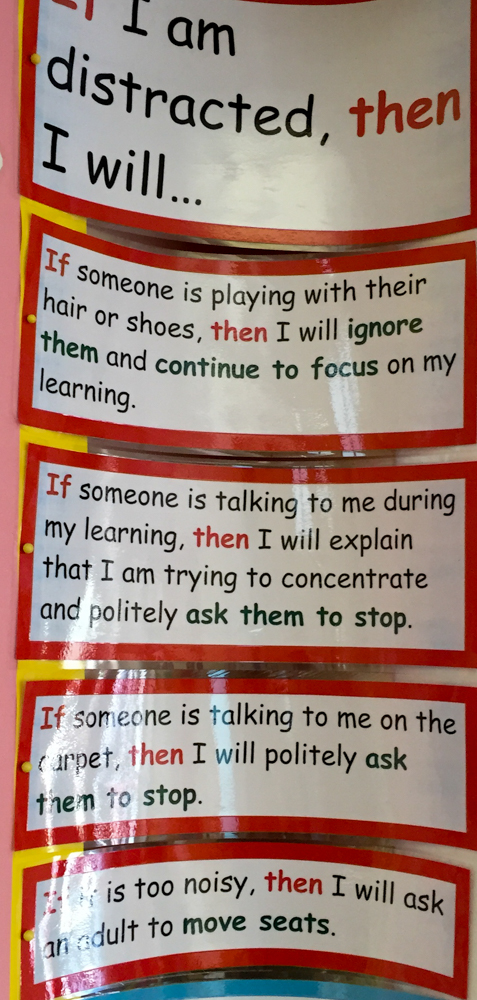
Put ‘If-then’ planning into action in your classroom to make goal setting more effective
Read more plus examples
Research findings
The how to ‘If-then’ planning
Examples:
#2: Introduce planning frames
Planning Frames
 target, blue hexagon for resources, yellow star for the people to help you, brown footprint for steps to take, grey clock for deadlines or time-frames.
#3 Model your own planning strategies
Pursuing your own goals

Read more ...
#1 Making FAME plans

Read more ...
#2 Allow students to select their own level of challenge and so set their own performance goals
Select own levels of challenge
Read more ...
#3 Begin to share outcomes with a wider audience

#4 Link goals to the real world
Be able to xxxxxxx So That. . . . add the wider purpose
#1 Self-monitoring of plans

Keeping goals on track
Require students to monitor how their plan is progressing AND assess whether the end goal is still achievable/relevant.
#2 Students analysing their own performance
 Self analysis of performance and creation of feedback
#3 Modelling a skill

Talk for learning
Organisation of ideas below
Talk to nudge visualising achievements.
 Phrases to help students think about what they are trying to achieve.
Encourage students to develop the ability to articulate what they are trying to achieve and visualise end results. Use phrases like:
Read more ...
#2 Written feedback encourging working towards a goal
Reinforce taking responsibility for learning with supportive marking comments
Well done – you thought carefully about what you were wanting to achieve and followed your plan.#3 Talking about learning
Making learning personal
#4 Guided Visualisation.
Using your mind’s eye to rehearse the future
Encourage students to develop the ability to articulate what they are trying to achieve and visualise end results. This technique is useful for students of any age.
Read more ...
How to use visualization for successful performance:
#1 Talk about the future
 For many students, the future is something that just ‘happens’. It is a future that they are consistently surprised by and so are at the mercy of these ‘unexpected’ events. It is a facet of learned helplessness due to an inability to see beyond the here and now.
#2 Involve everybody in asking why.
‘Why are we doing this?’

#3 Teacher talk to nudge students to decide what they are trying to achieve
#4 Written feedback: linking use of learning behaviours to successful outcomes
Use feedback to link learning behaviours to curriculum success.
Reinforce taking responsibility for learning with supportive marking comments
You thought carefully about what you were hoping to achieve, followed your plan and succeeded.#1 Written feedback
Supportive marking comments
I want you to look critically at this piece of work. Is it good ? Is it good enough ? How could it be even better ?#2 Use the language of expectation
From hope to expect.
#1 Talk to nudge reflection on progress towards goals
Enabling pupils to become reflective and thoughtful about goals. To evaluate progress towards the goal, use phrases like:
#2 Talk to nudge the skill of analysing their own performance
Enabling students to become reflective and thoughtful about learning. To reflect on how their learning behaviour is improving, use phrases like:
#3 Talk to nudge evaluation of learning behaviours
Enabling pupils to become reflective and thoughtful about learning. To monitor and evaluate learning, use phrases like:
#4 More ideas for If – Then prompts
Enabling pupils to become reflective and thoughtful about learning.#5 Written feedback on pursuing self-imposed standards
Supportive marking comments
Are you happy that this meets the standards that you have set for yourself? Does it accomplish what you intended ? How would you assess the piece against your own criteria ?Constructing learning lessons
Organisation of ideas below
#1 Sorting the language of goals.

Read more ...
Learning objectives are sometimes called goals or outcomes or learning intentions. Whichever word is used learning objectives are about what is to be learned, the bit of the curriculum that’s being focused on.
#2 Flipping the emphasis in how goals are expressed
 Getting student buy-in to goals
Read more ...
#3 Explore planning through stories
 Many stories that we share with children have a planning element in the plot.
#4 Plan a picnic
Planning together (for young children)
#5 Beginning to think about achievement
What is real achievement in learning?

#1 Building learning goals into lessons: shift your own thinking

Read more about Infusion ...
#2 Predict the next learning focus
 Use this as a plenary session.
#3 We’ve got a problem
#1 Build in expectation for students to establish their own success criteria
Creating Success Criteria#2 Thinking ahead of action
 ‘What will it look like when it’s finished?’ (WWILLWIF)
Read more ...
#3 Build in opportunities for students to self-check their work
Monitoring checklists
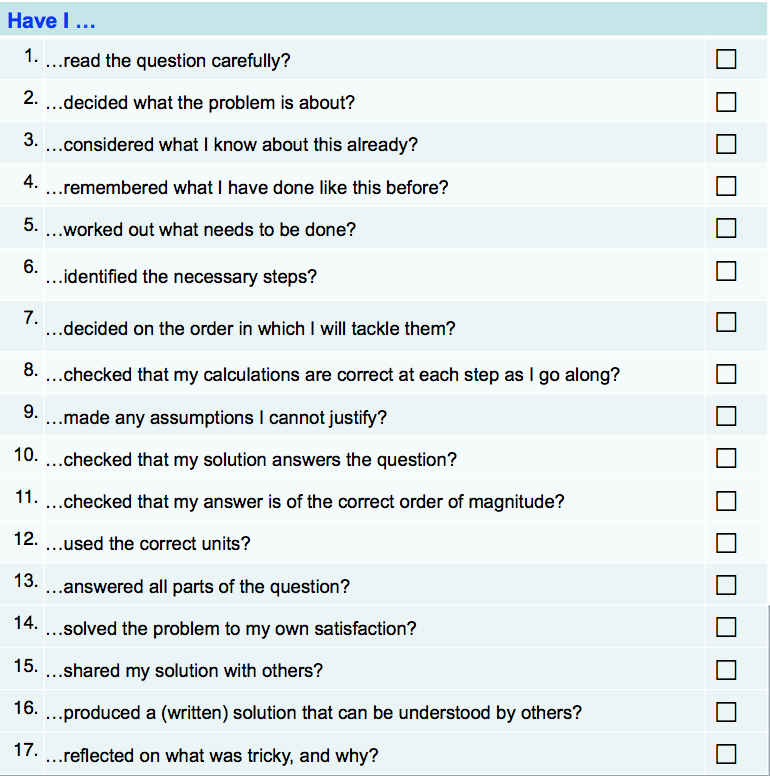
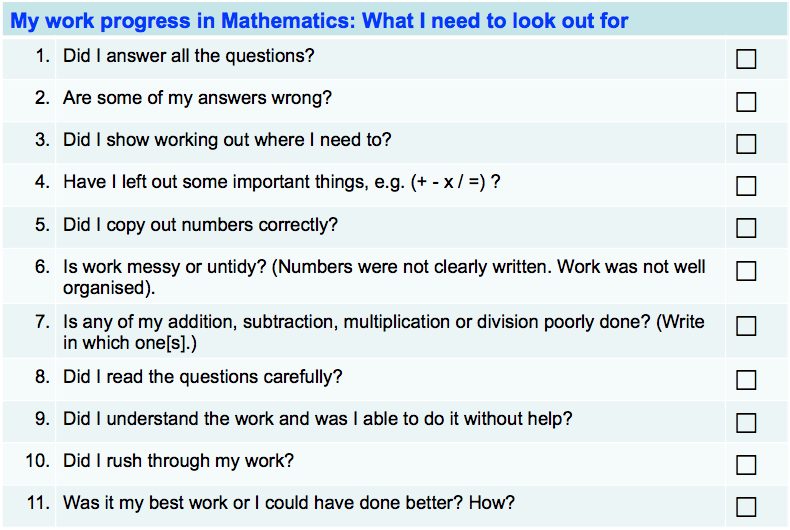
Read more ...
#1 Closer coupling of the ‘how’ and the ‘what; planning for learning
 Learning in school has two key purposes;
Designing split-screen lessons
Read more about Infusion ...
#2 Try ‘planning in reverse’ (future based planning)
Future-Based Planning

#3 Build in planning for consequences
 Encourage deeper thinking about consequences
#4 Planning for research
 A useful first step on any research activity can be to ask some key questions.
#5 Planning for risk
 In this organising phase students should be planning for risk and asking themselves questions such as;
Celebrate learning values
Organisation of ideas below
#1 Displaying our ‘plan for today’
#2 Celebrating ( reinforcing) learning behaviours
Here’s an interesting story from Nayland Primary school in Suffolk.
 We use circle time to discuss our learning each week and to positively identify children who have done well. Initially the children who were seen as being traditionally successful were selected; good students as opposed to good learners. However, as discussion gradually changed through modelling from the teacher, the children began to realise that just because someone didn’t get it ‘right’ didn’t mean they weren’t a good learner. We talked about Karl who had really persevered with his learning in a science investigation by repeating the test when it had gone wrong. We also thought about Sophie who had imitated the process her friend had used to solve a Maths problem, showing that copying how it had been done was fine. The children now value how they learn and are beginning to take greater notice of how others learn too.
#3 Displaying valuable types of achievement

#1 Putting learning behaviours into curriculum plans
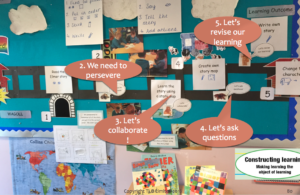
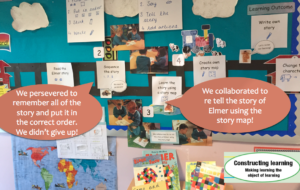
Read more ...
#2 Displaying the how of learning
Our plan for learning to spell
#1 Display planning prompts: FAME
#2 Goals and public recognition for growing learning behaviours

#1 Display questions for possibility, probability and certainty.

3. The culture sort
Key Learning Questions:
What could I do differently to engage students in realising the value of remaining focused and avoiding unnecessary distractions?
The four shifts in teacher behaviour:
- how you relate to students;
- how you talk to students;
- how you construct learning opportunities;
- how you celebrate learning.
This grouping will enable you to look at one type of teacher behaviour shift across all student development phases.
Have a rummage through the sections to see what you can find. As you do, keep in mind what your students do now when they are stuck. Think about, what do you want them to be able to do that they can’t or don’t do now?
This dimension of the learning friendly classroom concerns learning becoming a shared responsibility. As a teacher you will be giving students more responsibility for their own learning by: Shifting responsibility for learning ensures students recognise, use, understand and grow their learning habits. The classroom gradually becomes a learning community where everyone is learning from each other and growing more confident as learners as a result. The ideas below have been included for their effectiveness in helping to unhook teacher-student dependency and shifting more responsibility for learning to students. The coloured lines bounding each idea suggest the progression phase the ideas might best secure. For older students. Here are a couple of ideas for introducing the idea of distractions to students in the transition years. They need not be used in the ‘worksheet’ format of course! If these don’t suit there are plenty of other ideas later in this section. For younger students. Here is a story about managing distraction in everyday life. Take a look at the sort of questions the text calls for….both the content and the underlying process being unpacked. Here’s a fuller explanation of distraction if you need one. It might be useful for deeper discussion and analysis with students AIM To enable students to recognise; Set up the Learning Challenge Plenary Discussion Explore: Record Distractions A quick starter activity to illustrate the meaning of distraction. Explore the effects of distractions on pupils. Work with students to describe different degrees of the ability to manage distractions.For example: A 3-star manager might Use language appropriate for the age of the students. Comment on behaviour in order to recognise and value the management of distractions. Ask students to help each other with ideas about how to earn more stars as distraction managers. Being concerned with classroom layout in dealing with distraction may seem strange bedfellows, but if we think of distraction in the wider context of managing the learning environment it begins to make more sense. Just have a look around your classroom and ask yourself: Classrooms that feel like homely places to be, where there’s freedom of movement, a choice of learning spaces a sense of calm and where students feel they belong all seem to help concentration levels, lessen stress and focus effort. The Saints’ Way MAT in Cornwall decided to fundamentally challenge their thinking about educational spaces and provision. They wanted to enable learning, not necessarily direct learning. ‘I do not teach anyone I only provide the environment in which they can learn.’ The classroom environment became their starting point. It just so happened that they had a new classroom that needed to be equipped for the coming year – a blank canvas. The brief they set themselves was to create a flexible, neutral space that would facilitate learning. They had already equipped a number of classrooms with furniture from Ikea so returned to the catalogue for inspiration. The first decision was to put all the furniture on casters to maximise flexibility within the space, they centralised the resources so that they could put large whiteboards at child height on every wall. These were to enable pupils to think about, explore, plan and reflect upon their learning, they would become the Working Walls, ensuring that all information was current and relevant. They arranged several work and break out spaces including tables and chairs, bar tables and stools, sofas, bean bags, an architect’s desk. This variety of work spaces has enabled every child to feel comfortable and find their element. Some prefer tables, other work alone, some like being perched high up, others snuggle into sofas. Higher up display boards were minimised, but those that remained were covered in neutral backing paper in order to maintain a calm space where the pupils’ work would provide the colour. It may not look like a conventional classroom but it’s a space where learners feel able to move about, find what they need and learn in a variety of positions. There’s less fidgeting, more comfort and less stress and more focus. The new classroom layout Effort is a word that teachers use frequently, but what does it mean? How might students decode this and begin to do it purposefully? See Celebrate learning values #2 below for a poster of Effort prompts. Targeted Effort is now seen as a path to mastery. Students need to be aware of a connection between effort and improvement; that their effort is causing their improvement. This is why it is important to give effort meaning. Meaning often underpins motivation which in turn drives behaviour. Targeted effort is effort that has direction and purpose. It is underpinned by clear guidance and the specific goal to be achieved. What you are doing here is giving effort a size and direction. What students need to understand is that their effort has a size and a purpose. ‘Ifs’ are the situations you want to remind yourself about. In this case focusing effort it’s useful to list all the sorts of places this is needed. ‘Thens’ are what you will do about something; the action you will take. In this case the ways of focusing effort as introduced in #1 above. When setting a goal, for example ‘make more effort’, you need to specify not only what you will do but also where and when you will do it. If (or when) [___situation__], then I will do [___behaviour__] An If-then statement linked to the ‘make more effort’ goal might be ‘If I lose focus at the start of a task, then I’ll look at the success criteria to give me direction ‘. This may sound a bit cumbersome to start with but research suggests far more goals are achieved by using ‘if-then’ statements. And the clever bit is that this builds self talk at the same time. You do what you are telling yourself to do. The ‘if-then’ plan succeeds because the situation and the action become linked in the mind. The brain recognises the situation as an opportunity to advance the goal. When the situation is detected action is initiated automatically. “If-then’ plans become “instant habits”. Try this starter activity to introduce students to being absorbed. Useful at the start of any lesson. Contains Use it to extend the language of focusing on learning. The resource above is part of the BLP Activity Bank. Find out more from our website Working memory is what we use for processing information in real-time. It is particularly exercised when we are learning new things, performing tasks, cogitating, questioning and so forth. Your students are using it all the time during lessons. But working memory is limited to about 7 items at a time – any more than that and the brain starts to freeze up, and engagement drops. We sometimes say ‘I don’t have the head space for that’. Students will need to know when they are reaching capacity, and how to cope when they do. Fortunately, freeing up working memory is relatively simple. are all good techniques for giving the brain more thinking space. Learn more about working memory from The Centre for Working Memory and Learning at the University of York Model it: for the student who is well and truly stuck, or who has taken a path that leads to a dead-end and is Nudge it: For students who are more resilient to becoming stuck or encountering difficulty, try using gentle nudges to get them out of the mud. “Can you think of something we did earlier that might help you?” “How have you tackled this sort of problem before?” “Would the instructions help you here?” This is far from a full-blown model of what to do, but rather prompting to a way back in to the learning. Give clues: Some students will enjoy the added brain tease of a clue to nudge them in the right direction. “I think Newton had the right idea here…what about you?” “Perhaps it is a bit like hibernation…?” “Chapter 4 has some interesting things to say on this” Each of these techniques provides progressively less scaffolding for the student – you will need to gauge which technique to use for each student – fragile learners who struggle with being stuck will not appreciate clue giving as it will only compound their stuckness! Similarly, students who are able to deal with being stuck well on their own will not be sufficiently stretched by the modelling approach. You are differentiating your nudging. It’s the hard parts in learning that can cause demotivation in students accompanied by a greater likelihood of distraction. Students and teachers need to learn how best to cope with them. Good work on the hard parts is a structural challenge for teaching as well as learning. We need to build in versions of ongoing assessment but assessment that is not concerned with marks /grades or evaluating the the how of learning. This is assessment designed to feed into the learning process and make the learning stronger. It’s possible to organise the rhythm of learning so that it embraces; Teachers need to anticipate where the sticking points in the content are likely to be, the troublesome knowledge, and then ask; Here are researched ways of structuring work on the hard parts into the rhythm of the learning. You can read a little more on each of these below. Making learning easier boosts retrieval strength in the short term and this leads to better outcome performance. This feels good and produces a sense of cognitive ease. When something feels comfortable and familiar, it makes us feel good. And when we feel good, we’re relaxed, not thinking. BUT because the deeper processing that encourages the long-term retention is missing, that retrieval strength quickly evaporates. The very weird fact of the matter is that forgetting creates the capacity for learning. Remember though, learning happens when we think hard, so we need to create conditions which induce cognitive strain. Strain is unpleasant and stressful. We’re wary of the unfamiliar so we concentrate. When we’re forced into situations where we have to pay attention and make an effort, we have to think. Visual and verbal information can be processed simultaneously without overloading working memory. Practice should be distributed (spacing & interleaving) over extended periods of time. Spacing – exploits the cycle of forgetting and relearning (more strongly) by revisiting topics repeatedly over the course of a term or a year. Interleaving – what topics will you teach whilst you are waiting for students to forget what you have just taught before revisiting it? Blocking / massed practice– review the basics, complete a few related practice examples, reach an acceptable level of proficiency, and then move to the next topic. Blocking leads to compelling short term gains, but interleaving the curriculum leads to deeper understanding by the end of the course. Regular low stakes tests or quizzes taps into the effect (that trying to remember something helps us with the long-term memory for that material). Quick questions on the board, quizzes, self-tests. If students have drawn mindmaps, get them to try redrawing them from memory. If using flashcards, make sure they are testing themselves by jotting down their contents from memory, rather than simply looking at them (recognition vs recall). Students often mistake familiarity with material for the ability to recall it. We can help students from more accurate judgements of learning by encouraging a delay between studying and self-testing We are more accurate at predicting later performance when there is a delay between studying material and making a judgement about how much we can securely recall. Encourage students to test that judgement by attempting tasks or quests from memory. BUT When teaching new material, ensure pupils are not overloaded – more inductive discovery methods require pupils to juggle a lot of information at once in order to perceive the relationships or patterns we want them to understand. Providing an element of explicit instruction, using carefully considered explanations, worked example and accurate analogies, is almost certainly a better bet than providing relatively little guidance using problem-solving or open inquiry methods. Students should be provided with worked examples and exemplar answers as well as partially completed sample problems Expect students to plan for their targeted effort.When devising project plans with students, ask them to come up with; For example, a Y1 student might decide to focus on using capital letters at the beginning of sentences when writing a passage. When they read their work through at the end, they would focus their effort on the same criterion – are there any sentences that still need capital letters? And possibly ask themselves ‘I wonder how/why I missed that one?’ Or a Y10 student might aim to focus their effort in science on coming up with a really tight method for an experiment. They would monitor how things are going and whether they need to adjust anything. This will also provide the focus for the conclusion section of the process, as they can suggest refinements to their original method to gain more meaningful results in future experiments. It’s all about where the effort needs to be focused. One bit at a time. Now that your students are familiar with and in control of distractions it’s a good time to deepen their attentiveness. This activity offers an informal introduction to relaxed noticing rather than focused concentration. Here you will find a small set of ideas for introducing and discussing the noticing capacity. Useful for younger students. Both of these activities are part of the BLP Transition Activity Bank Build awareness of students’ distractibility across life more generally by using a learning log for recording everyday distractions and their reactions to them. Discuss ideas about how to reduce distractions. Extends the language of learning This dimension of the learning friendly classroom concerns using the language of learning, As a teacher you will be: The more richly children come to relate their own learning the more they see and take hold of their own role in it. The ideas below have been selected for their effectiveness in helping to surface the learning process and deepen the language of learning. Have a discussion about these two types of distractions (people and things) and come up with lists of the different ways we can be put off by people and by things e.g. when we break a pencil, when we don’t have the things we need etc. Talk about what we could do in different situations. The language of learning can help teachers to think about how they might talk in a way that helps to cultivate the learning behaviours and help pupils to gain a better personalised understanding of content. Once you have identified various potential distractions, ask students to rank the distractions and match them against ideas for managing these distractions. Remember to address the emotional content of internal distractions. Examples might include: Sometimes when we are stuck, becoming distracted is our brain’s way of saying “I need to take a break”. Often, moving away from the problem at hand and doing something different for a while, or simply gazing out of the window, can help new ideas bubble to the surface, it gives the subconscious time to work on a problem that has previously seemed uncrackable. Consider having a quiet break-out area for students to use when they need a break, but make sure it isn’t being used too frequently or improperly! Use ‘gazing out of the window’ positively. When you see a student doing this ask them ‘What’s bubbling up in your mind? What new ideas are you imagining?’ rather than referring negatively to an apparent loss of focus or concentration. Lemar was in Yr 6, registered SEN and always distracted. He looked here and there, talked to other children and sometimes wandered around the classroom when he should have been absorbed in learning. His teacher decided that the place to start with Lemar was managing his distractions. After talking with all the class about what distractions were the pupils came up with all manner of ways they could use to try and avoid them. One idea was a simple line on a page to record when distractions happened.(Self monitoring) The next day the teacher drew such a line at the top of Lemar’s page and asked him to try it out. You can see the line on the first picture and how Lemar marked it throughout the lesson. Although one could argue that the line itself was a distraction what it was actually doing here was making Lemar aware of being distracted. On seeing his writing at the end of the lesson the teacher was astonished by the amount Lemar had managed in the time. The lines he had written represented 100% increase in volume. Note the teacher’s comment at the bottom. She acknowledges that he has indeed managed his distractions well. A couple of days later Lemar had more writing to tackle. This time he created his own line at the top of his page….a significant breakthrough because he had seen the value of using this tactic. Here again he marks when distractions happen and even mentions his distractor Jordan! Furthermore he has completed yet more writing. Hannah Moore Primary School Here again the teacher comments on the writing and acknowledges that it is good work, but unfortunately she doesn’t comment on his obvious effort on managing his distractions. If we are going to help pupils to build their own learning habits a single written comment won’t be enough, habit formation needs far more encouragement and reinforcement. Process-Level Feedback Prompts (adapted from Nuckles et al, 2009) This dimension of the learning friendly classroom concerns how you design learning episodes/lessons/projects. As a teacher you will be: The ideas below have been selected for their effectiveness in helping to show how you value the process of maintaining focus. The coloured lines bounding each idea suggest the phase of development and the order in which they might best be introduced. Have some fun by thinking about what might have happened if characters in familiar stories had been distracted e.g. suppose someone distracted the prince each time he wanted to ask Cinderella to dance? We’ll let you have fun finding other ideas. Change the mental and physical state of the class by using music, quick games (Fizz-Buzz, Simon Says), guided relaxation, Brain Gym (Dennison, 1992), change of partner/desk/lighting, breathing exercises, or a refreshment break. Such activities refresh and relax pupils, enabling a greater degree of focus afterwards. Discuss their impact on concentration and how pupils could use them in other contexts to keep themselves on track with their learning. Break states are a positive distraction. Extract (above) from Building Learning Power in Action, by Sarah Gornall, Maryl Chambers, Guy Claxton. You will find lots of other ideas for all the learning behaviours. For students aged about 4 to 8 Encourage your students to recognise when they are becoming distracted. At the start of an activity give each student a number of counters, beads, bricks etc. Each time they find themselves distracted they put one counter etc. into a pot. Groups of individuals can compare outcomes and talk about the different ways they had been distracted. Set your students a task that requires them to focus their effort very tightly. For example: Produce a piece of writing on the topic of ‘squirrels'( or indeed on anything relevant/current), using only 10 words. you have five minutes. You can of course change the topic, word limit, and time limit, or add further constraints like ‘no lists’, to give almost infinite variations on this theme. Changing these criteria will have the effect of broadening or narrowing your students’ effort/focus. Being in a ‘state of flow’ is about an ideal state of being totally involved with or absorbed by something you are doing. How might we try to achieve that state in the classroom? The secret to designing what we might term “Goldilocks ‘ tasks is to make sure they are exciting ( arousing the interest of the learner) with just the right level of challenge; where the student is on the brink of being able to achieve something (challenging but within reach) A refinement of Austin’s butterfly. Give students 30 seconds to look at a picture relevant to your topic. Ask them to list ten things they noticed about the picture. Repeat the process, seeing if they can list 10 more things about the picture. This process can be repeated until no new ideas come forth. Focusing effort has now engaged the learning behaviour known as attentive noticing Go with the learning and follow absorption. Where possible, don’t stop a lesson arbitrarily because of the time or a projected move to the next topic. Make sure there’s time to explore and to allow the students to develop their interest fully. A a school in Wotton-under-Edge in Gloucestershire teachers have extended the usual idea about classroom distraction (losing focus) by using the same idea to encompass looking out for red herrings/distracting or irrelevant information in texts. A literacy lesson revolved around a writing activity. The stimulus was a video clip of Gavin Henson, the Welsh fly-half, taking a successful kick in a famous rugby match. This was used to stimulate a deep discussion about managing distraction and how this was possible in such a public setting. What had Gavin got to do to make sure the kick was successful? The students were then invited to write a short piece for a newspaper using the the following information. They were asked to be aware of what they thought to be the key pieces of information. But of course irrelevant information was also included. There were 3 layered targets for this piece of writing which different groups of students understood had to be incorporated into the writing. Throughout the lesson students recorded their thoughts about managing distraction using this format. This activity arouses an appreciation of noticing skills. Students will be able to: The following resources provide coaching notes, DIY resources and an observation tool. You could try the activity without as much scaffolding. E.g. use a VTR, ask: – “What do you notice?” – “What’s happening here?” – “What makes you say that?” Then explore feelings about not being told where to look and what to look for, etc. Self-Regulation-Level Feedback questions This dimension of the learning friendly classroom concerns what is valued, recognised, praised, displayed about managing distractions. As a teacher you will be: Learning powered environments build confident uncertainty. Managing distractions and remaining on task is celebrated as an interesting place where real learning begins. The ideas below have been selected for their effectiveness in helping to show how you value the process of maintaining focus. The coloured lines bounding each idea suggest the phase of development and the order in which they might best be introduced. Ensure that your display walls include pictures and explanations that illustrate what you have been exploring about distraction and how to avoid it. Here we see a ☆☆☆ Distraction manager ( explained in activity #4 Relating) Encourage students to write on a separate note how they managed their distractions, and display the note with the 3* managers. Make this a constant feature of your classroom It’s important that students understand learning as a process rather than an event, and that being distracted is a inevitable part of that process. Mostly distraction takes us away from learning but sometimes purposeful distraction can be a helpful addition to the learning process. We look at this in the ‘I’ll try’ section. Have your camera at the ready and capture moments where you see students focusing intently on what they are learning. Make a big fuss of this focused behaviour, explore with the students what they have been learning and what ‘focusing’ felt like. Regularly encourage students to think about a moment when they became really absorbed and how it felt. Celebrate the unusual ones by displaying them on a ‘focus or absorbed wall’. Students will develop an interest in their ability to become absorbed. Create a prompt checklist of the ways you have introduced that will help focus effort. This display list links to #1 Relating. Introduce how to focus effort This Working Memory checklist does the same job as a Stuck prompt…it reminds students about what they could do when their heads are in danger of getting confused; too full of ideas or too much to do or ……. Switch the thinking from managing distraction to becoming absorbed and attentiveness Make a scale on the classroom wall to indicate degrees of absorption. Students or adult observers (e.g. Teacher Training student, Teaching Assistant) observe groups and/or individuals as they are working and move a label with a students’s name or picture up and down the scale according to how absorbed they perceive individuals are. Use as a prompt for discussion about: Aids to help shift responsibility for learning
Organisation of ideas below
#1: Introduce the idea of distraction
Quick ways in to introducing managing distractions
Read more about managing distractions ...
#2 Explore the idea of managing distractions.
 Exploring what it feels like
#3 Model being distracted
Model distractions (ages 4-8)
#4 Start students self-monitoring their distractions
Am I a
 ☆☆☆ manager?
#5 Classroom layout: managing the learning environment
 An environment that’s their’s to manage
Read about another ...

Albert Einstein
#1 Introduce how to focus effort
Explore the meaning of effort

Read more
#2 Use ‘If-then’ statements to strengthen focusing effort
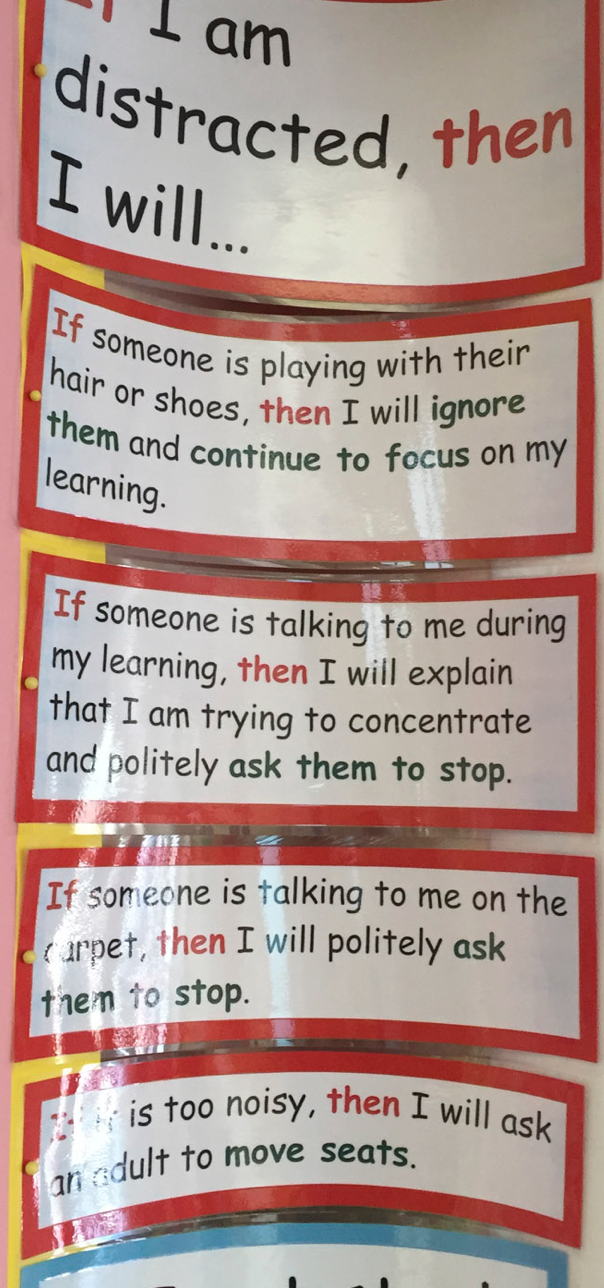 Put ‘If-then’ planning into action in your classroom to make effort more specific and focused
Read more
The how of ‘If-then’ planning and a relevant example:
#3 Model effort
Give students an idea of what effort looks like in practice.
#4 Introduce the idea of being absorbed
Introduce students to the idea of being absorbed
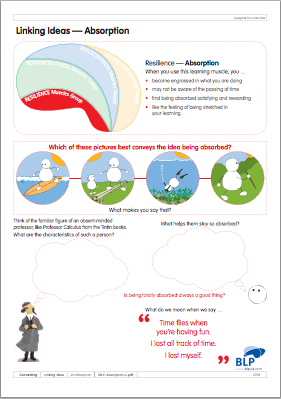
Read more ...
#1 Introduce ideas about working memory
Help for working memory

Ways to free up thinking space
Read more ...
#2 Three strategies for refocusing effort: nudging not telling
 withdrawing from learning, try modelling the process for them. Narrate as you go, highlighting the thinking processes you are using, what you plan to do next, how you are getting yourself unstuck, and so on.
Read more ...
#3 Introduce ideas for overcoming hard slog of practice

Embracing the hard bits
Read more ...
1. Introduce variety and unpredictability into classroom environments
2. Interleave/mix topics together instead of presenting them in neat termly blocks
3. Complex problems should be broken down into constituent parts and students required to practise these smaller elements before being asked to solve complex problems independently.
4. Test pupils’ ability to retrieve information instead of simply showing it to them again.
5. Self testing
6. Give clues rather than complete solutions so that pupils have to generate rather than simply repeat answers.
#1 Putting targeted effort in plans
Plan for targeted effort#2 Introduce attentive noticing
#3 Extend understanding of distractions to beyond the classroom.
Talk for learning
Organisation of ideas below
#1 Talk to extend understanding of distractions
 Sometimes we are distracted by people, sometimes things can get in the way.
#2 Talk to nudge the skill.
Managing distraction phrases
Encourage students to become more aware of distractions and how they might deal with them. Use phrases like:
 What might put you off?
Read more ...
#3 Written feedback on managing distractions
Reinforce taking responsibility for learning with supportive marking comments
You have been successful because you avoided being distracted. Well done! #1 Talk to extend understanding of ‘distractions’
To build up students’ understanding of distractions, use phrases like: #2 Reinforce familiarity with distractions by ranking them
 Work with students to identify distractions in the classroom and to come up with strategies for reducing them. Encourage them to think about:
#3 Using distractions positively

#4 Written feedback on managing distractions
Giving feedback on the learning process; make it a habit of yours.
The story of Lemar and his distractions

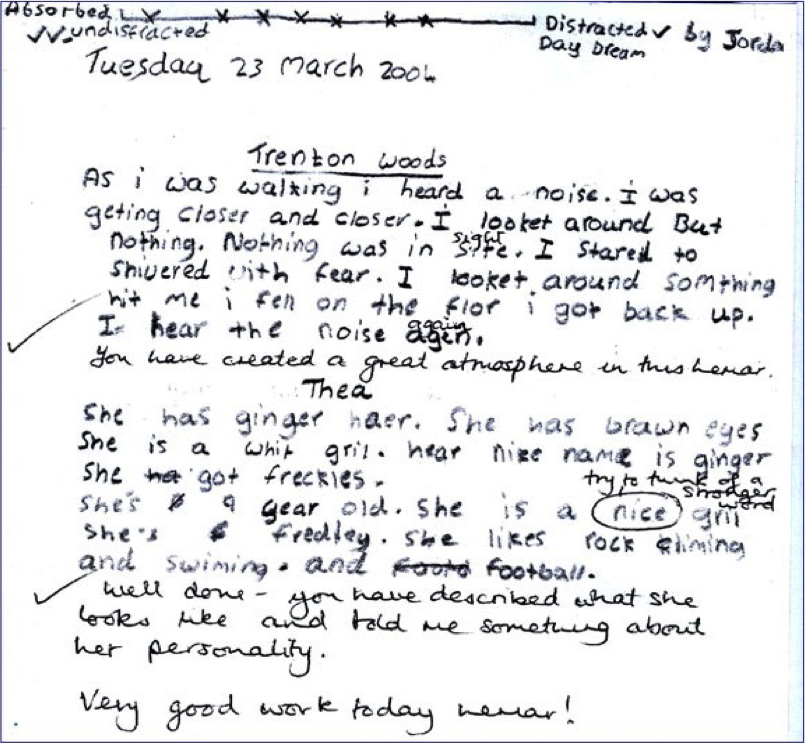
#1 Talk to focus effort
Effort focusing questions
#2 Written feedback to maintain interest
Supportive marking comments
Well done on keeping focused – this was a hard slog, but your effort was worthwhile and enabled you to produce a really good piece of work. #3 Questions to focus reflection on effort
 How did that effort help you learn more?
#1 Feedback to nudge the skill
#2 Written feedback on overcoming negative pressures
Supportive marking comments. Keep them coming to support habit formation
It would have been easy to have given up on this, but you stuck to your guns despite the doubts of others. You should be proud of what you have achieved.Constructing learning lessons
Organisation of ideas below
#1 Nurture the capacity to manage distractions
Sliding doors




#2 Build in break states
Break States.
Read more ...

#3 Build in ways to recognise distraction
Keeping count

#1 Practise using defined effort
Tight effort
#2 Use ‘brink’ targets and ‘flow’ tasks
#1 Targeting effort in self-assessment

Read more ...
Have a look at Austin’s butterfly above and notice how the children work out, with a little prompting, how to focus feedback to help Austin achieve his goal. Magic. #2 Scaffold tasks to focus effort
 Looking 10 x 2
#3 Go with the flow
#1 Blending managing distractions seamlessly into a lesson

 The following task was to consider what advice Gavin Henson would offer a learner about managing distraction. This again led to a very profitable discussion which was then captured in writing.
Needless to say this teacher is Welsh and a passionate Rugby supporter.
#2 Blending attentive noticing into lessons
#3 Reflect on effort related strategies
(adapted from Nuckles et al, 2009)Celebrate learning values
Organisation of ideas below
#1 Display ☆☆☆ managers
Display and celebrate achievement of managing distractions

Read more ...
#2 Photograph and display students focusing on learning

#1 Display students’ self monitoring of distraction

#2 Display an Effort checklist.
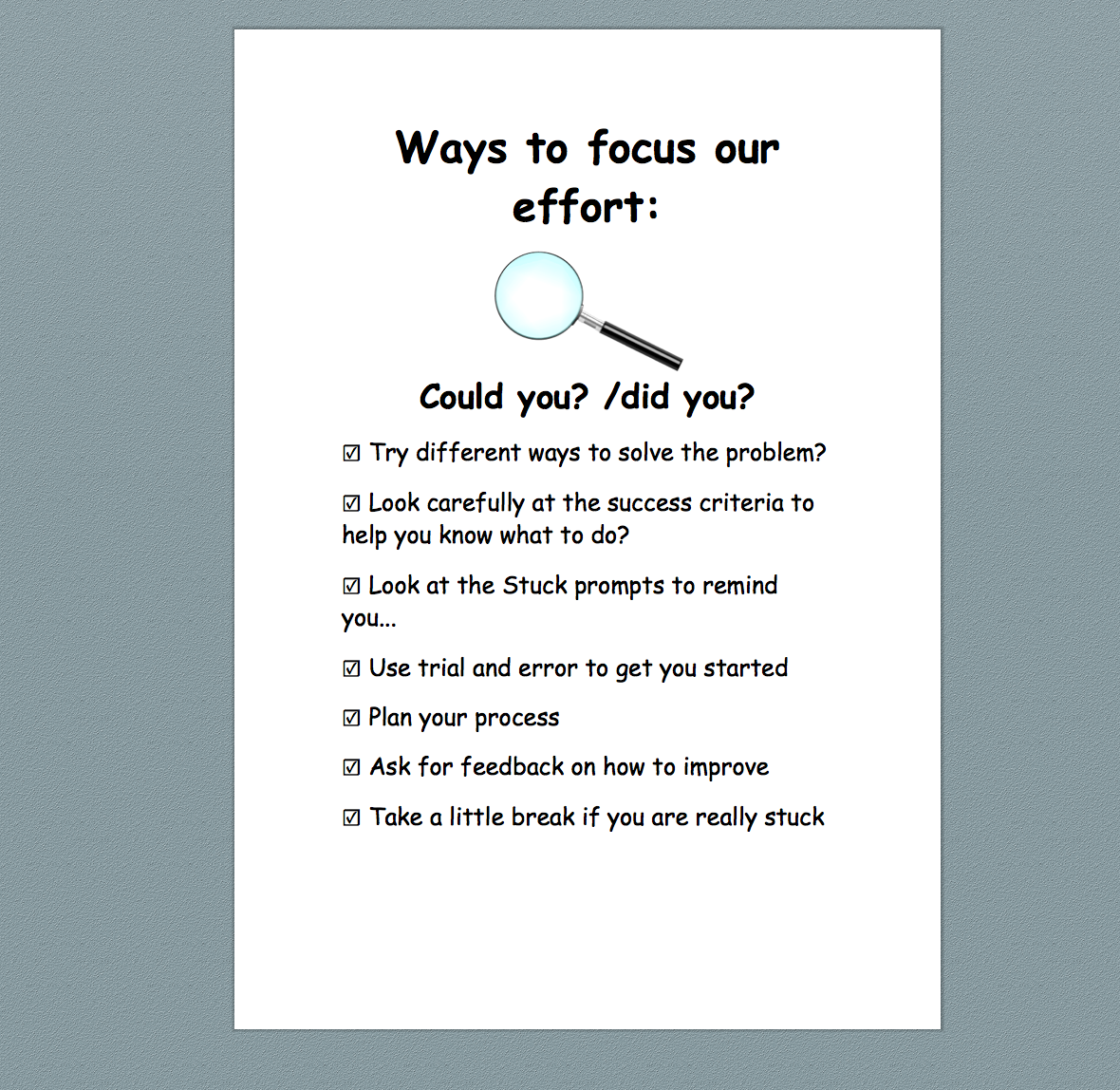
#1 Ways to help your memory: a checklist

#1 Develop a Raptometer
Raptometer.

2. Ideas to Practise
Key Learning Question:
What could I do differently to engage students in managing their distractions and becoming more focused?
In this section we explore a range of ideas, activities, ways to display, and things to say about understanding distraction and becoming more focused. The ideas aim to deepen your learning friendly classroom culture and help to support and strengthen your students’ relationship with focus: how to enjoy it; what to do about it if disrupted.
Much of being able to be focused involves your feelings; your emotional responses to learning. Being emotionally robust is a pre-requisite for powerful learning. Hence looking out for students who have lost focus (they are not usually hard to spot !) and offering them ways to maintain focus is one small, but essential, way of moulding them into powerful lifelong learners.
The ideas to practise are grouped in two ways;
In this section (2)
The four phases of learner behaviour (we have left the most advanced phase, ’embodies’, out):
- Receives ( purple) Do as they are told, but need assistance, ‘Show me. Tell me’;
- Responds ( blue) Act more willingly, prepared to try, ‘I’ll try’;
- Values ( green ) Values the behaviour, does it more frequently, ‘I see why’;
- Organises ( yellow) Organises themselves to use the behaviour effectively, ‘I’ll make sure’.
This grouping will enable you to look at all the ideas linked to a phase of development
In section 3 The culture sort
All the activities linked to the four shifts in teacher behaviour:
- how you relate to students;
- how you talk to students;
- how you construct learning opportunities;
- how you celebrate learning.
This grouping will enable you to look at one type of teacher behaviour shift across all student development phases
Most of the ideas to practise are not phase-specific and can be used, or readily be adapted for use, with students of any age. Have a rummage through the sections to see what you can find. As you do, keep in mind what your students do now when they become distracted and move off-task. Think about, what do you want them to be able to do that they can’t or don’t do now?
1. Where are you now?
Key Learning Questions:
How do my students deal with distractions? How focus friendly is my classroom culture? What might I do to develop a more focus friendly classroom culture?
Managing Distractions
Losing focus or getting distracted is an inevitable part of learning, it happens to all of us. As learners we come across distractions, both internal and external. If we are hungry, tired or anxious we find it hard to concentrate. Equally if there is too much going on around us or something unexpected happens, we may lose our focus or get side-tracked. But unless students are assisted to cope positively and practically with such situations their deep engagement with learning may be in jeopardy.
Being able to avoid distractions or get ourselves re-focused is as much about how we react emotionally as it is about having the practical strategies to work out what to do. Being able to manage distractions is a critical part of persevering.
Why is managing distractions difficult?
Being totally absorbed and focused isn’t always the best strategy. Total immersion, however valuable, may mean that you miss whatever else is going on, be it a new opportunity or a looming threat. Our ancestors would have been vulnerable were they not continually checking for potential danger, and so to a lesser extent are we. In reality some students are preoccupied with what they perceive to be more important calls on their attention than the learning topic in hand. This isn’t because they are wilfully off task, but because they simply cannot help it. The ability to maintain concentration on longer-term goals, in the face of more immediate attractions, isn’t finally developed until quite late adolescence. Nevertheless, calling attention to distraction, exploring ways to overcome it, being clear about what effort means, and devising activities that are likely to minimise distraction are all part of a learning friendly culture.
The two questionnaires in this section aim to help you analyse:
- Where your students are now in their journey to managing their distractions. [Questionnaire 1 Distraction Questions]
- What you do to help students minimise their distractions and what this might suggest. [Questionnaire 2 Culture Questions]
Results from these questionnaires will take you to a focused range of moving forward ideas.
1. Where are you now?
Key Learning Questions:
How do my students deal with difficulty? How challenge friendly is my classroom culture? What might I do to develop a more challenge friendly classroom culture?
Rising to the challenge vs taking the easy way out
Wrestling with difficulty is a natural part of learning, we all find lots of things hard, it’s a constant part of learning. Blocks and obstacles, just not ‘getting’ something, going into blind alleys, misremembering, getting flummoxed by having too much to think about, making little or even fatal mistakes are all things we may fear from taking the risk of trying difficult stuff. It feels as though there’s a lot at stake.
Being willing to ‘have a go’ or work through something we perceive to be difficult is as much about how we react emotionally as it is about having the practical strategies to press on, make an effort and work out how to overcome it. Being able to manage an effective way of rising to challenge is a critical part of persevering.
Re-framing challenge and mistakes
Most students, quite understandably, make great efforts to avoid making mistakes. After all, the culture of classrooms across the centuries has prized being right over being wrong. Examinations likewise! So it shouldn’t surprise us that our students have detected and absorbed this and hence do their best to avoid them.
Little wonder then that they often opt for ‘easy stuff’ to improve their chances of ‘getting it right’ – it seems a very sensible strategy to adopt in the face of the pressure to ‘be right’.
But never having a go at difficult stuff, succeeding at the easy option, avoiding the possibility of making a mistake, doesn’t bode well for real learning. It may well mean you are just coasting along – going through the motions, doing exercises, rather than learning. But avoiding challenge is just postponing the day when you’ll need to embrace real learning. The longer you leave it the harder and more disastrous it will be. Helping learners to make the most of challenge, make mistakes, put in the effort involves thinking of it anew: as an interesting place to be; with mistakes being valuable; and effort needing purposeful focusing. It’s about making challenge an adventure rather than a dispiriting chore.
The two questionnaires in this section aim to help you analyse:
- What your students do now when they face difficulty and what this reveals [Questionnaire 1 Challenge Questions]
- How challenge friendly your classroom culture appears to be and what this might suggest. [Questionnaire 2 Culture Questions]
Results from these questionnaires will take you to a focused range of moving forward ideas.
2. Ideas to Practise
Key Learning Question:
What could I do differently to engage students in confidently tackling challenging materials, making mistakes, and learning from them?
In this section we explore a range of ideas, activities, ways to display, and things to say about tackling challenge. The ideas aim to deepen your learning friendly classroom culture, helping to support and strengthen your students’ relationship with challenge; how to enjoy it; what to do about it; how to overcome it; when to give up on it.
Much of being able to deal with challenge involves your feelings; your emotional responses to learning. Being emotionally robust is a pre-requisite for powerful learning. Hence making sure students can face and manage difficulty is one small, but essential, way of moulding them as powerful lifelong learners.
As one teacher said to us recently: “I became a better teacher the day I stopped thinking ‘Have I made it easy enough for them to understand’ and started thinking ‘Have I made it hard enough to stretch them?'”
The ideas to practise are grouped in two ways:
In Section 2 (this section)
The four phases of learner behaviour (we have left ’embodies’ out):
- Receives ( purple) Tell me, Show me, where their tendency is to do as they are told.
- Responds ( blue) I’ll try, where they act more independently
- Values ( green ) I see why, where they come to value the behaviour
- Organises ( yellow) I make sure I do, where they organise themselves to use the behaviour effectively
This grouping will enable you to look at all the ideas linked to a phase of development
In Section 3: The culture sort
The four shifts in teacher behaviour:
- how you relate to students
- how you talk to students
- how you construct learning opportunities
- how you celebrate learning
This grouping will enable you to look at one type of teacher behaviour shift across all student development phases.
Most of the ideas to practise are not phase-specific and can be used, or readily be adapted for use, with students of any age. Have a rummage through the sections to see what you can find. As you do, keep in mind what your students do now when faced with difficulty. Think about, what you want them to be able to do that they can’t or don’t do now?
3. The culture sort
Key Learning Questions:
What could I do differently to engage students in realising the value of facing up to difficulty ?
The four shifts in teacher behaviour:
- how you relate to students;
- how you talk to students;
- how you construct learning opportunities;
- how you celebrate learning.
This grouping will enable you to look at one type of teacher behaviour shift across all student development phases.
Have a rummage through the sections to see what you can find. As you do, keep in mind what your students do now when they are stuck. Think about, what do you want them to be able to do that they can’t or don’t do now?
This dimension of the learning friendly classroom concerns learning becoming a shared responsibility. As a teacher you will be giving students more responsibility for their own learning by: Shifting responsibility for learning ensures students recognise, use, understand and grow their learning habits. The classroom gradually becomes a learning community where everyone is learning from each other and growing more confident as learners as a result. The ideas below have been included for their effectiveness in helping to unhook teacher-student dependency and shifting more responsibility for learning to students. The coloured lines bounding each idea suggest the progression phase the ideas might best secure. A whole-class activity set up to explore the nature of challenge, the difficulties encountered and how they work to overcome them Contains Tell students about how the brain works and what happens when we learn. It helps students to understand why challenge can be difficult and uncomfortable i.e. that challenge leads to new neural connections being formed and existing ones being reinforced and developed. Websites that might help: York University have a good guide aimed at teachers www.york.ac.uk/res/wml/Classroom%20guide.pdf An animation visualising brain development Avoiding challenge can take many forms. High achieving students can coast deliberately in an attempt to avoid being pushed. Lower achieving students withdraw or give up quickly to avoid the threat of failure. One of the first ways of surfacing learning – putting it on show – is to focus on how you are modelling being a good learner to students. Modelling is all the ways in which teachers demonstrate how they are a learner too; a confident finder-outer, a confident trier-outer. Make use of this type of resource routine in your classroom. It helps shift the responsibility for learning to the learner. Idea taken from Learning Power Heroes, by Raegan Delaney, Leanne Day and Maryl Chambers For the teacher, this provides valuable, instant feedback. For the child who is on ‘easy learning’, prepare to inject more challenge; for the child on ‘challenging learning’, prepare to intervene if it becomes too difficult; for the child on ‘too hard’, explore whether that is really the case or whether a pointer in the right direction might bring it back to ‘challenging learning’. Here’s a good big idea to introduce and discuss: Challenges are food for the brain. Mistakes are the building blocks of understanding Without making mistakes the chances are students are coasting and insufficiently challenged. Thus mistakes are the hallmark of challenge. You are aiming at a Goldilocks number of mistakes. Too many and the challenge is too difficult and dispiriting. None or too few and the challenge is to easy. Just right means the student is at a level that pushes them to the edge of what they can do. If we want students to change their behaviour we need to help them to think much more closely about the ‘hows’ and the ‘whats’. Motivation research proposes an effective solution called ‘if-then’ planning or, perhaps more precisely, mental contrasting. ‘Ifs’ are the situations you want to remind yourself about. In the case making mistakes it’s useful to list all the sorts of places this tends happen ‘Thens’ are what you will do about something; the action you will take. Brainstorm a list of the ‘what we might do in response to the Ifs’. This helps to sketch a path between where you are now and where you want to be. If I think there’s too much to do here → then I will break it down into small steps. When I am choosing what to do I will choose something a bit harder than last time. If we are going to challenge ourselves today then.…….. If I make a mistake today then I’ll…….think about why/notice more about it/ talk it through with a friend/ ask for feedback from my teachers….and so on. After introducing the approach to students you could use it in several ways. Research on motivation and goals from Harvard University shows how our brains work to achieve our goals. Basically it says that goals need to be very clear and our brain ignores a goal if it’s unclear about what to do. Brains act on goals only when what to do is clear. So, goals like ‘Lose weight’ or ‘Exercise more often‘ or even ‘I want to try harder questions‘ are too nebulous. They beg the question ‘how’ or ‘what do I do?’ When setting a goal you need to specify not only what you will do but also where and when you will do it. If (or when) [___situation__], then I will do [___behaviour__] So going back to our goal about losing weight, we need to know much more about the ‘how’ and the ‘what’ and the ‘how to’ of losing weight. An If-then statement or goal might be ‘If I get the pudding menu, then I’ll ask for coffee’. This may sound a bit cumbersome to start with but research suggests far more goals are achieved by using ‘if-then’ planning. And the clever bit is that this builds self talk at the same time. You do what you are telling yourself to do. The ‘if-then’ plan succeeds because the situation and the action become linked in the mind. The brain recognises the situation as an opportunity to advance the goal. When the situation is detected action is initiated automatically. “If-then’ plans become “instant habits”. …I I don’t know what to do next… …I think I have made a mistake… …I am feeling overwhelmed… …I will (Some specific statements to move them forwards) Re-framing mistakes means putting them into a different, positive, light. You’re not just putting a positive spin on mistakes, you are giving students a different way to think about them. It’s about turning all the negative connotations of mistakes into being positive and useful. Thus it leads to improvement and development in both learning outcomes and students’ learning behaviours. In making this shift think about: The attitudes, values and interests that you display in the classroom, knowingly or not, constitute arguably the most powerful medium through which the messages of learning rub off on students. To encourage students to engage in the effort necessary in rising to challenge, you need to: An aspect of their teaching on which BLP teachers will want to focus is what they themselves are modelling to their students about being a good learner. Modelling refers to all the ways in which teachers demonstrate to their students the presence or absence of learning power in their lives, as well as its nature. They can ask themselves: A BLP teacher’s job is as much to demonstrate the habits and inclinations of the good learner as it is to be knowledgeable and in control. Traditionally it has been the teacher’s role to demonstrate mastery of the subject, and to be able to answer any questions which the students may throw out. Teachers still tend to worry that they will lose respect from the students (and maybe from senior teachers and parents too) if they do not ‘know their stuff’ through and through. But the professionalism of the BLP teacher must allow them to show students what it is to be a confident ‘finder-outer’ as well as a ‘knower’. And if students or their parents need to have their attitudes and expectations changed somewhat, then that becomes part of the teacher’s and the school’s responsibility. Step 1 Helps to shift the language of the classroom…and hopefully in the minds and actions of students but you will need to keep explaining why mistakes are good; what they are and what they give rise to. Step 2 Good mistakes that are misconceptions means you can draw attention to the reasoning that underlies the change. Share assessment criteria with students and ask them to: Frame your written comments as questions to which your students are required to respond. “What do you think you need to do to make this section more convincing?” is preferable to “This section needs more explanation”, because it moves responsibility to the learner to identify what more needs to be done. Experiment with intervening only when absolutely necessary – stand back, listen and watch, and let the learning happen. Teachers are constantly walking a tightrope – when/whether/how to intervene, how much support to offer, how much challenge to inject etc. It is in these ways that teachers scaffold the learning for their students, offering just the right balance of challenge and support to keep students working towards the edge of their comfort zone. But if teachers always scaffold learning in this way, when will students develop the skills required to manage their own learning for themselves? This dimension of the learning friendly classroom concerns using the language of learning, As a teacher you will be: The more richly children come to relate their own learning the more they see and take hold of their own role in it. The ideas below have been selected for their effectiveness in helping to surface the learning process and deepen the language of learning. Help students to change their talk about challenge From ‘Challenge’ to ‘Interesting challenge’. From ‘It’s hard’ to ‘It’s tricky’. ‘Tricky learning builds my brain.’ From ‘I can’t do it’ to ‘I can’t do it yet’. ‘I don’t know how to’ becomes ‘I’m learning how to’. A bit of background. The language of learning can help teachers to think about how they might talk in a way that helps to cultivate the learning behaviours and help pupils to gain a better personalised understanding of content. ‘What was your biggest challenge today?’ ‘How did you overcome it?’ ‘What does it feel like when you are thinking hard?’ ‘What did/does it feel like when you overcame/got through the challenge?’ This was difficult, but you gave it a really good go. Well done for not taking the easy way out! OR I like the way you took up the challenges today. I can see you really enjoyed it. Use phrases like: If students freeze when they are wrestling with something they find tricky, offer supportive questions not answers. A basic support to continue is ‘What might you do next?’, and when this has been done simply ask the question again. To extend the ‘support to continue’ approach, try using phrases like: ‘Support to continue’ prompts are seen as helpful by pupils. You are encouraging them to take over the job themselves and reminding them that uncertainty shouldn’t lead to paralysis. The advantage of asking questions over telling is that you are in a better position to monitor how students are learning when they are doing the explaining. Ask students how they might check their answers or why they think they are right or wrong. Have them work with each other on this to encourage a learning community rather than just teacher-student dialogues. “Expert tutors often do not help very much. They hang back, letting the student manage as much as possible. And when things go awry, rather than help directly they raise questions: ‘Could you explain this step again? How did you… ?’” (Mark Lepper) When we are curious we are genuinely interested in learning. Curiosity lies at the heart of coaching, hence coaches are effective listeners and ask questions to open dialogue without sounding like an interrogation. Coaching aims to enable people to see what they are doing more clearly and discover their own ways to improve. A coaching approach: Above all, coaches resist offering solutions. Offering solutions does little to secure learning as the pupil hasn’t been allowed to confront and engage with the problem and find their way forward. Learning powered teachers adopt a coaching role. In order to secure the ability to approach challenge with clarity and flexibility, pose questions like: To secure an understanding of and relish for challenge, ask: This dimension of the learning friendly classroom concerns how you design learning episodes/lessons/projects. As a teacher you will be: The ideas below have been selected for their effectiveness in helping surface the learning process. The coloured lines bounding each idea suggest the phase of development and the order in which they might best be introduced. Helps to prepare for stretch and challenge as a natural part of learning Loosely based on Vigotsky’s work on Zone of Proximal Development, this activity uncovers how we feel about things we do, or don’t do. This activity helps students understand risk and challenge. It is worth routinising this until students get the measure of it Provide tasks that are designed to offer low, medium and high challenge (or cool, spicy, hot.) Allow students to decide on the level of challenge that they wish to undertake, and use it as an opportunity to encourage them to aim high. Start some lessons with something like: The explicit message is that students need to expect being stuck during the lesson. The implicit message is that mistakes are a good thing – something you want to see. Using this technique regularly means students come to accept that making mistakes as a natural part of learning. It begins to build their curiosity about the what they can learn from them. It is also worth noting that the pit is not necessarily inevitable for all students in all learning – some will fly over the pit in some topics or curriculum areas. The ability to cope with and overcome difficulty and challenge is a key aspect becoming a successful learner. James Nottingham introduced the idea of the Learning Pit as a way to explain that struggling is part of learning and that if we are to understand something we need to struggle with it first. Students move from unconsciously incompetent (an emotionally ‘safe’ area before learning), to consciously incompetent (the emotionally tricky “pit”), to consciously competent (the far side, after the learning has happened). Alternatively, from clarity before ‘the pit’, through confusion in ‘the pit’, before clarity re-emerges as one climbs out of ‘the pit’. Find out more by visiting: Roy Leighton uses a similar concept, which he refers to as the ‘Learning Line’, as part of his ‘Butterfly model’. Find out more here A note of learning…We have come across various diagrams of The Pit on classroom walls across the UK. Very few showed the critical questions about: It’s important NOT to use this metaphor just to explain struggle. It is imperative that the way out is clear too. Without this students will languish at the bottom and the positive aspects of the concept will quickly be lost. Ask yourself what would happen if your lessons were constructed with the intention of making it hard enough to stretch students, rather than easy enough for them to understand? Many lessons are pitched around the middle of the perceived ability range, with some extension work for the able/speedy, and some support materials for those who are struggling. Overly helpful ‘differentiation’ further diminishes levels of challenge, as students come to understand that teachers will often do the thinking for them. A useful list of questions to ask yourself when you are designing a ‘stretch challenge’. Notice how the teacher role is changing from ‘telling’ to coaching. When you design what we might call ‘stretch challenges’—ones that are designed to build your students’ relish for difficulty— it’s useful to ask yourself the following questions: The challenge isn’t about the inherent complexity of the subject matter but about how the content is orchestrated to encourage students to use their learning habits to resource their solution. Extract slightly amended from: The Learning Powered School – Claxton, Chambers et al. Offer students examples of written work with different numbers of mistakes in them. Challenge students to work in pairs to correctly identify the mistakes in each example. When complete tell pairs if they have found the right number of mistakes but if not don’t discuss which, if any, they have overlooked. Anticipating possible risks (or obstacles) and considering how to manage those risks requires a clear sense of what is to be done and where the sticking points might occur. It requires students to consider the points at which a plan might go wrong, and what they could do about it. Suggest they: Encourage flexibility because: Many students are reluctant to undertake such root and branch change, preferring to rely on minor amendments to their plans in the hope that a number of small tweaks will produce the necessary impact. To counteract this tendency, make sure students repeatedly consider not only how their plan is progressing, but also whether the end goal is still achievable/relevant. Use ‘Begin with the End in Mind’ (or ‘what will it look like when I have finished’) as a means of keeping the end-goal at the forefront of student thinking. (See Steven Covey – 7 habits of highly effective people). This dimension of the learning friendly classroom concerns what is valued, recognised, praised, displayed about rising to difficulty. As a teacher you will be: Learning powered environments build confident uncertainty. Facing up to difficulty and making mistakes is celebrated as an interesting place where real learning begins. The ideas below have been selected for their effectiveness in helping to show how you value the opportunities challenge offers the learner. The coloured lines bounding each idea suggest the phase of development and the order in which they might best be introduced. Thus the learning behaviours are given due attention and are seen by the students themselves to be more worthy of recognition and celebration than high achievement in content. Make this a constant feature of your classroom It’s important that students understand learning as a process rather than an event, and that making mistakes and trying again are prominent features of the process. From scribbled notes to final copy can be a long and eventful journey. Learning routines along the way include capturing rough ideas, adding to them, trying again, trying another way, re-thinking, refining and completing. Such routines lead students to see that learning is not about everything being perfect, straightforward or easy from the start. Make mistakes useful. Create a ‘Beware board’ in the classroom and invite pupils to share their mistakes on Post-its. Talk about why the mistake was made, what thinking led to the confusion and how it could be avoided in the future. Bringing mistakes into the open and discussing them helps other students to avoid them while recognising their value. Younger learners talk freely about their learning when encouraged to by adults. Here we hear about how Hannah persevered to make a pattern. This may sound like a simple everyday occurrence, but for Hannah this was a challenge worth celebrating. It’s useful to have a camera to hand to capture small triumphs, talk about them and display them for everyone to celebrate. What we notice and what we talk about matters. Students are ever-alert to the underlying culture of the classroom – ‘does this teacher really want me to make mistakes, or is she more interested in me getting it right ?’ What’s more, you can say you want them to make mistakes as often as you like, but if your reward systems are tilted towards ‘correct’ answers, they will readily sense the inconsistency. How do you show your sustained commitment to students making mistakes and learning from them? Many schools have found intriguing ways of celebrating and depicting the growth in learning habits. The display shown here is actually about the growth of questioning skills. Each aspect of the learning behaviour is explained on a leaf and students put a small picture of themselves onto the leaf when they feel they are using this skill effectively. In this way students become aware and conscious of their development and their next step. Students create their own plans for seeking and engaging with challenge: Aids to help shift responsibility for learning
Organisation of ideas below
#1: Introduce the idea of challenge
Explore challenge and stuck (ages 4- 11)
#2: Reframe challenge
Read more ...
The Science Museum also has a site showing how your brain works https://www.sciencemuseum.org.uk/whoami/findoutmore/yourbrain#3 Model tackling difficulty
Challenge demo
Show students how you personally tackle things you find difficult, and what strategies you have for doing so, by demonstrating a piece of tricky learning. The idea is that sharing these experiences encourages students to imitate your approaches.Read more ...
#4: Shift responsibility for monitoring the level of challenge to students
Monitoring challenge in action
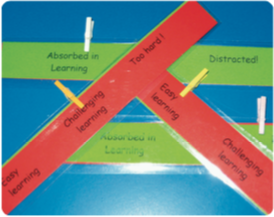 Little strips of laminated card and a peg can put children in charge of their learning a little more. Labelled ‘Easy learning’, ‘Challenging learning’ and ‘Too hard’ on one side, pupils use them to let you know whether you are meeting their learning needs or if they could do with more extension or support. It is powerful when learners realise that challenge is an essential element of their learning; that finishing easy tasks quickly does not signal cleverness but indicates time-filling rather than real learning.
Read more ...
#1 Introduce the link between challenge and mistakes
The ultimate aim is to help students view mistakes as an essential and valuable part of the learning process. We need to ensure students have a positive view of mistakes, they give access to our thinking and this can be used to change what we do; to enhance our understanding. Being able to overcome mistakes is an important part of perseverance and dealing with challenge.Putting a focus on mistakes includes:
Read more ...
#2 Introduce deeper ways of rising to challenge
Put ‘If-then’ planning into action in your classroom to target challenge and mistakes.
Try If/Then statements/targets like:
Read more
If you haven’t met this before here’s some background
The how of ‘If-then’ planning
Goal: I want to feel okay about having a go at things I don’t understand
If…
Then…
#3 Reframe making mistakes
#4 Model being a learner
Tell your own learning stories
Read more
Read an extract from Building Learning Power, by Guy Claxton
#1 Model dealing with challenge
Model how you might think about challenges:#2 Create a challenge checklist
#3 Differentiate mistakes

Read more ...
#1 Build expectation that students analyse their own mistakes
Expect students to analyse their own mistakes and create their own feedback
Essentially, this is about helping feedback to enable students to self-regulate their own learning.#2 Coaching: Strategically withdraw the scaffolding
Letting students ‘get on with it’
Read more ...
Talk for learning
Organisation of ideas below
#1 Talk to reframe challenge
#2 Talk to nudge improvement in the skill
Useful PhrasesEncourage students to become more interested in doing something more challenging and in viewing failure positively. Use phrases like:
Read more ...
#3 Talk to reflect on challenge
#4 Feedback to reinforce challenge
Reinforce taking on difficult tasks with supportive marking comments
#1 Talk to explore handling uncertainty and taking on more challenge.
#2 Talk to nudge improvement in the skill: keeping going with challenging material
Use the ‘support to continue’ technique: questions not answers
Read more
Coaching approaches
#3 Offer feedback on rising to challenge
#1 Talk to nudge the skill
#2 Feedback to promote interest in mistakes
Supportive marking comments
#1 Talk to nudge the skill
Enabling pupils to become reflective and thoughtful about learning.#2 Written feedback on engaging with difficulty
Supportive marking comments
You really excelled yourself here. The difficulties were immense, but you used effective strategies to unpick and resolve them. It must feel pretty good.Constructing learning lessons
Organisation of ideas below
#1 Coupling content and process
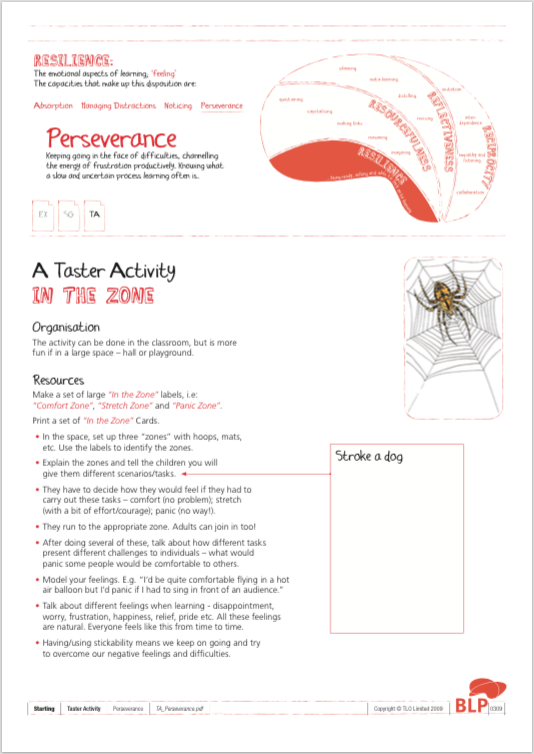 Use it to explore how different tasks present different challenges to individuals:
Read more ...
#2: Build reflection on challenge into lessons
Reflecting on challenge after the event
 Draw a thermometer on the wall, with a scale from overstretched to low or coasting. Work with the class to describe the various levels. High might read “I took the step to try something just a bit harder than before. I worked on it until I could do it and understood it clearly” and Overstretched might be “This was a few steps too far … next time I will chose a more manageable task.” Talk to children about the degree to which they have felt stretched and ask them to move photos of themselves up and down the scale. Use it to stimulate discussion about sticking with tasks and understanding when it is not wise to do so.
Read more ...
 Extract from Building Learning Power in Action, by Sarah Gornall, Maryl Chambers, Guy Claxton
#1 Offer choice
Enable students to select their own levels of challenge
#2 Coupling content and process
Plan to ensure students make mistakes
Read more ...
#3 Reflection: Use the learning pit to explore the nature of learning
The Learning Pit: understanding that struggle and effort are a natural aspect of learning
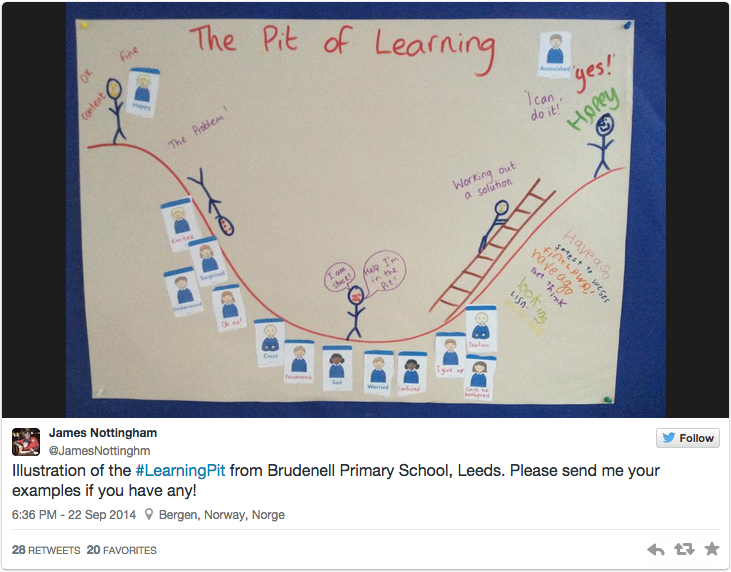 Use the ‘Learning Pit’ as a means of opening up a conversation around the feelings involved in learning, how effort is required, how the going will frequently be tough, and how mistakes are both inevitable and learning opportunities. It is essential that students know:
Read more ...
#1 Up the level of challenge
 Lift the level of challenge in lessons
Read more ...
#2 Coupling content and process: build trial and improvement into lessons.
Read more ...
Since we want young people to turn out to be robust, confident learners we have to talk with them in terms of a growth mindset. #3 Keep challenges interesting and worthwhile
Design ‘stretching’ challenges

Read more ...
#4 Encourage curiosity about mistakes
 Spot the mistake.
 #1 Expect students to create plans to manage challenging material
Require systematic plans for major projects/essays
#2 Expect students to analyse risks and strategies for achieving ‘high level’ work
#3 Encourage flexibility in goal revision in the context of setbacks
Read more ...
#4 Reflect on dealing with challenge
Reflection while still doing somethingReflection during the review phase:Celebrate learning values
Organisation of ideas below
#1 Recognise, praise, acknowledge overcoming challenges
 One of the greatest motivators is a bit of success and celebrating success is an important part of a learning culture. Many primary schools have changed their celebration assemblies so that students not only decide on the criteria for class awards but have shifted the setting of criteria to the ‘how’ of learning.
#2 Display growth in confidence in dealing with challenge
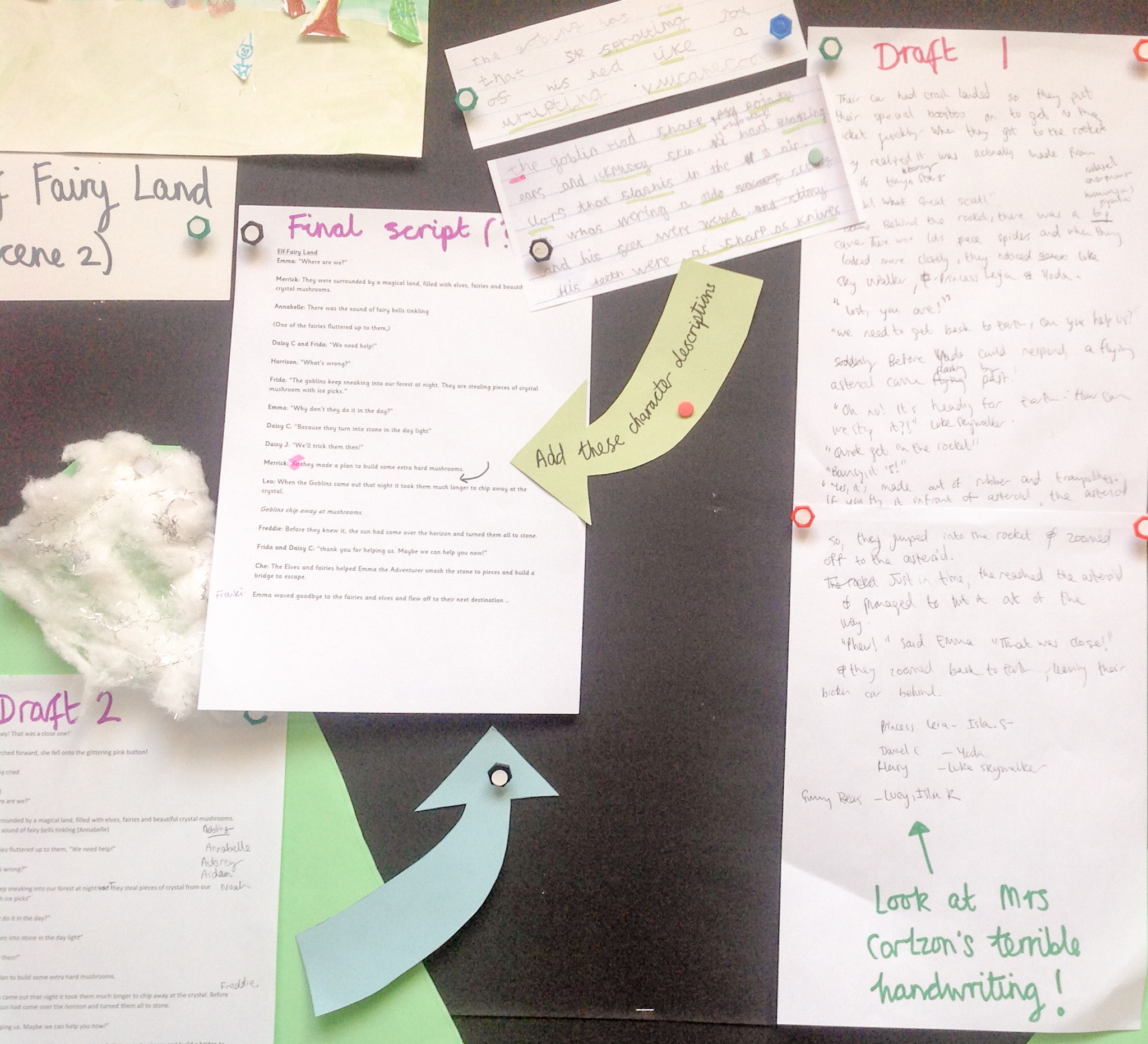 Ensure that your display walls include early drafts of work which show where students felt challenged. Encourage students to write on a separate note how they got unstuck, and display the note with the work.
Read more ...
#1 Display and celebrate mistakes
 Give mistakes high status, a key role in learning:
#2 Display
Sharing mistakes
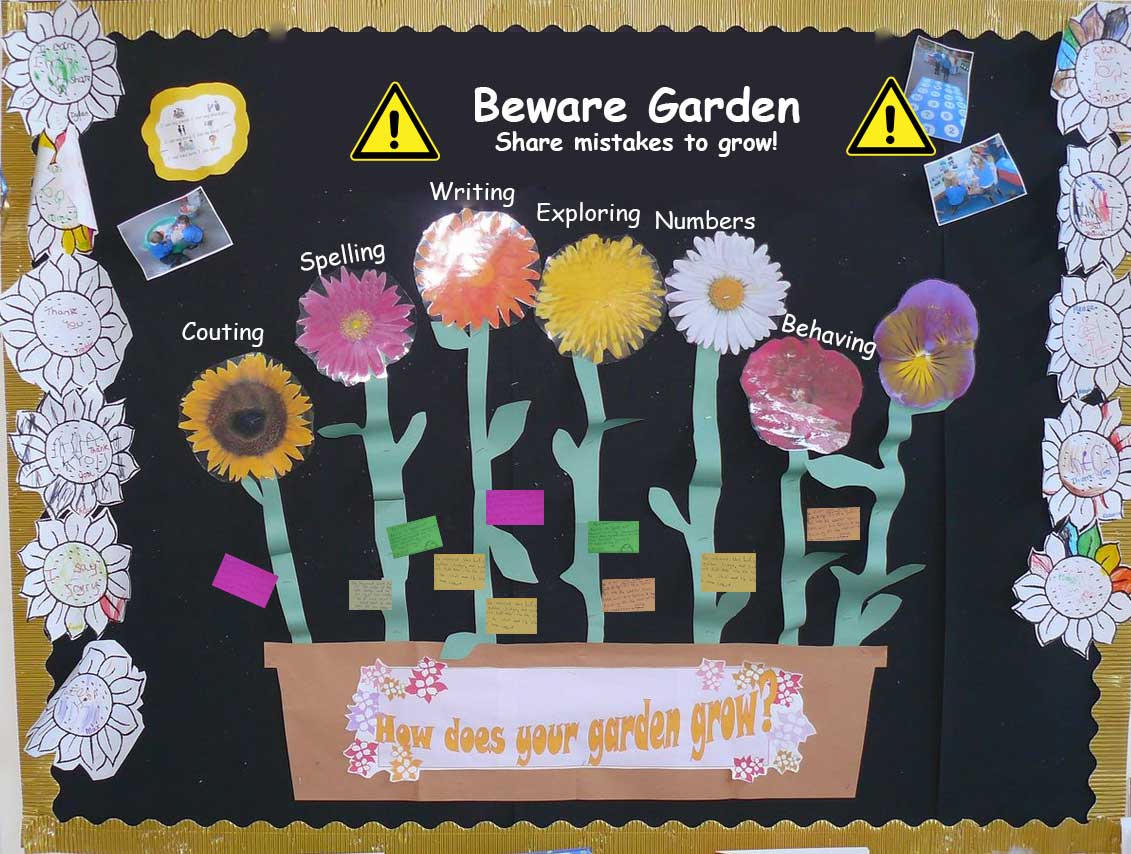
#3 Celebrate growth in dealing with challenge
Self reporting

#1 Create a challenge wall
Make the Challenge wall the focal point for your challenge culture. Make sure you add and refer to it frequently. For example;
Read more ...
#2 Celebrate growth in the skill
Read more ...
 The first questionnaire in this Unit should give you enough clues for you to be able to create some sort of development path for dealing with challenge /mistakes.
#1 Display
Challenge plan


3. The culture sort
Key Learning Questions:
What could I do differently to engage students in realising the value of
stuck?
The four shifts in teacher behaviour:
- how you relate to students;
- how you talk to students;
- how you construct learning opportunities;
- how you celebrate learning.
This grouping will enable you to look at one type of teacher behaviour shift across all student development phases.
Have a rummage through the sections to see what you can find. As you do, keep in mind what your students do now when they are stuck. Think about, what do you want them to be able to do that they can’t or don’t do now?
Aids to help shift responsibility for learning
This dimension of the learning friendly classroom concerns learning becoming a shared responsibility.
As a teacher you will be giving students more responsibility for their own learning by:
- acting as a learning coach, gradually enabling students to find their own ways to improve;
- focusing collaborative activity to help students to see each other as resources for learning;
- offering students choices about what and how to learn;
- enabling students to talk more, with you talking less;
- modelling being a learner;
- surfacing and promoting the processes of learning itself.
Shifting responsibility for learning ensures students recognise, use, understand and grow their learning habits.
The classroom gradually becomes a learning community where everyone is learning from each other and growing more confident as learners as a result.
Organisation of ideas below
The ideas below have been included for their effectiveness in helping to unhook teacher-student dependency and shifting more responsibility for learning to students. The coloured lines bounding each idea suggest the progression phase the ideas might best secure.
#1:
Talk for learning
This dimension of the learning friendly classroom concerns using the language of learning,
As a teacher you will be:
- using language to encourage perseverant, inquisitive, imaginative attitudes in students;
- exploring learning as an explicit theme that runs across all subject matter;
- talking about learning in terms of constant change; experimental, working towards, constant improvement, flexibility, could be;
- prompting in the form of questions to nudge pupils into thinking for themselves. “That’s curious. What’s odd about that? What does that make you wonder?”
- focusing questions on the process of learning, encouraging students to slow down, appraise the strategies and steps along the way, become more thoughtful and explore different strategies for making progress;
- aware of positive and negative student self talk and building positive talk by giving them the knowledge and experience of the learning behaviours ( the tools) with which they learn.
The more richly children come to relate their own learning the more they see and take hold of their own role in it.
Organisation of ideas below
The ideas below have been selected for their effectiveness in helping to surface the learning process and deepen the language of learning.
#1
Constructing learning lessons
This dimension of the learning friendly classroom concerns how you design learning episodes/lessons/projects.
As a teacher you will be:
- building reflection on learning and reviewing learning as key features in the rhythms of into the classroom;
- designing learning activities with a dual focus; to explore content and stretch ability to use learning behaviours;
- making conscious choices about:
- which habits/learning behaviours to introduce and stretch;
- how best to couple these with content so that lessons become more interesting and challenging;
- adding a third dimension to your teaching:
- 1. Subject matter;
- 2. Assessment;
- 3. The learning behaviours being used in order to learn the content.
Organisation of ideas below
The ideas below have been selected for their effectiveness in helping surface the learning process. The coloured lines bounding each idea suggest the phase of development and the order in which they might best be introduced.
#1
Celebrate learning values
This dimension of the learning friendly classroom concerns what is valued, recognised, praised, displayed about being stuck.
As a teacher you will be:
- showing attention to learning, rather than performance;
- recognising, praising, displaying aspects of becoming and undoing being stuck. For example:-
- recognising being stuck as an interesting – not shameful – place to be.
- ensuring mistakes seen as being valuable in learning.
- having a clear description of what effort means and how best to use it
- Good questions being as important as good answers.
- acknowledging/recognising/ praising when overcoming stuck strategies are used more skilfully
- attending to the growth of learning habits associated with being and overcoming stuck.
Learning powered environments build confident uncertainty. Being stuck is celebrated as an interesting place where real learning begins.
Organisation of ideas below
The ideas below have been selected for their effectiveness in helping to show how you value the opportunities being stuck offers the learner. The coloured lines bounding each idea suggest the phase of development and the order in which they might best be introduced.
#1
1. Where are you now? Copy
Key Learning Questions:
How do my students deal with being stuck? How stuck friendly is my classroom culture? What might I do to develop a more stuck friendly classroom culture?
Stuck and unstuck
Being stuck is a natural part of learning, we all get stuck. We come across blocks and obstacles, go into blind alleys, get flummoxed by a vast range of possibilities, or simply don’t know enough to decide what to do next.
Being able to get ourselves unstuck is as much about how we react emotionally as it is about having the practical strategies to work out how to overcome it. Being able to manage an effective way out of being stuck is a critical part of persevering.
Re-framing being stuck
But never being stuck or unsure doesn’t bode well for learning. It may well mean you are just coasting along; going through the motions, doing exercises rather than learning. Getting the most out of being stuck involves thinking of it anew; as an interesting place to be; being on the brink of learning; almost, but not quite understanding something new or different.
The two questionnaires in this section aim to help you analyse:
- What your students do now when they get stuck and what this reveals [Questionnaire 1 Stuck Questions]
- How learning friendly your classroom culture appears to be and what this might suggest. [Questionnaire 2 Culture Questions]
Results from these questionnaires will take you to a focused range of moving forward ideas.
2. Ideas to Practise Copy
Key Learning Questions:
What could I do differently to engage students in realising the value of stuck?
In this section we explore a range of ideas, activities, ways to display, and things to say about being stuck. the ideas aim to deepen your learning friendly classroom culture, helping to support and strengthen your students’ relationship with stuckness; how to enjoy it; what to do about it; how to overcome it, when to give up on it.
Much of being able to deal with being stuck involves your feelings; your emotional responses to learning. Being emotionally robust is a pre-requisite for powerful learning. Hence making sure students become stuck and coaching them to get unstuck is one small, but essential, way of moulding them as powerful lifelong learners.
The ideas to practise are grouped in two ways;
- The four phases of learner behaviour (we have left ’embodies’ out):
- Receives ( purple) Do as they are told;
- Responds ( blue) Acts more willingly;
- Values ( green ) Values the behaviour;
- Organises ( yellow) Organises themselves to use the behaviour effectively.
This grouping will enable you to look at all the ideas linked to a phase of development
2 The four shifts in teacher behaviour:
- how you relate to students;
- how you talk to students;
- how you construct learning opportunities;
- how you celebrate learning.
This grouping will enable you to look at one type of teacher behaviour shift across all student development phases
Have a rummage through the sections to see what you can find. As you do, keep in mind what your students do now when they are stuck. Think about, what do you want them to be able to do that they can’t or don’t do now?
4. Make your plan Copy
[NB Teachers who are following the Building Resilient Learners module will be undertaking this aspect of the learning cycle (planning) in the scheduled team meeting]
Key Learning Questions:
Which aspects of my practice do I want to change?
What do I want to accomplish over the next x weeks?
So far you have looked at;
- how your students currently deal with being stuck; their level of sophistication (Section 1a)
- how your classroom culture supports getting unstuck; the stuck friendliness of your classroom (Section 1b)
- practical ideas for ways of dealing with stuckness.( Sections 2)
This section is about sorting out what you want to achieve and drawing up a do-able enquiry plan. Learning enquiry plans create a record of what will be done and as such are important documents. Research has shown that it is important to: make your own choice about what you do within the suggested range; know that you have the flexibility to adapt a suggested activity to meet the needs of your students; make the plan specifically focus on development; concentrate on a small number of actions (3 is good); shrink overblown plans to keep the change manageable.
You might also think about what you are going to do less of in order to accommodate the changes.
The plan represents a promise to yourself and your colleagues to do something. This promise should help keep the plan as a priority in your mind.
5. What’s changed ?
Key Learning Question:
What effect have my actions had on my students and myself?
In this section we look at evaluating your learning enquiry actions and their effect on students. In other words how your action plan played out. This is an important part of the enquiry learning cycle; finding out what you have learned about yourself and your changing practice and considering the impact this has had on students. Such an evaluation will help you to decide whether to continue with the changes, whether to adapt or ditch them, or even whether to recommend that such changes would be useful for other staff to adopt across the school.
There are two parts to the evaluation, a self reflection stage and a team reflection stage. The team reflection stage can only be accessed by those schools that are using these Units as part of a whole school Professional Learning Programme.
A maths lesson in action
Key Learning Questions:
What does a maths lesson using learning behaviours look like?
Intro text about the lesson and the 3 parts of this section.
The lesson in full
The lesson deconstructed into episodes with explanations of what to look for
Key questions about the lesson explored.
t
xt
How learning powers work
Key Learning Questions:
What are the learning behaviours being used in this lesson? How do they work?
Not sure about this section. Thought we might need to explain habits like noticing, distilling, making links, questioning, etc ie the ones that are at play in the tasks
This could be a relatively short section especially for people who have not come across these learning behaviours previously. layout something like
#1: The learning behaviour…noticing
Explanation of this behaviour
Read more ...
Why its important and its use in maths
Similarly for the other behaviours
t
xt
How to link content and skills
Key Learning Questions:
How could I link maths content with key learning behaviours? What fits with what? How could I design tasks to make use of the behaviours to bring about mastery?
Unpack the essence of this section
Leanne I’m not sure of the order here and this is the key section; It might go something like
Fitting learning behaviours into medium term plans
Planning the flow of a lesson
Designing ‘towards mastery’ tasks (this is the heart of it)
t
xt
How to gear up learning power skills
Key Learning Questions:
How might I introduce the learning behaviours to students and enable them to practice them in other contexts?
General intro to this section…about the learning behaviours have to be introduced, surfaced, trained. Teacher has to make interventions so kids know the language, understand what they are doing when using them, why they are important,
noticing
distilling
making links
reasoning
there could be more but its getting quite complex with just these.
t
xt
4. How can teachers ensure learners improve as learners?
3. How do students improve as learners?
2. How do learners like to learn?
1. How do you like to teach?
2. Ideas to practise
Key Learning Questions:
What could I do differently to engage students in realising the value of stuck?
In this section we explore a range of ideas, activities, ways to display, and things to say about being stuck. The ideas aim to deepen your learning friendly classroom culture, helping to support and strengthen your students’ relationship with stuckness; how to enjoy it; what to do about it; how to overcome it, when to give up on it.
Much of being able to deal with being stuck involves your feelings; your emotional responses to learning. Being emotionally robust is a pre-requisite for powerful learning. Hence making sure students actually become stuck and coaching them to get unstuck is one small, but essential, way of moulding them as powerful lifelong learners.
The ideas to practise are grouped in two ways;
In section 2 (this section)
The four phases of learner behaviour ( we have left ’embodies’ out):
- Lacks (grey) ‘I can’t. I won’t’, can be a reluctant or fearful learner
- Receives ( purple) ‘Tell me’. ‘Show me’, where their tendency is to do as they are told.
- Responds ( blue) I’ll try. where they act more independently
- Values ( green ) I see why. where they come to value the behaviour
- Organises ( yellow) I make sure I do.where they organise themselves to use the behaviour effectively
This grouping will enable you to look at all the ideas linked to a phase of development
In section 3 (The culture sort)
The four shifts in teacher behaviour:
- how you relate to students
- how you talk to students
- how you construct learning opportunities
- how you celebrate learning
This grouping will enable you to look at one type of teacher behaviour shift across all student development phases. Basically it shows the subtle behaviour changes you will need to make in order to build your students’ behaviours.
Most of the ideas to practise are not phase-specific and can be used, or readily be adapted for use, with students of any age. Have a rummage through the sections to see what you can find. As you do, keep in mind what your students do now when they are ‘stuck’. Think about, what you want them to be able to do that they can’t or don’t do now?
1. Where are you now?
Key Learning Questions:
How do my students deal with being stuck? How stuck friendly is my classroom culture? What might I do to develop a more stuck friendly classroom culture?
Stuck and unstuck
Being stuck is a natural part of learning, we all get stuck. We come across blocks and obstacles, go into blind alleys, get flummoxed by a vast range of possibilities, or simply don’t know enough to decide what to do next.
Being able to get ourselves unstuck is as much about how we react emotionally as it is about having the practical strategies to work out how to overcome it. Being able to manage an effective way out of being stuck is a critical part of persevering.
Re-framing being stuck
But never being stuck or unsure doesn’t bode well for learning. It may well mean you are just coasting along; going through the motions, doing exercises rather than learning. Getting the most out of being stuck involves thinking of it anew; as an interesting place to be; being on the brink of learning; almost, but not quite understanding something new or different.
The two questionnaires in this section aim to help you analyse:
- What your students do now when they get stuck and what this reveals [Questionnaire 1 Stuck Questions]
- How learning friendly your classroom culture appears to be and what this might suggest. [Questionnaire 2 Culture Questions]
Results from these questionnaires will take you to a focused range of moving forward ideas.