Having taken a brief look at the Successful Futures At -a-Glance cards you may be wondering;
‘So what?’ or
‘How?’ or
‘What does it take?’ or
‘Could I have a go?’
Take a look at the sections below to find out about the sort of effort a school, its teachers and its students need to put in to make the big ambition of Successful Futures a reality. You’ll find:
Tools to help you gauge where you are now
Ideas for what it takes to shift practice
Descriptions of the various blended learning programmes
It could take three or so years to achieve fluency in the approach across the school but we can say categorically that the journey will be hugely worthwhile, endlessly interesting and keep you smiling all the way.
This section is for those teachers who are undertaking this unit alone and are not part of a Teacher Learning Communitystructure. The section provides well researched ways for planning and reflecting on your changing classroom practice
When teachers want or need to improve it actually involves them in changing their teaching habits. It’s not just about knowing new stuff, like reading the previous sections, it is about doing what you do differently. That’s much harder. It involves changes to;
what you know – knowledge
what you believe – feelings or attitudes
what you can do – your skills
what you actually do – putting it all into practice
So changing how you teach is a delicate, complex process……...that’s why it’s hard!
And the hardest thing isn’t getting new ideas into teachers’ heads
It’s getting the old ones out…….that’s why it takes time and effort.
It takes time and practice to undo old habits and become graceful at new ones……that’s why we have provided materials here to help you to plan the changes you want to make, monitor what happens in your classroom as the changes happen, and reflect on the impact of those changes; their worth and value.
This section offers a framework for supporting a productive Teacher Learning Community
If you are undertaking this unit alone and are not part of a Teacher Learning Communitystructure, please move on to Section 5.
Teacher learning communities have the potential to provide you, as teachers and support staff, with the information and support you need to develop your practice in deep and lasting ways. They provide a forum for supporting you in converting the information and ideas in the online learning sessions into “lived” practices within your specific subjects and classrooms. They provide a safe forum in which to;
kick around ideas from the online content,
unpack it’s meaning when it’s unclear,
consider what’s do-able and appropriate for your pupils
make plans for what and how you might incorporate the ideas into your practice
share and unpack what you have tried in the classroom
relate your triumphs and tribulations
support colleagues through changes in practice
reflect on what you hope you might do, or have done, differently
The format of the agenda is based on research into teacher learning communities by Dylan Wiliam, of Assessment for Learning (AfL) fame. Teacher learning communities are the engines of teacher development.
This section is for those teachers who are undertaking this unit alone and are not part of a Teacher Learning Communitystructure. The section provides well researched ways for planning and reflecting on your changing classroom practice
When teachers want or need to improve it actually involves them in changing their teaching habits. It’s not just about knowing new stuff, like reading the previous sections, it is about doing what you do differently. That’s much harder. It involves changes to;
what you know – knowledge
what you believe – feelings or attitudes
what you can do – your skills
what you actually do – putting it all into practice
So changing how you teach is a delicate, complex process……...that’s why it’s hard!
And the hardest thing isn’t getting new ideas into teachers’ heads
It’s getting the old ones out…….that’s why it takes time and effort.
It takes time and practice to undo old habits and become graceful at new ones……that’s why we have provided materials here to help you to plan the changes you want to make, monitor what happens in your classroom as the changes happen, and reflect on the impact of those changes; their worth and value.
This section offers a framework for supporting a productive Teacher Learning Community
Teacher learning communities have the potential to provide you, as teachers and support staff, with the information and support you need to develop your practice in deep and lasting ways. They provide a forum for supporting you in converting the information and ideas in the online learning sessions into “lived” practices within your specific subjects and classrooms. They provide a safe forum in which to;
kick around ideas from the online content,
unpack it’s meaning when it’s unclear,
consider what’s do-able and appropriate for your pupils
make plans for what and how you might incorporate the ideas into your practice
share and unpack what you have tried in the classroom
relate your triumphs and tribulations
support colleagues through changes in practice
reflect on what you hope you might do, or have done, differently
The format of the agenda is based on research into teacher learning communities by Dylan Wiliam, of Assessment for Learning (AfL) fame. Teacher learning communities are the engines of teacher development.
This section offers a framework of support for a productive Teacher Learning Community
Teacher learning communities have the potential to provide you, as teachers and support staff, with the information and support you need to develop your practice in deep and lasting ways. They provide a forum for supporting you in converting the information and ideas in the online learning sessions into “lived” practices within your specific subjects and classrooms. They provide a safe forum in which to;
kick around ideas from the online content,
unpack it’s meaning when it’s unclear,
consider what’s do-able and appropriate for your pupils
make plans for what and how you might incorporate the ideas into your practice
share and unpack what you have tried in the classroom
relate your triumphs and tribulations
support colleagues through changes in practice
reflect on what you hope you might do, or have done, differently
The format of the agenda is based on research into teacher learning communities by Dylan Wiliam, of Assessment for Learning (AfL) fame. Teacher learning communities are the engines of teacher development.
This section is for those teachers who are undertaking this unit alone and are not part of a Teacher Learning Communitystructure. The section provides well researched ways for planning and reflecting on your changing classroom practice
When teachers want or need to improve it actually involves them in changing their teaching habits. It’s not just about knowing new stuff, like reading the previous sections, it is about doing what you do differently. That’s much harder. It involves changes to;
what you know – knowledge
what you believe – feelings or attitudes
what you can do – your skills
what you actually do – putting it all into practice
So changing how you teach is a delicate, complex process……...that’s why it’s hard!
And the hardest thing isn’t getting new ideas into teachers’ heads
It’s getting the old ones out…….that’s why it takes time and effort.
It takes time and practice to undo old habits and become graceful at new ones……that’s why we have provided materials here to help you to plan the changes you want to make, monitor what happens in your classroom as the changes happen, and reflect on the impact of those changes; their worth and value.
This section is for those teachers who are undertaking this unit alone and are not part of a Teacher Learning Communitystructure. The section provides well researched ways for planning and reflecting on your changing classroom practice
When teachers want or need to improve it actually involves them in changing their teaching habits. It’s not just about knowing new stuff, like reading the previous sections, it is about doing what you do differently. That’s much harder. It involves changes to;
what you know – knowledge
what you believe – feelings or attitudes
what you can do – your skills
what you actually do – putting it all into practice
So changing how you teach is a delicate, complex process……...that’s why it’s hard!
And the hardest thing isn’t getting new ideas into teachers’ heads
It’s getting the old ones out…….that’s why it takes time and effort.
It takes time and practice to undo old habits and become graceful at new ones……that’s why we have provided materials here to help you to plan the changes you want to make, monitor what happens in your classroom as the changes happen, and reflect on the impact of those changes; their worth and value.
This section offers a framework of support for a productive Teacher Learning Community
Teacher learning communities have the potential to provide you, as teachers and support staff, with the information and support you need to develop your practice in deep and lasting ways. They provide a forum for supporting you in converting the information and ideas in the online learning sessions into “lived” practices within your specific subjects and classrooms. They provide a safe forum in which to;
kick around ideas from the online content,
unpack it’s meaning when it’s unclear,
consider what’s do-able and appropriate for your pupils
make plans for what and how you might incorporate the ideas into your practice
share and unpack what you have tried in the classroom
relate your triumphs and tribulations
support colleagues through changes in practice
reflect on what you hope you might do, or have done, differently
The format of the agenda is based on research into teacher learning communities by Dylan Wiliam, of Assessment for Learning (AfL) fame. Teacher learning communities are the engines of teacher development.
The first At a Glance card introduces a new chapter for education in Wales
Scroll through the At a Glance card below
Download as many copies as you need.
Explore and learn more about the topics on each page in the sections below.
This card offers a quick look at learning power. It encourages you to think about the rich forward looking purposes of the Successful Futures curriculum. It shows the broad approaches of learning friendly classrooms and what it means to build students’ learning power.
Now that you have worked your way through the previous sections you may be wondering, ‘So what?’ or ‘What next?’
This section explains the effort a school, its teachers and its students will need to put in to make learning powered learners and the CfE promise a reality. We are not going to pull any punches and tell you it’s easy because it isn’t. It’s likely to take between three and five years to achieve fluency in the approach across the school. But we can say categorically that the journey will be hugely worthwhile, endlessly interesting and keep you smiling all the way through.
The diagram above offers glimpses of the difference between traditional good teaching and teaching that enables learners to become better learners throughout their lives. Look through the following tabs to find out more about bridging this gap.
Making the shift from traditional good teaching to teaching for learning power.
Developing students as learning powered learners is a long term innovation. It requires far more than reading a few resources like the At-a-Glance cards and trying out a few of the ideas in practice. Even the traditional Inservice training day can only scratch the surface. This is because the approach has implications not just for student learning, but for staff learning too. Teachers’ habits as learners have to become part of the picture – how they go about changing is as relevant as what changes they want to bring about. This isn’t just about teachers knowing more about teaching, it’s about teaching differently.
So, what does this ‘teaching differently’ look like?
Basically, as a teacher you are going to become more forensic about learning, talking about the learning behaviours, stretching them through activities you offer, modelling them, and valuing them as you see learners using and developing them.
Look at the statements and work out:
how often you try to help students develop such behaviours by the way that you teach at present;
how many of your students display these behaviours in the classroom (without knowing it).
Having completed the quiz ask yourself:
From the left hand column:
Which behaviours did you denote OFTEN ?
Which do you RARELY attend to?
Which psychological domain receives most attention? (emotional, cognitive, social, strategic)
What might this reveal about your teaching?
Key Question: How do you know if/how students are improving in these behaviours?
From the right hand column:
Which behaviour was most difficult to assign students to? i.e. the things you may not know about your students
What patterns are emerging?
Is there a link between what you do and how students are as learners?
What is this making you wonder?
How subtle is subtle? Where am I now?
This tool shows just some of the small, yet profound, shifts teachers make when they are surfacing learning.
Each thread explores one of the 12 aspects of the Teachers’ Palette (mentioned in Section 2) and begins to put flesh on the journey towards ‘Bridging the Gap’.
Ask yourself, where is my classroom/school on each of these indicator threads ?
You don’t have to choose one of our descriptors – if you think ‘we are further on than ‘xxx’ but not yet at ‘yyy”, then score yourself accordingly.
As an additional challenge, try to write a descriptor for where you are positioning your classroom/school.
Scoring
If most of your scores are 3 or less, classrooms are still heavily teacher focused.
Scores in the range 4 through 7 suggest that classrooms are becoming increasingly learner focused.
Scores above 7 suggest that the classroom is already learning focused.
Wherever you are now, building pupils as more powerful learners is about ‘Bridging the Gap’ and moving classrooms towards becoming increasingly learning focused.
Making subtle shifts in practice takes a big effort in unlearning.
When teachers want different outcomes for their students it actually involves them in changing their teaching habits. It’s not simply about knowing about new techniques, it is about doing what you do differently. That’s much harder. It involves changes to;
what you know – knowledge
what you believe – feelings or attitudes
what you can do – your skills
what you actually do – putting it all into practice
So changing how you teach is a delicate, complex process……...that’s why it’s hard!
And the hardest thing isn’t getting new ideas into teachers’ heads
It’s getting the old ones out…….that’s why it takes time and effort.
It takes time and practice to undo old habits and become graceful at new ones……that’s why we have based our learning programmes on research into how adults learn and the professional value of teacher learning communities. You will find out more about this in the next section.
A blended learning programme to ensure changes in practice.
The diagram above illustrates the key features of a learning programme designed to bring about changes in classroom practice. Our programme design is built around best practice in professional development to ensure innovative and sustained practice. Use the tab boxes to find out more about the merits of such a design.
What it takes to grow innovative practice
For the school to take on wholeheartedly the new roles and new paradigms that minute-to-minute and day-by-day build better learning requires far more than just the quick exposure to its principles and methods you have seen thus far. Development of this magnitude asks a lot of teachers. They have to go through a process of un-knowing, re-learning, unpacking and re-adjusting.
The programme we have compiled is a careful blend of:
online learning sessions….that faithfully disseminate the researched content for building better learners;
professional learning team sessions ……actioned by the school that provide sustained, meaningful assistance; learning with and from colleagues;
trying things out for yourself in the classroom……because “learning by doing” is integral to the development of expertise and expertise cannot be developed quickly. It can only be developed if teachers have ample opportunity for practice, reflection, and adjustment.
This trio of learning opportunities work together to help teachers replace long-standing habituated practices with more effective ones.
Why online learning ?
The online learning aspect provides the content of the Learning Power approach based on over 20 years of research and development in schools. It attempts to cut the big complex innovation of Building Learning Power into more bite size chunks that schools and teachers can make sense of and implement over time.
You might well wonder why such content merits online modules and why you can’t just read a book about it and get on with it. We’ve discovered over time that:
schools in the past have had a tendency to think of the approach as merely a few tweaks in classroom practice, to make light of its potential and translate ‘lite’ versions of it in schools – versions that inevitably fizzle out;
research has revealed just what it takes to shift classroom cultures to being more learning friendly. This has given the approach a richer, more concrete vision of how to implement it across a school;
unique research into how learners grow and progress as learners…what the ‘better’ bit of better learners looks like at different phases. This has made the approach more purposeful. Not an approach but a way of being. All this new research has added purpose and rigour.
So, what the online courses and sessions are attempting to do is:
to offer bite size chunks for schools implement;
to faithfully offer the researched content in a do-able form i.e. so that you only get the bits we know work which saves you time twiddling about with stuff that may sound good but doesn’t do the job;
structure professional learning team sessions in schools because these are the best way of supporting and delivering changes in classroom practice.
The blended learning courses will enable the school to build better learners right not lite, make a complex set of ideas work on a practical level and, achieve the 4 Purposes of CfE efficiently and effectively.
Why Learning Communities?
All the evidence shows that teachers change their practice when they work together and support each other in trying out new teaching strategies, within a culture of classroom based action research. It is about teachers being empowered to explore together to find out what works with their students, in this context, at this time. As a consequence, the school learns its way forward, together.
Teacher learning communities provide a forum for supporting teachers in converting the information and ideas from the online learning sessions into “lived” practices within their specific subjects and classrooms. Such communities provide a safe forum in which to:
kick around ideas from the online content,
unpack it’s meaning when it’s unclear,
consider what’s do-able and appropriate for your students;
make plans for what and how you might incorporate the ideas into your practice;
share and unpack what you have tried in the classroom;
relate your triumphs and tribulations;
reflect on what you hope you might do differently.
Because Teacher Learning Communities are embedded in the day-to-day realities of classrooms they provide a time and place where teachers can hear real-life stories from colleagues that show the benefits of adopting these techniques in situations similar to your own. They provide local reassurances. As you adjust your practice, you are risking both disorder and less-than-accomplished performance on the part of your students and yourself. Being a member of a community of teacher-learners, engaged together in a change process, provides the support you need to take such risks.
That is why teacher learning communities work, and hence why learning through such communities lies at the heart of these learning programmes. Teacher learning communities are the engines of teacher development.
Classroom practice and monitoring impact
Crucially, real change happens in classrooms but this isn’t left to chance. Teachers are encouraged to plan the development action they will take between team sessions.
Their learning enquiry plans create a record of what will be done and as such is an important document in keeping the changes focused.
Research has shown that it is important to allow teachers:
choice about what they do within the suggested range;
flexibility to adapt a suggested activity to meet the needs of their students;
make the plan specifically focus on development;
concentrate on a small number of actions (3 is good);
shrink overblown plans – keep the change manageable;
structure the action over four weeks;
include what they will monitor…
About themselves:
How their actions change;
How their motivation changes over the 4 weeks and why;
Challenges – anything that didn’t go to plan, things they are finding tricky etc.
About students:
What they are doing/saying differently;
Any changes in their behaviour;
Any reactions, responses to new ways of working. For example: increased attention to detail, more precision in their questions that uncover the required information, reduction in the ‘tell me’ mindset.
Noting such change motivates teachers to continue with their experiments since the changes in pupils are almost always positive.
The plan represents a promise to do it. This promise keeps the plan as a priority in the mind of the teacher.
Stepping Stones phase 1 and Stepping Stones phase 2 are designed to help primary schools move towards a learning focused culture. They attempt to solve the challenge of designing a professional development model that can faithfully disseminate researched content to build better learners, whilst also scaffolding sustained, meaningful support for teachers who are attempting to replace long-standing habituated practices with more effective ones. Hence each is a blended programme of online content and in-school support for learning teams.
The content provides:
useful examples of proven classroom material relevant to all curriculum areas
descriptions of what each well-formed learning habit looks like
progression maps of how the learning behaviours develop over time
activities and routines related to these different phases of development
understanding of a common language for learning across the school
opportunities for teachers to generate their own ideas and teaching material
analysis tools to help teachers estimate their current learning cultures
a range of success criteria to keep a lookout for.
Stepping Stones phase 1 consists of 6 modules:
The first module is devoted to establishing learning friendly classroom cultures;
Four learning behaviour modules address Perseverance, Collaboration, Questioning and Revising;
The sixth module offers ways to review progress to date.
The content and development is expected to take at least a year to complete.
The solid foundation and understanding the school establishes in Stepping Stones Phase 1 means that development in Phase 2 can move more rapidly to introducing a new learning habit each month. You can also select the order of the sessions, so enabling teams to follow their own needs and ensure best fit with their students’ progress.
Stepping Stones phase 2 consists of 9 modules:
Eight learning behaviour modules address Noticing, Listening, Making Links, Imagining, Reasoning, Capitalising, Planning, and Meta Learning;
The ninth module offers ways to review the impact of the changes that have been made.
The content and development is again expected to take about a year to complete
All teachers and support staff are registered to receive the online modules so enabling the whole school to learn together, simultaneously on the same aspect of learning. This ‘togetherness’ ensures swifter, deeper learning across the school.
Each online session is divided into three content sections:
Section 1: How the learning habit develops (with the progression map) Section 2: A learning friendly classroom culture (with a tool to assess current practice) Section 3: Teaching for learning; activities and talk (containing masses of relevant activity ideas)
And one Professional Learning Team meeting section
Section 4: Team reflection and planning (containing session agendas, learning enquiry and planning formats)
Staff work their way through the materials in sections 1 – 3 at a time and place to suit them. The sections will usually take about 45-60 minutes to get your head around the new thinking and practical ideas in preparation for the team session.
Schools have found it useful to tackle one session each month. So, for example staff absorb the online material in week three of the month and the team meetings are held in week four.
It’s important to take your time – there’s no rush. There’s a lot of learning and development in any one session so it’s perfectly understandable to take more than one month to crack it. We have mentioned each phase being designed to take about a year but online sessions don’t just switch off after that time so you go at your own pace and rhythms.
There are 2 Nutshells programmes designed to help a secondary school to move towards a learning focused culture. It attempts to solve the challenge of designing a professional development model that can faithfully disseminate the content of building better learners, while also providing sustained, meaningful assistance to teachers who are attempting to replace long-standing habituated practices with more effective ones. Hence it is a blended programme of online content and in-school support for learning teams.
Nutshells 1 is designed to support a school to move from a highly teacher-centred classroom culture to one that is increasingly learner-centred. Nutshells 1 paves the way for Nutshells 2.
Nutshells 2 is designed to support a school to move to a learning-centred classroom culture. Some schools will need/want to do Nutshells 1 before turning to Nutshells 2, while others may already have a learner-centred culture and wish to start with Nutshells 2 from the outset.
A free online support for senior leaders (called ‘Where do we need to start in building better learners ?’) helps schools to decide at which level they engage with Nutshells.
The content provides:
useful examples of proven classroom material relevant to all curriculum areas
descriptions of what each well-formed learning habit looks like
descriptions of how the learning behaviour develops over time
activities and routines related to these different phases of development
understanding of a common language for learning across the school
opportunities for teachers to generate their own ideas and teaching material
analysis tools to help teachers estimate their current learning cultures
a range of success criteria to keep a lookout for.
The on-line material is designed to enable lead teachers to run training/coaching sessions with school teams that will give teachers practical hands-on experience and a wealth of ideas that they can put rapidly in place in their classrooms.
Alternatively schools may decide to enable teachers to access the material as individuals, coming together for team sessions once a half term or so.
This is for individual schools to decide – both routes are available and supported through Nutshells 1.
There are 11 modules in total, that are tackled broadly in the following order:
Strategic Issues and coaching notes (for senior and team leaders only)
A Culture for Building Learning Power
3 modules that relate to shifting classroom cultures
Building Active Participation
Building Dialogue and Collaboration
Building Shared Responsibility
5 modules relating to the key learning behaviour of Perseverance and how it grows
Building progression in Perseverance
Engage students in unsticking their learning
Engage students in rising to challenge
Engage students in managing distractions
Engage students in achieving goals
Reviewing our Progress
Using these materials will;
Develop team understanding of classroom cultures, learning habits and behaviours and, importantly, how they should develop over time
Establish team enthusiasm for refreshing student motivation and learning behaviours
Build expertise through guided sessions that stimulate teachers to use the materials and generate their own ideas.
Secure a common classroom culture for learning across the school
Pacing the content:
Expect teams to spend the best part of half a term exploring any one module. Do not be tempted to rush the process – it takes time for teachers to get their heads around the materials, consider their existing practice, try out some new ideas, share their successes and failures with colleagues, and slowly but surely adapt their practice so as to build secure, positive learning behaviours in students.
While we have mentioned that Nutshells 1 might take a school a year or so to work through, the online sessions don’t just switch off after that time, so feel free to go at your own pace and rhythms.
The content provides:
useful examples of proven classroom material relevant to all curriculum areas
descriptions of what each well-formed learning habit looks like
descriptions of how the learning behaviour develops over time
activities and routines related to these different phases of development
understanding of a common language for learning across the school
opportunities for teachers to generate their own ideas and teaching material
analysis tools to help teachers estimate their current learning cultures
a range of success criteria to keep a lookout for.
There is no right or wrong way to tackle the Nutshells 2 modules. Most schools choose to work in subject teams on the materials. The reason that a whole-school approach needs to be taken is that Nutshells 2 is not designed to be undertaken by individual teachers exploring the materials on their own. Nutshells 2 is designed to enable teams of teachers to work together on aspects of common concern. How these teams are formed is down to the strategic approach that the school decides upon. But it is not expected that all teachers will consider all of the modules.
Some schools allow subjects to start with modules that seem to fit well with their own subject; others choose to start on a module of common concern – perseverance is a regular favourite.Whichever route you choose, we recommend that everybody does the Culture module first, and then adopt one of the above approaches once the Culture module has been addressed.
The module on classroom culture is the recommended starting point for all teachers, and the reviewing progress module forms a useful end to the programme.
Pacing the content:
Each of the 12 key learning behaviour modules is divided into 4 sections:
The nature of the learning behaviour and how it develops. Unpick the meaning of the learning behaviour being studied, how it develops over time and use the progression chart to plot where your students are now.
Taking the learning behaviour into classroom culture. Think how to improve your classroom culture to better support the behaviour.
Introducing activities and routines. Look for ways to build the learning behaviour into learning activities/tasks.
Team and Individual reflection and planning. Share the impact of your experiments with colleagues and plan what you need to do next.
Expect teams to spend the best part of a term exploring any one learning behaviour. Do not be tempted to rush the process – it takes time for teachers to get their heads around the materials, consider their existing practice, try out some new ideas, share their successes and failures with colleagues, and slowly but surely adapt their practice so as to build secure, positive learning behaviours in pupils.
While we have mentioned that Nutshells 2 might take a team a couple of years to work through, the online sessions don’t just switch off after that time, so feel free to go at your own pace and rhythms.
We would be happy to welcome your school to the growing family of schools that are taking part in the online blended learning programmes. To find out more about how the programmes work, click on the appropriate link below.
Online blended learning programmes to support the development of powerful learners.
On the page above you can see an overview of the learning behaviours linked to Responsible Citizens. Use the tabs to find out more.
The main learning characteristics that make up a Responsible Citizen.
Building empathetic, ethical outlooks (Empathy): seeing things from other people’s point of view; demonstrating tolerance and empathy for others; listening attentively to understand what is being said and listening critically to evaluate the quality of others’ ideas; forming views with the greater good in mind.
Building outward-looking, reflective learners (Questioning, Revising): being interested in others who hold different views and beliefs; willing to review and weigh the available evidence, making decisions in light of careful reflection; being prepared to change outlook as further evidence emerges; being able to accommodate others’ perspectives into an increasingly diverse personal outlook.
Building future-orientated learners (Reasoning): having a sense of what needs to be achieved and able to adopt a strategic, logical approach to work things out and solve problems; taking sensible, logical action with the end in mind.
Building perceptive learners (Distilling): discerns what is, and what is not, important; able to separate key points from the underlying detail and to explain them with clarity to others.
Building attentive learners (Noticing, Listening): being alert to the implications of what they hear and what they see; attentive to detail, able to sense patterns and make accurate inferences.
Something to think about . . .
In summary – To attain this view of responsible citizenship, students need to take responsibility for their actions, be attentive, open and empathetic to different ideas and views while maintaining a questioning stance in considering the worth and value of something.
Do you agree that this short paragraph captures the essence of Responsible Citizenship as defined in Curriculum for Excellence?
If not, what would you add or subtract?
Using our definition, or yours, what proportion of your students are like this?
Does this vary by year group? By gender? By perceived ‘ability’?
On this page you can see the architecture of a learning friendly culture; one that is associated with nurturing Responsible Citizens. Use the tabs to find out more.
How classroom culture might change – From traditional to learning-friendly cultures
In general terms moving to establish learning-friendly cultures entails four shifts. A shift in relationships, a shift in the language, a shift in how learning is constructed, and a shift in what is celebrated – what is seen to matter:
Relating – How you relate to your students; gradually sharing more of the responsibility for learning with them
Talking – How you talk about learning; the sort of learning language content and style you use to enhance and explain learning
Constructing – How you construct learning activities; the tasks and classroom routines you use to build positive learning habits
Celebrating – What you celebrate about learning; what you prize, recognise, display; the outward signs of beliefs about learning
How the teacher’s role might change – Surfacing the learning
The teacher’s role becomes one of surfacing learning; to make learning public; to train some of the tricky bits; to talk about it; to recognise and celebrate it as it happens; to nudge it along, assisting students to grow their learning behaviours; and to design activity to stretch a wide range of learning habits. This uncovering of learning ensures students discover, use, understand and translate their learning behaviours into learning habits. There is a shift in emphasis from performance to learning, from content to process, from teaching to coaching.
How relationships might change – Developing Coaching approaches
“Expert tutors often do not help very much. They hang back, letting the student manage as much as possible. And when things go awry, rather than help directly they raise questions: ‘Could you explain this step again? How did you…?’ ” (Mark Lepper)
When we are curious we are genuinely interested in learning. Curiosity lies at the heart of coaching, hence coaches are effective listeners and ask questions to open dialogue without sounding like an interrogation. Coaching aims to enable people to see what they are doing more clearly and discover their own ways to improve. A coaching approach:
helps people to explore their challenges, problems and goals
provides an objective view of peoples actions to enable them to see things as they really are
enhances motivation and raises self-esteem
builds curiosity and encourages learning
Above all, coaches resist offering solutions. Offering solutions does little to secure learning as the student hasn’t been allowed to confront and engage with the problem and find their way forward. Learning powered teachers adopt a coaching role.
How feedback might change – Feedback prompts
In the learning-centred classroom feedback can be seen at three levels. Notice that all the prompts ask rather than tell.
Task-Level Feedback prompts (adapted from Nuckles et al, 2009)
• Does this answer meet the success criteria? • Is this right? • Could you elaborate on this answer? • What aspect of your response to this assignment are you pleased with/unhappy about? • What other information do you need to meet the criteria? • What’s the sticking point in this task?
Process-Level Feedback prompts (adapted from Nuckles et al, 2009)
• What strategies are you using? • Are there more efficient strategies you could use? • What other Qns could you ask about this task? • Do you grasp the concept underpinning this task? • Have you done anything similar to this before?
Self-Regulation-Level Feedback prompts (adapted from Nuckles et al, 2009)
• What would be the best way of checking your work? • How could you reflect on these answers? • What happened when you …? • How can you account for …? • What learning goals have you achieved? • How have your ideas changed? • What aspect of this work could you now teach to others?
Research suggests that 90% of feedback in classrooms falls into the first of these three categories. At what level do you currently pitch your feedback ? Could you offer more process level feedback than at present ? Could this lead, in time, to self-regulation level feedback ?
How learning is constructed might change – Models of learning
Active Learning cycle
This familiar learning cycle highlights what is needed in order to learn from experience. By active learning we mean active engagement with materials, with ideas, with relationships and with other resources.
The teacher’s role is to facilitate the cycle using questions such as;
In the DO phase
What’s happening?
What do you notice?
How are you feeling about this?
What else is happening?
In the REVIEW phase
What struck you?
What did you see operating?
How was that significant?
What seemed effective?
In the LEARN/SO WHAT phase
How did you make sense of that?
What does that mean to you?
What might help explain that?
In the APPLY/ NOW WHAT phase
Where does this leave you?
Where does this take you?
Do you know other situations like this?
Meta cycle
It’s not sufficient to simply have an experience in order to learn. Without reflecting on the experience it may quickly be forgotten or its learning potential lost (Gibbs 1988). This is the model that best drives the learning in learning-focused classrooms
How what we display might change – Learning on display
In a learning powered classroom learning will be on display in what you will see, hear and feel. In other words learning is visible in all sorts of ways.
You might find several ways of acknowledging learning on the walls:
useful prompts for use when stuck
a list of agreed ground rules for the social habits the class have created and are focusing on
displays of students efforts showing drafts and examples of work in progress to emphasise the idea of learning as a process
a humorous display of mistakes of the week
a five point scale students have devised about levels of distraction
some If -Then statements to encourage habit formation
whiteboard display of icons showing the learning behaviours they are focusing on just now
photographs taken by some of the students which capture their peers displaying some learning behaviours
statements showing some positive self-talk statements from students
a ladder or learning line showing descriptions of different levels of activity choices (mild, spicy, hot, super hot) which students use at the end of the session to reflect on their efforts.
Something to think about . . .
Let’s focus on the fourth cultural shift in terms of what is celebrated in the classroom.
Take a hard look around your own classroom. What have you considered to be so important that it goes on display?
What have you decided not to display?
Are you happy that what is on the walls of your classroom reflects the commitment to growing Successful Learners, Effective Contributors, Confident Individuals and Responsible Citizens?
How might you adapt your display to better emphasise this commitment?
On this page you can see just a small selection of learning activities and talk that may help to promote Responsible Citizen behaviours. Use the tabs to find out more.
Taking personal responsibility
Creating Responsible Citizens requires helping learners to take responsibility for themselves and for their actions. They are most likely to do this if they:
Know who they want to be – have a life plan; know what is important to them
Know what they want – take decisions that move them closer to the life they want; set effective goals and pursue them
Do not blame others – rather than offset responsibility to others, identify what went wrong so that they can rectify it
Do not blame themselves – know that accepting responsibility is not the same as blaming yourself; take responsibility for the situation, identify the changes they need to make and make them
Are honest with themselves – never resort to excuses; adopt a ‘can-do’ outlook
Recognise that they may have a vested interest in the status quo – refuse to take the easy way out and do nothing through self-interest
Know that they have choices – accept that they have the power to make choices/decisions that will change the situation.
Are your students like this? Are you? How might teachers nurture these behaviours?
The Visible Thinking Routine – ‘Step Inside: Perceive, Know, Care about‘
The visible thinking routine ‘Step Inside: Perceive, Know, Care about‘ helps students to explore different perspectives and viewpoints as they try to imagine things, events, problems, or issues differently.
Three core questions guide students in this routine: • What can the person perceive? • What might the person know about or believe? • What might the person care about?
The routine asks students to step inside the role of a character or object—from a picture they are looking at, a story they have read, an element in a work of art, an historical event being discussed, and so on—and to imagine themselves inside that point of view. Students are asked to then speak or write from that chosen point of view. This routine works well when you want students to open up their thinking and look at things differently. It can be used as an initial kind of problem-solving brainstorm that open ups a topic, issue, or item. It can also be used to help make abstract concepts, pictures, or events come more to life for students.
On this page you can read an overview of progression in learning behaviours and see a sketch of such a progression for Responsible Citizens. Use the tabs for more information.
Getting better = using it more frequently
The first dimension of progression, and easiest to activate, is frequency/how often. The distinction between skill and habit is important – skills are what you can do, whereas habits are what you do do. A skill that is only rarely employed, or only employed when adult-directed, is at best embryonic. Initially the aim is to activate the skill more frequently through direct intervention with a view to reducing the level of intervention as the skill becomes stronger through more frequent use. The target is to develop the skill into a habit that the pupil employs frequently, without support, as and when the need arises.
So the message here is to spot students using a learning behaviour and point this out.
Getting better = using it in different contexts
The second dimension of progression relates to the range of contexts within which the skill is deployed. The child who is tenacious and thoughtful on the Play Station can equally be defeatist and impulsive in the classroom – they have the skills, but fail to recognise that the perseverance that leads to success on the Play Station is precisely the same outlook that is needed for success in the literacy lesson. Initially the skill is used only in familiar circumstances, but the aim is to help students to recognise and exploit opportunities to utilise their leaning behaviours in new and uncharted territory.
Again the message is to look out for and comment on students using the habit, however tenuously, in different subjects or in the playground.
Getting better = becoming more skilled in its use
The third dimension, and by far the most subtle, is that of skilfulness. While we may start by encouraging students to ask more questions, more often and in different subjects, we rapidly turn our attention to the quality of the questions that are being asked. It is not too difficult to describe the attributes of a high level, sophisticated questioner who is skilled at asking incisive, generative questions, but it is very difficult to map out and sequence the steps between the natural curiosity of a three year-old and the sophisticated skill-set of the consummate question-asker/enquirer. This is the challenge, and why skilfulness is the most complex of the three dimensions. However, once mapped, the impact on how you mentor, set targets, enable self and peer assessment, design tasks, and plan the curriculum etc. is immense.
Helping students become more skilled in their learning behaviours is the role of a teacher in learning-friendly classrooms
Something to think about . . .
Take a look at the Empathy and Listening learning trajectory above.
You will have some students who ‘think/act out of self-interest. who hear but do not listen, who are intolerant of others with differing views’, and some others who ‘act from secure principles, listen sensitively to and beyond the words, and respond empathetically’. Ignore these ‘outliers’ for a moment:
Where would you guesstimate the majority of your learners to be on this journey?
Do many of them equate behaving empathetically with success?
How many of them actually act on this?
Do you believe that your students become more empathetic as they move through your school?
On this page you can see an overview of the learning behaviours associated with Effective Contributors. Use the tabs to find out more.
Brief descriptions of the learning behaviours of Effective Contributors.
Building enterprising frames of mind (Capitalising): drawing on the full range of strategies and resources from the wider world; making good use of what and who is around you; creating novel solutions.
Building resilient learners (Perseverance): prepared to stick at it in the face of difficulties; enjoying and rising to challenges; having a ‘can do’ outlook.
Building independent learners (Meta Learning): understanding how you best learn and playing to your own learning strengths, able to discuss and reflect on and manage the learning process with precision and fluency.
Building effective communicators (Empathy): understanding others; putting themselves in other people’s shoes, so that they can communicate effectively with a variety of audiences.
Building collaborative learners (Collaboration): working constructively with others; understanding when to step forward, or to lead, or to take more of a back seat when working with others; knowing when and how to stick to their own point of view when others need convincing; being skilled at seeking compromise and building consensus.
Building creativity (Imagining): being prepared to step into the unknown and explore areas of uncertainty; looking at things in different ways, being sufficiently brave to break new ground; producing original, novel and inventive outcomes.
Building critical thinkers (Listening): being able to listen attentively and sensitively yet critically to draw out key information, to hear what is not being said, and to judge the quality of ideas.
Something to think about . . .
In summary – To attain this view of effective contribution, students need to have social awareness, be an effective team player with the ability to lead and manage others through difficulties and have the strength to keep going.
Do you agree that this short paragraph captures the essence of Effective Contribution as defined in Curriculum for Excellence?
If not, what would you add or subtract?
Using our definition, or yours, what proportion of your students are like this?
Does this vary by year group? By gender? By perceived ‘ability’?
On this page you can see the architecture of a learning-friendly culture; one that is successful in building better learners. Use the tabs to find out more.
How the classroom culture might change – Traditional to Learning-friendly cultures
In general terms moving to establish learning-friendly cultures entails four shifts. A shift in relationships, a shift in the language, a shift in how learning is constructed, and a shift in what is celebrated – what is seen to matter:
Relating – How you relate to your students; gradually sharing more of the responsibility for learning with them
Talking – How you talk about learning; the sort of learning language content and style you use to enhance and explain learning
Constructing – How you construct learning activities; the tasks and classroom routines you use to build positive learning habits
Celebrating – What you celebrate about learning; what you prize, recognise, display; the outward signs of beliefs about learning
How the teacher’s role might change – Teaching with a difference
The teacher’s role becomes one of surfacing learning; to make learning public; to train some of the tricky bits; to talk about it; to recognise and celebrate it as it happens; to nudge it along, assisting students to grow their learning behaviours; and to design activity to stretch a wide range of learning habits. This uncovering of learning ensures students discover, use, understand and translate their learning behaviours into learning habits. There is a shift in emphasis from performance to learning, from content to process, from teaching to coaching.
How relationships might change – Promoting Independence
“Independent learners are internally motivated to be reflective, resourceful, and effective as they strive to accomplish worthwhile endeavours when working in isolation or with others – even when challenges arise, they persevere.” (Rose-Duckworth and Ramer)
To what extent does this describe learners in your school?
These skills and dispositions are unlikely to develop and flourish in a classroom culture that is work/performance orientated, coupled with controlling teaching that is directive and evaluative.
To nurture independence, learners need a classroom culture that:
intentionally makes learning a shared responsibility
focuses on finding out rather than being told
values the unique contribution that each learner brings
balances independence with interdependence
provides opportunities for learners to wrestle with difficulty
promotes awareness of self as learner.
To what extent does this describe classrooms in your school?
Something to think about: Firstly, identify the most independent learners in your class.
What actions do they exhibit that makes you identify them as independent?
What stops or inhibits other students from doing these things?
What do you/could you do that would provide opportunities for or facilitate these behaviours?
How talking for learning might change – Prompting learning
The language of learning can help teachers to think about how they might talk in a way that helps to cultivate the learning behaviours and help students to gain a better personalised understanding of content.
Teachers can turn each of the learning habits into sets of casual prompts or nudges to move students along in learning. For example, to nudge curiosity/questioning: “What’s odd about that? What does that make you wonder? What do you want to find out? How else could you do that?”
Teachers’ classroom talk is all focused on the process and experience of learning itself. Sometimes teacher comments encourage students to pay attention to how they are learning. Teacher comments ask them to slow down and notice and appraise the strategies and steps they are using along the way. E.g. “What would have made this easier for you? Where else could you use that?” This helps students to become more reflective and thoughtful about their own learning.
How activities might change – Stretching activities
Learning is always an emotional business and learning how to manage this is best done ‘on the job’ in the course of learning rather than as a separate stand alone activity. Emotional engagement is a prerequisite of powerful learning, it’s what gets you interested enough to be willing to put in the effort to get better and see the value of pushing yourself. So lessons aren’t just designed to make use of different kinds of learning behaviours but to give those behaviours a good work-out. Activities are designed to:
be challenging, where being stuck and confused are regular and fruitful experiences.
give students the opportunity to ‘learn what to do when they don’t know what to do’ – to work on wild tasks, rather than tame ones, where there’s plenty of scope to get lost and perplexed.
“The presence of challenging learning intentions has multiple consequences. Pupils can be induced to invest greater effort, and invest more of their total capacity than under low demand conditions.” (Hattie, Visible Learning)
How what we celebrate might change – Becoming Precise about Effort
Effort is a word we use often without really thinking about what it means. What do children understand by ‘effort’ or ‘try harder’? Using learning power language helps teachers to be much more specific about what sort of effort they suggest students make. As one teacher put it:
‘I often used to just tell students to make more effort, and got blank stares back. But when I started using Building Learning Power language I realised I could be much more specific about “making more effort.” I could turn my prompts and nudges into really useful statements. So now I watch students carefully through the Building Learning Power lens and say things like “how could you use your imagination to…?”, Or, “what questions might be helpful to take you further with this?”. I’ve started defining the sort of effort I want them to make’
Something to think about . . .
Let’s focus on the first cultural shift in terms of the relationships in the classroom.
Is it possible to devolve responsibility to students in a highly teacher-centred classroom?
How are your students currently enabled to take responsibility for their own learning?
Do they enjoy taking on this responsibility, or would many rather that you did it for them?
What one thing could you do differently that would give students increased opportunities for exercising personal responsibility?
On this page you can see just a small selection of learning activities and talk that may help to promote Effective Contributor behaviours. Use the tabs to find out more.
Starting a learning community
The basic building block of a learning community is pair work. Through brief and focused conversations students get the opportunity to voice their thoughts and start a dialogue about them. Such practices have many names; ‘chatterboxes’, ‘talk partners’, ‘study buddies’ and so on. Pair work forms the bridge between private thoughts and public discussion. Students develop their own thoughts, crystallising them as they talk about them, and testing them against the ideas of others. All students are acting as learning coaches.
Thus this often used, but misunderstood, activity gives students a voice, and represents a tiny shift in the relationship between teacher and pupil.
Think Pair Share (Lyman 1988) In its original version this starts with a teacher question
Think about the question individually Pair up with a partner. Explain your answer, listen to your partner’s response, and use this opportunity to clarify their thinking Share your answer or your partner’s if called upon.
You can go on from there varying the structure of thinking. E.g. Question, Summarise, Clarify, Predict for a group discussing a text. The collaborative structure of pairs and small groups is built up using high-level meaning-making tasks; everyone is teaching everyone else. Along the way you will have been encouraging students to use prompts with each other such as:
‘Why is this important?‘ ‘What would happen if?‘ to focus thought provoking ‘What do you think of my idea?‘ ‘It might be that…‘ ‘It seems that....’ to handle differences that might arise ‘I’m confused about...’ ‘I don’t see why...’ ‘It would help me if you could explain….’ to become effective help givers and receivers. ‘I feel…when you….because…..’ to support emotional aspects of interaction.
The Visible Thinking Routine – What’s happening here? What makes you say that?
The first question in this routine is flexible: it is useful when looking at objects such as works of art or historical artefacts, but it can also be used to explore a poem, make scientific observations and hypotheses, or investigate more conceptual ideas (e.g. democracy). The first question invites students to describe what they notice, see or know, but it is the supplementary question (What makes you say that?) that requires them to build explanations. It promotes evidence-based reasoning and when the students share their interpretations it encourages them to understand alternatives and multiple perspectives.
There are, of course, many other ways of encouraging students to move beyond describing what they think and beginning to explain and justify their thinking. Try using prompts like:
On this page you can read an overview of progression in learning behaviours and see a sketch of such a progression for Effective Contributors. Use the tabs for more information.
Overview
Putting the ‘building’ into building better learners requires teachers to assist students to spontaneously make more, wider, and increasingly sophisticated use of the learning behaviours. Ultimately students need to be able to make these behaviours their own; intuitively see the point of them; call them to mind for themselves when needed, and become ever more skilful in their use. That’s what we are all working towards.
Getting better = using it more frequently
The first dimension of progression, and easiest to activate, is frequency/how often. The distinction between skill and habit is important – skills are what you can do, whereas habits are what you do do. A skill that is only rarely employed, or only employed when adult-directed, is at best embryonic. Initially the aim is to activate the skill more frequently through direct intervention with a view to reducing the level of intervention as the skill becomes stronger through more frequent use. The target is to develop the skill into a habit that the student employs frequently, without support, as and when the need arises.
So the message here is to spot students using a learning behaviour and point this out.
Getting better = using it in different contexts
The second dimension of progression relates to the range of contexts within which the skill is deployed. The child who is tenacious and thoughtful on the play station can equally be defeatist and impulsive in the classroom – they have the skills, but fail to recognise that the perseverance that leads to success on the play station is precisely the same outlook that is needed for success in the literacy lesson. Initially the skill is used only in familiar circumstances, but the aim is to help students to recognise and exploit opportunities to utilise their leaning behaviours in new and uncharted territory.
Again the message is to look out for and comment on students using the habit, however tenuously, in different subjects or in the playground.
Getting better = becoming more skilled in its use
The third dimension, and by far the most subtle, is that of skilfulness. While we may start by encouraging students to ask more questions, more often and in different subjects, we rapidly turn our attention to the quality of the questions that are being asked. It is not too difficult to describe the attributes of a high level, sophisticated questioner who is skilled at asking incisive, generative questions, but it is very difficult to map out and sequence the steps between the natural curiosity of a three year-old and the sophisticated skill-set of the consummate question-asker/enquirer. This is the challenge, and why skilfulness is the most complex of the three dimensions. However, once mapped, the impact on how you mentor, set targets, enable self and peer assessment, design tasks, and plan the curriculum etc. is immense.
Helping students become more skilled in their learning behaviours is the role of a teacher in learning-friendly classrooms
Something to think about . . .
Take a look at the Capitalising learning trajectory above.
You will have some students who ‘are unaware of how others do things and like to stick with familiar tools’, and some others who ‘exploit every possible opportunity, create and improvise, find new ways of doing things’. Ignore these ‘outliers’ for a moment:
Where would you guesstimate the majority of your learners to be on this journey?
Do many of them equate the ability to make best use of what/who is available with success?
How many of them actually act on this?
Do you believe that your students become more enterprising as they move through your school?
Why do you think this might be?
Do you have any evidence for this?
Download copies of the Effective Contributor resource here…
On this page you can see an overview of the learning behaviours of the Confident Individuals. Use the tabs to find out more.
Brief descriptions of the learning behaviours of Confident Individuals.
Building learners with self respect (Meta Learning): building a strong and positive view of self; having a strong belief in one’s personal efficacy; learning within a culture of positive relationships which respect and value the unique contribution each student can make.
Building self-confident learners (Collaboration): developing a secure set of values from which to interact with others; being able to explain and defend one’s values and beliefs; developing the ability to act in accordance with one’s personal values.
Building self-managing learners (Interdependence): knowing when to call on others to support and complement their efforts; confident to ask for advice or assistance when appropriate.
Building self-aware learners (Meta Learning): understanding how they learn so that they can play to their strengths and improve on areas of weakness; having a sense of growing as a learner.
Building forward thinking learners (Planning and Revising): being prepared to think ahead before taking action; able to weigh up the pros and cons of possible ways forward; willing to reconsider decisions as new evidence emerges.
Building ambitious learners (Perseverance): having a realistic and achievable life plan; pursuing self-generated goals with tenacity; reaching high, self-imposed standards through focused effort.
Something to think about . . .
In summary – To attain this view of confident individuals students need to have a strong, positive view of self, understand how they achieve success in all areas of their lives and have the skill and disposition to manage themselves; to be self-regulators.
Do you agree that this short paragraph captures the essence of Confident Individuality as defined in Curriculum for Excellence?
If not, what would you add or subtract?
Using our definition, or yours, what proportion of your students are like this?
Does this vary by year group? By gender? By perceived ‘ability’?
Do you think that students who attain highly become confident as a consequence?
Or is it the other way round, that students attain highly because they are Confident?
On this page you can see the architecture of a learning-friendly culture; one that contributes to building Confident Individuals. Use the tabs to find out more.
How classroom culture might change – From traditional to learning-friendly cultures
In general terms moving to establish learning-friendly cultures entails four shifts. A shift in relationships, a shift in the language, a shift in how learning is constructed, and a shift in what is celebrated – what is seen to matter:
Relating – How you relate to your students; gradually sharing more of the responsibility for learning with them
Talking – How you talk about learning; the sort of learning language content and style you use to enhance and explain learning
Constructing – How you construct learning activities; the tasks and classroom routines you use to build positive learning habits
Celebrating – What you celebrate about learning; what you prize, recognise, display; the outward signs of beliefs about learning
How the teacher’s role might change – Teaching differently
The teacher’s role becomes one of surfacing learning; to make learning public; to train some of the tricky bits; to talk about it; to recognise and celebrate it as it happens; to nudge it along, assisting students to grow their learning behaviours; and to design activity to stretch a wide range of learning habits. This uncovering of learning ensures students discover, use, understand and translate their learning behaviours into learning habits. There is a shift in emphasis from performance to learning, from content to process, from teaching to coaching.
How relationships might change – Modelling learning, showing what it means to be a learner
One of the first ways of surfacing learning, putting it on show, is to focus on how you are modelling being a good learner to students. Modelling is all the ways in which teachers demonstrate how they are a learner too; a confident finder outer.
Take your students behind the scenes of learning and sharing with them some of the uncertain thinking of learning.
Learning aloud is a good place to start: take students through how you would work out a problem. Modelling the thought processes (including emotional) that learners go through is important because a lot of the skill of learning only manifests itself in the inner world of the learner.
Expose the thinking, feeling and decision making of a learner-in-action to help students actually see and hear how learning works.
How talking about learning might change – Exploring learning as a process
Deep talk about learning is what sets learning powered classrooms apart. Learning and how it works isn’t just talked about at the beginning of a term or year but is embedded in the everyday conversations of the classroom.
Conversations will include noticing things about learning:
What do we mean when we say learning?
When and where is it best?
What helps you to do it?
How does it feel? What hinders your learning?
It goes on into encouraging students to talk about their learning:
What made it so good?
What did you contribute?
How did you make sense of that?
And later learners can be enabled to become meta-learners with questions such as:
How do you plan to go about learning?
How will you monitor how it’s going?
How can you review how your learning has gone?
All the while a general interest in learning can be kept fresh by references to media reports and articles about the brain and the mind…. visualisation in sport coaching, or what happens to learning in Alzheimer’s Disease, or how babies learn to talk.
Learning as a process is brought to life by making it the subject of conversations.
How planning learning might change – Split screen learning
Whether we realise it or not, all lessons have a dual purpose:
The content dimension, with material to be mastered
The ‘epistemic’ dimension, with some learning skills and habits being exercised.
In conventional lessons where the teacher remains the focus of attention and the initiator of all activity, and where the epistemic dimension is not acknowledged, students gain habits of compliance and dependence, rather than curiosity and self-reliance. In developing learning power, teachers are making conscious choices about which habits to introduce and stretch and how best to couple these with content so that lessons become more interesting and challenging. Through such overt coupling of content and specific types of process, students come to know, understand and take control of their learning behaviours – they knowingly use and develop the whole range of learning behaviours.
How what we celebrate might change – Re-defining classroom learning, flipping what we value
“The hallmark of successful individuals is that they love learning, they seek challenges, they value effort, and they persist in the face of obstacles.” (Carol Dweck, 2000)
Mistakes or errors
“Errors represent invaluable aids with the potential to help us learn. When we see failure in a new light, success becomes a new and exhilarating concept.” (Black Box Thinking: The Surprising Truth About Success, Matthew Syed.)
Making mistakes, and more importantly covering them up – or rubbing them out – is now viewed as wasteful. Mistakes are a natural part of learning and recognised as valuable; something to learn from, something to improve on, something to change and try new ways, taking a risk and then learning from it if it doesn’t work. Mistakes are having a makeover not just in classrooms but in wide range of progressive institutions.
Redefining failure is and will be an essential part of reversing students’ fixed mindsets.
Something to think about . . .
Let’s focus on the third cultural shift in terms of how learning activities are constructed.
Lesson planning is frequently done at the level of ‘what do I have to teach, and how am I going to teach it ?’ How accurately does this reflect your current practice?
Consider changing this to ‘what do I have to teach, how are they best going to learn it, so how am I going to teach it?’ How does that change the lesson planning process?
Having decided the learning behaviours that they will probably need to access the content, how will this be communicated to learners?
How might students be enabled to reflect on the learning behaviours they have been using at plenary and review points?
On this page you can see just a small selection of learning activities and talk that may help to develop Confident Individuals. Use the tabs to find out more.
Talking about learning
One of the key elements in collaborative learning is the promotion of dialogue. Dialogue where learners explain things to each other enhances understanding. As learners become more adept in talking themselves through problems and contexts, their “outer speech” develops, and so does their “inner speech”, giving greater powers of self-direction.
If you have not been used to talking about learning, try opening a discussion about learning itself. What it is, how it feels, what it’s for etc. Here are some starters to think about:
What is learning about?
What is it not?
When is it best?
Where is it best?
What helps your learning?
What steps do you take in learning?
How does it feel?
What surprises have you found?
What hinders learning?
What do you learn for?
What do you do with your learning?
Visible Thinking Routine – I used to think . . . . ., Now I think . . . ,
This routine helps students to reflect on how and why their thinking/understanding is changing:
Remind students of the topic you have been working on.
Ask them to respond to each of the sentence stems: I used to think…, Now, I think…
Alternatively ask students to write down their views at the beginning of a topic. Invite them to revisit & update their answer during and at the end in light of what has been learned.
Or, at the beginning of a lesson ask students to write down what they understand by a particular term that will be explored in the coming lesson (e.g. Phrase (English); Proof (Maths); Power (Science) etc). At the end of the lesson ask them to write down what they now understand by the term.
On this page you can read an overview of progression in learning behaviours and see a sketch of such a progression for Confident Individuals. Use the tabs for more information.
Overview
Putting the ‘building’ into building better learners requires teachers to assist students to spontaneously make more, wider, and increasingly sophisticated use of the learning behaviours. Ultimately students need to be able to make these behaviours their own; intuitively see the point of them; call them to mind for themselves when needed, and become ever more skilful in their use. That’s what we are all working towards.
Getting better = using it more frequently
The first dimension of progression, and easiest to activate, is frequency/how often. The distinction between skill and habit is important – skills are what you can do, whereas habits are what you do do. A skill that is only rarely employed, or only employed when adult-directed, is at best embryonic. Initially the aim is to activate the skill more frequently through direct intervention with a view to reducing the level of intervention as the skill becomes stronger through more frequent use. The target is to develop the skill into a habit that the pupil employs frequently, without support, as and when the need arises.
So the message here is to spot students using a learning behaviour and point this out.
Getting better = using it in different contexts
The second dimension of progression relates to the range of contexts within which the skill is deployed. The child who is tenacious and thoughtful on the Play Station can equally be defeatist and impulsive in the classroom – they have the skills, but fail to recognise that the perseverance that leads to success on the Play Station is precisely the same outlook that is needed for success in the literacy lesson. Initially the skill is used only in familiar circumstances, but the aim is to help students to recognise and exploit opportunities to utilise their leaning behaviours in new and uncharted territory.
Again the message is to look out for and comment on students using the habit, however tenuously, in different subjects or in the playground.
Getting better = becoming more skilled in its use
The third dimension, and by far the most subtle, is that of skilfulness. While we may start by encouraging students to ask more questions, more often and in different subjects, we rapidly turn our attention to the quality of the questions that are being asked. It is not too difficult to describe the attributes of a high level, sophisticated questioner who is skilled at asking incisive, generative questions, but it is very difficult to map out and sequence the steps between the natural curiosity of a three year-old and the sophisticated skill-set of the consummate question-asker/enquirer. This is the challenge, and why skilfulness is the most complex of the three dimensions. However, once mapped, the impact on how you mentor, set targets, enable self and peer assessment, design tasks, and plan the curriculum etc. is immense.
Helping students become more skilled in their learning behaviours is the role of a teacher in learning-friendly classrooms
Something to think about . . .
Take a look at the Meta Learning trajectory above.
You will have some students who ‘have little sense of self as learner, who are unaware of thinking about how they are learning’, and some others who ‘understand how they learn and use this to control how/what they achieve’. Ignore these ‘outliers’ for a moment:
Where would you guesstimate the majority of your learners to be on this journey?
Do many of them equate the need to understand themselves as learners with success?
How many of them actually act on this?
Do you believe that your students become more aware of themselves as learners as they move through your school?
On the page above you can see an overview of the learning behaviours of the Successful Learners. Use the tabs to find out more
The main learning characteristics that make up a Successful Learner.
Building curious learners (Questioning): Motivated by asking questions of themselves and others, being curious and playful with ideas – delving beneath the surface of things. Exploring possibilities and asking what if.
Building perseverant learners (Perseverance): Being determined to keep going in the face of difficulties, channelling the energy of frustration and effort productively. Knowing what a slow and uncertain process learning often is in achieving success.
Building flexible learners (Revising): Being flexible, revising plans in the light of different circumstances, monitoring and reviewing how things are going and seeing new opportunities and fresh ideas all in pursuit of wanting to be the best they can be.
Building Imaginative learners (Imagination): Using imagination and intuition to put themselves through new experiences or to explore possibilities, Looking at things in different ways without knowing where this may lead. Wondering what if…?
Building interdependence (Interdependence): Knowing when it’s appropriate to learn independently or collaboratively with others. Being able to stand their ground in debate and manage themselves in the give and take of a collaborative venture.
Building reasoning learners (Reasoning): Using logical and rational skills to work things out methodically and rigorously: constructing good arguments and spotting the flaws in others in their evaluation of information or ideas.
Building meaning (Making Links): Seeing connections between disparate events and experiences – building patterns – weaving a web of understanding across subjects and ways of working.
Something to think about . . .
In summary – To attain this view of successful learning, students need to be interested and persistent in learning, taking responsibility for it, be informed and understand how things fit together yet be open to changing ideas, and be able to think in different ways so as to tackle any learning with enthusiasm.
Do you agree that this short paragraph captures the essence of Successful Learning as defined in Curriculum for Excellence?
If not, what would you add or subtract?
Using our definition, or yours, what proportion of your students are like this?
Does this vary by year group? By gender? By perceived ‘ability’?
Do you think that students who attain highly are, by definition, Successful Learners?
Or is it the other way round, that students attain highly because they are Successful Learners?
On the page above you can see the architecture of a learning friendly culture; one that is successful in building better learners. Use the tabs to find out more.
The four cultural shifts – From traditional to learning friendly cultures
In general terms moving to establish learning-friendly cultures entails four shifts. A shift in relationships, a shift in the language, a shift in how learning is constructed, and a shift in what is celebrated – what is seen to matter:
Relating – How you relate to your students; gradually sharing more of the responsibility for learning with them
Talking – How you talk about learning; the sort of learning language content and style you use to enhance and explain learning
Constructing – How you construct learning activities; the tasks and classroom routines you use to build positive learning habits
Celebrating – What you celebrate about learning; what you prize, recognise, display; the outward signs of beliefs about learning
How the teacher’s role might change – Teaching differently
The teacher’s role becomes one of surfacing learning; to make learning public or visible; to train some of the tricky bits; to talk about it; to recognise and celebrate it as it happens; to nudge it along, assisting students to grow their learning behaviours; and to design activity to stretch a wide range of learning habits. This uncovering of the learning process ensures students discover, use, understand and translate their learning behaviours into learning habits. There is a shift in emphasis from performance to learning, from content to process, from teaching to coaching.
How relationships might change – Devolving responsibility
An important way of surfacing learning is to let students do more of it; to become more active in the learning process. Active learners are not only offered more opportunities to decide what to do, but are also actively learning through the explicit review of their own experience.
The focus on students’ activity is learning rather than performing, hence the teacher makes sure that:
there’s plenty of collaborative activity, since this helps students to see each other as resources (not rivals) in learning
students can make choices about what and how to learn (high levels of learner autonomy)
students experience failure as a necessary and useful part of learning (tolerating uncertainty, mess, error and initial failure)
students are given a chance to talk more – and adults talk less
students experience more open-ended activities – and create their own
students have more opportunity to spend longer on an activity, to feed their interest/engagement in it
students establish high-level goals for their own learning, based on challenge and quality feedback, including their own
students have access to learning experiences that are under- rather than over engineered, with elements of ambiguity
students can decide on admissible outcomes
This shift to more learner involvement offers deep professional satisfaction and a new set of learning relationships.
How the language might change – Creating a language for learning
Building Learning Power is all about being able to:
name
recognise
talk about using
select for use when appropriate
become skilled in using
evaluate the effect of…
Students’ learning habits
Using and extending the language adds breadth and depth to how teachers and learners talk about, understand and improve learning.
Emotional language – how we feel The first aspect of the language framework is about helping students to lock onto learning; to resist distraction; to become absorbed and to stay engaged despite the ebb and flow of learning. Learning behaviours include; absorption, managing distraction, attentive noticing, perseverance.
Cognitive language – how we think The second aspect of the learning powered mind is about being able to draw on a wide range of learning methods or ways of thinking. Learning behaviours include; questioning, making links, imagination, reasoning, capitalising.
Social language – how we relate The next aspect of the supple learning mind is about being able to make use of relationships in the pursuit of learning. Learning behaviours include; inter-dependence, collaboration, empathy and attentive listening, imitation.
Strategic language – how we manage our learning The fourth aspect of a supple learning mind is about building the ability to be reflective, to manage the learning process, to think profitably about learning and ourselves as learners; to become meta-learners. Learning behaviours include; planning, revising or refining, distilling, meta-learning.
Use of the language becomes essential in what people notice about learning. When used abundantly it makes learning visible.
How learning might be constructed – Building in reflection
In this dimension the organisation of learning is strongly based on not just ‘doing’ learning but reviewing and reflecting on the process in order to make meaning and apply it elsewhere. In the current language of mastery, in this model, the pursuit of mastery of the ‘how’ of learning is built into the way learning is done.
Students are enabled to speculate, question, and solve problems more readily because knowledge is presented as provisional. Learning activities are designed to stretch and challenge by having a dual focus; to explore content and stretch students’ ability in using their learning behaviours. So, familiar content is coupled with a variety of learning behaviours, using Visible Thinking Routines (VTRs), for example, causing teachers to become more imaginative in their design of learning.
Engagement is seen as a pre-requisite for powerful learning and the value of learning is in pushing yourself so that your capacities are stretched and strengthened. Hence students are helped to get stuck, wrestle with challenges alone or with others, and set themselves challenging goals to achieve greater understanding.
The classroom becomes a place where young people learn that to struggle with a problem is ultimately satisfying and brings its own rewards.
How we might celebrate the Growth of learning habits
The whole point of everything described in the previous sections is to enable young people to become better learners, to grow a supple learning mind, to become a life-long learner. So the growth of learning habits is attended to closely. Successful growth or progression means that not only can students make use of reflection, or imagination, or managing their distraction, but that over time they spontaneously make more and better use of these learning behaviours and tools and secure them as habits. It is this type of growth/ improvement that is acknowledged, recognised, celebrated or praised in some way.
Learning powered classrooms look out for and celebrate three dimensions of progress:
the frequency and strength of the behaviour – how often it is used spontaneously as the need arises
the scope of its use – the range of contexts within which the behaviour is used (from the familiar to new uncharted territory)
the skilfulness of the behaviour – how the behaviour becomes more subtle, more appropriate to circumstances, more sophisticated.
Learning behaviours take time to recognise and grow, and teachers develop maps or progression ‘trajectories’ that surface the steps between, for example, the natural curiosity of a three year-old and the sophisticated skill-set of the consummate questioner. The trajectories allow teachers to identify, nudge and design activity to help students progressively build the fine grain learning behaviours of the effective learner.
What is being celebrated here is how young people are getting better at how, when and where they are using their learning behaviours. It’s the Building bit of Building Learning Power. There would be little point in introducing such learning behaviours if we didn’t attend to supporting their growth.
Something to think about . . .
Let’s focus on the second cultural shift in terms of what is talked about in the classroom.
Does your school have a common language with which to discuss the process of learning?
If yes, do teachers use it with fluency? And, critically, do students use it likewise?
If no, do you think that developing such a language is a high priority?
Listen to yourself as you teach – what is the balance like between talk about what they are learning and talk about how they are learning. Might the balance need to be adjusted?
Look at your written feedback to students – what is the balance like between feedback on what they have achieved and feedback on how they have achieved it?
On the page above you can see just a small selection of learning activities and talk that may help to promote Successful Learner behaviours. Use the tabs to find out more.
Offer learners more choices
Every time you are able to offer learners a choice their engagement is likely to increase and learners set themselves a level of challenge that’s right for them. This doesn’t mean turning lock stock and barrel to child-initiated learning overnight. It is possible to start with small-scale choices, fitting within current practices.
Choices in what to learn.
Which of this set of problems will you begin with?
Where in this text will you start reading?
Which story shall we read to the class at the end of the day?
What questions do you want to address in this topic?
Choices in how to learn.
Which reading place will you choose in the classroom?
Will you present your account to others?
How much shall we operate alone, in small groups, as a class?
What activities will help us learn this the best?
Visible Thinking Routine
See / Think / Wonder
See-Think-Wonder is a visible thinking routine that encourages students to notice attentively and make careful observations (See), to make thoughtful interpretations, to reflect on what they are noticing, to make links to what they already know, and to distil the important bits (Think), and finally to asks question about what has been noticed (Wonder). It helps stimulate curiosity and sets the stage for inquiry. Use this routine when you want students to think carefully about why something looks the way it does or is the way it is. Use the routine at the beginning of a new unit to motivate student interest or try it with an object that connects to a topic during the unit of study. Consider using the routine with an interesting object near the end of a unit to encourage students to further apply their new knowledge and ideas. The routine works best when a student responds by using the three stems together at the same time, i.e., “I see…, I think…, I wonder ...” However, you may find that students begin by using one stem at a time and that you need to scaffold each response with a follow-up question for the next stem.
On this page you can read an overview of progression in learning behaviours and see a sketch of such a progression for Successful Learners. Use the tabs for more information.
Getting better = using it more frequently
The first dimension of progression, and easiest to activate, is frequency/how often. The distinction between skill and habit is important – skills are what you can do, whereas habits are what you do do. A skill that is only rarely employed, or only employed when adult-directed, is at best embryonic. Initially the aim is to activate the skill more frequently through direct intervention with a view to reducing the level of intervention as the skill becomes stronger through more frequent use. The target is to develop the skill into a habit that the student employs frequently, without support, as and when the need arises.
So the message here is to spot students using a learning behaviour and point this out.
Getting better = using it in different contexts
The second dimension of progression relates to the range of contexts within which the skill is deployed. The child who is tenacious and thoughtful on the Play Station can equally be defeatist and impulsive in the classroom – they have the skills, but fail to recognise that the perseverance that leads to success on the Play Station is precisely the same outlook that is needed for success in the literacy lesson. Initially the skill is used only in familiar circumstances, but the aim is to help students to recognise and exploit opportunities to utilise their leaning behaviours in new and uncharted territory.
Again the message is to look out for and comment on students using the behaviour, however tenuously, in different subjects or in the playground.
Getting better = becoming more skilled in its use
The third dimension, and by far the most subtle, is that of skilfulness. While we may start by encouraging students to ask more questions, more often and in different subjects, we rapidly turn our attention to the quality of the questions that are being asked. It is not too difficult to describe the attributes of a high level, sophisticated questioner who is skilled at asking incisive, generative questions, but it is very difficult to map out and sequence the steps between the natural curiosity of a three year-old and the sophisticated skill-set of the consummate question-asker/enquirer. This is the challenge, and why skilfulness is the most complex of the three dimensions. However, once mapped, the impact on how you mentor, set targets, enable self and peer assessment, design tasks, and plan the curriculum etc. is immense.
Helping students become more skilled in their learning behaviours is the role of a teacher in learning-friendly classrooms
Something to think about . . .
Take a look at the Perseverance learning trajectory above.
You will have some students who ‘give up easily, crave constant support and have no coping strategies’, and some others who ‘seek out and relish challenge knowing that they have the skills to succeed’. Ignore these ‘outliers’ for a moment:
Where would you guesstimate the majority of your learners to be on this journey?
Do many of them equate perseverance with success?
How many of them actually act on this?
Do you believe that your students become more perseverant as they move through your school?
Research from across the learning sciences has proved that learning is learnable and that it is eminently possible to develop better learning habits in pupils.Building Learning Power is an approach to helping young people to become better learners, both in school and out. It is about creating a culture in classrooms – and in the school more widely – that systematically cultivates habits and attitudes that enable young people to face difficulty calmly, confidently and creatively. Students who are more confident of their own learning ability learn faster and learn better. Some classrooms cultures are more learning friendly that others. There are two strategic, value laden, shifts that form the basis of a culture for learning.
Firstly, moving the focus from what teachers do to a focus on what learners do. Secondly, moving from a focus on product and performance to a focus on the process of learning. We think what’s needed has to be seen as a gradual, sometimes difficult, but hugely worthwhile process of culture change by schools and habit change by teachers.
1.2 What do we mean by culture
By a ‘culture’ we mean all the little habits, routines and practices that implicitly convey ‘what we believe and value round here’. The medium of a school is its most powerful message, and the most important messages are conveyed to pupils in classrooms. Classrooms are the places where, hour by hour, pupils experience the values and practices that are embodied in the school, rather than just the ones that are espoused.
We have learned that you can’t make young people into powerful, proactive, independent learners by pinning up a few posters, or by delivering a stand-alone lesson on ‘learning to learn’ on Thursday afternoons, or even having a ‘BLP’ lesson twice a week. It’s when you can actually see and hear the commitment to the development of pupils’ learning capacities in the middle of a routine maths lesson, or a project on the Vikings, that you know teachers have really ‘got BLP’.
So ‘culture’ concerns the details of the micro-climate that teachers create in their classrooms. What they do and say, what they notice and commend and what they don’t, what kind of role model of a learner they offer: all these are of the essence. And what really matters is how they design and present activities so that, over the course of a term or a year, their pupils are cumulatively getting a really good all-round mental work-out. All the learning bits of their brains are being stretched and strengthened, one by one and all together.
What’s your classroom culture like?
Have a think. What happens in your classroom that makes it learning friendly/a good place to learn?
Make a note of…
Try listing a few things that you think contribute to a learning culture in your classroom.
1.3 Let’s just imagine a culture for learning.
Imagine a school that understands the importance of learning and enables all individuals to act as learners whatever their role within the school. Such a school is led by people who have a clear understanding of what it takes to bring out the best in other people.
They know that top-down approaches, where learners are told what to do and given few opportunities to exercise initiative and responsibility, don’t work. They know that learners are more effective when the level of threat and blame is low and the challenge of personal accountability is high. In such a school principles of learning are modelled and encouraged consistently, teachers are overt about learning expectations and provide opportunities for all pupils to take up the learning challenge. In this culture, students and their teachers are not passive recipients of instruction and prescriptive approaches but are actively engaged in developing the qualities of lifelong learners in order to engage in actively shaping their world.
The school’s purpose is clear: to enable young people to contribute positively to the collective aspirations of society and to take a lead, in some measure, within their own lives. Hence all pupils are expected to take responsibility for themselves and their own actions in a constructive way because learning is recognised as an essential life skill. The school believes that learning habits can be learnt and that good learners are made, not born.
Spot the difference
How did that description strike you?
Any concerns about it?
Anything you strongly agree or disagree with?
Make a note of…
Note down anything mentioned in the description above which did not appear on your list of learning culture features in your classroom.
1.4 Steps towards a learning culture.
So what does a culture shift mean? What sort of classroom cultures are there and which one do we need if pupils are going to understand and improve themselves as learners?
Moving towards a culture that is ripe for pupils to learn about learning can take a while. Research undertaken by Chris Watkins, at the London Institute of Education, suggests three different types of classroom culture.
As you read on, think of these descriptions as stages in a journey you may need to travel.
Teacher centred classrooms
Firstly, many classrooms could be thought of as teacher centred. Here the overriding emphasis is on what the teacher is doing or saying. Learners have little to do but listen and be told what to do. In these classrooms pupils can see themselves as isolated, passive and dependent on the teacher for the acquisition of knowledge. Here the conception of learning is “learning = being taught”. The teacher and teaching are dominant. Pupils have what’s been called a ‘thin’ description of their own learning and they have an impoverished view of their own role in learning.
Learner centred classrooms
The learner centred classroom is where pupils take a more active part in deciding what to do. The purpose is seen as the learner making meaning. So ‘content’ is not just stuff to be taught but for connecting to previous knowledge, extending understanding and helping learners to see things in new ways. Here there will be more collaborative learning where pupils have dialogues about what they are learning and create meaning together. There will also be more learner-driven learning where learners might have a role in the agenda through questioning or organising an enquiry and evaluating the products.
Learning centred classrooms
It’s only when the above dimensions are present to some extent that it becomes realistic to add another – that of learning about learning itself. Learners collaborating, taking a role in learning, using questions to drive learning and so forth give a firm platform on which to build powerful learners. Now we can add a language about learning for pupils and teachers alike, and practise meta-learning. Through such practices pupils come to see themselves as learners, develop stories about their experiences, understand the learning behaviours they are using and develop and propose improvements. They consciously grow their learning habits.
The gap between teacher and learning centred cultures is considerable. To move from a teacher focused to a learning focused culture requires learners to become increasingly active and collaborative. If you try and add learning-centred (BLP) ideas to teacher focused regimes the change won’t stick and indeed could backfire and be detrimental.
Something to chew on:
Which do you think happens more often: teaching without learning or learning without teaching?
Make a note of…
What happens to your thinking when you tackle this question?
Task 1
Download a copy of this informal classroom culture review tool.( Culture Tool 1 ) Spend a little time thinking about your own classroom culture against the indicators for each classroom culture. Where would you say your classroom culture is now?
Highlight the indicators that describe your classroom culture now. NB. There will probably be a mixture of teacher and learner focused features.
Which statement in the middle panel would you most want to be able to highlight to make your classroom more learner friendly? i.e. in place in your classroom.
OR
What do you need to work on first in the right hand panel to make your classroom more learning friendly?
Make a note of…
The statement you most want to be able to highlight?
Section 1 – What should we do, and how should we do it?
Section 2 – An outline of the available online resources – Stepping Stones for primary schools, and Nutshells for secondary schools
[Want a sneak preview of Stepping Stones or Nutshells ? Click here to view a preview of one of the Nutshells 2 modules before reading on] NEEDS A LINK TO STEPPING STONES INSERTING HERE
Section 3 – Ways to undertake the journey
Each of these has extensive ‘Learn More’ sections that are optional reading. They may be of interest to schools / leaders who are considering purchasing Stepping Stones or Nutshells, but probably give too much detail for the casual reader.
Section 1
It would be naive to think that reading the preceding sections and trying out a few teaching ideas will magically transform learners into successful, confident, effective and responsible learners – if it was that easy, we would have already done it by now !
So . . .
What should we do ? How should we do it ?
Developing pupils as better learners is a long term innovation. It requires far more than reading some At a Glance cards and ‘away you go’. It has implications not just for pupil learning, but for staff learning too. Teachers’ habits as learners have to become part of the picture; how they go about changing is as relevant as what changes they want to bring about.
This section offers a brief overview of how the development of staff involves not just new knowledge but changes in teaching habits.
Key Learning Question:
I want to build better learners. But how do I do it in my classroom ?
a) What it takes to grow innovative practice
To nurture and sustain the growth of innovation, both the primary Stepping Stones programme and the secondary Nutshells programme offer a carefully designed blend of online learning sessions that focus on the key 12 key Building Learning Power behaviours, professional learning team sessions and, critically, trying things out for yourself in your classroom.
For the school to take on wholeheartedly the new roles and new paradigms that minute-to-minute and day-by-day build better learning requires far more than just the quick exposure to its principles and methods you have seen thus far. Development of this magnitude asks a lot of teachers. You have to go through a process of un-knowing, re-learning, unpacking and re-adjusting.
The programme we recommend you embark on is a careful blend of:
online learning sessions….that faithfully disseminate the researched content for building better learners;
professional learning team sessions ……actioned by the school that provide sustained, meaningful assistance; learning with and from colleagues;
trying things out for yourself in your classroom……because “learning by doing” is integral to the development of expertise and expertise cannot be developed quickly. It can only be developed if you have ample opportunity for practice, reflection, and adjustment.
This trio of learning opportunities work together to help teachers replace long-standing habituated practices with more effective ones.
This is how it works
Growing new practice
b) Why online learning ?
The online learning aspect of Stepping Stones and Nutshells provides the content of the Building Better Learning approach based on over 20 years of research and development in schools.
It attempts to cut the big complex innovation of Building Learning Power into more bite size chunks for schools that schools and teachers can make sense of and implement over time.
The online courses will enable the school to build better learners, make a complex set of ideas work on a practical level and, achieve the 4 Purposes identified in the Curriculum for Excellence – Students who are Successful Learners, Confident Individuals, Effective Contributors and Responsible Citizens.
The first aspect of this carefully blended learning programme is the online learning. This provides the content of the Building Better Learning approach based on over 20 years of research and development in schools.
You might well wonder why such content merits online modules and why you can’t just read a book about it and get on with it. We’ve discovered over time that:
this level of innovation in classroom culture is harder, more complicated than it appears;
schools in the past have had a tendency think of the approach as merely a few tweaks in classroom practice, to make light of its potential and translate ‘lite’ versions of it in schools – versions that inevitably fizzle out;
research has revealed just what it takes to shift classroom cultures to being more learning friendly. This has given the approach a richer, more concrete vision of how to implement it across a school;
unique research into how learners grow and progress as learners…what the ‘better’ bit of better learners looks like at different phases. This has made the approach more purposeful. Not an approach but a way of being. All this new research has added purpose and rigour.
The rich ideas now embedded in Building Learning Power are far too extensive and deep to be dealt with in a few ‘At A Glance’ cards. The different facets and levels need to be focused and grouped into digestible pieces to help schools take them on board and make the most of them in action.
So, what the online courses and sessions are attempting to do is:
to cut the big complex innovation of Building Learning Power into more bite size chunks for schools;
to order those chunks in a way that schools and teachers can make sense of and implement over time;
to faithfully offer the researched content in a do-able form i.e. so that you only get the bits we know work which saves you time twiddling about with stuff that may sound good but doesn’t do the job;
coupling the researched online content with professional learning team sessions in schools because these are the best ways of supporting and delivering changes in classroom practice.
You see, there is:
no point in just knowing more stuff unless you can use it to change/improve your practice
AND
no point in changing your practice unless you know more about what sort of change is likely to work
The blended learning courses will enable the school to build better learners right not lite, make a complex set of ideas work on a practical level and, achieve the 4 Purposes you want for your learners efficiently and effectively.
Researched content to turn into practice
c) Changing professional habits
For generations teachers have been offering students good advice on how they might become better learners. If such advice was working, you would not be reading this now ! The uncomfortable truth is that students will not change markedly until teachers change the classroom culture and their day-to-day practice – after all, it is this culture and practice that has produced the students we have in front of us.
The change is not just about teachers knowing new stuff, it is also about teachers doing what they do differently – and that’s much harder. It involves changes to what you know, what you believe, what you can do, and what you actually do.
The second aspect of this carefully blended programme is the professional learning team; designed to turn researched ideas into practice in classrooms.
When teachers want different outcomes for their learners it actually involves them in changing their teaching habits. It’s not just about knowing new stuff, it is about doing what you do differently. That’s much harder. It involves changes to;
what you know – knowledge
what you believe – feelings or attitudes
what you can do – your skills
what you actually do – putting it all into practice
So changing how you teach is a delicate, complex process……...that’s why it’s hard!
And the hardest thing isn’t getting new ideas into teachers’ heads
It’s getting the old ones out…….that’s why it takes time and effort.
It takes time and practice to undo old habits and become graceful at new ones……that’s why this learning programme is based on how adults learn and the researched Professional Development approach of teacher learning communities.
Changing practice takes time and effort
d) Learning communities
Teachers have long been given ‘advice’ on how to teach, often through Inservice training days. These are often engaging and even a welcome diversion from the grind of the day job, but research suggests that such training has little long-term impact on how teachers teach. New ideas are tried in the days following the training, but after a while teachers tend to fall back into their established ways of working, and the new ideas become neglected and then forgotten.
All the evidence is that teachers change their practice when they work together and support each other in trying out new teaching strategies, within a culture of classroom based action research. It is about teachers being empowered to explore together to find out what works with their students, in this context, at this time. As a consequence, the school learns its way forward, together.
That is why teacher learning communities work, and hence why learning through such communities lies at the heart of the online materials.
Professional Learning Teams, or more generically, teacher learning communities have the potential to provide you, as teachers and support staff, with the information and support you need to develop your practice in deep and lasting ways. Furthermore these communities are designed to build school capacity to support individual and whole school change over time.
Teacher learning communities provide a forum for supporting you in converting the information and ideas in the online learning sessions into “lived” practices within your specific subjects and classrooms. They provide a safe forum in which to;
kick around ideas from the online content,
unpack it’s meaning when it’s unclear,
consider what’s do-able and appropriate for your pupils
make plans for what and how you might incorporate the ideas into your practice
share and unpack what you have tried in the classroom
relate your triumphs and tribulations
reflect on what you hope you might do differently
Because teacher learning communities are embedded in the day-to-day realities of classrooms they provide a time and place where you can hear real-life stories from colleagues that show the benefits of adopting these techniques in situations similar to your own. They provide local reassurances. As you adjust your practice, you are risking both disorder and less-than-accomplished performance on the part of your pupils and yourself. Being a member of a community of teacher-learners, engaged together in a change process, provides the support you need to take such risks.
Essential support
Section 2
Outlines of the online courses
There are two online courses available: Stepping Stones is tailored to support the work of primary schools, and Nutshells 2 is similarly designed for secondary schools. Both seek to support teachers to explore how they might systematically strengthen their students’ learning behaviours.
Stepping Stones
In year 1 there are 6 Stepping Stones modules:
The first module relates to classroom culture;
Four learning behaviour modules address Perseverance, Collaboration, Questioning and Revising;
The sixth module reviews progress to date.
In year 2 there are 9 further Stepping Stones modules:
Eight learning behaviour modules address Noticing, Listening, Making Links, Imagining, Reasoning, Capitalising, Planning, Meta and Learning;
The ninth module reviews the impact of the changes that have been made.
Nutshells 2
Nutshells mirrors Stepping Stones in terms of the available modules, but the teaching ideas are tailored to the secondary sector.
There are 15 Nutshells modules:
12 relate to the key learning behaviours of Building Learning Power – Perseverance, Collaboration, Questioning, Making Links, Reasoning, Imagining, Resourcing Learning, Listening, Noticing, Planning, Revising and Meta Learning;
The other three modules address strategy, classroom culture, and monitoring & evaluation – Strategic issues and coaching notes is designed to guide team leaders and senior leaders in making best use of the materials.The second module The culture of Building Learning Power introduces teachers to the idea of learning friendly cultures and helps them to analyse their current classroom culture. The final module, Reviewing our Progress, supports teachers in reviewing the impact of the changes that they have made.
useful examples of proven classroom material relevant to all curriculum areas
descriptions of what each well-formed learning habit looks like
descriptions of how the learning behaviour develops over time
activities and routines related to these different phases of development
understanding of a common language for learning across the school
opportunities for teachers to generate their own ideas and teaching material
analysis tools to help teachers estimate their current learning cultures
a range of success criteria to keep a lookout for.
How Stepping Stones works
The Stepping Stones online sessions may well take two years to work through in their entirety. It is expected that the whole school will tackle the modules together, and in the following order.
In year one deep attention is given to classroom culture and three key learning behaviours:
Classroom culture, because without a learning focused classroom culture students are unlikely to develop the positive learning behaviours we seek to achieve;
Perseverance, because if they routinely give up, little will be achieved;
Collaboration, because learning is essentially a social activity and learning friendly classrooms reflect this;
Questioning, because curiosity generates motivation and engagement;
Revising, because a willingness to change one’s approach in light of feedback is critical to improvement.
Year 2 builds on the key behaviours established in year 1, and the school can tackle the 8 learning behaviour modules in any order it wishes, ending with the review module to evaluate progress over the two year development cycle.
How Nutshells works
The Nutshells 2 online sessions, can be spaced out over a year, or even more. It is not expected that all teachers will consider all of the modules. The 12 learning behaviour modules will appeal to different subject areas in different ways – some subjects will be drawn to particular modules due to their direct relevance to their subject area, while other modules will less relevant.
That said, the module on classroom culture is the recommended starting point for all teachers, and the reviewing progress module forms a useful end to the programme.
The online materials plus learning teamwork ensure that teachers:
become enthusiastic leaders of their students’ learning growth
are committed to approaches that are relevant, worthwhile and manageable
can adopt learning behaviours at their own pace
adapt their classroom climate to encourage learning habit formation
adapt their lesson designs to ensure effective use of learning habits
engage students to reflect on their use of learning habits
experience and share in the rapid impact this approach has on their students’ learning and engagement
enjoy their teaching even more
The online materials ensure that students:
find classroom activities engaging and interesting
understand how best to develop their own learning behaviours and become leaders of their own learning
become less dependent on their teachers to provide them with answers and solutions
are better equipped for examinations as well as the challenges they will meet after school
become more self-aware as learners
become more independent as learners
increase their motivation and enjoyment
become successful, confident, effective and responsible
develop learning habits for life….if you keep this way of working going.
This section is about the content of the online Stepping Stones courses and what we hope you will be able to achieve in terms of developing secure learning behaviours that in turn will lead to successful, confident, effective and responsible learners.
a) The Stepping Stones programmes
Stepping Stones phase 1 and Stepping Stones phase 2 is designed to help a school to move towards a learning focused culture. It attempts to solve the challenge of designing a professional development model that can faithfully disseminate the content of building better learners, while also providing sustained, meaningful assistance to teachers who are attempting to replace long-standing habituated practices with more effective ones. Hence each is a blended programme of online content and in-school support for learning teams.
The Stepping Stones programmes
b) Content of the online Stepping Stones programmes
This Stepping Stones programme attempts to solve the challenge of designing a professional development model that can faithfully disseminate the content of building better learners, while also providing sustained, meaningful assistance to teachers who are attempting to replace long-standing habituated practices with more effective ones. Hence it is a blended programme of online content and in-school support for learning teams.
The first phase of the programme is titled Stepping Stones Phase 1 Introducing Key Learning Behaviours. It consists of six modules and is expected to take about a year to complete. The programme aims to enable your pupils to make deep and solid progress in four key learning behaviours – perseverance, collaboration, questioning and revising[also known as refining]
The course covers:
learning friendly classroom cultures;
four key learning habits;
reviewing your progress.
Stepping Stones Phase 2 consists of nine online sessions, each expected to take about a month to put into practice. The sessions give easy to access information about one learning behaviour, suggestions for making classrooms learning friendly and lots of activities to try out. Staff are thus armed with ideas to support their efforts to develop a learning friendly culture and apply a more forensic approach to learning. This in turn helps learners to build their own learning habits.
The Stepping Stones Phase 2nine online sessions, can be spaced out over a year, or more.
The nine modules are: Making Links, Reasoning, Imagining, Capitalising, Listening, Noticing, Planning, and Meta Learning, plus a review module.
The solid foundation and understanding the school established in Stepping Stones Phase 1 means that Phase 2 can move much more quickly and you can introduce a new learning habit into classrooms each month. You can also choose which order to do the sessions in, so teams can follow their own needs and ensure best fit with their pupils’ progress.
The effect of phase two Stepping Stones is to;
deepen the learning positive culture the school established in phase 1
step up the change process through learning teams
strengthen the growing expertise across the school
ensure a focus on a proven right track
build pupils’ learning character across a broader range of behaviours.
Click here to view a preview of one of the Stepping Stones modules NEEDS LINK INSERTING
Moving on, Putting the building into Building Better Learners
This section is about the content of the online Nutshells 2 course and what we hope you will be able to achieve in terms of developing secure learning behaviours that in turn will lead to successful, confident, effective and responsible learners.
a) The Nutshells 2 programme
Nutshells 2 is designed to help a school to move towards a learning focused culture. It attempts to solve the challenge of designing a professional development model that can faithfully disseminate the content of building better learners, while also providing sustained, meaningful assistance to teachers who are attempting to replace long-standing habituated practices with more effective ones. Hence each is a blended programme of online content and in-school support for learning teams.
Nutshells 2 programme
b) Content of the online Nutshells 2 programme
The Nutshells 2 distance learning programme consists of fifteen online sessions, each expected to take about a month or so to put into practice. The sessions give easy to access information about one learning behaviour and how it develops (or not) over time, suggestions for making classrooms increasingly learner friendly and lots of activities to try out. Staff are thus armed with ideas to support their efforts to develop a learning friendly culture and apply a more forensic approach to learning. This in turn helps learners to understand and build their own learning habits.
The Nutshell 2 modules
There are fifteen modules in total: the first module Strategic issues and coaching notes is designed to guide team leaders and senior leaders in making best use of the materials.The second module The culture of Building Learning Power introduces teachers to the idea of learning friendly cultures and helps them to analyse their current classroom culture. A final module, Reviewing our Progress, supports teachers in reviewing the impact of the changes that they have made. The other 12 modules* each cover one of the twelve essential learning behaviours and can be undertaken in any order. Teams might start with those learning behaviours that fit particularly snugly with their subject before extending the range of behaviours as they gain confidence. The final module provides teachers and the school with ways of assessing the progress made to date.
[*The 12 learning behaviour modules are Perseverance, Collaboration, Questioning, Making Links, Reasoning, Imagining, Resourcing Learning, Listening, Noticing, Planning, Revising and Meta Learning.]
Each module follows the same easy-to-follow format, aiding common understanding and common approaches looking at:
What the behaviour is about and how it grows
Classroom climate – routines, relationships and values
Teaching for learning – practical activities to build learning into classroom tasks
Teacher talk – using the learning language to nudge progression
This blended learning programme will enable the school to make a significant coherent start on building their students’ learning behaviours.
Click here to view a preview of one of the Nutshells 2 modules
Moving on, Putting the building into Building Better Learners
Section 3
Ways to undertake the journey
Stepping Stones
We recommend that schools start by looking at the Culture module. Because primary teachers tend to teach across all areas of the curriculum, we recommend that they then tackle three key behaviours in order: Perseverance, then Collaboration, then Questioning. and finally Revising. After that schools choose how to navigate the remaining 8 modules.
The reason that a whole-school approach needs to be taken is that Stepping Stones is designed to enable teams of teachers to work together, simultaneously, on the same aspect of learning.
Nutshells
Unlike Stepping Stones, there is no right or wrong way to tackle the Nutshells modules. Some schools start with modules that seem to fit well with their own subject; others choose to start on a module of common concern – perseverance is a regular favourite; some decide that everybody does the Culture module first, and then adopt one of the above approaches once the Culture module has been addressed.
The reason that a whole-school approach needs to be taken is that Nutshells is not designed to be undertaken by individual teachers exploring the materials on their own. Nutshells is designed to enable teams of teachers to work together on aspects of common concern.
Stepping Stones has 2 phases, each lasting approximately one school year or so.
Phase 1 focuses on getting the classroom culture receptive, plus deep engagement with three key learning behaviours – Perseverance, Collaboration and Questioning. The Revising module is the bridge into Phase 2.
Phase 2 looks at 8 further key learning behaviours – Making Links, Reasoning, Imagining, Capitalising, Listening, Noticing, Planning, and Meta Learning.
Further there are 2 review modules – one for each phase.
Where do we start ? What comes next ?
There is a fixed route through Stepping Stones Phase 1 that we urge all schools to follow faithfully.
Firstly, start with the Classroom Culture module to ensure that the learning environment is readied for the forthcoming developments. This module may take half a term to work through.
The four key modules in Phase 1 are Perseverance, Collaboration, Questioning and Revising. Experience suggests that each may well take a term to work through fully.
Finally the review module, which can probably be conducted alongside the Revising module.
Phase 1 Stepping Stones may take between 12 to 18 months for a school to do justice to the materials.
Phase 2 Stepping Stones is paced more quickly. Teachers are already well-versed in the format and scope of the learning behaviour modules, and each could be tackled in a month or so. There is prescribed route through the 8 learning behaviour modules – schools generally decide on the order depending on the perceived needs of their pupils.
Module organisation
Each of the 12 key learning behaviour modules is divided into 3 sections:
The nature of the learning behaviour and how it develops. Unpick the meaning of the learning behaviour being studied, how it develops over time and use the progression chart to plot where your students are now.
Introducing activities and routines. Look for ways to build the learning behaviour into learning activities/tasks.
Team reflection and planning. Share the impact of your experiments with colleagues and plan what you need to do next.
Suggested pacing of content
Expect to spend two years, maybe a little more, to work through the 2 phases of Stepping Stones. Do not be tempted to rush the process – it takes time for teachers to get their heads around the materials, consider their existing practice, try out some new ideas, share their successes and failures with colleagues, and slowly but surely adapt their practice so as to build secure, positive learning behaviours in pupils.
This is no quick fix – it takes time for teachers to discard some teaching behaviours and to practise and become graceful new ones.
Building an effective coaching climate
Changing the habits of a professional lifetime is not simple. It involves un-learning and re-learning: unpicking, readjusting, trying things out and seeing what works. It’s about staff using their own learning power to affect changes in themselves. And the desired change is not just in what they think and believe; it is in how they spontaneously talk and act and plan. Even small shifts in the type of language a teacher uses take time to implement fluently. They have to stop using previous language, start using new language, hesitantly at first, then in different contexts, more frequently and with greater fluency.
Think Teacher Learning Community
Think of these meetings as a Teacher Learning Community the essence of which is a small group of teachers who meet together regularly to deepen their understanding of an approach, trying out new things and reflecting on and sharing their experiments with each other.
A team session is usually arranged like this…
Introduction to agree aims for the meeting; Sharing how things are going – each member gives a summary of what he or she has tried to achieve since the last meeting; New learning – the middle section of the meeting is where ideas form the Nutshell modules are introduced discussed and decided on; Personal action planning – each member plans what they intend to try over the next, say, month; Review of the meeting – to consolidate commitment
There are twelve learning behaviour modules in the suite. Each module covers progression in one of the essential learning behaviours that have been identified by research as having greatest impact on learning outcomes:
Collaboration; Questioning; Perseverance; Making Links; Planning; Listening; Noticing; Revising; Reasoning; Imagining; Resourcing learning (Capitalising); Me-Learning ( Meta learning).
Additionally there are three other modules:
this one relating to how the other 14 might be used by team leaders;
‘A Culture for Building Learning Power’ module looking at how to get the classroom culture ready for learning – we recommend that schools start with this module;
and ‘Reviewing our Progress’ that should be used as the last module to review progress to date and to consider ways forward.
Using these materials across all school teams will;
Develop team understanding of learning habits and behaviours and, importantly, how they should develop over time;
Establish team enthusiasm for refreshing student motivation and learning capacity;
Build expertise through guided sessions that stimulate teachers to use the materials and generate their own ideas;
Secure a common language for learning across the school.
Where do we start ? What comes next ?
Here are two ways of deciding how the school might use the training modules across the school.
Begin by looking at the Culture module, and decide whether this is an appropriate starting point for all teachers. We wrote the Culture module with the idea that it would be the first point of contact that teachers have with Nutshells 2, but you know your school well and should decide this for yourselves.
Then either:
i) Let (curriculum) teams first play to their strengths.
Ask teams to consider the question, which three or four of the learning habits are most readily exercised through their subject? This means thinking about which habits fit easily with the disciplines of the curriculum area/subject content and indeed teaching styles. From this mapping exercise you will probably find that different subjects exercise a different blend of habits.
This approach of mapping habits to curriculum areas offers a smooth, non-threatening and pragmatic approach to introducing learning power. Teams first explore the learning habits they think their subject naturally uses before later being supported to experiment with less familiar learning habits as their confidence grows.
ii) Select a range of critical learning habits for the whole school
Here the school selects those learning habits which need explicit whole school attention because they are critical to the success of a large number of curriculum areas, For example, Questioning, Listening, Persevering.
This approach means that all teams experiment with the same range of learning behaviours, moving on to other behaviours as their confidence grows.
Module organisation
Each of the 12 key learning behaviour modules is divided into 3 sections:
The nature of the learning behaviour and how it develops. Unpick the meaning of the learning behaviour being studied, how it develops over time and use the progression chart to plot where your students are now.
Introducing activities and routines. Look for ways to build the learning behaviour into learning activities/tasks.
Team reflection and planning. Share the impact of your experiments with colleagues and plan what you need to do next.
Suggested pacing of content
Expect teams to spend the best part of a term exploring any one learning behaviour. Do not be tempted to rush the process – it takes time for teachers to get their heads around the materials, consider their existing practice, try out some new ideas, share their successes and failures with colleagues, and slowly but surely adapt their practice so as to build secure, positive learning behaviours in pupils.
This is no quick fix – it takes time for teachers to discard some teaching behaviours and to practise and become graceful new ones.
Building an effective coaching climate
Changing the habits of a professional lifetime is not simple. It involves un-learning and re-learning: unpicking, readjusting, trying things out and seeing what works. It’s about staff using their own learning power to affect changes in themselves. And the desired change is not just in what they think and believe; it is in how they spontaneously talk and act and plan. Even small shifts in the type of language a teacher uses take time to implement fluently. They have to stop using previous language, start using new language, hesitantly at first, then in different contexts, more frequently and with greater fluency.
Think Teacher Learning Community
Think of these meetings as a Teacher Learning Community the essence of which is a small group of teachers who meet together regularly to deepen their understanding of an approach, trying out new things and reflecting on and sharing their experiments with each other.
A team session is usually arranged like this…
Introduction to agree aims for the meeting; Sharing how things are going – each member gives a summary of what he or she has tried to achieve since the last meeting; New learning – the middle section of the meeting is where ideas form the Nutshell modules are introduced discussed and decided on; Personal action planning – each member plans what they intend to try over the next, say, month; Review of the meeting – to consolidate commitment
a) Linking Effective Contributor capacities and BLP learning behaviours
THIS SECTION NEEDS SOME TECHNICAL STUFF WE CAN’T DO BUT KNOW WHAT WE ARE TRYING TO DO. LEAVE TILL BRIAN RETURNS.
The learner capacities (both explicit and implicit) in the Curriculum for Excellence can readily be mapped on to the learning behaviours in BLP’s Supple Learning Mind framework. Just as in an MRI scan, active parts of the brain can be seen to ‘light up’, the different learner attributes of the CfE ‘light up’ different parts of the Supple Learning Mind.
The Curriculum for Excellence describes Effective Contributors as having:
an enterprising attitude
resilience
self-reliance
and the ability to
communicate in different ways and different settings
work in partnership and in teams
take the initiative and lead
apply critical thinking in new contexts
create and develop
solve problems
Brian to finesse
To attain this view of effective contribution, students need to have social awareness, be an effective team player with the ability to lead and manage others through difficulties and have the strength to keep going.
See below for more detail on the learning behaviours
Brief descriptions of the learning behaviours of Effective Contributors.
Building enterprising frames of mind (Capitalising): drawing on the full range of resources from the wider world; making good use of what and who is around you; creating novel solutions.
Building resilient learners (Perseverance): prepared to stick at it in the face of difficulties; enjoying and rising to challenges; having a ‘can do’ outlook.
Building independent learners (Meta Learning and Interdependence): knowing when to ‘go it alone’ and when to seek support from others; understanding how you best learn and playing to your own learning strengths.
Building effective communicators (Empathy): understanding others; putting themselves in other people’s shoes, so that they can communicate effectively with a variety of audiences.
Building Collaborative learners (Collaboration): working constructively with others; understanding when to step forward, or to lead, or to take more of a back seat when working with others; knowing when and how to stick to their own point of view when others need convincing; being skilled at seeking compromise and building consensus.
Building clear thinking frames of mind (Reasoning): exercising logical thinking skills; exploring issues, analysing information and evaluating materials and ideas; balancing data and different points of view.
Building creativity (Imagining): being prepared to step into the unknown and explore areas of uncertainty; looking at things in different ways, being sufficiently brave to break new ground; producing original, novel and inventive outcomes.
b) Classroom cultures to nurture Effective Contributors.
The architecture of learning cultures
In general terms moving to establish learning-friendly cultures entails four shifts. A shift in relationships, a shift in the language, a shift in how learning is constructed, and a shift in what is celebrated – what is seen to matter:
Relating – How you relate to your students; gradually sharing more of the responsibility for learning with them
Talking – How you talk about learning; the sort of learning language content and style you use to enhance and explain learning
Constructing – How you construct learning activities; the tasks and classroom routines you use to build positive learning habits
Celebrating – What you celebrate about learning; what you prize, recognise, display; the outward signs of beliefs about learning
In particular, classroom cultures that build Effective Contributors will exhibit many of the following features:
Relating
Students are enabled to contribute to a community of enquiry;
Students are encouraged to access resources independently to solve problems;
Aspects of leadership are devolved to learners;
Talking
Group work enables / encourages discussion and debate, conflict resolution and consensus building;
Students talk about effective collaboration strategies and evaluate their personal contribution to group tasks;
Students are required to explain and justify, rather than simply state, what they are thinking;
Knowledge is treated as provisional and open to question;
Constructing
The activities designed require students to work together to solve problems;
Open-ended challenges provide opportunities for students to pursue their own lines of enquiry;
Activities are designed to ensure students work at the edge of their comfort zone;
Celebrating
Mistakes are celebrated as learning opportunities;
Struggle is seen as an essential aspect of learning, not as a failure to learn;
Effort is prized over attainment;
Novel and unusual suggestions are welcomed and considered.
The teacher’s role becomes one of surfacing learning; to make learning public; to train some of the tricky bits; to talk about it; to recognise and celebrate it as it happens; to nudge it along, assisting students to grow their learning behaviours; and to design activity to stretch a wide range of learning habits. This uncovering of learning ensures students discover, use, understand and translate their learning behaviours into learning habits. There is a shift in emphasis from performance to learning, from content to process, from teaching to coaching.
The culture of our classrooms determine how our students think and behave as learners. The ways in which we relate to our students, the things that we choose to discuss, the ways we construct learning activities and the things that we celebrate and value combine to define the emotional climate of our classrooms.
Relating for learning: the changing roles and responsibilities of teachers and learners, where learning becomes a shared responsibility. Pupils are given more responsibility for their own learning, the role of the teacher changes from ‘the sage on the stage’ to ‘the guide by your side’; the role of the student moves from ‘passenger’ to ‘crew’ and ultimately ‘pilots of their own learning’.
Talking for learning: the sort of language content and style to enhance learning, making learning the object of conversation. The way we express ourselves in the classroom creates a powerful linguistic environment that teaches young people the best of what we know about learning. The language of learning helps students to discuss, understand, and become conscious of using their learning behaviours.
Constructing learning: activities and classroom routines feed learning habits and learning becomes the object of learning. Learning activities are designed to stretch and challenge by having a dual focus – to explore content and stretch students’ use of their learning behaviours. There is a strong underpinning of not just ‘doing’ learning but reviewing and reflecting on the process in order to make meaning and apply it elsewhere.
Celebrating learning: the outward signs of the values that underpin the culture, making learning the object of attention. In this dimension failure has been redefined; being stuck is seen as interesting and mistakes valuable. Effort, questions and taking risks are recognised, attended to, acknowledged and praised. These and other things serve to make visible the underlying values of the learning environment.
c) How will you know a Effective Contributor?
Being a Effective Contributor is not only about aspiring to or reaching high levels of academic achievement. It’s more about the attributes, attitudes, behaviours, habits that combine to bring success in life and work beyond school. So Effective Contributors will display a range of learning behaviours….
Effective Contributors are likely to:
be alert to opportunities (Capitalising)
make intelligent use of whatever and whoever is around (Capitalising)
enjoy challenging activities (Perseverance)
keep going in the face of difficulty (Perseverance)
exhibit a growth mindset (Perseverance)
work effectively with others and equally so on their own (Interdependence)
understand which learning strategies will work best for them (Meta Learning)
communicate with clarity to a range of audiences (Empathy)
build consensus and resolve conflict (Collaboration)
adopt various roles, including leadership, when working in a group (Collaboration)
know when to compromise and when to stick with their own ideas (Collaboration)
produce convincing explanations (Reasoning)
seek evidence to support their viewpoint (Reasoning)
ask ‘what if’ ? (Imagining)
create original and inventive outcomes (Imagining)
Consider the extent to which your learners are like the list above.
What is this telling you?
Do you believe that your students are becoming more Effective Contributors as they move through your school?
Does it happen by design, or by accident?
d) Teaching activities that tap into and stretch students’ learning behaviours
Constructing learning activity.
Teachers meld and blend learning activities together to ensure that over time students are enabled to use and grow the full range of their learning behaviours. The point is to ensure such behaviours are not abandoned and left to atrophy. They make sure that valuable potential learning behaviours aren’t squandered.
While it’s fair to say that many learning activities hook with several learning behaviours, teachers take advantage of being able to link specific learning behaviours to specific content. And the point is that students should know this. They become;
conscious of using these behaviours
aware of how to improve them
aware of the value of the behaviours to them
Below you will find a very small selection of activities that are designed to support and stretch Effective Contributors.
Starters – to prepare the way for team working: ‘Think Pair Share’
TPS is a well-known strategy for ensuring that students build up to learning in a team. It is the pair bit that is important – it gives students the chance to try out their ideas on a trusted friend before going public.
One way of using this might be to;
Pose a question or problem, give students 1 minute to think individually about their own personal response; give 2 minutes in pairs to compare their first reactions with a partner; give fours 3 minutes to share their views in a group.
Use as a simple strategy to prepare students for working together in teams.
[Why do it? To prepare students to contribute their ideas to the group]
Thinking routines – to embed learning behaviours. For example, try the visible thinking routine ‘What is happening here? What makes you say that?’.
The first question in this routine is flexible: it is useful when looking at objects such as works of art or historical artefacts, but it can also be used to explore a poem, make scientific observations and hypotheses, or investigate more conceptual ideas (i.e., democracy). The first question invites students to describe what they notice, see or know, but it is the supplementary question (What makes you say that ?) that requires them to build explanations. It promotes evidence-based reasoning.
[Why do it? To help students to go beyond saying what they think and begin to explain and justify their thinking – the beginnings of reasoning.]
From stuck to struggle
Stuck prompts and learning walls provide quick ways of overcoming a tricky bit. The ability to cope with and overcome difficulty and challenge is a key aspect becoming a successful learner. Struggling is part of learning and if we are to understand something we need to struggle with it first.
[Why do it? To re-define Struggle as an inevitable part of learning – indeed when learning is not a struggle, we are probably rehearsing something we know or can do already.]
Teacher talk to build social awareness:
To develop basic social skills, use phrases like:
Did you hear what xxx said ?
Tell the others what you think.
Listen carefully – xxx is talking.
Who hasn’t had a go yet?
Why is it fairer to take turns?
What does xxx think ?
If you all talk at the same time you won’t hear everyone’s ideas
To develop the inclination to contribute their ideas, use phrases like:
What do you think?
Tell your friend what you are thinking
What do you know about this?
Who would like to tell us . . . .
Say what you think
[Why do it? To nudge students to develop the basic skills needed to make an effective contribution to group tasks]
e) Growing the learning behaviours of Effective Contributors
The Poles Apart Grid outlines the possible start and end points of the growth of a Effective Contributor. By utilising their learning behaviours more frequently, in more contexts, and with increasing skill, students develop those behaviours into learning habits – ways of being. From the untrained, unskilled learner on the left to the learning-powered learner on the right lies a progression which can be mapped.
Full progression maps, detailing all the intermediate steps, are available for each and every one of the learning behaviours, as part of our online courses.
a) Linking Responsible Citizen capacities and BLP learning behaviours
THIS SECTION NEEDS SOME TECHNICAL STUFF WE CAN’T DO BUT KNOW WHAT WE ARE TRYING TO DO. LEAVE TILL BRIAN RETURNS.
The learner capacities (both explicit and implicit) in the Curriculum for Excellence can readily be mapped on to the learning behaviours in BLP’s Supple Learning Mind framework. Just as in an MRI scan, active parts of the brain can be seen to ‘light up’, the different learner attributes of the CfE ‘light up’ different parts of the Supple Learning Mind.
The Curriculum for Excellence describes Responsible Citizens as having:
respect for others
commitment to participate responsibly in political, economic, social and cultural life
and the ability to
develop knowledge and understanding of the world and Scotland’s place in it
understand different beliefs and cultures
make informed choices and decisions
evaluate environmental, scientific and technological issues
develop informed, ethical views of complex issues
To attain this view of responsible citizenship, students need to take responsibility for their action, be open and empathetic to different ideas and views while maintaining a questioning stance in considering the worth and value is something.
Brian to finesse
See below for more detail on the learning behaviours
Brief descriptions of the learning behaviours of Responsible Citizens.
Building empathetic, ethical outlooks (Empathy): seeing things from other people’s point of view; demonstrating tolerance and empathy for others; listening attentively to understand what is being said and listening critically to evaluate the quality of others’ ideas; forming views with the greater good in mind.
Building outward-looking, reflective learners (Questioning, Revising): being interested in others who hold different views and beliefs; willing to review and weigh the available evidence, making decisions in light of careful reflection; being prepared to change outlook as further evidence emerges; being able to accommodate others’ perspectives into an increasingly diverse personal outlook.
Building future-orientated learners (Reasoning and Planning): having a sense of what is to be achieved and developing a logical strategy for achieving it; taking action with the end in mind.
b) Classroom cultures to nurture Responsible Citizens.
The architecture of learning cultures
In general terms moving to establish learning-friendly cultures entails four shifts. A shift in relationships, a shift in the language, a shift in how learning is constructed, and a shift in what is celebrated – what is seen to matter:
Relating – How you relate to your students; gradually sharing more of the responsibility for learning with them
Talking – How you talk about learning; the sort of learning language content and style you use to enhance and explain learning
Constructing – How you construct learning activities; the tasks and classroom routines you use to build positive learning habits
Celebrating – What you celebrate about learning; what you prize, recognise, display; the outward signs of beliefs about learning
In particular, classroom cultures that build Responsible Citizens will exhibit many of the following features:
Relating
Students are enabled to take personal responsibility for their actions;
Self-assessment supports reflection and evaluation;
Respect for everyone and their views/beliefs;
Teachers listen more than they talk;
Talking
Students are encouraged to discuss right and wrong;
Students are given time to talk/think things though;
Constructing
Students are encouraged to plan their own approaches to solving problems;
Planning time is built in to classroom routines;
Task design encourages students to argue in favour of views contrary to their own viewpoint;
Celebrating
Changes of mind are re-framed as a valuable learning behaviour rather than not getting it right first time round;
All contributions are welcomed and valued.
The teacher’s role becomes one of surfacing learning; to make learning public; to train some of the tricky bits; to talk about it; to recognise and celebrate it as it happens; to nudge it along, assisting students to grow their learning behaviours; and to design activity to stretch a wide range of learning habits. This uncovering of learning ensures students discover, use, understand and translate their learning behaviours into learning habits. There is a shift in emphasis from performance to learning, from content to process, from teaching to coaching.
The culture of our classrooms determine how our students think and behave as learners. The ways in which we relate to our students, the things that we choose to discuss, the ways we construct learning activities and the things that we celebrate and value combine to define the emotional climate of our classrooms.
Relating for learning: the changing roles and responsibilities of teachers and learners, where learning becomes a shared responsibility. Pupils are given more responsibility for their own learning, the role of the teacher changes from ‘the sage on the stage’ to ‘the guide by your side’; the role of the student moves from ‘passenger’ to ‘crew’ and ultimately ‘pilots of their own learning’.
Talking for learning: the sort of language content and style to enhance learning, making learning the object of conversation. The way we express ourselves in the classroom creates a powerful linguistic environment that teaches young people the best of what we know about learning. The language of learning helps students to discuss, understand, and become conscious of using their learning behaviours.
Constructing learning: activities and classroom routines feed learning habits and learning becomes the object of learning. Learning activities are designed to stretch and challenge by having a dual focus – to explore content and stretch students’ use of their learning behaviours. There is a strong underpinning of not just ‘doing’ learning but reviewing and reflecting on the process in order to make meaning and apply it elsewhere.
Celebrating learning: the outward signs of the values that underpin the culture, making learning the object of attention. In this dimension failure has been redefined; being stuck is seen as interesting and mistakes valuable. Effort, questions and taking risks are recognised, attended to, acknowledged and praised. These and other things serve to make visible the underlying values of the learning environment.
c) How will you know a Responsible Citizen?
Being a Responsible Citizen is not only about aspiring to or reaching high levels of academic achievement. It’s more about the attributes, attitudes, behaviours, habits that combine to bring success in life and work beyond school. So Responsible Citizens will display a range of learning behaviours….
Responsible Citizens are likely to:
demonstrate tolerance, sensitivity and empathy (Empathy)
see things from others’ point of view (Empathy)
adopt a principled approach to others (Empathy)
show genuine interest in others’ views and beliefs (Questioning)
are willing to accommodate others’ perspectives into their personal outlook (Revising)
think before they act (Planning)
consider they are hoping to achieve (Planning)
devise logical strategies for achieving their goals (Reasoning)
consider pros and cons (Reasoning)
uses conditional, ‘if this . . . then that . . . ‘ type thinking (Reasoning)
weigh the evidence (Revising)
change their minds in light of new evidence (Revising)
Consider the extent to which your learners are like the list above.
What is this telling you?
Do you believe that your students are becoming more Responsible Citizens as they move through your school?
Does it happen by design, or by accident?
d) Teaching activities that tap into and stretch students’ learning behaviours
Constructing learning activity
Teachers meld and blend learning activities together to ensure that over time students are enabled to use and grow the full range of their learning behaviours. The point is to ensure such behaviours are not abandoned and left to atrophy. They make sure that valuable potential learning behaviours aren’t squandered.
While it’s fair to say that many learning activities hook with several learning behaviours, teachers take advantage of being able to link specific learning behaviours to specific content. And the point is that students should know this. They become;
conscious of using these behaviours
aware of how to improve them
aware of the value of the behaviours to them
Below you will find a very small selection of activities that are designed to support and stretch Responsible Citizens.
Starters – to help learners think ahead. For example, use ‘What will it look like when it’s finished?’ (WWILLWIF)
Set a task — physical, dramatic, written, practical, spoken, visual — that has clear parameters but which is open-ended.
Make WWILLWIF the regular precursor to any action.
Ask students to determine WWILLWIF for themselves in conjunction with others.
Help them to visualise this in an appropriate form.
[Why do it ? To encourage students to begin with the end in mind.]
Thinking routines – to embed learning behaviours. For example, try ‘Step Inside: Perceive, Know about, Care about’
A visible thinking routine for getting inside others’ viewpoints
Three core questions guide students in this routine:
What can the person perceive? What might the person know about or believe? What might the person care about?
[Why do it? To encourage students to explore things from others’ perspectives.]
Teacher talk to nudge learning habits and activate positive, ethical outlooks. For example:
The way we talk to students, and what we say to them, affects their thinking. On the one hand, we could ask for explanations and justifications to foster Reasoning, or ask for other possibilities to foster Imagining.
Use language like this to foster the growth of empathetic, ethical, thoughtful responses:
How do you think she is feeling ?
Why might he believe that ?
Is there another way of looking at this ?
On the one hand . . . .
On balance, which do you find more convincing ?
What is the right thing to do ?
Why do people sometimes not do the right thing ?
[Why do it? To create a climate where empathy is alive and well.]
e) Growing the learning behaviours of Responsible Citizens
The Poles Apart Grid outlines the possible start and end points of the growth of a Responsible Citizen. By utilising their learning behaviours more frequently, in more contexts, and with increasing skill, students develop those behaviours into learning habits – ways of being. From the untrained, unskilled learner on the left to the learning-powered learner on the right lies a progression which can be mapped.
Full progression maps, detailing all the intermediate steps, are available for each and every one of the learning behaviours, as part of our online courses.
a) Linking Confident Individual capacities and BLP learning behaviours
THIS SECTION NEEDS SOME TECHNICAL STUFF WE CAN’T DO BUT KNOW WHAT WE ARE TRYING TO DO. LEAVE TILL BRIAN RETURNS.
The learner capacities (both explicit and implicit) in the Curriculum for Excellence can readily be mapped on to the learning behaviours in BLP’s Supple Learning Mind framework. Just as in an MRI scan, active parts of the brain can be seen to ‘light up’, the different learner attributes of the CfE ‘light up’ different parts of the Supple Learning Mind.
The Curriculum for Excellence describes Confident Individuals as having:
self respect
a sense of physical, mental and emotional wellbeing
secure values and beliefs
and the ability to:
relate to others and manage themselves
pursue a healthy and active lifestyle
be self aware
develop and communicate their own beliefs and view of the world
live as independently as they can
assess risk and take informed decisions
achieve success in different areas of activity
Brian to finesse
To attain this view of confident individuals students need to have a strong, positive view of self, understand how they achieve success in all areas of their lives and have the skill and disposition to mange themselves. (self-regulators).
See below for more detail on the learning behaviours
Brief descriptions of the learning behaviours of Confident Individuals.
Building learners with self respect (Meta Learning): building a strong and positive view of self; having a strong belief in one’s personal efficacy; learning within a culture of positive relationships which respect and value the unique contribution each student can make.
Building self-confident learners (Collaboration): developing a secure set of values from which to interact with others; being able to explain and defend one’s values and beliefs; developing the ability to act in accordance with one’s personal values.
Building self-managing learners (Interdependence): knowing when to call on others to support and complement their efforts; confident to ask for advice or assistance when appropriate.
Building self-aware learners (Meta Learning): understanding how they learn so that they can play to their strengths and improve on areas of weakness; having a sense of growing as a learner.
Building forward thinking learners (Planning and Revising): being prepared to think ahead before taking action; able to weigh up the pros and cons of possible ways forward; willing to reconsider decisions as new evidence emerges.
Building ambitious learners (Perseverance): having a realistic and achievable life plan; pursuing self-generated goals with tenacity; reaching high, self-imposed standards through focused effort.
b) Classroom cultures to nurture Confident Individuals.
The architecture of learning cultures
In general terms moving to establish learning-friendly cultures entails four shifts. A shift in relationships, a shift in the language, a shift in how learning is constructed, and a shift in what is celebrated – what is seen to matter:
Relating – How you relate to your students; gradually sharing more of the responsibility for learning with them
Talking – How you talk about learning; the sort of learning language content and style you use to enhance and explain learning
Constructing – How you construct learning activities; the tasks and classroom routines you use to build positive learning habits
Celebrating – What you celebrate about learning; what you prize, recognise, display; the outward signs of beliefs about learning
In particular, classroom cultures that build Confident Individuals will exhibit many of the following features:
Relating
Assessment for Learning shifts responsibility towards the learner;
Learning is co-constructed;
Students are encouraged to create their own learning goals;
The classroom is a community of enquiry;
Talking
Students are enabled to talk about how they are learning;
Feedback is positive, supportive and developmental;
Constructing
Success criteria are public and, sometimes, student generated;
Students lead review points;
Students are expected to create plans of action, first drafts etc;
Celebrating
Display captures the growth of students as learners;
Display celebrates ‘work in progress’ as well as the finished article.
The teacher’s role becomes one of surfacing learning; to make learning public; to train some of the tricky bits; to talk about it; to recognise and celebrate it as it happens; to nudge it along, assisting students to grow their learning behaviours; and to design activity to stretch a wide range of learning habits. This uncovering of learning ensures students discover, use, understand and translate their learning behaviours into learning habits. There is a shift in emphasis from performance to learning, from content to process, from teaching to coaching.
The culture of our classrooms determine how our students think and behave as learners. The ways in which we relate to our students, the things that we choose to discuss, the ways we construct learning activities and the things that we celebrate and value combine to define the emotional climate of our classrooms.
Relating for learning: the changing roles and responsibilities of teachers and learners, where learning becomes a shared responsibility. Pupils are given more responsibility for their own learning, the role of the teacher changes from ‘the sage on the stage’ to ‘the guide by your side’; the role of the student moves from ‘passenger’ to ‘crew’ and ultimately ‘pilots of their own learning’.
Talking for learning: the sort of language content and style to enhance learning, making learning the object of conversation. The way we express ourselves in the classroom creates a powerful linguistic environment that teaches young people the best of what we know about learning. The language of learning helps students to discuss, understand, and become conscious of using their learning behaviours.
Constructing learning: activities and classroom routines feed learning habits and learning becomes the object of learning. Learning activities are designed to stretch and challenge by having a dual focus – to explore content and stretch students’ use of their learning behaviours. There is a strong underpinning of not just ‘doing’ learning but reviewing and reflecting on the process in order to make meaning and apply it elsewhere.
Celebrating learning: the outward signs of the values that underpin the culture, making learning the object of attention. In this dimension failure has been redefined; being stuck is seen as interesting and mistakes valuable. Effort, questions and taking risks are recognised, attended to, acknowledged and praised. These and other things serve to make visible the underlying values of the learning environment.
c) How will you know a Confident Individual?
Being a Confident Individual is not only about aspiring to or reaching high levels of academic achievement. It’s more about the attributes, attitudes, behaviours, habits that combine to bring success in life and work beyond school. So Confident Individuals will display a range of learning behaviours….
Confident Individuals are likely to:
have a strong and positive view of self as learner (Meta Learning)
exhibit a consistent, principled approach to others (Collaboration)
be able to explain and defend their views, values and beliefs (Collaboration)
independently seek help from informed others when necessary (Interdependence)
understand how they learn, their learning strengths and relative weaknesses (Meta Learning)
be able to describe how their learning is improving (Meta Learning)
take time to think ahead and consider alternatives before taking action (Planning)
do things ‘their way’, with confidence born of strategic thinking (Planning)
change plans in the face of new information (Revising)
learn with confident uncertainty (Revising)
set their own achievement goals (Perseverance)
put in the effort needed for achieving high standards (Perseverance)
Consider the extent to which your learners are like the list above.
What is this telling you?
Do you believe that your students are becoming more Confident Individuals as they move through your school?
Does it happen by design, or by accident?
d) Teaching activities that tap into and stretch students’ learning behaviours
Constructing learning activity
Teachers meld and blend learning activities together to ensure that over time students are enabled to use and grow the full range of their learning behaviours. The point is to ensure such behaviours are not abandoned and left to atrophy. They make sure that valuable potential learning behaviours aren’t squandered.
While it’s fair to say that many learning activities hook with several learning behaviours, teachers take advantage of being able to link specific learning behaviours to specific content. And the point is that students should know this. They become;
conscious of using these behaviours
aware of how to improve them
aware of the value of the behaviours to them
Below you will find a very small selection of activities that are designed to support and stretch Confident Individuals.
Starters – to engage learners and get them thinking about what they have learned and how they have learned it.
Going for Three:
Begin each lesson with ‘Tell me Three … things we learned last lesson; ways we learned last lesson; things we still need to find out; things you hope to achieve today’.
End each lesson with ‘Tell me Three … things we learned today; learning skills we used today; things we need to do next lesson; ways you could become a more effective learner’ etc.
Ensure that students tell you three. Do not lapse into doing it for them!
[Why do it ? To help students to make the links between the learning behaviours they have at their command and the content that they are learning.]
Thinking routines – to embed learning behaviours. For example, try ‘I used to think . . . . But now I think’:
This routine helps students to reflect on how and why their thinking/understanding is changing:
Remind students of the topic you have been working on.
Ask them to respond to each of the sentence stems: I used to think…, Now, I think…
Alternatively ask students to write down their views at the beginning of a topic. Invite them to revisit & update their answer during and at the end in light of what has been learned.
Or, at the beginning of a lesson ask students to write down what they understand by a particular term that will be explored in the coming lesson (e.g. Phrase (English); Proof (Maths); Power (Science) etc). At the end of the lesson ask them to write down what they now understand by the term.
[Why do it ? To encourage students to have the confidence to change their mind/opinion.]
Building on others’ ideas
Prepare the way for students to build on the ideas of others when working in a group by making ‘ABC’ a routine that you use during whole-class teaching. Once a student has answered a question, ask another student to Add to it, to Build on it, to Challenge it, to Defend it, to Elaborate on it, or to Finda Flaw in it. As easy as ABC ! This improves students’ listening skills at the same time !
[Why do it? To get students in the habit of picking up and running with the ideas of others]
Teacher talk to build ambition. To develop the ability to:
Visualise end results, use phrases like:
What are you hoping to achieve?
What will it look like when you have done it?
Accept and attempt externally generated goals, use phrases like
I think you can do this – will you have a go?
Do you accept this challenge?
Be flexible in their goal setting, use phrases like
I’ve no idea where this is going, but let’s have a go.
This might need a re-think
[Why do it? To encourage students to build the confidence to develop their own goals and pursue them with tenacity]
e) Growing the learning behaviours of Confident Individuals
The Poles Apart Grid outlines the possible start and end points of the growth of a Confident Individual. By utilising their learning behaviours more frequently, in more contexts, and with increasing skill, students develop those behaviours into learning habits – ways of being. From the untrained, unskilled learner on the left to the learning-powered learner on the right lies a progression which can be mapped.
Full progression maps, detailing all the intermediate steps, are available for each and every one of the learning behaviours, as part of our online courses.
a) Linking Successful Learner capacities and BLP learning behaviours
The learner capacities (both explicit and implicit) in the Curriculum for Excellence can readily be mapped on to the learning behaviours in BLP’s Supple Learning Mind framework. Just as in an MRI scan, active parts of the brain can be seen to ‘light up’, the different learner attributes of the CfE ‘light up’ different parts of the Supple Learning Mind.
The Curriculum for Excellence
Successful Learners have:
enthusiasm and motivation for learning
determination to reach high standards of achievement
openness to new thinking and ideas
and the ability to:
use literacy, communication and numeracy skills
use technology for learning
think creatively and independently
learn independently and as part of a group
make reasoned evaluations
link and apply different kinds of learning
Supple Learning Mind framework
To attain this view of successful learning, students need to be interested and persistent in learning, taking responsibility for it, be informed and understand how things fit together yet be open to changing ideas, and be able to think in different ways so as to tackle any learning with enthusiasm.
Motivated by asking questions of themselves and others, being curious and playful with ideas – delving beneath the surface of things. Exploring possibilities and asking what if.
Building perseverance (Perseverance):
Being determined to keep going in the face of difficulties, channeling the energy of frustration and effort productively. Knowing what a slow and uncertain process learning often is in achieving success.
Building flexible learners (Revising):
Being flexible, revising plans in the light of different circumstances, monitoring and reviewing how things are going and seeing new opportunities and fresh ideas all in pursuit of wanting to be the best they can be.
Building Imaginative learners (Imagination):
Using imagination and intuition to put themselves through new experiences or to explore possibilities, Looking at things in different ways without knowing where this may lead. Wondering what if.
Building interdependence (Interdependence):
Knowing when it’s appropriate to learn independently or collaboratively with others. Being able to stand their ground in debate and manage themselves in the give and take of a collaborative venture.
Building reasoning (Reasoning):
Using logical and rational skills to work things out methodically and rigorously: constructing good arguments and spotting the flaws in others in their evaluation of information or ideas.
Building Meaning (Making Links):
Seeing connections between disparate events and experiences – building patterns – weaving a web of understanding across subjects and ways of working
b) Classroom cultures to nurture Successful Learners.
The architecture of learning cultures
In general terms moving to establish learning-friendly cultures entails four shifts. A shift in relationships, a shift in the language, a shift in how learning is constructed, and a shift in what is celebrated – what is seen to matter:
Relating – How you relate to your students; gradually sharing more of the responsibility for learning with them
Talking – How you talk about learning; the sort of learning language content and style you use to enhance and explain learning
Constructing – How you construct learning activities; the tasks and classroom routines you use to build positive learning habits
Celebrating – What you celebrate about learning; what you prize, recognise, display; the outward signs of beliefs about learning
In particular, classroom cultures that build Successful Learners will exhibit many of the following features:
Relating
Everyone is regarded as a valuable contributor to the learning culture;
Students are enabled disagree in safety;
The process of learning is discussed and critiqued;
Talking
A common language to discuss the process of learning is evident;
Feedback is formative and focuses on how to improve;
Talk is more about ‘what might be’ rather than ‘what is’;
Constructing
Having a go, trying things out, seeing what happens is the prevailing culture;
Challenges are just that – challenging and open ended;
Celebrating
Stuckness and mistakes are regarded as interesting and worthy of celebration, as opposed to things to be avoided at all costs.
The teacher’s role becomes one of surfacing learning; to make learning public; to train some of the tricky bits; to talk about it; to recognise and celebrate it as it happens; to nudge it along, assisting students to grow their learning behaviours; and to design activity to stretch a wide range of learning habits. This uncovering of learning ensures students discover, use, understand and translate their learning behaviours into learning habits. There is a shift in emphasis from performance to learning, from content to process, from teaching to coaching.
The culture of our classrooms determine how our students think and behave as learners. The ways in which we relate to our students, the things that we choose to discuss, the ways we construct learning activities and the things that we celebrate and value combine to define the emotional climate of our classrooms.
Relating for learning: the changing roles and responsibilities of teachers and learners, where learning becomes a shared responsibility. Pupils are given more responsibility for their own learning, the role of the teacher changes from ‘the sage on the stage’ to ‘the guide by your side’; the role of the student moves from ‘passenger’ to ‘crew’ and ultimately ‘pilots of their own learning’.
Talking for learning: the sort of language content and style to enhance learning, making learning the object of conversation. The way we express ourselves in the classroom creates a powerful linguistic environment that teaches young people the best of what we know about learning. The language of learning helps students to discuss, understand, and become conscious of using their learning behaviours.
Constructing learning: activities and classroom routines feed learning habits and learning becomes the object of learning. Learning activities are designed to stretch and challenge by having a dual focus – to explore content and stretch students’ use of their learning behaviours. There is a strong underpinning of not just ‘doing’ learning but reviewing and reflecting on the process in order to make meaning and apply it elsewhere.
Celebrating learning: the outward signs of the values that underpin the culture, making learning the object of attention. In this dimension failure has been redefined; being stuck is seen as interesting and mistakes valuable. Effort, questions and taking risks are recognised, attended to, acknowledged and praised. These and other things serve to make visible the underlying values of the learning environment.
c) How will you know a Successful Learner?
Being a Successful Learner is not only about aspiring to or reaching high levels of academic achievement. It’s more about the attributes, attitudes, behaviours, habits that combine to bring success in life and work beyond school. So Successful learners will display a range of learning behaviours….
Successful Learners are likely to:
Enjoy putting in the required effort (Perseverance)
Be actively engaged (Perseverance)
Be determined to achieve their goals (Perseverance)
Be logical and thoughtful (Reasoning)
Enjoy solving problems (Reasoning)
Ask ‘what-if’ questions (Questioning)
Not take things at face value (Questioning)
Change their minds when necessary and act on feedback (Revising)
Learn from their mistakes (Revising)
Learn with and from others (Interdependence)
Think what might be rather than what is (Imagining)
Contribute fresh ideas (Imagining)
Apply their learning in different contexts (Making Links)
Pull together a range of ideas as a coherent whole (Making Links)
Consider the extent to which your learners are like the list above.
What is this telling you?
Do you believe that your students are becoming more Successful Learners as they move through your school?
Does it happen by design, or by accident?
d) Teaching activities that tap into and stretch students’ learning behaviours
Constructing learning activity
Teachers meld and blend learning activities together to ensure that over time students are enabled to use and grow the full range of their learning behaviours. The point is to ensure such behaviours are not abandoned and left to atrophy. They make sure that valuable potential learning behaviours aren’t squandered.
While it’s fair to say that many learning activities hook with several learning behaviours, teachers take advantage of being able to link specific learning behaviours to specific content. And the point is that students should know this. They become;
conscious of using these behaviours
aware of how to improve them
aware of the value of the behaviours to them
Below you will find a very small selection of activities that are designed to support and stretch Successful Learners.
Starters – to engage learners. For example, use Intriguing Questions to stimulate curiosity:
‘Why don’t people stay at home?’ rather than ‘We’re doing Migration’;
‘Why doesn’t the rain wash the colour out of grass?’ rather than ‘We’re doing chromatography’;
‘What should I do if I lose my memory?’
‘Where in the world is this?’
‘Which animals can we learn from the most?’
‘What shape is time?’
‘What’s the colour of wonder?’
Spot the subject.
[Why do it ? To engage enthusiasm and motivation for learning and secure engagement.]
Thinking routines – to embed learning behaviours. For example, try ‘See, Think, Wonder’
A visible thinking routine to encourage students to make careful observations (See) and thoughtful interpretations (Think). ‘Wonder’ helps to stimulate curiosity setting the stage for inquiry. When looking at an object, image, artefact etc, ask students three questions: • What do you See? • What do you Think about that? • What does it make you Wonder?
[Why do it? To encourage students to notice detail, to make reasoned evaluations, and to think creatively.]
Activities to stimulate the use of learning habits. For example:
Build a three-level questioning habit. ‘Re-Quest’ is a structured process for deepening questions:
On-the-line questions: ask questions for which the answers can be seen just by looking closely at something.
Between-the-line questions: questions whose answers can be inferred by looking at something.
Beyond-the-line: questions whose answers need to be elicited by making interpretive links from the source.
[Why do it ? To build curiosity and student questioning skills, and so deepen engagement]
Teacher talk to nudge learning habits and open up possibilities. For example:
Teachers who use ‘Could-Be’ language present knowledge as tentative and provisional, whereas the use of ‘Is’ language offers certainty and reduces the learner to remembering ‘facts’. ‘Could be’ language leaves open the possibility that things might not be cut-and-dried, that other avenues might need to be explored. It immediately invites students to be more thoughtful, critical, or imaginative about what they are studying. How could you use more ‘could be’ language in your classroom ?
[Why do it? To encourage the idea that knowledge is provisional.]
e) Growing the learning behaviours of Successful Learners
The Poles Apart Grid outlines the possible start and end points of the growth of a Successful Learner. By utilising their learning behaviours more frequently, in more contexts, and with increasing skill, students develop those behaviours into learning habits – ways of being. From the untrained, unskilled learner on the left to the learning-powered learner on the right lies a progression which can be mapped.
Full progression maps, detailing all the intermediate steps, are available for each and every one of the learning behaviours, as part of our online courses.
What does it really mean to get ‘better’ at learning?
Teachers are familiar with the need to assess, record and report on curriculum progress and attainment. The world is full of levels, level descriptors, tests, diagnostics, examinations, point scores, value added measures, and the like – even in ‘life after levels’ !! But they all refer to the acquisition of the knowledge, skills and understandings defined in the National Curriculum. But what of the child’s progress as a learner ? Where are the comparable measures for identifying how the child is growing and developing as, for example, a curious, tenacious, flexible and sociable lifelong learner? Not, mercifully, in the National Curriculum !
However any school that is interested in growing student learning behaviours will want to know the effectiveness of its strategies and the extent to which its students are growing as learners. This is not rooted in a need to label students as ‘level 3 at turn taking’ or ‘A* at conflict resolution’, rather out of a desire to understand the small, incremental steps that will take a child from ‘can’t share’ to ‘great team worker’, so that subtle intervention can support and even speed the child’s growth as a ‘collaborator’. The same is true, obviously, for all of the other learning behaviours within the Supple Learning Mind.
There are three key facets to the progression of learning behaviours – firstly the frequency/strength with which the behaviour is used, secondly the range of contexts in which it is deployed, and thirdly the skilfulness with which it is employed.
The frequency and strength of the habit:
The first dimension of progression, and easiest to activate, is frequency and strength. The distinction between skill and habit is important – skills are what you can do, whereas habits are what you do do. A skill that is only rarely employed, or only employed when adult directed, is at best embryonic. Initially the aim is to activate the skill more frequently through direct intervention with a view to reducing the level of intervention as the skill becomes stronger through more frequent use. The target is to develop the skill into a habit that the student employs frequently, without support, as and when the need arises.
The scope of the habit:
The second dimension of progression relates to the range of contexts within which the skill is deployed. The child who is tenacious and thoughtful on the play station can equally be defeatist and impulsive in the classroom – they have the skills, but fail to recognise that the perseverance that leads to success on the play station is precisely the same outlook that is needed for success in the literacy lesson. Initially the skill is used only in familiar circumstances, but the aim is to help students to recognise and exploit opportunities to utilise their leaning behaviours in new and uncharted territory.
The skilfulness of the habit:
The third dimension, and by far the most subtle, is that of skilfulness. While we may start by wanting students to be asking questions, for example, more frequently or in a wider range of contexts, once achieved we rapidly turn our attention to the quality of the questions that are being asked. It is not too difficult to describe the attributes of a high level, sophisticated questioner who is skilled at asking incisive, generative questions, but it is very difficult to map out and sequence the steps between the natural curiosity of a three year-old and the sophisticated skill-set of the consummate question-asker/enquirer. This is the challenge, and why skilfulness is the most complex of the three dimensions. However, once mapped, the impact on mentoring, target-setting, self and peer assessment, assessment, recording, reporting, task design, curriculum planning etc is immense.
Schools that are developing such progression ‘trajectories’, are gaining the insights that allow them to identify and build progressively the fine grain learning behaviours that comprise the highly effective learner.
In summary:
Progression puts the ‘Building’ into Building Learning Power. We are seeking to understand how, over time, we can intervene to enable students spontaneously to make more, wider, and increasingly sophisticated use of these behaviours. Unless students can make these skills their own, can intuitively see the point of them, can call them to mind for themselves when needed, and are becoming ever more skilful in their use, there is much still to do.
Scottish schools are more fortunate than many others in having, in CfE, a curriculum that pays balanced attention both to the higher purposes of educating young people for their future lives, and to the more obvious classroom business of curriculum areas with knowledge and specific skills to be inculcated and acquired.
“Our aspiration for all children and for every young person is that they should be successful learners, confident individuals, responsible citizens and effective contributors to society and at work.”
These four purposes of the curriculum are further exemplified as a range of attributes and capabilities.
But keeping the balance is always challenging. The ever-present pressure of the day-to-day, plus eventual qualifications, can squeeze out attention to the longer-term, higher-order learning and skills.
Yet the two sides can work synergistically instead of competitively, in concert rather than in conflict …
But how?
The development of a set of valuable learning habits, that are seen as essential for learning, life, work and citizenship, has implications not only for ‘what’ is taught and learned but, more importantly, ‘how’ it is taught and learned. Schools and teachers are keen to help realise the four purposes, but seek greater clarity on the practical implications of keeping the balance right. They ask:
What do we need to do differently to fulfil these purposes?
How do we create a blend of the ‘what’ with a more expansive ‘how’ of the curriculum?
Is it possible to do this in the time available and still improve standards?
How will we know whether any changes we make are successful?
An enabling approach that schools and teachers could use to deliver the CfE promise is known as Building Learning Power, which aims to put the ‘how’ of learning at the heart of education and assist learners to be the best they can be.
There is just a lot of learning for a young person to get through in their school career — but powerful learners can expect to learn more, faster, and more thoroughly. Which, by the way, also helps with the ‘outcomes’ side of the curriculum balance.
This set of resources aims to sketch out a practical learning power approach to keeping the curriculum in balance while fulfilling the CfE promise.
Some teachers’ views and concerns about the four purposes.
In conversation with teachers in Scotland, we hear a consistent attitude to these 4 capacities – broad approval, but concern about how to achieve it. It is these persistent concerns that have motivated and emboldened us to offer the ideas embedded in this resource.
“Who would not want their students to be successful, confident learners who contribute effectively and responsibly?”
“The problem is that while I buy into the idea, my students are not as successful, confident, responsible or effective as I would like”
“It’s a bit like apple pie and motherhood – what’s not to like? The problem is that we have no idea how to help our students become more like this!”
“I get good results with my kids, but I am not convinced that they are becoming more proficient [in these 4 capacities].”
“Why has the Government not given any indication of what ‘getting better’ at being a confident individual, for example, looks and feels like? How can we know if our efforts are bringing about the outcomes we desire?”
Building Learning Power puts at the heart of education the development of psychological characteristics that are judged to be of the highest value in young people growing up in a turbulent and increasingly complex world. There are two main parts to the approach:
A: a model of a learner and learning, in terms of a set of characteristics that work together to make a person a highly capable learner; we use ‘learning power’ to describe the effect. [The Supple Learning Mind]
B: a view of the kind of pedagogy that will nurture and strengthen the learning characteristics in young people. [The Teachers’ Palette]
These are bound together by the fundamental idea that ‘learning is a learnable craft’, and by explicit, detailed discussion of how learning works, supported by a rich repertoire of words and actions.
A. The Supple Learning Mind
The Supple Learning Mind framework, originally conceived and researched by Professor Guy Claxton, reveals learning as a complex process that isn’t just about thinking and having a good memory; it includes how we feel, how we think, how we learn with and from others and how we manage the process of learning. It gives the beginnings of a learning language that helps teachers think about how learning behaviours enable students to grow as learners and tackle the curriculum more profitably.
B. The Teachers’ Palette
The Teachers’ Palette provides an overview of aspects of a learning-friendly culture that combine to create the seedbed for building powerful learners. It includes the types of teacher actions that create the conditions necessary for such learning to become habituated – how teachers relate to students, the language they use, the types of tasks they design, and the things they celebrate and value; their teaching mindset.
The Supple Learning Mind framework of high value learning behaviours.
… captures each of the domains of learning:
The Emotional domain of learning (feelings) in order to build Resilience.
The Cognitive domain of learning (thinking) in order to build Resourcefulness.
The Social domain of learning (relating) in order to build Reciprocity.
The Strategic domain of learning (managing learning) in order to build Reflectiveness.
The Teachers’ Palette
Learning-friendly cultures systematically cultivate habits and attitudes that enable young people to face difficulty calmly, confidently and creatively. This often means moving the focus from what teachers do to a focus on what learners do. Moving from a focus on product and performance to a focus on the process of learning. It’s a gradual, sometimes difficult, but hugely worthwhile process of culture change by schools and habit change by teachers.
‘Culture’ concerns the details of the micro-climate that teachers create in their classrooms. What they do and say, what they notice and commend and what they don’t, what kind of role model of a learner they offer: all these are of the essence. And what really matters is how they design and present activities so that, over the course of a term or a year, their students are cumulatively getting a really good all-round mental work-out. All the learning bits of their brains are being stretched and strengthened, one by one and all together.
For learners it’s a place where their role changes from receptivity to activity:
they collaborate and talk about how they understand things
they accept responsibility for learning
they do more of the thinking
they develop curiosity, perseverance, attentiveness, and open-mindedness
they monitor and assess what they do
they talk fluently about their learning behaviours
they value mistakes, challenge, and feedback
they develop their learning behaviours consciously
they regard themselves as improving learners
For teachers it’s a place where their role changes from ‘delivering’ learning to students, to the creation of situations in which students learn. Relationships change from adversaries to collaborators:
the learning process is brought to the surface, given a language, discussed, looked for, celebrated
learning processes are modelled
teachers act as learning coaches
few lessons are simply talk-and chalk
lessons contain challenges and activities that get students thinking and learning for themselves
teachers encourage students to explore a challenging question, problem or assertion
teachers enable students to become observers and regulators of their own learning
teachers keep thinking ‘What’s the least I can do to get productive learning happening (again)?’
This general philosophy is not new of course. There have long been many advocates for learning where students are more active and engaged. But because learning-centred teachers have a particularly rich conception of learning and the habits that underpin it, they are able to design nudges and activities that target quite specific aspects of learning behaviours. Teaching for learning becomes more detailed and forensic.
This module is designed to guide you through a process of building the habit of Noticing in your students.
It invites you to undertake some rich activities in the form of learning experiments in your classrooms, helping you to organise your own discoveries and extend your own understanding of the power of building students’ learning habits.
Work through sections 1 – 4 where you will consider:
Noticing and how it develops. Unpick the Noticing grid and plot where your students are now.
Taking Noticing into classroom culture. Think how to improve your classroom culture to better support Noticing.
Teaching for learning; activities and talk. Look for ways of building Noticing into learning activities/tasks and the learning language.
Team reflection and planning. Share the impact of your experiments with colleagues and plan what you need to do next.
Learning often relies on being able to pay attention to what you are interested in: not necessarily thinking about it, just really noticing how it looks, what it is made of, or how it behaves. Many professionals, from poets to scientists to business managers, rely on this quality of attentive noticing: being able to identify the significant detail, or to let an underlying pattern of connections emerge into their minds. Sometimes you have to be patient before the detail or the pattern will reveal itself to you, like looking for sea creatures in a rock pool. And this is a skill that can be strengthened with practice. We often pick up this skill from people around us. Babies very soon learn to work out what their mother is focusing on, and to ‘share joint attention’ with her. It helps to be around people who are demonstrating this ability to watch carefully and turn their observations into accurate descriptions. Getting a really clear sense of what, before starting to think about how or why, is very useful.
From Building Learning Power by Guy Claxton 2002
1b) What does being a good Noticer involve?
A well formed Noticing habit involves being ready, willing, and able to:
Be attentive to details and subtleties in seeking to understand things
Seek underlying patterns patiently, understanding that connections may take time to emerge.
Actively use all the senses to gather information to build understanding of the world around.
Gain a clear sense of the ‘what’ of something before considering the ‘why’ and ‘how’.
Recognise that learning is often complex and difficult and takes time and effort to accomplish.
So, at a less abstract level, students need to learn how to focus their attention; to look patiently beyond the obvious to see detail and subtlety; to be able to identify the relative importance of what they are observing; to develop the ability to see detail in the context of the bigger picture; and to develop the ability to explain, hypothesise about and explore what is being noticed. When looked at from these diverse angles, growing noticing moves well beyond encouraging a student to ‘look carefully’.
Our progression grid for Noticing has 6 components:
Noticing is basically about paying attention, and how or how well you pay attention depends on how you are feeling. So this learning behaviour is, to a large extent, controlled by our emotions. Paying close attention, looking for detail, through any of the senses, takes time, needs focus and above all requires patience. In being able to do this well several strands come into play. Column one deals with being able to manage distraction and focus attention. Column two is about self-talk; what students may be saying to themselves in growing their self-awareness about noticing. Column three is about the ‘how’ of noticing; for the familiar, to a given brief, for interest, for fine grained detail. Column four is about what we are noticing, from things that matter to them, or similarties and differences or for unusual or curious etc. The last column concerns the outcome of the noticing; to simply describe what has been noticed or to raise more questions or to seek new understandings.
The difference between something good and something great is attention to detail.” – Charles R Swindoll
Managing distractions/mindfulness
Securing and maintaining a focus
The first development strand concerns being focused and absorbed, with an emphasis on managing distraction. It moves from moving attentiveness from being all over the place to using mind wandering purposefully. This may seem a strange and short journey but it turns out that being able to train the mind to use mind-wandering effectively takes a while. In the receives phase students are aware of being distracted and take steps to try and ignore them. In the next phase students become aware of the particular things that trigger their distraction. Triggers may be loud sounds, or flashing lights or countless others, but the student has become aware of particular triggers and try to manage them. By the values phase they know that the mind naturally slips in and out of focus and they have learned how to slide back into an absorbed state rapidly. In the organises phase people are able to achieve a state of flow, a state of complete concentration ‘that leads to a feeling of spontaneity’. Flow is performing at high levels of challenge and yet feeling ‘effortless’ like ‘you don’t have to think about it, you’re just doing it’. And in the highest phase the person is able to use their inevitable mind-wandering to imagine possibilities and put their new noticing into memory.
Self-talk
The voice is self-awareness
Self-talk is what we say to ourselves as we learn. The statements capture what someone in each phase of the grid would be thinking. Students may use some of these phrases when talking with you, or in writing from time to time, but mostly self-talk goes on inside their heads. We have shown a small flavour of self-talk thoughts that teachers can encourage students to imitate. Some relate to standards, others to self-monitoring or flexibility. All such self-talk is important in building a noticing habit
The ‘How’ of noticing.
How we notice what is happening
In the early phases of developing noticing, we notice things we are familiar with and things that are obvious, that stand out in some way. Then we draw on noticing particular things related to a task we have been given. But the more we notice about anything the more interesting it becomes making us to want to notice/discover more. Our noticing grows more comprehensive, we differentiate between the big picture and the finer details and gain insights into what’s really going on. Finally the ‘how’ of noticing has become highly skilful and very rewarding as we seek the deep-seated patterns to create new meanings. Such noticing adds much to the way we understand things.
The ‘What’ of noticing
What are we looking for?
In the early stages, we tend to notice things that are interesting to us, that we know about and that are familiar. Later we may start noting similarities and differences between things or how they were previously and how they are now. But as we become more familiar with something we might notice what’s missing or things that are curious or new. When we have spent a long time noticing say, a particular habitat, or a group of people, or musical compositions we become able to spot trends, patterns or anomalies, irregularities or contradictions. Thus we become expert in an interest or field of study.
Impact & outcomes
The results of attentive noticing.
So what can we do with these ways and hows of noticing? In the early stages, we can describe what we have noticed. Not well at first but with more detail later. Later our noticing brings forth questions ‘what’s that?’ what’s it called? what is happening? and so on. Later still, as our interest and curiosity increases, we notice with the intention of exploring possibilities, finding what’s important or constructing hypotheses. And as we become highly skilled our noticing leads to new understandings of the world.
What do you think?
What have you learned about Noticing from these descriptions?
What have you had confirmed?
What surprised you?
How have your views changed?
Make a note of…
Any ideas for practical classroom experiments that these descriptions have triggered
Which column your students are most secure in.
1d) Unpicking the rows; getting better at Noticing
Of course, the development of Noticing doesn’t grow neatly up each column or evenly across the phases in the grid. The five broad phases of dispositional growth (purple – orange) are affective ways in which people may be inclined to behave: we call this inclination ‘mindedness’.
Here is our interpretation of how Noticing might grow.
The phases are drawn from Bloom’s taxonomy of the affective domain.
Phase ‘Receives’ (purple) is about doing something because you are told or expected to.
Phase ‘Responds’ (blue) is about gaining interest and doing things more willingly.
Phase ‘Values’ (green) is a key phase since the student now sees the value of behaving in this way. It’s a win for them; to behave like this is in their interest. It’s in this phase that the behaviour becomes more secure.
Phase ‘Organises’ (yellow) is the phase in which the student capitalises on this ‘in their interest’ behaviour and gets themselves organised to use it positively.
Phase ‘Embodies’ (orange), known as ‘characterised’ in the original taxonomy. In this phase, the student has made this behaviour their own. It has become part of their character; they can’t, not do it and they have become highly skilled in doing it.
We urge you to see this progression as long term. Some phases will take years for people to work through; some will never be worked through. None of the phases are inevitable. There is a lifetime of development captured here. Nevertheless, the role of a teacher or parent should surely be to encourage and enable this journey.
Lacks: Minded to look rather than see.
In this ‘Lacks’ (grey) phase, students do of course look at things but take little notice. Their focus is blurred for they like to look at everything, but nothing in particular without a lot of support. Close attention for specific purposes is yet to come.
Receives: Minded to look for what they like.
In the Receives (purple) phase, students need help to notice attentively. They readily the see the familiar or obvious but needs help to go further. They can describe what they have seen but this too lacks detail. Students know that being distracted isn’t helpful to noticing attentively and do try to ignore common distractions.
Responds: Minded to notice for what’s needed.
In the Responds (blue) phase, students know more about distractions and what in particular distracts them. They know the triggers and take steps to divert or diminish them. Their focus now is on the task in-hand, usually one set by teachers or parents. They strive to notice what is required and look for first, differences, and then similarities in what they know about. Such noticing usually causes them to ask questions as their interest grows.
Values: Minded to notice with real interest, slowly.
In the Values ( green) phase, students come to understand what attentive noticing is really about. They know that it takes slow seeing and when they get distracted they can bring themselves back to focusing quickly. The more they notice the more fascinated they become. Now they are seeing or hearing or feeling not just the obvious or the differences but the unexpected, the unusual; the things that seem slightly odd in that context. Through this they are able to explore new possibilities.
Organises: Minded to notice for patterns and anomalies.
In the Organises (yellow) phase noticing has become a skilful habit. They see noticing as an important skill deserving of time, and their focus is such that they experience a state of flow where high challenge appears effortless. Now, from noticing irregularities or the unexpected they can see patterns emerging; how things hang together, or not.
Embodies: Minded to enjoy deep attentive noticing.
In the Embodies (orange) phase, attentive noticing is part of their character; it’s a way they approach learning, it’s a permanent piece of their deck of learning cards. They have a deep understanding of their interest or field of study. Their attention is held by their knowledge and understanding but through continuing attentive noticing they continue to seek new understandings. Their deep insight fuels their intuition.
What do you think?
What has struck you about the act of Noticing having read the descriptions above?
Which phase do you operate in?
What makes you say that?
Make a note of…
What you might do to assist your students to make headway in their Noticing behaviour.
2a) Activity 2: How well does my classroom climate encourage Noticing?
As teachers, we are in the habit-forming business. Those habits that we model in front of young people influence the ways in which they perform and behave. Therefore, we need to be sure to foster productive learning habits. If we frequently require students to work at pace, we are not building their ability or inclination to take time and to notice subtlety and nuance. In such ways do good teachers, albeit inadvertently, stifle the very behaviours they are seeking to promote.
A classroom climate that supports and nourishes an inclination to notice attentively is characterised by calm, patience and a spirit of curiosity. Attending to detail can be a slow but fascinating journey.
To enable this, teachers will need to believe that;
Attentive noticing of and for detail provokes insight and builds understanding
Students need time to notice detail and discern underlying patterns
Noticing has to be done by students, not for students
And in shaping a noticing friendly classroom you will develop students who come to believe that;
Attention to detail is a stepping stone to deeper understanding, but takes time.
Looking or sensing the deeper detail adds fascination and interest to subjects/discipline.
Noticing is not only about looking
Get a feel for your classroom culture and how it may be working for or against becoming increasingly noticing friendly. Look through the culture ideas carefully and consider whether you already use some and whether any appeal to you to try.
Looked at your students through the lens of the Noticing learning grid
Gained a sense of what becoming better at Noticing looks like
Considered how you might shift the culture of the classroom to nurture Noticing
Now we look more closely at classroom activities and language to provoke and guide students to get better at Noticing; to build
Go to the phase that you have already identified as the one that most of your students need to develop next.
In each Tab box below you will find; an overview of the teacher’s role; a couple of ‘quick wins’ or introductory activities; a couple of activities to surface Noticing; routines (must haves) to encourage noticing; some suggestions for teacher talk and If- Then statements; a review/reflection mat.
In the Receives (purple) phase, students need help to notice attentively. They readily the see the familiar or obvious but need help to go further. They can describe what they have seen but this too lacks detail. Students know that being distracted isn’t helpful to noticing attentively and do try to ignore common distractions.
In pursuing this phase, the role of the teacher becomes one of:
Introducing the idea of Noticing
Helping students to better focus their noticing
Insisting students describe what they see/hear/smell/feel
Invite some students to be Learning Detectives. Task them with seeking and capturing examples of effective learning on camera / video. Build the outcomes into a display that helps all students to become more aware of the effective habits of others.
Teacher Talk
To nudge students from Grey to Purple, use language like this to nudge each column of the grid:
To control distractions
When you look carefully what sort of things do you find out about . . . ?
Well done, you were looking at that very carefully.
What takes you off task? Is there anything you can do about it?
You spent a long time noticing those details. Well done.
To describe what is noticed
What do you notice when you do that? How does it feel?
How did it feel when you jumped/stretched/rolled/balanced ?
You were really good at noticing things today!
Tell me what you can see
Describe it to me
To notice beyond the familiar
What kind of things do you find out by feeling or touching something
What about smelling and tasting?
And what can you find out by listening or hearing?
Can you think about times when you shouldn’t touch, smell or taste?
To notice what they are interested in
Why do you like this?
Is this important to you? Why?
What do you enjoy?
To describe what they have observed
How does this colour/music/picture make you feel?
Did you notice what happened then?
Can you see any patterns in that?
How is this different from that? Can you see how these two … are alike?
An If – Then suggestion:
If Inotice something unusual, then I tell my friend about it.
If I feel that I am becoming distracted, then I will take a deep breath and look carefully at what I am doing.
Learning Mat
A Learning Mat is a simple tool to encourage pupils to become more self-aware of how they are using a learning habit. Basically, it’s an A3 or A4 laminated sheet that is kept on tables or used as part of wall display. It shows various aspects of a learning habit. Pupils refer to them during lessons, using them as prompts about the finer aspects of a learning habit that are being stretched. They help pupils to be able to join in meta-cognitive talk.
This mat is blank. You will find one that has suggested behaviours on in the Value/Green section. In this one you and your pupils could fill in some ideas for specific Receive/Purple behaviours that you want your pupils to start using. They can of course be individualised for specific pupils.
In the Responds (blue) phase, students know more about distractions and what in particular distracts them. They know the triggers and take steps to divert or diminish them. Their focus now is on the task in-hand, usually on set by teachers or parents. They strive to notice what is required and look for first, differences, and then similarities in what they know about. Such noticing usually causes them to ask questions as their interest grows.
In pursuing this phase, the role of the teacher becomes one of:
Helping pupils explore their distraction triggers
Assists pupils in focusing attention on the requirements of the task/enquiry
Offers opportunities to raise questions linked to what is being noticed.
Use pairs of objects, images, sounds or concepts etc. Invite students to identify as many similarities and differences as they can. Challenge them to find at least 10 of each and to find one that nobody else has noticed. Encourage students to represent these similarities and differences on a Venn diagram (similarities in the overlap, differences outside), or in other ways they feel appropriate.
Visible Thinking Routine
See, Think, Wonder
Invite students to make an observation about an object (artwork, image, artifact) or topic. Follow up with what they think might be going on. Encourage backing up their interpretation with reasons.
Ask students to think about what this makes them wonder about the object or topic.
The routine works best when a student responds by using the three stems together at the same time, i.e., “I see…, I think…, I wonder…”. If not you need to scaffold each response with a follow-up question for the next stem.
This routine encourages careful observations and thoughtful interpretations. It helps stimulate curiosity and sets the stage for inquiry. Use it at the beginning of a new unit to motivate student interest. Try it with an object that connects to a topic during the unit of study. Use the routine with an interesting object near the end of a unit to encourage students to further apply their new knowledge and ideas.
Go to visiblethinkingpz.org for more examples and information about visible thinking routines.
To see this routine on the Visible Thinking Website, go to:
To nudge students from Purple to Blue, use language like this to nudge each column of the grid:
To maintain focus
What might distract you?
What puts you off?
What happens when you lose focus?
How did you keep going?
Did . . . put you off?
What did you do to keep going?
What can we do when we feel that we are losing focus?
How did/will you re-focus?
To notice the familiar
What does this remind you of?
Ring any bells?
Have you seen anything like this before?
To focus noticing
What would you like / need to know more about
What would you like to find out?
What must you find out?
To notice differences and similarities
How is this different from that?
Can you see how these two … are alike?
Can you agree which are the 3 most important differences / similarities?
To create questions about what is noticed
What are you asking yourself about …
How is this puzzling you ?
What’s really happening here?
Having noticed X what questions does this cause you to ask?
An If – Then suggestion:
If I notice something interesting/important, then I will ask my friend a question about it to see what (s)he thinks.
If I notice how things are different, then I will look for similarities also.
Learning Mat
A Learning Mat is a simple tool to encourage pupils to become more self-aware of how they are using a learning habit. Basically, it’s an A3 or A4 laminated sheet that is kept on tables or used as part of wall display. It shows various aspects of a learning habit. Pupils refer to them during lessons, using them as prompts about the finer aspects of a learning habit that are being stretched. They help pupils to be able to join in meta-cognitive talk.
This mat is blank. You will find one that has suggested behaviours on in the Value/Green section. In this one you and your pupils could fill in some ideas for specific Responds/Blue behaviours that you want your pupils to start using. They can of course be individualised for specific pupils.
Values: Minded to notice with real interest, slowly
In the Values ( green) phase, students come to understand what attentive noticing is really about. They know that it takes slow seeing and when they get distracted they can bring themselves back to focusing quickly. The more they notice the more fascinated they become. Now they are seeing not just the obvious or the differences but the unexpected, the unusual; the things that seem slightly odd in that context. Through this, they are able to explore new possibilities.
In pursuing this phase, the role of the teacher becomes one of:
Offering opportunities to notice beyond the obvious/different/same to the curious and unusual.
Allowing plenty of time for noticing, so awarding it status as a learning behaviour.
Use images where everything is not quite as it seems at first glance as starter activities to get students in the noticing frame of mind. You might use:
Escher drawings
Images from Joan Steiner’s book ‘Look-Alikes’
Optical illusions [there are hundreds on the net – just google ‘optical illusions for kids’ and enjoy !
Revealing pictures
Reveal images on the interactive white board bit by bit.
Ask ‘What do you think…
this might be?’
is happening here?’
will fit in this bit?’
comes next?’
seems unusual?’ and so on.
Students work in pairs or triads. After each bit is revealed, students note what they think and whether/how their ideas have changed as a result. Mind Maps:
Use mind maps to encourage students to link and explain how information and ideas seem to be associated.
Use mind mapping at the beginning, middle and end of a unit of study to show how links and understanding change as knowledge grows.
Use at the end of a module of learning as a synthesising tool.
Use a ‘thought shower mind map’ at the outset of a lesson to connect with prior learning and activate link making.
Discuss Noticing Others
Set up a display area where students share strategies or ‘top tips’ that they have found particularly helpful in their own learning. For those offering the ‘top-tip’ this is a distilling activity; the resulting gallery of ‘top tips’ invites students to notice (and adopt) the successful strategies of others.
Teacher talk
To nudge students from Blue to Green, use language like this to nudge each column of the grid:
To notice patiently
You spent a long time noticing those details. Well done.
Look really closely, what else can you see?
You kept at it until you fully understood it
To notice more and more
Look again – Is there anything you have missed?
Let’s be patient a little longer and see what else we can notice about…
Just watch/listen to this for a while. What happens? Wait a little longer.
Great! You waited patiently, watched carefully, and now you’ve found a pattern.
To become more curious about what is noticed
What does it make you wonder?
What questions are you asking yourself about . . .
Hmmm – that’s puzzling, isn’t it
What is interesting you?
To find the unexpected
Were you expecting that?
What might explain that?
What could be going on?
Is that always like that? Does this seem irregular?
That’s an anomaly!
Why do you say that/think this is unusual?
Is it something you should look into further?
What’s getting your intuition twitching here?
To notice possibilities
How else could you explain that?
How might that fit the big picture?
What could that be?
That opens up a range of possibilities
What are the alternative explanations?
An If – Then suggestion:
If I am looking at something, then I will take my time and let the detail emerge.
If I see something unusual, curious or different, then I will ask myself what it might mean.
Learning Mats
A Learning Mat is a simple tool to encourage pupils to become more self-aware of how they are using a learning habit. Basically, they are A3 or A4 laminated sheets kept on tables or used as part of wall display, that show various aspects of a learning habit. Pupils refer to them during lessons, using them as prompts about the finer aspects of a learning habit that is being stretched. They help pupils to be able to join in meta-cognitive talk
As pupils become more proficient at noticing the statements could be upgraded to reflect later phases of the progression grid. Students often enjoy making their own learning mats describing the particular skills they are working on.
You could also use Learning Mats (in ‘teacher speak’ or ‘student speak):
To raise awareness of the habit
To spread the school’s common language for learning
As an aide memoire for students and teachers
As a self-assessment support for students
As an audit tool to support teacher planning. i.e. which of the noticing skills are implied in the lesson plan and therefore how will they be surfaced in what you draw attention to/orchestrate the lesson.
Organises: Minded to notice for patterns and anomalies
In the Organises (yellow) phase noticing has become a skilful habit. They see noticing as an important skill deserving of time and their focus is such that they experience a state of flow where high challenge appears effortless. Now, from noticing irregularities or the unexpected they can see patterns emerging; how things hang together, or not.
In pursuing this phase, the role of the teacher becomes one of:
Nudging the spotting of irregularities or contradictions
Reminding pupils of the big picture of the subject/ discipline/ taxonomy
Provoking the development of hypotheses
Still Image
Summary of the activity on page 158 from The Teacher’s Toolkit: Raise Classroom Achievement with Strategies for Every Learner by Paul Ginnis
Students work in small groups
Explain that a still image is like a photograph – it captures action, but is silent and motionless. Still images can be realistic or symbolic, but the image must have significance: it should capture a crucial or poignant moment, or an essential idea.
Provide groups with a photograph. The groups can then re-create the photograph as a still image, inventing names and life histories of the characters. Alternatively, if they don’t want to be tied to the picture, they can use it as a prompt to inspire their own image (based on the learning objectives). For older students, images can be created from imagination, arise from a text (for example, a moment from a play in English to study a theme or character in more depth), or come from research into technical knowledge (for instance, in science, the vaccination of a boy by Edward Jenner).
Groups have time to prepare – how much time will depend on whether the image they are to create is research-based or spontaneous.
Groups display their image long enough for the audience to work out what it is portraying. Then players can relax their positions a little without losing the overall shape of the picture.
Either: Audience ask questions of specific characters. Or: The teacher takes the lead, tapping players in turn who then say what their character is thinking and feeling (thought tracking), followed by questions from the audience.
Applications: This exercise can be used to portray significant moments in history or literature; to bring to life a photograph, drawing or painting; to provide a human angle on technical knowledge; as a starting point for creative writing; to portray abstract ideas symbolically, e.g. chemical reactions, mathematical truths, laws of physics
Why?: This task is great for developing emotional intelligence, independent, and interdependent thinking. Many students gain easier access to sophisticated ideas once they are set in a human context. Reading and writing abilities are not required.
Variations: Two or three still images could be used in a sequence to show a story or process. The exercise can be done at the beginning of a topic so that the questions that cannot be answered by students can be used to set the teacher’s agenda for the next couple of lessons. Alternatively you could use it after research as a means for students to express their learning.
A Visible Learning Routine
The visible thinking routine ‘The Explanation Game’ is a useful strategy to encourage students to notice subtle detail and to generate hypotheses about what they are noticing.
In the Embodies ( orange) phase, attentive noticing is part of their character; it’s a way they approach learning, it’s a permanent piece of their deck of learning cards. They have a deep understanding of their interest or field of study. Their attention is held by their knowledge and understanding but through continuing attentive noticing they continue to seek new understandings. Their deep insight fuels their intuition.
By and large, students who are able to, reach this embodies phase for themselves; it’s the nature of the phase. But there may be relatively few people who naturally and characteristically behave like this in virtually any circumstance. The classroom and home cultures established at the previous phases aim to give people the best chances of achieving this phase, hence there is little need for directteacher intervention. Rather, the role of the teacher/ coach/mentor becomes one of:
ensuring there are sufficient opportunities available to display these high level behaviours;
nudging, praising and supporting people to exercise them;
modelling these behaviours themselves in their everyday interactions.
Ask yourself:
Does the classroom culture actively support noticing at this level ?
Does it need to?
Is my own ‘nudging noticing’ language precise enough to keep nudging students to become highly-skilled noticers ?
How well do I model these highly skilled noticing behaviours myself ?
What phase of noticing behaviour have I reached?
Remember most people don’t ever reach these highly skilled phases.
Teacher talk
To nudge students from Yellow to Gold, use language like this to nudge each column of the grid:
To get lost in your imagination
Close your eyes and . . .
Ah! how could you use what you have just noticed to create new ideas?
What can you see in your mind’s eye?
Take a bit of time to mull this over.
Need to store that bit of noticed xx deep in the memory
To be open to new possibilities
Does that change your thinking?
What might that mean?
Does that change what you were thinking?
That’s thrown a spanner in the works!
How else might you look at this?
To create meaning
What is really happening here?
Is there an underlying pattern?
Have you noticed a pattern change?
Is it always like that?
Are there patterns like that in other disciplines/ways of thinking
Where have you seen something like this before, in different circumstances
What does this mean for how you understand xxx ?
To further deepen understanding
Do you need to go in even more deeply?
Does this encourage you to go further?
Wow – I didn’t know that
To produce highly detailed outcomes
How does this add to what you already know?
How can/will you use this insight?
Does this change how you think about xxx ?
Do you think you have enough detail now?
In this phase, and maybe the one before, students should be capable of setting their own, personal if/then targets to secure aspects of their learning skills that they wish to develop.
If this team session is your first one in Stepping Stones phase 2, miss out item 2
How did our experiments go? (20 mins)
Share
the changes in practice you tried
how students reacted
what you learned
what next as a result
Probe
what was getting in the way?
what seemed difficult?
what would make it easier?
what made it work particularly well?
why was it successful?
changes in your behaviour
Talk about impact
improvements in concentration
increased time on task
more enjoyment in learning
more/renewed interest in the subject
greater willingness to try, and try different ways
more deliberate looking
Avoidance of…..
Improvements in……
Increases in…….
Little of no changes in…
3. Recapping on-line materials
What did we think of the materials? (15 mins)
Reactions to
The Noticing grid
Where pupils are secure
Where the pupils could be secure when they leave for secondary school
Classroom culture ideas
Activities and talk ideas
4. Planning what to do
What do we need to do next? (10 mins)
Decide
Which ideas should we all adopt as a school strategy?
How the progression of Noticing should be built across the school. ie how the phases of Noticing might play out against key stages and even year groups.
5. Personal action planning
What am I going to do? (20 mins)
5a. Consider
How you want your pupils to improve/develop/enhance their approach to Noticing?
What are you going to do to bring this about?
Develop your enquiry question.
Think of it like this…
If I do XXXX will it improve/develop/enhance YYYY
This is the crunch question. Your pupils are unlikely to change unless you change!
This module is designed to guide you through a process of building the habit of Me-Learning in your students.
It invites you to undertake some rich activities in the form of learning experiments in your classrooms, helping you to organise your own discoveries and extend your own understanding of the power of building students’ learning habits.
Work through sections 1 – 4 where you will consider:
Me-Learning and how it develops. Unpick the Me-Learning grid and plot where your students are now
Taking Me-Learning into classroom culture. Think how to improve your classroom culture to better support Me-Learning.
Teaching for learning; activities and talk. Look for ways of building Me-Learning into learning activities/tasks and the learning language.
Team reflection and planning. Share the impact of your experiments with colleagues and plan what you need to do next.
1a) What do we mean by Me-Learning or Meta Learning ?
Meta-learning involves drawing out of your learning experience a more general, explicit understanding of the process of learning, and specific knowledge about yourself as a learner. Let’s take these two aspects of meta-learning in turn.
There is a wealth of research which shows that good learners know a lot about learning.
They possess a vocabulary for talking about the process of learning itself, and are able to articulate how learning works.
Good readers, even quite young ones, are often able tell you half-a-dozen things they can do when they come across an unfamiliar word: they sound it out, break it down into bits, re-read the previous sentence, read on to see if the meaning becomes clear, look at the picture and think about it, and so on. And so, more generally, for good learners. The more able they are to talk about their learning, the more likely they are to be able to apply their knowledge to new domains too: meta-learning increases generalisation.
And good learners also need an accurate sense of themselves as learners. Being a good learner means being able to take your own strengths and weaknesses into account as you are weighing up a learning challenge, or deciding on a course of ‘professional development.’
The skills and dispositions of meta-learning can be cultivated simply by a teacher’s persistent use of questions such as ‘How did you go about finding that out?’ or ‘How would you go about teaching that to other people?’
Extract from Building Learning Power by Guy Claxton 2oo2
1b) What does being a good Me-Learner involve?
We have given meta learning the friendly title of Me-Learning. Becoming a Me-learner; being able to assess the effectiveness of your own learning process and regulate it for greater success, is made up of several strands; How you become and stay motivated and plan your learning, how you build and organise your ideas; how you learn with and from others; how you manage your learning environment and how you monitor your learning process itself in order to improve. When looked at from these diverse angles, growing meta learning moves well beyond encouraging a student to ‘think about it’.
The progression grid is made up of sections from several of the other learning behaviours that you will have come across previously. Here they are drawn together to reflect a person’s self knowledge about their learning. The grid below captures of the constituent parts of building the habit of Me-Learning
Our progression grid for Me-Learning has 6 components:
John Biggs (1985) is credited with creating and defining the concept of Meta learning His conception is framed around the ideas of “being aware of and taking control of one’s own learning”. Implicit within this conception are the ideas that people need to have a knowledge of how they learn; have the motivation to be proactive in managing themselves in this way; have the capacity to be able to regulate their learning.The grid intertwines these important contributors to growing in the habit of Me-Learning; how we act in a progressive manner with other people and with available social, physical and intellectual resources learning how to learn.
“The knowledge worker needs one thing only: to learn how to learn”
The great business guru Peter F Drucker
Take a closer look at what each column of the grid is about
How I get motivated and plan my learning.
What we do to get started on learning
Proactive leaners get involved in thinking about learning before they start. This involves analysing a task and wondering if they are motivated enough to make a start. We are unlikely to engage in tasks or set goals and make a plan if we aren’t interested in them. We are also likely to think about whether we have the necessary ‘means to learn’. Do we have the skill and the will and will it be worthwhile for us? As we go along we gain added motivation from seeing our knowing about the subject grow from engaging in the process. When we bump into difficulties we have strategies to help us keep going through the inevitable hard slog bits. We can work through a process of dissatisfaction to satisfaction as understanding emerges.
How I build and organise my ideas.
How do I work with ideas?
The next contributory factor in Me-Learning has to do with gathering and using information. What sort of information is needed and where does it come from? How does it fit with what I already know about and how Can I retell the ‘story’ of this differently so that I’m incorporating the new ideas with the older ones. How could I distill and refine this new thinking into words or pictures or a recipe or a diagram so that I can make sense of it and other people can too.
How I learn with and from others
Me-learners know how to learn from others, not necessarily face to face or in teams but more and more through distributed electronic contact. They share their hypotheses with others, they pose questions and absorb others’ perspectives. This becomes an iterative process in gaining new ways of knowing and new insights until the learner is happy to craft their ideas and thoughts for the desired outcome.
How I manage my learning environment.
Getting comfortable for learning
The effective Me-learner understands that the learning environment needs structuring in order to optimise their learning effort. Some will be content with a computer, others will need acres of space and lots of paper and pens. Some like it hot, some work best in the small hours. They will be cognisant of their physical surroundings and their emotional state. They learn how to manage distractions, how to channel their emotional energy positively and how and when to break state.
In other words, they learn how to regulate their environment just as much they are regulating other aspects of the learning process.
Talking about my learning
The voice of self-awareness
Self-talk is what we say to ourselves as we learn. The statements capture what someone in each phase of the grid might be thinking. Students may use some of these phrases when talking with you, or in writing from time to time, but mostly self-talk goes on inside their heads. We have shown a small flavour of self-talk thoughts that teachers can encourage students to imitate. Some relate to setting about learning, others to talking through which learning methods or resources might be useful, and others to monitoring and evaluating the learning being used. All such self-talk is important in building a Me-Learning habit.
How I monitor and evaluate my learning.
Keeping an eye on the how of learning.
The last constituent of Me Learning has to do with how we self-observe how our learning is going as well as the conditions that surround and influence it Self-monitoring enables you to adjust how you are doing things and whether it is effective enough to achieve the goal; there is a causal link. It’s the goal that’s important and keeps you going. This means that even though you might have to alter your environment, or take account of some negative feelings, or clarify more information all these encourage further effort to improve, in order to reach your goals.
What do you think?
What have you learned about Me-Learning from these descriptions?
What have you had confirmed?
What surprised you?
How have your views changed?
Make a note of…
Any ideas for practical classroom experiments that these descriptions have triggered
Which column your students are most secure in.
1d) Unpicking the rows; getting better at Me-Learning.
Of course, the development of Me-Learning doesn’t grow neatly up each column or evenly across the phases in the grid. The five broad phases of dispositional growth (purple – orange) are affective ways in which people may be inclined to behave: we call this inclination ‘mindedness’.
Here is our interpretation of how Me Learning might grow.
The phases are drawn from Bloom’s taxonomy of the affective domain.
Phase ‘Receives’ (purple) is about doing something because you are told or expected to.
Phase ‘Responds’ (blue) is about gaining interest and doing things more willingly.
Phase ‘Values’ (green) is a key phase since the student now sees the value of behaving in this way. It’s a win for them; to behave like this is in their interest. It’s in this phase that the behaviour becomes more secure.
Phase ‘Organises’ (yellow) is the phase in which the student capitalises on this ‘in their interest’ behaviour and gets themselves organised to use it positively.
Phase ‘Embodies’ (orange), known as ‘characterised’ in the original taxonomy. In this phase the student has made this behaviour their own. It has become part of their character; they can’t not do it and they have become highly skilled in doing it.
We urge you to see this progression as long term. Some phases will take years for people to work through; some will never be worked through. None of the phases are inevitable. There is a lifetime of development captured here. Nevertheless, the role of a teacher or parent should surely be to encourage and enable this journey.
Lacks: Minded to ‘just do things’
In this ‘Lacks’ (grey) phase, students are not necessarily aware of learning, they are just doing things. They have no language to talk about learning and the word learning itself is hardly part of their repertoire. Self-reflection of any sort is unlikely to figure in their lives.
Receives: Minded to be interested in learning .
In the Receives (purple) phase, students are aware of what interests them and how to find information. They know that some surroundings are better than others for learning and that they can learn from other people. They are showing an interest in learning and enjoy finding out about lots of things.
Responds: Minded to have a sense of direction in learning.
In the Responds (blue) phase, students have the developed the skill of knowing what they want to achieve and be motivated to do so. They can visualise the broad direction they want to go in, call on others to guide their thinking and make a realistic plan based on their learning strengths. This phase is a big step up from the one before; it requires a broad range of skills which are undertaken consciously. (eg visualising, being aware of their learning skills, goal setting, outline planning, choosing surroundings.
Values: Minded to enjoy their learning effort.
In the Values ( green) phase, students are aware of how their learning is growing and they are careful to capture this new awareness in in drafts or models or trial artefacts.They are moulding their environment to meet their needs and their enthusiasm helps them to keep going and manage distractions. They are using a wide variety of learning methods and value the opportunity to discuss things with others. They are consciously aware of keeping all these elements on track.
Organises: Minded to refine what they are learning to meet their goals
In the Organises (yellow) phase, Me-Learning has become a skilful habit. Reviewing progress now turns to evaluating the emerging outcomes and adapting the learning process to make sure the goal is achieved and get through difficult times with well-paced downtime. In some cases, students may question the original goal in this phase and take action on another path. They use knowledgeable experts to help refine their thinking.
Embodies: Minded to self-regulate all aspects of their learning process
In the Embodies ( orange) phase, students know themselves well as learners ; their learning strengths (their questioning, imagining, reasoning, noticing, listening, linking skills); how to motivate themselves; how to search for ideas and blend them into understanding; how to work purposefully with others and tweak their learning environment for comfort. They self-regulate themselves as learners to accomplish their self-determined goals.
What do you think?
What has struck you about the act of Me-Learning having read the descriptions above?
Which phase do you operate in?
What makes you say that?
Make a note of…
What you might do to assist your students to make headway in their Me-Learning behaviour.
As teachers, we are in the habit-forming business. Those habits that we model in front of young people influence the ways in which they perform and behave. Therefore, we need to be sure to foster productive learning habits. If, for example, we don’t offer students a language and opportunities to talk about themselves as learners, we are not building their potential to become self-regulating . In such ways do good teachers, albeit inadvertently, stifle the very behaviours they are seeking to promote.
Activity 2: How well does my classroom climate encourage Me- Learning?
A classroom climate that supports and nourishes the inclination to reflect on and learn from the process of learning is characterised by an interest in the ‘how’ of learning, a belief that reflection consolidates learning and that responsibility for learning lies with the learner.
To bring about a learning-how-to-learn culture, the teacher needs to believe that;
Learning how to learn is indeed possible and learners can take control of their own learning
Talking about the process of learning (the how) is of equal importance to talking about what has been learned
A coherent and consistent language for talking about the learning process helps learners to understand themselves as learner
And through a friendly learning-how-to-learn culture, students will come to believe;
I have command of my learning habits
How I do things is as important as what I do
Talking about the process of learning helps me to become a more effective learner
Get a feel for your classroom culture and how it may be working for or against building students’ understanding of themselves as learners. Look through the ideas carefully and consider whether you already use some, and whether any appeal to you to try.
Looked at your students through the lens of the Me-Learning learning grid
Gained a sense of what becoming better at Me Learning looks like
Considered how you might shift the culture of the classroom to nurture Me-Learning
Now we look more closely at classroom activities and language to provoke and guide students to get better at Me-Learning; to build the phases of Me-Learning mindedness.
Go to the phase that you have already identified as the one that most of your students need to develop next.
In each Tab box below you will find; an overview of the teacher’s role; a couple of ‘quick wins’ or introductory activities; a couple activities to surface Me Learning;a routine or two; some suggestions for teacher talk and If- Then statements; Reflection Mat.
In the Receives (purple) phase, students are aware of what interests them and how to find information. They know that some surroundings are better than others for learning and that they can learn from other people. They are showing an interest in learning and enjoy finding out about lots of things.
The essence of this phase is about moving from having little or no awareness of learning as a process to recognising that they have a key role in their own learning; that it’s something only they can do…with a little help from others. It’s the start of a journey whereby they come to understand their learning habits, how to use them to advantage and how to manage the process for themselves.
In pursuing this phase, the role of the teacher becomes one of:
Introducing the idea of what learning is about
Exploring pupils’ role in learning
Exploring who and what can help them to learn
Learning Toolbox.
Discuss learning behaviours and link each one with a tool, following children’s ideas about the links. Display pictures of the tools labelled with the behaviour they represent. Collect real tools to be handled in class. When talking about learning behaviours ask children which tool would help them to learn something and why.
Show and talk about this animation. Or make your own.
Have you met something like this before ? What did you do then ?
To be used when a student is confused or stuck.
The twin questions require students firstly to make links back to prior learning, and secondly to think about what they did on that occasion. It is the question ‘What did you do then’ that turns the focus on to the ‘how’ of learning.
If the answer to the first question is ‘No’, the second question becomes ‘What might you do ?’. but this will need to be carefully scaffolded at this phase. The teacher may need to suggest two or three possibilities from which the student chooses.
Teacher talk
To nudge students from Grey to Purple, use language like this to nudge each column of the grid:
To take an interest and find out more
What do you like doing? Why?
What was your favourite thing today?
Which bit did you enjoy the most?
What is your favourite . . ?
Why do you like that?
Do you want to find out more about . . . . .
Tell your friend why you like . . .
Let’s think about what went well to-day.
To gather the necessary information
What do you need to know before you make a start?
How will / could you find that out?
Don’t rush. Gather what you need before getting going
Where do / could you go to find things out
To seek information from others
Who do you usually go to to find things out?
Who could you go to to find things out?
Who might know this? Will you ask them about it?
To think where they learn best
Where is your best place to learn? Why there?
What is it like when you are learning well?
What stops you learning? How might you avoid that?
To talk about their learning
Let’s talk about why that was so enjoyable
What interests you?
Can you describe how you learned that ?
When you are doing XX what are you saying to yourself in your head?
What ideas are running through your mind now?
To think back to past experience
You could ask yourself if you’ve done something like this before
You could ask yourself what you did last time you came across something like this?
You could ask yourself whether this reminds you of anything?
To set an If/Then target from Grey to Purple, try:
If I’m faced with a problem to solve, then I’ll spend time thinking about how I intend to tackle it
If I’m faced with something new, then I will ask myself whether I have seen something similar before and try to remember what I did then.
Learning Mat
A Learning Mat is a simple tool to encourage pupils to become more self-aware of how they are using a learning habit. Basically, it’s an A3 or A4 laminated sheet that is kept on tables or used as part of wall display. It shows various aspects of a learning habit. Pupils refer to them during lessons, using them as prompts about the finer aspects of a learning habit that are being stretched. They help students to be able to join in meta-cognitive talk.
This mat is blank. You will find one that has suggested behaviours on in the Value/Green section. In this one you and your pupils could fill in some ideas for specific Receive/Purple behaviours that you want your pupils to start using. They can of course be individualised for specific pupils
Responds: Minded to have a sense of direction in learning.
In the Responds(blue) phase, students have developed the skill of knowing what they want to achieve and be motivated to do so. They can visualise the broad direction they want to go in, call on others to guide their thinking and make a realistic plan based on their learning strengths. This phase is a big step up from the one before; it requires a broad range of skills which are undertaken consciously. (eg visualising, being aware of their learning skills, goal setting, outline planning, choosing surroundings.)
In working towards this phase, the role of the teacher becomes one of:
Stimulating interest in learning
Coaching students in goal setting and early planning (see Planning module)
Talking about how learning happens (see Making Links)
Ensuring students are willing and able to learn together ( see Collaborating module)
Learning Detectives
What do I need ? A phone/camera that takes video footage
What is it for ? Capturing learning in action
How might I use it ?
Arm students with a phone/camera. Dedicate time for them to record successful learning moments in their class, and elsewhere around the school.
Appoint some as Learning Observers whose role it is to video learning and to feedback on what they have seen and why they chose to record it.
Consider creating a prompt sheet to formally record information relating to the footage.
Build a video montage of learning in your classroom/school. Use it to illustrate good learning behaviours and to encourage students to reflect on their own role, strengths and weaknesses as learners.
If information is currently framed in any of the following, challenge students to change it into another format of their choosing: text; mind map; flow diagram; storyboard; graph; Venn diagram; ranked bullet points/list; video; teacher explanation; revision notes etc.
Consider limiting the number of words that can be used – forcing students to limit words and/or employ images instead encourages them to distil what is really important and salient.
Converting from one medium to another requires students to identify the key features. It can only be converted if it is understood, so this technique promotes deep learning. It helps students to create revision notes for themselves, and in their preferred learning style.
Establish reflecting as a classroom routine – Going for Three:
Begin each lesson with ‘Tell me Three … things we learned last lesson; ways we learned last lesson; things we still need to find out; things you hope to achieve today’.
End each lesson with ‘Tell me Three … things we learned today; learning skills we used today; things we need to do next lesson; ways you could become a more effective learner’ etc.
Ensure that students tell you three. Do not lapse into doing it for them!
Teacher talk
To nudge students from Purple to Blue, use language like this to nudge each column of the grid:
To consider goal setting
What are you looking to do?
What do you need to know about this?
How will you find out more about it?
What’s interesting about this?
Can you see/visualise how this might be in the end?
What do you want to be able to do here?
What’s your goal?
Can you see how you will get there?
What will you tackle first? Next?
You might try this planning format
To connect with prior learning
Ask yourself how this fits with what you already know.
Ask yourself what this reminds you of.
How does this fit with YOUR big picture ?
To consider who will be able to offer help
Who might you need to help you?
What might you need to consider?
Who knows what you need to find out about?
To take some control of their learning environment
Ask yourself when would be the best time to learn this ?
Ask yourself where you learn best ?
What can you do to give yourself the best chance of success?
To decide what needs to be done
You could ask yourself what you need to find out?
You could ask yourself what’s really interesting you about this.
You could ask yourself how you might go about tackling this.
How will you need to be to achieve that ?
To check the quality of the goals / plans
You could ask yourself if your goal or plan is realistic ?
You might think about whether you’ve got the skills necessary for this ?
If not, what could you do ?
An If – Then suggestion:
If I have a problem to solve, then I will think ahead about how I might tackle it and make a plan of action.
If I’m not sure what to do then I will seek help from a friend who knows
Learning Mat
A Learning Mat is a simple tool to encourage pupils to become more self-aware of how they are using a learning habit. Basically, it’s an A3 or A4 laminated sheet that is kept on tables or used as part of wall display. It shows various aspects of a learning habit. Pupils refer to them during lessons, using them as prompts about the finer aspects of a learning habit that are being stretched. They help pupils to be able to join in meta-cognitive talk.
This mat is blank. You will find one that has suggested behaviours on in the Value/Green section. In this one you and your pupils could fill in some ideas for specific Responds/Blue behaviours that you want your pupils to start using. They can of course be individualised for specific pupils
In the Values ( green) phase, students are aware of how their learning is growing and they are careful to capture this new awareness in drafts or models or trial artefacts. They are moulding their environment to meet their needs and their enthusiasm helps them to keep going and manage distractions. They are using a wide variety of learning methods and value the opportunity to discuss things with others. They are consciously aware of keeping all these elements on track.
In working towards this phase, the role of the teacher becomes one of:
Encouraging students to use rough note books to capture their draft thinking, models/diagrams
Enabling careful self monitoring to keep themselves on track
Orchestrating sharing of students’ new ideas.
Create opportunities for reflection:
Pay equal attention to what has been learned and how it has been learned in plenaries and review points. Encourage students to pick out the key information in what others say. Summarise. Build in moments for reflection whenever possible.
Exploring how we learn best …
Firstly share what you know about yourself as a learner. No need to go into too much detail or it may limit students’ ideas – just enough to get them going. Try things like ‘I learn best when I think ahead’, or ‘I learn best when I think about what I already know about this.’ etc.
Then have students work with a partner. One talks about when they learn best, while the other produces a spider diagram capturing the main points. Then they swap places so that each generates their partner’s spider diagram.
Use the spider diagrams as a basis for exploring similarities (and differences), and to produce a class spider diagram showing ‘how we learn best’. Make it into a display that can be referred to by yourself and by pupils.
Introducing students to themselves as learners (for older students)
Here is an activity you might use to introduce the concept of learning and explore how students feel about it.
To open up a conversation with students about how they perceive themselves to be as learners, invite them to complete the ‘How’s My Learning Fitness’ quiz.
Students complete the quiz individually and score themselves against the 4 domains of learning – emotional engagement, cognitive range, social involvement and strategic responsibility.
The conversation that follows is as important as the quiz itself. The conversation may be adult-led, or peer to peer. In either case, questions should include:
What are your areas of learning strength ?
Ditto relative weaknesses ?
Is this something you recognised in yourself before doing the quiz ?
Have you ever looked at yourself like this before ?
What might you do as a result of this ?
What one thing might you need to work on ?
Be more precise – exactly what will you do ?
Who might be able to help you ?
Do you know anyone else who is good at this ? What do they do ?
The question itself is deep and searching. It requires the student to have an accurate assessment of their existing learning strengths and weaknesses, and to have identified particular aspects on which they wish / need to work.
Supplementary questions along the lines of ‘what are you actually going to do to achieve that ?’ forces the move from wishful thinking to action planning. Such questions, asked to Yellow or Orange phase students, should elicit fluent responses. But at the Green phase, the teacher will need to be prepared to scaffold the conversation, to provide suggestions and to offer strategies that might be employed.
It is at the Green phase that students really begin to get the idea that their learning is their responsibility.
Teacher talk
To nudge students from Blue to Green, use language like this to nudge each column of the grid:
To seek feedback
That’s great, you have discovered XX. So what’s next? Where does that take you?
How did my last bit of feedback help you? Was it useful? Why or why not?
What type of feedback will be most useful to you?
Have you asked people to note down their thoughts about this topic? You might canvas their ideas.
Who gives you feedback?
To build and organise ideas
That’s a great way to capture how that idea works. it will help others understand it too.
Could you turn that list of features into a model/diagram to show relationships?
It would be easier to see patterns here if you used a spreadsheet.
How has knowing that changed/added to your ideas/growing understanding.
How are you including other peoples’ ideas into this?
To share outcomes with others
Could you share that new idea/understanding with your friends?
Who might be able to shed more light on this problem?
Do you know anyone else who is good at this ? What do they do/think ?
To be proactive in managing learning
When will be the best time for you to get on with this?
Where’s the best place to be, for you, when you’re working on a tricky bit?
What are you doing now to avoid distractions?
Are you aware of your distraction triggers? What do you say to your self to combat them?
Is there anything that might stop you being successful? How could you deal with that?
To reflect on how learning is improving
What are you doing in order to be successful?
Which of the learning behaviours are your strong points?
As a class, we need to get better at ( capacity ) How might we do that?
What do good (collaborators, listeners, imaginers, questioners etc.) do?
That’s an interesting way to talk about your learning!
How are you going to get better at . . . . ?
I think you are getting to know yourself really well as a learner.
To monitor and evaluate learning
What learning power have you used/improved in this learning project? How do you know?
What are you keeping an eye on in this learning project?
How do you think it’s going?
Are you on track/time.
How are you improving the way you monitor your learning?
If it’s not going well what do you do to keep yourself going?
What have you been really good at doing in this learning project?
What bits could you have done better?
Is this something you already recognised in yourself?
What one thing might you need to work on?
An If- Then suggestion :
If I have an idea about how to tackle something, then I will share my thinking with a friend
If I am finishing a piece of work, then I will reflect on how I did it and how I could have done it even better.
Learning Mats
Learning mats are tools to encourage students to become more self-aware of how they are using a learning habit. Basically, they are A3 or A4 laminated sheets that show various aspects of a learning habit. They are kept on tables or used as part of wall display. Pupils refer to them during lessons, using them as prompts about the finer aspects of a learning habit that is being stretched. They help students to be able to join in meta-cognitive talk
As pupils become more proficient at understanding themselves as learners the statements could be upgraded to reflect later phases of the progression grid. Pupils often enjoy making their own learning mats describing the particular skills they are working on.
You could also use Learning Mats (in ‘teacher speak’ or ‘student speak):
To raise awareness of the habit
To spread the school’s common language for learning
As an aide-memoire for students and teachers
As a self-assessment support for students
As an audit tool to support teacher planning. i.e. which of the Me-learning skills are implied in the lesson plan and therefore how will they be surfaced in what you draw attention to/orchestrate the lesson.
Organises: Minded to refine what they are learning to meet their goals
In the Organises (yellow) phase, Me-Learning has become a skilful habit. Reviewing progress now turns to evaluating the emerging outcomes, adapting the learning process to make sure the goal is achieved and getting through difficult times with well-paced downtime. In some cases, students may question their original goal in this phase and take action on another path. They use knowledgeable experts to help refine their thinking.
In working towards this phase, the role of the teacher becomes one of;
Making suggestions for getting through the struggle times
Supporting students in refining difficult ideas
Supporting self evaluation of outcomes.
Offering ideas for self evaluative questions
Delegation
Summary of the activity on page 91 from The Teacher’s Toolkit: Raise Classroom Achievement with Strategies for Every Learner by Paul Ginnis
Set up resource stations around the room. These might include posters to examine, experiments to carry out, a video to watch, reading material, etc.
Students form groups of five. Each group has the same objective: to understand and learn all aspects of the topic exhibited around the room
Each group decides which member to send to which station. These envoys go to their station working to a common deadline to make notes on the material and bring them back to base. Delegates from different groups help each other at the stations, so everyone goes back to their group feeling secure in their learning.
On returning to the group, each student takes turns to teach each other. The teacher moves around monitoring the quality of teaching and responding to questions.
Example Applications:
Science – learning the tests for difference food substances
History – the causes of World War II
English – different stanzas of a poem to interpret
Art – examples of an artist’s or genre’s work
Why?: A number of independent learning skills are being used, including, managing resources, note making, collaboration, communication, presentation.
Variations
Build in a ‘double check’: after the first round of delegation, everyone is sent out again to a different resource to check the work of their colleague.
Resources could be made by the students – either produced by small expert groups as the first phase of the exercise, or by last year’s class as the end products of their learning, or by a parallel class
Struggle strategies
need to write
Circus time
Summary of an activity from The Teacher’s Toolkit: Raise Classroom Achievement with Strategies for Every Learner by Paul Ginnis
Students work through a series of set tasks in any order within a given timescale.
Design a number of tasks pertinent to the topic at hand and set them out around the room.Tasks might include watching a video for selected information, listening to audio, an internet exercise, reading, writing, graphic and tactile activities. Have enough stations to ensure that no one location becomes crowded.
Display a large wall chart on which all the tasks appear as columns in random order, and all the students’ names appear as rows. Students are also given an individual record with all the tasks on. Each time a student completes a task, both the wall chart and individual sheet are signed and dated.
Set the challenge e.g. “Let’s see if everyone can achieve success in at least five tasks within the next three lessons”.
Students tackle tasks in an order that suits them. The teacher moves around monitoring, challenging and supporting.
Some students will plan their route, others will go with the flow, but some negotiation may be needed so that stations don’t get overcrowded.
At the end, learning is consolidated by the teacher.
Example idea: You could set out past exam questions as the tasks. Questions could have ‘bad answers attached, with the aim being to rework the answers until they are perfect.
Why? This exercise is a good example of structured independent learning, training students in time management, using a range of resources, operating in a range of styles, moving unprompted from one task to another, remaining on task, making choices.
Variations:
For more structure, put the students into groups and move them on from one task to the next at set intervals.
Make the task collaborative by requiring students to work in pairs.
Visible Thinking Routine. Headlines: a routine for capturing Essence.
This routine draws on the idea of newspaper-type headlines as a vehicle for summing up and capturing the essence of an event, idea, concept, topic, etc. The routine asks one core question:
If you were to write a headline for this topic or issue right now that captured the most important aspect that should be remembered, what would that headline be?
Consider following it up with the challenge of writing the first paragraph only of the newspaper article, the one that lays out all of the key information relating to the headline.
Could also be used as a lesson starter to frame students minds to be ready to adjust their point of view; to change their mind or Me-Learn their ideas.
Teacher talk
To nudge students from Green to Yellow, use language like this to nudge each column of the grid:
To maintain motivation when the going is tough
How could you use what you sorted out in your head last week to help you now?
I can see that you are really enjoying wrestling with . . .
What are you doing to keep yourself going?
I used to……..and found it really helpful for getting me through the tricky patches
To distil and communicate new learning
You could ask yourself why this makes sense/looks right/sounds right to you.
You could ask yourself whether this will make sense/look right/sound right to others. And whether that matters.
If you had to sum this up, what would you say?
Could you distil/refine these ideas any further.
To access appropriate expertise
Where will you look for the information you need?
You could check your ideas out with….
If xx thinks differently about this what will you do?
Would you stick with your ideas, shift them a bit or switch to their ideas? How confident are you about this?
If you ask lots of other knowledgeable people/go to other sources and they are all a bit different how will you reconcile that?
Who is best placed to help you?
How will you use xxx’s ideas in future?
To manage the learning environment positively
Go easy on yourself. If you need to take 5 and come back to it later just do it.
Do something else for a while and let your mind sort the ideas out for you.
Sharpen the saw.
To reflect on the learning process
Now that you are really well on with knowing yourself as a learner, what are you saying to yourself?
Do you ask yourself about what you’ve learned from the way you did that?
What lessons have you learned from this?
Think back to when you . . . What did you learn from that?
To evaluate progress towards the goal
Do you think that’s coming along well.
Have you checked your emerging outcome against your original goals?
Are you still on track?
What would make you change track?
Did you have to amend your goals part way through? Why was that?
What are you going to do about . . . . . ?
Do you think there’s anything you could have done better, differently?
How might you get better at that? What would be a better/alternative way of doing it.
Are you satisfied with how it is going?
An If – Then suggestion.
If I am near to finishing something, then I will stop and ask myself whether it will meet my expectations.
If I complete a piece of work, then I will ask myself what I have learned from the way I chose to tackle it.
If I am struggling, then I will seek out experts who can help me.
Embodies: Minded to self-regulate all aspects of their learning process
In the Embodies ( orange) phase, students know themselves well as learners ; their learning strengths (their questioning, imagining, reasoning, noticing, listening, linking skills); how to motivate themselves; how to search for ideas and blend them into understanding; how to work purposefully with others and tweak their learning environment for comfort. They self-regulate themselves as learners to accomplish their self-determined goals.
In this phase, the role of the teacher is one of being a co-learner.
By and large, students who are able to, reach this embodies phase for themselves; it’s the nature of the phase. But there may be relatively few people who naturally and characteristically behave like this in virtually any circumstance. The classroom and home cultures established at the previous phases aim to give people the best chances of achieving this phase, hence there is little need for directteacher intervention. Rather, the role of the teacher/ coach/mentor becomes one of:
ensuring there are sufficient opportunities available to display these high level behaviours;
nudging, praising and supporting people to exercise them;
modelling these behaviours themselves in their everyday interactions.
Ask yourself:
Does the classroom culture actively support me learning at this level ?
Does it need to?
Is my own ‘nudging me learning’ language precise enough to keep nudging students to become highly-skilled me learners ?
How well do I model these highly skilled me learning behaviours myself ?
What phase of me learning behaviour have I reached?
Remember most people don’t ever reach these highly skilled phases.
Teacher talk
To nudge students from Yellow to Orange, use language like this to nudge each column of the grid:
To maintain motivation
What’s your secret of keeping going on this ?
Is this working for you? Do you ever get downhearted? And then what do you do?
Believe in yourself and what you are doing
To realise their own learning goals
How do you know how best to solve this problem?
What connections are making sense to you now?
What might you need to do more of to figure this out?
It’s interesting how you have put those two ideas together. What made you do that?
What have you got in mind to improve this even more?
To learn purposefully with others
Who will you choose to work / learn with on this?
Do their skills complement yours?
Who else might you need to involve?
To regulate their own learning
When do you find it best to take a moment to review what you have done and how you have done it?
Give yourself some ‘think time’ if you feel you need it
Play to your strengths
To understand themselves as learners
What sort of motivational things do you say to yourself to keep going?
Do you use some sort of reward system to get you through the tedious bits?
Which way of working is working best for you? Why?
What sort of self talk would be useful for other people to use/try?
To control their own learning growth
What would you do differently in the future?
What bits of your personal learning style are you having to rein in on this project? Why is that?
How do you tackle it when things go too slowly/seem insurmountable/ are coming out wrong/are not as good as you want them to be?
What didn’t work so well? Why do you think that is?
In this phase, and maybe the one before, students should be capable of setting their own, personal if/then targets to secure aspects of their learning skills that they wish to develop.
If this team session is your first one in Stepping Stones phase 2, miss out item 2.
1. Session objectives
What do we want to achieve? ( 5 mins)
2. Sharing classroom experiments
How did our experiments go? ( 20 mins)
Share
the changes in practice you tried
how students reacted
what you learned
what next as a result
Probe
what was getting in the way?
what seemed difficult?
what would make it easier?
what made it work particularly well?
why it was successful?
changes in your behaviour
Impact
Avoidance of…..
Improvements in……
Increases in…….
Little of no changes in…
3. Recapping on-line materials
What did we think of the materials? ( 15 mins)
Reactions to
The Me Learning grid
Where pupils are secure
Where the pupils could be secure when they leave for secondary school
Classroom culture ideas
Activities and talk ideas
4. Planning what to do
What do we need to do next? ( 10 mins )
Decide
Which ideas should we all adopt as a school strategy?
How the progression of Me Learning should be built across the school. ie how the phases of Me Learning might play out against key stages and even year groups.
5. Personal action planning
What am I going to do? ( 20 mins )
5a.Consider
how you want your pupils to improve/develop/enhance their approach to Me Learning?
what you are going to do to bring this about?
develop your enquiry question.
Think of it like this…
If I do XXXX will it improve/develop/enhance YYYY
This is the crunch question. Your pupils are unlikely to change unless you change!
Welcome to session 7 of the Building Better Learners on-line programme: Stepping Stones Phase 1
This session is designed to guide you through a range of ideas for strengthening your pupils’ Questioning through language.
It invites you to consider some rich shifts in your language and offers ideas for helping your pupils to develop their own self talk for improving their questioning.
Work through sections 1 – 4 where you will consider:
Big shifts in the language of learning. Four big shifts in the language of learning that will have an effect on your classroom culture.
Learning talk to support perseverance. The kind of detailed language that will provoke questioning.
Generating pupils’ self talk. An interesting way of helping pupils generate more productive self talk for questioning.
Team reflection and planning. Share the impact of your experiments with colleagues and plan to add language elements to your culture shifting classroom.
You will probably need to spend 30-45 mins on sections 1-3. Section 1 may take about 10 minutes to get your head round. Section 2 should take you about 15 minutes. Section 3 needs about a 10 minute browse. Section 4 is a linked Professional Learning Team session which will have been organised to take place sometime after this on-line session, and should take about 75 minutes.
If it is to be successful, building learning power involves a process of deep culture change in a school that takes time patience and commitment. Schools socialise their pupils into ways of thinking about learning: how to go about learning, which kinds of learning are esteemed, how to think of themselves as learners, what their role is with respect to knowledge, and what aspects of learning are worth paying attention to. In all kinds of subtle ( and not so subtle)ways, schools imply answers to these questions that seep into young minds and shape their attitudes towards learning. Indeed the kind of learning culture created in classrooms depends a good deal on the way teachers talk about learning (and the attitudes to knowledge and life that such talk shows) .
1.2 Language to shape beliefs about learning.
In this section, we explain a number of big practical shifts that you can make in the language you use and the example you set, that encourage an inquisitive, resilient, and confident attitude in pupils. This shift in their demeanour forms a vital backdrop to the more visible and concrete changes that we consider in later modules.
1.2a From ‘Is’ to ‘Could-be’ language
From:
‘Is’ language
Dogmatic ‘is’ language invites students to use verbatim remembering and accurate transcription
To:
‘Could-be’ language
Provisional ‘could be’ language encourages more genuine engagement, and invites critical thinking, questioning and imagination.
A simple way to start this off…add the word Might to your questions, making them more open to exploration
The importance of using ‘Could-Be’ language is well researched. It encourages more genuine engagement with what is being taught; how students will question and solve problems more readily if knowledge is presented as provisional. It’s about shifting the tone to more tentative, less cut and dried. The opposite is ‘Is’ language which positions the learner as knowledge consumers where their job is to try and understand and remember. ‘Could be’ language immediately invites students to be more thoughtful, critical or imaginative about what they are hearing or reading. Could-be language includes phrase like; In most cases; may include; may on occasion; wide variety; could be; probably; possibly; most often; there are other ways; one of which….
A central belief of BLP is that, to breed powerful and enthusiastic young learners, we need to engage them not just as consumers of knowledge, but as critics and makers of knowledge. For more on using ‘could be’ language, see page 69-71 in The Learning Powered School
What do you think?
To what extent is your classroom language “Is” dominated?
What makes you say that?
Where would it be possible to have a go at changing this to more Could-be?
Make a note of…
Classroom displays that seem to be ‘Is” dominated and how you might change it.
Corridor displays that are “Is” dominated and how you might change it.
How you might talk with pupils about using more provisional language starting with the displays.
1.2b Celebrate ‘good’ questions
From:
Only celebrating right answers
To:
Celebrating ‘good’ questions
My mother made me a scientist without ever intending to. Every other Jewish mother in Brooklyn would ask her child after school: So? Did you learn anything today? But not my mother. “Izzy,” she would say, “did you ask a good question today?” That difference — asking good questions — made me become a scientist.
Isidor Issac Rabi was a Galician-born physicist, and Nobel laureate.
As quoted in “Great Minds Start With Questions” in Parents Magazine (September 1993) .
An important issue to explore here is what makes a ‘good’ question? Discuss this with your pupils. Try thinking about whether the question will;
take your interest further.
uncover some of what you want to know
focus the discovery process
challenge previous answers
keep the discovery process on track
stretch peoples’ thinking
lead to more questions
and so on…
What do you do?
Are you aware of your pupils’ negative perceptions of asking questions?
Which negative perception of questioning would you say is the most prevalent?
Do you have a tendency to value right answers?
Have you thought about recognising good questions?
See if you can make the change to valuing good questions.
Ask your pupils to notice when you have missed recognising a good question.
Make a note of…
Whether and how the classroom feels different after you have made the switch.
The pupils who tend not to ask questions
Keep them in mind as you look through these materials
Look back to the previous session’s materials in search of ideas to encourage reluctant questioners
Whether what you noticed was what you expected.
1.2c From telling to asking
From:
Only telling
To:
Using questions to deepen understanding
Encouraging pupils to ask questions is the driver of their learning. But how interesting or variable are your questioning habits? Modelling interesting ways to ask questions will help pupils to craft their own questioning skills.
Here are seven ways to make your questioning more interesting
Enquiry questions...to stimulate high level thinking. e.g. How democratic is the United Kingdom? Why is our school so ethnically diverse.
Good question stems. Why does…What if….How would you….Could you explain…What might…..
Discuss what makes a good question. Use this to show the difference between open and closed questions. Follow up with students coming up with questions on a topic and then decide which is best.
X and Y. Ask pupils why X is an example of Y. e.g. Why is a pear an example of a fruit? Why is a fox an example of a mammal? This way of questioning avoids factual recall and asks for the underlying reasoning to be made explicit.
Invert the question. Invert the question to show explicit reasoning. Is Germany a democracy? becomes What does it mean for a country to be a democracy?
Devising questions that…challenge misconceptions, create conflict that requires discussion, explore ambiguity and encourage discussion and clarification.
Slow answering down. Give students the opportunity to articulate their thinking before answering. 30 seconds silent thinking before any answers. Brainstorm in pairs first for 2-3 mins. Write some thoughts down before answering. Discuss with a neighbour first.
As we have seen one of the most important features of a learning culture is how adults talk with and offer encouragement to pupils. The way in which teachers and teaching assistants talk about, write about and celebrate questioning is key to helping pupils engage with the learning process and empower them to pursue it for themselves, While this holds true for all learning behaviours curiosity and questioning is what drives learning forward so being a confident questioner strengthens a pupil’s positive view of themselves as a learner and skills them up with practical ‘finding out’ behaviours.
2.1 Comments to nudge learning behaviours
the type of informal supportive comments that gently surface questioning and move pupils forward as inquisitive learners.
As you interact with your pupils on a day to day basis you will be commentating on the ‘what’ of their learning – the content. Whether it be literacy or numeracy or history you know what you are looking for, you are aware of the misunderstandings pupils may have and so your comments will be precise, well differentiated and supportive. On the other hand comments in the ‘how’ of the learning process may be missing altogether or lack the level of detail needed. After all you have to construct them ‘in the moment’; find the right thing to say, at the right time, to the right child. It’s little wonder that commentary on questioning rarely strays beyond repeated comments about ‘ what’s the right question?’. See 2.4 for examples.
‘I used to ask leading questions which structured their thinking towards the “right” answer that I wanted, but that was too much scaffolding. So now I use an inquisitive tone and nudge them to work things out for themselves. It’s always surprising what students can find out for themselves when you let them.‘
Secondary Teacher
2.2 Marking comments to surface learning behaviours
the sort of written feedback that captures or surfaces the learning behaviours pupils have used and how these have helped the task in hand
Just as with nudging comments, written feedback should be similarly differentiated. When you think about it comments like ‘well-tried’ or ‘good effort’ are of little use because they give pupils little clue about what they actually did to show curiosity or the effectiveness of their questions. “Good questioning’ at least uses the language of learning, but is similarly imprecise. However, ‘You have used a good open question there which helped you to a good outcome’ is more useful because it helps the pupil to make a link between what they actually did (which learning behaviour they used) and what they accomplished. Furthermore it is specific to the aspect of questioning that the pupil is working on. See 2.4 for examples.
Look again at the Questioning Grid you explored in session one.
Select the phase of mindedness you are working on with your pupils [Purple, Blue, Green Yellow, Orange]
Look at the handful of commentating nudges linked to what you are trying to achieve. What else might you be saying?
2.4a Receives: Minded to try out aspects of finding things out when required
In the Receives (purple)phase, pupils are shifting from perhaps a general lack of awareness of the role and power of questioning to trying out questioning because they are being required or encouraged or reminded to do so. Here they need help; to ask a ‘good’ question (i.e. generative, will get them somewhere) ; to become aware of what the questions uncover and whether it was sufficient/good enough/unexpected; to practise using open and closed questions and know what they are for, and to begin to use some simple search techniques.
Encouraging pupils to become more interested in finding things out.
Understand questioning and encourage them to become intrigued
What do we mean when we say,,,Let’s ask a question.
What are questions for?
Asking questions helps us to find out things.
You can ask questions in your head. It doesn’t need to be out loud.
If you never ask, you never find out!
What would you like to find out about….?
That’s a great/useful question …
Can you think of any more questions?
Supportive marking comments
What does the answer to this question tell you about …
Encouraging pupils to slow down, notice, and appraise strategies and steps.
Introduce ‘finding out’ search skills
How could we go about finding this out?
How will we know where to find that?
Where, other than the internet, could we look?
How is the information organised in this book?
What does the contents page show us?
What does an index do? How do we use it?
Have you used the contents / index pages?
Supportive marking comments
I can see you used the index very successfully.
Encouraging pupils to develop the habit of thinking for themselves.
Notice what the answers to questions reveal.
What is this telling you?
Does this change your thinking?
In light of that . . .
What do you think the answers might reveal?
Is this what you expected?
So, what would you want to ask next?
Does this confirm your first idea?
Supportive marking comments
Can you see how that closed question helped you focus in on the answer?
Encouraging pupils to bring a flexible intelligence to bear .
Explore the different effects of closed and open questions
Can you think of a closed question to ask?
What kind of answers do closed questions give us?
Can you think of an open question to ask?
What kind of answers do open questions give us?
Is that a closed or an open question?
When might we use a closed question?
What are closed questions useful for?
When might we use open questions?
What are open questions useful for?
Can you change this closed question into an open question?
Supportive marking comments
Try another open question. What are the possibilities?
Encouraging pupils to think before asking.
Asking questions of people carefully
Have a think about what you really want to know about
Why was that a useful question to ask xxx?
Did you notice how XXX looked at you when you asked that question?
Do you think it was appropriate/useful?
Who might know that?
Will the answer to that question tell you what you need to find out?
How will knowing that help you?
Supportive marking comments
If you are trying to find xx what would be a good way to rephrase that question?
2.4b Responds: Minded to better focus finding out.
In the Responds (blue)phase, pupils show more willingness to find things out and learn to focus their questioning efforts more effectively. They become very interested in and aware of the the detail or meaning of what their questions reveal.Their search skills are becoming more specific and their convergent and divergent questioning are becoming more profitable. And alongside these closer questioning skills they can vary the tone and emphasis of their questioning in order to build rapport with others.
Encouraging pupils to look for alternative ways of proceeding.
Build awareness of greater subtlety in what questions reveal
What else is this telling you?
What are the implications . .
What can you infer from . .
What do you induce
Supportive marking comments
You spotted useful details here that will help with your next question.
Encouraging pupils to become more interested in difficulty and digging deeper.
Develop internet search skills
Can the internet help?
What question would you need to type to find that out?
What would be a better question for this search?
Can we narrow it down?
Is this relevant?
Is it reliable?
Supportive marking comments
How did you find this out on the internet ?
Encouraging pupils to look for precise ways of proceeding.
Focus on sorting, sifting, filtering, clarifying, probing questions
Sorting/sifting
Which parts of this data are worth keeping? Will this information shed light on any of my questions? Is this information reliable? How much of this information do I need to retain? How can I summarize the best information and ideas?
Filtering
Having sorted that out, what shall we ask next to go further? If he believes/does not believe that, what will I ask next? How can I pursue this line of enquiry? Do I have any supplementary questions I can use and how will they be affected by the first I response I get?
Clarifying
What does this actually mean? / How did they get to this point? / do the ideas follow logically? / What is the sequence of ideas, and how do they work? Might there be more to it? What is it we’re not seeing? What do we need more clarity about?
Probing
What should we ask to get to the bottom of it? What is at the heart of this? Can we clear away everything that is not necessary? How can we separate the critical from the unimportant?
Supportive marking comments
What do you need more clarity about? What next?
Encouraging pupils to explore possibilities.
Developing questions that open up possibilities
Can you give me a bit more on that?
What do you think about . . .
Can you expand on that?
What is your opinion?
What do you think might happen next?
What is your hypothesis?
So what do you expect will happen then?
What are the possibilities? Are there any others?
Supportive marking comments
Your questions have opened a lot of ideas here – well done.
Encouraging pupils to think ahead before asking.
Explore the effects of the manner of asking questions
Does it matter how you ask your question?
What happens if you ask that question with a softer voice?
What difference does a cross voice make?
What would happen if you asked in a different way?
Is your question likely to get the answer you need?
It’s not what you ask, it’s how you ask it !
Supportive marking comments
I think you got the tone of that question just right.
2.4c Values: Minded dig deeper into things and develop the search and questioning skills to match
In the Values (green)phase, pupils have really understood the value of the skill of asking questions. They like and are able to dig more deeply or expansively to satisfy their curiosity. With greater skill comes more risk taking and questioning that ventures into the unknown. This phase is about honing their detective skills.
Encourage pupils to dig deeper and ask critical questions.
Assess the validity of evidence/information
Do we believe this?
Does that seem reasonable?
Does this have to be true in all circumstances?
Can we prove this?
Why are we having some doubts about this?
What assumptions do we need to test or challenge here in thinking about it?
Supportive marking comments
I like the way you re-thought that in order to go deeper.
Encouraging pupils to make effective use of the internet.
Teach deep internet search skills.
Can you think of a unique term that is specific to xxxx
Will you use quotation marks?
Might you need to use the Advance Search button?
How can you customise your search?
Supportive marking comments
To help your search, can you think of a unique term that is specific to xxx?
Encouraging pupils to go deeper.
Explore question funnels
What else might you want to know?
What does that question lead you to ask next?
When we find that out, what might we ask next?
Can you think of five questions that would give us the answer to this puzzle?
Let’s not drift off the point
Supportive marking comments
Great ! What’s the next question to go for?
Encouraging pupils to pursue interesting lines of enquiry
Develop hypothetical questions and explore hunches
What if . . . .
What if that is not the case?
What do you think might be going on?
Hypothetically, . . . .
What if you could . . . .
Why not see where it takes you
What are your instincts telling you?
Gut feeling
Supportive marking comments
What do you think might be going on? What is your best guess ?
Encouraging pupils to bring a flexible intelligence to bear.
Explore asking tough questions
What is the question we are not asking?
What can’t we ask?
How might we ask that without causing offence?
Why are some questions more challenging/difficult to ask than others/
Supportive marking comments
What are you not asking yourself ? What’s the elephant in the room here?
2.4d Organises: Minded to ensure their questioning skills pay off.
In the Organises (yellow)phase pupils organise themselves to keep on track. They have become highly skilled in various search skills, they kno1w how to prepare the right sort of questions for pursuing their lines of enquiry. They are familiar with various question frameworks and their lines of enquiry may have become more risky or provocative.
Encouraging pupils to balance detail and the big picture.
Discern big pictures and relevant detail
What’s really important here?
Have we got enough detail?
You need to see both the wood and the trees
Have you got sufficient detail to understand the bigger picture?
Does the big picture help you to organise and understand the detail?
Are you paying attention to both the big picture and the underlying detail in equal measure?
Supportive marking comments
What is really important, here?
Encouraging pupils to design and pursue their own lines of enquiry.
Enhance search skills
What do you want to find out about?
How will you go about finding that out?
What strategies do you have available?
Who are the experts on this and how might you find out what they think?
Supportive marking comments
What are you hoping to find out ? What’s the most efficient way to go about it ?
Encouraging pupils to use question frameworks.
Plan and evaluate question strategies
What types of question will you need in order to find out?
Would that strategy make it harder?
Think ahead of the questions you need to find answers to.
How will you go about finding out?
Which question framework might be useful here?
Which framework would be easier/more straightforward?
Which questions proved to be the most powerful? Why is that?
Which questions failed to uncover what you needed?
Supportive marking comments
What’s the best structure for your research ? What questions are needed?
Encouraging pupils to ask provocative questions that open up new lines of enquiry.
Develop new lines of enquiry
What are we not asking ?
What are we avoiding ?
What would someone who had a very different set of beliefs than we do say about it?
What question, if answered, would move this on ?
What’s missing from this picture so far? What is it we’re not seeing?
If there was one thing that hasn’t yet been said in order to reach a deeper level of understanding/clarity, what would that be?
If our success was completely guaranteed, what bold steps might we choose?
What question could ripple out in a way that created new possibilities for the future?
Supportive marking comments
Is there anything you have not considered?
Encouraging pupils to become more reflective and thoughtful.
Explore ‘challenging’ questions
How can we possibly ask that?
What makes that a challenging question?
Is it the question, or the way we ask it, that is challenging?
What can we not ask?
Why can’t we ask it?
How might we ask it?
What if we don’t ask it?
Supportive marking comments
Good. That string of questions is likely to bare fruit.
2.4e Embodies: Minded to take a questioning approach to learning and life
In the Embodies (orange)phase people have become skilled and seasoned ‘finder-outers’. They are fully and skilfully absorbed in seeking new ideas or experiences and their questioning style and demeanour has become sensitive to any occasion. So while their curiosity would lead them to want to ask questions in almost any situation they know when and where and how not to.
Encouraging pupils to seek and learn from new experiences.
Encourage undertaking new experiences
What might you try next ?
Have you ever tackled something like this before ?
This is uncharted territory – it’s exciting !
I can see that you are completely absorbed in what you are doing
If you can just crack this . . . . . .
Just imagine how you will feel if/when you can get to the bottom of this
That’s a novel way of going about it
You clearly enjoy breaking new ground !
This is intriguing
Supportive marking comments
Great! You focused hard and unearthed what you needed.
Encouraging pupils to achieve creative/novel solutions.
Enhancing search skills
Where else could you look?
What else might you ask?
What else might you do?
Who else might be able to help ?
Who is the leading expert on this ? Have you asked them ?
Maybe this requires a completely new approach
Curiosity is the mother of all inventions
Supportive marking comments
That search has helped you put your own, unique take on this.
Encouraging pupils to get to the heart of the matter.
Construct incisive questions.
Which one question, if answered, would tell us what we need to find out?
If there was one thing that hasn’t yet been asked, what would that be?
Does this get to the heart of it?
What, precisely, do we need more clarity about?
What’s in the centre of the table?
What question, if answered, could make the most difference to this
Cut to the chase …
Supportive marking comments
That question really cut through to the heart of it.
Encouraging pupils to see situations from multiple perspectives.
Play Devil’s advocate & explore its value.
Who will argue the opposite?
What would someone who had a very different set of beliefs than us say about it?
Why is it useful to consider it from another perspective?
On the other hand …
Have you considered …
But what about …
Supportive marking comments
How would someone who holds very different views from you react to this?
Encouraging pupils to be sensitive to the impact of their questions.
Exploring ‘sensitivity to occasion’.
What question might move things on right now?
Are there any questions we would find it difficult to ask? Why?
What’s the best thing to ask in this situation?
Who might be offended by this question? How might that be avoided?
Supportive marking comments
Who might be offended by your line of enquiry ? How will you manage this ?
What do you think?
Which of these groups of comments do you feel comfortable with?
Can you see how the comments are differentiated?
What do you think about how you might develop written comments for the phase(s)you are working on.
Make a note of
Other comments you might add to your bank of useful phrases
‘ Every word and action can send a message. It tells children or students how to think about themselves. It can be a fixed-mindset message that says: You have permanent traits and I am judging them. Or it can be a growth-mindset message that says: You are a developing person and I am interested in your development. It is remarkable how sensitive children are to these messages. ‘Carol Dweck
In trying to build pupils’ learning power teachers inevitably begin to use language that focuses pupils on how they can get better at learning, not on carving the world into things they are ‘good at’ or ‘not good at’. We need to encourage them to look for ways to try harder or differently, and to learn smarter. It is just worth noting, however, that there can be a problem with praising people too much for effort, as there is with praising them for ability.The safest thing is for teachers to develop the habit of interesting their students in the learnable skills and strategies that underpinned their performance, and to be continually looking for ways to expand and strengthen those learning habits. What we are trying to do here is develop pupils’ self-belief/ self-talk and offer positive ways for them to motivate themselves to do things differently.
3.2 Motivation and goals.
If you are familiar with ‘If- then planning go on to the example If-then statements in sections 3.4 & 3.5
Recent research on motivation and goals from Harvard University shows how our brains work to achieve our goals. Basically it says that:
Goals need to be very clear. Our brain ignores a goal if it’s unclear about what to do. Brains act on goals only when what to do is clear.
So, goals like ‘Lose weight’ or ‘Exercise more often‘ are too nebulous. They beg the question ‘how’ or ‘what do I do?’
To have any chance of success at such goals you need to:
Know how to do it
Believe you can do it
Not be stressed by it
Want to do it
Let’s bring this closer to our purposes of developing learning power.
Setting goals like ‘Ask better questions‘ or perhaps ‘Feel confident to ask questions‘ or ‘Know how to use the internet safely‘ all beg questions about the ‘how’ and ‘what do I do?’
So if we want pupils to change their behaviour we need to help them think much more closely about the ‘hows’ and the ‘whats’.
However, motivation research proposes an effective solution to the pitfalls of goal pursuit called ‘if-then’ planning.
3.3 Giving goals greater precision.
The how to ‘If-then’ planning
When setting a goal you need to specify not only what you will do but also where and when you will do it.
If (or when)[___situation__],then I will do [___behaviour__]
So going back to our goal about losing weight, we need to know much more about the ‘how’ and the ‘what’ and the ‘how to’ of losing weight.
An If-then statement or goal might be ‘If I get the pudding menu, then I’ll ask for coffee’.
So consider ‘ask closed questions‘, for example:
If [I need to find out a piece of factual information] then [I will ask a closed question]
If (or when) X happens, then I will do Y
This may sound a bit cumbersome to start with but research suggests far more goals are achieved by using ‘if-then’ planning. And the clever bit is that this builds self talk at the same time. You do what you are telling yourself to do.
The ‘if-then’ plan succeeds because the situation and the action become linked in the mind. The brain recognises the situation as an opportunity to advance the goal. When the situation is detected action is initiated automatically. “If-then’ plans become “instant habits”.
The steps for implementing ‘if-then’ plans are:
Identify the specific actions that need to be taken (to advance the goal)
Identify the outcome you want to achieve (your goal)
Determine the best situation in which to take each action
What do you think?
Is this making sense?
Can you see the point of this?
Is it realistic?
Make a note of
Where this If-Then planning idea might be useful.
3.4 Putting ‘If-then’ planning into action in your classroom
Listing the ‘Ifs’
‘Ifs’ are the situations you want to remind yourself about. In the case of questioning it will be useful to list all the types of information that might need to be uncovered. Chart them up on the wall.
1. If I feel nervous about asking a question2. If I can’t find what I ‘m looking for in a book3. When I need to know if something is true or false4. If I want to imagine how something might be5. When I want to find something on the internet
Listing the ‘Thens’
‘Thens’ are what you will do about something; the action you will take. Now you could brainstorm a list of the ‘what we might do in response to the Ifs. Add these to your wall and then connect if’s and ‘thens’
1. Then I’ll remember it’s not going to make me look stupid 2. Then I will use the index. 3. I will ask a closed question4. I’ll use an open question and start it with ‘what if’.5. Then I’ll think carefully to focus on what I want to know about
‘If – then’ display example, Heathcoat Primary
Goal…
I want to feel okay about using different sorts of questions to help me.
If…
…When I am reading and trying to work out what a sentence is about …
…I come across a tricky maths question …
…someone is nasty to me in the playground …
Then…
…I will ( specify the sort of questions they might usefully use)
3.5 Example ‘If-then’ statements
Have a look at the Questioning phases below. We have added some ‘if-then’ examples for each column and each phase.
If I feel that I have been here before → then I’ll try a completely different tack.
If I seem to be missing ‘something’ → then I’ll try to find the one question that will unlock the problem
If I’m uncertain what to do → then I’ll ask a question that nobody else has
If I get an adverse reaction to my question → then I’ll try and phrase it differently
What do you think?
Do the’ if-then’ statements make sense to you?
Are there any that you particularly like?
Make a note of
Other ‘If-then’ statements that fit the phase(s)you are working on.
Preparation for the Professional Team Meeting
Summarise your thinking about using the language of questioning with your pupils. List the specific ideas that you want to try out as a way of extending your classroom practice experiments.
Please take these noted points with you to the Professional Learning Team Session.
Please remember to mark this lesson as complete (button below)This will help you keep track of your progress and entitle you to certificate of completion at the end of the course. i.e. 3 modules consisting of 9 advance organisers including nine team sessions.
Welcome to Session 10 of the Building Better Learners on-line programme: Stepping Stones Phase 1
This session is a little different. It is designed to helpyou review your progress in developing a learning culture in your classroom.
It invites you to use a rich variety of tools and techniques to help you estimate the effect and impact of changing your practice. This review will provide you with relevant information on which to base your approach in the next phase of building pupils’ learning powers.
Work through sections 1 – 4 where you will consider:
Reflecting on your changing practice Looking at what you have done and how your classroom has changed. This section answers the question “How far have you come?”
Giving pupils a voice Finding out how your pupils have benefitted. This section answers the question “How well have the pupils taken to this way of learning?”
Learning with and from colleagues Learning from learning walks and observations. This section answers the question “What are the variations on the theme and what can I learn from these variations?”
Team session: Learning together Putting your heads together and thinking “what next?” This team session answers the questions “How are we doing, how are our pupils doing and where do we need to go next?”
Within the sections of this session we have offered at least eight ways in which you might reflect on your changing practice and collect evidence to support or question your views. We don’t expect you to use all of these tools – time would prohibit this. However, we suggest you look at all the ideas and consult with other members of your team before deciding which tools to select. Using the Learning Amble in Section 3 will certainly involve a whole team or school decision.
You will probably need to spend about 30 minutes thinking about and completing the personal reflections in Section 1. Section 2 may take about 20 minutes to get your head round and about an hour to carry out in your classroom. Section 3 needs a 15 minute browse and something like 30 minutes to carry out with some of your colleagues. Section 4 is the linked Professional Learning Team session. The date will be in your diary already, and should take about 75 minutes.
An essential aspect of a community of enquiry, of which you are a part, is keeping practice under review and researching the effects of changing practice.This accurate and continual self-reflection gives the school a real picture of itself as a learning organisation and the information is used to plan further improvement action.
Reflecting on your changing practice. This section of self reflection aims to answer the question “How far have I come?”
1.1 Looking back: where have you come from?
In the first session of this programme you looked at the idea of a learning friendly classroom culture. You explored the differences between teacher centred, learner centred and learning centred classrooms. Here are some quick reminders of these cultures.
Teacher centred classrooms
Many classrooms could be thought of as teacher centred. Here the overriding emphasis is on what the teacher is doing or saying. Learners have little to do but listen and be told what to do. Pupils have a ‘thin’ view of themselves as learners.
Learner centred classrooms
The learner centred classroom is where pupils take a more active part in deciding what to do. Here there is more collaborative learning where pupils have dialogues about what they are learning and create meaning together.
Learning centred classrooms
Here a language about learning itself is added for pupils and teachers alike, and learners practise reflecting on the learning process. Pupils come to see themselves as learners, develop stories about their experiences, understand the learning behaviours they are using and develop and propose improvements. They consciously grow their learning habits.
Task 1: How learning positive is my culture?
Download a copy of Culture Tool 1. Spend a little time thinking about your own classroom culture against the indicators for the three classroom cultures. Where would you say your classroom culture is now?
Now find the highlighting you did when you first used this tool. If you have lost it just take your memory back to where you were then and imagine how you probably completed it.
Now look at the two side by side and ask yourself:
How different/similar are the two assessments?
On which aspects have I made most progress?
Is this progress in the aspects I decided to focus on ‘way back then’?
To what extent has my working on Perseverance, Collaboration and Questioning helped to nudge the classroom culture in learning positive ways?
On which aspects do I wish I had made more progress?
What broad aspect of learning culture needs further improvement in my classroom?
Again at the start of this programme you looked at the four dimensions of a learning centred classroom culture. Here are the essential ideas, just to remind you.
Relating for learning: the changing roles and responsibilities of teachers and learners, where learning becomes a shared responsibility. Pupils are given more responsibility for their own learning, the role of the teacher changes from ‘the sage on the stage’ to ‘the guide by your side’; the role of the pupil moves from ‘passenger’ to ‘crew’ and ultimately ‘pilots of their own learning’.
Talking for learning: the sort of language content and style to enhance learning, making learning the object of conversation. The way we express ourselves in the classroom creates a powerful linguistic environment that teaches young people the best of what we know about learning. The language of learning helps pupils to discuss, understand, and become conscious of using their learning behaviours.
Organising for learning: activities and classroom routines feed learning habits and learning becomes the object of learning. Learning activities are designed to stretch and challenge by having a dual focus – to explore content and stretch pupils’ use of their learning behaviours. There is a strong underpinning of not just ‘doing’ learning but reviewing and reflecting on the process in order to make meaning and apply it elsewhere.
Celebrating learning: the outward signs of the values that underpin the approach, making learning the object of attention. In this dimension failure has been redefined; being stuck is seen as interesting and mistakes valuable. Effort, questions and taking risks are recognised, attended to, acknowledged and praised. These and other things serve to make visible the underlying values of the learning environment.
The teacher’s role becomes one of surfacing learning; to make learning public; to train some of the tricky bits; to talk about it; to recognise and celebrate it as it happens; to nudge it along assisting pupils to grow their learning capacities; and to design activity to stretch a wide range of learning habits. This uncovering of learning ensures pupils discover, use, understand and grow their learning habits. There is a shift in emphasis from performance to learning, from content to process, from teaching to coaching.
Task 2: Which aspects of culture have I tackled?
Download a copy of Culture Tool 2. Spend a little time thinking about your own classroom culture against the indicators for the four aspects of classroom culture.
Where would you say your classroom culture is now?
Ring the statements which describe aspects of the culture which you think are secure.
Underline in red those descriptors that would most benefit your pupils now.
Now go back to the ringing and underlining that you did on Culture Tool 2 when you first used it.
Look at your two assessments side by side and ask yourself:
How different/similar are the two assessments?
On which aspects have I made most progress?
Why I think progress is most marked in these areas?
On which aspects do I wish I had made more progress?
What might I do next to further improve the learning culture of your classroom?
And finally, consider:
Which do you think are the three most important aspects of culture shift in your classroom?
Which one thing do you think you should tackle next?
1.3 Looking back: on enabling three learning behaviours
Now it’s time to look more closely at what you have changed about your way of working in order to enable the use and growth of three learning behaviours: perseverance, collaboration and questioning.
Look back at your learning enquiry plans.
Let’s start informally with a couple of warm-ups that take a helicopter view of what you have been doing.
Download the pentagon and think about:
Things you started doing that you hadn’t done previously
Things that you stopped doing in order to shift the culture
Things you did more often and less often in order to hone the culture
Things you were already doing and kept on doing because they were on the right track
Now using the three baskets, offer an overall assessment of the changes you have made. Identify:
Things that worked really well. The ones you feel most satisfied with.
Things that worked okay but need a bit of finessing.
Things that didn’t seem to work and you quietly stopped doing them.
1.4 Looking back: getting closer to the action.
It’s time now to ask yourself some harder edged questions that link directly with the three key learning behaviours you have been working on in the last few months. In Task 3 below you will find a questionnaire that identifies the type of actions you may have taken in pursuit of a more learning friendly classroom. This teacher action questionnaire is linked to a pupil re-action questionnaire in Section 2.2. Take a look and try it out and reflect on the results.
Task 3: What detailed changes have I routinised?
The questionnaires below suggest the type of actions you may be taking in your classroom by way of introducing and enhancing pupils’ use of the three key behaviours. If you have been working mainly in the grey to purple phases (Lacks to Receives) select Tool 1. If you have been working at the purple to blue phases then select Tool 2
The first two sheets of the tools form the Teacher Action Review Tool. The review tool has 15 questions: 5 for each of the three learning behaviours. You are invited to estimate how much/often you use or referto these strategies – how much they have become routinised. Completing it is easy. The tool is available in Excel format. The Excel spreadsheet file will present your results as graphs for your analysis (see below), and will also generate graphs linking with the pupils’ results (see Section 2.2).
When you have completed the questionnaire you can access your results as a chart in the excel spreadsheet.
The blue columns show the strength of your answers. The higher the column the more you feel you have routinised this feature in your classroom. The statements below show the aspect of learning power the question was getting at. Questions 1-5 relate to Perseverance, 6-10 to Collaboration, 10-15 to Questioning.
Ask yourself
Which leaning behaviour do I seem to have routinised most?
Are these the ones I intentionally set out to work on with my pupils?
Which learning behaviour do I seem to have routinised least?
Which individual aspect(s) of each learning behaviour (collection of 5 questions) have I made most progress with?
Is there any evidence that progress takes time (i.e. that I have made more progress with Perseverance, which was tackled first, than with Questioning, which was third)?
Or is it the other way round? (The most recent ones are showing progress, but the impact of the earlier ones is beginning to evaporate?)
What are your answers telling you?
Make a note of…
Key answers to the questions above
Aspects of your changing practice that the questions seem not to cover, i.e. things the quiz has missed out.
The extent to which answers to these questions illustrate the thrust of the changes you made ( i.e. Which the quiz has missed.)
This section of drawing evidence from pupils aims to answer the questions “How well have my pupils taken to this way of learning? What impact has it had on them?”
What you have been trying to do over the last few months is to make learning visible for both you and your pupils. However, at this early stage it’s important to find out whether the changes you are making are having the effect you hoped for in pupils. Their feelings and thinking patterns can be rather different to what we might expect. So in this section we check out how pupils are feeling and reacting to understanding a little more about learning and themselves as a learner.
2.1 Pupils then and now: getting a feel for the big picture
This year you have focused on developing the key learning behaviours: Perseverance, because so many pupils seem to lack this behaviour and without it very little learning will take place; Collaboration, because learning together offers pupils the opportunity to enter a dialogue with others about their learning and make meaning together; Questioning, because it’s pupils’ curiosity that propels learning forward, ensures genuine interest and engagement, and leads to deep learning. So in this section we look at the impact of your learning experiments.
Don’t be tempted to look back at your original grids at this stage.
Colour in the cells where you think most of your pupils are secure now.
Draw a red line across the grid to denote where you think most of the school’s pupils could and should reach by the time they leave.
Look back to your original grids – the ones you coloured in before beginning work on each behaviour.
Now look at the two sets of grids, and ask yourself:
Which skills that were not secure originally now seem to be more secure?
Why might that be?
Which of the three grids appear to show most progress?
Which one shows least?
Are there any columns that seem to show significant shifts?
Are there columns where there appears to have been little progress?
Why do you think that might be?
Is there a relationship between my answers to the Teacher Action Review and my estimate of pupils’ progress?
Given that I started with Perseverance, is there any evidence that more progress has been made there because pupils’ exposure has been for the longest?
Have I any evidence that my interventions are having a positive effect/impact on learning behaviours?
With regard to the red lines – have I changed my original estimate of where most of our pupils should be able to get to before they leave? Does it look as though it’s going to be easier or harder than we first thought?
[Be careful to compare like with like – if your class has changed since the first colouring in, you need to compare your new class colouring in with their previous teacher’s so that you are considering the same pupils over time.]
Make a note of…
the shifts you have noticed in pupil behaviour
your best ideas for why this might be.
2.2 Activating pupil voice: at a distance
Using questionnaires
Pupils, of course, may see it a little differently. You can check out how their views of themselves as learners relate to your view of changes in practice. Invite your class to complete the quiz online. Older pupils will be able to do it for themselves, while younger ones will need to be talked through it by an adult.
The quizzes look at grey to purple (lacks to receive) and purple to blue phases of Perseverance, Collaboration and Questioning.
Task 5: What are pupils learning about learning?
Make the Pupil Reaction review survey available on a computer in your classroom. Have the class complete it over the course of a day. Please ensure you select the survey tool that matches the Teacher Action tool you used (1 Grey to purple or 2 Purple to blue) There are 32 identical questionnaires pre-prepared. All pupils have to do is to type their names at the top of the questionnaire (or leave the generic [pupil 1] name), read the questions and put an x in the appropriate column.
Pupil Reaction review tool 1 – Grey to Purple
You can find this tool in the same Classroom Practice Review Review tool 1 excel spreadsheet as the Grey to Purple Teacher Action tool 1.
Pupil Reaction review tool 2 – Purple to blue
You can find this tool in the same Classroom Practice Review tool 2 excel spreadsheet as the Purple to Blue Teacher Action tool 2
Once you have collected your pupils’ views you can access a spreadsheet that combines your answers with pupils’ answers. to each of the 15 questions. The blue columns are your results and the red columns are pupil results. The taller the red column the more the pupil agrees with the statement. Look carefully at these intriguing results.
Ask yourself:
To what extent do my views and pupil views coincide?
Where are they different?
Why might that be?
Are differences in some way related to the three different learning behaviours (i.e. is there a stronger relationship for Perseverance (1-5) than for Collaboration (6-10) for example)?
Do pupil results match my feeling for how they are progressing in their learning behaviours? (See questions in Task 4)
Are differences due to pupils having, in my opinion, an unrealistic/inaccurate view of themselves as learners?
If so, which learners have this unrealistic view? Is there a gender bias? Attainment bias?
What might I need to do to alter/improve these unrealistic/inaccurate views?
Make a note of…
What you think are the three most important differences in how your pupils are as Perseverers, Collaborators and Questioners
What you discovered from the Pupil Reaction quiz
2.3 Activating pupil voice: Getting up-close and personal
A learning conversation with pupils
The importance of enabling pupils to use a shared language is to ensure they can talk about themselves as learners. Without a sufficiently subtle language they are reduced to talking about learning in simple outcomes/performance terms. So in this section you can try holding a conversation about learning with your pupils and assess the extent to which pupils are picking up on it, understanding it and using it for themselves.
Think about recording and analysing conversations
Before beginning to talk with pupils about learning, it is worth organising a recording of what they say. You could use IRIS if the school has this technology, but a simple video camera will do the job. If everyone made such recordings they could be used further down the line to sense longitudinal change in your pupils’ ability to discuss the process of learning – whether they are becoming increasingly fluent in ‘talking learnish’.
Some important things to think about before you start
It’s probably easiest to conduct the conversation with a mixed group of about 6 pupils for about 15 minutes.
When conducting such conversations it will be important to:
Put pupils at ease
Explain what you are doing
Assure them that there are no right answers
Ask them to just answer honestly etc.
Follow up open-ended questions with prompts like
what makes you say that?
how do you know that?
how do you feel about that?
how often does that happen?
when does that happen? etc
Take care not to influence or lead
Try not to agree or disagree
Refrain from asking leading questions
Show empathy by saying ‘Yes I understand’
Check your understanding by “Do you mean…” “I’m not sure I understood that, are you saying…”
Avoid wandering by saying “Let’s move on to the next point/another idea”
Thank them for their time and thoughts at the end. Make them feel valued
Task 6: How fluently do pupils talk about learning?
Please don’t undertake the conversation without first reading the section below ‘Analysing pupil responses’. This will help you to become aware of what you are hoping to glean from these conversations and hence devise supplementary probing/exploratory questions to the ones below, as conversations unfold.
Key questions you might care to pose in the learning conversation:
What do you understand by the word ‘Persevere’?
What do good perseverers actually do?
Do you believe that you can get better at learning?
Which is more important – effort or talent?
What do you understand by the word ‘Collaboration’?
What do good collaborators actually do?
Do you enjoy learning with others?
If you had a choice, would you rather learn on your own or with others?
What do you understand by the word ‘questioning’? (or you might use curiosity)
What do good questioners actually do?
Do you think that asking questions can make you look foolish?
What do highly effective learners do?
[The last question will probably not, at this stage, get much of a detailed answer, but it is asked here as baseline information. A repeat of this quiz in future years should show responses becoming more sophisticated as pupils’ understanding of other learning behaviours, beyond these first three, mature]
Analysing pupil responses:
Watch your recording, listening carefully to what and, importantly, how pupils are talking about learning.
Ask yourself:
What do pupils understand by each of the three key learning behaviours?
Do they understand each of the terms?
Is their understanding a subtle as you might have hoped/expected? Do they answer in broad terms like ‘not giving up’, or do their responses show that they have incorporated aspects of the progression grid into their vocabulary?
Do they demonstrate an understanding of how they are progressing in each of the areas?
Are their beliefs about learning what you had hoped? [The ‘belief’ questions above are numbers 4, 7 and 11]
How fluent are their responses?
Do they have an age-appropriate means of discussing learning?
Is that fluency more evident with particular year groups/phases? Why might this be?
Is it ‘ability’ related?
Are their responses to question 12 less fluent than to the preceding questions?
[Question 12 is your ‘control’ question – pupils probably won’t, at this stage, be able to make much of a stab at answering this because you have yet to open up the full range of learning behaviours (like Noticing, Reasoning, Imagining, Listening, Planning etc) in the same depth.]
Is there any evidence that they have perceived a shift in responsibility?
Do responses indicate that pupils are aware of and prepared to accept a growing responsibility for their own learning?
A chance to speculate
Had you conducted this learning conversation a year ago with the same pupils, what do you think the responses would have been?
Overall
What are pupils saying about learning?
How well are they saying it?
Are there links between what they are saying and the analysis and reflections that you have just undertaken?
This section aims to answer the question…what are the variations on the learning culture theme and what can I learn from these variations?
3.1 Learning Walks….well, more of an amble really.
Learning Walks are sometimes given a bad press and have been abandoned in some schools. We view such experiences as important professional development opportunities. However, we prefer to use the word ‘Amble’ rather than ‘Walk’ and stress that they are best undertaken in a spirit of curiosity, enquiry, ruminative discussion, evolving understanding. NOT monitoring or checking up.
We have put together a Learning Amble tool that you may like to use to focus your Ambles. How you organise such Ambles we leave to your team and the school. But we would like to suggest that you each have an opportunity to visit other classrooms, preferably with other colleagues, when learning is in progress
Task 7: How is ‘learning culture’ interpreted by others?
Undertake a Learning Amble
A few basic ground rules.
The purpose of the classroom visit is to obtain a brief snapshot of the culture in action; to collect evidence of, in this case, the learning friendliness of the classroom with particular reference to perseverance or collaboration or questioning. So, for those of you who are about to amble, here are some ‘how to’ reminders.
Meet for 5 mins beforehand if ambling with other colleagues to agree the precise focus (perseverance, collaboration, questioning)
Make sure your documented evidence is free of judgement
Spend at least 10 minutes in each classroom
Don’t disrupt the learning in the classroom
Don’t chat to each other whilst in the classroom
Don’t make any judgemental comments
Meet outside the classroom afterwards for a quick learning conversation about what you saw
Looking differently.
When you walk around classrooms try to resist the old ways of looking for performance. Listen to what teachers are saying about learning:
Their informal comments during the course of lessons
How they conduct themselves as a teacher
Any written feedback in books
How they have woven learning behaviours into objectives/success criteria.
Listen to what pupils are saying to each other about the content and the process of learning. Look at the messages that come through the displays. Try to gain a sense of how Perseverance, Collaboration and Questioning are encouraged and attended to, and how pupils are relishing their learning.
About the Learning Amble tools.
These are organised around the four dimensions of a learning culture and how learning is surfaced through each dimension. For example Surfacing learning by shifting relationships; Surfacing learning through language and talk.
Each of the first 8 sections (glimpses) of learning consist of two general cultural statements (in black) followed by statements in purple and blue which specifically reflect classroom action at that phase of development. Glimpses 9 and 10 show outcome statements for pupils at purple and blue phases.
Download the most appropriate tool for your amble
Learning Amble. Perseverance Culture. Purple and Blue.
Talk with your colleagues, and compare and contrast:
Are there any variations across year groups/phases?
Where were the gains largest? Smallest?
Which of the three learning behaviours are given the greatest attention?
Speculate why that might be.
To what extent are teachers’ comments focused to support pupils’ learning process?
To what extent are teachers using phase-appropriate language with their pupils, i.e. are grey to purple pupils hearing purple phase language?
Are any facets of Perseverance/Collaboration/Questioning receiving more attention than others, i.e. is there lots of talk about distractions, but little about getting unstuck?
And finally consider
What are the three most important things you have learned about the ability of pupils to talk about the learning process?
What are the three most important things you have learned about the fluidity of teacher talk about learning?
Make a note of…
Key points from your Learning Amble that you want to share in the team meeting
This team session is the eighth one in Stepping Stones Phase 1. The format has been altered to accommodate the various evidence collection and analysis that team members may have been engaged in. NB All the review tools have a slot in this agenda. Simply select the ones that team members have used.
Agreeing objectives and the items to be covered (5mins)
Self reflection analysis (20mins)
Pupil voice assessment (20mins)
Learning Ambles (20mins)
Where next as a team and school? (15mins)
Evaluating the meeting process (5mins)
1. Session objectives. What do we want to achieve? (5 mins)
Share and unpick personal reflections on the ‘what and how well’ of our changing classrooms
Share and analyse our pupils’ understanding of their ‘how’ of learning
Develop a common understanding of our approaches to establishing a learning culture
Decide the strategic language issues that emerge from the various reviews
Plan some do-able shifts in the language of the classroom
2. Reflecting on your changing practice: how far have I come? (20 mins)
Share everyones personal findings
People’s analysis of changes in practice using Culture Tool 1
People’s analysis of changes in practice using Culture Tool 2
People’s analysis of changes in practice using the Pentagon
People’s analysis of changes in practice using the 3 baskets
People’s analysis of detailed changes in practice using Teacher Action Tool 1 or 2
Probe
What was getting in the way?
What seemed difficult?
What would make it easier?
What made things work particularly well?
What made something successful?
Which behaviours have become routine in classrooms?
Ways in which everyone’s behaviour has changed.
3. Giving pupils a voice: how well have pupils taken to this way of learning? What impact has it had on them? (20 mins)
Share everyone’s personal findings
People’s experience and analysis of Pupil Reaction Survey Tools 1 and 2
People’s reactions to and analysis of learning conversations with pupils
Explore impact on pupils
What are pupils saying about learning?
How well are they saying it?
Are there links between what they are saying/doing and the analysis and reflections that you have just undertaken?
Are there any surprises?
4. Learning with and from colleagues: what are the variations on the learning culture theme and what can we learn from these variations? (20 mins)
Share findings from Learning Ambles
What are the similarities and differences in cultural elements across year groups/phases?
Where were the learning/engagement gains largest? Smallest?
Which learning behaviour is being given the greatest attention?
Why might this be?
Which of the ideas we have seen would we each like to imitate?
5 Learning together: where do we need to go next? (15 mins)
Distilling our thoughts and findings
Evaluations and reflections have focused on:
The extent to which our classroom culture is learning friendly
The progress made in securing behaviours on the three progression grids
The fluency and precision of the learning language in both pupils and teachers
The extent to which we have achieved a coherent learning culture across the school
Key questions
What are the three most important aspects of culture shift in our classrooms?
What are the three most important differences in how our pupils are as perseverers, collaborators and questioners?
What are the three most important things we have learned about pupil talk about the learning process ?
What are the three most important things we have learned about the quality of teacher talk about learning ?
Given what we have learned about surfacing learning thus far, what is a reasonable end of KS2 target for Perseverance, Collaboration and Questioning? Do our original ‘red line’ estimates still stand?
Which key improvement would you each like to tackle in the next month?
Capture your learning enquiry as a question after this session
NB. The next online session is about the learning behaviour Revising (or Refining) From this point on each learning behaviour is dealt with in one online session. In next year’s programme there are a further eight learning behaviours. The team/school can decide on the order they want to tackle them. You might like to think about clustering them around themes such as:
Meta cognitivebehaviours – planning, (revising), me-learning
Welcome to session 6 of the Building Better Learners, Stepping Stones (Phase 1) programme.
This session is designed to guide you through a process of building the habit of Questioning in your pupils.
It invites you to undertake some rich activities in the form of learning experiments in your classrooms, helping you to organise your own discoveries and extend your own understanding of the power of building pupils’ learning habits.
Work through sections 1 – 4 where you will consider:
Questioning and how it develops. Unpick the meaning of Questioning, how it develops over time and use the Questioning grid to plot where your pupils are now.
Taking Questioning into classroom culture. An introduction to the classroom culture of Building Learning Power with particular reference to nurturing Questioning. Check what you do now.
Introducing activities and routines. Look for ways to build Questioning into learning activities/tasks.
Team reflection and planning. Share the impact of your experiments with colleagues and plan what you need to do next.
You will probably need to spend 30-45 mins on sections 1-3. Section 1 may take about 20 minutes to get your head round. Section 2 should take you about 10 minutes. Section 3 needs at least a 20 minute browse. Section 4 is a linked Professional Learning Team session which will have been organised to take place sometime after this on-line session, and should take about 75 minutes.
‘Wonder is the beginning of wisdom.’ So stated Socrates, considered by some to be ‘the father of questioning’. Even through nearly 2,500 years of human development and societal ‘progression’, those words still hold true. In growing the habit of questioning, it is important to acknowledge that questioning itself is rooted in curiosity, that great driver of engagement, of seeking, of asking, and asking again.
Questioning means both the ability to ask good questions and the disposition to do so (which is sometimes called curiosity). Good learners like questions, and are not afraid of the ‘don’t know’ state of mind out of which questions emerge.
Good learners like to wonder about things. For them, it often really is a wonder-ful world. The phrases ‘How come?’ and ‘What if?’ are never far from their lips.
They value getting below the surface of things, and are less likely to accept uncritically what they are told. They like to come to their own conclusions. They are more willing to reveal their questions and uncertainties if they think it will help them learn.
Questioning can be as much non-verbal as it is verbal. Playing around with materials or ideas just to see what happens is a powerful way of asking questions. It is what artists and inventors spend a lot of their time doing. The inclination to ask questions flourishes when you are around people who are also asking questions, and who encourage and appreciate your questions too.
There are classrooms that have a ‘Wonder Wall’ where both students and teachers store up all their questions. There are classrooms where marks are awarded for good questions as well as good answers.
Extract from Building Learning Power. Guy Claxton 2002
What do you think? How well do you know your children as questioners?
Think of the pupils that you teach. Who amongst them is irrepressibly curious?
Which of your pupils are reticent in asking questions?
Why this might be?
Have you ever considered the quality of the questions that your pupils ask?
Make a note of...
How ‘good’ are they at asking questions?
Do they ask ‘good’ questions?
Your definition of a ‘good’ question?
A well-formed habit
Let’s dig a little deeper into questioning. Effective questioners are motivated and not afraid to ask questions about the past, the present and to explore the future. They have an extensive range of question types and techniques at their disposal, which they use with discernment and sensitivity to occasion.
A well-formed questioning habit involves being ready, willing and able to
Not take things at face value
Be less likely to accept answers uncritically
Ask questions of oneself as well as of others
Dig beneath the surface
Get under the surface of things
Be comfortable with uncertainty and ambiguity
Not be afraid of the ‘don’t know’ state of mind
Be playful, yet systematic and analytical
Be socially aware of the impact that questions may have on others
Challenge others’ thinking
Understand and use different types of question for different purposes
Recognise that revealing their own uncertainties helps them learn.
What do you think?
Do you detect that your pupils are becoming increasingly like this as they move through your school?
How do you know? What makes you say that?
What do you currently do in school to develop an insatiable appetite to find out more?
Make a note of…
What you might be doing at the moment that inhibits curiosity?
1.2 How Questioning might build when we nurture it.
Being good at questioning isn’t something that switches on on good days and off on bad days. Questioning grows and builds when it’s nurtured and supported. Furthermore, being an effective questioner involves gaining control of a range of linked skills and emotions.
Cast your eye over the ‘big picture’ of growing Questioning below. Then move on to finding out what the columns (1.3) and the rows (1.4) are all about.
We tend to think of questioning as a common everyday skill that we all use and indeed it is. But questioning is rooted in curiosity and is therefore big driver of learning. But as with any learning behaviour it can wither and atrophy if left unattended. If children are made to feel stupid for asking questions, or told that questioning is cheeky, or that questioning is time wasting they are more than likely to give it up…it has little value to them. So this grid draws together all the aspects of learning that might contribute to questioning becoming a vital, well honed skill for navigating life. It deals with the details of questioning skill but also touches on search skills and indeed how we ask questions of others such that it’s accepted and generously answered.
Take a closer look at what each column of the grid is about
1) Attentiveness
The first column is about how we actually attend to being curious; what is it that piques our curiosity and how we keep it going. In the early phases this might involve looking carefully for the issues or details that our questions raise, using this information to go deeper, becoming fully involved/absorbed in a quest to uncover possibilities or answers. The more we ask, the more we find out, and the more curious we become to find out yet more. In the later phases we might become more picky about the information we are uncovering/seeking, making sure it is valid for our purposes. We become fascinated by both the big picture as well as the small details of an enquiry and seeking new experiences and information becomes a way of life.
2) Search skills
Being curious, finding things out, seeking information requires the ability to search effectively. This may start with asking questions of others or using a book index and library skills or reading a map. But these days searching rapidly embraces the internet and a whole new range of focused questioning skills come into play. Finding information may have become rapid and simple but discerning relevant, reliable and robust information calls for yet more new skills. How we seek, question and capitalise on a variety of resources, from books, to the internet, to physical tools is a vital aspect of any ‘finding out’ quest.
3) Self-talk
The voice of self awareness
Self-talk is what we say to ourselves as we learn. The statements capture what someone in each phase of the grid might be thinking. Pupils may use some of these phrases when talking with you, or in writing from time to time, but mostly self-talk goes on inside their heads. We have shown a small flavour of self talk thoughts that teachers can encourage pupils to imitate. How might we talk to ourselves in shaping our questioning behaviour. How does this talk move from the ‘need for help’, to enjoying the challenge of finding out, to taking a questioning approach to everything we do.
4) Questioning to focus on depth and detail (convergent)
In column four we get serious about types of questions and in this case the type of questions that are designed to seek more detail and depth. Here the questioning is more focused moving from simply knowing about closed questions and using them to find things out; to developing questions that will sift and filter information; to being about to use question frameworks purposefully; to being able to construct incisive and generative questions to probethe essence of something. In brief, how adept are we at posing questions that will uncover specific details and converge on and getting to the heart of the matter.
5) Questioning to open possibilities (divergent)
In column five we consider a different sort of questioning; that of opening possibilities ( divergent). Here our questioning approach gets braver as we move from opening possibilities when prompted, probing for more expansive information, to asking ‘what if’ questions. This expansive questioning leads to exploring possibilities, thinking about things differently, stimulating new ideas, daring to be different, exploring hunches,being creative. Its a line of questioning that leads us into the unknown.
6) The art of asking questions of others
The last column is about the aspect of asking questions of others. Questioning others, even through the lens of being curious , is a skilful business. It’s easy to upset people without realising it. It might be by using the wrong tone, or putting the emphasis in the wrong place.Building rapport with people is a really important aspect of being able to ask questions. and especially when, for one reason or another, the questions have to be tough. In the later phases of developing this skill we learn how to prepare a set of questions that will make an argument/case, or uncover a problem, or develop a story. ( much as you may do in preparing a set of questions for guiding a lesson. Eventually we become skilled enough to know just what sort of question to ask, in the right way, in the appropriate setting. Thus we have become sensitive to the potential impact of posing questions as much as to the quality of the question itself.
What do you think?
Do these big features of questioning make sense to you?
Can you think of any others?
Make a note of…
Things that you think might be missing from this big picture of questioning
What do you think?
In what order do you think these skills might develop?
Will it be the same for all pupils?
Do you think these skills will develop ‘naturally’ as children mature?
Do we need to intervene in some way order to support the development?
Do you think that there are any missing skills? Where would you add them?
Make a note of . . . .
Skills you think happen naturally
Any skills you think are missing
1.4 Unpick the rows; getting better at Questioning
Of course the development of Questioning does not grow neatly up each column or evenly across the phases in the grid. The five broad phases of dispositional growth (purple – orange) are affective ways in which people may be inclined to behave: we call this inclination ‘mindedness’.
Here is our interpretation of how Questioning might grow.
The phases are drawn from Bloom’s taxonomy of the affective domain.
Phase ‘Receives’ (purple) is about doing something because you are told or expected to.
Phase ‘Responds’ (blue) is about gaining interest and doing things more willingly.
Phase ‘Values’ (green) is a key phase since the student now sees the value of behaving in this way. It’s a win for them – to behave like this is in their interest. It’s in this phase that the behaviour becomes more secure.
Phase ‘Organises’ (yellow) is the phase in which the student capitalises on this ‘in their interest’ behaviour and gets themselves organised to use it positively.
Phase ‘Embodies’ (orange), known as ‘characterised’ in the original taxonomy. In this phase the student has made this behaviour their own. It has become part of their character; they can’t not do it and they have become highly skilled in doing it.
We urge you to see this progression as long term. Some phases will take years for people to work through; some will never be worked through. None of the phases are inevitable. There is a lifetime of development captured here. Nevertheless the role of a teacher or parent should surely be to encourage and enable this journey.
Lacks: Minded to give up easily and be needy for support
In the lacks or grey phase there are a range of possible negative or controlling issues to overcome.Not all children will display all of these but these are the type of behaviours that need to be remedied. The first issue is that pupils need to feel that asking questions is the most important part of learning and not something to be afraid of. They need to be encouraged to find things out for themselves and to be interested in the answer as much as the question. Moving out of the lacks phase is the first stage of encouraging children to think and find things out for themselves. There are of course children who have a constant stream of questions and perhaps in this case they need help with looking at/caring more about the answers.
Receives: Minded to try out aspects of finding things out when required
In the Receives (purple) phase, pupils are shifting from perhaps a general lack of awareness of the role and power of questioning to trying out questioning because they are being required or encouraged or reminded to do so. Here they need help; to ask a ‘good’ question (i.e. generative, will get them somewhere); to become aware of what the questions uncover and whether it was sufficient/good enough/unexpected; to practise using open and closed questions and know what they are for, and to begin to use some simple search techniques.
Responds: Minded to be interested in things to better focus finding out.
In the Responds (blue) phase, pupils show more willingness to find things out and learn to focus their questioning efforts more effectively. They become very interested in and aware of the the detail or meaning of what their questions reveal.Their search skills are becoming more specific and their convergent and divergent questioning are becoming more profitable. And alongside these closer questioning skills they can vary the tone and emphasis of their questioning in order to build rapport with others.
Values: Minded dig deeper into things and develop the search and questioning skills to match
In the Values (green) phase, pupils have really understood the value of the skill of asking questions. They like and are able to dig more deeply or expansively to satisfy their curiosity. With greater skill comes more risk taking and questioning that ventures into the unknown. This phase is about honing their detective skills.
Organises: Minded to ensure their curiosity and questioning skills pay off.
In the Organises (yellow) phase pupils organise themselves to keep on track. They have become highly skilled in various search skills, they know how to prepare the right sort of questions for pursuing their lines of enquiry. They are familiar with various question frameworks and their lines of enquiry may have become more risky or provocative.
Embodies: Minded to take a questioning approach to learning and life
In the Embodies (orange) phase people have become skilled and seasoned ‘finder-outers’. They are fully and skilfully absorbed in seeking new ideas or experiences and their questioning style and demeanour has become sensitive to any occasion. So while their curiosity would lead them to want to ask questions in almost any situation they know when and where and how not to.
What do you think?
Which phases of questioning mindedness do most of your pupils fit into?
Are some in the grey zone, where questioning and curiosity are largely missing?
As teachers we are in the habit-forming business. Those habits that we model in front of young people influence the ways in which they perform and behave. Therefore, we need to be sure to foster productive learning habits. If we tend to ask most of the questions in class, then we may be building a belief in students that their role is predominantly one of responding to our questions rather than of framing their own. In such ways do good teachers, albeit inadvertently, stifle the very behaviours they are seeking to promote.
Activity 2: Does my classroom climate encourage students to ask questions?
Classroom culture is all-important in building pupils’ learning power. It’s about roles andrelationships in the classroom, how learning is organised, the vocabulary of learning, and what gets celebrated. A classroom climate that supports and nourishes the inclination for students to frame their own questions is characterised by enquiry mindedness and confident uncertainty. This includes a healthy sceptical curiosity about all things and the enjoyment of ‘not knowing’ that lead students to pursue their own lines of enquiry.
To build a friendly learner-questioning culture teachers will need to believe that:
Questioning with curiosity is what drives learning
Pupils need to become skilled questioners as part of becoming independent learners
Innate curiosity is fragile, needing to be nurtured, supported and stretched
Pupils’ questions are windows into their understanding
And from a question friendly environment learners come to believe:
Asking questions doesn’t make me look stupid
Asking questions shows that I’m learning
I need to find things out for myself
It’s okay to ask when I don’t know / am not sure
I like to ask questions to make sure that I can believe what I am being told.
Get a feel for the questioning culture of your classroom. How might it be working for or against developing pupils questioning habits. Look through the ideas carefully and consider whether you already use some, and whether any appeal to you to try.
Looked at your students through the lens of the Questioning learning grid
Gained a sense of what becoming better at Questioning looks like
Considered how you might shift the culture of the classroom to nurture Questioning
Now we look more closely at things you can actually do in the classroom to provoke, guide and support pupils to get better at Questioning; to build the phases of Questioning mindedness.
Go to the phase that you have already identified as the one that most of your students need to develop next.
In each Tab box below you will find an overview of the teacher’s role followed by a range of suggestions linked to making the classroom culture more Questioning-friendly. After each suggestion you will see a brief statement in green that reinforces the cultural aspect of the idea. While some suggestions are one-off ideas, many can be used several times during a year or indeed be made into a classroom routine and thereby shift the culture.
Receives: Minded to try out aspects of finding things out when required
In the Receives (purple) phase, pupils are shifting from perhaps a general disinterest in things or a lack of awareness of the role and power of questioning to trying out questioning because they are being required to do so. Here they need help to ask a ‘good’ question, to become aware of what the questions uncover and to begin to use some simple search techniques.
Behaviours to secure, Moving from Grey to Purple
Questioning can be promoted both by how you structure the learning environment and how you help pupils to think of themselves as learners.
Your role as a teacher in this phase is to:
Explain the role of questioning, encouraging pupils to become intrigued and to notice what the answers to the questions reveal
Explore the different effects of closed and open questions
Introduce ‘finding out’ search skills
In other words you are beginning to make Questioning visible: uncovering and exploring how it feels, what makes it work, and what the pupil’s role in the process is to be.
Adopt a character (ages 4-8)
‘Adopt’ a character – real, imaginary, human or animal – who exhibits the best features of perseverance. Talk about the character until your children become familiar with its attributes. When you have set a group to work on a particular task – numeracy, reading, writing etc., leave this character (actual or picture) on their table as a reminder of ‘what to do when you don’t know what to do’.
Show an animation (ages 4-10)
1 minute animation to illustrate an aspect of Questioning.
Use it to talk about trying other ways to achieve what you want to do.
Make your own class animations for different aspects of Questioning.
Read a story (ages 4-10)
In this story Gemma, Callum and their mum talk about knowing things. They realise that no-one can know everything and that the important part of learning new things is to come up with good questions.
Describe the topic and then ask the students to generate as many questions as they can [individually, in pairs or in groups]. Then sort the questions into a hierarchy of interest. The teaching input is then built around these questions. Minority questions can be answered via the subject blog / website.
See page 141 in The Teacher’s Toolkit: Raise classroom achievement with strategies for every Learner by Paul Ginnis.
Linking ideas – Questioning (ages 4-10)
Try this starter activity to introduce pupils to Questioning. Useful at the start of any lesson.
Create question walls in the classroom to illustrate and prompt questioning. Display, for example:
Student-posted questions about current topics that need resolution.
‘The Question of The Day’
Different types and purposes of questions.
Questioning routines that the class have defined.
A lexicon of questions for use when exploring and enquiring.
A list of questions for use to get started, or unstuck.
Annotated student work and pictures to provoke questioning.
A class wonder book (ages 4-10)
Help children to value the phrase ‘I wonder…’ as showing genuine curiosity. Start a class Wonder Book. Encourage the children to use ‘I wonder’ questions and record them in the book. Regularly share the book with the class and suggest that children try to find answers to some of the ‘I wonder’ questions. Remember to focus on praising the good ‘I wonders’ before the answers. Opportunities will arise to emphasise the fact that there is not always one simple answer to a question and that children will come up with a variety of responses.
Starting a new topic. Curiosity corner (ages 4-10)
Create a Curiosity Corner with magnifying glasses and interesting objects …. shells, coins, dead insects, flowers …… and lots more! Spend a few minutes each day for children to report what new things they have noticed about the objects.
Old and new (ages 4-10)
Pull together a range of objects which are examples of old and new, especially objects which may be unfamiliar e.g. a teabag and tea strainer. Invite the children to think of ‘I wonder…?’ or ‘What might …?’ questions to discover how the two things differ or are the same..
I spy with my little eye (ages 4-10)
Try this starter activity to introduce pupils to Questioning. Useful at the start of any lesson.
Developing students’ ability to narrow down their thinking from an infinite number of possibilities. Get students into the habit of asking the best strategic questions to help manage their enquiries.
Choose one group to be the Question Time panel as a plenary to a lesson. Sit them at the front, around a table like the real thing, and invite the rest of the class to ask questions about what they have been doing.
How could you encourage good questioning…
When preparing for a visit
At the start of a new topic
During Show and Tell sessions
Guess Who (ages 4-10)
Guess Who: A pack of cards is developed with key events, items, facts, processes, arguments for the topic. The first player in the group takes a card and the others have to ask questions about this. The holder of the card can only answer ‘yes’ or ‘no’ once the item has been identified then the turn passes to the next player.
See page 109 in The Teacher’s Toolkit: Raise classroom achievement with strategies for every Learner by Paul Ginnis.
Set a task through question not instruction (ages 4-10)
Key Questions as Learning Objectives: what better way to foster a culture of inquiry than to spark the whole shooting match off with a big question that gets students thinking critically about what they are going to learn? By asking a big question you can initiate thinking and group discussion that immediate engages students in their prospective learning. By framing it as a question, it can raise motivation, as students feel like they have invested choice in their learning – and by getting students to subsequently formulate the learning objective they really begin to think about the nuances of what they are to learn and why.”
Question Starts is a Visible Thinking Routine that provides students with the opportunity to practise developing good questions that provoke thinking and inquiry into a topic by offering a range of interesting question stems, including: How would it be different if…?, Suppose that…? What if…?, What would change if… For more detail on Question Starts, visit the Visible Thinking website:
Appoint ‘question spotters’ when you having a class discussion time and get the children listening for great questions.
Question monitors (ages 4-10)
A monitor, or a pair of monitors, would be given the responsibility to track and monitor the frequency of questions: teacher and student – open or closed: factual or conceptual. You can have them monitor for a given task, or relate more cumulative research by undertaking the monitoring over a week or two of lessons. By exploring the evidence you are signalling to the students that you value evidence, and you are diagnosing the quality of your questioning, and that of the students. You will then have the evidence to know whether you really do have a culture of enquiry – and if not, it illuminates some of the steps you need to take to develop one. The activity sends very powerful messages to students about how highly your value quality questioning.”
Find a couple of visual aids for a story before you share it with the children and get them to think about what the story is about first. Model this with ‘I wonder if you can guess what this story might be about?’
Question focused research (ages 4-10)
Ask pupils to
research possible types of questions using the Internet
record and analyse the types of questions used in their peer group
compare their research findings and their observations.
Use this to expand the range of questions used in class and to create guidelines for asking good questions.
Information Hunt (ages 4-10)
Information Hunt: Each student [or pair or group] is given a ‘fact finder’ sheet – this could be a ‘hunter’s map, showing where in the classroom, or wider, information can be found. The materials where the information can be found [books, posters, maps, images, video etc..] are scattered around the classroom. You could build in riddles or puzzles for the students to ‘crack’. This could also be in the form of a game e.g. complete a line of four pieces of information in a 4×4 grid.
See page 118 in The Teacher’s Toolkit: Raise classroom achievement with strategies for every Learner by Paul Ginnis .
Responds: Minded to be interested in things and better focused in finding out
In the Responds (blue) phase, pupils show more willingness to find things out and learn to focus their questioning efforts more effectively.
Behaviours to secure, moving from Purple to Blue
Questioning can be promoted both by how you structure the learning environment and how you help pupils to think of themselves as learners.
Your role as a teacher in this phase is to:
Build awareness of greater subtlety in question types and what they reveal
Develop internet search skills
Explore the effects of the manner of asking questions on others.
De-Bono’s Six Thinking hats (ages 4-10)
Exploring an issue in a variety of ways
Distribute, for example, a piece of direct marketing material for students to critique.
Invite the students to wear the six thinking hats:
White Hat — Facts and information: What do I know…what’s happening?
Yellow Hat — Positive judgment: What are the positive features and why?
Black Hat — Critical judgment: What are the negative features and why?
Green Hat — Alternatives and learning: What is possible?
Red Hat — Feelings and emotions: How do I feel about this?
Blue Hat — The big picture: What hat should we use now?
Make sure that students take enough time wearing one hat before moving on to another. Coach your students in thinking in this way when faced with unfamiliar material. ‘Six Hats’ in Wikipedia gives an excellent introduction to using the hats; or buy the book!
The why game (ages 4-10)
Start a story with an opening line. Encourage the pupils to keep on asking each other Why? and giving answers until they have created a story. Opening lines can be simple “The red van roared down the street” but lead to all sorts of questions —“Why was the van red?” “Why was it roaring?” which lead on to other ‘Why?’ questions. Vary the game by starting with a riddle or conundrum, or requiring different types of questions.
See Think Wonder
See Think Wonder is a Visible Thinking Routine that encourages students to make careful observations and thoughtful interpretations. It is the ‘Wonder’ part that helps to stimulate curiosity and sets the stage for inquiry. When looking at an object, image, artefact etc, pupils are asked three questions: What do you See ? What do you Think about that ? What does it make you Wonder ? Moreover, it is a useful reminder, for teachers, that curiosity is often an outcome of attentive noticing. For more detail on See/Think/Wonder, visit the Visible Thinking website:
Think, Puzzle, Explore is a Visible Thinking Routine that encourages students to connect to prior knowledge, to stimulate curiosity and to lay the groundwork for independent inquiry. The 3 questions are: What do you think you know about this topic? What questions or puzzles do you have? How can you explore this topic? For more detail on Think/Puzzle/Explore visit the Visible Thinking website:
In the Hot Seat-Student in Hot Seat takes on role of character from fiction/history or person from another part of world facing a particular challenge. Student must answer questions from characters’ perspective
See page 116 in The Teacher’s Toolkit: Raise classroom achievement with strategies for every Learner by Paul Ginnis.
If this is the answer, what is the question
“Taken from [the BBC television show] ‘Mock the Week’, this simple little technique sparks the inquisitiveness within students – just by quickly reversing the standard question and answer dichotomy it can deepen their thinking. It could be a relatively closed answer, like ‘3.14159265359’ (the numerical value of pi); or something more open and abstract, like ‘religion’ (a potential powder-keg that one!). They can be given the idea by showing a short clip of ‘Mock the Week from’ on YouTube – but I would advise you to vet the video carefully first!
‘What do I know about this already?’ ‘What do I need to know?’ ‘What questions could I ask, to find out?’
Make regular opportunities for students to generate their own questions.
Build in moments when students are required to say ‘What am I asking myself about this?’
Promote peer assessment so that students pose questions of each other.
Is your question important (ages 4-10)
Identify a project which the class might investigate. Write a series of questions on separate pieces of cards and give each group a set of the cards. The group shuffle the cards and deal each student one card. They have to decide:
the best order for the questions, to do the project well
if they have to ask all the questions or whether some are irrelevant in the context
whether there are any missing questions and if so, what they might be
what they have learnt about questions from this.
Question walls (ages 4-10)
Make a space on a wall and display questions which pupils think might be answered during a topic. Discuss what sort of questions these are — open, closed, speculative, divergent, clarifying, essential, subsidiary … — and how they might lead to different types of information/reactions/strategies to gather information. Draw up and display lists of generic questions to use whenever pupils undertake certain types of task, e.g. scientific investigation. Refer to and extend these question groups regularly.
The Question wall (ages 4-10)
The ‘Question Wall’ in this instance is a working space for students to communicate questions about their learning. By giving students post it notes and asking them to commit questions to writing typically eliminates those questions that reflect a sense of ‘learnt helplessness’ – the ‘how does you spell such and such’, when they have a dictionary on their table; or, ‘what do we have to do’, in response to your lengthy and erudite explanation you have only just imparted! The question wall helps foster independence and, once more, makes the students think a little more about their questions. To add a level of nuance to the wall, consider creating simple quadrants with simple labels: students can be advised that closed questions are placed on the left of the wall, whereas more open questions are placed progressively to the right hand side. A vertical axis could indicate the timer he student would expect was needed for explanation: placing questions that need a high degree of support, and therefore time, higher up the wall than those shorter, typically more closed questions. This simple visual representation of their questions allows the teacher to make a quick visual judgement about what questions they have time to address, or may want to prioritise. It helpfully indicates the level of ‘stuckness’ of the student, which is important feedback.”
Students will appreciate the value of questioning in learning. Deepen understanding of what it is to ask questions. Students take a strategic approach to questioning.
Establish a topic which the pupils could research on the Internet. Ask them to use search engines to find out what they need to know, without being precise about what the outcome should be. Find out which key words have been most successful in helping them to access useful information. In pairs, use these key words to construct good questions. Try typing those questions into a search engine to see if they produce different or more focused information. Discuss the different ways that questions might need to be structured in different contexts and for different audiences.
Hierarchies (ages 4-10)
Draw a pyramid, take some non-fiction text, then big idea goes at the apex, main points at the next layer, key vocabulary in the next layer and then details at the base.
See page 113 in The Teacher’s Toolkit: Raise classroom achievement with strategies for every Learner by Paul Ginnis.
My learning log – Questioning (ages 4-10)
A log to capture positive and could-be ways of Questioning. Part of a learning log for students. Creates greater awareness of their Questioning tendencies.
Values: Minded to be eager to go deeper into things and developing the search and questioning skills to match
In the Values (green) phase, pupils value the skill of asking questions. They like to dig more deeply or expansively and hone their detective skills.
Behaviours to secure…moving from Blue to Green
Questioning can be promoted both by how you structure the learning environment and how you help pupils to think of themselves as learners.
Your role as a teacher in this phase is to:
Explore question funnels to narrow or open an enquiry
Explore the asking of hypothetical/what if questions
Assess the validity of evidence/information
Build a three-level questioning habit (ages 4-10)
‘ReQuest’ is a structured process for deepening questions. For example, start with the painting The Arnolfini Wedding by Jan van Eyck:
On-the-line questions: ask questions about the picture for which the answers can be seen just by looking closely at the picture: ‘How many candles are there?’ ‘What kind of room is it?’ ‘What is on the wall behind the people?’
Between-the-lines questions: questions whose answers can be inferred by looking at the picture: E.g. ‘What is the relationship between the two people?’ ‘How long ago was the picture painted?’ ‘What time of day is it?’
Beyond-the-line questions: questions whose answers need to be elicited by making interpretive links from the picture: E.g. ‘What did the artist think of his subjects?’ Is the number of candles significant?’ How does perspective work in the painting?’
Just one more Question… (ages 4-10)
‘Just One More Question…’ (said in the style of Columbo!): Given any topic or subject, they have to work collaboratively in groups to create an array of quality questions. They can then be given a series of challenging question stems to broaden their range of questions, using the following: What if…?; Suppose we knew…?; What would change if…? Suppose we knew…? If they write the questions on post it notes then they can be collated and saved – with the teacher returning to them further thrown the learning line. As the topic develops students can add ‘just one more question’, as well as answering the initial questions as their understanding grows. By following this method you can continue to foster the crucial culture of inquiry in the classroom – encouraging questions as a matter of course. Generating a range of such questions is a great way to initiate a topic, as it helps highlight miscomprehension immediately; it can foster collaboration and it can give the teacher precise and immediate formative feedback to shape their subsequent planning for the topic.”
Question continuum – The continuum involves the students first devising questions, in pairs or groups, on any given topic or idea. Then the continuum is created very visibly, either on the whiteboard, or more semi-permanently on a display board (great to resume the strategy in future lessons) – with student questions being on post it notes for added flexibility. The horizontal axis would represent the ‘Interest Level’ generated by each question – that is how likely the question is to inspire new thinking and new possibilities, and simply the interest level it generates from the group. Then the vertical axis could be flexible in a variety of ways, should you wish to include a vertical axis. The vertical axis could represent ‘Complexity‘ (from ‘closed factual questions’ to ‘open, conceptual questions’) – that is how far the question would deepen their understanding and generate complex thinking. Students could feedback their opinions, shaped by the teacher, to identify the best questions – which then could be the subject of further exploration. Having the questions very visible means you can also flexibly rearrange, such as selecting the ‘best’ nine questions and creating a new ‘diamond nine’ formation. As you can see, the possibilities are endless.”
In order to strengthen learning habits, it is important for students and their teachers to reflect on the specific attributes that contribute to a well-formed habit.
Ipsative and formative approaches to reviewing learning habits place students at the centre of the process of developing their learning habits and recognising progress.
From the book How to Solve it, mathematician George Polya lays out a framework of progressively penetrating questions for solving problems.
What are you asked to find out or show?
Can you restate the problem in your own words?
Can you think of a picture or diagram that might help you to understand the problem?
Is there enough information to enable you to find the solution?
Do you understand all the words used in stating the problem.?
do you need to ask a question to get to the answer?
Creative Questions (ages 4-10)
Creative Questions is a visible thinking routine that encourages students to students create interesting questions and then imaginatively mess around with them for a while in order to explore their creative possibilities. It begins with a standard question generation strategy, but then helps students to ‘improve’ their original questions to further challenge the imagination. For more detail on Creative Questions, visit the Visible Thinking website:
A useful list of tips and tricks from the University of Illinois about assessing the validity of a site, its authors, and its information, which you could incorporate into your own task on data validity. https://www.library.illinois.edu/ugl/howdoi/evaluate_sources.html
Organises: Minded to be prepared to ensure their curiosity and questioning skills pay off
In the Organises (yellow) phase, pupils organise themselves to keep on track, becoming ever more skilled in preparing and pursuing lines of enquiry.
Behaviours to secure … moving from Green to Yellow
Questioning can be promoted both by how you structure the learning environment and how you help pupils to think of themselves as learners.
Your role as a teacher in this phase is to:
Encourage students to plan and evaluate questions strategies
Explore asking ‘challenging’ or ‘tough’ questions of others
Questions for Answers (ages 4-10)
Students appreciate that there are a range of strategies that can be used to improve questioning. Sometimes we ask open and exploratory questions and at other times we try and limit the focus in order to tie things down. Good questioners are strategic about their questioning — they stop, distil what they know and refocus themselves.
Question sorts is a Visible Thinking Routine that helps students to identify powerful questions that are both generative (that take us somewhere) and genuine (that we care about). It begins with a standard question generator activity, but then requires students to agree where to place the questions on a grid in terms of how likely or unlikely they are to generate interesting lines of enquiry and how much or little they care about the answer to the question. For more detail on Question Sorts, visit the Visible Thinking website:
Teachers are already well aware that there are different question stems that produce differing outcomes:
What based questions tend to lead to answers about an event
Where and When based questions lead to answers about a situation
Which based questions require a choice to be made
Who based questions lead to answers about the person
Why based questions require reasons to be explained
How based questions require the means to be identified/explained.
All standard stuff, and people use these question stems to start the majority of their questions.
But have you ever considered the importance of the verb that is attached to the question word?
“Is” will generate an answer about the present
“Was/Did” will generate an answer about the past
“Can/Could” requires pupils to explore possibilities
“Would” requires pupils to consider what is probable
“Will/Should” requires pupils to predict/hypothesise
“Might” requires pupils to imagine/speculate
The first 2 verbs tend to activate lower-order thinking skills, the last 4 the higher-order ones.
6 question stems, 6 verbs. Combine them to create 36 different types of question thus:
What Questions can I ask?
Event
Situation
Choice
Person
Reason
Means
Present
What is?
Where is? When did?
Which is?
Who is?
Why is?
How is?
Past
What did?
Where did? When did?
Which did?
Who did?
Why did?
How did?
Possibility
What can? What could?
Where can? When can? Where could? When could?
Which can? Which could?
Who can? Who could?
Why can? Why could?
How can? How could?
Probability
What would?
Where would? When would?
Which would?
Who would?
Why would?
How would?
Prediction
What will? What should?
Where will? When will? Where should? When should?
Which will? Which should?
Who will? Who should?
Why will? Why should?
How will? How should?
Imagination
What might?
Where might? When might?
Which might?
Who might?
Why might?
How might?
How/why might you use this in your classroom ?
To stimulate students to ask a wider range of questions:
Towards the end of a lesson/module of work, generate question stems comprising a question word and a verb (both chosen at random). Require pupils to create a question about the topic in hand using the question stem as a starting point.
Example – you are studying World War 1. The random question stem generated is “Who could”. Pupils have to create a “Who could” question relating WW1. Then repeat for “How should” etc etc.
Given the six-ness of both dimensions, why not create a pair of question dice, one with the question words on, the other with the verbs. Roll the 2 dice to generate the question stem. Or google ‘Question Dice’ and buy yourself a pair of foam dice.
To evaluate the effectiveness and range of your own questioning strategies
Get a friend to monitor the questions you regularly ask in your classroom. Do your questions cover the full range, or do you tend to ask questions from a restricted set (ie you use ‘is’ a lot, but rarely use ‘might’, and/or you use what frequently, but use which rarely.
Question Dice 2 (ages 4-10)
Bloom’s Taxonomy identifies six ‘levels’ of activity – Remembering, Understanding, Applying, Analysing, Evaluating and Creating.
Questions relating to the remembering phase include: Who is; What is; Why does; Where was etc.
(Worryingly, research indicates that between 80 and 90% of all teacher questions fall into this category !)
But what could teachers ask to activate the other (higher) levels ?
Google ‘Thinking Dice’ and buy a set of dice that will support higher-order questioning.
Use the dice to expand your own questioning repertoire, but also use the dice with students to help them to frame their own, increasingly sophisticated questions.
Socratic Questioning (ages 4-10)
Socrates himself believed that questioning was at the root of all learning – and it is hard to disagree. The six steps of Socratic questioning creates a critical atmosphere that probes thinking and once more gets the students questioning in a structured way. There are six main categories:
Q1. Get your students to clarify their thinking, for instance: “Why do you say that?” ….“Could you explain that further?” Q2. Challenging students about assumptions, for instance: “Is this always the case? Why do you think that this assumption holds here?” Q3. Evidence as a basis for argument, questions such as: “Why do you say that?” or “Is there reason to doubt this evidence?” Q4. Viewpoints and perspectives, this challenges the students to investigate other ways of looking at the same issue, for example: “What is the counter argument for…?” or Can/did anyone see this another way?” Q5. Implications and consequences, given that actions have consequences, this is an area ripe for questioning, for instance: “But if that happened, what else would result?” or “How does… affect ….?” By investigating this, students may analyse more carefully before jumping to an opinion Q6. Question the question, just when students think they have a valid answer this is where you can tip them back into the pit: “Why do you think I asked that question?” or “Why was that question important?””
Embodies: Minded to take a questioning approach to learning and life
In the Embodies (orange) phase, being a skilled and seasoned ‘finder-outer’ characterises students. They are fully and skilfully absorbed in seeking new ideas or experiences and their questioning style and demeanour is sensitive to any occasion.
Behaviours to secure … moving from Yellow to Orange
Questioning can be promoted both by how you structure the learning environment and how you help pupils to think of themselves as learners.
Your role as a teacher in this phase
Let students get on with it. By and large, students migrate into this phase for themselves. The classroom culture established at the previous phases supports this, and there is little need for direct teacher intervention. Rather, the role of the teacher becomes one of:
Helping students to construct incisive questions.
Exploring the value of playing Devil’s Advocate.
Exploring ‘sensitivity to occasion’.
Construct incisive questions
Keep nudging pupils to identify key features
Encourage pupils to keep a log of questions that really uncover important information or lines of enquiry
Nudge pupils with questions that encourage them to suspend their current view of things in order to move their thinking on – for example: “If that were not the case, then how might you . . . ?”
Ask “Which one question, if answered, would really get you to the heart of this issue ?”
Open up conversations with pupils about the difference between surveying the scenery, much as one would with flood lights, and looking closely at detail, much as one would with a torch.
Understand the power of playing Devil’s Advocate
Model playing Devil’s Advocate to challenge their thinking
Encourage pupils to argue against their own point of view
Nudge pupils to explore a situation from the perspective of someone who has sharply differing beliefs from their own
On occasion, ask unanswerable questions
Use ‘Thunks’ to stimulate unexpected lines of enquiry, and explore them alongside your pupils
Explore ‘sensitivity to occasion’.
Remind pupils to consider the likely impact of their questions before they ask them
Ask “how else could you have broached this ?”
Encourage discussion about questions that cannot / should not be asked
Discuss / research strategies for exploring delicate lines of enquiry – try googling ‘Asking difficult questions’ for more.
Model sensitivity to occasion yourself and explore with them the extent to which you are successful
Key Task
Which behaviours will work best with your class or group of pupils?
Which of the ideas are you thinking of trying out?
Please take your ideas to the Professional Learning Team session.
We hope that you have enjoyed reading this material and that your Professional Learning Team session proves fruitful. You will receive a short feedback form within the next 24 hours for you to share your impressions of the Advance Organiser material with us.
If you want to read again the notes on Professional Learning Teams that were in the Perseverance session, click on the view notes tab in this box
Professional Learning Teams: what and how
The purpose of these meetings is for the team to act as a teacher learning community or as we term them, a Professional Learning Team: a small group of teachers who meet together regularly to deepen their understanding of an approach, commit to trying out new things, reflect on and share their experiments with each other. Such learning communities are the engines of teacher development. They work best with 6-8 teachers with similar subjects or age groups, and who meet for about an hour regularly over a period of a couple of years.
The group question and probe each other’s summaries of their experiments in order to encourage analysis and deeper reflection. They use questions such as ‘What do you think is getting in the way? What would make this even better? How could this technique be modified to make it work for you? What do you think made that happen? In this way they support each other in changing and developing their practice.
Some guidelines for team reflection sessions
The delicate, hard work of changing practice requires a safe professional environment in which to explore and understand both triumphs and tribulations. These short guidelines may be helpful in setting a climate for the team itself.
Everyone is expected to report back on their classroom experiments
Coaching questions and probes of colleagues’ classroom experiments encourage deeper reflection.
The group is careful to follow their agreed ground rules which might include;
No group member can ‘pass’
Listen between the lines when it’s not your turn
Actively discuss everyone’s input
Constructive criticism – developmental not judgemental
Everyone fully engaged in the group •What is said is confidential to the group • Respect others’ views and encourage others’ ideas
1. Session objectives. What do we want to achieve? ( 5 mins)
Share and unpick our learning enquiries in perseverance
Develop a common understanding of the on-line materials about the language of perseverance
Decide the strategic language issues that everyone needs to apply in their classroom
Plan some do-able shifts in the language of the classroom
2. Sharing learning enquiries
Share
the changes in practice you tried
how students reacted
what you learned
what next as a result
Probe
what was getting in the way?
what seemed difficult?
what would make it easier?
what made it work particularly well?
why it was successful?
changes in your behaviour
Impact on pupils
Greater willingness to try…
Avoidance of…..
Improvements in……
Increases in…….
Little or no changes in…
3. Recapping on-line materials: What did we think of the materials? (15 mins)
Thoughts about:
The Questioning grid
Where pupils are secure
The phase pupils could aspire to feel secure in before leaving the school
Classroom culture ideas
Ideas for activities and routines
4. Planning what to do: What do we need to do next? (15 mins)
Decide
Which ideas should we all adopt as whole school strategies?
How the progression of Questioning should be built across the school. ie how the phases of Questioning might play out against key stages and even year groups.
5. Personal action planning. What am I going to do? (20 mins)
Consider
How you want your pupils to improve/develop/enhance their approach to Questioning?
What you are going to do to bring this about?
Develop an enquiry question.
Think of it like this:
If I do XXXX will it improve/develop/enhance YYYY?
This is the crunch question. Your pupils are unlikely to change unless you change!
Welcome to session 5 of the Building Better Learners on-line programme: Stepping Stones Phase 1
This session is designed to guide you through a range of ideas for strengthening your pupils’ Collaboration through language.
It invites you to consider some rich shifts in your language and offers ideas for helping your pupils to develop their own self talk for a growth mindset.
Work through sections 1 – 4 where you will consider:
Big shifts in the language of learning. Three big shifts in the language of learning that will have an effect on your classroom culture.
Learning talk to support collaboration. The kind of detailed language that will nudge collaboration
Generating pupils’ self talk. An interesting way of helping pupils generate more productive self talk for Collaboration.
Team reflection and planning. Share the impact of your experiments with colleagues and plan to add language elements to your culture shifting classroom.
You will probably need to spend 30-45 mins on sections 1-3. Section 1 may take about 15 minutes to get your head round. Section 2 should take you about 15 minutes. Section 3 needs about a 5 minute browse as you have met much of it before. Section 4 is a linked Professional Learning Team session which will have been organised to take place sometime after this on-line session, and should take about 75 minutes.
If it is to be successful, building learning power involves a process of deep culture change in a school that takes time patience and commitment. Schools socialise their pupils into ways of thinking about learning: how to go about learning, which kinds of learning are esteemed, how to think of themselves as learners, what their role is with respect to knowledge, and what aspects of learning are worth paying attention to. In all kinds of subtle ( and not so subtle) ways, schools imply answers to these questions that seep into young minds and shape their attitudes towards learning. Indeed the kind of learning culture created in classrooms depends a good deal on the way teachers talk about learning (and the attitudes to knowledge and life that such talk shows).
1.2 Language to shape beliefs about learning
In this section, we explain a number of big practical shifts that you can make in the language you use and the example you set, that encourage an inquisitive, resilient, and collaborative attitude in pupils. This shift in their demeanour forms a vital backdrop to the more visible and concrete changes that we consider in later modules.
1.2a Turning Group work into Team learning
From:
Unstructured group work
To:
Collaborative team learning
How familiar does this sound? You set a group a task, you outline what’s to be done, and give a timeframe for completion. You are expecting pupils to work together harmoniously and participate equally in getting the task done. However, you are often disappointed with the group’s results. It seems that pupils find it hard to capitalise on learning with and from others. Often a self-appointed leader takes over, makes all the decisions, and does most of the work. Other group members may try to contribute, some do nothing, some become a distraction to the real work. After all that you have to assess the outcome and the whole group is awarded the same assessment.
We might refer to this as a description of unstructured group work, and yet we use it often and somehow expect that pupils just know how to behave in groups in order to achieve the best outcomes. What is needed is collaborative learning where groups of pupils become teams, each with a job to do and where all are held accountable.
You will find thousands of ideas about team work on-line but before you start searching here’s the essence of what teams are all about
Unified Commitment to a Goal
A team exists to achieve the goals it is given or has decided for themselves. An effective team does this by being committed to completing its goal by using the team’s resources. It doesn’t mean that the individuals share the same point of view or are all in agreement on what is best for the team. It means that when the team has a goal to achieve, they can come together and work as a single unit to complete the task.
Participation
In order for a team to act as a team everyone must be participating in the creation of a solution. A team doesn’t have extra members. Each member of a team is essential to the team’s success, and when the team takes on a task, each member knows what their job is and sets out to put in their fair share of the effort.
Open Communication
A team is able to communicate effectively and there is a feeling of open communication between all members of the group. Issues within a team are handled by face-to-face communication. Team members respect each other and that necessitates direct and open communication on all issues.
Decision-Making
A team is good at decision-making and can react quickly and effectively to many situations. The team leader has developed the ability to draw out members’ opinions and formulate the team’s response. This applies to any decision made in the team ranging from resolving internal conflict to changing the leadership itself.
Efficient Use of Ideas
An effective team is able to gather information from each member and formulate information into a response. The team becomes adept at dismissing ideas that won’t work.
What do you think?
What percentage of class time do your pupils spend in groups in an average week?
Would you say this way of learning was more group work or team learning?
Where are your pupils on the collaboration grid?
Would it help if you moved towards doing more team learning?
Make a note of…
The features of team learning that you think pupils will find most difficult.
Things you pick up from reading this material or searching the internet that will useful in moving pupils from group workers to team learners.
1.2b From learning IN a team to AS a team
From:
Learning IN a team
To:
Learning AS a team
Interdependence
Now it’s all very well being aware that teams work to common goals, with open communication and good decision making skills, but what really makes the teamness of teams?
The essence of working As a team is achieved by each member having a particular role to play. Each of these different roles use peoples’ personality traits; their unique strengths and weaknesses, to contribute to and ensure that the team achieves its purpose. So in team learning activities pupils can practise and hone the roles their personality tends to favour. Typically people have two or three team roles that they are most comfortable with; a few others that they can manage to cover if needed and the rest they prefer not to adopt at all.
Perhaps the most well known set of team roles was put together by Meredeth Belbin as a result of significant significant research. A team role is defined as ‘a tendency to behave, contribute and interrelate with other in a particular way’ and for a team to be successful it needs to have access to each of the following Belbin team roles. We have added the learning behaviours the role seems to relate closely to.
Action roles
Shaper Role
Shapers are dynamic and relish challenges. They don’t quit when faced with challenges but strive to find the best ways to overcome challenges facing the team. Shapers have great interpersonal communication skills and work toward motivating other team members. Perseverance, Collaboration.
Implementer Role
Implementers actually get things done in the team. They are practical, efficient and well-organized. Implementers turn the team’s ideas and thoughts into actual plans but they’re slow to accept change in a team. Planning, Manage distractions,
Completer finishers
Finishers have an eye for detail. They’re the ones who detect errors or omissions and strive to make sure that the team keeps to deadlines. They’re neat and worry at the slightest sign of a problem. Finishers can have a problem with delegation; they would rather be overwhelmed than share their work with others. Noticing, Reasoning
People oriented roles
Coordinator Role
Coordinators have the traditional team role. They have good listening skills and guide the team activities to meet the team’s obligations. Coordinators are good at delegating duties in the team to meet the goals. Listening and empathy
Team worker Role
Team workers ensure the team remains united. They work toward resolving conflict or issues affecting the team’s dynamics. Team workers are very supportive of other team members and are thus popular within the team. Team workers may be non-committal during decision making because they don’t want to be seen as taking sides: they put team cohesion ahead of their decision-making abilities. Interdependence, collaboration
Resource Investigator Role
Resource investigators are inquisitive and great negotiating and networking skills. They relate to others easily and develop external contacts and negotiate for the team’s resources. They tend to be quick thinkers and good at getting information from other people. Capitalising, collaboration
Thought oriented roles
Monitor-Evaluator Role
These are the critical thinkers in a team. They’re serious minded and cautious in nature. They don’t rush into decision making but prefer to critically analyse information before drawing any conclusions. Seen to lack the energy to motivate the team and slow to make decisions. Questioning, Reasoning, Absorption.
Specialist Role
People with expert knowledge in a particular area have the specialist role. Their contribution is limited to their area of expertise. Their priority is in maintaining their professional standards and it’s their expert knowledge that makes them indispensable members of a team.
Plants Role
Plants are innovative members of the team. They come up with original approaches and ideas that help the team in solving problems or overcoming challenges. Plants prefer to work alone. liked to be praised but are greatly affected by negative criticism. Questioning, Imagining, Making links
What do you think?
In relation to these team role descriptions, which role do you tend to take in a team?
Does this range of roles appeal to you?
Could you use any of this set of roles with your pupils.
Make a note of…
whether.
1.2c Team values
From:
Approximate ways of working
To:
Ways of working underpinned by strong team values
Agreeing goals
Know that it pays to start with the end in mind; identify end goals or objectives before considering possible action.
Work effectively with others towards common goals, acting flexibly in response to circumstances.
Have a sense of the longer term — considering options and possible consequences before taking action.
Making flexible plans
Consider timescales and possible obstacles in drawing up a realistic plan.
Make use of a wide variety of skills and tools to gather ideas and information, or sequence activity in order to decide what needs to be done.
Working harmoniously and effectively
Adopt different roles and responsibilities in pursuit of agreed goals and the well-being of the team.
Seek to understand what others are saying; sharing, challenging, supporting and building on ideas.
Hold and express opinions coherently, compromising and adapting when appropriate.
Think laterally as well as logically so that the task in hand benefits both from creative and rational thought.
Be open-minded and flexible about how things might happen so that opportunities can be seized and fresh directions taken.
Keeping things on track
Stop and take stock of progress in the light of experience, adapt the planned course of action, or even abandon it if it turns out to be inappropriate.
Learning from the experience
Evaluate the process and outcomes of an endeavour in order to learn from the experience and adapt behaviour in the future.
What do you think?
Make a note of…
the perception you think is most prevalent
keep it in mind as you look through these materials
watch out for ideas that might help you to re-frame these perceptions
you might also look back to the previous session’s materials in search of ideas.
As we have seen one of the most important features of a learning culture is how adults talk with and offer encouragement to pupils. The way in which teachers and teaching assistants talk about, write about and celebrate collaboration is key to helping pupils understand how to take control of skilling themselves up to be sociable collaborative team players.
2.1 Comments to nudge learning behaviours
the type of informal supportive comments that gently surface collaboration and move pupils forward as collaborative learners.
As you interact with your pupils on a day to day basis you will be commentating on the ‘what’ of their learning – the content. Whether it be literacy or numeracy or history you know what you are looking for, you are aware of the misunderstandings pupils may have and so your comments will be precise, well differentiated and supportive. On the other hand comments in the ‘how’ of the learning process may be missing altogether or lack the level of detail needed. After all you have to construct them ‘in the moment’; find the right thing to say, at the right time, to the right child. It’s little wonder that commentary on collaboration rarely strays beyond repeated comments about ‘ working together’. See 2.3 for examples.
‘I often used to just tell students to make more effort, and got blank stares back. But when I started using BLP language I realised I could be much more specific about “making more effort.” I could turn my prompts and nudges into really useful statements. So now I watch students carefully through the BLP lens and say things like “how could you use your imagination to…?”, Or, “what questions might be helpful to take you further with this?”. I’ve started defining the sort of effort I want them to make’.
Secondary Teacher
2.2 Marking comments to surface learning behaviours
the sort of written feedback that captures or reinforces the learning behaviours pupils have used and how these have helped the task in hand
Just as with nudging comments, written feedback should be similarly differentiated. When you think about it comments like ‘well-tried’ or ‘good effort’ are of little use because they give pupils little clue about what they actually did to show perseverance. “Good group effort’ at least uses the language of learning, but is similarly imprecise. However, ‘Good ideas building – I can hear you are developing each other’s ideas ’ is more useful because it helps the pupil to make a link between what they actually did/are doing (which type of learning behaviour they used/are using) and what they accomplished. Furthermore it is specific to the aspect of collaboration that the pupils are working on. See 2.3 for examples.
Look again at the Collaboration Grid you explored in session six.
Select the phase of mindedness you are working on with your pupils [Purple, Blue, Green Yellow, Orange]
Look at the handful of commentating nudges linked to what you are trying to achieve. Get a general flavour of what the comments are trying to achieve. Then think about what else might you be saying?
2.3a Receives: Minded to begin to collaborate with others
In the Receives (purple) phase, pupils are making a big leap from being wary of others, being unaware of social conventions or any of the advantages of working/learning with others. Here they are collaborating with others because they are required to. There is much to be done in this phase: social skills, sharing ideas, working out what needs doing, playing their part and even thinking about how they have contributed to the team.
Encouraging pupils to adopt basic social skills.
Focus on sharing, turn taking and listening
Did you hear what xxx said ?
Tell the others what you think.
When someone else is talking we all need to listen carefully
Listen carefully – xxx is talking.
Who hasn’t had a go yet?
Why do we need to take turns?
Why is it fairer to take turns?
Well done for taking turns and sharing.
What does xxx think ?
Be patient – one at a time!
It was great to see you listening carefully as you did that task together
If you all talk at the same time you won’t hear everyone’s ideas
Supportive marking comments
Well done for listening to each other and taking turns. How do you think that helped the team to work together?
Enabling pupils to share their ideas with others.
Developing the inclination to share their ideas
What do you think?
Tell your friend what you are thinking?
What do you know about this?
Tell us about . . .
Who would like to tell us . . . .
What does xxx think
Say what you think
Supportive marking comments
You contributed your ideas – well done.
Encouraging pupils to try different team roles.
Introducing the idea of different roles in a group
What sorts of jobs are there to do in a team?
How can we each do a special job to help get things done?
What is your role going to be?
I would like you to be the ……today
What does the ……(role)… do in /for the team?
What will you do to make a contribution to the team ?
What else needs doing, and who will do it ?
You don’t all have to do the same thing !
Supportive marking comments
You all took on particular roles – did that help the team to succeed?
Encouraging teams to decide together what needs to be done.
Identifying goals and tasks
What do you all need to do?
What are you hoping to achieve?
Can you visualise what it might look like when you’ve finished?
How are you going to work together?
What is this task all about?
What are you really being asked to do?
What will you do first? Next?
Supportive marking comments
You started by sorting out what needed to be done – good thinking!
Encouraging pupils to review how they contribute to their team’s success.
Beginning to think about their own contribution
Were you a good team player? What makes you say that?
How did you play your role? What did you do? How did that help the team?
What did you like about that role?
How did you help the team today/ meet its goal ?
Do you think you did a good job/ made a good contribution ?
What more/else could you have done ?
What could you have done differently?
How do you think that job/role helps a team to do better?
In the Responds (blue) phase pupils are willing to develop their understanding of what being part of a team involves, agreeing goals together, trying out different roles, broadening social skills to opening up others.
Encouraging pupils to show respect for other group members.
Showing patience and concern for others
Be patient – one at a time !
It was great to see you listening carefully as you did that task together
If you all talk at the same time you won’t hear everyone’s ideas
Listen – xxx has a really good idea
We can’t always be the star of the group !
Let’s all go with xxx’s great idea
Supportive marking comments
You showed patience with each other so that everyone could contribute.
Encouraging pupils to value the contributions of others.
Offering their own ideas and encouraging others to do the same
Let xxx say what (s)he is thinking
I think xxx might have a good idea here
Does anyone have an idea that might help us here?
Let’s take turns to say what we each think
Are you sure that everyone is making a contribution?
Do you have something useful / relevant to add?
How will you make sure that everybody’s voice is heard?
Supportive marking comments
You made sure that everyone contributed their own ideas.
Encouraging pupils expand their teamworking skills.
Enable pupils to try different roles
What else might you do to help the group ?
Who is going to do what ?
Who is going to make sure the team’s plan is on track?
Who would like to take the role of making sure everything is finished well?
What other roles might be needed ?
What other roles are there ?
Who will be the resource finder?
Who will make sure everyone has a job to do?
Why not try a different role this time ?
Which role do you feel most comfortable with ? Ditto least ?
Supportive marking comments
What roles are there in a team? Are they all equally important?
Encouraging teams to agree and commit to goals.
Agree Relevant Goals
What do we think we have to do ?
What’s this task really about?
What are we trying to end up with?
What will that look like?
How will we know we have been successful?
Which is the best idea so far?
So, what is our goal?
Does this goal sound do-able/worthwhile/right for us?
What do we need to do together ?
How will you agree what needs to be done ?
What will the end product be ?
Does/will that answer the question / solve the problem
Supportive marking comments
I can see what you are trying to achieve here.
Encouraging pupils to take responsibility for their contribution to team effort.
Offering and accepting feedback
Can I tell you what I noticed about your teamwork ?
Have you asked your team what they feel about your contribution?
Who made the greatest/least contribution? Why do you think that?
On a scale of 1-10, how well did you contribute?
We all need to listen to our team mates
On a scale of 1-10, how do you think you did as a team?
2.3c Values: Minded to function flexibly as part of a team
In the Values ( green) phase pupils see/appreciate the value of being a team member and honing their skills in different roles, planning action more carefully, and being flexible in their own views for the sake of the team. Once this phase is secure pupils are likely to develop further skills by having opportunities to work in this way.
Encouraging pupils to value others’ contributions.
Building confidence and respect
How can you show that you are respecting someone else’s viewpoint?
What do/can you say if you disagree?
How does it feel when someone does not like your idea ?
Remember – no put downs!
That’s a fantastic idea!
I wish I had thought of that . . .
Supportive marking comments
I liked the way you enabled everyone to take part/contribute.
Enabling pupils to develop the ideas of others.
Build on the ideas of others
Can you add your ideas to this ?
What can you add to what xxx said?
Who can build on xxx’s idea ?
Can we make that a bigger idea/expand it?
Do we need to think smaller?
What ideas can you add to this discussion ?
That’s interesting – who could take it further ?
Could you link those two ideas together?
Who would like to challenge that idea ?
Who would be able to defend that ?
Is there a flaw in this line of thinking ?
If that is true, what would it mean for . . .
How does it feel when someone does not like your idea ?
Supportive marking comments
I liked the way you all helped to develop ‘X’s’ idea
Encouraging pupils to reflect on team roles.
Understanding team roles
Why do we need different roles?
What are the different roles involved in team working?
Are all of them always necessary?
Which roles are most important? Why do you think that?
Are you an ‘expert’ in any particular role?
Are there any roles that you avoid? Why?
How are you broadening your team working skills?
Supportive marking comments
Will you take on a different roles next time? Who would like to do what?
Helping groups to plan effectively.
Making realistic team plans
Who is going to be responsible for how the group gets on?
What are you planning to do?
Have we agreed our goal?
How did you decide on that goal?
What might need doing differently?
Do we think this will be possible?
What is the most important thing we have to do?
What is the most urgent ?
What order are we going to do this in?
Is that the best sequence of actions?
How long do we think this will take?
What might stop us?
Time to check you are still on track
Supportive marking comments
Taking time to sort out what needed doing and ordering how you would do it helped you to be successful.
Reflecting on the effectiveness of the team.
Evaluate the performance of the team
How well did you do as a team ?
What have you learned about yourself and your team ?
How might you do it differently next time ?
Can I tell you what I noticed about your teamwork ?
How well did you make the most of everyone’s talents ?
Did you meet your own targets ?
Did you complete on time ?
Was the outcome as you had hoped /planned ?
Supportive marking comments
Sharing what you each did to make the team successful was really useful.
In the Organises (yellow) phase, pupils are sufficiently skilled to organise themselves to operate as a team. They learn that skilful teams manage conflict and that conflict and controversy are positive keys to involvement and creativity; that high-performing teams frequently check their progress and adjust their practice to stay on track.
Encouraging pupils to resolve differences and find ways forward.
Managing conflict and building consensus
How can you show that you respect the person but disagree with their idea?
Explain carefully why you disagree
It’s OK to disagree, but how could you handle it better?
What will you do if you cannot agree?
What about the conflict resolution strategies we talked about. Have you tried any?
What’s the best decision making process here?
Have you thought of the various voting methods?
Anyone not happy with how things are going?
What’s the basis of the disagreement here?
What can you all agree on?
How can you make the best of this difficult situation?
How might you move forward?
You may have to agree to disagree
Supportive marking comments
When ‘X’ was getting angry with ‘Y’, you did well to find ways to help the group to move forward together.
Encouraging pupils to support those they do not agree with.
Speak for others
Can you say what your team is thinking?
What is xxx thinking?
Who will speak up for xxx’s idea, even though they disagree ?
How do/should you react when you do not agree with your team?
Can you / Do you understand how your opponents are thinking?
How do you hang on to your own ideas when faced with opposition?
Have you asked xxx what she thinks ?
How do you think xxx feels ?
What is xxx not saying?
Supportive marking comments
I know you don’t agree with ‘X’, but well done for speaking up in his/her defence
Encouraging pupils to become more reflective and thoughtful.
Strengthen team roles
How are you getting better at contributing to your team’s efforts?
What is your best / favourite role?
Why is it important to be able to undertake all / most roles in the team?
I notice that you are expanding the roles that you volunteer for
Who is good at xxx (team role)? Why do you think that? Could you take on that role yourself?
How will you utilise the skills of all team members ?
What will you do to ensure that others enjoy working alongside you ?
Supportive marking comments
I see that you used XXX’s resource finding skills to help the team out of difficulties there.
Encouraging flexibility in the face of difficulties.
Questioning how things are going
Who is going to be responsible for how the group gets on?
Have you got everything covered?
Have you missed anything vital?
Have you built in sufficient review points?
If it is not going to plan, what will you do?
Maybe you need to think this through from scratch
Are you flogging a dead horse?
Supportive marking comments
Carefully planned and with some useful planning tweaks. Well executed.
Encouraging groups to learn from experience.
Consider alternative ways of working
How well did that go ?
Was the outcome as you had hoped /planned ?
Did you meet your own targets ? If not, why ?
What did you learn from doing it that way?
How well did you do ‘as a team’?
Is there anything else you could have done as a team?
How else could you have tackled this?
Did you all take on the role you are comfortable with?
If you had would that have helped?
How might you do it differently next time?
Supportive marking comments
What are you two stars and one wish for working as a team on this project?
2.3e Embodies: Minded to see Collaborating as a way of being.
In the Embodies (orange) phase, being a skilled team player is what characterises the student. They work happily and skilfully in any team, confident in their social, task development, planning, reviewing, and team evaluation strategies. A valuable member of any team.
Encouraging pupils to work in a wide variety of different teams.
Joining another team
Could you work in another team today, please?
What will you bring to your new team?
What might you learn from your new team?
How will you deal with any resentment at you joining the group?
Supportive marking comments
You all appeared to really enjoy learning together in your newly formed team.
Enabling pupils to avoid pooling ignorance.
Avoiding group think
Just because most of you believe it does not necessarily mean it is true
What if everything you think / believe about this is wrong?
Beware of pooled ignorance!
To every complex problem there is a simple solution that is almost always wrong !
How can / will you develop this idea further?
What more do you need to know / find out ?
Supportive marking comments
Together you made the best of all of your talents and ideas and avoided the obvious but wrong solution !
Encouraging pupils to prioritise team needs over their own preferences.
Adopt any role as required
Can you adopt any role as necessary?
Is it a good idea to rotate roles regularly? Why?
Do you enjoy doing a role that takes you out of your comfort zone?
When did you last volunteer to take on the role that nobody really wanted?
Sometimes we have to take one for the team
Supportive marking comments
Well done for rolling your sleeves up and getting the job done.
Encouraging pupils to stop skipping quickly to another task before evaluating their actions.
Check outcomes against goals
Before moving on . . . .
Does this meet your team’s aspirations?
Did you achieve what you set out to achieve?
Was your plan effective in helping you?
Did your goals change as the task unfolded?
Give yourselves marks out of 10
Supportive marking comments
Well done for checking at the end that you had met your original targets.
Encouraging teams to learn from experience.
Plan to improve next time
How well did you do as a team ? What makes you say that?
How could you have done it even better?
What could you do differently next time?
What will you do differently next time?
How will you make certain that you make good use of the lessons you have learned?
Can you set an ‘If/Then’ target for your team in light of this experience?
Supportive marking comments
Well done, I think your plans for improvement next time will work very well.
What do you think?
Which of these groups of comments do you feel comfortable with?
Can you see how the comments are differentiated?
What do you think about how you might develop written comments for the phase(s) you are working on.
Make a note of
Other comments you might add to your bank of useful phrases
‘ Every word and action can send a message. It tells children or students how to think about themselves. It can be a fixed-mindset message that says: You have permanent traits and I am judging them. Or it can be a growth-mindset message that says: You are a developing person and I am interested in your development. It is remarkable how sensitive children are to these messages. ‘Carol Dweck
In trying to build pupils’ learning power teachers inevitably begin to use language that focuses pupils on how they can get better at learning, not on carving the world into things they are ‘good at’ or ‘not good at’. We need to encourage them to look for ways to try harder or differently, and to learn smarter. It is just worth noting, however, that there can be a problem with praising people too much for effort, as there is with praising them for ability.The safest thing is for teachers to develop the habit of interesting their students in the learnable skills and strategies that underpinned their performance, and to be continually looking for ways to expand and strengthen those learning habits. What we are trying to do here is develop pupils’ self belief/ self talk and offer positive ways for them to motivate themselves to do things differently.
3.2 Motivation and goals.
If you are familiar with ‘If- then planning go on to the example If-then statements in sections 3.4 & 3.5
Recent research on motivation and goals from Harvard University shows how our brains work to achieve our goals. Basically it says that:
Goals need to be very clear. Our brain ignores a goal if it’s unclear about what to do. Brains act on goals only when what to do is clear.
So, goals like ‘Lose weight’ or ‘Exercise more often‘ are too nebulous. They beg the question ‘how’ or ‘what do I do?’
To have any chance of success at such goals you need to:
Know how to do it
Believe you can do it
Not be stressed by it
Want to do it
Let’s bring this closer to our purposes of developing learning power.
Setting goals like ‘Improve my team work skills, or better, Become an effective team worker‘ or perhaps ‘Undertake more jobs in the team‘ or even ‘Keep the team happy ‘ ( we really did find this in a school) all beg questions about the ‘how’ and ‘what do I do?’
So if we want pupils to change their behaviour we need to help them think much more closely about the ‘hows’ and the ‘whats’.
However, motivation research proposes an effective solution to the pitfalls of goal pursuit called ‘if-then’ planning.
3.3 Giving goals greater precision.
The how to ‘If-then’ planning
When setting a goal you need to specify not only what you will do but also where and when you will do it.
If (or when) [___situation__],then I will do [___behaviour__]
So going back to our goal about losing weight, we need to know much more about the ‘how’ and the ‘what’ and the ‘how to’ of losing weight.
An If-then statement or goal might be ‘If I get the pudding menu, then I’ll ask for coffee’.
So returning to our ‘Improve my team work skills or Become an effective team worker’ goal we need to add, for example:
If [when working in a group I hear an idea that I broadly agree with], then [I will say that I agree and will contribute my thoughts].
OR
If I hear an idea I like, then I will say all the things that I like about it
OR
Before I am asked to take on a different team job I will read the job cards to make sure I know what to do
This may sound a bit cumbersome to start with but research suggests far more goals are achieved by using ‘if-then’ planning. And the clever bit is that this builds self talk at the same time. You do what you are telling yourself to do.
The ‘if-then’ plan succeeds because the situation and the action become linked in the mind. The brain recognises the situation as an opportunity to advance the goal. When the situation is detected action is initiated automatically. “If-then’ plans become “instant habits”.
The steps for implementing ‘if-then’ plans are:
Identify the specific actions that need to be taken (to advance the goal)
Identify the outcome you want to achieve (your goal)
Determine the best situation in which to take each action
What do you think?
Is this making sense?
Can you see the point of this?
Is it realistic?
Make a note of
Where this If-Then planning idea might be useful.
3.4 Putting ‘If-then’ planning into action in your classroom
Listing the ‘Ifs’
‘Ifs’ are the situations you want to remind yourself about. In the case of collaboration and team roles in particular it will be useful to list the various sorts of team roles you have decided to adopt and the sorts of jobs each role is expected to fulfil. Chart them up on the wall. NB there are lots of team role
1. When there’s lots of noise 2. If a friend talks to me, but not about what we are learning 3. When I get hungry 4. If I get tired 5. When I get stuck
‘If – then’ display example, Heathcoat Primary
Listing the ‘Thens’
‘Thens’ are what you will do about something; the action you will take. Now you could brainstorm a list of the ‘what we might do in response to the Ifs. Add these to your wall and then connect if’s and ‘thens’. You could also try the same exercise for various aspects of collaboration; job roles; ideas building; planning the job and so forth
1. I’ll move to a quiet place 2. Then I will ask her to concentrate on what we are doing 3. I will stop for an energy snack 4. I’ll find somewhere quiet for a while 5. Then I’ll take a break and come back to it later
‘If – then’ display example, Heathcoat Primary
Goal…
Become confident in three team roles
If or When…
…I
…I
…I
Then…
…I will (Some specific statements to unstick themselves)
Example ‘If–Then‘ statements
Have a look at the Collaboration phases below. We have added some ‘If–Then‘ examples for each column and each phase.
If a job needs doing → Then I will volunteer to do it myself if no one else offers.
If I think we can do it even better → Then I will try to convince others that we should make some changes.
If I am in a new team → Then I will do my best to support the team in any way that I can.
If we have nearly finished → Then I will remind the team to check that we have achieved what we set out to do.
If we have finished → Then I will ask how we could do it even better next time.
What do you think?
Do the’ if-then’ statements make sense to you?
Are there any that you particularly like?
Make a note of
Other ‘If-then’ statements that fit the phase(s) you are working on.
Preparation for the Professional Team Meeting
Summarise your thinking about using the language of perseverance with your pupils. List the specific ideas that you want to try out as a way of extending your classroom practice experiments.
Please take these noted points with you to the Professional Learning Team Session.
Please remember to mark this lesson as complete (button below) This will help you keep track of your progress and entitle you to certificate of completion at the end of the course. i.e. 3 modules consisting of 9 advance organisers including nine team sessions.
Welcome to session 4 of the Building Better Learners, Stepping Stones (Phase 1) programme.
This session is designed to guide you through a process of building the habit of Collaboration in your pupils.
It invites you to undertake some rich activities in the form of learning experiments in your classrooms, helping you to organise your own discoveries and extend your own understanding of the power of building pupils’ learning habits.
Work through sections 1 – 4 where you will consider:
Collaboration and how it develops. Unpick the meaning of Collaboration, how it develops over time and use the Collaboration grid to plot where your pupils are now.
Taking Collaboration into classroom culture. An introduction to the classroom culture of Building Learning Power with particular reference to nurturing Collaboration. Check what you do now.
Introducing activities and routines to Look for ways of building Collaboration into learning activities/tasks.
Team reflection and planning. Share the impact of your experiments with colleagues and plan what you need to do next.
You will probably need to spend 30-45 mins on sections 1-3. Section 1 may take about 20 minutes to get your head round. Section 2 should take you about 10 minutes. Section 3 needs at least a 20 minute browse. Section 4 is a linked Professional Learning Team session which will have been organised to take place sometime after this on-line session. The team session is timed to take about 75 minutes.
Pair work, group work or teamwork are frequent features of classroom practice across all age ranges. But what are the essential features of this way of learning? How can students improve their collaborative behaviours in order to achieve better results?
In this session, we explore the subtleties of collaboration and the skills that make up teamwork. We consider a broad order in which such skills might be explained, orchestrated, commented on and modelled by teachers in classrooms to ensure the progressive development of students as collaborative learners.
There are many ways to define collaboration. In a learning context we have come to understand collaboration as being able to manage yourself effectively in the give and take of a collaborative venture, having a range of interpersonal skills that enable you to work and learn with and from others, being willing and able to contribute constructively and with sensitivity, and adding to and drawing strength from the team itself.
At its least sophisticated, it is little more than being cooperative. At its most sophisticated and complex levels it goes beyond learning ‘in a team’ and becomes learning ‘as a team’. It is an invaluable life skill.
In short…
Collaboration: Having both the skills and the inclination to contribute positively to group work in order to learn productively with and from others.
What do you think?
Are you aware of pupils whose lack of social skills limits their ability to cooperate, let alone collaborate, with others?
Are you aware of pupils who regard group work as an opportunity to allow others do all the work? (the social loafers,)
Are you aware of pupils who are keen to do all of the work themselves to the exclusion of others? (the job hogs)
Make a note of…
Pupils who do not trust others to contribute effectively
Pupils who are reluctant to contribute to group work
What does a well-formed habit look like?
Effective collaborators are adept at learning with and from others. They help to: shape the ideas of the team; decide what needs to be done; contribute to getting the job done; keep an eye on how things are going; improve team performance through reflection.
At-a-glance Collaboration card [extract] – Click image to view full screen
Find out more about Collaboration:
A well-formed collaboration habit includes being ready willing and able to:
Work effectively with others towards agreed, common goals, acting flexibly in response to circumstances.
Adopt different roles and responsibilities in pursuit of agreed goals and the well-being of the team.
Hold and express opinions coherently, compromising and adapting when appropriate.
Seek to understand what others are saying; sharing, challenging, supporting and building on ideas.
What do you think?
Do your pupils become increasingly like this as they move through your school?
What makes you say that?
What do you currently do in school that encourages pupils to develop their social learning skills?
What might you be doing to inhibit collaborative learning?
Make a note of…
Things you do to support collaboration
Things you do that might hinder collaboration
1.2 How Collaboration might build when we nurture it.
Being collaborative isn’t something that switches on on good days and off on bad days. Being a good collaborator grows and builds when it’s nurtured and supported. Furthermore, being collaborative involves gaining control of a range of linked skills and emotions. Take a look at how progression in Collaboration might grow across six contributory aspects.
Cast your eye over the ‘big picture’ of growing Collaboration below. Then move on to finding out what the columns (1.3) and the rows (1.4) are all about.
Collaboration involves knowing how to learn with others, as part of a team, in situations where no one person knows all parts of the puzzle. This complicated yet essential learning habit develops in several different ways. First of all it hinges on social interaction; how well we get on together, whether we are patient with others and respect their views. Then how we are able to bounce off others to build ideas; making the most of several brains rather than one. Next, how we learn to be part of a team and to perform different roles when needed. Fourthly, how we talk to ourselves about learning with others, where our real understanding of the process is revealed. Fifthly, how we contribute to the process of actually getting things done. Not just being there but doing something helpful. And lastly how we contribute to improving team performance by evaluating not just outcomes but the process of getting there.
Take a closer look at what each column of the grid is about
1) Social interaction
How we interact socially in learning and working with others.The way in which we learn the social conventions of behaving in a group; taking turns to speak and contribute, listening to understand others; being patient with others and not hogging the limelight; stepping outside our own concerns and building the confidence of others and respecting their views; being able to manage and overcome the inevitable controversy as teams work creatively together; and thus being able to become a valuable sociable member of any team.
2) Building ideas
Just being good mates in a team doesn’t lead to success. Teams have to understand how to build ideas together; to draw on the ideas of others, to be able to graciously set aside ideas that wouldn’t work, to spark off others to ensure new and better ideas get an airing.And somehow, in all this ‘togetherness’ people are able to retain their independent judgement and avoid being drawn into group think. Teams share and build ideas together; growing and improving possible solutions in order to reach their goals
3) Working as a team
Working as a team is rather different to working in a team. It’s all about ‘teamness’ or ‘togetherness’. In order to work as a team people need to understand team roles, ti find out what role they are particularly good at, to take on a range of roles when needed and eventually be willing to play any role in a team to ensure the goal is reached.Being able to work as a team is influenced by how our self perception and confidence grow, how we learn to trust, how we recognise the need for each other.
4) Self talk
The voice of self awareness
Self-talk is what we say to ourselves as we learn. The statements capture what someone in each phase of the grid might be thinking. Students may use some of these phrases when talking with you, or in writing from time to time, but mostly self-talk goes on inside their heads. We have shown a small flavour of self talk thoughts that teachers can encourage students to imitate. Some relate to standards, others to self monitoring, or flexibility. All such self-talk is important in building a persevering habit.
5) Getting the job done
How teams achieve their goals by using the well known learning process of Plan Do Review. Good teams have people who know that the first job is to be clear about what the task is really about. They are skilled in considering/creating/agreeing realistic goals to be achieved and which everyone has bought in to. Then the team have to plan how they will achieve the goal, how they will monitor their progress and methodology and how they will make sure the job is well done.
6) Reviewing action
This aspect is about how teams learn how to improve. It’s the aspect of teamwork that is frequently left out altogether or given short shrift. But it’s the aspect of teamwork that helps teams build themselves into better teams. It includes evaluating how they performed as individuals in contributing to the work of the team and how/whether the team process worked to achieving the team goal. Importantly such reflection leads to serious re-planning of their ways of working. It’s meta learning at a team level. Good teams will be looking for what has become know as marginal gains. What little things can we do better/improve that will impact on the overall performance.
What do you think?
Do these contributory features of collaboration make sense to you?
Make a note of…
Things that you think might be missing from this big picture of collaboration
What do you think?
Do you think there’s an order in which these skills develop? Would it be the same order for every pupil?
Do you think these behaviours develop ‘naturally’ as children mature?
Do we need to intervene in order to support this positive development?
Make a note of…
Any behaviours you think develop naturally
Any behaviours you think may be missing from this picture of collaboration
1.4 Unpick the rows; getting better at Collaborating.
Of course the development of collaboration doesn’t grow neatly up each column or even across the columns. However, it is possible to look at the grid another way and group cells together into five broad phases of dispositional growth. We have based this growth on Bloom’s taxonomy of the affective domain. By looking at the development of emotion and skill, the grid yields broad ways in which people may be inclined to behave: we call this inclination ‘mindedness’. Pupils may be:
Here is our interpretation of how Collaborating might grow.
The phases are drawn from Bloom’s taxonomy of the affective domain.
Phase ‘Receives’ (purple) is about doing something because you are told or expected to.
Phase ‘Responds’ (blue) is about gaining interest and doing things more willingly.
Phase ‘Values’ (green) is a key phase since the student now sees the value of behaving in this way. It’s a win for them; to behave like this is in their interest. It’s in this phase that the behaviour becomes more secure.
Phase ‘Organises’ (yellow) is the phase in which the student capitalises on this ‘in their interest’ behaviour and gets themselves organised to use it positively.
Phase ‘Embodies’ (orange), known as ‘characterised’ in the original taxonomy. In this phase the student has made this behaviour their own. It has become part of their character; they can’t not do it and they have become highly skilled in doing it.
We urge you to see this progression as long term. Some phases will take years for people to work through; some will never be worked through. None of the phases are inevitable. There is a lifetime of development captured here. Nevertheless the role of a teacher or parent should surely be to encourage and enable this journey.
Lacks:
In this ‘Lacks’ (grey) phase, pupils are often unsure of themselves in a group. They often learn and play alongside other children but collaborating together is far more tricky. their social skill may not be conducive to working with others either tending to push themselves forward and take control or shying away and saying/contributing little. They have much learning and adapting to do before they are really ready to work in a collaborative team.
Receives: Minded to begin to collaborate with others
In the Receives (purple) phase, pupils are making a big leap from being wary of others, being unaware of social conventions or any of the advantages of working/learning with others. Here they are collaborating with others because they are required to. There is much to be done in this phase: social skills, sharing ideas, working out what needs doing, playing their part and even thinking about how they have contributed to the team.
Responds: Minded to be part of a team
In the Responds (blue) phase pupils are willing to develop their understanding of what being part of a team involves, agreeing goals together, trying out different roles, broadening social skills to opening up others.
Values: Minded to function flexibly as part of a team
In the Values ( green) phase pupils see/appreciate the value of a team member and honing their skills in different roles, planning action more carefully, and being flexible in their own views for the sake of the team. Once this phase is secure pupils are likely to develop further skills by having opportunities to work in this way.
Organises: Minded to learn in and as a team
In the Organises (yellow) phase, pupils organise themselves to work as part of a team. They learn that skilful teams manage conflict and that conflict and controversy are positive keys to involvement and creativity; that high-performing teams frequently check their progress and adjust their practice to stay on track.
Embodies: Minded to see Collaborating as a way of being.
In the Embodies (orange) phase, being a skilled team player is what characterises the student. They work happily and skilfully in any team, confident in their social, task development, planning, reviewing, and team evaluation strategies. A valuable member of any team.
What do you think?
Which phase of collaboration mindedness do most of your pupils fit into? They may of course be developing in more than one phase at a time.
Are some in the grey zone ? – i.e. collaboration is missing altogether.
Make a note of…
The pupils who don’t appear to be mainly in the grey zone
As teachers we are in the habit-forming business. Those habits that we model in front of young people influence the ways in which they perform and behave. Therefore, we need to be sure to foster productive learning habits. If, for example, we offer constructive feedback but fail to require students to act on it, we are not building their inclination to further improve on previous attempts. In such ways do good teachers, albeit inadvertently, stifle the very behaviours they are seeking to promote.
Activity 2: Does my classroom climate encourage Collaboration?
Classroom culture is all important in building pupils’ learning power. It’s about roles andrelationships in the classroom, how learning is organised, the vocabulary of learning, and what gets celebrated. A classroom climate that supports and nourishes the inclination to collaborate is characterised by: a culture that prizes trust and mutual respect; open ended, challenging activities that require pupils to work as a team not just in a team; a language of ‘we’, not ‘I’, and that the essence of team work is about working to an agreed goal. A classroom climate that supports and develops the ability to collaborate becomes a community of enquiry.
In order to develop a collaborative learning culture teachers need to believe that:
Learning is building knowledge and understanding through doing things with others
Learning with and through others is dependent on constructive dialogue and effective collaborative skills
Teamwork needs to be purposeful and carefully structured
And through such a collaboration friendly culture students come to believe that:
‘I can trust my peers to help me to learn.’
‘I can contribute to the learning of my peers.’
Get a feel for your classroom culture and how this may be working for, or against building students’ willingness and ability to learn with and from others. Look through the ideas carefully and consider whether you already use some and whether any appeal to you to try.
Looked at your pupils through the lens of the Collaboration learning grid
Gained a sense of what becoming better at Collaborating looks like
Considered how you might shift the culture of the classroom to nurture Collaboration
Now we look more closely at things you can actually do in the classroom to provoke, guide and support pupils to get better at Collaborating; to build the phases of Collaboration mindedness.
Go to the phase that you have already identified as the one that most of your pupils need to develop next.
In each Tab box below you will find an overview of the teacher’s role followed by a range of suggestions linked to making the classroom culture more Collaboration friendly. After each suggestion you will see a brief statement in green that reinforces the cultural aspect of the idea. While some suggestions are one off ideas many can be used several times during a year or indeed be made into a classroom routine and thereby shift the culture.
Receives: Minded to begin to collaborate with others
In the Receives (purple) phase, pupils are making a big leap from being wary of others, being unaware of social conventions or any of the advantages of working/learning with others. Here they are collaborating with others because they are required to. There is much to be done in this phase: social skills, sharing ideas, working out what needs doing, playing their part and even thinking about how they have contributed to the team.
Behaviours to secure, Moving from Grey to Purple
Collaboration can be promoted both by how you structure the learning environment and how you help pupils to think of themselves as learners.
Your role as a teacher in this phase is to:
Introduce the concept of Collaboration to encourage trust in relating to others
Focus on sharing, turn taking and listening
Introduce the idea of different roles in a group
Encourage self reflection
In other words you are beginning to make learning visible: uncovering and exploring how it feels, what makes it work, and what the pupil’s role in the process is to be.
Introducing the concepts of collaboration and teamwork.
Read a story (ages 4-8)
A ready-made story – Jay and Milly and their mum and dad find out that you can get things done when everyone works together.
Reinforce good collaborative behaviours by capturing them on camera as they happen.
Take photographs when you notice children playing and working well. Place them on a ‘Collaboration Wall’ in the classroom or in a special book that you look at and talk about regularly with the children.
Adapt a familiar song (ages 4-8)
Try this song to the tune Twinkle Twinkle Little Star.
Help each other as you learn.
Listen, share and take your turn.
Pull together, work in teams,
Learn with others, build your dreams
Help each other as you learn,
Listen, share and take your turn
Rights and responsibilities (KS1,2,3)
Work in pairs and small groups to suggest a charter of matching rights and responsibilities or ground rules for collaboration. If everyone has a right to have their voice heard, everyone also has a responsibility to listen attentively to others and wait until they have finished speaking. What else might be important and why?
Building trust (KS2,3)
Play some quick trust games and discuss what pupils learn from this about working with others. What do they have to be aware of in a group? How could they transfer their learning to a different context?
One person stands in the centre of a close circle of other pupils, who are all facing inwards. The central person falls in any direction, without giving prior warning. S/he trusts the others to catch, support and lift her/him up again safely.
A group of people stand closely in a circle, with their backs to each other. At a given signal, all sit down on each others knees.
Think of an icon (ages 4-11)
Adopt a character – real, imaginary, human or animal – that implies or illustrates collaboration. Talk about the character and how they work and learn alongside others.
Talk about roles (ages 4-14)
Use this one minute animation to illustrate collaboration. Use it to talk about how members of a team have different roles in getting a job done.
Link collaboration to life (ages 8-12)
A range of short ideas to help pupils link collaboration to the world more generally.
Use as a start-up activity for introducing collaboration.
An activity that requires pupils to share what they have in order to finish the task. Use this also to encourage children to think about what they are trying to achieve.
Work with small groups of children to create a listening page so that they can then go on a listening walk together around the school. Use a sheet of A4 paper subdivided into 12 or 16 boxes and in each box draw a picture of something the children might hear on their walk. As they walk around they can put a tick or cross in the box each time they hear the sound. This is great fun with clipboards and pencils and can be used for a nature trail, local walk or anywhere you would really like the children to focus on what can be heard around them. Regular short listening walks will definitely help them become really familiar with how ‘active listening’ feels. This will help children understand that they can learn something about birds and animals by listening carefully.
Build listening skills (KS2/3)
Listen and Draw
Deepen listening skills by requiring students to attend to each other and supplement what they are hearing and understanding through focused questions.
Capture collaborative incidents across a week (ages 8-12)
My learning log
A log to capture positive and could-be ways of collaborating. Part of a learning log for students. Creates greater awareness of their collaborative tendencies.
In the Responds (blue) phase pupils are willing to develop their understanding of what being part of a team involves, agreeing goals together, trying out different roles, broadening social skills to open up others.
Behaviours to secure, moving from Purple to Blue
Collaboration can be promoted both by how you structure the learning environment and how you help pupils to think of themselves as learners.
Your role as a teacher in this phase is to:
Stress the ‘teamness’ of teams.
Focus on ways of agreeing relevant goals.
Enable role trialling.
Explore working together (KS1)
Look out for physical tasks that will only succeed if pupils actively cooperate – a see-saw for example, or catching games, or hide and seek, or ‘What’s the time Mister Wolf’ ?’, etc. Treat it as an opportunity to discuss how success can only come if everyone plays their part.
Jigsaw listening (KS1/2/3)
Assign pupils letters A-E into groups to listen to a short story. In each group A listens for one type of information (eg types of transport used), B listens for something else etc etc.
At the end of the story, ask them to reconstruct the story together by each putting in the information that they know.
Reflect on
whether this helped to get a fuller understanding of the story ?
how this might shape the way pupils approach tasks outside school ?”
what this way of working tells pupils about using the skills of all team members
Jigsaw research (KS2)
“Assign ‘expert’ groups of pupils different aspects of a topic to research. They then share the information they have gathered with the wider group to create the whole picture. Discuss how to ensure that each ‘expert group’ has an equal voice in putting forward their point of view, even though the whole group outcome may emphasise one aspect over another.” – another way of building interdependence.
Teamness of teams (ages 8-12)
Machines – creating a machine with moving parts using pupils.
Follows up with discussion about the ‘teamness’ of teams and everyone contributing.
TPS is a well-known strategy for ensuring that pupils build up to learning in a team.
One way of using this might be to;
Pose a question or problem, give pupils 1 minute to think individually about their own personal response; give 2 minutes in pairs to compare their first reactions with a partner; give fours 3 minutes to share their views in a group.
Use as a simple strategy to prepare pupils for working together in teams.
As an alternative, try Think/Link/Together which achieves the same outcomes.
A useful way of knowing who is contributing what, although not a means of ensuring everyone contributes!
Draw the mat onto a large piece of sugar paper (the one shown would be suitable for a group of 4 – adjust for smaller/larger groups). Each individual writes their personal response/views/solution in the section immediately in front of them. Once all individuals have made their contribution the group agree the group response, which is written in the central panel.
Provide each team member with a piece of ‘pizza’, plus one spare. Ask students to write their own ideas or responses or solutions or questions or answers etc on their own piece. Once complete, the pizza is assembled and the team together distil their thinking and complete the final piece of the pizza. Display either each team’s pizza, or of the distilled pieces from all teams to form a composite view.
Pizza the Action is a Kagan Cooperative Learning structure:
Offer activities where the goals are not immediately apparent. These may be in the form of fragmented information where each pupil has some key information, but no pupil has sufficient information, but no pupil has sufficient information to solve the problem by themselves, or simply where the group is not given a clear steer on what is to be achieved. Insist the group have agreed their goal before making a start on the task.
Sorting the goal (KS2/3)
Offer goal planning tools for groups to complete before deciding what to do
Alternatively, look at the KS1/2 group roles if more appropriate for your pupils.
KS3 Group roles (ages KS3)
By KS3 you might want to consider the group roles identified by Belbin. At this stage, students are probably looking only at the ‘To Do’ column, and the language may well need to be made age-appropriate. Also, think about whether it is wise to introduce all of these roles at the same time. If they are to be phased in, what is the most sensible order ? For example the people orientated roles first (coordinator/team-worker/resource-investigator), the action orientated roles next (shaper/implementer/completer-finisher), and finally the thought orientated roles (plant/monitor-evaluator/specialist).
Values: Minded to function flexibly as part of a team
In the Values ( green) phase pupils see/appreciate the value of a team member and honing their skills in different roles, planning action more carefully, and being flexible in their own views for the sake of the team. Once this phase is secure pupils are likely to develop further skills by having opportunities to work in this way.
Behaviours to secure…moving from Blue to Green
Collaboration can be promoted both by how you structure the learning environment and how you help pupils to think of themselves as learners.
Your role as a teacher in this phase is to:
Encourage careful planning
Train ideas building
Home in on team evaluation
Groups organising themselves (KS 2/3)
A carousel
Invite pupils to work through a series of set tasks, in an order of their choosing, within a given time frame. This trains pupils to manage time; use a range of resources; operate in a range of roles; move unprompted from task to task; prioritise what needs to be done; make choices about how to organise themselves to meet a given goal. Sometimes called a Carousel (of activities), or in the Teacher’s Toolkit (Paul Ginnis) it is called Circus Time.
Circus time is embedded in this pdf which is freely available online
Require groups to devise a plan of action in advance of starting the task in hand. Include: what needs to be done; the order in which it will be done; who will do what; how long each step might take; success criteria; possible obstacles; when progress will be reviewed.
The TASC wheels (KS1 and KS2/3) are planning tools to help groups/pupils to structure their response to a given task – start from 1 o’clock and work clockwise round the wheel. Additionally you could use it as a means of discussing who will be doing what at each point in the process, thereby opening up a conversation about roles and responsibilities.
Encourage flexibility
Messing up plans
Set pupils off on a group task and deliberately feed in some information after a while that requires the group to change their approach and rethink their plans.
[Adapt this activity for a closer/more relevant venue]
Prepare the way for pupils to build on the ideas of others when working in a group by making ‘ABC’ a routine that you use during whole-class teaching. Once a pupil has answered a question, ask another pupil to Add to it, to Build on it, to Challenge it, to Defend it, to Elaborate on it, or to Finda Flaw in it. As easy as ABC ! This improves pupils’ listening skills at the same time !
Building on the answers of others (KS2/3)
Have pupils work in pairs for 5 minutes to begin a draft answer to a tricky question. Once time is up, partially completed answers are passed to the next pair to be built upon, refined or redrafted, and the process is repeated as many times as necessary. At the end of the process, answers are returned to the original pair who are tasked with using all of the suggestions to draft their final polished version of the answer.
For more on this, read The Teacher’s Toolkit (Paul Ginnis), pages 139/140
At the end of a group task, the whole group reflects together on how they functioned as a group and agree a development target. Choose the review tool that best fits your pupils’ current collaborative behaviours.
Use groupwork observers to watch a group in action and to feedback on what they have seen. Depending on your pupils, you might need to offer a checklist of behaviours that will help to focus the observation and feedback.
After students have completed a group task, invite them individually to reflect on what they did to help the group or indeed hinder the group. Then to consider what they think others did to help or to hinder the process. Once they have reflected individually, pupils pool their views with the focus on ‘what we can do differently next time’ rather than ‘who was at fault’. Finally the group draw up an action plan that identifies what the group agree to do in future, and individuals make personal commitments about how they will contribute in future. The action plan is reviewed subsequently at intervals to monitor the extent to which the group and individuals are meeting their targets.
Inform students that at the end of the group work task each group member will be expected to judge the relative percentage contribution of themselves and others. Once the group task is completed, each student completes their form. Depending on your pupils and how you wish to use the information, this can be done individually and submitted to the teacher; or completed individually and then became subject to group discussion; or agreed and completed by the team as a whole.
In the Organises (yellow) phase, pupils organise themselves to work as part of a team. They learn that skilful teams manage conflict and that conflict and controversy are positive keys to involvement and creativity; that high-performing teams frequently check their progress and adjust their practice to stay on track.
Behaviours to secure … moving from Green to Yellow
Collaboration can be promoted both by how you structure the learning environment and how you help pupils to think of themselves as learners.
Your role as a teacher in this phase is to:
Train conflict resolution skills
Explore controversy and creatively seeking consensus
Strengthen empathy
Make use of fairy tales (KS2/3)
Fairy tales are loaded with conflict – think of the Wolf and the Three Little Pigs; Goldilocks; Cinderella. Can we help these characters to resolve their conflict in a healthier way ?
Choose a conflict-heavy fairy tale that the children already know. Read it to them, challenging them to spot the conflicts. Address the questions: What is the main conflict ?; How does each character feel ?; What does each character need or want ?
Then imagine you could convince the characters to work together to solve their problem. List possible solutions that would benefit everyone. Be creative – it is only a fairy tale !
Use I-Messages (KS1/2)
Children often blame others when a problem arises, (i.e. “He won’t work/agree with me !”) – and so the conflict begins. Coaching children to recognise emotions, both in themselves and others, can be very useful. Using an I-statement, such as “I feel sad when you don’t work with me,” allows children to identify their emotion instead of blaming others. Guide children through the process of talking through their conflict with I-messages before discussing possible solutions. In time, children will become better at using I-statements without adult guidance.
Establish a routine and some ground rules (KS2/3)
Agree with your class a routine to be followed when conflict arises, and ground rules for how pupils should behave. This could form the basis of a display to help pupils to remember what they have signed up to do.
You might end up with a variation on . . . .
Resolving Conflicts – Without Fighting
STOP Don’t let the conflict get worse.
SAY What the conflict is about.
SAY What each of us want.
THINK of positive things we could do.
CHOOSE a positive option that both of us can agree on.
ASK someone for help if we can’t agree
Ground Rules
Listen to each other, try to understand how they feel
Take turns, don’t interrupt
Say how you feel and be truthful
Brains, not hands
Stranded (KS2/3+)
Put your students into the desert and challenge them to survive. Stranded is a team task that invariably produces conflicts, especially if the teacher actively spreads a bit of dissent ! Use the activity to encourage students to reflect on how they successfully (or otherwise) dealt with differences of opinion.
[Pizza the Action was introduced at Blue level: Provide each team with a piece of ‘pizza’ for each team member, plus one spare. Ask students to write their own ideas, responses, solutions, questions, answers etc on their own piece. Once complete, the pizza is assembled and the team together distil their thinking by completing the final piece of the pizza. Display could be either of each team’s pizza, or of the distilled pieces from all teams to form a composite view.]
Alternatively the groups could be formed after pupils have completed their personal ‘pizza’ piece. You then form groups deliberately putting pupils with opposing ideas into the same group, thereby creating the need for seeking consensus.
Alternatively, the teacher could form groups of like-minded pupils, so that when it comes to forming the composite class view there are polarised group views that need to be accommodated.
This illustrates an important and occasionally neglected aspect of group work – minor shifts in how you handle the activity can impact significantly on the teamworking behaviours that it activates.
Consider how can you deliberately adapt team-working strategies that you currently use in order to build in disagreement and the need for resolving it through seeking consensus.
How do we make decisions ?
.
What could groups do when they can’t agree ? Try this three stage approach to reaching a consensus.
Pupils work in pairs to solve a problem, and then move into fours to agree a shared point of view. Add some spice by forming pairs with very different outlooks into fours.
Most practitioners would agree that imaginative play strengthens communication, problem solving and creativity. But do we realise its importance in encouraging empathy ? As children play act different roles, they have to put themselves in someone else’s shoes and imagine what they might be feeling.
Children who frequently immerse themselves in imaginative play are often especially sensitive to their playmates’ feelings. When children understand the feelings of others, it helps them to build positive relationships. So an environment that inspires imaginative play can also foster empathy.
Empathy specs (KS2/3)
Make (or buy) ‘empathy specs’ that are worn when a pupil makes a conscious decision to see/describe/explain something from someone else’s perspective.
What is empathy ?
.
Definition – “the ability to share someone else’s feelings or experiences by imagining what it would be like to be in that person’s situation”.
But what does it look like in the classroom ?
Empathy is a slippery concept. It is something that appears to grow naturally in most people, to a greater or lesser extent, and very young children are developing empathy long before they attend school. Embryonic in the child’s early years, empathy (or its absence !) is readily visible in KS1 pupils. The dictionary definition is “the ability to share someone else’s feelings or experiences by imagining what it would be like to be in that person’s situation”, which is sometimes reduced to “seeing the world through someone else’s eyes or from their point of view”, or “putting yourself in their shoes”. That said it is occasionally confused with sympathy, which relates to the “expression of understanding and care for someone else’s suffering”, perhaps because empathy might be inferred from an expression of sympathy.
Research indicates that children who are empathic tend to do better in school, in social situations, and in their adult careers. Children and teenagers who have the greatest amount of skill at empathy are viewed as leaders by their peers. So it would appear that this is a skill that is well worth cultivating and strengthening, but what does it look like in the classroom?
There are curriculum areas that appear to lend themselves to activating empathy in pupils – it is hard to imagine successfully appreciating the human effects of a tsunami, or the motives of Chamberlain, or the belief systems of Muslims, without trying to see the world through their eyes. Likewise trying to discern a writer’s intentions, or a speaker’s values and belief systems, or performing in front of an audience.
But what of other curriculum areas – the ones that do not seem to lend themselves so readily? Empathy in D&T might relate to understanding the customer for whom a product is being designed; in maths it might relate to thinking about how convincing others would find a line of reasoning; in science it might relate to how others would view the clarity of a poster/presentation that is being produced; in Art it might relate to how others will view the artefact that is being produced; in all subjects it might relate to how the teacher will view the work being undertaken.
In other words, empathy looks different in different subjects.
Delve into books (Early Years)
Stories are opportunities for pupils to practise perspective-taking skills. What do the characters think, believe, want, or feel? And how do we know it?
What could we make of the collaborative behaviours of the dog, cat, frog and bird in Room on the Broom when they combine to save the witch from the dragon ?
Which of the books you are currently reading with your pupils could be used in this way ?
Discover what we have in common (KS2/3)
Experiments suggest that children are more likely to feel empathy for individuals who are familiar and/or similar to them. Help your pupils to discover the many things they have in common with other people to foster empathy. For example, show an image of another person and ask pupils to find 10 similarities between themselves and the person in the image.
Turn mirrors to windows (KS3)
When teenagers identify or feel that another person is similar to them, they are more likely to feel empathy for that individual. So one way to help teenagers develop their empathic skills would be to help them discover what they have in common with other individuals. Moreover, in this age of “cyber-ism” the line between “real” and the “imaginary” is blurred and there are seldom direct consequences for their actions. The more teachers can humanise the victim’s distress, the better our teenagers will be able to respond with empathy. Teaching teenagers empathy is like turning their “mirrors” into “windows”. A mirror symbolizes self-centeredness, where some teenagers see only themselves and care only for their own feelings. Windows symbolize empathy, where the teenager is able to look beyond their own needs and put themselves in another person’s position.
Create opportunities for teenagers to explore the similarities between themselves and others, especially people with whom they do not have great empathy.
Embodies: Minded to see Collaborating as a way of being not a chore.
In the Embodies (orange) phase, being a skilled team player is what characterises the student. They work happily and skilfully in any team, confident in their social, task development, planning, reviewing, and team evaluation strategies. A valuable member of any team.
Behaviours to secure … moving from Yellow to Orange
Collaboration can be promoted both by how you structure the learning environment and how you help pupils to think of themselves as learners.
Your role as a teacher in this phase is to:
By and large, students access this level for themselves. The classroom culture established at the previous phases supports this, and there is little need for direct teacher intervention. Rather, the role of the teacher becomes one of:
ensuring there are sufficient opportunities available to display these high level behaviours;
nudging, praising and supporting students to exercise them;
modelling these behaviours themselves in their everyday interactions.
Consider the following behaviours and what you might need to do to create the conditions in which they can flourish, and in particular to secure those that you consider most in need of attention:
Students have progressed way beyond working well in a group
Their social skills, which are highly developed, are sensitively and flexibly deployed
their ability to build consensus ensures that others’ experience of teamworking is positive
They assume a leadership when necessary, tempered with a willingness to allow others to lead on other occasions
As a consequence, the individual is considered a valuable member of any team by others
What do you think?
Adults you know to whom this would not apply
Think about the teams in the school – who are the individuals that exhibit these collaborative skills ?
Are there any students (perhaps lead learners, or student representatives) who could be used as role models for other students ?
Students now think of themselves as natural team players and relish working in that way
Even when working alone, their thoughts are directed to the contribution that their individual effort can bring to others
They are generous and sociable, the greater good of the greater number drives their learning, which is viewed as a collective endeavour.
The success of the team is far more important than individual success
What do you think?
People you know who are like this
How the school might harness such individuals to greater effect ?
Whether these attitudes extend to individual teachers ? Or to teams of teachers ? Or even to the school as an organisation ?
The student is willing and keen to ‘run with’ and develop the ideas of others
They see a good idea as a good idea, whatever the source, it doesn’t have to be their’s
They are alert to the possibility of ‘collective mediocrity’ or ‘pooled ignorance’ and work hard to avoid it.
What do you think?
What might you say to students to encourage them to value and build on the ideas of others ?
Which of your students currently exhibit this behaviour ?
How can their attitudes be used as a model for other students ?
Here the student is striving for excellence, want ting to ensure that the original goals are achieved and if not, to find out why. Hence monitoring what is happening is essential to keeping a team on the intended trajectory
This ongoing monitoring keeps a team responsive and flexible as the task proceeds, ensuring that the team goals are not lost in the cut and thrust of getting the job done.
What do you think?
Do you need to build in more time for monitoring to happen ?
What might you say to encourage teams to do this for themselves ?
Why are so many ‘improvement plans’ merely a list of noble intentions that are never quite realised ? Could it be that ‘checks the outcomes of the process against original team goals’ is in need of attention at the team and whole school level ?
Now the student never insists on having a particular role. Thye don’t need to be the leader or the resource finder or the plant, or whatever. They are happy to be part of a team fulfilling any role that is needed.
This ability to function flexibly in the best interests of the team is ingrained, as is the generosity of spirit required to stand back on occasion to let others take centre stage
The feelings are more about wanting to be in the best team rather than to be the best in the team.
What do you think?
Of course you have moved well past the point of having to assign roles to individual students, but are they actually doing it, equitably, for themselves ?
What would an analysis of the roles that individuals undertake reveal ?
Might you need to reconfigure teams occasionally so as to ensure that students don’t drift into assuming the same role every time ?
So often after finishing a job a team walks away and never thinks about their process again. Thus they never ask themselves how well they worked together and whether they need to do it differently/better next time.This key step to improvement requires a reflective approach to the performance of the team as a whole and goes beyond evaluating their own, individual contribution
This reflection after the event, rather than in the heat of battle yields profound insights into how teams work and calls for great maturity of spirit and a strong self belief.
What do you think?
Do you encourage students to undertake such evaluations ?
Is time built in for this to happen ?
What might you say to nudge students to reflect in this way ?
Could you and your students devise a checklist against which to evaluate team performance ?
Key Task
Which behaviours will work best with your class or group of pupils?
Which of the ideas are you thinking of trying out?
Please take your ideas to the Professional Learning Team session.
We hope that you have enjoyed reading this material and that your Professional Learning Team session proves fruitful. You will receive a short feedback form within the next 24 hours for you to share your impressions of the Advance Organiser material with us. The next Advance Organiser in this module will be available in about four weeks.
The purpose of these meetings is for the team to act as a teacher learning community or as we term them, a Professional Learning Team: a small group of teachers who meet together regularly to deepen their understanding of an approach, commit to trying out new things, reflect on and share their experiments with each other. Such learning communities are the engines of teacher development. They work best with 6-8 teachers with similar subjects or age groups, and who meet regularly for about an hour over a period of a couple of years.
The group question and probe each other’s summaries of their experiments in order to encourage analysis and deeper reflection. They use questions such as ‘What do you think is getting in the way? What would make this even better? How could this technique be modified to make it work for you? What do you think made that happen? In this way they support each other in changing and developing their practice.
Some guidelines for team reflection sessions
The delicate, hard work of changing practice requires a safe professional environment in which to explore and understand both triumphs and tribulations. These short guidelines may be helpful in setting a climate for the team itself.
Everyone is expected to report back on their classroom experiments
Coaching questions and probes of colleagues’ classroom experiments encourage deeper reflection.
The group is careful to follow their agreed ground rules which might include;
No group member can ‘pass’
Listen between the lines when it’s not your turn
Actively discuss everyone’s input
Constructive criticism – developmental not judgemental
Everyone fully engaged in the group • What is said is confidential to the group • Respect others’ views and encourage others’ ideas
This team session is your first one in Stepping Stones phase 1 so it is important to spend the first part of the meeting considering the purpose and working guidelines of the team.
Agreeing objectives and agenda (5mins)
Sharing learning enquiries (20mins)
Re-capping the on-line materials (15mins)
Deciding what’s to be done (15mins)
Personal Action Planning (20mins)
Evaluating the meeting process (5mins)
1. Session objectives. What do we want to achieve? ( 5 mins)
Feel able to apply the on-line materials in the classroom
Decide the strategic cultural issues that everyone needs to apply in their classroom
Plan some do-able shifts in classroom practice
2. Sharing learning enquiries
Share
the changes in practice you tried
how students reacted
what you learned
what next as a result
Probe
what was getting in the way?
what seemed difficult?
what would make it easier?
what made it work particularly well?
why it was successful?
changes in your behaviour
Impact on pupils
Greater willingness to try…
Avoidance of…..
Improvements in……
Increases in…….
Little or no changes in…
3. Recapping on-line materials. What did we think of the materials? ( 15 mins)
Thoughts about;
The Collaboration grid
Share where pupils are secure
The phase pupils could aspire to feel secure in before leaving the school
Classroom culture ideas
Ideas for activities and routines.
4. Planning what to do. What do we need to do next? ( 10 mins )
Decide
Which ideas should we all adopt as whole school strategies?
How the progression of Collaboration should be built across the school. ie how the phases of Collaboration might play out against key stages and even year groups.
5. Personal action planning. What am I going to do? ( 20 mins )
This is important as it gives people a sacrosanct chunk of time to plan what they are going to do
The Action Plan is an important document and can of course be used as evidence in performance management
Consider
How you want your pupils to improve/develop/enhance their approach to Collaborating?
What you are going to do to bring this about?
Develop an enquiry question.
Think of it like this…
If I do XXXX will it improve/develop/enhance YYYY
This is the crunch question. Your pupils are unlikely to change unless you change!

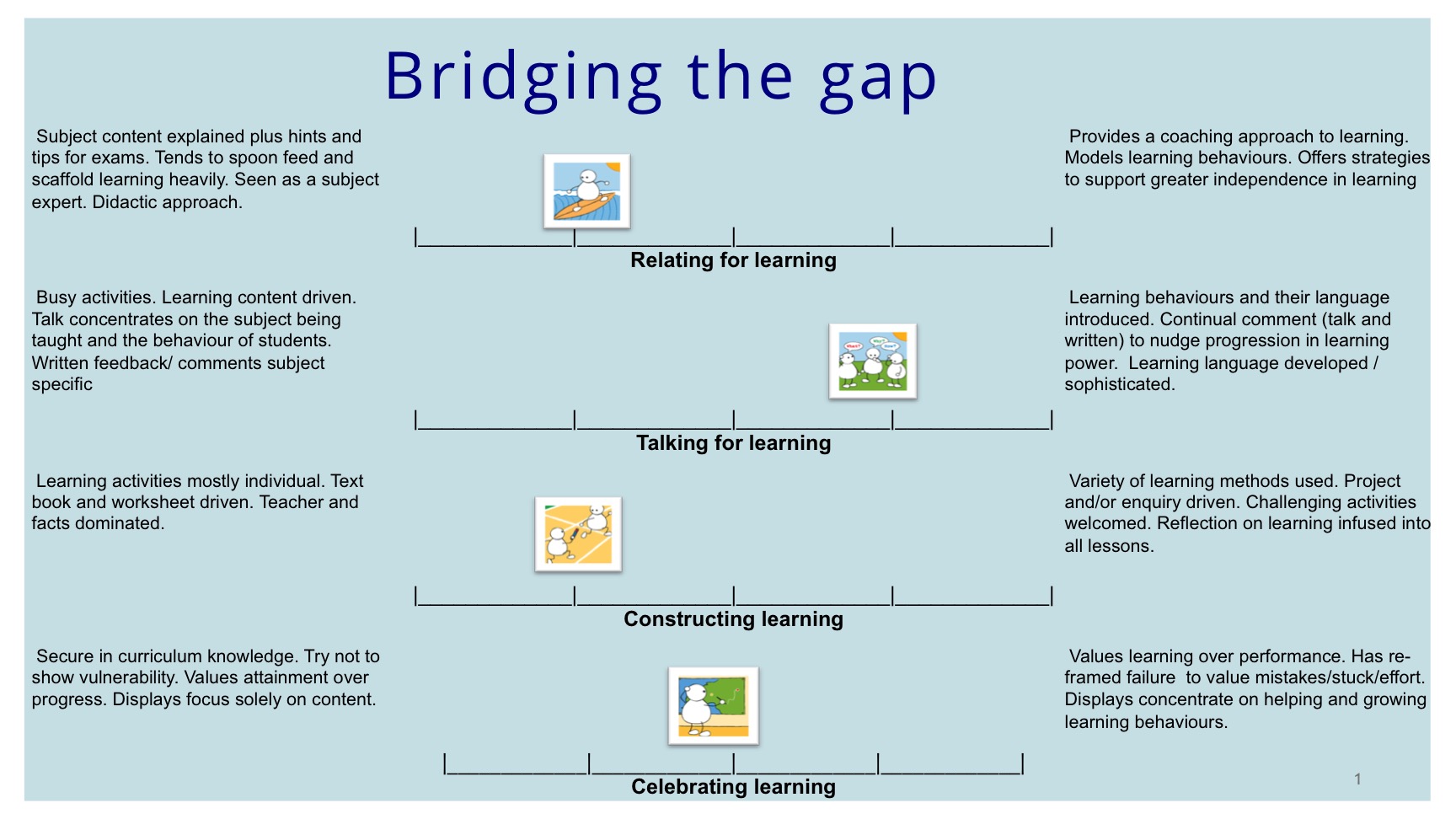

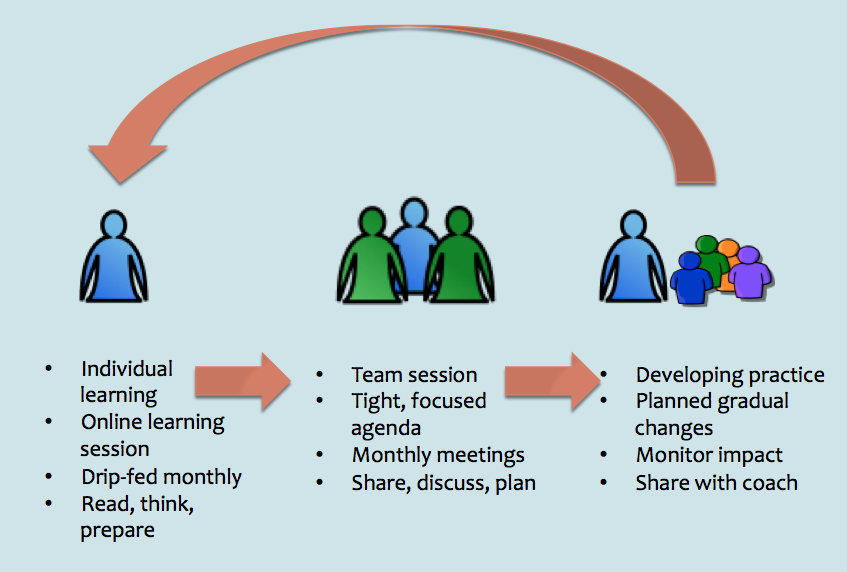




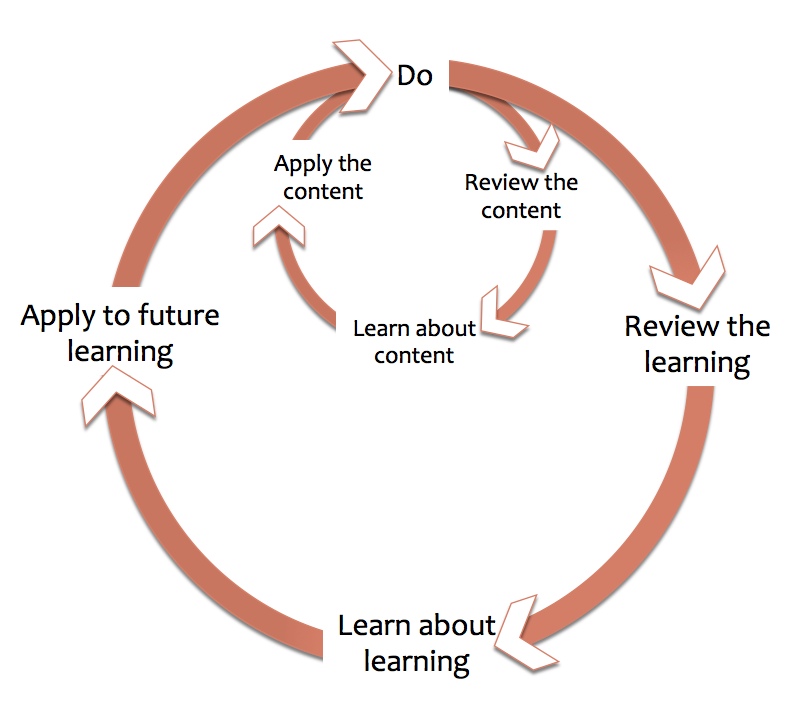


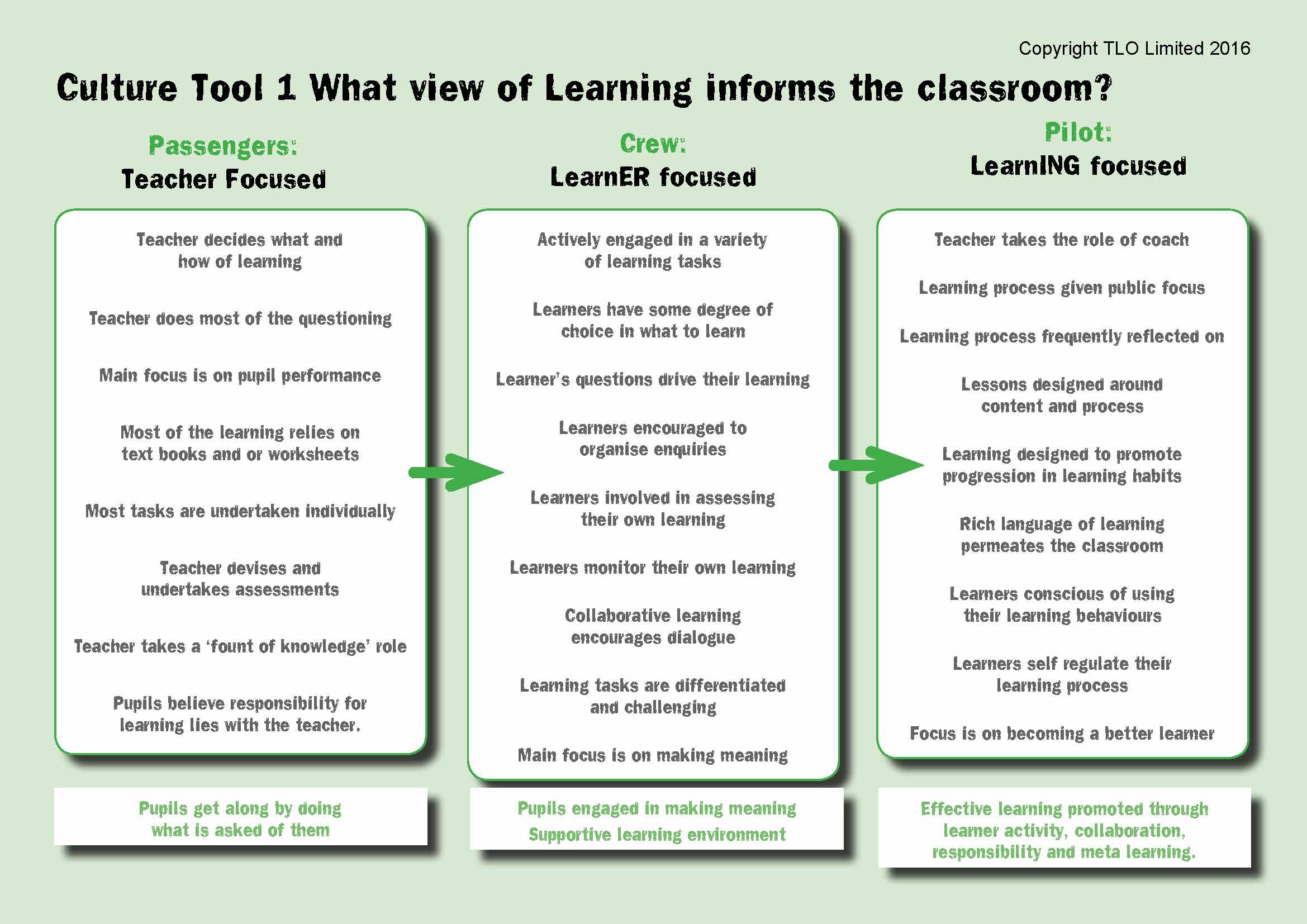
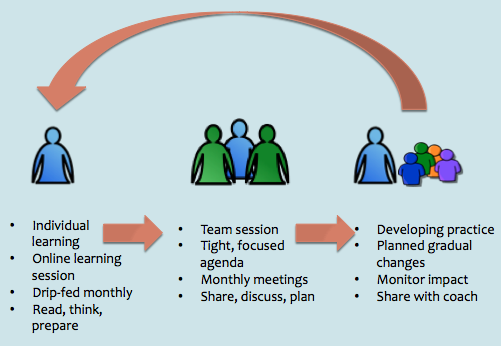

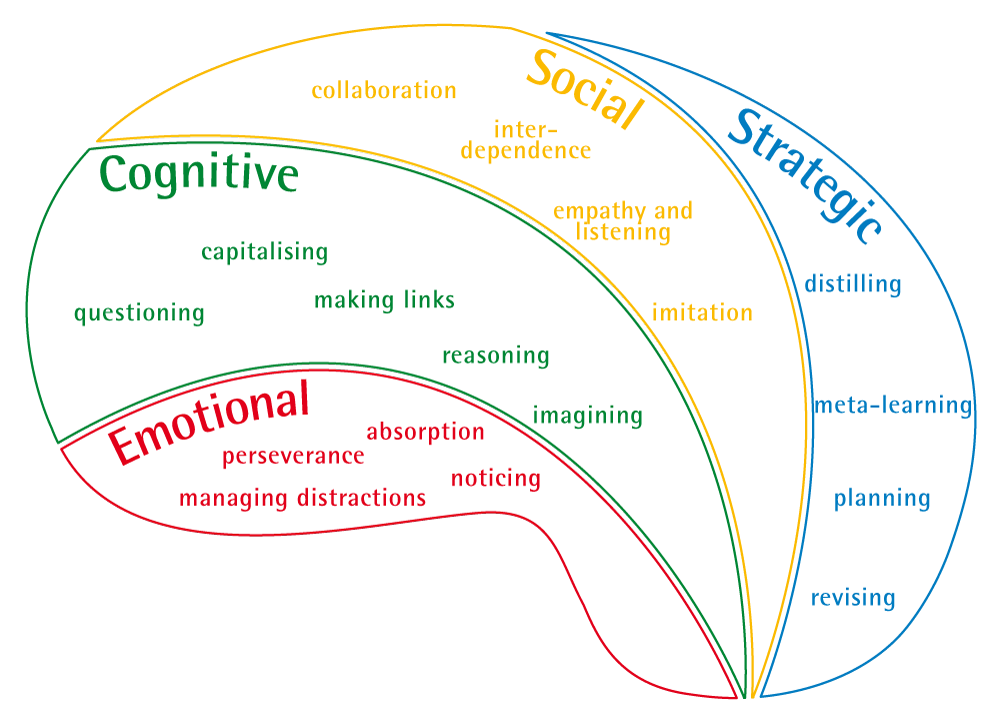


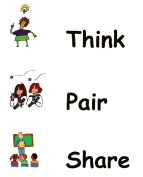


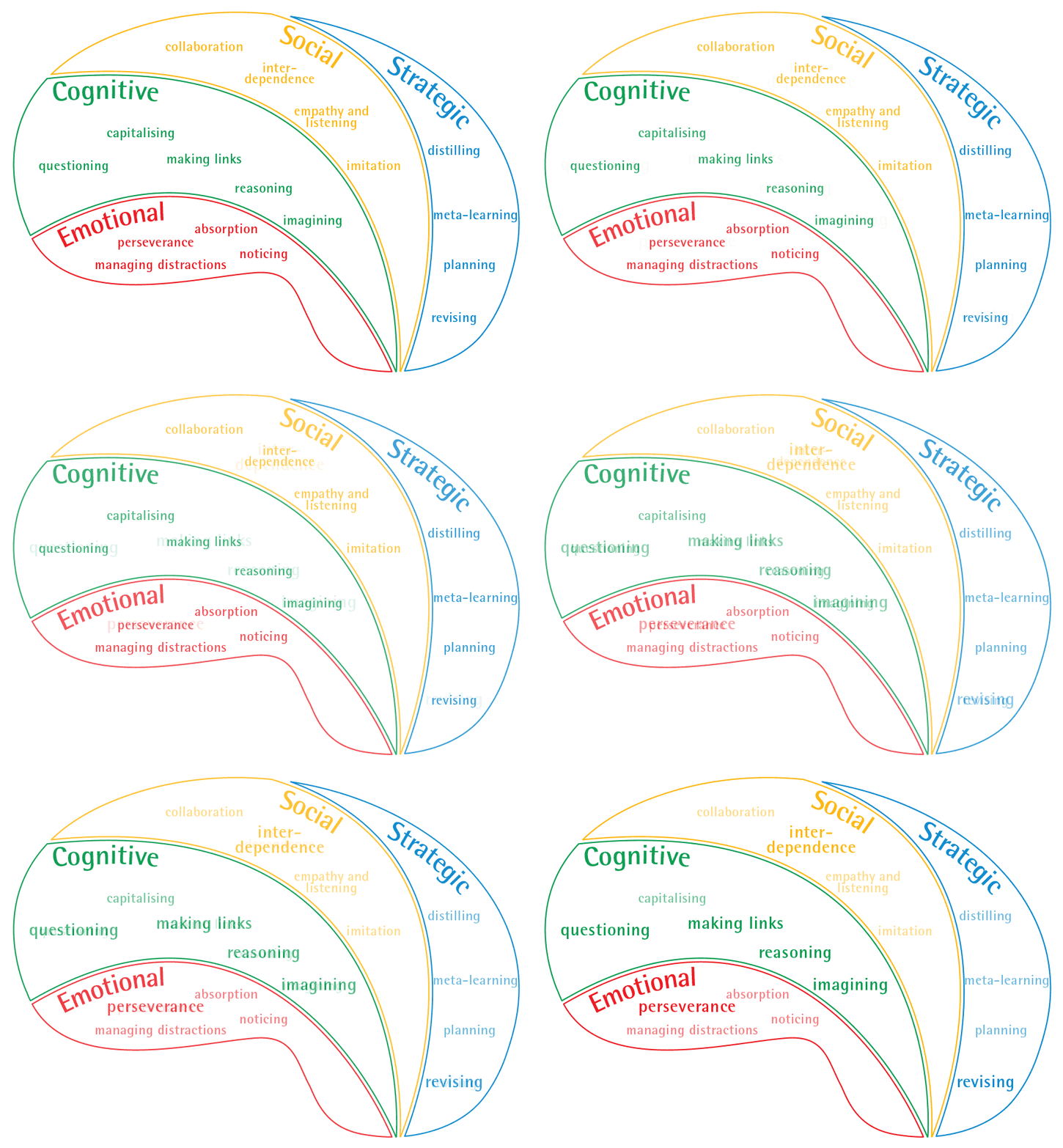
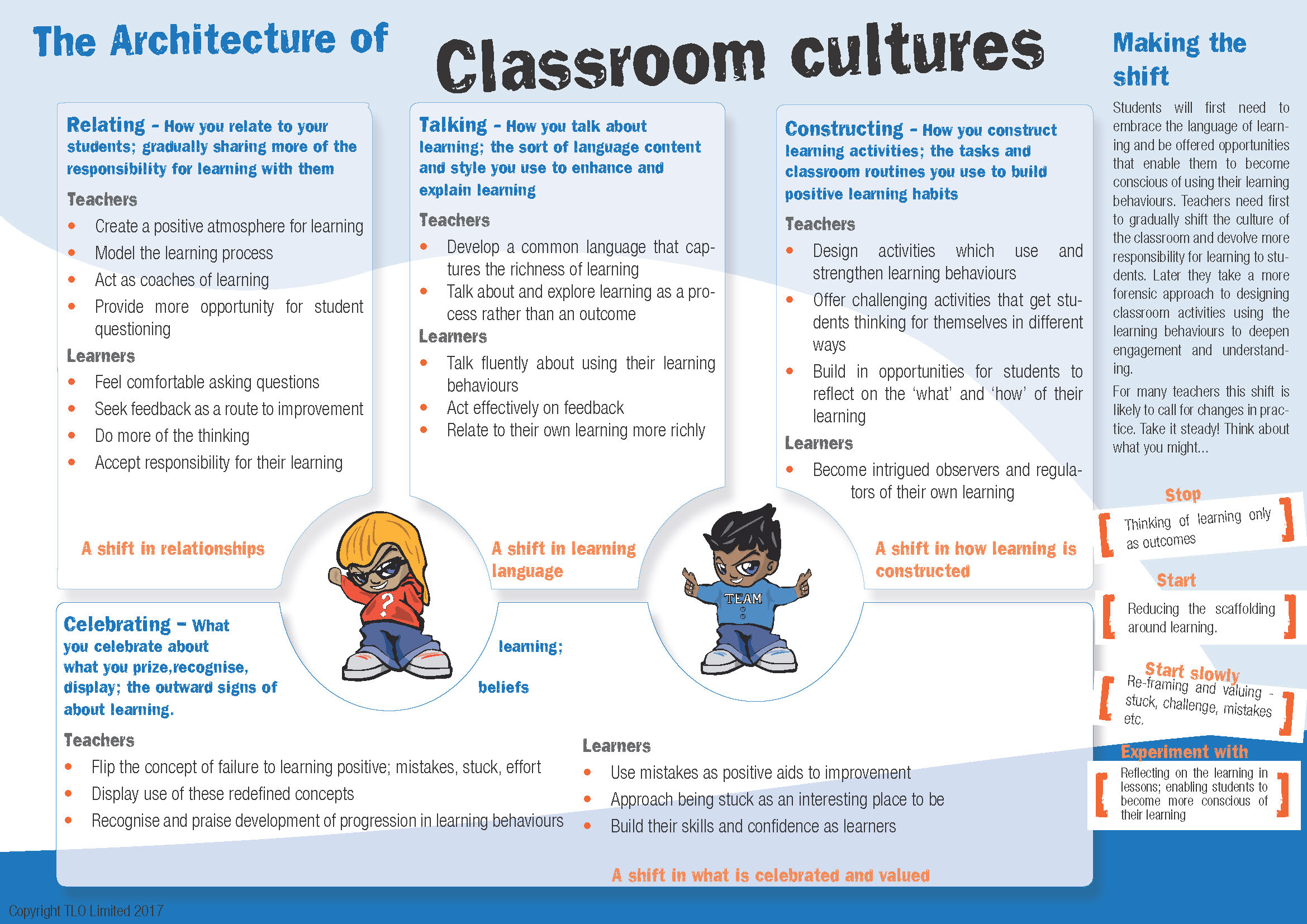


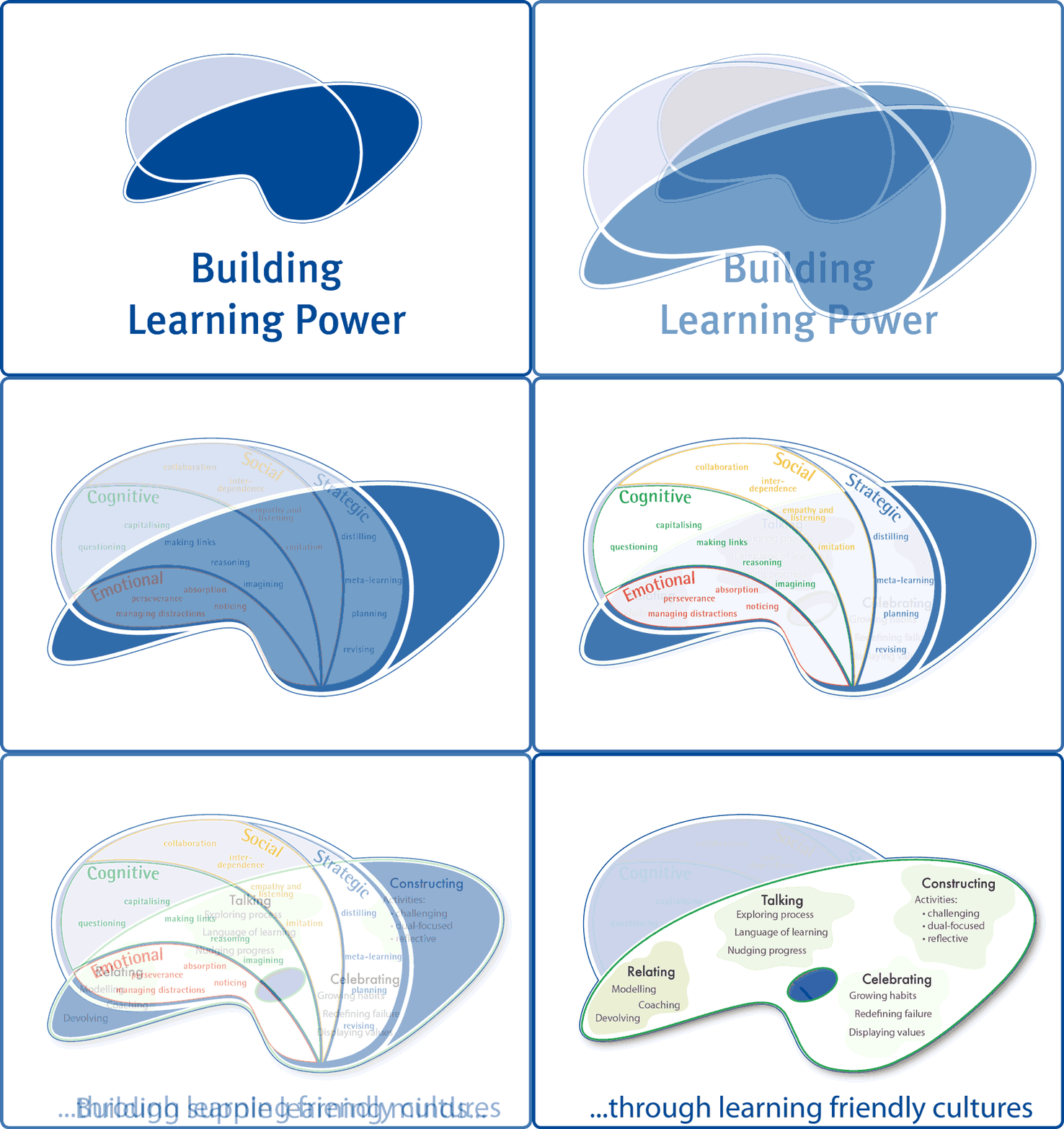
![BLP_Brain_Generic_no-Rs-[Converted]](https://www.buildinglearningpower.com/wp-content/uploads/2016/12/BLP_Brain_Generic_no-Rs-Converted-300x216.png)

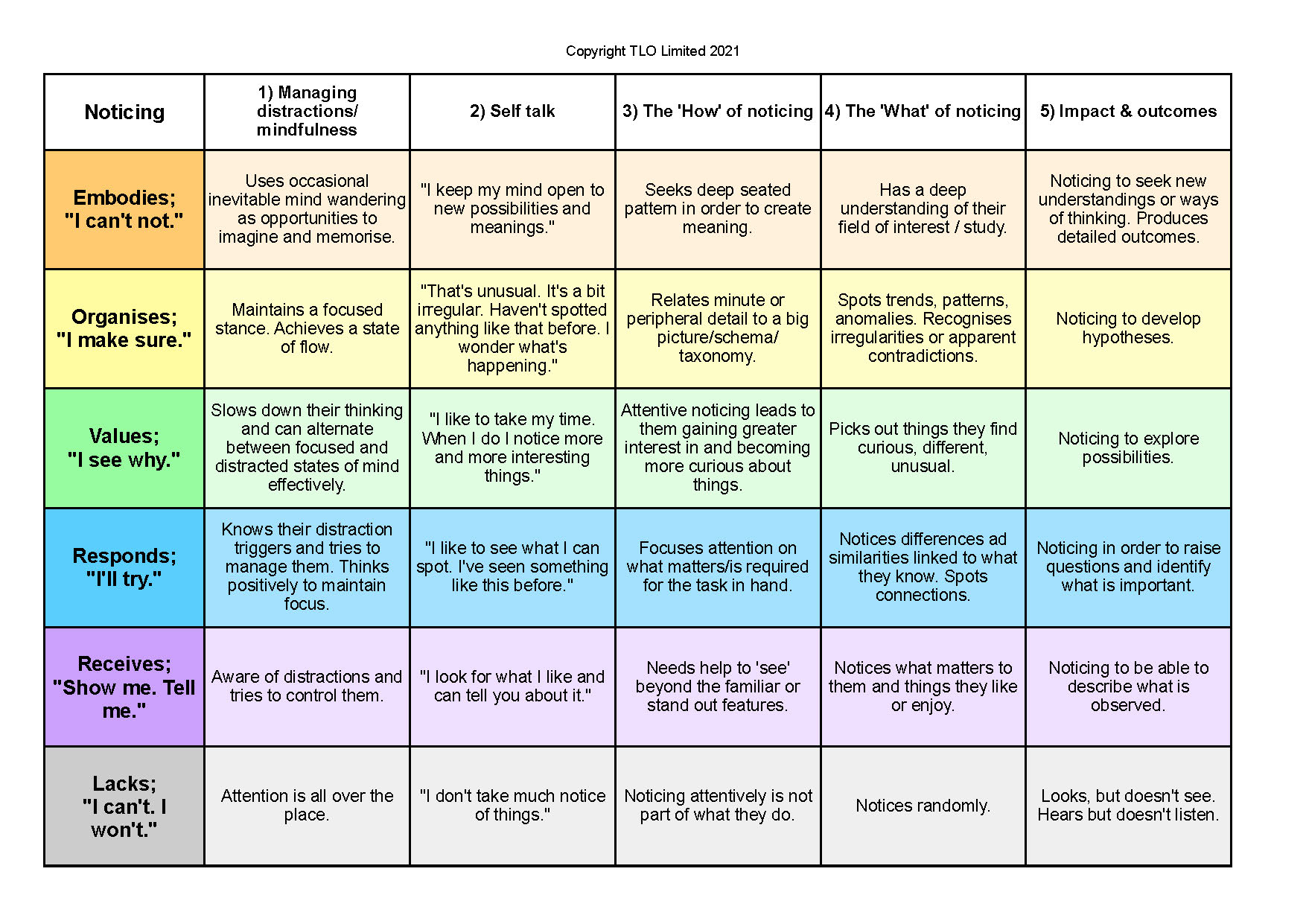
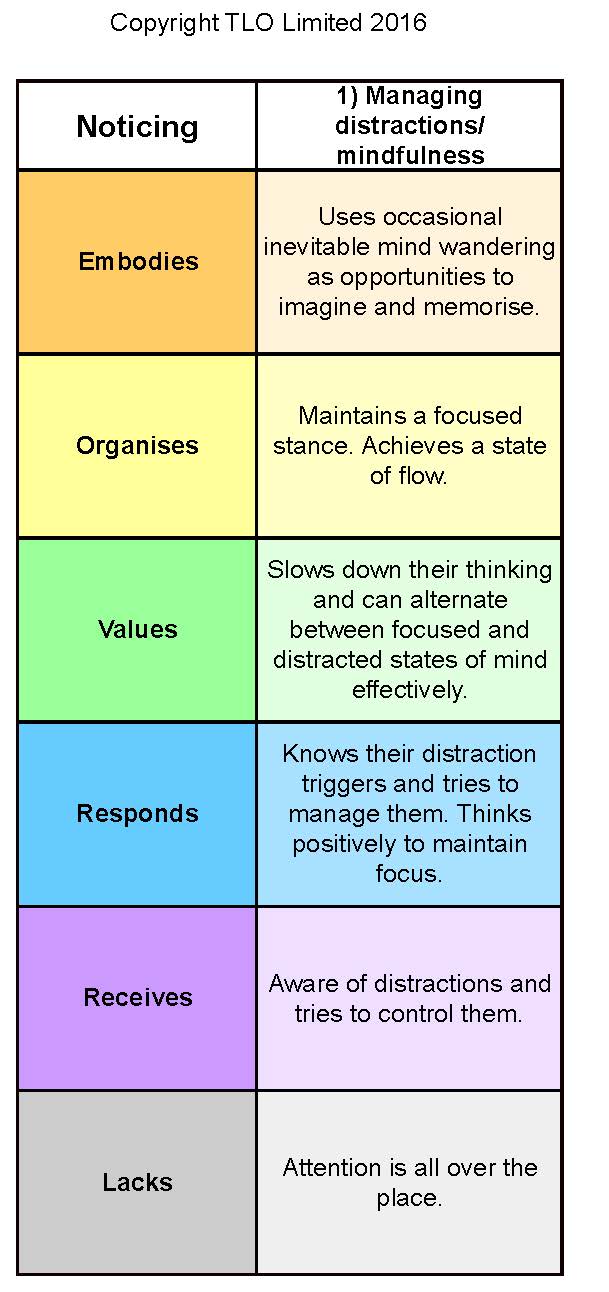
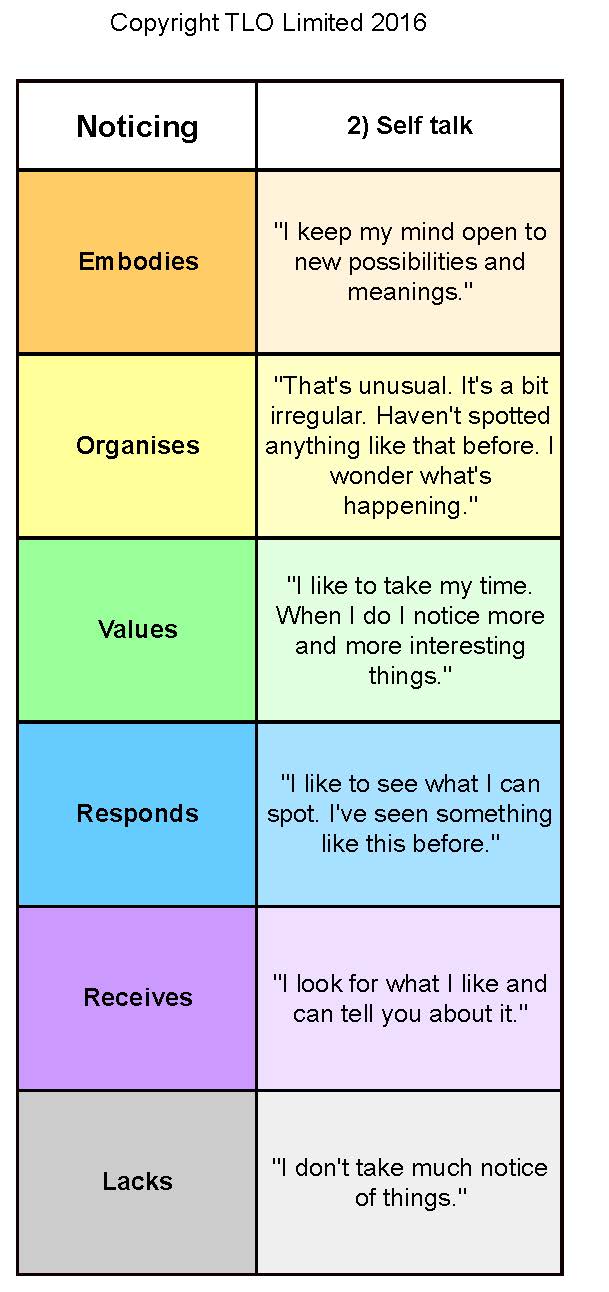
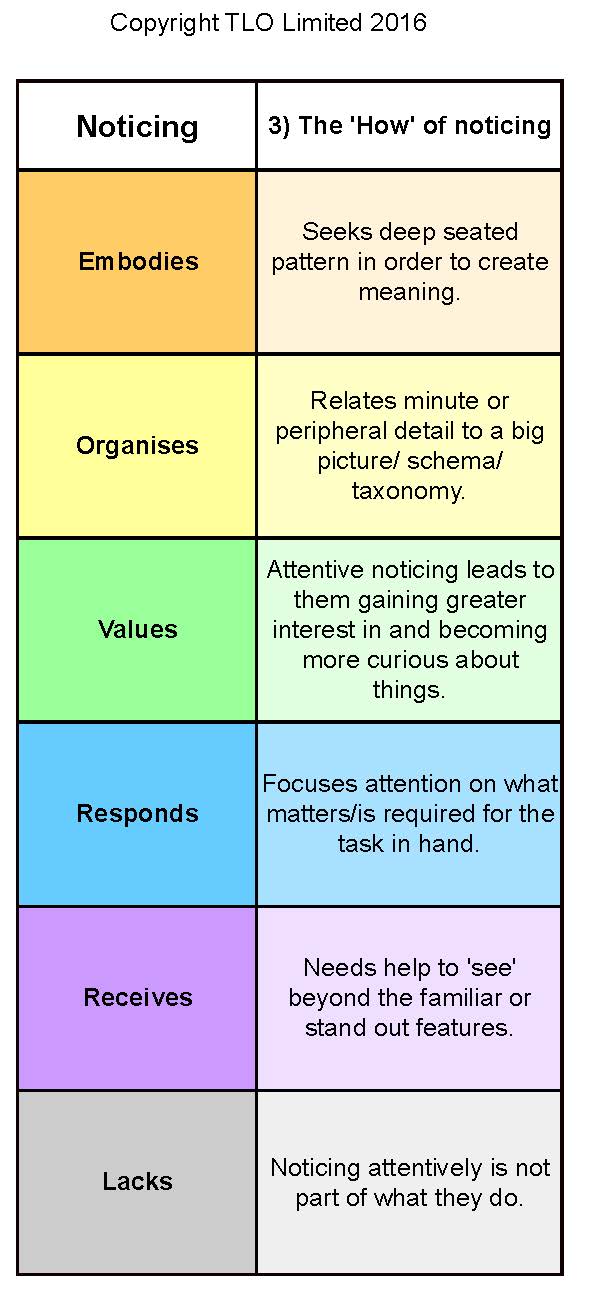
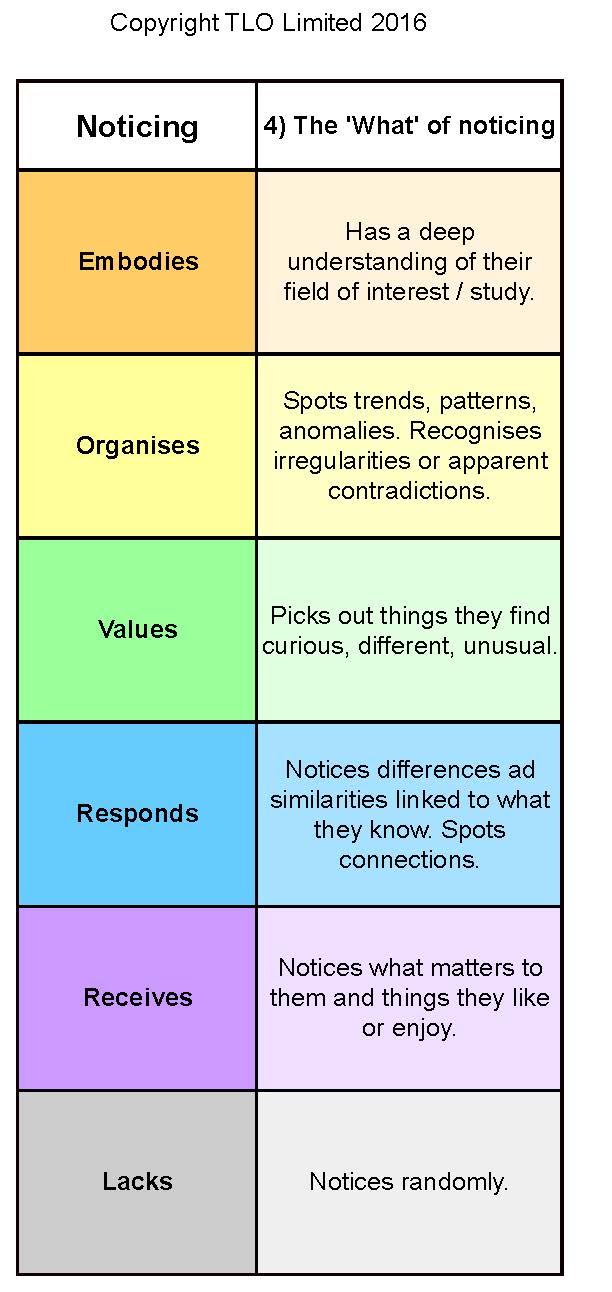
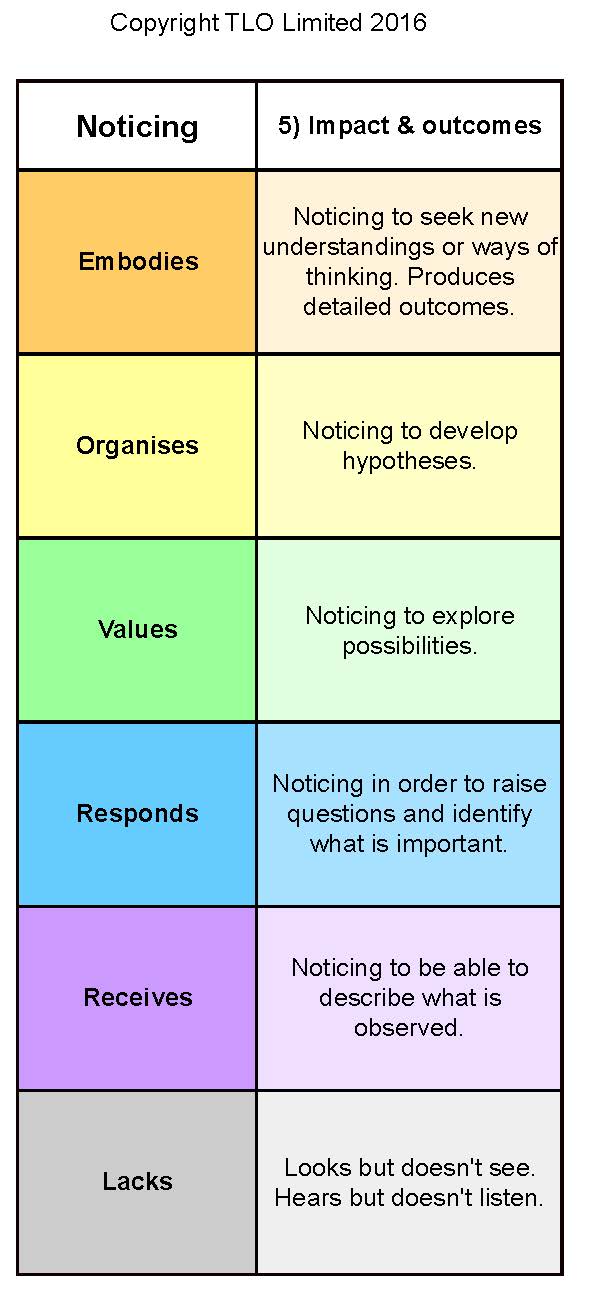
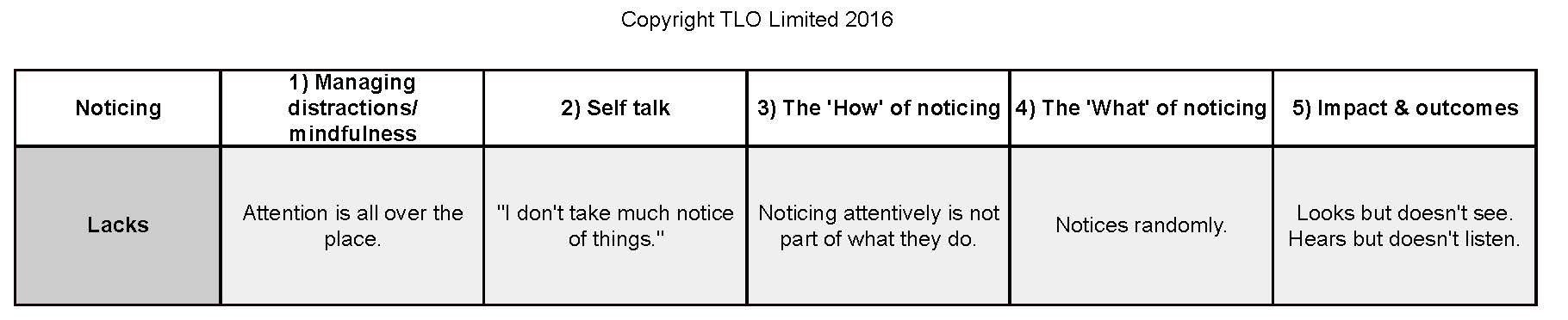
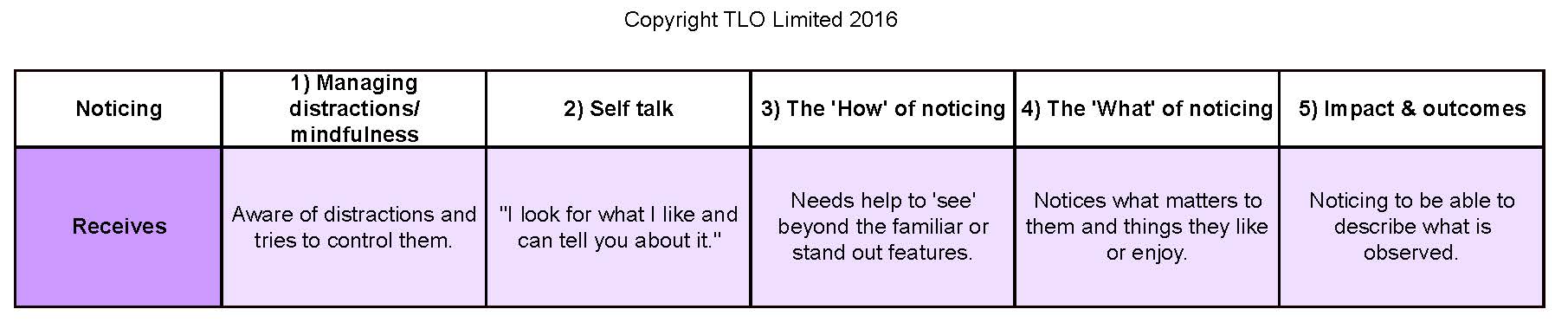
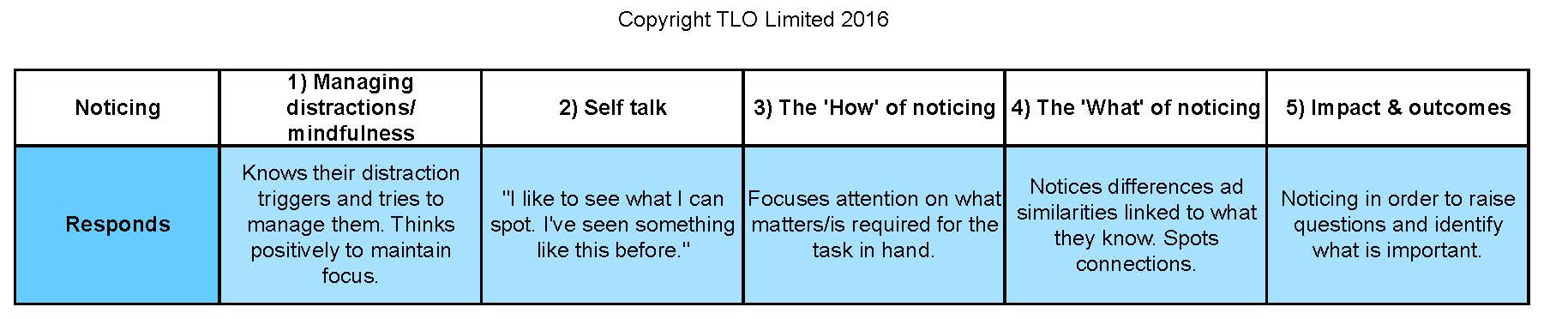
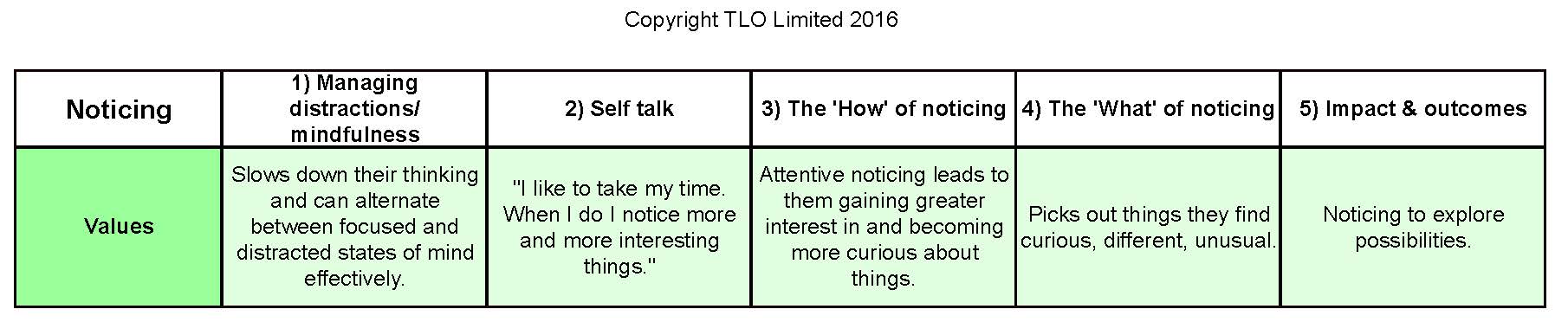
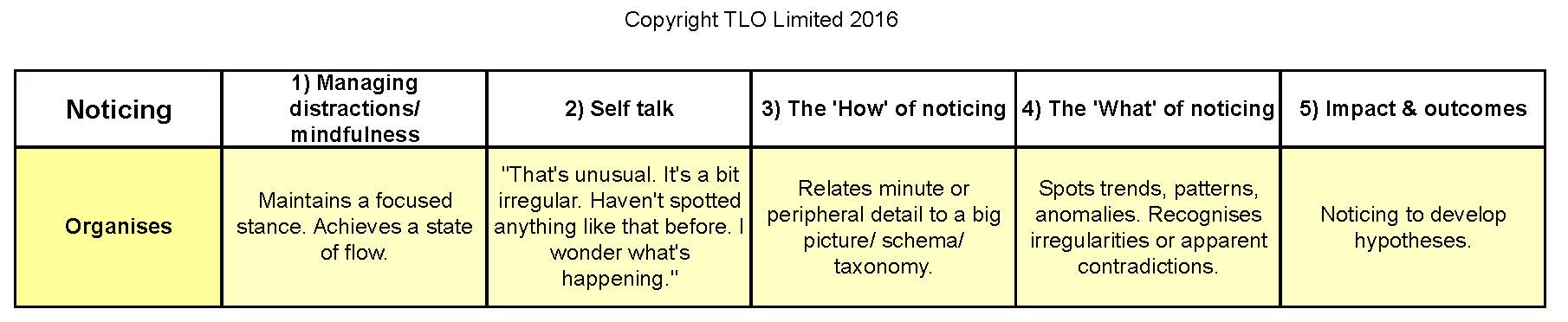
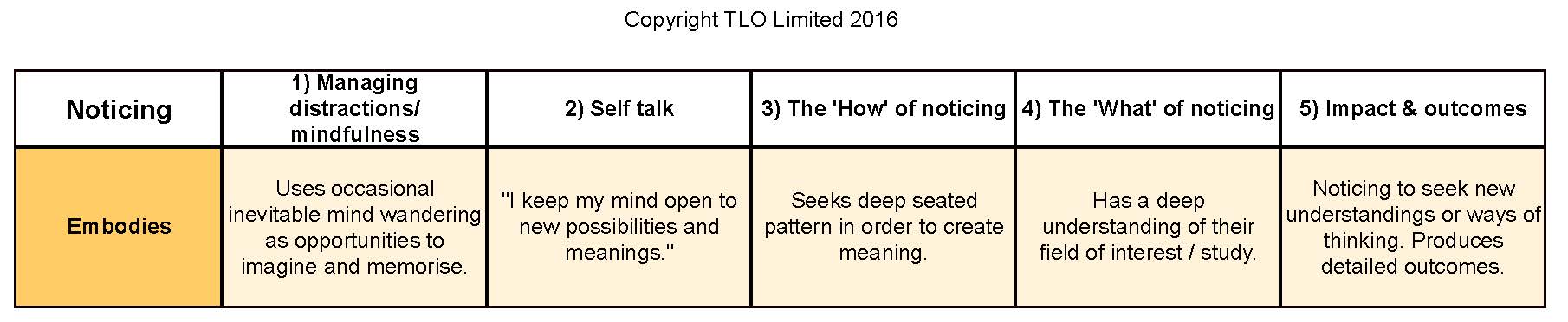
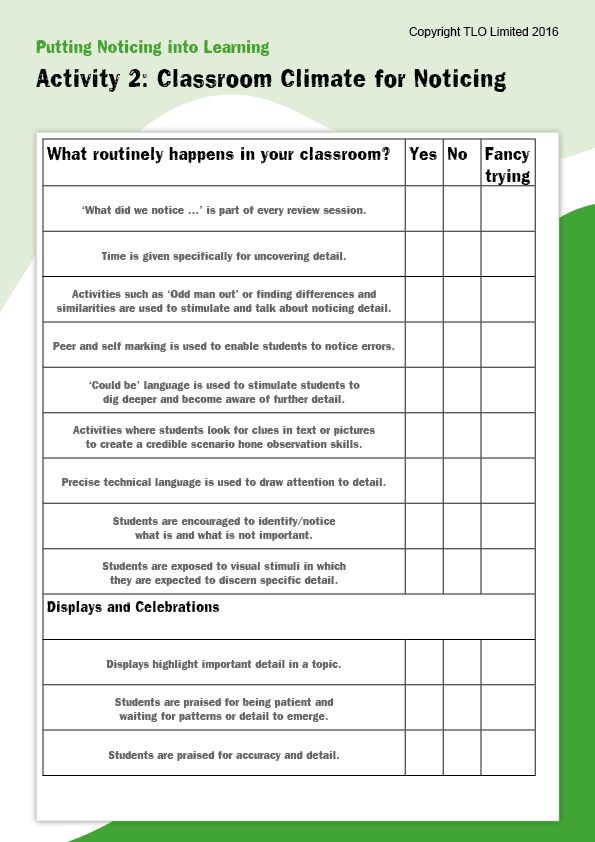


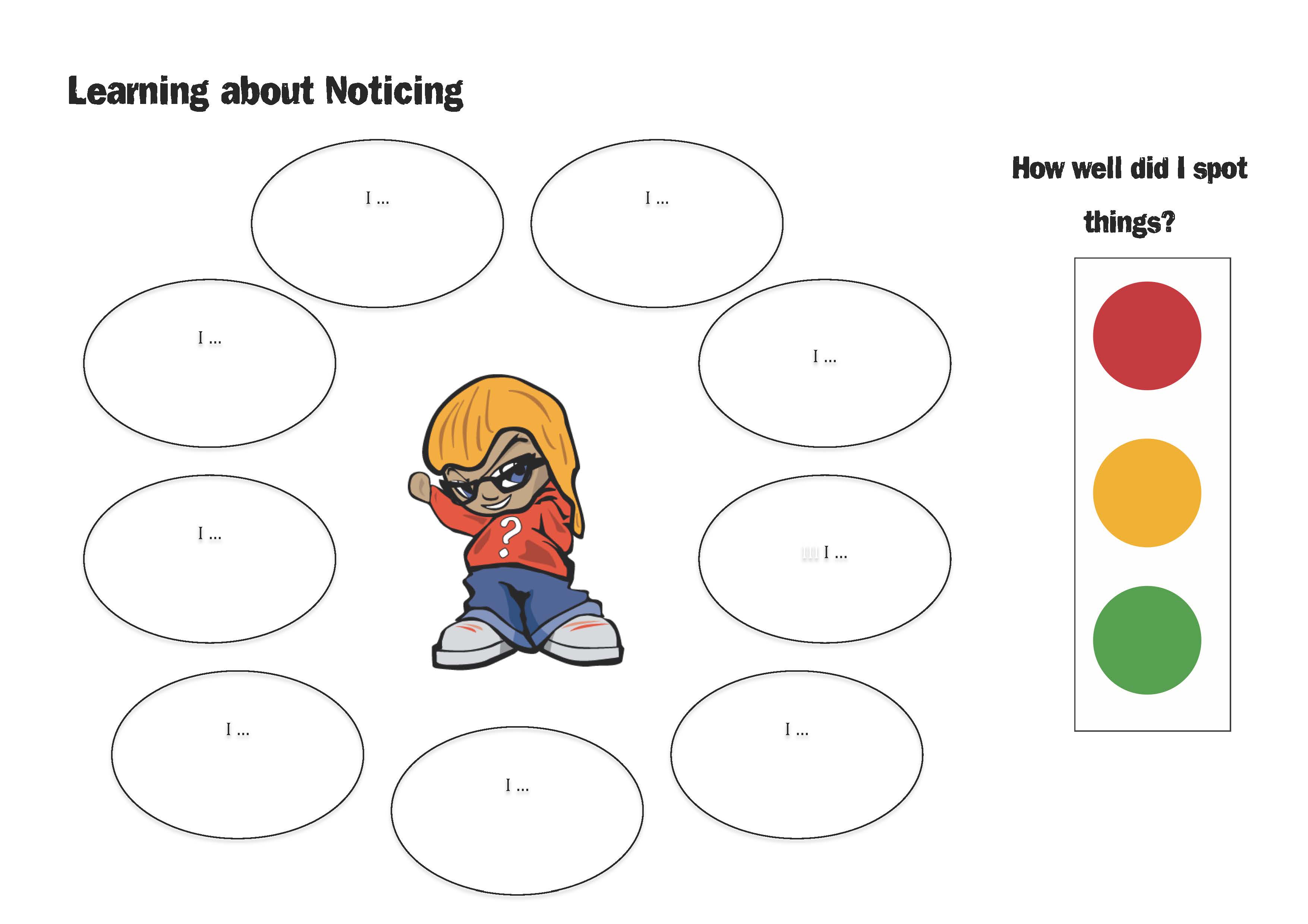


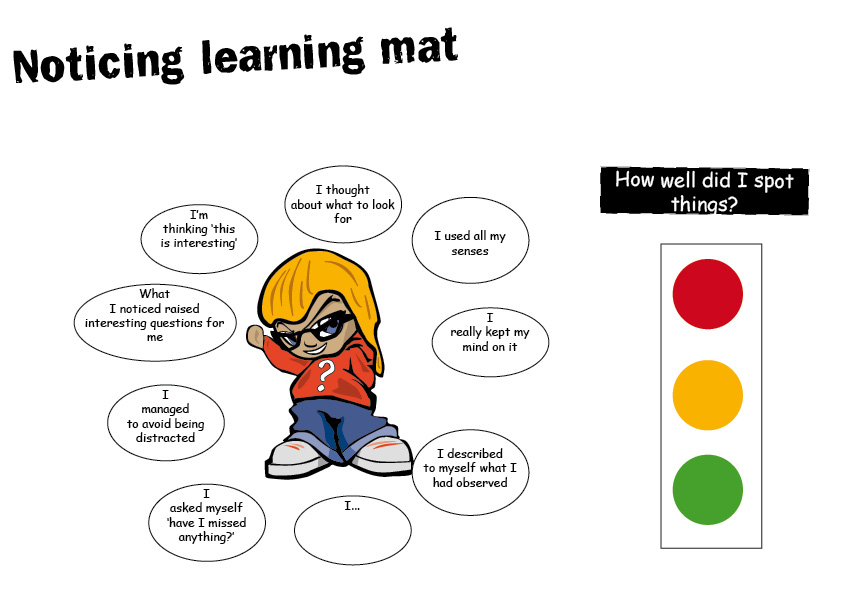

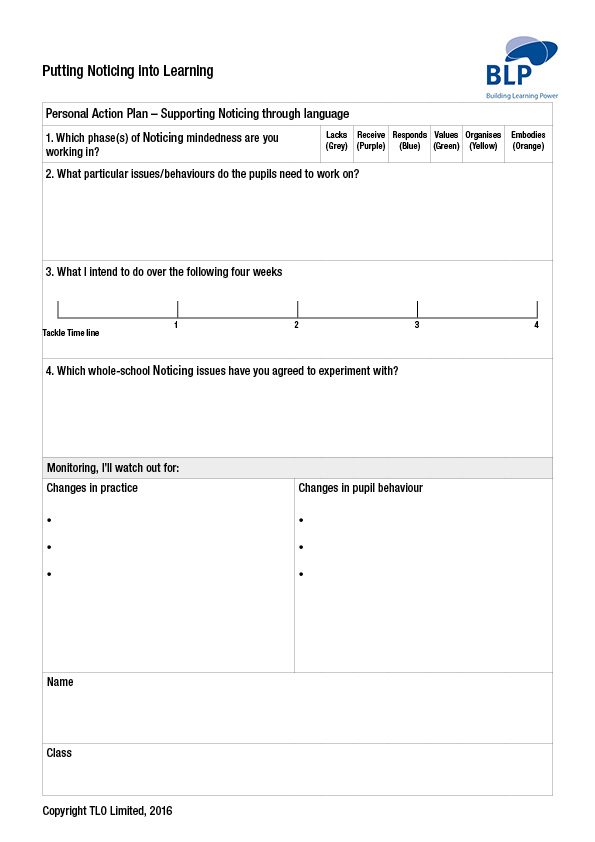
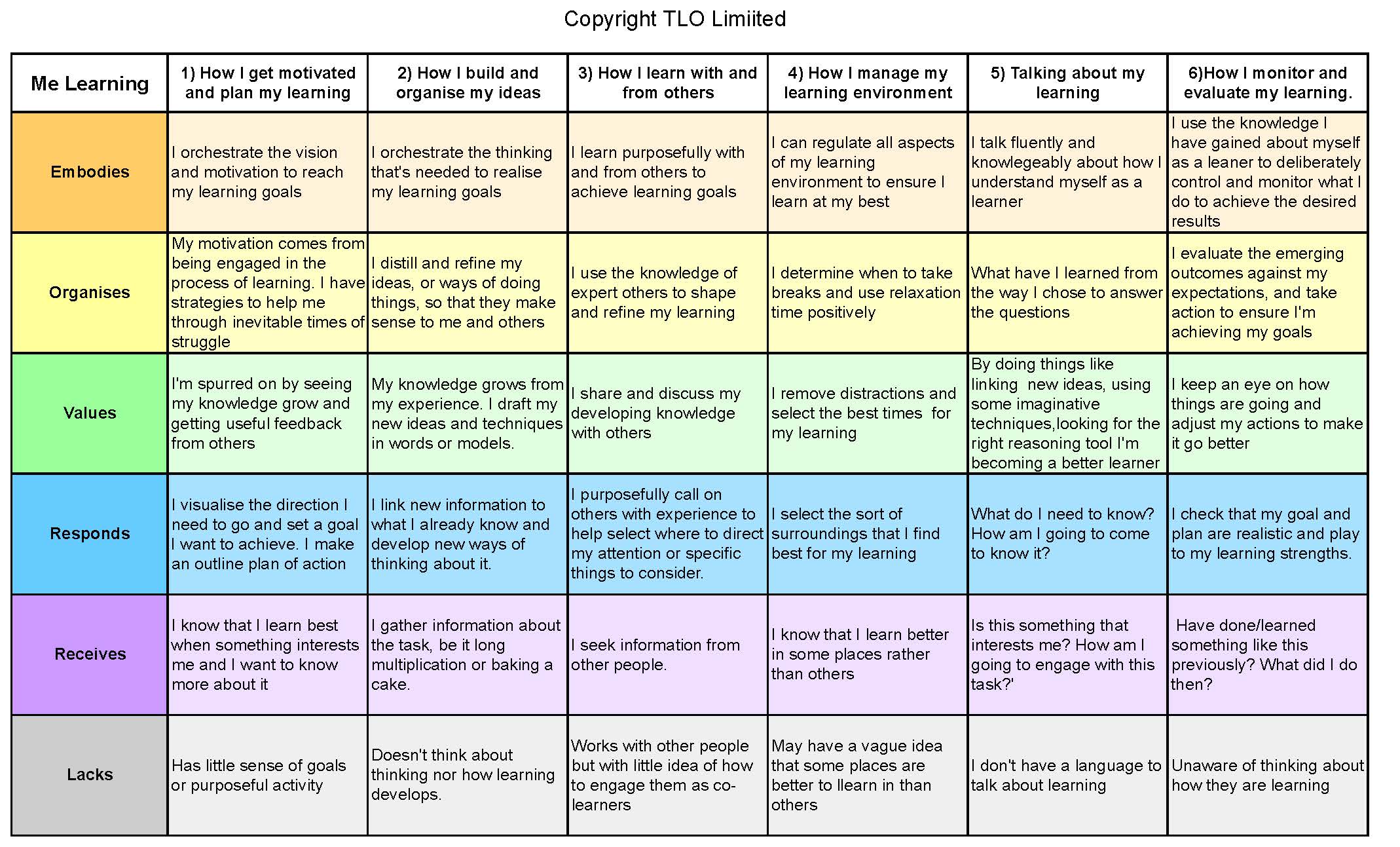
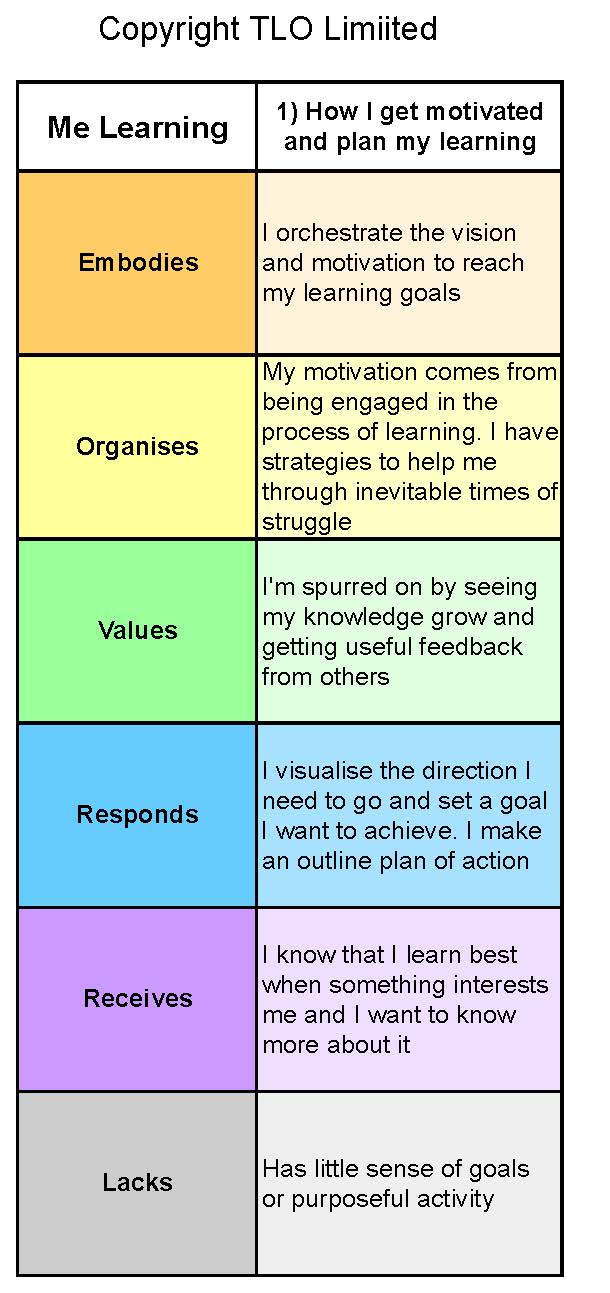
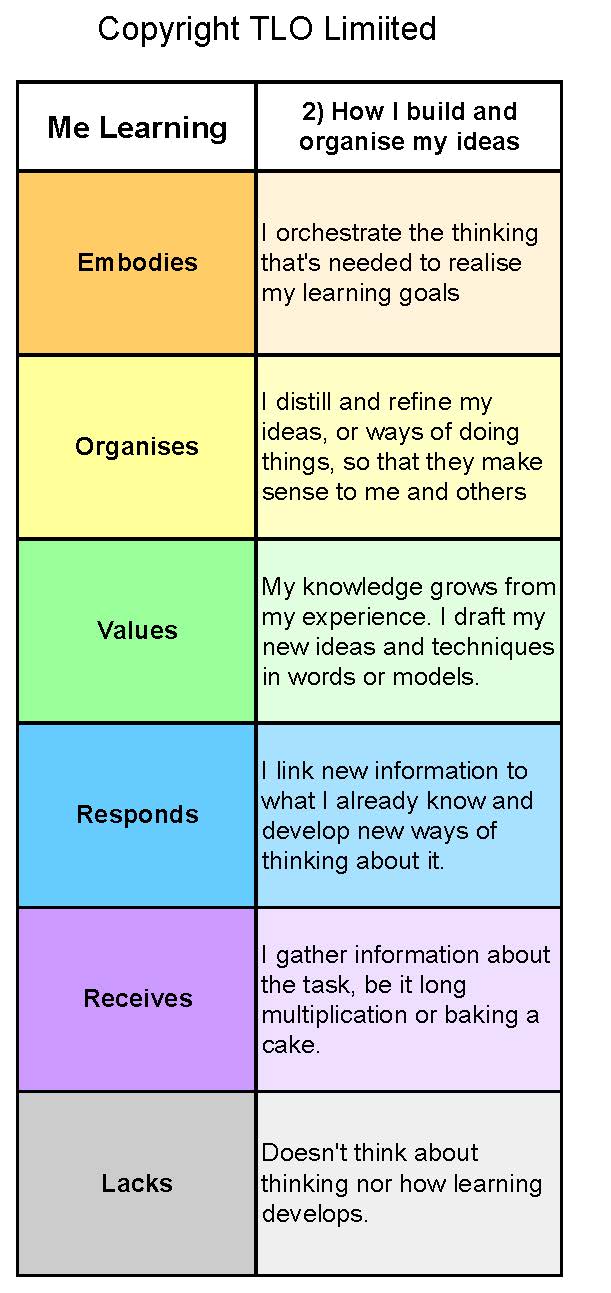
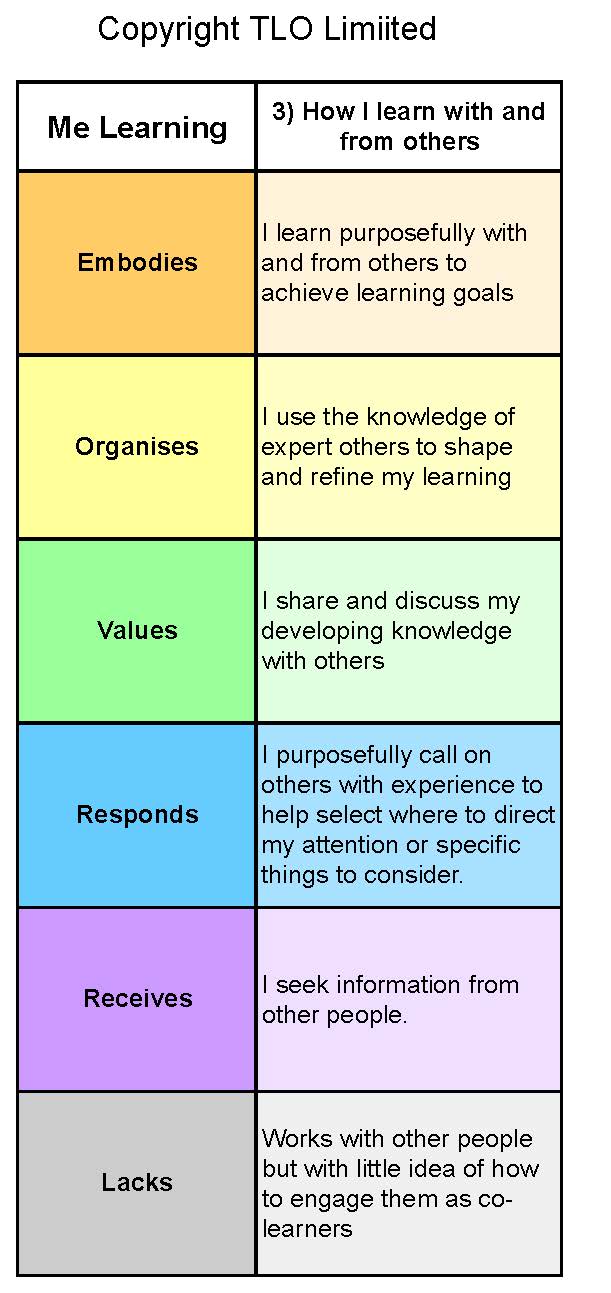
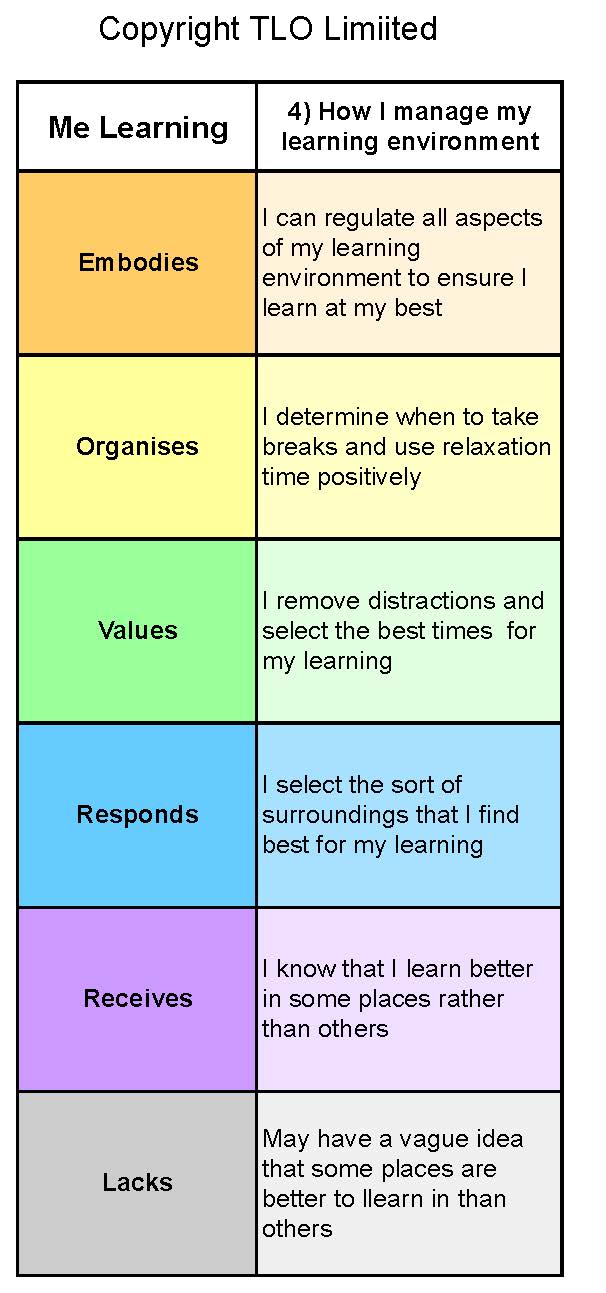

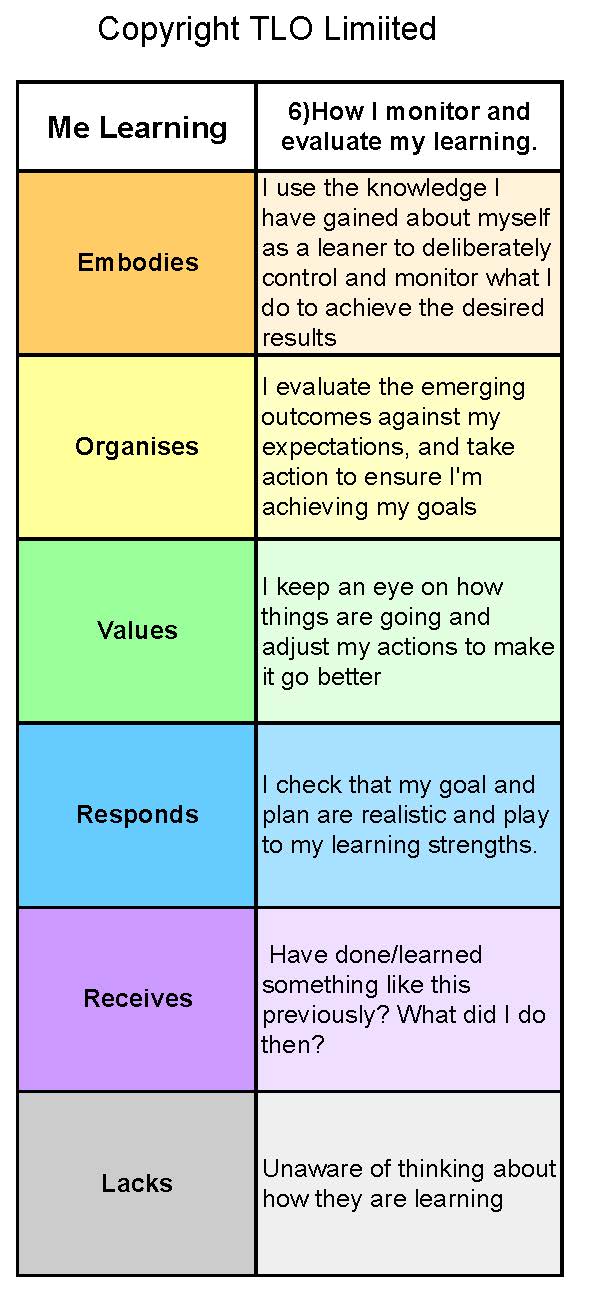






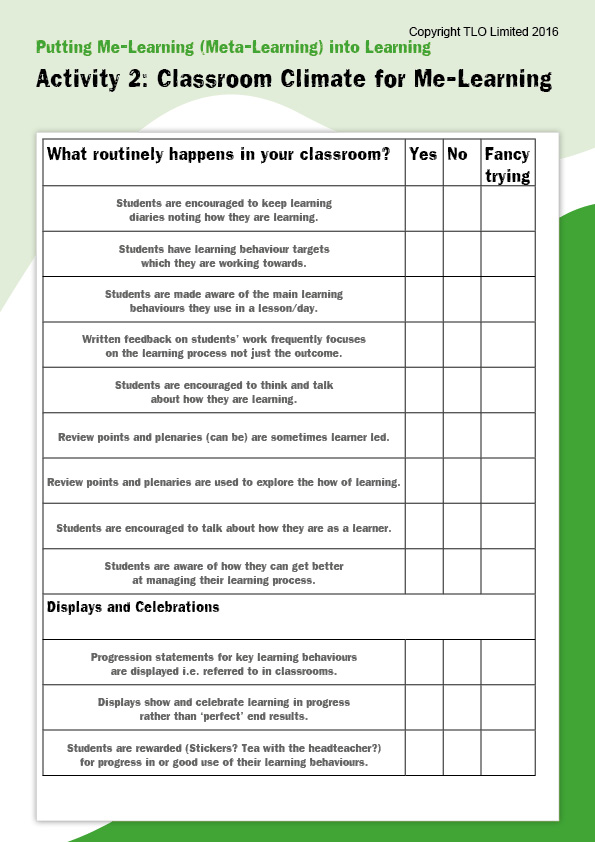

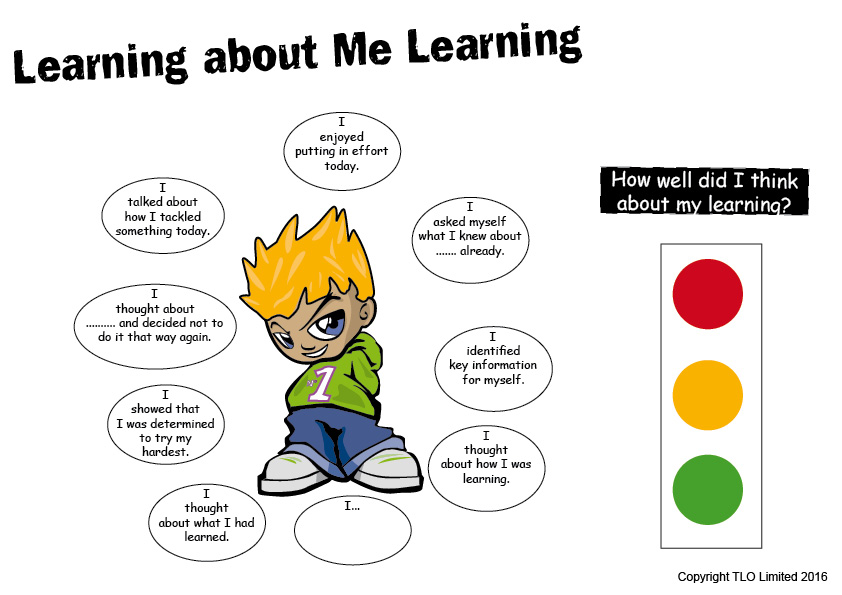
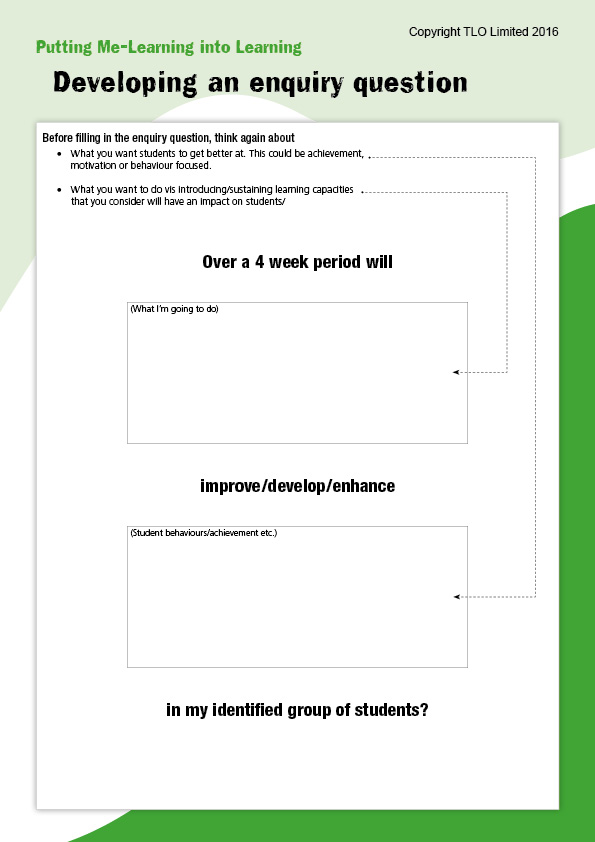
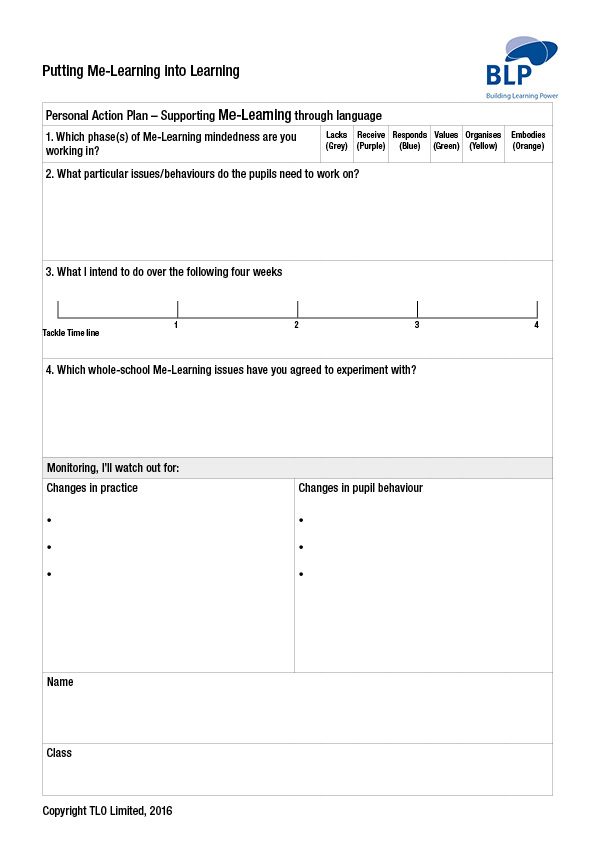
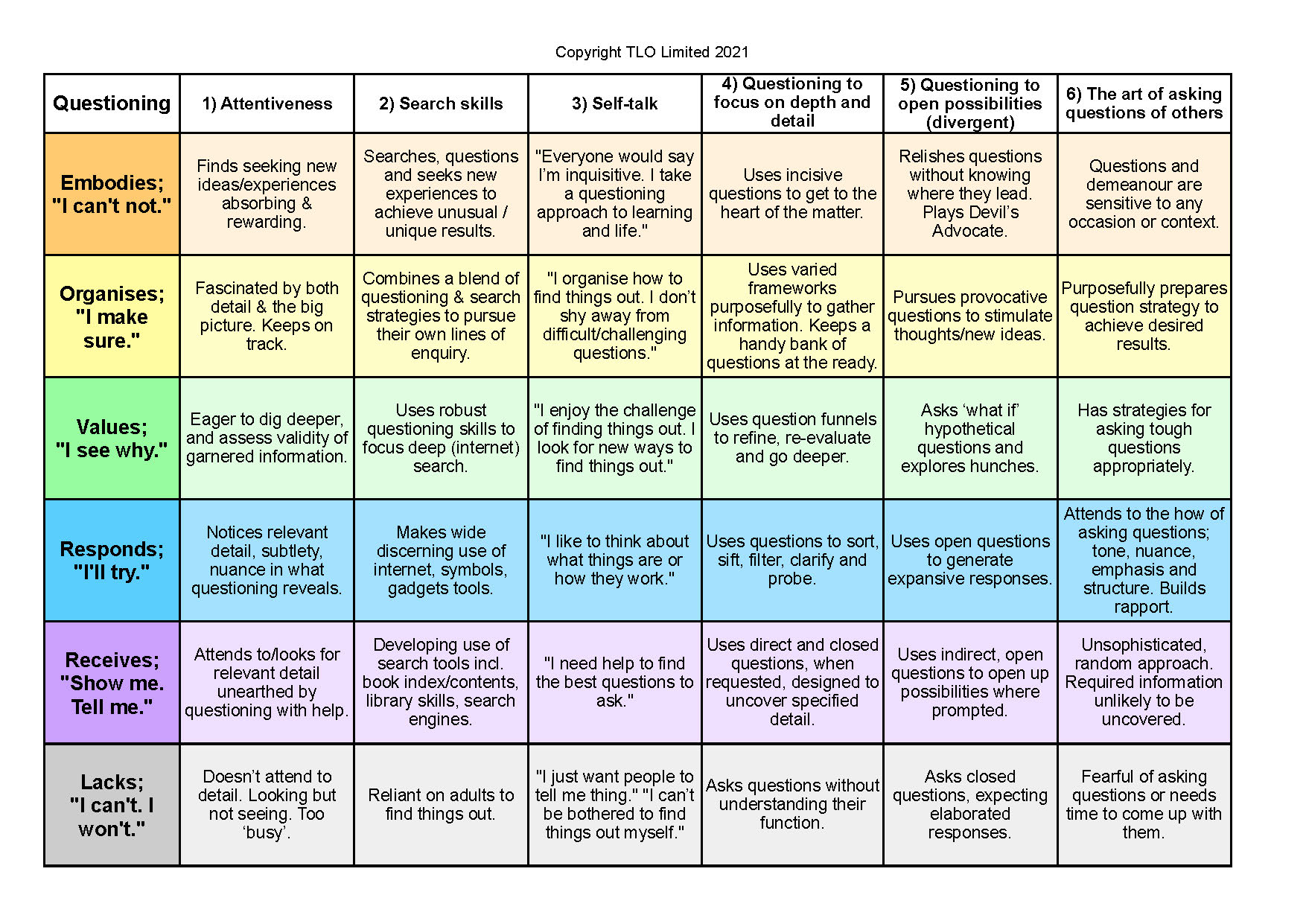





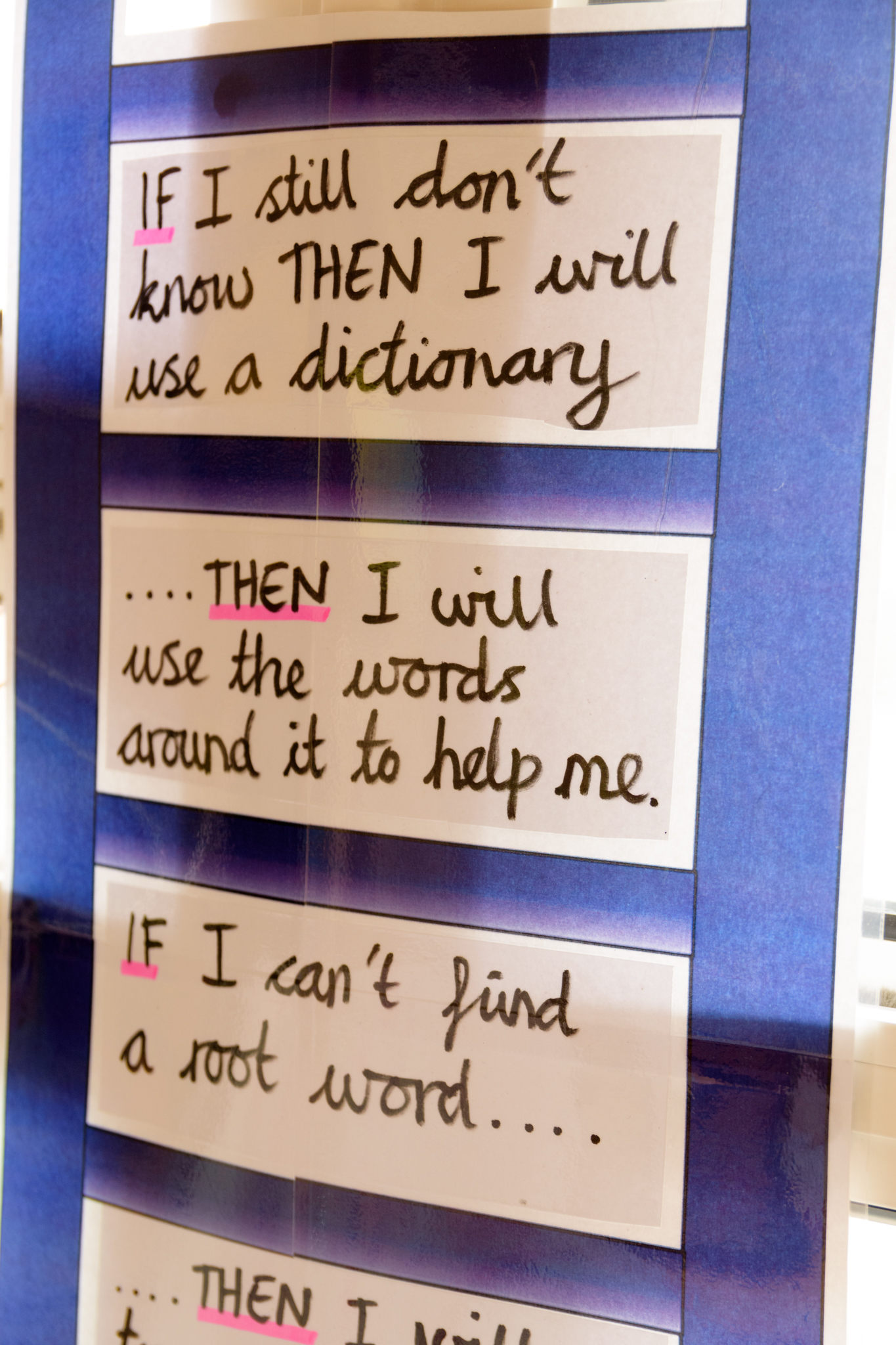


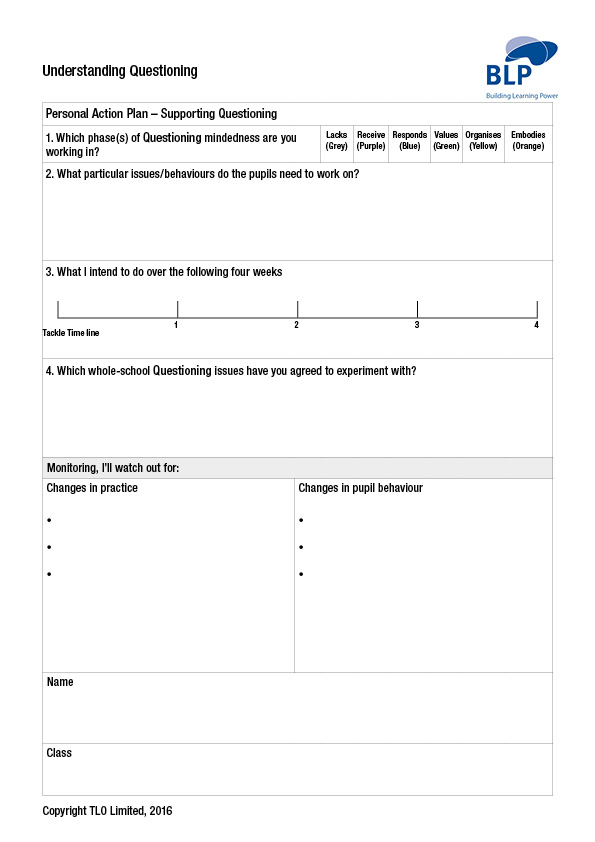
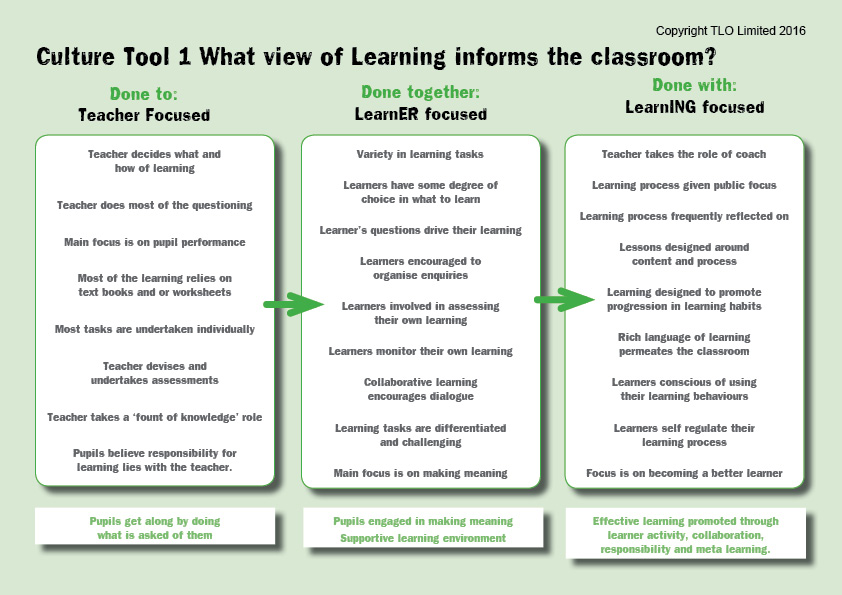
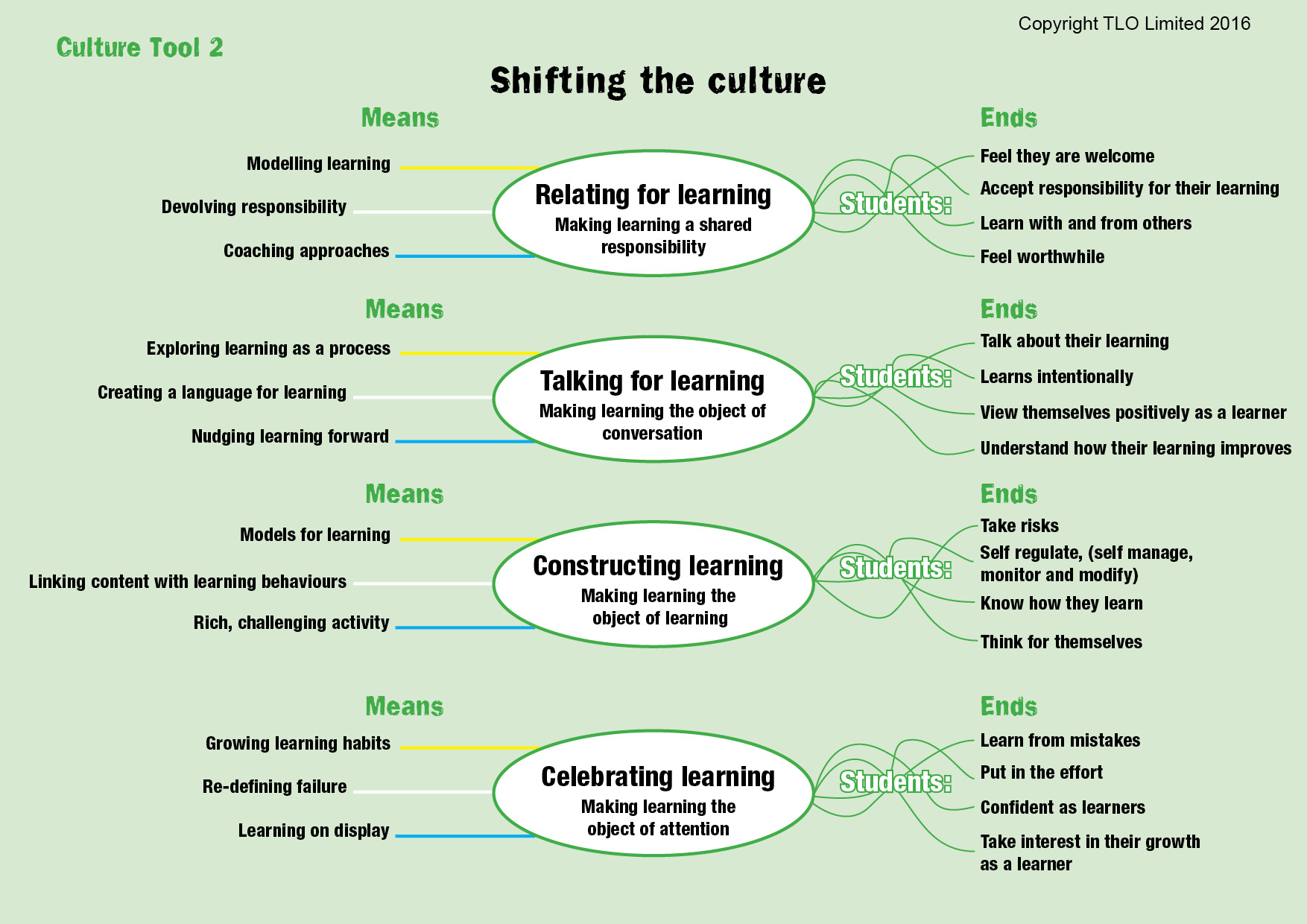

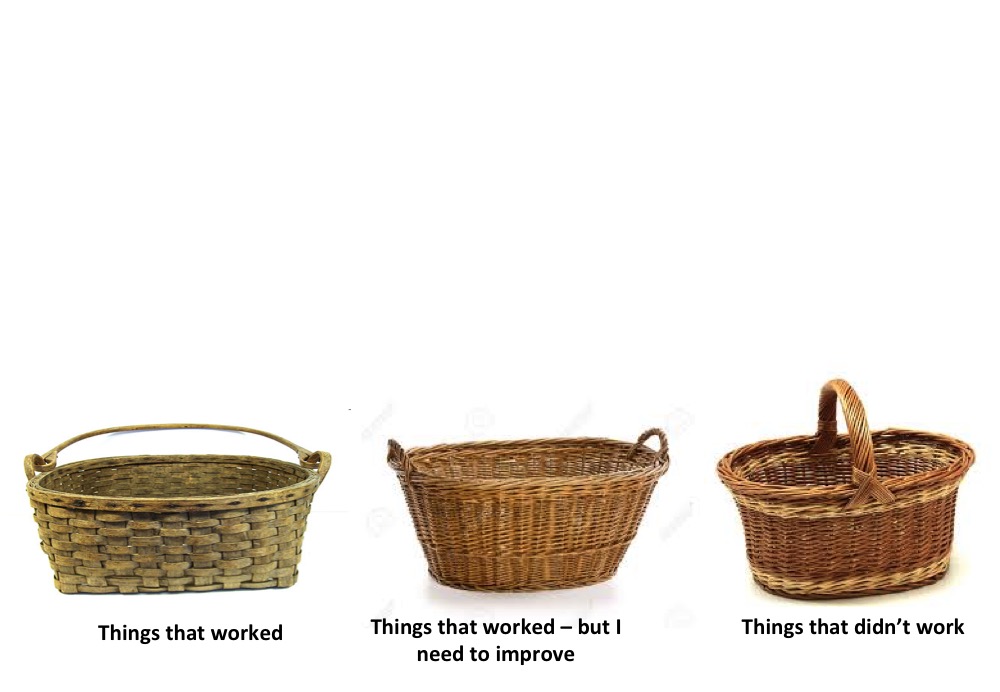
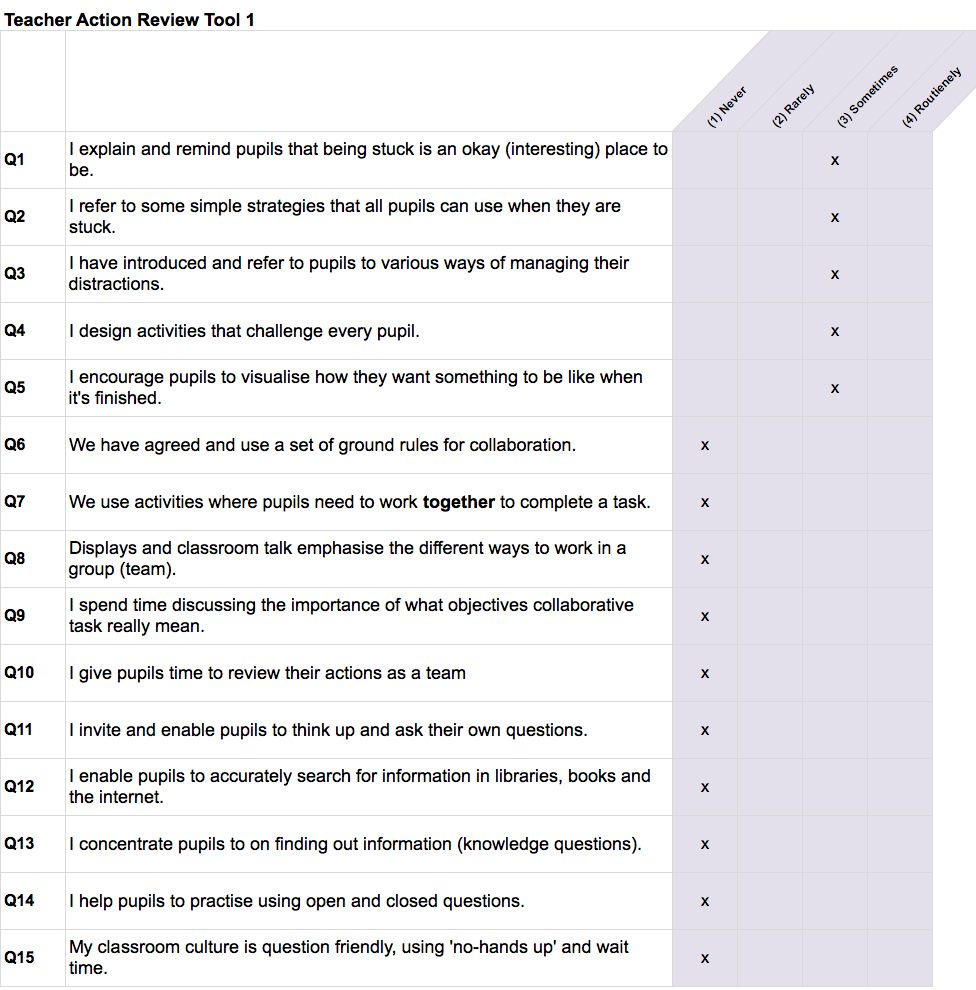
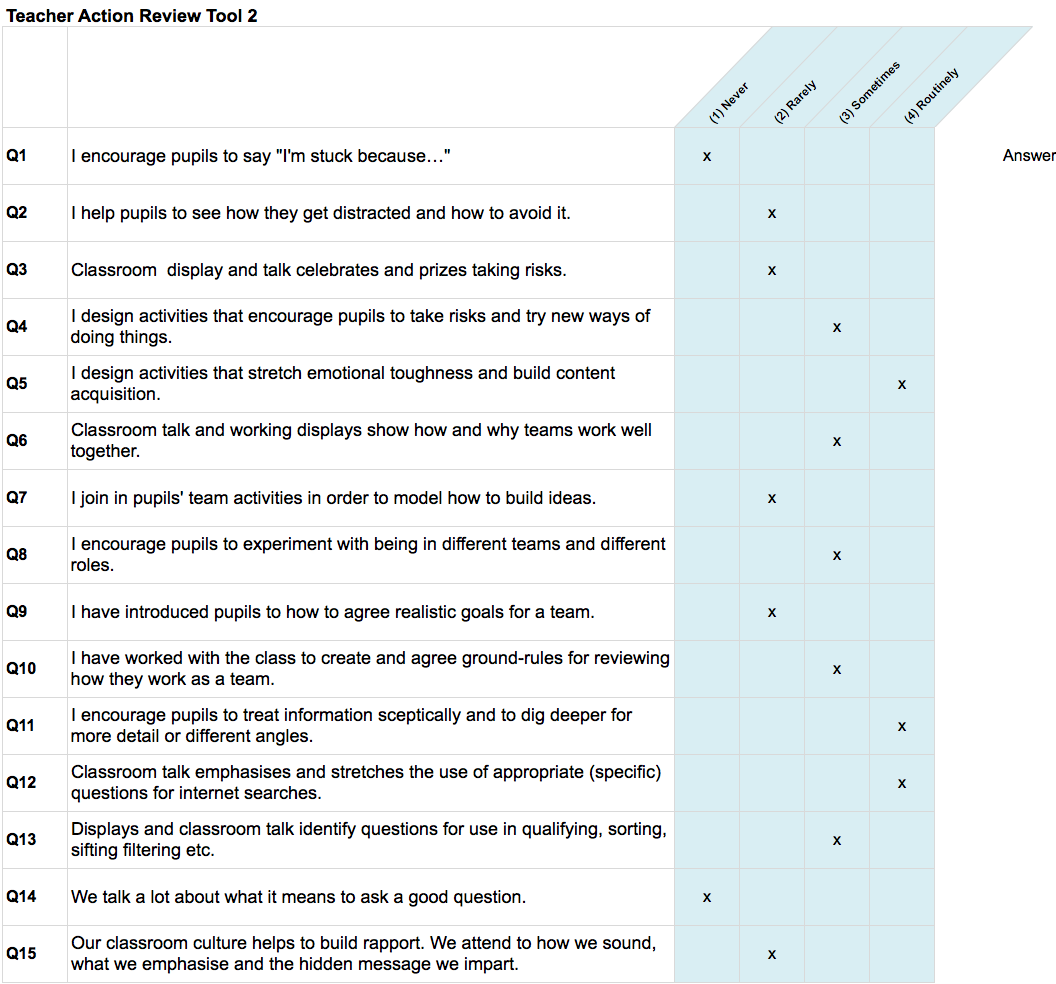
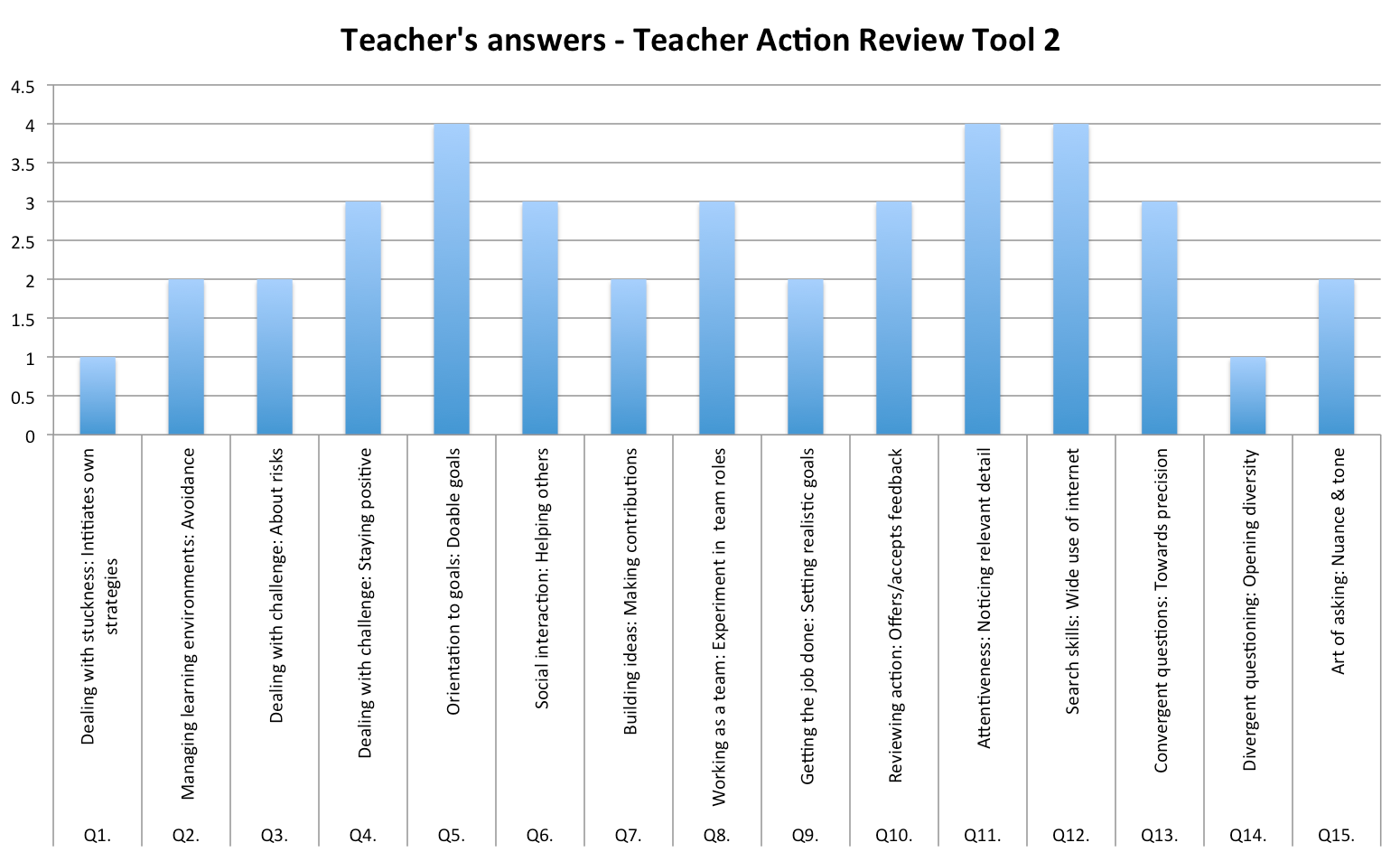
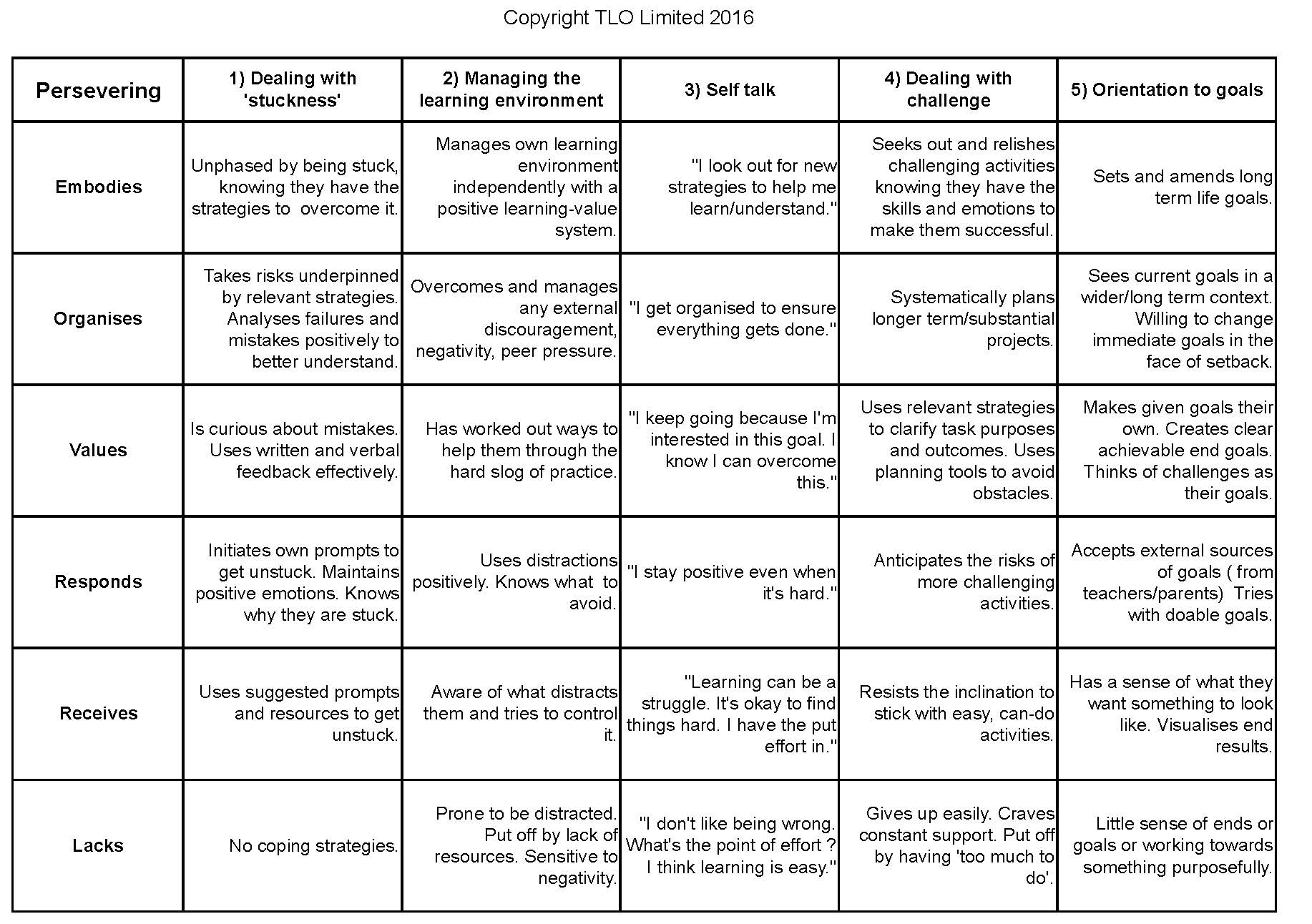
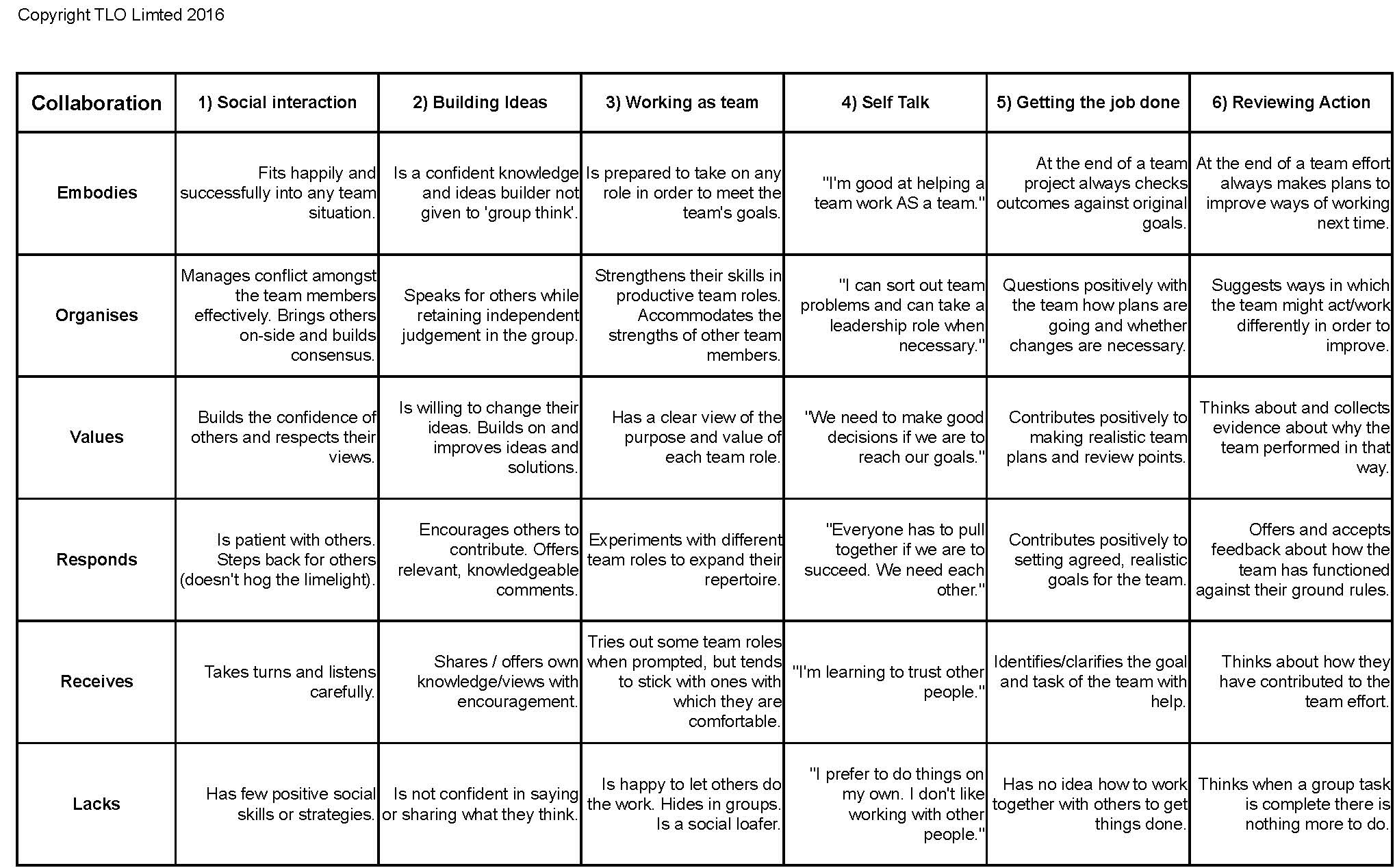
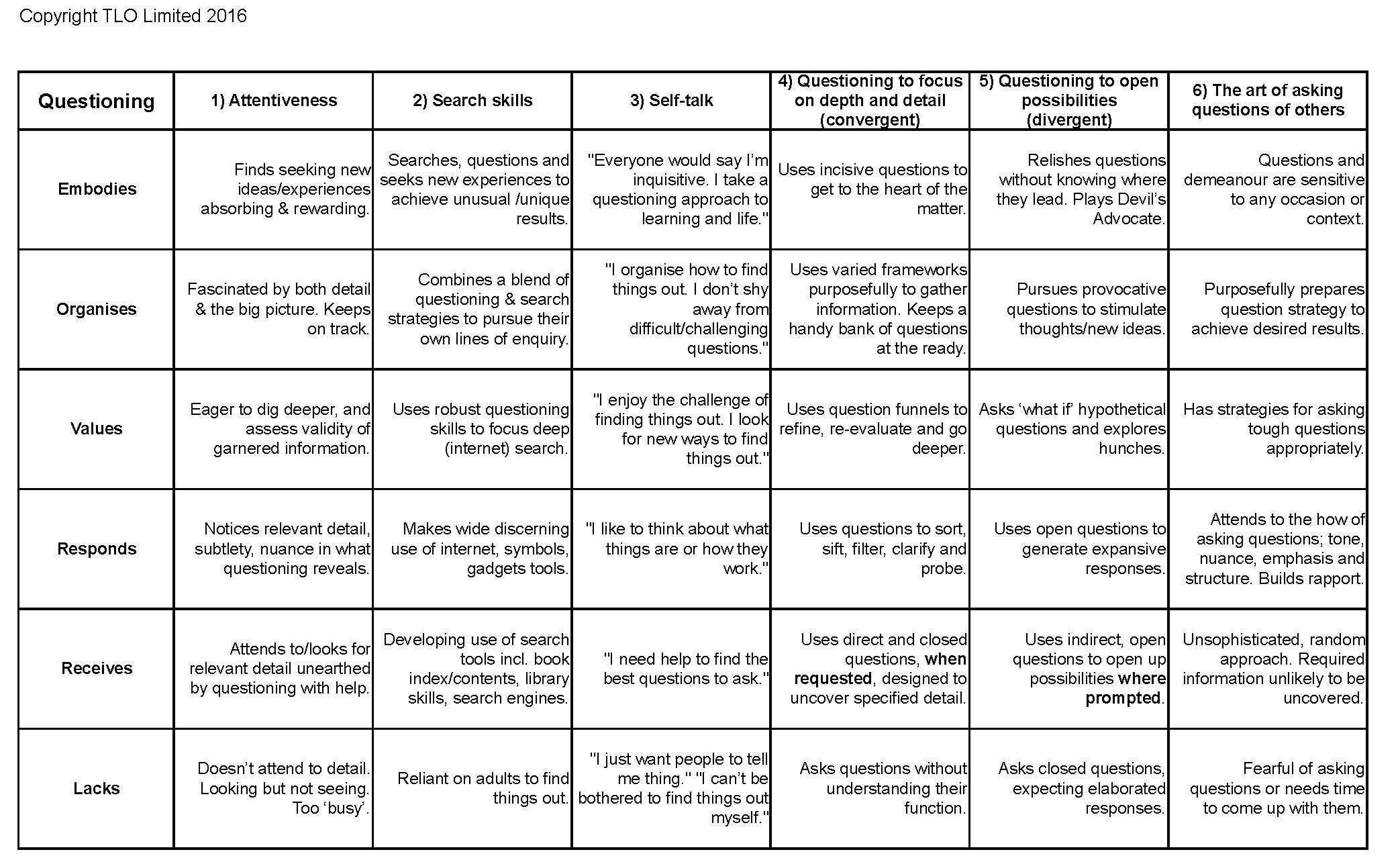
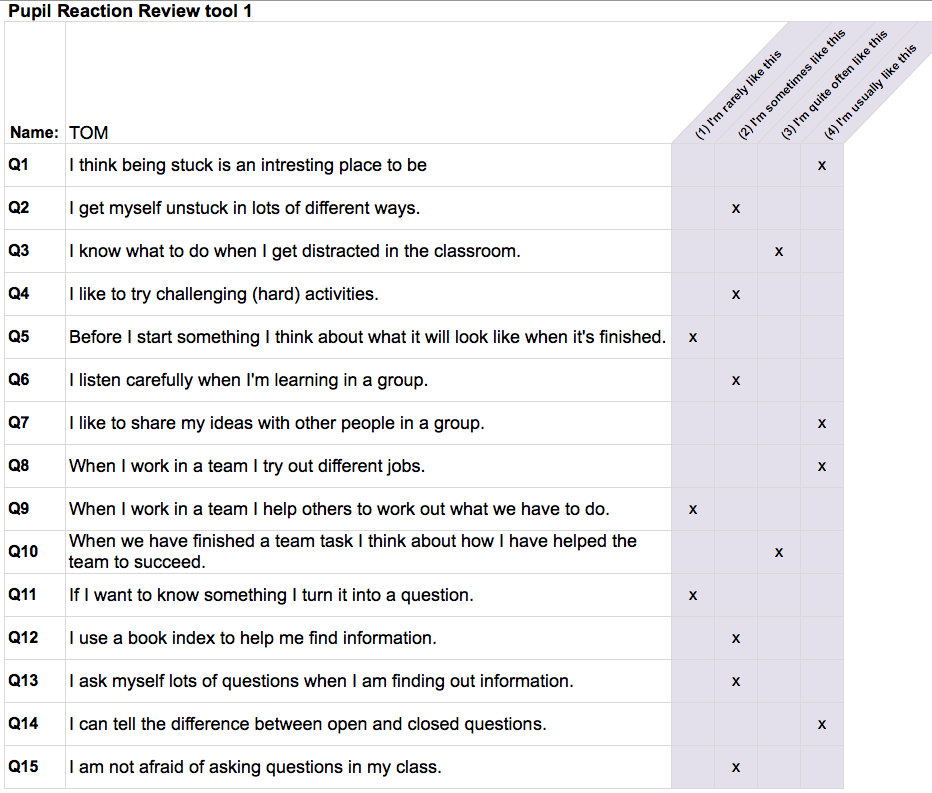
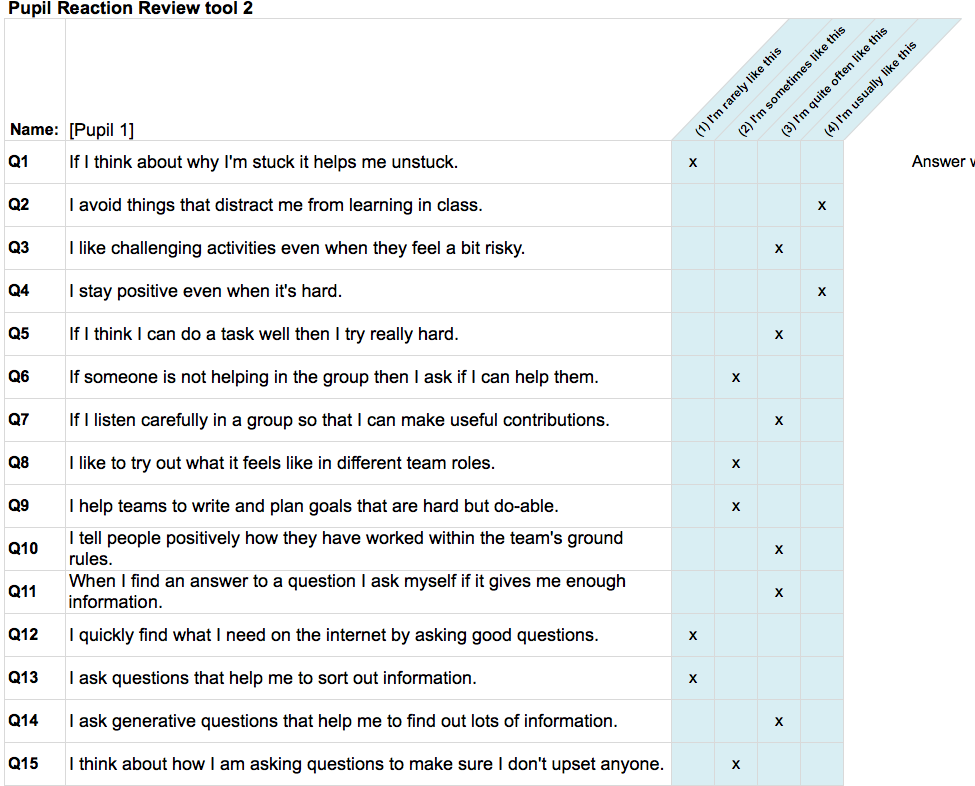
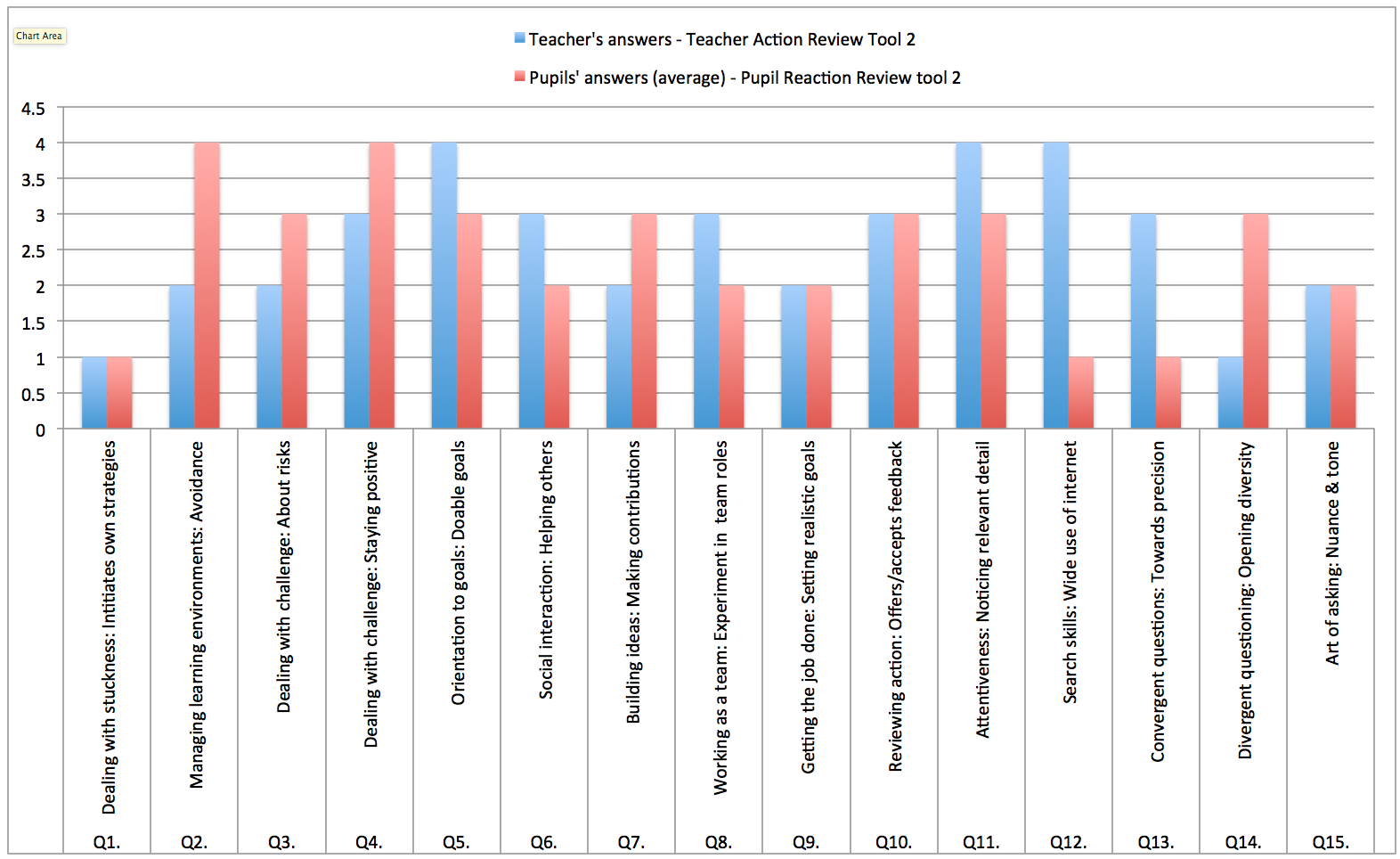
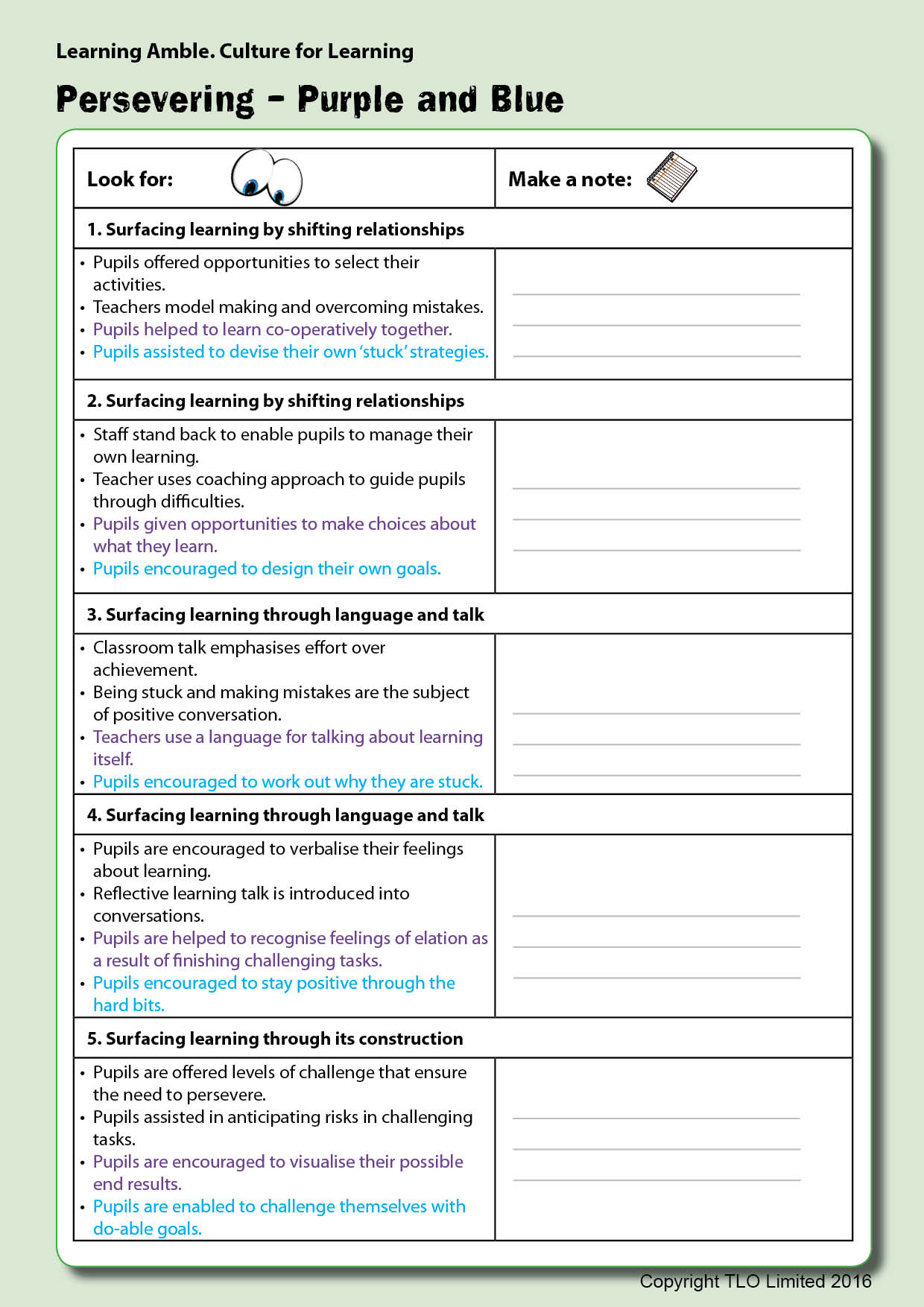
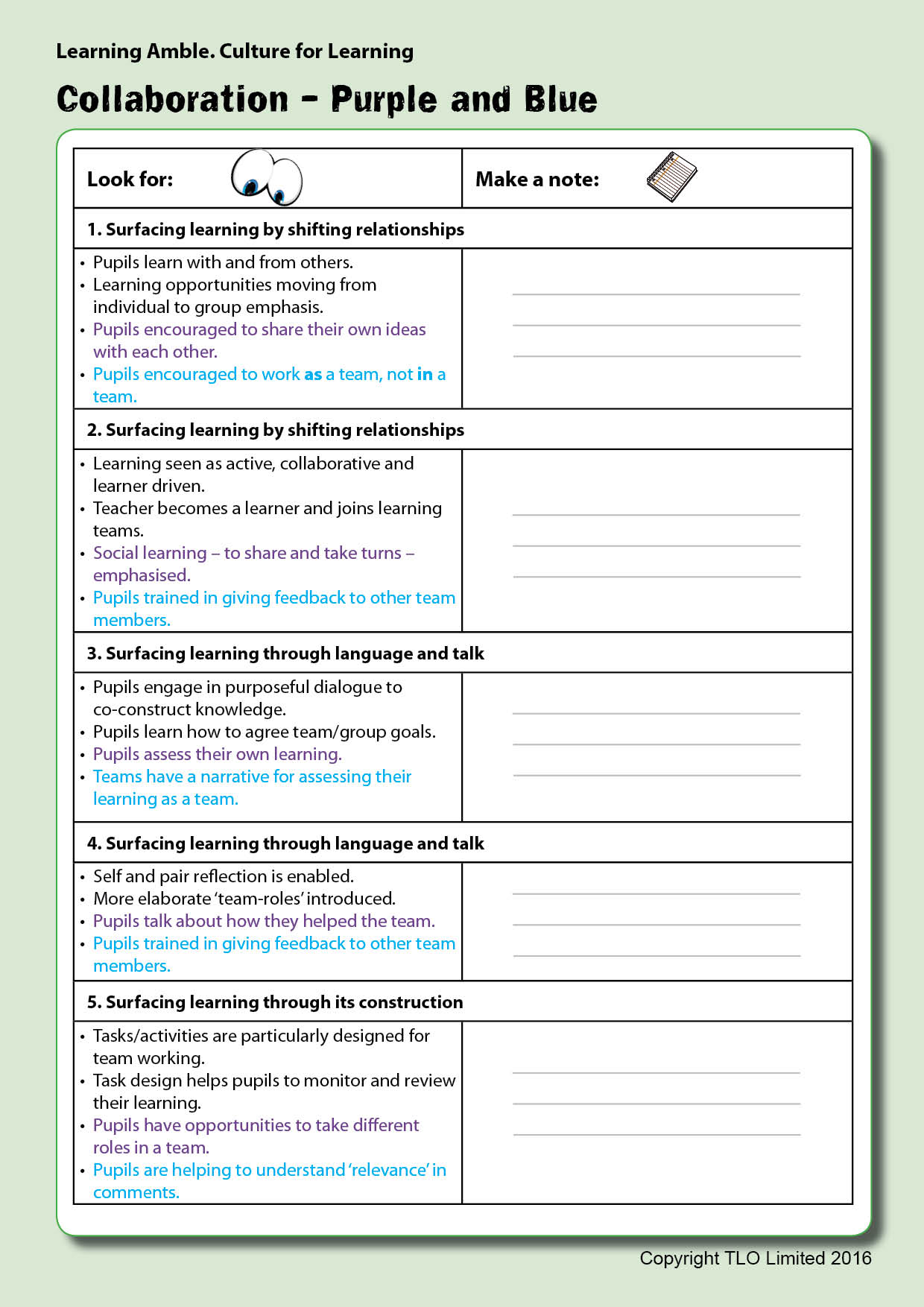
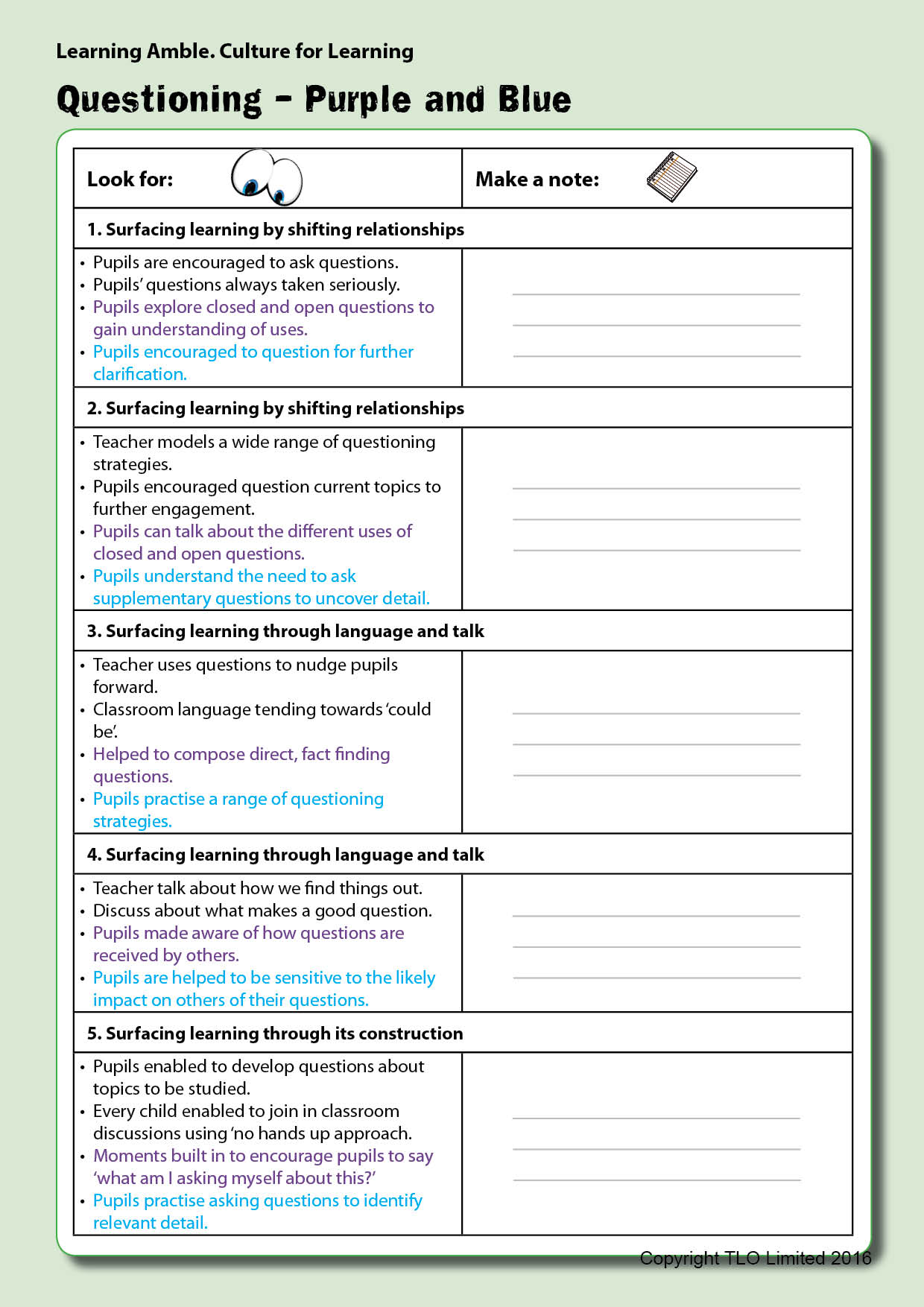
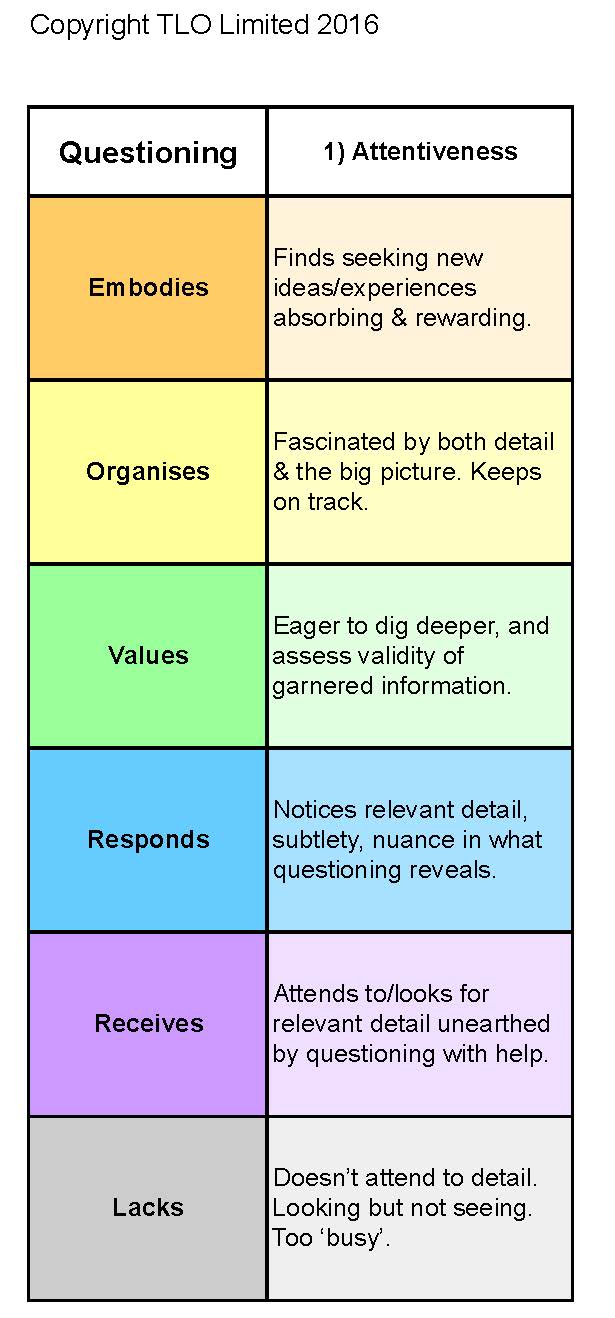
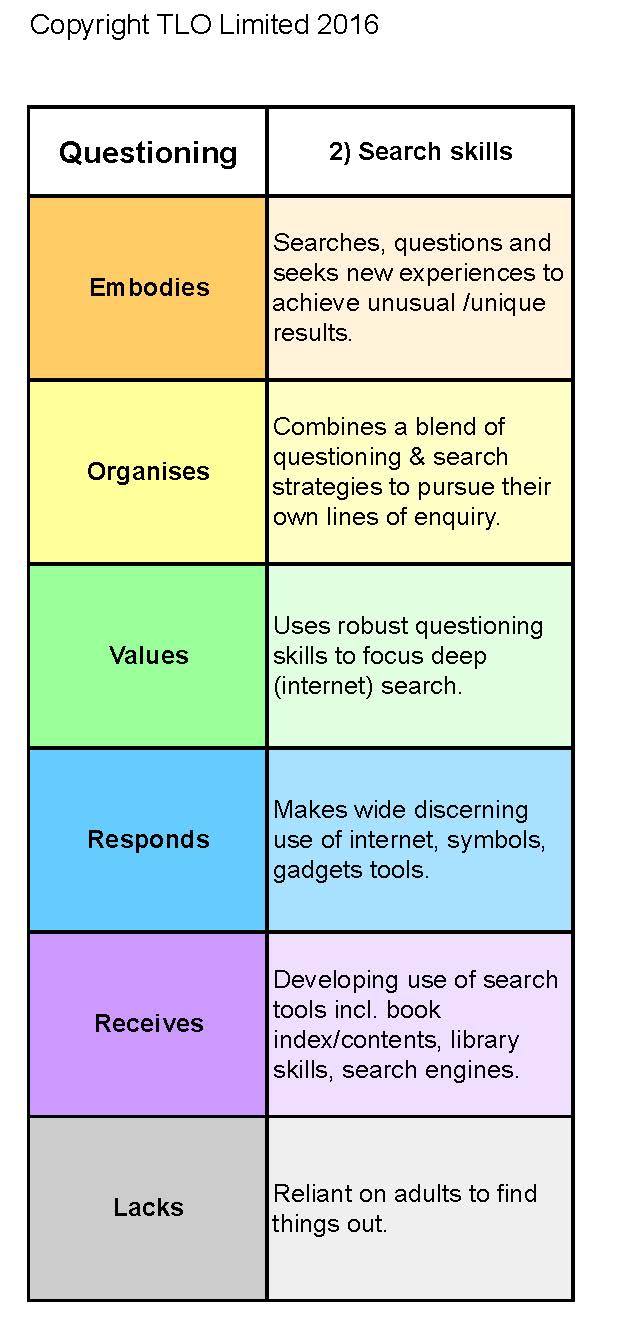
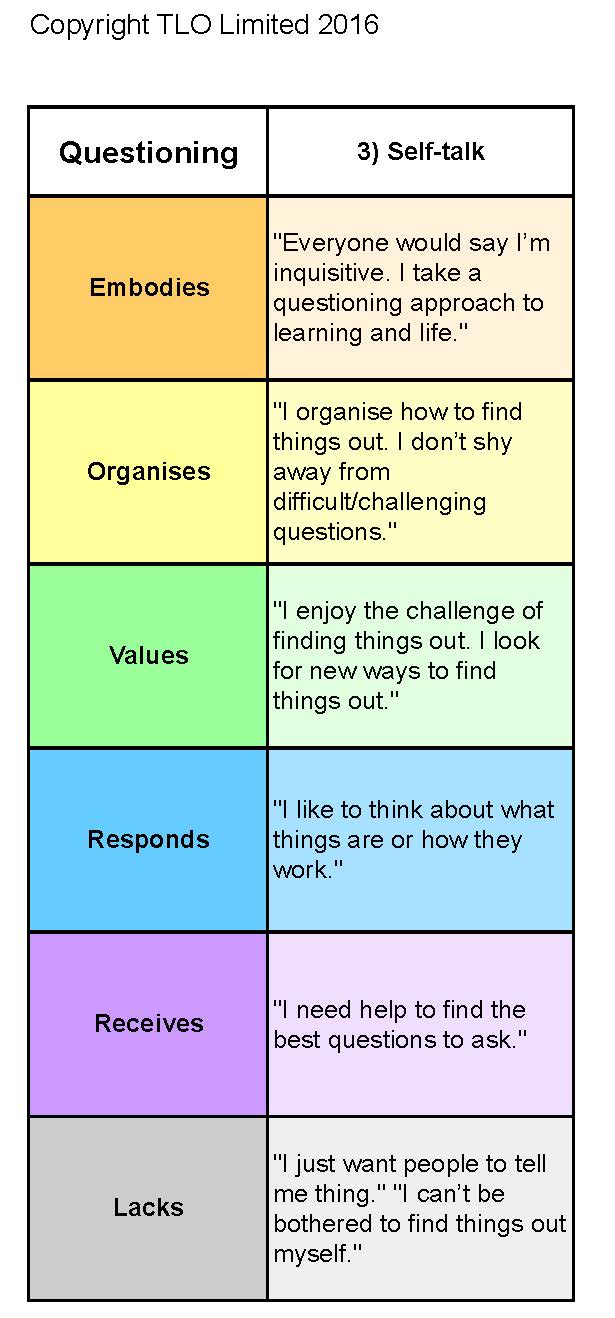
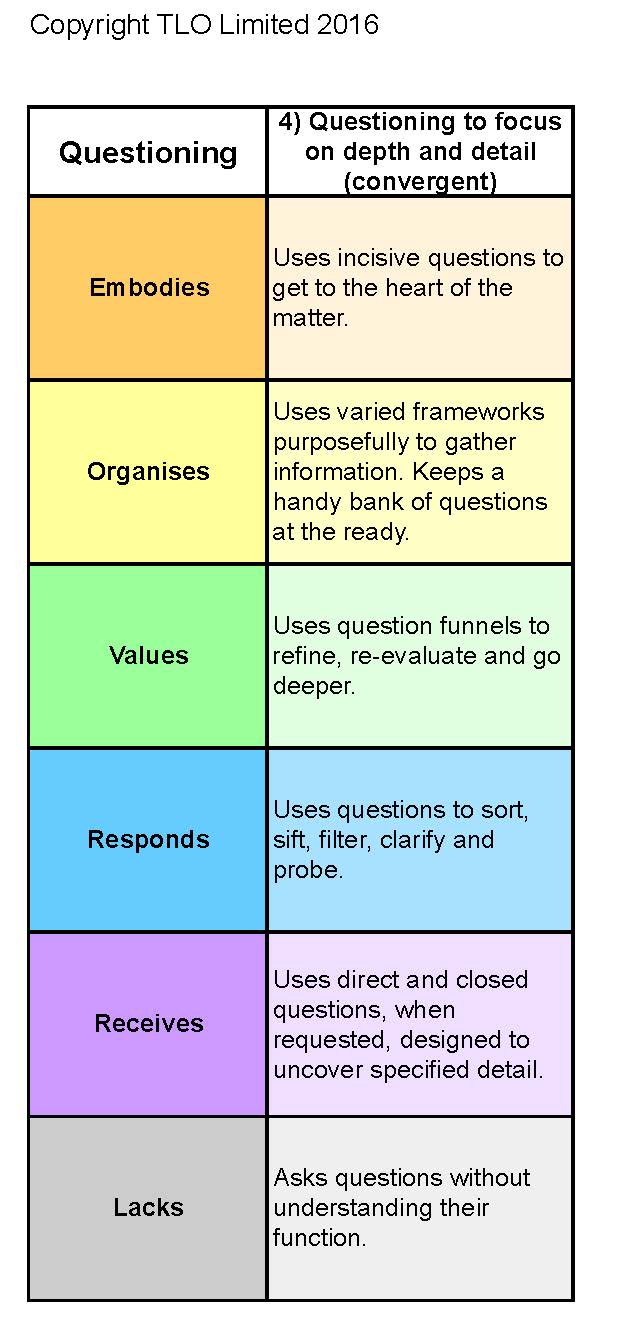
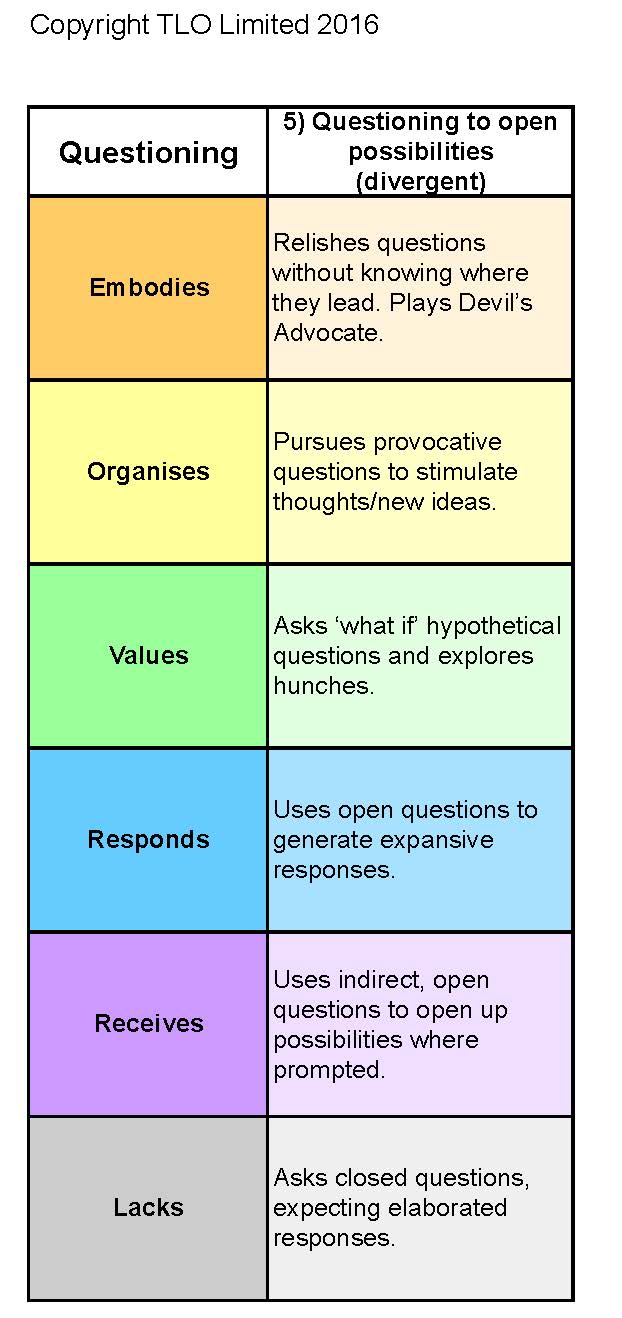
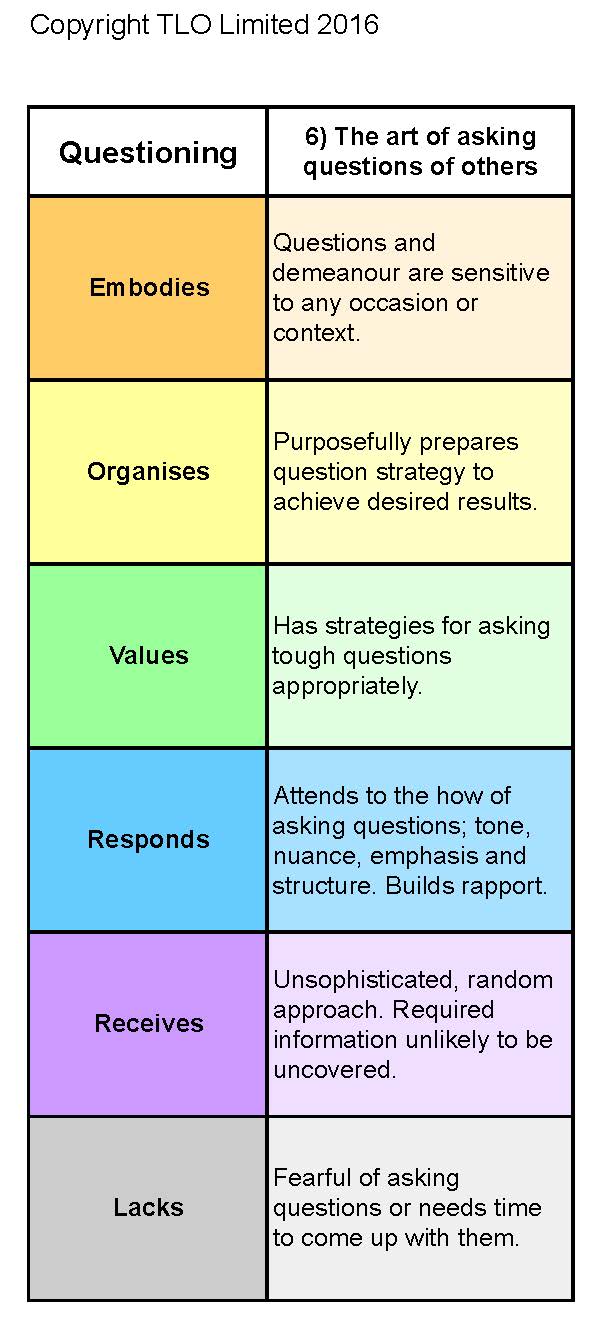

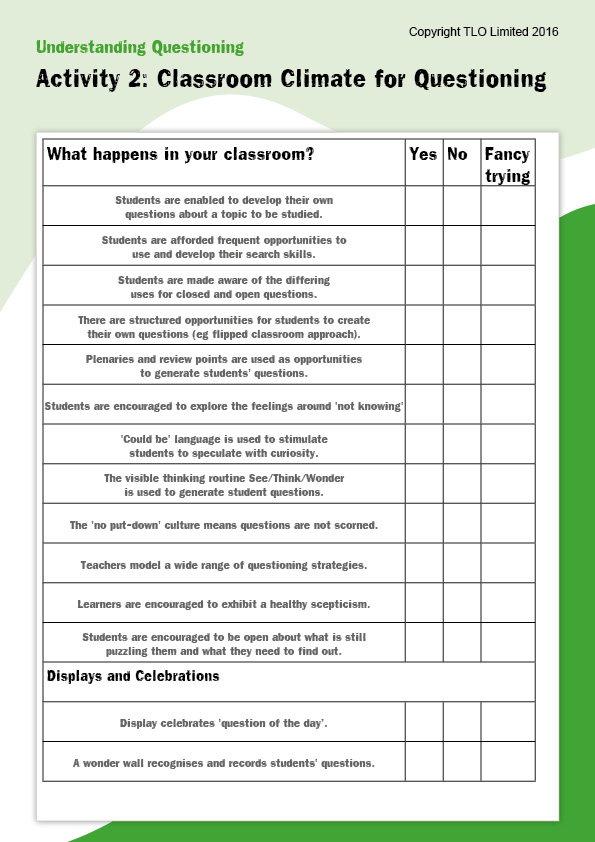


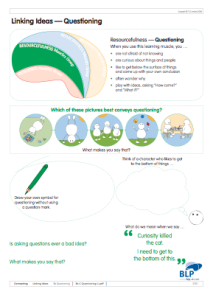
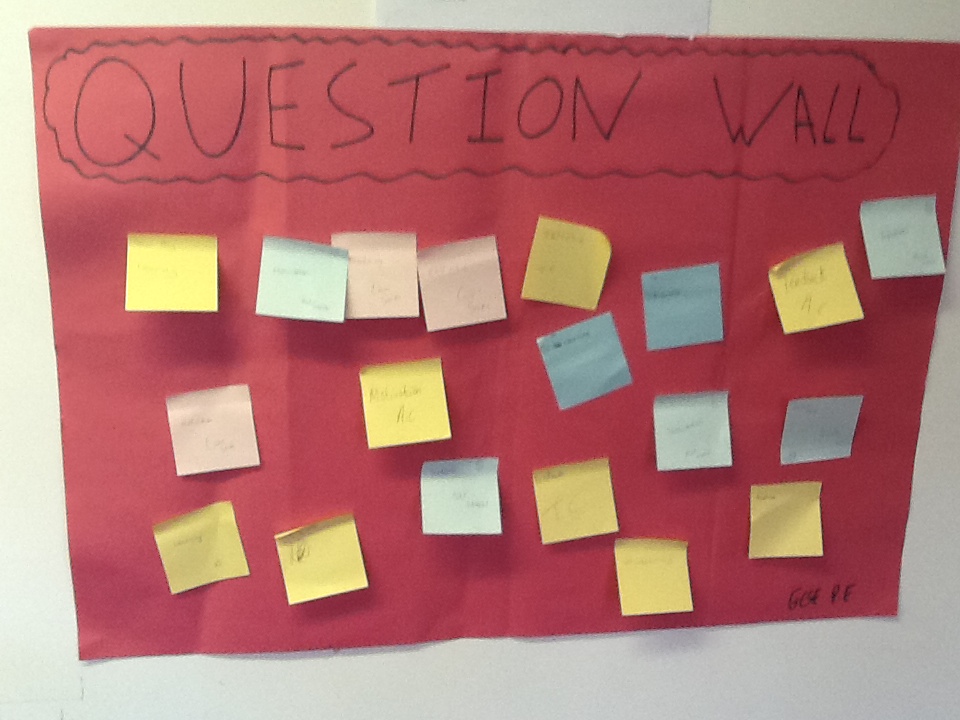

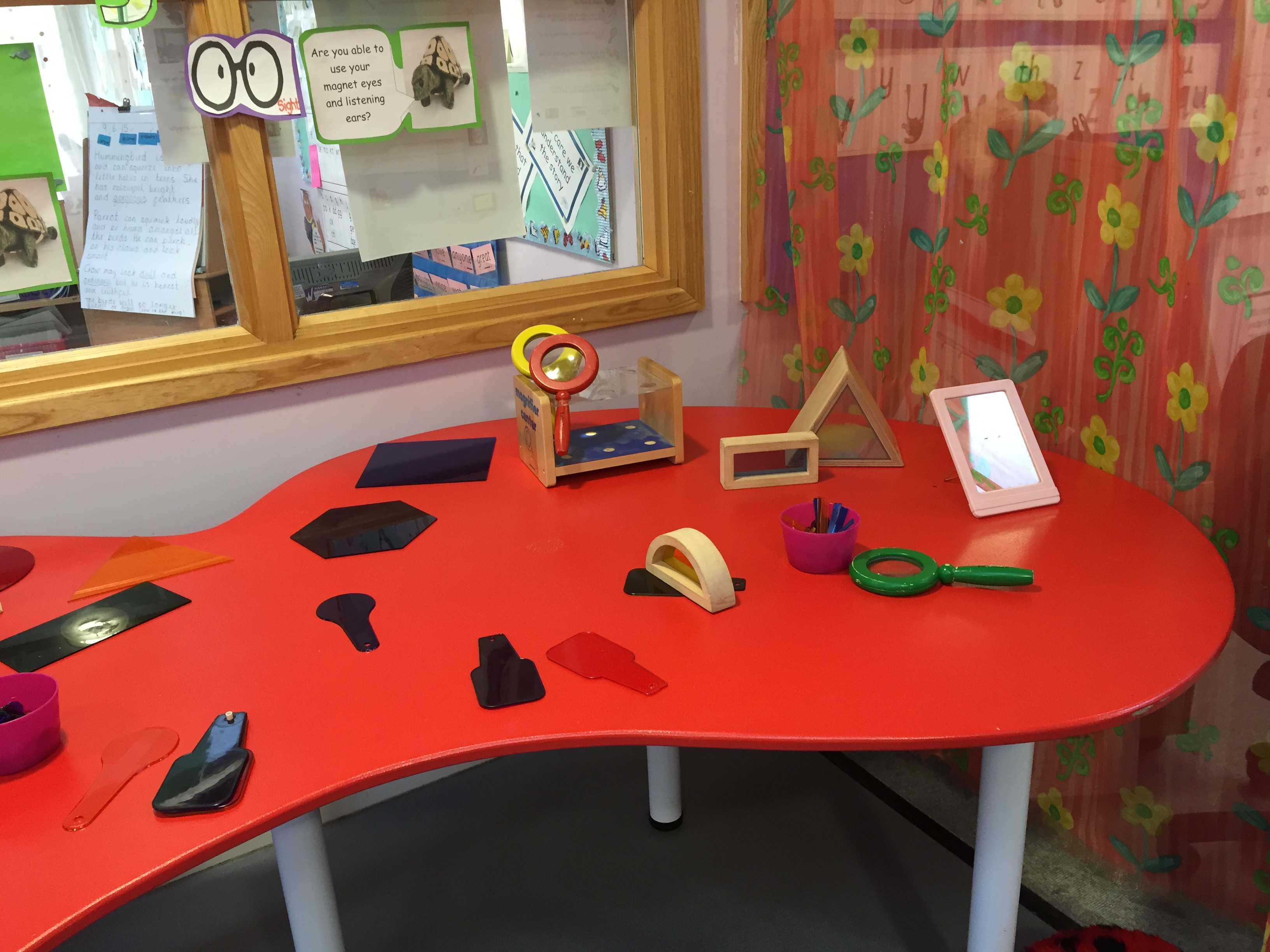


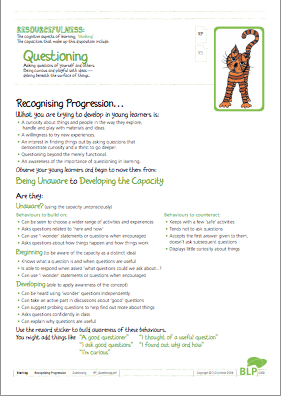
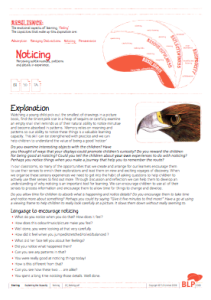














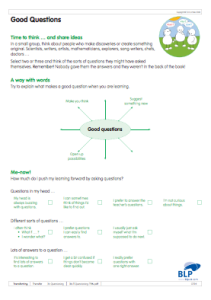



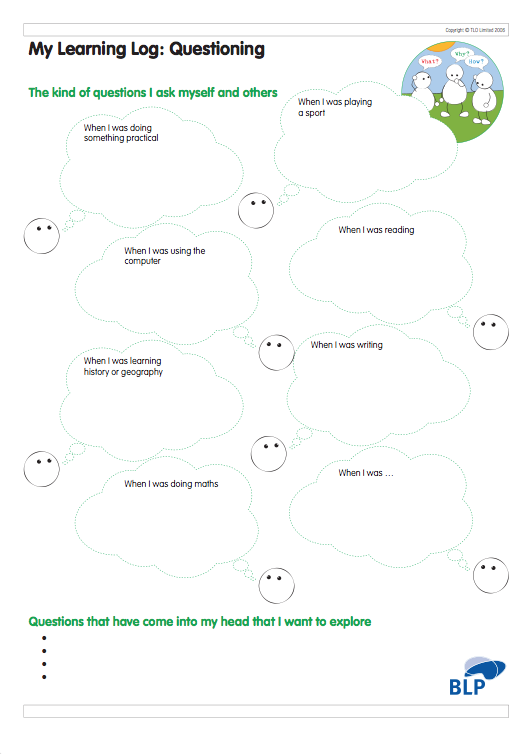


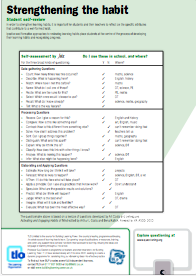


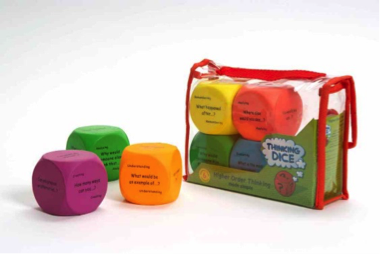
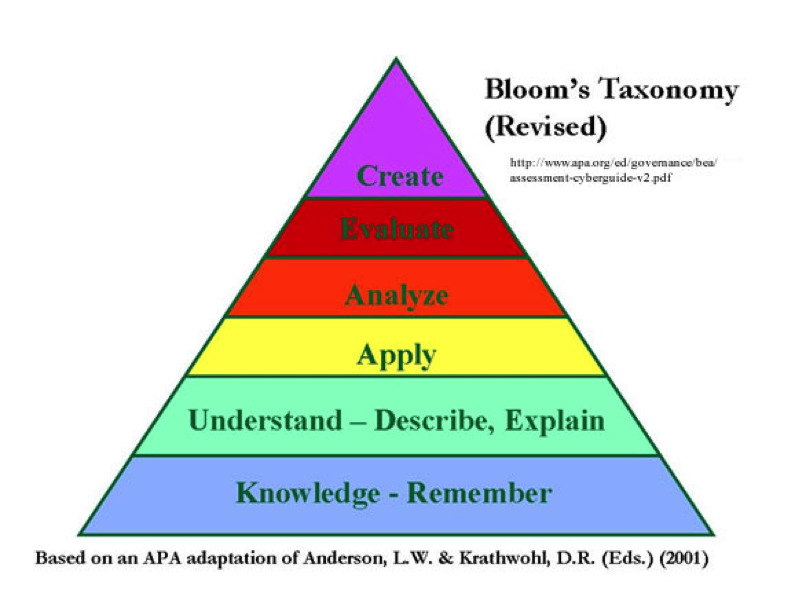



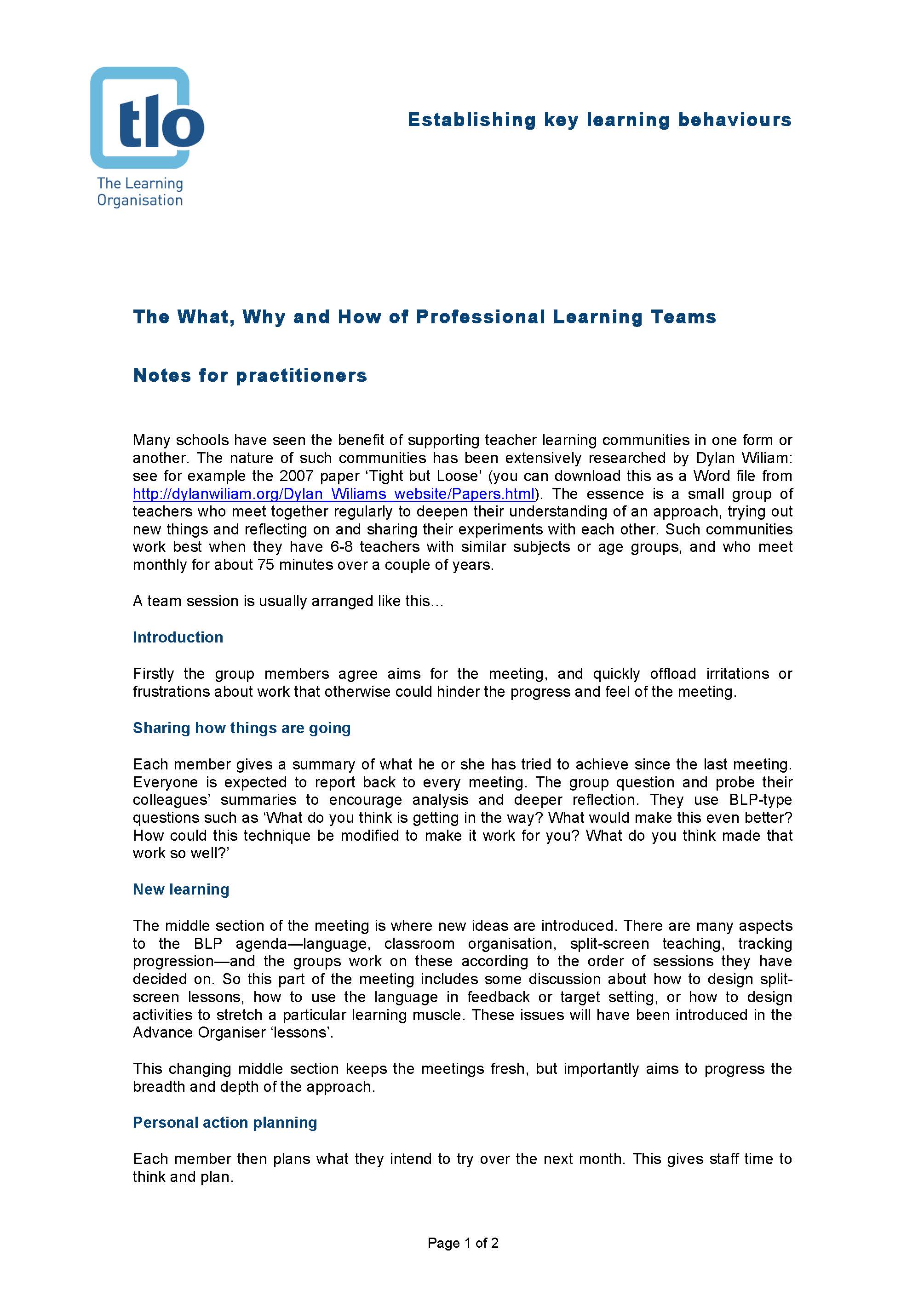
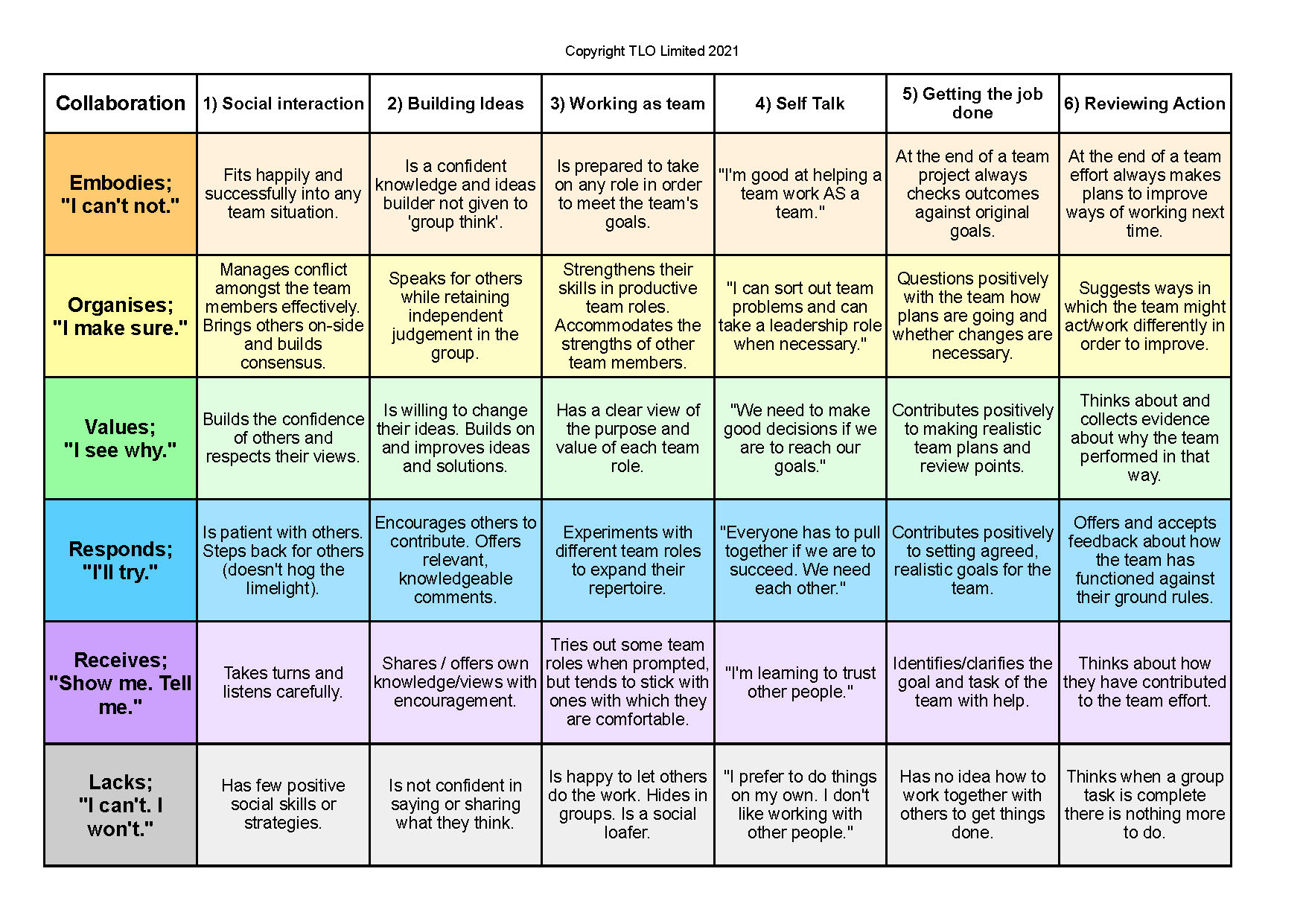





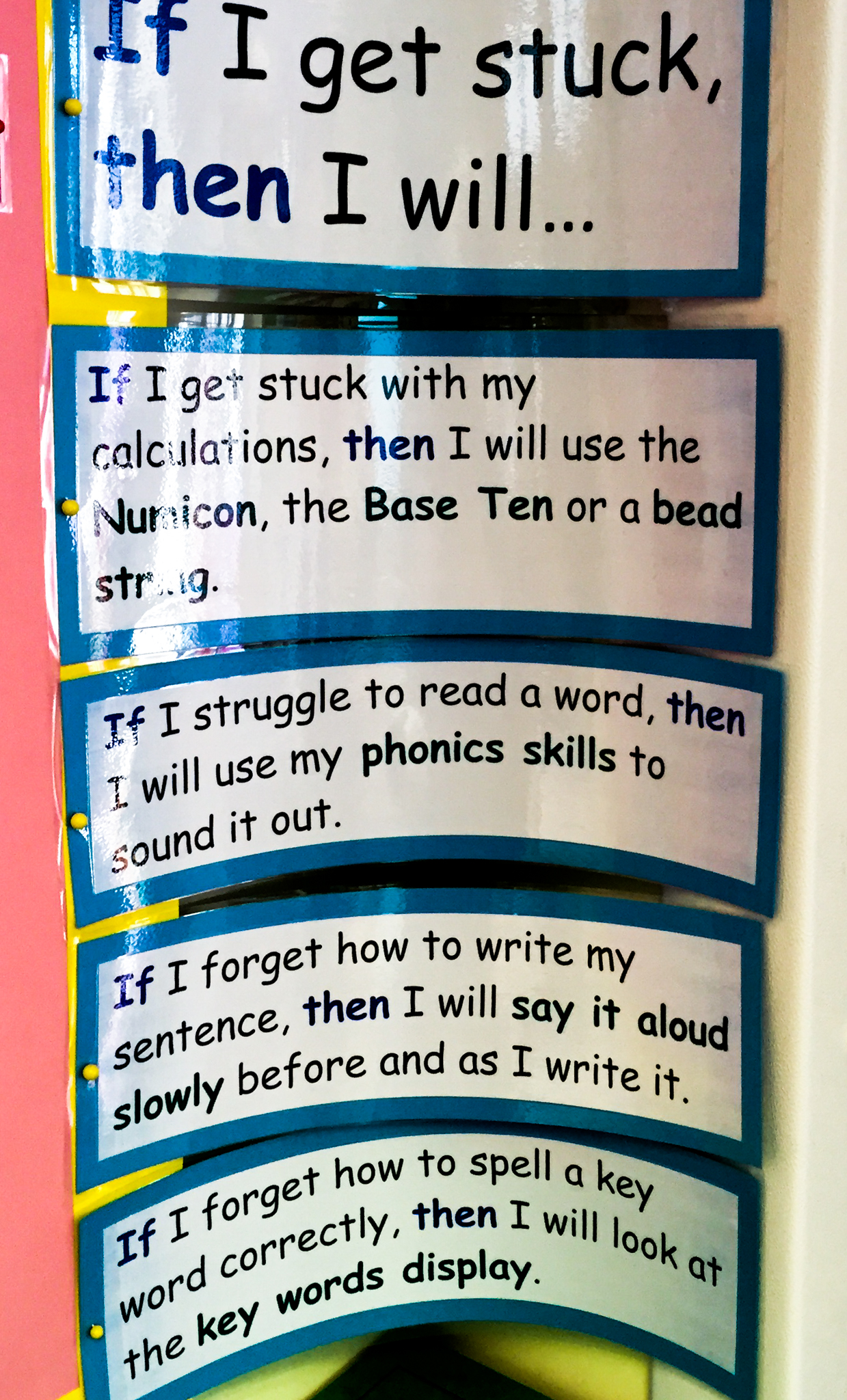


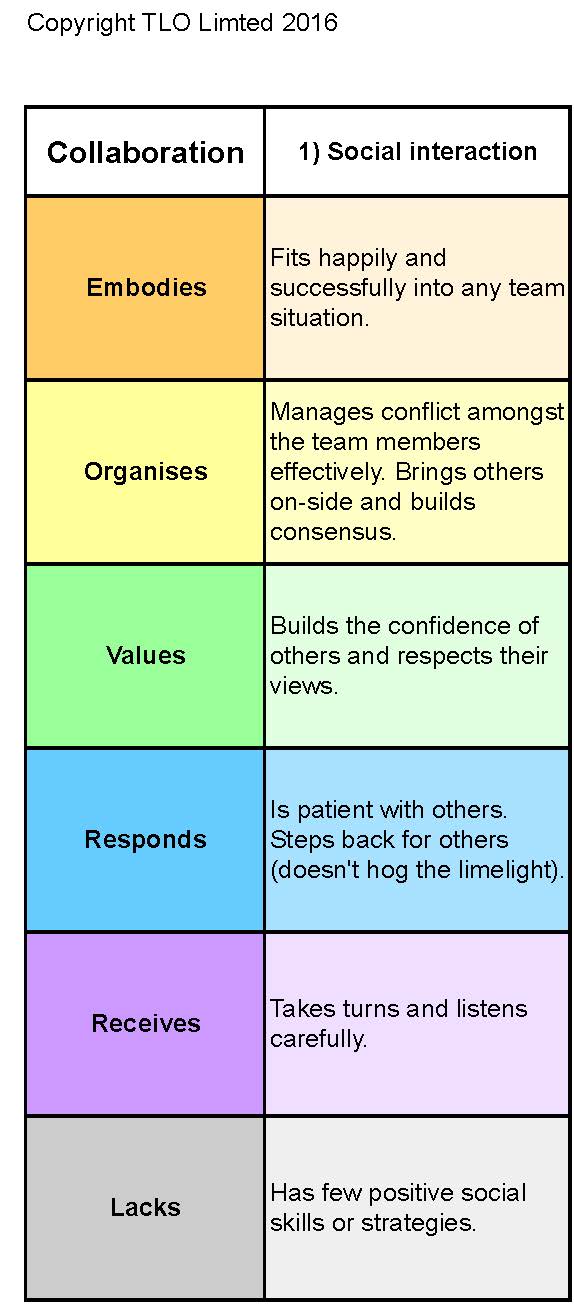
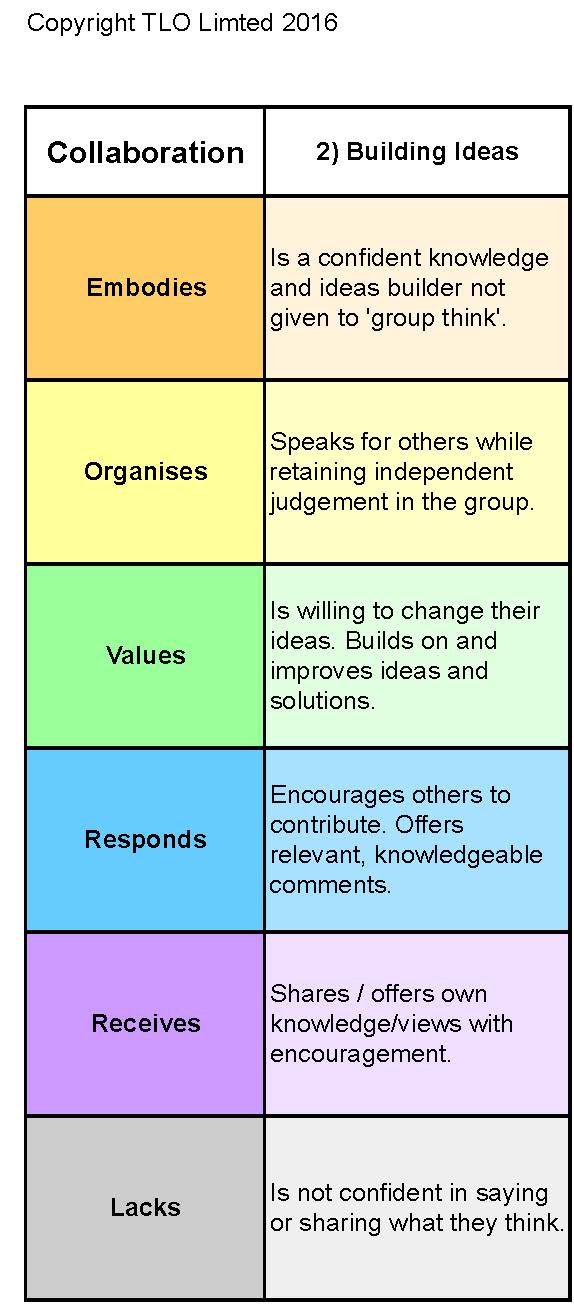

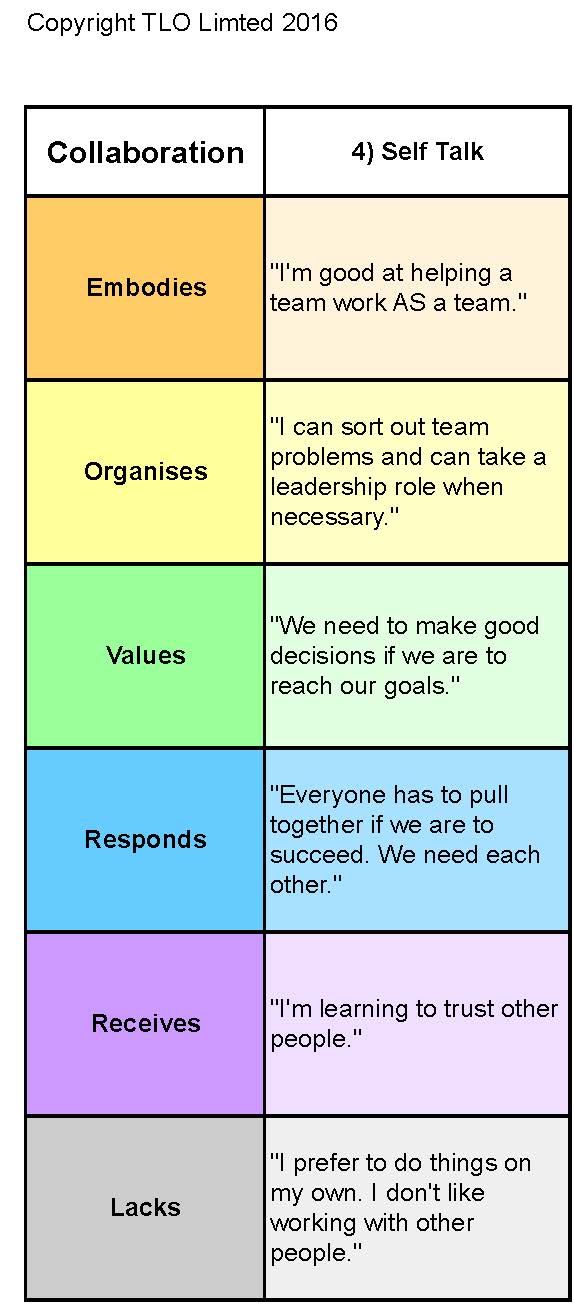


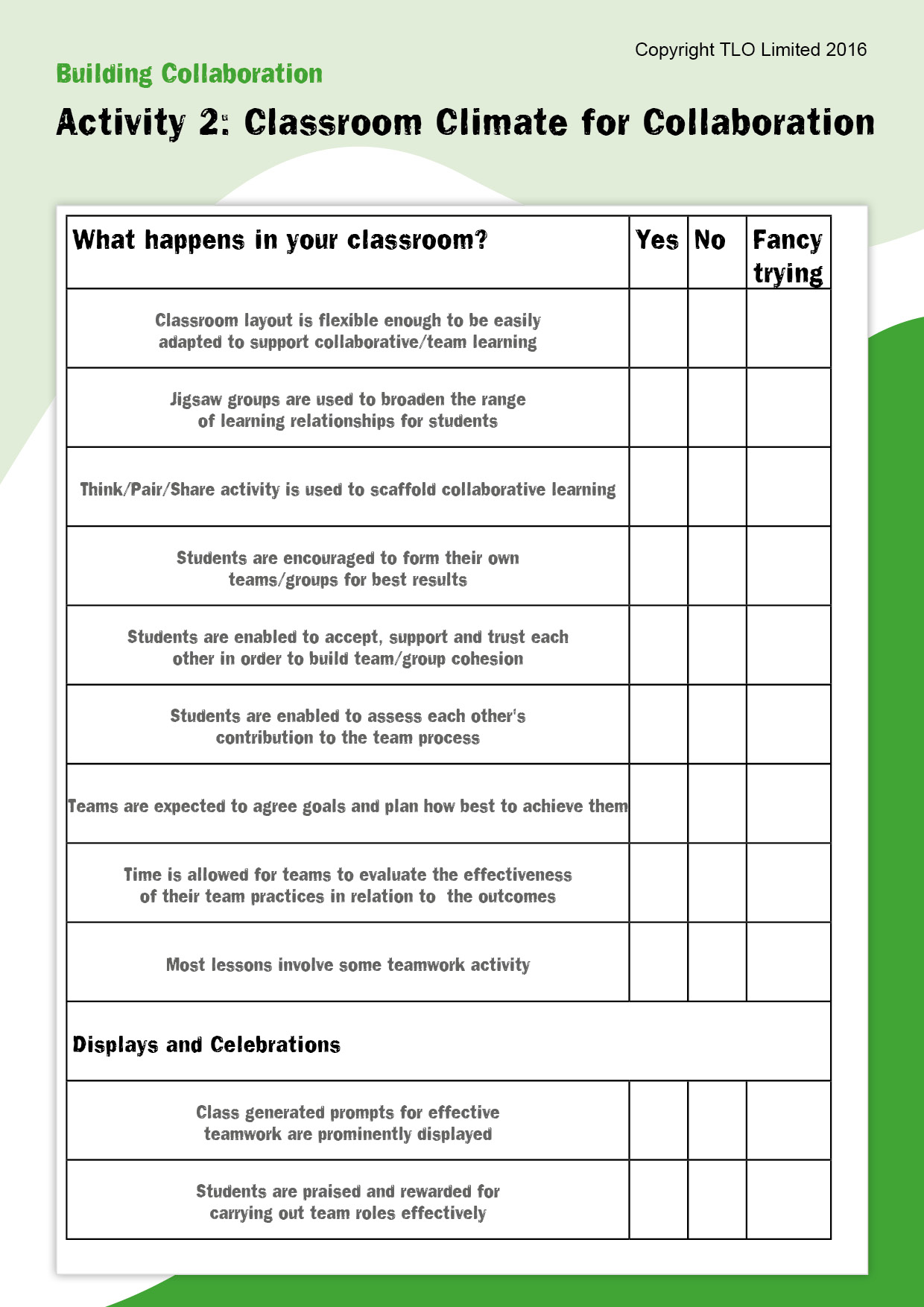
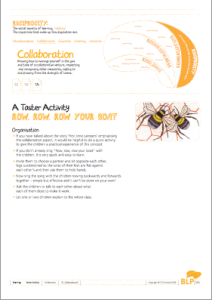


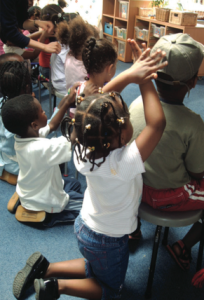

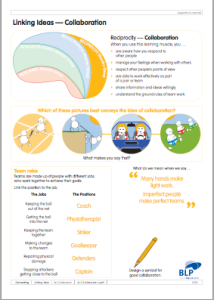
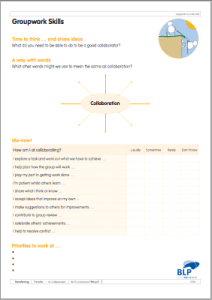
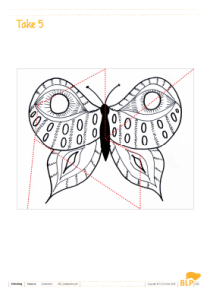
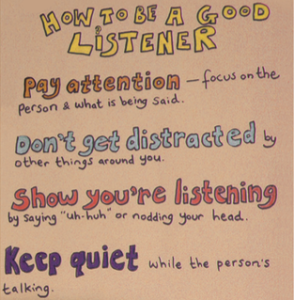
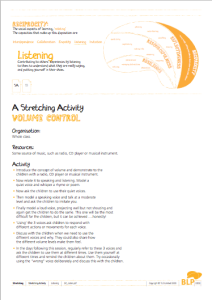

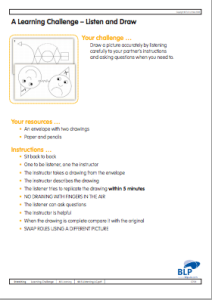
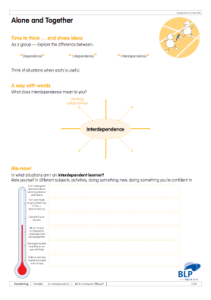
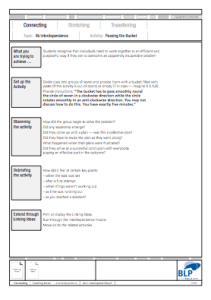
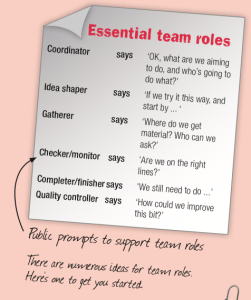
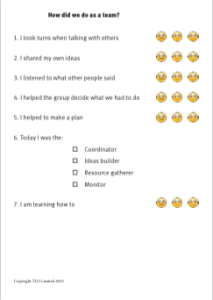
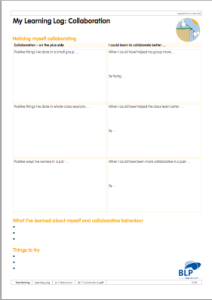







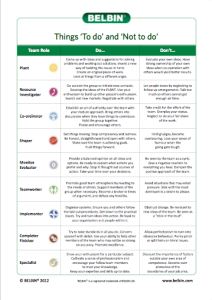


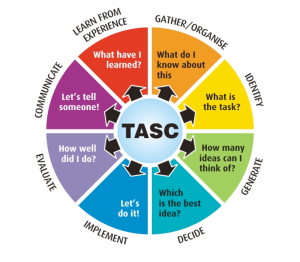

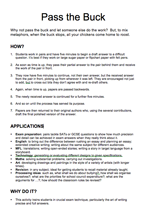
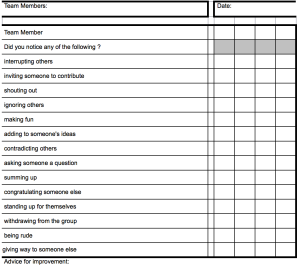


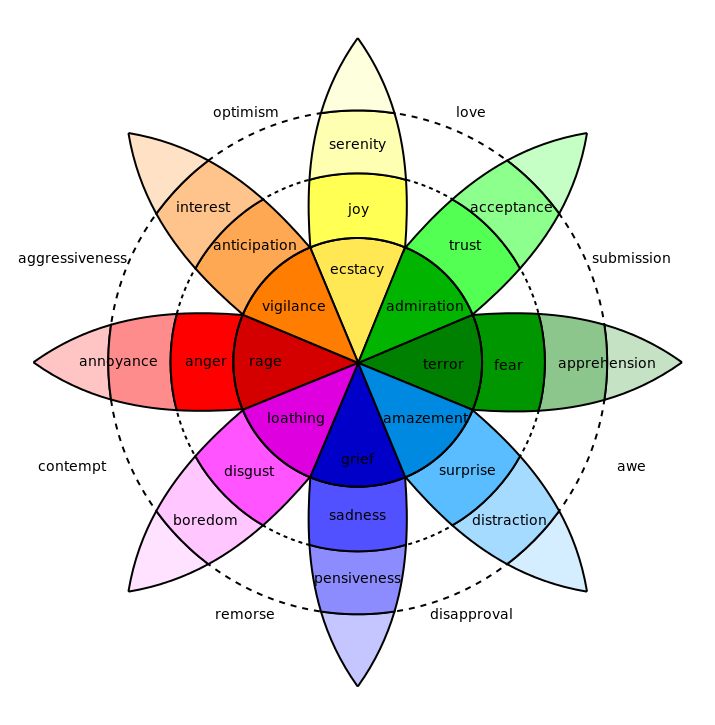
_1.jpg)