
What’s in store?
Read more about ...
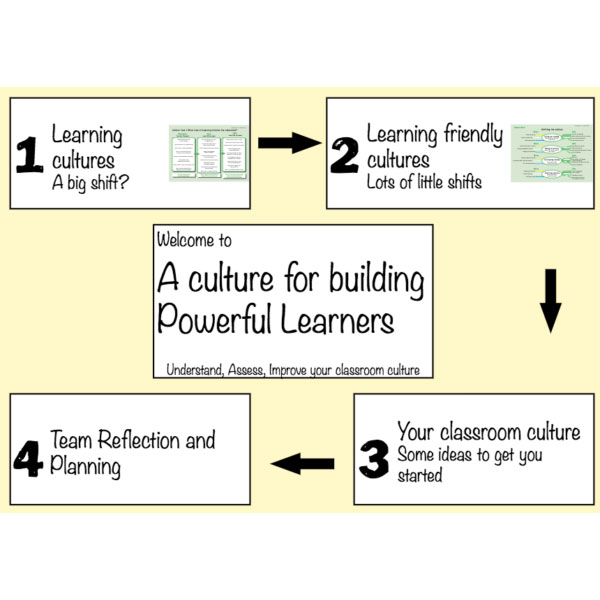
Welcome to Stepping Stones Phase 1. This first session is designed to guide you through a process of understanding, assessing and improving your classroom learning culture; making it more learning friendly in order to build your students’ learning power.
Click here to download your Learning Diary
Learning Diary. This resource will help you to distil important messages, home in on the key bits of information and design learning experiments specifically for your students.
Section 1. Learning cultures. A big shift? Unpick the meaning of classroom cultures, what they might consist of and the big shifts that may be needed to develop better learning. Use the culture tool to estimate where your classroom culture is now.
Section 2. Learning friendly cultures; Lots of little shifts. Find out about the four big dimensions of culture and use the culture tool 1 to estimate the sorts of shifts your classroom culture would benefit from.
Section 3. Your classroom culture. Some ideas to get you started. Look for ideas to strengthen your learner/learning classroom culture.
Section 4. Team reflection and planning. Share the results of your culture analysis with colleagues. Make plans for what everyone needs to do and what you will each do individually.
Why education needs to change
1. Students throughout the world need now to reach higher levels of achievement, not only to find fulfilling work but also to empower themselves to thrive in an increasingly complex world.
- Employment requires being able to enhance and transfer knowledge and to operate collaboratively.
- The capacity to learn and to adapt needs to be lifelong because change is a permanent state.
2. Research in the learning sciences shows that learning itself is learnable; that we, as a species, can get better at learning. This means we, schools, teachers, parents, can grow/develop better, more effective learners.
- Vast amounts of information is available and learners, young and old, need to know how to find and select relevant information, to process it, connect it, to understand it and use it.
- Learning is increasingly taking place in different settings and with different relationships. Learning is a way of life.
Comments are closed.