

Building the habit of Imagining.
Welcome to Building Powerful Learners Phase 2. This eight unit online programme will enable you as a teacher to expand your students’ use of learning behaviours.
The programme combines three types of action that will help you to experiment with, analyse and understand how to become more skilled in developing your students’ use of learning power.
1 Understand by using Read abouts…of which there are two types
- Essential Read …essential must read text.
- Extended Read …interesting, good to know, absorb when you can.
2 Analyse by using Find outs…tools to help you discover and analyse essential information
3 Experiment with Try outs…practical activities for you to try, check and perfect in your classroom
This unit explores the “how” of building imagining.
- What are the key aspects of imagining? (Essential Read about 1)
- How confident are my students now as imaginers? (Find out 1)
- How could I embed building imagining into my teaching? (Find out 2)
- What sort of approaches may be useful in making a start on this? (Try out 1 to 5)
- Estimate my students’ development using a detailed imagining chart (Find out 3)
Structuring and using the ideas below with your students over the next month or so will enable them to extend the range of learning behaviours that they use consciously.

Essential Read about 1
Unpacking Imagining
A well formed Imagining habit involves being ready, willing, and able to:
- Use the mind as a theatre in which to play out ideas and possible actions experimentally.
- Use a rich variety of visual, aural and sensory experiences to trigger creative and lateral thinking.
- Explore possibilities speculatively, saying ‘What might …’, ‘What could …’ and ‘What if …?’ rather than being constrained by what is.
- Retain a childlike playfulness when confronted with challenges and difficulties.
- Be aware of intended outcomes whilst adopting a flexible approach to realising goals.
- Rehearse actions in the mind before performing them in reality.
So, at a less abstract level, students need to have a wide range of experiences on which to base their imaginations; to have the bravery to take imaginative risks; to have the ability to visualise what they will do in advance of taking action; to be happy to allow their minds to explore intuitions and possible lines of enquiry; and to create innovative creative outcomes. When looked at from these diverse angles growing imagination moves well beyond encouraging a student to ‘be creative’.

Extended Read about 1. Understanding Imagining ⬇️
The learning behaviour known as imagining
Imagining is an important way of thinking but one that seems to be afforded too few opportunities in classrooms. Imagination isn’t just a cute faculty that children use to weave fantasies: it is one of the most effective tools in the learner’s toolbox. Scientists, designers and executives need a powerful imagination just as much as painters and novelists, and it can either be developed, through appropriate experience and encouragement, or left to shrivel up. Good learners are ready and able to look at things in different ways. They like playing with ideas and possibilities and adopting different perspectives (even though they may not have a clear idea of where their imagination is leading them). They use pictures and diagrams to help them think and learn.
There are two kinds of imagination: active and receptive. In active imagination, you deliberately create a scenario to run in your mind’s eye. Sports people use this kind of mental rehearsal and experiments have shown it to be very effective at improving their level of skill.
The second kind of imagination is more receptive, like daydreaming: letting a problem slip to the back of your mind, and then just sliding into a kind of semi-awake reverie, where the mind plays with ideas and images without much control on your part. Successful learners and inventors know how to make good use of this kind of creative intuition. They are interested in inklings and ideas that just bubble up into their minds.
Extract from Building Learning Power. Guy Claxton 2002.
Re-find out 1
Focus on the imaginers in your class.
The imagining progression chart should give you a fairly clear view of the imagining behaviours and how your students do, and do not, currently exhibit them.
- The majority of students may well display a similar set of positive behaviours (ie the majority may be in the purple or blue phase)
- You will also be conscious of some students who still lack positive behaviours (ie they are still firmly rooted in the grey/lacks phase of the progression chart)
- But some students will appear to have made general progress even in learning behaviours not spotlighted earlier.
The chart alongside shows how imagining grows. Column 1 identifies the 6 phases of development, column 2 describes how the skills and behaviours may grow over time, column 3 shows the self-talk; what students may quietly say/explain to themselves at each phase of development.
A word of warning.
While you may be tempted to focus your efforts on the majority for greatest impact, you’ll need to take care not to do so at the expense of your ‘grey’ students, as these are your potential underachievers in the future.
What to look for.
In Try Outs 1 to 5, look out for teaching ideas that you think will have the greatest impact on your particular group of learners. Don’t attempt to try all of the ideas – better to do a few thoroughly than to adopt a scattergun approach.
Growing imagining; a trajectory of developing behaviours, skills, attitudes and self-talk
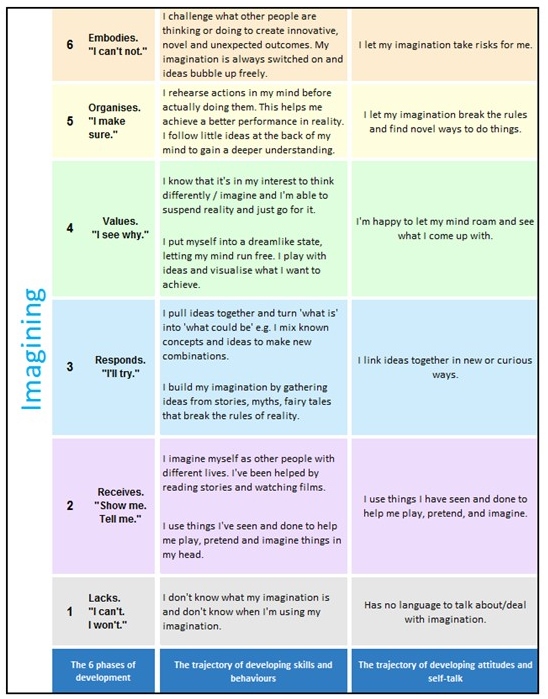
Which phase have most of your students reached now?
Download as a pdfFind out 2
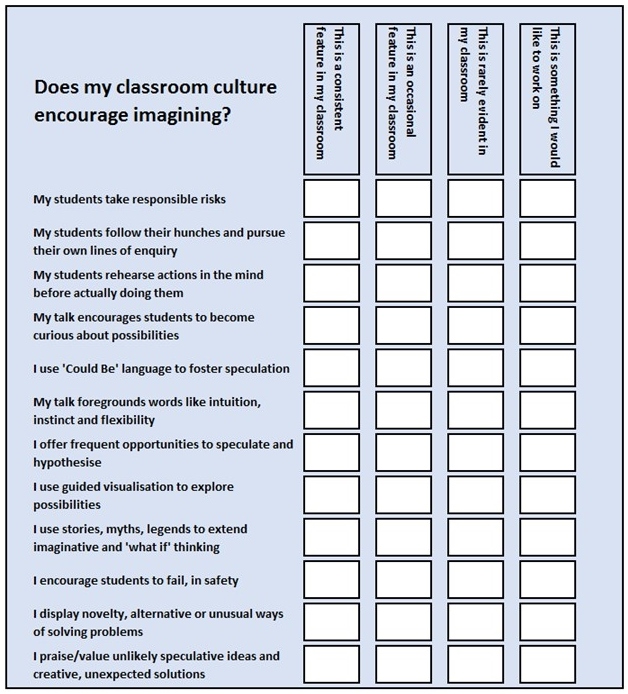
How much does my classroom culture encourage Imagining?
Culture is the curriculum of the classroom, frequently hidden from the external observer, but always all evident to learners. It is the minute by minute, hour by hour, day by day way that learners come to understand their role as a learner. Culture is your enacted values in the classroom – what you do and what you do not do, what you say and do not say, what you believe and do not believe, what you value and do not value.
Here is a selection of features that might begin to shape the emotional climate of your classroom to encourage imagining.
Download and print a copy.
Reflect on your current classroom culture.
It’s worth noting that the list is made up of the four action types you first met last year in the Teachers’ Palette (Unit 2);
- ways of giving students more responsibility for their learning
- the sort of language you might use to stimulate imagining
- ideas for constructing lessons to build imagining
- ways of celebrating imagining
Ask yourself which of the features of the imagining-friendly classroom are:
- already a consistent feature of your classroom?
- an occasional feature of your classroom?
- rarely evident in your classroom?
Which of these features are you interested in developing further?
At this point it might be worth having an informal chat with some of your colleagues. Is anyone already making progress with one of the features you would like to work on? Do you have any consistent features that others might learn from? Take your completed sheet to discuss at the meeting at the end of this unit.
Try out 1
A range of little culture shifts
Have a think about your current classroom culture in relation to Imagining.
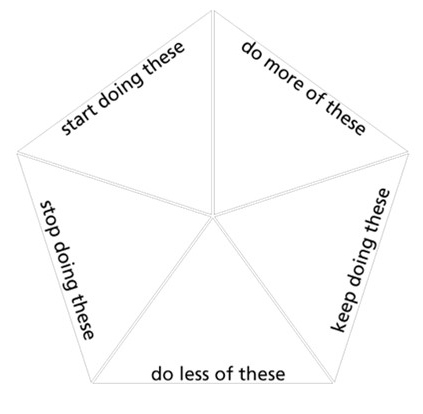
Begin with the ‘stop/avoid’ box – if any of these teaching behaviours are still in evidence in your classroom it would be worth thinking through how they can be eliminated, since failure to do so will undermine the changes you are hoping to achieve for your learners
Then cast your eye over the other 3 boxes. Which ideas appeal to you? Which do you think will have the greatest impact on your students?
Now seek out teaching ideas below in Try Outs 2/3/4/5 that you can use to move your classroom culture forward.
Try Out 2 focuses on ideas for moving responsibility for imagining towards learners (Relating);
Try Out 3 focuses on developing a learning language for imagining (Talking);
Try Out 4 focuses on how lessons/activities can be designed to activate and develop imagining (Constructing);
Try Out 5 focuses on how imagining can be recognised/ rewarded / praised / celebrated (Celebrating).
Try out 2
Extend students’ responsibilities in order to build imagining
Use a quick starter to key students into the learning behaviour you want to concentrate on in the lesson.
Provide a stem statement…
A man walks into a room with a suitcase in his hand…
Invite one student to carry it on. Each student continues from where the previous one left off.
Or . .
Create a scenario…There are no windows, water drips into a bucket, two people are seated back to back…what might be happening? What might happen next? Can you improvise the dialogue between the people?

Two more ideas for extending students' responsibilities. ⬇️
Adopt a character to help to anchor imagining
‘Adopt’ a character – real, imaginary, human or animal – who/that exhibits the best features of imagining. Talk about the character until your students become familiar with its attributes. Leave the character (actual /picture) on tables when you have set a group to work on using a particular learning behaviour in – numeracy, reading, writing etc., as a reminder.
Teacher talk
- What is imagining all about?
- Why do we need to imagine things?
- What will help us to imagine?
- It’s all about letting your mind play with ideas

Draw me the answer – can you draw ‘Change?’
An activity to stimulate the use of the imagination.
Use drawings to release student imagination and to encourage students to identify the key features of whatever it is they are drawing. [Much like Mind Maps, this is also a Distilling and Link Making activity].
It is at its most powerful when the ‘thing’ being drawn is abstract – change, democracy; fairness; liberty; fear; happiness, struggle, stuck etc.

Teacher talk
- Get a feel for the concept…
- Does it have a dominant colour?
- What shaping might this concept suggest?
- What can we learn from the different interpretations you have drawn?
- What sorts of feelings does this drawing evoke?
Try out 3
Build a learning language of imagining.
Teacher talk – as a learning coach
Here are 10 ideas to ensure your students do the thinking for themselves
- What would happen if …
- Try to picture … in your mind. Tell me about . . . .
- Can you use your mind’s eye to see what that might look like?
- Are there any other possible explanations?
- Close your eyes – what can you see? Hear? Feel?
- What do you feel might be happening?
- What could this be?
- How might you do this differently?
- Imagine yourself doing it before you do it for real.
- Can you imagine how xxx feels now even though you disagree with their views?

Two more teacher talk ideas ⬇️
Talk about how things might look, feel, sound.
Give students a familiar object – a pencil, hairbrush, scissors, toilet roll, cushion – whatever comes to hand.
Then pose the question: ‘What else could it be?‘ or ‘What could this become’
Discuss and praise the most imaginative ideas.
What you are trying to develop in young learners is:
- An awareness of the power of imagination;
- The ability to use their imagination to picture how things might look, sound, feel or be;
- The willingness to talk imaginatively about situations, events, characters, etc.

Guided Visualisation
Invite students to visualise, for example, a snowy mountain peak until the image fades – discuss how long this could be sustained.
Now visualise hovering over the mountain and exploring the terrain by helicopter – the experience will have lasted longer.
Now provide students with a guided visualisation of the mountain that triggers their imaginative faculties – discuss the features of this experience.
Enable students to identify the ways of triggering their own imaginations when provided with stimuli. Invite them into a city at night, or the alimentary canal, . . .
Stimulating the imagination
Use music to create atmosphere and stimulate imaginative thinking.
Provide varied, unexpected and ever-changing visual experiences — on whiteboards, classroom walls, in ideas banks, through web-links, etc.
Read vivid prose and poetry that captures details, moods and atmospheres.

Try out 4
Build imagining into lesson design
It is through learning activities that learning behaviours get a workout. Their role is to enable your students to access and wrestle with information and ideas; to help them use and understand something; to ensure their effectiveness as a learner. The ‘right’ activity helps to make new concepts more concrete. The ‘right’ activity provides insights into new ideas and subject matter. The ‘right’ activities need to be carefully chosen and, critically, linked to the learning goal.
An activity to highlight and strengthen Imagining
What has happened here? Good guy or bad? Can we see any colours? Hear any sounds? Imagine being there….
A quick way to activate the Imagination and explore how we use our senses to imagine.
What you are trying to achieve:
To support students to use their imaginations using all of their senses,
How might you use the technique?
- As a starter for creative writing
- As a prelude to reading a book – start with the B&W copy of the dust jacket.
- To build empathy
- To scaffold the use of all of the senses
- To trigger the imagination

Two more lesson design ideas ⬇️
Visible Thinking Routine
Creative Questions
Creative Questions is a visible thinking routine that encourages students to create interesting questions and then imaginatively mess around with them for a while in order to explore their creative possibilities:
Pick an everyday object or topic and brainstorm a list of questions about it.
Look over the list and transform some of the questions into questions that challenge the imagination. Do this by transforming questions along the lines of:
- What would it be like if…
- How would it be different if…
- Suppose that …
- What would change if …
- How would it look differently if …
Choose a question to imaginatively explore. Explore it by imaginatively playing out its possibilities. Do this by: Writing a story or essay, drawing a picture, creating a play or dialogue, inventing a scenario, conducting an imaginary interview, conducting a thought experiment . . . .
Reflect: What new ideas do you have about the topic, concept or object that you didn’t have before?
Go to the Visible Thinking Websitefor more examples and information about visible thinking routines.
Download Creative Questions as a pdf
Another VTR, Step Inside.
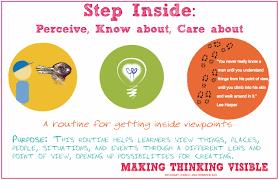
The visible thinking routine ‘Step Inside: Perceive, Know, Care about‘ helps students to explore different perspectives and viewpoints as they try to imagine things, events, problems, or issues differently.
The routine asks students to step inside the role of a character or object from;
- a picture they are looking at
- a story they have read
- an element in a work of art
- an historical event being discussed
- and so on—
and to imagine themselves inside that point of view. Students are asked to then speak or write from that chosen point of view. This routine works well when you want students to open up their thinking and look at things differently. It can be used as an initial kind of problem-solving brainstorm that opens up a topic, issue, or item. It can also be used to help make abstract concepts, pictures, or events come more to life for students.
Go to the Visible Thinking Websitefor more examples and information about visible thinking routines.
Download Step Inside as a pdf
Teacher talk
- What is X really saying here?
- What are the feelings underneath the words?
- What is their viewpoint?
- Why is this view unusual?
- What problem does this highlight?
- That’s a different perspective
- Where is that leading us to?
Try out 5
Build imagining by celebrating its use.
Self-monitoring imagining in action.
Introducing a new learning behaviour every month or so is trickier than it seems.
- You might concentrate on it in say three or four lessons.
- You will bring it to the fore in your talk.
- But how do you get students to pick up all the aspects of the behaviour?
- How might you ensure they see its usefulness in lessons in general?
- How do you ensure they absorb the use of the behaviour into how they learn?
A learning mat
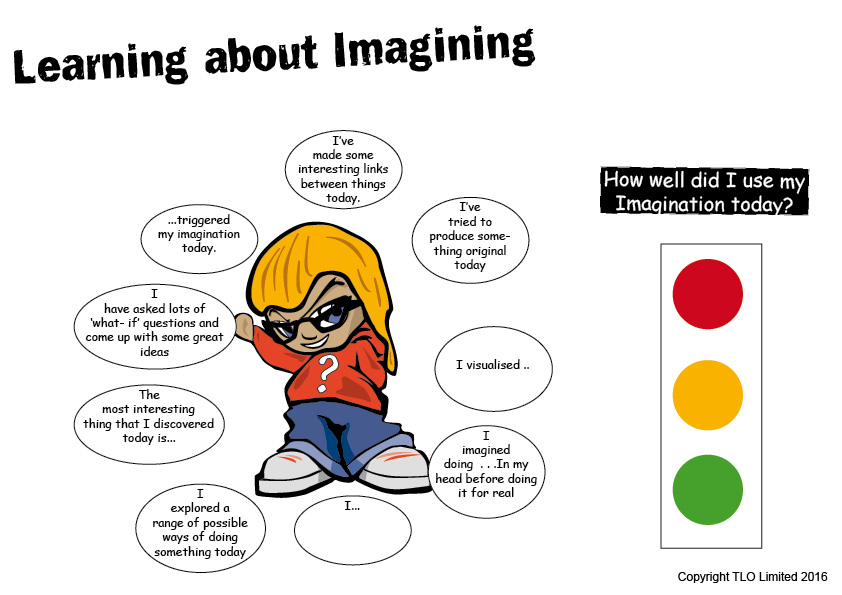
Use a learning mat for imagining to ensure students monitor their own use of the behaviour.
Learning mats are usually A4 laminated sheets that show various aspects of a learning habit. Keep them on desks/tables or as part of a wall display.
Students refer to them during lessons, using them as prompts about the finer aspects of a learning habit that is being stretched. This tool helps students to be able to join in meta-cognitive talk.
Two more celebrating ideas ⬇️
Create a setting where students are more likely to engage the imagination and wonder
Often students have little conception of imagination as being an essential part of ‘good learning’. They think ‘good learning’ means neat, correctly spelled and done on time, while imagination ‘is when you think about stuff and see pictures in your head’—but they don’t get the connection.
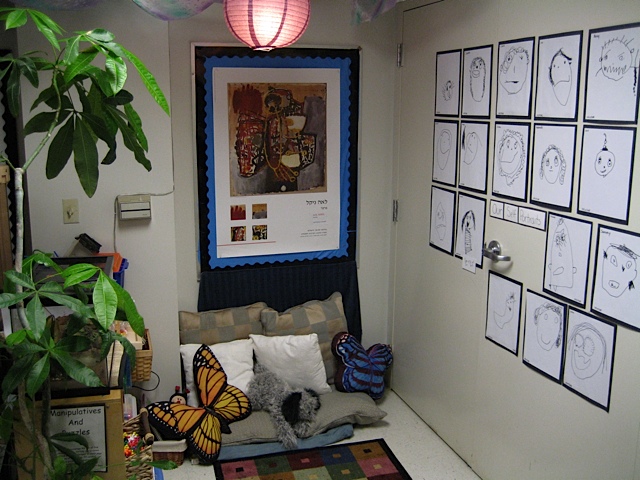
It has long been a feature of primary classrooms that areas are designated for a particular purpose, whether it be for reading, imagining, improving work, noticing detail etc. Rarely is it seen in secondary classrooms – too often the physical constraints of the classroom and the rotation of students from class to class make such arrangements impossible. Or is it? If we are serious about developing the imagination of younger students, we may need to be imaginative ourselves and seek a creative solution to this problem. Where could such an ‘Imagination Space’ go? Does it even have to be in the classroom? Could it be in a public circulation area? The library? What would the Imagination Space be like if it is to trigger imaginative thinking?
Places to sit and wonder…
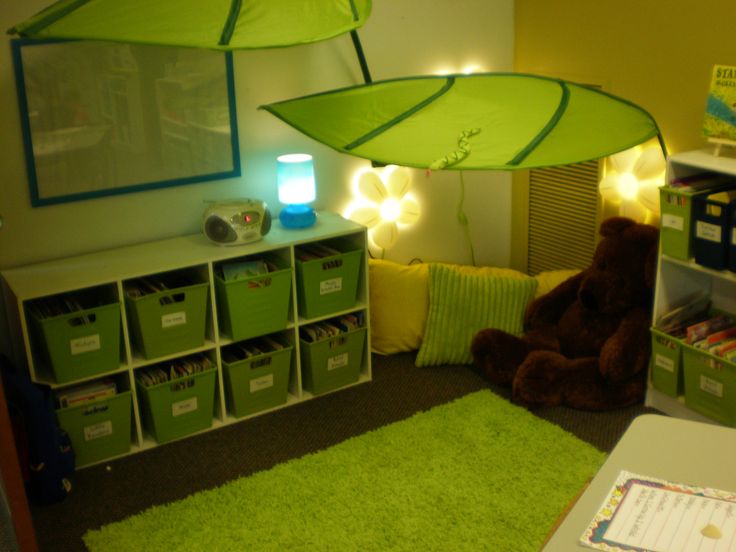
Teacher Talk
- Can you use your mind’s eye to see what that might look like?
- Can you imagine yourself doing that really well?
- Can you imagine what that would be like?
Switch perspectives
Ask students to imagine something and then try to see it from different perspectives.
Sit down quietly, close your eyes, and think about one of your pets. (If you don’t have any, try to imagine a pet you would like to have.) Now, try to take on your pet’s point of view. Don’t just try to become a human being in an animal’s body. Try to think and interpret things the way an animal really would. This can be a lot of fun, because many of the things we humans do probably appear confusing and silly to animals.
Or…
- How would a bird flying overhead view your garden?
- How did the sinking of the Spanish Armada appear to the fish in the North Sea?
- What might a flower look like when seen through the multi-faceted eye of an insect?

Teacher talk
- How would your kitchen appear to your pet?
- What might your pet think about the television?
- That’s a really unusual/fresh idea.
- How is your pet feeling about that?
- Put yourself in their shoes.
Find out 3
Build imagining by considering it in greater depth
The chart alongside offers a deeper view of how Imagining may grow.
Column one deals with how students are able to nurture their imagination; from building their experience from day to day living, to purposefully gathering ideas to trigger the imagination.
Column two is about how students gradually develop their understanding of their own and other peoples’ feelings. Growing empathy fuels our imagination as we learn to see things in ways that are different to our own, including through film or television where we are put into the lives of others.
Column three is about the development of self-talk; what students may be saying to themselves in growing their self-awareness.
Column four is about the growth of the conscious use of imagination, moving from imaginative play to linking ideas together and asking ‘what if’, then being able to visualise what we want to achieve or make or create, then rehearsing it in our minds and living the process.
Column five is about receptive imagination where we shift the problem to the back of our mind where we enter a state of reverie to play with ideas. it’s a state of wondering, shifting, sifting, juxtaposing, just to see where it goes.
Column six is about growing the outcomes of imagination from limited and predictable to more original and innovative.
Take a look at the chart and see if you can plot where the majority of your students are now.
Which aspects do they find more tricky?
How has the chart helped you to understand the development of imagining more fully?
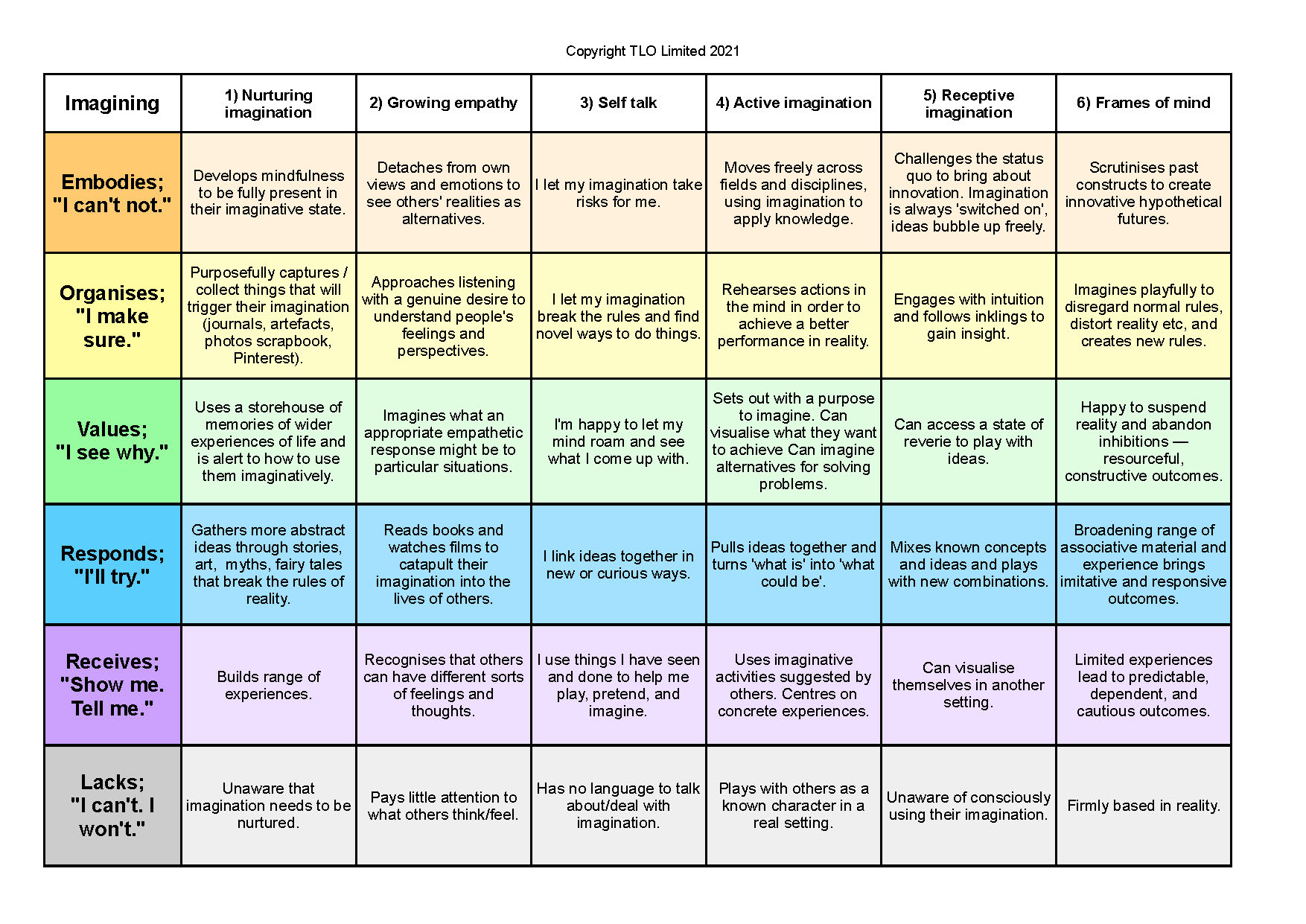
Growing imagining; a trajectory of developing behaviours, skills, attitudes and self-talk
Download as a pdf
Learning together meeting (for schools that have decided that all teachers study the same unit at the same time)
Suggested meeting agenda
- Decide what you want this meeting to achieve (5 mins)
- Discuss what you have found out about students’ use of imagining (15 mins)
- Re-cap and reflect on the action you have each undertaken in your classrooms (20 mins)
- Consider issues that would be beneficial if implemented across the school (10 mins)
- Review how the meeting format went (5 mins)

Learning Team Year 2 Meeting Agenda ⬇️
Item 1. Meeting Objectives. (5 mins)
Meeting objectives might include:
- discuss levels of imagining displayed across the school
- share and learn from what we have each tried in our classrooms;
- feel confident about taking forward ideas from online materials into our practice;
- identify actions that would be more useful if everyone applied them in their practice;
Outcome. To have decided what the meeting should aim to achieve.

Item 2. Discussion about learning culture (15 mins)
Explore together your discoveries about your students as imaginers;
- what did you find out about your students as imaginers (Find out 1)?
- are students improving imagining with age? Moving from grey to purple to blue etc?
- where did we each estimate our classroom to be in terms of its culture (Find out 2)?
- what did we each learn from Find out 2.
- which 3 are the weakest features?
- which 3 actions are our strongest?
- what surprised or baffled you?
- are there significant differences between year groups?
Outcome. A clearer understanding of students as imaginers and the extent to which our classroom cultures are set up to support and develop imagining.
Item 3. Explore action using the initial Try outs (20 mins)
Share and discuss the action you each took in making a start on strengthening imagining in classroom practice.
- Which of the suggestions did you each use?
- Any concerns about or difficulties in putting the Try outs into action.
- Which seemed the most valid or successful?
- How the Try Outs affected different age groups.
- Ways of implementing these that we can all learn from and adopt.
Outcome. A clear picture of our interest in and enthusiasm for amending classroom cultures to support learning to learn. A feel for which are proving to be most effective and why. Would any of these culture shifts call for action on current school wide policies?
Item 4. Learning from practice (10 mins)
In relation to all the shades of practice you have been trying out, sharing, mulling over and observing, think about them now in two ways;
1. personally and 2. school wide.
Which ideas/practice stand out as:
- things you want to start doing
- things you think you need to stop doing (that’s harder)
- things you want to keep doing
- things you want to do more often
- things you want to do less
Outcome.
- At this stage it’s essential to note ideas arising from this discussion using 2 pentagon diagrams;
- one for each team member personally and
- one for decisions/suggestions that are school wide.
- Ensure that your school/group wide pentagon is shared with senior leaders.
Item 5. Evaluate team session. (5 mins)
- Did we achieve our objectives?
- Are we comfortable with what we are trying to achieve so far?
- Any concerns at this point?
- Next meeting date and time.

Feedback proforma (for schools that have decided that teachers can study the units in any order)
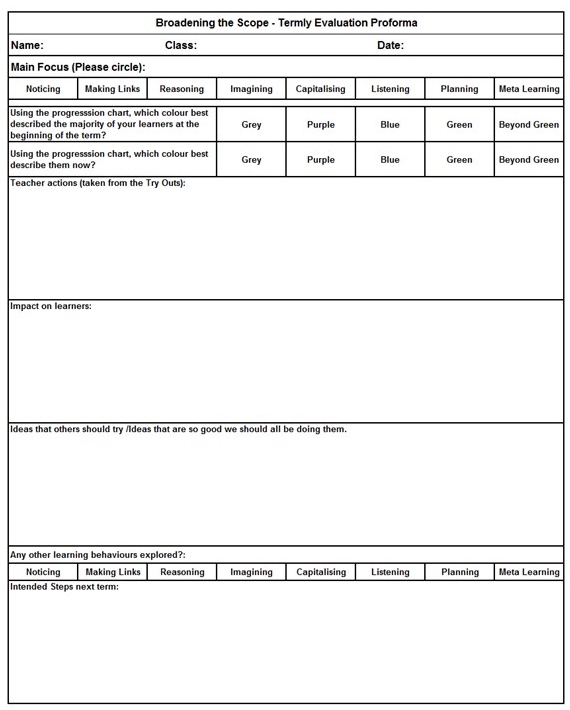
To share your experiments with others and to enable senior leaders to maintain an overview of developments, please complete this proforma termly and hand it to the Building Powerful Learners coordinator.
To give you a flavour, an example of a completed proforma is in the Noticing unit. Click below to download and print a blank version for yourself.
Download a blank proforma
Comments are closed.