
Building Dialogue and Collaboration
Overview
Here are some ideas you might try in your own classroom. They are split into four sections:
- Some teaching ideas;
- A routine you might adopt;
- Ways in which you might talk to support the behaviour;
- A learning mat to help students to reflect on the behaviour.
Use the tabs to navigate the sections.
Developing basic social skills
To make the shift towards collaborative learning requires students to begin to develop their social skills, and in particular listening to others and taking turns. Discuss, agree and display basic classroom ‘rules’ like:
- Don’t interrupt or talk over others
- Look at the speaker
- No shouting out
- Give others a chance to say what they think
- etc etc
Remember – these students have been exposed to ‘good listening’ and encouraged to ‘take turns’ for years, and yet many still do neither. It will take time to turn this round.
These basic agreed rules need to be referred to very regularly and explored at every opportunity. Keep asking them how they feel when someone else does not follow the ‘rules’ ?
Rights and responsibilities
Work in pairs and small groups to suggest a charter of matching rights and responsibilities or ground rules for collaboration. If everyone has a right to have their voice heard, everyone also has a responsibility to listen attentively to others and wait until they have finished speaking. What else might be important and why?
Good listener prompts
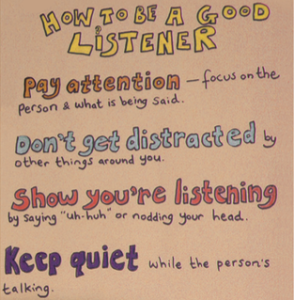
- Have the students make suggestions about good listening
- Pay attention. Focus on the person and what is being said
- Don’t get distracted by other things around you
- Show you’re listening by saying uh-huh or nodding your head
- Keep quiet while the other person’s talking
- Wait to ask a question or give comments that show others that you care about what they’re saying
Make these into a public display and refer to them often. Here is an example from a group of 11 year olds.
Assign Group Roles
Below are two ‘levels’ of group roles – choose the one that best fits your students’ current needs.
Group roles (younger students)

Assign roles to group members prior to beginning a task, ensuring that over time students experience a range of roles.
For younger students, consider these group work role cards
https://www.buildinglearningpower.com/wp-content/uploads/2017/11/team-notesimages.pdf
Everyone contributing
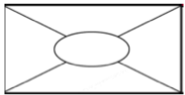
Teamworking mat
A useful way of knowing who is contributing what, although not a means of ensuring everyone contributes!
Draw the mat onto a large piece of sugar paper (the one shown would be suitable for a group of 4 – adjust for smaller/larger groups). Each individual writes their personal response/views/solution in the section immediately in front of them. Once all individuals have made their contribution the group agree the group response, which is written in the central panel.
Starting a learning community
The basic building block of a learning community is pair work. Through brief and focused conversations students get the opportunity to voice their thoughts and start a dialogue about them. Such practices have many names: ‘chatterboxes’, ‘talk partners’, ‘study buddies’ and so on. Pair work forms the bridge between private thoughts and public discussion. Students develop their own thoughts, crystallising them as they talk about them, and testing them against the ideas of others. All students are acting as learning coaches.
Thus this often used, but misunderstood, activity gives students a voice, and represents a tiny shift in the relationship between teacher and pupil.
- Think Pair Share (Lyman 1988) In its original version this starts with a teacher question
Think about the question individually
Pair up with a partner. Explain your answer, listen to your partner’s response, and use this opportunity to clarify their thinking
Share your answer or your partner’s if called upon.
You can go on from there varying the structure of thinking. E.g. Question, Summarise, Clarify, Predict for a group discussing a text. The collaborative structure of pairs and small groups is built up using high-level meaning-making tasks; everyone is teaching everyone else.
Along the way you will have been encouraging students to use prompts with each other such as:
‘Why is this important?‘ ‘What would happen if?‘ to focus thought provoking;
‘What do you think of my idea?‘ ‘It might be that…‘ ‘It seems that....’ to handle differences that might arise;
‘I’m confused about...’ ‘I don’t see why...’ ‘It would help me if you could explain….’ to become effective help givers and receivers;
‘I feel…when you….because…..’ to support emotional aspects of interaction.
Teacher talk
To nudge students to think about the basic social skills that they need to exhibit, use language like this:
To focus on sharing, turn taking and listening
- Did you hear what xxx said?
- Tell the others what you think.
- When someone else is talking we all need to listen carefully
- Listen carefully – xxx is talking.
- Who hasn’t had a go yet?
- Why do we need to take turns?
- Why is it fairer to take turns?
- Well done for taking turns and sharing.
- What does xxx think?
- Be patient – one at a time!
- It was great to see you listening carefully as you did that task together
- If you all talk at the same time you won’t hear everyone’s ideas
Learning Mat
A Learning Mat is a simple tool to encourage students to become more self-aware of how they are using a learning habit. Basically, it’s an A3 or A4 laminated sheet that is kept on tables or used as part of wall display. It shows various aspects of a learning habit. Students refer to them during lessons, using them as prompts about the finer aspects of a learning habit that are being stretched. They help students to be able to join in meta-cognitive talk.
Click below to download a PDF copy of the above mat.
Download as a PDFIf you prefer you can download the mat with the speech bubbles left blank for you to fill in with your own ideas.
Download as a Word document Download as a pdf
Comments are closed.