
The page below offers an overview of how ambitious curriculums, when combined with an approach to build students learning capabilities (Building Learning Power), enables schools to realise the true learning potential of all students.
Balancing a demanding ‘what’ with an enabling ‘how’
‘Students throughout the world need now to reach higher levels of achievement, not only to find fulfilling work but also to empower themselves to thrive in an increasingly complex world’
– Dylan Wiliam
The ability to learn more effectively is fundamentally important in being able to thrive in a fast paced, constantly changing, modern environment.
The response of governments has often been to introduce a more demanding curriculum that expects students to tackle more difficult content at earlier ages and constantly achieve ever greater outcomes.
BUT there are increasing concerns that formal education and training is failing learners. Many educationalists believe that our focus on achievement and performance is reducing learners confidence and competence across the board. Research shows that traditional schooling builds dependency and stifles critical curiosity and creativity.
Helping learners to understand how they learn and how to improve their learning capacity and capability is one of the most important functions schools can offer.
Yet these two sides, demanding outcomes and learning to learn, can work synergistically instead of competitively, in concert rather than in conflict …
The development of a set of valuable learning habits, that are seen as essential for learning, life, work and citizenship, has implications not only for ‘what’ is taught and learned but, more importantly, ‘how’ it is taught and learned.
Building Learning Power is an enabling approach that schools and teachers are using to deliver 21st century citizens. It aims to put the ‘how’ of learning at the heart of education and assist learners to be the best they can be. Powerful learners can expect to learn more, faster, and more thoroughly. Which, by the way, also helps with the ‘outcomes’ side of the curriculum balance.
What are the frameworks on which Learning Power is based?
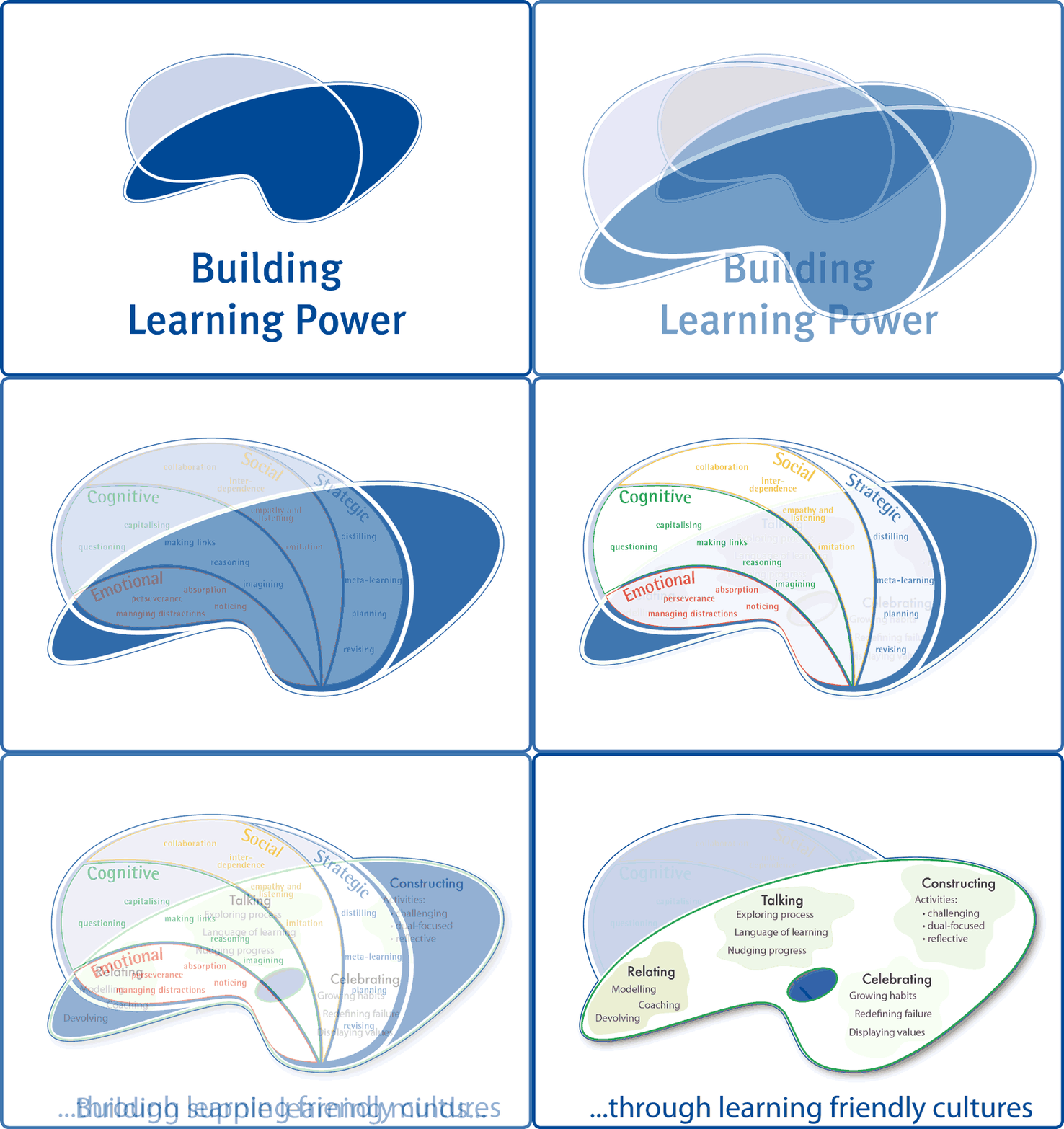
Building Learning Power puts at the heart of education the development of psychological characteristics that are judged to be of the highest value in young people growing up in a turbulent and increasingly complex world. There are two main parts to the approach:
A: a model of a learner and learning, in terms of a set of characteristics that work together to make a person a highly capable learner; we use ‘learning power’ to describe the effect. [Supple Learning Mind]
B: a view of the kind of pedagogy that will nurture and strengthen the learning characteristics in young people.[Teachers’ Palette]
These are bound together by the fundamental idea that ‘learning is a learnable craft’, and by explicit, detailed discussion of how learning works, supported by a rich repertoire of words and action.
What’s the Supple Learning Mind?![BLP_Brain_Generic_no-Rs-[Converted]](https://www.buildinglearningpower.com/wp-content/uploads/2016/12/BLP_Brain_Generic_no-Rs-Converted-300x216.png)
![BLP_Brain_Generic_no-Rs-[Converted]](data:image/svg+xml,%3Csvg%20xmlns=%22http://www.w3.org/2000/svg%22%20viewBox=%220%200%20300%20216%22%3E%3C/svg%3E)
![BLP_Brain_Generic_no-Rs-[Converted]](https://www.buildinglearningpower.com/wp-content/uploads/2016/12/BLP_Brain_Generic_no-Rs-Converted.png)
The Supple Learning Mind framework of high value learning characteristics, originally conceived and researched by Professor Guy Claxton, reveals learning as a complex process that isn’t just about thinking and having a good memory; it includes how we feel, how we think, how we learn with and from others and how we manage the process of learning. It gives the beginnings of a learning language that helps teachers think about how learning behaviours enable students to grow as learners and tackle the curriculum more profitably. [See section Progression in learning habits for more detail]
What’s the Teachers’ Palette?

The Teachers’ Palette provides an overview of aspects of a learning friendly culture that combine to create the seedbed for building powerful learners. It includes the types of teacher action that create the conditions necessary for such learning to become habituated – how they relate to students, the language they use, the types of tasks they design, and the things that they truly value. [ See section What are learning friendly cultures? for more detail]
What effect does the approach have on students?
Schools that are able to combine a demanding content curriculum with a focused approach to building students’ learning characteristics can expect learners who are:
- Committed to learning for life, able to learn, un-learn and re-learn and so thrive in uncertain times
- Emotionally engaged and willing to learn with enthusiasm and commitment
- Cognitively skilled, curious, logical and creative thinkers able to build a web of understanding for themselves
- Socially adept, able to balance sociability and self-reliance
- Strategically aware, interested in and able to manage their own learning
- Independent, self-confident, self-aware, reflective and self-regulating
- Ready, willing, and able to fulfil their potential
- Ready to play a full role in the learning communities of today and tomorrow.
What’s not to like?
Questions for you.
Something to think about.
Does your curriculum and its expected delivery . . . .
- prepare learners for the tests of life OR a lifetime of tests?
- educate the whole child OR just the examinee?
- go beyond the transmission of a centrally defined set of knowledge, skills and understandings?
- enable students to ‘learn to’ OR ‘learn about’?
- emphasise the development of higher-order thinking skills?
- teach the knowledge, skills and understandings they cannot Google for themselves?
- inspire a lifetime of learning about their world, themselves, and others?
Comments are closed.