
The diagram below offers a glimpse of the difference between traditional good teaching and teaching that enables learners to become powerful learners throughout their lives.
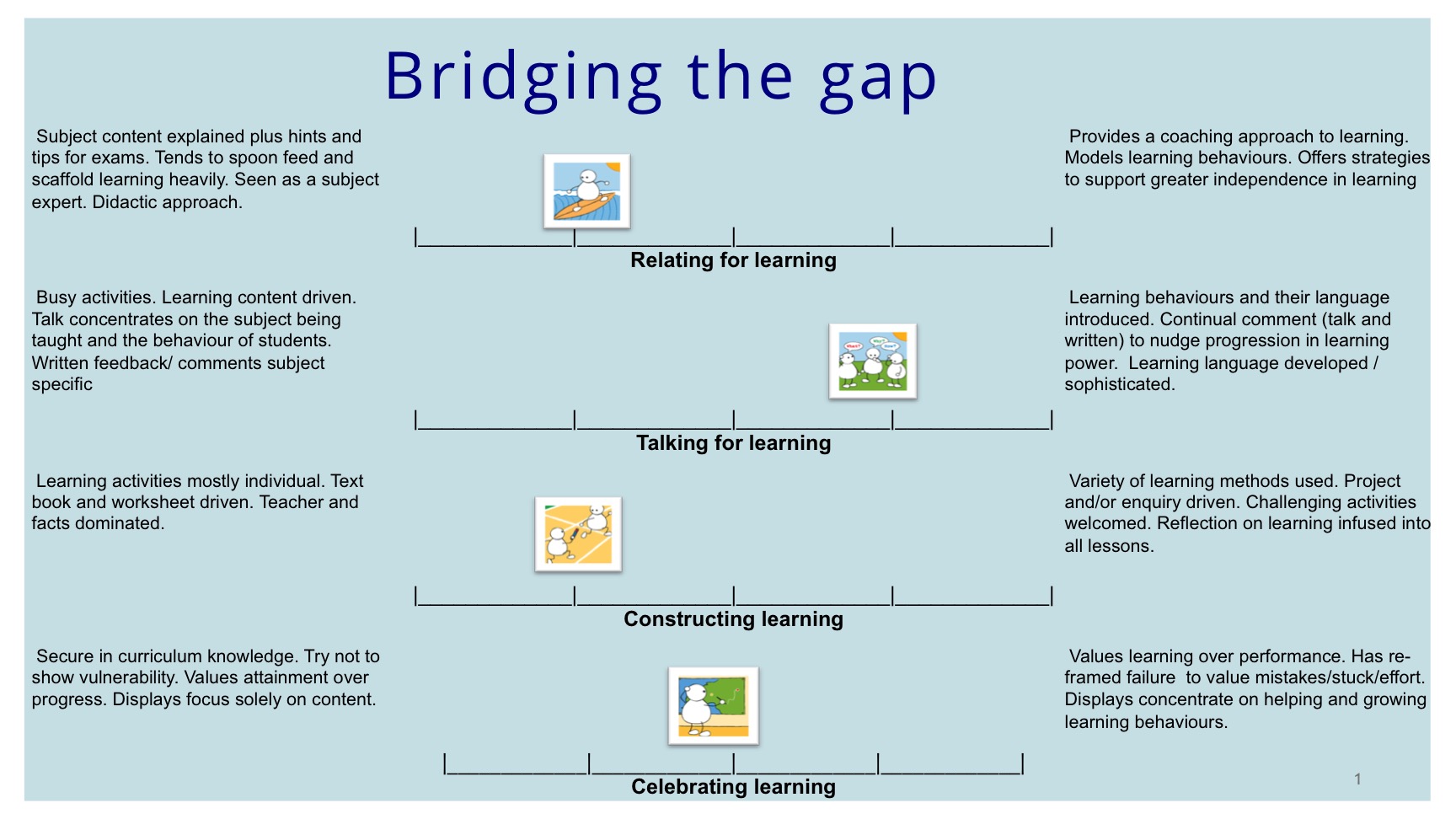
What does it take to make the shift from traditional good teaching to teaching for learning power?
Developing students as learning powered learners is a long term innovation. It requires far more than reading a resource like the At-a-Glance card and trying out a few of the ideas in practice. Even the traditional In-service training day can only scratch the surface. This is because the approach has implications not just for student learning, but for staff learning too. Teachers’ habits as learners have to become part of the picture – how they go about changing is as relevant as what changes they want to bring about. This isn’t just about teachers knowing more about teaching, it’s about teaching differently.
What does ‘teaching differently’ look like?
Basically, as a teacher you are going to become more forensic about learning, talking about the learning behaviours, stretching them through activities you offer, modelling them, and valuing them as you see learners using and developing them.
Look at the statements and work out:
- how often you try to help students develop such behaviours by the way that you teach at present;
- how many of your students display these behaviours in the classroom (without knowing it).


Having completed the quiz ask yourself:
From the left hand column:
- Which behaviours did you denote OFTEN?
- Which do you RARELY attend to?
- Which psychological domain receives most attention? (emotional, cognitive, social, strategic.)
- What might this reveal about your teaching?
- Key Question: How do you know if/how students are improving in these behaviours?
From the right hand column:
- Which behaviour was most difficult to assign students to? i.e. the things you may not know about your students
- What patterns are emerging?
- Is there a link between what you do and how students are as learners?
- What is this making you wonder?
Where is your practice now?
This tool shows just some of the small, yet profound, shifts teachers make when they are surfacing learning.
Each thread explores one of the 12 aspects of the Teachers’ Palette (mentioned in Section 1) and begins to put flesh on the journey towards ‘Bridging the Gap’.
Ask yourself “Where is my classroom/school on each of these indicator threads?”
You don’t have to choose one of our descriptors – if you think “We are further on than ‘xxx’ but not yet at ‘yyy'”, then score yourself accordingly.
As an additional challenge, try to write a descriptor for where you are positioning your classroom/school.
Scoring
- If most of your scores are 3 or less, classrooms are still heavily teacher focused.
- Scores in the range 4 through 7 suggest that classrooms are becoming increasingly learner focused.
- Scores above 7 suggest that the classroom is already learning focused.
Wherever you are now, building pupils as more powerful learners is about ‘Bridging the Gap’ and moving classrooms towards becoming increasingly learning focused.
Why is shifting practice difficult?
When teachers want different outcomes for their students it actually involves them in changing their teaching habits. It’s not simply about knowing about new techniques, it is about doing what you do differently. That’s much harder. It involves changes to:
- what you know – knowledge
- what you believe – feelings or attitudes
- what you can do – your skills
- what you actually do – putting it all into practice
So changing how you teach is a delicate, complex process — that’s why it’s hard!
And the hardest thing isn’t getting new ideas into teachers’ heads, it’s getting the old ones out — that’s why it takes time and effort.
It takes time and practice to undo old habits and become graceful at new ones. That’s why we have based our learning programmes on research into how adults learn and the professional value of teacher learning communities. You will find out more about this in the next section.
Questions you might want to ask.
Does it look possible?
- How much unlearning is there to do?
- Would people take kindly to developing their practice?
- On the whole, do you see these ideas going down well or badly with staff?
Explore some well tried professional development solutions in the next topic
nextBlended learning programmes to ensure changes in practice
Comments are closed.