
Hello again. Thanks for your interest in building powerful learners in your school. As promised I’ve pulled together some specific information and questions designed to help you consider;
- the need for and nature of Learning Power
- the culture of the school’s classroom practice and
- possible ways forward you might want to take.
Take a look, have a think and then we’ll chat about it on our Zoom call.
1. Reminders of the basics of building powerful learners
Find the right lines…
Here’s a quick rundown of the various facets of learning power. Take time…at your leisure… to recap on its whys, whats and hows. Use this link for exploring BLP quickly 7 BIG QUESTIONS – a quick read
Or use this link for a longer read with more detail
If you decide that BLP is right for your school and think the Seven Big Questions would be a useful resource for introducing it to your staff and/or governors just let me know and we’ll share it with them when you think the time is right.

2. Take a look at learning power in action
Accounts from schools
If you have never seen the development of learning power in action in classrooms you might find it useful to read a couple of our blogs. Any one of the following might be interesting:
3. Think about your classroom cultures now
In order to enrich a conversation about how our programmes might assist you to develop your staff there’s a bit of hard thinking to do about what your classroom cultures are like now.
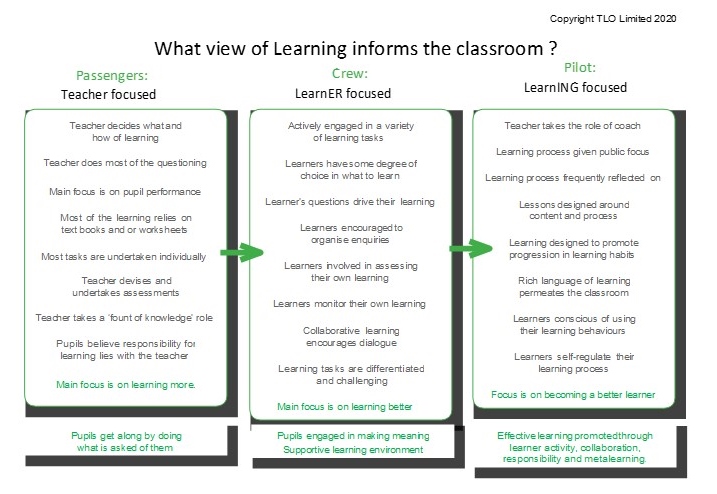
Classroom cultures
Download the culture diagram (opposite).
Think about your own classrooms . . .
- Of the three types of classroom culture – teacher focused, learner focused, learning focused – which best describes classrooms in your school?
- Which of the individual facets of classroom culture would you like to embed further?
- Which would you like to see less of?
4. Question yourself about how well your learners are learning
Helping pupils to understand that learning is learnable and that they command their learning behaviours, gives them greater enthusiasm and power for engaging with learning. ‘Doing’ learning power is all very well, but getting better at doing it; more often; more widely; more skilfully, is quite another. So take a quick look at this trajectory from low use (can’t/won’t) to high use (skilful and frequent) in relation to your pupils now.
Learning – Poles Apart
Download the Poles Apart diagram (opposite).
Think about the children in your school:
- Where do you ‘guesstimate’ the majority are on each of the 4 trajectories?
- Is any trajectory lagging behind (or surging ahead) of the others?
- Critically – do you think that your pupils move towards the right as they pass through your school?
- And if so – is this progression the result of planned interventions?
- Despite your best efforts, are some pupils remaining on the left-hand side?

When learners become aware of learning behaviours they...
When learners become aware of their learning behaviours through structured opportunities to improve it, they become:
- more reflective and aware of themselves as learners
- more confident and motivated to learn
- more willing and able to take responsibility by ‘owning’ their learning for themselves
- more intentional in their learning
- keener to carry on learning as they move beyond school
- more likely to realise their potential and gain grades that were previously regarded as beyond them
- more confident socially and able to learn with, and from, one another
- more able to manage transitions and take change in their stride throughout their lives.
5. Recognise learning power as a serious undertaking
Building the learning habits of students involves amending / changing / growing / adapting the teaching habits of staff. It’s not just about knowing new stuff, or buffing up on content knowledge, it is about doing what they do differently. That’s much harder and involves changes to;
- what teachers know – knowledge about learning
- what they believe – feelings or attitudes about learning and schooling
- what they can do – their skills in enabling learning
- what they actually do – putting it all into practice
So changing how teachers teach is a delicate, complex process……...that’s why it’s hard! And the hardest thing isn’t getting new ideas into teachers’ heads. It’s getting the old ones out…….that’s why it takes time and effort.
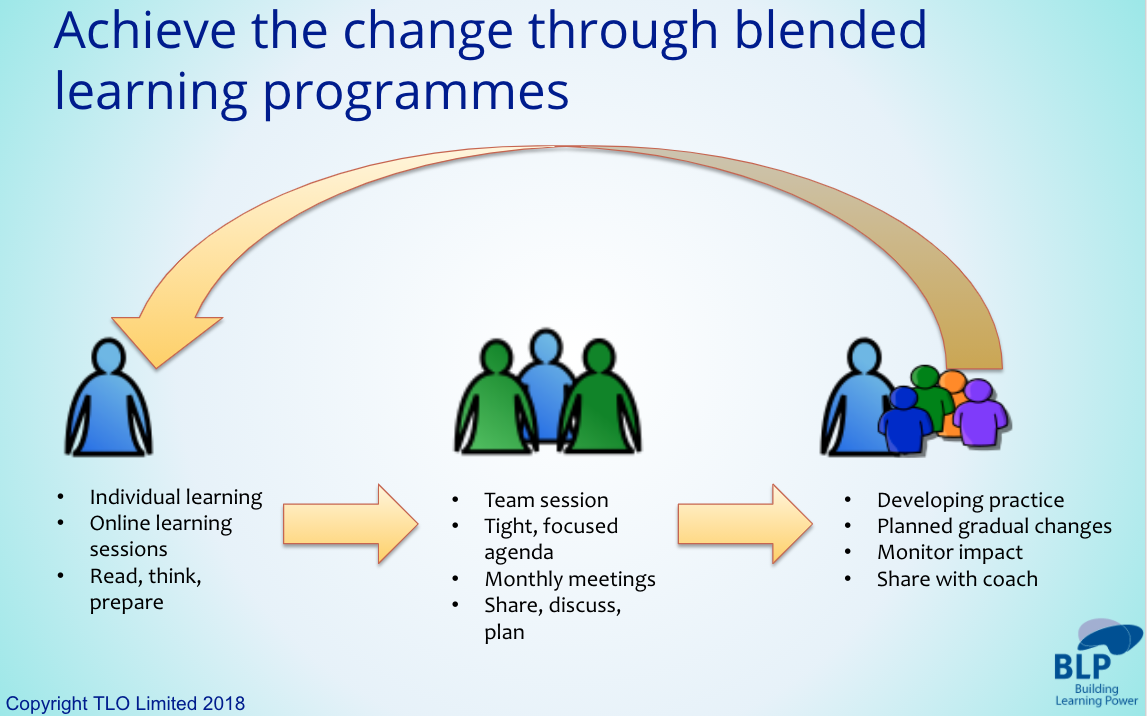
It takes time, practice and support to undo old habits and become graceful at new ones……that’s why our programmes embrace blended learning, based on how adults learn. The programmes include; researched classroom approaches offered in the online modules; an adaptation of the well-known professional development approach – Professional Learning Communities with agendas mapped out in the online modules and advice on designing enquiry questions for classroom research.
6. Our chat about possibilities for your school
During our arranged zoom meeting I hope we’ll be able to explore the thoughts you’ve had about your classroom cultures and pupil progression and consider the nature of the online courses and which might be appropriate for your school.
Basically there are two options to consider and these are described below;
Option 1 Building Better Learners (6a)
Option 2 Helping your learners to… (6b)

6a. Option 1: Building better learners
- Phase 1 Playing the Learning Power game. This introductory course is likely to take at least a couple of terms to work through. The course is accompanied by a resource for strategic leaders which we have given you access to.
- Phase 2 Stepping Stones (we have given you access to Putting Perseverance into Learning which is one of the 12 modules that make up this course) These modules go much deeper, specifically in relation to the growth of learning powers. This phase is likely to take a couple of years to work through.
Phase 1. ‘Playing the Learning Power game’ helps a school to take a school-wide, strategic approach to building better learners and develop learning-friendly classroom cultures.
The phase is about the ‘whole game’ of learning power rather than just bits and pieces so it introduces all the key learning behaviours before focusing on the four most important for your students’ emotional engagement, their cognitive range, their social adeptness and, critically, their strategic awareness or self-regulation: Perseverance; Questioning; Collaboration and Revising. This solid foundation takes a couple of terms to accomplish but enables a school to build wider and more sophisticated approaches in phase 2.
This course is accompanied by a resource for senior leaders. Link to the strategic issues resource
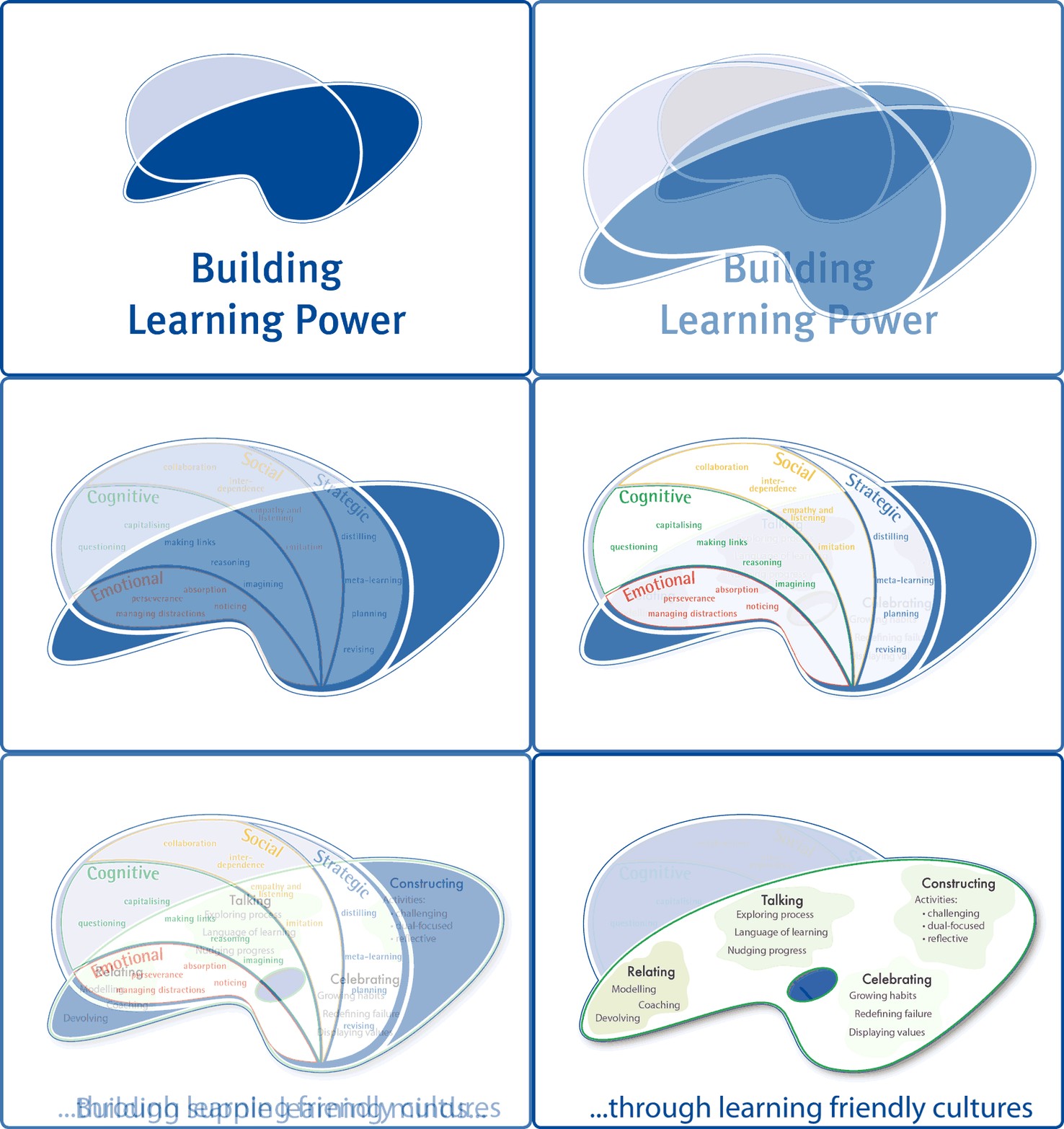
Phase 2 Stepping Stones (primary) or Nutshells (secondary) enables a school to build on the solid base of Phase 1, strengthening classroom practice and particularly making sure pupils grow and develop their learning behaviours. Each of the 12 modules is based on a progression chart that describes the various features of a behaviour and how it might grow when supported by a learning friendly culture. The many and various classroom activities are linked to the phases of growth, together with appropriate teacher talk. This organisation of the material enables the learning behaviours to be used with greater purpose and precision by teachers.

6b. Option 2: Helping your learners to…
- Phase 1 The Foundational 9 covering perseverance, questioning, collaboration, revising, absorption, listening, making links, imagining, noticing. We have given you access to Helping your learners to imagine.
- Phase 2 The Finessing 8 covering reasoning, meta-learning, managing distraction, resourcing learning, interdependence, empathy, planning and distilling.
Modules in this route take a straightforward approach without a strong emphasis on progression. However it’s likely to take a couple of years to work through all the modules.
Helping your learners to…
each online module offers classroom activities, think pieces and questions to help teachers:
- introduce students to one learning behaviour;
- use the language of learning effectively with students;
- get a feel for how learning behaviours gradually grow
- design the use of learning behaviours into the way they teach;
- develop the confidence and skill to help students grow their learning power.
The modules are suitable for both primary and secondary schools with example activities for both.
This course is accompanied by a resource for senior leaders.

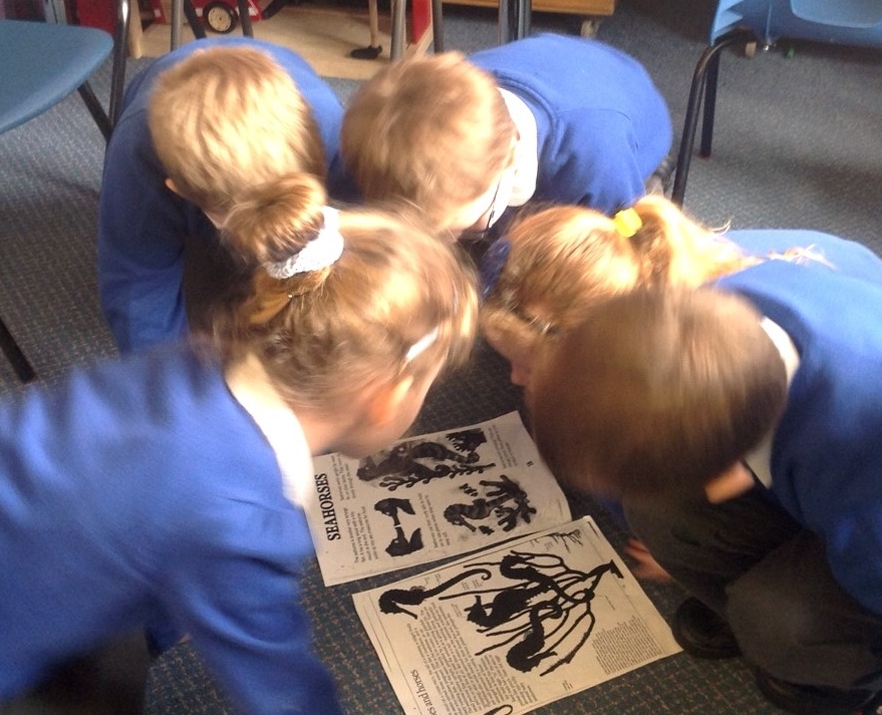

To give you a flavour of a ‘Helping your learners to’ module, take a look at this one free of charge. It addresses how teachers might help learners to develop the habit of attentive noticing.
Click here to view ‘Helping your learners to Notice’
All other ‘Helping your learners to’ modules are similarly structured.
Explore the bundles ...
The BIG Bundle: All 17 modules.
All these modules tackle introducing learning behaviours, spotting them in your students, a brief introduction into how the behaviour develops, using them productively in lessons, talking about them confidently and planning their use alongside colleagues. Tackling the full set of behaviours will take a school about two years, and you can return to them again and again.

Bundle #1: The Foundational 9. Helping your learners to . . . . . Persevere, Become Absorbed, Notice, Question, Make links, Imagine, Collaborate, Revise and Listen.
This bundle of 9 online modules serves to help teachers develop a basic suite of dispositions and inclinations and provides the ‘soil’ in which to develop others.

Bundle #2: The Finessing 8. Helping your learners to . . . . . Reason, Manage distraction, Become Interdependent, Resource learning (Capitalising and Imitation), Empathise, Plan, Distil and Meta-learn.
This bundle of 8 online modules helps teachers develop dispositions and inclinations in more specific ways of learning.
Comments are closed.