
Unit 3. The big picture of progression in learning
Welcome to Building Powerful Learners. This eight unit online programme will enable you as a teacher to:
- explore how learners might become not just better learners but effective lifelong learners;
- engage your learners consciously with the ideas and processes of their own learning.
The programme combines three types of action that will help you to experiment with, analyse and understand how to become skilled in developing your students’ learning power.
1 Understand by using Read abouts…of which there are two types
- Essential Read …essential must read text.
- Extended Read …interesting, good to know, absorb when you can.
2 Analyse by using Find outs…tools to help you discover and analyse essential information
3 Experiment with Try outs…practical activities for you to try, check and perfect in your classroom
Unit 3 explores what getting better at learning looks like.
- What are the key aspects of progression in learning behaviours? (Essential Read about 1)
- How do the progression charts work? (Find out 1)
- How do groups of my students differ in that progression? (Find out 2)
- Where are my students strengths and weaknesses in four key behaviours? (Try out 1 to 4)
Structuring and using the ideas below with your students over the next month or so is your third step in becoming a skilled learning power practitioner.

The idea of growth in learning behaviours

Essential Read about 1
A framework for the growth of learning behaviours
Building the powers to learn
The whole point of building better learners is to do just that, to build the learning behaviours, not just name them. The diagram alongside – Learning: Poles Apart – offers an outline view of this journey showing the reluctant learner on the left and the learning powered learner on the right. It’s a long but exciting journey from what can sometimes be negative behaviours on the left to rich, skilled and positive attitudes on the right. This journey covers students’ emotional learning habits, their cognitive/thinking habits, their social learning habits and their ability to manage the learning process itself.
There are three key facets to the progression of learning behaviours;
- the frequency/how often the behaviour is being used (How much)
- the range/scope of contexts in which it is used (Wheres)
- the skilfulness with which it is employed. (How well)
Our understanding of what the journey might look like in practice has emerged and taken shape over the past seven years. The stages of the journey are ‘borrowed’ from Bloom’s taxonomy of the affective domain of learning. It is this scaling of the learning dispositions that will help you make sense of the journey as you track, and influence, your learners’ progress over time.
Poles apart for four key learning behaviours
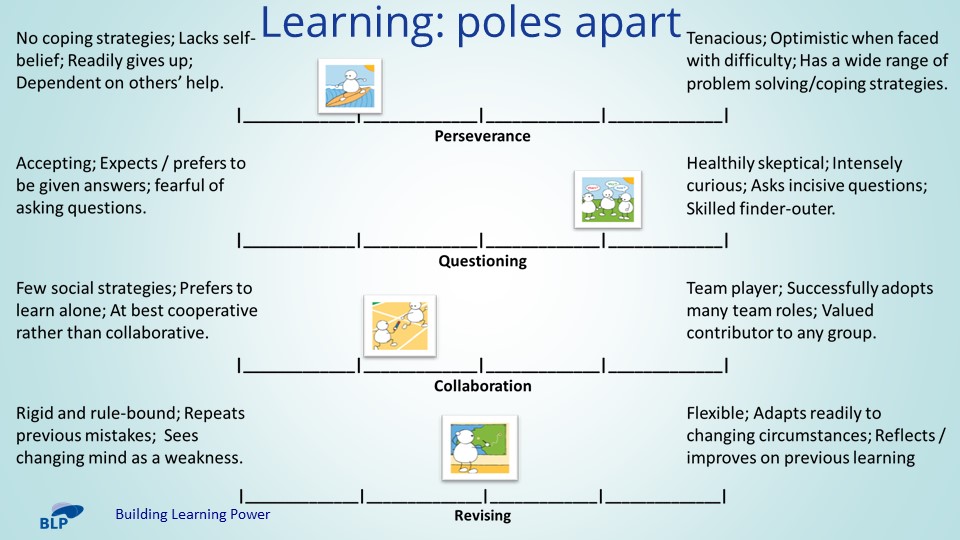
Essential Read about 1..The phases of learning behaviour growth.⬇️
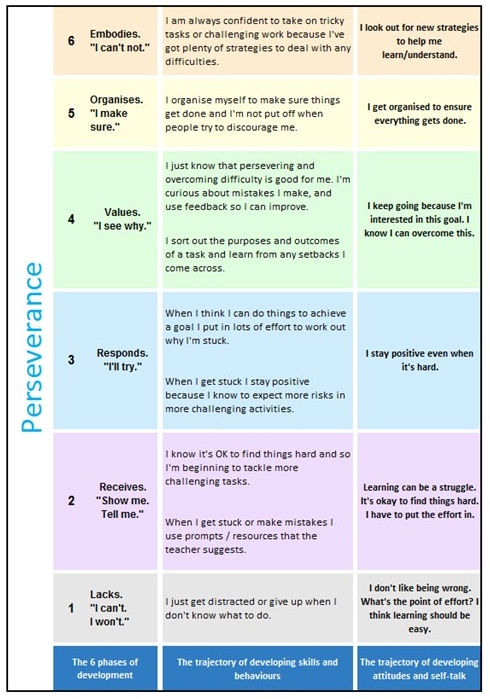
We’ve borrowed ideas from Benjamin Bloom’s Taxonomy of Objectives of the Affective Domain to generate a very condensed version of the five main phases of growth, namely;
Receiving. (purple)…which involves giving attention to something; becoming aware, not avoiding or rejecting it; being alert to something.
Responding. (blue)…which involves going beyond merely attending to actively attending; complying; taking more responsibility for and enjoyment in initiating action.
Valuing. (green)…which involves accepting the worth of something; preferring something; being committed to the value of something.
Organisation. (yellow)…which involves adding to, formulating and organising their values into how they live their life.
Embodies. (Characterisation in the original)(orange)…which involves behaving consistently in accordance with their values, living what they stand for.
We’ve added a negative phase labelled Lacks (grey) where learners are unaware, show no interest in or avoid or reject the learning behaviour.
Take a look at the phases shown above, but start at the bottom and work up
- We urge you to see this progression as long term.
- Some phases will take years for people to work through.
- Some will never be worked through or achieved.
- None of the phases are inevitable.
- There is a lifetime of development captured here.
Nevertheless your role as a teacher or parent should surely be to encourage and enable this journey.
It’s worth getting your head around the outline of these phases of development. They apply to any of the learning behaviours as we show in the toggle boxes as you scroll down.
Essential Read about 2
Growth in the big four learning behaviours
It’s useful to remember the essentials of building powerful learners include:
So now ask yourself…

Find out 1
How do the charts work?
You as a learner
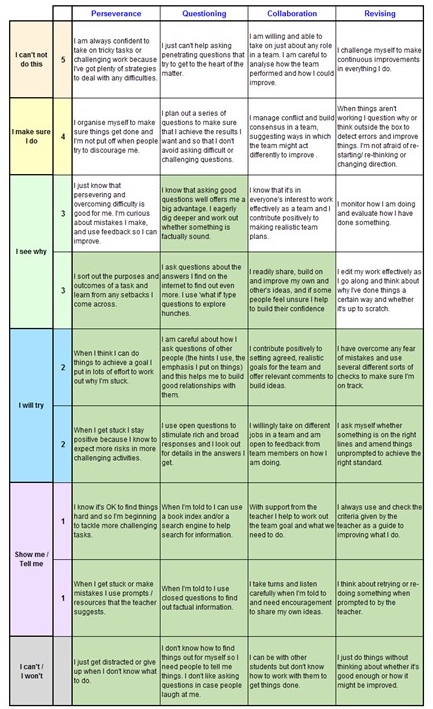
To get a better sense of the growth of these learning behaviours use the chart to think about yourself as a learner. Start slowly and think:
- where would I place myself on each of these 4 trajectories?
- do I understand the statements well enough to answer? Any I need to check?
- can I really say that the statement is secure? [By secure, we mean that these are behaviours that you exhibit in a range of different circumstances.]
- does it actually describe what I do most of the time, or does it describe something I can do but tend not to? (what I do do, rather than what I can do).
- have I ever thought about myself like this before?
- would my partner or colleagues see me in the same way?
- colour in your secure statements on the chart.
This has now become your Learning Behaviour Profile.
- Now ask...
- which learning behaviour is particularly strong, or weak?
- am I substantially lower or higher in some? Which?
- are there any surprises or disappointments?
- what questions is this raising for me?
- where would I like to improve?
- what may have shaped my current learning characteristics?
- if I hadn’t used this chart how would I have described myself as a learner?
Find out 2
What do learning profiles reveal about my learners?
Your students as learners
Now turn your attention to some of the learners in your class just to get an idea of how useful such profiles can be.
Begin by identifying 4 students you wish to focus on. Choose 1 lower achieving boy, 1 higher achieving boy, 1 lower achieving girl, and 1 higher achieving girl.
Download and print 4 copies of the behaviour chart opposite.
Using your knowledge of these 4 students, colour in and create a learning profile for each student.
Now ask...
- which learning behaviours are particularly strong or weak?
- are the profiles of the girls different from the boys?
- are the profiles of the higher attainers different from the profiles of the lower attainers?
- what questions is this raising for me?
- has this exercise changed or sharpened your understanding of these students as learners.
If this activity has piqued your interest and you want to find out more about your students as learners, have a go at the Extended Find Out that follows.
Extended Find out 2
A deeper dive into your students as learners.
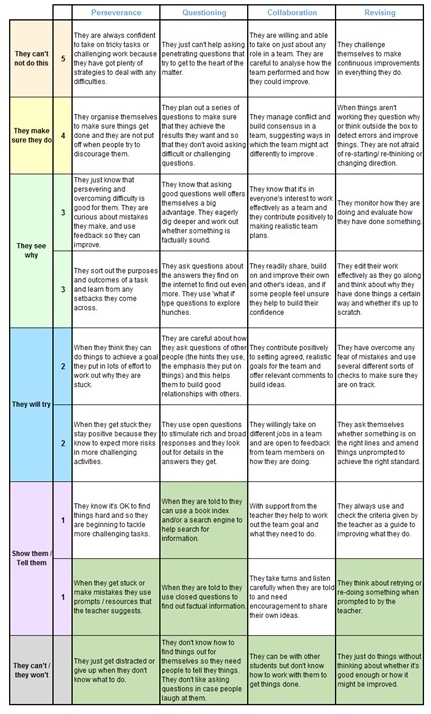
We hope you’ll have time and be sufficiently intrigued to find out more about your students as learners. Ideally this deeper dive would be done for every student but, since schools are busy places, here’s a swifter way of gaining a broader picture of your students as learners. Make four or five copies of the progression charts each to represent one of the various groups you want to analyse. For example; You might also have separate charts for groups like; Complete a profile for each group just like the ones you compiled in Find out 1. Remember – colour in the behaviours that you think are secure, that is behaviours that the students consistently exhibit in a range of different circumstances. BUT if they use a behaviour in, say, maths but not in other subject areas you cannot count it as secure. Now ask; Can I discern any patterns across groups of learning profiles? You might be thinking: Whatever your area of interest, shuffle the profiles and look for common features in one group of profiles that are different from the other group of profiles. It’s important to capture and summarise your main findings. The chart shown alongside could be your most valuable collection of learning information about your students that you’ll ever have. Note down;

Encouraging students to become aware of their own learning behaviours.
All the Try outs below will help you to:
- focus your class/group on using one of the four learning behaviours being addressed in this course;
- closely observe your students using one of those behaviours;
- identify your students’ current stage in their use of each behaviour.
Try out 1
Understanding perseverance
This activity has two purposes.
- to introduce students to the idea of perseverance being a useful learning behaviour.
- to inform yourself of your students’ current perseverance skills
Open up a conversation with your class about perseverance. You could stimulate the discussion by challenging them to have a go at the ‘Piggies in a field’ activity that you met in unit 1, or, for older students, by getting them to do some origami. [Downloads for both are opposite.]
Debrief the activity with questions like:
- How did you feel when you were doing the activity?
- Who wanted to give up?
- What made you give up?
- What sorts of things did you say to yourself?
- Did you find yourself saying ‘I’m no good at …’?
- What did it feel like to see some people doing it quickly?
- Who completed the challenge?
- What made you keep going?
Explore further with the group — what makes us give up, what helps us keep going?
Later, by yourself after the discussion, look at the perseverance progression chart and consider what you’ve discovered about your students’ current perseverance skills. Which skills are secure? Which ones in particular might need some attention?
Reflection Point: How can I design lessons and activities that will enable my students to persevere more frequently?
A reminder about Growing Perseverance ⬇️
1. Perseverance – Keeping going
Attention can be broken when learning gets blocked, but good learners have learnt the knack of maintaining or quickly re-establishing their concentration when they get stuck or frustrated. Perseverance is often undermined by two common and erroneous beliefs. Firstly, learning ought to be easy. If learners think that they will either understand something straight away, or not at all, then there is simply no point in persisting and struggling. Secondly, bright people pick things up easily, so if you have to try it means you’re not very bright. Clearly the idea that effort must be symptomatic of a lack of ability makes persevering an unpleasant experience. Good learners develop perseverance when their parents and teachers avoid conveying these messages, even unwittingly. Perseverance is about: Keeping going in the face of difficulties; channelling the energy of frustration productively; knowing what a slow and uncertain process learning often is. 
Growing perseverance
This complex learning behaviour is part of the emotional domain of learning. Here it’s reduced to a single column which attempts to capture enough detail for you to recognise the behaviours as you witness them in your classroom.
Note also that the actions going up the column become more skilled and sophisticated. Purple, Blue and Green phases have two descriptions which belong to the same phase but the lower ones in each colour tend to happen first.
Perseverance has a great deal of emotional involvement and its growth will rely heavily on an emotionally supportive classroom culture. Much of this behaviour relies on students’ feelings, how ‘failure’ is handled and how they are supported through difficulty and challenge.
Try out 2
Introduce opportunities to ask questions
Here are a couple of examples of involving students in posing their own questions.
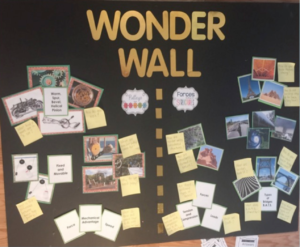
At the start of a learning unit on the Egyptians the class discuss what they want to find out and log this on a wall of questions. This gives students some ownership of this unit of work and consequently greater emotional involvement.
Here the class have a wonder wall where pupils can record their ‘wonders’, knowing that their teacher will find time to address their questions over time.

A reminder about Growing Questioning ⬇️
Questioning – Finding out
Effective questioners are motivated and not afraid to ask questions about the past, the present and to explore the future. They have an extensive range of question types and techniques at their disposal, which they use with discernment and sensitivity to occasion. A well-formed questioning habit involves being ready, willing and able to; not take things at face value; be less likely to accept answers uncritically; ask questions of oneself as well as of others; get under the surface of things; be comfortable with uncertainty and ambiguity; not be afraid of the ‘don’t know’ state of mind; be playful, yet systematic and analytical; be socially aware of the impact that questions may have on others; challenge others’ thinking; understand and use different types of question for different purposes; recognise that revealing their own uncertainties helps them learn. 
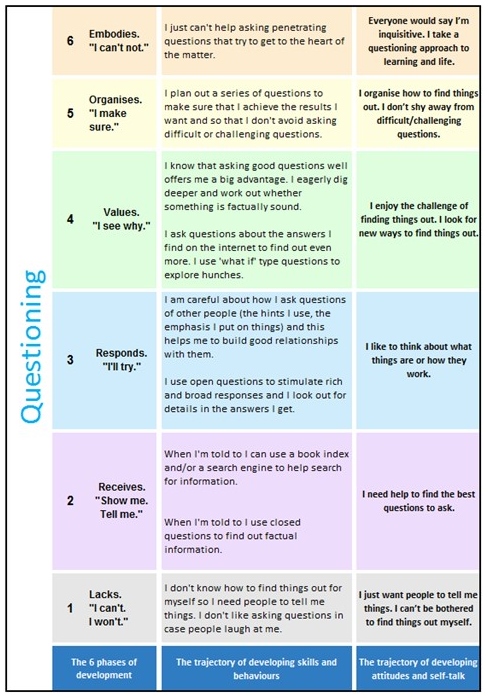
Growing questioning
This complex learning behaviour is part of the cognitive domain of learning. Its growth here attempts to capture enough detail for you to recognise the behaviours as you might witness them in your classroom.
Note also that the actions going up the columns become more skilled and sophisticated. Purple, blue and green phases have two descriptions which belong to the same phase but the lower ones in each colour tend to happen first.
Questioning drives our learning; that curiosity to find out. The column focuses on skills that enable students to find things out for themselves and emphasises getting under the surface of things and assessing the validity of information. In today’s world this is a learning behaviour of primary importance.
Try out 3
Make reflecting on collaboration part of everyday lessons
Here is a practical example of how you might develop the social climate of the classroom and make it collaboration friendly.
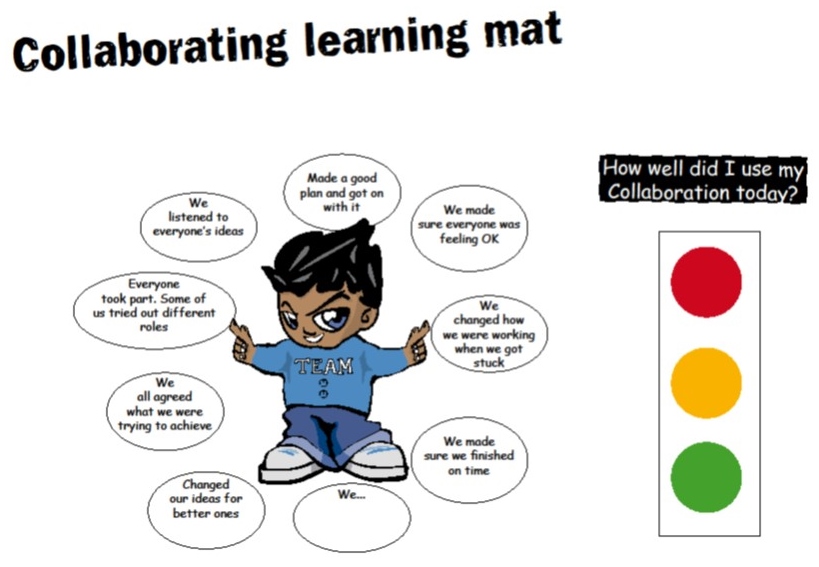
Learning mats are usually A4 laminated sheets that show various aspects of a learning habit. Keep them on desks/tables or as part of a wall display.
Students can refer to them during lessons as prompts about the finer aspects of collaborating and later for self-reflection on what they have used, whether it was successful and how to improve it.
A reminder about Growing Collaboration ⬇️
Collaboration – Learning together
Effective collaborators are adept at learning with and from others. They help to: A well-formed collaboration habit includes being ready willing and able to: work effectively with others towards agreed common goals; acting flexibly in response to circumstances; adopting different roles and responsibilities in pursuit of agreed goals and the well-being of the team; holding and expressing opinions coherently, compromising and adapting when appropriate; seeking to understand what others are saying; sharing, challenging, supporting and building on ideas.
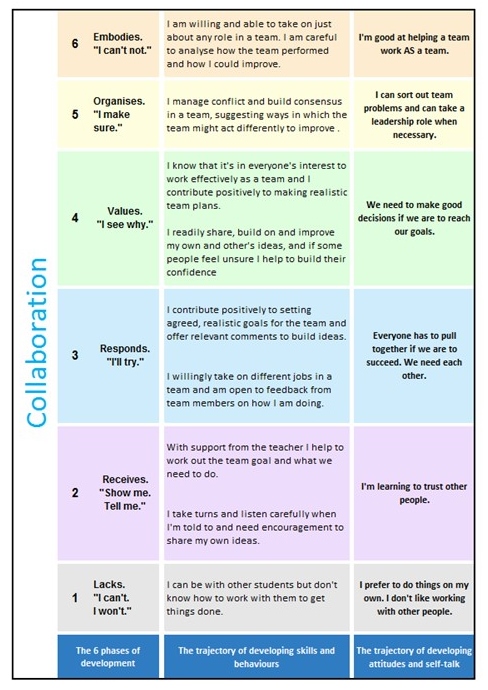
Growing collaboration
This learning behaviour is part of the social domain of learning. Its growth here attempts to capture enough detail for you to recognise the behaviours as you witness them in your classroom.
Note also that the actions going up the columns become more skilled and sophisticated. Purple, blue and green phases have two descriptions which belong to the same phase but the lower ones in each colour tend to happen first.
Collaboration is often thought of as a natural skill but as the column shows it is highly sophisticated and will take time to become productive. Here the skills of working with others as a team are given centre stage.
Try out 4
Explore what it means to revise.
Invite the students to move around a big open space then stop and make the shape you call out.
When they have all made their shape, ask them to look around at each other and then have another go at making the same shape differently.
- Do this several times.
- Talk about thinking again and changing one’s first idea of how to do something.
- Over time get the children to start asking themselves whether they want/need to improve their first go at making the shape -so gaining a sense of an internal ‘good enough’ measure.

A reminder about Growing Revising ⬇️
Revising – Making improvements
So students need to learn how to deal with change, emotionally and practically. With an inflexible frame of mind they are unlikely to recognise the need to change their ideas or the way they do something. They also need to know what ‘good’ looks like; how to keep an eye on how things are going and the willingness to evaluate how things went against external standards. Growing revising moves well beyond encouraging a student to ‘have another go’.

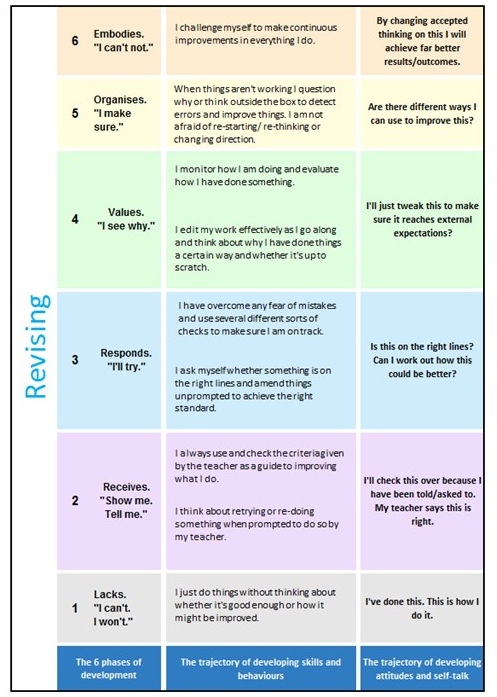
Growing revising
This complex learning behaviour is part of the strategic domain of learning. Here the chart attempts to capture enough detail for you to recognise the behaviours as you witness them in your classroom.
Note also that the actions going up the columns become more skilled and sophisticated. Purple, blue and green phases have two descriptions which belong to the same phase but the lower ones in each colour tend to happen first.
Revising. This critical learning skill has been given a new lease of life recently, often evoked by metacognition in the world of teaching. The column charts the type of skills students will need to embrace to become an effective self-monitor and evaluator of their own learning.
Extended Read about 1
Progression in learning behaviours.
Teachers are familiar with the need to assess, record and report on curriculum progress and attainment. The world is full of levels, level descriptors, tests, diagnostics, examinations, point scores, value added measures, and the like – even in ‘life after levels’ !! But they all refer to the acquisition of the knowledge, skills and understandings defined in the National Curriculum. But what of the child’s progress as a learner ? Where are the comparable measures for identifying how the child is growing and developing as, for example, a curious, tenacious, flexible and sociable lifelong learner? Not, mercifully, in the National Curriculum!

Extended Read about key facets to progression. . . ⬇️
Key facets to progression in learning behaviours.
Any school that is interested in growing student learning behaviours will want to know the effectiveness of its strategies and the extent to which its students are growing as learners. This is not rooted in a need to label students as ‘level 3 at turn taking’ or ‘A* at conflict resolution’, rather out of a desire to understand the small, incremental steps that will take a child from ‘can’t share’ to ‘great team worker’, so that subtle intervention can support and even speed the child’s growth as a ‘collaborator’. The same is true, obviously, for all of the other learning behaviours within the Supple Learning Mind.
There are three key facets to the progression of learning behaviours –
- firstly the frequency/strength with which the behaviour is used,
- secondly the range of contexts in which it is deployed, and
- thirdly the skilfulness with which it is employed.
1.The frequency and strength of the habit:
The first dimension of progression, and easiest to activate, is frequency and strength. The distinction between skill and habit is important – skills are what you can do, whereas habits are what you do do. A skill that is only rarely employed, or only employed when adult directed, is at best embryonic. Initially the aim is to activate the skill more frequently through direct intervention with a view to reducing the level of intervention as the skill becomes stronger through more frequent use. The target is to develop the skill into a habit that the student employs frequently, without support, as and when the need arises.
2. The scope of the habit:
The second dimension of progression relates to the range of contexts within which the skill is deployed. The child who is tenacious and thoughtful on the play station can equally be defeatist and impulsive in the classroom – they have the skills, but fail to recognise that the perseverance that leads to success on the play station is precisely the same outlook that is needed for success in the literacy lesson. Initially the skill is used only in familiar circumstances, but the aim is to help students to recognise and exploit opportunities to utilise their leaning behaviours in new and uncharted territory.
3. The skilfulness of the habit:
The third dimension, and by far the most subtle, is that of skilfulness. While we may start by wanting students to be asking questions, for example, more frequently or in a wider range of contexts, once achieved we rapidly turn our attention to the quality of the questions that are being asked. It is not too difficult to describe the attributes of a high level, sophisticated questioner who is skilled at asking incisive, generative questions, but it is very difficult to map out and sequence the steps between the natural curiosity of a three year-old and the sophisticated skill-set of the consummate question-asker/enquirer. This is the challenge, and why skilfulness is the most complex of the three dimensions. However, once mapped, the impact on mentoring, target-setting, self and peer assessment, assessment, recording, reporting, task design, curriculum planning etc is immense.
Schools that are developing such progression ‘trajectories’, are gaining the insights that allow them to identify and build progressively the fine grain learning behaviours that comprise the highly effective learner.
In summary:
Progression puts the ‘Building’ into Building Learning Power. We are seeking to understand how, over time, we can intervene to enable students spontaneously to make more, wider, and increasingly sophisticated use of these behaviours. Unless students can;
- make these skills their own,
- intuitively see the point of them,
- call them to mind for themselves when needed,
- become ever more skilful in their use
there is much still to do.
Learning together. Meeting 3
Unit 3 Suggested meeting agenda
- Decide what you want this meeting to achieve
- Discuss what you have found out about a progression in learning habits, (15 mins)
- Re-cap and reflect on the action you have each undertaken in your classrooms (20 mins)
- Consider issues of progression that may have consequences across the school (10 mins)
- Review how the meeting format went (5 mins)

Learning Team Meeting 3 Agenda ⬇️
Item 1. Meeting Objectives. (5 mins)
Meeting objectives might include:
- share and learn from what we have each discovered about progression in learning habits;
- to feel more confident about being aware of students growth as learners;
- identify difficulties and possible solutions for collecting and acting on learning habit progression data;
- report findings on the management of progression data to senior leaders. (see item 4)
Outcome. To have decided what this meeting should aim to achieve.

Item 2. Discussion about progression in learning habits (15 mins)
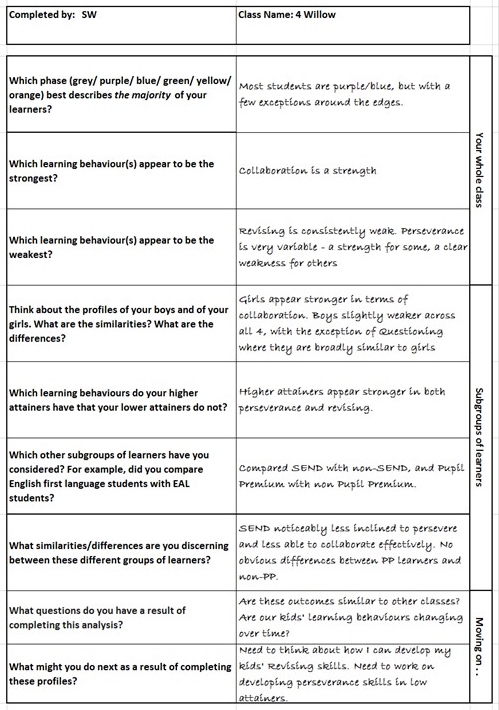
Explore together your reaction to the progression charts and your discoveries about yourself and your students as developing learners.What do the profiles look like for our classes? Where are the similarities / differences?
- what were your first impressions of progression in learning habits?
- what did you find out about yourself as a learner (Find out 1)
- what did we each learn about our students as learners. (Find out 2)
- share your students’ Learning progression charts. (Find out 2)
- which of the four learning habits seem to be the strongest across the school?
- which of the four learning habits appear to be the weakest across the school?
- What surprised or baffled you?
- Are there significant differences between year groups?
Outcome. A clearer understanding of the thinking behind the progression in learning behaviours and first understandings of the growth levels of our students’ learning behaviours.
Item 3. Explore action using the Try outs (20 mins)
Share and discuss the action and results from your close observation of students’ use of four key behaviours.
- Which of the Try out suggestions did you each use?
- Any concerns about or difficulties in putting the Try outs into action.
- How did students react to being introduced to their learning behaviours?
- Which approach (Try outs) seemed the most valid or successful?
- How the Try outs affected different age groups.
- Ways of implementing these that we can all learn from and adopt.
Outcome. A clearer understanding appreciation of our students’ learning behaviours, their strengths, weaknesses and growth potential.
Item 4. Now you know…so what? (10 mins)
In relation to all the ideas about progression you’ve been finding out, sharing and mulling over, it’s now time to think about the future impact of having this information;
1. Do the charts provide us with useful information?
2 How should we each use that information now that we know it?
3 Should collecting this information become whole school requirement? If so when?
It’s more than likely that, as you become more familiar with the benefits of growing learning behaviours, you will frequently return to considering the how, when and where of its use, collection and storage at school level.
Outcome.
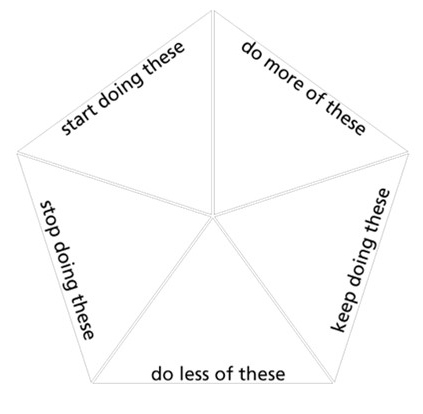
- At this stage it’s essential to record ideas arising from this discussion using 2 pentagon diagrams outcomes:
- one for each team member personally and
- one for decisions/suggestions that are school wide.
- Ensure that your school/group wide pentagon is shared with senior leaders.
Item 5. Evaluate team session. (5 mins)
- Did we achieve our objectives?
- Are we comfortable with what we are trying to achieve so far?
- Any concerns at this point?
- Next meeting date and time.
Comments are closed.