
You are now in Unit 1 Introduction
A. The intention of this unit is to..
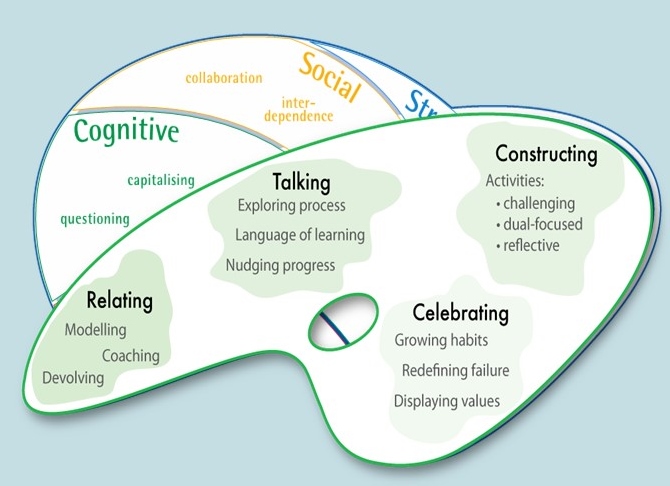
..introduce the two foundational frameworks of Learning Power..the Supple Learning Mind, and the Teachers’ Palette.. the warp and the weft of learning.
..introduce you to the intriguing prospect of growing and developing learning habits
…offer you a chance to explore yourself as a learner and complete your own learning profile
…start you on a journey of understanding your students’ learning by compiling and analysing their learning profiles
Sections 1D and 1E are vitally important because the results will shape your practice thereafter.
B. The best way of tackling this unit is to..
Read through Section 1A to explore the big ideas that underpin Learning Power
Read through Section 1B just to give you confidence about the approach
Settle down, maybe one evening, and explore your own learning habits (Section 1C)
Undertake the fascinating exercise of completing a learning profile for each of your students. You might do 3 or 4 a day over a couple of weeks (Sections 1D and 1E)
Slowly unpack what the data in the profiles is telling you.
Timing. We suggest you give yourselves a couple of months to understand, collect and analyse this data. Your view of your students learning behaviours will henceforth influence and shape your practice. If your programme started in Sept you should aim to complete this unit by the end of the first half term. (e.g. Sept to end Oct)
Team Meeting 1 is scheduled for the end of Unit 1, Section 1E
C. As a result it should have the following impact.
You will have become familiar with the underlying concepts of Learning Power
You will have gained interesting insights into yourself as a learner.
Your student learning profiles will be giving you some of the most influential data you’ve ever had to shape your classroom practice.
Unit Navigation Bar
| Overview: Playing the Learning Power Game | Unit 1: Understanding Learning and Cultures | Unit 2: Classroom Cultures | Unit 3: Constructing Learning | Unit 4: Broadening the range |
|---|
The contents of Unit 1 Understanding Learning and Cultures
1A. The warp and weft of Learning Power…
.. is a tapestry of activities on the part of both you and learners. The warp of Learning Power is made up of the learning behaviours you want students to develop. And these are being developed and woven together by the weft of all the different methods that you, as a teacher, have at your disposal: the language you use and the explicit attention you pay to the ‘how’ of learning; the activities you make available, and the way these are framed for students; and the aspects of learning power that you model in a dozen different ways, throughout the school day.
This section introduces and explores the 2 models that underpin Learning Power:
- The Supple Learning Mind – the key learning behaviours that were and are judged to be of the highest value in helping students to learn and thrive in a complex world;
- The Teachers’ Palette – the ways that teachers: shift responsibility for learning towards students; talk about the process of learning; plan lessons that consciously develop positive learning behaviours; celebrate the growth of learning.
1B. Why learning habits matter
‘Why learning habits matter’ explores the background, heritage and research behind learning to learn and why it is so important for 21st Century learners.
Schools today need to be educating not just for exam results but for a life of learning. To thrive in the twenty-first century, it is not enough to leave school with a clutch of examination certificates. Students need to have learnt how to be tenacious and resourceful, imaginative and logical, self-disciplined and self-aware, collaborative and inquisitive.
The core purpose of education is to prepare young people for life after school; to get them ready, as Art Costa, an American educator with similar views, says, ‘not just for a life of tests, but for the tests of life’.

1C. Uncover the mysteries of learning behaviours
‘Uncover the mysteries of learning behaviours’ explores 12 important learning behaviours and introduces you to how these behaviours might grow. It is the first step in moving from Learning Power to Building Learning Power.
Now that we have moved beyond seeing learning as a performance to it being an interesting process going on in our brains, we turn towards the growth of this supple learning mind. The whole point of building learning powers is to do just that, to build the learning behaviours, not simply to name them.
To help schools make the collection of learning data more manageable we have selected 12 of the original 17 characteristics for you to take a closer look at over time. In this section you can find out more about these fascinating learning characteristics and how they grow under the influence of a learning friendly environment.

1D. Up close and personal with learning
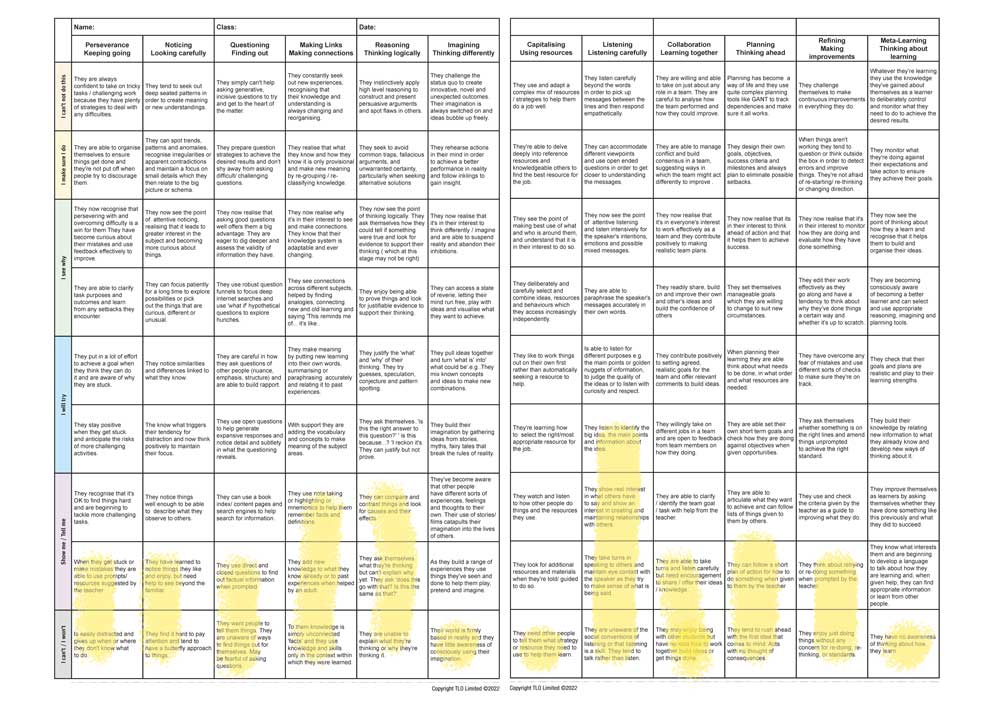
‘Up close and personal with learning’ pulls together the growth trajectories introduced in the previous section into one progression chart covering all 12 learning behaviours.
Perhaps the best way of really getting to grips with the growth of learning power is to take a personal look at yourself as a learner and the learning behaviours you tend to use. What might your learning profile look like; where are your strengths, what are the behaviours you find tricky; which would you like to improve?
Having got the idea we then invite you to look at just a couple of your students; a low and a high attaining student. This should give you a glimpse of what it is that makes the difference in how students approach and achieve in learning.

1E. Finding learning characteristics
‘Finding learning characteristics’ invites you to turn your attention to your class and to build learning profiles for each of them individually.
And once these profiles are completed, to begin to explore patterns:
- How do girls’ profiles differ from boys’ profiles?
- More able profiles with less able profiles?
- Pupil premium profiles with others?
- Which learning behaviours appear most secure across my class?
- Which are least secure?
It is a key step in seeing your students through the lens of learning power and understanding their strengths and relative weaknesses.
Team meeting 1
This is the first of 7 team sessions that are built into the online programme. The first meeting is scheduled to take place after completing Section 1E.
The agenda is carefully structured and timed to take an hour although this first meeting will take longer because the team will need to discuss the ground rules for how they want the meeting to work.
The agenda structure thereafter aims to ensure the main purposes of the meeting are accomplished. It’s a structure informed by significant research into teacher learning groups.

You are now in Unit 1 Introduction
Use the Section Navigation Bar below to find your way around the sections of unit 1.
Comments are closed.