
Welcome to Playing the Learning Power Game on-line programme
You are now in the contents page of the programme.
A. The intention of this page is to..
…give you an overall picture of the structure and intent of the programme. The programme is designed to take a school somewhere between a year to fifteen months to work through. It offers and represents an important shift in educational thinking about classroom practice.
B. The best way of tackling this page is to..
…read through it fairly quickly and hover on the greater depth bits such as The Big Ambition. This shows the intent and possible outcomes of each Unit of the programme. It’s a good general overview of what it’s all about and could act as a monitoring tool to keep you on track.
C. As a result it should have the following impact.
You will have gained an overview of the purpose and structure of the first phase of programme and hopefully gleaned enough information to make you excited about the journey you are making a start on.
Unit Navigation Bar.
| Overview: Playing the Learning Power Game | Unit 1: Understanding Learning and Cultures | Unit 2: Classroom Cultures | Unit 3: Constructing Learning | Unit 4: Broadening the range |
|---|
This on-line programme aims to help you to discover your students’ learning behaviours and, with that knowledge, enable you to fashion your classroom culture and teaching methodology to ensure students, knowingly, become better learners.
1. What this programme is about.
The Big Ambition of Playing the Learning Power Game.
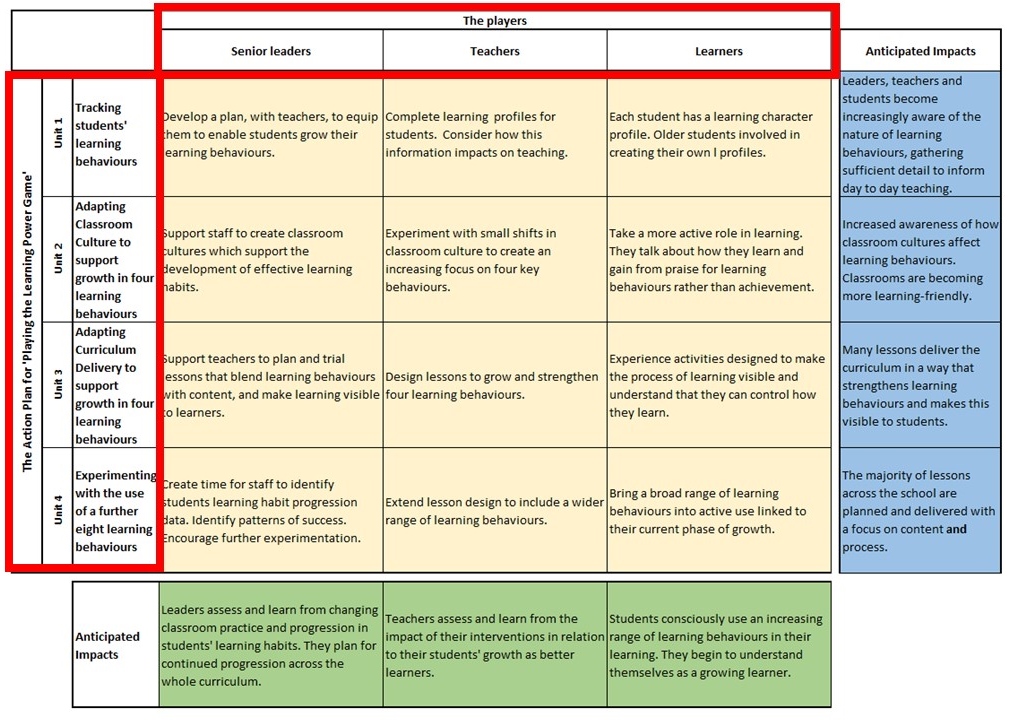
This chart shows the big ambition of the programme. It distils what it’s all about.
- the cells in yellow capture what leaders, teachers and learners will need to do across each row:
- tracking the growth of learning behaviours;
- adapting classroom cultures to strengthen 4 key learning behaviours;
- adapting how the curriculum is delivered in order to build 4 key learning behaviours;
- experimenting with and expanding the number of learning behaviours consciously being used by students;
- the blue boxes capture the outcomes such changes could make to classrooms; cultures and curriculum delivery.
- the green boxes capture the anticipated outcomes for people; leaders, teachers and learners.

Read more about the Big Ambition at your leisure
The vertical and horizontal axes of the grid
The vertical axis to the left shows the 4 main aims or thrusts of the programme. These four components involve:
- Unit 1. The formative work of finding out about your students’ learning behaviours and how they have the potential to improve/grow;
- Unit 2. The practical work of shifting classroom culture to better accommodate learning behaviours, using 4 foundational learning behaviours to get you started;
- Unit 3. The practical work of purposefully blending the use of learning behaviours into lesson design, again focusing on just four foundational behaviours;
- Unit 4. The work of gradually bringing more of the original researched learning behaviours into play in order to build students’ use of them over time. This is in preparation for the Phase 2 programme.
The horizontal axis across the top shows the 3 main groups of players in the game and what they will need to do to make it all work.
The central 12 cells
These cells serve 2 purposes. Firstly:
- The text in each cell gives an indication of who needs to do what, in very broad terms, at each stage of this journey;
- When looked at vertically down the page, they map out the 4 stages of this first part of the learning power journey;
- When looked at horizontally across the page, they show the players in the game and how what they do needs to interact.

The cells to the bottom and to the right
The green cells across the bottom give an outline of how the school’s players will have developed by the time you have finished this first stage programme. The blue cells to the far right give an indication of the anticipated outcomes for each part of the journey from; discovering students learning behaviours, to shifts in classroom cultures, to early shifts in lesson design accommodating learning behaviours, and to the beginning of consciously using a much broader range of learning behaviours across the curriculum.

2. How the programme is organised.
Units and sections…
Each unit deals with a key aspect of understanding and growing learning power:
- Unit 1. Discovering learning and culture. This unit has sections covering:
- The warp and the weft, foundational ideas of learning power; the basic ‘must knows’
- Finding Learning Power, the ‘must dos’ of collecting evidence about students’ learning behaviours
- Unit 2. Classroom cultures. This unit has sections covering:
- Aspects of a learning friendly classroom culture
- An easy to access catalogue of practical ideas designed to help you shift your classroom culture to support the growth of the foundational four learning behaviours.
- Unit 3. Constructing learning. This unit has four sections covering:
- The big picture of curriculum planning
- Designing units and lessons
- Activity design to stimulate learning habits
- A catalogue of learning activities are displayed in a second, easy to access, grid framework of ideas. The point is to blend some of these ideas into the curriculum and your lessons.
- Unit 4. Broadening learning. Here you are encouraged to spread your wings and begin to add some of another eight learning behaviours to the mix. This unit has eight sections covering:
- Noticing
- Making links
- Imagining
- Reasoning
- Capitalising
- Listening
- Planning
- Meta-learning
This development will help prepare you to move on to Phase 2 of the programme.
Strengthening classroom cultures to build students’ use of learning behaviours
FIND OUT MORE about the content of each section of the course
The content of each unit and section of the course
Unit 1, Section 1A. The warp and weft of learning
Here you will find:
- a whistle stop tour of the two frameworks that shape the development of students’ dispositional learning powers;
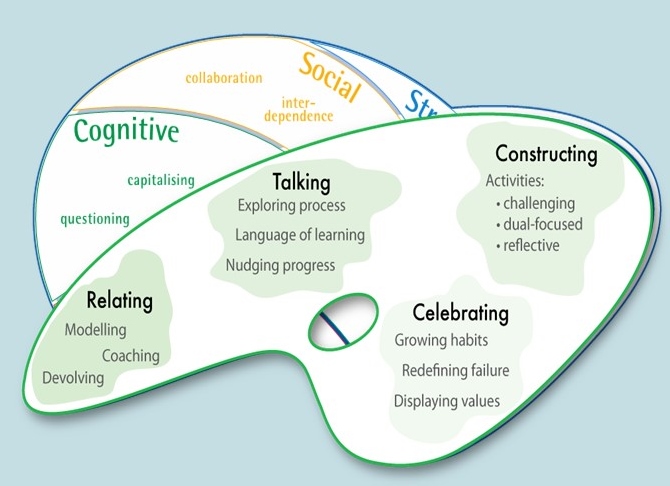
- an overview of the classroom culture framework (the teachers’ palette) that shapes building learning behaviours;
- an overview of the supple learning mind framework that identifies the learning behaviours and how they fit together.
Timing. We suggest you spend an hour or so in the first week exploring these big shaping ideas of Learning Power.
Unit 1, Sections 1B/C/D/E. Finding Learning Power
Here you will find:
- an exploration of why learning behaviours are so important for 21st century learners;
- information about progression in learning behaviours, what ‘getting better’ at learning looks like;
- the opportunity to reflect on your own learning behaviours and those of 2 students you know well;
- guidance to support you in producing and analysing your students’ learning profiles.
Timing. We would suggest you spend a couple of months collecting and understanding this data. Your view of your students learning behaviours will henceforth influence and shape your practice. If your programme started at the beginning of an educational year you should aim to complete this unit by the end of the first half term. (e.g. Sept to end Oct)

Unit 2. Classroom cultures.
A catalogue of practical ideas to create a learning friendly classroom culture
Here you will find 3 short sections, explorations of:
- Section 2A – Relating for Learning, how we might enable students to take greater responsibility for their own learning;
- Section 2B – Talking for Learning, how we might enable students to understand and talk about the process of learning;
- Section 2C – Celebrating Learning, how we might organise classrooms to celebrate learning over performance.
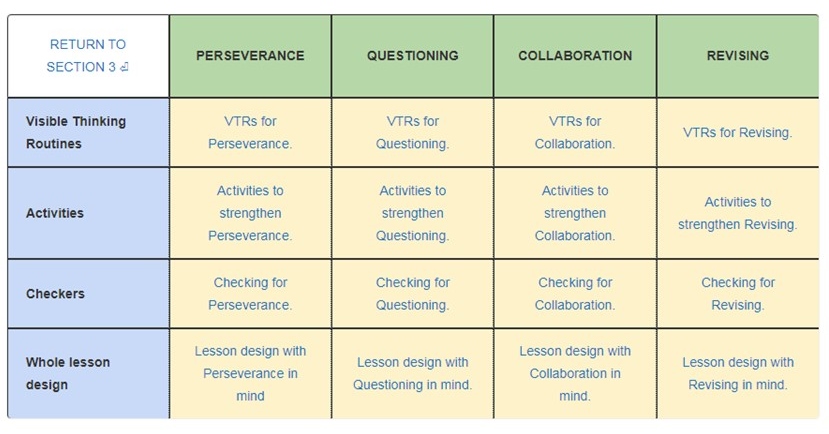
Plus – Section 2D has a practical four by four framework organised around:
- four foundational, really important, learning behaviours at
- four levels of growth, with
- practical packages of ideas, across
- three aspects of classroom cultures.
This four-by-four framework is presented in a simple grid format, illustrated here.
We’ve done the sorting for you. All you have to do is select what you need!
Timing. We suggest you spend 2 or 3 months exploring this catalogue. So for example if you started the programme in September you should be ready to move on by mid-February.
Unit 3. Constructing learning
Here you will find:
- Section 3A – The big picture of curriculum planning…planning that integrates progression in content with progression in learning behaviours;
- Section 3B – Designing units and lessons…the fundamentals of lesson design;
- Section 3C – Activity design to stimulate learning habits…suggesting a hierarchy of activity types, going from ‘Listening’, through to ‘Discovery’.
Section 3D has a practical four by four framework organised around:
- the four foundational learning habits;
- four categories of learning activities;
- and with over 100 ideas to try.
This four-by-four framework is presented in a simple grid, illustrated here.
Timing. We suggest you spend at least 2 or 3 months exploring this catalogue of lesson ideas. So, if you started this programme at the start of the educational year in Sept. and you kept to our suggested timing for earlier units, you should be ready to move on from this unit by mid May.
Unit 4. Broadening the range
This unit offers you an opportunity to spread your wings and begin to work across another 8 of the learning behaviours.
It has 8 small sections, each based on one learning behaviour – Noticing; Making links; Reasoning; Imagining; Capitalising; Listening; Planning, Meta Learning.
Here you will find:
A staged way of introducing the behaviours by;
- Firstly… making students aware of the use and importance of a habit…when, where, why, how they could be using it
- Then... explore the learning habit a little more through its language
- Try... using the behaviour as a lesson starter to tune students into using it
- Then start... blending the behaviour into the way you teach content. Use specific strategies to deepen content understanding.
- Ensure… students reflect on the success or otherwise of their new frame of mind.
The content of this section encourages you to play with introducing more learning behaviours
Timing. We would suggest you spend a couple of months exploring this section. If the school started this programme at the start of a school year and you have kept with the times suggested for previous units you could be using these ideas in the last couple of months of the summer term, readying yourself to begin the deeper learning power journey in Phase 2 of the Programme.

3. Working together to ensure success
This ‘Playing the Learning Power Game’ online programme provides you with the research and ideas to work with but it can’t in itself bring about change in classrooms. To make these ideas work best in classrooms across the school you’ll need to discuss and tease out what you have read and thought about with your colleagues and then try some of them out for real with students.
Useful types of CPD include:
- Teacher learning communities, or as we refer to them, Professional Learning Teams (see below)
- Coaching partnerships
- Small-scale learning enquiries
- Classroom observations and personal review
- Learning walks.
We can’t insist on particular ways of enabling these ideas to become a reality in your classrooms, but, learning with your colleagues will give you and your students a far greater chance of success.

4. Learning Team Meetings
Changing working practices is hard and delicate work. Research shows it works best when you can meet in a safe professional environment in which to explore and plan how you could change, and then share and probe the triumphs, tribulations and outcomes of the classroom experiments. Research into teacher learning communities by Dylan Wiliam, of Assessment for Learning (AfL) fame, describes such teams as:
- a small group of teachers who meet together regularly
- to deepen their understanding of an approach,
- to commit to trying out new things,
- to reflect on and share their experiments with each other.
If the school decides to adopt this professional learning approach we have provided 7 customised team meeting agendas at key points in the programme.

A BIT MORE ABOUT LEARNING TOGETHER.
A quick look at learning together.
Professional Learning Teams
Discussions with colleagues are often known as Professional Learning Teams. What they aim to plan and support are thought of as Classroom Based Enquiries.
PLTs are groups of 8-10 teachers (and TA’s?) who meet together regularly to deepen their understanding of an approach. They try out ideas offered in the programme and reflect on and share their experiments with each other. Such communities work best when they are voluntary, grouping similar subjects or age groups and meet monthly for about 75 minutes over a couple of years. Such communities support and scaffold teachers’ habit change. In short this approach:
- deepens staff understanding of learning;
- draws on the support of colleagues;
- unpacks the ‘how to’ together when it’s unclear;
- results in a plan to try out new things, considering what’s doable for their students;
- benefits from reflection on and sharing of data from their experiments with each other;
- draws on sharing trials and tribulations and what they will do differently.
The typical session agenda follows this pattern;
- Agreeing objectives and agenda (5mins)
- Sharing learning enquiries (20mins) from 2nd meeting on
- Re-capping the on-line materials (15mins)
- Deciding what’s to be done (15mins) at whole school and individual level
- Personal Action Planning (20mins)
- Evaluating the meeting process (5mins)
This agenda format also works when you prefer to use learning partnerships such as;
- pairs of teachers acting as a coaching partnership
- one member of staff (learning champion) leading and coaching other staff
In Units 1, 2, 3 and 4 you will find suggested detailed meeting agendas aimed to keep you on track.
Unit navigation
| Overview: Playing the Learning Power Game | Unit 1: Understanding Learning and Cultures | Unit 2: Classroom Cultures | Unit 3: Constructing Learning | Unit 4: Broadening the range |
|---|
Comments are closed.