
You are now in Unit 4, Broadening the range
A. The intention of this unit is to..
…introduce and encourage you to branch out and play with building some of the next 8 learning behaviours. Just to get the feel of them in preparation for Phase 2 of the programme.
B. The best way of tackling this unit is to..
Skim read a couple of the sections to understand the shape of them. Consider which of the eight behaviours, according to your students’ progression charts, appear to be most needed.
Timing. If you have kept with suggested timings you should reach here by May or June. This gives you several weeks to try two or maybe three of these learning behaviours in your classroom.
Unit 4, Team Meeting 1. Scheduled around one month after starting Unit 4.
Unit 4, Team Meeting 2. Scheduled towards the end of Unit 4.
C. As a result it should have the following impact.
There is no expectation for you to activate all eight of the behaviours but we hope you’ll be inspired to try two or three and be set up in readiness for Phase 2 of the programme.
Unit Navigation Bar
| Overview: Playing the Learning Power Game | Unit 1: Understanding Learning and Cultures | Unit 2: Classroom Cultures | Unit 3: Constructing Learning | Unit 4: Broadening the range |
|---|
1.Why branch out?

2. Decide which behaviours to make a start on
Take a look at the learning profiles of your students. Become curious about what your data is telling you and remember not all learning behaviours are equally important. Some are more critical for success in some subjects than others, while others are critical for success across the curriculum. This table shows the average scores for an imaginary target group. Alternative strategies for prioritising which behaviours to begin with: Find the behaviours to make a start on:

3. Check out your classroom culture
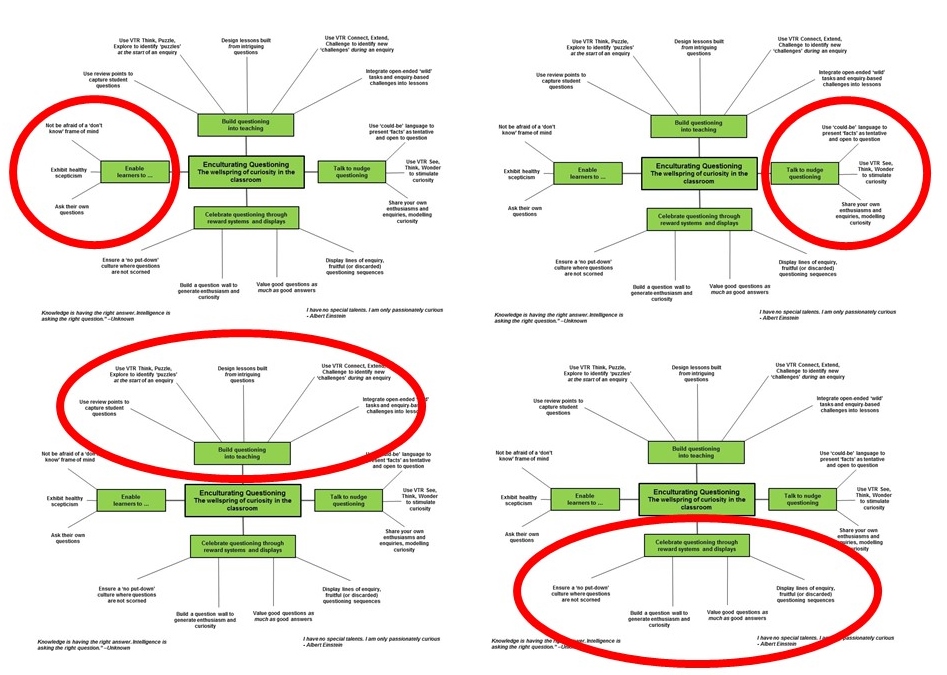
Having already explored classroom culture in Unit 2 you might find it useful to consider the aspects of classroom culture that need to be present for the particular learning behaviour to flourish. The culture diagrams address 4 aspects of classroom culture: Give time to evaluate your own classroom culture against these 4 aspects, because minor adjustments to classroom culture will make it easier for the teaching ideas that follow to achieve the outcomes you want for your learners.The classroom culture to foster learners’ curiosity
You are now in Unit 4. Broadening the range. Introduction
Use the Section Navigation Bar below to find your way around introducing the 8 learning behaviours.
Unit 4, Team Meeting Agenda 1
This meeting invites you to share your explorations of the 8 new learning behaviours in Unit 4.
This meeting is positioned and designed to enable you to:
- Look back over and discuss with colleagues the progress you have made with your personal action plans relating to Unit 3 that you devised at the previous meeting, and . . .
- Share your responses to your reading in Unit 4, Broadening the range.
- Draw up a personal action plan for how you will take your practice forward based on further exploration of the ideas in Unit 4.

Unit 4 - Learning Team Meeting 1 Agenda ⬇️
Unit 4, Team Meeting Agenda 1
- Agree objectives and agenda (5 mins)
- Share reports of how learning powered lesson plans have worked (20 mins)
- Discuss the online materials that people have looked at in Unit 4 (15 mins)
- Consider possible policy issues for the school (5 mins)
- Personal Action Planning (20 mins)
- Review the meeting process (5 mins)
Item 1. Session objectives: What do we want to achieve? (5 mins)
Objectives should include:
- learning from what and how our Action Plans have worked in different classrooms;
- feeling confident to take forward ideas from online materials into our practice;
- proposing actions that would benefit if everyone applied them in their practice;
- planning further personal developments in classroom practice.

Item 2. Reports from classroom enquiries (15 mins)
(NB. based on material from Unit 3)
Share and discuss teachers’ practice; a valuable source of learning for everyone.
- what you each tried to change or try out in your lesson planning and delivery, the activities you designed/used, the VTRs that worked . . . .
- how they worked
- what you could/did change to make them work better
- how students reacted
- whether there may be longer term benefits for students
Ask each other questions, offer suggestions and learn from each other.
Remember…everyone is supposed to report back to every meeting.
This isn’t a simple show-and-tell session but one where the group question and probe their colleagues’ summaries of what they have done to encourage analysis and deeper reflection.
Questions to encourage deeper thinking include:
- What do you think is getting in the way?
- What would make this better?
- How did students react to that change?
- How could this technique be modified to make it work better for you?
- What do you think made that work so well?
Item 3. Recap on-line materials in Unit 4: What the materials made us think (15 mins)
You will have been exploring at least some of the 8 new learning behaviours for around a month or so. What have you been trying out? Why did you choose to start with those? What was of particular interest? What more do you want to experiment with?
Try a PMI (Plus, minus, interesting) routine to help sort out your thinking.
Think about:
- how the ideas would suit your students as learners
- which are realistic both for you and your students
- how the ideas would impact on your classroom culture and the students view of themselves as learners
- which ideas are front runners and why?
Use this decision making pentagon in deciding what to do you might try.
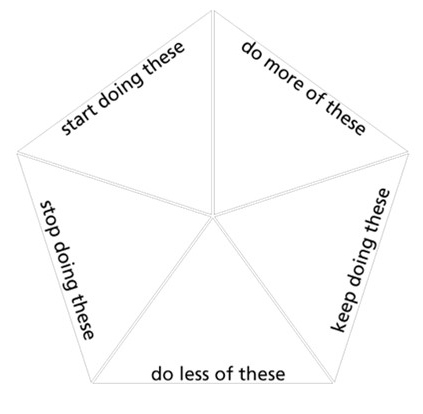
Note down a couple of:
- things you want to start doing
- things you think you need to stop doing (that’s harder)
- things you want to keep doing
- things you want to do more often
- things you want to do less
Item 4. Propose what may be needed across the school. (5 mins)
The point here is to identify ideas that are sufficiently important that they;
- should be included in everyone’s action plan
- i.e. you are sufficiently keen on some of the ideas that you all want to try them in one form or another
- should be adopted by everyone as a whole school strategy
- i.e. when discussions over time have concluded that some ideas have proved so useful across the school they should be woven into school policies or procedures.
Some of the ideas suggested in the on-line materials are likely to make greater impact if they were to be adopted by everyone across the school.
Item 5. Personal action planning. What am I going to do? (20 mins)
Think about what you are trying to achieve.
Plans at this stage should be linked to what you are learning from Unit 4 and how your students are responding to the changes you are trialling.
Gain more value from your plan by creating it around a question. Think of it as an If:Then problem.
For example, if you are intending to focus on Making Links:
If I encourage my students to create mindmaps, will I notice any improvement in their ability to understand how ideas are/can be linked together?
Or, if you are intending to focus on Reasoning and promote evidence based reasoning:
If I use the VTR ‘What makes you say that?’ fairly frequently, will I notice any development in students’ ability to support their thinking with evidence?
The learning enquiry plan is a record of what you intend to do. It takes your enquiry question from what to how. Remember:
- you can choose which aspect(s) of classroom practice to focus on;
- think about the aspect that is likely to have the greatest benefit for your students;
- make the plan specifically focus on development;
- concentrate on no more than two or three actions;
- decide how to map your actions over the next three or four weeks;
- it’s useful to think about what you are going to do less of to make room for the changes.
As part of your plan it’s important to record what you will monitor over the weeks.
Changes you expect to see in your classroom practice. For example what do you expect to:
- see yourself doing differently?
- hear yourself saying more often, with greater commitment, more effectively?
- look out for in order to find out which approach best suits most students?
- feel less stressed about? What will indicate that?
- monitor to make sure that the changes you are making are having an impact of your students?
Changes you expect to see in your students. For example do you expect students to:
- begin to take greater responsibility for their own learning;
- be more inclined / better able to talk about learning;
- be better able to recognise/ describe how they are learning;
- show a deeper understanding of the process of learning;
- other.
Noting such changes will motivate you to continue with your experiments because the changes in students are almost always positive. The plan represents a promise to do it. This promise helps you to keep the plan as a priority in your mind.
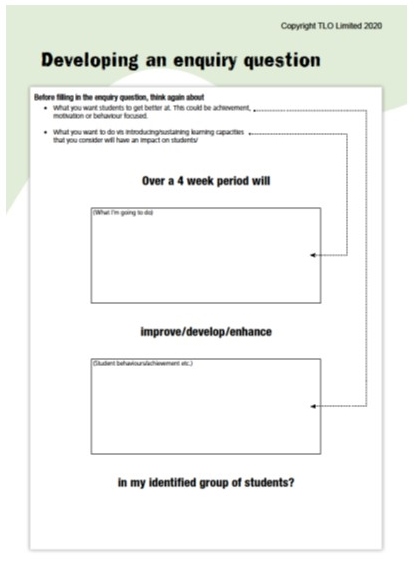
You could talk yourself through ‘THINKS’ like:
- How would you like your students to be different?
- How do you want your students to improve/develop/enhance in …………?.
- What aspects of your learning culture might be stopping this happening?
- Which practical ideas from the online material might improve these circumstances.

The level of critical analysis which is part of small research projects has been designed/built into the Enquiry Question and Action Planning forms. In other words their very design helps you to develop effective research focused questions and provoke evidenced based reflection.
Item 6. Evaluate team session: How did we do as a team? (5 mins)
- Did we achieve our objectives?
- Are we comfortable with what we are trying to achieve?
- Any concerns at this point?
- Next meeting date and time.
Unit 4, Team Meeting Agenda 2
This meeting invites you to share your explorations of the 8 new learning behaviours in Unit 4, invites you to look back over your learning over the course of the Playing the Learning Power Game programme, and offers a glimpse of what might come next.
This meeting is positioned and designed to enable you to:
- Look back over and discuss with colleagues the progress you have made with your personal action plans relating to Unit 4 that you devised at the previous meeting, and . . .
- Share your responses to your reading in Unit 4, Broadening the range.
- Draw up a personal action plan for how you will take your practice forward based on further exploration of the ideas in Unit 4.
Unit 4 - Learning Team Meeting 2 Agenda ⬇️
Unit 4, Team Meeting Agenda 2
- Agree objectives and agenda (5 mins)
- Share reports of progress in introducing new learning behaviours from Unit 4 (20 mins)
- Consider possible policy issues for the school (5 mins)
- Discuss what the school should do next to further secure and grow student learning behaviours (10 mins)
- Personal Action Planning (20 mins)
- Review the meeting process (5 mins)
Item 1. Session objectives: What do we want to achieve? (5 mins)
Objectives should include:
- learning from what has already been trialled in different classrooms;
- feeling confident to take forward ideas from online materials into our practice;
- proposing actions that would benefit if everyone applied them in their practice;
- planning further personal developments in classroom practice.
Item 2. Reports from classroom enquiries (15 mins)
Share and discuss teachers’ practice; a valuable source of learning for everyone.
This involves thinking back to what you have been putting into practice over the last few weeks from your last Action Plan. It covers;
- what you each tried to implement using ideas from Unit 4
- how they worked
- what you could/did change to make it work better
- how students reacted
- whether there may be longer term benefits for students
Ask each other questions, offer suggestions and learn from each other.
Remember…everyone is supposed to report back to every meeting.
This isn’t a simple show-and-tell session but one where the group question and probe their colleagues’ summaries of what they have done to encourage analysis and deeper reflection.
Questions to encourage deeper thinking include:
- What do you think is getting in the way?
- What would make this better?
- How did students react to that change?
- How could this technique be modified to make it work better for you?
- What do you think made that work so well?
Item 3. Propose what may be needed across the school. (5 mins)
The point here is to identify ideas that are sufficiently important that they:
- should be adopted by everyone as part of a whole school strategy
- i.e. when discussions over time have concluded that some ideas have proved so useful across the school they should be woven into school policies or procedures.
Think back over the past year as you have engaged with Playing the Learning Power Game.
Some of the ideas have been trialled and found favour with particular teachers, but others seem to have had widespread interest from teachers due to their impact on student learning.
What are these ‘stand out’ ideas? How will they become ‘how we all do things here’?
Item 4. Personal action planning. What am I going to do? (20 mins)
This is the point when everyone in the team makes an action plan which they will implement as the programme draws to a close.
A. It starts with a question
The key to developing your practice, is to think first of the need (what needs to change in students) and then think what could be done to achieve it. The knack lies in developing enquiry questions to sort out what you want to do.
Why a question? Because this is an enquiry! You want to find out if something (student behaviour) will change/improve if you change something specific.
Research suggests that you’ll gain more value from your plan by creating it around a question. Think of it like this:
If I do/plan, try xxxx will it improve/develop/ secure/ enhance xxx?
For example, if you were planning to introduce another one of the 8 behaviours to your class, your enquiry question could be:
If I introduce my students to the idea of meta learning, will they become more aware of their learning behaviours, strengths and weaknesses?
Try the planning sheet opposite.
B. Now think about a plan
But remember what you are trying to achieve.
Plans at this stage should be linked to what you are reading in Unit 4.
The learning enquiry plan is a record of what you intend to do. It takes your enquiry question from what to how. Remember:
- you can choose which aspect(s) of classroom practice to focus on;
- think about the aspect that is likely to have the greatest benefit for your students;
- make the plan specifically focus on development;
- concentrate on no more than two or three actions;
- decide how to map your actions over the next three or four weeks;
- it’s useful to think about what you are going to do less of to make room for the changes.
See format alongside to help you think through the planning process. You can fill in your Personal Action Plan using the word document version.
Also record what you will monitor over the weeks.
Changes you expect to see in your classroom practice. For example what do you expect to:
- see yourself doing differently?
- hear yourself saying more often, with greater commitment, more effectively?
- look out for in order to find out which approach best suits most students?
- feel less stressed about? What will indicate that?
- monitor to make sure that the changes you are making are having an impact of your students?
Changes you expect to see in your students. For example do you expect students to:
- begin to take greater responsibility for their own learning;
- be more inclined / better able to talk about learning;
- be better able to recognise/ describe how they are learning;
- show a deeper understanding of the process of learning;
- other.
Noting such changes will motivate you to continue with your experiments because the changes in students are almost always positive. The plan represents a promise to do it. This promise helps you to keep the plan as a priority in your mind.
You could talk yourself through ‘THINKS’ like:
- How would you like your students to be different?
- How do you want your students to improve/develop/enhance in …………?.
- What aspects of your learning culture might be stopping this happening?
- Which practical ideas from the online material might improve these circumstances.
The level of critical analysis which is part of small research projects has been designed/built into the Enquiry Question and Action Planning forms. In other words their very design helps you to develop effective research focused questions and provoke evidenced based reflection.
5. Discuss what we might do next (10 mins)
The programme Playing the Learning Power Game is phase 1 of Building Learning Power. The next phase takes you much deeper into all 12 learning behaviours, allowing you to build on the excellent foundations that you have already laid. Are you, as a school, ready to begin phase 2, The Professional Learning Power Game?

Items 6. Evaluate team session: How did we do as a team? (5 mins)
- Did we achieve our objectives?
- Are we happy with what we have achieved?
- Will we continue to learn together like this in the future?
Comments are closed.