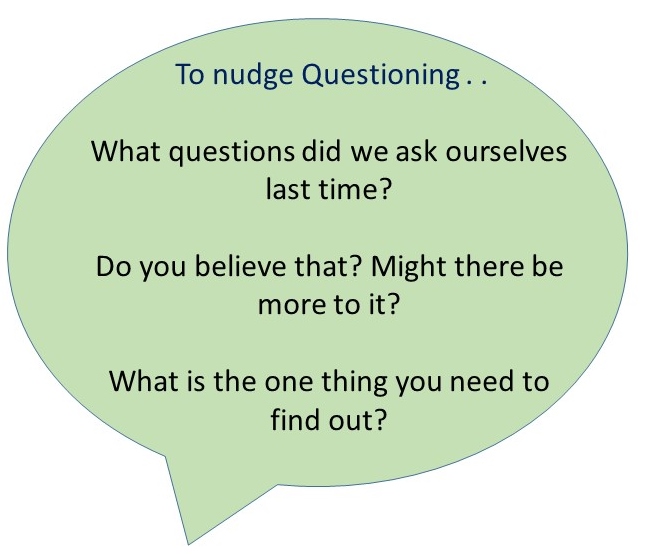
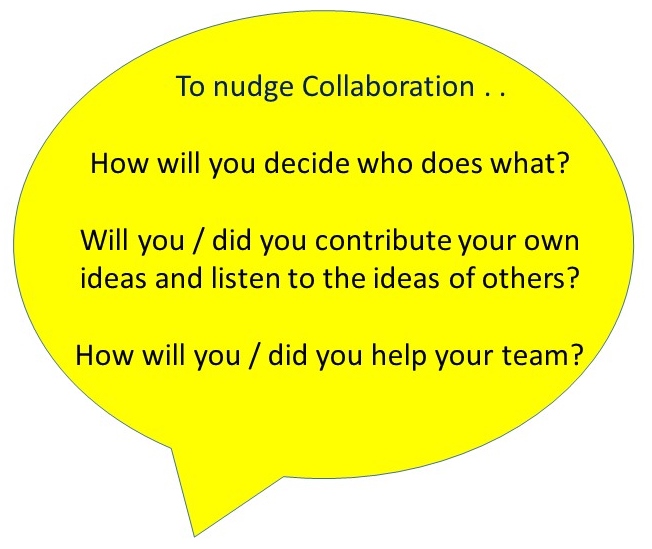
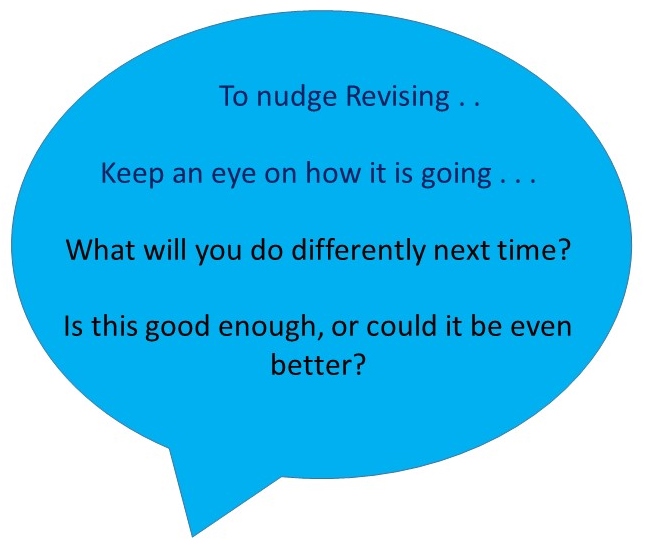
Finding learning challenging is part and parcel of learning. Indeed when learning isn’t challenging it usually means we’re practising / consolidating what we can already do rather than breaking new ground. As learners we all come across challenges that cause us to think hard – the question is whether we are excited by the prospect of rising to the challenge, or daunted by the prospect of not being able to do so.
Having practical strategies to help us cope with challenge will lead us to think ‘Great, this is tricky and I’m going to give it a go’ or ‘Oh dear, this is too hard for me, I’ll give up’.
About Display
What you’re aiming to achieve is to ensure that the look and feel of your classroom, its walls and reward systems, serve to strengthen your students’ learning habits.
This involves giving more attention to learning rather than performance, where more traditional ideas of classroom learning are flipped or re-defined – where being stuck is seen as interesting and mistakes valuable, where effort, questioning and taking risks are defined, attended to, acknowledged and praised. This classroom culture serves to make learning visible and public; one in which learners are being coached to become meta-learners.
Engage your students in being able to rise to a challenge by:
Encouraging students to seek out ever more challenging situations with confidence.
The hallmark of successful individuals is that they love learning, they seek challenges, they value effort, and they persist in the face of obstacles.” (Carol Dweck, 2000)
Mistakes or errors
‘Errors represent invaluable aids with the potential to help us learn. When we see failure in a new light, success becomes a new and exhilarating concept’. Black Box Thinking: The Surprising Truth About Success. Matthew Syed
Making mistakes, and more importantly covering them up – or rubbing them out – is now viewed as wasteful. Mistakes are a natural part of learning and recognised as valuable; something to learn from, something to improve on, something to change and try new ways, taking a risk and then learning from it if it doesn’t work. Mistakes are having a makeover, not just in classrooms but in wide range of progressive institutions.
Redefining failure is and will be an essential part of reversing pupils’ fixed mindsets
A. Introduce
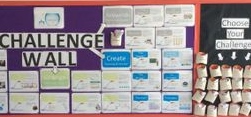
Make the Challenge wall the focal point
for your challenge culture. Make sure you add and refer to it frequently. For example;
Invite students to post up the most challenging questions they can think of. Allocate time to discuss them. The wall becomes a challenging talking point.
Cover the wall with challenges. questions, extension tasks, riddles, puzzles etc. These could be used by students who have finished their tasks early. Alternatively, set aside lesson time to for the whole class to discuss a challenge they select.
Display students’ work which shows mistakes they have learned from. This would include problems which students have persisted with or work that has been revised and edited to improve it.
One of the greatest motivators is a bit of success and celebrating success is an important part of a learning culture. Many primary schools have changed their celebration assemblies so that students not only decide on the criteria for class awards but have shifted the setting of criteria to the ‘how’ of learning.
Thus the learning behaviours are given due attention and are seen by the students themselves to be more worthy of recognition and celebration than high achievement in content.
C. Use
Share mistakes
Make mistakes useful. Create a ‘Beware board’ in the classroom and invite pupils to share their mistakes on Post-its. Talk about:
why the mistake was made
what thinking led to the confusion and
how it could be avoided in the future.
Bringing mistakes into the open and discussing them helps other students to avoid them while recognising their value.
D. Reflect on
Self reporting
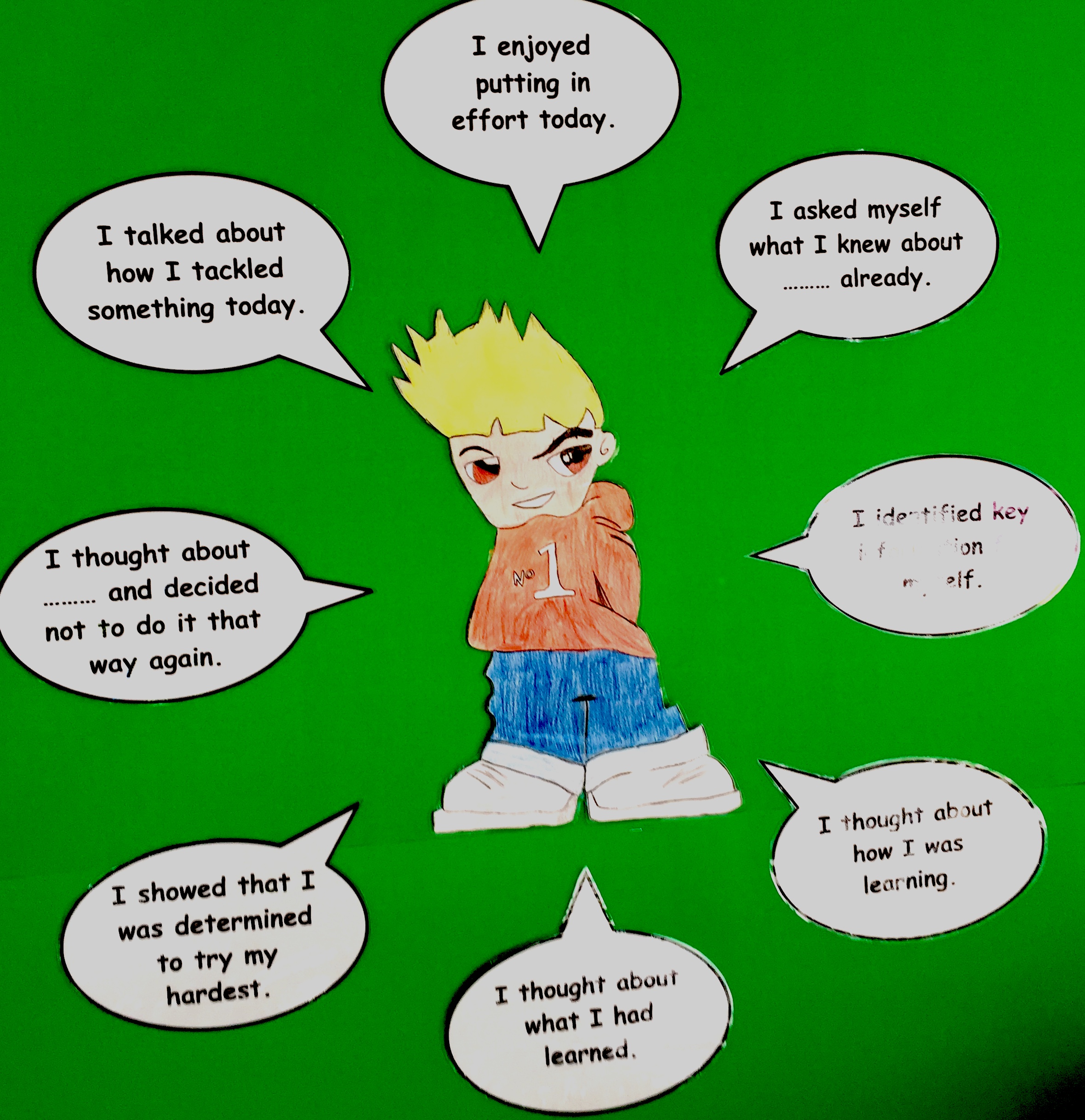
Younger learners talk freely about their learning when encouraged to by adults. Here we see how Haaniah persevered to make a pattern. This may sound like a simple everyday occurrence, but for Hannah this was a challenge worth celebrating. It’s useful to have a camera to hand to capture small triumphs, talk about them and display them for everyone to celebrate.
5. Improve on
Display a Challenge Plan
Support students to create their own plans for seeking and engaging with challenge but it’s useful to have one displayed for quick reference.
What’s the goal?
What are the success criteria?
What is the timeframe?
Gather information about the tasks
Link new information to what I already know
Where am I expecting difficulties – blocks and obstacles?
Are there any dependencies? It this….then that….
Use the expert knowledge of others to help distil and refine my ideas
Review where I’ve got to and check my thinking against the original success criteria
Evaluate emerging outcomes against my expectations
Amend the plan or goal if necessary
Hand in on time!
Clicking on the link in any cell takes you to 5 related classroom activities.
Finding learning challenging is part and parcel of learning. Indeed when learning isn’t challenging it usually means we’re practising / consolidating what we can already do rather than breaking new ground. As learners we all come across challenges that cause us to think hard – the question is whether we are excited by the prospect of rising to the challenge, or daunted by the prospect of not being able to do so.
Having practical strategies to help us cope with challenge will lead us to think ‘Great, this is tricky and I’m going to give it a go’ or ‘Oh dear, this is too hard for me, I’ll give up’.
About Do Every Day
What you’re aiming to achieve is to design and deliver learning opportunities that strengthen students’ learning behaviours.
This involves making becoming a better learner the purpose of classroom; how classroom activities and routines feed learning habits. Learning challenges are designed to enable students to understand both the content and the process of learning. This dual focus stretches students’ use of their learning behaviours in order to explore and understand content. It’s not just about ‘doing’ learning but reflecting on the process to create self-regulated learners.
Engage your students in being able to rise to a challenge by:
Building greater willingness in students to change their plans.
Whether we realise it or not, all lessons have a dual purpose:
The content dimension, with material to be mastered
The ‘epistemic’ dimension, with some learning skills and habits being exercised.
In conventional lessons where the teacher remains the focus of attention and the initiator of all activity, and where the epistemic dimension is not acknowledged, students gain habits of compliance and dependence, rather than curiosity and self reliance. In developing resilient learning behaviours, teachers are making conscious choices about which habits to introduce and stretch and how best to couple these with content so that lessons become more interesting and challenging. Through such overt coupling of content and specific types of process, students come to know, understand and take control of their learning behaviours – they knowingly use and develop the whole range of learning behaviours. They become self-regulating learners.
A. Introduce
Give mistakes high status, a key role in learning:
Say that you expect students to make, for example, 3 in a lesson. If they haven’t made the quota of mistakes they are to ask for harder work.
Make a ‘Mistakes of the Week’ display.
Identify ‘Good’ mistakes – as misconceptions and discuss them.
Offer a range of examples of good mistakes as lesson starters for students to find and discuss.
Model making mistakes and how you learn from them.
B. Model and explore
Couple content and process: build trial and improvement into lessons
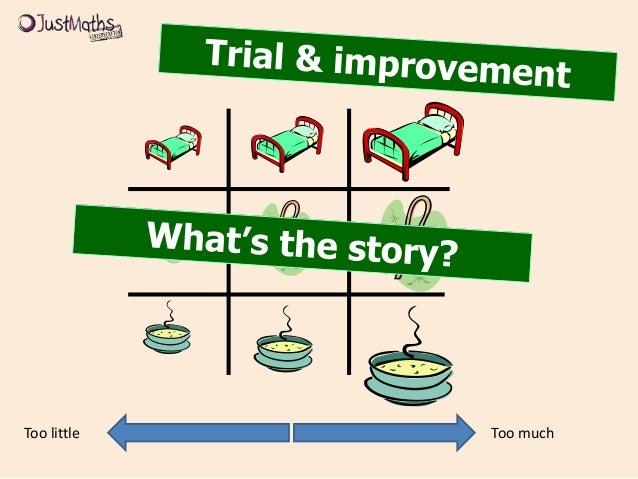
Trial and Improvement; If students know we expect them to try things out, make slip-ups and have another go, their perception of being stuck is likely to turn to curiosity. Weave trial and improvement into lessons by, for example:–
Include a trial and improvement success criterion when asking students to complete an activity or create a piece of work. For example: ‘I want to see evidence that you have tried and improved at least a couple of different layouts before settling on…’
Include a designated focused trial and improvement time in lessons; time to test out ideas. Use scrap paper, mini whiteboards or rough books. Include opportunities for discussion to encourage editing, refining and clarifying of thinking
Mark the working out that students do. Extend this common in maths idea across the curriculum.
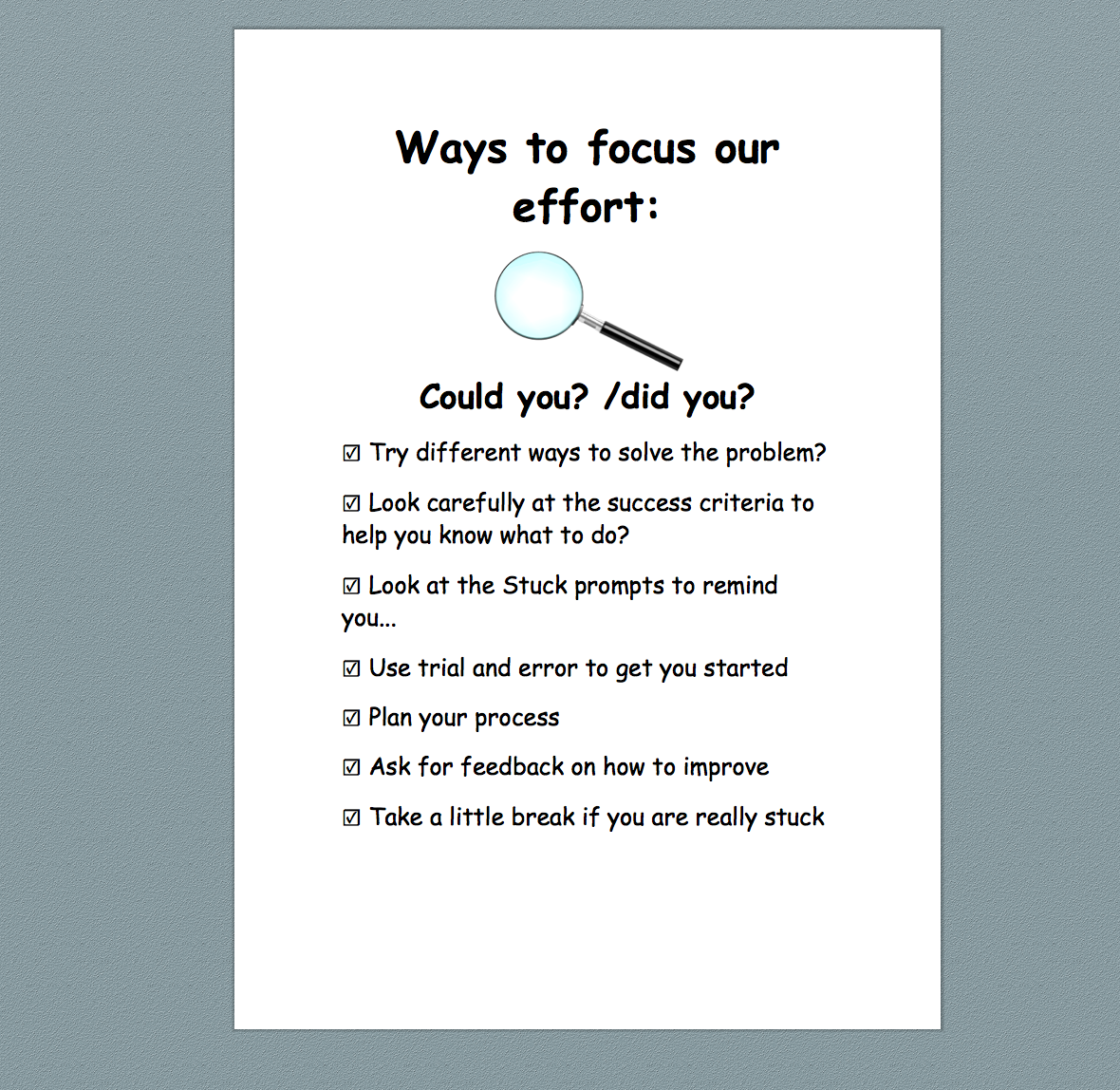
Effort is a word that teachers use frequently, but what does it mean? How might students decode this and begin to do it purposefully?
Explore what is meant by ‘effort’ with your students, and discuss with them the ways in which they might apply it.
Encourage them to come up with a definition of effort and specific examples of what it might look like in the classroom – for example by;
trying different strategies to solve a problem,
using a Visible Thinking Routine (VTR)
aiming to achieve challenging goals, or
using different un-sticking techniques when something is tricky.
paying attention to whoever is speaking
Targeted Effort is now seen as a path to mastery. Students need to be aware of a connection between effort and improvement; that the sort of effort being used is causing their improvement. This is why it is important to give effort meaning. Meaning often underpins motivation which in turn drives behaviour.
C. Use
Enable students to select their own levels of challenge
Provide tasks that are designed to offer low, medium and high challenge (or cool, spicy, hot.) Allow students to decide on the level of challenge that they wish to undertake, and use it as an opportunity to encourage them to aim high.
Use the Nando’s Peri-ometer as a visual aid to support the ranking of tasks by level of challenge, and allow students to select the level of challenge that they wish to undertake.
It’s the hard parts in learning that can cause demotivation in students accompanied by a greater likelihood of distraction. Students and teachers need to learn how best to cope with them.
Good work on the hard parts is a structural challenge for teaching as well as learning. We need to build in versions of ongoing assessment but assessment that is not concerned with marks /grades or evaluating the the how of learning. This is assessment designed to feed into the learning process and make the learning stronger. It’s possible to organise the rhythm of learning so that it embraces;
deliberate practice
assessment focused on understanding
peer and self assessment
communicative feedback
Teachers need to anticipate where the sticking points in the content are likely to be, the troublesome knowledge, and then ask;
what standard ritual ways of thinking might get in the way?
what do students know already that they might not have linked to this topic/knowledge/task?
what is getting in the way of them thinking differently about this content to be able to assimilate it?
what might they need to unlearn in order to relearn this content?
which aspect(s) of the content is conceptually difficult
Here are researched ways of structuring work on the hard parts into the rhythm of the learning.
Vary practice activities and conditions
Interleave rather than block practice
Break down complex problems
Use low stake tests/quizzes with students
Encourage students to self test
Offer clues rather than solutions
4. Reflect on
Help students to know themselves as learners
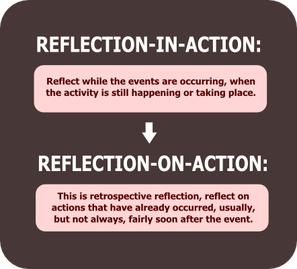
Self talk phrases to use when monitoring while still doing something. Reflection in action:
What’s happening?
What am I seeing /noticing?
How am I feeling / thinking about that?
What else is happening?
What’s changing?
What’s going best/well?
Do I need to do anything about any of this?
Self talk phrases to use when reviewing the results of learning. Reflection on action:
What’s the most important thing that’s happened? Why?
This routine helps students to reflect on how and why their thinking/understanding is changing.
Remind students of the topic you have been working on. Ask them to respond to each of the sentence stems: I used to think…, Now, I think…
Alternatively ask students to write down their views at the beginning of a topic. Invite them to revisit & update their answer during and at the end in light of what has been learned.
Or, at the beginning of a lesson ask students to write down what they understand by a particular term that will be explored in the coming lesson (e.g. Phrase (English); Proof (Maths); Power (Science) etc). At the end of the lesson, ask them to write down what they now understand by the term.
5. Improve on
Design stretch challenges
When you design what we might call ‘stretch challenges’—ones that are designed to build your students’ relish for difficulty— it’s useful to ask yourself the following questions:
How can I construct a problem-solving activity to enable students’ understanding of xyz content without telling them?
How can I intrigue them with something that is open to several interpretations?
What could I say/do/show to stimulate their curiosity?
How can I make this grab their attention…visually and aurally?
How long shall I allow them to stay stuck before I ask them how they are thinking?
If they are well and truly stuck, what can I offer as a nudge to get them thinking differently that doesn’t give the answer away?
Will I leave it as a problem hanging in the air to which we will return later?
When will I ask them to make links between the challenge, and what and how we are learning in this lesson?
Clicking on the link in any cell takes you to 5 related classroom activities.
Finding learning challenging is part and parcel of learning. Indeed when learning isn’t challenging it usually means we’re practising / consolidating what we can already do rather than breaking new ground. As learners we all come across challenges that cause us to think hard – the question is whether we are excited by the prospect of rising to the challenge, or daunted by the prospect of not being able to do so.
Having practical strategies to help us cope with challenge will lead us to think ‘Great, this is tricky and I’m going to give it a go’ or ‘Oh dear, this is too hard for me, I’ll give up’.
About Say
What you’re aiming to achieve is to use a learning language that gives students more control of their learning.
This involves talking about the ‘how’ of learning; making learning the object of conversation. The way you talk about learning in the classroom creates a powerful linguistic environment that teaches your students the best of what we know about learning. The language of learning helps students to discuss, understand, and become conscious of using their learning behaviours.
Engage your students in being able to rise to a challenge by:
Helping students to recognise possible risks in challenging activities.
In prompting learning your classroom talk is all focused on the process and experience of learning itself. Sometimes your comments encourage students to pay attention to how they are learning. Your comments ask them to slow down and notice and appraise the strategies and steps they are using along the way. E.g. “What would have made this easier for you? Where else could you use that?” This helps students to become more reflective and thoughtful about their own learning.
A. Introduce
Reframe challenge and mistakes
From ‘Challenge’ to ‘Interesting challenge’.
From ‘It’s hard’ to ‘It’s tricky’.
‘Tricky learning builds my brain.’
From ‘I can’t do it’ to ‘I can’t do it yet’.
‘I don’t know how to’ becomes ‘I’m learning how to’.
Use phrases like:
Finding it hard is the most interesting place to be. It’s where real learning begins.
Mistakes can be the signposts to success.
How will you feel when you finish that?
What can you learn from that little mistake?
You look as though you are really enjoying puzzling over that.
B. Model and explore
Model how you might think about challenges:
Things I could ask myself
what is the challenge about?
what is it asking me to do?
have I seen one like this before?
how did I do that one?
were there any tricky bits?
can I remember how I tackled them
How I could check out my feelings
do I feel I can do this?
will it matter if I get this wrong?
no, I can always try again
how will I make sure I stay positive?
I don’t need to feel negative about this because I am learning how to do this
Encourage pupils to think things through to make the challenge work
can I spot the key words or symbols here?
what might the end result look like?
what’s the first step?
and what’s the next step?
what could I do if/when I get stuck?
what’s the best way round this tricky bit?
I could do…….
or I could try….
which would be best?
Oh! I remember this idea from…
and so forth
C. Use
Visible Thinking Routine
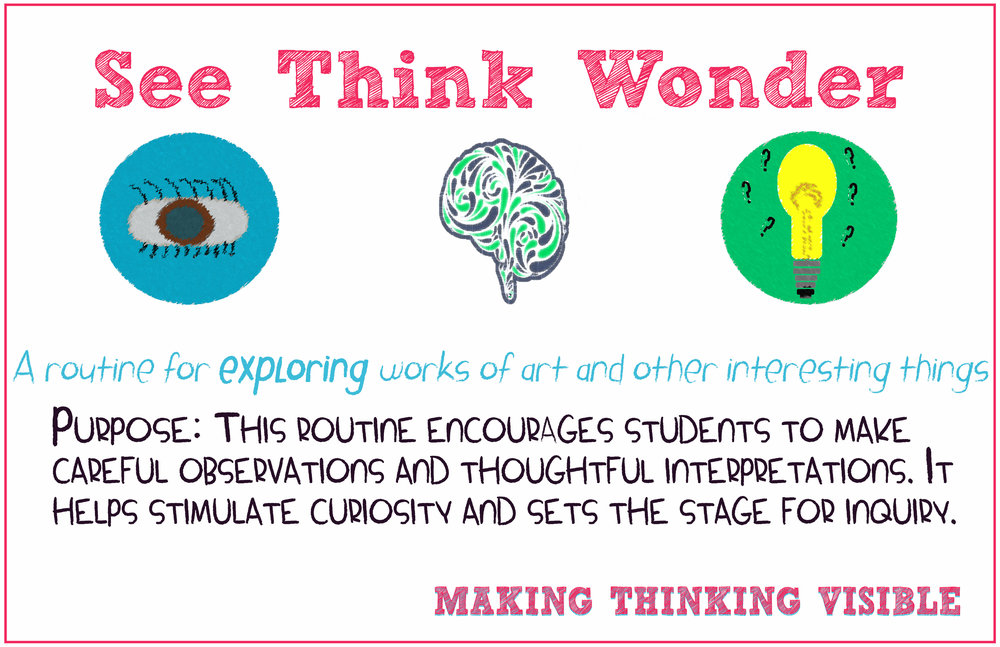
See Think Wonder is a Visible Thinking Routine that encourages students to:
notice attentively and make careful observations (See),
make thoughtful interpretations; what they are noticing; make links to what they know; distil the important bits (Think)
ask a question about what has been noticed (Wonder).
This routine helps stimulate curiosity and sets the stage for inquiry. Use it when you want students to think carefully about why something looks the way it does or is the way it is. It’s useful at the beginning of a new unit to motivate student interest or try it with an object that connects to a topic during the unit of study. The routine works best when a student responds by using the three stems together at the same time, i.e., “I see…, I think…, I wonder ...
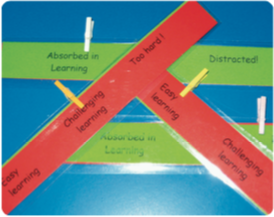
Strips of laminated card and a peg can put pupils in charge of their learning a little more. Labelled ‘Easy learning’, ‘Challenging learning’ and ‘Too hard’ on one side, pupils use them to let you know whether you are meeting their learning needs or if they could do with more extension or support. It is powerful when learners realise that challenge is an essential element of their learning; that finishing easy tasks quickly does not signal cleverness but indicates time-filling rather than real learning.
Make use of this type of resource routine in your classroom. It helps shift the responsibility for learning to the learner.
For the teacher, it provides valuable, instant feedback. For the child who is on ‘easy learning’, prepare to inject more challenge; for the child on ‘challenging learning’, prepare to intervene if it becomes too difficult; for the child on ‘too hard’, explore whether that is really the case or whether a pointer in the right direction might bring it back to ‘challenging learning’.
E. Improve on
Offer constant reminders
Learning mats are A4 laminated sheets that show various aspects of a learning habit you want pupils to develop. They can be kept on desks/tables or as part of a wall display (as shown). Use them during lessons as prompts to promote use. Refer to them at the end of a lesson to assess which were used, which worked and why.
Clicking on the link in any cell takes you to 5 related classroom activities.
Finding learning challenging is part and parcel of learning. Indeed when learning isn’t challenging it usually means we’re practising / consolidating what we can already do rather than breaking new ground. As learners we all come across challenges that cause us to think hard – the question is whether we are excited by the prospect of rising to the challenge, or daunted by the prospect of not being able to do so.
Having practical strategies to help us cope with challenge will lead us to think ‘Great, this is tricky and I’m going to give it a go’ or ‘Oh dear, this is too hard for me, I’ll give up’.
About Give Away
What you’re aiming to achieve is to give your students a more active role in their learning.
This involves offering them more opportunities to decide what to do, to ask more questions, to learn together with others and to actively learn by reviewing their own experience. This shifts how you relate to your students; gradually sharing more of the responsibility for learning with them. Shaping them to become self-regulated learners.
Engage your students in being able to rise to a challenge by:
Nudging students to feel comfortable with making mistakes.
Devolving responsibility for learning is about making learning a shared responsibility; making the classroom a learning community where everyone learns from each other and become more confident as learners as a result. It involves letting students do more of the learning; to become more active in the learning process. Active learners are not only offered more opportunities to decide what to do, but are also actively learning through the explicit review of their own experience.
A. Introduce
Reframe making mistakes: putting them in a positive light.
You’re not just putting a positive spin on mistakes, you are giving students a different way to think about them. It’s about turning all the negative connotations of mistakes into being positive and useful. Thus it leads to improvement and development in both learning outcomes and students’ learning behaviours.
In making this shift think about:
how you would talk about mistakes
how you would offer feedback on mistakes
how you would change students’ views of themselves as learners
how you would display and show that you value mistakes
how you would describe the purpose of mistakes
how you would change students’ language about mistakes
B. Model and explore
Model tackling difficulty
Challenge demo
Show students how you personally tackle things you find difficult, and what strategies you have for doing so, by demonstrating a piece of tricky learning. The idea is that sharing these experiences encourages students to imitate your approaches.
One of the first ways of surfacing learning – putting it on show – is to focus on how you are modelling being a good learner to students. Modelling is all the ways in which teachers demonstrate how they are a learner too; a confident finder-outer, a confident trier-outer.
Take your students behind the scenes of learning and share with them some of the uncertain thinking of learning.
Learning aloud is a good place to start: take students through how you would work out a problem. Modelling the thought processes (including emotional) that learners go through is important because a lot of the skill of learning only manifests itself in the inner world of the learner.
Expose the thinking, feeling and decision making of a learner-in-action to help students actually see and hear how learning works.
C. Use
Reflecting on challenge after the event
Draw a thermometer on the wall, with a scale from overstretched to low or coasting. Work with the class to describe the various levels. High might read:
“I took the step to try something just a bit harder than before.
I worked on it until I could do it and understood it clearly”
and Overstretched might be
“This was a few steps too far … next time I will chose a more manageable task.”
Talk to children about the degree to which they have felt stretched and ask them to move photos of themselves up and down the scale. Use it to stimulate discussion about sticking with tasks and understanding when it is not wise to do so.
This activity helps students understand risk and challenge. It is worth routinising this until students get the measure of it.
D. Reflect on
Monitor taking responsibility
A Learning Mat is a simple tool to encourage students to become more self-aware of how they are using a learning habit. Basically, it’s an A3 or A4 laminated sheet that is kept on tables or used as part of wall display. It shows various aspects of a learning habit. Students refer to them during lessons, using them as prompts about the finer aspects of a learning habit that are being stretched. They help students to be able to join in meta-cognitive talk.
Click below to download a PDF copy of the above mat.
Expect students to analyse their own mistakes and create their own feedback
Share assessment criteria with (older) students and ask them to:
assess/comment on the (imperfect) solutions you provide. Invite them to produce improvements based on their own feedback.
require them to assess/comment on their own work, and amend it if necessary, before submitting it.
Frame your written comments as questions to which your students are required to respond.
“What do you think you need to do to make this section more convincing?” is preferable to “This section needs more explanation”, because it moves responsibility to the learner to identify what more needs to be done. Essentially, this is about helping feedback to enable students to self-regulate their own learning.
Clicking on the link in any cell takes you to 5 related classroom activities.
Getting distracted or losing focus is an inevitable part of learning. As learners we all come across distractions, both internal and external. When we’re hungry, tired or anxious we find it hard to concentrate. Equally if there’s too much going on around us or something unexpected happens, we may lose focus and get side-tracked.
Being able to avoid distractions or get ourselves re-focused is as much about how we react emotionally as it is about having the practical strategies to work out what to do. Students sometimes need assistance to cope with such situations and ensure their engagement with learning continues.
About Display
What you’re aiming to achieve is to ensure that the look and feel of your classroom, its walls and reward systems, serve to strengthen your students’ learning habits.
This involves giving more attention to learning rather than performance, where more traditional ideas of classroom learning are flipped or re-defined – where being stuck is seen as interesting and mistakes valuable, where effort, questioning and taking risks are defined, attended to, acknowledged and praised. This classroom culture serves to make learning visible and public; one in which learners are being coached to become meta-learners.
Engage your students in being able to manage their distractions by:
Building students’ understanding of overcoming distractions and managing their own learning climate.
The negative value of too much general ability praise, uncovered by Carole Dweck in her research into Growth Mindsets, has caused teachers to think differently about giving praise. Suggested shifts in giving praise include:
Praise the effort, not the ‘ability’;
Praise the process not the outcome;
Praise in specifics of learning behaviours, not generalities;
Praise privately;
Praise authentically, and not too much;
Praise should be seen as separate from feedback; ( praise is evaluation)
If using stickers, awards, treats etc (concrete tokens of recognition), make sure they’re given for accomplishing specific process or product goals.
A. Introduce
Photograph and display students focusing on learning
Have your camera at the ready and capture moments where you see students focusing intently on what they are learning. Make a big fuss of this focused behaviour, explore with the students what they have been learning and what ‘focusing’ felt like. Regularly encourage students to think about a moment when they became really absorbed and how it felt. Celebrate the unusual ones by displaying them on a ‘focus or absorbed wall’. Students will develop an interest in their ability to become absorbed.
B. Model and explore
Raptometer.
Make a scale on the classroom wall to indicate degrees of absorption. Students or adult observers (e.g. Teacher Training student, Teaching Assistant) observe groups and/or individuals as they are working and move a label with a student’s name or picture up and down the scale according to how absorbed they perceive individuals are.
Use as a prompt for discussion about:
how students have become absorbed at different stages of a lesson;
what the characteristics of absorption are;
what it feels like to be absorbed;
how to be more absorbed in the flow and how to avoid distractions.
Switch the thinking from managing distraction to becoming absorbed and attentive.
C. Use
Ways to help your memory: a checklist
Your students are using their working memory all the time during lessons, but working memory is limited to about 7 items at a time – any more than that and the brain starts to freeze up, and engagement drops. We sometimes say ‘I don’t have the head space for that’. Students will need to know when they are reaching capacity, and how to cope when they do.
Fortunately, freeing up working memory is relatively simple.
jotting things down as notes,
talking through a process out loud,
creating a mind map
making a set of lists to group disparate pieces of information into larger lumps
splitting a task down into smaller tasks
Putting these ideas into a Working Memory checklist does the same job as a Stuck prompt…it reminds students about what they could do when their heads are in danger of getting confused; too full of ideas or too much to do.
D. Reflect on
Display students’ self-monitoring of distraction
A learning powered primary school near Milton Keynes captured student’s own assessment of managing distractions each week
They have developed a 5 point scale describing different levels of distraction
Each student crafted a personal logo, known only to them and the teacher. Each week they would stick their logo on the level of distraction they estimated they had achieved across the week.
These assessments were recorded by school and set against progress data
Perhaps not surprisingly strong positive correlations were found…being able to manage distractions better positively correlates with increases in progress! Now there’s a surprise.
E. Improve on
Display and celebrate achievement of managing distractions
Ensure that your display walls include pictures and explanations that illustrate what you have been exploring about distraction and how to avoid it.
Here we see a ☆☆☆ Distraction manager (explained in Distractions / Things to do every day)
Encourage students to write on a separate note how they managed their distractions, and display the note with the 3* managers.
Make this a constant feature of your classroom
Clicking on the link in any cell takes you to 5 related classroom activities.
Getting distracted or losing focus is an inevitable part of learning. As learners we all come across distractions, both internal and external. When we’re hungry, tired or anxious we find it hard to concentrate. Equally if there’s too much going on around us or something unexpected happens, we may lose focus and get side-tracked.
Being able to avoid distractions or get ourselves re-focused is as much about how we react emotionally as it is about having the practical strategies to work out what to do. Students sometimes need assistance to cope with such situations and ensure their engagement with learning continues.
About Do Every Day
What you’re aiming to achieve is to design and deliver learning opportunities that strengthen students’ learning behaviours.
This involves making becoming a better learner the purpose of classroom; how classroom activities and routines feed learning habits. Learning challenges are designed to enable students to understand both the content and the process of learning. This dual focus stretches students’ use of their learning behaviours in order to explore and understand content. It’s not just about ‘doing’ learning but reflecting on the process to create self-regulated learners.
Engage your students in being able to manage their distractions by:
Enable students to manage their own learning climate.
To gain emotional engagement activities are designed to:
be challenging and where being stuck and confused are regular and fruitful experiences.
give students the opportunity to ‘learn what to do when they don’t know what to do’ – to work on wild tasks, rather than tame ones, where there’s plenty of scope to get lost and perplexed.
“The presence of challenging learning intentions has multiple consequences. Pupils can be induced to invest greater effort, and invest more of their total capacity than under low demand conditions.”
(Hattie, Visible Learning)
A. Introduce
Build in break states
Change the mental and physical state of the class by using music, quick games (Fizz-Buzz, Simon Says), guided relaxation, Brain Gym (Dennison, 1992), change of partner/desk/lighting, breathing exercises, or a refreshment break. Such activities refresh and relax pupils, enabling a greater degree of focus afterwards. Discuss their impact on concentration and how pupils could use them in other contexts to keep themselves on track with their learning.
Break states are a positive distraction.
Extract (above) from Building Learning Power in Action, by Sarah Gornall, Maryl Chambers, Guy Claxton. You will find lots of other ideas for all the learning behaviours.
PrimarySecondaryFor example have an intriguing picture ready on the whiteboard before the lesson starts. Students look forward to looking carefully at pictures where all is not as it seems.
B. Model and explore
Model it: for the student who is well and truly stuck, or who has taken a path that leads to a dead-end and is withdrawing from learning, try modelling the process for them. Narrate as you go, highlighting the thinking processes you are using, what you plan to do next, how you are getting yourself unstuck, and so on.
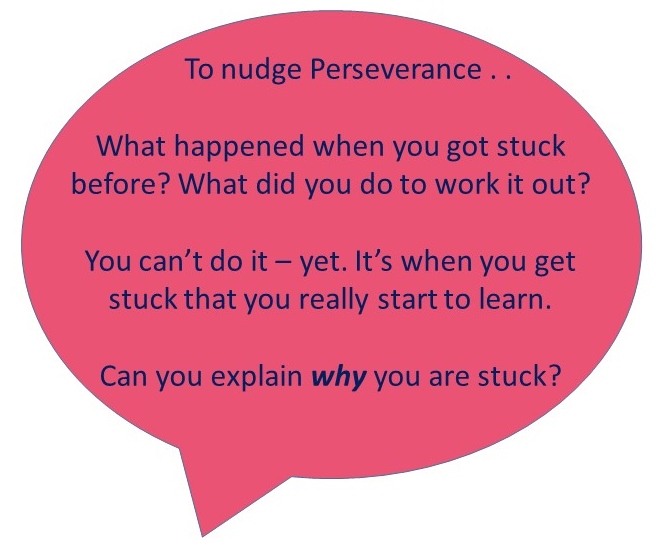
Nudge it: For students who are more resilient to becoming stuck or encountering difficulty, try using gentle nudges to get them out of the mud. “Can you think of something we did earlier that might help you?” “How have you tackled this sort of problem before?” “Would the instructions help you here?” This is far from a full-blown model of what to do, but rather prompting to a way back in to the learning.
Give clues: Some students will enjoy the added brain tease of a clue to nudge them in the right direction. “I think Newton had the right idea here…what about you?” “Perhaps it is a bit like hibernation…?” “Chapter 4 has some interesting things to say on this”
Each of these techniques provides progressively less scaffolding for the student – you will need to gauge which technique to use for each student – fragile learners who struggle with being stuck will not appreciate clue giving as it will only compound their stuckness! Similarly, students who are able to deal with being stuck well on their own will not be sufficiently stretched by the modelling approach. You are differentiating your nudging.
C. Use
Target noticing in self-assessment
A refinement of Austin’s butterfly.
Ask your students to copy a picture of a teapot (or something relevant to current learning) as best they can in 10 minutes.
At the end of the allotted time ask them to swap pictures with a partner.
Now provide students with a list of criteria against which to review the picture they have been given, but require them to select and focus their review against only one of the criteria. The list, in this case, might include: handle, spout, pattern, outline, lid. Stress that the feedback must be helpful enough to enable their partner to improve their drawing. This keeps feedback tight, focused and meaningful. It also helps students move on from potentially vague and ambiguous feedback.
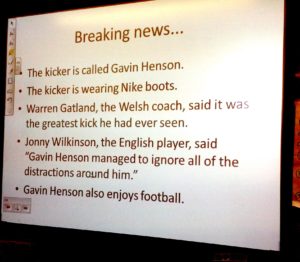
At a school in Wotton-under-Edge in Gloucestershire teachers have extended the usual idea about classroom distraction (losing focus) by using the same idea to encompass looking out for red herrings/distracting or irrelevant information in texts.
A literacy lesson revolved around a writing activity. The stimulus was a video clip of Gavin Henson, the Welsh fly-half, taking a successful kick in a famous rugby match. This was used to stimulate a deep discussion about managing distraction and how this was possible in such a public setting. What had Gavin got to do to make sure the kick was successful?
The students were then invited to write a short piece for a newspaper using the the following information. They were asked to be aware of what they thought to be the key pieces of information. But of course irrelevant information was also included.
There were 3 layered targets for this piece of writing which different groups of students understood had to be incorporated into the writing.
The following task was to consider what advice Gavin Henson would offer a learner about managing distraction. This again led to a very profitable discussion which was then captured in writing.
Throughout the lesson students recorded their thoughts about managing distraction using this format.
Needless to say this teacher is Welsh and a passionate Rugby supporter.
D. Reflect on
Start students self-monitoring their distractions
Am I a ☆☆☆ manager?
Work with students to describe different degrees of the ability to manage distractions. For example:
A 3-star manager might:
always keep focused on what s/he is learning
support other learners by helping them to manage their distractions
Use language appropriate for the age of the students.
Comment on behaviour in order to recognise and value the management of distractions.
Ask students to help each other with ideas about how to earn more stars as distraction managers.
E. Improve on
Help for working memory
Working memory is what we use for processing information in real-time. It is particularly exercised when we are learning new things, performing tasks, cogitating, questioning and so forth. Your students are using it all the time during lessons. But working memory is limited to about 7 items at a time – any more than that and the brain starts to freeze up, and engagement drops. We sometimes say ‘I don’t have the head space for that’. Students will need to know when they are reaching capacity, and how to cope when they do.
Ways to free up thinking space
Fortunately, freeing up working memory is relatively simple.
jotting things down as notes,
talking through a process out loud,
creating a mind map
making a set of lists to group disparate pieces of information into larger lumps
splitting a task down into smaller tasks
are all good techniques for giving the brain more thinking space.
Clicking on the link in any cell takes you to 5 related classroom activities.
Getting distracted or losing focus is a common part of learning. As learners we all come across distractions, both internal and external. When we’re hungry, tired or anxious we find it hard to concentrate. Equally if there’s too much going on around us or something unexpected happens, we may lose focus and get side-tracked.
Being able to avoid distractions or get ourselves re-focused is as much about how we react emotionally as it is about having the practical strategies to work out what to do. Students sometimes need assistance to cope with such situations and ensure their engagement with learning continues.
About Say
What you’re aiming to achieve is to use a learning language that gives students more control of their learning.
This involves talking about the ‘how’ of learning; making learning the object of conversation. The way you talk about learning in the classroom creates a powerful linguistic environment that teaches your students the best of what we know about learning. The language of learning helps students to discuss, understand, and become conscious of using their learning behaviours.
Engage your students in being able to manage their distractions by:
Encouraging students to recognise and overcome what distracts them in learning.
A language for learning can help you to think about how you might talk in a way that helps to cultivate learning behaviours and help students to gain a better personalised understanding of content.
You can turn any of the learning behaviours you want learners to use into sets of casual prompts or nudges to move students along in using them. For example, to nudge curiosity/questioning: “What’s odd about that? What does that make you wonder? What do you want to find out? How else could you do that?”
A. Introduce
Managing distraction phrases
Encourage students to become more aware of distractions and how they might deal with them. Use phrases like:
What might put you off?
What might get in your way?
Do you sometimes distract others?
How might they feel when you do that?
What could you do to avoid being distracted?
Where are you now on our distractions scale?
How well have you managed your distractions today?
To build up students’ understanding of distractions, use phrases like:
How did you keep going?
What could we do when we feel we are losing focus?
What sorts of things distract you most?
When are friends a distraction – or a source of inspiration?
What sorts of learning environment might be appropriate for different types of learning?
What internal distractions might we have? (tiredness, emotions, hunger, failure).
How could you let us know if we are distracting you?
You’re doing well with avoiding that distraction.
B. Model and explore
Reinforce familiarity with distractions by ranking them
Work with students to identify distractions in the classroom and to come up with strategies for reducing them. Encourage them to think about:
Straightforward concepts – e.g. people, objects, the weather, the environment.
Issues which are not clear cut, such as friends who are both a distraction and a source of inspiration, and whether fiddling is a distraction or an aid to concentration
Different learning environments that might be appropriate for different types of learning, both in school and at home
Internal distractions, such as hunger, tiredness, emotions, failure.
Once you have identified various potential distractions, ask students to rank the distractions and match them against ideas for managing these distractions. Remember to address the emotional content of internal distractions. Examples might include:
Using their imagination to take themselves to a different place, a happy place, where they can block out the distraction
Discussing how to deal with the situation with a friend so that the worry does not go round and round in their minds
Giving themselves time to laugh or cry about a situation if necessary before settling back into a task.
C. Use
Effort focusing questions
What strategies will keep you going here?
What are the things you can do to keep yourself on track?
Can you show me what really good effort looks like?
What could you look at to see if you are on the right lines?
When did you target your effort effectively?
What could you focus on next?
If you had to pick one thing to focus your effort on, what would it be?
D. Reflect on
Written feedback on managing distractions
By devolving responsibility for learning to pupils our job as teachers becomes one of coaching them to build their own learning habits. Habits take time to form and stick and so the type of support you offer needs to be maintained for quite a while. Open the toggle box and read Lemar’s story. It serves to reinforce the need for more encouragement and reinforcement than a single written comment if behaviours are to mature into habits.
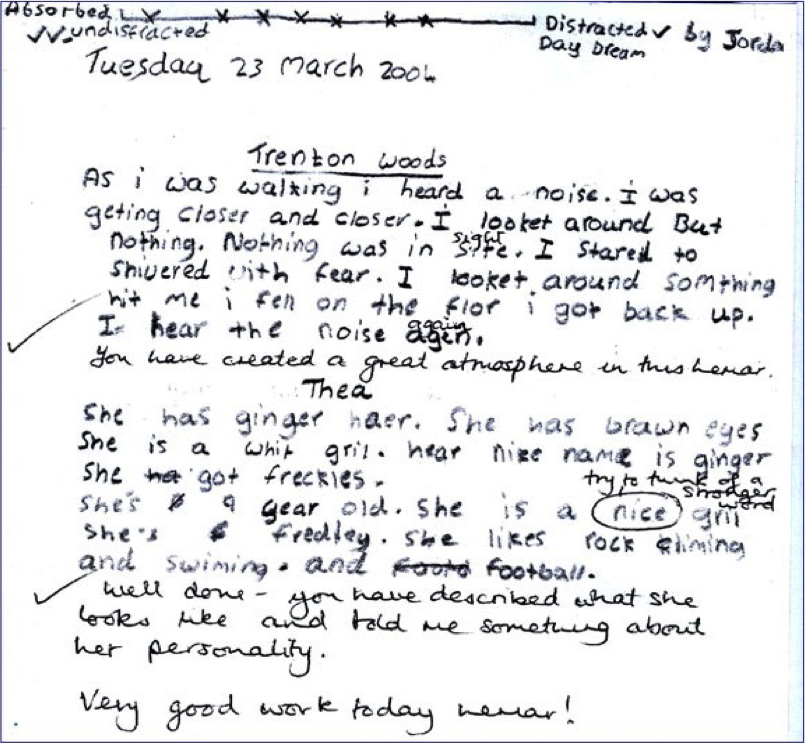
Lemar was in Yr 6, registered SEN and always distracted. He looked here and there, talked to other children and sometimes wandered around the classroom when he should have been absorbed in learning.
His teacher decided that the place to start with Lemar was managing his distractions. After talking with all the class about what distractions were the pupils came up with all manner of ways they could use to try and avoid them. One idea was a simple line on a page to record when distractions happened. (Self-monitoring)
The next day the teacher drew such a line at the top of Lemar’s page and asked him to try it out. You can see the line on the first picture and how Lemar marked it throughout the lesson. Although one could argue that the line itself was a distraction what it was actually doing here was making Lemar aware of being distracted.
On seeing his writing at the end of the lesson the teacher was astonished by the amount Lemar had managed in the time. The lines he had written represented 100% increase in volume. Note the teacher’s comment at the bottom. She acknowledges that he has indeed managed his distractions well.
A couple of days later Lemar had more writing to tackle. This time he created his own line at the top of his page….a significant breakthrough because he had seen the value of using this tactic. Here again he marks when distractions happen and even mentions his distractor Jordan! Furthermore he has completed yet more writing.
Hannah Moore Primary School
Here again the teacher comments on the writing and acknowledges that it is good work, but unfortunately she doesn’t comment on his obvious effort on managing his distractions.
If we are going to help pupils to build their own learning habits a single written comment won’t be enough, habit formation needs far more encouragement and reinforcement.
Wow! Using your distraction line today has really helped you to focus well. Feel pleased with yourself for this good effort.
E. Improve on
Feedback to nudge the skill
Process-Level Feedback Prompts (adapted from Nuckles et al, 2009)
What strategies are you using?
Are there more efficient strategies you could use?
What other Qs could you ask about this task?
Do you grasp the concept underpinning this task?
Have you done anything similar to this before?
How could you use that information to target your effort?
Has making this effort made you want to learn more?
What could you focus on next?
Clicking on the link in any cell takes you to 5 related classroom activities.
Getting distracted or losing focus is a common part of learning. As learners we all come across distractions, both internal and external. When we’re hungry, tired or anxious we find it hard to concentrate. Equally if there’s too much going on around us or something unexpected happens, we may lose focus and get side-tracked.
Being able to avoid distractions or get ourselves re-focused is as much about how we react emotionally as it is about having the practical strategies to work out what to do. Students sometimes need assistance to cope with such situations and ensure their engagement with learning continues.
About Give Away
What you’re aiming to achieve is to give your students a more active role in their learning.
This involves offering them more opportunities to decide what to do, to ask more questions, to learn together with others and to actively learn by reviewing their own experience. This shifts how you relate to your students; gradually sharing more of the responsibility for learning with them. Shaping them to become self-regulated learners.
Engage your students in being able to manage their distractions by:
Building student understanding of distractions and maintaining focus.
“The culture of the classroom teaches. It not only sets the tone for learning but also determines what gets learned. The messages sent through the culture of the classroom communicate to students what it means to think and learn well. These messages are a curriculum in themselves, teaching students how to learn and ways of thinking.” Ron Ritchhart ‘Creating Cultures of Thinking’:
A. Introduce
Raise awareness of what distracts us.
Sometimes we are distracted by people, sometimes things can get in the way.
Have a discussion about these two types of distractions (people and things) and come up with lists of the different ways we can be put off by people and by things e.g. when we break a pencil, when we don’t have the things we need etc. Talk about what we could do in different situations.
B. Model and explore
Model being distracted
Model distractions (ages 4-8)
A quick starter activity to illustrate the meaning of distraction.
Classroom layout: managing the learning environment
Being concerned with classroom layout in dealing with distraction may seem strange bedfellows, but if we think of distraction in the wider context of managing the learning environment it begins to make more sense.
Just have a look around your classroom and ask yourself:
Does it feel a calm place to be?
Are there different habitats within the classroom? e.g.A quiet thinking place, An editor’s table and chair
Is the layout quickly adaptable?
What about the walls? Do they celebrating the classroom values? Too busy/congested?
Are learning resources accessible by students? Do they know where things are? Can they get what they need, when they need it?
Do you expect students always to sit at tables? Are there any other work spaces?
Is it a distracting environment? Does it aid quiet reflection?
Is the environment theirs to manage?
Classrooms that feel like homely places to be, where there’s freedom of movement, a choice of learning spaces a sense of calm and where students feel they belong all seem to help concentration levels, lessen stress and focus effort.
An environment that’s theirs to manage
Clicking on the link in any cell takes you to 5 related classroom activities.
Getting stuck is a natural part of learning. We all come across blocks and obstacles, go into blind alleys, get flummoxed by a vast range of possibilities, or simply don’t know enough to decide what to do next.
Being able to get ourselves unstuck is as much about how we react emotionally as it is about having the practical strategies to work out how to overcome it. Being able to manage an effective way out of being stuck is a critical part of being resilient.
About Display
What you’re aiming to achieve is to ensure that the look and feel of your classroom, its walls and reward systems, serve to strengthen your students’ learning habits.
This involves giving more attention to learning rather than performance; where more traditional ideas of classroom learning are flipped or re-defined – where being stuck is seen as interesting and mistakes valuable, where effort, questioning and taking risks are defined, attended to, acknowledged and praised. This classroom culture serves to make learning visible to learners; one in which learners are being coached to become meta-learners.
Engage your students in being able to deal with being stuck by:
Building their comfort, understanding and curiosity about getting stuck.
“The hallmark of successful individuals is that they love learning, they seek challenges, they value effort, and they persist in the face of obstacles.” (Carol Dweck, 2000)
`Stuck’ is promoted as an interesting place to be rather than a place of shame. Getting stuck, coming against a brick wall, not knowing what to do next is a natural part of learning.If you don’t get stuck the learning is probably not challenging enough. Being stuck is where real learning begins. Pupils who never experience being stuck or struggle with learning can become fragile learners unable to cope emotionally with the inevitable difficulty of learning and life.
Viewing learning as interesting, challenging, stimulating and worthy of effort needs to feed into changing pupils’ fixed mindsets
A. Introduce
Display stuck prompts in all shapes and sizes
These might include:
Quick reminder sheets on group tables
A special Stuck Table with plenty of resources
Stuck Prompts
Containers ( e.g. wellies) holding laminated reminders of things to do. Spots=numeracy. Stripes=literacy
Stuck Walls with multiple displays of Stuck Posters, ‘stuck-of-the-week’, the Learning Pit and so forth.
During lessons students post up stuck problems and other students suggest solutions (see below)
Ensure students are involved in creating stuck prompts.
B. Model and explore
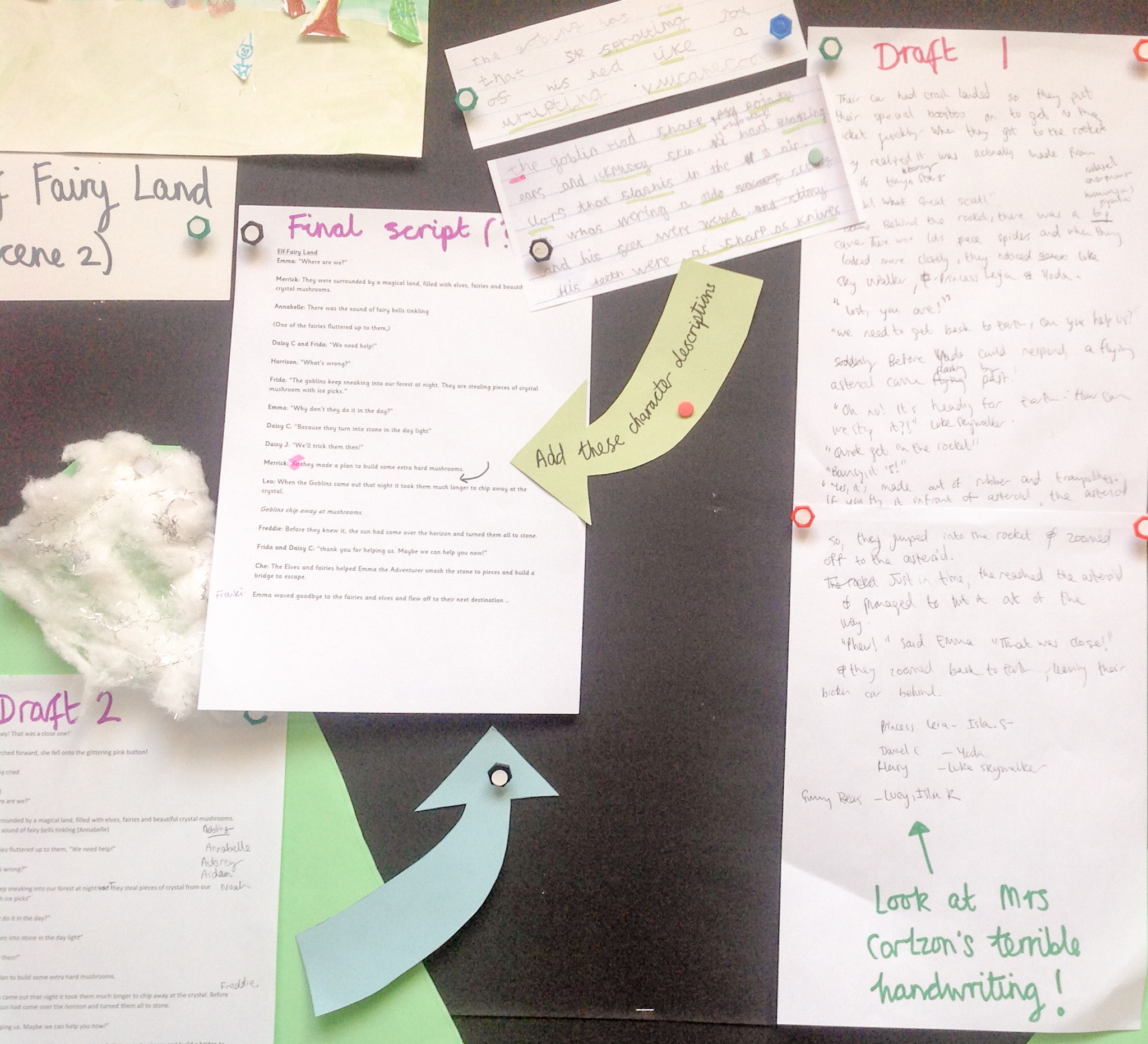
Display work in progress
Ensure that your display walls include early drafts of work which show where students got stuck. Encourage students to write on a separate note how they got unstuck, and display the note with the work.
Make this a constant feature of your classroom
It’s important that students understand learning as a process rather than an event, and that stuckness is a prominent part of that process. From scribbled notes to final copy can be a long and eventful journey. Learning routines along the way include capturing rough ideas, adding to them, trying again, trying another way, re-thinking, refining and completing. Such routines lead students to see that it’s not about everything being perfect or easy from the start.
C. Use
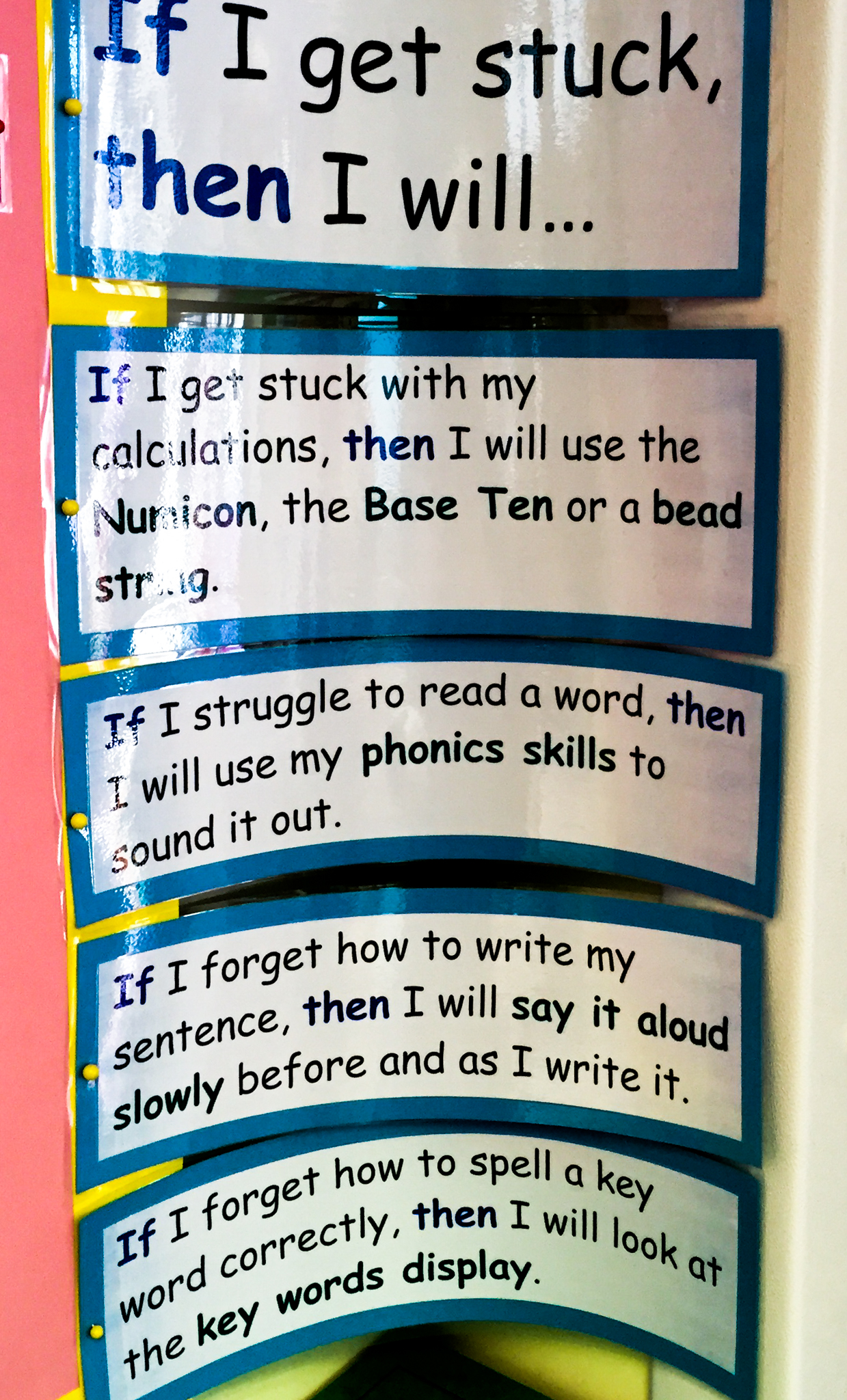
Put ‘If-then’ planning into action to make stuck solutions more specific and personal
If we want students to change their behaviour we need to help them to think much more closely about the ‘hows’ and the ‘whats’.
Motivation research proposes an effective solution to this called ‘if-then’ planning.
‘Ifs’ are the situations you want to remind yourself about. In the case getting unstuck it’s useful to list all the sorts of places this tends happen
‘Thens’ are what you will do about something; the action you will take. Brainstorm a list of the ‘what we might do in response to the Ifs’.
Research on motivation and goals from Harvard University shows how our brains work to achieve our goals. Basically it says that goals need to be very clear and our brain ignores a goal if it’s unclear about what to do. Brains act on goals only when what to do is clear.
So, goals like ‘Lose weight’ or ‘Exercise more often‘ or even ” I want to feel ok about being stuck‘ are too nebulous. They beg the question ‘how’ or ‘what do I do?’
How to use ‘If-then’ planning
When setting a goal you need to specify not only what you will do but also where and when you will do it.
If (or when) [___situation__], then I will do [___behaviour__]
So going back to our goal about losing weight, we need to know much more about the ‘how’ and the ‘what’ and the ‘how to’ of losing weight.
An If-then statement or goal might be ‘If I get the pudding menu, then I’ll ask for coffee’.
This may sound a bit cumbersome to start with but research suggests far more goals are achieved by using ‘if-then’ planning. And the clever bit is that this builds self-talk at the same time. You do what you are telling yourself to do.
The ‘if-then’ plan succeeds because the situation and the action become linked in the mind. The brain recognises the situation as an opportunity to advance the goal. When the situation is detected action is initiated automatically. “If-then’ plans become “instant habits”.
Goal: I want to feel okay about being stuck
If…
…I get stuck in my reading (all the stuck places will need specifying)…
…I get stuck in Maths (specify how you might get stuck)…
…I get into tricky situations in the playground (specify tricky)…
Then…
…I will (Some specific statements to unstick themselves)
D. Reflect on
Reflect on overcoming being stuck
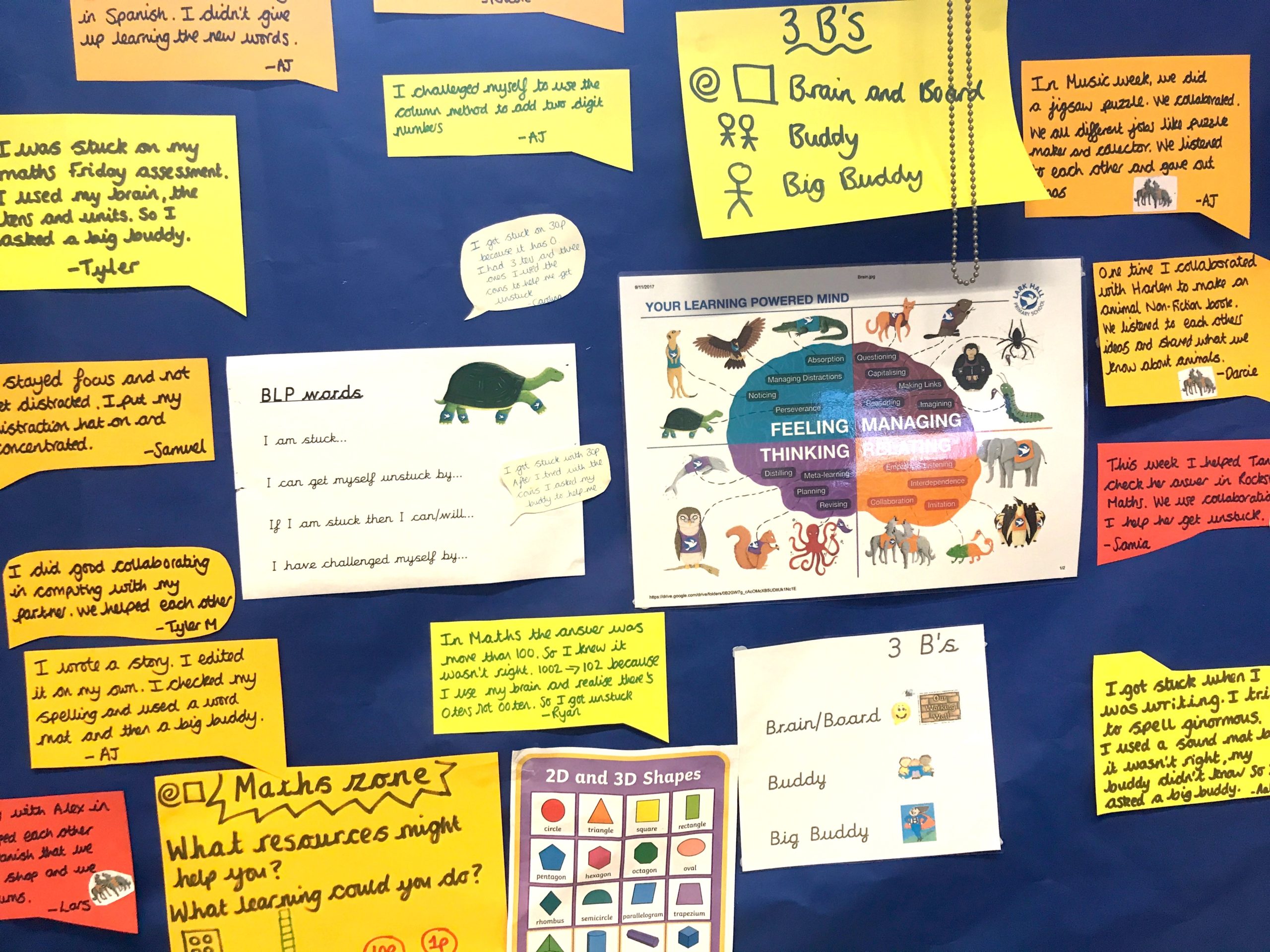
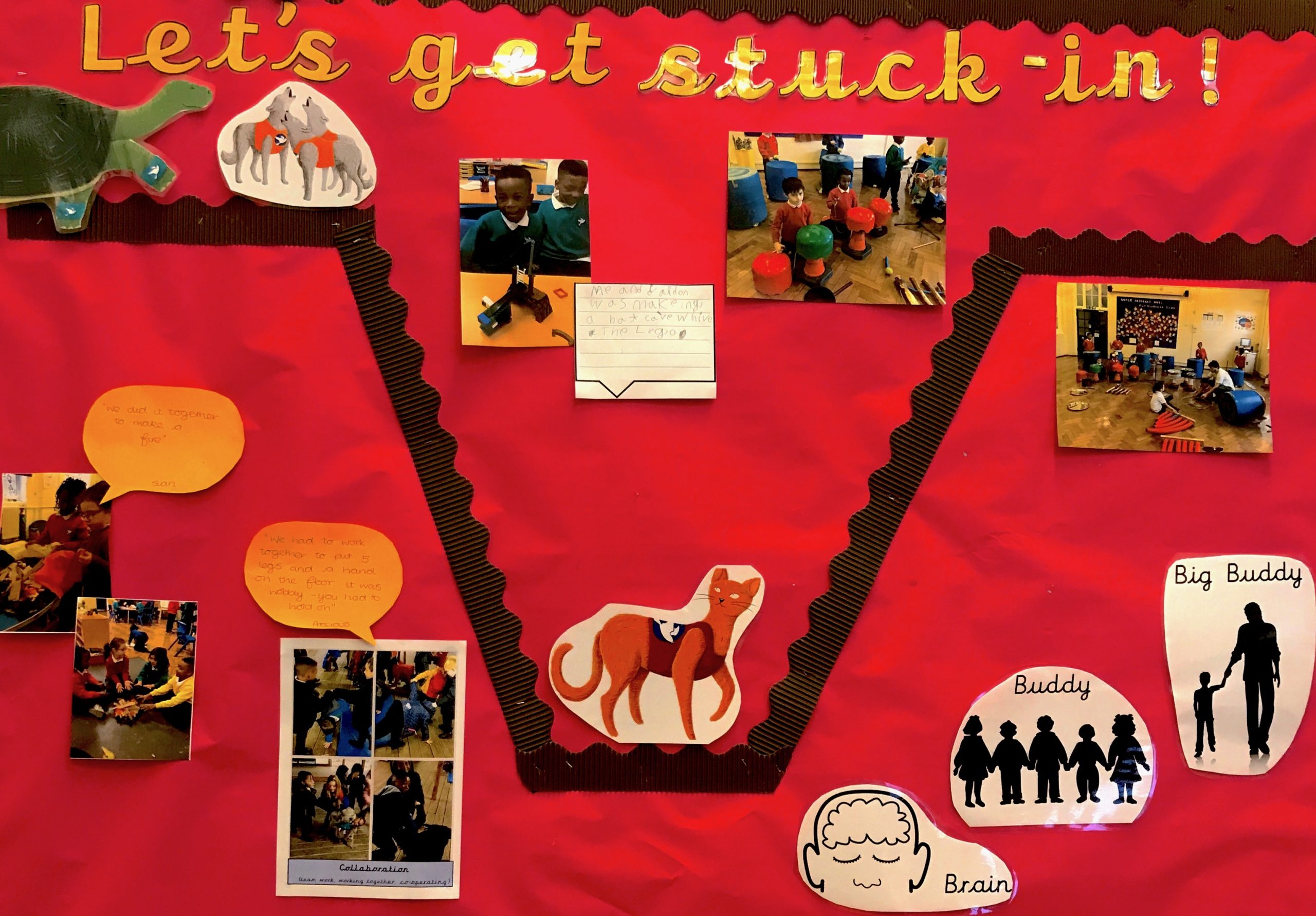
If we want learning behaviours to stick and become habits we need to become aware of using them, recognise when you do it and reflect on whether or why it worked. When the pupils in this London school were becoming aware of being stuck and what to do about it they were encouraged to write about their experiences. But not only that…these short accounts were given a status of being displayed on the wall. It’s an encouraging display of a developing disposition; it’s self-regulation in the making.
E. Improve on
Recognise growth in the behaviour
Learning behaviour sticker books
You might allocate pages in the back of your students’ learning journals/school diaries where they collect stickers which indicate improvement in their learning behaviour.
Clicking on the link in any cell takes you to 5 related classroom activities.
Getting stuck is a natural part of learning. We all come across blocks and obstacles, go into blind alleys, get flummoxed by a vast range of possibilities, or simply don’t know enough to decide what to do next.
Being able to get ourselves unstuck is as much about how we react emotionally as it is about having the practical strategies to work out how to overcome it. Being able to manage an effective way out of being stuck is a critical part of being resilient.
About Do every day
What you’re aiming to achieve is to design and deliver learning opportunities that strengthen students’ learning behaviours.
This involves making – becoming a better learner – the purpose of classroom; how classroom activities and routines feed learning habits. Learning challenges are designed to enable students to understand both the content and the process of learning. This dual focus stretches students’ use of their learning behaviours in order to explore and understand content. It’s not just about ‘doing’ learning but reflecting on the process to create self-regulated learners.
Engage your students in being able to deal with being stuck by:
The classroom becomes a place where young people learn that to struggle with a problem is ultimately satisfying and brings its own rewards.Learning is always an emotional business and learning how to manage this is best in the course of learning itself. Emotional engagement is a prerequisite of powerful learning, it’s what gets you interested enough to be willing to put in the effort to get better and see the value of pushing yourself. So lessons are designed to make use of different kinds of learning behaviours and to give those behaviours a good work-out.
A. Introduce
Plan to get students stuck
Start some lessons with something like:
‘In this lesson I want to make sure that you do get stuck’.
‘When you get stuck take a look at the unsticking prompts on your table to see if these help you to get unstuck’.
‘Later we will spend a few minutes talking about what we learned from being stuck and decide which unsticking idea worked best.’
The explicit message is that students need to expect being stuck during any lesson. The implicit message is that being stuck is a good thing – something you want to see. Using this technique regularly means students come to accept being stuck as a natural part of learning. It begins to build their curiosity about the why and possible patterns to stuckness.
B. Model and explore
Use routines that put responsibility on students
C3B4Me can be used in conjunction with the stuck posters displayed in the classroom. Students should try three strategies from their stuck posters before seeking help from the teacher.
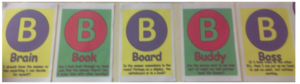
Another alternative to the stuck poster, BBBBB invites students to:
use their Brain
check in “the Book” (or other resources). This implies that students are allowed to get out of their seats to find these resources, and that those resources are available.
look on the (White/Smart)Board
ask their partner/friend/another student (“Buddy”)
before finally turning to the ‘Boss’ (teacher) for help.
C. Use
Build thinking routines into lessons
Try the Visible Thinking Routine:
What do I know?
What do I need to know?
What techniques do I have for bridging the gap?
This helps students to develop their own internal dialogue for combating stuck-ness. It encourages students to take stock of what they already know or can do, the puzzles, questions and difficulties that remain and, critically, how they might resolve them. Best used after students have started to study something but before they have got it completely sorted. It places responsibility on them to think through the best way ahead.
VTRs are, as they say, simple routines that apply across a wide range of subjects and contexts, and which require students to think in a variety of different ways, that are used so regularly by teachers that they become woven into the fabric of the classroom culture and progressively hard-wired into the thinking practices of students. These are ways in which different ways of thinking can become routine in classrooms. They become part of the learning culture.
To be effective such routines need to be;
Direct, guide, support, encourage thinking
Short, memorable, few steps
Used over and over again
Useful in a variety of contexts
Facilitate connections, generating ideas, using knowledge
D. Reflect on
Reflect on dealing with being stuck
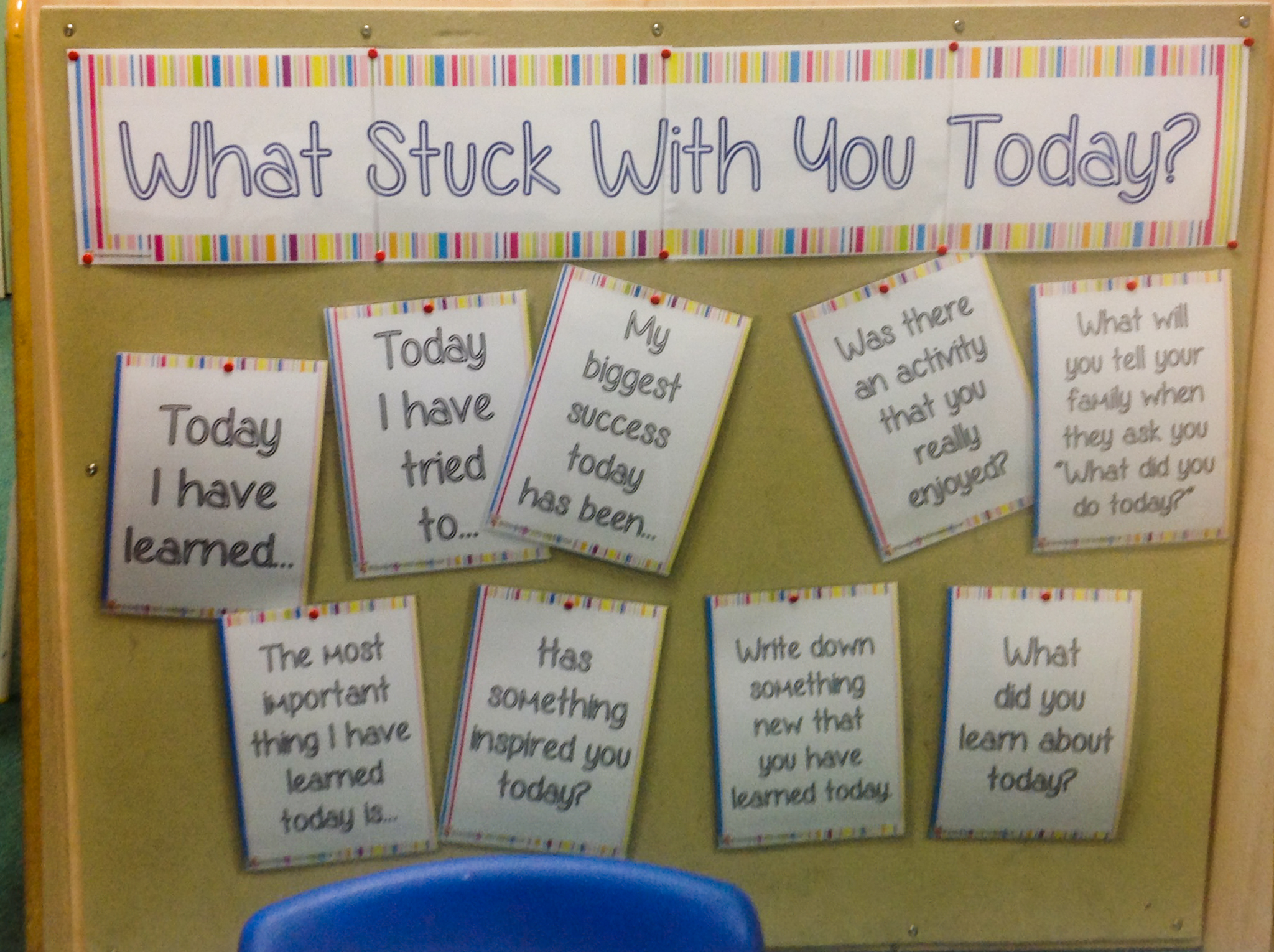
Make reflection on being stuck part of the daily or lesson routine. This display from Miriam Lord primary school in Bradford shows a range of discussion cards which the teacher uses with specific groups of students during or at the end of a day.
The questions include;
Today I have learned….
Today I have tried to…
My biggest success today has been….
What will you tell your family when they ask ‘What did you do at school today’?
The most important thing I have learned today.
Has something inspired you today?
What other sorts of questions would you include in such a selection for your classroom? Something about asking good questions or how they got themselves unstuck would be useful. This exercise makes a good start on introducing meta-cognitive behaviours more generally.
Getting stuck is a natural part of learning. We all come across blocks and obstacles, go into blind alleys, get flummoxed by a vast range of possibilities, or simply don’t know enough to decide what to do next.
Being able to get ourselves unstuck is as much about how we react emotionally as it is about having the practical strategies to work out how to overcome it. Being able to manage an effective way out of being stuck is a critical part of being resilient.
About Say
What you’re aiming to achieve is to use a learning language that gives students more control of their learning.
This involves talking about the ‘how’ of learning; making learning the object of conversation. The way you talk about learning in the classroom creates a powerful linguistic environment that teaches your students the best of what we know about learning. The language of learning helps students to discuss, understand, and become conscious of using their learning behaviours.
Engage your students in being able to deal with being stuck by:
Assisting students towards understanding why they are stuck.
The more richly children come to relate their own learning the more they see and take hold of their own role in it. Deep talk about learning is what sets learning friendly classrooms apart. Learning and how it works isn’t just talked about at the beginning of a term or year but is embedded in the everyday conversations of the classroom.
Conversations will include noticing things about learning:
What do we mean when we say learning?
When and where is it best?
What helps you to do it?
How does it feel? What hinders your learning?
It goes on into encouraging students to talk about their learning:
What made it so good?
What did you contribute?
How did you make sense of that?
And later students are enabled to become meta-cognitive learners with questions such as:
How do you plan to go about learning?
How will you monitor how it’s going?
How can you review how your learning has gone?
A. Introduce being stuck
Talk to re-frame being stuck
Try this type of shifting-mindset language:
Being stuck is a good place to be.
Getting stuck means your brain is working hard on something new.
When you learn new things your brain gets bigger.
If you don’t get stuck you’re probably not learning anything new
Getting stuck is good for you.
It’s not too hard, it’s just a bit tricky right now.
When you say you can’t do this, just add ‘yet’
Being stuck means you are about to discover something new
B. Model and explore being stuck
From ‘I’m stuck’ to ‘I’m stuck because …’
Encourage students to identify the cause of their stuckness. Move students from saying “I’m stuck” to ” I’m stuck because…” Naming the problem will often suggest a reasonable next step. It’s also useful at this stage to insist that students can’t call themselves ‘stuck’ unless they have tried to apply at least 1 solution.
C. Use
Support to continue: questions not answers
If students freeze when they are stuck, offer supportive questions not answers. A basic support to continue is ‘What do you do next?’, and when this has been done ask the question again, and then again
‘Support to continue’ prompts are seen as helpful by students. You are encouraging them to take over the job themselves and reminding them that uncertainty shouldn’t lead to paralysis. It’s about weaning students off depending on you and activating their positive self-talk about learning.
Learners find transfer between similar situations difficult, and near impossible between dissimilar ones. They frequently fail to see that the successful behaviours in one area of learning can be useful when applied elsewhere.
Where else?
Give time to discuss effective learning behaviours. Catch them being effective and unpack what they are doing, how they are doing it, and why it is successful. It is very much ‘in the moment’ planning – spotting it and talking about it.
Then probe ‘Where else might you use this?’
Start with other areas of school learning, but broaden it out into other areas of students’ learning lives – home, hobbies, family etc.
Clicking on the link in any cell takes you to 5 related classroom activities.
Getting stuck is a natural part of learning. We all come across blocks and obstacles, go into blind alleys, get flummoxed by a vast range of possibilities, or simply don’t know enough to decide what to do next.
Being able to get ourselves unstuck is as much about how we react emotionally as it is about having the practical strategies to work out how to overcome it. Being able to manage an effective way out of being stuck is a critical part of being resilient.
About Give Away
What you’re aiming to achieve is to give your students a more active role in their learning.
This involves offering them more opportunities to decide what to do, to ask more questions, to learn together with others and to actively learn by reviewing their own experience. This shifts how you relate to your students; gradually sharing more of the responsibility for learning with them. Shaping them to become self-regulated learners.
Engage your students in being able to deal with being stuck by:
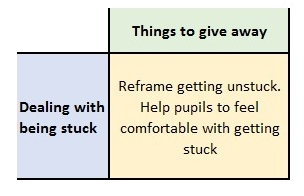
Enabling students to feel comfortable with getting stuck.
‘Culture’ concerns the details of the micro-climate that you create in your classrooms. What you do and say, what you notice and commend and what you don’t, what kind of role model of a learner you offer: all these are of the essence. And what really matters is how you design and present activities so that, over the course of a term or a year, your students are cumulatively getting a really good all-round mental work-out. All the learning bits of their brains are being stretched and strengthened, one by one and all together.
A. Introduce
Develop ‘stuck prompts’ together.
Work with students to find useful questions for them to ask themselves and helpful strategies for them to use when they are stuck.
Ensure that there are plenty of options that come higher on the list than “Ask the teacher”.
Every classroom needs stuck prompts in one form or another.
They could be of a general nature or made relevant to a subject or topic.
It’s important to ensure that they ‘grow up’ through the school, reflecting the curriculum expectations. In essence they represent the level of independence expected in different year groups.
B. Model
Model being stuck
Show students how you personally get stuck, and what strategies you have for getting unstuck. Demonstrate a piece of tricky learning and highlight the things you say to yourself to find a way through. Sharing these experiences encourages students to imitate getting unstuck.
Modelling demonstrates how you are a learner too; a confident finder-outer.
Take your students behind the scenes of learning, sharing with them some of the uncertain thinking of learning.
Learning aloud is a good place to start: take students through how you would work out a problem. Modelling the thought processes (including emotional) that learners go through is important because a lot of the skill of learning only manifests itself in the inner world of the learner.
Expose the thinking, feeling and decision making of a learner-in-action to help students actually see and hear how learning works.
C. Use
The Learning Pit: explore learning to overcome a struggle
Use the ‘Learning Pit’ as a means of opening up a conversation around the feelings involved with being stuck, and the journey towards getting unstuck – the struggle. It is essential that students know:
that the ‘pit’ is only one staging post on the learning journey
they can get out by using ‘stuck strategies’ and tools
The ability to cope with and overcome difficulty and challenge is a key aspect to becoming a successful learner.
James Nottingham introduced the idea of the Learning Pit as a way to explain that struggling is part of learning and that if we are to understand something we need to struggle with it first. Students move from unconsciously incompetent (an emotionally ‘safe’ area before learning), to consciously incompetent (the emotionally tricky “pit”), to consciously competent (the far side, after the learning has happened).
But the important thing to recognise, talk about and design are the ways of getting out of the pit. It’s not enough to know that learning is a struggle but to know what the struggle means and the ways to overcome it; what you need to do to get out of the pit.
D. Reflect on
Explore feelings and ‘stuck’
Explore and contrast the feelings of being stuck with those of overcoming stuckness. Use the positive feelings of ‘unstuck’ as a springboard for developing ‘stuck strategies’.
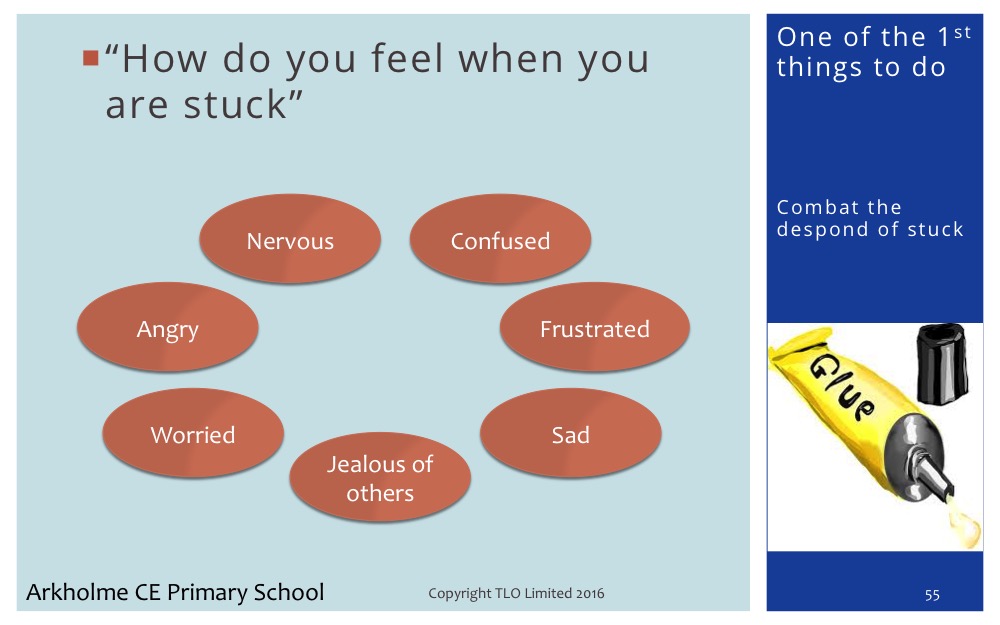
Take a look at how a teacher at Arkholme primary school approached the ‘stuck’ issue by exploring the pupils’ emotions.
A Yr 5 teacher from Arkholme Primary school near Lancaster explained STUCK by exploring it for real with her pupils. First she asked how they felt when they got stuck….. Take a look at the wide range of negative emotions being stuck seems to generate in pupils
Then she explored what led the pupils into getting get stuck…..a fairly predictable content driven set of ideas here
Then she explored what the children felt like when they overcame being stuck……..another great range of emotions; this time positive
Then the class discussed what they might do to get unstuck, and charted their ideas for everyone to use!!
E. Improve
It’s useful to identify and model several forms of being stuck.
What sort of stuck is it? Do different sorts of being stuck call for different strategies?
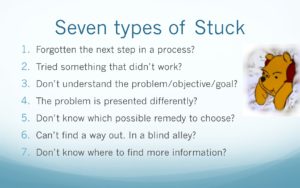
Seven types of stuck:
Forgotten the next step in a process?
Tried something that didn’t work?
Don’t understand the problem/objective/goal?
The problem is presented differently?
Don’t know which possible remedy to choose?
Can’t find a way out. In a blind alley?
Don’t know where to find more information?
You could turn any one of these questions into an ‘If, then’ statement:
If I have forgotten the next step in a process, then I’ll…
Clicking on the link in any cell takes you to 5 related classroom activities.
While this section is interesting, and by all means look through it, it won’t be invoked until the end of an educational year. It remains here to give this resource a sense of completeness, enabling you to see the whole picture. By the time its content is really relevant for you, you’ll have been working with a Professional Learning Team for many months on either a Phase 1 or Phase 2 learning power programme for schools.
Know thy impact
It’s all very well making plans and putting them into action but what difference do they actually make; have your plans and actions worked and how well? This section invites you to consider your progress in 3 aspects – how increasing learning friendly classroom cultures are working, how students’ learning behaviours are growing, and whether this activity raising attainment.
Here you will find:
a reflection tool to help you consider how your classroom culture has developed and how your students have responded;
a reflection tool to help you to consider how your students’ learning behaviours may have changed;
a reflection piece inviting you to evaluate the impact of the changes you have made on progress and attainment.
1. Impact on classroom culture
In section 4 – Shifting your Classroom Culture – you considered the 4 aspects of developing a learning friendly classroom culture. You evaluated your existing classroom culture before embarking on interventions aimed at building student learning behaviours, raising achievement and possibly narrowing some performance gaps.
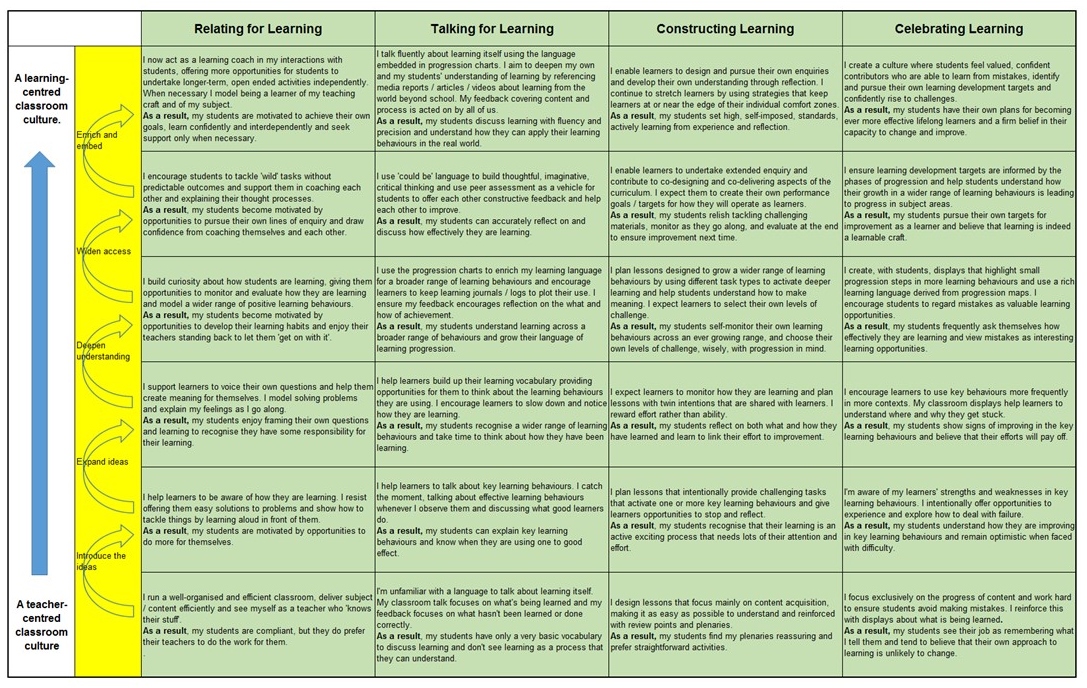
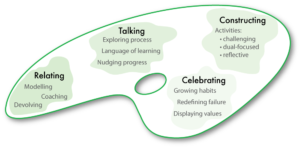
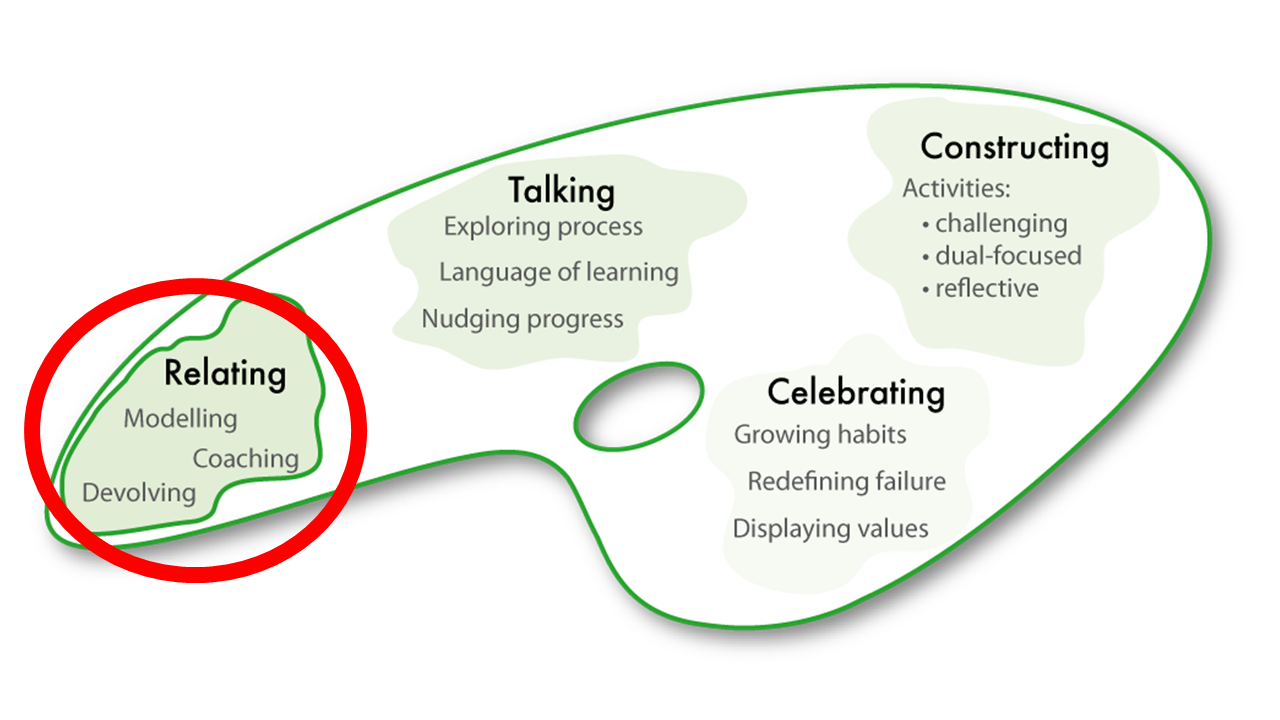
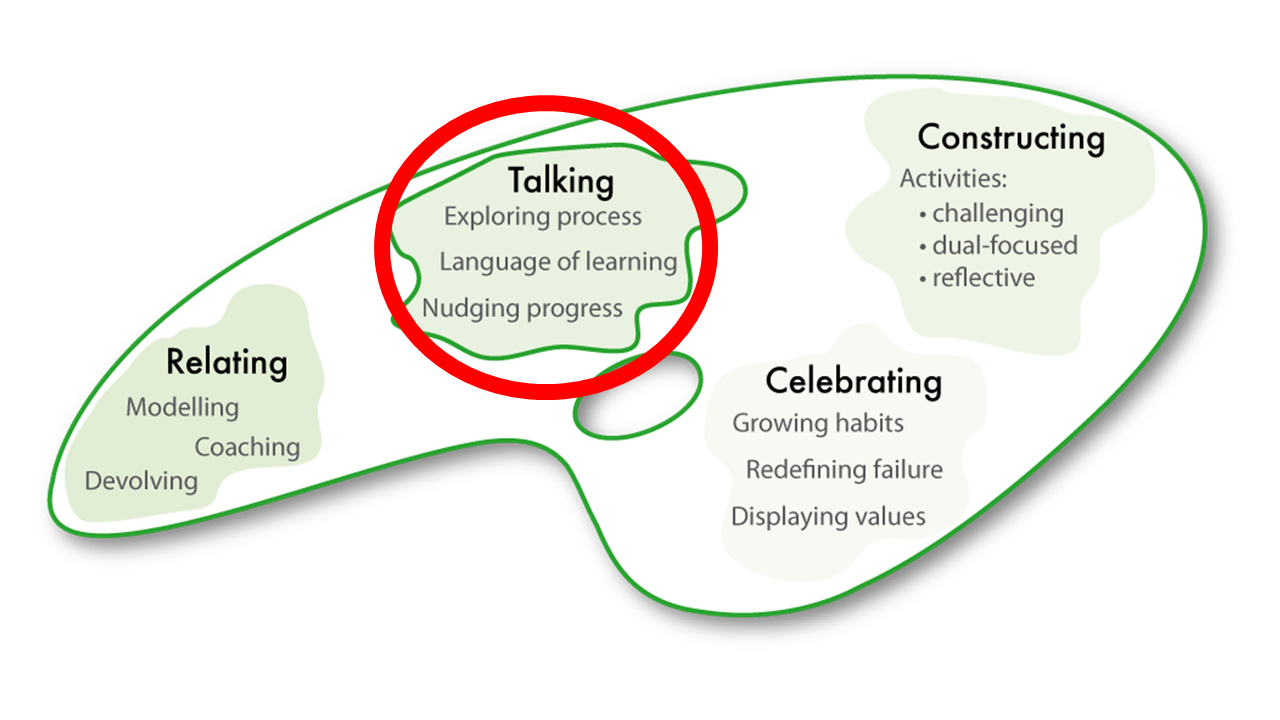
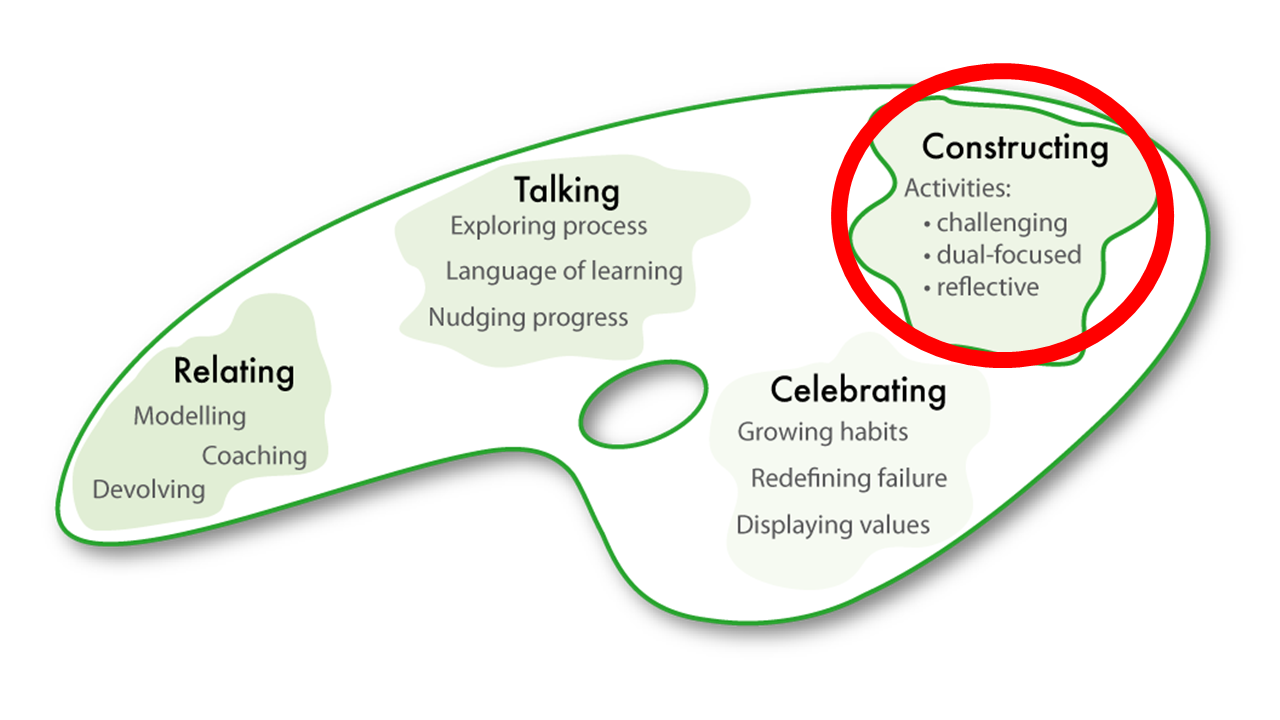
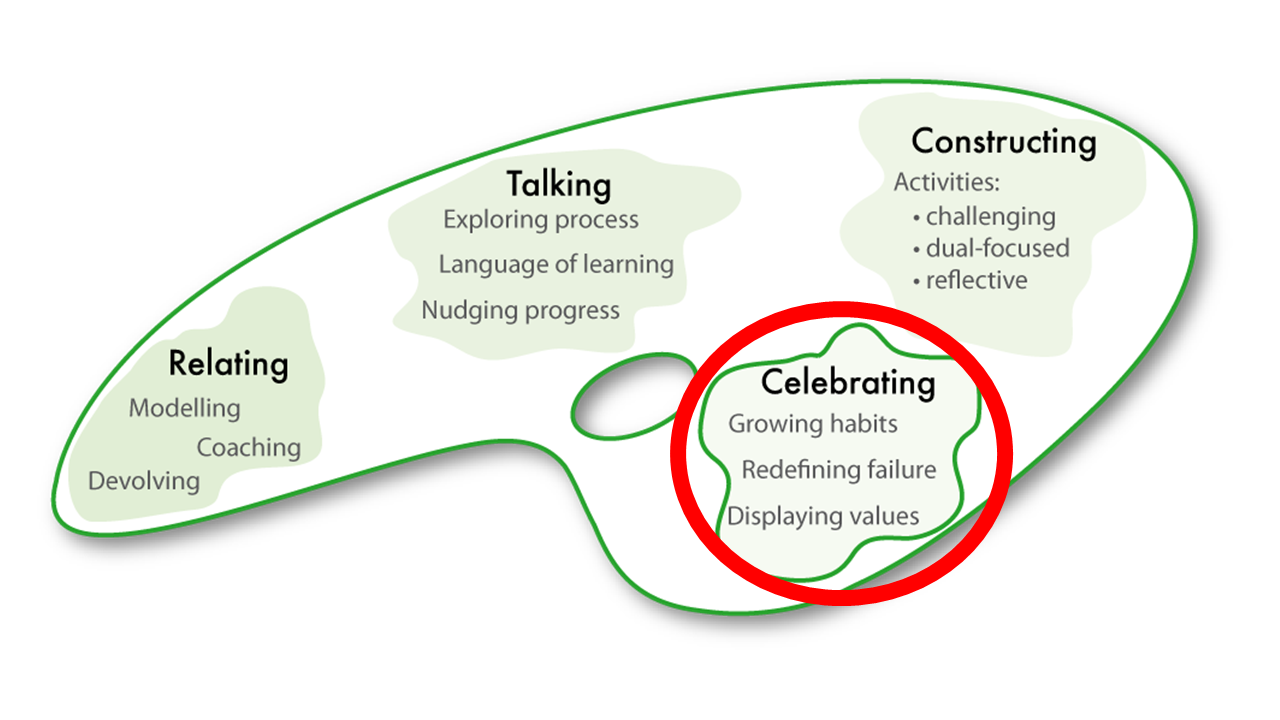
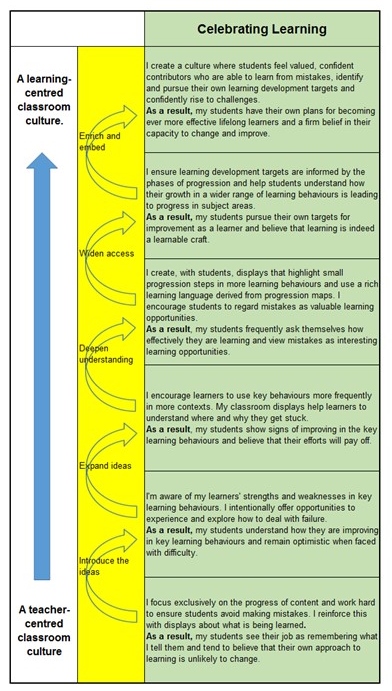
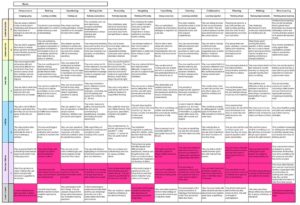
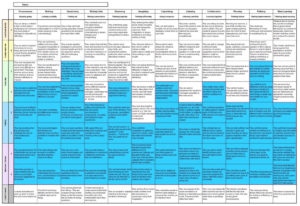
Now is the time to retrieve those initial judgements so that you can see the extent to which your classroom culture has become more learning friendly over the period of this project. The 4 charts for Relating, Talking, Constructing and for Celebrating that you considered in section 4 are repeated here, combined as one teacher progression chart.
Download the chart, and consider which statements / cells most accurately reflect your current classroom culture, and compare this with the judgements you made at the outset. The differences are an indication of the changes you have made in your classroom culture and how your students have responded.
Ask yourself:
In which of the 4 aspects of classroom culture have I made most progress?
Of which changes am I most proud?
Which changes appear to have had the greatest impact a) on you, b) on your class(es)?
How would I describe the impact of my changes in classroom culture on my students? Try to write a short paragraph that describes the changes you have made and the impact that these changes have had on your students.
Are there any aspects where I have made less progress than I might have hoped? What has held me back? What was tricky and why?
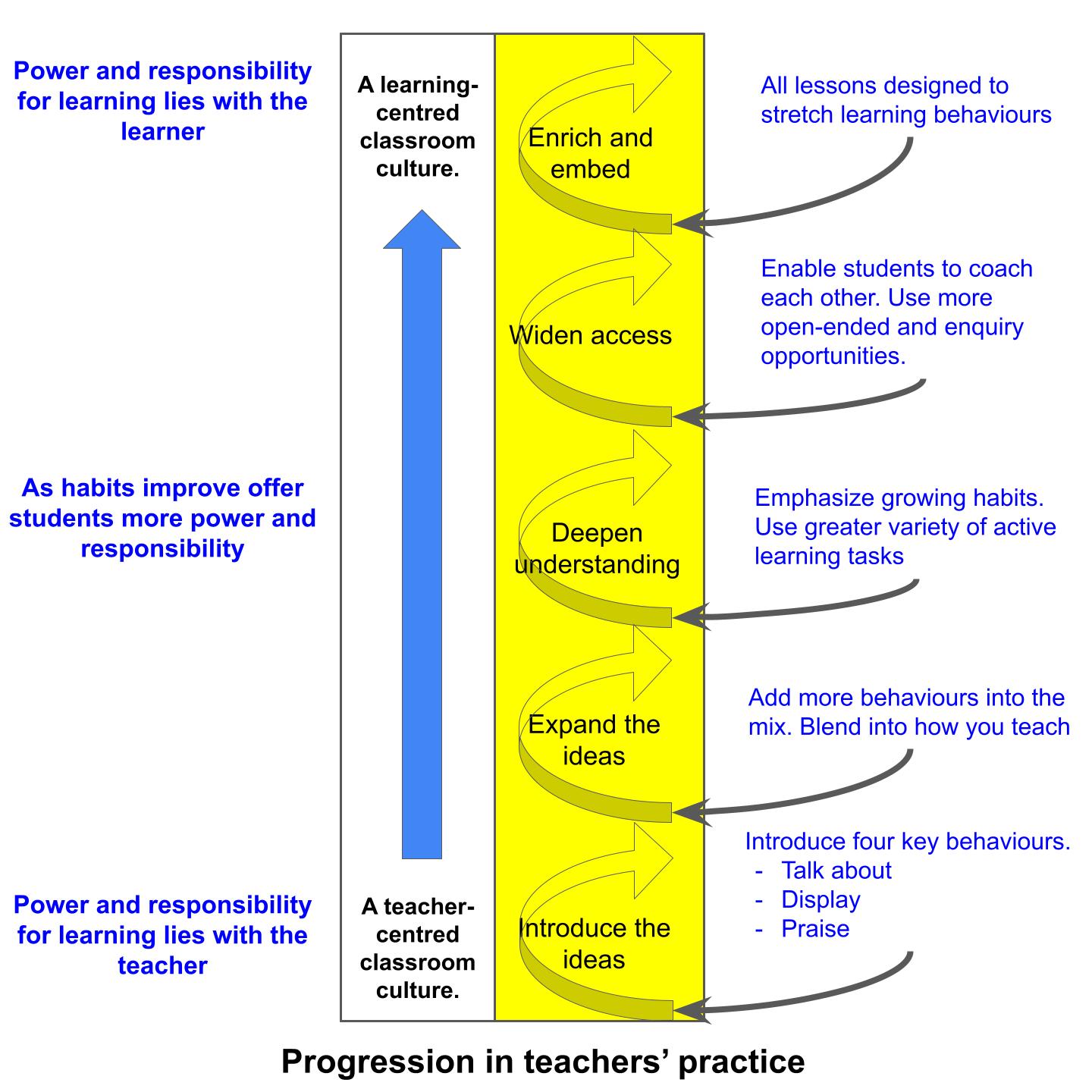
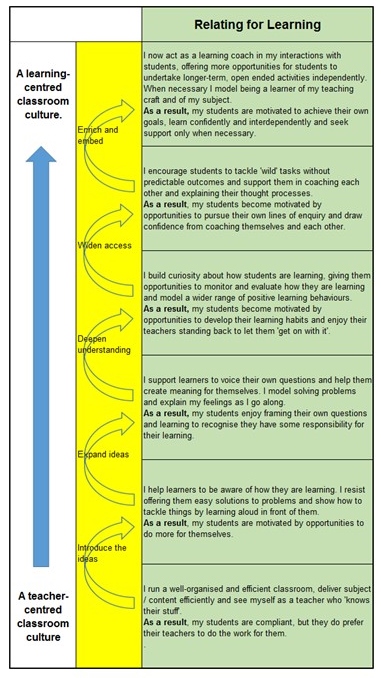
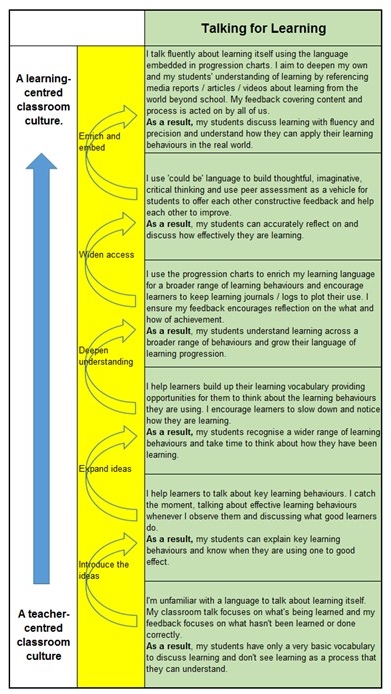
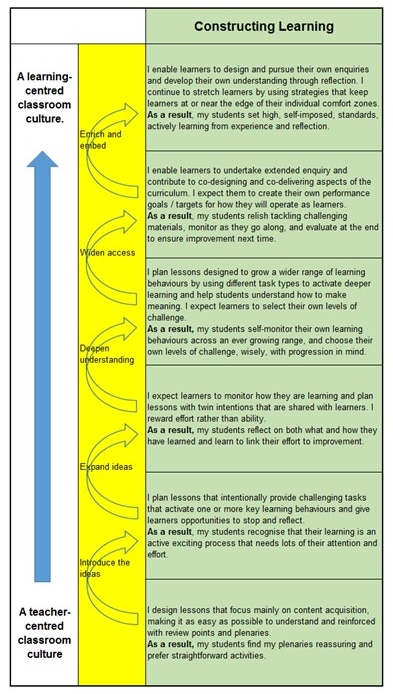
Here’s a reminder of how teachers’ practice progresses; from highly teacher and content focused to a learning-focused cultures, and anticipated outcomes for learners. Note – this growth pattern is very different to the growth of learning behaviours for students.
At the foot of the column lies a description of a traditional classroom where the power and responsibility for learning lies solely with the teacher and the focus is on the efficient transmission of curriculum content. At the top of the columns lies a brief description of a full-on learning-friendly, learning-centred classroom.
If you read across the tops of the columns you’ll see a clear picture of the practice teachers are ultimately aiming for. The cumulative steps in between describe the journey and how it changes in focus. In the early stages you will be concentrating on introducing a carefully chosen but limited set of learning behaviours. Later you will add more learning behaviours to the range, increase your skill and fluency and turn your attention to helping the students use and benefit from the same ideas.
A closer look at the stages of the journey.
Introducing the ideas (at the foot of the column)
The first stage of the journey is simply to introduce the idea of learning powers. This is often limited to a few learning behaviours that you have identified as being in need of attention for your target group of students.
At this introductory stage, across all the columns, you are only dealing with these key behaviours. You are developing learning talk for them. You are setting up displays with students to capture their growth in these behaviours. You are developing lessons that use and stretch these behaviours.
Expanding the ideas and the strategies
At the second stage of the journey you add more learning behaviours to the mix. This is a tricky stage because you are becoming more familiar with a wider range of behaviours and becoming more skilful in how you attend to them. It’s a lengthy stage.
Deepening understanding
At this third stage progress across the board hots up. You have got many of the learning behaviours in play now and within any of the columns you are deepening the behaviours. You are more aware of students growing their habits and this is proudly displayed. You are becoming bolder in how much responsibility you are allowing students. Your lessons use a greater variety of active learning tasks and the learning language is richer and mapped with the student progression tables. In areas of assessment too students are taking an active role in assessing each other and critiquing learning.
Widen access
At this fourth stage students are being encouraged and enabled to get in on the act. Coaching isn’t just you coaching students but now includes students coaching each other. In teaching each other, students may have a role in co-designing and co-delivering lessons. Students are offered far more open ended or ‘wild’ tasks and enquiry based learning opportunities. There’s an emphasis on being inquisitive and devolving responsibility to learners.
Enrich and embed (top of the column)
In the final, fifth stage students are in command of their own learning. Teachers and students are able to adapt their coaching style to fit different needs. The language of learning is familiar to everyone and even formal feedback is framed as questions rather than suggestions or answers. All lessons are designed to deal with content and stretch learning behaviours with much of the curriculum covered through an enquiry approach to learning. In such classrooms everyone feels a valued contributor, everyone is alert to and counters unhelpful attitudes to learning and all are becoming experienced independent learners.
2. Impact on student learning behaviours
Earlier (see section 3) you created learning profiles for some students. These profiles will now act as the baseline measure against which you can assess the impact you have had on the students’ learning behaviours.
A simple way to do this is to make a copy of each student’s original chart with its completed learner profile. Look carefully at each column and, drawing on your knowledge of the student, begin to colour in, using a different colour, the cells that show where they are now.
Compare the new learning profile with the original one. Focus particularly on the learning behaviours you have specifically attended to – the ones that you focused on in section 6.
Remember these single columns can’t show all the nuances of these behaviours so there may be some improvements that don’t show up here
Remember, what you are looking for are changes in attitude and a subsequent improvement in skill
moving from ‘can’t/won’t to ‘show me/tell me’
from ‘show me/tell me’ to ‘I’ll try’
from ‘I’ll try’ to ‘I see why’
Similarly, the steps shown are quite substantial and one step up the chart indicates a significant shift.
Comparing these updated profiles with the ones that you did at the outset will give you an indication of the extent to which their learning behaviours have developed. It might even be a good time to talk with these students to gather their views.
Ask yourself:
To what extent have my students’ learning behaviours improved because of the interventions I have made?
Highlighted in pink, the learner’s profile at the outset, in yellow the secure skills after your interventions.
At the beginning, this learner was developing at the first (purple) phase, with 3 behaviours still negative in the ‘lacks’ phase.
After your interventions, the learner has eliminated the 3 negative behaviours and is broadlysecure at the first (purple) phase of development and showing developing skills at the second (blue) phase.
In numerical terms, 16 newly acquired yellow cells averaged over 12 learning behaviours = 1.33 cells per column, which is an improvement of approximately 0.67 of a phase.
This is, of course, much harder to identify, even if you have solid evidence that your classroom culture has become more learning-friendly, and that your interventions have led to stronger learning behaviours in all students and especially in your target group.
Suppose you have been targeting year 7 students. It will take 4 years before their improved learning behaviours will feed through into externally generated performance data. Equally, even if you have been working with year 11 students, six months of interventions may still be too little to overturn years of accumulated under-performance.
Hence you will need to rely on your professional judgement. Ask yourself:
Are my students making greater progress than I would have expected without the interventions I have made?
Putting it all together . .
Write a short report focusing on:
what you were hoping to achieve – your intent;
the strategies you chose to implement;
the outcomes of your interventions – your impact.
Your report, coupled with those of other teachers, will provide compelling evidence of your collective efforts to. build better learners.
This section gives you all sorts of help on deciding which learning behaviours to tackle and shows you where to find them. It may be wise to discuss your starting point in the context of the school’s previous work on learning power with a senior leader. When you reach this point you should be invited to join one of the school’s Professional Learning Teams.
Features of the catalogue
Section 6 simply offers a broad range of teaching ideas to help you focus on building students’ learning behaviours. This may involve making sophisticated shifts in your teaching as mentioned in sections 4 and 5. To help things along we have linked the classroom based ideas to students’ growth as learners. Here, in section 6, we bring together:
the 12 learning behaviour progression tables;
each interlinked with specific teaching ideas to enable that progression;
and shorthand diagrams that summarise how this all plays out in classroom cultures.
The Catalogue – Progression phases interlinked with teaching ideas . . .
1. Decide where to make a start . .
This needs a re-write in relation to starting with those behaviours that sit most readily in your subject. Complete once section 3 is completed.
Take a look at the data you have recorded about your students. (see section 3.1 or 3.2) Become curious about what your data is telling you and remember not all learning behaviours are equally important. Some are more critical for success in some subjects than others, while others are critical for success across the curriculum.
Find the behaviours to make a start on
You could start by looking at those behaviours that apply more generally and are linked to students’ attention…perseverance, noticing, listening, refining. These alone may account for sluggish performance.
Look particularly at questioning. More curious students are motivated to explore and engage, whereas a student lacking curiosity usually has little enthusiasm for learning.
Remember too, that it’s well-researched that well-developed meta-cognitive skills tend to raise students’ attainment. So maybe think hard about including meta learning too.
Select three or four behaviours that seem most appropriate to work on first for your group. If the school is undertaking the Phase 1 course Playing the Learning Power game they will be focusing on only 4 behaviours…perseverance, questioning, collaboration and revising/refining for the majority of the course.
Let learning profiles influence your choice of approaches or activities
2. Check out your classroom culture
Having already explored classroom culture in section 4, we now consider the aspects of classroom culture that need to be present for the particular learning behaviour to flourish. The culture diagrams you will find in each section address 4 aspects of classroom culture:
At 9 o’clock – the dispositions, habits and behaviours you are aiming to enable your learners to develop;
At 3 o’clock – how you might talk about the learning behaviours;
At 12 o’clock – how you might organise learning to exercise the behaviours;
And at 6 o’clock – how you might organise your classroom to celebrate the behaviours.
Give time to evaluate your own classroom culture against these 4 aspects, because minor adjustments to classroom culture will make it easier for the teaching ideas that follow to achieve the outcomes you desire for your learners.
The classroom culture to foster learners’ curiosity (for example)
3. Decide which levels to start on
The next thing to consider is how well are the students disposed to the learning behaviours you have selected.
What stage of ‘mindedness’, about this behaviour, have these students attained? Are they:
unaware and or fearful of the behaviour? (grey);
needing masses of help or reassurance? (purple);
becoming willing to work on/ tackle this? (blue);
‘sold’ on this behaviour because they realise it’s good for them? (green)
Remember, your role will be to ‘work between the lines’. So, if your students are:
still in the grey zone… you need to look at material shown between grey and purple;
in the purple phase…you need to look for ideas between purple and blue;
in the blue zone…you need to look for ideas between blue and green.
green and above you need one of our more sophisticated products!
PS. It’s usually a good idea to start at the bottom and work up. You’ll often find activities that you can adapt or tweak a bit for different phases of growth or different ages of student.
Remember too, that in these early stages, you’ll be bringing these behaviours out of the shadows in several ways:
making students aware of the behaviour;
talking about it (what, how, why, when, if);
giving them opportunities to practise it, both in lessons and elsewhere;
celebrating its use;
reflecting on it to improve it.
You will find a variety of teacher activities ‘between the lines’ in all twelve behaviour progression tables so enabling you to work on many of these fronts.
While all the suggestions below are essential, the school you have joined may already have particular ways of doing them. It would be wise to check which of the 11 ideas below are common features of classrooms and whether the school has some common formats that you should follow.( e.g. Learning mats no 11) You will also need to know which learning behaviours students are already familiar with due to them having been introduced previously throughout the school.
If you want your students to become better learners you first need to offer them more opportunities to use and cultivate their learning powers. This often involves shifting the culture of the classroom so that it systematically cultivates the positive learning habits and attitudes of young people. ‘Culture’ is about all the little habits, routines and practices that implicitly convey ‘what we believe and value round here’; where, hour by hour, day by day, term by term students experience the values and practices that are embodied in the school.
As a teacher, you can build students’ learning power by helping them to expand their own learning capacities. This involves the ways in which you relate to students, talk to students, organise your classroom, and constructactivities, as well as what you notice and celebrate about learning. Take a look at the video for a short explanation of these ideas in action.
The big picture of classroom culture
Four aspects of culture – Relating, Talking, Constructing and Celebrating – for learning friendly classrooms
Making learning power work involves shifting or even transforming the culture of the classroom. A common language for learning is adopted; staff shift responsibility for learning to students and model learning by sharing their own difficulties, frustrations and triumphs; students come to understand themselves as growing learners and consciously improve their learning habits; teachers assume the role of learning-power coach, offering students interesting, real and challenging activities to enable them to create their own knowledge and stretch their learning habits. Underpinning this is the obvious reality that students will only change their behaviours once their teachers have changed theirs’.
The culture of the classroom is determined by how teachers are, the relationships that exist between the teacher and the learners, the ways in which the teacher talks and what the teacher talks about, the extent to which teaching is designed to ensure both content acquisition and the development of learning behaviours, and the often subliminal messages about what the teacher really thinks is important.
These 4 aspects of culture – Relating, Talking, Constructing and Celebrating – form the basis of The Teachers’ Palette, the second of two key models in the approach known as Building Learning Power.
1. Get curious about your own teaching
Take a look at the questionnaire about teaching (see opposite). The statements on the left-hand side are about conventional good teaching. Those of the right-hand side describe what you might be doing when your goal is to boost your students’ learning power.
Consider each good teaching statement (column A and gauge whether you do this sometimes or routinely. Now look at the boosting statements in column B and estimate the extent to which they describe your teaching. Habits like these can add an extra dimension to good teaching: you are acting as a learning coach, deliberately working on those learning muscles at the same time as conveying the curriculum message.
Building students’ learning habits is not about you having to do more, it’s about doing things a bit differently; boosting your teaching effectiveness by becoming a learning-power coach to your students.
You’re aiming to give your students a more active role in their learning.
In the first instance this involves offering them more opportunities to decide what to do, to ask more questions, to learn together with others and to actively learn by reviewing their own experience. In general this shifts how you relate to your students; gradually sharing more of the responsibility for learning with them. Shaping them to become self-regulated learners.
Putting learning on show by modelling being a learner to students, demonstrating how you are a learner too; a confident finder outer.
Becoming a learning coach, enabling students to see what they are doing more clearly and discover their own ways to improve. Helping students to explore their challenges, enhancing their motivation and self-esteem and build curiosity. Above all, resisting offering solutions because offering solutions doesn’t allow students to confront and engage with the problem and find their way forward.
This is the first of four little charts that describe a teacher journey. One from being a perfectly good teacher to becoming a learning powered teacher
The Relating for Learning chart identifies aspects of classroom culture as your classroom moves from being highly teacher focused (at the bottom of the chart) to being learning focused (at the top).
Each cell of the chart blends statements about Relating for Learning, how teachers:
are devolving responsibility for learning to students;
adopt a coaching approach;
model themselves as learners.
and links these cultural shifts with the anticipated outcomes for students.
Ask yourself:
Which cell best describes my existing classroom culture and how my students are responding to it?
Download the chart and record your first impressions. You can use this ‘first stab’ as a baseline measure against which to judge the impact of your efforts in the future.
There is an old Polish proverb which says, ‘One who sleeps on the floor need not fear falling out of bed’, and there are indeed some students like that. They prefer to be passive passengers rather than active ‘crew’ as far as their education is concerned, because that way they do not have to take any risks or be held responsible. And the more you tow them through the curriculum, rather than making them learn how to use their own muscles to swim, the more likely they are to develop that passive attitude. You should not be surprised—and certainly not defeated—if at first some of them resist your efforts to get them to think for themselves. But we have found that, for the vast majority of students, this is just a habit that, with a bit of persistence and persuasion, they can get over; and when they do, they discover that school is more engaging and more rewarding. They become more keen to be proactive and independent.
The Golden Rules, when you start to push students towards taking more responsibility for their own learning, are:
Start small: make just one or two small shifts to ‘the way we do things round here’;
Be persistent and consistent in reminding students what your expectations are, and in noticing and commenting approvingly when they meet those expectations;
Don’t try to get them to run before they can walk, and don’t back down in the face of any resistance. Remember: Learning Power is not laisser-faire. You are coaching and training your students in a positive attitude towards learning.
3. Talking with students about learning
What you’re aiming to achieve is to use a learning language that gives students more control of their learning.
This involves talking about the ‘how’ of learning; making learning the object of conversation. The way you talk about learning in the classroom creates a powerful linguistic environment that teaches your students the best of what we know about learning. The language of learning helps students to discuss, understand, and become conscious of using their learning behaviours.
Here we introduce the idea of progression in classroom culture, focusing on Talking for Learning. The chart attempts to identify aspects of classroom culture as the classroom moves from being highly teacher focused (at the bottom of the chart) to being learning focused (at the top).
Each cell of the chart blends statements about Talking for Learning, how teachers:
are sharing a language of learning;
enable students to explore and understand the process of learning;
nudge learning through written and oral feedback.
and links these cultural shifts with the anticipated outcomes for students.
Ask yourself:
Which cell best describes my existing classroom culture and how my students are responding to it?
Download the chart and record your first impressions. You can use this ‘first stab’ as a baseline measure against which to judge the impact of your efforts in the future.
Some ways to talk about and nudge learning behaviours of perseverance, questioning, collaborating and revising.
4. Constructing learning
What you’re aiming to achieve is to design and deliver learning opportunities that strengthen students’ learning behaviours.
This involves making ‘becoming a better learner’ the purpose of the classroom; how classroom activities and routines feed learning habits. Learning challenges are designed to enable students to understand both the content and the process of learning. This dual focus stretches students’ use of their learning behaviours in order to explore and understand content. It’s not just about ‘doing’ learning but reflecting on the process to create self-regulated learners.
Constructing activities to activate learning behaviours
Here we introduce the idea of progression in classroom culture, focusing on Constructing Learning. The chart identifies aspects of classroom culture as the classroom moves from being highly teacher focused (at the bottom of the chart) to being learning focused (at the top).
Each cell of the chart blends statements about Constructing Learning, how teachers:
create opportunities for reflection;
link curriculum content with learning behaviours;
create rich, challenging activities.
and links these cultural shifts with the anticipated outcomes for students.
Ask yourself:
Which cell best describes my existing classroom culture and how my students are responding to it?
Download the chart and record your first impressions. You can use this ‘first stab’ as a baseline measure against to judge the impact of your efforts in the future.
What you’re aiming to achieve is to ensure that the look and feel of your classroom, its walls and reward systems, serve to strengthen your students’ learning habits.
This involves giving more attention to learning rather than performance; where more traditional ideas of classroom learning are flipped or re-defined – where being stuck is seen as interesting and mistakes valuable, where effort, questioning and taking risks are defined, attended to, acknowledged and praised. This classroom culture serves to make learning visible to learners; one in which learners are being coached to become meta-learners.
Walls displays and reward systems strengthen learning habits
Here we introduce the idea of progression in classroom culture, focusing on Celebrating Learning. The chart identifies aspects of classroom culture as the classroom moves from being highly teacher focused (at the bottom of the chart) to being learning focused (at the top).
Each cell of the chart blends statements about Celebrating Learning, how teachers:
actively grow student learning behaviours;
re-define failure;
display the learning values of the classroom and link these cultural shifts with the anticipated outcomes for students.
Ask yourself:
Which cell best describes my existing classroom culture and how my students are responding to it?
Download the chart and record your first impressions. You can use this ‘first stab’ as a baseline measure against which to judge the impact of your efforts in the future.
Show the learning that has – or is – taking place in the work that you choose to display on classroom walls.
What works is when all teachers look more critically at what they are putting on the walls of their classrooms and ask themselves what purpose this material serves.
Ask yourself:
What does the ‘feel’ of the display tell me about the classroom culture?
Is there a balance towards in-house displays rather than commercially produced displays?
How do displays support independent learning by students?
Do the displays focus mostly on what has been learned, or what is being learned?
Do displays of students’ work show work in progress, and tentative, amended drafts?
Do displays help students know how to improve and make curriculum progress?
Are any of the displays helping students to know how to improve their learning behaviours?
Do students have a say in what should go on the classroom walls?
Do displays invite students to interact with them in some way?
6. Pulling it all together – the big picture of culture change
The 4 growth trajectories for classroom culture that have been introduced above together describe the transition of classroom culture from teacher-focused to learning-focused, across 4 cultural aspects – Relating, Talking, Constructing and Celebrating.
Here these 4 trajectories are aligned so that you can see the big picture of this development ‘at a glance’.
If you would like a copy, download and print yourself one.
Here’s a reminder of how teachers’ practice progresses; from highly teacher and content focused to a learning-focused cultures, and anticipated outcomes for learners. Note – this growth pattern is very different to the growth of learning behaviours for students.
At the foot of the column lies a description of a traditional classroom where the power and responsibility for learning lies solely with the teacher and the focus is on the efficient transmission of curriculum content.
If you read across the tops of the columns you’ll see a clear picture of the practice teachers are ultimately aiming for. The cumulative steps in between describe the journey and how it changes in focus. In the early stages you will be concentrating on introducing a carefully chosen but limited set of learning behaviours. Later you will add more learning behaviours to the range, increase your skill and fluency and turn your attention to helping the students use and benefit from the same ideas.
A closer look at the stages of the journey.
Introducing the ideas (at the foot of the column)
The first stage of the journey is simply to introduce the idea of learning powers. This is often limited to a few learning behaviours that you have identified as being in need of attention for your target group of students.
At this introductory stage, across all the columns, you are only dealing with these key behaviours. You are developing learning talk for them. You are setting up displays with students to capture their growth in these behaviours. You are developing lessons that use and stretch these behaviours.
Expanding the ideas and the strategies
At the second stage of the journey you add more learning behaviours to the mix. This is a tricky stage because you are becoming more familiar with a wider range of behaviours and becoming more skilful in how you attend to them. It’s a lengthy stage.
Deepening understanding
At this third stage progress across the board hots up. You have got many of the learning behaviours in play now and within any of the columns you are deepening the behaviours. You are more aware of students growing their habits and this is proudly displayed. You are becoming bolder in how much responsibility you are allowing students. Your lessons use a greater variety of active learning tasks and the learning language is richer and mapped with the student progression tables. In areas of assessment too students are taking an active role in assessing each other and critiquing learning.
Widen access
At this fourth stage students are being encouraged and enabled to get in on the act. Coaching isn’t just you coaching students but now includes students coaching each other. In teaching each other, students may have a role in co-designing and co-delivering lessons. Students are offered far more open ended or ‘wild’ tasks and enquiry based learning opportunities. There’s an emphasis on being inquisitive and devolving responsibility to learners.
Enrich and embed (top of the column)
In the final, fifth stage students are in command of their own learning. Teachers and students are able to adapt their coaching style to fit different needs. The language of learning is familiar to everyone and even formal feedback is framed as questions rather than suggestions or answers. All lessons are designed to deal with content and stretch learning behaviours with much of the curriculum covered through an enquiry approach to learning. In such classrooms everyone feels a valued contributor, everyone is alert to and counters unhelpful attitudes to learning and all are becoming experienced independent learners.
Please note… this section logically fits here in the sequence of topics and what it describes is one of the best ways for you to really understand learning power in your students. However, your school will have a scheduled time when the information from this section is required. Or, the school may not have used the materials discussed. You will need to enquire when the school intends to collect and explore its students’ learning profiles and when you might use this section to best advantage.
Which learning characteristics do our students display?
The growth charts you used in the last section have the power to reveal interesting and vital information about students’ learning. They are suitable for use with any class or a sub-group of students.
Work through the sections called ‘Understand your students as learners’ (3.1) and ‘Interpreting the information for your class’ (3.2) to help you to synthesise your views in readiness for sharing these views with colleagues.
This section helps you to answer the question:
What are the learning strengths and weaknesses of my students?
The primary purpose of this resource is to help you, as a new teacher in a learning powered school to:
discover and understand the learning behaviour features of students
learn about the possible learning behaviour differences of students
become familiar with students’ growth in learning power behaviours
feel confident to introduce students to their learning behaviours
adapt their teaching so as to strengthen growth in learning behaviours;
monitor and evaluate their own practice and the subsequent growth in students’ learning behaviours.
Perhaps the best way of really getting to grips with the growth of learning power is to take a personal look at your own learning behaviours; what yours may look like; where your strengths are, those you find tricky; those you’d like to improve.
Having got the idea we then invite you to look at just a couple of your students; a low and a high attaining student. This may give you a glimpse into what it is that makes the difference in how students approach and achieve in learning
1. What does a ‘good learner’ look like?
In case you were wondering what a good learner looked like take a look at this video of Molly Coffey, a past student of an Academy in Derby. Here she talks about how she gained an understanding of her own learning through her time in school.
Muse a while:
What strikes you first about Molly?
How is Molly ready to cope with life after school?
Could you talk as fluently about your own learning now?
Is this what you want for your students?
Before the school started to put an emphasis on building their students’ learning habits Molly’s only idea of herself as a learner was gleaned from her grades. She knew nothing about herself as a learner nor how she might improve. Coming to understand her own learning behaviours gave her far more power and control over her own learning; something that will help shape the rest of her life.
2. Put your toe into this learning water
Are you aware of whether or how well your students use the valuable learning behaviours we looked at in section 1?
To get you started just look at the statements in the resource opposite to prompt you to think about your students. Focus on a class you know well. Try to see these students through the lens of learning behaviours, their current strengths and shortcomings as learners. ‘How’ they learn, rather than in terms of their attainment, ‘what’ they learn.
Fill in the name of a student for each descriptor, and consider what evidence you might have to support this judgement. Are there students in this group who you haven’t mentioned?
Spend a few minutes on this. You might consider whether there seems to be an imbalance in the domains of learning. Which domain was the hardest to complete? Does the emotional domain seem weaker than others? Is there anything recorded in the strategic domain? If ‘yes’, why? What other questions do your answers raise?
Now take a closer look by opening the ‘Reflect carefully’ piece below.
On the surface, this looked to be a simple activity. Indeed if you were a primary teacher who spends most of their time with a group of students that you know well, it would have been.
The problem for secondary teachers is that they may be working with 150/200 students per week, making it much harder to know their students in this way.
But what is worse, this simple exercise is just that – simple. You are presented with straightforward choices
are they curious?
do they work well with others?,
do they like a challenge?
Research tells us that these learning behaviours:
are not either or options, this is not a binary choice. Nobody does any of these things in all circumstances with consummate skill;
likewise, nobody is completely lacking in all circumstances. Learning behaviours are neither black nor white – they are a muddy mix of dispositions, skills, attitudes and habits that are acquired /cultivated progressively (or not) and are not necessarily deployed consistently across the different subjects of the curriculum.
Therefore you’ll need to think carefully about how you might go about exploring:
the learning behaviours of your students (see section 3)
how the learning differs between different groups of learners
how you might strengthen and cultivate better learners (see sections 4, 5, 6.)
what would count as success (see section 7)
3. Get a sense of how learning behaviours progress
Being an effective learner isn’t something that switches on on good days and off on bad days; it grows and builds when it’s nurtured and supported. Furthermore, being a learning powered learner involves gaining control of a range of linked dispositions and skills and emotions.
Over the last ten years we have tried to capture the essence of that growth and make it useful for teachers and learners. Take a look at this very slimmed down progression chart alongside. Here you can see we have identified just 12 key learning behaviours...shown in the columns.
Each of the 12 learning behaviours are briefly described at one of 5 levels of proficiency shown in the rows. These levels of proficiency grow and flourish when they are cultivated by teachers and supported by families.
Download the chart and take a closer look at it. You’ve probably never considered any student in this way. Take your time just absorbing what you see. Don’t think too hard about the progression levels at this stage, but rather try to absorb the nature of the descriptions of learning behaviours across the different areas of learning.
Find out more about the progression scale/phases in the toggle box below.
Twelve learning behaviours with five levels of proficiency
Download as pdf [When printing this pdf, it is best done on A3 paper, landscape (in the print settings)]
We’ve borrowed ideas from Benjamin Bloom’s Taxonomy of Objectives of the Affective Domain to generate a very condensed version of the five main phases of growth, namely:
Receiving. (purple)..which involves giving attention to something; becoming aware, not avoiding or rejecting it; being alert to something.
Responding. (blue)..which involves going beyond merely attending to actively attending; complying; taking more responsibility for and enjoyment in initiating action.
Valuing. (green)..which involves accepting the worth of something; preferring something; being committed to the value of something.
Organisation.(yellow)..which involves adding to, formulating and organising their values into how they live their life.
Embodies. (Characterisation in the original)(orange)…which involves behaving consistently in accordance with their values, living what they stand for.
We have simplified and applied these highbrow ideas to the affective development (emotional) of learning behaviours. We’ve also added a negative phase labelled Lacks where learners are unaware, show no interest in or avoid or reject the learning behaviour.
Take a look at the phases shown above, but start at the bottom and work up.
We urge you to see this progression as long term.
Some phases will take years for people to work through.
Some will never be worked through or achieved.
None of the phases are inevitable.
There is a lifetime of development captured here.
Nevertheless your role as a teacher or indeed a parent should surely be to encourage and enable this journey.
It’s worth getting your head around the outline of these phases of development. They apply to any of the learning behaviours as we show in the toggle boxes as you scroll down.
4. Discover yourself as a learner
To get a better sense of these learning behaviours and their growth think about yourself as a learner. Start slowly. Make copies of the Learning Behaviour Charts (download is opposite), read about the development phase (see toggle box above) and think:
where would I place myself on each of these 12 trajectories?
what do the statements really mean?
is this behaviour secure for me i.e. I do it all the time (I do do it rather than I can do it)
have I ever thought about myself like this before?
would my partner / colleagues see me in the same way?
when you have completed all the columns the pattern becomes your current Learning Behaviour Profile. Now ask you can ask…
what are my learning strengths/weaknesses?
am I substantially lower or higher in some? Which?
When you think you understand the progression charts well enough try using them to consider a couple of students.
think of two students you have come to know fairly well, but whose attainment differs.
Look at each column (describing a learning behaviour) and indicate which descriptors seem best to describe these students’ current secure behaviours.
Check it again after a day or so to convince yourself that you’ve identified the descriptors.
It might be useful to have a conversation with a colleague especially if you are uncertain about your answers.
If the school has been using these charts at this stage you might ask to see the students’ latest version of their profiles. This would give you an indication of whether your early assessments of the students’ learning character were on the right lines
The profiles opposite illustrate:
Pink… a relatively weak, needy learner, still negative in key aspects of learning (perseverance, imagining, meta learning) and elsewhere in need of adult support (ie they are broadly just into the purple phase of Show me, Tell me);
Blue…illustrates a more well-rounded learner, secure at the purple and blue phases, and moving into the green phase for some behaviours.( i.e. they see the point of behaving like this and are therefore likely to continue and improve) This might be typical of a well-rounded, high attaining learner who is disposed to behave in learning-positive ways. However, it might be wise not expect to see much beyond the green phase, especially in primary schools. The uppermost 2 phases require levels of maturity and independence rarely accessed by younger learners.
Ask yourself:
what do these profiles tell me about these students as learners?
do these students appear to do things differently?
do any of the columns seem to show use of later phases growth for the higher achieving student?
which learning behaviours appear to make the higher attaining student more successful?
does any learning domain (emotional, cognitive, social, strategic) dominate for either student?
which learning behaviours appear to need boosting most for either student?
See section 6 for a rich description of each learning behaviour if you are unsure
What makes good learners? What’s important in learning? What causes some learners to struggle more than others? Which learning behaviours are important and how can we find out more about them?
This first section takes a whistle stop tour through the what and why of learning power. It’s an approach to learning that looks at the building blocks of learning, what they are, the part they play and why they matter. The basic learning behaviour framework, known as the supple learning mind, itemises the high value learning behaviours most of which will be broken down in detail in section 2 to become learning journeys in their own right.
1. Framework of high value learning behaviours
Learning Power has been described as the raw ‘building blocks’ of learning; not abilities, not styles, but the actual components of learning itself; the raw energy of learning. Through a systematic programme of research over several years, and with the co-operation of thousands of research participants, researchers at Bristol University turned this ‘learning power’ inside-out until finally it was broken down into the four domains of learning and seventeen identifiable learning capacities; key psychological characteristics that were and are judged to be of the highest value in helping students to learn and thrive in a complex world. These learning behaviours are inherent in us all, not fixed at birth, or when we leave school: they can be developed by everyone regardless of ‘ability’, social background, or age. There are no limits to extending our learning power.
The Supple Learning Mind framework of high value learning behaviours
A rich framework for learning
The Supple Learning Mind framework uses each of the domains of learning and these are shown in its four parts:
The Emotional domain of learning (where the disposition needed is resilience)
The Cognitive domain of learning (where the disposition needed is resourcefulness)
The Social domain of learning (where the disposition needed is reciprocity)
The Strategic domain of learning (where the disposition needed is reflectiveness)
This learning framework shows that learning isn’t just about having a good memory; it includes how we feel, how we think, how we learn with others and how we manage the process of learning. It shows that effective learning is a complex process with a dispositional overlay. Furthermore it provides a language that helps teachers to think about how they cultivate each of the learning behaviours and helps students to gain a better personalised understanding of what they have to do to learn content.
Each domain clusters together the high value learning behaviours that best make that domain work well and each of these have a dispositional aspect. For example the social domain is made up of the learning behaviours of being ready, willing and able to be interdependent, to collaborate, to listen and empathise and to imitate.
2. The primacy of dispositions and the essentials of the approach
Underlying this approach is a recognition that learning how to learn involves more than skills, it involves students’ attitudes, values, interests and beliefs as well. It’s about helping students to help themselves to be disposed to persist, to question and be curious, to collaborate harmoniously and to be open to new ideas.
It may be that some of the girls in your classes believe that ‘Maths isn’t for girls’ or that some students think that ‘If you can’t solve it in a minute, you can’t solve it at all’ or that ‘Bright people never have to try’. All these erroneous ideas cause students to be disposed to give up easily, to feel stupid, to feel disengaged. You can think of ‘dispositions’ as indicators of the degree to which one is disposed to make use of a skill or knowledge.
The good thing is that these dispositions, inherent in all of us, are not fixed at birth. They can be developed by all of us regardless of ‘ability’, social background or age. Extending our learning power has no limits.
3. Can we trust it? Is it evidence based?
From there to here
An enthusiasm for ‘better learning’ has motivated teachers for a long time. In attempts to help students learn more or learn better, teachers tried to understand learning styles, multiple intelligences, and the like. In attempts to help students improve their organisation of knowledge or the effectiveness of their memory, teachers used tools like mind maps, mnemonics, and other study skills. These approaches laid the ground for a deeper, more permanent set of approaches, whose aim is to get beyond learning more, or learning better, to helping students to help themselves become better learners.
“I can’t think of anything more worth learning than learning to learn. It’s like having money in the bank at compound interest” David Perkins. Project Zero, Harvard University
Research in the learning sciences shows that learning is itself a learnable craft; that we can all get better at learning. This means that schools, teachers and parents can enable young people to help themselves to develop as better, more effective learners.
Skills and techniques aren’t enough. Students must not only possess the requisite capabilities; they must be ready, willing and able to use them when the time is right.
Dispositions to learning should be key performance indicators of the outcomes of schooling. Many teachers believe that, if achievement is enhanced, there is a ripple effect to these dispositions. However, such a belief is not defensible. Such dispositions need planned interventions. John Hattie.
We need to move from thinking about learning as a set of techniques and skills that can be ‘trained’, to a set of dispositions, interests and values that need to be ‘cultivated’. David Perkins
From learning more, to learning better, to becoming better learners. A brief history.
Learning more: an interest in raising achievement
Outcome of schooling (e.g. GCSE results)
‘Good teaching’ was about content and acquisition
‘Good teachers’ could put across information, develop literacy and numeracy, etc.
When schools’ prospectuses first started talking a lot about ‘improving the quality of students’ learning’ what they really meant was ‘raising attainment’. ‘Learning’ was only used to refer to the outcome of schooling, learning as performance rather than learning as a process. There was no recognition of ‘learning’ as an interesting process going on in students’ brains.
Learning better: developing study skills
Hints and tips on retaining and recalling for tests
Practising techniques
‘Good teaching’ was still content focused, plus delivering study skill based on practical things that students could do to improve the organisation of their knowledge, their memories, or the effectiveness of their revision. The concern with ‘improving learning’ was linked to exams with numerous hints and tips on how best to retain and recall what had been learned.
Learning better: styles and self-esteem
Characteristic ways of learning (e.g. multiple intelligences)
‘Good teaching’ included reducing stress levels and helping students raise their attainment levels
Concern shifts to the ‘how’ of teaching
The concern with the emotional aspects of learning led to a tsunami of approaches but lacked an overall framework. Mind maps to help organise and retrieve knowledge; bottled water to lubricate students’ brain cells to ensure they didn’t ‘dry up’; learning styles of overall learning strengths (auditory, visual, kinaesthetic) which people were encouraged to play to; background classical music; the centrality of bolstering students’ self-esteem. L2L manuals became fashionable but the focus was on how the teacher could ‘teach’ better, rather than on how students could be helped to become better learners.
Becoming better learners: involving students in their learning
Concerned with how students can be helped to help themselves (e.g. think creatively)
Teachers themselves involved in becoming better learners
Developmental and cumulative — encouraging the ‘ready and willing’, not just the ‘able’
Why the shift in focus? A glance at the research
When we all believed that ‘intelligence’ was fixed at birth there seemed little point in trying to cultivate it. Now we know just how learnable learning is we are realising that there’s a place for developing how we learn. Research at Bristol University uncovered seven dimensions or energies or powers that can be used to shape how we learn. This was the beginning of shaping a good route map of how children’s learning power grows: a route map to do with the growth of our resilience in learning, our learning relationships, our thinking skills and how we manage our learning. The route map causes questions such as:
What does resilience mean to an eleven-year-old, or fifteen-year-old, and how can it be appropriately stretched?
What kinds of thinking skills will help students become better learners
Questions such as this explain why this ‘learning power’ approach is often referred to as ‘building’ learning power.
The secret of learning power: disposition to make use of skill
Underlying this approach is a recognition that learning how to learn involves more than skills. How, and how well, children learn can’t be reduced to a matter of ‘skill’; it involves their attitudes, values, interests and beliefs as well. For example…
Kamini believes that ‘Maths isn’t for girls’ so she is not predisposed to try hard tasks. Neither is Fred, but for a different reason: he believes that ‘If you can’t solve it in a minute, you can’t solve it at all’. Evie thinks that ‘Bright people never have to try’, so she feels stupid when she can’t do something easily, and gives up too.
Think of ‘dispositions’ as indicators of the degree to which one is disposed to make use of that skill or knowledge. Rather than nouns, ‘dispositions’ are adverbs — those little signifiers of ‘time, manner and place’ that modify the verbs they accompany. To be disposed to persist, for example, is simply:
to show persistence across a broad rather than a narrow range of occasions;
to tend to persist in the face of more severe obstacles or frustrations; and
to have a rich repertoire of ways of supporting and encouraging one’s own persistence.
To be disposed to ask questions is to:
tend to ask questions in English as well as in maths;
ask questions despite a degree of discouragement or fear.
When one is ‘disposed’ to self-evaluation you:
stand back from time to time and ask yourself how it is going;
self-evaluation has become routine, second nature, and across the board.
This shift in terminology reflects the influence of a particular strand of research that has emphasised the difference between skills and dispositions. David Perkins of Harvard University and others have shown that people often appear less capable than they are, not because they don’t possess the skill they need, but because they don’t realise that now is the right moment to call that skill to mind and make use of it. They lack what Perkins calls ‘sensitivity to occasion’.Skills and techniques aren’t enough. Students must not only possess the requisite capabilities; they must be ready, willing and able to use them when the time is right.
We need to move from thinking about learning as a set of techniques and skills that can be ‘trained’, to a set of dispositions, interests and values that need to be ‘cultivated’.
4. Why it matters
Schools today need to be educating not just for exam results but for lifelong learning. To thrive in the twenty-first century, it is not enough to leave school with a clutch of examination certificates. Students need to have learnt how to be tenacious and resourceful, imaginative and logical, self-disciplined and self-aware, collaborative and inquisitive.
‘Students throughout the world need now to reach higher levels of achievement, not only to find fulfilling work but also to empower themselves to thrive in an increasingly complex world’ – Dylan Wiliam
Employment requires being able to enhance and transfer knowledge and to operate collaboratively
The capacity to learn and adapt needs to be lifelong because change is a permanent state, and the pace of change is moving more rapidly.
The core purpose of education is to prepare young people for life after school; to get them ready, as Art Costa, an American educator with similar views, says, ‘not just for a life of tests, but for the tests of life’. This means helping them build up the mental, emotional, and social resources to enjoy challenge and cope well with uncertainty and complexity. If you strip away political dogma, the evidence is overwhelming that this aim is not currently being achieved for very many students. Of course, this has to be done in a way that also develops literacy and numeracy, and gets young people the best test results possible.
5. What are the benefits?
No worries
Building students’ Learning Power is not a high risk strategy as far as results are concerned. In giving students a language with which to think about the process of learning; in giving teachers strategies to encourage their students to become more engaged and more effective in their learning; in giving students and teachers a tool to assess the growth of Learning Power, Learning Power provides a ‘both / and’ solution. Teachers boost the development of students’ confidence, capacity and appetite for learning itself, while helping young people to achieve as well as they can in terms of more conventional syllabus content. Students get a better preparation for life and improved examination performance—a seductive package indeed.
One of the goals of education is to develop independent young people who are able to make mature and reliable decisions for themselves. This can only become habituated if students are given regular opportunities to think ahead of action, generate their own plans and review progress with discernment and discrimination. In many classrooms, students adopt their teacher’s well-honed plans and fulfil the requirements that have been imposed upon them.
A proper regard for the development of higher levels of independence requires teachers to:
Give students thinking time – as a matter of course – before they are required to make a response;
Negotiate the time needed to complete a particular task;
Provide a range of possibilities and resources that require conscious and careful choices to be made;
Enable students to know themselves as learners so that they can decide what works best for them and what areas they need to develop;
Explore possible planning templates rather than providing one definitive approach;
Expect students to justify their choices and decisions;
Require students to exercise discernment over the reliability of information and ideas;
Build in moments for review and reflection so that students can change tack, revise their approaches and realign themselves;
Pay equal attention to how students are learning as to what they have learnt.
Please note… this section logically fits here in the sequence of topics and what it describes is one of the best ways for you to really understand learning power in your students. However, your school will have a scheduled time when the information from this section is required. Or, the school may not have used the materials discussed. You will need to enquire when the school intends to collect and explore its students’ learning profiles and when you might use this section to best advantage.
Which learning characteristics do our students display?
The growth charts you used in the last section have the power to reveal interesting and vital information about students’ learning. They are suitable for use with any class or a sub-group of students.
Work through the sections called ‘Understand your students as learners’ (3.1) and ‘Interpreting the information for your class’ (3.2) to help you to synthesise your views in readiness for sharing these views with colleagues.
This section helps you to answer the question:
What are the learning strengths and weaknesses of my students?