My menu

Sections Archive

Playing the Learning Power Game (v6)

Available in both primary and secondary school editions.

This first phase of the Building Better Learners programme picks up on teacher’s discoveries from using the Finding Learning Power learning charts to focus how teachers fashion learning friendly cultures and strengthen students’ positive learning behaviours.

A course with big ambitions…

…combining a rich research heritage from Carole Dweck, Mihalyi Csikszentmihalyi, Art Costa, Sir Ken Robinson, Dylan Wiliam, Chris Watkins, John Hattie and Guy Claxton, the course combines and unravels;

  • The formative work of finding out about your students’ learning behaviours using the ‘Finding Learning Power’ resource.
  • The practical work of shifting classroom culture to better accommodate learning behaviours, using 4 foundational behaviours to get you started
  • The fine grained work of purposefully blending the use of learning behaviours into lesson design, again focusing on just four behaviours
  • The blending work of gradually adding more of the original charted learning behaviours into the mix.

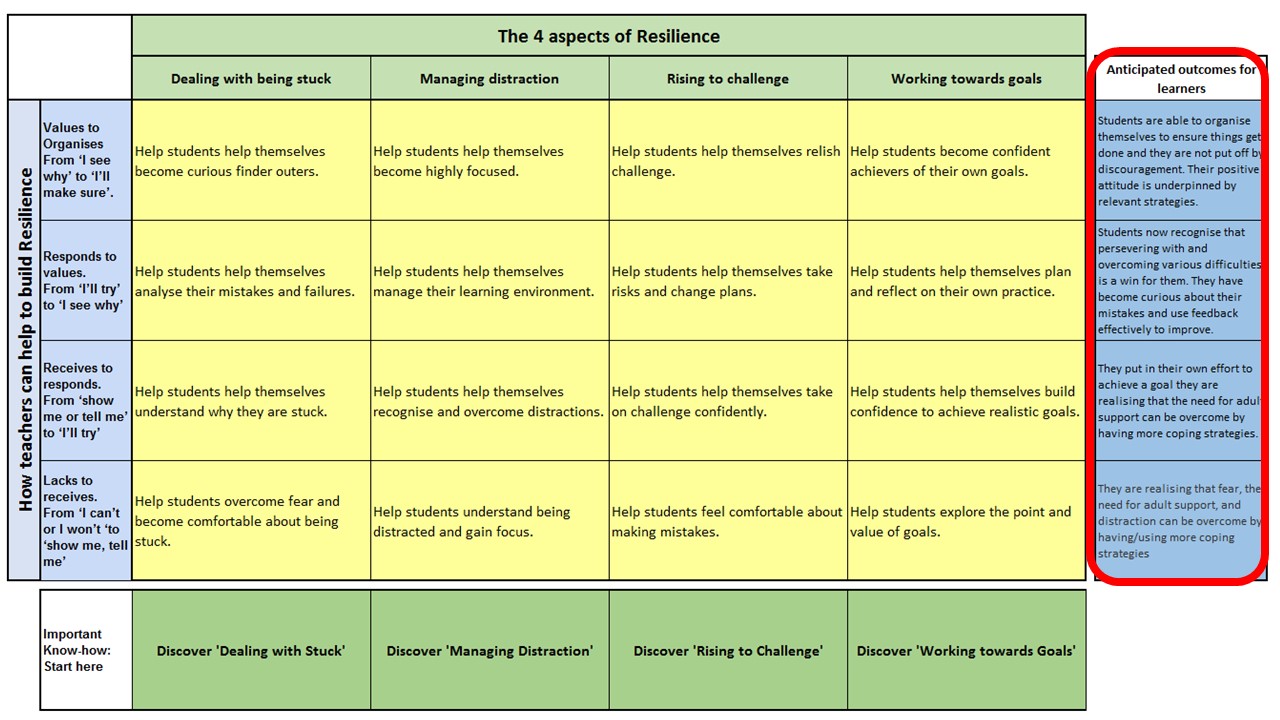
The anticipated results shown in the green cells outline of how the school’s players will have developed by the time you have finished this first stage course, while the blue cells offer the anticipated outcomes for each part of the journey. These include; discovering students learning behaviours, shifts in classroom cultures to support their growth, early shifts in lesson design accommodating learning behaviours, and the beginning of using a much broader range of learning behaviours across the curriculum.


The course and its big ambitions explained

A blended learning programme.

Playing the Learning Power Game’ is designed as a blended learning programme offering rich online content, meeting agendas for Professional Learning Teams and planning tools needed to keep classroom based enquiries on track; key features to help ensure schools achieve the desired outcomes.

Playing the Learning Power Game is not a how to do it manual.

The programme is a careful blend of:

  1. online learning sessions….that faithfully disseminate the researched content about how to build better learners
  2. professional learning team sessions ……actioned by the school that aim to provide sustained, meaningful assistance; learning with and from colleagues
  3. trying things out for yourselves in your classrooms……because “learning by doing” is integral to the development of expertise and expertise can’t be developed quickly. It can only be developed if you have ample opportunity for practice, reflection, and adjustment.

This trio of learning opportunities work together to help teachers replace long-standing habituated practices with more effective ones.
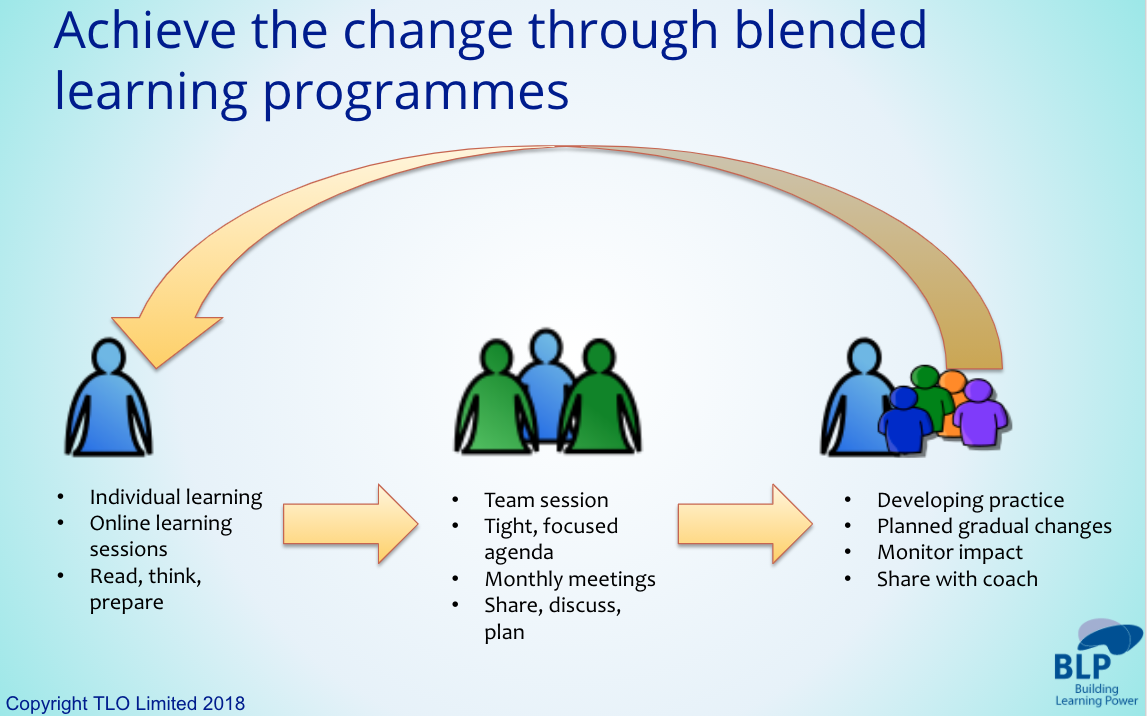
A combination of online content learning, learning with and from colleagues, and learning from small scale enquiries in your own classroom.

Starting tight and focused

Where to start?

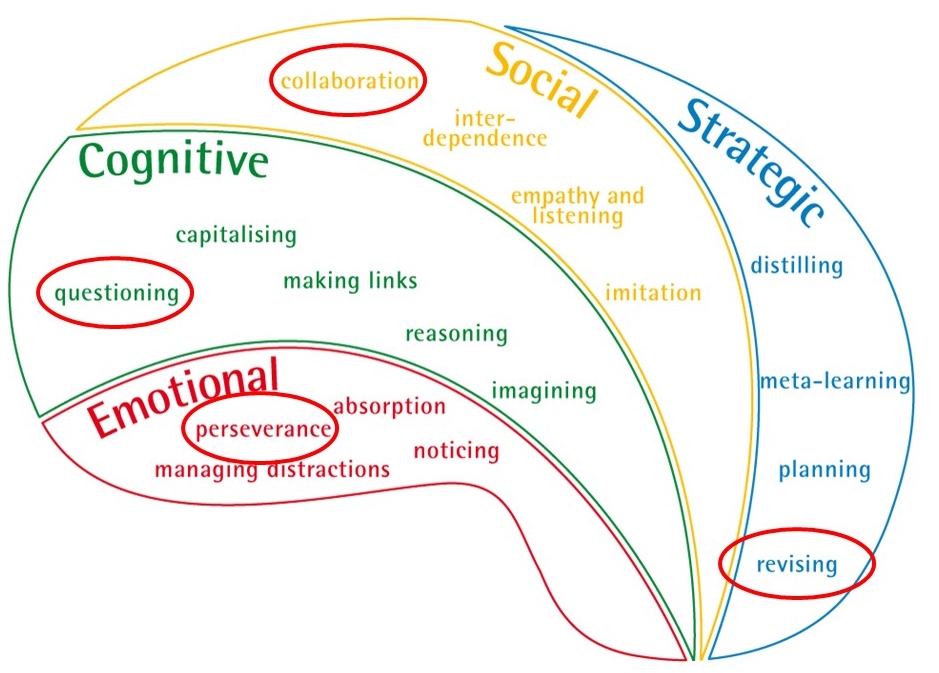
The course introduces the holistic ideas of learning power and our experience suggests that it’s best to select one key disposition from each domain of learning; Questioning from the Cognitive domain, Collaboration from the Social domain  Perseverance from the Emotional domain, and revising from the Strategic domain; these we know as the foundational four.

Why start with these four dispositions?

  • Perseverance because teachers find that it’s the disposition to keep going, to remain engaged, to relish challenge and go for goals that’s most lacking in many students.
  • Questioning because this is the driver of learning; wanting to know why, how, if, when and so forth connects us with learning.
  • Collaboration because ‘working together’ is a familiar classroom activity and yet few students know how best to learn profitably together.
  • Revising because learning is a process and like any process it needs managing and adapting to work really well. This foundational set of four offer the soil in which other dispositions can take root more easily.

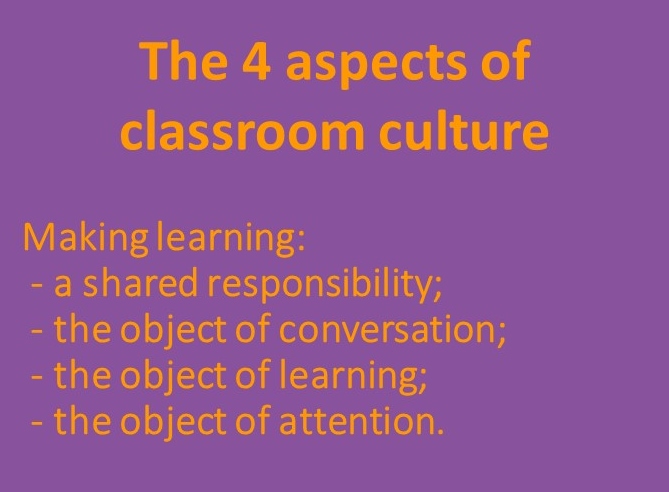
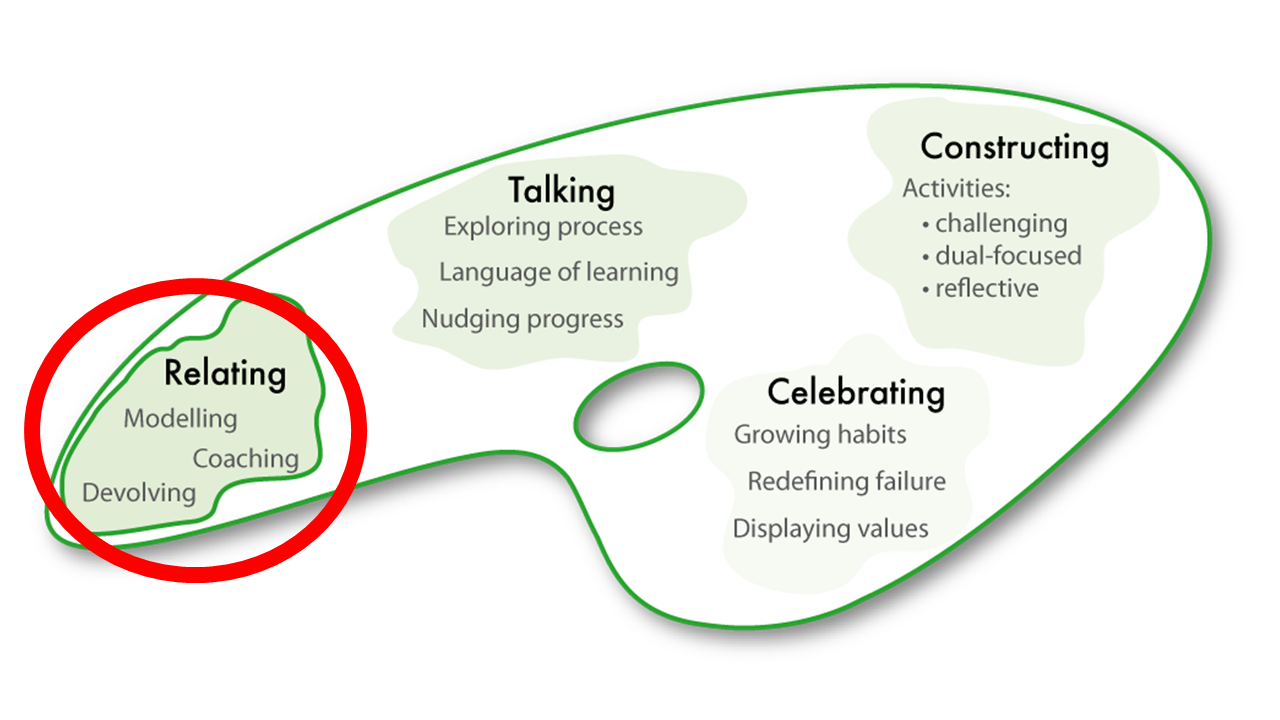
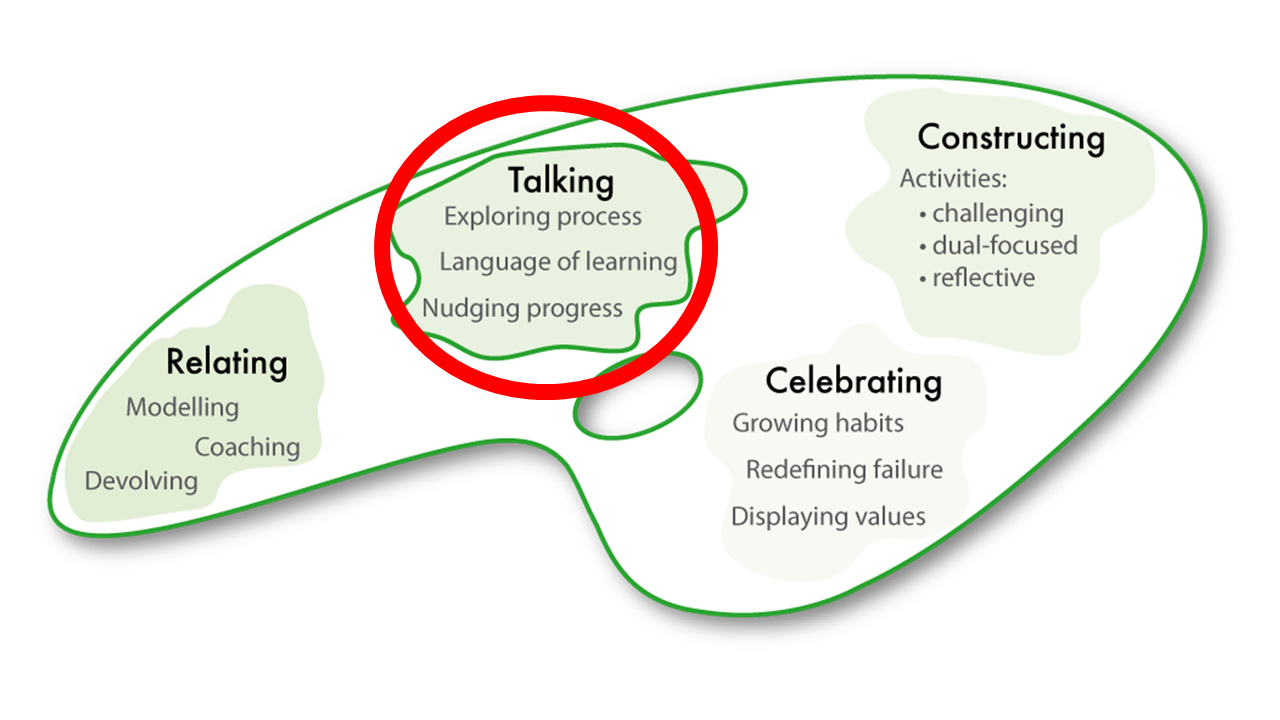
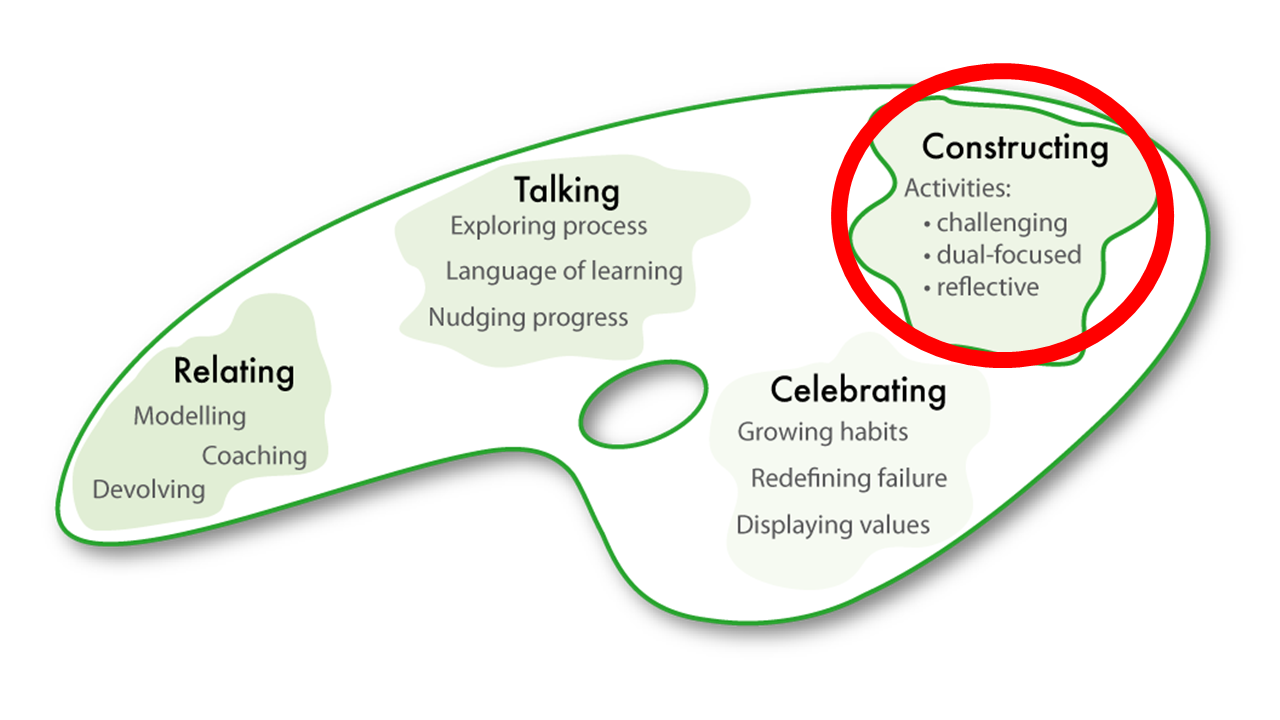
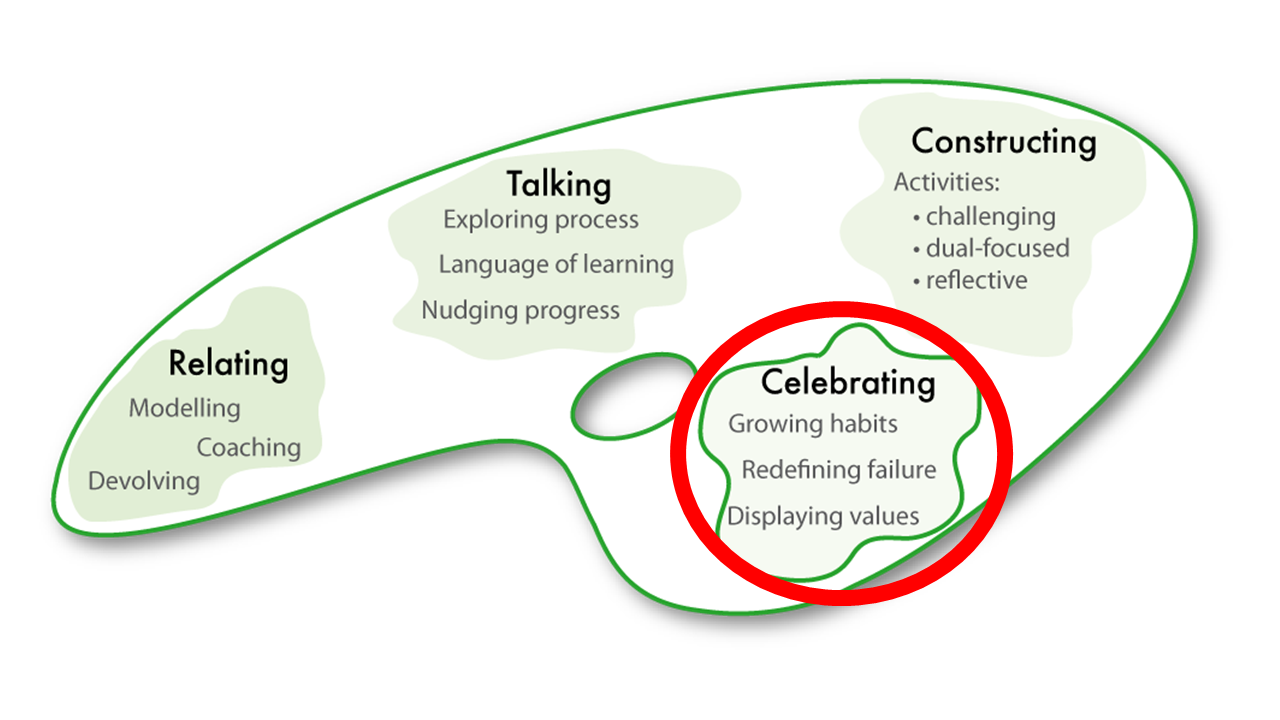
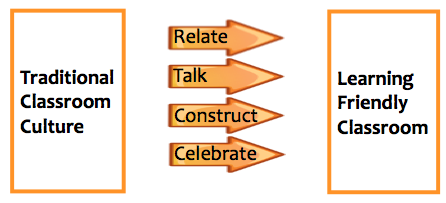
To enable these dispositions to flourish the course also introduces the four essential aspects of classroom culture: how teachers relate to students to support learning; how teachers talk to students to enable learning; how teachers construct lessons to stretch learning and how teachers celebrate to nurture students’ learning power.

“Instead of simply dishing out more good advice to students-as-consumers, classrooms are becoming places of day-by-day knowledge generation about learning”
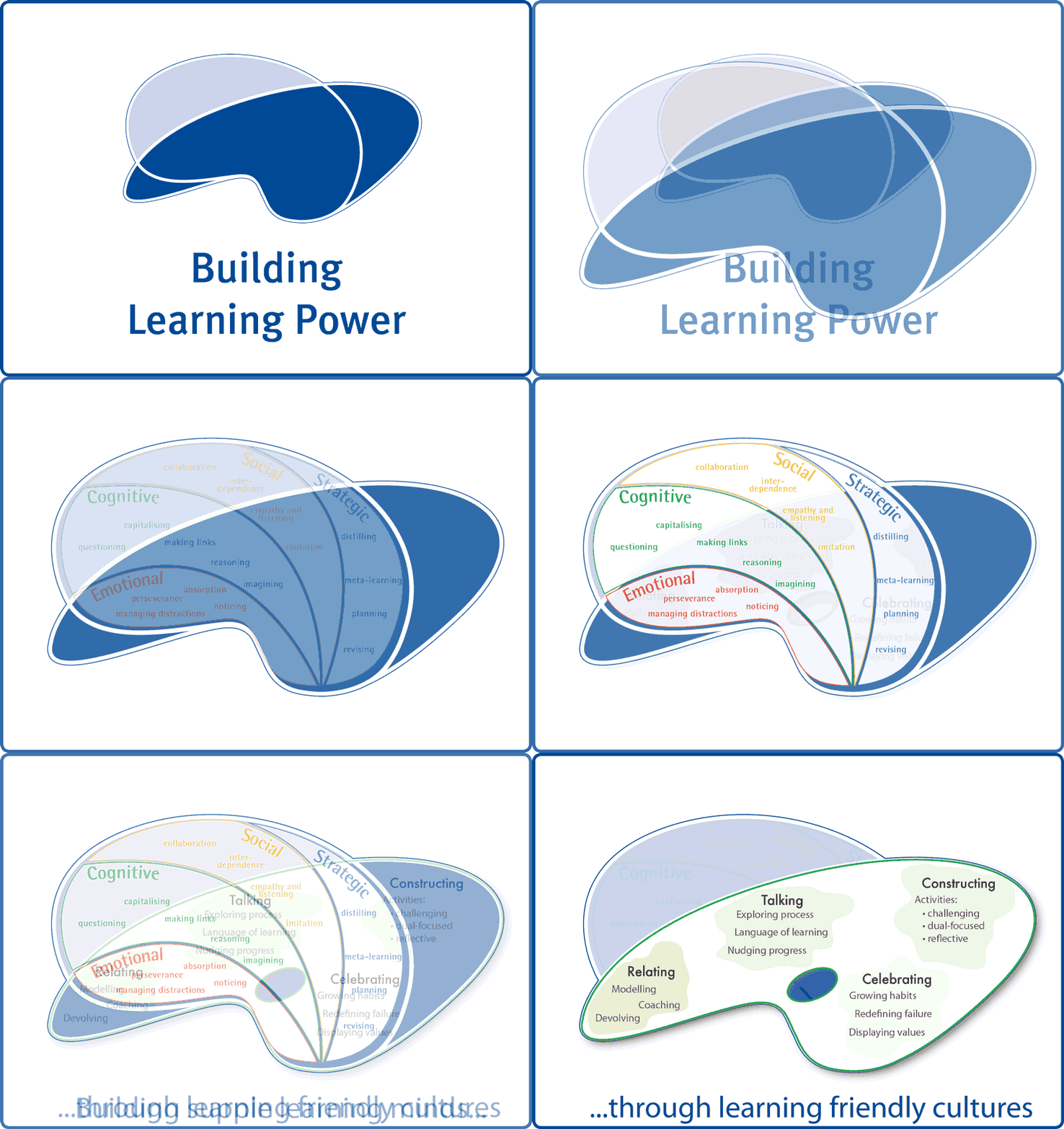


The supple learning mind and the teachers palette.


Broadening the effort and impact

Having worked on introducing students to the foundational four learning behaviours, teachers are later encouraged to branch out and take an exploratory look at building a couple of the next 8 learning behaviours which involves making more sophisticated shifts in teaching.

Some of the learning behaviours are more critical for success in some subjects than others, while others are critical for success across the curriculum.

Teachers are encouraged to widen their reach by, for example…

  • …looking at those behaviours that apply more generally and are linked to students’ attention...perseverance, noticing, listening, revising. These alone may account for any under performance.
  • looking more deeply into questioning. More curious students are motivated to explore and engage, whereas a student who is lacking curiosity has little enthusiasm for learning.
  • remembering that it’s well-researched that students with well-developed meta-cognitive skills attain more highly than those who don’t. So maybe think hard about exploring meta learning.
  • selecting two or three behaviours that seem most appropriate to work on.

The Catalogue – Progression tables interlinked with teaching ideas . . .
Support for senior leaders and learning champions

The ‘Playing the Learning Power Game‘ course is packed full of interesting ideas for teachers but taking the course on board and making it work throws up some vital leadership questions. These include not only the time and effort needed by staff to make it work, but also changes in the school’s operations that will need to be managed.

This accompanying resource takes a leadership perspective and offers a view of the strategic concerns that will arise when the school takes on ‘Playing the Learning Power Game‘. It offers questions, think pieces, frameworks, slide decks and diagrams to help leaders;

  • feel reassured about the purpose, benefits and frameworks of learning power
  • explore important leadership roles when taking on the development of Learning Power through the school
  • maintain momentum into the future
  • understand ways forward beyond this initial stages

 

 Costs and benefits. 

The ‘Playing the Learning Power Game forms the first essential part of the whole Building Better Learners programme and will be of benefit to a school for years to come.

.

Analysing the costs and benefits of staff development involves identifying as many of the costs as possible and weighing these against the benefits that will mount up over time. The purpose is to be able to make judgements about value for money: that is to ascertain whether staff development has been an investment with identifiable benefits, or a cost which represents an inefficient use of resources.

Costs. The majority are relatively easy to calculate in financial terms. They include course fees, replacement costs, travel, manager time, disruption to teaching, staff meeting time/directed time…and so on.

Benefits. Here we’ve considered the benefits of staff development at three levels because they mount up over time: staff learning, changes in practice on the job, benefits for students.The full benefits of this programme will take time to emerge but describing them enables you to value the benefits of staff development.


Continue Reading

REMOVE

A start-up resource with a vital role in the Building Better Learners programme. Available in both primary and secondary school editions.

Uncover the mysteries of learning behaviours

to be heavily edited

We no longer see learning as a performance but rather an interesting process going on in our brains. The whole point of building learning powers is to do just that, to build the learning behaviours; building students’ emotional learning habits; building their cognitive/thinking habits; building their social learning habits and their ability to manage the process of their learning. The reluctant learner on the left and the learning powered learner on the right show the beginnings and ends of a long, exciting, but far from inevitable, learning journey.

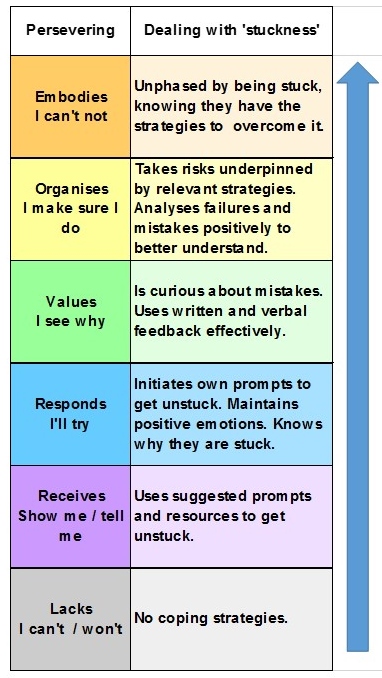
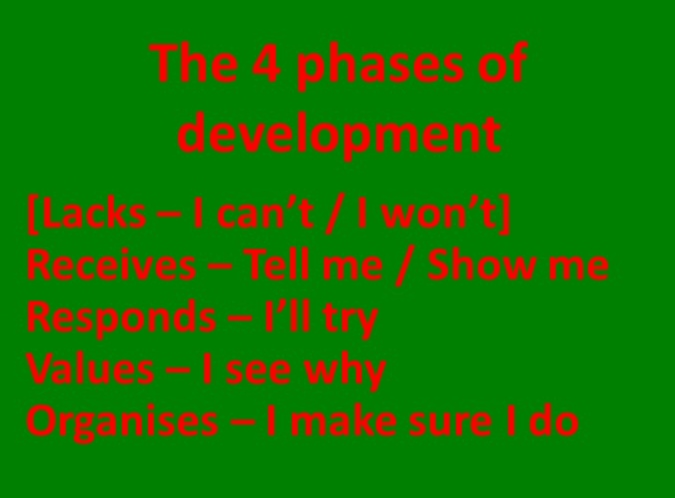
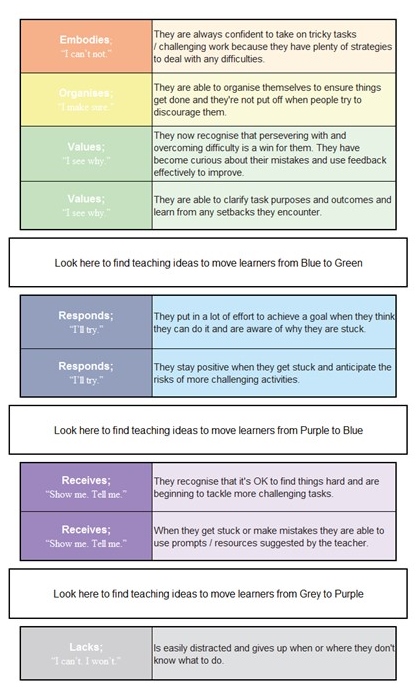
Our understanding of what the journey might look like in practice has emerged and flowered over the past seven years. The stages of the journey are ‘borrowed’ from Bloom’s taxonomy of the affective domain of learning and summarised opposite. It is this scaling of the learning dispositions that will help you make sense of the journey as you document, and influence, your learners’ progress over time.

To help schools make the collection of learning data more manageable we have selected 12 of the original 17 characteristics for you to take a closer look at over time. In this section you can find out more about these fascinating learning characteristics and how they grow under the influence of a learning friendly environment. Understanding more about them will increase your confidence to collect valid data about how these characteristics are growing in your students.

Have you ever wondered…

  • What sort of learning character your learners have?
  • What sort of learning characteristics our more successful learners have?
  • Which characteristics or behaviours do our struggling learners have?
  • Which learning behaviour contributes to the success of most of our learners?
  • Which learning behaviour is used less than any of the others?
  • How do the answers to these, and similar questions, apply to the schools’ success, our teaching and the curriculum?

What you are wondering about here are the very building blocks of learning, what they are, the part they play and why they are important.


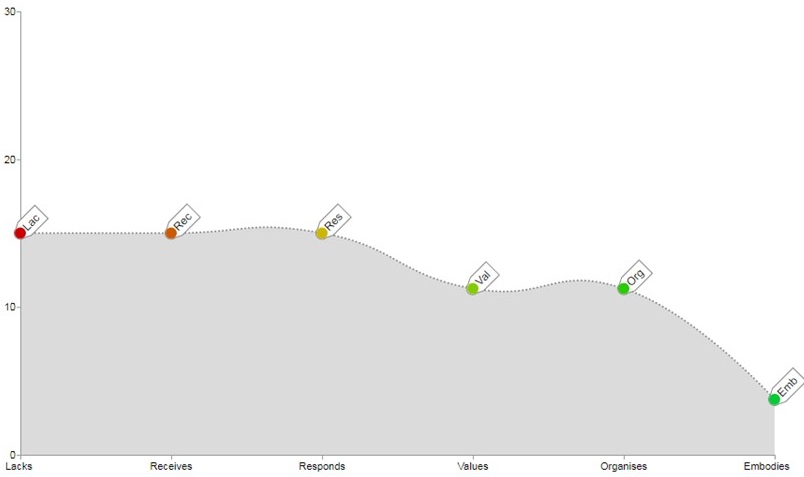
Use a rich picture of your students’ learning behaviours to underpin your approach to improve, develop or catch up on their learning.

What if you knew far more about your students as learners?

Using this resource teachers have found;

  • something interesting about  the learning character of every student
  • those learning behaviours in successful learners  that appear lacking in less successful learners
  • how their boys’ learning behaviours seem to differ from their girls’
  • which of the learning behaviours are stronger or weaker in Pupil Premium learners’
  • which learning behaviours students need to strengthen
  • how learning character plays a part in influencing the learning of every child

These unusual yet vital and urgent findings form the stimulus for this resource; a practical tool to help teachers and schools uncover their students’ learning character and use this, usually hidden and unknown information, as the very basis for developing and strengthening them as learners.


What else will you come to know about your learners?

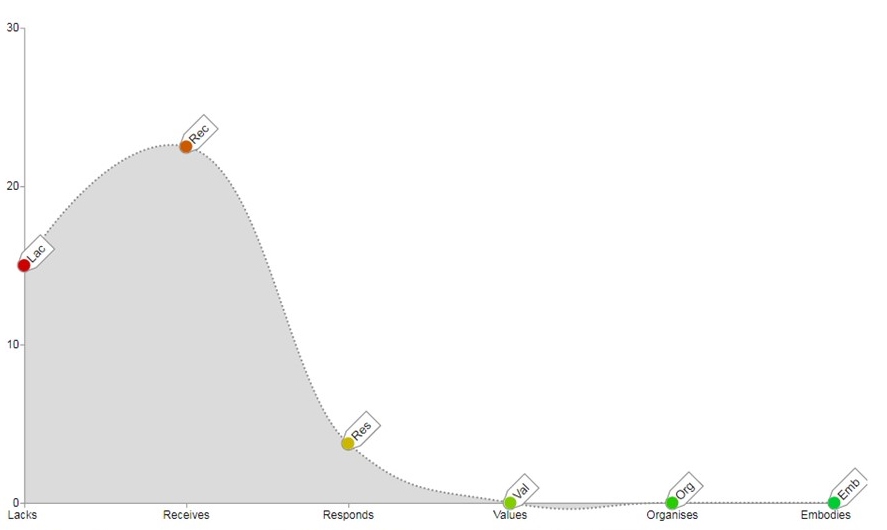
 Ultimately, by looking at the data through the different learning domains, i.e. emotional, cognitive, social and strategic, you’ll be able to answer some big questions:

  • Which of the learning domains (emotional, cognitive, social and strategic) seems consistently under developed across most groups of students?
  • Which of the learning domains (emotional, cognitive, social and strategic) seems consistently well developed?
  • Which learning behaviour overall, across all groups, comes out weakest?
  • Which learning domain is strong in higher attaining learners
  • How does this differ in lower attaining learners?
  • What do we suspect might be happening?

Whatever your area of interest, the learning profiles will reveal useful information that lies at the heart of teaching.


What does the resource offer?

Our growing understanding of how learning habits build has led us to ask how schools might use such information to help shape teachers’, or even whole school, plans. What does growth in learning habits look like? How might teachers estimate students’ phase of growth?

This resource offers teachers and schools:

  • a manageable set of tools to enable teachers uncover, collect and analyse information about their students’ learning character;
  • an outline of the research, value, makeup and growth of peoples’ learning character.

These tools aim to help schools discover and analyse their students’ learning behaviours and use this information as an essential starting point for helping students become better learners. In other words this resource will help you and your school to;

  • use a rich picture of your students’ learning behaviours, rather than attainment, to underpin your approach to helping them to improve, develop or catch up on their learning.


How does the resource work?

Each section deals with a key aspect of understanding and using the tool and reading the results.

    • Section 1 What makes a difference in learning?…offers  a brief introduction to the meaning, purpose and attributes of learning character /learning power.
    • Section 2 Uncover the mysteries of learning behaviours...offers rich descriptions of the learning behaviours that form part of this measuring tool.
    • Section 3 Up close and personal with learning…invites you to start considering learning behaviours seriously by looking at yourself as a learner, followed by a couple of students.
    • Section 4 Finding learning characteristics….suggests how you might go about gathering, recording and interpreting the evidence for just one class and then for the whole school
    • Section 5 Where now, what’s next? explores the changes you might make based on the data collected and the routes you might take to ensure growth in pupil’s learning behaviours.


 Support for Senior Leaders

TEXT

PIC

7. Logistics

How it is sold…separately or as an essential part of the whole Building Better Learners programme

TEXT

PIC

Might schools use this information in strategic plans of action (Intent)? What sort of activities would teachers need to use to strengthen the growth of learning habits? (Implementation) What would count as evidence of impact and how might that be captured and reviewed? (Impact).

Continue Reading

Re-energising your Learners’ Resilience v3

Available in both primary and secondary school editions.

Wouldn’t it be wonderful if…

  • all your students had a tendency to lock onto learning
  • they knew how to work through difficulties when the pressure mounted
  • they could all grow their willingness to stay engaged
  • and that the well-known retreat into defensive mode, with a brittle and defensive attitude to learning, was a thing of the past.

That’s what this resource aspires to.

Based on a background of sound research this resource offers swift access to classroom-focused material that will help any teacher to re-energise, revive and develop students’ all important emotional learning dispositions and behaviours.


It offers schools…

…easy access to a curated range of activities covering:

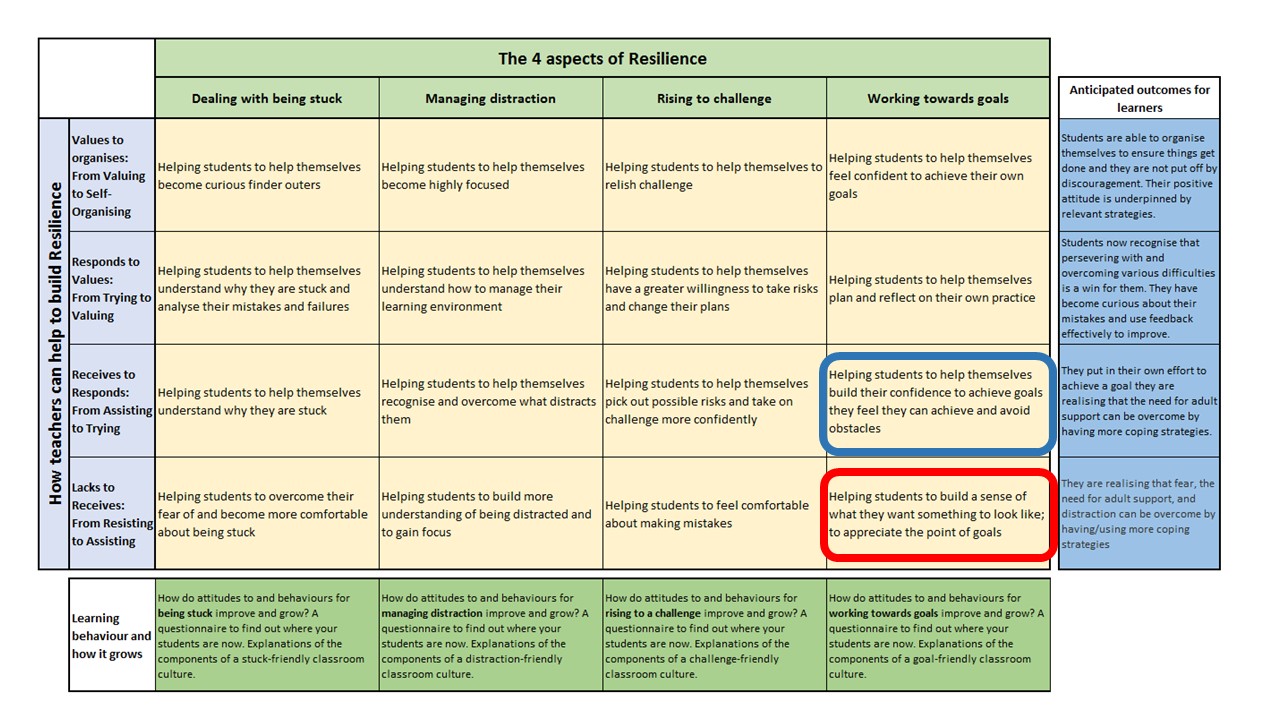
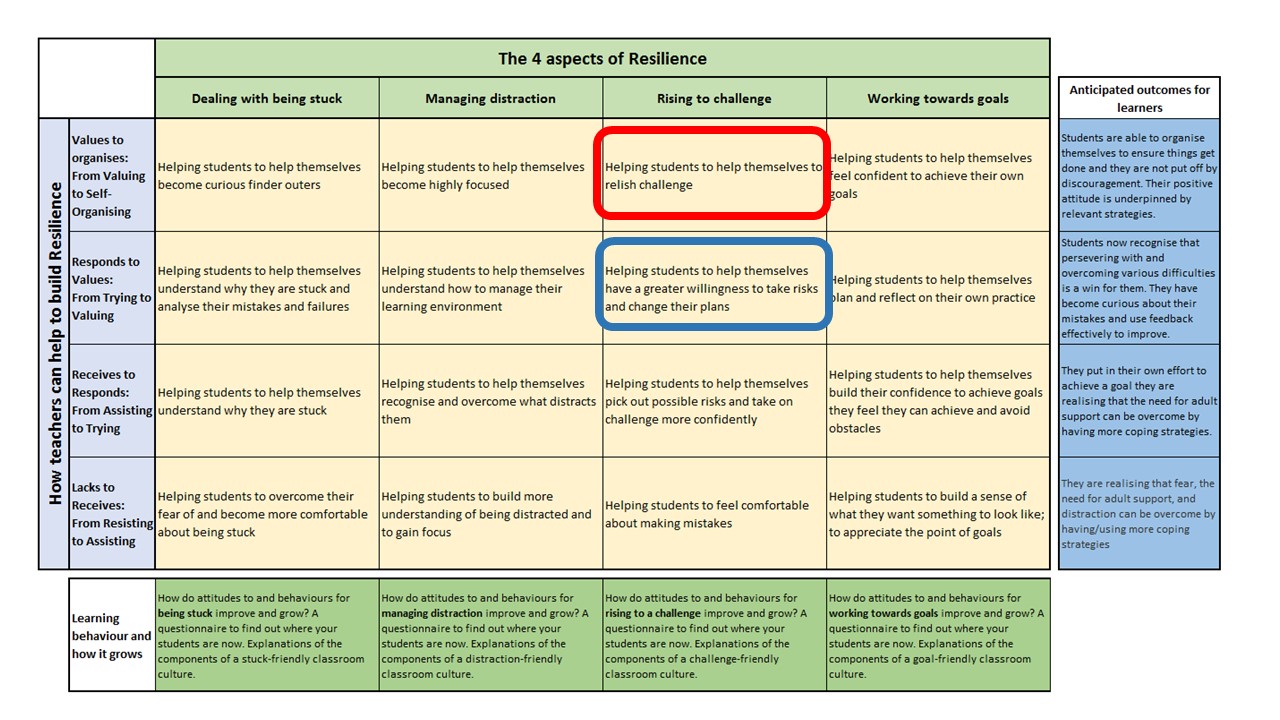
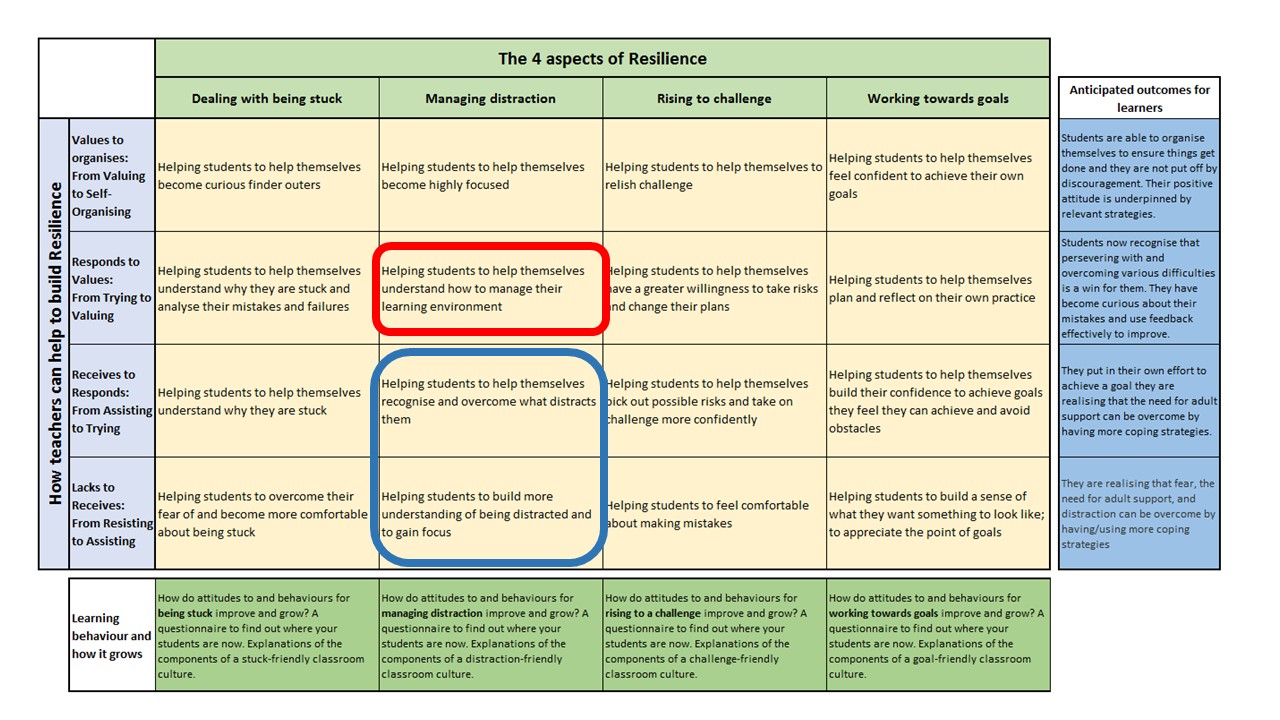
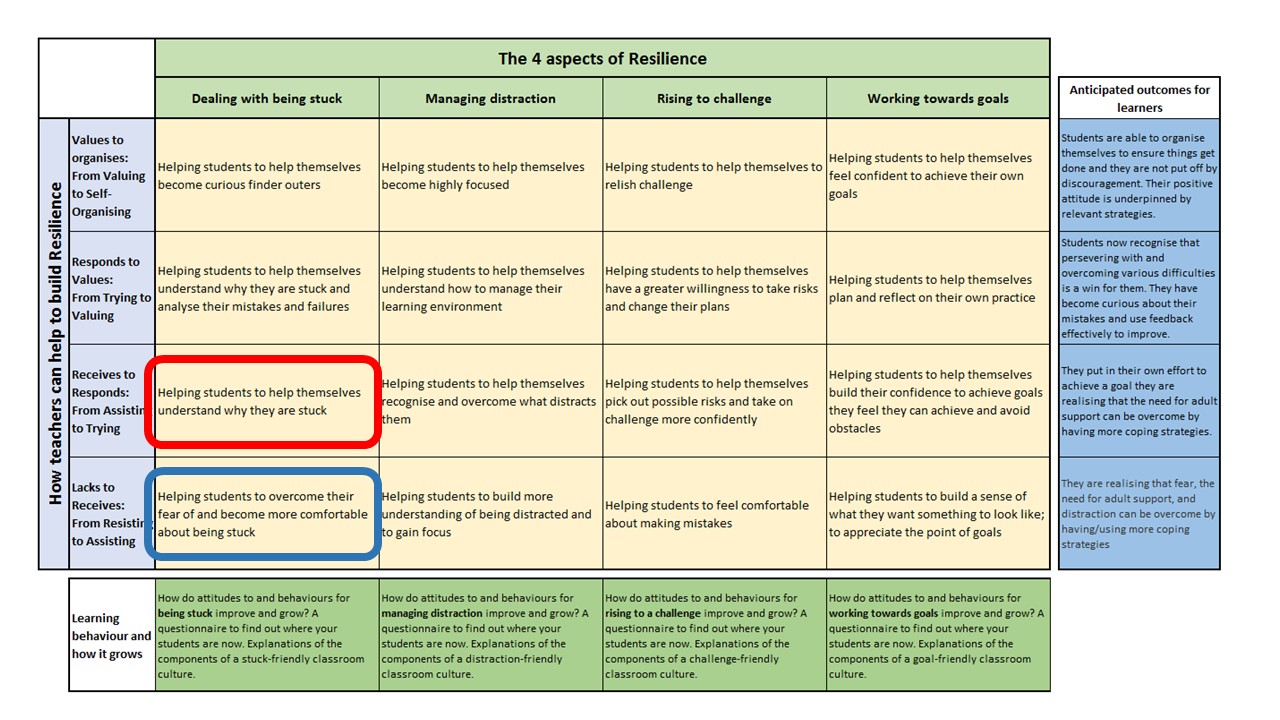
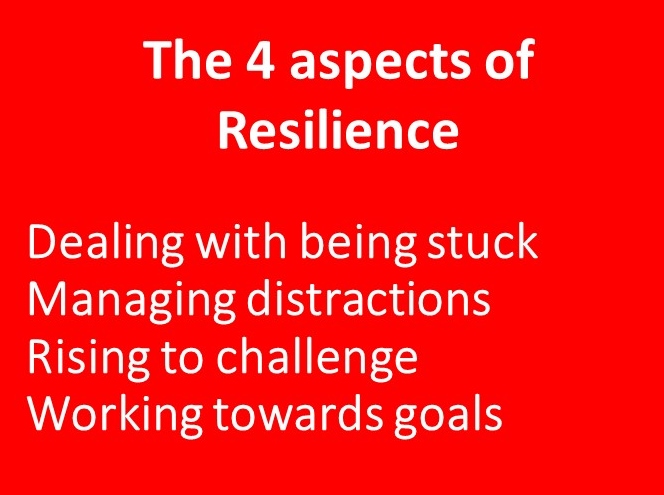
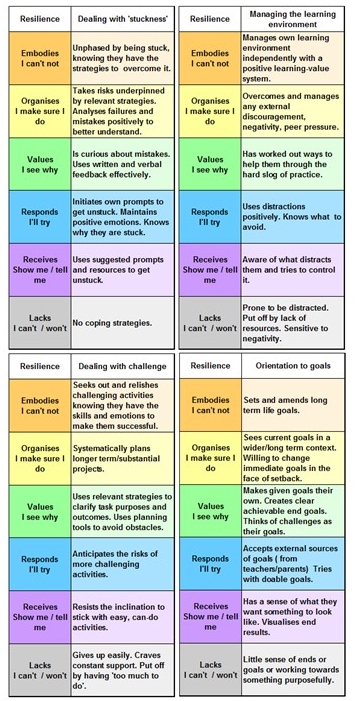
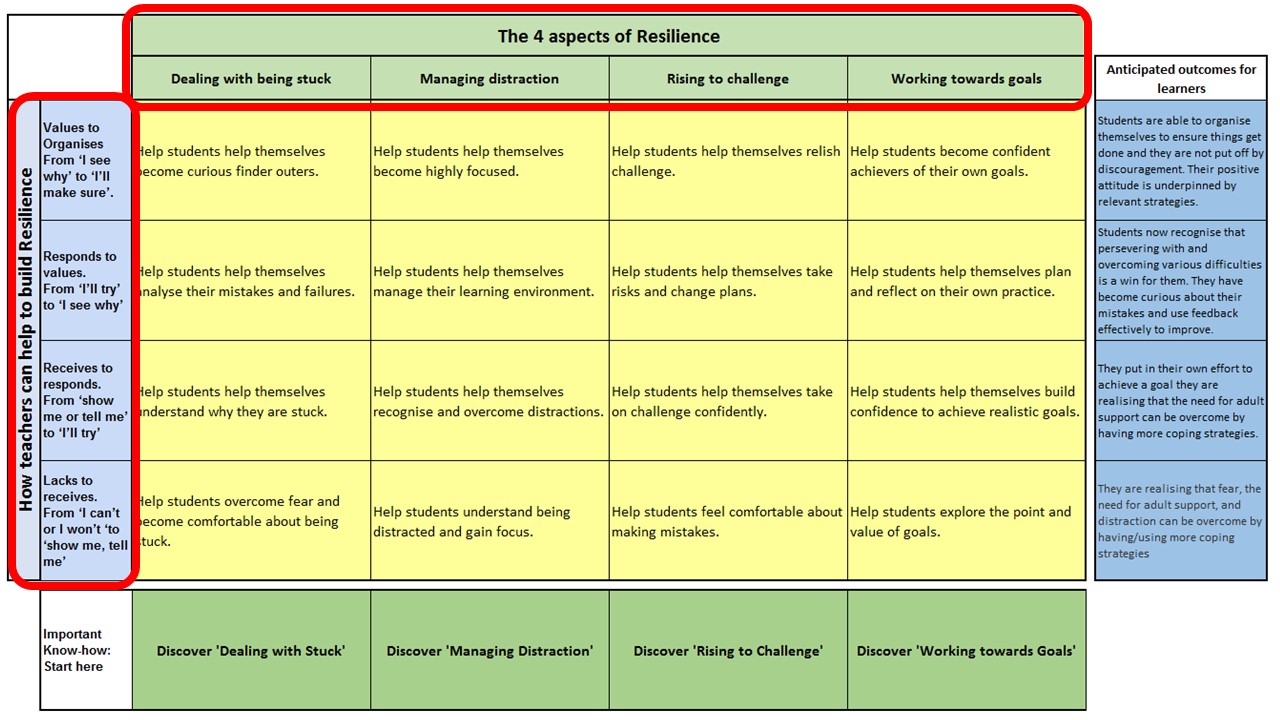
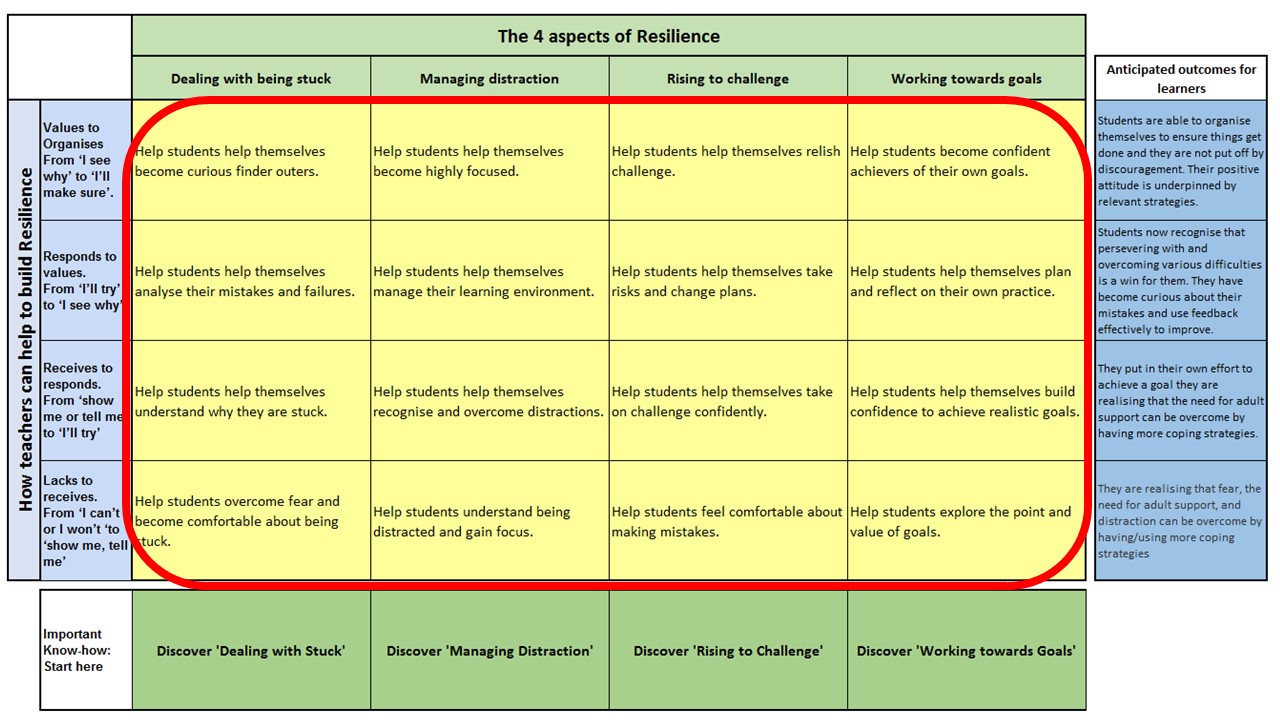
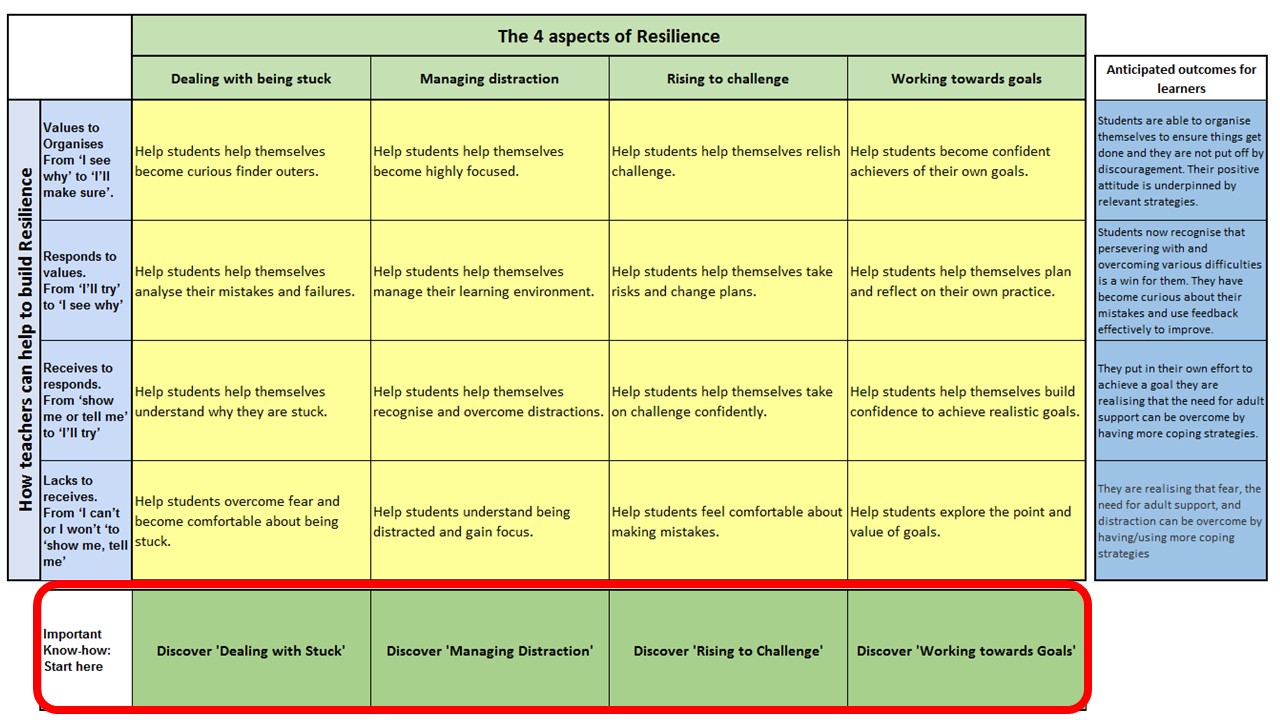
  • 4 aspects of Resilience, across
  • 4 levels of growth, across
  • 4 aspects of teaching practice.

So your learners will then be able to:

  • know what to do when they get stuck
  • maintain focus in the face of competing distractions and priorities
  • deal effectively with difficulty or challenge
  • work effectively purposefully towards their own goals.

This four-by-four framework is accessed through a simple grid, blending research from Carole Dweck, Mihalyi Csikszentmihalyi, Art Costa, Sir Ken Robinson, Dylan Wiliam, Chris Watkins and Guy Claxton.


Activities to meet students’ needs

It includes;

  • quizzes to establish students’ resilient learning behaviours
  • quizzes to establish how classroom culture fosters resilience
  • detail on the 4 aspects of resilience, and how each progresses over time
  • advice on how to target teacher interventions
  • multiple practical classroom activities, at 4 phases of learner development, across 4 aspects of resilience – 16 sets of classroom resources in all
  • multiple suggestions for teacher talk to support learner resilience
  • comprehensive support and advice for senior leaders in introducing, managing and leading the programme.

Support for senior leaders to plan and implement change

The ‘Re-energising’ resource is packed full of interesting ideas for many teachers. Taking the resource on board and making it work throws up some vital leadership questions. These include not only the time and effort needed by staff to make it work, but also changes in the school’s operations that will need to be managed.

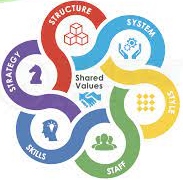
An accompanying online resource for senior leaders helps to structure these leadership and management issues using the successful McKinsey 7-S Change Management Model; a model that’s often used to plan and implement organisational change.

This manager’s guide covers:

  • The school’s shared values and how these will influence the change culture
  • A strategic plan that managers construct to accommodate the change project
  • The leadership style that will best benefit the change
  • The structure of accountability for the change project (who leads, how to monitor)
  • Tweaks in the schools systems to accommodate the change project (i.e. making the most of directed time)
  • Identifying the skills needed by staff for the change project to be successful
  • The type of development/training staff need to best complement the ‘Re-energising‘ resource.

Senior leaders will want to be sure that any organisational changes won’t act in adverse ways across their concerns in the school. A useful way of doing just that is by running the adoption of the ‘Re-energising’ resource through the 7- S model, focusing on making the most of the resource.


The McKinsey 7-S Model combines seven components of an organisation that must work together for effective change management, namely its : Structure, Strategy, Staff, Style, Systems, Shared Values, and Skills.

Costs and benefits

We’ve borrowed this cost benefit analysis from a school that has used this resource successfully. The majority of costs of staff development were relatively easy to calculate. The benefits of staff development are considered over three levels that mount up and will take some time to accumulate and emerge.

Classrooms that feel different

The example shown opposite comes from a large primary school. The school was delighted by what the ‘Re-energising’ resource enabled them to do at relatively little financial cost and, importantly, with no other disruption to school timetables or loss of contact time.

Three or four learning teams met monthly to discuss the online materials, plan for changes in their practice and share how their experiments had worked. This focused 1 hour, once a month, was taken from the directed time budget. Teachers were expected to read and absorb the practical online suggestions in their own time. Needless to say this large primary school is now looking to extend their understanding of students’ learning dispositions with further on-line support.


Continue Reading

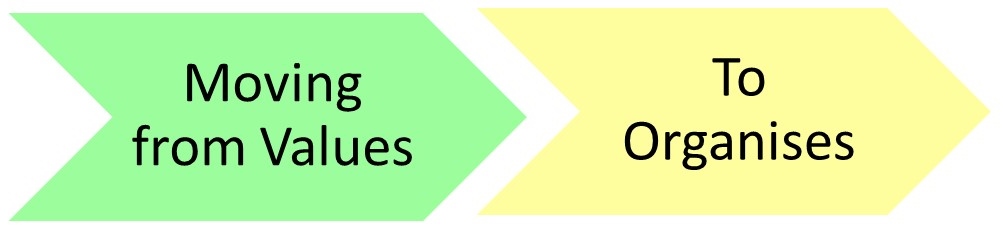
4. Goals. Values to Organises

This section pulls together ideas that will assist students to progress from recognising that using the learning behaviours benefits them to organising themselves to use the behaviours to their advantage,

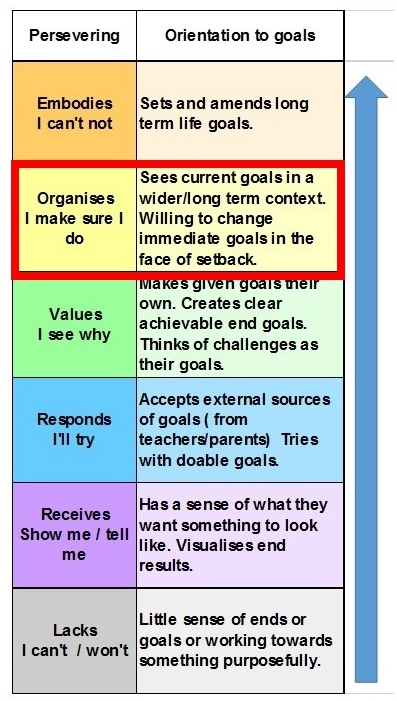
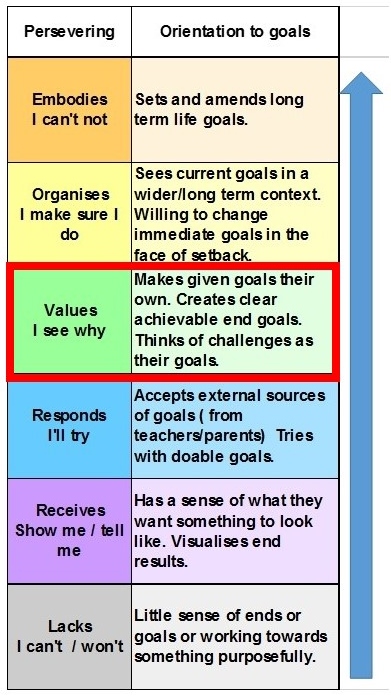
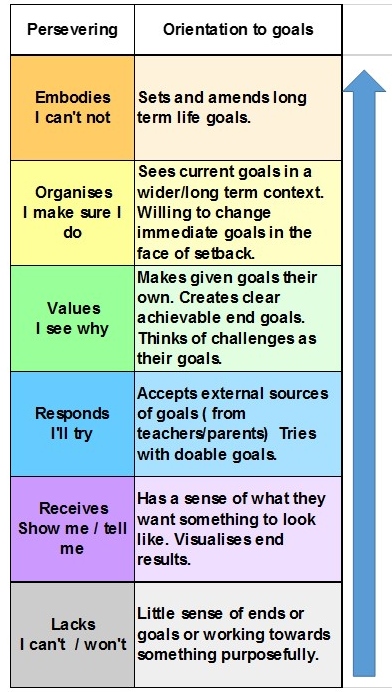
In the Values phase, the student develops a strong belief that they can get better at learning and that using learning behaviours is a benefit to them. They are able to take given goals and make them their own, and/or create clear, achievable goals of their own. They understand the need to create plans so that they are better able to achieve their goals.

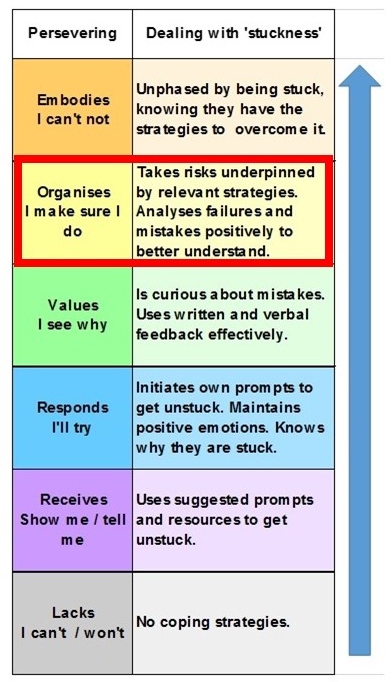
In the Organises phase, the student organises themselves to get the job/task/problem done. They see current goals in a wider, longer term context. They design their own objectives, success criteria and milestones to ensure that they are successful. They have accepted responsibility for their behaviours.

Enable students to pursue their own goals with confidence


Things to give away

How you relate to your students; gradually sharing more of the responsibility for learning with them. In this case, how you encourage them to think ahead of action

Keeping goals on track

Self-monitoring of plans. 

Require students to monitor how their plan is progressing AND assess whether the end goal is still achievable/relevant.

Make sure students understand that changing plans (revising) is an okay thing to do and that changing their plans in order to achieve their end goals is often necessary.

Sometimes of course the set back is such that the original goal becomes unattainable and needs re-casting in a more achievable form – this requires maturity and bravery. Changing an end-goal inevitably leads to having to revise, in the form of start from scratch, the original plan. Many people, let alone students, are reluctant to undertake such root and branch changes, and erroneously rely on minor amendments to plans in the hope that small tweaks will produce the necessary impact.

Constant monitoring of the plan and the goal can counteract this tendency.


Self-analysis of performance and creation of feedback

In order to reach the goals of progressing in their learning – be it content or process – students must be able to self-regulate their own learning. Teachers need to provide helpful feedback to enable pupils to do this.

  • Share assessment criteria with students and ask them to assess/comment on the (imperfect) solutions you provide. Invite them to produce improvements based on their own feedback.
  • Share assessment criteria with students and require them to assess/comment on their own work, and amend it if necessary, before submitting it.
  • Ensure that your written comments are framed as questions to which your students are required to respond. “What do you think you need to do to make this section more convincing?” is preferable to “This section needs more explanation”, as it moves responsibility to the learner to identify what more needs to be done.


Things to say

How you talk about learning; the sort of language content and style you use to enhance and explain learning. In this case how you talk about what they are hoping to do/achieve.

To evaluate progress towards the goal, use phrases like:

  • Do you think that’s coming along well.
  • Have you checked your emerging outcome against your original goals?
  • Are you still on track?
  • What would make you change track?
  • Did you have to amend your goals part way through? Why was that?
  • What are you going to do about . . . . . ?
  • Do you think there’s anything you could have done better, differently?
  • How might you get better at that? What would be a better/alternative way of doing it.
  • Are you satisfied with how it is going?

Things to do everyday

How you construct learning activities; the tasks and classroom routines you use to build positive learning habits. In this case how you design activities that require advance planning and goal setting.

Expect students to analyse risks and strategies for achieving ‘high level’ work

Plan to manage risks

Anticipating possible risks (or obstacles) and considering how to manage those risks requires a clear sense of what is to be done and where the sticking points might occur. It requires students to consider the points at which a plan might go wrong, and what they could do about it. Suggest they:

  • Look at their existing plan and ask the question ‘what could possibly go wrong?’;
  • List all potential risks to success;
  • Suggest a possible strategy to overcome/counteract each risk;
  • Require students to add a risk assessment to all plans that they create in the future.

Image result for taking risks in pursuit of excellence

Teacher talk

  • How would you increase the level of challenge here?
  • How could you make this better even though it looks finished?
  • If things get tough what are some of the different ways you can respond?
  • Is this both challenging and enjoyable?
  • What makes you say that?
  • Try to find something that you are not sure you can succeed with
  • Why does it have to be challenging to be enjoyable?
  • How do mistakes link to challenge?
  • Are you brave enough to give this a go?
  • Is this difficult enough?
  • How could you inject further challenge?
  • What advice would you give to someone who thought they couldn’t do it?
  • Can you tell me how you would try to solve a problem you haven’t seen yet?

Plan from the confidence of achievement

Future-Based Planning

Basically this is about asking students to envisage what their goal will look like when they have achieved it and planning back from that achievement to now. This is a powerful technique because it is about planning from the strength and confidence of achievement rather than from uncertainty of just starting out. It’s harder than you might imagine but worth the effort. Take students through the following steps:

  • Step into the future. Imagine you have achieved your goals
  • Bring back to mind your ideas about goals, and describe them as though they are happening now
  • Describe how it is: –
    • what is in place
    • what is happening
    • how are you feeling
    • how are you behaving
    • what can you do
  • Establish a picture of success – think it, feel it, see it.
  • From your viewpoint in the future, think about what you did to get there:
    • What did you do the day before handing it in?
    • What did you do the day/week before that?
    • What did you do the day/week before that?
    • When were different ideas introduced and finished?
    • What resistors were overcome, when and how?
  • Plot the broad path of each aspect of your plan backwards from the future, take each aspect in turn.
    • researching
    • building lines of argument
    • drafts
    • illustrations/maps
    • monitoring points
    • revising points
  • Look across the aspects:
    • Is there coherence?
    • Does it make sense?
    • Are some things dependent on others and is the ordering right?
    • Have you thought about resisting factors?
    • Is this manageable, where are the possible overload points?
  • Amend the timing of these aspects accordingly.
  • Record this broad outline of action.

Write or draw it on a flipchart sheet with a target date.


Things to display

What you celebrate about learning; what you prize, recognise, display; the outward signs of beliefs about learning. In this case what you praise, value and display about thinking ahead to ensure success.

Keep monitoring and evaluation of learning in view.

Display phrases like:

  • What learning behaviour have you used/improved in this learning project? How do you know?
  • What are you keeping an eye on in this learning project?
  • How do you think it’s going?
  • Are you on track/time?
  • How are you improving the way you monitor your learning?
  • If it’s not going well what do you do to keep yourself going?
  • What have you been really good at doing in this learning project?
  • What bits could you have done better?
  • Is this something you already recognised in yourself?
  • What one thing might you need to work on?


You are currently in – Working towards goals

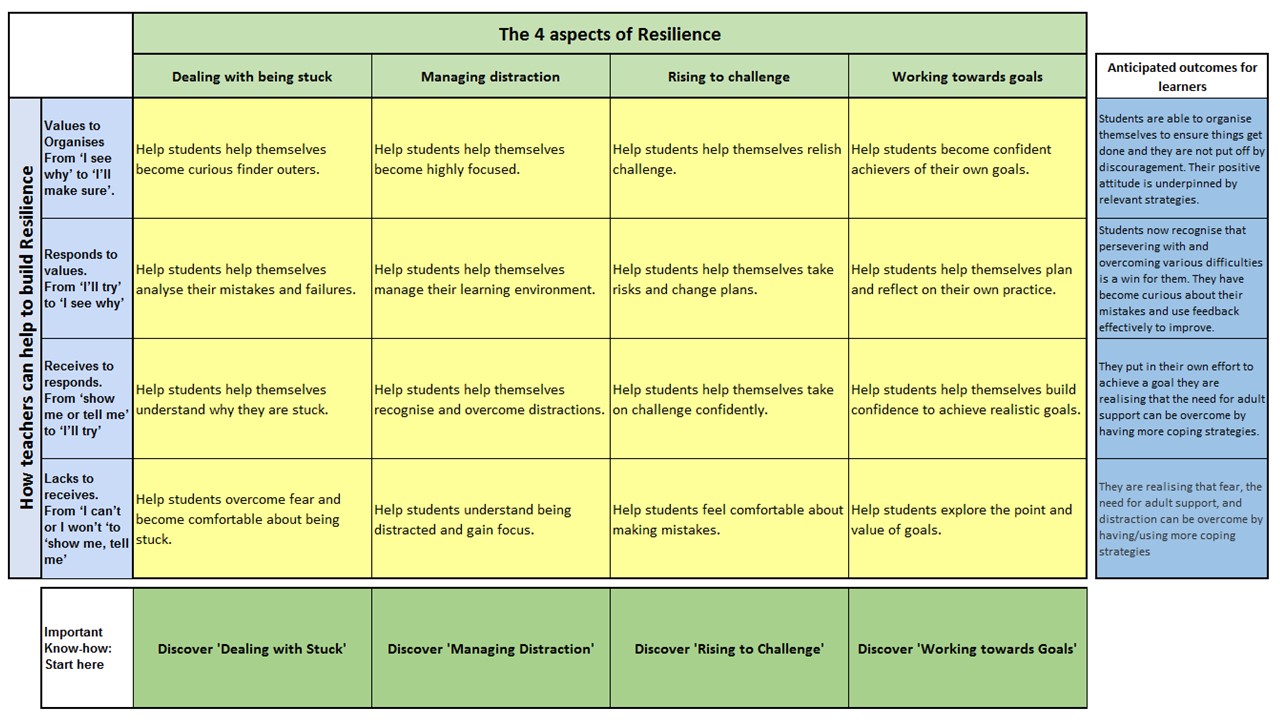
Return to the front page ⏎Dealing with being stuckManaging distractionRising to challengeWorking towards goals
From ‘I see why’ to ‘I’ll make sure’:
Values  to Organises
. . become curious finder outers.. . become highly focused. . . relish challenge.. . confident achiever of  own goals.
From ‘I’ll try’ to ‘I see why’:

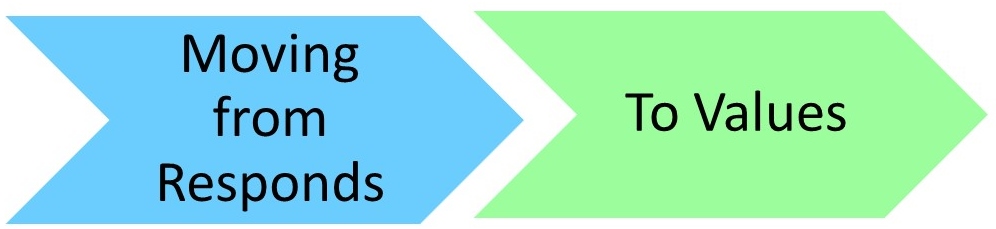
Responds
to Values
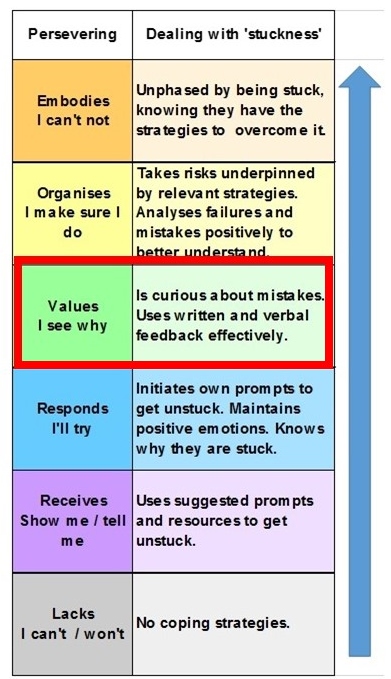
. . analyse mistakes and failures. . . manage their environment.. . take risks and change plans.. . plan and reflect on their own practice.
From ‘Show me/tell me’ to I’ll try’:
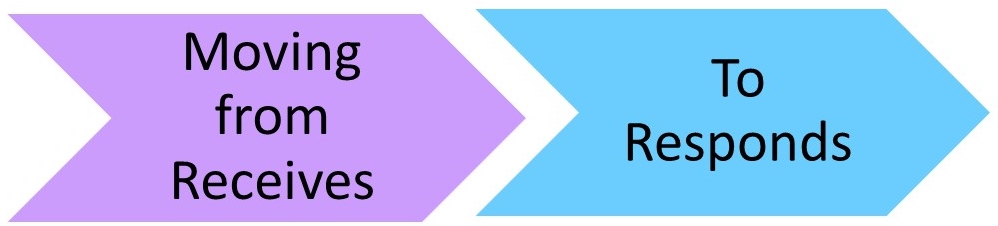
Receives to Responds 
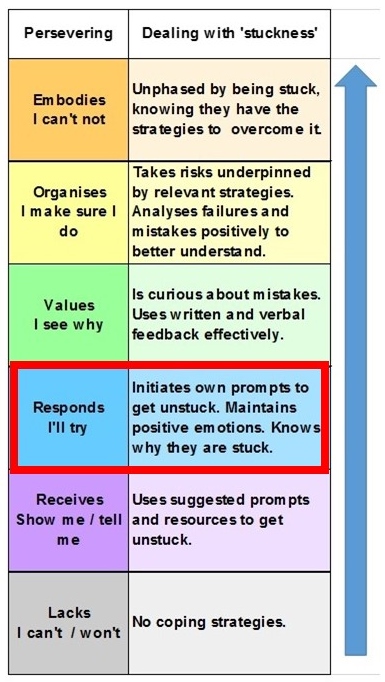
. .  understand why they are stuck.. . overcome their distractions.. . take on challenge confidently.. . achieve realistic goals.
From ‘I can’t’ to ‘Show me/tell me’:
Lacks to Receives
. . comfortable about being stuck.. . understand distraction and focus.. .  comfortable about making mistakes.. . see the point and value of goals.
Important Know – How: 
Start here.Work up ➡️
Discover ‘Dealing with Stuck’Discover ‘Managing Distraction’Discover ‘Rising to Challenge’Discover ‘Working towards Goals’
Continue Reading

3. Goals. Responds to Values

This section pulls together ideas that will best assist students to progress from being willing to do things for themselves to recognising that using the learning behaviour actually benefits them.

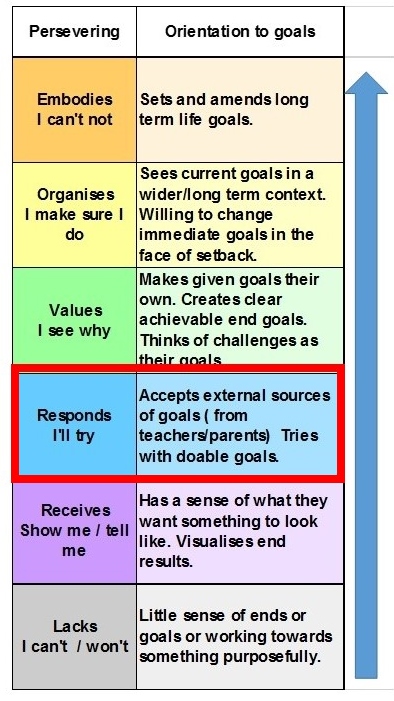
In the Responds phase, students are prepared to accept external sources of goals from others. They try with goals they consider do-able. They are beginning to set their own short-term goals and create simple plans for achieving them.

In the Values phase, the student develops a strong belief that they can get better at learning and that using learning behaviours is a benefit to them. They are able to take given goals and make them their own, and/or create clear, achievable goals of their own. They understand the need to create plans so that they are better able to achieve their goals.

Encourage students to set their own goals confidently and check that goal planning is geared to avoid obstacles


Things to give away

How you relate to your students; gradually sharing more of the responsibility for learning with them. In this case, how you encourage them to think ahead of action

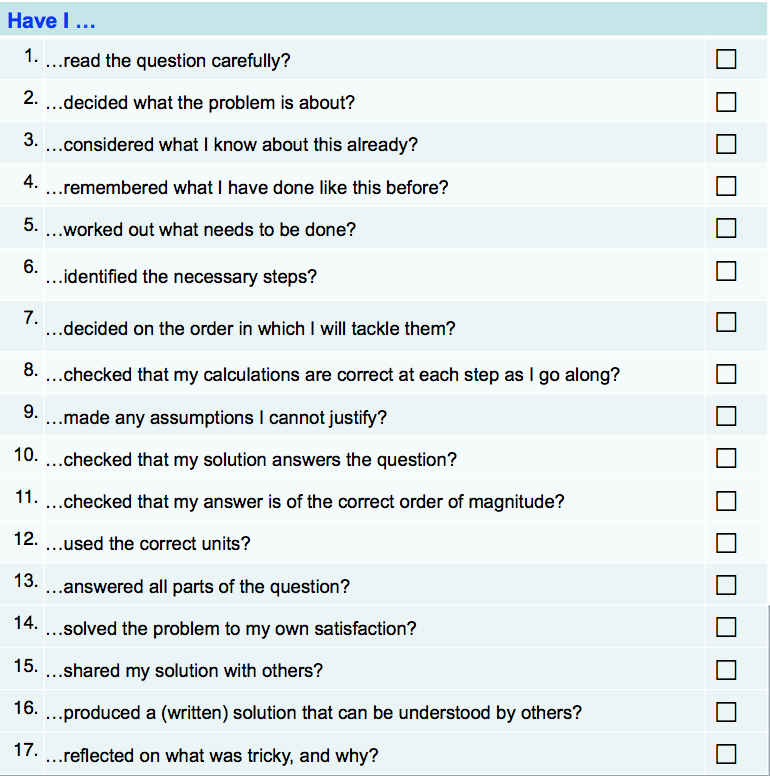
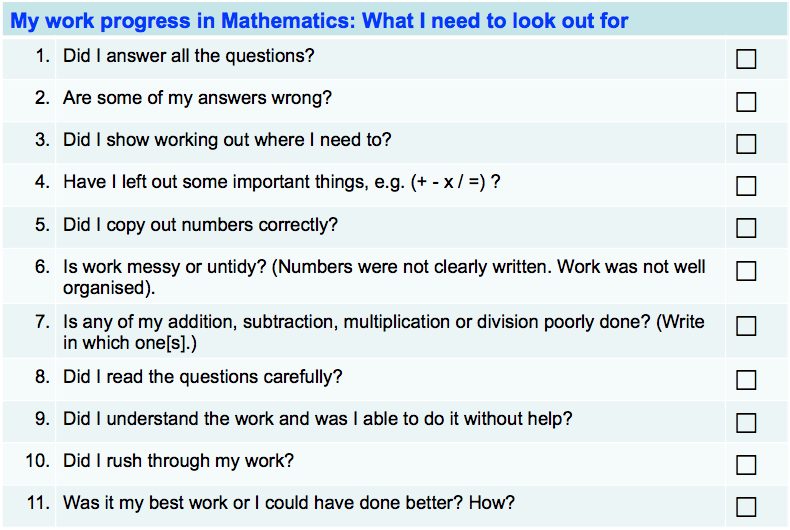
Build in opportunities for students to self-check their work

Monitoring checklists

Construct checklists with students itemising the important things to check before they consider something is finished. Students should use such checklists as they work through something, and again as a final check before they submit work for assessment.

How we relate to standards of excellence, quality, and correctness is key. It is about developing a sense of standards; a view of what’s good, bad or indifferent. Initially students accept what they are told by teachers about what something needs to look like, be like, feel like. But with support and encouragement students are able to begin to think for themselves about what makes something good and eventually determine their own standards.

Screen Shot 2016-05-09 at 13.56.32

Screen Shot 2016-05-06 at 14.34.55

Teacher talk

  • Have you checked your checklist?
  • Did you miss anything?
  • Did you have to go back and alter/improve something?
  • Great. You are monitoring your learning really effectively.

Select own levels of challenge

For the same bit of curriculum content, provide tasks that are designed to offer low, medium and high challenge (or mild, spicy, hot) and encourage students to decide on the level of challenge they wish to undertake. Use this as an opportunity to encourage them to set their own learning goals.

Read more ...

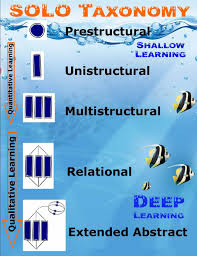
SOLO Taxonomy (structure of observed learning outcomes) is sometimes used to help teachers to structure tasks with varying levels of challenge.

At the unistructural level, only key aspects of the task are explored

[ie: How did the fire of London start? ]

At the multistructural level, several aspects of the task are explored but their relationships to each other and the whole are not.

[ie: What factors contributed to the spread of the fire of London?]

At the relational level, the aspects are linked and integrated, and contribute to a deeper and more coherent understanding of the whole.

[ie: How did these factors combine to cause so much damage?]

At the extended abstract level, the new understanding at the relational level is re-thought at another conceptual level, looked at in a new way, and used as the basis for prediction, generalisation, reflection, or creation of new understanding.

[ie: What could have been done at the time to prevent the fire of London spreading so quickly?]

Four levels of challenge. Four goals for students to choose between.


Things to say

How you talk about learning; the sort of language content and style you use to enhance and explain learning. In this case how you talk about what they are hoping to do/achieve.

Develop the skill of planning to achieve goals

  • Do you need a plan for this?
  • What do you want to achieve?
  • What will it look like when it’s finished?
  • What needs to be done?
  • In what order?
  • How well?
  • What do I know and what needs to be found out?

Things to do everyday

How you construct learning activities; the tasks and classroom routines you use to build positive learning habits. In this case how you design activities that require advance planning and goal setting.

Make FAME plans

It’s important that plans provide a starting point. A clear beginning or focus shows a student where and how to start and what to do, and what steps or actions to take. The aim of the plan is to liberate the student from direct teacher assistance. Plans are not only a teaching device but aim to provide a means for independent learning.

A good plan contains;

  • an action component
  • a thinking component
  • a monitoring component, which means providing metacognitive steps to help make judgements about what they are doing
  • an evaluation component

Without the monitoring and evaluation components the plan remains just a set of directions for a given task. A good plan is strategic and includes skills that can be applied in a number of contexts.

FAME – Focus, Act, Monitor, Evaluate.

You can of course include more steps e.g. 2 for focusing or 3 for acting. Having too many steps becomes confusing. Keep the magic number 7 in mind.

A good way to introduce this type of planning is for you to do a very detailed one and then ask students to simplify the steps in their own words

Once students understand the planning process and have used them for a number of purposes they will become more proficient and confident, developing skills in;

  • knowledge of what plans are
  • formulating plans for different purposes
  • understanding when planning would or would not be useful/appropriate
  • being mindful (strategic) in undertaking tasks and solving problems.


Teacher talk

  • Do you need a plan for this?
  • What do you want to achieve?
  • What will it look like when it’s finished?
  • What needs to be done?
  • In what order?
  • How well?
  • What do I know and what needs to be found out?

Move from hope to expect.

What I hope students will do as a result of this lesson

becomes

What I expect students to be able to do as a result of this lesson

When you ask students to set their own goals ahead of the lesson ask them to think through the frame;

  • I expect to complete….
  • I expect to achieve….
  • I expect to be able to….

In this way they can begin to own their ambition

Other expectant language could be:

As a result of today’s lesson (learning outcome) I can.………..so that I will.………


Things to display

What you celebrate about learning; what you prize, recognise, display; the outward signs of beliefs about learning. In this case what you praise, value and display about thinking ahead to ensure success.

Avoid learned helplessness

Think and talk about the future

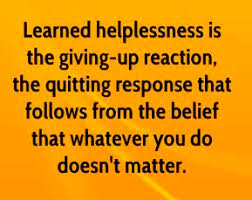
For many students, the future is something that just ‘happens’. It is a future that they are consistently surprised by and so are at the mercy of these ‘unexpected’ events. This factor has increased greatly over the last two or three years during which the world has become much more unpredictable. It is a facet of learned helplessness due to an inability to see beyond the here and now.

Try the following simple ideas for getting students thinking and talking about the future:

  • Have a routine which is consistent and discussed – ‘What do we need to do for the next lesson?’
  • When discussing or reading a book or watching a film etc, stop and ask what they think will happen next.
  • Enquire what they are going to be doing at the weekend / tonight / after school.
  • Encourage talk about tomorrow / next week / the future.


Display planning prompts.

An example of public prompts related to the ‘how’ of planning learning. In this case the FAME plan – focus / action / monitor / evaluate. For more on FAME planning see above.


You are currently in – Working towards goals

Return to the front page ⏎Dealing with being stuckManaging distractionRising to challengeWorking towards goals
From ‘I see why’ to ‘I’ll make sure’:
Values  to Organises
. . become curious finder outers.. . become highly focused. . . relish challenge.. . confident achiever of  own goals.
From ‘I’ll try’ to ‘I see why’:

Responds
to Values
. . analyse mistakes and failures. . . manage their environment.. . take risks and change plans.. . plan and reflect on their own practice.
From ‘Show me/tell me’ to I’ll try’:
Receives to Responds 
. .  understand why they are stuck.. . overcome their distractions.. . take on challenge confidently.. . achieve realistic goals.
From ‘I can’t’ to ‘Show me/tell me’:
Lacks to Receives
. . comfortable about being stuck.. . understand distraction and focus.. .  comfortable about making mistakes.. . see the point and value of goals.
Important Know – How: 
Start here.Work up ➡️
Discover ‘Dealing with Stuck’Discover ‘Managing Distraction’Discover ‘Rising to Challenge’Discover ‘Working towards Goals’
Continue Reading

2. Goals. Receives to Responds

This section pulls together all the ideas that will best assist students to progress from being bounded by needing direction to being willing to do more things for themselves. 

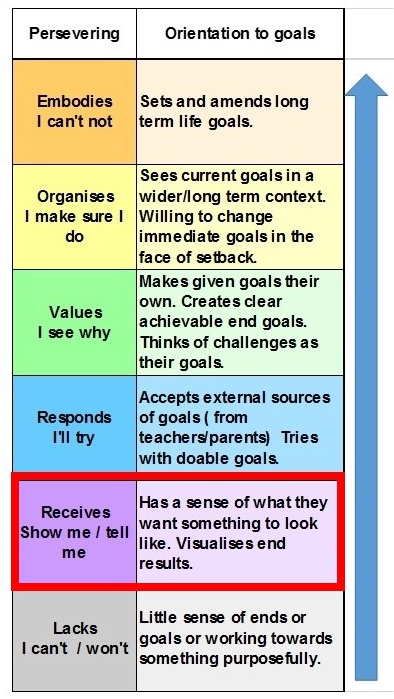
In the Receives phase, students have made a big leap from having an enjoyable but aimless approach to learning to a more purposeful one. Here they are inclined to be developing a sense of what they are trying to achieve and can describe what the finished article / product will look like. They may begin to use lists of ‘things to do’. They will follow a plan that has been given to them when supported.

In the Responds phase, students are prepared to accept external sources of goals from others. They try with goals they consider do-able. They are beginning to set their own short-term goals and create simple plans for achieving them.

Build students’ confidence in trying to achieve goals they think they can achieve.


Things to give away

How you relate to your students; gradually sharing more of the responsibility for learning with them. In this case, how you encourage them to think ahead of action.

Making learning personal

Gaining interest

If we want students to take some responsibility for their learning we need them to relate to what they are learning. At this stage in the progression of goal setting, they are reliant on goals set by others – we need to sow the seeds for them to begin to set their own goals. One way that has proved effective is to ask “you-questions’ which aim to help students identify with the subject matter. Such questions should be addressed to the student and relevant to their personal interests, feelings and experiences. They should invite opinion, knowledge and experience.

  • What do you know about it?
  • What do you want to know?
  • Have you ever been to…?
  • Have you ever heard about…?
  • What do you think it feels/felt like…?


Planning for goals

Planning Frames

Establish a convention of shapes and colours linked to elements needed for a good plan, e.g. green arrow for your target, blue hexagon for resources, yellow star for the people to help you, brown footprint for steps to take, grey clock for deadlines or time-frames.

  • For group or whole-class work, use coloured card cut shapes to put together project plans.
  • Set up symbols on the network so that students can cut and paste these into word processed plans.
  • Create worksheets using the symbols.
  • Set criteria for what you expect in particular plans, and encourage students to use at least one frame of each colour/shape for every plan.

Screen Shot 2016-07-22 at 13.55.35

Teacher talk

As students are deciding what they are going to do and how they are going to do it, use phrases like:

  • What are you trying to do?
  • What do you hope to achieve.
  • What will it be like when you have finished it?
  • Maybe you need to reconsider what you are trying to achieve.
  • Is that possible, or might you need to try something else?
  • Is that realistic, or are you aiming too high / too low?

Things to say

How you talk about learning; the sort of language content and style you use to enhance and explain learning. In this case how you talk about what they are hoping to do/achieve.

Develop the willingness to accept and attempt externally generated goals with language like:

  • When you can do this… it will help you to do….more easily.
  • Your challenge is to . . . . When you are older this will enable you to…
  • Well done for accepting this challenge because it will help us to….
  • Yesterday you couldn’t manage this. Today you can do it. Well done! Why does this matter? What else is it helping you to do?


Share and discuss the value of achieving goals. In doing so you will be:

  • showing attention to learning, rather than performance
  • recognising, praising, displaying aspects of pursuing and achieving clearly defined goals
  • acknowledging/recognising/ praising when goals /success criteria are achieved
  • attending to the growth of learning habits associated with becoming goal orientated
  • prizing aspects of self-regulation
  • prizing risk taking, trying new ways, and being flexible
  • prizing the generation of intriguing ideas, making interesting connections, and forming well-reasoned arguments over ‘right’ answers
  • prizing self-review and evaluation of the learning process.


Things to do everyday

How you construct learning activities; the tasks and classroom routines you use to build positive learning habits. In this case how you design activities that require advance planning and goal setting.

Think ahead of action

‘What will it look like when it’s finished?’ (WWILLWIF)

  • Set a task — physical, dramatic, written, practical, spoken, visual — that has clear parameters.
  • Make WWILLWIF the regular precursor to any action.
  • Ask students to determine WWILLWIF for themselves and in conjunction with others.
  • Help them to visualise this in an appropriate form.

Build WWILLWIF into a list of stuck prompts, as a reminder to think ahead, but also to help students to get unstuck by visualising what the finished article might look like.

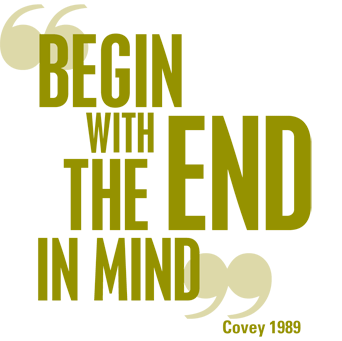
With older students, you might consider exploring one of Stephen Covey’s Habits of Highly Effective People – to ‘Begin with the end in Mind’.

Teacher talk

  • What is the purpose/function?
  • Useful/real/creative/new/familiar/imaginative?
  • Time constraints?
  • Size …not too heavy/light/enormous/minute/long/short?

Explore the value of activities

‘Why are we doing this?‘

is a question that students rarely know the answer to. The most common answer is ‘because my teacher told me’. Students do things on the whole without knowing why. They inhabit a classroom environment whose purpose is activity but don’t know the reason for the activity.
If we want our students to take on learning goals as their own we need to broaden their thinking about why they are doing something. Broaden their perception by seeking to identify the purpose of our thinking and learning.
Discuss things like;

  • what are we trying to do
  • what do we want to end up with?
  • why are we doing this?
  • what is its purpose?
  • what else will it help us to do?
  • would it matter if we couldn’t do this? Why?

Then move into planning mode.

Teacher talk

  • When you can do this… it will help you to do….more easily.
  • Your challenge is to . . . . When you are older this will enable you to…
  • Well done for accepting this challenge because it will help us to….
  • Yesterday you couldn’t manage this. Today you can do it. Well done! Why does this matter? What else is it helping you to do?

Things to display 

What you celebrate about learning; what you prize, recognise, display; the outward signs of beliefs about learning. In this case what you praise, value and display about thinking ahead to ensure success.

Reinforcing the the how of learning

Our plan for writing

Here is a public prompt showing how the class is getting to grips with writing. The subject (writing) itself isn’t the point here. What’s important is that students are being offered reminders about the how of learning, e.g. having a simple plan to help remember the stages involved in writing..

Teacher talk

  • Planning  Drafting  Editing  Proofing is our learning process for writing.
  • What do we need to think about at the planning stage?
  • What will it look /feel like when it’s finished?
  • Who are we writing for?
  • Would some of our planning symbols (see above) help us to plan our writing?

You are currently in – Working towards goals…

Return to the front page ⏎Dealing with being stuckManaging distractionRising to challengeWorking towards goals
From ‘I see why’ to ‘I’ll make sure’:
Values  to Organises
. . become curious finder outers.. . become highly focused. . . relish challenge.. . confident achiever of  own goals.
From ‘I’ll try’ to ‘I see why’:

Responds
to Values
. . analyse mistakes and failures. . . manage their environment.. . take risks and change plans.. . plan and reflect on their own practice.
From ‘Show me/tell me’ to I’ll try’:
Receives to Responds 
. .  understand why they are stuck.. . overcome their distractions.. . take on challenge confidently.. . achieve realistic goals.
From ‘I can’t’ to ‘Show me/tell me’:
Lacks to Receives
. . comfortable about being stuck.. . understand distraction and focus.. .  comfortable about making mistakes.. . see the point and value of goals.
Important Know – How: 
Start here.Work up ➡️
Discover ‘Dealing with Stuck’Discover ‘Managing Distraction’Discover ‘Rising to Challenge’Discover ‘Working towards Goals’
Continue Reading

1. Goals. Lacks to Receives

This section pulls together ideas that will best assist students to progress from lacking ‘a goal orientation’ to making the first positive steps.

In this Lacks phase, students have little sense of ends or goals. They learn but with little sense of direction or purpose. So, while learning can be an enjoyable activity it has no defined purpose. As a consequence their efforts may be unfocused, possibly ill-directed and rarely fruitful in a conventional sense. They could be seen to be messing about, aimless, with no purpose, but still enjoyable.

In the Receives phase, students have made a big leap from a ‘just messing about’ mind-set to a more purposeful one. Here they are inclined to be developing a sense of what they are trying to achieve and that there is a direction of travel. They can sometimes describe what they want to achieve, what the finished article/product will or could look like. They may begin to use lists of ‘things to do’. They will follow a plan that has been given to them when supported.

Help students to build a sense of what they want something to look like


Things to give away

How you relate to your students; gradually sharing more of the responsibility for learning with them. In this case, how you encourage them to think ahead of action

Using your mind’s eye to rehearse the future

Guided Visualisation to rehearse the future

Encourage students to develop the ability to articulate what they are trying to achieve and visualise end results. This technique is useful for students of any age.

Visualisation or mental imagery is a way of conditioning your brain for successful outcomes. The more you mentally rehearse your performance, the more it becomes habituated in your mind.

Think of visualisation as a pre-activity walk-through, helping you to think through what you will be doing and what you want to achieve in advance of actually doing it. It can be used to eliminate some of the unknowns and allows the student to rehearse the future in their mind’s eye.

  • Talk students through what they are going to be doing.
  • Some students find it helpful to close their eyes as you guide them through what they will be doing and achieving.
  • As they get the idea, encourage them to talk each other through it for themselves.
  • The point is to slow the learning down and give students the time to think in advance of committing to action.

How to use visualisation for successful performance:

  1. Visualise the outcome you want – When you mentally rehearse your performance in your head, make sure you see the event as how you want it to unfold. If your mental images turn negative, stop the mental tape, rewind and restart then visualise again see the performance you want to see.
  2. Use all your senses from a first-person perspective – Visualise your performance in detail. What would you see, hear, feel, smell and taste. Feel how your body would feel as you go through the motions of your performance. Try adding in some physical movements that coincide with the visualised images. Feel the excitement of successfully fulfilling your performance goal.
  3. Practise frequently – Mental rehearsal is a skill that becomes better with repetition. Practise your visualisation or imagery daily.


Teacher talk

  • Tell your friend what you are going to do
  • Tell me what you are trying to achieve
  • What are you going to do?
  • What are you hoping to achieve?
  • What will it look like when you have done it?
  • Begin with the end in mind . . .
  • Let’s imagine what success will be like.


Motivate the unmotivated

Some students are just difficult to motivate to try anything, never mind achieving learning goals. This shows itself when they:

  • have little regard for anything they are learning at school;
  • would rather play video games than do homework;
  • rarely stick to something until its completed;
  • prefer activities that don’t require much effort;
  • are frequently defined as “lazy”;
  • find everything pointless or irrelevant;
  • rarely take any initiative and take on everything half-heartedly;
  • blame everyone else for their performance and/or behaviour;
  • have poor self-esteem.

Success is everyone’s innate desire but repeated failure can lead to learned helplessness i.e. they have learned to see themselves as failures. In other words a student may lose their motivation because of a lack of confidence in their ability to achieve specific goals. It is this lack of confidence that can drive behaviour such as avoidance, stress, “laziness” and a “don’t care attitude’. In such cases students need to have opportunities for success.

Carol Dweck and others have shown that the use of certain words and the adoption of certain practices can help the unmotivated student. Steer their interest towards learning goals by:

  1. Showing an interest in their interests. Link their interests to skills you want them to develop .e.g. use comics to practise reading.
  2. Helping students to view themselves as successful people by talking about their successes.
  3. Setting reasonable expectations with challenging but achievable tasks.
  4. Making sure students know exactly what they are expected to do.
  5. Don’t focus on past performance, focus on their future performance – “what do you think you can do differently?”
  6. Letting them know that their failures do not define them – they make them stronger.  Talk of famous people who encountered and overcame failures and that struggle is real for many people.
  7. Commenting on ALL the positive changes you observe even if they do not immediately lead to an improvement. If you see students put in greater effort, say it. If you see them trying harder, say it. If you see them trying a different approach, let them know you’ve noticed. Remember, though, to praise the effort and not the child.
  8. Reminding them of their strengths and accomplishments. Help them see themselves as successful.
  9. Not doing everything for them – you’ll only teach them to become more dependent.
  10. Letting students participate in the decision-making process. It will work wonders for their motivation.


Things to say

How you talk about learning; the sort of language content and style you use to enhance and explain learning. In this case how you talk about what they are hoping to do/achieve.

Growing an orientation to goals

Encourage students to develop the ability to articulate what they are trying to achieve and visualise end results.

Use phrases like:

  • Tell your friend what you are going to do
  • Tell me what you are trying to achieve
  • What are you going to do?
  • What are you hoping to achieve?
  • What will it look like when you have done it?
  • Begin with the end in mind . . .
  • Let’s imagine what success will be like.

Things to do everyday

How you construct learning activities; the tasks and classroom routines you use to build positive learning habits. In this case how you design activities that require advance planning and goal setting.

Secure students’ buy-in to goals

Flip the emphasis in how goals are expressed

Setting a goal that the learner has little or no motivation to achieve is unlikely to lead to success. What is needed is learner buy-in to goals.

Evidence shows that goals that relate to doing something or researching something, or creating something . . . ) are better motivators than goals that relate to knowing something or passing / doing well in a test.

Putting the ‘how’ before the ‘what’.

So – a goal relating to ‘understanding xxxxx’ or ‘knowing yyyyy’ is less likely to motivate a learner to make the effort than a goal that starts with some indication of the sort of ‘effort’ or way of doing something;

  • work with a partner to decide why…….
  • use your problem solving skills to work out……
  • use your imagination to ….

Where ‘knowing goals’ place the emphasis on the successful acquisition of knowledge or creates a pass/fail scenario, the ‘doing goals’ focus on how – something to do rather than something to know.

What you are doing here is beginning to pay attention to how students will be learning as well as what they will be learning. This linking of how and what will come to play a central role in building students’ learning power later in your learning journey.


Teacher talk

Some real examples just to give you a flavour of this technique

  • With a partner, use your reasoning skills to explain why all prime numbers, with the exception of 2, are odd.
  • Use your noticing skills to identify three similarities and three differences between these two images.
  • By using what you already know and your imagination to generate ideas, tell the story of the fire of London from the perspective of a young person living in London at the time.

Make Success Criteria more useful

Success criteria help students to target their efforts by giving them a clear understanding of what they need to do to be successful. Without success criteria, students may spend more time trying to work out what they should be doing than getting on with the task set. Success criteria describe and illuminate the learning objective and can be used to assess progress; they put flesh on the bare bones of a learning objective. Identifying ‘what a good one looks like’, enables students to glimpse the future and think about the upcoming learning journey. You can use success criteria to redirect student effort if it wilts during a lesson or to help students check their own work especially if you build redrafting /improvement time into activities.

  • Add 3 success criteria to each task for students to meet success. Add a further 2 as challenges to act as an extension task for pushing thinking

Encourage students to use success criteria to act as guides when they are planning and executing their own work. e.g in the sciences or Food Technology:

  • one success criterion based on planning an experiment/ food preparation
  • one for attention to detail during the experiment (noticing);
  • one based on what they have learned as a result doing the experiment (reflecting).

Train students to self-assess their work at specific points using the success criteria you provide.


What on Earth are Success Criteria - YouTube


Teacher talk for re-framing feedback

  • Great work – I saw how you kept going even when the level of challenge was increased
  • Done well today – I liked the fact that you were prepared to try a different strategy when you hit an obstacle
  • Can you talk me through your answer? I’d love to know how you worked it out


Things to display

What you celebrate about learning; what you prize, recognise, display; the outward signs of beliefs about learning. In this case what you praise, value and display about thinking ahead to ensure success.

Display a different type of achievement

Goals are so often thought of in terms of performance. One way to entice reluctant learners to consider the idea of goals is to look at them through the lens of different types of achievement. In the picture the wall of a maths classroom has a weekly display of outcomes related to a different type of achievement, i.e. learning itself. As a result students began to realise they could dream up their own goals related to what they would be proud of or what they would work hard on to finish.

Our achievements this week;

  • Things we are proud of
  • Things we have never done before
  • Things that we kept trying to do and finally succeeded
  • Things that we found difficult
  • Things that we worked hard on to finish


You are currently in – Working towards goals…

Return to the front page ⏎Dealing with being stuckManaging distractionRising to challengeWorking towards goals
From ‘I see why’ to ‘I’ll make sure’:
Values  to Organises
. . become curious finder outers.. . become highly focused. . . relish challenge.. . confident achiever of  own goals.
From ‘I’ll try’ to ‘I see why’:

Responds
to Values
. . analyse mistakes and failures. . . manage their environment.. . take risks and change plans.. . plan and reflect on their own practice.
From ‘Show me/tell me’ to I’ll try’:
Receives to Responds 
. .  understand why they are stuck.. . overcome their distractions.. . take on challenge confidently.. . achieve realistic goals.
From ‘I can’t’ to ‘Show me/tell me’:
Lacks to Receives
. . comfortable about being stuck.. . understand distraction and focus.. .  comfortable about making mistakes.. . see the point and value of goals.
Important Know – How: 
Start here.Work up ➡️
Discover ‘Dealing with Stuck’Discover ‘Managing Distraction’Discover ‘Rising to Challenge’Discover ‘Working towards Goals’
Continue Reading

4. Challenge. Values to Organises

This section pulls together the ideas that will assist students to progress from recognising that using the learning behaviours benefits them, to organising themselves to use the behaviours to their advantage.

In the Values phase, the student develops a strong belief that they can get better at learning and that using learning behaviours is a benefit to them. They expect learning to be challenging, and even understand why it has to be. They expect to make mistakes, but recognise the importance of learning from them. They are increasingly open to feedback so that they are better able to overcome challenge.

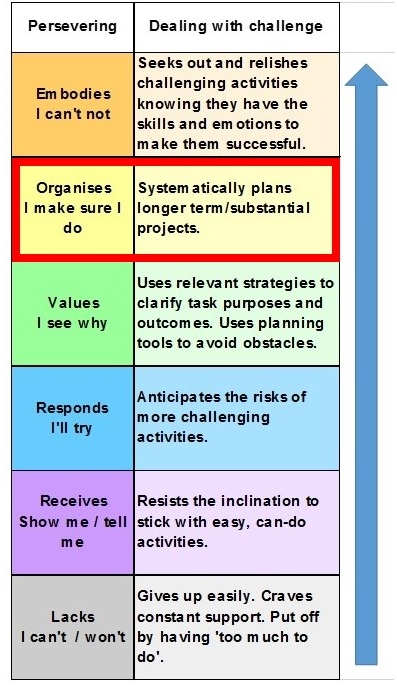
In the Organises phase, the student organises themselves to get the job/task/problem done. They create their own plans for tackling challenging material, and are beginning to seek out and enjoy activities that they know will prove challenging. They have accepted responsibility for their behaviours.

Encourage students to seek out ever more challenging situations with confidence


Things to give away

How you relate to your students; gradually sharing more of the responsibility for learning with them. In this case, how you encourage them to enjoy rising to challenges

Encourage planning for risk

In this organising phase students should be planning for risk and asking themselves questions such as;

  • What are the dangers?
  • What might go wrong?
  • How can that be avoided?
  • What’s the worst thing that could go wrong?
  • How do I make sure it doesn’t happen?
  • What’s the ideal outcome?
  • What’s the most likely outcome?

Teacher talk

  • Which of your many strategies might you use here?
  • I’m sure that you can sort that out for yourself.
  • Have you thought about the pros and cons of this way of working?
  • What will you lose if you tried it this way?
  • Have you done enough trial and improvement before starting?
  • What did you learn from each of your attempts?
  • Your risk analysis paid off there.

Expect students to analyse their own mistakes and create their own feedback

Share assessment criteria with (older) students and ask them to:

  • assess/comment on the (imperfect) solutions you provide. Invite them to produce improvements based on their own feedback.
  • require them to assess/comment on their own work, and amend it if necessary, before submitting it.

Frame your written comments as questions to which your students are required to respond.

“What do you think you need to do to make this section more convincing?” is preferable to “This section needs more explanation”, because it moves responsibility to the learner to identify what more needs to be done.
Essentially, this is about helping feedback to enable students to self-regulate their own learning.


Things to say

How you talk about learning; the sort of language content and style you use to enhance and explain learning. In this case how you talk about overcoming difficulty and how it is a natural part of learning.

To secure an understanding of and relish for challenge, ask:

  • How would you increase the level of challenge here?
  • How could you make this better even though it looks finished?
  • If things get tough what are some of the different ways you can respond?
  • Is this both challenging and enjoyable?
  • What makes you say that?
  • Try to find something that you are not sure you can succeed with
  • Why does it have to be challenging to be enjoyable?
  • How do mistakes link to challenge?
  • Are you brave enough to give this a go?
  • Is this difficult enough?
  • How could you inject further challenge?
  • What advice would you give to someone who thought they couldn’t do it?
  • Can you tell me how you would try to solve a problem you haven’t seen yet?

Things to do everyday

How you construct learning activities; the tasks and classroom routines you use to build positive learning habits. In this case how you design activities to stretch learners.

Have students create their own challenge plan

Challenge plan prompts

Students create their own plans for seeking and engaging with challenge:

  • What’s the goal?
  • What are the success criteria?
  • What is the timeframe?
  • Gather information about the tasks
  • Link new information to what I already know
  • Where am I expecting difficulties – blocks and obstacles?
  • Are there any dependencies? If this….then that….
  • Use the expert knowledge of others to help distil and refine my ideas
  • Review where I’ve got to and check my thinking against the original success criteria
  • Evaluate emerging outcomes against my expectations
  • Amend the plan or goal if necessary
  • Hand in on time!

Teacher talk

  • Do you think that’s coming along well.
  • Have you checked your emerging outcome against your original goals?
  • Are you still on track?
  • What would make you change track?
  • Did you have to amend your goals part way through? Why was that?
  • What are you going to do about . . . . . ?
  • Do you think there’s anything you could have done better, differently?
  • How might you get better at that? What would be a better/alternative way of doing it.
  • Are you satisfied with how it is going?

Encourage deeper thinking about consequences

By this phase students will be familiar with planning and organising their learning but may not yet have considered the consequences. In considering a course of action we need to consider the consequences because it invites students to predict along a timeline into the future.

Things to discuss;

  • what may happen as an immediate consequence of this?
  • what may happen in the short period of time as a consequence?
  • what may happen after some time when things have settled down?
  • What might be the long term consequence of this action now?

Teacher talk

To get students foreseeing consequences:

  • What do you think will happen?
  • What might happen?
  • Can you be sure that this will happen?
  • If you . . . . what will happen / might happen?

To get students separating certainty from uncertainty:

  • What are you sure that you know?
  • What do you think you know?
  • What might be true?
  • Can you be certain that . . . .
  • Will it always be like this?
  • Is it always the case that . . . ?

Things to display

What you celebrate about learning; what you prize, recognise, display; the outward signs of beliefs about learning. In this case what you praise, value and display about rising to challenge.

Re-frame your own role

Intervene only when absolutely necessary – stand back, listen and watch, and let the learning happen.

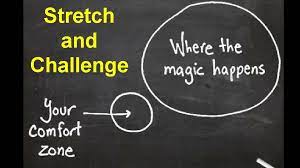
Teachers are constantly walking a tightrope – when/whether/how to intervene, how much support to offer, how much challenge to inject etc. It is in these ways that teachers scaffold the learning for their students, offering just the right balance of challenge and support to keep students working towards the edge of their comfort zone. But if teachers always scaffold learning in this way, when will students develop the skills required to manage their own learning for themselves?

At this phase, students are ready to go it alone, to face up to challenge and to enjoy doing so. They are ready to wrestle with difficulty independently – indeed they understand the importance of doing so in a safe, challenge-rich environment.

The big question is: Are you ready for this change in your role?

Many teachers find standing back, shutting up, letting students get on with it, apparently doing nothing, excruciating. A lifetime of performance and being ‘a teacher’, reduced to ‘interested observer’!

Stop worrying – this is when you get to reap the rewards of your previous efforts. Time to stand back, watch your students at their learning, consider what more you might do to support and nudge them to take even greater ownership of their learning. Facilitator, not organiser. Coach, not teacher. Learner, not guru.


NLP Reframing – The Past Does Not Equal The Future | Lisa Christiansen's Wealth Of Wisdom


Are you ready?

You are currently in – Rising to challenge

Return to the front page ⏎Dealing with being stuckManaging distractionRising to challengeWorking towards goals
From ‘I see why’ to ‘I’ll make sure’:
Values  to Organises
. . become curious finder outers.. . become highly focused. . . relish challenge.. . confident achiever of  own goals.
From ‘I’ll try’ to ‘I see why’:

Responds
to Values
. . analyse mistakes and failures. . . manage their environment.. . take risks and change plans.. . plan and reflect on their own practice.
From ‘Show me/tell me’ to I’ll try’:
Receives to Responds 
. .  understand why they are stuck.. . overcome their distractions.. . take on challenge confidently.. . achieve realistic goals.
From ‘I can’t’ to ‘Show me/tell me’:
Lacks to Receives
. . comfortable about being stuck.. . understand distraction and focus.. .  comfortable about making mistakes.. . see the point and value of goals.
Important Know – How: 
Start here.Work up ➡️
Discover ‘Dealing with Stuck’Discover ‘Managing Distraction’Discover ‘Rising to Challenge’Discover ‘Working towards Goals’
Continue Reading

3. Challenge. Responds to Values

This section pulls together ideas that will best assist students to progress from being willing to do things for themselves, to recognising that using the learning behaviour benefits them.

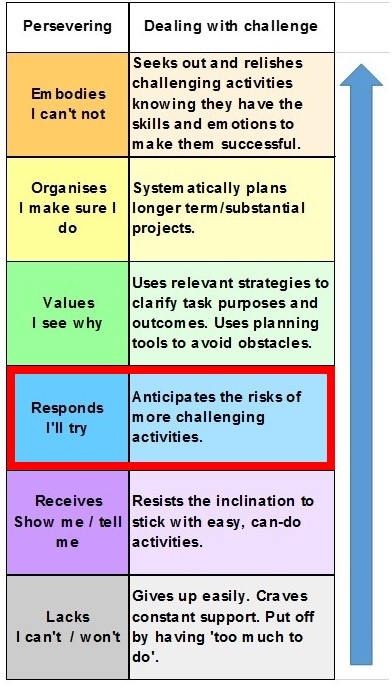
In the Responds phase, students develop greater independence and are motivated to undertake more challenging activities. They anticipate that they may make mistakes, and are less afraid of doing so. They are realising that finding things hard is a natural part of learning. They are better able to remain positive in the face of difficulty.

In the Values phase, the student develops a strong belief that they can get better at learning and that using learning behaviours is a benefit to them. They expect learning to be challenging, and even understand why it has to be. They expect to make mistakes, but recognise the importance of learning from them. They are increasingly open to feedback so that they are better able to overcome challenge.

Equip students with tactics to take the panic out of challenge


Things to give away

How you relate to your students; gradually sharing more of the responsibility for learning with them. In this case, how you encourage them to enjoy rising to challenges

Model dealing with challenge

Model how you might think about challenges:

Things you might ask yourself

  • what is the challenge about?
  • what is it asking me to do?
  • have I seen one like this before?
  • how did I do that one?
  • were there any tricky bits?
  • can I remember how I tackled them

How you might check out your feelings

  • do I feel I can do this?
  • will it matter if I get this wrong?
  • no, I can always try again
  • how will I make sure I stay positive?
  • I don’t need to feel negative about this because I am learning how to do this

Turn it into a story

Teacher talk

Continue talking it through to make the challenge work

  • can I spot the key words or symbols here?
  • what might the end result look like?
  • what’s the first step?
  • and what’s the next step?
  • what should I do if/when I get stuck?
  • what’s the best way round this tricky bit?
  • I could do…….
  • or I could try….
  • which would be best?
  • Oh! I remember this idea from…
  • and so forth

Help students to know themselves as learners

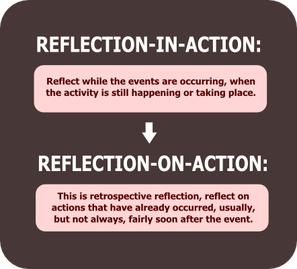
Reflect on dealing with challenge

Self talk phrases to use when monitoring as they are still doing something:
  • What’s happening?
  • What am I seeing /noticing?
  • How am I feeling / thinking about that?
  • What else is happening?
  • What’s changing?
  • What’s going best/well?
  • Do I need to do anything about any of this?
Self talk phrases to use when reviewing the results of learning:
  • What’s the most important thing that’s happened? Why?
  • How was it significant?
  • What difficulties did I meet?
  • How did I resolve / sort them?
  • Which strategies seemed effective?
  • What else could we / I have done?
  • How might it have been different?

Nudge students to self-regulate by asking: (adapted from Nuckles et al, 2009)

  • What would be the best way of checking your learning?
  • How could you reflect on these answers?
  • What happened when you …?
  • How can you account for …?
  • What learning goals have you achieved?
  • How have your ideas changed?
  • What aspect of this work could you now teach to others?

Things to say

How you talk about learning; the sort of language content and style you use to enhance and explain learning. In this case how you talk about overcoming difficulty and how it is a natural part of learning.

Secure the ability to approach challenge with clarity and flexibility by posing questions like:

  • What is this challenge really asking you to do?
  • What will success look like?
  • How are you planning to go about it?
  • What might go wrong?
  • Do you have any fall-back plans?
  • What could you do if it goes wrong?

Things to do everyday

How you construct learning activities; the tasks and classroom routines you use to build positive learning habits. In this case how you design activities to stretch learners.

Design ‘stretching’ challenges

A useful list of questions to ask yourself when you are designing a ‘stretch challenge’. Notice how the teacher role is changing from ‘telling’ to coaching.

When you design what we might call ‘stretch challenges’—ones that are designed to build your students’ relish for difficulty— it’s useful to ask yourself the following questions:

  • How can I construct a problem-solving activity to enable students’ understanding of xyz content without telling them?
  • How can I intrigue them with something that is open to several interpretations?
  • What could I say/do/show to stimulate their curiosity?
  • How can I make this grab their attention…visually and aurally?
  • How long shall I allow them to stay stuck before I ask them how they are thinking?
  • If they are well and truly stuck, what can I offer as a nudge to get them thinking differently that doesn’t give the answer away?
  • Will I leave it as a problem hanging in the air to which we will return later?
  • When will I ask them to make links between the challenge, and what and how we are learning in this lesson?

The challenge isn’t about the inherent complexity of the subject matter but about how the content is orchestrated to encourage students to use their learning habits to resource their solution.

Extract slightly amended from: The Learning Powered School – Claxton, Chambers et al.


Teacher talk

In order to secure the ability to approach challenge with clarity and flexibility, pose questions like:

  • What is this challenge really asking you to do?
  • What will success look like?
  • How are you planning to go about it?
  • What might go wrong?
  • Do you have any fall-back plans?
  • What could you do if it goes wrong?


Building the level of challenge in lessons

How many oranges?

Take a look at the powerpoint for the lesson opposite. It was designed as a one hour maths lesson for KS3 students.

  • Note how the teacher uses the same image throughout, increasing the level of challenge as the lesson develops.
  • In particular, notice how the teacher has identified the learning behaviours that they anticipate each phase of the lesson will require / exercise – these are in the ‘banner’ running across the bottom of the odd numbered slides.
  • Note also the emphasis given to the how and what of teacher talk.

Ask yourself – is this a format that you might use to support your own lesson planning?

Things to display

What you celebrate about learning; what you prize, recognise, display; the outward signs of beliefs about learning. In this case what you praise, value and display about rising to challenge.

Enable students to self-monitor how they respond to challenge.

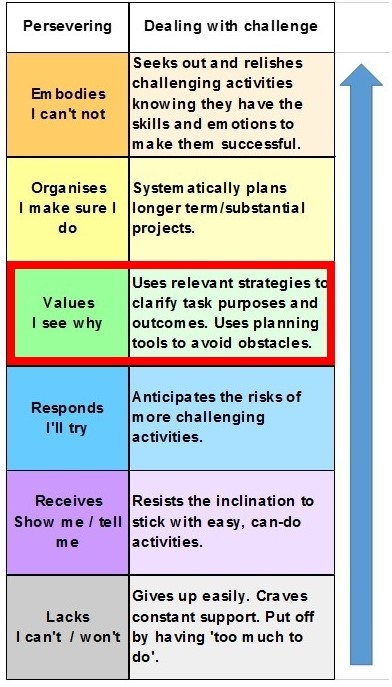
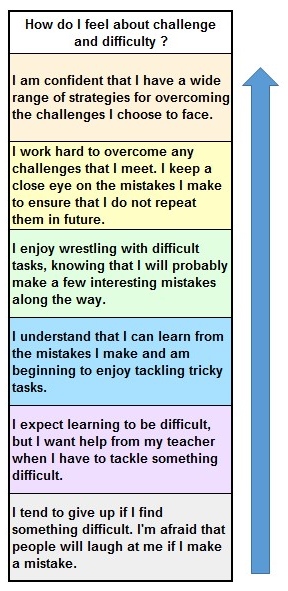
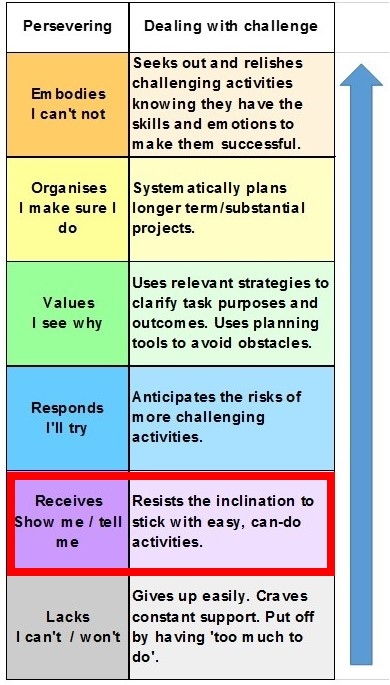
The challenge ladder

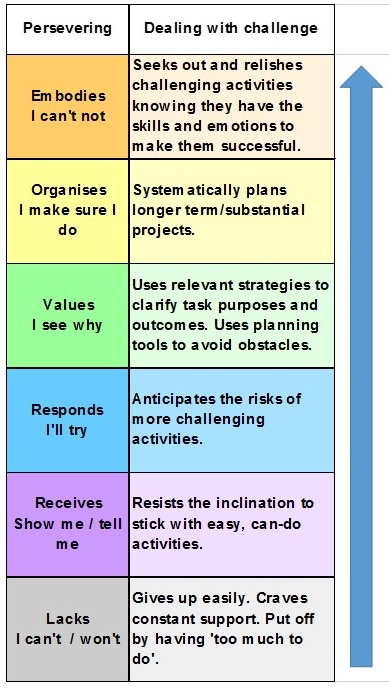
Help your students to understand how they feel about rising to challenge by creating and displaying a challenge ‘ladder’.

Use the ladder to support students’ understanding of how they feel about challenge and to consider what they might need to do differently.


[The display opposite has been created from the 12 questions in the student quiz on challenge, the first 2 questions informing the grey box, questions 3 and 4 the purple box etc. It is written in the first person and in student speak, to enable students to better understand how they react to challenge and difficulty.

It is in a similar format to the one that you have already seen in the ‘Things to Say’ section above.

You could obviously create similar ‘ladders’ for Stuck, Distraction or Goals by using the respective student quizzes.]

You are currently in – Rising to challenge

Return to the front page ⏎Dealing with being stuckManaging distractionRising to challengeWorking towards goals
From ‘I see why’ to ‘I’ll make sure’:
Values  to Organises
. . become curious finder outers.. . become highly focused. . . relish challenge.. . confident achiever of  own goals.
From ‘I’ll try’ to ‘I see why’:

Responds
to Values
. . analyse mistakes and failures. . . manage their environment.. . take risks and change plans.. . plan and reflect on their own practice.
From ‘Show me/tell me’ to I’ll try’:
Receives to Responds 
. .  understand why they are stuck.. . overcome their distractions.. . take on challenge confidently.. . achieve realistic goals.
From ‘I can’t’ to ‘Show me/tell me’:
Lacks to Receives
. . comfortable about being stuck.. . understand distraction and focus.. .  comfortable about making mistakes.. . see the point and value of goals.
Important Know – How: 
Start here.Work up ➡️
Discover ‘Dealing with Stuck’Discover ‘Managing Distraction’Discover ‘Rising to Challenge’Discover ‘Working towards Goals’
Continue Reading

2. Challenge. Receives to Responds

This section pulls together the ideas that will best assist students to progress from being bounded by needing direction to being willing to do things for themselves.

In the Receives phase, students have made a big leap from having a negative mindset to a neutral one. Here they are still inclined to stick with the familiar but are beginning to understand that some level of difficulty is to be expected. They need adult direction and support to engage positively with difficulty.

In the Responds phase, students develop greater independence and are motivated to undertake more challenging activities. They anticipate that they may make mistakes, and are less afraid of doing so. They are realising that finding things hard is a natural part of learning. They are better able to remain positive in the face of difficulty.

Help students to recognise any possible risks in challenging activities


Things to give away

How you relate to your students; gradually sharing more of the responsibility for learning with them. In this case, how you encourage them to enjoy rising to challenges

Differentiate between learning and performing

The Learning Zone

Begin by watching (or reading) the Ted Talk by Eduardo Briceno (see below for downloads).

The challenges of being in the performance zone are very different from the challenges of being in the learning zone. What is effective in each zone is limiting in the other.

If your students perceive school to be a performance zone, they will likely be risk averse and keen to show off what they can already do. Their challenge is in recalling and executing what they have learned. Flawless execution.

If they see school as a learning zone, they will be much more inclined to rise to the challenge, to take risks, to break new ground. Their challenge is in being sufficiently brave to show vulnerability, to make mistakes and to learn from them. Deliberate practice.

Find ways to introduce and explore these ideas with your students, to reassure them that the real challenge is to learn so that they may perform even better, rather than to recall and perform in order to impress.

Watch the Ted Talk Read the Ted Talk


Listen to, or read, this Ted Talk.

Ask yourself:

  • Have I thought about my classroom in this way before?
  • Am I clear when I expect my students to be in the performing zone and when I expect them to be in the learning zone?
  • Critically, are my students aware of whether they are meant to be performing or learning, minimising mistakes to demonstrate mastery, or making mistakes in order to learn?
  • What is the balance in my own classroom between performance time and learning time?
  • And – how might I create low-stakes islands for my students in otherwise high-stakes seas?


Re-frame challenge: explore learning how to overcome a struggle

The Learning Pit: from struggle to success.

A mental model to help students understand that learning should be challenging and that ‘getting out of the pit’ is their responsibility.

Use the ‘Learning Pit’ as a means of opening up a conversation around the feelings involved with being stuck, and the journey to overcoming difficulty – the struggle. It is essential that students know:

  • that the ‘pit’ is only one staging post on the learning journey
  • they can get out by using ‘stuck strategies’ and tools

It is also worth noting that the pit is not necessarily inevitable for all students in all learning – some will fly over the pit in some topics or curriculum areas.

The ability to cope with and overcome difficulty and challenge is a key aspect to becoming a successful learner.

James Nottingham introduced the idea of the Learning Pit as a way to explain that struggling is part of learning and that if we are to understand something we need to struggle with it first. Students move from unconsciously incompetent (an emotionally ‘safe’ area before learning), to consciously incompetent (the emotionally tricky “pit”), to consciously competent (the far side, after the learning has happened).

Find out more by visiting:

https://www.learningpit.org/

Roy Leighton uses a similar concept, which he refers to as the ‘Learning Line’, as part of his ‘Butterfly model’.

https://www.youtube.com/watch?v=mr-aG2bvAcg


Copyright: Challenging Learning Ltd

Teacher talk

  • From ‘Challenge’ to ‘Interesting challenge’.
  • From ‘It’s hard’ to ‘It’s tricky’.
  • ‘Tricky learning builds my brain.’
  • From ‘I can’t do it’ to ‘I can’t do it yet’.
  • ‘I don’t know how to’ becomes ‘I’m learning how to’.


Things to say

How you talk about learning; the sort of language content and style you use to enhance and explain learning. In this case how you talk about overcoming difficulty and how it is a natural part of learning.

Talk to explore handling uncertainty and taking on more challenge.

Use phrases like:

  • Finding it hard is the most interesting place to be. It’s where real learning begins.
  • Mistakes can be the signposts to success
  • How will you feel when you finish that?
  • What can you learn from that little mistake?
  • You look as though you are really enjoying puzzling over that

Keeping going with challenging material

To extend the ‘support to continue’ approach, try using phrases like:

  • What have you already tried? What else might work?
  • Why is this proving difficult? What is it that you can’t do?
  • What did you do last time?
  • I wonder what you did to move on?

Things to do everyday

How you construct learning activities; the tasks and classroom routines you use to build positive learning habits. In this case how you design activities to stretch learners.

Plan to ensure students make mistakes

Start some lessons with something like:

  • ‘In this lesson I expect you to make a couple of mistakes’.
  • ‘If you get half-way through and haven’t made mistakes move to more challenging activities.’
  • ‘When you make a mistake make a note and try to explain to yourself why you made the mistake at that point.’
  • ‘Later in the lesson we will spend a few minutes reflecting on what we learned from being stuck and decide which strategy worked best’.

The explicit message is that students need to expect to make mistakes during the lesson. The implicit message is that mistakes are a good thing – something you want to see. Using this technique regularly means students come to accept that making mistakes as a natural part of learning. It begins to build their curiosity about what they can learn from them.

Teacher talk

  • Finding it hard is the most interesting place to be. It’s where real learning begins.
  • Mistakes can be the signposts to success
  • How will you feel when you finish that?
  • What can you learn from that little mistake?
  • You look as though you are really enjoying puzzling over that.

Enable students to select their own levels of challenge

Provide tasks that are designed to offer low, medium and high challenge (or cool, spicy, hot.) Allow students to decide on the level of challenge that they wish to undertake, and use it as an opportunity to encourage them to aim high.

Image result for nandos chilli

  • The Nando’s Peri-ometer is a useful visual aid to support the ranking of tasks by level of challenge, and allow students to select the level of challenge that they wish to undertake.

Image result for seeking challenges

Teacher talk

  • What level of challenge have you chosen?
  • What made you select that one?
  • How does achieving this challenge make you feel?
  • What could you do to make that challenge harder for yourself?
  • Why do you think this challenge is trickier than that one?
  • I can see from your working out that you have chosen the right challenge for you. Not too difficult and not to easy!

Make clear thinking a regular part of lessons

Use Visible Thinking Routines

See Think Wonder is a Visible Thinking Routine that encourages students to;

  • notice attentively and make careful observations (See),
  • make thoughtful interpretations; what they are noticing; make links to what they know; distil the important bits (Think)
  • ask a question about what has been noticed (Wonder).

This routine helps stimulate curiosity and sets the stage for inquiry.
Use it when you want students to think carefully about why something looks the way it does or is the way it is. It’s useful at the beginning of a new unit to motivate student interest or try it with an object that connects to a topic during the unit of study.
The routine works best when a student responds by using the three stems together at the same time, i.e., “I see…, I think…, I wonder ...

Variations – Hear / Think / Wonder, or Read / Think / Wonder, or Feel /Think / Wonder . . . . .


Things to display

What you celebrate about learning; what you prize, recognise, display; the outward signs of beliefs about learning. In this case what you praise, value and display about rising to challenge.

Use short reminders to encourage self-reliance.

Display prominently in classrooms

These routines put responsibility on students to do things for themselves before asking the teacher for help.

C3B4Me can be used in conjunction with the stuck posters displayed in the classroom. Students should try three strategies from their stuck posters before seeking help from the teacher.

Another alternative to the stuck poster, BBBBB invites students to:

  • use their Brain
  • check in “the Book” (or other resources). This implies that students are allowed to get out of their seats to find these resources, and that those resources are available.
  • look on the (White/Smart)Board
  • ask their partner/friend/another student (“Buddy”)
  • before finally turning to the ‘Boss’ (teacher) for help.


Teacher talk

Use phrases like:

  • what have you tried to do already?
  • who else have you asked?
  • what else might you try?
  • is there anything around that might help?


You are currently in – Rising to challenge

Return to the front page ⏎Dealing with being stuckManaging distractionRising to challengeWorking towards goals
From ‘I see why’ to ‘I’ll make sure’:
Values  to Organises
. . become curious finder outers.. . become highly focused. . . relish challenge.. . confident achiever of  own goals.
From ‘I’ll try’ to ‘I see why’:

Responds
to Values
. . analyse mistakes and failures. . . manage their environment.. . take risks and change plans.. . plan and reflect on their own practice.
From ‘Show me/tell me’ to I’ll try’:
Receives to Responds 
. .  understand why they are stuck.. . overcome their distractions.. . take on challenge confidently.. . achieve realistic goals.
From ‘I can’t’ to ‘Show me/tell me’:
Lacks to Receives
. . comfortable about being stuck.. . understand distraction and focus.. .  comfortable about making mistakes.. . see the point and value of goals.
Important Know – How: 
Start here.Work up ➡️
Discover ‘Dealing with Stuck’Discover ‘Managing Distraction’Discover ‘Rising to Challenge’Discover ‘Working towards Goals’
Continue Reading

1. Challenge. Lacks to Receives

This section pulls together the ideas that will best assist students to progress from avoiding difficulty to making the first positive steps.

In this Lacks phase, students much prefer to succeed at easy tasks; they lack the confidence to tackle anything they perceive to be tricky; they are afraid of making mistakes; they can be daunted by difficulty, volume, or both; they need constant support from an adult who they expect to overcome difficulties for them.

In the Receives phase, students have made a big leap from having a negative mindset to a more neutral one. Here they are still inclined to stick with the familiar but are beginning to understand that some level of difficulty is to be expected. They need adult direction and support to engage positively with difficulty.

Nudge students towards feeling comfortable with making mistakes


Things to give away

How you relate to your students; gradually sharing more of the responsibility for learning with them. In this case, how you encourage them to enjoy rising to challenges

Shift responsibility for monitoring the level of challenge to students

Use traffic lights or coloured pages in the homework diary inserted for this purpose.

Green = ‘Easy learning’, Yellow = ‘Challenging learning’ and Red = ‘Too hard’.

Students use them to let you know whether you are meeting their learning needs (yellow) or if they could do with more extension (green) or support (red). It is powerful when learners realise that challenge is an essential element of their learning; that finishing easy tasks quickly does not signal cleverness but indicates time-filling rather than real learning.

Make use of this type of resource routine in your classroom too. It helps shift the responsibility for learning to the learner.

For the teacher, this provides valuable, instant feedback. For the student who is on green, ‘easy learning’, prepare to inject more challenge; for the student on yellow, ‘challenging learning’, prepare to intervene if it becomes too difficult; for the student on red, ‘too hard’, explore whether that is really the case or whether a pointer in the right direction might bring it back to yellow, ‘challenging learning’.

Mod The Sims - Correct positioning for traffic lights

Teacher talk

  • I wonder what this is all about?
  • How might you do this?
  • This is exercising your brain really well.
  • Is your brain feeling tired?
  • Take a little break and come back to it later
  • What is particularly tricky about this?
  • Don’t let that put you off
  • Have another go.
  • What might help you?

Re-frame challenge

Explore how the brain works

Explore with students how the brain works and what happens when we learn. It helps students to understand why challenge can be difficult and uncomfortable i.e. that challenge leads to new neural connections being formed and existing ones being reinforced and developed.

This animation visualising brain development may be helpful for teachers.

Avoiding challenge can take many forms. High achieving students can coast deliberately in an attempt to avoid being pushed. Lower achieving students withdraw or give up quickly to avoid the threat of ‘yet-again’ failure.

Teacher talk

  • Learning something tricky makes your brain grow.
  • Some bits of your brain might feel as though it’s hurting.
  • As you try to do things again the pathways in your brain get stronger.
  • Stronger pathways make things feel easier/less tiring.
  • Learning is fun to do.
  • When you are in the flow of learning you feel really happy.

Things to say

How you talk about learning; the sort of language content and style you use to enhance and explain learning. In this case how you talk about overcoming difficulty and how it is a natural part of learning.

Grow an appetite for challenge

Help students to change their talk about challenge

  • From ‘Challenge’ to ‘Interesting challenge’.
  • From ‘It’s hard’ to ‘It’s tricky’.
  • ‘Tricky learning builds my brain.’
  • From ‘I can’t do it’ to ‘I can’t do it yet’.
  • ‘I don’t know how to’ becomes ‘I’m learning how to’.

Encourage students to become familiar with, and learn to love, challenge.

Use phrases like:

  • I wonder what this is all about?
  • How might you do this?
  • This is exercising your brain really well.
  • Is your brain feeling tired?
  • Take a little break and come back to it later
  • What is particularly tricky about this
  • Don’t let that put you off?
  • Have another go.
  • What might help you?


Model tackling difficulty

Show students how you personally tackle things you find difficult, and what strategies you have for doing so, by demonstrating a piece of tricky learning. The idea is that sharing these experiences encourages students to imitate your approaches.

One of the first ways of surfacing learning – putting it on show – is to focus on how you are modelling being a good learner to students. Modelling is all the ways in which teachers demonstrate how they are a learner too; a confident finder-outer, a confident trier-outer.

  • Take your students behind the scenes of learning and share with them some of the uncertain thinking of learning.
  • Learning aloud is a good place to start: take students through how you would work out a problem. Modelling the thought processes (including emotional) that learners go through is important because a lot of the skill of learning only manifests itself in the inner world of the learner.
  • Expose the thinking, feeling and decision making of a learner-in-action to help students actually see and hear how learning works.


Things to do everyday

How you construct learning activities; the tasks and classroom routines you use to build positive learning habits. In this case how you design activities to stretch learners.

Create a wall full of challenges 

Make the Challenge wall the focal point for your challenge culture. Make sure you add and refer to it frequently. For example:

  • Invite students to post up the most challenging questions they can think of. Allocate time to discuss them. The wall becomes a challenging talking point;
  • Cover the wall with challenges. questions, extension tasks, riddles, puzzles etc. These could be used by students who have finished their tasks early. Alternatively, set aside lesson time for the whole class to discuss a challenge they select;
  • Display students’ work which shows mistakes they have learned from. This would include problems which students have persisted with or work that has been revised and edited to improve it.

Teacher talk

What you notice and talk about matters. Students are ever-alert to the underlying culture of the classroom – ‘does this teacher really want me to make mistakes, or is she more interested in me getting it right?’

What’s more, you can say you want them to make mistakes as ‘often as you like’, but if your reward systems are tilted towards ‘correct’ answers, they will readily sense the inconsistency.

Link challenge and mistakes positively

Think of mistakes as the hallmark of challenge. If students are making them the work is probably at a level at the edge of what they can do. To promote a culture of challenge you need to build positive connections in students’ minds between mistakes and challenge. Why?

  1. Because you need to minimise any perception that mistakes are a signal to give up
  2. Because we want students to see mistakes for what they are: opportunities to learn

Students need to see mistakes as opportunities to work out what has gone wrong and therefore, what could be done differently next time.

Draw connections by:

  • praising making mistakes and learning from them
  • asking students to tell you about mistakes they have made and what they learned from these
  • talking about times in your life when you faced challenges and made mistakes
  • creating a system through which students can gauge the level of challenge they feel they are working under, based on how many mistakes they are making and how difficult they are finding the work. This gives them a reference point for quantifying challenge
  • model how to think about challenges. Narrate what actually happens, emotionally and intellectually while you are taking on the challenge
  • create a checklist of steps to go through for embracing challenge. (see The Learning Pit for one idea).


Things to display

What you celebrate about learning; what you prize, recognise, display; the outward signs of beliefs about learning. In this case what you praise, value and display about rising to challenge.

Reframe challenge

Make mistakes useful. Create a ‘Beware board’ in the classroom and invite students to share their mistakes on Post-its. Talk about why the mistake was made, what thinking led to any confusion and how it could be avoided in the future.

Bringing mistakes into the open and discussing them helps other students to avoid them as well as recognising their value.


Reflect on challenge after the event

Use an image of a thermometer denoting a scale from overstretched to coasting. Discuss descriptions of the various levels with the class. High challenge might read:

  • “This challenge was just about right for me. It was difficult but do-able.
  • It required lots of effort, and in the end I was successful.”

and Overstretched might be

  • “This was a few steps too far … next time I will chose a more manageable task.”

Talk with students about the degree to which they have felt stretched. Use it to stimulate discussion about sticking with tasks and understanding when it is not wise to do so.

This activity helps students understand risk and challenge. It is worth routinising this reflective activity until students get the measure of it.


You are currently in – Rising to challenge…

Return to the front page ⏎Dealing with being stuckManaging distractionRising to challengeWorking towards goals
From ‘I see why’ to ‘I’ll make sure’:
Values  to Organises
. . become curious finder outers.. . become highly focused. . . relish challenge.. . confident achiever of  own goals.
From ‘I’ll try’ to ‘I see why’:

Responds
to Values
. . analyse mistakes and failures. . . manage their environment.. . take risks and change plans.. . plan and reflect on their own practice.
From ‘Show me/tell me’ to I’ll try’:
Receives to Responds 
. .  understand why they are stuck.. . overcome their distractions.. . take on challenge confidently.. . achieve realistic goals.
From ‘I can’t’ to ‘Show me/tell me’:
Lacks to Receives
. . comfortable about being stuck.. . understand distraction and focus.. .  comfortable about making mistakes.. . see the point and value of goals.
Important Know – How: 
Start here.Work up ➡️
Discover ‘Dealing with Stuck’Discover ‘Managing Distraction’Discover ‘Rising to Challenge’Discover ‘Working towards Goals’
Continue Reading

4. Distraction. Values to Organises

This section pulls together ideas that will assist students to progress from recognising that using the learning behaviours benefits them to organising themselves to use the behaviours to their advantage.

In the Values phase, the student develops a strong belief that they can get better at learning and that using learning behaviours is a benefit to them. The inclination to go off-task is overcome by a range of strategies for avoiding distractions and maintaining purposeful focus. They understand that concentration is leading to better learning outcomes.

In the Organises phase, the student organises themselves to get the job/task/problem done. They manage their own learning environment and have strategies for overcoming external discouragement or negativity. They have accepted responsibility for their behaviours.

Enable students to manage their own learning climate


Things to give away

How you relate to your students; gradually sharing more of the responsibility for learning with them. In this case, how you encourage them to take responsibility for maintaining focus

Use ‘big questions’ to stimulate and explore absorption

If humans did not exist, what would happen to the earth?

Pose questions that are difficult to answer, encourage speculation, or call for finding new information. Better still, use your students’ own ‘big questions’. Seize opportunities to learn alongside them, using ‘could be’ and ‘I wonder if . . . ‘ language.

Explore how absorbed students felt when undertaking the task and, importantly, how they might increase their engagement when questions / topics do not immediately seem appealing.

Steven Landsburg | The Big Questions: Tackling the Problems of Philosophy with Ideas from Mathematics, Economics, and Physics


Plan for targeted effort

Expect students to plan for their targeted effort. When devising project plans with students, ask them to come up with;

  • Their own idea for what they want to focus on.
  • What that will mean they are looking out for (monitoring) as they undertake the work.
  • What they will focus on when revising in their work.

For example, a Y7 student might decide to focus on using capital letters at the beginning of sentences and full stops at the end when writing a passage. When they read their work through at the end, they would focus their effort on the same criterion – are there any sentences that still need capital letters / full stops? And possibly ask themselves ‘I wonder how/why I missed that one?’

Or a Y10 student might aim to focus their effort in science on coming up with a really tight method for an experiment. They would monitor how things are going and whether they need to adjust anything. This will also provide the focus for the conclusion section of the process, as they can suggest refinements to their original method to gain more meaningful results in future experiments.

It’s all about where the effort needs to be focused. One bit at a time.


Effort and Ambition To Reach Goal or Target, Challenge To Win Higher Target, Business Mission or Career Concept, Strong Stock Vector - Illustration of heavy, direction: 222764228


Things to say

How you talk about learning; the sort of language content and style you use to enhance and explain learning. In this case how you talk about distraction and effort.

Encourage students to become more aware of distractions and how they might deal with them.

Use phrases like:

  • What might put you off?
  • What might get in your way?
  • Do you sometimes distract others?
  • How might they feel when you do that?
  • What could you do to avoid being distracted?
  • Where are you now on our distractions scale?
  • How well have you managed your distractions today?

Things to do everyday

How you construct learning activities; the tasks and classroom routines you use to build positive learning habits. In this case how you design activities to ensure greater focus.

Attract interest and attention using intriguing pictures

Not just a fascinating picture that should grab your students’ attention and interest but also the warm up for an English lesson. Students are asked to decode the illustrations into well know phrases or sayings

Take a closer look and work out which sayings you can find.

Intrigue students with ‘wild tasks’

Introduce a Problem of the Week… problems that allow you and students to move away from the comfort of the curriculum and step into wilder areas. These problems are complex, messy, somewhat obscure but not impossible to solve if one persists.
Here’s one we found on the internet which is sufficiently complex to intrigue you! It involves a camel crossing the desert.

Camila Camel’s harvest, worth its weight in gold, consists of 3,000 bananas. The market place where the stash can be cashed in is 1,000 miles away. However, Camila must walk to the market and can only carry up to 1,000 bananas at a time. Furthermore, being a camel, Camila eats one banana during each and every mile she walks (so Camila can never walk anywhere without bananas). How many bananas can Camila get to the market?

Sufficiently wild because it is not solvable by any simple algorithm, sufficiently tame so that many people feel they have some entry point to start working on it. Wild enough to allow for several different approaches, tame enough to be accessible to a wide range of maths learners. It does have a best answer (highest number) but actually there are many good answers that are perfectly acceptable approximations.

Success at finding a solution is much more dependent on flexible thought and the ability to discern a pattern in the data than it is with formulas. It is a wonderfully wild problem that can be cultivated using relatively straightforward maths skills in new and inventive ways.

Things to display

What you celebrate about learning; what you prize, recognise, display; the outward signs of beliefs about learning. In this case what you praise, value and display about distraction and effort.

Celebrate and expand the language of learning

Banish all thought of distractions and look out for students who are thoroughly and happily involved with their learning. Expand the range of words that could be use to describe the fascinating, if sometimes troublesome, activity called learning.

You are currently in – Managing distraction

Return to the front page ⏎Dealing with being stuckManaging distractionRising to challengeWorking towards goals
From ‘I see why’ to ‘I’ll make sure’:
Values  to Organises
. . become curious finder outers.. . become highly focused. . . relish challenge.. . confident achiever of  own goals.
From ‘I’ll try’ to ‘I see why’:

Responds
to Values
. . analyse mistakes and failures. . . manage their environment.. . take risks and change plans.. . plan and reflect on their own practice.
From ‘Show me/tell me’ to I’ll try’:
Receives to Responds 
. .  understand why they are stuck.. . overcome their distractions.. . take on challenge confidently.. . achieve realistic goals.
From ‘I can’t’ to ‘Show me/tell me’:
Lacks to Receives
. . comfortable about being stuck.. . understand distraction and focus.. .  comfortable about making mistakes.. . see the point and value of goals.
Important Know – How: 
Start here.Work up ➡️
Discover ‘Dealing with Stuck’Discover ‘Managing Distraction’Discover ‘Rising to Challenge’Discover ‘Working towards Goals’
Continue Reading

3. Distraction. Responds to Values

This section pulls together ideas that will best assist students to progress from being willing to do things for themselves to recognising that using the learning behaviour benefits them.

In the Responds phase, students develop greater independence and are motivated to initiate their own prompts or practical strategies to manage distractions. They are aware of what distracts them and know how to avoid such distractions.

In the Values phase, the student develops a strong belief that they can get better at learning and that using learning behaviours is a benefit to them. The inclination to go off-task is overcome by a range of strategies for avoiding distractions and maintaining purposeful focus. They understand that concentration is leading to better learning outcomes.

Enable students to know how and where to focus their efforts


Things to give away

How you relate to your students; gradually sharing more of the responsibility for learning with them. In this case, how you encourage them to take responsibility for maintaining focus

Introduce ideas about working memory

Working memory is what we use for processing information in real-time. It is particularly exercised when we are learning new things, performing tasks, cogitating, questioning and so forth. Your students are using it all the time during lessons. But working memory is limited to about 7 items at a time – any more than that and the brain starts to freeze up, and engagement drops. We sometimes say ‘I don’t have the head space for that’. Students will need to know when they are reaching capacity, and how to cope when they do.

Ways to free up thinking space

Fortunately, freeing up working memory is relatively simple.

  • jotting things down as notes,
  • talking through a process out loud,
  • creating a mind map
  • making a set of lists to group disparate pieces of information into larger lumps
  • splitting a task down into smaller tasks

are all good techniques for giving the brain more thinking space. 


Three strategies for refocusing effort: nudging not telling

Model it: for the student who is well and truly stuck, or who has taken a path that leads to a dead-end and is withdrawing from learning, try modelling the process for them. Narrate as you go, highlighting the thinking processes you are using, what you plan to do next, how you are getting yourself unstuck, and so on.

Nudge it: For students who are more resilient to becoming stuck or encountering difficulty, try using gentle nudges to get them out of the mud. “Can you think of something we did earlier that might help you?” “How have you tackled this sort of problem before?” “Would the instructions help you here?” This is far from a full-blown model of what to do, but rather prompting to a way back in to the learning.

Give clues: Some students will enjoy the added brain tease of a clue to nudge them in the right direction. “I think Newton had the right idea here…what about you?” “Perhaps it is a bit like hibernation…?” “Chapter 4 has some interesting things to say on this”

Each of these techniques provides progressively less scaffolding for the student – you will need to gauge which technique to use for each student – fragile learners who struggle with being stuck will not appreciate clue giving as it will only compound their stuckness! Similarly, students who are able to deal with being stuck well on their own will not be sufficiently stretched by the modelling approach. You are differentiating your nudging.


Things to say

How you talk about learning; the sort of language content and style you use to enhance and explain learning. In this case how you talk about distraction and effort.

Effort focusing questions:

  • What strategies will keep you going here?
  • What are the things you can do to keep yourself on track?
  • Can you show me what really good effort looks like?
  • What could you look at to see if you are on the right lines?
  • When did you target your effort effectively?
  • What could you focus on next?
  • If you had to pick one thing to focus your effort on, what would it be?

Things to do everyday

How you construct learning activities; the tasks and classroom routines you use to build positive learning habits. In this case how you design activities to ensure greater focus.

Blend managing distractions seamlessly into a lesson.

We’ve seen year 6, 7 and 8 classes extend the usual idea of classroom distractions (losing focus) and use the same idea to look out for red herrings/distracting or irrelevant information in texts.

The stimulus for a writing activity here was a video clip of Gavin Henson, the Welsh fly-half, taking a successful kick in a famous rugby match. This stimulated a deep discussion about managing distraction and how this was possible in such a public setting. What had Gavin got to do to make sure the kick was successful?


The students were then invited to write a short piece for a newspaper using the information shown alongside. They were asked to be aware of what they thought to be the key pieces of information. But of course irrelevant information was also included.


The following task was to consider what advice Gavin Henson would offer a learner about managing distraction. This again led to a very profitable discussion which was then captured in writing.


Throughout the lesson students were invited to record their thoughts about managing distractions in the environment using the format on the right.


Target effort in self-assessment

A refinement of Austin’s butterfly.

Ask your students to copy a picture of a teapot (or something relevant to current learning) as best they can in 10 minutes.

  • At the end of the allotted time ask them to swap pictures with a partner.
  • Now provide students with a list of criteria against which to review the picture they have been given, but require them to select and focus their review against only one of the criteria.
  • The list, in this case, might include: handle, spout, pattern, outline, lid.
  • Stress that the feedback must be helpful enough to enable their partner to improve their drawing.This keeps feedback tight, focused and meaningful. It also helps students move on from potentially vague and ambiguous feedback.


Have a look at Austin’s butterfly above and notice how the children work out, with a little prompting, how to focus feedback to help Austin achieve his goal. Although this video is of young children this only serves to emphasise its universal message. Pure Magic. Enjoy.

Scaffold tasks to focus effort

Looking 10 x 2

Give students 30 seconds to look at a picture relevant to your topic.

Ask them to list ten things they noticed about the picture.

Repeat the process, seeing if they can list 10 more things about the picture.

This process can be repeated until no new ideas come forth.

Focusing effort on attentive noticing guards against distraction.

Things to display

What you celebrate about learning; what you prize, recognise, display; the outward signs of beliefs about learning. In this case what you praise, value and display about distraction and effort.

Building memory

Encourage and celebrate self-testing

Some things just have to be remembered, but it’s important to celebrate and praise the use of self-testing just as much as right answers.

Regular low stakes tests or quizzes tap into the effect that trying to remember something helps us with the long-term memory for that material. Quick questions on the board, quizzes, self-tests.

If students have drawn mindmaps, get them to try redrawing them from memory. If using flashcards, make sure they are testing themselves by jotting down their contents from memory, rather than simply looking at them (recognition vs recall). Students often mistake familiarity with material for the ability to recall it.

You can help students form more accurate judgements of learning by encouraging a delay between studying and self-testing.

You are currently in – Managing distraction

Return to the front page ⏎Dealing with being stuckManaging distractionRising to challengeWorking towards goals
From ‘I see why’ to ‘I’ll make sure’:
Values  to Organises
. . become curious finder outers.. . become highly focused. . . relish challenge.. . confident achiever of  own goals.
From ‘I’ll try’ to ‘I see why’:

Responds
to Values
. . analyse mistakes and failures. . . manage their environment.. . take risks and change plans.. . plan and reflect on their own practice.
From ‘Show me/tell me’ to I’ll try’:
Receives to Responds 
. .  understand why they are stuck.. . overcome their distractions.. . take on challenge confidently.. . achieve realistic goals.
From ‘I can’t’ to ‘Show me/tell me’:
Lacks to Receives
. . comfortable about being stuck.. . understand distraction and focus.. .  comfortable about making mistakes.. . see the point and value of goals.
Important Know – How: 
Start here.Work up ➡️
Discover ‘Dealing with Stuck’Discover ‘Managing Distraction’Discover ‘Rising to Challenge’Discover ‘Working towards Goals’
Continue Reading

2. Distraction. Receives to Responds

This section pulls together ideas that will assist students to progress from being bounded by needing direction to being willing to do things for themselves.

In the Receives phase, students have made a big leap from having a negative mindset to a neutral one. Here they are inclined to get distracted, but they are becoming aware of being distracted and beginning to understand what distracts them. They still need adult direction and comply with suggestions for managing distractions.

In the Responds phase, students develop greater independence and are motivated to initiate their own practical strategies to manage distractions. They have become aware of what distracts them and know how to avoid such distractions.

Encourage students to recognise and overcome what distracts them in learning


Things to give away

How you relate to your students; gradually sharing more of the responsibility for learning with them. In this case, how you encourage them to take responsibility for maintaining focus

Switch the thinking from managing distraction to feeling absorbed and attentive.

Develop a Raptometer

Make a scale on the classroom wall to indicate degrees of absorption.

Students monitor their absorption levels against the scale according to how absorbed they perceive themselves to be. The scale, negotiated with students, might begin with ‘Disengaged’, through ‘Engaged with enthusiasm’ ending with ‘Engrossed and lost in learning’.

Use as a prompt for discussion about:

  • how students became absorbed at different stages of a lesson;
  • what the characteristics of absorption are;
  • what it feels like to be absorbed;
  • how to be more absorbed in the flow and how to avoid distractions.

Teacher talk

  • You look as though you are enjoying . . . .
  • What is it like when you really get into it?
  • Is time passing slowly? Or quickly?
  • Do you find you can’t hear others when you are really concentrating on your own learning?
  • When do you get ‘lost’ in what you are doing? In school? At home?
  • What is it about that task that got your really absorbed?

Build motivation to concentrate

Use ‘If-then’ statements to strengthen focusing effort

‘If-then’ planning can help to make effort in your classroom more specific and focused

‘Ifs’ are the situations you want to remind yourself about. In this case focusing effort it’s useful to list all the sorts of places this is needed.
‘Thens’ are what you will do about something; the action you will take. In this case the ways of focusing effort as introduced in #1 above.

The how of ‘If-then’ planning and a relevant example:

When setting a goal, for example ‘make more effort’, you need to specify not only what you will do but also where and when you will do it.

If (or when) [___situation__], then I will do [___behaviour__]
An If-then statement linked to the ‘make more effort’ goal might be
‘If I lose focus at the start of a task, then I’ll look at the success criteria to give me direction ‘.

This may sound a bit cumbersome to start with but research suggests far more goals are achieved by using ‘if-then’ statements. And the clever bit is that this builds self-talk at the same time. You do what you are telling yourself to do.
The ‘if-then’ plan succeeds because the situation and the action become linked in the mind. The brain recognises the situation as an opportunity to advance the goal. When the situation is detected action is initiated automatically. “If-then’ plans become “instant habits”.

A primary classroom example just to give you a flavour of the possibilities

Teacher talk

  • How did you keep going?
  • What could we do when we feel we are losing focus?
  • What sorts of things distract you most?
  • When are friends a distraction – or a source of inspiration?
  • What sorts of learning environment might be appropriate for different types of learning?
  • What internal distractions might we have? (tiredness, emotions, hunger, failure).
  • How could you let us know if we are distracting you?
  • You’re doing well with avoiding that distraction.

Things to say

How you talk about learning; the sort of language content and style you use to enhance and explain learning. In this case how you talk about distraction and effort.

Build up students’ understanding of distractions by using phrases like:

  • How did you keep going?
  • What could we do when we feel we are losing focus?
  • What sorts of things distract you most?
  • When are friends a distraction – or a source of inspiration?
  • What sorts of learning environment might be appropriate for different types of learning?
  • What internal distractions might we have? (tiredness, emotions, hunger, failure).
  • How could you let us know if we are distracting you?
  • You’re doing well with avoiding that distraction.

Vary the nature of your support

Offer written feedback on managing distractions

By devolving responsibility for learning to students our job as teachers becomes one of coaching them to build their own learning habits. Habits take time to form and stick and so the type of support you offer needs to be maintained for quite a while. Open the toggle box and read Lemar’s story. It serves to reinforce the need for more encouragement and reinforcement than a single written comment if behaviours are going to mature into habits.

This story just happens to be from a year 6 classroom but it carries a universal message.

Hannah Moore Primary School
 

A story of a simple line and teacher feedback

The story of Lemar and his distractions

Lemar was in Yr 6, registered SEN and always distracted. He looked here and there, talked to other children and sometimes wandered around the classroom when he should have been absorbed in learning.

His teacher decided that the place to start with Lemar was managing his distractions. After talking with all the class about what distractions were the students came up with all manner of ways they could use to try and avoid them. One idea was a simple line on a page to record when distractions happened. (Self-monitoring)

The next day the teacher drew such a line at the top of Lemar’s page and asked him to try it out. You can see the line on the first picture and how Lemar marked it throughout the lesson. Although one could argue that the line itself was a distraction what it was actually doing here was making Lemar aware of being distracted.

On seeing his writing at the end of the lesson the teacher was astonished by the amount Lemar had managed in the time. The lines he had written represented 100% increase in volume. Note the teacher’s comment at the bottom. She acknowledges that he has indeed managed his distractions well.

A couple of days later Lemar had more writing to tackle. This time he created his own line at the top of his page….a significant breakthrough because he had seen the value of using this tactic. Here again he marks when distractions happen and even mentions his distractor Jordan! Furthermore he has completed yet more writing.


Here again the teacher comments on the writing and acknowledges that it is good work, but unfortunately she doesn’t comment on his obvious effort on managing his distractions.

If we are going to help students to build their own learning habits a single written comment won’t be enough, habit formation needs far more encouragement and reinforcement.

  • Wow! Using your distraction line today has really helped you to focus well. Feel pleased with yourself for this good effort.

Things to do everyday

How you construct learning activities; the tasks and classroom routines you use to build positive learning habits. In this case how you design activities to ensure greater focus.

Ensure students know what effort means

Explore the meaning of effort

Effort is a word that teachers use frequently, but what does it mean? How might students decode this and begin to do it purposefully?

  • Explore what is meant by ‘effort’ with your students, and discuss with them the ways in which they might apply it.
  • Encourage them to come up with a definition of effort and specific examples of what it might look like in the classroom – for example by;
    • trying different strategies to solve a problem,
    • using a Visible Thinking Routine (VTR)
    • aiming to achieve challenging goals, or
    • using different un-sticking techniques when something is tricky.
    • paying attention to whoever is speaking

Targeted Effort is now seen as a path to mastery. Students need to be aware of a connection between effort and improvement; that the sort of effort being used is causing their improvement. This is why it is important to give effort meaning. Meaning often underpins motivation which in turn drives behaviour.
Targeted effort is effort that has direction and purpose; something is focusing their mind. It is underpinned by clear guidance and the specific goal to be achieved.
What you are doing here is giving effort a size and direction. What students need to understand is that their effort has a size and a purpose.

Teacher talk

  • What sort of effort are you using on this activity?
  • I can see that this xxx sort of effort will help you to…
  • Is this the most appropriate sort of effort to use. You might try xxx instead.
  • you might get on better if you used more of…
  • which VTR would be useful to you here?

Focus their attention

Blend attentive noticing into lessons

Use sets of interesting pictures together with cards with a viewing window cut into them. Students place the viewing frame over the picture in seeking a range of different features. E.g. something red, made of xx, something denoting happiness, something which suggests what might happen next. It’s a good idea to move from looking firstly for concrete features before moving on to abstract features. You could:

  • use a poem. Use the viewer to find the stanza that is most descriptive, that makes them happy, that uses the best simile…
  • or use a geometrical image. Use the viewer to find corresponding angles, perpendicular lines, a reflex angle…
  • or an image of the water cycle. Use the viewer to find where water vapour is rising, where water is moving downwards, where it would be best to site a farm, a village, a wind turbine…
Coaching Notes

Teacher talk

  • Can you find . . .
  • Which bit best shows . . .
  • Where is . . . .
  • Why have you chosen that?
  • Take another look…

Make reflecting on managing distractions part of everyday lessons

Here is a very practical example of how you might develop the emotional climate of the classroom and make it managing distractions friendly.

Learning mats are A4 laminated sheets that show various aspects of a learning habit. Keep them on desks/tables or as part of a wall display.

Things to display

What you celebrate about learning; what you prize, recognise, display; the outward signs of beliefs about learning. In this case what you praise, value and display about distraction and effort.

Use distraction positively

Sometimes when we are stuck, becoming distracted is our brain’s way of saying “I need to take a break”. Often, moving away from the problem at hand and doing something different for a while, or simply gazing out of the window, can help new ideas bubble to the surface, it gives the subconscious time to work on a problem that has previously seemed uncrackable.

Consider having a quiet break-out area for students to use when they need a break.

Use ‘gazing out of the window’ positively.

When you see a student doing this ask them ‘What’s bubbling up in your mind? What new ideas are you imagining?’ rather than referring negatively to an apparent loss of focus or concentration.


Encourage students’ to self-monitor distraction or lack of focus 

  • Although largely applicable in primary schools this idea could also be useful in some secondary groups.
  • Engage the group in developing a 5 point scale describing different levels of distraction.
  • Each student crafts a personal logo, known only to them and the teacher. At the end of each week students stick their logo on the level of distraction they estimated they had achieved across the week.
  • NB. When these assessments were recorded by schools and set against progress data they found strong positive correlations …being able to manage distractions better positively correlated with increases in progress!


You are currently in – Managing distraction

Return to the front page ⏎Dealing with being stuckManaging distractionRising to challengeWorking towards goals
From ‘I see why’ to ‘I’ll make sure’:
Values  to Organises
. . become curious finder outers.. . become highly focused. . . relish challenge.. . confident achiever of  own goals.
From ‘I’ll try’ to ‘I see why’:

Responds
to Values
. . analyse mistakes and failures. . . manage their environment.. . take risks and change plans.. . plan and reflect on their own practice.
From ‘Show me/tell me’ to I’ll try’:
Receives to Responds 
. .  understand why they are stuck.. . overcome their distractions.. . take on challenge confidently.. . achieve realistic goals.
From ‘I can’t’ to ‘Show me/tell me’:
Lacks to Receives
. . comfortable about being stuck.. . understand distraction and focus.. .  comfortable about making mistakes.. . see the point and value of goals.
Important Know – How: 
Start here.Work up ➡️
Discover ‘Dealing with Stuck’Discover ‘Managing Distraction’Discover ‘Rising to Challenge’Discover ‘Working towards Goals’
Continue Reading

1. Distraction. Lacks to Receives

This section pulls together the ideas that will best assist students to progress from lacking an understanding of the nature of distractions to making the first positive steps in dealing with distractions.

In this Lacks phase, students are readily distracted. They are very much ‘at the mercy of events’. They have few if any strategies for avoiding going off task, and/or need constant adult support to retain focus.

In the Receives phase, students have made a big leap from being unaware to being in the know. Here they may still be inclined to get distracted, but they are becoming aware of being distracted and are beginning to understand what distracts them. They still need adult direction and tend to comply with suggestions for managing distractions.

Build student understanding of distractions and maintaining focus


Things to give away

Encourage focus

Explore the idea of managing distractions.

How you relate to your students; gradually sharing more of the responsibility for learning with them. In this case, how you encourage them to take responsibility for maintaining focus

Exploring what it feels like

AIM To enable students to recognise;

  • What distractions are
  • What it feels like when being distracted
  • A range of distractions
  • What distracts them.

Set up the Learning Challenge

  • Pair up students — Student A, Student B.
  • A to describe a complicated process, e.g. tying a shoelace or tie.
  • B to try to distract by –
    • butting in –
    • looking bored –
    • looking elsewhere –
    • talking about how they would do it –
    • and so on 2 minutes.
  • Swap roles.

Plenary Discussion Explore:

  • What happened?
  • How were you distracted?
  • What did being distracted feel like?
  • How could you avoid or manage the distractions better?

Record Distractions

  • As a whole group, or in pairs, construct a list of things that distract people: – in the classroom – at home.
  • Prompt: Distractions may not be outside us, but in our heads …
  • Compare the lists. Draw out interesting / mundane distractions.
    • (Could be done using Post-its as a scan and focus exercise.)


Teacher Talk

  • What might put you off?
  • What might get in your way?
  • Do you sometimes distract others?
  • How might they feel when you do that?
  • What could you do to avoid being distracted?
  • Where are you now on our distractions scale?
  • How well have you managed your distractions today?


Introduce the idea of distraction

Quick ways to introduce managing distraction

Here are a couple of ideas for introducing the idea of distractions to students in the transition years. They need not be used in the ‘worksheet’ format of course! If these don’t suit look for other ideas later in this section.

Download as pdf

Here’s a fuller explanation of distraction if you need one. It might be useful for deeper discussion and analysis with students.

Download as pdf

It is the beginnings of getting students to realise that distraction is something that they can and should control.

Image result for manage distractions

Teacher talk

Encourage students to become more aware of distractions and how they might deal with them. Use phrases like:

  • What might put you off?
  • What might get in your way?
  • Do you sometimes distract others?
  • How might they feel when you do that?
  • What could you do to avoid being distracted?
  • Where are you now on our distractions scale?
  • How well have you managed your distractions today?

Things to say

How you talk about learning; the sort of language content and style you use to enhance and explain learning. In this case how you talk about distraction and effort.

Build awareness of distractions

To ensure students become more aware of distractions and how they might deal with them use phrases like:

  • What might put you off?
  • What might get in your way?
  • Do you sometimes distract others?
  • How might they feel when you do that?
  • What could you do to avoid being distracted?
  • Where are you now on our distractions scale?
  • How well have you managed your distractions today?

Things to do everyday

How you construct learning activities; the tasks and classroom routines you use to build positive learning habits. In this case how you design activities to ensure greater focus.

Explore keeping themselves on track

Break States.

Change the mental and physical state of the class by using music, quick games (Fizz-Buzz, Simon Says), guided relaxation,  change of partner/desk/lighting, breathing exercises, or a refreshment break. Such activities refresh and relax students, enabling a greater degree of focus afterwards. Discuss their impact on concentration and how students could use them in other contexts to keep themselves on track with their learning.

It’s important that students understand learning as a process rather than an event, and that being distracted is a inevitable part of that process. Mostly distraction takes us away from learning but sometimes purposeful distraction can be a helpful addition to the learning process.

Break states are a positive distraction.


Enable students to self-monitor their distractions

Am I a ☆☆☆ manager?

Work with students to describe different degrees of the ability to manage distractions.For example:

A 3-star manager might

  • always keep focused on what s/he is learning
  • support other learners by helping them to manage their distractions

Use language appropriate for the age of the students.

Comment on behaviour in order to recognise and value the management of distractions.

Ask students to help each other with ideas about how to earn more stars as distraction managers.

Teacher talk

Some questions you might use to encourage your students to reflect on and think meta-cognitively about how they manage distraction:

  • When you got distracted what did you do?
  • And then what did you do?
  • Did that help you make progress?
  • What usually helps you stay focused?
  • What’s your favourite way of staying on task?
  • What other ways might you try?

Things to display

What you celebrate about learning; what you prize, recognise, display; the outward signs of beliefs about learning. In this case what you praise, value and display about distraction and effort.

Promote a learning environment

Enable students to control their learning space

Being concerned with classroom layout in dealing with distraction may seem strange bedfellows, but if we think of distraction in the wider context of managing the learning environment it begins to make more sense.

Just have a look around your classroom and ask yourself:

  • Does it feel a calm place to be?
  • Are there different habitats within the classroom? e.g. A quiet thinking place, a reading place?
  • Is the layout quickly adaptable?
  • What about the walls? Do they celebrate the classroom values? Too busy/congested?
  • Are learning resources accessible by students? Do they know where things are? Can they get what they need, when they need it?
  • Do you expect students always to sit at tables? Are there any other work spaces?
  • Is it a distracting environment? Does it aid quiet reflection?
  • To what extent is the environment their’s to manage?

Classrooms that feel like homely places to be, where there’s freedom of movement, a choice of learning spaces a sense of calm and where students feel they belong all seem to help concentration levels, lessen stress and focus effort.


You are currently in – Managing distraction…

Return to the front page ⏎Dealing with being stuckManaging distractionRising to challengeWorking towards goals
From ‘I see why’ to ‘I’ll make sure’:
Values  to Organises
. . become curious finder outers.. . become highly focused. . . relish challenge.. . confident achiever of  own goals.
From ‘I’ll try’ to ‘I see why’:

Responds
to Values
. . analyse mistakes and failures. . . manage their environment.. . take risks and change plans.. . plan and reflect on their own practice.
From ‘Show me/tell me’ to I’ll try’:
Receives to Responds 
. .  understand why they are stuck.. . overcome their distractions.. . take on challenge confidently.. . achieve realistic goals.
From ‘I can’t’ to ‘Show me/tell me’:
Lacks to Receives
. . comfortable about being stuck.. . understand distraction and focus.. .  comfortable about making mistakes.. . see the point and value of goals.
Important Know – How: 
Start here.Work up ➡️
Discover ‘Dealing with Stuck’Discover ‘Managing Distraction’Discover ‘Rising to Challenge’Discover ‘Working towards Goals’
Continue Reading

4. Stuck. Values to Organises

This section pulls together ideas that will help students to progress from recognising that using the learning behaviours benefits them to organising themselves to use the behaviours to their advantage,

In the Values phase, the student develops a strong belief that they can get better at learning and that using learning behaviours is a benefit to them. Wariness turns to being curious about getting stuck and they use feedback, from both teachers and students, to quench or resolve that curiosity.

In the Organises phase, the student organises themselves to get the job/task/problem done. They can take more risks because they understand how to use sound ‘unsticking’ strategies. They analyse how and where they get stuck in order to better understand the process. They have accepted responsibility for their behaviours.

Encourage students to analyse their failures and mistakes and become curious about learning


Things to give away

How you relate to your students; gradually sharing more of the responsibility for learning with them. In this case, how you encourage them to take responsibility for overcoming being stuck.

Promote deeper ways of looking at being stuck

In this phase we are not talking about modelling getting unstuck on a problem where you may simply have forgotten a step. Nor is this process driven primarily by subject knowledge. Here the analysis is about what you might ask yourself when you are in a major stuck problem and need to rethink what you are doing in order to restart, tweak, or give up.

Encourage exploration of the following 10 points;

  1. Can I explain to myself what’s really going on here?
  2. Am I keeping to the original intention?
  3. Have I read and understood the question/problem properly?
  4. Am I applying the right principles? Have I got roughly the right ideas?
  5. Does anything stand out as simply wrong?
  6. Have I forgotten something obvious?
  7. Have I veered off course? Am I down a rabbit hole?
  8. Am I making this too complicated? or too simple? Do I need to go back to basics?
  9. What would a distilled list of key stages or points look like?
  10. Is this worth continuing with in this way? Why/why not? What could I do instead?


learning unstuck growth mindset

Teacher talk

Help students to think things through:

  • Take a look at the questions…
  • What makes you feel things are going seriously wrong for this activity/piece of learning.
  • Have you been monitoring how things are going as you’ve gone along?
  • Have you stuck with your original plan?
  • Which of these questions seem to resonate with you?
  • Have you thought about rethinking/reworking the goal or looking more widely at other ways to…?
  • Are you being too self-critical?
  • In striving to be the best you can be are you willing to make …substantial changes?

Promote acting wisely in a tough situation

Five steps

Here the analysis of finding a way out of being in a major stuck crisis is put into a series of considered calming steps. You may still have to restart, tweak or abort your project but hopefully after careful rather than chaotic thought.

Two big questions to answer:

  • What’s actually going on here?
  • What should I do?

Five steps to getting unstuck

Entering, Exploring, Acting, Refining, Letting Go.

  1. Entering or starting- do nothing, pause, be willing to look afresh, allow the situation to reveal itself.
  2. Exploring – slow down, look at the challenge/ difficulties with genuine curiosity. Think about the problem in different ways, See list in #1 above. e.g.
    1. split the problem into parts, try pro and con analyses
    2. take a step back and look at the bigger picture, look for patterns, influences. root causes.
    3. use gut instinct -‘ there’s something off here ‘
    4. read the signs – ask ‘have I been here before?’, ‘what do I recognise from previously?’
    5. let things brew for a while before moving from broad openness (observation) to determined action.
  3. Acting “Not-knowing” changes to knowing; confidence in committing to a course of action. Put your considered new ideas/plan into action.
  4. Refining – work with the initial feedback you are getting as a result of your action to deepen the effectiveness of what you have done. Keep to your intention but look for genuinely useful feedback to refine your new course of action.
  5. Letting Go. Don’t keep replaying your action decisions. Time to say ‘That’s done, what’s next?’


Teacher talk

  • Take your time, work out what is really going on.
  • What could you do? How will you do it?
  • Give it a go, see what happens.
  • Is your plan / idea working out?
  • Are you done? Is there no more that needs doing?


Things to say

How you talk about learning; the sort of language content and style you use to enhance and explain learning. In this case how you talk about mistakes and being stuck.

Help students to analyse risks and strategies for ‘high-level’ work. Ask:

  • Which of your many strategies might you use here?
  • I’m sure that you can sort that out for yourself.
  • Have you thought about the pros and cons of this way of working?
  • What will you lose if you tried it this way?
  • Have you done enough trial and improvement before starting?
  • What did you learn from each of your attempts?
  • Your risk analysis paid off there.


Things to do everyday

How you construct learning activities; the tasks and classroom routines you use to build positive learning habits. In this case how you design activities to ensure students are learning at the edge of their comfort zone.

Build high level learning inclinations

Build flexibility into a learning focused curriculum 

The ability to undertake the type of analysis of being stuck shown by the 10 points in the first item above, relies on a broad range of high level inclinations. The way students have encountered the curriculum will have influenced the growth of these inclinations.

Check your curriculum/lesson plans for opportunities for students to;

  • self-monitor how things are going, keeping an eye on the goal;
  • expect the unexpected, requiring a readiness to re-shape, re-order, re-form plans to take account of new circumstances;
  • remain alive to new, unforeseen opportunities and ideas;
  • look at what they are doing with a critical eye;
  • strive to be the best they can be;
  • make sure things are on track and make improvements along the way.

So at a less abstract level, students need to learn how to deal with change, emotionally and practically. With an inflexible frame of mind they are unlikely to recognise the need to change their ideas or the way they do something. These behaviours are closely aligned with meta-cognition and self-regulation.


Learn About Your Child's Learning at Curriculum Night! - Woodstock Elementary School


Avoid demotivation

Embrace the hard bits through a rhythm of learning

It’s the hard parts in learning that can cause demotivation in students. Good work on the hard parts is a structural challenge for teaching as well as learning. You’ll need to build in versions of ongoing assessment but assessment that is not concerned with marks /grades or evaluating the how of learning. This is assessment designed to feed into the learning process and make the learning stronger. It’s possible to organise the rhythm of learning so that it embraces:

  • deliberate practice;
  • assessment focused on understanding;
  • peer and self-assessment;
  • communicative feedback.

Anticipate where the sticking points in the content are likely to be, the troublesome knowledge, and then ask:

  • what standard ritual ways of thinking might get in the way?
  • what do students know already that they might not have linked to this topic/knowledge/task?
  • what is getting in the way of them thinking differently about this content to be able to assimilate it?
  • what might they need to unlearn in order to relearn this content?
  • which aspect(s) of the content is conceptually difficult

Music School | Rhythm Of Learning | United States


The researched ways of structuring work on the hard parts into the rhythm of the learning.

  1. Vary practice activities and conditions
  2. Interleave rather than block practice
  3. Break down complex problems
  4. Use low stake tests/quizzes with students
  5. Encourage students to self-test
  6. Offer clues rather than solutions


Things to display

What you celebrate about learning; what you prize, recognise, display; the outward signs of beliefs about learning. In this case what you praise, value and display about being stuck and making mistakes.

Stimulate thinking patterns

Offer prompts to support thinking

The more you can display and use public prompts that underlie the learning process the quicker students will incorporate them into their thinking patterns. This sort of display could be tailored to meet specific subject/curriculum requirements across a school

You are currently in – Dealing with being stuck . .

Return to the front page ⏎Dealing with being stuckManaging distractionRising to challengeWorking towards goals
From ‘I see why’ to ‘I’ll make sure’:
Values  to Organises
. . become curious finder outers.. . become highly focused. . . relish challenge.. . confident achiever of  own goals.
From ‘I’ll try’ to ‘I see why’:

Responds
to Values
. . analyse mistakes and failures. . . manage their environment.. . take risks and change plans.. . plan and reflect on their own practice.
From ‘Show me/tell me’ to I’ll try’:
Receives to Responds 
. .  understand why they are stuck.. . overcome their distractions.. . take on challenge confidently.. . achieve realistic goals.
From ‘I can’t’ to ‘Show me/tell me’:
Lacks to Receives
. . comfortable about being stuck.. . understand distraction and focus.. .  comfortable about making mistakes.. . see the point and value of goals.
Important Know – How: 
Start here.Work up ➡️
Discover ‘Dealing with Stuck’Discover ‘Managing Distraction’Discover ‘Rising to Challenge’Discover ‘Working towards Goals’
Continue Reading

3. Stuck. Responds to Values

This section pulls together ideas that will help students to progress from being willing to do things for themselves to recognising that using the learning behaviour benefits them.

In the Responds phase, students develop greater independence and are motivated to initiate their own prompts or practical strategies to get themselves unstuck. They are realising that fear and the need for adult support can be overcome by using more coping strategies and maintaining positive emotions.

In the Values phase, the student develops a strong belief that they can get better at learning and that using learning behaviours is a benefit to them. Wariness turns to being curious about getting stuck and they use feedback, from both teachers and students, to quench or resolve that curiosity.

Build students’ curiosity about making mistakes or getting stuck


Things to give away

How you relate to your students; gradually sharing more of the responsibility for learning with them. In this case, how you encourage them to take responsibility for overcoming being stuck.

Make reflection on being stuck and getting unstuck a student responsibility

Reflection, because all too often it is rushed and at the end of the lesson, rarely has the desired impact. More frequently it is a re-cap by the teacher of what they wanted their students to know, a re-statement of the intended learning outcomes. Less frequently is it an opportunity for students to reflect on what they have learned. Remember – reflection should be done by, not to, students.

But – students reflecting on how they have been learning is even rarer than students reflecting on what they have learned.

Build in quality reflection time that focuses on:

  • what it feels like when you are stuck;
  • what it feels like when you get unstuck;
  • why you got stuck in the first place, the mistakes you made and why you made them;
  • the things that you did to get unstuck, strategies that you could share with others.

Teacher talk

Use nudges like:

  • What was it that caused you to get stuck or caused you to make a mistake?
  • How did you get round it / could you have got round it?
  • How did you feel when you had that breakthrough?
  • What will you do in future to avoid falling into a similar trap?

Explore resilience playfully

Offer a challenge

The purpose of this challenge is to help students appreciate:

  • How their feelings can influence how long or how much they attend to a problem;
  • That noticing possibilities generates solutions.

Set up a challenge with pairs of students. Give each pair one challenge sheet. Offer the challenge “There are nine little pigs in a field. By drawing two squares how can you give each pig its own pen?” Give 5 minutes to complete.

Use coaching questions to help. Use “could be” or “might be” language.

  • “How differently can we draw the squares?”
  • “Can we draw squares outside the box?” [This is a distraction for them to manage!]

Whole Group Plenary

  • Model tackling the puzzle and coming to the answer.
  • What helped you to solve the problem? – What did it feel like to be stuck? –
  • What did you feel when you saw the puzzle? – Is there a link between people who had positive feelings towards the puzzle and those who solved it?
  • Did both partners feel the same about the puzzle? – If not, did the positive person try to help or interest the negative person and vice versa?
  • How did you set about and proceed with the problem?
  • Run through the meaning of resilience, and move on to related activities.


Download


Things to say

How you talk about learning; the sort of language content and style you use to enhance and explain learning. In this case how you talk about mistakes and being stuck.

Generate curiosity about being stuck by saying;

  • Give it a go, you can always try another approach if that doesn’t work.
  • What could you do if it goes wrong?
  • Where will you seek help from?
  • Is this sufficiently challenging for you?
  • How are you planning to go about it?
  • Do you have any fall-back plans?
  • I wonder why that happened?

Things to do everyday

How you construct learning activities; the tasks and classroom routines you use to build positive learning habits. In this case how you design activities to ensure students are learning at the edge of their comfort zone.

Make thinking a routine

Build thinking routines into lessons

Try the Visible Thinking Routine:

  • What do I know?
  • What do I need to know?
  • What techniques do I have for bridging the gap?

This helps students to develop their own internal dialogue for combating stuck-ness.

What are Visible Thinking Routines?

VTRs are, as they say, simple routines that apply across a wide range of subjects and contexts, and which require students to think in a variety of different ways, that are used so regularly by teachers that they become woven into the fabric of the classroom culture and progressively hard-wired into the thinking practices of students. These are ways in which different ways of thinking can become routine in classrooms. They become part of the learning culture.

To be effective such routines need to be:

  • Direct, guide, support, encourage thinking;
  • Short, memorable, few steps;
  • Used over and over again;
  • Useful in a variety of contexts;
  • Facilitate connections, generating ideas, using knowledge.

Find out more: Visible Thinking Routines

Image result for bridge the gap

Teacher talk

  • Look at the activity suggestion and ask yourself what is this about?
  • Now try the VTR Bridge the Gap. This should get you going.
  • What can you remember about this topic?
  • Make a list of things you think you already know about this.
  • What else/other things do you need to know so that you can complete this activity?
  • What ideas do you have that would help you bridge the gap?

Continue to generate curiosity about being stuck

Couple content and process: build trial and improvement into lessons.

  • Trial and Improvement; continue to promote the idea that being stuck is okay. If students know we expect them to try things out, make slip-ups and have another go, their perception of being stuck is likely to turn to curiosity. Weave trial and improvement into lessons by, for example: –
    • Include a trial and improvement success criterion when asking students to complete an activity or create a piece of work. For example: I want to see evidence that you have tried and improved at least a couple of different layouts before settling on…
    • Include a designated focused trial and improvement time in lessons; time to test out ideas. Use scrap paper, mini whiteboards or rough books. Include opportunities for discussion to encourage editing, refining and clarifying of thinking
  • Mark the working out that students do. Extend this common in maths idea across the curriculum.

Things to display

What you celebrate about learning; what you prize, recognise, display; the outward signs of beliefs about learning. In this case what you praise, value and display about being stuck and making mistakes.

Introduce and model greater varieties of being stuck

In this phase it may be useful to identify and model several forms of being stuck. What sort of stuck is it? Do different sorts of being stuck call for different strategies?

Seven types of stuck:

  1. Forgotten the next step in a process?
  2. Tried something that didn’t work?
  3. Don’t understand the problem/objective/goal?
  4. The problem is presented differently?
  5. Don’t know which possible remedy to choose?
  6. Can’t find a way out. In a blind alley?
  7. Don’t know where to find more information?

You could turn any one of these questions into an ‘If, then’ statement:

  1. If I have forgotten the next step in a process, then I’ll…

We leave it to you to discover other ways of being stuck with your students and to model your way out of them.

Teacher talk

Encourage students to slow down, notice, and appraise strategies and steps.

Become curious about being stuck.

  • Give it a go, you can always try another approach if that doesn’t work.
  • What could you do if it goes wrong?
  • Where will you seek help from?
  • Is this sufficiently challenging for you?
  • How are you planning to go about it?
  • Do you have any fall-back plans?

You are currently in – Dealing with being stuck . .

Return to the front page ⏎Dealing with being stuckManaging distractionRising to challengeWorking towards goals
From ‘I see why’ to ‘I’ll make sure’:
Values  to Organises
. . become curious finder outers.. . become highly focused. . . relish challenge.. . confident achiever of  own goals.
From ‘I’ll try’ to ‘I see why’:

Responds
to Values
. . analyse mistakes and failures. . . manage their environment.. . take risks and change plans.. . plan and reflect on their own practice.
From ‘Show me/tell me’ to I’ll try’:
Receives to Responds 
. .  understand why they are stuck.. . overcome their distractions.. . take on challenge confidently.. . achieve realistic goals.
From ‘I can’t’ to ‘Show me/tell me’:
Lacks to Receives
. . comfortable about being stuck.. . understand distraction and focus.. .  comfortable about making mistakes.. . see the point and value of goals.
Important Know – How: 
Start here.Work up ➡️
Discover ‘Dealing with Stuck’Discover ‘Managing Distraction’Discover ‘Rising to Challenge’Discover ‘Working towards Goals’
Continue Reading

2. Stuck. Receives to Responds

This section pulls together the ideas that will best help students to progress from being bounded by needing direction to being willing to do things for themselves.

In the Receives phase, students have made a big leap from having a negative mindset to a more neutral one. Here they are inclined to; play it safe and stay in their comfort zone. They need adult direction to comply with suggestions for getting unstuck.

In the Responds phase, students develop greater independence and are motivated to initiate their own prompts or practical strategies to get themselves unstuck. They are realising that fear and the need for adult support can be overcome by using more coping strategies and maintain positive emotions.


Equip students to understand why they are stuck


Things to give away

How you relate to your students; gradually sharing more of the responsibility for learning with them. In this case, how you encourage them to take responsibility for overcoming being stuck.

Have students think why

From ‘I’m stuck’ to ‘I’m stuck because …’

Encourage students to identify the cause of their stuckness. Move students from saying “I’m stuck” to ” I’m stuck because…” Naming the problem will often suggest a reasonable next step.
It’s also useful at this stage to insist that students can’t call themselves ‘stuck’ unless they have tried to apply at least 1 solution.

It is the beginnings of them realising that it is not enough to just say ‘I’m stuck’!

Image result for because

Teacher talk

  • Can you tell me why you think you are stuck?
  • What seems to be getting you stuck?
  • Is it because…?
  • What have you tried so far?

Make getting unstuck collaborative

Who wants to be a Millionaire?

Use the ideas from the television quiz show Who Wants to Be a Millionaire? Refer to these prompts as students’ ‘lifelines’ which, just like ‘Phone a friend’ or ‘Ask the audience’, can be used when they are stuck or unsure. At the end of lessons, the class can review who used which lifelines, how many times, and which were the most popular or successful.
The class can make up its own rules, like ‘You have to have used “Read the prompts” and “Ask a friend” before you can use “Ask the teacher”.’ ‘You can have three designated friends (or learning buddies), but you can’t use any one of them more than twice in any lesson.’
An idea to use now and again throughout the year.

Teacher talk

Questions you can explore with your students include:

  • How much more have we learned by getting unstuck?
  • When you got stuck which different ideas did you try?
  • Which one worked best?
  • Would you try that one again?
  • Was there an idea that didn’t work?
  • Why was that do you think?
  • How did that getting unstuck feel?
  • What ‘something new’ did you discover/learn about?

Things to say

How you talk about learning; the sort of language content and style you use to enhance and explain learning. In this case how you talk about mistakes and being stuck.

Grow the ability to deal with being stuck

Develop self-reliance in getting unstuck

  • Can you tell me why you are stuck?
  • What are you finding tricky?
  • What do you intend to do next?
  • Who might be able to help you?
  • What did you do last time this happened?
  • Does it remind you of something that you did well in the past?


Things to do everyday

How you construct learning activities; the tasks and classroom routines you use to build positive learning habits. In this case how you design activities to ensure students are learning at the edge of their comfort zone.

Develop self reliance

Support to continue: questions not answers

If students freeze when they are stuck, offer supportive questions not answers. A basic support to continue is ‘What do you do next?’, and when this has been answered or done ask the question again, and then again

Support to continue’ prompts are seen as helpful by students. You are encouraging them to take over the job themselves and reminding them that uncertainty shouldn’t lead to paralysis. It’s about weaning students off depending on you and activating their positive self-talk about learning.

Teacher talk

To extend the ‘support to continue’ approach, try using phrases like:

  • What have you already tried? What else might work?
  • What did you do when you got stuck before?
  • I wonder what you did to move on?
  • How about taking a short break and coming back to it later.
  • Have you looked at the stuck prompts ?
  • Who seems to be managing this ok ? What are they doing
  • I can see that [this task] is important to you. Well done for keeping going.

Treat getting stuck as ordinary

Plan to get students stuck

Start some lessons with something like:

  • ‘In this lesson I want to make sure that you do get stuck’.
  • ‘When you get stuck take a look at the unsticking prompts on your table to see if these help you to get unstuck’.
  • ‘Later we will spend a few minutes talking about what we learned from being stuck and decide which unsticking idea worked best.’

The explicit message is that students need to expect being stuck during any lesson. The implicit message is that being stuck is a good thing – something you want to see. Using this technique regularly means students come to accept being stuck as a natural part of learning. It begins to build their curiosity about the why and possible patterns to stuckness.


Image result for get stuck

Teacher talk

  • Have a go yourself. I think you can do this.
  • Which of your friends might you ask?
  • Have you looked at the stuck prompts?
  • Well done for sticking at it by yourself.
  • What have you already tried? What else might work?
  • Which ideas on the stuck prompts might work here?
  • There are some good ideas on the learning wall you could try.

Things to display

What you celebrate about learning; what you prize, recognise, display; the outward signs of beliefs about learning. In this case what you praise, value and display about being stuck and making mistakes.

Continue to give mistakes high status,

Display and celebrate mistakes by;

  • Telling students you expect them to make, for example, 3 in a lesson.
  • Require those students who haven’t made the quota of mistakes to move on to harder work.
  • Make a ‘Mistakes of the Week’ display. Pick out common mistakes and talk about them.
  • Identify ‘Good’ mistakes – as misconceptions and discuss them.
  • Offer a range of examples of good mistakes as lesson starters for students to find and discuss.
  • Model making mistakes and how you learn from them.

Image result for mistakes

Teacher talk

  • Who has made the best mistake this week?
  • What sort of mistakes have we stopped making this week?
  • Let’s just go through the ‘good’ mistakes that we discovered we were making this week.
  • Here are 3 sentences. See if you can find and correct the mistakes.
  • I can spot 2 mistakes here. Can you find them?

Make stuck solutions more specific and personal

Put ‘If-then’ planning into action  

If we want students to change their behaviour we need to help them to think much more closely about the ‘hows’ and the ‘whats’.

Motivation research proposes an effective solution to this called ‘if-then’ planning.

‘Ifs’ are the situations you want to remind yourself about. In the case getting unstuck it’s useful to list all the sorts of places this tends happen

‘Thens’ are what you will do about something; the action you will take. Brainstorm a list of the ‘what we might do in response to the Ifs’.

See a deeper explanation of this technique in Distraction. Receives to Responds.

Although this example is from a primary classroom the relevance of this technique remains valid throughout life. This display offers useful statements to start you off.

2016-03-17 11.32.28_FaceBook

You are currently in – Dealing with being stuck…

Return to the front page ⏎Dealing with being stuckManaging distractionRising to challengeWorking towards goals
From ‘I see why’ to ‘I’ll make sure’:
Values  to Organises
. . become curious finder outers.. . become highly focused. . . relish challenge.. . confident achiever of  own goals.
From ‘I’ll try’ to ‘I see why’:

Responds
to Values
. . analyse mistakes and failures. . . manage their environment.. . take risks and change plans.. . plan and reflect on their own practice.
From ‘Show me/tell me’ to I’ll try’:
Receives to Responds 
. .  understand why they are stuck.. . overcome their distractions.. . take on challenge confidently.. . achieve realistic goals.
From ‘I can’t’ to ‘Show me/tell me’:
Lacks to Receives
. . comfortable about being stuck.. . understand distraction and focus.. .  comfortable about making mistakes.. . see the point and value of goals.
Important Know – How: 
Start here.Work up ➡️
Discover ‘Dealing with Stuck’Discover ‘Managing Distraction’Discover ‘Rising to Challenge’Discover ‘Working towards Goals’
Continue Reading

1. Stuck. Lacks to Receives

This section pulls together the ideas that will best help students to progress from lacking perseverance to making their first positive steps.

In this Lacks phase, students give up easily; they lack confidence; they need constant support from an adult; they simply don’t know what perseverance means, let alone how to be like that.

In the Receives phase, students have made a big leap from having a negative mindset to a neutral one. Here they are inclined to; play it safe and stay in their comfort zone. They need adult encouragement to comply with suggestions for becoming perseverant. There’s a danger here of students becoming too reliant on the teacher.


Encourage students to feel comfortable with getting stuck


Things to give away

How you relate to your students; gradually sharing more of the responsibility for learning with them. In this case, how you encourage them to take responsibility for overcoming being stuck

Make perseverance understandable

Show and discuss an animation

It’s hard to shift responsibility for something to others when they have no idea what it’s all about. This, and other short amusing videos proved to be useful triggers for starting a conversation about important learning habits.

This 1 minute animation illustrates an aspect of Perseverance. It’s a fun way to begin approaching important and tricky issues of learning habits. Use it to talk about trying other ways to achieve what you want to do.

Some groups and schools have made their own animations which explore different aspects of Resilience such as dealing with challenge.


Make being stuck acceptable, normal and interesting

Create stuck prompts in all shapes and sizes

Having a stuck poster in a classroom helps to build resilience. In a climate where ‘being stuck’ is seen as a perfectly acceptable and normal place to be, or even a potentially interesting place to be –  a place where you might uncover a useful piece of self-help knowledge – being stuck stops being interpreted as a negative indicator of ‘ability’. Ideally they are a publicly displayed cumulative record of all the helpful tips the students have come up with about ‘what to do when you don’t know what to do’.

These records might be styled as:

  • Quick reminder sheets on group tables
  • A special table with plenty of helpful resources
  • Stuck prompts poster
  • Containers holding laminated reminders of things to do.
  • Walls with a ‘stuck-of-the-week’ or a home spun version of the Learning Pit.
  • During lessons students might post up their stuck problems and other students suggest solutions.
  • Ensure students are involved in creating the stuck prompts.


Teacher talk to reflect on getting unstuck

Questions you might use to encourage your students to reflect on and think meta-cognitively about stuckness:

  • When you got stuck what did you do?
  • And then what did you do?
  • Did that help you get unstuck?
  • What usually helps you get unstuck?
  • What’s your favourite way of getting unstuck?
  • What’s your best way of getting unstuck?
  • What other ways might you try?

Things to say

How you talk about learning; the sort of language content and style you use to enhance and explain learning. In this case how you talk about mistakes and being stuck.

Grow the ability to deal with being stuck

Prompt meaningful discussions

Encourage students to become more interested in difficulty and develop strategies to deal with stuckness. Use phrases like:

  • Have a go yourself. I think you can do this.
  • Which of your friends might you ask?
  • Have you looked at the stuck prompts?
  • Well done for sticking at it by yourself.
  • What have you already tried? What else might work?
  • Which ideas on the stuck prompts might work here?
  • There are some good ideas on the learning wall you could try.
  • Try this type of shifting-mindset language:

    • Being stuck is a good place to be.
    • Getting stuck means your brain is working hard on something new.
    • When you learn new things your brain gets bigger.
    • If you don’t get stuck you’re probably not learning anything new
    • Getting stuck is good for you.
    • It’s not too hard, it’s just a bit tricky right now.
    • When you say you can’t do this, just add ‘yet’
    • Being stuck means you are about to discover something new


Things to do everyday

How you construct learning activities; the tasks and classroom routines you use to build positive learning habits. In this case how you design activities to ensure students are learning at the edge of their comfort zone.

Give being stuck a status

Start some lessons with something like:

  • In this lesson I want to make sure that you do get stuck.
  • When you get stuck take a look at the unsticking prompts to see if these help you to get unstuck.
  • Later we will spend a few minutes talking about what we learned from being stuck and decide which unsticking idea worked best.

The explicit message is that students need to expect being stuck during any lesson. The implicit message is that being stuck is a good thing – something you want to see. Using this technique regularly means students come to accept being stuck as a natural part of learning. It begins to build their curiosity about the why they get stuck. What you are doing is giving stuck a status.


Emphasise being stuck is normal

Model getting unstuck

Show students how you personally get stuck, and what strategies you have for getting unstuck, by demonstrating a piece of tricky learning. The idea is that sharing these experiences encourages students to imitate getting unstuck.

One of the first ways of surfacing learning, putting it on show, is to focus on how you are modelling being a good learner to students. Modelling is effectively you demonstrating how you are a learner too; a confident finder-outer.

  • Take your students behind the scenes of learning and share with them some of the uncertain thinking of learning.
  • Learning aloud is a good place to start: take students through how you would work out a problem. Modelling the thought processes (including emotional) that learners go through is important because a lot of the skill of learning only manifests itself in the inner world of the learner.
  • Expose the thinking, feeling and decision making of a learner-in-action to help students actually see and hear how learning works.


Teacher talk

  • Hmm. what is this all about?
  • Have I seen/tried something like this before?
  • What did I do then/last time?
  • What would happen if I just tried xxx
  • Did that work?
  • Good. That seemed to work
  • Oh! this is fun…

Begin learning from reflection

Reflect on dealing with being stuck 

Make reflection on being stuck part of the lesson routine.

Questions or discussion point might include;

Today I have learned how to….

Today I have tried to…

My biggest success today has been….

The most important thing I have learned about my learning today is…

XXX inspired me today?

What other sorts of questions might you include in such a selection for your subject or groups? Something about asking how they got themselves unstuck would be useful. This exercise makes a good start on introducing meta-cognitive behaviours more generally.

Things to display

What you celebrate about learning; what you prize, recognise, display; the outward signs of beliefs about learning. In this case what you praise, value and display about being stuck and making mistakes.

Celebrate learning as a process

Display work in progress

As part of this learning culture it’s a good idea to display early drafts of work which show where students got stuck. Encourage students to write on a separate note how they got unstuck, and display the note with the work.

It’s important that students understand learning as a process rather than an event, and that stuckness is a prominent part of that process. From scribbled notes to final copy can be a long and eventful journey. Learning routines along the way include capturing rough ideas, adding to them, trying again, trying another way, re-thinking, refining and completing. Such routines lead students to see that it’s not about everything being perfect or easy from the start.


You are currently in – Dealing with being stuck…

Return to the front page ⏎Dealing with being stuckManaging distractionRising to challengeWorking towards goals
From ‘I see why’ to ‘I’ll make sure’:
Values  to Organises
. . become curious finder outers.. . become highly focused. . . relish challenge.. . confident achiever of  own goals.
From ‘I’ll try’ to ‘I see why’:

Responds
to Values
. . analyse mistakes and failures. . . manage their environment.. . take risks and change plans.. . plan and reflect on their own practice.
From ‘Show me/tell me’ to I’ll try’:
Receives to Responds 
. .  understand why they are stuck.. . overcome their distractions.. . take on challenge confidently.. . achieve realistic goals.
From ‘I can’t’ to ‘Show me/tell me’:
Lacks to Receives
. . comfortable about being stuck.. . understand distraction and focus.. .  comfortable about making mistakes.. . see the point and value of goals.
Important Know – How: 
Start here.Work up ➡️
Discover ‘Dealing with Stuck’Discover ‘Managing Distraction’Discover ‘Rising to Challenge’Discover ‘Working towards Goals’
Continue Reading

Know-how for Achieving Goals

This section:

  • Explores the nature of achieving goals and how it grows

  • Helps you consider how effectively your students develop and achieve their goals

  • Enables you to reflect on how ‘goal-friendly’ your classroom culture is now.

Re-energising students with achieving goals

We all find it easier to put in effort and keep going when we see the point of doing it, when we have a goal that is of interest to us. Without a goal that we buy in to, why should we bother?

The world of the classroom is most often about externally set goals or targets or success criteria or objectives. Whatever the word the way in which they are viewed is as something that is given, required by someone or something else. They are not our goals or standards and if we are unable to adopt these as our own, we will forever be dancing to someone else’s tune, pursuing an agenda in which we have little interest.

Key points:

    • A goal without the will is wishful thinking
    • The will without the goal means rapidly fading interest
    • Performance related goals are less likely to engage and motivate than learning related goals

Goal orientation

Goal Orientation

Goal oriented people can see the outcomes they are trying to achieve clearly and vividly in their minds and apply themselves vigorously to achieving them. A goal without the will is wishful thinking. The will without a goal means rapidly fading interest. Goals need motivation in order to be realised, motivation needs a goal if it is to remain focused.

Students are often able to apply themselves to their own projects, but can lack such purpose and motivation when it comes to learning in school. The same child who purposefully wrestles with a computer game one minute can become an uninterested ‘spectator’ in the next lesson – why? What makes us want to achieve something, glad to put in the effort, happy to spend hours of practise, or just content to keep going. What types of goals make the difference? Research shows that performance related goals are less likely to engage and motivate than are learning related goals. Goals that relate to knowing stuff or achieving particular outcomes (like a target grade) – performance related goals – are less motivating than goals that relate to being able to do something – learning related goals. Whereas performance goals provide hurdles to be overcome, leading to a focus on ability as defined by one’s hurdle jumping skills, learning related goals encourage effort where success is defined by the sort of effort deployed rather than the height of the hurdle that is cleared. So, how can we help students to engage with curricular challenges in such a way as they become their own learning goals?

1. How confidence in achieving goals grows

The development of being confident about achieving goals doesn’t grow neatly and evenly up this trajectory. You will feel confident to deal with some goals in some situations but not in others. But gradually over time we learn how to manage our orientation to setting and achieving goals. The five broad bands or phases of dispositional growth (purple – orange) are affective ways in which people may be inclined or have a tendency, or a habit of behaving in this way: we call this inclination ‘mindedness’.

How our orientation to goals influences our determination to persevere.

This trajectory concerns goals; having goals can have an impact on our resilience. Let’s face it, if you haven’t got a goal, or at least an interest in something, you are not likely to stick at it and channel your emotion positively to get it done. In the beginning students have little sense of goals or purpose, they are just doing something. But this can be turned into being able to imagine what something might look like. Later students can be helped to understand what a ‘do-able’ goal is and how to turn goals set by the teacher into a goal that they want to achieve – to make it their goal. A wanted goal is something you put effort into. Later phases in this development include being able to put your goals into a wider context, to realise that being able to do X or Y isn’t just about the here and now but has wider implications for life. This will certainly come into play when choosing subject options, for example, in later years. Do students go for something they like, enjoy and find easy or do they chose some options on the basis of their relevance to their future career? It’s a hard and grown up sort of decision to make. This orientation to goals all turns on how we design our own goals, blend these with the goals of others, and then pursue them with tenacity and independence.

So there is a lifetime of possible development captured here. In a learning friendly classroom culture learning habits have a better chance of improving because teachers can make specific interventions, to bring about improvements, that are purposeful rather than being left to chance.

Growth pattern for learning behaviours.

Can students get better at working towards goals?

Being able to pursue goals isn’t something that switches on one day and stays for ever. It grows and builds when it’s viewed as a useful part of learning thus enabling the emotional blocks to diminish and the skill and tactics to pursue goals with tenacity to increase. You become both willing and able to achieve highly through focused endeavour.

Growth pattern for learning behaviours.

Learning behaviours e.g. becoming more competent at achieving goals, can be seen as going through emotionally generated phases.

This growth pattern of progression phases should be seen as a long term journey. Some phases can take some people years to work through. Some phases may never be worked through since none of the phases are inevitable. So there is a lifetime of possible development captured here.

In a learning friendly classroom culture learning behaviours have a better chance of improving because teachers can make specific interventions to bring about improvements. The development is purposeful rather than being left to chance.

2. Explore where your students are now

The questionnaire in this section aims to help you analyse what your students do now.

Results from the questionnaire will help you to decide where to put your focus in moving forward.


The questions in the quiz ask you to gauge how your students react to setting and achieving goals now,

It asks about your students’ orientation to goals. Look at each question carefully and think about:

  • the proportion of your students the statement applies to;
  • Don’t worry about the outliers…those who are very different to the statement in one direction or another;
  • Concentrate on the average range of students;
  • Estimate (roughly) how many of your students the statement describes.

PRESS the button, take the live quiz and receive automated feedback.

Using the results of the quiz

The feedback from the Working towards Goals questionnaire will have given you a sense where most of your students are in being able to work constructively towards achieving goals.

The Goals column organises the interventions and routines you might use into phases of development:

  • from ‘lacks’ to ‘receives’, grey to purple, from ‘can’t or won’t ‘to ‘show me, tell me’
  • from ‘receives’ to ‘responds, purple to blue, from ‘show me or tell me’ to ‘I’ll try’
  • from ‘responds’ to ‘values, blue to green, from ‘I’ll try’ to ‘I see why’
  • from ‘values’ to ‘organises’, green to yellow, from ‘I see why’ to ‘I’ll make sure’.

that will help to nudge your students’ learning forward from their perceived starting points.

Remember…

..this isn’t something you do only once! What you are trying to do is not just re-energise students after a very disrupted period of education but to strengthen their learning resilience throughout their education. Hence, as most of your students reach, say, ‘purple’ phase – ie they will do it, but you have to tell them – that should signal to you to move to the next phase blue, where their confidence has grown so that they try things for themselves, and so on. The magic phase is of course green, from which, very often, there is no return; no slipping back. But, you can keep returning to this resource for years to come as you help your students’ to build their resilience.


Deciding where to start . . .

Suppose the outcomes of the quiz are like the graph opposite. Your students evidently have a wide range of skills and dispositions, and in the absence of any phase of development that appears more frequent than others, it is unclear where to make a start.

To focus on the upper phases of development would do nothing for those students still in the Lacks/Receives phases. Likewise starting with the lower phases would do little for those students who already have well developed strategies for working towards goals.

Given that there is no self-evident starting point, we would recommend making a start with addressing the Lacks to Receives phase circled in red, moving on to the Receives to Responds phase, circled in blue, when possible.

Why? Your students in the Values and Organises phases are already accomplished learners and are very likely on a trajectory for achieving highly whether or not you intervene to move them even further on. Whereas students most at risk of under-achievement most likely lie in the Lacks and Receives phases. Sort that in the first instance, and look to stretch the Values/Organises students later when time allows.


3. Explore where your classroom culture is now

Culture is the curriculum of the classroom, frequently hidden from the external observer, but always all too evident to learners. It is the minute by minute, hour by hour, day by day way that learners come to understand their role as a learner. Culture is the enacted values of the teacher, not the espoused ones – it is the shadow that the teacher casts in the classroom in terms of what they do do and what they do not do, what they say and do not say, what they believe and do not believe, what they value and do not value.

Does your classroom culture actively support students to work towards goals?

There are four shifts that make classroom cultures more learning friendly:

1. How you relate to your students; gradually sharing more of the responsibility for learning with them. In this case, how you encourage them to think ahead of action.

2. How you talk about learning; the sort of language content and style you use to enhance and explain learning. In this case how you talk about what they are hoping to do/achieve.

3. How you construct learning activities; the tasks and classroom routines you use to build positive learning habits. In this case how you design activities that require advance planning and goal setting.

4. What you celebrate about learning; what you prize, recognise, display; the outward signs of beliefs about learning. In this case what you praise, value and display about thinking ahead to ensure success.

The Culture Quiz (opposite) helps you to gauge how learning focus friendly your classroom culture appears to be now in these four areas.

The Questions in the Quiz ask you to reflect on your existing classroom culture in relation to working towards goals.

Look at each question carefully and think about whether your classroom culture is currently closer to statement A or statement B.

PRESS the button, take the live quiz and receive automated feedback.

The teachers’ palette


View culture for Goals

Using the results of the quiz

The feedback from the How goal friendly is your classroom? quiz will have given you a sense of how goal-friendly your classroom culture is currently. In each case, the first statement in the quiz described a fairly traditional classroom culture, whereas the second hints at the various aspects of a goal-friendly culture.

What to stop and start

Does your feedback offer any pointers as to how you might need to tweak your classroom culture to pave the way for helping your students to work constructively towards goals?

As a teacher you are an influential character builder and so need to be mindful of how you help students form, replace, re-form and strengthen their learning habits. Have a think about what you might do…

To the right are a few ideas you might want to try. Take it steady, this way of teaching can be a big but exciting shift so it’s worth doing it slowly and thoughtfully. Look first at the Stop/avoid ideas. Some of these are far from trivial but it’s best to try to remove them before starting on the Start/do more of, Start slowly and Experiment with ideas.

download

What do you think?

  • To get your classroom culture more goal-friendly . . .
  • Are there any aspects of classroom culture in the Stop/Avoid section that you need to eliminate from your own classroom culture?
  • Are there any aspects of classroom culture in the Start/Do More Of section that you need to introduce into your own classroom culture?

Make a note of…

  • How you might need to change your classroom culture to pave the way for growing your students’ resilience.
Return to the front page ⏎Dealing with being stuckManaging distractionRising to challengeWorking towards goals
From ‘I see why’ to ‘I’ll make sure’:
Values  to Organises
. . become curious finder outers.. . become highly focused. . . relish challenge.. . confident achiever of  own goals.
From ‘I’ll try’ to ‘I see why’:

Responds
to Values
. . analyse mistakes and failures. . . manage their environment.. . take risks and change plans.. . plan and reflect on their own practice.
From ‘Show me/tell me’ to I’ll try’:
Receives to Responds 
. .  understand why they are stuck.. . overcome their distractions.. . take on challenge confidently.. . achieve realistic goals.
From ‘I can’t’ to ‘Show me/tell me’:
Lacks to Receives
. . comfortable about being stuck.. . understand distraction and focus.. .  comfortable about making mistakes.. . see the point and value of goals.
Important Know – How: 
Start here.Work up ➡️
Discover ‘Dealing with Stuck’Discover ‘Managing Distraction’Discover ‘Rising to Challenge’Discover ‘Working towards Goals’
Continue Reading

Know-how for Rising to Challenge

This section:

  • Explores the nature of rising to challenge and how this grows

  • Helps you to consider how effectively your students approach challenge

  • Enables you to reflect on how ‘challenge-friendly’ your classroom culture is.

Re-energising students with rising to the challenge

Finding learning difficult is part and parcel of learning. Indeed when learning is not challenging it is often a case of practising / consolidating what one can already do as opposed to breaking new ground. As learners we all come across difficulties that cause us to think hard – the question is whether we are excited by the prospect of rising to the challenge, or daunted by the prospect of not rising to the challenge. Do we think ‘Great, this is tricky and I’m going to give it a go’ or ‘Oh dear, this is probably too hard for me’?

Key points:

  • your classroom culture has an immense effect on students’ learning attitudes and dispositions
  • your goal is to cultivate learning so that students are minded to believe that their effort will pay off
  • offer students ways to talk about and shape the effort they need to make
  • unpack what ‘effort ‘ means

Stop opting for the easy stuff

Re-frame challenge and mistakes

Most students, quite understandably, make great efforts to avoid making mistakes. After all, the culture of classrooms across the centuries has prized being right over being wrong. Examinations likewise! So it shouldn’t surprise us that our students have detected and absorbed this and hence do their best to avoid them.

Little wonder then that they often opt for ‘easy stuff’ to improve their chances of ‘getting it right’ – it seems a very sensible strategy to adopt in the face of the pressure to ‘be right’.

But never having a go at difficult stuff, succeeding at the easy option, avoiding the possibility of making a mistake, doesn’t bode well for real learning. It may well mean you are just coasting along – going through the motions, doing exercises, rather than actually learning. But avoiding challenge is just postponing the day when you’ll need to embrace real learning. The longer you leave it the harder and, maybe, more disastrous it will be. Helping learners to make the most of challenge, make mistakes, put in the effort involves thinking of it anew: as an interesting place to be; with mistakes being valuable; and effort needing purposeful focusing. It’s about making challenge an adventure rather than a dispiriting chore.

How confidence in rising to the challenge grows

The development of being confident about facing challenge doesn’t grow neatly and evenly up this trajectory. You’ll feel confident in some situations but not in others. But gradually over time our bravery in learning is strengthened by the learning friendly culture of the classroom. The five broad bands of dispositional growth (purple – orange) are affective phases describing peoples’ inclination or tendency, or habit of behaving in this way.

The Challenge trajectory is about how we relate to challenge: are we more excited by the prospect of triumphing over challenge, or more afraid of failing when faced with difficulty? Challenge needs to be included here with Perseverance because there is little need to persevere with easy, familiar activities. Students need to be challenged even for us to discover how or whether or not they persevere at all. So the growth of ways to cope with challenge helps to cement Perseverance too. Here they learn to enjoy a challenge and recognise the satisfaction of triumphing over difficulty. The phases include practical ideas like recognising risks, sorting out what the challenge is fundamentally about, and using tools to plan and avoid obstacles.

This growth pattern of progression phases should be seen as a long term journey. Some phases can take some people years to work through. Some phases may never be worked through since none of the phases are inevitable and are sensitive to cultures

The key to improvement lies with teachers making specific interventions; purposeful rather than their being left to chance.

Growth pattern for learning behaviours.

Can students get better at rising to challenge?

Being able to enjoy and rise to a challenge isn’t something that switches on one day and stays for ever. It grows and builds when it’s re-framed thus enabling the emotional blocks to diminish and the skill and strategies to deal with ‘challenge’ to increase. You become both willing and able to deal difficulty.

Growth pattern for learning behaviours.

Learning behaviours e.g. becoming more competent at getting unstuck, can be seen as going through emotionally generated phases.

This growth pattern of progression phases should be seen as a long term journey. Some phases can take some people years to work through. Some phases may never be worked through since none of the phases are inevitable. So there is a lifetime of possible development captured here.

In a learning friendly classroom culture learning behaviours have a better chance of improving because teachers can make specific interventions to bring about improvements. The development is purposeful rather than being left to chance.

2. Explore where your students are now

The questionnaire in this section aims to help you analyse what your students do now.

Results from this questionnaire will help you to decide where to put your focus in moving forward.


The Questions in the quiz ask you to gauge how your students react to challenge now,

Look at each question carefully and think about:

  • the proportion of your students the statement applies to;
  • Don’t worry about the outliers…those who are very different to the statement in one direction or another;
  • Concentrate on the average range of students;
  • Estimate (roughly) how many of your students the statement describes.

PRESS the button, take the live quiz and receive automated feedback.

Using the results of the quiz

The feedback from the Rising to Challenge questionnaire will have given you a sense where most of your students are in being able to rise to challenge.

The Challenge column organises the interventions and routines you might use into phases of development:

  • from ‘lacks’ to ‘receives’, grey to purple, from ‘can’t or won’t ‘to ‘show me, tell me’
  • from ‘receives’ to ‘responds, purple to blue, from ‘show me or tell me’ to ‘I’ll try’
  • from ‘responds’ to ‘values, blue to green, from ‘I’ll try’ to ‘I see why’
  • from ‘values’ to ‘organises’, green to yellow, from ‘I see why’ to ‘I’ll make sure’.

that will help to nudge your students’ learning forward from their perceived starting points.

Remember…

..this isn’t something you do only once! What you are trying to do is not just re-energise students after a very disrupted period of education but to strengthen their learning resilience throughout their education. Hence, as most of your students reach, say, ‘purple’ phase – ie they will do it, but you have to tell them – that should signal to you to move to the next phase blue, where their confidence has grown so that they try things for themselves, and so on. The magic phase is of course green, from which, very often, there is no return; no slipping back. But, you can keep returning to this resource for years to come as you help your students’ to build their resilience.


Deciding where to start . . .

Suppose the outcomes of the quiz are like the graph opposite. The overwhelming majority of students are in the Values phase. They are already comfortable at rising to challenge and skilful at planning to overcome challenge.

Since your class appears to have very similar starting point in terms of their attitude to rising to challenge, it is sensible to begin looking for teaching ideas behind the Values to Organises cell – the one circled in red, ‘Help students help themselves relish challenge’.

But . . . do not neglect the fact that some students may be more secure at the Values phase than others. It might still be wise to check out the teaching ideas behind the Responds to Values cell, the one circled in blue, ‘Help students help themselves take risks and change plans’. A period of consolidation at this phase might be a great starting point for the whole class to move forward together.


3. Explore where your classroom culture is now

Culture is the curriculum of the classroom, frequently hidden from the external observer, but always all too evident to learners. It is the minute by minute, hour by hour, day by day way that learners come to understand their role as a learner. Culture is the enacted values of the teacher, not the espoused ones – it is the shadow that the teacher casts in the classroom in terms of what they do do and what they do not do, what they say and do not say, what they believe and do not believe, what they value and do not value.

Does your classroom culture actively support students to rise to challenge?

There are four shifts that make classroom cultures more learning friendly:

1. How you relate to your students; gradually sharing more of the responsibility for learning with them. In this case, how you encourage them to enjoy rising to challenges.

2. How you talk about learning; the sort of language content and style you use to enhance and explain learning. In this case how you talk about overcoming difficulty and how it is a natural part of learning.

3. How you construct learning activities; the tasks and classroom routines you use to build positive learning habits. In this case how you design activities to stretch learners.

4. What you celebrate about learning; what you prize, recognise, display; the outward signs of beliefs about learning. In this case what you praise, value and display about rising to challenge.

The Culture Quiz (opposite) helps you to gauge how learning focus friendly your classroom culture appears to be now in these four areas.

The Questions in the Quiz ask you to reflect on your existing classroom culture in relation to rising to challenge.

Look at each question carefully and think about whether your classroom culture is currently closer to statement A or statement B.

PRESS the button, take the live quiz and receive automated feedback.

Using the results of the quiz

The feedback from the How challenge friendly is your classroom? quiz will have given you a sense of how challenge-friendly your classroom culture is currently. In each case, the first statement in the quiz described a fairly traditional classroom culture, whereas the second hints at the various aspects of a challenge-friendly culture.

What to stop and start

Does your feedback offer any pointers as to how you might need to tweak your classroom culture to pave the way for helping your students to rise to challenge?

As a teacher you are an influential character builder and so need to be mindful of how you help students form, replace, re-form and strengthen their learning habits. Have a think about what you might do…

To the right are a few ideas you might want to try. Take it steady, this way of teaching can be a big but exciting shift so it’s worth doing it slowly and thoughtfully. Look first at the Stop/avoid ideas. Some of these are far from trivial but it’s best to try to remove them before starting on the Start/do more of, Start slowly and Experiment with ideas.

download

What do you think?

  • To get your classroom culture more challenge-friendly . . .
  • Are there any aspects of classroom culture in the Stop/Avoid section that you need to eliminate from your own classroom culture?
  • Are there any aspects of classroom culture in the Start/Do More Of section that you need to introduce into your own classroom culture?

Make a note of…

  • How you might need to change your classroom culture to pave the way for growing your students’ resilience.
Return to the front page ⏎Dealing with being stuckManaging distractionRising to challengeWorking towards goals
From ‘I see why’ to ‘I’ll make sure’:
Values  to Organises
. . become curious finder outers.. . become highly focused. . . relish challenge.. . confident achiever of  own goals.
From ‘I’ll try’ to ‘I see why’:

Responds
to Values
. . analyse mistakes and failures. . . manage their environment.. . take risks and change plans.. . plan and reflect on their own practice.
From ‘Show me/tell me’ to I’ll try’:
Receives to Responds 
. .  understand why they are stuck.. . overcome their distractions.. . take on challenge confidently.. . achieve realistic goals.
From ‘I can’t’ to ‘Show me/tell me’:
Lacks to Receives
. . comfortable about being stuck.. . understand distraction and focus.. .  comfortable about making mistakes.. . see the point and value of goals.
Important Know – How: 
Start here.Work up ➡️
Discover ‘Dealing with Stuck’Discover ‘Managing Distraction’Discover ‘Rising to Challenge’Discover ‘Working towards Goals’
Continue Reading

Know-how for Managing Distractions

This section:

  • Explores the nature of managing distractions and how it grows

  • Helps you to consider how effectively your students manage their distractions

  • Enables you to reflect on how ‘distraction-friendly’ your classroom culture is.

Re-energising students with managing their distractions

Losing focus or getting distracted is an inevitable part of learning, it happens to all of us. As learners we come across distractions, both internal and external. If we are hungry, tired or anxious we find it hard to concentrate. Equally if there is too much going on around us or something unexpected happens, we may lose our focus get side-tracked. But unless students are assisted to cope positively and practically with such situations their deep engagement with learning may be in jeopardy.

Being able to avoid distractions or get ourselves re-focused is as much about how we react emotionally as it is about having the practical strategies to work out what to do.

Key points:

When you use this learning behaviour, you …

  • are aware of possible sources of distraction
  • purposefully try to minimise distractions
  • know what conditions help you to learn
  • settle back to learning quickly after an interruption

The threat of distraction

The threat of distraction

  • Distractions threaten absorption.
  • Distractions make it harder to concentrate.
  • Distractions can get in the way of learning and make us lose our focus.

Sometimes we are the source of our own distractions: if we are hungry, tired or anxious it’s hard to concentrate. Other times it may be the general hubbub of activity going on around that makes it difficult to stay focused. Sometimes the task or activity just doesn’t matter enough to us to keep us engaged.

Concentration can’t be forced, but we can help students to recognise what is going on when they are finding it difficult to keep on task. In this way they will begin to develop a vocabulary to think and talk about what can get in the way of learning. We can help them to think about how they might deal with distractions, but in time they will develop their own strategies; what suits one person will not always work for someone else.

We shouldn’t have unrealistic expectations of younger students’ abilities to concentrate for long periods. At the same time we can learn a lot about the kinds of activities and experiences which seem to get them ‘locked on to learning’. Recognising this should help us to provide more of the same.

1. How confidence in managing the learning environment grows

The Managing Distraction trajectory is about how we manage our learning environment; the extent to which we can manage our own learning climate, ignore or manage distractions, regain focus if lost. Since much of students’ learning takes place in a classroom, they need to be able to manage and take advantage of that environment. They learn to understand just what distracts them from learning and why distractions can be both a help and a hindrance. How they need to learn to overcome the hard slog of practice and use their environment to help. How the learning environment can include all sorts of negativity from others and how they might overcome these disruptive emotions. The learning environment itself has many facets that can trip up and stall learning.

This growth pattern of progression phases should be seen as a long term journey. Some phases can take some people years to work through. Some phases may never be worked through since none of the phases are inevitable.

The key to improvement lies with teachers making specific interventions, purposeful rather than being left to chance.

Growth pattern for learning behaviours.

Can students get better at dealing with distractions?

Being able to maintain focus isn’t something that switches on one day and stays for ever. Many younger students are unaware of the concept or why it’s important. Others can happily spend long periods engrossed in something that interests them. But there are ways to help students become aware of distraction and strengthen their inclination to focus, pay attention and put in more effort. They become both willing and able to manage their own learning environment.

Growth pattern for learning behaviours.

Learning behaviours e.g. becoming more competent at getting unstuck, can be seen as going through emotionally generated phases.

This growth pattern of progression phases should be seen as a long term journey. Some phases can take some people years to work through. Some phases may never be worked through since none of the phases are inevitable. So there is a lifetime of possible development captured here.

In a learning friendly classroom culture learning behaviours have a better chance of improving because teachers can make specific interventions to bring about improvements. The development is purposeful rather than being left to chance.

2. Explore where your students are now

The questionnaire in this section aims to help you analyse what your students do now.

Results from the questionnaire will help you to decide where to put your focus in moving forward.

The Questions in the Quiz ask you about how your students might react to or deal with Managing Distractions

Look at each question carefully and think about:

  • the proportion of your students the statement applies to;
  • Don’t worry about the outliers…those who are very different to the statement in one direction or another;
  • Concentrate on the average range of students;
  • Estimate (roughly) how many of your students the statement describes.

PRESS the button, take the live quiz and receive automated feedback.

Using the results of the quiz

The feedback from the Managing Distractions questionnaire will have given you a sense where most of your students are in being able to manage distractions.

The Managing Distraction column organises the interventions and routines you might use into phases of development:

  • from ‘lacks’ to ‘receives’, grey to purple, from ‘can’t or won’t ‘to ‘show me, tell me’
  • from ‘receives’ to ‘responds, purple to blue, from ‘show me or tell me’ to ‘I’ll try’
  • from ‘responds’ to ‘values, blue to green, from ‘I’ll try’ to ‘I see why’
  • from ‘values’ to ‘organises’, green to yellow, from ‘I see why’ to ‘I’ll make sure’.

that will help to nudge your students’ learning forward from their perceived starting points.

Remember…

..this isn’t something you do only once! What you are trying to do is not just re-energise students after a very disrupted period of education but to strengthen their learning resilience throughout their education. Hence, as most of your students reach, say, ‘purple’ phase – ie they will do it, but you have to tell them – that should signal to you to move to the next phase blue, where their confidence has grown so that they try things for themselves, and so on. The magic phase is of course green, from which, very often, there is no return; no slipping back. But, you can keep returning to this resource for years to come as you help your students’ to build their resilience.


Deciding where to start . . .

Suppose the outcomes of the quiz are like the graph opposite. The majority of students are in the Responds phase, although quite a few are still in the Lacks and Receives phases.

It might seem sensible to begin looking for teaching ideas behind the Responds to Values cell – the one circled in red, ‘Help students help themselves manage their learning environment’. That would be an appropriate starting point for many of your learners.

But . . . do not neglect the fact that a significant number of learners are still in the Lacks and Receives phases. These are likely to be the students who struggle to maintain focus and are most at risk of under-achievement.

It follows that you should also look for teaching ideas for these students – behind the Lacks to Receives cell and the Receives to Responds cell, the ones circled in blue. You might even decide that it is wise to start by attempting to narrow the learning gaps with the ‘blue cell’ ideas before even embarking on the ‘red cell’ ideas.


3. Explore where your classroom culture is now

Culture is the curriculum of the classroom, frequently hidden from the external observer, but always all too evident to learners. It is the minute by minute, hour by hour, day by day way that learners come to understand their role as a learner. Culture is the enacted values of the teacher, not the espoused ones – it is the shadow that the teacher casts in the classroom in terms of what they do do and what they do not do, what they say and do not say, what they believe and do not believe, what they value and do not value.

Does your classroom culture actively support students to manage distractions?

There are four shifts that make classroom cultures more learning friendly:

1. How you relate to your students; gradually sharing more of the responsibility for learning with them. In this case, how you encourage them to take responsibility for maintaining focus

2. How you talk about learning; the sort of language content and style you use to enhance and explain learning. In this case how you talk about distraction and effort.

3. How you construct learning activities; the tasks and classroom routines you use to build positive learning habits. In this case how you design activities to ensure greater focus.

4. What you celebrate about learning; what you prize, recognise, display; the outward signs of beliefs about learning. In this case what you praise, value and display about distraction and effort.

The Culture Quiz (opposite) helps you to gauge how learning focus friendly your classroom culture appears to be now in these four areas.

The Questions in the Quiz ask you to reflect on your existing classroom culture in relation to managing distractions.

Look at each question carefully and think about whether your classroom culture is currently closer to statement A or statement B.

PRESS the button, take the live quiz and receive automated feedback.

Using the results of the quiz

The feedback from the How distraction friendly is your classroom? quiz will have given you a sense of how distraction-friendly your classroom culture is currently. In each case, the first statement in the quiz described a fairly traditional classroom culture, whereas the second hints at the various aspects of a distraction-friendly culture.

What to stop and start

Does your feedback offer any pointers as to how you might need to tweak your classroom culture to pave the way for helping your students to manage distractions?

As a teacher you are an influential character builder and so need to be mindful of how you help students form, replace, re-form and strengthen their learning habits. Have a think about what you might do…

To the right are a few ideas you might want to try. Take it steady, this way of teaching can be a big but exciting shift so it’s worth doing it slowly and thoughtfully. Look first at the Stop/avoid ideas. Some of these are far from trivial but it’s best to try to remove them before starting on the Start/do more of, Start slowly and Experiment with ideas.

download

What do you think?

  • To get your classroom culture more distraction-friendly . . .
  • Are there any aspects of classroom culture in the Stop/Avoid section that you need to eliminate from your own classroom culture?
  • Are there any aspects of classroom culture in the Start/Do More Of section that you need to introduce into your own classroom culture?

Make a note of…

  • How you might need to change your classroom culture to pave the way for growing your students’ resilience.
Return to the front page ⏎Dealing with being stuckManaging distractionRising to challengeWorking towards goals
From ‘I see why’ to ‘I’ll make sure’:
Values  to Organises
. . become curious finder outers.. . become highly focused. . . relish challenge.. . confident achiever of  own goals.
From ‘I’ll try’ to ‘I see why’:

Responds
to Values
. . analyse mistakes and failures. . . manage their environment.. . take risks and change plans.. . plan and reflect on their own practice.
From ‘Show me/tell me’ to I’ll try’:
Receives to Responds 
. .  understand why they are stuck.. . overcome their distractions.. . take on challenge confidently.. . achieve realistic goals.
From ‘I can’t’ to ‘Show me/tell me’:
Lacks to Receives
. . comfortable about being stuck.. . understand distraction and focus.. .  comfortable about making mistakes.. . see the point and value of goals.
Important Know – How: 
Start here.Work up ➡️
Discover ‘Dealing with Stuck’Discover ‘Managing Distraction’Discover ‘Rising to Challenge’Discover ‘Working towards Goals’
Continue Reading

Know-how for Stuck

This section:

  • Explores the nature of dealing with being stuck and how it grows

  • Helps you to consider how effectively your students deal with being stuck

  • Enables you to reflect on how ‘stuck-friendly’ your classroom culture is now.

Re-energising students to deal with being stuck

Being stuck is a natural part of learning, we all get stuck. We come across blocks and obstacles, go into blind alleys, get flummoxed by a vast range of possibilities, or simply don’t know enough to decide what to do next.

Being able to get ourselves unstuck is as much about how we react emotionally as it is about having the practical strategies to work out how to overcome it. Being able to manage an effective way out of being stuck is a critical part of resilience.

Key points:

  • Re-think being stuck as:
    • an interesting place to be;
    • being on the brink of learning;
    • almost, but not quite understanding something new or different.
  • Think positively to:
    • Channel the energy of frustration productively;
    • marshal positive emotions to succeed.


1. How confidence in getting unstuck grows

The development of being confident about being stuck doesn’t grow neatly and evenly up this trajectory. We will feel confident to deal with being stuck in some situations but not in others. But gradually over time we might learn how to manage being stuck for the best. The five broad bands or phases of dispositional growth (purple – orange) are affective ways in which people may be inclined or have a tendency, or a habit of behaving in this way: we call this inclination ‘mindedness’. It’s this habit that, as a teacher, you can steer and strengthen.

Progression in Stuck

Progression in Stuck is all about how we react when we get stuck; the strategies we have for overcoming it; being brave about not knowing something; how we cope with making mistakes; how we benefit from feedback about mistakes or being stuck; how we can come to appreciate mistakes, become curious about them and learn from them. There’s a long and winding road buried in the statements in this column and the role of the teacher is to ensure students make a significant start on this positive journey.

This growth pattern of progression phases should be seen as a long term journey. Some phases can take some people years to work through. Some phases may never be worked through since none of the phases are inevitable. Habits need cultivating.

So there is a lifetime of possible development captured here. In a learning friendly classroom culture learning behaviours have a better chance of improving because teachers can make specific interventions to bring about improvements. The development is purposeful rather than being left to chance.

Growth pattern for learning behaviours.

How students get better at dealing with being stuck

Being able to get yourself unstuck isn’t something that switches on one day and stays for ever. It grows and builds when it’s viewed as a useful part of learning thus enabling the emotional blocks to diminish and the skill and tactics to deal with ‘stuckness’ to increase. You become both willing and able to deal with being stuck.

Growth pattern for learning behaviours.

Learning behaviours e.g. becoming more competent at getting unstuck, can be seen as going through emotionally generated phases.

This growth pattern of progression phases should be seen as a long term journey. Some phases can take some people years to work through. Some phases may never be worked through since none of the phases are inevitable. So there is a lifetime of possible development captured here.

In a learning friendly classroom culture learning behaviours have a better chance of improving because teachers can make specific interventions to bring about improvements. The development is purposeful rather than being left to chance.

2. Explore where your students are now

The questionnaire in this section aims to help you analyse what your students do now.

Results from the questionnaire will help you to decide where you need to put your focus in helping students to move forward.

The Questions ask you to gauge how your students react to being stuck now,

It asks about how your students might react to or deal with being stuck. Look at each question carefully and think about:

  • the proportion of your students the statement applies to;
  • Don’t worry about the outliers…those who are very different to the statement in one direction or another;
  • Concentrate on the average range of students;
  • Estimate (roughly) how many of your students the statement describes.

PRESS the button, take the live quiz and receive automated feedback.

Using the results of the quiz

The feedback from the Dealing with Stuck questionnaire will have given you a sense where most of your students are in being able to deal with being stuck.

The Stuck column organises the interventions and routines you might use into phases of development:

  • from ‘lacks’ to ‘receives’, grey to purple, from ‘can’t or won’t ‘to ‘show me, tell me’
  • from ‘receives’ to ‘responds, purple to blue, from ‘show me or tell me’ to ‘I’ll try’
  • from ‘responds’ to ‘values, blue to green, from ‘I’ll try’ to ‘I see why’
  • from ‘values’ to ‘organises’, green to yellow, from ‘I see why’ to ‘I’ll make sure’.

that will help to nudge your students’ learning forward from their perceived starting points.

Remember…

..this isn’t something you do only once! What you are trying to do is not just re-energise students after a very disrupted period of education but to strengthen their learning resilience throughout their education. Hence, as most of your students reach, say, ‘purple’ phase – ie they will co-operate, but you have to tell them – that should signal to you to move to the next phase blue, where their confidence has grown so that they try things for themselves, and so on. The magic phase is of course green, from which, very often, there is no return; no slipping back. But, you can keep returning to this resource for years to come as you help your students to build their resilience.


Deciding where to start . . .

Suppose the outcomes of the quiz are like the graph opposite. The majority of students are in the Receives phase. They have moved past having a negative mindset (i.e. in the Lacks phase), but have yet to reach the Responds phase.

It might seem sensible to begin looking for teaching ideas behind the Receives to Responds cell – the one circled in red, ‘Help students help themselves understand why they are stuck’. That would be an appropriate starting point for the majority of your learners.

But . . . do not neglect the fact that a significant number of learners are still in the Lacks phase. They need help to catch up with the majority of their peers.

It follows that you should also look for teaching ideas for these students – behind the Lacks to Receives cell, the one circled in blue, ‘Help students overcome fear and become comfortable about being stuck’.


3. Explore where your classroom culture is now

Culture is the curriculum of the classroom, frequently hidden from the external observer, but always all too evident to learners. It is the minute by minute, hour by hour, day by day way that learners come to understand their role as a learner. Culture is the enacted values of the teacher, not the espoused ones – it is the shadow that the teacher casts in the classroom in terms of what they do do and what they do not do, what they say and do not say, what they believe and do not believe, what they value and do not value.

Does your classroom culture actively support students to deal with being stuck?

There are four shifts that make classroom cultures more learning friendly:

1. How you relate to your students; gradually sharing more of the responsibility for learning with them. In this case, how you encourage them to take responsibility for overcoming being stuck

2. How you talk about learning; the sort of language content and style you use to enhance and explain learning. In this case how you talk about mistakes and being stuck.

3. How you construct learning activities; the tasks and classroom routines you use to build positive learning habits. In this case how you design activities to ensure students are learning at the edge of their comfort zone.

4. What you celebrate about learning; what you prize, recognise, display; the outward signs of beliefs about learning. In this case what you praise, value and display about being stuck and making mistakes.

The Culture Quiz (opposite) helps you to gauge how stuck-friendly your classroom culture appears to be now in these four areas.

The Questions in the Quiz ask you to reflect on your existing classroom culture in relation to dealing with being stuck.

Look at each question carefully and think about whether your classroom culture is currently closer to statement A or statement B.

PRESS the button, take the live quiz and receive automated feedback.

Using the results of the quiz

The feedback from the How stuck friendly is your classroom? quiz will have given you a sense of how stuck-friendly your classroom culture is currently. In each case, the first statement in the quiz described a fairly traditional classroom culture, whereas the second hints at the various aspects of a stuck-friendly culture.

What to stop and start

Does your feedback offer any pointers as to how you might need to tweak your classroom culture to pave the way for helping your students to deal with being stuck?

As a teacher you are an influential character builder and so need to be mindful of how you help students form, replace, re-form and strengthen their learning habits. Have a think about what you might do…

To the right are a few ideas you might want to try. Take it steady, this way of teaching can be a big but exciting shift so it’s worth doing it slowly and thoughtfully. Look first at the Stop/avoid ideas. Some of these are far from trivial but it’s best to try to remove them before starting on the Start/do more of, Start slowly and Experiment with ideas.

download

What do you think?

  • To get your classroom culture more stuck-friendly . . .
  • Are there any aspects of classroom culture in the Stop/Avoid section that you need to eliminate from your own classroom culture?
  • Are there any aspects of classroom culture in the Start/Do More Of section that you need to introduce into your own classroom culture?

Make a note of…

  • How you might need to change your classroom culture to pave the way for growing your students’ resilience.
Return to the front page ⏎Dealing with being stuckManaging distractionRising to challengeWorking towards goals
From ‘I see why’ to ‘I’ll make sure’:
Values  to Organises
. . become curious finder outers.. . become highly focused. . . relish challenge.. . confident achiever of  own goals.
From ‘I’ll try’ to ‘I see why’:

Responds
to Values
. . analyse mistakes and failures. . . manage their environment.. . take risks and change plans.. . plan and reflect on their own practice.
From ‘Show me/tell me’ to I’ll try’:
Receives to Responds 
. .  understand why they are stuck.. . overcome their distractions.. . take on challenge confidently.. . achieve realistic goals.
From ‘I can’t’ to ‘Show me/tell me’:
Lacks to Receives
. . comfortable about being stuck.. . understand distraction and focus.. .  comfortable about making mistakes.. . see the point and value of goals.
Important Know – How: 
Start here.Work up ➡️
Discover ‘Dealing with Stuck’Discover ‘Managing Distraction’Discover ‘Rising to Challenge’Discover ‘Working towards Goals’
Continue Reading

OLD 3. Keeping an eye on progress

Ensuring that you are able to make the most of this resource the all important questions about possible support systems need to be considered and managed across the school.

This section addresses 3 such questions:

1) Why is changing teachers’ practice difficult and are there successful ways of doing it?

  • Changing practice

  • Small Scale Enquiries

  • Professional Learning Communities

2) How might we make a start on monitoring what’s happening?

3) How might we monitor progress and impact?


1) Why changing teachers’ practice is difficult and some successful ways of doing it

1.1 Why changing professional habits is difficult

When teachers want or need to improve it actually involves them in changing their teaching habits. It’s not just about knowing new stuff, it is about doing what you do differently. That’s much harder. It involves changes to;

  • what you know – knowledge
  • what you believe – feelings or attitudes
  • what you can do – your skills
  • what you actually do – putting it all into practice

So changing how you teach is a delicate, complex process……...that’s why it’s hard!

And the hardest thing isn’t getting new ideas into teachers’ heads

It’s getting the old ones out…….that’s why it takes time and effort.

It takes time and practice to undo old habits and become graceful at new ones.

Small Scale Enquiries, conducted within the supportive environment of a Professional Learning Community, have been found to be key drivers of changing teaching practice.

Read about Small Scale Enquiries and Professional Learning Communities.

1.2 What are Small Scale Enquiries?

Small scale enquiries are action research, with a small ‘r’, not the kind of ‘R’esearch undertaken at universities. It is about teachers making a small change to their practice, and monitoring the impact of this change on themselves and their learners. Small scale enquiries invite teachers to explore what works, at this time, with our learners. Individual teachers, experimenting in their classrooms to see what happens and, critically, sharing the outcomes of these experiments with other colleagues in a safe learning environment – the Professional Learning Community.

Formalising Learning Enquiries: an intentional and systematic attempt to explore how changes in teacher behaviours can lead to positive changes in student learning behaviours.

1) Typically, such enquiries begin with an itch of dissatisfaction – ie my students give up too readily.

2) It may be that the teacher suspects that they are contributing to this by the way they behave – ie by providing too much support,

3) Teachers may explore what recent research into this area tells them – are there any hints as to what might be done differently?

4) And from this, the enquiry question emerges, usually in the form ‘if I do ‘x’, will they do ‘y’?

– ie If I enable my students to develop and use Stuck Posters, will their inclination to persevere improve?

5) And these changes are monitored in terms of both the changes made in the teacher behaviours and the resulting changes in student behaviours, and both are decided before the intervention starts.


As John Hattie says:

The biggest effects on student learning occur when teachers become learners of their own teaching, and students become their own teachers.

1.3 How Professional Learning Communities work

Professional Learning Teams, or more generically, teacher learning communities, have the potential to provide teachers and support staff, with the information and support they need to develop their practice in deep and lasting ways. Furthermore these communities are designed to build school capacity to support individual and whole school change over time.

Teacher learning communities provide a forum for supporting staff in converting ideas and desired changes into “lived” practices within specific subjects and classrooms. They provide a safe forum in which to;

  • kick around ideas,
  • unpack meaning when it’s unclear,
  • consider what’s do-able and appropriate for your students
  • make plans for what and how you might incorporate the ideas into your practice
  • share and unpack what you have tried in the classroom
  • relate your triumphs and tribulations
  • reflect on what you hope you might do differently

Professional Learning Communities help schools to learn their way forward together. No need for expensive external support – just teachers trying things out, sharing good practice and growing together.


2) Making a start on monitoring engagement

Finding out about learners’ perceptions of learning and themselves as learners is a great starting point before the school begins to explore and use the online materials. It will give you, as a senior leader, an insight to how your students are at present and, importantly, by repeating these conversations with the same students in a year’s time, you can track the impact of changing teaching practice.

Holding a learning conversation

Identify a small group of students, or maybe a couple of groups from different key stages.

Or you may choose groups of higher attainers and lower attainers . . .

Or boys and girls . . .

It depends on what you wish to explore, and this might be informed by your’s and teachers’ reactions to the Engaged vs Disengaged activity.

Before you meet, decide whether you need to record the conversation.

After conducting the conversations, consider how you might distil and share the outcomes.

What to explore

Ask only a few learning related questions.

For example, you might use these questions to stimulate the conversation, or you might like to design your own:

  • What makes a good learner a good learner?
  • What happens when you get stuck in your learning?
  • How do you feel when the learning is a bit tricky / difficult?

And, so that you can compare across different groups and/or longitudinally over time, always ask the same set of questions.


3) Monitoring progress and impact

What might you be on the lookout for over the period of the school’s engagement with the online materials?

Conducting learning walks

Go back to the Overview sheet that you first saw in section 1 of this resource.

During a learning walk, be on the lookout for:

  • Evidence of any of the key teaching ideas being trialled / used;
  • Evidence in relation to classroom culture (the 16 central cells);
  • Evidence in relation to the Outcomes for Learners.

But keep your observations closely focused. If teachers have decided to focus on the ‘Stuck’ module, focus your observations on the stuck row.

[Remember the advice in section 2, ‘Leadership Issues’, that monitoring should be formative and developmental rather than judgemental, done with rather than to teachers.]


Alternatively, you might choose to create a learning walk observation sheet to help to focus and record your observations. A specimen one can be downloaded from the box to the right – just adapt it to your personal circumstances.


Continue Reading

OLD 2. Managing the use of the Re-energising resource

If you want to make the most of this resource the why, how, where and when questions need to be considered and then managed across the school.

This section addresses 4 issues:

1) Introducing the ‘Re-energising’ resource to staff

2) Establishing a baseline

3) Tackling the sections

4) Keeping things moving


1) Introducing the ‘Re-energising’ resource to staff

We wouldn’t presume to ‘tell’ you how to do this – you know your school, your teachers, and can probably guess what will trigger their interest. But, if you enjoyed the Engaged vs Disengaged activity in the previous section, you might consider using that to open up a conversation with teachers and TAs.

Getting the discussions going . .

You could use the PPt, see right, or download and adapt it to your needs, to stimulate a conversation about your students’ levels of engagement.

The outcomes will be of interest to you as senior leaders. Ask yourselves:

  • do teachers perceive learning in the same way as you and the senior leadership team do?
  • what do staff perceive the issues to be?
  • are staff up for doing something different?
  • where are the movers and shakers: teachers who’ll want to press ahead and explore the materials?
  • how will we harness their energy?
  • who’re likely to be the resistors – teachers who’ll want students to be engaged, but aren’t prepared to change their practice!
  • how will you ensure that these teachers engage?
  • what are the teachers’ responses telling us? Does this help us to focus the starting place?

And finally – think through how you’ll answer or deal with potential obstacles such as:

  • we are so close to GCSEs that we can’t spend time on this.
  • students have been out of school for months and need to catch up.
  • I have no problems with learners’ engagement levels, so what has it got to do with me?
  • we have so much to do so how can we find the time to fit this in?
  • why worry – it’s yet another SLT initiative. They will soon get bored and move on to something else!

2) Establishing a baseline

As teachers embark on the 4 key sections (stuck / distraction / challenge / goals) they are invited to undertake 2 quizzes in each – 8 quizzes in total. The first quiz explores how they perceive their learners, and the second how they view their classroom culture. They will, of course, complete these quizzes in relation to their own students / classroom.

But you, as a senior leader, could also complete these quizzes, but at whole-school level.

Ask yourself – how can we capture the outcomes of these quizzes to establish a baseline measure of where our learners and classroom culture are now, with a view to repeating the quizzes after a year or so to gain a sense of the impact of our interventions?

[For ease of access, links to the 8 quizzes in the teachers’ module – ‘Re-energising Your Learners’ Resilience’ – are reproduced opposite.]


3) Tackling the sections

Questions you might need to ask . . . .

Questions you might need to ask

Does the resource need to be managed?

The ‘Re-energising’ resource is packed full of interesting and often new ideas for any teachers, and as such it’s designed to be undertaken collaboratively by the teachers across a school. Experience suggests that it’s wise to nominate someone to coordinate activity and who is able to think about;

  • what are we expecting teachers to do?
  • how long should teachers spend on the resource?
  • will everyone need to work on the same part at the same time?


Have you come across Mckinsey’s 7S change management tool?

We could spin the following bits of this toggle box around 3 aspects of it:

  1. Shared values
  2. The hard S’s – Strategy, Structure, Systems
  3. The soft S’s – skills, staff and style


In what order should we tackle the sections?

This is a key question and needs to be addressed early in the school’s engagement with Re-energising.

Here is a possible sequence:

  • A senior leader introduces the ideas to teachers and TAs (see the first part of this section)
  • Give teachers access to the Re-energising module and invite them to explore it, but not at this stage start to do anything.
  • Then focus on the first section – Introduction etc etc. Find time to meet together as a team to discuss it. Maybe focus this discussion with 3 questions – How do the ideas presented Connect with what you already know? How did it Extend your thinking? What Challenges or Puzzles do you now have?
  • The 4 main sections (stuck / distractions / challenge / goals) can be tackled in any order. This is explored in the blue box to the right.
  • The final section – Where next? – can be left alone for the time being.

Think about . .

  • The outcomes from the Engaged vs Disengaged activity – do they suggest a possible starting point in terms of stuck, distractions, challenge or goals?
  • Do you, as senior leaders, wish to give this a steer this because you are confident that you know where to start? Or are you happy to ‘go with the flow’?
  • The need to avoid everybody deciding individually to do something different – it makes the structuring of Teacher Learning Communities nearly impossible.
  • How you are going to balance the need for some agreed, whole school focus that everybody is working on simultaneously, and yet not stifle individual exploration and innovation.


How long should we take over each section?

The simple answer is ‘much longer than you might first think!’

Changing the habits of both teachers and learners takes time.

Habit change is achieved over a period of time – it is not a ‘one-off’ event.

Think about . .

A possible sequence might be:

  • Start by deciding as a team to focus on one of the 4 aspects (stuck / distractions / challenge / goals)
  • Individual teachers do the 2 quizzes to get a feel for where learners are and where classroom culture is.
  • Teachers go to the section relevant to their individual quiz outcomes. For example, if the quiz suggests that most learners are in the Purple / Tell me, Show me Phase, then look for teaching ideas to move learners from Purple to Blue – the next phase up.
  • Select a teaching idea (or two) that appeal.
  • Plan what is to be done – this is where/when the Small Scale Enquiry is structured.
  • Use the teaching ideas repeatedly over the next few (maybe 4?) weeks to give teachers time to practise the changes and learners time to assimilate and respond to the changes that are being made.
  • Analyse how teaching behaviours and learning behaviours have changed.
  • Report back to colleagues via the Teacher Learning Community structure.

You can immediately sense that just getting this far will take at least half a term to complete.

It follows that to make a start on all 4 sections may well take the best part of a school year.


What are the implications for the directed time budget?

Sustaining Teacher Learning Communities requires time –

  • how much time?
  • where will it come from?

Think about . .

Let’s assume that you are trying to work towards the half-termly pattern outlined above:

There will need to be a meeting to get things going.

At some point during the 4 week ‘trying something out’ period it will probably be worth a short ‘how is it going?’ catch up.

At the end of the half term, a meeting to distil:

  • what has been learned;
  • which ideas gave the greatest traction;
  • which strategies should be adopted school-wide;
  • and to decide what to do next.

So – perhaps 2 and a half meetings each half term?

How will you find time for this? Will you use some INSET time?

A hard question: Ask yourself – which meetings that currently form part of your directed time budget are less important than addressing ‘Re-energising your Learners’ Resilience’?

Answer – Ditch them – they are less important! You cannot do everything, and some things may just have to wait.


After half a term, do we just turn to another section of our choosing?

The answer is both yes and no!

Think about . .

Which section should we all agree to tackle next?

How will we ensure that successful interventions from last term remain features of practice going forward?

The difference between the first half term and subsequent ones is that we are both trying to break new ground in one area and maintain changed practice in others.


4) Keeping things moving

Take a little time to think through how you, as a senior leader, will support teachers to undertake their ongoing engagement with the Re-energising module. ‘Ongoing’ is important – this is no quick fix, and momentum will need to be maintained over an extended period. The whole point of undertaking the module is for teachers to tweak / refine their practice so as to build learner resilience – how will you support and encourage a culture of experimentation within small scale classroom enquiries? And finally – how will you keep a handle on all of this so that you can track and share emerging best practice?

It comes down to three key aspects of leadership:

  1. How will you sustain dialogue about Re-energising Resilience?
  2. How will you enable a culture of experimentation?
  3. How will you keep an eye on progress?

If you want to read more about these aspects of leadership, we offer a bit more detail below.


Supporting the Re-energising modules: Leadership Issues

This section pulls together the leadership strategies that will sustain the school in ‘Re-energising Learners’ Resilience’

The headings are:

  • Creating a dialogue about learning
  • Enabling experimentation
  • Monitoring progress

Creating a dialogue

Generating Dialogue is about how leaders create, focus and sustain a dialogue about learning and innovation.

Key ideas:

  • Talking about the school’s core activity – teaching and learning
  • Maintaining an ongoing interest in human learning

School leaders raise and lead the dialogue about possible new approaches to teaching and learning, how current practice might need to be re-formed, the possibility of a new vision for learning etc. This is a form of agenda setting for change in the school.

The leadership style employed is one of engaging and including practitioners in discussing change, new ideas, other ways of working etc. (ie the opposite of leaders simply deciding what needs to be done and then telling others).

Members of SLT engage in informal discussions about learning with teachers whenever possible. Middle/phase/subject leaders are picking up on this and supporting such discussions.

They stimulate an emerging debate about why and how things might need to be done differently.

Critically, what leaders choose to talk about, and not talk about, reveals where their true interests lie.

Enabling exploration

Enabling Exploration is about how leaders enable people to seek and try out creative and innovative ways of working and overcoming barriers.

The key ideas:

  • Encouraging staff to actively experiment in their classrooms
  • Supporting the freedom to take risks and learn from mistakes
  • Emphasising the school is learning its way forward
  • Promoting the idea of teachers being leaders of their own learning

Leaders are building a culture which encourages teachers to experiment and take risks in their classroom.

Teachers feel able to try things out, get things wrong and learn from them. There is a feeling that it is through experimentation against agreed and known indicators of good practice that learning develops.

Teachers share what they are wanting to find out about either through school wide formal professional groups or within their team. The outcomes from the resulting experiments (both positive and negative) are shared and learned from.

Critically – Leaders are modelling experimentation and are adopting ‘no blame’ attitudes to risk taking.

Monitoring progress

Monitoring Progress is about the extent to which leaders keep a close eye on how teachers’ experiments are developing so that they can capture and share developments across the school.

Key idea:

  • Regular classroom reviews are conducted in a spirit of learning enquiry and support, NOT judgement or appraisal.

Leaders are instrumental in setting up and being involved in monitoring learning practice within the school. Monitoring is increasingly viewed as a developmental rather than judgemental process. The outcomes of such monitoring activities are fed back into planning and evaluation to steer individual, team and school developments.

Critically – Learning walks, regularly undertaken, are focused on learning from, rather than judging, what is observed.


Continue Reading

1. An Overview: ‘Re-energising your Learners’ Resilience’ resource

This overview is an important read for senior leaders. It offers the rationale, structure and potential of the ‘Re-energising your Learners Resilience’ resource.

This overview section addresses 2 issues:

1) An exploration of the 3 key threads that combine to build resilience:

  • The 4 behaviours of Resilience;

  • The 4 phases of development;

  • The 4 underpinning aspects of a learning friendly culture.

2) A big picture look at the ‘Re-energising‘ resource

1) The 3 key threads running through the resource.

1.1 The 4 behaviours of Resilience

The resource deals with 4 differing aspects of Resilience which combine to create the resilient learner. They are:

  • What you do when you are stuck / what you believe about ‘being stuck’?;
  • How you maintain focus in the face of competing distractions and priorities;
  • How you feel about difficulty – Does it excite you as an opportunity to learn? Or does it daunt you as yet another opportunity to fail?;
  • How effectively can you work purposefully towards goals.

Read more about the 4 aspects of Resilience

Four aspects of Resilience.

A. Dealing with being stuck

Re-engaging students with dealing with being stuck

Being stuck is a natural part of learning, we all get stuck. We come across blocks and obstacles, go into blind alleys, get flummoxed by a vast range of possibilities, or simply don’t know enough to decide what to do next.

Being able to get ourselves unstuck is as much about how we react emotionally as it is about having the practical strategies to work out how to overcome it. Being able to manage an effective way out of being stuck is a critical part of resilience.

B. Managing distractions

Re-engaging students with managing their distractions

Losing focus or getting distracted is an inevitable part of learning, it happens to all of us. As learners we come across distractions, both internal and external. If we are hungry, tired or anxious we find it hard to concentrate. Equally if there is too much going on around us or something unexpected happens, we may lose our focus and get side-tracked. But unless students are assisted to cope positively and practically with such situations their deep engagement with learning may be in jeopardy.

C. Rising to challenge

Re-engaging students with rising to challenge

Finding learning difficult is part and parcel of learning. Indeed when learning is not challenging it is often a case of practising / consolidating what one can already do as opposed to breaking new ground. As learners we all come across difficulties that cause us to think hard – the question is whether we are excited by the prospect of rising to the challenge, or daunted by the prospect of not rising to the challenge. Do we think ‘Great, this is tricky and I’m going to give it a go’ or ‘Oh dear, this is probably too hard for me’?

D. Achieving goals

Re-engaging students with achieving goals

We all find it easier to put in effort and keep going when we see the point of doing it, when we have a goal that is of interest to us. Without a goal that we buy in to, why should we bother?

The world of the classroom is most often about externally set goals or targets or success criteria or objectives. Whatever the word, the way in which they are viewed is as something that is given, required by someone or something else. They are not our goals or standards and if we are unable to adopt these as our own, we will forever be dancing to someone else’s tune, pursuing an agenda in which we have little interest.

1.2 The 4 Phases of development

The resource considers how learners move through 4 phases of development. These phases are:
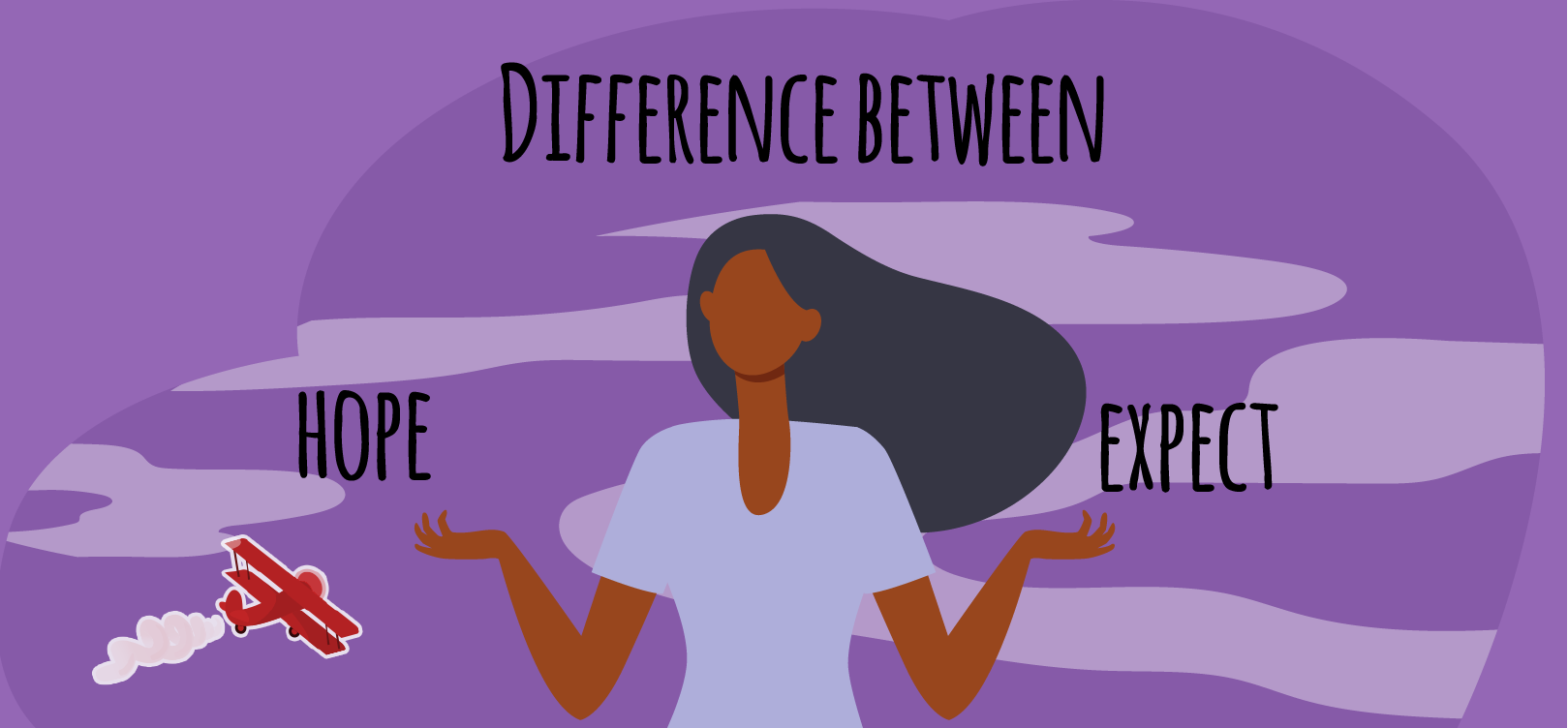
  • From ‘Lacks’ to ‘Receives’ – In student speak…from ‘I can’t or I won’t’ to ‘show me or tell me ‘
  • From ‘Receives’ to ‘Responds’ – In student speak…from ‘show me or tell me ‘ to ‘I’ll try’
  • From ‘Responds’ to ‘Values’ – In student speak…from ‘I’ll try’ to ‘I see why”
  • From ‘Values’ to ‘Organises’ – In student speak…from ‘I see why” to ‘I’ll make sure’

These phases are differentiated using the colours Grey / Purple / Blue / Green / Yellow on the progression trajectories which teachers meet in the Re-energising resource.

Read more about the 4 phases of development

Four phases of getting better at learning.

A. How can students get better at ‘learning’?

Growth pattern for learning behaviours.

Learning behaviours e.g. becoming more competent at getting unstuck, can be seen as going through emotionally generated phases.

The best way of understanding this growth pattern of progression is to see it as a long term journey. Some phases can take some people years to work through. Some phases may never be worked through because none of the phases are inevitable. So there is a lifetime of possible development captured here.

In a learning friendly classroom culture learning behaviours have a better chance of improving because teachers understand the phases and can make specific interventions to bring about improvements. The development is purposeful rather than being left to chance.

B. Getting better – at the 4 aspects of Resilience

The progression trajectories to the right are embedded in the ‘Re-energising‘ resource. They are collected together here for your convenience as a senior leader.

Download a pdf of the trajectories

Ask yourself:

How might I use these progression trajectories to sharpen the observations I make on a learning walk?

1.3 The 4 aspects of a learning-friendly classroom culture

These 4 aspects underpin how the teaching suggestions are organised in the ‘Re-energising‘ resource – ‘Practical Things to Try’. The 4 aspects are:

  • How teachers make learning a shared responsibility, also referred to as ‘things to give away‘
  • How teachers stimulate talk about the process of learning, also referred to as ‘things to say’
  • How teachers shape learning experiences or lesson, also referred to as ‘do every day‘
  • How teachers recognise and display the learning process, also referred to as ‘things to display‘.

Read more about classroom culture

Learning friendly cultures; Lots of little shifts. Find out about the four big dimensions of classroom culture.

Note – this is included as background reading for senior leaders. It doesn’t form part of the ‘Re-energising’ resource although it does help to shape the ways in which the teaching ideas are structured.

A. The What and the Why of shifts

What

Moving to more learning-friendly cultures takes lots of little shifts in thinking and action. To establish learning-friendliness it’s useful to think about four types of shift. A shift in relationships, a shift in the language, a shift in how learning is constructed and a shift in what is celebrated – what is seen to matter:

Why

The more structured we make the environment the more structure the students need.
The more we decide for students the more they expect us to decide.
The more motivation we provide the less they find within themselves.
The more responsibility for learning we try to assume the less they accept on their own.
The more control we exert the more restive their response.

Weimar 2002.


B. Shifts in relating – things to give away

Relating for learning: the changing roles and responsibilities of teachers and learners, where learning becomes a shared responsibility. Students are given more responsibility for their own learning, the role of the teacher changes from ‘the sage on the stage’ to ‘the guide by your side’; the role of the student moves from ‘passenger’ to ‘crew’ and ultimately ‘pilots of their own learning’.

C. Shifts in talking – things to say

Talking for learning: the sort of language content and style to enhance learning, making learning the object of conversation. The way we express ourselves in the classroom creates a powerful linguistic environment that teaches young people the best of what we know about learning. The language of learning helps students to discuss, understand, and become conscious of using their learning behaviours.

D. Shifts in constructing – things to do every day

Constructing learning: activities and classroom routines feed learning habits and learning becomes the object of learning. Challenging activities are designed to enable students to understand both the content and the process of learning. They do this by having a dual focus – to explore content and stretch students’ use of their learning behaviours. There is a strong underpinning of not just ‘doing’ learning but reviewing and reflecting on the process in order to make meaning and apply it elsewhere (transfer).

E. Shifts in celebrating learning – things to display

Celebrating learning: the outward signs of the values that underpin the culture, making learning the object of attention. In this dimension common notions of classroom learning are flipped or re-defined – being stuck is seen as interesting and mistakes as valuable. Effort, questioning and taking risks are recognised, attended to, acknowledged and praised. These and the recognition of the development of learning habits serve to make visible and public the underlying values of the learning-friendly environment.

F. Shifts in the teacher’s role

The teacher’s role becomes one of surfacing learning; to make learning public; to train some of the tricky bits; to talk about it; to recognise and celebrate it as it happens; to nudge it along, assisting students to grow their learning capacities; and to design activity to stretch a wide range of learning habits. This uncovering of learning ensures students discover, use, understand and grow their learning habits. There is a shift in emphasis from performance to learning, from content to process, from teaching to coaching.

Screen Shot 2017-02-02 at 13.58.57


2) A big picture look at the ‘Re-energising‘ resource


2.1 The vertical and horizontal axes of the grid

The horizontal axis across the top shows the 4 aspects of Resilience – stuck / distractions / challenge / goals.

The vertical axis to the left shows the 4 phases of development – tell me / I’ll try / I see why / I make sure I . .

2,1a. The central 16 cells

The text in each cell gives an indication of what teachers need to be doing at each phase of development.
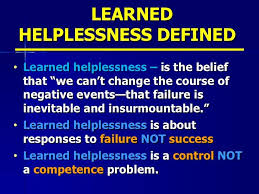
  • When looked at vertically up the page, they map out the progression of interventions teachers make as learner skilfulness grows;
  • When looked at horizontally, they indicate the learning journey that students will undertake as they become increasingly resilient.

2.1b. The green cells to the bottom

The green cells across the bottom give an outline of the 4 aspects of Resilience.

Behind each cell you will find:

  • an indication of how the aspect of Resilience grows;
  • a quiz that helps to assess how effective students currently behave in this aspect of Resilience;
  • a detailed explanation of how you might use the outcomes of the quiz;
  • a second quiz to explore a teacher’s own classroom culture and consider the extent to which it currently supports this particular aspect of Resilience. It offers some quick wins, some changes that might need to be made to pave the way for the interventions that will be made as teachers work through the teaching ideas behind the yellow cells.

These green cells are the starting point for exploring each of the 4 columns.

2.1c. The blue cells to the right

The blue cells to the far right give an indication of the anticipated outcomes for learners in terms of the 4 phases the growth of Resilience. Each blue cell hints at the changes you might look for in classrooms.


Continue Reading

Display: sharing the values of achieving GOALS Copy

Taking ownership of learning goals

About Goals

We all find it easier to put in effort and keep going when we see the point of doing it; when we have a goal that is of interest to us. Without a goal that we buy in to we often wonder why should we bother.

Classroom learning with its goals, targets, success criteria can feel like an imposition; someone else’s goal, not yours. Assisting students to take ownership of their learning goals will help them to focus their effort and engage their motivation. Without this many learners will forever feel they are pursuing an agenda in which they have little interest.

About Display

What you’re aiming to achieve is to ensure that the look and feel of your classroom, its walls and reward systems, serve to strengthen your students’ learning habits.

This involves giving more attention to learning rather than performance, where more traditional ideas of classroom learning are flipped or re-defined – where being stuck is seen as interesting and mistakes valuable, where effort, questioning and taking risks are defined, attended to, acknowledged and praised. This classroom culture serves to make learning visible and public; one in which learners are being coached to become meta-learners.

Engage your students in being able to achieve their goals by:

Checking that students’ goal planning is geared to avoid obstacles.


A learning classroom

“The hallmark of successful individuals is that they love learning, they seek challenges, they value effort, and they persist in the face of obstacles.” (Carol Dweck, 2000)

A culture for learning

At the side of the room there may be a review table with a label “Put your learning here if you want to come back to it, improve it or review it with the class”. There may be a pile of ‘learning journals’ which children use to illustrate and record the difficulties they are having, or indeed the triumphs.

You will see students moving freely around the classroom selecting resources they think they may need for their tasks. On the a flip chart is today’s selection of tasks at different levels of challenge, but all challenging, for pupils to choose from. Some children are working on their own, some with their teacher, some in teams. They are focused, engaged, enthusiastic and excited about what they are doing. There’s no hint of anxiety or pressure or boredom. They are learning to handle uncertainty, learn together and embrace challenge. No one has told them ‘this is hard’, they are knowingly using their imagination, generative questioning, different sorts of resources, listening for the key points and so forth.

The language is enquiring, propelling the learning forward…what if, how come, now what.; every so often a group will stop and check if they are on track and if they need to try another way to tackle their task; at the end of the session one group reflects on their learning process and its outcomes with their teacher, other groups do this for themselves.

The classroom is humming with the language and imagery of learning. The natural process of learning has been unearthed and given high status. An environment the provokes curiosity and stimulates learning becomes a ‘teacher’ in itself.

A. Introduce

In sharing the values of achieving goals you will be:

  • showing attention to learning, rather than performance;
  • recognising, praising, displaying aspects of pursuing and achieving clearly defined goals;
  • acknowledging/recognising/ praising when goals /success criteria are achieved;
  • attending to the growth of learning habits associated with becoming goal orientated.
  • prizing aspects of self-regulation
  • prizing risk taking, trying new ways, and being flexible
  • prizing the generation of intriguing ideas, making interesting connections, and forming well-reasoned arguments over ‘right’ answers
  • prizing self-review and evaluation of the learning process


In the early stages

In learning friendly classrooms failure, mistakes, being stuck and applying effort have been re-framed so that learners come to view these old adversaries as valuable, interesting and essential.  In the early stages re-defining the quest-like values of learning might simply include:

  • ensuring students (and parents) understand ‘being stuck’ as an interesting not shameful position, with tactics to get unstuck ensuring students (and yourself and parents) understand what is meant by effort;
  • ensuring students (and parents) understand the value of mistakes;
  • celebrating students’ using and making progress in learning behaviours;
  • celebrating ‘work in progress’.

The success of this shift will depend on consistency and strong emphasis. You have to make these ideas/values obvious, big and overblown. Whispering them quietly won’t work. They have to be shouted about and put ‘in-your-face’ if they are to stick, be believed, be understood and capitalised on.

B. Model and explore

Celebrating (reinforcing) learning behaviours

Use circle time to discuss learning each week to positively identify children who have been good learners. Initially it’s likely that children who are seen as being ‘traditionally’ successful will be selected; students who finish first, answer questions quickly, are well behaved etc. However, discussion will gradually change through modelling from yourself, the children will begin to realise that just because someone didn’t get it ‘right’ doesn’t mean they weren’t a good learner. Talk about children who have really persevered with their learning, for example, those who in a science investigation by repeating the test when it had gone wrong or those who had imitated the process a friend had used to solve a Maths problem, (showing that copying how it had been done was fine). The children will then value how they learn and will begin to take greater notice of how others learn too.


C. Use

Public recognition for growing resilient behaviours

All the students in this classroom own a coloured piece of A4 paper on the classroom wall. There is an envelope attached to the paper which contains a piece of card cut up into five pieces. Each piece of card has a student generated ‘learning how’ goal. For example;

  • I ignore things that distract me.
  • I keep calm when I get stuck
  • I found a way of getting unstuck
  • I learned how to improve something after making a mistake
  • I built on other people’s ideas

When a student achieves a stated behaviour the card is taken out of the envelope and stuck to their piece of paper. The aim is to have all five pieces of card making up a completed jigsaw on the wall in a given time. e.g. a fortnight.

This public recognition of growing resilience helps the pupils to keep these behaviours in constant use.


D. Reflect on

Display valuable types of achievement

Here a teacher has made a weekly display of outcomes related to the ideas children came up with when they thought about achievement.

Look at our achievements this week:

  • Things we are really proud of
  • Things we have never done before
  • Things that we kept trying to do and finally succeeded
  • Things that we found difficult
  • Things that we worked hard on to finish


E. Improve on

Display planning prompts.

An example of public prompts related to the ‘how’ of planning learning. In this case the FAME plan – focus / action / monitor / evaluate. For more on FAME planning go to Goals, Do every day, C.


Clicking on the link in any cell takes you to 5 related classroom activities.

↩️ IntroductionThings to give awayThings to sayThings to do everydayThings to display
Dealing with being stuckReframe getting unstuck. Help pupils to feel comfortable with getting stuckUse language to help pupils understand why they are stuckActivities and routines to help pupils overcome fear and become a curious finder-outerClassroom displays to offer positive assistance on ‘stuck’
Managing distractionsReframe managing distraction. Help pupils to maintain focus.Use language to help pupils to overcome distractions in learning.Activities and routines to help pupils manage their learning environmentClassroom displays to aid pupils’ understanding of distraction
Rising to challengeOffer strategies to help pupils take on challenge confidently.Use language to help pupils feel comfortable with mistakes.Activities and routines to support pupils to take risks and change plans.Classroom displays to support pupils in undertaking challenging activities.
Working towards goalsHelp pupils to set their own goals confidently.Use language to help pupils’ confidence to achieve their goals.Activities and routines to support pupils to plan and reflect on practice.Classroom displays to support the use of goal strategies.
Continue Reading

Do every day: activities and routines to support achieving GOALS Copy

Taking ownership of learning goals

About Goals

We all find it easier to put in effort and keep going when we see the point of doing it; when we have a goal that is of interest to us. Without a goal that we buy in to we often wonder why should we bother.

Classroom learning with its goals, targets, success criteria can feel like an imposition; someone else’s goal, not yours. Assisting students to take ownership of their learning goals will help them to focus their effort and engage their motivation. Without this many learners will forever feel they are pursuing an agenda in which they have little interest.

About Do every day

What you’re aiming to achieve is to design and deliver learning opportunities that strengthen students’ learning behaviours.

This involves making becoming a better learner the purpose of classroom; how classroom activities and routines feed learning habits. Learning challenges are designed to enable students to understand both the content and the process of learning. This dual focus stretches students’ use of their learning behaviours in order to explore and understand content. It’s not just about ‘doing’ learning but reflecting on the process to create self-regulated learners.
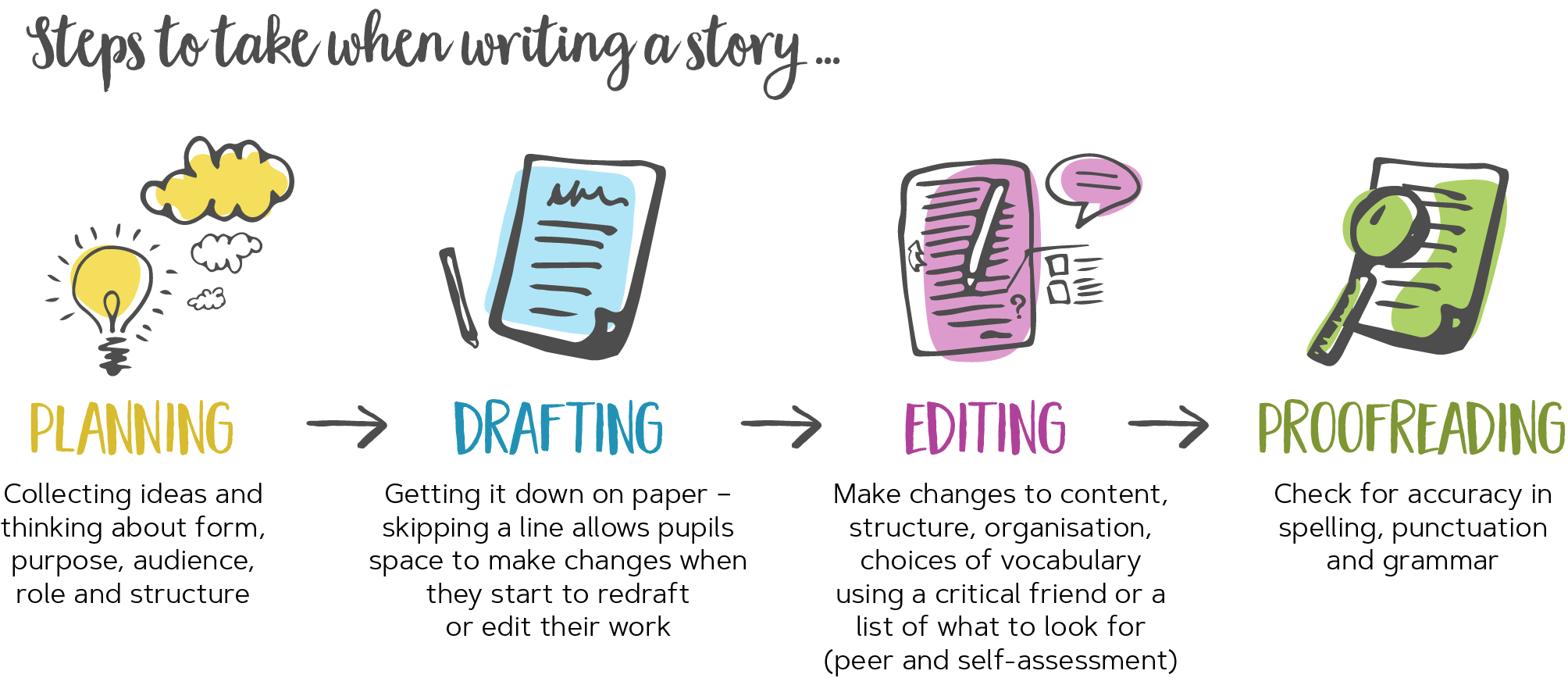
Engage your students in being able to achieve their goals by:

Encourage students to set their own goals confidently.


Happy to face challenges

Professor Jo Boaler of Sussex University has found that girls in top maths sets often struggle for a very particular reason. Teachers have high expectations of top sets, so they tend to rattle through the material at a speed that enables students to learn techniques and procedures, but not to really ‘get their heads round’ what is going on. Boys, Boaler discovered, are more willing to settle for this instrumental kind of understanding than girls. The girls tend to worry more that they don’t really understand what they are doing, and this leads not only to greater anxiety but also to underachievement. Boaler concludes:
‘Maladaptive patterns will be countered when students are exposed to environments in which they are encouraged to try things out, to get things wrong as they do so and to have the time and space in which to develop their understanding… Only when these conditions are realised will students feel happy about facing challenges on which they may not succeed.’

A. Introduce

Flip the emphasis in how goals are expressed

Getting student buy-in to goals

Setting a goal that the learner has little or no motivation to achieve is unlikely to lead to success. What is needed is learner buy-in to goals.

Evidence shows that goals that relate to doing something or researching something, or creating something . . . ) are better motivators than goals that relate to knowing something or passing / doing well in a test.
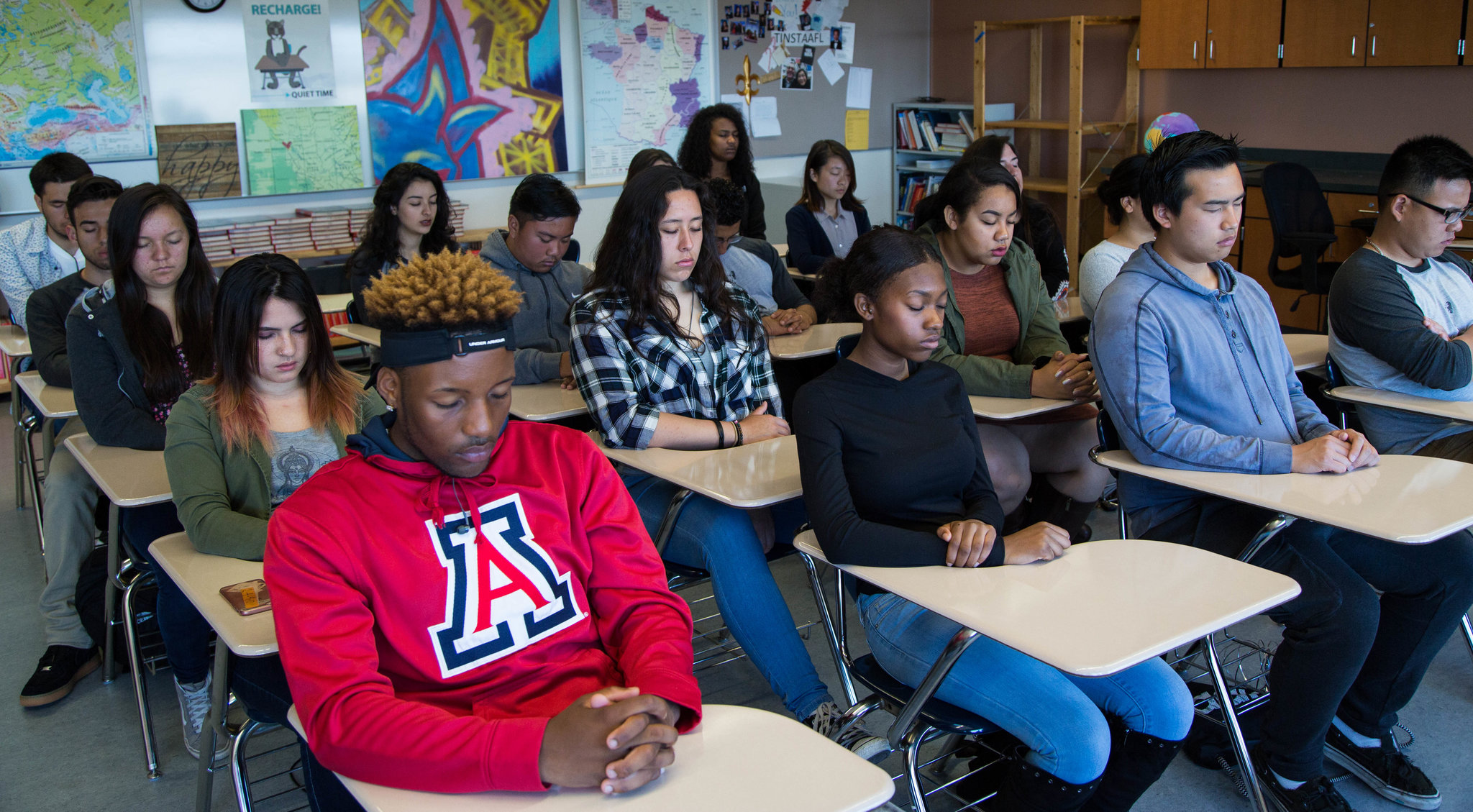
Putting the ‘how’ before the ‘what’.
So – a goal relating to ‘understanding xxxxx’ or ‘knowing yyyyy’ is less likely to motivate a learner to make the effort than a goal that starts with some indication of the sort of ‘effort’ or way of doing something;

  • work with a partner to decide why…….
  • use your problem solving skills to work out……
  • use your imagination to …


Some examples of flipped goals

Where ‘knowing goals’ place the emphasis on the successful acquisition of knowledge or creates a pass/fail scenario, the ‘doing goals’ focus on how – something to do rather than something to know.

Take a look at some real examples just to give you a flavour of this technique

  • With a partner, use your reasoning skills to explain why all prime numbers, with the exception of 2, are odd.
  • Use your noticing skills to identify three similarities and three differences between these two images.
  • By using what you already know and your imagination to generate ideas, tell the story of the fire of London from the perspective of a young child living in London at the time.

What you are doing here is beginning to pay some attention to how students will be learning as well as what they will be learning. This linking of how and what plays a central role in building students learning behaviours.

B. Model and explore

Thinking ahead of action

‘What will it look like when it’s finished?’ (WWILLWIF)

  • Set a task — physical, dramatic, written, practical, spoken, visual — that has clear parameters.
  • Make WWILLWIF the regular precursor to any action.
  • Ask students to determine WWILLWIF for themselves and in conjunction with others.
  • Help them to visualise this in an appropriate form.

Build WWILLWIF into a list of stuck prompts, as a reminder to think ahead, but also to help students to get unstuck by visualising what the finished article might look like.

With older students, you might consider exploring one of Stephen Covey’s Habits of Highly Effective People – to ‘Begin with the end in Mind’.


C. Use

Making FAME plans

A good plan contains;

  • an action component
  • a thinking component
  • a monitoring component, which means providing metacognitive steps to help make judgements about what they are doing
  • an evaluation component

Without the monitoring and evaluation components the plan remains just a set of directions for a given task. A good plan is strategic and includes skills that can be applied in a number of contexts.

FAME – Focus, Act, Monitor, Evaluate.

You could include more steps e.g. 2 for focusing or 3 for acting but too many steps becomes confusing. Keep the magic number 7 in mind.

A good way to introduce this type of planning is for you to do a very detailed one and then ask pupils to simplify the steps in their own words.

Once pupils understand the planning process and have used them for a number of purposes they’ll become more proficient and confident, developing skills in:

  • knowledge of what plans are
  • formulating plans for different purposes
  • understanding when planning would or would not be useful/appropriate
  • being mindful (strategic) in undertaking tasks and solving problems.


Plans provide an important starting point. A clear beginning or focus shows a student where and how to start and what to do, and what steps or actions to take. The aim of the plan is to liberate the pupil from direct teacher assistance. Plans are not only a teaching device but aim to provide a means for independent learning.


4. Reflect on

Monitoring checklists

Construct checklists with students itemising the important things to check before they consider something is finished. Use such checklists as they work through something, and use it again as a final check before they submit work for assessment.
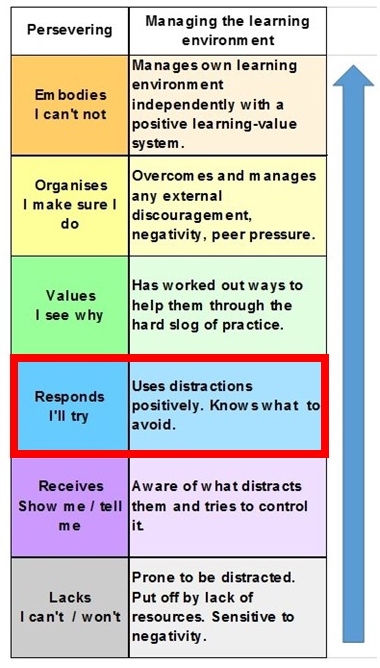
How we relate to standards of excellence, quality, and correctness is key. It is about developing a sense of standards; a view of what’s good, bad or indifferent. Initially students accept what they are told by teachers about what something needs to look like, be like, feel like. But with support and encouragement students are able to begin to think for themselves about what makes something good and eventually determine their own standards.


Screen Shot 2016-05-09 at 13.56.32


5. Improve on

Self-monitoring of plans: keeping goals on track

Require students to monitor how their plan is progressing AND assess whether the end goal is still achievable/relevant.
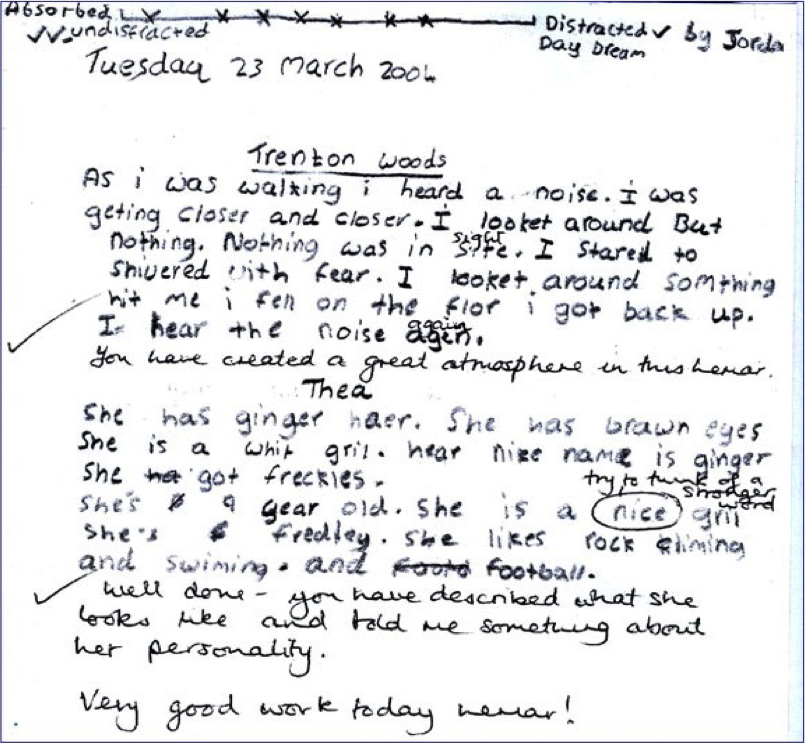
Make sure pupils understand that changing plans (revising) is an okay thing to do and that changing their plans in order to achieve their end goals is often necessary.

Sometimes of course the set back is such that the original goal becomes unattainable and needs re-casting in a more achievable form – this requires maturity and bravery. Changing an end-goal inevitably leads to having to revise, in the form of start from scratch, the original plan. Many people, let alone students, are reluctant to undertake such root and branch changes, and erroneously rely on minor amendments to plans in the hope that small tweaks will produce the necessary impact.

Constant monitoring of the plan and the goal can counteract this tendency.


Clicking on the link in any cell takes you to 5 related classroom activities.

↩️ IntroductionThings to give awayThings to sayThings to do everydayThings to display
Dealing with being stuckReframe getting unstuck. Help pupils to feel comfortable with getting stuckUse language to help pupils understand why they are stuckActivities and routines to help pupils overcome fear and become a curious finder-outerClassroom displays to offer positive assistance on ‘stuck’
Managing distractionsReframe managing distraction. Help pupils to maintain focus.Use language to help pupils to overcome distractions in learning.Activities and routines to help pupils manage their learning environmentClassroom displays to aid pupils’ understanding of distraction
Rising to challengeOffer strategies to help pupils take on challenge confidently.Use language to help pupils feel comfortable with mistakes.Activities and routines to support pupils to take risks and change plans.Classroom displays to support pupils in undertaking challenging activities.
Working towards goalsHelp pupils to set their own goals confidently.Use language to help pupils’ confidence to achieve their goals.Activities and routines to support pupils to plan and reflect on practice.Classroom displays to support the use of goal strategies.
Continue Reading

Say: use language to enhance achieving GOALS Copy

Taking ownership of learning goals

About Goals

We all find it easier to put in effort and keep going when we see the point of doing it; when we have a goal that is of interest to us. Without a goal that we buy in to we often wonder why should we bother.

Classroom learning with its goals, targets, success criteria can feel like an imposition; someone else’s goal, not yours. Assisting students to take ownership of their learning goals will help them to focus their effort and engage their motivation. Without this many learners will forever feel they are pursuing an agenda in which they have little interest.

About Say

What you’re aiming to achieve is to use a learning language that gives students more control of their learning.

This involves talking about the ‘how’ of learning; making learning the object of conversation. The way you talk about learning in the classroom creates a powerful linguistic environment that teaches your students the best of what we know about learning. The language of learning helps students to discuss, understand, and become conscious of using their learning behaviours.

Engage your students in being able to achieve their goals by:

Building students’ confidence in trying to achieve goals they think they can achieve.


Promoting positive self talk

Since we want young people to turn out to be robust confident learners we have to talk with them in terms of a growth mindset.

  • You develop students’ interest in the learnable skills and strategies.
  • Your comments focus on learning habits and dispositions, focusing students on how to get better by looking for ways to use learning routines and strategies and do things differently.
  • Students are steered away from carving the world into things they are ‘good at’ or ‘not good at’.

A. Introduce

Talk to nudge visualising achievements.

Phrases to help students think about what they are trying to achieve.

Encourage students to develop the ability to articulate what they are trying to achieve and visualise end results. Use phrases like:

  • Tell your friend what you are going to do
  • Tell me what you are trying to achieve
  • What are you going to do?
  • What are you hoping to achieve?
  • What will it look like when you have done it?
  • Begin with the end in mind . . .
  • Let’s imagine what success will be like


B. Model and explore

Model your own goal strategies

Pursuing your own goals

Share something that you personally are trying to achieve, and how you are going about achieving it. Talk about plans, milestones, stumbling blocks, resources, time frames etc.

The key ideas to get over are:

  • that success usually results from effort and following a planned course of action, and rarely happens ‘by accident’;
  • that by thinking ahead we can influence the future.


A bit about effort

Effort is a word we use often without really thinking about what it means. What do children understand by ‘effort’ or ‘try harder’? Using a learning language helps you to be much more specific about what sort of effort you suggest students make. As one teacher put it;

‘I often used to just tell students to make more effort, and got blank stares back. But when I started using learning Planguage I realised I could be much more specific about “making more effort.” I could turn my prompts and nudges into really useful statements. So now I watch students carefully through a learning lens and say things like “how could you use your imagination to…?”, Or, “what questions might be helpful to take you further with this?”. I’ve started defining the sort of effort I want them to make’

C. Use

Involve everybody in asking…

‘Why are we doing this?’

is a question that students rarely know the answer to. The most common answer is ‘because my teacher told me’. They inhabit a classroom environment whose purpose is activity but don’t know the reason for the activity.

If we want our students to take on learning goals as their own we need to broaden their thinking about why they are doing something. Broaden their perception by seeking to identify the purpose of learning tasks and projects.

Discuss things like;

  • what are we trying to do
  • what do we want to end up with?
  • why are we doing this?
  • what is its purpose?
  • what else will it help us to do?
  • would it matter if we couldn’t do this? Why?


4. Reflect on

Talk to nudge the skill of analysing their own performance

Enable students to become reflective and thoughtful about learning.

To reflect on how their learning behaviour is improving, use phrases like:

  • What are you doing in order to be successful?
  • Which of the learning behaviours are your strong points?
  • As a class, we need to get better at (learning bahaviour) How might we do that?
  • What do good (collaborators, listeners, imaginers, questioners etc.) do?
  • That’s an interesting way to talk about your learning!
  • How are you going to get better at . . . . ?
  • I think you are getting to know yourself really well as a learner.


5. Improve on

Teacher talk to nudge students to decide what they are trying to achieve

As they are deciding what they are going to do and how they are going to do it, use phrases like:

  • What are you trying to do?
  • What do you hope to achieve.
  • What will it be like when you have finished it?
  • Maybe you need to reconsider what you are trying to achieve.
  • Is that possible, or might you need to try something else?
  • Is that realistic, or are you aiming too high / too low?


Clicking on the link in any cell takes you to 5 related classroom activities.

↩️ IntroductionThings to give awayThings to sayThings to do everydayThings to display
Dealing with being stuckReframe getting unstuck. Help pupils to feel comfortable with getting stuckUse language to help pupils understand why they are stuckActivities and routines to help pupils overcome fear and become a curious finder-outerClassroom displays to offer positive assistance on ‘stuck’
Managing distractionsReframe managing distraction. Help pupils to maintain focus.Use language to help pupils to overcome distractions in learning.Activities and routines to help pupils manage their learning environmentClassroom displays to aid pupils’ understanding of distraction
Rising to challengeOffer strategies to help pupils take on challenge confidently.Use language to help pupils feel comfortable with mistakes.Activities and routines to support pupils to take risks and change plans.Classroom displays to support pupils in undertaking challenging activities.
Working towards goalsHelp pupils to set their own goals confidently.Use language to help pupils’ confidence to achieve their goals.Activities and routines to support pupils to plan and reflect on practice.Classroom displays to support the use of goal strategies.
Continue Reading

Give away: devolve responsibility for achieving GOALS Copy

Taking ownership of learning goals

About Goals

We all find it easier to put in effort and keep going when we see the point of doing it; when we have a goal that is of interest to us. Without a goal that we buy in to we often wonder why should we bother.

Classroom learning with its goals, targets, success criteria can feel like an imposition; someone else’s goal, not yours. Assisting students to take ownership of their learning goals will help them to focus their effort and engage their motivation. Without this many learners will forever feel they are pursuing an agenda in which they have little interest.

About Give Away

What you’re aiming to achieve is to give your students a more active role in their learning.

This involves offering them more opportunities to decide what to do, to ask more questions, to learn together with others and to actively learn by reviewing their own experience. This shifts how you relate to your students; gradually sharing more of the responsibility for learning with them. Shaping them to become self-regulated learners.

Engage your students in being able to achieve their goals by:

Helping students to build a sense of what they want something to look like.


Take a coaching approach

“Expert tutors often do not help very much. They hang back, letting the student manage as much as possible. And when things go awry, rather than help directly they raise questions: ‘Could you explain this step again? How did you… ?’” (Mark Lepper)

A coaching approach:

  • helps students to explore their challenges, problems and goals
  • provides an objective view of students’ actions to enable them to see things as as they really are
  • enhances motivation and raises self esteem
  • builds curiosity and encourages learning

Above all, coaches resist offering solutions. Offering solutions does little to secure learning as the student hasn’t been allowed to confront and engage with the problem and find their way forward.

A. Introduce

Learning tools to equip learners to achieve learning intentions

If we want young learners to achieve curriculum goals we need to alert them to the tools to do just that. i.e. knowledge, understanding and improvement of their learning behaviours.

Younger learners need physical prompts or hooks for many invisible concepts including learning. Several schools use physical tools since tools help adults to do many jobs. Tools help children to connect with the idea of their learning process in a tangible way.

Use real toolboxes and gather items to represent just some of the learning behaviours. For example:

  • a blindfold for managing distractions
  • a magnifying glass for noticing details.
  • a plastic hammer for perseverance.
  • a giant key for collaboration.
  • a notebook for planning

Introduce the items one at a time as the learning behaviour it represents fits with what you want to strengthen. Later ask children ‘Which learning tools will we need to help us today?’


B. Model and explore

Modelling a skill

Whatever the subject, modelling ‘how to’ is given added value when linked to the learning behaviours that make for successful performance. Take on the role of an intelligent novice and model performance at a slightly higher, more coherent and informed level than is characteristic of your students. Model your ‘think alouds’.

Try the following steps for whatever skill you are modelling;

  • introduce the skill e.g. how to find something in an index
  • explain the skill, explaining why the information is important
  • model the skill, showing how you do it
  • review what you have done, ask students to tell you what you did
  • reflect on the use of the skill, where else the skill can be applied.


C. Use

Using your mind’s eye to rehearse the future

Encourage students to develop the ability to articulate what they are trying to achieve and visualise end results. This technique is useful for students of any age.

Think of visualisation as a pre-activity walk-through, helping you to think through what you will be doing and what you want to achieve in advance of actually doing it. It can be used to eliminate some of the unknowns and allows the student to rehearse the future in their mind’s eye.

  • Talk students through what they are going to be doing.
  • Some students find it helpful to close their eyes as you guide them through what they will be doing and achieving.
  • As they get the idea, encourage them to talk each other through it for themselves.
  • The point is to slow the learning down and give students the time to think in advance of committing to action.

Visualisation or mental imagery is a way of conditioning your brain for successful outcomes. The more you mentally rehearse your performance, the more it becomes habituated in your mind.


How to use visualisation for successful performance

How to use visualisation for successful performance:

  1. Visualise the outcome you want – When you mentally rehearse your performance in your head, make sure you see the event as how you want it to unfold. If your mental images turn negative, stop the mental tape, rewind and restart then visualise again see the performance you want to see.
  2. Use all your senses from a first-person perspective – Visualise your performance in detail. What would you see, hear, feel, smell and taste. Feel how your body would feel as you go through the motions of your performance. Try adding in some physical movements that coincide with the visualised images. Feel the excitement of successfully fulfilling your performance goal.
  3. Practise frequently – Mental rehearsal is a skill that becomes better with repetition. Practise your visualisation or imagery daily.

D. Reflect on

Begin to think about achievement

Start children thinking about broader ways of understanding/recognising achievement.

What is real achievement in learning?

Invite your students to brainstorm their own definitions and come up with a list.

An achievement is something;

  • you can be really proud of
  • you have never done it before
  • that you kept trying to do and finally succeeded
  • you have done that you found difficult
  • you have worked hard to finish
  • you have done what teachers tell you is good

Notice that all these are aimed towards a growth mindset. Make sure your praise matches these statements. You could use any one of these to group children’s learning on a wall display.


E. Improve on

From hope to expect.

What I hope students will do as a result of this lesson

becomes

What I expect students to be able to do as a result of this lesson

When you ask students to set their own goals ahead of the lesson ask them to think through the frame

  • I expect to complete….
  • I expect to achieve….
  • I expect to be able to….

In this way they can begin to own their ambition

Other expectant language could be:

As a result of today’s lesson (learning outcome) I can.………..so that I will.………


Winners make a habit of manufacturing their own positive expectations in advance of the event.


Clicking on the link in any cell takes you to 5 related classroom activities.

↩️ IntroductionThings to give awayThings to sayThings to do everydayThings to display
Dealing with being stuckReframe getting unstuck. Help pupils to feel comfortable with getting stuckUse language to help pupils understand why they are stuckActivities and routines to help pupils overcome fear and become a curious finder-outerClassroom displays to offer positive assistance on ‘stuck’
Managing distractionsReframe managing distraction. Help pupils to maintain focus.Use language to help pupils to overcome distractions in learning.Activities and routines to help pupils manage their learning environmentClassroom displays to aid pupils’ understanding of distraction
Rising to challengeOffer strategies to help pupils take on challenge confidently.Use language to help pupils feel comfortable with mistakes.Activities and routines to support pupils to take risks and change plans.Classroom displays to support pupils in undertaking challenging activities.
Working towards goalsHelp pupils to set their own goals confidently.Use language to help pupils’ confidence to achieve their goals.Activities and routines to support pupils to plan and reflect on practice.Classroom displays to support the use of goal strategies.
Continue Reading