The Key Features of this section:
Take each of the 4 dimensions in turn. Share:
Thoughts about:
Think of it like this:
This is the crunch question. Your classroom culture is unlikely to change unless you change!
 DEVELOPING-AN-ENQUIRY-QUESTION-CULTURE.PDF.
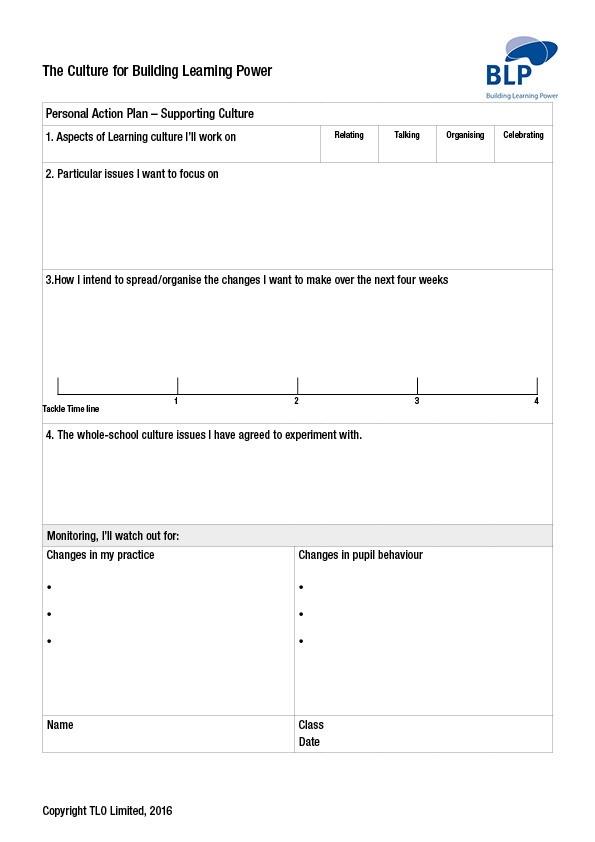 PERSONAL-ACTION-PLAN-CULTURE.PDF
It enables you to choose from a range of differentiated teaching ideas suitable for implementing into your existing classroom culture.
This section identifies teaching ideas to use at each phase of classroom culture development.
But – make sure that you start at the section most closely related to where you have assessed your classroom culture:
And finally, two words of warning. . . . .
Below low some ideas to seed the sub sections Delete when used
| Demonstrate fallibility, react with confident uncertainty to show that you too are still learning | Enable students to explore their own lines of enquiry and to create meaning for themselves | Adopt a coaching approach to help students to find their own way through difficulties |
| Set a learning challenge without knowing the answer and join in the investigation | Create opportunities for students find/uncover/process information for themselves | Help students to believe that, with effort, they can do more than they think they can |
| Say ‘I don’t know’ without being defensive | Build in opportunities for greater student involvement, choice and ownership | Stand back and say less in order to let the learning happen |
| Modelling learning | Devolving responsibility | Coaching approaches |
| Create opportunities for students to explore and reflect on the process of learning and how it can be further refined | Use language drawn from the progression map to enable students to understand how they are improving as learners | Use differentiated, supportive comments to nudge progression in both content and learning behaviours. |
| Enable students to understand the learning process and how it improves. | Make talking about learning a regular feature of classroom talk and reflection | Set and monitor targets for how students might improve as learners. |
| Talk informally to students about learning and how it works | Use the school’s learning language to explain learning. | Ensure that oral and written comments about content are well-balanced by comments about learning |
| Exploring learning as a process | Sharing the language of learning | Nudging learning forward
|
| Build in opportunities for learners to reflect on what they have learned, how and how well they have learned it, and how they might apply this learning elsewhere | Orchestrate activities to ensure progression in both content acquisition and in learning habit development. | Offer rich, challenging and open-ended activities that intentionally develop content understanding and stretch learning behaviours |
| Create frequent opportunities for reflection to secure new learning and to help students to understand themselves as learners. | Plan learning activities using the map of progression to ensure that learning habits are stretched rather than exercised. | Ensure that activities are sufficiently challenging to secure engagement and keep students near to the edge of their comfort zone |
| Ensure that review points are a regular feature of lessons | Ensure students are aware of the twin-focused intentions of activities in terms of both content and learning objectives | Create opportunities for students to get stuck |
| Encourage reflection | Linking learning and content | Offer rich, challenging activities |
| Understand how individual students learn and what they need to improve, and intervene to secure such improvements. | Enable students to regard mistakes as valuable opportunities for reflection and learning. | Create interactive displays that help students to understand how improving learning behaviours can support and enhance the acquisition of content. |
| Intervene in order to enable students to exercise and grow specific learning behaviours. | Allow students to ‘fail in safety’ | Ensure that display celebrates both the processes of learning / work in progress and the outcomes of learning / final versions in equal measure. |
| Celebrate any developments in a student’s personal best as a learner | Treat mistakes and being stuck as sites of interest. | Remind students to use public learning prompts. |
| Growing learning habits | Re-defining failure | Learning on display |
It enables you to answer two complementary questions:
Or
Each cultural dimension has ‘ends’ or ‘outcomes for learners’ – the outcomes we plan to achieve for learners. These intended outcomes also have a progression trajectory that is the consequence of progression in the 12 aspects of classroom culture. Progression in terms of outcomes for learners may well lag behind the changes in classroom culture as learners need time to perceive and act on these cultural changes. In this section of the module, we link progression in classroom culture with progression in learner behaviours and invite you to look at your classroom through this lens.
Work through each of the 4 dimensions (below) in turn.
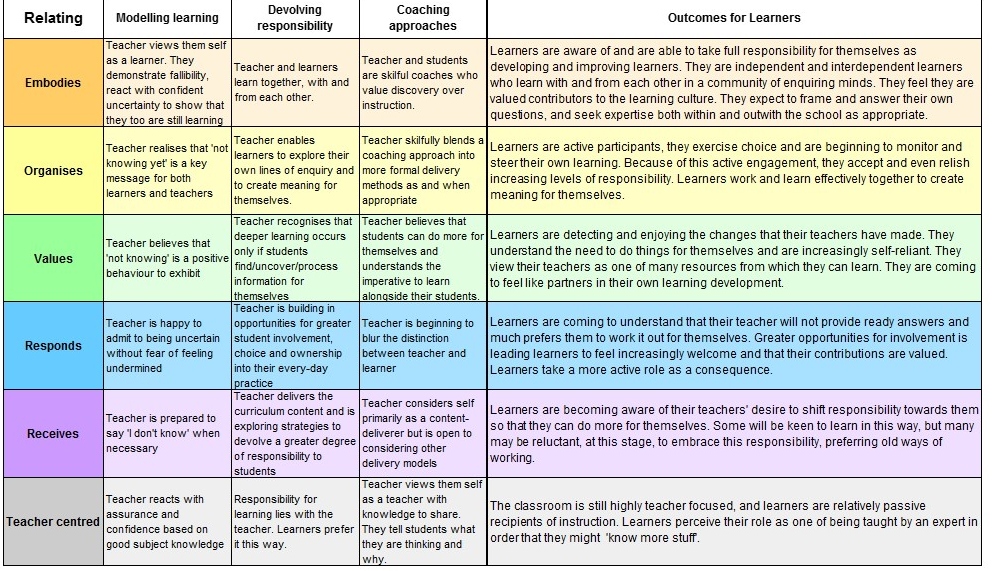
You have already seen the three columns of the Relating grid in section 1. Here we add the associated student learning behaviours. You can find a b&w copy in your Learning Diary.
Add in download / view in full screen option
You have already seen the three columns of the Talking grid in section 1. Here we add the associated student learning behaviours. You can find a b&w copy in your Learning Diary.

You have already seen the three columns of the Constructing grid in section 1. Here we add the associated student learning behaviours. You can find a b&w copy in your Learning Diary.
You have already seen the three columns of the Celebrating grid in section 1. Here we add the associated student learning behaviours. You can find a b&w copy in your Learning Diary.
You have already done the colouring-in activities on the 4 progression grids and have a sense of where you believe your classroom culture is and the extent to which your students are perceiving and responding to it. Take these to the Learning Team meeting.
Additionally, give some thought to how you might gather evidence that your evaluations are accurate. For example:
Sections 1a), 1b) are reminders of the culture module that you have done previously. Skip these, or skim read them, if you wish.
Section 1c), 1d) and 1e) are the important (new) sections where we explore progression and classroom culture.
Building Learning Power is about creating a culture in classrooms – and in the school more widely – that systematically cultivates habits and attitudes that enable young people to face difficulty calmly, confidently and creatively. By a ‘culture’ we mean all the little habits, routines and practices that implicitly convey ‘what we believe and value round here’. The medium of a school is its most powerful message, and the most important messages are conveyed to students in classrooms. Classrooms are the places where, hour by hour, students experience the values and practices that are embodied in the school, rather than just the ones that are espoused.
As Ron Ritchhart observes in ‘Creating Cultures of Thinking’:
The culture of the classroom teaches. It not only sets the tone for learning but also determines what gets learned. The messages sent through the culture of the classroom communicate to students what it means to think and learn well. These messages are a curriculum in themselves, teaching students how to learn and ways of thinking.
So ‘culture’ concerns the details of the micro-climate that teachers create in their classrooms. What they do and say, what they notice and commend and what they don’t, what kind of role model of a learner they offer: all these are of the essence. And what really matters is how they design and present activities so that, over the course of a term or a year, their students are cumulatively getting a really good all-round mental work-out. All the learning bits of their brains are being stretched and strengthened, one by one and all together.
So what does a culture shift mean? What sort of classroom cultures are there and which one do we need if students are going to understand and improve themselves as learners?
Moving towards a culture that is ripe for students to learn about learning can take a while. Research undertaken by Chris Watkins, at the London Institute of Education, suggests three different types of classroom culture: teacher centred culture; learner centred culture; and learning centred culture.
As you read on, think of these descriptions as stages in a journey you may need to travel.
Firstly, many classrooms could be thought of as teacher centred. Here the overriding emphasis is on what the teacher is doing or saying. Learners have little to do but listen and be told what to do. In these classrooms students can see themselves as isolated, passive and dependent on the teacher for the acquisition of knowledge. Here the conception of learning is “learning = being taught”. The teacher and teaching are dominant. Students have what’s been called a ‘thin’ description of their own learning and they have an impoverished view of their own role in learning.
The learner centred classroom is where students take a more active part in deciding what to do. The purpose is seen as the learner making meaning. So ‘content’ is not just stuff to be taught but for connecting to previous knowledge, extending understanding and helping learners to see things in new ways. Here there will be more collaborative learning where students have dialogues about what they are learning and create meaning together. There will also be more learner-driven learning where learners might have a role in the agenda through questioning or organising an enquiry and evaluating the products.
It’s only when many of the learner centred dimensions are present to some extent that it becomes realistic to add another – that of learning about learning itself. Learners collaborating, taking a role in learning, using questions to drive learning and so forth give a firm platform on which to build powerful learners. Now we can add a language about learning for students and teachers alike, and practise meta-learning. Through such practices students come to see themselves as learners, develop stories about their experiences, understand the learning behaviours they are using and develop and propose improvements. They are able consciously to grow their learning habits.
These two models, both of which you have met elsewhere, illustrate the nature of the learning-friendly classroom. Culture tool 2 shows the 4 big dimensions of a learning-friendly classroom culture, the 12 ‘means’ or ‘aspects’ (to the LHS), and the outcomes we intend for learners (RHS). The Teachers’ Palette summarises those same 4 dimensions and 12 aspects.
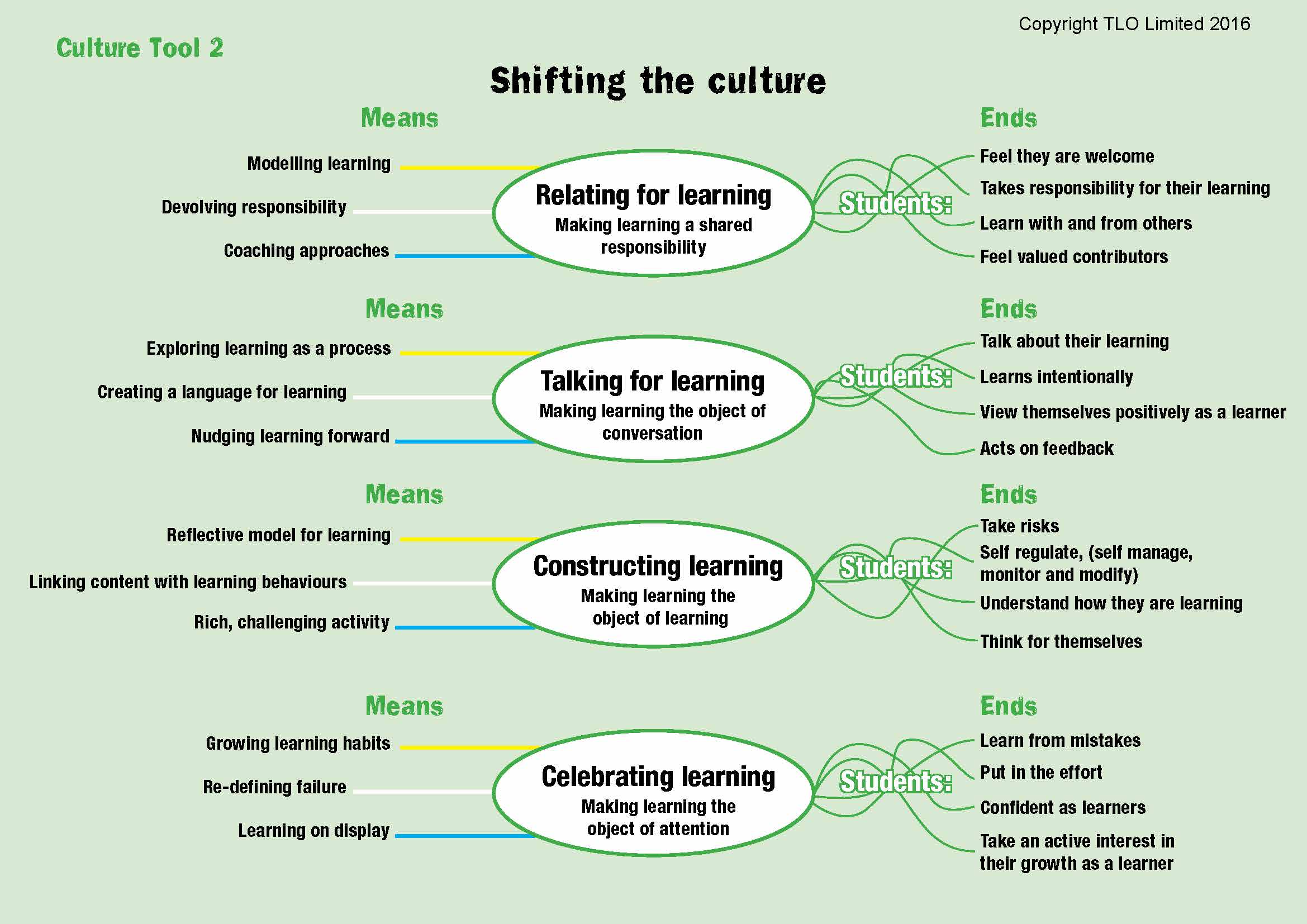
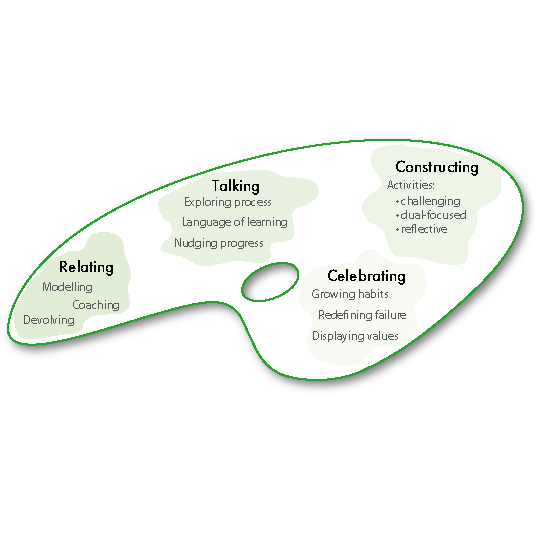
Relating for learning: the changing roles and responsibilities of teachers and learners, where learning becomes a shared responsibility. Students are given more responsibility for their own learning, the role of the teacher changes from ‘the sage on the stage’ to ‘the guide by your side’; the role of the student moves from ‘passenger’ to ‘crew’ and ultimately ‘pilots of their own learning’.
Talking for learning: the sort of language content and style to enhance learning, making learning the object of conversation. The way we express ourselves in the classroom creates a powerful linguistic environment that teaches young people the best of what we know about learning. The language of learning helps students to discuss, understand, and become conscious of using their learning behaviours.
Constructing learning: activities and classroom routines feed learning habits and learning becomes the object of learning. Learning challenging activities are designed to enable students to understand both the content and the process of learning. They do this by having a dual focus – to explore content and stretch students’ use of their learning behaviours. There is a strong underpinning of not just ‘doing’ learning but reviewing and reflecting on the process in order to make meaning and apply it elsewhere (transfer).
Celebrating learning: the outward signs of the values that underpin the culture, making learning the object of attention. In this dimension common notions of classroom learning are flipped or re-defined – being stuck is seen as interesting and mistakes valuable. Effort, questioning and taking risks are recognised, attended to, acknowledged and praised. These and the recognition of the development of learning habits serve to make visible and public the underlying values of the learning friendly environment.
The teacher’s role becomes one of surfacing learning; to make learning public; to train some of the tricky bits; to talk about it; to recognise and celebrate it as it happens; to nudge it along, assisting students to grow their learning capacities; and to design activity to stretch a wide range of learning habits. This uncovering of learning ensures students discover, use, understand and grow their learning habits. There is a shift in emphasis from performance to learning, from content to process, from teaching to coaching
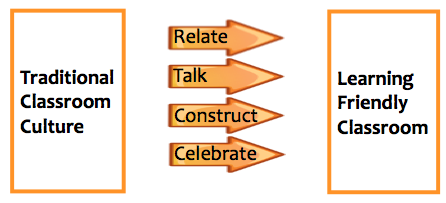
Cast your eye over the ‘big picture’ of a learning friendly culture above. There are four big dimensions:
Each dimension has three ‘Means’ or ‘Aspects’ – the inputs that teachers can make to create a learning-friendly classroom culture. In this section we explore progression in these three 12 aspects as the classroom culture moves from teacher focused, to learner focused, and finally to learning focused.
Rather than try to capture this progression on one (very large) grid, we have chosen to offer 4 progression grids, one for each of the 4 cultural dimensions, and these are explored in section 1d) below.
Each dimension has ‘ends’ or ‘outcomes for learners’ – the outcomes we plan to achieve for learners. These intended outcomes also have a progression trajectory that is the consequence of progression in the 12 aspects of classroom culture. Progression in terms of outcomes for learners may well lag behind the changes in classroom culture as learners need time to perceive and act on these cultural changes. In section 2 of this module, we link progression in classroom culture with progression in learner behaviours and invite you to look at your classroom through this lens.
Open each of the 4 tabs in turn to explore:

Relating for learning explores the changing roles and responsibilities of teachers and learners, where learning becomes an increasingly shared responsibility. Students are given more responsibility for their own learning, the role of the teacher changes from ‘the sage on the stage’ to ‘the guide by your side’; the role of the student moves from ‘passenger’ to ‘crew’ and ultimately ‘pilots of their own learning’.
In some classrooms, responsibility rests almost exclusively with the teacher. The teacher decides the what and how of learning, and does most of the questioning. The main focus is on student performance. Most tasks are undertaken individually. The teacher assumes responsibility for assessment and adopts a ‘fount of knowledge’ role. In such classrooms, students believe and accept that responsibility for learning lies with the teacher and become increasingly dependent on their teachers.
But does it have to be like this? What if learners are enabled to take responsibility for their own learning? How would classroom culture change?
Aspect 1. Modelling the learning process – the ways in which we show that we, too, are learners. It indicates a shift away from teachers being ‘all-knowing subject specialists’ to displaying uncertainty, to sharing their own learning stories, to learning ‘aloud’, to learning alongside students.
Aspect 2: Devolving Responsibility – shifting the emphasis towards learners taking increasing responsibility for their own development. It involves a shift towards students asking more of the questions, monitoring their own learning, doing more of the work, making more choices, pursuing their own lines of enquiry.
Aspect 3. Coaching approaches – moving away from ‘telling’ whenever possible. It is one of the hardest of balancing acts: knowing when you can coach and when you have to tell requires the teacher to have a deep understanding of both the subject matter and the learner.

Here is the progression chart for Relating for Learning. The 5 phases of development will be familiar from the progression grids for learning behaviours. The three columns correspond to progression in the 3 aspects of Relating for Learning.
What are your immediate reactions to this progression grid?
Does it make sense to you?
Can you sense how teaching behaviours change as the culture evolves?

Talking about learning is about the sort of language content and style that enhances learning, making learning the object of conversation. The way we express ourselves in the classroom creates a powerful linguistic environment that teaches young people the best of what we know about learning. The language of learning helps students to discuss, understand, and become conscious of using and improving their learning behaviours.
In many classrooms, talk is almost exclusively about the content of what will be, is being, or has been, learned. Talk about ‘how’ that learning could happen, is happening, has happened and could happen better, adds a further dimension to classroom discourse; a dimension that shifts the classroom culture to a embrace both the what and the how of learning. By focusing on the how students are enabled to take far greater control of their learning.
Aspect 1: Exploring learning as a process – the ways in which you enable learners to explore and reflect on the process of learning. It’s a shift away from talking about the ‘what’ of learning and broadens classroom discourse to include conversations about the process of learning, the ‘how’ of learning.
Aspect 2: Creating a language for learning – helping learners to understand and use a language of sufficient precision and subtlety that enables them to describe, discuss and understand the learning process. The learning language begins with naming the learning behaviours of the four strands of a supple learning mind. (emotional, cognitive, social and strategic) It moves on to exploring what these are, when we use them, how we might get better at using them and how we can become a better learner.
Aspect 3: Nudging learning forward – offering feedback, both written and oral, to help learners to improve as learners. This is about how we catch learners actually learning, alert them to it, remind them about it, suggest how they might get better at it. Nudging the learning process broadens feedback to include the learning behaviours employed as well as content.

Learning about learning involves integrating reflection and review into the way learning is organised; where activities are designed to stretch and challenge not just in outcome terms but in the very nature of ‘doing’ the task (dual focus of content and process). Students’ emotional engagement is a pre-requisite when learning is organised in these ways, and the value of learning is in pushing yourself so that your capacities are stretched and strengthened.
For many students, the word ‘learning’ means ‘knowing / remembering stuff”. The cultural shift to learning about learning, or making learning the object of attention, is about understanding how they are learning as well as what they are learning.
Aspect 1: Lessons with in-built reflection – reflection on content and reflection on learning behaviours is routinely built into lessons.Review points, rather than the formulaic plenary, focus students on what they have learned and how they have learned it. Reflection is done by students for themselves, not by teachers on their behalf.
Aspect 2: Lessons with a dual focus – lessons are designed intentionally to deliver content and to exercise learning behaviours, and students are made aware of both. The learning behaviours drive the content acquisition, the content is the exercise regime for the learning behaviours, each enhancing the other.
Aspect 3: Lessons with rich and challenging activities – increasingly open-ended activities are designed to engage, to stretch and to challenge. The learning is not over-scaffolded, and the inherent difficulties are not avoided or diluted by overly-helpful teachers. The activities stretch and challenge both content understanding and learning behaviours.

Celebrating and valuing learning is about making learning the object of attention. Here the values of learning bubble up and show themselves in what you attend to, what you recognise, what you praise, what you display and celebrate. In learning friendly classrooms failure, mistakes, being stuck and applying effort have been re-framed so that learners come to view these old adversaries as valuable, interesting and essential. Furthermore, in the learning friendly classroom the development and growth of learning behaviours themselves is given attention, praise and recognition.
The success of this shift will depend on consistency and strong emphasis. You have to make these ideas/values obvious, big and overblown. Whispering them quietly won’t work. They have to be shouted about and put ‘in-your-face’ if they are to stick, be believed, be understood and capitalised on.
While we would like student learning to be the central focus of classrooms many still celebrate and value successful performance over successful learning. What is considered worthy of display or praise speaks volumes about the underlying, unspoken, classroom culture. What does the cultural shift from a performance culture to a learning friendly culture entail?
Aspect 1: Growing Learning habits – finding ways to notice, track, record and celebrate learning behaviour growth. It implies that teachers and learners have a good understanding of themselves as learners and of what ‘getting better’ at learning looks and feels like. In the same way that attainment is routinely tracked, recorded and celebrated, so is learning itself.
Aspect 2: Re-defining failure – turning the lens around: mistakes become learning opportunities; difficulty is when learning happens; struggle is to be expected; asking questions shows curiosity, not a lack of intelligence; effort not just talent is what leads to success. It is about ensuring that hard won gains over the difficult are preferable to effortless success over the easy.
Aspect 3: Displaying values – the process of learning (as opposed to the finished outcomes of learning) are on display. Annotated work in progress, first attempts, revisions, failed lines of enquiry, leading, of course, to the finished article. What we choose to display tells students a lot about what we truly believe – displaying / praising only the finished article suggests that whatever we might say, we are more interested in the outcome than the process. In such ways are the underlying values of the classroom revealed to learners.

Of course, the development of classroom culture doesn’t grow neatly up each column or evenly across the phases in the grid. The five broad phases of dispositional growth (purple – orange) are affective ways in which people may be inclined to behave: we call this inclination ‘mindedness’.
Phase ‘Teacher-centred’ (Grey) is standard good subject teaching within a classroom culture that is highly teacher-centred.
Phase ‘Receives’ (purple) is about teachers doing something because they are told or expected to. At this stage teachers are trying out a couple of learning-friendly strategies in a classroom that is otherwise highly teacher-centred.
Phase ‘Responds’ (blue) is about gaining interest and expanding the range of cultural shifts being explored and embedded.
Phase ‘Values’ (green) is a key phase since the teacher is now fully committed to building a learning-friendly classroom culture. The experimentation phase is over, the classroom is already learner-focused and ripe for growing a learning-friendly culture.
Phase ‘Organises’ (yellow) is the phase in which all of the aspects of a learning-friendly classroom culture are being explored and developed.
Phase ‘Embodies’ (orange), known as ‘characterised’ in the original taxonomy. In this phase, the learning-friendly culture is embedded and secure. Teachers and learners alike learn in a community of enquiry.


The prevailing culture in the Teacher Centred phase is ‘teacher knows best’. Talk is about content and working hard. Attainment and examination success are the key drivers. The classroom culture focuses on ‘knowing stuff’.
Teachers are beginning to explore other, better ways of working. Classroom talk is mostly about curriculum content, but with some references to supportive learning behaviours. Attainment and examination success are still the key drivers, but learning behaviours are beginning to be discussed / referenced. While still largely focused on content delivery, the culture is beginning to show signs of becoming more learner-friendly.
The classroom culture is becoming increasingly learner focused. Classroom talk about learning by teacher and by students uses the school’s chosen language of learning with precision and fluency. The classroom culture brings both content and the associated learning processes into the foreground. Classrooms are developing as places to learn.
Effective learning is more important than efficient teaching. Talking about the process of learning is seen as an essential aid to effective learning. The classroom is increasingly designed to build and stretch, as opposed to exercise, key learning behaviours. The culture reflects the teacher’s interest in and commitment to securing both content and learning progression.
The classroom is becoming increasingly learning focused. Classroom talk about learning relates to how students might improve as learners. Content is the vehicle for stretching learning behaviours. Learning behaviours enhance content understanding. The culture has moved from a ‘teaching room’ to a ‘learning space’. Learning has replaced working.
Coaching is the prevailing culture in a community of enquiry. A rich and differentiated language for learning, rooted in the school’s understanding of progression, permeates classroom discourse. The culture is one of high progress driven by secure and sophisticated learning behaviours that are reflected on, developing and widely applied. The classroom culture prizes students’ growth as learners over attainment/achievement, which takes care of itself as learning behaviours are enhanced.
What do we want to achieve? ( 5 mins)
How did our experiments go? ( 20 mins)
What did we think of the materials? ( 15 mins)
Reactions to
What do we need to do next? ( 10 mins )
What am I going to do? ( 20 mins )
Think of it like this…
If I do XXXX will it improve/develop/enhance YYYY
This is the crunch question. Your students are unlikely to change unless you change!
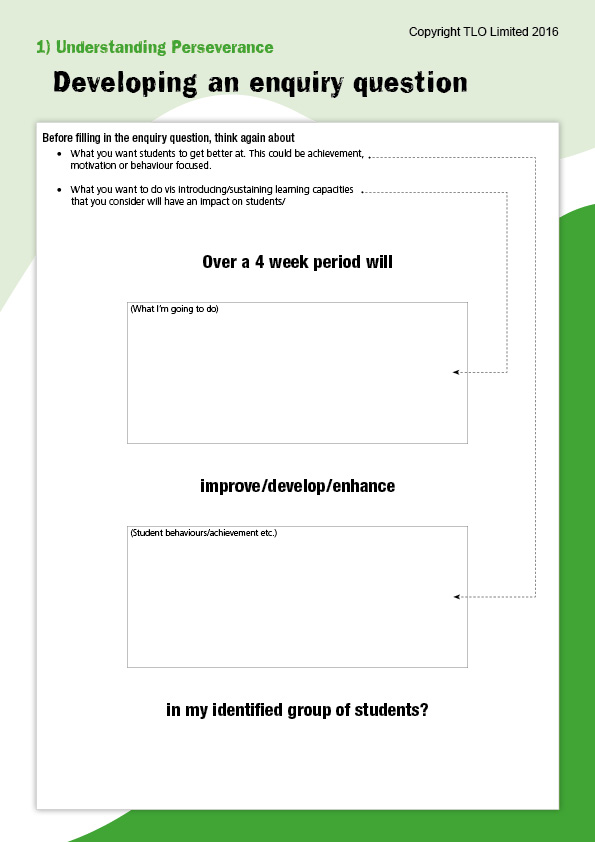
Developing-an-enquiry-question-Perseverance.pdf
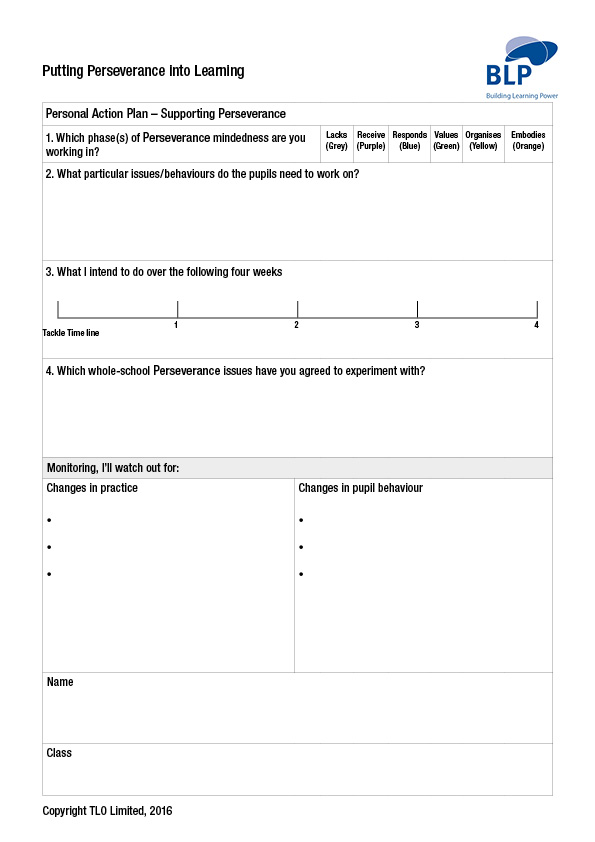
Personal-Action-Plan-Perseverance.pdf
How did we do as a team? ( 5 mins )
We wish you well with your rich activity/learning enquiry. Do let us know how it went…
Maybe you would like to write a blog about it to feature on our website for the benefit of the Building Learning Power community.
So far, you have:
Now we look closely at how to blend improving students’ perseverance into the content you have to teach.
A. The principles behind any learning powered lesson
B. Big questions to ask about lesson design
C. Lesson planning in action…an exemplar perseverance focused task
Learning habits form through use and practice, but desirable habits survive and flourish better if students are aware of them, realise their value and strive to improve them. The curriculum through its lessons provides the rich and varied occasions for exercising learning habits.
Think of yourself as a learning power coach, helping your students to help themselves to develop their learning habits. Hence your lessons are much more likely to contain challenges and activities that get your students thinking and learning for themselves. You encourage students to explore challenging questions, problems or assertions and become observers of their own learning. You step back from telling and heavy scaffolding and instead try to mobilise your students’ learning behaviours. You are organising learning to let them take the strain.
You make it clear to students which learning habits and processes they are using. You try to make every aspect of the learning process as visible as possible through the language you use and through the words and images you display on the walls.
For example:
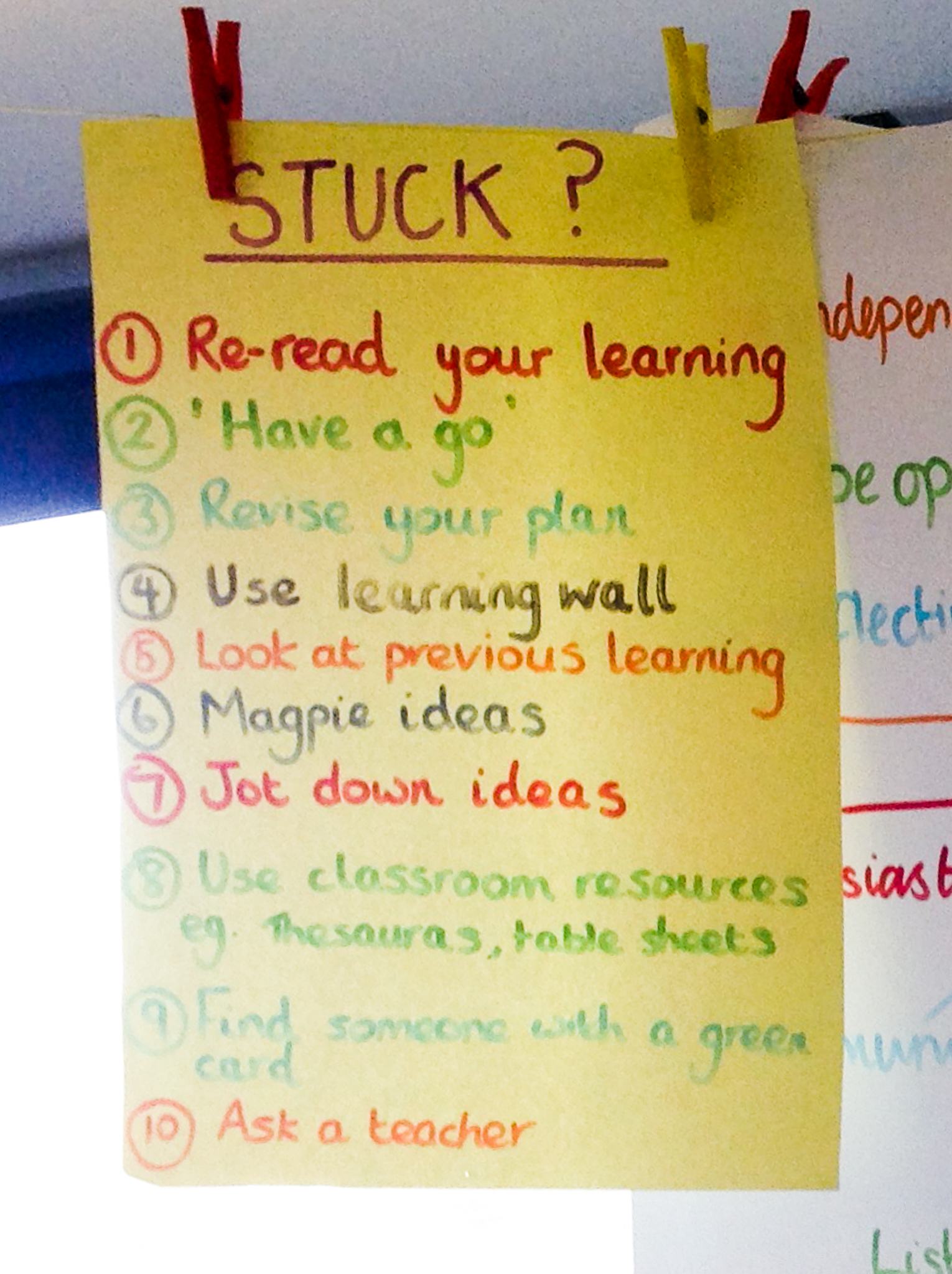
You design activities that combine the dual objectives of ‘what’ will be learned and ‘how’ it will be learned. You make sure students know that the content they are learning is a way of giving their minds a useful workout. (The content is the vehicle for learning)
For example:

All your lessons have always had two purposes:
…although you may not have been fully aware of the learning behaviours that are being invoked.
As you become more deeply aware of learning behaviours you will think through lesson planning a bit differently:
In other words, the goal of the lesson would then have overt content and learning dimensions.
In planning terms, you have made a shift from thinking;
Your lessons are designed to intrigue your students. Students don’t put in the effort unless their energy and attention are captured by what they are doing. You capture your students’ emotional engagement by giving them more of a stake in the process of learning.
For example:
A good grapple problem is challenging. It’s something that the students might have an idea about but might entail something they haven’t come across or done before. A good grapple task centres on learning that is just beyond the students’ reach/experience. They give students a chance to wrestle with the problem before they have been taught methods for tackling it. They are allowed to solve it in any way they want and in doing so they are discovering their own approaches and exposing their own tricky bits.
Blend grapple tasks with Think Pair Share…giving time to think by themselves, share ideas with a partner before discussing it more widely. By using grapple tasks you are getting the students:
Don’t forget to discuss which strategies were used, which were successful/effective and why.
You have realised from your own life that what is engaging tends to be what is challenging. Since you see education as a preparation for a learning life, you help students to learn how to handle increasing degrees of complexity and uncertainty.
For example:

Learning is both a sociable and a solitary activity, and you offer your students opportunities to experience both. You develop interdependent learners who know how to handle themselves in collaborative groups and able to move around in the social space of learning to best effect.
For example:
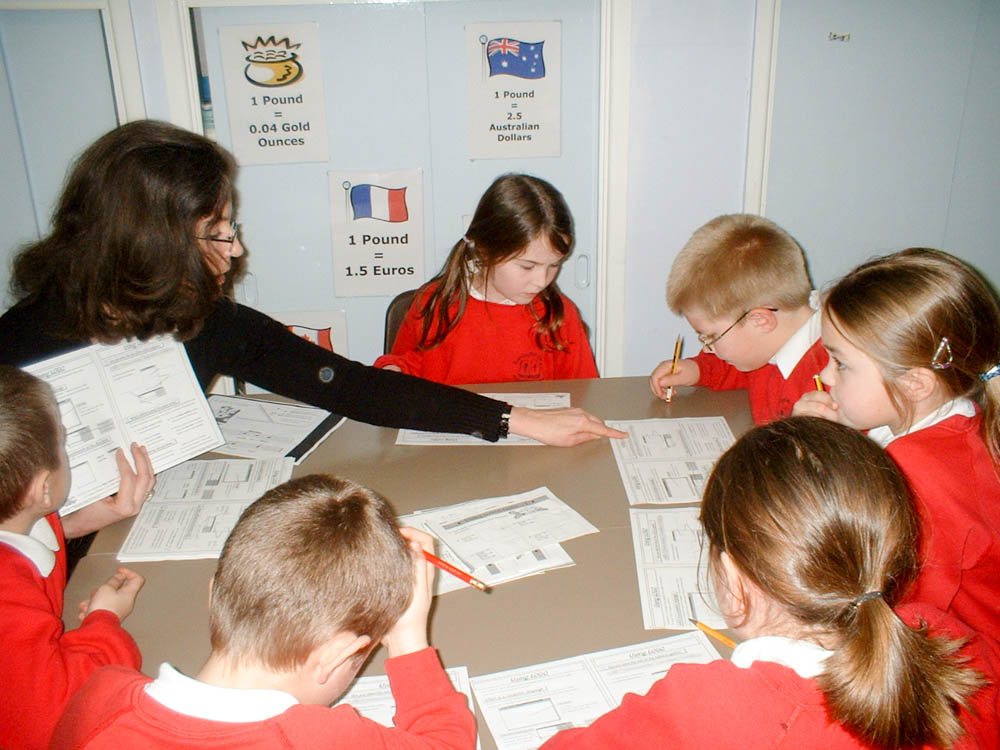
Many students find it hard to share their ideas with others – in group situations, they seem to get swamped by the louder, by the more assertive, by the quicker thinkers. So they stop trying and become reliant on the ideas of others.
To develop students’ inclination to share their ideas, nudge them with:
You understand that students have to learn how to manage and organise their own learning and that the way to do this is by giving them increasingly demanding opportunities to do so. You orchestrate students taking charge of their learning by expecting them to plan what they do, distil meaning from it, and revise it accordingly.
For example:
Learning mats are A4 laminated sheets that show various aspects of a learning habit. Keep them on desks/tables or as part of a wall display.
Students refer to them during lessons, using them as prompts about the finer aspects of a learning habit that is being stretched.
What we teach and how we teach it (the enacted curriculum) are intertwined and offer teachers a lot of freedom. It is here that you can start applying a learning power filter and deploy a unique combination of content and learning tasks.
In conventional lessons where the teacher remains the focus of attention and the initiator of all activity, and where the epistemic dimension (the conditions for acquiring knowledge) is not acknowledged, students gain habits of compliance and dependence, rather than curiosity and self-reliance.
In developing learning power, teachers are making conscious choices about which habits to introduce and stretch and how best to couple these with content so that lessons become more interesting and challenging. Through such overt coupling of content and specific types of process, students come to know, understand and take control of their learning behaviours – they knowingly use and develop the whole range of learning behaviours.
All lessons function on two levels, they have twin intentions. On the one hand there is content to be acquired, and on the other there are learning behaviours to be exercised in pursuit of this content. The factor that differentiates a standard lesson that effectively ‘delivers the content’ from a learning powered lesson is that the teacher has to think, in advance, about:
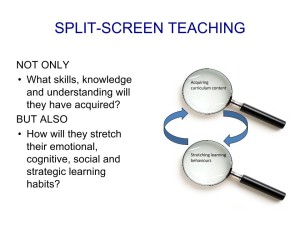
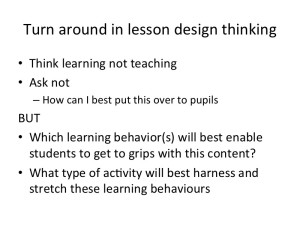
Think to yourself;
Here the general rules of lesson design have been related to the learning behaviour…perseverance.
What content has to be learned? …..Think outcomes.
This is the new bit
Not the usual second step but nonetheless a vital second step where the aim is to weave content acquisition with learning behaviours. The content is the vehicle for exercising the learning behaviours and the learning behaviours accelerate the content acquisition.
Using which learning behaviours?…Think types of learning behaviours
Say something like this to yourself .…My students need to achieve xxx. At this stage we could get closer to this content by using perseverance. Most of my students are able to use xxx phase (e.g. respond/blue) perseverance approaches confidently.
Which type of task…Think types of task.
Pick up your thinking from stage 2;
My students need to achieve xxx. At this stage we could get closer to this content by using perseverance. Most of my students would be able to use xxx phase (e.g. blue/responds phase) perseverance approaches confidently.
And now think about the sort of task/activity you might develop/design so as to:
The challenge isn’t about the inherent complexity of the subject matter but about how the content is orchestrated to encourage students to use their learning habits to resource their solution.
Say something like this to yourself .…
It’s the question ‘using which learning behaviours?’ that causes you to think differently about the lesson planning.
You are designing the task in a way that requires students to contribute their learning ‘powers’ / behaviours. The tasks you design will hook into their learning ‘powers’ and help them to improve them.
Say something like this to yourself:
I am going to think content, learning behaviour and task together:
As teachers we are in the habit-forming business. What we say, what we display on classroom walls, what we celebrate, praise or dismiss, what we model or how we design learning activities will all influence the ways in which pupils learn, perform and behave. Classroom cultures have a huge influence on pupils’ learning.
“Attention can be broken when learning gets blocked, but good learners have learnt the knack of maintaining or quickly re-establishing their concentration when they get stuck or frustrated. The quality of stickability or perseverance is essential if you are going to get to the bottom of something that doesn’t turn out as quickly or easily as you had thought, or hoped.
If you get upset and start to think there is something wrong with you as soon as you get stuck, you are not going to be able to maintain engagement.
Instead, all your energy will go into trying to avoid the uncomfortable feeling, and this may mean drifting off into a daydream, creating a distraction, or blaming somebody else. A great deal of classroom misbehaviour starts this way. If students were better equipped to cope emotionally with the inevitable difficulty of learning, they would mess about less. There is a range of things that teachers can do to strengthen students’ stickability.
Building Learning Power, Guy Claxton
Perseverance is often undermined by two common and erroneous beliefs. The first is that learning ought to be easy. If learners think that they will either understand something straight away, or not at all, then there is simply no point in persisting and struggling. The second is that bright people pick things up easily, so if you have to try it means you’re not very bright. Clearly the idea that effort must be symptomatic of a lack of ability makes persevering an unpleasant experience. Good learners develop perseverance when their parents and teachers avoid conveying these messages, even unwittingly.”
Extract from Building Learning Power, by Guy Claxton
Perseverance is about;
Keeping going in the face of difficulties; channelling the energy of frustration productively; knowing what a slow and uncertain process learning often is.
A mature learner understands that real learning requires effort and persistence, relishes opportunities to struggle with challenge, and believes that with effort they can become a more effective learner.
Being perseverant isn’t something that switches on on good days and off on bad days. Perseverance grows and builds when it’s nurtured and supported. Furthermore, being perseverant involves gaining control of a range of linked skills and emotions. Take a look at how progression in Perseverance might grow across five components.
Cast your eye over the ‘big picture’ of growing Perseverance below. Then move on to finding out what the columns and the rows are all about.
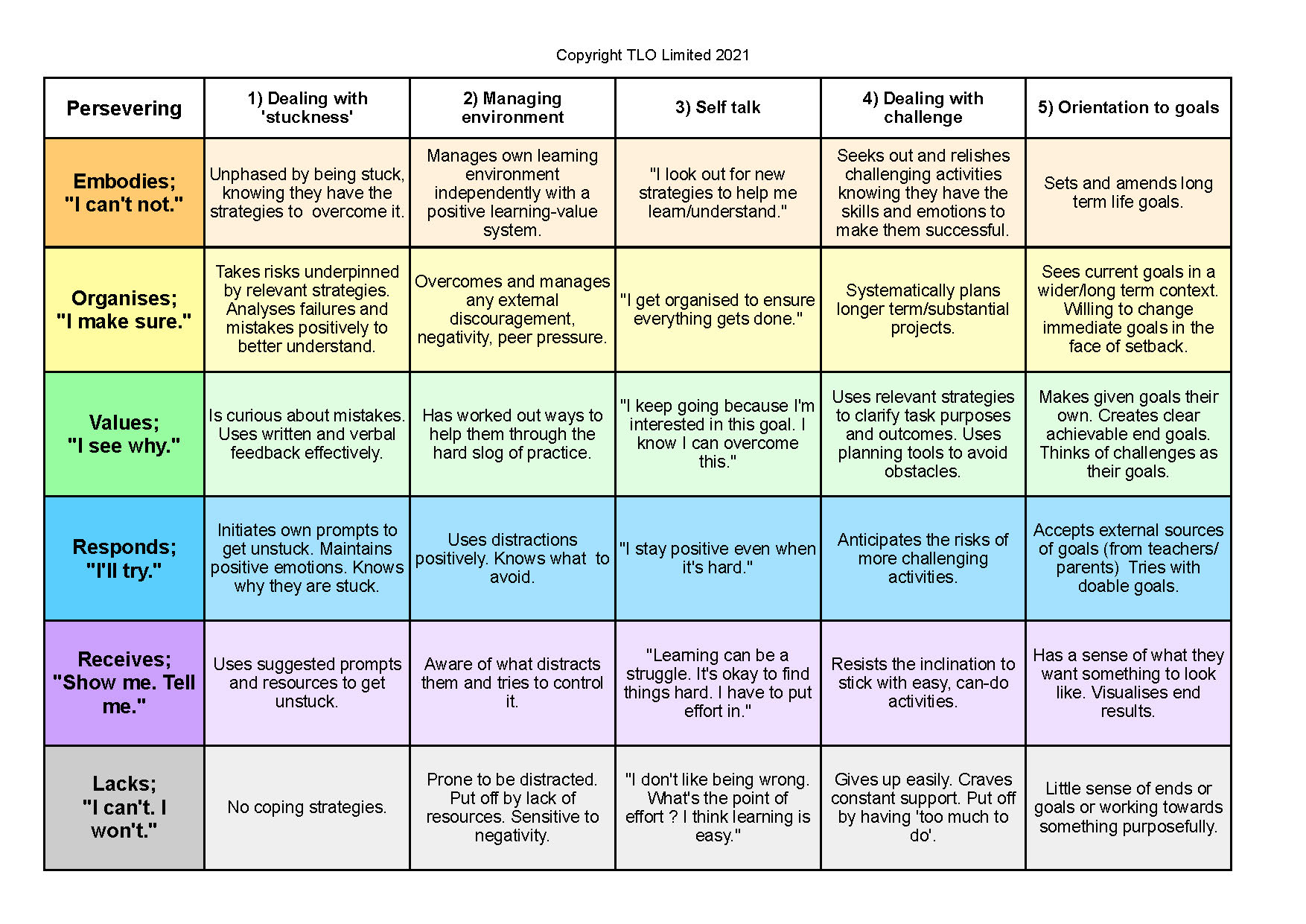
Perseverance is about the way we stick at things even when they are difficult. It’s one of the most useful but neglected learning behaviours. What makes us able to persevere more and more usefully? We think several things come into play here. How you are willing and able to deal with being stuck, how you are able to manage distractions and manage the learning environment, how you relate to a challenge and whether you are influenced by goals whether they be your own or imposed by others. All these things contribute to being able to persevere. And lastly there’s your own little voice of self-awareness: what you say to yourself and how this influences your beliefs and values.
Take a closer look at what each column of the grid is about
 1) Dealing with ‘stuckness’
How we deal with being stuck
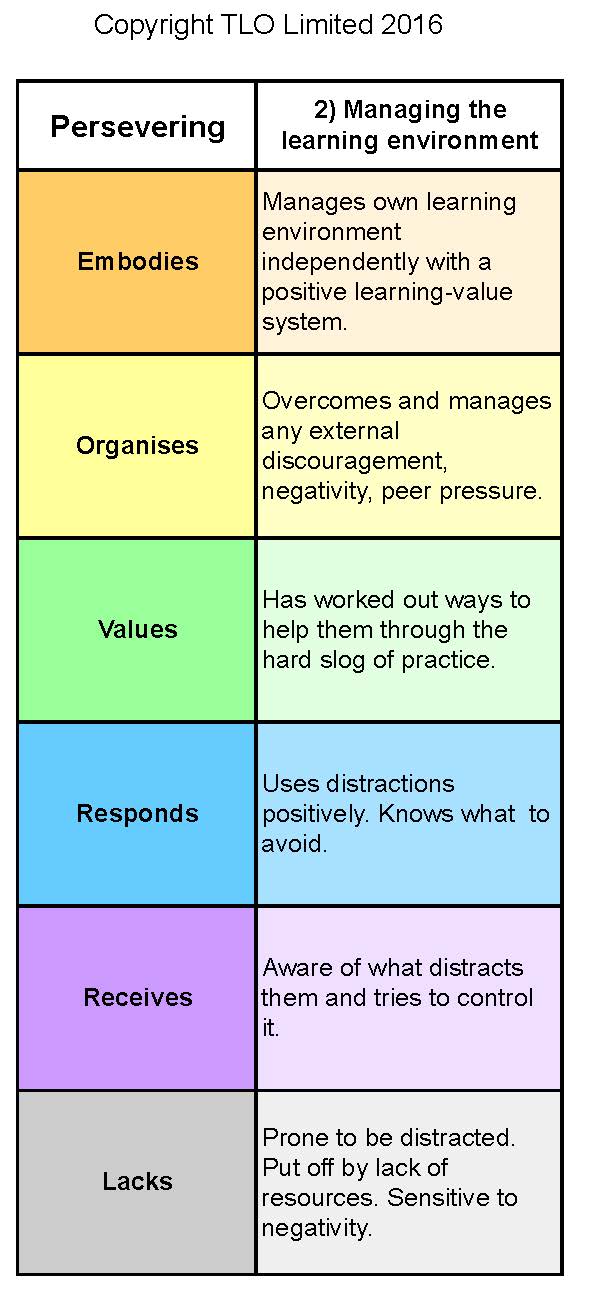 2) Managing the learning environment
How adept we are at maintaining focus
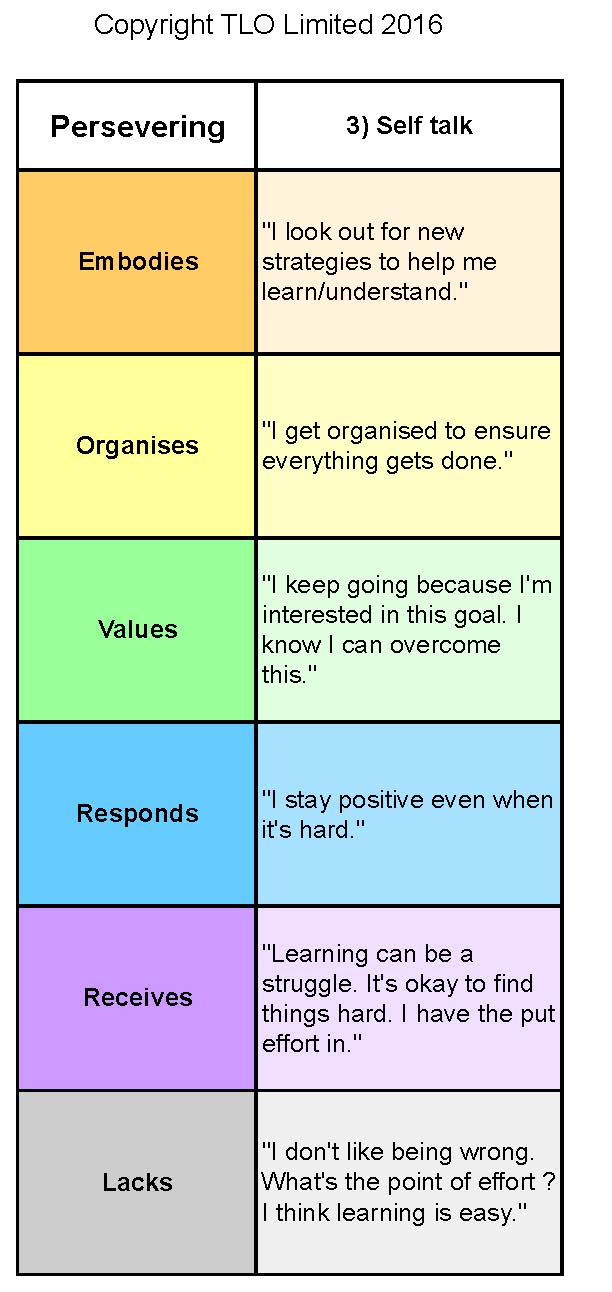 3) Self-talk
The voice of self awareness
 4) Dealing with challenge
The relationship we have with challenge
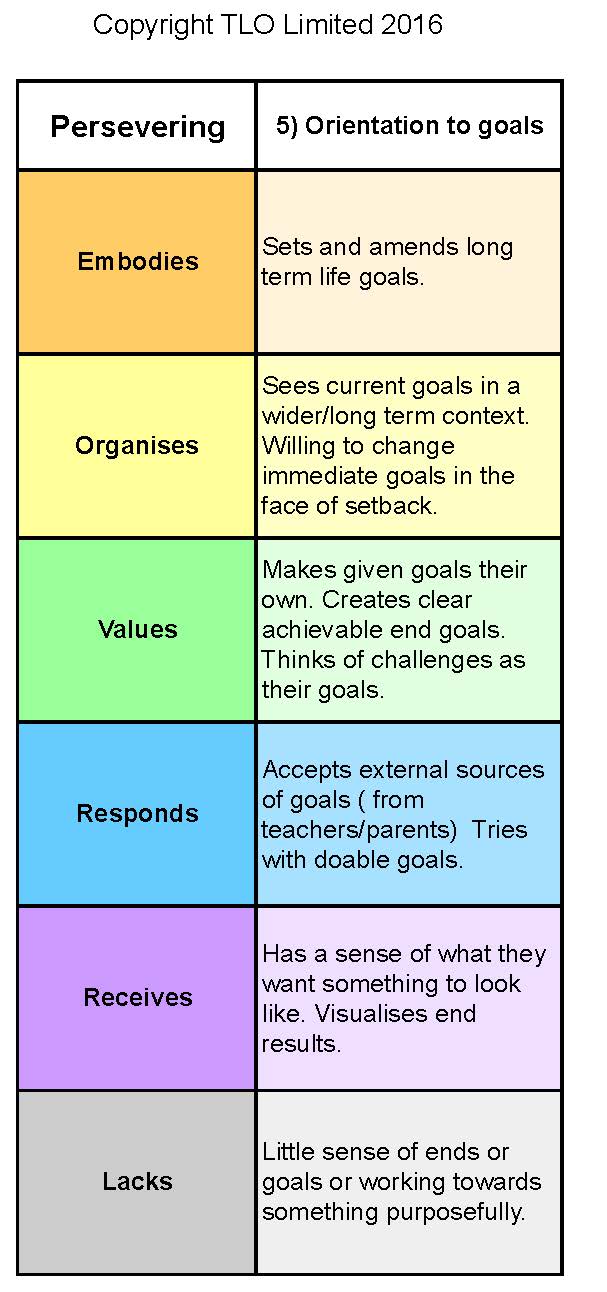 5) Orientation to goals
How our orientation to goals influences our determination to persevere.
Of course the development of Perseverance does not grow neatly up each column or evenly across the phases in the grid. The five broad phases of dispositional growth (purple – orange) are affective ways in which people may be inclined to behave: we call this inclination ‘mindedness’.
Phase ‘Receives’ (purple) is about doing something because you are told or expected to.
Phase ‘Responds’ (blue) is about gaining interest and doing things more willingly.
Phase ‘Values’ (green) is a key phase since the student now sees the value of behaving in this way. It’s a win for them; to behave like this is in their interest. It’s in this phase that the behaviour becomes more secure.
Phase ‘Organises’ (yellow) is the phase in which the student capitalises on this ‘in their interest’ behaviour and gets themselves organised to use it positively.
Phase ‘Embodies’ (orange), known as ‘characterised’ in the original taxonomy. In this phase the student has made this behaviour their own. It has become part of their character; they can’t not do it and they have become highly skilled in doing it.
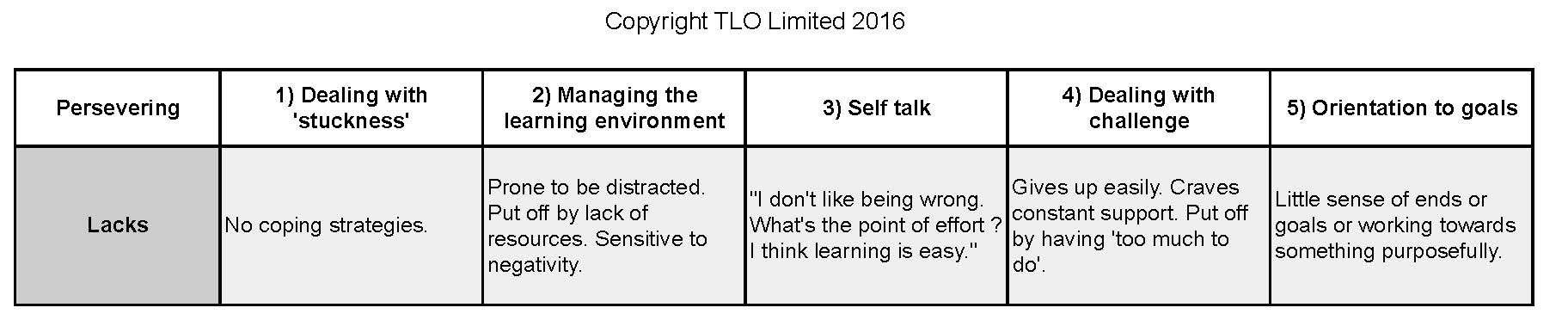 In this ‘Lacks’ (grey) phase, students are minded to give up easily. There are all sorts of reasons for this; they may just be constantly distracted from the activity in hand; they may just need constant support from an adult; they may not know which resource might help them or they simply don’t know what stuck means, let alone how to get unstuck. Many students will need to be eased into learning how to learn in a classroom setting and how/what perseverant learners behave/do.
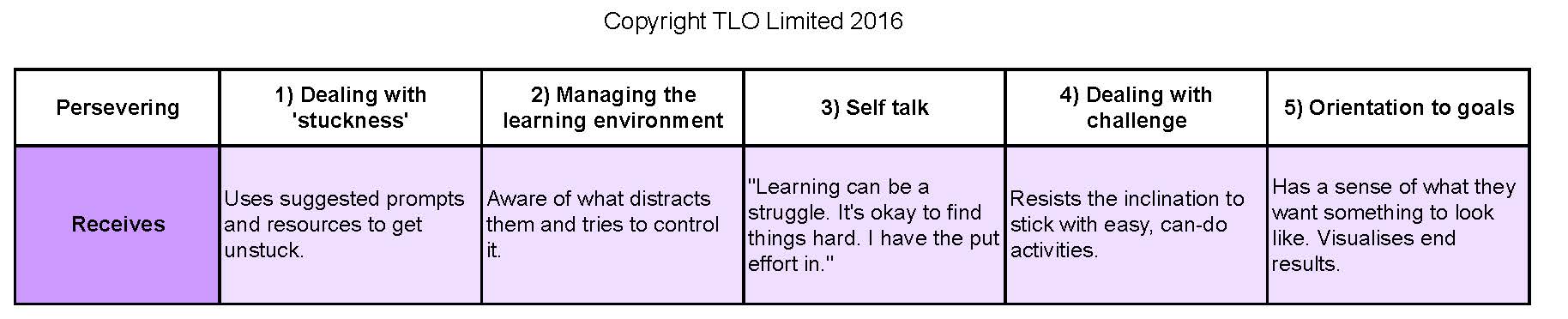 In the Receives (purple) phase, students have made a big leap from having a negative mindset to a neutral one. Here they are inclined to play it safe, staying within their own comfort zone to ensure success and avoid perceived failure. They still need adult support to maintain focus and optimism when tackling tasks they perceive as difficult, but beginning to show willing to take more responsibility.
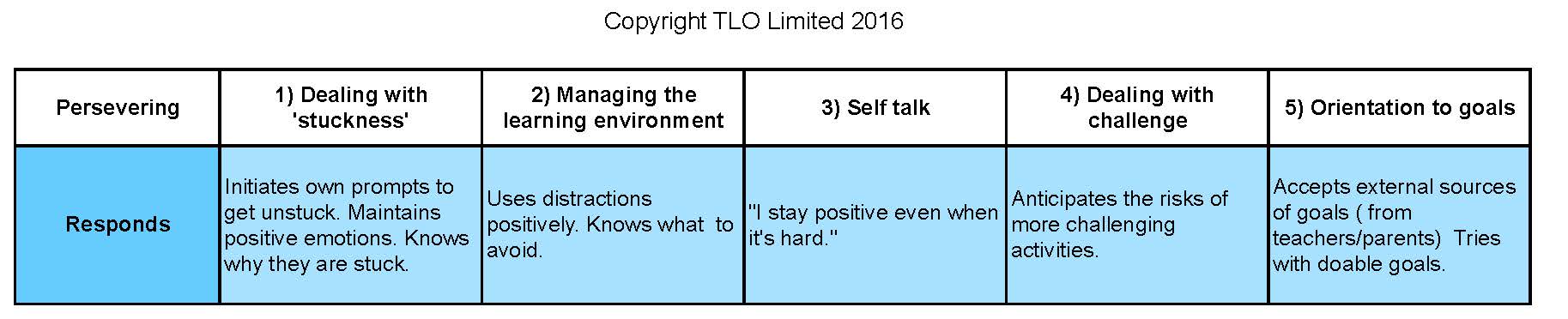
In the Responds (blue) phase students develop greater independence and are motivated by trying to reach achievable goals. They are realising that fear, the need for adult support, and distraction can be overcome by having/using more coping strategies and practical ideas to get them unstuck.
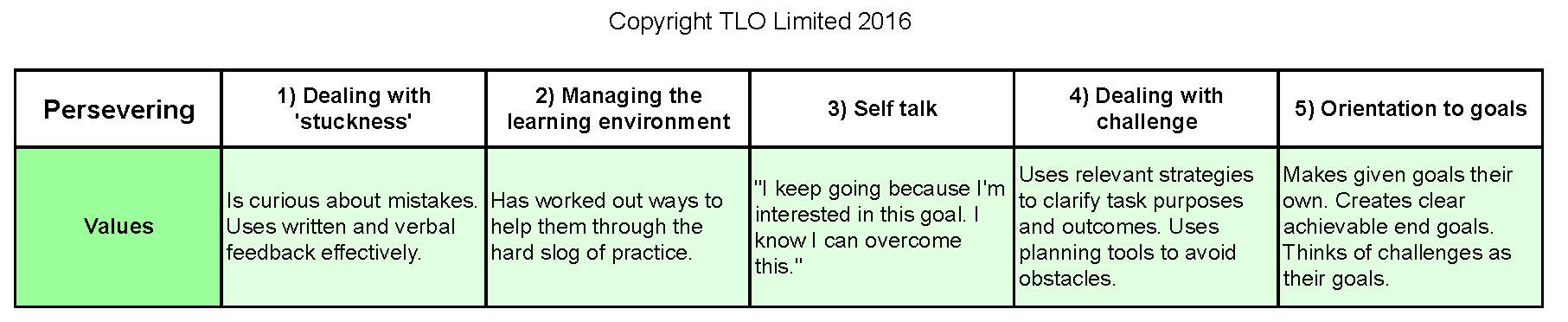
In the Values (green) phase the student has developed a strong belief that they can get better at learning. They become curious about mistakes and care about the goals they are trying to reach. They develop and use many practical strategies to assist them in dealing with challenge, being stuck and staying focused.
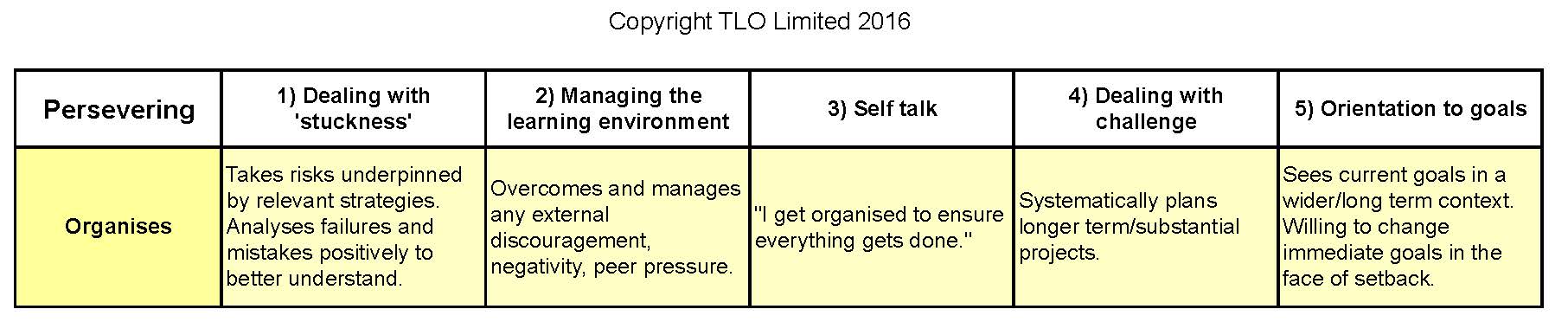
In the Organises (yellow) phase the student organises themselves to get the job/task/problem done. Risk-taking is underpinned by sound strategies. Failures are analysed for greater understanding. They have accepted responsibility for their behaviour.
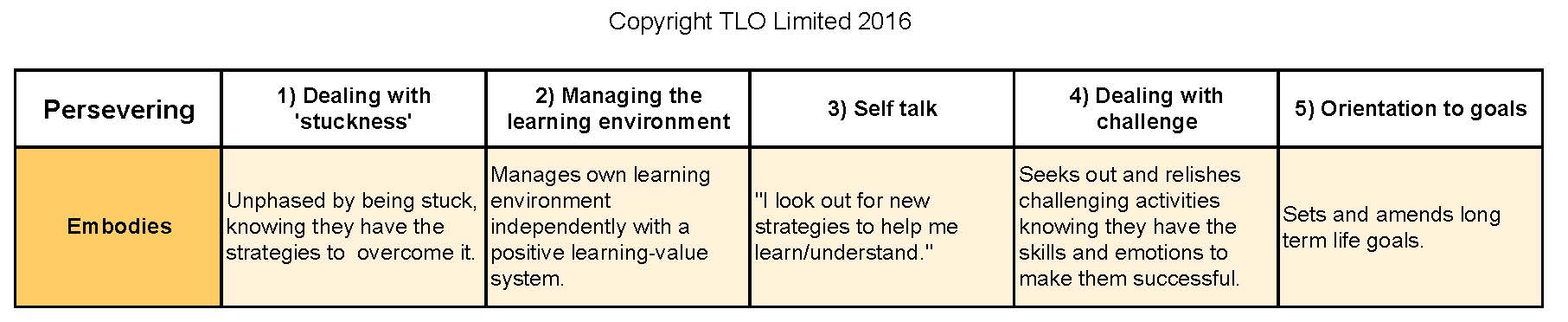
In the Embodies (orange) phase, student behaviour is pervasive and consistent, predictable and importantly characteristic of the learner. Persevering effectively i.e. using all the contributory aspects, is now part of their character.
As a teacher you are an influential character builder and so need to be mindful of how you help students form, replace, re-form and strengthen their learning habits.
But don’t worry, you’re not there yet. It takes most teachers between 2 and 3 years to become really fluent with this way of teaching. So, go easy on yourself. Feel determined because small steps often prove to be big levers for change. Have a think about what you might do…
Here are a few ideas you might want to try. Take it steady, this way of teaching can be a big but exciting shift so it’s worth doing it slowly and thoughtfully.
Look first at the Stop/avoid ideas. Some of these are far from trivial but it’s best to try to remove them before starting on the Start/do more of, Start slowly and Experiment with ideas.
Stop
Solving problems for them
Telling them what they need to do to solve a problem
Reminding them of similar problems already encountered – this is their job!
Doing the reasoning for them
Making all of the decisions about how best to solve a given problem
Start
Identifying important information in problems and separating it from the irrelevant
Requiring students to show their workings as a visual demonstration of their logical train of thought
Exploring flaws in arguments
Encouraging students justify what they say / think
Asking ‘have you done something like this before?’
Modelling how you solve problems
Start slowly
Creating problems where students need to work out a conclusion from partial facts or clues
Introducing or using thinking tools that support disciplined, methodical thought.
Enabling / requiring students to present their solutions to others
Setting problems that require the higher-order thinking skills of analysing, synthesising, justifying, and evaluating.
Experiment with
Team, rather than individual, problem solving
Playing Devil’s advocate
Introducing new information mid-way through a problem to force a re-think
Offering choice about how to present their solutions
Here is a range of things you can say to nudge critical thinking and problem solving. When you use this kind of language you are talking as a learning coach, encouraging students to think for themselves. Using such statements encourages your students to:
Eventually you will hear some of the questions pop up in students’ self-talk….in speech or even in writing from time to time, but mostly these will go on inside their heads. As your work on critical thinking and problem solving gathers pace see if you can detect students who talk, or think, in these ways.
To ensure students do the thinking for themselves, use phrases like these to nudge them to:
Utilise effective reasoning skills:
Have the skills and self-belief to wrestle with difficulty:
Question received wisdom:
Identify the nature of the problem to be solved:
Make links to previously experienced / solved problems:
Plan how to address the problem:
Monitor progress:
Engage with others to resolve differences of opinion:
These are the first things you come to on net when you ask for problem solving skills. I think we need to consider some of these. Have we explained what problem solving really is?
7 steps….which obviously need specific skills or behaviours.
These are the skills
Some key problem-solving skills include:
How you make students aware of the words that describe the behaviour and why it is important to use it.
A strategy for encouraging children to explain what they are thinking. Whole class or large groups of 10/15 children. You will need a PE hoop and a large assortment of small objects from the classroom and home. At every step, the focus is on explaining what they are thinking and why. The Tower of Hanoi is a well-known problem. The task is to move all of the disks, one by one, from pole#1 to pole #3 as shown above. The only constraint is that you can never put a larger disk on top of a smaller one. The minimum number of moves for the above 3-disk problem is 7 – can you see why? Scaffolding the problem:Primary
The beginnings of evidence-based reasoning
Secondary
Use mathematical brain teasers
The Tower of Hanoi

Problem Solving ‘Adopt’ a character – real, imaginary, human or animal – who/that exhibits the best features of good problem solving. [Go to section 1 of this module if you need some ideas for this] Talk about the character until your children become familiar with its attributes. Leave the character (actual /picture) on tables when you have set a problem solving task. Use games that require strategy and logical thinking. From noughts and crosses to chess, from hangman to backgammon, such games help to develop and refine reasoning skills.Primary
Adopt a character to make learning visible

Secondary
Strategy Games

How you might extend the language and understanding of this behaviour
Catch them solving problems and use the opportunity to discuss what was and was not successful. Use language like: REPLACE WITH ‘Critical Thinking and Problem Solving’ in the centre. Add ‘Sort out what to do’ on one of the arms, ‘Seek evidence’ on another Collect words that tell you how people learn to solve problems. Explore well known sayings Getting to the bottom of it You are either part of the problem or part of the solution Primary
Talk about the process of problem solving

Secondary
A way with words
What do we mean when we say …

Use a quick starter to key students into the learning behaviour you want to concentrate on in the lesson. i.e. here you are starting up the need to problem solve.
Offer students pieces of information or ideas or pictures or statements as a set of separate items, usually on cards. The subject could be: possible causes of global warming; the sayings of a religious leader; discoveries of the last 20 years; the music of Gershwin; causes of WW1; poems of Sylvia Plath; healthy lifestyle indicators; famous people; social networking sites etc. NEEDS SOME PRIMARY EGs above The criterion for ranking the cards is given or negotiated with students. For example rank the cards in order of; The point of the activity is to debate the relative merits, place them in rank order according to the chosen criterion, and to be able to explain and justify the ranking based on evidence rather than opinion. Ranking to trigger evidence based reasoning

Draw out the problem solving behaviours being used in a thinking routine.
This is one of many visible thinking routines to be found on the Visible Thinking website The first question in this routine is flexible: it is useful when looking at objects such as works of art or historical artefacts, but it can also be used to explore a poem, make scientific observations and hypotheses, or investigate more conceptual ideas (i.e., democracy). It promotes evidence-based reasoning and when the students share their interpretations it encourages them to explain and justify their viewpoint. Visible Thinking Routine
The first question invites students to describe what they notice, see or know, but it is the supplementary question (What makes you say that?) that requires them to build explanations.
And here is an idea that will help students to understand the problem solving processes.
Design specific activities to highlight and strengthen the behaviour
The 18 cards suggest different steps in the problem solving process. In 4’s, can groups decide on the best order to tackle these tasks? [The blank cards are in case you, or they, wish to add additional steps] This is not a simple task, as most of the cards that start ‘Check’ or ‘Monitor’ need to be ongoing rather than done just once. Having tried to put the 18 in order and come to understand that checking points may indicate a need to go back and start afresh, use the ideas on the cards as the basis for a problem solving flow chart. You might need to help to structure the flow chart by suggesting some overarching sections like: Getting going; Doing it; Checking it; Showing it. And finally, to further meta-cognitive thinking, challenge students to assess how they solved the problem of creating a flow chart against their own flow chart! A Problem Solving card sort challenge.
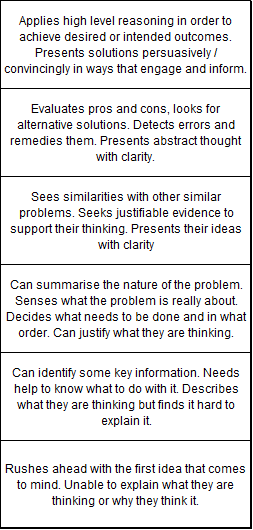
Here is a very practical example of how you might develop the emotional climate of the classroom and make it problem solving friendly. Titles Critical Thinking and Problem Solving learning mat How well did I solve problems today? Learning mats are A4 laminated sheets that show various aspects of a learning habit. Keep them on desks/tables or as part of a wall display. The trajectory from novice to expert problem solver may look something like this: Ask yourself: Where are your learners now? Which behaviours are secure? Which behaviours have yet to become secure? Securing which single aspect of problem solving would make the biggest difference to your students? How might you achieve this? Primary
Make reflecting on Critical Thinking and Problem solving part of everyday lessons
Learning Mats
INSERT MAT HERE
Secondary
Getting better at Problem Solving
Building effective learning behaviours is about creating a culture in classrooms that systematically cultivates habits and attitudes that enable young people to face difficulty calmly, confidently and creatively. By a ‘culture’ we mean all the little habits, routines and practices that implicitly convey ‘what we believe and value round here’.
So ‘culture’ concerns the details of the micro-climate that you create in your classrooms. What you do and say, what you notice and commend and what you don’t, what kind of role model of a learner you offer – all these are of the essence. The micro-climate of a classroom can inadvertently stifle, or specifically enhance, the very behaviours you are seeking to promote.
In the classroom that is a learning-friendly environment within which critical thinking and problem solving can grow, there are changes in the relationships; what is discussed; how learning is constructed; and in what is celebrated.
Apply your own attentive noticing and consider whether you already use any of these features and which you fancy trying.
The changes in relationships include:
The changes in what is talked about include:
The changes in how learning is constructed include:
The changes in how learning is celebrated include:
Title
A Learning-Friendly Culture for Critical Thinking and Problem Solving
Relating
Talking
Constructing
Celebrating
Successful Futures identifies Critical Thinking and Problem Solving as one of the four Integral Skills for modern life and work and describes it as:
with the associated sub-skills of:
The two aspects, Critical Thinking and Problem Solving are not, however, inextricably linked. Critical thinking does not always result in problem solving, and problem solving does not always require critical thinking. That said, they do often appear together, and research suggests that effective problem solving is an indicator of sound critical thinking skills.
Critical thinking means making reasoned judgements that are logical and well-thought out. It is a way of thinking in which you don’t simply accept all arguments and conclusions you are exposed to but rather have an attitude involving questioning such arguments and conclusions.
Problem solving is the process of working through details of a problem to reach a solution. Problem solving may include mathematical or systematic operations and can be a gauge of an individual’s critical thinking skills. Equally the problem may be the need to resolve a disagreement, to build consensus, or to restore harmony – the solution to problems such as these may require a degree of critical thinking, but depend inevitably the ‘softer’ social skills of empathy and compromise.
Much as innovation is the application of imagination to find creative solutions to real-world problems, so problem solving is frequently the application of critical thinking to find well-reasoned, logical solutions to real-world problems.
Just to get you tuned in – have a quick think about ‘Critical Thinking, Problem Solvers you may know’. Make a note of students you know who display these characteristics.
Being a learning powered teacher means developing a keen awareness of the subtleties of your students’ learning behaviours.
Titles
Good learning habits – Critical Thinking and Problem Solving
Your potentially good critical thinking, problem solvers are likely to:
Text:
Tend to look for details.
Work out which information is important
Identify what needs to be done
Think ahead before leaping into action
Work things out step by step
Create a logical line of argument
Adopt a ‘can-do’ attitude
Seek evidence to support their views
Question assumptions
Spot flaws in lines of argument
Show their workings / thinking
Monitor the extent to which they are solving / have solved the problem
Present their thinking with clarity
Understand the need to balance logic and emotion
As a teacher you are an influential character builder and so need to be mindful of how your classroom culture helps students to form, replace, re-form and strengthen their learning habits. Which aspects of your classroom culture are helpful in this respect, and which are perhaps less so? After all, if you are unable or unwilling to make changes to your classroom culture, learners are unlikely to change how they respond to it!
Here are a few ideas you might want to try. Take it steady, this way of teaching can be a big but exciting shift so it’s worth doing it slowly and thoughtfully.
Look first at the Stop/avoid ideas. Some of these are far from trivial but it’s best to try to remove them before starting on the Start/do more of, Start slowly and Experiment with ideas.
For the aspects of Celebrating and Valuing Learning:
Quick wins to get you going.

In this display, group working behaviours are being noticed and celebrated.
Even everyday behaviours such as listening to a partner are being recognised.
It is in this way that you show its importance while at the same time alerting pupils to what effective learners do.
Here are 4 collaboration Rating Wheels. In each case, the skills become progressively harder as you move round the circle clockwise from 12 o’clock.
Use the wheel that feels ‘right’ for your students – and by ‘right ‘ we mean the wheel where their skills are fairly secure at 12 to 3 o’clock, and increasingly flakey thereafter. Use it to help students to analyse what they might do to improve their collaborative behaviours.
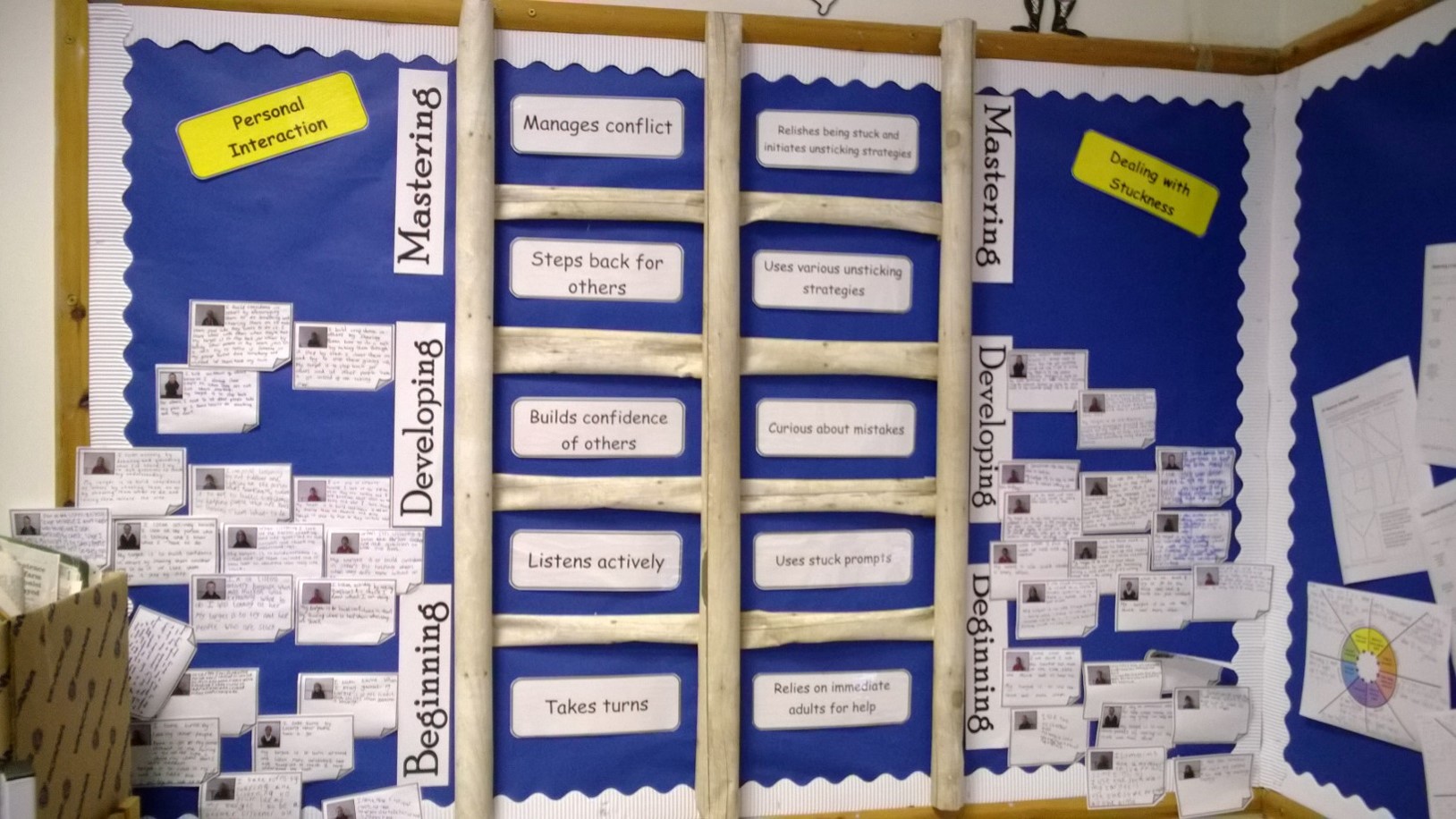
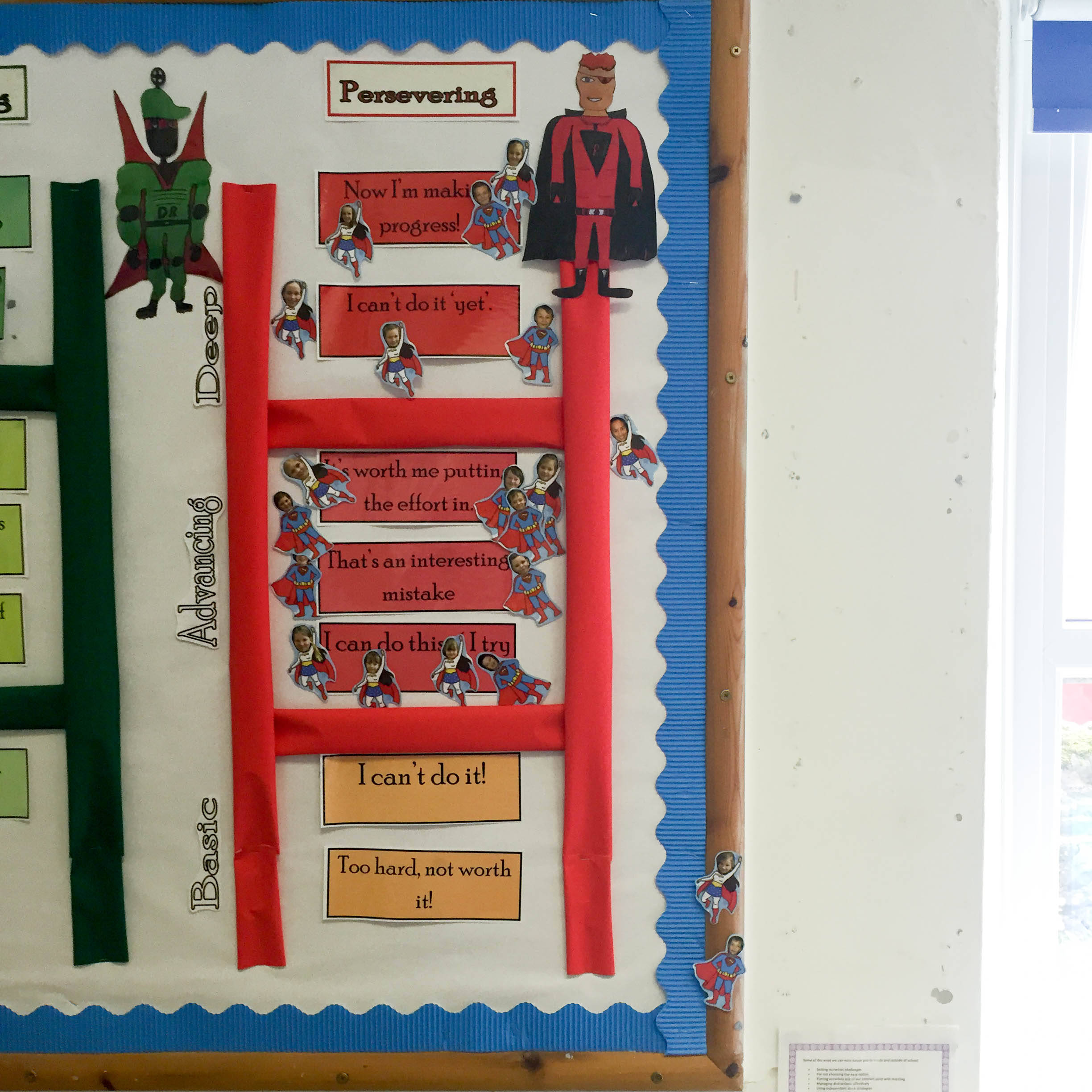
Hallbankgate Village School have developed ladders for the learning behaviours they are focusing on – the ones illustrated relate to aspects of Collaboration and Perseverance.
Around the ladders, pupils are self-assessing and explaining which of the skills they believe they exhibit, and offering evidence for when and how they did it.
Progression and reflection in action!
To reflect on how their learning behaviour is improving, use phrases like:
 The whole point is to enable young people to become better learners, to grow a supple learning mind, to become a life long learner. So the growth of learning behaviours is attended to closely. Successful growth or progression means that not only can students make use of reflection, or imagination, or managing their distractions, but that over time they spontaneously make more and better use of these learning skills and tools and secure them as habits. It is this type of growth, improvement that is acknowledged, recognised, celebrated or praised in some way.
Learning powered classrooms look out for and celebrate three dimensions of progress:
In other words, students ask more and more questions not only in one subject but across all subjects and moreover they ask increasingly better, more searching, more generative questions. They take a questioning stance to learning.
Learning behaviours take time to recognise and grow, and it’s important to develop maps or progression ‘trajectories’ that surface the steps between, for example, the natural curiosity of a three year-old and the sophisticated skill-set of the consummate questioner. The trajectories allow teachers to identify, nudge and design activity to help students build progressively the fine grain learning behaviours of the effective learner.
What is being celebrated here is how young people are getting better at how, when and where they are using their learning behaviours. It’s the Building bit of Building Learning Power. There would be little point in introducing such learning behaviours if we didn’t attend to having them grow.
Ask yourself:
Are pupils in our school becoming increasingly skilful as learners during their time with us?
What evidence do we have for this?
Quick wins to get you going.

Create a display called ‘Mistake of the Week’. Use it as an opportunity to identify ‘good mistakes’ and to discuss the misconceptions behind them.
Offer a range of examples of good mistakes as lesson starters for students to find and discuss.
The underlying message is that learning means making mistakes, and that the mistakes themselves are learning opportunities. And, by implication, that if you are not making mistakes, then you are not really learning, just practising what you could do already.

Tell your students that you expect them to make, for example, 3 mistakes in a given lesson. Naturally the level of challenge needs to be sufficiently high that mistakes are a possibility.
If they do not make the quota mistakes, it is a sign that the learning was too easy and that they should be asking for harder, more challenging material.
What you are building is a recognition that mistakes are a natural part of learning; that learning without mistakes is not really learning; that students have the responsibility of monitoring their own levels of challenge, and seeking more challenge when necessary.

Shift the talk . . .
From ‘Challenge’ to ‘Interesting challenge’.
From ‘Mistake’ to ‘Learning opportunity’.
From ‘It’s hard’ to ‘It’s tricky’.
From ‘Too hard’ to ‘Tricky learning builds my brain.’
From ‘I can’t do it’ to ‘I can’t do it yet’.
From ‘I’m stuck’ to ‘I’m about to learn’.
From ‘I can’t . . . ‘ to ‘How can I . . . .?’
From ‘I’m good at this’ to ‘This is too easy for me’.
From ‘I don’t know how to’ to ‘I’m learning how to’.
The whole point is to shift the pessimistic, ‘glass half empty’ outlook towards an optimistic, ‘already half full’ attitude.
Without making mistakes the chances are that students are coasting and insufficiently challenged. Thus mistakes are the hallmark of challenge. You are aiming at a Goldilocks number of mistakes. Too many and the challenge is too difficult and dispiriting. None or too few and the challenge is too easy. Just right means the student is at a level that pushes them to the edge of what they can do.
The ultimate aim is to help students view mistakes as an essential and valuable part of the learning process. We need to ensure students have a positive view of mistakes, they give access to our thinking and this can be used to change what we do; to enhance our understanding. Being able to overcome mistakes is an important part of perseverance and dealing with challenge.
Putting a focus on mistakes includes:
Here’s a couple of ideas to introduce and discuss:
“The hallmark of successful individuals is that they love learning, they seek challenges, they value effort, and they persist in the face of obstacles.” (Carol Dweck, 2000)
 ‘Errors represent invaluable aids with the potential to help us learn. When we see failure in a new light, success becomes a new and exhilarating concept’. Black Box Thinking: The Surprising Truth About Success. Matthew Syed
Making mistakes, and more importantly covering them up – or rubbing them out – is now viewed as wasteful. Mistakes are a natural part of learning and recognised as valuable; something to learn from, something to improve on, something to change and try new ways, taking a risk and then learning from it if it doesn’t work. Mistakes are having a makeover not just in classrooms but in wide range of progressive institutions.
Redefining failure is and will be an essential part of reversing pupils’ fixed mindsets
Similarly ‘stuck’ is promoted as an interesting place to be rather than a place of shame. Getting stuck, coming against a brick wall, not knowing what to do next is a natural part of learning.If you don’t get stuck the learning is probably not challenging enough. Being stuck is where real learning begins. Pupils who never experience being stuck or struggle with learning can become fragile learners unable to cope emotionally with the inevitable difficulty of learning and life.
Viewing learning as interesting, challenging, stimulating and worthy of effort needs to feed into changing pupils’ fixed mindsets
Effort is a word we use often without really thinking about what it means. What do children understand by ‘effort’ or ‘try harder’? Using learning power language helps teachers to be much more specific about what sort of effort they suggest pupils make. As one teacher put it;
‘I often used to just tell students to make more effort, and got blank stares back. But when I started using Building Learning Power language I realised I could be much more specific about “making more effort.” I could turn my prompts and nudges into really useful statements. So now I watch students carefully through the Building Learning Power lens and say things like “how could you use your imagination to…?”, Or, “what questions might be helpful to take you further with this?”. I’ve started defining the sort of effort I want them to make’
The negative value of too much general ability praise, uncovered by Carole Dweck in her research into Growth Mindsets, has caused teachers to think differently about giving praise. Suggested shifts in giving praise include:
Ask yourself:
How do I treat ‘stuck’, ‘mistakes’ and praise in my classroom?
How much have we re-defined failure?
Quick wins to get you going.
All the students in this classroom own a colour piece of A4 paper on the classroom wall. There is an envelope attached to the paper which contains a piece of card cut up into five pieces. Each piece of card has a student generated ‘learning how’ goal. For example;
When a student achieves a stated behaviour the card is taken out of the envelope and stuck to their piece of paper. The aim is to have all five pieces of card making up a completed jigsaw on the wall in a given time. e.g. a fortnight.
This one example of public recognition being given to learning behaviour goals.


Rather than displaying progression lines in classrooms, Landau Forte College in Derby display their’s in public circulation areas – strategically placed. Reasoning is near Maths and Science, Collaboration near P/E and Drama, Noticing near Art & Design etc.
An alternative way of bringing the growth of learning behaviours to students’ attention?
Also, an important message about what the school believes is important. Take a look around the public circulation areas in your own school – what do they reveal, intentionally or otherwise, about the school’s priorities?
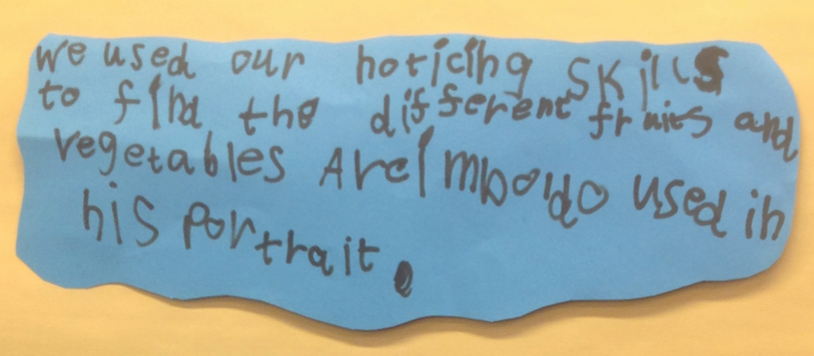

“We used our Noticing skills to find the different fruits and vegetables Archimboldo used in his portrait”
A simple display that reminds pupils of the learning behaviour that they have been using and link it to the curriculum content to put it in context. It could become part of a larger display capturing the different learning behaviours that are used over the course of, say, a term.
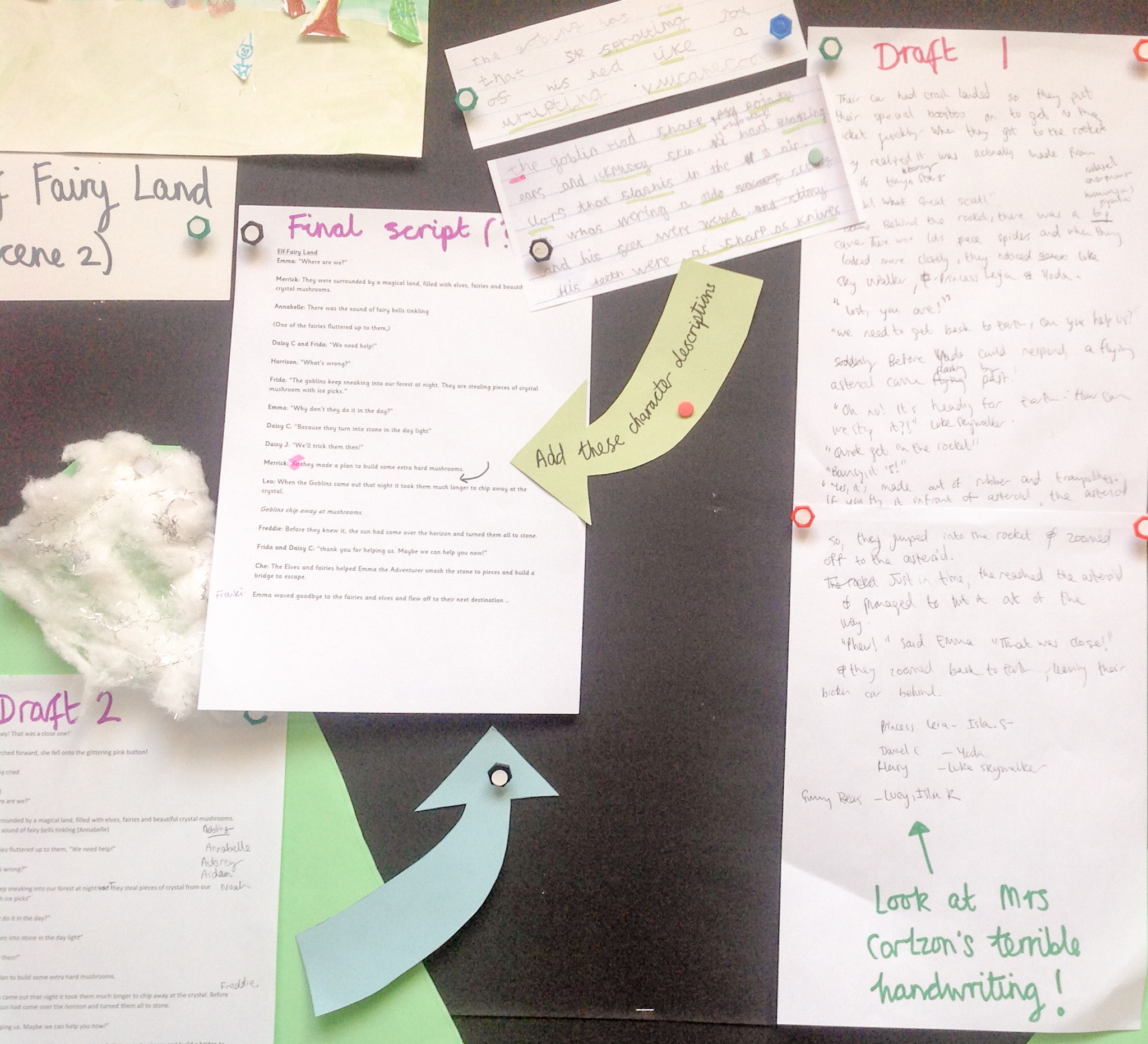
In a learning powered classroom learning will be on display in what you will see, hear and feel. In other words learning is visible in all sorts of ways.
You might find several ways of acknowledging learning on the walls:
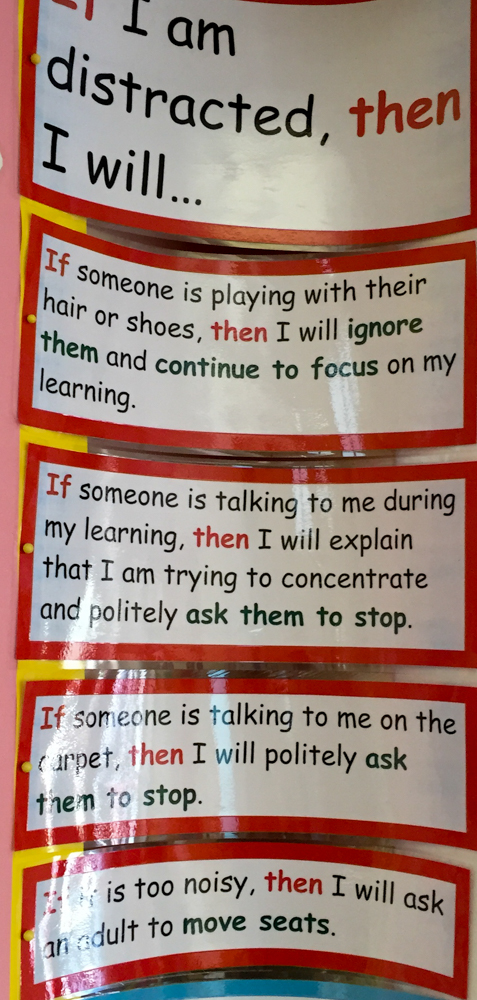
‘If – then’ display example, Heathcoat Primary school Tiverton
At the side of the room there may be a review table with a label “Put your learning here if you want to come back to it, improve it or review it”. There may be a pile of ‘learning journals’ which children use to illustrate and record the difficulties they are having, or indeed the triumphs.
You will see students moving freely around the classroom selecting resources they think they may need for their tasks. On the a flip chart is today’s selection of tasks at different levels of challenge, but all challenging, for pupils to choose from. Some children are working on their own, some with their teacher, some in teams. They are focused, engaged, enthusiastic and excited about what they are doing. There’s no hint of anxiety or pressure or boredom. They are learning to handle uncertainty, learn together and embrace challenge. No one has told them ‘this is hard’, they are knowingly using their imagination, generative questioning, different sorts of resources, listening for the key points and so forth.
The language is enquiring, propelling the learning forward…what if, how come, now what.; every so often a group will stop and check if they are on track and if they need to try another way to tackle their task; at the end of the session one group reflects on their learning process and its outcomes with their teacher, other groups do this for themselves.
The classroom is humming with the language and imagery of learning. The natural process of learning has been unearthed and given high status. Attention to the environment can be a powerful culture builder. An environment the provokes curiosity and stimulates learning becomes a ‘teacher’ in itself.
Ask yourself:
What does the display in my classroom reveal about my priorities and my commitment to keeping the process of learning in the foreground?
The ideas presented can, on the whole, be used in both primary and secondary phases with minor amendments.
In the early stages re-defining learning more as a quest might simply include:
Quick wins to get you going.
Observe children undertaking collaborative activities, analyse the results, work on improving collaborative behaviours and observe again to look for improvements. Things to observe about collaboration might include:

This radar diagram shows the results of a learning enquiry by Frizington School in Cumbria. The red zone shows the first set of results where they were somewhat shocked by their children being such poor collaborators. The blue zone plots the same behaviours 6 weeks later.
Read their fascinating story here link to blog
Here are 4 collaboration Rating Wheels. In each case, the collaborative behaviours become progressively harder as you move round the circle clockwise from 12 o’clock.
Use a wheel to help students to understand the many and varied aspects of collaboration, or to self-evaluate how their collaborative learning behaviours and to set targets for future development, or for a group to reflect on how they performed as a team and what they might do better next time, or even as a group-work observation tool.
But – select the wheel that feels ‘right’ for your students – and by ‘right ‘ we mean the wheel where their behaviours are fairly secure at 12 to 3 o’clock, and increasingly flakey thereafter.
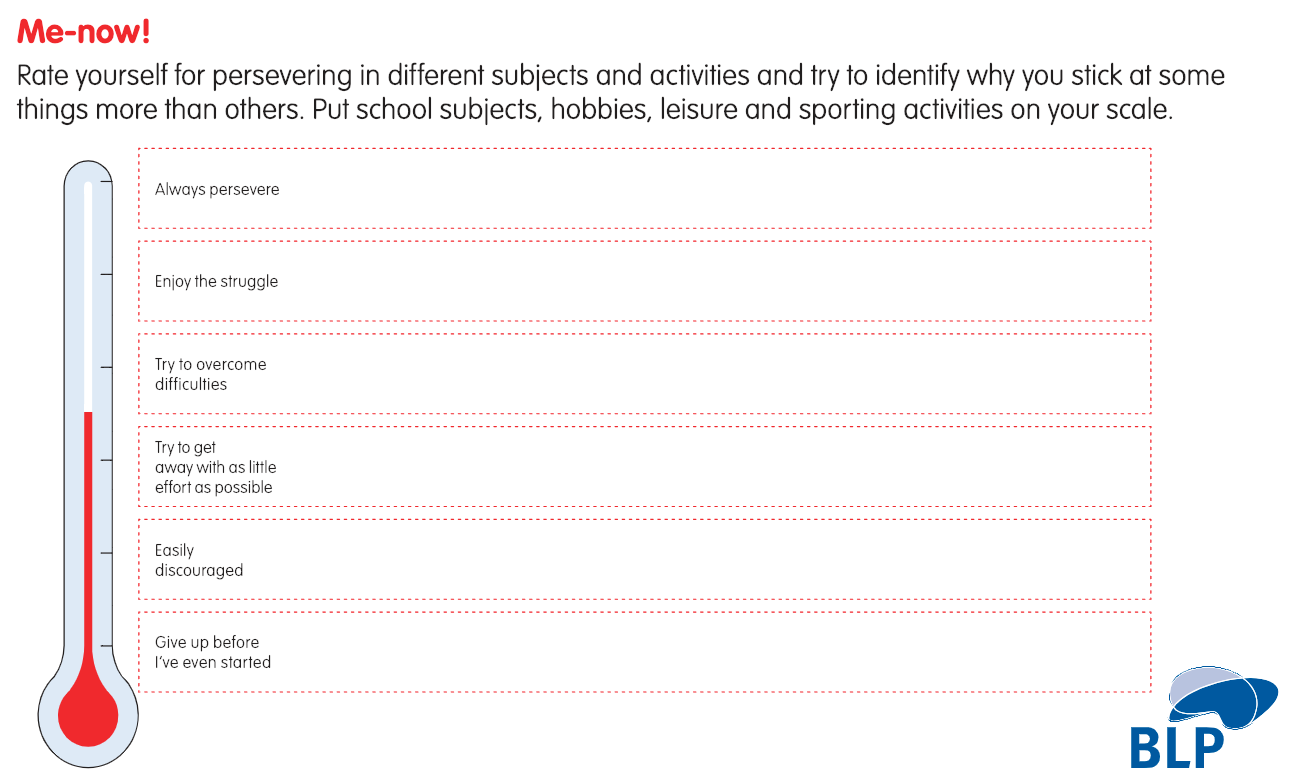
This tool asks students to rate their perseverance levels for different subjects and activities and try to identify why they stick at some more than others. They are also asked to consider their perseverance when undertaking hobbies, leisure and sporting activities.
Tools such as this encourage discussions about:
A similar tool but this time about making links. Here students are asked to look at the sort of links they are aware of and how often they tend to use such link making behaviours.
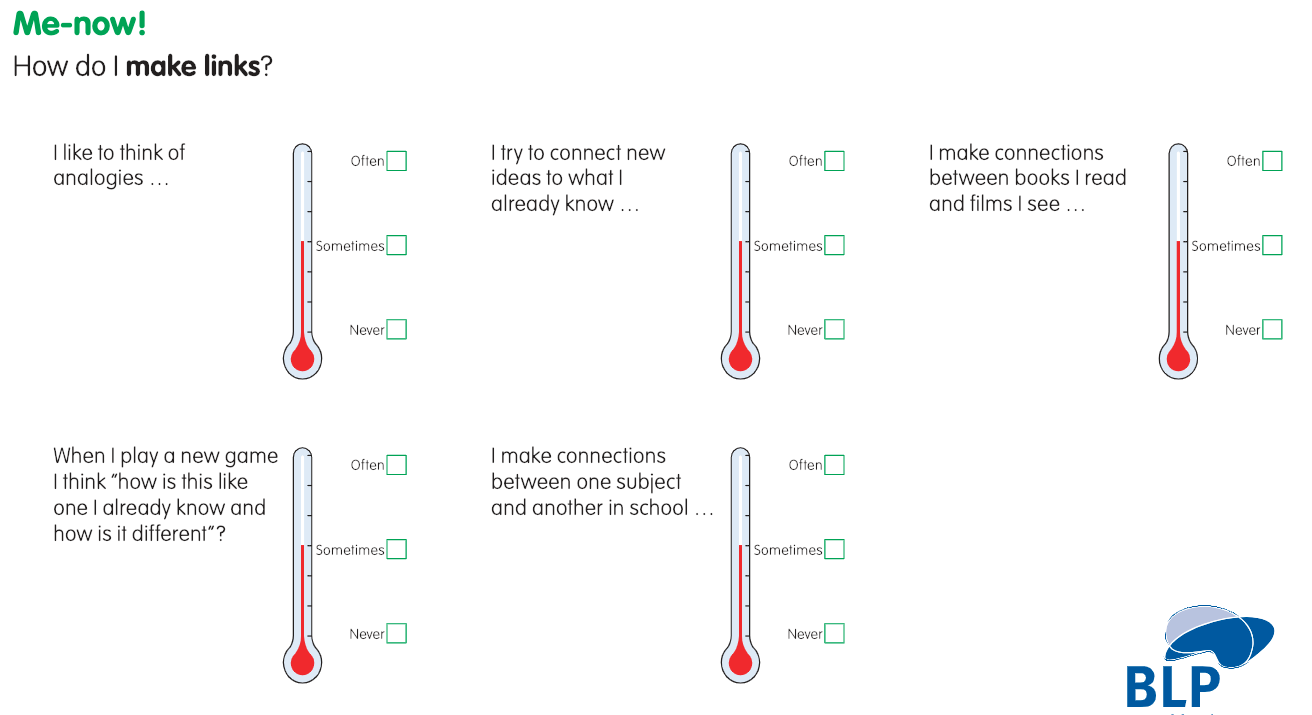
This tool encourages discussion about:
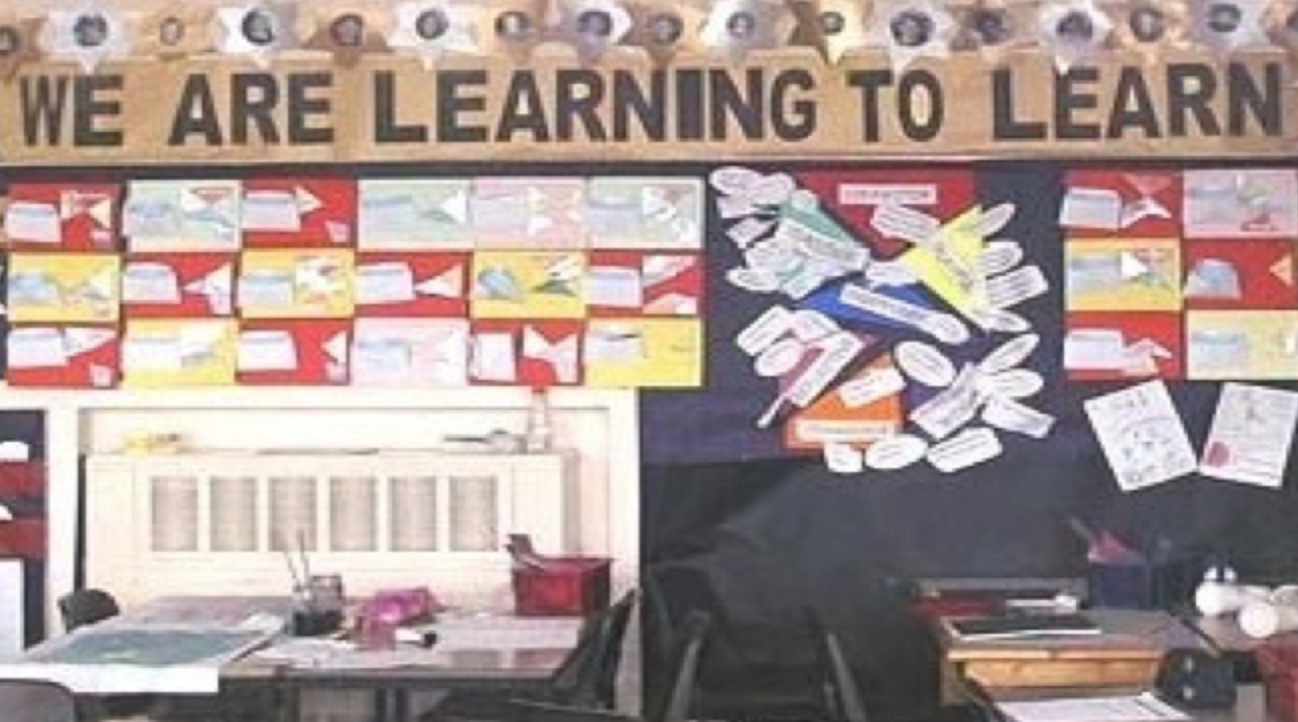
All the students in this classroom own a coloured piece of A4 paper on the classroom wall. There is an envelope attached to the paper which contains a piece of card cut up into five pieces. Each piece of card has a student generated ‘learning how’ goal. For example:
When a student achieves a stated behaviour the card is taken out of the envelope and stuck to their piece of paper. The aim is to have all five pieces of card making up a completed jigsaw on the wall in a given time. e.g. a fortnight.
This is an example of public recognition being given to learning behaviour goals.
Advice about ‘making more effort’ or ‘asking more questions in class’ are almost never effective because they are ill-defined and beg more questions than answers – how much more effort? what kind of effort? / how many more questions? what type of questions?
If we want students to grow their learning behaviours we need to help them to think much more closely about the ‘hows’ and the ‘whats’. Motivation research proposes an effective solution to this called ‘if-then’ planning.

‘Ifs’ are the situations you want to remind yourself about. It is the bit that reminds you about the target.
‘Thens’ are what you will do about something, the action you will take.
If I am finding something hard, then I will try an idea from the ‘stuck poster’
If I am finding something confusing, then I will ask a friend a question about it.
A simple. do-able target (the Then) preceded by an alert to remember the target (the If).
How might this idea impact on the targets you set, the feedback you offer, and the reports that you write?
Hallbankgate Village School have developed ladders for learning behaviours they are focusing on – the ones illustrated relate to aspects of Collaboration and Perseverance.
Beside the ladders, students are writing about themselves and where they are now. They are:
This shows progression in learning and reflection on the process… in action!
Rather than displaying progression lines in classrooms, Landau Forte College in Derby display their’s in public circulation areas – strategically placed. Reasoning is near Maths and Science, Collaboration near P/E and Drama, Noticing near Art & Design etc.
Such lines are an alternative way of bringing the growth of learning behaviours to students’ attention. Also, they are an important message about what the school believes to be important.
Take a look around the public circulation areas in your own school – what do they reveal, intentionally or otherwise, about the school’s priorities?
Quick wins to get you going.
One dramatic way of celebrating mistakes might be to create a display entitled ‘Mistake of the Week’. Make its creation as an opportunity to identify ‘good mistakes’ and to discuss the misconceptions behind them.
To make mistakes more familiar you might offer a range of examples of ‘good’ mistakes as lesson starters. Ask students to find, correct and discuss the mistakes and how they have improved on them
The underlying message is that real learning always involves making mistakes, and that the mistakes themselves are learning opportunities. By implication, if you are not making mistakes, then you are not really learning, but rather just practising what you could do already.
Tell your students that you expect them to make, for example, 3 mistakes in a given lesson. Naturally the level of challenge needs to be sufficiently high that mistakes are a possibility.
If they do not make the quota mistakes, it may be a sign that the learning is too easy and that they should be asking for/selecting harder, more challenging material.
What you are building is a recognition that mistakes are a natural part of learning; that learning without mistakes is not really learning; that students have the responsibility of monitoring their own levels of challenge, and seeking more challenge when necessary.
This is about Growth Mindset and self-belief, challenging that little voice that says ‘I can’t . . . ‘
Create a display around these ideas to initiate a learning conversation to shift the pessimistic, ‘glass half empty’ outlook towards an optimistic, ‘already half full’ attitude?

Teachers often call for more effort from students but what do we mean by this?
Effort: it’s about focusing and re-focusing the mind on the learning you are doing. Something is directing students’ attention.
For example the following could be used to focus the mind (making an effort):
What would you add to this list of mind focusing learning activities? What other features might effort exhibit?
Without making mistakes the chances are that students are either coasting or are insufficiently challenged. Thus mistakes are the hallmark of challenge. You are aiming for a Goldilocks number of mistakes. Too many and the challenge is too difficult and dispiriting. None or too few and the challenge is too easy. Just right means the student is at a level that pushes them to the edge of what they can do.
The ultimate aim is to help students view mistakes as an essential and valuable part of the learning process. We need to ensure students have a positive view of mistakes, they give access to our thinking and this can be used to change what we do; to enhance our understanding. Being able to overcome mistakes is an important part of perseverance and dealing with challenge.
Putting a focus on mistakes includes:
Here’s a couple of ideas to introduce and discuss:
Quick wins to get you going.
“We used our Noticing behaviours to find the different fruits and vegetables Archimboldo used in his portrait”
A simple display that reminds students of the learning behaviour that they have been using and link it to the curriculum content to put it in context. It could become part of a larger display capturing the different learning behaviours that are used over the course of, say, a term.
In this display, group working behaviours are being noticed and celebrated.
Even everyday behaviours such as listening to a partner are being recognised and publicly celebrated by a framed and displayed photograph.
It is in ways such as this that you show the value of positive learning behaviours and keep alerting students to what effective learners do.
Do displays support your desire to build a learning-friendly culture? Beware displays that are jaded, too high on walls, rarely referred to, laminated to lengthen their life, bought in from Twinkle and don’t reflect the underlying culture. Here’s a typical example of a ‘lazy’ display where the sentiments behind the words aren’t understood and the classroom organisation doesn’t allow the implications to happen.

BBBBB is a well known alternative to the more detailed, home grown stuck poster. If BBBBB is to be anything more than a nod to learning power the implicit issues need to be explored and made possible in the classroom. It invites students to:
Make sure displays mirror culture. Display does not, by itself, change the learning (and teaching) habits in the classroom. A learning-friendly culture is for living, not for laminating.
Celebrating and valuing learning is about making learning the object of attention. Here the values of learning bubble up and show themselves in what you attend to, what you recognise, what you praise, what you display and celebrate. In learning friendly classrooms failure, mistakes, being stuck and applying effort have been re-framed so that learners come to view these old adversaries as valuable, interesting and essential. Furthermore, in the learning friendly classroom the development and growth of learning behaviours themselves is given attention, praise and recognition.
The success of this shift will depend on consistency and strong emphasis. You have to make these ideas/values obvious, big and overblown. Whispering them quietly won’t work. They have to be shouted about and put ‘in-your-face’ if they are to stick, be believed, be understood and capitalised on.
While we would like student learning to be the central focus of classrooms many still celebrate and value successful performance over successful learning. What is considered worthy of display or praise speaks volumes about the underlying, unspoken, classroom culture. What does the cultural shift from a performance culture to a learning friendly culture entail?
Aspect 1: Growing Learning habits – finding ways to notice, track, record and celebrate learning behaviour growth. It implies that teachers and learners have a good understanding of themselves as learners and of what ‘getting better’ at learning looks and feels like. In the same way that attainment is routinely tracked, recorded and celebrated, so is learning itself.
The whole point of focusing attention on the ‘how’ of learning is to enable young people to become better learners, to grow a supple learning mind, to become a lifelong learner. So the growth of learning behaviours is attended to closely. Successful growth or progression means that not only can students make use of reflection, or imagination, or managing their distractions, but that over time they spontaneously make more and better use of these learning behaviours and tools and secure them as habits. It is this type of growth and improvement that is acknowledged, recognised, celebrated or praised in some way.
Teachers look out for and celebrate three dimensions of progress:
In other words, students ask more and more questions not only in one subject but across all subjects and moreover they ask increasingly better, more searching, more generative questions. They take a questioning approach to learning.
Learning behaviours take time to recognise and grow, and it’s important to develop maps or progression ‘trajectories’ that show/unpick the steps between, for example, the natural curiosity of a three year-old and the sophisticated skill-set of the consummate questioner. The trajectories allow teachers to identify, nudge and design activity to help students build progressively the fine grain learning behaviours of the effective learner.
What is being celebrated here is how young people are getting better at how, when and where they are using their learning behaviours. It’s the Building bit of Building Learning Power. There would be little point in introducing such learning behaviours if we didn’t attend to having them grow.
Ask yourself:
Aspect 2: Re-defining failure – turning the lens around: mistakes become learning opportunities; difficulty is when learning happens; struggle is to be expected; asking questions shows curiosity, not a lack of intelligence; effort not just talent is what leads to success. It is about ensuring that hard won gains over the difficult are preferable to effortless success over the easy.
“The hallmark of successful individuals is that they love learning, they seek challenges, they value effort, and they persist in the face of obstacles.” (Carol Dweck, 2000)
‘Errors represent invaluable aids with the potential to help us learn. When we see failure in a new light, success becomes a new and exhilarating concept’. Black Box Thinking: The Surprising Truth About Success. Matthew Syed
Making mistakes, and more importantly covering them up – or rubbing them out – is now viewed as wasteful. Mistakes are a natural part of learning and recognised as valuable; something to learn from, something to improve on, something to change and try new ways, taking a risk and then learning from it if it doesn’t work. Mistakes are having a makeover not just in classrooms but in wide range of progressive institutions.
Redefining failure is and will be an essential part of reversing students’ fixed mindsets
Similarly, ‘stuck’ is promoted as an interesting place to be rather than a place of shame. Getting stuck, coming against a brick wall, not knowing what to do next is a natural part of learning. If you don’t get stuck the learning is probably not challenging enough. Being stuck is where real learning begins. Students who never experience being stuck or struggle with learning can become fragile learners unable to cope emotionally with the inevitable difficulty of learning and life.
Viewing learning as interesting, challenging, stimulating and worthy of effort needs to feed into changing students’ fixed mindsets
Effort is a word we use often without really thinking about what it means. What do children understand by ‘effort’ or ‘try harder’? Using a learning language helps teachers to be much more specific about what sort of effort they suggest students make. As one teacher put it;
‘I often used to just tell students to make more effort, and got blank stares back. But when I started using Building Learning Power language I realised I could be much more specific about “making more effort.” I could turn my prompts and nudges into really useful statements. So now I watch students carefully through the Building Learning Power lens and say things like “how could you use your imagination to…?”, Or, “what questions might be helpful to take you further with this?”. I’ve started defining the sort of effort I want them to make’
The negative value of too much general ability praise, uncovered by Carole Dweck in her research into Growth Mindsets, has caused teachers to think differently about giving praise. Suggested shifts in giving praise include:
Ask yourself:
Aspect 3: Displaying values – the process of learning (as opposed to the finished outcomes of learning) are on display. Annotated work in progress, first attempts, revisions, failed lines of enquiry, leading, of course, to the finished article. What we choose to display tells students a lot about what we truly believe: displaying/praising only the finished article suggests that whatever we might say, we are more interested in the outcome than the process. In such ways are the underlying values of the classroom revealed to learners.
In a learning powered classroom learning will be on display in what you will see, hear and feel. In other words learning is visible in all sorts of ways.
You might find several ways of acknowledging learning on the walls:
‘If – then’ display example, Heathcoat Primary school Tiverton
There may be a pile of ‘learning journals’ which students use to illustrate and record the difficulties they are having, or indeed the triumphs.
You will see students moving freely around the classroom selecting resources they think they may need for their tasks. On the flip chart is today’s selection of tasks at different levels of challenge, but all challenging, for students to choose from. Some children are working on their own, some with their teacher, some in teams. They are focused, engaged, enthusiastic and excited about what they are doing. There’s no hint of anxiety or pressure or boredom. They are learning to handle uncertainty, learn together and embrace challenge. No one has told them ‘this is hard’, they are knowingly using their imagination, generative questioning, different sorts of resources, listening for the key points and so forth.
The language is enquiring, propelling the learning forward…what if, how come, now what.; every so often a group will stop and check if they are on track and if they need to try another way to tackle their task; at the end of the session one group reflects on their learning process and its outcomes with their teacher, other groups do this for themselves.
The classroom is humming with the language and imagery of learning. The natural process of learning has been unearthed and given high status. Attention to the environment can be a powerful culture builder. An environment that provokes curiosity and stimulates learning becomes a ‘teacher’ in itself.
Ask yourself:
Ask yourself:
Now, move to section 2 to explore some quick wins that will help you to Grow, Re-Define and Display learning in your classroom.
As a teacher you are an influential character builder and so need to be mindful of how your classroom culture helps students to form, replace, re-form and strengthen their learning habits. Which aspects of your classroom culture are helpful in this respect, and which are perhaps less so? After all, if you are unable or unwilling to make changes to your classroom culture, learners are unlikely to change how they respond to it!
Here are a few ideas you might want to try. Take it steady, this way of teaching can be a big but exciting shift so it’s worth doing it slowly and thoughtfully.
Look first at the Stop/avoid ideas. Some of these are far from trivial but it’s best to try to remove them before starting on the Start/do more of, Start slowly and Experiment with ideas.
For the aspects of Learning about Learning:
Quick wins to get you going.
Every time you are able to offer learners a choice their engagement is likely to increase and learners are increasingly inclined to set themselves a level of challenge that’s right for them. This doesn’t mean turning lock stock and barrel to child initiated learning overnight. It is possible to start with small-scale choices, fitting within current practices.
Challenges are all well and good, but students also need to understand the emotional aspects of rising to challenge. James Nottingham’s Learning Pit is a visual device to help students to understand the move from clarity, through uncertainty and confusion as the challenge unfolds, and finally back to clarity as the challenge is overcome.
Adding strategies that can be used when ‘in the pit’ makes for a useful aide-memoire for students.
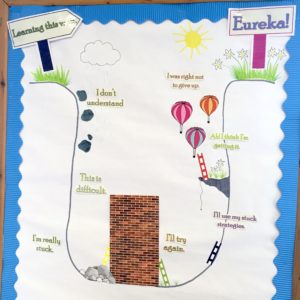
The Learning Pit

Hallbankgate Village School, high up in the Cumbrian fells, is a small rural primary school. A headteacher, 4 teachers, 5 TAs.
Teachers work Monday to Thursday and have Fridays off for marking and preparation. On Fridays, the HT and the TAs run the school, and children can do whatever they want, so long as the HT approves – it is child initiated learning day.
Given this freedom, pupils design and undertake their own learning challenges. For example, 3 year 5 lads have been attempting to break the world record for launching a rocket using only water power!
Ask yourself – do I give my pupils sufficient opportunities to design and explore their own challenges?
 Learning is always an emotional business and learning how to manage this is best done ‘on the job’ in the course of learning rather than as a separate stand alone activity. Emotional engagement is a prerequisite of powerful learning, it’s what gets you interested enough to be willing to put in the effort to get better and see the value of pushing yourself. So lessons aren’t just designed to make use of different kinds of learning behaviours but to give those behaviours a good work-out. Activities are designed to:
“The presence of challenging learning intentions has multiple consequences. Pupils can be induced to invest greater effort, and invest more of their total capacity than under low demand conditions.”
(Hattie, Visible Learning)
Ask yourself:
What proportion of tasks in my classroom are rich and challenging?
Quick wins to get you going.
Every classroom in Cadland Primary school has two walls dedicated to curriculum plans, one for maths and one for literacy. The purpose of these displays is to show the stages of what might be termed a unit of work showing;
These lively plans are talked about and added to as the class progresses through them. Learning power behaviours are added at each point in the plan. Now students are not only aware of the what they are learning about but the learning behaviour, the how, they will be using to help them get to grips with the content.
These broad brush descriptions of the learning behaviours being used is a first stage in coupling content with process, the what with the how of learning.
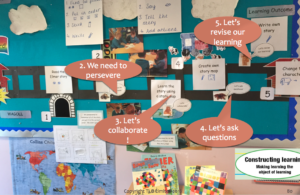
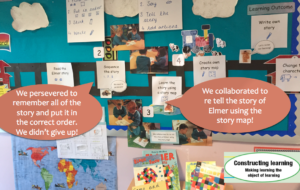
The first photograph shows the learning behaviours they anticipate using as they move through the unit. The second photograph shows a reflection on the learning behaviours used and what this accomplished.
Lessons have two key purposes:
This has been true for all time whether or not the teacher (or learners) are aware of the learning behaviours that are being invoked.
The difference is that a learning-power-aware teacher thinks through:
In other words, the goal of the lesson has both a content and a learning dimension.
In planning terms, the teacher has made a shift from thinking;
From ‘what do I have to teach and how am I going to teach it?’
To ‘what do I have to teach, how will they best learn it, and how am I going to teach it ?’
What is being learned in a particular lesson is generally made public. Usually this is done through the Learning Outcomes / Intentions / Objectives which teachers use to inform pupils about the upcoming learning, and this may be in written or oral format. Some teachers use WALT and WILF to alert pupils to what ‘We Are Learning’ (Objectives) and ‘What I’m Looking For’ (Success criteria).
However the teacher chooses to do it, pupils are made aware of what they will be / are learning.
But are pupils also enabled to understand how they will be learning, the learning behaviours that they will need to engage in order to master the content?
Try one of two strategies:
A simple way to begin to blend content and learning behaviours.
 Flipping Goals to get student buy-in.
Setting a goal that the learner has little or no motivation to achieve is unlikely to lead to success. What is needed is learner buy-in to goals.
Evidence shows that goals that relate to doing something or researching something, or creating something . . . ) are better motivators than goals that relate to knowing something or passing / doing well in a test.
Putting the ‘how’ before the ‘what’.
So – a goal relating to ‘understanding xxxxx’ or ‘knowing yyyyy’ is less likely to motivate a learner to make the effort than a goal that starts with some indication of the sort of ‘effort’ or way of doing something;
Where ‘knowing goals’ place the emphasis on the successful acquisition of knowledge or creates a pass/fail scenario, the ‘doing goals’ focus on how – something to do rather than something to know.
Have a look at some real examples just to give you a flavour of this technique
With a partner, use your reasoning skills to explain why all prime numbers, with the exception of 2, are odd.
Use your noticing skills to identify three similarities and three differences between these two images.
By using what you already know and your imagination to generate ideas, tell the story of the fire of London from the perspective of a young child living in London at the time.
What you are doing here is beginning to pay some attention to how students will be learning as well as what they will be learning.
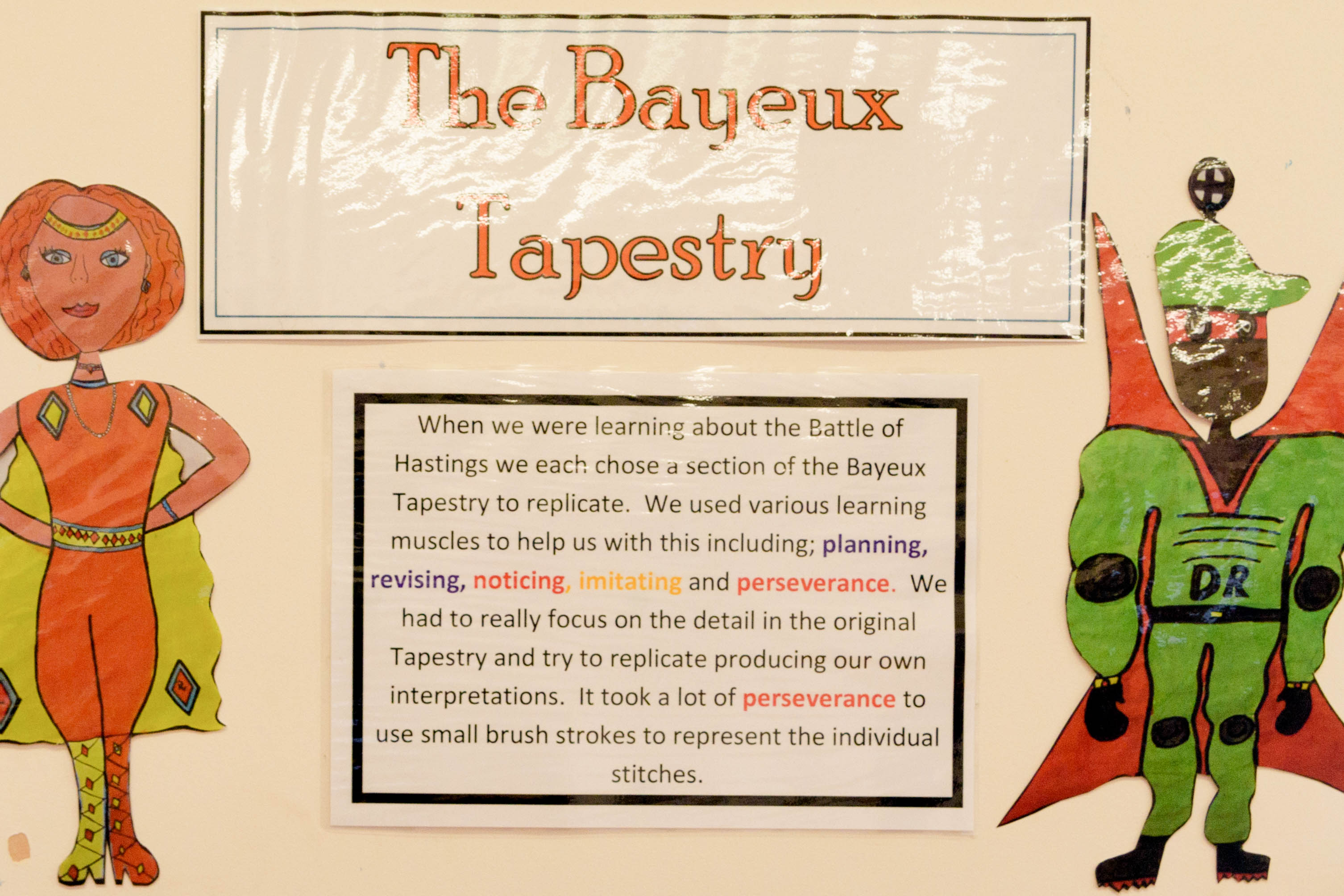 Whether we realise it or not, all lessons have a dual purpose:
In conventional lessons where the teacher remains the focus of attention and the initiator of all activity, and where the epistemic dimension is not acknowledged, students gain habits of compliance and dependence, rather than curiosity and self reliance. In developing learning power, teachers are making conscious choices about which habits to introduce and stretch and how best to couple these with content so that lessons become more interesting and challenging. Through such overt coupling of content and specific types of process, students come to know, understand and take control of their learning behaviours – they knowingly use and develop the whole range of learning behaviours.
Ask yourself:
Do I ask myself “How are students going to learn it?” instead of ‘How am I going to teach it?”?
Quick wins to get you going.
Unlike the mats in other modules that are specific to one learning behaviour, this one encourages students to reflect across a wide range of key learning behaviours.
Titles:
Learning Mat
Black box subtitle:
How was I learning today?
bubbles:
I did not give up when . .
My best question today was . .
I looked carefully at . .
I listened carefully to . .
I thought things through carefully when . .
I used my imagination to . .
I worked well with . . . when we . . .
I spotted a connection between . . . and . . .
I changed my mind about . . .
Reflection is used by many schools for summative evaluation of a piece of work, rather than being woven formatively throughout the learning and production process.
Being able to reflect, review and refine your ideas is one of the key learning characteristics. Students need to be taught:

Take a few photographs of pupils learning. Try to capture feelings, concentration, joy, puzzlement, satisfaction, downheartedness. Use the pictures to start a dialogue about learning. Later on pupils themselves can capture themselves and others learning. Build up a learning picture gallery on a display board.

Use Tell me three as a simple plenary / review activity.
Tell me:

This familiar learning cycle highlights what is needed in order to learn from experience. By active learning we mean active engagement with materials, with ideas, with relationships and with other resources.
The teacher’s role is to facilitate the cycle using questions such as;
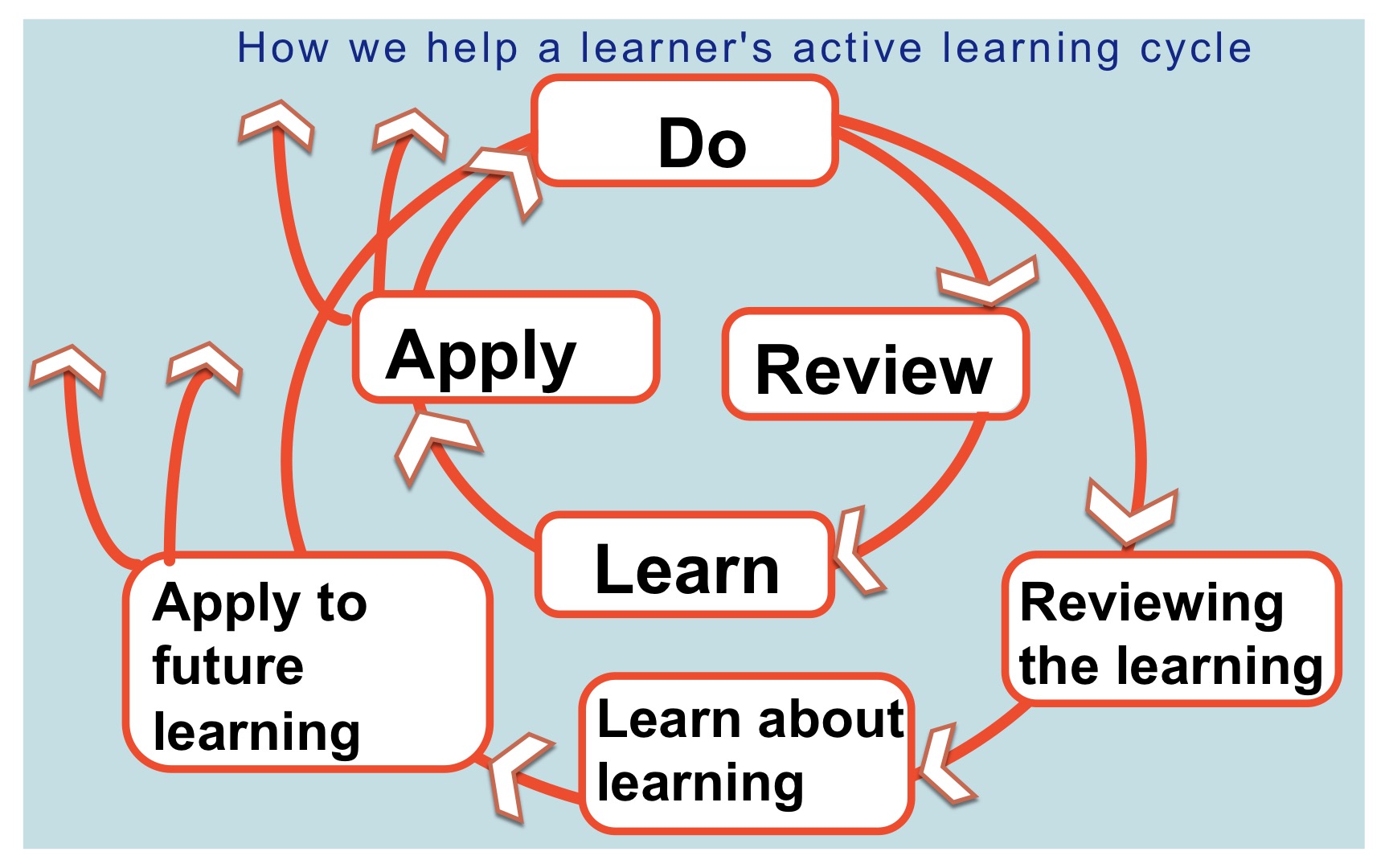
It’s not sufficient to simply have an experience in order to learn. Without reflecting on the experience it may quickly be forgotten or its learning potential lost (Gibbs 1988). This is the model that best drives the learning in learner and learning focused classrooms.
Ask yourself:
To what extent is Reflection on either content or process a consistent feature in your classroom?
The ideas presented can, on the whole, be used in both primary and secondary phases with minor amendments.
The early stages of this aspect of developing learning-friendly classrooms might simply include;
The classroom becomes a place where young people learn that to struggle with a problem is ultimately satisfying and brings its own rewards.
Quick wins to get you going.

Help children to think positively about challenge, struggle and not knowing by:
This tool moves students from a state of cognitive conflict and forces them to think more deeply, critically, and strategically until they discover their “eureka” moment. .. James Nottingham’s Learning Pit helps students to understand the move from clarity, through uncertainty and confusion as the challenge unfolds, and finally back to clarity as the challenge is overcome.
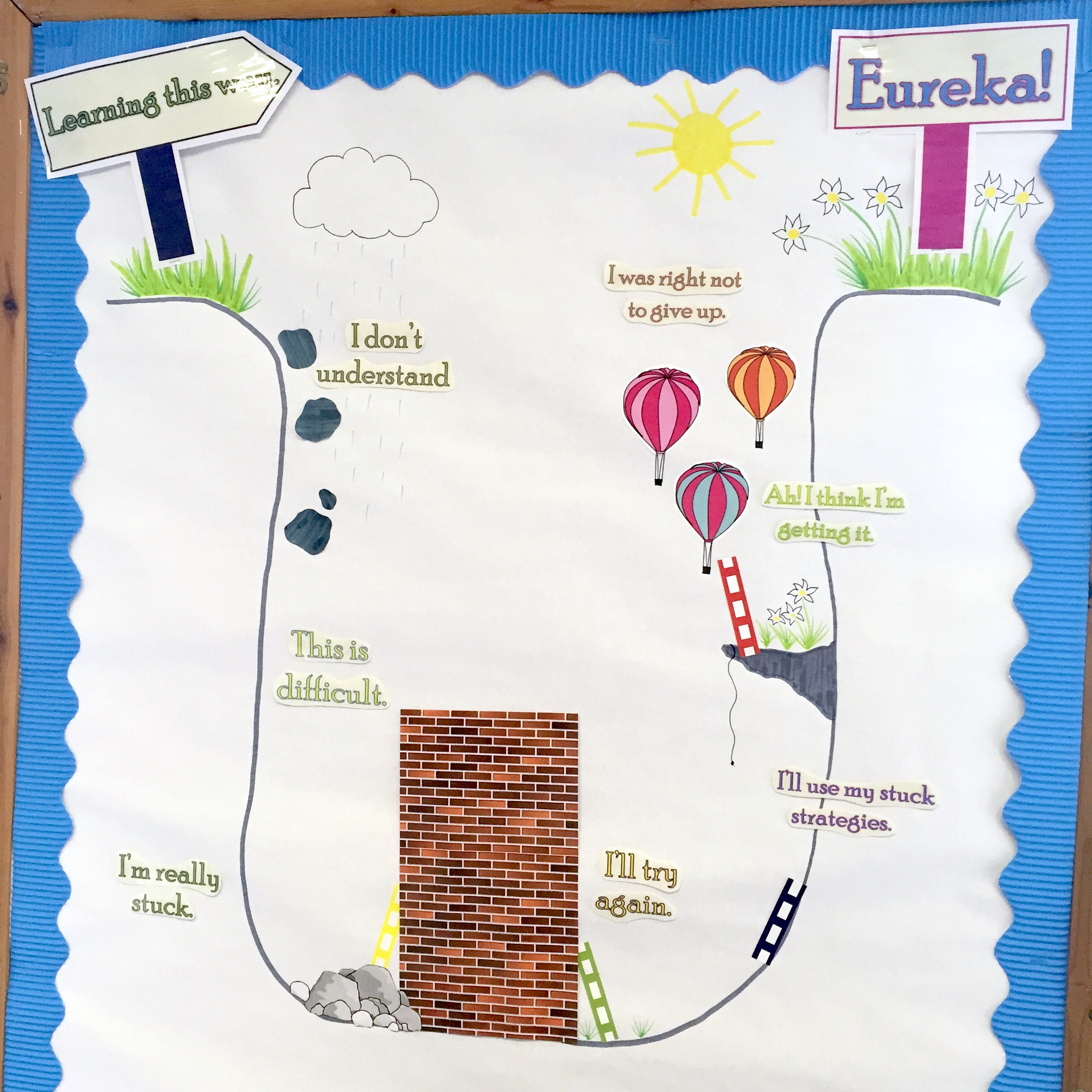
The Learning Pit (click to enlarge)

Hallbankgate Village School, not all that far from Hadrian’s Wall, is a small rural primary school with a headteacher, 4 teachers and 5 TAs.
Teachers spend Monday to Thursday in the classroom and spend Fridays marking and preparing learning sessions for the following week. On Fridays, the HT and the TAs run the school, and children are given the freedom to learn about whatever they want… so long as the HT approves. Friday is child initiated learning day.
Given this freedom, students design and undertake their own learning challenges. Some are short and are completed in the day. Others are far more extensive, problem solving activities. For example, 3 year 5 lads have been attempting to break the world record for launching a rocket using only water power!
Ask yourself – do I give my students sufficient opportunities to design and explore their own challenges?
Quick wins to get you going.
Every classroom in Cadland Primary school has two walls dedicated to current curriculum plans, one for maths and one for literacy. The purpose of these displays is to show the journey of the current a unit of work. They show;
These visual journeys are talked about and added to as the class progresses through the unit content. Learning behaviours are added to each point in the plan. Now students are not only aware of what they are learning about but the learning behaviours they are using to help them get to grips with the content.
The broad brush descriptions of the learning behaviours being used is a powerful, visual coupling of content and process; the what with the how of learning.
The first photograph shows the learning behaviours they are using as they move through the unit. The second photograph shows a reflection on the learning behaviours used and what this accomplished.
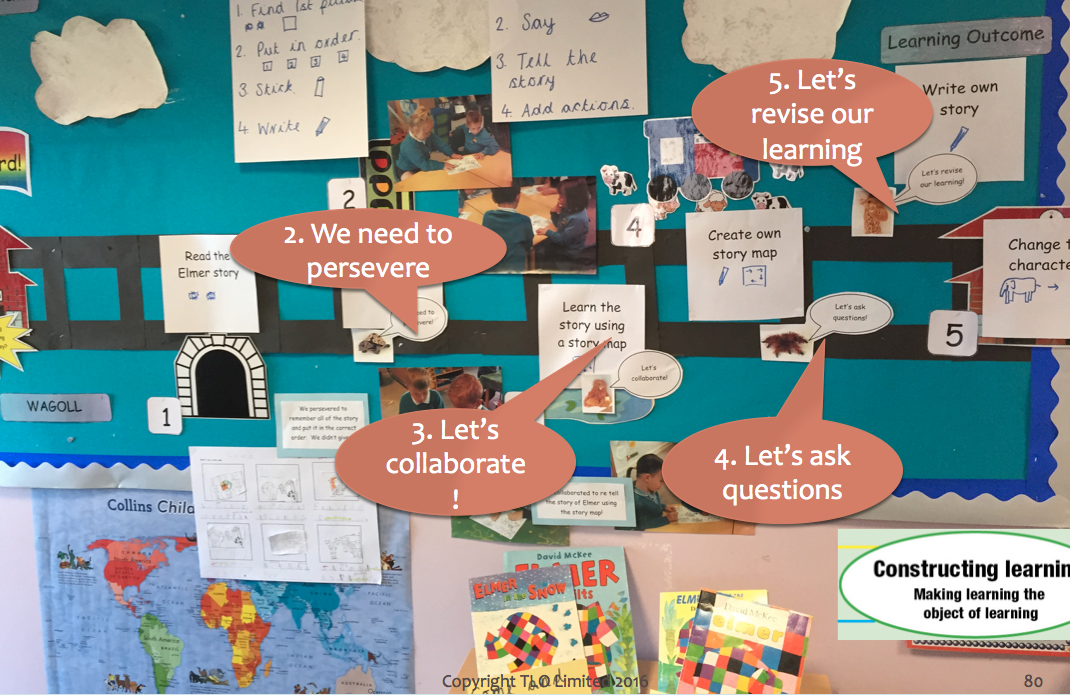
Click to enlarge
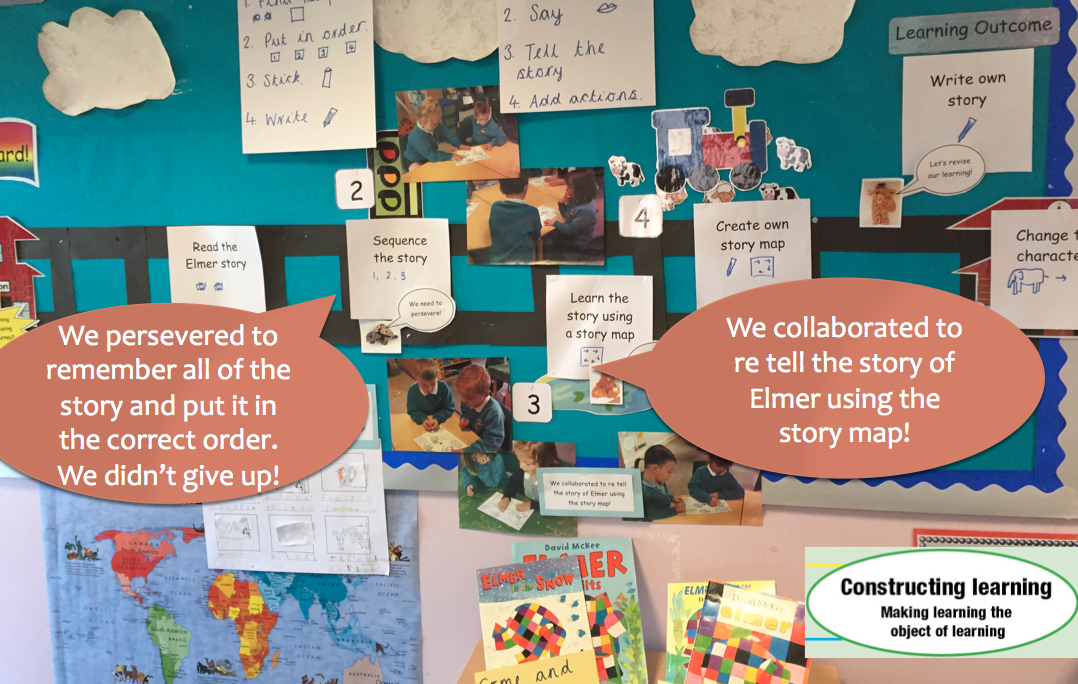
Click to enlarge
All your lessons have always had two purposes:
…although you may not have been fully aware of the learning behaviours that are being invoked.
As you become more deeply aware of learning behaviours you will think through lesson planning a bit differently:
In other words, the goal of the lesson would then have overt content and learning dimensions.
In planning terms, you have made a shift from thinking;
A good grapple problem is challenging. It’s something that the students might have an idea about but might entail something they haven’t come across or done before. A good grapple task centres on learning that is just beyond the students’ reach/experience. They give students a chance to wrestle with the problem before they have been taught methods for tackling it. They are allowed to solve it in any way they want and in doing so they are discovering their own approaches and exposing their own tricky bits.
Blend grapple tasks with Think Pair Share…giving time to think by themselves, share ideas with a partner before discussing it more widely. By using grapple tasks you are getting the students:
Don’t forget to discuss which strategies were used, which were successful/effective and why.

Ask yourself:
Setting a goal that the learner has little or no motivation to achieve is unlikely to lead to success. What is needed is learner buy-in to goals.
Evidence shows that goals that relate to doing something or researching something, or creating something . . . are better motivators than goals that relate to knowing something or passing / doing well in a test.
Putting the ‘how’ before the ‘what’.
So – a goal (or objective or outcome) relating to ‘understanding xxxxx’ or ‘knowing yyyyy’ is less likely to motivate a learner to make the effort than a goal that starts with some indication of the sort of ‘effort’ or way of doing something;
Where ‘knowing goals’ place the emphasis on the successful acquisition of knowledge or creates a pass/fail scenario, the ‘doing goals’ focus on how – something to do rather than something to know.
Have a look at some real examples just to give you a flavour of this technique.
By devising objectives such as these you are paying some attention to how students will be learning as well as what they will be learning.
Quick wins to get you going.
Learning mats are A4 laminated sheets that show various aspects of a learning habit. Keep them on desks/tables or as part of a wall display. Use them during lessons as prompts to promote use. Refer to them at the end of a lesson to support reflection on the learning behaviours employed.
Unlike the mats in other modules that are specific to one learning behaviour, this one encourages students to reflect across a wide range of key learning behaviours.
Can you spot which learning behaviours each bubble is referencing?
Reflection is a powerful tool for learning usually used to evaluate of a piece of work but rarely woven formatively throughout the learning and production process.
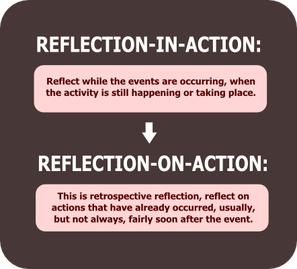
Click to enlarge
There are two aspects to reflection – reflection In action (or monitoring) and reflection On action (or evaluating) – both have a place. The former is undertaken in the hurly-burly of the process of learning, the latter is a retrospective focusing on what happened, what worked and to how to do it better next time.
Being able to reflect on, refine and review your ideas is a key learning characteristic. Students need to be taught:
Take a few photographs of students learning. Try to capture feelings, concentration, joy, puzzlement, satisfaction, downheartedness. Create a display of learners learning. Use the display to start a dialogue about learning, and as a reminder of what effective learning looks and feels like.
Later on students can capture themselves and others learning. Build up a learning picture gallery on a display board.

Use Tell me three as a simple plenary / review activity.
Tell me:

After any activity, ask the children what they have been doing, what they have learned, what worked, what didn’t work so well and what they would use again next time.
Make wall displays of things that children have found worked well. Support with photographs and examples, to ensure everyone benefits from the learning. Expect lots of variety – what works for one child might not work for another.

If information is currently framed in any of the following, challenge students to change it into another format of their choosing: text; mind map; flow diagram; storyboard; graph; venn diagram; ranked bullet points/list; video; teacher explanation; revision notes etc.
Consider limiting the number of words that can be used – forcing students to limit words and/or employ images instead encourages them to distil what is really important and salient.
Converting from one medium to another requires students to identify the key features. It can only be converted if it is understood, so this technique promotes deep learning. Where students are struggling, it can reveal misconceptions. It helps students to create revision notes for themselves, and in their preferred learning style.
VTRs are, as they say, simple routines that apply across a wide range of subjects and contexts, and which require students to think in a variety of different ways, that are used so regularly by teachers that they become woven into the fabric of the classroom culture and progressively hard-wired into the thinking practices of students. These are ways in which different ways of thinking can become routine in classrooms. They become part of the learning culture.
To be effective such routines need to be;
Find out more: Google ‘Visible thinking routines’
Connect Extend Challenge is a visible thinking routine for connecting new ideas to prior learning and encourages reflection.
It goes like this;
CONNECT: How are the ideas and information presented CONNECTED to what you already knew?
EXTEND: What new ideas did you get that EXTENDED or pushed your thinking in new directions?
CHALLENGE: What is still CHALLENGING or confusing for you to get your mind around? What questions, wonderings or puzzles do you now have?
The routine helps students make connections between new ideas and prior knowledge. It also encourages them to take stock of ongoing questions, puzzles and difficulties as they reflect on what they are learning.
Learning about learning involves integrating reflection and review into the way learning is organised; where activities are designed to stretch and challenge not just in outcome terms but in the very nature of ‘doing’ the task (dual focus of content and process). Students’ emotional engagement is a pre-requisite when learning is organised in these ways, and the value of learning is in pushing yourself so that your capacities are stretched and strengthened.
For many students, the word ‘learning’ means ‘knowing / remembering stuff”. The cultural shift to learning about learning, or making learning the object of attention, is about understanding how they are learning as well as what they are learning.
Aspect 1: Lessons with rich and challenging activities – increasingly open-ended activities are designed to engage, to stretch and to challenge. The learning is not over-scaffolded, and the inherent difficulties are not avoided or diluted by overly-helpful teachers. The activities stretch and challenge both content understanding and learning behaviours.
Learning is always an emotional business and learning how to manage this is best done ‘on the job’ in the course of learning rather than as a separate stand-alone activity. Emotional engagement is a prerequisite of powerful learning, it’s what gets you interested enough to be willing to put in the effort to get better and see the value of pushing yourself. So lessons aren’t just designed to make use of different kinds of learning behaviours but to give those behaviours a good work-out. Activities are designed to:
“The presence of challenging learning intentions has multiple consequences. Students can be induced to invest greater effort, and invest more of their total capacity than under low demand conditions.”
(Hattie, Visible Learning)
Ask yourself:
Aspect 2: Lessons with a dual focus – lessons are designed intentionally to deliver content and to exercise learning behaviours, and students are made aware of both. The learning behaviours drive the content acquisition, the content is the exercise regime for the learning behaviours, each enhancing the other.
Whether we realise it or not, all lessons have a dual purpose:
In conventional lessons where the teacher remains the focus of attention and the initiator of all activity, and where the epistemic dimension is not acknowledged, students gain habits of compliance and dependence, rather than curiosity and self-reliance. In developing learning power, teachers are making conscious choices about which habits to introduce and stretch and how best to couple these with content so that lessons become more interesting and challenging. Through such overt coupling of content and specific types of process, students come to know, understand and take control of their learning behaviours – they knowingly use and develop the whole range of learning behaviours.
Ask yourself:
Aspect 3: Lessons with in-built reflection – reflection on content and reflection on learning behaviours is routinely built into lessons.Review points, rather than the formulaic plenary, focus students on what they have learned and how they have learned it. Reflection is done by students for themselves, not by teachers on their behalf.
This familiar learning cycle highlights what is needed in order to learn from experience. By active learning we mean active engagement with materials, with ideas, with relationships and with other resources.
The teacher’s role is to facilitate the cycle using questions such as;
It’s not sufficient to simply have an experience in order to learn. Without reflecting on the experience it may quickly be forgotten or its learning potential lost (Gibbs 1988). This is the model that best drives the learning in learner and learning focused classrooms.
Ask yourself:
Ask yourself:
Now, move to section 2 to explore some quick wins that will get you started.
As a teacher you are an influential character builder and so need to be mindful of how your classroom culture helps students to form, replace, re-form and strengthen their learning habits. Which aspects of your classroom culture are helpful in this respect, and which are perhaps less so? After all, if you are unable or unwilling to make changes to your classroom culture, learners are unlikely to change how they respond to it!
Here are a few ideas you might want to try. Take it steady, this way of teaching can be a big but exciting shift so it’s worth doing it slowly and thoughtfully.
Look first at the Stop/avoid ideas. Some of these are far from trivial but it’s best to try to remove them before starting on the Start/do more of, Start slowly and Experiment with ideas.