Here is a range of things you can say to nudge reasoning. When you use this kind of language you are talking as a learning coach, encouraging students to think for themselves. Using such statements encourages your students to:
imitate you;
start to think in this way;
become conscious of these phrases and their meaning.
Eventually you will hear some of the questions pop up in students’ self-talk….in speech or even in writing from time to time, but mostly these will go on inside their heads. As your work on reasoning gathers pace see if you can detect students who talk, or think, in these ways.
My learning talk nudges to encourage Reasoning
Teacher talk – as a learning coach
Here are 10 ideas to ensure your students do the thinking for themselves
What assumptions are you making? Are they sound?
Can you think it through in clear steps from start to finish?
How many reasons can we find for that?
Can you spot the false step there? Is the argument water tight?
What evidence can you find to support your case/argument? What’s the counter evidence?
How have you reached that conclusion? What are the implications?
Which thinking tool would help us solve this?
Are you convinced?
One the one hand . . . , but on the other . . .
Why do you think that?
What do you think?
Which of these reasoning nudges might you start using?
In which particular lessons would such nudging be most useful?
How will most of your students respond to such nudges?
Will this way of engaging be more popular with girls or boys?
What other nudging ideas might you add to the list?
Make a note of…
Students’ reactions to the nudges.
Ideas about why this might be.
Ways in which you could further encourage students to imitate this metacognitive self-talk.
Any positive or negative impact of these reasoning behaviours.
Some ideas to encourage a Reasoning frame of mind.
In the early stages of building your students‘ learning power your role is to; make students aware of the capacity; talk about it (what, how, why, when, if); celebrate its use; give opportunities to practice it, both in lessons and elsewhere; reflect on it to improve it. This staged start is reflected below…
Firstly… make students aware of reasoning…when, where, why.
Then… explore reasoning a little more through the language of reasoning
Try… using reasoning as a lesson starter to tune students into using it
Then start… blending reasoning into the way you teach the content. Use specific reasoning strategies to deepen content understanding.
Ensure… students reflect on the success or otherwise of their reasoning frame of mind.
1. Make students aware of Reasoning
How you make students aware of the words that describe the behaviour and why it is important to use it.
Primary
Take Two
A strategy for encouraging children to explain what they are thinking. Whole class or large groups of 10/15 children. You will need a PE hoop and a large assortment of small objects from the classroom and home.
Sit pupils in a circle and place all the items on the floor inside the hoop in the middle of the circle.
Explain that they will take turns to choose 2 objects from inside the hoop which ‘go together’. Tell them there are no right or wrong pairs as long as they can explain why the two they choose might go together.
Give an example: Choose the knife and fork and give your reason: “These go together because I use them both to eat my dinner.”
Encourage pupils to choose different items each time and reward good reasoning. Look out for cause and effect connectives and imaginative reasons. Use phrases like: “That’s a good reason” and “You explained that really clearly.”
[ This type of activity is also useful for making links ]
Secondary
Strategy Games
Use games that require strategy and logical thinking. From noughts and crosses to chess, from hangman to backgammon, such games help to develop and refine reasoning skills.
Many appear in the form of maths investigations and problems: Frogs; Tower of Hanoi; Nim; Connect 4; etc.
Primary
Introduce games that require reasoning behaviours
Sit at the jigsaw table with groups of children and work on the jigsaws together. Model your reasoning out loud to the children explaining what you did first second, third, etc. so that they begin to understand a methodical, step by step approach.
Secondary
Code Breaking
Present students with coded messages and require them to work them out using their deductive skills.
Start with simple substitution codes where, for example, each letter is replaced by the one after it in the alphabet. (i.e. b replaces a, c replaces b etc. etc.) Increase difficulty by using more complex ciphers.
2. Explore the language of Reasoning
How you might extend the language and understanding of this behaviour
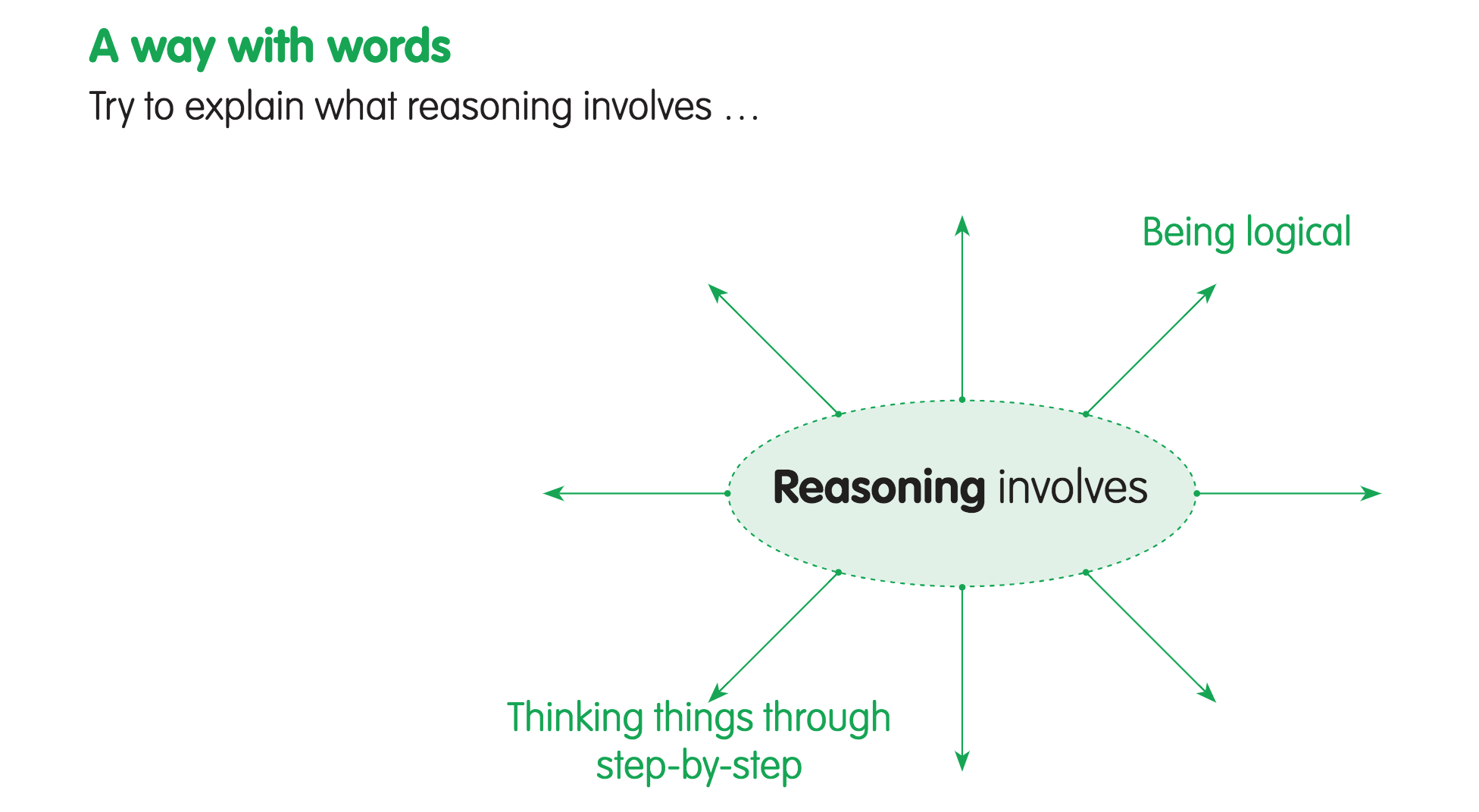
Collect words that tell you how people learn to Reason.
Explore well known sayings
What do we mean when we say …
On the one hand . . .
One step at a time
It adds up
3. Use Reasoning as a lesson starter
Use a quick starter to key students into the learning behaviour you want to concentrate on in the lesson. i.e. here you are starting up the Reasoning behaviour
Primary
Sequencing
Cut up;
a cartoon,
series of pictures of a production process,
a flow diagram,
a mathematical proof,
a story line,
a musical score,
a poem,
a sequence of events, and so on.
Invite students to reassemble the pieces in what they think is a viable order and explain their reasons for this. Model and listen for the language of reasoning to strengthen the process.
[Lift the level of challenge by omitting one or two of the pieces, or by including a red herring or two, or by interleaving two sequences that need to be separated before the sequencing can be completed.]
Secondary
Ranking
Offer students pieces of information or ideas or pictures or statements as a set of separate items, usually on cards.
The subject could be: possible causes of global warming; the sayings of a religious leader; discoveries of the last 20 years; the music of Gershwin; causes of WW1; poems of Sylvia Plath; healthy lifestyle indicators; famous people etc.
The criterion for ranking the cards is given or negotiated with students. For example rank the cards in order of;
importance
appeal
relevance
how controversial
any other appropriate criterion.
The point of the activity is to debate the relative merits, place them in rank order according to the chosen criterion, and to be able to explain and justify the ranking based on evidence rather than opinion.
As the lesson progresses your activities should, by their very nature, develop students’ reasoning AND their understanding of the content.
Here is an idea where, by using reasoning students will gain an understanding of the content AND will develop a reasoning habit.
4. Focus on Reasoning as a learning strategy
Draw out the reasoning behaviour being used in a thinking routine.
The first question in this routine is flexible: it is useful when looking at objects such as works of art or historical artefacts, but it can also be used to explore a poem, make scientific observations and hypotheses, or investigate more conceptual ideas (i.e., democracy). The first question invites students to describe what they notice, see or know, but it is the supplementary question (What makes you say that?) that requires them to build explanations. It promotes evidence-based reasoning and when the students share their interpretations it encourages them to understand alternatives and multiple perspectives.
And here is an idea that will help students to understand the reasoning process.
5. An activity to highlight and strengthen Reasoning
Liepz & Bounz
A jumble of clues to unravel and make sense of. Are there any red herrings? Did we make any assumptions, and were they valid? Did we miss anything vital? Did we ‘get it right’? Can we convince others that our answer is correct?
Use Liepz and Bounz to explore how we have to use our reasoning skills to solve problems.
Make reflecting on Reasoning part of everyday lessons
Here is a very practical example of how you might develop the emotional climate of the classroom and make it reasoning friendly
Learning Mats
Learning mats are A4 laminated sheets that show various aspects of a learning habit. Keep them as prompts on desks/tables or as part of a wall display.
Secondary
A Learning Log to alert students to Reasoning across various aspects of their learning lives
A useful resource for tutor time to guide reflection and a wide ranging discussion
Can you see a use for any of the suggested activities?
Have you raised awareness of reasoning with your students?
Does your class have an agreed set of good reasoning behaviours?
Which two ideas from above do you want to try out?
How long will you keep them going before you decide whether they have worked or not?
Make a note of…
What happens in your classroom in response to any of the above ideas.
How students’ behaviour changes over about 3 weeks of becoming more familiar and talking about the behaviour.
How your behaviour in the classroom changes as you use these ideas over time.
NB. None of the behaviours above will lead to instant understanding in students nor instant changes of behaviour. You will need to drip them in over time and keep building and refreshing your language of learning.
Building Learning Power is about creating a culture in classrooms – that systematically cultivates habits and attitudes that enable young people to face difficulty calmly, confidently and creatively. By a ‘culture’ we mean all the little habits, routines and practices that implicitly convey ‘what we believe and value round here’.
So ‘culture’ concerns the details of the micro-climate that you create in your classrooms. What you do and say, what you notice and commend and what you don’t, what kind of role model of a learner you offer – all these are of the essence. The micro-climate of a classroom can inadvertently stifle, or specifically enhance, the very behaviours you are seeking to promote.
Does my classroom climate encourage Reasoning?
Here is a selection of features which might begin to shape the emotional climate of the classroom to encourage reasoning.
Apply your own attentive noticing and consider whether you already use any of these features and which you fancy trying.
What do you think?
What do your answers suggest?
How does your classroom culture contribute to students’ reactions or approaches to reasoning?
Is this broadly negative or positive?
What insightful ‘Ah Ha’ moments did you have as you read through the list?
How have these changed your view of reasoning?
Make a note of…
Any ideas that look as if they might help students to become better at being logical.
An idea on the list you want to start doing.
An idea that interests you, but you are uncertain what it means or how you might do it.
Reasoning—the kind of logical, analytical, explicit disciplined thinking that schools often focus on (sometimes to the exclusion of some of the other elements). There is a lot of interest at the moment in ways of teaching thinking, and there are many materials for teaching thinking on the market. In Building Learning Power, such ‘Show your working’kinds of thinking are a very important part of the good learner’s toolkit, but they are not the be-all and end-all of learning. In fact, research suggests that secondary schools have not been very successful at developing students’ ability to think logically in real life.
It turns out to be quite difficult to free any kind of thinking or learning skill from its ties to the particular setting and subject matter in which it was originally practised.
Nevertheless, being able to construct logical arguments or make practical use of Venn diagrams, for example, is very useful, and good learners need practice at using such tools in the context of their real-life concerns.
What does being a good Reasoner involve?
A well formed Reasoning habit involves being ready, willing, and able to:
Resist jumping to conclusions;
Seek justifiable evidence to shape sound, well-honed arguments;
Scrutinise your assumptions;
Seek evidence and counter evidence, look for false steps and carefully draw conclusions;
Remain suspicious, doubting and self-doubting in order to avoid unwarranted certainty;
Convey your logical thinking clearly, through dialogue, symbols, analogies, prose and pictures.
So, at a less abstract level, students need to learn the inclination to resist impulsive responses; to respond logically and thoughtfully; to apply logic by explaining, justifying and, ultimately, proving what they think; to utilise a range of reasoning tools; and to develop strategies for presenting their reasoning to others persuasively. When looked at from these diverse angles growing reasoning moves well beyond encouraging a student to ‘think it through’.
Spotting the Reasoners in your classes
Just to get you tuned in – have a quick think about ‘Reasoners you may know’. Make a note of students you know who display these characteristics.
Being a learning powered teacher means developing a keen awareness of the subtleties of your students’ learning behaviours.
What do you think?
How many students come to mind when looked at through the lens of reasoning?
Is there a gender balance or have you noted down more girls than boys or vice versa?
Are the students you have noted from across all age groups or do some dominate?
How do these reasoning characteristics help these students to be better learners?
Make a note of…
Those groups or classes that seem to have lots of good reasoning characteristics.
Providing rich and varied occasions for exercising learning habits;
Infusing learning habits into lessons to enhance content understanding;
Recognising and celebrating the use and growth of learning habits;
Expecting students to take ownership of and responsibility for their own learning habits;
Exploring the development of learning habits with students over time.
As a teacher you are an influential character builder and so need to be mindful of how you help students form, replace, re-form and strengthen their learning habits.
But don’t worry, you’re not there yet. It takes most teachers between 2 and 3 years to become really fluent with this way of teaching. So, go easy on yourself. Feel determined because small steps often prove to be big levers for change. Have a think about what you might do…
What to stop and start
Here are a few ideas you might want to try. Take it steady, this way of teaching can be a big but exciting shift so it’s worth doing it slowly and thoughtfully.
Look first at the Stop/avoid ideas. Some of these are far from trivial but it’s best to try to remove them before starting on the Start/do more of, Start slowly and Experiment with ideas.
What do you think?
Which of the ideas appealed to you most?
Can you see ways of incorporating these into your subject/class routines?
Which would make the biggest difference to your students?
Which would make your life easier?
Make a note of…
Ideas that you want to try and the impact you hope they will have on your teaching and on your students.
Here is a range of things you can say to nudge listening. When you use this kind of language you are talking as a learning coach, encouraging students to think for themselves. Using such statements encourages your students to:
imitate you;
start to think in this way;
become conscious of these phrases and their meaning.
Eventually you will hear some of the questions pop up in students’ self-talk….in speech or even in writing from time to time, but mostly these will go on inside their heads. As your work on listening gathers pace see if you can detect students who talk, or think, in these ways.
My learning talk nudges to encourage Listening
Teacher talk – as a learning coach
Here are 10 ideas to ensure your students do the thinking for themselves
What does the tone of voice tell you about the person?
Close your eyes and let the sounds wash over you.
Can you hear what she’s really saying?
Listen for the main messages. Can you summarise the key points of what you’ve just heard.
How does what he’s saying make you feel?
Wait for your turn to talk.
How can you help XXX to say what they are thinking?
Do you think there’s a deeper meaning in what is being said?
How can you show empathy for the speaker in your responses?
Do you understand the mood and beliefs of the speaker?
What do you think?
Which of these listening nudges might you start using?
In which particular lessons would such nudging be most useful?
How will most of your students respond to such nudges?
Will this way of engaging be more popular with girls or boys?
What other nudging ideas might you add to the list?
Make a note of…
Students’ reactions to the nudges.
Ideas about why this might be.
Ways in which you could further encourage students to imitate this metacognitive self-talk.
Any positive or negative impact of these listening behaviours.
In the early stages of building learning power your role is to; make students aware of the capacity; talk about it (what, how, why, when, if); celebrate its use; give opportunities to practice it, both in lessons and elsewhere; reflect on it to improve it. This staged start is reflected below…
Firstly… make students aware of listening…when, where, why.
Then… explore listening a little more through the language of listening
Try… using listening as a lesson starter to tune students into using it
Then start… blending listening into the way you teach the content. Use specific listening strategies to deepen content understanding.
Ensure… students reflect on the success or otherwise of their listening mindframe.
1. Making students aware of Listening
How you make students aware of the words that describe the behaviour and why it is important to use it.
Primary
Who said “Sausages”?
An activity to encourage good listening skills.
First, try a quiet activity to help the children focus on the physical sensation of intent listening.
Ask the children to move round to sit in a circle.
Ask them to close their eyes and clasp their hands gently on their laps.
Tell them you are going to chime an Indian bell and that they should listen as carefully as they can and only open their eyes when they can no longer hear the sound.
Ask them to be very, very quiet so that they do not disturb each other.
Now move on to a simple listening game.
Children remain sitting in their circle. They take turns to sit blindfolded in the middle.
Point to a child in the circle who then says “sausages.” The blindfolded child has to guess whose voice it is.
As the children become more familiar with this game, they will deliberately alter their voices and it can be a lot of fun.
Regularly remind the children of the skills they are using and reward really good listening!
After playing this game, you may be able to agree some good listening tips with the children.
Now think about how you could extend this into other listening activities.
Secondary
What Can You Hear?
A short listening activity to help students to recognise that attentive listening enables them to centre themselves, focus on what is really happening and take possession of themselves as learners.
Explore sentences spoken with different stress, tone, pace and emphasis, to yield different meanings.
For example:
‘I don’t know why you didn’t go.’
‘How can I answer that?’
Secondary
Silent Film Show
Play a two-minute scene from a film, without the visuals.
Listen for clues in sound effects, voices, soundtrack.
Predict / speculate what is happening.
Show the film and attend to the way in which sounds contributed to meaning.
2. Exploring the language of Listening
How you might extend the language and understanding of this behaviour
Primary
Discuss listening and tone of voice.
Model different tones of voice. Start with ones that are easy to recognise and understand, like a cross voice or a scared one. Gradually build up this repertoire of voices and use them in stories and songs. Talk about when we use these different tones of voice and why. Ask the children to listen carefully to the way people talk at different times and spot their feelings.
Expand further by inventing voices that you can use for different activities: imagine the voices for different toys or puppets you may have in the classroom; say that you are all going to count like robots today; recite a rhyme like the big bad wolf. The children will have fun inventing a wide and wonderful assortment of voices whilst refining their listening skills.
Secondary
A way with words
Collect words that tell you how people learn to listen attentively.
Explore well known sayings
What do we mean when we say …
Being all ears
Listening between the lines
3. Using Listening as a lesson starter
Use a quick starter to key students into the learning behaviour you want to concentrate on in the lesson. i.e. here you are starting up the listening behaviour
Primary
Centring Activities
Use centring activities at the beginning of lessons to focus minds before the learning begins. Play music and ask students to focus on the associations that it conjures about places, people, moods and atmospheres.
Something wrong here ?
Read a sentence or statement without expression, then read it again, once, with changes; no further repetition. Students have to spot the changes.
Secondary
Listening for inference and understanding
Play recordings of, for example:
One end of a telephone conversation: Who’s on the other end… What’s being said… How do you know?
A dialogue: What’s just happened… What happens next… How do you know?
Recognisable people: Who are they… What’s the evidence… How do you know?
Unknown individuals talking: What do you know… Who could they be… How do you know?
As you get deeper into a lesson you will need activities which, by their very nature, will develop students’ listening AND their understanding of the content.
Here is an idea where, by using listening students will gain an understanding of the content AND will develop a listening habit.
4. Focusing on Listening as a learning strategy
Draw out the listening behaviour being used in a thinking routine.
Primary and Secondary
Visible Thinking Routine
What did (s)he say ?
This routine helps students to listen carefully for and to understand important factual information. It also encourages them to distil key points as they listen for key messages. The routine has two questions:
What are the big ideas ?
What are the big ideas in your own words ?
The natural place to use this routine is before students are about to listen to something – it could be a video, a You Tube clip, or even teacher exposition. The routine works just as well with small groups or individually.
And here is an idea that will help students to understand the listening process.
5. An activity to highlight and strengthen Listening
Design specific activities to highlight and strengthen the behaviour
Listen and Draw
A short and enjoyable task that can only be achieved through careful explanation and attentive listening. Use it to stimulate a discussion about jumping to conclusions based on partial information.
Can you see a use for any of the suggested activities?
Have you raised awareness of attentive listening with your students?
Does your class have an agreed set of good listening behaviours?
Which two ideas from above do you want to try out?
How long will you keep them going before you decide whether they have worked or not?
Make a note of…
What happens in your classroom in response to any of the above ideas.
How students’ behaviour changes over about 3 weeks of becoming more familiar and talking about the behaviour.
How your behaviour in the classroom changes as you use these ideas over time.
NB. None of the behaviours above will lead to instant understanding in students nor instant changes of behaviour. You will need to drip them in over time and keep building and refreshing your language of learning.
Building Learning Power is about creating a culture in classrooms – that systematically cultivates habits and attitudes that enable young people to face difficulty calmly, confidently and creatively. By a ‘culture’ we mean all the little habits, routines and practices that implicitly convey ‘what we believe and value round here’.
So ‘culture’ concerns the details of the micro-climate that you create in your classrooms. What you do and say, what you notice and commend and what you don’t, what kind of role model of a learner you offer – all these are of the essence. The micro-climate of a classroom can inadvertently stifle, or specifically enhance, the very behaviours you are seeking to promote.
Does my classroom climate encourage Listening?
Here is a selection of features which might begin to shape the emotional climate of the classroom to encourage Listening.
Apply your own attentive noticing and consider whether you already use any of these features and which you fancy trying.
What do you think?
What do your answers suggest?
How does your classroom culture contribute to students’ reactions or approaches to attentive listening?
Is this broadly negative or positive?
What insightful ‘Ah Ha’ moments did you have as you read through the list?
How have these changed your view of listening?
Make a note of…
Any ideas that look as if they might help students to become better at listening.
An idea on the list you want to start doing.
An idea that interests you, but you are uncertain what it means or how you might do it.
Empathy and listening are core skills. We bracket them together because listening is the main medium through which empathy is generated and communicated. Students can quite readily be coached in the art of being a good listener, and can be given games and exercises that help them develop the ability to hear what someone else has said and, if necessary, play it back to them. Teachers sometimes complain that students will not listen, either to them or to each other; but the habit of listening can be cultivated in most classes inside a term. The most powerful way to do this is for the teachers to model good listening.
There is some suggestion that people who suffer from autism lack the ability to see the world through other people’s eyes. And it is also possible that many bullies have failed to develop the ability to read other people’s emotional signals. But for the vast majority of students, empathy develops with a little encouragement.
What does being a good Listener involve?
A well formed Listening habit involves being ready, willing, and able to:
Be genuinely interested in other people and what they are saying;
Focus on the current moment, being attentive and responsive to visual cues and atmosphere;
Notice subtle details and nuances in what is being said;
Know when to make well-judged interventions to elucidate, probe or challenge;
Manage distractions constructively;
Be comfortable with silence and attend actively to what is being said.
Spotting the Listeners in your classes
Just to get you tuned in – have a quick think about ‘listeners you may know’. Make a note of students you know who display these characteristics.
Being a learning powered teacher means developing a keen awareness of the subtleties of your students’ learning behaviours.
What do you think?
How many students come to mind when looked at through the lens of listening?
Is there a gender balance or have you noted down more girls than boys or vice versa?
Are the students you have noted from across all age groups or do some dominate?
How do these listening characteristics help these students to be better learners?
Make a note of…
Those groups or classes that seem to have lots of good listening characteristics.
Providing rich and varied occasions for exercising learning habits;
Infusing learning habits into lessons to enhance content understanding;
Recognising and celebrating the use and growth of learning habits;
Expecting students to take ownership of and responsibility for their own learning habits;
Exploring the development of learning habits with students over time.
As a teacher you are an influential character builder and so need to be mindful of how you help students form, replace, re-form and strengthen their learning habits.
But don’t worry, you’re not there yet. It takes most teachers between 2 and 3 years to become really fluent with this way of teaching. So, go easy on yourself. Feel determined because small steps often prove to be big levers for change. Have a think about what you might do…
What to stop and start
Here are a few ideas you might want to try. Take it steady, this way of teaching can be a big but exciting shift so it’s worth doing it slowly and thoughtfully.
Look first at the Stop/avoid ideas. Some of these are far from trivial but it’s best to try to remove them before starting on the Start/do more of, Start slowly and Experiment with ideas.
What do you think?
Which of the ideas appealed to you most?
Can you see ways of incorporating these into your subject/class routines?
Which would make the biggest difference to your students?
Which would make your life easier?
Make a note of…
Ideas that you want to try and the impact you hope they will have on your teaching and on your students.
Here is a range of things you can say to nudge perseverance. When you use this kind of language you are talking as a learning coach, encouraging students to think for themselves. Using such statements encourages your students to:
imitate you;
start to think in this way;
become conscious of these phrases and their meaning.
Gradually you will hear some of the ideas pop up in students’ self-talk….in speech or even in writing from time to time, but mostly these will go on inside their heads. As your work on persevering gathers pace see if you can detect students who talk, or think, in these ways.
My learning talk nudges to encourage Perseverance
Teacher talk – as a learning coach
Here are 10 ideas to ensure your students do the thinking for themselves
What happened when you got stuck before? What did you do to work it out?
Great! You have come through the confused / stuck feeling. What helped you?
It’s when you get stuck that you really start to learn.
How can you avoid that distraction?
Is this goal worth going for?
What do you know? What do you need to know? How might you bridge the gap?
You can’t do it – yet.
Can you explain why you are stuck?
That’s an interesting mistake.
Give it a go and see what happens.
What do you think?
Which of these perseverance nudges might you start using?
In which particular lessons would such nudging be most useful?
How will most of your students respond to such nudges?
Will this way of engaging be more popular with girls or boys?
What other nudging ideas might you add to the list?
Make a note of…
Students’ reactions to the nudges.
Ideas about why this might be.
Ways in which you could further encourage students to imitate this metacognitive self-talk.
Any positive or negative impact of these perseverant behaviours.
In the early stages of building learning power your role is to; make students aware of the behaviour; talk about it (what, how, why, when, if); celebrate its use; give opportunities to practice it, both in lessons and elsewhere; reflect on it to improve it. This staged start is reflected below…
Some ideas to enable students to become more perseverant
Firstly… make students aware of perseverance…what, when, where, why, if.
Then… explore perseverance a little more through the language of persevering.
Try… strengthening more positive feelings about being stuck, the value of mistakes or the exhilaration of challenge.
Then start… blending the above aspects of perseverance into the way you teach the content. Teach perseverance strategies.
Ensure… students reflect on the success or otherwise of their ‘sticking at it’ efforts.
1. Making students aware of Persevering
How you make students aware of the words that describe the behaviour and why it is important to use it.
Primary
Develop learning heroes
‘Adopt’ a character – real, imaginary, human or animal – who exhibits the best features of perseverance. Talk about the character until your children become familiar with its attributes. When you have set a group to work on a particular task – numeracy, reading, writing etc., leave this character (actual or picture) on their table as a reminder of ‘there are things you can do when you don’t know what to do’
Secondary
Explore strategies for getting unstuck…
…by looking at the hows of being stuck. Different sorts of stuck call for different strategies:
Develop prompts to nudge students’ self talk:
You have forgotten the next step in a process – what might I try next.
You tried something that didn’t work- what would be an alternative strategy?
You don’t understand the problem/objective/goal – I need to re-read the ‘question’.
The problem is presented differently – what does this remind me of? What did I do then?
You don’t know which remedy to choose – what’s the range of possible strategies I could use?
You can’t find a way out, you are in a blind alley – I’ll retrace my steps back to where I first ‘got lost’.
You don’t know where to find more information – where else might I look?
Primary
Enable students to become aware of levels of challenge
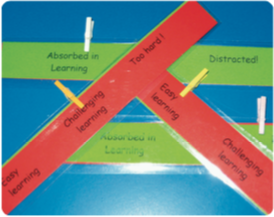
Provide a laminated strip of card and a clothes peg. The card is marked ‘Too Easy’, ‘Hard but not too hard’ and ‘Too difficult’
Students move the peg to indicate the difficulty of the task. Good information for the teacher to judge when and how to intervene. A great opportunity for students to become aware of how they assess their own levels of challenge.
Invite students to think up their own ideas about achievement.
Here are some examples from children.
An achievement is something;
you can be really proud of
you have never done it before
that you kept trying to do and finally succeeded
you have done something you found difficult
you have worked hard to finish
you have done what teachers tell you is good
Make sure your praise matches these statements.
Secondary
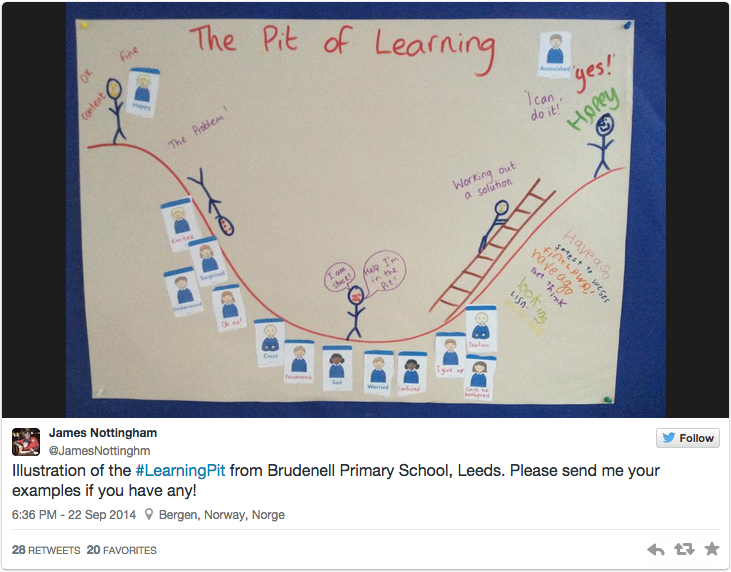
Introduce the Learning Pit to explore the stuck/struggle journey
Use the ‘Learning Pit’ as a means of opening up a conversation around the feelings involved with being stuck, and the journey towards getting unstuck – the struggle. It is essential that students know:
that the ‘pit’ is only one staging post on the learning journey
they can get out by using ‘stuck strategies’ and tools
It is also worth noting that the pit is not necessarily inevitable for all students in all learning – some will fly over the pit in some topics or curriculum areas.
2. Exploring the language of Persevering
How you might extend the language and understanding of this behaviour
Primary
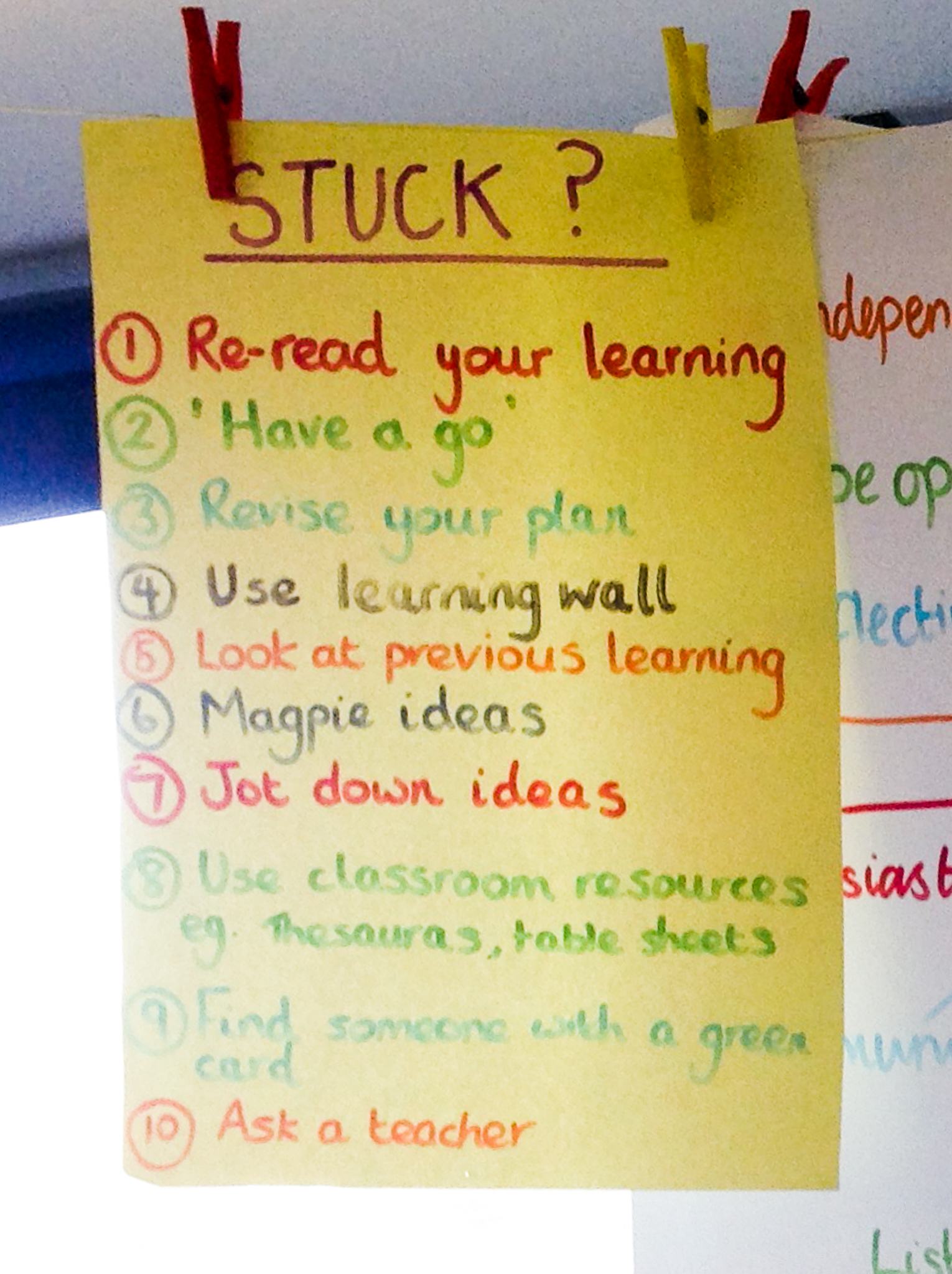
Develop ‘stuck prompts’ together
Work with students to find useful questions to ask themselves and helpful strategies for them to use when they are stuck.
Ensure that there are plenty of options that come higher on the list than “Ask the teacher”.
Create stuck prompts as reminders around the classroom.
These are, in effect, low-risk, low-investment levers for creating a shift in students’ sense of what is valued, what is normal, and what is the point of their learning — and thus in the quality of their engagement.
Secondary
A way with words
What do we mean when we say . .
Look at these quotations. What message is the writer trying to convey?
Consider the postage stamp: its usefulness consists of the ability to stick to one thing ‘til it gets there
Fall seven times, stand up eight
Perseverance is the hard work you do after you get tired of doing the hard work you already did
3. Counter attitudes that limit perseverance, strengthen the positives.
Consider what your students feel about being stuck, facing challenge, and risking failure. Think how you might adjust your language to re-frame their outlook.
Primary and Secondary
Re-framing Stuck and Challenge
Many students are eager to ‘get things right (first time!)’, to ‘do things quickly’, to ‘avoid errors’ because they perceive that’s what good learners do and want to be the same. This mindset means being stuck is: shameful, the point at which learning finishes rather than a stepping stone to new learning; challenge should be avoided rather than embraced; breaking new ground is too risky at the edge of their comfort zone, with all of the attendant risks of ‘failure’. Here are some ‘starters for 10’ to begin to tackle it.
Adopt a coaching role
Model being a learner and show how you work things out, get unstuck, learn from mistakes.
When modelling
Take on the role of an intelligent novice
Model getting unstuck at a slightly higher, more coherent and informed level than is characteristic of your students
Model your ‘think alouds’
When students get perplexed
If students freeze offer supportive questions NOT answers.
‘What do you do next?’
and ‘Then what do you do next’
and ‘Then what do you do next’
Thus you are encouraging students to take over the job for themselves
Remind students that uncertainty shouldn’t lead to paralysis!
Re-framing Challenge
Give Mistakes a status, a key role in learning
Give mistake quotas. Tell students you expect them to make, say.3 in a lesson. If not, the challenges they are tackling are too easy and they should move to harder ones.
Explore the concept of ‘Good mistakes’ – where the student has misunderstood something thus enabling you and the student to track the issue.
Offer a range of ‘good mistakes’ at the start of a lesson for students to find, explore and correct.
Give time in lessons for students to Trial and Improve something. Discard ‘trial and error’.
4. Focusing on Persevering as a learning strategy
Draw out the persevering behaviour being used in a thinking routine.
Primary and Secondary
Visible Thinking Routine
From ‘I’m stuck ‘ To ‘I’m stuck because …‘
When a student says ‘I’m stuck’, resist the temptation to ask ‘what are you stuck on?’ – you know only too well they will probably reply ‘everything’. Better to explore ‘why’ they are stuck . . . .
Encourage students to identify the cause of their stuckness. Move students from saying “I’m stuck” to ” I’m stuck because…” Naming the problem will often suggest a reasonable next step.
It’s also useful to insist that students can’t call themselves ‘stuck’ unless they have tried to apply at least 1 solution.
And here is an idea that will help students to understand the persevering process.
5. An activity to highlight and strengthen Persevering
Use Origami to help students explore keeping going with a challenge.
A seemingly simple task that frequently leads to frustration and the need to have another go. Some students may do it fairly easily, others will give up, and some will struggle through and achieve, almost to their surprise, the desired outcome. Use the task to explore the feelings around stuck, challenge, potential distractions, and trying to achieve a goal.
Use it as an opportunity to explore further with the group — what makes us give up, what helps us keep going?
Make reflecting on persevering part of everyday lessons
Learning Mats
Learning mats are A4 laminated sheets that show various aspects of a learning habit. Keep them on desks/tables or as part of a wall display.
Students refer to them during lessons, using them as prompts about the finer aspects of a learning habit that is being stretched.
Secondary
A Perseverance Learning Log
Use learning logs such as this to encourage students to reflect on when they did and didn’t persevere, and what happened as a consequence. Use as the basis of discussion.
Can you see a use for any of the suggested activities?
Have you raised awareness of perseverance with your students?
Does your class have an agreed set of good persevering behaviours?
Which two ideas from above do you want to try out?
How long will you keep them going before you decide whether they have worked or not?
Make a note of…
What happens in your classroom in response to any of the above ideas.
How students’ behaviour changes over about 3 weeks of becoming more familiar and talking about the behaviour.
How your behaviour in the classroom changes as you use these ideas over time.
NB. None of the suggestions above will lead to instant understanding in students nor instant changes in their behaviour. You will need to drip them in over time and keep building and refreshing your language of learning.
Building Learning Power is about creating a culture in classrooms – that systematically cultivates habits and attitudes that enable young people to face difficulty calmly, confidently and creatively. By a ‘culture’ we mean all the little habits, routines and practices that implicitly convey ‘what we believe and value round here’.
So ‘culture’ concerns the details of the micro-climate that you create in your classrooms. What you do and say, what you notice and commend and what you don’t, what kind of role model of a learner you offer – all these are of the essence. The micro-climate of a classroom can inadvertently stifle, or specifically enhance, the very behaviours you are seeking to promote.
Does my classroom climate encourage Persevering?
Here is a selection of features which might begin to shape the emotional climate of the classroom to encourage persevering.
Apply your own attentive noticing and consider whether you already use any of these features and which you fancy trying.
What do you think?
What do your answers suggest?
How does your classroom culture contribute to students’ reactions or approaches to persevering?
Is this broadly negative or positive?
What insightful ‘Ah Ha’ moments did you have as you read through the list?
How have these changed your view of perseverance?
Make a note of…
Any ideas that look as if they might help students to become better at persevering.
An idea on the list you want to start doing.
An idea that interests you, but you are uncertain what it means or how you might do it.
Attention can be broken when learning gets blocked, but good learners have learnt the knack of maintaining or quickly re-establishing their concentration when they get stuck or frustrated. The quality of stickability or perseverance is essential if you are going to get to the bottom of something that doesn’t turn out as quickly or easily as you had thought, or hoped.
If you get upset and start to think there is something wrong with you as soon as you get stuck, you are not going to be able to maintain engagement.
Instead all your energy will go into trying to avoid the uncomfortable feeling, and this may mean drifting off into a daydream, creating a distraction, or blaming somebody else. A great deal of classroom misbehaviour starts this way. If students were better equipped to cope emotionally with the inevitable difficulty of learning, they would mess about less. There is a range of things that teachers can do to strengthen students’ stickability.
Perseverance is often undermined by two common and erroneous beliefs. The first is that learning ought to be easy. If learners think that they will either understand something straight away, or not at all, then there is simply no point in persisting and struggling. The second is that bright people pick things up easily, so if you have to try it means you’re not very bright. Clearly the idea that effort must be symptomatic of a lack of ability makes persevering an unpleasant experience. Good learners develop perseverance when their parents and teachers avoid conveying these messages, even unwittingly.
What does being a good Perseverer involve?
A well formed Persevering habit involves being ready, willing, and able to:
Keep going in the face of difficulties;
Enjoy working at the edge of our comfort zone;
Channelling the energy of frustration productively, marshalling positive emotions to succeed;
Understanding that learning is often a slow and uncertain process that requires grit,risk-taking and different ways of working;
Relish working towards ever more challenging goals without fear of ‘failure’.
Spotting the Perseverers in your classes
Just to get you tuned in – have a quick think about ‘Perseverers you may know’. Make a note of students you know who display these characteristics.
Being a learning powered teacher means developing a keen awareness of the subtleties of your students’ learning behaviours.
What do you think?
How many students come to mind when looked at through the lens of perseverance?
Is there a gender balance or have you noted down more girls than boys or vice versa?
Are the students you have noted from across all age groups or do some dominate?
How do these perseverant characteristics help these students to be better learners?
Make a note of…
Those groups or classes that seem to have lots of good perseverant characteristics.
Providing rich and varied occasions for exercising learning habits;
Infusing learning habits into lessons to enhance content understanding;
Recognising and celebrating the use and growth of learning habits;
Expecting students to take ownership of and responsibility for their own learning habits;
Exploring the development of learning habits with students over time.
As a teacher you are an influential character builder and so need to be mindful of how you help students form, replace, re-form and strengthen their learning habits.
But don’t worry, you’re not there yet. It takes most teachers between 2 and 3 years to become really fluent with this way of teaching. So, go easy on yourself. Feel determined because small steps often prove to be big levers for change. Have a think about what you might do…
What to stop and start
Here are a few ideas you might want to try. Take it steady, this way of teaching can be a big but exciting shift so it’s worth doing it slowly and thoughtfully.
Look first at the Stop/avoid ideas. Some of these are far from trivial but it’s best to try to remove them before starting on the Start/do more of, Start slowly and Experiment with ideas.
What do you think?
Which of the ideas appealed to you most?
Can you see ways of incorporating these into your subject/class routines?
Which would make the biggest difference to your students?
Which would make your life easier?
Make a note of…
Ideas that you want to try and the impact you hope they will have on your teaching and on your students.
Here is a range of things you can say to nudge imagining. When you use this kind of language you are talking as a learning coach, encouraging students to think for themselves. Using such statements encourages your students to:
imitate you;
start to think in this way;
become conscious of these phrases and their meaning.
Eventually you will hear some of the questions pop up in students’ self-talk….in speech or even in writing from time to time, but mostly these will go on inside their heads. As your work on imagining gathers pace see if you can detect students who talk, or think, in these ways.
My learning talk nudges to encourage Imagining
Teacher talk – as a learning coach
Here are 10 ideas to ensure your students do the thinking for themselves
What would happen if …
Try to picture … in your mind. Tell me about . . . .
Can you use your mind’s eye to see what that might look like?
Are there any other possible explanations?
Close your eyes – what can you see? Hear? Feel?
What do you feel might be happening?
What could this be?
How might you do this differently?
Imagine yourself doing it before you do it for real.
Can you imagine how xxx feels now even though you disagree with their views?
What do you think?
Which of these imagining nudges might you start using?
In which particular lessons would such nudging be most useful?
How will most of your students respond to such nudges?
Will this way of engaging be more popular with girls or boys?
What other nudging ideas might you add to the list?
Make a note of…
Students’ reactions to the nudges.
Ideas about why this might be.
Ways in which you could further encourage students to imitate this metacognitive self-talk.
Any positive or negative impact of these imagining behaviours.
Some ideas to encourage an Imagining frame of mind.
In the early stages of building learning power your role is to; make students aware of the behaviour; talk about it (what, how, why, when, if); celebrate its use; give opportunities to practice it, both in lessons and elsewhere; reflect on it to improve it. This staged start is reflected below…
Firstly… make students aware of imagining…when, where, why.
Then… explore imagining a little more through the language of imagining
Try… using imagining as a lesson starter to tune students into using it
Then start… blending imagining into the way you teach the content. Use specific imagining strategies to deepen content understanding.
Ensure… students reflect on the success or otherwise of their imagining mindframe.
1. Making students aware of Imagining
How you make students aware of the words that describe the behaviour and why it is important to use it.
Primary
The Mind’s Eye
Introduce pupils to the idea of the mind’s eye: Talk about the fact that we all have 2 eyes which we use all the time but that everyone also has a third, hidden, mind’s eye. Talk about how we can use this secret third eye to imagine and create pictures and ideas inside our minds.
Invite pupils to close their eyes and imagine they are using their third eye. Describe something in great detail and ask them to try and see it with their third eye.
Here is an example: Close your eyes tightly and imagine my alien. It has a large, round, green body with lots of arms and legs. On the top of the round, green body is a huge pink and purple head with spiky yellow hair and 4 great big blue eyes. It has long, pink fingers on its hands and short, purple toes on its big feet. When it walks along it makes a high squeaky sound and it smells just like fish and chips!
You could ask them to draw their idea of the alien, concentrating on their ideas rather than an exact representation of your description.
Ask pupils to imagine something for themselves- unprompted by you. Invite them to describe what they are imagining.
Talk about what seems to happen in their mind when they imagine.
Talk about when our ability to imagine can be useful.
Ask, “When do you use your imagination?”
Secondary
Guided Visualisation
Invite students to visualise, for example, a snowy mountain peak until the image fades – discuss how long this could be sustained.
Now visualise hovering over the mountain and exploring the terrain by helicopter – the experience will have lasted longer.
Now provide students with a guided visualisation of the mountain that triggers their imaginative faculties – discuss the features of this experience.
Enable students to identify the ways of triggering their own imaginations when provided with stimuli. Invite them into a city at night, or the alimentary canal, . . .
Stimulating the imagination
Use music to create atmosphere and stimulate imaginative thinking.
Provide varied, unexpected and ever-changing visual experiences — on whiteboards, classroom walls, in ideas banks, through web-links, etc.
Read vivid prose and poetry that captures details, moods and atmospheres.
Primary
Capturing ideas
Encourage students to brainstorm or mind-map and keep notebooks or Post-its of interesting ideas to feed their creativity. Do this collectively and individually.
Elect one student ‘Plant of the Day’, whose job it is to suggest unlikely ideas.
Secondary
Play the prediction game
Show video clips of e.g. Beckham and Wilkinson preparing to kick a ball, as well as other sports and entertainment people rehearsing ahead of action.
Discuss what they are doing to ‘play the movie’ in their heads before they act.
Explore occasions when this could be useful in students’ own lives. Identify the triggers and habits required when anticipating the right action.
2. Exploring the language of Imagining
How you might extend the language and understanding of this behaviour
Primary
What else could it be ?
Give students a familiar object – a pencil, hairbrush, scissors, toilet roll, cushion – whatever comes to hand.
Then pose the question: ‘What else could it be?’
Discuss and praise the most imaginative ideas.
What you are trying to develop in young learners is:
An awareness of the power of imagination;
The ability to use their imagination to picture how things might look, sound, feel or be;
The willingness to talk imaginatively about situations, events, characters, etc.
Secondary
A way with words . .
Click to enlarge
Collect words that tell you how people learn to imagine.
Explore well known sayings
What do we mean when we say …
In my mind’s eye
Thinking outside the box
3. Using Imagining as a lesson starter
Use a quick starter to key students into the learning behaviour you want to concentrate on in the lesson. i.e. here you are starting up the imagining behaviour
Primary
Telling Stories
Provide a stem statement…
A man walks into a room with a suitcase in his hand…
Invite one student to carry it on. Each student continues from where the previous one left off.
Or . .
Create a scenario…There are no windows, water drips into a bucket, two people are seated back to back…what might be happening? What might happen next? Can you improvise the dialogue between the people?
Secondary
‘What if …’ challenges
Provoke students to think ‘What if… we ran out of oil in 25 years… we lived in a two-dimensional world… we all lived for exactly 70 years… tennis balls were heavier… we had two moons…’
Encourage students to build collaborative spider diagrams that explore the possible ramifications of such eventualities. Extend the imagining in creative presentations using a variety of media.
As you get deeper into a lesson you will need activities which, by their very nature, will develop students’ Imagining AND their understanding of the content.
Here is an idea where, by using Imagining, students will gain an understanding of the content AND will develop a Imagining habit.
4. Focusing on Imagining as a learning strategy
Draw out the Imagining behaviour being used in a thinking routine.
Primary and Secondary
Visible Thinking Routine
Creative Questions
Creative Questions is a visible thinking routine that encourages students to create interesting questions and then imaginatively mess around with them for a while in order to explore their creative possibilities:
Pick an everyday object or topic and brainstorm a list of questions about it.
Look over the list and transform some of the questions into questions that challenge the imagination. Do this by transforming questions along the lines of:
What would it be like if…
How would it be different if…
Suppose that …
What would change if …
How would it look differently if …
Choose a question to imaginatively explore. Explore it by imaginatively playing out its possibilities. Do this by: Writing a story or essay, drawing a picture, creating a play or dialogue, inventing a scenario, conducting an imaginary interview, conducting a thought experiment . . . .
Reflect: What new ideas do you have about the topic, concept or object that you didn’t have before?
For more detail on Creative Questions, visit the Visible Thinking website:
And here is an idea that will help students to understand the imagining process.
5. An activity to highlight and strengthen Imagining
Design specific activities to highlight and strengthen the behaviour
Imagining through all of the senses . . .
Click to enlarge
What has happened here ? Good guy or bad ? Can we see any colours ? Hear any sounds ? Imagine being there….
A quick way to activate the Imagination and explore how we use our senses to imagine.
What you are trying to achieve:
To support students to use their imaginations using all of their senses,
How might you use the technique?
As a starter for creative writing
As a prelude to reading a book – start with the B&W copy of the dust jacket.
To build empathy
To scaffold the use of all of the senses
To trigger the imagination
6. Reflecting on Imagining
Primary
Make reflecting on Imagining part of everyday lessons
Here is a very practical example of how you might develop the emotional climate of the classroom and make it Imagining friendly
Learning Mats
Learning mats are A4 laminated sheets that show various aspects of a learning habit. Keep them on desks/tables or as part of a wall display.
Secondary
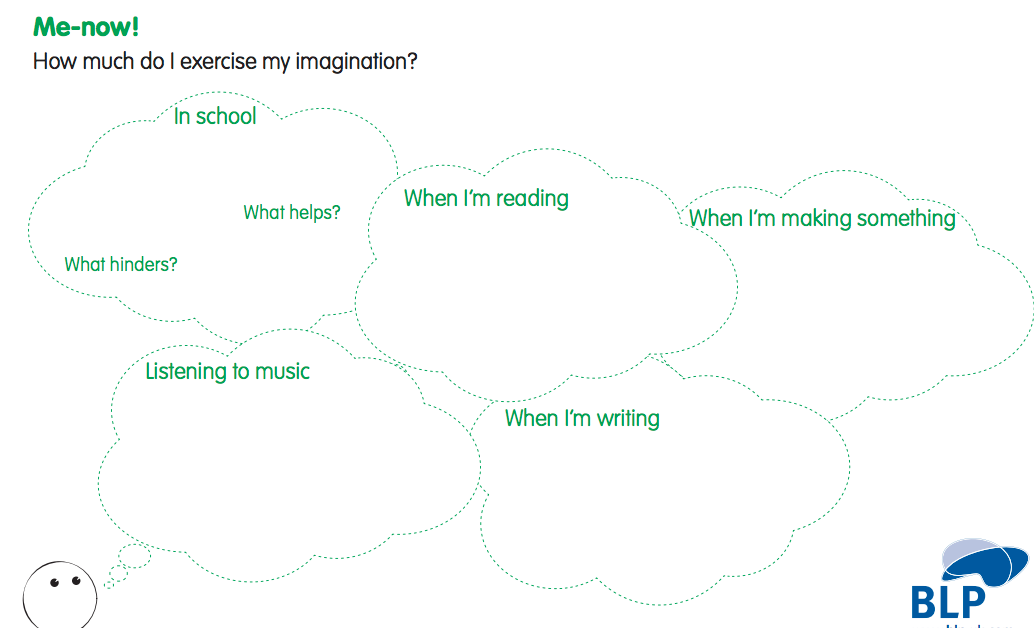
Alert students to how they use their Imaginations
Click to enlarge
A useful resource for tutor time to guide a wide ranging discussion.
Primary and Secondary
What do you think?
Can you see a use for any of the suggested activities?
Have you raised awareness of imagining with your students?
Does your class have an agreed set of good imaginative behaviours?
Which two ideas from above do you want to try out?
How long will you keep them going before you decide whether they have worked or not?
Make a note of…
What happens in your classroom in response to any of the above ideas.
How students’ behaviour changes over about 3 weeks of becoming more familiar and talking about the behaviour.
How your behaviour in the classroom changes as you use these ideas over time.
NB. None of the suggestions above will lead to instant understanding in students nor instant changes in their behaviours. You will need to drip them in over time and keep building and refreshing your language of learning.
Building Learning Power is about creating a culture in classrooms – that systematically cultivates habits and attitudes that enable young people to face difficulty calmly, confidently and creatively. By a ‘culture’ we mean all the little habits, routines and practices that implicitly convey ‘what we believe and value round here’.
So ‘culture’ concerns the details of the micro-climate that you create in your classrooms. What you do and say, what you notice and commend and what you don’t, what kind of role model of a learner you offer – all these are of the essence. The micro-climate of a classroom can inadvertently stifle, or specifically enhance, the very behaviours you are seeking to promote.
Does my classroom climate encourage Imagining?
Here is a selection of features which might begin to shape the emotional climate of the classroom to encourage Imagining.
Apply your own attentive noticing and consider whether you already use any of these features and which you fancy trying.
What do you think?
What do your answers suggest?
How does your classroom culture contribute to students’ reactions or approaches to imagining?
Is this broadly negative or positive?
What insightful ‘Ah Ha’ moments did you have as you read through the list?
How have these changed your view of imagining?
Make a note of…
Any ideas that look as if they might help students to become better at imagining.
An idea on the list you want to start doing.
An idea that interests you, but you are uncertain what it means or how you might do it.
Imagination is not just a cute faculty that children use to weave fantasies: it is one of the most effective tools in the learner’s toolbox. Scientists, designers and executives need a powerful imagination just as much as painters and novelists, and it can either be developed, through appropriate experience and encouragement, or left to shrivel up. Good learners are ready and able to look at things in different ways. They like playing with ideas and possibilities, and adopting different perspectives (even though they may not have a clear idea of where their imagination is leading them). They use pictures and diagrams to help them think and learn.
There are two kinds of imagination: active and receptive. In active imagination, you deliberately create a scenario to run in your mind’s eye. Sports people use this kind of mental rehearsal, and experiments have shown it to be very effective at improving their level of skill.
The second kind of imagination is more receptive, like daydreaming: letting a problem slip to the back of your mind, and then just sliding into a kind of semi-awake reverie, where the mind plays with ideas and images without much control on your part. Successful learners and inventors know how to make good use of this kind of creative intuition. They are interested in inklings and ideas that just bubble up into their minds.
What does being a good Imaginer involve?
A well formed Imagining habit involves being ready, willing, and able to:
Use the mind as a theatre in which to play out ideas and possible actions experimentally;
Use a rich variety of visual, aural and sensory experiences to trigger creative and lateral thinking;
Explore possibilities speculatively, saying ‘What might …’, ‘What could …’ and ‘What if …?’ rather than being constrained by what is;
Retain a childlike playfulness when confronted with challenges and difficulties;
Be aware of intended outcomes whilst adopting a flexible approach to realising goals;
Rehearse actions in the mind before performing them in reality.
Spotting the Imaginers in your classes
Just to get you tuned in – have a quick think about ‘imaginers you may know’. Make a note of students you know who display these characteristics.
Being a learning powered teacher means developing a keen awareness of the subtleties of your students’ learning behaviours.
What do you think?
How many students come to mind when looked at through the lens of imagining?
Is there a gender balance or have you noted down more girls than boys or vice versa?
Are the students you have noted from across all age groups or do some dominate?
How do these imagining characteristics help these students to be better learners?
Make a note of…
Those groups or classes that seem to have lots of good imagining characteristics.
Providing rich and varied occasions for exercising learning habits;
Infusing learning habits into lessons to enhance content understanding;
Recognising and celebrating the use and growth of learning habits;
Expecting students to take ownership of and responsibility for their own learning habits;
Exploring the development of learning habits with students over time.
As a teacher you are an influential character builder and so need to be mindful of how you help students form, replace, re-form and strengthen their learning habits.
But don’t worry, you’re not there yet. It takes most teachers between 2 and 3 years to become really fluent with this way of teaching. So, go easy on yourself. Feel determined because small steps often prove to be big levers for change. Have a think about what you might do…
What to stop and start
Here are a few ideas you might want to try. Take it steady, this way of teaching can be a big but exciting shift so it’s worth doing it slowly and thoughtfully.
Look first at the Stop/avoid ideas. Some of these are far from trivial but it’s best to try to remove them before starting on the Start/do more of, Start slowly and Experiment with ideas.
What do you think?
Which of the ideas appealed to you most?
Can you see ways of incorporating these into your subject/class routines?
Which would make the biggest difference to your students?
Which would make your life easier?
Make a note of…
Ideas that you want to try and the impact you hope they will have on your teaching and on your students.
Here is a range of things you can say to nudge planning. When you use this kind of language you are talking as a learning coach, encouraging students to think for themselves. Using such statements encourages your students to:
imitate you;
start to think in this way;
become conscious of these phrases and their meaning.
Eventually you will hear some of the questions pop up in students’ self-talk….in speech or even in writing from time to time, but mostly these will go on inside their heads. As your work on planning gathers pace see if you can detect students who talk, or think, in these ways.
My learning talk nudges to encourage Planning
Teacher talk – as a learning coach
Here are 10 ideas to ensure your students do the thinking for themselves
What will your end product look like?
How will you judge the success of what you have done?
Look at what you have done so far – do you need to make any changes?
Are you on track to meet your deadline?
What needs doing? In what order will you tackle it?
Do you have a contingency plan if that does not work?
Keep a weather eye on how it is going.
Are any particular planning tools appropriate here?
Is the goal manageable?
How can you make this plan more efficient?
What do you think?
Which of these planning nudges might you start using?
In which particular lessons would such nudging be most useful?
How will most of your students respond to such nudges?
Will this way of engaging be more popular with girls or boys?
What other nudging ideas might you add to the list?
Make a note of…
Students’ reactions to the nudges.
Ideas about why this might be.
Ways in which you could further encourage students to imitate this metacognitive self-talk.
Any positive or negative impact of these planning behaviours.
In the early stages of building learning power your role is to; make students aware of the capacity; talk about it (what, how, why, when, if); celebrate its use; give opportunities to practice it, both in lessons and elsewhere; reflect on it to improve it. This staged start is reflected below…
Firstly… make students aware of planning…when, where, why.
Then… explore planning a little more through the language of planning
Try… using planning as a lesson starter to tune students into using it
Then start… blending planning into the way you teach the content. Use specific planning strategies to deepen content understanding.
Ensure… students reflect on the success or otherwise of their planning mindframe.
1. Making students aware of Planning
How you make students aware of the words that describe the behaviour and why it is important to use it.
Primary
Planning a picnic
Tell the class that they are going to bring their teddies to school for a picnic and there are lots of things that need to be planned to make sure that it goes well.
Ask the children to suggest things that might need doing. They may well come up with ideas like food, games, music, invitations… Write the ideas on a flip chart with pictures as prompts.
Explain that different groups are going to plan each part. While you are supporting each group in turn, the others could perhaps draw their teddy bear.
Spend time with each group in turn. Discuss what needs doing for one aspect of the picnic and act as their scribe. Summarise their plan back to them when everything is agreed.
Bring everyone back together and share each aspect of the plan.
Now ask the children how they think they can work together to get everything ready for the party. Keep referring to the plan. This is also a very good exercise in collaboration and will offer lots of opportunities for revising as well when things need changing from the original idea.
Secondary
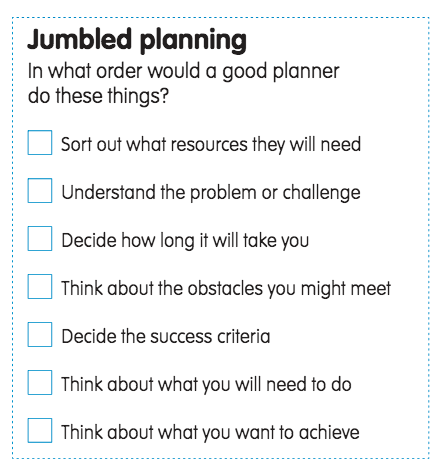
Jumbled up planning
click to enlarge
Can you put these jumbled aspects of planning into a sensible order? Could you use the outcomes to create a planning flowchart with your class to guide future planning?
Primary
Timetables . .
Click to enlarge
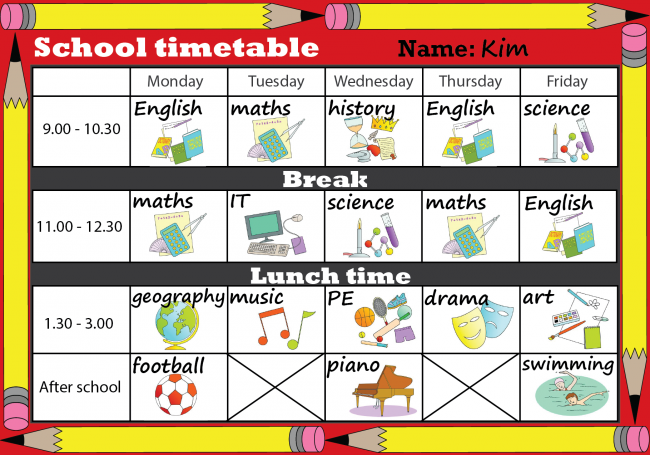
Ask the children to think of other things that need a timetable or plan. Start a display table and board of anything the children suggest or collect. You could find some bus and train timetables, a plan of the school and playground or a dinner menu for the term and so on.
A Treasure Map
Plan a treasure hunt around the school. This could have a seasonal theme or simply be a fun one. Use a small area of the school and make a very simple large scale plan. Attach photographs or drawings to help the children follow the plan. Take them on the treasure hunt in small groups and regularly refer to the Treasure Map as a plan.
Secondary
Structuring an extended project
Give students a pack of cards that describe the 10 or so sections in an extended project based on the Driving Question: Where’s the safest place to live? Ask them to sequence the material to make clearest sense. Ask them to give each section a generic heading.
Challenge students to prepare the outline structure for a response to other Driving Questions, for example, ‘Is Planet Earth injury prone?’ ‘Where did the dinosaurs go?’ ‘Why don’t people stay at home?’ ‘Should we choose to end a human life?’ ‘Is the idea of God more trouble than it’s worth?’
Agree with the class the generic headings for an extended piece of work – display it as an aide-memoire in the future.
2. Exploring the language of Planning
How you might extend the language and understanding of this behaviour
Primary
Discuss planning
Design a planning sheet to use with the children when you are planning an activity with them. You might include these and other headings:
What are we trying to achieve?
How will we know we have been successful?
What do we need to do?
What will help us?
What might be a problem?
What will we do about it?
Who will do what? [Simplify according to age range.]
Secondary
A way with words
Collect words that tell you how people plan.
Explore well known sayings
click to enlarge
What do we mean when we say …
If you fail to plan, you plan to fail.
Hit the ground running.
Cross that bridge when you come to it.
3. Using Planning as a lesson starter
Use a quick starter to key students into the learning behaviour you want to concentrate on in the lesson. i.e. here you are starting up the planning behaviour
Primary
Clapping a pattern
Planning a short rhythm
Sit pupils in a circle. Tell them you are going to clap a short rhythm for them, but first of all you are going to plan it.
Think aloud as you plan what you are going to do and mention “Beginning”, “Middle” and “End”. Then clap the pattern you have planned.
Ask pupils if they want to listen again and then have a go with you. Tell them you can remember it because you have a plan.
Now ask pupils to work in pairs and plan a short clapping pattern of their own. Get them to practice with their fingertips on their palms so that they don’t disturb each other too much.
After a few minutes ask them if they would like to perform their rhythm in pairs for everyone to listen to. Some may also like to try to teach it!
The emphasis is on planning what they are going to clap rather than just clapping straight off.
You may want to encourage pupils to make some kind of paper plan with a mark for every clap.
Secondary
‘What will it look like when it’s finished?’
Too often students start a task without giving thought to what it will look like when it has been completed, what a good one will look like. Many find it easier to plan ‘in reverse’ – working backwards from the finished article to where they are now to establish a sensible plan of action.
Make WWILLWIF the regular precursor to any action. Ask students to determine WWILLWIF for themselves in conjunction with others. Help them to visualise this in an appropriate form.
As you get deeper into a lesson you will need activities which, by their very nature, will develop students’ planning AND their understanding of the content.
Here is an idea where, by using planning, students will gain an understanding of the content AND will develop a planning habit.
4. Focusing on Planning as a learning strategy
Draw out the planning behaviour being used in a thinking routine.
Primary and Secondary
Visible Thinking Routine
How long will it take ?
This routine helps students to anticipate what needs doing and how long it might take. It also encourages them to consider the sequencing of the activity. There are three questions:
What needs to be done ?
What order will you do it in ?
How long do you think it might take ?
The natural place to use this routine is prior to embarking on a piece of extended work in order to slow the impulse to ‘get on with it’ and to encourage a more strategic approach.
And here is an idea that will help students to understand the planning process.
5. An activity to highlight and strengthen Planning
Design specific activities to highlight and strengthen the behaviour
The London Game
Your challenge is to plan a two-day visit to London for a group from the school.
Seven events are to be scheduled over two days, and two of the events are already fixed. Creating a plan is not too difficult, but then one of the venues has to close unexpectedly…
How will you need to revise your plan in light of this?
Can you see a use for any of the suggested activities?
Have you raised awareness of planning with your students?
Does your class have an agreed set of good planning behaviours?
Which two ideas from above do you want to try out?
How long will you keep them going before you decide whether they have worked or not?
Make a note of…
What happens in your classroom in response to any of the above ideas.
How students’ behaviour changes over about 3 weeks of becoming more familiar and talking about the behaviour.
How your behaviour in the classroom changes as you use these ideas over time.
NB. None of the actions above will lead to instant understanding nor instant changes in student’s behaviour. You will need to drip them in over time and keep building and refreshing your language of learning.
Building Learning Power is about creating a culture in classrooms – that systematically cultivates habits and attitudes that enable young people to face difficulty calmly, confidently and creatively. By a ‘culture’ we mean all the little habits, routines and practices that implicitly convey ‘what we believe and value round here’.
So ‘culture’ concerns the details of the micro-climate that you create in your classrooms. What you do and say, what you notice and commend and what you don’t, what kind of role model of a learner you offer – all these are of the essence. The micro-climate of a classroom can inadvertently stifle, or specifically enhance, the very behaviours you are seeking to promote.
Does my classroom climate encourage Planning?
Here is a selection of features which might begin to shape the emotional climate of the classroom to encourage planning.
Apply your own attentive planning and consider whether you already use any of these features and which you fancy trying.
What do you think?
What do your answers suggest?
How does your classroom culture contribute to students’ reactions or approaches to planning?
Is this broadly negative or positive?
What insightful ‘Ah Ha’ moments did you have as you read through the list?
How have these changed your view of planning?
Make a note of…
Any ideas that look as if they might help students to become better at planning.
An idea on the list you want to start doing.
An idea that interests you, but you are uncertain what it means or how you might do it.
Planning is the ability to take a strategic overview of your learning, and make sensible decisions. It means:
taking stock of the problem and the parameters within which you must work
assessing the available resources, both inner and outer, and deciding which you think are going to be needed
making an estimate of the time the learning will take, and the competing priorities that may have to be delayed or sacrificed
imagining a route-map for the learning
anticipating hurdles or problems that may arise along the way.
Good learners like taking responsibility for planning and organising their learning. They welcome opportunities to decide for themselves when, where, why and how they are going to learn—and to get better at doing so. Research shows, for example, that people who can make a reasonable estimate of how long a task will take are more likely to finish on time, and to do better work.
What does being a good Planner involve?
A well formed Planning habit involves being ready, willing, and able to:
Identify end goals or objectives before considering possible action;
Consider timescales and possible obstacles in drawing up a realistic plan;
Make use of a wide variety of skills and tools to gather ideas and information;
Sequence activity in order to decide what needs to be done;
Think laterally as well as logically so that the task benefits equally from creative and rational thought;
Be open-minded and flexible about how things might happen so that opportunities can be seized and fresh directions taken.
Spotting the Planners in your classes
Just to get you tuned in – have a quick think about ‘planners you may know’. Make a note of students you know who display these characteristics.
Being a learning powered teacher means developing a keen awareness of the subtleties of your students’ learning behaviours.
What do you think?
How many students come to mind when looked at through the lens of planning?
Is there a gender balance or have you noted down more girls than boys or vice versa?
Are the students you have noted from across all age groups or do some dominate?
How do these planning characteristics help these students to be better learners?
Make a note of…
Those groups or classes that seem to have lots of good planning characteristics.
Providing rich and varied occasions for exercising learning habits;
Infusing learning habits into lessons to enhance content understanding;
Recognising and celebrating the use and growth of learning habits;
Expecting students to take ownership of and responsibility for their own learning habits;
Exploring the development of learning habits with students over time.
As a teacher you are an influential character builder and so need to be mindful of how you help students form, replace, re-form and strengthen their learning habits.
But don’t worry, you’re not there yet. It takes most teachers between 2 and 3 years to become really fluent with this way of teaching. So, go easy on yourself. Feel determined because small steps often prove to be big levers for change. Have a think about what you might do…
What to stop and start
Here are a few ideas you might want to try. Take it steady, this way of teaching can be a big but exciting shift so it’s worth doing it slowly and thoughtfully.
Look first at the Stop/avoid ideas. Some of these are far from trivial but it’s best to try to remove them before starting on the Start/do more of, Start slowly and Experiment with ideas.
What do you think?
Which of the ideas appealed to you most?
Can you see ways of incorporating these into your subject/class routines?
Which would make the biggest difference to your students?
Which would make your life easier?
Make a note of…
Ideas that you want to try and the impact you hope they will have on your teaching and on your students.
Here is a range of things you can say to nudge collaboration. When you use this kind of language you are talking as a learning coach, encouraging students to think for themselves. Using such statements encourages your students to:
imitate you;
start to think in this way;
become conscious of these phrases and their meaning.
Gradually you will hear some of the ideas pop up in students’ self-talk….in speech or even in writing from time to time, but mostly these will go on inside their heads. As your work on collaboration gathers pace see if you can detect students who talk, or think, in these ways.
My learning talk nudges to encourage Collaboration
Teacher talk – as a learning coach
Here are 10 ideas to ensure your students do the thinking for themselves
Choose different groups today so that you work with different people.
Who is going to be responsible for how the team gets on?
Time to check you are on the right lines.
Are you making the most of everybody’s talents?
How will you / did you help your team?
Have you worked together to discover what this task/problem is about?
How can you / did you help to get everyone more involved?
Will you / did you contribute your own ideas and listen to the ideas of others?
How will you find a way to agree / make a decision?
How and why was your team successful?
What do you think?
Which of these collaboration nudges might you start using?
In which particular lessons would such nudging be most useful?
How will most of your students respond to such nudges?
Will this way of engaging be more popular with girls or boys?
What other nudging ideas might you add to the list?
Make a note of…
Students’ reactions to the nudges.
Ideas about why this might be.
Ways in which you could further encourage students to imitate this metacognitive self-talk.
Any positive or negative impact of these collaboration behaviours.
Some ideas to encourage a Collaborative frame of mind
In the early stages of building learning power your role is to; make students aware of the capacity; talk about it (what, how, why, when, if); celebrate its use; give opportunities to practice it, both in lessons and elsewhere; reflect on it to improve it. This staged start is reflected below…
Firstly… make students aware of collaborating…when, where, why.
Then… explore collaborating a little more through the language of collaboration
Try… using collaboration as a lesson starter or short activity to tune students into using it
Then start… blending collaboration into the way you teach the content. Use specific collaboration strategies to deepen content understanding.
Ensure… students reflect on the success or otherwise of their collaborative mindframe.
1. Making students aware of Collaborating
How you make students aware of the words that describe the behaviour and why it is important to use it.
Primary
Give collaborating a high profile
Collaboration Wall
Click to enlarge
Take photographs when you notice children playing and working well together. Place them on a ‘Collaboration Wall’ in the classroom or in a special book that you look at regularly with the children.
Invite the children to suggest captions for the photographs encouraging phrases that exemplify collaboration – sharing ideas, listening carefully, talking turns, everyone involved, etc.
Secondary
Time to think… and share ideas
An idea to get students thinking about collaboration. It could also be used in upper primary classes too.
In pairs – Think of a time when each of you has learned something with others. Take turns to interview each other about;
Where you were.
How many people were in the group.
What you learned from them.
How the group worked out the best way forward
What you were trying to do.
What you did to add to the group’s learning
Who you were with.
Whether you were able to pick up any good learning habits.
Where the group’s best idea came from.
Primary
Introduce games that require collaborating behaviours
Give the children challenges which can only be achieved through collaboration! For example; Ask a group of 10 children to stand on a bench and put themselves in order of height without anyone stepping off and on again. They will have to work cooperatively as a team to meet this challenge.
Secondary
An activity that enables students to recognise that working collaboratively means everyone having a role in success.
Making Machines Activity
Four teams of seven. Explain: “Create a machine with moving parts using yourselves. Each of you is to be part of the machine or something that the machine makes. When you have made it work you will demonstrate it working to the class. You have 10 minutes. The class will try and guess what your machine makes.”
Debrief...how the group work together. Whether a leader emerged? How decisions were made about what the machine should make. How it was decided when the machine would start. How machine parts were assigned. What different people contributed to the team effort? What has been learned about working in a team?
2. Exploring the language of Collaboration
How you might extend the language and scope of collaborating in a team
Primary and Secondary
Explore and use team roles
click to enlarge
Open up a conversation about different team roles with students. Introduce students to a few essential team roles, for example.
Coordinator
Resource gatherer
Finisher
Many students will, initially, have a preferred role, but over time encourage them to try out other roles to broaden their team working skills. Experiment with allowing individuals to choose their own roles, assigning roles yourself, and allowing teams to assign roles.
3. Using Collaboration as a way of organising learning
Use a quick starter to key students into the learning behaviour you want to concentrate on in the lesson. i.e. here you are starting up the collaborating behaviour
Primary
Getting ready for teamwork
Try a sharing activity (KS1)
An activity that requires pupils to share what they have in order to finish the task. Use this also to encourage children to think about what they are trying to achieve.
Use harder jigsaws, or groups of information, with older pupils.
Secondary
Building on the answers of others (KS2/3)
Have students work in pairs for 5 minutes to begin a draft answer to a tricky question. Once time is up, partially completed answers are passed to the next pair to be built upon, refined or redrafted, and the process is repeated as many times as necessary. At the end of the process, answers are returned to the original pair who are tasked with using all of the suggestions to draft their final polished version of the answer.
For more on this, read The Teacher’s Toolkit (Paul Ginnis), pages 139/140
4. Focusing on Collaboration as a learning strategy
Improve collaborating behaviour through the use of a thinking routine.
Primary and Secondary
Visible Thinking Routine
Think, Pair, Share
Offer students a problem or question which is more substantial than simple recall.
Think – Allow plenty of individual think time to engage with the issue.
Pair – Students then try out their ideas, (discuss, clarify, challenge) with a ‘Learning Partner’.
Share – The pair share with another pair, and subsequently with the whole class to arrive at a range of possible answers. They come to know and shape their views by collaborating with others.
Use as a simple strategy to prepare students for working together in teams, having first thought it through for themselves (Think), checked their ideas out with a trusted friend (Pair), before moving on to contributing to a group (Share).
At each point students are exposed to the views of others which encourages them to revise and refine their initial thinking.
And here is an activity that will help students to understand more about collaboration and team work.
5. An activity to highlight and strengthen Collaboration
Design specific activities to highlight and strengthen and improve collaboration itself. Use collaboration to help students to better understand the content.
Stranded!
This take on a classic exercise encourages students to listen, share ideas and, hopefully, come to an agreed solution.
Make reflecting on collaboration part of everyday lessons
Here is a practical example of how you might develop the social climate of the classroom and make it collaboration friendly
Learning Mat
Learning mats are A4 laminated sheets that show various aspects of a learning habit. Keep them on desks/tables or as part of a wall display.
Students can refer to them during lessons as prompts about the finer aspects of collaborating and later for self-reflection on what they have used, whether it was successful and how to improve it.
Secondary
Encourage self reflection on collaboration
click to enlarge
Me-now! is a self-reflective tool for use in either upper primary or secondary schools maybe to focus a discussion. They are useful in encouraging students to consider several aspects of the learning behaviour in question. There are some fairly sophisticated attributes in the list.
How am I at collaborating? Answer with Usually/Sometimes/Rarely/Don’t Know
I explore a task and work out what we have to achieve …
I help plan how the group will work …
I play my part in getting work done …
I’m patient whilst others learn …
I share what I think or know …
I accept ideas that improve on my own …
I make suggestions to others for improvements …
I contribute to group review …
I celebrate others’ achievements …
I help to resolve conflict …
Primary and Secondary
What do you think?
Can you see a use for any of the suggested activities?
Have you raised awareness of collaboration with your students?
Does your class have an agreed set of good collaborative behaviours?
Which two ideas from above do you want to try out?
How long will you keep them going before you decide whether they have worked or not?
Make a note of…
What happens in your classroom in response to any of the above ideas.
How students’ behaviour changes over about 3 weeks of becoming more familiar and talking about the behaviour.
How your behaviour in the classroom changes as you use these ideas over time.
NB. None of the suggestions above will lead to instant understanding in students nor instant changes of behaviour. You will need to drip them in over time and keep building and refreshing your language of learning.
Building Learning Power is about creating a culture in classrooms – that systematically cultivates habits and attitudes that enable young people to face difficulty calmly, confidently and creatively. By a ‘culture’ we mean all the little habits, routines and practices that implicitly convey ‘what we believe and value round here’.
So ‘culture’ concerns the details of the micro-climate that you create in your classrooms. What you do and say, what you notice and commend and what you don’t, what kind of role model of a learner you offer – all these are of the essence. The micro-climate of a classroom can inadvertently stifle, or specifically enhance, the very behaviours you are seeking to promote.
Does my classroom climate encourage Collaboration?
Here is a selection of features which might begin to shape the emotional climate of the classroom to encourage collaboration.
Apply your own attentive noticing and consider whether you already use any of these features and which you fancy trying.
What do you think?
What do your answers suggest?
How does your classroom culture contribute to students’ reactions or approaches to collaborating?
Is this broadly negative or positive?
What insightful ‘Ah Ha’ moments did you have as you read through the list?
How have these changed your view of collaboration?
Make a note of…
Any ideas that look as if they might help students to become better at collaborating.
An idea on the list you want to start doing.
An idea that interests you, but you are uncertain what it means or how you might do it.
Collaboration involves knowing how to learn with others. It means being able to work as part of a pair or a team, in a situation where no one person is in possession of all parts of the puzzle, and where the sharing of information and ideas is essential. Collaboration means being willing to share, and having the skills of communication to do so effectively. In many primary schools, Circle Time, for example, is used as a way of cultivating the requisite attitudes and abilities. Classes can be constituted as a group of research teams, each of which has responsibility for finding out part of the answer to a whole-class project, and then sharing that research with the other teams.
What does being a good Collaborator involve?
A well formed Collaborating habit involves being ready, willing, and able to:
Work effectively with others towards common goals;
Seek to understand what others are saying;
Share, challenge, support and build on ideas;
Adopt different roles and responsibilities in pursuit of team goals;
Act responsibly with initiative, and perseveres in the face of difficulties;
Hold and express opinions coherently, compromises and adapts to circumstances when appropriate.
Spotting the Collaborators in your classes
Just to get you tuned in – have a quick think about ‘Collaborators you may know’. Make a note of students you know who display these characteristics.
Being a learning powered teacher means developing a keen awareness of the subtleties of your students’ learning behaviours because what you are trying to do is to help them to help themselves to get better at using them.
What do you think?
How many students come to mind when looked at through the lens of collaboration?
Is there a gender balance or have you noted down more girls than boys or vice versa?
Are the students you have noted from across all age groups or do some dominate?
How do these collaborative characteristics help these students to be better learners?
Make a note of…
Those groups or classes that seem to have lots of good collaborative characteristics.
Providing rich and varied occasions for exercising learning habits;
Infusing learning habits into lessons to enhance content understanding;
Recognising and celebrating the use and growth of learning habits;
Expecting students to take ownership of and responsibility for their own learning habits;
Exploring the development of learning habits with students over time.
As a teacher you are an influential character builder and so need to be mindful of how you help students form, replace, re-form and strengthen their learning habits.
But don’t worry, you’re not there yet. It takes most teachers between 2 and 3 years to become really fluent with this way of teaching. So, go easy on yourself. Feel determined because small steps often prove to be big levers for change. Have a think about what you might do…
What to stop and start
Here are a few ideas you might want to try. Take it steady, this way of teaching can be a big but exciting shift so it’s worth doing it slowly and thoughtfully.
Look first at the Stop/avoid ideas. Some of these are far from trivial but it’s best to try to remove them before starting on the Start/do more of, Start slowly and Experiment with ideas.
What do you think?
Which of the ideas appealed to you most?
Can you see ways of incorporating these into your subject/class routines?
Which would make the biggest difference to your students?
Which would make your life easier?
Make a note of…
Ideas that you want to try and the impact you hope they will have on your teaching and on your students.