My menu

Sections Archive

4. Developing my talk for… Questioning

Developing your learning language

Here is a range of things you can say to nudge curiosity. When you use this kind of language you are talking as a learning coach, encouraging students to think for themselves. Using such statements encourages your students to:

  • imitate you;
  • start to think in this way;
  • become conscious of these phrases and their meaning.

Gradually you will hear some of the ideas pop up in students’ self-talk….in speech or even in writing from time to time, but mostly these will go on inside their heads. As your work on questioning gathers pace see if you can detect students who talk, or think, in these ways.

My learning talk nudges to encourage Questioning

Teacher talk – as a learning coach

Here are 10 ideas to ensure your students do the thinking for themselves

  1. That’s an interesting/insightful question.
  2. What questions did we ask last time?
  3. You might find it useful to try and predict what you think will happen.
  4. Could you speculate about the possible results and solutions.
  5. What sort of questions might help you get a bit further with this problem?
  6. Do you believe that? Might there be more to it?
  7. A closed question might focus your search.
  8. How can you get to the bottom of this?
  9. A hypothetical question might help to stimulate your ideas.
  10. How can you phrase that so that you don’t upset people?

What do you think?

  • Which of these questioning nudges might you start using?
  • In which particular lessons would such nudging be most useful?
  • How will most of your students respond to such nudges?
  • Will this way of engaging be more popular with girls or boys?
  • What other nudging ideas might you add to the list?

Make a note of…

Little_r

  • Students’ reactions to the nudges.
  • Ideas about why this might be.
  • Ways in which you could further encourage students to imitate this metacognitive self-talk.
  • Any positive or negative impact of these questioning behaviours.
Continue Reading

3. Ideas for classroom practice

In the early stages of building learning power your role is to; make students aware of the behaviour; talk about it (what, how, why, when, if); celebrate its use; give opportunities to practice it, both in lessons and elsewhere; reflect on it to improve it. This staged start is reflected below…

Some ideas to enable students to become better questioners.

  1. Firstly… make students aware of questioning…when, where, why. 
  2. Then… explore questioning a little more through the language of questioning
  3. Try… using questioning as a lesson starter to tune students into using it
  4. Then start… blending questioning into the way you teach the content. Use specific questioning strategies to deepen content understanding.
  5. Ensure… students reflect on the success or otherwise of their questioning mindframe.


1. Making students aware of Questioning

How you make students aware of the words that describe the behaviour and why it is important to use it.

Primary

A ‘mystery’ object in a bag

 Ask questions to find out what the mystery object is.

  •  Vary the complexity according to the age and experience of the class. Use clues to narrow down the possibilities for younger children e.g. it’s something you’d find in the garden. Young children will tend to want to ‘guess’. They will need encouragement to ask questions before offering solutions.
  •  Ask talk partners to come up with two ‘I wonder’ questions e.g.” I wonder what it’s made of?” “I wonder if you can play with it?”
  •  It’s best to set a limit, say 10/15/20 questions allowing the children to guess before showing  the object.
  •  The key to this activity is that the focus is on the questions; acknowledge and reward good questions.
  •  At the end compile a list of some of the useful/unusual/interesting questions that were asked.

Secondary

A way with words

Trainer Notes

Collect ideas about the purpose of questions.

Explore well known sayings

What do we mean when we say …

Curiosity killed the cat

I need to get to the bottom of this

More questions than answers


Primary

Questions on display

Click to enlarge

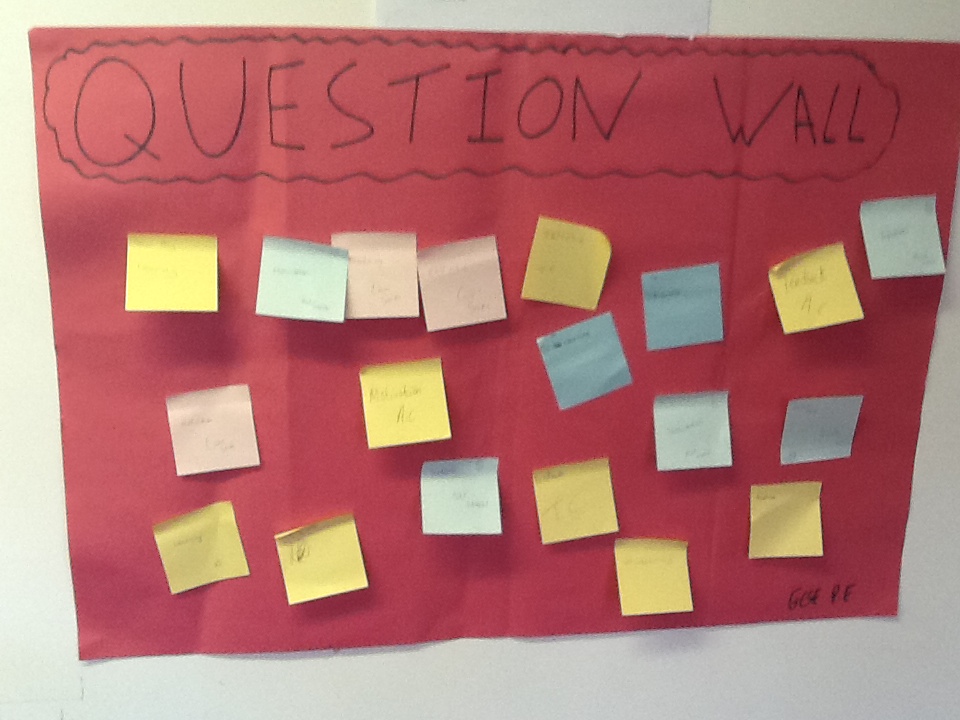
Create a Question Wall in the classroom to illustrate and prompt questioning. For example, the question wall might focus on student generated questions about the topic in hand. Use their questions to help to focus / shape their enquiry.

Secondary

Questions on display


Click to enlarge

Create displays to support students’ questioning skills. For example; explore the differences between closed and open questions; when / why each should be used. Offer question stems for each.

Or create, with students, a set of questions they might ask when they are stuck. These might include; What did I do last time when  . . . .  ?  What do I already know about this? What should I do first? And next? I am finding this tricky because . . . . Who might know? Where can I look?

2. Exploring the language of Questioning

How you might extend the language and understanding of this behaviour

Primary

The why gameScreen Shot 2015-08-18 at 13.23.50

Start a story with an opening line. Encourage the students to keep on asking each other Why? and giving answers until they have created a story. Opening lines can be simple “The red van roared down the street” but lead to all sorts of questions —Why was the van red?” “Why was it roaring?” which lead on to other ‘Why?’ questions. Vary the game by starting with a riddle or conundrum, or requiring different types of questions.

Secondary

Question focused research 

magnifying

Ask students to

  • research possible types of questions using the Internet record and analyse the types of questions used in their peer group
  • compare their research findings and their observations.

Use this to expand the range of questions used in class and to create guidelines for asking good questions.

3. Using Questioning as a lesson/project starter

Use a quick starter to key students into the learning behaviour you want to concentrate on in the lesson. i.e. here you are starting up the questioning behaviour 

Primary

Is your question important? 

quesito everything

Identify a project which the class might investigate. Write a series of questions on separate pieces of cards and give each group a set of the cards. The group shuffle the cards and deal each student one card. They have to decide:

  • the best order for the questions, to do the project well
  • if they have to ask all the questions or whether
    some are irrelevant in the context
  • whether there are any missing questions and if so, what they might be
  • what they have learnt about questions from this.

Secondary

Questions you would like to ask

Image result for question dice

Tell students:

‘In 5 minutes, ‘something’ related to the upcoming lesson will walk in.

What are the three questions that we should ask it ?’

[The ‘something’ might be: a full stop; an improper fraction; osmosis; the Bible; a data base; the renaissance . . . . ] [The ‘three’ is important – it encourages students to prioritise their questions and consider which are most likely to uncover the information they require and discourages ‘random’ asking.]

Here is an idea where, by using questioning, students will gain an understanding of the content AND will develop a questioning habit.

4. Focusing on Questioning as a learning strategy

Draw out the questioning behaviour being used in a thinking routine.

Primary and Secondary

Visible Thinking Routine

Question Starts is a Visible Thinking Routine that provides students with the opportunity to practise developing good questions that provoke thinking and inquiry into a topic by offering a range of interesting question stems. For example:

Brainstorm a list of at least 12 questions about the topic, concept or object. Use these question-starts to help you think of interesting questions:

  • Why…?
  • How would it be different if…?another question mark
  • What are the reasons…?
  • Suppose that…?
  • What if…?
  • What if we knew…?
  • What is the purpose of…?
  • What would change if…?

Review the brainstormed list and star the questions that seem most interesting. Then, select one or more of the starred questions to discuss for a few moments.

Reflect: What new ideas do you have about the topic, concept or object that you didn’t have before?


And here is an idea that will help students to understand the questioning process.

5. An activity to highlight and strengthen curiosity

Design specific activities to highlight and strengthen the behaviour

An Activity to learn about the behaviour

Build a three-level ‘questioning habit‘ Image result for arnolfini

‘ReQuest’ is a structured process for deepening questions.

For example, start with the painting The Arnolfini Wedding by Jan van Eyck:

  • On-the-line questions: ask questions about the picture for which the answers can be seen just by looking closely at the picture: ‘How many candles are there?’ ‘What kind of room is it?’ ‘What is on the wall behind the people?’
  • Between-the-lines questions: questions whose answers can be inferred by looking at the picture: E.g. ‘What is the relationship between the two people?’ ‘How long ago was the picture painted?’ ‘What time of day is it?’
  • Beyond-the-line questions: questions whose answers need to be elicited by making interpretive links from the picture: E.g. ‘What did the artist think of his subjects?’ Is the number of candles significant?’ How does perspective work in the painting?


6. Reflecting on Questioning

Primary

Make reflecting on questioning part of everyday lessons

Here is a practical example of how you might develop the emotional climate of the classroom and make it questioning friendly

Learning Mats

Learning mats are A4 laminated sheets that show various aspects of a learning habit. Keep them on desks/tables or as part of a wall display. Students refer to them during lessons, using them as prompts about the finer aspects of a learning habit that is being stretched.

Secondary

Build a Question Bank

Give students time to reflect on the questions that they ask of themselves and of others in different situations. Which of these questions, when answered, proved to be the most powerful? Why was that? Which question, if asked, would be most likely to move thinking forward? Encourage students to build a bank of powerful questions that they can refer back to when necessary.

Learning Log

Primary and Secondary

What do you think?

  • Can you see a use for any of the suggested activities? 
  • Have you raised awareness of questioning with your students?
  • Does your class have an agreed set of good questioning behaviours?
  • Which two ideas from above do you want to try out?
  • How long will you keep them going before you decide whether they have worked or not?

Make a note of…Little_r

  • What happens in your classroom in response to any of the above ideas.
  • How students’ behaviour changes over about 3 weeks of becoming more familiar and talking about the behaviour.
  • How your behaviour in the classroom changes as you use these ideas over time.


NB. None of the suggestions above will lead to instant understanding in students nor instant changes in their behaviour. You will need to drip them in over time and keep building and refreshing your language of learning.

Continue Reading

2. Getting the classroom climate right

Building Learning Power is about creating a culture in classrooms – that systematically cultivates habits and attitudes that enable young people to face difficulty calmly, confidently and creatively. By a ‘culture’ we mean all the little habits, routines and practices that implicitly convey ‘what we believe and value round here’. 

So ‘culture’ concerns the details of the micro-climate that you create in your classrooms. What you do and say, what you notice and commend and what you don’t, what kind of role model of a learner you offer – all these are of the essence. The micro-climate of a classroom can inadvertently  stifle, or specifically enhance,  the very behaviours you are seeking to promote.

Does my classroom climate encourage Curiosity?

Here is a selection of features which might begin to shape the emotional climate of the classroom to encourage questioning.

Apply your own attentive noticing and consider whether you already use any of these features and which you fancy trying.

What do you think?

  • What do your answers suggest?
  • How does your classroom culture contribute to students’ reactions or approaches to questioning?
  • Is this broadly negative or positive?
  • What insightful ‘Ah Ha’ moments did you have as you read through the list?
  • How have these changed your view of questioning?

Make a note of…Little_r

  • Any ideas that look as if they might help students to become better at questioning.
  • An idea on the list you want to start doing.
  • An idea that interests you, but you are uncertain what it means or how you might do it.
Continue Reading

1. What is… good Questioning?

What do we mean by Questioning ?

Questioning means both the ability to ask good questions and the disposition to do so (which is sometimes called curiosity). Good learners like questions, and are not afraid of the ‘don’t know’ state of mind out of which questions emerge.

Good learners like to wonder about things. For them, it often really is a wonder-ful world. The phrases ‘How come?’ and ‘What if?’ are never far from their lips.

They value getting below the surface of things, and are less likely to accept uncritically what they are told. They like to come to their own conclusions. They are more willing to reveal their questions and uncertainties if they think it will help them learn.

Questioning can be as much non-verbal as it is verbal. Playing around with materials or ideas just to see what happens is a powerful way of asking questions. It is what artists and inventors spend a lot of their time doing. The inclination to ask questions flourishes when you are around people who are also asking questions, and who encourage and appreciate your questions too.

There are classrooms that have a ‘Wonder Wall’ where both students and teachers store up all their questions. There are classrooms where credit is given for good questions as well as good answers.

What does being a good Questioner involve?

A well formed Questioning habit involves being ready, willing, and able to:

  • Be curious about all experiences;
  • Dig beneath the surface, asking why something is happening as it is;
  • Play with ideas and possibilities;
  • Be systematic and adopt a logical approach — exploring a line of thought purposefully; posing questions that follow a rational path towards an emerging goal;
  • Be socially aware in asking questions of others, exhibiting genuine interest in other people;
  • Be comfortable with uncertainty and ambiguity; enjoy different points of view and contrary evidence.

Spotting the questioners in your classes

Just to get you tuned in – have a quick think about ‘Questioners you may know’. Make a note of students you know who display these characteristics.

Being a learning powered teacher means developing a keen awareness of the subtleties of your students’ learning behaviours. 

What do you think?

  • How many students come to mind when looked at through the lens of questioning?
  • Is there a gender balance or have you noted down more girls than boys or vice versa?
  • Are the students you have noted from across all age groups or do some dominate?
  • How do these questioning characteristics help these students to be better learners?

Make a note of…Little_r

  • Those groups or classes that seem to have lots of good questioning characteristics.
  • How you think you might capitalise on this.
Continue Reading

5. Moving my practice on

Cultivating learning habits ultimately involves:

  • Providing rich and varied occasions for exercising learning habits;
  • Infusing learning habits into lessons to enhance content understanding;
  • Recognising and celebrating the use and growth of learning habits;
  • Expecting students to take ownership of and responsibility for their own learning habits;
  • Exploring the development of learning habits with students over time.

As a teacher you are an influential character builder and so need to be mindful of how you help students form, replace, re-form and strengthen their learning habits.

But don’t worry, you’re not there yet. It takes most teachers between 2 and 3 years to become really fluent with this way of teaching. So, go easy on yourself. Feel determined because small steps often prove to be big levers for change. Have a think about what you might do…

What to stop and start

Here are a few ideas you might want to try. Take it steady, this way of teaching can be a big  but exciting shift so its worth doing it slowly and thoughtfully.

Look first at the Stop/avoid ideas. Some of these are far from trivial but it’s best to try to remove them before starting on the Start/do more of, Start slowly and Experiment with ideas.

What do you think?

  • Which of the ideas appealed to you most?
  • Can you see ways of incorporating these into your subject/class routines?
  • Which would make the biggest difference to your students?
  • Which would make your life easier?

Make a note of…Little_r

  • Ideas that you want to try and the impact you hope they will have on your teaching and on your students.
Continue Reading

4. Developing my talk for… Resourcing Learning (Capitalising)

Developing your learning language

Here is a range of things you can say to nudge capitalising. When you use this kind of language you are talking as a learning coach, encouraging students to think for themselves. Using such statements encourages your students to:

  • imitate you;
  • start to think in this way;
  • become conscious of these phrases and their meaning.

Eventually you will hear some of the questions pop up in students’ self-talk….in speech or even in writing from time to time, but mostly these will go on inside their heads. As your work on capitalising gathers pace see if you can detect students who talk, or think, in these ways.

My learning talk nudges to encourage Capitalising

Teacher talk – as a learning coach

(To ensure students do the thinking for themselves)

  1. What could we use to help us with this?
  2. What led you to choose to use that?
  3. Look very carefully at someone you think is doing …… really well and think about how you can do it like that
  4. Could you tackle this by imagining someone who does it really well?
  5. What sort of reference / resource do you need here?
  6. Look around.  See what is available to help. How could you use it?
  7. Could you work this out for yourself first before looking for more information?
  8. Who could you turn to for help?
  9. Think through the strategies you might use.
  10. Which is the best learning strategy for this job?

What do you think?

  • Which of these capitalising nudges might you start using?
  • In which particular lessons would such nudging be most useful?
  • How will most of your students respond to such nudges?
  • Will this way of engaging be more popular with girls or boys?
  • What other nudging ideas might you add to the list?

Make a note of…

Little_r

  • Students’ reactions to the nudges.
  • Ideas about why this might be.
  • Ways in which you could further encourage students to imitate this metacognitive self-talk.
  • Any positive or negative impact of these collaboration behaviours.
Continue Reading

3. Ideas for classroom practice

Some ideas to encourage a Capitalising frame of mind.

  1. Firstly… make students aware of capitalising…when, where, why. 
  2. Then… explore capitalising a little more through the language of capitalising
  3. Try… using capitalising as a lesson starter to tune students into using it
  4. Then start… blending capitalising into the way you teach the content. Use specific capitalising strategies to deepen content understanding.
  5. Ensure… students reflect on the success or otherwise of their capitalising mindframe.


1. Making students aware of Capitalising

How you make students aware of the words that describe the behaviour and why it is important to use it.

Primary

Use display to record key learning

Image result for top tips

Set aside an area of display where students are asked to share any strategies or ‘top tips’ that they have found particularly helpful in their own learning.

For those offering the ‘top tip’ it is a distilling activity, but the resulting gallery of ‘top tips’ invites students to adopt the successful strategies of others.


Secondary

Expert Interviews

Related image

Set up interviews with people who can do something really well. Develop a series of questions with students to uncover exactly what the ‘expert’ does. E.g. What sort of preparation is there? What does it feel like? What sort of thinking, habits of mind, values or beliefs are helpful?

Create a checklist of key aspects to imitate.

Extend with students in the role of real or imaginary expert, encouraging them to assess their own subconscious knowledge of how to succeed.

Primary

Helpful Habits – discuss the idea of helpful and unhelpful habits

Explore this through role plays. Use imaginary characters to create more emotional distance.

Discuss peer and family influence on forming habits. How many of our habits do we pick up from those around us? To what extent can we choose our habits?

Set up a Helpful Habit board for tips from students to others about habits which might help them to achieve their long or short term goals.

In pairs, identify habits that could easily be changed (ie always eating cornflakes for breakfast),
and discuss how this came to be a habit. Decide to change one habit for a set period of time.
Discuss what happened. How did the new ‘habit’ feel the first time? How did it feel after 21 times? How could you use this experience to imitate other people’s helpful habits?

Secondary

Scrapheap Challenge

Image result for scrap heapCollect a pile of unrelated objects, or ask students to bring in one object each and mix them in random groupings – eg a copper tube, piece of cloth, felt pen, blu-tack.

Challenge students to make as many things as they can from the objects, using all of them but nothing else.

Discuss examples of particularly imaginative / effective use of materials and whether these ideas can be used in another context.

2. Exploring the language of Capitalising

How you might extend the language and understanding of this behaviour

Primary

Discuss capitalising

Use language to encourage thinking about capitalising. Build these into your learning language:

  • Have you thought about what would help you to do this?
  • Just think about all the things we have in the classroom that might be useful.
  • How else might you do it?
  • What is everyone else doing?
  • Is there anything else that you could use?
  • There may be other people who could help you with this.
  • Who do you think might know something about this?
  • Where could you find out more about this?
  • Which of the things you used did you find the most useful?
  • If you had to do this again is there anything else you might use to help you?

Secondary

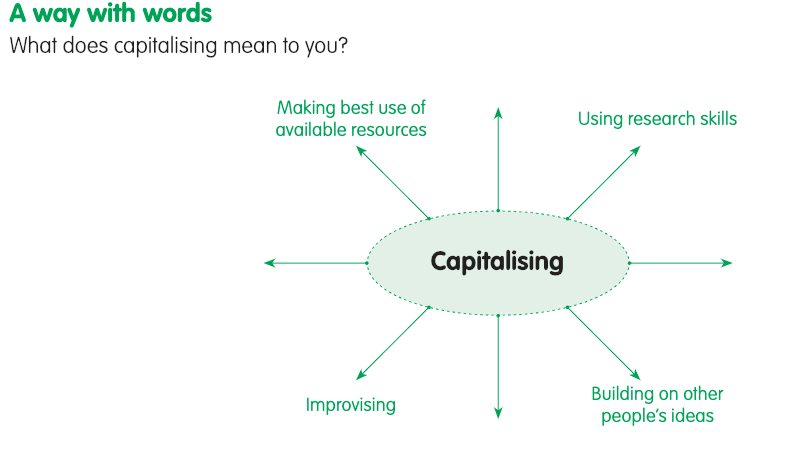
A way with words

click to enlarge

Collect words that tell you how people learn to Capitalise on what is around them.

Explore well known sayings.

What do we mean when we say …

There is more than one way to skin a cat

Making the best of a bad job

A bit ‘Heath Robinson’

3. Using Capitalising as a lesson starter

Use a quick starter to key students into the learning behaviour you want to concentrate on in the lesson. i.e. here you are starting up the Capitalising behaviour 

Primary

How might we tackle this?

Image result for strategy

At the beginning of a session talk with the children about the strategies and things they might use to help them with their learning.

Talk to the children frequently about where they might find information or help.

Offer the children a rich and varied curriculum so that they can start to appreciate that they are learning from lots of different sources using a range of learning strategies.

Secondary

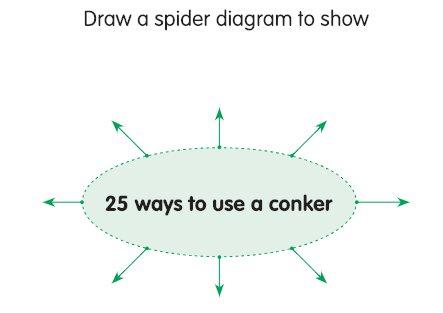
How many uses for . . . . 

Image result for conkers

To get students thinking about how resources can be used in many different ways.


As you get deeper into a lesson you will need activities which, by their very nature, will develop students’ capitalising AND their understanding of the content.

Here is an idea where, by using capitalising, students will gain an understanding of the content AND will develop a capitalising habit.

4. Focusing on Capitalising as a learning strategy

Draw out the capitalising behaviour being used in a thinking routine.

Primary and Secondary

Visible Thinking Routine

How will you find that out ? This routine helps students to take stock of what they need to find out and to consider the strategies they might use to achieve it. It encourages metacognitive thinking about which learning strategy is most likely to lead to success. The routine has two questions:

  • What do you need to know / understand ?
  • Which strategy is most likely to be successful ?

The natural place to use this routine is when students understand what they need to find out but before they make a choice from a range of learning strategies.


And here is an idea that will help students to understand the capitalising process.

5. Two activities to highlight and strengthen Capitalising

Design specific activities to highlight and strengthen the behaviour

Icarus All-Sorts

We have an image, but we do not know what it is called. Where might we look? How  might we find out?

The activity leads to a recognition of the range of resources that can be called upon when seeking to acquire new knowledge, understand the unfamiliar and respond to challenges.

Coaching Notes

Coaching Notes

Resource

Resource


Borrowing the Best Bits

The aim of ‘Borrowing the Best Bits’ is to develop an understanding that learning is about gleaning from others, taking what they do well, adapting it and applying their strategies to our own practice. 

Coaching Notes

Coaching Notes


6. Reflecting on Capitalising

Primary

Make reflecting on Capitalising part of everyday lessons

Here is a very practical example of how you might develop the emotional climate of the classroom and make it capitalising friendly

Learning Mats

Learning mats are A4 laminated sheets that show various aspects of a learning habit. Keep them on desks/tables or as part of a wall display.

Secondary

A Learning Log to alert students to Capitalising across subjects 

A useful resource for tutor time to guide reflection and a wide ranging discussion.

Learning Log

Primary and Secondary

What do you think?

  • Can you see a use for any of the suggested activities? 
  • Have you raised awareness of capitalising with your students?
  • Does your class have an agreed set of good capitalising behaviours?
  • Which two ideas from above do you want to try out?
  • How long will you keep them going before you decide whether they have worked or not?

Make a note of…Little_r

  • What happens in your classroom in response to any of the above ideas.
  • How students’ behaviour changes over about 3 weeks of becoming more familiar and talking about the behaviour.
  • How your behaviour in the classroom changes as you use these ideas over time.

NB. None of the behaviours above will lead to instant understanding in students nor instant changes of behaviour. You will need to drip them in over time and keep building and refreshing your language of learning.

Continue Reading

2. Getting the classroom climate right

Building Learning Power is about creating a culture in classrooms – that systematically cultivates habits and attitudes that enable young people to face difficulty calmly, confidently and creatively. By a ‘culture’ we mean all the little habits, routines and practices that implicitly convey ‘what we believe and value round here’. 

So ‘culture’ concerns the details of the micro-climate that you create in your classrooms. What you do and say, what you notice and commend and what you don’t, what kind of role model of a learner you offer – all these are of the essence. The micro-climate of a classroom can inadvertently stifle, or specifically enhance,  the very behaviours you are seeking to promote.

Does my classroom climate encourage Capitalising?

Here is a selection of features which might begin to shape the emotional climate of the classroom to encourage capitalising.

Apply your own attentive noticing and consider whether you already use any of these features and which you fancy trying.

What do you think?

  • What do your answers suggest?
  • How does your classroom culture contribute to students’ reactions or approaches to capitalising?
  • Is this broadly negative or positive?
  • What insightful ‘Ah Ha’ moments did you have as you read through the list?
  • How have these changed your view of capitalising?

Make a note of…Little_r

  • Any ideas that look as if they might help students to become more independent.
  • An idea on the list you want to start doing.
  • An idea that interests you, but you are uncertain what it means or how you might do it.
Continue Reading

1. What is… good Resourcing Learning (Capitalising)

What do we mean by Capitalising on resources ?

Capitalising on resources means being on the lookout for strategies, materials, resources and forms of support in the environment that can help you in your current learning or problem- solving. Traditional schooling assumes that intelligence is all in the head. But recent studies show that it is much fairer and more accurate to see good learners as people who are ready and able to make intelligent use of all kinds of things around them – books, phones, social media, e-mail, the internet, and, of course, a range of learning strategies and other people. Everyone needs to be good at finding and using the learning resources available in the world, so it is obviously a good idea to start developing this skill at school.

The forms of assessment we use in schools have a powerful influence on the kinds of learning that students do, and the kinds of teaching their teachers use. If the good learner is essentially the person plus their resources (and their ability to draw on them), our methods of testing should encourage teachers and students to value and practise capitalising. In today’s world, it makes as much sense to sit 15-year-olds down at solitary desks and ask them to display their knowledge and skill as it would to take away Wayne Rooney’s football and tell him to perform.

What does being a good at Capitalising involve?

A well formed Capitalising habit involves being ready, willing, and able to:

  • Recognise that we learn from many different sources – other people, books, the internet, music, the environment, experience…
  • Select appropriately from a range of learning strategies;
  • Keep a purposeful look-out for useful learning aids;
  • Adapt and adopt the successful habits and values of others into their own learning repertoire;
  • Make intelligent use of all kinds of things to aid learning;
  • Use resources in novel ways to solve problems.

Spotting the Capitalisers in your classes

Just to get you tuned in – have a quick think about ‘capitalisers you may know’. Make a note of students you know who display these characteristics.

Being a learning powered teacher means developing a keen awareness of the subtleties of your students’ learning behaviours. 

What do you think?

  • How many students come to mind when looked at through the lens of capitalising?
  • Is there a gender balance or have you noted down more girls than boys or vice versa?
  • Are the students you have noted from across all age groups or do some dominate?
  • How do these capitalising characteristics help these students to be better learners?

Make a note of…Little_r

  • Those groups or classes that seem to have lots of good capitalising characteristics.
  • How you think you might capitalise on this.
Continue Reading

1. What is… good Noticing?

What do we mean by Noticing?

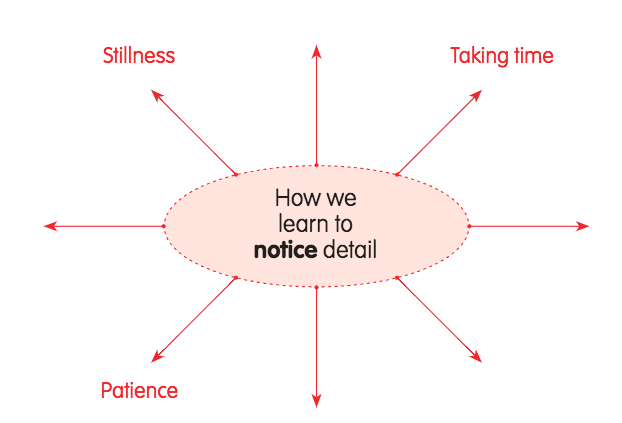
Learning often relies on being able to pay attention to what you are interested in: not necessarily thinking about it, just really noticing how it looks, what it is made of, or how it behaves. Many professionals, from poets to scientists to business managers, rely on this quality of attentive noticing: being able to identify the significant detail, or to let an underlying pattern of connections emerge into their minds. Sometimes you have to be patient before the detail or the pattern will reveal itself to you, like looking for sea creatures in a rock pool.

This is a skill that can be strengthened with practice. We often pick up this skill from people around us. Babies very soon learn to work out what their mother is focusing on, and to ‘share joint attention’ with her. It helps to be around people who are demonstrating this ability to watch carefully and turn their observations into accurate descriptions. Getting a really clear sense of what, before starting to think about how or why, is very useful.

What does being a good Noticer involve/mean?

If you have a well formed Noticing habit you will be ready, willing, and able to:

  • be attentive to details and subtleties in order to understand things;
  • seek underlying patterns patiently, understanding that connections take time to emerge;
  • actively use all your senses to gather information to build understanding of the world around;
  • gain a clear sense of the ‘what’ of something before considering the ‘why’ and ‘how’;
  • recognise that learning is often complex and difficult and takes time and effort to accomplish.

Spot the Noticers in your classes

Just to get you tuned in – have a quick think about ‘noticers you may know’. Make a note of students you know who display these characteristics.

Being a learning powered teacher means developing a keen awareness of the subtleties of your students’ learning behaviours. 

What do you think?

  • How many students come to mind when looked at through the lens of noticing?
  • Is there a gender balance or have you noted down more girls than boys or vice versa?
  • Are the students you have noted from across all age groups or do some dominate?
  • How do these noticing characteristics help these students to be better learners?

Make a note of…Little_r

  • Those groups or classes that seem to have lots of good noticing characteristics.
  • How you think you might capitalise on this.
Continue Reading

2. Getting the classroom climate right

Building Learning Power is about creating a culture in classrooms – that systematically cultivates habits and attitudes that enable young people to face difficulty calmly, confidently and creatively. By a ‘culture’ we mean all the little habits, routines and practices that implicitly convey ‘what we believe and value round here’. 

So ‘culture’ concerns the details of the micro-climate that you create in your classrooms. What you do and say, what you notice and commend and what you don’t, what kind of role model of a learner you offer: all these are of the essence. The micro-climate of a classroom can inadvertently stifle or, specifically enhance,  the very behaviours you are seeking to promote.

 Does my classroom climate encourage Noticing?

Here is a selection of features which might begin to shape the emotional climate of the classroom to encourage Noticing.

Apply your own attentive noticing and consider whether you already use any of these features and which you fancy trying.

What do you think?

  • What do your answers suggest?
  • How does your classroom culture contribute to students’ reactions or approaches to noticing?
  • Is this broadly negative or positive?
  • What insightful ‘Ah Ha’ moments did you have as you read through the list?
  • How have these changed your view of noticing?

Make a note of…Little_r

  • Any ideas that look as if they might help students to become better at noticing.
  • An idea on the list you want to start doing.
  • An idea that interests you, but you are uncertain what it means or how you might do it.
Continue Reading

3. Ideas for classroom practice

Some ideas to encourage a Noticing frame of mind.

In the early stages of building learning power your role is to; make students aware of the behaviour; talk about it (what, how, why, when, if); celebrate its use; give opportunities to practice it, both in lessons and elsewhere; reflect on it to improve it. This staged start is reflected below…

  1. Firstly… make students aware of noticing…when, where, why. 
  2. Then… explore noticing a little more through the language of noticing
  3. Try… using noticing as a lesson starter to tune students into using it
  4. Then start… blending noticing into the way you teach the content. Use specific noticing strategies to deepen content understanding.
  5. Ensure… students reflect on the success or otherwise of their noticing mindframe.

1. Making students aware of Noticing

How you make students aware of the words that describe the behaviour and why it is important to use it.

Primary

Give noticing a high profile

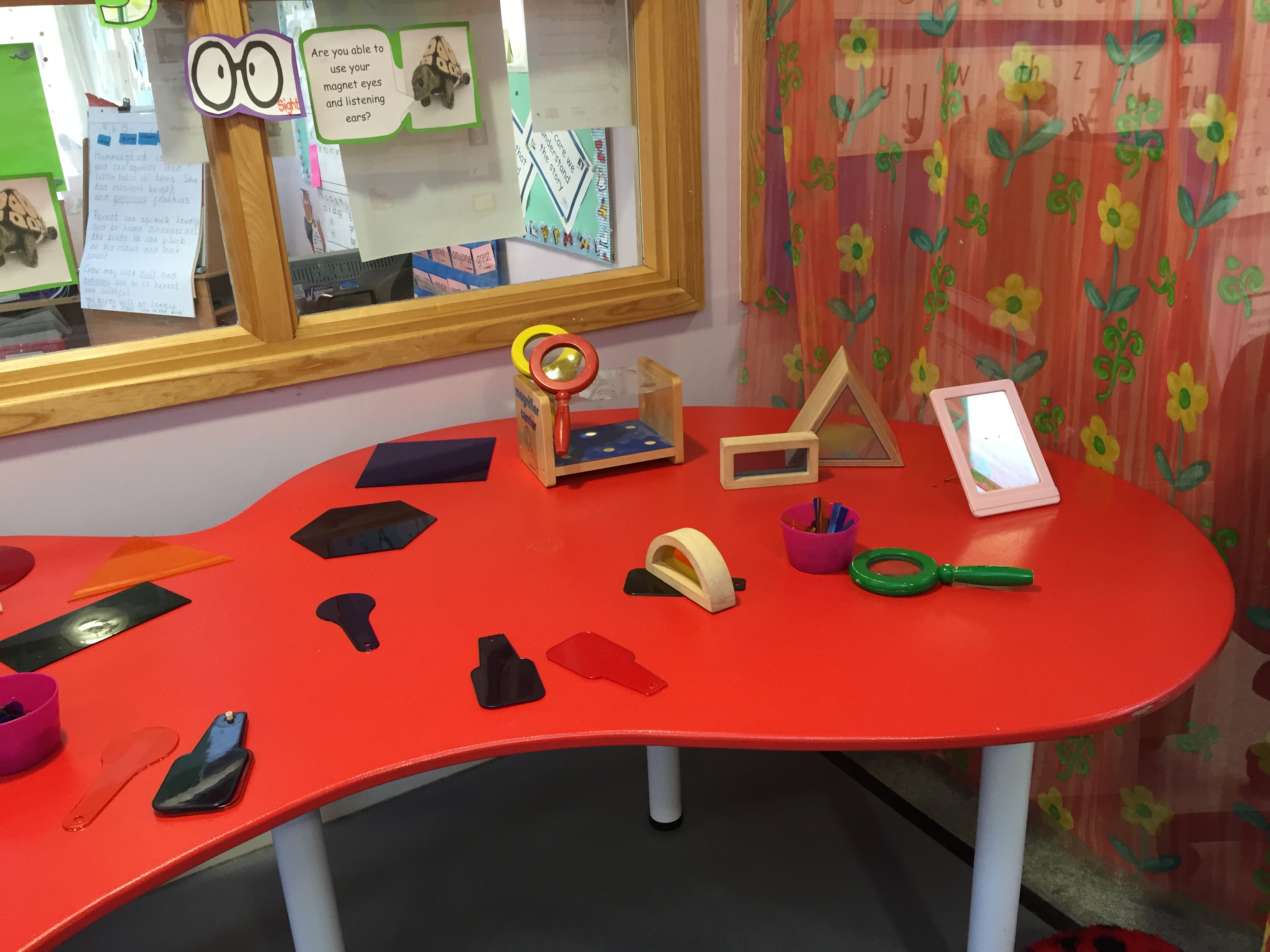
For example, create a Noticing table with magnifying glasses and interesting objects …. shells, coins, dead insects, flowers …… and lots more! Spend a few minutes each day for children to report on what new things they have noticed about the objects.


Secondary

Time to think … and share ideas

What do experts notice? – A painter will notice subtle differences in colour, shape or texture. What about other experts … gardeners, doctors, musicians, drivers, sports-people, actors, cooks, mechanics?

Choose a couple of experts from the list or from your own ideas and think about what they notice and how they might have learned this.

Primary

Introduce games that require noticing behaviours

For example… use the familiar Kim’s game where students have to look carefully for a given time and then try to remember the group of articles. This simple format has numerous variations…what’s missing, what’s been added, what’s the odd one out? 


Secondary

Introduce intriguing pictures to provoke noticing


2. Exploring the language of Noticing

How you might extend the language and understanding of this behaviour

Primary

Discuss Noticing Others

Invite some students to be Learning Detectives. Task them with watching how children play team games. Their job is to watch out for how to do the activity best, what works and what doesn’t work. You will need to model this regularly, it won’t matter whether they are throwing bean bags into buckets, jumping through hoops or balancing on bars, the noticing and coaching will make a real difference to their learning. If possible capture examples of effective learning on camera / video. Build the outcomes into a display that helps all students to become more aware of the effective habits of others.

Secondary

A way with words

Collect words that tell you how people learn to notice detail.

Explore well known sayings

What do we mean when we say …

Eagle-eyed.

I’ve gone through it with a fine-tooth comb.

Keep your eyes peeled


3. Using Noticing as a lesson starter

Use a quick starter to key students into the learning behaviour you want to concentrate on in the lesson. i.e. here you are starting up the noticing behaviour 

Primary

Intriguing Images

For example have an intriguing picture ready on the whiteboard before the lesson starts. Students look forward to looking carefully at pictures where all is not as it seems. 

Secondary

FInding shapes

Offer students a random set of dots (or picture of the night sky). Invite them to seek items such as:

  • A letter of the alphabet
  • An animal
  • A regular shape
  • A face
  • Or something linked to the content of the forthcoming lesson

As you get deeper into a lesson you will need activities which, by their very nature, will develop students’ Noticing AND their understanding of the content.

Here is an idea where, by using noticing, students will gain an understanding of the content AND will develop a Noticing habit.

4. Focusing on Noticing as a learning strategy

Draw out the noticing behaviour being used in a thinking routine.

Primary and Secondary

Visible Thinking Routine

See, Think, Wonder:

  • Invite students to make an observation (see) about an object (artwork, image, artifact) or topic.
  • Follow up with what they think might be going on. Encourage backing up their interpretation with reasons.
  • Ask students to think about what this makes them wonder about the object or topic.
  • The routine works best when a student responds by using the three stems together at the same time, i.e., “I see…, I think…, I wonder…”. If not you need to scaffold each response with a follow up question for the next stem.

This routine encourages careful observations and thoughtful interpretations. It helps stimulate curiosity and sets the stage for inquiry. Use it at the beginning of a new unit to motivate student interest. Try it with an object that connects to a topic during the unit of study. Use the routine with an interesting object near the end of a unit to encourage students to further apply their new knowledge and ideas. Go to visiblethinkingpz.org for more examples and information about think routines.


And here is an idea that will help students to understand the noticing process.

5. An activity to highlight and strengthen Noticing

Design specific activities to highlight and strengthen the behaviour

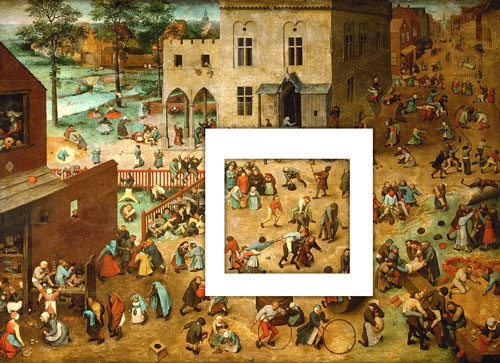
Viewing Frames:

Use sets of interesting pictures together with cards with a viewing window cut into them. Students place the viewing card over the picture in seeking a range of different features. E.g.  something red, made of xx, something denoting  happiness, something which suggests what might happen next. It’s a good idea to move from looking firstly for concrete features before moving on to abstract features. You could:

  • use a poem. Use the viewer to find the stanza that is most descriptive, that makes them happy, that uses the best simile…
  • or use a geometrical image, use the viewer to find corresponding angles, perpendicular lines, a reflex angle…
  • or an image of the water cycle, use the viewer to find where water vapour is rising, where water is moving downwards, where it would be best to site a farm, a village,  a wind turbine…


6. Reflecting on Noticing

Primary

Make reflecting on noticing part of everyday lessons

Here is a very practical example of how you might develop the emotional climate of the classroom and make it Noticing friendly

Learning Mats

Learning mats are  A4 laminated sheets that show various aspects of a learning habit. Keep them on desks/tables or as part of a wall display.

Secondary

Alert students to noticing across subjects 

A useful resource for tutor time to guide a wide ranging discussion


Primary and Secondary

What do you think?

  • Can you see a use for any of the suggested activities? 
  • Have you raised awareness of attentive noticing with your students?
  • Does your class have an agreed set of good noticing behaviours?
  • Which two ideas from above do you want to try out?
  • How long will you keep them going before you decide whether they have worked or not?

Make a note of…Little_r

  • What happens in your classroom in response to any of the above ideas.
  • How students’ behaviour changes over about 3 weeks of becoming more familiar and talking about the behaviour.
  • How your behaviour in the classroom changes as you use these ideas over time.

NB. None of the suggestions above will lead to instant understanding in students nor instant changes of behaviour. You will need to drip them in over time and keep building and refreshing your language of learning.

Continue Reading

4. Developing talk for… Noticing

Developing your learning language

Here is a range of things you can say to nudge Noticing. When you use this kind of language you are talking as a learning coach; encouraging students to think for themselves. Using such statements encourages your students to:

  • imitate you
  • start to think in this way
  • become conscious of these phrases and their meaning.

Gradually you will hear some of the statements pop up in students’ self-talk….in speech or even in writing from time to time, but mostly this will go on inside their heads. As your work on noticing gathers pace see if you can detect students who talk, or think, in these ways.

My learning-talk nudges to encourage noticing

Teacher talk – as a learning coach

Here are 10 ideas to ensure your students do the thinking for themselves

  1. What do you notice about the way… is doing that?
  2. Just watch/listen for a while. What’s happening? Wait a little longer. What’s really going on?
  3. Be patient for a bit longer. Do you notice any patterns here?
  4. Great! Your patience is rewarded. You noticed some (unusual) patterns/really useful details there.
  5. Do you notice any differences between xxx and yyy?
  6. Is there more to this than you are seeing now?
  7. Had you noticed that before?
  8. What seems to be going on here?
  9. Do you notice [something different/unusual] about this?
  10. Have you missed anything?

What do you think?

  • Which of these noticing nudges might you start using?
  • For which particular content areas would such nudging be most useful?
  • How will most of your students respond to such nudges?
  • Will this way of engaging be more popular with girls or boys?
  • What other nudging ideas might you add to the list?

Make a note of…

Little_r

  • Students’ reactions to the nudges.
  • Ideas about why this might be.
  • Ways in which you could further encourage students to imitate this metacognitive self-talk.
  • Any positive or negative impact of these noticing behaviours.
Continue Reading

5. Moving my practice on

Cultivating learning habits ultimately involves:

  • Providing rich and varied occasions for exercising learning habits
  • Infusing learning habits into lessons to enhance content understanding
  • Recognising and celebrating the use and growth of learning habits
  • Expecting students to take ownership of and responsibility for their own learning habits
  • Exploring the development of learning habits with students over time

As a teacher you are an influential character builder and so need to be mindful of how you help students form, replace, re-form and strengthen their learning habits.

But don’t worry, you’re not there yet. It takes most teachers between 2 and 3 years to become really fluent with this way of teaching. So, go easy on yourself. Feel determined because small steps often prove to be big levers for change. Have a think about what you might do…


What to stop and start

Here are a few ideas you might want to try. Take it steady, this way of teaching can be a big but exciting shift so it’s worth doing it slowly and thoughtfully.

Look first at the Stop/avoid ideas. Some of these are far from trivial but it’s best to try to remove them before starting on the Start/do more of, Start slowly and Experiment with ideas.

What do you think?

  • Which of the ideas appealed to you most?
  • Can you see ways of incorporating these into your subject/class routines?
  • Which would make the biggest difference to your students?
  • Which would make your life easier?

Make a note of…Little_r

  • Ideas that you want to try and the impact you hope they will have on your teaching and on your students.
Continue Reading

Section 1: Content and Sequencing

Strategic concerns.


What is the overall purpose of the suite of 13 Nutshell Phase 2 modules?

Once a school has established a commitment to developing students’ learning habits, there is a pressing need to maintain momentum and generate further ideas and enthusiasm.

These resources answer that need.

The on-line material is designed to enable lead teachers to run training/coaching sessions with school teams that will give teachers practical hands-on experience and a wealth of ideas that they can put rapidly in place in their classrooms.

There are eleven learning behaviour modules in the suite. Each module covers progression in one of the essential learning behaviours that have been identified by research as having greatest impact on learning outcomes:

Collaboration; Questioning; Making Links; Planning; Listening; Noticing; Revising; Reasoning; Imagining; Resourcing learning (Capitalising); Me-Learning ( Meta learning).

Each module has 4 sections:

  1. How the learning behaviour develops over time. Progression Chart. Unpick the meaning of the behaviour, how it develops over time and use the progression chart to plot where your students are now.
  2. Taking the learning behaviour into classroom cultureClassroom activities. Offers numerous suggestions to develop a Learning friendly culture and build students’ Learning skills.
  3. Blending Learning with content. Dual focused lesson. Suggests a series of questions and steps you might use to ensure the development of Learning claims its place in the curriculum and is designed into lesson/activities to aid understanding. 
  4. Team reflection and planning.  Share the impact of your experiments with colleagues and plan what you need to do next.

And the resource materials in the Learning Diary help you to distil important messages, home in on the key bits of information and design learning experiments specifically for you.

Important Note: Unlike Nutshells 1, there is no expectation that all teachers will tackle all modules. Teachers should expect to look at those that are most relevant to either their own subject, or to identified whole-school issues. Even so, expect any module to take at least half a term, probably more.

Additionally there are two other modules:

  • this one relating to how the other 12 might best be used by team leaders;
  • and ‘Reviewing our Progress‘ that should be used as the last module to review progress to date and to consider ways forward.

However senior / team leaders should take a quick look at this module now, as some of the suggested review strategies might benefit from conducting an evaluation of the current situation at this point so that the subsequent review can track shifts in teacher and learner behaviours.

[Naturally these two additional modules have a unique format, unlike the consistent  approach in the 11 learning behaviour modules described above] 


Using these materials across all school teams will;

  • Develop team understanding of learning habits and behaviours and, importantly, how they should develop over time
  • Establish team enthusiasm for refreshing student motivation and learning capacity
  • Build expertise through guided sessions that stimulate teachers to use the materials and generate their own ideas.
  • Secure a common language for learning across the school


How do we decide where to start in using the Nutshell Phase 2 modules?

Unlike Nutshells 1 where the order for sequencing the modules was tightly defined, Nutshells 2 has no pre-determined sequencing. 

Schools can either:

i) Let (curriculum) teams first play to their strengths.

Invite teams to consider the question,

  • which three or four of the learning habits are most readily exercised through their subject?

In other words teams think about which habits fit easily with the disciplines of their curriculum area/subject content and indeed teaching styles.

Mapping different subjects to learning habits will show that each exercise a different blend of habits.

Many teachers believe that through their subject disciplines the learning habits grow naturally, although they will probably be unaware of whether and how learning habits are developing. John Hattie’s research shows that learning habits need specific interventions if they are to grow and strengthen.

This approach of mapping habits to curriculum areas offers a smooth, non-threatening and pragmatic approach to introducing learning power.

Teams first explore the learning habits they think their subject naturally uses before later being supported to experiment with less familiar learning habits as their confidence grows.

Advantage: teams start with behaviours that most readily fit in their subject. Disadvantage: teams are working on different modules concurrently.

or:

ii) Select a range of critical learning habits for the whole school to tackle together

Here the school selects those learning habits that need explicit whole school attention because they are critical to the success of a large number of curriculum areas, For example, Questioning, Listening . . . . 

Or maybe the choice is to work on a module(s) perceived to be an area of known learner weakness.

This approach means that all teams experiment with the same range of learning behaviours, moving on to other behaviours as their confidence grows. Disadvantage: teams are delayed from focusing on modules that relate most closely to their subject area.

You know your school well. Which strategy will work best for you?


Continue Reading

Section 2: Managing team coaching sessions

Managing team coaching sessions

What are we expecting work on the Nutshell phase 2 modules will achieve for staff and students?

[This section is simply a reminder of how the Nutshells team sessions work in practice, and is repeated from Nutshells phase 1.]

Coaching Nutshell modules should help all teachers to;

  • Become enthusiastic leaders of their students learning
  • Be committed to approaches that are relevant, worthwhile and manageable
  • Develop more and more creative ideas of their own
  • Share with each other the rapid impact this shift in perspective has on their students’ learning
  • Enjoy their teaching even more

Teachers working differently should have the following outcomes for students. They;

  • Find classroom activities engaging and interesting
  • Secure a greater understanding of content and make progress
  • Understand how using learning behaviours helps them to learn better
  • Work towards becoming leaders of their own learning
  • Become less dependent on their teachers to provide them with answers and solutions


How might we pace the content? What coaching climate will be most effective?

i) Suggested pacing of content

In preparation of a team meeting.

Make teams aware of which module is being studied. Give teams access to the on-line module in advance of the team session. Invite them to read it through to get the feel of it – they will anyway. They should focus particularly on section 1, focusing on the activity  relating to the progression grid. Team members should arrive at the meeting having downloaded the progression grid and estimated where their students are on the grid. This is essential pre-reading before the team meeting.

Team meeting

Aim to discuss any outstanding issues from the previous module (if appropriate).

The bulk of the meeting is given over to:

  • Agreeing where the majority of students lie on the progression grid;
  • Exploring the suggested teaching activities, routines and teacher talk that can support students at that level;
  • Planning and committing to undertaking a learning enquiry stimulated by the online materials.

It may well be necessary to have a second team meeting to evaluate progress, to identify enquiries that are having a significant impact, to share good practice, and to maintain momentum 


ii) Building an effective development climate

Changing the habits of a professional lifetime is not simple. It involves un-learning and re-learning: unpicking, readjusting, trying things out and seeing what works. It’s about staff using their own learning power to affect changes in themselves. And the desired change is not just in what they think and believe; it is in how they spontaneously talk and act and plan. Even small shifts in the type of language a teacher uses take time to implement fluently. They have to stop using previous language, start using new language, hesitantly at first, then in different contexts, more frequently and with greater fluency.

Think Teacher Learning Community

Think of these meetings as a Teacher Learning Community the essence of which is a small group of teachers who meet together regularly to deepen their understanding of an approach, trying out new things and reflecting on and sharing their experiments with each other.

iii) A team session is usually arranged like this…

Introduction to agree aims for the meeting, and quickly offload irritations or frustrations about work that otherwise could hinder the progress of the meeting.

Sharing how things are going Each member gives a summary of what he or she has tried to achieve since the last meeting. Everyone is expected to report back to every meeting. The group question and probe their colleagues’ summaries to encourage analysis and deeper reflection. They use questions such as ‘What do you think is getting in the way? What would make this even better? How could this technique be modified to make it work for you? What do you think made that work so well?’

New learning The middle section of the meeting is where ideas form the Nutshell modules are introduced discussed and decided on. This changing middle section keeps the meetings fresh, but importantly aims to progress the breadth and depth of the approach.

Personal action planning Each member then plans what they intend to try over the next, say, month. This gives teachers time to think and plan in the session itself. 

Review of the meeting

Finally the group reflect on the original objectives of the meeting to see if they have been achieved.

This tight format makes the purpose of the exercise clear and everyone knows what is expected of them.

Meetings such as these have been a prominent feature in many learning powered schools and have helped teachers to share both successes and tricky problems in an atmosphere of trust and commitment.

Operating ground rules. 

But apart from the structure it’s a good idea to have some ground rules for such meetings. It’s important in keeping groups both comfortable and purposeful.

Try these ground rules for size and amend at your first meeting to suit your team’s way of working.

Pre-session organisation

All team members to:

  • look through the Nutshell materials before a session
  • bring their previous session’s Personal Action Plan to the meeting
  • prepare a two-minute input about their lesson experiments to share with the group

In-session climate

  • Everyone fully engaged in the group
  • No group member can ‘pass’
  • Active listening when not your turn
  • Actively discuss everyone’s input
  • What is said is confidential to the group
  • Constructive criticism – developmental not judgemental
  • No put-downs
  • Open-mindedness
  • Respect others’ views and encourage others’ ideas

Post-session activity:

  • Everyone to undertake their small-scale learning enquiry with a view to feeding back at the next session;
  • Everyone to undertake the required reading for the next session;
  • It’s a good idea to review these ground rules occasionally to make sure the team is working well for all its members.

Continue Reading

2. Developing learning friendly cultures

Making learning power work involves transforming the traditional culture of the classroom. A common language for learning is adopted; staff shift responsibility for learning to pupils and model learning by sharing their own difficulties, frustrations and triumphs; students come to understand themselves as growing learners and consciously improve their learning habits; teachers assume the role of learning-power coach, offering students interesting, real and challenging activities to enable them to create their own knowledge and stretch their learning habits.

Continue Reading

1. Getting to know your students as learners

This online module introduces you to a constellation of learning behaviours. Research confirms them to be the high value psychological characteristics that make up a successful lifelong learner.

Take a look at yourself and your students through the lens of these learning behaviours and think about why it  might be important to develop them into learning habits.

Continue Reading

Reflectiveness – (Planning, Revising, Distilling, Meta-learning) KS2-3

Building Reflectiveness

Being ready, willing and able to become more strategic about learning. Reflectiveness: The strategic aspects of learning (Managing).

Planning

Working learning out in advance

Revising

Monitoring and adapting along the way

Distilling

Drawing out the lessons from experience

Meta-learning

Understanding learning, and yourself as a learner

Connecting

The Face in the Mirror

Coaching notes

Coaching notes

Learning Challenge

Learning Challenge

Linking Ideas

Linking Ideas

Stretching

The London Game

Coaching Notes

Coaching Notes

Rating Wheel

Rating Wheel

Learning Challenge

Learning Challenge

Resource

Resource

DIY

DIY

Transferring

Reflectiveness for Martians

Coaching Notes

Coaching Notes

Trainer Notes

Trainer Notes

Learning Log

Learning Log

Continue Reading

Reciprocity – (Interdependence, Collaboration, Empathy, Listening, Imitation) KS2-3

Reciprocity

Being ready, willing and able to learn alone and with others. The social aspects of learning (Relating)

Interdependence

Balancing self-reliance and sociability

Collaboration

The skills of learning with others

Empathy and Listening

Getting inside others’ minds

Imitation

Picking up others’ habits and values

Connecting

Making Omelettes

Coaching notes

Coaching notes

Linking Ideas

Linking Ideas


Stretching

Stranded

Coaching Notes

Coaching Notes

Questionnaire

Questionnaire

Learning Challenge

Learning Challenge

Answer Sheet

Answer Sheet

Observation Sheet

Observation Sheet

Transferring

Reciprocity for Martians

Coaching Notes

Coaching Notes

Trainer Notes

Trainer Notes

Learning Log

Learning Log

Continue Reading

Resourcefulness – (Questioning, Making Links, Imagining, Reasoning, Capitalising) KS2-3

Building Resourcefulness

Being ready, willing and able to learn in different ways. The cognitive aspects of learning (Thinking).

Questioning

Getting below the surface; being curious

Making Links

Seeking coherence, relevance and meaning

Imagining

Using the mind’s eye as a learning theatre

Reasoning

Thinking rigorously and methodically

Capitalising

Making good use of resources

Connecting

Questions for Answers

Coaching notes

Coaching notes

DIY

DIY

Linking Ideas

Linking Ideas

Stretching

Whose Wallet?

Coaching Notes

Coaching Notes

Rating Wheel

Rating Wheel

Learning Challenge

Learning Challenge


DIY

DIY

Transferring

Questions for Answers

Coaching Notes

Coaching Notes

Trainer Notes

Trainer Notes

Learning Log

Learning Log

Continue Reading

Resilience – (Absorption, Managing Distractions, Noticing, Perseverance) KS2-3

Building Resilience: 

Being ready, willing and able to lock on to learning. The emotional aspects of learning (Feeling). 

Absorption

Flow; the pleasure of being rapt in learning

Managing Distractions

Recognising and reducing interruptions

Noticing

Really sensing what’s out there

Perseverance

Stickability; tolerating the feelings of learning

Connecting

Piggies in a Field

Coaching notes

Coaching notes

Learning Challenge

Learning Challenge

Linking ideas

Linking ideas

Stretching

Heath Robinson Challenge

Coaching Notes

Coaching Notes

Observation Sheet

Observation Sheet

Learning Challenge

Learning Challenge

Resource

Resource

Transferring

Resilience for Martians

Coaching Notes

Coaching Notes

Trainer Notes

Trainer Notes

Learning Log

Learning Log

Continue Reading

About the activities KS2-3

The construction of the Bank offers you tremendous flexibility

For example you could:

  • string the topics and approaches together to form a whole programme
    – e.g. year 7 PSHE
  • use warm-up activities in tutor time
  • infuse stretching activities into the curriculum
  • and so on

Things to think about

  • Which of the themes and topics do you want or need to use?
  • What order of the themes and topics seems appropriate?
  • Would it be useful to mix topics from different themes?
  • Which of the approaches will work best, for each topic?
  • Do some topics lend themselves to all or some of the approaches?
  • Which activities are too difficult or too easy for your students?
  • How could you adapt or replace them?

How about …

  • Learning mentors using the Transferring activities
  • Year 7 using Connecting activities in their induction programme or tutor time
  • Using any of the activities to structure an assembly
  • Using some Stretching activities to introduce teaching for learning power to staff
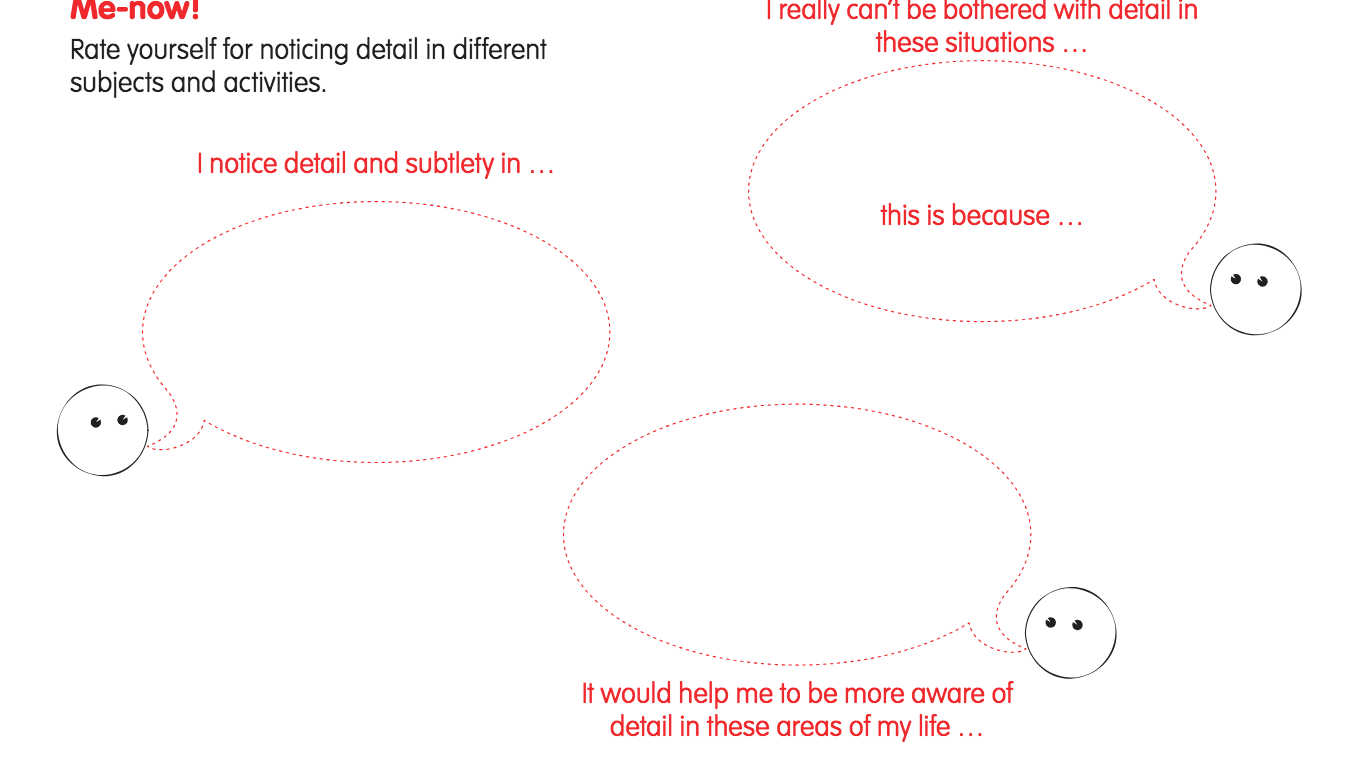
  • Using the ‘Me-now’ activities (see Transferring) in learning reviews

Connecting activities include some or all of the following:

  • Learning Challenges (LC) – instructions for students
  • Observation Sheets (OBS) – for use with the activity
  • Linking Ideas (LI) – a range of activities to deepen understanding

Stretching activities include:

  • Learning Challenges (LC) – instructions for students
  • Resources (RES) – for use with the activity
  • DIY Resources (DIY) – templates which require printing and cutting
  • Observation Sheets (OBS) – for use with the activity
  • Rating wheels (RW) – for use after the activity

Transferring activities include:

  • Reflective Activities (TRN) – for use with groups of students
  • Learning Logs (LL) – for use by individual students

All the resources can be displayed on the interactive whiteboard or printed for students’ use.

The great majority of the activities are accompanied by selected resources and can be used without further delay. Those activities with DIY resources require you to make resources. This usually involves printing the DIY resources onto card and cutting them up.

Using the activities

There are five main content themes, each divided into several topics.

Theme 1 About Learning

Learning is an important part of all aspects of our everyday lives, and not something that simply happens through school. We have a set of ‘learning muscles’ that we use to help us learn successfully, and these muscles need exercising to keep them toned and strong.

1a Learning and life (topic)

Exploring what learning means, how it is experienced and how learning and life are inseparable.

1b How we learn (topic)

Exploring the big picture of learning power, introducing the four dispositions of resilience, resourcefulness, reciprocity, and reflectiveness. 

Theme 2 Resilience

Being ready, willing and able to lock on to learning.

  • Absorption:
    • flow; the pleasure of being rapt in learning
  • Managing Distractions:
    • recognising and reducing interruptions
  • Noticing:
    • really sensing what’s out there
  • Perseverance:
    • stickability; tolerating the feelings of learning

2a About Resilience

Exploring what resilience in learning means, how it is experienced and its importance in learning.

2b Absorption

Exploring being absorbed, what absorption feels like and why it’s important in learning.

2c Managing distractions

Exploring the notion of distraction in learning, how we might manage distractions and why this is important in learning.

2d Noticing

Exploring the capacity of attentive noticing, how we use it in learning and why it is important in learning.

2e Perseverance

Exploring what we mean by persevering in learning, its association with feelings and how persevering helps learning.

Theme 3 Resourcefulness

Being ready, wiling and able to learn in different ways.

  • Questioning:
    • getting below the surface; being curious
  • Making Links:
    • seeking coherence, relevance and meaning
  • Imagining:
    • using the mind’s eye as a learning theatre
  • Reasoning:
    • thinking rigorously and methodically

3a About Resourcefulness

Considering the big picture of being a resourceful learner.

3b Questioning

Exploring the value of questioning in learning.

3c Making links

Examining how and why making links is central to how we understanding things.

3d Imagining

Exploring the use and power of imagination as a learning habit.

3e Reasoning

Exploring the nature and value of thinking logically as an aspect of learning.

3f Capitalising

Examining the nature and usefulness of using all sorts of resources as a habit of learning.

Theme 4 Reciprocity

Being ready, willing and able to learn alone and with others.

  • Interdependence:
    • balancing self-reliance and sociability
  • Collaboration:
    • the skills of learning with others
  • Empathy and Listening:
    • getting inside others’ minds
  • Imitation:
    • picking up others’ habits and values

4a About Reciprocity

Considering the big picture of being a reciprocal learner.

4b Interdependence

Exploring the meaning and use of interdependence in learning.

4c Collaboration

Exploring the meaning and skills involved in collaborating with others in learning.

4d Listening

Examining the skills involved in real listening and its importance in learning with and from others.

4e Empathy

Exploring the meaning of empathy and the need for empathetic behaviour in learning.

4f Imitation

Exploring the meaning of imitation, and how and when we use imitation as a useful learning habit.

Theme 5 Reflectiveness

Being ready, willing and able to become more strategic about learning.

  • Planning:
    • working learning out in advance
  • Revising:
    • monitoring and adapting along the way
  • Distilling:
    • drawing out the lessons from experience
  • Meta-learning:
    • understanding learning, and yourself as a learner

5a About Reflectiveness

Considering the big picture of being a reflective learner.

5b Planning

Exploring the nature and role of planning as a
useful habit in managing our learning.

5c Revising

Exploring the nature and role of flexibility in learning
and the importance of monitoring our own learning.

5d Distilling

Examining the nature of distilling and how this
helps us to improve how we do things.

5e Meta learning

Exploring the meaning and
value of understanding ourselves as learners

These skills, attitudes and values, when used with increasing competence and confidence across a wide range of learning opportunities, amount to a successful learning character. Building Learning Power is fundamentally about establishing, nurturing and stretching the learning characters of students. The approaches and activities in the Activity Bank aim to introduce students to the habits of a learning character, and involve them in understanding and growing their own learning character.

Continue Reading

Infusing Collaboration into lessons

This Advance Organiser is a little different. The materials show you how an ‘infused’ lesson is designed but here we go a little deeper and include specific aspects of collaboration. The resulting lesson is one that you can use or adapt to develop or assess pupils’ collaborative behaviours.

It is an essential preparation for the Professional Learning Team session in the same course

Session Objectives

By completing the steps in this session you will be able to:

  • use the ideas to plan a Learning Power infused lesson of your own.
  • use or adapt the given sample lesson with your pupils
  • monitor how your pupils behave in a collaborative activity.

Learning behaviours to help you

  • notice the essential differences between the ‘infused’ planning process and how you plan lessons now
  • make links between the ideas described and your standard planning format
  • review your own lesson planning practice
  • question the practicality of the described methodology

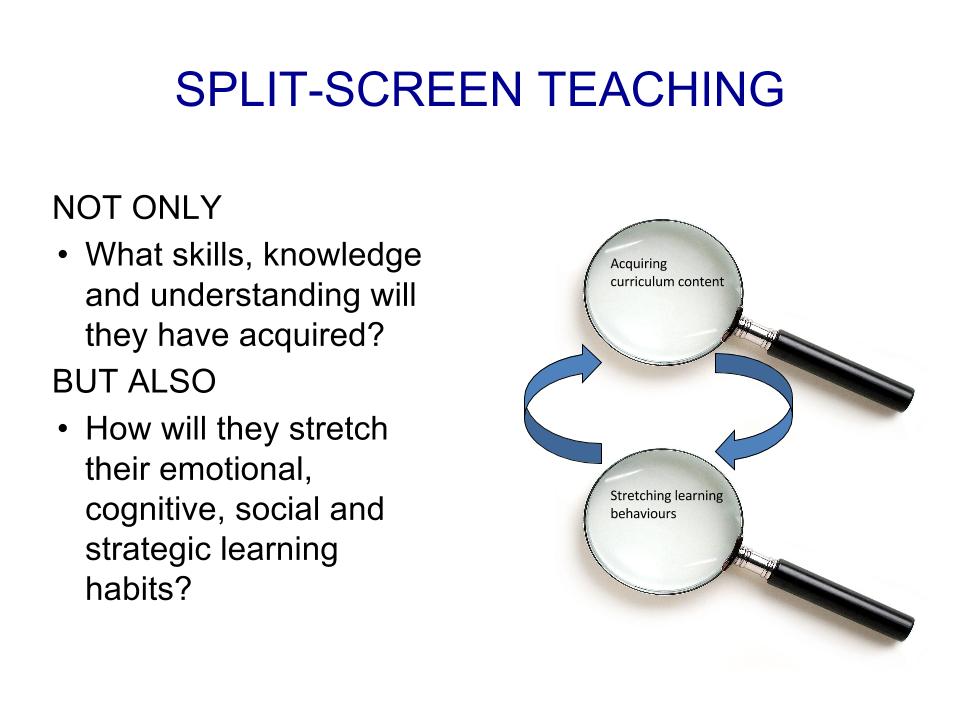
1. A reminder about dual-focused or split-screen lesson design

Jump to section 2  if you feel you understand the design of a split-screen lesson

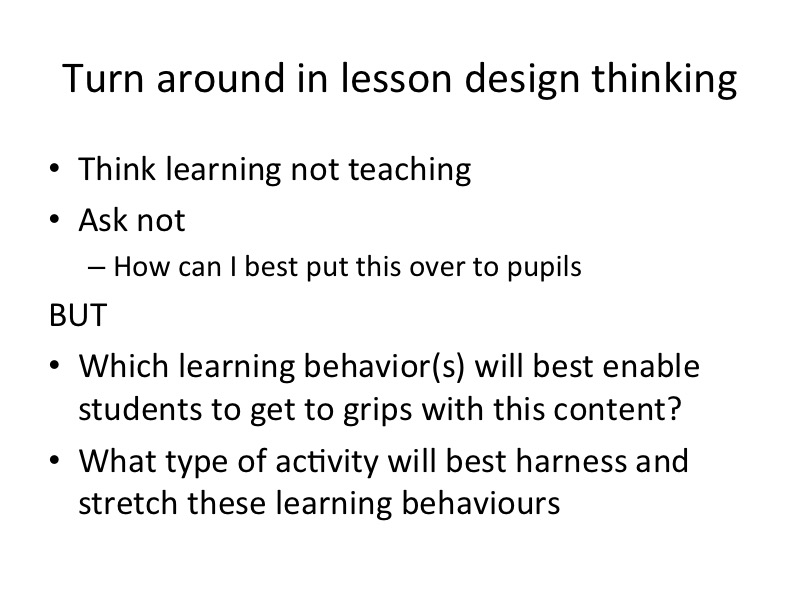
1a. A turn-around in lesson design.

Learning to be a BLP teacher means learning to think in two dimensions at once – the content dimension and the learning behaviour dimension. It means turning your thinking around – from teaching to learning. Look at the distillation of these ideas in these two panels.

Or put another way…


1b. Putting the ‘turn-around thinking’ into practice.


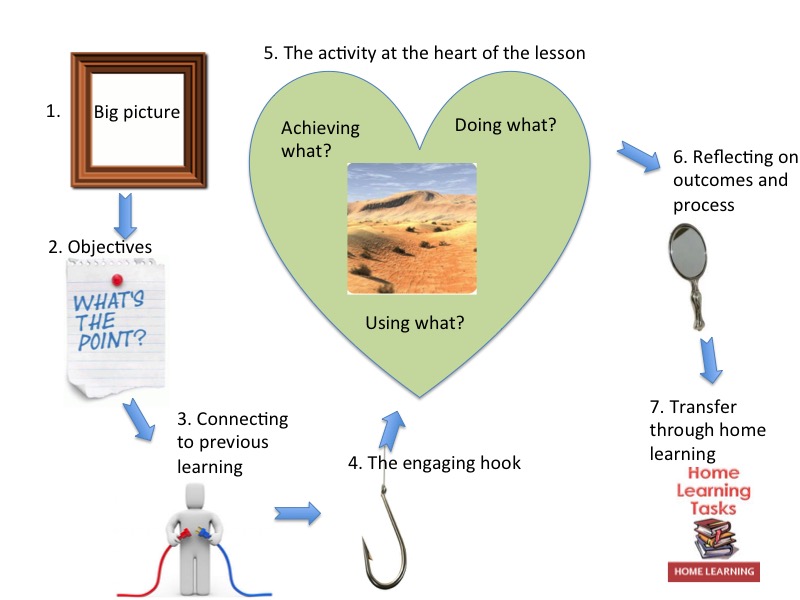
Jumping to the heart of the lesson

Let’s just by-pass lesson starters and recalling previous learning for now, and jump to the heart of the lesson.

  • What has to be achieved or understood by pupils – objectives
  • By doing what? – task
  • Using which learning capacities? This is the NEW bit

You already do all the rest!

But it’s this ‘using which learning capacities?’ that will cause you to think differently about the lesson planning.

You ask – as always – what are the anticipated objectives?

The verbs in your resulting objectives will give you clues about the types of activities that will achieve the objectives and the sorts of learning behaviours your pupils will need to contribute to this learning endeavour.

You are designing the task in a way that relies on pupils to contribute their learning ‘powers’; muscles, behaviours, call them what you will.

Click on the image below to progress through the slideshow

1c. Working the lesson design through

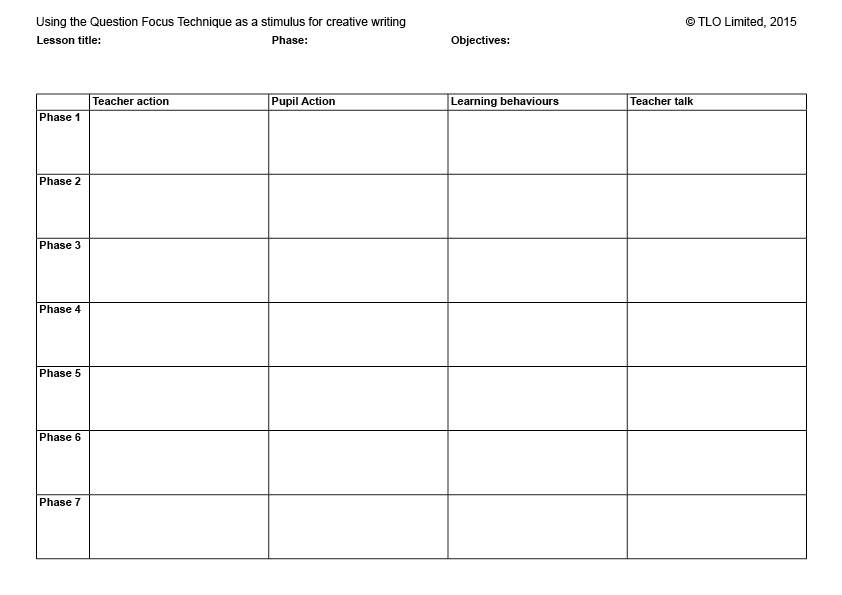
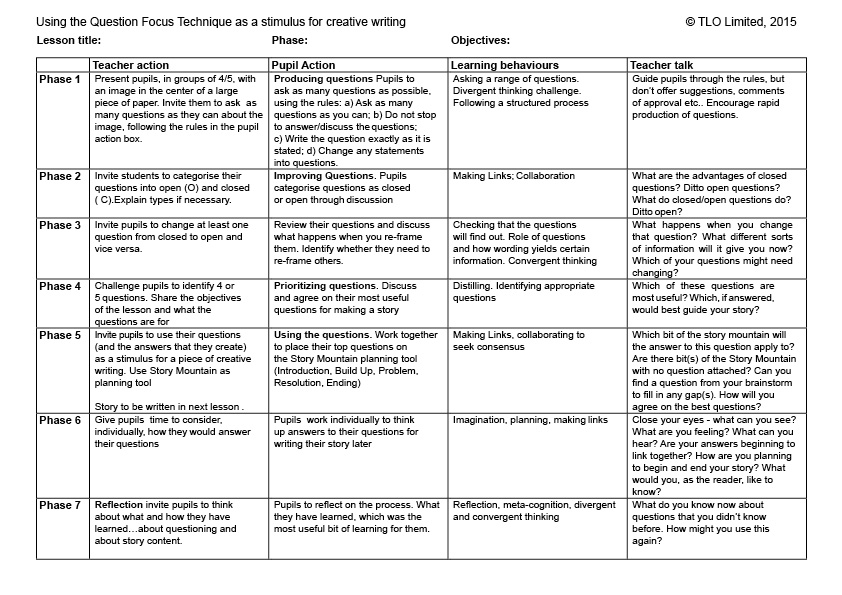
The lesson schema.


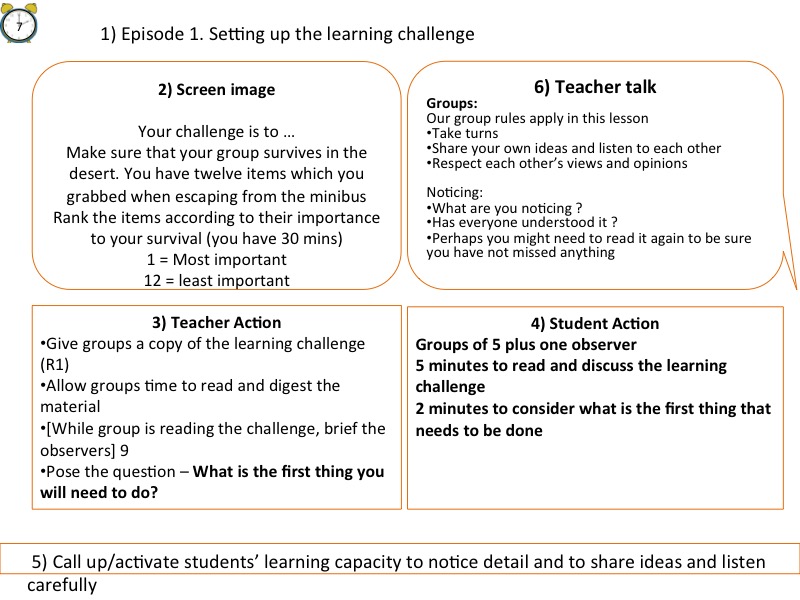
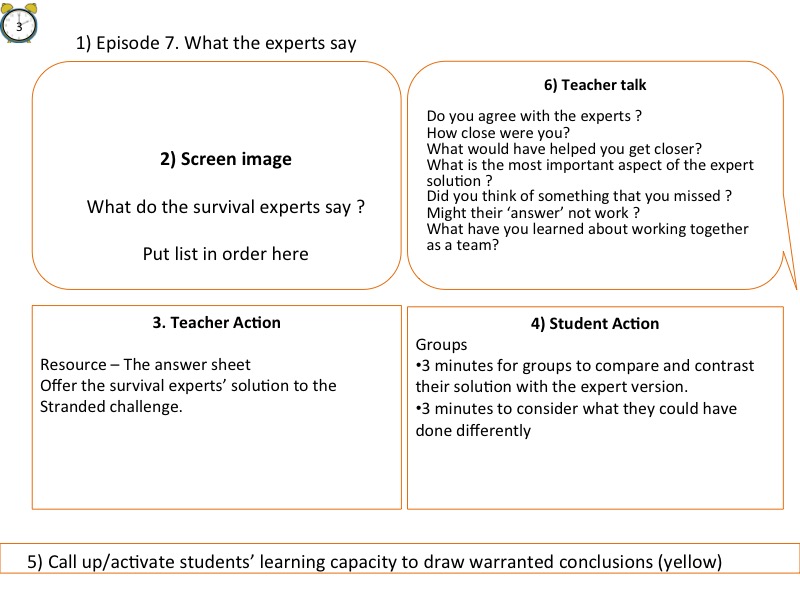
Oops! This might look different to your standard lesson planning format. Don’t worry, no need for you to use this format, we are using it to help you see clearly what’s happening.

We’ll build it up bit by bit

  1. Lesson title or sub title for this part of the lesson
  2. Stimulus on the whiteboard or in reality. This might be a driving questions, a hook, a resource, the objectives, and so on.
  3. What you, the teacher, will be doing at this point.
  4. What the pupils will be doing at this point.
  5. The learning behaviour you are going to ‘call up’ or activate in pupils to help them reach the learning objectives. The new bit.
  6. How you will be talking – the language you will be using to nudge learning behaviours along. Another new bit.
  7. Time –how long this part of the lesson should take.

So, as you can see there are only two new components to think about. (5 and 6) and they are linked together: the learning behaviour being used and how you will talk about it to encourage and nudge its use.

Click on the image below to progress through the slideshow

2. Let’s start the Collaboration lesson proper

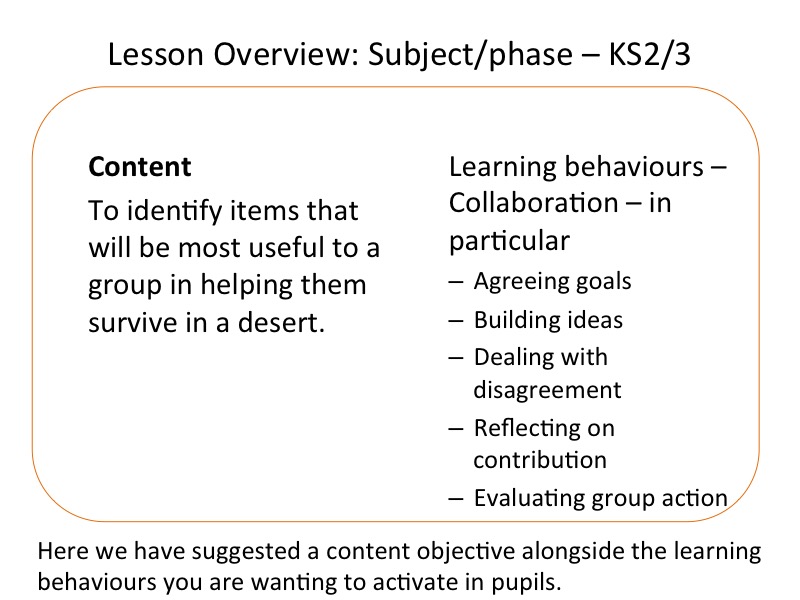
In this section we are going to work through planning a lesson that aims to deal with surviving in a desert. To do this we have selected a ranking order type task which will be achieved by  pupils using their collaborative behaviours. You could use, or adapt, this lesson with your class to develop collaboration. Alternatively you could use it to monitor pupils’ progress in collaborative skills. Its function here is to show how a dual focus lesson is made up/planned.

The lesson has been structured to bring out various aspects of collaboration.

Episode 1 Noticing detail and a reminder to use teamwork ground rules

Episode 2. Sharing and building ideas

Episode 3. Agreeing a goal and dealing with controversy

Episode 4. Making good decisions in planning and foreseeing obstacles

Episode 5. Assessing individual contributions to the team effort

Episode 6. Assessing team performance

Episode 7. Reviewing team performance in view of knowledge of the experts’ answer

All these aspects of teamwork are taken from the Collaboration Grid


Objectives

Slide9

In this lesson the teacher is orchestrating the activity – splitting it up into episodes and guiding it along in order to highlight/stretch/provoke particular aspects of collaboration.

But you could run this activity without any structuring, i.e. just set the task, observe the action and let groups know when time is up.


Screen Shot 2015-06-17 at 16.33.24 smEpisode 1 – Setting up the challenge

Slide2


N.B.  We are activating general teamwork conventions here. These are activated through teacher talk

Time 7 minutes

2. Screen image. The hook An intriguing challenge to get pupils engaged. You may want briefly to summarise the task ahead.

3. / 4. Teacher Action and Student Action This first episode is designed to encourage groups to become familiar with the challenge, to begin to think about how they will tackle it, and so resist the temptation to rush into action.

Resources 1 and 2: The learning Challenge – Stranded (R1) and Observation sheet (R2), 1 per group

5) Learning behaviours. In this episode pupils will be using their noticing skills to get under the skin of the challenge and their collaboration skills to identify what the task is about (collaboration purple) and to begin to prioritise action ( collaboration green).

6) Teacher talk:- Here we suggest the sort of teacher talk that is designed to nudge the learning behaviours in the right direction, and supportive of the sort of discussion you are trying to orchestrate. This talk will of course be tailored to the age and existing learning behaviours of your group. The examples given in the teacher talk box nudge students to observe the conventions of group work and to be attentive to detail.

Screen Shot 2015-06-17 at 16.33.24 smEpisode 2 – Possible survival strategies


Slide3

7) Time 8 mins

2) Screen image – Posing key questions

3/4 Teacher and Student Action. Purpose: To steer students to realise that they cannot begin to rank the relative importance of the items until they have decided together on their strategy for survival – [Walking to the ranch would make the compass and map important, whereas staying put and awaiting rescue would not]. The group activity suggests groups generate at least three possible survival strategies. (Possible strategies could be: go to ranch; stay put; retrace minibus tracks; walk in general direction of hotel; walk to try to find a road . . . . )

(A teaching point – pupils will usually gravitate to the ‘go to the ranch’ strategy, in the expectation of finding people, shelter and water. The unspoken assumption is that it is a working ranch with people at it who can help. To help them to avoid this course of action (which is wrong anyway) you might need to nudge their thinking with comments like ‘what do you actually know about the ranch ?’ and ‘what can you be certain about ?)
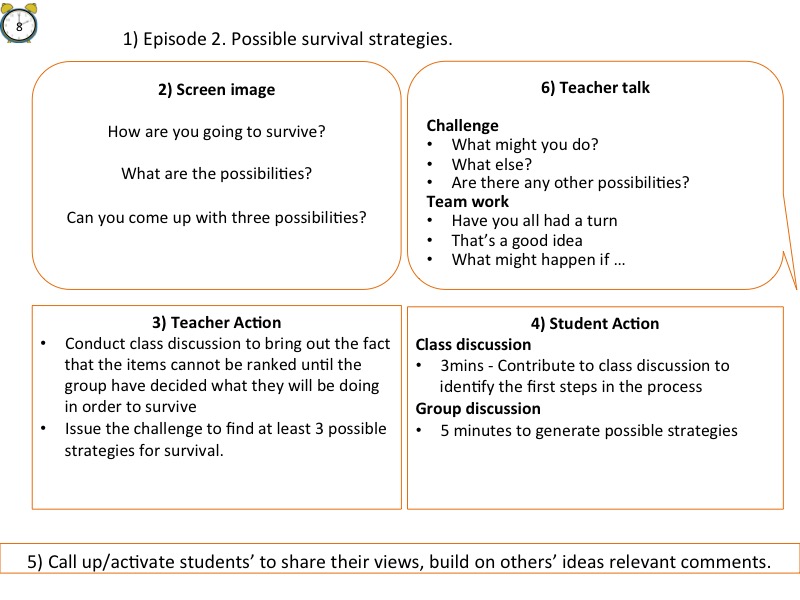
5) Learning behaviours: -In this episode pupils will be using their imagination based on information given to generate possible courses of action. In collaboration terms, the team need to  share and offer their own views (collaboration purple) and make relevant comments (collaboration blue)

6) Teacher talk:- this needs to be tailored to the age and existing level of questioning behaviours of your group. The examples given in the teacher talk box nudge towards careful consideration of various alternatives.

Screen Shot 2015-06-17 at 16.33.24 sm

Episode 3 – What should we do?

Slide4

7) Time 5 mins

2) Screen image – Time for groups to decide on their strategy

3/4) Teacher and Student Action. Purpose – to require groups to agree on their preferred/agreed survival strategy.

5) Learning behaviours: – In episode 3 students are required to consider the strategies they thought of in episode 2, and to agree which one they intend to adopt. In collaboration terms, they are seeking agreement in setting goals and resolving potential differences of opinion, dealing with possible controversy(collaboration blue and green)

6) Teacher talk:- intervene in groups as and when necessary in order to prompt further consideration and/or to agree a way forward, or ways to resolve conflict.

Screen Shot 2015-06-17 at 16.33.24 sm

Episode 4 – What do we need [most]?

Slide5


7) Time 12 mins – Ensure groups are aware of the time limits in this episode.

2) Screen image – Here groups to identify precisely how they are going to use the items to ensure survival

3/4) Teacher and Student Action. Purpose – to enable groups to plan how they will use the items to give themselves the best chance of survival.

5) Learning behaviours: – In episode 4 groups are required to make good decisions to reach their goal (collaboration yellow) by making links to prior knowledge/experience and by capitalising on the potential uses of the items taken from the bus.

6) Teacher talk:- intervene in groups as and when necessary in order to prompt them to exploit the potential uses of the items.

Watch for how they pull together as a group; how they encourage others to contribute, how they contribute to making good decisions.

Screen Shot 2015-06-17 at 16.33.24 sm

Episode 5 – How did I do?

Slide6


7) Time 3 mins

2) Screen image – Pose the question about individual contributions to the group.

3/4) Teacher and Student Action. The main activity is now finished. Purpose now is to enable individuals to reflect on their personal contribution to, and feelings about, the process. Allow pupils to reflect individually. Could be done as a pair exercise if pupils trust each other. Try to get a sense of how honest pupils are being regarding their contributions
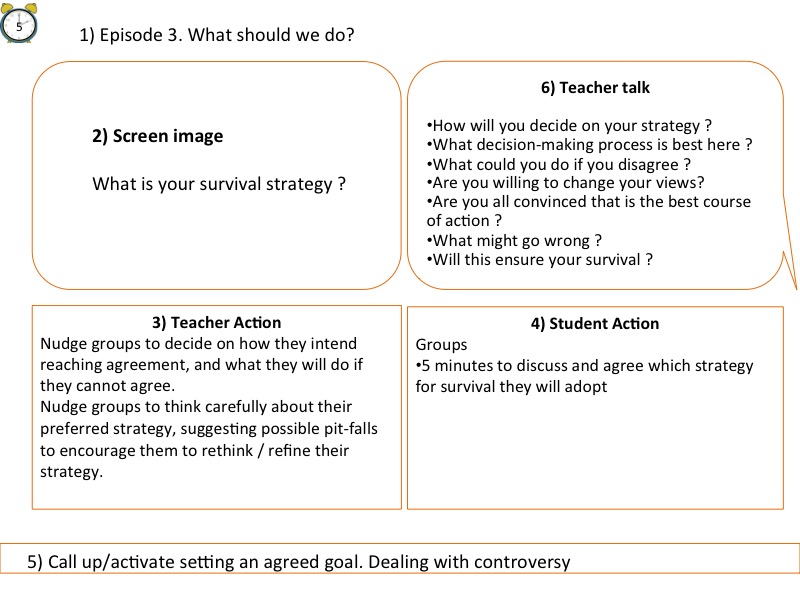
Resource 3 – Post Decision questionnaire, 1 per pupil 

5) Learning behaviours: – In episode 5 individuals are required to think about how they have contributed (collaboration purple) to the activity, their feelings about the extent to which a good decision was made and the extent to which their views were respected (collaboration green) .

6) Teacher talk:- intervene only if necessary

Screen Shot 2015-06-17 at 16.33.24 sm

Episode 6 – How well did we do as a team?


Slide7

Time 6 mins

2) Screen image – Time now for observers to feedback on group/individual behaviours and generate evaluative discussion.

3/4) Teacher and Student Action. Purpose – to help groups practise reflecting on their team-working during the activity.

Resource Observing a Learning challenge – stranded

5) Learning behaviours: – In episode 6 the observer/groups will offer/accept feedback on their own and group performance (collaboration blue) and evaluate team effort (collaboration yellow).

6) Teacher talk:- intervene in groups only in order to prompt groups to hear the observer’s feedback with a view to using it to improve.

Screen Shot 2015-06-17 at 16.33.24 sm

Episode 7 – What the experts say


Slide8

Resource – The Learning Challenge: Answer sheet.

Let teams see the experts answer and estimate how close they come to this. Also encourage teams to think about what they might have done differently to achieve a closer answer.
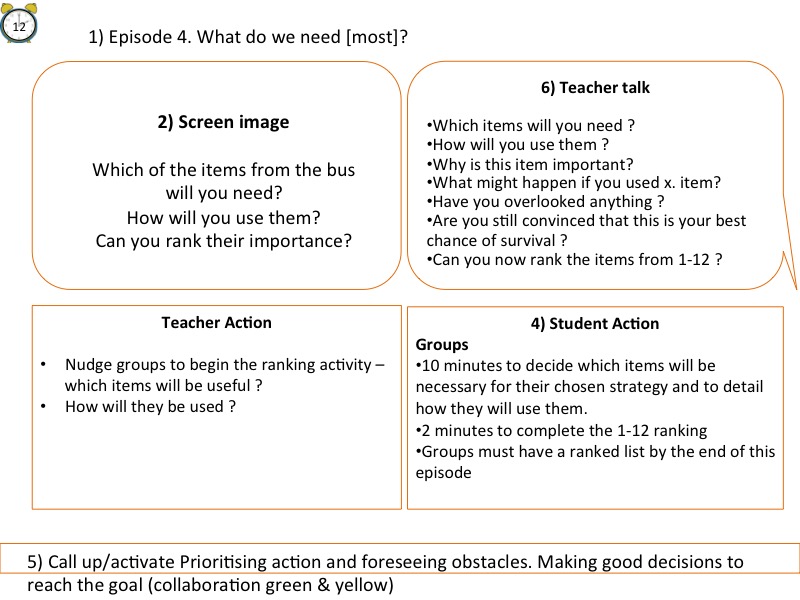
3. Putting the activity into the whole lesson
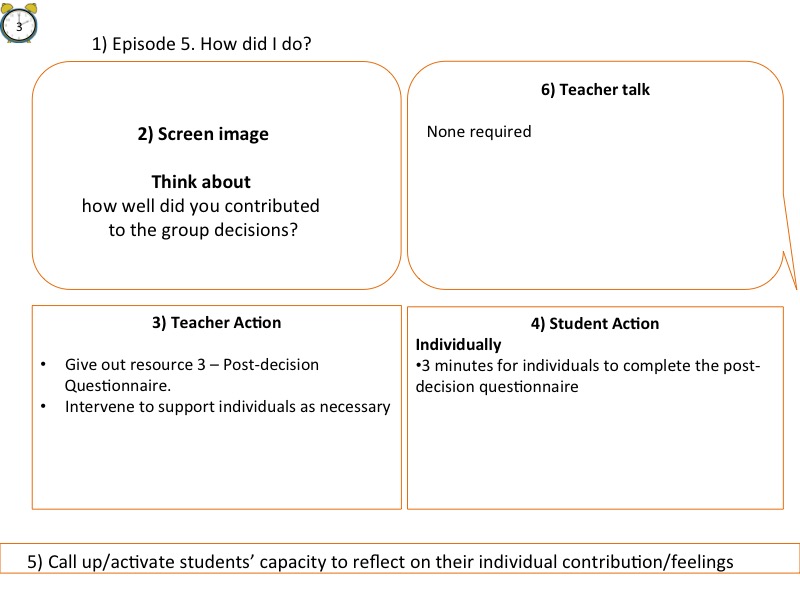
Slide1

Here’s the full lesson story

  1. Big Picture – where the lesson fits into a wider SoW – a holistic context
  2. What the lesson will achieve (objectives, outcomes, success criteria and the like)
  3. How you will connect pupils to previous learning on this topic
  4. The hook – how you will initially engage/interest/make them curious about the subject matter
  5. The activity at the heart of the lesson – where the blending of what and how happens
  6. Reflecting on the process
  7. Reinforcing/transferring through a linked home learning

Look carefully at the seven steps

What do you think?

  • Can you see how the ‘heart of the lesson’ fits with the wider context of lesson design?
  • Have you noticed how the running order of the lesson is not the order in which it is planned? 

Make a note of…Little_r

  • Any positive or negative feelings you have about planning lessons in this way?


Task 1

Summarise your thinking about the infusion of collaboration into the Stranded lesson. List the specific ideas that you wish to try out as a way of extending your classroom practice experiments.

Please bring these noted points with you to the Professional Learning Team Session.

Continue Reading

Infusing Questioning into Lessons

This advance organiser is a bit different. Here we introduce you to an interesting way to encourage pupils to formulate questions and then show you how this question formation technique can be infused into lessons

This lesson is an essential preparation for the final Professional Team session in this Year 1 programme.

Session Objectives

By completing the steps in this session you will be able to:

  • Use the Question Formulation Technique (QFT™*) with your pupils
  • Use or adapt the sample lesson for your pupils
  • Plan other lessons infused with pupil questioning

Learning behaviours to help you

  • Notice the essential differences between learning power lesson planning process and how you plan lessons now.
  • Make links between how you tackle encouraging pupil questioning and the Question Formulation Technique (QFT)
  • Question the practicality and versatility of the Question Formulation Technique


Section 1: An interesting way to formulate and understand questions

We have come across an intriguing technique that has been developed by the Right Question Institute over several years. The technique puts pupils into the driving seat of asking their own questions. It helps pupils to learn how to produce their own questions, improve them, and think how best to use them. When pupils know how to ask their own questions, they take greater ownership of their learning, have deeper comprehension and make new connections and discoveries on their own.

The Question Formulation Technique is a step by step process designed to facilitate the asking of many questions by taking pupils through a rigorous process in which they think more deeply about their questions, refine them and prioritise their use. During this process pupils practice divergent and convergent thinking and metacognition (thinking about thinking).

The teacher begins the technique with a sharp enough hook to start the pupils’ questioning process. In brief the process goes like this

The RQI’s Question Formulation Technique

  • Stage 1: Produce Your Own Questions
  • Stage 2: Improve Your Questions
  • Stage 3: Prioritise Your Questions

Stage 1: Produce your Questions

Four essential rules for producing your own questions:

  • Ask as many questions as you can
  • Do not stop to discuss, judge or answer the questions
  • Write down every question exactly as it is stated
  • Change any statement into a question

Stage 2: Improve Your Questions

Categorise the questions as closed – or open-ended:

  • Closed-ended questions: They can be answered with yes or no or with one word.
  • Open-ended questions: They require an explanation and cannot be answered with yes or no or with one word

Find closed- ended questions. Mark them with a ‘C’.

The other questions must be open-ended. Mark them with an ‘O’.

Name the value of each type of question:

  • The advantages and disadvantages of asking closed-ended questions
  • The advantages and disadvantages of asking open-ended questions

Change questions from one type to another:

  • Change closed-ended questions to open-ended.
  • Change open-ended questions to closed-ended

Stage 3: Prioritise the Questions

Choose your three most important questions:

Why did you choose these three as the most important?

Next Steps

How are you going to use your questions?

Source: rightquestion.org

You can find out a great deal more about this by going to rightquestion.org/educators/resources. The book Make Just One Change: Teach students to ask their own questions, is a very readable comprehensive discussion and analysis of how to use the QFT.

The lesson described in Section 3 uses this technique to stimulate creative writing.


Section 2: A reminder about lesson planning for learning power

Learning habits form through use and practice, but desirable habits survive and flourish better if pupils are aware of them, realise their value and strive to improve them. The curriculum through its lessons provides the rich and varied occasions for EXERCISING learning habits. What’s more – by infusing learning habits (or meta cognitive behaviours) into lesson content, understanding is deepened and mastery is achieved more comprehensively.

Planning a split-screen or dual focused lesson so that you simultaneously ‘do creative writing’ and ‘stretch their questioning powers’ can feel strange. Don’t worry – it takes time to discard old habits, and even longer to become graceful with new ones! But it starts with having a go and seeing what happens.

A reminder about turn around lesson design

Try thinking in two dimensions at once – the content dimension and the learning behaviour/metacognitive dimension.

Turn your thinking from teaching to learning.

  • what do pupils need to understand or be able to do? – objectives
  • which meta cognitive behaviour(s) will best enable this understanding?
  • what type of task/activity would best enhance and enable this learning?

The second bullet should cause you to think differently about how to design activities because you are aiming to draw pupils fully into the learning process. The activities should ‘make’ pupils use the specific learning behaviour. They will be contributing this to the process and stretching their learning behaviour.

What do you think?

  • Think back to the last lesson you planned.
  • What questions did you ask yourself?
  • How do your questions differ from the 3 above?
  • Would your lesson be any different using the 3 questions above?

Make a note of…Little_r

  • How your lesson changes when you use the 3 BLP lesson planning questions.


Section 3: The lesson plan template

A new lesson plan template.

In this session we are using a different template from the one used in the Perseverance and Collaboration modules. This template retains most of the same elements but is more streamlined.

  • What you do (teacher action)
  • What pupils do (Student action)
  • What the learning behaviours  being called upon are (learning behaviours)
  • What you say (commentating) to nudge the learning behaviour along

We have left out the screen image; a small price to pay, we think for a more streamlined and usable format. Our first format was for teaching purposes. Now you know your way around lesson design this simpler format should suffice.

As you can see the new format is still divided into episodes, but only because we want to unpack each episode bit by bit so that you can understand what is happening.

Lesson Planning Grid - Questioning_Final52Download a blank lesson plan as a MS Word document: Lesson Planning Grid [.DOC 33KB]

Let’s look at the Questioning lesson proper.

Just look through the lesson below. It uses the rigorous Question Focus Technique (QFT) process, mentioned earlier, to stimulate creative writing.

We observed this lesson being delivered by a Yr 5 teacher at one of our Building Learning Power showcase days at Blakesley Hall Primary School in Birmingham. It caused quite a stir because delegates had never witnessed questioning being ‘taught’ like this before and the questions pupils generated were indeed very impressive!

The objective of the lesson was to use the QFT to generate questions that would inspire and stimulate a piece of creative writing.

Lesson Planning Grid - Questioning_Final5


Section 4: An analysis of the lesson

Now let’s take the lesson apart step by step.

Phase 1

Teacher actionPupil ActionLearning behavioursTeacher talk
Present pupils, in groups of 4/5, with an image in the center of a large piece of paper. Invite them to ask as many questions as they can about the image, following the rules in the pupil action box.Producing questions Pupils to ask as many questions as possible, using the rules:

a) Ask as many questions as you can;
b) Do not stop to answer/discuss the questions;
c) Write the question exactly as it is stated;
d) Change any statements into questions.

Asking a range of questions. Divergent thinking challenge.

Following a structured process

Guide pupils through the rules, but don’t offer suggestions, comments of approval etc.. Encourage rapid production of questions

What’s happening here?

Time:

Ten minutes

Resource:

An interesting picture secured to a large sheet of sugar paper. 1 per table. This is the Question Focus.

Teacher action:

Invite pupils to generate questions about the picture. Explain the rules.

Pupil action:

The pupils have to generate their own questions using the following rules:

  • Produce their own questions
  • As many as they can
  • Don’t stop, don’t judge, don’t answer the questions
  • Write each one exactly as stated
  • Change any statement into a question

Learning behaviours:

Questioning, divergent thinking challenge, keeping to a structured process

Teacher talk:

Not to get involved. Not to be drawn into pupils’ discussions. Not to influence. Simply guide pupils through the the rules.

Phase 2

Teacher actionPupil ActionLearning behavioursTeacher talk
Invite students to categorise their questions into open (O) and closed (C). Explain types if necessary.Improving Questions. Pupils categorise questions as closed or open through discussionMaking Links; CollaborationWhat are the advantages of closed questions? Ditto open questions? What do closed/open questions do? Ditto open?


What’s happening here?

The point here is to improve the questions.

Pupils are asked to categorise questions into open and closed – causing discussion. The teacher may need to introduce a definition of closed and open questions. Closed – can only be answered with yes or no or one word. Open – require and explanation and cannot be answered with yes or no or one word

The teacher then leads a discussion of the advantages and disadvantages of the different types of questions. This causes students to think of the role and purpose of questions.

Phase 3

Teacher actionPupil ActionLearning behavioursTeacher talk
Invite pupils to change at least one question from closed to open and vice versa.Review their questions and discuss what happens when you re-frame them. Identify whether they need to re-frame others.Checking that the questions will find out. Role of questions and how wording yields certain information. Convergent thinking.What happens when you change that question? What different sorts of information will it give you now? Which of your questions might need changing?


What’s happening here?

The point here is to appreciate how changing a question makes a difference to the information it yields.

Here the teacher invites pupils to change at least one open question into a closed question and vice versa. This causes students to consider how manipulating the wording of the question can block or yield certain information. The discovery of the nature of questions allows them to think about the enquiry process in a new way. As pupils work on changing the form of a question they think about what they will find out, how it meets their needs. In other words they begin to think convergently

Phase 4

Teacher actionPupil ActionLearning behavioursTeacher talk
Challenge pupils to identify 4 or 5 questions. Share the objectives of the lesson and what the questions are for.Prioritising questions. Discuss and agree on their most useful questions for making a story.Distilling. Identifying appropriate questions.Which of these questions are most useful? Which, if answered, would best guide your story?


What’s happening here?

The point here is to look at the relative merits of questions

Pupils are asked to prioritise their questions for the job in hand. This stage is linked to the objectives of the lesson. Prioritisation will differ according to the lesson plan in mind, the nature of the enquiry; the purpose of using QFT.

This causes the pupils to compare their questions and assess which will be most helpful. They also begin to sequence the questions; which would need to be answered first  before others could be even considered.  Looking  at the sequential nature of the questions – in this case to for a story – offers a possible storyline. Used in a different context gives rise to a more focused enquiry.

Phase 5

Teacher actionPupil ActionLearning behavioursTeacher talk

Invite pupils to use their questions (and the answers that they create) as a stimulus for a piece of creative writing. Use Story Mountain as planning tool.

Story to be written in next lesson.

Using the questions. Work together to place their top questions on the Story Mountain planning tool (Introduction, Build Up, Problem, Resolution, Ending).Making Links, collaborating to seek consensus.Which bit of the story mountain will the answer to this question apply to? Are there bit(s) of the Story Mountain with no question attached? Can you find a question from your brainstorm to fill in any gap(s). How will you agree on the best questions?

What’s happening here?

The point here is to work out how best to use the questions informed by the prioritisation process

In this case for a story. This is now more familiar territory. In this lesson the pupils began to arrange their questions on a Story Mountain planning tool.

The story was to be written during the next lesson

Phase 6

Teacher actionPupil ActionLearning behavioursTeacher talk
Give pupils time to consider, individually, how they would answer their questions.Pupils work individually to think up answers to their questions for writing their story later.Imagination, planning, making links.Close your eyes – what can you see? What are you feeling? What can you hear? Are your answers beginning to link together? How are you planning to begin and end your story? What would you, as the reader, like to know?

Phase 6 in this lesson was used to have pupils thinking up/imagining answers to their questions in readiness for writing their story in the next lesson.

Phase 7

Teacher actionPupil ActionLearning behavioursTeacher talk
Reflection invite pupils to think about what and how they have learned…about questioning and about story content.Pupils to reflect on the process. What they have learned, which was the most useful bit of learning for them.Reflection, meta-cognition, divergent and convergent thinking.What do you know now about questions that you didn’t know before. How might you use this again?

What’s happening here?

The point here is to reflect on the precess of generating, improving and prioritising questions.

The teacher guides a discussion about what pupils have learned. how they have learned, what is different about what they know now than at the start of the lesson, how they can use what they know now in terms of content and questioning skills. Here the pupils are engaged in thinking about their thinking and learning process( metacognition)

Lastly they might be asked to name the most important thing they learned.

More about this technique

There is much more detail and sophistication to this technique than we have been able to show here. It has multiple uses across the curriculum. It’s an ideal problem solving tool.

The technique provides:

  • A clear disciplined structure
  • Open space for different student and learning and talking styles
  • Respect for student ideas and ability to work together
  • High expectations that students can think at very high levels

It will take several go’s at it to begin to reap real benefits but such benefits are well worth the wait. In their book ; Make just one change Dan Rothstein and Luz Santana report that pupils themselves recognised three categories of change in themselves;

  • better understanding of content
  • increased confidence, becoming self started, more engaged, take ownership of their learning.
  • developed lifelong thinking skills

We would urge you to buy their book, learn more about the process in detail and try the ideas with your pupils.

Task 1

Bring one idea for where and how you might use the Question Formulation Technique to the next Professional Learning Team session to share with colleagues.

Please bring any noted points with you to the Professional Learning Team Session.


*QFT™ is a Trademark of The Right Question Institute

Continue Reading