This session is a little different. It is designed to help you review your progress in developing a learning culture in your classrooms. Here you will reflect on how you have changed your learning culture, how your learners have grown in confidence as learners and ready you to engage with the deeper development in Nutshells Phase 2.
Work through sections 1 – 5 where you will:
Reflect on your changing practice.Look at what you have done, how your classroom culture has changed, and the extent to which student learning behaviours have developed. This section answers the question “How far have I come?”
Give students a voice.Find out how your students have benefited. This section answers the question “To what extent have students discerned a culture shift in classrooms”.
Learn with and from colleaguesLearn from learning walks and observations. This section answers the question “How have learning cultures been interpreted differently in classrooms?”
Reflect on students’ changing learning behaviours. Consider how your students have changed as learners. This section answers the question “How have the changes in classroom culture impacted on student learning behaviours?”
Team session: Learning together.Put your heads together and think “what next?” This team session answers the questions “How are we doing, how are our students doing and where do we need to go next?”
Within the sections of this session we have offered at least six ways in which you might reflect on your changing practice and collect evidence to support or question your views. We don’t expect you to use all of these tools – time would prohibit this. However, we suggest you look at all the ideas and consult with other members of your team before deciding which tools to select. Using the Learning Amble in Section 3 will certainly involve a whole team or school decision.
This module is intended to help learning champions make the most of the Nutshells 1 module material. It is a must read for senior leaders and team leaders who will be taking a strategic responsibility for building better learners.
Section A deals with strategic concerns with reminders about the purpose of using the materials and, importantly, how the modules might be sequenced.
Section B deals with the more nitty gritty concerns of running team sessions around the module materials to ensure pace, positive impact and happy learning teams.
This module is designed to guide you through a process of building the habit of Revising in your students.
It invites you to undertake some rich activities in the form of learning experiments in your classrooms, helping you to organise your own discoveries and extend your own understanding of the power of building students’ learning habits. Work through sections 1 – 4 where you will consider:
Revising and how it develops. Unpick the revising grid and plot where your students are now
Taking revising into classroom culture. Think how to improve your classroom culture to better support revising.
Teaching for learning; activities and talk. Look for ways of building revising into learning activities/tasks and the learning language.
Team reflection and planning. Share the impact of your experiments with colleagues and plan what you need to do next.
This session is designed to guide you through a process of building the habit of Questioning in your pupils.
It invites you to undertake some rich activities in the form of learning experiments in your classrooms, helping you to organise your own discoveries and extend your own understanding of the power of building pupils’ learning habits.
Work through sections 1 – 4 where you will consider:
Questioning and how it develops. Unpick the meaning of Questioning, how it develops over time and use the Questioning grid to plot where your pupils are now.
Taking Questioning into classroom culture. An introduction to the classroom culture of Building Learning Power with particular reference to nurturing Questioning. Check what you do now.
Introducing activities and routines. Look for ways to build Questioning into learning activities/tasks.
Team reflection and planning. Share the impact of your experiments with colleagues and plan what you need to do next.
You will probably need to spend 30-45 mins on sections 1-3. Section 1 may take about 20 minutes to get your head round. Section 2 should take you about 10 minutes. Section 3 needs at least a 20 minute browse. Section 4 is a linked Professional Learning Team session which will have been organised to take place sometime after this on-line session, and should take about 75 minutes.
This session is designed to guide you through a process of building the habit of Collaboration in your pupils.
It invites you to undertake some rich activities in the form of learning experiments in your classrooms, helping you to organise your own discoveries and extend your own understanding of the power of building pupils’ learning habits.
Work through sections 1 – 4 where you will consider:
Collaboration and how it develops. Unpick the meaning of Collaboration, how it develops over time and use the Collaboration grid to plot where your pupils are now.
Taking Collaboration into classroom culture. An introduction to the classroom culture of Building Learning Power with particular reference to nurturing Collaboration. Check what you do now.
Introducing activities and routines to Look for ways of building Collaboration into learning activities/tasks.
Team reflection and planning. Share the impact of your experiments with colleagues and plan what you need to do next.
You will probably need to spend 30-45 mins on sections 1-3. Section 1 may take about 20 minutes to get your head round. Section 2 should take you about 10 minutes. Section 3 needs at least a 20 minute browse. Section 4 is a linked Professional Learning Team session which will have been organised to take place sometime after this on-line session. The team session is timed to take about 75 minutes.
The child who can marvel at the stormy clouds of difficulty, change tack, and sail through them will naturally feel better and learn more than the child who sees the storm and, afraid, takes his sails down, stranding him in the grey seas. That child has missed the opportunity of seeing the blue skies of understanding beyond the difficulty, and moreover won’t feel comforted by the situation in which he has landed. The more often that child encounters difficulty, the more likely he is to associate the struggle with feelings of failure, discomfort, low self-worth, and the more likely he is to furl his sails again. And again. And again.
This Unit aims to;
help teachers to explore the components of the big picture of perseverance, how it’s made up;
analyse where their students currently function in relation to progress in perseverance;
look briefly at their own practice in developing a perseverant friendly culture;
This unit is an information unit, it does not suggest practical ideas for improvement. Closer analysis of student progress, classroom culture and practical ideas for how to improve both of these can be found in four separate units;
Engaging students in….getting themselves unstuck.
Engaging students in….managing their distractions.
Welcome to Stepping Stones Phase 1. This first session is designed to guide you through a process of understanding, assessing and improving your classroom learning culture; making it more learning friendly in order to build your students’ learning power.
Learning Diary.This resource will help you to distil important messages, home in on the key bits of information and design learning experiments specifically for your students.
Section 1. Learning cultures. A big shift? Unpick the meaning of classroom cultures, what they might consist of and the big shifts that may be needed to develop better learning. Use the culture tool to estimate where your classroom culture is now.
Section 2. Learning friendly cultures; Lots of little shifts. Find out about the four big dimensions of culture and use the culture tool 1 to estimate the sorts of shifts your classroom culture would benefit from.
Section 3. Your classroom culture. Some ideas to get you started. Look for ideas to strengthen your learner/learning classroom culture.
Section 4. Team reflection and planning. Share the results of your culture analysis with colleagues. Make plans for what everyone needs to do and what you will each do individually.
Why education needs to change
1. Students throughout the world need now to reach higher levels of achievement, not only to find fulfilling work but also to empower themselves to thrive in an increasingly complex world.
Employment requires being able to enhance and transfer knowledge and to operate collaboratively.
The capacity to learn and to adapt needs to be lifelong because change is a permanent state.
2. Research in the learning sciences shows that learning itself is learnable; that we, as a species, can get better at learning. This means we, schools, teachers, parents, can grow/develop better, more effective learners.
Vast amounts of information is available and learners, young and old, need to know how to find and select relevant information, to process it, connect it, to understand it and use it.
Learning is increasingly taking place in different settings and with different relationships. Learning is a way of life.
Welcome to the Successful Futures online resource pack.
Here you will find;
Downloadable copies of five At a Glance cards
Extended online practical resources for each card
Downloadable quizzes and tools to gauge where you are now
…all of which explore how the forward thinking Successful Futures curriculum can realise its ambition by using a learning centred approach. The resources offer plenty of information to help schools and teachers take a serious look at what the learning centred approach Building Learning Power involves and how you can take it further.
This ‘course’ is for experimenting and demo-ing the new implementations of what used to be called Blaze, and before that Tracking Learning Online.
Expect various versions of the quizzes to appear on this page (and to disappear as they are superseded). I (AMC) will try to ensure that there’s enough status information about each that people will not get too lost or frustrated.
14 August 2017: first demo of the 4R’s quiz (identified as v3). Fingers crossed!
15 August: So far so good. Scroll down for Resilience quiz v1.
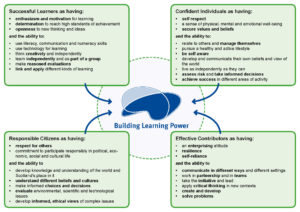
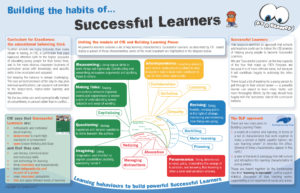
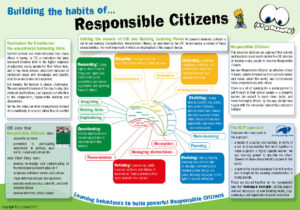
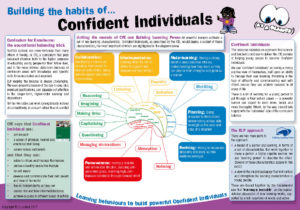
This online resource pack sketches the what, why and how of developing the sort of powerful learners envisaged in Scotland’s Curriculum for Excellence.
The big picture frameworks of CfE purposes and Building Learning Power are linked, explained and illustrated with practical ideas.
These materials offer sufficient initial information to enable schools and teachers to take a serious look at what learning centred approaches involve and begin to ask themselves deeper questions about how to take the ideas further.
Taking on this approach is not insignificant. It’s not about little tweaks or golden flecks, or simplistic ‘hints and tips’. The depth and challenge of what is involved can be widely underestimated. What’s needed has to be seen as a gradual, sometimes difficult, but hugely worthwhile process of culture change by schools and habit change by teachers.
links to the Building Learning Power website for more about the approach and details of relevant blended learning programmes to introduce and sustain learning centred approaches.
Guided by best practice thinking in professional development this modular on-line programme organises a consistent school wide approach to developing pupils’ learning behaviours.
Developing pupils as better learners is a serious, long term, innovative undertaking. It requires far more than a training day and reading the odd book. Building Learning Power has implications not just for student learning, but for staff learning too. Teachers’ habits as learners becomes a crucial part of the picture; how they go about changing is as relevant as what changes they want to bring about.
The blended learning programmes are a careful blend of:
Online learning sessions … that faithfully disseminate the researched content;
Professional Learning Team sessions … actioned by the school to provide sustained, meaningful support for teachers;
Trying things out in the classroom … because ‘learning by doing’ is integral to the development of expertise which can only be developed if teachers have ample opportunity for practice, reflection, and adjustment.
This trio of learning opportunities work together to help teachers replace long-standing habituated practices with more effective ones.
This unit explores the why, how and what of the online and team aspects of the programme and how to ensure the programme works effectively for the school.
Unit: Engaging students in working purposefully to achieve goals
We all find it easier to put in effort and keep going when we see the point of doing it, when we have a goal that is of interest to us. Without a goal that we buy in to, why should we bother?
The world of the classroom is most often about externally set goals or targets or success criteria or objectives. Whatever the word the way in which they are viewed is as something that is given, required by someone or something else. They are not our goals or standards and if we are unable to adopt these as our own, we will forever be dancing to someone else’s tune, pursuing an agenda in which we have little interest.
This unit explores how we can help students to understand different types of goals and support them in working purposefully towards them. The hope is that coming to own and self regulate their goals in a classroom setting will move ultimately to them developing and pursuing their own life plans.
This Unit aims to:
help teachers to analyse how their students’ think and feel about pursuing goals.(Quiz 1)
look at their own practice in developing a learning friendly culture. (Quiz 2)
suggest practical strategies to increase students’ skill and confidence in pursuing goals. ( Sections 2 and 3)
assist teachers to use a learning enquiry method to help shift their practice. (Section 4)
Unit: Engage students in managing their distractions and maintaining focus
Losing focus or getting distracted is an inevitable part of learning, it happens to all of us.As learners we come across distractions, both internal and external. If we are hungry, tired or anxious we find it hard to concentrate. Equally if there is too much going on around us or something unexpected happens, we may lose our focus get side-tracked. But unless students are assisted to cope positively and practically with such situations their deep engagement with learning may be in jeopardy.
This Unit aims to;
help teachers to analyse their students’ awareness of and strategies for being distracted;
look at their own practice in developing a learning culture that helps students to maintain focus;
suggest practical strategies to increase students’ skill and confidence in dealing with internal and external distractions;
assist teachers to use a learning enquiry method to help shift their practice.
Finding learning difficult is part and parcel of learning. Indeed when learning is not challenging it is often a case of practising / consolidating what one can already do as opposed to breaking new ground. As learners we all come across difficulties that cause us to think hard – the question is whether we are excited by the prospect of rising to the challenge, or daunted by the prospect of not rising to the challenge. Do we think ‘Great, this is tricky and I’m going to give it a go’ or ‘Oh dear, this is probably too hard for me’?
This Unit aims to:
help teachers to analyse how their students think and feel about challenge;
look at their own practice in developing a learning-challenge-friendly culture;
suggest practical strategies to increase students’ skill and confidence in dealing with challenge;
assist teachers to use a learning enquiry method to help shift their practice.
Unit: Engage students in unsticking their learning
Some intro text about the new maths curriculum and maths mastery in particular. then a sentence or two about what this means for students. What they need to be able to do to surmount the challenges…ie become better learners. Hence students need to be assisted to develop specific learning skills to cope positively and practically with deeper learning and deeper engagement with learning.
This Unit aims to;
show how students’ learning behaviours contribute to mastery in maths;
explore the nature of these particular learning behaviours;
show how lessons and activities can be constructed to use these behaviours to best advantage;
assist teachers to support students to build these learning behaviours.
Unit: Engage students in unsticking their learning
Being stuck is a natural part of learning, we all get stuck. As learners we come across blocks and obstacles, go into blind alleys, get flummoxed by a vast range of possibilities, or simply don’t know enough to decide what to do next. But unless students are assisted to cope positively and practically with such confusion their deep engagement with learning may be in jeopardy.
This Unit aims to;
help teachers to analyse how their students’ think and feel about being stuck;
look at their own practice in developing a learning friendly culture;
suggest practical strategies to increase students’ skill and confidence in coping with being stuck;
assist teachers to use a learning enquiry method to help shift their practice.
Unit: Engage students in unsticking their learning
Being stuck is a natural part of learning, we all get stuck. As learners we come across blocks and obstacles, go into blind alleys, get flummoxed by a vast range of possibilities, or simply don’t know enough to decide what to do next. But unless students are assisted to cope positively and practically with such confusion their deep engagement with learning may be in jeopardy.
This Unit aims to;
help teachers to analyse how their students’ think and feel about being stuck;
look at their own practice in developing a learning friendly culture;
suggest practical strategies to increase students’ skill and confidence in coping with being stuck;
assist teachers to use a learning enquiry method to help shift their practice.