My menu

Sections Archive

3. What does it take to shift classroom cultures

Making the journey from teacher to learning centred cultures is a gradual, sometimes difficult, but hugely worthwhile process of culture change by the school and habit change by teachers. Building Better Learners is essentially about making that journey in order to systematically cultivate pupils’ supple learning mind.

This section explores what is entailed in shifting from the dominant teacher culture to the richer learning culture.
Key Learning Question:

Which aspect of classroom culture needs most attention in your school?

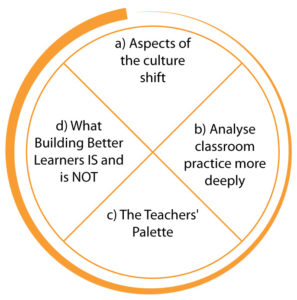
a) Aspects of the culture shift

In broad terms the teachers’ role becomes one of surfacing the learning; making it public; making it visible to the learner; making pupils aware of their learning behaviours, thoughts and feelings. In so doing the strategic emphasis of the classroom shifts;

  • from performance ⟹ learning.
  • from content ⟹ process.
  • from teaching ⟹ coaching

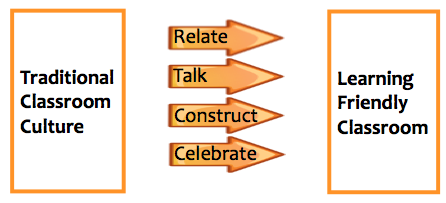
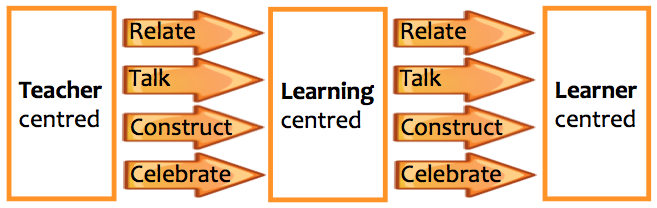
And in order to make these strategic shifts there are four inter-related aspects of teacher behaviour to work on. The precise details of the four aspects will be different for every teacher in every school.
screen-shot-2017-01-13-at-16-21-07

Gradual and worthwhile change

1. Relating for learning is about:

  • Learning becoming a shared responsibility
  • Pupils being given more responsibility for their own learning
  • The teacher becoming the learning coach; enabling pupils to find their own ways to improve
  • Collaborative activity that helps pupils to see each other as resources for learning
  • Pupils being given choices about what and how to learn
  • Pupils talking more, adults talking less
  • Teachers modelling being a learner
  • Processes promoting, enabling and supporting the best of what we know about learning.

culture-tool-2_shifting-the-culture_v7_cutup-1

Sharing responsibility for learning

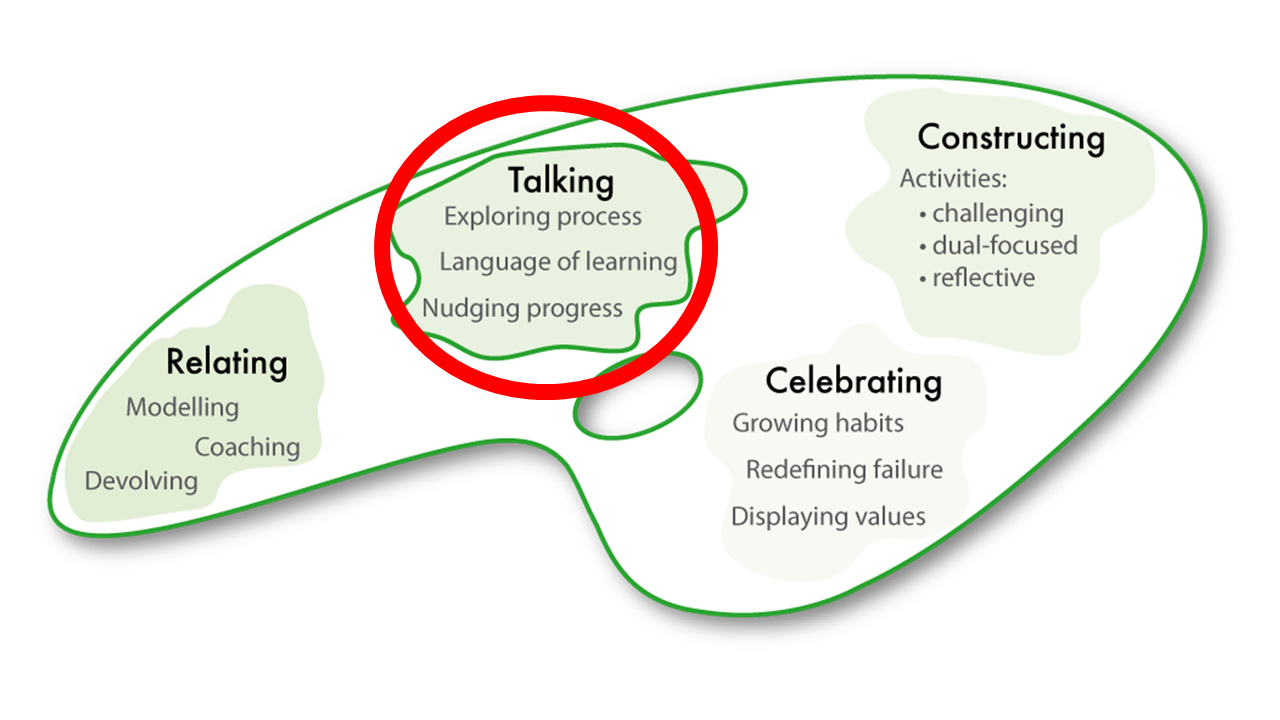
2. Talking for learning is about:

  • Learning, rather than performance, becoming the object of conversation
  • The gradual introduction of a learning language helping pupils to become conscious of using their learning behaviours
  • Using and extending the language; adding breadth and depth to how teachers and learners talk about, understand and improve learning.
  • Pupils being encouraged to notice things about how they are learning, talking about the learning process and becoming a meta-learner.

The language of learning revolves around a set of high value psychological characteristics to develop a supple learning mind. These include emotional, cognitive, social and strategic characteristics. These characteristics are unpacked in Section 2.

culture-tool-2_shifting-the-culture_v7_cutup-2

Talking about the learning process

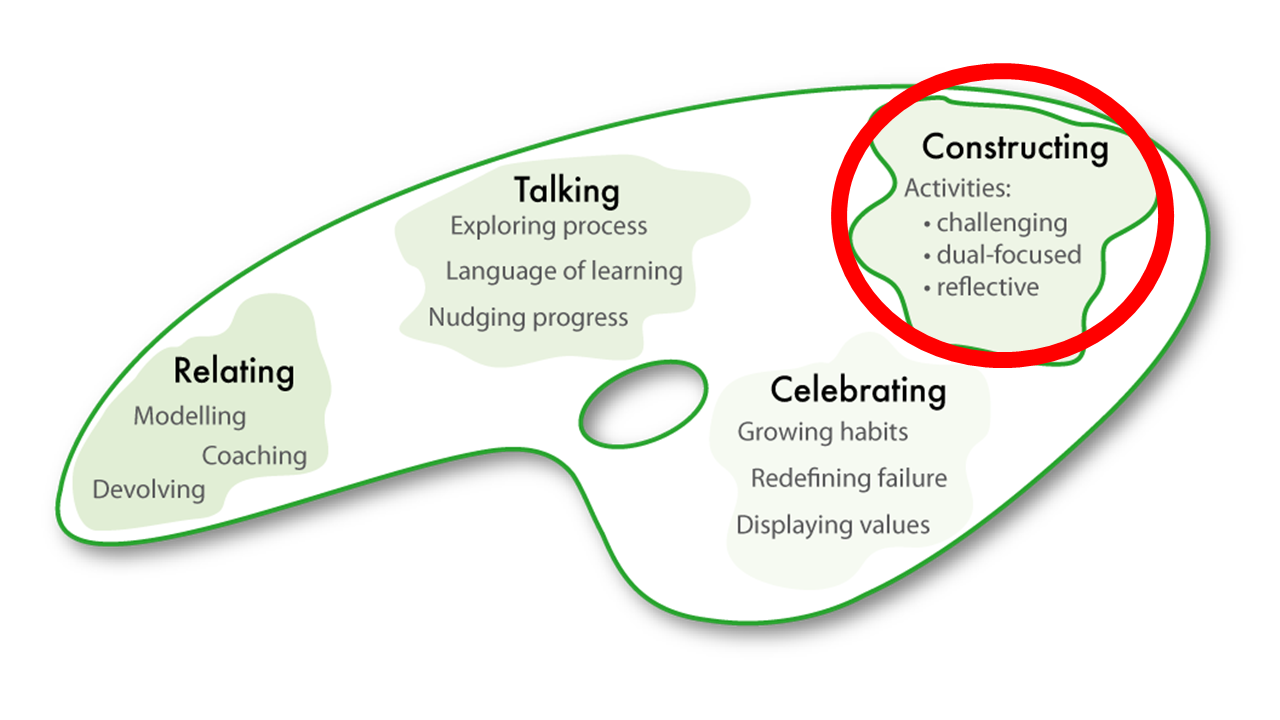
3. Constructing learning is about:

  • Learning, rather than performance, being made the object of learning.
  • Reflecting on learning and reviewing learning being built into the learning model used in the classroom
  • Learning activities being designed to stretch and challenge – by having a dual focus to explore content and stretch pupils’ ability to use their learning behaviours.
  • Teachers making conscious choices about which habits/learning behaviours to introduce and stretch and how best to couple these with content so that lessons become more interesting and challenging.
  • A third dimension being added to teaching: 1. Subject matter, 2. Assessment 3. The learning behaviours being used in order to learn.

culture-tool-2_shifting-the-culture_v7_cutup-3

Blending content with learning process. The what and how.

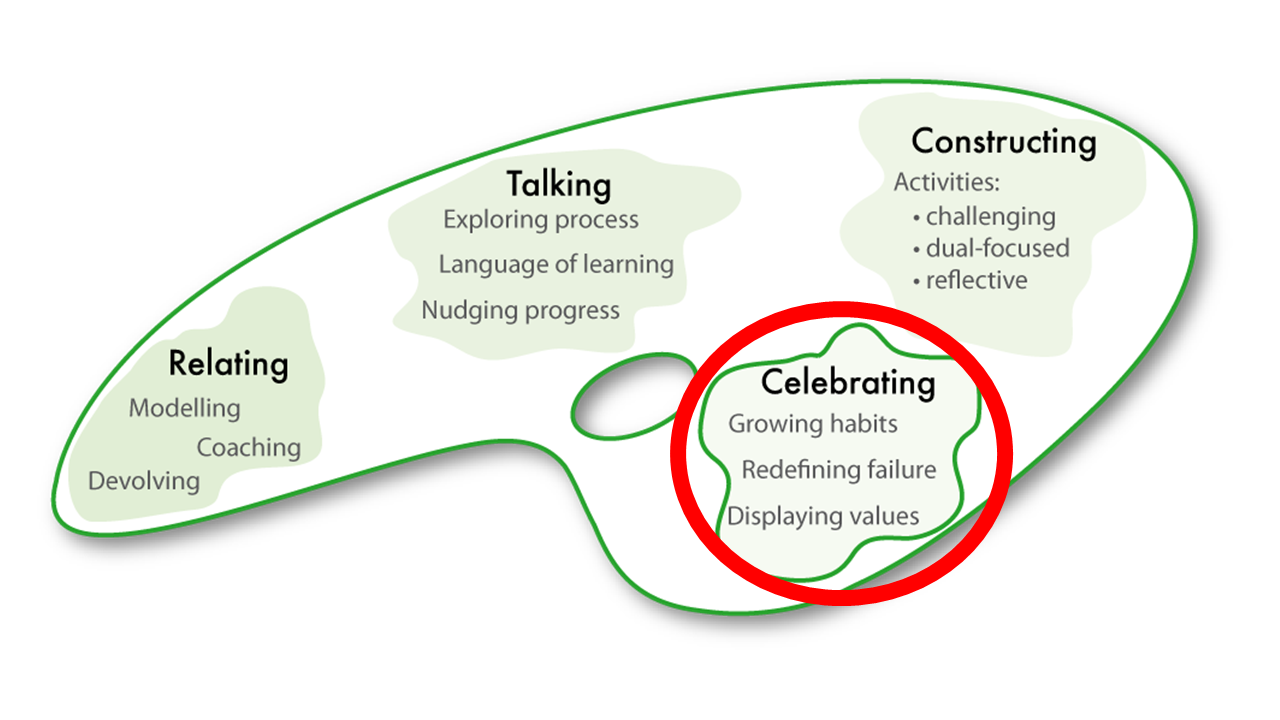
4. Celebrating learning is about:

  • Learning, rather than performance, being made the object of attention
  • The underlying values about learning becoming visible through what is recognised, praised, displayed. For example:-
    • Being stuck being recognised as an interesting – not shameful – place to be.
    • Mistakes being recognised as invaluable in learning.
    • Effort being unpacked to show how it is channelled.
    • Good questions being as important as good answers.
  • Using learning behaviours more often and more skilfully being nudged and recognised
  • So the growth of learning habits is being attended to closely.

culture-tool-2_shifting-the-culture_v7_cutup-4

The how of learning is closely attended to.

[memb_has_any_tag tagid=”134″]
When you’re ready to find out about learning culture just click here to access the first session of the Stepping Stones Phase 1 online course Culture Module
[/memb_has_any_tag]

jean-victor-balin-arrow-orange-down

Putting better learning into classrooms

Listen to what the originator of Building Learning Power has to say about what the culture change in schools and the habit change by teachers might look like

jean-victor-balin-arrow-orange-down

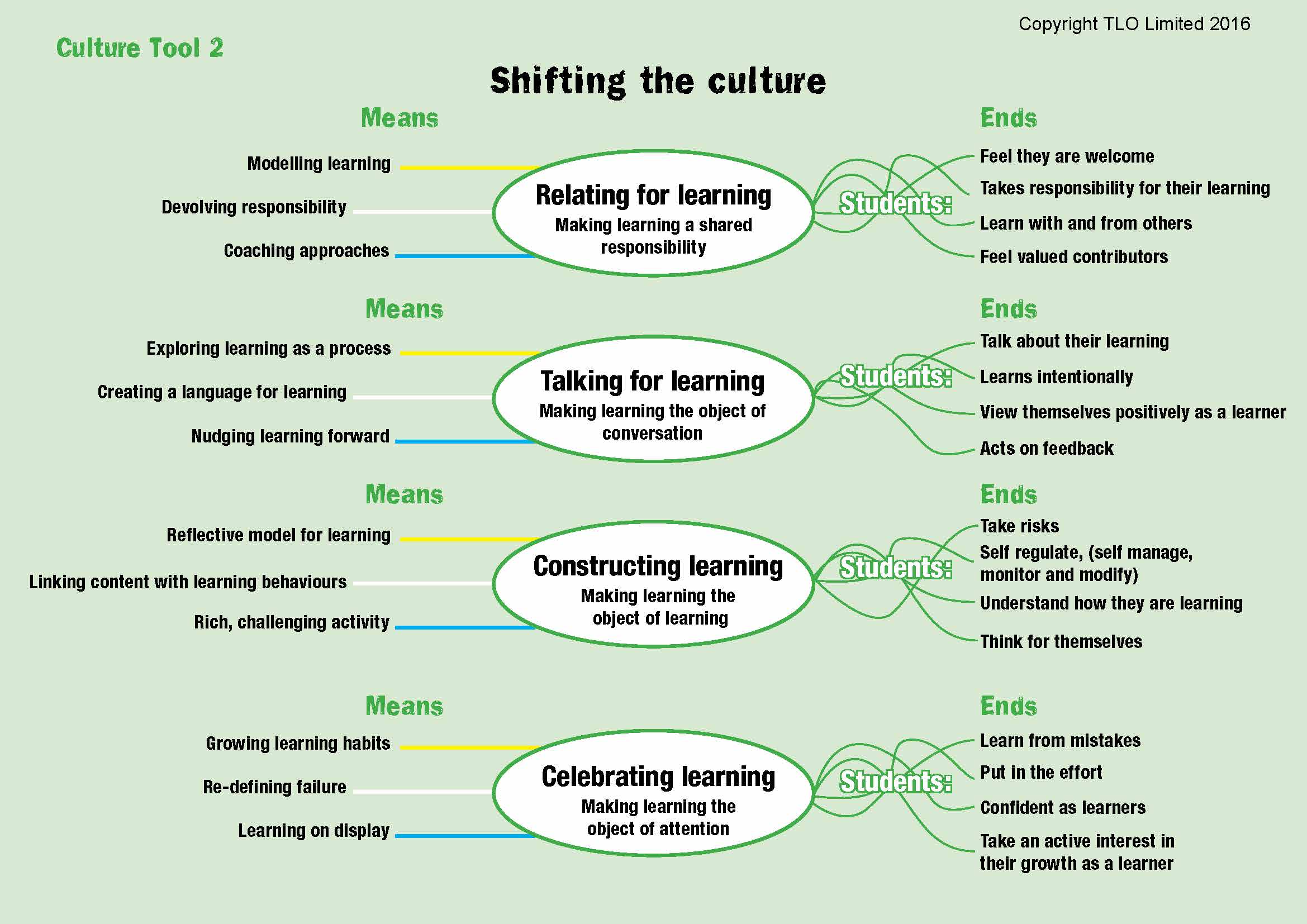
b) Analyse classroom practice more deeply
culture-tool-2_shifting-the-culture_v7

Learning Culture Tool 2
  • Download the deeper Learning Culture Tool 2.
  • Look carefully at the Culture Tool 2 in relation to your school.
  • Ring the MEANS statements that describe aspects of the school culture that you think are secure.
  • Underline those statements that would most benefit your pupils now.


Thinking more deeply about classroom cultures in your school. Asking hard questions.

QuestionMark100
  • How many of these MEANS are in use in classrooms?
  • How much is learning externalised or surfaced?
  • What’s the balance between telling and coaching in classrooms?
  • Do pupils have any language to talk about their learning?
  • What proportion of tasks would you estimate to be rich and challenging?


jean-victor-balin-arrow-orange-down

c) The Teachers’ Palette

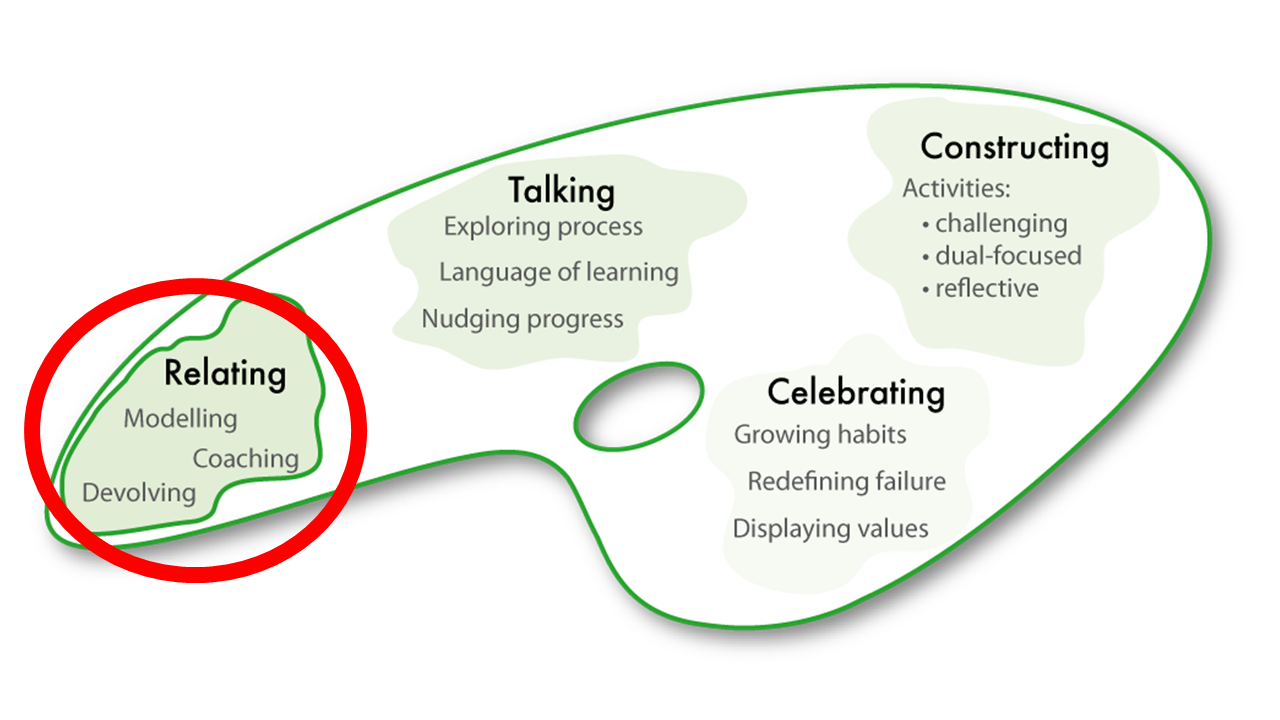
The thinking and research of Chris Watkins, Guy Claxton and others have influenced the models and diagrams above. We  have distilled this into the new Teachers’ Palette. The Teachers’ Palette depicts an action packed framework of the types of actions teachers need to take in order to create the conditions necessary for learning behaviours to be habituated.

 Those of you who have read and absorbed the original book Building Learning Power by Guy Claxton will notice the palette has now turned green. Thinking has moved on since Building Learning Power was introduced in 2002, many schools have become more performance focused, curriculums have become overloaded and with more difficult content, teachers have been put under greater administrative strain and so forth. Hence the green palette takes on the uncomfortable truth that classrooms, in many schools, have become more teacher focused and pupils are being given less responsibility for their learning. The journey to learning centred classrooms now has more hurdles to overcome  
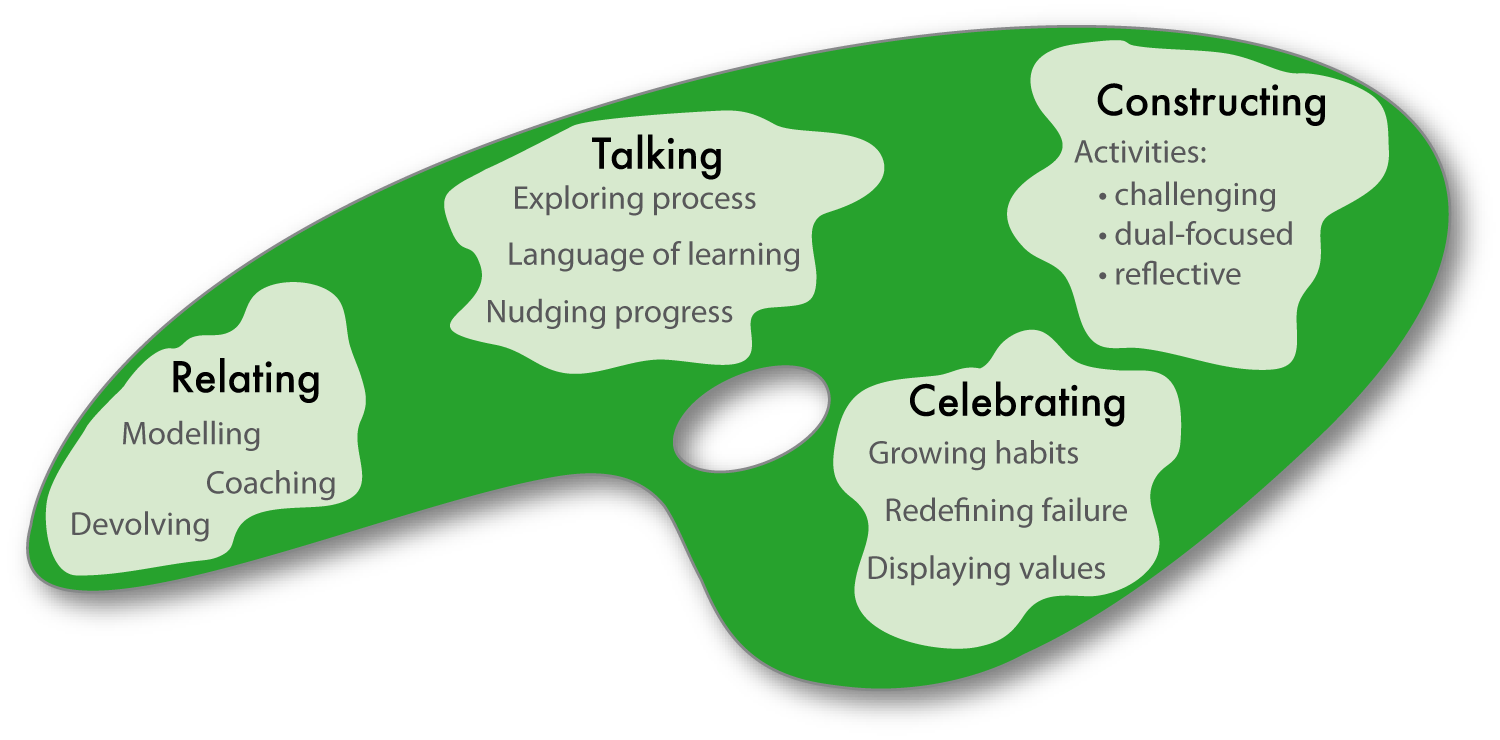
 

Modules 3.2 to 3.5 explore each of these cultural aspects in turn, suggesting first steps on the journey towards building better learners.


jean-victor-balin-arrow-orange-down

d) What Building Better Learners IS and is NOT

It’s not:

  • a short-term, quick fix for classroom practice
  • about little tweaks to the how of teaching
  • about having pupils just saying “I can’t do this yet”
  • about pupils just being able to say ‘collaboration’ or ‘resilience’ without knowing what and how and when
  • pupils ‘doing’ learning power
  • about teachers knowing a bit more about learning
  • about pupils simply knowing the names of learning behaviours
  • just about what happens in classrooms (see Section 5 for detail)
  • simply offering pupils harder learning activities
  • something we can do in a year
  • an initiative

It is about:

  • pupils developing long term learning habits to stand them in good stead for a complex world
  • young people becoming better learners (independent, self-regulating, flexible)
  • learners having the skills to flourish in uncertain times
  • a way of educating which has learning at its heart
  • classrooms becoming learning labs; schools becoming learning organisations
  • classroom cultures becoming learning-friendly
  • teachers using a forensic and precise understanding of learning in order to grow supple learning minds
  • teachers becoming learning coaches
  • a shift that will take most schools about 3 years
  • a bigger game of education


Continue Reading

2. What sort of culture will create better learners

Building better learners is about creating a culture in classrooms – and the school more widely – that systematically cultivates habits and attitudes that will stand pupils in good stead for a complex world.

This section introduces a range of classroom cultures, from traditional to learning centred, and invites you to consider and analyse the learning cultures of your school.

1.2_Headings

Key Learning Question:

What is the most dominant learning culture in the school at present?

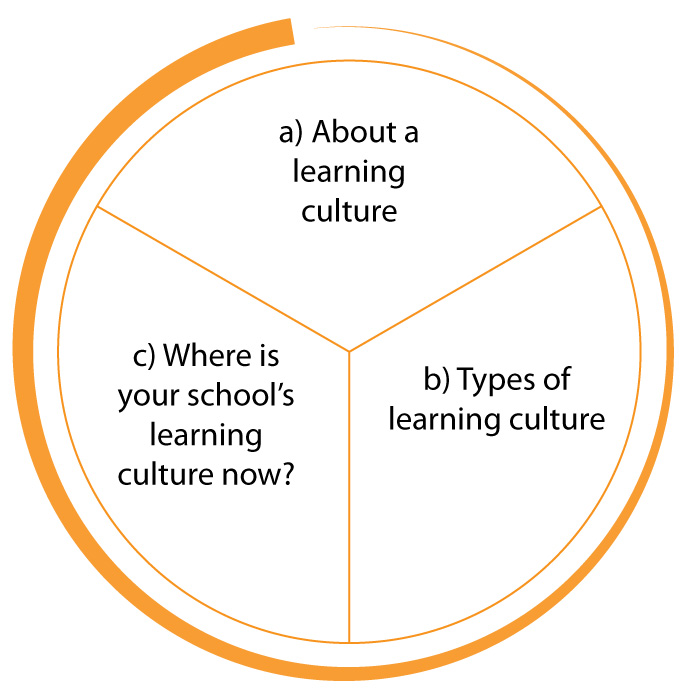
a) About a learning culture

Culture: all those little habits, routines and practices that implicitly convey ‘what we believe and value around here’. Classrooms are the places where, hour by hour, pupils experience the values and practices that are embodied in the school, rather than just the ones that are espoused.

Culture is about the micro-climate: what teachers do and say; what they notice and commend, or don’t; what kind of role model of learning they offer; how they design and present activities to build learning behaviours. Some classroom cultures are just more learning friendly than others.

What do we mean by learning culture ?

jean-victor-balin-arrow-orange-down

b) Types of learning culture

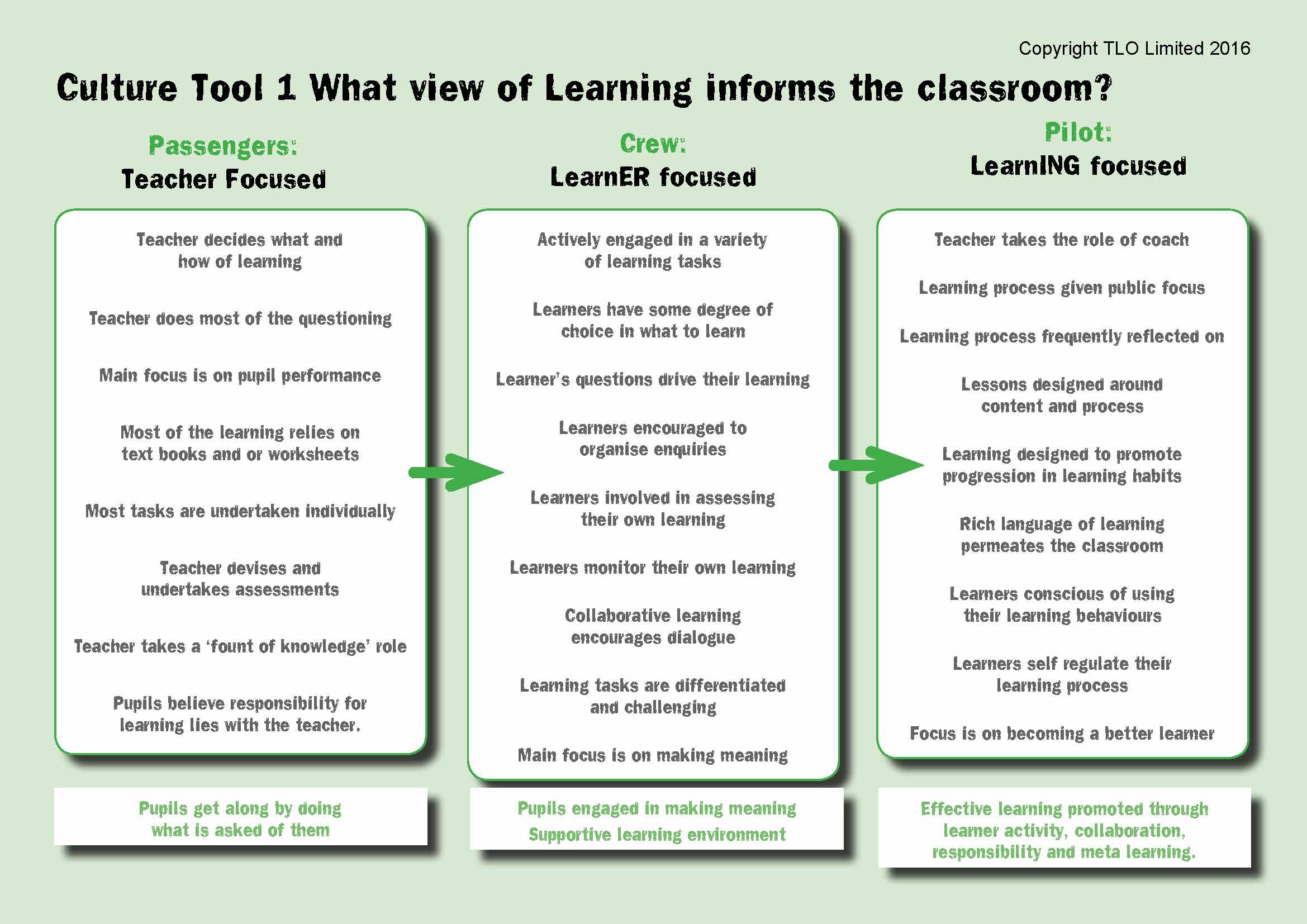
Research by Chris Watkins back in 2004 suggested three types of classroom learning cultures, some more learning friendly than others.

  • Teacher centred; overriding emphasis on what the teacher is doing or saying.
    • Learning = being taught.
    • Pupils are passengers
    • Pupils have an impoverished view of their learning ability.
  • Learner centred; pupils take a more active role in deciding what to do.
    • The learning is making meaning.
    • Pupils are crew
    • Pupils collaborate and discuss learning
  • Learning centred; pupils learn about learning itself.
    • Pupils use a language of learning.
    • Become conscious of the learning process and the learning habits they command.
    • Pupils are pilots of their learning

Hence there are often two strategic shifts to make in the journey from Teacher centred to Learning centred cultures. Teacher centred cultures may well achieve good results but only Learning centred cultures achieve good results PLUS curious, creative, self-regulating, independent learners.

Learning shift

Learning shift

Types of classroom cultures

jean-victor-balin-arrow-orange-down

c) Where is your school’s learning culture now?

culture-tool-1_v2

Download a copy of the Culture 1 Review Tool

The Culture Tool 1 gives more detail about each of the classroom cultures.

Take a look at the resource and think about the school’s learning culture against the indicators in each panel.

  • Reflect on the culture of each classroom
  • Highlight all aspects of culture that are a regular feature in each classroom
  • What are the similarities and differences between phases, year groups, individual classes?
  • What is this telling you?

Analyse the school’s current learning culture

QuestionMark100
  • Which panels have most statements highlighted?
  • Does this alter from phase to phase?
  • What does this imply?
  • Which statements in the middle panel would you most want to work on?
  • Which statements in the right hand panel need to be worked on first?
  • It’s worth remembering that the more teacher centred the school the longer the journey to a learning friendly culture.
Continue Reading

6. How might we review learning in classrooms?

The changing nature of observing learning in classrooms.

Find out about:

  • Three different purposes for observing classroom practice
  • How looking for learning refocuses classroom observation
  • What early attempts of looking for learning might consist of
  • An observation tool for capturing learning behaviours;

  in order to become aware of how teachers’ classroom cultures build powerful learners.

Three broad purposes of classroom observation

Classrooms provide rich learning environments for teachers as well as students. Watching teaching and learning and exploring the experience afterwards is a highly effective tool for developing the craft of teaching. As continuing professional development takes its rightful place at the heart of school improvement, enthusiasm for classroom observation as a supportive developmental process is being rekindled.

There are perhaps three broad purposes for classroom observation:

  • to help to stimulate and initiate new practice (observation AS development)
  • to develop current practice (observation FOR development)
  • to assure standards of practice (observation OF development) associated with performance management.

Pathways to Classroom Observation

For the purposes of developing better learners the feel and format of classroom observation should be firmly rooted in:

  • observation AS development, where the focus is on discovery.e.g. how to develop good coaching habits, how students are using collaborative habits, how problem solving is being developed.
  • observation FOR development, where the focus is on improvement e.g. are students learning effectively from group work, are students questioning skills effective, are our approaches to problem solving proving effective? 


Three very different purposes for classroom observation.

jean-victor-balin-arrow-orange-down

Re-thinking observing in classrooms

Looking at classrooms through the lens of learning behaviours rather than teaching behaviours.

Classrooms are where the school conducts its core activity of building learning behaviours. It is where all of our values, policies and procedures are made real and communicated to learners, minute by minute, hour by hour, day by day. It is where all of our intentions become reality, or not.

A shift in focus

In Successful Futures the focus is on learners and how teachers nurture the use and development learning behaviours. Thus the focus of observation turns firstly towards learners learning and how this process is being stimulated and supported by the teacher. This shift in focus will succeed if, and only if, leaders are able to stimulate and support professional conversations about how students are learning and, later, how the design of the curriculum might further support learning behaviours.

Your approach to observing in classrooms … ‘can be a fixed-mindset message that says: You have permanent traits and I’m judging them. Or it can be a growth-mindset message that says: You are a developing person and I am interested in your development.”
― Carol S. Dweck, Mindset: The New Psychology Of Success

The observation strategy suggested here is based on that simple premise.


Looking for learning

jean-victor-balin-arrow-orange-down

Review learning in classrooms

 Looking for learning behaviours that students are being enabled to exercise

BLP_Brain_Generic_no-Rs-[Converted]

In the early stages of looking for learning the discovery question becomes: ‘Which learning behaviours are students being enabled to exercise?’ And the subsidiary discovery question, ‘How are we going to find out?’

Traditional observation tools focusing on the teacher’s behaviour won’t  provide the evidence needed. The observation tool below is focused purely on learning behaviours and invites observers to record which they see/notice/recognise being used. This tool helps teachers to become more aware of learning behaviours and where/when they are used.


(The ‘learning behaviours’ on the wheel are the 17 learning behaviours from the Supple Learning Mind, changed into questions. Hence ‘Perseverance’ becomes ‘Did they stick at it when it is difficult?’)


How to use it:

  • Spend around 20/30 minutes in a classroom,
  • Towards the end shade in the sector of the wheel to show the extent to which learning behaviours were a positive aspect of this lesson
    •  For example. If planning was very strong feature of the lesson, shade all/most of the planning sector.
    • If planning was only used a little, shade only the inner bit of the sector.
    • If students have not been required to do any planning, simply leave the sector blank.
  • Repeat for all of the sectors.

The final ‘picture’ shows which behaviours were (and were not) exercised.

On its own, one of these completed wheels tells us little of the bigger picture. It is a useful document on which to base a discussion with the teacher…which behaviours were used (or were planned into the lesson), why they were used, to what purpose, whether there were missed opportunities for nurturing learning dispositions and so on…. but beyond that it has minimal meaning. It’s a tool to sharpen skills in the observation of learning.

However, once several have been completed clear patterns begin to emerge. They will show which behaviours are getting regular exposure, which less so. This information will, later, give rise to interesting discussions about the balance of learning behaviours in lesson or across the curriculum and how to foreground the ones gaining less exposure.


How to look for and record learning.

jean-victor-balin-arrow-orange-down

QuestionMark100

Ask yourself:

  • how might you introduce this observation tool to colleagues?
  • how will you ensure that the observations are developmental rather than judgemental?
  • how will you analyse and share the outcomes?
  • how will you ensure refocused observation across the school?


Continue Reading

8. Does all this add up to becoming a learning organisation?

Developing the school as a learning organisation.

Find out about:

  • The essential features of a learning organisation
  • How ways of learning cascade through the school to teachers and then to students
  • Applying the learning characteristics of a learner to the school; its emotional, cognitive, social and metacognitive culture.
  • A review tool to match your practice against and plan for development

in order to ensure that the school, as an organisation, is aware of the conditions in which successful learners (students and staff), can flourish.

Schools in Wales as learning organisations

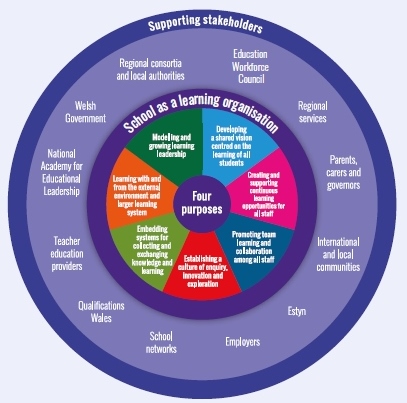
Unlike anywhere else we know of, the Welsh government has recognised the amount of change involved in implementing Successful Futures and has developed an all-Wales model of schools as learning organisations. ‘Schools in Wales as Learning Organisations’ sets out a framework with seven dimensions:

  • developing and sharing a vision centred on the learning of all students
  • creating and supporting continuous learning opportunities for all staff
  • promoting team learning and collaboration among all staff
  • establishing a culture of inquiry, innovation and exploration
  • embedding systems for collecting and exchanging knowledge and learning
  • learning with and from the external environment and larger learning system
  • modelling and growing learning leadership

So as your school takes on becoming a learning organisation you will come to see the school as a learning system and see how the seven dimensions  interact and affect each other. This accurate and continual self-reflection will give you a real picture of developing both staff and students as powerful learners.


Schools that learn

jean-victor-balin-arrow-orange-down

More on learning organisations


Organisations, just like people, exist in a society that is constantly changing. In order to thrive, the school and its leaders must constantly adapt and change. Schools with a determination to flourish in an environment of change adopt a learning philosophy – they have come to be known as ‘learning organisations’.

Learning organisations are characterised by their ability to: 

  • understand the environment in which they operate 
  • anticipate the future
  • appreciate their capabilities 
  • learn from practice, experience and data 
  • use their learning to plan and guide change

Schools that adopt the characteristics of learning organisations may truly become ‘learning schools’ where everyone within them is a learner. Such schools are organised as learning systems: they are rich in data and use evaluative activity to inform and guide change. There is a focus on student learning, but staff collaborate and learn too. Staff learning is facilitated and harnessed to bring about development, with the headteacher as the leading learner.

The learning school goes well beyond securing extensive professional development. It is concerned to:

  • generate and apply individual and team learning 
  • learn from and through internal systems and processes 
  • interact with and learn from external sources 
  • contribute to and learn from other schools and training systems 
  • support the development of a lifelong learning culture

In addition the learning school recognises that it has a past, a present and a future and that it has the power to determine and achieve that future. Strategic planning acts as the focus for organisational learning and helps create a culture of enquiry, reflection, innovation and achievement. 


School: an organisation of learning and an organisation that learns

jean-victor-balin-arrow-orange-down

 Creating a trickle down culture

As a school you have undertaken to develop your students as:

  • emotionally intelligent learners;
  • who are cognitively skilled;
  • socially adept;
  • and aware of themselves as growing learners (meta-learners);

in order to realise the core purposes of Successful Futures.

However, this is unlikely to happen unless teachers themselves adopt these qualities; modelling and using the behaviours they wish to instil in their students.

Similarly, teachers will find it difficult to do this unless, the school, as an organisation, does itself display these qualities. Thus in adopting a focus on learning the school will need to act in ways that:

  • ensures its own improvement as an organisation;
  • ensures its teachers grow as confident, interdependent, risk taking professionals, who in turn..
  • guide students to become self-regulating learners. It’s a cascade effect.

As John Hattie says in Visible Learning for Teachers:

“The remarkable feature of the evidence is that the greatest effects on student learning occur when teachers become learners of their own teaching, and when students become their own teachers”


A common learning framework for students, staff and the school

jean-victor-balin-arrow-orange-down

Try thinking of your school as a Supple Learning Mind

BLP_Brain_Generic_no-Rs-[Converted]

A school that is emotionally engaged, cognitively skilled, socially adept and strategically responsible exhibits a range of positive learning behaviours, much like the ones they are seeking to develop in learners. Here’s how it works:

[Use the tabs across the top to scroll through the 4 dimensions.]

A school that is Emotionally Engaged:

  • Takes risks in pursuit of its long-term goals
  • Is confident it can rise to the challenge of its long term goals
  • Retains its focus and commitment in adversity
  • Is resilient and optimistic in the face of difficulty
  • Avoids complacency when things are going well
  • Maintains focus on what it sees as important
  • Experiments and learns from its mistakes.

A school that is Cognitively Skilled:

  • Is interested in and questions how things might be different
  • Constantly questions to secure deeper understanding
  • Senses how things are inter-connected
  • Values intuition and is prepared to play with ideas
  • Adopts an efficient and methodical approach
  • Creates its own understandings for itself
  • Is inventive and flexible in its use of people and resources.

A school that is Socially Adept:

  • Articulates its values in ways that are understandable to all
  • Explores things from a variety of viewpoints before deciding
  • Is led by a team that listens, consults and conveys clear messages
  • Values and rewards everyone’s contributions
  • Challenges individuals to go beyond their comfort zone
  • Is outward looking and networked with other schools / professionals
  • Learns and functions as a team in pursuit of common goals

A school that is Strategically Aware:

  • Has a vision and plan of action to achieve it
  • Sets challenging targets that provide stretch
  • Initiates development
  • Monitors performance in order to modify practice proactively
  • Focuses on the important rather than the urgent, and knows the difference
  • Ensures teams and talents are managed effectively
  • Understands how it learns, keeping the quality of learning under review.

How well does this describe your school? What might you need to do differently?


The school as a powerful learner

jean-victor-balin-arrow-orange-down

 To what extent are we a Learning School now?


Screen Shot 2017-01-23 at 17.27.12

This review tool will cause you to ask difficult questions, help you evaluate the learning culture of your school taking account of the evidence you have for this. Download a copy and use it to explore just where you are now.

The questions, some of which you will be familiar with, have been worded and organised to reflect;  emotional engagement; cognitive skill; social adeptness;  strategic responsibility;  much like the range of learning behaviours the school is seeking to develop in its learners:

Download as a pdf


A learning school review tool


questionmark_50
  • What does the review tell you about your school?
  • Which aspects do you consider to be strengths in your school?
  • Ditto relative weaknesses?
  • How secure is your evidence base?
  • Would all stakeholders view the school similarly ? How will you find out?

jean-victor-balin-arrow-orange-down

 A learning  journey framework

LQF_Logo_Final_Main_250x250

The journey to becoming a learning school is complex and many schools have found it helpful to seek a framework to support their development as a learning organisation. The Learning Quality Framework [LQF] offers a set of staged descriptions of the development of a school seeking to become a school that learns. The LQF captures the essence of what a learning school does to ensure that all of its people become better learners.

The LQF is organised under twelve principles which are concerned with different aspects of a school’s culture, such as the school’s vision for learning, how leaders lead learning, how classroom practice works, how assessment and the curriculum are designed in order to build learning habits, and how the school acts on its own learning. In other words many of the issues that have been explored in sections of this resource.

LQF serves three useful functions:

As a diagnostic instrument, the LQF enables a school to assess where it is now on its learning journey. By matching current practice against the twelve LQF principles, schools can assess where they have reached thus far and so identify areas of development.

As a formative instrument, the LQF provides a school with a clear set of guidelines for planning their way forward. From an audit of ‘what is’, which the framework provides, the school can develop a strategic overview of next steps.

As a summative instrument, it gives schools an external view of their progress through an external assessment and the award of a LQF quality mark. Developing a culture in which real world learning thrives is not an insignificant job, so stages along the way are worth recognising and celebrating. A school’s progress can be publicly validated and accredited by The Learning Organisation (TLO), as and when it feels ready to seek accreditation.

Visit the Learning Quality Framework website


The Learning Quality Framework – an intelligent Sat-Nav for the journey


Continue Reading

7. How will we know that our students are progressing as learners?

The why and how of knowing your students as learners. 

Find out about how progress in learning could be recorded and used:

  • The nature of progression in learning behaviours
  • What progress in learning behaviours might look like
  • Ways of becoming aware of progress
  • Reasons for recording progress

and gain an overview of the importance of progression in learning behaviours.

If a parent were to ask whether their child was more perseverant than when they arrived in the school, what would you be able to say? How would you respond beyond, hopefully, yes, or a bland statement about ‘sticking at things for longer’? How would you know? What evidence might you use and where would this come from? 


A quick overview of progression

There are three key facets to the progression of learning behaviours: 

  • the frequency with which the behaviour is used (how often)
  • the range of contexts in which it is used (range of different wheres)
  • and the skilfulness with which it is employed (how effective)

The frequency with which the learning behaviour is used: Is about noticing how often students use the behaviour and then intentionally planning activities that will give more opportunities to extend that frequency. 

The range of contexts within which it is used: Is about noticing where/when students use the learning behaviour and helping them to see how the behaviour used in one context can be applied to different one. 

The skilfulness of the habit: Is about noticing how well students are using the learning behaviour, for example the quality of the questions they are asking. To be able to do this there’s a need for a trajectory of skilfulness, and this is why skilfulness is the most complex of the three dimensions to track. However, once mapped, it helps; students to set targets; self and peer assessment; teachers to design appropriate tasks; curriculum planning and more.


What does ‘getting better’ mean?

jean-victor-balin-arrow-orange-down

What does progress look like?

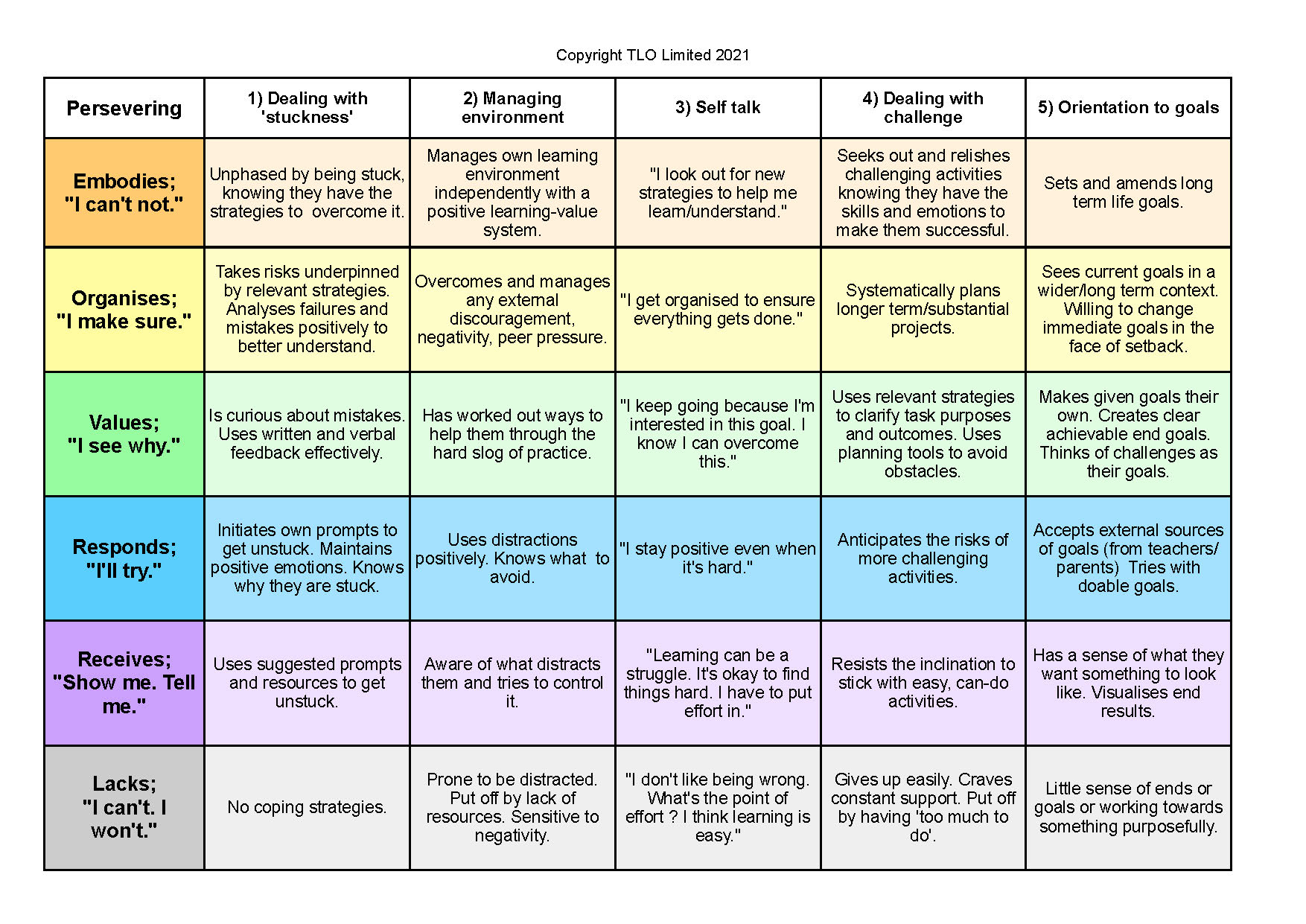
Our Progression Chart for perseverance offers a way to understand and map the complex journey from, for example, the ready giver-upper to the highly tenacious student in pursuit of goals.

This and similar charts are written for teachers rather than students and the statements are too broad to be individually tracked. However, these statements could be used in student reports or broken down into a couple of ‘can do’ statements. Importantly, the statements serve to broaden our understanding of the learning behaviour and enrich the language of learning. This helps teachers to talk more meaningfully about perseverance and to offer parents a more professional answer to their valid question about progress in perseverance. 

Take a broad look at your school’s learners through the lens of this map of perseverance:

  • Outliers aside, where are the majority of your youngest learners?
  • Outliers aside, where are the majority of your oldest learners?
  • Do your students become increasingly perseverant as they pass through your school?
  • Can you speculate on why this happens?
  • Would plotting this progression be useful?
    • to teachers
    • to students
    • to parents
  • How realistic would it be to have most of your students reaching at least the Value/Green phase?
  • How might you use the chart to help you sort out the evidence you need to collect to show such progression robustly?


 Becoming perseverant, step by step

jean-victor-balin-arrow-orange-down

What types of evidence might you look for?

Having students  use a learning behaviour is one thing, but enabling students to use it more frequently, more skilfully and in a wider range of contexts, is what will make the four purposes of Successful Futures successful. Evidence teachers could collect in order to make these kinds of judgements include:

  • what students think of themselves as learners
  • what teachers observe of students as learners
  • what other people perceive of students as learners.

1. What students think about themselves as learners

2016-03-10 13.33.57_6000 x 4000Given the opportunity, students are often happy to reflect on, talk about or write about themselves as learners. Learners’ own self-reports offer a rich and legitimate source of evidence through, for example:

  • extracts from students’ learning logs;
  • digital records of personal best moments taken by students themselves;
  • student responses to self-report questionnaires;
  • evidence from self and peer assessments;
  • testimony recorded in their school planner.

2. What teachers observe of students as learners

_ELE9692 As teachers assess students’ learning they will also be noticing and commentating on their use of various learning behaviours. Teachers will be rewarding or praising the determined use of learning behaviour or undertaking observations of students as they grapple with a new challenge.

Such evidence might include:

  • students’ products or performances;
  • photographic records of ‘personal best’ moments;
  • dynamic assessment—observations and records made of students in the process of learning.
    • when and how they ask for help.
    • the kinds of questions they ask.
    • the sort of self-talk they venture out loud;
  • a record of to whom, when and why recognitions of learning behaviours were given;
  • noticing student comments that echo progression chart statements.(e.g. the chart above)

3. What other people perceive of students as learners

Evidence of using their learning behaviours more widely can be drawn not only from other teachers but from people who see the students outside school. It might include:

  • unsolicited comments from parents;
  • digital records from home or school clubs or out-of-school activities;
  • testimony from employers regarding a student’s attitude to work during work experience;
  • testimony from piano teachers, sports coaches, youth club leaders, and the like.

Naturally, as you gain a clearer record of your students’ growth as learners (as opposed to knowers), you have a rich evidence base from which to report more extensively to parents about both their attainment levels and how they are developing as a learner.


What might the evidence look like?

jean-victor-balin-arrow-orange-down

The benefits of looking for progress

Schools find it useful to start documenting progression in students’ learning behaviours because it:

  • motivates and encourages students to put in the effort to continue improving their learning behaviours;
  • gives students feedback on their learning behaviour progress so that they can decide which learning behaviours they might target in the next period;
  • encourages teachers to recognise that their efforts to improve learning behaviours are being effective;
  • gives teachers information about individual students or classes to enable them to discuss and guide learning development more precisely and helpfully;
  • validates the progress made by students in terms of conventional attainment measures.


Why do it?

jean-victor-balin-arrow-orange-down

QuestionMark100
Consider:

  • what are the advantages of tracking learning behaviours in this way?
  • any disadvantages?
  • how could you use the outcomes to inform:
    • teaching?
    • learning?
    • mentoring?
    • target setting?
    • curriculum planning?
    • reporting to parents?


Continue Reading

5. Which leadership strategies secure and sustain learning friendly cultures?

Leadership strategies that secure and sustain a learning culture. 

Find out about the need to:

  • create and share a vision for learning
  • build dialogue amongst staff
  • create a culture of enquiry
  • monitor progress of the changes
  • follow the impact on student learning.

and gain an overview of the sort of leadership that will enable your vision for learning to be successful.

The nature of leadership

Leadership is about creating a sense of purpose and direction’ –Sir Michael Bichard

For school leaders, creating Successful Futures is about leading innovation – not through great fanfare or grand gestures, but through many and various marginal gains. So it involves a series of leadership approaches that include: creating a dialogue; supporting a culture of enquiry; keeping the learning on track. It’s about slowly creating a community that thrives on investigation and enquiry.


Creating a community that thrives on investigation and enquiry

jean-victor-balin-arrow-orange-down

Create a vision for learning and learners

The-Learning-Powered-School

Creating this new curriculum involves every Welsh school becoming a learning organisation;  ‘where everyone continually expands their capacity to create the results they truly desire‘

Research shows that the development and use of a shared vision is a common feature of successful organisations.  Visions have been described as ‘an expression of a desirable direction and future challenging state for the school’. They articulate the way forward and are more than a restatement of aims and values; beyond a short, punchy, expressive statement. It’s helpful to think in terms of a broader framework which is visionary in the sense of forward-looking but which captures all the overarching ideas that will guide the work of the school into the future – a visionary guiding framework:

  • to guide future decisions about all aspects of the school
  • to provide a reference point for the school
  • to provide a sense of higher purpose beyond the routine 
  • to provide the focus and energy for learning
  • to inspire and redirect change
  • to create consistency of purpose towards improvement
  • to create a sense of identity
  • to characterise the school to its community and articulate the values of the school.

The visionary guiding framework acts as a magnet that draws staff and stakeholders together to understand and achieve a common purpose. While the common purpose of all schools is achieving Successful Futures, the visionary guiding framework will be unique to the school; it expresses its ambitions and ways of achieving them within its social, economic and geographical context.

Take time to develop your own school’s  vision of how you will make the challenges of Successful Futures a reality in your school. 

You may find Chapter 1, Vision, in ‘The Learning Powered School‘ useful in forming your narrative.


Vision: an expression of a desirable direction and future challenging state for the school

jean-victor-balin-arrow-orange-down

Build a dialogue to maintain commitment

Driving your commitment to build Successful Futures.

Few teachers would argue against the core purposes of Successful Futures. Who could mount a serious argument against building, for example, learners’ ambition and capability? But believing in it, and doing something about it, are different things.

Some may argue that the fact that their students already achieve good grades must indicate that they are already building their Successful Futures and that they don’t need to change, even if others do! Some may be initiative weary. Some may want to do it, but don’t know how. Some may have the best of intentions, but lose sight of these in the day to day pressures of the classroom.

Image result for build dialogue

It follows that as a leader you will need to make sure that you frequently, visibly and genuinely express your commitment through both your actions and through the dialogues you create. 

And as this innovation goes along the big lessons for senior leaders are:

  1. Keep close to the developments.
  2. Keep it high profile in school, visit classrooms regularly.
  3. Talk with teachers about how they are weaving the ideas into their lessons.
  4. Focus on the kinds of learning processes teachers are routinely asking students to use.
  5. Identify where the new practice is really taking hold or is faltering.


Sharing your commitment

jean-victor-balin-arrow-orange-down

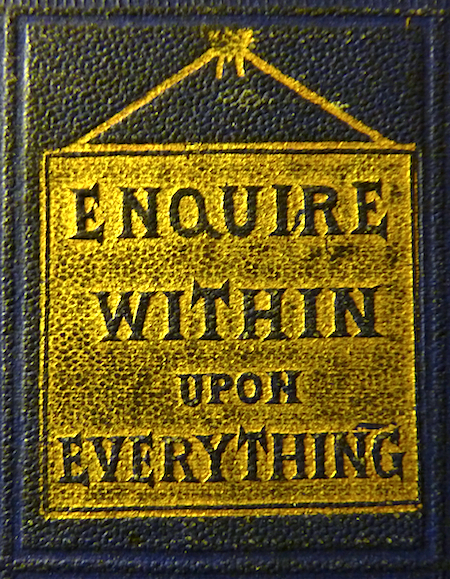
Create a culture of enquiry

Image result for enquire within

In any school there will be enthusiasts, early adopters, cautious observers (waiting to be reassured or convinced), and maybe a few who actively resist changing their ways.  You will need to work with different groups in different ways for a while. It’s important to see Successful Futures as a process of gradual, cumulative culture change across the whole school that might take several years to really embed.

The following types of professional development opportunities could be built into the Continuing Professional Development programmes of your school.  The more of these professional development opportunities are used strategically to affect change, the more the school becomes a culture of enquiry.

  • Learning reviews
  • Teacher learning communities or Professional Learning Teams
  • Coaching partnerships
  • Small-scale learning enquiries
  • Appreciative enquiry
  • Classroom observation and personal review
  • Visiting and sharing with other schools

 Teachers’ habits as learners have to become part of the picture; how they go about changing as well as those changes they are aiming to bring about. In other words, staff learning has to undergo the same sort of shifts as students’ learning. So the school has to think of professional development in terms of ‘what’ has to be learned and ‘how’ it might be learned.

Professional Learning Teams serve to deepen and sustain dialogue and empower staff to experiment and create their own solutions. Such teams meet together regularly to deepen their understanding of an approach, try out new things and reflect on and share data from their experiments with each other. As a consequence, a spirit of openness and enquiry increasingly pervades the school.

It’s the development of staff through Professional Learning Teams that will prove to be the engine of change.


PLCs: the engines of change

jean-victor-balin-arrow-orange-down

Monitor development in classrooms

Image result for How is it going

Working in this culture of trust and openness, teachers and teaching assistants will become increasingly confident to experiment and take risks. But this is no free-for-all: the quality of learning in classrooms and around the school will need to be kept under regular review.

It’s important that teachers get used to being observed regularly, and come to trust that such observation is in the spirit of learning support for them, and not a process of judgement or appraisal. Staff need to see classroom observation  as part of a dynamic, reflective and development process across all levels of the school. As the new culture consolidates, people will get used to watching out for and recording changes both in their practice and in students’ learning behaviours, motivation and achievement.

See section 6 for more ideas on classroom observation.


Observation AS development

jean-victor-balin-arrow-orange-down

Come to know your students as developing learners 

As part of the innovation to bring Successful Futures into being you will need to keep an eye on and recognise progression students make in their learning behaviours. When leaders and teachers recognise, point out and praise such progression it:

Image result for getting to know you as a learner

  • motivates and encourages students to put in the effort to continue improving their learning behaviours
  • gives students feedback on their learning behaviour progress so that they can decide which ‘learning muscles’ they are going to put effort into next
  • encourages teachers themselves to realise that their efforts to improve learning behaviours are being effective
  • gives teachers information about individual students or classes that will enable them, the teachers, to discuss and guide learning development more precisely and helpfully
  • validates the progress made by students in terms of conventional attainment measures.

In other words you will be quietly watching to see whether and how students’ learning dispositions are shaping up. You can be assured that learning habits won’t suddenly appear from nowhere at the end of their school life: you will  have been building them up slowly throughout their time in your school.


Navigating your way forward

jean-victor-balin-arrow-orange-down

QuestionMark100

Self reflection

  • To what extent is your school’s vision for developing and embedding Successful Futures clearly developed and widely understood in the school’s community?
  • What might you say to assure colleagues of your belief and commitment to the school’s core purpose of developing students’ successful futures?
  • To what extent do staff feel empowered to enquire into their classroom practice and to innovate?
  • How do you plan to understand what is happening in classrooms that build the purposes of Successful Futures?


Continue Reading

3. What does it take to shift classroom cultures?

Powerful learners are developed in learning-friendly classroom cultures.

Find out about a framework for building learning friendly classrooms:

  • frameworks for building powerful learning 
  • the four cultural shifts that create a learning-friendly classroom culture
  • the outcomes of these shifts for learners and for teachers.

and gain an overview of where practice is now in your classrooms.

A word or two about culture

 ‘Culture’ concerns the details of the micro-climate that teachers create in their classrooms.

  • What they do and say
  • What they notice and commend and what they don’t
  • What kind of role model of a learner they offer: all these are of the essence.

And what really matters is how they design and present activities so that, over the course of a term or a year, their students are cumulatively getting a really good all-round mental work-out. All the learning bits of their brains are being stretched and strengthened, one by one and all together.

The framework for developing  learning friendly classrooms is known as the Teachers’ Palette. This combines the types of teacher actions that create the conditions necessary for students’ learning behaviours to become shaped and habituated. Schools that successfully build learning behaviours have found that there are four key cultural shifts that combine to create the seedbed for building better learners – the relationships in the classroom; the ways in which learning is talked about; how learning itself becomes the object of learning; how learning is noticed and celebrated. 


Creating the seedbed for building powerful learners

jean-victor-balin-arrow-orange-down

The four key cultural shifts

Moving to more learning-friendly cultures is a big shift in thinking and action. Establishing learning-friendliness comes from four shifts in teacher practice:

  • a shift in relationships
  • a shift in the language
  • a shift in how learning is constructed 
  • a shift in what is celebrated, what is seen to matter.

1. Relating for learning: changing the roles and responsibilities of teachers and learners, so that learning becomes a shared responsibility. Students are given more responsibility for their own learning, the role of the teacher changes from ‘the sage on the stage’ to ‘the guide by your side’; the role of the student moves from ‘passenger’ to ‘crew’ and ultimately to becoming ‘pilots of their own learning’.


2. Talking for learning: developing the sort of language content and style to enhance learning, making learning itself the object of conversation. The way we express ourselves in the classroom creates a powerful linguistic environment that teaches young people the best of what we know about the how of learning. The language of learning helps students to discuss, understand, and become conscious of using their learning behaviours.


3. Constructing for learning: developing activities and classroom routines that feed learning habits, where learning becomes the object of learning. Learning activities are designed to stretch and challenge by having a dual focus – to explore content and stretch students’ use of their learning behaviours. There is a strong underpinning of not just ‘doing’ learning but reviewing and reflecting on the process in order to make meaning and apply it elsewhere.


4. Celebrating learning: clarifying the outward signs of the values that underpin the culture, making learning the object of attention. In this shift failure has been redefined; being stuck is seen as interesting and mistakes valuable. Effort, questions and taking risks and the growth of learning habits are recognised, attended to, acknowledged and praised. These serve to make visible the underlying values of the learning environment.

Screen Shot 2017-02-02 at 13.58.57


This uncovering of learning ensures students discover, use, understand and grow their learning habits. 

The shifts lead teachers to ask how can I:

  • build a classroom culture that ensures that responsibility for learning is shared with and to some degree devolved to learners?
  • create opportunities to discuss the learning process using the language of learning?
  • construct activities that develop positive learning behaviours and help learners to acquire the necessary content?
  • build learners’ commitment to becoming better learners through what is valued and recognised?


How roles change

jean-victor-balin-arrow-orange-down

The changing role of learners and teachers

For learners a learning friendly culture is a place where their role changes from receptivity to activity:

  • they collaborate and talk about how they understand things
  • they accept responsibility for learning
  • they do more of the thinking
  • they develop curiosity, perseverance, attentiveness, and open-mindedness
  • they monitor and assess what they do
  • they talk fluently about their learning behaviours
  • they value mistakes, challenge, feedback
  • they develop their learning behaviours consciously
  • they regard themselves as improving learners

For teachers a learning friendly culture is a place where their role changes from ‘delivering’ learning to students, to the creation of situations in which students consciously use their learning behaviours to learn:

  • the learning process is brought to the surface, given a language, discussed, looked for, celebrated
  • learning processes are modelled
  • teachers act as learning coaches
  • few lessons are simply ‘talk-and chalk’
  • lessons contain challenges and activities that get students thinking and learning for themselves
  • teachers encourage students to explore a challenging question, problem or assertion
  • teachers enable students to become observers and regulators of their own learning
  • teachers keep thinking ‘What’s the least I can do to get productive learning happening (again)?’
[Use the tabs in the orange bar at the top to shift between learners and teachers]

Because learning-centred teachers have a particularly rich conception of learning and the habits that underpin it, they are able to design nudges and activities that target quite specific aspects of learning behaviours. Teaching for learning becomes more detailed and forensic.


Where are you now?

questionmark_50
  • How did you react to the learner’s list?
  • What about the teacher’s list?
  • How do-able does that feel?
  • Which aspects on either list feel very possible?
  • Which items feel more problematic?
  • What makes you say that?
  • What one thing might you insist upon developing to make classrooms more learning-friendly?

jean-victor-balin-arrow-orange-down

Analyse classroom practice more deeply


culture-tool-2_shifting-the-culture_v7

Deeper Learning Culture Tool
  • Download the deeper Learning Culture Tool.
  • Look carefully at the issues raised in relation to your school.
  • Ring the MEANS statements that describe aspects of the school’s classroom cultures that you think are secure.
  • Ring the ENDS statements that you think are secure.
  • Underline those statements that would most benefit your students now, the statements that you would most like to ring but can’t at the moment.

Ask the hard questions

  • How many of these MEANS are in use in classrooms?
  • How many ENDS are secure?
  • How much is learning externalised or surfaced?
  • What’s the balance between telling and coaching in classrooms?
  • Do students have a language with which to talk about their learning?
  • What proportion of tasks would you estimate to be rich and challenging?


Something to reflect on


Thinking more deeply about classroom cultures in your school. Asking the hard questions.

QuestionMark100

What is needed to make it all work?

A headteacher said, apropos the recently published draft curriculum for Wales:

‘It tells us what to do, but does not tell us how to do it. We all agree with the core purposes of the curriculum and the importance of progressively building the wider skills, but we need help on how to do it, not on what to teach. The new curriculum aspires to create a range of complex outcomes for students, I still have little idea about how this might be achieved. 

  • To what extent have you considered how classroom culture is critical in delivering the core purposes and wider skills?
  • How confident are you that the classroom culture in your school is already achieving these desirable dispositional outcomes?
  • And if it is not, what changes might be necessary?


Continue Reading

2. What sort of culture will develop powerful learners?

Powerful learners are developed in learning-friendly classroom cultures.

Find out about a the type of classroom culture that best supports powerful learners:

  • the meaning of classroom culture
  • teacher centred cultures
  • learner centred cultures
  • learning centred cultures

and gain an overview of the most dominant learning culture in your school at present.

 Cultures for learning 

Why talk about culture

The original research behind the idea of Learning Power made clear that learning dispositions aren’t fixed at birth, that learning is a learnable craft, and that the learning environment can have a constructive or destructive influence on a person’s energy for and approach to learning. Classroom cultures, therefore, come into play. Cultures have the power to grow or diminish students’ inclinations and abilities to learn.

Therefore…

developing learners for a successful future is about creating a culture in classrooms – and the school more widely – that will systematically cultivate habits and attitudes that will stand students in good stead for a complex world.

Culture: all those little habits, routines and practices that implicitly convey ‘what we believe and value around here’. Classrooms are the places where, hour by hour, students experience the values and practices that are embodied in the school, rather than just the ones that are espoused.

Culture is about the micro-climate: what teachers do and say; what they notice and commend, or don’t; what kind of role model of learning they offer; how they design and present activities to build learning behaviours. Some classroom cultures are just more learning friendly than others.


What do we mean by a learning culture?

jean-victor-balin-arrow-orange-down

 Types of learning culture

Research by Chris Watkins from XXX back in 2004 suggested three types of classroom learning cultures, some more learning friendly than others.

  • Teacher centred; has an overriding emphasis on what the teacher is doing or saying.
    • Learning = being taught.
    • Students are passengers
    • Students have an impoverished view of their learning ability
    • The emphasis is on acquiring knowledge
  • Learner centred; students take a more active role in deciding what to do.
    • The learning is making meaning.
    • Students are crew
    • Students collaborate and discuss learning
    • The emphasis is on understanding
  • Learning centred; students learn about learning itself.
    • Students use a language of learning.
    • Become conscious of the learning process and the learning habits they command.
    • Students are pilots of their learning
    • The emphasis is on self-regulation, becoming meta-learners for a learning life

Hence there are often two strategic shifts to make in the journey from Teacher centred to Learning centred cultures. Teacher centred cultures may well achieve good results but only Learning centred cultures achieve good results PLUS ambitious and capable, enterprising and creative, ethical and informed, healthy and confident learners.

Learning shift

Learning shift


Types of classroom cultures

jean-victor-balin-arrow-orange-down

 Where is your school’s learning culture now?

culture-tool-1_v2

Download a copy of the Culture Review Tool

The Culture Tool describes in greater detail the features of teacher centred, learner centred and learning centred classrooms.

Take a look at it and think about the school’s learning culture against the indicators in each panel.

  • Reflect on the culture of each classroom
  • Highlight all aspects of culture that are a regular feature in each classroom
  • What are the similarities and differences between phases, year groups, individual classes?
  • What is this telling you about your school’s learning culture?

Analyse the school’s current learning culture

QuestionMark100

Look more closely and think ahead

  • Which panels have most statements highlighted?
  • Does this alter from phase to phase? Teacher to teacher?
  • What does this imply?
  • Which statements in the middle panel would you most liked to have ticked but could not?
  • What might you need to do about that?
  • Are there any aspects from the third, learning centred, panel that you were able to tick?
  • How might you spread this practice more widely?
  • It’s worth remembering that the more teacher centred the existing culture, the longer the journey to creating a learning friendly culture.


Continue Reading

1. What sort of learners are we trying to create?

Living the purposes

It is important that as children and young people move through the education system in Wales they are not viewed as aiming towards the four purposes, but rather seen as living the four purposes during their time at school.

Dylan Jones and Jane Waters. CfW Blog. IoE UWTSD

Enriching students’ sense of being a learner… throughout the curriculum

The four purposes referred to above are the now familiar pillars of the new curriculum for Wales… to develop children and young people as:

ambitious, capable learners, ready to learn throughout their lives; enterprising, creative contributors, ready to play a full part in life and work; ethical, informed citizens of Wales and the world; healthy, confident individuals, ready to lead fulfilling lives as valued members of society.“

There’s a temptation to view these four life enhancing learning behaviours exclusively as outcomes; something to hope for as the end result of the new curriculum. While the new curriculum in Wales is designed to achieve such results, developing them will cause schools to infuse them all the way through the curriculum and across years of education.

In other words the whole curriculum, both in its content, design and delivery, will be dedicated to achieving these wider outcomes for young people. Through new programmes of study and experiences, (PoSE) a set of wider skills and a re-think of assessment, ‘what’ is taught and learned and ‘how’ it is taught and learned should constantly enrich students’ sense of being a learner.

An ambitious curriculum preparing students for the future

jean-victor-balin-arrow-orange-down

Bringing learning out of the shadows 

Behind the headlines

So, as the new curriculum prepares students ‘ not just for a life of tests but for the tests of life‘ the purpose of education moves beyond the accumulation of knowledge to shaping what a student can become as a person.

To make such outcomes more compelling and understandable the four purposes are expanded using words and phrases such as:

  • resilience
  • perseverance
  • making connections
  • play different team roles
  • use evidence
  • face and overcome challenge
  • manage risk
  • develop empathy

Such words begin to tell us what sort of learners your school will be creating. This means helping students build up the mental, emotional and social resources to enjoy challenge and cope well with uncertainty and complexity. Students have to learn how to be tenacious and resourceful, imaginative and logical, self-disciplined and self-aware, collaborative and inquisitive.

These are descriptors of what are known as learning dispositions, or powers or habits. Taken together they add up to a learning character. Your learning dispositions determine your inclination or tendency for change; they direct those behaviours that influence and underpin your performance throughout life. Making the purposes of Successful Futures successful will rely on paying attention to developing students’ learning dispositions; firing up their energy or appetite for changing, growing and learning . It’s about concentrating on the ‘how’ of learning – on bringing the learning process itself out of the shadows.


Learning dispositions/ habits/ powers = learner’s character.

jean-victor-balin-arrow-orange-down

Can you learn how to learn?

Selling the idea that learning is learnable

It’s an erroneous idea that an individual’s ability is fixed at birth, we now know that the brain is like a muscle in that its intelligence grows with exercise. We also know that intelligence is ‘the sum total of ‘habits of mind’ and that habits can be changed. When learners and their teachers are convinced of these facts it causes a major shift in self belief and the possibilities of education

Helping all young people to understand that learning is learnable, to make them aware of the learning behaviours they command, gives them greater enthusiasm and power for engaging with the potential highs and lows of learning.

When learners become aware of their learning behaviours through structured opportunities to improve it, they become:

  • more reflective and aware of themselves as learners
  • more confident and motivated to learn
  • more willing and able to take responsibility by ‘owning’ their learning for themselves
  • more intentional in their learning
  • keener to carry on learning as they move beyond school
  • more likely to realise their potential and gain grades that were previously regarded as beyond them
  • more confident socially and able to learn with, and from, one another
  • more able to manage transitions and take change in their stride throughout their lives.

Learning is a learnable craft

A valuable set of learning habits

Big questions: some answers

  1. It’s easy for schools to come across lists of learning habits — you might even make up your own! But is there a cluster of learning dispositions that are particularly appropriate for 21st century learners; helping them to deal with an increasingly complex world?
  2. Similarly, teaching ideas to improve student performance abound, but do these teaching ideas develop the valuable, necessary learning habits?

What schools are in search of is a researched collection of learning habits coupled with sound classroom activities and advice about how to nurture and build lifelong learning habits.

Background to an approach that works

Research undertaken by Bristol University, as part of a project into lifelong learning, identified critical dimensions of what is now known as Learning Power; dimensions of learning that can create a step-change in individual, team, and indeed organisational performance.

Furthermore the research found that the power to learn changes over time in response to the qualities of learning environments. As environmental circumstances change, they can have either a constructive or a destructive influence on a person’s power to learn. Informed interventions can significantly enhance personal confidence and performance.

The Building Learning Power approach developed from this original research. It’s an approach which is focused on developing learning habits through appropriate classroom cultures and which schools and teachers could profitably use to deliver the Successful Futures promise.The emergent powerful learners develop skills in monitoring and reviewing their learning, they pay attention to the diversity of practices that can be effective for learning more thoroughly, and become self-regulating, meta-cognitive learners.

How can we make this work?

jean-victor-balin-arrow-orange-down

A framework of valuable learning habits

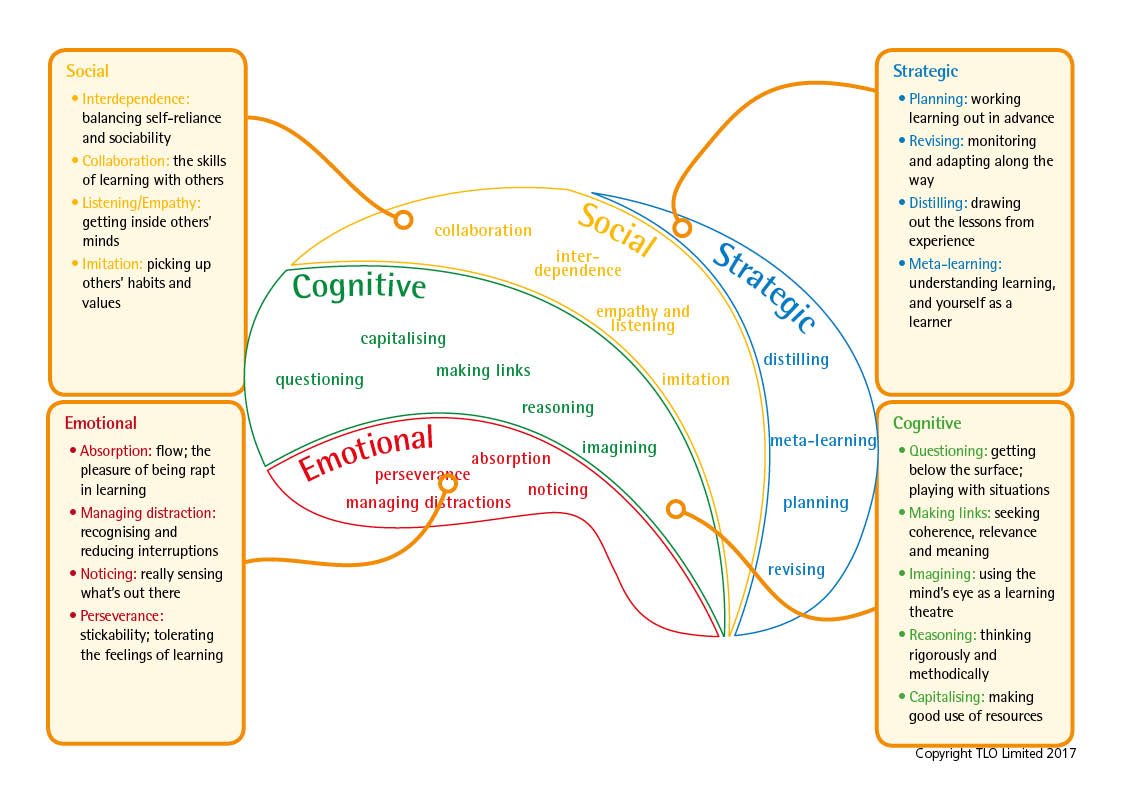
The Supple Learning Mind; framework of high value learning behaviours. 
BLP_Brain_Generic_no-Rs-[Converted]

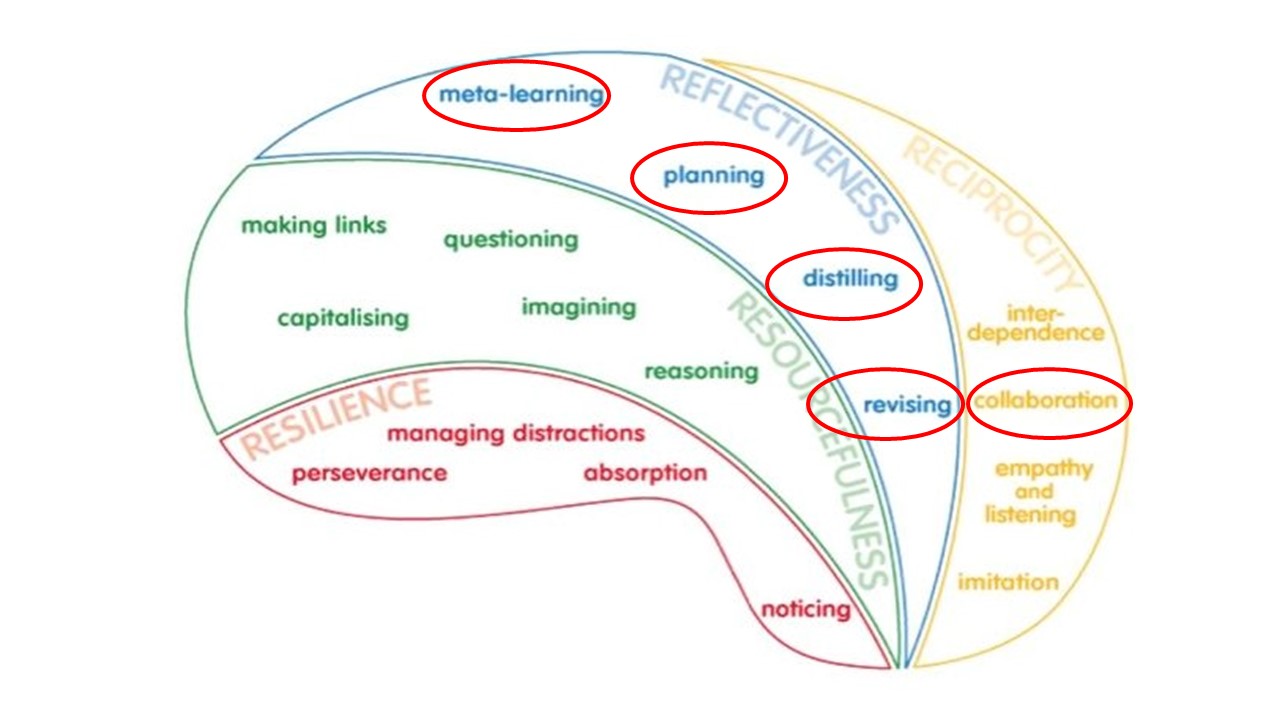
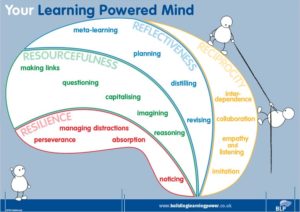
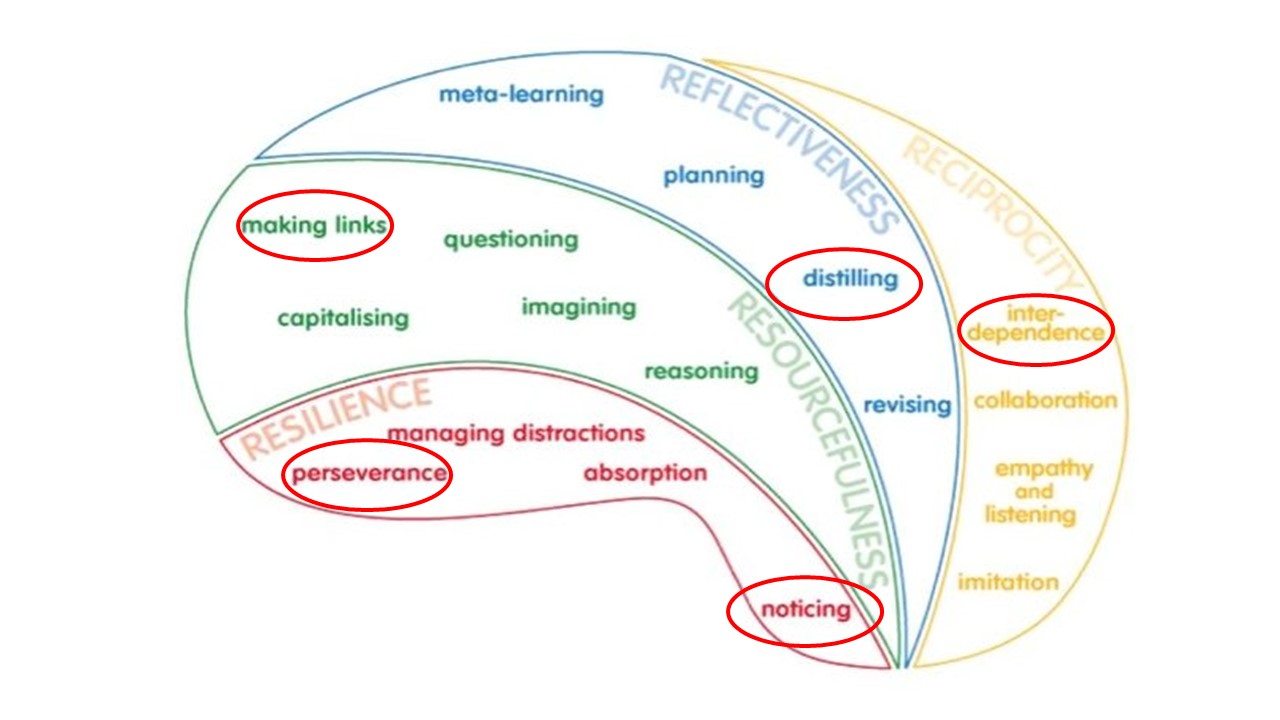
The first framework of Building Learning Power is The Supple Learning Mind. This captures the key psychological characteristics that are judged to be of the highest value in helping students to learn and thrive in a complex world. The framework embraces each of the domains of learning and these are shown in its four parts:

  • The Emotional domain of learning (sometimes described as Resilience)
  • The Cognitive domain of learning (sometimes described as Resourcefulness)
  • The Social domain of learning (sometimes described as Reciprocity)
  • The Strategic domain of learning (sometimes described as Reflectiveness)

This learning framework shows that learning isn’t just about having a good memory; it includes how we feel, how we think, how we learn with and from others and how we manage the process of learning. It shows that learning is a complex process. Moreover it provides a language that helps teachers to think about how they cultivate each of the learning behaviours and helps students to gain a better personalised understanding of how they learn content.

Each domain clusters together the high value learning behaviours that best make that domain work well. For example the emotional domain is made up of the learning behaviours of perseverance, managing distractions, absorption and noticing.
The Supple Learning Mind diagram_v2

 The cognitive domain is made up of behaviours like questioning, link making, imagination, reasoning and capitalising.  The social domain is made up of behaviours like interdependence, collaboration, listening and empathy, and imitation. Finally the strategic domain encompasses planning, revising, distilling and meta-learning.

A researched framework of high value learning dispositions


jean-victor-balin-arrow-orange-down

Learning dispositions to underpin the four curriculum purposes

Ambitious, capable learners; enterprising, creative contributors; ethical, informed citizens; healthy, confident individuals.

Sometimes these ambitious purposes sound too grand and vague to get a practical handle on but the behaviours in the learning power framework can help to underpin and clarify. Being Capable, Creative, Informed, Confident, for example all require good questioning skills. Being ambitious, enterprising, ethical and healthy all draw on the ability to draw on multiple perspectives and see the world from other people’s eyes (empathy). In this way the same learning habit can contribute to several ‘high order’ competencies’.

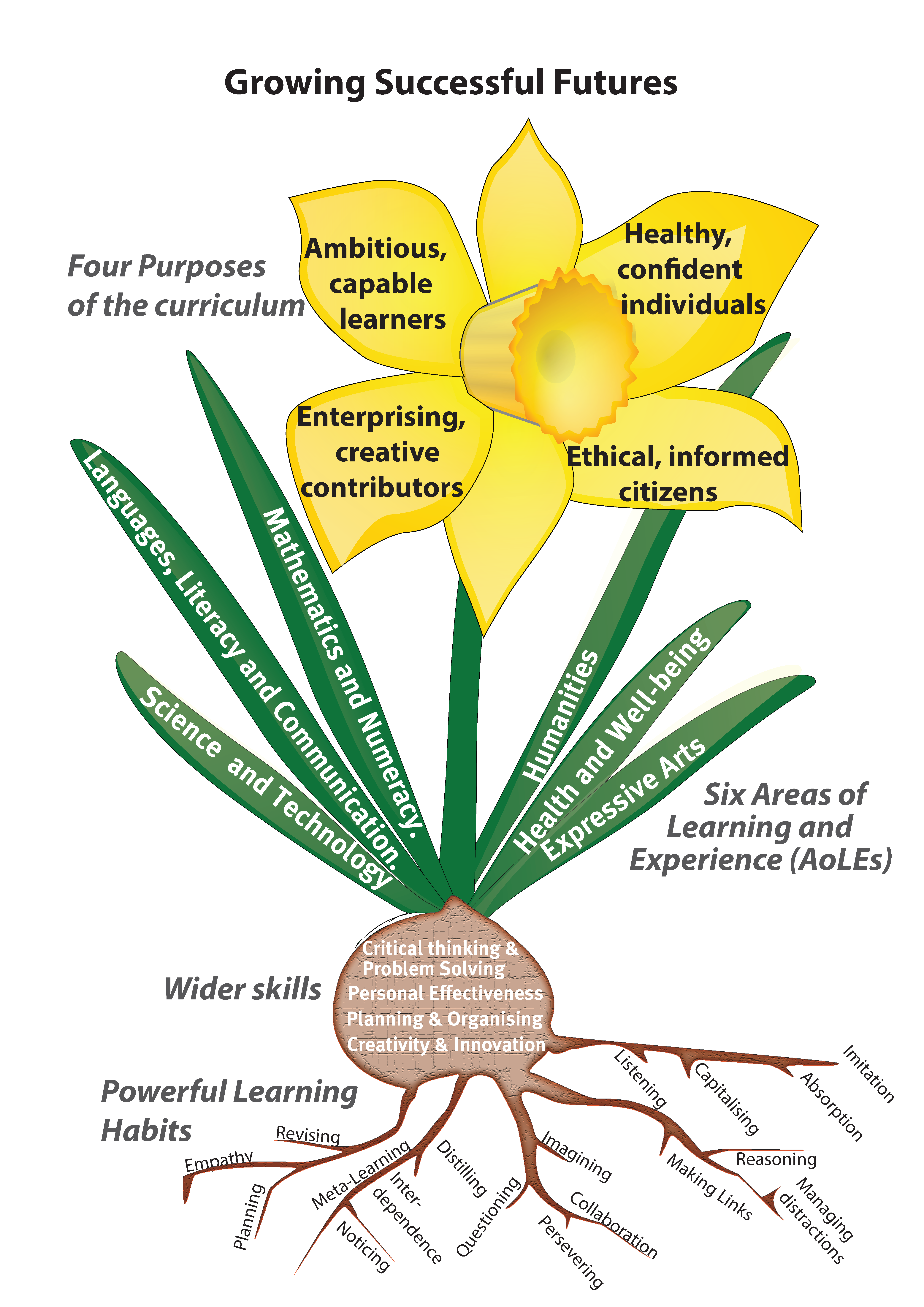
By the same token each wider skill is itself a composite. Take the wider skill of Creativity and innovation. Research suggests that becoming a creative thinker involves being able to notice details and patterns, taking risks, questioning and playing, learning by imitating others, revising your ideas, and imagining possibilities. Each of these is treated in the Supple Learning Mind framework (see above) as a separate learning behaviour, each of which is capable of being stretched and strengthened. Thus learning dispositions make explicit and coachable the very foundations of those qualities of mind the new curriculum for Wales is trying to secure. They form the very roots of learning, enabling students to develop wider skills throughout the programmes of study and experience and the flowering of the four purposes. 

Learning behaviours: the essential roots of the curriculum

QuestionMark100

Some important questions

The headteacher of a Welsh medium school recently told us that:

‘If we do not look at the core purposes and wider skills of the new curriculum through the lens of a well-researched framework of learning dispositions, Successful Futures will fail in Wales. As a school, we are able to understand Successful Futures only because we already understand learning through our engagement with Building Learning Power.’

  • Do you agree with the need for a well-researched framework of learning dispositions?
  • If yes, which well-researched framework do you plan to use to support your implementation of Successful Futures and your understanding of the core purposes and wider skills in designing your curriculum?
  • If no, how do you plan to make sense of, and align, all of the demands that Successful Futures places on schools, on leaders, on teachers, and on learners?


Continue Reading

Sec 3

Big question…

Enter your content herek

How 1

Lorem ipsum dolor sit amet, solum summo ex duo, duo delectus verterem menandri et. Pro probo dicam similique id, mei te minim solet. Elit admodum an mea, ex tale accumsan appellantur per. Eum recusabo invenire efficiendi ut, in movet eruditi corpora mea, alii esse dolorem qui ne.

read more


Lorem ipsum dolor sit amet, solum summo ex duo, duo delectus verterem menandri et. Pro probo dicam similique id, mei te minim solet. Elit admodum an mea, ex tale accumsan appellantur per. Eum recusabo invenire efficiendi ut, in movet eruditi corpora mea, alii esse dolorem qui ne.

Posse putent aliquid ea his, ex invidunt delicatissimi sed. Meis ceteros id sea, per ad tale sadipscing. Ut cum dicat aliquip quaeque. Iudico sadipscing te mei. Ad vel dolor nostrum facilisi. Eam no commune probatus.

Ex pri enim nibh, eos at euismod civibus voluptaria. Adipiscing liberavisse

C

Lorem ipsum dolor sit amet, solum summo ex duo, duo delectus verterem menandri et. Pro probo dicam similique id, mei te minim solet. Elit admodum an mea, ex tale accumsan appellantur per. Eum recusabo invenire efficiendi ut, in movet eruditi corpora mea, alii esse dolorem qui ne.

Posse putent aliquid ea his, ex invidunt delicatissimi sed. Meis ceteros id sea, per ad tale sadipscing. Ut cum dicat aliquip quaeque. Iudico sadipscing te mei. Ad vel dolor nostrum facilisi. Eam no commune probatus.

Ex pri enim nibh, eos at euismod civibus voluptaria. Adipiscing liberavisse

How 2

Lorem ipsum dolor sit amet, solum summo ex duo, duo delectus verterem menandri et. Pro probo dicam similique id, mei te minim solet. Elit admodum an mea, ex tale accumsan appellantur per. Eum recusabo invenire efficiendi ut, in movet eruditi corpora mea, alii esse dolorem qui ne.

Posse putent aliquid ea his, ex invidunt delicatissimi sed. Meis ceteros id sea, per ad tale sadipscing. Ut cum dicat aliquip quaeque. Iudico sadipscing te mei. Ad vel dolor nostrum facilisi. Eam no commune probatus.

Ex pri enim nibh, eos at euismod civibus voluptaria. Adipiscing liberavisse

Lorem ipsum dolor sit amet, solum summo ex duo, duo delectus verterem menandri et. Pro probo dicam similique id, mei te minim solet. Elit admodum an mea, ex tale accumsan appellantur per. Eum recusabo invenire efficiendi ut, in movet eruditi corpora mea, alii esse dolorem qui ne.

Posse putent aliquid ea his, ex invidunt delicatissimi sed. Meis ceteros id sea, per ad tale sadipscing. Ut cum dicat aliquip quaeque. Iudico sadipscing te mei. Ad vel dolor nostrum facilisi. Eam no commune probatus.

Ex pri enim nibh, eos at euismod civibus voluptaria. Adipiscing liberavisse

Lorem ipsum dolor sit amet, solum summo ex duo, duo delectus verterem menandri et. Pro probo dicam similique id, mei te minim solet. Elit admodum an mea, ex tale accumsan appellantur per. Eum recusabo invenire efficiendi ut, in movet eruditi corpora mea, alii esse dolorem qui ne.

Posse putent aliquid ea his, ex invidunt delicatissimi sed. Meis ceteros id sea, per ad tale sadipscing. Ut cum dicat aliquip quaeque. Iudico sadipscing te mei. Ad vel dolor nostrum facilisi. Eam no commune probatus.

Ex pri enim nibh, eos at euismod civibus voluptaria. Adipiscing liberavisse

Lorem ipsum dolor sit amet, solum summo ex duo, duo delectus verterem menandri et. Pro probo dicam similique id, mei te minim solet. Elit admodum an mea, ex tale accumsan appellantur per. Eum recusabo invenire efficiendi ut, in movet eruditi corpora mea, alii esse dolorem qui ne.

Posse putent aliquid ea his, ex invidunt delicatissimi sed. Meis ceteros id sea, per ad tale sadipscing. Ut cum dicat aliquip quaeque. Iudico sadipscing te mei. Ad vel dolor nostrum facilisi. Eam no commune probatus.

Ex pri enim nibh, eos at euismod civibus voluptaria. Adipiscing liberavisse

Continue Reading

Sec 2

Big question…

Enter your content herek

How 1

Lorem ipsum dolor sit amet, solum summo ex duo, duo delectus verterem menandri et. Pro probo dicam similique id, mei te minim solet. Elit admodum an mea, ex tale accumsan appellantur per. Eum recusabo invenire efficiendi ut, in movet eruditi corpora mea, alii esse dolorem qui ne.

Posse putent aliquid ea his, ex invidunt delicatissimi sed. Meis ceteros id sea, per ad tale sadipscing. Ut cum dicat aliquip quaeque. Iudico sadipscing te mei. Ad vel dolor nostrum facilisi. Eam no commune probatus.

Ex pri enim nibh, eos at euismod civibus voluptaria. Adipiscing liberavisse

Lorem ipsum dolor sit amet, solum summo ex duo, duo delectus verterem menandri et. Pro probo dicam similique id, mei te minim solet. Elit admodum an mea, ex tale accumsan appellantur per. Eum recusabo invenire efficiendi ut, in movet eruditi corpora mea, alii esse dolorem qui ne.

Posse putent aliquid ea his, ex invidunt delicatissimi sed. Meis ceteros id sea, per ad tale sadipscing. Ut cum dicat aliquip quaeque. Iudico sadipscing te mei. Ad vel dolor nostrum facilisi. Eam no commune probatus.

Ex pri enim nibh, eos at euismod civibus voluptaria. Adipiscing liberavisse

How 2

Lorem ipsum dolor sit amet, solum summo ex duo, duo delectus verterem menandri et. Pro probo dicam similique id, mei te minim solet. Elit admodum an mea, ex tale accumsan appellantur per. Eum recusabo invenire efficiendi ut, in movet eruditi corpora mea, alii esse dolorem qui ne.

Posse putent aliquid ea his, ex invidunt delicatissimi sed. Meis ceteros id sea, per ad tale sadipscing. Ut cum dicat aliquip quaeque. Iudico sadipscing te mei. Ad vel dolor nostrum facilisi. Eam no commune probatus.

Ex pri enim nibh, eos at euismod civibus voluptaria. Adipiscing liberavisse

Lorem ipsum dolor sit amet, solum summo ex duo, duo delectus verterem menandri et. Pro probo dicam similique id, mei te minim solet. Elit admodum an mea, ex tale accumsan appellantur per. Eum recusabo invenire efficiendi ut, in movet eruditi corpora mea, alii esse dolorem qui ne.

Posse putent aliquid ea his, ex invidunt delicatissimi sed. Meis ceteros id sea, per ad tale sadipscing. Ut cum dicat aliquip quaeque. Iudico sadipscing te mei. Ad vel dolor nostrum facilisi. Eam no commune probatus.

Ex pri enim nibh, eos at euismod civibus voluptaria. Adipiscing liberavisse

Continue Reading

Sec 1

Big question…

Enter your content herek

How 1

Lorem ipsum dolor sit amet, solum summo ex duo, duo delectus verterem menandri et. Pro probo dicam similique id, mei te minim solet. Elit admodum an mea, ex tale accumsan appellantur per. Eum recusabo invenire efficiendi ut, in movet eruditi corpora mea, alii esse dolorem qui ne.

Posse putent aliquid ea his, ex invidunt delicatissimi sed. Meis ceteros id sea, per ad tale sadipscing. Ut cum dicat aliquip quaeque. Iudico sadipscing te mei. Ad vel dolor nostrum facilisi. Eam no commune probatus.

Ex pri enim nibh, eos at euismod civibus voluptaria. Adipiscing liberavisse

Lorem ipsum dolor sit amet, solum summo ex duo, duo delectus verterem menandri et. Pro probo dicam similique id, mei te minim solet. Elit admodum an mea, ex tale accumsan appellantur per. Eum recusabo invenire efficiendi ut, in movet eruditi corpora mea, alii esse dolorem qui ne.

Posse putent aliquid ea his, ex invidunt delicatissimi sed. Meis ceteros id sea, per ad tale sadipscing. Ut cum dicat aliquip quaeque. Iudico sadipscing te mei. Ad vel dolor nostrum facilisi. Eam no commune probatus.

Ex pri enim nibh, eos at euismod civibus voluptaria. Adipiscing liberavisse

Column 1/3

How 2

Lorem ipsum dolor sit amet, solum summo ex duo, duo delectus verterem menandri et. Pro probo dicam similique id, mei te minim solet. Elit admodum an mea, ex tale accumsan appellantur per. Eum recusabo invenire efficiendi ut, in movet eruditi corpora mea, alii esse dolorem qui ne.

Posse putent aliquid ea his, ex invidunt delicatissimi sed. Meis ceteros id sea, per ad tale sadipscing. Ut cum dicat aliquip quaeque. Iudico sadipscing te mei. Ad vel dolor nostrum facilisi. Eam no commune probatus.

Ex pri enim nibh, eos at euismod civibus voluptaria. Adipiscing liberavisse

Column 1/3

Lorem ipsum dolor sit amet, solum summo ex duo, duo delectus verterem menandri et. Pro probo dicam similique id, mei te minim solet. Elit admodum an mea, ex tale accumsan appellantur per. Eum recusabo invenire efficiendi ut, in movet eruditi corpora mea, alii esse dolorem qui ne.

Posse putent aliquid ea his, ex invidunt delicatissimi sed. Meis ceteros id sea, per ad tale sadipscing. Ut cum dicat aliquip quaeque. Iudico sadipscing te mei. Ad vel dolor nostrum facilisi. Eam no commune probatus.

Ex pri enim nibh, eos at euismod civibus voluptaria. Adipiscing liberavisse

Column 1/3
Continue Reading

Helping your learners to . . . Collaborate

Reciprocity — Collaboration

When you use this learning muscle, you …

  • are aware how you respond to other people
  • manage your feelings when working with others
  • respect other people’s points of view
  • are able to work effectively as part of a pair or team
  • share information and ideas willingly
  • understand the ground rules of team work


The purpose of Building Learning Power is to facilitate the growth of high value psychological characteristics in order to strengthen students’ learning characters. These skills, attitudes and values, when used with increasing competence and confidence across many learning opportunities, become learning habits; the characteristics of successful lifelong learners. 

‘A person’s Learning Power determines, even dictates, their propensity for change, and directs those behaviours that influence and underpin performance throughout life.

The power to learn is the essential ingredient in implementing strategies for change i.e. to learn.‘

The activities, think pieces and questions in this online unit aim to help teachers make a start on:

  • introducing students to one of the key learning behaviours;
  • using the language of learning effectively with students;
  • designing the use of learning behaviours into the way they teach;
  • developing the confidence and skill in helping students to grow their learning power.


Continue Reading

An introduction to the Supple Learning Mind


An edited version of the below, plus the supple with the behaviours shown.


3 supples to choose from – delete the 2 that are not needed:


The first key model of Building Learning Power – the Supple Learning Mind.

Find out about the 4 dimensions of learning powered minds :

  • The features of a Supple Learning Mind;
  • How the vocabulary of learning  enriches understanding of learning;
  • The extent to which they get regular exposure in your classroom(s).

and gain an overview of the essence of effective learning behaviours.

If you are reading this as a senior leader… reflect on how the issues raised work across the school.

If you are reading this as a classroom practitioner… reflect on how the issues raised affect your own learners. 

The Supple Learning Mind framework of high value learning behaviours.

A rich framework for learning

BLP_Brain_Generic_no-Rs-[Converted]

The Supple Learning Mind framework was originally conceived and researched by Professor Guy Claxton. It captures the key psychological characteristics that are judged to be of the highest value in helping students to learn and thrive in a complex world. The framework embraces each of the domains of learning and these are shown in its four parts:

  • The Emotional domain of learning (sometimes described as Resilience)
  • The Cognitive domain of learning (sometimes described as Resourcefulness)
  • The Social domain of learning (sometimes described as Reciprocity)
  • The Strategic domain of learning (sometimes described as Reflectiveness)

This learning framework shows that learning isn’t just about having a good memory; it includes how we feel, how we think, how we learn with others and how we manage the process of learning. It shows that learning is a complex process. Furthermore it provides a language that helps teachers to think about how they cultivate each of the learning behaviours and helps students to gain a better personalised understanding of how they learn content.

Each domain clusters together the high value learning behaviours that best make that domain work well. For example the social domain is made up of the learning behaviours of interdependence, collaboration, listening and empathy and imitation.

The Supple Learning Mind diagram_v2


QuestionMark100
  • What’s your initial reaction to the learning framework?
  • Which learning behaviours chime with you?
  • Are there others you would add?
  • Which of the four domains makes most sense to you?
  • Which domain is, arguably, the most important?


The vocabulary of the Supple Mind creates a language of learning

Having a language that captures the richness of learning can be used to understand and discuss the learning process, helping teachers and students to uncover learning as a visible process that can improve.

The learning language offers teachers and students alike a rich vocabulary for thinking and talking about what learners actually do, and this in itself enables them to expand their capacity and appetite for learning.

The language has many uses. It helps:

  • teachers to think about how they might talk in a way that helps to cultivate each of the learning behaviours.
  • students to notice and recognise learning behaviours they were unaware of.
  • students to gain a better personalised understanding of content by consciously engaging the behaviours.
  • to know which learning habits and attitudes are being exercised by the way subjects are being presented, taught and assessed.
  • to understand concepts such as ‘reasoning’, ‘collaborating’, or ‘managing distractions’, and to have worked on getting better at using them purposefully and routinely.
  • to name such things explicitly so that students (and their parents) know what it is teachers are noticing and valuing.
  • teachers to become aware of which learning behaviours they routinely require students to use in lessons — and then to think more carefully about whether there might be others they might  profitably call on instead.
  • teachers to design activities that stretch and strengthen learning behaviours so that they become student’s learning habits. Teachers begin to think, ‘How is learning happening; What habits of mind am I cultivating in students by the way we I’m designing and delivering the curriculum’; Which learning behaviours need to be used more often so that they become habits?

So as we can see it’s not just the words themselves that are powerful but the variety of functions they have in making learning behaviours visible, learnable and habitual. The learning behaviours themselves become even more useful when brought to life through everyday phrases that promote, encourage and strengthen them. 


QuestionMark100
  • Which of these functions of the learning language sound useful to you?
  • How could you make use of this learning vocabulary?
  • Have a quick look at lesson plans for last week and try to think which learning behaviours the activities required students to use (maybe without you realising it).
  • If you started to use this learning framework which learning behaviour would you tackle first?


Translating the Supple Mind into classroom practice

So, how does all this translate into the classroom? Basically, as a teacher, you are going to talk about the behaviours, stretch them through activities, model them, and show that you value them when you see them in use.

Have a think about some of the learning behaviours and work out;

  • how often you try to help students develop such behaviours in the way that you teach at present;
  • how many of your students display these behaviours in the classroom (even without knowing it).


Emotional Engagement

  • what do I do now to help students develop these behaviours?
  • how many of my students display these behaviours now (even without knowing it)?
  • Relish a challenge
  • Not afraid of finding things hard
  • Identify significant detail
  • Stick at things despite difficulties
  • Minimise negative distractions
  • Work for extended periods to solve a problem


Cognitive Range

  • what do I do now to help students develop these behaviours?
  • how many of my students display these behaviours now (even without knowing it)?
  • Become curious about possibilities
  • Ask questions to get to the bottom of things
  • See how things fit together
  • Are logical and systematic
  • Use imagination to good effect
  • Make use of a wide range of learning resources and strategies

Social Involvement

  • what do I do now to help students develop these behaviours?
  • how many of my students display these behaviours now (even without knowing it)?
  • Work well with others
  • Maintain own ideas in a group
  • Listen to what others say, showing understanding
  • Put themselves in others’ shoes
  • Absorb and use the way other people do things
  • Know when to learn alone or with others

Strategic Responsibility

  • what do I do now to help students develop these behaviours?
  • how many of my students display these behaviours now (even without knowing it)?
  • Sort out what needs to be done
  • Think ahead of taking action
  • Take stock to make sure things are on track
  • Change tack if necessary
  • Pull out key points from experience
  • Talk about how they learn


questionmark_50

About your teaching, ask yourself:

  • Which behaviours do you regularly attend to?
  • Which do you rarely attend to?
  • Which psychological domain receives most attention in your classroom? (emotional, cognitive, social, strategic)
  • What does this reveal about your teaching?

About your learners, ask yourself:

  • Which of these behaviours are already well-developed?
  • Which are least well-developed?
  • To what extent are learners aware of using these behaviours?
  • Is there a link between what you do and how students are as learners?
  • What is this making you wonder?


Continue Reading

Helping your learners’ . . . Meta-learning

Reflectiveness — Meta-learning

When you use this learning muscle, you …

  • are interested in how you learn as an individual
  • can talk about what skills you need to make progress
  • can talk about how learning works for you
  • know your strengths and weaknesses as a learner
  • are interested in becoming a better learner


The purpose of Building Learning Power is to facilitate the growth of high value psychological characteristics in order to strengthen students’ learning characters. These skills, attitudes and values, when used with increasing competence and confidence across many learning opportunities, become learning habits; the characteristics of successful lifelong learners. 

‘A person’s Learning Power determines, even dictates, their propensity for change, and directs those behaviours that influence and underpin performance throughout life.

The power to learn is the essential ingredient in implementing strategies for change i.e. to learn.‘

The activities, think pieces and questions in this online unit aim to help teachers make a start on:

  • introducing students to one of the key learning behaviours;
  • using the language of learning effectively with students;
  • designing the use of learning behaviours into the way they teach;
  • developing the confidence and skill in helping students to grow their learning power.
Continue Reading

Helping your learners to . . . Re-think, Review, Revise

Reflectiveness — Revising

When you use this learning muscle, you …

  • are ready to revise your plans as you go along
  • are flexible in your learning
  • monitor how things are going
  • review your progress and change tack if necessary
  • change your plans when you’ve had a better idea
  The purpose of Building Learning Power is to facilitate the growth of high value psychological characteristics in order to strengthen students’ learning characters. These skills, attitudes and values, when used with increasing competence and confidence across many learning opportunities, become learning habits; the characteristics of successful lifelong learners. 

‘A person’s Learning Power determines, even dictates, their propensity for change, and directs those behaviours that influence and underpin performance throughout life.

The power to learn is the essential ingredient in implementing strategies for change i.e. to learn.‘

The activities, think pieces and questions in this online unit aim to help teachers make a start on:

  • introducing students to one of the key learning behaviours;
  • using the language of learning effectively with students;
  • designing the use of learning behaviours into the way they teach;
  • developing the confidence and skill in helping students to grow their learning power.


Continue Reading

Helping your learners to . . . Plan

Reflectiveness — Planning

When you use this learning muscle, you …

  • think about what you want to get out of learning
  • assess which resources you may need
  • estimate how long it will take you
  • plan the steps you might take
  • anticipate what might get in the way


The purpose of Building Learning Power is to facilitate the growth of  high value psychological characteristics in order to strengthen students’ learning characters. These skills, attitudes and values, when used with increasing competence and confidence across many learning opportunities, become learning habits; the characteristics of successful lifelong learners. 

‘A person’s Learning Power determines, even dictates, their propensity for change, and directs those behaviours that influence and underpin performance throughout life.

The power to learn is the essential ingredient in implementing strategies for change i.e. to learn.‘

The activities, think pieces and questions in this online unit aim to help teachers make a start on:

  • introducing students to one of the key learning behaviours;
  • using the language of learning effectively with students;
  • designing the use of learning behaviours into the way they teach;
  • developing the confidence and skill in helping students to grow their learning power.
Continue Reading

An introduction to the Supple Learning Mind

An edited version of the below, plus the supple with the 5 behaviours shown.


The first key model of Building Learning Power – the Supple Learning Mind.

Find out about the 4 dimensions of learning powered minds :

  • The features of a Supple Learning Mind;
  • How the vocabulary of learning  enriches understanding of learning;
  • The extent to which they get regular exposure in your classroom(s).

and gain an overview of the essence of effective learning behaviours.

If you are reading this as a senior leader… reflect on how the issues raised work across the school.

If you are reading this as a classroom practitioner… reflect on how the issues raised affect your own learners. 

The Supple Learning Mind framework of high value learning behaviours.

A rich framework for learning

BLP_Brain_Generic_no-Rs-[Converted]

The Supple Learning Mind framework was originally conceived and researched by Professor Guy Claxton. It captures the key psychological characteristics that are judged to be of the highest value in helping students to learn and thrive in a complex world. The framework embraces each of the domains of learning and these are shown in its four parts:

  • The Emotional domain of learning (sometimes described as Resilience)
  • The Cognitive domain of learning (sometimes described as Resourcefulness)
  • The Social domain of learning (sometimes described as Reciprocity)
  • The Strategic domain of learning (sometimes described as Reflectiveness)

This learning framework shows that learning isn’t just about having a good memory; it includes how we feel, how we think, how we learn with others and how we manage the process of learning. It shows that learning is a complex process. Furthermore it provides a language that helps teachers to think about how they cultivate each of the learning behaviours and helps students to gain a better personalised understanding of how they learn content.

Each domain clusters together the high value learning behaviours that best make that domain work well. For example the social domain is made up of the learning behaviours of interdependence, collaboration, listening and empathy and imitation.

The Supple Learning Mind diagram_v2


QuestionMark100
  • What’s your initial reaction to the learning framework?
  • Which learning behaviours chime with you?
  • Are there others you would add?
  • Which of the four domains makes most sense to you?
  • Which domain is, arguably, the most important?


The vocabulary of the Supple Mind creates a language of learning

Having a language that captures the richness of learning can be used to understand and discuss the learning process, helping teachers and students to uncover learning as a visible process that can improve.

The learning language offers teachers and students alike a rich vocabulary for thinking and talking about what learners actually do, and this in itself enables them to expand their capacity and appetite for learning.

The language has many uses. It helps:

  • teachers to think about how they might talk in a way that helps to cultivate each of the learning behaviours.
  • students to notice and recognise learning behaviours they were unaware of.
  • students to gain a better personalised understanding of content by consciously engaging the behaviours.
  • to know which learning habits and attitudes are being exercised by the way subjects are being presented, taught and assessed.
  • to understand concepts such as ‘reasoning’, ‘collaborating’, or ‘managing distractions’, and to have worked on getting better at using them purposefully and routinely.
  • to name such things explicitly so that students (and their parents) know what it is teachers are noticing and valuing.
  • teachers to become aware of which learning behaviours they routinely require students to use in lessons — and then to think more carefully about whether there might be others they might  profitably call on instead.
  • teachers to design activities that stretch and strengthen learning behaviours so that they become student’s learning habits. Teachers begin to think, ‘How is learning happening; What habits of mind am I cultivating in students by the way we I’m designing and delivering the curriculum’; Which learning behaviours need to be used more often so that they become habits?

So as we can see it’s not just the words themselves that are powerful but the variety of functions they have in making learning behaviours visible, learnable and habitual. The learning behaviours themselves become even more useful when brought to life through everyday phrases that promote, encourage and strengthen them. 


QuestionMark100
  • Which of these functions of the learning language sound useful to you?
  • How could you make use of this learning vocabulary?
  • Have a quick look at lesson plans for last week and try to think which learning behaviours the activities required students to use (maybe without you realising it).
  • If you started to use this learning framework which learning behaviour would you tackle first?


Translating the Supple Mind into classroom practice

So, how does all this translate into the classroom? Basically, as a teacher, you are going to talk about the behaviours, stretch them through activities, model them, and show that you value them when you see them in use.

Have a think about some of the learning behaviours and work out;

  • how often you try to help students develop such behaviours in the way that you teach at present;
  • how many of your students display these behaviours in the classroom (even without knowing it).


Emotional Engagement

  • what do I do now to help students develop these behaviours?
  • how many of my students display these behaviours now (even without knowing it)?
  • Relish a challenge
  • Not afraid of finding things hard
  • Identify significant detail
  • Stick at things despite difficulties
  • Minimise negative distractions
  • Work for extended periods to solve a problem


Cognitive Range

  • what do I do now to help students develop these behaviours?
  • how many of my students display these behaviours now (even without knowing it)?
  • Become curious about possibilities
  • Ask questions to get to the bottom of things
  • See how things fit together
  • Are logical and systematic
  • Use imagination to good effect
  • Make use of a wide range of learning resources and strategies

Social Involvement

  • what do I do now to help students develop these behaviours?
  • how many of my students display these behaviours now (even without knowing it)?
  • Work well with others
  • Maintain own ideas in a group
  • Listen to what others say, showing understanding
  • Put themselves in others’ shoes
  • Absorb and use the way other people do things
  • Know when to learn alone or with others

Strategic Responsibility

  • what do I do now to help students develop these behaviours?
  • how many of my students display these behaviours now (even without knowing it)?
  • Sort out what needs to be done
  • Think ahead of taking action
  • Take stock to make sure things are on track
  • Change tack if necessary
  • Pull out key points from experience
  • Talk about how they learn


questionmark_50

About your teaching, ask yourself:

  • Which behaviours do you regularly attend to?
  • Which do you rarely attend to?
  • Which psychological domain receives most attention in your classroom? (emotional, cognitive, social, strategic)
  • What does this reveal about your teaching?

About your learners, ask yourself:

  • Which of these behaviours are already well-developed?
  • Which are least well-developed?
  • To what extent are learners aware of using these behaviours?
  • Is there a link between what you do and how students are as learners?
  • What is this making you wonder?


Continue Reading

Helping your learners to . . . . be interdependent

Reciprocity— Interdependence

When you use this learning muscle, you …

  • know how much interaction you need with others to assist your learning 
  • make informed choices about working on your own or with others
  • are capable of maintaining your independent judgement when working with others


The purpose of Building Learning Power is to facilitate the growth of high value psychological characteristics in order to strengthen students’ learning characters. These skills, attitudes and values, when used with increasing competence and confidence across many learning opportunities, become learning habits; the characteristics of successful lifelong learners. 

‘A person’s Learning Power determines, even dictates, their propensity for change, and directs those behaviours that influence and underpin performance throughout life.

The power to learn is the essential ingredient in implementing strategies for change i.e. to learn.‘

The activities, think pieces and questions in this online unit aim to help you as a teacher make a start on:

  • introducing your students to one of the key learning behaviours;
  • using the language of learning effectively with your students;
  • designing the use of learning behaviours into the way you teach;
  • developing the confidence and skill in helping your students to grow their learning power.

In making this your own, learning journey you may find it helpful to jot down your thoughts, plans, realisations and observations as you go along. Such jottings can form valid evidence of your own self-directed professional development. A basic Learning Diary, offered below, can be downloaded to use as a print version or saved as a spreadsheet to use as you go along.

DOWNLOADS NEEDED ONCE AGREED, then copy red bits to all other modules

Continue Reading

Helping your learners to . . . Distil

Reflectiveness — Distilling

When you use this learning muscle, you …

  • mull over experiences
  • draw out useful lessons from experiences
  • identify features that are likely to help you elsewhere
  • think about where else you might use these lessons


The purpose of Building Learning Power is to facilitate the growth of high value psychological characteristics in order to strengthen students’ learning characters. These skills, attitudes and values, when used with increasing competence and confidence across many learning opportunities, become learning habits; the characteristics of successful lifelong learners. 

‘A person’s Learning Power determines, even dictates, their propensity for change, and directs those behaviours that influence and underpin performance throughout life.

The power to learn is the essential ingredient in implementing strategies for change i.e. to learn.‘

The activities, think pieces and questions in this online unit aim to help teachers make a start on:

  • introducing students to one of the key learning behaviours;
  • using the language of learning effectively with students;
  • designing the use of learning behaviours into the way they teach;
  • developing the confidence and skill in helping students to grow their learning power.
Continue Reading

Helping your learners to . . . Notice

Resilience — Noticing

When you use this learning muscle, you …

  • notice how things look, what they are made of, or how they behave
  • are patient, knowing that details may take time to emerge
  • can identify significant detail
  • get a clear sense of what, before starting to think why or how


The purpose of Building Learning Power is to facilitate the growth of high value psychological characteristics in order to strengthen students’ learning characters. These skills, attitudes and values, when used with increasing competence and confidence across many learning opportunities, become learning habits; the characteristics of successful lifelong learners. 

‘A person’s Learning Power determines, even dictates, their propensity for change, and directs those behaviours that influence and underpin performance throughout life.

The power to learn is the essential ingredient in implementing strategies for change i.e. to learn.‘

The activities, think pieces and questions in this online unit aim to help teachers make a start on:

  • introducing students to one of the key learning behaviours;
  • using the language of learning effectively with students;
  • designing the use of learning behaviours into the way they teach;
  • developing the confidence and skill in helping students to grow their learning power.
Continue Reading