

This resource takes a leadership perspective on developing students’ learning power and is designed to offer you, as senior leaders, a view of the strategic concerns that will arise when the school takes on ‘Playing the Learning Power Game‘. It offers questions, think pieces, frameworks, slide decks and diagrams to help leaders:
- feel reassured about the purpose, benefits and frameworks of learning power;
- explore important leadership roles when taking on the development of Learning Power through the school;
- introduce each unit of the programme to staff
- maintain momentum into the future;
- understand ways forward beyond this initial stage.
These issues are considered over 6 sections:
- Overviews – this section;
- The Leadership Questions that need to be addressed by school leaders before ‘Playing the Learning Power Game’ is introduced to the school;
- How to lead teachers through Unit 1 – Understanding Learning and Cultures;
- How to lead teachers through Unit 2 – Classroom Cultures;
- How to lead teachers through Unit 3 – Constructing Learning;
- How to lead teachers through Unit 4 – Broadening the Range.
1. What Playing the Learning Power Game is about.
Playing the Learning Power Game is an on-line programme that aims to help teachers discover their students’ learning behaviours and, with that knowledge, enable them to fashion their classroom culture and teaching methodologies to ensure students, knowingly, become better learners.
The Big Ambition of Playing the Learning Power Game.
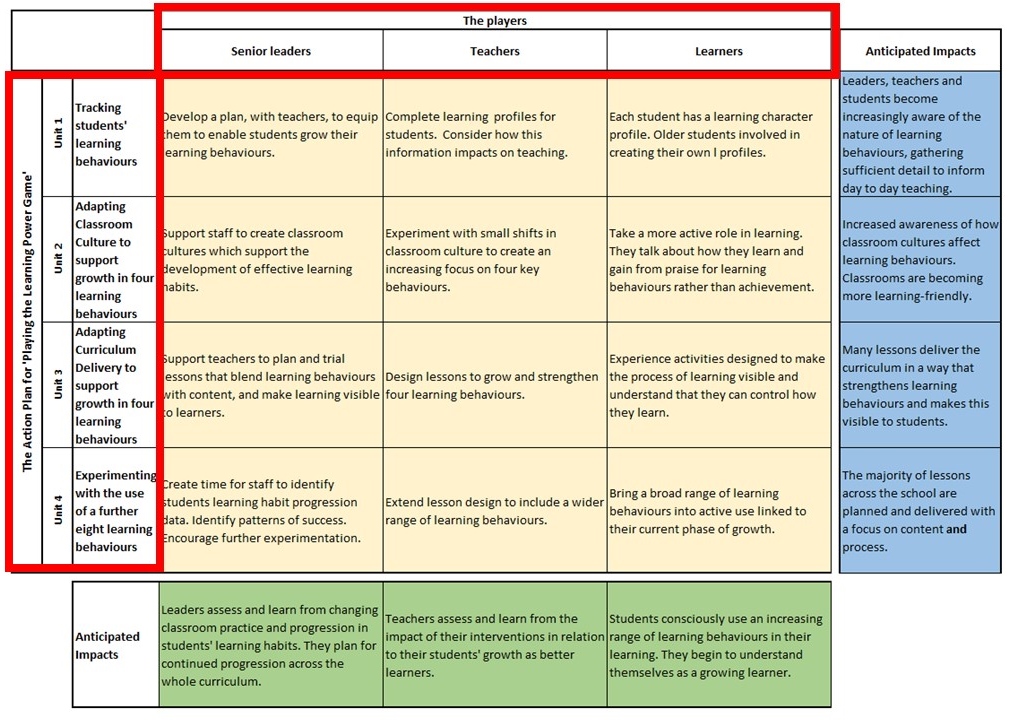
This chart shows the big ambition of the programme. It distils what it’s all about.
- the cells in yellow capture what leaders, teachers and learners will need to do in relation to each row:
- tracking the growth of learning behaviours;
- adapting classroom cultures to strengthen 4 key learning behaviours;
- adapting how the curriculum is delivered in order to build 4 key learning behaviours;
- experimenting with and expanding the number of learning behaviours consciously being used by students;
- the blue boxes capture the outcomes such changes could make to classrooms; cultures and curriculum delivery.
- the green boxes capture the anticipated outcomes for people; leaders, teachers and learners.

Read more about the Big Ambition at your leisure ⬇️
The vertical and horizontal axes of the grid
The vertical axis to the left shows the 4 main aims or thrusts of the programme. These four components involve:
- Unit 1. The formative work of finding out about their students’ learning behaviours and how they have the potential to improve/grow;
- Unit 2. The practical work of shifting classroom culture to better accommodate learning behaviours, using 4 foundational learning behaviours to get teachers started;
- Unit 3. The practical work of purposefully blending the use of learning behaviours into lesson design, again focusing on just four foundational behaviours;
- Unit 4. The work of gradually bringing more of the original researched learning behaviours into play in order to build students’ use of them over time. This is in preparation for the Phase 2 programme.
The horizontal axis across the top shows the 3 main groups of players in the game and what they will need to do to make it all work.
The central 12 cells
These cells serve 2 purposes. Firstly:
- The text in each cell gives an indication of who needs to do what, in very broad terms, at each stage of this journey;
- When looked at vertically down the page, they map out the 4 stages of this first part of the learning power journey;
- When looked at horizontally across the page, they show the players in the game and how what they do needs to interact.

The cells to the bottom and to the right
The green cells across the bottom give an outline of how the school’s players will have developed by the time teachers have finished this first stage programme. The blue cells to the far right give an indication of the anticipated outcomes for each part of the journey from; discovering students learning behaviours, to shifts in classroom cultures, to early shifts in lesson design accommodating learning behaviours, and to the beginning of consciously using a much broader range of learning behaviours across the curriculum.

2. How the programme is organised.
Assisting the learning. At the beginning of every section of every Unit there are notes on; the intentions of the section; the best way of tackling the section; the impact the content should have on the staff member. This information enables staff to manage their way through the material, understanding its intent, the how-to’s of making it work and what they should expect as a result.
Units and sections…
Each unit deals with a key aspect of understanding and growing learning power:
- Unit 1. Discovering learning and culture. This unit has sections covering:
- The warp and the weft, foundational ideas of learning power; the basic ‘must knows’
- Finding Learning Power, the ‘must dos’ of collecting evidence about students’ learning behaviours
- Unit 2. Classroom cultures. This unit has sections covering:
- Aspects of a learning friendly classroom culture
- An easy to access catalogue of practical ideas designed to help teachers shift their classroom culture to support the growth of the foundational four learning behaviours.
- Unit 3. Constructing learning. This unit has four sections covering:
- The big picture of curriculum planning
- Designing units and lessons
- Activity design to stimulate learning habits
- A catalogue of learning activities are displayed in a second, easy to access, grid framework of ideas. The point is to blend some of these ideas into the curriculum and their lessons.
- Unit 4. Broadening the range. Here teachers are encouraged to spread their wings and begin to add some of another eight learning behaviours to the mix. This unit has eight sections covering:
- Noticing, Making links, Imagining, Reasoning, Capitalising, Listening, Planning, Meta-learning.
This development helps to prepare teachers to move on to a deeper Phase 2 of the programme.
Strengthening classroom cultures to build students’ use of learning behaviours
FIND OUT MORE about the content of each section of the course ⬇️
The content of each unit and section of the course
Unit 1, Section 1A. The warp and weft of learning
Here teachers will find:
- a whistle stop tour of the two frameworks that shape the development of students’ dispositional learning powers;
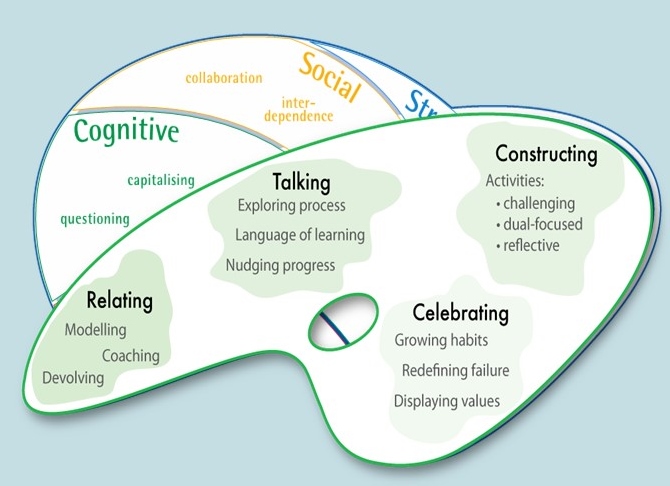
- an overview of the classroom culture framework (the teachers’ palette) that shapes building learning behaviours;
- an overview of the supple learning mind framework that identifies the learning behaviours and how they fit together.
Timing. We suggest teachers spend an hour or so in the first week exploring these big shaping ideas of Learning Power.
Unit 1, Sections 1B/C/D/E. Finding Learning Power
Here teachers will find:
- an exploration of why learning behaviours are so important for 21st century learners;
- information about progression in learning behaviours, what ‘getting better’ at learning looks like;
- the opportunity to reflect on their own learning behaviours and those of 2 students teachers know well;
- guidance to support teachers in producing and analysing their students’ learning profiles.
Timing. We would suggest teachers spend a couple of months collecting and understanding this data. Their view of their students’ learning behaviours will henceforth influence and shape their practice. If their programme started at the beginning of an educational year teachers should aim to complete this unit by the end of the first half term. (e.g. Sept to end Oct)

Unit 2. Classroom cultures.
A catalogue of practical ideas to create a learning friendly classroom culture
Here teachers will find 3 short sections, explorations of:
- Section 2A – Relating for Learning, how they might enable students to take greater responsibility for their own learning;
- Section 2B – Talking for Learning, how they might enable students to understand and talk about the process of learning;
- Section 2C – Celebrating Learning, how they might organise classrooms to celebrate learning over performance.
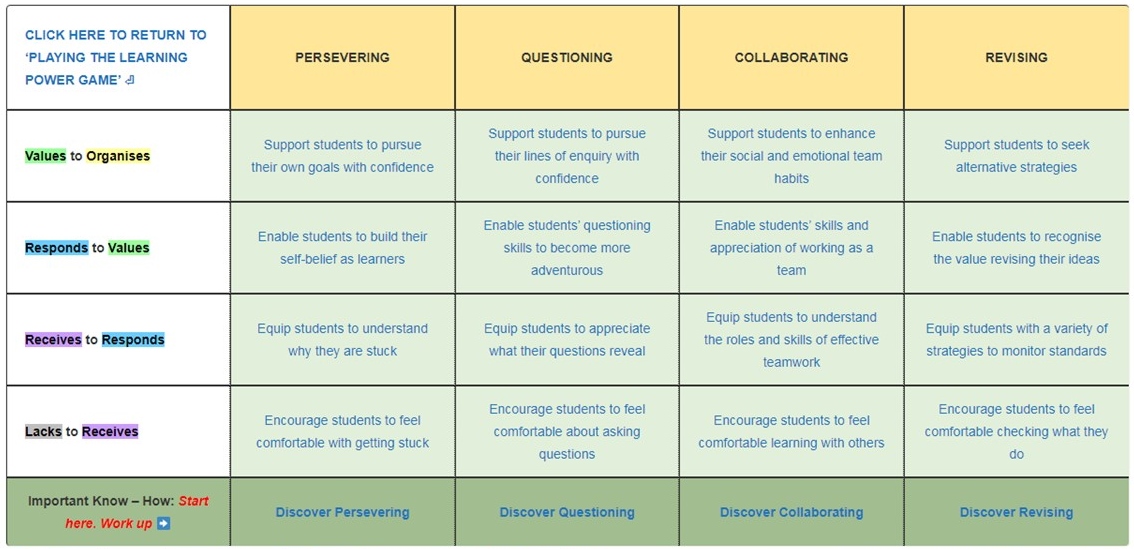
Plus – Section 2D has a practical four by four framework organised around:
- four foundational, really important, learning behaviours at
- four levels of growth, with
- practical packages of ideas, across
- three aspects of classroom cultures.
This four-by-four framework is presented in a simple grid format, illustrated here.
We’ve done the sorting for you. All teachers have to do is select what they need!
Timing. We suggest teachers spend 2 or 3 months exploring this catalogue. So for example if teachers started the programme in September teachers should be ready to move on from Unit 2 by mid-February.
Unit 3. Constructing learning
Here teachers will find:
- Section 3A – The big picture of curriculum planning…planning that integrates progression in content with progression in learning behaviours;
- Section 3B – Designing units and lessons…the fundamentals of lesson design;
- Section 3C – Activity design to stimulate learning habits…suggesting a hierarchy of activity types, going from ‘Listening’, through to ‘Discovery’.
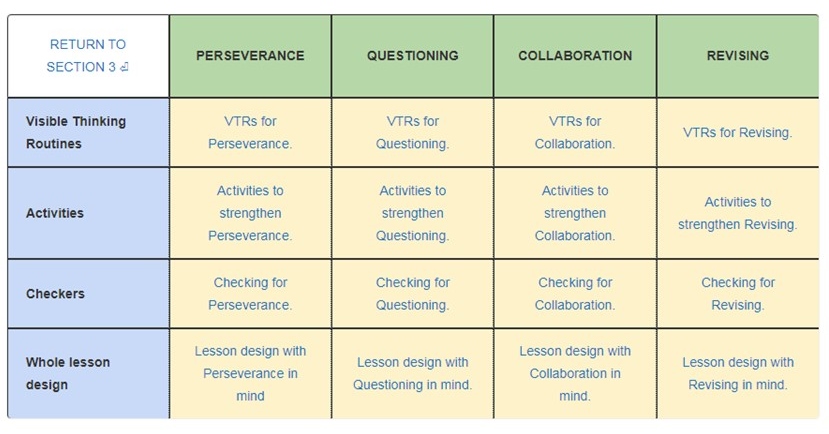
Section 3D has a practical four by four framework organised around:
- the four foundational learning habits;
- four categories of learning activities;
- and with over 100 ideas to try.
This four-by-four framework is presented in a simple grid, illustrated here.
Timing. We suggest teachers spend at least 2 or 3 months exploring this catalogue of lesson ideas. So, if teachers started this programme at the start of the educational year in Sept. and teachers kept to our suggested timing for earlier units, teachers should be ready to move on from Unit 3 by mid May.
Unit 4. Broadening the range
This unit offers teachers an opportunity to spread their wings and begin to work across another 8 of the learning behaviours.
It has 8 small sections, each based on one learning behaviour – Noticing; Making links; Reasoning; Imagining; Capitalising; Listening; Planning, Meta Learning.
Here teachers will find:
A staged way of introducing the behaviours by;
- Firstly… making students aware of the use and importance of a habit…when, where, why, how they could be using it
- Then... exploring the learning habit a little more through its language
- Try... using the behaviour as a lesson starter to tune students into using it
- Then start... blending the behaviour into the way teachers teach content. Use specific strategies to deepen content understanding.
- Ensure… students reflect on the success or otherwise of their new frame of mind as a result of consciously using the behaviour.
The content of this section encourages teachers to play with introducing more learning behaviours.
Timing. We would suggest teachers spend a couple of months exploring this section. If the school started this programme at the start of a school year and teachers have kept with the times suggested for previous units, teachers could be using these ideas in the last couple of months of the summer term, readying themselves to begin the deeper learning power journey in Phase 2 of the Programme.

3. A blended learning framework to bring ideas alive in practice.
While the online programme provides teachers with the research and classroom ideas that work the ideas alone can’t bring about change in classrooms. There’s a long road between teachers ‘knowing’, teachers ‘doing’ and teachers ‘doing things differently’ which this programme is designed to support.
Changing teachers’ working practices is known to be hard and delicate work and they need support to ensure these ideas take root in classrooms. While we can’t insist schools use any particular staff development practice our suggestions are heavily influenced by the the work of Dylan Wiliam and EEF’s Effective Professional Development guidance report.
The programme is a careful blend of learning:
- online learning units that… are available at any time, faithfully present researched content, are broken into manageable chunks and encourage the use of prior knowledge;
- professional learning team sessions that……are strategically placed throughout the programme, provide a carefully structured agenda to ensure effective meetings, offer social support, give prompts for setting and agreeing learning goals, is a forum for affirming and reinforcing progress;
- trying things out in classrooms where…teachers follow their plans and monitor their actions because “learning by doing” is integral to the development of expertise and expertise needs ample opportunities for practice, reflection, and adjustment.
This trio of learning opportunities work together to help teachers replace long-standing habituated practices with more effective ones. Such learning opportunities can also be reinforced by other staff development formats such as coaching partnerships to provide more practical social and technical support.
Across the four units there are seven agendas for Professional Learning Team meetings and these will need to be scheduled by the school.
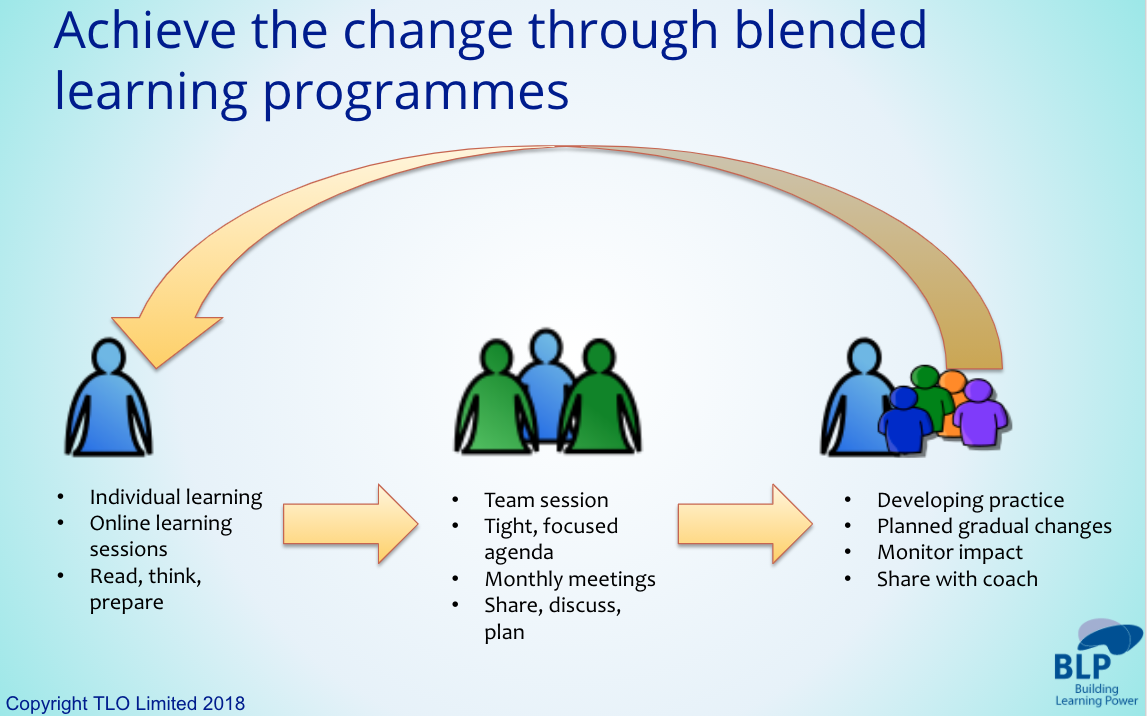

A combination of online content learning, learning with and from colleagues, and learning from small scale enquiries in classrooms.
4. Leadership questions you’ll want to muse on
The prospect and potential of taking on such a programme will inevitably raise all manner of critically important questions…
- how will the school benefit from this resource?
- what impact will it have on students?
- what sort of time and effort will staff need to make?
- what changes to the school’s operations will need to be accommodated?
These and many other strategic, leadership or management questions deserve serious consideration before school leaders can make a reasoned decision about whether / how to implement Playing the Learning Power Game.
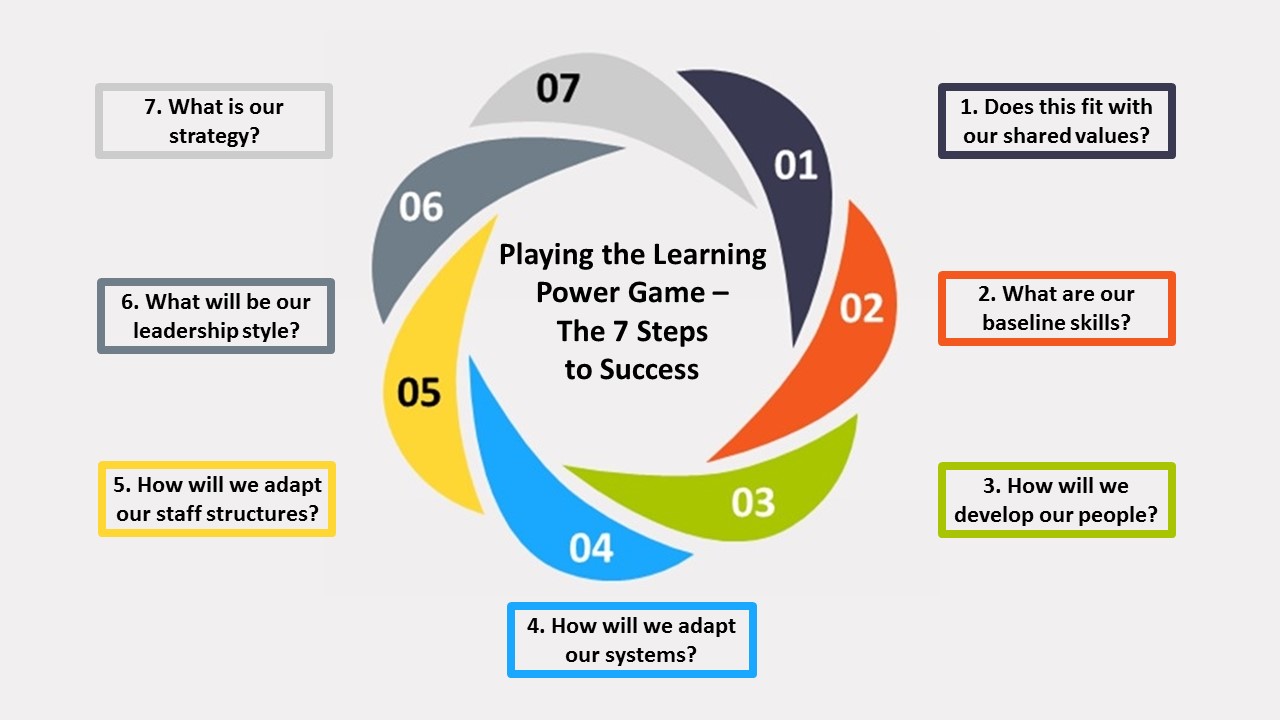
This critically important section called ‘Leadership Questions’ outlines both the questions and suggested answers relating to 7 aspects of leadership considerations, namely: Shared Values; Skills; Staff; Systems; Structure; Style; and Strategy.
Take your time to reflect on all 7 aspects – it is only when you address all 7 that you will have laid the foundations of success.
5. Resources for bringing staff onboard
Here we offer resources you may need to introduce ‘Playing the Learning Power Game’ to staff. This isn’t a simple show and tell session. It’s designed to provoke deep thinking about learning and about classroom culture.
Each slide contains a suggested commentary in the notes underneath. It will take around an hour to talk through the Powerpoint, depending on how much detail you add to the suggested commentary.
Introducing ‘Playing the Learning Power Game’ content to your teachers
The slide deck could be used to introduce teachers to the key ideas behind the Playing the Learning Power Game. It helps teachers to understand the content and purpose of the programme and explains how the blended learning programme will work.
You might use this slide deck:
- just as it is to introduce the ideas to staff;
- to help structure a learning conversation amongst/in teams;
- adapted to meet the needs of a particular audience;
- added to strategic presentation of your own to ensure staff gain a holistic picture.
Brief explanatory notes can be found under each slide.
The slides in the presentation cover the following key issues:
- the 2 models of Learning Power
- the nature of the blended learning programme
- the big ambition of the programme
In doing so you will be encouraging staff to use their own learning behaviours such as noticing similarities and differences between what they know now and this way of looking at learning and at classroom culture. Questioning some of their own practice, and distilling the key messages and their appropriateness to the school.
Comments are closed.