

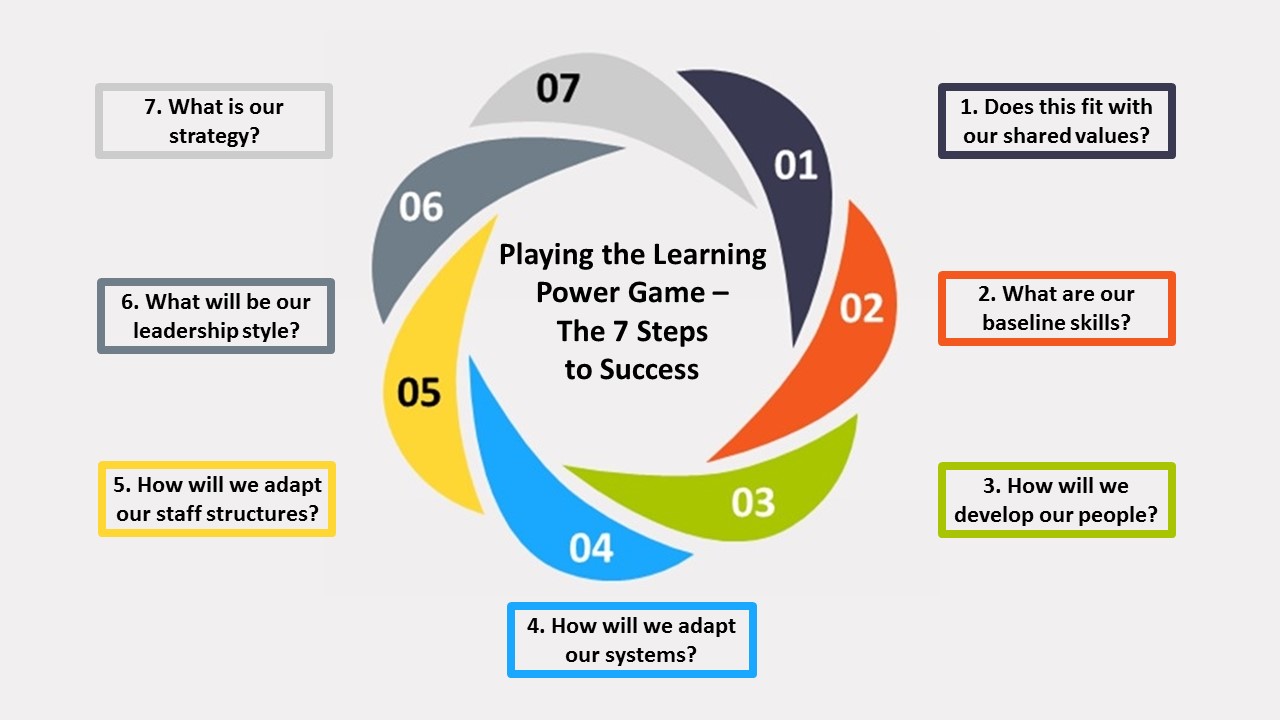
Essential leadership considerations – laying the foundations of success.
This is a critically important section. It outlines all of the leadership considerations necessary for the successful implementation of ‘Playing the Learning Power Game’.
Take your time to reflect on all 7 aspects – it is only when you address all 7 that you will have laid the foundations of success.
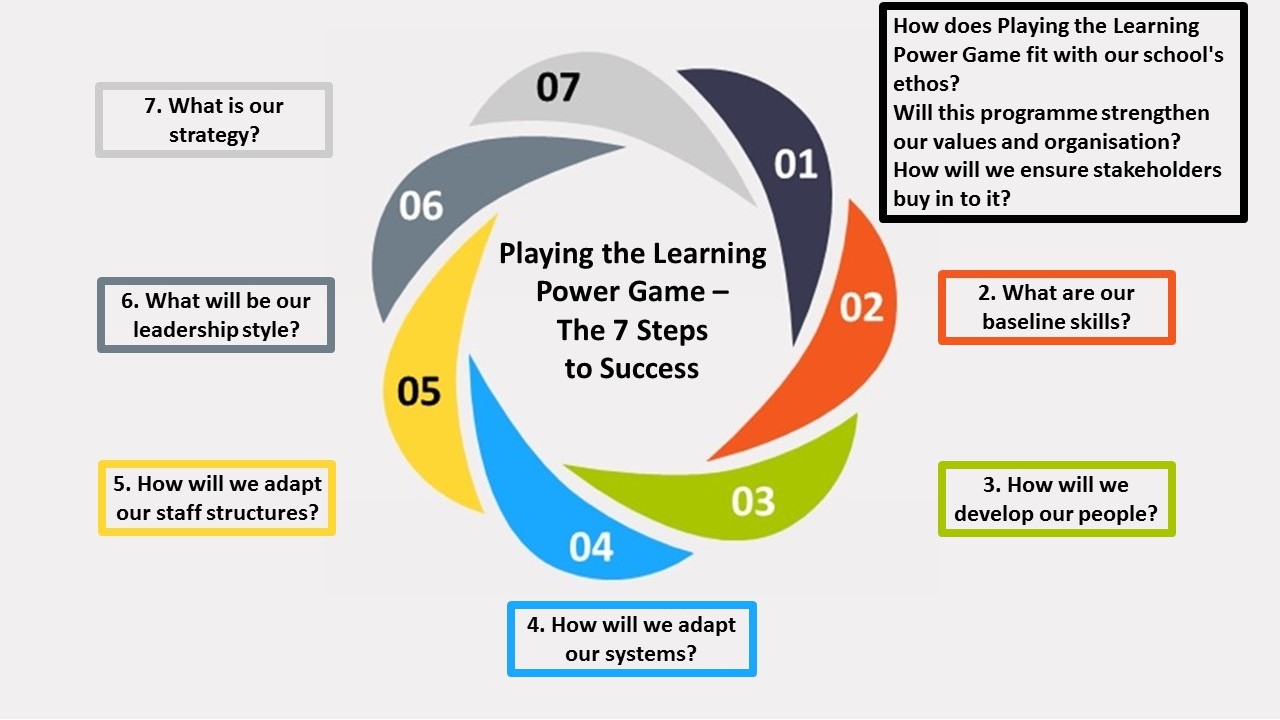
1. How does this programme chime/fit with our school values?
Having read through the outline of the programme content and approach the first questions you will want to muse on are;
- How does Playing the Learning Power Game fit with our school’s ethos?
- Will this programme strengthen our values and organisation?
- How will we ensure stakeholders buy in to it?
Shared values govern a school’s health and when implementing change the expectation is often that teachers will change/adapt their teaching behaviours. As research has told us, this is only possible where there’s a change culture and real, lived school values. So whatever you decide as a result of considering all the questions below, they should all be seen to fit with your school’s values. Shared values is not so much a place to start but the one that will have a guiding influence over all your other questions.
The principles and values of the programme ⬇️
Question – How does Playing the Learning Power Game fit with our school’s ethos?
Issues to consider:
It might first be reassuring to consider the ‘Playing the Learning Power Game’ programme itself to make sure it fits with the school’s values. School values can be gleaned from a school’s vision and/or mission statements, from your goals or anticipated outcomes or even current targets.
One reason for taking on ‘Playing the Learning Power Game‘ is to help prepare students for a lifetime of learning, to:
- grow learner independence;
- help learners to understand the process of learning, how they learn, and how they can get better at learning;
- empower learners to lead a productive lifetime of learning.
Solutions:
The key here is to ask:
- Do these points chime with our school values?
- Does this fit well with our vision of the purposes of education?
- If our vision / mission statement does match, is our vision lived in the day to day life of the school, or is it more aspirational and indicative of a direction of travel?
- If our vision is at odds with Playing the Learning Power Game, do we need to open up a conversation about the core purposes of education?
Question – Will this programme strengthen our values and organisation?
Issues to consider:
Many teachers would like their students to be more independent, less needy, better motivated, more engaged, curious, perseverant . . . .
Fewer teachers are ready to face up to the reality that to change their learners’ learning behaviours, teachers must first change their teaching behaviours!
Ask yourself – Are our teachers ready for these changes?
- Who will buy in?
- Who might resist?
- Who will find it easiest to tweak their teaching behaviours?
- Who will find it harder?
Solutions:
Remain aware that changing practice is hard and takes both time and deliberate practice.
It’s not just about knowing new stuff, it is about doing what you do differently. That’s much harder. It involves changes to:
- what you know – knowledge;
- what you believe – feelings or attitudes;
- what you can do – your skills;
- what you actually do – putting it all into practice.
So changing how you teach is a delicate, complex process……...that’s why it’s hard!
And the hardest thing isn’t getting new ideas into teachers’ heads . . .
It’s getting the old ones out…….that’s why it takes time and effort.
It takes time and practice to undo old habits and become graceful at new ones.
All the evidence shows that teachers change their practice when they work together and support each other in trying out new teaching strategies, within a culture of classroom based action research. It is about teachers being empowered to explore together to find out what works with their students, in this context, at this time. As a consequence, the school learns its way forward, together.
All of these principles are embedded into the very design of Playing the Learning Power Game programme.
Question – How will we ensure stakeholders buy in to it?
Issues to consider:
Who are the stakeholders that might need to be informed about Playing the Learning Power Game?
Your list might include:
- Members of SLT;
- Learning Champions;
- Teachers;
- TA’s;
- Governors;
- Parents.
Solutions:
We would not presume to tell you how to do this, as you know your audience and will want to tailor what you say to them.
The powerpoint contained in the section ‘Leading Playing the Learning Power Game’ is designed to introduce the programme to staff, but it can easily be shortened for a different audience.
A copy of that powerpoint is below:
Download the ppt Presenter notes
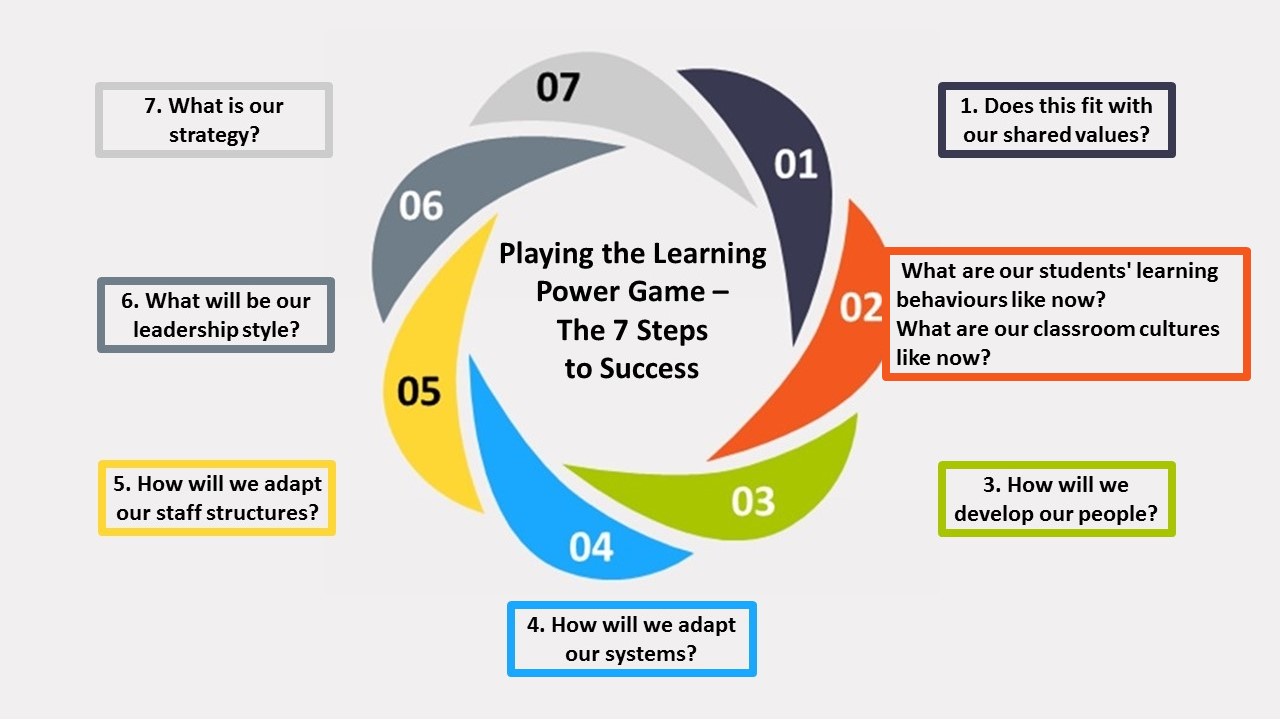
2. What sort of skills/competencies would the programme enhance?
Having thought about how the programme fits with school values your next questions may well revolve around your staff and your learners’ competencies, wondering how you can assess what your teachers’ classroom cultures and your students’ learning behaviours are really like now?
You may want to muse on;
- What are our students’ learning behaviours like now?
- What are our classroom cultures like now?
Finding baselines for students and cultures ⬇️
Question – What are our students’ learning behaviours like now?
The key here is the word ‘learning’ being associated with behaviours. All schools have broad views of their students’ behaviours; timid, outgoing, shy, troublesome, keen, engaged and so forth. But many schools would find it hard to go much deeper other than perhaps to refer to a child’s test or exam results. Researchers at Bristol University uncovered key psychological characteristics that were and are judged to be of the highest value in helping students to learn and thrive in a complex world. It is these learning behaviours that can be developed by everyone regardless of ‘ability’, social background, or age, that are of interest here.
Issues to consider:
Take a look at the first model of ‘Playing the Learning Power Game’ – the Supple Learning Mind:
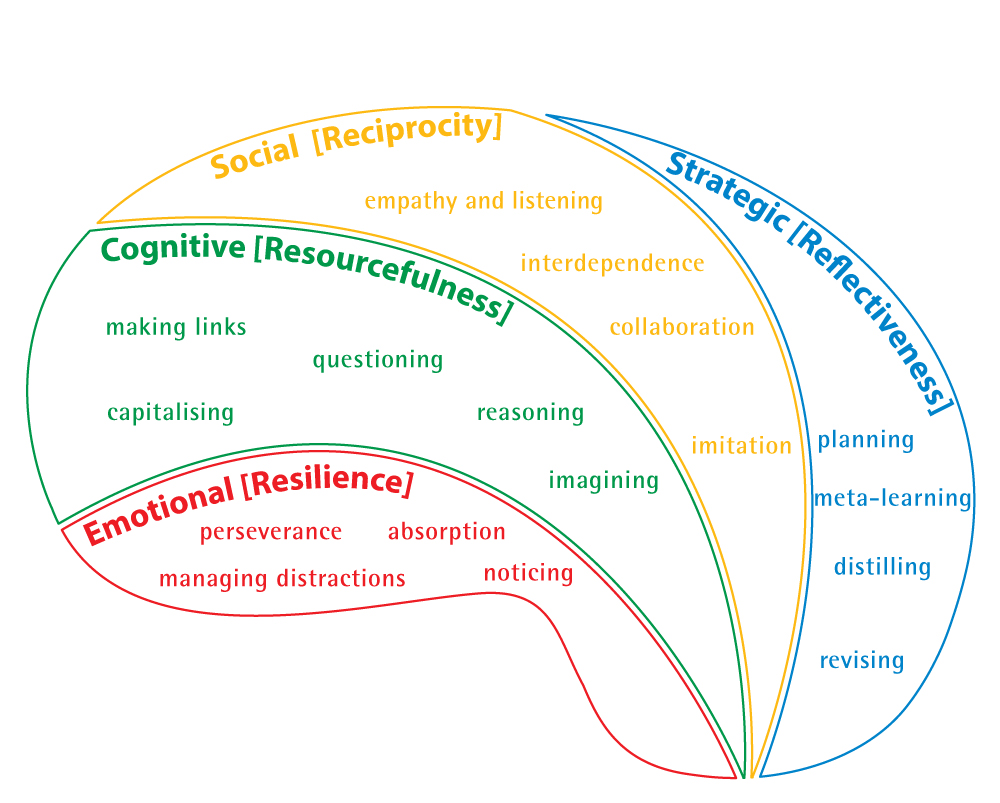
Ask… what do we know about our students’ learning behaviours at present?
Do we have any systems in place in relation to tracking student learning behaviours?
[Once teachers have completed Unit 1 and built their students’ Learning Profiles, you will have a rich resource to interrogate and so begin to answer these questions.]Solutions:
To get you going – Have a discussion about the students in your school.
No need for any research – just go on your instincts at this stage. Unit 1 will provide richer data that you can analyse later.
Download the short questionnaire. Ask yourselves:
- Leaving aside obvious ‘outliers’, where do we think the majority of our learners are on this Skilled / Unskilled scale? Broadly skilled or unskilled?
- As learners progress through our school, do they seem to become more skilled or is there no difference with age?
- Are there any gender differences?
- Are our higher attainers more skilled than our lower attainers? What might this be telling us?
- Do we have any evidence to support our views, or is this really a gut instinct?
- What might all of this mean for us?
And finally – What strategies do we currently have in place to:
- gather information about our students’ learning behaviours?
- intervene to help students to grow their learning behaviours?
Question – What are our classroom cultures like now?
Issues to consider:
Now look at the second model of ‘Playing the Learning Power Game’ – the Teachers’ Palette:

Ask yourself …What do we know about our classroom cultures at present?
Do we have any monitoring systems in place that explore classroom cultures?
How will we know if our classroom cultures are changing as teachers engage with ‘Playing the Learning Power Game‘?
Solutions:
To get you going – Have a discussion about the prevailing classroom culture in your school.
No need for any research – just go on your instincts at this stage. You will gather richer data as ‘Playing the Learning Power Game’ becomes embedded in everyday practice.
Download the short questionnaire. Ask yourselves:
- On each of the 12 indicators, are our classrooms closer to being Teacher Focused or closer to Learning Friendly?
- Are there any exceptions to this? Are some classrooms more learning friendly than others? Why might this be? Are some classrooms less learning friendly than others? Why might this be?
- Is there any variation across year groups?
- Do we already have examples of learning friendly classrooms that others may learn from?
- What might all of this mean for us?
And finally – What strategies do we currently have in place to:
- gather information about classroom culture?
- identify and share best practice?
3. How could we accommodate the staff development approaches suggested?
Having mused on the skills and competencies that the programme will enhance you might then wonder how you go about enhancing staff skills and whether the school could support the staff development approaches that are embedded in the programme. You may want to consider;
- What’s the best way to organise the development of staff across the school?
- How will we achieve high levels of engagement with the programme?
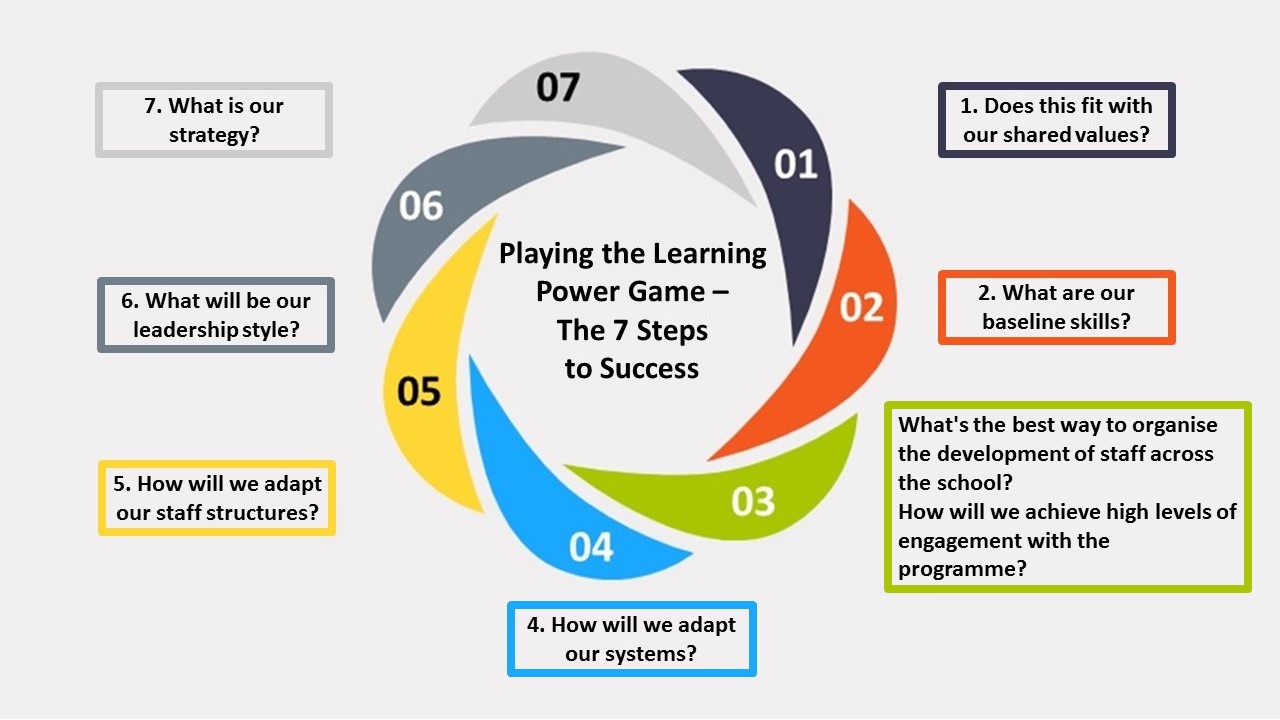
Ways and means of developing staff ⬇️
Question – What’s the best way to organise the development of staff across the school?
Issues to consider:
- The way that the school decides to organise staff to engage with the programme and learn together impacts on how the programme will be led, who will lead it, and how it will be resourced in terms of directed time. As such, this is a decision that will inform many aspects of the strategy.
- Central to the programme is that staff will blend 3 ways of engaging with the learning programme: by exploring the online materials individually ( available at any time of day); by learning collaboratively with and from colleagues to identify ways forward; and by initiating small scale enquiries in their own classrooms. This idea is explored in the previous section of this module, and is developed further in ‘Playing the Learning Power Game‘ (see copy below).
- The school will have to decide how it will structure the teams of staff who will learn together. In our preferred order, the choices are:
- adopting the full Professional Learning Team approach;
- using a number of ‘learning champions’ to lead the thinking of small teams of staff – maybe one champion steering the learning of, say, 3 colleagues;
- small groups of 2 or 3 staff working as a coaching partnership of equals, learning their way forward together;
- giving staff access to the online materials and just hoping that somehow learning conversations will arise as a result.
Solutions:
Adopting the full Professional Learning Team approach:-
- Is our preferred option. The benefits are well researched and we recommend that you work in this way, unless there are powerful, local reasons for doing otherwise. Think very carefully about the composition of the teams you create – is it best to create teams with a blend of experience, openness to change, subject / age group specialism, or might a simpler structure like ‘all KS2 staff together’ be preferable? The choice is yours, and you will make it based on your knowledge of your staff.
Using a number of ‘learning champions’ to lead the thinking of small teams of staff – maybe one champion steering the learning of, say, 3 colleagues:-
- Is an attractive alternative to the PLT approach above. It is effectively PLTs, but half the size. The downside is it limits the number of colleagues individuals will be learning with and from. Coordination and lines of communication will need attention. The size of the school may be important – a small primary school may be able to make such an approach work, but even a three form entry primary would need more than 10 champions if TA’s are included in the programme.
Small groups of 2 or 3 staff working as a coaching partnership of equals, learning their way forward together:-
- Is a democratic strategy that may work well but the composition of the coaching partnerships is critical. One less than enthusiastic voice may have a disproportionate impact on other members and you will need to construct the partnerships carefully. Beware simple solutions like ‘we are a 2 form entry school, so let’s pair up the two year 1 class teachers etc’ – you risk building in insularity.
Giving staff access to the online materials and just hoping that somehow learning conversations will arise as a result:-
- Is more wishful thinking than a strategy! You almost guarantee that the programme will have limited if any impact across the school. Some individual teachers may engage, but that’s about the most you can hope for. Don’t go there!
Question – How will we achieve high levels of engagement with the programme?
Issues to consider:
- Playing the Learning Power Game is a programme designed to help teachers to intentionally build their students’ learning power. This necessarily involves teachers changing their teaching behaviours to enable students to change their learning behaviours.
- But – changing working practices is hard and delicate work. Research shows it works best when you can meet in a safe professional environment in which to explore and plan how you could change, and then share and probe the triumphs, tribulations and outcomes of the classroom experiments. [Hence why we advocate PLTs as the most powerful approach.]
- In terms of engaging with the programme, think about your colleagues and how they may need to be handled differently. You may need to be prepared to:
- direct the activities of the most inexperienced and rule bound practitioners;
- coach those with limited experience but with openness to change;
- allow those with experience and openness to change to forge their own pathway to developing their practice;
- and perhaps most tricky, find ways to re-ignite the interests of those with experience coupled with a reluctance to change their practice.
- Openness to change is the key to engagement – without such openness, engagement is likely to be weaker. Ask yourself – how will we sell the need for change to our staff? What is the itch of dissatisfaction felt by everyone that can be harnessed to drive the need for ‘doing things differently’? (This may be ‘pupils are not the same post Covid’ or ‘catch-up is not working as expected’ or ‘our kids are too needy / passive’ or whatever it is that is making it impossible to apply old solutions to new problems).
Solutions:
This is a whole-school initiative. Engagement levels will be impacted by how the programme is launched to staff, how it fits with the school’s ethos and values, how effectively it is led and managed, and how it meets their personal and professional priorities. Careful attention to all of the other ‘Questions’ explored in this section will lay the foundations for engagement.
But ultimately it is the ‘Team’ nature of the preferred Professional Learning Team approach that cements engagement – the responsibility to ‘not let the team down’ proves to be more powerful than any attempts at forcing engagement.
What will you do if it becomes apparent that a member of staff is still failing to engage with the programme, is not pulling their weight in team meetings, etc? A one to one conversation will be a starting point – there may be personal reasons that are making participation difficult that you are not aware of.
But some things are non-negotiable – this is a whole-school initiative, it is an expectation that all staff engage purposefully, and given that you will have removed all obstacles like workload issues, you do whatever you would normally do to address a failure to adequately fulfil a professional responsibility. Experienced leaders make extensive use of carrots, but also have sticks when needed!
An essential read about how Professional Learning Teams work. ⬇️
Working together to ensure success
This ‘Playing the Learning Power Game’ online programme provides you with the research and ideas to work with but it can’t in itself bring about change in classrooms. To make these ideas work best in classrooms across the school you’ll need to discuss and tease out what you have read, think things through with your colleagues and then try some of the ideas out for real with students.
Useful types of CPD include:
- Teacher learning communities, or as we refer to them, Professional Learning Teams (see below)
- Coaching partnerships
- Small-scale learning enquiries
- Classroom observations and personal review
- Learning walks.
We can’t insist on particular ways of enabling these ideas to become a reality in your classrooms, but, learning with your colleagues will give you and your students a far greater chance of success.

Learning Team Meetings
Changing working practices is hard and delicate work. Research shows it works best when you can meet in a safe professional environment in which to explore and plan how you could change, and then share and probe the triumphs, tribulations and outcomes of the classroom experiments. Research into teacher learning communities by Dylan Wiliam, of Assessment for Learning (AfL) fame, describes such teams as:
- a small group of teachers who meet together regularly
- to deepen their understanding of an approach,
- to commit to trying out new things,
- to reflect on and share their experiments with each other.
If the school decides to adopt this professional learning approach we have provided 7 customised team meeting agendas at key points in the programme.

A quick look at learning together.
Professional Learning Teams
Discussions with colleagues are often known as Professional Learning Teams. What they aim to plan and support are thought of as Classroom Based Enquiries.
PLTs are groups of 8-10 teachers (and TA’s?) who meet together regularly to deepen their understanding of an approach. They try out ideas offered in the programme and reflect on and share their experiments with each other. Such communities work best when they are voluntary, grouping similar subjects or age groups and meet monthly for about 75 minutes over a couple of years. Such communities support and scaffold teachers’ habit change. In short this approach:
- deepens staff understanding of learning;
- draws on the support of colleagues;
- unpacks the ‘how to’ together when it’s unclear;
- results in a plan to try out new things, considering what’s doable for their students;
- benefits from reflection on and sharing of data from their experiments with each other;
- draws on sharing trials and tribulations and what they will do differently.
The typical session agenda follows this pattern;
- Agreeing objectives and agenda (5mins)
- Sharing learning enquiries (20mins) from 2nd meeting on
- Re-capping the on-line materials (15mins)
- Deciding what’s to be done (15mins) at whole school and individual level
- Personal Action Planning (20mins)
- Evaluating the meeting process (5mins)
This agenda format also works when you prefer to use learning partnerships such as;
- pairs of teachers acting as a coaching partnership
- one member of staff (learning champion) leading and coaching other staff
In Units 1, 2, 3 and 4 you will find suggested detailed meeting agendas aimed to keep you on track.
4. How do we prevent it becoming a workload issue?
Of course the school has all sort of instructions for how staff need to go about completing certain tasks and processes to ensure all runs smoothly. However, when thinking about changing your school’s systems, it’s sometimes necessary to assess the different types of project management and workflows which are currently in place. You might want to ask yourself;
- How will we prevent Playing the Learning Power Game becoming a workload issue for teachers, support staff, the programme lead, and senior leaders?
- What will need to be changed to create the necessary directed time for ongoing engagement with the online learning aspects of the programme?
- What will need to be changed to create the necessary directed time for the 7 programme related meetings?
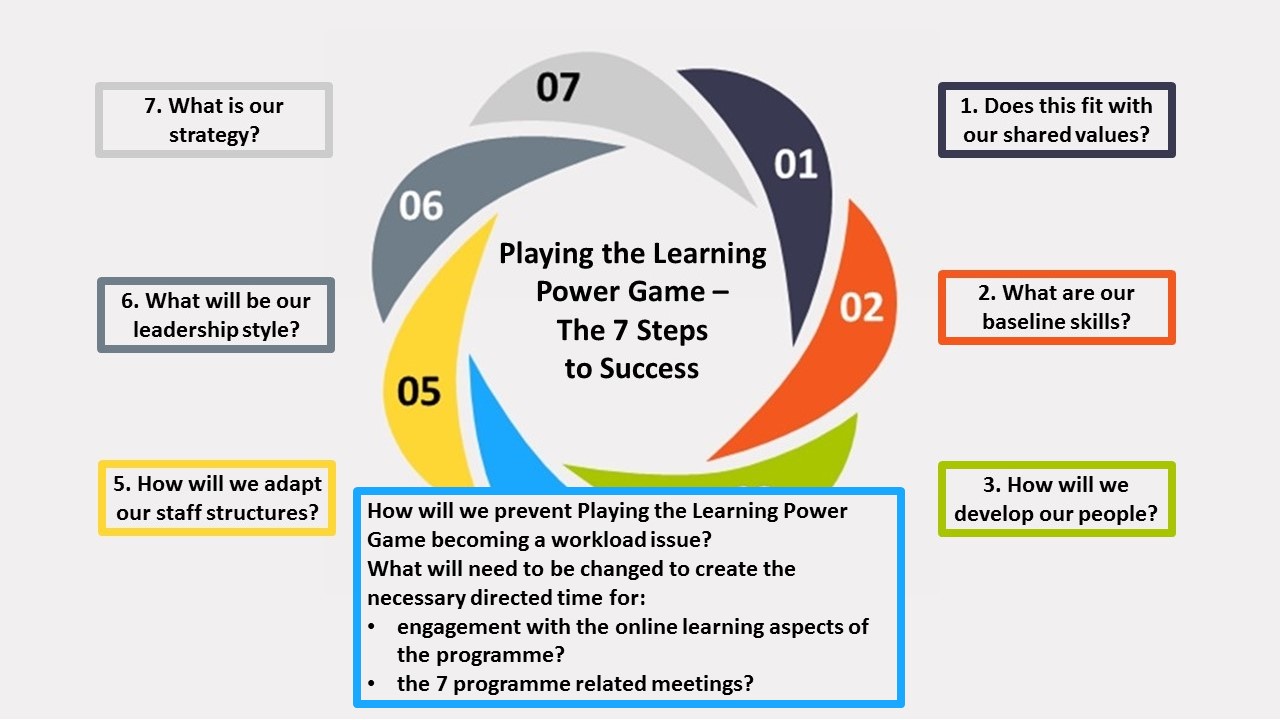
Accommodating the programme ⬇️
Question – How will we prevent Playing the Learning Power Game becoming a workload issue for teachers, support staff, the programme lead, and senior leaders?
Issues to consider:
- The Playing the Learning Power Game programme requires participants to engage with the online materials, to plan for and implement small scale learning enquiries in their classrooms, and to meet with colleagues to reflect on the impact and plan for further developments.
- This may well amount to in excess of 20 hours in a calendar year.
- Failure to address these time requirements will simply add to teacher workload, and moreover such a failure gives the message that the programme is not of sufficient importance to merit dedicated directed time.
- You cannot will the ends without willing the means.
Solutions:
- Take a hard look at your existing directed time budget – is there any flexibility?
- Ask yourself the hard question – what are we going to stop doing in order to make time for this programme ?
- Utilise all (or almost all) of the directed time you would ordinarily earmark for staff development to Playing the Learning Power Game.
Question – What will need to be changed to create the necessary directed time for ongoing engagement with the online learning aspects of the programme?
Issues to consider:
- Accessing and acting on the online materials is an essential component of the programme. The online materials frame the CPD and ensure that teachers are working together on the same materials at the same time. This may amount to 3 or 4 hours reading and exploration for each of the 4 units – something around 12/16 hours spread over an academic year.
- Access can be at any time the teacher wishes (assuming they are online). Is there any particular advantage in trying to ensure that all teachers access the materials simultaneously, or will you expect them to access the materials at a time they find suitable within a time frame determined by the programme leader?
Solutions:
- Think about how you intend using your INSET time for the year.
- Since engagement with the online materials is in-service training, why not use 3 of these INSET days flexibly – 3 closure days when teachers are not required to attend school, giving each teacher 18 hours of development time to access the online aspects of the programme across the year, at times that fit their personal circumstances.
- You would need to have a clear plan of which materials have to be accessed when to ensure that the staff can move forward together.
Question – What will need to be changed to create the necessary directed time for the 7 programme related meetings?
Issues to consider:
- In effect there will be six such meetings in the academic year (as the 7th one will almost certainly fall in the next academic year).
- The timing of these meetings is fairly tightly defined (assuming that the school is following our suggested timings).
- Schedule them into your annual meeting cycle and you are leaving minimal room for ‘slippage’. Leave timings to chance and you almost certainly build in time-slippage as these meetings act as ‘staging points’, deadlines for getting things done so that teachers are ready for the meeting.
- Will these 6 meetings be additional to the normal weekly meeting cycle throughout the 38 weeks of the year? If additional, where is the directed time coming from? Will teachers really want 2 meetings in the same week 6 times a year?
- If the meetings are going to be 6 of your normal 38 meeting cycle, you now have only 32 meetings available for ‘other business’ – which meetings will you do without to accommodate the 6 for the programme?
Solutions:
- These meetings have to be scheduled in advance to establish the ‘rhythm’ for the programme over the year.
- Schedule them as part of the weekly programme of meetings at the outset of the year and you are committing to following our recommended timings in terms of how long each unit will take. Fixed meetings drive the programme forward as planned and inject urgency.
- Schedule them ‘flexibly’, moving meetings by a couple of weeks here and there to accommodate unexpected pinch points etc, and you will almost certainly end up with a programme that lasts somewhat more than one year. This may or may not be a bad thing! You may take the view that following the programme at a more leisurely pace at times that work best for your school is the way to go.
- The choice is yours. But choose you must!
5. Who will lead it and what accountability may be needed?
Clear chains of command avoid chaos & confusion and the school will have a simple structure because it creates a sense of accountability within the school. You may like to consider;
- Who will lead this change strategy and what accountability may be needed in the system?
- How will the programme leader keep senior leaders informed of developments? How will senior leaders support the programme leader?
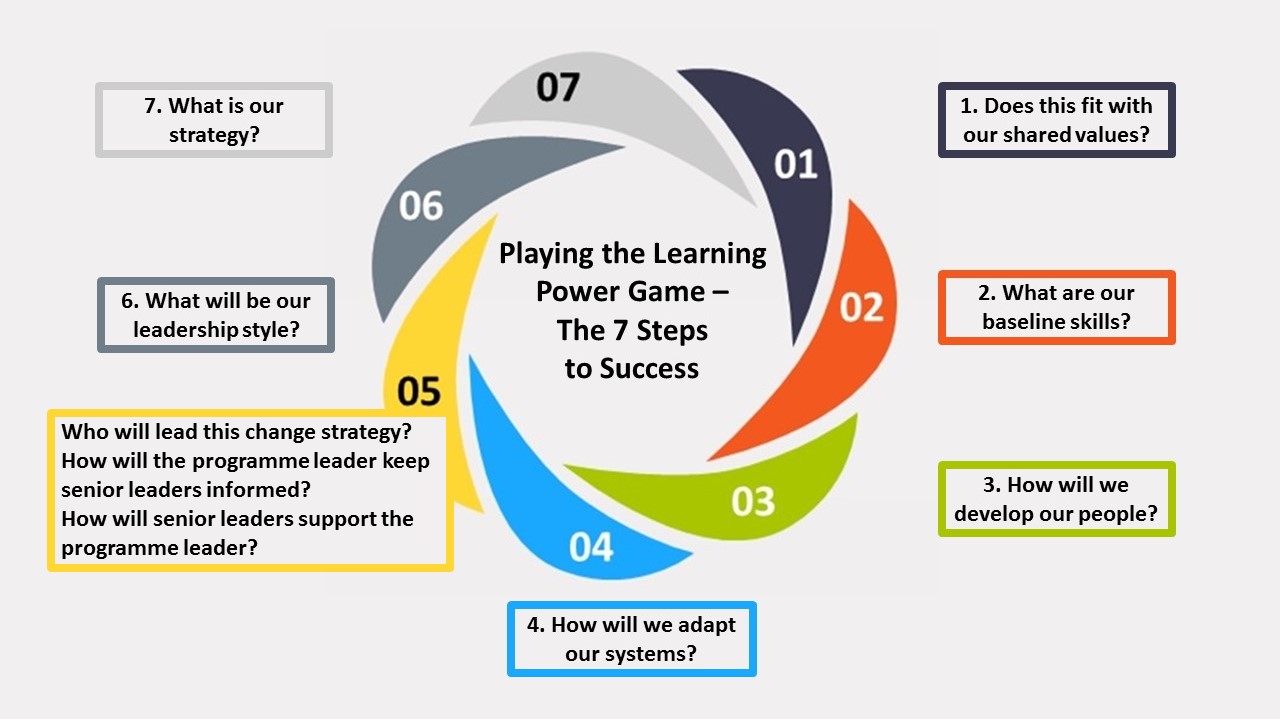
Leading and monitoring the programme ⬇️
Question – Who will lead this change strategy and what accountability may be needed in the system?
Issues to consider:
- The programme will need to be overseen by someone, or maybe by a small group of people. Whether it is an individual or a small team may well be determined by the staff development approach that you decided in 3 above.
- There may be someone on your staff who already holds a responsibility for teaching and learning, or perhaps staff development – will they lead the programme?
- You may consider a programme leader from outside of the school leadership team – is there someone you have in mind?
- If you are going down a learning champion route – how will you select your learning champions? Will you choose / nominate them? Will you invite expressions of interest from teachers?
- Whoever you choose to lead the programme, how will you ensure that they have sufficient time to familiarise themselves with Playing the Learning Power Game before it is launched to staff?
- Will there be a written job description for the programme leader?
- Remember – the issues raised in 4 above in relation to teacher workload apply equally to the programme leader. How will you ensure that the programme lead has sufficient time to discharge their responsibilities?
Solutions:
- Once the programme leader(s) have been identified, discuss with them their development needs and the time that they need to lead the programme successfully. Don’t expect to be able to answer this immediately – regard it as an ongoing issue that will need to be re-visited as the programme moves forward.
- Consider if any fixed term incentives need to be offered for the duration of the programme.
- Remember – it is a false economy to invest in the programme itself but neglect making adequate provision for its leadership.
Question – How will the programme leader keep senior leaders informed of developments? How will senior leaders support the programme leader?
Issues to consider:
- If the programme lead is already a member of the leadership team, then it is likely that existing communication routes will be sufficient.
- If the programme lead is not on the leadership team, an alternative solution will be required.
- If you have decided to use a small team to lead the programme (learning champions), again an alternative solution will be required.
Solutions:
- Ensure that Playing the Learning Power Game is a consistent item on senior leadership team meetings.
- Either invite the programme lead to join SLT for programme related agenda items, or preferably make a clear statement of the importance of the programme by making the lead an SLT member for the duration.
- Probably the most time-efficient way is to ensure that at least one member of the leadership team is one of the learning champions.
6. How are we going to support the programme?
Leadership and Management behaviour patterns
The school will have its own leadership / management styles and indeed it is this style that often decides the level of staff productivity and satisfaction in an organisation. Hence you will have been wondering;
- How will leaders create the conditions where teachers are encouraged to take risks, to try things out, to fail in safety?
- How will leaders demonstrate an ongoing interest in the enquiries that teachers are undertaking?
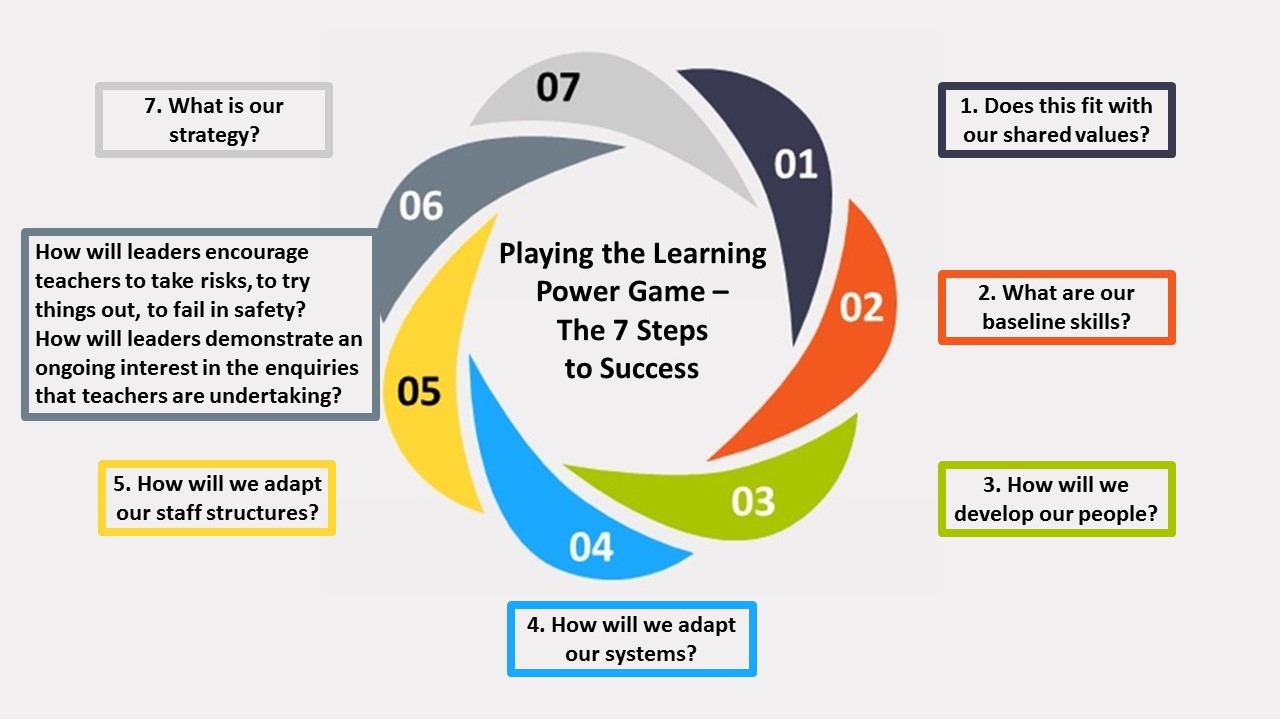
The style of the programme ⬇️
Question – How will leaders create the conditions where teachers are encouraged to take risks, to try things out, to fail in safety?
Issues to consider:
- Flawless execution of tried and tested teaching routines is at odds with a programme that intentionally seeks to help teachers to adjust their classroom practice to focus more explicitly on growing students’ learning behaviours.
- Teachers are being asked to take risks, to see what happens, to explore possibilities. Inevitably some things will work well, but others less so.
- This will not fit well in a system that is risk averse, that prides itself on not making mistakes.
- To what extent is your school (and your leadership team) risk averse?
Solutions:
There are 2 key leadership behaviours that support innovation:
- Dialogue – because what leaders talk about reveals their true priorities. If leaders are going to support innovation, risk taking and change, they need to make talking about it their priority. They need to model it in the way that they lead the school, and in the ways in which they embrace (or resist) change. Teachers will find it hard to innovate in a school led by risk-averse leaders. Take a hard look at how teachers view senior leaders – do teachers feel safe to make mistakes and learn from them, and if not, how can senior leaders change the narrative?
- Enabling exploration – because ‘permission to act’ needs to be devolved to teachers. In a top-down leadership structure within which senior leaders define ‘good practice’ and how things are to be done in classrooms, permission to innovate is denied teachers because they are required to follow agreed procedures / systems / methods. This may be appropriate if practice is poor and is in need of greater consistency, but it acts directly against the individual teacher innovation envisaged by this programme. How can leaders make it clear that teachers are responsible for seeking their own solutions, rather than slavishly following orthodoxy? How can they / do they model this in their own everyday leadership practices?
Question – How will leaders demonstrate an ongoing interest in the enquiries that teachers are undertaking?
Issues to consider:
- How frequently do leaders currently find time to get into classrooms, and for what purpose?
- How will leaders separate their ongoing responsibility to monitor practice and quality assure the provision with the need to maintain an ongoing interest in teacher enquiries?
- What would ‘interest in the enquiries’ look and feel like? Will there be any paper records? Why? For whom?
- Who will initiate these conversations – leaders undertaking a ‘learning walk’ at a time of their choosing, or teachers inviting senior leaders into their classroom to observe / support the enquiry they are undertaking?
- What will leaders do with the outcomes from their ‘interest in the enquiries’?
Solutions:
- Keep all existing observation systems, especially those that have a judgemental element to them (ie Performance Management, Capability) separate from these developmental observations.
- Move towards teachers inviting leaders into their classroom at a time of their choosing. This may have to begin with leaders asking to be invited in to observe something that is being trialled, but if the observation is formative, non-threatening and supportive, teacher initiated invites will surely follow.
- Leaders must allow plenty of time to discuss what has been observed with the teacher after the lesson. This is the opportunity for the teacher and the leader to exchange views and learn with and from each other. It is this discussion that shifts the observation towards the developmental.
- The overview that this affords leaders enables them to share emerging innovative practice, to pair up teachers working on similar lines of enquiry, to encourage teachers to showcase their experiments.
As this innovation goes along, the big lessons for leaders are to:
- keep close to the developments;
- keep it high profile in school, visit classrooms regularly;
- talk with teachers about how they are weaving the ideas into their lessons;
- focus on the kinds of learning processes teachers are routinely asking students to use;
- identify where the new practice is really taking hold or is faltering.
7. How do we expect it to work? How will we create a plan to pull all this together?
The purpose and organisation of the change
The Playing the Learning Power game programme is a strategy and will have a place in the school’s plan to implement change and so gain improved outcomes for students. A well-crafted strategy will draw together the answers from the other six questions dealt with above. You may find yourself musing on;
- What is our strategy for implementing ‘Playing the Learning Power Game’?
- Is the plan sufficiently detailed to show time frames, responsibilities of key players, monitoring checkpoints, contingencies, funding/time implications?
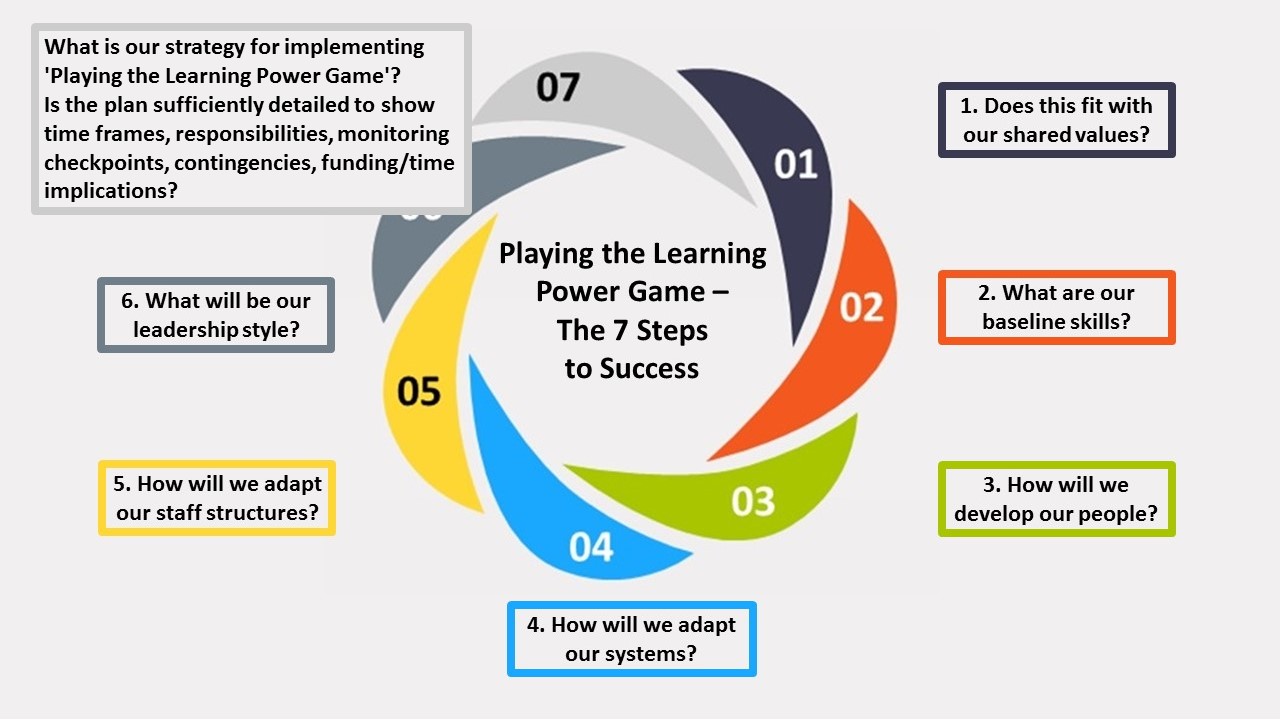
Putting a plan together ⬇️
Question – What is our strategy for implementing ‘Playing the Learning Power Game’?
Issues to consider:
Any strategy needs to take into account all of the preceding 6 sections:
- How Playing the Learning Power Game fits with our school ethos;
- Where we are now and the direction of travel;
- How we will organise staff learning;
- How we will adjust school systems to make this achievable;
- The leadership of the programme;
- How sensitive leadership will support the programme.
Neglecting any of the 6 at this stage will limit the potential impact of Playing the Learning Power Game.
Consider how your plan will inform your Self Evaluation form – you should already be able to describe what you are Intending to achieve and how you plan to Implement it. The Impact of these plans will be evidenced by ongoing monitoring as the programme develops over the next year or so.
Solutions:
- Decide how your plan will link to the school improvement plan – will the Playing the Learning Power Game plan be embedded in the SIP, or a plan in its own right that is cross referenced into the SIP?
- Whichever you decide, use your SIP planning format since the investment that the school is making in the programme should receive the same treatment as other whole-school priorities.
- Keep a close eye on your SEF and how you will weave Playing the Learning Power Game into it.
Question – Is the plan sufficiently detailed to show time frames, responsibilities of key players, monitoring checkpoints, contingencies, funding/time implications?
Issues to consider:
The level of detail contained in your plan is important. It sends a message to staff and to Governors that you have considered a wide range of programme related issues and provides a route map for implementation.
On first meeting Playing the Learning Power Game, it may be difficult to sense how the programme will play out over the first year or so. Who will be doing what, when etc. This will be as true for leaders as it will be for members of staff.
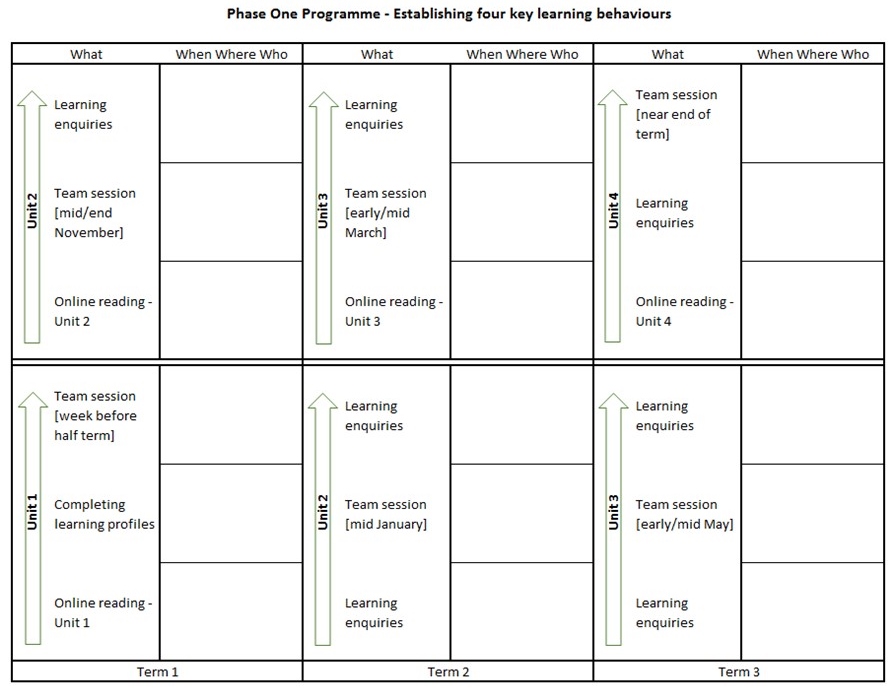
Would it be worth trying to capture how/when the Units will be phased in; when staff will be reading the online materials; when they will be meeting with colleagues to discuss and plan; when they will be trialling enquiries in their own classrooms? In other words, is it worth fleshing out the ‘rhythm of the year’?
Solutions:
You have already met the ‘Big Ambition’ of the programme. Each row of yellow cells describes one of the phases of the programme and describes what the key players will be doing:
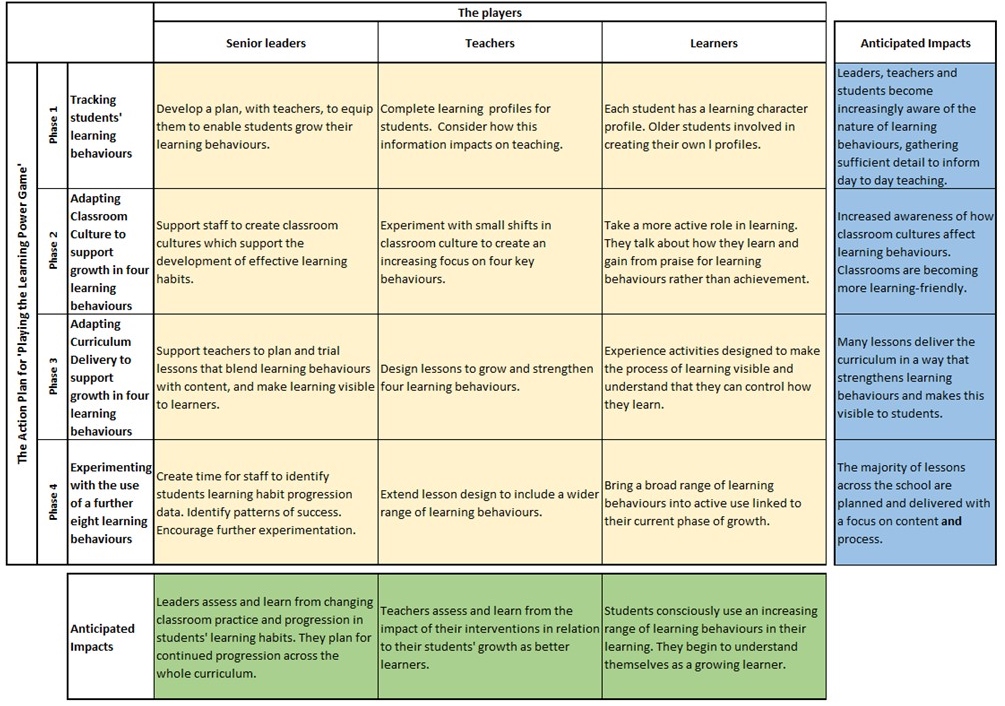
Use this to populate the year plan below – it will help you to get your head around all of the elements of the programme and how they will fit together and play out over time as the year progresses.
Comments are closed.