

This section covers key leadership issues;
- What Unit 2 is about and why it’s important
- More detail on the in’s and out’s of classroom culture
- Strategic concerns you might need to consider
- How support for staff is built into Unit 2
- A range of resources designed to help you introduce Unit 2 to staff
1. The intentions of Unit 2 – Classroom Cultures
The intention of the second unit is to:
- explore three aspects of the Teachers’ Palette framework – Relating, Talking and Celebrating and their impact on classroom culture;
- deepen understanding of the 4 key learning behaviours – Perseverance, Questioning, Collaboration, Revising.
The content builds on what staff discovered about their students’ learning characteristics in Unit 1 and suggests classroom culture interventions tailored to particular levels of learner development.
As a result it should have the following impact:
Classrooms will be well on the way to being able to cultivate learning behaviours – it is about readying classroom culture for intentionally blending content and with learning behaviours, which we tackle in Unit 3.



2. Tackling Unit 2 over three months
Staff will need time to;
- read sections 2A, 2B and 2C to gain an overview of 3 aspects of the Teachers’ Palette – Relating, Talking and Celebrating.
- consider which of these aspects of classroom culture are already in evidence in their classrooms.
- this exploration may take an hour or two, but the real point is to begin to integrate some ideas into their everyday practice.
The next step is to;
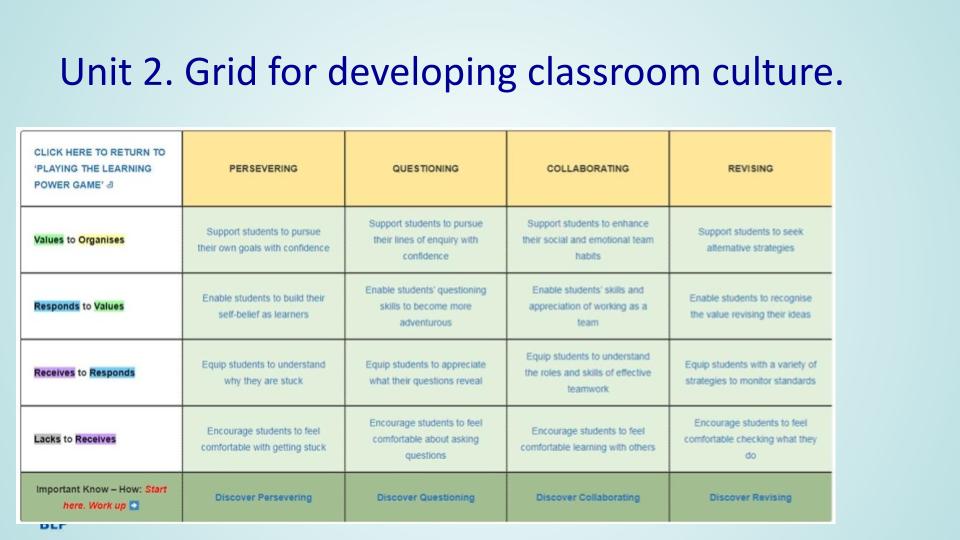
- explore the interactive navigation grid in section 2D.
- Start with dark green ‘Discovering’ cells first.
- Select ideas to try based on the analysis of students’ progress in learning habits.
Over the next three months staff are expected to pick out several classroom culture ideas that will benefit their students. They should plan to put a couple into action every couple of weeks and note the positives or negatives of making such a change.
If the programme started in Sept you should aim to begin Unit 2 around October half term with the intention of completing it around February half term. (England)

3. Strategic concerns for leaders
What might leaders be doing?
- During the online reading stage: keep the conversation going informally, show an interest in what staff are reading, thinking and maybe planning
- Before Meeting 1: As teachers begin to trial some ideas, go into classrooms to support and encourage.
- After Meeting 1 and through to the end of Unit 2: Support teachers as they implement their personal action plans derived from Section 2D. Look out for teachers trialling similar ideas and pair them up. Share ideas that are working well.
What leaders will be thinking about?
- Were our preliminary views about classroom culture accurate (see the activity in ‘Leadership Questions, 2b)?
- Can we sense a shift in classroom cultures beginning to take place?
- Are there any ideas that seem worthy of everybody adopting?
- Which areas of the school / teachers are ‘on fire’ and can act as beacons for others?
- Which areas / teachers are struggling and may need additional support?

4. Supporting development
Unit 2, Team Meeting Agenda 1
[We anticipate that Unit 2 may well take around 3 months to complete. Two meetings are to be scheduled, this meeting one month after starting Unit 2, and a second one a month later. There is no ‘end of unit’ meeting, although the outcomes from Unit 2 will be explored during the first of the Unit 3 meetings.]
So far teachers have been developing their understanding of learning power and their students’ learning behaviours. Here they begin to create action plans for developing their practice in order to make your classroom increasingly learning-friendly.
This meeting is positioned and designed to enable them to:
- Share their responses to their reading thus far in Unit 2, and…
- Draw up a personal action plan for how they will take their practice forward based on their exploration of section 2D in light of what they have already learned about their students’ learning behaviours in Unit 1.

Unit 2, Team Meeting Agenda 2
[Schedule this meeting about one month after the previous Unit 2 meeting.]
So far teachers have been developing their practice to ensure that their classroom culture becomes increasingly learning-friendly.
This meeting is positioned and designed to enable them to:
- Look back over and discuss with colleagues the progress they have made with their personal action plans, relating to classroom culture, that they devised at the previous meeting, and . . .
- Share their responses to your further reading in Unit 2, section 2D and…
- Draw up a personal action plan for how they will take their practice forward based on further exploration of the catalogue of ideas in section 2D.
Find the agendas for the meetings in the toggle boxes below.
Unit 2 - Learning Team Meeting 1 Agenda ⬇️
Unit 2, Team Meeting Agenda 1
- Agree objectives and agenda (5 mins)
- Discuss the online materials that people have looked at and trialled in Unit 2 (15 mins)
- Consider possible policy issues for the school (5 mins)
- Personal Action Planning (20 mins)
- Review the meeting process (5 mins)
Item 1. Session objectives: What do we want to achieve? (5 mins)
Objectives should include:
- learning from what has already been trialled in different classrooms;
- feeling confident to take forward ideas from online materials into our practice;
- proposing actions that would benefit if everyone applied them in their practice;
- planning further personal developments in classroom practice.

Item 2. Recap on-line materials in Unit 2: What the materials made us think (15 mins)
This is an opportunity to check out what you have been reading and absorbing from the on-line materials. It’s a chance to share or check out your understanding. It is these ideas that will be absorbed into your next Action Plan.
Try a PMI (Plus, minus, interesting) routine to help sort out your thinking.
Think about:
- what was understandable or tricky to understand;
- how the ideas would suit your students as learners;
- which are realistic both for you and your students;
- how the ideas would impact on your classroom culture;
- which ideas are front runners and why?
- which aspect of relating, teacher talk or celebration seems the place to start?
Use this decision making pentagon in deciding what you might try.
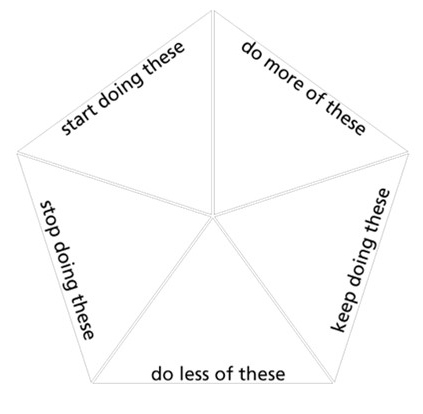
Note down a couple of:
- things you want to start doing
- things you think you need to stop doing (that’s harder)
- things you want to keep doing
- things you want to do more often
- things you want to do less
Item 3. Propose what may be needed across the school. (5 mins)
The point here is to identify ideas that are sufficiently important that they;
- should be included in everyone’s action plan
- i.e. you are sufficiently keen on some of the ideas that you all want to try them in one form or another
- should be adopted by everyone as a whole school strategy
- i.e. when discussions over time have concluded that some ideas have proved so useful across the school they should be woven into school policies or procedures.
Some of the ideas suggested in the on-line materials are likely to make more impact if they were to be adopted by everyone across the school. For example, if someone has already trialled an idea from section 2D that worked really well (for example, the introduction of a ‘Stuck’ poster), it may be worth everyone agreeing to give it a go with their own class. Of course they don’t need to look the same in every classroom but the ideas they contain need to ‘grow up’ through the age ranges. What do you expect students to be able to try for themselves as they grow up through the school?
Item 4. Personal action planning. What am I going to do? (20 mins)
This is the point when everyone in the team makes an action plan which they will implement over the next few weeks.
A. It starts with a question
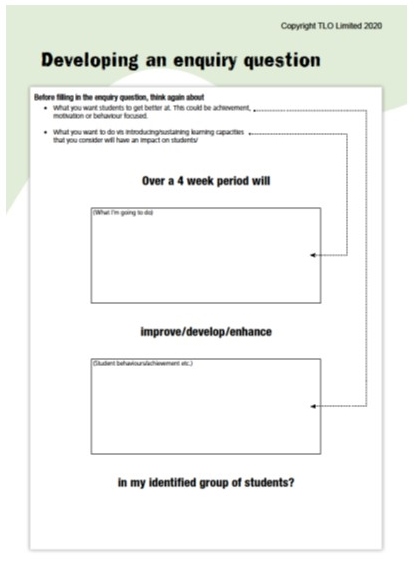
The key to developing your practice, is to think first of the need (what needs to change in students) and then think what could be done to achieve it. The knack lies in developing enquiry questions to sort out what you want to do.
Why a question? Because this is an enquiry! You want to find out if something (student behaviour) will change/improve if you change something specific.
Research suggests that you’ll gain more value from your plan by creating it around a question. Think of it like this:
If I do/plan, try xxxx will it improve/develop/ secure/ enhance xxx?
For example, if you were planning to have a go with the ‘Stuck Poster’ idea above, your enquiry question could be:
If I develop ‘Stuck’ prompts with my class, will it reduce my students’ dependency on my help?
(Find ideas in Unit 2. Section 2D. Perseverance, Lacks to Receives)
Try the planning sheet opposite.
B. Now think about a plan
But remember what you are trying to achieve.
Plans at this stage should be linked to what you are reading in Unit 2.
The learning enquiry plan is a record of what you intend to do. It takes your enquiry question from what to how. Remember:
- you can choose which aspect(s) of classroom practice to focus on;
- think about the aspect that is likely to have the greatest benefit for your students;
- make the plan specifically focus on development;
- concentrate on no more than two or three actions;
- decide how to map your actions over the next three or four weeks;
- it’s useful to think about what you are going to do less of to make room for the changes.
See format alongside to help you think through the planning process. You can fill in your Personal Action Plan using the word document version.
Also record what you will monitor over the weeks.
Changes you expect to see in your classroom practice. For example what do you expect to:
- see yourself doing differently?
- hear yourself saying more often, with greater commitment, more effectively?
- look out for in order to find out which approach best suits most students?
- feel less stressed about? What will indicate that?
- monitor to make sure that the changes you are making are having an impact of your students?
Changes you expect to see in your students. For example do you expect students to:
- begin to take greater responsibility for their own learning;
- be more inclined / better able to talk about learning;
- be better able to recognise/ describe how they are learning;
- show a deeper understanding of the process of learning;
- other.
Noting such changes will motivate you to continue with your experiments because the changes in students are almost always positive. The plan represents a promise to do it. This promise helps you to keep the plan as a priority in your mind.
You could talk yourself through ‘THINKS’ like:
- How would you like your students to be different?
- How do you want your students to improve/develop/enhance in …………?.
- What aspects of your learning culture might be stopping this happening?
- Which practical ideas from the online material might improve these circumstances.

The level of critical analysis which is part of small research projects has been designed/built into the Enquiry Question and Action Planning forms. In other words their very design helps you to develop effective research focused questions and provoke evidenced based reflection.
Item 5. Evaluate team session: How did we do as a team? (5 mins)
- Did we achieve our objectives?
- Are we comfortable with what we are trying to achieve?
- Any concerns at this point?
- Next meeting date and time.

Unit 2 - Learning Team Meeting 2 Agenda ⬇️
Unit 2, Team Meeting Agenda 2
- Agree objectives and agenda (5 mins)
- Share reports of how learning powered lesson plans have worked (20 mins)
- Discuss the online materials that people have looked at in Unit 2 (15 mins)
- Consider possible policy issues for the school (5 mins)
- Personal Action Planning (20 mins)
- Review the meeting process (5 mins)
Item 1. Session objectives: What do we want to achieve? (5 mins)
Objectives should include:
- learning from what and how our Action Plans have worked in different classrooms;
- feeling confident to take forward ideas from online materials into our practice;
- proposing actions that would benefit if everyone applied them in their practice;
- planning further personal developments in classroom practice.
Item 2. Reports from classroom enquiries (15 mins)
This is the first time this item has appeared on the agenda. It will remain for the rest of the series.
Share and discuss teachers’ practice; a valuable source of learning for everyone.
This involves thinking back to what you have been putting into practice over the last few weeks from your last Action Plan. It covers;
- what you each tried to implement using ideas from Unit 2 Classroom Culture
- how they worked
- what you could/did change to make it work better
- how students reacted
- whether there may be longer term benefits for students
Ask each other questions, offer suggestions and learn from each other.
Remember…everyone is supposed to report back to every meeting.
This isn’t a simple show-and-tell session but one where the group question and probe their colleagues’ summaries of what they have done to encourage analysis and deeper reflection.
Questions to encourage deeper thinking include:
- What do you think is getting in the way?
- What would make this better?
- How did students react to that change?
- How could this technique be modified to make it work better for you?
- What do you think made that work so well?
Item 3. Recap on-line materials in Unit 2: What the materials made us think (15 mins)
This is an opportunity to check out what you have been reading and absorbing from the on-line materials. It’s a chance to share or check out your understanding. It is these ideas that will be absorbed into your next Action Plan.
Try a PMI (Plus, minus, interesting) routine to help sort out your thinking.
Think about:
- what was understandable or tricky to understand;
- how the ideas would suit your students as learners;
- which are realistic both for you and your students;
- how the ideas would impact on your classroom culture for developing the language;
- which ideas are front runners and why?
- which aspect of relating, teacher talk or celebration seems the place to start?
Use this decision making pentagon in deciding what you might try.
Note down a couple of:
- things you want to start doing
- things you think you need to stop doing (that’s harder)
- things you want to keep doing
- things you want to do more often
- things you want to do less
4. Propose what may be needed across the school. (5 mins)
The point here is to identify ideas that are sufficiently important that they;
- should be included in everyone’s action plan
- i.e. you are sufficiently keen on some of the ideas that you all want to try them in one form or another
- should be adopted by everyone as a whole school strategy
- i.e. when discussions over time have concluded that some ideas have proved so useful across the school they should be woven into school policies or procedures.
Some of the ideas suggested in the on-line materials are likely to make more impact if they were to be adopted by everyone across the school. If we want students to change their behaviour we need to help them to think much more closely about the ‘hows’ and the ‘whats’. Motivation research proposes an effective solution to this called ‘if-then’ planning. ‘Ifs’ are the situations you want to remind yourself about. In the case getting unstuck it’s useful to list all the sorts of places this tends happen‘Thens’ are what you will do about something; the action you will take. This simple approach (shown in Perseverance, Receives to Responds) would have a far greater impact if it were replicated in every classroom; it’s a strategic approach that can be calibrated for different ages and stages.
Item 5. Personal action planning. What am I going to do? (20 mins)
This is the point when everyone in the team makes an action plan which they will implement over the next few weeks.
A. It starts with a question
The key to developing your practice, is to think first of the need (what needs to change in students) and then think what could be done to achieve it. The knack lies in developing enquiry questions to sort out what you want to do.
Why a question? Because this is an enquiry! You want to find out if something (student behaviour) will change/improve if you change something specific.
Research suggests that you’ll gain more value from your plan by creating it around a question. Think of it like this:
If I do/plan, try xxxx will it improve/develop/ secure/ enhance xxx?
For example:
If I select and implement 5 ideas about ‘learning on display’ will this provoke curiosity and make learning more visible to my students?
(Find ideas for Learning on Display in Unit 2, Section 2D. Perseverance, Responds to Values, Things to Display 3.)
Try the planning sheet opposite.
B. Now think about a plan
But remember what you are trying to achieve.
Plans at this stage should be linked to what you learned from Unit 2.
The learning enquiry plan is a record of what you intend to do. It takes your enquiry question from what to how. Remember:
- you can choose which aspect(s) of classroom practice to focus on;
- think about the aspect that is likely to have the greatest benefit for your students;
- make the plan specifically focus on development;
- concentrate on no more than two or three actions;
- decide how to map your actions over the next three or four weeks;
- it’s useful to think about what you are going to do less of to make room for the changes.
See format alongside to help you think through the planning process. You can fill in your Personal Action Plan using the word document version.
Also record what you will monitor over the weeks.
Changes you expect to see in your classroom practice. For example what do you expect to:
- see yourself doing differently?
- hear yourself saying more often, with greater commitment, more effectively?
- look out for in order to find out which approach best suits most students?
- feel less stressed about? What will indicate that?
- monitor to make sure that the changes you are making are having an impact of your students?
Changes you expect to see in your students. For example do you expect students to:
- begin to take greater responsibility for their own learning;
- be more inclined / better able to talk about learning;
- be better able to recognise/ describe how they are learning;
- show a deeper understanding of the process of learning;
- other.
Noting such changes will motivate you to continue with your experiments because the changes in students are almost always positive. The plan represents a promise to do it. This promise helps you to keep the plan as a priority in your mind.
You could talk yourself through ‘THINKS’ like:
- How would you like your students to be different?
- How do you want your students to improve/develop/enhance in …………?.
- What aspects of your learning culture might be stopping this happening?
- Which practical ideas from the online material might improve these circumstances.
The level of critical analysis which is part of small research projects has been designed/built into the Enquiry Question and Action Planning forms. In other words their very design helps you to develop effective research focused questions and provoke evidenced based reflection.
Item 6. Evaluate team session: How did we do as a team? (5 mins)
- Did we achieve our objectives?
- Are we comfortable with what we are trying to achieve?
- Any concerns at this point?
- Next meeting date and time.
5. Resources for bringing staff onboard
Here we offer resources you may need to introduce Classroom Cultures to staff. This isn’t a simple show and tell session. It’s designed to provoke deep thinking about classroom culture and how it impacts on student learning. You’ll find all the background notes and resources in the toggle box below.
Introducing Unit 2 content to your teachers
This 24 slide presentation aims to help teachers explore the Teachers’ Palette, the second of 2 models central to building learning powers. The 3 types of classroom culture are explained, explored and reflected upon, and consideration is given to strategies to make classroom cultures ‘learning friendly’.
The slide deck and associated resources could be used to introduce teachers to the key ideas behind finding out more about classroom culture. In total it might take around 60 / 75 minutes to work through with your staff.
You might use this slide deck:
- just as it is to introduce the ideas to staff;
- to help structure a learning conversation amongst/in teams;
- added to strategic presentation of your own to ensure staff gain a holistic picture.
Brief explanatory notes can be found under each slide. Fuller supporting resources are offered as downloads in the toggle box below.
The slides in the presentation cover the following key issues:
- different types of classroom culture;
- the Teachers’ Palette, the second key model of Learning Power;
- how the Palette relates to classroom cultures.
In doing so you are encouraging staff to use their own learning behaviours such as making links to their current classroom culture, reflecting on what happens now, and imagining what a learning focused classroom might look like.
Resources for the introductory session ⬇️
1) Download a copy of the ppt with presenter notes.
Presenter notes2) If the school is using the presentation as a basis for a whole staff training session to introduce classroom culture, staff will find these 4 images helpful to have as hard copy.
Download key images3) If you need a little help with how you might talk to slide 21 . . .
Slide 21 presenter notes
You are now in Leading Unit 2, Classroom Cultures.
Use the navigation bar to move from section to section
Comments are closed.