

This section covers key leadership issues;
- What Unit 1 is about and why it’s important
- More detail on the collection and analysis of student data
- Strategic concerns you might need to consider
- How Unit 1 builds in support for staff from the start
- A range of resources designed to help you introduce Unit 1 to staff
1. The intentions of Unit 1 – Understanding Learning and Cultures
The intention of the first unit is to:
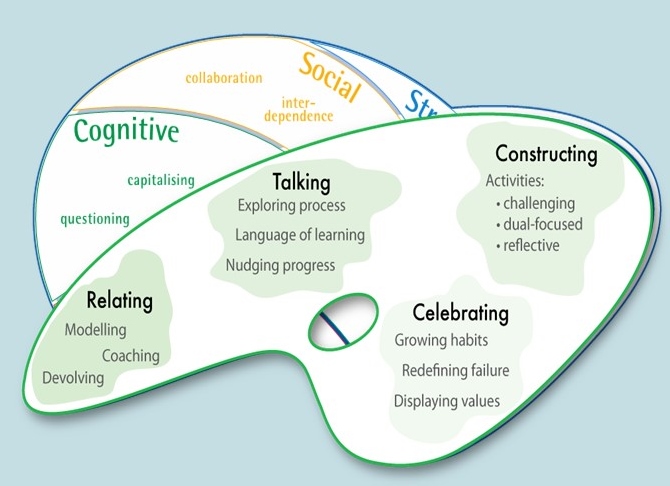
- introduce the two foundational frameworks of Learning Power . . the Supple Learning Mind, and the Teachers’ Palette. i.e. the warp and the weft of learning;
- introduce teachers to the intriguing prospect of growing and developing students’ learning habits;
- offer teachers a chance to explore themselves as a learner and complete their own learning profile;
- provide teachers with the tools to compile and analyse their students’ learning profiles
As a result of working through Unit 1:
- staff will have become familiar with the underlying concepts of Learning Power;
- they will have gained interesting insights into themselves as a learner;
- their student learning profiles will be giving them some of the most influential data they’ve ever had to shape their classroom practice.

The results from Sections 1D and 1E will shape teachers’ practice thereafter.
Find out about yourself as learner using the same charts as your staff ⬇️
We urge you first to look at your own learning through the learning power lens and then to think it through with a couple of students in mind. This is your chance to relate the quite detailed descriptions of learning behaviours to real students. It’s an essential part of the process so best not to skip it.
Here you have opportunities to…
Perhaps the best way of really getting to grips with the growth of learning power is to take a personal look at yourself as a learner and the learning behaviours you tend to use. What might your learning profile look like; where are your strengths, what are the behaviours you find tricky; which would you like to improve? Having got the idea we then invite you to look at just a couple of your students; a low and a high attaining student. This should give you a glimpse of what it is that makes the difference in how students approach and achieve in learning
1. How learning behaviours progress
Being an effective learner isn’t something that switches on on good days and off on bad days; it grows and builds when it’s nurtured and supported. Furthermore, being a learning powered learner involves gaining control of a range of linked dispositions and skills and emotions. Over the last ten years we’ve tried to capture the essence of that growth and make it useful for teachers and learners. Take a look at the progression chart alongside. Here you can see all 12 key learning behaviours together. Each of the 12 learning behaviours are briefly described at one of 5 levels of proficiency shown in the rows. These levels of proficiency grow and flourish when they are cultivated by teachers in learning friendly classrooms and supported by families. Download the chart and take a closer look at it. You’ve probably never considered yourself, let alone any students, in this way before. Take your time just absorbing what you see. Don’t think too hard about the progression levels at this stage, but rather try to absorb the nature of the descriptions of learning behaviours and the different areas of learning. 
Twelve learning behaviours with five levels of proficiency.
Download as pdf [When printing this pdf, it is best done on A3 paper, landscape (in the print settings)]
2. Discover yourself as a learner
To get a better sense of these learning behaviours and their growth use the chart to think about yourself as a learner. Start slowly. Refer to the learning behaviour descriptions and progression notes in section 1.2 for help. Now just think:

3. Analyse two of your students as a learners
When you think you understand the progression charts well enough try using them to consider a couple of students. The profiles opposite illustrate: Pink… a relatively weak learner, still negative aspects of learning (perseverance, imagining, meta learning) and elsewhere in need of adult support (ie they are broadly just into the purple phase); Blue…illustrates a well-rounded learner, secure at the purple and blue phases, and moving into the green phase for some behaviours. This might be typical of a well-rounded, high attaining learner who is disposed to behave in learning-positive ways. Do not expect to see much beyond the green phase, as the uppermost 2 phases require levels of maturity and independence rarely accessed by younger learners.] Ask yourself:
2. What teachers have been asked to do across two months
In tackling this first unit teachers are invited to:
- Read through Sections 1A and 1B to explore the big ideas that underpin Learning Power and give them confidence in the approach;
- settle down, maybe one evening, and explore their own learning habits (Section 1C);
- undertake the fascinating exercise of completing a learning profile for each of their students. This could be done over a couple of weeks (Sections 1D and 1E).
We suggest teachers give themselves a couple of months to understand, collect and analyse this data. Their view of their students learning behaviours will henceforth influence and shape their practice.
If the programme started in Sept you should aim to complete this unit by the end of the first half term. (e.g. Sept to end Oct)

This is what teachers have been asked to do in Section 1E. Essential read. ⬇️
Section 1E is where the practical action for teachers really begins. It’s about them generating the data, filling in the charts and interpreting what they’ve found. It is on this data that teachers will later build their learning power culture and interventions. Be prepared to be fascinated by data gathered by your teachers.
Which learning characteristics do our students display?
The growth charts you used in the last section have the power to reveal interesting and vital information about students’ learning. They are suitable for use with any class or a sub-group of students. This section helps you to answer the question:
What are the learning strengths and weaknesses of my/our students?
Gaps to discover

Understand your students as learners using a new type of data
In this section we ask teachers to give the same consideration to all the students in their class and keep an eye out for any emerging patterns; They are to ask themselves – ‘What questions are bubbling up in my mind?’ as they work through their class one by one. They’ll find themselves beginning to form some tentative hypotheses about their students’ learning behaviours.
1 Generate data for each student
Download and print sufficient charts – one for each student in your group. You’ll need to think carefully about each student in relation to each of their 12 learning behaviours. Colour in the behaviours that you think are secure. By secure, we mean that these are behaviours that the student consistently exhibits in a range of different circumstances. BUT if they use a behaviour in, say, maths but not in other subject areas you cannot count it as secure. You might find it easier later if you use different colours for say, boys and girls etc. Things to consider in gathering the data: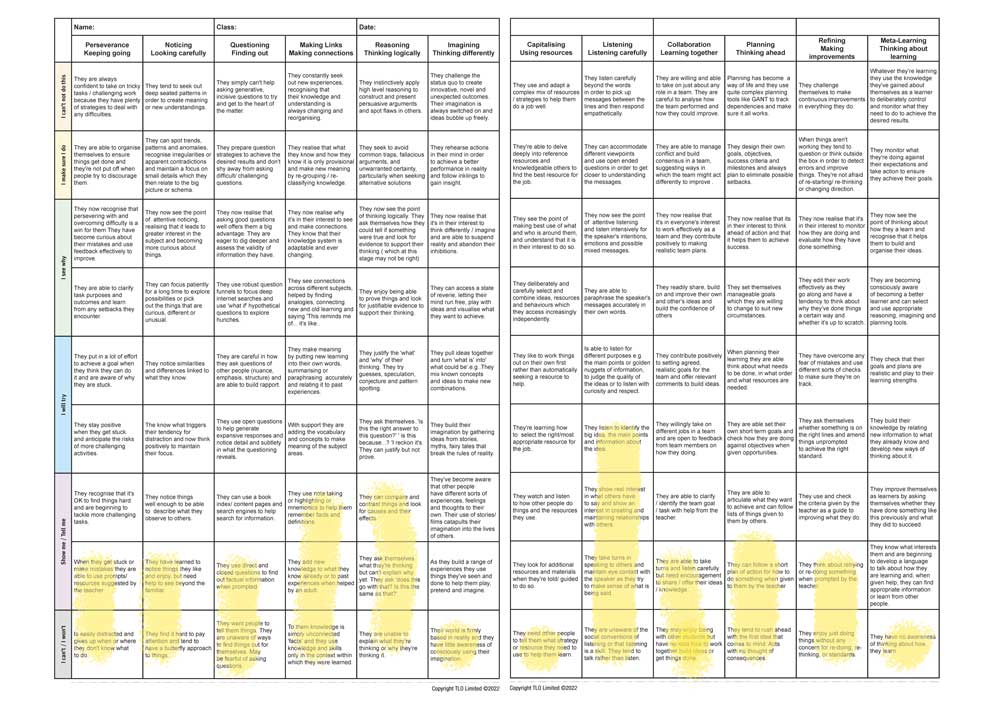
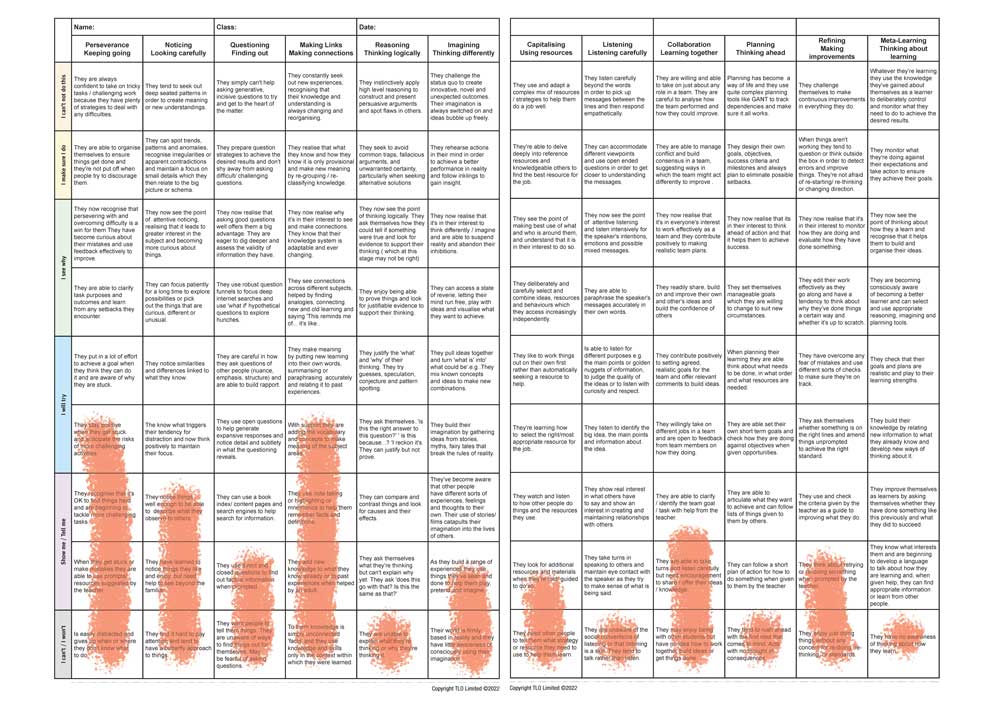 Download as pdf [When printing this pdf, it is best done on A3 paper, landscape (in the print settings)]
2. Interpret individual student profiles
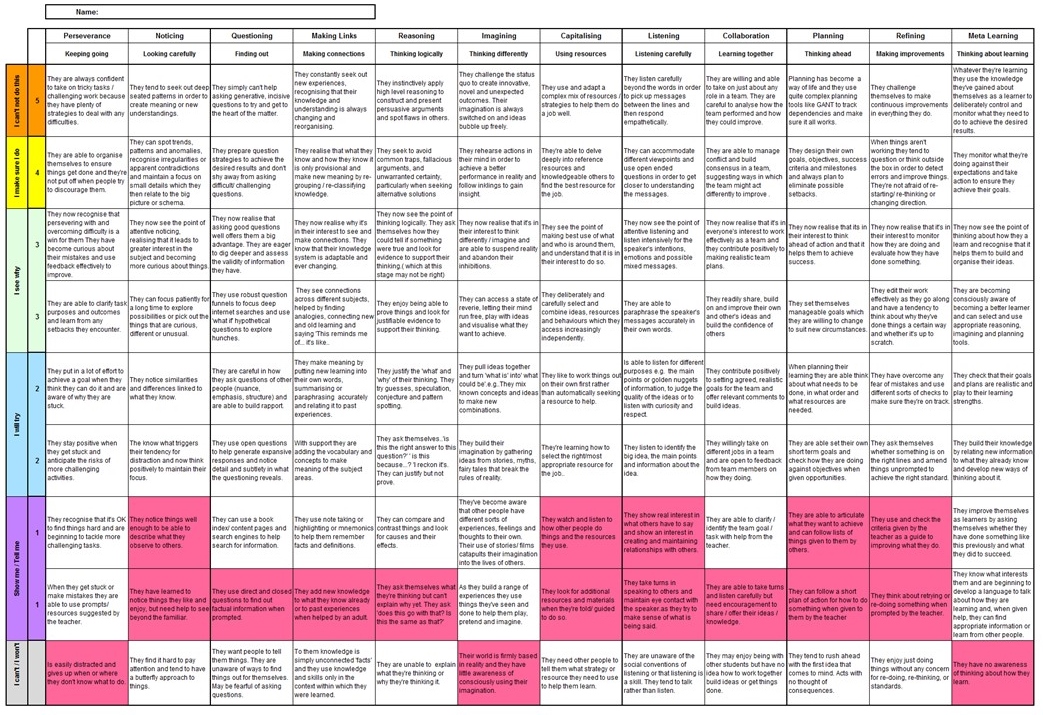
When completed the learning behaviour profiles for each of your students will look something like the one to the right – some cells identified as ‘this is a secure skill / behaviour’ with others left blank. (Here the ‘secure’ cells are coloured pink). Ultimately you need to be able to answer the question: What is this profile telling me about this student? Explore each student profile and ask yourself:What does this profile tell me?
3. Begin to notice and wonder about your class as a whole
Now that you have had a close look at each individual student you will have noticed several things, more of an inkling really, that seem to be showing up across the group. So before getting into a rigorous class analysis it will be useful to let you mind go into that receptive kind of imagination that’s a bit like daydreaming. Let the problem slip to the back of your mind and let your mind play with ideas and images about your class of students and their learning behaviours. Play with what you have recorded and wonder: In the next section we will help you build on this reverie and make a close interrogation of the patterns.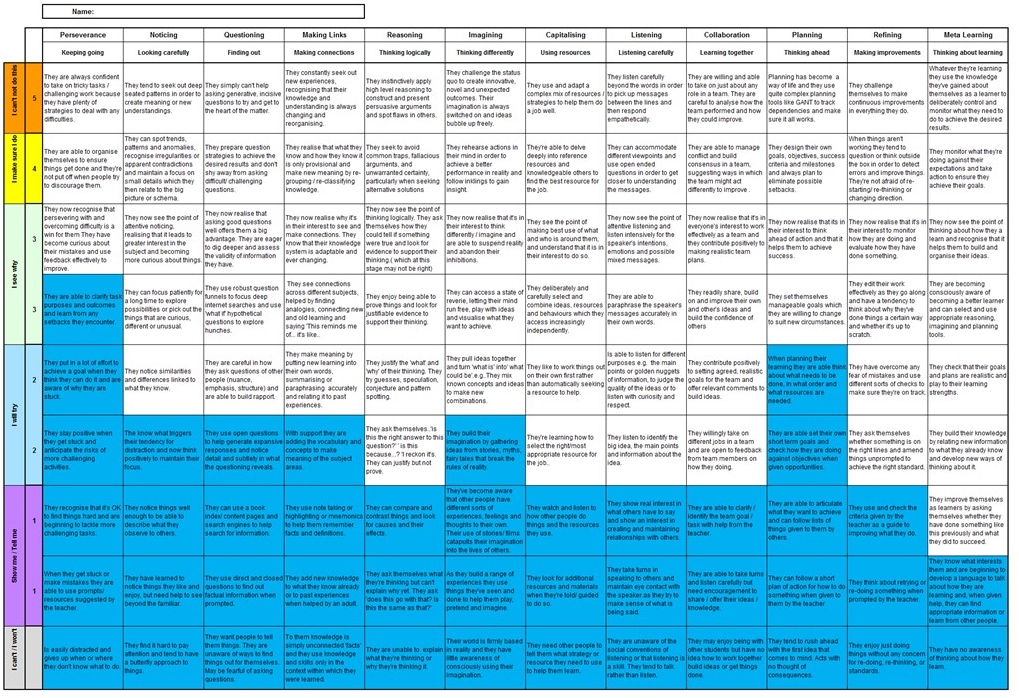
4. Interpret your profiles for groups of students and the class
Having been through the important stage of reverie it’s now time to take a hard look and jot a few things down. First, you’ll need to interrogate your data through the lens of different groups of students. It might be an idea to take your pile of charts and divide them firstly into girls and boys, then into high and low attainers (however you designate that label), then isolate, separately, groups like Pupil Premium. EAL, SEND, G&T, (if you still use this), and other groups that may have significance in your area. Ultimately you need to be able to answer the question: Can I discern any patterns across groups of learning profiles? Ask yourself: You might be thinking: Whatever your area of interest, shuffle the profiles and look for common features in one group of profiles that are different from the other group of profiles.What do these profiles tell me about a particular group of learners?
Do my pupil premium learners’ behaviours differ from other students?

What sort of learning patterns can I detect between high and low attainers?

5. Interpret your profiles through a learning domain lens
The second way you will find interesting to interrogate your data is through the lens of different learning domains, i.e. emotional, cognitive, social and strategic, and their learning behaviours. Ultimately you want to be able to answer the question: Can I discern any patterns across groups of learning behaviours? Some big questions: Further interesting questions might include: Whatever your area of interest, shuffle the profiles and look for common features in one group of profiles that are different from the other group of profiles.Which learning behaviour overall, across all groups, comes out weakest?
 Which learning domain do the boys seem to be strong in? Is there a different pattern of learning domain strength in my pupil premium students?
6. Synthesise your thoughts . . .
Having spent an interesting hour or so looking at your students’ learning charts it would be well worth your while to try and capture some of your main findings. You will have discovered far more than you can capture in your short term memory so a quick synthesising exercise would be well worthwhile. Summarise your findings about: Share with colleagues, find out more and become totally intrigued. Ask yourself: In the next section we look at how the school might make strategic use of this data across the school.

3. Strategic concerns for leaders
What might leaders be doing?
Ask yourself:
- How do we want to introduce the programme?
- Do we intend to do an in-school launch for Unit 1? [If yes, go to Section 5 below for a presentation that may help.]
- Would we want to arrange a day with outside speakers to introduce the programme to all staff?
- How will we keep a check on how the learning profiles are coming on?
This is vital because:
- The only meeting for Unit 1 is scheduled for the end of Section 1E, after around 6/7 weeks [Go to 4 below for detail];
- There is no point in holding the meeting until the learning profiles are completed;
- Unit 2 relies on teachers having completed the profiles.
The most important job for programme leaders during Unit 1 is to;
- chat to staff individually or in small groups to get a feel for how they are progressing with the Unit;
- offer support where needed;
- make sure that it is not being left to the last minute;
- ensure that their Summary is completed in advance of the meeting
- pick up on and support staff who are struggling to engage with the programme.
Having received the Summaries of class profiles:
- be on the lookout for possible trends in your students’ learning profiles.
- think particularly about any differences between sub-groups (ie are the profiles of boys different from girls?), and how this might link to whole-school attainment patterns.
- ask what questions is this data beginning to raise for us as a school?

4. Supporting development
This first learning team meeting is positioned and designed to enable teams to:
- Agree ground rules for this and all following Learning Team meetings;
- Discuss people’s responses to their reading in Unit 1, section 1A, (i.e. the guiding frameworks of the approach);
- Discuss their findings and reactions arising from Unit 1 sections, 1B to 1E (developing your students’ learning profiles).
NB. As this is the first such meeting the agenda below is unique in the Learning Team meeting series. Prior to this meeting, all of the data collection, analysis and Summary should be complete. Teachers who have not reached this point will find it difficult to contribute to the meeting.
Find the agenda for the meeting in the toggle box below.

Learning Team Meeting 1 Agenda ⬇️
Unit 1, Section 1E, First Team Meeting Agenda
- Agree ground rules, objectives and agenda (15 mins only for 1st meeting)
- Discuss your first impressions of Unit 1, section 1A, the Warp and Weft of Learning (10 mins)
- Re-cap and reflect on the online materials from Unit 1, sections 1B to 1E (20 mins)
- Consider possible strategic consequences across the school (5 mins)
- Review the meeting process (5 mins)
Reading in advance of the meeting.
[As this is the team’s first meeting please read these guidelines beforehand]
The delicate, hard work of changing practice requires a safe professional environment in which to explore and understand both triumphs and tribulations. These short guidelines may be helpful in setting a climate for the team itself.
What-Why-How-of-PLT.pdfNB. This first meeting does not follow all the aspects of Learning Team meetings as described in this paper. The full meeting pattern will be in operation at the next meeting. Unit 2 Section 2D.
Item 1. Ground rules and objectives.
What ground rules should we adopt and what do we want to achieve? (15 mins)
This first item invites you to explore how you want to be as a learning team. See download above for some suggested ground rules
Meeting objectives might include:
- learn from how our actions have worked;
- feel confident to take forward ideas from online materials into our practice;
- propose actions that would benefit if everyone applied them in their practice;
- plan further personal developments in classroom practice.
Outcome. You have decided how your learning team will operate henceforth.

Item 2. Reports from the Warp and Weft of Learning (15 mins)
Explore together your initial understanding of and reaction to the two foundational frameworks… the Supple Learning Mind and the Teachers’ Palette (Unit 1 section 1A)
- what were your first impressions?
- what do you still need to get your head around?
- what excites you about this?
- what worries you?
- speculate on how these 2 models might change your teaching.
Outcome. You will have a clearer understanding of the foundational thinking behind the ideas of Learning Power.
Item 3. Reports from class profile data (30 mins)
Share and discuss teachers’ practice; making your own experience a valuable source of learning for everyone.
- what you each experienced in completing each student’s learning profile. i.e. trying to implement Unit 1, section 1E, Finding Learning Characteristics
- how the process worked
- what you could/did change to make it work better
- what you have discovered about your learners
- what surprised or baffled you
- how valuable you think this information to be i.e. the point of collecting and recording it
- whether you feel there may be longer term benefits for students
Ask each other questions, offer suggestions and learn from each other. At this stage it’s valuable to note which of the foundational four learning behaviours your own class need to work on. Which stage from grey to green (From ‘I can’t TO ‘I see why’) do most of your students work at?
Outcome. You will have begun to understand your learners’ deeper behaviours and challenges. This will focus your looking when you start Unit 2, Classroom culture.
Item 4. Consider what may be needed across the school. (5 mins)
Think about;
As a result of recording and analysing the learner profiles consider;
- Are there easier ways of doing this?
- Are there ways of doing it we could all learn from and adopt?
- Do we feel confident about our results
- Should this idea be woven into school policies/directed time?
At this stage it’s valuable to note ideas arising from this discussion. Those relating to the final point could be passed to school managers just for discussion at this point.
Outcome. You will have a considered view of how such student data might be collected and stored.
While there are many ideas suggested in the on-line materials that will make a greater impact if they were adopted by everyone across the school the actual collection and storage of student data remains a school organisation issue. But the use of student learning profile data is a key factor in shaping the programme’s central idea of building students’ learning power. Without this data you’d never know how best to select activities. However, even at this early stage, you may be realising that your students’ learning profiles will need to be kept up to date so that they can act as a transfer document when they move on next year. It might be an area to raise tentatively at this point.
Item 5. Evaluate team session: How did we do as a team? (5 mins)
- Did we achieve our objectives?
- Are we comfortable with what we are trying to achieve?
- Any concerns at this point?
- Next meeting date and time.
We suggest that you schedule two team meetings now for your work in Unit 2 about classroom culture. You will find their agendas in Unit 2 Section 3C and Section 3D

5. Resources for bringing staff onboard
Here we offer resources you may need to introduce Unit 1 to staff. This isn’t a simple show and tell session. It’s designed to provoke deep thinking about learning and how it grows and thus makes the case for the importance and use of the data you are asking staff to collect.
It will take around an hour to talk through the Powerpoint, depending on how much detail you add to the suggested commentary.
Introducing Unit 1 content to your teachers
The slide deck could be used to introduce teachers to the key ideas behind Learning Power. It helps teachers to understand the content and purpose of Unit 1, describes what is to be done, and explains the anticipated timings.
You might use this slide deck:
- just as it is to introduce the ideas to staff;
- to help structure a learning conversation amongst/in teams;
- added to strategic presentation of your own to ensure staff gain a holistic picture.
Brief explanatory notes can be found under each slide.
The slides in the presentation cover the following key issues:
- unpicking the key area and habits of a supple learning mind
- a look at how these habits might grow and develop
- an invite to look at their own learning behaviours
In doing so you will be encouraging staff to use their own learning behaviours such as noticing similarities and differences between what they know now and this way of looking at learning. Questioning some of their own learning strengths and weaknesses and distilling the key messages and their appropriateness to the school.
You are now in Leading Unit 1, Understanding Learning and Cultures.
Use the navigation bar to move from section to section
Comments are closed.