identify features that are likely to help you elsewhere
think about where else you might use these lessons
The purpose of Building Learning Power is to facilitate the growth of high value psychological characteristics in order to strengthen students’ learning characters. These skills, attitudes and values, when used with increasing competence and confidence across many learning opportunities, become learning habits; the characteristics of successful lifelong learners.
‘A person’s Learning Power determines, even dictates, their propensity for change, and directs those behaviours that influence and underpin performance throughout life.
The power to learn is the essential ingredient in implementing strategies for change i.e. to learn.‘
The activities, think pieces and questions in this online unit aim to help teachers make a start on:
introducing students to one of the key learning behaviours;
using the language of learning effectively with students;
designing the use of learning behaviours into the way they teach;
developing the confidence and skill in helping students to grow their learning power.
The purpose of Building Learning Power is to facilitate the growth of high value psychological characteristics in order to strengthen students’ learning characters. These skills, attitudes and values, when used with increasing competence and confidence across many learning opportunities, become learning habits; the characteristics of successful lifelong learners.
‘A person’s Learning Power determines, even dictates, their propensity for change, and directs those behaviours that influence and underpin performance throughout life.
The power to learn is the essential ingredient in implementing strategies for change i.e. to learn.‘
The activities, think pieces and questions in this online unit aim to help teachers make a start on:
introducing students to one of the key learning behaviours;
using the language of learning effectively with students;
designing the use of learning behaviours into the way they teach;
developing the confidence and skill in helping students to grow their learning power.
The purpose of Building Learning Power is to facilitate the growth of high value psychological characteristics in order to strengthen students’ learning characters. These skills, attitudes and values, when used with increasing competence and confidence across many learning opportunities, become learning habits; the characteristics of successful lifelong learners.
‘A person’s Learning Power determines, even dictates, their propensity for change, and directs those behaviours that influence and underpin performance throughout life.
The power to learn is the essential ingredient in implementing strategies for change i.e. to learn.‘
The activities, think pieces and questions in this online unit aim to help teachers make a start on:
introducing students to one of the key learning behaviours;
using the language of learning effectively with students;
designing the use of learning behaviours into the way they teach;
developing the confidence and skill in helping students to grow their learning power.
An edited version of the below, plus the supple with the behaviours shown.
3 supples to choose from – delete the 2 that are not needed:
The first key model of Building Learning Power – the Supple Learning Mind.
Find out about the 4 dimensions of learning powered minds :
The features of a Supple Learning Mind;
How the vocabulary of learning enriches understanding of learning;
The extent to which they get regular exposure in your classroom(s).
and gain an overview of the essence of effective learning behaviours.
If you are reading this as a senior leader… reflect on how the issues raised work across the school.
If you are reading this as a classroom practitioner… reflect on how the issues raised affect your own learners.
The Supple Learning Mind framework of high value learning behaviours.
A rich framework for learning
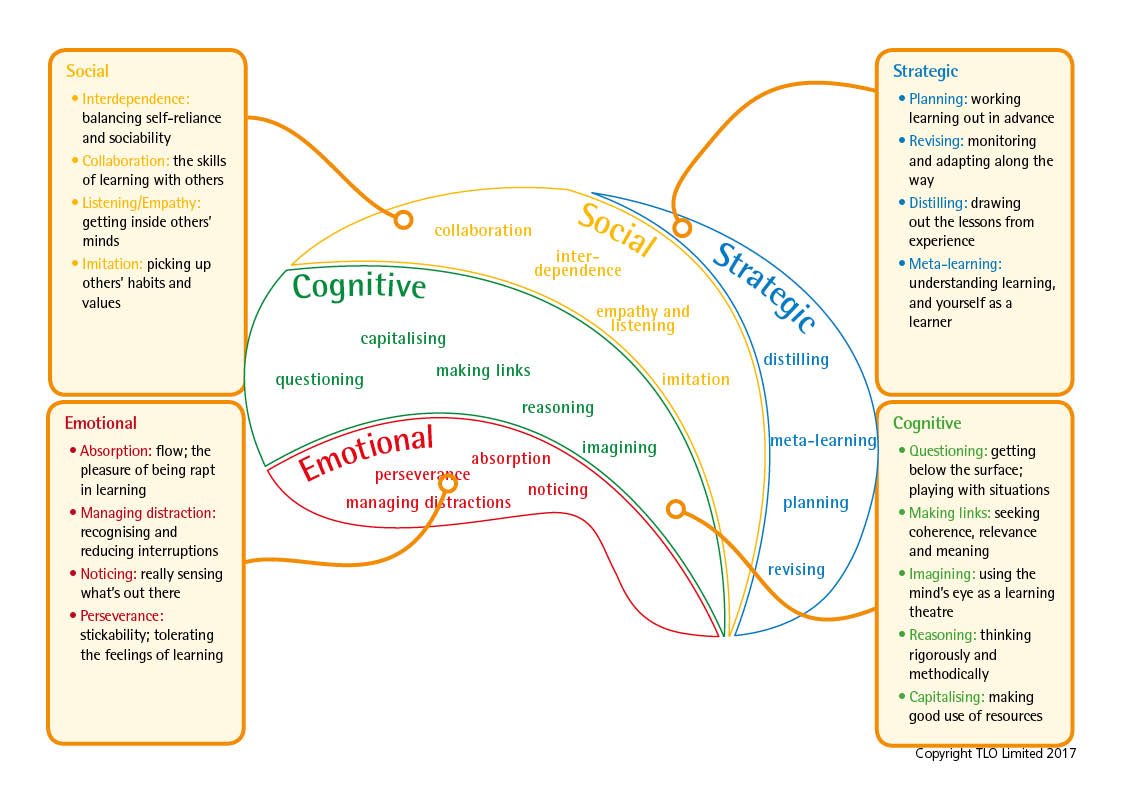
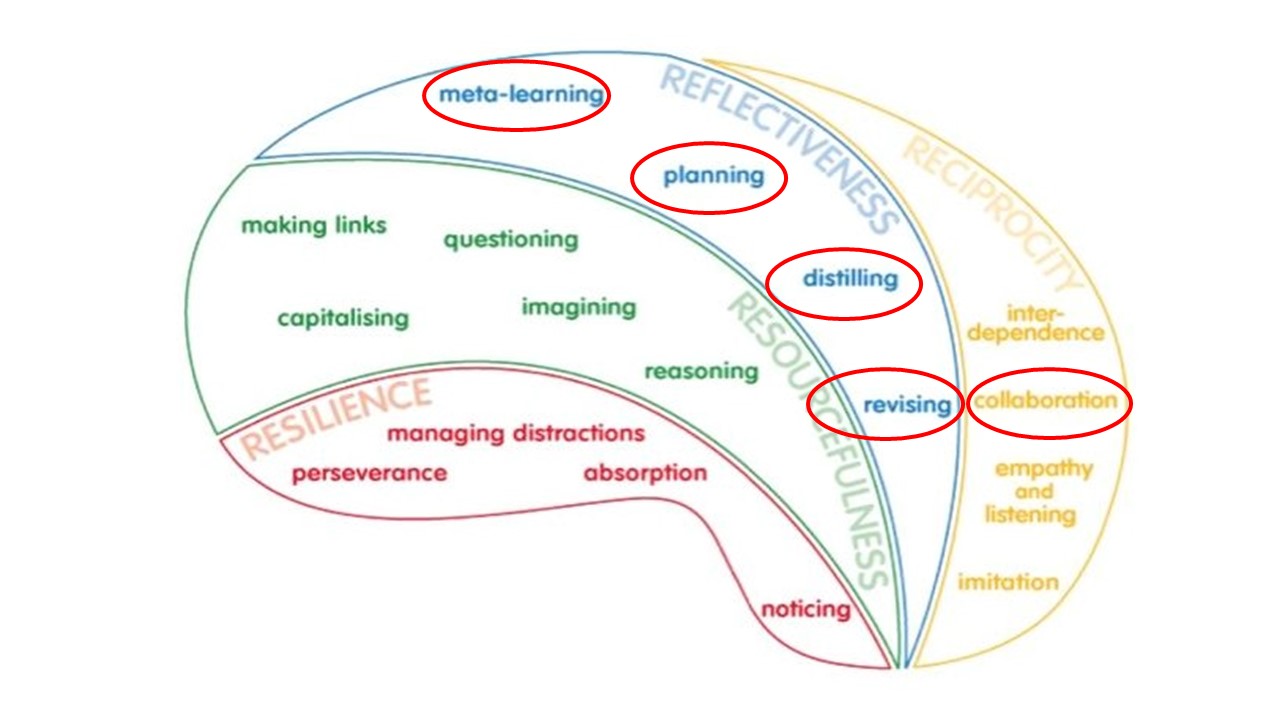
The Supple Learning Mind framework was originally conceived and researched by Professor Guy Claxton. It captures the key psychological characteristics that are judged to be of the highest value in helping students to learn and thrive in a complex world. The framework embraces each of the domains of learning and these are shown in its four parts:
The Emotional domain of learning (sometimes described as Resilience)
The Cognitive domain of learning (sometimes described as Resourcefulness)
The Social domain of learning (sometimes described as Reciprocity)
The Strategic domain of learning (sometimes described as Reflectiveness)
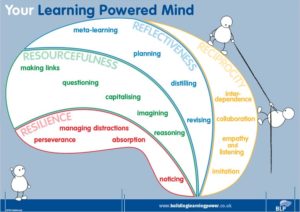
This learning framework shows that learning isn’t just about having a good memory; it includes how we feel, how we think, how we learn with others and how we manage the process of learning. It shows that learning is a complex process. Furthermore it provides a language that helps teachers to think about how they cultivate each of the learning behaviours and helps students to gain a better personalised understanding of how they learn content.
Each domain clusters together the high value learning behaviours that best make that domain work well. For example the social domain is made up of the learning behaviours of interdependence, collaboration, listening and empathy and imitation.
What’s your initial reaction to the learning framework?
Which learning behaviours chime with you?
Are there others you would add?
Which of the four domains makes most sense to you?
Which domain is, arguably, the most important?
The vocabulary of the Supple Mind creates a language of learning
Having a language that captures the richness of learning can be used to understand and discuss the learning process, helping teachers and students to uncover learning as a visible process that can improve.
The learning language offers teachers and students alike a rich vocabulary for thinking and talking about what learners actually do, and this in itself enables them to expand their capacity and appetite for learning.
The language has many uses. It helps:
teachers to think about how they might talk in a way that helps to cultivate each of the learning behaviours.
students to notice and recognise learning behaviours they were unaware of.
students to gain a better personalised understanding of content by consciously engaging the behaviours.
to know which learning habits and attitudes are being exercised by the way subjects are being presented, taught and assessed.
to understand concepts such as ‘reasoning’, ‘collaborating’, or ‘managing distractions’, and to have worked on getting better at using them purposefully and routinely.
to name such things explicitly so that students (and their parents) know what it is teachers are noticing and valuing.
teachers to become aware of which learning behaviours they routinely require students to use in lessons — and then to think more carefully about whether there might be others they might profitably call on instead.
teachers to design activities that stretch and strengthen learning behaviours so that they become student’s learning habits. Teachers begin to think, ‘How is learning happening; What habits of mind am I cultivating in students by the way we I’m designing and delivering the curriculum’; Which learning behaviours need to be used more often so that they become habits?
So as we can see it’s not just the words themselves that are powerful but the variety of functions they have in making learning behaviours visible, learnable and habitual. The learning behaviours themselves become even more useful when brought to life through everyday phrases that promote, encourage and strengthen them.
Which of these functions of the learning language sound useful to you?
How could you make use of this learning vocabulary?
Have a quick look at lesson plans for last week and try to think which learning behaviours the activities required students to use (maybe without you realising it).
If you started to use this learning framework which learning behaviour would you tackle first?
Translating the Supple Mind into classroom practice
So, how does all this translate into the classroom? Basically, as a teacher, you are going to talk about the behaviours, stretch them through activities, model them, and show that you value them when you see them in use.
Have a think about some of the learning behaviours and work out;
how often you try to help students develop such behaviours in the way that you teach at present;
how many of your students display these behaviours in the classroom (even without knowing it).
Emotional Engagement
what do I do now to help students develop these behaviours?
how many of my students display these behaviours now (even without knowing it)?
Relish a challenge
Not afraid of finding things hard
Identify significant detail
Stick at things despite difficulties
Minimise negative distractions
Work for extended periods to solve a problem
Cognitive Range
what do I do now to help students develop these behaviours?
how many of my students display these behaviours now (even without knowing it)?
Become curious about possibilities
Ask questions to get to the bottom of things
See how things fit together
Are logical and systematic
Use imagination to good effect
Make use of a wide range of learning resources and strategies
Social Involvement
what do I do now to help students develop these behaviours?
how many of my students display these behaviours now (even without knowing it)?
Work well with others
Maintain own ideas in a group
Listen to what others say, showing understanding
Put themselves in others’ shoes
Absorb and use the way other people do things
Know when to learn alone or with others
Strategic Responsibility
what do I do now to help students develop these behaviours?
how many of my students display these behaviours now (even without knowing it)?
Sort out what needs to be done
Think ahead of taking action
Take stock to make sure things are on track
Change tack if necessary
Pull out key points from experience
Talk about how they learn
About your teaching, ask yourself:
Which behaviours do you regularly attend to?
Which do you rarely attend to?
Which psychological domain receives most attention in your classroom? (emotional, cognitive, social, strategic)
What does this reveal about your teaching?
About your learners, ask yourself:
Which of these behaviours are already well-developed?
Which are least well-developed?
To what extent are learners aware of using these behaviours?
Is there a link between what you do and how students are as learners?
This section offers a framework for supporting a productive Teacher Learning Community
If you are undertaking this unit alone and are not part of a Teacher Learning Communitystructure, please move on to Section 7.
Teacher learning communities have the potential to provide you, as teachers and support staff, with the information and support you need to develop your practice in deep and lasting ways. They provide a forum for supporting you in converting the information and ideas in the online learning sessions into “lived” practices within your specific subjects and classrooms. They provide a safe forum in which to;
kick around ideas from the online content,
unpack it’s meaning when it’s unclear,
consider what’s do-able and appropriate for your pupils
make plans for what and how you might incorporate the ideas into your practice
share and unpack what you have tried in the classroom
relate your triumphs and tribulations
support colleagues through changes in practice
reflect on what you hope you might do, or have done, differently
The format of the agenda is based on research into teacher learning communities by Dylan Wiliam, of Assessment for Learning (AfL) fame. Teacher learning communities are the engines of teacher development.
This section is for those teachers who are undertaking this unit alone and are not part of a Teacher Learning Communitystructure.
Cultivating learning habits ultimately involves:
Providing rich and varied occasions for exercising learning habits;
Infusing learning habits into lessons to enhance content understanding;
Recognising and celebrating the use and growth of learning habits;
Expecting students to take ownership of and responsibility for their own learning habits;
Exploring the development of learning habits with students over time.
As a teacher you are an influential character builder and so need to be mindful of how you help students form, replace, re-form and strengthen their learning habits.
But don’t worry, you are not expected to be there yet. It takes most teachers between 2 and 3 years to become really fluent with this way of teaching. So, go easy on yourself. Feel determined because small steps often prove to be big levers for change. Have a think about what you might do…
What to stop and start
Here are a few ideas you might want to try. Take it steady, this way of teaching can be a big but exciting shift so it’s worth doing it slowly and thoughtfully.
Look first at the Stop/avoid ideas. Some of these are far from trivial but it’s best to try to remove them before starting on the Start/do more of, Start slowly and Experiment with ideas.
What do you think?
Which of the ideas appealed to you most?
Can you see ways of incorporating these into your subject/class routines?
Which would make the biggest difference to your students?
Which would make your life easier?
Make a note of…
Ideas that you want to try and the impact you hope they will have on your teaching and on your students.
Here is a range of things you could say to nudge distilling. When you use this kind of language you are talking as a learning coach, encouraging students to think for themselves. Using such statements encourages your students to:
imitate you;
start to think in this way;
become conscious of these phrases and their meaning.
Eventually you will hear some of the questions pop up in students’ self-talk….in speech or even in writing from time to time, but mostly these will go on inside their heads. As your work on distilling gathers pace see if you can detect students who talk, or think, in these ways.
Learning-talk nudges that encourage Distilling
Teacher talk – as a learning coach
(Here are 10 ideas to ensure your students do the thinking for themselves)
What do you think are the three most important things you have found out?
If you only had to tell someone one thing about what you have learned today, what would it be? Why did you choose that?
Think back to when you . . . What did you learn from that?
How could you use what you learnt last week to help you now?
How could you teach someone else the key things about . . ?
Just think over what we have been doing. What went well? What could be improved? What lessons can we learn from this?
Where/when else could you use this skill, knowledge, idea?
The main thing here is . . .
What do you have to know? What must you do?
Is any of this unnecessary?
What do you think?
Which of these distilling nudges might you start using?
In which particular lessons would such nudging be most useful?
How will most of your students respond to such nudges?
Will this way of engaging be more popular with girls or boys?
What other nudging ideas might you add to the list?
Make a note of…
Students’ reactions to the nudges.
Ideas about why this might be.
Ways in which you could further encourage students to imitate this metacognitive self-talk.
Any positive or negative impact of these distilling behaviours.
Some ideas to encourage a Distilling frame of mind.
In the early stages of building your students’ learning power your role is to; make them aware of the behaviour; talk about it (what, how, why, when, if); celebrate its use; give opportunities to practise it, both in lessons and elsewhere; reflect on it to improve it. This staged start is reflected below…
Firstly… make students aware of the use and importance of distilling…when, where, why, how they are or could be doing it.
Then… explore distilling a little more through the language of distilling
Try… using distilling as a lesson starter to tune students into using it
Then start… blending distilling into the way you teach the content. Use specific distilling strategies to deepen content understanding.
Ensure… students reflect on the success or otherwise of their distilling frame of mind.
1. Make students aware of Distilling
How you make students aware of the words that describe the behaviour and why it is important to use it.
Primary
Make the process of distilling obvious.
After any activity, ask the children what they have been doing, what they have learned, what worked, what didn’t work so well and what they would use again next time. Make wall displays of things that children have found worked well. Support with photographs and examples, to ensure everyone benefits from the learning. Expect lots of variety – what works for one child might not work for another.
Secondary
Use post-its or postcards
Giving students a large piece of paper encourages them to write lots – it might be a useful strategy for capturing detail, but it acts against the need to weigh up what is really important.
Require students to make notes on postcards or post-its – large enough for the key points, but too small for unnecessary detail.
Encourage students to discuss what must be on the postcard, and what can be safely considered ‘detail’.
Primary
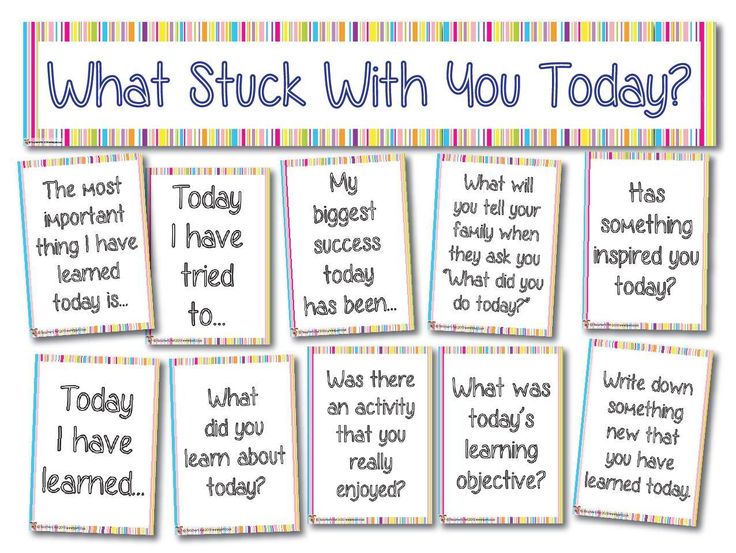
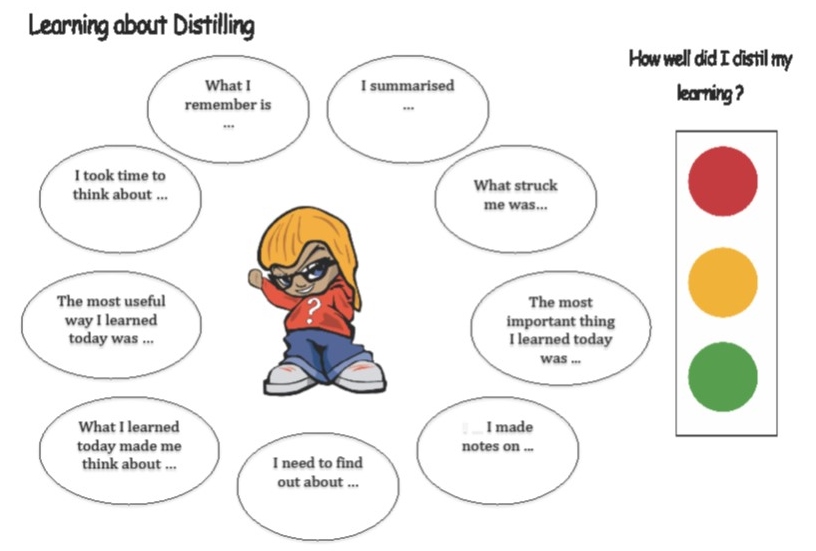
What stuck with you today?
Make reflection on being stuck part of the daily or lesson routine. This display from Miriam Lord primary school in Bradford shows a range of discussion cards which the teacher uses with specific groups of students during or at the end of a day.
The questions include;
Today I have learned….
Today I have tried to…
My biggest success today has been….
What will your tell your family when they ask ‘What did you do at school today’?
The most important thing I have learned today.
Has something inspired you today?
Secondary
Conversions
If information is currently framed in any of the following, challenge students to change it into another format of their choosing: text; mind map; flow diagram; storyboard; graph; venn diagram; ranked bullet points/list; video; teacher explanation; revision notes etc.
Consider limiting the number of words that can be used – forcing students to limit words and/or employ images instead encourages them to distil what is really important and salient.
Converting from one medium to another requires students to identify the key features. It can only be converted if it is understood, so this technique promotes deep learning. Where students are struggling, it can reveal misconceptions. It helps students to create revision notes for themselves, and in their preferred learning style.
2. Explore the language of Distilling
How you might extend the language and understanding of this behaviour
Primary
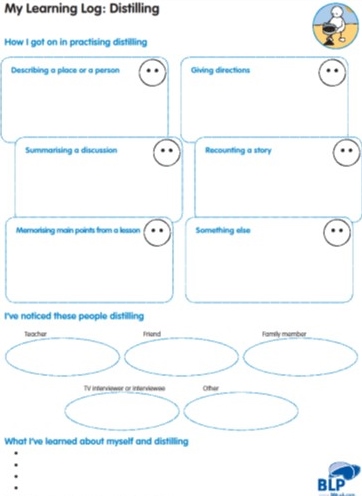
Distilling learning behaviours
Distilling is all about ‘mulling over’ experiences in order to recognise and appreciate just what we have done and what is worth holding onto to use again in new, similar or different situations. As you talk about learning by reflecting on noticing or reasoning or collaborating or any of the other capacities, you will be guiding your pupils to learn about learning from their own experiences. You will be ‘distilling’ – drawing out that ‘essence’ of noticing, reasoning etc. that you want them to use again and develop. Distilling is a capacity that is very much your area of responsibility. It would not be reasonable to expect young learners to understand, or have any awareness of the complexities involved. With your guidance, your learning, they will be able to participate in drawing out lessons from the opportunities you give them to experience the capacities and develop a language with which to talk about them.
Secondary
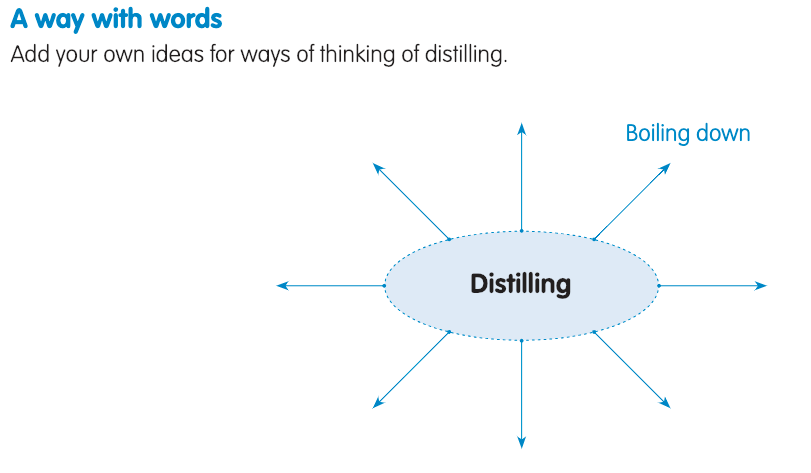
A way with words
Collect words that tell you how people learn to distil what is and what is not important.
Explore well known sayings.
What do we mean when we say …
The heart of the matter
Can’t see the wood for the trees
Hit the nail on the head
3. Use Distilling as a lesson starter
Use a quick starter to key students into the learning behaviour you want to concentrate on in the lesson. i.e. here you are starting up the Distilling behaviour
Primary
Circle Time
As part of circle time, encourage the children to talk about:
Things that worked well for me this week/today
or Things I will use again to help me
or Things I have learned
or Things I still need to find out
Secondary
Going for Three
Begin each lesson with ‘Tell me Three . . things we learned last lesson; ways we learned last lesson; things we still need to find out; things you hope to achieve today’.
End each lesson with ‘Tell me Three . . things we learned today; learning skills we used today; things we need to do next lesson; ways you could become a more effective learner’ etc.
Vary which you use according to circumstances.
Ensure that they tell you three. Do not lapse into doing it for them !
As you get deeper into a lesson you will need activities which, by their very nature, will develop students’ distilling AND their understanding of the content.
Here is an idea where, by using distilling, students will gain an understanding of the content AND will develop a distilling habit.
4. Focus on Distilling as a learning strategy
Draw out the distilling behaviour being used in a thinking routine.
Primary and Secondary
Visible Thinking Routine
Headlines: a routine for capturing Essence.
This routine draws on the idea of newspaper-type headlines as a vehicle for summing up and capturing the essence of an event, idea, concept, topic, etc. The routine asks one core question:
If you were to write a headline for this topic or issue right now that captured the most important aspect that should be remembered, what would that headline be?
Consider following it up with the challenge of writing the first paragraph only of the newspaper article, the one that lays out all of the key information relating to the headline.
This routine works especially well at the end of a class discussion or session in which students have explored a topic and gathered a fair amount of new information or opinions about it.
For more detail on Headlines, visit the Visible Thinking website:
And here is an idea that will help students to understand the distilling process.
5. An activity to highlight and strengthen Distilling
Design specific activities to highlight and strengthen the behaviour.
Student led plenaries and review points
Use review points and end of lesson plenaries to encourage students to reflect on their own learning. [A variation on De Bono’s Thinking Hats.]
At the beginning of the lesson, place some coloured boxes/hats/objects on student desks. These identify which aspects of the learning the individual/group have to pay particular attention to.
Some teachers might use hats so that individual students will do the feedback. Others might place a coloured box on each nest of tables to indicate that the group has the responsibility to conduct the feedback.
At the end of the lesson, students have to feed back as follows:
Black box/hat – what were the learning objectives of the lesson ?
Red box/hat – what were the three most important things we learned today ?
Blue box/hat – in what three ways did we learn today ?
Green box/hat – what might we do tomorrow ?
Yellow box/hat – how could the lesson have been improved ?
White box/hat – how would you teach this to your younger sibling ?
6. Reflect on Distilling
Primary
Make reflecting on Distilling part of everyday lessons
Here is a very practical example of how you might develop the emotional climate of the classroom and make it Distilling friendly.
Can you see a use for any of the suggested activities?
Have you raised awareness of distilling with your students?
Does your class have an agreed set of good distilling behaviours?
Which two ideas from above do you want to try out?
How long will you keep them going before you decide whether they have worked or not?
Make a note of…
What happens in your classroom in response to any of the above ideas.
How students’ behaviour changes over about 3 weeks of becoming more familiar and talking about the behaviour.
How your behaviour in the classroom changes as you use these ideas over time.
NB. None of the behaviours above will lead to instant understanding in students nor instant changes of behaviour. You will need to drip them in over time and keep building and refreshing your language of learning.
Building Learning Power is about creating a culture in your classrooms – that systematically cultivates habits and attitudes that enable your students to learn confidently and face difficulty calmly and creatively. By a ‘culture’ we mean all the little habits, routines and practices that implicitly convey ‘what we believe and value round here’.
So ‘culture’ concerns the details of the micro-climate that you create in your classrooms. What you do and say, what you notice and commend and what you don’t, what kind of role model of a learner you offer – all these are of the essence. The micro-climate of a classroom can inadvertently stifle, or specifically enhance, the very behaviours you are seeking to promote.
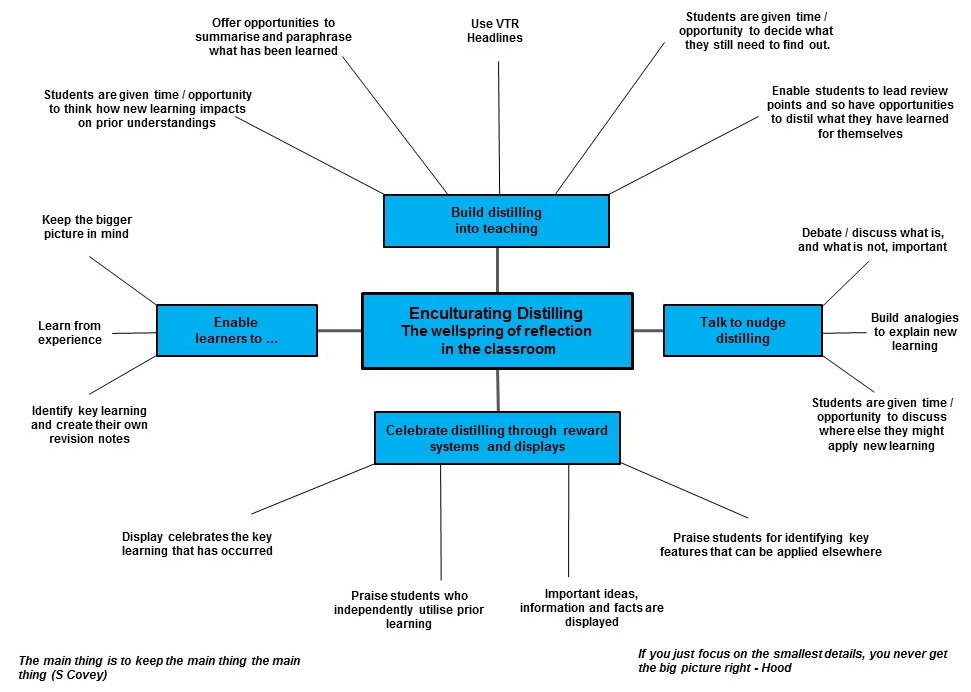
Does my classroom climate encourage Distilling?
Here is a selection of features that might begin to shape the emotional climate of your classroom to encourage distilling.
The diagram has 4 sections:
Top – strategies you could build into the way you teach to stimulate distilling;
Right – indications of the sort of language you might use to stimulate distilling;
Bottom – ways in which you might celebrate / praise students’ use of distilling;
Left – things that you need to enable students to do.
Apply your own noticing and consider whether you already use any of these features and which you fancy trying.
Distilling is a key skill in terms of mulling over experience, sorting out what is and what is not important – what should be committed to memory, and what can safely be regarded as unnecessary detail. It is about drawing out useful lessons from experience, both about what has been learned and what has been learned about learning itself.
It involves looking back over what is being learned, pulling out the essential features, and considering firstly how these features affect prior understanding / knowledge, secondly how these new understandings might help you elsewhere in your learning, and thirdly what you still need to find out.
In simple terms, in relation to both understanding the content and understanding one’s self as learner:
“What have I found out, where else might I use it, what should I do next ?”
What does being a good Distiller involve?
If you have a well formed Distilling habit you will be ready, willing, and able to:
Reflect on what has been learned, and how it has been learned. Link newly acquired learning with existing knowledge, both in terms of factual information and learning about learning;
Identify key features that might help elsewhere. Think about where else they might apply the learning, actively seeking to transfer new learning into other contexts;
Mull things over, either alone or with others. Draw out useful lessons from experience and learn from those experiences so that mistakes are not repeated in the future;
Identify what is, and what is not, important, separating key features from underlying detail. Balance both the big picture and the fine-grain detail;
Use their understanding of what they already know or can do to identify what they need to find out and/or develop in the future.
Spot the Distillers in your classes
Just to get you tuned in – have a quick think about ‘Distillers you may know’. Make a note of students you know who display these characteristics.
Becoming a teacher who develops students’ learning power means developing a keen awareness of the subtleties of your students’ learning behaviours.
What do you think?
How many students come to mind when looked at through the lens of distilling?
Is there a gender balance or have you noted down more girls than boys or vice versa?
Are the students you have noted from across all age groups or do some dominate?
How do these distilling characteristics help these students to be better learners?
Make a note of…
Those groups or classes that seem to have lots of good distilling characteristics.
This section offers a framework for supporting a productive Teacher Learning Community
If you are undertaking this unit alone and are not part of a Teacher Learning Communitystructure, please move on to Section 7.
Teacher learning communities have the potential to provide you, as teachers and support staff, with the information and support you need to develop your practice in deep and lasting ways. They provide a forum for supporting you in converting the information and ideas in the online learning sessions into “lived” practices within your specific subjects and classrooms. They provide a safe forum in which to;
kick around ideas from the online content,
unpack it’s meaning when it’s unclear,
consider what’s do-able and appropriate for your pupils
make plans for what and how you might incorporate the ideas into your practice
share and unpack what you have tried in the classroom
relate your triumphs and tribulations
support colleagues through changes in practice
reflect on what you hope you might do, or have done, differently
The format of the agenda is based on research into teacher learning communities by Dylan Wiliam, of Assessment for Learning (AfL) fame. Teacher learning communities are the engines of teacher development.
This section offers a framework for supporting a productive Teacher Learning Community
If you are undertaking this unit alone and are not part of a Teacher Learning Communitystructure, please move on to Section 7.
Teacher learning communities have the potential to provide you, as teachers and support staff, with the information and support you need to develop your practice in deep and lasting ways. They provide a forum for supporting you in converting the information and ideas in the online learning sessions into “lived” practices within your specific subjects and classrooms. They provide a safe forum in which to;
kick around ideas from the online content,
unpack it’s meaning when it’s unclear,
consider what’s do-able and appropriate for your pupils
make plans for what and how you might incorporate the ideas into your practice
share and unpack what you have tried in the classroom
relate your triumphs and tribulations
support colleagues through changes in practice
reflect on what you hope you might do, or have done, differently
The format of the agenda is based on research into teacher learning communities by Dylan Wiliam, of Assessment for Learning (AfL) fame. Teacher learning communities are the engines of teacher development.
This section offers a framework for supporting a productive Teacher Learning Community
If you are undertaking this unit alone and are not part of a Teacher Learning Communitystructure, please move on to Section 7.
Teacher learning communities have the potential to provide you, as teachers and support staff, with the information and support you need to develop your practice in deep and lasting ways. They provide a forum for supporting you in converting the information and ideas in the online learning sessions into “lived” practices within your specific subjects and classrooms. They provide a safe forum in which to;
kick around ideas from the online content,
unpack it’s meaning when it’s unclear,
consider what’s do-able and appropriate for your pupils
make plans for what and how you might incorporate the ideas into your practice
share and unpack what you have tried in the classroom
relate your triumphs and tribulations
support colleagues through changes in practice
reflect on what you hope you might do, or have done, differently
The format of the agenda is based on research into teacher learning communities by Dylan Wiliam, of Assessment for Learning (AfL) fame. Teacher learning communities are the engines of teacher development.
This section offers a framework for supporting a productive Teacher Learning Community
If you are undertaking this unit alone and are not part of a Teacher Learning Communitystructure, please move on to Section 7.
Teacher learning communities have the potential to provide you, as teachers and support staff, with the information and support you need to develop your practice in deep and lasting ways. They provide a forum for supporting you in converting the information and ideas in the online learning sessions into “lived” practices within your specific subjects and classrooms. They provide a safe forum in which to;
kick around ideas from the online content,
unpack it’s meaning when it’s unclear,
consider what’s do-able and appropriate for your pupils
make plans for what and how you might incorporate the ideas into your practice
share and unpack what you have tried in the classroom
relate your triumphs and tribulations
support colleagues through changes in practice
reflect on what you hope you might do, or have done, differently
The format of the agenda is based on research into teacher learning communities by Dylan Wiliam, of Assessment for Learning (AfL) fame. Teacher learning communities are the engines of teacher development.
This section offers a framework for supporting a productive Teacher Learning Community
If you are undertaking this unit alone and are not part of a Teacher Learning Communitystructure, please move on to Section 7.
Teacher learning communities have the potential to provide you, as teachers and support staff, with the information and support you need to develop your practice in deep and lasting ways. They provide a forum for supporting you in converting the information and ideas in the online learning sessions into “lived” practices within your specific subjects and classrooms. They provide a safe forum in which to;
kick around ideas from the online content,
unpack it’s meaning when it’s unclear,
consider what’s do-able and appropriate for your pupils
make plans for what and how you might incorporate the ideas into your practice
share and unpack what you have tried in the classroom
relate your triumphs and tribulations
support colleagues through changes in practice
reflect on what you hope you might do, or have done, differently
The format of the agenda is based on research into teacher learning communities by Dylan Wiliam, of Assessment for Learning (AfL) fame. Teacher learning communities are the engines of teacher development.
This section offers a framework for supporting a productive Teacher Learning Community
If you are undertaking this unit alone and are not part of a Teacher Learning Communitystructure, please move on to Section 7.
Teacher learning communities have the potential to provide you, as teachers and support staff, with the information and support you need to develop your practice in deep and lasting ways. They provide a forum for supporting you in converting the information and ideas in the online learning sessions into “lived” practices within your specific subjects and classrooms. They provide a safe forum in which to;
kick around ideas from the online content,
unpack it’s meaning when it’s unclear,
consider what’s do-able and appropriate for your pupils
make plans for what and how you might incorporate the ideas into your practice
share and unpack what you have tried in the classroom
relate your triumphs and tribulations
support colleagues through changes in practice
reflect on what you hope you might do, or have done, differently
The format of the agenda is based on research into teacher learning communities by Dylan Wiliam, of Assessment for Learning (AfL) fame. Teacher learning communities are the engines of teacher development.
This section offers a framework for supporting a productive Teacher Learning Community
If you are undertaking this unit alone and are not part of a Teacher Learning Communitystructure, please move on to Section 7.
Teacher learning communities have the potential to provide you, as teachers and support staff, with the information and support you need to develop your practice in deep and lasting ways. They provide a forum for supporting you in converting the information and ideas in the online learning sessions into “lived” practices within your specific subjects and classrooms. They provide a safe forum in which to;
kick around ideas from the online content,
unpack it’s meaning when it’s unclear,
consider what’s do-able and appropriate for your pupils
make plans for what and how you might incorporate the ideas into your practice
share and unpack what you have tried in the classroom
relate your triumphs and tribulations
support colleagues through changes in practice
reflect on what you hope you might do, or have done, differently
The format of the agenda is based on research into teacher learning communities by Dylan Wiliam, of Assessment for Learning (AfL) fame. Teacher learning communities are the engines of teacher development.
This section offers a framework for supporting a productive Teacher Learning Community
If you are undertaking this unit alone and are not part of a Teacher Learning Communitystructure, please move on to Section 7.
Teacher learning communities have the potential to provide you, as teachers and support staff, with the information and support you need to develop your practice in deep and lasting ways. They provide a forum for supporting you in converting the information and ideas in the online learning sessions into “lived” practices within your specific subjects and classrooms. They provide a safe forum in which to;
kick around ideas from the online content,
unpack it’s meaning when it’s unclear,
consider what’s do-able and appropriate for your pupils
make plans for what and how you might incorporate the ideas into your practice
share and unpack what you have tried in the classroom
relate your triumphs and tribulations
support colleagues through changes in practice
reflect on what you hope you might do, or have done, differently
The format of the agenda is based on research into teacher learning communities by Dylan Wiliam, of Assessment for Learning (AfL) fame. Teacher learning communities are the engines of teacher development.
This section is for those teachers who are undertaking this unit alone and are not part of a Teacher Learning Communitystructure.
Cultivating learning habits ultimately involves:
Providing rich and varied occasions for exercising learning habits;
Infusing learning habits into lessons to enhance content understanding;
Recognising and celebrating the use and growth of learning habits;
Expecting students to take ownership of and responsibility for their own learning habits;
Exploring the development of learning habits with students over time.
As a teacher you are an influential character builder and so need to be mindful of how you help students form, replace, re-form and strengthen their learning habits. But don’t worry you are not expected to be there yet. It takes most teachers between 2 and 3 years to become really fluent with this way of teaching. So, go easy on yourself. Feel determined because small steps often prove to be big levers for change. Have a think about what you might do…
What to stop and start
Here are a few ideas you might want to try. Take it steady, this way of teaching can be a big but exciting shift so it’s worth doing it slowly and thoughtfully. Look first at the Stop/avoid ideas. Some of these are far from trivial but it’s best to try to remove them before starting on the Start/do more of, Start slowly and Experiment with ideas.
What do you think?
Which of the ideas appealed to you most?
Can you see ways of incorporating these into your subject/class routines?
Which would make the biggest difference to your students?
Which would make your life easier?
Make a note of…
Ideas that you want to try and the impact you hope they will have on your teaching and on your students.
Here is a range of things you can say to nudge Managing Distractions. When you use this kind of language you are talking as a learning coach; encouraging students to think for themselves. Using such statements encourages your students to:
imitate you
start to think in this way
become conscious of these phrases and their meaning.
Gradually you will hear some of the statements pop up in students’ self-talk….in speech or even in writing from time to time, but mostly this will go on inside their heads. As your work on managing distractions gathers pace see if you can detect students who talk, or think, in these ways.
Learning-talk nudges that encourage managing distraction
Teacher talk – as a learning coach
Here are 10 ideas to ensure your students do the thinking for themselves
What do you find gets in the way of your learning?
What would help you to avoid those distractions?
How are you feeling – is that getting in the way of your learning?
What can we do to help you focus on what you want to do?
What can you do to help yourself?
How could you remind yourself of your own anti-distraction tactics?
Great ! I noticed that you went back to your learning quickly after that interruption (catch them doing what you want, and praise them for it)
What could you copy in the way xxx stay focused?
Let your mind relax a little, take a deep breath and refresh yourself before going on
Imagine you are in a good place for learning. What is it like?
What do you think?
Which of these managing distractions nudges might you start using?
For which particular content areas would such nudging be most useful?
How will most of your students respond to such nudges?
Will this way of engaging be more popular with girls or boys?
What other nudging ideas might you add to the list?
Make a note of…
Students’ reactions to the nudges.
Ideas about why this might be.
Ways in which you could further encourage students to imitate this meta-cognitive self-talk.
Any positive or negative impact of these distraction managing behaviours.
Some ideas to encourage a Distraction Managing frame of mind.
In the early stages of building learning power your role is to; make students aware of the behaviour; talk about it (what, how, why, when, if); celebrate its use; give opportunities to practise it, both in lessons and elsewhere; reflect on it to improve it. This staged start is reflected below…
Firstly… make students aware of managing distractions…when, where, why.
Then… explore managing distractions a little more through the language used.
Try… using managing distractions as a lesson starter to tune students into using it.
Then start… blending managing distractions into the way you teach the content. Use specific distraction management strategies to deepen content understanding.
Ensure… students reflect on the success or otherwise of their distraction managing mind-frame.
1. Making students aware of Managing Distractions
How you make students aware of the words that describe the behaviour and why it is important to use it.
Primary
Give managing distractions a high profile
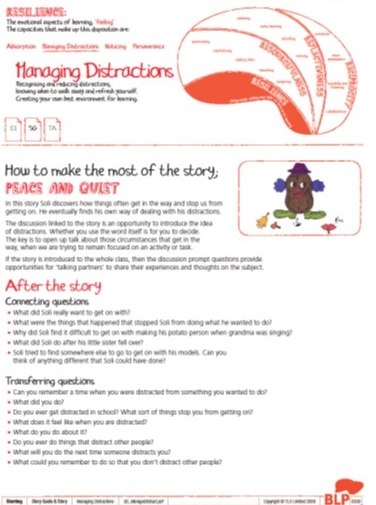
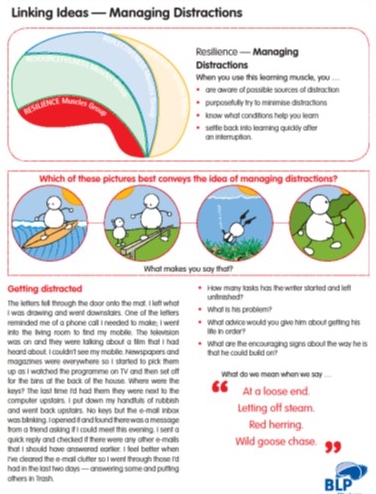
Here is a story about managing distraction in everyday life. Take a look at the sort of questions the text calls for….both the content and the underlying process being unpacked.
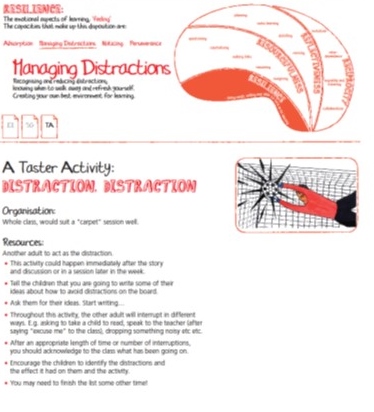
A quick starter activity to illustrate the meaning of distraction.
Explore the effects of distractions on pupils.
Secondary
Explore the meaning of effort
Effort is a word that teachers use frequently, but what does it mean? How might students decode this and begin to do it purposefully?
Explore what is meant by ‘effort’ with your students, and discuss with them the ways in which they might apply it.
Encourage them to come up with a definition of effort and specific examples of what it might look like in the classroom – for example by;
trying different strategies to solve a problem,
using a Visible Thinking Routine (VTR)
aiming to achieve challenging goals, or
using different un-sticking techniques when something is tricky.
paying attention to whoever is speaking.
2. Exploring the language of Managing Distractions
How you might extend the language and understanding of this behaviour
Primary
Talk about what distracts us.
Sometimes we are distracted by people, sometimes things can get in the way.
Have a discussion about these two types of distractions (people and things) and come up with lists of the different ways we can be put off by people and by things e.g. when we break a pencil, when we don’t have the things we need etc. Talk about what we could do in different situations.
Secondary
A way with words
To build up students’ understanding of distractions, use phrases like:
How did you keep going?
What could we do when we feel we are losing focus?
What sorts of things distract you most?
When are friends a distraction – or a source of inspiration?
What sorts of learning environment might be appropriate for different types of learning?
What internal distractions might we have? (tiredness, emotions, hunger, failure).
How could you let us know if we are distracting you?
You’re doing well with avoiding that distraction.
3. Using Managing Distractions as a lesson starter
Use a quick starter to key students into the learning behaviour you want to concentrate on in the lesson. i.e. here you are starting up the managing distractions behaviour
Primary and Secondary
Looking 10 x 2
Give students 30 seconds to look at a picture relevant to your topic.
Ask them to list ten things they noticed about the picture.
Repeat the process, seeing if they can list 10 more things about the picture.
This process can be repeated until no new ideas come forth.
Focusing effort has now engaged the learning behaviour known as attentive noticing.
As you get deeper into a lesson you will need activities which, by their very nature, will develop students’ distraction management AND their understanding of the content.
Here is an idea where, by managing distractions, students will gain an understanding of the content AND will develop the habit of managing distractions.
4. Focusing on Managing Distractions as a learning strategy
Draw out the distraction managing behaviour being used in a thinking routine.
Primary and Secondary
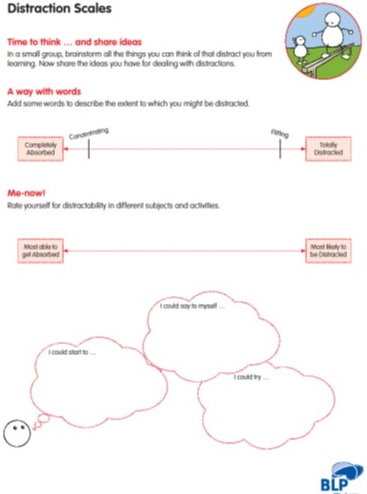
How distracted am I?
Teachers regularly take responsibility for keeping students on task, and in so doing manage distractions for their students. Many acquiesce, but some students remain prone to distraction and lack focus, despite our best endeavours.
The problem may lie in the fact that we have assumed responsibility for keeping them on task, thereby relieving them of taking responsibility for their own actions (or in-actions!).
Lemar Yr 6, Hannah Moore Primary School (click to enlarge)
Try turning the tables by making them responsible for monitoring their own distraction levels. This could be via a piece of laminated card with a clothes peg that is moved, at 5 minute intervals, along an axis from Distracted/Off task to Focused/On task. The same can be achieved with a distraction line drawn across the top of the page, again annotated at 5 minute intervals.
There is an irony in giving students who are readily distracted yet another source of distraction, but it may just be worth a try. What is there to lose? – if it works, you have found the holy grail, if it does not, then try something else!
And here is an idea that will help students to understand the distraction managing process.
5. An activity to highlight and strengthen Managing Distractions
Design specific activities to highlight and strengthen the behaviour
Exploring what it feels like
AIM To enable students to recognise;
What distractions are
What it feels like when being distracted
A range of distractions
What distracts them.
Set up the Learning Challenge
Pair up students — Student A, Student B.
A to describe a complicated process, e.g. tying a shoelace or tie.
B to try to distract by –
butting in –
looking bored –
looking elsewhere –
talking about how they would do it –
and so on 2 minutes.
Swap roles.
Plenary Discussion Explore:
What happened?
How were you distracted?
What did being distracted feel like?
How could you avoid or manage the distractions better?
Record Distractions
As a whole group, or in pairs, construct a list of things that distract people: – in the classroom – at home.
Prompt: Distractions may not be outside us, but in our heads …
Compare the lists. Draw out interesting / mundane distractions.
(Could be done using Post-its as a scan and focus exercise.)
6. Reflecting on Managing Distractions
Primary
Make reflecting on managing distractions part of everyday lessons
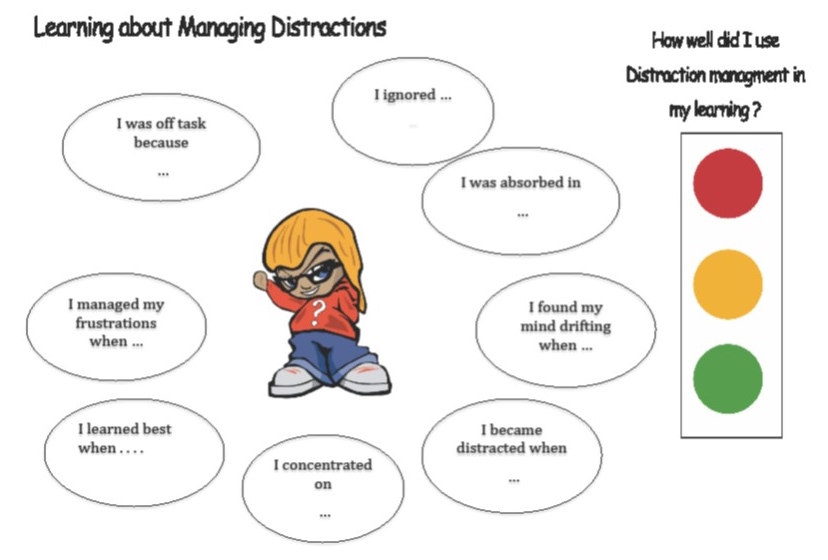
Here is a very practical example of how you might develop the emotional climate of the classroom and make it managing distractions friendly
Can you see a use for any of the suggested activities?
Have you raised awareness of managing distractions with your students?
Does your class have an agreed set of good managing distraction behaviours?
Which two ideas from above do you want to try out?
How long will you keep them going before you decide whether they have worked or not?
Make a note of…
What happens in your classroom in response to any of the above ideas.
How students’ behaviour changes over about 3 weeks of becoming more familiar and talking about the behaviour.
How your behaviour in the classroom changes as you use these ideas over time.
NB. None of the suggestions above will lead to instant understanding in students nor instant changes of behaviour. You will need to drip them in over time and keep building and refreshing your language of learning.
Building students’ Learning Power is about creating a culture in your classrooms – that systematically cultivates habits and attitudes that enable your students to learn confidently and face difficulty calmly and creatively. By a ‘culture’ we mean all the little habits, routines and practices that implicitly convey ‘what we believe and value round here’.
So ‘culture’ concerns the details of the micro-climate that you create in your classrooms. What you do and say, what you notice and commend and what you don’t, what kind of role model of a learner you offer: all these are of the essence. The micro-climate of a classroom can inadvertently stifle or, specifically enhance, the very behaviours you are seeking to promote.
Does my classroom climate encourage learners to manage distractions?
Here is a selection of features that might begin to shape the emotional climate of your classroom to encourage managing distractions.
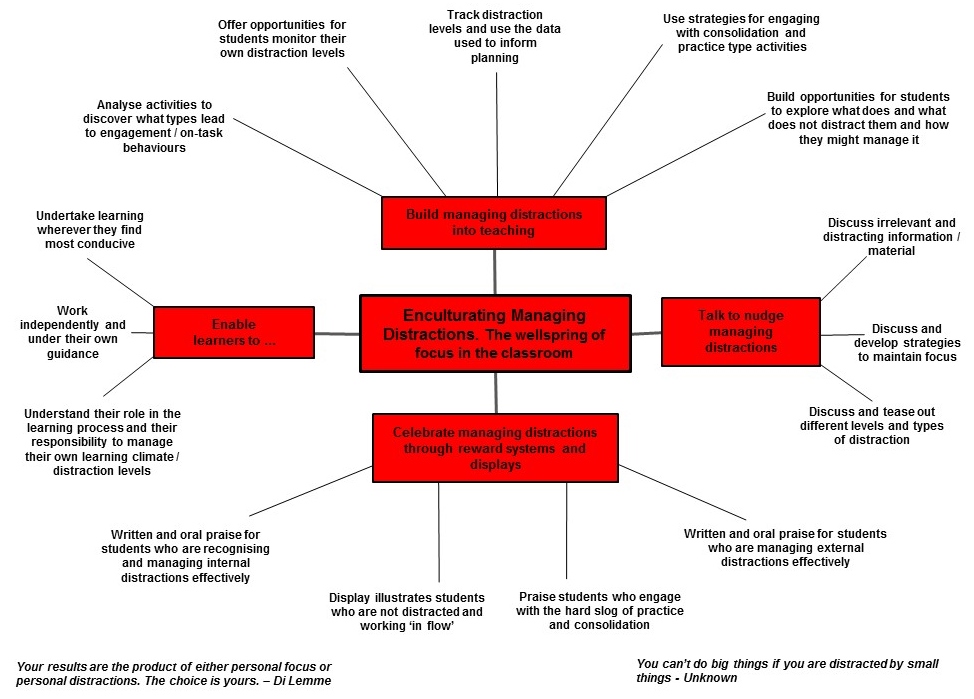
The diagram has 4 sections:
Top – strategies you could build into the way you teach to stimulate managing distractions;
Right – indications of the sort of language you might use to stimulate managing distractions;
Bottom – ways in which you might celebrate / praise students for managing distractions;
Left – things that you need to enable students to do.
Apply your own noticing and consider whether you already use any of these features and which you fancy trying.
Distractions threaten absorption. Distractions make it harder to concentrate. Distractions can get in the way of learning and make us lose our focus. Sometimes we are the source of our own distractions: if we are hungry, tired or anxious it’s hard to concentrate. Other times it may be the general hubbub of activity going on around that makes it difficult to stay focused. Sometimes the task or activity just doesn’t matter enough to us to keep us engaged.
Concentration can’t be forced, but we can help young children to recognise what is going on when they are finding it difficult to keep on task. In this way they will begin to develop a vocabulary to think and talk about what can get in the way of learning. We can help them to think about how they might deal with distractions, but in time they will develop their own strategies; what suits one person will not always work for someone else.
We shouldn’t have unrealistic expectations of younger children’s abilities to concentrate for long periods. At the same time we can learn a lot about the kinds of activities and experiences which seem to get them ‘locked on to learning’. Recognising this should help us to provide more of the same.
What does being a good Manager of Distraction involve/mean?
If you have a well formed distraction managing habit you will be ready, willing, and able to:
Have the inner confidence to stay on task and avoid getting involved in off-task conversations or activities
Be aware of the adverse impact of poor behaviour and have strategies for reducing this.
Work independently and need little support from their teachers to maintain focus and commitment
Recognise what distracts them and plan to avoid them e.g. finding a quiet space to work, avoiding the distractions of people / pets / internet and television
Take responsibility for their own distracting behaviours without blaming others
Deal with competing pressures. They are able to weigh up the instant gratification of distractions against the deferred gratification of good work / results / greater understanding
Manage the risk of appearing different to other students if it means concentrating and getting on with a task when others are not
Spot the Distraction Managers in your classes
Just to get you tuned in – have a quick think about ‘distraction managers you may know’. Make a note of students you know who display these characteristics.
Becoming a teacher who develops students’ learning power means developing a keen awareness of the subtleties of your students’ learning behaviours.
What do you think?
How many of your students come to mind when looked at through the lens of managing distractions?
Is there a gender balance or have you noted down more girls than boys or vice versa?
Are the students you have noted from across all age groups or do some dominate?
How do these distraction managing characteristics help these students to be better learners?
Make a note of…
Those groups or classes that seem to have lots of good distraction managing characteristics.
This section is for those teachers who are undertaking this unit alone and are not part of a Teacher Learning Communitystructure.
Cultivating learning habits ultimately involves:
Providing rich and varied occasions for exercising learning habits;
Infusing learning habits into lessons to enhance content understanding;
Recognising and celebrating the use and growth of learning habits;
Expecting students to take ownership of and responsibility for their own learning habits;
Exploring the development of learning habits with students over time.
As a teacher you are an influential character builder and so need to be mindful of how you help students form, replace, re-form and strengthen their learning habits. But don’t worry you are not expected to be there yet. It takes most teachers between 2 and 3 years to become really fluent with this way of teaching. So, go easy on yourself. Feel determined because small steps often prove to be big levers for change. Have a think about what you might do…
What to stop and start
Here are a few ideas you might want to try. Take it steady, this way of teaching can be a big but exciting shift so it’s worth doing it slowly and thoughtfully. Look first at the Stop/avoid ideas. Some of these are far from trivial but it’s best to try to remove them before starting on the Start/do more of, Start slowly and Experiment with ideas.
What do you think?
Which of the ideas appealed to you most?
Can you see ways of incorporating these into your subject/class routines?
Which would make the biggest difference to your students?
Which would make your life easier?
Make a note of…
The ideas that you want to try and the impact you hope they will have on your teaching and on your students.
Here is a range of things you could say to nudge curiosity. When you use this kind of language you are talking as a learning coach, encouraging students to think for themselves. Using such statements encourages your students to:
imitate you;
start to think in this way;
become conscious of these phrases and their meaning.
Gradually you will hear some of the ideas pop up in students’ self-talk….in speech or even in writing from time to time, but mostly these will go on inside their heads. As your work on questioning gathers pace see if you can detect students who talk, or think, in these ways.
My learning talk nudges to encourage Questioning
Teacher talk – as a learning coach
Here are 10 ideas to ensure your students do the thinking for themselves
That’s an interesting/insightful question.
What questions did we ask last time?
You might find it useful to try and predict what you think will happen.
Could you speculate about the possible results and solutions.
What sort of questions might help you get a bit further with this problem?
Do you believe that? Might there be more to it?
A closed question might focus your search.
How can you get to the bottom of this?
A hypothetical question might help to stimulate your ideas.
How can you phrase that so that you don’t upset people?
What do you think?
Which of these questioning nudges might you start using?
In which particular lessons would such nudging be most useful?
How will most of your students respond to such nudges?
Will this way of engaging be more popular with girls or boys?
What other nudging ideas might you add to the list?
Make a note of…
Students’ reactions to the nudges.
Ideas about why this might be.
Ways in which you could further encourage students to imitate this metacognitive self-talk.
Any positive or negative impact of these questioning behaviours.
Some ideas to enable students to become better questioners.
In the early stages of building your students’ learning power your role is to: make them aware of the behaviour; talk about it (what, how, why, when, if); celebrate its use; give opportunities to practise it, both in lessons and elsewhere; reflect on it to improve it. This staged start is reflected below…
Firstly… make students aware of the use and importance of questioning…when, where, why, how they are or could be doing it
Then… explore questioning a little more through the language of questioning
Try… using questioning as a lesson starter to tune students into using it
Then start… blending questioning into the way you teach the content. Use specific questioning strategies to deepen content understanding
Ensure… students reflect on the success or otherwise of their questioning mindframe.
1. Make students aware of Questioning
How you make your students aware of the actions and words that describe the behaviour and why it is important to use it.
Primary
Engage with a ‘mystery’ object in a bag
Invite pupils to ask questions to find out what the mystery object is.
Vary the complexity according to age and experience of class. Use clues to narrow down the possibilities for younger children e.g. it’s something you’d find in the garden. Young children will tend to want to ‘guess’. They will need encouragement to ask questions before offering solutions.
Ask talk partners to come up with two ‘I wonder’ questions e.g.” I wonder what it’s made of?”
Set a limit, say 10/15/20 questions allowing the children to guess before showing the object.
Key is to focus on the questions; acknowledge and reward good questions.
At the end compile a list of some of the useful/unusual/interesting questions that were asked.
Secondary
Question focused research
Ask students to;
research possible types of questions using the Internet.
record and analyse the types of questions used in their peer group
compare their research findings and their observations.
Use this to expand the range of questions used in class and to create guidelines for asking good (search) questions.
Primary
Put questions on display
Click to enlarge
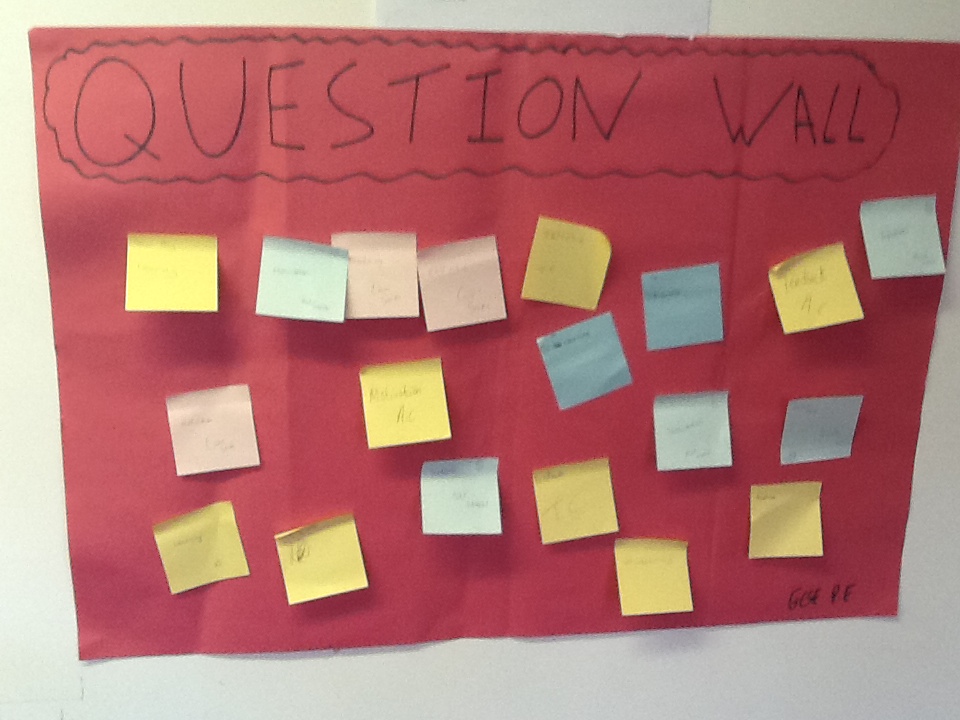
Create a Question Wall in the classroom to illustrate and prompt questioning. For example, the question wall might focus on student generated questions about the topic in hand. Use their questions to help to focus / shape their enquiry.
Establish ground rules for asking questions e.g. speaking clearly, think before you ask…is this an important/relevant question? Do I know the answer? Get to the point. Listen to the answer.
Secondary
Questions on display
Click to enlarge
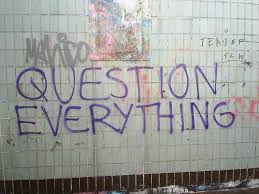
Create displays to support students’ questioning skills. Go on to
Discuss what sort of questions these are — open, closed, speculative, divergent, clarifying, essential, subsidiary
How they might lead to different types of information/reactions/strategies to gather information.
Draw up and display lists of generic questions to use whenever students undertake certain types of task, e.g. scientific investigation.
Refer to and extend these question groups regularly.
Create, with students, a set of questions they might ask when they are stuck. These might include; What did I do last time when . . . . ? What do I already know about this? What should I do first? And next? I am finding this tricky because . . . . Who might know? Where can I look?
2. Explore the language of Questioning
How you might extend the language and understanding of this behaviour
Primary
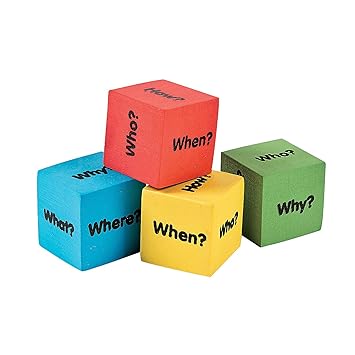
The why game
Start a story with an opening line. Encourage the students to keep on asking each other Why? and giving answers until they have created a story. Opening lines can be a simple
“The red van roared down the street”
but lead to all sorts of questions —“Why was the van red?” “Why was it roaring?” which lead on to other ‘Why?’ questions.
Vary the game by starting with a riddle or conundrum, or requiring different types of questions.
Use a quick starter to key students into the learning behaviour you want to concentrate on in the lesson. i.e. here you are starting up the questioning behaviour
Primary
Is your question important?
Identify a project which the class might investigate. Write a series of questions on separate pieces of cards and give each group a set of the cards. The group shuffle the cards and deal each student one card. They have to decide:
the best order for the questions, to do the project well
if they have to ask all the questions or whether some are irrelevant in the context
whether there are any missing questions and if so, what they might be
what they have learnt about questions from this.
Secondary
Questions you would like to ask
Tell students:
‘In 5 minutes, ‘something’ related to the upcoming lesson will walk in.
What are the three questions that we should ask it ?’
[The ‘something’ might be: a full stop; an improper fraction; osmosis; the Bible; a data base; the renaissance . . . . ]
[The ‘three’ is important – it encourages students to prioritise their questions and consider which are most likely to uncover the information they require and discourages ‘random’ asking.]
Here is an idea where, by using questioning, students will gain an understanding of the content AND will develop a questioning habit.
4. Focus on Questioning as a learning strategy
Draw out the questioning behaviour being used in a thinking routine.
Primary and Secondary
Visible Thinking Routine
Question Starts is a Visible Thinking Routine that provides students with the opportunity to practise developing good questions that provoke thinking and inquiry into a topic by offering a range of interesting question stems. For example:
Brainstorm a list of at least 12 questions about the topic, concept or object. Use these question-starts to help you think of interesting questions:
Why…?
How would it be different if…?
What are the reasons…?
Suppose that…?
What if…?
What if we knew…?
What is the purpose of…?
What would change if…?
Review the brainstormed list and star the questions that seem most interesting. Then, select one or more of the starred questions to discuss for a few moments.
Reflect: What new ideas do you have about the topic, concept or object that you didn’t have before?
5. An activity to highlight and strengthen questioning
Design specific activities to highlight and strengthen the behaviour
An activity to learn about questioning
Build a three-level ‘questioning habit‘
‘ReQuest’ is a structured process for deepening questions.
For example, start with a painting, in this case The Arnolfini Wedding by Jan van Eyck:
On-the-line questions: ask questions about the picture for which the answers can be seen just by looking closely at the picture: ‘How many candles are there?’ ‘What kind of room is it?’ ‘What is on the wall behind the people?’
Between-the-lines questions: questions whose answers can be inferred by looking at the picture: E.g. ‘What is the relationship between the two people?’ ‘How long ago was the picture painted?’ ‘What time of day is it?’
Beyond-the-line questions: questions whose answers need to be elicited by making interpretive links from the picture: E.g. ‘What did the artist think of his subjects?’ Is the number of candles significant?’ How does perspective work in the painting?
6. Reflect on Questioning
Primary
Make reflecting on questioning part of everyday lessons
Here is a practical example of how you might develop the emotional climate of the classroom and make it questioning friendly
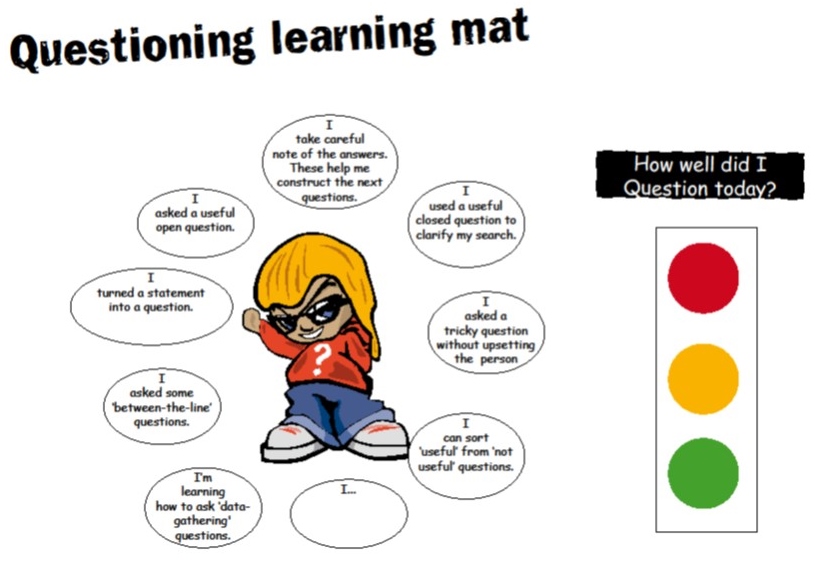
Learning mats are A4 laminated sheets that show various aspects of a learning habit. Keep them on desks/tables or as part of a wall display. Students refer to them during lessons, using them as prompts about the finer aspects of a learning habit that is being stretched.
Secondary
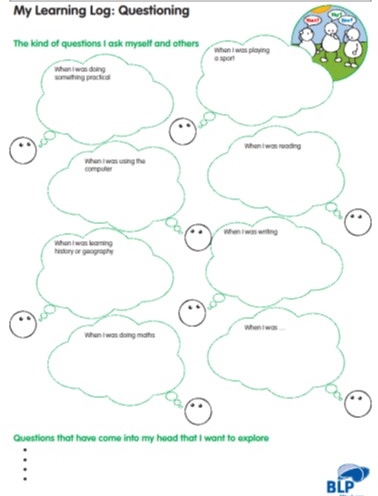
Reflect and build a powerful Question Bank
Give students time to reflect on the questions that students ask of themselves and of others in different situations. Which of these questions, when answered, proved to be the most powerful? Why was that? Which question, if asked, would be most likely to move thinking forward? Encourage students to build a bank of powerful questions that they can refer back to when necessary.
Can you see a use for any of the suggested activities?
Have you raised awareness of questioning with your students?
Does your class have an agreed set of good questioning behaviours?
Which two ideas from above do you want to try out?
How long will you keep them going before you decide whether they have worked or not?
Make a note of…
What happens in your classroom in response to any of the above ideas.
How students’ behaviour changes over about 3 weeks of becoming more familiar and talking about the behaviour.
How your behaviour in the classroom changes as you use these ideas over time.
NB. None of the suggestions above will lead to instant understanding in students nor instant changes in their behaviour. You will need to drip them in over time and keep building and refreshing your language of learning.
Building students’ Learning Power is about creating a culture in your classrooms – that systematically cultivates habits and attitudes that enable your students learn confidently and face difficulty calmly and creatively. By a ‘culture’ we mean all the little habits, routines and practices that implicitly convey ‘what we believe and value round here’.
So ‘culture’ concerns the details of the micro-climate that you create in your classrooms. What you do and say, what you notice and commend and what you don’t, what kind of role model of a learner you offer – all these are of the essence. The micro-climate of a classroom can inadvertently stifle, or specifically enhance, the very behaviours you are seeking to promote.
Does my classroom climate encourage Curiosity?
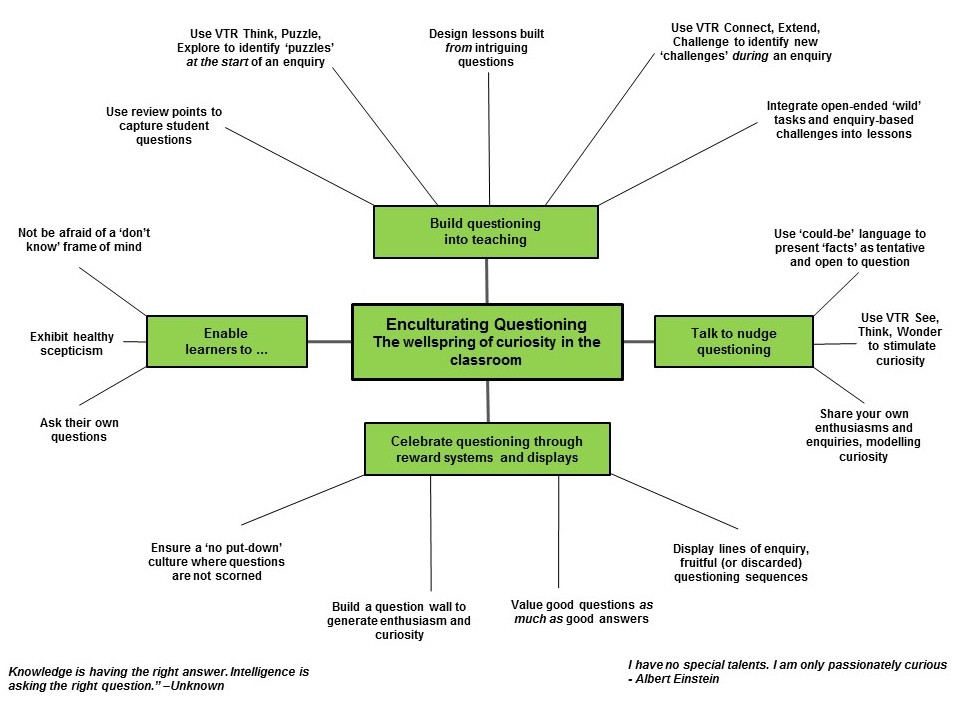
Here is a selection of features that might begin to shape the emotional climate of your classroom to encourage questioning.
The diagram has 4 sections:
Top – strategies you could build into the way you teach to stimulate questioning;
Right – indications of the sort of language you might use to stimulate questioning;
Bottom – ways in which you might celebrate / praise students’ use of questioning;
Left – things that you need to enable students to do.
Apply your own questioning skills and consider whether you already use any of these features and which you fancy trying.
Questioning means both the ability to ask good questions and the disposition to do so (which is sometimes called curiosity). Good learners like questions, and are not afraid of the ‘don’t know’ state of mind out of which questions emerge.
Good learners like to wonder about things. For them, it often really is a wonder-ful world. The phrases ‘How come?’ and ‘What if?’ are never far from their lips.
They value getting below the surface of things, and are less likely to accept uncritically what they are told. They like to come to their own conclusions. They are more willing to reveal their questions and uncertainties if they think it will help them learn.
Questioning can be as much non-verbal as it is verbal. Playing around with materials or ideas just to see what happens is a powerful way of asking questions. It is what artists and inventors spend a lot of their time doing. The inclination to ask questions flourishes when you are around people who are also asking questions, and who encourage and appreciate your questions too.
What does being a good Questioner involve?
A well formed Questioning habit involves being ready, willing, and able to:
Be curious about all experiences;
Dig beneath the surface, asking why something is happening as it is;
Play with ideas and possibilities;
Be systematic and adopt a logical approach — exploring a line of thought purposefully; posing questions that follow a rational path towards an emerging goal;
Be socially aware in asking questions of others, exhibiting genuine interest in other people;
Be comfortable with uncertainty and ambiguity; enjoy different points of view and contrary evidence.
Spot the questioners in your classes
Just to get you tuned in – have a quick think about ‘Questioners you may know’. Make a note of students you know who display these characteristics.
Becoming a teacher who develops students’ learning power means developing a keen awareness of the subtleties of your students’ learning behaviours.
What do you think?
How many of your students come to mind when looked at through the lens of questioning?
Is there a gender balance or have you noted down more girls than boys or vice versa?
Are the students you have noted from across all age groups or do some dominate?
How do these questioning characteristics help these students to be better learners?
Make a note of…
Those groups or classes that seem to have lots of good questioning characteristics.
This section is for those teachers who are undertaking this unit alone and are not part of a Teacher Learning Communitystructure.
Cultivating learning habits ultimately involves:
Providing rich and varied occasions for exercising learning habits;
Infusing learning habits into lessons to enhance content understanding;
Recognising and celebrating the use and growth of learning habits;
Expecting students to take ownership of and responsibility for their own learning habits;
Exploring the development of learning habits with students over time.
As a teacher you are an influential character builder and so need to be mindful of how you help students form, replace, re-form and strengthen their learning habits. But don’t worry, you’re not there yet. It takes most teachers between 2 and 3 years to become really fluent with this way of teaching. So, go easy on yourself. Feel determined because small steps often prove to be big levers for change. Have a think about what you might do…
What to stop and start
Here are a few ideas you might want to try. Take it steady, this way of teaching can be a big but exciting shift so its worth doing it slowly and thoughtfully. Look first at the Stop/avoid ideas. Some of these are far from trivial but it’s best to try to remove them before starting on the Start/do more of, Start slowly and Experiment with ideas.
What do you think?
Which of the ideas appealed to you most?
Can you see ways of incorporating these into your subject/class routines?
Which would make the biggest difference to your students?
Which would make your life easier?
Make a note of…
Ideas that you want to try and the impact you hope they will have on your teaching and on your students.
Here is a range of things you could say to nudge capitalising. When you use this kind of language you are talking as a learning coach, encouraging students to think for themselves. Using such statements encourages your students to:
imitate you;
start to think in this way;
become conscious of these phrases and their meaning.
Eventually you will hear some of the questions pop up in students’ self-talk….in speech or even in writing from time to time, but mostly these will go on inside their heads. As your work on capitalising gathers pace see if you can detect students who talk, or think, in these ways.
Learning-talk nudges that encourage Capitalising
Teacher talk – as a learning coach
(To ensure students do the thinking for themselves)
What could we use to help us with this?
What led you to choose to use that?
Look very carefully at someone you think is doing …… really well and think about how you can do it like that
Could you tackle this by imagining someone who does it really well?
What sort of reference / resource do you need here?
Look around. See what is available to help. How could you use it?
Could you work this out for yourself first before looking for more information?
Who could you turn to for help?
Think through the strategies you might use.
Which is the best learning strategy for this job?
What do you think?
Which of these capitalising nudges might you start using?
In which particular lessons would such nudging be most useful?
How will most of your students respond to such nudges?
Will this way of engaging be more popular with girls or boys?
What other nudging ideas might you add to the list?
Make a note of…
Students’ reactions to the nudges.
Ideas about why this might be.
Ways in which you could further encourage students to imitate this metacognitive self-talk.
Any positive or negative impact of these collaboration behaviours.

 Reflectiveness — Distilling


![BLP_Brain_Generic_no-Rs-[Converted]](https://www.buildinglearningpower.com/wp-content/uploads/2016/12/BLP_Brain_Generic_no-Rs-Converted.png)