
C. Lesson planning in action – an exemplar perseverance task.
How do we design tasks that stretch perseverance and assist pupils to approach the content more productively? We cover this in four ways:
- 1 describes the Think/Puzzle/Explore visible thinking routine;
- 2 shows the phases of a lesson where Think/Puzzle/Explore is embedded;
- 3 invites you to extend your thinking about the Think/Puzzle/Explore technique and introduces another subtly different thinking routine.
Open Me
Prelude
Because appropriate levels of challenge, for each individual learner – hard, but not too hard – should be a feature of all lessons, it follows that rising to challenge and persevering in the face of difficulty should be a feature of learning in all such lessons. The reality is often that a few learners are indeed appropriately challenged, whereas others are faced with work that no amount of effort and perseverance will conquer as the subject matter is beyond their extended grasp, while others effortlessly cruise through the material with no need for perseverance in tackling tasks / concepts that they find undemanding.
When teachers link perseverance to a piece of curriculum content, too often they mean that they want their learners to ‘try hard’, rather than develop a particular skill / attitude from the perseverance progression chart. This begs the question ‘what type of trying hard are we talking about?, and the answer may be that learners need to ‘try hard’ by using their reasoning skills, or their listening skills, or their noticing skills etc. It follows that explicitly linking reasoning, or listening, or noticing etc, would be more appropriate. It is for this reason that some schools advise teachers not to link perseverance to content as it can conceal rather than illuminate the type of effort that is required.
Here we focus on a visible thinking routine that encourages learners to develop skills drawn from the ‘Orientation to Goals’ column of the perseverance chart.
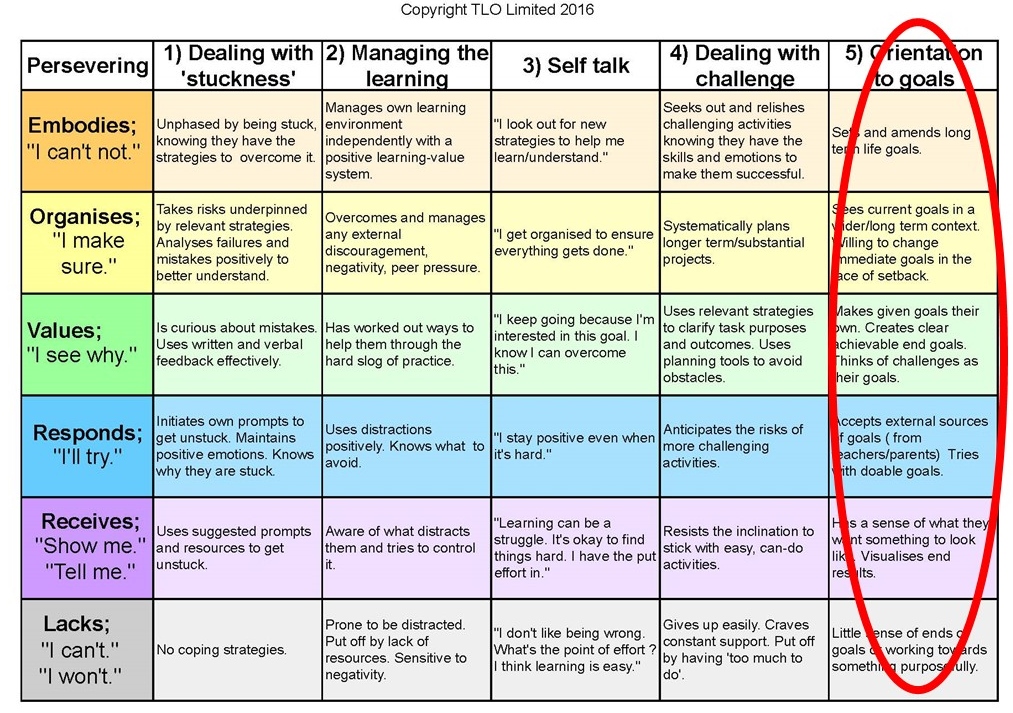
1. A description of the Think / Puzzle / Explore thinking routine
The following lesson is based around a visible thinking routine from the Visible Thinking website.
[Follow the link to see T/P/E and all of the other Visible Thinking routines.]Think / Puzzle / Explore – A routine that sets the stage for deeper inquiry.
The routine uses three questions:
- What do you think you know about this topic?
- What questions or puzzles do you have?
- What does the topic make you want to explore?
Purpose: What kind of thinking does this routine encourage?
This routine activates prior knowledge, generates ideas and curiosity, and sets the stage for deeper inquiry.
Application: When and where can I use it?
This routine works especially well when introducing a new topic, concept, or theme in the classroom. It helps students take stock of what they already know and then pushes students to identify puzzling questions or areas of interest to pursue. Teachers can get a good sense of where students are on a conceptual level and, by returning to the routine over the course of study, they can identify development and progress. The third question is useful in helping students lay the ground work for independent inquiry.
Launch: What are some tips for starting and using this routine?
With the introduction of a new topic—for example, earth, leaves, fractions, Buddhism—the class can engage in the routine together to create a group list of ideas. Between each phase of the routine, that is with each question, adequate time needs to be given for individuals to think and identify their ideas. You may even want to have students write down their individual ideas before sharing them out as a class. In some cases, you may want to have students carry out the routine individually on paper or in their heads before working on a new area.
Keep a visible record of students’ ideas. If you are working in a group, ask students to share some of their thoughts and collect a broad list of ideas about the topic on chart paper. Or students can write their individual responses on post-it notes and later add them to a class list of ideas.
Note that it is common for students to have misconceptions at this point—include them on the list so all ideas are available for consideration after further study. Students may at first list seemingly simplistic ideas and questions. Include these on the whole class list but push students to think about things that are truly puzzling or interesting to them.
2. A lesson that has uses Think / Puzzle /Explore to support curriculum understanding.
Overview of lesson plan:
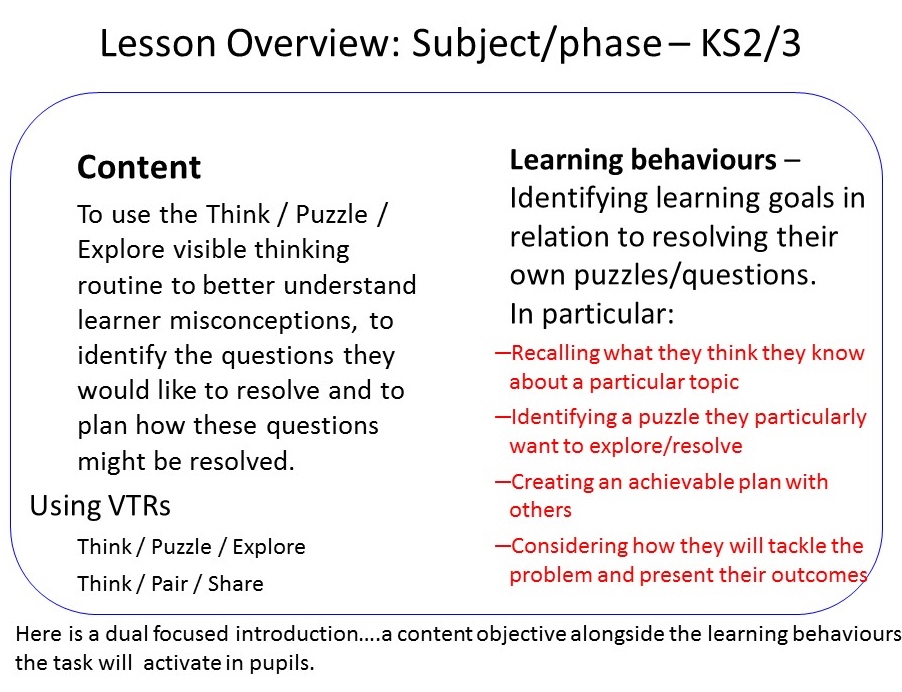
[Previous Episodes – Learning something about upcoming curriculum content
What is happening here?
The routine Think/Puzzle/Explore is used before some new learning takes place, but only if learners have some previous knowledge of the content in hand. This knowledge may have been acquired earlier in school, or it may simply be something they know about from personal experience. Without such prior knowledge, it is impossible to access the Think stage, and maybe even the Puzzle stage.]
Episode 1 – What do you think you know about xxx?
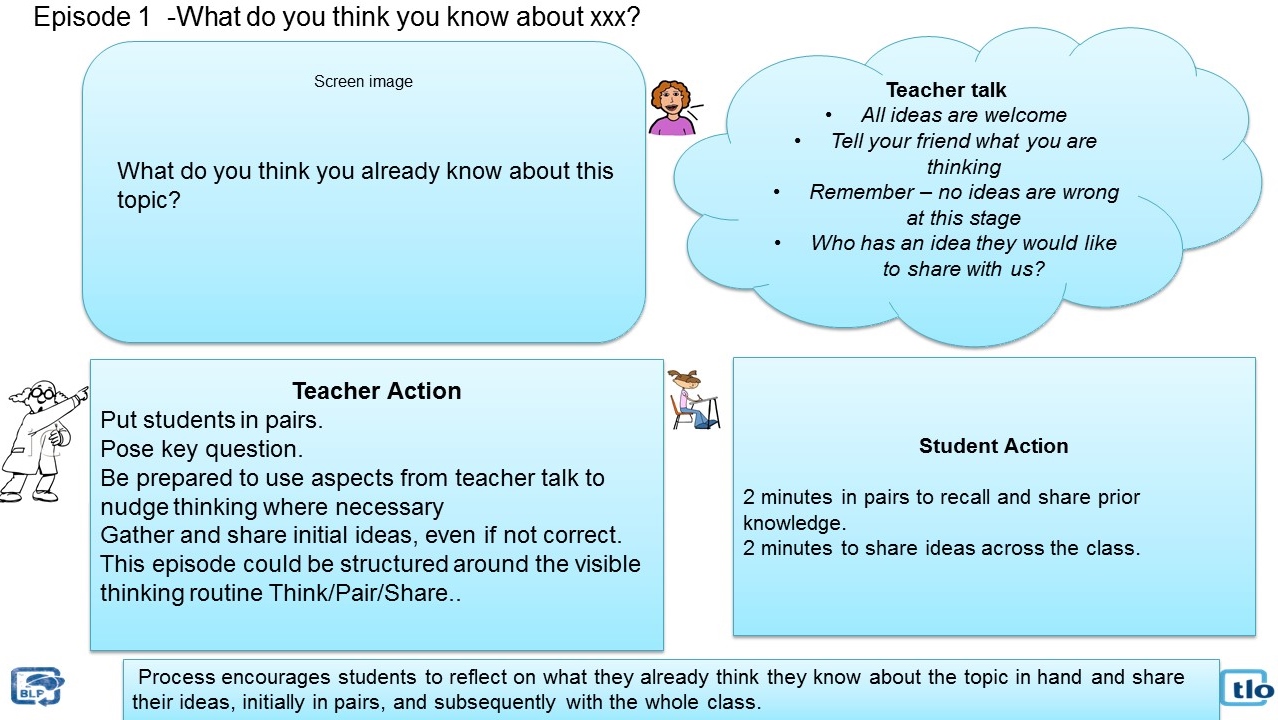
What is happening here?
In this Episode, pupils are encouraged to think back to what they already know of the content / topic.
[This would obviously not work if they had no prior knowledge of the topic being studied. It may have been worth checking this out before embarking on the lesson/topic by asking pupils informally what they know about xxx. It is a classic way of identifying misconceptions that can be addressed through the upcoming session(s)].In the bottom blue box, the Learning Behaviours being activated are simply identified as:
- Process encourages students to reflect on what they already think they know about the topic in hand and share their ideas, initially in pairs, and subsequently with the whole class.
This phase of the lesson is not activating much in the way of working towards goals, but it is creating buy-in by signalling that the lesson is going to relate to what they already know rather than what the teacher intends to teach. Nonetheless, a blend of recall and social behaviours is being activated in the Think phase.
Episode 2 – What puzzles and questions do you have about this topic?
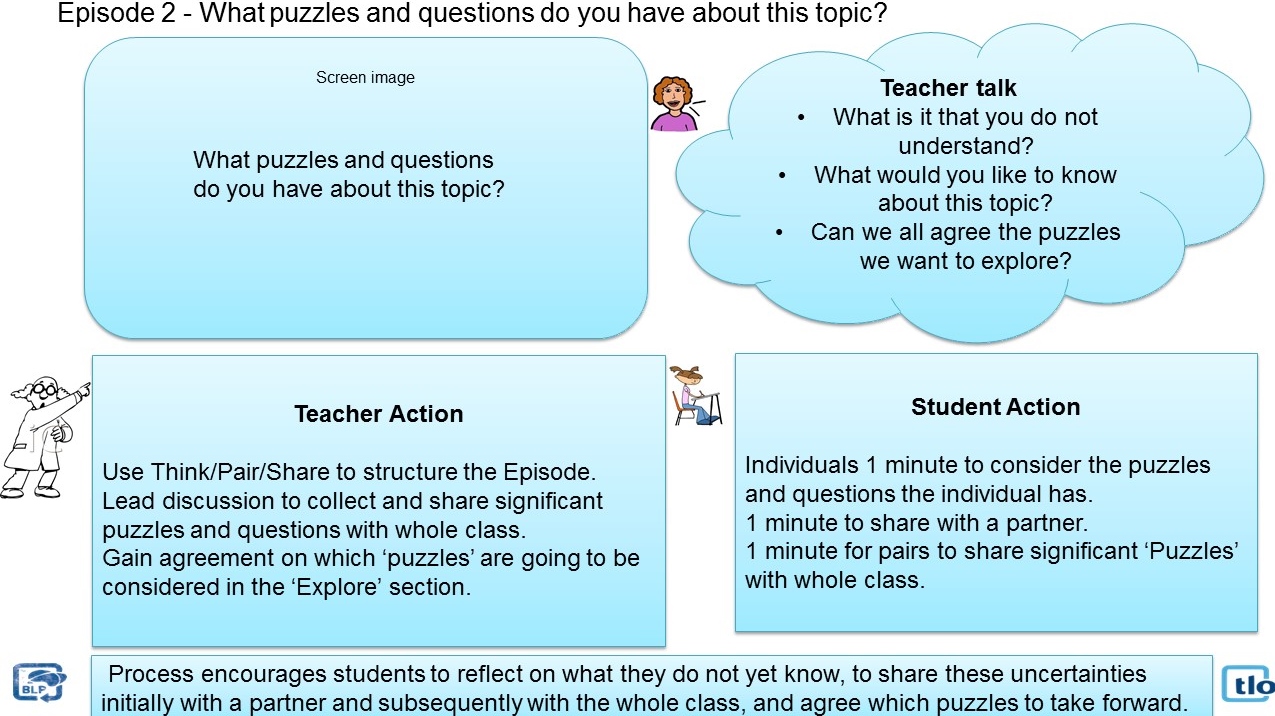
What is happening here?
Having used the Think phase to remind pupils of what they think they know about the topic, the Puzzle phase encourages pupils to consider whet they do not yet know, the questions that are bubbling up in their thoughts, and the things that they are interested in resolving. Where Episode 1 was looking backwards, Episode 2 turns to lens to considering the future.
Some initial misconceptions may have been resolved by the contributions of other learners. Equally some new Puzzles may have arisen from these contributions.
In the bottom blue box, the Learning Behaviours being activated are summarised as:
- To encourage students to reflect on what they do not yet know, to share these uncertainties initially with a partner and subsequently with the whole class, and agree which puzzles to take forward.
Essentially, the addition of the ‘Puzzle’ aspect of T/P/E lifts the requirements further. Episode 2 encourages pupils to consider what they do not yet know rather than, as in Episode 1, what they think they know. They are invited to share their uncertainties, to discuss and agree which ‘puzzles’ are worthy of further investigation. As in Episode 1, the message is that the learning is to rooted in what they want to find out.
Episode 3 – How might you explore this topic?

What is happening here?
Having used the Think phase to help students to make links to what they already think they know, and the Puzzle phase to identify future learning, Episode 3 puts like-minded students into groups to plan how to explore a Puzzle that they are all interested in.
In the Explore phase, pupils are encouraged to consider how, together, they will go about resolving their particular puzzle.
In the bottom blue box, the Learning Behaviours being activated are summarised as:
- To encourage students to visualise what they seeking to achieve and to create achievable plans to realise their goals.
The ‘Explore’ aspect of T/P/E encourages pupils to develop a sense of what they want something to look like and visualise end results (Orientation to Goals, Purple phase on the Perseverance chart) and to create clear achievable end goals that they think of as their goals (Orientation to Goals, Green phase).
Can you see how this is a much more forensic approach to building perseverant learning behaviours than simply encouraging students to ‘keep going’ or ‘try hard’?
The powerpoint can be downloaded here if you wish:
Download PowerPointWhat do you think?
- Can you think of a situation in which you could use Think/Puzzle/Explore to advantage in your own classroom?
Make a note of…

- When you might try this.
- How you capture the ‘Puzzles’.
3 Extend your thinking about the Think/Puzzle/Explore visible thinking routine
Introducing another visible thinking routine:
Connect Extend Challenge – A routine for connecting new ideas to prior knowledge.
The routine uses three questions:
- How are the ideas and information presented CONNECTED to what you already knew?
- What new ideas did you get that EXTENDED or pushed your thinking in new directions?
- What is still CHALLENGING or confusing for you to get your mind around? What questions, wonderings or puzzles do you now have?
Purpose: What kind of thinking does this routine encourage?
The routine helps pupils make connections between new ideas and prior knowledge. It also encourages them to take stock of ongoing questions, puzzles and difficulties as they reflect on what they are learning.
Why use Connect/Extend/Challenge?

The whole point of the strategy is not that it should be used occasionally at the end of a project as a sort of topic plenary, rather it should be used frequently so that it should in time become habituated so that pupils’ responses to all new learning is to use it to further enhance and refine their web of understanding. Furthermore, the ‘challenges’ that arise help to focus the next steps for both teaching and learning.
Think/Puzzle/Explore
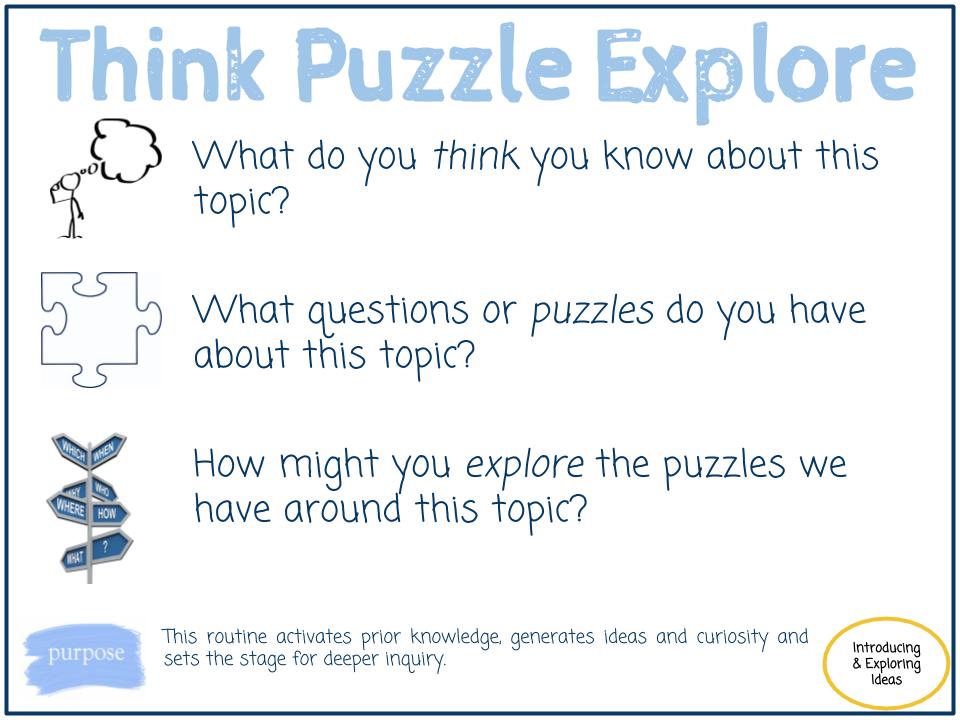
The visible thinking routine Think/Puzzle/Explore has three driving questions:
- What do you think you know about this topic?
- What questions or puzzles do you have?
- How can you explore this topic?
It is similar to but subtly different from Connect/Extend/Challenge. On the surface, ‘Connect’ and ‘Think’ are similar, as are ‘Challenge’ and ‘Puzzles’. Extend is missing from T/P/E because it is designed to be used before the new learning takes place, whereas C/E/C is used after new learning has taken place. The addition of ‘Explore’ encourages and sets the scene for higher levels of learner independence than C/E/C, which is more heavily teacher directed.
As learners mature, it should be possible to use T/P/E as a stimulus to independent enquiry, and C/E/C as an ongoing review tool during such enquiry.
What do you think?
- Where / when / why might you use T/P/E?
- Where / when / why might you use C/E/C?
- Which of these routines do you think would work best with your students? How will you find out?
- How will you use the ‘puzzles/challenges’ that are generated?
- How will these ‘puzzles/challenges’ inform your planning?
- How will you enable pupils to undertake what they would like to ‘Explore’ so as to support their growth as independent enquirers?
Make a note of…
- Which class you might try these visible thinking routines with.
- When you will try it.
Broaden your repertoire - Reasoning
Reasoning—the kind of logical, analytical, explicit disciplined thinking that schools often focus on, and that can easily built into learning objectives.
What do we mean by Reasoning ?
There is a lot of interest at the moment in ways of teaching thinking, and in building students’ Learning Power, such ‘Show your working’ kinds of thinking are a very important part of the good learner’s toolkit, although not the be-all and end-all of learning. In fact, research suggests that secondary schools have not been very successful at developing students’ ability to think logically in real life.
It turns out to be quite difficult to free any kind of thinking or learning skill from its ties to the particular setting and subject matter in which it was originally practised.
Nevertheless, being able to construct logical arguments or make practical use of Venn diagrams, for example, is very useful, and good learners need practice at using such tools in the context of their real-life concerns.
What does being a good Reasoner involve ?
A well formed Reasoning habit involves being ready, willing, and able to:
- Resist jumping to conclusions;
- Seek justifiable evidence to shape sound, well-honed arguments;
- Scrutinise your assumptions;
- Seek evidence and counter evidence, look for false steps and carefully draw conclusions;
- Remain suspicious, doubting and self-doubting in order to avoid unwarranted certainty;
- Convey your logical thinking clearly, through dialogue, symbols, analogies, prose and pictures.
So, at a less abstract level, students need to learn the inclination to resist impulsive responses; to respond logically and thoughtfully; to apply logic by explaining, justifying and, ultimately, proving what they think; to utilise a range of reasoning tools; and to develop strategies for presenting their reasoning to others persuasively. When looked at from these diverse angles growing reasoning moves well beyond encouraging a student to ‘think it through’.
Spot the Reasoners in your classes
Just to get you tuned in – have a quick think about ‘Reasoners you may know’. Make a note of students you know who display these characteristics.
Becoming a teacher who develops students’ learning power means developing a keen awareness of the subtleties of your students’ learning behaviours.
Does my classroom climate encourage Reasoning ?
Building students’ Learning Power is about creating a culture in your classrooms – that systematically cultivates habits and attitudes that enable your students to learn confidently and face difficulty calmly and creatively. By a ‘culture’ we mean all the little habits, routines and practices that implicitly convey ‘what we believe and value round here’.
So ‘culture’ concerns the details of the micro-climate that you create in your classrooms. What you do and say, what you notice and commend and what you don’t, what kind of role model of a learner you offer – all these are of the essence. The micro-climate of a classroom can inadvertently stifle, or specifically enhance, the very behaviours you are seeking to promote.
Here is a selection of features that might begin to shape the emotional climate of your classroom to encourage reasoning.
Apply your own reasoning and consider whether you already use any of these features and which you fancy trying.
What to stop and start
Cultivating learning habits ultimately involves:
- Providing rich and varied occasions for exercising learning habits;
- Infusing learning habits into lessons to enhance content understanding;
- Recognising and celebrating the use and growth of learning habits;
- Expecting students to take ownership of and responsibility for their own learning habits;
- Exploring the development of learning habits with students over time.
As a teacher you are an influential character builder and so need to be mindful of how you help students form, replace, re-form and strengthen their learning habits. But don’t worry, you’re not there yet. It takes most teachers between 2 and 3 years to become really fluent with this way of teaching. So, go easy on yourself. Feel determined because small steps often prove to be big levers for change. Have a think about what you might do…
Here are a few ideas you might want to try. Take it steady, this way of teaching can be a big but exciting shift so it’s worth doing it slowly and thoughtfully. Look first at the Stop/avoid ideas. Some of these are far from trivial but it’s best to try to remove them before starting on the Start/do more of, Start slowly and Experiment with ideas.
Broaden your repertoire - Capitalising
How can teachers create classrooms that encourage learners to capitalise on the hints and strategies that are displayed?
What do we mean by Capitalising ?
Capitalising means being on the lookout for strategies, materials, resources and forms of support in the environment that can help you in your current learning or problem- solving. Traditional schooling assumes that intelligence is all in the head. But recent studies show that it is much fairer and more accurate to see good learners as people who are ready and able to make intelligent use of all kinds of things around them – books, phones, social media, e-mail, the internet, and, of course, a range of learning strategies and other people. Everyone needs to be good at finding and using the learning resources available in the world, so it is obviously a good idea to start developing this habit at school.
The forms of assessment we use in schools have a powerful influence on the kinds of learning that students do, and the kinds of teaching their teachers use. If the good learner is essentially the person plus their resources (and their ability to draw on them), our methods of testing should encourage teachers and students to value and practise capitalising. In today’s world, it makes as much sense to sit 15-year-olds down at solitary desks and ask them to display their knowledge and skill as it would to take away Wayne Rooney’s football and tell him to perform.
What does being a good at Capitalising involve ?
A well formed Capitalising habit involves being ready, willing, and able to:
- Recognise that we learn from many different sources – other people, books, the internet, music, the environment, experience…
- Select appropriately from a range of learning strategies;
- Keep a purposeful look-out for useful learning aids;
- Adapt and adopt the successful habits and values of others into their own learning repertoire;
- Make intelligent use of all kinds of things to aid learning;
- Use resources in novel ways to solve problems.
Spotting the Capitalisers in your classes
Just to get you tuned in – have a quick think about ‘capitalisers you may know’. Make a note of students you know who display these characteristics.
Becoming a teacher who develops students’ learning power means developing a keen awareness of the subtleties of your students’ learning behaviours.
Does my classroom climate encourage Capitalising ?
Building students’ Learning Power is about creating a culture in your classrooms – that systematically cultivates habits and attitudes that enable your students to learn confidently and face difficulty calmly and creatively. By a ‘culture’ we mean all the little habits, routines and practices that implicitly convey ‘what we believe and value round here’.
So ‘culture’ concerns the details of the micro-climate that you create in your classrooms. What you do and say, what you notice and commend and what you don’t, what kind of role model of a learner you offer – all these are of the essence. The micro-climate of a classroom can inadvertently stifle, or specifically enhance, the very behaviours you are seeking to promote.
Here is a selection of features that might begin to shape the emotional climate of your classroom to encourage capitalising.
Apply your own attentive noticing and consider whether you already use any of these features and which you fancy trying.
What to stop and start
Cultivating learning habits ultimately involves:
- Providing rich and varied occasions for exercising learning habits;
- Infusing learning habits into lessons to enhance content understanding;
- Recognising and celebrating the use and growth of learning habits;
- Expecting students to take ownership of and responsibility for their own learning habits;
- Exploring the development of learning habits with students over time.
As a teacher you are an influential character builder and so need to be mindful of how you help students form, replace, re-form and strengthen their learning habits. But don’t worry, you’re not there yet. It takes most teachers between 2 and 3 years to become really fluent with this way of teaching. So, go easy on yourself. Feel determined because small steps often prove to be big levers for change. Have a think about what you might do…
Here are a few ideas you might want to try. Take it steady, this way of teaching can be a big but exciting shift so its worth doing it slowly and thoughtfully. Look first at the Stop/avoid ideas. Some of these are far from trivial but it’s best to try to remove them before starting on the Start/do more of, Start slowly and Experiment with ideas.
Broaden your repertoire - Listening
Having a language to talk about the learning process is the first stage in understanding the learning process and yourself as a learner, hence why it is so important that teachers talk ‘learnish’. But are students attentive to these changes that teachers are making? Are they really listening to what is being said?
What do we mean by Listening ?
Understanding how to listen effectively is an essential skill that benefits everything from family life to business. It’s one of the most critical skills for working effectively in teams. Hearing and listening are different. There’s all sorts of faulty listening. Sometimes we fake it or pretend to listen; sometimes we only respond to the remarks we are interested in and reject the rest. Sometimes we listen defensively and take innocent remarks as personal attacks. Or, we listen to collect information to use to attack the speaker, or we avoid particular topics, or we listen insensitively and can’t look beyond the words for other meanings, or we turn the conversation to ourselves. So, listening is hard and requires effort. To be a good listener you need to be able to listen for information, listen to judge the quality of the information and listen empathetically to build a relationship and help solve a problem. When looked at from these diverse angles growing Listening moves well beyond encouraging a student to ‘do good listening’.
What does being a good Listener involve ?
A well formed Listening habit involves being ready, willing, and able to:
- Be genuinely interested in other people and what they are saying;
- Focus on the current moment, being attentive and responsive to visual cues and atmosphere;
- Notice subtle details and nuances in what is being said;
- Know when to make well-judged interventions to elucidate, probe or challenge;
- Manage distractions constructively;
- Be comfortable with silence and attend actively to what is being said.
Spot the Listeners in your classes
Just to get you tuned in – have a quick think about ‘listeners you may know’. Make a note of students you know who display these characteristics.
Becoming a teacher who develops students’ learning power means developing a keen awareness of the subtleties of your students’ learning behaviours.
Does my classroom climate encourage Listening ?
Building students’ Learning Power is about creating a culture in your classrooms – that systematically cultivates habits and attitudes that enable your students to learn confidently and face difficulty calmly, and creatively. By a ‘culture’ we mean all the little habits, routines and practices that implicitly convey ‘what we believe and value round here’.
So ‘culture’ concerns the details of the micro-climate that you create in your classrooms. What you do and say, what you notice and commend and what you don’t, what kind of role model of a learner you offer – all these are of the essence. The micro-climate of a classroom can inadvertently stifle, or specifically enhance, the very behaviours you are seeking to promote.
Here is a selection of features that might begin to shape the emotional climate of your classroom to encourage Listening.
Apply your own learning habits and consider whether you already use any of these features and which you fancy trying.
What to stop and start
Cultivating learning habits ultimately involves:
- Providing rich and varied occasions for exercising learning habits;
- Infusing learning habits into lessons to enhance content understanding;
- Recognising and celebrating the use and growth of learning habits;
- Expecting students to take ownership of and responsibility for their own learning habits;
- Exploring the development of learning habits with students over time.
As a teacher you are an influential character builder and so need to be mindful of how you help students form, replace, re-form and strengthen their learning habits.
But don’t worry, you’re not expected to be there yet. It takes most teachers between 2 and 3 years to become really fluent with this way of teaching. So, go easy on yourself. Feel determined because small steps often prove to be big levers for change. Have a think about what you might do…
Here are a few ideas you might want to try. Take it steady, this way of teaching can be a big but exciting shift so it’s worth doing it slowly and thoughtfully.
Look first at the Stop/avoid ideas. Some of these are far from trivial but it’s best to try to remove them before starting on the Start/do more of, Start slowly and Experiment with ideas.
Broaden your repertoire - xxxx
Some text linking the learning behaviour to the section
What do we mean by
Download Spotting the planners in your classes
Below are the 3 standard layouts we have used.
1) STANDARD LHS AND RHS
Title
Text across the top
LHS Title
LHS Text
2) STANDARD TOGGLE BOX
Read more
Title
text
3) TOGGLE BOX WITH TABS
toggle box with tabs
Heading
This section pulls together the ideas that will best help students to xxxxxxxxx. The cluster headings are:
- Over to you
- Talk learnish
- Lessons
- Displays
DELETE FROM HERE ON ONCE ABOVE IS AGREED
Where next page as at 6 July before restore
Interest piqued?
Students re-energised?
Job completed?
No, there’s so much more you could do to help your students engage with their learning. You’ve taken the first essential step with their Emotional engagement; without that students wouldn’t be ready, willing or able to engage other productive learning behaviours. It’s been a great place to start but an awful way to finish. What are those ‘other productive learning behaviour’, and how might you enable your students to use them?
Take a look at a couple of suggestions about what you could do next.
I think this should be an engaging picture of someone who is questioning/musing/wondering what next.
Suggestion 1: Playing the whole Learning Power game
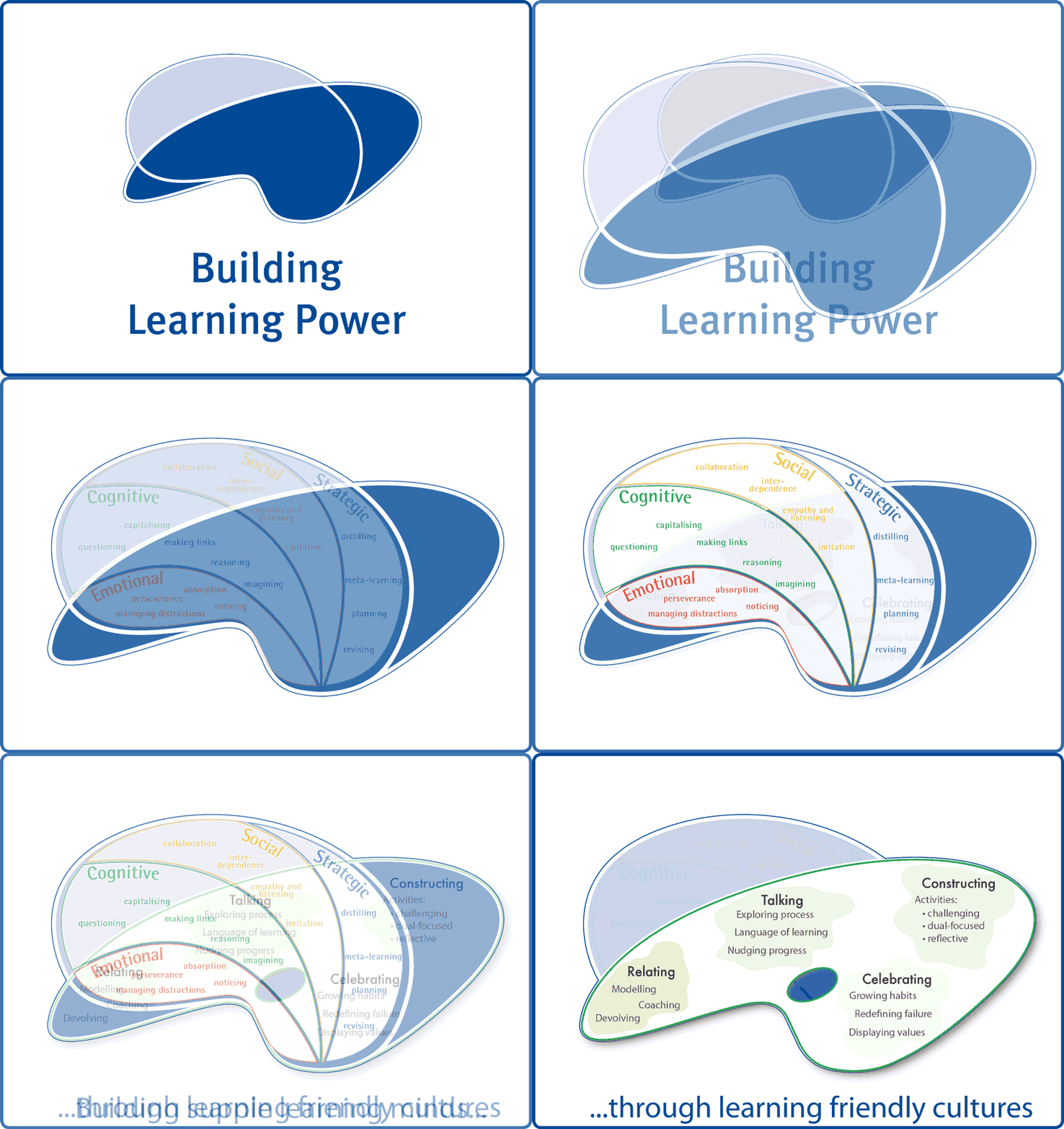
‘Playing the whole Learning Power game’ helps a school to take a school-wide, strategic approach to building better learners in learning-friendly classroom cultures.
It has two parts, one for classroom practitioners and one for senior leaders
Playing the Learning Power game ( classroom practitioners) offers you around a year’s worth of development materials, all designed to make your classrooms more learning-friendly. Since it’s about the ‘whole game’ of learning power rather than just bits and pieces, it introduces all the key learning behaviours before focusing on the four most important for your students’ emotional engagement, their cognitive range, their social adeptness and, critically, their strategic awareness: Curiosity; Collaboration; Perseverance and Revising.
The programme is laid out in the same way as the materials in this course so you will be able to find your way around it very easily. We estimate each section will take about an hour to read and digest and has enough material for you to trial and perfect in your classroom over several weeks. You are unlikely to need deeper material for at least a couple of terms.
Playing the Learning Power game ( strategic issues) is designed to give senior leaders an overview of the strategic issues involved in taking ‘Playing the Learning Power game’ on board. It provides resources that leaders might use to introduce the purpose benefits and frameworks of learning power to staff, and to maintain momentum into the future. It has a key section that supports senior leaders to think through how they intend to start and sustain interest in ‘Playing the Learning Power game’ and resources such as PPts and resource books to aid an introduction to staff.

Suggestion 2: Helping your learners to…
The ‘Help your learners to . . . ‘ modules offer activities, think pieces and questions to help teachers make a start on:
- introducing students to one of the key learning behaviours;
- using the language of learning effectively with students;
- designing the use of learning behaviours into the way they teach;
- developing the confidence and skill in helping students to grow their learning power.
They are suitable for both primary and secondary schools with example activities for both
There are 3 bundles of modules to choose from, or, better still, get them all and enjoy a significant discount.
Bundle 1: Helping your learners to . . . . . Question, Make links, Reason, Imagine and Resource learning
This suite of 5 online modules serves to help teachers to assist students to develop their dispositions and inclinations in the cognitive or thinking aspects of learning.
Bundle #2: Helping your learners to…. Collaborate, Listen, Empathise and Learn independently
This bundle of 4 online modules serves to serves to help teachers to assist students to develop their dispositions and inclinations in the social aspects of learning.
Bundle #3: Helping your learners to…. Plan, Revise, Distil and Meta Learn.
This bundle of 4 online modules serves to serves to help teachers to assist students to develop their dispositions and inclinations in the meta-cognitive aspects of learning.
The BIG Bundle #4: All 13 modules.
All these modules tackle introducing learning behaviours, spotting them in your students, using them productively in lessons, talking about them confidently and planning their use alongside other colleagues. This route is broader than ‘Playing the whole Learning Power game’, but goes into less depth and does not cover progression.
Take a look
Helping your learners to Notice
To give you a flavour of a ‘Help your learners to . . . ‘ module, take a look at this one free of charge. It addresses how teachers might help learners to develop the habit of attentive noticing.
All other ‘Help your learners to’ modules are similarly structured.
Things to download
LINK TO ORDERING/LANDING PAGE
Link to Help your learners to Notice Download
The layout of the resource
The four key sections of this resource are laid out identically to ensure consistency and to make them easier to navigate.
Text on the left hand side
Text on the left hand side is for information. It gives an overview of what the section is about.
On the right hand side . .
There might be:
- further text;
- key points;
- a video to watch;
- an illustration / image.
Below the blue box on the right
Where appropriate, there are one or two download buttons that might lead you to:
- something to view, download or print;
- a quiz;
- a link to a blog.
After each subsection there are Read More panels containing ‘how to’ ideas, further examples and deeper explanations.
There are two types of Read More panels:
- All panels that are named ‘Ideas for nudging . . . . . . ‘ contain differentiated ideas for classroom practice;
- All other panels offer further examples and/or deeper explanations.
How to make it work best
- Read the introduction and think about which of the four ‘re-engagements’ is needed first by your students.
- Go to the appropriate section and skim down the content just to get the hang of the structure and line of argument. Don’t take any detours into ‘Read more’ sections on this first time through or look at the downloads where relevant.
- Look through the section again, still fairly rapidly but now taking in the more extensive information in the ‘Read more’ boxes.
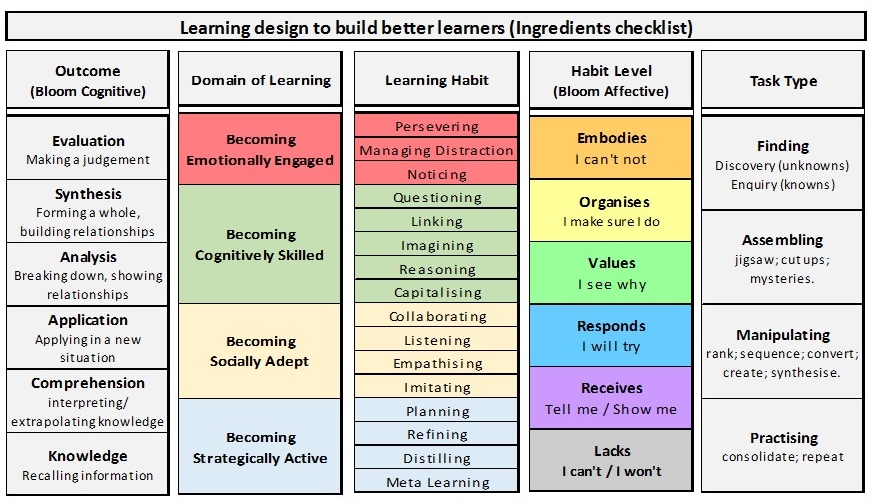
- Then look at things more closely with the intention of using the material. Use the questionnaires, consider the results and decide on the phase of development (grey to purple, purple to blue etc) you want to look at in detail for your students.
- Go to the relevant phase (grey to purple, purple to blue etc) and select three or four ideas that you think might help and try them with your students for three or four weeks.
- Remember it takes about 21 days for a new habit to become solid practice so you’ll need to be patient. You’ll need to give your students lots of opportunities to behave in these new ways with plenty of encouragement from you. However, it will be well worth it for you and your students as you gradually see their engagement with learning grow.
- As you see and hear students’ engagement strengthening and improving take a look at more advanced ideas (e.g. blue to green) and effectively repeat No 5 above.
Comments are closed.