

This resource takes a leadership perspective on developing students’ learning power and is designed to offer you, as senior leaders, a view of the strategic concerns that will arise when the school takes on ‘Playing the Learning Power Game‘. It offers questions, think pieces, frameworks, slide decks and diagrams to help leaders:
- feel reassured about the purpose, benefits and frameworks of learning power;
- explore important leadership roles when taking on the development of Learning Power throughout the school;
- introduce each unit of the programme to staff;
- maintain momentum into the future;
- understand ways forward beyond this initial stage.
These issues are considered over 6 sections:
1. Overviews – this important section covers;
- what the programme is about; its big ambition
- how the programme is organised; its units and sections
- the key role of collaborative staff development; translating theory into classroom practice
- introducing the leadership questions; stuff you need to sort before you start
- four ways of launching the programme…you choose.
2. The Leadership Questions that need to be addressed by school leaders before ‘Playing the Learning Power Game’ is introduced to the school;
3. Leading Unit 1 – Understanding Learning and Cultures;
4. Leading Unit 2 – Classroom Cultures;
5. Leading Unit 3 – Constructing Learning;
6. Leading Unit 4 – Broadening the Range;
7. Moving on to Phase 2.
You are now in the Overviews section
Use the navigation bar to move from section to section
1. Overviews
1a. What ‘Playing the Learning Power Game‘ is about.
Playing the Learning Power Game is an on-line programme that aims to help teachers discover their students’ learning behaviours and, with that knowledge, enable them to fashion their classroom culture and teaching methodologies to ensure students, knowingly, become better learners.
The Big Ambition of Playing the Learning Power Game.
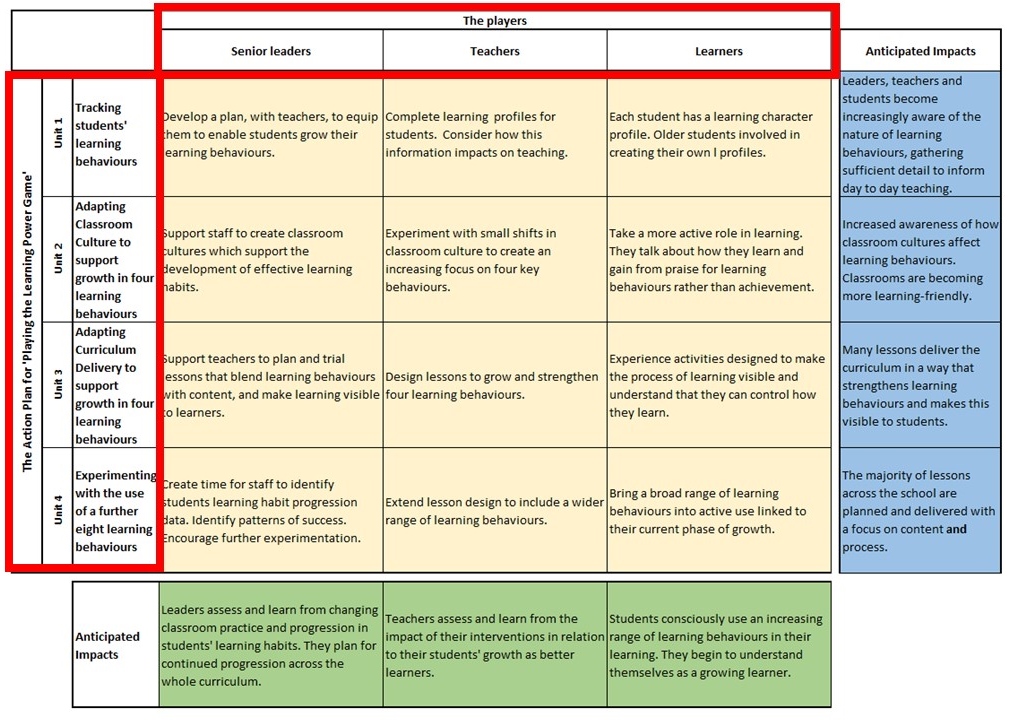
This chart shows the big ambition of the programme. It distils what it’s all about.
- the cells in yellow capture what leaders, teachers and learners will need to do in relation to each row:
- tracking the growth of learning behaviours;
- adapting classroom cultures to strengthen 4 key learning behaviours;
- adapting how the curriculum is delivered in order to build 4 key learning behaviours;
- experimenting with and expanding the number of learning behaviours consciously being used by students;
- the blue boxes capture the outcomes such changes could make to classrooms; cultures and curriculum delivery;
- the green boxes capture the anticipated outcomes for people; leaders, teachers and learners.

Read more about the Big Ambition of the programme at your leisure ⬇️
The vertical and horizontal axes of the grid
The vertical axis to the left shows the 4 main aims or thrusts of the programme. These four components involve:
- Unit 1. The formative work of finding out about their students’ learning behaviours and how they have the potential to improve/grow;
- Unit 2. The practical work of shifting classroom culture to better accommodate learning behaviours, using 4 foundational learning behaviours to get teachers started;
- Unit 3. The practical work of purposefully blending the use of learning behaviours into lesson design, again focusing on just four foundational behaviours;
- Unit 4. The work of gradually bringing more of the original researched learning behaviours into play in order to build students’ use of them over time. This is in preparation for the Phase 2 programme.
The horizontal axis across the top shows the 3 main groups of players in the game and what they will need to do to make it all work.
The central 12 cells
These cells serve 2 purposes. Firstly:
- The text in each cell gives an indication of who needs to do what, in very broad terms, at each stage of this journey;
- When looked at vertically down the page, they map out the 4 stages of this first part of the learning power journey;
- When looked at horizontally across the page, they show the players in the game and how what they do needs to interact.

The cells to the bottom and to the right
The green cells across the bottom give an outline of how the school’s players will have developed by the time teachers have finished this first stage programme. The blue cells to the far right give an indication of the anticipated outcomes for each part of the journey from; discovering students learning behaviours, to shifts in classroom cultures, to early shifts in lesson design accommodating learning behaviours, and to the beginning of consciously using a much broader range of learning behaviours across the curriculum.

1b. How the programme is organised.
Units and sections…
Each unit deals with a key aspect of understanding and growing learning power.
- Unit 1. Discovering learning and culture. This unit has sections covering:
- The warp and the weft, foundational ideas of learning power; the basic ‘must-knows’;
- Finding Learning Power, the ‘must dos’ of collecting evidence about students’ learning behaviours.
- Unit 2. Classroom cultures. This unit has sections covering:
- Aspects of a learning friendly classroom culture;
- An easy to access catalogue of practical ideas designed to help teachers shift their classroom culture to support the growth of the foundational four learning behaviours.
- Unit 3. Constructing learning. This unit has four sections covering:
- The big picture of curriculum planning;
- Designing units and lessons;
- Activity design to stimulate learning habits;
- A catalogue of learning activities are displayed in an easy to access grid framework. The point is to blend some of these ideas into the curriculum and lessons.
- Unit 4. Broadening the range. Here teachers are encouraged to spread their wings and begin to add some of another eight learning behaviours to the mix. This unit has eight sections covering:
- Noticing, Making links, Imagining, Reasoning, Capitalising, Listening, Planning, Meta-learning.
This development will help prepare teachers to move on to a deeper Phase 2 of the programme.
Strengthening classroom cultures to build students’ use of learning behaviours
FIND OUT MORE about the content of each Unit of the programme ⬇️
The content of each unit and section of the programme
Unit 1, Section 1A. The warp and weft of learning
Here teachers will find:
- a whistle stop tour of the frameworks that shape the development of students’ dispositional learning powers;
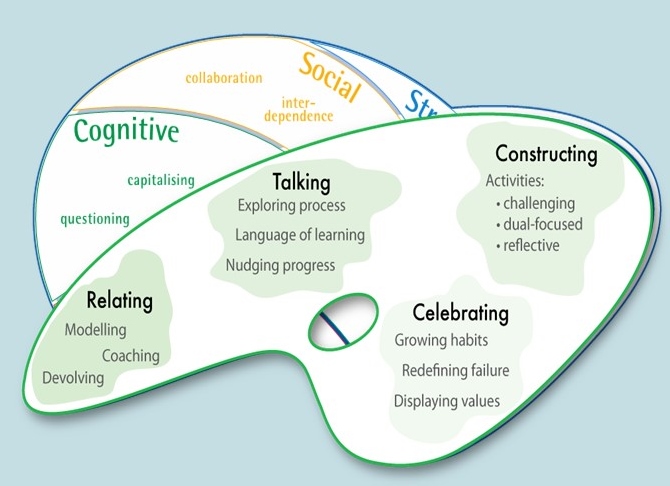
- an overview of the classroom culture framework (the teachers’ palette) that shapes building learning behaviours;
- an overview of the supple learning mind framework that identifies the learning behaviours and how they fit together.
Timing. We suggest teachers spend an hour or so in the first week exploring these big shaping ideas of Learning Power.
Unit 1, Sections 1B/C/D/E. Finding Learning Power
Here teachers will find:
- an exploration of why learning behaviours are so important for 21st century learners;
- information about progression in learning behaviours, what ‘getting better’ at learning looks like;
- the opportunity to reflect on their own learning behaviours and those of 2 students teachers know well;
- guidance to support teachers in producing and analysing their students’ learning profiles.
Timing. We would suggest teachers spend a couple of months collecting and understanding this data. Their view of their students’ learning behaviours will henceforth influence and shape their practice. If their programme started at the beginning of an educational year teachers should aim to complete this unit by the end of the first half term. (e.g. Sept to end Oct)

Unit 2. Classroom cultures.
A catalogue of practical ideas to create a learning friendly classroom culture
Here teachers will find 3 short sections with explorations of:
- Section 2A – Relating for Learning, how they might enable students to take greater responsibility for their own learning;
- Section 2B – Talking for Learning, how they might enable students to understand and talk about the process of learning;
- Section 2C – Celebrating Learning, how they might organise classrooms to celebrate learning over performance.
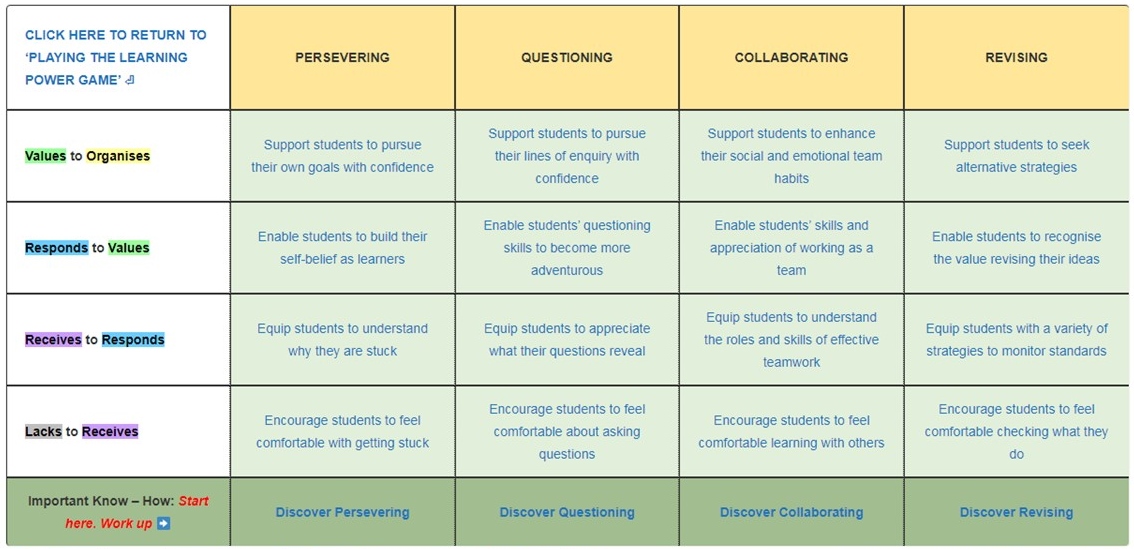
Plus – Section 2D has a practical four by four framework organised around:
- four foundational, really important, learning behaviours at
- four levels of growth, with
- practical packages of ideas, across
- three aspects of classroom cultures.
This four-by-four framework is presented in a simple grid format, illustrated here.
We’ve done the sorting for you. All teachers have to do is select what they need!
Timing. We suggest teachers spend 2 or 3 months exploring this catalogue. So for example if teachers started the programme in September teachers should be ready to move on from Unit 2 by mid-February.
Unit 3. Constructing learning
Here teachers will find:
- Section 3A – The big picture of curriculum planning…planning that integrates progression in content with progression in learning behaviours;
- Section 3B – Designing units and lessons…the fundamentals of lesson design;
- Section 3C – Activity design to stimulate learning habits…suggesting a hierarchy of activity types, going from ‘Listening’, through to ‘Discovery’.
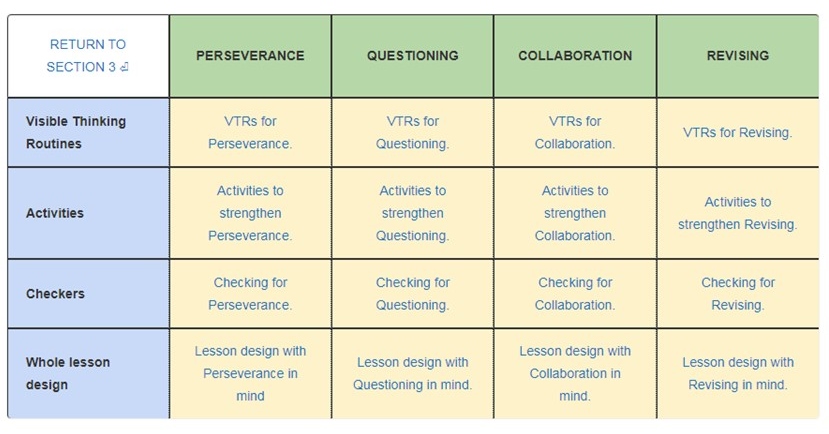
Section 3D has a practical four by four framework organised around:
- the four foundational learning habits;
- four categories of learning activities;
- and with over 100 ideas to try.
This four-by-four framework is presented in a simple grid, illustrated here.
Timing. We suggest teachers spend at least 2 or 3 months exploring this catalogue of lesson ideas. So, if teachers started this programme at the start of the educational year in Sept. and teachers kept to our suggested timing for earlier units, teachers should be ready to move on from Unit 3 by mid May.
Unit 4. Broadening the range
This unit offers teachers an opportunity to spread their wings and begin to work across another 8 of the learning behaviours.
It has 8 small sections, each based on one learning behaviour – Noticing; Making links; Reasoning; Imagining; Capitalising; Listening; Planning, Meta Learning.
Here teachers will find:
A staged way of introducing the behaviours by;
- Firstly… making students aware of the use and importance of a habit…when, where, why, how they could be using it
- Then... exploring the learning habit a little more through its language
- Try... using the behaviour as a lesson starter to tune students into using it
- Then start... blending the behaviour into the way teachers teach content. Use specific strategies to deepen content understanding.
- Ensure… students reflect on the success or otherwise of their new frame of mind as a result of consciously using the behaviour.
The content of this section encourages teachers to play with introducing more learning behaviours.
Timing. We would suggest teachers spend a couple of months exploring this Unit. If the school started this programme at the start of a school year and teachers have kept with the times suggested for previous units, teachers could be using these ideas in the last couple of months of the summer term, readying themselves to begin the deeper learning power journey in Phase 2 of the Programme.

1c. Working together to ensure success
While the ‘Playing the Learning Power Game’ online programme provides teachers with the research and ideas that work these ideas alone can’t bring about change in classrooms; there’s a gulf between teachers’ ‘knowing’ and ‘doing’.
Changing teachers’ working practices is known to be hard and delicate work and to ensure these ideas take root in classrooms teachers will need support. We can’t insist on any particular staff development practice but research shows it works best when teachers can meet in a safe professional environment where they can explore and plan how they could change, and then share and probe the triumphs, tribulations and outcomes of their classroom experiments.
Useful types of CPD include:
- Teacher Learning Communities, or as we refer to them, Professional Learning Teams;
- Coaching partnerships;
- Small-scale learning enquiries;
- Classroom observations and personal review;
- Learning walks.
The very architecture of the programme provides 7 customised team meeting agendas at key points to help the school structure its CPD programme and deepen understanding and use of the learning power approach.


1d. Leadership questions you’ll want to muse on
The prospect and potential of taking on such a programme will inevitably raise all manner of critically important questions…
- how will the school benefit from this resource?
- what impact will it have on students?
- what sort of time and effort will staff need to make?
- what changes to the school’s operations will need to be accommodated?
These and many other strategic, leadership or management questions deserve serious consideration before school leaders can make a reasoned decision about whether / how to implement Playing the Learning Power Game.
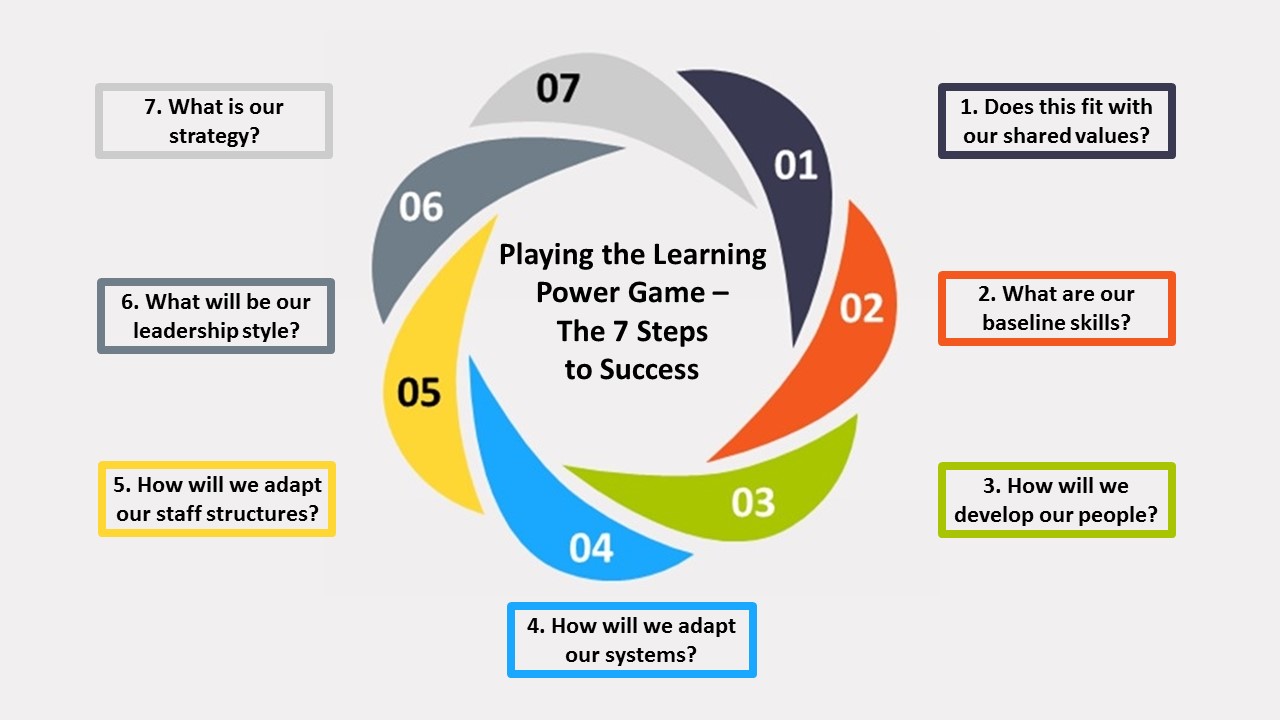
The critically important section 2 ‘Leadership Questions’ outlines both the questions and suggested answers relating to 7 aspects of leadership considerations, namely: Shared Values; Skills; Staff; Systems; Structure; Style; and Strategy.
Take your time to reflect on all 7 aspects – it is only when you address all 7 that you will have laid the foundations of success. You will find more detail on leadership issues in section 2 of this resource.

1e. Bringing and keeping staff on board
Taking on a programme of this nature needs both initial and ongoing care and attention. We offer four types of programme launch to support, ensure and enrich your journey.
Launching the programme;
- Launching the programme yourself using materials prepared by TLO. (The DIY launch) These resources are available to all schools using the Building Better Learners programme. You’ll find them in the toggle box below and at appropriate points in this leadership resource.
- Launching the programme with a bit of help via Zoom. (The ‘At a distance’ launch)
- Managing the programme through your own learning champions. (The ‘Grow your own’ launch)
- Launching the programme with an in-school training day. (The ‘Full blown’ launch)
If you haven’t yet decided which launch option would best fit your school you will find a full description of each option in the toggle boxes below.

1. The DIY launch model ⬇️
DIY training resources
The DIY offer has resources you could use to introduce the programme to staff and others e.g. governors. There are slide decks, resource booklets and activities designed to enable you to put your own introductory training together for the programme as a whole and later for each Unit of the programme. These resources don’t just amount to simple show and tell sessions – they are designed to provoke deep thinking about each aspect of the programme: it’s aims; learning behaviours and how they grow; the culture of the classroom; the design of lessons.
We have assembled all the DIY resources together here. You will also find them dotted around the programme in the appropriate Units.
What’s in the pack?
There are 5 slide decks:
- Introducing ‘Playing the Learning Power Game‘ i.e. the whole programme
- Introducing each of Units 1, 2, 3 and 4 in Phase 1
Each has a pack of resources containing;
- a slide deck with notes
- further explanatory / commentary notes
- activities to deepen thinking

1. Resources to introduce the whole programme
Here we offer resources you may need to introduce ‘Playing the Learning Power Game‘ to staff. These aren’t for a simple show and tell session. They are designed to provoke deep thinking about learning and about classroom culture.
Each slide contains a suggested commentary in the notes underneath. It will take around an hour to talk through the slides, depending on how much detail you add to the suggested commentary.
Introducing Playing the Learning Power Game
The slide deck could be used to introduce teachers to the key ideas behind the Playing the Learning Power Game. It helps teachers to understand the content and purpose of the programme and explains how the blended learning programme will work.
You might use this slide deck:
- just as it is to introduce the ideas to staff;
- to help structure a learning conversation amongst/in teams;
- adapted to meet the needs of a particular audience;
- added to a strategic presentation of your own to ensure staff gain a holistic picture.
Brief explanatory notes can be found under each slide.
The slides in the presentation cover the following key issues:
- the 3 models of Learning Power
- the nature of the blended learning programme
- the big ambition of the programme
The presentation encourages staff to use their own learning behaviours such as noticing similarities and differences between what they know now and this way of looking at learning and classroom culture. Questioning some of their own practice, and distilling the key messages and their appropriateness to the school.
2. Resources to introduce Unit 1
This resource is available here for any of the following functions;
- to introduce the programme to staff if you have opted for a DIY start
- to reinforce any previous training e.g. remind you of the key ideas given by TLO during either Zoom or In-school programme launch sessions
- to act as initial training immediately before staff begin to use Unit 1 of the online programme
Introducing Unit 1 content to your teachers The slide-deck and notes below are specifically concerned with Unit 1 content. It concentrates on the content and purpose of Unit 1, describes what is to be done, and explains the anticipated timings. NB. This slide-deck takes about an hour to talk through depending on how much detail you wish to add to the suggested commentary. You might use this slide deck: Brief explanatory notes can be found under each slide. The slides in the presentation cover the following key issues: This 24 slide presentation aims to help teachers explore the Teachers’ Palette, the second model central to building learning powers. Three types of classroom culture are explained, explored and reflected upon, and consideration is given to strategies to make classroom cultures ‘learning friendly’. Introducing Unit 2 content to your teachers The slide deck and associated resources could be used to introduce teachers to the key ideas behind finding out more about classroom culture. In total it might take around 60 / 75 minutes to work through with your staff. You might use this slide deck: Brief explanatory notes can be found under each slide. Fuller supporting resources are offered as downloads in the toggle box below. The slides in the presentation cover the following key issues: 1) Download a copy of the ppt with presenter notes. 2) If the school is using the presentation as a basis for a whole staff training session to introduce classroom culture, staff will find these 4 images helpful to have as hard copy. 3) If you need a little help with how you might talk to slide 21 . . Here we offer a short powerpoint with delivery notes to introduce Unit 3, Constructing Learning, to staff. It is available to any school undertaking this programme. They can be used to; Introducing Unit 3 content to your teachers This short slide presentation aims to help teachers understand Unit 3 and how it leads naturally on from the work they have been doing on Unit 2. The slide deck could be used to introduce teachers to the key ideas behind Unit 3. In total it might take around 30 minutes to work through with your staff. You might use this slide deck: Brief explanatory notes can be found under each slide. Here we offer a short powerpoint with delivery notes to introduce Unit 4, Broadening the range, to staff. It is available to any school undertaking this programme. They can be used to; Introducing Unit 4 content to your teachers This short slide presentation aims to help teachers understand Unit 4 and how it builds naturally on from the work they have been doing thus far. The slide deck could be used to introduce teachers to the key ideas behind Unit 4. In total it might take around 30 minutes to work through with your staff. You might use this slide deck: Brief explanatory notes can be found under each slide. 3. Resources to introduce Unit 2
4. Resources to introduce Unit 3
5. Resources to introduce Unit 4
2.The Zoom assisted launch model ⬇️
The Zoom assisted launch
1. Overview
These at-a-distance training sessions are anything but just lectures. They are interactive in nature, calling on staff to engage in activities and discussions. Each session has a Resource book that captures the story of the session, the presentation slides and the important diagrams and interactive activities. These booklets will act as memory joggers well into the future.
The package in brief.
This Zoom assisted introductory launch package consists of:
- two 75 min Zoom sessions, two weeks apart;
- two online pre-session preparation packs, sent to the school a week before the event, containing;
- a short pre-session introductory film
- quizzes and activities to try
- a resource booklet to download and print
- the session timetable and its activities
- two post session 1 tasks to be completed before session 2
- an overview of the programme staff are about to embark on.
- two Resource books for staff to use throughout each Zoom session
During these two sessions staff will come to understand their own students as learners and be ready to start on Phase 1 Unit 2.

2. Pre-session preparation
The first online preparation pack is designed to introduce staff to the up-coming training and to ensure they are able to make the most of it. It will be sent to the school to send to their staff a week before the Zoom training is due to take place.
The second preparation pack is designed to deepen the ideas and support staff between between session 1 and 2. It will be sent to schools a couple of days after session 1
Pack 1 is designed to help staff:
- make the most of the up-coming staff training about building their students’ learning power
- come to the training having done a bit of preparatory thinking
- feel engaged in and enjoy our first online training session
- be confident to take on the post session tasks that need to be tried out before session 2
- find out more about the programme they will be taking part in over the coming months
This pack contains a film to watch, a quiz to try and the Resource booklet to print
Pack 2 is designed to help staff:
- become aware of four aspects of the Teachers’ Palette framework
- recognise where they are now in building a learning friendly classroom
- become more aware of the strong link between how they teach and how their students learn
- recognise how learning activities impact on students’ learning habits.
This pack also contains a film to watch, a quiz to try and the Resource booklet to print
3. Session 1 outline
The first session is designed to enable staff to become aware of why the learning behaviours are useful and gain an understanding of how learning behaviours grow.
Session 1 Timetable
- x.00 Introduction and objectives
- x.05 What do good learners do? Activity
- x.25 The supple learning mind. Input
- x.40 What do we do when we learn? Activity
- x.05 Post session tasks intro
- x.10 Post session task 1&2 (complete for session 2)
- x.20 Evaluation of session
- Cheerio till session
During this first session there are 2 substantial group activities.
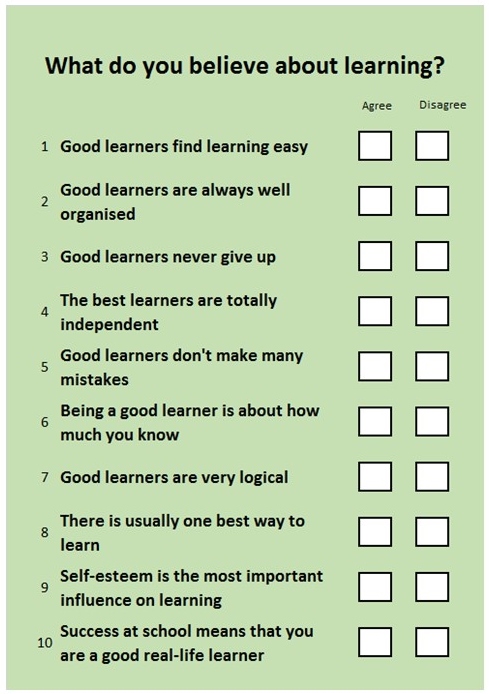
The first involves teachers considering what their students think good learners do, and how this may differ from their own views of learning. (20 Mins including discussion)
The second involves teachers looking at comic book pictures, considering clues and and putting them into an order to make a credible storyline. This task is about teachers applying their own learning habits to reason and imagine a solution. (25 mins including sharing solutions and the patterns of habits used)
What do good learners do?

4. Post session 1 task
We believe that the best way to secure staff learning after session 1 is to relate the ideas to their own students. By doing so they will begin to connect practically with what learning power is all about.
Post session task
Getting to know students’ growth as learners
The task directs teachers to Unit 1 Section 1D of the Playing the Learning Power Game online course to where they will find the material and support to develop their own learning profile and create profiles for a couple of their students. The three profiles will probably take about 30 minutes to complete and staff are encouraged to spend time asking questions of this fascinating data.
Completing these profiles will help teachers to attach a real student’s behaviour to an abstract learning behaviour and make the behaviours come alive.
NB. This task is a warm-up for teachers’ main task in this first half term of the programme…that of developing learning profiles for all their students.
This rich discussion and analysis will serve to show the importance of understanding, using and developing learning behaviours.
My learning profile

5. Session two outline.
This second interactive training session is designed to introduce teachers to the idea of learning friendly classrooms and their role in developing students’ learning behaviours. The content knits together research based inputs with interactive analytical activities. These serve to encourage teachers to consider their own teaching style, its impact in the classroom and what they might do to change this for the benefit of learning behaviours.
Session 2 Timetable
- x.00 Introduction and objectives
- x.05 Learning cultures. Input
- x.20 Where are we now? Group discussion
- x.3o Means and Ends of a new culture. Input
- x.40 Ends and school values Group discussion
- x.50 Practical ideas for classroom use Input
- x.10 Post session task
- x.25 Session review
- x.30 Cheerio for now
During this second session there are 3 types group discussions.
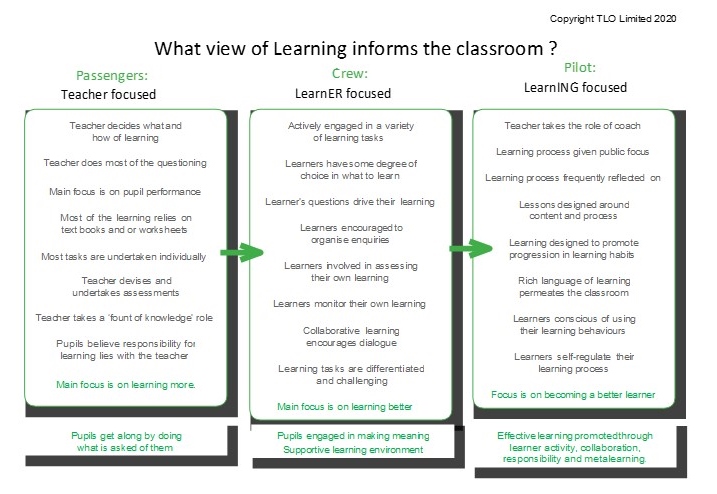
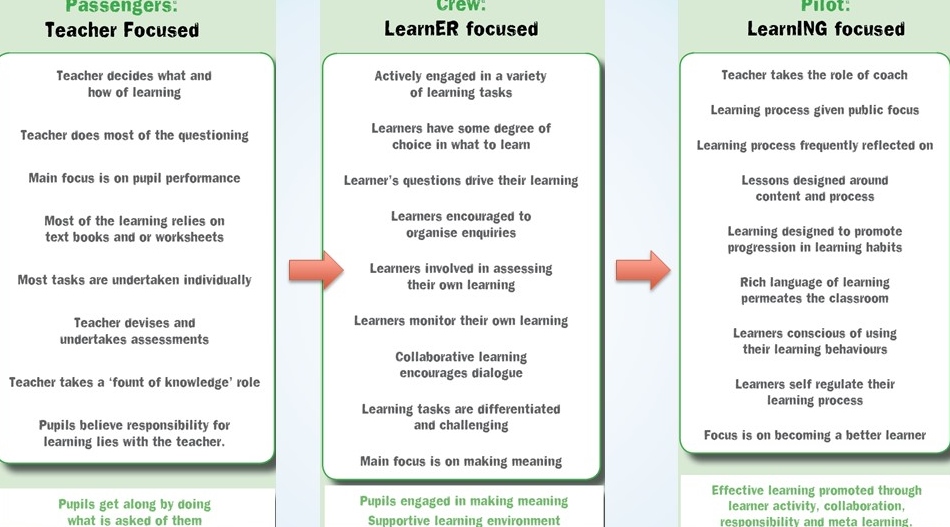
Culture 1 diagram. The first involves teachers considering where their classroom culture lies on the ‘teacher…learner.…learning‘ trajectory. This is a useful discussion with the addition of a quiz to help.
Culture 2 diagram. The second involves teachers considering the type of shifts needed to make classrooms more learning focused. The point here is to think about the broad teacher behaviours that are needed and the resulting outcomes for students – i.e. the link between what you do as a teacher and the sort of learners this produces.
The third is a short series of mini discussions with colleagues re. the ideas for developing classroom practice. The input on these ideas will break off every now and again to let staff debate what they have just heard.
Culture diagram 1

Culture diagram 2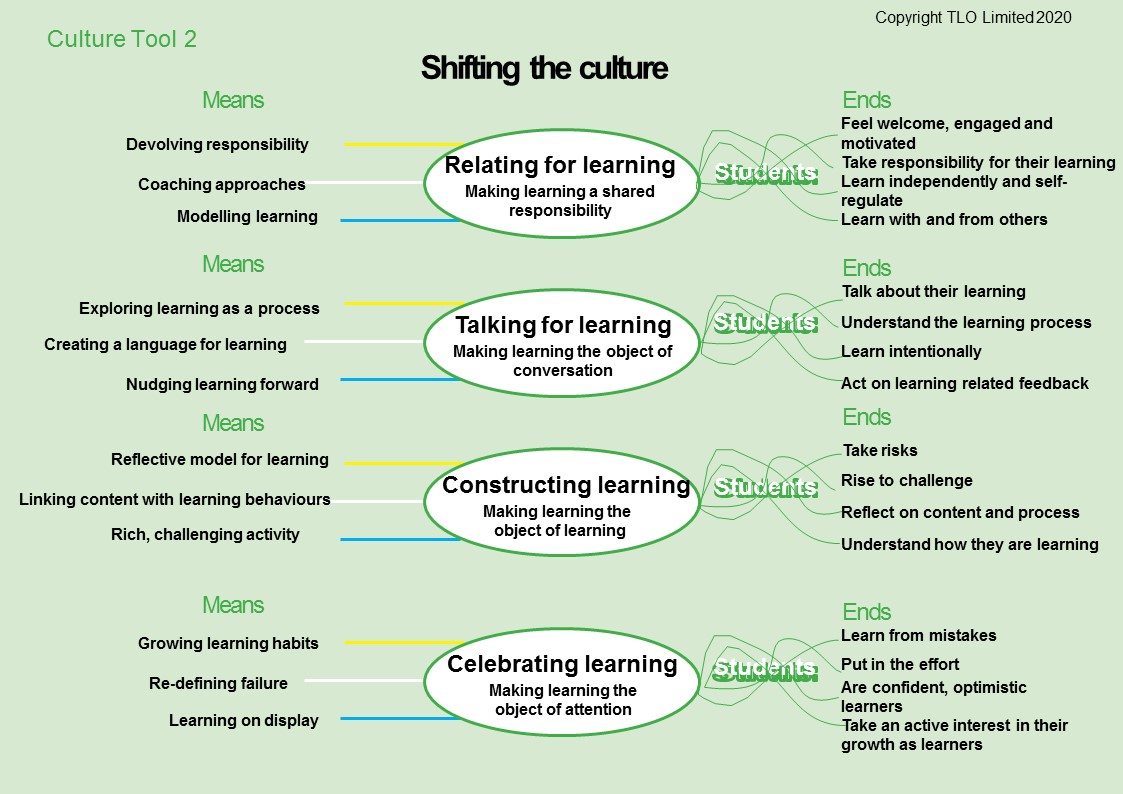

6. Post session 2 task
This activity is designed to encourage teachers to work together across the school and begin to recognise how the materials need to work across the school rather than just in individual classrooms.
Promoting ‘unsticking’ throughout the school
Much has been said about ‘stuck prompts’ for classroom walls, however it’s important that teachers discuss the sort of stuck prompts they are using and make sure the prompts become more stretching from year to year.
In other words stuck prompts need to grow up! What are you expecting of students in year one? How do those change by year two? How independent do you expect them to be by their last year in your school?
It’s a good idea to debate these issues as a whole staff over time because what appears on classroom walls will essentially indicate the school’s trajectory for independent learning; it implies how independent you expect learners to be at certain stages.
Have a go! You will keep coming back to refine and update these ideas as you learn more and expect more of your students as learners.

3. The Learning Champions model ⬇️
Learning Champions online resource
Getting something new going evenly and consistently across a large school can be tricky. To overcome this many larger primary schools and secondary schools have prefered to spread the load of managing the programme. This is done by identifying a group of staff, who we’ll call ‘Learning Champions’, who learn together by working their way through part of ‘Playing the Learning Power Game’ programme before using their experience to involve all staff. Thereafter they manage the Professional Learning Team sessions.
This package includes a separate on-line resource especially for ‘Learning Champions’.
Learning Champions:
- need a 3 month lead time to become familiar with the programme and to iron out any practical problems. i.e. they start at least 3 months before the rest of the school;
- create practical experience of the approach within the school and can act as a ‘go to’ resource for other staff;
- offers senior leaders a significant group of teachers ready, willing and able to support / encourage others;
- have access to the slides in the DIY package through their own Learning Champions resource.

1. The role and resources
The Learning Champions resource is designed to support them, as learning champions nominated by your school, to:
- get to grips with the concepts and practicalities of developing students’ learning power
- engage with and learn from a blended learning programme with other learning champions in preparation for…
- helping other teachers take part in the programme and develop their classroom practice and develop their students as metacognitive, self-regulated learners.
The Learning Champions’ resource is designed to help them:
- gain an overview of what the development of learning power is all about;
- look at their own class and draw up a learning profile for each of their student;
- understand how the Playing the Learning Power Game programme is designed to work across the school;
- experience how Professional Learning Teams work by forming one with fellow Learning Champions;
- decide how, as a team, they might introduce, and support the programme, for teachers across the school;
- take part in monitoring and supporting the effects of the programme as it moves along.

2. Finding out about their students
An early section in the Learning Champions’ resource offers them:
- a manageable set of tools to enable them to uncover, collect and analyse information about their students’ learning character;
- an outline of the research, value, makeup and growth of peoples’ learning character.
These tools aim to help them, and then the whole school, discover and analyse their students’ learning behaviours and use this information as an essential starting point for helping students become better learners.
Collecting this information provokes fascinating questions;
- What are students like as learners…now?
- Where are students’ current learning strengths or limitations?
- Which learning behaviours do students need to strengthen…now?
- Does learning character play any part in influencing the attainment of higher vs lower performing students?
These unusual yet vital and urgent questions form the stimulus and potential for Playing the Learning Power Game.

3. Becoming a learning powered team
Changing working practices is hard and delicate work. Research shows it works best when teachers can meet in a safe professional environment in which to explore and plan how they could change, and later share and probe the triumphs, tribulations and outcomes of their classroom experiments.
A trailblazing role
The first role of a Learning Champion will be to begin working their way through the first few sections of the online resource, meet, with other champions, discuss the content and plan learning enquiries as a newly formed learning team and begin to try these out in their classrooms. These trailblazing experiences will help them support other teachers when they all begin the programme at a later date.
The online resource has useful sections covering how best to;
- work through a team agenda
- track what they do
- lead a learning team

4. Introducing the programme to staff
Having had the benefit of being involved with aspects of the blended learning programme the Learning Champions are now in a strong position to be able to introduce both the concepts and the classroom reality of learning power to other members of staff.
Quite how this is brought about is very much up to the school. Some schools choose to devote a staff training day to this introduction, others may use a series of staff meetings. Whatever the format it’s important for the Learning Champions to bring their own experience of the programme into the mix, giving the occasion the touch of authenticity… their triumphs and difficulties and how the approach fits with the school’s vision and values.
The 5 topics explored in this section are:
- Breaking the ice…ideas to try to stimulate a discussion about learning. For use before teachers engage with Playing the Learning Power Game.
- Introducing the blended learning programme… a short ppt presentation
- Introducing learning progression charts. . . a short ppt to encourage teachers to look at their class through the lens of learning progression.
- Introducing learning power to teachers… an extensive ppt and all the resources to support a half day whole-school training session.
- Introducing learning friendly cultures to teachers… an extensive ppt and all the resources to support a half day whole-school training session.

5. Monitoring progress
Working in a culture of trust and openness Learning Champions, and later other teachers, will become increasingly confident to experiment and take risks. But it remains important that the quality of learning in classrooms is kept under regular review.
Observing themselves and others regularly will become a valuable and supportive none judgemental learning opportunity. As the school embraces learning power, classroom observation, learning walks and learning reviews will become essential aspects of a reflective and developmental culture.
This online resource for Learning Champions includes;
- tools to check and monitor whether things are going to plan
- useful learning ambles and monitoring tools
- a way of understanding the purpose classroom observation in three different ways:
- to help to stimulate and initiate new practice (observation AS development)
- to develop current practice (observation FOR development)
- to assure standards of practice (observation OF development) associated with performance management.

6. Moving on
Having made a good start on the foundational four learning behaviours, Perseverance, Collaboration, Questioning, Revising, students will now be ready to engage more deeply in their learning. The next step expands all their emotional, social, cognitive and strategic behaviours. Learners will broaden their learning repertoire to build a complete learning toolkit, and consequently teachers will broaden the range of behaviours that they surface in lessons.
The final section of the resource offers:
- descriptions of a broader set of modules that make up the next phase of the programme;
- brief explanations of why and how the next phase enables students to become better learners.
- an explanation of a resource that will help them develop as a learning champion

4. The in-school training day start model ⬇️
The in-school training day start
You may want to assign one of your 5 training days to launch the programme with staff. Such days at the beginning of terms are in very short supply and early booking is essential. The day is designed to introduce staff to how students’ learning behaviours develop, how knowing that will influence the idea of learning friendly classrooms and their role as the teacher.
1. Overview
This full day training is divided into two parts; a substantial morning session for all teaching and classroom staff; a focused afternoon session for senior leaders.
Morning session
The half-day (4 hour 9 am to 1 pm) session is designed to introduce staff to the three models that underpin the ideas of Learning Power, namely, the Supple Learning Mind, the Phases of learning growth, and the Teachers Palette. The session looks at what they are, why they are important and how they can be developed in schools.
Afternoon session
The afternoon session (2pm to 4pm) is a chance for the leadership team to discuss their role in supporting and managing the development of students’ learning character. Issues under consideration might include; how the programme might affect classroom culture and curriculum design, and how the student data might be collected and interpreted.
A richly illustrated resource book will act as a reference text for leaders for months to come.

2. The objectives
The training day knits together interesting knowledge based inputs with engaging interactive activities. These serve to reinforce new ideas by applying them to the practical reality of the classroom.
From the start staff are encouraged to contribute their own learning habits to ensure the session is a rich learning opportunity for everyone.
Objectives for staff training
The point of this session is to enable teachers to be able to;
- unpick the habits of a supple learning mind; what they are and why they matter
- explore their own learning dispositions and how they use them
- unpick how classrooms need to be different in order to foster learning power
- recognise the shifts they can make in their own teaching.
In so doing teachers will be invited to knowingly use use their learning behaviours. Noticing (of the different and unusual), Making links (to review their current ways of teaching), Imagination ( to visualise alternative ways of teaching).
Objectives for leadership discussions
The point of the session with leaders is to enable the team to;
- understand the key models, their implications and the organisation of the programme
- explore some strategic issues such as; how the programme fits with the schools key values, ensuring stakeholder buy-in, accountability and workload issues.
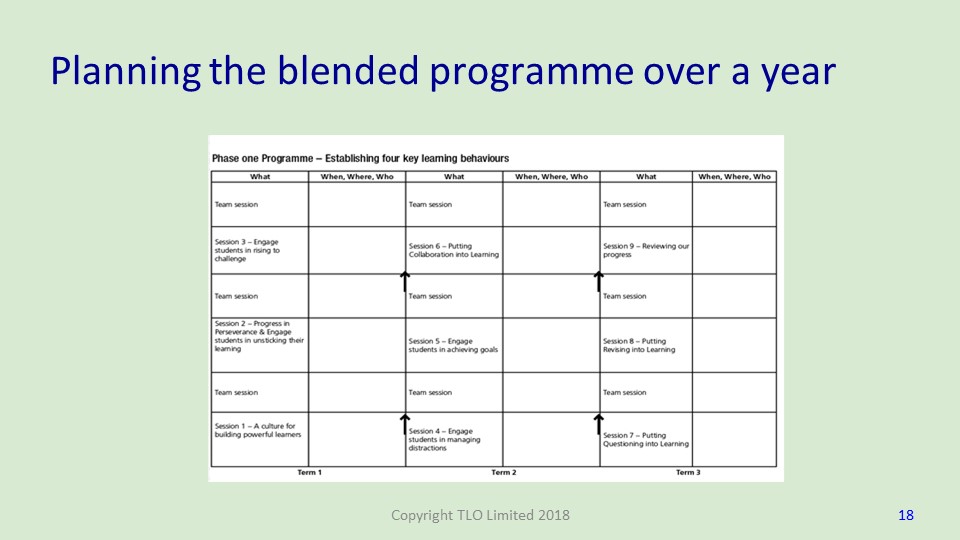
- plan how the programme might best be diaried across the school year(s)
- consider realistic expectations for infusing learning power into lessons
- Changing how you look and what you look for in classrooms.

3. Preparation
Rooms, layouts, resources and visuals are all vitally important in making this training work to best advantage. We have designed and made available the essential resources for the session, i.e. Resource books and activity resources We would be grateful if the school could print sufficient copies for the number of staff attending.
The Resource Book is made available as PDFs and contains most of the PPt slides used in the presentations, the group activities and session tasks. Every member of staff should have a copy of this Resource Book at the beginning of the morning session…but not before!
Things for the school to do
- Print sufficient copies of Resource books for both the morning and afternoon sessions
- Room layout. This training works best when the room is laid out ‘cabaret style’, i.e. tables of 5-6 participants.
- Encourage staff are to sit with colleagues (both teachers and support staff) who work with similar aged pupils.
- Provide 2 packs of Post-Its. One yellow, the second any other colour for each table.
- Audio-visual equipment should include a digital projector and screen.

4. The morning programme
The morning session consists of 7 or 8 group activities interspersed with inputs, and whole school discussion. The half-day (4 hour) session is designed to introduce staff to the three models that underpin the ideas of Learning Power, namely, the Supple Learning Mind, the Phases of Learning Power growth and the Teachers Palette.
Activity 1 (20 Mins including discussion) involves staff considering what their students might think good learners do, and how this may differ from their own views of learning.
Activity 2 (25 Mins including discussion on solutions and patterns of habits used) involves staff looking at comic book pictures, considering clues and putting them into an order to make a credible story line. This task ensures staff apply their own learning habits to achieve a solution.
Activity 3 (2 mins x 4 plus whole group discussion) is an introduction to learning habits, helping staff become more aware of their students as learners; to think about their tendencies, dispositions and habits and muse on positive and negative characteristics.
Activity 4. Completing a student learning profile ( xxxxxxxxxx mins including whole group discussion) This activity………xxxxxxxxxx
Activity 5 Learning culture tool 1 (10 mins including whole group discussion) This activity sees a shift in focus from student’s learning behaviours to classroom cultures. It highlights 3 different learning cultures and emphasises the teachers’ and students’ role in each one.
Activity 6 Learning culture tool 2 (10 mins including whole group discussion) This activity centres on the research of Chris Watkins (London Institute of Education). Participants are invited to discuss the ‘Ends’ and ‘Means’ of the school.
Activity 7 (3 mins x 4, plus whole group discussion) This activity is interspersed with a presentation that offers numerous examples of how schools have introduced learning behaviours. Participants are invited to think about what do they do now and which of the ideas they might try.
Activity 8 if time (15 mins plus whole group discussion but only if time.) This activity rounds off the morning and links the ideas of what teachers ‘do’ to how students ‘progress’ in their use of learning behaviours and is designed to give staff a taste of designing practical tools to help their students to become more aware of their learning behaviours…behaviours that they control.
For each of these tasks a member of staff will be needed to distil any feedback/findings and report back on behalf of each group.

5. The afternoon programme
The two hour afternoon session is reserved for the leadership team.
Things to bring and discuss
- The feel of this session is more like a friendly, stimulating chat, helped if the group can all sit around one table in a quiet space but with access to a screen.
- It would be useful to bring along some or all of the following;
- latest versions of the school’s Vision and Mission
- any evidence of surveys of classroom cultures or practice
- the school’s Intent, Implementation and Impact statements
- The focus will be on aspects of managing the programme including;
- the programme’s big ambition
- clarity about the Units and sections of the course
- collecting the student learning data
- accountability and overload issues
- the nature and role of learning teams
- the rhythm of the workflow through the year
- progression in behaviours; what to look for
- changing how you look and what you look for
1f. Ongoing support
A programme of this depth and scale very often benefits from encouragement, questioning and celebrating from outside the school itself. Hence the core programme can be optionally supported by further live virtual consultancy sessions.
Supporting the programme
Supportive coaching sessions are typically scheduled to last 75–90 minutes, and with associated resources. All such support packages are conducted via Zoom sessions at times to suit schools. The various flavours of these ongoing consultancy sessions are outlined below and you can opt to take up any of the options at any time as the programme progresses.

A rundown of the Ongoing Support Packages ⬇️
Support to keep things going smoothly
Both phases of the core programme can be optionally augmented by further live virtual consultancy sessions, typically scheduled to last 75–90 minutes, and with associated resources.
All the following support packages are conducted via Zoom sessions at times to suit schools.
1. Keeping it on track (leaders)
How it works.
This support package consists of three 75 minute Zoom sessions for leaders spread through the first year. These are scheduled to coincide with key Phase 1 milestones namely…
- after the first couple of months when staff have completed their students’ learning profiles (e.g. start Nov), to ponder/discuss student profiles and what they reveal
- three months later when teachers have had time to make shifts in their classroom culture and are about to start applying the ideas to curriculum/lesson plans (e.g. start March), to discuss progress in classroom culture.
- three or four months later when staff are exploring more learning behaviours and preparing for phase two of the programme (e.g. start June), to discuss lesson design and steps to prepare for Phase 2.
Possible subjects include;
- Managing our expectations
- Highlights and concerns
- Changing the focus of classroom observation
- What are we learning from looking for learning?
- Engaging parents with Learning Power
Tools to remind you of what you are looking for.
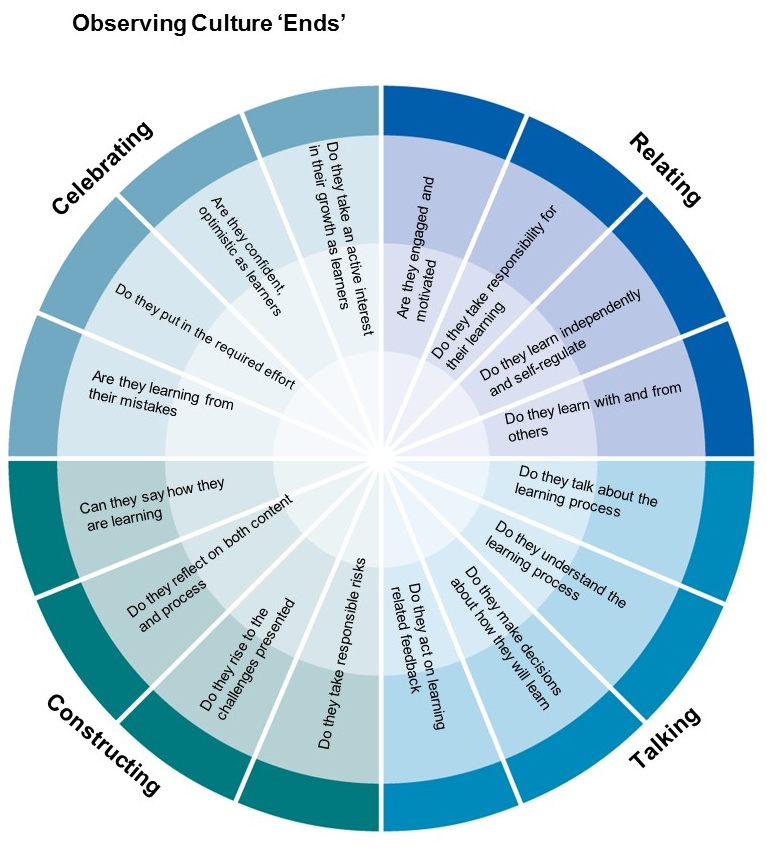
2. How’s it going? (teachers)
How it works
The emphasis of this support package is on teachers monitoring their own development. It consists of three 75 minute Zoom sessions for a group of about 8-10 teachers spread across the year. These can be scheduled to coincide with key Phase 1 milestones…
- when staff have completed their students’ learning profiles.
- when teachers have had time to make shifts in their classroom culture.
- when staff are exploring more learning behaviours in preparation for phase two of the programme.
Possible subjects include;
- What have we learned from students’ learning profiles?
- Tools and techniques for observing learning power in lessons;
- Designing lessons to enhance learning powers
Self-monitoring tools
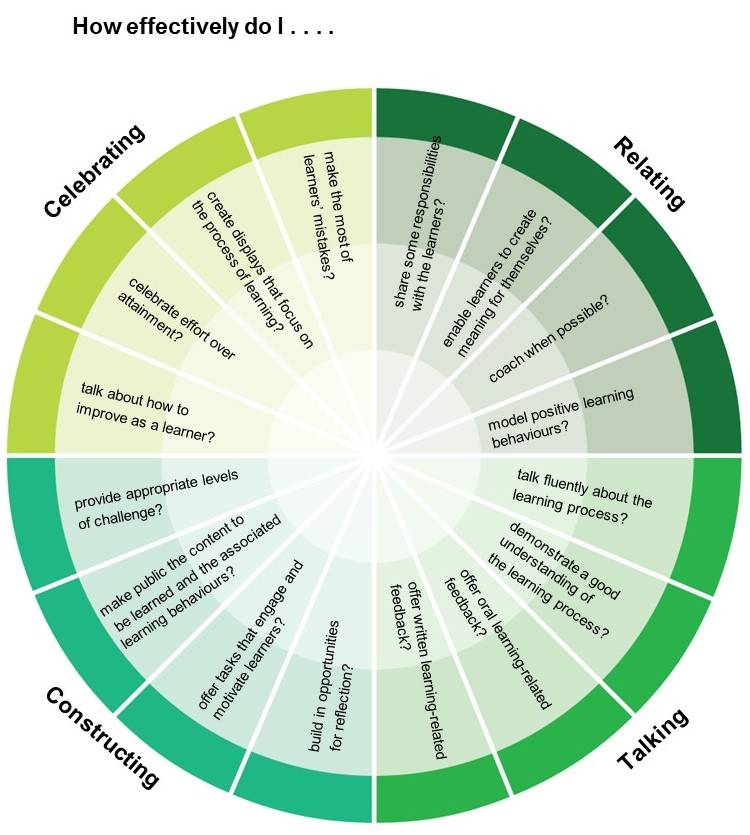
3. Learning Champion support.
How it works
The Learning Champion route is aimed at larger schools. It’s important that this team itself feels supported and stretched. To enable this we have prepared a specialised on-line resource for the start of their journey; this is part of the package. Thereafter as Champions begin to lead learning teams across the school it’s important that support for them continues.
Possible subjects include;
Learning Champion support consists of five 75 minute Zoom conversations across 4 terms covering;
- Becoming a team and the job to be done ( an introduction to the programme and their role)
- Overcoming difficulties of drawing up student learning profiles (after a couple of months)
- Lessons from becoming and developing as a team (things to take forward as they begin to lead other teams)
- Keeping track and celebrating progress (things to be aware of or watch out for as teams progress)
- Where to next? (an introduction to Phase 2 of the programme)

You are now in Leading . . ‘Playing the Learning Power Game’. Use the navigation bar to move to other sections
Comments are closed.