
7. Capitalising – Using resources
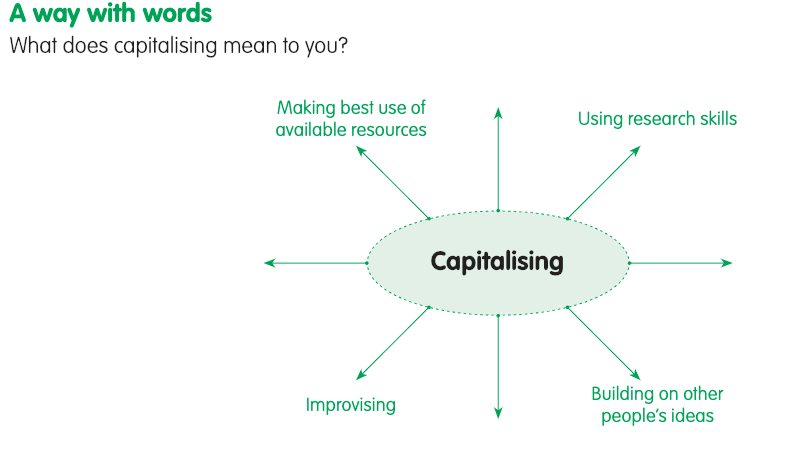
Effective resource users learn with the help of many different sources –other people, books, the internet, music, the environment, experience…and making intelligent use of all kinds of strategies and things to aid learning. In the early stages, it means selecting and making the best use of known strategies and classroom resources but this swiftly moves on to embracing a much wider and varied range of possibilities. This involves being able to seek novel ways of solving problems by exploiting the potential of known strategies and what is around them including things they may never have thought of as a resource.
How well does your classroom climate encourage Capitalising? ⬇️
Does my classroom climate encourage Capitalising?
Here is a selection of features that might begin to shape the emotional climate of your classroom to encourage capitalising.
The diagram has 4 sections:
- Top – strategies you could build into the way you teach to stimulate capitalising;
- Right – indications of the sort of language you might use to stimulate capitalising;
- Bottom – ways in which you might celebrate / praise students’ use of capitalising;
- Left – things that you need to enable students to do.
Apply your own noticing and consider whether you already use any of these features and which you fancy trying.
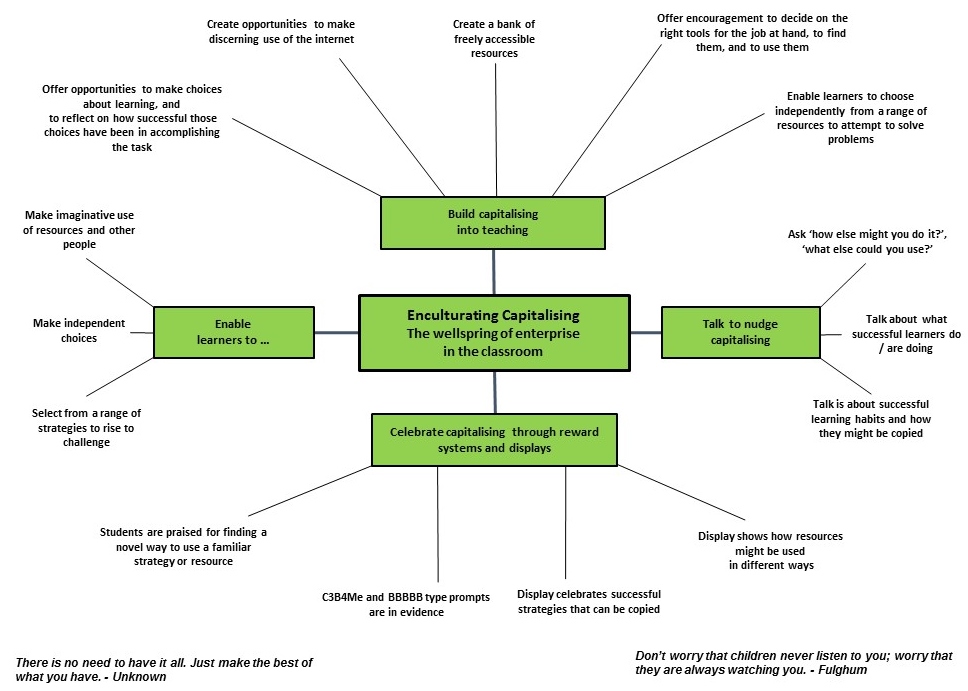
Bridging the gaps – teaching ideas to cultivate Capitalising
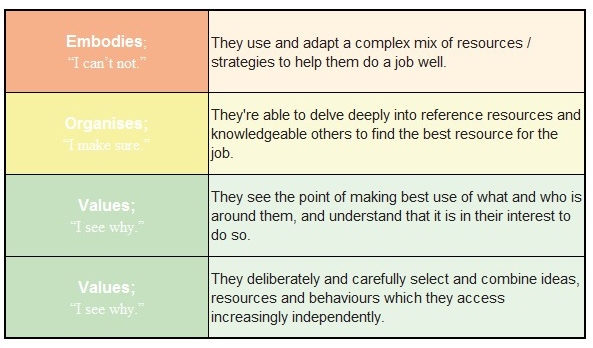
Teaching ideas to move learners from Blue to Green ⬇️
What you are trying to help students to achieve
In the Values (green) phase, students are fully aware of the purpose and usefulness of different strategies and resources. Here they become more skilled in selecting the right one for the job in hand. They become more skilled in using expertise and they know when they need other strategies or resources to help them further. Importantly they now select ideas or behaviours from others and combine these with their own to make/achieve new understandings.
Your role as a teacher in this phase is to:
Devolve responsibility for capitalising… by expecting students to select their own strategies appropriately
Talk about capitalising…by exploring through talk how to use each other as a legitimate resource
Give students opportunities to practise capitalising…by offering plenty of opportunities to gather internet resources safely, efficiently and with discernment
Celebrate capitalising… by reflecting on, praising or displaying its use
1. Devolve responsibility for capitalising
Learn from experts
Interviews
Set up interviews with people who can do something really well. Develop a series of questions with students to uncover exactly what the ‘expert’ does. E.g. What sort of preparation is there? What resources are needed? What does it feel like? What sort of thinking, habits of mind, values or beliefs are helpful?
Create a checklist of key aspects to imitate.
Extend with students in the role of real or imaginary expert, encouraging them to assess their own subconscious knowledge of how to succeed.

2. Talk for capitalising
Talk about how to tackle things
How might we tackle this?
At the beginning of a session talk with the students about the strategies and things they might use to help them with their learning.
Talk to students frequently about where they might find information or help.
Offer students a rich and varied curriculum so that they can start to appreciate that they are learning from lots of different sources using a range of learning strategies.

3. Give students opportunities to practise capitalising
Build familiarity with possible resources
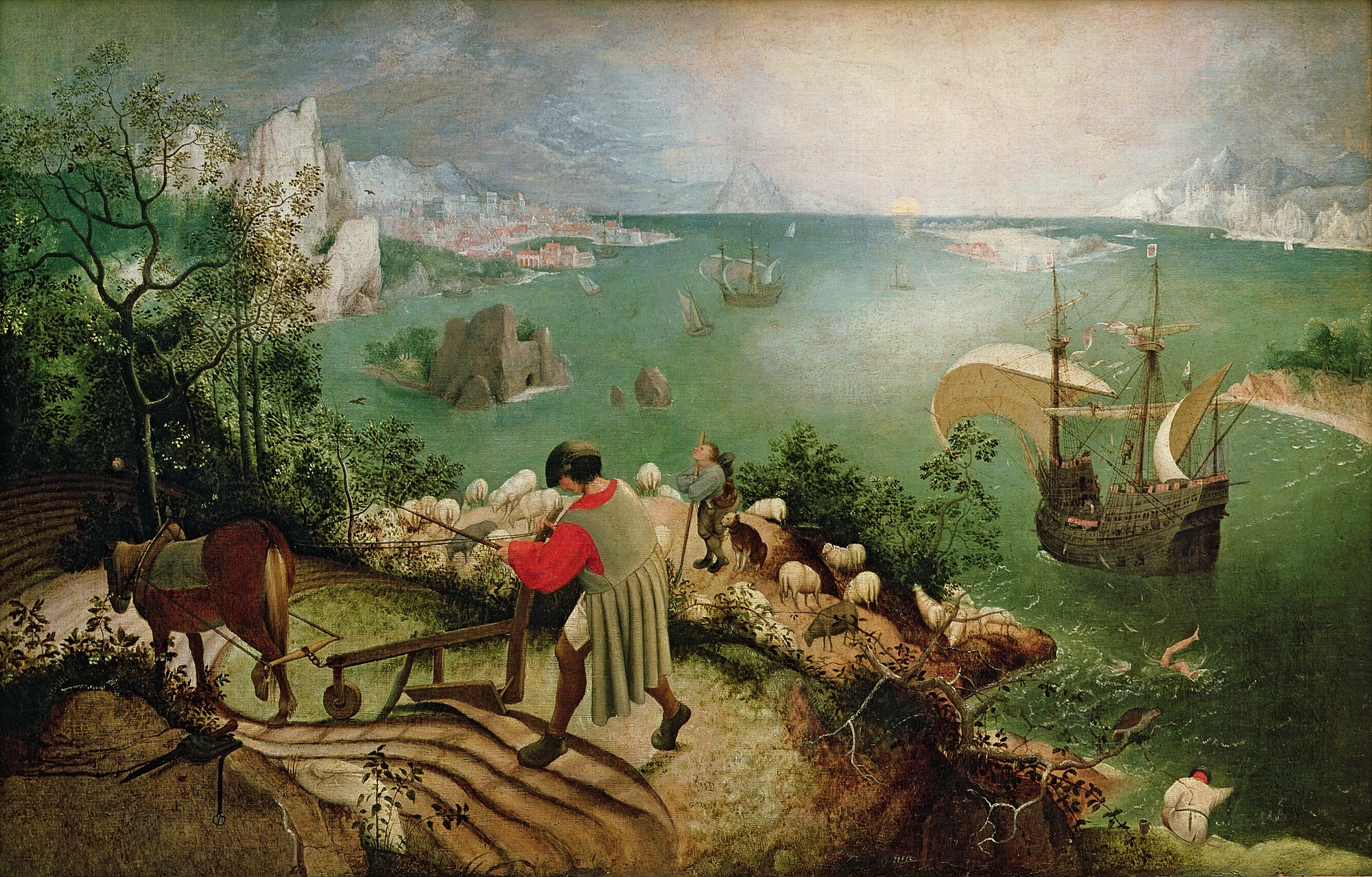
Icarus All-Sorts
- Show a painting or picture or passage of text or diagram.
- Don’t give its title.
- Ask students to examine the picture/passage/score etc, and notice and make observations.
- Accept observations from paired discussion – encourage curiosity – take all offers at face value.
- Ask class to consider “What could we find out about this picture/object etc. ?”
- “Where could we find out about it?”
- Capitalise on using resources available in the school (internet, library, the relevant department …)
- Develop by offering the artist’s/composer’s name and encourage further research possibilities.
- Offer, or allow the discovery of, the object’s title. Ask: “What does the title mean? How can we find out …?”
- As suggestions and realisations occur prompt curiosity about subject (e.g. Icarus – as the myth emerges)
- [Encourage enquiries into what the myth has to do with the picture … and what the artist may have had in mind.]
- Distil all of the resources – from memory, to other people, to books and the internet, that have been used or could be used to fully explore what challenges are offered by the picture/diagram/score.
- Go on to discuss… internal capacities students drew and the external resources they turned to?
- How were external resources used – by being selective – skimming for information – going deeper to find out more – linking ideas and information?
- What are the first things to do when set a challenge that requires you to capitalise on all possible sources? We have an image, but we do not know what it is called. Where might we look? How might we find out?
The activity leads to a recognition of the range of resources that can be called upon when seeking to acquire new knowledge, understand the unfamiliar and respond to challenges.
/twocol_one]
Click to enlarge
4. Celebrate capitalising
Make reflecting on Capitalising part of everyday lessons
Here is a very practical example of how you might develop the emotional climate of the classroom and make it capitalising friendly
Learning Mats
Learning mats are A4 laminated sheets that show various aspects of a learning habit. Keep them on desks/tables or as part of a wall display.
Students refer to them during lessons, using them as prompts about the finer aspects of a learning habit that is being stretched.
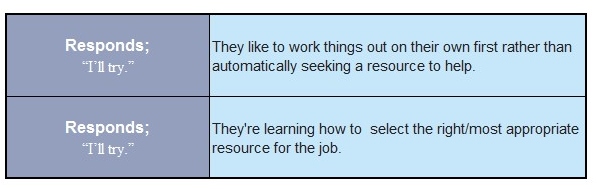
Teaching ideas to move learners from Purple to Blue ⬇️
What you are trying to help your students to achieve
In the Responds (blue) phase, students have become aware of many classroom strategies and resources although have yet to learn to select them carefully for a specific need. They now begin to use other sources of expertise such as books or the internet but again their approach lacks precision.
Your role as a teacher in this phase is to:
Devolve responsibility for capitalising… by gradually reducing the scaffolding and encourage students to select the best strategy/resource for the job
Talk about capitalising…by exploring the use of resources through talk
Give students opportunities to practise capitalising…by allowing time for using books and internet tools for learning
Celebrate capitalising… by reflecting on, praising or displaying its use
1. Devolve responsibility for capitalising
Learn to capitalise imaginatively
Scrapheap Challenge
Collect a pile of unrelated objects, or ask pupils to bring in one object each and mix them in random groupings – e.g. a copper tube, piece of cloth, felt pen, blu-tack. Challenge pupils to make as many things as they can from the objects, using all of them but nothing else. Discuss examples of particularly imaginative/effective use of materials and whether these ideas can be used in another context.

2. Talk for capitalising
Extend the language of capitalising
Collect words and phrases that tell you how people learn to Capitalise on what is around them.
Relate capitalising to well-known sayings
There is more than one way to skin a cat
Making the best of a bad job
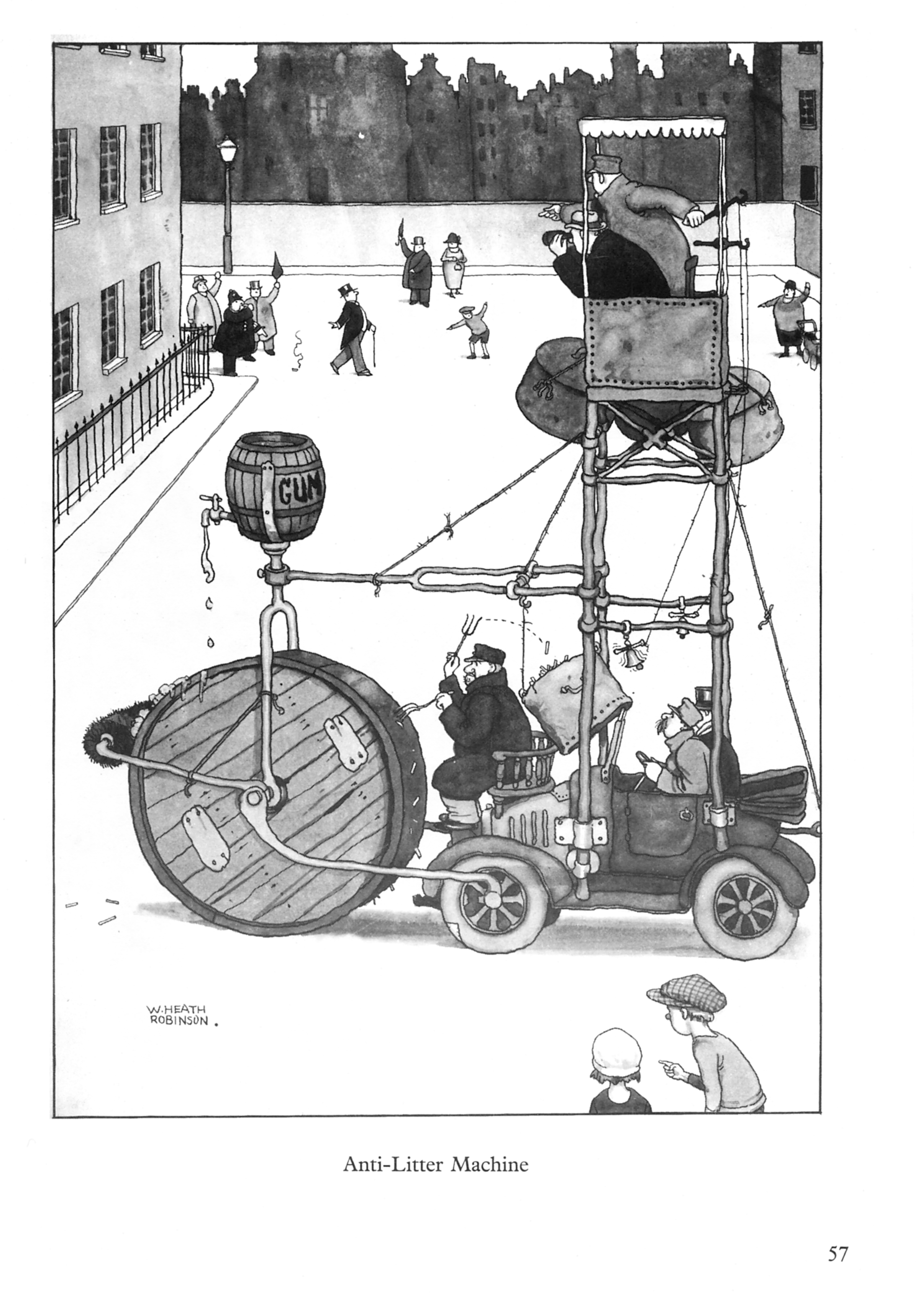
A bit ‘Heath Robinson’
click to enlarge
Extend the language of learning (capitalising vocabulary)
Noticing learning
Spend time with your class just noticing learning, talking about how it feels and when it’s best. Then ask the class to talk about what helped their learning, the ingredients of learning.
Capture what pupils say and make lists of:
- Doing words such as
- sharing
- focusing
- listening
- talking
- practising
- quiet thinking
- Feeling words such as
- energy
- support
- happy
- patient
- Words relating to things such as
- number lines
- computers
- TV
- books
- People words such as
- brothers
- sisters
- parents
- doctors
You will be pleasantly surprised by the number of words offered for processes, and the great range of items that pupils find helpful when learning. Make the lists into posters and display in the classroom, as a public support to continuing the dialogue about learning. It’s also worth reviewing and developing the lists at a later date.
3. Give students opportunities to practise capitalising
Ideas Factory
Invite students to become famous inventors who are going to come up with a new gadget to help other people. It must be useful and commercially viable. Use mindmaps to show the needs of their potential customers and gadgets that could be invented to meet the needs.
- What materials would they need to make it?
- Who do they know with the skills to help?
- Where might they find out relevant information?
Success criteria for the task should focus on the way groups have thought about using resources rather than on the finished gadget.
4. Celebrate capitalising
Use display to share key learning
Set aside an area of display where students are asked to share any strategies or ‘top tips’ that they have found particularly helpful in their own learning.
Set up a Helpful Habit board for tips from students to others about habits which might help them to achieve their long or short term goals. For those offering the ‘top tip’ it is a distilling activity, but the resulting gallery of ‘top tips’ invites students to adopt the successful strategies of others.

Teaching ideas to move learners from Grey to Purple ⬇️
What you are trying to help your students to achieve
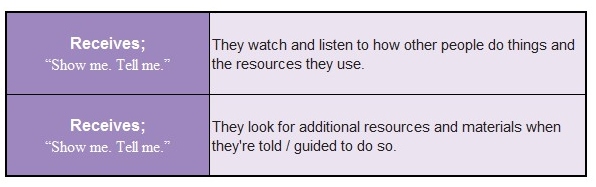
In the Receives (purple) phase, students begin to use the things and strategies they are given to help with their learning. The concept of resourcing learning is beginning to form. They become aware that it might be useful to watch and listen to others and that this can be useful in their own learning. They see their teachers as a source of expertise and can become too dependent on this unless supported to broaden their range of strategies and resources.
Your role as a teacher in this phase is to:
Devolve responsibility for capitalising… by introducing the idea of resourcing learning
Talk about capitalising…by exploring capitalising through talk.
Give students opportunities to practise capitalising…by making particular ranges of resources available for students to use
Celebrate capitalising… by reflecting on, praising or displaying its use
1. Devolve responsibility for capitalising
Organise the classroom for easy access to resources
The obvious starting point is to organise classrooms in such a way that pupils are able to select, get and return the resources they need.
Design tasks that require the use of a range of resources and gradually expect the children to select what they need.
At the beginning of a session talk with the children about the things they might use to help them with their learning.
As the pupils’ understanding grows introduce the idea of “learning tools” and start filling a plastic toolbox with things like a ruler, calculator, notepad and pencil. Keep asking the children for new ideas and regularly look through it together.
Explore imitation
A quick way to start pupils thinking about and reflecting on the nature of imitation.

2. Talk for capitalising
Discuss capitalising
Use language to encourage thinking about capitalising. Build these into your learning language:
- Have you thought about what would help you to do this?
- Just think about all the things we have in the classroom that might be useful.
- How else might you do it?
- What is everyone else doing?
- Is there anything else that you could use?
- There may be other people who could help you with this.
- Who do you think might know something about this?
- Where could you find out more about this?
- Which of the things you used did you find the most useful?
- If you had to do this again is there anything else you might use to help you?

3. Give students opportunities to practise capitalising
Build appreciation of how things might be used
What is it ?
Help pupils to appreciate / recognise that:
- objects can be used in different ways
- sometimes we need to free up thinking — not seeing things as functionally fixed.
Set up the Activity by dividing pupils into groups of four. Each group selects an object in the room. The aim is to develop as many strange uses as possible for each object.
- Each person in the group uses the object in a different way (e.g. the chair becomes a wheelbarrow, horse, cart, etc.)
- Group members to guess what the objects have become.
- Debrief and Discuss

4. Celebrate capitalising
Use a Learning Log to alert students to Capitalising across subjects
A useful resource for tutor time to guide reflection and a wide ranging discussion.
We have coupled imitation with capitalising here because imitating others is a powerful way of resourcing our own learning.
When you use this learning muscle, you …
- are ready to learn from others
- notice the approach and detail of how others do things
- improve physical skills, and absorb ideas, strategies and thinking patterns, by observing other people

Comments are closed.