
1. Perseverance – Keeping going
Attention can be broken when learning gets blocked, but good learners have learnt the knack of maintaining or quickly re-establishing their concentration when they get stuck or frustrated. Perseverance is often undermined by two common and erroneous beliefs. Firstly that learning ought to be easy. If learners think that they will either understand something straight away, or not at all, then there is simply no point in persisting and struggling. Secondly that bright people pick things up easily, so if you have to try it means you’re not very bright. Clearly the idea that effort must be symptomatic of a lack of ability makes persevering an unpleasant experience. Good learners develop perseverance when their parents and teachers avoid conveying these messages, even unwittingly. Perseverance is about: Keeping going in the face of difficulties; channelling the energy of frustration productively; knowing what a slow and uncertain process learning often is. 
How well does your classroom climate encourage persevering? ⬇️
Does my classroom climate encourage Persevering?
Here’s a selection of features that might begin to shape the emotional climate of your classroom to encourage persevering.
The diagram has 4 sections:
- Top – strategies you could build into the way you teach to stimulate perseverance;
- Right – indications of the sort of language you might use to stimulate perseverance;
- Bottom – ways in which you might celebrate / praise students’ use of perseverance;
- Left – things that you need to enable students to do.
Apply your own perseverance and consider whether you already use any of these features and which you fancy trying.

Download as a pdf
Bridging the gaps – teaching ideas to cultivate perseverance
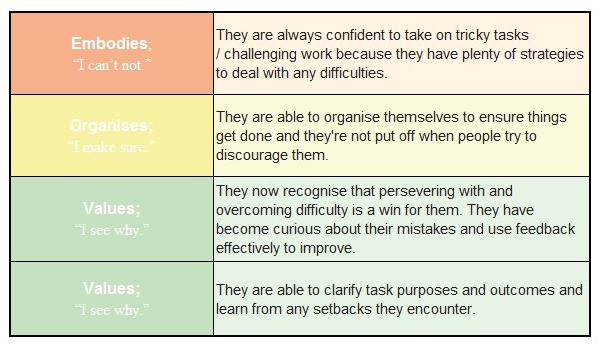
Teaching ideas to move learners from Blue to Green ⬇️
What you are trying to help students achieve
In the Values (green) phase the student has developed a strong belief that they can get better at learning. They become curious about mistakes and care about the goals they are trying to reach. They develop and use many practical strategies to assist them in dealing with challenge, being stuck and staying focused.
Your role as a teacher in this phase is to:
Devolve responsibility for persevering…by building students curiosity about their mistakes or getting stuck
Talk about persevering…by exploring through talk that students’ goal planning is geared to avoid obstacles
Give students opportunities to practise persevering…by encouraging them to set their own goals
Celebrate persevering… by reflecting on, praising or displaying its use
1. Devolve responsibility for persevering
Model how you might think about tackling challenges:
Things you might ask yourself
- what is the challenge about?
- what is it asking me to do?
- can I spot the key words or symbols here?
- have I seen one like this before?
- what might the end result look like?
- what’s the first step?
- and what’s the next step?
- what should I do if/when I get stuck?
- were there any tricky bits?
- can I remember how I tackled them
- what’s the best way round this tricky bit?
- I could do…….
- or I could try….
- which would be best?
- Oh! I remember this idea from…
Turn it into a story

2. Talk for perseverance
In order to secure the ability to approach challenge with clarity and flexibility, pose questions like:
- What is this challenge really asking you to do?
- What will success look like?
- How are you planning to go about it?
- What might go wrong?
- Do you have any fall-back plans?
- What could you do if it goes wrong?

3. Give students opportunities to practise persevering
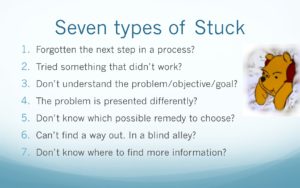
In this phase it may be useful to identify and model several forms of being stuck. What sort of stuck is it? Do different sorts of being stuck call for different strategies?
Seven types of stuck:
- Forgotten the next step in a process?
- Tried something that didn’t work?
- Don’t understand the problem/objective/goal?
- The problem is presented differently?
- Don’t know which possible remedy to choose?
- Can’t find a way out. In a blind alley?
- Don’t know where to find more information?
You could turn any one of these questions into an ‘If, then’ statement:
- If I have forgotten the next step in a process, then I’ll…
4. Celebrating perseverance
Learning mats
Learning mats are A4 laminated sheets that show various aspects of a learning habit. Keep them on desks/tables or as part of a wall display.
Students refer to them during lessons, using them as prompts about the finer aspects of a learning habit that is being stretched.
Learning Logs
Learning LogUse learning logs such as this to encourage students to reflect on when they did and didn’t persevere, and what happened as a consequence. Use as the basis of discussion.
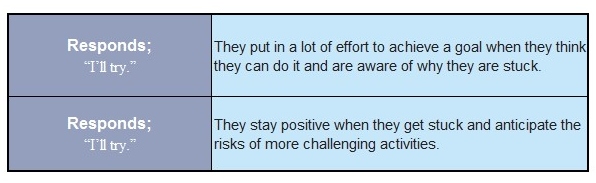
Teaching ideas to move learners from Purple to Blue ⬇️
What you are trying to help students achieve
In the Responds (blue) phase students develop greater independence and are motivated by trying to reach achievable goals. They are realising that fear, the need for adult support, and distraction can be overcome by having/using more coping strategies and practical ideas to get them unstuck.
Your role as a teacher in this phase is to:
Devolve responsibility for persevering… by encouraging students to overcome distractions
Talk about persevering…by exploring, through talk, understanding why they are stuck.
Give students opportunities to practise persevering…by offering challenging activities
Celebrate persevering… by reflecting on, praising or displaying its use
1. Devolve responsibility for persevering
Explain effort: it’s about focusing and re-focusing the mind on the work you are doing. Something is directing students’ attention. For example it could be…
- using different strategies
- using trial and error to deal with challenge
- using success criteria to direct what you do
- asking for feedback on how to improve/apply

2. Talk for persevering
Move language from ‘I’m stuck ‘ To ‘I’m stuck because …‘
When a student says ‘I’m stuck’, resist the temptation to ask ‘what are you stuck on?’ – you know only too well they will probably reply ‘everything’. Better to explore ‘why’ they are stuck . . . .
Encourage students to identify the cause of their stuckness. Move students from saying “I’m stuck” to ” I’m stuck because…” Naming the problem will often suggest a reasonable next step.
It’s also useful to insist that students can’t call themselves ‘stuck’ unless they have tried to apply at least 1 solution.
Develop prompts to nudge students’ self-talk:
- You have forgotten the next step in a process – what might I try next.
- You tried something that didn’t work- what would be an alternative strategy?
- You don’t understand the problem/objective/goal – I need to re-read the ‘question’.
- The problem is presented differently – what does this remind me of? What did I do then?
- You don’t know which remedy to choose – what’s the range of possible strategies I could use?
- You can’t find a way out, you are in a blind alley – I’ll retrace my steps back to where I first ‘got lost’.
- You don’t know where to find more information – where else might I look?

3. Give students opportunities to practise persevering
- Model how to think about and work through challenges
Give getting stuck a status
Start some lessons with something like:
- ‘In this lesson I want to make sure that you do get stuck’.
- ‘When you get stuck take a look at the unsticking prompts on your table to see if these help you to get unstuck’.
- ‘Later we will spend a few minutes talking about what we learned from being stuck and decide which unsticking idea worked best.’
The explicit message is that students need to expect being stuck during any lesson. The implicit message is that being stuck is a good thing – something you want to see. Using this technique regularly means students come to accept being stuck as a natural part of learning. It begins to build their curiosity about the why and possible patterns to stuckness.

4. Celebrate persevering
- Create a challenge wall with;
- questions,
- extension tasks,
- riddles,
- problems.
- Set up a go-to place when other work is finished OR set aside lesson time for everyone to work on a selected challenge.
- Display work that shows how students have improved mistakes etc.

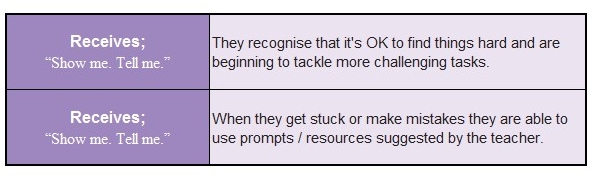
Teaching ideas to move learners from Grey to Purple ⬇️
What you are trying to help students achieve
In the Receives (purple) phase, students have made a big leap from having a negative mindset to a neutral one. Here they are inclined to play it safe, staying within their own comfort zone to ensure success and avoid perceived failure. They still need adult support to maintain focus and optimism when tackling tasks they perceive as difficult, but are beginning to show willing to take more responsibility.
Your role as a teacher in this phase is to:
Devolve responsibility for persevering… by helping them to understand distractions and how to maintain focus
Talk about persevering…by exploring mistakes and being stuck just by talking about it
Give students opportunities to practise persevering…by building a sense of what they want something to look like
Celebrate persevering… by reflecting on, praising or displaying its use
1. Devolve responsibility
Develop learning heroes
‘Adopt’ a character – real, imaginary, human or animal – who exhibits the best features of perseverance. Talk about the character until your pupils become familiar with its attributes. When you have set a group to work on a particular task – numeracy, reading, writing etc., leave this character (actual or picture) on their table as a reminder of ‘there are things you can do when you don’t know what to do’

Shift responsibility for monitoring the level of challenge to students
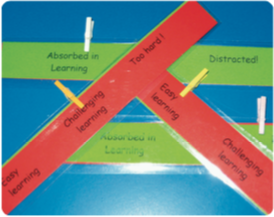
Little strips of laminated card and a peg can put students in charge of their learning a little more. Labelled ‘Easy learning’, ‘Challenging learning’ and ‘Too hard’ on one side, students use them to let you know whether you are meeting their learning needs or if they could do with more extension or support. It is powerful when learners realise that challenge is an essential element of their learning; that finishing easy tasks quickly does not signal cleverness but indicates time-filling rather than real learning.
For the teacher, this provides valuable, instant feedback. For the student who is on ‘easy learning’, prepare to inject more challenge; for the student on ‘challenging learning’, prepare to intervene if it becomes too difficult; for the student on ‘too hard’, explore whether that is really the case or whether a pointer in the right direction might bring it back to ‘challenging learning’
2. Talk for persevering
Model getting unstuck
Show students how you personally get stuck, and what strategies you have for getting unstuck, by demonstrating a piece of tricky learning. The idea is that sharing these experiences encourages students to imitate getting unstuck.
One of the first ways of surfacing learning, putting it on show, is to focus on how you are modelling being a good learner to students. Modelling is effectively you demonstrating how you are a learner too; a confident finder-outer.
- Take your students behind the scenes of learning and share with them some of the uncertain thinking of learning.
- Learning aloud is a good place to start: take students through how you would work out a problem. Modelling the thought processes (including emotional) that learners go through is important because a lot of the skill of learning only manifests itself in the inner world of the learner.
- Expose the thinking, feeling and decision making of a learner-in-action to help students actually see and hear how learning works.
3. Give students opportunities to practise persevering
Help students explore keeping going with a challenge.
Use Origami
A seemingly simple task that frequently leads to frustration and the need to have another go. Some students may do it fairly easily, others will give up, and some will struggle through and achieve, almost to their surprise, the desired outcome. Use the task to explore the feelings around stuck, challenge, potential distractions, and trying to achieve a goal.
Use it as an opportunity to explore further with the group — what makes us give up, what helps us keep going?
Coaching notes
Coaching notesLearning Challenge
Learning Challenge
4. Celebrate perseverance
Develop appropriate stuck prompts together
We all come across blocks and obstacles, go into blind alleys, get flummoxed by a vast range of possibilities, or simply don’t know enough to decide what to do next.
Being able to get ourselves unstuck is as much about how we react emotionally as it is about having the practical strategies to work out how to overcome it. Being able to manage an effective way out of being stuck is a critical part of being resilient.
- Explore with students how it feels to be stuck in learning and develop a list of suggested unsticking strategies
- Work with students to find useful questions for them to ask themselves and helpful strategies for them to use when they are stuck.
- Ensure that there are plenty of options that come higher on the list than “Ask the teacher”.
- Every classroom needs stuck prompts in one form or another. They could be of a general nature or made relevant to a subject or topic.
- It’s important to ensure that they ‘grow up’ through the school, reflecting the curriculum expectations. In essence they represent the level of independence expected in different year groups.


Comments are closed.