However well prepared learners are, they have to expect the unexpected. They have to have the readiness to revise as they go along. Good learners are able to change their plans and think on their feet. They are able to be flexible. To be effective at revising, learners need to monitor how things are going and periodically review where they have got to. Monitoring is the art of looking over your own shoulder as you’re working away at a problem, asking yourself how it’s going. Getting better at monitoring (‘reflection in action’) involves cultivating the little voice of self-awareness that keeps the strategic goals in mind, and is ready to change tack if it seems appropriate. Reviewing (‘reflection on action’) means stopping every so often to take stock of progress, and to ensure that any emerging product—an artwork, an essay, a draft business plan—is on track. Reviewing requires the ability to look at your own work with the critical eye of an editor, and not be afraid of the possibility that some corrections may be needed. Extract from Building Learning Power. Guy Claxton 2002
1b) What does being a good Reviser involve?
A well formed Revising habit involves being ready, willing, and able to:
Self-monitor how things are going, keeping an eye on the goal
Expect the unexpected, having a readiness to re-shape, re-order, re-form plans to take account of new circumstances.
Remain alive to new, unforeseen opportunities and ideas
Look at what you are doing with a critical eye
Strive to be the best you can be
Make sure things are on track and make improvements along the way.
So at a less abstract level, students need to learn how to deal with change, emotionally and practically. With an inflexible frame of mind they are unlikely to recognise the need to change their ideas or the way they do something. They also need to know what ‘good’ looks like; how to keep an eye on how things are going and the willingness to evaluate how things went against external standards. When looked at from these diverse angles, growing revising moves well beyond encouraging a student to ‘have another go’.
The Revising grid below takes account of the constituent parts of building the habit of Revising
Our progression grid for Revising has 6 components:
Revising is about the way we work on something to improve it. Whether it be icing a cake, solving a tricky maths problem or creating a well-crafted essay, all require effort, retries and determination to satisfy ourselves that the result pleases us. How we tackle such a job isn’t just a case of monitoring as we go along or reviewing the result: it will be influenced by other qualities. Our attitude to change, whether we have a sense of quality and what sort of validation we need. The grid intertwines these important contributors to our growth in the habit of Revising.
The learning guru Royce Sadler put it like this: “Students need to be able to judge the quality of what they are producing and be able to regulate what they are doing during the doing itself”.
Take a closer look at what each column of the grid is about
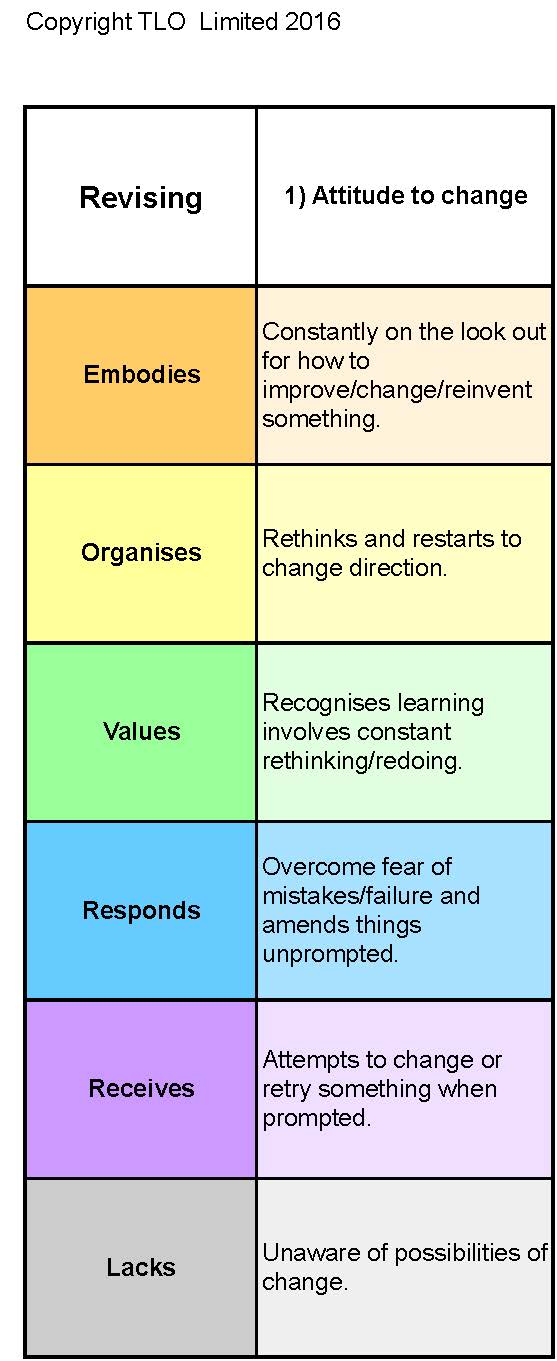
1) Attitude to change
How we relate to the change process
For many of us, doing things differently is scary and only for the bold and confident. But if we want students to enjoy achieving their best learning outcomes, we need to scaffold that process by building confidence – helping students move beyond their comfort zone and becoming more flexible as a learner. In the early phases students adapt what they are doing because they are being told and/or supported to do so. But this support pays off at the ‘value’ phase (green) when students feel positive about their efforts and realise learning is all about rethinking and adjusting and redoing, rather than getting it right first time. By the ‘organises’ phase (yellow), students are ready, willing, and able to move beyond making relatively small changes to making wholesale changes or starting again on a different tack.
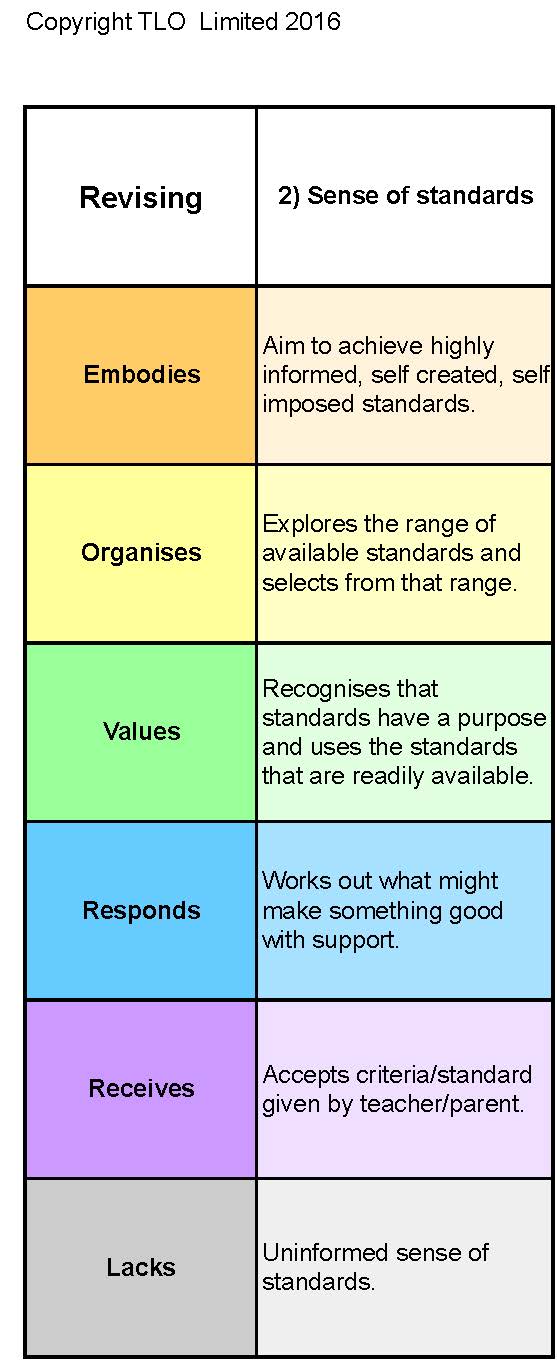
2) Sense of standards
How we relate to standards of excellence, quality, and correctness
The next contributory factor in revising what we are doing has to do with how we view quality; whether we have a sense of standards; our view of what’s good, bad or indifferent. In the early phases students accept what they are told about by teachers; what something needs to look like, be like, feel like. Schools are full of them – objectives, criteria, steps to success, outcomes – and constantly trying to achieve them can be dispiriting. But with support and encouragement students are able to begin to think for themselves what makes something good and determine their own standards.
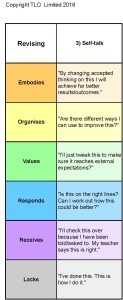
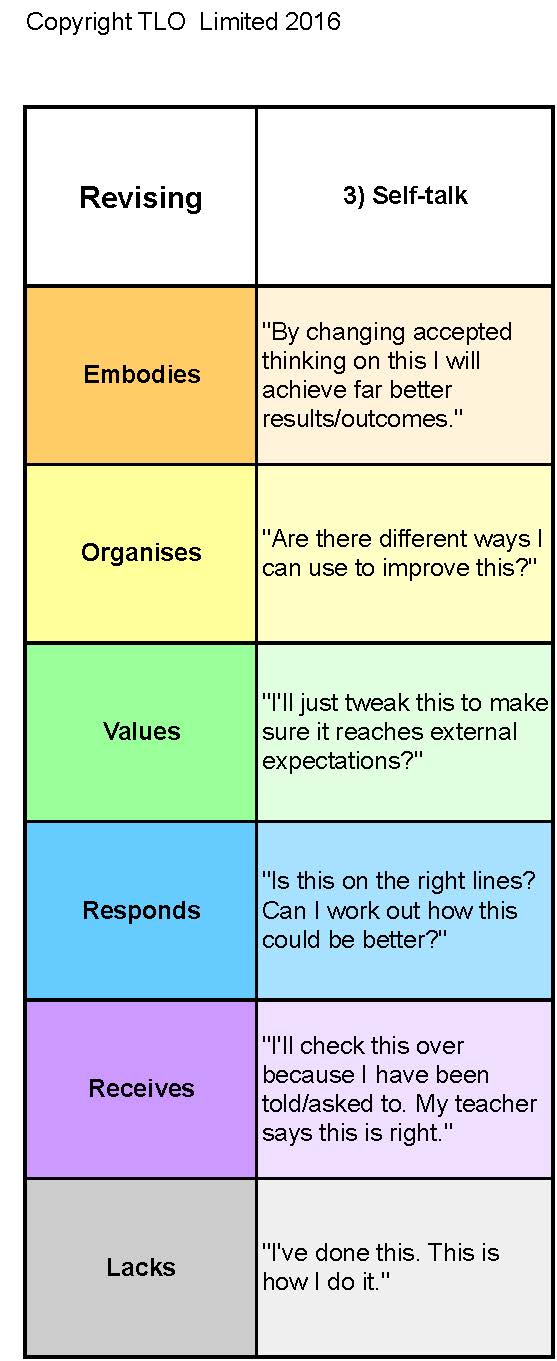
3) Self-talk
The voice of self-awareness
Self-talk is what we say to ourselves as we learn. The statements capture what someone in each phase of the grid would be thinking. Students may use some of these phrases when talking with you, or in writing from time to time, but mostly self-talk goes on inside their heads. We have shown a small flavour of self-talk thoughts that teachers can encourage students to imitate. Some relate to standards, others to self-monitoring, or flexibility. All such self-talk is important in building a revising habit.
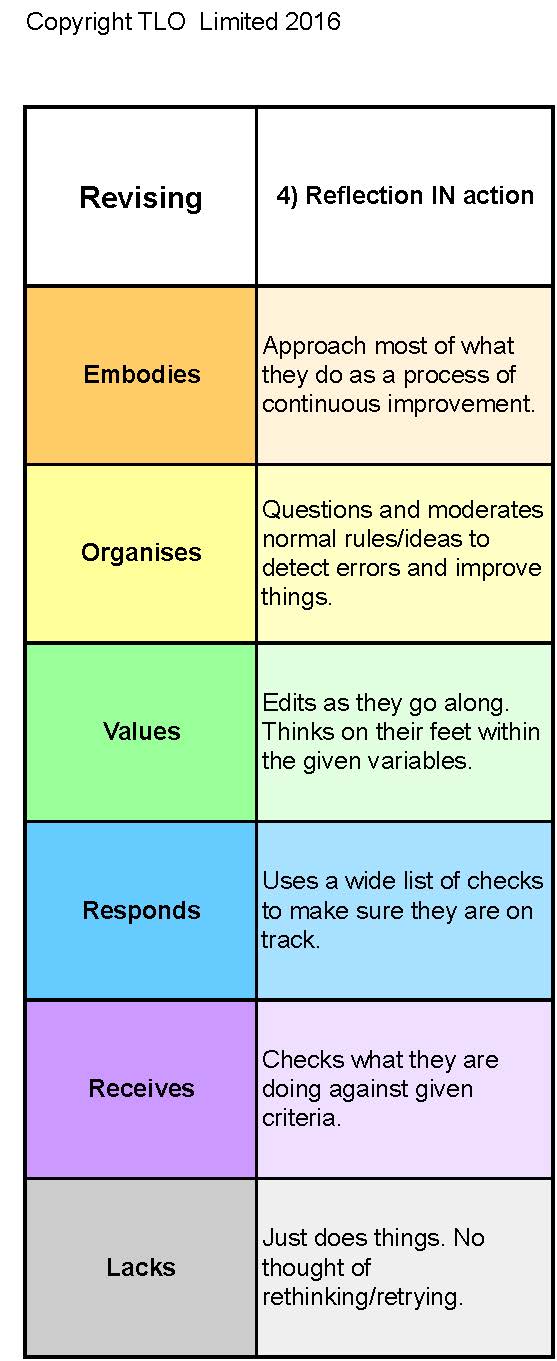
4) Reflection IN action
Checking of how things are going
This column is about how we monitor what’s happening as we go along; keeping a weather eye on how things are going. Students need help to do this well. They need to know what they are looking for, what they are tracking. Should they look for good things or bad, for feelings, for whether they understand…? It’s a minefield. The early phases shown here relate to monitoring what you are doing against known criteria, and checking the process of doing something itself. Students need these props in the early phases. It’s only in the ‘valuing’ ( green) phase that they become skilled at editing as they go along, having had practice with checklists and criteria in earlier phases.
Look particularly at the difference between ‘value’ and ‘organised’. In the ‘value’ phase the amends, revisions, and re-tries are being done with the original aim/goal/ objective in mind. In the ‘organised’ phase students are prepared to ditch the original plan, ask hard questions, change the rules and change direction. It’s a big and important shift in becoming an independent learner.
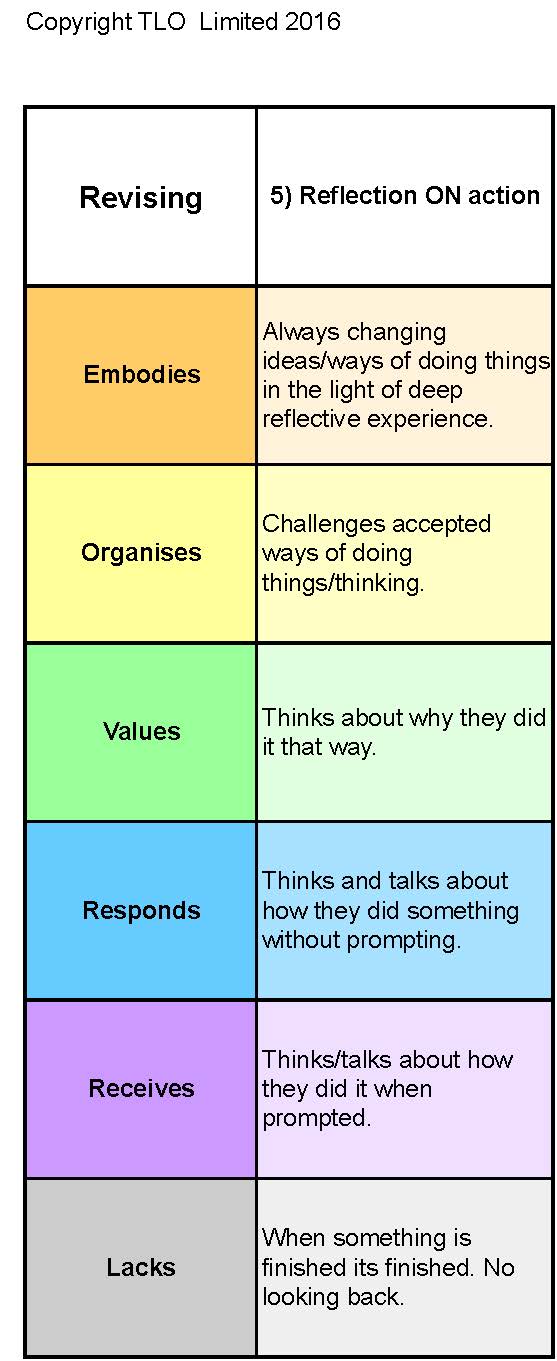
5) Reflection ON action
The inclination to reflect on what we have achieved
This is the essence of learning from experience although sadly it is not a common inclination. The key here is not simply reflecting on what happened and whether we could have improved, but whether we take heed of such lessons and behave differently next time. This is not a natural skill and will need careful structuring and nurturing. Notice that the early phases are about what happened and are heavily scaffolded. By green students are asking why they did it that way, and by yellow they are challenging those familiar ways of working and rethinking the how in order to achieve better outcomes. It’s a breakout moment.
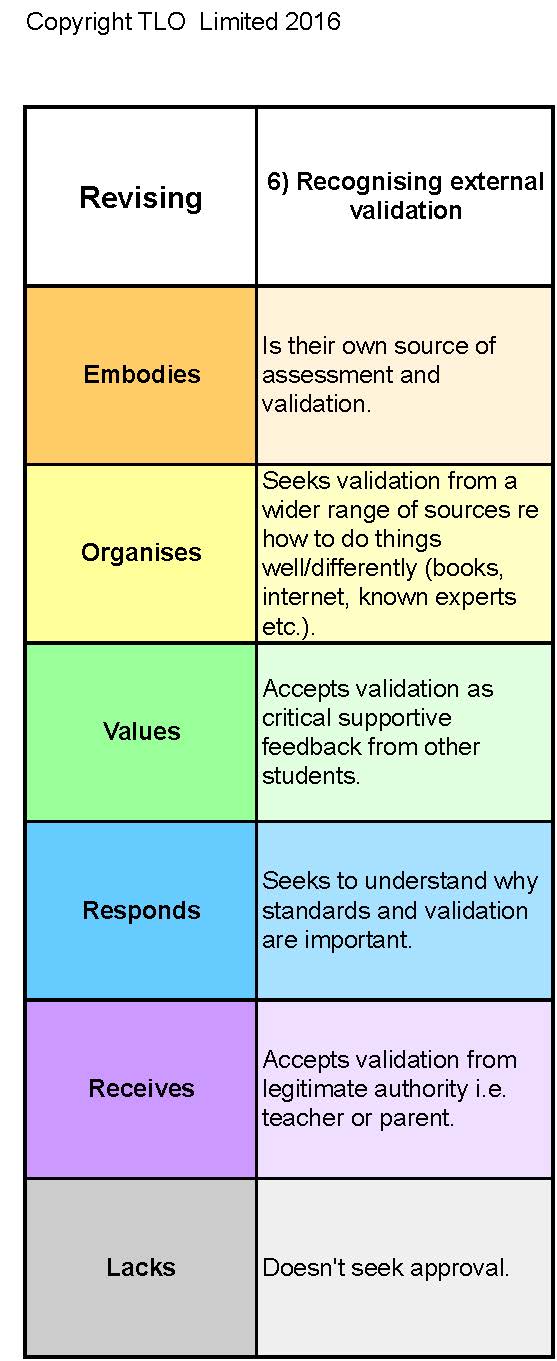
6) Recognising external validation
How we relate to external validation.
The last constituent of revising has to do with how we need and use external validation – the need for a legitimate authority source to confirm that what we are doing is right. When we are chasing facts we need to be sure they are correct. When we are using standards we need to be sure they are sound. In the early phases this authority normally comes from parents and teachers. As students move through the phases there is a move to seeking out experts, dictionaries and original sources. (The internet invariably plays a role here but while it might be a great place to start it’s a terrible place to finish! It needs to be used with discernment.) Sources of legitimate authority plays into how we revise and improve our learning.
What do you think?
What have you learned about revising from these descriptions?
What have you had confirmed?
What surprised you?
How have your views changed?
Make a note of…
Any ideas for practical classroom experiments that these descriptions have triggered
Which column your students are most secure in.
1d) Unpicking the rows; getting better at Revising.
Of course the development of revising does not grow neatly up each column or evenly across the phases in the grid. The five broad phases of dispositional growth (purple – orange) are affective ways in which people may be inclined to behave: we call this inclination ‘mindedness’.
Here is our interpretation of how Revising might grow.
The phases are drawn from Bloom’s taxonomy of the affective domain.
Phase ‘Receives’ (purple) is about doing something because you are told or expected to. Phase ‘Responds’ (blue) is about gaining interest and doing things more willingly. Phase ‘Values’ (green) is a key phase since the student now sees the value of behaving in this way. It’s a win for them; to behave like this is in their interest. It’s in this phase that the behaviour becomes more secure. Phase ‘Organises’ (yellow) is the phase in which the student capitalises on this ‘in their interest’ behaviour and gets themselves organised to use it positively. Phase ‘Embodies’ (orange), known as ‘characterised’ in the original taxonomy. In this phase the student has made this behaviour their own. It has become part of their character; they can’t not do it and they have become highly skilled in doing it.
We urge you to see this progression as long term. Some phases will take years for people to work through; some will never be worked through. None of the phases are inevitable. There is a lifetime of development captured here. Nevertheless the role of a teacher or parent should surely be to encourage and enable this journey.
Lacks: Minded to ‘just do things’
In this ‘Lacks’ (grey) phase, students are not necessarily aware of doing things well or differently. Once they get going on something they may change it but more for the joy of just doing it. Outcomes maybe rushed or lack finesse, but once completed there may be little interest in revisiting it or in any comments they are offered. External standards are not yet a feature of their world.
Receives: Minded to check what they do.
In the Receives (purple) phase, students begin to make checks on how they are doing against given criteria when prompted. They can talk about what they did and sometimes how. They rely on their teachers or parents to validate what they do/have done.
Responds: Minded to understand standards.
In the Responds (blue) phase students have overcome a fear of mistakes and are more able and willing to monitor what they are doing. They begin to develop the idea of ‘good’ themselves and to understand why given standards are important. They respond positively to supportive feedback and talk reflectively about how they could improve with encouragement.
Values: Minded to value revising
In the Values ( green) phase, students understand the importance of keeping a close eye on progress in order to achieve high-quality outcomes that meet their goals. They see the point in making changes in the light of the original goal or external standard or internal feedback. They understand the need to learn from previous experiences and realise that learning is all about changing understandings; not just knowing stuff. In so doing they widen the scope of external validation.
Organises: Minded to actively seek alternative strategies
In the Organises (yellow) phase revising has become a skilful habit; where revising itself raises more questions than answers. Yes, progress is kept under review but now students question the original goal of the activity. They look more widely for validation and may well change to a more productive strategy or a different goal. They use critical feedback positively and are keen to look back on what and how they achieved what they did in order to learn from the experience.
Embodies: Minded to exploit previous experience to the full
In the Embodies ( orange) phase, students make ongoing checks and amends, and major rethinking, in order to meet their own, often more exacting, standards of achievement. Now they tend not to need the validation of others (marks, grades, exams, quality feedback) because their own critical sense of standards acts as their barometer. They adapt readily to changing circumstances and always reflect on what and how they have done something with the explicit intention of doing it better, more efficiently / differently in the future.
What do you think?
What has struck you about the act of revising having read the descriptions above?
Which phase do you operate in?
What makes you say that?
Make a note of…
What you might do to assist your students to make headway in their revising behaviour.
Any practical ideas the text has triggered.
Preparation for the Learning Team meeting
Where are my pupils now?
Take a look at the Revising progression chart in your Learning Diary or
Colour in the cells where you think your pupils are secure.
Some will barely be on the chart while others may be quite a way up. Neat straight lines of secure classes are rare. But looking at your class in this way should give you an idea of what you need to work on.
Draw a red line across the chart to denote where you think most of the school’s pupils could and should reach by the time they leave.
Please take the results of these tasks with you to the Professional Learning Team session shown in Section 4
As teachers we are in the habit-forming business. What we say, what we display on classroom walls, what we celebrate, praise or dismiss, what we model or how we design learning activities will all influence the ways in which pupils learn, perform and behave. Classroom cultures have a huge influence on pupils’ learning as you will remember from the Culture unit.
Five big shifts to get you started. Ask yourself – how might you:
Ensure high levels of inclusion, acceptance, affection, support, and trust to build group cohesion?
Create opportunities for students to resolve conflict and build consensus; helping controversy and conflict to be seen as a positive key to students’ involvement, the quality of decisions and the continuance of the group in good working condition?
Design group work activities to provide opportunities to experience different methods of decision-making?
Encourage students to extend the range of roles that they adopt when collaborating?
Help students to reflect on and evaluate their individual contribution to the group’s progress?
Now look at the Learning Chart sections below where you will find plenty more ideas to try.
Pair work, group work or teamwork are frequent features of classroom practice across all age ranges. But what are the essential features of this way of learning? How can students improve their collaborative behaviours in order to achieve better results?
In this unit, we explore the subtleties of collaboration and the skills that make up teamwork. We consider a broad order in which such skills might be explained, orchestrated, commented on and celebrated by teachers in classrooms to ensure the progressive development of students as collaborative learners.
There are many ways to define collaboration. In a learning context we have come to understand collaboration as being able to manage yourself effectively in the give and take of a collaborative venture, having a range of interpersonal skills that enable you to work and learn with and from others, being willing and able to contribute constructively and with sensitivity, and adding to and drawing strength from the team itself.
At its least sophisticated, it is little more than being cooperative. At its most sophisticated and complex levels it goes beyond learning ‘in a team’ and becomes learning ‘as a team’. It is an invaluable life skill.
In short…
Collaboration: Having both the skills and the inclination to contribute positively to group work in order to learn productively with and from others.
What do you think?
Are you aware of pupils whose lack of social skills limits their ability to cooperate, let alone collaborate, with others?
Are you aware of pupils who regard group work as an opportunity to allow others do all the work? (the social loafers,)
Are you aware of pupils who are keen to do all of the work themselves to the exclusion of others? (the job hogs)
Make a note of…
Pupils who do not trust others to contribute effectively
Pupils who are reluctant to contribute to group work
What does a well-formed habit look like?
Effective collaborators are adept at learning with and from others. They help to: shape the ideas of the team; decide what needs to be done; contribute to getting the job done; keep an eye on how things are going; improve team performance through reflection.
At-a-glance Collaboration card [extract] – Click image to view full screen
Find out more about Collaboration:
A well-formed collaboration habit includes being ready willing and able to:
Work effectively with others towards agreed, common goals, acting flexibly in response to circumstances.
Adopt different roles and responsibilities in pursuit of agreed goals and the well-being of the team.
Hold and express opinions coherently, compromising and adapting when appropriate.
Seek to understand what others are saying; sharing, challenging, supporting and building on ideas.
What do you think?
Do your pupils become increasingly like this as they move through your school?
What makes you say that?
What do you currently do in school that encourages pupils to develop their social learning skills?
What might you be doing to inhibit collaborative learning?
Make a note of…
Things you do to support collaboration
Things you do that might hinder collaboration
1b) How Collaboration might build when we nurture it.
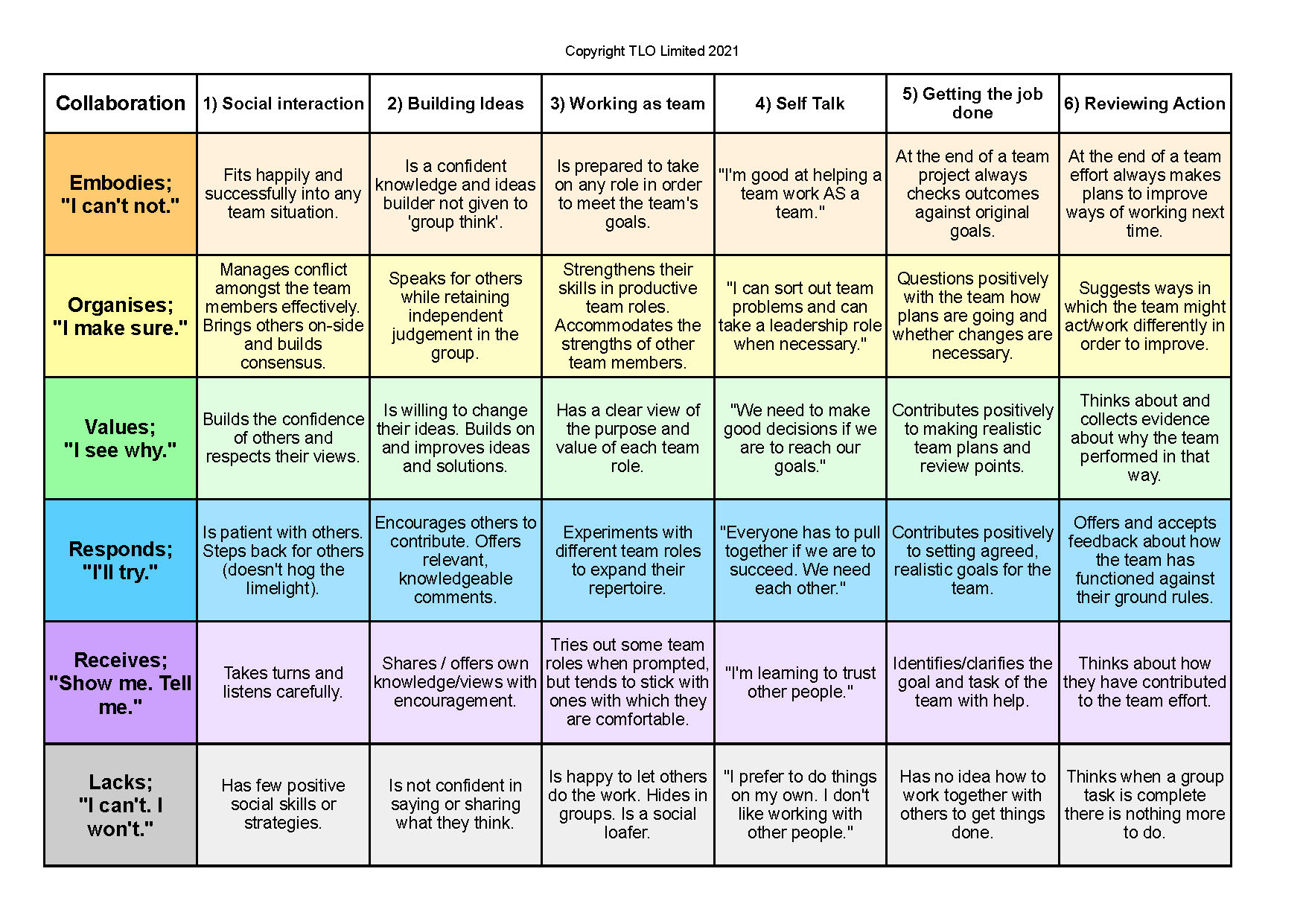
Being collaborative isn’t something that switches on on good days and off on bad days. Being a good collaborator grows and builds when it’s nurtured and supported. Furthermore, being collaborative involves gaining control of a range of linked skills and emotions. Take a look at how progression in Collaboration might grow across six contributory aspects.
Cast your eye over the ‘big picture’ of growing Collaboration below. Then move on to finding out what the columns (1.3) and the rows (1.4) are all about.
1c) Unpick the columns; what contributes to a readiness to Persevere?
The grid columns are things that might combine to make up the skills and attitudes of a Perseverer.
Collaboration involves knowing how to learn with others, as part of a team, in situations where no one person knows all parts of the puzzle. This complicated yet essential learning habit develops in several different ways. First of all it hinges on social interaction; how well we get on together, whether we are patient with others and respect their views. Then how we are able to bounce off others to build ideas; making the most of several brains rather than one. Next, how we learn to be part of a team and to perform different roles when needed. Fourthly, how we talk to ourselves about learning with others, where our real understanding of the process is revealed. Fifthly, how we contribute to the process of actually getting things done. Not just being there but doing something helpful. And lastly how we contribute to improving team performance by evaluating not just outcomes but the process of getting there.
Take a closer look at what each column of the grid is about
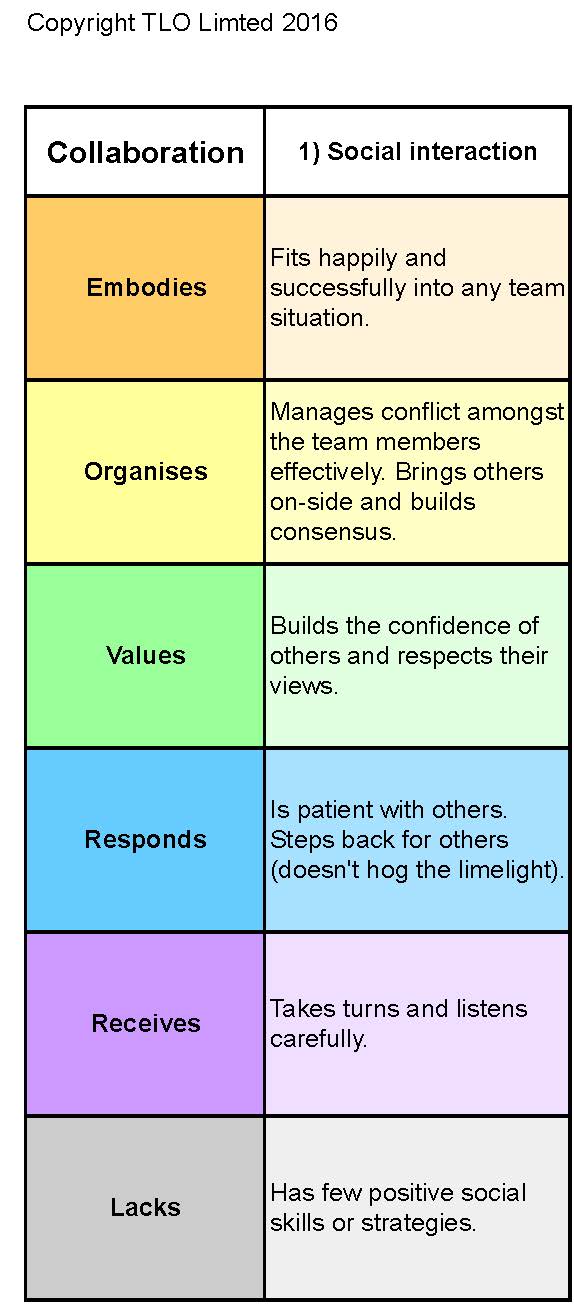
1) Social interaction
How we interact socially in learning and working with others. The way in which we learn the social conventions of behaving in a group; taking turns to speak and contribute, listening to understand others; being patient with others and not hogging the limelight; stepping outside our own concerns and building the confidence of others and respecting their views; being able to manage and overcome the inevitable controversy as teams work creatively together; and thus being able to become a valuable sociable member of any team.
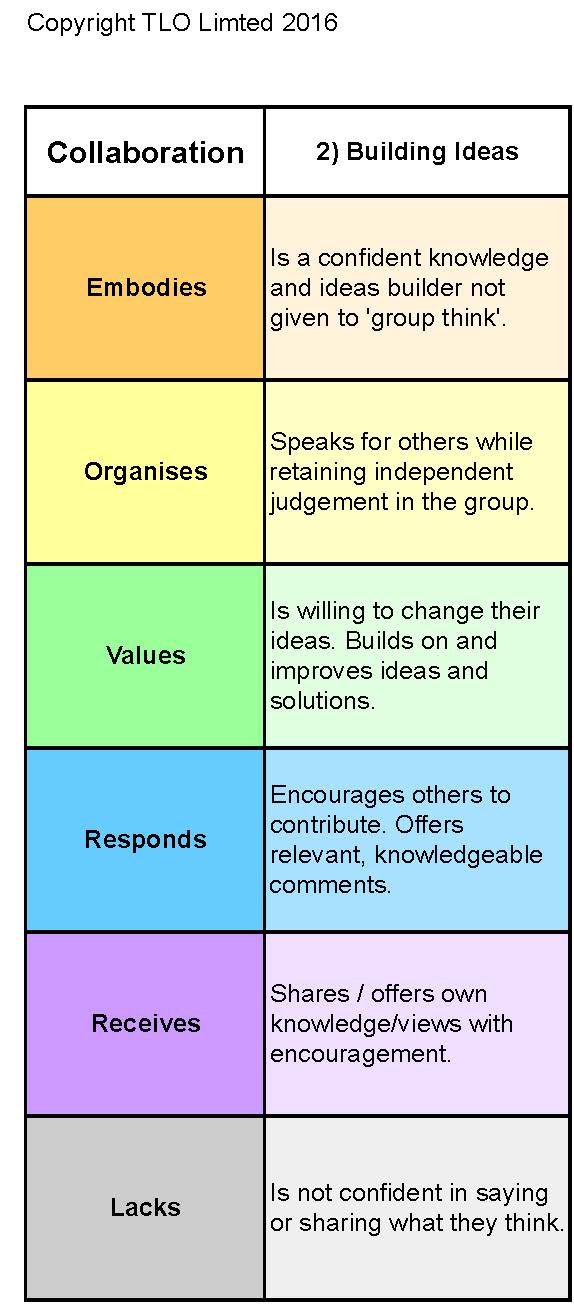
2) Building ideas
Just being good mates in a team doesn’t lead to success. Teams have to understand how to build ideas together; to draw on the ideas of others, to be able to graciously set aside ideas that wouldn’t work, to spark off others to ensure new and better ideas get an airing. And somehow, in all this ‘togetherness’ people are able to retain their independent judgement and avoid being drawn into group think. Teams share and build ideas together; growing and improving possible solutions in order to reach their goals
3) Working as a team
Working as a team is rather different to working in a team. It’s all about ‘teamness’ or ‘togetherness’. In order to work as a team people need to understand team roles, to find out what role they are particularly good at, to take on a range of roles when needed and eventually be willing to play any role in a team to ensure the goal is reached. Being able to work as a team is influenced by how our self-perception and confidence grow, how we learn to trust, how we recognise the need for each other.
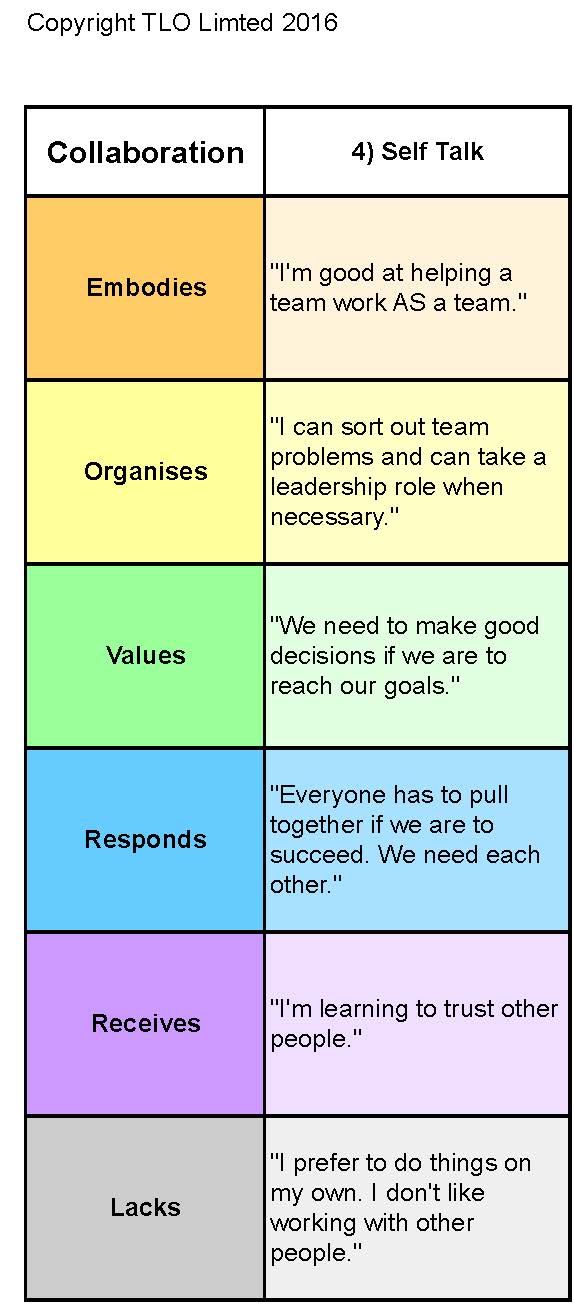
4) Self talk
The voice of self awareness
Self-talk is what we say to ourselves as we learn. The statements capture what someone in each phase of the grid might be thinking. Students may use some of these phrases when talking with you, or in writing from time to time, but mostly self-talk goes on inside their heads. We have shown a small flavour of self-talk thoughts that teachers can encourage students to imitate. Some relate to standards, others to self-monitoring, or flexibility. All such self-talk is important in building a collaborating habit.
5) Getting the job done
How teams achieve their goals by using the well-known learning process of Plan Do Review. Good teams have people who know that the first job is to be clear about what the task is really about. They are skilled in considering/creating/agreeing realistic goals to be achieved and which everyone has bought in to. Then the team have to plan how they will achieve the goal, how they will monitor their progress and methodology and how they will make sure the job is well done.
6) Reviewing action
This aspect is about how teams learn how to improve. It’s the aspect of teamwork that is frequently left out altogether or given short shrift. But it’s the aspect of teamwork that helps teams build themselves into better teams. It includes evaluating how they performed as individuals in contributing to the work of the team and how/whether the team process worked to achieve the team goal. Importantly such reflection leads to serious re-planning of their ways of working. It’s meta learning at a team level. Good teams will be looking for what has become known as marginal gains, those little things can we do better/improve that will impact on the overall performance.
What do you think?
Do these contributory features of collaboration make sense to you?
Make a note of…
Things that you think might be missing from this big picture of collaboration
What do you think?
Do you think there’s an order in which these skills develop? Would it be the same order for every pupil?
Do you think these behaviours develop ‘naturally’ as children mature?
Do we need to intervene in order to support this positive development?
Make a note of…
Any behaviours you think develop naturally
Any behaviours you think may be missing from this picture of collaboration
1d) Unpick the rows; getting better at Collaborating.
Of course the development of collaboration doesn’t grow neatly up each column or even across the columns. However, it is possible to look at the grid another way and group cells together into five broad phases of dispositional growth. We have based this growth on Bloom’s taxonomy of the affective domain. By looking at the development of emotion and skill, the grid yields broad ways in which people may be inclined to behave: we call this inclination ‘mindedness’. Pupils may be:
Here is our interpretation of how Collaborating might grow.
The phases are drawn from Bloom’s taxonomy of the affective domain.
Phase ‘Receives’ (purple) is about doing something because you are told or expected to.
Phase ‘Responds’ (blue) is about gaining interest and doing things more willingly.
Phase ‘Values’ (green) is a key phase since the student now sees the value of behaving in this way. It’s a win for them; to behave like this is in their interest. It’s in this phase that the behaviour becomes more secure.
Phase ‘Organises’ (yellow) is the phase in which the student capitalises on this ‘in their interest’ behaviour and gets themselves organised to use it positively.
Phase ‘Embodies’ (orange), known as ‘characterised’ in the original taxonomy. In this phase the student has made this behaviour their own. It has become part of their character; they can’t not do it and they have become highly skilled in doing it.
We urge you to see this progression as long term. Some phases will take years for people to work through; some will never be worked through. None of the phases are inevitable. There is a lifetime of development captured here. Nevertheless the role of a teacher or parent should surely be to encourage and enable this journey.
Lacks:
In this ‘Lacks’ (grey) phase, pupils are often unsure of themselves in a group. They often learn and play alongside other children but collaborating together is far more tricky. Their social skill may not be conducive to working with others either tending to push themselves forward and take control or shying away and saying/contributing little. They have much learning and adapting to do before they are really ready to work in a collaborative team.
Receives: Minded to begin to collaborate with others
In the Receives (purple) phase, pupils are making a big leap from being wary of others, being unaware of social conventions or any of the advantages of working/learning with others. Here they are collaborating with others because they are required to. There is much to be done in this phase: social skills, sharing ideas, working out what needs doing, playing their part and even thinking about how they have contributed to the team.
Responds: Minded to be part of a team
In the Responds (blue) phase pupils are willing to develop their understanding of what being part of a team involves, agreeing goals together, trying out different roles, broadening social skills to opening up others.
Values: Minded to function flexibly as part of a team
In the Values (green) phase pupils see/appreciate the value of a team member and honing their skills in different roles, planning action more carefully, and being flexible in their own views for the sake of the team. Once this phase is secure pupils are likely to develop further skills by having opportunities to work in this way.
Organises: Minded to learn in and as a team
In the Organises (yellow) phase, pupils organise themselves to work as part of a team. They learn that skilful teams manage conflict and that conflict and controversy are positive keys to involvement and creativity; that high-performing teams frequently check their progress and adjust their practice to stay on track.
Embodies: Minded to see Collaborating as a way of being.
In the Embodies (orange) phase, being a skilled team player is what characterises the student. They work happily and skilfully in any team, confident in their social, task development, planning, reviewing, and team evaluation strategies. A valuable member of any team.
What do you think?
Which phase of collaboration mindedness do most of your pupils fit into? They may of course be developing in more than one phase at a time.
Are some in the grey zone ? – i.e. collaboration is missing altogether.
Make a note of…
The pupils who don’t appear to be mainly in the grey zone
Preparation for the Learning Team meeting
Where are my pupils now?
Take a look at the Collaboration progression chart in your Learning Diary or
Colour in the cells where you think your pupils are secure.
Some pupils will barely be on the chart while others may be quite a way up. Neat straight lines of secure classes are just about impossible. But looking at your class in this way should give you an idea of what you need to work on.
Draw a red line across the chart to denote where you think most of the school’s pupils could and should reach by the time they leave.
Please take the results of these tasks with you to the Professional Learning Team session shown in Section 4
This section is for those teachers who are undertaking this unit alone and are not part of a Teacher Learning Communitystructure. The section provides well researched ways for planning and reflecting on your changing classroom practice
When teachers want or need to improve it actually involves them in changing their teaching habits. It’s not just about knowing new stuff, like reading the previous sections, it is about doing what you do differently. That’s much harder. It involves changes to;
what you know – knowledge
what you believe – feelings or attitudes
what you can do – your skills
what you actually do – putting it all into practice
So changing how you teach is a delicate, complex process……...that’s why it’s hard!
And the hardest thing isn’t getting new ideas into teachers’ heads
It’s getting the old ones out…….that’s why it takes time and effort.
It takes time and practice to undo old habits and become graceful at new ones……that’s why we have provided materials here to help you to plan the changes you want to make, monitor what happens in your classroom as the changes happen, and reflect on the impact of those changes; their worth and value.
This section offers a framework for supporting a productive Teacher Learning Community
If you are undertaking this unit alone and are not part of a Teacher Learning Communitystructure, please move on to Section 5.
Teacher learning communities have the potential to provide you, as teachers and support staff, with the information and support you need to develop your practice in deep and lasting ways. They provide a forum for supporting you in converting the information and ideas in the online learning sessions into “lived” practices within your specific subjects and classrooms. They provide a safe forum in which to;
kick around ideas from the online content,
unpack it’s meaning when it’s unclear,
consider what’s do-able and appropriate for your pupils
make plans for what and how you might incorporate the ideas into your practice
share and unpack what you have tried in the classroom
relate your triumphs and tribulations
support colleagues through changes in practice
reflect on what you hope you might do, or have done, differently
The format of the agenda is based on research into teacher learning communities by Dylan Wiliam, of Assessment for Learning (AfL) fame. Teacher learning communities are the engines of teacher development.
What could I do differently to ensure my students benefit from a ‘stuck friendly’ culture?
In the tab boxes below you will find the activities shown in section 2 re-grouped. This grouping enables you to look at one type of teacher behaviour shift across all student development phases. Basically it shows the subtle behaviour changes you will need to make in order to build your students’ behaviours.
The four shifts in teacher behaviour:
how you relate to students
how you talk to/with students
how you construct learning opportunities
how you celebrate learning
Have a rummage through the tabs to see what you can find. As you do, keep in mind what your students do now when they are stuck. Think about, what do you want them to be able to do that they can’t or don’t do now?
This dimension of the learning friendly classroom concerns learning gradually becoming a shared responsibility;
As a teacher you will be giving students more responsibility for their own learning by;
acting as a learningcoach, gradually enabling students to find their own ways to improve
focusing collaborative activity to help students to see each other as resources for learning
offering students choices about what and how to learn
enabling students to talk more, with you talking less
modelling being a learner
surfacing and promoting the processes of learning itself.
Shifting responsibility for learning ensures students recognise, use, understand and grow their learning habits.
The classroom gradually becomes a learning community where everyone is learning from each other and growing more confident as learners as a result.
Organisation of ideas below
The ideas below have been included for their effectiveness in helping to unhook teacher-student dependency and shift more responsibility for learning to students. The coloured lines bounding each idea suggest the progression phase of ‘unsticking’ the ideas might best secure.
From Lacks to Receives. ( From ‘I can’t’ or ‘I wont’ to ‘Show me’ or ‘Tell me’)
Aids to help shift responsibility for learning
How you relate to your students; gradually sharing more of the responsibility for learning with them
#1 Introduce the idea of being stuck
Adopt a character (ages 4-10)
‘Adopt’ a character – real, imaginary, human or animal – who exhibits the best features of persevering with being stuck. Talk about the character until your children become familiar with its attributes. When you have set a group to work on a particular task – numeracy, reading, writing etc., leave this character (actual or picture) on their table as a reminder of ‘what to do when you don’t know what to do’.
Show an animation (ages 4-10)
1 minute animation to illustrate an aspect of Perseverance.
Use it to talk about trying other ways to achieve what you want to do.
It’s about shifting responsibility for learning to the learner.
Make your own class animations for different aspects of Perseverance.
Try a quick activity (ages 8-12)
NB. Please read Perseverance for Resilience.
A 5 minute activity to introduce students to broad ideas of stuck and perseverance
When first introducing the concept of a learning behaviour…being stuck, dealing with challenge, reasoning, questioning and so forth… it’s important to make it a big, bold and brash affair. These introductory images or activities are the important hook(s) that fire student’s imaginations and help them combat their more usual response to it . In other words it’s not about whispering that being stuck is an interesting place it needs to be shouted about, sung about, storied, played with etc. otherwise students will not believe this new framing.
#2 Re-frame being stuck: explore learning to overcome a struggle
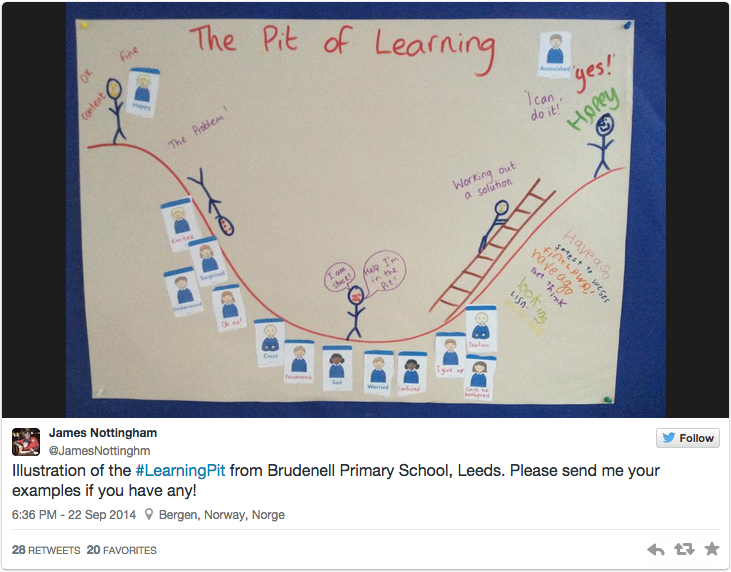
The Learning Pit: from stuck to struggle
Use the ‘Learning Pit’ as a means of opening up a conversation around the feelings involved with being stuck, and the journey towards getting unstuck – the struggle. It is essential that students know:
that the ‘pit’ is only one staging post on the learning journey
they can get out by using ‘stuck strategies’ and tools
It is also worth noting that the pit is not necessarily inevitable for all students in all learning – some will fly over the pit in some topics or curriculum areas.
The ability to cope with and overcome difficulty and challenge is a key aspect becoming a successful learner.
James Nottingham introduced the idea of the Learning Pit as a way to explain that struggling is part of learning and that if we are to understand something we need to struggle with it first. Students move from unconsciously incompetent (an emotionally ‘safe’ area before learning), to consciously incompetent (the emotionally tricky “pit”), to consciously competent (the far side, after the learning has happened).
Find out more by visiting:
Roy Leighton uses a similar concept, which he refers to as the ‘Learning Line’, as part of his ‘Butterfly model’
#3 Model being stuck
Unstuck demo
Show students how you personally get stuck, and what strategies you have for getting unstuck, by demonstrating a piece of tricky learning. The idea is that sharing these experiences encourages students to imitate getting unstuck.
One of the first ways of surfacing learning, putting it on show, is to focus on how you are modelling being a good learner to students. Modelling is all the ways in which teachers demonstrate how they are a learner too; a confident finder-outer.
Take your students behind the scenes of learning and sharing with them some of the uncertain thinking of learning.
Learning aloud is a good place to start: take students through how you would work out a problem. Modelling the thought processes (including emotional) that learners go through is important because a lot of the skill of learning only manifests itself in the inner world of the learner.
Expose the thinking, feeling and decision making of a learner-in-action to help students actually see and hear how learning works.
#4 Learn together: introduce ways of getting unstuck
Develop ‘stuck prompts’ together.
Work with students to find useful questions for them to ask themselves and helpful strategies for them to use when they are stuck.
Ensure that there are plenty of options that come higher on the list than “Ask the teacher”.
Every classroom needs stuck prompts in one form or another.
They could be of a general nature or made relevant to a subject or topic.
It’s important to ensure they ‘grow up’ through the school, reflecting the curriculum expectations. In essence they represent the level of independence expected at different stages.
Extract from Building Learning Power in Action, by Sarah Gornall, Maryl Chambers, Guy Claxton
Building Learning Power in Action
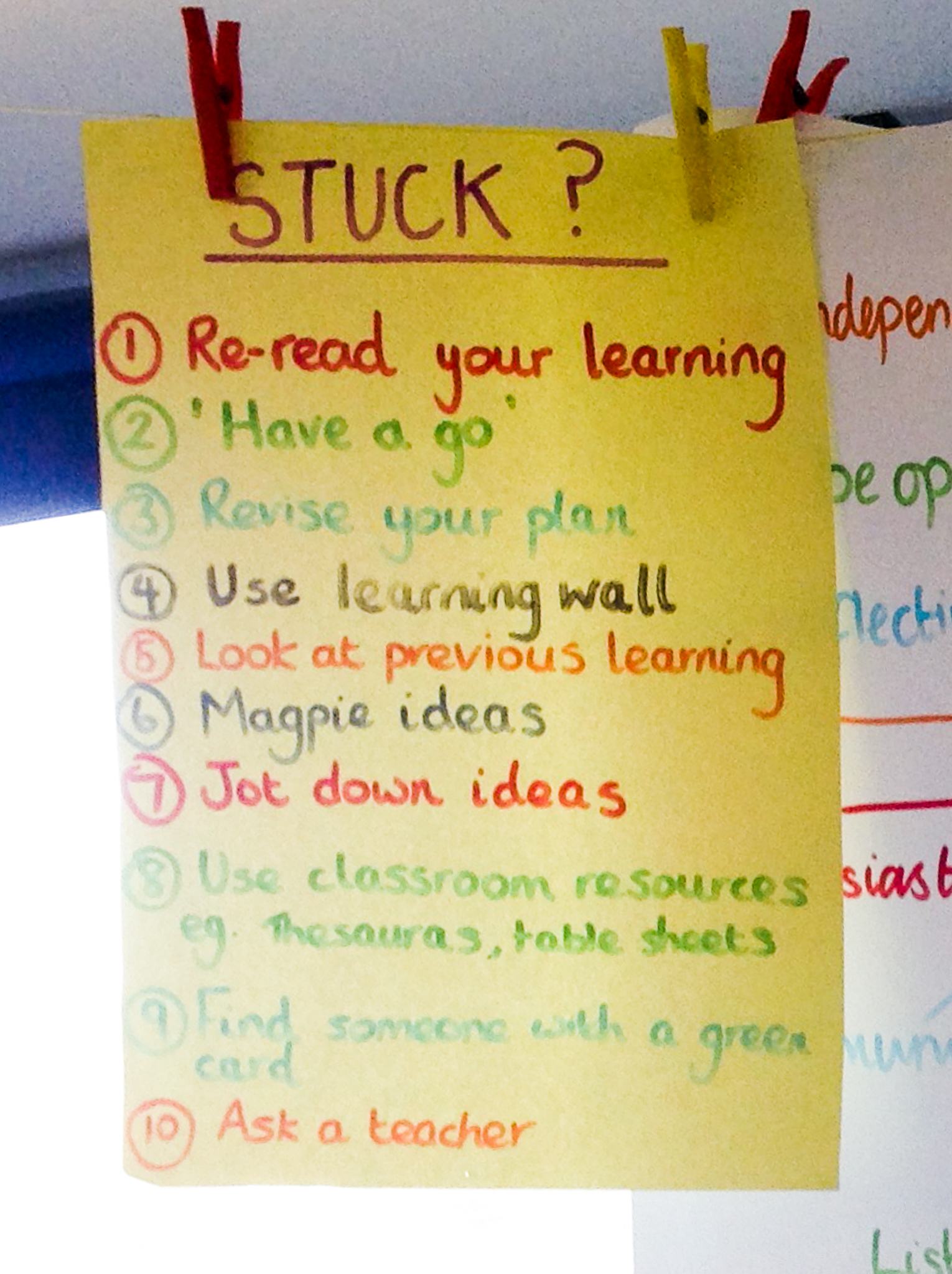
So-called ‘Stuck posters’ or prompts come in various shapes and sizes, but essentially they are simply home-made lists of what students can try when they get stuck with their learning: ‘Read the question again’, ‘Split the question into smaller bits’, ‘Try sounding the word out letter by letter’, ‘Ask your neighbour’ — that kind of thing. If the teacher were simply to photocopy the list from a L2L manual and stick it on the wall it wouldn’t work. But in a learning powered classroom, the ideas are generated by the students themselves, and are the subject of continual debate and refinement.
“Instead of simply dishing out more good advice to students-as-consumers, classrooms are becoming places of day-by-day knowledge generation about learning”
Students are challenged to produce a continual stream of ever more sophisticated ideas about how they can boot-strap their own ability to be independent learners, and these are accumulated and displayed as ever-expanding public records of their achievement. To begin with, the teacher trains the students to make use of this information by greeting every request for prompting with; ‘Have you looked at the prompts?’ After a while, looking at the prompts becomes routine, and eventually, when the habit of self-unsticking becomes second nature, even prompts become redundant. It does not take long before ‘Ask the teacher’ becomes a last-ditch strategy, to be engaged only when all else has failed.
By contrast, when effort becomes seen as natural and interesting, the habit of perseverance expands, and a subtle but powerful shift in the classroom atmosphere begins to occur. It is in this kind of way that learning pow moves up a gear, from the technical to the cultural. In a sense the STUCK poster is a stand-alone technique, but it can be much more than that if the teacher wants it to be. It can be used as an effective, low-risk, low-investment lever for creating a shift in students’ sense of what is valued, what is normal, and what is the point of their learning — and thus in the quality of their engagement.
From Receives to Responds. ( From ‘ Show me or ‘Tell me’ to ‘I’ll try’.)
#1 Introduce deeper ways of getting unstuck
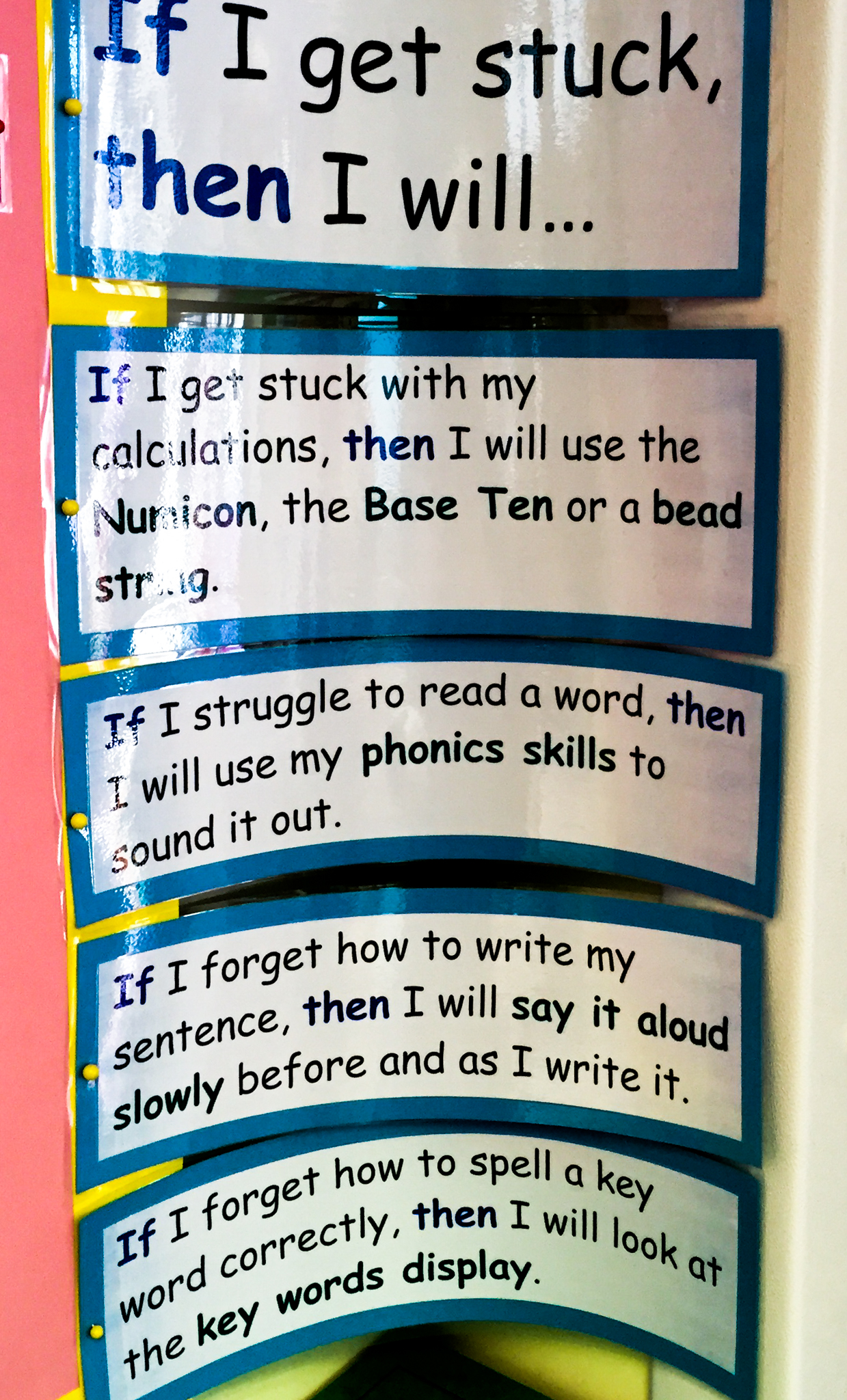
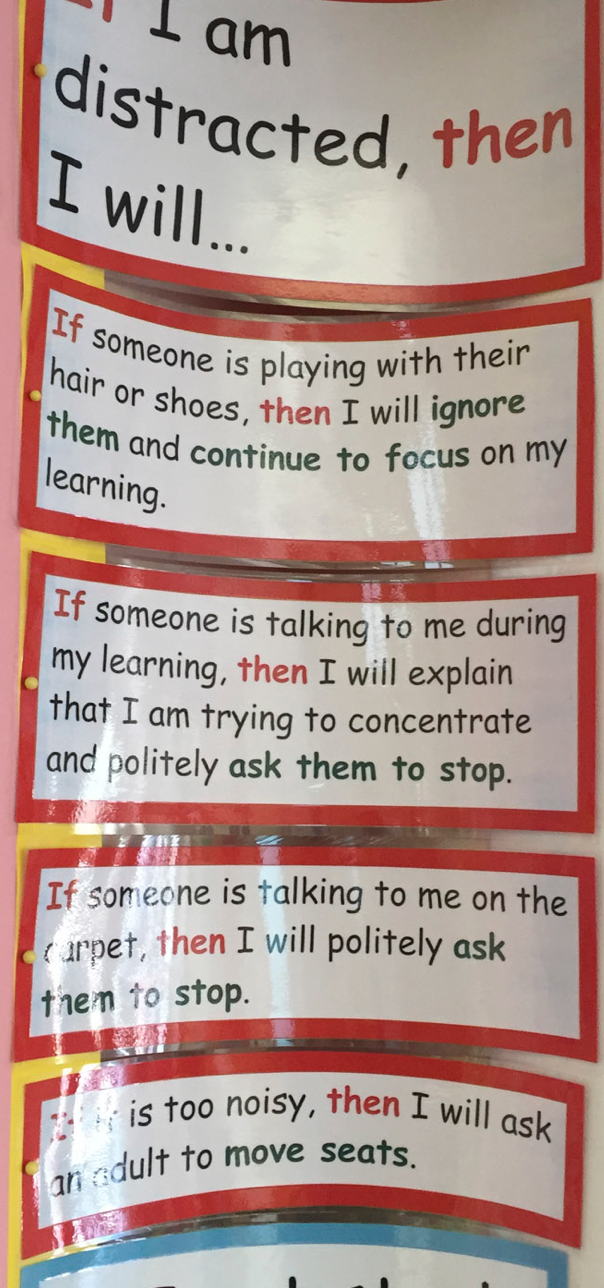
‘If – then’ display example, Heathcoat Primary school Tiverton
Put ‘If-then’ planning into action in your classroom to make stuck solutions more specific and personal
If we want students to change their behaviour we need to help them to think much more closely about the ‘hows’ and the ‘whats’.
Motivation research proposes an effective solution to this called ‘if-then’ planning.
‘Ifs’ are the situations you want to remind yourself about. In the case getting unstuck it’s useful to list all the sorts of places this tends happen
‘Thens’ are what you will do about something; the action you will take. Brainstorm a list of the ‘what we might do in response to the Ifs’.
Research on motivation and goals from Harvard University shows how our brains work to achieve our goals. Basically it says that goals need to be very clear and our brain ignores a goal if it’s unclear about what to do. Brains act on goals only when what to do is clear.
So, goals like ‘Lose weight’ or ‘Exercise more often‘ or even ” I want to feel ok about being stuck‘ are too nebulous. They beg the question ‘how’ or ‘what do I do?’
The how to ‘If-then’ planning
When setting a goal you need to specify not only what you will do but also where and when you will do it.
If (or when) [___situation__], then I will do [___behaviour__]
So going back to our goal about losing weight, we need to know much more about the ‘how’ and the ‘what’ and the ‘how to’ of losing weight.
An If-then statement or goal might be ‘If I get the pudding menu, then I’ll ask for coffee’.
This may sound a bit cumbersome to start with but research suggests far more goals are achieved by using ‘if-then’ planning. And the clever bit is that this builds self talk at the same time. You do what you are telling yourself to do.
The ‘if-then’ plan succeeds because the situation and the action become linked in the mind. The brain recognises the situation as an opportunity to advance the goal. When the situation is detected action is initiated automatically. “If-then’ plans become “instant habits”.
Goal: I want to feel okay about being stuck
If…
…I get stuck in my reading (all the stuck places will need specifying)…
…I get stuck in Maths (specify how you might get stuck)…
…I get into tricky situations in the playground (specify tricky)…
Then…
…I will (Some specific statements to unstick themselves)
#2 Use short reminders to encourage self reliance.
These routines put responsibility on students to do things for themselves before asking the teacher for help.
C3B4Me can be used in conjunction with the stuck posters displayed in the classroom. Students should try three strategies from their stuck posters before seeking help from the teacher.
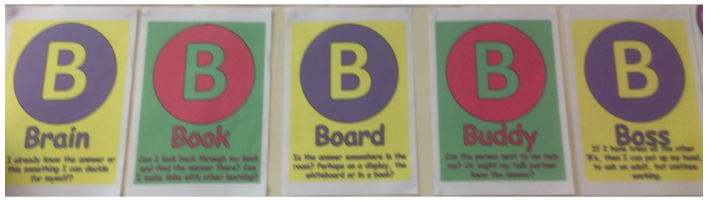
Another alternative to the stuck poster, BBBBB invites students to:
use their Brain
check in “the Book” (or other resources). This implies that students are allowed to get out of their seats to find these resources, and that those resources are available.
look on the (White/Smart)Board
ask their partner/friend/another student (“Buddy”)
before finally turning to the ‘Boss’ (teacher) for help.
From Responds to Values. ( From ‘I’ll try’ to ‘I see why’.)
#1 Introduce and model different types of being stuck
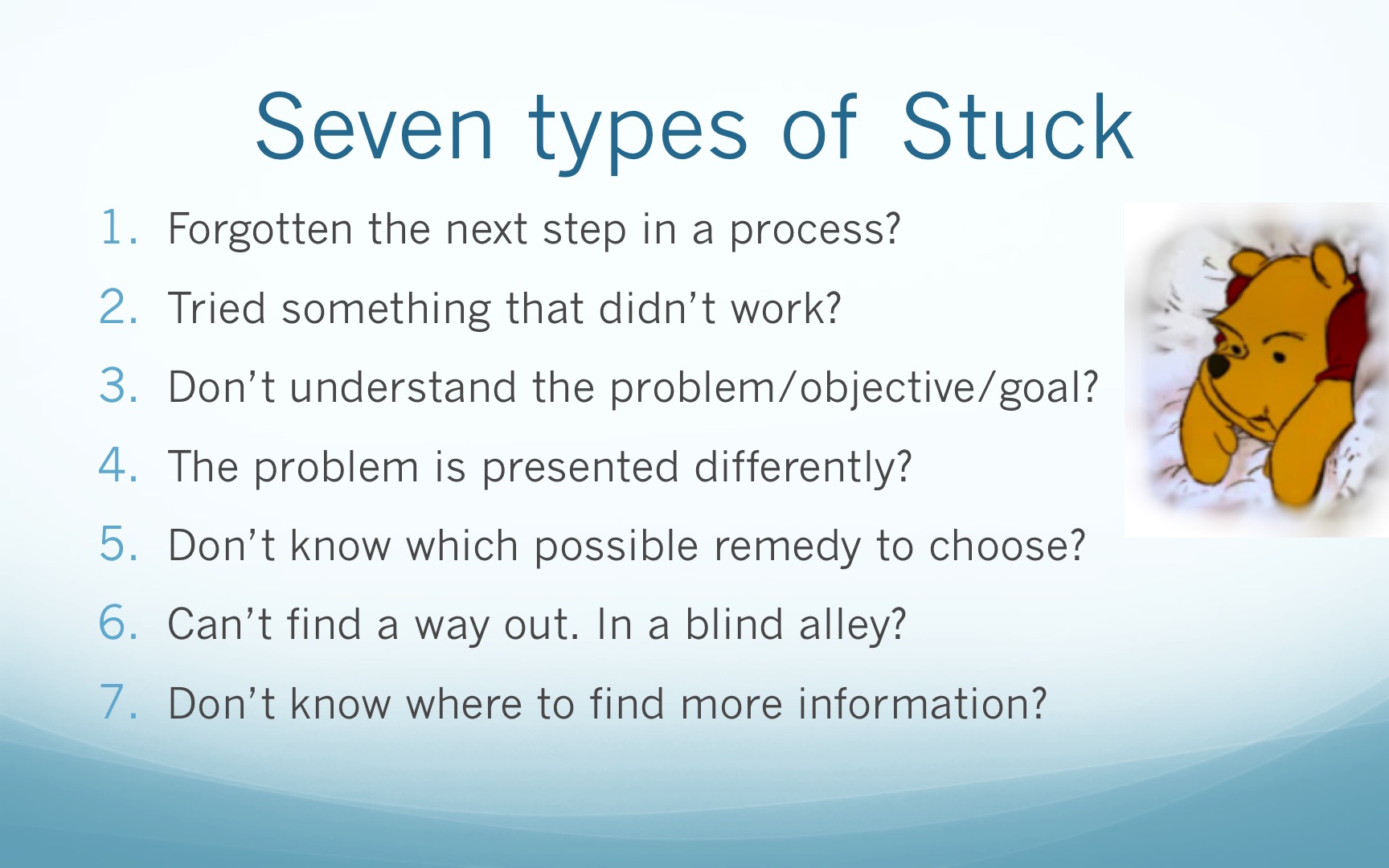
In this phase it may be useful to identify and model several forms of being stuck. What sort of stuck is it? Do different sorts of being stuck call for different strategies?
You could turn any one of these questions into an ‘If, then’ statement:
If I have forgotten the next step in a process, then I’ll…
We leave it to you to discover other ways of being stuck with your students and to model your way out of them.
#2 Learning from each other
Try Stuck Show and Tell. Simply ask students to share their best stuck episode i.e. the one that seemed tricky but taught them the most (in school or elsewhere). You might profitably start by modelling your own example.
From Values to Organises. ( From ‘I see why’ to ‘I make sure I do’.)
#1 Introducing a deeper way of looking at being stuck
In this phase we are not talking about modelling getting unstuck on a problem where you may simply have forgotten a step. Nor is this process driven primarily by subject knowledge. Here the analysis is about what you might ask yourself when you are in a major stuck problem and need to rethink what you are doing in order to restart, tweak, or give up.
10 points to explore;
Can I explain to myself what’s really going on here?
Am I keeping to the original intention?
Have I read and understood the question/problem properly?
Am I applying the right principles? Have I got roughly the right ideas?
Does anything stand out as simply wrong?
Have I forgotten something obvious?
Have I veered off course? Am I down a rabbit hole?
Am I making this too complicated? or too simple? Do I need to go back to basics?
What would a distilled list of key stages or points look like?
Is this worth continuing with in this way? Why/why not? What could I do instead?
Undertaking this analysis relies on the students’ inclination to;
Self-monitor how things are going, keeping an eye on the goal
Expect the unexpected, having a readiness to re-shape, re-order, re-form plans to take account of new circumstances.
Remain alive to new, unforeseen opportunities and ideas
Look at what you are doing with a critical eye
Strive to be the best you can be
Make sure things are on track and make improvements along the way.
So at a less abstract level, students need to learn how to deal with change, emotionally and practically. With an inflexible frame of mind they are unlikely to recognise the need to change their ideas or the way they do something. These behaviours are closely aligned with the revising/refining habit.
#2 Model taking the panic out of assessing a major stuck problem
The following suggestions have their origins in Mindfulness. Here the analysis of finding a way out of being in a major stuck crisis is put into a series of considered calming steps. You may still have to restart, tweak or abort your project but hopefully after careful rather than chaotic thought.
‘In order to act wisely, we need to access both clear insight and decisive action. Insight without action is impotent; action without insight is reckless.’ Michael Chender
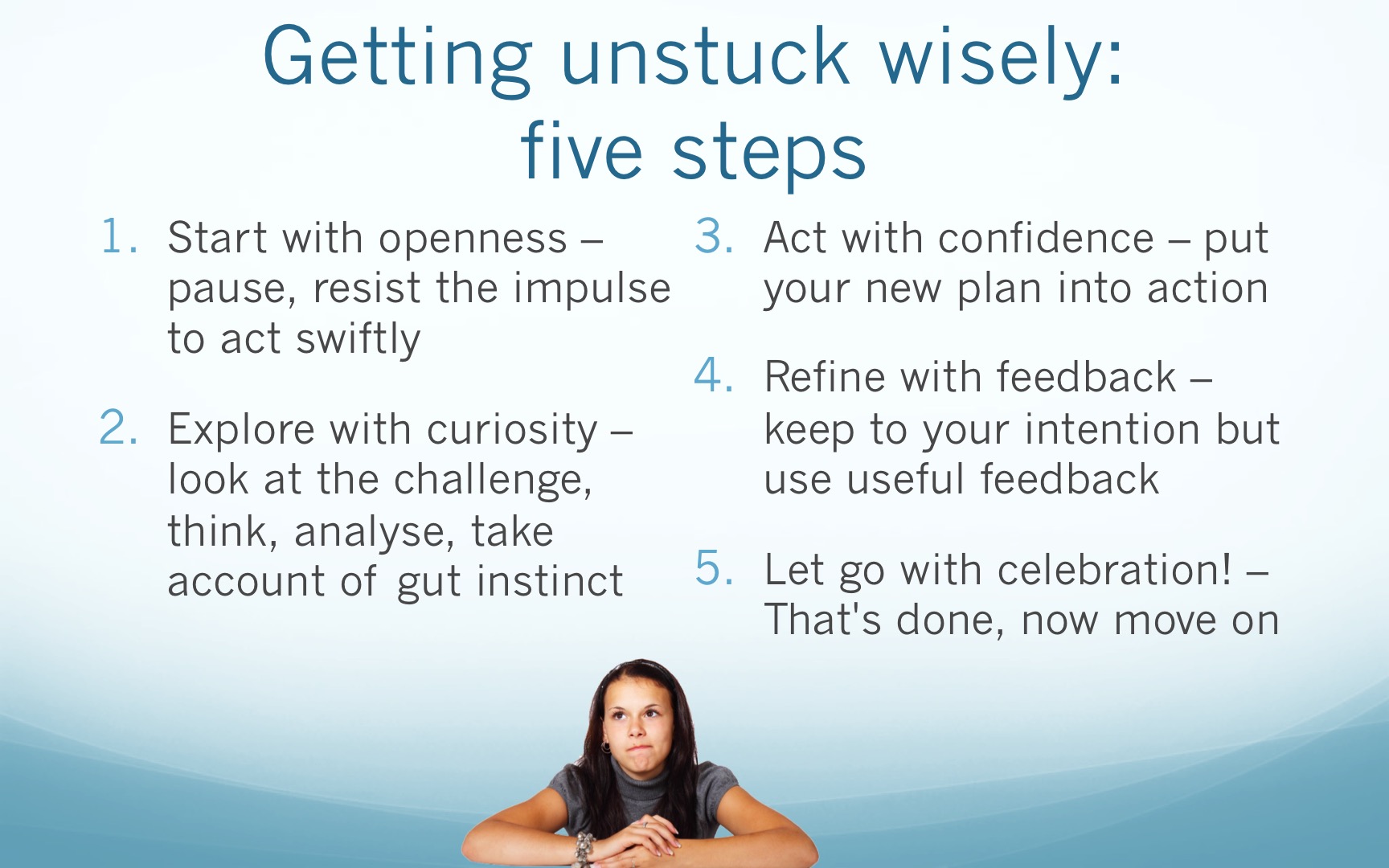
Entering or starting- do nothing, pause, be willing to look afresh, allow the situation to reveal itself.
Exploring – slow down, look at the challenge/ difficulties with genuine curiosity. Think about the problem in different ways, See list in #1 above. e.g.
split the problem into parts, try pro and con analyses
take a step back and look at the bigger picture, look for patterns, influences. root causes.
use gut instinct -‘ there’s something off here ‘
read the signs – ask ‘have I been here before?’, ‘what do I recognise from previously?’
let things brew for a while before moving from broad openness (observation) to determined action.
Acting “Not-knowing” changes to knowing; confidence in committing to a course of action. Put your considered new ideas/plan into action.
Refining – work with the initial feedback you are getting as a result of your action to deepen the effectiveness of what you have done. Keep to your intention but look for genuinely useful feedback to refine your new course of action.
Letting Go. Don’t keep replaying your action decisions. Time to say ‘That’s done, what’s next?’
To see more on Chender’s thoughts on acting wisely, visit the Mindful website.
Talk for learning
This dimension of the learning friendly classroom concerns using the language of learning;
As a teacher you will be;
using language to explore learning as an explicit theme that runs across all subject matter.
talking about learning in terms of constant change; experimental, working towards, constant improvement, flexibility, could be.
prompting in the form of questions to nudge pupils into thinking for themselves. “That’s curious. What’s odd about that? What does that make you wonder?”
focusing questions on the process of learning, encouraging students to slow down, appraise the strategies and steps along the way, become more thoughtful and explore different strategies for making progress.
aware of positive and negative student self talk and building positive talk by giving them the knowledge and experience of the learning behaviours ( the tools) with which they learn.
The more richly children come to relate their own learning the more they see and take hold of their own role in it.
Organisation of ideas below
The ideas below have been selected for their effectiveness in helping to surface the learning process and deepen the language of learning .
From Lacks to Receives. ( From ‘I can’t’ or ‘I want’ to ‘Show me’ or ‘Tell me’)
Talk for learning
#1 Talk to reframe being stuck
Moving students on from “I can’t” to “Show me…”
Try this type of shifting-mindset language:
Being stuck is a good place to be.
Getting stuck means your brain is working hard on something new.
When you learn new things your brain gets bigger.
If you don’t get stuck you’re probably not learning anything new
Getting stuck is good for you.
It’s not too hard, it’s just a bit tricky right now.
When you say you can’t do this, just add ‘yet’
Being stuck means you are about to discover something new
#2 Talk to explore the feelings of being stuck
Build positive associations with being stuck
Discuss places where students may get stuck because it gives ‘being stuck’ a status. Through such discussions make sure you signal to students that being stuck is a good thing; it probably means they are at an interesting place in learning, or on the brink of discovering or learning something new.
Try creating a wordle with your students, using the words they associate with being stuck. If it is negative introduce a new ‘stuck positive’ language.
#3 Talk to nudge improvement in the skill.
Unstuck Phrases
Encourage students to become more interested in difficulty and develop strategies to deal with stuckness. Use phrases like:
Have a go yourself. I think you can do this.
Which of your friends might you ask?
Have you looked at the stuck prompts?
Well done for sticking at it by yourself.
What have you already tried? What else might work?
Which ideas on the stuck prompts might work here?
There are some good ideas on the learning wall you could try
The language of learning can help teachers to think about how they might talk in a way that helps to cultivate the learning behaviours and help pupils to gain a better personalised understanding of content.
Teachers can turn each of the learning habits into sets of casual prompts or nudges to move pupils along in learning. For example, to nudge curiosity/questioning: “What’s odd about that? What does that make you wonder? What do you want to find out? How else could you do that?”
Teachers’ classroom talk is all focused on the process and experience of learning itself. Sometimes teacher comments encourage pupils to pay attention to how they are learning. Teacher comments ask them to slow down and notice and appraise the strategies and steps they are using along the way. E.g. “What would have made this easier for you? Where else could you use that?” This helps pupils to become more reflective and thoughtful about their own learning.
#4 Talk to reflect on getting unstuck
Some questions you might use to encourage your students to reflect on and think meta-cognitively about stuckness:
When you got stuck what did you do?
And then what did you do?
Did that help you get unstuck?
What usually helps you get unstuck?
What’s your favourite way of getting unstuck?
What’s your best way of getting unstuck?
What other ways might you try?
From Receives to Responds. ( From ‘ Show me or ‘Tell me’ to ‘I’ll try’.)
#1 Talk to reframe ‘stuck’
From ‘I’m stuck ‘ To ‘I’m stuck because …’
Encourage students to identify the cause of their stuckness. Move students from saying “I’m stuck” to ” I’m stuck because…” Naming the problem will often suggest a reasonable next step.
It’s also useful at this stage to insist that students can’t call themselves ‘stuck’ unless they have tried to apply at least 1 solution.
#2 Talk to explore: the consequences of giving up
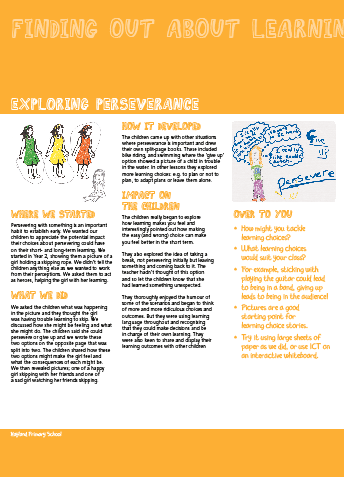
Two paths
Once a year or so, explore the notion of ‘giving up’.
Introduce a character struggling to learning a new skill. Pictures are a good starting point.
Encourage students to discuss how the character is feeling and what he or she might do (give up or persevere).
Explore the feelings and consequences of the two options – giving up or persevering.
Ask students to come up with their own examples and draw pictures or describe the potential consequences of giving up or persevering in these scenarios.
Uncover the emotions of being and overcoming ‘stuck’
Explore and contrast the feelings of being stuck with those of overcoming stuckness. Use the positive feelings of ‘unstuck’ as springboard for developing ‘stuck strategies’.
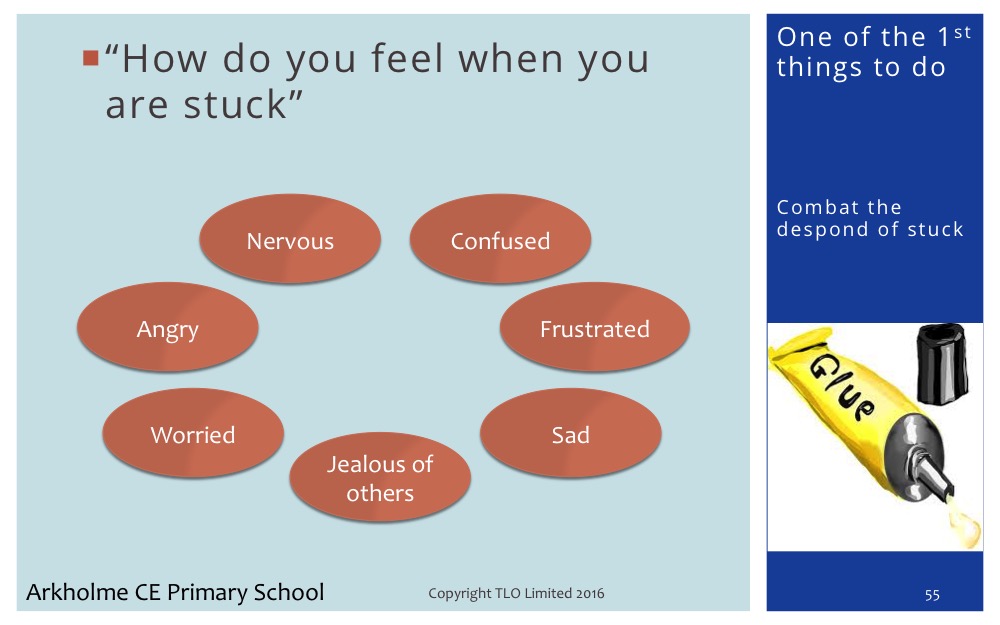
Take a look at how a teacher at Arkholme primary school approached the ‘stuck’ issue by exploring the pupils’ emotions.
A Yr 5 teacher from Arkholme Primary school near Lancaster explained STUCK by exploring it for real with her pupils. First she asked how they felt when they got stuck….. Take a look at the wide range of negative emotions being stuck seems to generate in pupils
Then she explored what led the pupils into getting get stuck…..a fairly predictable content driven set of ideas here
Then she explored what the children felt like when they overcame being stuck……..another great range of emotions; this time positive
Then the class discussed what they might do to get unstuck, and charted their ideas for everyone to use!!
#4 Talk to nudge improvement in the skill: self recovery from ‘stuck’
Support to continue: questions not answers
If students freeze when they are stuck, offer supportive questions not answers. A basic support to continue is ‘What do you do next?’, and when this has been done ask the question again.
To extend the ‘support to continue’ approach, try using phrases like:
What have you already tried? What else might work?
What did you do when you got stuck before?
I wonder what you did to move on?
How about taking a short break and coming back to it later.
Have you looked at the stuck prompts ?
Who seems to be managing this ok ? What are they doing
I can see that [this task] us important to you. Well done for keeping going.
‘Support to continue’ prompts are seen as helpful by pupils. You are encouraging them to take over the job themselves and reminding them that uncertainty shouldn’t lead to paralysis.
The advantage of asking questions over telling is that you are in a better position to monitor how students are learning when they are doing the explaining. Ask students how they might check their answers or why they think they are right or wrong. Have them work with each other on this to encourage a learning community rather than just teacher-student dialogues.
“Expert tutors often do not help very much. They hang back, letting the student manage as much as possible. And when things go awry, rather than help directly they raise questions: ‘Could you explain this step again? How did you… ?’” (Mark Lepper)
When we are curious we are genuinely interested in learning. Curiosity lies at the heart of coaching, hence coaches are effective listeners and ask questions to open dialogue without sounding like an interrogation. Coaching aims to enable people to see what they are doing more clearly and discover their own ways to improve. A coaching approach:
helps people to explore their challenges, problems and goals
provides an objective view of peoples actions to enable them to see things as as they really are
enhances motivation and raises self esteem
builds curiosity and encourages learning
Above all, coaches resist offering solutions. Offering solutions does little to secure learning as the pupil hasn’t been allowed to confront and engage with the problem and find their way forward. Learning powered teachers adopt a coaching role.
From Responds to Values. ( From ‘I’ll try’ to ‘I see why’.)
#1 Talk to explore: written feedback to provoke curiosity
Supportive marking comments
There’s only one stuck point here. Can you find it? I can see that you have remembered two earlier stuck points and used them to work this out …
#2 Talk to nudge improvement in the skill
Encouraging pupils to slow down, notice, and appraise strategies and steps.
Become curious about being stuck.
Give it a go, you can always try another approach if that doesn’t work.
What could you do if it goes wrong?
Where will you seek help from?
Is this sufficiently challenging for you?
How are you planning to go about it?
Do you have any fall-back plans?
From Values to Organises. ( From ‘I see why’ to ‘I make sure I do’.)
#1 Talk to nudge improvement in the skill
Enabling pupils to become reflective and thoughtful about learning.
Analyse risks and strategies for ‘high-level’ work. Ask:
Which of your many strategies might you use here?
I’m sure that you can sort that out for yourself.
Have you thought about the pros and cons of this way of working?
What will you lose if you tried it this way?
You risk analysis paid off there.
#2 Talk to reflect on being stuck
Supportive marking comments
How do you plan to work yourself out of this situation? `What might help? I noticed you used the … strategy to help you here. It worked!
Constructing learning lessons
This dimension of the learning friendly classroom concerns how you design learning episodes/lessons/projects;
As a teacher you will be:
building reflection on and reviewing of learning into the rhythms of the classroom
designing learning activities with a dual focus; coupling the exploration of content with stretching students’ ability to use learning behaviours.
enabling students to make conscious choices about;
the level of learning stretch they feel able to work at.
adding a third dimension to your teaching:
1. Subject matter,
2. Assessment
3. The learning behaviours being used in order to learn the content.
Organisation of ideas below
The ideas below have been selected for their effectiveness in helping surface the learning process. The coloured lines bounding each idea suggest the phase of unsticking growth when they might best be introduced.
From Lacks to Receives. ( From ‘I can’t’ or ‘I want’ to ‘Show me’ or ‘Tell me’)
#1 Coupling content and process
Give being stuck more status by planning to get students stuck
Start some lessons with something like:
In this lesson I’m expecting you to get stuck.
When you get stuck take a look at the unsticking prompts on your table to see if these help you to get unstuck.
Later we will spend a few minutes talking about what we learned from being stuck and decide which unsticking idea worked best.
The explicit message is that students need to expect being stuck during any lesson. The implicit message is that being stuck is a good thing – something you want to see. Using this technique regularly means students come to accept being stuck as a natural part of learning. It begins to build their curiosity about the why and possible patterns to stuckness.
#2 Reflect on dealing with being stuck
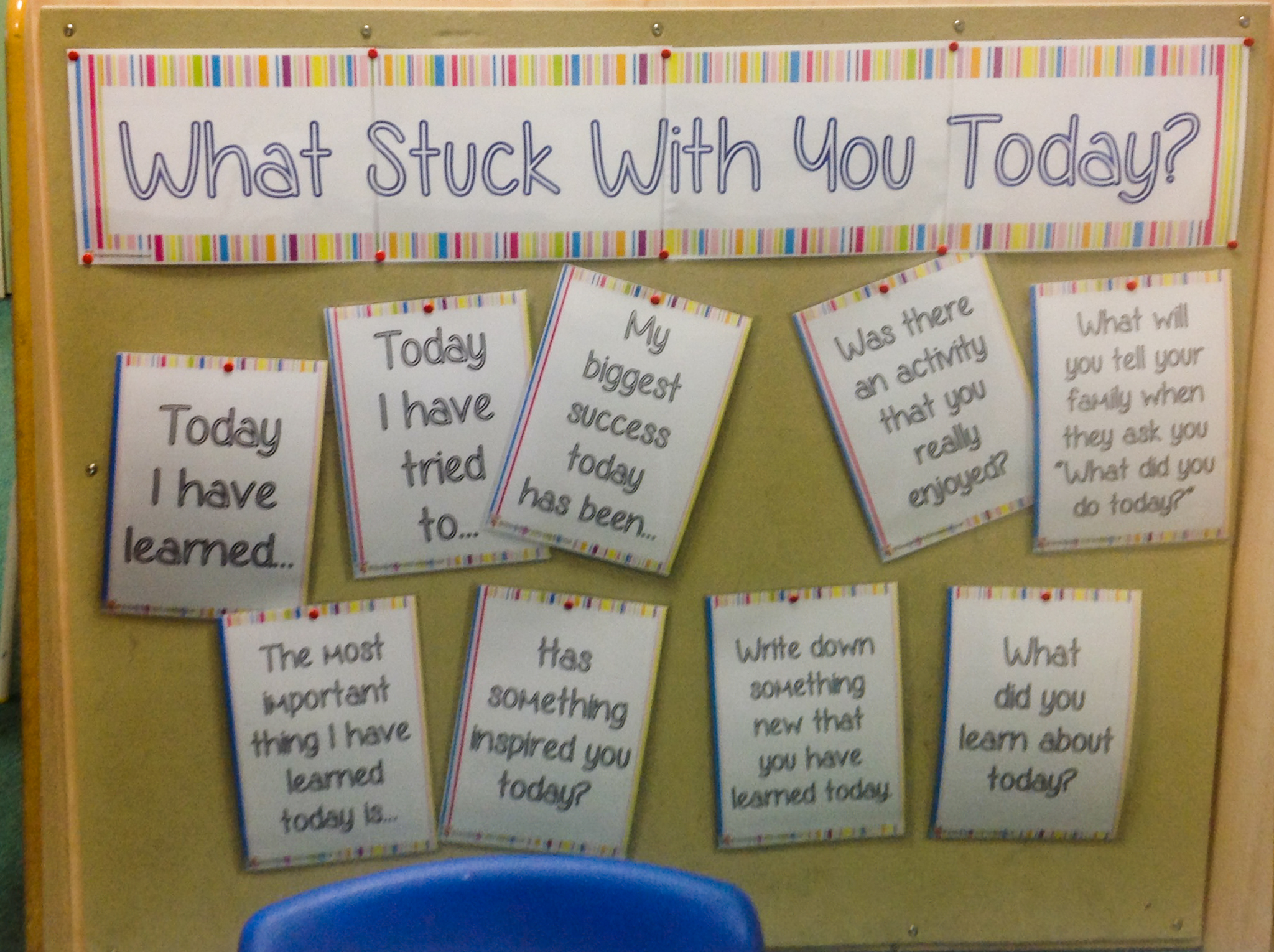
Make reflection on being stuck part of the daily or lesson routine. This display from Miriam Lord primary school in Bradford shows a range of discussion cards which the teacher uses with specific groups of students during or at the end of a day.
The questions include;
Today I have learned….
Today I have tried to…
My biggest success today has been….
What will your tell your family when they ask ‘What did you do at school today’?
The most important thing I have learned today.
Has something inspired you today?
You could easily incorporate some of the ‘Talk to reflect’ questions ( see #4 above)
What other sorts of questions would you include in such a selection for your classroom. Something about asking good questions or how they got themselves unstuck would be useful. This exercise makes a good start on introducing meta-cognitive behaviours more generally.
From Receives to Responds. ( From ‘ Show me or ‘Tell me’ to ‘I’ll try’.)
#1 Coupling content with process: building getting stuck into lessons
Plan to get students stuck
Start some lessons with something like:
In this lesson I expect you to get stuck 3 times.
If you get half-way through and haven’t become stuck move to more challenging activities.
When you get stuck make a note and try to explain to yourself why you are stuck at that point.
Later in the lesson we will spend a few minutes reflecting on what we learned from being stuck and decide which strategy worked best.
The explicit message is that students need to expect being stuck during the lesson. The implicit message is that being stuck is a good thing – something you want to see. Using this technique regularly means students come to accept being stuck as a natural part of learning. It begins to build their curiosity about the why and possible patterns to stuckness.
#2 Coupling content with process: turning getting unstuck into a co-operative activity.
Who wants to be a Millionaire?
During the popularity of the television quiz show Who Wants to Be a Millionaire?, teachers called these sorts of prompts the students’ ‘lifelines’ which, just like ‘Phone a friend’ or ‘Ask the audience’, they can use when they are stuck or unsure. At the end of lessons, the class can review who used which lifelines, how many times, and which were the most popular or successful.
The class can make up its own rules, like ‘You have to have used “Read the prompts” and “Ask a friend” before you can use “Ask the teacher”.’ ‘You can have three designated friends (or learning buddies), but you can’t use any one of them more than twice in any lesson.’
An idea to use now and again throughout the year.
#3 Reflecting on being stuck
Questions you can ask your students include:
How much more have we learned by getting unstuck?
If you get stuck what different ideas can you try?
Tell me where you got to. What could we try next to move on?
From Responds to Values. ( From ‘I’ll try’ to ‘I see why’.)
#1 Coupling content and process: build thinking routines into the fabric of lessons
Visible Thinking Routine
What do I know? What do I need to know?
What techniques do I have for bridging the gap?
This helps students to develop their own internal dialogue for combating stuck-ness.
VTRs are, as they say, simple routines that apply across a wide range of subjects and contexts, and which require students to think in a variety of different ways, that are used so regularly by teachers that they become woven into the fabric of the classroom culture and progressively hard-wired into the thinking practices of students.These are ways in which different ways of thinking can become routine in classrooms. They become part of the learning culture.
To be effective such routines need to be;
Direct, guide, support, encourage thinking
Short, memorable, few steps
Used over and over again
Useful in a variety of contexts
Facilitate connections, generating ideas, using knowledge
Find out more: Google ‘Visible thinking routines’
Build trial and improvement into lessons
Trial and Improvement; promote the idea that being stuck is okay. If students know we expect them to try things out, make slip-ups and have another go, their perception of being stuck is likely to turn to curiosity. Weave trial and improvement into lessons by, for example: –
Include a trial and improvement success criterion when asking students to complete an activity or create a piece of work. For example: I want to see evidence that you have tried and improved at least a couple of different layouts before settling on…
Include a designated focused trial and improvement time in lessons; time to test out ideas. Use scrap paper, mini whiteboards or rough books. Include opportunities for discussion space to encourage editing, refining and clarifying of thinking
Mark the working out that students do. Extend this common in maths idea across the curriculum.
Since we want young people to turn out to be robust confident learners we have to talk with them in terms of a growth mindset.
Teachers develop their students’ interest in the learnable skills and strategies.
Teacher comments focus on effort, habit and disposition, focusing students on how to get better by looking for ways to try harder or differently.
Students are steered away from carving the world into things they are ‘good at’ or ‘not good at’.
#2 Reflection
You could nudge your students to ask themselves:
What advice would I give to someone who wanted to give up?
Why is being stuck good?
Have I selected the most useful way of getting unstuck?
Why did that idea work/not work?
From Values to Organises. ( From ‘I see why’ to ‘I make sure I do’.)
#1 Reflection on dealing with getting unstuck
Provide the list of 10 questions about stuckness for students to refer to throughout a tricky lesson. Build in time at the end of the lesson for students to look at the list of 10 questions about stuckness.
Can I explain to myself what’s really going on here?
Am I keeping to the original intention?
Have I read and understood the question/problem properly?
Am I applying the right principles? Have I got roughly the right ideas?
Does anything stand out as simply wrong?
Have I forgotten something obvious?
Have I veered off course? Am I down a rabbit hole?
Am I making this too complicated? or too simple? Do I need to go back to basics?
What would a distilled list of key stages or points look like?
Is this worth continuing with in this way? Why/why not? What could I do instead?
Build in time at the end of the lesson for students to ask themselves “Which of these questions did I find most useful in moving forward today?” Over time, see if they can recognise whether there are any patterns in their stuckness i.e. do they have a tendency to veer off course, or forget something obvious, or make things too simple, etc.
Celebrate learning values
This dimension of the learning friendly classroom is about what is valued, recognised, praised, displayed about being stuck;
As a teacher you will be;
giving attention to learning, rather than performance
recognising, praising, displaying aspects of becoming and undoing being stuck. For example:-
recognising being stuck as an interesting – not shameful – place to be.
ensuring mistakes are seen as being valuable in learning.
having a clear understanding of what effort means and how best to use it
Good questions being as important as good answers.
acknowledging/recognising/ praising when overcoming stuck strategies are used more skilfully
attending to the growth of learning habits associated with being and overcoming stuck.
Learning powered environments build confident uncertainty. Being stuck is celebrated as an interesting place where real learning begins
Organisation of ideas below
The ideas below have been selected for their effectiveness in helping to show how you value the the opportunities being stuck offers the learner. The coloured lines bounding each idea suggest the phase of unsticking growth when they might best be introduced.
From Lacks to Receives. ( From ‘I can’t’ or ‘I want’ to ‘Show me’ or ‘Tell me’)
#1 Displays: showing how it happens
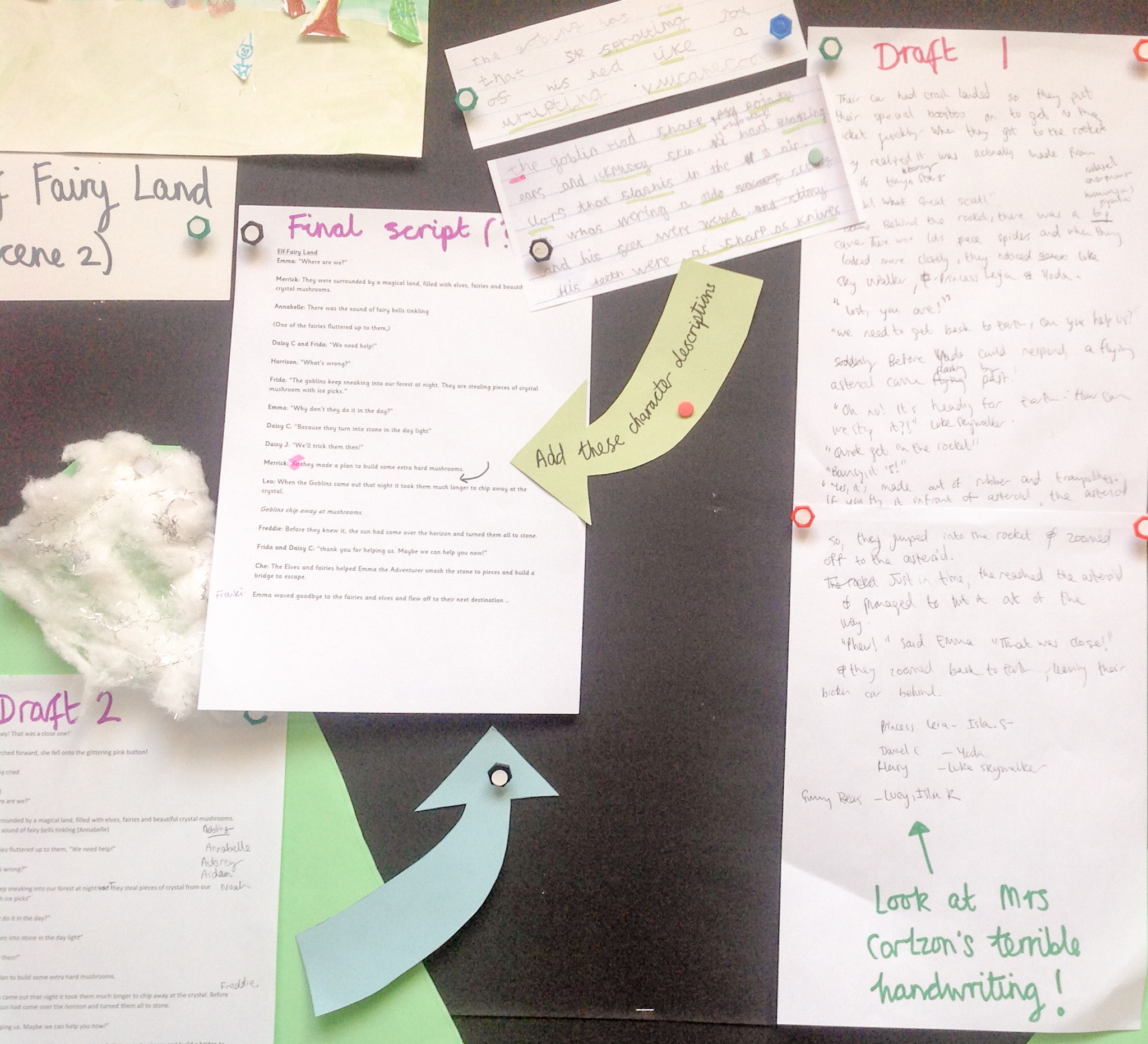
Display work in progress
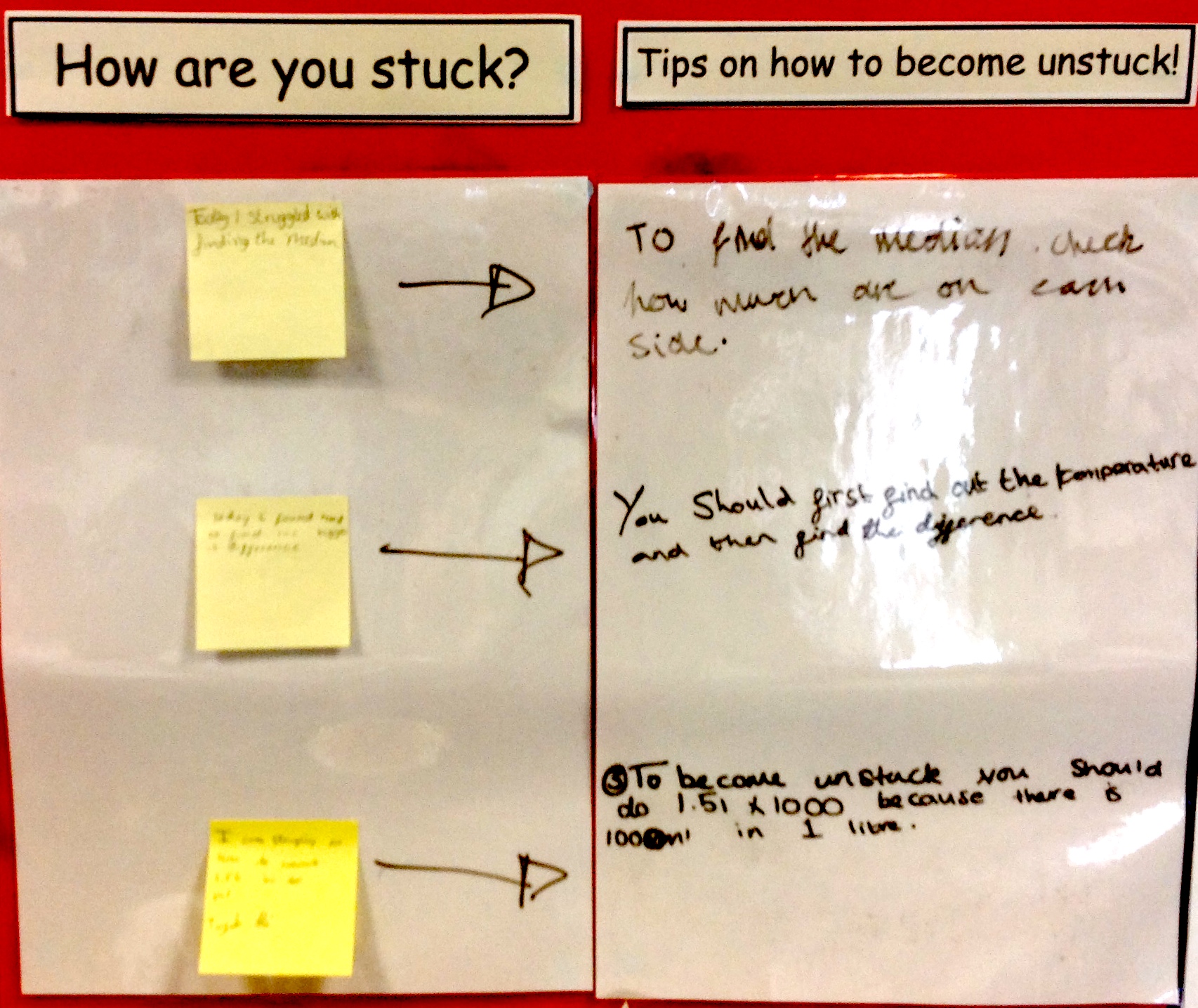
Ensure that your display walls include early drafts of work which show where students got stuck. Encourage students to write on a separate note how they got unstuck, and display the note with the work.
It’s important that students understand learning as a process rather than an event, and that stuckness is a prominent part of that process. From scribbled notes to final copy can be a long and eventful journey. Learning routines along the way include capturing rough ideas, adding to them, trying again, trying another way, re-thinking, refining and completing. Such routines lead students to see that it’s not about everything being perfect or easy from the start.
Display stuck prompts in all shapes and sizes
These might include:
Quick reminder sheets on group tables
A special Stuck Table with plenty of resources
Stuck Posters
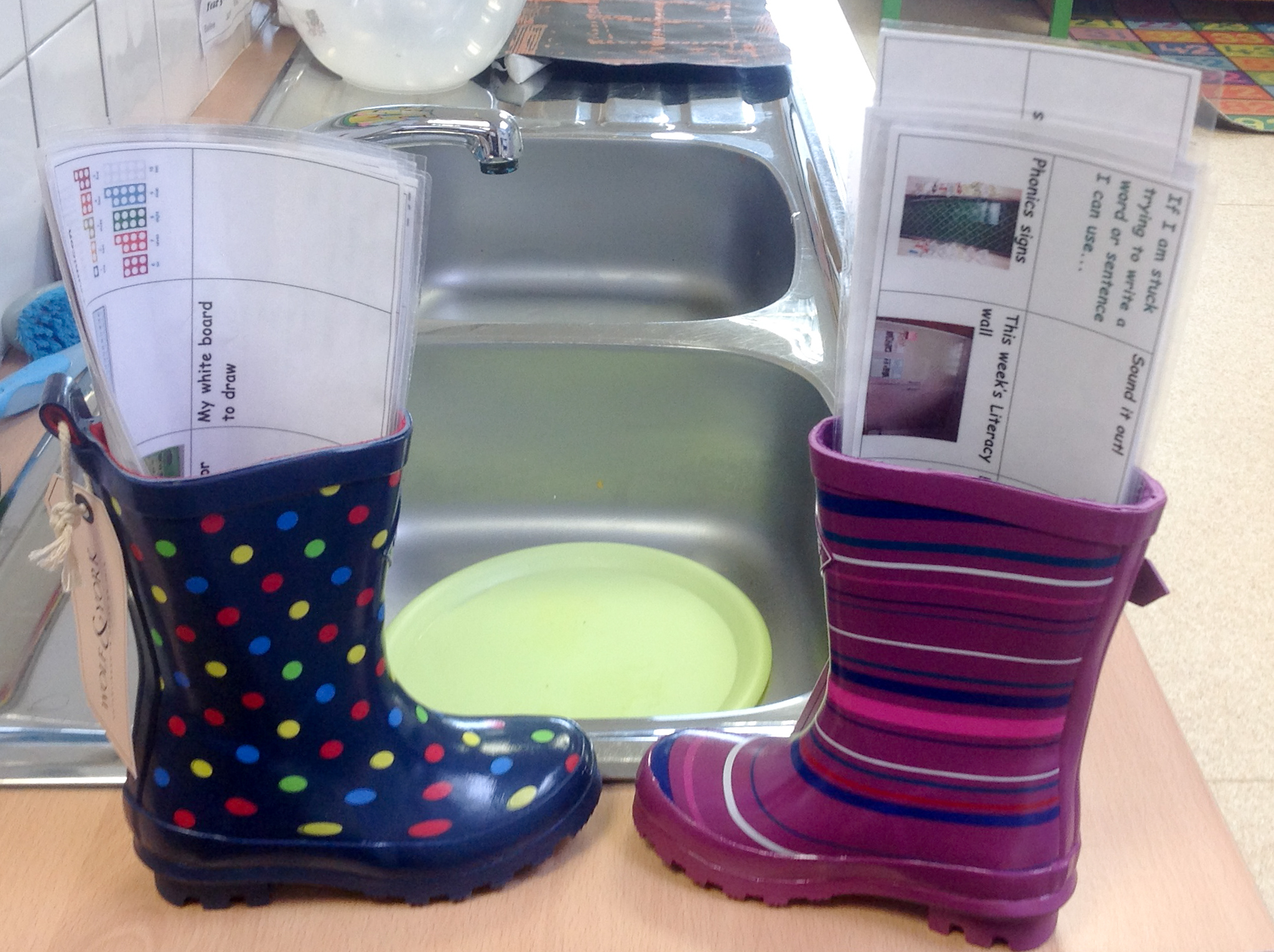
Containers ( e.g. wellies) holding laminated reminders of things to do. Spots=numeracy. Stripes=literacy
Stuck Walls with multiple displays of Stuck Posters, ‘stuck-of-the-week’, the Learning Pit and so forth.
During lessons students post up stuck problems and other students suggest solutions ( see below)
#2 Recognition: praise and acknowledge overcoming stuck
Stuck of the Week
Regularly encourage students to think about a moment when they were stuck and how they got around it. Celebrate the unusual ones by displaying them on a ‘stuck wall’. Students should develop an interest in their ability to overcome stuckness.
By celebrating the moment of being stuck, students are reminded that stuck is not a place of shame, rather that it is part of the journey. It is equally important to celebrate the unsticking strategy so that students can see that there is always a way forward.
#3 Growth – paying attention to developing the behaviour
This marking comment is emphasising the growth in the skill. The student is beginning to use the stuck prompts by themselves, and is therefore moving out of “Show me” towards “I’ll try…”
You have used the stuck prompts really well here. Well done! You did this all by yourself.
From Receives to Responds. ( From ‘ Show me or ‘Tell me’ to ‘I’ll try’.)
#1 Display positive emotions about being stuck.
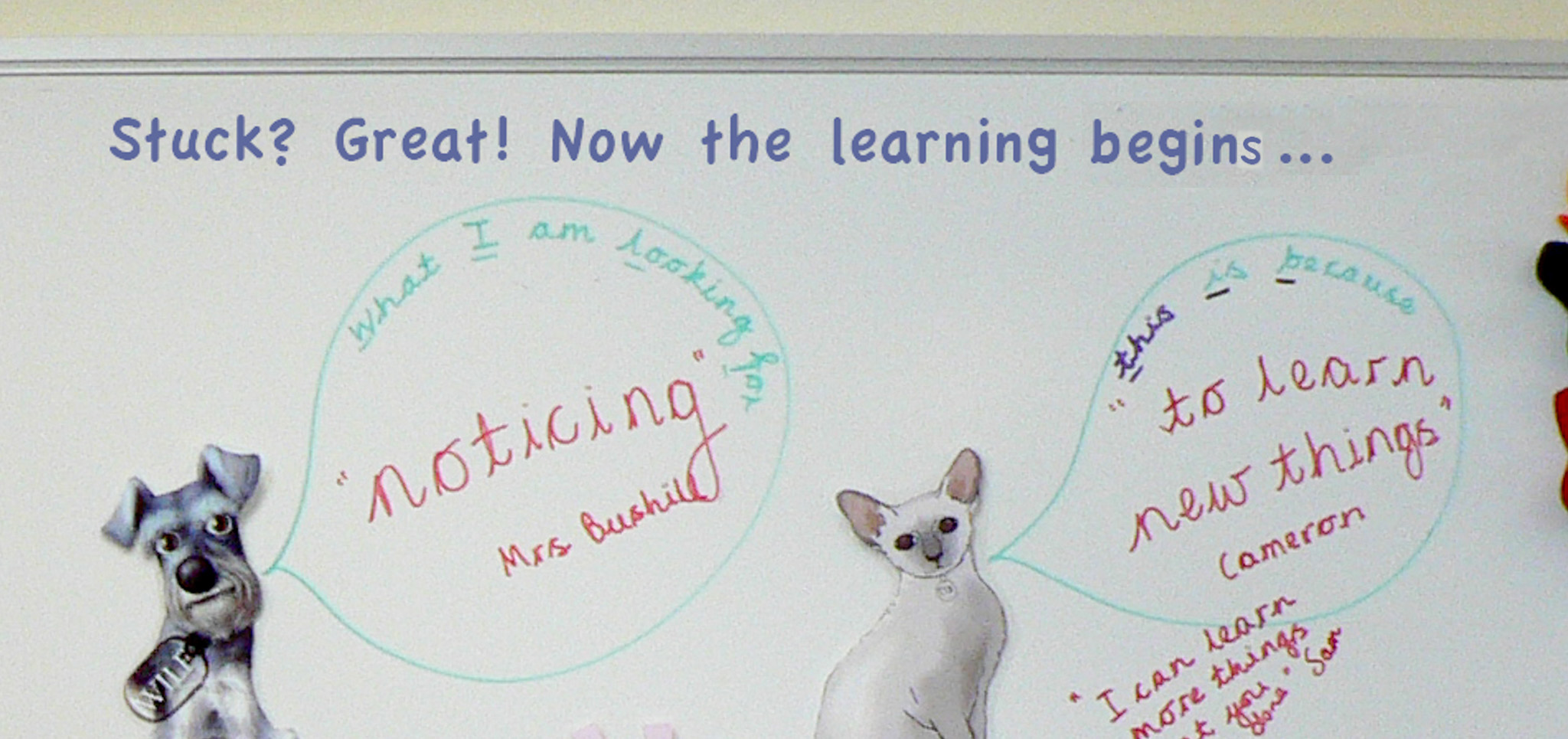
Stuck? Great! Now the learning begins …
This interesting proclamation across a classroom wall shows how being stuck has been reframed as an interesting place to be. Students create their own stuck prompts for display around the classroom.
#2 Celebrate students finding their own strategies
Celebrate when students discover their own strategies for getting unstuck
#3 Growth in the behaviour
Learning behaviour sticker books
You might allocate pages in the back of your students’ learning journals/school diaries where they collect stickers which indicate improvement in their learning behaviour
From Responds to Values. ( From ‘I’ll try’ to ‘I see why’.)
#1 Display: meta-cognitive tips.
This poster is a meta-cognitive display: it reminds students to ask themselves questions about how and why they are stuck.
#2 Recognition of improvement in the learning behaviour
Look out for and celebrate when students:
encourage others to try a new unsticking idea
use their unsticking strategies more widely
use a wider range of ways of getting themselves unstuck
talk confidently about being stuck
These all show that they have moved towards valuing the skill of getting unstuck.
From Values to Organises. ( From ‘I see why’ to ‘I make sure I do’.)
#1 Display the metacognitive ideas
What’s going on here?
Five Wise Stages in dealing with a major stuck problem
#2 A miscellany of learning values on display
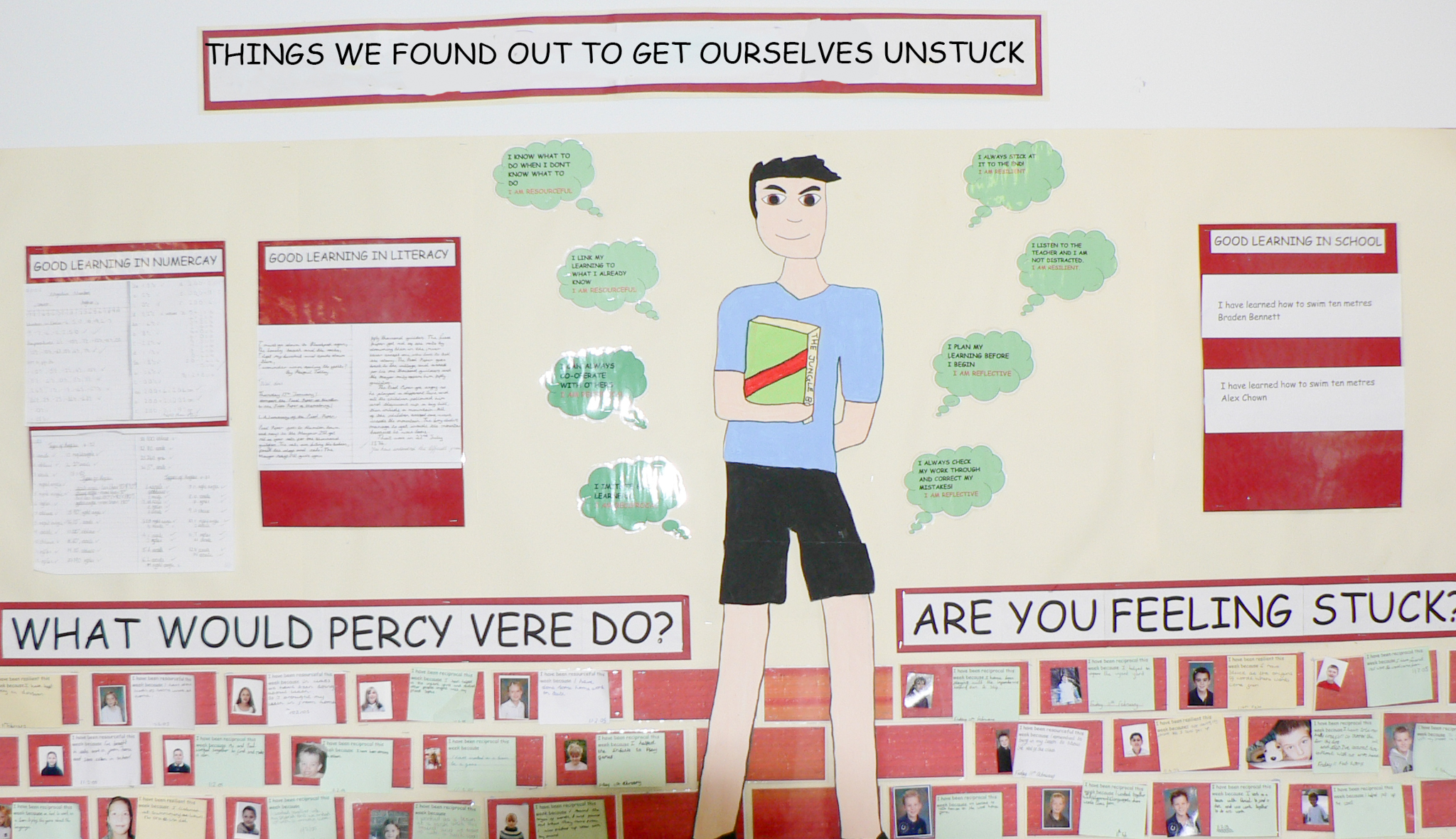
In a learning powered classroom learning will be on display in what you will see, hear and feel. In other words learning is visible in all sorts of ways.
You might find several ways of acknowledging learning on the walls:
useful prompts for use when stuck
displays of pupils efforts showing drafts and examples of work in progress to emphasise the idea of learning as a process
a humorous display of mistakes of the week
a five point scale pupils have devised about levels of distraction
some If -Then statements to encourage habit formation
whiteboard display of icons showing the learning behaviours they are focusing on just now
photographs taken by some of the children which capture their peers using ‘stuck strategies’
statements showing what superpower learners say
a ladder or learning line showing descriptions of how pupils might feel about the activities and their learning stretch just completed (low, good, high, overstretched) around which the pupils gather at the end of the session to reflect on their efforts.
What could I do differently to engage students in realising the value of stuck?
In this section we explore a range of ideas, activities, ways to display, and things to say about being stuck. The ideas aim to deepen your learning friendly classroom culture, helping to support and strengthen your students’ relationship with stuckness; how to enjoy it; what to do about it; how to overcome it, when to give up on it.
Much of being able to deal with being stuck involves your feelings; your emotional responses to learning. Being emotionally robust is a pre-requisite for powerful learning. Hence making sure students actually become stuck and coaching them to get unstuck is one small, but essential, way of moulding them as powerful lifelong learners.
The ideas to practise are grouped in two ways;
In section 2 (this section)
The four phases of learner behaviour ( we have left ’embodies’ out):
Lacks (grey) ‘I can’t. I won’t’, can be a reluctant or fearful learner
Receives ( purple) ‘Tell me’. ‘Show me’, where their tendency is to do as they are told.
Responds ( blue) I’ll try. where they act more independently
Values ( green ) I see why. where they come to value the behaviour
Organises ( yellow) I make sure I do.where they organise themselves to use the behaviour effectively
This grouping will enable you to look at all the ideas linked to a phase of development
In section 3 (The culture sort)
The four shifts in teacher behaviour:
how you relate to students
how you talk to students
how you construct learning opportunities
how you celebrate learning
This grouping will enable you to look at one type of teacher behaviour shift across all student development phases. Basically it shows the subtle behaviour changes you will need to make in order to build your students’ behaviours.
Most of the ideas to practise are not phase-specific and can be used, or readily be adapted for use, with students of any age. Have a rummage through the sections to see what you can find. As you do, keep in mind what your students do now when they are ‘stuck’. Think about, what you want them to be able to do that they can’t or don’t do now?
How do my students deal with being stuck? How stuck friendly is my classroom culture? What might I do to develop a more stuck friendly classroom culture?
Stuck and unstuck
Being stuck is a natural part of learning, we all get stuck. We come across blocks and obstacles, go into blind alleys, get flummoxed by a vast range of possibilities, or simply don’t know enough to decide what to do next.
Being able to get ourselves unstuck is as much about how we react emotionally as it is about having the practical strategies to work out how to overcome it. Being able to manage an effective way out of being stuck is a critical part of persevering.
Re-framing being stuck
But never being stuck or unsure doesn’t bode well for learning. It may well mean you are just coasting along; going through the motions, doing exercises rather than learning. Getting the most out of being stuck involves thinking of it anew; as an interesting place to be; being on the brink of learning; almost, but not quite understanding something new or different.
The two questionnaires in this section aim to help you analyse:
What your students do now when they get stuck and what this reveals [Questionnaire 1 Stuck Questions]
How learning friendly your classroom culture appears to be and what this might suggest. [Questionnaire 2 Culture Questions]
Results from these questionnaires will take you to a focused range of moving forward ideas.
This section is for those teachers who are undertaking this unit alone and are not part of a Teacher Learning Communitystructure. The section provides well researched ways for planning and reflecting on your changing classroom practice
When teachers want or need to improve it actually involves them in changing their teaching habits. It’s not just about knowing new stuff, like reading the previous sections, it is about doing what you do differently. That’s much harder. It involves changes to;
what you know – knowledge
what you believe – feelings or attitudes
what you can do – your skills
what you actually do – putting it all into practice
So changing how you teach is a delicate, complex process……...that’s why it’s hard!
And the hardest thing isn’t getting new ideas into teachers’ heads
It’s getting the old ones out…….that’s why it takes time and effort.
It takes time and practice to undo old habits and become graceful at new ones……that’s why we have provided materials here to help you to plan the changes you want to make, monitor what happens in your classroom as the changes happen, and reflect on the impact of those changes; their worth and value.
This section offers a framework of support for a productive Teacher Learning Community
Teacher learning communities have the potential to provide you, as teachers and support staff, with the information and support you need to develop your practice in deep and lasting ways. They provide a forum for supporting you in converting the information and ideas in the online learning sessions into “lived” practices within your specific subjects and classrooms. They provide a safe forum in which to;
kick around ideas from the online content,
unpack it’s meaning when it’s unclear,
consider what’s do-able and appropriate for your pupils
make plans for what and how you might incorporate the ideas into your practice
share and unpack what you have tried in the classroom
relate your triumphs and tribulations
support colleagues through changes in practice
reflect on what you hope you might do, or have done, differently
The format of the agenda is based on research into teacher learning communities by Dylan Wiliam, of Assessment for Learning (AfL) fame. Teacher learning communities are the engines of teacher development.
What could I do differently to engage students in realising the value of remaining focused and avoiding unnecessary distractions?
The four shifts in teacher behaviour:
how you relate to students;
how you talk to students;
how you construct learning opportunities;
how you celebrate learning.
This grouping will enable you to look at one type of teacher behaviour shift across all student development phases.
Have a rummage through the sections to see what you can find. As you do, keep in mind what your students do now when they are stuck. Think about, what do you want them to be able to do that they can’t or don’t do now?
This dimension of the learning friendly classroom concerns learning becoming a shared responsibility.
As a teacher you will be giving students more responsibility for their own learning by:
acting as a learning coach, gradually enabling students to find their own ways to improve;
focusing collaborative activity to help students to see each other as resources for learning;
offering students choices about what and how to learn;
enabling students to talk more, with you talking less;
modelling being a learner;
surfacing and promoting the processes of learning itself.
Shifting responsibility for learning ensures students recognise, use, understand and grow their learning habits.
The classroom gradually becomes a learning community where everyone is learning from each other and growing more confident as learners as a result.
Organisation of ideas below
The ideas below have been included for their effectiveness in helping to unhook teacher-student dependency and shifting more responsibility for learning to students. The coloured lines bounding each idea suggest the progression phase the ideas might best secure.
#1: Introduce the idea of distraction
Quick ways in to introducing managing distractions
For older students.
Here are a couple of ideas for introducing the idea of distractions to students in the transition years. They need not be used in the ‘worksheet’ format of course! If these don’t suit there are plenty of other ideas later in this section.
For younger students.
Here is a story about managing distraction in everyday life. Take a look at the sort of questions the text calls for….both the content and the underlying process being unpacked.
Here’s a fuller explanation of distraction if you need one. It might be useful for deeper discussion and analysis with students
#2 Explore the idea of managing distractions.
Exploring what it feels like
AIM To enable students to recognise;
What distractions are
What it feels like when being distracted
A range of distractions
What distracts them.
Set up the Learning Challenge
Pair up students — Student A, Student B.
A to describe a complicated process, e.g. tying a shoelace or tie.
B to try to distract by –
butting in –
looking bored –
looking elsewhere –
talking about how they would do it –
and so on 2 minutes.
Swap roles.
Plenary Discussion Explore:
What happened?
How were you distracted?
What did being distracted feel like?
How could you avoid or manage the distractions better?
Record Distractions
As a whole group, or in pairs, construct a list of things that distract people: – in the classroom – at home.
Prompt: Distractions may not be outside us, but in our heads …
Compare the lists. Draw out interesting / mundane distractions.
(Could be done using Post-its as a scan and focus exercise.)
#3 Model being distracted
Model distractions (ages 4-8)
A quick starter activity to illustrate the meaning of distraction.
Explore the effects of distractions on pupils.
#4 Start students self-monitoring their distractions
Am I a ☆☆☆ manager?
Work with students to describe different degrees of the ability to manage distractions.For example:
A 3-star manager might
always keep focused on what s/he is learning
support other learners by helping them to manage their distractions
Use language appropriate for the age of the students.
Comment on behaviour in order to recognise and value the management of distractions.
Ask students to help each other with ideas about how to earn more stars as distraction managers.
#5 Classroom layout: managing the learning environment
An environment that’s their’s to manage
Being concerned with classroom layout in dealing with distraction may seem strange bedfellows, but if we think of distraction in the wider context of managing the learning environment it begins to make more sense.
Just have a look around your classroom and ask yourself:
Does it feel a calm place to be?
Are there different habits within the classroom? e.g.A quiet thinking place, An editor’s table and chair
Is the layout quickly adaptable?
What about the walls? Do they celebrating the classroom values? Too busy/congested?
Are learning resources accessible by students? Do they know where things are? Can they get what they need, when they need it?
Do you expect students always to sit at tables? Are there any other work spaces?
Is it a distracting environment? Does it aid quiet reflection?
Is the environment their’s to manage?
Classrooms that feel like homely places to be, where there’s freedom of movement, a choice of learning spaces a sense of calm and where students feel they belong all seem to help concentration levels, lessen stress and focus effort.
The Saints’ Way MAT in Cornwall decided to fundamentally challenge their thinking about educational spaces and provision. They wanted to enable learning, not necessarily direct learning.
‘I do not teach anyone I only provide the environment in which they can learn.’ Albert Einstein
The classroom environment became their starting point. It just so happened that they had a new classroom that needed to be equipped for the coming year – a blank canvas. The brief they set themselves was to create a flexible, neutral space that would facilitate learning. They had already equipped a number of classrooms with furniture from Ikea so returned to the catalogue for inspiration.
The first decision was to put all the furniture on casters to maximise flexibility within the space, they centralised the resources so that they could put large whiteboards at child height on every wall. These were to enable pupils to think about, explore, plan and reflect upon their learning, they would become the Working Walls, ensuring that all information was current and relevant. They arranged several work and break out spaces including tables and chairs, bar tables and stools, sofas, bean bags, an architect’s desk. This variety of work spaces has enabled every child to feel comfortable and find their element. Some prefer tables, other work alone, some like being perched high up, others snuggle into sofas. Higher up display boards were minimised, but those that remained were covered in neutral backing paper in order to maintain a calm space where the pupils’ work would provide the colour.
It may not look like a conventional classroom but it’s a space where learners feel able to move about, find what they need and learn in a variety of positions. There’s less fidgeting, more comfort and less stress and more focus.
The new classroom layout
#1 Introduce how to focus effort
Explore the meaning of effort
Effort is a word that teachers use frequently, but what does it mean? How might students decode this and begin to do it purposefully?
Explore what is meant by ‘effort’ with your students, and discuss with them the ways in which they might apply it.
Encourage them to come up with a definition of effort and specific examples of what it might look like in the classroom – for example by;
trying different strategies to solve a problem,
using a Visible Thinking Routine (VTR)
aiming to achieve challenging goals, or
using different un-sticking techniques when something is tricky.
paying attention to whoever is speaking
See Celebrate learning values #2 below for a poster of Effort prompts.
Targeted Effort is now seen as a path to mastery. Students need to be aware of a connection between effort and improvement; that their effort is causing their improvement. This is why it is important to give effort meaning. Meaning often underpins motivation which in turn drives behaviour.
Targeted effort is effort that has direction and purpose. It is underpinned by clear guidance and the specific goal to be achieved.
What you are doing here is giving effort a size and direction. What students need to understand is that their effort has a size and a purpose.
#2 Use ‘If-then’ statements to strengthen focusing effort
Put ‘If-then’ planning into action in your classroom to make effort more specific and focused
‘Ifs’ are the situations you want to remind yourself about. In this case focusing effort it’s useful to list all the sorts of places this is needed.
‘Thens’ are what you will do about something; the action you will take. In this case the ways of focusing effort as introduced in #1 above.
The how of ‘If-then’ planning and a relevant example:
When setting a goal, for example ‘make more effort’, you need to specify not only what you will do but also where and when you will do it.
If (or when) [___situation__], then I will do [___behaviour__]
An If-then statement linked to the ‘make more effort’ goal might be
‘If I lose focus at the start of a task, then I’ll look at the success criteria to give me direction ‘.
This may sound a bit cumbersome to start with but research suggests far more goals are achieved by using ‘if-then’ statements. And the clever bit is that this builds self talk at the same time. You do what you are telling yourself to do.
The ‘if-then’ plan succeeds because the situation and the action become linked in the mind. The brain recognises the situation as an opportunity to advance the goal. When the situation is detected action is initiated automatically. “If-then’ plans become “instant habits”.
#3 Model effort
Give students an idea of what effort looks like in practice.
Demonstrating a task which you expect them to complete later in the lesson.
Explain what you are doing, in terms of effort, as you go along.
Your commentary might include:
referring to success criteria to plan and direct your actions
using an unsticking strategy when you come across something tricky
looking for feedback from the class on your efforts, and adjusting your course in the face of that feedback
reminding yourself to refocus when a distraction comes along
#4 Introduce the idea of being absorbed
Introduce students to the idea of being absorbed
Try this starter activity to introduce students to being absorbed. Useful at the start of any lesson.
The resource above is part of the BLP Activity Bank. Find out more from our website
#1 Introduce ideas about working memory
Help for working memory
Working memory is what we use for processing information in real-time. It is particularly exercised when we are learning new things, performing tasks, cogitating, questioning and so forth. Your students are using it all the time during lessons. But working memory is limited to about 7 items at a time – any more than that and the brain starts to freeze up, and engagement drops. We sometimes say ‘I don’t have the head space for that’. Students will need to know when they are reaching capacity, and how to cope when they do.
Ways to free up thinking space
Fortunately, freeing up working memory is relatively simple.
jotting things down as notes,
talking through a process out loud,
creating a mind map
making a set of lists to group disparate pieces of information into larger lumps
splitting a task down into smaller tasks
are all good techniques for giving the brain more thinking space.
#2 Three strategies for refocusing effort: nudging not telling
Model it: for the student who is well and truly stuck, or who has taken a path that leads to a dead-end and is withdrawing from learning, try modelling the process for them. Narrate as you go, highlighting the thinking processes you are using, what you plan to do next, how you are getting yourself unstuck, and so on.
Nudge it: For students who are more resilient to becoming stuck or encountering difficulty, try using gentle nudges to get them out of the mud. “Can you think of something we did earlier that might help you?” “How have you tackled this sort of problem before?” “Would the instructions help you here?” This is far from a full-blown model of what to do, but rather prompting to a way back in to the learning.
Give clues: Some students will enjoy the added brain tease of a clue to nudge them in the right direction. “I think Newton had the right idea here…what about you?” “Perhaps it is a bit like hibernation…?” “Chapter 4 has some interesting things to say on this”
Each of these techniques provides progressively less scaffolding for the student – you will need to gauge which technique to use for each student – fragile learners who struggle with being stuck will not appreciate clue giving as it will only compound their stuckness! Similarly, students who are able to deal with being stuck well on their own will not be sufficiently stretched by the modelling approach. You are differentiating your nudging.
#3 Introduce ideas for overcoming hard slog of practice
Embracing the hard bits
It’s the hard parts in learning that can cause demotivation in students accompanied by a greater likelihood of distraction. Students and teachers need to learn how best to cope with them.
Good work on the hard parts is a structural challenge for teaching as well as learning. We need to build in versions of ongoing assessment but assessment that is not concerned with marks /grades or evaluating the the how of learning. This is assessment designed to feed into the learning process and make the learning stronger. It’s possible to organise the rhythm of learning so that it embraces;
deliberate practice
assessment focused on understanding
peer and self assessment
communicative feedback
Teachers need to anticipate where the sticking points in the content are likely to be, the troublesome knowledge, and then ask;
what standard ritual ways of thinking might get in the way?
what do students know already that they might not have linked to this topic/knowledge/task?
what is getting in the way of them thinking differently about this content to be able to assimilate it?
what might they need to unlearn in order to relearn this content?
which aspect(s) of the content is conceptually difficult
Here are researched ways of structuring work on the hard parts into the rhythm of the learning.
Vary practice activities and conditions
Interleave rather than block practice
Break down complex problems
Use low stake tests/quizzes with students
Encourage students to self test
Offer clues rather than solutions
You can read a little more on each of these below.
1. Introduce variety and unpredictability into classroom environments
Making learning easier boosts retrieval strength in the short term and this leads to better outcome performance. This feels good and produces a sense of cognitive ease. When something feels comfortable and familiar, it makes us feel good. And when we feel good, we’re relaxed, not thinking. BUT because the deeper processing that encourages the long-term retention is missing, that retrieval strength quickly evaporates. The very weird fact of the matter is that forgetting creates the capacity for learning.
Remember though, learning happens when we think hard, so we need to create conditions which induce cognitive strain. Strain is unpleasant and stressful. We’re wary of the unfamiliar so we concentrate. When we’re forced into situations where we have to pay attention and make an effort, we have to think. Visual and verbal information can be processed simultaneously without overloading working memory.
2. Interleave/mix topics together instead of presenting them in neat termly blocks
Practice should be distributed (spacing & interleaving) over extended periods of time. Spacing – exploits the cycle of forgetting and relearning (more strongly) by revisiting topics repeatedly over the course of a term or a year. Interleaving – what topics will you teach whilst you are waiting for students to forget what you have just taught before revisiting it?
Blocking / massed practice– review the basics, complete a few related practice examples, reach an acceptable level of proficiency, and then move to the next topic. Blocking leads to compelling short term gains, but interleaving the curriculum leads to deeper understanding by the end of the course.
3. Complex problems should be broken down into constituent parts and students required to practise these smaller elements before being asked to solve complex problems independently.
4. Test pupils’ ability to retrieve information instead of simply showing it to them again.
Regular low stakes tests or quizzes taps into the effect (that trying to remember something helps us with the long-term memory for that material). Quick questions on the board, quizzes, self-tests. If students have drawn mindmaps, get them to try redrawing them from memory. If using flashcards, make sure they are testing themselves by jotting down their contents from memory, rather than simply looking at them (recognition vs recall). Students often mistake familiarity with material for the ability to recall it. We can help students from more accurate judgements of learning by encouraging a delay between studying and self-testing
5. Self testing
We are more accurate at predicting later performance when there is a delay between studying material and making a judgement about how much we can securely recall. Encourage students to test that judgement by attempting tasks or quests from memory.
6. Give clues rather than complete solutions so that pupils have to generate rather than simply repeat answers.
BUT When teaching new material, ensure pupils are not overloaded – more inductive discovery methods require pupils to juggle a lot of information at once in order to perceive the relationships or patterns we want them to understand. Providing an element of explicit instruction, using carefully considered explanations, worked example and accurate analogies, is almost certainly a better bet than providing relatively little guidance using problem-solving or open inquiry methods. Students should be provided with worked examples and exemplar answers as well as partially completed sample problems
#1 Putting targeted effort in plans
Plan for targeted effort
Expect students to plan for their targeted effort.When devising project plans with students, ask them to come up with;
their own idea for what they want to focus on
What that will mean they are looking out for (monitoring) as they undertake the work.
What they will focus on when revising in their work.
For example, a Y1 student might decide to focus on using capital letters at the beginning of sentences when writing a passage. When they read their work through at the end, they would focus their effort on the same criterion – are there any sentences that still need capital letters? And possibly ask themselves ‘I wonder how/why I missed that one?’
Or a Y10 student might aim to focus their effort in science on coming up with a really tight method for an experiment. They would monitor how things are going and whether they need to adjust anything. This will also provide the focus for the conclusion section of the process, as they can suggest refinements to their original method to gain more meaningful results in future experiments.
It’s all about where the effort needs to be focused. One bit at a time.
#2 Introduce attentive noticing
Now that your students are familiar with and in control of distractions it’s a good time to deepen their attentiveness. This activity offers an informal introduction to relaxed noticing rather than focused concentration.
Here you will find a small set of ideas for introducing and discussing the noticing capacity. Useful for younger students.
Talk for learning
This dimension of the learning friendly classroom concerns using the language of learning,
As a teacher you will be:
using language to encourage perseverant, inquisitive, imaginative attitudes in students;
exploring learning as an explicit theme that runs across all subject matter;
talking about learning in terms of constant change; experimental, working towards, constant improvement, flexibility, could be;
prompting in the form of questions to nudge pupils into thinking for themselves. “That’s curious. What’s odd about that? What does that make you wonder?”
focusing questions on the process of learning, encouraging students to slow down, appraise the strategies and steps along the way, become more thoughtful and explore different strategies for making progress;
aware of positive and negative student self talk and building positive talk by giving them the knowledge and experience of the learning behaviours ( the tools) with which they learn.
The more richly children come to relate their own learning the more they see and take hold of their own role in it.
Organisation of ideas below
The ideas below have been selected for their effectiveness in helping to surface the learning process and deepen the language of learning.
#1 Talk to extend understanding of distractions
Sometimes we are distracted by people, sometimes things can get in the way.
Have a discussion about these two types of distractions (people and things) and come up with lists of the different ways we can be put off by people and by things e.g. when we break a pencil, when we don’t have the things we need etc. Talk about what we could do in different situations.
#2 Talk to nudge the skill.
Managing distraction phrases
Encourage students to become more aware of distractions and how they might deal with them. Use phrases like:
What might put you off?
What might get in your way?
Do you sometimes distract others?
How might they feel when you do that?
What could you do to avoid being distracted?
Where are you now on our distractions scale?
How well have you managed your distractions today?
The language of learning can help teachers to think about how they might talk in a way that helps to cultivate the learning behaviours and help pupils to gain a better personalised understanding of content.
Teachers can turn each of the learning habits into sets of casual prompts or nudges to move pupils along in learning. For example, to nudge curiosity/questioning: “What’s odd about that? What does that make you wonder? What do you want to find out? How else could you do that?”
Teachers’ classroom talk is all focused on the process and experience of learning itself. Sometimes teacher comments encourage pupils to pay attention to how they are learning. Teacher comments ask them to slow down and notice and appraise the strategies and steps they are using along the way. E.g. “What would have made this easier for you? Where else could you use that?” This helps pupils to become more reflective and thoughtful about their own learning.
#3 Written feedback on managing distractions
Reinforce taking responsibility for learning with supportive marking comments
You have been successful because you avoided being distracted. Well done!
#1 Talk to extend understanding of ‘distractions’
To build up students’ understanding of distractions, use phrases like:
How did you keep going?
What could we do when we feel we are losing focus?
What sorts of things distract you most?
When are friends a distraction – or a source of inspiration?
What sorts of learning environment might be appropriate for different types of learning?
What internal distractions might we have? (tiredness, emotions, hunger, failure).
How could you let us know if we are distracting you?
You’re doing well with avoiding that distraction.
#2 Reinforce familiarity with distractions by ranking them
Work with students to identify distractions in the classroom and to come up with strategies for reducing them. Encourage them to think about:
Straightforward concepts – e.g. people, objects, the weather, the environment.
Issues which are not clear cut, such as friends who are both a distraction and a source of inspiration, and whether fiddling is a distraction or an aid to concentration
Different learning environments that might be appropriate for different types of learning, both in school and at home
Internal distractions, such as hunger, tiredness, emotions, failure.
Once you have identified various potential distractions, ask students to rank the distractions and match them against ideas for managing these distractions. Remember to address the emotional content of internal distractions. Examples might include:
Using their imagination to take themselves to a different place, a happy place, where they can block out the distraction
Discussing how to deal with the situation with a friend so that the worry does not go round and round in their minds
Giving themselves time to laugh or cry about a situation if necessary before settling back into a task.
#3 Using distractions positively
Sometimes when we are stuck, becoming distracted is our brain’s way of saying “I need to take a break”. Often, moving away from the problem at hand and doing something different for a while, or simply gazing out of the window, can help new ideas bubble to the surface, it gives the subconscious time to work on a problem that has previously seemed uncrackable.
Consider having a quiet break-out area for students to use when they need a break, but make sure it isn’t being used too frequently or improperly!
Use ‘gazing out of the window’ positively.
When you see a student doing this ask them ‘What’s bubbling up in your mind? What new ideas are you imagining?’ rather than referring negatively to an apparent loss of focus or concentration.
#4 Written feedback on managing distractions
Giving feedback on the learning process; make it a habit of yours.
The story of Lemar and his distractions
Lemar was in Yr 6, registered SEN and always distracted. He looked here and there, talked to other children and sometimes wandered around the classroom when he should have been absorbed in learning.
His teacher decided that the place to start with Lemar was managing his distractions. After talking with all the class about what distractions were the pupils came up with all manner of ways they could use to try and avoid them. One idea was a simple line on a page to record when distractions happened.(Self monitoring)
The next day the teacher drew such a line at the top of Lemar’s page and asked him to try it out. You can see the line on the first picture and how Lemar marked it throughout the lesson. Although one could argue that the line itself was a distraction what it was actually doing here was making Lemar aware of being distracted.
On seeing his writing at the end of the lesson the teacher was astonished by the amount Lemar had managed in the time. The lines he had written represented 100% increase in volume. Note the teacher’s comment at the bottom. She acknowledges that he has indeed managed his distractions well.
A couple of days later Lemar had more writing to tackle. This time he created his own line at the top of his page….a significant breakthrough because he had seen the value of using this tactic. Here again he marks when distractions happen and even mentions his distractor Jordan! Furthermore he has completed yet more writing.
Hannah Moore Primary School
Here again the teacher comments on the writing and acknowledges that it is good work, but unfortunately she doesn’t comment on his obvious effort on managing his distractions.
If we are going to help pupils to build their own learning habits a single written comment won’t be enough, habit formation needs far more encouragement and reinforcement.
Wow! using your distraction line today has really helped you to focus well. Feel pleased with yourself for this good effort.
#1 Talk to focus effort
Effort focusing questions
What strategies will keep you going here?
What are the things you can do to keep yourself on track?
Can you show me what really good effort looks like?
What could you look at to see if you are on the right lines?
When did you target your effort effectively?
What could you focus on next?
If you had to pick one thing to focus your effort on, what would it be
#2 Written feedback to maintain interest
Supportive marking comments
Well done on keeping focused – this was a hard slog, but your effort was worthwhile and enabled you to produce a really good piece of work.
#3 Questions to focus reflection on effort
How did that effort help you learn more?
How did you manage to keep your effort up when there was a lot of distraction?
Where in that piece of work did effort play a really big part?
Which effort strategies have you found most useful?
How would you change your tactics next time?
Are there certain times in learning when effort becomes indispensable?
What does it feel like when you are really targeting your effort?
#1 Feedback to nudge the skill
Process-Level Feedback Prompts (adapted from Nuckles et al, 2009)
What strategies are you using?
Are there more efficient strategies you could use?
What other Qs could you ask about this task?
Do you grasp the concept underpinning this task?
Have you done anything similar to this before?
How could you use that information to target your effort?
Has making this effort made you want to learn more?
What could you focus on next?
#2 Written feedback on overcoming negative pressures
Supportive marking comments. Keep them coming to support habit formation
It would have been easy to have given up on this, but you stuck to your guns despite the doubts of others. You should be proud of what you have achieved.
Constructing learning lessons
This dimension of the learning friendly classroom concerns how you design learning episodes/lessons/projects.
As a teacher you will be:
building reflection on learning and reviewing learning as key features in the rhythms of into the classroom;
designing learning activities with a dual focus; to explore content and stretch ability to use learning behaviours;
making conscious choices about:
which habits/learning behaviours to introduce and stretch;
how best to couple these with content so that lessons become more interesting and challenging;
adding a third dimension to your teaching:
1. Subject matter;
2. Assessment;
3. The learning behaviours being used in order to learn the content.
Organisation of ideas below
The ideas below have been selected for their effectiveness in helping to show how you value the process of maintaining focus. The coloured lines bounding each idea suggest the phase of development and the order in which they might best be introduced.
#1 Nurture the capacity to manage distractions
Sliding doors
Have some fun by thinking about what might have happened if characters in familiar stories had been distracted e.g. suppose someone distracted the prince each time he wanted to ask Cinderella to dance?
We’ll let you have fun finding other ideas.
#2 Build in break states
Break States.
Change the mental and physical state of the class by using music, quick games (Fizz-Buzz, Simon Says), guided relaxation, Brain Gym (Dennison, 1992), change of partner/desk/lighting, breathing exercises, or a refreshment break. Such activities refresh and relax pupils, enabling a greater degree of focus afterwards. Discuss their impact on concentration and how pupils could use them in other contexts to keep themselves on track with their learning.
Extract (above) from Building Learning Power in Action, by Sarah Gornall, Maryl Chambers, Guy Claxton. You will find lots of other ideas for all the learning behaviours.
#3 Build in ways to recognise distraction
Keeping count
For students aged about 4 to 8
Encourage your students to recognise when they are becoming distracted.
At the start of an activity give each student a number of counters, beads, bricks etc. Each time they find themselves distracted they put one counter etc. into a pot.
Groups of individuals can compare outcomes and talk about the different ways they had been distracted.
#1 Practise using defined effort
Tight effort
Set your students a task that requires them to focus their effort very tightly. For example:
Produce a piece of writing on the topic of ‘squirrels'( or indeed on anything relevant/current),
using only 10 words.
you have five minutes.
You can of course change the topic, word limit, and time limit, or add further constraints like ‘no lists’, to give almost infinite variations on this theme. Changing these criteria will have the effect of broadening or narrowing your students’ effort/focus.
#2 Use ‘brink’ targets and ‘flow’ tasks
Being in a ‘state of flow’ is about an ideal state of being totally involved with or absorbed by something you are doing. How might we try to achieve that state in the classroom? The secret to designing what we might term “Goldilocks ‘ tasks is to make sure they are exciting ( arousing the interest of the learner) with just the right level of challenge; where the student is on the brink of being able to achieve something (challenging but within reach)
#1 Targeting effort in self-assessment
A refinement of Austin’s butterfly.
Ask your students to copy a picture of a teapot (or something relevant to current learning) as best they can in 10 minutes.
At the end of the allotted time ask them to swap pictures with a partner.
Now provide students with a list of criteria against which to review the picture they have been given, but require them to select and focus their review against only one of the criteria. The list, in this case, might include: handle, spout, pattern, outline, lid. Stress that the feedback must be helpful enough to enable their partner to improve their drawing.This keeps feedback tight, focused and meaningful. It also helps students move on from potentially vague and ambiguous feedback.
Have a look at Austin’s butterfly above and notice how the children work out, with a little prompting, how to focus feedback to help Austin achieve his goal. Magic.
#2 Scaffold tasks to focus effort
Looking 10 x 2
Give students 30 seconds to look at a picture relevant to your topic.
Ask them to list ten things they noticed about the picture.
Repeat the process, seeing if they can list 10 more things about the picture.
This process can be repeated until no new ideas come forth.
Focusing effort has now engaged the learning behaviour known as attentive noticing
#3 Go with the flow
Go with the learning and follow absorption. Where possible, don’t stop a lesson arbitrarily because of the time or a projected move to the next topic. Make sure there’s time to explore and to allow the students to develop their interest fully.
#1 Blending managing distractions seamlessly into a lesson
A a school in Wotton-under-Edge in Gloucestershire teachers have extended the usual idea about classroom distraction (losing focus) by using the same idea to encompass looking out for red herrings/distracting or irrelevant information in texts.
A literacy lesson revolved around a writing activity. The stimulus was a video clip of Gavin Henson, the Welsh fly-half, taking a successful kick in a famous rugby match. This was used to stimulate a deep discussion about managing distraction and how this was possible in such a public setting. What had Gavin got to do to make sure the kick was successful?
The students were then invited to write a short piece for a newspaper using the the following information. They were asked to be aware of what they thought to be the key pieces of information. But of course irrelevant information was also included.
There were 3 layered targets for this piece of writing which different groups of students understood had to be incorporated into the writing.
The following task was to consider what advice Gavin Henson would offer a learner about managing distraction. This again led to a very profitable discussion which was then captured in writing.
Throughout the lesson students recorded their thoughts about managing distraction using this format.
Needless to say this teacher is Welsh and a passionate Rugby supporter.
#2 Blending attentive noticing into lessons
This activity arouses an appreciation of noticing skills.
Students will be able to:
Recognise that noticing can be fun
Appreciate the value of noticing
Appreciate noticing as a way into greater interest
Appreciate noticing as a precursor to making links
The following resources provide coaching notes, DIY resources and an observation tool.
You could try the activity without as much scaffolding. E.g. use a VTR, ask: – “What do you notice?” – “What’s happening here?” – “What makes you say that?” Then explore feelings about not being told where to look and what to look for, etc.
#3 Reflect on effort related strategies
Self-Regulation-Level Feedback questions (adapted from Nuckles et al, 2009)
What would be the best way of checking your work?
How could you reflect on these answers?
What happened when you …?
How can you account for …?
What learning goals have you achieved?
How have your ideas changed?
What aspect of this work could you now teach to others?
Celebrate learning values
This dimension of the learning friendly classroom concerns what is valued, recognised, praised, displayed about managing distractions.
As a teacher you will be:
showing attention to learning, rather than performance;
recognising, praising, displaying aspects of remaining focused and bouncing back after distractions. For example:-
recognising losing focus is something over which we have some degree of control;
having a clear description of what focus means and how best to achieve it.
acknowledging/recognising/ praising when overcoming distractions is used more skilfully
attending to the growth of learning habits associated with retaining focus.
Learning powered environments build confident uncertainty. Managing distractions and remaining on task is celebrated as an interesting place where real learning begins.
Organisation of ideas below
The ideas below have been selected for their effectiveness in helping to show how you value the process of maintaining focus. The coloured lines bounding each idea suggest the phase of development and the order in which they might best be introduced.
#1 Display ☆☆☆ managers
Display and celebrate achievement of managing distractions
Ensure that your display walls include pictures and explanations that illustrate what you have been exploring about distraction and how to avoid it.
Here we see a ☆☆☆ Distraction manager ( explained in activity #4 Relating)
Encourage students to write on a separate note how they managed their distractions, and display the note with the 3* managers.
It’s important that students understand learning as a process rather than an event, and that being distracted is a inevitable part of that process. Mostly distraction takes us away from learning but sometimes purposeful distraction can be a helpful addition to the learning process. We look at this in the ‘I’ll try’ section.
#2 Photograph and display students focusing on learning
Have your camera at the ready and capture moments where you see students focusing intently on what they are learning. Make a big fuss of this focused behaviour, explore with the students what they have been learning and what ‘focusing’ felt like. Regularly encourage students to think about a moment when they became really absorbed and how it felt. Celebrate the unusual ones by displaying them on a ‘focus or absorbed wall’. Students will develop an interest in their ability to become absorbed.
#1 Display students’ self monitoring of distraction
A learning powered primary school near Milton Keynes captured student’s own assessment of managing distractions each week
They have developed a 5 point scale describing different levels of distraction
Each student crafted a personal logo, known only to them and the teacher. Each week they would stick their logo on the level of distraction they estimated they had achieved across the week.
These assessments were recorded by school and set against progress data
Perhaps not surprisingly strong positive correlations were found…being able to manage distractions better positively correlates with increases in progress! Now there’s a surprise.
#2 Display an Effort checklist.
Create a prompt checklist of the ways you have introduced that will help focus effort.
This display list links to #1 Relating. Introduce how to focus effort
#1 Ways to help your memory: a checklist
This Working Memory checklist does the same job as a Stuck prompt…it reminds students about what they could do when their heads are in danger of getting confused; too full of ideas or too much to do or …….
#1 Develop a Raptometer
Switch the thinking from managing distraction to becoming absorbed and attentiveness
Raptometer.
Make a scale on the classroom wall to indicate degrees of absorption. Students or adult observers (e.g. Teacher Training student, Teaching Assistant) observe groups and/or individuals as they are working and move a label with a students’s name or picture up and down the scale according to how absorbed they perceive individuals are.
Use as a prompt for discussion about:
how students have become absorbed at different stages of a lesson,
what the characteristics of absorption are
what it feels like to be absorbed
how to be more absorbed in the flow and how to avoid distractions.
What could I do differently to engage students in managing their distractions and becoming more focused?
In this section we explore a range of ideas, activities, ways to display, and things to say about understanding distraction and becoming more focused. The ideas aim to deepen your learning friendly classroom culture and help to support and strengthen your students’ relationship with focus: how to enjoy it; what to do about it if disrupted.
Much of being able to be focused involves your feelings; your emotional responses to learning. Being emotionally robust is a pre-requisite for powerful learning. Hence looking out for students who have lost focus (they are not usually hard to spot !) and offering them ways to maintain focus is one small, but essential, way of moulding them into powerful lifelong learners.
The ideas to practise are grouped in two ways;
In this section (2)
The four phases of learner behaviour (we have left the most advanced phase, ’embodies’, out):
Receives ( purple) Do as they are told, but need assistance, ‘Show me. Tell me’;
Responds ( blue) Act more willingly, prepared to try, ‘I’ll try’;
Values ( green ) Values the behaviour, does it more frequently, ‘I see why’;
Organises ( yellow) Organises themselves to use the behaviour effectively, ‘I’ll make sure’.
This grouping will enable you to look at all the ideas linked to a phase of development
In section 3 The culture sort
All the activities linked to the four shifts in teacher behaviour:
how you relate to students;
how you talk to students;
how you construct learning opportunities;
how you celebrate learning.
This grouping will enable you to look at one type of teacher behaviour shift across all student development phases
Most of the ideas to practise are not phase-specific and can be used, or readily be adapted for use, with students of any age. Have a rummage through the sections to see what you can find. As you do, keep in mind what your students do now when they become distracted and move off-task. Think about, what do you want them to be able to do that they can’t or don’t do now?
How do my students deal with distractions? How focus friendly is my classroom culture? What might I do to develop a more focus friendly classroom culture?
Managing Distractions
Losing focus or getting distracted is an inevitable part of learning, it happens to all of us.As learners we come across distractions, both internal and external. If we are hungry, tired or anxious we find it hard to concentrate. Equally if there is too much going on around us or something unexpected happens, we may lose our focus or get side-tracked. But unless students are assisted to cope positively and practically with such situations their deep engagement with learning may be in jeopardy.
Being able to avoid distractions or get ourselves re-focused is as much about how we react emotionally as it is about having the practical strategies to work out what to do. Being able to manage distractions is a critical part of persevering.
Why is managing distractions difficult?
Being totally absorbed and focused isn’t always the best strategy. Total immersion, however valuable, may mean that you miss whatever else is going on, be it a new opportunity or a looming threat. Our ancestors would have been vulnerable were they not continually checking for potential danger, and so to a lesser extent are we. In reality some students are preoccupied with what they perceive to be more important calls on their attention than the learning topic in hand. This isn’t because they are wilfully off task, but because they simply cannot help it. The ability to maintain concentration on longer-term goals, in the face of more immediate attractions, isn’t finally developed until quite late adolescence. Nevertheless, calling attention to distraction, exploring ways to overcome it, being clear about what effort means, and devising activities that are likely to minimise distraction are all part of a learning friendly culture.
The two questionnaires in this section aim to help you analyse:
Where your students are now in their journey to managing their distractions. [Questionnaire 1 Distraction Questions]
What you do to help students minimise their distractions and what this might suggest. [Questionnaire 2 Culture Questions]
Results from these questionnaires will take you to a focused range of moving forward ideas.
This section is for those teachers who are undertaking this unit alone and are not part of a Teacher Learning Communitystructure. The section provides well researched ways for planning and reflecting on your changing classroom practice
When teachers want or need to improve it actually involves them in changing their teaching habits. It’s not just about knowing new stuff, like reading the previous sections, it is about doing what you do differently. That’s much harder. It involves changes to;
what you know – knowledge
what you believe – feelings or attitudes
what you can do – your skills
what you actually do – putting it all into practice
So changing how you teach is a delicate, complex process……...that’s why it’s hard!
And the hardest thing isn’t getting new ideas into teachers’ heads
It’s getting the old ones out…….that’s why it takes time and effort.
It takes time and practice to undo old habits and become graceful at new ones……that’s why we have provided materials here to help you to plan the changes you want to make, monitor what happens in your classroom as the changes happen, and reflect on the impact of those changes; their worth and value.
This section offers a framework of support for a productive Teacher Learning Community
Teacher learning communities have the potential to provide you, as teachers and support staff, with the information and support you need to develop your practice in deep and lasting ways. They provide a forum for supporting you in converting the information and ideas in the online learning sessions into “lived” practices within your specific subjects and classrooms. They provide a safe forum in which to;
kick around ideas from the online content,
unpack it’s meaning when it’s unclear,
consider what’s do-able and appropriate for your pupils
make plans for what and how you might incorporate the ideas into your practice
share and unpack what you have tried in the classroom
relate your triumphs and tribulations
support colleagues through changes in practice
reflect on what you hope you might do, or have done, differently
The format of the agenda is based on research into teacher learning communities by Dylan Wiliam, of Assessment for Learning (AfL) fame. Teacher learning communities are the engines of teacher development.
What could I do differently to engage students in realising the value of remaining focused and avoiding unnecessary distractions?
The four shifts in teacher behaviour:
how you relate to students;
how you talk to students;
how you construct learning opportunities;
how you celebrate learning.
This grouping will enable you to look at one type of teacher behaviour shift across all student development phases.
Have a rummage through the sections to see what you can find. As you do, keep in mind what your students do now when they are stuck. Think about, what do you want them to be able to do that they can’t or don’t do now?
This dimension of the learning friendly classroom concerns learning becoming a shared responsibility.
As a teacher you will be giving students more responsibility for their own learning by:
acting as a learning coach, gradually enabling students to find their own ways to improve;
focusing collaborative activity to help students to see each other as resources for learning;
offering students choices about what and how to learn;
enabling students to talk more, with you talking less;
modelling being a learner;
surfacing and promoting the processes of learning itself.
Shifting responsibility for learning ensures students recognise, use, understand and grow their learning habits.
The classroom gradually becomes a learning community where everyone is learning from each other and growing more confident as learners as a result.
Organisation of ideas below
The ideas below have been included for their effectiveness in helping to unhook teacher-student dependency and shifting more responsibility for learning to students. The coloured lines bounding each idea suggest the progression phase the ideas might best secure.
#1: Introduce the idea of distraction
Quick ways in to introducing managing distractions
For older students.
Here are a couple of ideas for introducing the idea of distractions to students in the transition years. They need not be used in the ‘worksheet’ format of course! If these don’t suit there are plenty of other ideas later in this section.
For younger students.
Here is a story about managing distraction in everyday life. Take a look at the sort of questions the text calls for….both the content and the underlying process being unpacked.
Here’s a fuller explanation of distraction if you need one. It might be useful for deeper discussion and analysis with students
#2 Explore the idea of managing distractions.
Exploring what it feels like
AIM To enable students to recognise;
What distractions are
What it feels like when being distracted
A range of distractions
What distracts them.
Set up the Learning Challenge
Pair up students — Student A, Student B.
A to describe a complicated process, e.g. tying a shoelace or tie.
B to try to distract by –
butting in –
looking bored –
looking elsewhere –
talking about how they would do it –
and so on 2 minutes.
Swap roles.
Plenary Discussion Explore:
What happened?
How were you distracted?
What did being distracted feel like?
How could you avoid or manage the distractions better?
Record Distractions
As a whole group, or in pairs, construct a list of things that distract people: – in the classroom – at home.
Prompt: Distractions may not be outside us, but in our heads …
Compare the lists. Draw out interesting / mundane distractions.
(Could be done using Post-its as a scan and focus exercise.)
#3 Model being distracted
Model distractions (ages 4-8)
A quick starter activity to illustrate the meaning of distraction.
Explore the effects of distractions on pupils.
#4 Start students self-monitoring their distractions
Am I a ☆☆☆ manager?
Work with students to describe different degrees of the ability to manage distractions.For example:
A 3-star manager might
always keep focused on what s/he is learning
support other learners by helping them to manage their distractions
Use language appropriate for the age of the students.
Comment on behaviour in order to recognise and value the management of distractions.
Ask students to help each other with ideas about how to earn more stars as distraction managers.
#5 Classroom layout: managing the learning environment
An environment that’s their’s to manage
Being concerned with classroom layout in dealing with distraction may seem strange bedfellows, but if we think of distraction in the wider context of managing the learning environment it begins to make more sense.
Just have a look around your classroom and ask yourself:
Does it feel a calm place to be?
Are there different habits within the classroom? e.g.A quiet thinking place, An editor’s table and chair
Is the layout quickly adaptable?
What about the walls? Do they celebrating the classroom values? Too busy/congested?
Are learning resources accessible by students? Do they know where things are? Can they get what they need, when they need it?
Do you expect students always to sit at tables? Are there any other work spaces?
Is it a distracting environment? Does it aid quiet reflection?
Is the environment their’s to manage?
Classrooms that feel like homely places to be, where there’s freedom of movement, a choice of learning spaces a sense of calm and where students feel they belong all seem to help concentration levels, lessen stress and focus effort.
The Saints’ Way MAT in Cornwall decided to fundamentally challenge their thinking about educational spaces and provision. They wanted to enable learning, not necessarily direct learning.
‘I do not teach anyone I only provide the environment in which they can learn.’ Albert Einstein
The classroom environment became their starting point. It just so happened that they had a new classroom that needed to be equipped for the coming year – a blank canvas. The brief they set themselves was to create a flexible, neutral space that would facilitate learning. They had already equipped a number of classrooms with furniture from Ikea so returned to the catalogue for inspiration.
The first decision was to put all the furniture on casters to maximise flexibility within the space, they centralised the resources so that they could put large whiteboards at child height on every wall. These were to enable pupils to think about, explore, plan and reflect upon their learning, they would become the Working Walls, ensuring that all information was current and relevant. They arranged several work and break out spaces including tables and chairs, bar tables and stools, sofas, bean bags, an architect’s desk. This variety of work spaces has enabled every child to feel comfortable and find their element. Some prefer tables, other work alone, some like being perched high up, others snuggle into sofas. Higher up display boards were minimised, but those that remained were covered in neutral backing paper in order to maintain a calm space where the pupils’ work would provide the colour.
It may not look like a conventional classroom but it’s a space where learners feel able to move about, find what they need and learn in a variety of positions. There’s less fidgeting, more comfort and less stress and more focus.
The new classroom layout
#1 Introduce how to focus effort
Explore the meaning of effort
Effort is a word that teachers use frequently, but what does it mean? How might students decode this and begin to do it purposefully?
Explore what is meant by ‘effort’ with your students, and discuss with them the ways in which they might apply it.
Encourage them to come up with a definition of effort and specific examples of what it might look like in the classroom – for example by;
trying different strategies to solve a problem,
using a Visible Thinking Routine (VTR)
aiming to achieve challenging goals, or
using different un-sticking techniques when something is tricky.
paying attention to whoever is speaking
See Celebrate learning values #2 below for a poster of Effort prompts.
Targeted Effort is now seen as a path to mastery. Students need to be aware of a connection between effort and improvement; that their effort is causing their improvement. This is why it is important to give effort meaning. Meaning often underpins motivation which in turn drives behaviour.
Targeted effort is effort that has direction and purpose. It is underpinned by clear guidance and the specific goal to be achieved.
What you are doing here is giving effort a size and direction. What students need to understand is that their effort has a size and a purpose.
#2 Use ‘If-then’ statements to strengthen focusing effort
Put ‘If-then’ planning into action in your classroom to make effort more specific and focused
‘Ifs’ are the situations you want to remind yourself about. In this case focusing effort it’s useful to list all the sorts of places this is needed.
‘Thens’ are what you will do about something; the action you will take. In this case the ways of focusing effort as introduced in #1 above.
The how of ‘If-then’ planning and a relevant example:
When setting a goal, for example ‘make more effort’, you need to specify not only what you will do but also where and when you will do it.
If (or when) [___situation__], then I will do [___behaviour__]
An If-then statement linked to the ‘make more effort’ goal might be
‘If I lose focus at the start of a task, then I’ll look at the success criteria to give me direction ‘.
This may sound a bit cumbersome to start with but research suggests far more goals are achieved by using ‘if-then’ statements. And the clever bit is that this builds self talk at the same time. You do what you are telling yourself to do.
The ‘if-then’ plan succeeds because the situation and the action become linked in the mind. The brain recognises the situation as an opportunity to advance the goal. When the situation is detected action is initiated automatically. “If-then’ plans become “instant habits”.
#3 Model effort
Give students an idea of what effort looks like in practice.
Demonstrating a task which you expect them to complete later in the lesson.
Explain what you are doing, in terms of effort, as you go along.
Your commentary might include:
referring to success criteria to plan and direct your actions
using an unsticking strategy when you come across something tricky
looking for feedback from the class on your efforts, and adjusting your course in the face of that feedback
reminding yourself to refocus when a distraction comes along
#4 Introduce the idea of being absorbed
Introduce students to the idea of being absorbed
Try this starter activity to introduce students to being absorbed. Useful at the start of any lesson.
The resource above is part of the BLP Activity Bank. Find out more from our website
#1 Introduce ideas about working memory
Help for working memory
Working memory is what we use for processing information in real-time. It is particularly exercised when we are learning new things, performing tasks, cogitating, questioning and so forth. Your students are using it all the time during lessons. But working memory is limited to about 7 items at a time – any more than that and the brain starts to freeze up, and engagement drops. We sometimes say ‘I don’t have the head space for that’. Students will need to know when they are reaching capacity, and how to cope when they do.
Ways to free up thinking space
Fortunately, freeing up working memory is relatively simple.
jotting things down as notes,
talking through a process out loud,
creating a mind map
making a set of lists to group disparate pieces of information into larger lumps
splitting a task down into smaller tasks
are all good techniques for giving the brain more thinking space.
#2 Three strategies for refocusing effort: nudging not telling
Model it: for the student who is well and truly stuck, or who has taken a path that leads to a dead-end and is withdrawing from learning, try modelling the process for them. Narrate as you go, highlighting the thinking processes you are using, what you plan to do next, how you are getting yourself unstuck, and so on.
Nudge it: For students who are more resilient to becoming stuck or encountering difficulty, try using gentle nudges to get them out of the mud. “Can you think of something we did earlier that might help you?” “How have you tackled this sort of problem before?” “Would the instructions help you here?” This is far from a full-blown model of what to do, but rather prompting to a way back in to the learning.
Give clues: Some students will enjoy the added brain tease of a clue to nudge them in the right direction. “I think Newton had the right idea here…what about you?” “Perhaps it is a bit like hibernation…?” “Chapter 4 has some interesting things to say on this”
Each of these techniques provides progressively less scaffolding for the student – you will need to gauge which technique to use for each student – fragile learners who struggle with being stuck will not appreciate clue giving as it will only compound their stuckness! Similarly, students who are able to deal with being stuck well on their own will not be sufficiently stretched by the modelling approach. You are differentiating your nudging.
#3 Introduce ideas for overcoming hard slog of practice
Embracing the hard bits
It’s the hard parts in learning that can cause demotivation in students accompanied by a greater likelihood of distraction. Students and teachers need to learn how best to cope with them.
Good work on the hard parts is a structural challenge for teaching as well as learning. We need to build in versions of ongoing assessment but assessment that is not concerned with marks /grades or evaluating the the how of learning. This is assessment designed to feed into the learning process and make the learning stronger. It’s possible to organise the rhythm of learning so that it embraces;
deliberate practice
assessment focused on understanding
peer and self assessment
communicative feedback
Teachers need to anticipate where the sticking points in the content are likely to be, the troublesome knowledge, and then ask;
what standard ritual ways of thinking might get in the way?
what do students know already that they might not have linked to this topic/knowledge/task?
what is getting in the way of them thinking differently about this content to be able to assimilate it?
what might they need to unlearn in order to relearn this content?
which aspect(s) of the content is conceptually difficult
Here are researched ways of structuring work on the hard parts into the rhythm of the learning.
Vary practice activities and conditions
Interleave rather than block practice
Break down complex problems
Use low stake tests/quizzes with students
Encourage students to self test
Offer clues rather than solutions
You can read a little more on each of these below.
1. Introduce variety and unpredictability into classroom environments
Making learning easier boosts retrieval strength in the short term and this leads to better outcome performance. This feels good and produces a sense of cognitive ease. When something feels comfortable and familiar, it makes us feel good. And when we feel good, we’re relaxed, not thinking. BUT because the deeper processing that encourages the long-term retention is missing, that retrieval strength quickly evaporates. The very weird fact of the matter is that forgetting creates the capacity for learning.
Remember though, learning happens when we think hard, so we need to create conditions which induce cognitive strain. Strain is unpleasant and stressful. We’re wary of the unfamiliar so we concentrate. When we’re forced into situations where we have to pay attention and make an effort, we have to think. Visual and verbal information can be processed simultaneously without overloading working memory.
2. Interleave/mix topics together instead of presenting them in neat termly blocks
Practice should be distributed (spacing & interleaving) over extended periods of time. Spacing – exploits the cycle of forgetting and relearning (more strongly) by revisiting topics repeatedly over the course of a term or a year. Interleaving – what topics will you teach whilst you are waiting for students to forget what you have just taught before revisiting it?
Blocking / massed practice– review the basics, complete a few related practice examples, reach an acceptable level of proficiency, and then move to the next topic. Blocking leads to compelling short term gains, but interleaving the curriculum leads to deeper understanding by the end of the course.
3. Complex problems should be broken down into constituent parts and students required to practise these smaller elements before being asked to solve complex problems independently.
4. Test pupils’ ability to retrieve information instead of simply showing it to them again.
Regular low stakes tests or quizzes taps into the effect (that trying to remember something helps us with the long-term memory for that material). Quick questions on the board, quizzes, self-tests. If students have drawn mindmaps, get them to try redrawing them from memory. If using flashcards, make sure they are testing themselves by jotting down their contents from memory, rather than simply looking at them (recognition vs recall). Students often mistake familiarity with material for the ability to recall it. We can help students from more accurate judgements of learning by encouraging a delay between studying and self-testing
5. Self testing
We are more accurate at predicting later performance when there is a delay between studying material and making a judgement about how much we can securely recall. Encourage students to test that judgement by attempting tasks or quests from memory.
6. Give clues rather than complete solutions so that pupils have to generate rather than simply repeat answers.
BUT When teaching new material, ensure pupils are not overloaded – more inductive discovery methods require pupils to juggle a lot of information at once in order to perceive the relationships or patterns we want them to understand. Providing an element of explicit instruction, using carefully considered explanations, worked example and accurate analogies, is almost certainly a better bet than providing relatively little guidance using problem-solving or open inquiry methods. Students should be provided with worked examples and exemplar answers as well as partially completed sample problems
#1 Putting targeted effort in plans
Plan for targeted effort
Expect students to plan for their targeted effort.When devising project plans with students, ask them to come up with;
their own idea for what they want to focus on
What that will mean they are looking out for (monitoring) as they undertake the work.
What they will focus on when revising in their work.
For example, a Y1 student might decide to focus on using capital letters at the beginning of sentences when writing a passage. When they read their work through at the end, they would focus their effort on the same criterion – are there any sentences that still need capital letters? And possibly ask themselves ‘I wonder how/why I missed that one?’
Or a Y10 student might aim to focus their effort in science on coming up with a really tight method for an experiment. They would monitor how things are going and whether they need to adjust anything. This will also provide the focus for the conclusion section of the process, as they can suggest refinements to their original method to gain more meaningful results in future experiments.
It’s all about where the effort needs to be focused. One bit at a time.
#2 Introduce attentive noticing
Now that your students are familiar with and in control of distractions it’s a good time to deepen their attentiveness. This activity offers an informal introduction to relaxed noticing rather than focused concentration.
Here you will find a small set of ideas for introducing and discussing the noticing capacity. Useful for younger students.
#3 Extend understanding of distractions to beyond the classroom.
Build awareness of students’ distractibility across life more generally by using a learning log for recording everyday distractions and their reactions to them.
Discuss ideas about how to reduce distractions.
Extends the language of learning
Constructing learning lessons
This dimension of the learning friendly classroom concerns how you design learning episodes/lessons/projects.
As a teacher you will be:
building reflection on learning and reviewing learning as key features in the rhythms of into the classroom;
designing learning activities with a dual focus; to explore content and stretch ability to use learning behaviours;
making conscious choices about:
which habits/learning behaviours to introduce and stretch;
how best to couple these with content so that lessons become more interesting and challenging;
adding a third dimension to your teaching:
1. Subject matter;
2. Assessment;
3. The learning behaviours being used in order to learn the content.
Organisation of ideas below
The ideas below have been selected for their effectiveness in helping to show how you value the process of maintaining focus. The coloured lines bounding each idea suggest the phase of development and the order in which they might best be introduced.
#1 Nurture the capacity to manage distractions
Sliding doors
Have some fun by thinking about what might have happened if characters in familiar stories had been distracted e.g. suppose someone distracted the prince each time he wanted to ask Cinderella to dance?
We’ll let you have fun finding other ideas.
#2 Build in break states
Break States.
Change the mental and physical state of the class by using music, quick games (Fizz-Buzz, Simon Says), guided relaxation, Brain Gym (Dennison, 1992), change of partner/desk/lighting, breathing exercises, or a refreshment break. Such activities refresh and relax pupils, enabling a greater degree of focus afterwards. Discuss their impact on concentration and how pupils could use them in other contexts to keep themselves on track with their learning.
Extract (above) from Building Learning Power in Action, by Sarah Gornall, Maryl Chambers, Guy Claxton. You will find lots of other ideas for all the learning behaviours.
#3 Build in ways to recognise distraction
Keeping count
For students aged about 4 to 8
Encourage your students to recognise when they are becoming distracted.
At the start of an activity give each student a number of counters, beads, bricks etc. Each time they find themselves distracted they put one counter etc. into a pot.
Groups of individuals can compare outcomes and talk about the different ways they had been distracted.
#1 Practise using defined effort
Tight effort
Set your students a task that requires them to focus their effort very tightly. For example:
Produce a piece of writing on the topic of ‘squirrels'( or indeed on anything relevant/current),
using only 10 words.
you have five minutes.
You can of course change the topic, word limit, and time limit, or add further constraints like ‘no lists’, to give almost infinite variations on this theme. Changing these criteria will have the effect of broadening or narrowing your students’ effort/focus.
#2 Use ‘brink’ targets and ‘flow’ tasks
Being in a ‘state of flow’ is about an ideal state of being totally involved with or absorbed by something you are doing. How might we try to achieve that state in the classroom? The secret to designing what we might term “Goldilocks ‘ tasks is to make sure they are exciting ( arousing the interest of the learner) with just the right level of challenge; where the student is on the brink of being able to achieve something (challenging but within reach)
#1 Targeting effort in self-assessment
A refinement of Austin’s butterfly.
Ask your students to copy a picture of a teapot (or something relevant to current learning) as best they can in 10 minutes.
At the end of the allotted time ask them to swap pictures with a partner.
Now provide students with a list of criteria against which to review the picture they have been given, but require them to select and focus their review against only one of the criteria. The list, in this case, might include: handle, spout, pattern, outline, lid. Stress that the feedback must be helpful enough to enable their partner to improve their drawing.This keeps feedback tight, focused and meaningful. It also helps students move on from potentially vague and ambiguous feedback.
Have a look at Austin’s butterfly above and notice how the children work out, with a little prompting, how to focus feedback to help Austin achieve his goal. Magic.
#2 Scaffold tasks to focus effort
Looking 10 x 2
Give students 30 seconds to look at a picture relevant to your topic.
Ask them to list ten things they noticed about the picture.
Repeat the process, seeing if they can list 10 more things about the picture.
This process can be repeated until no new ideas come forth.
Focusing effort has now engaged the learning behaviour known as attentive noticing
#3 Go with the flow
Go with the learning and follow absorption. Where possible, don’t stop a lesson arbitrarily because of the time or a projected move to the next topic. Make sure there’s time to explore and to allow the students to develop their interest fully.
#1 Blending managing distractions seamlessly into a lesson
A a school in Wotton-under-Edge in Gloucestershire teachers have extended the usual idea about classroom distraction (losing focus) by using the same idea to encompass looking out for red herrings/distracting or irrelevant information in texts.
A literacy lesson revolved around a writing activity. The stimulus was a video clip of Gavin Henson, the Welsh fly-half, taking a successful kick in a famous rugby match. This was used to stimulate a deep discussion about managing distraction and how this was possible in such a public setting. What had Gavin got to do to make sure the kick was successful?
The students were then invited to write a short piece for a newspaper using the the following information. They were asked to be aware of what they thought to be the key pieces of information. But of course irrelevant information was also included.
There were 3 layered targets for this piece of writing which different groups of students understood had to be incorporated into the writing.
The following task was to consider what advice Gavin Henson would offer a learner about managing distraction. This again led to a very profitable discussion which was then captured in writing.
Throughout the lesson students recorded their thoughts about managing distraction using this format.
Needless to say this teacher is Welsh and a passionate Rugby supporter.
#2 Blending attentive noticing into lessons
This activity arouses an appreciation of noticing skills.
Students will be able to:
Recognise that noticing can be fun
Appreciate the value of noticing
Appreciate noticing as a way into greater interest
Appreciate noticing as a precursor to making links
The following resources provide coaching notes, DIY resources and an observation tool.
You could try the activity without as much scaffolding. E.g. use a VTR, ask: – “What do you notice?” – “What’s happening here?” – “What makes you say that?” Then explore feelings about not being told where to look and what to look for, etc. Use other pictures — Google paintings
#3 Reflect on effort related strategies
Self-Regulation-Level Feedback questions (adapted from Nuckles et al, 2009)
What would be the best way of checking your work?
How could you reflect on these answers?
What happened when you …?
How can you account for …?
What learning goals have you achieved?
How have your ideas changed?
What aspect of this work could you now teach to others?
Celebrate learning values
This dimension of the learning friendly classroom concerns what is valued, recognised, praised, displayed about managing distractions.
As a teacher you will be:
showing attention to learning, rather than performance;
recognising, praising, displaying aspects of remaining focused and bouncing back after distractions. For example:-
recognising losing focus is something over which we have some degree of control;
having a clear description of what focus means and how best to achieve it.
acknowledging/recognising/ praising when overcoming distractions is used more skilfully
attending to the growth of learning habits associated with retaining focus.
Learning powered environments build confident uncertainty. Managing distractions and remaining on task is celebrated as an interesting place where real learning begins.
Organisation of ideas below
The ideas below have been selected for their effectiveness in helping to show how you value the process of maintaining focus. The coloured lines bounding each idea suggest the phase of development and the order in which they might best be introduced.
#1 Display ☆☆☆ managers
Display and celebrate achievement of managing distractions
Ensure that your display walls include pictures and explanations that illustrate what you have been exploring about distraction and how to avoid it.
Here we see a ☆☆☆ Distraction manager ( explained in activity #4 Relating)
Encourage students to write on a separate note how they managed their distractions, and display the note with the 3* managers.
It’s important that students understand learning as a process rather than an event, and that being distracted is a inevitable part of that process. Mostly distraction takes us away from learning but sometimes purposeful distraction can be a helpful addition to the learning process. We look at this in the ‘I’ll try’ section.
#2 Photograph and display students focusing on learning
Have your camera at the ready and capture moments where you see students focusing intently on what they are learning. Make a big fuss of this focused behaviour, explore with the students what they have been learning and what ‘focusing’ felt like. Regularly encourage students to think about a moment when they became really absorbed and how it felt. Celebrate the unusual ones by displaying them on a ‘focus or absorbed wall’. Students will develop an interest in their ability to become absorbed.
#1 Display students’ self monitoring of distraction
A learning powered primary school near Milton Keynes captured student’s own assessment of managing distractions each week
They have developed a 5 point scale describing different levels of distraction
Each student crafted a personal logo, known only to them and the teacher. Each week they would stick their logo on the level of distraction they estimated they had achieved across the week.
These assessments were recorded by school and set against progress data
Perhaps not surprisingly strong positive correlations were found…being able to manage distractions better positively correlates with increases in progress! Now there’s a surprise.
#2 Display an Effort checklist.
Create a prompt checklist of the ways you have introduced that will help focus effort.
This display list links to #1 Relating. Introduce how to focus effort
#1 Ways to help your memory: a checklist
This Working Memory checklist does the same job as a Stuck prompt…it reminds students about what they could do when their heads are in danger of getting confused; too full of ideas or too much to do or …….
#1 Develop a Raptometer
Switch the thinking from managing distraction to becoming absorbed and attentiveness
Raptometer.
Make a scale on the classroom wall to indicate degrees of absorption. Students or adult observers (e.g. Teacher Training student, Teaching Assistant) observe groups and/or individuals as they are working and move a label with a students’s name or picture up and down the scale according to how absorbed they perceive individuals are.
Use as a prompt for discussion about:
how students have become absorbed at different stages of a lesson,
what the characteristics of absorption are
what it feels like to be absorbed
how to be more absorbed in the flow and how to avoid distractions.
What could I do differently to engage students in managing their distractions and becoming more focused?
In this section we explore a range of ideas, activities, ways to display, and things to say about understanding distraction and becoming more focused. The ideas aim to deepen your learning friendly classroom culture and help to support and strengthen your students’ relationship with focus: how to enjoy it; what to do about it if disrupted.
Much of being able to be focused involves your feelings; your emotional responses to learning. Being emotionally robust is a pre-requisite for powerful learning. Hence looking out for students who have lost focus (they are not usually hard to spot !) and offering them ways to maintain focus is one small, but essential, way of moulding them into powerful lifelong learners.
The ideas to practise are grouped in two ways;
In this section (2)
The four phases of learner behaviour (we have left the most advanced phase, ’embodies’, out):
Receives ( purple) Do as they are told, but need assistance, ‘Show me. Tell me’;
Responds ( blue) Act more willingly, prepared to try, ‘I’ll try’;
Values ( green ) Values the behaviour, does it more frequently, ‘I see why’;
Organises ( yellow) Organises themselves to use the behaviour effectively, ‘I’ll make sure’.
This grouping will enable you to look at all the ideas linked to a phase of development
In section 3 The culture sort
All the activities linked to the four shifts in teacher behaviour:
how you relate to students;
how you talk to students;
how you construct learning opportunities;
how you celebrate learning.
This grouping will enable you to look at one type of teacher behaviour shift across all student development phases
Most of the ideas to practise are not phase-specific and can be used, or readily be adapted for use, with students of any age. Have a rummage through the sections to see what you can find. As you do, keep in mind what your students do now when they become distracted and move off-task. Think about, what do you want them to be able to do that they can’t or don’t do now?
How do my students deal with distractions? How focus friendly is my classroom culture? What might I do to develop a more focus friendly classroom culture?
Managing Distractions
Losing focus or getting distracted is an inevitable part of learning, it happens to all of us.As learners we come across distractions, both internal and external. If we are hungry, tired or anxious we find it hard to concentrate. Equally if there is too much going on around us or something unexpected happens, we may lose our focus or get side-tracked. But unless students are assisted to cope positively and practically with such situations their deep engagement with learning may be in jeopardy.
Being able to avoid distractions or get ourselves re-focused is as much about how we react emotionally as it is about having the practical strategies to work out what to do. Being able to manage distractions is a critical part of persevering.
Why is managing distractions difficult?
Being totally absorbed and focused isn’t always the best strategy. Total immersion, however valuable, may mean that you miss whatever else is going on, be it a new opportunity or a looming threat. Our ancestors would have been vulnerable were they not continually checking for potential danger, and so to a lesser extent are we. In reality some students are preoccupied with what they perceive to be more important calls on their attention than the learning topic in hand. This isn’t because they are wilfully off task, but because they simply cannot help it. The ability to maintain concentration on longer-term goals, in the face of more immediate attractions, isn’t finally developed until quite late adolescence. Nevertheless, calling attention to distraction, exploring ways to overcome it, being clear about what effort means, and devising activities that are likely to minimise distraction are all part of a learning friendly culture.
The two questionnaires in this section aim to help you analyse:
Where your students are now in their journey to managing their distractions. [Questionnaire 1 Distraction Questions]
What you do to help students minimise their distractions and what this might suggest. [Questionnaire 2 Culture Questions]
Results from these questionnaires will take you to a focused range of moving forward ideas.
This section is for those teachers who are undertaking this unit alone and are not part of a Teacher Learning Communitystructure.
Cultivating learning habits ultimately involves:
Providing rich and varied occasions for exercising learning habits;
Infusing learning habits into lessons to enhance content understanding;
Recognising and celebrating the use and growth of learning habits;
Expecting students to take ownership of and responsibility for their own learning habits;
Exploring the development of learning habits with students over time.
As a teacher you are an influential character builder and so need to be mindful of how you help students form, replace, re-form and strengthen their learning habits.
But don’t worry you are not expected to be there yet. It takes most teachers between 2 and 3 years to become really fluent with this way of teaching. So, go easy on yourself. Feel determined because small steps often prove to be big levers for change. Have a think about what you might do…
What to stop and start
Here are a few ideas you might want to try. Take it steady, this way of teaching can be a big but exciting shift so it’s worth doing it slowly and thoughtfully.
Look first at the Stop/avoid ideas. Some of these are far from trivial but it’s best to try to remove them before starting on the Start/do more of, Start slowly and Experiment with ideas.
What do you think?
Which of the ideas appealed to you most?
Can you see ways of incorporating these into your subject/class routines?
Which would make the biggest difference to your students?
Which would make your life easier?
Make a note of…
Ideas that you want to try and the impact you hope they will have on your teaching and on your students.
This section offers a framework of support for a productive Teacher Learning Community
Teacher learning communities have the potential to provide you, as teachers and support staff, with the information and support you need to develop your practice in deep and lasting ways. They provide a forum for supporting you in converting the information and ideas in the online learning sessions into “lived” practices within your specific subjects and classrooms. They provide a safe forum in which to;
kick around ideas from the online content,
unpack it’s meaning when it’s unclear,
consider what’s do-able and appropriate for your pupils
make plans for what and how you might incorporate the ideas into your practice
share and unpack what you have tried in the classroom
relate your triumphs and tribulations
support colleagues through changes in practice
reflect on what you hope you might do, or have done, differently
The format of the agenda is based on research into teacher learning communities by Dylan Wiliam, of Assessment for Learning (AfL) fame. Teacher learning communities are the engines of teacher development.
Teacher Learning Community Agenda
[If this is the team’s first meeting, please read these guidelines beforehand]
The delicate, hard work of changing practice requires a safe professional environment in which to explore and understand both triumphs and tribulations. These short guidelines may be helpful in setting a climate for the team itself.
If this is the first team session it is important to spend the first part of the meeting considering the purpose and working guidelines of the team. Subsequent meeting agendas can drop item 2.
Agreeing objectives and agenda (5 mins)
Considering working practices (15 mins)
Sharing classroom experiments (20 mins)
Re-capping the on-line materials (15 mins)
Deciding what’s to be done across the school (15 mins)
Personal Action Planning (20 mins)
Evaluating the meeting process (5 mins)
1. Session objectives: What do we want to achieve? (5 mins)
Feel confident about working as a team
Feel comfortable about sharing classroom experiments (warts and all)
Feel able to apply the on-line materials in the classroom
Decide the strategic cultural issues that everyone needs to apply in their classroom
Plan some do-able shifts in classroom practice
2. Consider the working practices of the team (15 mins)(First meeting only)
Purposes of the group
Format of the sessions
Ground rules for working
Expectations of outcomes
3.Sharing classroom experiments (20 mins)
How did our experiments go? ( 20 mins)
Share
the changes in practice you tried
how students reacted
what you learned
what next as a result
Probe
what was getting in the way?
what seemed difficult?
what would make it easier?
what made it work particularly well?
why it was successful?
changes in your behaviour
Impact
improvements in students’ behaviour
increased focus
more enjoyment in learning
more/renewed interest in the subject
greater harmony in the classroom
more willingness to try, and try different ways
more positive about themselves as learners
Avoidance of…..
Improvements in……
Increases in…….
Little of no changes in…
4. Recapping on-line materials: What did we think of the materials? (15 mins)
Thoughts about:
The questionnaire re your students’ progression re managing distractions;
Where most of your students were;
The questionnaire re your classroom culture;
Aspects that seemed to need most attention (relating, talking, constructing, celebrating);
Ideas for activities and routines. What do you need/want to do?
5. Planning what to do across the school. (15 mins)
Decide
Which ideas should we all adopt as whole school strategies?
For example. Whether we might all adopt an If-Then list about dealing with distractions across the school and how such a list might play out against key stages and even year groups.i.e what are we expecting in year 1; are our expectations different in year 6
6. Personal action planning. What am I going to do? (20 mins)
Think about what you are trying to achieve.
Rather than simply deciding to introduce something new into the classroom because it sounds interesting, you will gain more value if your plan is given a specific focus by creating a question.
Why a question? Because this is an enquiry, you want to find out if something will change (pupil behaviour) when you change something specific.
Think through questions like:
Where are your students now in their development of the learning behaviour? ( ie results from Activity #1)
How you would like your students to be different?
What aspects of your learning culture need to be improved/changed?
Which of the practical ideas for doing something different seem most appropriate?
How you want your pupils to improve/develop/enhance in …………?.
Think of it like this:
If I do XXXX will it improve/develop/enhance YYYY?
This is the crunch question. Students are unlikely to change unless your behaviour changes!
Visualise how you want your students to be and then think about what you might do, or say, or model, or celebrate, or whatever…. differently to bring about this change in students.
If I discuss managing distractions with my class( e.g. using idea xx in Show me, Tell me phase), then will they become more aware of what distracts them and their levels of distraction reduce?
If I explore what is meant by effort ( using the idea in xx), then will they show willingness to make more effort to improve?
If I point out where a student has made focused effort, then will students gain increased confidence to make more effort?
If I acknowledge student being distracted in a good way, then will they use ‘good distractions’ positively?
The learning enquiry plan is a record of what you intend to do.
Taking your enquiry question on into a plan remember;
you can adapt the activity/ideas that you chose to ensure they meet the needs of your pupils;
make the plan specifically focus on development;
concentrate on no more than three actions;.
decide how to map your actions over the next three or four weeks;
It’s useful to think about what you are going to do less of to make room for the changes.
The format below may help you think through the planning process. You can fill in your Personal Action Plan using the word document version.
Here is a range of things you can say to nudge Managing Distractions. When you use this kind of language you are talking as a learning coach; encouraging students to think for themselves. Using such statements encourages your students to:
imitate you
start to think in this way
become conscious of these phrases and their meaning.
Gradually you will hear some of the statements pop up in students’ self-talk….in speech or even in writing from time to time, but mostly this will go on inside their heads. As your work on managing distractions gathers pace see if you can detect students who talk, or think, in these ways.
My learning-talk nudges to encourage managing distractions
Teacher talk – as a learning coach
Here are 10 ideas to ensure your students do the thinking for themselves
What do you find gets in the way of your learning?
What would help to avoid those distractions?
How are you feeling – is that getting in the way of your learning?
What can we do to help you focus on what you want to do?
What can you do to help yourself?
How could you remind yourself of your own anti-distraction tactics?
Great ! I noticed that you went back to your learning quickly after that interruption (catch them doing what you want, and praise them for it)
Who could you copy in the way they stay focused?
Let your mind relax a little, take a deep breath and refresh yourself before going on
Imagine you are in a good place for learning. What is it like?
What do you think?
Which of these managing distractions nudges might you start using?
For which particular content areas would such nudging be most useful?
How will most of your students respond to such nudges?
Will this way of engaging be more popular with girls or boys?
What other nudging ideas might you add to the list?
Make a note of…
Students’ reactions to the nudges.
Ideas about why this might be.
Ways in which you could further encourage students to imitate this meta-cognitive self-talk.
Any positive or negative impact of these distraction managing behaviours.
Some ideas to encourage a Managing Distraction frame of mind.
In the early stages of building your students’ learning power your role is to; make them aware of the behaviour; talk about it (what, how, why, when, if); celebrate its use; give opportunities to practice it, both in lessons and elsewhere; reflect on it to improve it. This staged start is reflected below…
Firstly… make students aware of the use and importance of managing distractions…when, where, why, how they are or could be doing it.
Then… explore managing distractions a little more through the language used.
Try… using managing distractions as a lesson starter to tune students into using it.
Then start… blending managing distractions into the way you teach the content. Use specific distraction management strategies to deepen content understanding.
Ensure… students reflect on the success or otherwise of their distraction managing mind-frame.
1. Make students aware of Managing their Distractions
How you make your students aware of distractive behaviour and why it is important to avoid it.
Primary
Give managing distractions a high profile
Here is a story about managing distraction in everyday life. Take a look at the sort of questions the text calls for….both the content and the underlying process being unpacked.
Secondary
Introduce Managing Distractions
Here is an idea for introducing the idea of distractions to students in the transition years.
Primary
Model distractions
A quick starter activity to illustrate the meaning of distraction.
Explore the effects of distractions on pupils.
Secondary
Explore the meaning of effort
Effort is a word that teachers use frequently, but what does it mean? How might students decode this and begin to do it purposefully?
Explore what is meant by ‘effort’ with your students, and discuss with them the ways in which they might apply it.
Encourage them to come up with a definition of effort and specific examples of what it might look like in the classroom – for example by;
trying different strategies to solve a problem,
using a Visible Thinking Routine (VTR)
aiming to achieve challenging goals, or
using different un-sticking techniques when something is tricky.
paying attention to whoever is speaking.
2. Explore the language of Managing Distractions
How you might extend the language and understanding of this behaviour
Primary
Talk about what distracts us.
Sometimes we are distracted by people, sometimes things can get in the way.
Have a discussion about these two types of distractions (people and things) and come up with lists of the different ways we can be put off by people and by things e.g. when we break a pencil, when we don’t have the things we need etc. Talk about what we could do in different situations.
Secondary
Extend your language of managing distraction
To build up students’ understanding of distractions, use phrases like:
How did you keep going?
What could we do when we feel we are losing focus?
What sorts of things distract you most?
When are friends a distraction – or a source of inspiration?
What sorts of learning environment might be appropriate for different types of learning?
What internal distractions might we have? (tiredness, emotions, hunger, failure).
How could you let us know if we are distracting you?
You’re doing well with avoiding that distraction.
3. Use Managing Distractions at the start of a lesson
Use a quick starter to key students into the learning behaviour you want to concentrate on in the lesson. i.e. here you are starting up the managing distractions behaviour
Primary and Secondary
Scaffold tasks to focus effort
Looking 10 x 2
Give students 30 seconds to look at a picture relevant to your topic.
Ask them to list ten things they noticed about the picture.
Repeat the process, seeing if they can list 10 more things about the picture.
This process can be repeated until no new ideas come forth.
Focusing effort has now engaged the learning behaviour known as attentive noticing.
As you develop greater understanding of managing distraction you might design learning activities which, by their very nature, will deepen students’ tendency to focus effort AND their understanding of the content.
Here is an idea where, by managing distractions, students will gain an understanding of the content AND will develop the habit of managing distractions.
4. Use learning strategies to help students Manage Distraction
Offer a range of tactics to make managing distractions easier.
Primary and Secondary
Help for working memory
Working memory is what we use for processing information in real-time. It is particularly exercised when we are learning new things, performing tasks, cogitating, questioning and so forth. Your students are using it all the time during lessons. But working memory is limited to about 7 items at a time – any more than that and the brain starts to freeze up, and engagement drops. We sometimes say ‘I don’t have the head space for that’. Students will need to know when they are reaching capacity, and how to cope when they do.
Offer suggestions to free up thinking space
For example:
jotting things down as notes,
talking through a process out loud,
creating a mind map
making a set of lists to group disparate pieces of information into larger lumps
splitting a task down into smaller tasks
are all good techniques for giving the brain more thinking space.
5. Activities to strengthen Managing Distraction
Design specific activities to highlight and strengthen the behaviour
Introduce ideas for overcoming the hard slog of practice
It’s possible to organise the rhythm of learning so that it embraces;
deliberate practice
assessment focused on understanding
peer and self assessment
communicative feedback
Anticipate where the sticking points in the content are likely to be, the troublesome knowledge, and then ask;
what standard ritual ways of thinking might get in the way?
what do students know already that they might not have linked to this topic/knowledge/task?
what is getting in the way of them thinking differently about this content to be able to assimilate it?
what might they need to unlearn in order to relearn this content?
which aspect(s) of the content is conceptually difficult
Here are researched ways of structuring work on the hard parts into the rhythm of the learning.
Vary practice activities and conditions
Interleave rather than block practice
Break down complex problems
Use low stake tests/quizzes with students
Encourage students to self test
Offer clues rather than solutions
You can read a little more on each of these below.
1. Introduce variety and unpredictability into classroom environments
Making learning easier boosts retrieval strength in the short term and this leads to better outcome performance. This feels good and produces a sense of cognitive ease. When something feels comfortable and familiar, it makes us feel good. And when we feel good, we’re relaxed, not thinking. BUT because the deeper processing that encourages the long-term retention is missing, that retrieval strength quickly evaporates. The very weird fact of the matter is that forgetting creates the capacity for learning.
Remember though, learning happens when we think hard, so we need to create conditions which induce cognitive strain. Strain is unpleasant and stressful. We’re wary of the unfamiliar so we concentrate. When we’re forced into situations where we have to pay attention and make an effort, we have to think. Visual and verbal information can be processed simultaneously without overloading working memory.
2. Interleave/mix topics together instead of presenting them in neat termly blocks
Practice should be distributed (spacing & interleaving) over extended periods of time. Spacing – exploits the cycle of forgetting and relearning (more strongly) by revisiting topics repeatedly over the course of a term or a year. Interleaving – what topics will you teach whilst you are waiting for students to forget what you have just taught before revisiting it?
Blocking / massed practice– review the basics, complete a few related practice examples, reach an acceptable level of proficiency, and then move to the next topic. Blocking leads to compelling short term gains, but interleaving the curriculum leads to deeper understanding by the end of the course.
3. Complex problems should be broken down into constituent parts and students required to practise these smaller elements before being asked to solve complex problems independently.
4. Test pupils’ ability to retrieve information instead of simply showing it to them again.
Regular low stakes tests or quizzes taps into the effect (that trying to remember something helps us with the long-term memory for that material). Quick questions on the board, quizzes, self-tests. If students have drawn mindmaps, get them to try redrawing them from memory. If using flashcards, make sure they are testing themselves by jotting down their contents from memory, rather than simply looking at them (recognition vs recall). Students often mistake familiarity with material for the ability to recall it. We can help students from more accurate judgements of learning by encouraging a delay between studying and self-testing
5. Self testing
We are more accurate at predicting later performance when there is a delay between studying material and making a judgement about how much we can securely recall. Encourage students to test that judgement by attempting tasks or quests from memory.
6. Give clues rather than complete solutions so that pupils have to generate rather than simply repeat answers.
BUT When teaching new material, ensure pupils are not overloaded – more inductive discovery methods require pupils to juggle a lot of information at once in order to perceive the relationships or patterns we want them to understand. Providing an element of explicit instruction, using carefully considered explanations, worked example and accurate analogies, is almost certainly a better bet than providing relatively little guidance using problem-solving or open inquiry methods. Students should be provided with worked examples and exemplar answers as well as partially completed sample problems
6. Reflect on Managing Distractions
Primary
Make reflecting on managing distractions part of everyday lessons
Here is a very practical example of how you might develop the emotional climate of the classroom and make it managing distractions friendly
Learning Mats
Learning mats are A4 laminated sheets that show various aspects of a learning habit. Keep them on desks/tables or as part of a wall display.
Secondary
Alert students to managing distractions across subjects
A useful resource for tutor time to guide a wide ranging discussion.
Primary and Secondary
What do you think?
Can you see a use for any of the suggested activities?
Have you raised awareness of managing distractions with your students?
Does your class have an agreed set of good managing distraction behaviours?
Which two ideas from above do you want to try out?
How long will you keep them going before you decide whether they have worked or not?
Make a note of…
What happens in your classroom in response to any of the above ideas.
How students’ behaviour changes over about 3 weeks of becoming more familiar and talking about the behaviour.
How your behaviour in the classroom changes as you use these ideas over time.
NB. None of the suggestions above will lead to instant understanding in students nor instant changes in their behaviour. You will need to drip them in over time and keep building and refreshing your language of learning.
Building students’ Learning Power is about creating a culture in your classrooms – that systematically cultivates habits and attitudes that enable your students to learn confidently and face difficulty calmly and creatively. By a ‘culture’ we mean all the little habits, routines and practices that implicitly convey ‘what we believe and value round here’.
So ‘culture’ concerns the details of the micro-climate that you create in your classrooms. What you do and say, what you notice and commend and what you don’t, what kind of role model of a learner you offer: all these are of the essence. The micro-climate of a classroom can inadvertently stifle or, specifically enhance, the very behaviours you are seeking to promote.
Does my classroom climate encourage learners to manage distractions?
Here is a selection of features that might begin to shape the emotional climate of the your classroom to encourage managing distractions.
Apply your own attentive noticing and consider whether you already use any of these features and which you fancy trying.
What do you think?
What do your answers suggest?
How does your classroom culture contribute to your students’ reactions or approaches to managing distractions?
Is this broadly negative or positive?
What insightful ‘Ah Ha’ moments did you have as you read through the list?
How have these changed your view of managing distractions?
Make a note of…
Any ideas that look as if they might help students to become better at managing distractions.
An idea on the list you want to start doing.
An idea that interests you, but you are uncertain what it means or how you might do it.
Distractions threaten absorption. Distractions make it harder to concentrate. Distractions can get in the way of learning and make us lose our focus. Sometimes we are the source of our own distractions: if we are hungry, tired or anxious it’s hard to concentrate. Other times it may be the general hubbub of activity going on around that makes it difficult to stay focused. Often the task or activity just doesn’t matter enough to us to keep us engaged.
Concentration can’t be forced, but we can help young children to recognise what is going on when they are finding it difficult to keep on task. In this way they will begin to develop a vocabulary to think and talk about what can get in the way of learning. We can help them to think about how they might deal with distractions, but in time they will develop their own strategies; what suits one person will not always work for someone else.
We shouldn’t have unrealistic expectations of younger children’s abilities to concentrate for long periods. At the same time we can learn a lot about the kinds of activities and experiences which seem to get them ‘locked on to learning’. Recognising this should help us to provide more of the same.
What does being a good Manager of Distraction involve/mean?
If you have a well formed distraction managing habit you will be ready, willing, and able to:
Have the inner confidence to stay on task and avoid getting involved in off-task conversations or activities
Be aware of the adverse impact of poor behaviour and have strategies for reducing this.
Work independently and need little support from their teachers to maintain focus and commitment
Recognise what distracts them and plan to avoid them e.g. finding a quiet space to work, avoiding the distractions of people / pets / internet and television
Take responsibility for their own distracting behaviours without blaming others
Deal with competing pressures. They are able to weigh up the instant gratification of distractions against the deferred gratification of good work / results / greater understanding
Manage the risk of appearing different to other students if it means concentrating and getting on with a task when others are not
Spot the Distraction Managers in your classes
Just to get you tuned in – have a quick think about ‘distraction managers you may know’. Make a note of students you know who display these characteristics.
Becoming a teacher who develops students’ learning power means developing a keen awareness of the subtleties of your students’ learning behaviours.
What do you think?
How many of your students come to mind when looked at through the lens of managing distractions?
Is there a gender balance or have you noted down more girls than boys or vice versa?
Are the students you have noted from across all age groups or do some dominate?
How do these distraction managing characteristics help these students to be better learners?
Make a note of…
Those groups or classes that seem to have lots of good distraction managing characteristics.
This section helps the school to ready itself for accreditation.
With six subsections, it describes the evidence base that you need to build and the accreditation route at each of the three phases of development – bronze, silver and gold.
Going for Accreditation
Many schools will want to celebrate their achievements in relation to the Learning Quality Framework and seek accreditation against the Standard. This operates differently at each phase of development:
At Bronze phase, schools are invited to self-certificate themselves against the Learning Quality Standard;
At Silver phase, schools can choose to self-certificate their efforts or to seek external verification;
At Gold phase, schools are able to seek external verification. Self-certification is not possible at this phase.
Self-certification involves building the evidence base and submitting it to TLO for consideration. TLO may visit a sample of such schools to verify that the Standard is being accurately interpreted.
External verification involves building the evidence base and submitting it to TLO to trigger a verification visit from an experienced TLO assessor.
Go to the phase that you are interested in for detailed guidance on building the evidence base and the certification route(s).
Key Task for Senior Leaders
You have by now audited practice, developed an action plan, and made changes to practice in light of the plan and monitored the impact.
Consider:
Why do we want / not want to gain accreditation?
At what level(s) do we want to achieve accreditation?
This section offers a range of tools you might use to monitor / evaluate how your action plan is progressing.
Monitoring and Evaluation
We offer a range of monitoring and evaluating strategies here, and do not suggest that you slavishly work through all of them. Decide which ones will work for you, and how you will use your M&E activities to build an evidence base to illustrate your school’s learning journey (see section 6 of this module for more on the evidence base).
#1: Review your LQF Action Plan
You have created an LQF Action Plan and have integrated it into the whole school Improvement Plan. Hence the Action Plan will be formally reviewed and progress evaluated as part of the school’s ongoing M&E processes.
Ask yourself whether you need to build in more frequent review points – this will depend on how frequently the Improvement Plan itself is reviewed.
#2: Monitoring and Evaluation as part of the Learning Quality Framework
Three aspects of the LQF focus explicitly on monitoring and evaluation:
Indicator 4.3: focuses on how leaders adopt a developmental approach to M&E, at Silver level how effectively it is increasingly devolved to teams, and at Gold level how it becomes the responsibility of the individual.
Indicator 5.4: focuses on monitoring classroom practice in terms of monitoring of, for, and as development, which is progressively devolved over the phases.
Principle 12: focuses on how the school understands itself and monitors itself as a learning organisation.
#3: Auditing practice
Repeat the audit process, outlined in Section 2, as a means of reflecting on progress to date, establishing next steps, and updating the LQF Action Plan as and when necessary. It is recommended that the Full Audit be used for this purpose, rather than the Basic Tool which is better considered an aide-memoire at this phase.
#4: An alternative audit tool
For an alternative means of monitoring and evaluating the curricular aspects of the LQF, try this quiz to think about how far your school has progressed along the journey to building better learners in a planned, progressive manner. It will encourage reflection on Principles 6, 7, 8 and 11 of the LQF.
As with other monitoring tools, these are best done as ‘before’ and ‘after’ surveys to monitor attitudinal changes over time. Below are surveys that address all 12 principles, at the three phases of development, for Students, Staff and Team Leaders.

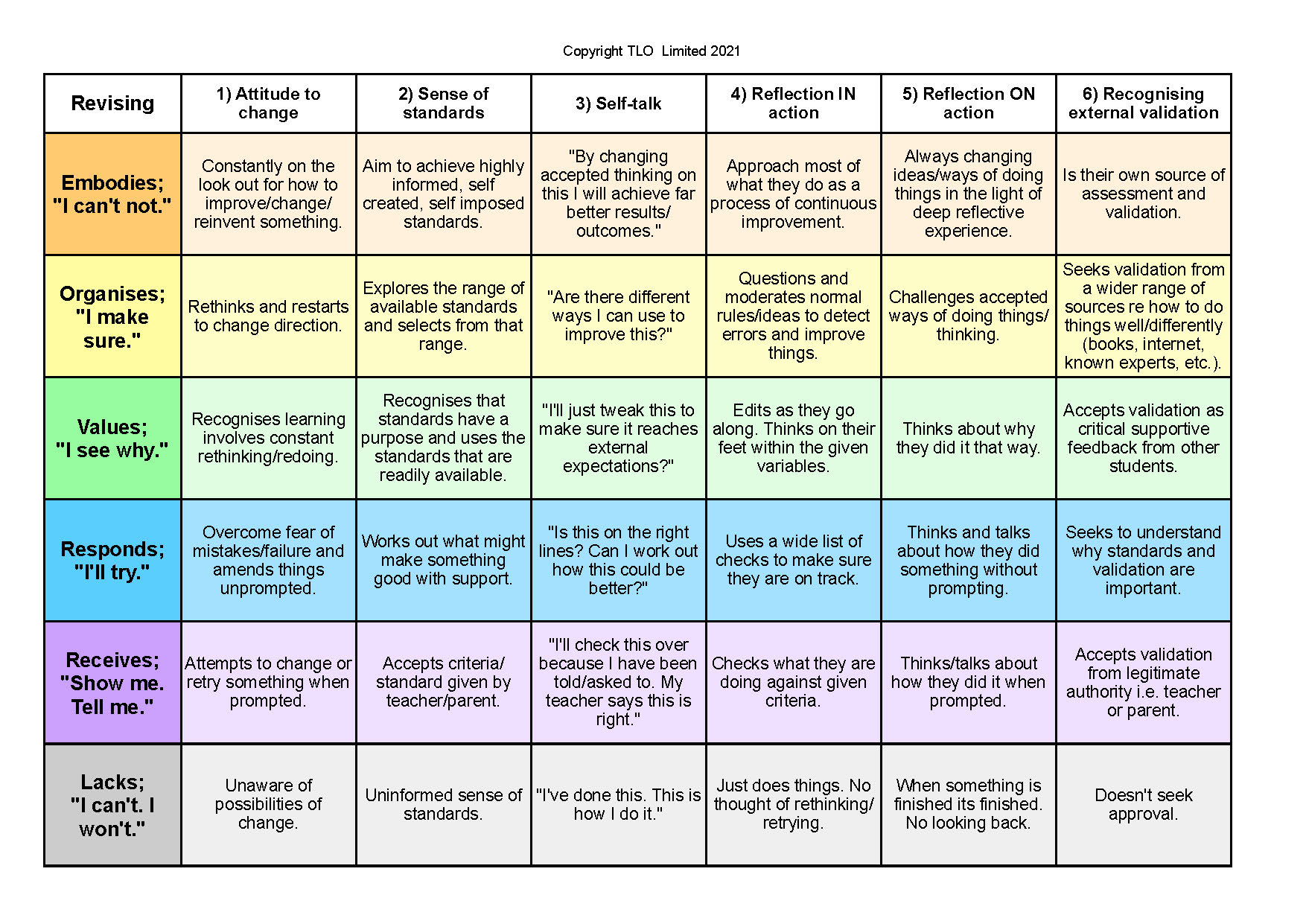
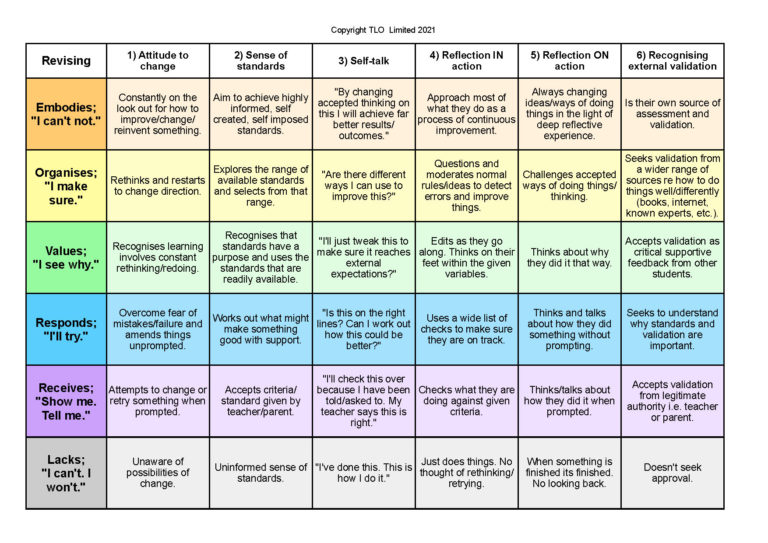
 Overview of the grid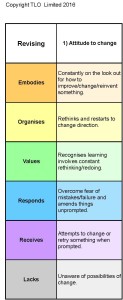
 1) Attitude to change