
text
Sections Archive
The Framework
xx
Section 4: Action Planning
The key ideas in this section:
Creating a plan of action.
NEED TO RE-WRITE THIS AS A SHORT SECTION JUST EXPLAINING THE ACTION PLANNING PROCESS STAGES
This section helps to translate your audit of existing practice into an action plan that will move the school forward.
The three subsections offer support for schools seeking to move towards each of bronze, silver and gold levels.
Action Planning
As a result of the Audit you have undertaken, you will have arrived at a broad consensus of where your school is against the Learning Quality Framework. This section addresses ‘what next ?’.
Go to the phase that you wish/need to secure as a result of your Audit. In each section you are offered a phase -related Action Plan Shaping Tool and a generic Planning Tool (although you may prefer to use your existing improvement planning format). Critically, each section begins with a suggested order in which you might tackle the Indicator threads, as improving in some indicators is dependent on others having already been addressed, and starting on 32 threads simultaneously is evidently impossible.
Section 3: Auditing Practice
The key ideas in this section:
Getting a handle on where we are.
This section helps you to answer the question – where are we now?
We offer two audit tools, the first a broad-brush ‘amble’ around your school to gather initial impressions, and the second a searching audit tool that will highlight strengths, weaknesses and areas for further development.
The Audit Tools
In this section we offer two Audit Tools: the first is a fairly basic one that will rapidly give you a feel of the Standard and how your school interfaces with it; the second is a much more rigorous tool that will lead you into a deep analysis of your school and the evidence that you have to support your view.
You may choose to start with the Basic Audit and come to the Full Audit later at a progress review point, or you may prefer to begin with the Full Audit to gain a more solid baseline measure from which to action plan – the choice is yours.
Whichever of the Audit Tools you choose to use . . .
The auditing process is probably best led by a member of the leadership team but it shouldn’t be left to the leadership team alone. The Standard penetrates many aspects of school life so it’s a good idea to involve a representative group of staff, covering different roles and responsibilities.
Some audit teams work through the Audit Tool together as a group while other teams work through it individually first before coming together to question, challenge or support each others views.
The audit invites you to look at the whole Standard and identify the indicators (bronze, silver, gold) that are secure, partly there, or need starting from scratch. The point about these audits is to get a feel for the Standard, identify your strengths and, from this, decide which level you wish to make secure . Your audit may show a smattering of secure indicators across the levels but unless almost all of the bronze indicators are met you should opt to secure this level first. Bronze level forms the foundation for the development of the whole Standard.
Key Task
Decide who is going to be part of the audit process.
Decide who will lead it.
Decide how you will disseminate the outcomes.
Section 2: The LQF Framework and the Development Guide
The key ideas in this section:
Seeing the big picture and getting at the detail
This section illustrates how the Development Guide underpins and explains the Learning Quality Framework, putting flesh on the bones of Section 1.
The LQF Framework and Development Guide
This section introduces an overview of the LQF, the Development Guide, and the terms that are used in the Framework.
- Section 1 explores an overview of the whole LQF Framework – the big picture.
- Section 2 introduces The Development Guide – the LQF Handbook – the detail.
- Section 3 shows how the overview is further expanded by the Development Guide – how they are linked.
- Section 4 shows a glossary of the terms that are used in the LQF – defining the terms.
Section 1: About the Learning Quality Framework
The key ideas in this section:
Getting your head around the Learning Quality Framework
This section explores the 4 dimensions of the LQF, and in the subsections:
- The 12 Principles of the LQF;
- The 32 Indicators that sit under these 12 Principles;
- The three phases of development;
- The three functions of the LQF.
About the Learning Quality Framework
The framework is made up of:
- Four Dimensions: the overall organisation of a learning school (see below);
- Twelve Principles: describing key features of the school’s learning practice and how it works;
- Thirty Two Indicators: describing how each of the principles might look in practice;
- Each written at three levels or stages of a learning journey.
The Learning Quality Framework has four dimensions and each of the LQF Principles fall into one of these dimensions.
Dimension 1 Commitment
The school is committed to using the learning sciences to develop its people’s learning dispositions and equip itself as a learning organisation
The first dimension of the framework covers the school’s commitment to a new way of thinking about and addressing learning. In the last 10 years or so a number of disciplines have come together under the banner of ‘the learning sciences’. Geneticists, psychologists, developmental psychologists, neuroscientists, sociocultural researchers and academic philosophers are shaping a new image of the malleability of young minds. Having a commitment to using this type of research to shape learning in the school is what this aspect is about.
Dimension 2. Plans and strategies
Leadership approaches, plans and strategies are aligned to enhance learning development across the school & its students
The second dimension of the framework covers how the school leads and grows innovation. Without strong distributed leadership innovation is more likely to fizzle out than to take hold. Furthermore the nature and structure of staff learning is pivotal in ensuring a change in school culture and habits. These two aspects are picked out in the following principles.
Dimension 3. Action
Learning opportunities within and beyond the school build, broaden and strengthen people’s effective learning habits for lifelong learning
The third dimension of the framework covers how the school takes action to ensure people develop their learning habits – being able to use them more often, in more contexts and with greater skill. Such action is co-ordinated across many aspects of school life – its curriculum, its teaching methodologies, its leaning environment, how learners are engaged and involved in the school, and how parents, as a child’s foremost teacher, are enabled to contribute positively to their child’s development as a learner.
Dimension 4. Evaluation
The school, its people and its community understand and use the impact of growing learning habits to improve its practice and objectives
The final dimension of the framework covers how the school monitors, assesses and evaluates its actions in order to better understand learning and use this to improve what it is doing and what it is achieving, the learning of the organisation is fed back into action.
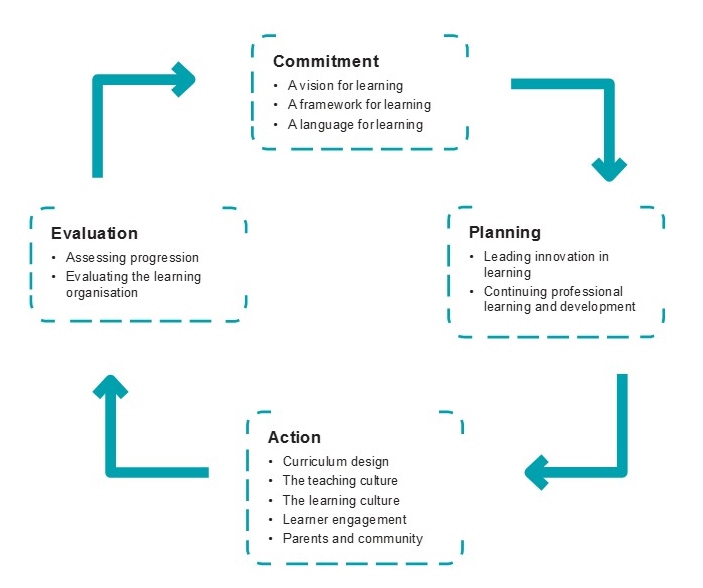
The 4 Dimensions
Dimensions 2, 3 and 4 are self explanatory – they are the standard Plan / Do / Review of improvement planning. But what do you make of Dimension 1 – Commitment?
Ask yourself:
- What view of learning currently shapes classroom practice in your school?
- Are classrooms designed primarily for teaching or for learning?
Section 3. Management. Implications for supporting change
The contents of this Management section:
Here, we raise the management implications of supporting the strategic and classroom practice issues raised earlier. Without strong and sustained management support the development of learning powered learners is unlikely to take hold.
Issues and discussion points captured in slides
4 Management presentations covering: the what and the why; the supple learning mind; learning friendly cultures; growing learning habits.
These slide decks could be used to:
- structure learning conversations with and for managers;
- inform managers of what has worked elsewhere;
- act as a checklist of what needs ongoing attention.
Brief explanatory notes can be found under each slide. Fuller supporting information is offered under headings below.
Data gathering materials
Monitoring the developments across the school is a key management role in making the development of learning power successful. To this end we offer useful, downloadable questionnaires and other review materials for the first year of the journey.
Further information
Here we offer links to further relevant information. Offered as curiosity quenchers not the answers to everything. Here there may be:
- a link to an appropriate blog;
- a link to an online unit to do with managing the development of learning power;
- a link to specific information from our extensive banks of resources;
- suggestions for further reading.
Topic A. Shaping the future of learning
Key points captured in slides
What’s in the presentation?
This 8 slide presentation gives an overview of the vision for learning and the parts of the school such a vision will impact on. It then offers key management issues to ensure such a vision is taken seriously and believed by staff.
Discussion points
- What are we trying to achieve, our vision for learning?
- What aspects of school practice will this vision impact?
- What do we need to sort out to ensure staff are sufficiently well supported in working towards the vision?
Downloads
- Notes – to help understanding of slide 5 (Breadth of change) taken from the handbook Building Learning Power with elli. Unpicking the pieces of a Learning Powered school
Data gathering materials
- None at this stage.
Further information
Online section. Here you will find a line of argument in support of embedding learning how to learn into how the curriculum is taught. Why do we need to build better learners?
Online section. Addressing the crucial issue of the sort of school leadership that affects embedding the approach. It’s more than a technical matter or personality approach. Vision, stimulating dialogue, creating a culture of enquiry, and keeping an eye on what’s working are all involved here. Which leadership strategies will secure and sustain a learning culture?
Online section. Here we introduce the strategic model of putting learning at the heart of the school and shine a light on the key principles and models of thinking. How does developing better learners affect the school’s infrastructure?
Topic B. The supple learning mind
Key points captured in slides
What’s in the presentation?
This 11 slide presentation looks primarily at the development of staff and the mechanics of the blended learning programme. It suggests what should be closely attended to by managers to ensure the online programmes help staff achieve changes in classroom practice.
Downloads.
- Plan the use of the online learning units (Copy of slide 9) for planning timing and order of the online units Phase one Programme – Building a solid foundation
- Online units in Nutshells Phase 1 (Copy of slide 7) plus supporting text
- Copies of the learning journey plans as shown in slides 10-12
Data gathering materials.
- The Learning Power Rating Wheel and notes can be used to gather data about the range of learning behaviours that learners are being enabled to exercise in lessons. Review learning in classrooms.
Further information
- Online Units. About how the running of learning teams to make the programme work.
Building Learning Power: making the blended learning programmes work
- Namely:
- 1. The big picture of making BLP happen.
- 2. How does a Professional Learning Team work?
- 3. What are the essentials of running a learning team?
- 4. What does the blended learning programme consist of?
This online unit shows how Professional Learning Teams work and how to ensure best practice. The Professional Learning Teams will become the engines of change in the school and how they operate becomes crucial to the success of Learning Power.
Senior leaders would be wise to read section 1.
The whole module of four sections should be shared with those staff who are to act as leaders of the Professional Learning Teams.
Topic C. Learning friendly cultures
Key points captured in slides
What’s in the presentation?
This 9 slide presentation considers the major shifts needed in classroom culture to nurture powerful learners. Management issues involved in changing classroom cultures are addressed together with a simple observation tool (Learning Amble. Learning Friendly Culture) to track early development of the culture shifts.
Downloads
- Culture tool 1 as shown on slide 3 Classroom cultures (Culture tool 1)
- Culture tool 2 as shown on slide 5 Shifting the culture – (Culture Tool 2)
- Culture review tool as shown on slide 8 Learning Culture Review
Data gathering materials
- The review tool as shown on slide 7 (A Learning Amble, Learning friendly culture) makes a good starting point for reflection on classroom culture. Completed at the outset and again a year or so later it would provide evidence of the perceived shifts in learning culture.
- Also, take a look at the online module ‘Reviewing our Progress‘ in Nutshells Phase 1 for further data gathering ideas. You may wish to focus on:
- section 2, ‘Give Pupils a Voice’
- or section 3, ‘Learning with and from Colleagues’
Further learning and resources
- Online unit What sort of culture will help build betters learners.This introduces a range of classroom cultures, from traditional to learning centred, and invites you to consider and analyse the learning cultures of your school.
- Online unit What does it take to shift the culture to being more learner friendly? This explores what is entailed in shifting from the dominant teacher culture to the richer learning culture.
Topic D. Growing learning habits
Key points captured in slides
What’s in the presentation?
This 6 slide presentation considers the early stages of tracking the growth of students’ perseverance habits and offers a couple of observation tools to get you started.
Data gathering materials
- Take a look at the online module ‘Reviewing our Progress‘ in Nutshells Phase 1 for further data gathering ideas. You may wish to focus on section 4, ‘Reflect on changes in student learning behaviours’. The progression chart for active participation, shared responsibility and dialogue & collaboration could be used before teachers engage with these modules in Nutshells, and again after completion.
- Growth in perseverance tool (slide 6). Gather information from all teachers on how they view their learners before undertaking the 4 modules related to perseverance in Nutshells Phase 1. Repeat it again after the interventions to gauge the shift in teacher perceptions. Consider how you might analyse and share the outcomes of, and the patterns revealed, by this exercise. Guestimate the percentage of your class
- Getting a handle on how teachers’ interventions relate to the perseverance progression chart. Between the lines Persevering (slide 5).
Further information
- Online unit. How can we track learners? A short online unit that explores the issues around generating and recording evidence that pupils are becoming better at learning over time.
- Blog Walking the walk. A quick read about learning walks.
- Book chapter. A deeper read exploration into the practical issues of assessing for learning. Chapter 7 | Assessment and progression: How do we know it’s working?
Section 2. Chalkface implications for classroom practice
The contents of this Chalkface section:
Here, for each of the four topics, you will find the implications of the strategic issues unpacked for classroom practitioners: what they may mean at classroom level; the how to’s. The decks of slides also include activities designed to tease out issues – learning by experiencing and doing.
Key points captured in slides
4 Chalkface presentations covering; the what and the why; the supple learning mind; learning friendly cultures; growing learning habits. These slide decks could be used:
- just as they are to introduce the ideas to staff;
- to help structure a learning conversation amongst/in teams;
- added to the strategic presentation to ensure staff gain a holistic picture.
Brief explanatory notes can be found under each slide. Fuller supporting information is offered under headings below.
Downloads
For some topics there are downloads for use with the slides. e.g. a resource booklet for a whole school training day.
Links to Online units
For some topics we offer links to short online units that serve to enhance the information covered in the slides. Staff can view and reflect on these at their own pace, in their own time.
- Online unit about the supple learning mind
- Online unit exploring classroom culture
Further information
Here we offer links to further information. Offered to quench critical curiosity not as must dos. Here there may be:
- a link to an appropriate blog;
- a link to specific information from our extensive banks of resources;
- a link to a book chapter offering deeper understanding;
- suggestions for further reading.
Topic A. Learning Power: The what and the why
Key points captured in slides
What’s in the presentation?
This 19 slide presentation aims to help teachers explore the nature of commonly held beliefs about learning and offers evidence to show that learning is a learnable craft that needs to be nurtured so that young people are developed as 21st century learners. These slides simply open the questions.
Discussion points
- What do we know about learning?
- Is it possible to get better at learning?
- If we spend time on learning to learn will results suffer?
- Students become better learners as they mature.
- If we develop growth mindsets the problem is sorted.
Further information
- Book page. A brief description of learning power and its component parts. Taken from Building Learning Power in Action
- Book chapter. FAQs about a variety of doubts, challenges and misapprehensions about teaching for learning power. Taken from The Learning Powered school. Building a Learning Powered school
Topic B. The supple learning mind
Key points captured in slides
What’s in the presentation?
This 28 slide presentation aims to help teachers explore the Supple Learning Mind, the first of 2 models central to Building Learning Power. The 4 domains of learning, underpinned by 17 learning capacities are explained, and teachers are invited to reflect on how effectively their learners employ these behaviours. It is designed as a presentation that can form part of a whole-school training day.
Downloads
- Resource book for staff. Useful if the school is using the presentation as a basis for a whole staff training session to introduce Building Learning Power. The Supple Learning Mind
- Notes relating to slides 9, 12, 15, 18 (The Supple Learning Mind…deeper presentation notes.)
- Copy of the Tin Tin activity cards for use in a staff training session. Chase in the Crypt
Online units for staff
- Online unit Which constellation of learning habits could we develop?
A short section of an online resource exploring the learning power framework of high value learning characteristics, their language and how they translate into the classroom.
- An online unit about learning habits. Understanding learning behaviours… a short online module to help consolidate information about the supple learning mind. The unit has 4 sections. These could be used to structure team meetings or for individual to consolidate understanding of the basic ideas after being introduced to them on a training day.
Further information
- Book chapter Building Learning Power ( 2002) Part of Chapter 1. The descriptions of the learning behaviours of the supple learning mind
- Book pages. Building Learning Power in Action. Putting learning power back together. A short read on how the learning behaviours weave together; the warp and the weft.
Topic C. Learning friendly cultures
Key points captured in slides
What’s in the presentation?
This 41 slide presentation aims to help teachers explore the Teachers’ Palette, the second of 2 models central to Building Learning Power. The 3 types of classroom culture are explained, explored and reflected upon, and consideration is given to strategies to make classroom cultures ‘learning friendly’. It is designed as a presentation that can form part of a whole-school training day.
Downloads
- Resource book for staff. Useful if the school is using the presentation as a basis for a whole staff training session to introduce Building Learning Power.
Online units
- Online unit. What does a learning friendly classroom look like? A short online unit to help consolidate information about learning friendly classroom cultures. The unit has 4 sections. This could be used to structure team meetings or for staff to consolidate the ideas after they have been introduced on a school training day.
Further information
- Book section. A quick read about the learning culture models. Extract from Building Learning Power with elli.
Topic D. Growing learning habits
Key points captured on slides
What’s in the presentation?
This 21 slide presentation aims to help teachers explore the nature of progression with particular reference to Perseverance. It is designed to encourage teachers to reflect on how well their learners persevere and offers some suggestions for helping learners to become more perseverant. It serves as an introduction to the 4 perseverance modules in Nutshells phase 1. It is designed as a presentation that can form part of a whole-school training day.
Downloads
- Resource book for staff . Useful if the school is using the presentation as a basis for a whole staff training session to introduce Building Learning Power (see also above). Growing Learning Habits
- Activity: Perseverance activity cards
Further information
- Online unit. How do pupils grow and develop as learners? A short online unit to help consolidate information about learning friendly classroom cultures. There is just one section that explores how learners’ behaviours might progress, build and become stronger: what ‘betterness’ might look like.
- This resource could be used to structure team meetings or for staff to consolidate the ideas after being introduced at a school training day.
Section 1. Strategic issues and ideas
The contents of this Strategic section:
Here, for each of the four topics, you will find the big strategic issues, the principles and models, the must dos and the ‘be good ifs’ of Building Learning Power. boiled down to their essence. The aim is to help senior leaders get to grips quickly with the main ideas and how to make them work.
Key points captured in slides
4 Strategic presentations covering; the what and the why; the supple learning mind; learning friendly cultures; growing learning habits. These slide decks could be used:
- just as they are to introduce the ideas to governors;
- to help structure a learning conversation amongst senior leaders;
- added to an introductory presentation for teachers (see Section 2 Chalkface).
Brief explanatory notes can be found under each slide. Fuller supporting information is offered under headings below.
Discussion points…
Questions worthy of consideration in relation to the the big ideas.They are given simply as examples, not as must do’s.
Further information…
To deepen or extend the key issues raised in the slides. These are offered to quench your critical curiosity, not as must read/view items.
Topic A. Learning Power. The What and the why.
Key points captured in slides
What’s in the presentation?
This presentation of 13 slides offers a guided conversation for senior leaders (and Governors) about the need to develop students’ learning behaviours, the breadth of impact of this on the school and its effects on students.
Discussion points
- What’s our view of the purpose of education?
- How might we better prepare students for an unknown future?
- How do we want students to be as learners?
- How will building students’ learning power impact on the school?
Downloads
- Notes to help understanding of slide 11 (Breadth of change) Unpicking the pieces of a Learning Powered school taken from the handbook Building Learning Power with elli.
Further information
- Article from BLP website. Why does education need to change
- Blog What’s Building Learning Power all about..really
- Handbook section What is learning power? from the handbook Building Learning Power with elli.
- Book chapter For anyone who is interested in where the ideas behind Learning Power hail from across a wide spectrum of psychology. Chapter 2 The Learning Powered School.
Topic B The supple learning mind
Key points captured in slides
What’s in the presentation
This presentation of 7 slides shows the key framework of learning power with its researched ‘high value’ learning behaviours. The difference in learners with low and high levels of learning power are explored and exemplified by students talking fluently about the use and value of learning powers.
Downloads
Copy of slide 4: The learning power framework
Copy of slide 5: Learning Poles apart
Further information
- Book chapter Extract from Building Learning Power. The descriptions of the learning behaviours of the supple learning mind. Building Learning Power (extract chapter 1)
- Online unit Which constellation of learning habits could we develop? A short section of an online resource exploring the learning power framework of high value learning characteristics, their language and how they translate into the classroom.
Topic C. Learning friendly cultures
Key points captured in slides
What’s in the presentation?
This presentation of 11 slides introduces the two key models that explain the sort of shifts schools may need to make in order to achieve learning friendly cultures that nurture the growth of learning habits.
Downloads
Copy of slide 4: Classroom cultures (Culture tool 1)
Copy of slide 6: Four shifts in classroom culture (Culture tool 2)
Copy of slide 9: The teaching framework to make it work (The teachers’ palette)
Further information
- Online unit. What is a learning friendly culture? A short section of an online unit giving an overview about shifting the classroom culture to learning friendly.
- Blog. Creating meta-cognitive cultures, offering an explanation of the basis of a learning friendly culture.
- Handbook section. A quick read about the learning culture models. Taken from the handbook Building Learning Power with elli. offering an overview of the learning culture model.
Topic D. Progression in learning power
Key point captured in slides
What’s in the presentation?
This presentation of 7 slides introduces the importance of progression in learning power i.e. the building aspect of Building Learning Power, and how this understanding enables schools to make use of learning power at far deeper and more impactful levels.
Downloads
Copy of slide 5: What does progression in perseverance look like?
Further information
Introduction: format and content of the resource pack
The contents of this section:
This introductory section provides a brief overview of the resource pack:
The 3 working sections of the resource pack –
- Strategic
- Chalkface
- Management
The 4 topics in each section –
- The what and why of learning power
- The supple learning mind
- Learning-friendly cultures
- Growing learning habits
It helps you to:
- Get to grips with the format and content of the resource pack;
- Become familiar with the sorts of things you will find in each section;
- Begin thinking about how the school could make best use the resources.
The pack has three working sections each taking a different perspective;
Section 1 Strategic: The strategic issues, the big ideas
- This section covers the level of detail that will be vital for senior leaders and school governors.
Section 2 Chalkface: The implications of those issues for classroom practice
- This section covers the level of detail that will be essential for classroom practitioners.
Section 3 Management: The implications for managing and supporting change
- This section covers the level of detail necessary for managing the big ideas into action.
The structure recognises that establishing a learning powered school is a collaborative endeavour. So often ideas like learning power start off with a big enthusiastic bang, get as far as the early stages and then shrivel and disappear. These resources aim to guard against such shrivelling by paying attention to all three layers of practice and giving particular emphasis to managing and supporting change.
Each of the three sections deal with four topics of Building Learning Power:
- Topic A Learning Power.The What and Why…the need for change and the sort of changes needed.
- Topic B The supple learning mind...the framework of learning behaviours of successful learners.
- Topic C Learning friendly cultures… the classroom culture that best supports the development of learning habits
- Topic D Growing learning habits… how learning behaviours strengthen into habits through learning powered teaching.
Scroll down into an outline of each section to find out more about how these sections work and what you will find there.
Section 1: Strategic: the strategic issues, the big ideas.
In the Strategic section, for each of the four topics, you will find the big strategic issues, the principles and models, the must dos and the ‘be good ifs’ of Building Learning Power. boiled down to their essence. The aim is to help senior leaders get to grips quickly with the main ideas and how to make them work.
Key points captured in slides
4 Strategic presentations covering; the what and the why; the supple learning mind; learning friendly cultures; growing learning habits
These slide decks could be used:
- just as they are to introduce the ideas to governors;
- to help structure a learning conversation amongst senior leaders;
- added to an introductory presentation for teachers ( see Section 2 below).
The slide format conveys the big issues succinctly. Brief explanatory notes can be found under each slide. Fuller supporting information is offered under headings below.
Discussion points
In this spot we offer questions worthy of consideration in relation to the the big ideas.
They are given simply as examples, not as must do’s.
Further information
Here we offer links to further information to deepen or extend the key issues raised in the slides. These are offered to quench your critical curiosity, not as must read/view items. Here there may be;
- a link to an appropriate blog;
- a link to specific deeper information in our extensive bank of resources;
- a link to a page/chapter/idea in one of our BLP books;
- suggestions for further/wider reading elsewhere.
Section 2: Chalkface: The implications for classroom practice.
In the Chalkface section, for each of the four topics, you will find the implications of the strategic issues unpacked for classroom practitioners: what they may mean at classroom level; the how to’s. The decks of slides also include activities designed to tease out issues – learning by experiencing and doing.
Key ideas and illustrations slides.
4 Chalkface presentations covering; the what and the why; the supple learning mind; learning friendly cultures; growing learning habits
These resources could be used:
- just as they are to introduce the ideas to staff;
- to structure learning conversations in teams;
- added to the strategic slides to ensure staff gain a holistic picture.
Brief explanatory notes can be found under each slide. Fuller supporting information is offered under headings below.
Downloads
For some of the topics we offer materials to download for use with the slides. e.g. a resource booklet for a training day that you can deliver for your school.
Links to Online units
For some topics we offer links to short online units that serve to enhance the information covered in the slides. Staff can view and reflect on these at their own pace, in their own time.
- Online unit about the supple learning mind
- Online unit exploring classroom culture
Further information
Here we offer links to further information. Offered to quench critical curiosity not as must dos. Here there may be:
- a link to an appropriate blog;
- a link to specific information from our extensive banks of resources;
- a link to a book chapter offering deeper understanding;
- suggestions for further reading.
Section 3: Management: The implications for managing and supporting change.
In the management section we raise the management implications of supporting the strategic and classroom practice issues raised above. Without strong and sustained management support the development of learning powered learners is unlikely to take hold.
Issues and discussion points captured in slides
4 Management presentations covering: the what and the why; the supple learning mind; learning friendly cultures; growing learning habits.
These slide decks could be used to:
- structure learning conversations with and for managers;
- inform managers of what has worked elsewhere;
- act as a checklist of what needs ongoing attention.
Brief explanatory notes can be found under each slide. Fuller supporting information is offered under headings below.
Data gathering materials
Monitoring the developments across the school is a key management role in making the development of learning power successful. To this end we offer useful, downloadable questionnaires and other review materials for the first year of the journey.
Further information
Here we offer links to further relevant information. Offered as curiosity quenchers not the answers to everything. Here there may be:
- a link to an appropriate blog;
- a link to an online unit to do with managing the development of learning power;
- a link to specific information from our extensive banks of resources;
- suggestions for further reading.
Through these three sections you should find enough carefully curated material to give the school a fighting chance of making learning power come alive in your students and work well in your school.
Introduction: format and content of the resource pack.
The contents of this section:
This introductory section provides a brief overview of the resource pack:
The 3 working sections of the resource pack –
- Strategic
- Chalkface
- Management
The 4 topics in each section –
- The what and why of learning power
- The supple learning mind
- Learning-friendly cultures
- Growing learning habits
It helps you to:
- Get to grips with the format and content of the resource pack;
- Become familiar with the sorts of things you will find in each section;
- Begin thinking about how the school could make best use the resources.
The pack has three working sections each taking a different perspective;
Section 1 Strategic: The strategic issues, the big ideas
- This section covers the level of detail that will be vital for senior leaders and school governors.
Section 2 Chalkface: The implications of those issues for classroom practice
- This section covers the level of detail that will be essential for classroom practitioners.
Section 3 Management: The implications for managing and supporting change
- This section covers the level of detail necessary for managing the big ideas into action.
The structure recognises that establishing a learning powered school is a collaborative endeavour. So often ideas like learning power start off with a big enthusiastic bang, get as far as the early stages and then shrivel and disappear. These resources aim to guard against such shrivelling by paying attention to all three layers of practice and giving particular emphasis to managing and supporting change.
Each of the three sections deal with four topics of Building Learning Power:
- Topic A Learning Power.The What and Why…the need for change and the sort of changes needed.
- Topic B The supple learning mind...the framework of learning behaviours of successful learners.
- Topic C Learning friendly cultures… the classroom culture that best supports the development of learning habits
- Topic D Growing learning habits… how learning behaviours strengthen into habits through learning powered teaching.
Scroll down into an outline of each section to find out more about how these sections work and what you will find there.
Section 1: Strategic: the strategic issues, the big ideas.
In the Strategic section, for each of the four topics, you will find the big strategic issues, the principles and models, the must dos and the ‘be good ifs’ of Building Learning Power. boiled down to their essence. The aim is to help senior leaders get to grips quickly with the main ideas and how to make them work.
Key points captured in slides
4 Strategic presentations covering; the what and the why; the supple learning mind; learning friendly cultures; growing learning habits
These slide decks could be used:
- just as they are to introduce the ideas to governors;
- to help structure a learning conversation amongst senior leaders;
- added to an introductory presentation for teachers ( see Section 2 below).
The slide format conveys the big issues succinctly. Brief explanatory notes can be found under each slide. Fuller supporting information is offered under headings below.
Discussion points
In this spot we offer questions worthy of consideration in relation to the the big ideas.
They are given simply as examples, not as must do’s.
Further information
Here we offer links to further information to deepen or extend the key issues raised in the slides. These are offered to quench your critical curiosity, not as must read/view items. Here there may be;
- a link to an appropriate blog;
- a link to specific deeper information in our extensive bank of resources;
- a link to a page/chapter/idea in one of our BLP books;
- suggestions for further/wider reading elsewhere.
Section 2: Chalkface: The implications for classroom practice.
In the Chalkface section, for each of the four topics, you will find the implications of the strategic issues unpacked for classroom practitioners: what they may mean at classroom level; the how to’s. The decks of slides also include activities designed to tease out issues – learning by experiencing and doing.
Key ideas and illustrations slides.
4 Chalkface presentations covering; the what and the why; the supple learning mind; learning friendly cultures; growing learning habits
These resources could be used:
- just as they are to introduce the ideas to staff;
- to structure learning conversations in teams;
- added to the strategic slides to ensure staff gain a holistic picture.
Brief explanatory notes can be found under each slide. Fuller supporting information is offered under headings below.
Downloads
For some of the topics we offer materials to download for use with the slides. e.g. a resource booklet for a training day that you can deliver for your school.
Links to Online units
For some topics we offer links to short online units that serve to enhance the information covered in the slides. Staff can view and reflect on these at their own pace, in their own time.
- Online unit about the supple learning mind
- Online unit exploring classroom culture
Further information
Here we offer links to further information. Offered to quench critical curiosity not as must dos. Here there may be:
- a link to an appropriate blog;
- a link to specific information from our extensive banks of resources;
- a link to a book chapter offering deeper understanding;
- suggestions for further reading.
Section 3: Management: The implications for managing and supporting change.
In the management section we raise the management implications of supporting the strategic and classroom practice issues raised above. Without strong and sustained management support the development of learning powered learners is unlikely to take hold.
Issues and discussion points captured in slides
4 Management presentations covering: the what and the why; the supple learning mind; learning friendly cultures; growing learning habits.
These slide decks could be used to:
- structure learning conversations with and for managers;
- inform managers of what has worked elsewhere;
- act as a checklist of what needs ongoing attention.
Brief explanatory notes can be found under each slide. Fuller supporting information is offered under headings below.
Data gathering materials
Monitoring the developments across the school is a key management role in making the development of learning power successful. To this end we offer useful, downloadable questionnaires and other review materials for the first year of the journey.
Further information
Here we offer links to further relevant information. Offered as curiosity quenchers not the answers to everything. Here there may be:
- a link to an appropriate blog;
- a link to an online unit to do with managing the development of learning power;
- a link to specific information from our extensive banks of resources;
- suggestions for further reading.
Through these three sections you should find enough carefully curated material to give the school a fighting chance of making learning power come alive in your students and work well in your school.
Section 3. Management. Implications for supporting change – Primary
The contents of this Management section:
Here, we raise the management implications of supporting the strategic and classroom practice issues raised earlier. Without strong and sustained management support the development of learning powered learners is unlikely to take hold.
Issues and discussion points captured in slides
4 Management presentations covering: the what and the why; the supple learning mind; learning friendly cultures; growing learning habits.
These slide decks could be used to:
- structure learning conversations with and for managers;
- inform managers of what has worked elsewhere;
- act as a checklist of what needs ongoing attention.
Brief explanatory notes can be found under each slide. Fuller supporting information is offered under headings below.
Data gathering materials
Monitoring the developments across the school is a key management role in making the development of learning power successful. To this end we offer useful, downloadable questionnaires and other review materials for the first year of the journey.
Further information
Here we offer links to further relevant information. Offered as curiosity quenchers not the answers to everything. Here there may be:
- a link to an appropriate blog;
- a link to an online unit to do with managing the development of learning power;
- a link to specific information from our extensive banks of resources;
- suggestions for further reading.
Topic A. Shaping the future of learning
Key points captured in slides
What’s in the presentation?
This 8 slide presentation gives an overview of the vision for learning and the parts of the school such a vision will impact on. It then offers key management issues to ensure such a vision is taken seriously and believed by staff.
Discussion points
- What are we trying to achieve, our vision for learning?
- What aspects of school practice will this vision impact?
- What do we need to sort out to ensure staff are sufficiently well supported in working towards the vision?
Downloads
- Notes – to help understanding of slide 5 (Breadth of change) taken from the handbook Building Learning Power with elli. Unpicking the pieces of a Learning Powered school
Data gathering materials
- None at this stage.
Further information
Online section. Here you will find a line of argument in support of embedding learning how to learn into how the curriculum is taught. Why do we need to build better learners?
Online section. Addressing the crucial issue of the sort of school leadership that affects embedding the approach. It’s more than a technical matter or personality approach. Vision, stimulating dialogue, creating a culture of enquiry, and keeping an eye on what’s working are all involved here. Which leadership strategies will secure and sustain a learning culture?
Online section. Here we introduce the strategic model of putting learning at the heart of the school and shine a light on the key principles and models of thinking. How does developing better learners affect the school’s infrastructure?
Topic B. The supple learning mind
Key points captured in slides
What’s in the presentation?
This 11 slide presentation looks primarily at the development of staff and the mechanics of the blended learning programme. It suggests what should be closely attended to by managers to ensure the online programmes help staff achieve changes in classroom practice.
Downloads.
- Plan the use of the online learning units (Copy of slide 9) for planning timing and order of the online units Phase one Programme – Establishing 4 key learning behaviours
- Online units in Stepping Stones Phase 1 (Copy of slide 7) plus supporting text.
- Copies of the learning journey plans as shown in slides 10-12
Data gathering materials.
- The Learning Power Rating Wheel and notes can be used to gather data about the range of learning behaviours that learners are being enabled to exercise in lessons. Review learning in classrooms.
Further information
- Online Units. About how the running of learning teams to make the programme work.
Building Learning Power: making the blended learning programmes work
- Namely:
- 1. The big picture of making BLP happen.
- 2. How does a Professional Learning Team work?
- 3. What are the essentials of running a learning team?
- 4. What does the blended learning programme consist of?
This online unit shows how Professional Learning Teams work and how to ensure best practice. The Professional Learning Teams will become the engines of change in the school and how they operate becomes crucial to the success of Learning Power.
Senior leaders would be wise to read section 1.
The whole module of four sections should be shared with those staff who are to act as leaders of the Professional Learning Teams.
Topic C. Learning friendly cultures
Key points captured in slides
What’s in the presentation?
This 9 slide presentation considers the major shifts needed in classroom culture to nurture powerful learners. Management issues involved in changing classroom cultures are addressed together with a simple observation tool (Learning Amble. Learning Friendly Culture) to track early development of the culture shifts.
Downloads
- Culture tool 1 as shown on slide 3 Classroom cultures (Culture tool 1)
- Culture tool 2 as shown on slide 5 Shifting the culture – (Culture Tool 2)
- Culture review tool as shown on slide 8 Learning Culture Review
Data gathering materials
- The review tool as shown on slide 7 (A Learning Amble, Learning friendly culture) makes a good starting point for reflection on classroom culture. Completed at the outset and again a year or so later it would provide evidence of the perceived shifts in learning culture.
- Also, take a look at the online module ‘Reviewing our Progress‘ in Stepping Stones Phase 1 for further data gathering ideas. You may wish to focus on:
- section 2, ‘Give Pupils a Voice’
- or section 3, ‘Learning with and from Colleagues’
Further learning and resources
- Online unit What sort of culture will help build betters learners.This introduces a range of classroom cultures, from traditional to learning centred, and invites you to consider and analyse the learning cultures of your school.
- Online unit What does it take to shift the culture to being more learner friendly? This explores what is entailed in shifting from the dominant teacher culture to the richer learning culture.
Topic D. Growing learning habits
Key points captured in slides
What’s in the presentation?
This 6 slide presentation considers the early stages of tracking the growth of students’ perseverance habits and offers a couple of observation tools to get you started.
Data gathering materials
- Gather information from all teachers on how they view their learners before undertaking the 4 modules related to perseverance in Stepping Stones Phase 1. Repeat it again after the interventions to gauge the shift in teacher perceptions. Consider how you might analyse and share the outcomes of, and the patterns revealed, by this exercise. Guestimate the percentage of your class
- Getting a handle on how teachers’ interventions relate to the perseverance progression chart. Between the lines Persevering (slide 5).
Further information
- Online unit. How can we track learners? A short online unit that explores the issues around generating and recording evidence that pupils are becoming better at learning over time.
- Blog Walking the walk. A quick read about learning walks.
- Book chapter. A deeper exploration into the practical issues of assessing for learning. Chapter 7 | Assessment and progression: How do we know it’s working?
Section 2. Chalkface implications for classroom practice – Primary
The contents of this Chalkface section:
Here, for each of the four topics, you will find the implications of the strategic issues unpacked for classroom practitioners: what they may mean at classroom level; the how to’s. The decks of slides also include activities designed to tease out issues – learning by experiencing and doing.
Key points captured in slides
4 Chalkface presentations covering; the what and the why; the supple learning mind; learning friendly cultures; growing learning habits. These slide decks could be used:
- just as they are to introduce the ideas to staff;
- to help structure a learning conversation amongst/in teams;
- added to the strategic presentation to ensure staff gain a holistic picture.
Brief explanatory notes can be found under each slide. Fuller supporting information is offered under headings below.
Downloads
For some topics there are downloads for use with the slides. e.g. a resource booklet for a whole school training day.
Links to Online units
For some topics we offer links to short online units that serve to enhance the information covered in the slides. Staff can view and reflect on these at their own pace, in their own time.
- Online unit about the supple learning mind
- Online unit exploring classroom culture
Further information
Here we offer links to further information. Offered to quench critical curiosity not as must dos. Here there may be:
- a link to an appropriate blog;
- a link to specific information from our extensive banks of resources;
- a link to a book chapter offering deeper understanding;
- suggestions for further reading.
Topic A. Learning Power: The what and the why
Key points captured in slides
What’s in the presentation?
This 19 slide presentation aims to help teachers explore the nature of commonly held beliefs about learning and offers evidence to show that learning is a learnable craft that needs to be nurtured so that young people are developed as 21st century learners. These slides simply open the questions.
Discussion points
- What do we know about learning?
- Is it possible to get better at learning?
- If we spend time on learning to learn will results suffer?
- Students become better learners as they mature.
- If we develop growth mindsets the problem is sorted.
Further information
- Book page. A brief description of learning power and its component parts. Taken from Building Learning Power in Action
- Book chapter. FAQs about a variety of doubts, challenges and misapprehensions about teaching for learning power. Taken from The Learning Powered school
Topic B. The supple learning mind
Key points captured in slides
What’s in the presentation?
This 28 slide presentation aims to help teachers explore the Supple Learning Mind, the first of 2 models central to Building Learning Power. The 4 domains of learning, underpinned by 17 learning capacities are explained, and teachers are invited to reflect on how effectively their learners employ these behaviours. It is designed as a presentation that can form part of a whole-school training day.
Downloads
- Resource book for staff.Useful if the school is using the presentation as a basis for a whole staff training session to introduce Building Learning Power
- Notes relating to slides 9, 12, 15, 18 (Supple Learning Mind..learning behaviours)
- Tin Tin activity cards Chase in the Crypt – for use in a staff training session
Online units for staff
- Online unit Which constellation of learning habits could we develop?A short section of an online resource exploring the learning power framework of high value learning characteristics, their language and how they translate into the classroom.
- All about learning habits. A short online module to help consolidate information about the supple learning mind. The unit has 4 sections. These could be used to structure team meetings or for individuals to consolidate understanding of the basic ideas after being introduced to them on a training day.
Further information
- Book chapter Building Learning Power (extract chapter 1). The descriptions of the learning behaviours of the supple learning mind
- Book pages. Building Learning Power in Action. Putting learning power back together. A short read on how the learning behaviours weave together; the warp and the weft.
Topic C. Learning friendly cultures
Key points captured in slides
What’s in the presentation?
This 41 slide presentation aims to help teachers explore the Teachers’ Palette, the second of 2 models central to Building Learning Power. The 3 types of classroom culture are explained, explored and reflected upon, and consideration is given to strategies to make classroom cultures ‘learning friendly’. It is designed as a presentation that can form part of a whole-school training day.
Downloads
- Resource book for staff. Learning friendly cultures Useful if the school is using the presentation as a basis for a whole staff training session to introduce Building Learning Power.
Online units
- Online unit. What does a learning friendly classroom look like? A short online unit to help consolidate information about learning friendly classroom cultures. The unit has 4 sections. This could be used to structure team meetings or for staff to consolidate the ideas after they have been introduced on a school training day.
Further information
- Book section. A quick read about the learning culture models. Building Learning Power with elli.
Topic D. Growing learning habits
Key points captured on slides
What’s in the presentation?
This 35 slide presentation aims to help teachers explore the nature of progression with particular reference to Perseverance. It is designed to encourage teachers to reflect on how well their learners persevere and offers some suggestions for helping learners to become more perseverant. It serves as an introduction to the 4 perseverance modules in Stepping Stones phase 1. It is designed as a presentation that can form part of a whole-school training day.
Downloads
- Resource book for staff Growing Learning Habits Useful if the school is using the presentation as a basis for a whole staff training session to introduce Building Learning Power (see also above).
- Resource Perseverance activity cards
Further information
- Online unit. How do pupils grow and develop as learners? A short online unit to help consolidate information about learning friendly classroom cultures. There is just one section which explores how learners’ behaviours might progress, build and become stronger: what ‘betterness’ might look like.
- This resource could be used to structure team meetings or for staff to consolidate the ideas after being introduced at a school training day.
Section 1. Strategic issues and ideas
The contents of this Strategic section:
Here, for each of the four topics, you will find the big strategic issues, the principles and models, the must dos and the ‘be good ifs’ of Building Learning Power. boiled down to their essence. The aim is to help senior leaders get to grips quickly with the main ideas and how to make them work.
Key points captured in slides
4 Strategic presentations covering; the what and the why; the supple learning mind; learning friendly cultures; growing learning habits. These slide decks could be used:
- just as they are to introduce the ideas to governors;
- to help structure a learning conversation amongst senior leaders;
- added to an introductory presentation for teachers (see Section 2 Chalkface).
Brief explanatory notes can be found under each slide. Fuller supporting information is offered under headings below.
Discussion points…
Questions worthy of consideration in relation to the the big ideas.They are given simply as examples, not as must do’s.
Further information…
To deepen or extend the key issues raised in the slides. These are offered to quench your critical curiosity, not as must read/view items.
Topic A. Learning Power. The What and the why.
Key points captured in slides
What’s in the presentation?
This presentation of 13 slides offers a guided conversation for senior leaders (and Governors) about the need to develop students’ learning behaviours, the breadth of impact of this on the school and its effects on students.
Discussion points
- What’s our view of the purpose of education?
- How might we better prepare students for an unknown future?
- How do we want students to be as learners?
- How will building students’ learning power impact on the school?
Downloads
- Notes to help understanding of slide 11 (Breadth of change) Unpicking the pieces of a Learning Powered school taken from the handbook Building Learning Power with elli.
Further information
- Article from BLP website. Why does education need to change?
- Blog What’s Building Learning Power all about..really?
- Handbook section What is learning power?from the handbook Building Learning Power with elli.
Topic B. The supple learning mind
Key points captured in slides
What’s in the presentation
This presentation of 7 slides shows the key framework of learning power with its researched ‘high value’ learning behaviours. The difference in learners with low and high levels of learning power are explored and exemplified by students talking fluently about the use and value of learning powers.
Downloads
Copy of slide 4: The learning power framework
Copy of slide 5: Learning Poles apart
Further information
- Book chapter Building Learning Power (extract chapter 1). The descriptions of the learning behaviours of the supple learning mind
- Online unit Which constellation of learning habits could we develop? A short section of an online resource exploring the learning power framework of high value learning characteristics, their language and how they translate into the classroom.
Topic C. Learning friendly cultures
Key points captured in slides
What’s in the presentation?
This presentation of 11 slides introduces the two key models that explain the sort of shifts schools may need to make in order to achieve learning friendly cultures that nurture the growth of learning habits.
Downloads
Copy of slide 4: Classroom cultures (Culture tool 1)
Copy of slide 6: Four shifts in classroom culture (Culture tool 2)
Copy of slide 9: The teaching framework to make it work (The teachers’ palette)
Further information
- Online unit. What is a learning friendly culture? A short section of an online unit giving an overview about shifting the classroom culture to learning friendly.
- Blog. Creating meta-cognitive cultures, offering an explanation of the basis of a learning friendly culture.
- Handbook section. A quick read about the learning culture models. Classroom cultures to nurture learning power. Taken from the handbook Building Learning Power with elli. offering an overview of the learning culture model.
Topic D. Progression in learning power
Key point captured in slides
What’s in the presentation?
This presentation of 7 slides introduces the importance of progression in learning power i.e. the building aspect of Building Learning Power, and how this understanding enables schools to make use of learning power at far deeper and more impactful levels.
Downloads
Copy of slide 5: What does progression in perseverance look like?
Further information
Section 4: Team reflection and planning
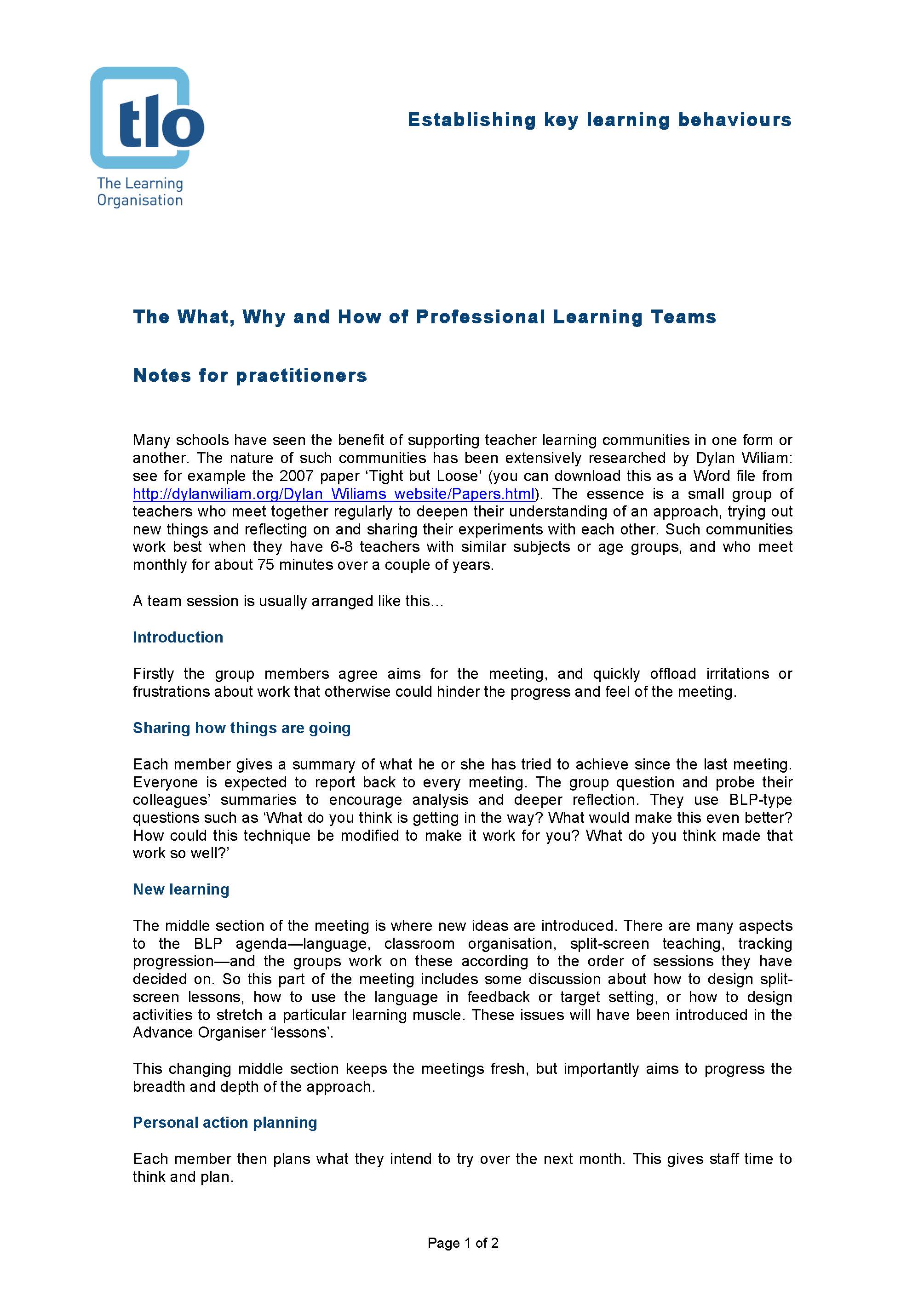
If you want to read again the notes on Professional Learning Teams, click on the view notes tab in this box
Professional Learning Teams: what and how
The purpose of these meetings is for the team to act as a teacher learning community or Professional Learning Team: a small group of teachers who meet together regularly to deepen their understanding of building better learners, commit to trying out new things, reflect on and share their experiments with each other. Such learning communities are the engines of teacher development. They work best with 6-8 teachers with similar subjects or age groups, and who meet for about an hour regularly over a period of a couple of years.
The group question and probe each other’s summaries of their experiments in order to encourage analysis and deeper reflection. They use questions such as ‘What do you think is getting in the way? What would make this even better?
How could this technique be modified to make it work for you? What do you think made that happen? In this way they support each other in changing and developing their practice.
 Some guidelines for team reflection sessions
The delicate, hard work of changing practice requires a safe professional environment in which to explore and understand both triumphs and tribulations. These short guidelines may be helpful in setting a climate for the team itself.
- Everyone is expected to report back on their classroom experiments
- Coaching questions and probes of colleagues’ classroom experiments encourage deeper reflection.
- The group is careful to follow their agreed ground rules which might include;
- No group member can ‘pass’
- Listen between the lines when it’s not your turn
- Actively discuss everyone’s input
- Constructive criticism – developmental not judgemental
- Everyone fully engaged in the group
•What is said is confidential to the group
• Respect others’ views and encourage others’ ideas - No-put downs
- Maintain an open mind
What-Why-How-of-PLT.pdf
Session agenda
If this team session is your first one in Stepping Stones, miss out item 2.
1. Session objectives
What do we want to achieve? ( 5 mins)
2. Sharing classroom experiments
How did our experiments go? ( 20 mins)
Share
- the changes in practice you tried
- how students reacted
- what you learned
- what next as a result
Probe
- what was getting in the way?
- what seemed difficult?
- what would make it easier?
- what made it work particularly well?
- why it was successful?
- changes in your behaviour
Talk about impact
- greater willingness to try, and try different ways
- Avoidance of…..
- Improvements in……
- Increases in…….
- Little to no changes in…
3. Recapping on-line materials
What did we think of the materials? ( 15 mins)
Reactions to
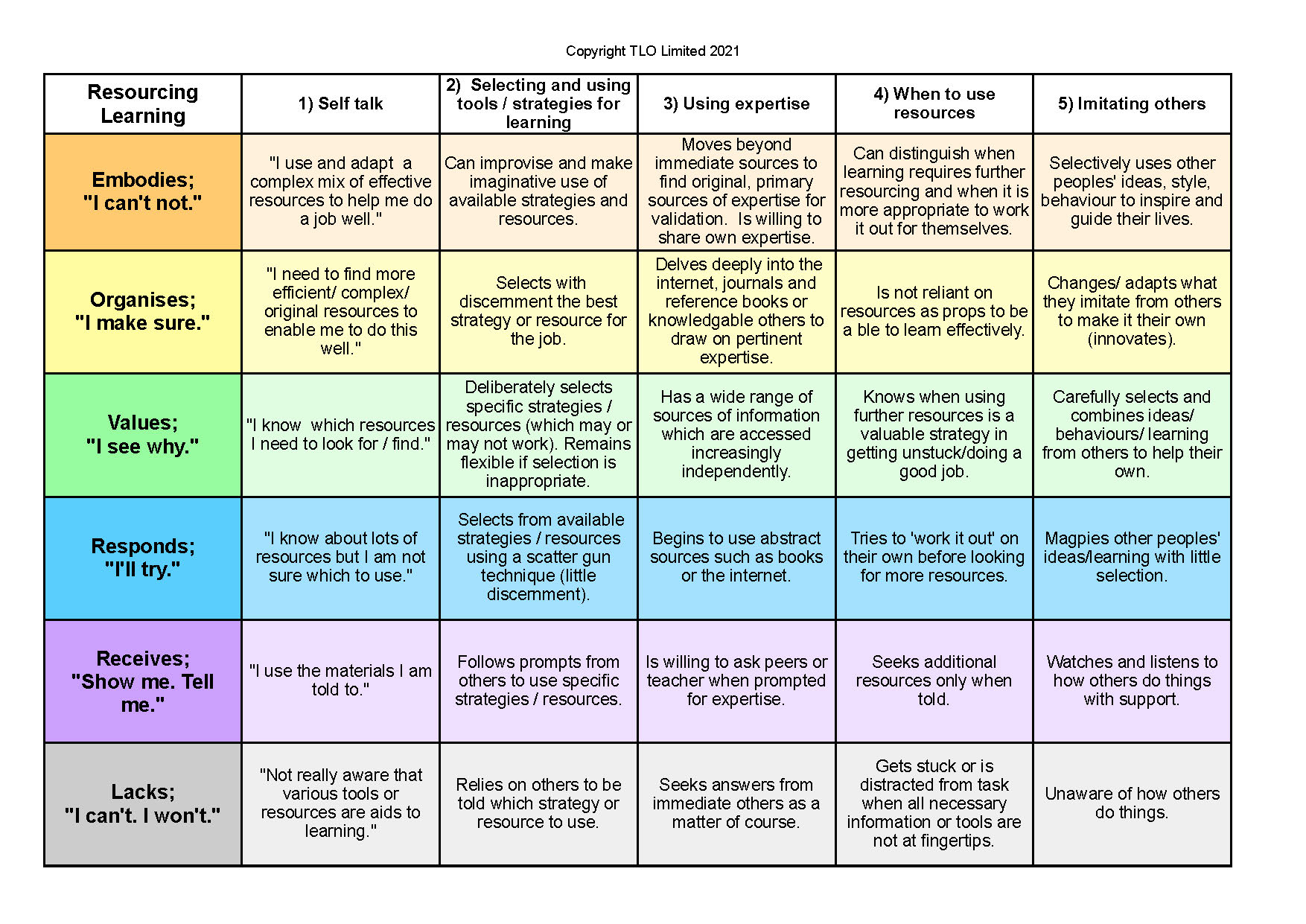
- The Resource Learning grid
- Where pupils are secure
- Where the pupils could be secure when they leave for secondary school
- Classroom culture ideas
- Activities and talk ideas
4. Planning what to do
What do we need to do next? ( 10 mins )
Decide
- Which ideas should we all adopt as a school strategy?
- How the progression of Resource Learning should be built across the school. ie how the phases of Resource Learning might play out against key stages and even year groups.
5. Personal action planning
What am I going to do? ( 20 mins )
5a.Consider
- how you want your pupils to improve/develop/enhance their approach to Resource Learning?
- what you are going to do to bring this about?
- develop your enquiry question.
Think of it like this…
If I do XXXX will it improve/develop/enhance YYYY
This is the crunch question. Your pupils are unlikely to change unless you change!
Capture your learning enquiry as a question
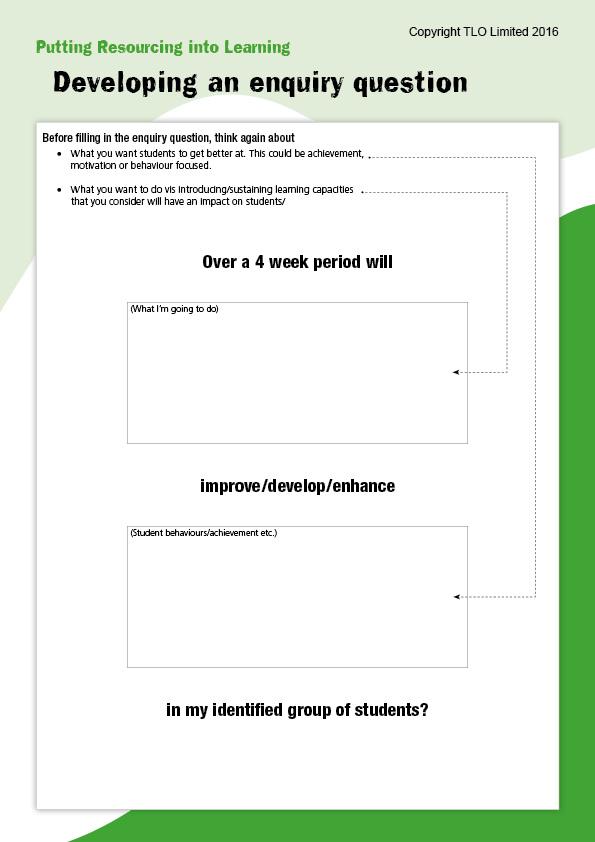
5b.Put a short enquiry plan together
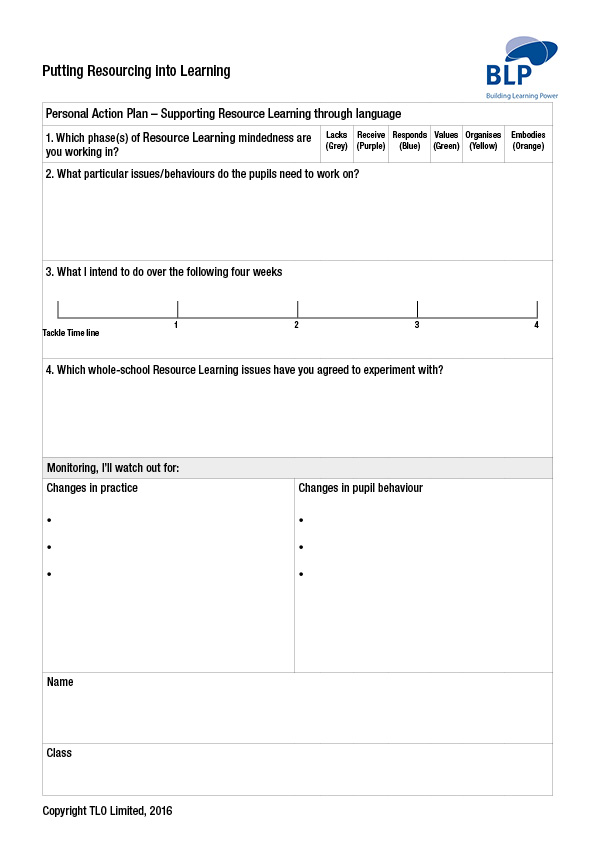
5c. Discuss which of these possible impacts on students have been observed:
- happy to use previously untried strategies or resources
- increasingly chooses own strategies or resources
- willingness to seek information/ideas from others
- better able to match the right resource to the right job
- more alert to how others do things
- better able to adopt others’ successful strategies
- increasingly independent
- increasingly interdependent
- others you may have observed…
Or if you want to be more specific you could use the indicators from the progression grid
6. Evaluate team session
How did we do as a team? ( 5 mins )
- Did we achieve our objectives?
- Are we comfortable with what we are trying to achieve?
- Any concerns at this point?
- Next meeting date and time.
Section 3: Blending Resourcing Learning with content
So far, you have:
- Looked at your pupils through the lens of the Resourcing Learning chart
- Gained a sense of what becoming better at Resourcing Learning looks like
- Explored a range of ideas and activities that will help to engage pupils with Resourcing Learning
Now we look closely at how to blend improving pupils’ Resourcing Learning into the content you have to teach.
A. The principles behind any learning powered lesson
B. Big questions to ask about lesson design
C. Lesson planning in action…an exemplar Resourcing Learning focused task
Learning habits form through use and practice, but desirable habits survive and flourish better if pupils are aware of them, realise their value and strive to improve them. The curriculum through its lessons provides the rich and varied occasions for exercising learning habits.
A. The principles behind any learning powered lesson
Think of yourself as a learning power coach, helping your pupils to help themselves to develop their learning habits. Hence your lessons are much more likely to contain challenges and activities that get your pupils thinking and learning for themselves. You encourage pupils to explore challenging questions, problems or assertions and become observers of their own learning. You step back from telling and heavy scaffolding and instead try to mobilise your pupils’ learning behaviours. You are organising learning to let them take the strain.
Open Me
The SIX principles that lie behind teaching for learning power
1: Visible learning…Surfacing learning
You make it clear to pupils which learning habits and processes they are using. You try to make every aspect of the learning process as visible as possible through the language you use and through the words and images you display on the walls.
For example:
Use display to record key learning

Set aside an area of display where pupils are asked to share any strategies or ‘top tips’ that they have found particularly helpful in their own learning. For those offering the ‘top tip’, it is a distilling activity, but the resulting gallery of ‘top tips’ invites pupils to adopt the successful strategies of others. This will also support the skills of noticing, collaborating, and distilling.
Organise your classroom in such a way that pupils are able to select, get and return the resources they need.
2: Dual focus teaching…blending content and process
You design activities that combine the dual objectives of ‘what’ will be learned and ‘how’ it will be learned. You make sure pupils know that the content they are learning is a way of giving their minds a useful workout. (The content is the vehicle for learning)
For example:
Encourage self regulation of resources
Design tasks that require the use of a range of resources and gradually expect the pupils to select what they need. At the beginning of a session talk with pupils about the things they might use to help them with their learning.
3: Emotional engagement…Capturing attention
Your lessons are designed to intrigue your pupils. Pupils don’t put in the effort unless their energy and attention are captured by what they are doing. You capture your pupils’ emotional engagement by giving them more of a stake in the process of learning.
For example:
Ideas Factory
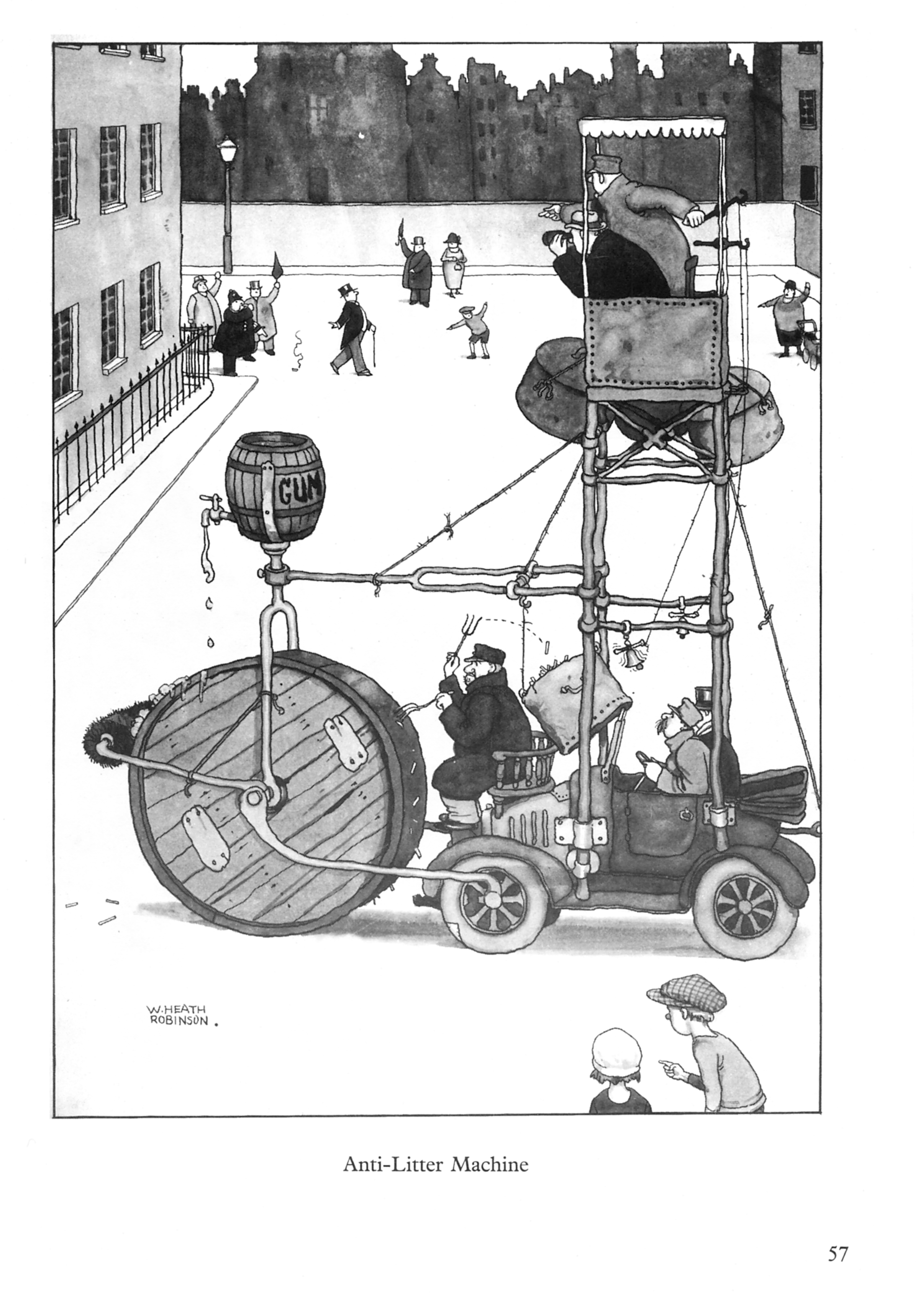
Invite pupils to work as teams of famous inventors who are going to come up with a new gadget to help other people. It must be useful and commercially viable. Use mindmaps to show the needs of their potential customers and gadgets that could be invented to meet the needs. What materials would they need to make it? Who do they know with the skills to help? Where might they find out relevant information? Success criteria for the task should focus on the way groups have thought about using resources rather than on the finished gadget.
4: Handling uncertainty…Challenge
You have realised from your own life that what is engaging tends to be what is challenging. Since you see education as a preparation for a learning life, you help pupils to learn how to handle increasing degrees of complexity and uncertainty.
For example:
Scrapheap Challenge

Collect a pile of unrelated objects, or ask pupils to bring in one object each and mix them in random groupings – e.g. a copper tube, piece of cloth, felt pen, blu-tack. Challenge pupils to make as many things as they can from the objects, using all of them but nothing else. Discuss examples of particularly imaginative/effective use of materials and whether these ideas can be used in another context.
5: Relationships…Working together
Learning is both a sociable and a solitary activity, and you offer your pupils opportunities to experience both. You develop interdependent learners who know how to handle themselves in collaborative groups and able to move around in the social space of learning to best effect.
For example:
Changing Habits –from unhelpful to helpful habits

Explore this through role play. Use imaginary characters to create more emotional distance. Discuss peer and family influence on forming habits. How many of our habits do we pick up from those around us? To what extent can we choose our habits?
In pairs, identify habits that could easily be changed (i.e. always eating cornflakes for breakfast), and discuss how this came to be a habit. Decide to change one habit for a set period of time. Discuss what happened. How did the new ‘habit’ feel the first time? How did it feel after 21 times? How could pupils use this experience to imitate other people’s helpful habits?
6: Reflection and responsibility…Taking charge
You understand that pupils have to learn how to manage and organise their own learning and that the way to do this is by giving them increasingly demanding opportunities to do so. You orchestrate pupils taking charge of their learning by expecting them to plan what they do, distil meaning from it, and revise it accordingly.
For example:
Use learning mats
at the start of this process to prompt the use of and reflection on Resourcing Learning.
A checklist for lesson planning based on these six principles.
Does the lesson plan:
- Make it clear to pupils which learning behaviours are being activated?
- Match and blend the learning behaviour with content?
- Include a tactic to captivate pupils’ attention?
- Have sufficiently challenging learning activities to sustain interest for all?
- Offer choice on how pupils could interact on these tasks?
- Embed aspects of planning, reflecting and revising for content and process?
What do you think?
- Which of these six principles are a regular feature of your planning?
- What do you make of principle 2? Is it the most tricky of the six? The following section B is mostly about this aspect of planning.
- Look at the checklist in the green box above this one: Do your lesson plans capture these six aspects of an effective learning experience?
Make a note of…

- Which of the six principles might need to be given greater prominence in your planning.
Skim read or leave this section if you have met it in other units because… the section applies to any learning behaviour. i.e. not specific to Resourcing Learning/Capitalising.
B. Big questions to ask about lesson design.
What we teach and how we teach it (the enacted curriculum) are intertwined and offer teachers a lot of freedom. It is here that you can start applying a learning power filter and deploy a unique combination of content and learning tasks.
Open Me
Prelude
In conventional lessons where the teacher remains the focus of attention and the initiator of all activity, and where the epistemic dimension (the conditions for acquiring knowledge) is not acknowledged, pupils gain habits of compliance and dependence, rather than curiosity and self-reliance.
In developing learning power, teachers are making conscious choices about which habits to introduce and stretch and how best to couple these with content so that lessons become more interesting and challenging. Through such overt coupling of content and specific types of process, pupils come to know, understand and take control of their learning behaviours – they knowingly use and develop the whole range of learning behaviours.
All lessons function on two levels, they have twin intentions. On the one hand there is content to be acquired, and on the other there are learning behaviours to be exercised in pursuit of this content. The factor that differentiates a standard lesson that effectively ‘delivers the content’ from a learning powered lesson is that the teacher has to think, in advance, about:
- the learning behaviours that are necessary for successful content acquisition;
- the design of activities /tasks that will stimulate these behaviours;
- how learners could reflect on and evaluate their use of these behaviours.
In designing such lessons you have to dare to think differently and flip round your usual lesson design thinking.
A turn-around in lesson design
Think in two dimensions at once – the content dimension and the learning behaviour dimension. It means turning your thinking around – from teaching to learning.
Or put another way
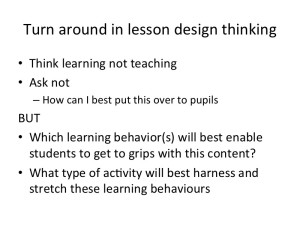
Think to yourself;
- what content?
- using which learning behaviour(s)?
- via an activity to stretch both?
Lesson design questions… one by one
Here the general rules of lesson design have been related to the learning behaviour…Resourcing Learning.
Stage 1. What content do pupils need to learn?
What content has to be learned? …..Think outcomes.
- Use standard lesson planning tools:
- What are pupils going to be able to do/learn?…think objectives
- How will they know if they been successful?… think success criteria
- While keeping an obvious eye on
- What do they already know?….think previous learning.
Stage 2. How will they best learn it?
Using which learning behaviours?
This is the new bit
Not the usual second step but nonetheless a vital second step where the aim is to weave content acquisition with learning behaviours. The content is the vehicle for exercising the learning behaviours and the learning behaviours accelerate the content acquisition.
Using which learning behaviours?…Think types of learning behaviours
- Which learning behaviour(s) will help these pupils get closer to understanding this content?…think learning behaviour charts.
- Which aspect of, say, Resourcing Learning, lends itself to achieving these outcomes?…think progression columns.
- How skilled are these pupils in using this learning behaviour …think progression phases/rows
Say something like this to yourself .…My pupils need to achieve xxx. At this stage we could get closer to this content by using Resourcing Learning. Most of my pupils are able to use xxx phase (e.g. respond/blue) Resourcing Learning approaches confidently.
Stage 3. What type of task/activity will stretch the learning?
Which type of task…Think types of task.
Pick up your thinking from stage 2;
My pupils need to achieve xxx. At this stage we could get closer to this content by using Resourcing Learning. Most of my pupils would be able to use xxx phase (e.g. blue/responds phase) Resourcing Learning approaches confidently.
And now think about the sort of task/activity you might develop/design so as to:
- orchestrate a problem-solving activity to enable pupils’ understanding of xyz content without telling them;
- intrigue them with something that is open to several interpretations;
- stimulate their curiosity;
- grab their attention…visually and aurally;
- allow them to stay stuck before I ask them how they are thinking;
- offer as a nudge to get them thinking differently that doesn’t give the answer away;
- leave it as a problem hanging in the air to which we will return later;
- make links between the challenge, and what and how we are learning in this lesson.
The challenge isn’t about the inherent complexity of the subject matter but about how the content is orchestrated to encourage pupils to use their learning habits to resource their solution.
Think…what/how much information/content do I need to give/reveal? At what point? In what form? To what end?
Say something like this to yourself .…
- my pupils need to achieve xxx.
- at this point we could get closer to this content by using Resourcing Learning.
- most of my pupils are able to use xxx phase (e.g. respond/blue phase) Resourcing Learning approaches confidently.
- What type of task would stretch their Resourcing Learning but assist them with the content…without me just telling them!
To summarise…the heart of the lesson
It’s the question ‘using which learning behaviours?’ that causes you to think differently about the lesson planning.
- You ask – as always – what are the anticipated objectives/intentions?
- The verbs in your resulting objectives will give you clues about the types of task/methodology that will get pupils there and the sorts of learning behaviours your pupils will need to contribute to this learning endeavour.
You are designing the task in a way that requires pupils to contribute their learning ‘powers’ / behaviours. The tasks you design will hook into their learning ‘powers’ and help them to improve them.
Say something like this to yourself:
I am going to think content, learning behaviour and task together:
- Resourcing Learning will help pupils to better access the content;
- The aspect of Resourcing Learning (column) and phase (row) that would fit best is (for example) ‘use a wide range of sources of information which are accessed increasingly independently’ (Resourcing Learning grid, Using Expertise column, Values phase)
- The type of task/activity that would best stretch both content and learning behaviour, intrigue, challenge, bring people together and give responsibility to pupils is………
- Think….what information do I need to reveal/give, in what form, at what point, and what do I want pupils to do with it?
What do you think?
- What strikes you about this way of planning with learning behaviours in mind?
- Where are the potential stumbling blocks?
- How will you decide which learning behaviour(s) you are going to foreground in your objectives?
Consider a lesson you are about to teach…
- What is the content?
- Which learning behaviour(s), if missing, would make accessing the content very difficult / impossible?
- How could you blend reference to this learning behaviour(s) into the learning objectives?
- Can you design a task that will help pupils to access the content and exercise the key learning behaviour(s) you have identified?
C. Lesson planning in action – an exemplar, Resourcing Learning focused, task.
How do we design tasks that stretch Resourcing Learning and assist pupils to approach the content more productively? We cover this in four ways:
- 1 describes the Think/Puzzle/Explore visible thinking routine;
- 2 shows the phases of a lesson where Resourcing Learning is the driving behaviour;
- 3 offers a simple lesson plan template that can be used for any lesson and distils the Resourcing lesson into this format;
- 4 invites you to extend your thinking about the ways in which we might build learner independence.
Open Me
1. A description of the Think, Puzzle, Explore visible thinking routine
This useful VTR is used in Episode 4 of the following lesson, so here as a full description of what it is and how it works.
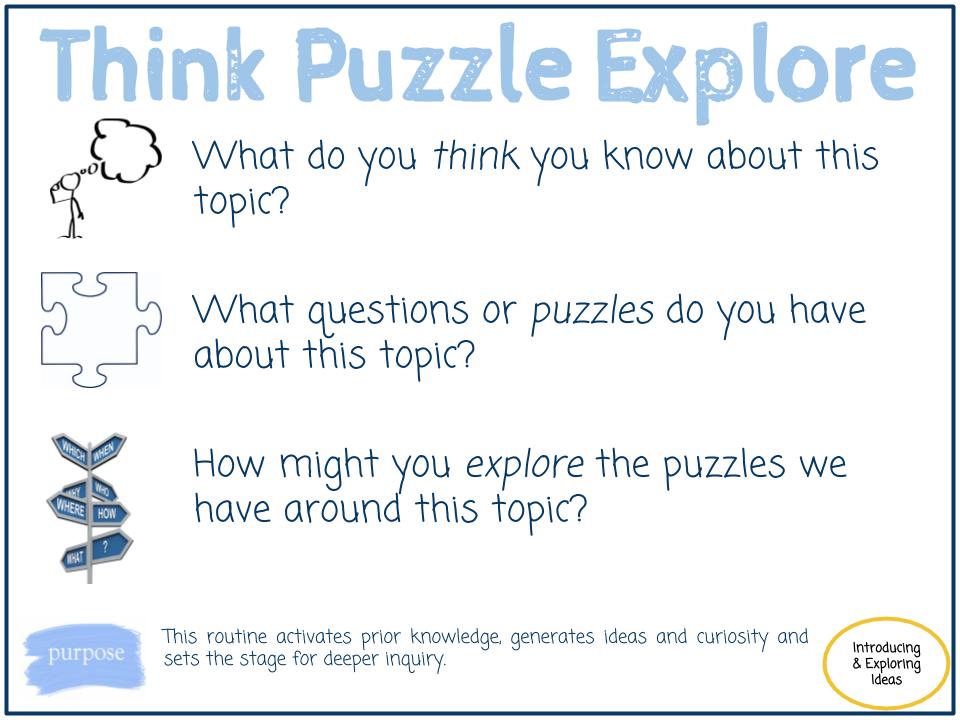
The following is from the Visible Thinking website:
Think Puzzle Explore – is a routine that sets the stage for deeper inquiry
Three core questions guide pupils in this routine:
- What do you think you know about this topic?
- What questions or puzzles do you have?
- How can you explore this topic?
Purpose: What kind of thinking does this routine encourage?
The whole routine helps pupils connect to prior knowledge, stimulates curiosity lays the groundwork for independent inquiry.
Application: When and Where can it be used?
You can use Think/Puzzle/Explore at the beginning of a topic and when you want pupils to develop their own investigative questions
Launch: tips for starting and using this routine.
- Begin by giving pupils a few quiet moments to consider the topic at hand.
- Work as a whole class or in small groups and brainstorm ideas in response to:
- What do you think you know about this topic? Expect misconceptions at this point but include on a list for consideration after further study
- What questions or puzzles do you have? Expect simple ideas and questions but include in a list and push for thoughts that are truly puzzling or interesting them.
- How can you explore this topic?
- Make sure to give adequate time between each question for pupils to think about and articulate their ideas.
When beginning to use this routine it is sometimes best to do the Think and Puzzle questions together first. In some cases, you may want to have pupils do this part of the routine individually on paper or in their heads before sharing ideas in a group. Return to the Explore aspect after sharing ideas and puzzles. It may be helpful to a think about what makes an interesting question, or puzzle, and then discuss strategies for exploring selected questions.
Keep a visible record of pupils’ ideas. If you are working in a group, ask pupils to share some of their thoughts and collect a broad list of ideas about the artwork or topic on chart paper. Or pupils can write their individual responses on post-it notes and later add them to a class list of ideas.
2. A lesson with Resourcing Learning to encourage independence.
The lesson below is based around the Aberfan disaster of 1966, but the same principles could be applied to any area of study so long as there are sufficient resources available for independent access by pupils. The lesson itself starts in a highly structured manner to secure interest and to set the scene for the subsequent independent enquiry.
Overview of lesson plan:
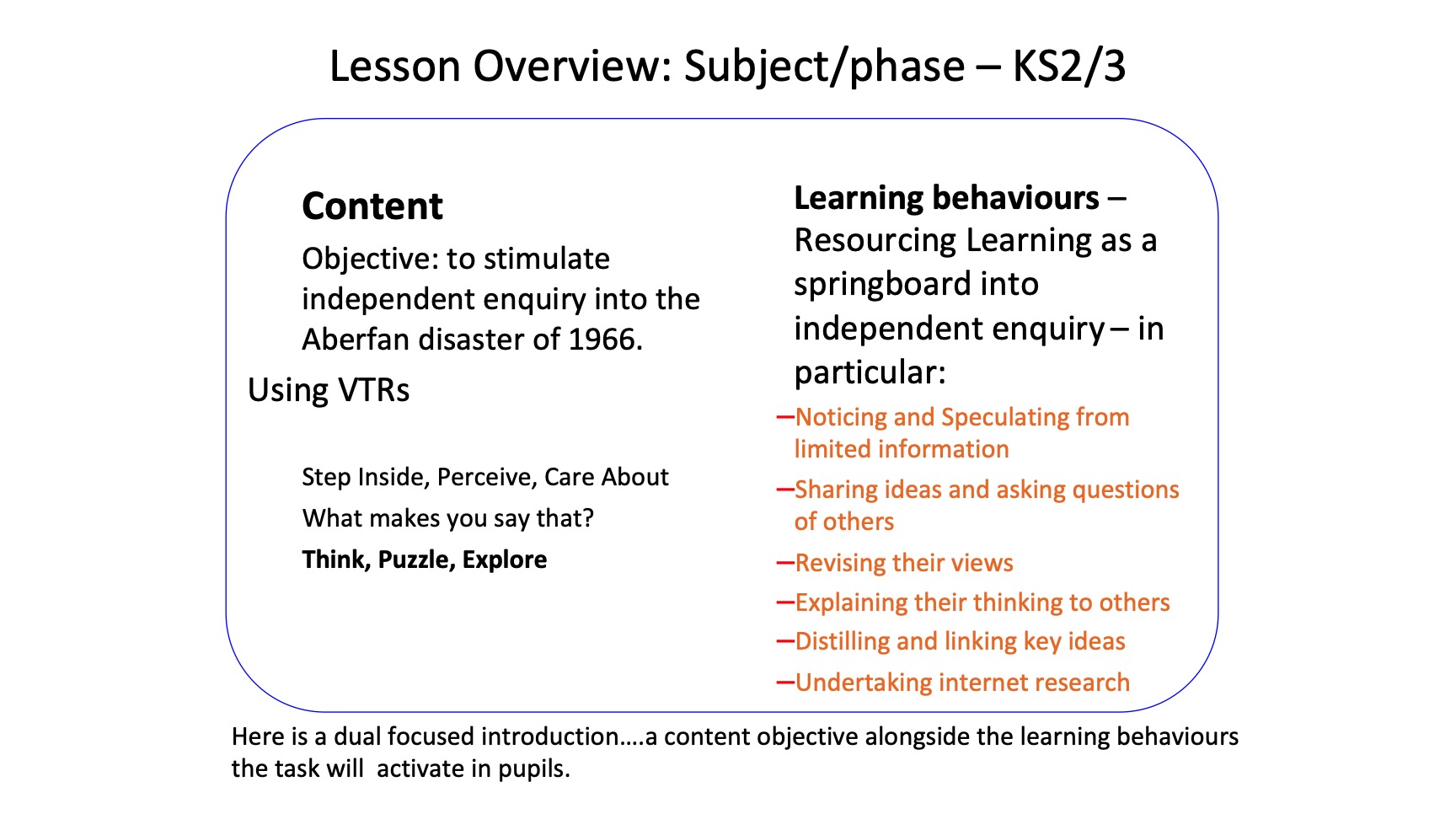
What is happening here?
The lesson exercises a wide variety of learning behaviours in the different Episodes, but in terms of Resourcing Learning and Questioning, it assumes that pupils have the skills described at the Responds (Blue) and Values (Green) phases of the Resourcing Learning and Questioning grids. Learners already at the Values phase will need little support to access the lesson, whereas Responds phase learners will need more scaffolding and support.
Ask yourself – where are most of my learners on this progression chart? Do they have the necessary Resourcing and Search skills to undertake this lesson?
Episode 1 – What might this poem be about?
[This is an Episode with 5 separate phases – see the Powerpoint download and the lesson plan grid for more detail.]
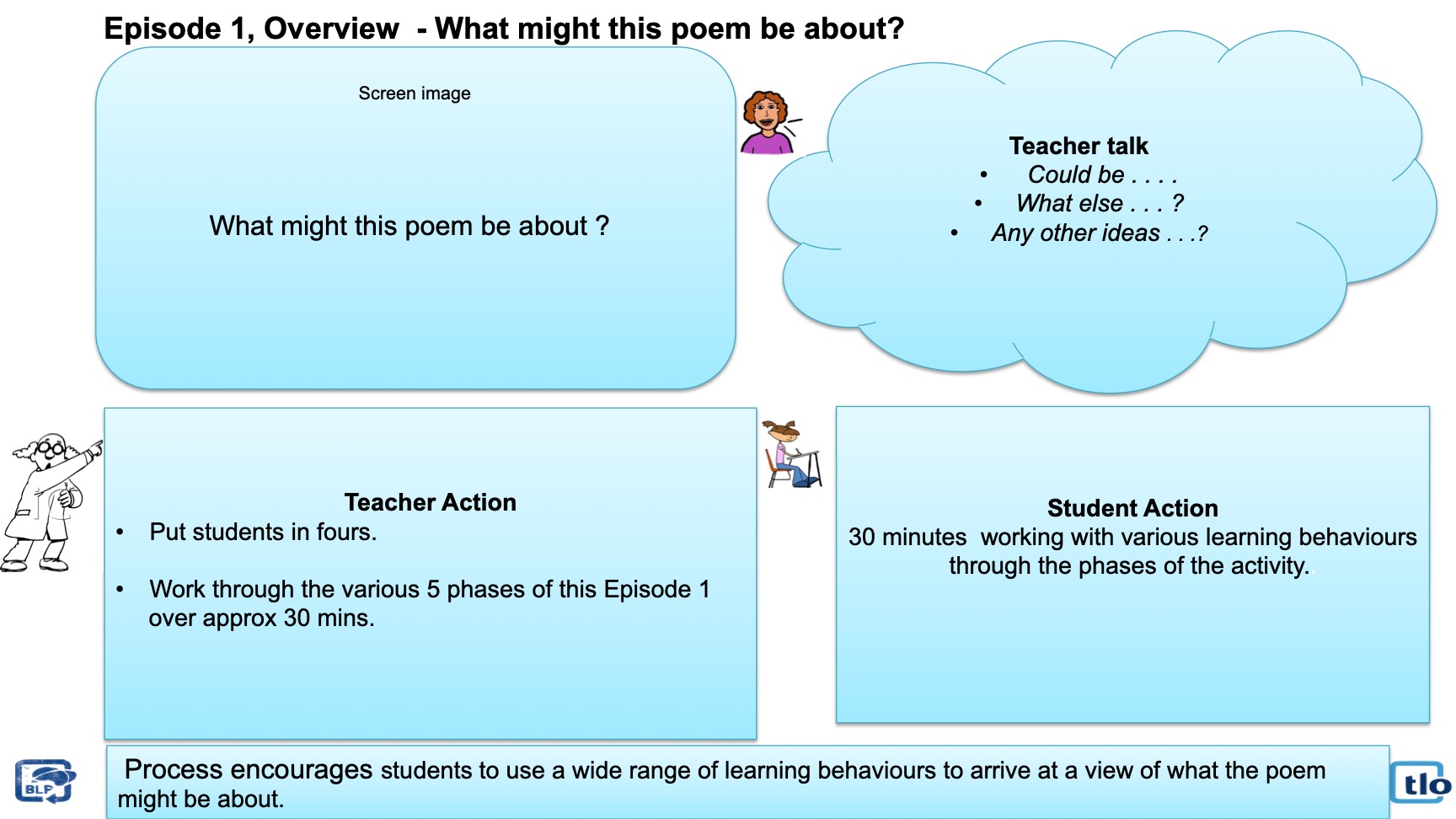
What is happening here?
A starter activity to intrigue and build interest in further research.
[This is a complex activity to run, and the slide above is only an overview. Download the powerpoint or grid for detail on how to facilitate the 5 different phases of the Episode.]
Download PowerPointThe different phases of this Episode stimulate a range of learning behaviours. In Episode 1:
- Phase 1 – Trying to gain meaning from just one stanza of the poem requires attentive noticing and imagination;
- Phase 2 – Circulating to find out more provokes distilling, making links, questioning, listening and revising;
- Phase 3 – Deciding how to tackle the problem involves stopping and planning what to do next;
- Phase 4 – Putting the stanzas in order requires learners to make links, speculate, explain their thinking and revise their ideas as they go along;
- Phase 5 – Deciding/Agreeing what the poem might be about requires a blend of reasoning, imagining and negotiation/consensus building;
- Working as a team of 4 requires a range of collaborative learning behaviours throughout.
This is a rich activity that activates a wide range of learning behaviours as it draws pupils into the lesson. It aims to be a more engaging introduction than ‘Today we are studying the Aberfan Disaster’
Episode 2 –
What are these 2 boys thinking?
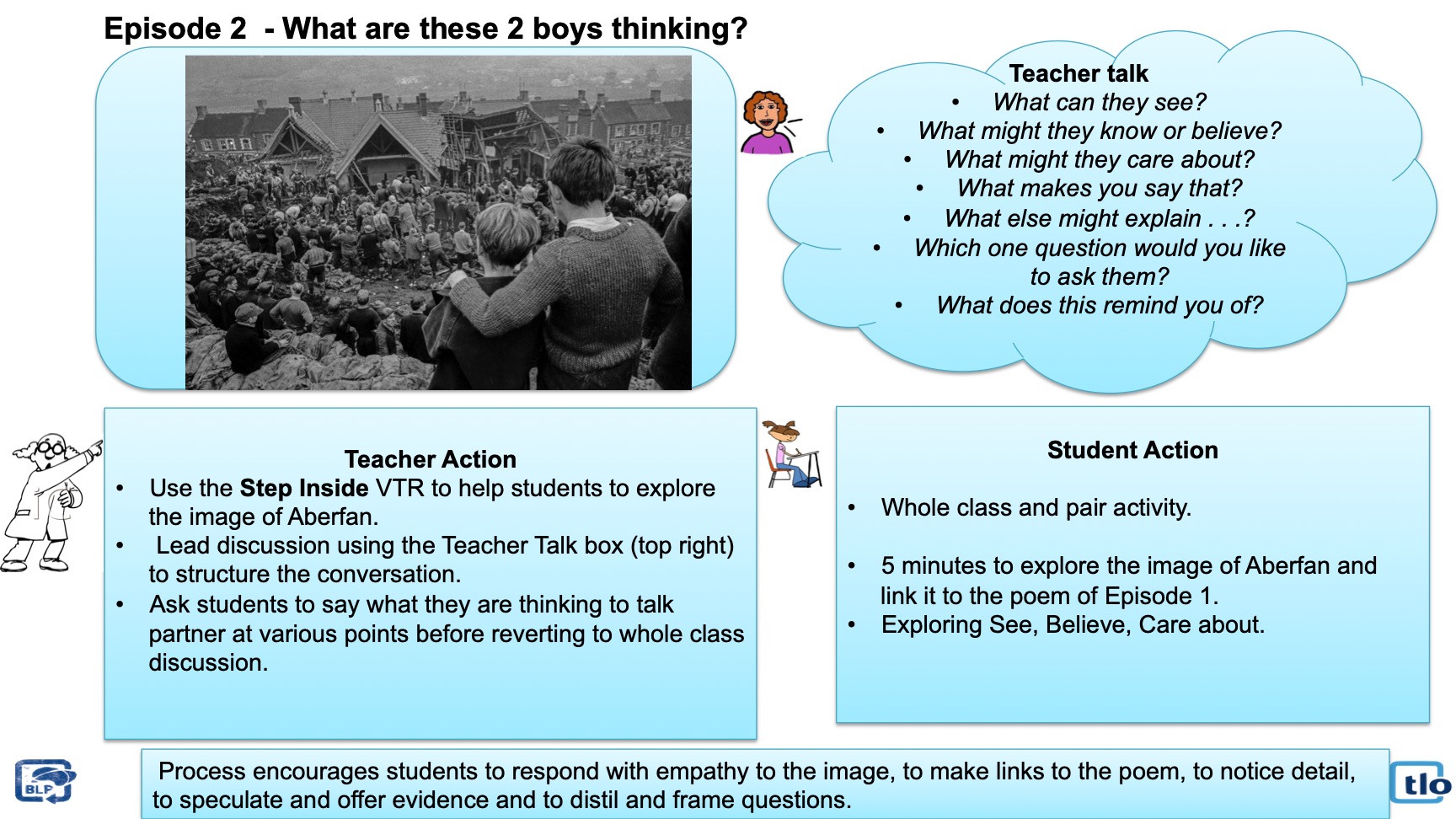
What is happening here?
Having established that the poem relates to a disaster of some kind (they may even have heard something about Aberfan before), this Episode uses some visible thinking routines to explore an image and to ‘Step Inside’ the minds of the 2 boys in the forefront.
For more detail on the Step Inside visible thinking routine:
Primarily an Empathy related activity that depends on good noticing, the addition of ‘what makes you say that’ and ‘what else might explain . . . ‘ overlays aspects of reasoning and imagining, ‘which one question . . . ‘ adds questioning and distilling, and ‘what does this remind you of’ stimulates link making.
Episode 3 – What can you find out about the Aberfan disaster?
What is happening here?
At this stage, you are encouraging pupils to begin looking for information, almost certainly from the internet. Their research may, at this stage, be relatively superficial and related to finding out some facts/dates/number of casualties etc, but it sets the scene for Episode 4 and for the more focused research that is to follow.
The learning behaviours being activated in this Episode relate to the Questioning grid, and in particular the ‘Search skills’ column. How sophisticated are your learners’ search skills? How much scaffolding will you need to provide?
Episode 4 – Taking Stock, Framing an Enquiry
What is happening here?
Having done some preliminary research on the internet, this Episode uses the Think/Puzzle/Explore visible thinking routine to help pupils to distil what they have found out, to consider the things that are puzzling them, the questions to which they would like answers, and to begin to think about how they might go about finding this out. It is here that you are setting up the independent enquiry that is to follow.
The ‘Think’ phase encourages pupils to pool what they have found out, what they think they know already.
The ‘Puzzle’ phase begins to identify potential lines of enquiry.
[It may be worth having a few ‘puzzles’ of your own pre-prepared in case pupils struggle to identify questions: Was it a natural disaster? Who/what was most responsible? What was the role of Lord Robins? What prevention legislation did it lead to, if any? What is Aberfan like today? etc. Use only if pupils are struggling and you have to!]The ‘Explore’ phase encourages some preliminary thinking about what they will do next and how they will do it.
[NB. How groups might organise themselves to undertake such an enquiry is also explored in section 3c of the Planning module.]
Episode 5 – Undertaking independent enquiry
What is happening here?
Having set up the enquiry in Episode 4, here the pupils, in groups of 4, pursue their own line(s) of enquiry.
Consider:
- How long will you give them – it needs to be a significant amount of time if they are to dig beyond the superficial.
- How you will maintain momentum – will you need mini review points to check/monitor progress?
- How you will help them to assess reliability / possible bias in what they are discovering.
- How they will report/share the outcomes of their enquiry so that others may share their insights – will it be a report, a presentation to other groups, a ‘jigsaw’ activity where groups are reconfigured, or something else?
- To what extent you are able/prepared to allow pupils to decide these things for themselves. The more they can decide for themselves, the greater the levels of independence and interdependence.
What do you think?
- Can you think of something from your own curriculum that could be treated in this, or a similar, way?
Make a note of…
- Which class you might try this with.
3 Using a lesson plan template to distil this lesson.
Given that there are hundreds of lesson plan formats we will use a few different types of planning tools over the course of these units. This one is a simple streamlined useable tool that includes:
- What you do (teacher action);
- What pupils do (pupil action);
- What the learning behaviours being called upon are (learning behaviours);
- What you say (learning talk) to nudge the learning behaviour along.
The format is divided into episodes to show the change of purpose, action and use of learning behaviour across the course of the lesson.
Download a blank lesson plan as a MS Word document:If we now populate the template with the episodes explored in section 2 above, we get the completed lesson plan. . .
What do you think?
- What are your first reactions to this lesson plan template?
- Does planning for four aspects – teacher action, pupil action, learning behaviours, teacher talk – seem useful?
- How does sequencing the lesson as ‘episodes’ help or hinder planning?
Make a note of…
- The extent to which your existing planning template enables you to think about lessons in this way.
- What you would like / need to add to it.
4 Extend your thinking about stimulating independent enquiry.
We all would like learners to become increasingly independent as they move through their schooling. Many schools embed such a commitment into their mission statement, in the recognition that lifelong learning necessarily requires learners to be able to control and direct their own learning.
But . . .
It is an uncomfortable truth that, despite our best intentions, research suggests that the longer pupils stay in school the more, not less, dependent they become on their teachers.
Many schools tell us that the biggest problem is that seemingly successful yet dependent learners at key stage 4 are unable to make the shift towards independent study post 16. A significant number of Ofsted reports cite lack of learner independence as one of the reasons that a school is not yet outstanding. It appears that, left to chance, independence often fails to flourish, sacrificed perhaps on the altar of meeting targets, passing exams, delivering an increasingly overloaded curriculum.
King’s School, Macclesfield, bucks the trend – there is a planned programme of increasingly independent study units running through Key Stages 3, 4 and 5. Time is given to these activities, successes are celebrated, and pupils talk with enthusiasm about the impact on their ability to explore and study areas of personal interest. Could the same be said of your school? Your classroom?
Ask yourself
- Do learners gain in independence as they move through the school?
- Why/how does this happen?
- Are opportunities for growing independence built into curriculum plans, or is it left to chance?
- How does my classroom contribute to growing independent learners?
- How could my classroom contribute to growing independent learners?
Make a note of…
- One thing you will do differently in order to nurture learner independence
Section 2: Building Resourcing Learning friendly classroom cultures
Teachers as habit formers
As teachers we are in the habit-forming business. What we say, what we display on classroom walls, what we celebrate, praise or dismiss, what we model or how we design learning activities will all influence the ways in which pupils learn, perform and behave. Classroom cultures have a huge influence on pupils’ learning as you will remember from the Culture unit.
Five big shifts to get you started. Ask yourself – how might you:
Encourage students to choose their own resources;
Enable students to choose which learning strategy they will use;
Harness display to celebrate successful learning strategies;
Promote greater choice, self-reliance and independence;
Alert students to the successful strategies of others.
Now look at the Learning Chart sections below where you will find plenty more ideas to try.
Section 1: Resourcing Learning and how it develops
1a) What do we mean by Resourcing Learning?
In the early BLP framework it is called capitalising. It’s about being on the lookout for strategies, resources and forms of support in the environment that can help you in your current learning or problem-solving. Traditional schooling assumes that intelligence is all in the head. But recent studies show that it is much fairer and more accurate to see good learners as people who are ready and able to make intelligent use of all kinds of strategies and things around them—floor space, filing cabinets, dictionaries, notebooks, personal organisers, telephones, libraries, e-mail and, of course, other people.
1b) What does being a good Resource Learner involve?
Being a good resource learner involves learning with the help of many different sources –other people, books, the internet, music,the environment, experience…and making intelligent use of all kinds of strategies and things to aid learning. In the early stages, it means selecting and making the best use of known strategies and classroom resources but this swiftly moves on to embracing a much wider and varied range of possibilities. This involves being able to seek novel ways of solving problems by exploiting the potential of known strategies and what is around them including things you may never have thought of as a resource. Importantly it includes being able to adapt and adopt the ways other people do things; taking their habits and values into your own repertoire (imitating). Gradually students can improve their physical skills, absorb ideas and thinking patterns by observing the approach and detail of how others do things. When looked at from these diverse angles, growing resourcing moves well beyond encouraging a student to ‘read pages 24 and 25’. The Resourcing Learning grid below takes account of the constituent parts of building the habit of Resourcing Learning
Our progression grid for Resourcing Learning has 5 components:
1c) Unpicking the columns; what contributes to a readiness to Resource Learning?
The grid columns are things that might combine to make up the skills and attitudes of a learner who uses resources effectively
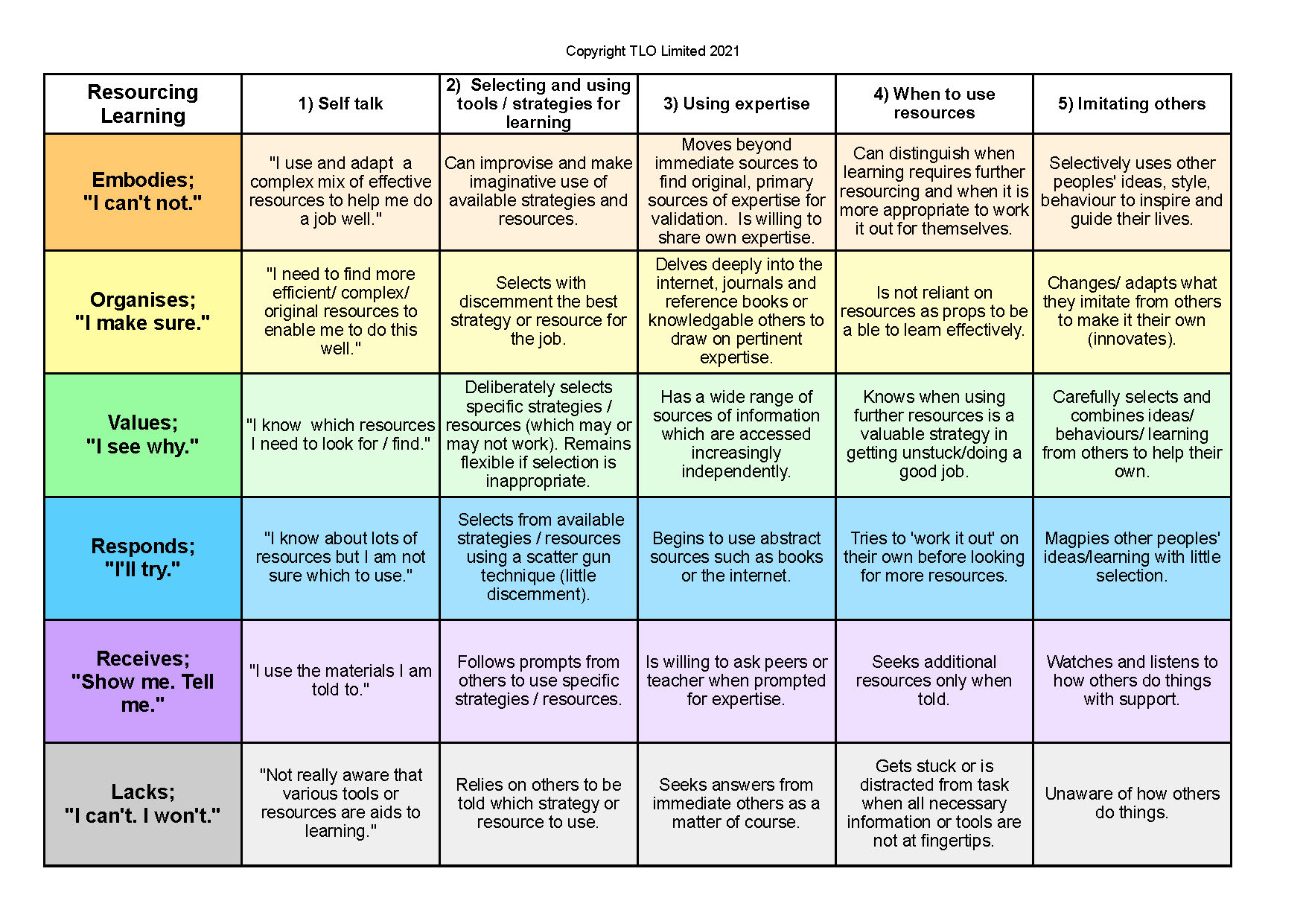
Overview of the grid
The grid for resourcing learning covers how pupils might progress in the skill and habit selecting and using strategies and resources to help their learning. It covers how pupils grow in the selection of tools for learning, moving from a scattergun approach to being able to select the best strategy / tool for the job. Using expertise from books or the internet and moving gradually to using original sources of expertise. Imitating others is covered in a column of it’s own showing how pupils might start with watching others for clues and moving towards selectively using others’ ideas to guide their own lives. But one column is devoted to being aware of whether is needed at all to guard against the danger of resources turning into a prop which the pupil relies on too heavily
Take a closer look at what each column of the grid is about
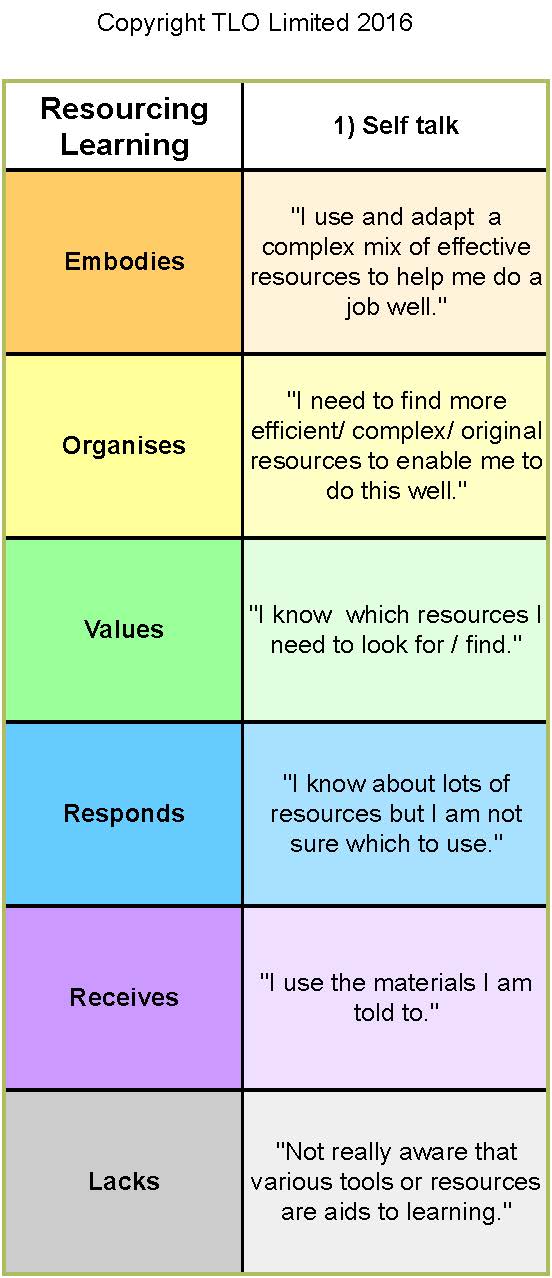
Self-talk
The voice of self-awareness
Self-talk is what we say to ourselves as we learn. The statements capture what someone in each phase of the grid might be thinking. Students may use some of these phrases when talking with you, or in writing from time to time, but mostly self-talk goes on inside their heads. We have shown a small flavour of self-talk thoughts that teachers can encourage students to imitate. Some relate to setting about learning, others to talking through which learning methods or resources might be useful, and others to monitoring and evaluating the learning being used. All such self-talk is important in building a Me-Learning habit.
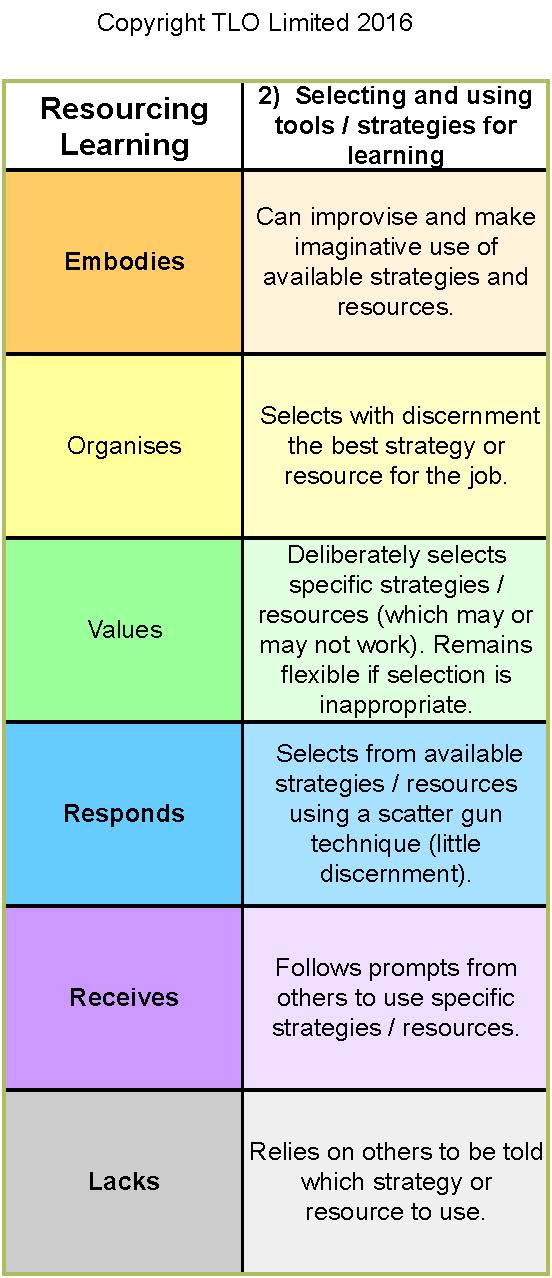
Selecting and using strategies and tools for learning
How we build expertise in finding and selecting strategies and resources
The first contributory factor in Resourcing Learning is about how students move from relying on others to provide strategies and tools to help them learn to being able to choose from a selection and on to being able to find their own strategies and tools and finally to use familiar strategies and resources imaginatively to broaden their effect.
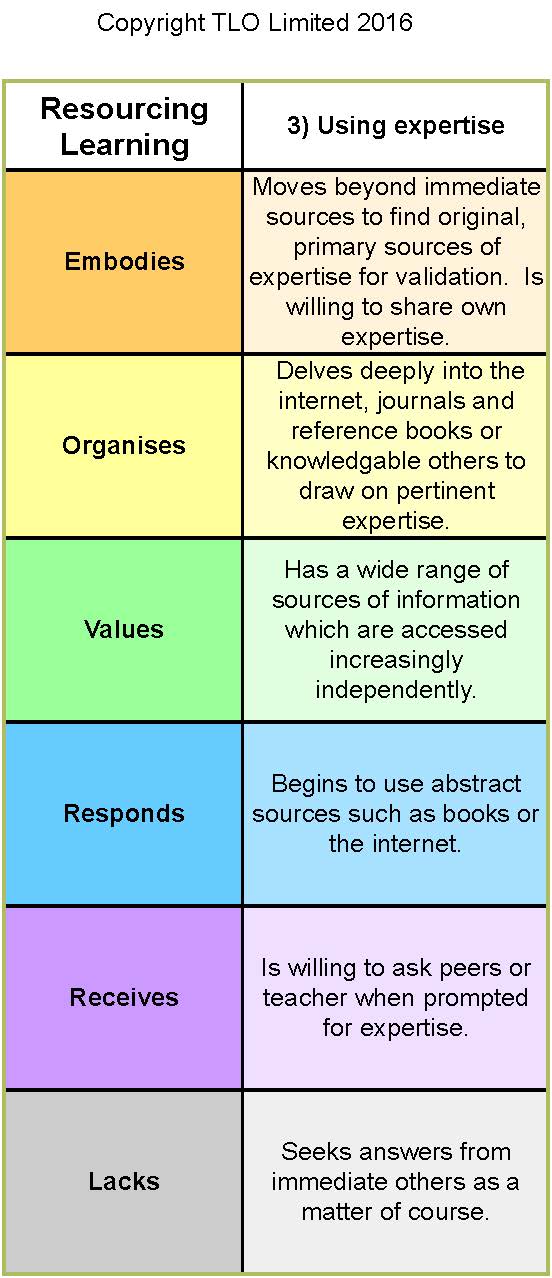
Using expertise
How we broaden our use of sources of expertise
The second contributory factor in Resourcing Learning is about our use of expertise. Our first understanding of expertise may lie with people we know; we ask for information about what and why etc. But we move on to realising that there are other sources of expertise to be found in books and on the internet for example.This broad range of expertise must be used with care and discernment and moves on into more specific and complex realms. There’s a real skill to finding and being able to use high-level expertise. From this effective use of expertise we might become expert ourselves and share our understanding with others.

When to use resources
Distinguishing between resources and props
This column has been included as a bit of a caution. It’s about students being able to recognise when a resource is needed and when they could indeed work something out for themselves.There are times when learning resources become learning props; when students come to rely on them and can’t move on without them. Of course, this doesn’t happen with every subject but there comes a time when the contents of learning walls and visual prompts have to become part of a student’s understanding. Eventually, a person’s own expertise enables them to learn well from themselves.

Imitating others
Our inclination and ability to learn from others
We are all hard-wired to learn by imitating others. This is something that can be used wisely or inappropriately. in this column we explore how this moves from being unaware of how other people do things to using people’s ideas and values to help guide our own lives. The important ideas going up the column are; watching and listening; ‘magpieing’ but with little selection; selecting and combining; changing and adapting ( innovating). So this is not straight copying, it’s about being stimulated by using others’ ideas but making them fully your own. It’s a valuable trait that can be transformed into an essential skill/habit.
What do you think?
- What have you learned about Resourcing Learning from these descriptions?
- What have you had confirmed?
- What surprised you?
- How have your views changed?
Make a note of…
- Any ideas for practical classroom experiments that these descriptions have triggered
- Which column your students are most secure in.
1d) Unpicking the rows; getting better at Resourcing Learning.
Of course, the development of Resource Learning doesn’t grow neatly up each column or evenly across the phases in the grid. The five broad phases of dispositional growth (purple – orange) are affective ways in which people may be inclined to behave: we call this inclination ‘mindedness’.
Here is our interpretation of how Resource Learning might grow.
Meaning behind the phases
The phases are drawn from Bloom’s taxonomy of the affective domain.
Phase ‘Receives’ (purple) is about doing something because you are told or expected to.
Phase ‘Responds’ (blue) is about gaining interest and doing things more willingly.
Phase ‘Values’ (green) is a key phase since the student now sees the value of behaving in this way. It’s a win for them; to behave like this is in their interest. It’s in this phase that the behaviour becomes more secure.
Phase ‘Organises’ (yellow) is the phase in which the student capitalises on this ‘in their interest’ behaviour and gets themselves organised to use it positively.
Phase ‘Embodies’ (orange), known as ‘characterised’ in the original taxonomy. In this phase, the student has made this behaviour their own. It has become part of their character; they can’t not do it and they have become highly skilled in doing it.
We urge you to see this progression as long term. Some phases will take years for people to work through; some will never be worked through. None of the phases are inevitable. There is a lifetime of development captured here. Nevertheless the role of a teacher or parent should surely be to encourage and enable this journey.
Lacks: Minded to ‘just do things’
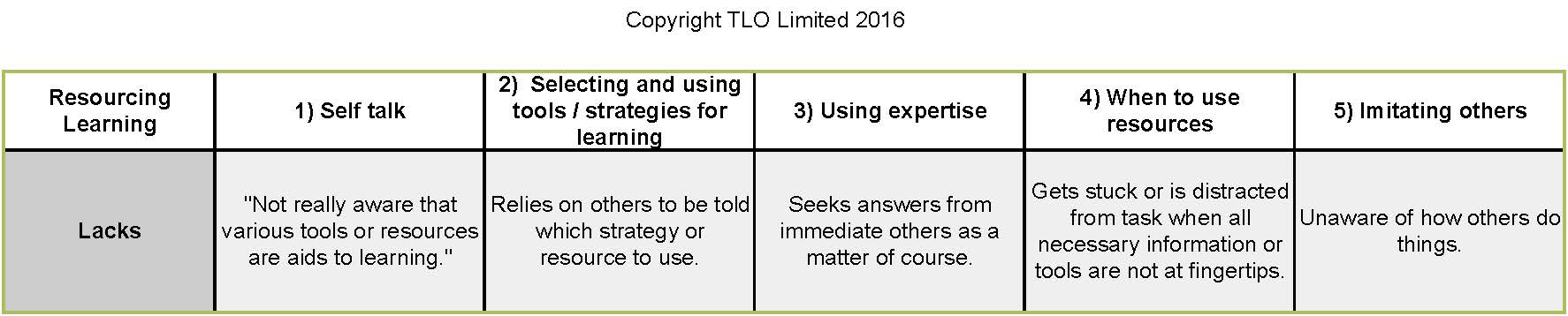
In this ‘Lacks’ (grey) phase, students are not really aware of using strategies or resources for learning. They will use strategies and things that are around but don’t view them as something that helps them to learn. The concept of a resource for learning or a learning strategy is not yet formed.
Receives: Minded to use resources they are given and the strategies they are told to use

In the Receives (purple) phase, students begin to use the things and strategies they are given to help with their learning. The concept of resourcing learning is beginning to form. They become aware that it might be useful to watch and listen to others and that this can be useful in their own learning. They see their teachers as a source of expertise and can become too dependent on this unless supported to broaden their range of strategies and resources.
Responds: Minded to use a wider range of strategies and resources.
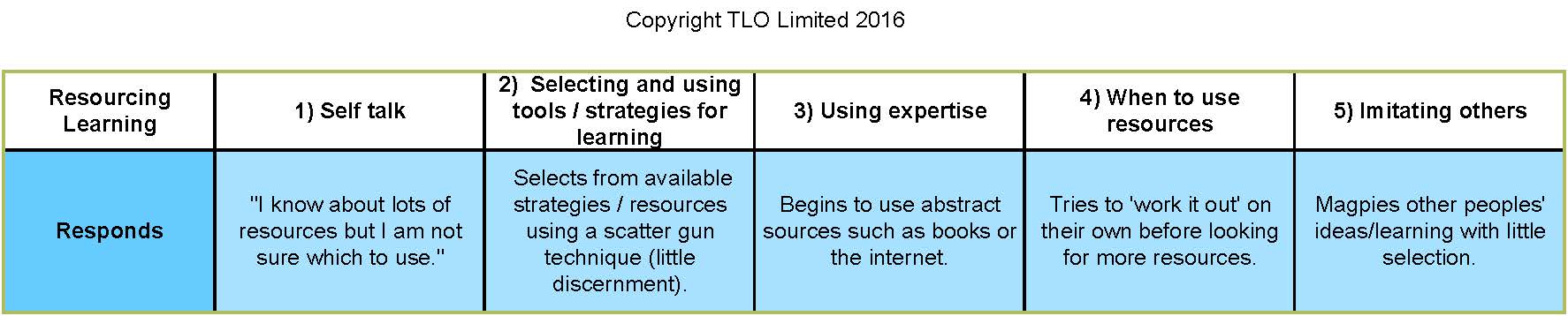
In the Responds (blue) phase, students have become aware of many classroom strategies and resources although have yet to learn to select them carefully for a specific need. They now begin to use other sources of expertise such as books or the internet but again their approach lacks precision.
Values: Minded to broaden the range of Learning Strategies and Resources.

In the Values (green) phase, students are fully aware of the purpose and usefulness of different strategies and resources. Here they become more skilled in selecting the right one for the job in hand. They become more skilled in using expertise and they know when they need other strategies or resources to help them further. Importantly they now select ideas or behaviours from others and combine these with their own to make/achieve new understandings.
Organises: Minded to deepen their use of Learning Strategies and Resources.
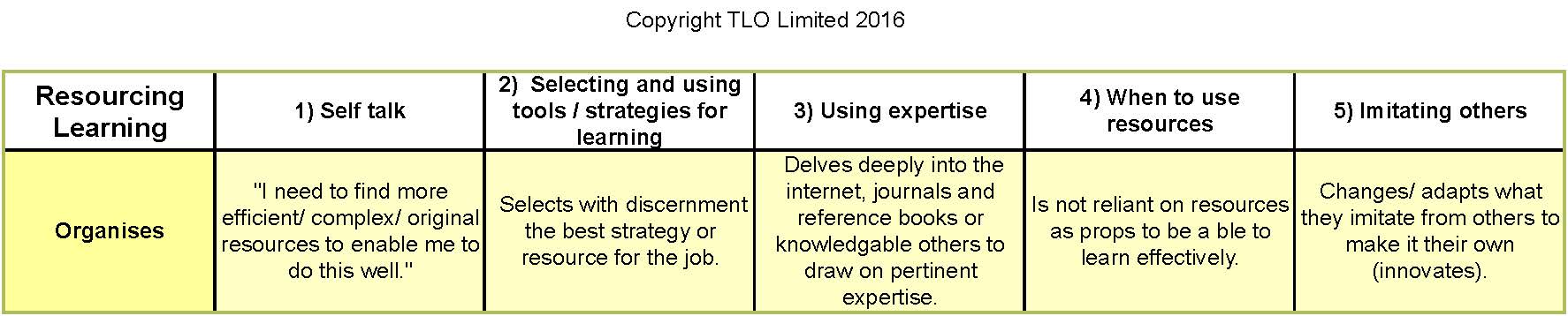
In the Organises (yellow) phase, Resourcing Learning has become a skilful habit. Now students are able to select the best strategy or tool for the job, delve deeply into pertinent sources of expertise and know when they can work things out for themselves. When imitating others they can adapt others’ ideas in an innovative way thus making a unique result.
Embodies: Minded to exploit learning strategies and resources to the full.

In the Embodies (orange) phase, people have become expert at finding and using appropriate strategies and resources. They can use a wide range with real expertise and can use these imaginatively to bring about different results. They now use original sources in search of validation of their ideas or to form new knowledge. They have acquired enough skill, knowledge or expertise to become an expert themselves, and their drive for expertise may be inspired by the vision, values and ideas of significant others.
What do you think?
- What has struck you about the act of Resource Learning having read the descriptions above?
- Which phase do you operate in?
- What makes you say that?
Make a note of…
- What you might do to assist your students to make headway in their Resource Learning behaviour.
- Any practical ideas the text has triggered.
Preparation for the Learning Team meeting
Where are my pupils now?
- Take a look at the Resourcing Learning progression chart in your Learning Diary or
- Download grid to colour in here
- Colour in the cells where you think your pupils are secure.
- Some will barely be on the chart while others may be quite a way up. Neat straight lines of secure classes are rare. But looking at your class in this way should give you an idea of what you need to work on.
- Draw a red line across the chart to denote where you think most of the school’s pupils could and should reach by the time they leave.
- Please take the results of these tasks with you to the Professional Learning Team session shown in Section 4
Section 4: Team reflection and planning
If you want to read again the notes on Professional Learning Teams, click on the view notes tab in this box
Professional Learning Teams: what and how
The purpose of these meetings is for the team to act as a teacher learning community or Professional Learning Team: a small group of teachers who meet together regularly to deepen their understanding of building better learners, commit to trying out new things, reflect on and share their experiments with each other. Such learning communities are the engines of teacher development. They work best with 6-8 teachers with similar subjects or age groups, and who meet for about an hour regularly over a period of a couple of years.
The group question and probe each other’s summaries of their experiments in order to encourage analysis and deeper reflection. They use questions such as ‘What do you think is getting in the way? What would make this even better?
How could this technique be modified to make it work for you? What do you think made that happen? In this way they support each other in changing and developing their practice.
Some guidelines for team reflection sessions
The delicate, hard work of changing practice requires a safe professional environment in which to explore and understand both triumphs and tribulations. These short guidelines may be helpful in setting a climate for the team itself.
- Everyone is expected to report back on their classroom experiments
- Coaching questions and probes of colleagues’ classroom experiments encourage deeper reflection.
- The group is careful to follow their agreed ground rules which might include;
- No group member can ‘pass’
- Listen between the lines when it’s not your turn
- Actively discuss everyone’s input
- Constructive criticism – developmental not judgemental
- Everyone fully engaged in the group
•What is said is confidential to the group
• Respect others’ views and encourage others’ ideas - No-put downs
- Maintain an open mind
What-Why-How-of-PLT.pdf
Session Agenda
- Agreeing objectives and agenda (5mins)
- Sharing learning enquiries (20mins)
- Re-capping the on-line materials (15mins)
- Deciding what’s to be done (15mins)
- Personal Action Planning (20mins)
- Evaluating the meeting process (5mins)
1. Session objectives. What do we want to achieve? ( 5 mins)
- Feel able to apply the on-line materials in the classroom
- Decide the strategic cultural issues that everyone needs to apply in their classroom
- Plan some do-able shifts in classroom practice
2. Sharing learning enquiries
Share
- the changes in practice you tried
- how students reacted
- what you learned
- what next as a result
Probe
- what was getting in the way?
- what seemed difficult?
- what would make it easier?
- what made it work particularly well?
- why it was successful?
- changes in your behaviour
Impact on pupils
- Greater willingness to try…
- Avoidance of…..
- Improvements in……
- Increases in…….
- Little or no changes in…
3. Recapping on-line materials. What did we think of the materials? ( 15 mins)
Thoughts about;
- The Collaboration grid
- Share where pupils are secure
- The phase pupils could aspire to feel secure in before leaving the school
- Classroom culture ideas
- Ideas for activities and routines.
4. Planning what to do. What do we need to do next? ( 10 mins )
Decide
- Which ideas should we all adopt as whole school strategies?
- How the progression of Collaboration should be built across the school. ie how the phases of Collaboration might play out against key stages and even year groups.
5. Personal action planning. What am I going to do? ( 20 mins )
- This is important as it gives people a sacrosanct chunk of time to plan what they are going to do
- The Action Plan is an important document and can of course be used as evidence in performance management
Consider
- How you want your pupils to improve/develop/enhance their approach to Collaborating?
- What you are going to do to bring this about?
- Develop an enquiry question.
Think of it like this…
If I do XXXX will it improve/develop/enhance YYYY
This is the crunch question. Your pupils are unlikely to change unless you change!
Capture your learning enquiry as a question

and put a short enquiry plan together

Notes about planning
- All aspects of the plan should be completed
- Make sure your plan covers 4 weeks
- The plan leaves room for you to monitor…
- About yourself
- Whether your planning has changed your actions
- Whether your motivation changes over the 4 weeks and why
- Challenges – anything that didn’t go to plan
- About pupils
- What they are doing/saying differently
- Any changes in behaviour
- Any reactions, responses to new ways of working
- About yourself
- Complete plans in pairs
- Share plans with the whole group if time
Things you might want to look out for that result from your classroom experiment.
- improved social skills
- greater inclination to listen to understand
- increased patience with others
- willingness to adopt different roles
- more respectful towards their peers
- increased empathy for others
- more trusting and prepared to contribute
- reduced inclination to work alone
- more inclined to participate in group work
- increasingly open to feedback from other group members
- others you may have observed…
6. Evaluate team session, How did we do as a team? ( 5 mins )
- Did we achieve our objectives?
- Are we comfortable with what we are trying to achieve?
- Any concerns at this point?
- Next meeting date and time.
Section 3: Blending Collaboration with content
So far, you have:
- Looked at your pupils through the lens of the Collaborating learning chart
- Gained a sense of what becoming better at Collaborating looks like
- Explored a range of ideas and activities that will help to engage pupils with Collaborating
Now we look closely at how to blend improving pupils’ collaboration into the content you have to teach.
A. The principles behind any learning powered lesson
B. Big questions to ask about lesson design
C. Lesson planning in action…an exemplar collaboration focused task
Learning habits form through use and practice, but desirable habits survive and flourish better if pupils are aware of them, realise their value and strive to improve them. The curriculum through its lessons provides the rich and varied occasions for exercising learning habits.
A. The principles behind any learning powered lesson
Think of yourself as a learning power coach, helping your pupils to help themselves to develop their learning habits. Hence your lessons are much more likely to contain challenges and activities that get your pupils thinking and learning for themselves. You encourage pupils to explore challenging questions, problems or assertions and become observers of their own learning. You step back from telling and heavy scaffolding and instead try to mobilise your pupils’ learning behaviours. You are organising learning to let them take the strain.
Open Me
The SIX principles that lie behind teaching for learning power
1: Visible learning…Surfacing learning
You make it clear to pupils which learning habits and processes they are using. You try to make every aspect of the learning process as visible as possible through the language you use and through the words and images you display on the walls.
For example:
 Invite the pupils to develop a charter of matching rights and responsibilities or ground rules for collaboration. If everyone has a right to have their voice heard, everyone also has a responsibility to listen attentively to others and wait until they have finished speaking. Display the results prominently and refer to them frequently.
2: Dual focus teaching…blending content and process
You design activities that combine the dual objectives of ‘what’ will be learned and ‘how’ it will be learned. You make sure pupils know that the content they are learning is a way of giving their minds a useful workout. (The content is the vehicle for learning)
For example:
Put the ‘how’ before the ‘what’ in constructing objectives or intentions.
Research shows that objectives relating to ‘understanding xxxxx’ or ‘knowing yyyyy’ are less likely to motivate a learner to make the effort than those that start with some indication of the sort of ‘effort’ or way of doing something
For example: We are going to…
- …work as a team to decide why…….
- …select and use the most appropriate team roles to complete……
- …use the fairest team decision making process to work your way through ….challenge
3: Emotional engagement…Capturing attention
Your lessons are designed to intrigue your pupils. Pupils don’t put in the effort unless their energy and attention are captured by what they are doing. You capture your pupils’ emotional engagement by giving them more of a stake in the process of learning.
For example:
Offer pupils strategies so that they are able to manage their stake in the process
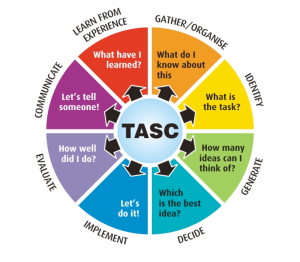
Introduce the TASC wheel to help teams/pupils to structure their response to a given task – start from 1 o’clock and work clockwise round the wheel. Additionally use it as a means of discussing who will be doing what at each point in the process, thereby opening up a conversation about roles and responsibilities.
4: Handling uncertainty…Challenge
You have realised from your own life that what is engaging tends to be what is challenging. Since you see education as a preparation for a learning life, you help pupils to learn how to handle increasing degrees of complexity and uncertainty.
For example:
Use supportive/shared processes to build shared responsibility to deal with challenge.

Provide each team member with a piece of ‘pizza’, plus one spare. Ask pupils to write their own ideas or responses or solutions or questions or answers etc on their own piece. Once complete, the pizza is assembled and the team together distil their thinking and complete the final piece of the pizza. Display either each team’s pizza, or of the distilled pieces from all teams to form a composite view.
Pizza the Action is a Kagan Cooperative Learning structure.
5: Relationships…Working together
Learning is both a sociable and a solitary activity, and you offer your pupils opportunities to experience both. You develop interdependent learners who know how to handle themselves in collaborative groups and able to move around in the social space of learning to best effect.
For example:
Introduce activities that build ‘working together’ behaviours
Prepare the way for pupils to build on the ideas of others when working in a group by making ‘ABC’ a routine that you use during whole-class teaching. Once a pupil has answered a question, ask another pupil to Add to it, to Build on it, to Challenge it, to Defend it, to Elaborate on it, or to Find a Flaw in it. As easy as ABC ! This improves pupils’ listening skills at the same time!
6: Reflection and responsibility…Taking charge
You understand that pupils have to learn how to manage and organise their own learning and that the way to do this is by giving them increasingly demanding opportunities to do so. You orchestrate pupils taking charge of their learning by expecting them to plan what they do, distil meaning from it, and revise it accordingly.
For example:
Prompt pupils to reflect on how they are/have been collaborating.
At the start of this process introduce learning mats to prompt the use of and reflection on collaborating.
A checklist for lesson planning based on these six principles.
Does the lesson plan:
- Make it clear to pupils which learning behaviours are being activated?
- Match and blend the learning behaviour with content?
- Include a tactic to captivate pupils’ attention?
- Have sufficiently challenging learning activities to sustain interest for all?
- Offer choice on how pupils could interact on these tasks?
- Embed aspects of planning, reflecting and revising for content and process?
What do you think?
- Which of these six principles are a regular feature of your planning?
- What do you make of principle 2? Is it the most tricky of the six? The following section B is mostly about this aspect of planning.
- Look at the checklist in the green box above this one: Do your lesson plans capture these six aspects of an effective learning experience?
Make a note of…
- Which of the six principles might need to be given greater prominence in your planning.
B. Big questions to ask about lesson design.
Skim read or leave this section if you have met it in other units because… the section applies to any learning behaviour. i.e. not specific to Collaborating.
What we teach and how we teach it (the enacted curriculum) are intertwined and offer teachers a lot of freedom. It is here that you can start applying a learning power filter and deploy a unique combination of content and learning tasks.
Open Me
Prelude
In conventional lessons where the teacher remains the focus of attention and the initiator of all activity, and where the epistemic dimension (the conditions for acquiring knowledge) is not acknowledged, pupils gain habits of compliance and dependence, rather than curiosity and self-reliance.
In developing learning power, teachers are making conscious choices about which habits to introduce and stretch and how best to couple these with content so that lessons become more interesting and challenging. Through such overt coupling of content and specific types of process, pupils come to know, understand and take control of their learning behaviours – they knowingly use and develop the whole range of learning behaviours.
All lessons function on two levels, they have twin intentions. On the one hand there is content to be acquired, and on the other there are learning behaviours to be exercised in pursuit of this content. The factor that differentiates a standard lesson that effectively ‘delivers the content’ from a learning powered lesson is that the teacher has to think, in advance, about:
- the learning behaviours that are necessary for successful content acquisition;
- the design of activities /tasks that will stimulate these behaviours;
- how learners could reflect on and evaluate their use of these behaviours.
In designing such lessons you have to dare to think differently and flip round your usual lesson design thinking.
A turn-around in lesson design
Think in two dimensions at once – the content dimension and the learning behaviour dimension. It means turning your thinking around – from teaching to learning.
Or put another way
Think to yourself;
- what content?
- using which learning behaviour(s)?
- via an activity to stretch both?
Lesson design questions… one by one
Here the general rules of lesson design have been related to the learning behaviour…collaborating.
Stage 1. What content do pupils need to learn?
What content has to be learned? …..Think outcomes.
- Use standard lesson planning tools:
- What are pupils going to be able to do/learn?…think objectives
- How will they know if they been successful?… think success criteria
- While keeping an obvious eye on
- What do they already know?….think previous learning.
Stage 2. How will they best learn it?
Using which learning behaviours?
This is the new bit
Not the usual second step but nonetheless a vital second step where the aim is to weave content acquisition with learning behaviours. The content is the vehicle for exercising the learning behaviours and the learning behaviours accelerate the content acquisition.
Using which learning behaviours?…Think types of learning behaviours
- Which learning behaviour(s) will help these pupils get closer to understanding this content?…think learning behaviour charts.
- Which aspect of, say, collaborating, lends itself to achieving these outcomes?…think progression columns.
- How skilled are these pupils in using this learning behaviour …think progression phases/rows
Say something like this to yourself .…My pupils need to achieve xxx. At this stage we could get closer to this content by using collaboration. Most of my pupils are able to use xxx phase (e.g. respond/blue) collaborating approaches confidently.
Stage 3. What type of task/activity will stretch the learning?
Which type of task…Think types of task.
Pick up your thinking from stage 2;
My pupils need to achieve xxx. At this stage we could get closer to this content by using collaborating. Most of my pupils would be able to use xxx phase (e.g. blue/responds phase) collaborating approaches confidently.
And now think about the sort of task/activity you might develop/design so as to:
- orchestrate a problem-solving activity to enable pupils’ understanding of xyz content without telling them;
- intrigue them with something that is open to several interpretations;
- stimulate their curiosity;
- grab their attention…visually and aurally;
- allow them to stay stuck before I ask them how they are thinking;
- offer as a nudge to get them thinking differently that doesn’t give the answer away;
- leave it as a problem hanging in the air to which we will return later;
- make links between the challenge, and what and how we are learning in this lesson.
The challenge isn’t about the inherent complexity of the subject matter but about how the content is orchestrated to encourage pupils to use their learning habits to resource their solution.
Think…what/how much information/content do I need to give/reveal? At what point? In what form? To what end?
Say something like this to yourself .…
- my pupils need to achieve xxx.
- at this point we could get closer to this content by using collaborating.
- most of my pupils are able to use xxx phase (e.g. respond/blue phase) collaborating approaches confidently.
- What type of task would stretch their collaboration but assist them with the content…without me just telling them!
To summarise…the heart of the lesson
It’s the question ‘using which learning behaviours?’ that causes you to think differently about the lesson planning.
- You ask – as always – what are the anticipated objectives/intentions?
- The verbs in your resulting objectives will give you clues about the types of task/methodology that will get pupils there and the sorts of learning behaviours your pupils will need to contribute to this learning endeavour.
You are designing the task in a way that requires pupils to contribute their learning ‘powers’ / behaviours. The tasks you design will hook into their learning ‘powers’ and help them to improve them.
Say something like this to yourself:
I am going to think content, learning behaviour and task together:
- Collaboration will help pupils to better access the content;
- The aspect of collaborating (column) and phase (row) that would fit best is (for example) building on and improving the ideas


- The type of task/activity that would best stretch both content and learning behaviour, intrigue, challenge, bring people together and give responsibility to pupils is………
- Think….what information do I need to reveal/give, in what form, at what point, and what do I want pupils to do with it?
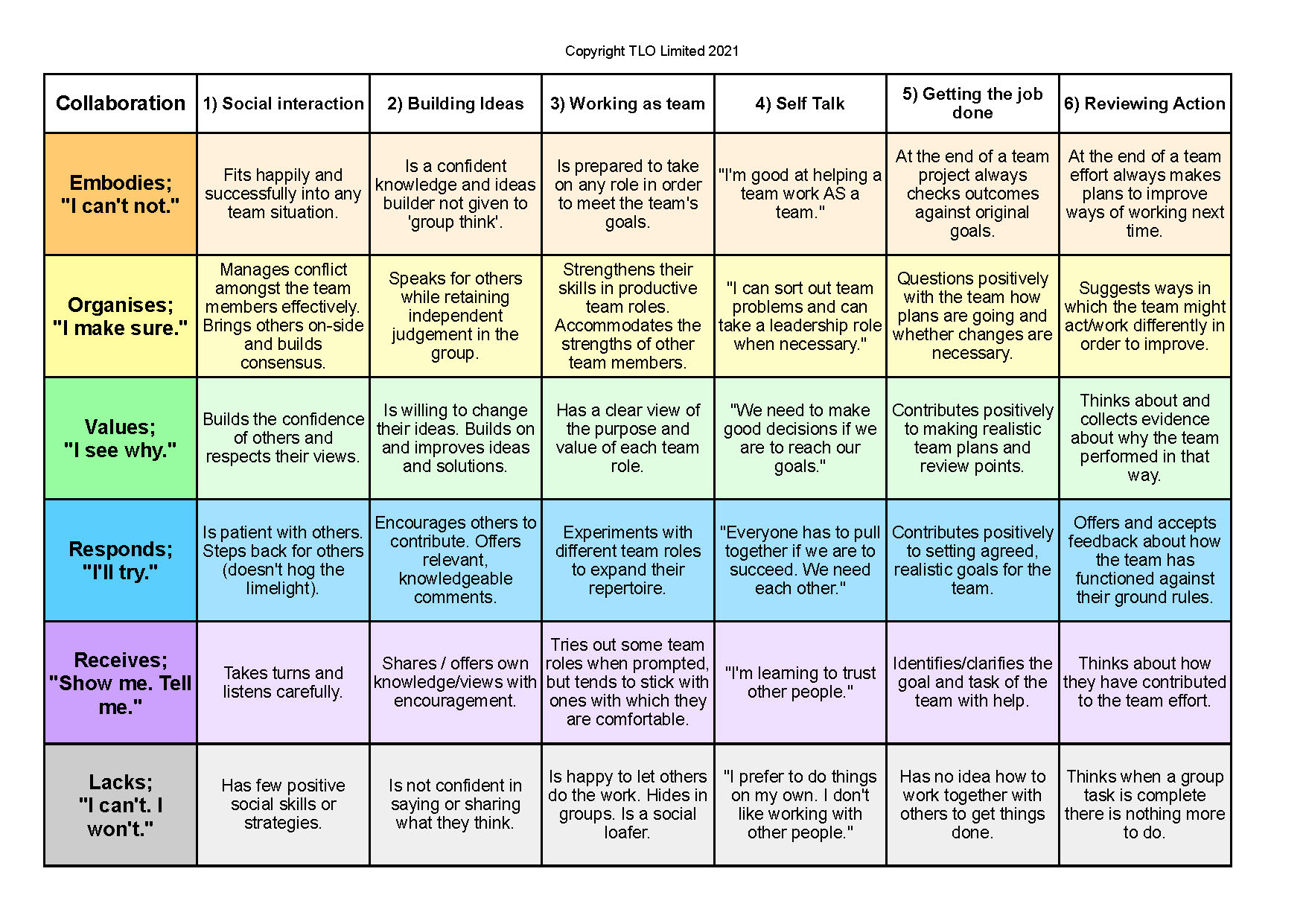

What do you think?
- What strikes you about this way of planning with learning behaviours in mind?
- Where are the potential stumbling blocks?
- How will you decide which learning behaviour(s) you are going to foreground in your objectives?
Consider a lesson you are about to teach…
- What is the content?
- Which learning behaviour(s), if missing, would make accessing the content very difficult / impossible?
- How could you blend reference to this learning behaviour(s) into the learning objectives?
- Can you design a task that will help pupils to access the content and exercise the key learning behaviour(s) you have identified?
C. Lesson planning in action – an exemplar, collaborating focused, task.
How do we design tasks that stretch Collaboration and assist pupils to approach the content more productively? We cover this in four ways:
- 1 Collaborative group-work: principles and checklists
- 2 Collaboration focused task
- 3 The lesson plan shown as a simple grid
- 4 Extend your thinking about this type of task
Open Me
1. Collaborative group-work: principles and checklists
Take a look at these words from an Ofsted report from a visit to an outstanding school:
‘Though pupils have many opportunities to work collaboratively they do not always do so effectively or understand the different roles they might play within a group. The school should ensure that pupils understand how to work effectively in a group and that they all have the opportunity to take on different roles.’
Here and elsewhere, there is a need to deepen pupils’ social learning habits to ensure that they have a robust understanding of what it means to truly collaborate and are regularly putting these habits into practice.
In many classrooms, pupils are required to work together – though not as frequently as one might suppose – but they are rarely set challenges that require high levels of collaboration nor are they helped to disaggregate the attributes and habits of effective collaborators.
Genuine collaboration requires:
- Appraisal of the task in hand
- Agreement as to the imagined outcome or goals
- Systematic thinking: setting deadlines and check-points
- Understanding of the roles and responsibilities that need to be discharged
- Open-mindedness and creativity
- Appropriate and distributed leadership
- Evaluation of the time and resources needed to accomplish the task
Your job as a teacher is to ensure that these Seven principles of effective collaboration are understood and adopted by all pupils. This isn’t done by telling them what they are but by drawing them out in agreement with the pupils themselves.
Thereafter you will need to ensure that collaborative tasks lend itself to collaborative group-work. That is to say they:
- Sustain long-term pupil engagement
- Are open-ended and challenging
- Depend on the use of a variety of roles and responsibilities
- Involve all partners
- Lead to urgent and purposeful procedures
- Require choice and decision-making
- Lead to prioritised action and successful outcomes
A useful checklist to set against any collaborative tasks you design.
2. Collaboration focused task.
Here we work through a lesson that aims to combine:
- surviving in a desert (content)
- collaboration, teamwork (in particular learning behaviours in the xxx phase)
- a ranking order type task.
See if you can spot the collaboration principles that have been embedded.
The lesson has 7 episodes as follows:
Episode 1 Noticing detail and a reminder to use teamwork ground rules
Episode 2. Sharing and building ideas
Episode 3. Agreeing a goal and dealing with controversy
Episode 4. Making good decisions in planning and foreseeing obstacles
Episode 5. Assessing individual contributions to the team effort
Episode 6. Assessing team performance
Episode 7. Reviewing team performance in view of knowledge of the experts’ answer
All these aspects of teamwork are taken from the Collaboration chart
In this lesson the teacher is orchestrating the activity – splitting it up into episodes and guiding it along in order to highlight/stretch/provoke particular aspects of collaboration.
But you could run this activity without any structuring, i.e. just set the task, observe the action and let groups know when time is up.
Objectives and explanation of how the format works
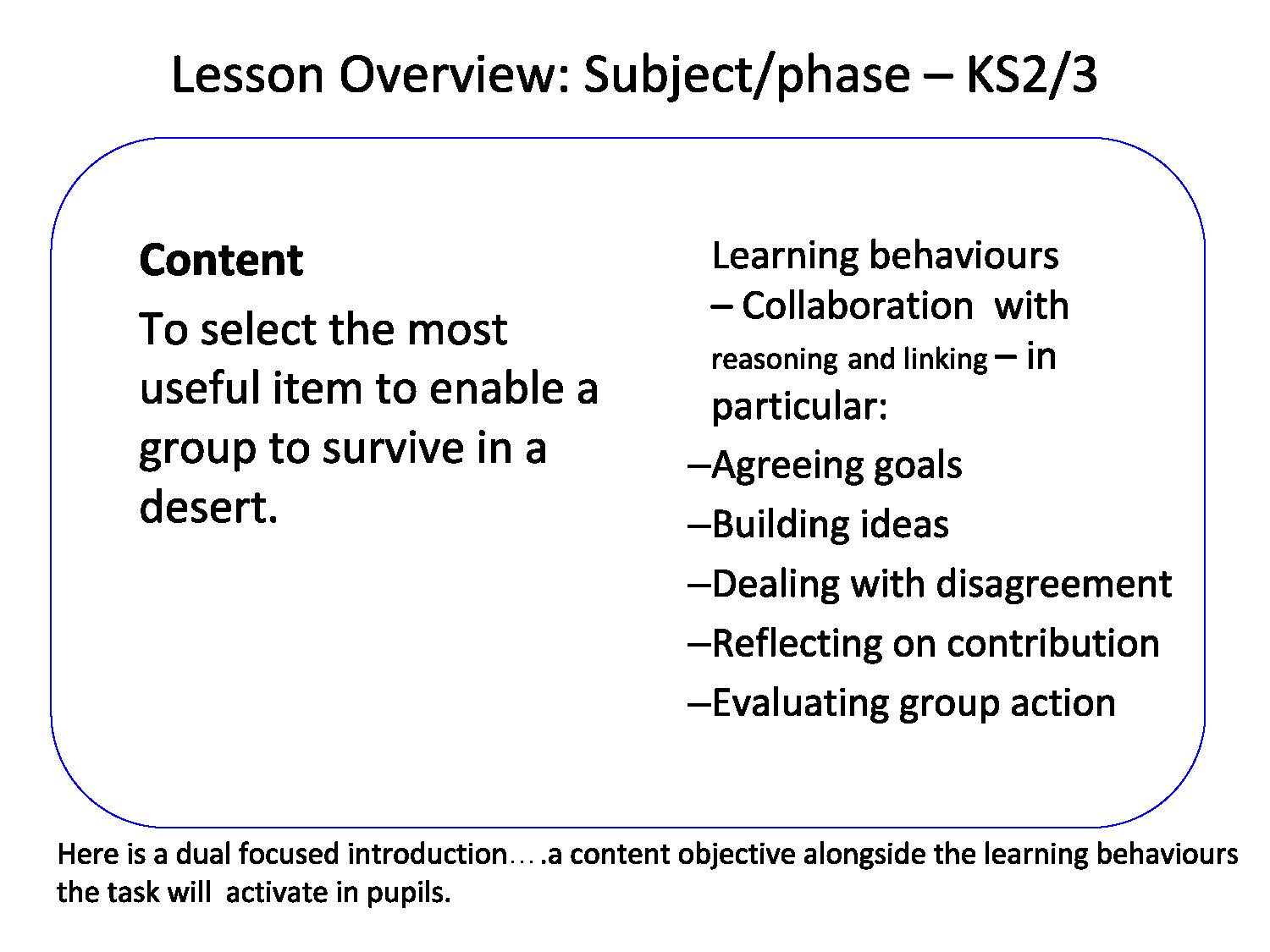
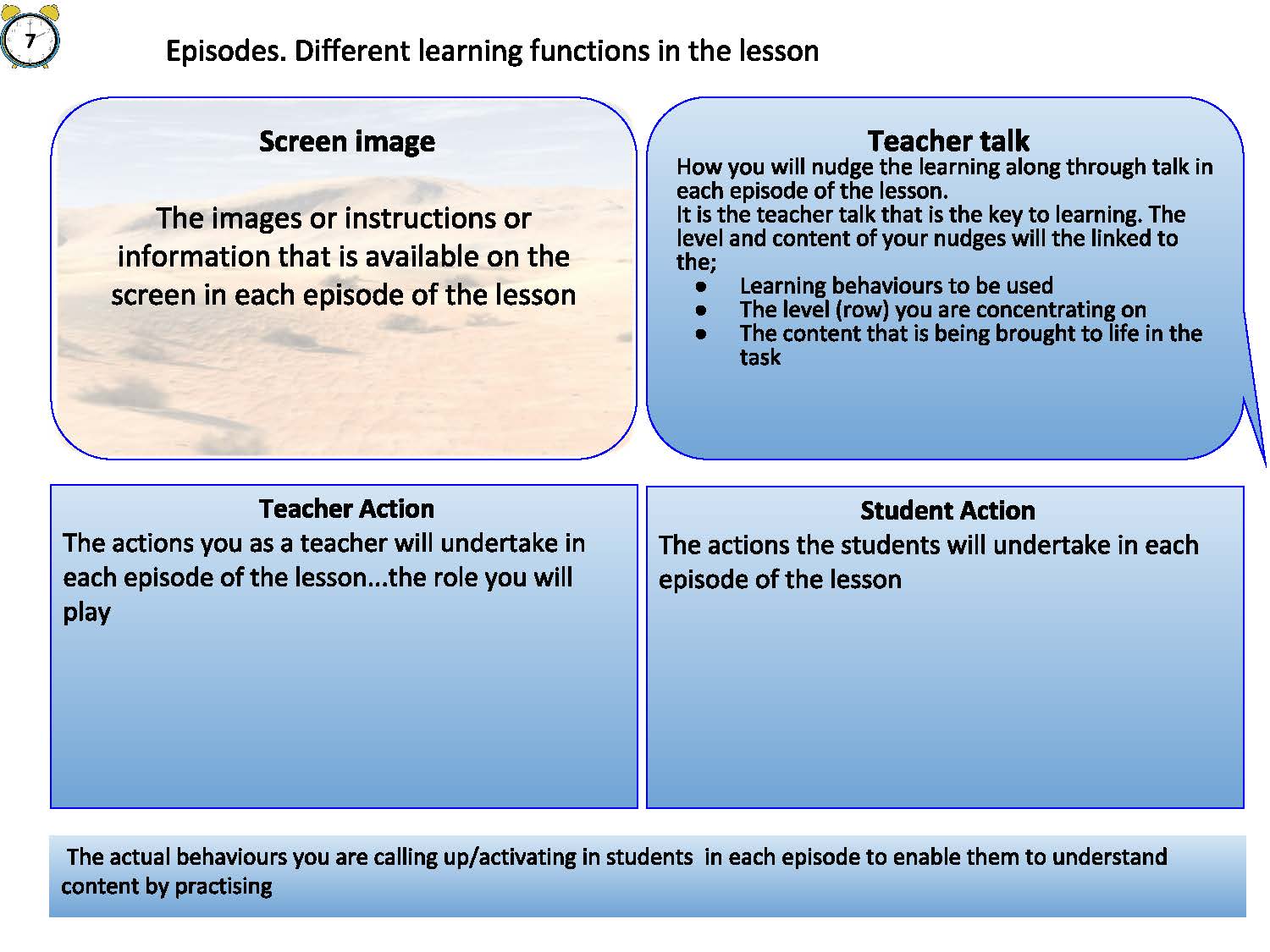
N.B. We are activating general teamwork conventions here. These are activated through teacher talk

 Episode 1 – Setting up the challenge
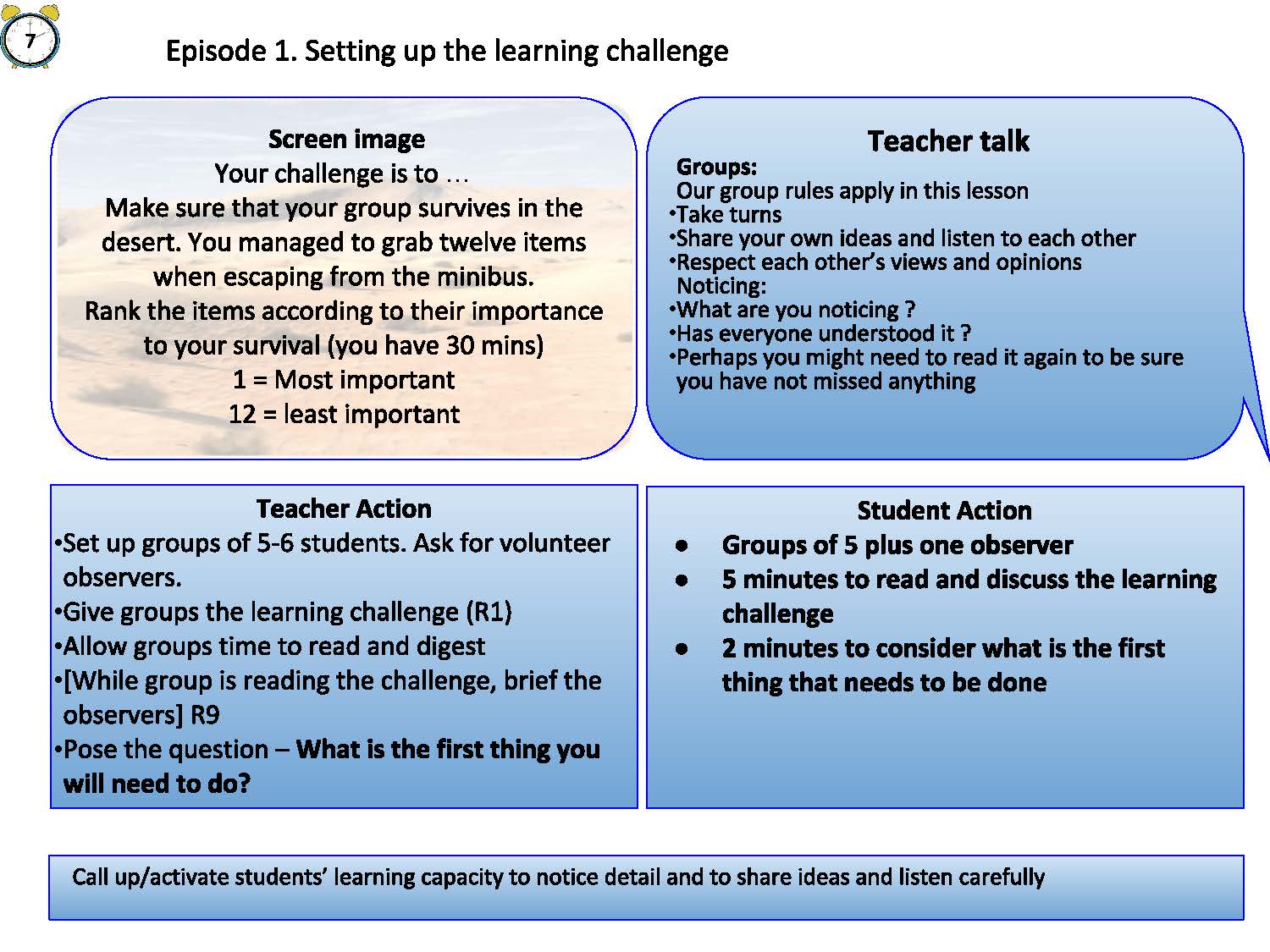
What’s happening here?
1.Time 7 minutes
2. Screen image. The hook An intriguing challenge to get pupils engaged. You may want briefly to summarise the task ahead.
3. / 4. Teacher Action and Pupil Action This first episode is designed to encourage groups to become familiar with the challenge, to begin to think about how they will tackle it, and so resist the temptation to rush into action.
Resources 1 and 2: The learning Challenge – Stranded (R1) and Observation sheet (R2), 1 per group
5) Learning behaviours. In this episode pupils will be using their noticing skills to get under the skin of the challenge and their collaboration skills to identify what the task is about (collaboration purple) and to begin to prioritise action (collaboration green).
6) Teacher talk:- Here we suggest the sort of teacher talk that is designed to nudge the learning behaviours in the right direction, and supportive of the sort of discussion you are trying to orchestrate. This talk will of course be tailored to the age and existing learning behaviours of your group. The examples given in the teacher talk box nudge pupils to observe the conventions of group work and to be attentive to detail.
Episode 2 – Possible survival strategies

What’s happening here?
1) Time 8 mins
2) Screen image – Posing key questions
3/4 Teacher and Pupil Action. Purpose: To steer pupils to realise that they cannot begin to rank the relative importance of the items until they have decided together on their strategy for survival – [Walking to the ranch would make the compass and map important, whereas staying put and awaiting rescue would not]. The group activity suggests groups generate at least three possible survival strategies. (Possible strategies could be: go to ranch; stay put; retrace minibus tracks; walk in general direction of hotel; walk to try to find a road . . . . )
(A teaching point – pupils will usually gravitate to the ‘go to the ranch’ strategy, in the expectation of finding people, shelter and water. The unspoken assumption is that it is a working ranch with people at it who can help. To help them to avoid this course of action (which is wrong anyway) you might need to nudge their thinking with comments like ‘what do you actually know about the ranch?’ and ‘what can you be certain about?’)
5) Learning behaviours: -In this episode pupils will be using their imagination based on information given to generate possible courses of action. In collaboration terms, the team need to share and offer their own views (collaboration purple) and make relevant comments (collaboration blue)
6) Teacher talk:- this needs to be tailored to the age and existing level of questioning behaviours of your group. The examples given in the teacher talk box nudge towards careful consideration of various alternatives.
Episode 3 – What should we do?

What’s happening here
1) Time 5 mins
2) Screen image – Time for groups to decide on their strategy
3/4) Teacher and Pupil Action. Purpose – to require groups to agree on their preferred/agreed survival strategy.
5) Learning behaviours: – In episode 3 pupils are required to consider the strategies they thought of in episode 2, and to agree which one they intend to adopt. In collaboration terms, they are seeking agreement in setting goals and resolving potential differences of opinion, dealing with possible controversy (collaboration blue and green).
6) Teacher talk:- intervene in groups as and when necessary in order to prompt further consideration and/or to agree a way forward, or ways to resolve conflict.
Episode 4 – What do we need [most]?

What’s happening here?
1) Time 12 mins – Ensure groups are aware of the time limits in this episode.
2) Screen image – Here groups to identify precisely how they are going to use the items to ensure survival
3/4) Teacher and Pupil Action. Purpose – to enable groups to plan how they will use the items to give themselves the best chance of survival.
5) Learning behaviours: – In episode 4 groups are required to make good decisions to reach their goal (collaboration yellow) by making links to prior knowledge/experience and by capitalising on the potential uses of the items taken from the bus.
6) Teacher talk:- intervene in groups as and when necessary in order to prompt them to exploit the potential uses of the items.
Watch for how they pull together as a group; how they encourage others to contribute, how they contribute to making good decisions.
Episode 5 – How did I do?

What’s happening here?
1) Time 3 mins
2) Screen image – Pose the question about individual contributions to the group.
3/4) Teacher and Pupil Action. The main activity is now finished. Purpose now is to enable individuals to reflect on their personal contribution to, and feelings about, the process. Allow pupils to reflect individually. Could be done as a pair exercise if pupils trust each other. Try to get a sense of how honest pupils are being regarding their contributions
Resource 3 – Post Decision questionnaire, 1 per pupil
5) Learning behaviours: – In episode 5 individuals are required to think about how they have contributed (collaboration purple) to the activity, their feelings about the extent to which a good decision was made and the extent to which their views were respected (collaboration green) .
6) Teacher talk:- intervene only if necessary
Episode 6 – How well did we do as a team?
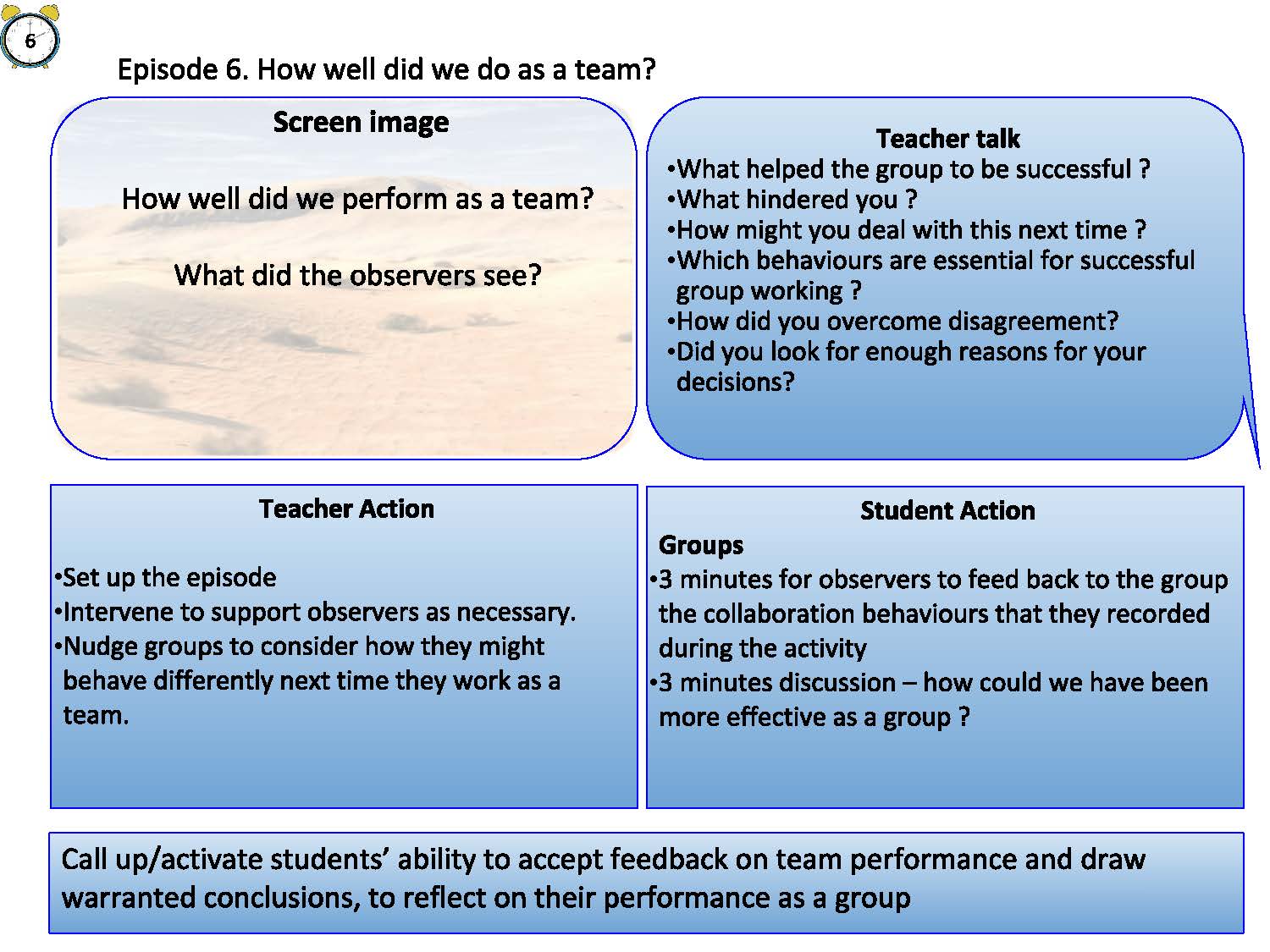
What’s happening here?
1.Time 6 mins
2. Screen image – Time now for observers to feedback on group/individual behaviours and generate evaluative discussion.
3/4. Teacher and Pupil Action. Purpose – to help groups practise reflecting on their team-working during the activity.
Resource Observing a Learning challenge – stranded
5. Learning behaviours: – In episode 6 the observer/groups will offer/accept feedback on their own and group performance (collaboration blue) and evaluate team effort (collaboration yellow).
6. Teacher talk:- intervene in groups only in order to prompt groups to hear the observer’s feedback with a view to using it to improve.
Episode 7 – What the experts say
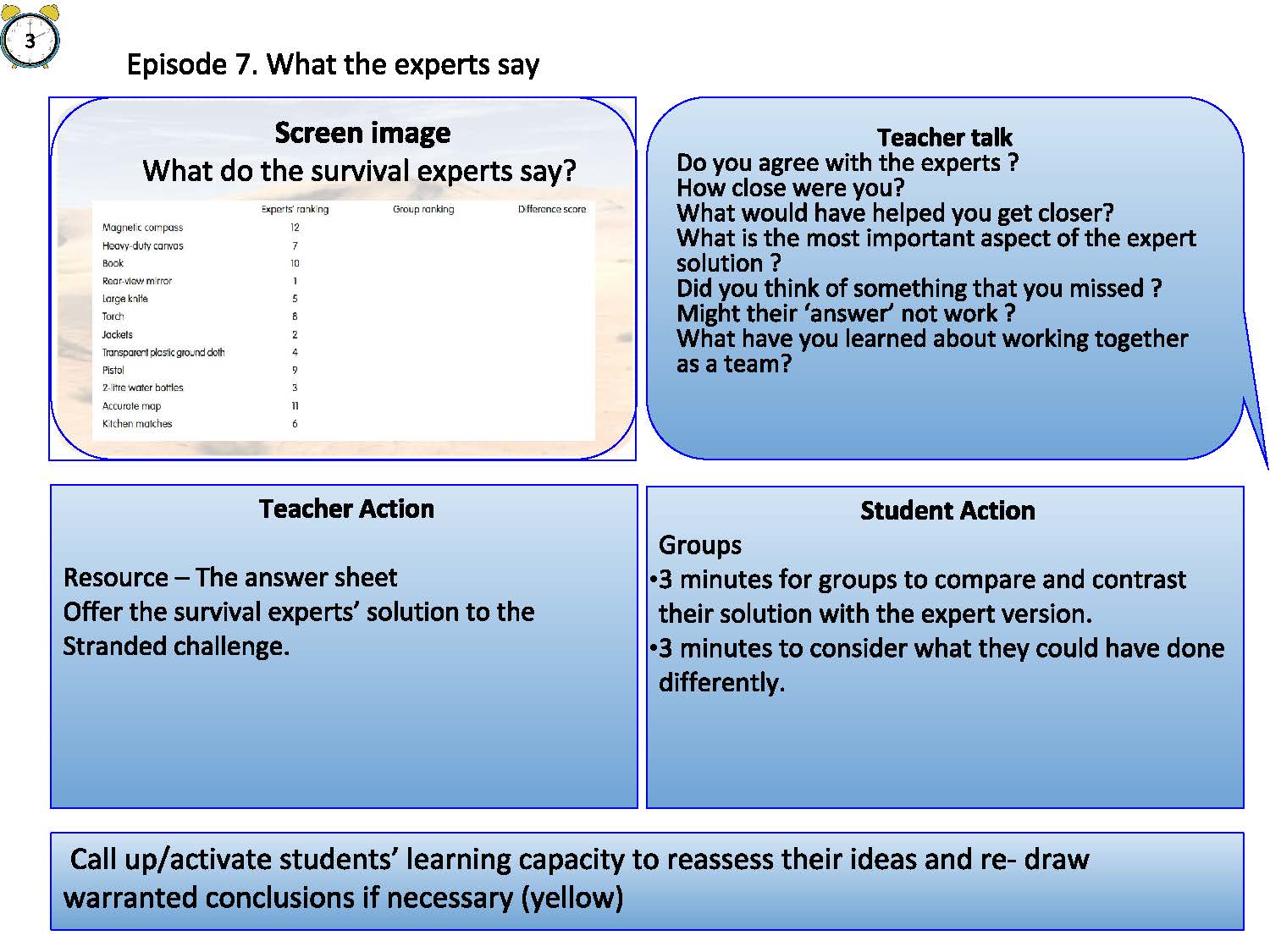
Resource – The Learning Challenge: Answer sheet.
Let teams see the experts’ answer and estimate how close they come to this. Also encourage teams to think about what they might have done differently to achieve a closer answer.
Here is the PPt of the lesson plan format shown above. This animated version may help understanding.
What do you think?
- Have you thought of a lesson as a blend of teacher actions, pupil actions, learning behaviours, and teacher talk before?
- How could you use this type of activity to advantage in your own classroom?
Make a note of…
- Your initial reactions to the Stranded activity.
3 The lesson plan shown as a simple grid.
Here you will find the Stranded lesson translated into our simple lesson plan format.
The format is divided into episodes to show the change of purpose, action and use of learning behaviour across the course of the lesson:
- What you do (teacher action);
- What pupils do (pupil action);
- The learning behaviours being called upon to be activated (from progression charts);
- What you say (learning talk) to nudge the learning behaviour along.
Download a blank lesson plan as a MS Word document: Lesson-Planning-Grid [.DOC 33KB]
You can download the completed format here.
What do you think?
- Does planning for four aspects – teacher action, pupil action, learning behaviours, teacher talk – seem useful?
- How does sequencing the lesson as ‘episodes’ help or hinder planning?
Make a note of…
- The extent to which your existing planning template enables you to think about lessons in this way.
- What you would like / need to add to it.
4 Extend your thinking about using this type of task
a) Other ways to organise this type of lesson
Allow greater freedom
The version of Stranded we have unpacked is ‘hand-held’, in other words you as the teacher did a lot of the work nudging the action along. But it is possible to run this sort of activity such that you simply set it up, let it run and concentrate on what happened in a big debrief at the end, It goes something like:
- 1 Set up a scenario and a goal (change the setting to suit i.e. not a desert)
- 2 Remove yourself from the activity and let the group get on with it
- 3 Leave out any help or nudges that might steer pupils to the right/appropriate answer
- 4 Dispense with the ranking task and ask pupils to decide on/agree only the most essential/important object/ activity to ensure safety/success
- 5 Allow 30 mins for this decision making process
- 6 Reveal the answer before reflecting on the process
- 7 Allow 15 minutes for reflecting on the group process. Leave out the individual reflections
Focus the activity on questioning
- Set up a scenario and goal to select the most essential object to bring about the best solution
- Leave out any nudging and dispense with the ranking activity
- Add in rules such as only able to use open questions in making the decision or limited to 10 or 20 questions in reaching a decision
- Appoint an observer with a checklist of types of questions
- Allow 20 minutes for the decision making process
- Orchestrate 15 minutes reflection on the use of questions using comments and observations from the observer’s analysis.
b) Where else in the curriculum might this sort of task fit
Small groups could be asked to:
- design a science experiment and choose from a range of possible resources;
- undertake a design and make task in D&T;
- work together to create a performance in the expressive arts.
What do you think?
- Where / when / why might you use Stranded or similar technique?
- Where else in the curriculum would you want to give practice in group decision making?
- How will you ensure that this type of group work is frequently an integral part of lessons, and not just a ‘catchy’ activity before the ‘serious’ work begins?
Make a note of…
- Which class/group/subject you might try this activity with.
- When you will try it?
Section 2: Building Collaboration friendly classroom cultures
Teachers as habit formers
As teachers we are in the habit-forming business. What we say, what we display on classroom walls, what we celebrate, praise or dismiss, what we model or how we design learning activities will all influence the ways in which pupils learn, perform and behave. Classroom cultures have a huge influence on pupils’ learning as you will remember from the Culture unit.
Five big shifts to get you started. Ask yourself – how might you:
Ensure high levels of inclusion, acceptance, affection, support, and trust to build group cohesion?
Create opportunities for students to resolve conflict and build consensus; helping controversy and conflict to be seen as a positive key to students’ involvement, the quality of decisions and the continuance of the group in good working condition?
Design group work activities to provide opportunities to experience different methods of decision-making?
Encourage students to extend the range of roles that they adopt when collaborating?
Help students to reflect on and evaluate their individual contribution to the group’s progress?
Now look at the Learning Chart sections below where you will find plenty more ideas to try.
Section 1: Collaboration and how it develops
1a) What is Collaboration?
Pair work, group work or teamwork are frequent features of classroom practice across all age ranges. But what are the essential features of this way of learning? How can students improve their collaborative behaviours in order to achieve better results?
In this unit, we explore the subtleties of collaboration and the skills that make up teamwork. We consider a broad order in which such skills might be explained, orchestrated, commented on and celebrated by teachers in classrooms to ensure the progressive development of students as collaborative learners.
There are many ways to define collaboration. In a learning context we have come to understand collaboration as being able to manage yourself effectively in the give and take of a collaborative venture, having a range of interpersonal skills that enable you to work and learn with and from others, being willing and able to contribute constructively and with sensitivity, and adding to and drawing strength from the team itself.
At its least sophisticated, it is little more than being cooperative. At its most sophisticated and complex levels it goes beyond learning ‘in a team’ and becomes learning ‘as a team’. It is an invaluable life skill.
In short…
Collaboration: Having both the skills and the inclination to contribute positively to group work in order to learn productively with and from others.
What do you think?
- Are you aware of pupils whose lack of social skills limits their ability to cooperate, let alone collaborate, with others?
- Are you aware of pupils who regard group work as an opportunity to allow others do all the work? (the social loafers,)
- Are you aware of pupils who are keen to do all of the work themselves to the exclusion of others? (the job hogs)
Make a note of…
- Pupils who do not trust others to contribute effectively
- Pupils who are reluctant to contribute to group work
What does a well-formed habit look like?
Effective collaborators are adept at learning with and from others. They help to: shape the ideas of the team; decide what needs to be done; contribute to getting the job done; keep an eye on how things are going; improve team performance through reflection.

At-a-glance Collaboration card [extract] – Click image to view full screen
Find out more about Collaboration:
A well-formed collaboration habit includes being ready willing and able to:
- Work effectively with others towards agreed, common goals, acting flexibly in response to circumstances.
- Adopt different roles and responsibilities in pursuit of agreed goals and the well-being of the team.
- Hold and express opinions coherently, compromising and adapting when appropriate.
- Seek to understand what others are saying; sharing, challenging, supporting and building on ideas.
What do you think?
- Do your pupils become increasingly like this as they move through your school?
- What makes you say that?
- What do you currently do in school that encourages pupils to develop their social learning skills?
- What might you be doing to inhibit collaborative learning?
Make a note of…
- Things you do to support collaboration
- Things you do that might hinder collaboration
1b) How Collaboration might build when we nurture it.
Being collaborative isn’t something that switches on on good days and off on bad days. Being a good collaborator grows and builds when it’s nurtured and supported. Furthermore, being collaborative involves gaining control of a range of linked skills and emotions. Take a look at how progression in Collaboration might grow across six contributory aspects.
Cast your eye over the ‘big picture’ of growing Collaboration below. Then move on to finding out what the columns (1.3) and the rows (1.4) are all about.
1c) Unpick the columns; what contributes to a readiness to Persevere?
The grid columns are things that might combine to make up the skills and attitudes of a Perseverer.
Overview of the grid
Collaboration involves knowing how to learn with others, as part of a team, in situations where no one person knows all parts of the puzzle. This complicated yet essential learning habit develops in several different ways. First of all it hinges on social interaction; how well we get on together, whether we are patient with others and respect their views. Then how we are able to bounce off others to build ideas; making the most of several brains rather than one. Next, how we learn to be part of a team and to perform different roles when needed. Fourthly, how we talk to ourselves about learning with others, where our real understanding of the process is revealed. Fifthly, how we contribute to the process of actually getting things done. Not just being there but doing something helpful. And lastly how we contribute to improving team performance by evaluating not just outcomes but the process of getting there.
Take a closer look at what each column of the grid is about
 1) Social interaction
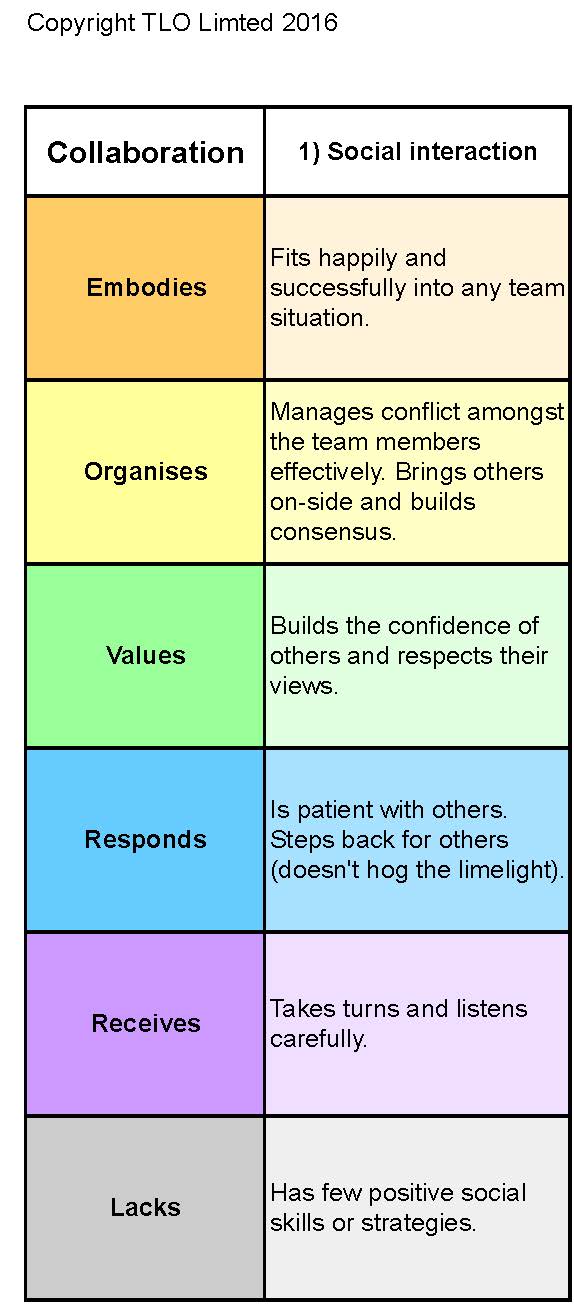
How we interact socially in learning and working with others. The way in which we learn the social conventions of behaving in a group; taking turns to speak and contribute, listening to understand others; being patient with others and not hogging the limelight; stepping outside our own concerns and building the confidence of others and respecting their views; being able to manage and overcome the inevitable controversy as teams work creatively together; and thus being able to become a valuable sociable member of any team.
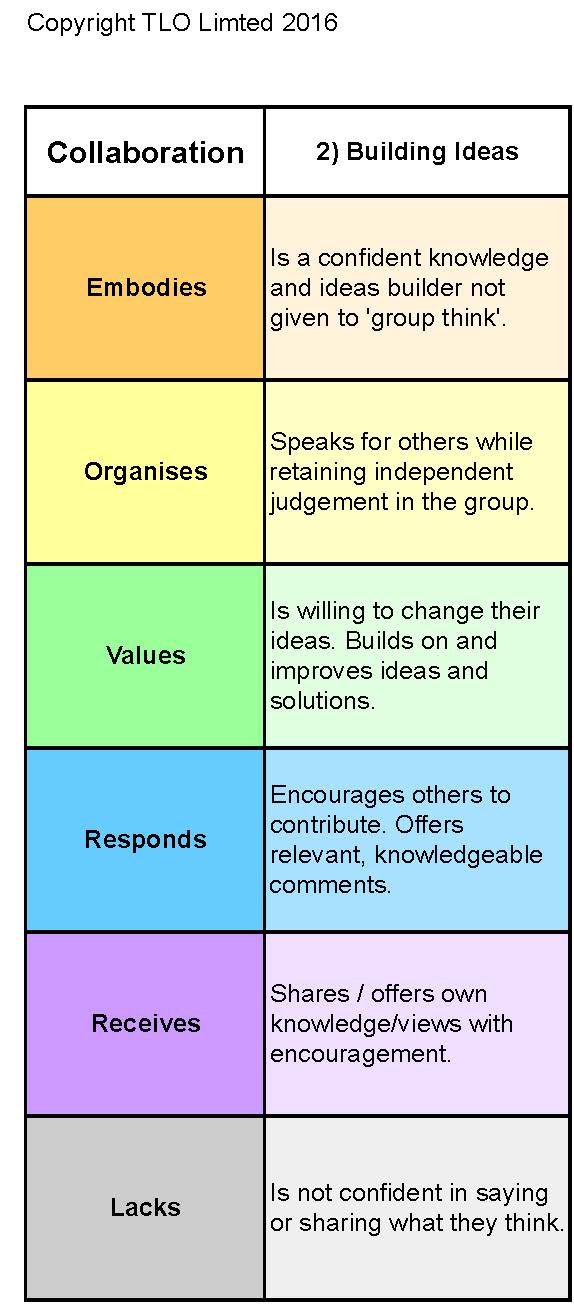
2) Building ideas
Just being good mates in a team doesn’t lead to success. Teams have to understand how to build ideas together; to draw on the ideas of others, to be able to graciously set aside ideas that wouldn’t work, to spark off others to ensure new and better ideas get an airing. And somehow, in all this ‘togetherness’ people are able to retain their independent judgement and avoid being drawn into group think. Teams share and build ideas together; growing and improving possible solutions in order to reach their goals
 3) Working as a team

Working as a team is rather different to working in a team. It’s all about ‘teamness’ or ‘togetherness’. In order to work as a team people need to understand team roles, to find out what role they are particularly good at, to take on a range of roles when needed and eventually be willing to play any role in a team to ensure the goal is reached. Being able to work as a team is influenced by how our self-perception and confidence grow, how we learn to trust, how we recognise the need for each other.
 4) Self talk
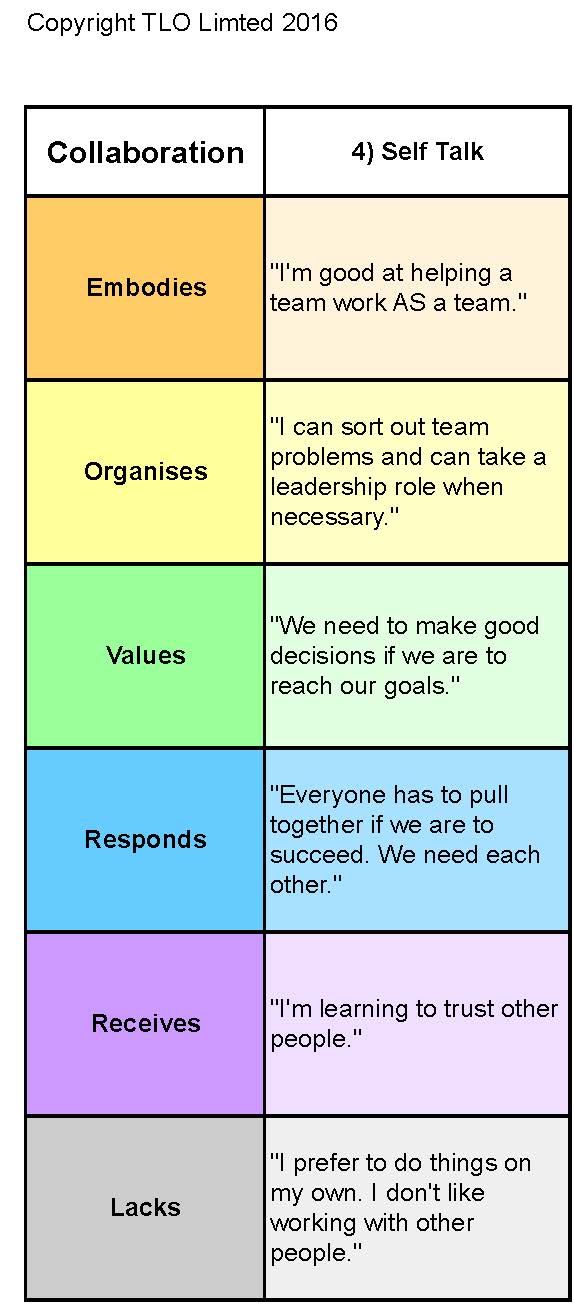
The voice of self awareness
- Self-talk is what we say to ourselves as we learn. The statements capture what someone in each phase of the grid might be thinking. Students may use some of these phrases when talking with you, or in writing from time to time, but mostly self-talk goes on inside their heads. We have shown a small flavour of self-talk thoughts that teachers can encourage students to imitate. Some relate to standards, others to self-monitoring, or flexibility. All such self-talk is important in building a collaborating habit.
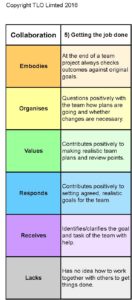 5) Getting the job done

How teams achieve their goals by using the well-known learning process of Plan Do Review. Good teams have people who know that the first job is to be clear about what the task is really about. They are skilled in considering/creating/agreeing realistic goals to be achieved and which everyone has bought in to. Then the team have to plan how they will achieve the goal, how they will monitor their progress and methodology and how they will make sure the job is well done.
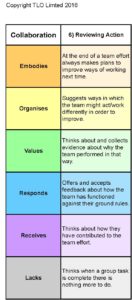 6) Reviewing action

This aspect is about how teams learn how to improve. It’s the aspect of teamwork that is frequently left out altogether or given short shrift. But it’s the aspect of teamwork that helps teams build themselves into better teams. It includes evaluating how they performed as individuals in contributing to the work of the team and how/whether the team process worked to achieve the team goal. Importantly such reflection leads to serious re-planning of their ways of working. It’s meta learning at a team level. Good teams will be looking for what has become known as marginal gains, those little things can we do better/improve that will impact on the overall performance.
What do you think?
- Do these contributory features of collaboration make sense to you?
Make a note of…
- Things that you think might be missing from this big picture of collaboration
What do you think?
- Do you think there’s an order in which these skills develop? Would it be the same order for every pupil?
- Do you think these behaviours develop ‘naturally’ as children mature?
- Do we need to intervene in order to support this positive development?
Make a note of…
- Any behaviours you think develop naturally
- Any behaviours you think may be missing from this picture of collaboration
1d) Unpick the rows; getting better at Collaborating.
Of course the development of collaboration doesn’t grow neatly up each column or even across the columns. However, it is possible to look at the grid another way and group cells together into five broad phases of dispositional growth. We have based this growth on Bloom’s taxonomy of the affective domain. By looking at the development of emotion and skill, the grid yields broad ways in which people may be inclined to behave: we call this inclination ‘mindedness’.
Here is our interpretation of how Collaborating might grow.
Meaning behind the phases
The phases are drawn from Bloom’s taxonomy of the affective domain.
Phase ‘Receives’ (purple) is about doing something because you are told or expected to.
Phase ‘Responds’ (blue) is about gaining interest and doing things more willingly.
Phase ‘Values’ (green) is a key phase since the student now sees the value of behaving in this way. It’s a win for them; to behave like this is in their interest. It’s in this phase that the behaviour becomes more secure.
Phase ‘Organises’ (yellow) is the phase in which the student capitalises on this ‘in their interest’ behaviour and gets themselves organised to use it positively.
Phase ‘Embodies’ (orange), known as ‘characterised’ in the original taxonomy. In this phase the student has made this behaviour their own. It has become part of their character; they can’t not do it and they have become highly skilled in doing it.
We urge you to see this progression as long term. Some phases will take years for people to work through; some will never be worked through. None of the phases are inevitable. There is a lifetime of development captured here. Nevertheless the role of a teacher or parent should surely be to encourage and enable this journey.
Lacks:

In this ‘Lacks’ (grey) phase, pupils are often unsure of themselves in a group. They often learn and play alongside other children but collaborating together is far more tricky. Their social skill may not be conducive to working with others either tending to push themselves forward and take control or shying away and saying/contributing little. They have much learning and adapting to do before they are really ready to work in a collaborative team.
Receives: Minded to begin to collaborate with others

In the Receives (purple) phase, pupils are making a big leap from being wary of others, being unaware of social conventions or any of the advantages of working/learning with others. Here they are collaborating with others because they are required to. There is much to be done in this phase: social skills, sharing ideas, working out what needs doing, playing their part and even thinking about how they have contributed to the team.
Responds: Minded to be part of a team

In the Responds (blue) phase pupils are willing to develop their understanding of what being part of a team involves, agreeing goals together, trying out different roles, broadening social skills to opening up others.
Values: Minded to function flexibly as part of a team

In the Values (green) phase pupils see/appreciate the value of a team member and honing their skills in different roles, planning action more carefully, and being flexible in their own views for the sake of the team. Once this phase is secure pupils are likely to develop further skills by having opportunities to work in this way.
Organises: Minded to learn in and as a team

In the Organises (yellow) phase, pupils organise themselves to work as part of a team. They learn that skilful teams manage conflict and that conflict and controversy are positive keys to involvement and creativity; that high-performing teams frequently check their progress and adjust their practice to stay on track.
Embodies: Minded to see Collaborating as a way of being.

In the Embodies (orange) phase, being a skilled team player is what characterises the student. They work happily and skilfully in any team, confident in their social, task development, planning, reviewing, and team evaluation strategies. A valuable member of any team.
What do you think?
- Which phase of collaboration mindedness do most of your pupils fit into? They may of course be developing in more than one phase at a time.
- Are some in the grey zone ? – i.e. collaboration is missing altogether.
Make a note of…
- The pupils who don’t appear to be mainly in the grey zone
Preparation for the Learning Team meeting
Where are my pupils now?
- Take a look at the Collaboration progression chart in your Learning Diary or
- Download chart to colour in here
- Colour in the cells where you think your pupils are secure.
- Some pupils will barely be on the chart while others may be quite a way up. Neat straight lines of secure classes are just about impossible. But looking at your class in this way should give you an idea of what you need to work on.
- Draw a red line across the chart to denote where you think most of the school’s pupils could and should reach by the time they leave.
- Please take the results of these tasks with you to the Professional Learning Team session shown in Section 4
Section 4: Team reflection and planning
If you want to read again the notes on Professional Learning Teams, click on the view notes tab in this box
Professional Learning Teams: what and how
The purpose of these meetings is for the team to act as a teacher learning community or Professional Learning Team: a small group of teachers who meet together regularly to deepen their understanding of building better learners, commit to trying out new things, reflect on and share their experiments with each other. Such learning communities are the engines of teacher development. They work best with 6-8 teachers with similar subjects or age groups, and who meet for about an hour regularly over a period of a couple of years.
The group question and probe each other’s summaries of their experiments in order to encourage analysis and deeper reflection. They use questions such as ‘What do you think is getting in the way? What would make this even better?
How could this technique be modified to make it work for you? What do you think made that happen? In this way they support each other in changing and developing their practice.
Some guidelines for team reflection sessions
The delicate, hard work of changing practice requires a safe professional environment in which to explore and understand both triumphs and tribulations. These short guidelines may be helpful in setting a climate for the team itself.
- Everyone is expected to report back on their classroom experiments
- Coaching questions and probes of colleagues’ classroom experiments encourage deeper reflection.
- The group is careful to follow their agreed ground rules which might include;
- No group member can ‘pass’
- Listen between the lines when it’s not your turn
- Actively discuss everyone’s input
- Constructive criticism – developmental not judgemental
- Everyone fully engaged in the group
•What is said is confidential to the group
• Respect others’ views and encourage others’ ideas - No-put downs
- Maintain an open mind
What-Why-How-of-PLT.pdf
Session agenda
If this team session is your first one in Stepping Stones, miss out item 2.
1. Session objectives
What do we want to achieve? ( 5 mins)
2. Sharing classroom experiments
How did our experiments go? ( 20 mins)
Share
- the changes in practice you tried
- how students reacted
- what you learned
- what next as a result
Probe
- what was getting in the way?
- what seemed difficult?
- what would make it easier?
- what made it work particularly well?
- why it was successful?
- changes in your behaviour
Impact
- Avoidance of…..
- Improvements in……
- Increases in…….
- Little of no changes in…
3. Recapping on-line materials
What did we think of the materials? ( 15 mins)
Reactions to
- The Me Learning grid
- Where pupils are secure
- Where the pupils could be secure when they leave for secondary school
- Classroom culture ideas
- Activities and talk ideas
4. Planning what to do
What do we need to do next? ( 10 mins )
Decide
- Which ideas should we all adopt as a school strategy?
- How the progression of Me Learning should be built across the school. ie how the phases of Me Learning might play out against key stages and even year groups.
5. Personal action planning
What am I going to do? ( 20 mins )
5a.Consider
- how you want your pupils to improve/develop/enhance their approach to Me Learning?
- what you are going to do to bring this about?
- develop your enquiry question.
Think of it like this…
If I do XXXX will it improve/develop/enhance YYYY
This is the crunch question. Your pupils are unlikely to change unless you change!
Capture your learning enquiry as a question
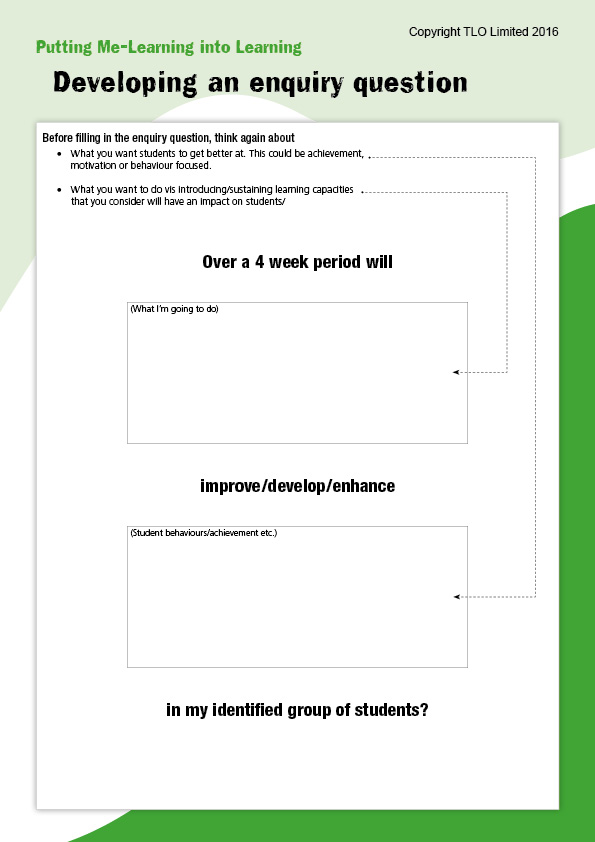
Developing-an-enquiry-question-Revising-Me-Learning.pdf
5b.Put a short enquiry plan together
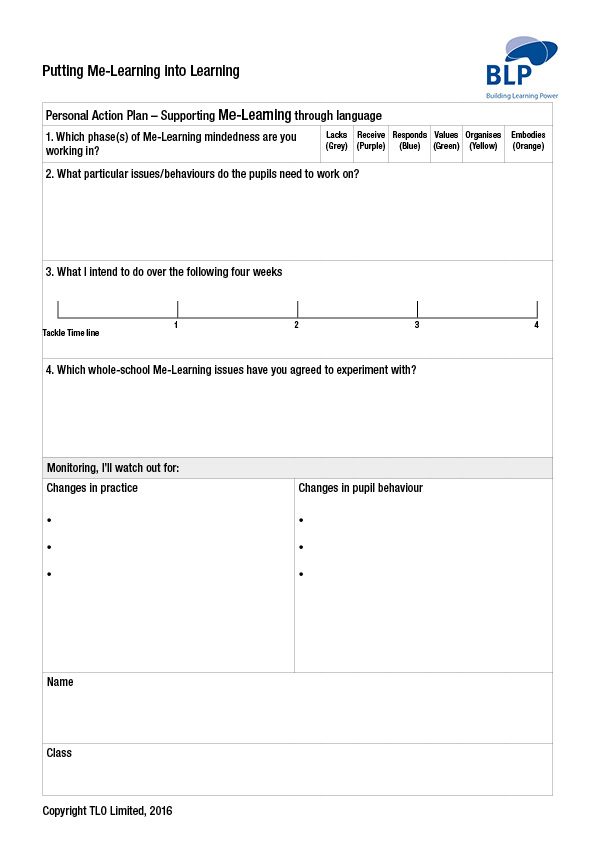
5c.Improvement indicators to consider for Me Learning
- motivated to get on with learning
- increasingly able to plan their own learning
- willingness to seek information/ideas from others
- better able to link ideas/information together
- more able to talk about how they are learning
- better able monitor what they are doing
- increasingly able to self-regulate their learning behaviours
- increasingly interdependent
- others you may have observed…
Or if you want to be more specific you could use the indicators from the progression grid
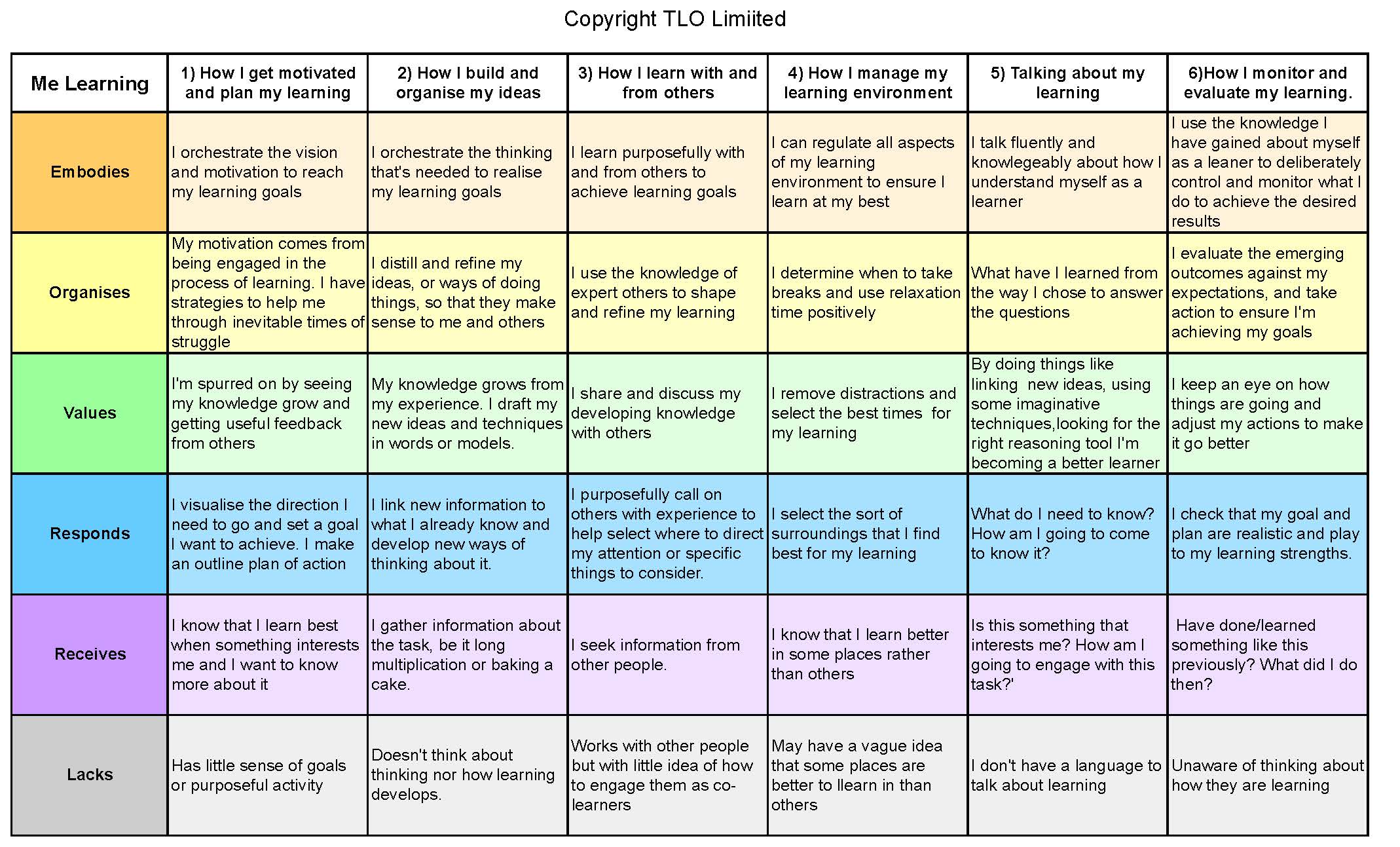
6. Evaluate team session
How did we do as a team? ( 5 mins )
- Did we achieve our objectives?
- Are we comfortable with what we are trying to achieve?
- Any concerns at this point?
- Next meeting date and time.
Section 3: Blending Meta Learning with content
So far, you have:
- Looked at your pupils through the lens of the Meta Learning learning chart
- Gained a sense of what becoming better at Meta Learning looks like
- Explored a range of ideas and activities that will help to engage pupils with Meta Learning
Now we look closely at how to blend improving pupils’ Meta Learning into the content you have to teach.
A. The principles behind any learning powered lesson
B. Big questions to ask about lesson design
C. Lesson planning in action…an exemplar Meta Learning focused task
Learning habits form through use and practice, but desirable habits survive and flourish better if pupils are aware of them, realise their value and strive to improve them. The curriculum through its lessons provides the rich and varied occasions for exercising learning habits.
A. The principles behind any learning powered lesson
Think of yourself as a learning power coach, helping your pupils to help themselves to develop their learning habits. Hence your lessons are much more likely to contain challenges and activities that get your pupils thinking and learning for themselves. You encourage pupils to explore challenging questions, problems or assertions and become observers of their own learning. You step back from telling and heavy scaffolding and instead try to mobilise your pupils’ learning behaviours. You are organising learning to let them take the stain.
Open Me
The SIX principles that lie behind teaching for learning power
1: Visible learning…Surfacing learning
You make it clear to pupils which learning habits and processes they are using. You try to make every aspect of the learning process as visible as possible through the language you use and through the words and images you display on the walls.
For example:
Rethink displays to illustrate work in progress

Collect and display work at different stages of development, with arrows and notes highlighting changes and their impact. Refer to these to encourage pupils to review and amend their work. Provide guidelines with questions they can ask themselves or each other at different stages in the process. Show that you do not expect perfection at a first attempt!
2: Dual focus teaching…blending content and process
You design activities that combine the dual objectives of ‘what’ will be learned and ‘how’ it will be learned. You make sure pupils know that the content they are learning is a way of giving their minds a useful workout. (The content is the vehicle for learning)
For example:
Embed learning how to learn into every lesson
Frequently include the following questions when talking with pupils:
- how did you go about finding that out?
- how would you explain that to someone else?
- what did you do to help you read that new/unfamiliar word?
- what made you persist/give up on that task?
- why do you think this is too difficult/easy for you?
- and so on
3: Emotional engagement…Capturing attention
Your lessons are designed to intrigue your pupils. Pupils don’t put in the effort unless their energy and attention are captured by what they are doing. You capture your pupils’ emotional engagement by giving them more of a stake in the process of learning.
Establish Reflecting as a classroom routine

For example:
Going for Three:
Begin each lesson with ‘Tell me Three . .
- things we learned last lesson
- ways we learned last lesson
- things we still need to find out
- things you hope to achieve today’.
End each lesson with ‘Tell me Three . .
- things we learned today
- learning skills we used today
- things we need to do next lesson
- ways you could become a more effective learner’ etc.
Ensure that pupils tell you three. Do not lapse into doing it for them!
4: Handling uncertainty…Challenge
You have realised from your own life that what is engaging tends to be what is challenging. Since you see education as a preparation for a learning life, you help pupils to learn how to handle increasing degrees of complexity and uncertainty.
For example:
Develop a project around ‘the best place to learn’.
- Discuss the best conditions for learning.
- What would the building/room need to have in it and why?
- What time of day?
- Quiet or with music?
- Curl up on chairs or desk and table?
- A little and often or long labs of time?
- With other people or alone?
Use this type of discussion to broaden the pupils’ views of good learning. Later discussions could include long and short term memory, spacing content, retrieval practice, desirable difficulties, interleaving content, self-testing and so forth. Make a display of ‘the best place to learn’ or ‘the best conditions for learning’.
5: Relationships…Working together
Learning is both a sociable and a solitary activity, and you offer your pupils opportunities to experience both. You develop interdependent learners who know how to handle themselves in collaborative groups and able to move around in the social space of learning to best effect.
For example:
Formulate-Share-Listen-Create

A development of Think Pair Share is called `Formulate-Share-Listen-Create’ (Johnson et al., 1991). The important addition here is to ask learners to create something collaboratively after the earlier steps have been followed through. Ask pupils to;
- Formulate your answer to the question individually.
- Share your answer with your partner.
- Listen carefully to your partner’s answer.
- Note similarities and differences in your answers.
- Create a new answer that incorporates the best of the ideas.
- Be prepared to present your answer if called upon.
6: Reflection and responsibility…Taking charge
You understand that pupils have to learn how to manage and organise their own learning and that the way to do this is by giving them increasingly demanding opportunities to do so. You orchestrate pupils taking charge of their learning by expecting them to plan what they do, distil meaning from it, and revise it accordingly.
Expect pupils to self monitor their learning.
For example:
Learning mats
As learners we need to gain an accurate sense of ourselves. Eventually this means being able to take our own learning strengths and weaknesses into account when weighing up a learning challenge or project. Pupils need lots of practice in thinking and talking about themselves as growing learners. Prompt the use of and reflection on Meta Learning.
A checklist for lesson planning based on these six principles.
Does the lesson plan:
- Make it clear to pupils which learning behaviours are being activated?
- Match and blend the learning behaviour with content?
- Include a tactic to captivate pupils’ attention?
- Have sufficiently challenging learning activities to sustain interest for all?
- Offer choice on how pupils could interact on these tasks?
- Embed aspects of planning, reflecting and revising for content and process?
What do you think?
- Which of these six principles are a regular feature of your planning?
- What do you make of principle 2? Is it the most tricky of the six? The following section B is mostly about this aspect of planning.
- Look at the checklist in the green box above this one: Do your lesson plans capture these six aspects of an effective learning experience?
Make a note of…
- Which of the six principles might need to be given greater prominence in your planning.
Skim read or leave this section if you have met it in other units because… the section applies to any learning behaviour. i.e. not specific to Meta Learning.
B. Big questions to ask about lesson design.
What we teach and how we teach it (the enacted curriculum) are intertwined and offer teachers a lot of freedom. It is here that you can start applying a learning power filter and deploy a unique combination of content and learning tasks.
Open Me
Prelude
In conventional lessons where the teacher remains the focus of attention and the initiator of all activity, and where the epistemic dimension (the conditions for acquiring knowledge) is not acknowledged, pupils gain habits of compliance and dependence, rather than curiosity and self-reliance.
In developing learning power, teachers are making conscious choices about which habits to introduce and stretch and how best to couple these with content so that lessons become more interesting and challenging. Through such overt coupling of content and specific types of process, pupils come to know, understand and take control of their learning behaviours – they knowingly use and develop the whole range of learning behaviours.
All lessons function on two levels, they have twin intentions. On the one hand there is content to be acquired, and on the other there are learning behaviours to be exercised in pursuit of this content. The factor that differentiates a standard lesson that effectively ‘delivers the content’ from a learning powered lesson is that the teacher has to think, in advance, about:
- the learning behaviours that are necessary for successful content acquisition;
- the design of activities /tasks that will stimulate these behaviours;
- how learners could reflect on and evaluate their use of these behaviours.
In designing such lessons you have to dare to think differently and flip round your usual lesson design thinking.
A turn-around in lesson design
Think in two dimensions at once – the content dimension and the learning behaviour dimension. It means turning your thinking around – from teaching to learning.
Or put another way
Think to yourself;
- what content?
- using which learning behaviour(s)?
- via an activity to stretch both?
Lesson design questions… one by one
Here the general rules of lesson design have been related to the learning behaviour…Meta Learning.
Stage 1. What content do pupils need to learn?
What content has to be learned? …..Think outcomes.
- Use standard lesson planning tools:
- What are pupils going to be able to do/learn?…think objectives
- How will they know if they been successful?… think success criteria
- While keeping an obvious eye on
- What do they already know?….think previous learning.
Stage 2. How will they best learn it?
Using which learning behaviours?
This is the new bit
Not the usual second step but nonetheless a vital second step where the aim is to weave content acquisition with learning behaviours. The content is the vehicle for exercising the learning behaviours and the learning behaviours accelerate the content acquisition.
Using which learning behaviours?…Think types of learning behaviours
- Which learning behaviour(s) will help these pupils get closer to understanding this content?…think learning behaviour charts.
- Which aspect of, say, Meta Learning, lends itself to achieving these outcomes?…think progression columns.
- How skilled are these pupils in using this learning behaviour …think progression phases/rows
Say something like this to yourself .…My pupils need to achieve xxx. At this stage we could get closer to this content by using Meta Learning. Most of my pupils are able to use xxx phase (e.g. respond/blue) Meta Learning approaches confidently.
Stage 3. What type of task/activity will stretch the learning?
Which type of task…Think types of task.
Pick up your thinking from stage 2;
My pupils need to achieve xxx. At this stage we could get closer to this content by using Meta Learning. Most of my pupils would be able to use xxx phase (e.g. blue/responds phase) Meta Learning approaches confidently.
And now think about the sort of task/activity you might develop/design so as to:
- orchestrate a problem-solving activity to enable pupils’ understanding of xyz content without telling them;
- intrigue them with something that is open to several interpretations;
- stimulate their curiosity;
- grab their attention…visually and aurally;
- allow them to stay stuck before asking them how they are thinking;
- offer a nudge to get them thinking differently that doesn’t give the answer away;
- leave it as a problem hanging in the air to which we will return later;
- make links between the challenge, and what and how we are learning in this lesson.
The challenge isn’t about the inherent complexity of the subject matter but about how the content is orchestrated to encourage pupils to use their learning habits to resource their solution.
Think…what/how much information/content do I need to give/reveal? At what point? In what form? To what end?
Say something like this to yourself .…
- my pupils need to achieve xxx.
- at this point we could get closer to this content by using Meta Learning.
- most of my pupils are able to use xxx phase (e.g. respond/blue phase) Meta Learning approaches confidently.
- What type of task would stretch their Meta Learning but assist them with the content…without me just telling them!
To summarise…the heart of the lesson
It’s the question ‘using which learning behaviours?’ that causes you to think differently about the lesson planning.
- You ask – as always – what are the anticipated objectives/intentions?
- The verbs in your resulting objectives will give you clues about the types of task/methodology that will get pupils there and the sorts of learning behaviours your pupils will need to contribute to this learning endeavour.
You are designing the task in a way that requires pupils to contribute their learning ‘powers’ / behaviours. The tasks you design will hook into their learning ‘powers’ and help them to improve them.
Say something like this to yourself:
I am going to think content, learning behaviour and task together:
- Meta Learning will help pupils to better access the content;
- The aspect of Meta Learning (column) and phase (row) that would fit best is (for example)
Ask myself “What do I need to know? How am I going to come to know it?”(‘Talking about my learning’ column, Blue phase). - The type of task/activity that would best stretch both content and learning behaviour, intrigue, challenge, bring people together and give responsibility to pupils is………
- Think….what information do I need to reveal/give, in what form, at what point, and what do I want pupils to do with it?
What do you think?
- What strikes you about this way of planning with learning behaviours in mind?
- Where are the potential stumbling blocks?
- How will you decide which learning behaviour(s) you are going to foreground in your objectives?
Consider a lesson you are about to teach…
- What is the content?
- Which learning behaviour(s), if missing, would make accessing the content very difficult / impossible?
- How could you blend reference to this learning behaviour(s) into the learning objectives?
- Can you design a task that will help pupils to access the content and exercise the key learning behaviour(s) you have identified?
C. Lesson planning in action – an exemplar, Meta Learning focused, task.
Where lessons in other units have been designed to blend content with a learning behaviour, here the lesson content is about understanding the learning process itself. How do we design tasks that intentionally activate / stretch a wide range of learning behaviours and enable learners to reflect on how and how well they have used those behaviours?
We cover this in three ways:
- Section 1 shows the phases of a lesson where a range of learning behaviours are activated in different Episodes of the lesson and subsequently reflected on and discussed;
- Section 2 considers a simple lesson plan template that can be used for any lesson and distils the Meta Learning( learning about learning) lesson into this format;
- Section 3 invites you to extend your thinking about the lesson and how to help pupils to become increasingly skilful, self-aware, self-regulating learners.
Open Me
1. Activating and stretching a wide range of learning behaviours in a single lesson.
[NB: This lesson is unusual in that it sets out to activate different learning behaviours in the different Episodes of the lesson. Whereas lessons in other units focus on one learning behaviour, while accepting that others would ‘bubble up’ as the lesson unfolded, here we intentionally spread the net in order to activate a wide range of behaviours on which to reflect. The key part of the lesson comes in Episode 7 – the first 6 Episodes are simply setting up a range of learning behaviours that can be reflected upon in Episode 7.]Resources needed for each pupil:
A copy of the Snow Scene: Resource
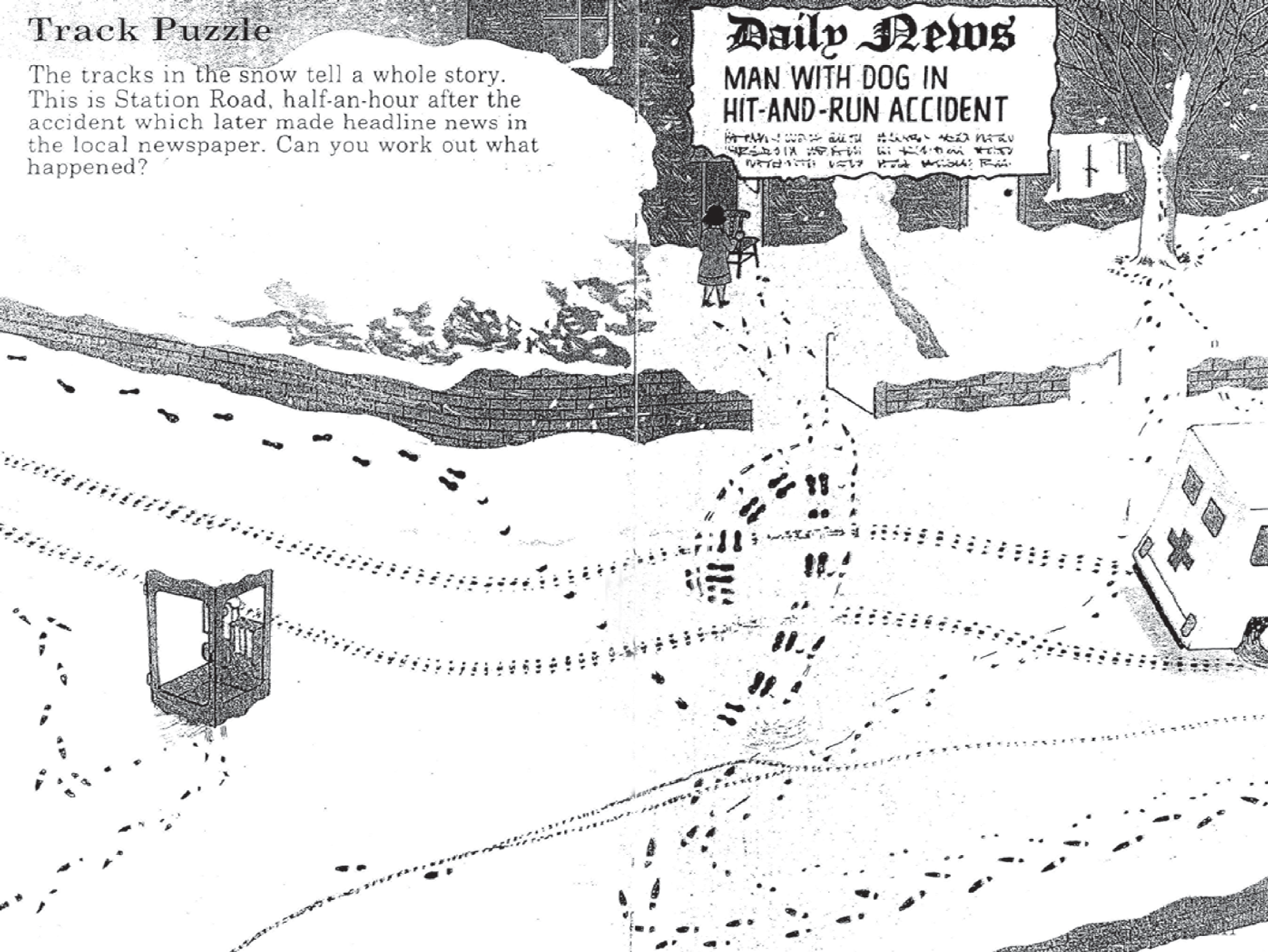
And 2 copies of the Rating Wheel:
Overview of lesson plan:
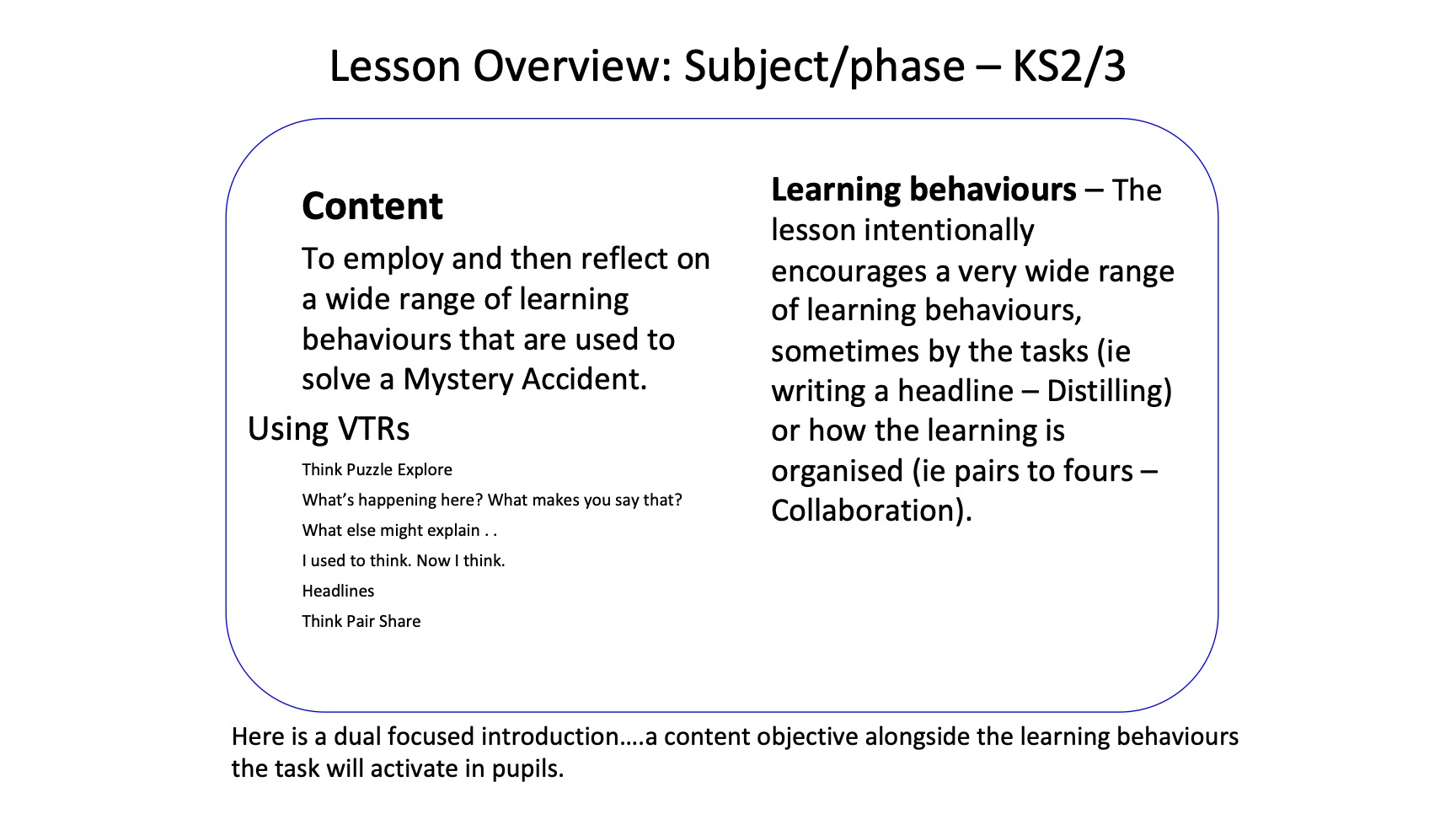
Episode 1 – How might we set about solving the Mystery Accident?
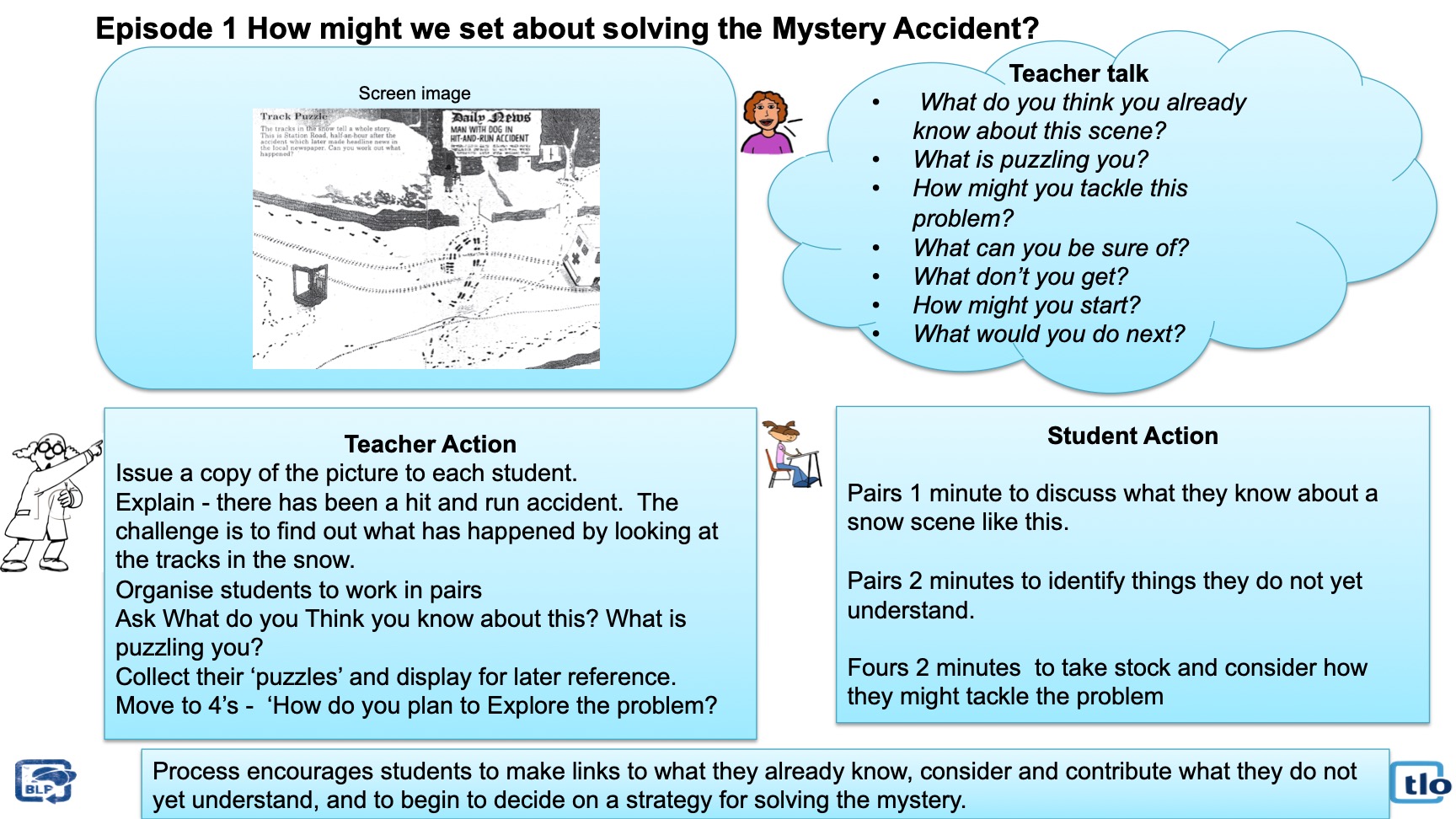
What is happening here?
In this Episode, pupils become familiar with the Mystery Accident and think about the kinds of questions that they will need to answer and how they might go about working out what has happened. It requires pupils to:
- frame their own questions;
- think ahead to plan how they might go about finding out.
None of this will be possible without the ability to notice detail, the learning behaviour that so frequently triggers a range of cognitive learning behaviours.
Resist the temptation to gather answers and speculations at this stage – that comes in subsequent Episodes.
Use the visible thinking routine Think / Puzzle / Explore to achieve three things:
- ‘What do you Think you know about this?’ encourages pupils to make links with prior experience;
- ‘What is Puzzling you?’ encourages the generation of a range of questions and lines of enquiry;
- ‘How might you Explore this?’ encourages pupils to begin to plan how they might tackle the problem in order to answer their questions.
Consider how you might collect their ‘questions’ for reference in later Episodes.
Episode 2 – How many people and animals are involved?
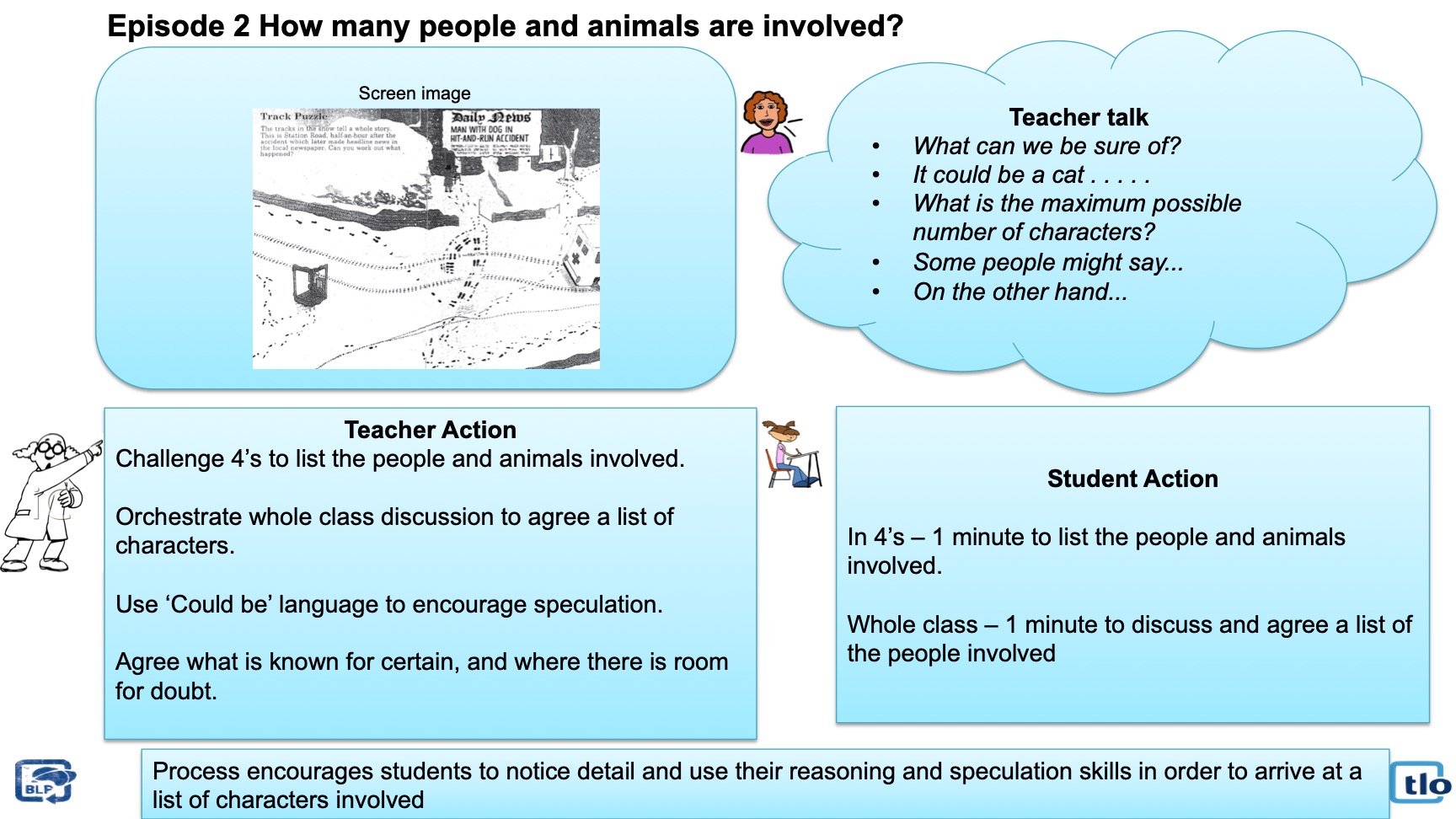
What is happening here?
Ask – How many people and animals are involved?
Essentially this is a Noticing activity in order to arrive at a list of characters.
You will need to work the following sorts of thing out in advance.
Some characters we can be certain of – there is a man and a dog (the headline says so), there is a cyclist (we can see the tracks in the snow), there is an old lady (we can see her), and someone must be driving the ambulance.
And then there are the footprints coming in from the left of the image along the pavement – they indicate another person. Ditto the footprints around the phone box. [Accept all answers without comment at this stage, but at some point in the upcoming Episodes pupils will need to consider whether all of these characters are different people]
And finally – the dog runs off to chase something. Usually people assume this to be a cat, but all we really know about this animal is that it can climb trees, and that dogs are inclined to chase it. A cat may be the most likely suspect, but a squirrel also fits the bill. Whichever suggestion you get, use the ‘Could Be’ approach to deepen thinking and open up other possibilities.
[So – a maximum of 6 people and 2 animals – old woman, the person who helps out, the person by phone box, the cyclist, the injured man, the ambulance driver, plus the dog and the tree climbing animal.]Episode 3 – Where does the story begin?

What is happening here?
Where does the story begin?
This is a focusing activity in which pupils use their reasoning skills to decide where the action begins.
Use ‘What makes you say that?‘ to encourage pupils to explain their reasoning.
In terms of the hit and run, the answer is bottom right of the image – the man walking his dog on a snowy morning.
Ask the supplementary question: What can the man and dog see as they first enter the scene? The question is deceptively simple, but it helps pupils to visualise the scene before the accident and to realise that the ambulance and some of the characters have yet to arrive at the scene.
[But there are other possibilities – the person at the phone box could have been first on the scene long before the man with dog arrived; the person arriving from the left might have come into view around the same time as the man and dog.]
Episode 4- Can you tell the story, from beginning to end?
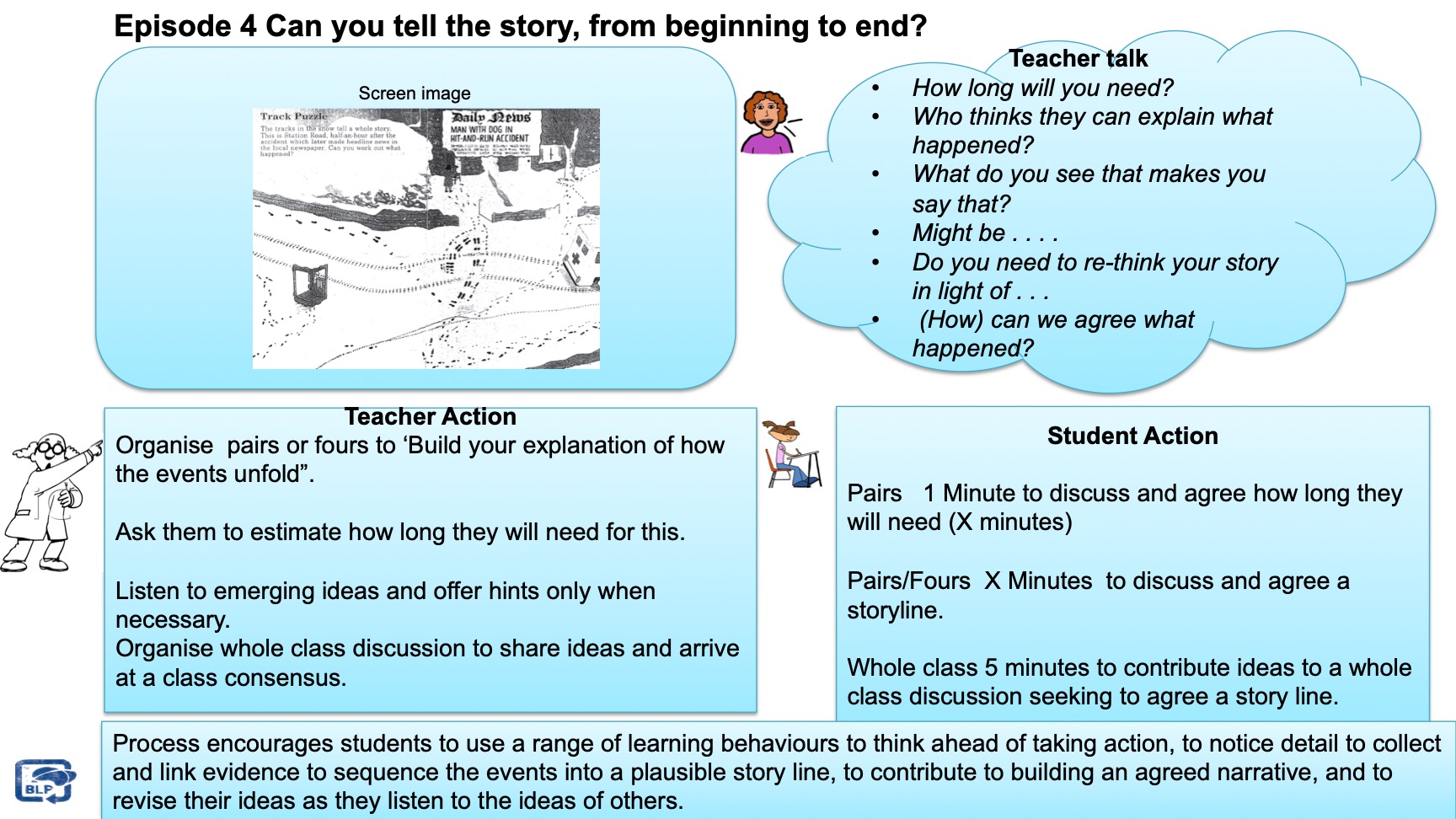
What is happening here?
Can you tell the story, from beginning to end?
This is where pupils use a range of learning behaviours to collect and combine evidence to sequence the events into a plausible story line. Begin by asking; ‘How long do you think you will need for this?’ – it is a quick way to get them thinking ahead and planning what needs doing. During the sharing ideas across the class phase, pupils will have to listen carefully to the ideas of others, contribute their own explanations and be prepared to revise their ideas in light of others’ contributions.
[Hints #1:Some pupils will be able to do this for themselves and you need to offer nothing further to nudge them towards producing a story line.
If some need help, use some or more of:
- Is the cyclist riding left to right, or right to left? How do you know?
- Where is the dog?
- Where does the ambulance stop?
- Who is the person who comes in from the left of the image? What do they do? What might explain their footprint pattern?
- Where does the old lady put the chair?]
To stretch those groups who arrive at a solution quickly, ask if their story explains (not all in one go, obviously!):
- Who is the ‘good samaritan? (We do not know this for certain. A helpful passer-by? Paramedic?)
- Why does the good samaritan ‘bunny-hop’ from the scene of the accident across the road when helping the victim? (They do not, they are walking one step at a time supporting the injured man)
- What are the man’s injuries? (Left leg / ankle – because samaritan supports on left side)
- Was the dog free before the accident, or freed by the accident? (Before – look at the lead making marks in the snow as dog runs off. This is rarely noticed without a hint of some kind, or at the very least being asked the question)
- Does the ambulance driver get out? (No footprints near where ambulance stops – can they explain this?)
- Who has been at the phone box? (If they say it was someone else who phoned for ambulance, ask why they not go over to help at the scene of accident? If it was the cyclist, ask why did they do it?)
- Where is everybody? (Old lady aside, everybody has left the scene. Samaritan must get in the ambulance – why?)
- Does your story address all of the questions we generated in Episode 1?]
Episode 5- Imagine you are a reporter . . .
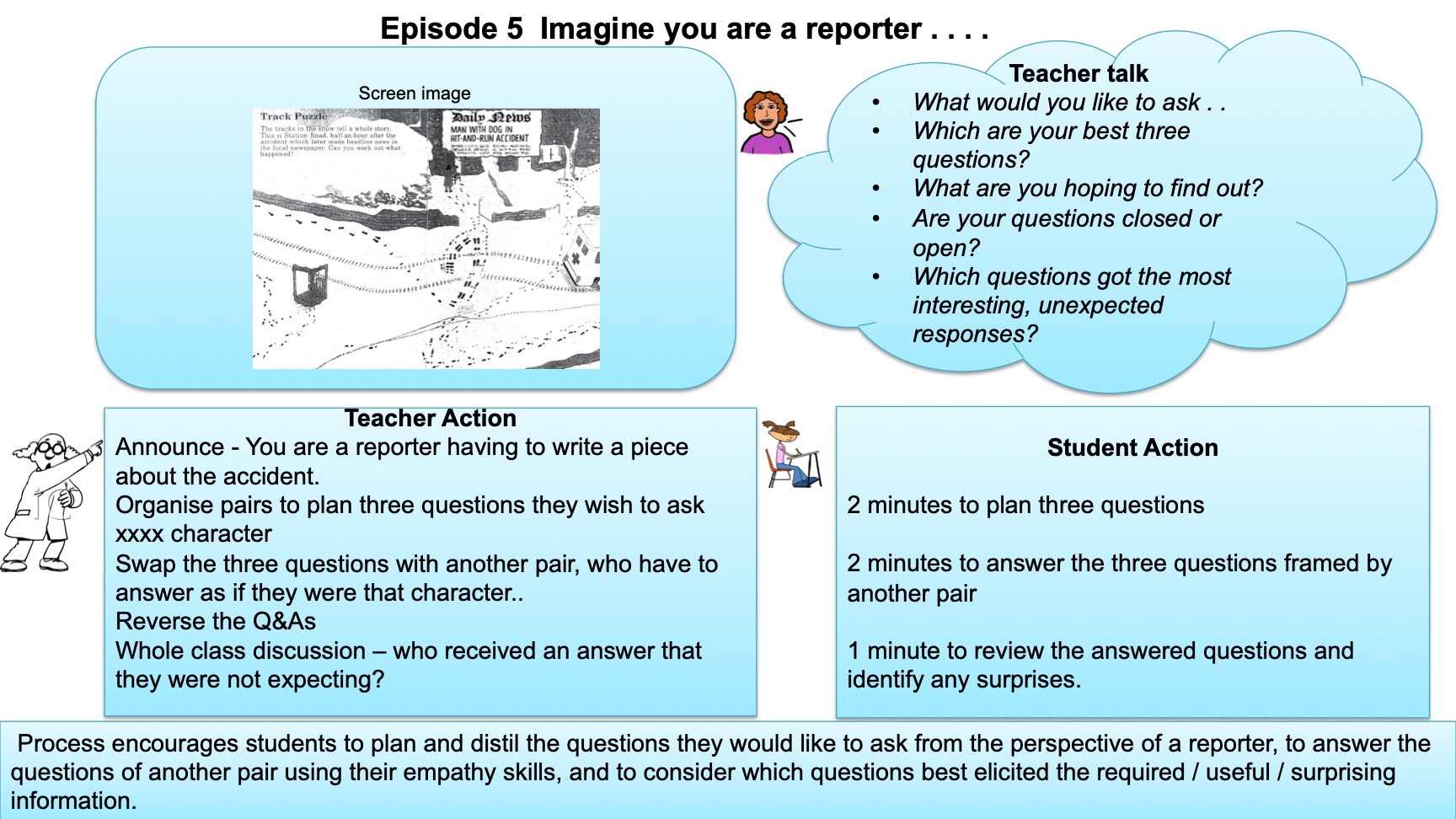
What is happening here?
Imagine you are a reporter . . .
Thus far pupils have been looking at and trying to assemble the available evidence into a credible story line.
Pupils are to imagine that they are a reporter who has been sent to interview one of the people in the story. (They can choose any one of the six people)
Here we are asking pupils to plan the three questions that they would ask, and then to use their empathy skills to answer those questions from someone else’s perspective. The restriction to three questions make this a distilling activity, and the swapping of questions opens up the possibility of unexpected responses.
End the Episode by discussing any questions that received a surprising response.
It sets the scene for Episode 6.
Episode 6- Can you write the headline and first paragraph of your newspaper report?
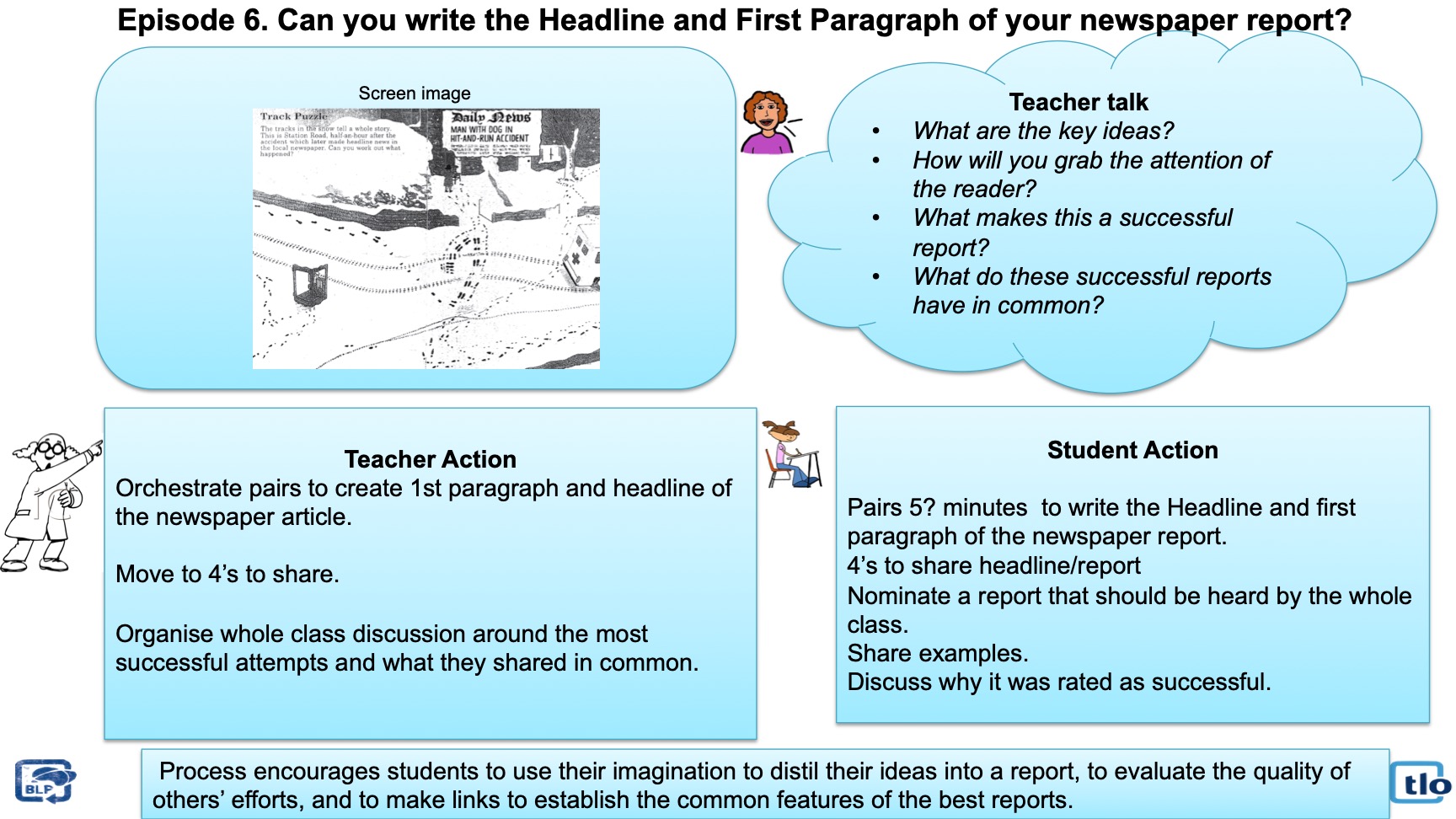
What is happening here?
Can you write the headline and first paragraph of your newspaper report?
A distilling and creative activity. Important information only goes in the headline and first paragraph of a newspaper report – how would they construct that headline and first paragraph to convey the key information, as they see it?
Write the Headline / paragraph in pairs. Move to and share in 4’s. Pairs who have read a report that they really like nominate it to be read out to the whole class.
Conclude with discussion about identifying and linking the characteristics that these reports had in common.
Episode 7- Which learning behaviours did you use in solving this mystery?
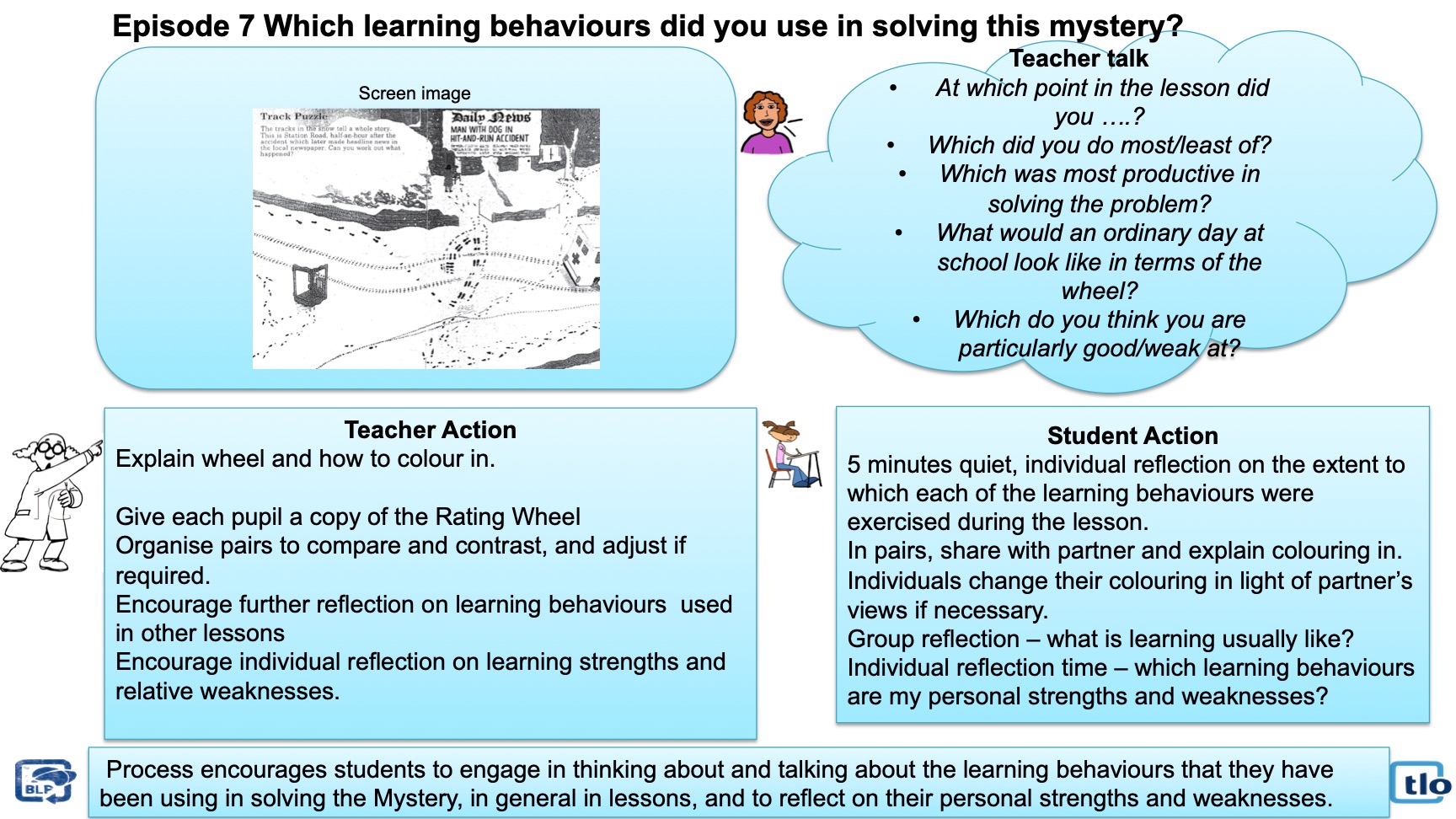
What is happening here?
Which learning behaviours did you use in solving this mystery?
This is the key part of this lesson. It is the opportunity for pupils to think back over the previous 6 Episodes and reflect on how they behaved as learners in tackling the challenges – it is where Meta Learning comes to the fore.
As individuals, pupils fill in the Rating Wheel as follows:
- Consider the sector at 1 o’clock – ‘Did I ask lots of questions?’
- If the pupil believes that they had asked lots of questions, they shade / colour in all or most of the sector. If a few questions it might be coloured only half way. If they never asked any questions, they will leave the sector blank;
- Repeat for all of the other sectors.
They will end up with a ‘picture’ of the learning behaviours that they believe they used, something like this:

Move pupils into pairs to compare and contrast, explain their reasons for colouring as they did, and to adjust their colouring in light of the conversation if they wish.
Probe their thinking by asking at which Episodes in the lesson they did particular learning behaviours.
Then broaden the discussion to thinking about the past week of learning – how would they colour in the wheel if they were considering all of their lessons over the past day / week?
And finally:
Ask… ‘Which of these learning behaviours do you consider to be a personal strength?’
Ask… ‘Which do you consider to be in need of further development?
Ask … ‘How might you go about this?’
[Depending on their depth of understanding, they may need a great deal of support to answer ‘How might you go about this?’The idea of If/Then targets may help here.
See the introduction to If/Then targets in the unit ‘Engage pupils in Achieving Goals’. For examples of If/Then targets for each learning behaviour, look in Section 2 of any unit titled ‘Putting xxx into learning’ – the suggested If/Thens are the last entry in all of the ‘More Ideas to Try’ section.]
You can Download the Meta learning ppt here.
What do you think?
- How would your pupils react to this challenge?
- Would they be sufficiently self-aware as learners to be able to colour in the rating wheel?
- How much scaffolding and support would they need?
- How will you help them to arrive at a personal learning development target, an If/Then that addresses one of their perceived weaknesses?
Make a note of…
- A class you might try this with.
- How you might build on this lesson and use the Rating Wheel to keep reflection on learning and the resulting meta-cognitive talk a regular feature of your classroom.
2 Using a lesson plan template to distil this lesson.
Given that there are hundreds of lesson plan formats we will use a few different types of planning tools over the course of these units. This one is a simple streamlined useable tool that includes:
- What you do (teacher action);
- What pupils do (pupil action);
- What the learning behaviours being called upon are (learning behaviours);
- What you say (learning talk) to nudge the learning behaviour along.
The format is divided into episodes to show the change of purpose, action and use of learning behaviour across the course of the lesson.
Download a blank lesson plan as a MS Word document: Lesson Planning Grid [.DOC]
If we now populate the template with the episodes explored in section 2 above, we get the completed lesson plan. . .
What do you think?
- What are your first reactions to this lesson plan template?
- Does planning for four aspects – teacher action, pupil action, learning behaviours, teacher talk – seem useful?
- How does sequencing the lesson as ‘episodes’ help or hinder planning?
Make a note of…
- The extent to which your existing planning template enables you to think about lessons in this way.
- What you would like / need to add to it.
3 Extend your thinking about the lesson and how to help pupils to become increasingly skilful, self-aware, self-regulating learners.
The problem with the Rating Wheel used in Episode 7 is that it tends to capture whether the learning behaviour has been used, but fails to capture how well it has been used – i.e. frequency rather than skilfulness.
To capture skilfulness, we would need to dig in much more deeply. For example, if we wished to explore skilfulness in Meta Learning, we could use a Rating Wheel like this:
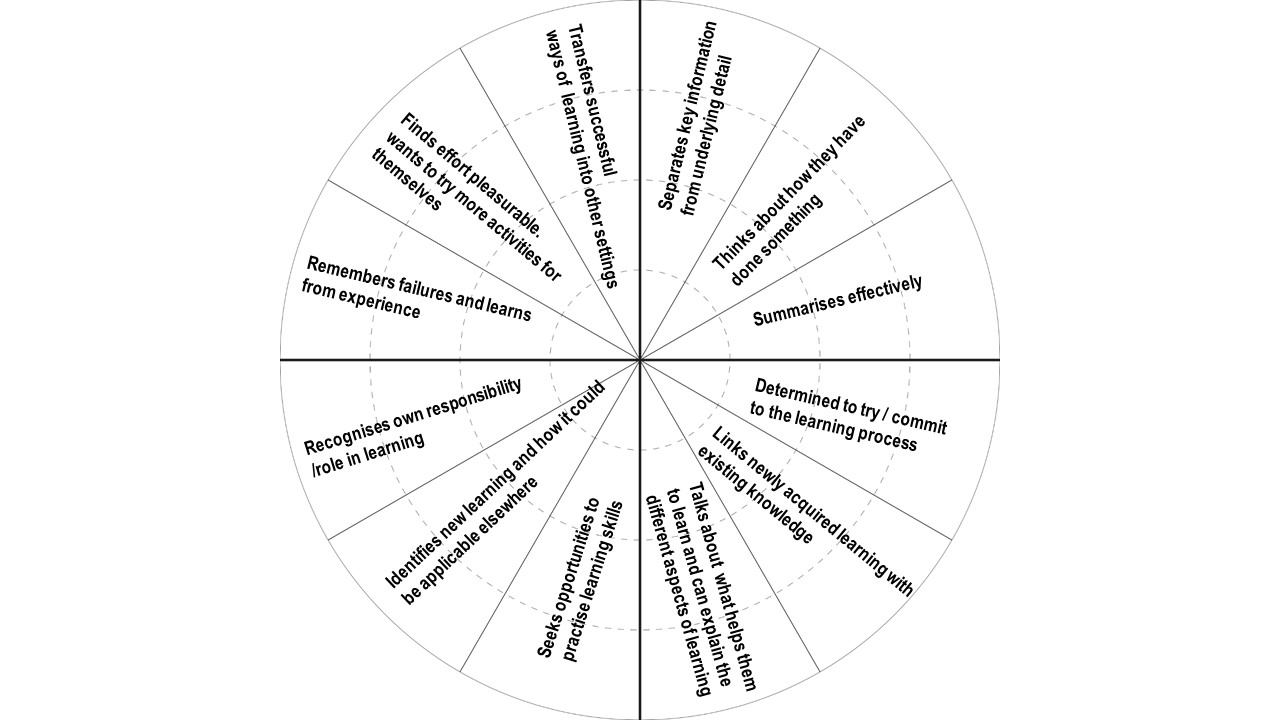
We have built this Rating Wheel from the progression grid so that the learning behaviours become increasingly more skilful as you move clockwise from 12 o’clock. This wheel has been designed for a learner who is already fairly skilled at Meta Learning.
For a less skilful learner, we might use a wheel like this:
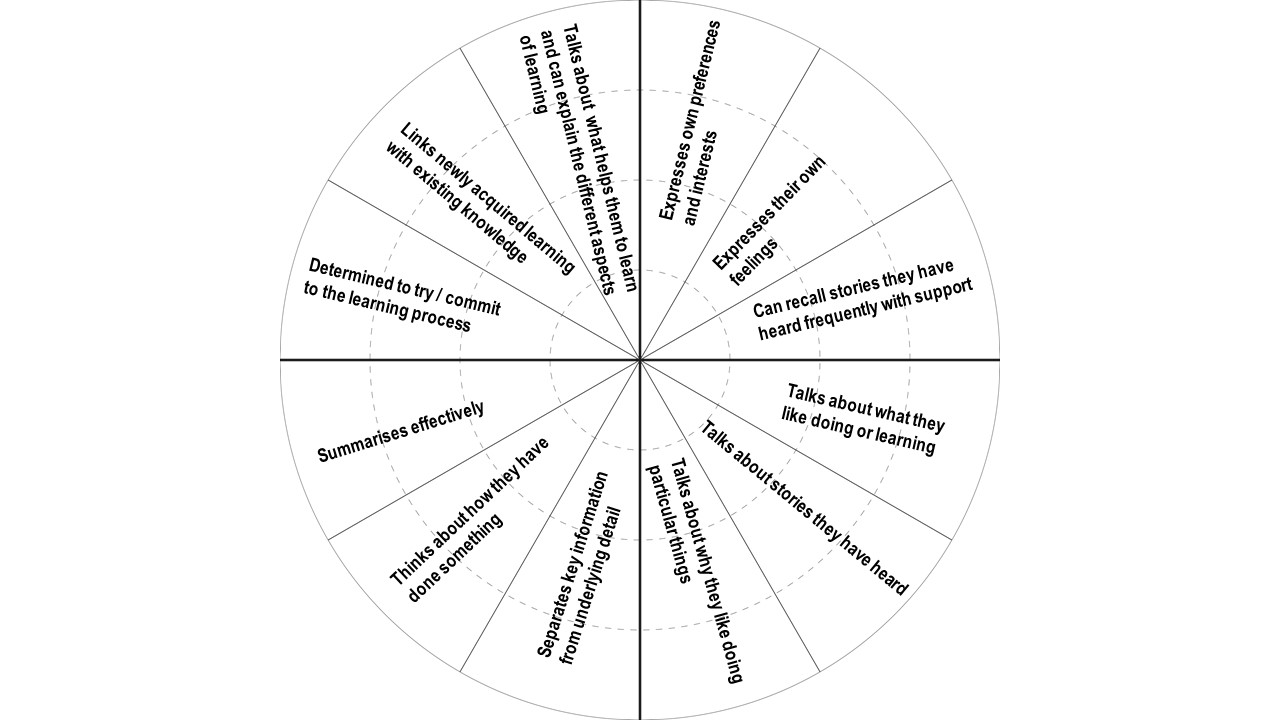
The higher order skills on the first wheel (from 6 to 12 o’clock) have been removed, the skills from 12 to 6 o’clock have moved clockwise to be replaced by skills more likely to be seen in younger, less skilful learners. Again, the Wheel is read clockwise from 12 o’clock.
What do you think?
- Which of the skills on these wheels are secure in your learners?
- Which ones might need attention?
- How might you use the wheels to monitor the growth of skilfulness in Meta Learning?
- (Why) would you need to put the wheels into ‘pupil’ speak’?
- Key Question – could you use, for example, the Collaboration progression chart to produce your own Collaboration Wheel(s) in the same style?
Make a note of…
The learning behaviour progression charts that you (and your school) could really do with using to create your own rating wheels.
Section 2: Building Meta Learning friendly classroom cultures
Teachers as habit formers
As teachers we are in the habit-forming business. What we say, what we display on classroom walls, what we celebrate, praise or dismiss, what we model or how we design learning activities will all influence the ways in which pupils learn, perform and behave. Classroom cultures have a huge influence on pupils’ learning as you will remember from the Culture unit.
Five big shifts to get you started. Ask yourself – how might you:
Enable learners to lead plenaries and review points;
Encourage learners to discuss the learning process;
Use display to celebrate learning in progress and the processes used;
Create opportunities for students to co-construct learning with you;
Shift responsibility for learning to learners.
Now look at the Learning Chart sections below where you will find plenty more ideas to try.
Section 1: Meta Learning and how it develops
1a) What do we mean by Me-Learning or Meta Learning?
Meta-learning involves drawing out of your learning experience a more general, explicit understanding of the process of learning, and specific knowledge about yourself as a learner. Let’s take these two aspects of meta-learning in turn.
There is a wealth of research which shows that good learners know a lot about learning.
They possess a vocabulary for talking about the process of learning itself, and are able to articulate how learning works.
Good readers, even quite young ones, are often able tell you half-a-dozen things they can do when they come across an unfamiliar word: they sound it out, break it down into bits, re-read the previous sentence, read on to see if the meaning becomes clear, look at the picture and think about it, and so on. And so, more generally, for good learners. The more able they are to talk about their learning, the more likely they are to be able to apply their knowledge to new domains too: meta-learning increases generalisation.
And good learners also need an accurate sense of themselves as learners. Being a good learner means being able to take your own strengths and weaknesses into account as you are weighing up a learning challenge, or deciding on a course of ‘professional development.’
The skills and dispositions of meta-learning can be cultivated simply by a teacher’s persistent use of questions such as ‘How did you go about finding that out?’ or ‘How would you go about teaching that to other people?’
Extract from Building Learning Power by Guy Claxton 2oo2
1b) What does being a good Me-Learner involve?
We have given meta learning the friendly title of Me-Learning. Becoming a Me-learner; being able to assess the effectiveness of your own learning process and regulate it for greater success, is made up of several strands; How you become and stay motivated and plan your learning, how you build and organise your ideas; how you learn with and from others; how you manage your learning environment and how you monitor your learning process itself in order to improve. When looked at from these diverse angles, growing meta learning moves well beyond encouraging a student to ‘think about it’.
The progression chart is made up of sections from several of the other learning behaviours that you will have come across previously. Here they are drawn together to reflect a person’s self knowledge about their learning. The chart below captures of the constituent parts of building the habit of Me-Learning
Our progression chart for Me-Learning has 6 components:
1c) Unpicking the columns; what contributes to Me-Learning?
The grid columns are things that might combine to make up the skills and attitudes of Me- Learning.
 Overview of the grid
John Biggs (1985) is credited with creating and defining the concept of Meta learning His conception is framed around the ideas of “being aware of and taking control of one’s own learning”. Implicit within this conception are the ideas that people need to have a knowledge of how they learn; have the motivation to be proactive in managing themselves in this way; have the capacity to be able to regulate their learning.The chart intertwines these important contributors to growing in the habit of Me-Learning; how we act in a progressive manner with other people and with available social, physical and intellectual resources learning how to learn.
“The knowledge worker needs one thing only: to learn how to learn”
The great business guru Peter F Drucker
Take a closer look at what each column of the chart is about.
 How I get motivated and plan my learning.
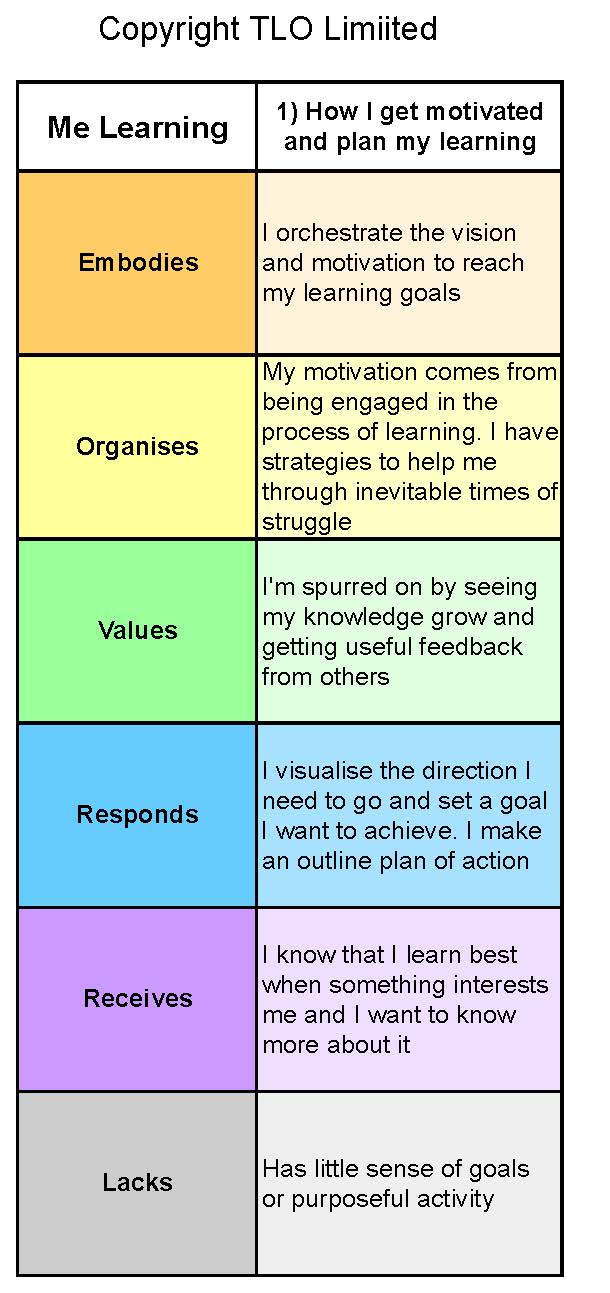
What we do to get started on learning
Proactive leaners get involved in thinking about learning before they start. This involves analysing a task and wondering if they are motivated enough to make a start. We are unlikely to engage in tasks or set goals and make a plan if we aren’t interested in them. We are also likely to think about whether we have the necessary ‘means to learn’. Do we have the skill and the will and will it be worthwhile for us? As we go along we gain added motivation from seeing our ‘knowing’ about the subject grow from engaging in the process. When we bump into difficulties we have strategies to help us keep going through the inevitable hard slog bits. We can work through a process of dissatisfaction to satisfaction as understanding emerges.
 How I build and organise my ideas.
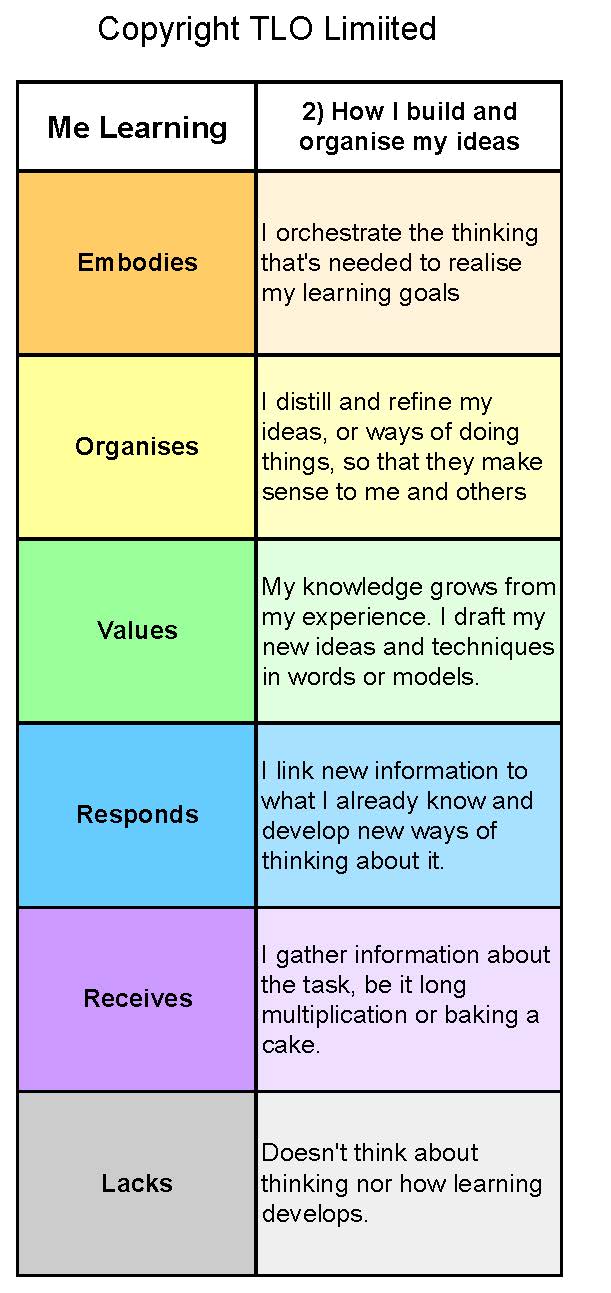
How do I work with ideas?
The next contributory factor in Me-Learning has to do with gathering and using information. What sort of information is needed and where does it come from? How does it fit with what I already know about and how can I retell the ‘story’ of this differently so that I’m incorporating the new ideas with the older ones. How could I distill and refine this new thinking into words or pictures or a recipe or a diagram so that I can make sense of it and other people can too.
 How I learn with and from others
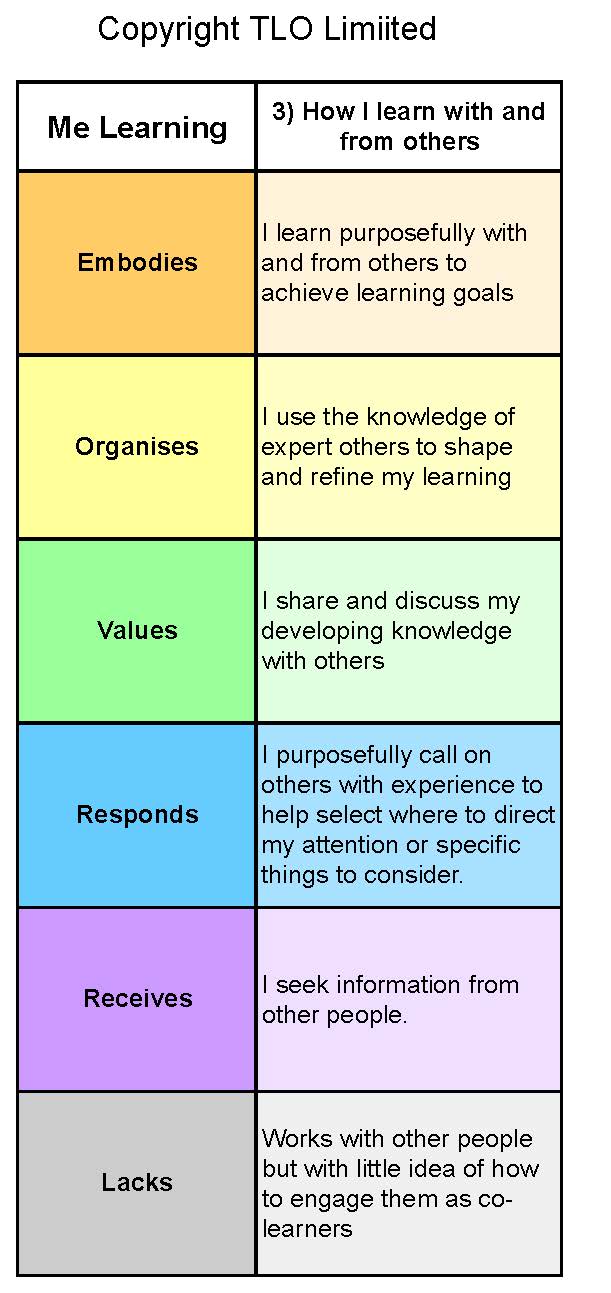
Me-learners know how to learn from others, not necessarily face to face or in teams but more and more through distributed electronic contact. They share their hypotheses with others, they pose questions and absorb others’ perspectives. This becomes an iterative process in gaining new ways of knowing and new insights until the learner is happy to craft their ideas and thoughts for the desired outcome.
 How I manage my learning environment.
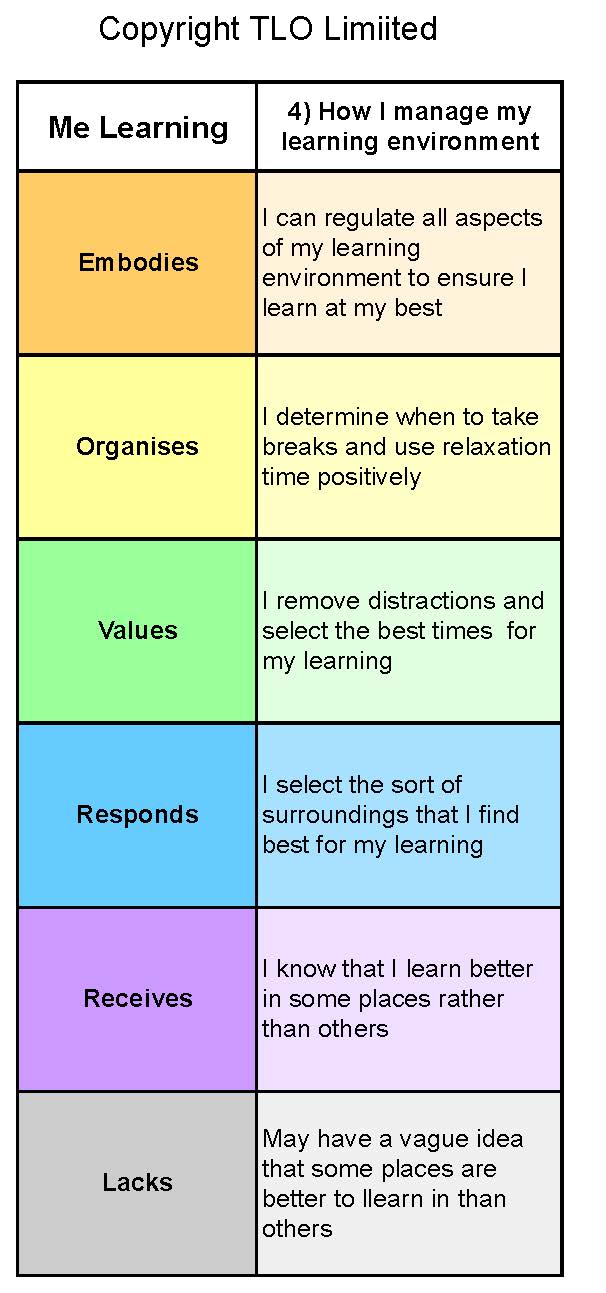
Getting comfortable for learning
The effective Me-learner understands that the learning environment needs structuring in order to optimise their learning effort. Some will be content with a computer, others will need acres of space and lots of paper and pens. Some like it hot, some work best in the small hours. They will be cognisant of their physical surroundings and their emotional state. They learn how to manage distractions, how to channel their emotional energy positively and how and when to break state.
In other words, they learn how to regulate their environment just as much they are regulating other aspects of the learning process.
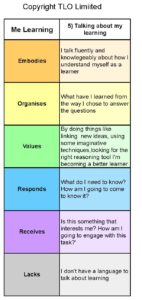
 Talking about my learning

The voice of self-awareness
Self-talk is what we say to ourselves as we learn. The statements capture what someone in each phase of the chart might be thinking. Students may use some of these phrases when talking with you, or in writing from time to time, but mostly self-talk goes on inside their heads. We have shown a small flavour of self-talk thoughts that teachers can encourage students to imitate. Some relate to setting learning goals, others to talking through which learning methods or resources might be useful, and others to monitoring and evaluating the learning being used. All such self-talk is important in building a Me-Learning habit.
In fact all the statements across the chart have been couched in self-talk to emphasise the full nature of the meta-learning capacity/behaviour/habit.
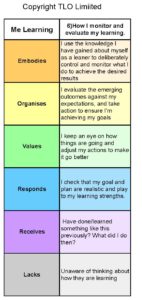 How I monitor and evaluate my learning.
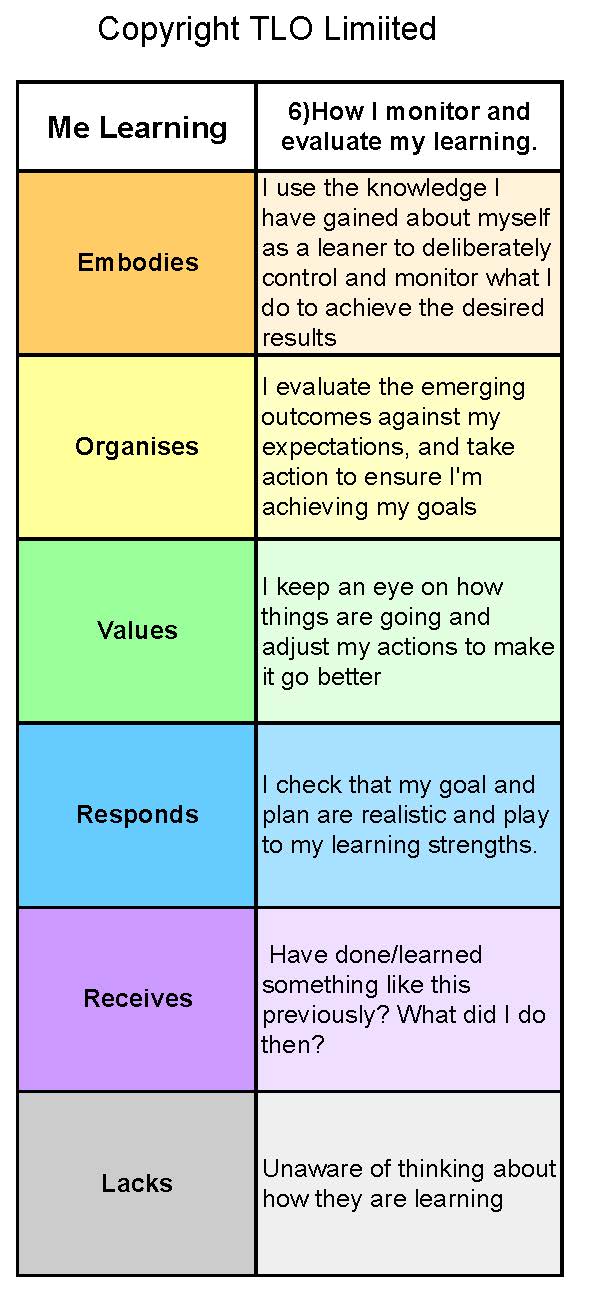
Keeping an eye on the how of learning.
The last constituent of Me Learning has to do with how we self-observe how our learning is going as well as the conditions that surround and influence it. Self-monitoring enables you to adjust how you are doing things and whether it is effective enough to achieve the goal; there is a causal link. It’s the goal that’s important and keeps you going. This means that even though you might have to alter your environment, or take account of some negative feelings, or clarify more information… all these encourage further effort to improve, in order to reach your goals.
What do you think?
- What have you learned about Me-Learning from these descriptions?
- What have you had confirmed?
- What surprised you?
- How have your views changed?
Make a note of…
- Any ideas for practical classroom experiments that these descriptions have triggered
- Which column your students are most secure in.
1d) Unpicking the rows; getting better at Me-Learning.
Of course, the development of Me-Learning doesn’t grow neatly up each column or evenly across the phases in the grid. The five broad phases of dispositional growth (purple – orange) are affective ways in which people may be inclined to behave: we call this inclination ‘mindedness’.
Here is our interpretation of how Me Learning might grow.
Meaning behind the phases
The phases are drawn from Bloom’s taxonomy of the affective domain.
Phase ‘Receives’ (purple) is about doing something because you are told or expected to.
Phase ‘Responds’ (blue) is about gaining interest and doing things more willingly.
Phase ‘Values’ (green) is a key phase since the student now sees the value of behaving in this way. It’s a win for them; to behave like this is in their interest. It’s in this phase that the behaviour becomes more secure.
Phase ‘Organises’ (yellow) is the phase in which the student capitalises on this ‘in their interest’ behaviour and gets themselves organised to use it positively.
Phase ‘Embodies’ (orange), known as ‘characterised’ in the original taxonomy. In this phase the student has made this behaviour their own. It has become part of their character; they can’t not do it and they have become highly skilled in doing it.
We urge you to see this progression as long term. Some phases will take years for people to work through; some will never be worked through. None of the phases are inevitable. There is a lifetime of development captured here. Nevertheless, the role of a teacher or parent should surely be to encourage and enable this journey.
Lacks: Minded to ‘just do things’

In this ‘Lacks’ (grey) phase, students are not necessarily aware of learning, they are just doing things. They have no language to talk about learning and the word learning itself is hardly part of their repertoire. Self-reflection of any sort is unlikely to figure in their lives.
Receives: Minded to be interested in learning .

In the Receives (purple) phase, students are aware of what interests them and how to find information. They know that some surroundings are better than others for learning and that they can learn from other people. They are showing an interest in learning and enjoy finding out about lots of things.
Responds: Minded to have a sense of direction in learning.

In the Responds (blue) phase, students have the developed the skill of knowing what they want to achieve and be motivated to do so. They can visualise the broad direction they want to go in, call on others to guide their thinking and make a realistic plan based on their learning strengths. This phase is a big step up from the one before; it requires a broad range of skills which are undertaken consciously. (eg visualising, being aware of their learning skills, goal setting, outline planning, choosing surroundings.
Values: Minded to enjoy their learning effort.

In the Values ( green) phase, students are aware of how their learning is growing and they are careful to capture this new awareness in in drafts or models or trial artefacts.They are moulding their environment to meet their needs and their enthusiasm helps them to keep going and manage distractions. They are using a wide variety of learning methods and value the opportunity to discuss things with others. They are consciously aware of keeping all these elements on track.
Organises: Minded to refine what they are learning to meet their goals

In the Organises (yellow) phase, Me-Learning has become a skilful habit. Reviewing progress now turns to evaluating the emerging outcomes and adapting the learning process to make sure the goal is achieved and get through difficult times with well-paced downtime. In some cases, students may question the original goal in this phase and take action on another path. They use knowledgeable experts to help refine their thinking.
Embodies: Minded to self-regulate all aspects of their learning process

In the Embodies ( orange) phase, students know themselves well as learners ; their learning strengths (their questioning, imagining, reasoning, noticing, listening, linking skills); how to motivate themselves; how to search for ideas and blend them into understanding; how to work purposefully with others and tweak their learning environment for comfort. They self-regulate themselves as learners to accomplish their self-determined goals.
What do you think?
- What has struck you about the act of Me-Learning having read the descriptions above?
- Which phase do you operate in?
- What makes you say that?
Make a note of…
- What you might do to assist your students to make headway in their Me-Learning behaviour.
- Any practical ideas the text has triggered.
Preparation for the Learning Team meeting
Where are my pupils now?
- Take a look at the Meta Learning progression chart in your Learning Diary or
- Download CHART to colour in here
- Colour in the cells where you think your pupils are secure.
- Some will barely be on the chart while others may be quite a way up. Neat straight lines of secure classes are rare. But looking at your class in this way should give you an idea of what you need to work on.
- Draw a red line across the chart to denote where you think most of the school’s pupils could and should reach by the time they leave.
- Please take the results of these tasks with you to the Professional Learning Team session shown in Section 4
Section 4: Team reflection and planning
If you want to read again the notes on Professional Learning Teams, click on the view notes tab in this box
Professional Learning Teams: what and how
The purpose of these meetings is for the team to act as a teacher learning community or Professional Learning Team: a small group of teachers who meet together regularly to deepen their understanding of building better learners, commit to trying out new things, reflect on and share their experiments with each other. Such learning communities are the engines of teacher development. They work best with 6-8 teachers with similar subjects or age groups, and who meet for about an hour regularly over a period of a couple of years.
The group question and probe each other’s summaries of their experiments in order to encourage analysis and deeper reflection. They use questions such as ‘What do you think is getting in the way? What would make this even better?
How could this technique be modified to make it work for you? What do you think made that happen? In this way they support each other in changing and developing their practice.
Some guidelines for team reflection sessions
The delicate, hard work of changing practice requires a safe professional environment in which to explore and understand both triumphs and tribulations. These short guidelines may be helpful in setting a climate for the team itself.
- Everyone is expected to report back on their classroom experiments
- Coaching questions and probes of colleagues’ classroom experiments encourage deeper reflection.
- The group is careful to follow their agreed ground rules which might include;
- No group member can ‘pass’
- Listen between the lines when it’s not your turn
- Actively discuss everyone’s input
- Constructive criticism – developmental not judgemental
- Everyone fully engaged in the group
•What is said is confidential to the group
• Respect others’ views and encourage others’ ideas - No-put downs
- Maintain an open mind
What-Why-How-of-PLT.pdf
Session agenda
If this team session is your first one in Stepping Stones, miss out item 2.
1. Session objectives
What do we want to achieve? ( 5 mins)
2 Sharing classroom experiments
How did our experiments go? ( 20 mins)
Share
- the changes in practice you tried
- how students reacted
- what you learned
- what next as a result
Probe
- what was getting in the way?
- what seemed difficult?
- what would make it easier?
- what made it work particularly well?
- why was it successful?
- changes in your behaviour
Talk about impact
- improvements in concentration
- increased time on task
- more enjoyment in learning
- more/renewed interest in the subject
- greater willingness to try, and try different ways
- more deliberate looking
- Avoidance of…..
- Improvements in……
- Increases in…….
- Little of no changes in…
3. Recapping on-line materials
What did we think of the materials? (15 mins)
Reactions to
- The Noticing grid
- Where pupils are secure
- Where the pupils could be secure when they leave for secondary school
- Classroom culture ideas
- Activities and talk ideas
4. Planning what to do
What do we need to do next? (10 mins)
Decide
- Which ideas should we all adopt as a school strategy?
- How the progression of Noticing should be built across the school. ie how the phases of Noticing might play out against key stages and even year groups.
5. Personal action planning
What am I going to do? (20 mins)
5a. Consider
- How you want your pupils to improve/develop/enhance their approach to Noticing?
- What are you going to do to bring this about?
Develop your enquiry question.
Think of it like this…
- If I do XXXX will it improve/develop/enhance YYYY
- This is the crunch question. Your pupils are unlikely to change unless you change!
Capture your learning enquiry as a question

5b. Put a short enquiry plan together
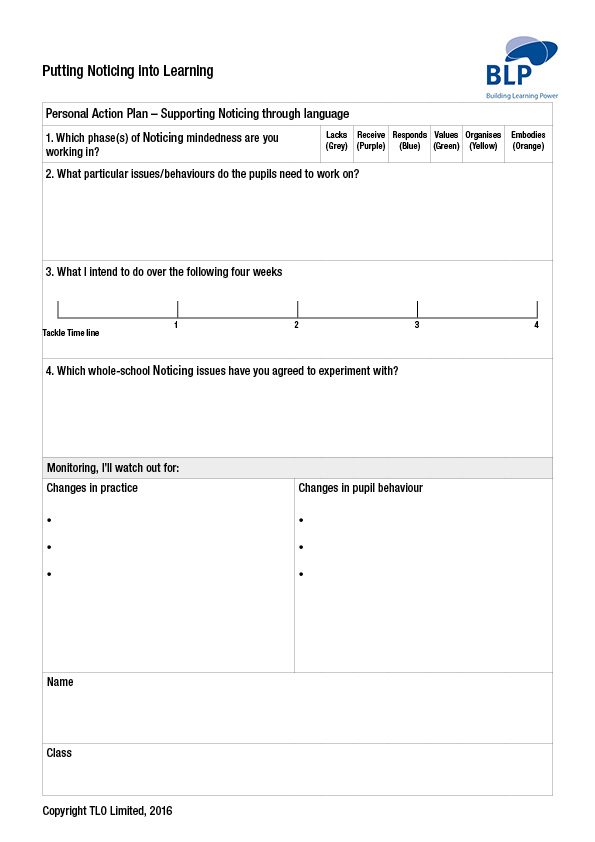
5c.Improvement indicators to consider for Noticing
Purple
- Increased interest in what they can see/hear
- Greater talk about what they like.
Blue
- Greater awareness of what distracts them
- Picks out what matters
- Increasingly spots connections
- Skilled at noticing similarities and differences
- Increasingly remembers what they have spotted previously
Green
- Increasing patience in noticing. Spend far more time at it.
- Increasingly spotting curious or different things.
- Greater awareness in noticing possibilities in complex environments
- Distinguishes between big picture and detail
Yellow
- Confident linking small detail to the overarching taxonomy
- Particularly sharp at spotting irregularities, anomalies
- Increasing use of insight to focus on trends and contradictions
6. Evaluate team session
How did we do as a team? (5 mins)
- Did we achieve our objectives?
- Are we comfortable with what we are trying to achieve?
- Any concerns at this point?
- Next meeting date and time.
Section 3: Blending Noticing with content
So far, you have:
- Looked at your pupils through the lens of the Noticing learning chart
- Gained a sense of what becoming better at Noticing looks like
- Explored a range of ideas and activities that will help to engage pupils with Noticing
Now we look closely at how to blend improving pupils’ noticing into the content you have to teach.
A. The principles behind any learning powered lesson
B. Big questions to ask about lesson design
C. Lesson planning in action…an exemplar noticing focused task
Learning habits form through use and practice, but desirable habits survive and flourish better if pupils are aware of them, realise their value and strive to improve them. The curriculum through its lessons provides the rich and varied occasions for exercising learning habits.
A. The principles behind any learning powered lesson
Think of yourself as a learning power coach, helping your pupils to help themselves to develop their learning habits. Hence your lessons are much more likely to contain challenges and activities that get your pupils thinking and learning for themselves. You encourage pupils to explore challenging questions, problems or assertions and become observers of their own learning. You step back from telling and heavy scaffolding and instead try to mobilise your pupils’ learning behaviours. You are organising learning to let them take the strain.
Open Me
The SIX principles that lie behind teaching for learning power
1: Visible learning…Surfacing learning
You make it clear to pupils which learning habits and processes they are using. You try to make every aspect of the learning process as visible as possible through the language you use and through the words and images you display on the walls.
For example:
Noticing what works

Ask some pupils to watch how others play team games. It might be throwing bean bags into buckets, jumping through hoops or balancing on bars. Their job is to notice what works, what doesn’t work and what seems to work best. Model this regularly… the noticing and coaching makes a real difference to their learning. Capture examples of effective learning on camera / video. Build the outcomes into a display that helps all pupils to become more aware of the effective habits of others.
2: Dual focus teaching…blending content and process
You design activities that combine the dual objectives of ‘what’ will be learned and ‘how’ it will be learned. You make sure pupils know that the content they are learning is a way of giving their minds a useful workout. (The content is the vehicle for learning)
For example:
Activities that use tools to highlight the learning behaviour being used
Use sets of interesting pictures together with cards with a viewing window cut into them. Pupils place the viewing card over the picture in seeking a range of different features. The more complex the picture/diagram the better
Variety of subject possibilities:
- poems. Use the viewer to find the stanza that is most descriptive, that makes them happy, that uses the best simile…
- geometrical images, use the viewer to find corresponding angles, perpendicular lines, a reflex angle…
- image of the water cycle, use the viewer to find where water vapour is rising, where water is moving downwards, where it would be best to site a farm, a village, a wind turbine…
3: Emotional engagement…Capturing attention
Your lessons are designed to intrigue your pupils. Pupils don’t put in the effort unless their energy and attention are captured by what they are doing. You capture your pupils’ emotional engagement by giving them more of a stake in the process of learning.
For example:
Introduce intriguing pictures to provoke noticing

4: Handling uncertainty…Challenge
You have realised from your own life that what is engaging tends to be what is challenging. Since you see education as a preparation for a learning life, you help pupils to learn how to handle increasing degrees of complexity and uncertainty.
For example:
Noticing the important

The VTR ‘Headlines’ is a useful strategy for encouraging pupils to notice what is most important. It is how Noticing contributes to pupils distilling what they have learned and identifying the salient features.
The routine uses the idea of newspaper-type headlines as a vehicle for summing up and capturing the essence of an event, idea, concept, topic, etc. It asks one core question:
- If you were to write a headline for this topic or issue right now, that captured the most important aspect that should be remembered, what would that headline be?
Then write the first paragraph of the newspaper article with all the key information.
5: Relationships…Working together
Learning is both a sociable and a solitary activity, and you offer your pupils opportunities to experience both. You develop interdependent learners who know how to handle themselves in collaborative groups and able to move around in the social space of learning to best effect.
For example:
Becoming aware of body language.
Observing, discussing and using body language to improve relationships. The meanings of shoulder shrugs,( I don’t know) open palms (ancient display of honesty) pointed fingers, fake smiles, raised eyebrows, mirroring body language and so forth.
6: Reflection and responsibility…Taking charge
You understand that pupils have to learn how to manage and organise their own learning and that the way to do this is by giving them increasingly demanding opportunities to do so. You orchestrate pupils taking charge of their learning by expecting them to plan what they do, distil meaning from it, and revise it accordingly.
For example:
Use learning mats
at the start of this process to prompt the use of and reflection on noticing.
A checklist for lesson planning based on these six principles.
Does the lesson plan:
- Make it clear to pupils which learning behaviours are being activated?
- Match and blend the learning behaviour with content?
- Include a tactic to captivate pupils’ attention?
- Have sufficiently challenging learning activities to sustain interest for all?
- Offer choice on how pupils could interact on these tasks?
- Embed aspects of planning, reflecting and revising for content and process?
What do you think?
- Which of these six principles are a regular feature of your planning?
- What do you make of principle 2? Is it the most tricky of the six? The following section B is mostly about this aspect of planning.
- Look at the checklist in the green box above this one: Do your lesson plans capture these six aspects of an effective learning experience?
Make a note of…
- Which of the six principles might need to be given greater prominence in your planning.
B. Big questions to ask about lesson design.
What we teach and how we teach it (the enacted curriculum) are intertwined and offer teachers a lot of freedom. It is here that you can start applying a learning power filter and deploy a unique combination of content and learning tasks.
Open Me
Prelude
In conventional lessons where the teacher remains the focus of attention and the initiator of all activity, and where the epistemic dimension (the conditions for acquiring knowledge) is not acknowledged, pupils gain habits of compliance and dependence, rather than curiosity and self-reliance.
In developing learning power, teachers are making conscious choices about which habits to introduce and stretch and how best to couple these with content so that lessons become more interesting and challenging. Through such overt coupling of content and specific types of process, pupils come to know, understand and take control of their learning behaviours – they knowingly use and develop the whole range of learning behaviours.
All lessons function on two levels, they have twin intentions. On the one hand there is content to be acquired, and on the other there are learning behaviours to be exercised in pursuit of this content. The factor that differentiates a standard lesson that effectively ‘delivers the content’ from a learning powered lesson is that the teacher has to think, in advance, about:
- the learning behaviours that are necessary for successful content acquisition;
- the design of activities /tasks that will stimulate these behaviours;
- how learners could reflect on and evaluate their use of these behaviours.
In designing such lessons you have to dare to think differently and flip round your usual lesson design thinking.
A turn-around in lesson design
Think in two dimensions at once – the content dimension and the learning behaviour dimension. It means turning your thinking around – from teaching to learning.
Or put another way
Think to yourself;
- what content?
- using which learning behaviour(s)?
- via an activity to stretch both?
Lesson design questions… one by one
Here the general rules of lesson design have been related to the learning behaviour…noticing.
Stage 1. What content do pupils need to learn?
What content has to be learned? …..Think outcomes.
- Use standard lesson planning tools:
- What are pupils going to be able to do/learn?…think objectives
- How will they know if they been successful?… think success criteria
- While keeping an obvious eye on
- What do they already know?….think previous learning.
Stage 2. How will they best learn it?
Using which learning behaviours?
This is the new bit
Not the usual second step but nonetheless a vital second step where the aim is to weave content acquisition with learning behaviours. The content is the vehicle for exercising the learning behaviours and the learning behaviours accelerate the content acquisition.
Using which learning behaviours?…Think types of learning behaviours
- Which learning behaviour(s) will help these pupils get closer to understanding this content?…think learning behaviour charts.
- Which aspect of, say, noticing, lends itself to achieving these outcomes?…think progression columns.
- How skilled are these pupils in using this learning behaviour …think progression phases/rows
Say something like this to yourself .…My pupils need to achieve xxx. At this stage we could get closer to this content by using noticing. Most of my pupils are able to use xxx phase (e.g. respond/blue) noticing approaches confidently.
Stage 3. What type of task/activity will stretch the learning?
Which type of task…Think types of task.
Pick up your thinking from stage 2;
My pupils need to achieve xxx. At this stage we could get closer to this content by using noticing. Most of my pupils would be able to use xxx phase (e.g. blue/responds phase) noticing approaches confidently.
And now think about the sort of task/activity you might develop/design so as to:
- orchestrate a problem-solving activity to enable pupils’ understanding of xyz content without telling them;
- intrigue them with something that is open to several interpretations;
- stimulate their curiosity;
- grab their attention…visually and aurally;
- allow them to stay stuck before I ask them how they are thinking;
- offer as a nudge to get them thinking differently that doesn’t give the answer away;
- leave it as a problem hanging in the air to which we will return later;
- make links between the challenge, and what and how we are learning in this lesson.
The challenge isn’t about the inherent complexity of the subject matter but about how the content is orchestrated to encourage pupils to use their learning habits to resource their solution.
Think…what/how much information/content do I need to give/reveal? At what point? In what form? To what end?
Say something like this to yourself .…
- my pupils need to achieve xxx.
- at this point we could get closer to this content by using noticing.
- most of my pupils are able to use xxx phase (e.g. respond/blue phase) noticing approaches confidently.
- What type of task would stretch their noticing but assist them with the content…without me just telling them!
To summarise…the heart of the lesson
It’s the question ‘using which learning behaviours?’ that causes you to think differently about the lesson planning.
- You ask – as always – what are the anticipated objectives/intentions?
- The verbs in your resulting objectives will give you clues about the types of task/methodology that will get pupils there and the sorts of learning behaviours your pupils will need to contribute to this learning endeavour.
You are designing the task in a way that requires pupils to contribute their learning ‘powers’ / behaviours. The tasks you design will hook into their learning ‘powers’ and help them to improve them.
Say something like this to yourself:
I am going to think content, learning behaviour and task together:
- Noticing will help pupils to better access the content;
- The aspect of noticing (column) and phase (row) that would fit best is (for example), “Notice differences and
similarities linked to what they know” (‘The What of Noticing’ column, Blue phase). - The type of task/activity that would best stretch both content and learning behaviour, intrigue, challenge, bring people together and give responsibility to pupils is………
- Think….what information do I need to reveal/give, in what form, at what point, and what do I want pupils to do with it?
What do you think?
- What strikes you about this way of planning with learning behaviours in mind?
- Where are the potential stumbling blocks?
- How will you decide which learning behaviour(s) you are going to foreground in your objectives?
Consider a lesson you are about to teach…
- What is the content?
- Which learning behaviour(s), if missing, would make accessing the content very difficult / impossible?
- How could you blend reference to this learning behaviour(s) into the learning objectives?
- Can you design a task that will help pupils to access the content and exercise the key learning behaviour(s) you have identified?
C. Lesson planning in action – an exemplar, noticing focused, task.
How do we design tasks that stretch Noticing and assist pupils to approach the content more productively? We cover this in four ways:
- 1 describes the See Think Wonder visible thinking routine;
- 2 shows the phases of a lesson where noticing is the driving behaviour;
- 3 considers a simple lesson plan template that can be used for any lesson and distils the Noticing lesson into this format;
- 4 invites you to extend your thinking about the See / Think /Wonder technique into other aspects of the curriculum.
Open Me
1. A description of the See / Think / Wonder thinking routine
The following lesson is based around a visible thinking routine from the Visible Thinking website visible thinking website
See Think Wonder – A routine for exploring works of art and other interesting things.
The routine uses three questions:
- What do you see?
- What do you think about that?
- What does it make you wonder?
Purpose: What kind of thinking does this routine encourage?
This routine encourages pupils to make careful observations and thoughtful interpretations. It helps stimulate curiosity and sets the stage for inquiry.
Application: When and Where can it be used?
Use this routine when you want pupils to think carefully about why something looks the way it does or is the way it is. Use the routine at the beginning of a new unit to motivate pupil interest or try it with an object that connects to a topic during the unit of study. Consider using the routine with an interesting object near the end of a unit to encourage pupils to further apply their new knowledge and ideas.
Launch: Some tips for starting and using this routine.
Ask pupils to make an observation about an object–it could be an artwork, image, artefact or topic–and follow up with what they think might be going on or what they think this observation might be. Encourage pupils to back up their interpretation with reasons. Ask pupils to think about what this makes them wonder about the object or topic.
The routine works best when a pupil responds by using the three stems together at the same time, i.e., “I see…, I think…, I wonder….”
However, you may find that pupils begin by using one stem at a time, and that you need to scaffold each response with a follow up question for the next stem. [This is why we build up See, See/Think, and See/Think/Wonder over Episodes 1/2/3 below.]
The routine works well in a group discussion but in some cases you may want to ask pupils to try the routine individually on paper or in their heads before sharing out as a class. Pupil responses to the routine can be written down and recorded so that a class chart of observations, interpretations and wonderings are listed for all to see and return to during the course of study.
2. An introduction to a unit of work on The Fire of London based around See / Think / Wonder.

Overview of lesson plan:
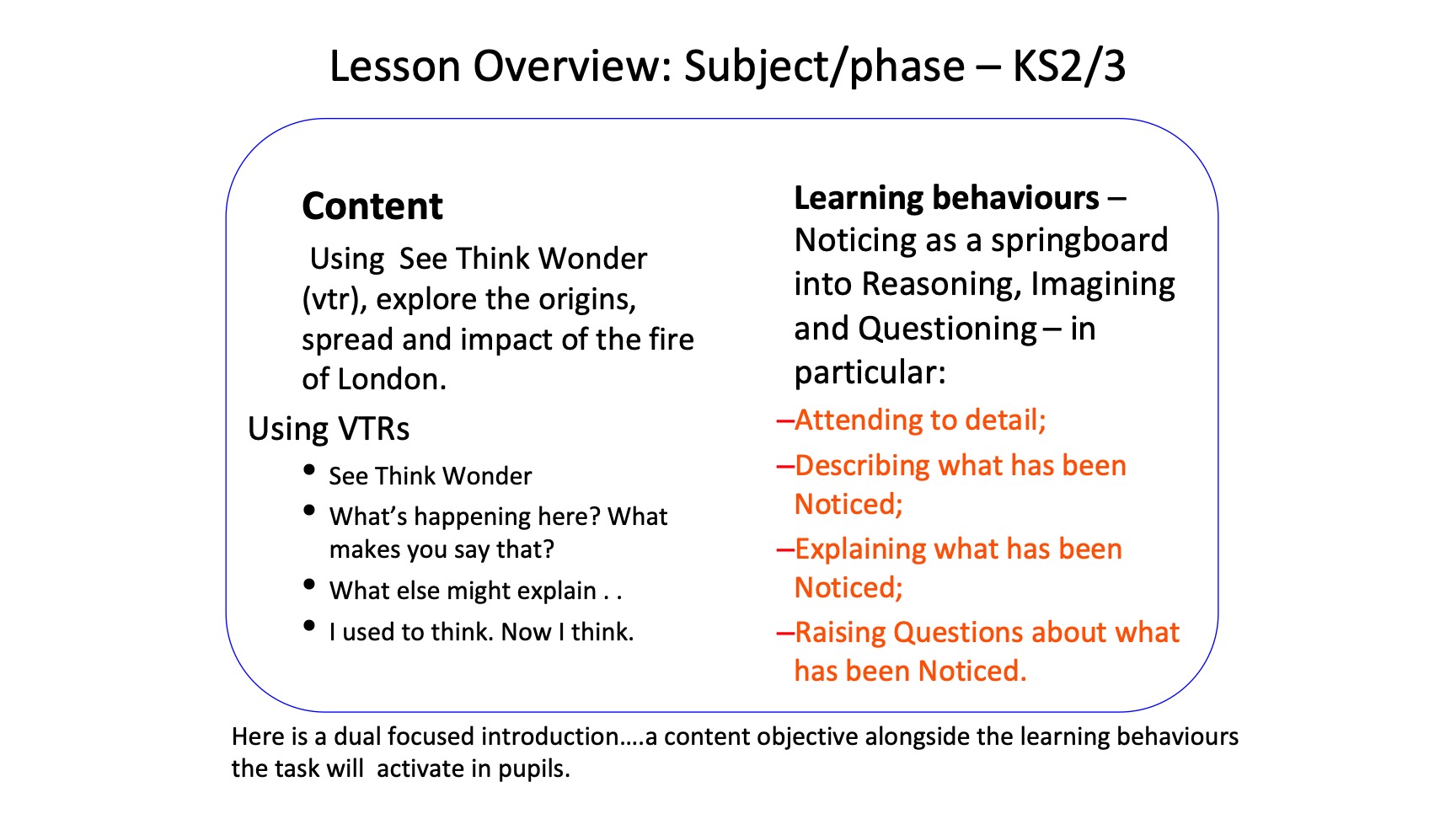
Episode 1 – What can you see?
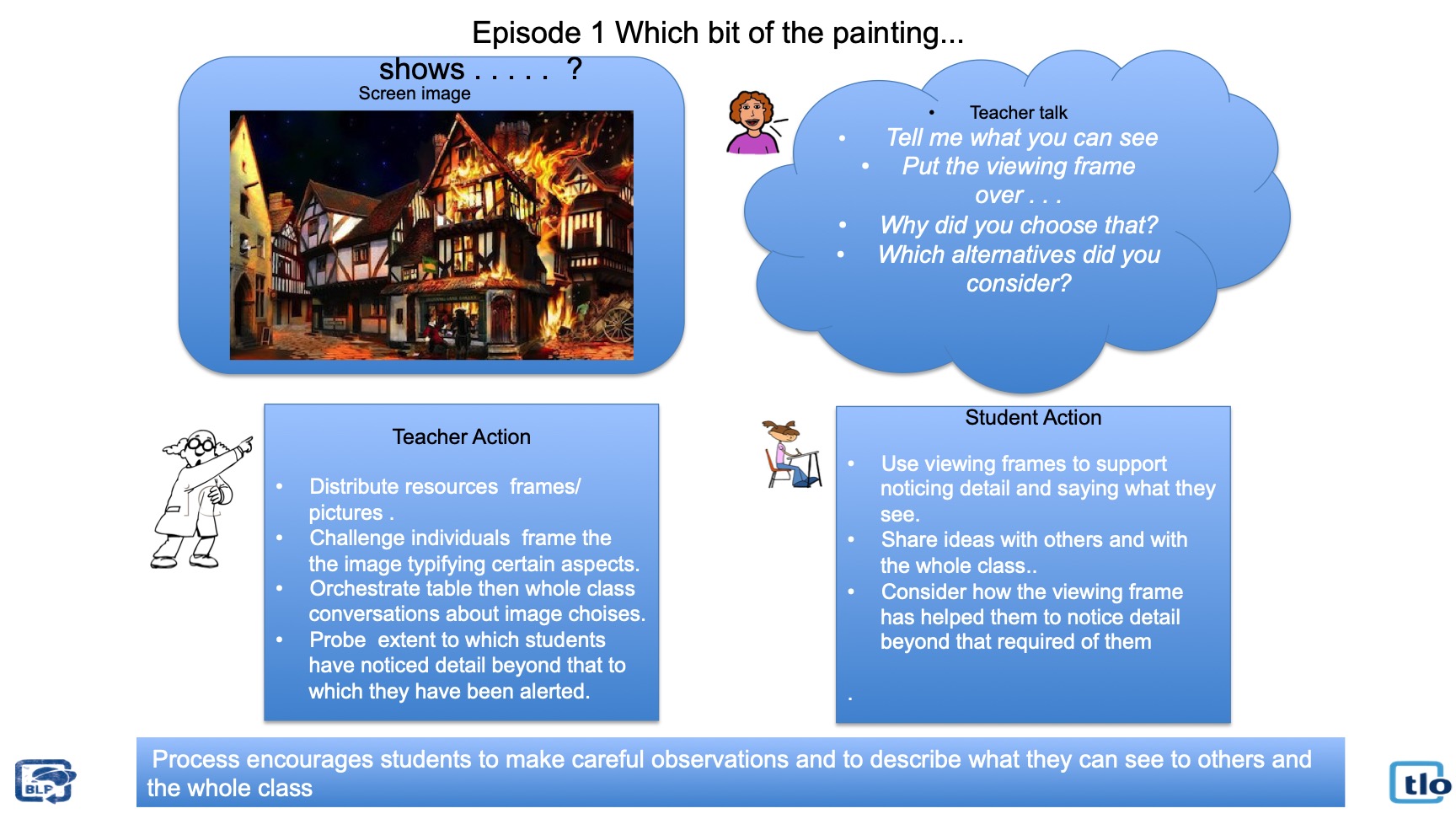
What is happening here?
The use of viewing frames is surprisingly powerful, and has the effect of removing the Think and Wonder aspects of S/T/W so that pupils focus only on the Noticing aspect. It elevates Noticing beyond ‘looking/scanning’ to ‘attention to detail’.
Download a template for creating your own viewing frames here.
Because many pupils find it hard to structure their responses in the STW style, in Episode 1 we focus only on the ‘See’ aspect.
When you distribute the image and the viewing frames, challenge pupils to find the part of the painting that best shows:
- heat
- light
- wood
- danger
- alarm/concern
NB.The things you ask students to look for determine the content depth and direction of the lesson. We leave you, as subject experts, to make best use of your subject expertise using this VTR. You decided i.e. what information and meaning students could absorb/learn about a subject by looking at/interrogating pictures/artefacts using a VTR.
The viewing frames help to ‘fix’ the whole image, even though a limited number of things were sought. Deep noticing, or shallow looking?
In the bottom blue box, the Learning Behaviours being activated are identified as:
- Process encourages students to make careful observations and to describe what they can see to others and the whole class
which corresponds to the Receives / Purple phase, Impact & Outcomes column.
Episode 2 – What can you see, and what do you think about it?
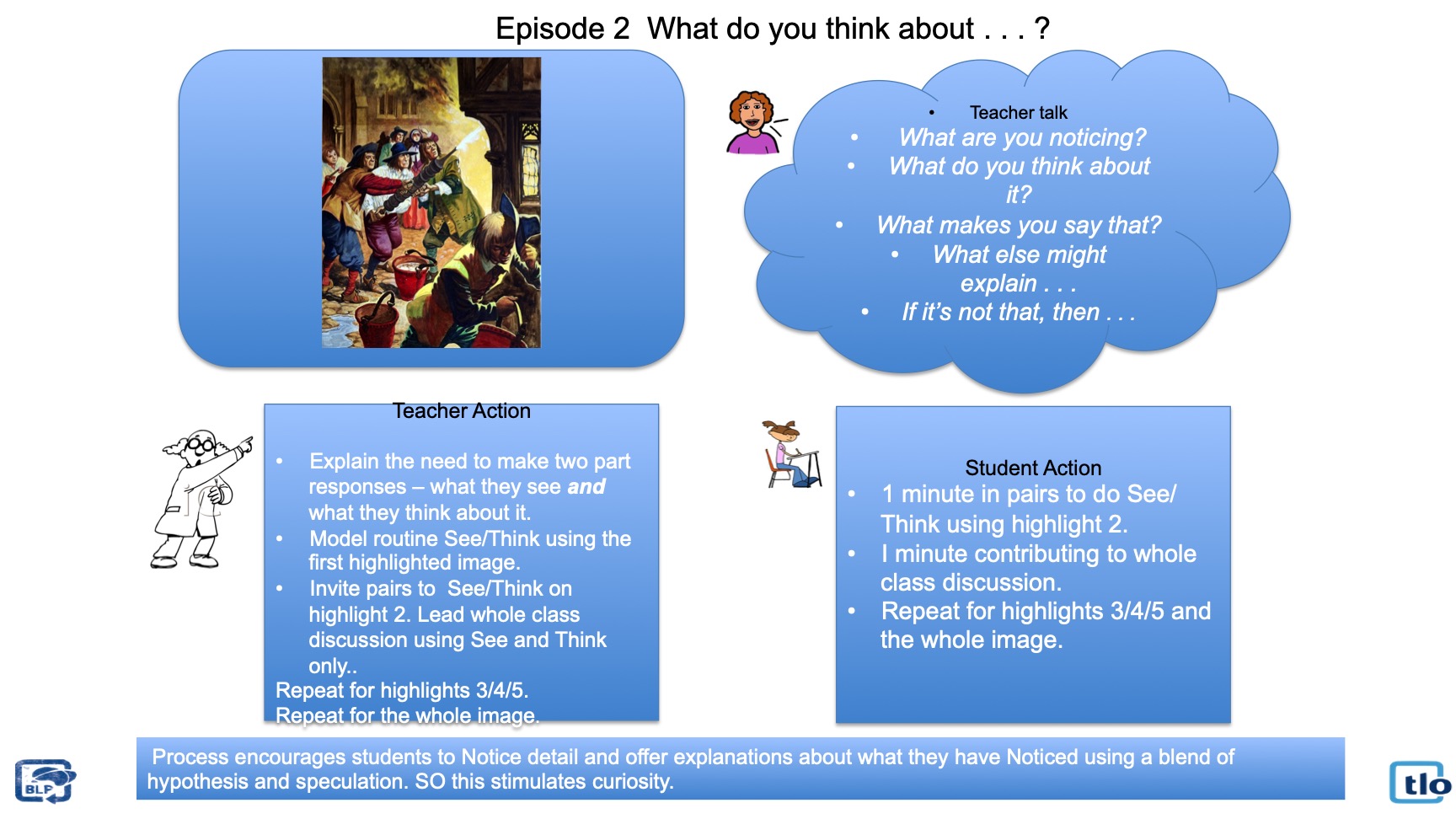
What is happening here?
In this Episode, we extend the Noticing to include the cognitive aspects of Reasoning and Imagining. See and Think.
Via the powerpoint, you do the ‘viewing frame’ aspect for them i.e. selecting which aspects/parts of the picture you want pupils to interrogate/see and think. Their job is to describe what they see/notice, and then to say what they think about it.
You might model this to get them going:
- “I see a woman, I think she is worried” or
- “I see a woman, I think she is holding something”
Force the issue here. Pupils need to both say what they Notice, and what they Think. You are seeking a 2-part response. Do not allow pupils to ask questions at this stage, that comes in Episode 3.
You might use ‘what makes you say that?’ or ‘what else might explain that?’ to encourage pupils to sharpen their observations/thoughts, or you may choose to take all of the See/Thinks without comment.
This Episode is about encouraging pupils to notice detail and to elaborate on their observations. It starts to build the bridge between Noticing and Cognition.
In the bottom blue box, the Learning Behaviours being activated are simply identified as:
- To Notice detail and offer explanations about what they have Noticed using a blend of hypothesis and speculation and to stimulate curiosity.
The addition of the ‘Think’ aspect of STW lifts the requirements significantly. In Noticing terms, it moves learners from describing what they have noticed in Episode 1, to speculating and hypothesising about what has been noticed. It moves Reasoning beyond describing towards explaining and justifying, and moves Imagining beyond ‘what is’ to ‘what could be’.
Episode 3 – Using See/Think/Wonder to interrogate an image and to set the scene for deeper enquiry.
What can you see, what do you think, what does it make you wonder?
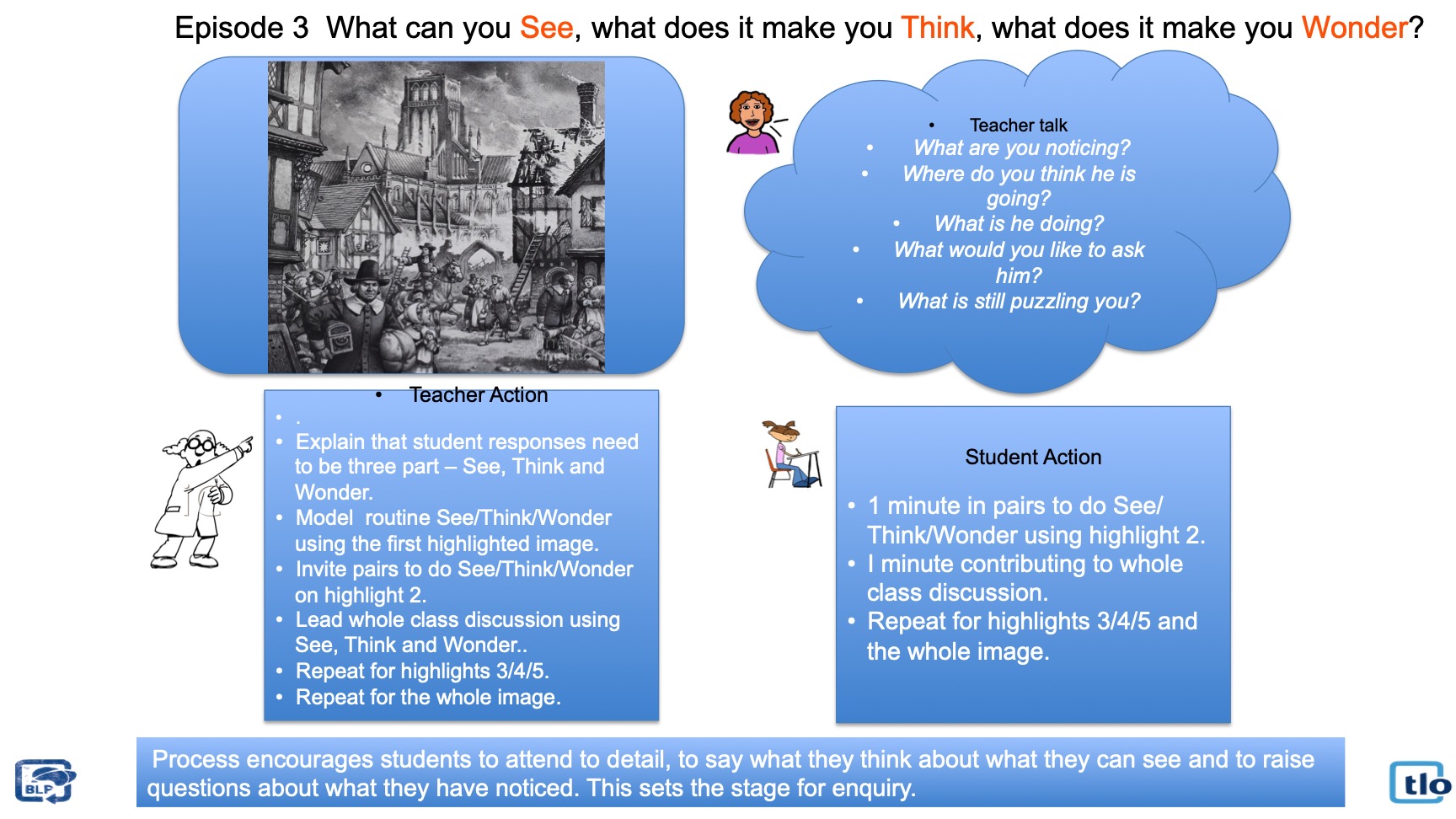
What is happening here?
In this Episode, you extend See/Think to See / Think / Wonder.
Via the powerpoint, again you are doing the ‘viewing frame’ aspect for the students. Their job is to describe what they see, and then to say what they think about it, and finally to ask a question about it.
You might model this to get them going: “I see a man with a ladder, I think he is going to rescue someone, I wonder if he knows them?’ or ”I see a box under his arm, I think it contains his valuables, I wonder if they belong to him?’
Force the issue here. Pupils need to both say what they Notice, what they Think, and to pose a question about what they have noticed. You are seeking a 3-part response.
You might use ‘what makes you say that?’ or ‘what else might explain that?’ or ‘what is puzzling you?’ or ‘what would you like to know / ask about . . . . ?’ to encourage pupils to sharpen their observations/thoughts/questions.
This Episode is about encouraging pupils to notice detail, to elaborate on the observation and to pose a question that arises from the observation. It sets the scene for further, deeper enquiry.
Take time to consider how you would capture and subsequently use the ‘Wonders’ that arise during the See / Think / Wonder activity. How might they inform your planning? How might you use them to enable pupils to pursue their own lines of enquiry?
In the bottom blue box, the Learning Behaviours being activated are identified as:
- To attend to detail, to say what they think about what they can see and to raise questions about what they have noticed.This sets the stage for enquiry..
The addition of the ‘Wonder’ aspect of STW lifts the requirements further. The noticing, reasoning and imagining aspects of Episode 2 are still present, and the addition of the requirement to frame a question sets the scene for deeper enquiry. Where Episode 1 required Purple phase Noticing skills, Episode 3 is engaging a minimum of green phase Noticing, Reasoning, Imagining and Questioning behaviours.
Download the Fire of London ppt here.
What do you think?
- Can you think of a curriculum-related image that you could use instead of the Fire of London painting?
Make a note of…
- Which class you might try this with, using which image(s).
3 Using a lesson plan template to distil this lesson.
Given that there are hundreds of lesson plan formats we will use a few different types of planning tools over the course of these units. This one is a simple streamlined useable tool that includes:
- What you do (teacher action);
- What pupils do (pupil action);
- What the learning behaviours being called upon are (learning behaviours);
- What you say (learning talk) to nudge the learning behaviour along.
The format is divided into episodes to show the change of purpose, action and use of learning behaviour across the course of the lesson.
Download a blank lesson plan as a MS Word document: Lesson Planning Grid [.DOC 33KB]
If we now populate the template with the episodes explored in section 2 above, we get the completed lesson plan. . .
What do you think?
- What are your first reactions to this lesson plan template?
- Does planning for four aspects – teacher action, pupil action, learning behaviours, teacher talk – seem useful?
- How does sequencing the lesson as ‘episodes’ help or hinder planning?
Make a note of…
- The extent to which your existing planning template enables you to think about lessons in this way.
- What you would like / need to add to it.
4 Extend your thinking about the See/Think/Wonder visible thinking routine
Why use See / Think / Wonder?
The whole point of the See Think Wonder strategy is not that it should be used occasionally at the start of a project as an engaging lesson starter, rather that it should in time become habituated so that pupils’ responses to all situations become more thoughtful, evidence based and enquiry focused. It lifts their responses beyond merely describing what they can see (the Noticing bit) and stimulates the cognitive aspects of Reasoning, Imagining, Making Links and Questioning (the Thinking and Wondering bits).
Taking Noticing beyond Seeing . .
We used images as the basis for this section as they are easy to put into a powerpoint. But in your own classroom you could adapt the strategy to include Hear/Think/Wonder (maybe listening to the soundtrack of part of a film without the visuals? Or a conversation? Or one side of a phone conversation?), or Read/Think/Wonder (maybe used on an extract from some text?).
Ask yourself – How might you use Smell/Think/Wonder? Or Touch/Think/Wonder? Or Taste/Think/Wonder in your classroom?
What do you think?
- Where / when / why might you use S/T/W?
- How will you use the questions that are generated?
- How will these questions inform your planning?
- How will you ensure that S/T/W is an integral part of the lesson, and not just a ‘catchy’ activity before the ‘serious’ work begins?
Make a note of…
- Which class you might try S/T/W with.
- When you will try it.
- Which of the variations appeal to you.
Section 2: Building Noticing friendly classroom cultures
Teachers as habit formers
As teachers we are in the habit-forming business. What we say, what we display on classroom walls, what we celebrate, praise or dismiss, what we model or how we design learning activities will all influence the ways in which pupils learn, perform and behave. Classroom cultures have a huge influence on pupils’ learning as you will remember from the Culture unit.
Five big shifts to get you started. Ask yourself – how might you:
Slow the pace down to afford time to notice detail and to reflect on what has been noticed;
Reward attention to detail and accuracy;
Design learning activities that call for searching for patterns and identifying significant detail;
Engage all of the other senses to heighten noticing skills;
Encourage students to hypothesise about what they have noticed.
Now look at the Learning Chart sections below where you will find plenty more ideas to try.
Section 1: Noticing and how it develops
1a) What do we mean by Noticing?
Learning often relies on being able to pay attention to what you are interested in: not necessarily thinking about it, just really noticing how it looks, what it is made of, or how it behaves. Many professionals, from poets to scientists to business managers, rely on this quality of attentive noticing: being able to identify the significant detail, or to let an underlying pattern of connections emerge into their minds. Sometimes you have to be patient before the detail or the pattern will reveal itself to you, like looking for sea creatures in a rock pool. And this is a skill that can be strengthened with practice. We often pick up this skill from people around us. Babies very soon learn to work out what their mother is focusing on, and to ‘share joint attention’ with her. It helps to be around people who are demonstrating this ability to watch carefully and turn their observations into accurate descriptions. Getting a really clear sense of what, before starting to think about how or why, is very useful.
From Building Learning Power by Guy Claxton 2002
1b) What does being a good Noticer involve?
A well formed Noticing habit involves being ready, willing, and able to:
- Be attentive to details and subtleties in seeking to understand things
- Seek underlying patterns patiently, understanding that connections may take time to emerge.
- Actively use all the senses to gather information to build understanding of the world around.
- Gain a clear sense of the ‘what’ of something before considering the ‘why’ and ‘how’.
- Recognise that learning is often complex and difficult and takes time and effort to accomplish.
So, at a less abstract level, students need to learn how to focus their attention; to look patiently beyond the obvious to see detail and subtlety; to be able to identify the relative importance of what they are observing; to develop the ability to see detail in the context of the bigger picture; and to develop the ability to explain, hypothesise about and explore what is being noticed. When looked at from these diverse angles, growing noticing moves well beyond encouraging a student to ‘look carefully’.
Our progression grid for Noticing has 6 components:
1c) Unpicking the columns; what contributes to a readiness to Notice?
The grid columns are aspects that might combine to make up the skills and attitudes of a Noticer.
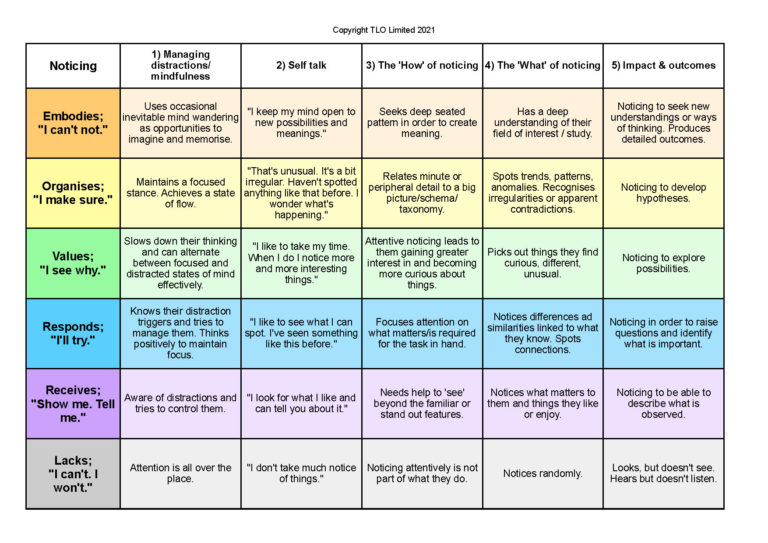
 Overview of the grid
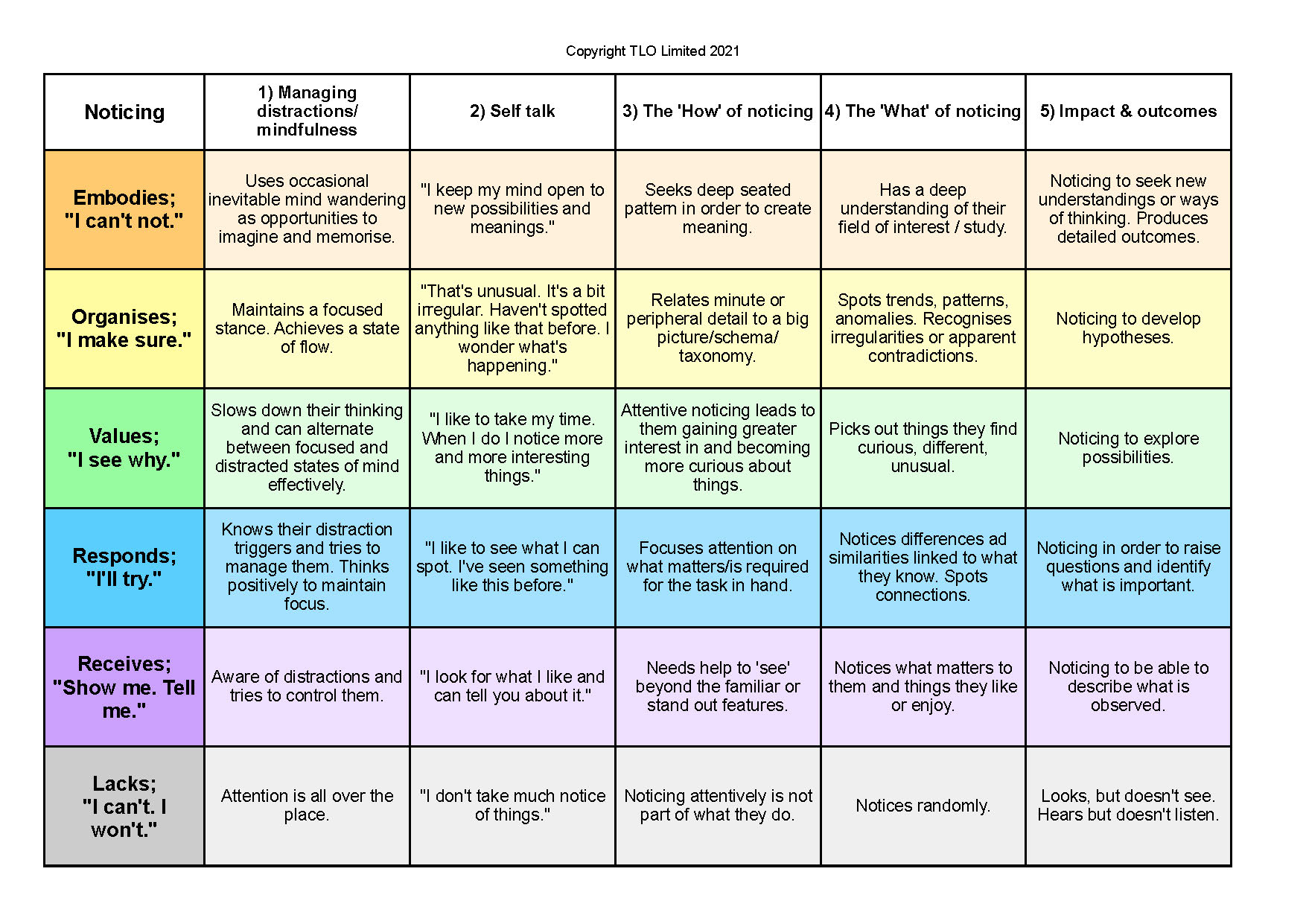
Noticing is basically about paying attention, and how or how well you pay attention depends on how you are feeling. So this learning behaviour is, to a large extent, controlled by our emotions. Paying close attention, looking for detail, through any of the senses, takes time, needs focus and above all requires patience. In being able to do this well several strands come into play. Column one deals with being able to manage distraction and focus attention. Column two is about self-talk; what students may be saying to themselves in growing their self-awareness about noticing. Column three is about the ‘how’ of noticing; for the familiar, to a given brief, for interest, for fine grained detail. Column four is about what we are noticing, from things that matter to them, or similarties and differences or for unusual or curious etc. The last column concerns the outcome of the noticing; to simply describe what has been noticed or to raise more questions or to seek new understandings.
The difference between something good and something great is attention to detail.” – Charles R Swindoll
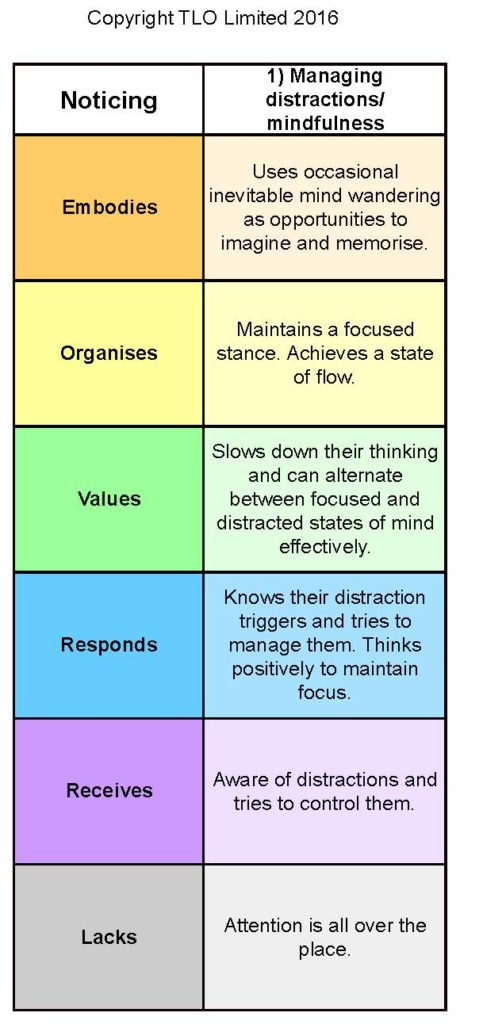 Managing distractions/mindfulness
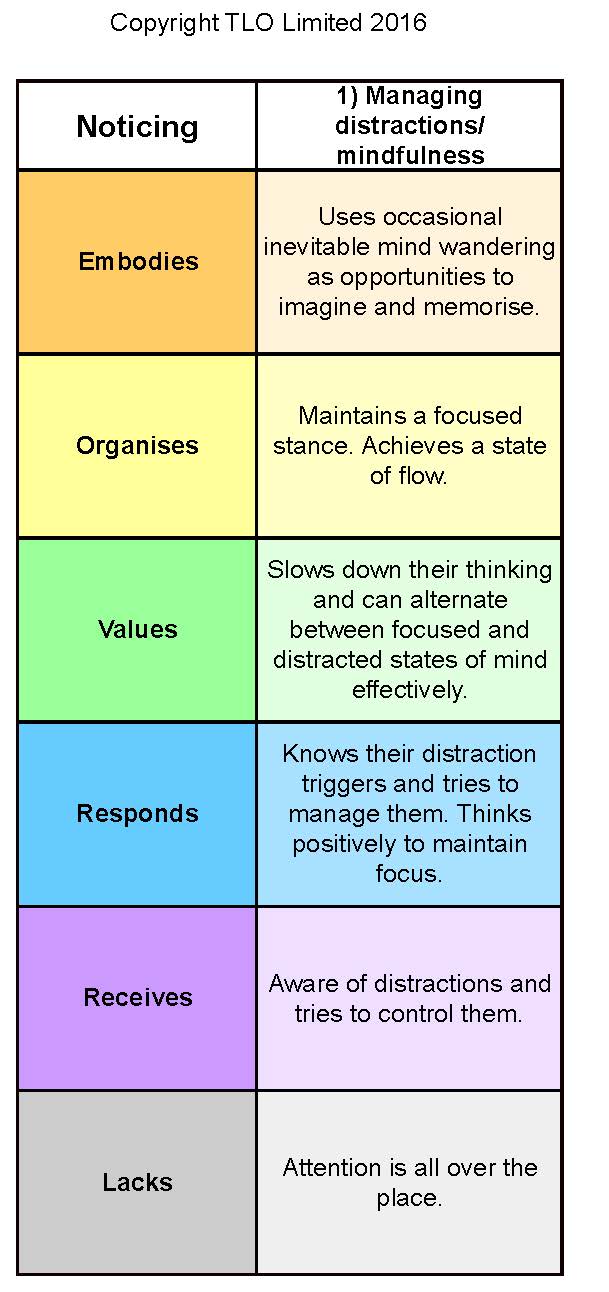
Securing and maintaining a focus
The first development strand concerns being focused and absorbed, with an emphasis on managing distraction. It moves from moving attentiveness from being all over the place to using mind wandering purposefully. This may seem a strange and short journey but it turns out that being able to train the mind to use mind-wandering effectively takes a while. In the receives phase students are aware of being distracted and take steps to try and ignore them. In the next phase students become aware of the particular things that trigger their distraction. Triggers may be loud sounds, or flashing lights or countless others, but the student has become aware of particular triggers and try to manage them. By the values phase they know that the mind naturally slips in and out of focus and they have learned how to slide back into an absorbed state rapidly. In the organises phase people are able to achieve a state of flow, a state of complete concentration ‘that leads to a feeling of spontaneity’. Flow is performing at high levels of challenge and yet feeling ‘effortless’ like ‘you don’t have to think about it, you’re just doing it’. And in the highest phase the person is able to use their inevitable mind-wandering to imagine possibilities and put their new noticing into memory.
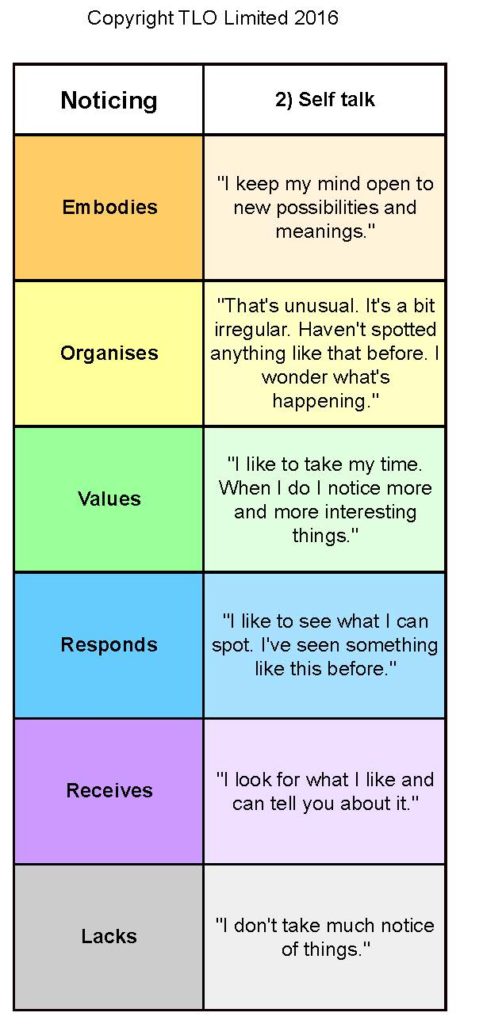 Self-talk
The voice is self-awareness
Self-talk is what we say to ourselves as we learn. The statements capture what someone in each phase of the grid would be thinking. Students may use some of these phrases when talking with you, or in writing from time to time, but mostly self-talk goes on inside their heads. We have shown a small flavour of self-talk thoughts that teachers can encourage students to imitate. Some relate to standards, others to self-monitoring or flexibility. All such self-talk is important in building a noticing habit
 The ‘How’ of noticing.
How we notice what is happening
- In the early phases of developing noticing, we notice things we are familiar with and things that are obvious, that stand out in some way. Then we draw on noticing particular things related to a task we have been given. But the more we notice about anything the more interesting it becomes making us to want to notice/discover more. Our noticing grows more comprehensive, we differentiate between the big picture and the finer details and gain insights into what’s really going on. Finally the ‘how’ of noticing has become highly skilful and very rewarding as we seek the deep-seated patterns to create new meanings. Such noticing adds much to the way we understand things.
 The ‘What’ of noticing
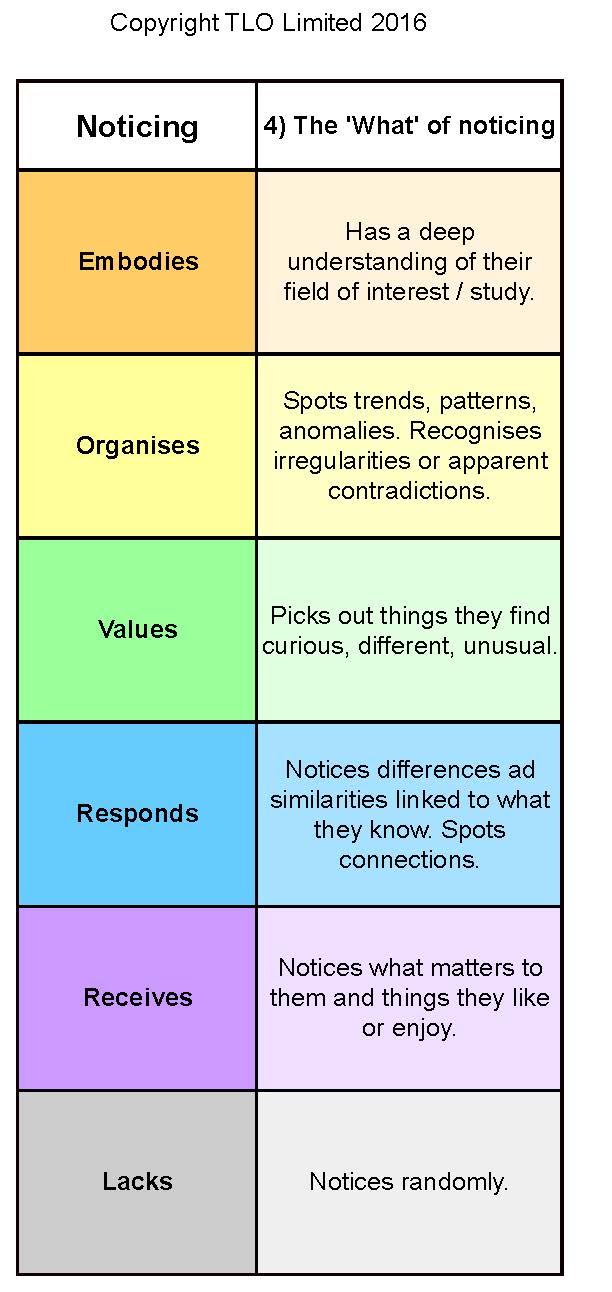
What are we looking for?
In the early stages, we tend to notice things that are interesting to us, that we know about and that are familiar. Later we may start noting similarities and differences between things or how they were previously and how they are now. But as we become more familiar with something we might notice what’s missing or things that are curious or new. When we have spent a long time noticing say, a particular habitat, or a group of people, or musical compositions we become able to spot trends, patterns or anomalies, irregularities or contradictions. Thus we become expert in an interest or field of study.
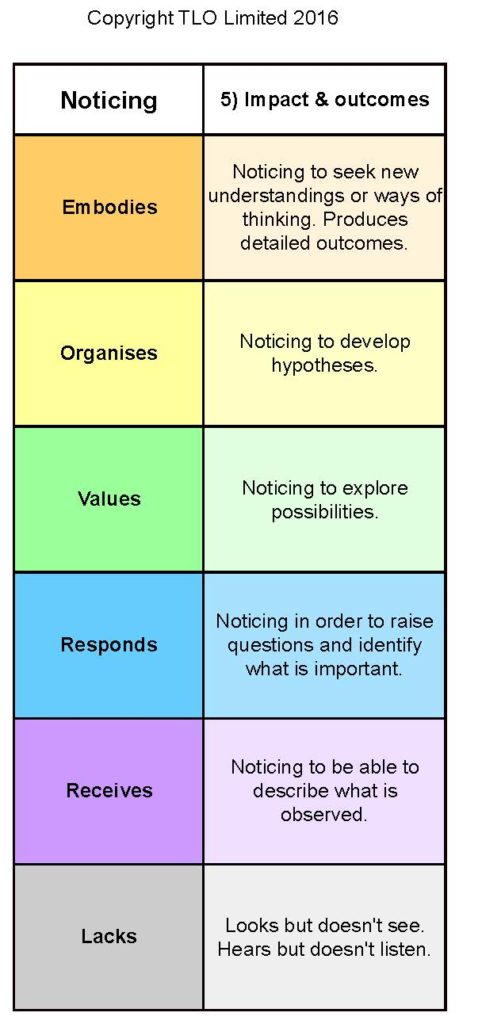
 Impact & outcomes
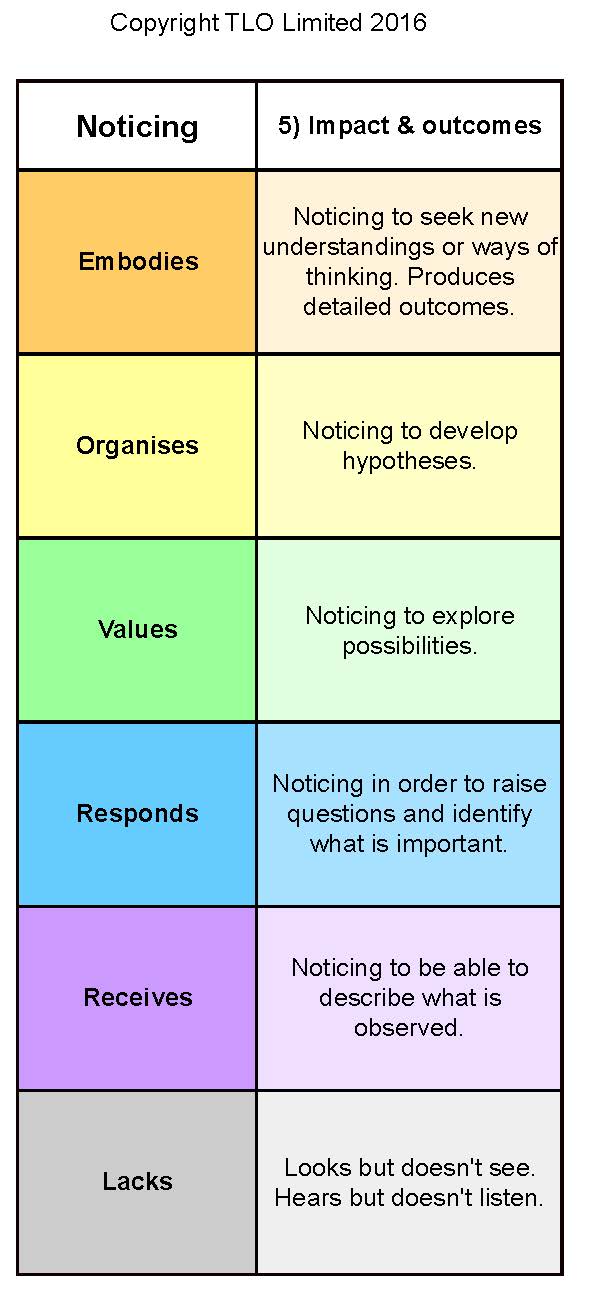
The results of attentive noticing.
So what can we do with these ways and hows of noticing? In the early stages, we can describe what we have noticed. Not well at first but with more detail later. Later our noticing brings forth questions ‘what’s that?’ what’s it called? what is happening? and so on. Later still, as our interest and curiosity increases, we notice with the intention of exploring possibilities, finding what’s important or constructing hypotheses. And as we become highly skilled our noticing leads to new understandings of the world.
What do you think?
What have you learned about Noticing from these descriptions?
What have you had confirmed?
What surprised you?
How have your views changed?
Make a note of…
Any ideas for practical classroom experiments that these descriptions have triggered
Which column your students are most secure in.
1d) Unpicking the rows; getting better at Noticing
Of course, the development of Noticing doesn’t grow neatly up each column or evenly across the phases in the grid. The five broad phases of dispositional growth (purple – orange) are affective ways in which people may be inclined to behave: we call this inclination ‘mindedness’.
Here is our interpretation of how Noticing might grow.
Meaning behind the phases
The phases are drawn from Bloom’s taxonomy of the affective domain.
Phase ‘Receives’ (purple) is about doing something because you are told or expected to.
Phase ‘Responds’ (blue) is about gaining interest and doing things more willingly.
Phase ‘Values’ (green) is a key phase since the student now sees the value of behaving in this way. It’s a win for them; to behave like this is in their interest. It’s in this phase that the behaviour becomes more secure.
Phase ‘Organises’ (yellow) is the phase in which the student capitalises on this ‘in their interest’ behaviour and gets themselves organised to use it positively.
Phase ‘Embodies’ (orange), known as ‘characterised’ in the original taxonomy. In this phase, the student has made this behaviour their own. It has become part of their character; they can’t, not do it and they have become highly skilled in doing it.
We urge you to see this progression as long term. Some phases will take years for people to work through; some will never be worked through. None of the phases are inevitable. There is a lifetime of development captured here. Nevertheless, the role of a teacher or parent should surely be to encourage and enable this journey.
Lacks: Minded to look rather than see.
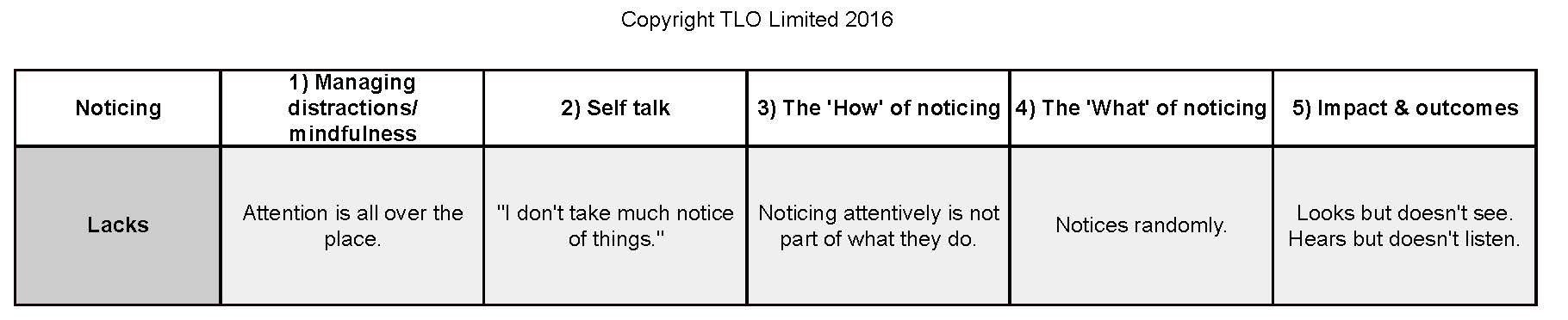
In this ‘Lacks’ (grey) phase, students do of course look at things but take little notice. Their focus is blurred for they like to look at everything, but nothing in particular without a lot of support. Close attention for specific purposes is yet to come.
Receives: Minded to look for what they like.
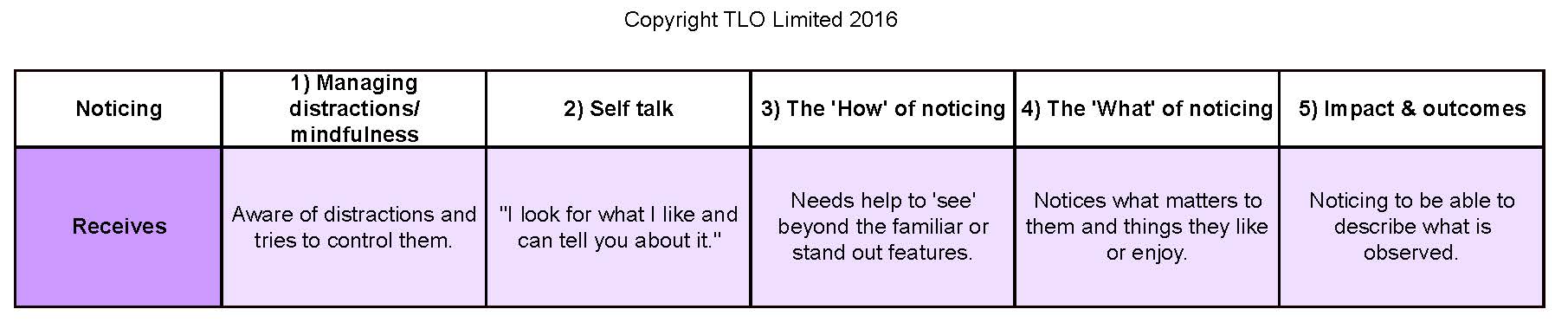
In the Receives (purple) phase, students need help to notice attentively. They readily the see the familiar or obvious but need help to go further. They can describe what they have seen but this too lacks detail. Students know that being distracted isn’t helpful to noticing attentively and do try to ignore common distractions.
Responds: Minded to notice for what’s needed.
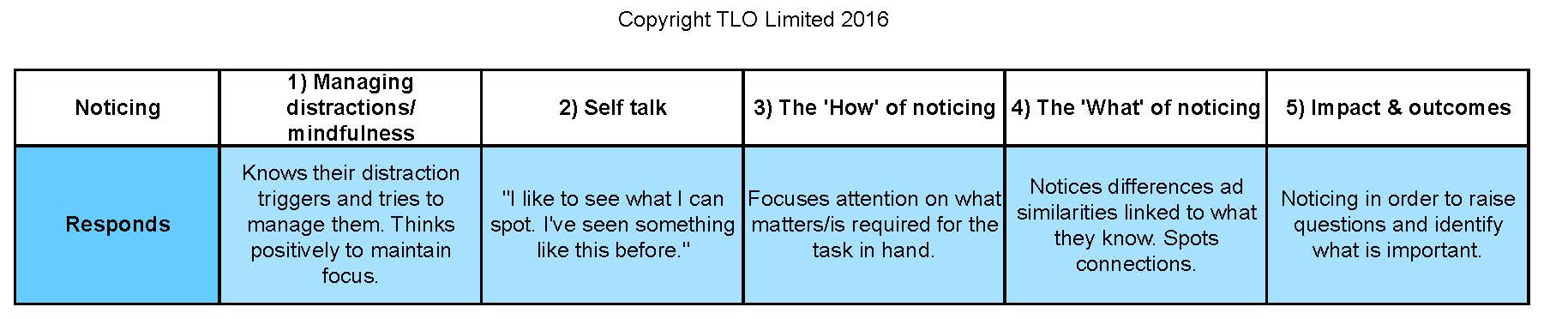
In the Responds (blue) phase, students know more about distractions and what in particular distracts them. They know the triggers and take steps to divert or diminish them. Their focus now is on the task in-hand, usually one set by teachers or parents. They strive to notice what is required and look for first, differences, and then similarities in what they know about. Such noticing usually causes them to ask questions as their interest grows.
Values: Minded to notice with real interest, slowly.
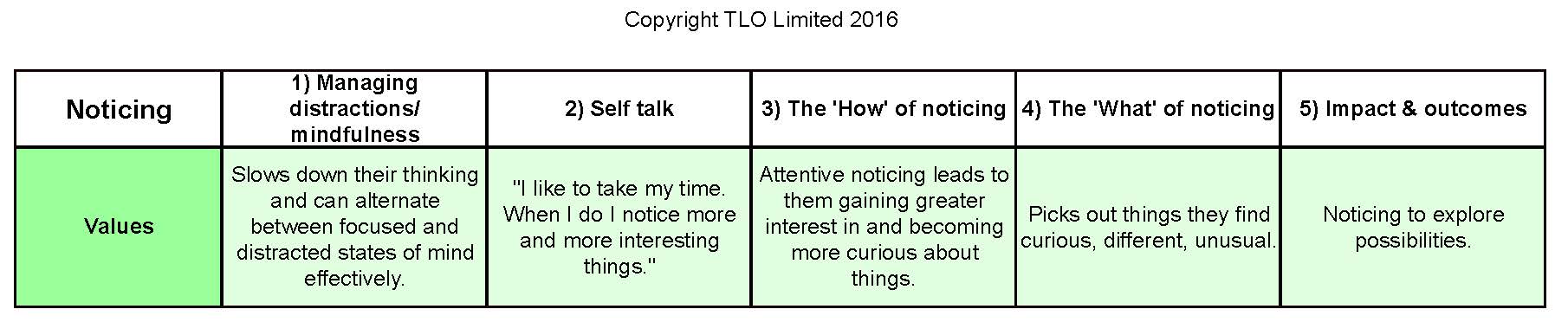
In the Values ( green) phase, students come to understand what attentive noticing is really about. They know that it takes slow seeing and when they get distracted they can bring themselves back to focusing quickly. The more they notice the more fascinated they become. Now they are seeing or hearing or feeling not just the obvious or the differences but the unexpected, the unusual; the things that seem slightly odd in that context. Through this they are able to explore new possibilities.
Organises: Minded to notice for patterns and anomalies.
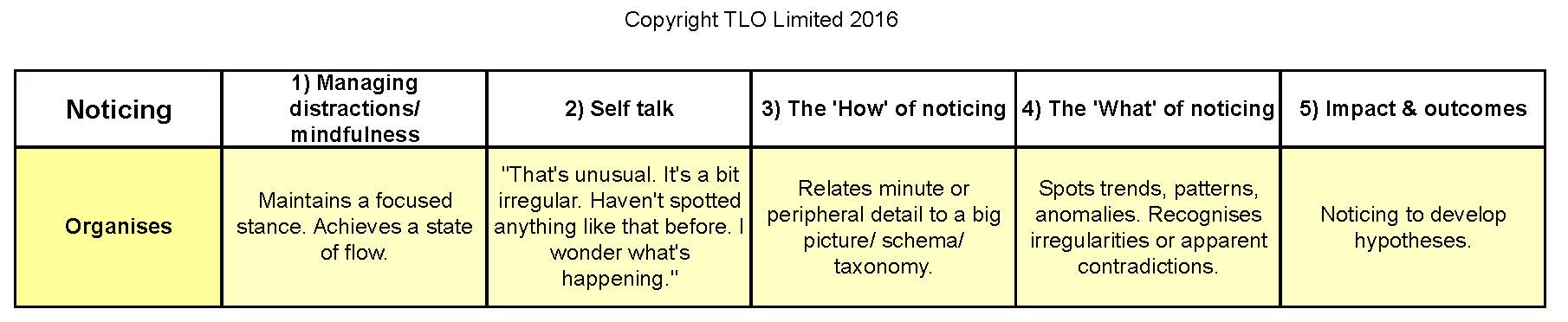
In the Organises (yellow) phase noticing has become a skilful habit. They see noticing as an important skill deserving of time, and their focus is such that they experience a state of flow where high challenge appears effortless. Now, from noticing irregularities or the unexpected they can see patterns emerging; how things hang together, or not.
Embodies: Minded to enjoy deep attentive noticing.
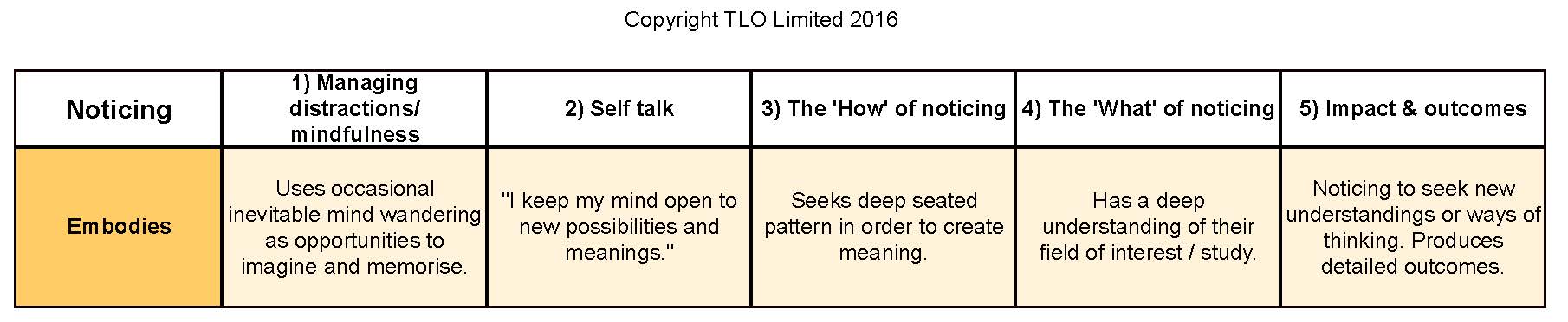
In the Embodies (orange) phase, attentive noticing is part of their character; it’s a way they approach learning, it’s a permanent piece of their deck of learning cards. They have a deep understanding of their interest or field of study. Their attention is held by their knowledge and understanding but through continuing attentive noticing they continue to seek new understandings. Their deep insight fuels their intuition.
What do you think?
What has struck you about the act of Noticing having read the descriptions above?
Which phase do you operate in?
What makes you say that?
Make a note of…
What you might do to assist your students to make headway in their Noticing behaviour.
Any practical ideas the text has triggered.
Preparation for the Learning Team meeting
Where are my pupils now?
- Take a look at the Revising progression chart in your Learning Diary or
- Download grid to colour in here
- Colour in the cells where you think your pupils are secure.
- Some will barely be on the chart while others may be quite a way up. Neat straight lines of secure classes are rare. But looking at your class in this way should give you an idea of what you need to work on.
- Draw a red line across the chart to denote where you think most of the school’s pupils could and should reach by the time they leave.
- Please take the results of these tasks with you to the Professional Learning Team session shown in Section 4