
How might I shift the classroom culture to help students to become willing to help themselves in learning?

This section clusters all the ideas that will best assist students to progress from being bounded by needing direction to being willing to do things for themselves.
In the Receives phase, students have made a big leap from having a negative mindset to a more neutral one. Here they are inclined to; play it safe and stay in their comfort zone. They need adult direction and comply with suggestions for getting unstuck.
In the Responds phase, students develop greater independence and are motivated to initiate their own prompts or practical strategies to get themselves unstuck. They are realising that fear and the need for adult support can be overcome by using more coping strategies and maintain positive emotions.
1. Stop
- Giving all the answers
2. Start
- Using If/Then strategies
- I’m stuck because…
3. Start slowly
- Building getting stuck in lesson
- Build reflection on ‘stuck’ into lessons
4. Experiment with
- ‘Support to continue’ coaching talk
Aids to help shift responsibility for learning
- How you relate to your students; gradually sharing more of the responsibility for learning with them
#1 Introduce deeper ways of getting unstuck
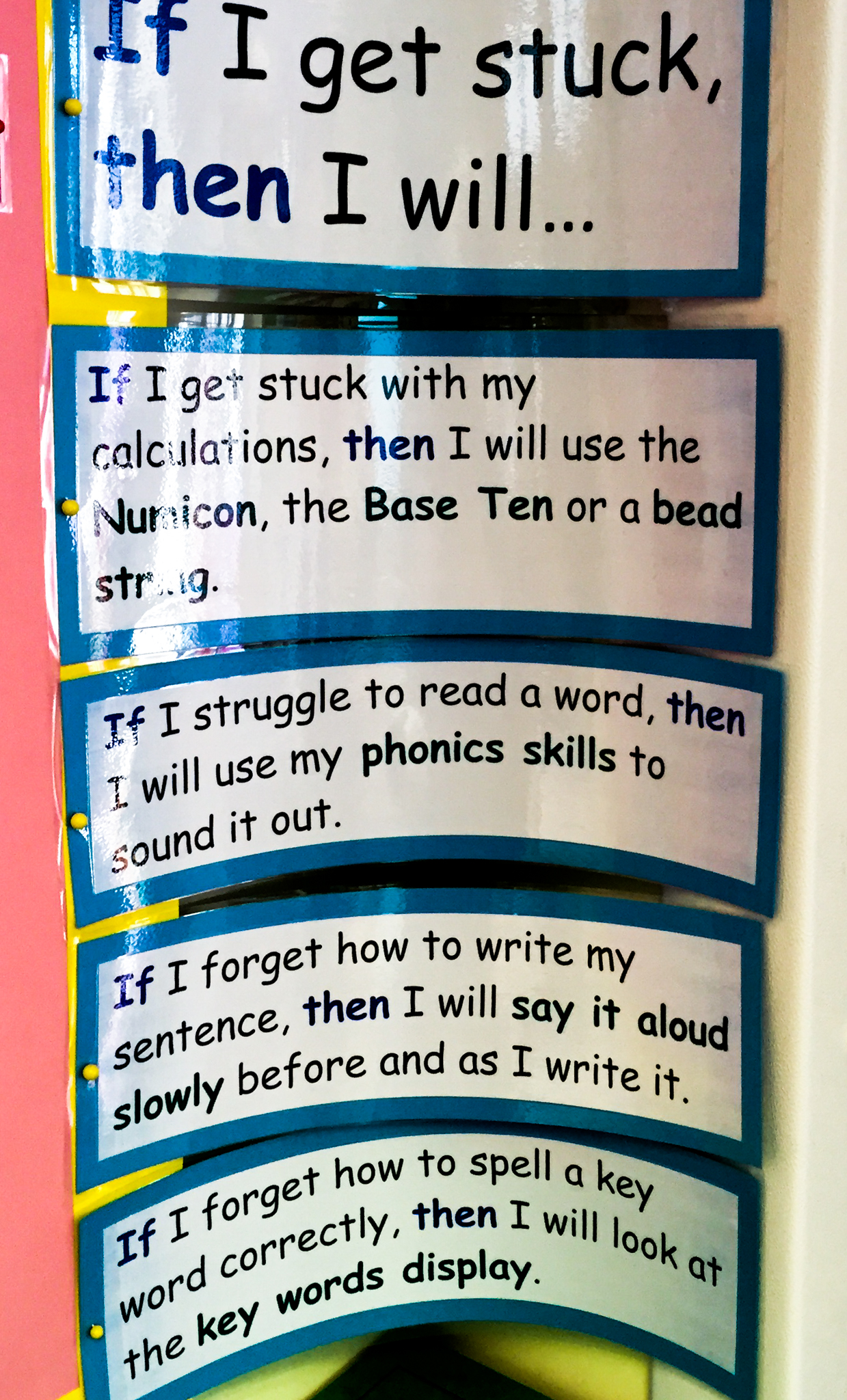
‘If – then’ display example, Heathcoat Primary school Tiverton
Put ‘If-then’ planning into action in your classroom to make stuck solutions more specific and personal
If we want students to change their behaviour we need to help them to think much more closely about the ‘hows’ and the ‘whats’.
Motivation research proposes an effective solution to this called ‘if-then’ planning.
‘Ifs’ are the situations you want to remind yourself about. In the case getting unstuck it’s useful to list all the sorts of places this tends happen
‘Thens’ are what you will do about something; the action you will take. Brainstorm a list of the ‘what we might do in response to the Ifs’.
Read more
Research findings
Research on motivation and goals from Harvard University shows how our brains work to achieve our goals. Basically it says that goals need to be very clear and our brain ignores a goal if it’s unclear about what to do. Brains act on goals only when what to do is clear.
So, goals like ‘Lose weight’ or ‘Exercise more often‘ or even ” I want to feel ok about being stuck‘ are too nebulous. They beg the question ‘how’ or ‘what do I do?’
The how to ‘If-then’ planning
When setting a goal you need to specify not only what you will do but also where and when you will do it.
If (or when) [___situation__], then I will do [___behaviour__]
So going back to our goal about losing weight, we need to know much more about the ‘how’ and the ‘what’ and the ‘how to’ of losing weight.
An If-then statement or goal might be ‘If I get the pudding menu, then I’ll ask for coffee’.
This may sound a bit cumbersome to start with but research suggests far more goals are achieved by using ‘if-then’ planning. And the clever bit is that this builds self talk at the same time. You do what you are telling yourself to do.
The ‘if-then’ plan succeeds because the situation and the action become linked in the mind. The brain recognises the situation as an opportunity to advance the goal. When the situation is detected action is initiated automatically. “If-then’ plans become “instant habits”.
Goal: I want to feel okay about being stuck
If…
…I get stuck in my reading (all the stuck places will need specifying)…
…I get stuck in Maths (specify how you might get stuck)…
…I get into tricky situations in the playground (specify tricky)…
Then…
…I will (Some specific statements to unstick themselves)
#2 Use short reminders to encourage self reliance.
These routines put responsibility on students to do things for themselves before asking the teacher for help.

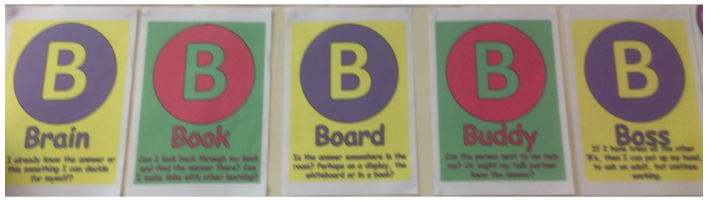
Brain / Book / Board / Buddy / Boss
Read more ...
C3B4Me can be used in conjunction with the stuck posters displayed in the classroom. Students should try three strategies from their stuck posters before seeking help from the teacher.
Another alternative to the stuck poster, BBBBB invites students to:
- use their Brain
- check in “the Book” (or other resources). This implies that students are allowed to get out of their seats to find these resources, and that those resources are available.
- look on the (White/Smart)Board
- ask their partner/friend/another student (“Buddy”)
- before finally turning to the ‘Boss’ (teacher) for help.
Talk for learning
How you talk about learning; the sort of language content and style you use to enhance and explain learning
#1 Talk to reframe ‘stuck’
From ‘I’m stuck ‘ To ‘I’m stuck because …’
Encourage students to identify the cause of their stuckness. Move students from saying “I’m stuck” to ” I’m stuck because…” Naming the problem will often suggest a reasonable next step.
It’s also useful at this stage to insist that students can’t call themselves ‘stuck’ unless they have tried to apply at least 1 solution.
#2 Talk to explore: the consequences of giving up
Two paths
 Once a year or so, explore the notion of ‘giving up’.
- Introduce a character struggling to learning a new skill. Pictures are a good starting point.
- Encourage students to discuss how the character is feeling and what he or she might do (give up or persevere).
- Explore the feelings and consequences of the two options – giving up or persevering.
- Ask students to come up with their own examples and draw pictures or describe the potential consequences of giving up or persevering in these scenarios.
Read more ...
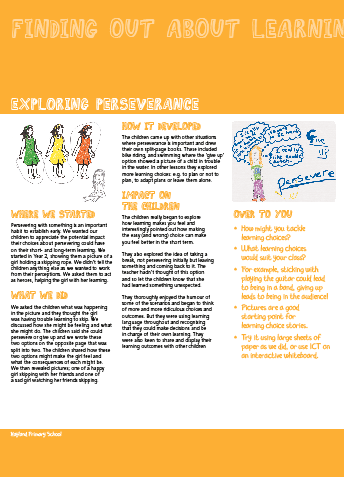 Read about how pupils at Nayland primary school in Suffolk explored the consequences of giving up and their own choices in making such decisions.
#3 Talk to explore: the feelings of stuck
Uncover the emotions of being and overcoming ‘stuck’
 Explore and contrast the feelings of being stuck with those of overcoming stuckness. Use the positive feelings of ‘unstuck’ as springboard for developing ‘stuck strategies’.
Read more ...
Take a look at how a teacher at Arkholme primary school approached the ‘stuck’ issue by exploring the pupils’ emotions.
-
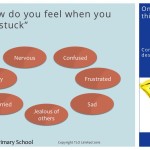

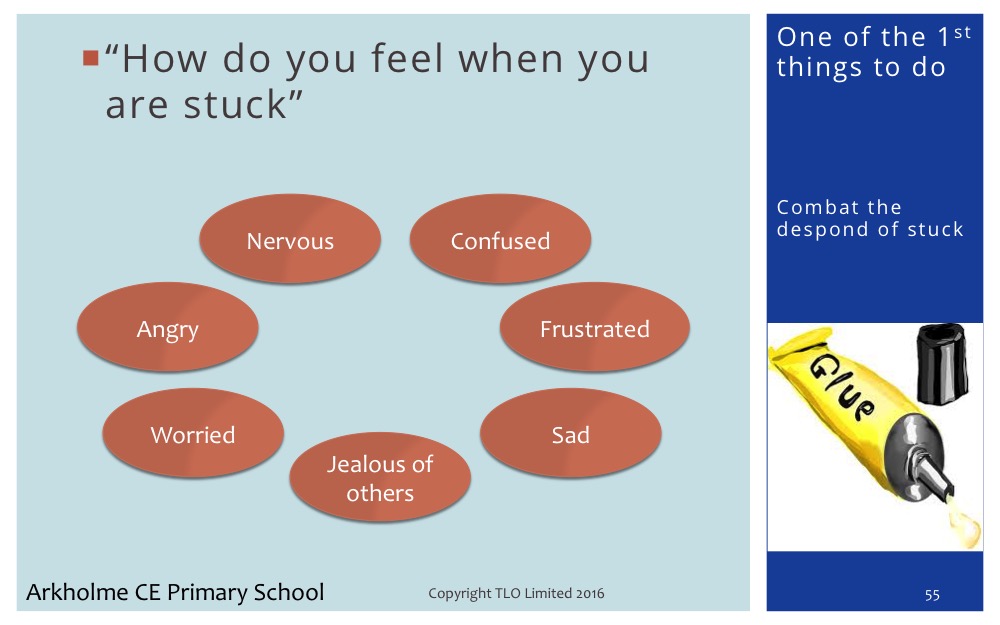
- A Yr 5 teacher from Arkholme Primary school near Lancaster explained STUCK by exploring it for real with her pupils. First she asked how they felt when they got stuck….. Take a look at the wide range of negative emotions being stuck seems to generate in pupils
-
- Then she explored what led the pupils into getting get stuck…..a fairly predictable content driven set of ideas here

-
- Then she explored what the children felt like when they overcame being stuck……..another great range of emotions; this time positive

-

- Then the class discussed what they might do to get unstuck, and charted their ideas for everyone to use!!

#4 Talk to nudge improvement in the skill: self recovery from ‘stuck’
Support to continue: questions not answers
If students freeze when they are stuck, offer supportive questions not answers. A basic support to continue is ‘What do you do next?’, and when this has been done ask the question again.
To extend the ‘support to continue’ approach, try using phrases like:
- What have you already tried? What else might work?
- What did you do when you got stuck before?
- I wonder what you did to move on?
- How about taking a short break and coming back to it later.
- Have you looked at the stuck prompts ?
- Who seems to be managing this ok ? What are they doing
- I can see that [this task] is important to you. Well done for keeping going.
‘Support to continue’ prompts are seen as helpful by pupils. You are encouraging them to take over the job themselves and reminding them that uncertainty shouldn’t lead to paralysis.
Read more ...
Coaching approaches
The advantage of asking questions over telling is that you are in a better position to monitor how students are learning when they are doing the explaining. Ask students how they might check their answers or why they think they are right or wrong. Have them work with each other on this to encourage a learning community rather than just teacher-student dialogues.
“Expert tutors often do not help very much. They hang back, letting the student manage as much as possible. And when things go awry, rather than help directly they raise questions: ‘Could you explain this step again? How did you… ?’” (Mark Lepper)
When we are curious we are genuinely interested in learning. Curiosity lies at the heart of coaching, hence coaches are effective listeners and ask questions to open dialogue without sounding like an interrogation. Coaching aims to enable people to see what they are doing more clearly and discover their own ways to improve. A coaching approach:
- helps people to explore their challenges, problems and goals
- provides an objective view of peoples actions to enable them to see things as as they really are
- enhances motivation and raises self esteem
- builds curiosity and encourages learning
Above all, coaches resist offering solutions. Offering solutions does little to secure learning as the pupil hasn’t been allowed to confront and engage with the problem and find their way forward. Learning powered teachers adopt a coaching role.
#5 Offer feedback on maintaining a ‘can-do’ attitude
- Even though this was difficult, you remained upbeat and positive. It was this that led to your success – great stuff !
Constructing learning lessons
How you construct learning activities; the tasks and classroom routines you use to build positive learning habits
#1 Couple content with process: building getting stuck into lessons
Plan to get students stuck
Start some lessons with something like:
- In this lesson I expect you to get stuck 3 times.
- If you get half-way through and haven’t become stuck move to more challenging activities.
- When you get stuck make a note and try to explain to yourself why you are stuck at that point.
- Later in the lesson we will spend a few minutes reflecting on what we learned from being stuck and decide which strategy worked best.
Read more ...
The explicit message is that students need to expect being stuck during the lesson. The implicit message is that being stuck is a good thing – something you want to see. Using this technique regularly means students come to accept being stuck as a natural part of learning. It begins to build their curiosity about the why and possible patterns to stuckness.
#2 Couple content with process: turning getting unstuck into a co-operative activity.
 Who wants to be a Millionaire?

During the popularity of the television quiz show Who Wants to Be a Millionaire?, teachers called these sorts of prompts the students’ ‘lifelines’ which, just like ‘Phone a friend’ or ‘Ask the audience’, they can use when they are stuck or unsure. At the end of lessons, the class can review who used which lifelines, how many times, and which were the most popular or successful.
The class can make up its own rules, like ‘You have to have used “Read the prompts” and “Ask a friend” before you can use “Ask the teacher”.’ ‘You can have three designated friends (or learning buddies), but you can’t use any one of them more than twice in any lesson.’
An idea to use now and again throughout the year.
#3 Reflect on being stuck
Questions you can explore with your students include:
- How much more have we learned by getting unstuck?
- When you got stuck which different ideas did you try?
- Which one worked best?
- Would you try that one again?
- Was there an idea that didn’t work?
- Why was that do you think?
- How did that getting unstuck feel?
- What ‘something new’ did you discover/learn about?
Celebrate learning values
What you celebrate about learning; what you prize, recognise, display; the outward signs of beliefs about learning.
#1 Display positive emotions about being stuck.
Stuck? Great! Now the learning begins …
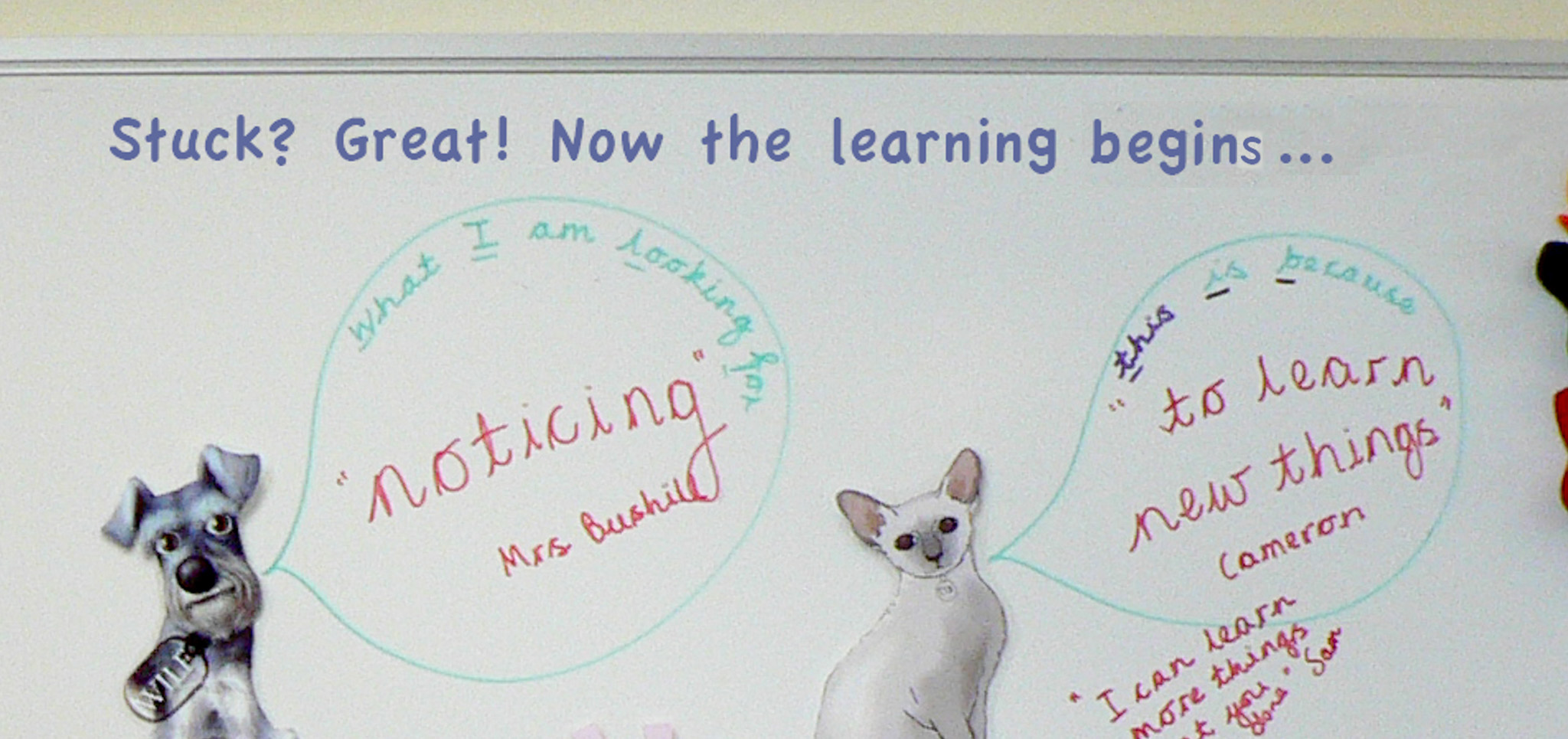
This interesting proclamation across a classroom wall shows how being stuck has been reframed as an interesting place to be. Students create their own stuck prompts for display around the classroom.
#2 Celebrate students finding their own strategies
Celebrate when students discover their own strategies for getting unstuck
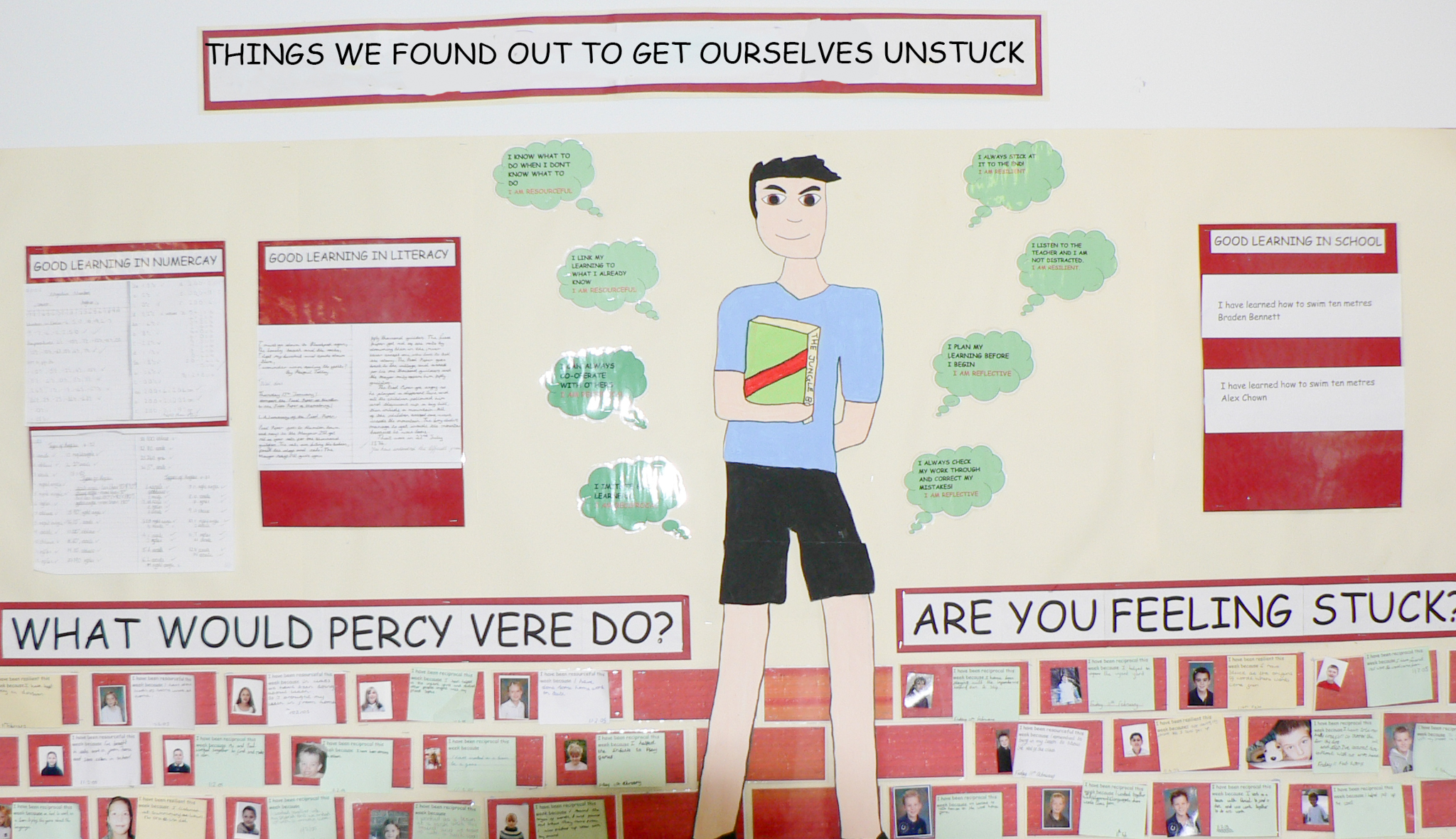
#3 Recognise growth in the behaviour
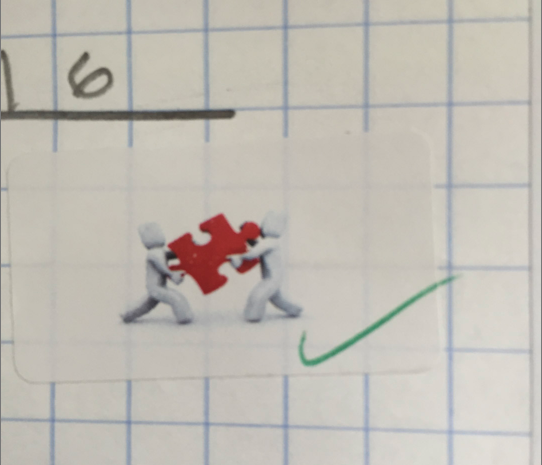
Learning behaviour sticker books
You might allocate pages in the back of your students’ learning journals/school diaries where they collect stickers which indicate improvement in their learning behaviour
Comments are closed.