
Key Learning Question:
How might I shift the classroom culture to ensure students organise themselves to use learning behaviours effectively?

This section clusters ideas that will assist students to progress from recognising that using the learning behaviours benefits them to organising themselves to use the behaviours to their advantage,
In the Values phase, the student develops a strong belief that they can get better at learning and that using learning behaviours is a benefit to them. Wariness turns to being curious about getting stuck and they use feedback, from both teachers and students, to quench or resolve that curiosity.
In the Organises phase, the student organises themselves to get the job/task/problem done. They can take more risks because they understand how to use sound ‘unsticking’ strategies. They analyse how and where they get stuck in order to better understand the process. They have accepted responsibility for their behaviours.
1. Stop
- Ever trivialising being stuck
2. Start
- Designing risk into lesson tasks
3. Start slowly
- Analysing the why of stuck in major projects
4. Experiment with
- Suggesting the use of potential risk plans
- Looking for patterns in getting stuck
Aids to help shift responsibility for learning.
- How you relate to your students; gradually sharing more of the responsibility for learning with them
#1 Introduce a deeper way of looking at being stuck
In this phase we are not talking about modelling getting unstuck on a problem where you may simply have forgotten a step. Nor is this process driven primarily by subject knowledge. Here the analysis is about what you might ask yourself when you are in a major stuck problem and need to rethink what you are doing in order to restart, tweak, or give up.
10 points to explore;
- Can I explain to myself what’s really going on here?
- Am I keeping to the original intention?
- Have I read and understood the question/problem properly?
- Am I applying the right principles? Have I got roughly the right ideas?
- Does anything stand out as simply wrong?
- Have I forgotten something obvious?
- Have I veered off course? Am I down a rabbit hole?
- Am I making this too complicated? or too simple? Do I need to go back to basics?
- What would a distilled list of key stages or points look like?
- Is this worth continuing with in this way? Why/why not? What could I do instead?
Read more ...
Undertaking this analysis relies on the students’ inclination to;
- Self-monitor how things are going, keeping an eye on the goal
- Expect the unexpected, having a readiness to re-shape, re-order, re-form plans to take account of new circumstances.
- Remain alive to new, unforeseen opportunities and ideas
- Look at what you are doing with a critical eye
- Strive to be the best you can be
- Make sure things are on track and make improvements along the way.
So at a less abstract level, students need to learn how to deal with change, emotionally and practically. With an inflexible frame of mind they are unlikely to recognise the need to change their ideas or the way they do something. These behaviours are closely aligned with the revising/refining habit.
#2 Model taking the panic out of assessing a major stuck problem
The following suggestions have their origins in Mindfulness. Here the analysis of finding a way out of being in a major stuck crisis is put into a series of considered calming steps. You may still have to restart, tweak or abort your project but hopefully after careful rather than chaotic thought.
‘In order to act wisely, we need to access both clear insight and decisive action. Insight without action is impotent; action without insight is reckless.’ Michael Chender
Two big questions to answer:
What’s actually going on here?
What should I do?
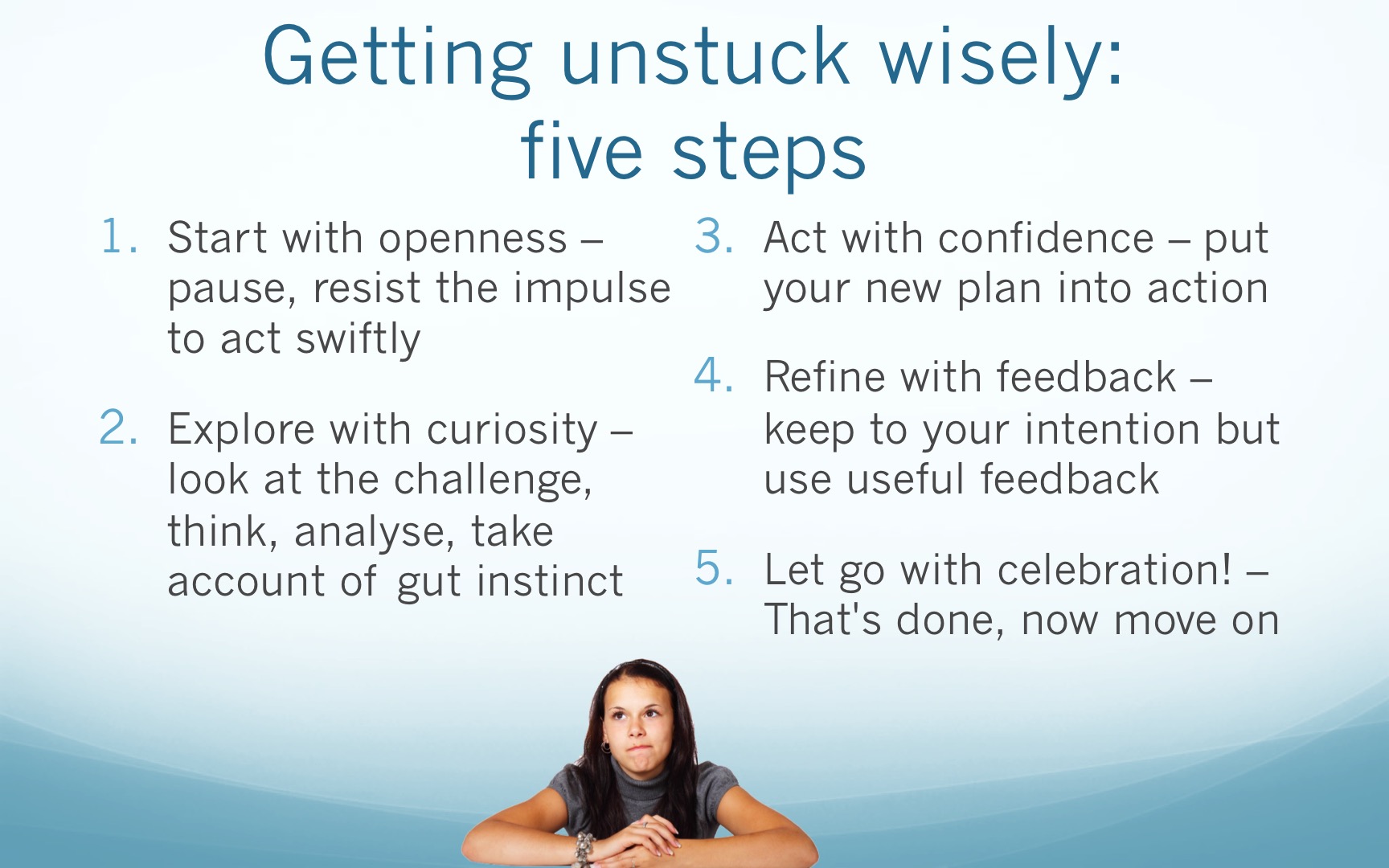
Five steps to getting unstuck
Entering, Exploring, Acting, Refining, Letting Go.
- Entering or starting- do nothing, pause, be willing to look afresh, allow the situation to reveal itself.
- Exploring – slow down, look at the challenge/ difficulties with genuine curiosity. Think about the problem in different ways, See list in #1 above. e.g.
- split the problem into parts, try pro and con analyses
- take a step back and look at the bigger picture, look for patterns, influences. root causes.
- use gut instinct -‘ there’s something off here ‘
- read the signs – ask ‘have I been here before?’, ‘what do I recognise from previously?’
- let things brew for a while before moving from broad openness (observation) to determined action.
- Acting “Not-knowing” changes to knowing; confidence in committing to a course of action. Put your considered new ideas/plan into action.
- Refining – work with the initial feedback you are getting as a result of your action to deepen the effectiveness of what you have done. Keep to your intention but look for genuinely useful feedback to refine your new course of action.
- Letting Go. Don’t keep replaying your action decisions. Time to say ‘That’s done, what’s next?’
Read more ...
To see more on Chender’s thoughts on acting wisely, visit the Mindful website here
Talk for learning
How you talk about learning; the sort of language content and style you use to enhance and explain learning
#1 Talk to nudge improvement in the skill
Analyse risks and strategies for ‘high-level’ work. Ask:
- Which of your many strategies might you use here?
- I’m sure that you can sort that out for yourself.
- Have you thought about the pros and cons of this way of working?
- What will you lose if you tried it this way?
- Have you done enough trial and improvement before starting?
- What did you learn from each of your attempts?
- Your risk analysis paid off there.
#2 Talk to reflect on being stuck
Supportive marking comments
How do you plan to work yourself out of this situation? `What might help? I noticed you used the … strategy to help you here. It worked!Constructing learning lessons
How you construct learning activities; the tasks and classroom routines you use to build positive learning habits
#1 Reflection on dealing with getting unstuck
Provide the list of 10 questions about stuckness for students to refer to throughout a tricky lesson. Build in time at the end of the lesson for students to look at the list of 10 questions about stuckness.
- Can I explain to myself what’s really going on here?
- Am I keeping to the original intention?
- Have I read and understood the question/problem properly?
- Am I applying the right principles? Have I got roughly the right ideas?
- Does anything stand out as simply wrong?
- Have I forgotten something obvious?
- Have I veered off course? Am I down a rabbit hole?
- Am I making this too complicated? or too simple? Do I need to go back to basics?
- What would a distilled list of key stages or points look like?
- Is this worth continuing with in this way? Why/why not? What could I do instead?
Build in time at the end of the lesson for students to ask themselves “Which of these questions did I find most useful in moving forward today?” Over time, see if they can recognise whether there are any patterns in their stuckness i.e. do they have a tendency to veer off course, or forget something obvious, or make things too simple, etc.
Celebrate learning values
What you celebrate about learning; what you prize, recognise, display; the outward signs of beliefs about learning.
#1 Display the metacognitive ideas
What’s going on here?

Read more ...
The more you can display and use public prompts that underlie the learning process the quicker students will incorporate them into their thinking patterns. This sort of display could be tailored to meet specific subject/curriculum requirements across a school.
Five Wise Stages in dealing with a major stuck problem
Read more ...
Again we see here the key steps in getting unstuck wisely…just a reminder to slow down, panic not and curiously analyse what’s going on. Perhaps the most important step is to start with openness to the possibility that you might need to change something. An attitude worth discussing with students.
#2 A miscellany of learning values on display
In a learning powered classroom learning will be on display in what you will see, hear and feel. In other words learning is visible in all sorts of ways.
You might find several ways of acknowledging learning on the walls:
- useful prompts for use when stuck
- displays of pupils efforts showing drafts and examples of work in progress to emphasise the idea of learning as a process
- a humorous display of mistakes of the week
- a five point scale pupils have devised about levels of distraction
- some If -Then statements to encourage habit formation
- whiteboard display of icons showing the learning behaviours they are focusing on just now
- photographs taken by some of the children which capture their peers using ‘stuck strategies’
- statements showing what superpower learners say
- a ladder or learning line showing descriptions of how pupils might feel about the activities and their learning stretch just completed (low, good, high, overstretched) around which the pupils gather at the end of the session to reflect on their efforts.
Comments are closed.