
Key Learning Question:
How might I shift the classroom culture to ensure students come to value the use of learning behaviours?

This section clusters ideas that will assist students to progress from being willing to do things for themselves to recognising that using the learning behaviour benefits them.
In the Responds phase, students develop greater independence and are motivated to initiate their own prompts or practical strategies to get themselves unstuck. They are realising that fear and the need for adult support can be overcome by using more coping strategies and maintaining positive emotions.
In the Values phase, the student develops a strong belief that they can get better at learning and that using learning behaviours is a benefit to them. Wariness turns to being curious about getting stuck and they use feedback, from both teachers and students, to quench or resolve that curiosity.
1. Stop
- Ever implying stuck is a bad place to be
2. Start
- Getting curious about common stuck points in the curriculum
3. Start slowly
- Using Visible Thinking Routines in lessons
4. Experiment with
- Trial and improvement
Aids to help shift responsibility for learning
How you relate to your students; gradually sharing more of the responsibility for learning with them
#1 Introduce and model different types of being stuck
In this phase it may be useful to identify and model several forms of being stuck. What sort of stuck is it? Do different sorts of being stuck call for different strategies?
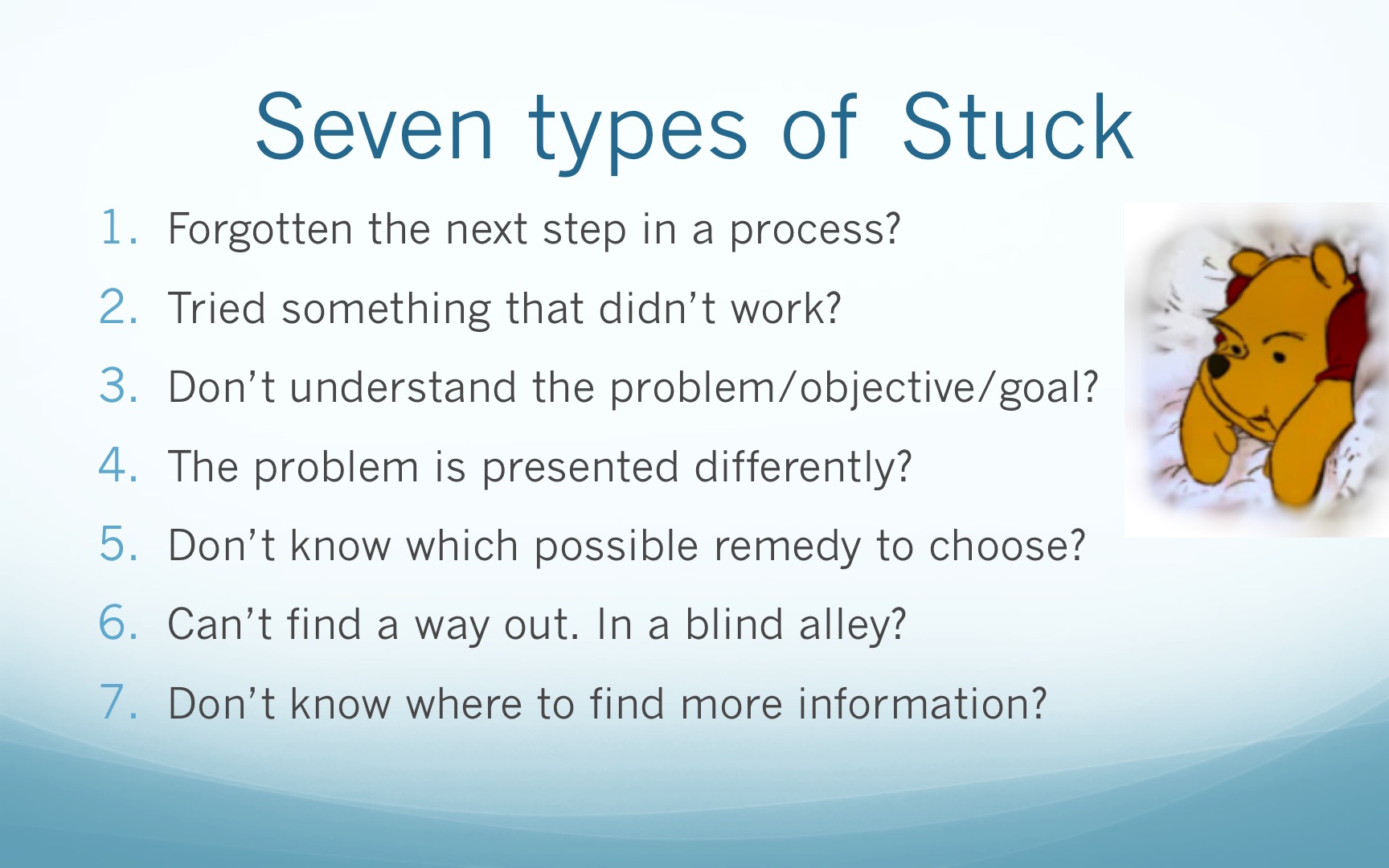
Seven types of stuck:
- Forgotten the next step in a process?
- Tried something that didn’t work?
- Don’t understand the problem/objective/goal?
- The problem is presented differently?
- Don’t know which possible remedy to choose?
- Can’t find a way out. In a blind alley?
- Don’t know where to find more information?
Read more ...
You could turn any one of these questions into an ‘If, then’ statement:
- If I have forgotten the next step in a process, then I’ll…
We leave it to you to discover other ways of being stuck with your students and to model your way out of them.
#2 Learning from each other
Try Stuck Show and Tell. Simply ask students to share their best stuck episode i.e. the one that seemed tricky but taught them the most (in school or elsewhere). You might profitably start by modelling your own example.
Talk for learning
How you talk about learning; the sort of language content and style you use to enhance and explain learning
#1 Talk to explore: written feedback to provoke curiosity
Supportive marking comments
There’s only one point where you got stuck here. Can you find it? I can see that you have remembered two earlier stuck points and used them to work this out …#2 Talk to nudge improvement in the skill
Encouraging pupils to slow down, notice, and appraise strategies and steps.
Become curious about being stuck.
- Give it a go, you can always try another approach if that doesn’t work.
- What could you do if it goes wrong?
- Where will you seek help from?
- Is this sufficiently challenging for you?
- How are you planning to go about it?
- Do you have any fall-back plans?
Constructing learning lessons
#1 Coupling content and process: build thinking routines into lessons.
Visible Thinking Routine
What do I know? What do I need to know?
What techniques do I have for bridging the gap?
This helps students to develop their own internal dialogue for combating stuck-ness.
Read more ...
What are Visible Thinking Routines?
VTRs are, as they say, simple routines that apply across a wide range of subjects and contexts, and which require students to think in a variety of different ways, that are used so regularly by teachers that they become woven into the fabric of the classroom culture and progressively hard-wired into the thinking practices of students.These are ways in which different ways of thinking can become routine in classrooms. They become part of the learning culture.
To be effective such routines need to be;
- Direct, guide, support, encourage thinking
- Short, memorable, few steps
- Used over and over again
- Useful in a variety of contexts
- Facilitate connections, generating ideas, using knowledge
Find out more: Google ‘Visible thinking routines’
#2 Coupling content and process: build trial and improvement into lessons.
- Trial and Improvement; promote the idea that being stuck is okay. If students know we expect them to try things out, make slip-ups and have another go, their perception of being stuck is likely to turn to curiosity. Weave trial and improvement into lessons by, for example: –
- Include a trial and improvement success criterion when asking students to complete an activity or create a piece of work. For example: I want to see evidence that you have tried and improved at least a couple of different layouts before settling on…
- Include a designated focused trial and improvement time in lessons; time to test out ideas. Use scrap paper, mini whiteboards or rough books. Include opportunities for discussion to encourage editing, refining and clarifying of thinking
- Mark the working out that students do. Extend this common in maths idea across the curriculum.
Read more ...
Since we want young people to turn out to be robust confident learners we have to talk with them in terms of a growth mindset.
- Teachers develop their students’ interest in the learnable skills and strategies.
- Teacher comments focus on effort, habit and disposition, focusing students on how to get better by looking for ways to try harder or differently.
- Students are steered away from carving the world into things they are ‘good at’ or ‘not good at’.
#3 Reflection: build into lessons.
You could nudge your students to ask themselves:
- What advice would I give to someone who wanted to give up?
- Why is being stuck good?
- Have I selected the most useful way of getting unstuck?
- Why did that idea work/not work?
Celebrate learning values
What you celebrate about learning; what you prize, recognise, display; the outward signs of beliefs about learning.
#1 Display: meta-cognitive tips.
This poster is a meta-cognitive display: it reminds students to ask themselves questions about how and why they are stuck.
#2 Recognition of improvement in the learning behaviour
Look out for and celebrate when students:
- encourage others to try a new unsticking idea
- use their unsticking strategies more widely
- use a wider range of ways of getting themselves unstuck
- talk confidently about being stuck
These all show that they have moved towards valuing the skill of getting unstuck.

Comments are closed.