
How might I shift the classroom culture to help students to understand stuck as an okay place to be?

This section clusters all the ideas that will best assist students to progress from lacking ‘stuck skills’ to making the first positive steps.
In this Lacks phase, students give up easily; they lack confidence; they need constant support from an adult; they simply don’t know what stuck means, let alone how to get unstuck.
In the Receives phase, students have made a big leap from having a negative mindset to a neutral one. Here they are inclined to; play it safe and stay in their comfort zone. They need adult direction and comply with suggestions for getting unstuck.
1. Stop
- Giving all the answers
2. Start
- Developing stuck prompts
- Talking positively about being stuck
3. Start slowly
- Reflecting on being stuck
4. Experiment
- Planning to get students stuck
Aids to help shift responsibility for learning
- How you relate to your students; gradually sharing more of the responsibility for learning with them
#1 Introduce the idea of being stuck
Adopt a character (ages 4-10)
‘Adopt’ a character – real, imaginary, human or animal – who exhibits the best features of persevering with being stuck. Talk about the character until your children become familiar with its attributes. When you have set a group to work on a particular task – numeracy, reading, writing etc., leave this character (actual or picture) on their table as a reminder of ‘what to do when you don’t know what to do’.
Show an animation (ages 4-10)
1 minute animation to illustrate an aspect of Perseverance.
Use it to talk about trying other ways to achieve what you want to do.
It’s about shifting responsibility for learning to the learner.
Make your own class animations for different aspects of Perseverance.
Try a quick activity (ages 8-12)
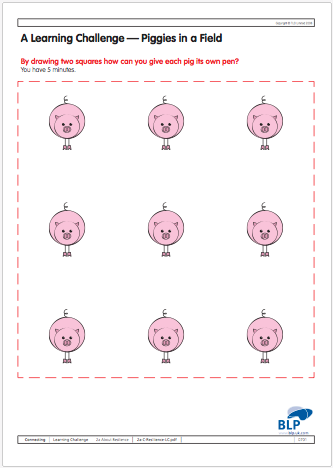
NB. Please read Perseverance for Resilience.
A 5 minute activity to introduce students to broad ideas of stuck and perseverance
This resource consists of
Read more ...
When first introducing the concept of a learning behaviour…being stuck, dealing with challenge, reasoning, questioning and so forth… it’s important to make it a big, bold and brash affair. These introductory images or activities are the important hook(s) that fire student’s imaginations and help them combat their more usual response to it . In other words it’s not about whispering that being stuck is an interesting place it needs to be shouted about, sung about, storied, played with etc. otherwise students will not believe this new framing.
#2 Re-frame being stuck: explore learning to overcome a struggle
The Learning Pit: from stuck to struggle
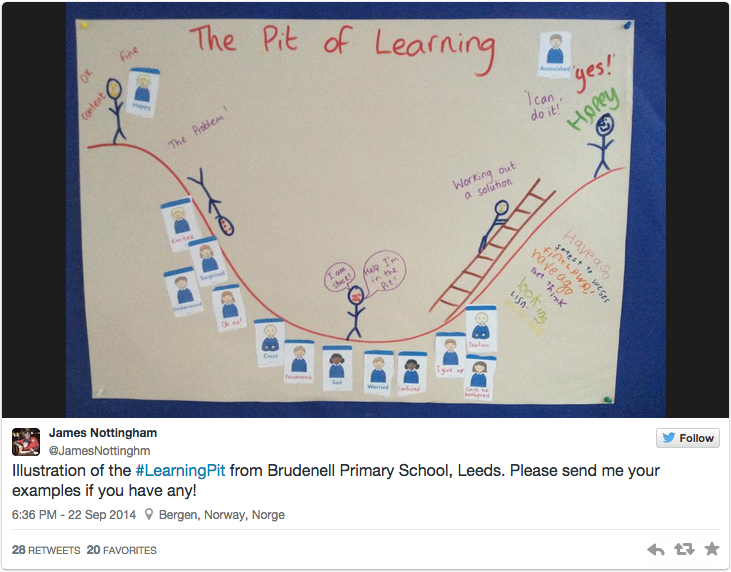 Use the ‘Learning Pit’ as a means of opening up a conversation around the feelings involved with being stuck, and the journey towards getting unstuck – the struggle. It is essential that students know:
- that the ‘pit’ is only one staging post on the learning journey
- they can get out by using ‘stuck strategies’ and tools
It is also worth noting that the pit is not necessarily inevitable for all students in all learning – some will fly over the pit in some topics or curriculum areas.
Read more ...
The ability to cope with and overcome difficulty and challenge is a key aspect to becoming a successful learner.
James Nottingham introduced the idea of the Learning Pit as a way to explain that struggling is part of learning and that if we are to understand something we need to struggle with it first. Students move from unconsciously incompetent (an emotionally ‘safe’ area before learning), to consciously incompetent (the emotionally tricky “pit”), to consciously competent (the far side, after the learning has happened).
Find out more by visiting:
Roy Leighton uses a similar concept, which he refers to as the ‘Learning Line’, as part of his ‘Butterfly model’. Find out more here
#3 Model being stuck
Unstuck demo
 Show students how you personally get stuck, and what strategies you have for getting unstuck, by demonstrating a piece of tricky learning. The idea is that sharing these experiences encourages students to imitate getting unstuck.
Read more ...
One of the first ways of surfacing learning, putting it on show, is to focus on how you are modelling being a good learner to students. Modelling is all the ways in which teachers demonstrate how they are a learner too; a confident finder-outer.
- Take your students behind the scenes of learning and sharing with them some of the uncertain thinking of learning.
- Learning aloud is a good place to start: take students through how you would work out a problem. Modelling the thought processes (including emotional) that learners go through is important because a lot of the skill of learning only manifests itself in the inner world of the learner.
- Expose the thinking, feeling and decision making of a learner-in-action to help students actually see and hear how learning works.
#4 Learn together: introduce ways of getting unstuck

 Develop ‘stuck prompts’ together.

- Work with students to find useful questions for them to ask themselves and helpful strategies for them to use when they are stuck.
- Ensure that there are plenty of options that come higher on the list than “Ask the teacher”.
- Create displays as reminders.
Read more ...
- Every classroom needs stuck prompts in one form or another.
- They could be of a general nature or made relevant to a subject or topic.
- It’s important to ensure that they ‘grow up’ through the school, reflecting the curriculum expectations. In essence they represent the level of independence expected in different year groups.
Extract from Building Learning Power in Action, by Sarah Gornall, Maryl Chambers, Guy Claxton
Building Learning Power in Action
So-called ‘Stuck posters’ or prompts come in various shapes and sizes, but essentially they are simply home-made lists of what students can try when they get stuck with their learning: ‘Read the question again’, ‘Split the question into smaller bits’, ‘Try sounding the word out letter by letter’, ‘Ask your neighbour’ — that kind of thing. If the teacher were simply to photocopy the list from a L2L manual and stick it on the wall it wouldn’t work. But in a learning powered classroom, the ideas are generated by the students themselves, and are the subject of continual debate and refinement.
“Instead of simply dishing out more good advice to students-as-consumers, classrooms are becoming places of day-by-day knowledge generation about learning”
Students are challenged to produce a continual stream of ever more sophisticated ideas about how they can boot-strap their own ability to be independent learners, and these are accumulated and displayed as ever-expanding public records of their achievement. To begin with, the teacher trains the students to make use of this information by greeting every request for prompting with; ‘Have you looked at the prompts?’ After a while, looking at the prompts becomes routine, and eventually, when the habit of self-unsticking becomes second nature, even prompts become redundant. It does not take long before ‘Ask the teacher’ becomes a last-ditch strategy, to be engaged only when all else has failed.
By contrast, when effort becomes seen as natural and interesting, the habit of perseverance expands, and a subtle but powerful shift in the classroom atmosphere begins to occur. It is in this kind of way that learning power moves up a gear, from the technical to the cultural. In a sense the STUCK poster is a stand-alone technique, but it can be much more than that if the teacher wants it to be. It can be used as an effective, low-risk, low-investment lever for creating a shift in students’ sense of what is valued, what is normal, and what is the point of their learning — and thus in the quality of their engagement.
Talk for learning
How you talk about learning; the sort of language content and style you use to enhance and explain learning
#1 Talk to reframe being stuck
Moving students on from “I can’t” to “Show me…”
Try this type of shifting-mindset language:
- Being stuck is a good place to be.
- Getting stuck means your brain is working hard on something new.
- When you learn new things your brain gets bigger.
- If you don’t get stuck you’re probably not learning anything new
- Getting stuck is good for you.
- It’s not too hard, it’s just a bit tricky right now.
- When you say you can’t do this, just add ‘yet’
- Being stuck means you are about to discover something new
#2 Talk to explore the feelings of being stuck

 Build positive associations with being stuck
Discuss places where students may get stuck because it gives ‘being stuck’ a status. Through such discussions make sure you signal to students that being stuck is a good thing; it probably means they are at an interesting place in learning, or on the brink of discovering or learning something new.
Try creating a wordle with your students, using the words they associate with being stuck. If it is negative introduce a new ‘stuck positive’ language

#3 Talk to nudge improvement in the skill.

 Unstuck Phrases

Encourage students to become more interested in difficulty and develop strategies to deal with stuckness. Use phrases like:
- Have a go yourself. I think you can do this.
- Which of your friends might you ask?
- Have you looked at the stuck prompts?
- Well done for sticking at it by yourself.
- What have you already tried? What else might work?
- Which ideas on the stuck prompts might work here?
- There are some good ideas on the learning wall you could try
Read more ...
The language of learning can help teachers to think about how they might talk in a way that helps to cultivate the learning behaviours and help pupils to gain a better personalised understanding of content.
- Teachers can turn each of the learning habits into sets of casual prompts or nudges to move pupils along in learning. For example, to nudge curiosity/questioning: “What’s odd about that? What does that make you wonder? What do you want to find out? How else could you do that?”
- Teachers’ classroom talk is all focused on the process and experience of learning itself. Sometimes teacher comments encourage pupils to pay attention to how they are learning. Teacher comments ask them to slow down and notice and appraise the strategies and steps they are using along the way. E.g. “What would have made this easier for you? Where else could you use that?” This helps pupils to become more reflective and thoughtful about their own learning.
#4 Talk to reflect on getting unstuck
Some questions you might use to encourage your students to reflect on and think meta-cognitively about stuckness:
- When you got stuck what did you do?
- And then what did you do?
- Did that help you get unstuck?
- What usually helps you get unstuck?
- What’s your favourite way of getting unstuck?
- What’s your best way of getting unstuck?
- What other ways might you try?
#5 Feedback to reinforce getting unstuck
Reinforce getting unstuck with supportive marking comments
I know that you found this tricky. I can see that you used . . . [one of the stuck prompts] . . to get through it – well done !
Constructing learning lessons
How you construct learning activities; the tasks and classroom routines you use to build positive learning habits
#1 Coupling content and process
Give being stuck more status by planning to get students stuck
Start some lessons with something like:
- In this lesson I want to make sure that you do get stuck.
- When you get stuck take a look at the unsticking prompts on your table to see if these help you to get unstuck.
- Later we will spend a few minutes talking about what we learned from being stuck and decide which unsticking idea worked best.
Read more ...
The explicit message is that students need to expect being stuck during any lesson. The implicit message is that being stuck is a good thing – something you want to see. Using this technique regularly means students come to accept being stuck as a natural part of learning. It begins to build their curiosity about the why and possible patterns to stuckness.
#2 Reflect on dealing with being stuck
Make reflection on being stuck part of the daily or lesson routine. This display from Miriam Lord primary school in Bradford shows a range of discussion cards which the teacher uses with specific groups of students during or at the end of a day.
The questions include;
Today I have learned….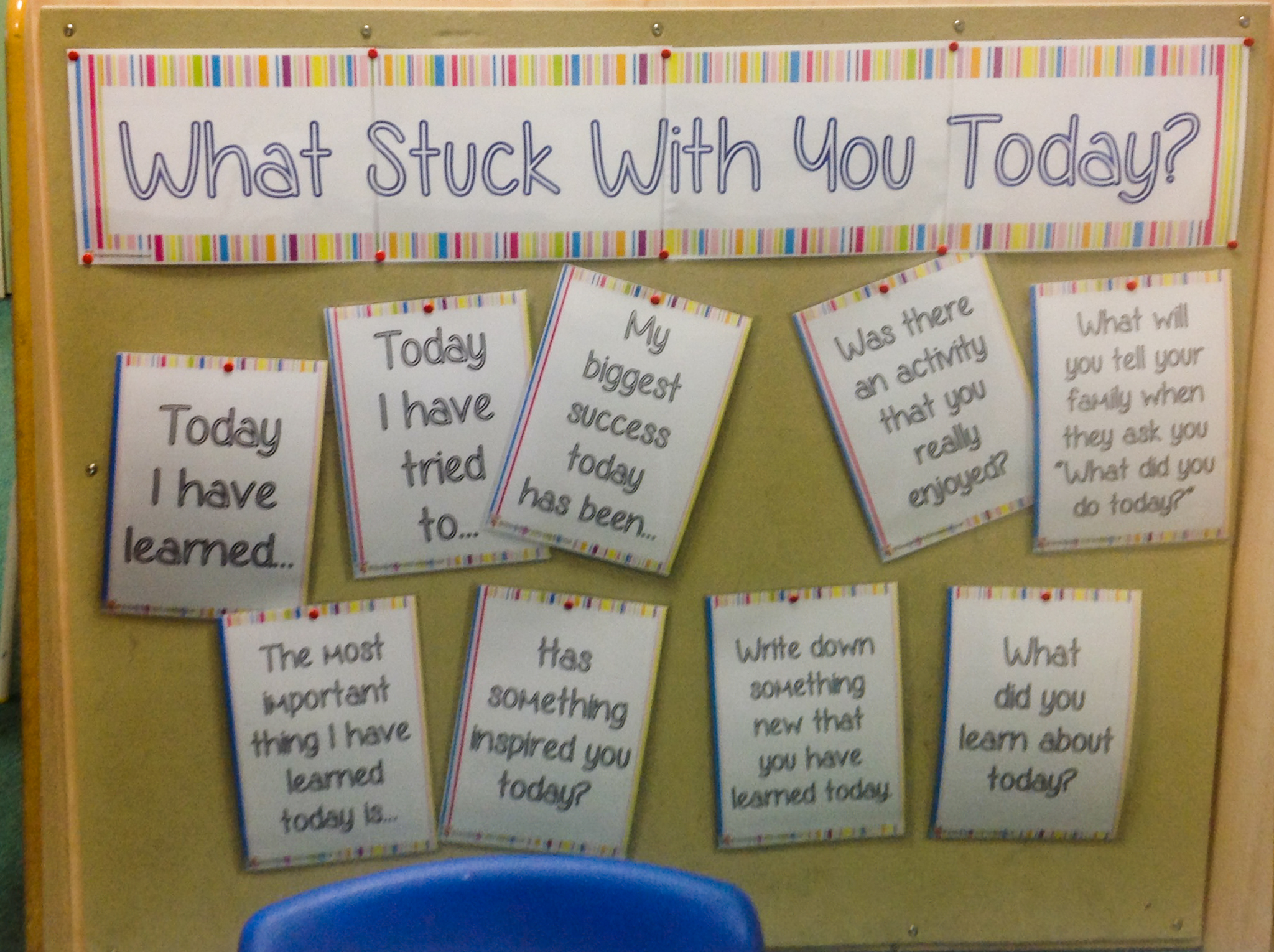
Today I have tried to…
My biggest success today has been….
What will your tell your family when they ask ‘What did you do at school today’?
The most important thing I have learned today.
Has something inspired you today?
You could easily incorporate some of the ‘Talk to reflect’ questions ( see #4 above)
Read more ...
What other sorts of questions would you include in such a selection for your classroom. Something about asking good questions or how they got themselves unstuck would be useful. This exercise makes a good start on introducing meta-cognitive behaviours more generally.
Celebrate learning
What you celebrate about learning; what you prize, recognise, display; the outward signs of beliefs about learning.
#1 Displays: showing how learning happens
Display work in progress
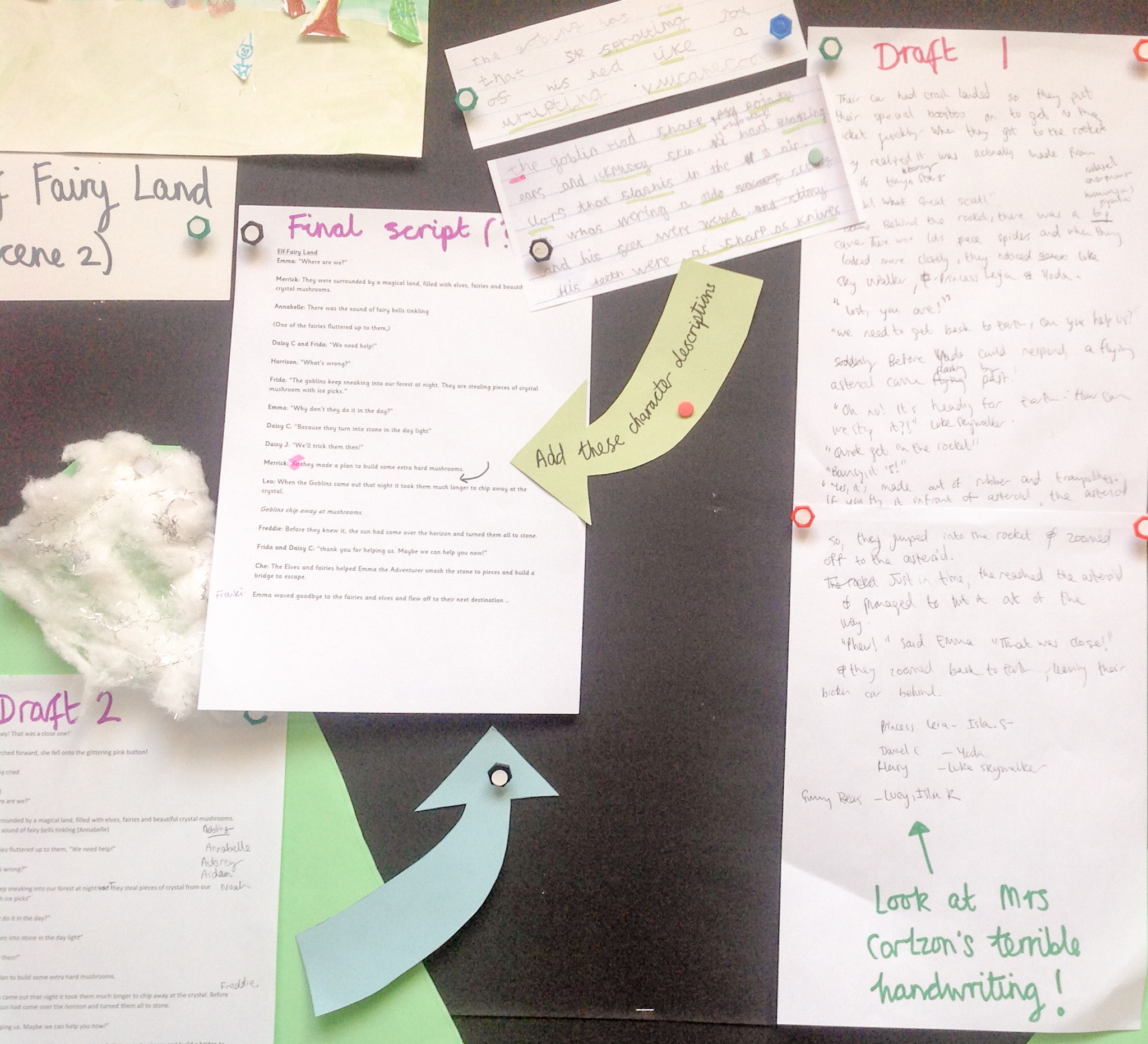 Ensure that your display walls include early drafts of work which show where students got stuck. Encourage students to write on a separate note how they got unstuck, and display the note with the work.
Make this a constant feature of your classroom
Read more ...
It’s important that students understand learning as a process rather than an event, and that stuckness is a prominent part of that process. From scribbled notes to final copy can be a long and eventful journey. Learning routines along the way include capturing rough ideas, adding to them, trying again, trying another way, re-thinking, refining and completing. Such routines lead students to see that it’s not about everything being perfect or easy from the start.
Display stuck prompts in all shapes and sizes
These might include:
- Quick reminder sheets on group tables
- A special Stuck Table with plenty of resources
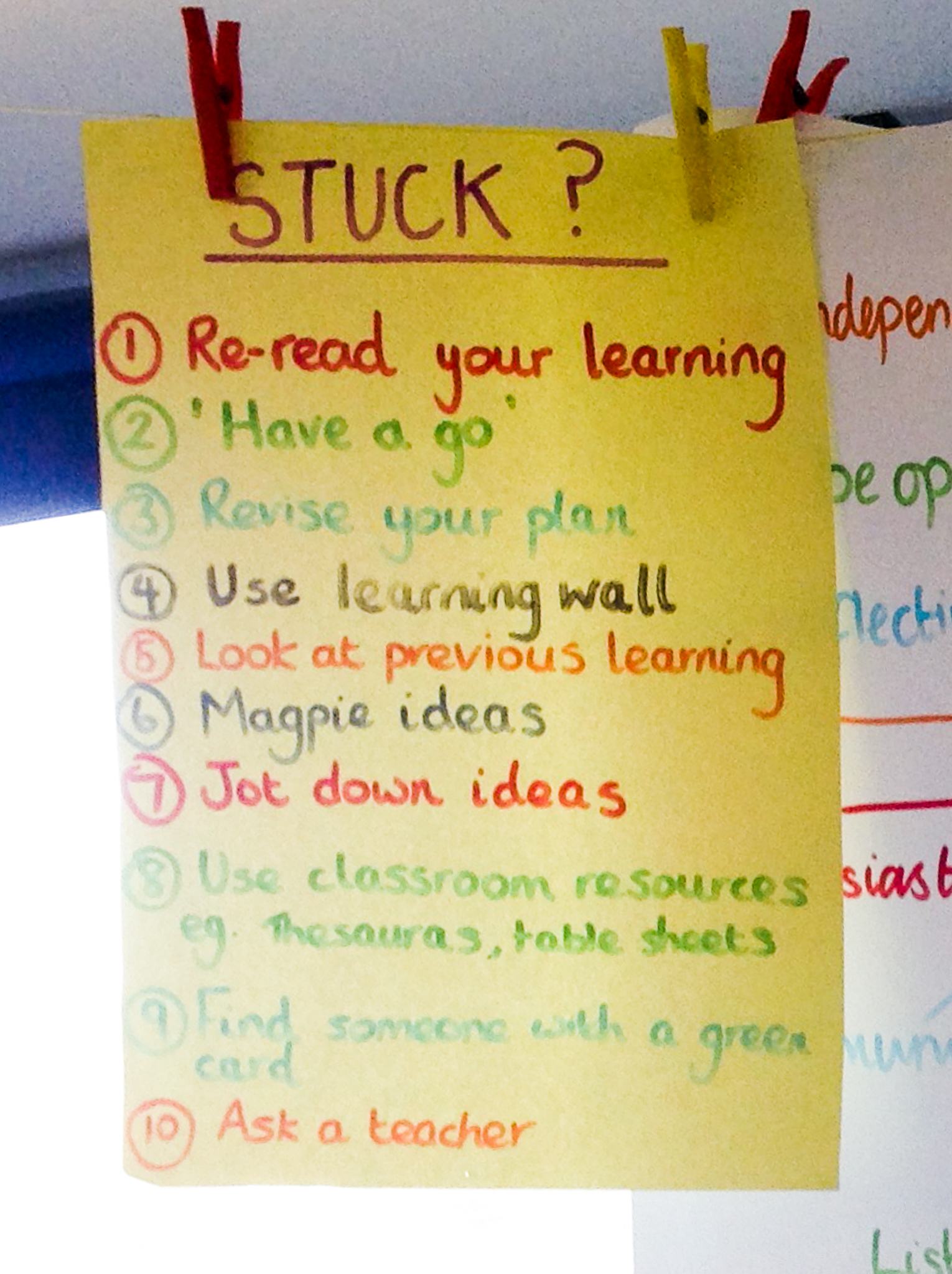
- Stuck Posters
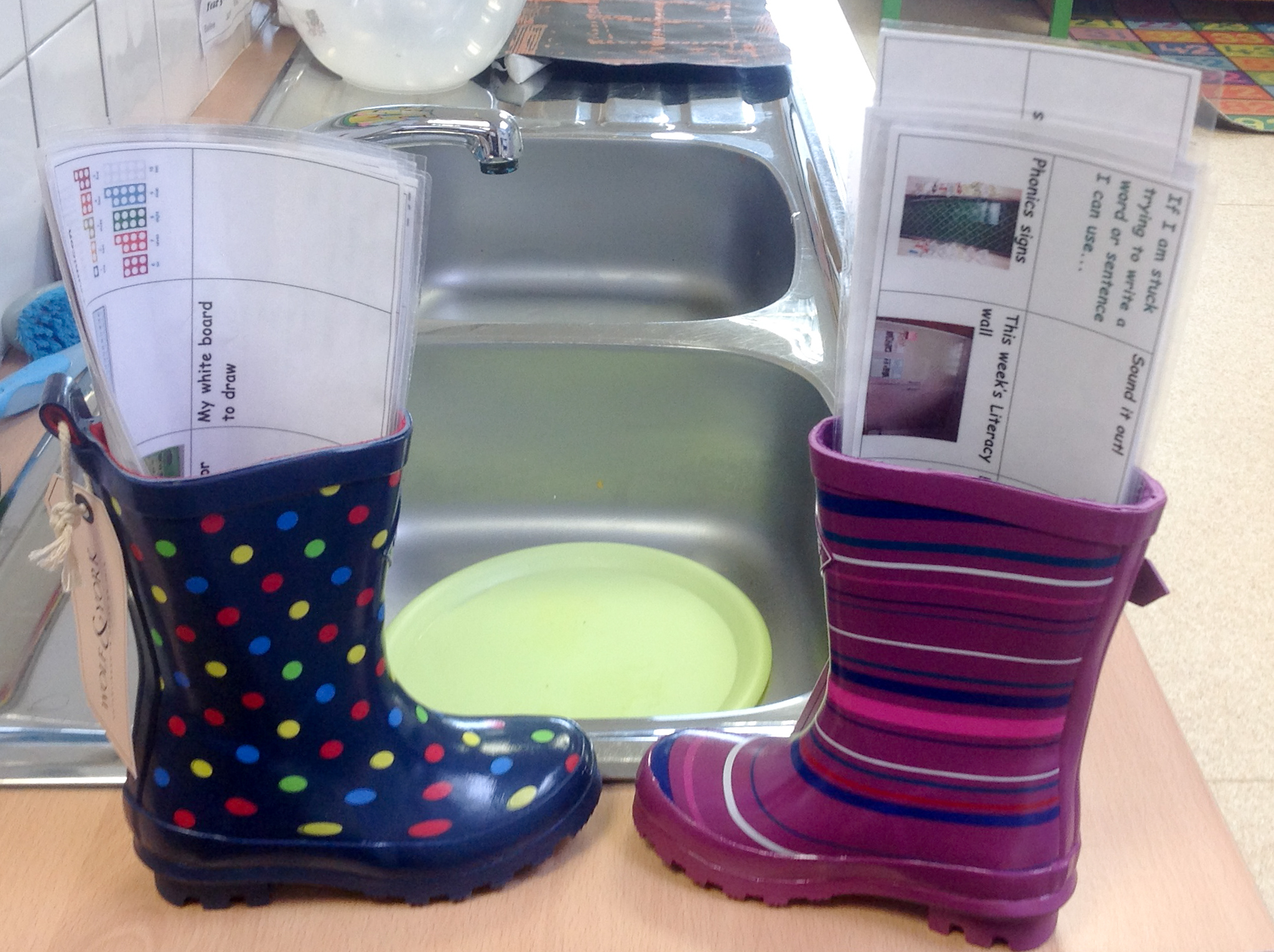
- Containers ( e.g. wellies) holding laminated reminders of things to do. Spots=numeracy. Stripes=literacy
- Stuck Walls with multiple displays of Stuck Posters, ‘stuck-of-the-week’, the Learning Pit and so forth.
- During lessons students post up stuck problems and other students suggest solutions ( see below)
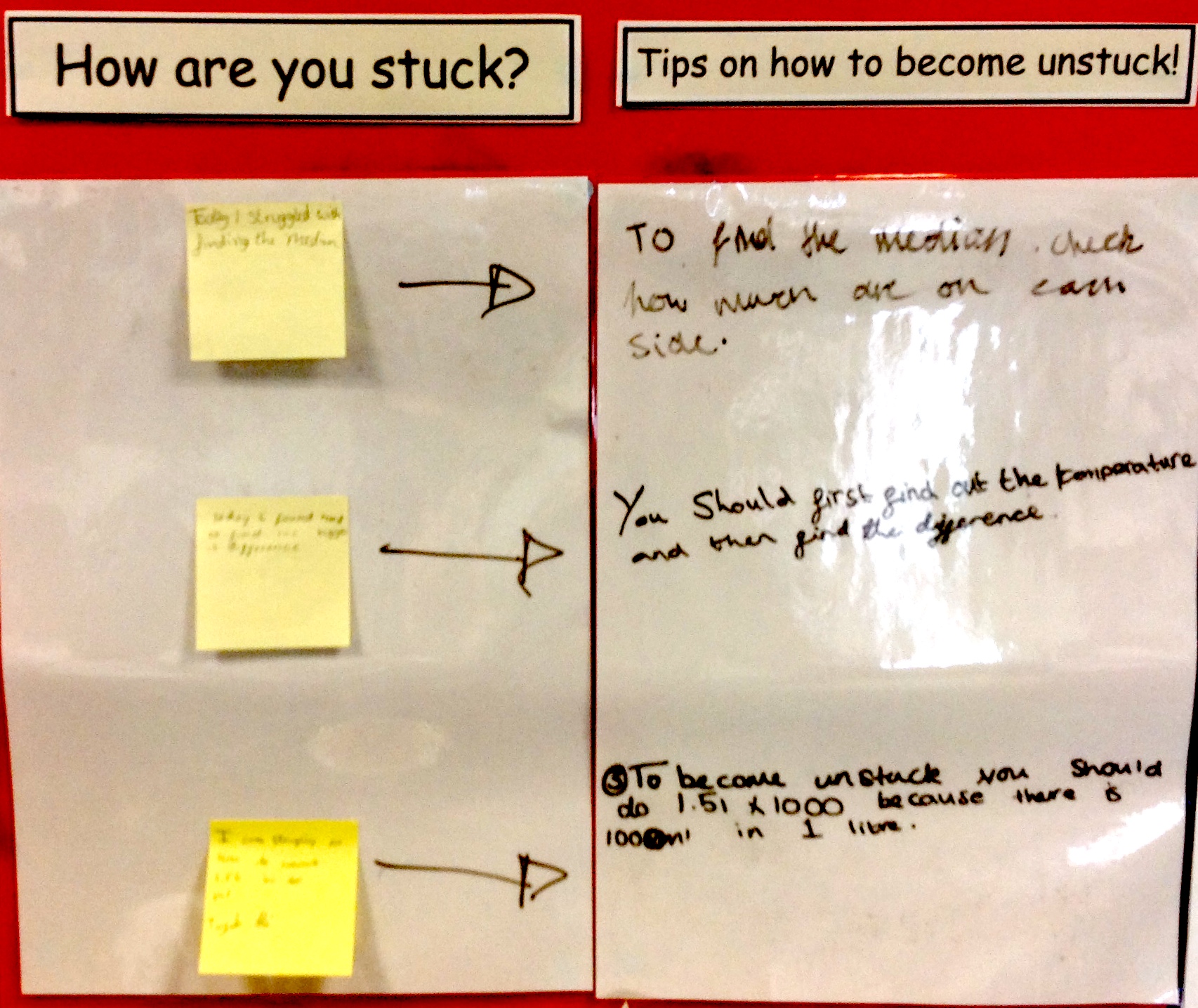
#2 Recognition: praise and acknowledge overcoming stuck
Stuck of the Week
Regularly encourage students to think about a moment when they were stuck and how they got around it. Celebrate the unusual ones by displaying them on a ‘stuck wall’. Students should develop an interest in their ability to overcome stuckness.
Read more ...
By celebrating the moment of being stuck, students are reminded that stuck is not a place of shame, rather that it is part of the journey. It is equally important to celebrate the unsticking strategy so that students can see that there is always a way forward.
Comments are closed.