
6. Imagining – Thinking differently
A well formed Imagining habit involves being ready, willing, and able to: use the mind as a theatre in which to play out ideas and possible actions experimentally; use a rich variety of visual, aural and sensory experiences to trigger creative and lateral thinking: explore possibilities speculatively, saying ‘What might …’, ‘What could …’ and ‘What if …?’ rather than being constrained by what is; retain a childlike playfulness when confronted with challenges and difficulties; be aware of intended outcomes whilst adopting a flexible approach to realising goals; rehearse actions in the mind before performing them in reality. 
How well does your classroom climate encourage Imagining? ⬇️
Does my classroom climate encourage Imagining?
Here is a selection of features which might begin to shape the emotional climate of the classroom to encourage Imagining.
The diagram has 4 sections:
- Top – strategies you could build into the way you teach to stimulate imagining;
- Right – indications of the sort of language you might use to stimulate the imagination;
- Bottom – ways in which you might celebrate / praise students’ use of imagination;
- Left – things that you need to enable students to do.
Apply your own imagination and consider whether you already use any of these features and which you fancy trying.
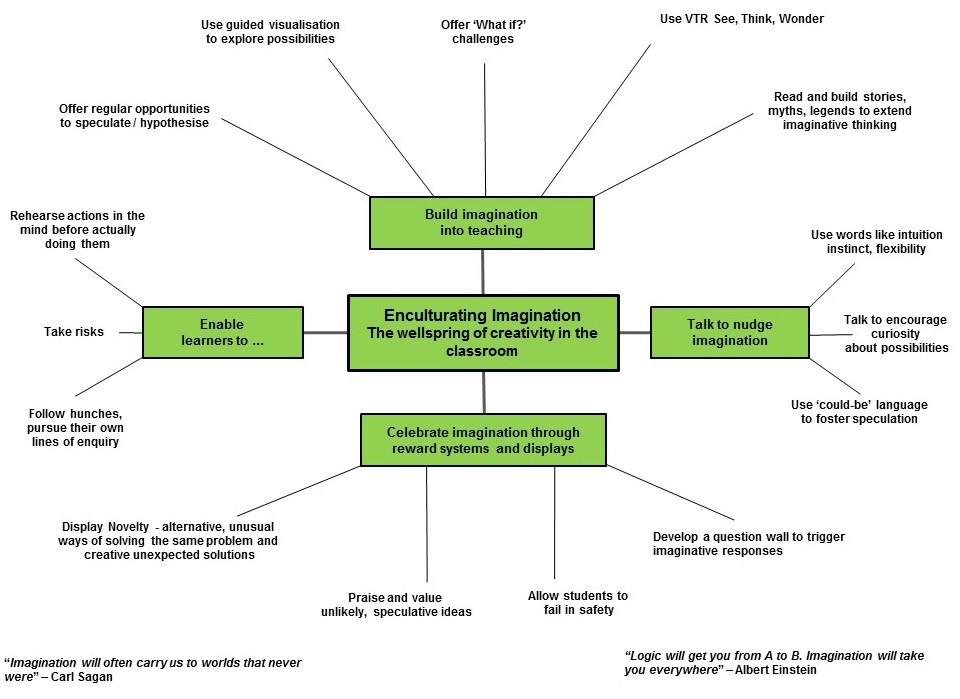
Bridging the gaps – teaching ideas to cultivate Imagining
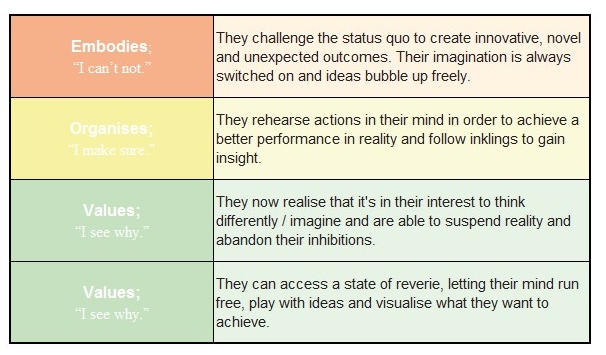
Teaching ideas to move learners from Blue to Green ⬇️
What you are trying to help your students to achieve
In the Values (green) phase, students know how to use their memories of experiences and stories to achieve their own imaginative writing. They are able to abandon their inhibitions and create other worlds. They can see that in the world of imagination they can ‘get’ things to act differently and this frees them to think more boldly.
Your role as a teacher in this phase is to:
Devolve responsibility for imagining… by encouraging students to think laterally and create their own worlds
Talk about imagining…by encouraging students to respond empathetically to others’ different views
Give students opportunities to practise imagining…by allowing time to visualise outcomes
Celebrate imagining… by reflecting on, praising or displaying its use
1. Devolve responsibility for imagining
Introduce mental rehearsal
The prediction game
Show video clips of e.g. rugby or football heroes preparing to kick a ball, as well as other sports and entertainment people rehearsing ahead of action.
Discuss what they are doing to ‘play the movie’ in their heads before they act.
Explore occasions when this could be useful in students’ own lives. Identify the triggers and habits required when anticipating the right action.

2. Talk about imagining
Capture interesting ideas

Encourage students to brainstorm or mind-map and keep notebooks or Post-its of interesting ideas to feed their creativity. Do this collectively and individually.
Elect one student as ‘Plant of the Day’, whose job it is to suggest unlikely ideas.

3. Give opportunities to practise imagining
Trigger imagination with ‘What if …’ challenges
Provoke students to think ‘What if… we ran out of oil in 25 years… we lived in a two-dimensional world… we all lived for exactly 70 years… tennis balls were heavier… we had two moons…’
Encourage students to build collaborative spider diagrams that explore the possible ramifications of such eventualities. Extend the imagining in creative presentations using a variety of media.

4. Celebrating imagining
Make reflecting on Imagining part of everyday lessons
Here is a very practical example of how you might develop the emotional climate of the classroom and make it Imagining friendly
Learning Mats
Learning mats are A4 laminated sheets that show various aspects of a learning habit. Keep them on desks/tables or as part of a wall display.
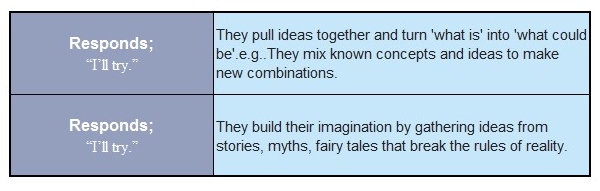
Teaching ideas to move learners from Purple to Blue ⬇️
What you are trying to help your students to achieve
In the Responds (blue) phase, students are broadening their range of experiences not only of and in real life settings but also through stories and myths, art and fairy tales. Such stories allow them to appreciate that at least in stories the rules of reality can be broken or disregarded. In the growth of empathy, they are again stepping out of their more restricted world and into the lives of others through film or the internet. This allows them an insight into the lives of others. So their growing experiences lead to more imitative and responsive imaginative outcomes.
Your role as a teacher in this phase is to:
Devolve responsibility for imagining… by offering opportunities to engage students in a fantasy world
Talk about imagining…by helping students to explore other worlds
Give students opportunities to practise imagining…by incorporating imagination across the curriculum
Celebrate imagining… by reflecting on, praising or displaying its use
1. Devolve responsibility for imagining
Switch perspectives
Ask students to imagine something and then try to see it from different perspectives.
Sit down quietly, close your eyes, and think about one of your pets. (If you don’t have any, try to imagine a pet you would like to have.) Now, try to take on your pet’s point of view. Don’t just try to become a human being in an animal’s body. Try to think and interpret things the way an animal really would. This can be a lot of fun, because many of the things we humans do probably appear confusing and silly to animals. Or…
- How would a bird flying overhead view your garden?
- How did the sinking of the Spanish Armada appear to the fish in the North Sea?
- What might a flower look like when seen through the multi-faceted eye of an insect?

2. Talk about imagining
Talk about how things might look, feel, sound.
Give students a familiar object – a pencil, hairbrush, scissors, toilet roll, cushion – whatever comes to hand.
Then pose the question: ‘What else could it be?’ or ‘What could this become’
Discuss and praise the most imaginative ideas.
What you are trying to develop in young learners is:
- An awareness of the power of imagination;
- The ability to use their imagination to picture how things might look, sound, feel or be;
- The willingness to talk imaginatively about situations, events, characters, etc.

3. Give opportunities to practise imagining
Use Visible Thinking Routines
Creative Questions
Creative Questions is a visible thinking routine that encourages students to create interesting questions and then imaginatively mess around with them for a while in order to explore their creative possibilities:
Pick an everyday object or topic and brainstorm a list of questions about it.
Look over the list and transform some of the questions into questions that challenge the imagination. Do this by transforming questions along the lines of:
- What would it be like if…
- How would it be different if…
- Suppose that …
- What would change if …
- How would it look differently if …
Choose a question to imaginatively explore. Explore it by imaginatively playing out its possibilities. Do this by: Writing a story or essay, drawing a picture, creating a play or dialogue, inventing a scenario, conducting an imaginary interview, conducting a thought experiment . . . .
Reflect: What new ideas do you have about the topic, concept or object that you didn’t have before?
For more detail on Creative Questions, visit the visible thinking website

Practice using the senses to imagine
Imagining through all of the senses . . .
What has happened here? Good guy or bad? Can we see any colours? Hear any sounds? Imagine being there….
A quick way to activate the Imagination and explore how we use our senses to imagine.
What you are trying to achieve:
To support students to use their imaginations using all of their senses,
How might you use the technique?
- As a starter for creative writing
- As a prelude to reading a book – start with the B&W copy of the dust jacket.
- To build empathy
- To scaffold the use of all of the senses
- To trigger the imagination

Click to enlarge
4. Celebrating imagining
Stimulating the imagination
- Use music to create atmosphere and stimulate imaginative thinking.
- Provide varied, unexpected and ever-changing visual experiences — on whiteboards, classroom walls, in ideas banks, through web-links, etc.
- Read vivid prose and poetry that captures details, moods and atmospheres.
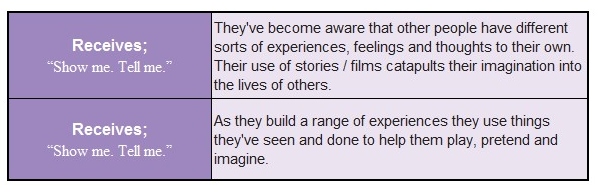
Teaching ideas to move learners from Grey to Purple ⬇️
What you are trying to help your students to achieve
In the Receives (purple) phase, students are busy building up their range of experiences of the world and this in large part prescribes how they imagine things to be. Their imaginative state is still often suggested by adults but they are recognising that others can and do have different kinds of feelings and thoughts to themselves. This can be the source of some discomfort.
Your role as a teacher in this phase is to:
Devolve responsibility for imagining… by introducing the the idea of imagining
Talk about imagining…by encouraging students to talk about what they are imagining
Give students opportunities to practise imagining…by organising many opportunities to imagine
Celebrate noticing… by reflecting on, praising or displaying its use
1. Devolve responsibility for imagining
Introduce the idea of imagination
The Mind’s Eye
- Introduce students to the idea of the mind’s eye: Talk about the fact that we all have 2 eyes which we use all the time but that everyone also has a third, hidden, mind’s eye. Talk about how we can use this secret third eye to imagine and create pictures and ideas inside our minds.
- Invite students to close their eyes and imagine they are using their third eye. Describe something in great detail and ask them to try and see it with their third eye.
- For example: Close your eyes tightly and imagine my alien. It has a large, round, green body with lots of arms and legs. On the top of the round, green body is a huge pink and purple head with spiky yellow hair and 4 great big blue eyes. It has long, pink fingers on its hands and short, purple toes on its big feet. When it walks along it makes a high squeaky sound and it smells just like fish and chips!
- You could ask students to draw their idea of the alien, concentrating on their ideas rather than an exact representation of your description.
- Ask students to imagine something for themselves- unprompted by you. Invite them to describe what they are imagining.
- Talk about what seems to happen in their mind when they imagine.
- Talk about when our ability to imagine can be useful.
- Ask, “When do you use your imagination?”
2. Talk about imagining
Extend imaginative thinking by telling stories
Provide a stem statement…
A man walks into a room with a suitcase in his hand…
Invite one student to carry it on. Each student continues from where the previous one left off.
Or . .
Create a scenario…There are no windows, water drips into a bucket, two people are seated back to back…what might be happening? What might happen next? Can you improvise the dialogue between the people?

3. Give opportunities to practise imagining
Use guided visualisation
Invite students to visualise, for example, a snowy mountain peak until the image fades – discuss how long this could be sustained.
Now visualise hovering over the mountain and exploring the terrain by helicopter – the experience will have lasted longer.
Now provide students with a guided visualisation of the mountain that triggers their imaginative faculties – discuss the features of this experience.
Enable students to identify the ways of triggering their own imaginations when provided with stimuli. Invite them into a city at night, or the alimentary canal.

Imagine together
Use this activity for encouraging students to pool their imagination with a partner but scaffolded by a given range of pictures.
Upgrade the activity using the blank beanstalk leaf sheet (see resources) but use words, rather than pictures to write a story. You could also add smaller leaves with connectives written on them. You could also draw a different set of pictures connected to your current topic.
Try this strategy for helping students to create imaginative story lines.
Resources Starter activity
4. Celebrating imagining
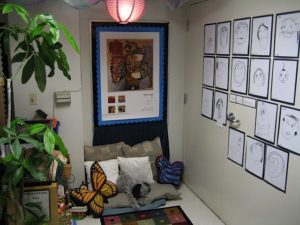
Create settings that engage students’ imagination and wonder
Often students have little conception of imagination as being an essential part of ‘good learning’. They think ‘good learning’ means neat, correctly spelled and done on time, while imagination ‘is when you think about stuff and see pictures in your head’—but they don’t get the connection.
It has long been a feature of primary classrooms that areas are designated for a particular purpose, whether it be for reading, imagining, improving work, noticing detail etc. Rarely is it seen in secondary classrooms – too often the physical constraints of the classroom and the rotation of students from class to class make such arrangements impossible. Or is it? If we are serious about developing the imagination of younger students, we may need to be imaginative ourselves and seek a creative solution to this problem. Where could such an ‘Imagination Space’ go? Does it even have to be in the classroom? Could it be in a public circulation area? The library? What would the Imagination Space be like if it is to trigger imaginative thinking?

Comments are closed.