My menu

Sections Archive

3s. Planning improvement and checking progress

Lesson 3

What this section contains.

This section offers a number of ideas and resources for you to use in constructing a lesson, or even two lessons, to enable students to explore ways to improve Revising, make a plan of action, and monitor its success.

We leave the specific lesson design to you but offer pointers and resources in the sections below including:

  • suggested information for content areas
  • advice on selecting the appropriate growth phase
  • example Revising activities for students to practice sorted into growth phases
  • suggestions on how to complete an action plan
  • downloadable resources for use by students (see content area 3)
  • a slide presentation for use in the lesson
Download Presentation (pdf)

Suggested content areas

This lesson invites students to think harder about what, when and where they use their learning behaviours; consider some ideas they might try; make a formal 6 month plan with materials to help.

  1. A re-look at where students think they are now
  2. Careful consideration of the phases of growth
  3. Selection of appropriate activities
  4. Construct an action plan
  5. Monitor their success

Your aim for this lesson should be to help students understand:

  • the diversity and choice of revising practice across various phases
  • the importance of estimating the most appropriate phase for them as an individual
  • how to construct a simple do-able action plan


Content area 1: Re-look at where students think they are now.

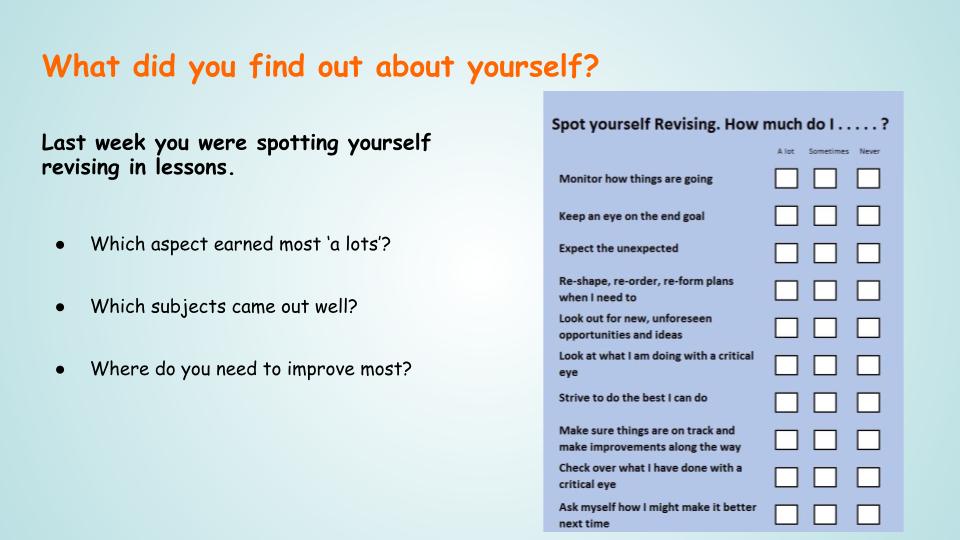
What did you discover about your Revising habits?

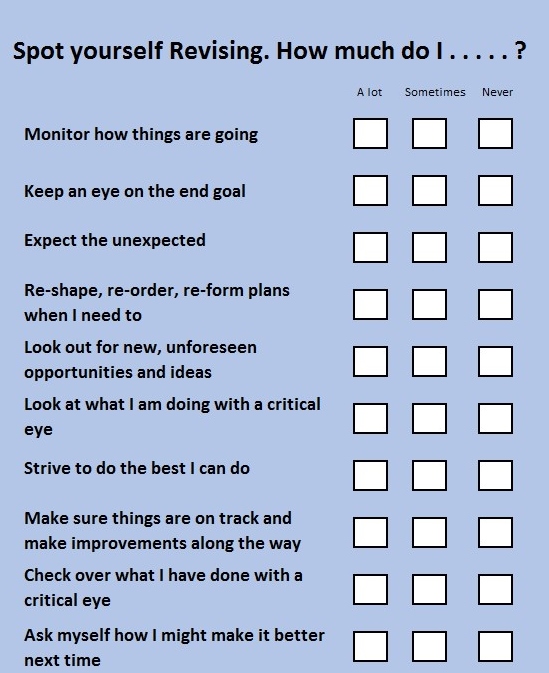
At the end of the last lesson you asked students to use the ‘Spot yourself Revising’ resource to help them become more aware of themselves as learners. We leave it to you how best to manage this session but we can guarantee the resulting information will be fascinating and useful to both teachers and students.

It is useful to hone the wider discussion to:

  • which aspect of revising seemed to be used most often by students
  • which subject seemed to come out well i.e. where students used more of the behaviours
  • which behaviours were used less frequently and call for most improvement.

Whatever the results this research will have made students far more aware of how they learn. They’ll be ready to move on to what they need to improve.

Content area 2: Careful consideration of the phases of growth.

Things to remember about the stages

It’s worth thinking and talking about the phases with these overarching ideas in mind.

  • Students’ development as learners isn’t a race and the stages don’t just happen, they have to make them happen.
  • Each stage takes quite a while to work on and become competent in. It’s not about acting in that way once or twice but acting it that way most of the time, consistently, before being ready to move on to the next phase.
  • These Revising behaviours may look and sound straightforward but they make up one of the most valuable and important learning habits.
  • Working through these stages to become someone who absorbs the various aspects of Revising into their learning character could easily take four or five years of supported and focused development.

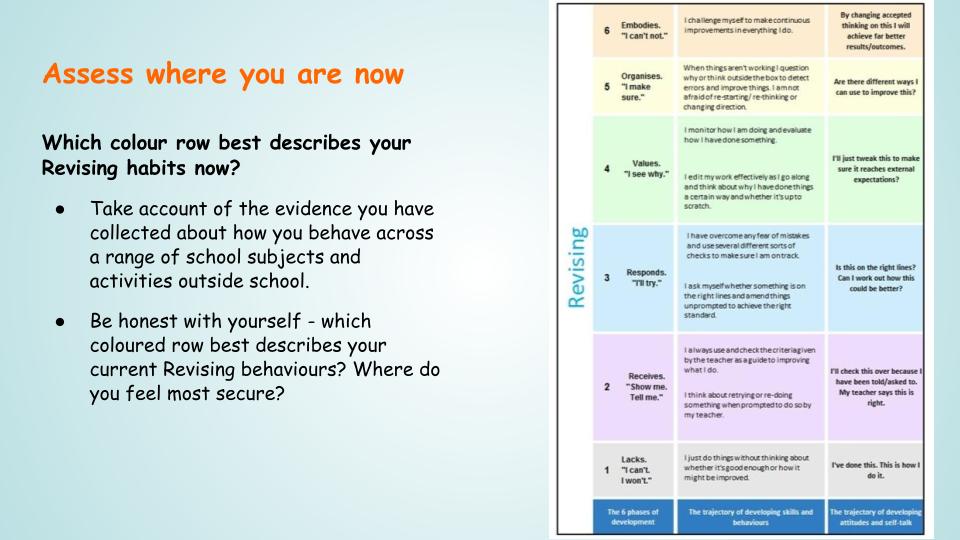
Take time to help students think about how they behave across a range of school subjects and even activities outside school. They need to be honest with themselves before deciding which coloured row or phase best describes their current Revising habits.

Why do this?

  • Because you are trying to help students to come to know themselves well enough to judge this, and they will gain from seeking advice from friends or their teachers.
  • And secondly, where they decide they are now should determine what they do next.

For example, if they think that the Purple row/phase best describes them at present, then their immediate target should be to consider ideas that will move into the Blue phase.
 

Content area 2: Careful consideration of the phases.

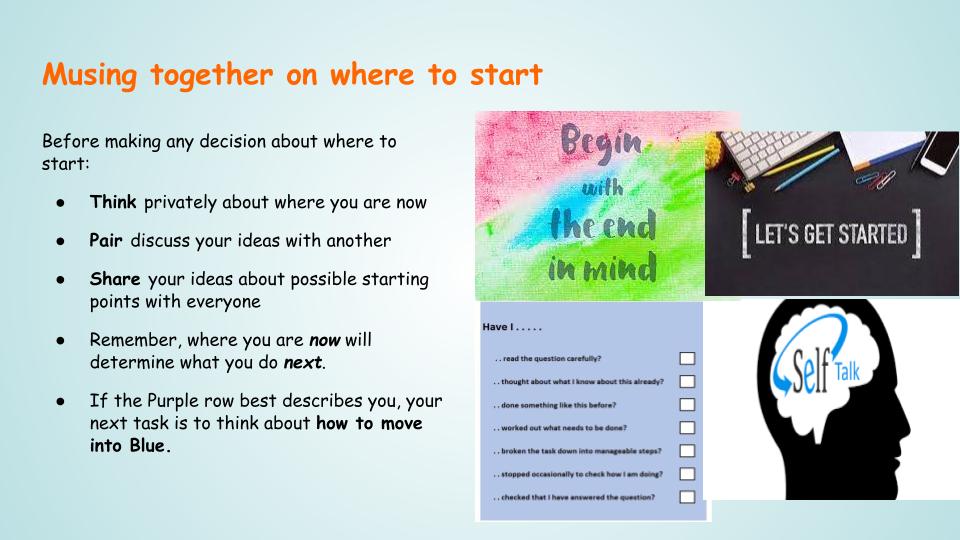
If you think you have time you might start this further reflection on the phases with a Think Pair Share activity (see slide 5) If not it is worth talking about the issues mentioned below. These are also captured on slides 6 and 7.

Take it steady

If students aren’t sure where they are on the chart, and as this is their first plan, it’s better to pitch their first plan low rather than high.

There’s nothing wrong with starting in grey to purple where their goal will be to listen carefully for teachers’ suggestions. But they could also try some of their own self-talk phrases to help them take some responsibility for thinking about their learning.

If they think they are ready to work on moving from purple to blue their aim will be to rely on their own nudges and prompts to make sure they are monitoring and reflecting on their learning.

If they think they are already doing this in some subjects they could focus their plan on covering more or trickier subjects.

If they think they are ready to work on moving from blue to green they must be confident that they are employing a range of monitoring strategies. Their aim will be to add looking back to evaluate/review to their learning repertoire and to recognise why this is a beneficial thing for their learning.

If they think they are ready to work on moving beyond green they must be sure they’re ready to look at what they are doing with a critical eye and make their own improvements along the way. Their aim here will be to constantly be on the lookout for how to improve or reinvent something in the light of deeply reflective experience.



Content area 3: Select appropriate activities to aid improvement

This is a tricky part of your lesson, and may well depend on:

  • how realistically your students evaluate their starting points for Revising, and
  • the range of those evaluations.

Things to consider as you plan the lesson is to ensure students achieve a realistic understanding of what they currently do, what they currently do not do, and what actions might improve their Revising skills:

  • If the overwhelming majority of your students believe they are at the same phase of development, planning, for say, small group discussion, will be straightforward.
  • If there is wide variation on starting points, organising small group discussions will need to consider whether you:
    • partner up students who are at the same phase
    • just run with ‘mixed phase’ groups
    • structure these discussions
    • offer guidance and how much
    • will need to produce the guidance in advance (e.g. download PDF resource below)

Also, ask yourself:

  • Is a whole class discussion viable?
  • What will you do about students who appear to have an unrealistic impression of their Revising behaviours? [It is highly unlikely that students are already functioning at the Green phase – so be alert to over-optimistic student evaluations! Decide in advance how will you challenge such evaluations.]

Resources

The information in the toggle boxes below give a few suggestions for activities and self-talk for each phase of the growth chart. It’s worth acquainting yourself with the ideas.

The same information is also available in a downloadable PDF resource which you can print for students to use in the lesson.

There are slides of the same information should you want to use them in the lesson.


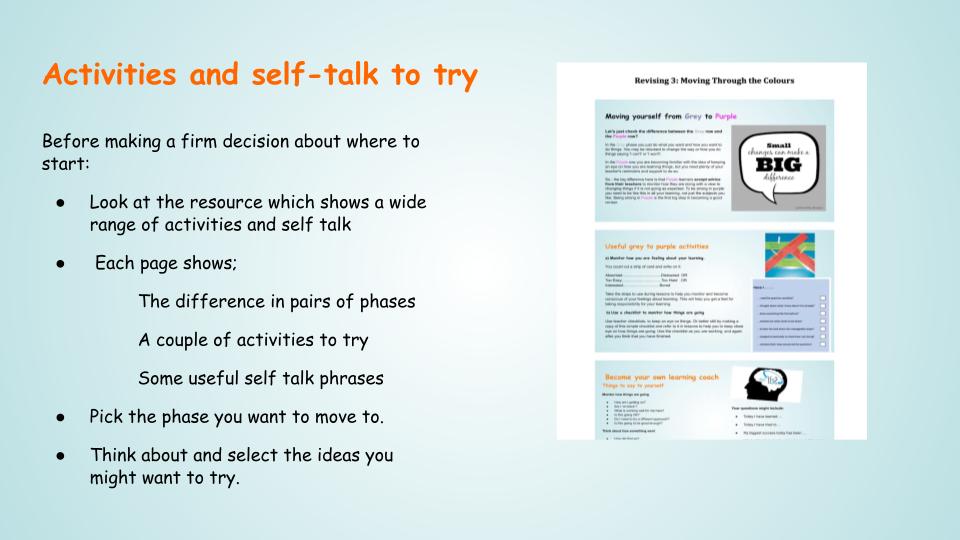
Ideas to help you to move you from Grey to Purple

Moving yourself from Grey to Purple

What is the main difference between the Grey row and the Purple row?

If you think you are in the Grey row you just do what you want and how you want to do things. You may be reluctant to change the way or how you do things saying ‘I can’t’ or ‘I won’t’.

If you think you are in the Purple row you are becoming familiar with the idea of keeping an eye on how you are learning things, but you need plenty of your teacher’s support to do so.

So – the big difference here is that Purple learners accept advice from their teachers to monitor how they are doing with a view to changing things if it is not going as expected. To be strong in purple you need to be like this in all your learning, not just the subjects you like. Being strong in Purple is the first big step in becoming a good reviser


A couple of useful activities

a) Monitor how you are feeling about your learning.

You could cut a strip of card and write on it:

Absorbed……………………………..Distracted OR

Too Easy………………………………Too Hard OR

Interested……………………………Bored

Take the strips to use during lessons to help you monitor and become more conscious of your feelings about learning. This is just a small beginning but will help you get a feel for learning to begin to take more responsibility for it.


b) Use a checklist to monitor how things are going

If your teacher offers you a checklist, then take their advice and use it to keep an eye on things. If your teacher does not offer you a checklist, try making a copy of this simple checklist and refer to it in lessons to help you to keep close eye on how things are going. Use the checklist as you are working, and again after you think that you have finished.


Become your own learning coach

Things to say to yourself

To help you begin to monitor how things are going

  • How am I getting on?
  • Am I ‘on track’?
  • What is working well for me here?
  • Is this going OK?
  • Do I need to try a different approach?
  • Is this going to be good enough?

To help you begin to think about how it went

  • How did that go?
  • What worked well?
  • Did it go as I expected?
  • Am I happy with that?

Make a quick reflection on what you’ve done become part of your daily or lesson routine.

Your questions might include:

  • Today I have learned….
  • Today I have tried to…
  • My biggest success today has been….
  • What will I tell my family when they ask ‘What did you do at school today’?
  • The most important thing I have learned today.
  • What has inspired me today?

Each, in different ways, encourages you to think about how your thinking / understanding has changed, how you have revised/amended your view of things.


Ideas to help you to move you from Purple to Blue

Moving yourself from Purple to Blue

What is the main difference between the Purple row and the Blue row?

Learners in the Purple row have become familiar with the idea of keeping an eye on how things are going with plenty of help from their teachers.

Learners in the Blue row use a range of strategies to enable them to keep an eye on how things are progressing towards achieving a goal and meeting the required standards.

So – the big difference is that learners in the Blue zone have become far more interested in their learning, monitoring and evaluating what they are doing in order to achieve good standards and without being told / helped to do so. Keeping an eye on how they are learning helps Blue learners to achieve good standards.


A couple of useful activities

a) Create your own checklists

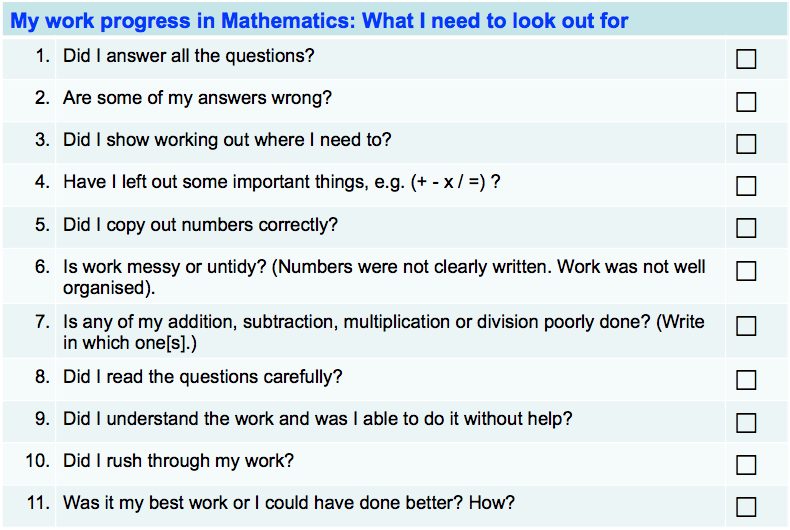
You do not need to wait to be given a checklist by your teacher. Why not create one for yourself?

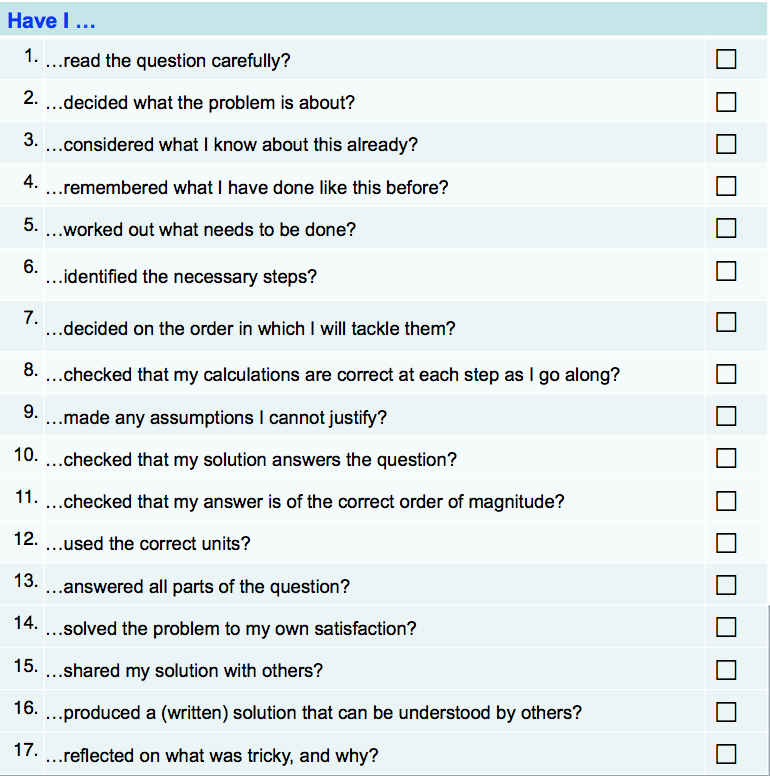
Suppose that you wanted to create a list that focuses specifically on numeracy/ maths? You might end up with something like the checklist opposite.

Challenge yourself – how would you adapt this checklist to make it relate to literacy rather than numeracy?

b) Trying something different

We all have our preferred ways of working, and if that way is successful we tend to use that method again and again. But what if our preferred way of working is not working as well as we had hoped?

The answer is, of course, to ditch an unsuccessful strategy in favour of a better one.

So where can you find alternative ways of working? Easy – Just stop and look around your class!

Ask yourself:

  • who has found a successful way of doing this?
  • what, precisely, are they doing to be successful?
  • do I need to talk to them to fully understand their approach?
  • how can I copy or imitate their successful strategy?


Become your own learning coach

Things to say to yourself

To help you to learn from mistakes

  • What went wrong there?
  • What can I learn from this mistake?
  • If I have another go what would I change?
  • Do I need to try something different?
  • What have I misunderstood here I wonder?

To develop a sense of what ‘good’ looks like

  • What made me think this wasn’t quite right/good enough?
  • Am I (un)happy with this? Why?
  • What hint could I give myself so I can figure it out?
  • Can I do something more/better to meet my success criteria?
  • How you could I improve this.
  • Am I happy with what I’ve achieved?

To explore externally set standards

  • Have I noticed the success criteria?
  • Why do we have success criteria? What are they for?
  • Is it going to be good enough?
  • Is it going to be good enough for me?

Try these If/Thens statements to help you to monitor how things are going:

  • If I am working on something, then I will stop occasionally and ask myself how well I am getting on.
  • If I’m working on something then I will ask myself why I think it’s okay/good/meeting the success criteria.


Ideas to help you to move you from Blue to Green

Moving yourself from Blue to Green

What is the main difference between the Blue row and the Green row?

Learners in the Blue row employ a range of strategies to enable them to keep an eye on how things are progressing towards achieving a goal and meeting the required standard.

Learners in the Green row have come to understand the benefit of monitoring how things are progressing but also take time to look back over what they have done to consider whether they have achieved what they intended and how they might do it differently next time.

So – the big difference is that Green learners not only monitor progress while they are doing something, but also look back to evaluate what they have achieved once they have completed a task. Green learners recognise that doing those things brings worthwhile benefits so they keep on doing them.


A couple of useful activities

a) I used to think . . . Now I think . . .

This routine helps you to reflect on how and why your thinking/understanding is changing. It encourages you to recognise that new learning often requires you to change what you were thinking previously.

For example, at the beginning of a lesson or topic, ask yourself what you understand by one of the key concepts that you will be studying. (e.g. Phrase (English); Proof (Maths); Power (Science) etc). At the end of the lesson/topic ask yourself what you now understand by the term in light of what you have learned.

It is about noticing, acknowledging and celebrating a change of mind.

b) Use a checklist to evaluate a completed piece of work

Monitoring and evaluation are slightly different. You monitor as you go along, as you are doing your learning. Evaluation is what you do after the learning/task has been completed. It involves stopping to look back over what you have done, how you did it, how successful you were, and how you might do it differently next time.

At the end of a substantial piece of work, use the checklist opposite to reflect on what you have achieved.


Download as a pdf

Become your own learning coach

Things to say to yourself

To help you begin to evaluate how it went

  • How did that go?
  • What worked well?
  • What didn’t go as I expected?

To check against standards

  • Is this the best it can be?
  • Why do I think this is as good as I can make it?
  • Is it good, or just good enough?
  • Can I visualise how it could be even better?

To make minor changes to tweak

  • I could always say to myself. . ‘Does this meet the criteria?’
  • Could I / do I need to make some small improvements?
  • We never/rarely get it right first time.
  • I could say to myself…’I did this well/right/better because I made XX changes

To reflect on why you did it that way

  • Why am I happy with what I have achieved?
  • Did I meet the success criteria I set myself?
  • Can I think of other ways I might have tackled it?


Ideas to help you to move you beyond Green

Moving myself beyond Green

What is the main difference between the Green row and the rows beyond Green?

Learners in the Green row have come to understand the benefit of monitoring how things are progressing, but also take time to look back over what they have done to consider whether they have achieved what they intended and how they might do it differently next time.

Learners in the rows beyond Green organise themselves to meet their own high standards through a combination of reflecting while they are learning (monitoring) and reflecting after the have learned (evaluation). This reflection sets them on a pathway of change and improvement.

So – the big difference is that learners beyond Green have taken control of their own improvement and use monitoring and reflection independently to ensure that they meet the highest standards.


A couple of activities to try

a) Acting on feedback

Students receive feedback from their teachers, parents and friends. Mostly the feedback is spoken, but some feedback might be offered to you in written form.

Positive feedback is always welcome and tends to make us feel good. But the most valuable feedback you can receive is feedback that points to ways that you can improve. Perhaps not as comfortable as the positive, praise type feedback that gives you that warm glow of satisfaction at a job well-done, the most useful feedback you can receive focuses on how you can do even better next time.

So – be alert to all of the sources of feedback around you, listen very carefully, and, most importantly, act on the feedback. Keep asking yourself: ‘How will I do it differently next time?’

b) Slow down, get creative, look at the options

Often when faced with a task there are one or two obvious courses of action. These tend to be the ones that you have used successfully in the past. But are there any other options that might be even better?

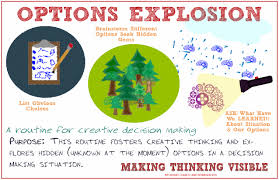
Try the routine ‘Options Explosion’ to explore hidden options before committing to a course of action.

  • Begin by listing the obvious options, then . .
  • Brainstorm all sorts of different options to find the “hidden” options. Often there are hidden options that are the real best choices. Be imaginative! Piggyback on ideas you have already, combine ideas to get new ones, look for ideas of a very different kind. . .
  • And finally, select your course of action.


Become your own learning coach

Things to say to yourself

To make choices about standards

  • How will I decide if it is good enough?
  • What standards have I set myself for this?
  • Why did I choose to judge it against these criteria?
  • Are there other criteria I could / should have used?

To detect errors

  • Am I using the most efficient way of doing this?
  • Could / should I change what I am doing here?
  • Can I spot any errors/ a better way to do this/to change my original plan
  • Am I satisfied with this yet?

To challenge accepted ways of doing things

  • How could I have done this differently / better?
  • I need to think outside the box here.
  • Am I sure this amount of change is necessary.
  • Is there another way I could have done this?


Content area 4: Put a do-able plan together

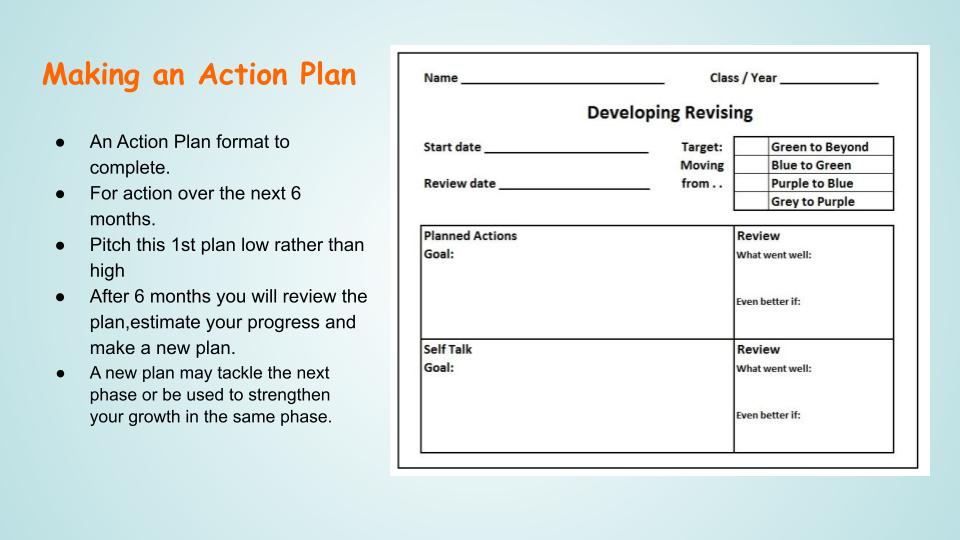
The next stage of the lesson involves students putting an Action Plan together

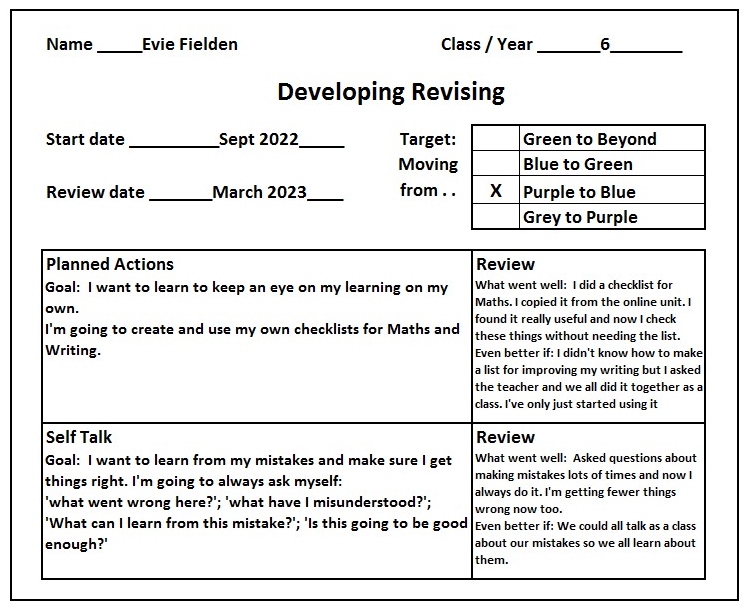
Here is a fairly straightforward six month Action Plan format for students to complete. This means that what they are planning will be put into action by them, over about six months. At the end of six months they will need to review their plan, estimate their progress and then make a new plan. The new plan may tackle the next phase of growth or strengthen the growth in the same phase.

Invite them to:

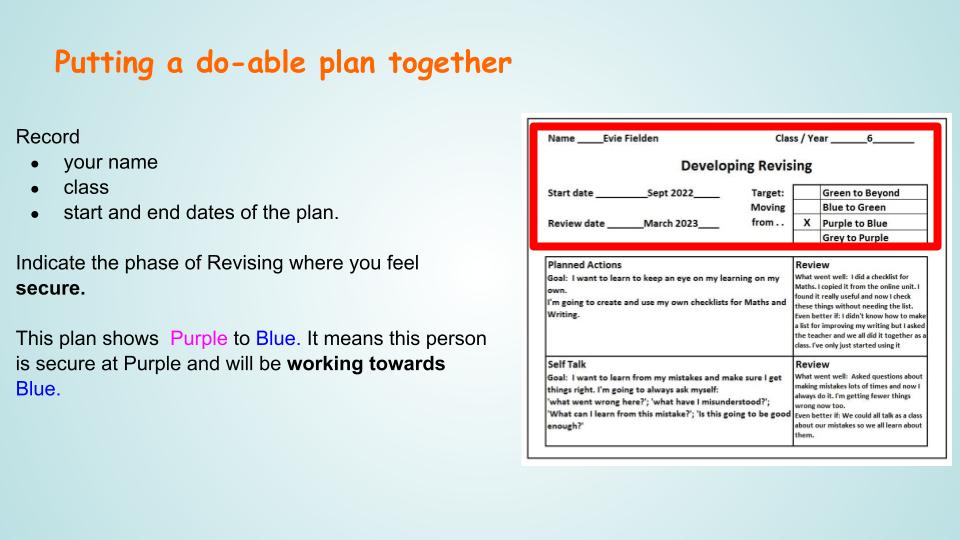
  • Record name and class
    • the date the plan was made
    • the date the plan will be reviewed
  • In the little table students should indicate the phase of Revising where they feel secure. This shows their starting point. If they mark Purple to Blue it means they think they are secure at Purple and will be working towards Blue
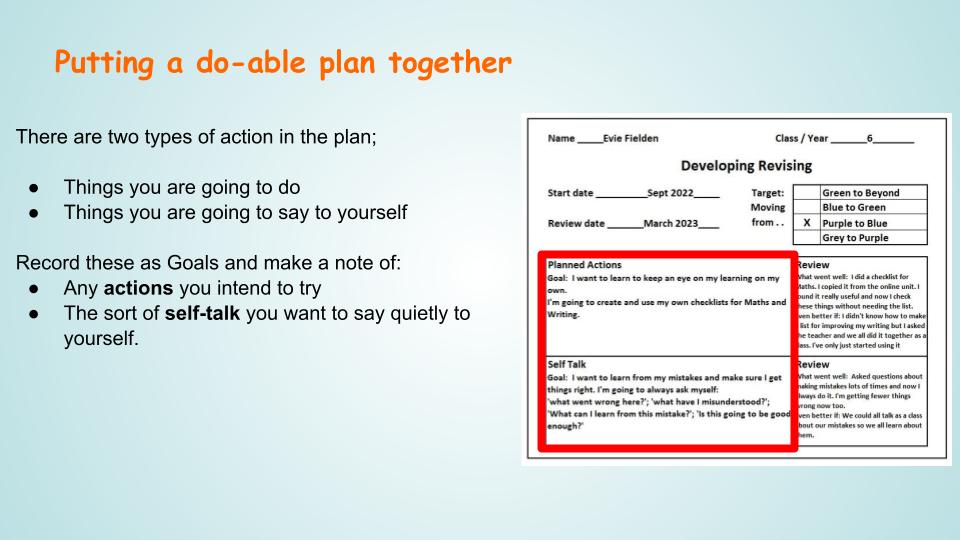
  • What they want to improve should be shown as Goals and notes made of:
    • any actions they intend to try
    • the sort of self-talk they want to say quietly to themselves.

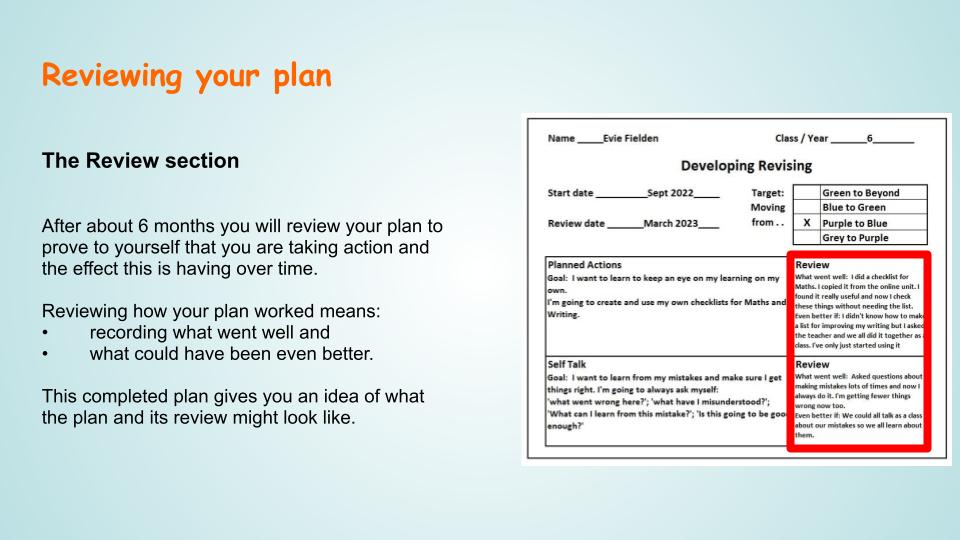
Reviewing the plan:

  • After about 6 months the plan should be reviewed to prove to students that they are taking action which is having effect over time.
  • It’s useful to note down how the plan worked:
    • what went well and
    • what could have been even better.

Here’s a completed plan to give you an idea of what the plan and its review might look like. Feel free to design your own Action Plan format.


Example completed Action Plan


Read the completed plan Download a blank proforma

Content area 5: Monitoring how it’s going and keeping plans under review

The best way of keeping their plan going will be by students getting used to looking at the changes they are making and their impact on their learning.

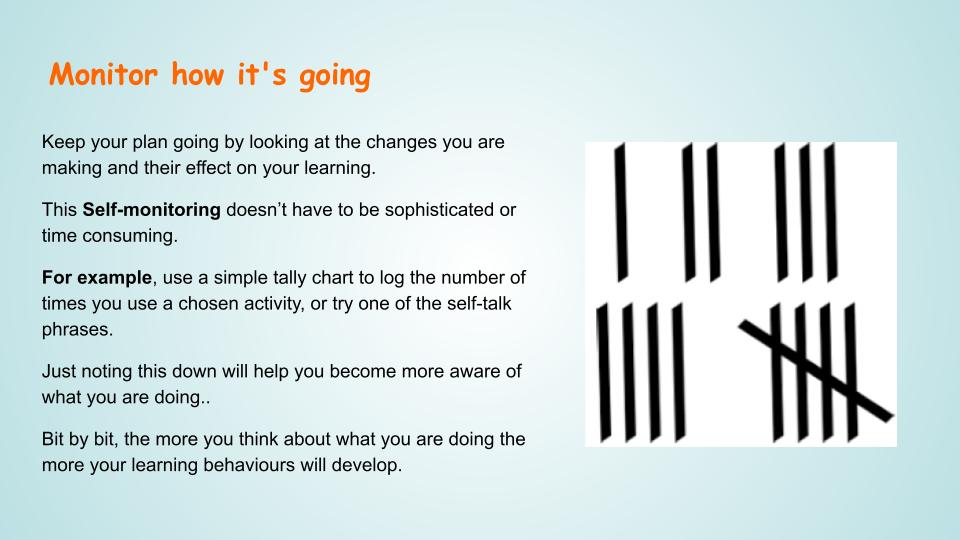
This amounts to Self-monitoring. It’s about students keeping track of the actions or self-talk they are trying in their classrooms. This monitoring doesn’t have to be sophisticated or time consuming. For example, they could use a simple tally chart to log the number of times they use a chosen activity, or try one of the self-talk phrases. Just noting this down can help them become more conscious of the actions they are taking.

Bit by bit, the more they question themselves about what they are doing the more they will consolidate their approaches to developing these learning behaviours into learning habits.

In six months time

A lesson at the end of the six months should enable students to look back at their plan, and any notes they have made, using this useful technique.

Look closely at what you have changed about your way of working.

Think about:

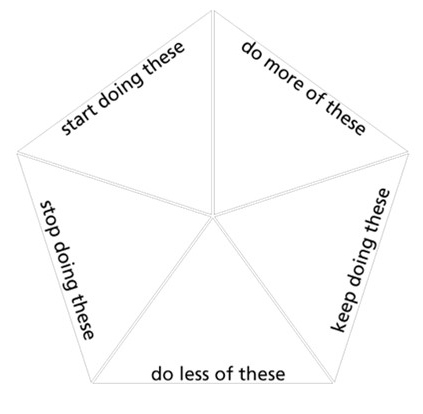
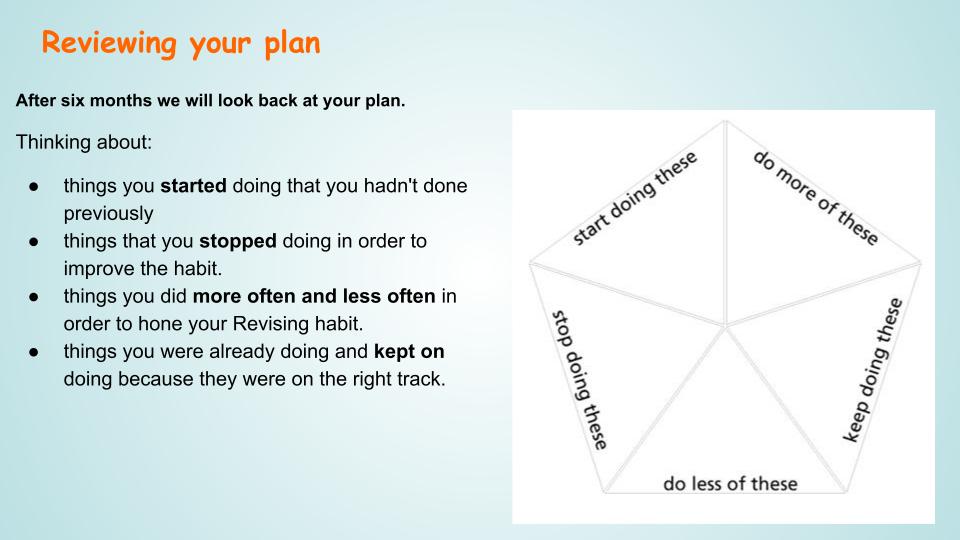
  • Things you started doing that you hadn’t done previously
  • Things that you stopped doing in order to improve the habit.
  • Things you did more often and less often in order to hone the habit.
  • Things you were already doing and kept on doing because they were on the right track.


I stopped . . .

I tried . . .

I used . . .


Continue Reading

2s. Exploring Revising and how it grows

Lesson 2

a) What this section contains.

This section offers ideas and resources for you to use in constructing a lesson, or even two lessons, to enable students explore Revising and how it grows as an effective learning habit.

We leave the specific lesson design to you but offer pointers and resources in the sections below including:

  • suggested content areas
  • a clear definition of Revising
  • a list of how teachers help students to use the habit
  • clear explanations of how Revising develops when encouraged
  • downloadable resources for use by students
  • a slide presentation for use in the lesson
Download Presentation (pdf)

b) Suggested content areas

  1. What does Revising mean?
  2. What are the different revising habits?
  3. How do teachers help students to develop revising habits?
  4. How revising habits grow?
  5. Where students’ revising strengths lie now.

Your aim for this lesson should be to help students understand:

  • what the learning habit Revising is really all about
  • how it can develop
  • where they are now in the growth of this habit

In the sections below you will find: explanations of how the learning habit works; a quiz to help students spot themselves Revising in lessons; ideas about how teachers help students become better at Revising; a chart showing how Revising habits grow, given the right circumstances.

Content areas 1 and 2: What being a good reviser means.

Being ready, willing and able

Revising is about the way we work on something to improve it. Whether it be icing a cake, solving a tricky maths problem or creating a well-crafted essay, all require effort, retries and determination to satisfy ourselves that the result pleases us; that it comes up to scratch. How we tackle such a job isn’t just a case of monitoring as we go along or reviewing the result: it will be influenced by other qualities. Our attitude to change, whether we have a sense of quality and what sort of validation we need.


Being a good reviser involves:

  • self-monitoring how things are going, keeping an eye on the goal;
  • expecting the unexpected, being ready to re-shape, re-order, re-form plans to take account of new circumstances;
  • staying alive to new, unforeseen opportunities and ideas;
  • looking at what you are doing with a critical eye;
  • striving to be the best you can be;
  • making sure things are on track and making improvements along the way.

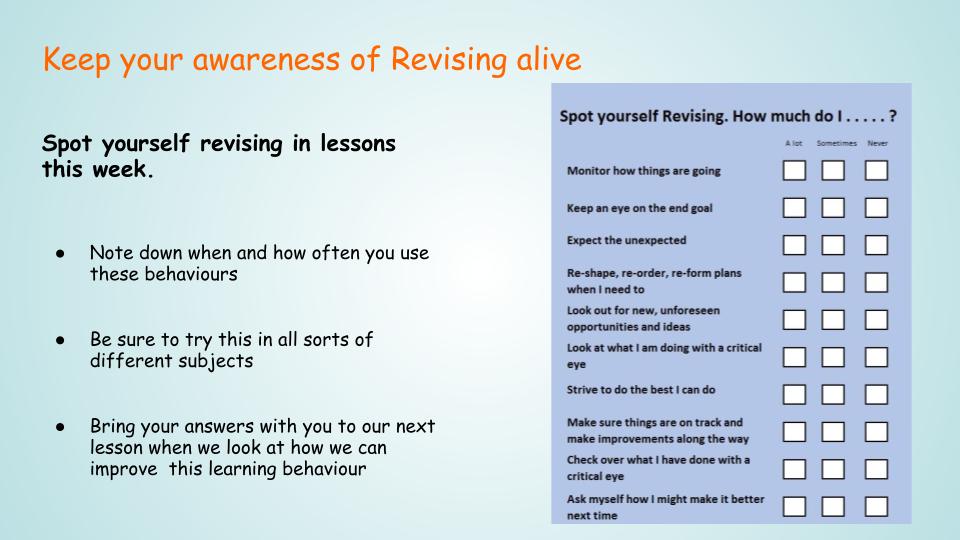
Resource 1 Spot yourself revising in lessons

Use this resource to help to get students tuned in – offer them time to think about their revising habits. Unpack each of statements. Use of the chart could be extended into other lessons too. At the end of this lesson encourage students to take it with them into lessons and make a note of whether and how often they display these characteristics.

Students will take the outcomes of using this little questionnaire into account when they tackle lesson 3.


Content area 3: How teachers help students become revisers

As teachers you will:

  • encourage students to change the way you are doing things if necessary
  • help students to view change as a natural part of learning
  • want students to view making corrections as an opportunity to improve
  • focus your feedback on what students need to do to improve, rather than simply praising what they got right
  • offer students checklists that help them to keep an eye on how their work is progressing
  • create opportunities for them to stop and to consider how things are going

Feel free to add your own ideas to this list.

Good revisers have had to learn how to deal with change, both emotionally and practically. If you’re someone who just wants or likes things to stay the same you’re unlikely to recognise the need to change your ideas or the way you do something.

A good reviser needs to know/understand what ‘good’ looks like; how to keep an eye on how things are going; be willing to evaluate how good things are against external standards. Growing students’ revising habits is much more than encouraging them ‘having another go’.


Content area 4 and Resource 2: Progression in Revising

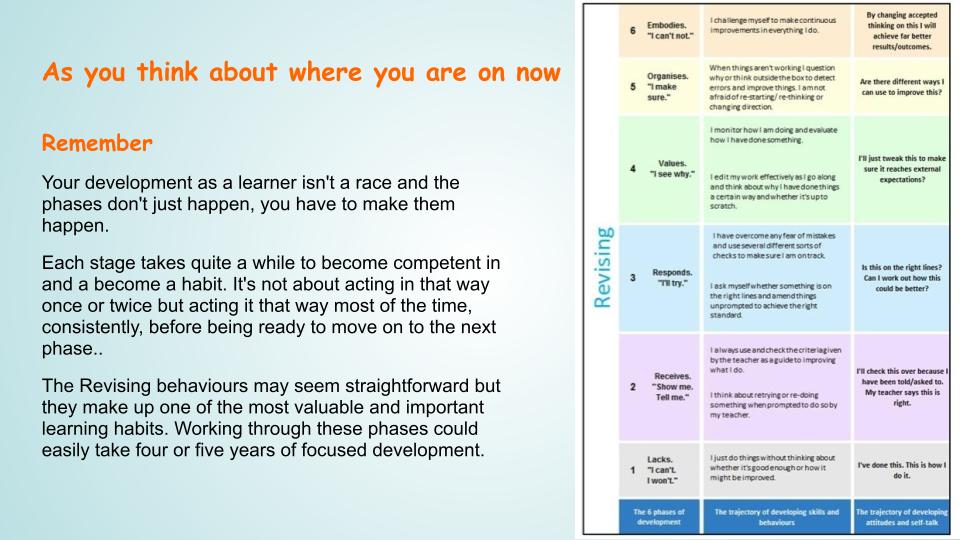
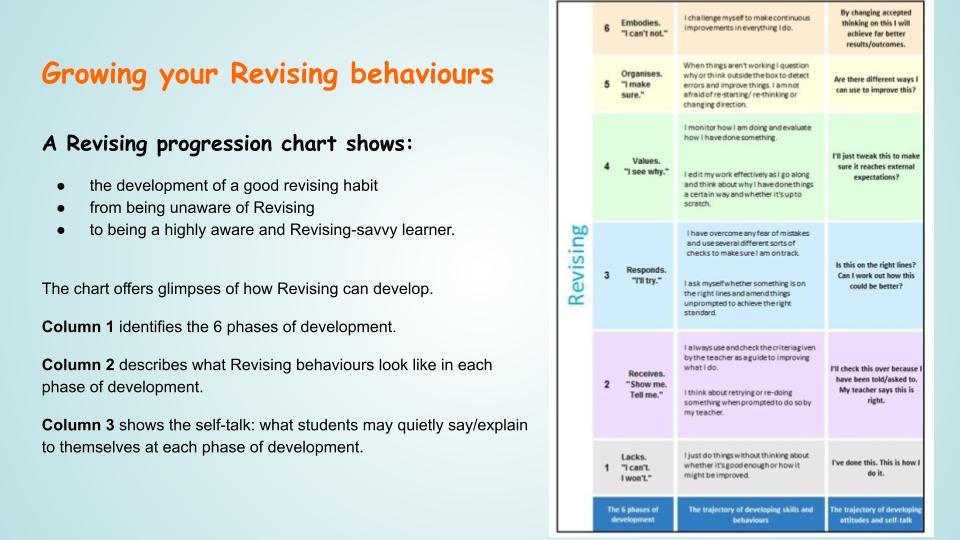
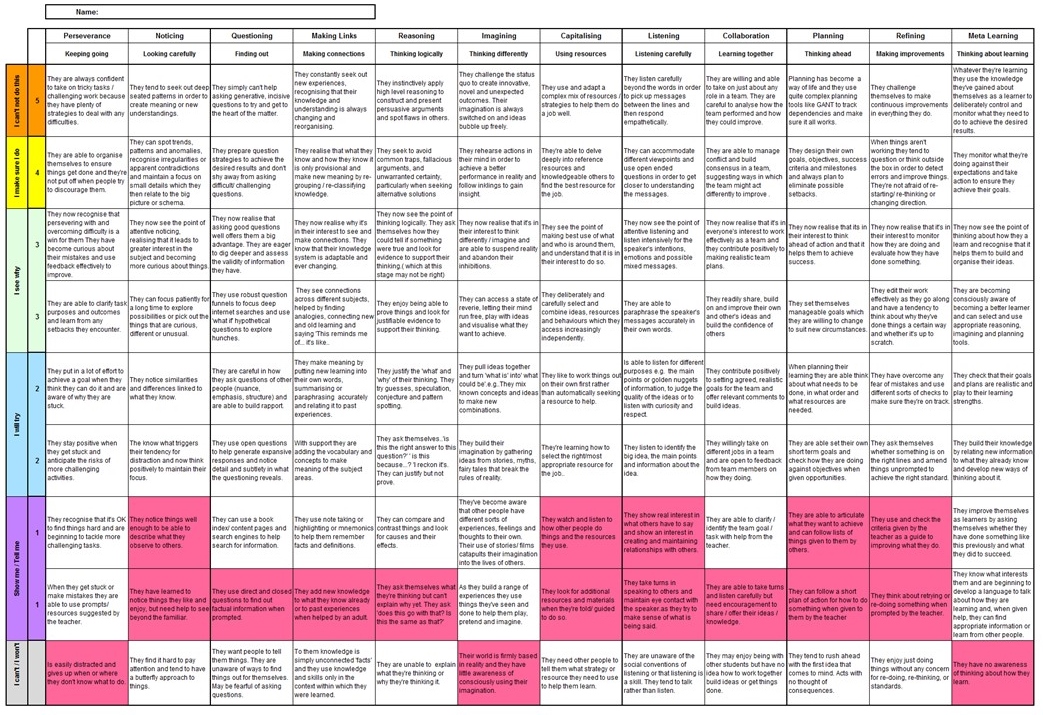
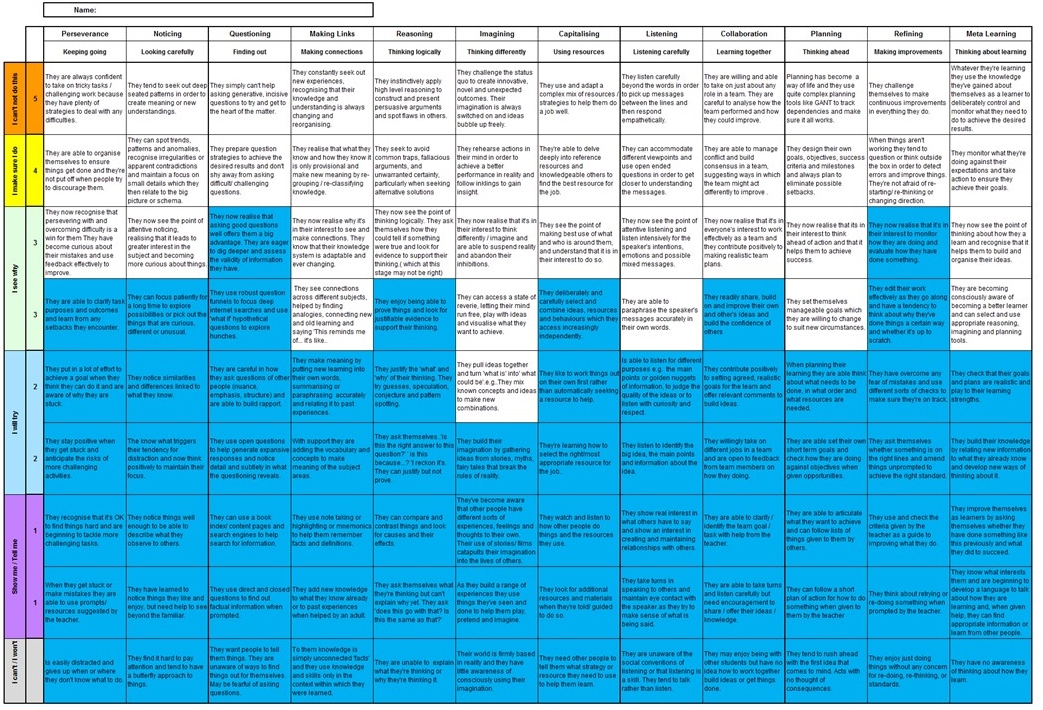
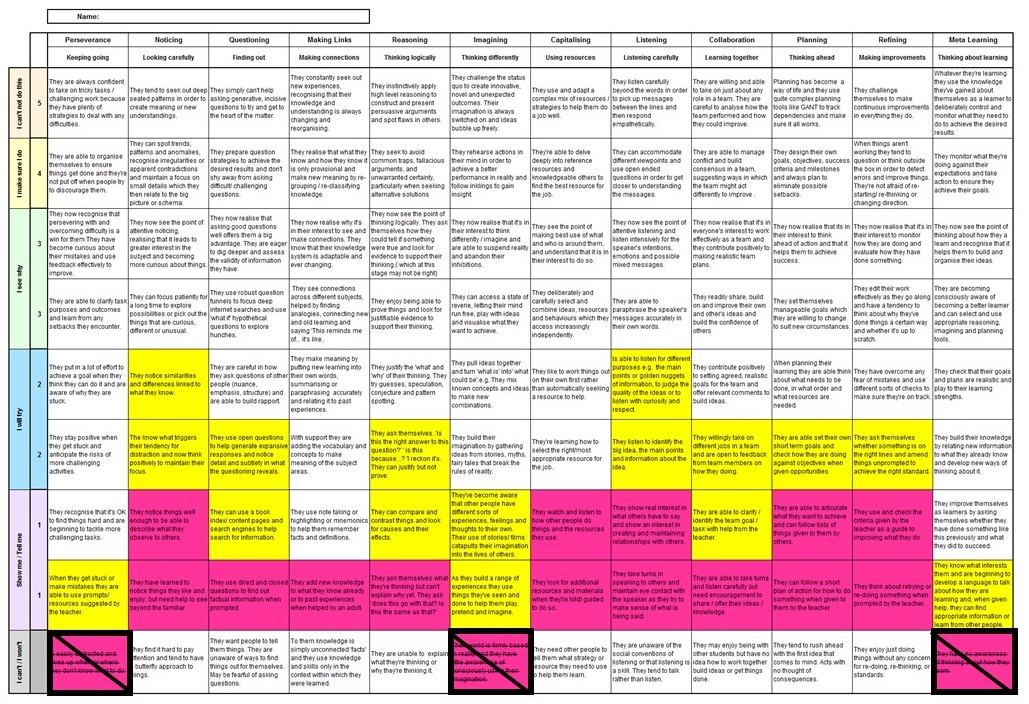
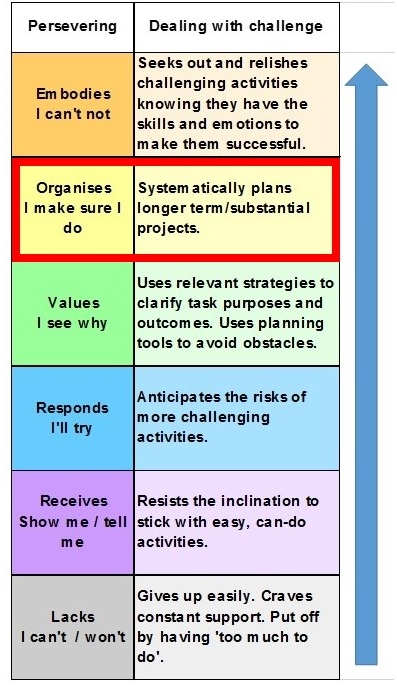
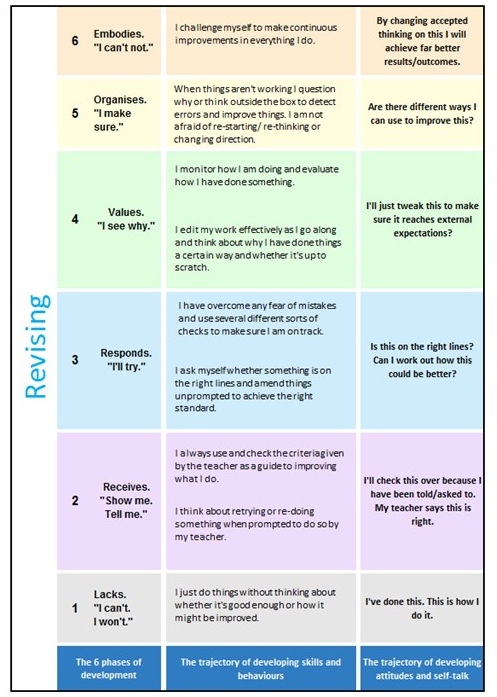
A progression chart for Revising

It may be tempting to think that either you do, or you do not, use your Revising habits – that either you are inflexible and reluctant to change, or that you are flexible and open to change. This could not be further from the truth!

The reality is that there are lots of little steps, skills and attitudes that lie between these two extremes.

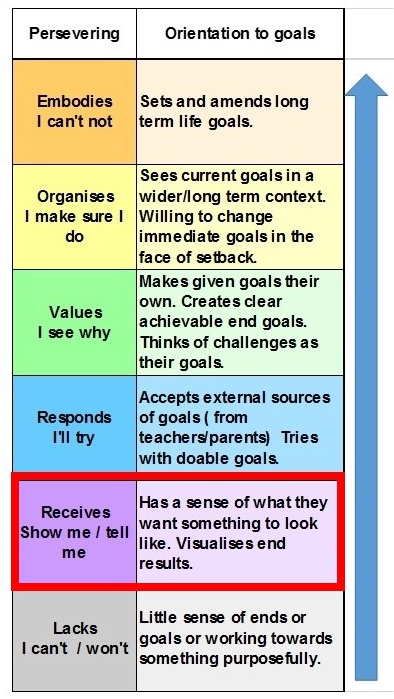
The chart alongside outlines a possible trajectory of the development of a good revising habit. It moves from being the learner at the bottom who is unaware of Revising, to the highly aware and Revising savvy learner at the top. Between the two lies a progression that can be mapped and described. The statements in the diagram hint at the journey from novice Reviser to an expert Reviser.


Content area 4: What the columns are about

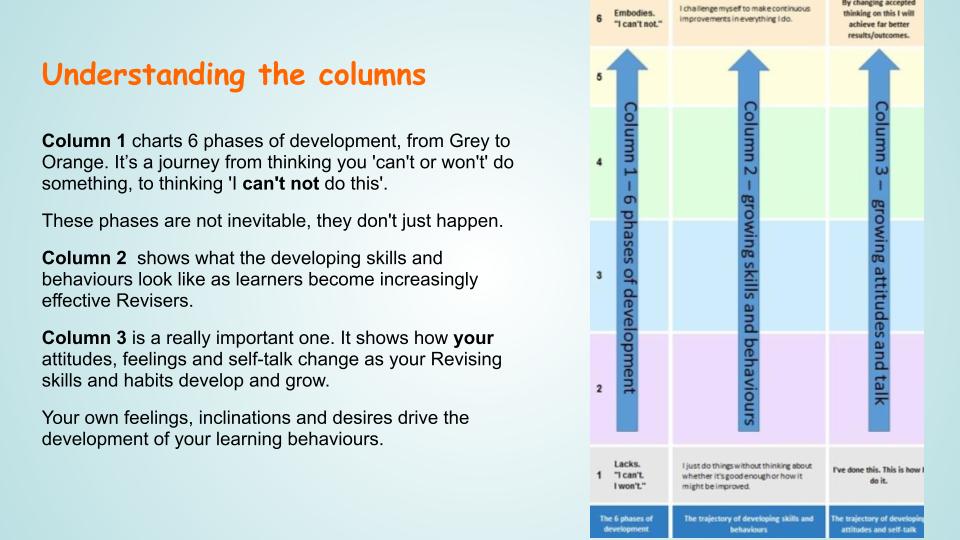
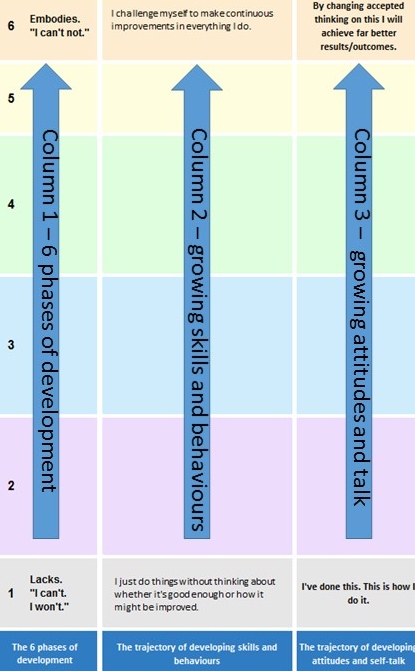
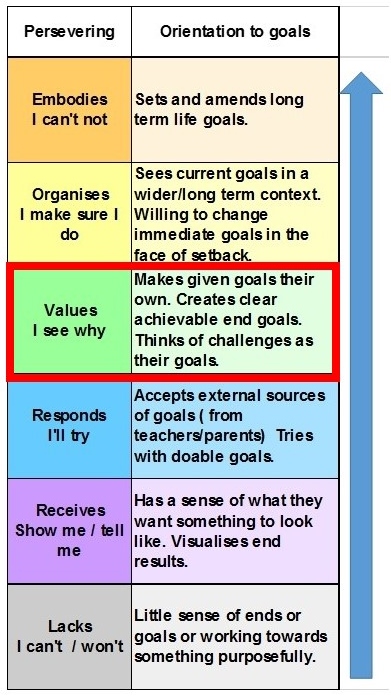
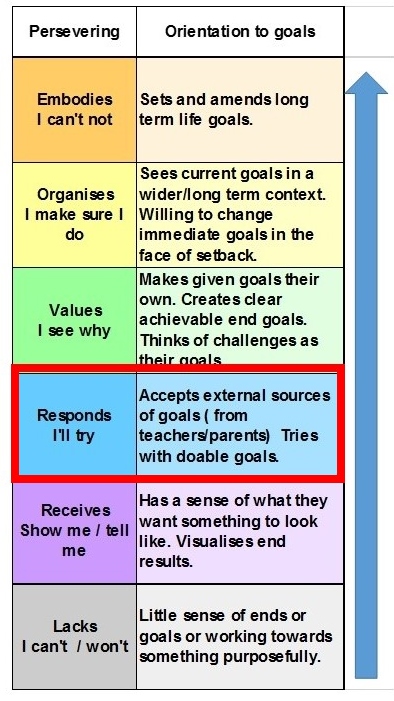
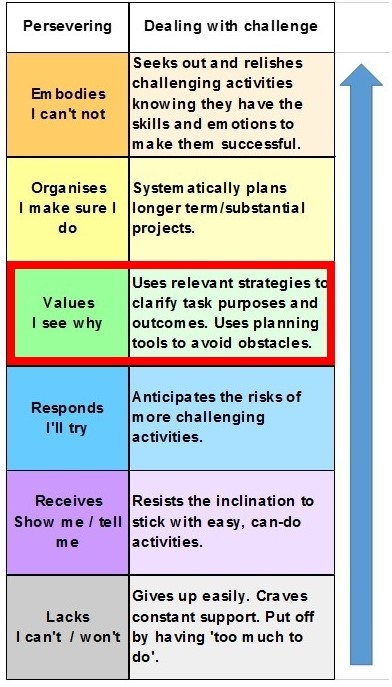
Column 1 charts 6 phases of development, going from Grey at the bottom, through to Orange at the top. These phases describe the journey from an attitude of ‘I can’t / I won’t’ at the bottom, through to ‘I can’t not do this’ at the top. These phases are not inevitable or automatic; they don’t just happen.

Column 2 puts flesh on these phase bones, and identifies what the developing skills, behaviours, habits look like as learners become increasing more effective as Revisers.

Column 3 is a really important one. It shows how attitudes and self-talk change as Revising skills develop and grow. Interestingly it’s one’s own feelings, inclinations and desires that drive the development of any of the learning behaviours. If you don’t know or care about it it’s unlikely to improve.


Content area 5: Resource 3 Where students’ revising strengths lie

To make Revising come alive and feel real it’s important to offer learners a closer look at each phase. To enable this enquiry we offer two resources. You could use the slides shown below or the same slides presented as a downloadable PDF for you to print. How you explore this information with students we leave to you.

Looking closely at grey from the learners’ viewpoint

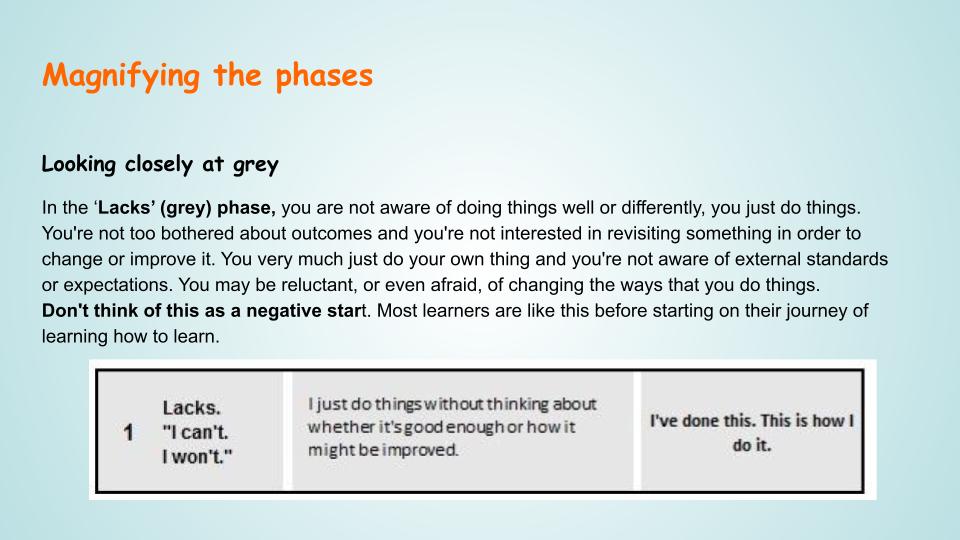
In this ‘Lacks’ (grey) phase, you are not aware of doing things well or differently, you just do things. You’re not too bothered about outcomes and you’re not interested in revisiting something in order to change or improve it. You very much just do your own thing and you’re not aware of external standards or expectations. You may be reluctant, or even afraid, of changing the ways that you do things. But don’t think of this as a negative start. Most learners start like this before making a start on their journey of learning how to learn.


Looking closely at purple

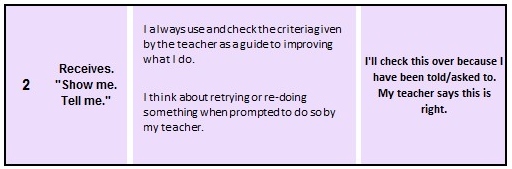
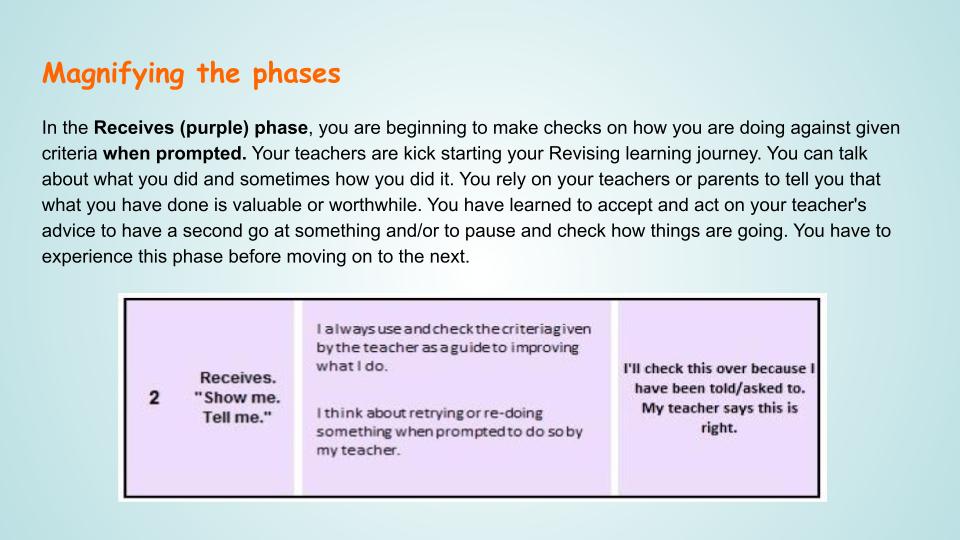
In the Receives (purple) phase, you are beginning to make checks on how you are doing against given criteria when you are prompted to do so. Your teachers are kick starting your Revising learning journey. You can talk about what you did and sometimes how you did it. You rely on your teachers or parents to tell you that what you have done is valuable or worthwhile. You have learned to accept and act on your teacher’s advice to have a second go at something and/or to pause and check how things are going. You have to go through this phase before moving on to the next.


Looking closely at blue

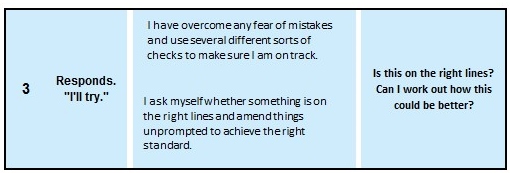
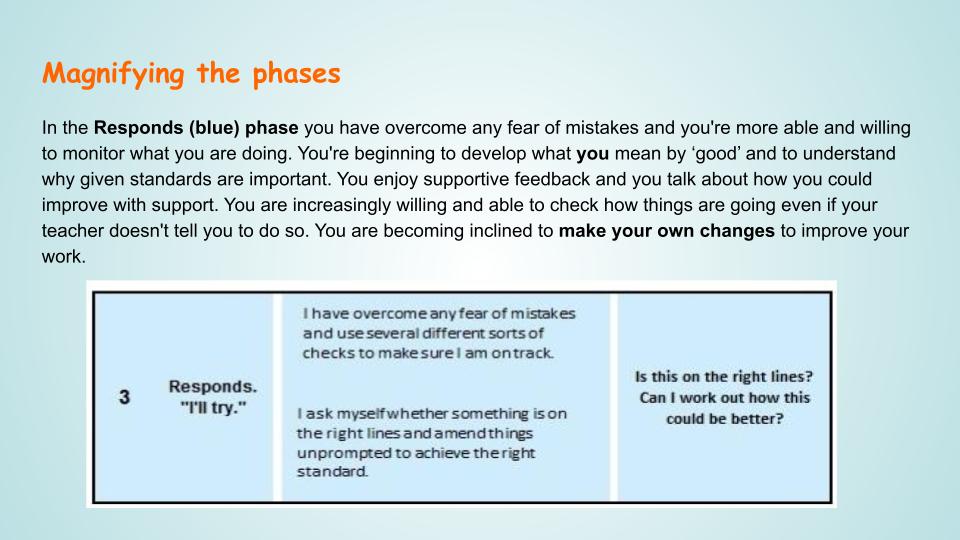
In the Responds (blue) phase you have overcome any fear of mistakes and you’re more able and willing to monitor what you are doing. You’re beginning to develop what you mean by ‘good’ and to understand why given standards are important. You enjoy supportive feedback and you talk about how you could improve with support. You are increasingly willing and able to check how things are going even if your teacher doesn’t tell you to do so. You are becoming inclined to make your own changes to improve your work.


Looking closely at green

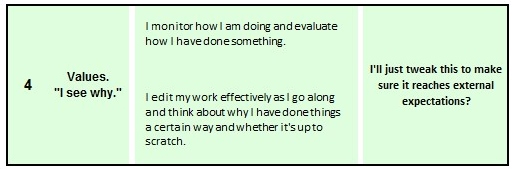
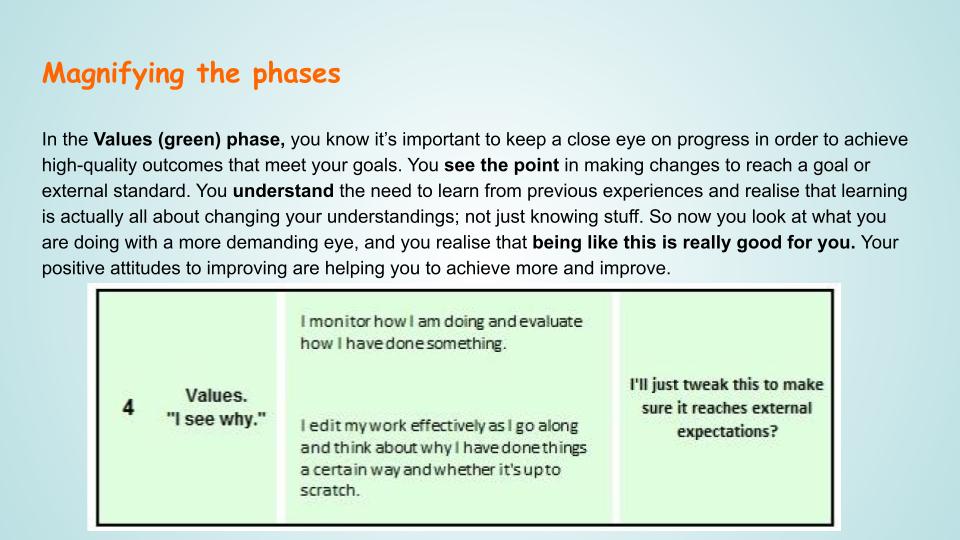
In the Values (green) phase, you understand the importance of keeping a close eye on progress in order to achieve high-quality outcomes that meet your goals. You see the point in making changes to reach a goal or external standard. You understand the need to learn from previous experiences and realise that learning is actually all about changing your understandings; not just knowing stuff. So now you look at what you are doing with a more critical or demanding eye and have realised that being like this this is really good for you. Your positive attitudes to improving are helping you to achieve more and improve.


Looking beyond green

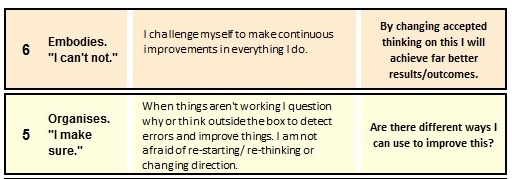
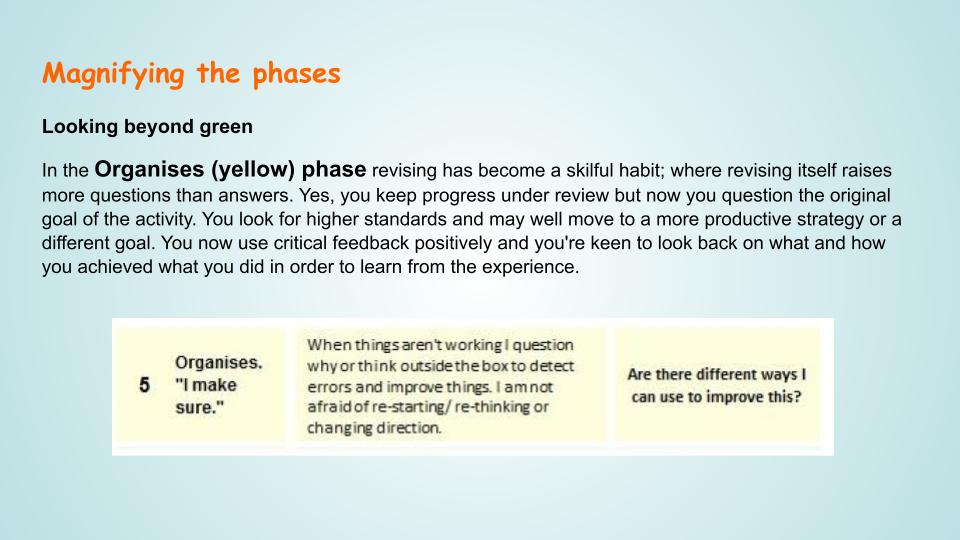
In the Organises (yellow) phase revising has become a skilful habit; where revising itself raises more questions than answers. Yes, you keep progress under review but now you question the original goal of the activity. You look for higher standards and may well move to a more productive strategy or a different goal. You now use critical feedback positively and you’re keen to look back on what and how you achieved what you did in order to learn from the experience.

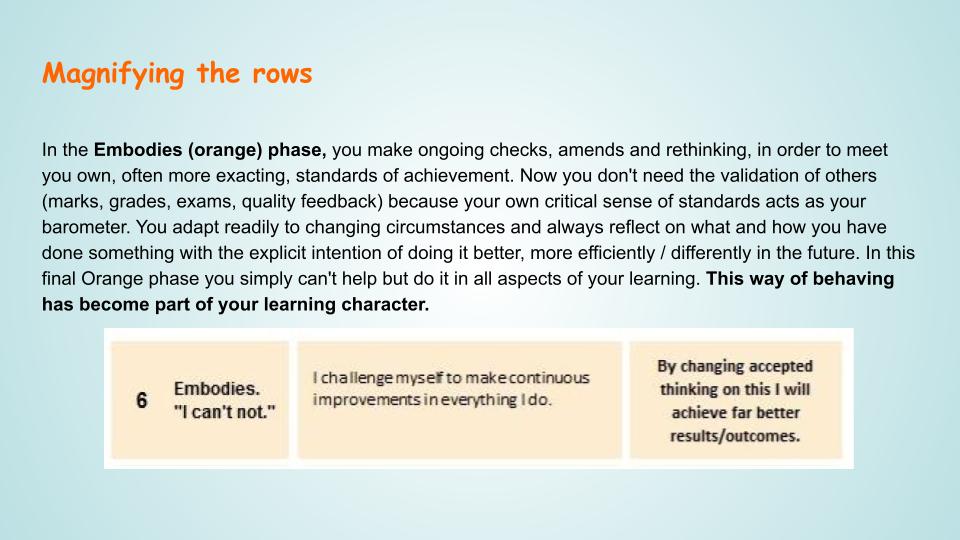
In the Embodies (orange) phase, you make ongoing checks, amends and rethinking, in order to meet you own, often more exacting, standards of achievement. Now you don’t need the validation of others (marks, grades, exams, quality feedback) because your own critical sense of standards acts as your barometer. You adapt readily to changing circumstances and always reflect on what and how you have done something with the explicit intention of doing it better, more efficiently / differently in the future. In this final Orange phase you simply can’t help but do it in all aspects of your learning. This way of behaving has become a defining part of your learning character.


Content area 5: Where students’ revising strengths lie

Reflecting on learning

Using an effective thinking routine

Invite learners to reflect on what they have learned about themselves as a learner by using the Visible Thinking Routine ‘I used to think… Now I think’ . . . before estimating which colour row best describes their current Revising skills, behaviours, attitudes and habits.

It’s fair to say this first estimate won’t be their last because the next lesson gives time to reassess their decisions. But it gives them a basis to work on before looking more closely at themselves learning during their lessons next week.


Keeping awareness alive

Using the checklist from the beginning of the lesson invite learners to take the resource with them into lessons over the next week. We suggest they use the resource after at least three lessons across the week. You could leave the choice of lessons to them or maybe suggest they select a subject they enjoy/find fulfilling and one they find tricky. Probably wise to advise them to complete the resource after rather than during the lessons.

Emphasise the need to bring the results of their observations to the next lesson on Revising where they will be used to help them further their understanding of themselves as learners.


Continue Reading

1t. What is good Revising?

a) About Revising

The word Revising has unfortunate connotations with Revision [for a test]. What is meant here is being prepared to do things differently in light of feedback, to be adaptable, flexible and open to change.

However well prepared learners are, they have to expect the unexpected. They have to have the readiness to revise / refine as they go along. Good learners are able to change their plans and think on their feet. They are able to be flexible. It may be a good decision to say ‘This is turning out to be far harder than I thought, and I’m getting less help than I imagined, and there are other interesting possibilities opening up, so I think I’ll cut my losses and quit.’ Note that the decision is based on a realistic cost-benefit analysis of the actual situation, not on frustration, pique or a blow to self-esteem.

To be effective at revising, learners need to monitor how things are going and periodically review where they have got to.


b)The first big aspect of Revising…monitoring

Monitoring is the art of looking over your own shoulder as you’re working away at a problem, asking yourself how it’s going.

Getting better at monitoring involves cultivating the little voice of self-awareness that keeps the strategic goals in mind, and is ready to change tack if it seems appropriate. A football manager contemplating making a substitution is monitoring, as is a teacher who decides to throw away the lesson plan on the spur of the moment and go with the interesting discussion which is developing. Students can pick up the habit and the skill of this kind of monitoring by being around people—teachers are ideally placed—who are able to model it, and who have learnt how to learn aloud, i.e. to externalise the thought processes of the vigilant monitor.


c) The second big aspect of Revising…reviewing.

Reviewing means stopping every so often to take stock of progress, and to ensure that any emerging product—an artwork, an essay, a draft business plan—is on track. Reviewing requires the ability to look at your own work with the critical eye of an editor, and not be afraid of the possibility that some corrections may be needed. A writer may put a piece of work aside for a while and then come back to look at it afresh. An athlete may sit down and look at the video of her starting technique to see if any adjustments need to be made. But reviewing is what the low-achieving maths student, for example, is very often unable to do.

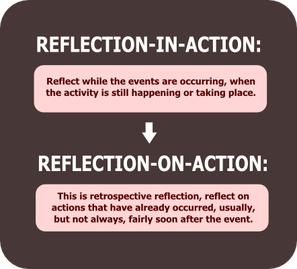
Donald Schon called monitoring ‘reflection in action’, and reviewing ‘reflection on action’. Again, modelling and coaching can help develop these abilities.


Image result for REFLECTION


d) A well formed Revising habit involves being ready, willing, and able to:

  • Self-monitor how things are going, keeping an eye on the goal;
  • Expect the unexpected, having a readiness to re-shape, re-order, re-form plans to take account of new circumstances;
  • Remain alive to new, unforeseen opportunities and ideas;
  • Look at what you are doing with a critical eye;
  • Strive to be the best you can be;
  • Make sure things are on track and make improvements along the way.


e) Spot the Revisers in your classes

Just to get you tuned in – have a quick think about ‘Revisers you may know’. Make a note of students you know who display these characteristics.

Becoming a teacher who develops students’ learning power means developing a keen awareness of the subtleties of your students’ learning behaviours.

f) What do you think?

  • How many of your students come to mind when looked at through the lens of revising?
  • Is there a gender balance or have you noted down more girls than boys or vice versa?
  • Are the students you have noted from across all age groups or do some dominate?
  • How do these revising characteristics help these students to be better learners?

Make a note of…

  • Those groups or classes that seem to have lots of good revising characteristics.
  • How you think you might capitalise on this.


Continue Reading

Section 3 Some ideas to practise

3.1 Confirm where you are now.

Which coloured row best describes your Revising skills?

You met this progression chart in the previous section.

Take time to think about how you behave across a range of school subjects and activities outside school. Be honest with yourself – which coloured row best describes your current Revising skills?

Why do this?

  • Because only you know yourself well enough to judge this, although of course you could seek advice from a friend or your teacher if you find that helpful.
  • And secondly, where you are now should determine what you do next.

For example, if you think that the Purple row best describes you, then your immediate target should be to consider advice to move into the Blue row.

Look below for ideas to help you to move one level up from your current secure ‘row’.

3.2 Consider ideas to help you improve


Ideas to help you to move you from Grey to Purple

Moving yourself from Grey to Purple

What is the main difference between the Grey row and the Purple row?

If you think you are in the Grey row you just do what you want and how you want to do things. You maybe reluctant to change the way or how you do things saying ‘I can’t’ or ‘I won’t’.

If you think you are in the Purple row you are becoming familiar with the idea of keeping an eye on how you are learning things, but you need plenty of your teacher’s support to do so.

So – the big difference here is that Purple learners accept advice from their teachers to monitor how they are doing with a view to changing things if it is not going as expected. To be strong in purple you need to be like this in all your learning, not just the subjects you like. Being strong in Purple is the first big step in becoming a good reviser


A couple of useful activities

a) Monitor how you are feeling about your learning.

You could cut a strip of card and write on it:

Absorbed……………………………..Distracted  OR

Too Easy………………………………Too Hard   OR

Interested……………………………Bored

Take the strips to use during lessons to help you monitor and become more conscious of your feelings about learning. This is just a small beginning but will help you get a feel for learning to begin to take more responsibility for it.


b) Use a checklist to monitor how things are going

If your teacher offers you a checklist, then take their advice and use it to keep an eye on things. If your teacher does not offer you a checklist, try making a copy of this simple checklist and refer to it in lessons to help you to keep close eye on how things are going. Use the checklist as you are working, and again after you think that you have finished.


Become your own learning coach

Things to say to yourself

To help you begin to monitor how things are going 

  • How am I getting on?
  • Am I ‘on track?’
  • What is working well for me here?
  • Is this going OK?
  • Do I need to try a different approach?
  • Is this going to be good enough?

To help you begin to think about how it went

  • How did that go?
  • What worked well?
  • Did it go as I expected?
  • Am I happy with that?

Make a quick reflection on what you’ve done become part of your daily or lesson routine.

Your questions might include:

  • Today I have learned….
  • Today I have tried to…
  • My biggest success today has been….
  • What will I tell my family when they ask ‘What did you do at school today’?
  • The most important thing I have learned today.
  • What has inspired me today?

Each, in different ways, encourages you to think about how your thinking / understanding has changed, how you have revised/amended your view of things.


Ideas to help you to move you from Purple to Blue

Moving yourself from Purple to Blue

What is the main difference between the Purple row and the Blue row?

Learners in the Purple row have become familiar with the idea of keeping an eye on how things are going with plenty of help from their teacher’s.

Learners in the Blue row use a range of strategies to enable them to keep an eye on how things are progressing towards achieving a goal and meeting the required standards.

So – the big difference is that learners in the Blue zone have become far more interested in their learning, monitoring and evaluating what they are doing in order to achieve good standards and without being told / helped to do so. Keeping an eye on how they are learning helps Blue learners to achieve good standards.


A couple of useful activities

a) Create your own checklists

You do not need to wait to be given a checklist by your teacher. Why not create one for yourself?

Suppose that you wanted to create a list that focuses specifically on numeracy/ maths? You might end up with something like the checklist opposite.

Challenge yourself – how would you adapt this checklist to make it relate to literacy rather than numeracy?

b) Trying something different

We all have our preferred ways of working, and if that way is successful we tend to use that method again and again. But what if our preferred way of working is not working as well as we had hoped?

The answer is, of course, to ditch an unsuccessful strategy in favour of a better one.

So where can you find alternative ways of working? Easy – Just stop and look around your class!

Ask yourself:

  • who has found a successful way of doing this?
  • what, precisely, are they doing to be successful?
  • do I need to talk to them to fully understand their approach?
  • how can I copy or imitate their successful strategy?


Become your own learning coach

Things to say to yourself

To help you to learn from mistakes

  • What went wrong there?
  • What can I learn from this mistake?
  • If I have another go what would I change?
  • Do I need to try something different?
  • What have I misunderstood here I wonder?

To develop a sense of what ‘good’ looks like

  • What made me think this wasn’t quite right/good enough?
  • Am I (un)happy with this? Why?
  • What hint could I give myself so I can figure it out?
  • Can I do something more/better to meet my success criteria?
  • How you could I improve this.
  • Am I happy with what I’ve achieved?

To explore externally set standards

  • Have I noticed the success criteria?
  • Why do we have success criteria? What are they for?
  • Is it going to be good enough?
  • Is it going to be good enough for me?

Try these If/Thens statements to help you to monitor how things are going:

  • If I am working on something, then I will stop occasionally and ask myself how well I am getting on.
  • If I’m working on something then I will ask myself why I think it’s okay/good/meeting the success criteria.


Ideas to help you to move you from Blue to Green

Moving yourself from Blue to Green

What is the main difference between the Blue row and the Green row?

Learners in the Blue row employ a range of strategies to enable them to keep an eye on how things are progressing towards achieving a goal and meeting the required standard.

Learners in the Green row have come to understand the benefit of monitoring how things are progressing but also take time to look back over what they have done to consider whether they have achieved what they intended and how they might do it differently next time.

So – the big difference is that Green learners not only monitor progress while they are doing something, but also look back to evaluate what they have achieved once they have completed a task. Green learners recognise that doing those things brings worthwhile benefits so they keep on doing them.


A couple of useful activities

a) I used to think . . .   Now I think . . .

This routine helps you to reflect on how and why your thinking/understanding is changing. It encourages you to recognise that new learning often requires you to change what you were thinking previously.

For example, at the beginning of a lesson or topic, ask yourself what you understand by one of the key concepts that you will be studying. (e.g. Phrase (English); Proof (Maths); Power (Science) etc). At the end of the lesson/topic ask yourself what you now understand by the term in light of what you have learned.

It is about noticing, acknowledging and celebrating a change of mind.

b) Use a checklist to evaluate a completed piece of work

Monitoring and evaluation are slightly different. You monitor as you go along, as you are doing your learning. Evaluation is what you do after the learning/task has been completed. It involves stopping to look back over what you have done, how you did it, how successful you were, and how you might do it differently next time.

At the end of a substantial piece of work, use the checklist opposite to reflect on what you have achieved.


Download as a pdf

Become your own learning coach

Things to say to yourself

To help you begin to evaluate how it went

  • How did that go?
  • What worked well?
  • What didn’t go as I expected?

To check against standards

  • Is this the best it can be?
  • Why do I think this is as good as I can make it?
  • Is it good, or just good enough?
  • Can I visualise how it could be even better?

To make minor changes to tweak

  • I could always say to myself..’Does this meet the criteria?’
  • Could I / do I need to make some small improvements?
  • We never/rarely get it right first time.
  • I could say to myself…’I did this well/right/better because I made XX changes

To reflect on why you did it that way

  • Why am I happy with what I have achieved?
  • Did I meet the success criteria I set myself?
  • Can I think of other ways I might have tackled it?


Ideas to help you to move you beyond Green

Moving myself beyond Green

What is the main difference between the Green row and the rows beyond Green?

Learners in the Green row have come to understand the benefit of monitoring how things are progressing, but also take time to look back over what they have done to consider whether they have achieved what they intended and how they might do it differently next time.

Learners in the rows beyond Green organise themselves to meet their own high standards through a combination of reflecting while they are learning (monitoring) and reflecting after the have learned (evaluation). This reflection sets them on a pathway of change and improvement.

So – the big difference is that learners beyond Green have taken control of their own improvement and use monitoring and reflection independently to ensure that they meet the highest standards.


A couple of activities to try

a) Acting on feedback

Students receive feedback from their teachers, parents and friends. Mostly the feedback is spoken, but some feedback might be offered to you in written form.

Positive feedback is always welcome and tends to make us feel good. But the most valuable feedback you can receive is feedback that points to ways that you can improve. Perhaps not as comfortable as the positive, praise type feedback that gives you that warm glow of satisfaction at a job well-done, the most useful feedback you can receive focuses on how you can do even better next time.

So – be alert to all of the sources of feedback around you, listen very carefully, and, most importantly, act on the feedback. Keep asking yourself: ‘How will I do it differently next time?’

b) Slow down, get creative, look at the options

Often when faced with a task there are one or two obvious courses of action. These tend to be the ones that you have used successfully in the past. But are there any other options that might be even better?

Try the routine ‘Options Explosion’ to explore hidden options before committing to a course of action.

  • Begin by listing the obvious options, then . .
  • Brainstorm all sorts of different options to find the “hidden” options. Often there are hidden options that are the real best choices. Be imaginative! Piggyback on ideas you have already, combine ideas to get new ones, look for ideas of a very different kind. . .
  • And finally, select your course of action.


Become your own learning coach

Things to say to yourself

To make choices about standards

  • How will I decide if it is good enough?
  • What standards have I set myself for this?
  • Why did I choose to judge it against these criteria?
  • Are there other criteria I could / should have used?

To detect errors

  • Am I using the most efficient way of doing this?
  • Could / should I change what I am doing here?
  • Can I spot any errors/ a better way to do this/to change my original plan
  • Am I satisfied with this yet?

To challenge accepted ways of doing things

  • How could I have done this differently / better?
  • I need to think outside the box here.
  • Am I sure this amount of change is necessary.
  • Is there another way I could have done this?


Continue Reading

Section 2 Where are my strengths?

2.1 How does Revising grow?

Growing as a Reviser

It may be tempting to think that either you do, or you do not, use your Revising habits – that either you are inflexible and reluctant to change, or that you are flexible and open to change. This could not be further from the truth!

The reality is that there are lots of little steps, skills and attitudes that lie between these two extremes.

In this section, we explore the shifts that gradually transform you into becoming a flexible and adaptable learner.

2.2 Progression in Revising

A Revising progression chart

The chart alongside outlines a possible trajectory of the growth of a good revising habit. It moves from being the learner at the bottom who is unaware of Revising, to the highly aware and Revising savvy learner at the top. Between the two lies a progression that can be mapped and described. The statements in the diagram hint at the journey from novice Reviser to an expert Reviser.

The chart offers glimpses of how Revising may grow across three columns.

Column 1 identifies 6 phases of development.

Column 2 describes how the skills and behaviours may change and grow over time.

Column 3 shows the self-talk; what students may quietly say/explain to themselves at each phase of development.

2.3 What the columns are about?

Column 1 charts 6 phases of development, going from Grey at the bottom, through to Orange at the top. These phases describe the journey from ‘I can’t / I won’t’ at the bottom, through to ‘I can’t not do this’ at the top. These phases are not inevitable or automatic; they don’t just happen.

Column 2 puts flesh on these phase bones, and identifies what the developing skills and behaviours look like as learners become increasing effective Revisers.

Column 3 is a really important one. It alerts you to how your attitudes and self-talk change as your Revising skills develop and grow. Interestingly it’s your own feelings, inclinations and desires that drive the development of any of your learning behaviours. If you don’t care about it it’s unlikely to improve.


2.4 What the rows are about

Looking closely at grey

In this ‘Lacks’ (grey) phase, you are not aware of doing things well or differently, you just do things. You’re not too bothered about outcomes and you’re not interested in revisiting something in order to change or improve it. You very much just do your own thing and you’re not aware of external standards or expectations. You may be reluctant, or even afraid, of changing the ways that you do things. But don’t think of this as a negative start. Most learners start like this before making a start on their journey of learning how to learn.


Looking closely at purple

In the Receives (purple) phase, you are beginning to make checks on how you are doing against given criteria when you are prompted to do so. Your teachers are kick starting your Revising learning journey. You can talk about what you did and sometimes how you did it. You rely on your teachers or parents to tell you that what you have done is valuable or worthwhile. You have learned to accept and act on your teacher’s advice to have a second go at something and/or to pause and check how things are going. You have to go through this phase before moving on to the next.


Looking closely at blue

In the Responds (blue) phase you have overcome any fear of mistakes and you’re more able and willing to monitor what you are doing. You’re beginning to develop what you mean by ‘good’ and to understand why given standards are important. You enjoy  supportive feedback and you talk about how you could improve with support. You are increasingly willing and able to check how things are going even if your teacher doesn’t tell you to do so. You are becoming inclined to make your own changes to improve your work.


Looking closely at green

In the Values (green) phase, you understand the importance of keeping a close eye on progress in order to achieve high-quality outcomes that meet your goals. You see the point in making changes to reach a goal or external standard. You understand the need to learn from previous experiences and realise that learning is actually all about changing your understandings; not just knowing stuff. So now you look at what you are doing with a more critical or demanding eye and have realised that being like this this is really good for you. Your positive attitudes to improving are helping you to achieve more and improve.


Looking beyond green

In the Organises (yellow) phase revising has become a skilful habit; where revising itself raises more questions than answers. Yes, you keep progress under review but now you question the original goal of the activity. You  look for higher standards and may well move to a more productive strategy or a different goal. You now use critical feedback positively and you’re keen to look back on what and how you achieved what you did in order to learn from the experience.

In the Embodies (orange) phase, you make ongoing checks, amends and rethinking, in order to meet you own, often more exacting, standards of achievement. Now you don’t need the validation of others (marks, grades, exams, quality feedback) because your own critical sense of standards acts as your barometer. You adapt readily to changing circumstances and always reflect on what and how you have done something with the explicit intention of doing it better, more efficiently / differently in the future. In this final Orange phase you simply can’t help but do it in all aspects of your learning. This way of behaving has become part of your learning character.


Ask yourself . . .

Which colour row best describes your current Revising skills, behaviours and attitudes?


Continue Reading

Section 4 Planning and checking action

4.1 Changing how you learn

Changing how you learn can be tricky

Changing how you learn is a complex process……..that’s why it’s hard!

And the hardest thing isn’t getting the new ideas into your head…

It’s getting the old ones out…….that’s why it takes time and effort.

It takes time and practice to undo old habits and become graceful at new ones……so we have provided materials here to help you to plan the changes you want to make, monitor what happens, and reflect on the impact of those changes; their worth and value.

4.2 Think about where you are on the progression chart

Things to remember about the stages

Think about where you seem to be on the progression chart.

Remember your development as a learner isn’t a race and the stages don’t just happen, you have to make them happen.

Each stage takes quite a while to work through and become competent in. It’s not about acting in that way once or twice but acting it that way most of the time, consistently, before being ready to move on to the next stage.

Take a look back at section 2 to remind yourself of the detailed descriptions of the stages.

These Revising behaviours may look and sound straightforward but they make up one of the most valuable and important learning habits. Working through these stages to become someone who absorbs the various aspects of Revising into their learning character could easily take three or four years of supported and focused development.


4.3 Think about the activities and self-talk you might try

Take it steady

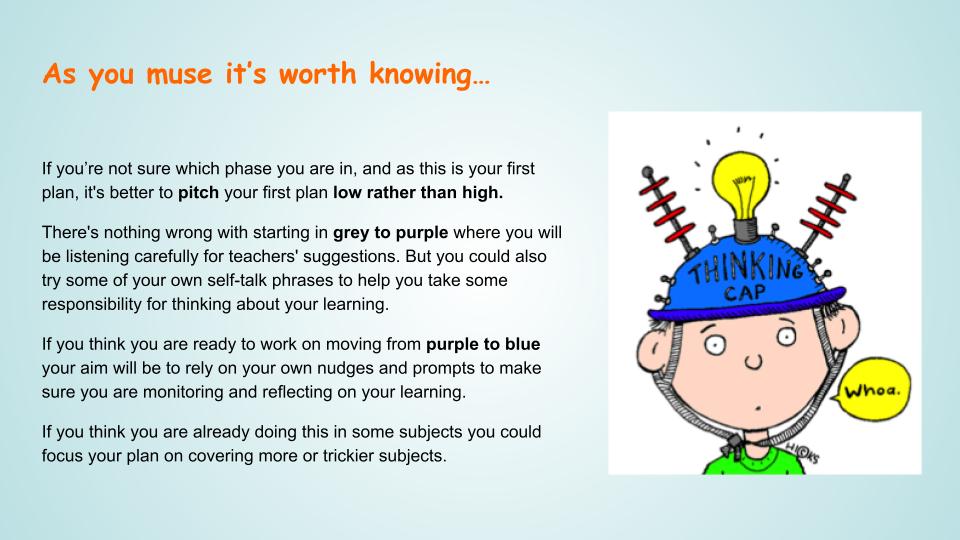
If you aren’t sure where you are on the chart, and as this is your first plan, it’s better to pitch your first plan low rather than high.

There’s nothing wrong with starting in grey to purple where you will be listening carefully for teachers’ suggestions. But you could also try some of your own self-talk phrases to help you take some responsibility for thinking about your learning.

If you think you are ready to work on moving from purple to blue your aim will be to rely on your own nudges and prompts to make sure you are monitoring and reflecting on your learning.

If you think you are already doing this in some subjects you could focus your plan on covering more or trickier subjects.

If you think you are ready to work on moving from blue to green you must be confident that you are employing a range of monitoring strategies. Your aim will be to add looking back to evaluate/review to your learning repertoire and to recognise why this is a good thing for your learning.

If you think you are ready to work on moving beyond green you must be sure you’re ready to look at what you are doing with a critical eye and make your own improvements along the way. Your aim here is to be constantly on the lookout for how to improve or reinvent something in the light of deeply reflective experience.


4.4 Put a do-able plan together

Here is a fairly straightforward six month Action Plan format for you to complete. This means that what you are planning will be put into action, by you, over about six months. At the end of six months you will need to review your plan, estimate your progress and then make a new plan. The new plan may tackle the next phase of growth or more likely strengthen your growth in the same phase.

Filling in the easy bits:

  • Record your name and class and
    • the date you made the plan
    • the date the plan will be reviewed
  • In the little table indicate the level of Revising where you feel secure. This shows your starting point. If you mark Purple to Blue it means you think you are secure at Purple and will be working towards Blue
  • Record the Goals you’ve chosen and make a note of:
    • any actions you intend to try
    • the sort of self-talk you want to say quietly to yourself.

Reviewing the plan:

  • After about 6 months it will be time to review your plan to prove to yourself that you are taking action and the effect this is having over time.
  • When you review how your plan worked:
    • write down what went well and
    • what could have been even better.

Here’s a plan we filled in earlier to give you an idea of what the plan and its review might look like.


Example completed Action Plan


Read the completed plan Download a blank proforma

4.5 Monitoring how it’s going

The best way of keeping your plan going is by getting used to looking at the changes you are making and their impact on your learning.

Self-monitoring. As your plan unfolds it’s a good idea to keep track of the actions or self-talk you are trying in your classrooms. This monitoring doesn’t have to be sophisticated or time consuming there are some very simple ways of slowing down and getting an objective view of what you are doing.

For example, you could use a simple tally chart to log the number of times you use a chosen activity, or try one of the self-talk phrases. Just noting this down can help you become more consciously competent.

Bit by bit, the more you question yourself about what you are doing the more you will consolidate your approaches to developing your learning behaviours.

I stopped . . .

I tried . . .

I used . . .

4.6 Keeping your plans under review

At the end of the six months take a look back at your plan.

Look closely at what you have changed about your way of working.

Look back at your Action Plan and any notes you made. Think about:

  • Things you started doing that you hadn’t done previously
  • Things that you stopped doing in order to improve the habit.
  • Things you did more often and less often in order to hone the habit.
  • Things you were already doing and kept on doing because they were on the right track.

Now using the three baskets, offer an overall assessment of the changes you have made. Identify:

  • things that worked really well. The ones you feel most satisfied with.
  • things that worked okay but need a bit of finessing.
  • things that didn’t seem to work and you quietly stopped doing them.


Continue Reading

Section 1 What does Revising mean?

1.1 What is Revising?

Revising – Making improvements

There’s more to Revising than you might have thought and it’s not about revising for an exam! A well formed Revising habit involves being ready, willing, and able to:

  • self-monitor how things are going and keeping an eye on the goal
  • expecting the unexpected
  • being willing to re-shape, re-order, re-form plans to take account of new circumstances
  • remain alive to new, unforeseen opportunities and ideas
  • look at what you are doing with a critical eye
  • strive to be the best you can be
  • make sure things are on track and
  • make improvements along the way.

It’s all about being adaptable, flexible and open to change.


1.2 What does being a good reviser involve?

Being ready, willing and able

Revising is about the way we work on something to improve it. Whether it be icing a cake, solving a tricky maths problem or creating a well-crafted essay, all require effort, retries and determination to satisfy ourselves that the result pleases us. How we tackle such a job isn’t just a case of monitoring as we go along or reviewing the result: it will be influenced by other qualities. Our attitude to change, whether we have a sense of quality and what sort of validation we need. The growth chart in section 2 intertwines these important contributors to our growth in the habit of Revising.


Being a good reviser involves:

  • self-monitoring how things are going, keeping an eye on the goal;
  • expecting the unexpected, being ready to re-shape, re-order, re-form plans to take account of new circumstances;
  • staying alive to new, unforeseen opportunities and ideas;
  • looking at what you are doing with a critical eye;
  • striving to be the best you can be;
  • making sure things are on track and making improvements along the way.

1.3 Spot yourself revising in lessons


Just to get you tuned in – have a quick think about your revising habits at this stage. Use the chart alongside, take it with you into lessons and make a note of whether and how often you display these characteristics.

Take the outcomes of this little questionnaire into account when you tackle section 2.


1.4 What teachers can do to help you become a good reviser

Your teachers will:

  • encourage you to change the way you are doing things if necessary
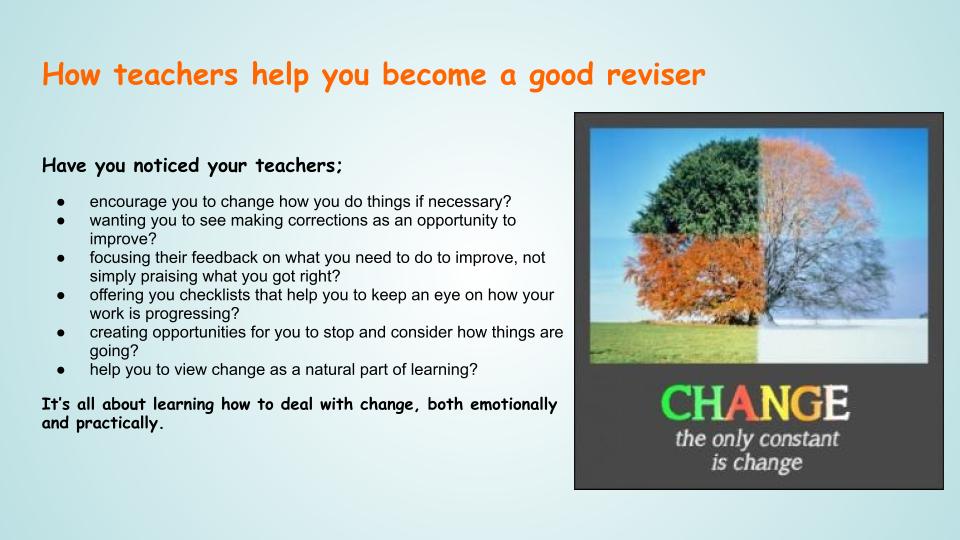
  • help you to view change as a natural part of learning
  • want you to view making corrections as an opportunity to improve
  • focus their feedback on what you need to do to improve, rather than simply praising what you got right
  • offer you checklists that help you to keep an eye on how your work is progressing
  • create opportunities for you to stop and to consider how things are going

Good revisers have had to learn how to deal with change, both emotionally and practically. If you just want or like things to stay the same you are unlikely to recognise the need to change your ideas or the way you do something.

As a good reviser you’ll also need to know what ‘good’ looks like; how to keep an eye on how things are going and be willing to evaluate how good things are against external standards. Growing your revising habits is much more than you ‘having another go’.

Continue Reading

6. Develop your practice for Revising


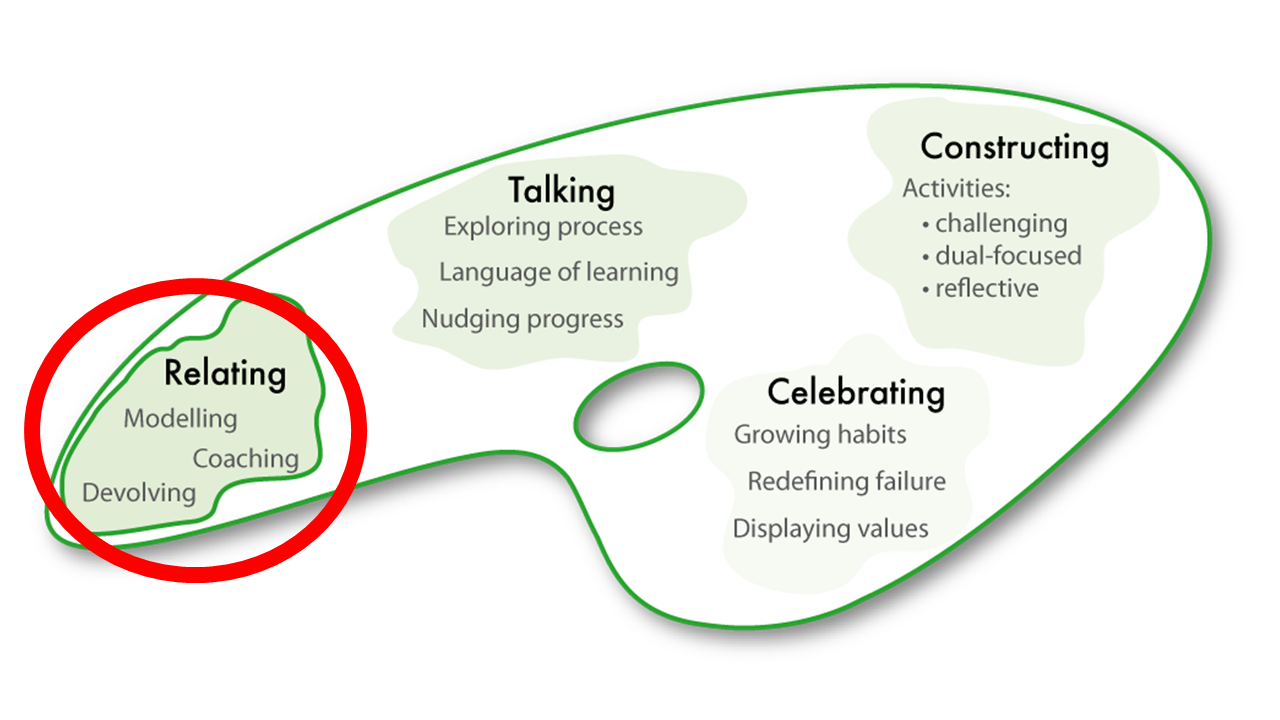
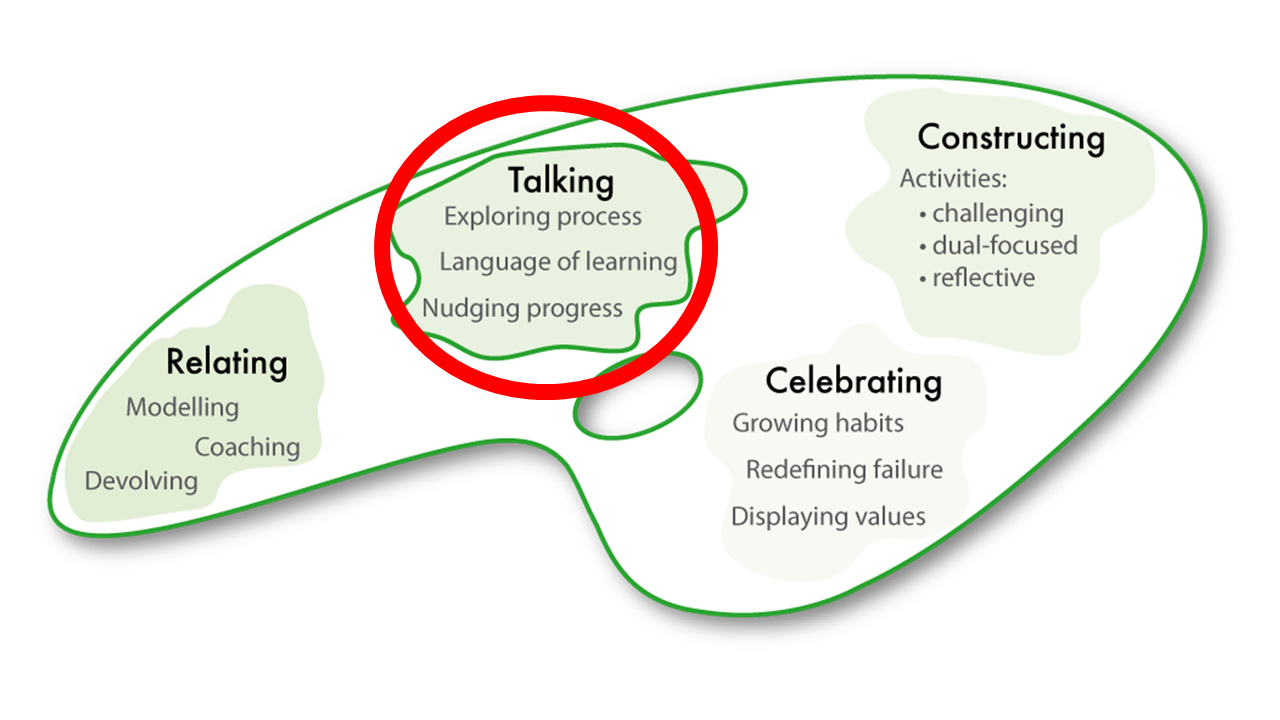
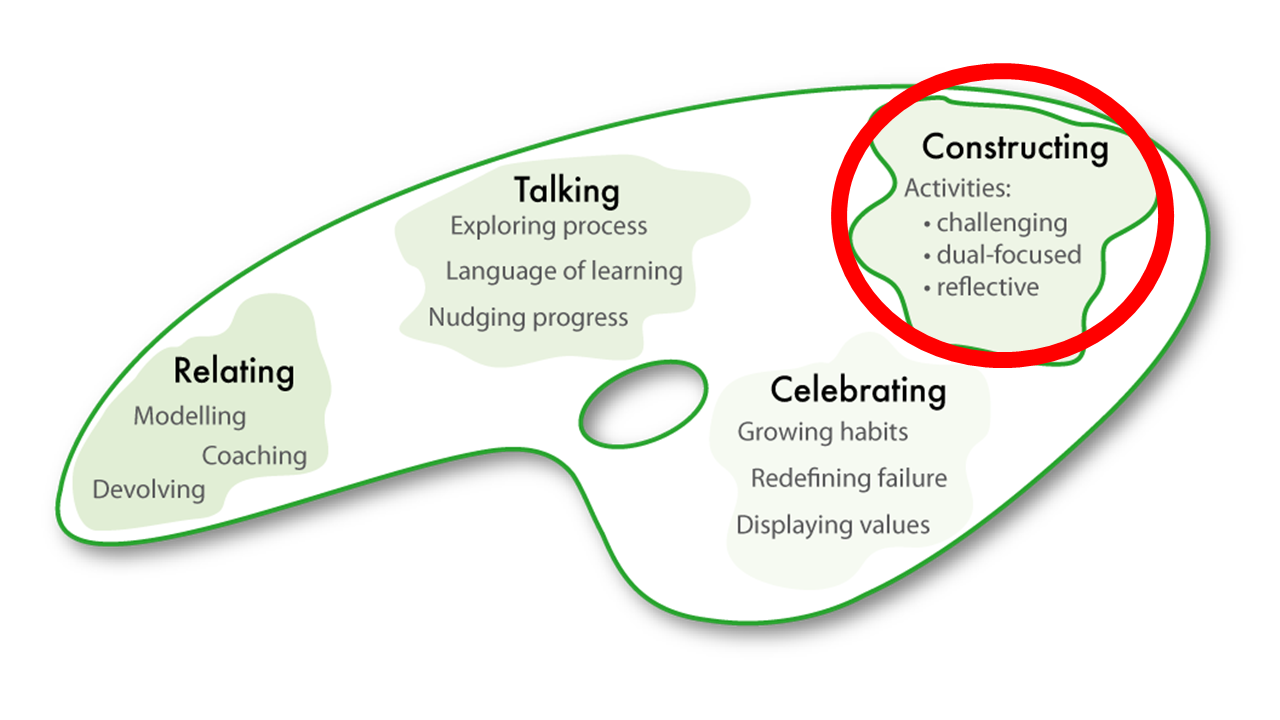
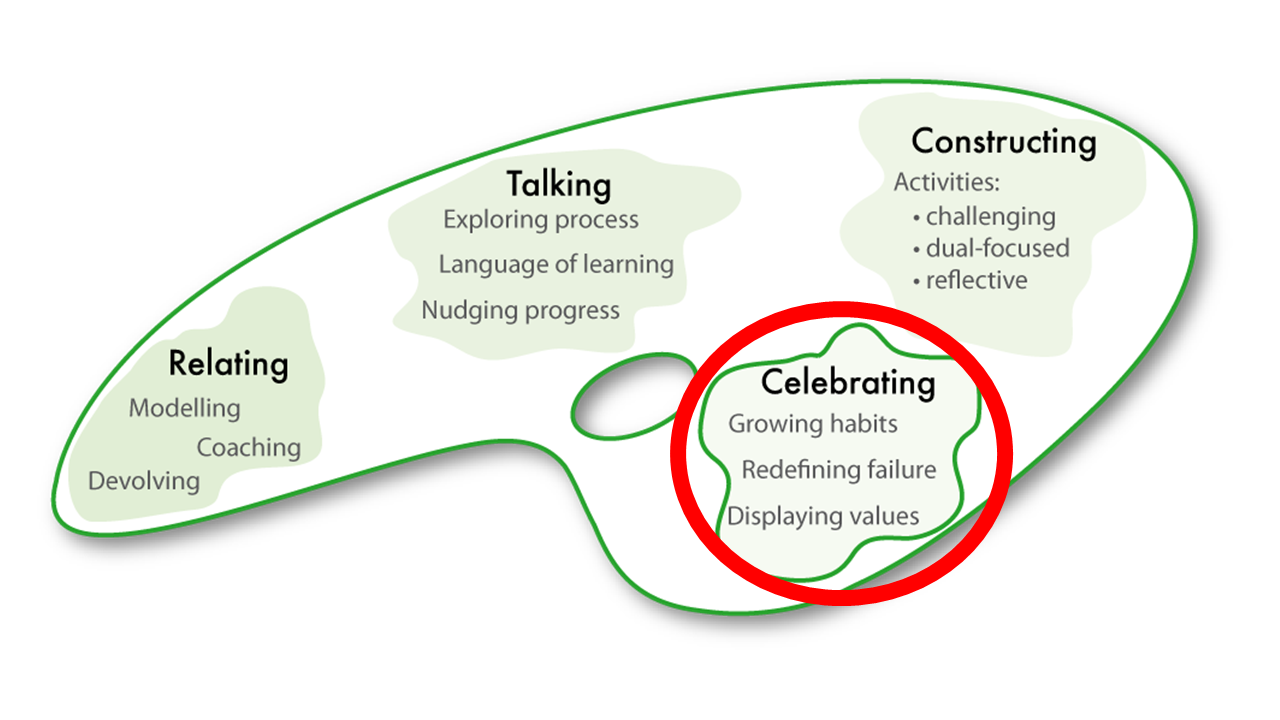
Cultivating learning habits ultimately involves:

  • Providing rich and varied occasions for exercising learning habits;
  • Infusing learning habits into lessons to enhance content understanding;
  • Recognising and celebrating the use and growth of learning habits;
  • Expecting students to take ownership of and responsibility for their own learning habits;
  • Exploring the development of learning habits with students over time.

As a teacher you are an influential character builder and so need to be mindful of how you help students strengthen their learning habits. It takes most teachers between 2 or 3 years to become really fluent with this way of teaching. So, go easy on yourself  because small steps often prove to be big levers for change.


Revising - Learning Mats - purple blue green_Page_1


First develop your coaching language

Below you’ll find a range of things you could say to nudge revising. When you use this kind of language you are talking as a learning coach, encouraging your students to think for themselves. Using such statements encourages your students to:

  • imitate you;
  • start to think in this way;
  • become conscious of these phrases and their meaning.

Gradually you will hear some of the ideas pop up in students’ self-talk….in speech or even in writing from time to time, but mostly these will go on inside their heads. As your work on revising gathers pace see if you can detect students who talk, or think, in these ways.

Teacher talk – as a learning coach

10 ideas to ensure your students do the thinking for themselves

  1. Good learners are flexible – they watch how they are doing and change things as they go
  2. Are there other ways you might do it?
  3. What can you learn from this mistake?
  4. Ask yourself: ‘Am I happy with what I have achieved?’
  5. Think about your success criteria as you go along. Check that you are still on track to meet them.
  6. Ask yourself from time to time: Is this going ok?
  7. It’s OK to amend your plan and approach it differently.
  8. How can you improve this?
  9. How will you do it differently next time?
  10. How will you act on this feedback?

Have a think

  • Which of these revising nudges might you start using?
  • In which particular lessons would such nudging be most useful?
  • How will most of your students respond to such nudges?
  • Will this way of engaging be more popular with girls or boys?
  • What other nudging ideas might you add to the list?

Make a note of…

Little_r

  • Students’ reactions to the nudges.
  • Ideas about why this might be.
  • Ways in which you could further encourage students to imitate this metacognitive self-talk.
  • Any positive or negative impact of these revising behaviours.

What to start and stop

Here are a few more ideas you might want to try. Take it steady, this way of teaching can be a big but exciting shift so it’s worth doing it slowly and thoughtfully. Look first at the Stop/avoid ideas. Some of these are far from trivial but it’s best to try to remove them before starting on the Start/do more of, Start slowly and Experiment with ideas

What do you think?

  • Which of the ideas appealed to you most?
  • Can you see ways of incorporating these into your subject/class routines?
  • Which would make the biggest difference to your students?
  • Which would make your life easier?

Make a note of…Little_r

  • Ideas that you want to try and the impact you hope they will have on your teaching and on your students.


Continue Reading

5. Ideas for classroom practice

Ideas to encourage a Revising frame of mind

In the early stages of building your students’ learning power your role is to:

  • make them aware of the behaviour
  • talk about it (what, how, why, when, if)
  • celebrate its use
  • give opportunities to practise it, both in lessons and elsewhere
  • reflect on it to improve it.

Use a staged start for using Revising…

  1. Firstly... make students aware of the use and importance of revising…what, when, where, why, how they are or could be doing it
  2. Then… explore revising a little more through the language of revising
  3. Try... using revising as a lesson starter to tune students into using it
  4. Then start... blending revising into the way you teach the content. Use specific revising strategies to deepen content understanding.
  5. Ensure... students reflect on the success or otherwise of their revising activities.


1. Make students aware of Revising

How you make students aware of the words that describe the behaviour and why it is important to use it.

Primary

Explore what it means to revise.

Invite the students to move around a big open space then stop and make the shape you call out.
When they have all made their shape, ask them to look around at each other and then have another go at making the same shape differently.

  • Do this several times.
  • Talk about thinking again and changing one’s first idea of how to do something.
  • Over time get the children to start asking themselves whether they want/need to improve their first go at making the shape -so gaining a sense of an internal ‘good enough’ measure.

Secondary

*Give revising a high profile

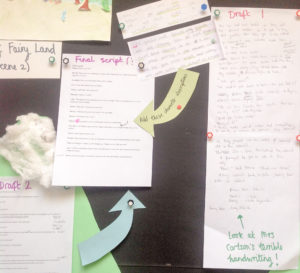
Display work in progress

  • Collect and display work at different stages of development. Use arrows and notes to highlight the changes and their impact.
  • Renew and refer to these frequently to encourage students to review and amend their work.
  • Show that learning isn’t about perfection at the first attempt!

Primary

Give revising a special place

The Editor’s Desk

Create an area of the classroom which is dedicated to and celebrates the skills of reviewing and improving.

Set aside a table in the classroom, and equip it as if it were an office – writing equipment, computer, office chair etc.

This is called the ‘Editor’s Desk’, which is set aside for a student to use when they are in editing, drafting, redrafting, correcting or improving mode.

Secondary

*Make monitoring checklists

Construct checklists with students itemising the important things to check before they consider something is finished. Here’s just one example:Screen Shot 2016-05-09 at 13.56.32

2. Exploring the language of Revising

How you might extend the language and understanding of this behaviour

Primary

*Focus on monitoring: checking as you go along


Secondary

Extend the language of Revising


Collect words that describe what a good reviser does. How else might we talk about Revising?

Relate Revising to well-known sayings

What do we mean when we say …

Change tack
Think on your feet
Fine tuning
Back to the drawing board
Keep an open mind

3. Use Revising as a lesson starter

Use a quick starter to key students into the learning behaviour you want to concentrate on in the lesson. i.e. here you are starting up the revising (Re-thinking) behaviour

Primary

*Optical Illusions

Use Optical Illusions to remind students that once we have seen something from one perspective, it is hard to change our minds and see it / think about it differently.

Image result for optical illusion old woman

Secondary

*What do you see here?

Ready students’ minds for adjusting their point of view, changing their mind or revising their ideas.
The technique, illustrated here through the picture of a dog leaping over First World War trenches, can be applied to any image where there is some kind of unexpected juxtaposition of conflicting aspects within the same picture.
The purpose is to draw students into speculating about various parts of the image before revealing the full image. This will necessarily require them to revise and build on their first impressions. The underlying message is that new information often forces us to change our original understandings.

4. Focus on Revising as a learning strategy

Use an appropriate thinking routine to practice the behaviour.

Primary and Secondary

*Visible Thinking Routine

I used to think . . . . . Now I think.

This routine helps students to reflect on how and why their thinking/understanding is changing.

Remind students of the topic you have been working on. Ask them to respond to each of the sentence stems:

I used to think…, Now, I think…

Alternatively ask students to write down their views at the beginning of a topic. Invite them to revisit & update their answer during and at the end in light of what has been learned.

Or, at the beginning of a lesson ask students to write down what they understand by a particular term that will be explored in the coming lesson (e.g. Phrase (English); Proof (Maths); Power (Science) etc). At the end of the lesson, ask them to write down what they now understand by the term.

Read more on the VTR website


5. Reflect on Revising

Primary

Make reflecting on Revising behaviours part of everyday lessons

Download

Learning mats are A4 laminated sheets that show various aspects of a learning habit. Keep them on desks/tables or as part of a wall display. Use them during lessons as prompts to promote use. Refer to them at the end of a lesson to assess which were used, which worked and why.

Secondary

Get a handle on excellence

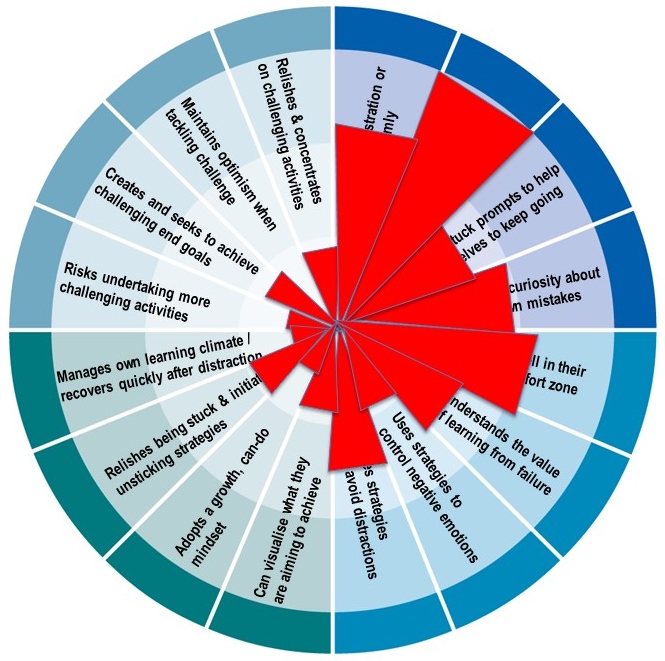
The Rating Wheel describes an expert ‘Reviser’. Use the wheel as a reflection tool for students to consider which skills they know about, which they have used and which might need improvement.

Download

Finally, a classroom practice idea that deserves a special place

Ron Berger’s Ethic of Excellence

Build a culture of critique

Plan formal critique sessions, where students may show a piece of work, explaining their ideas and what they were trying to achieve. Students are then encouraged to critique the work, but using the rules that it must be:

  • Kind
  • Specific
  • Helpful

Students should be encouraged to phrase their critique as questions e.g. ‘Have you thought about…..?’  As a result of this feedback from their peers, students improve their work over time.  This is demonstrated brilliantly, by this short video.

Just watch, be amazed and try similar approaches with your students.


What do you think?

  • Can you see a use for any of the suggested activities?
  • Have you raised awareness of revising / refining with your students?
  • Does your class have an agreed set of good revising / refining behaviours?
  • Which two ideas from above do you want to try out?
  • How long will you keep them going before you decide whether they have worked or not?

Make a note of…Little_r

  • What happens in your classroom in response to any of the above ideas.
  • How students’ behaviour changes over about 3 weeks of becoming more familiar and talking about the behaviour.
  • How your behaviour in the classroom changes as you use these ideas over time.


NB. None of the suggestions above will lead to instant understanding in students nor instant changes of behaviour. You will need to drip these, and others, in over time and keep building and refreshing your language of learning.


Continue Reading

4. Introducing learners to the idea of Revising

Many ways to introduce learning habits

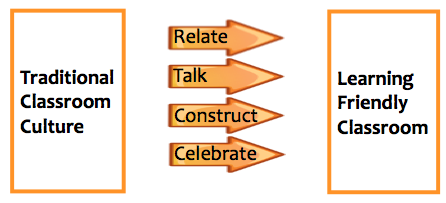
There are many ways to introduce the habit of Revising but here are five culture shifts to think about and get you started.

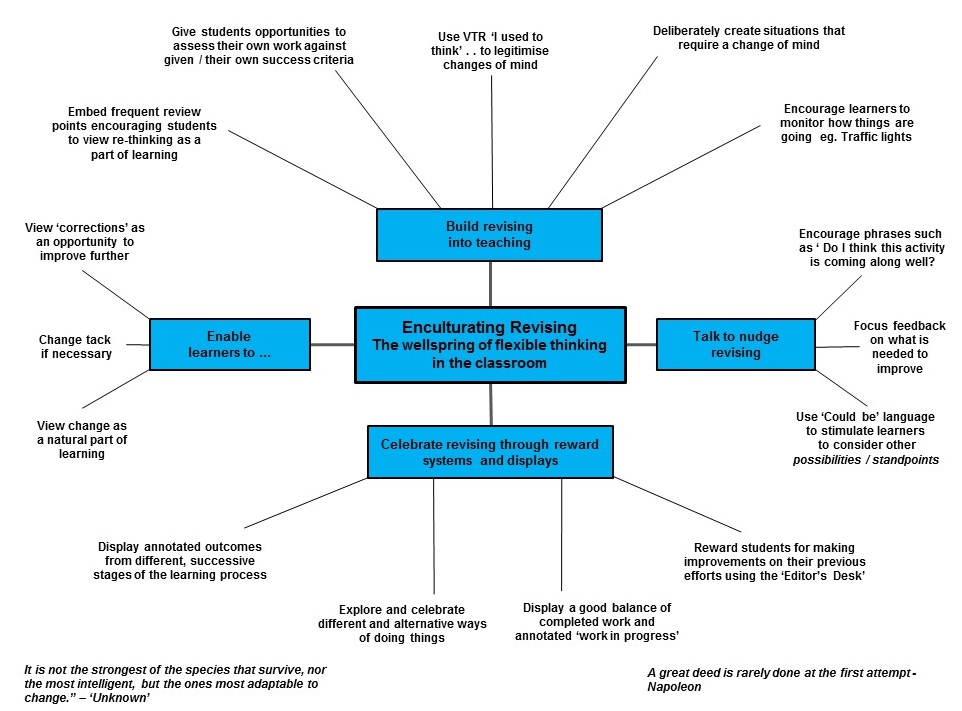
Ask yourself – how might you:

  • Harness display to illustrate that first attempts are rarely the finished article
  • Ensure that students act on your feedback and do things differently next time
  • Encourage students to monitor how things are going, and change tack if necessary
  • Encourage students to evaluate the extent to which they have met the required standards
  • Deliberately create situations that require a change of mind.

An activity to introduce students to the idea of Revising

The type of activity given below aims to open up a conversation about Revising and demonstrate how opinions and hypotheses change and are revised as more information becomes available. It underlines the importance of speculative thinking that is unlikely to be right first time.

Per-verse


In this example we have used a poem but you could use other material that can be ‘cut-up’ and recombined.

Groups of three or four. One stanza of a poem to each group. DO NOT REVEAL THE POEM’s TITLE!

Explain: The group has to make assumptions about what they are reading based on the limited information they have.

Ask groups to:

  • Distil what they know so far, and
  • List the questions to which they need answers.

Next, exchange stanzas with another group

  • Does the new information answer any questions?
  • Are there new questions to find out about?
  • How do the verses fit together — which comes first?

Repeat the process about four times. Run a formative plenary: What do we know so far? Now issue all groups with the complete but cut up poem and ask students to work towards a sequence that makes sense.

Extend understanding of revising by exploring;

  • How did opinions change as more information became available?
  • Were group members willing and able to revise their views?
  • How flexible was people’s thinking?
  • What is the wider importance of keeping an open mind?

We have found Mushrooms by Sylvia Plath a useful poem to start with. Download it in cut up form here.

Download the poem


Continue Reading

3. Understand how Revising grows


Get a handle on progression

As with all learning behaviours, Revising is not a case of ‘either you do, or you don’t’. Few learners are inflexible and rule-bound in every circumstance, and equally few are reflective and adaptable in every situation. Most lie somewhere between these two extremes. The diagram alongside – Learning: Poles Apart – offers an outline view of the whole journey; building students’ emotional learning habits; building their cognitive/thinking habits; building their social learning habits and their ability to manage the process of their learning. The reluctant learner on the left and the learning powered learner on the right show the beginnings and ends of a long, exciting, but far from inevitable, learning journey.


Stages of growth in Revising

The chart alongside offers a glimpse of how Revising may grow, given the opportunity and encouragement. It is this scaling of the learning disposition that will help you make sense of the journey as you, and students, track, and influence, learners’ progress over time.

Column 1 identifies 6 phases of development.

Column 2 describes how the skills and behaviours may look like as they grow over time,

Column 3 captures the self-talk; what students may quietly say/explain to themselves at each phase of development.

What are the stages of growth based on?

We’ve borrowed ideas from Benjamin Bloom’s Taxonomy of Objectives of the Affective Domain to generate a very condensed version of the five main phases of growth, namely:

 1 ‘Lacks’ (grey) We have added this level where the behaviour is weak and the response is negative. This might translate into “I can’t or I won’t” in student self talk

2. Receiving. (purple)..which involves giving attention to something; becoming aware, not avoiding or rejecting it; being alert to something. This might translate to “Show me or Tell me” in student self talk

3. Responding. (blue)…which involves going beyond merely attending to actively attending; complying; taking more responsibility for and enjoyment in initiating action.This might translate to “I’ll try” in student self talk

4. Valuing. (green)..which involves accepting the worth of something; preferring something; being committed to the value of something.This might translate to “I see why” in student self talk

5. Organisation.(yellow)..which involves adding to, formulating and organising their values into how they live their life.This might translate to “I make sure” in student self talk

6. Embodies. (Characterisation in the original)(orange)…which involves behaving consistently in accordance with their values, living what they stand for.This might translate to “I can’t not do this” in student self talk

This progression is long term and not inevitable. Some phases will take years for people to work through; some will never be worked through. None of the phases are inevitable. There is a lifetime of potential development captured here.

Where are your classes in relation to their levels of Revising?

Level detail

In the ‘Lacks’ (grey) phase, students are not necessarily aware of doing things well or differently. Once they get going on something they may change it but more for the joy of just doing it. Outcomes maybe rushed or lack finesse, but once completed there may be little interest in revisiting it or in any comments they are offered. External standards are not yet a feature of their world.

In the Receives (purple) phase, students begin to make checks on how they are doing against given criteria when prompted. They can talk about what they did and sometimes how. They rely on their teachers or parents to validate what they do/have done.

In the Responds (blue) phase students have overcome a fear of mistakes and are more able and willing to monitor what they are doing. They begin to develop the idea of ‘good’ themselves and to understand why given standards are important. They respond positively to supportive feedback and talk reflectively about how they could improve with encouragement.

In the Values (green) phase, students understand the importance of keeping a close eye on progress in order to achieve high-quality outcomes that meet their goals. They see the point in making changes in the light of the original goal or external standard or internal feedback. They understand the need to learn from previous experiences and realise that learning is all about changing understandings; not just knowing stuff. In so doing they widen the scope of external validation.

In the Organises (yellow) phase revising has become a skilful habit; where revising itself raises more questions than answers. Yes, progress is kept under review but now students question the original goal of the activity. They look more widely for validation and may well change to a more productive strategy or a different goal. They use critical feedback positively and are keen to look back on what and how they achieved what they did in order to learn from the experience.

In the Embodies (orange) phase, students make ongoing checks and amends, and major rethinking, in order to meet their own, often more exacting, standards of achievement. Now they tend not to need the validation of others (marks, grades, exams, quality feedback) because their own critical sense of standards acts as their barometer. They adapt readily to changing circumstances and always reflect on what and how they have done something with the explicit intention of doing it better, more efficiently / differently in the future.


Where are your students now?

  • What insight does the progression trajectory yield?
  • Think about a class you know well. Ignore the ‘outliers’ for a moment, which phase(s) do you think best describes the majority of your learners?
  • Where do you think your higher attaining learners sit on this trajectory?
  • Where do you think your lower attaining learners sit on this trajectory?
  • Do you think that your learners are slowly edging up this trajectory as they pass through your school?
  • If yes, why do you think this happens? Are there any interventions that you / the school make to support this?
  • If no, why are learners not improving their skills and attitudes?

Make a note of the skills and attitudes that your learners might need to develop further.


Download as a pdf

A companion resource for students

This table of growth in Revising is also featured in the companion resource for students. The complementary resource aims to alert students to:

  • the nature of Revising
  • why it is an important habit
  • how it can grow and develop
  • where they are now
  • actions to take to improve it
  • a possible plan of action


Continue Reading

2. A classroom culture for Revising


A learning classroom culture

Building students’ learning behaviours is about creating a culture in your classrooms – that systematically cultivates habits and attitudes that enable your students to learn confidently and face difficulty calmly and creatively. By a ‘culture’ we mean all the little habits, routines and practices that implicitly convey ‘what we believe and value round here’.

So ‘culture’ concerns the details of the micro-climate that you create in your classrooms. What you do and say, what you notice and commend and what you don’t, what kind of role model of a learner you offer – all these are of the essence. The micro-climate of a classroom can inadvertently stifle, or specifically enhance, the very behaviours you are seeking to promote.


What sort of culture are you trying to create?

Bringing learning to the fore is to let students do more of it; to become more active in the learning process. Becoming more active learners involves offering them more opportunities to decide what to do, being given a chance to talk more and actively learn by reviewing of their own experience. As students are given more responsibility for their own learning the role of the teacher changes from ‘the sage on the stage’ to ‘the guide by your side’.

What you are doing is developing students as meta-learners who become able to understand and grow themselves as learners.

Looking more closely at classroom culture

There are four specific ways in which teachers can create the classroom culture to build learning habits;

  • strategies you could build into the way you teach to stimulate revising
  • the sort of language you might use to stimulate revising
  • ways in which you might celebrate / praise students’ use of revising
  • actions you need to enable students to undertake to build their revising habits

A graphic summary

Here we’ve sketched a diagram to identify the prominent features of a classroom culture that’s geared towards growing students’ Revising habits.

The 4 sections of the diagram are:

  • Top – strategies you could build into the way you teach to stimulate revising;
  • Right – indications of the sort of language you might use to stimulate revising;
  • Bottom – ways in which you might celebrate / praise students’ use of revising;
  • Left – actions that you need to enable students to undertake.

Apply your own attentive noticing skills and consider whether you already use any of these features and which you fancy trying.

In the panels below you will find brief explanations of some of the more unusual terms in the diagram.


Strategies to build into the way you teach

Terms new and old

Visible Thinking Routines (VTR) are easily remembered routines that can be applied in wide range of circumstances. The routine ‘I used to think . . . But now I think’ is explored further in section 5 of this resource. To see more VTRs, go to the VTR website.

‘Traffic Lights’ is a classic AfL strategy – Green = it is fine, Amber = ok-ish, Red = it is going badly. Use it to encourage students to keep an eye on how things are progressing.

Strategies at the top of the diagram… build into the way you teach to stimulate revising

  1. Embed frequent review points encouraging students to view re-thinking as a part of learning
  2. Give students opportunities to assess their own work against given / their own success criteria
  3. Use VTR ‘I used to think’ . . to legitimise changes of mind
  4. Deliberately create situations that require a change of mind
  5. Encourage learners to monitor how things are going eg. Traffic lights

The sort of language to stimulate revising

Learning power is activated by the use of more tentative, could be kinds of language. Specifically, if you say definitively that something is the case, students frequently take it literally and try to remember it. But if you say, of the same thing, that it could be the case, they become more engaged, more thoughtful, more imaginative, and more critical. That ‘could be’ invites students to consider what else it could be, to consider alternatives.

Strategies on the right of the diagram… to show the sort of language you might use to stimulate revising

  1. Encourage phrases such as ‘ Do I think this activity is coming along well?
  2. Focus feedback on what is needed to improve
  3. Use ‘Could be’ language to stimulate learners to consider other possibilities / standpoints


Ways of celebrating revising

The ‘Editor’s Desk‘ is an area of the classroom that is reserved for re-crafting and making further improvements – not for ‘doing corrections!

The idea of displaying ‘work in progress’, annotated to illustrate the changes as the work is refined and improved, is in stark contrast to displaying the ‘finished article’. The former emphasises the processes involved in creating a good piece of work, whereas the latter focuses solely on the final product.

Both are explored further in section 5 of this resource.

Strategies at the bottom of the diagram… ways in which you might celebrate the use of revising.

  1. Reward students for making improvements on their previous efforts using the ‘Editor’s Desk’
  2. Display a good balance of completed work and annotated ‘work in progress’
  3. Explore and celebrate different and alternative ways of doing things
  4. Display annotated outcomes from different, successive stages of the learning process

Actions you need to enable in students

By ‘change tack’, we mean being prepared to adopt a different approach when things are not going as well as expected. It requires students to monitor what they are doing as they go along, keep an eye on the end goal, and be sufficiently flexible to re-think a strategy that is not working.

Strategies on the left of the diagram…actions that you need to enable in students to boost revising.

  1. View ‘corrections’ as an opportunity to improve further
  2. Change tack if necessary
  3. View change as a natural part of learning


What do you think?

  • Which of the ‘build’ ideas (top) are already features of your teaching?
  • Which of the ‘talk’ prompts (right) do you regularly use when talking about revising?
  • Which of the ‘celebrate’ ideas (bottom) are already in evidence your classroom?
  • Which of the ‘enable’ behaviours (left) are you intentionally enabling in your classroom?

Make a note of…

  • Any ideas that look as if they might help your students to become better at revising.
  • An idea that you want to start doing.
  • An idea that interests you, but you are uncertain what it means or how you might do it.


Continue Reading

1. What is good Revising?

About Revising

The word Revising has unfortunate connotations with Revision [for a test]. What is meant here is being prepared to do things differently in light of feedback, to be adaptable, flexible and open to change.

However well prepared learners are, they have to expect the unexpected. They have to have the readiness to revise / refine as they go along. Good learners are able to change their plans and think on their feet. They are able to be flexible. It may be a good decision to say ‘This is turning out to be far harder than I thought, and I’m getting less help than I imagined, and there are other interesting possibilities opening up, so I think I’ll cut my losses and quit.’ Note that the decision is based on a realistic cost-benefit analysis of the actual situation, not on frustration, pique or a blow to self-esteem.

To be effective at revising, learners need to monitor how things are going and periodically review where they have got to.


The first big aspect of Revising…monitoring

Monitoring is the art of looking over your own shoulder as you’re working away at a problem, asking yourself how it’s going.

Getting better at monitoring involves cultivating the little voice of self-awareness that keeps the strategic goals in mind, and is ready to change tack if it seems appropriate. A football manager contemplating making a substitution is monitoring, as is a teacher who decides to throw away the lesson plan on the spur of the moment and go with the interesting discussion which is developing. Students can pick up the habit and the skill of this kind of monitoring by being around people—teachers are ideally placed—who are able to model it, and who have learnt how to learn aloud, i.e. to externalise the thought processes of the vigilant monitor.


The second big aspect of Revising…reviewing.

Reviewing means stopping every so often to take stock of progress, and to ensure that any emerging product—an artwork, an essay, a draft business plan—is on track. Reviewing requires the ability to look at your own work with the critical eye of an editor, and not be afraid of the possibility that some corrections may be needed. A writer may put a piece of work aside for a while and then come back to look at it afresh. An athlete may sit down and look at the video of her starting technique to see if any adjustments need to be made. But reviewing is what the low-achieving maths student, for example, is very often unable to do.

Donald Schon called monitoring ‘reflection in action’, and reviewing ‘reflection on action’. Again, modelling and coaching can help develop these abilities.


Image result for REFLECTION


A well formed Revising habit involves being ready, willing, and able to:

  • Self-monitor how things are going, keeping an eye on the goal;
  • Expect the unexpected, having a readiness to re-shape, re-order, re-form plans to take account of new circumstances;
  • Remain alive to new, unforeseen opportunities and ideas;
  • Look at what you are doing with a critical eye;
  • Strive to be the best you can be;
  • Make sure things are on track and make improvements along the way.


Spot the Revisers in your classes

Just to get you tuned in – have a quick think about ‘Revisers you may know’. Make a note of students you know who display these characteristics.

Becoming a teacher who develops students’ learning power means developing a keen awareness of the subtleties of your students’ learning behaviours.

What do you think?

  • How many of your students come to mind when looked at through the lens of revising?
  • Is there a gender balance or have you noted down more girls than boys or vice versa?
  • Are the students you have noted from across all age groups or do some dominate?
  • How do these revising characteristics help these students to be better learners?

Make a note of…

  • Those groups or classes that seem to have lots of good revising characteristics.
  • How you think you might capitalise on this.


Continue Reading

Section 4 Planning and checking action

4.1 Changing how you learn

Changing how you learn can be tricky

Changing how you learn is a complex process……..that’s why it’s hard!

And the hardest thing isn’t getting the new ideas into your head…

It’s getting the old ones out…….that’s why it takes time and effort.

It takes time and practice to undo old habits and become graceful at new ones……so we have provided materials here to help you to plan the changes you want to make, monitor what happens, and reflect on the impact of those changes; their worth and value.

4.2 Think about where you are on the progression chart

Things to remember about the stages

Think about where you seem to be on the progression chart.

Remember your development as a learner isn’t a race and the stages don’t just happen, you have to make them happen.

Each stage takes quite a while to work through and become competent in. It’s not about acting in that way once or twice but acting it that way most of the time, consistently, before being ready to move on to the next stage.

Take a look back at section 2 to remind yourself of the detailed descriptions of the stages.

These Revising behaviours may look and sound straightforward but they make up one of the most valuable and important learning habits. Working through these stages to become someone who absorbs the various aspects of Revising into their learning character could easily take three or four years of supported and focused development.


4.3 Think about the activities and self-talk you might try

Take it steady

If you aren’t sure where you are on the chart, and as this is your first plan, it’s better to pitch your first plan low rather than high.

There’s nothing wrong with starting in grey to purple where you will be listening carefully for teachers’ suggestions. But you could also try some of your own self-talk phrases to help you take some responsibility for thinking about your learning.

If you think you are ready to work on moving from purple to blue your aim will be to rely on your own nudges and prompts to make sure you are monitoring and reflecting on your learning.

If you think you are already doing this in some subjects you could focus your plan on covering more or trickier subjects.

If you think you are ready to work on moving from blue to green you must be confident that you are employing a range of monitoring strategies. Your aim will be to add looking back to evaluate/review to your learning repertoire and to recognise why this is a good thing for your learning.

If you think you are ready to work on moving beyond green you must be sure you’re ready to look at what you are doing with a critical eye and make your own improvements along the way. Your aim here is to be constantly on the lookout for how to improve or reinvent something in the light of deeply reflective experience.
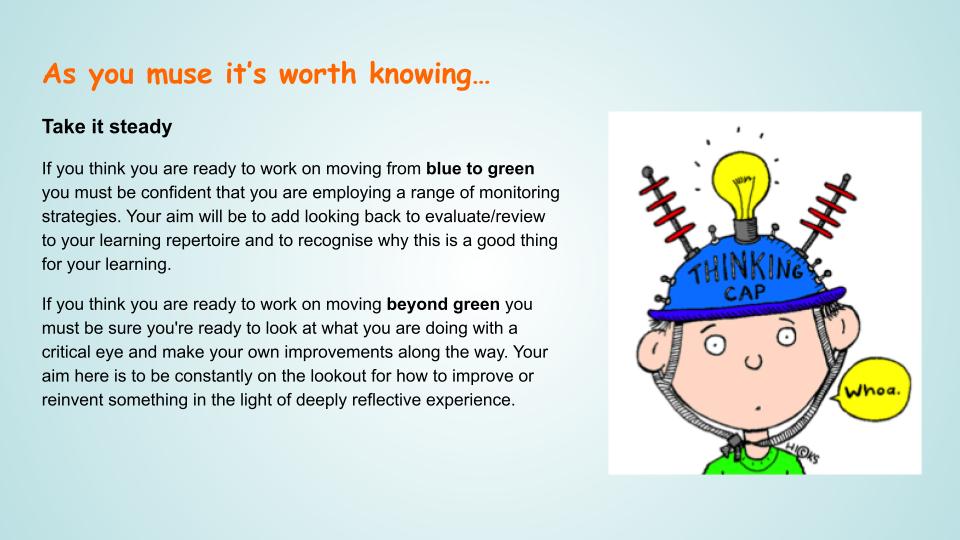


4.4 Put a do-able plan together

Here is a fairly straightforward six month Action Plan format for you to complete. This means that what you are planning will be put into action, by you, over about six months. At the end of six months you will need to review your plan, estimate your progress and then make a new plan. The new plan may tackle the next phase of growth or more likely strengthen your growth in the same phase.

Filling in the easy bits:

  • Record your name and class and
    • the date you made the plan
    • the date the plan will be reviewed
  • In the little table indicate the level of Revising where you feel secure. This shows your starting point. If you mark Purple to Blue it means you think you are secure at Purple and will be working towards Blue
  • Record the Goals you’ve chosen and make a note of:
    • any actions you intend to try
    • the sort of self-talk you want to say quietly to yourself.

Reviewing the plan:

  • After about 6 months it will be time to review your plan to prove to yourself that you are taking action and the effect this is having over time.
  • When you review how your plan worked:
    • write down what went well and
    • what could have been even better.

Here’s a plan we filled in earlier to give you an idea of what the plan and its review might look like.


Example completed Action Plan


Read the completed plan Download a blank proforma

4.5 Monitoring how it’s going

The best way of keeping your plan going is by getting used to looking at the changes you are making and their impact on your learning.

Self-monitoring. As your plan unfolds it’s a good idea to keep track of the actions or self-talk you are trying in your classrooms. This monitoring doesn’t have to be sophisticated or time consuming there are some very simple ways of slowing down and getting an objective view of what you are doing.

For example, you could use a simple tally chart to log the number of times you use a chosen activity, or try one of the self-talk phrases. Just noting this down can help you become more consciously competent.

Bit by bit, the more you question yourself about what you are doing the more you will consolidate your approaches to developing your learning behaviours.

I stopped . . .

I tried . . .

I used . . .

4.6 Keeping your plans under review

At the end of the six months take a look back at your plan.

Look closely at what you have changed about your way of working.

Look back at your Action Plan and any notes you made. Think about:

  • Things you started doing that you hadn’t done previously
  • Things that you stopped doing in order to improve the habit.
  • Things you did more often and less often in order to hone the habit.
  • Things you were already doing and kept on doing because they were on the right track.

Now using the three baskets, offer an overall assessment of the changes you have made. Identify:

  • things that worked really well. The ones you feel most satisfied with.
  • things that worked okay but need a bit of finessing.
  • things that didn’t seem to work and you quietly stopped doing them.


Continue Reading

Section 3 Some ideas to practise

3.1 Confirm where you are now.

Which coloured row best describes your Revising skills?

You met this progression chart in the previous section.

Take time to think about how you behave across a range of school subjects and activities outside school. Be honest with yourself – which coloured row best describes your current Revising skills?

Why do this?

  • Because only you know yourself well enough to judge this, although of course you could seek advice from a friend or your teacher if you find that helpful.
  • And secondly, where you are now should determine what you do next.

For example, if you think that the Purple row best describes you, then your immediate target should be to consider advice to move into the Blue row.

Look below for ideas to help you to move one level up from your current secure ‘row’.

3.2 Consider ideas to help you improve


Ideas to help you to move you from Grey to Purple

Moving yourself from Grey to Purple

What is the main difference between the Grey row and the Purple row?

If you think you are in the Grey row you just do what you want and how you want to do things. You maybe reluctant to change the way or how you do things saying ‘I can’t’ or ‘I won’t’.

If you think you are in the Purple row you are becoming familiar with the idea of keeping an eye on how you are learning things, but you need plenty of your teacher’s support to do so.

So – the big difference here is that Purple learners accept advice from their teachers to monitor how they are doing with a view to changing things if it is not going as expected. To be strong in purple you need to be like this in all your learning, not just the subjects you like. Being strong in Purple is the first big step in becoming a good reviser


A couple of useful activities

a) Monitor how you are feeling about your learning.

You could cut a strip of card and write on it:

Absorbed……………………………..Distracted  OR

Too Easy………………………………Too Hard   OR

Interested……………………………Bored

Take the strips to use during lessons to help you monitor and become more conscious of your feelings about learning. This is just a small beginning but will help you get a feel for learning to begin to take more responsibility for it.


b) Use a checklist to monitor how things are going

If your teacher offers you a checklist, then take their advice and use it to keep an eye on things. If your teacher does not offer you a checklist, try making a copy of this simple checklist and refer to it in lessons to help you to keep close eye on how things are going. Use the checklist as you are working, and again after you think that you have finished.
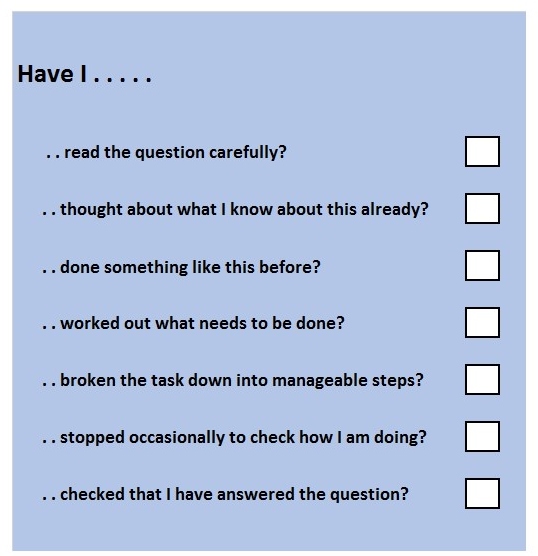


Become your own learning coach

Things to say to yourself

To help you begin to monitor how things are going 

  • How am I getting on?
  • Am I ‘on track?’
  • What is working well for me here?
  • Is this going OK?
  • Do I need to try a different approach?
  • Is this going to be good enough?

To help you begin to think about how it went

  • How did that go?
  • What worked well?
  • Did it go as I expected?
  • Am I happy with that?

Make a quick reflection on what you’ve done become part of your daily or lesson routine.

Your questions might include:

  • Today I have learned….
  • Today I have tried to…
  • My biggest success today has been….
  • What will I tell my family when they ask ‘What did you do at school today’?
  • The most important thing I have learned today.
  • What has inspired me today?

Each, in different ways, encourages you to think about how your thinking / understanding has changed, how you have revised/amended your view of things.



Ideas to help you to move you from Purple to Blue

Moving yourself from Purple to Blue

What is the main difference between the Purple row and the Blue row?

Learners in the Purple row have become familiar with the idea of keeping an eye on how things are going with plenty of help from their teacher’s.

Learners in the Blue row use a range of strategies to enable them to keep an eye on how things are progressing towards achieving a goal and meeting the required standards.

So – the big difference is that learners in the Blue zone have become far more interested in their learning, monitoring and evaluating what they are doing in order to achieve good standards and without being told / helped to do so. Keeping an eye on how they are learning helps Blue learners to achieve good standards.


A couple of useful activities

a) Create your own checklists

You do not need to wait to be given a checklist by your teacher. Why not create one for yourself?

Suppose that you wanted to create a list that focuses specifically on numeracy/ maths? You might end up with something like the checklist opposite.

Challenge yourself – how would you adapt this checklist to make it relate to literacy rather than numeracy?

b) Trying something different

We all have our preferred ways of working, and if that way is successful we tend to use that method again and again. But what if our preferred way of working is not working as well as we had hoped?

The answer is, of course, to ditch an unsuccessful strategy in favour of a better one.

So where can you find alternative ways of working? Easy – Just stop and look around your class!

Ask yourself:

  • who has found a successful way of doing this?
  • what, precisely, are they doing to be successful?
  • do I need to talk to them to fully understand their approach?
  • how can I copy or imitate their successful strategy?
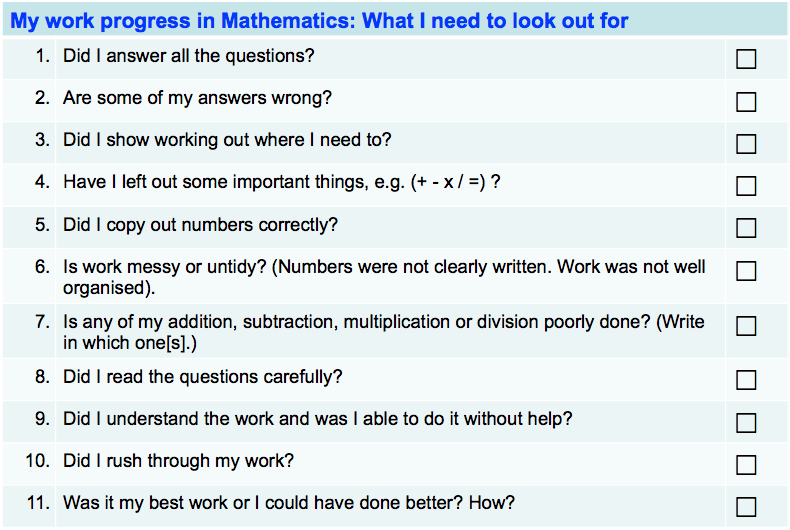


Become your own learning coach

Things to say to yourself

To help you to learn from mistakes

  • What went wrong there?
  • What can I learn from this mistake?
  • If I have another go what would I change?
  • Do I need to try something different?
  • What have I misunderstood here I wonder?

To develop a sense of what ‘good’ looks like

  • What made me think this wasn’t quite right/good enough?
  • Am I (un)happy with this? Why?
  • What hint could I give myself so I can figure it out?
  • Can I do something more/better to meet my success criteria?
  • How you could I improve this.
  • Am I happy with what I’ve achieved?

To explore externally set standards

  • Have I noticed the success criteria?
  • Why do we have success criteria? What are they for?
  • Is it going to be good enough?
  • Is it going to be good enough for me?

Try these If/Thens statements to help you to monitor how things are going:

  • If I am working on something, then I will stop occasionally and ask myself how well I am getting on.
  • If I’m working on something then I will ask myself why I think it’s okay/good/meeting the success criteria.


Ideas to help you to move you from Blue to Green

Moving yourself from Blue to Green

What is the main difference between the Blue row and the Green row?

Learners in the Blue row employ a range of strategies to enable them to keep an eye on how things are progressing towards achieving a goal and meeting the required standard.

Learners in the Green row have come to understand the benefit of monitoring how things are progressing but also take time to look back over what they have done to consider whether they have achieved what they intended and how they might do it differently next time.

So – the big difference is that Green learners not only monitor progress while they are doing something, but also look back to evaluate what they have achieved once they have completed a task. Green learners recognise that doing those things brings worthwhile benefits so they keep on doing them.


A couple of useful activities

a) I used to think . . .   Now I think . . .

This routine helps you to reflect on how and why your thinking/understanding is changing. It encourages you to recognise that new learning often requires you to change what you were thinking previously.

For example, at the beginning of a lesson or topic, ask yourself what you understand by one of the key concepts that you will be studying. (e.g. Phrase (English); Proof (Maths); Power (Science) etc). At the end of the lesson/topic ask yourself what you now understand by the term in light of what you have learned.

It is about noticing, acknowledging and celebrating a change of mind.

b) Use a checklist to evaluate a completed piece of work

Monitoring and evaluation are slightly different. You monitor as you go along, as you are doing your learning. Evaluation is what you do after the learning/task has been completed. It involves stopping to look back over what you have done, how you did it, how successful you were, and how you might do it differently next time.

At the end of a substantial piece of work, use the checklist opposite to reflect on what you have achieved.
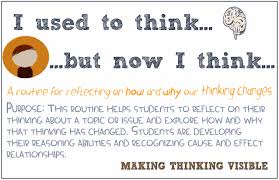
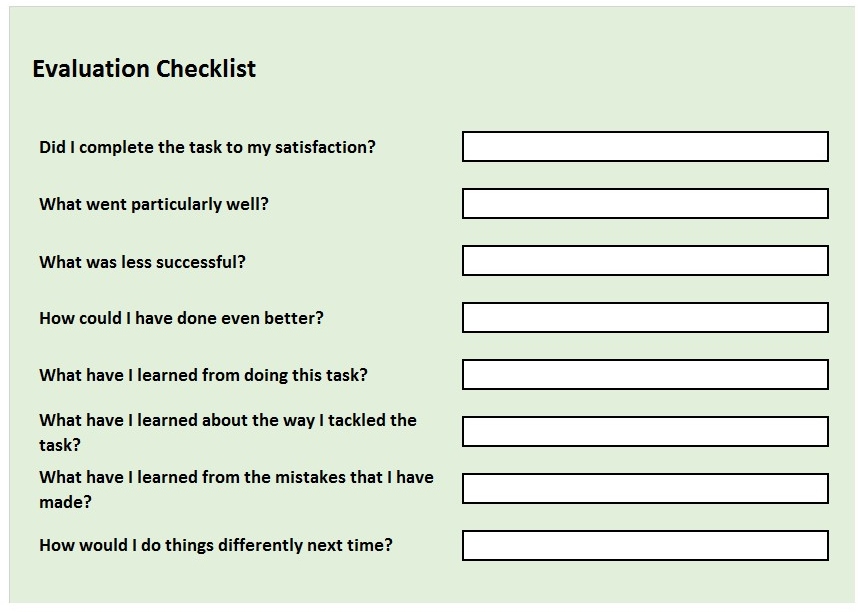


Download as a pdf

Become your own learning coach

Things to say to yourself

To help you begin to evaluate how it went

  • How did that go?
  • What worked well?
  • What didn’t go as I expected?

To check against standards

  • Is this the best it can be?
  • Why do I think this is as good as I can make it?
  • Is it good, or just good enough?
  • Can I visualise how it could be even better?

To make minor changes to tweak

  • I could always say to myself..’Does this meet the criteria?’
  • Could I / do I need to make some small improvements?
  • We never/rarely get it right first time.
  • I could say to myself…’I did this well/right/better because I made XX changes

To reflect on why you did it that way

  • Why am I happy with what I have achieved?
  • Did I meet the success criteria I set myself?
  • Can I think of other ways I might have tackled it?


Ideas to help you to move you beyond Green

Moving myself beyond Green

What is the main difference between the Green row and the rows beyond Green?

Learners in the Green row have come to understand the benefit of monitoring how things are progressing, but also take time to look back over what they have done to consider whether they have achieved what they intended and how they might do it differently next time.

Learners in the rows beyond Green organise themselves to meet their own high standards through a combination of reflecting while they are learning (monitoring) and reflecting after the have learned (evaluation). This reflection sets them on a pathway of change and improvement.

So – the big difference is that learners beyond Green have taken control of their own improvement and use monitoring and reflection independently to ensure that they meet the highest standards.


A couple of activities to try

a) Acting on feedback

Students receive feedback from their teachers, parents and friends. Mostly the feedback is spoken, but some feedback might be offered to you in written form.

Positive feedback is always welcome and tends to make us feel good. But the most valuable feedback you can receive is feedback that points to ways that you can improve. Perhaps not as comfortable as the positive, praise type feedback that gives you that warm glow of satisfaction at a job well-done, the most useful feedback you can receive focuses on how you can do even better next time.

So – be alert to all of the sources of feedback around you, listen very carefully, and, most importantly, act on the feedback. Keep asking yourself: ‘How will I do it differently next time?’

b) Slow down, get creative, look at the options

Often when faced with a task there are one or two obvious courses of action. These tend to be the ones that you have used successfully in the past. But are there any other options that might be even better?

Try the routine ‘Options Explosion’ to explore hidden options before committing to a course of action.

  • Begin by listing the obvious options, then . .
  • Brainstorm all sorts of different options to find the “hidden” options. Often there are hidden options that are the real best choices. Be imaginative! Piggyback on ideas you have already, combine ideas to get new ones, look for ideas of a very different kind. . .
  • And finally, select your course of action.


Become your own learning coach

Things to say to yourself

To make choices about standards

  • How will I decide if it is good enough?
  • What standards have I set myself for this?
  • Why did I choose to judge it against these criteria?
  • Are there other criteria I could / should have used?

To detect errors

  • Am I using the most efficient way of doing this?
  • Could / should I change what I am doing here?
  • Can I spot any errors/ a better way to do this/to change my original plan
  • Am I satisfied with this yet?

To challenge accepted ways of doing things

  • How could I have done this differently / better?
  • I need to think outside the box here.
  • Am I sure this amount of change is necessary.
  • Is there another way I could have done this?


Continue Reading

Section 2 Where do my strengths lie?

2.1 How does Revising grow?

Growing as a Reviser

It may be tempting to think that either you do, or you do not, use your Revising habits – that either you are inflexible and reluctant to change, or that you are flexible and open to change. This could not be further from the truth!

The reality is that there are lots of little steps, skills and attitudes that lie between these two extremes.

In this section, we explore the shifts that gradually transform you into becoming a flexible and adaptable learner.

2.2 Progression in Revising

A Revising progression chart

The chart alongside outlines a possible trajectory of the growth of a good revising habit. It moves from being the learner at the bottom who is unaware of Revising, to the highly aware and Revising savvy learner at the top. Between the two lies a progression that can be mapped and described. The statements in the diagram hint at the journey from novice Reviser to an expert Reviser.

The chart offers glimpses of how Revising may grow across three columns.

Column 1 identifies 6 phases of development.

Column 2 describes how the skills and behaviours may change and grow over time.

Column 3 shows the self-talk; what students may quietly say/explain to themselves at each phase of development.

2.3 What the columns are about?

Column 1 charts 6 phases of development, going from Grey at the bottom, through to Orange at the top. These phases describe the journey from ‘I can’t / I won’t’ at the bottom, through to ‘I can’t not do this’ at the top. These phases are not inevitable or automatic; they don’t just happen.

Column 2 puts flesh on these phase bones, and identifies what the developing skills and behaviours look like as learners become increasing effective Revisers.

Column 3 is a really important one. It alerts you to how your attitudes and self-talk change as your Revising skills develop and grow. Interestingly it’s your own feelings, inclinations and desires that drive the development of any of your learning behaviours. If you don’t care about it it’s unlikely to improve.


2.4 What the rows are about

Looking closely at grey

In this ‘Lacks’ (grey) phase, you are not aware of doing things well or differently, you just do things. You’re not too bothered about outcomes and you’re not interested in revisiting something in order to change or improve it. You very much just do your own thing and you’re not aware of external standards or expectations. You may be reluctant, or even afraid, of changing the ways that you do things. But don’t think of this as a negative start. Most learners start like this before making a start on their journey of learning how to learn.


Looking closely at purple

In the Receives (purple) phase, you are beginning to make checks on how you are doing against given criteria when you are prompted to do so. Your teachers are kick starting your Revising learning journey. You can talk about what you did and sometimes how you did it. You rely on your teachers or parents to tell you that what you have done is valuable or worthwhile. You have learned to accept and act on your teacher’s advice to have a second go at something and/or to pause and check how things are going. You have to go through this phase before moving on to the next.


Looking closely at blue

In the Responds (blue) phase you have overcome any fear of mistakes and you’re more able and willing to monitor what you are doing. You’re beginning to develop what you mean by ‘good’ and to understand why given standards are important. You enjoy  supportive feedback and you talk about how you could improve with support. You are increasingly willing and able to check how things are going even if your teacher doesn’t tell you to do so. You are becoming inclined to make your own changes to improve your work.


Looking closely at green

In the Values (green) phase, you understand the importance of keeping a close eye on progress in order to achieve high-quality outcomes that meet your goals. You see the point in making changes to reach a goal or external standard. You understand the need to learn from previous experiences and realise that learning is actually all about changing your understandings; not just knowing stuff. So now you look at what you are doing with a more critical or demanding eye and have realised that being like this this is really good for you. Your positive attitudes to improving are helping you to achieve more and improve.


Looking beyond green

In the Organises (yellow) phase revising has become a skilful habit; where revising itself raises more questions than answers. Yes, you keep progress under review but now you question the original goal of the activity. You  look for higher standards and may well move to a more productive strategy or a different goal. You now use critical feedback positively and you’re keen to look back on what and how you achieved what you did in order to learn from the experience.

In the Embodies (orange) phase, you make ongoing checks, amends and rethinking, in order to meet you own, often more exacting, standards of achievement. Now you don’t need the validation of others (marks, grades, exams, quality feedback) because your own critical sense of standards acts as your barometer. You adapt readily to changing circumstances and always reflect on what and how you have done something with the explicit intention of doing it better, more efficiently / differently in the future. In this final Orange phase you simply can’t help but do it in all aspects of your learning. This way of behaving has become part of your learning character.


Ask yourself . . .

Which colour row best describes your current Revising skills, behaviours and attitudes?


Continue Reading

Section 1 What does Revising mean?

1.1 What is Revising?

Revising – Making improvements

There’s more to Revising than you might have thought and it’s not about revising for an exam! A well formed Revising habit involves being ready, willing, and able to:

  • self-monitor how things are going and keeping an eye on the goal
  • expecting the unexpected
  • being willing to re-shape, re-order, re-form plans to take account of new circumstances
  • remain alive to new, unforeseen opportunities and ideas
  • look at what you are doing with a critical eye
  • strive to be the best you can be
  • make sure things are on track and
  • make improvements along the way.

It’s all about being adaptable, flexible and open to change.


1.2 What does being a good reviser involve?

Being ready, willing and able

Revising is about the way we work on something to improve it. Whether it be icing a cake, solving a tricky maths problem or creating a well-crafted essay, all require effort, retries and determination to satisfy ourselves that the result pleases us. How we tackle such a job isn’t just a case of monitoring as we go along or reviewing the result: it will be influenced by other qualities. Our attitude to change, whether we have a sense of quality and what sort of validation we need. The growth chart in section 2 intertwines these important contributors to our growth in the habit of Revising.


Being a good reviser involves:

  • self-monitoring how things are going, keeping an eye on the goal;
  • expecting the unexpected, being ready to re-shape, re-order, re-form plans to take account of new circumstances;
  • staying alive to new, unforeseen opportunities and ideas;
  • looking at what you are doing with a critical eye;
  • striving to be the best you can be;
  • making sure things are on track and making improvements along the way.

1.3 Spot yourself revising in lessons


Just to get you tuned in – have a quick think about your revising habits at this stage. Use the chart alongside, take it with you into lessons and make a note of whether and how often you display these characteristics.

Take the outcomes of this little questionnaire into account when you tackle section 2.


1.4 What teachers can do to help you become a good reviser

Your teachers will:

  • encourage you to change the way you are doing things if necessary
  • help you to view change as a natural part of learning
  • want you to view making corrections as an opportunity to improve
  • focus their feedback on what you need to do to improve, rather than simply praising what you got right
  • offer you checklists that help you to keep an eye on how your work is progressing
  • create opportunities for you to stop and to consider how things are going

Good revisers have had to learn how to deal with change, both emotionally and practically. If you just want or like things to stay the same you are unlikely to recognise the need to change your ideas or the way you do something.

As a good reviser you’ll also need to know what ‘good’ looks like; how to keep an eye on how things are going and be willing to evaluate how good things are against external standards. Growing your revising habits is much more than you ‘having another go’.

Continue Reading

Finding Learning Power

Available in both primary and secondary school editions.

A new resource with an intriguing role in any Building Better Learners programme.

You will no doubt have wondered…

  • about the sort of learning character your learners have now
  • whether there are some learning characteristics that all your high performing learners have
  • about which characteristics or dispositions most of your struggling learners seem to show
  • which learning behaviour contributes to the success of most of your learners?
  • which learning behaviours gain regular exposure in classrooms, and which less so?
  • whether there are levels of learning disposition and how they grow?
  • how do the answers to these, and similar questions, apply to the school’s success, our teaching and the curriculum?

What you are wondering about here are the very building blocks of learning, what they are, the part they play in every child’s learning, and why they are important. ‘Finding Learning Power’ helps any school to discover the answers for their students.


The very building blocks of learning


‘Finding Learning Power’ helps you discover the answers…

Each section of the resource deals with a key aspect of understanding and using the ‘Finding’ tool and reading the results.

  • Section 1 What makes a difference in learning?…offers a brief introduction to the meaning, purpose and attributes of learning character /learning dispositions.
  • Section 2 Uncover the mysteries of learning behaviours...offers rich descriptions of the learning behaviours that form part of this measuring tool.
  • Section 3 Up close and personal with learning…invites you to start considering learning behaviours seriously by first looking at yourself as a learner, followed by a couple of students.
  • Section 4 Finding learning characteristics….suggests how you might go about gathering, recording and interpreting the evidence for just one class and then for the whole school
  • Section 5 Where now, what’s next? explores the changes you might make based on the data collected and the routes you might take to ensure growth in student’s learning behaviours.


5 sections packed with intriguing ideas to help you uncover truths about your learners and their potential.


What does the ‘Finding’ tool offer?

Over many years growing understanding of how learning habits build has been the central design feature of all BLP courses. These rich understandings captured in various charts have now been scoured, distilled and combined to form one generic, personal, growth chart that will ultimately help schools and teachers to shape lesson, curriculum or whole school plans.

This resource offers teachers and schools:

  • a manageable set of tools to enable teachers uncover, collect and analyse information about each of their students’ learning character (disposition);
  • an outline of the research, value, makeup and growth of peoples’ learning character.

The tool will help schools discover, record, analyse and chart their students’ learning behaviours and use this information as an essential starting point for helping students become better learners. In other words this resource will help you and your school to;

  • use a rich picture of your students’ learning behaviours, rather than their attainment, to underpin your approach to helping them to improve, develop or catch up on their learning.


What will you discover?

Using this resource teachers have found:

  • interesting facets of the learning character of every one of their students
  • those learning behaviours in successful learners that appear lacking in less successful learners
  • how their boys’ learning behaviours seem to differ from their girls’
  • which of the learning behaviours are stronger or weaker in many Pupil Premium learners
  • which learning behaviours students need to strengthen
  • how much and where their students have improved over the last year or their life in that school
  • just how valuable the information can be when writing reports for parents or structuring classroom reward systems
  • just how learning character plays a part in influencing the learning of every child.

These unusual, vital and urgent findings formed the stimulus for this resource; a practical tool to help teachers and schools uncover their students’ learning character and use this, usually hidden and unknown information, as the very basis for developing and strengthening students’ learning character.

As a result schools and individual teachers have been able to use this information to help structure lesson plans, curriculum plans and whole school development plans.

Whatever your area of interest, these students’ learning profiles will reveal invaluable information that lies at the heart of teaching and learning.


Every student is different. What are yours like?

How will the results be useful?

Using this resource brings joy to teachers and their students:

The completed profiles can be added to year on year. They act as an annual baseline measure against which schools might appreciate the growth in their students’ learning behaviours. As time goes on the profiles capture strengthening and growth similar to that illustrated alongside.

This profile suggests changes in attitude and a subsequent improvement in skill.

Comparing  updated profiles year on year gives teachers and schools an indication of the extent to which learning behaviours have developed. It will also be important to ask:

  • To what extent have our students’ learning behaviours improved because of the interventions we have made?
  • How might this improvement impact on our curriculum or school development plans for next year? (INTENT)
  • What sort of activity would we all need to undertake? (IMPLEMENTATION)
  • What would count as evidence of impact and how might that be captured and reviewed? (IMPACT)


One student’s growth chart over two years


Support for Senior Leaders

An accompanying online resource outlines the leadership and management issues that will arise from using the ‘Finding‘ resource. Content includes:

  • Section 1  a copy of the same section in the teachers’ resource ‘Finding Learning Power’ –  included here for ease of reference and because senior leaders will need to work their way through it in advance of launching the resource in the school.
  • Section 2 identifies strategic considerations for senior leaders both before making a start, in how the information might be managed, a simple database in which to store and interrogate the results, and suggestions on how the information might impact the school in the longer term
  • Section 3 contains some useful training materials senior leaders might care to use to launch the use of this resource and the value and need to develop students’ learning capacities/powers.
  • Section 4 signposts the content of the follow-on development programme for teachers, ‘Playing the Learning Power Game’ for schools new to Learning Power.


Costs and benefits

The ‘Finding’ resource forms an essential part of the whole Building Better Learners programme and will be of benefit to a school for years to come as they track the growth of students’ learning behaviours. Whether the school is just starting out on learning power or has been involved with it for some years this resource will be invaluable.

Growth charts with greater impact

We’ve borrowed this cost benefit analysis from a school that has begun to use the resource relatively recently. This two form entry primary school has been involved with BLP programmes for some time. So while teachers were familiar with detailed learning charts for every learning behaviour there had never been a chart to the pinpoint growth of all behaviours for a student. The school was delighted that with little financial cost they now had a handy, researched based way of itemising the growth of each of their students’ learning behaviours. The majority of costs of staff development were relatively easy to calculate. The benefits show how the school has used this new tool to streamline their use of their learning power programme.

Continue Reading

2. The 7S’s of Managing Change

In order to make the most of the ‘Re-energising‘ resource you’ll need to think about not only its potential in the classroom but how, at an operational level, it will best marry with the school’s beliefs and operating systems; it’s about managing the why, how, where and when questions across the school.

A helpful model

The ‘Re-energising’ resource is packed full of interesting and often new ideas for many teachers. As such it’s designed to be investigated and consulted collaboratively by the teachers across a school. Taking the resource on board throws up some vital leadership questions:

  • how will the school benefit from this resource?
  • what impact will it have on students?
  • what sort of time and effort will staff need to make?
  • what changes to the school’s operations will need to be accommodated?

To help structure these leadership and management issues we have borrowed the successful McKinsey 7-S Change Management Model which is often used to plan and implement organisational change.

The McKinsey 7-S Model combines seven components of an organisation that must work together for effective change management, namely its : Structure, Strategy, Staff, Style, Systems, Shared Values, and Skills.

Senior leaders will want to be sure that any organisational changes won’t act in adverse ways across their concerns in the school. A useful way of doing just that is by running the adoption of the ‘Re-energising’ resource through the 7- S model, focusing on making the most of the resource.

It’s worth saying here that while each aspect of the 7-S model should be attended to, each will vary in size of importance depending on the nature of the organisational change being considered.

Below we have attempted to show how applying 7-S to Re-energising your Learners’ Resilience might work.


How will taking on this resource influence and be influenced by Structure, Strategy, Staff, Style, Systems, Shared Values, and Skills?


1. Shared Values

Shared values govern an organisation’s health. While implementing a change, schools often expect their teachers to change their teaching behaviours but this is only possible where there’s a strong change culture and real, lived school values. Shared values links all the aspects of the 7-S model. Whatever is decided as a result of considering the other 6 parts of the model, they should all be seen to fit with the school’s values. Shared values is not so much a place to start but the one that has a guiding influence over the other 6.

Check against school values

It might first be reassuring to consider the ‘Re-energising’ resource itself to make sure it fits with the school’s values. School values can be gleaned from a school’s vision and/or mission statements, from their goals or anticipated outcomes or even current targets.

One reason for taking on ‘Re-energising‘ is to address dwindling levels of engagement in students and for teachers to:

  • equip students with the strategies to keep going when the going gets tough;
  • enable students to manage their own learning environment and avoid competing distractions;
  • ensure that students come to relish tackling work that they find challenging;
  • encourage students to pursue their learning goals with tenacity.

The key here is to ask:

  • Do the points above chime with our school values? Is this how we view a teacher’s role?
  • How will using the ‘Re-energising‘ resource positively influence or strengthen our values and organisational health?
  • How might we emphasise these points when we introduce the resource to staff?


A useful, formative activity for SMT and later for use with staff

1a. A reflective activity for senior leaders.

It’s worth taking a bit of time to think about what your students’ levels of engagement are like currently.

Have a discussion about the students in your school.

No need for any research – just go on your instincts at this stage.

Ask yourselves:

  • Leaving aside obvious ‘outliers’, where do we think the majority of our learners are on this Engaged or Disengaged’ scale?
  • Broadly Engaged or Disengaged?
  • As learners progress through our school, do they seem to become more/less engaged or is there no difference with age?
  • Are there any gender differences?
  • Are our higher attainers more engaged than our lower attainers? What might this be telling us?
  • Do we have any evidence to support our views, or is this really a gut instinct?
  • What might all of this mean for us?

And finally – What strategies do we currently have in place to:

  • equip students with the strategies to keep going when the going gets tough?
  • enable students to manage their own learning environment and avoid competing distractions?
  • ensure that students come to relish tackling work that they find challenging?
  • encourage students to pursue their learning goals with tenacity?

1b. Introduce the ‘Re-energising’ resource to staff

We wouldn’t presume to ‘tell’ you how to do this – you know your school, its teachers and values, and can guess what will trigger staff interest. But if you enjoyed the Engaged vs Disengaged activity above, you could consider using it to open up a conversation with staff.

Getting the discussions going . .

You might use the PPt, see right, or download and adapt it to your needs, to stimulate a conversation with staff.

The outcomes will be of interest to you as senior leaders. Ask yourselves:

  • do teachers perceive learning as the leadership team do?
  • what do staff perceive the issues to be?
  • are staff up for doing something different?
  • where are the movers and shakers: teachers who’ll want to press ahead and explore the materials?
  • how will you harness their energy?
  • who’re likely to be the resistors – those who’ll want resilient students but are unlikely change their practice!
  • how will you ensure that these teachers engage?
  • do teachers’ responses help us to focus the starting place?

And finally – think through how you’ll answer or deal with potential obstacles such as:

  • we are so close to SATs that we can’t spend time on this:
  • students have been out of school for months and just need to catch up;
  • I have no problems with learners’ engagement levels, so what has it got to do with me?
  • we have so much to do so how can we find the time to fit this in?
  • why worry – it’s yet another SLT initiative. They will soon get bored and move on to something else!

2. Strategy

The purpose and organisation of the change

The strategy element of the 7-S model is a detailed plan that organisations e.g. schools, create to implement change successfully and gain improved outcomes, e.g. for students. A well-crafted strategy draws together the other six elements of the 7-S model and is reinforced by the organisation’s strong vision, mission, and values.

Without a clear organisational strategy describing the purpose of ‘Re-energising’ and how you expect it to work in the school, it can be difficult to convince your staff or governors that changes, in general, are absolutely necessary.

The ‘Re-energising‘ strategy

The ‘Re-energising’ online resource can be accessed by any member of staff at any time of day and such personal exploration should be encouraged. But simply relying on individuals to take a look and try a few of the ideas now and then will have little effect on classrooms or students. Leaders will need to organise how this rich source of practical information might best be utilised as a central resource so that it affects classroom cultures, develops teachers’ teaching habits and strengthens students’ learning habits. As such it’s surely worth a plan!

The detail of any such strategy will of course be different for every school but here we offer the key questions that will need ironing out in order to build the strategy:

  • Style issues…how will we use our cooperative management style to ensure success across the school?
    • by promoting; dialogue, experimentation and self-monitoring.
  • Structure issues…who will lead the change strategy and what accountability may be needed in the system?
    • by agreeing role responsibilities, introducing ‘Re-energising‘ to staff, managing the monitoring system.
  • Systems issues…. what changes are needed in school systems to accommodate the change strategy?
    • by considering directed time, adjusting meeting patterns and agendas to support the change strategy.
  • Skills issues…. how can we assess what our students’ resilience and teachers’ classroom cultures are like now?
    • by discovering baselines for students’ resilience, baselines for learning cultures, to shape the use of the resource.
  • Staff issues… what’s the best way to organise the development of staff across the school using a common resource?
    • by considering small scale enquiries, professional learning teams, coaching partnerships.


How the design of the 'Re-energising' resource might influence your strategy.

Interaction between the resource and its management

2a. Key features of the resource and their management consequences

A model of choices

The way in which the resource is designed does not force how you should use it. It offers four aspects of resilience but doesn’t force you to use these in any particular order. It shows four stages of growth of each aspect but doesn’t force you to start with a particular stage. Inside each yellow cell there are between 6-8 classroom based ideas but you are left to choose what’s right for your classroom. The blue cells on the right offer a useful feel for what the outcomes should look like but you are left to decide how to monitor or evaluate such actions or results. The resource allows a diversity of management approaches which means it can be made to fit any school, regardless of size, age of students and strength of their resilience, or leadership culture. This leaves leaders to recognise the potential of the resource, decide how to organise its staff development potential and so to make best use of it across school.

The only request regarding its use is that people should start any column in dark green cells at the bottom. This enables teachers to explore baselines of current practice in relation to:

    • the level of their students’ resilience;
    • the type of classroom culture they themselves generate.

What’s the best way to tackle the resource for greatest effect?

Answering this key question will help leaders to form the bare bones of the strategy.

  • Where are we now? What do the outcomes of the Engaged vs Disengaged activity suggest across the school? Does this suggest a possible starting point in terms of stuck, distractions, challenge or goals?
  • Do we, as senior leaders, want to give this steer to staff because we’re confident that we know where to start? Or are we happy to ‘go with the flow’?
  • If we left every teacher to decide for themselves where to start, how would that affect students or fit with a collaborative staff development culture?
  • How could we balance the need a whole school focus that everybody works on simultaneously, without stifling individual exploration and innovation?
  • How long is each section/column of the resource likely to take? (Probably much longer than we think it will)

2b. Some possible answers

A possible action sequence for senior leaders:

  1. Senior leaders introduce the ideas to staff (see resources in 1b above);
  2. Give teachers access to the ‘Re-energising‘ resource inviting them to explore it, but not to start doing anything at this stage;
  3. Set up the appropriate staff development approach for your school (see 7 below);
  4. Invite staff to focus discussions on the first section of the resource – Introduction – using the following 3 questions:
    • How do the ideas presented Connect with what you already know?
    • How did it Extend your thinking?
    • What Challenges or puzzles do you now have?
  5. Emphasise that the 4 main sections (stuck / distraction / challenge / goals) can be tackled in any order but where to start must be a team decision.

A possible action sequence for a staff team:

  1. Decide as a team which of the 4 aspects of resilience (stuck / distractions / challenge / goals) to focus on;
  2. Individual teachers do the 2 quizzes to get a feel for where learners are and where classroom culture is (sections 6a/b);
  3. Teachers start with the section relevant to their individual quiz outcomes. E.g. if most learners are in the Purple / Tell me, Show me Phase, look for teaching ideas to move learners from Purple to Blue (6a);
  4. Select a teaching idea (or two) that appeal;
  5. Plan what’s to be done – using a Small Scale Enquiry structure (7c);
  6. Incorporate the teaching ideas into the classroom culture repeatedly over the next few (maybe 4?) weeks, giving time for learners to respond;
  7. Analyse how the classroom culture and learning behaviours have changed. (see e.g. monitoring tools in section 4a below).
  8. Report back to colleagues via whatever team structure has been utilised.

You’ll immediately sense that just to get this far will take about half a term to complete.

It follows that to make a start on all 4 sections may well take the best part of a school year.


3. Style

Leadership and Management behaviour patterns

This element refers to the leadership / management style that’s prevalent in an organisation. Indeed it is this style that often decides the level of staff productivity and satisfaction in an organisation. Hence its importance.

What sort of leadership / management style will be needed to support the ‘Re-energising‘ resource?

All school leaders establish their own leadership style in the hope of matching or shaping the school’s values. The beliefs and values lying at the heart of ‘Re-energising‘ is a cooperative style of teaching where the teacher’s role is to help students to help themselves become better learners.

Hence leadership styles that are more likely to sustain the school in using ‘Re-energising’ are low in directives and high in a supportive style. Our experience across many schools over many years suggests change management of this sort works best when leaders:

  • Create a dialogue about learning across the school;
  • Enable staff to experiment with the ideas without fear of failure;
  • Encourage and support teachers to self-monitor their experiments and their impact on students.


Read more about creating dialogue, enabling experimentation and supporting self-monitoring tools

3. Management styles

To create the kind of culture change that is necessary, you’ll need to read, and think, and argue, and experiment, and adjust, and try again. In short, you create a dialogue about learning, you actively encourage experimentation, and you involve everyone in monitoring improvements that are not always measurable in the traditional ways of measuring attainment.

3a. Create a dialogue about learning

Critically, what leaders choose to talk about, and not talk about, reveals where their true interests lie. Hence if ‘Re-energising’ is to be successful it will help if you engage teachers in discussing learning; ways of learning, learning habits, learning character, learning styles etc. The emphasis becomes the how of learning, the process rather than the result.

Schools that have been particularly successful with generating an interest in developing learning habits have:

  • ensured that managers frequently, visibly and genuinely expressed their commitment to learning through their actions and dialogues;
  • introduced the resource not through big fanfares or guest speakers but by talking with staff about learning; This in itself represented a subtle shift in the school’s approach to staff learning; ‘its a learning journey no-one can do for us’;
  • created dialogues about learning were through informal staffroom chat, or having colleagues take a learning walk around the school to look at learning (not at teaching, or at students’ ‘work’).

Examples of approaches to creating deeper research-based dialogue include:

  • creating a staff ‘learning research club’ where all teachers read the same piece of research and meet to share their reactions;

  • enabling and encouraging staff to enrol for higher degrees;

  • producing a digest of teacher reports into their enquiries.

And as this innovation goes along, the big lessons for senior leaders are to:

  1. keep close to the developments;
  2. keep it high profile in school, visit classrooms regularly;
  3. talk with teachers about how they are weaving the ideas into their lessons;
  4. focus on the kinds of learning processes teachers are routinely asking students to use;
  5. identify where the new practice is really taking hold or is faltering.

Ensure that phase / curriculum leaders pick up on this and support such discussions. This will stimulate an emerging debate about why and how things might need to be done differently.


3b. Enable exploration

Use of the ‘Re-energising‘ resource has been found to be more successful when leaders enable teachers to seek and try out creative and innovative ways of working and overcome barriers to change.

Teachers’ habits as learners have to become part of the picture; how they go about changing as well as those changes they are aiming to bring about. In other words, staff learning has to undergo the same sort of shifts as students’ learning. So the school needs to think of professional development in terms of ‘what’ has to be learned and ‘how’ it might be learned. Critically – Learning Walks, regularly undertaken, are focused on learning from, rather than judging, what is observed (4a).

Key ideas include:

  • encouraging staff to actively experiment in their classrooms;
  • supporting the freedom to take risks and learn from mistakes;
  • emphasising the school is learning its way forward;
  • promoting the idea of teachers being leaders of their own learning.

Ask yourselves:

  • how does our culture encourage teachers to experiment and take risks in their classroom?
  • do teachers feel able to try things out, get things wrong and learn from them?
  • is there a feeling that it is through experimentation against agreed and known indicators of good practice that learning develops?
  • can teachers share what they are wanting to find out either through school wide formal professional groups or within their team?
  • are the outcomes from the resulting experiments (both positive and negative) shared and learned from?
  • critically – are we as leaders modelling experimentation and adopting ‘no blame’ attitudes to risk taking?

3c. Self-monitoring

As this culture consolidates, people get used to watching out for and recording changes in their practice, and changes in students’ learning behaviour, motivation, or achievement. They might note, for example, the extent to which students are:

  • showing greater interest in learning;
  • taking more responsibility for learning;
  • becoming less dependent;
  • asking deeper, more insightful, or more frequent questions;
  • showing more confidence in tackling difficulty.

This is teachers self-monitoring the results of their changing practice.

Teachers may also undertake an annual self-review of their practice against indicators such as those shown opposite.

Download the self-review wheel Download advice on using the self-review wheel

4. Structure

Task distribution

Structure or organisational structure refers to having a clear chain of command to avoid chaos & confusion. Structure is a simple yet crucial element because it creates a sense of accountability within the school.

In a school this includes:

  • who will lead the change strategy and what accountability may be needed in the system?
  • agreeing role responsibilities, introducing ‘Re-energising‘ to staff, managing the monitoring system.

Structural tweaks to accommodate ‘Re-energising’

All schools have a leadership and management structure with clearly defined roles and responsibilities. Many have someone who holds a responsibility for ‘teaching and learning’, or maybe even ‘learning and teaching’, but few schools have a leadership role that focuses on the planning for and delivery of interventions to improve students’ learning behaviours.

Ask yourself:

  • Who is best placed to take the lead on ‘Re-energising‘?
  • Will you add it to someone’s existing responsibilities? Or do it yourself?
  • Or could this be a role for an untested mover and shaker?
  • What information will they need to run the change strategy effectively?

And for whoever you decide to lead on this:

  • How will you make time available for ongoing monitoring and the sharing of best practice?


Read more about the Monitoring system and some observation tools

4a. Monitoring progress

Working in a culture of trust and openness, teachers will become increasingly confident to experiment and take risks. But this is no free-for-all: the quality of learning in classrooms and around the school will benefit from being kept under regular review.

It’s important that teachers get used to being observed regularly, and come to trust that such observation is in the spirit of learning support for them, and not a process of judgement or appraisal. Staff need to see classroom observation as part of a dynamic, reflective and development process across all levels of the school. As the new culture consolidates, people will get used to watching out for and recording changes both in their practice and in students’ learning behaviours, motivation and achievement.

Key idea:

  • Regular classroom reviews are conducted in a spirit of learning enquiry and support, NOT judgement or appraisal.

As leaders you’ll be instrumental in setting up and being involved in monitoring learning practice across the school. Such monitoring will give you a valuable handle on how the overall development of students’ resilience and perseverance as a learner is progressing and will feed back into planning to steer individual, team and school developments.

We offer 2 possible observation tools which take differing approaches to monitoring progress – use either or both to look for resilience in classrooms.

The ‘Rating Wheel’ is a lesson observation tool that focuses on resilient behaviours. Take a copy into lessons to record what you are seeing and hearing. By its nature, this tool shifts the observation focus away from observing teaching behaviours to observing students’ learning behaviours.

At the end of the observation, simply shade in each of the 16 segments depending on how evident the resilient behaviour was during the lesson. You might do this on your own, or in consultation with the teacher.

You could end up with something like the one shown alongside.

The Lesson Observation Proforma is a more formal observation tool than the ‘Rating Wheel’.

The 12 aspects of resilience are organised in 3’s – the first 3 relate to how students deal with being Stuck, the next 3 relate to Managing Distractions and so on.

The majority of these ‘observations’ will result from discussions with students and their teacher rather than by you simply ‘looking around’. In the download below we provide a crib sheet for completing this format.

Download the learning behaviour wheel Download the learning observation proforma Download advice on using these observation proformas


5. Systems

Systems refer to the school processes and operational procedures used to complete a school’s routine activities. In businesses these are known as SOP’s (Standard Operating Procedures); instructions for how staff need to go about completing certain tasks and processes in the organisation that are there to ensure all runs smoothly.

When thinking about changing your school’s systems, it might be necessary to assess the different types of project management and workflows which are currently in place.

System tweaks to accommodate ‘Re-energising’.

Schools can do anything they want. But they can’t do everything they want!

If a school wishes to introduce ‘Re-energising’ and for it not to become an additional workload issue for staff, some adjustments may well be necessary.

Schools have standard ways of operating on a day to day, week to week, term to term, even on a year to year basis – a ‘usual’ way of organising the school day, a weekly meeting cycle, a termly curriculum plan, a yearly reporting structure, a directed time budget that changes little year on year etc.

These ‘standard’ ways of operating, the ‘way we do things around here’, may, or may not, be helpful in terms of ‘Re-energising‘.

One of the problems is that while schools are adept at taking on new ideas, they are sometimes poor at moving on from earlier ones. Systems that were designed for one purpose are ‘tweaked’ (or not!) to accommodate changing times.

It’s worth giving time to think about whether your existing systems, your ways of organising the learning year, need adjustment to give ‘Re-energising‘ the best chance of successful implementation.

Making the most of directed time

The problem schools have, and rightly so, is that there are only 1265 hours specified as directed time. This means that if/when you want to add something new it usually means having to adjust regular routines keeping within the specified hours. The question then becomes…

5b. What are the implications of ‘Re-energising‘ for the directed time budget?

Subsequent questions might include;

  • which members of staff should be involved?
    • all teachers and TA’s
    • just teachers
  • how do we see this project operating beyond teaching timetables?
    • through our usual meeting structure
    • or through newly formed teacher learning community meetings (7b)
  • how much time will this need?
    • one meeting dedicated to it each month
    • or squeezed in as an agenda item in usual meetings
  • where will that time come from?

Also allow for time to set up the project…

For an introductory meeting to get things going.

For maybe having a 4 week ‘try something out’ period with a short ‘how is it going?’ catch up meeting.

After about half term, a meeting to distil:

  • what has been learned;
  • which ideas gave the greatest traction;
  • which strategies would be worth adopting school-wide;
  • and to decide what to do next.

So – perhaps 2 and a half meetings each half term?

How will you find time for this? Will you need to use some INSET time?

A hard question: Ask yourself – which meetings / agenda items that currently form part of your directed time budget are less important than addressing ‘Re-energising Learners’ Resilience’?

Answer – Ditch them – they are less important! You cannot do everything, and some things may just have to wait.

Or maybe add one week to the usual weekly meeting cycle to add a staff development meeting to accommodate this project?


6. Skills

Competencies

Skills refer to the abilities of employees to complete tasks. There are many studies that suggest that skill gaps cause a loss of productivity and overburden experienced colleagues who have to pick up the slack of inexperience. It’s thought to be essential to identify skill gaps and shape development programmes to bridge the gaps. Since education is at the forefront of developing the citizens of tomorrow, schools must surely find ways to ensure teachers are learning about and using the new sciences of learning.

Skills issues in relation to ‘Re-energising‘.

There are 2 considerations:

Student learning behaviours / skills: How can we establish a measure of our students’ current learning behaviours to act as a baseline against which to evaluate the impact of ‘Re-energising‘?

Teaching behaviours / classroom cultures: How do we view our existing classroom cultures, and how might they need to adapt in light of ‘Re-energising’?

These important because:

  1. your evaluation of student learning behaviours may well guide your decisions about the order in which you tackle the 4 sections of ‘Re-energising’;
  2. your evaluation of classroom cultures will yield insight into those areas of the school where integrating learning behaviours will most readily take root, and those classrooms that may well struggle to blend learning behaviours into everyday practice.

Use the 8 quizzes in the following toggle box (4 relating to students and 4 for classroom culture) to explore these 2 considerations further.

Find out about gauging a baseline for student skills and classroom cultures

Establishing baseline skills

As teachers embark on the bottom 4 dark green key cells of ‘Re-energising‘ (stuck / distraction / challenge / goals) they are invited to undertake 2 quizzes in each one – 8 quizzes in total. The first of these quizzes explore how they perceive their learners, and the second how they view their classroom culture. They will, of course, complete these quizzes in relation to their own students / classroom.

6a. Establish a baseline – student skills

As a senior leadership team, you could also complete these quizzes, but thinking at whole-school level.

To gain an insight into your students’ current learning behaviours, undertake the 4 quizzes (to the right).

No need to go into classes, just trust your instincts. Ignore the outliers, the ‘golden children’ who are already highly resilient learners, and also ignore those students who have yet to develop many positive resilient behaviours – just focus on your ‘average’ students. You may even choose to do these quizzes for each year group rather than for the whole school.

Ask yourselves:

  • how can we capture the outcomes of these quizzes to establish a baseline measure of where our students’ resilient behaviours are now, with a view to repeating the quizzes after a year or so to gain a sense of the impact of teachers’ interventions?
  • whether these quizzes are raising any questions for us?
  • whether there’s any suggestion that student skill levels are rising as students move through the school?
[For ease of access, links to the 4 quizzes relating to students’ resilient behaviours are reproduced opposite. You can use these quizzes as many times as you like.]

6b. Establish a baseline – classroom cultures

The second set of 4 quizzes concerns the classroom culture. Each question describes a fairly traditional, teacher-focused classroom culture and invites you to compare it with the features of a more learning-friendly classroom culture.

Ask yourselves – how can we capture the outcomes of the quiz to establish a baseline measure of where our classroom cultures are now, with a view to repeating the quiz after a year or so to gain a sense of the impact of interventions? As with the learning behaviour quizzes, focus on your ‘average’ classroom culture – this will inevitably lead you into identifying classrooms where classroom cultures are more (or less) learning-friendly.

[For ease of access, links to the 4 culture related quizzes are reproduced opposite.]


7. Staff

Human resources

This element of the 7-S model represents the talent pool the organisation needs, the size of the existing workforce, and their motivations. It also considers how they are trained and rewarded within the organisation so it is here that we consider a range of staff development options for use with ‘Re-energising‘

Staff development opportunities to generate ‘Re-energising’.

The ‘Re-energising‘ online resource can of course be accessed by any member of staff at any time of day and such personal exploration should be encouraged; teachers’ habits as learners become part of the picture. However, rather than simply relying on staff to look at and act on ‘Re-energising’ school leaders have to organise how this rich, practical source of information might best be utilised as a professional development resource; answering the questions ‘what’ has to be learned and ‘how’ it might be learned?

In any school there will be enthusiasts, early adopters, cautious observers (waiting to be reassured or convinced), and maybe a few who actively resist changing their ways. You may need to work with different groups in different ways for a while. It’s important to see using ‘Re-energising’ as a process of gradual, cumulative culture change across the whole school that might take several terms to really embed.

One or more of following types of professional development could be built into the CPD programmes of your school. The more you activate professional development opportunities to affect change, the more the school will become a culture of enquiry. Useful types of CPD include:

  • Teacher learning communities, or as we refer to them, Professional Learning Teams;
  • Coaching partnerships;
  • Small-scale learning enquiries;
  • Classroom observations and personal review;
  • Learning walks.

Your strategic managing change plan will need to explain which of the various alternative staff development routes will be utilised to support ‘Re-energising’.


Changing teachers' practice and some successful ways of doing it

7a. Why is changing teachers’ practice so difficult?

When teachers want or need to improve it actually involves them in changing their teaching habits. It’s not just about knowing new stuff, it is about doing what you do differently. That’s much harder. It involves changes to:

  • what you know – knowledge;
  • what you believe – feelings or attitudes;
  • what you can do – your skills;
  • what you actually do – putting it all into practice.

So changing how you teach is a delicate, complex process……...that’s why it’s hard!

And the hardest thing isn’t getting new ideas into teachers’ heads . . .

It’s getting the old ones out…….that’s why it takes time and effort.

It takes time and practice to undo old habits and become graceful at new ones.

All the evidence shows that teachers change their practice when they work together and support each other in trying out new teaching strategies, within a culture of classroom based action research. It is about teachers being empowered to explore together to find out what works with their students, in this context, at this time. As a consequence, the school learns its way forward, together.

7b. How Professional Learning Communities work

PLCs are groups of 8-10 teachers (and TA’s?) who meet together regularly to deepen their understanding of an approach. They try out ideas offered in ‘Re-energising‘ and reflect on and share their experiments with each other. Such communities work best when they are voluntary, grouping similar subjects or age groups and meet monthly for about 75 minutes over a couple of years. Such communities support and scaffold teachers’ habit change. In short this approach:

  • deepens staff understanding of learning;
  • draws on the support of colleagues;
  • unpacks the ‘how to’ together when it’s unclear;
  • results in a plan to try out new things, considering what’s doable for their students;
  • benefits from reflection on and sharing of data from their experiments with each other;
  • draws on sharing trials and tribulations and what they will do differently.

The ‘Re-energising’ resource could easily take teams 2 or 3 terms to complete.


7c. Small Scale Enquiries

Small scale enquiries are action research, with a small ‘r’, not the kind of ‘R’esearch undertaken at universities. They are about teachers making a small change to their practice, and monitoring the impact of this change on themselves and their learners. Small scale enquiries invite teachers to explore what works, at this time, with our learners.

This approach involves individual teachers, experimenting in their classrooms to see what happens. They may then share the outcomes of these experiments with other colleagues in a team meeting or other safe learning environment.

Formalising Learning Enquiries: an intentional and systematic attempt to explore how changes in teacher behaviours can lead to positive changes in student learning behaviours.

1) Typically, such enquiries begin with an itch of dissatisfaction – ie my students give up too readily.

2) It may be that the teacher wonders whether they are contributing to this by the way they behave – ie by providing too much support.

3) Teachers may explore relevant sections of ‘Re-energising‘ for any ideas as to what might be done differently?

4) From this, the enquiry question emerges, usually in the form ‘if I do ‘x’, will students do ‘y’?

– ie If I enable my students to develop and use Stuck Posters, will their inclination to persevere improve?

5) They monitor these changes in terms of both the changes they made and the resulting changes in student behaviours. Both are decided before the intervention starts.


As John Hattie says:

The biggest effects on student learning occur when teachers become learners of their own teaching, and students become their own teachers.

7d. Classroom observations and personal review

As schools push on into developing teachers’ learning habits, they come to question how and why they undertake classroom observation, especially where it is currently viewed as part of an appraisal leading to a graded assessment of performance and linked to a performance management system that sets targets for teachers. This view limits the learning that can take place – none of us is at our most open-minded when we feel we are being judged – and inhibits teachers from engaging in professional dialogue about how students learn.

A powerful way of developing teachers is by using classroom observation as a developmental entitlement of self-organised improvement. Here the observer is often as much of a learner as the observed colleague is, and the observation ‘schedule’ is designed in a more open-ended way, to encourage reflection and imagination by both parties.

Before an observation takes place teachers themselves:

  • identify what learning habits they will be focusing on;
  • generate the most appropriate tools for capturing data to stimulate the ensuing discussion.

Many of the observation tools shown in previous sections could be used in this sort of reflective classroom observation. It is observation as development, as shown in the diagram alongside. Such an approach readily supports peer to peer observation.


Continue Reading

1. An Overview: ‘Re-energising your Learners’ Resilience’ resource

This overview is an important read for you as a senior leader. It offers the rationale, structure and potential of the ‘Re-energising your Learners Resilience’ resource.

This overview section addresses 2 issues:

1) An exploration of the 3 key threads that combine to build resilience:

  • The 4 behaviours of Resilience;

  • The 4 phases of development;

  • The 4 underpinning aspects of a learning friendly culture.

2) A big picture look at the ‘Re-energising‘ resource

1) The 3 key threads running through the resource.

1.1 The 4 behaviours of Resilience

The resource deals with 4 differing aspects of Resilience which combine to create the resilient learner. They are:

  • What you do when you are stuck / what you believe about ‘being stuck’?;
  • How you maintain focus in the face of competing distractions and priorities;
  • How you feel about difficulty – Does it excite you as an opportunity to learn? Or does it daunt you as yet another opportunity to fail?;
  • How effectively can you work purposefully towards goals.

Read more about the 4 aspects of Resilience

Four aspects of Resilience.

A. Dealing with being stuck

Re-engaging students with dealing with being stuck

Being stuck is a natural part of learning, we all get stuck. We come across blocks and obstacles, go into blind alleys, get flummoxed by a vast range of possibilities, or simply don’t know enough to decide what to do next.

Being able to get ourselves unstuck is as much about how we react emotionally as it is about having the practical strategies to work out how to overcome it. Being able to manage an effective way out of being stuck is a critical part of resilience.

B. Managing distractions

Re-engaging students with managing their distractions

Losing focus or getting distracted is an inevitable part of learning, it happens to all of us. As learners we come across distractions, both internal and external. If we are hungry, tired or anxious we find it hard to concentrate. Equally if there is too much going on around us or something unexpected happens, we may lose our focus and get side-tracked. But unless students are assisted to cope positively and practically with such situations their deep engagement with learning may be in jeopardy.

C. Rising to challenge

Re-engaging students with rising to challenge

Finding learning difficult is part and parcel of learning. Indeed when learning is not challenging it is often a case of practising / consolidating what one can already do as opposed to breaking new ground. As learners we all come across difficulties that cause us to think hard – the question is whether we are excited by the prospect of rising to the challenge, or daunted by the prospect of not rising to the challenge. Do we think ‘Great, this is tricky and I’m going to give it a go’ or ‘Oh dear, this is probably too hard for me’?

D. Achieving goals

Re-engaging students with achieving goals

We all find it easier to put in effort and keep going when we see the point of doing it, when we have a goal that is of interest to us. Without a goal that we buy in to, why should we bother?

The world of the classroom is most often about externally set goals or targets or success criteria or objectives. Whatever the word, the way in which they are viewed is as something that is given, required by someone or something else. They are not our goals or standards and if we are unable to adopt these as our own, we will forever be dancing to someone else’s tune, pursuing an agenda in which we have little interest.

1.2 The 4 Phases of development

The resource considers how learners move through 4 phases of development. These phases are:

  • From ‘Lacks’ to ‘Receives’ – In student speak…from ‘I can’t or I won’t’ to ‘show me or tell me ‘
  • From ‘Receives’ to ‘Responds’ – In student speak…from ‘show me or tell me ‘ to ‘I’ll try’
  • From ‘Responds’ to ‘Values’ – In student speak…from ‘I’ll try’ to ‘I see why”
  • From ‘Values’ to ‘Organises’ – In student speak…from ‘I see why” to ‘I’ll make sure’

These phases are differentiated using the colours Grey / Purple / Blue / Green / Yellow on the progression trajectories which teachers meet in the Re-energising resource.

Read more about the 4 phases of development

Four phases of getting better at learning.

A. How can students get better at ‘learning’?

Growth pattern for learning behaviours.

Learning behaviours e.g. becoming more competent at getting unstuck, can be seen as going through emotionally generated phases.

The best way of understanding this growth pattern of progression is to see it as a long term journey. Some phases can take some people years to work through. Some phases may never be worked through because none of the phases are inevitable. So there is a lifetime of possible development captured here.

In a learning friendly classroom culture learning behaviours have a better chance of improving because teachers understand the phases and can make specific interventions to bring about improvements. The development is purposeful rather than being left to chance.

B. Getting better – at the 4 aspects of Resilience

The progression trajectories to the right are embedded in the Re-energising resource. They are collected together here for your convenience as a senior leader.

Download a pdf of the trajectories

Ask yourself:

How might I use these progression trajectories to sharpen the observations I make on a learning walk?

1.3 The 4 aspects of a learning-friendly classroom culture

These 4 aspects underpin how the teaching suggestions are organised in the Re-energising resource – ‘Practical Things to Try’. The 4 aspects are:

  • How teachers make learning a shared responsibility, also referred to as ‘things to give away’
  • How teachers stimulate talk about the process of learning, also referred to as ‘things to say’
  • How teachers shape learning experiences or lesson, also referred to as ‘do every day’
  • How teachers recognise and display the learning process, also referred to as ‘things to display’.

Read more about classroom culture

Learning friendly cultures; Lots of little shifts. Find out about the four big dimensions of classroom culture.

Note – this is included as background reading for senior leaders. It does not itself form part of the Re-energising module, although it does help to shape the ways in which the teaching ideas are structured.

A. The What and the Why of shifts

What

Moving to more learning-friendly cultures takes lots of little shifts in thinking and action. To establish learning-friendliness it’s useful to think about four types of shift. A shift in relationships, a shift in the language, a shift in how learning is constructed and a shift in what is celebrated – what is seen to matter:

Why

The more structured we make the environment the more structure the students need.
The more we decide for students the more they expect us to decide.
The more motivation we provide the less they find within themselves.
The more responsibility for learning we try to assume the less they accept on their own.
The more control we exert the more restive their response.

Weimar 2002.


B. Shifts in relating – things to give away

Relating for learning: the changing roles and responsibilities of teachers and learners, where learning becomes a shared responsibility. Students are given more responsibility for their own learning, the role of the teacher changes from ‘the sage on the stage’ to ‘the guide by your side’; the role of the student moves from ‘passenger’ to ‘crew’ and ultimately ‘pilots of their own learning’.

C. Shifts in talking – things to say

Talking for learning: the sort of language content and style to enhance learning, making learning the object of conversation. The way we express ourselves in the classroom creates a powerful linguistic environment that teaches young people the best of what we know about learning. The language of learning helps students to discuss, understand, and become conscious of using their learning behaviours.

D. Shifts in constructing – things to do every day

Constructing learning: activities and classroom routines feed learning habits and learning becomes the object of learning. Challenging activities are designed to enable students to understand both the content and the process of learning. They do this by having a dual focus – to explore content and stretch students’ use of their learning behaviours. There is a strong underpinning of not just ‘doing’ learning but reviewing and reflecting on the process in order to make meaning and apply it elsewhere (transfer).

E. Shifts in celebrating learning – things to display

Celebrating learning: the outward signs of the values that underpin the culture, making learning the object of attention. In this dimension common notions of classroom learning are flipped or re-defined – being stuck is seen as interesting and mistakes as valuable. Effort, questioning and taking risks are recognised, attended to, acknowledged and praised. These and the recognition of the development of learning habits serve to make visible and public the underlying values of the learning-friendly environment.

F. Shifts in the teacher’s role

The teacher’s role becomes one of surfacing learning; to make learning public; to train some of the tricky bits; to talk about it; to recognise and celebrate it as it happens; to nudge it along, assisting students to grow their learning capacities; and to design activity to stretch a wide range of learning habits. This uncovering of learning ensures students discover, use, understand and grow their learning habits. There is a shift in emphasis from performance to learning, from content to process, from teaching to coaching.

Screen Shot 2017-02-02 at 13.58.57


2) A big picture look at the ‘Re-energising‘ resource


2.1 The vertical and horizontal axes of the grid

The horizontal axis across the top shows the 4 aspects of Resilience – stuck / distractions / challenge / goals.

The vertical axis to the left shows the 4 phases of development – tell me / I’ll try / I see why / I make sure I . .

2,1a. The central 16 cells

The text in each cell gives an indication of what teachers need to be doing at each phase of development.

  • When looked at vertically up the page, they map out the progression of interventions teachers make as learner skilfulness grows;
  • When looked at horizontally, they indicate the learning journey that students will undertake as they become increasingly resilient.

2.1b. The green cells to the bottom

The green cells across the bottom give an outline of the 4 aspects of Resilience.

Behind each cell you will find:

  • an indication of the aspect of Resilience grows;
  • a quiz that helps to assess how effective students currently are in this aspect of Resilience;
  • a detailed explanation of how you might use the outcomes of the quiz;
  • a second quiz to explore a teacher’s own classroom culture and consider the extent to which it currently supports this particular aspect of Resilience. It offers some quick wins, some changes that might need to be made to pave the way for the interventions that will be made as teachers work through the teaching ideas behind the yellow cells.

These green cells are the starting point for exploring each of the 4 columns.

2.1c. The blue cells to the right

The blue cells to the far right give an indication of the anticipated outcomes for learners in terms of the 4 phases the growth of Resilience. Each blue cell hints at the changes you might look for in classrooms.


Continue Reading

4. Goals… Values to Organises

This section pulls together ideas that will assist students to progress from recognising that using the learning behaviours benefits them to organising themselves to use the behaviours to their advantage,

In the Values phase, the student develops a strong belief that they can get better at learning and that using learning behaviours is a benefit to them. They are able to take given goals and make them their own, and/or create clear, achievable goals of their own. They understand the need to create plans so that they are better able to achieve their goals.

In the Organises phase, the student organises themselves to get the job/task/problem done. They see current goals in a wider, longer term context. They design their own objectives, success criteria and milestones to ensure that they are successful. They have accepted responsibility for their behaviours.

Enable students to pursue their own goals with confidence


Things to give away

How you relate to your students; gradually sharing more of the responsibility for learning with them. In this case, how you encourage them to think ahead of action

Keeping goals on track

Self-monitoring of plans.

Require students to monitor how their plan is progressing AND assess whether the end goal is still achievable/relevant.

Make sure students understand that changing plans (revising) is an okay thing to do and that changing their plans in order to achieve their end goals is often necessary.

Sometimes of course the set back is such that the original goal becomes unattainable and needs re-casting in a more achievable form – this requires maturity and bravery. Changing an end-goal inevitably leads to having to revise, in the form of start from scratch, the original plan. Many people, let alone students, are reluctant to undertake such root and branch changes, and erroneously rely on minor amendments to plans in the hope that small tweaks will produce the necessary impact.

Constant monitoring of the plan and the goal can counteract this tendency.


Self-analysis of performance and creation of feedback

In order to reach the goals of progressing in their learning – be it content or process – students must be able to self-regulate their own learning. Teachers need to provide helpful feedback to enable pupils to do this.

  • Share assessment criteria with students and ask them to assess/comment on the (imperfect) solutions you provide. Invite them to produce improvements based on their own feedback.
  • Share assessment criteria with students and require them to assess/comment on their own work, and amend it if necessary, before submitting it.
  • Ensure that your written comments are framed as questions to which your students are required to respond. “What do you think you need to do to make this section more convincing?” is preferable to “This section needs more explanation”, as it moves responsibility to the learner to identify what more needs to be done.


Things to say

How you talk about learning; the sort of language content and style you use to enhance and explain learning. In this case how you talk about what they are hoping to do/achieve.

To evaluate progress towards the goal, use phrases like:

  • Do you think that’s coming along well.
  • Have you checked your emerging outcome against your original goals?
  • Are you still on track?
  • What would make you change track?
  • Did you have to amend your goals part way through? Why was that?
  • What are you going to do about . . . . . ?
  • Do you think there’s anything you could have done better, differently?
  • How might you get better at that? What would be a better/alternative way of doing it.
  • Are you satisfied with how it is going?

Things to do everyday

How you construct learning activities; the tasks and classroom routines you use to build positive learning habits. In this case how you design activities that require advance planning and goal setting.

Expect students to analyse risks and strategies for achieving ‘high level’ work

Plan to manage risks

Anticipating possible risks (or obstacles) and considering how to manage those risks requires a clear sense of what is to be done and where the sticking points might occur. It requires students to consider the points at which a plan might go wrong, and what they could do about it. Suggest they:

  • Look at their existing plan and ask the question ‘what could possibly go wrong?’;
  • List all potential risks to success;
  • Suggest a possible strategy to overcome/counteract each risk;
  • Require students to add a risk assessment to all plans that they create in the future.

Image result for taking risks in pursuit of excellence

Teacher talk

  • How would you increase the level of challenge here?
  • How could you make this better even though it looks finished?
  • If things get tough what are some of the different ways you can respond?
  • Is this both challenging and enjoyable?
  • What makes you say that?
  • Try to find something that you are not sure you can succeed with
  • Why does it have to be challenging to be enjoyable?
  • How do mistakes link to challenge?
  • Are you brave enough to give this a go?
  • Is this difficult enough?
  • How could you inject further challenge?
  • What advice would you give to someone who thought they couldn’t do it?
  • Can you tell me how you would try to solve a problem you haven’t seen yet?

Plan from the confidence of achievement

Future-Based Planning

Basically this is about asking students to envisage what their goal will look like when they have achieved it and planning back from that achievement to now. This is a powerful technique because it is about planning from the strength and confidence of achievement rather than from uncertainty of just starting out. It’s harder than you might imagine but worth the effort. Take students through the following steps:

  • Step into the future. Imagine you have achieved your goals
  • Bring back to mind your ideas about goals, and describe them as though they are happening now
  • Describe how it is: –
    • what is in place
    • what is happening
    • how are you feeling
    • how are you behaving
    • what can you do
  • Establish a picture of success – think it, feel it, see it.
  • From your viewpoint in the future, think about what you did to get there:
    • What did you do the day before handing it in?
    • What did you do the day/week before that?
    • What did you do the day/week before that?
    • When were different ideas introduced and finished?
    • What resistors were overcome, when and how?
  • Plot the broad path of each aspect of your plan backwards from the future, take each aspect in turn.
    • researching
    • building lines of argument
    • drafts
    • illustrations/maps
    • monitoring points
    • revising points
  • Look across the aspects:
    • Is there coherence?
    • Does it make sense?
    • Are some things dependent on others and is the ordering right?
    • Have you thought about resisting factors?
    • Is this manageable, where are the possible overload points?
  • Amend the timing of these aspects accordingly.
  • Record this broad outline of action.

Write or draw it on a flipchart sheet with a target date.


Things to display

What you celebrate about learning; what you prize, recognise, display; the outward signs of beliefs about learning. In this case what you praise, value and display about thinking ahead to ensure success.

Keep monitoring and evaluation of learning in view.

Display phrases like:

  • What learning behaviour have you used/improved in this learning project? How do you know?
  • What are you keeping an eye on in this learning project?
  • How do you think it’s going?
  • Are you on track/time?
  • How are you improving the way you monitor your learning?
  • If it’s not going well what do you do to keep yourself going?
  • What have you been really good at doing in this learning project?
  • What bits could you have done better?
  • Is this something you already recognised in yourself?
  • What one thing might you need to work on?


You are currently in – Working towards goals…

Return to the front page ⏎Dealing with being stuck…Managing distraction…Rising to challenge…Working towards goals…
From ‘I see why’ to ‘I’ll make sure’:
Values  to Organises
… become curious finder outers.… become highly focused.… relish challenge.… confident achiever of  own goals.
From ‘I’ll try’ to ‘I see why’:

Responds
to Values
… analyse mistakes and failures.… manage their environment.… take risks and change plans.… plan and reflect on their own practice.
From ‘Show me/tell me’ to I’ll try’:
Receives to Responds 
… understand why they are stuck.… overcome their distractions.… take on challenge confidently.… achieve realistic goals.
From ‘I can’t’ to ‘Show me/tell me’:
Lacks to Receives
… comfortable about being stuck.… understand distraction and focus.… comfortable about making mistakes.… see the point and value of goals.
Important Know – How: 
Start here.Work up ➡️
Discover ‘Dealing with Stuck’Discover ‘Managing Distraction’Discover ‘Rising to Challenge’Discover ‘Working towards Goals’
Continue Reading

3. Goals… Responds to Values

This section pulls together ideas that will best assist students to progress from being willing to do things for themselves to recognising that using the learning behaviour actually benefits them.

In the Responds phase, students are prepared to accept external sources of goals from others. They try with goals they consider do-able. They are beginning to set their own short-term goals and create simple plans for achieving them.

In the Values phase, the student develops a strong belief that they can get better at learning and that using learning behaviours is a benefit to them. They are able to take given goals and make them their own, and/or create clear, achievable goals of their own. They understand the need to create plans so that they are better able to achieve their goals.

Encourage students to set their own goals confidently and check that goal planning is geared to avoid obstacles


Things to give away

How you relate to your students; gradually sharing more of the responsibility for learning with them. In this case, how you encourage them to think ahead of action

Build in opportunities for students to self-check their work

Monitoring checklists

Construct checklists with students itemising the important things to check before they consider something is finished. Students should use such checklists as they work through something, and again as a final check before they submit work for assessment.

How we relate to standards of excellence, quality, and correctness is key. It is about developing a sense of standards; a view of what’s good, bad or indifferent. Initially students accept what they are told by teachers about what something needs to look like, be like, feel like. But with support and encouragement students are able to begin to think for themselves about what makes something good and eventually determine their own standards.

Screen Shot 2016-05-09 at 13.56.32

Screen Shot 2016-05-06 at 14.34.55

Teacher talk

  • Have you checked your checklist?
  • Did you miss anything?
  • Did you have to go back and alter/improve something?
  • Great. You are monitoring your learning really effectively.

Select own levels of challenge

For the same bit of curriculum content, provide tasks that are designed to offer low, medium and high challenge (or mild, spicy, hot) and encourage students to decide on the level of challenge they wish to undertake. Use this as an opportunity to encourage them to set their own learning goals.

Read more ...

SOLO Taxonomy (structure of observed learning outcomes) is sometimes used to help teachers to structure tasks with varying levels of challenge.

At the unistructural level, only key aspects of the task are explored

[ie: How did the fire of London start? ]

At the multistructural level, several aspects of the task are explored but their relationships to each other and the whole are not.

[ie: What factors contributed to the spread of the fire of London?]

At the relational level, the aspects are linked and integrated, and contribute to a deeper and more coherent understanding of the whole.

[ie: How did these factors combine to cause so much damage?]

At the extended abstract level, the new understanding at the relational level is re-thought at another conceptual level, looked at in a new way, and used as the basis for prediction, generalisation, reflection, or creation of new understanding.

[ie: What could have been done at the time to prevent the fire of London spreading so quickly?]

Four levels of challenge. Four goals for students to choose between.


Things to say

How you talk about learning; the sort of language content and style you use to enhance and explain learning. In this case how you talk about what they are hoping to do/achieve.

Develop the skill of planning to achieve goals

  • Do you need a plan for this?
  • What do you want to achieve?
  • What will it look like when it’s finished?
  • What needs to be done?
  • In what order?
  • How well?
  • What do I know and what needs to be found out?

Things to do everyday

How you construct learning activities; the tasks and classroom routines you use to build positive learning habits. In this case how you design activities that require advance planning and goal setting.

Make FAME plans

It’s important that plans provide a starting point. A clear beginning or focus shows a student where and how to start and what to do, and what steps or actions to take. The aim of the plan is to liberate the student from direct teacher assistance. Plans are not only a teaching device but aim to provide a means for independent learning.

A good plan contains;

  • an action component
  • a thinking component
  • a monitoring component, which means providing metacognitive steps to help make judgements about what they are doing
  • an evaluation component

Without the monitoring and evaluation components the plan remains just a set of directions for a given task. A good plan is strategic and includes skills that can be applied in a number of contexts.

FAME – Focus, Act, Monitor, Evaluate.

You can of course include more steps e.g. 2 for focusing or 3 for acting. Having too many steps becomes confusing. Keep the magic number 7 in mind.

A good way to introduce this type of planning is for you to do a very detailed one and then ask students to simplify the steps in their own words

Once students understand the planning process and have used them for a number of purposes they will become more proficient and confident, developing skills in;

  • knowledge of what plans are
  • formulating plans for different purposes
  • understanding when planning would or would not be useful/appropriate
  • being mindful (strategic) in undertaking tasks and solving problems.


Teacher talk

  • Do you need a plan for this?
  • What do you want to achieve?
  • What will it look like when it’s finished?
  • What needs to be done?
  • In what order?
  • How well?
  • What do I know and what needs to be found out?

Move from hope to expect.

What I hope students will do as a result of this lesson

becomes

What I expect students to be able to do as a result of this lesson

When you ask students to set their own goals ahead of the lesson ask them to think through the frame

  • I expect to complete….
  • I expect to achieve….
  • I expect to be able to….

In this way they can begin to own their ambition

Other expectant language could be:

As a result of today’s lesson (learning outcome) I can.………..so that I will.………


Things to display

What you celebrate about learning; what you prize, recognise, display; the outward signs of beliefs about learning. In this case what you praise, value and display about thinking ahead to ensure success.

Avoid learned helplessness

Think and talk about the future

For many students, the future is something that just ‘happens’. It is a future that they are consistently surprised by and so are at the mercy of these ‘unexpected’ events. This factor has increased greatly over the last two or three years during which the world has become much more unpredictable. It is a facet of learned helplessness due to an inability to see beyond the here and now.

Try the following simple ideas for getting students thinking and talking about the future:

  • Have a routine which is consistent and discussed – ‘What do we need to do for the next lesson?’
  • When discussing or reading a book or watching a film etc, stop and ask what they think will happen next.
  • Enquire what they are going to be doing at the weekend / tonight / after school.
  • Encourage talk about tomorrow / next week / the future.


Display planning prompts.

An example of public prompts related to the ‘how’ of planning learning. In this case the FAME plan – focus / action / monitor / evaluate. For more on FAME planning see above.


You are currently in – Working towards goals…

Return to the front page ⏎Dealing with being stuck…Managing distraction…Rising to challenge…Working towards goals…
From ‘I see why’ to ‘I’ll make sure’:
Values  to Organises
… become curious finder outers.… become highly focused.… relish challenge.… confident achiever of  own goals.
From ‘I’ll try’ to ‘I see why’:

Responds
to Values
… analyse mistakes and failures.… manage their environment.… take risks and change plans.… plan and reflect on their own practice.
From ‘Show me/tell me’ to I’ll try’:
Receives to Responds 
… understand why they are stuck.… overcome their distractions.… take on challenge confidently.… achieve realistic goals.
From ‘I can’t’ to ‘Show me/tell me’:
Lacks to Receives
… comfortable about being stuck.… understand distraction and focus.… comfortable about making mistakes.… see the point and value of goals.
Important Know – How: 
Start here.Work up ➡️
Discover ‘Dealing with Stuck’Discover ‘Managing Distraction’Discover ‘Rising to Challenge’Discover ‘Working towards Goals’
Continue Reading

2. Goals… Receives to Responds

This section pulls together all the ideas that will best assist students to progress from being bounded by needing direction to being willing to do more things for themselves. 

In the Receives phase, students have made a big leap from having an enjoyable but aimless approach to learning to a more purposeful one. Here they are inclined to be developing a sense of what they are trying to achieve and can describe what the finished article / product will look like. They may begin to use lists of ‘things to do’. They will follow a plan that has been given to them when supported.

In the Responds phase, students are prepared to accept external sources of goals from others. They try with goals they consider do-able. They are beginning to set their own short-term goals and create simple plans for achieving them.

Build students’ confidence in trying to achieve goals they think they can achieve.


Things to give away

How you relate to your students; gradually sharing more of the responsibility for learning with them. In this case, how you encourage them to think ahead of action.

Making learning personal

Gaining interest

If we want students to take some responsibility for their learning we need them to relate to what they are learning. At this stage in the progression of goal setting, they are reliant on goals set by others – we need to sow the seeds for them to begin to set their own goals. One way that has proved effective is to ask “you-questions’ which aim to help students identify with the subject matter. Such questions should be addressed to the student and relevant to their personal interests, feelings and experiences. They should invite opinion, knowledge and experience.

  • What do you know about it?
  • What do you want to know?
  • Have you ever been to…?
  • Have you ever heard about…?
  • What do you think it feels/felt like…?


Planning for goals

Planning Frames

Establish a convention of shapes and colours linked to elements needed for a good plan, e.g. green arrow for your target, blue hexagon for resources, yellow star for the people to help you, brown footprint for steps to take, grey clock for deadlines or time-frames.

  • For group or whole-class work, use coloured card cut shapes to put together project plans.
  • Set up symbols on the network so that students can cut and paste these into word processed plans.
  • Create worksheets using the symbols.
  • Set criteria for what you expect in particular plans, and encourage students to use at least one frame of each colour/shape for every plan.

Screen Shot 2016-07-22 at 13.55.35

Teacher talk

As students are deciding what they are going to do and how they are going to do it, use phrases like:

  • What are you trying to do?
  • What do you hope to achieve.
  • What will it be like when you have finished it?
  • Maybe you need to reconsider what you are trying to achieve.
  • Is that possible, or might you need to try something else?
  • Is that realistic, or are you aiming too high / too low?

Things to say

How you talk about learning; the sort of language content and style you use to enhance and explain learning. In this case how you talk about what they are hoping to do/achieve.

Develop the willingness to accept and attempt externally generated goals with language like:

  • When you can do this… it will help you to do….more easily.
  • Your challenge is to . . . . When you are older this will enable you to…
  • Well done for accepting this challenge because it will help us to….
  • Yesterday you couldn’t manage this. Today you can do it. Well done! Why does this matter? What else is it helping you to do?


Share and discuss the value of achieving goals. In doing so you will be:

  • showing attention to learning, rather than performance;
  • recognising, praising, displaying aspects of pursuing and achieving clearly defined goals;
  • acknowledging/recognising/ praising when goals /success criteria are achieved;
  • attending to the growth of learning habits associated with becoming goal orientated;
  • prizing aspects of self-regulation;
  • prizing risk taking, trying new ways, and being flexible;
  • prizing the generation of intriguing ideas, making interesting connections, and forming well-reasoned arguments over ‘right’ answers;
  • prizing self-review and evaluation of the learning process.


Things to do everyday

How you construct learning activities; the tasks and classroom routines you use to build positive learning habits. In this case how you design activities that require advance planning and goal setting.

Think ahead of action

‘What will it look like when it’s finished?’ (WWILLWIF)

  • Set a task — physical, dramatic, written, practical, spoken, visual — that has clear parameters.
  • Make WWILLWIF the regular precursor to any action.
  • Ask students to determine WWILLWIF for themselves and in conjunction with others.
  • Help them to visualise this in an appropriate form.

Build WWILLWIF into a list of stuck prompts, as a reminder to think ahead, but also to help students to get unstuck by visualising what the finished article might look like.

With older students, you might consider exploring one of Stephen Covey’s Habits of Highly Effective People – to ‘Begin with the end in Mind’.

Teacher talk

  • What is the purpose/function?
  • Useful/real/creative/new/familiar/imaginative?
  • Time constraints?
  • Size …not too heavy/light/enormous/minute/long/short?

Explore the value of activities

‘Why are we doing this?’

is a question that students rarely know the answer to. The most common answer is ‘because my teacher told me’. Students do things on the whole without knowing why. They inhabit a classroom environment whose purpose is activity but don’t know the reason for the activity.
If we want our students to take on learning goals as their own we need to broaden their thinking about why they are doing something. Broaden their perception by seeking to identify the purpose of our thinking and learning.
Discuss things like;

  • what are we trying to do
  • what do we want to end up with?
  • why are we doing this?
  • what is its purpose?
  • what else will it help us to do?
  • would it matter if we couldn’t do this? Why?

Then move into planning mode.

Teacher talk

  • When you can do this… it will help you to do….more easily.
  • Your challenge is to . . . . When you are older this will enable you to…
  • Well done for accepting this challenge because it will help us to….
  • Yesterday you couldn’t manage this. Today you can do it. Well done! Why does this matter? What else is it helping you to do?

Things to display

What you celebrate about learning; what you prize, recognise, display; the outward signs of beliefs about learning. In this case what you praise, value and display about thinking ahead to ensure success.

Our plan for learning to spell

Here is a public prompt showing just one way (memorisation) this class is getting to grips with spelling. The subject (spelling) itself isn’t the point here. What’s important is that students are being offered reminders about the how of learning, e.g. having a simple plan to help remember spellings.


You are currently in – Working towards goals…

Return to the front page ⏎Dealing with being stuck…Managing distraction…Rising to challenge…Working towards goals…
From ‘I see why’ to ‘I’ll make sure’:
Values  to Organises
… become curious finder outers.… become highly focused.… relish challenge.… confident achiever of  own goals.
From ‘I’ll try’ to ‘I see why’:

Responds
to Values
… analyse mistakes and failures.… manage their environment.… take risks and change plans.… plan and reflect on their own practice.
From ‘Show me/tell me’ to I’ll try’:
Receives to Responds 
… understand why they are stuck.… overcome their distractions.… take on challenge confidently.… achieve realistic goals.
From ‘I can’t’ to ‘Show me/tell me’:
Lacks to Receives
… comfortable about being stuck.… understand distraction and focus.… comfortable about making mistakes.… see the point and value of goals.
Important Know – How: 
Start here.Work up ➡️
Discover ‘Dealing with Stuck’Discover ‘Managing Distraction’Discover ‘Rising to Challenge’Discover ‘Working towards Goals’
Continue Reading

1. Goals… Lacks to Receives

This section pulls together ideas that will best assist students to progress from lacking ‘a goal orientation’ to making the first positive steps.

In this Lacks phase, students have little sense of ends or goals. They learn but with little sense of direction or purpose. So, while learning can be an enjoyable activity it has no defined purpose. As a consequence their efforts may be unfocused, possibly ill-directed and rarely fruitful in a conventional sense. They could be seen to be messing about, aimless, with no purpose, but still enjoyable.

In the Receives phase, students have made a big leap from a ‘just messing about’ mind-set to a more purposeful one. Here they are inclined to be developing a sense of what they are trying to achieve and that there is a direction of travel. They can sometimes describe what they want to achieve, what the finished article/product will or could look like. They may begin to use lists of ‘things to do’. They will follow a plan that has been given to them when supported.

Help students to build a sense of what they want something to look like


Things to give away

How you relate to your students; gradually sharing more of the responsibility for learning with them. In this case, how you encourage them to think ahead of action

Using your mind’s eye to rehearse the future

Guided Visualisation to rehearse the future

Encourage students to develop the ability to articulate what they are trying to achieve and visualise end results. This technique is useful for students of any age.

Visualisation or mental imagery is a way of conditioning your brain for successful outcomes. The more you mentally rehearse your performance, the more it becomes habituated in your mind.

Think of visualisation as a pre-activity walk-through, helping you to think through what you will be doing and what you want to achieve in advance of actually doing it. It can be used to eliminate some of the unknowns and allows the student to rehearse the future in their mind’s eye.

  • Talk students through what they are going to be doing.
  • Some students find it helpful to close their eyes as you guide them through what they will be doing and achieving.
  • As they get the idea, encourage them to talk each other through it for themselves.
  • The point is to slow the learning down and give students the time to think in advance of committing to action.

How to use visualisation for successful performance:

  1. Visualise the outcome you want – When you mentally rehearse your performance in your head, make sure you see the event as how you want it to unfold. If your mental images turn negative, stop the mental tape, rewind and restart then visualise again see the performance you want to see.
  2. Use all your senses from a first-person perspective – Visualise your performance in detail. What would you see, hear, feel, smell and taste. Feel how your body would feel as you go through the motions of your performance. Try adding in some physical movements that coincide with the visualised images. Feel the excitement of successfully fulfilling your performance goal.
  3. Practise frequently – Mental rehearsal is a skill that becomes better with repetition. Practise your visualisation or imagery daily.

Teacher talk

  • Tell your friend what you are going to do
  • Tell me what you are trying to achieve
  • What are you going to do?
  • What are you hoping to achieve?
  • What will it look like when you have done it?
  • Begin with the end in mind . . .
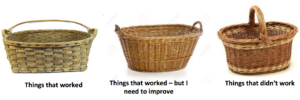
  • Let’s imagine what success will be like.


Motivate the unmotivated

Some students are just difficult to motivate to try anything, never mind achieving learning goals. This shows itself when they:

  • have little regard for anything they are learning at school;
  • would rather play video games than do homework;
  • rarely stick to something until its completed;
  • prefer activities that don’t require much effort;
  • are frequently defined as “lazy”;
  • find everything pointless or irrelevant;
  • rarely take any initiative and take on everything half-heartedly;
  • blame everyone else for their performance and/or behaviour;
  • have poor self-esteem.

Success is everyone’s innate desire but repeated failure can lead to learned helplessness i.e. they have learned to see themselves as failures. In other words a student may lose their motivation because of a lack of confidence in their ability to achieve specific goals. It is this lack of confidence that can drive behaviour such as avoidance, stress, “laziness” and a “don’t care attitude’. In such cases students need to have opportunities for success.

Carol Dweck and others have shown that the use of certain words and the adoption of certain practices can help the unmotivated student steer their interest towards learning goals by:

  1. Show an interest in their interests. Link their interests to skills you want them to develop .e.g. use comics to practise reading.
  2. Help students to view themselves as successful people by talking about their successes.
  3. Set reasonable expectations with challenging but achievable tasks.
  4. Make sure students know exactly what they are expected to do.
  5. Don’t focus on past performance, focus on their future performance – “what do you think you can do differently?”
  6. Let them know that their failures do not define them – they make them stronger.  Talk of famous people who encountered and overcame failures and that struggle is real for many people.
  7. Comment on ALL the positive changes you observe even if they do not immediately lead to an improvement. If you see students put in greater effort, say it. If you see them trying harder, say it. If you see them trying a different approach, let them know you’ve noticed. Remember, though, to praise the effort and not the child.
  8. Remind them of their strengths and accomplishments. Help them see themselves as successful.
  9. Don’t do everything for them – you’ll only teach them to become more dependent.
  10. Let students participate in the decision-making process. It will work wonders for their motivation.


Learning tools to equip learners to achieve learning intentions

If we want young learners to achieve curriculum goals we need to alert them to the tools to do just that. i.e. knowledge, understanding and improvement of their learning behaviours.

Younger learners need physical prompts or hooks for many invisible concepts including learning. Several schools use physical tools since tools help adults to do many jobs. Tools help children to connect with the idea of their learning process in a tangible way.

Use real toolboxes and gather items to represent just some of the learning behaviours. For example:

  • a blindfold for managing distractions
  • a magnifying glass for noticing details.
  • a plastic hammer for perseverance.
  • a giant key for collaboration.
  • a notebook for planning

Introduce the items one at a time as the learning behaviour it represents fits with what you want to strengthen. Later ask children ‘Which learning tools will we need to help us today?’

Things to say

How you talk about learning; the sort of language content and style you use to enhance and explain learning. In this case how you talk about what they are hoping to do/achieve.

Growing an orientation to goals

Encourage students to develop the ability to articulate what they are trying to achieve and visualise end results.

Use phrases like:

  • Tell your friend what you are going to do
  • Tell me what you are trying to achieve
  • What are you going to do?
  • What are you hoping to achieve?
  • What will it look like when you have done it?
  • Begin with the end in mind . . .

  • Let’s imagine what success will be like.

Celebrating (reinforcing) learning behaviours

Use circle time to discuss learning each week to positively identify children who have been good learners. Initially it’s likely that children who are seen as being ‘traditionally’ successful will be selected; students who finish first, answer questions quickly, are well behaved etc. However, discussion will gradually change through modelling from yourself, the children will begin to realise that just because someone didn’t get it ‘right’ doesn’t mean they weren’t a good learner. Talk about children who have really persevered with their learning, for example, those who in a science investigation by repeating the test when it had gone wrong or those who had imitated the process a friend had used to solve a Maths problem, (showing that copying how it had been done was fine). The children will then value how they learn and will begin to take greater notice of how others learn too.


Things to do everyday

How you construct learning activities; the tasks and classroom routines you use to build positive learning habits. In this case how you design activities that require advance planning and goal setting.

Secure student buy-in to goals

Flip the emphasis in how goals are expressed

Setting a goal that the learner has little or no motivation to achieve is unlikely to lead to success. What is needed is learner buy-in to goals.

Evidence shows that goals that relate to doing something or researching something, or creating something . . . ) are better motivators than goals that relate to knowing something or passing / doing well in a test.
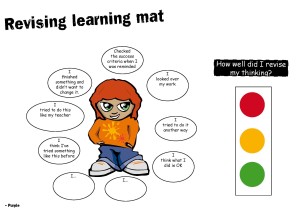
Putting the ‘how’ before the ‘what’.

So – a goal relating to ‘understanding xxxxx’ or ‘knowing yyyyy’ is less likely to motivate a learner to make the effort than a goal that starts with some indication of the sort of ‘effort’ or way of doing something;

  • work with a partner to decide why…….
  • use your problem solving skills to work out……
  • use your imagination to ….

Where ‘knowing goals’ place the emphasis on the successful acquisition of knowledge or creates a pass/fail scenario, the ‘doing goals’ focus on how – something to do rather than something to know.

What you are doing here is beginning to pay attention to how students will be learning as well as what they will be learning. This linking of how and what will come to play a central role in building students’ learning power later in your learning journey.


Teacher talk

Some real examples just to give you a flavour of this technique

  • With a partner, use your reasoning skills to explain why all prime numbers, with the exception of 2, are odd.
  • Use your noticing skills to identify three similarities and three differences between these two images.
  • By using what you already know and your imagination to generate ideas, tell the story of the fire of London from the perspective of a young person living in London at the time.

Make Success Criteria more useful

Success criteria help students to target their efforts by giving them a clear understanding of what they need to do to be successful. Without success criteria, students may spend more time trying to work out what they should be doing than getting on with the task set. Success criteria describe and illuminate the learning objective and can be used to assess progress; they put flesh on the bare bones of a learning objective. Identifying ‘what a good one looks like’, enables students to glimpse the future and think about the upcoming learning journey. You can use success criteria to redirect student effort if it wilts during a lesson or to help students check their own work especially if you build redrafting /improvement time into activities.

  • Add 3 success criteria to each task for students to meet success. Add a further 2 as challenges to act as an extension task for pushing thinking

Encourage students to use success criteria to act as guides when they are planning and executing their own work. e.g in the sciences or Food Technology:

  • one success criterion based on planning an experiment/ food preparation;
  • one for attention to detail during the experiment (noticing);
  • one based on what they have learned as a result doing the experiment (reflecting).

Train students to self-assess their work at specific points using the success criteria you provide.


What on Earth are Success Criteria - YouTube


Teacher talk for re-framing feedback

  • Great work – I saw how you kept going even when the level of challenge was increased
  • Done well today – I liked the fact that you were prepared to try a different strategy when you hit an obstacle
  • Can you talk me through your answer? I’d love to know how you worked it out


Things to display

What you celebrate about learning; what you prize, recognise, display; the outward signs of beliefs about learning. In this case what you praise, value and display about thinking ahead to ensure success.

Display a different type of achievement

Goals are so often thought of in terms of performance. One way to entice reluctant learners to consider the idea of goals is to look at them through the lens of different types of achievement. In the picture the wall of a maths classroom has a weekly display of outcomes related to a different type of achievement, i.e. learning itself. As a result students began to realise they could dream up their own goals related to what they would be proud of or what they would work hard on to finish.

Our achievements this week;

  • Things we are proud of
  • Things we have never done before
  • Things that we kept trying to do and finally succeeded
  • Things that we found difficult
  • Things that we worked hard on to finish


Begin to think about achievement

Start children thinking about broader ways of understanding/recognising achievement.

What is real achievement in learning?

Invite your students to brainstorm their own definitions and come up with a list.

An achievement is something;

  • you can be really proud of
  • you have never done it before
  • that you kept trying to do and finally succeeded
  • you have done that you found difficult
  • you have worked hard to finish
  • you have done what teachers tell you is good

Notice that all these are aimed towards a growth mindset. Make sure your praise matches these statements. You could use any one of these to group children’s learning on a wall display.


You are currently in – Working towards goals…

Return to the front page ⏎Dealing with being stuck…Managing distraction…Rising to challenge…Working towards goals…
From ‘I see why’ to ‘I’ll make sure’:
Values  to Organises
… become curious finder outers.… become highly focused.… relish challenge.… confident achiever of  own goals.
From ‘I’ll try’ to ‘I see why’:

Responds
to Values
… analyse mistakes and failures.… manage their environment.… take risks and change plans.… plan and reflect on their own practice.
From ‘Show me/tell me’ to I’ll try’:
Receives to Responds 
… understand why they are stuck.… overcome their distractions.… take on challenge confidently.… achieve realistic goals.
From ‘I can’t’ to ‘Show me/tell me’:
Lacks to Receives
… comfortable about being stuck.… understand distraction and focus.… comfortable about making mistakes.… see the point and value of goals.
Important Know – How: 
Start here.Work up ➡️
Discover ‘Dealing with Stuck’Discover ‘Managing Distraction’Discover ‘Rising to Challenge’Discover ‘Working towards Goals’
Continue Reading

4. Challenge… Values to Organises

This section pulls together the ideas that will assist students to progress from recognising that using the learning behaviours benefits them, to organising themselves to use the behaviours to their advantage.

In the Values phase, the student develops a strong belief that they can get better at learning and that using learning behaviours is a benefit to them. They expect learning to be challenging, and even understand why it has to be. They expect to make mistakes, but recognise the importance of learning from them. They are increasingly open to feedback so that they are better able to overcome challenge.

In the Organises phase, the student organises themselves to get the job/task/problem done. They create their own plans for tackling challenging material, and are beginning to seek out and enjoy activities that they know will prove challenging. They have accepted responsibility for their behaviours.

Encourage students to seek out ever more challenging situations with confidence


Things to give away

How you relate to your students; gradually sharing more of the responsibility for learning with them. In this case, how you encourage them to enjoy rising to challenges

Encourage planning for risk

In this organising phase students should be planning for risk and asking themselves questions such as;

  • What are the dangers?
  • What might go wrong?
  • How can that be avoided?
  • What’s the worst thing that could go wrong?
  • How do I make sure it doesn’t happen?
  • What’s the ideal outcome?
  • What’s the most likely outcome?

Teacher talk

  • Which of your many strategies might you use here?
  • I’m sure that you can sort that out for yourself.
  • Have you thought about the pros and cons of this way of working?
  • What will you lose if you tried it this way?
  • Have you done enough trial and improvement before starting?
  • What did you learn from each of your attempts?
  • Your risk analysis paid off there.

Expect students to analyse their own mistakes and create their own feedback

Share assessment criteria with (older) students and ask them to:

  • assess/comment on the (imperfect) solutions you provide. Invite them to produce improvements based on their own feedback.
  • require them to assess/comment on their own work, and amend it if necessary, before submitting it.

Frame your written comments as questions to which your students are required to respond.

“What do you think you need to do to make this section more convincing?” is preferable to “This section needs more explanation”, because it moves responsibility to the learner to identify what more needs to be done.
Essentially, this is about helping feedback to enable students to self-regulate their own learning.


Things to say

How you talk about learning; the sort of language content and style you use to enhance and explain learning. In this case how you talk about overcoming difficulty and how it is a natural part of learning.

To secure an understanding of and relish for challenge, ask:

  • How would you increase the level of challenge here?
  • How could you make this better even though it looks finished?
  • If things get tough what are some of the different ways you can respond?
  • Is this both challenging and enjoyable?
  • What makes you say that?
  • Try to find something that you are not sure you can succeed with
  • Why does it have to be challenging to be enjoyable?
  • How do mistakes link to challenge?
  • Are you brave enough to give this a go?
  • Is this difficult enough?
  • How could you inject further challenge?
  • What advice would you give to someone who thought they couldn’t do it?
  • Can you tell me how you would try to solve a problem you haven’t seen yet?

Things to do everyday

How you construct learning activities; the tasks and classroom routines you use to build positive learning habits. In this case how you design activities to stretch learners.

Have students create their own challenge plan

Challenge plan prompts

Students create their own plans for seeking and engaging with challenge:

  • What’s the goal?
  • What are the success criteria?
  • What is the timeframe?
  • Gather information about the tasks
  • Link new information to what I already know
  • Where am I expecting difficulties – blocks and obstacles?
  • Are there any dependencies? If this….then that….
  • Use the expert knowledge of others to help distil and refine my ideas
  • Review where I’ve got to and check my thinking against the original success criteria
  • Evaluate emerging outcomes against my expectations
  • Amend the plan or goal if necessary
  • Hand in on time!

Teacher talk

  • Do you think that’s coming along well.
  • Have you checked your emerging outcome against your original goals?
  • Are you still on track?
  • What would make you change track?
  • Did you have to amend your goals part way through? Why was that?
  • What are you going to do about . . . . . ?



  • Do you think there’s anything you could have done better, differently?
  • How might you get better at that? What would be a better/alternative way of doing it.
  • Are you satisfied with how it is going?

Encourage deeper thinking about consequences

By this phase students will be familiar with planning and organising their learning but may not yet have considered the consequences. In considering a course of action we need to consider the consequences because it invites students to predict along a timeline into the future.

Things to discuss;

  • what may happen as an immediate consequence of this?
  • what may happen in the short period of time as a consequence?
  • what may happen after some time when things have settled down?
  • What might be the long term consequence of this action now?

Teacher talk

To get students foreseeing consequences:

  • What do you think will happen?
  • What might happen?
  • Can you be sure that this will happen?
  • If you . . . . what will happen / might happen?
To get students separating certainty from uncertainty:

  • What are you sure that you know?
  • What do you think you know?
  • What might be true?
  • Can you be certain that . . . .

  • Will it always be like this?
  • Is it always the case that . . . ?

Things to display

What you celebrate about learning; what you prize, recognise, display; the outward signs of beliefs about learning. In this case what you praise, value and display about rising to challenge.

Re-frame your own role

Intervene only when absolutely necessary – stand back, listen and watch, and let the learning happen.

Teachers are constantly walking a tightrope – when/whether/how to intervene, how much support to offer, how much challenge to inject etc. It is in these ways that teachers scaffold the learning for their students, offering just the right balance of challenge and support to keep students working towards the edge of their comfort zone. But if teachers always scaffold learning in this way, when will students develop the skills required to manage their own learning for themselves?

At this phase, students are ready to go it alone, to face up to challenge and to enjoy doing so. They are ready to wrestle with difficulty independently – indeed they understand the importance of doing so in a safe, challenge-rich environment.

The big question is: Are you ready for this change in your role?

Many teachers find standing back, shutting up, letting students get on with it, apparently doing nothing, excruciating. A lifetime of performance and being ‘a teacher’, reduced to ‘interested observer’!

Stop worrying – this is when you get to reap the rewards of your previous efforts. Time to stand back, watch your students at their learning, consider what more you might do to support and nudge them to take even greater ownership of their learning. Facilitator, not organiser. Coach, not teacher. Learner, not guru.


NLP Reframing – The Past Does Not Equal The Future | Lisa Christiansen's Wealth Of Wisdom


Are you ready?

You are currently in – Rising to challenge…

Return to the front page ⏎Dealing with being stuck…Managing distraction…Rising to challenge…Working towards goals…
From ‘I see why’ to ‘I’ll make sure’:
Values  to Organises
… become curious finder outers.… become highly focused.… relish challenge.… confident achiever of  own goals.
From ‘I’ll try’ to ‘I see why’:

Responds
to Values
… analyse mistakes and failures.… manage their environment.… take risks and change plans.… plan and reflect on their own practice.
From ‘Show me/tell me’ to I’ll try’:
Receives to Responds 
… understand why they are stuck.… overcome their distractions.… take on challenge confidently.… achieve realistic goals.
From ‘I can’t’ to ‘Show me/tell me’:
Lacks to Receives
… comfortable about being stuck.… understand distraction and focus.… comfortable about making mistakes.… see the point and value of goals.
Important Know – How: 
Start here.Work up ➡️
Discover ‘Dealing with Stuck’Discover ‘Managing Distraction’Discover ‘Rising to Challenge’Discover ‘Working towards Goals’
Continue Reading

3. Challenge… Responds to Values

This section pulls together ideas that will best assist students to progress from being willing to do things for themselves, to recognising that using the learning behaviour benefits them.

In the Responds phase, students develop greater independence and are motivated to undertake more challenging activities. They anticipate that they may make mistakes, and are less afraid of doing so. They are realising that finding things hard is a natural part of learning. They are better able to remain positive in the face of difficulty.

In the Values phase, the student develops a strong belief that they can get better at learning and that using learning behaviours is a benefit to them. They expect learning to be challenging, and even understand why it has to be. They expect to make mistakes, but recognise the importance of learning from them. They are increasingly open to feedback so that they are better able to overcome challenge.

Equip students with tactics to take the panic out of challenge


Things to give away

How you relate to your students; gradually sharing more of the responsibility for learning with them. In this case, how you encourage them to enjoy rising to challenges

Model dealing with challenge

Model how you might think about challenges:

Things you might ask yourself

  • what is the challenge about?
  • what is it asking me to do?
  • have I seen one like this before?
  • how did I do that one?
  • were there any tricky bits?
  • can I remember how I tackled them

How you might check out your feelings

  • do I feel I can do this?
  • will it matter if I get this wrong?
  • no, I can always try again
  • how will I make sure I stay positive?
  • I don’t need to feel negative about this because I am learning how to do this

Turn it into a story

Teacher talk

Continue talking it through to make the challenge work

  • can I spot the key words or symbols here?
  • what might the end result look like?
  • what’s the first step?
  • and what’s the next step?
  • what should I do if/when I get stuck?
  • what’s the best way round this tricky bit?
  • I could do…….
  • or I could try….
  • which would be best?
  • Oh! I remember this idea from…
  • and so forth

Help students to know themselves as learners

Reflect on dealing with challenge

Self talk phrases to use when monitoring as they are still doing something:
  • What’s happening?
  • What am I seeing /noticing?
  • How am I feeling / thinking about that?
  • What else is happening?
  • What’s changing?
  • What’s going best/well?
  • Do I need to do anything about any of this?
Self talk phrases to use when reviewing the results of learning:
  • What’s the most important thing that’s happened? Why?
  • How was it significant?
  • What difficulties did I meet?
  • How did I resolve / sort them?
  • Which strategies seemed effective?
  • What else could we / I have done?
  • How might it have been different?

Nudge students to self-regulate by asking: (adapted from Nuckles et al, 2009)

  • What would be the best way of checking your learning?
  • How could you reflect on these answers?
  • What happened when you …?
  • How can you account for …?
  • What learning goals have you achieved?
  • How have your ideas changed?
  • What aspect of this work could you now teach to others?

Things to say

How you talk about learning; the sort of language content and style you use to enhance and explain learning. In this case how you talk about overcoming difficulty and how it is a natural part of learning.

Secure the ability to approach challenge with clarity and flexibility by posing questions like:

  • What is this challenge really asking you to do?
  • What will success look like?
  • How are you planning to go about it?
  • What might go wrong?
  • Do you have any fall-back plans?
  • What could you do if it goes wrong?

Things to do everyday

How you construct learning activities; the tasks and classroom routines you use to build positive learning habits. In this case how you design activities to stretch learners.

Design ‘stretching’ challenges

A useful list of questions to ask yourself when you are designing a ‘stretch challenge’. Notice how the teacher role is changing from ‘telling’ to coaching.

When you design what we might call ‘stretch challenges’—ones that are designed to build your students’ relish for difficulty— it’s useful to ask yourself the following questions:

  • How can I construct a problem-solving activity to enable students’ understanding of xyz content without telling them?
  • How can I intrigue them with something that is open to several interpretations?
  • What could I say/do/show to stimulate their curiosity?
  • How can I make this grab their attention…visually and aurally?
  • How long shall I allow them to stay stuck before I ask them how they are thinking?
  • If they are well and truly stuck, what can I offer as a nudge to get them thinking differently that doesn’t give the answer away?
  • Will I leave it as a problem hanging in the air to which we will return later?
  • When will I ask them to make links between the challenge, and what and how we are learning in this lesson?

The challenge isn’t about the inherent complexity of the subject matter but about how the content is orchestrated to encourage students to use their learning habits to resource their solution.

Extract slightly amended from: The Learning Powered School – Claxton, Chambers et al.


Teacher talk

In order to secure the ability to approach challenge with clarity and flexibility, pose questions like:

  • What is this challenge really asking you to do?
  • What will success look like?
  • How are you planning to go about it?
  • What might go wrong?
  • Do you have any fall-back plans?
  • What could you do if it goes wrong?


Build the level of challenge in lessons

How many oranges

Take a look at the powerpoint for the lesson opposite. It was designed as a one hour maths lesson for KS3 students.

Note how the teacher uses the same image throughout, increasing the level of challenge as the lesson develops.

In particular, notice how the teacher has identified the learning behaviours that they anticipate each phase of the lesson will require / exercise – these are in the ‘banner’ running across the bottom of the odd numbered slides.

Note also the emphasis given to the how and what of teacher talk.

Ask yourself – is this a format that you might use to support your own lesson planning?

Things to display

What you celebrate about learning; what you prize, recognise, display; the outward signs of beliefs about learning. In this case what you praise, value and display about rising to challenge.

Reflecting on challenge after the event

Draw a thermometer on the wall, with a scale from overstretched to low or coasting. Work with the class to describe the various levels. High might read:

“I took the step to try something just a bit harder than before. I worked on it until I could do it and understood it clearly”

and Overstretched might be:

“This was a few steps too far … next time I will chose a more manageable task.”

Talk to children about the degree to which they have felt stretched and ask them to move photos of themselves up and down the scale. Use it to stimulate discussion about sticking with tasks and understanding when it is not wise to do so.

This activity helps students understand risk and challenge. It is worth routinising this until students get the measure of it.

You are currently in – Rising to challenge…

Return to the front page ⏎Dealing with being stuck…Managing distraction…Rising to challenge…Working towards goals…
From ‘I see why’ to ‘I’ll make sure’:
Values  to Organises
… become curious finder outers.… become highly focused.… relish challenge.… confident achiever of  own goals.
From ‘I’ll try’ to ‘I see why’:

Responds
to Values
… analyse mistakes and failures.… manage their environment.… take risks and change plans.… plan and reflect on their own practice.
From ‘Show me/tell me’ to I’ll try’:
Receives to Responds 
… understand why they are stuck.… overcome their distractions.… take on challenge confidently.… achieve realistic goals.
From ‘I can’t’ to ‘Show me/tell me’:
Lacks to Receives
… comfortable about being stuck.… understand distraction and focus.… comfortable about making mistakes.… see the point and value of goals.
Important Know – How: 
Start here.Work up ➡️
Discover ‘Dealing with Stuck’Discover ‘Managing Distraction’Discover ‘Rising to Challenge’Discover ‘Working towards Goals’
Continue Reading