
Key Learning Question:
Question box
Orange text?
Trainer notes
TEXT for trainer

a. Increasingly complex world
Trainer notes
TEXT for trainer
b. New Curriculum
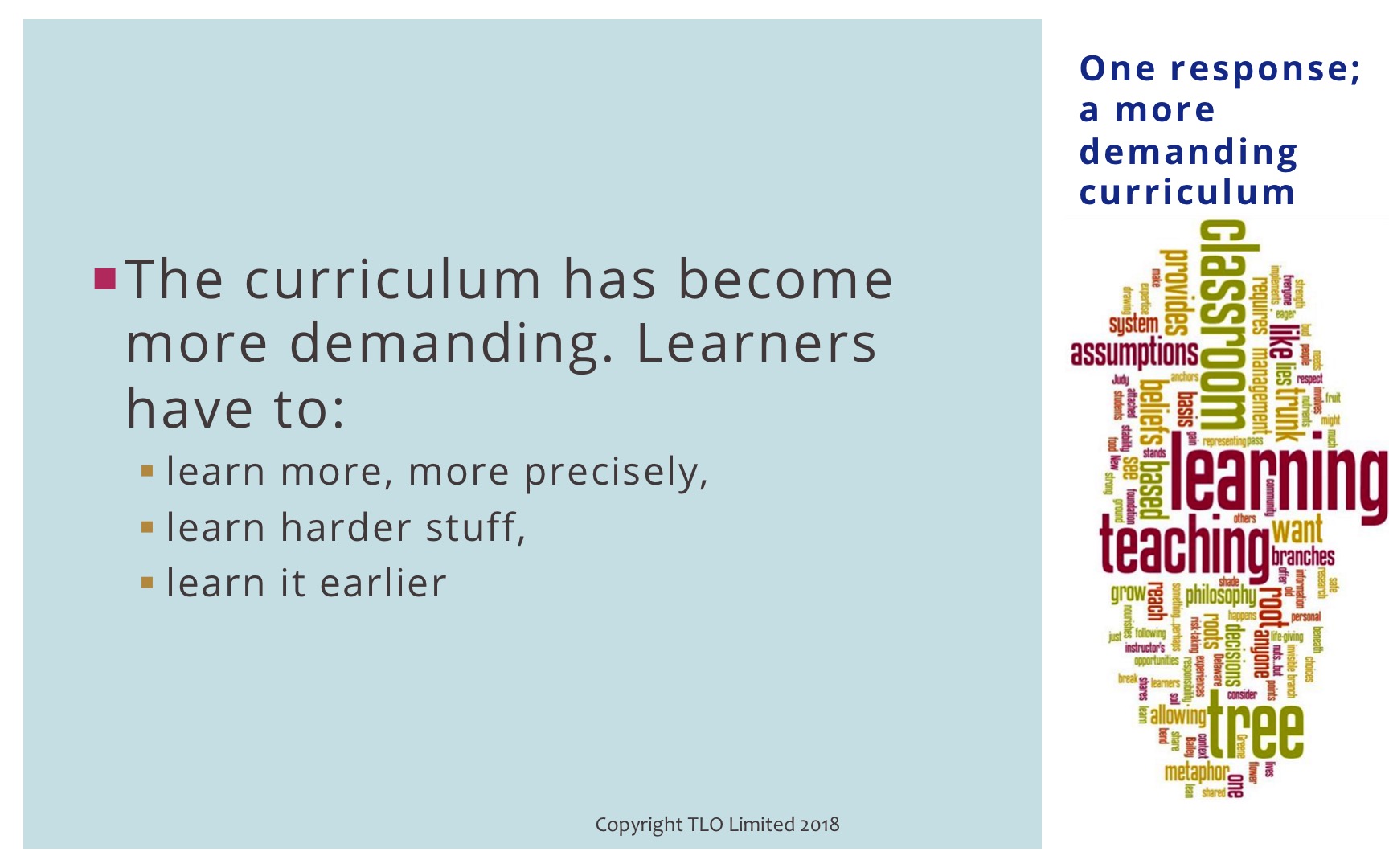
Trainer notes
TEXT for trainer
c. Digital age
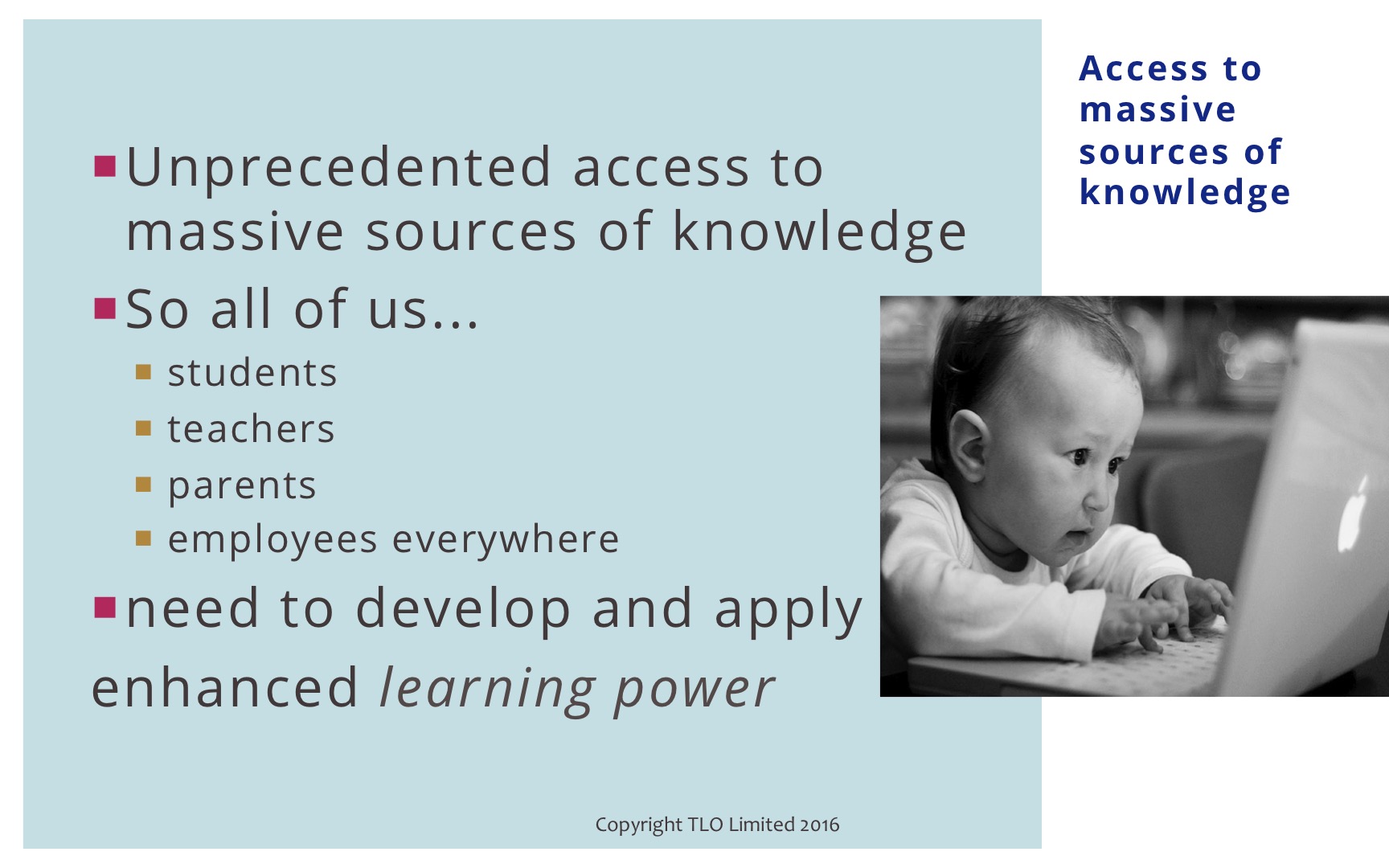
Trainer notes
TEXT for trainer
Orange text?
Orange text?
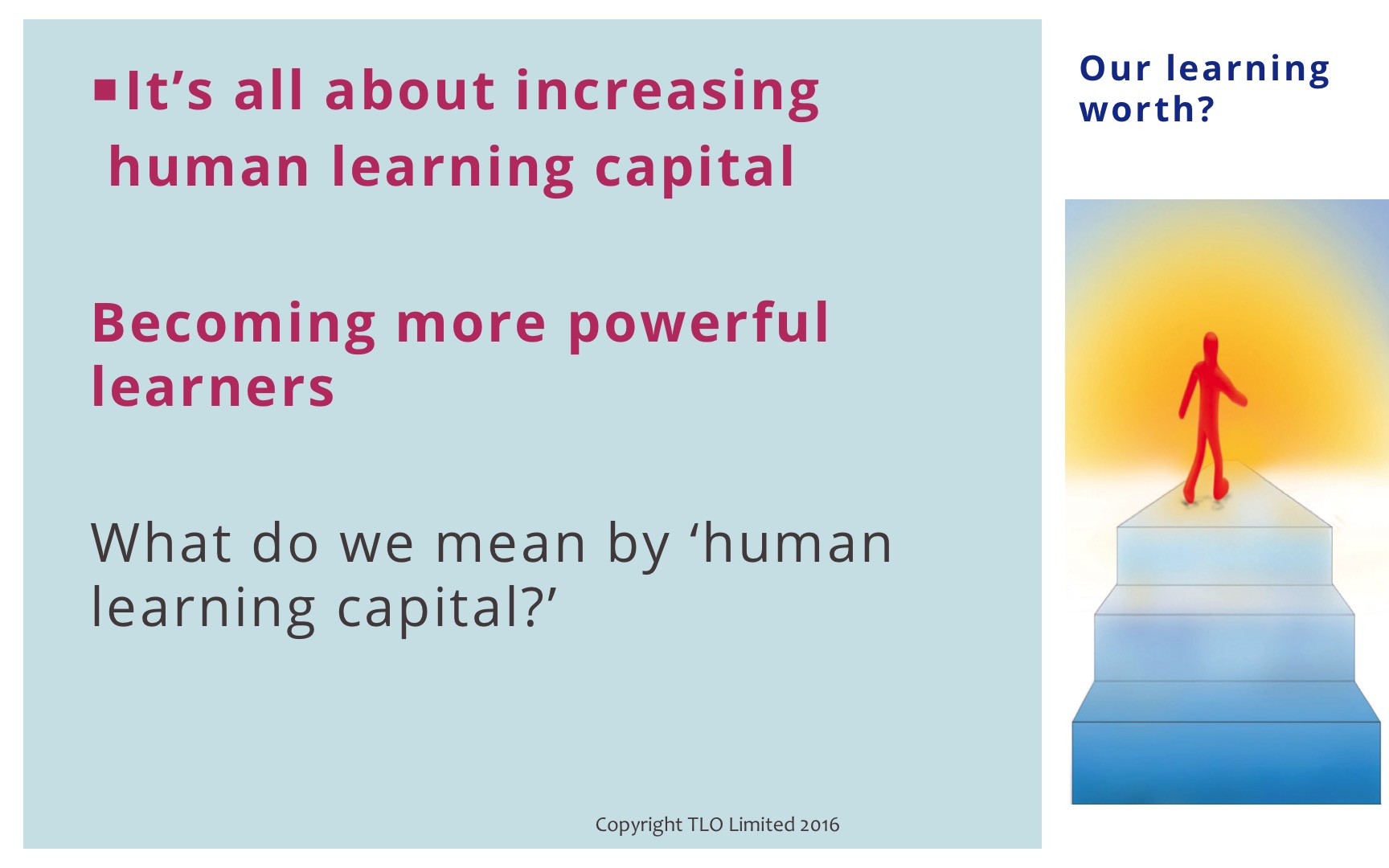

Orange text?
Text
Orange text?
Text
Text
Text
Orange text?
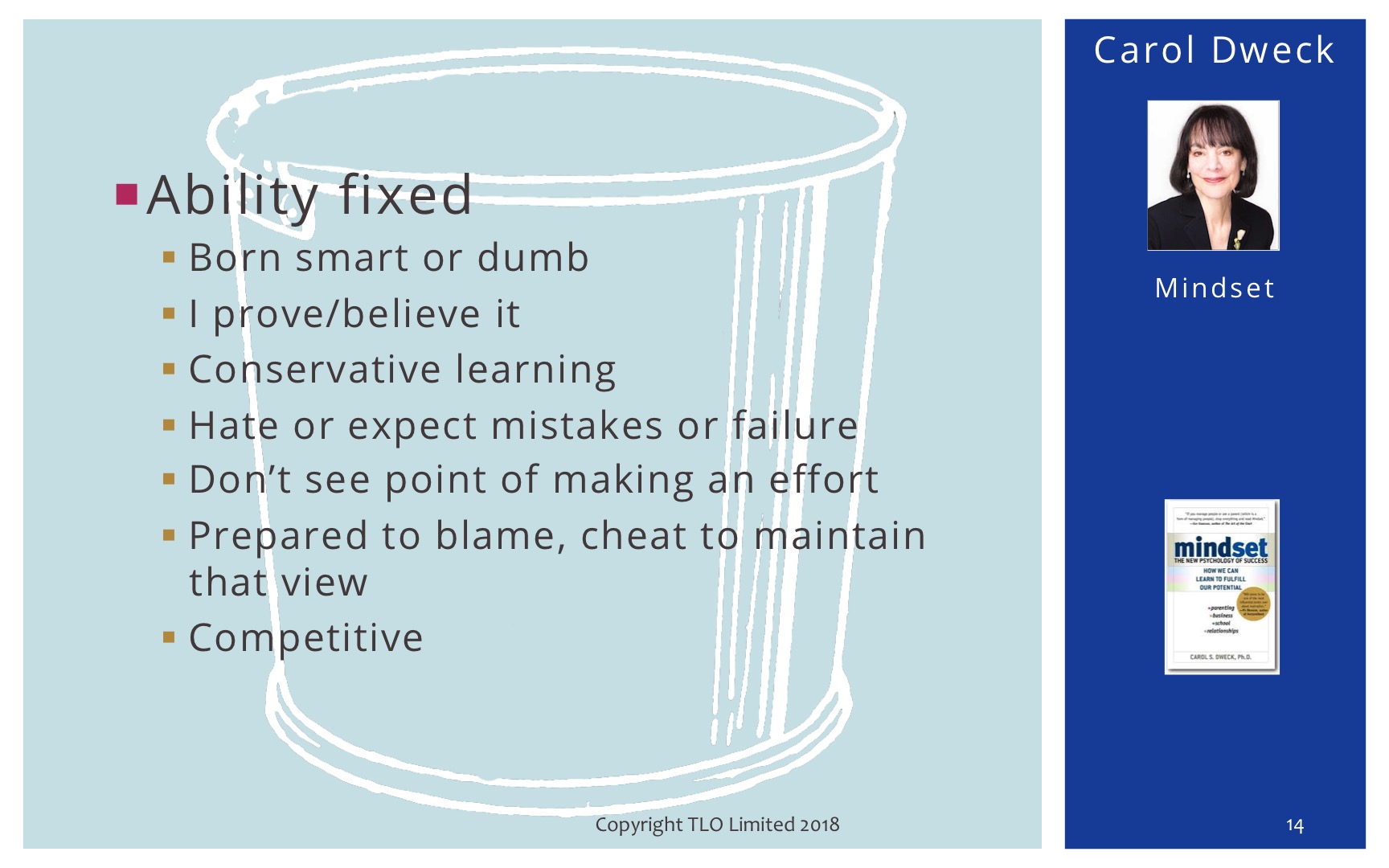
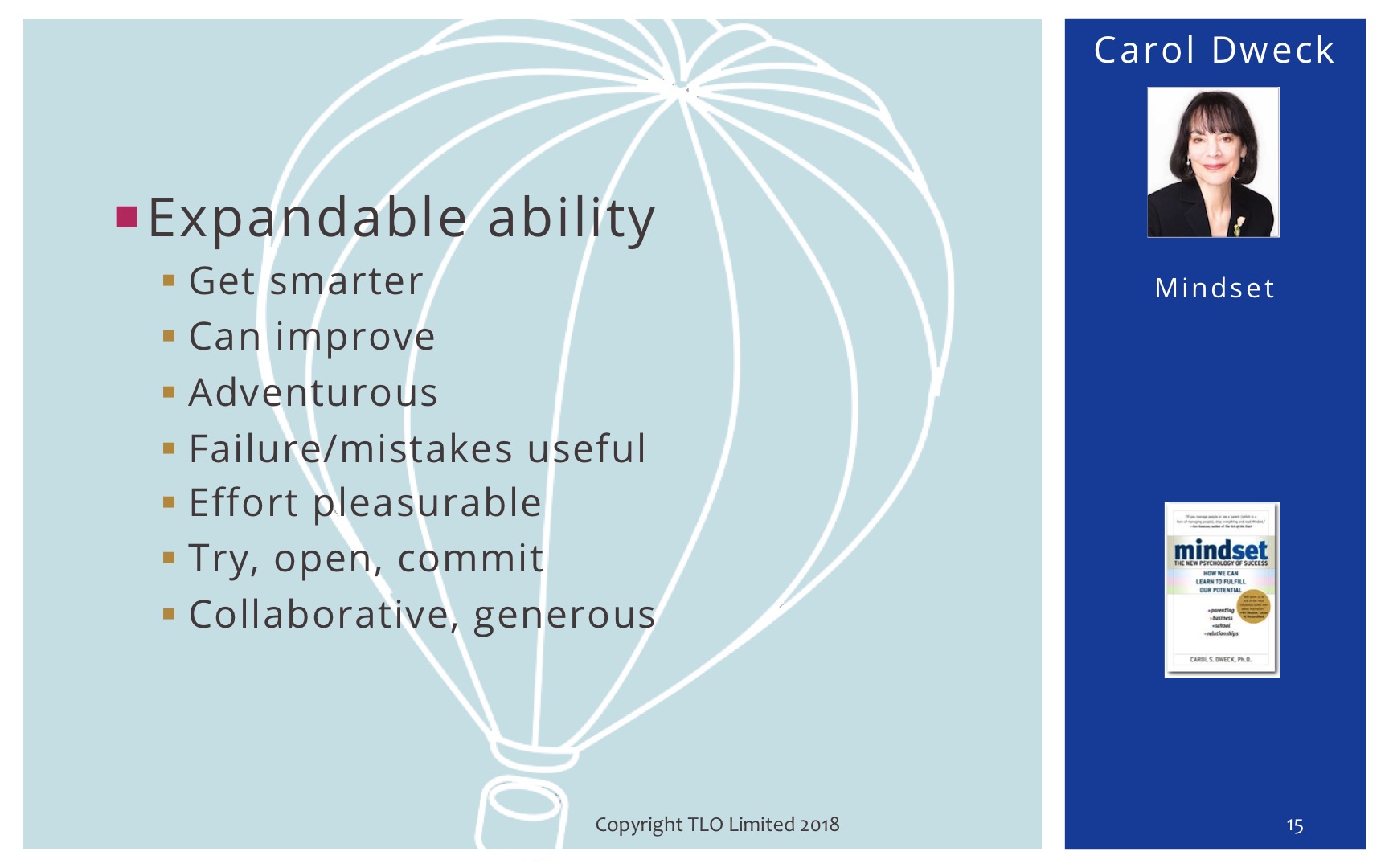
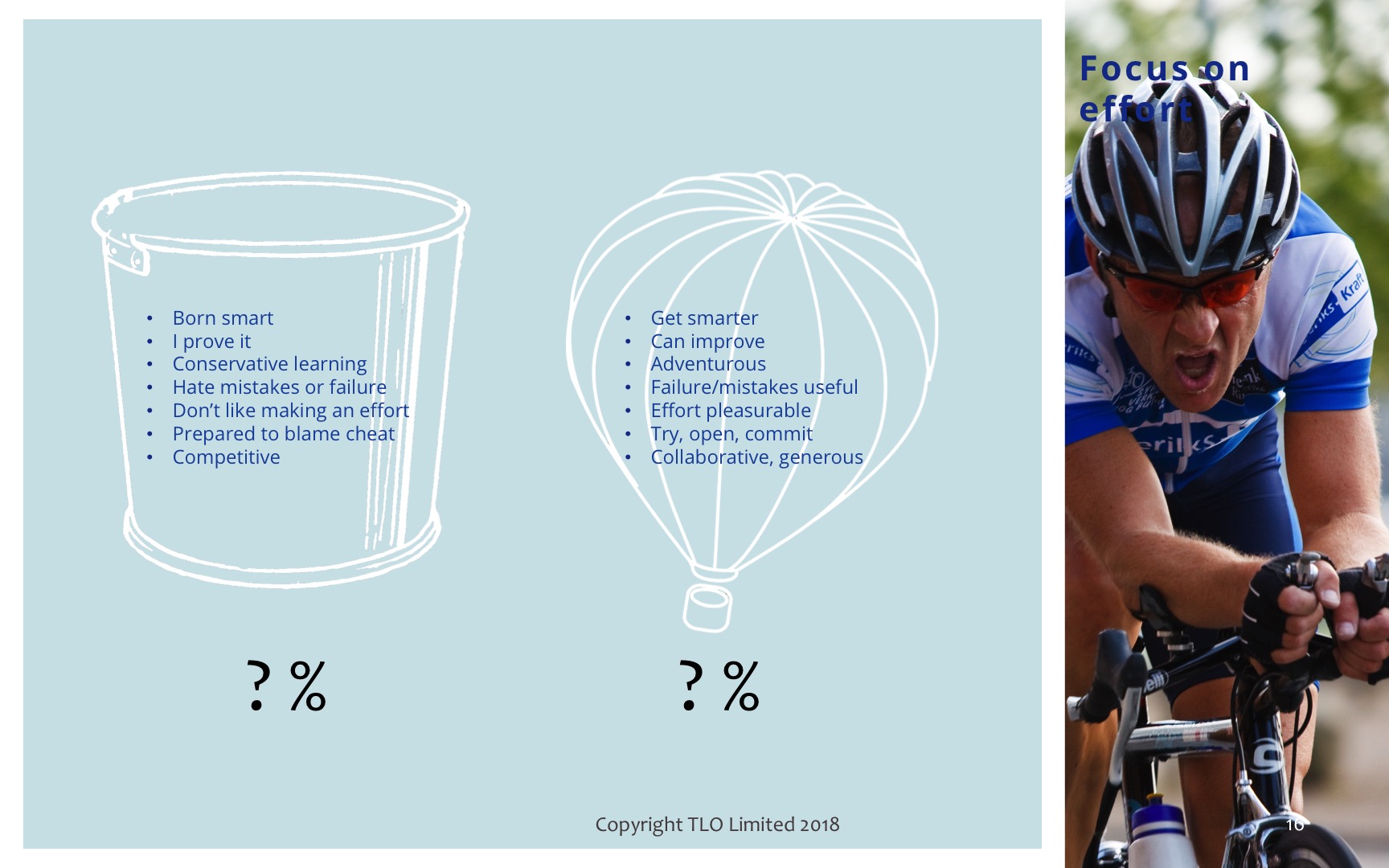
Text
Text
Orange text?
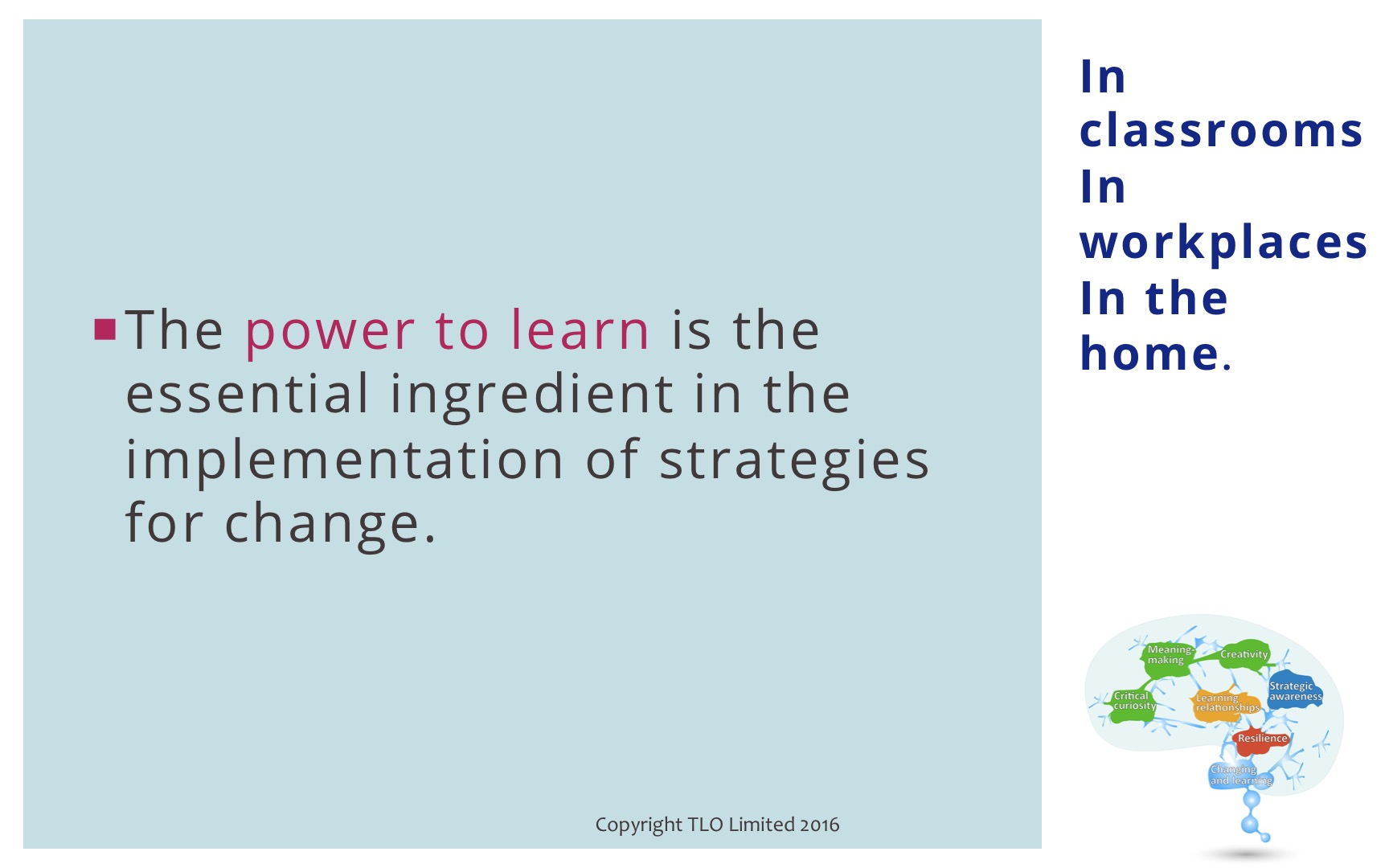
plus more…..

Orange text?
Orange text?
Text
Text
Text
Orange text?
Text
Text
Text
Orange text?
Text
Text
Text
Connecting | Stretching | Transferring |
Learning and Life:AutobiographiesSomething Understood | Learning and Life:The Tree of Learning and Life | Learning and Life:Learning and Me |
How We Learn:The Hidden Apple | How We Learn:Mystery Accident | How We Learn:Big Learning Muscles |
As a teacher you are an influential character builder and so need to be mindful of how you help students form, replace, re-form and strengthen their learning habits.
But don’t worry, you’re not there yet. It takes most teachers between 2 and 3 years to become really fluent with this way of teaching. So, go easy on yourself. Feel determined because small steps often prove to be big levers for change. Have a think about what you might do…
Here are a few ideas you might want to try. Take it steady, this way of teaching can be a big but exciting shift so it’s worth doing it slowly and thoughtfully.
Look first at the Stop/avoid ideas. Some of these are far from trivial but it’s best to try to remove them before starting on the Start/do more of, Start slowly and Experiment with ideas.
Use:
Stop
Start
Start slowly
Experiment with

Here is a range of things you can say to nudge empathy & interdependence. When you use this kind of language you are talking as a learning coach, encouraging students to think for themselves. Using such statements encourages your students to:
Eventually you will hear some of the questions pop up in students’ self-talk….in speech or even in writing from time to time, but mostly these will go on inside their heads. As your work on empathy & interdependence gathers pace see if you can detect students who talk, or think, in these ways.
(To ensure students do the thinking for themselves)
Talk to nudge
How you make students aware of the words that describe the behaviour and why it is important to use it.
Design activities where no one person has all of the information to ensure that they MUST work together to solve the problem. Try splitting information on to different cards that pupils can tell (but not show) each other.
Prepare the way for students to build on the ideas of others when working in a group by making ‘ABC’ a routine that you use during whole-class teaching.
Once a student has answered a question, ask another student to Add to it, to Build on it, to Challenge it, to Defend it, to Elaborate on it, or to Find a Flaw in it.
As easy as ABC! This improves students’ listening skills at the same time.
Make cardboard spectacles and cover the lens space with coloured film. These are empathy specs. When a pupil puts them on, they have to see the world, problem, or event, from a different point of view.
You could use different colour specs for different points of view – ‘Today the blue specs are for land owners, the red specs are for tenant farmers, the green specs are for animals, the yellow specs are for . . . .’
Stimulate debate with provocative statements:
How you might extend the language and understanding of this behaviour
Discuss with the children the colour that certain feelings make them think of and then do some ‘Mood Paintings’ using these colours. These kind of associations will help the children build a vocabulary of feelings.
Two heads are better than one
Put yourself in my shoes
More than the sum of the parts
Use a quick starter to key students into the learning behaviour you want to concentrate on in the lesson. i.e. here you are starting up the need to demonstrate empathy and interdependence.
Make two enormous feet out of coloured card or material. Choose two volunteers, each stands on one of the feet. The first talks about a situation or problem from their point of view. The second talks about the same situation / problem from his/her point of view. Then they each move to stand on the other foot and talk about the same situation from the other person’s point of view.
Offer students different pictures, or descriptions, of the same event.
Ask students to build the full picture. This is usually more effective done in pairs or small groups than individually.
Compare two groups’ views of the same event. Explore how such different views may come about.
Draw out the empathy and interdependence behaviour being used in a thinking routine.
 The visible thinking routine ‘Step Inside: Perceive, Know, Care about‘ helps students to explore different perspectives and viewpoints as they try to imagine things, events, problems, or issues differently.
Three core questions guide students in this routine:
• What can the person perceive?
• What might the person know about or believe?
• What might the person care about?
The routine asks students to step inside the role of a character or object—from a picture they are looking at, a story they have read, an element in a work of art, an historical event being discussed, and so on—and to imagine themselves inside that point of view. Students are asked to then speak or write from that chosen point of view. This routine works well when you want students to open up their thinking and look at things differently. It can be used as an initial kind of problem-solving brainstorm that open ups a topic, issue, or item. It can also be used to help make abstract concepts, pictures, or events come more to life for students.
And here is an idea that will help students to understand the empathy and interdependence processes.
Design specific activities to highlight and strengthen the behaviour
You are all in a hot air balloon escaping from a contaminated area. Each of you is an expert — a doctor, a market gardener, and electrician, a builder, an accountant, a computer programmer. Here is a very practical example of how you might develop the emotional climate of the classroom and make it empathy and interdependence friendly Use: Learning mats are A4 laminated sheets that show various aspects of a learning habit. Keep them on desks/tables or as part of a wall display. Students refer to them during lessons, using them as prompts about the finer aspects of a learning habit that is being stretched. This one relates to empathy and interdependence. As students become more proficient at empathy and interdependence they enjoy making their own learning mats describing higher order skills than the ones shown here. An Activity to learn about the behaviour
Balloon Challenge
BUT, the balloon is falling and one person must jump out if the others are to survive.
Acting in role, each person must make a case and try to convince the other group members as to why they should be allowed to survive.
6. Reflecting on Empathy and Interdependence
Primary
Make reflecting on empathy and interdependence part of everyday lessons
Learning Mats
BRIAN _ INSERT MAT built from scratch
Secondary
Primary and Secondary
What do you think?
Make a note of…
NB. None of the behaviours above will lead to instant understanding in students nor instant changes of behaviour. You will need to drip them in over time and keep building and refreshing your language of learning.
Building Learning Power is about creating a culture in classrooms – that systematically cultivates habits and attitudes that enable young people to face difficulty calmly, confidently and creatively. By a ‘culture’ we mean all the little habits, routines and practices that implicitly convey ‘what we believe and value round here’.
So ‘culture’ concerns the details of the micro-climate that you create in your classrooms. What you do and say, what you notice and commend and what you don’t, what kind of role model of a learner you offer – all these are of the essence. The micro-climate of a classroom can inadvertently stifle, or specifically enhance, the very behaviours you are seeking to promote.
Here is a selection of features which might begin to shape the emotional climate of the classroom to encourage empathy & interdependence.
Apply your own attentive noticing and consider whether you already use any of these features and which you fancy trying.
We link Empathy with Interdependence because each supports the other – we need empathy to learn effectively with others, and learning with others is the situation in which we hone our empathy skills.
Empathy involves being able to see the world through the eyes of others, putting yourself in their shoes. Empathetic learners understand that others may hold different views from themselves and are interested in these alternative views on reality. It is an essential skill in creating and sustaining positive relationships, it is the oil that lubricates all of our relationships.
Interdependence is the ability to ‘rub along’ with others, to balance rights with responsibilities, willing and able to take personal responsibility for the actions they take and the choices they make, willing and able to offer support to others when necessary, so contributing to the greater good. It is about working constructively with others while retaining our own individuality – a balancing act that requires high levels of empathy for others.
Just to get you tuned in – have a quick think about ‘Empathetic, Interdependent learners you may know’. Make a note of students you know who display these characteristics.
Being a learning powered teacher means developing a keen awareness of the subtleties of your students’ learning behaviours.
As a teacher you are an influential character builder and so need to be mindful of how you help students form, replace, re-form and strengthen their learning habits.
But don’t worry, you’re not there yet. It takes most teachers between 2 and 3 years to become really fluent with this way of teaching. So, go easy on yourself. Feel determined because small steps often prove to be big levers for change. Have a think about what you might do…
Here are a few ideas you might want to try. Take it steady, this way of teaching can be a big but exciting shift so it’s worth doing it slowly and thoughtfully.
Look first at the Stop/avoid ideas. Some of these are far from trivial but it’s best to try to remove them before starting on the Start/do more of, Start slowly and Experiment with ideas.
Here is a range of things you can say to nudge distilling. When you use this kind of language you are talking as a learning coach, encouraging students to think for themselves. Using such statements encourages your students to:
Eventually you will hear some of the questions pop up in students’ self-talk….in speech or even in writing from time to time, but mostly these will go on inside their heads. As your work on distilling gathers pace see if you can detect students who talk, or think, in these ways.
(To ensure students do the thinking for themselves)
How you make students aware of the words that describe the behaviour and why it is important to use it.

After any activity, ask the children what they have been doing, what they have learned, what worked, what didn’t work so well and what they would use again next time.
Make wall displays of things that children have found worked well. Support with photographs and examples, to ensure everyone benefits from the learning. Expect lots of variety – what works for one child might not work for another.

Giving students a large piece of paper encourages them to write lots – it might be a useful strategy for capturing detail, but it acts against the need to weigh up what is really important.
Require students to make notes on postcards or post-its – large enough for the key points, but too small for unnecessary detail.
Encourage students to discuss what must be on the postcard, and what can be safely considered ‘detail’.
Make reflection on being stuck part of the daily or lesson routine. This display from Miriam Lord primary school in Bradford shows a range of discussion cards which the teacher uses with specific groups of students during or at the end of a day.
The questions include;
Today I have learned….
Today I have tried to…
My biggest success today has been….
What will your tell your family when they ask ‘What did you do at school today’?
The most important thing I have learned today.
Has something inspired you today?

If information is currently framed in any of the following, challenge students to change it into another format of their choosing: text; mind map; flow diagram; storyboard; graph; venn diagram; ranked bullet points/list; video; teacher explanation; revision notes etc.
Consider limiting the number of words that can be used – forcing students to limit words and/or employ images instead encourages them to distil what is really important and salient.
Converting from one medium to another requires students to identify the key features. It can only be converted if it is understood, so this technique promotes deep learning. Where students are struggling, it can reveal misconceptions. It helps students to create revision notes for themselves, and in their preferred learning style.
How you might extend the language and understanding of this behaviour
Distilling is all about ‘mulling over’ experiences in order to recognise and appreciate just what we have done and what is worth holding onto to use again in new, similar or different situations. As you talk about learning by reflecting on noticing or reasoning or collaborating or any of the other capacities, you will be guiding your pupils to learn about learning from their own experiences. You will be ‘distilling’ – drawing out that ‘essence’ of noticing, reasoning etc. that you want them to use again and develop.
Distilling is a capacity that is very much your area of responsibility. It would not be reasonable to expect young learners to understand, or have any awareness of the complexities involved. With your guidance, your learning, they will be able to participate in drawing out lessons from the opportunities you give them to experience the capacities and develop a language with which to talk about them.
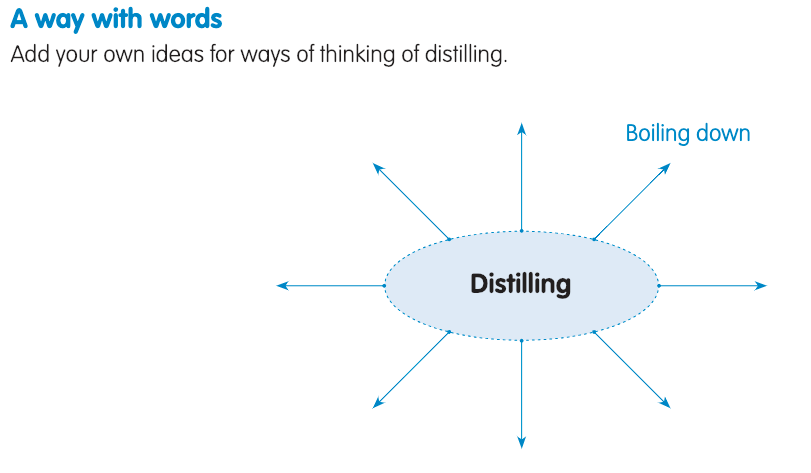
Collect words that tell you how people learn to distil what is and what is not important.
Explore well known sayings.
The heart of the matter
Can’t see the wood for the trees
Hit the nail on the head
Use a quick starter to key students into the learning behaviour you want to concentrate on in the lesson. i.e. here you are starting up the Distilling behaviour

As part of circle time, encourage the children to talk about:

Begin each lesson with ‘Tell me Three . . things we learned last lesson; ways we learned last lesson; things we still need to find out; things you hope to achieve today’.
End each lesson with ‘Tell me Three . . things we learned today; learning skills we used today; things we need to do next lesson; ways you could become a more effective learner’ etc.
Vary which you use according to circumstances.
Ensure that they tell you three. Do not lapse into doing it for them !
Draw out the distilling behaviour being used in a thinking routine.

This routine draws on the idea of newspaper-type headlines as a vehicle for summing up and capturing the essence of an event, idea, concept, topic, etc. The routine asks one core question:
Consider following it up with the challenge of writing the first paragraph only of the newspaper article, the one that lays out all of the key information relating to the headline.
This routine works especially well at the end of a class discussion or session in which students have explored a topic and gathered a fair amount of new information or opinions about it.
Read more at:
And here is an idea that will help students to understand the distilling process.
Design specific activities to highlight and strengthen the behaviour.
Use review points and end of lesson plenaries to encourage students to reflect on their own learning. At the beginning of the lesson, place some coloured boxes/hats/objects on student desks. These identify which aspects of the learning the individual/group have to pay particular attention to. Some teachers might use hats so that individual students will do the feedback. Others might place a coloured box on each nest of tables to indicate that the group has the responsibility to conduct the feedback. At the end of the lesson, students have to feed back as follows: Black box/hat – what were the learning objectives of the lesson ? Red box/hat – what were the three most important things we learned today ? Blue box/hat – in what three ways did we learn today ? Green box/hat – what might we do tomorrow ? Yellow box/hat – how could the lesson have been improved ? White box/hat – how would you teach this to your younger sibling ? Here is a very practical example of how you might develop the emotional climate of the classroom and make it Distilling friendly. Learning mats are A4 laminated sheets that show various aspects of a learning habit. Keep them on desks/tables or as part of a wall display. A useful resource for tutor time to guide reflection and a wide ranging discussion. Student led plenaries and review points

6. Reflecting on Distilling
Primary
Make reflecting on Distilling part of everyday lessons
Learning Mats
Secondary
A Learning Log to alert students to Distilling across various aspects of their learning lives
Learning LogPrimary and Secondary
What do you think?
Make a note of…
NB. None of the behaviours above will lead to instant understanding in students nor instant changes of behaviour. You will need to drip them in over time and keep building and refreshing your language of learning.
Building Learning Power is about creating a culture in classrooms – that systematically cultivates habits and attitudes that enable young people to face difficulty calmly, confidently and creatively. By a ‘culture’ we mean all the little habits, routines and practices that implicitly convey ‘what we believe and value round here’.
So ‘culture’ concerns the details of the micro-climate that you create in your classrooms. What you do and say, what you notice and commend and what you don’t, what kind of role model of a learner you offer – all these are of the essence. The micro-climate of a classroom can inadvertently stifle, or specifically enhance, the very behaviours you are seeking to promote.
Here is a selection of features which might begin to shape the emotional climate of the classroom to encourage distilling.
Apply your own attentive noticing and consider whether you already use any of these features and which you fancy trying.
Distilling is a key skill in terms of mulling over experience, sorting out what is and what is not important – what should be committed to memory, and what can safely be regarded as unnecessary detail. It is about drawing out useful lessons from experience, both about what has been learned and what has been learned about learning itself.
It involves looking back over what is being learned, pulling out the essential features, and considering firstly how these features affect prior understanding / knowledge, secondly how these new understandings might help you elsewhere in your learning, and thirdly what you still need to find out.
In simple terms, in relation to both understanding the content and understanding one’s self as learner:
“What have I found out, where else might I use it, what should I do next ?”
Just to get you tuned in – have a quick think about ‘Distillers you may know’. Make a note of students you know who display these characteristics.
Being a learning powered teacher means developing a keen awareness of the subtleties of your students’ learning behaviours.
As a teacher you are an influential character builder and so need to be mindful of how you help students form, replace, re-form and strengthen their learning habits.
But don’t worry, you’re not there yet. It takes most teachers between 2 and 3 years to become really fluent with this way of teaching. So, go easy on yourself. Feel determined because small steps often prove to be big levers for change. Have a think about what you might do…
Here are a few ideas you might want to try. Take it steady, this way of teaching can be a big but exciting shift so it’s worth doing it slowly and thoughtfully.
Look first at the Stop/avoid ideas. Some of these are far from trivial but it’s best to try to remove them before starting on the Start/do more of, Start slowly and Experiment with ideas.
Here is a range of things you can say to nudge revising. When you use this kind of language you are talking as a learning coach, encouraging students to think for themselves. Using such statements encourages your students to:
Gradually you will hear some of the ideas pop up in students’ self-talk….in speech or even in writing from time to time, but mostly these will go on inside their heads. As your work on revising gathers pace see if you can detect students who talk, or think, in these ways.
Here are 10 ideas to ensure your students do the thinking for themselves
In the early stages of building learning power your role is to; make students aware of the behaviour; talk about it (what, how, why, when, if); celebrate its use; give opportunities to practice it, both in lessons and elsewhere; reflect on it to improve it. This staged start is reflected below…
How you make students aware of the words that describe the behaviour and why it is important to use it.
Invite the students to move around a big open space then stop and make the shape you call out.
When they have all made their shape, ask them to look around at each other and then have another go at making the same shape differently.

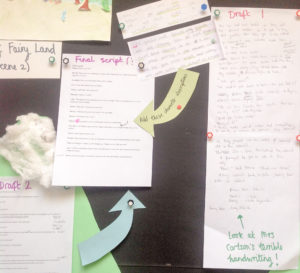

Create an area of the classroom which is dedicated to and celebrates the skills of reviewing and improving. Set aside a table in the classroom, and equip it as if it were an office – writing equipment, computer, office chair etc. This is called the ‘Editor’s Desk’, which is set aside for a student to use when they are in editing, drafting, redrafting, correcting or improving mode.
Construct checklists with students itemising the important things to check before they consider something is finished. Here’s just one example: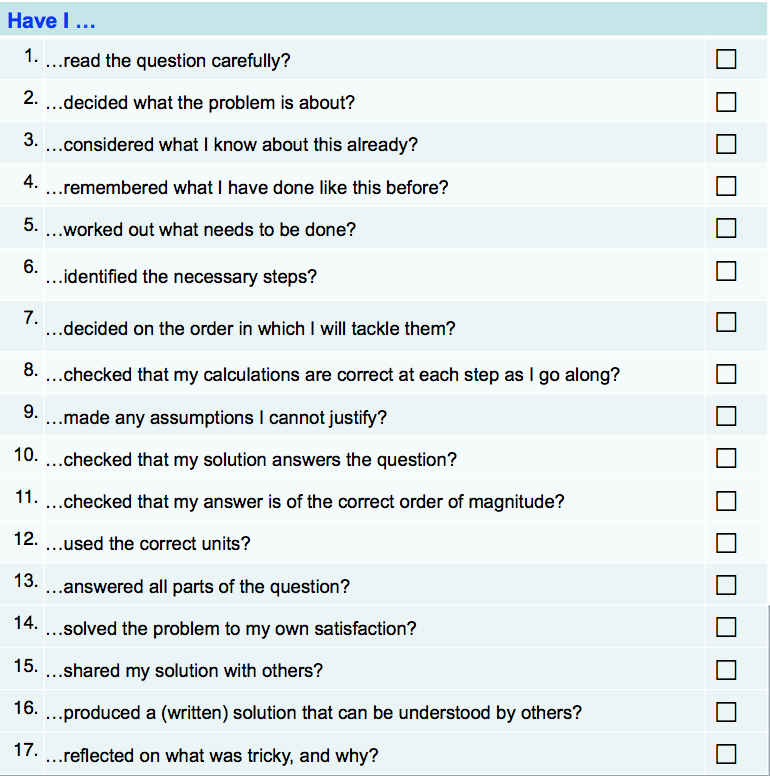
How you might extend the language and understanding of this behaviour


Collect words that describe what a good reviser does.How else might we talk about Revising? Explore well known sayings
Change tack
Think on your feet
Fine tuning
Back to the drawing board
Keep an open mind
Use a quick starter to key students into the learning behaviour you want to concentrate on in the lesson. i.e. here you are starting up the revising ( Re-thinking) behaviour
Use Optical Illusions to remind students that once we have seen something from one perspective, it is hard to change our minds and see it/think about it differently.

This type of lesson starter readies students’ minds for adjusting their point of view, changing their mind or revising their ideas.
The technique, of gradually revealing an image, in this case through the picture of a dog leaping over First World War trenches, can be applied to any image where there is some kind of unexpected juxtaposition of conflicting aspects within the same picture.
The purpose is to draw students into speculating about various parts of the image before revealing the full image. This will necessarily require them to revise and build on their first impressions. The underlying message is that new information often forces us to change our original understandings.

Use an appropriate thinking routine to practice the behaviour.
I used to think . . . . . Now I think.
This routine helps students to reflect on how and why their thinking/understanding is changing.
Remind students of the topic you have been working on. Ask them to respond to each of the sentence stems: I used to think…, Now, I think…
Alternatively ask students to write down their views at the beginning of a topic. Invite them to revisit & update their answer during and at the end in light of what has been learned.
Or, at the beginning of a lesson ask students to write down what they understand by a particular term that will be explored in the coming lesson (e.g. Phrase (English); Proof (Maths); Power (Science) etc). At the end of the lesson, ask them to write down what they now understand by the term.
Read more on the VTR website
Develop classroom activities that put the behaviour centre stage, helping students to understand the content by using the behaviour i.e. revising.
Use this activity to demonstrate how opinions and hypotheses change and are revised as more information becomes available. Underline the importance of speculative thinking that is unlikely to be right first time. Divide into groups of three or four. Deal out one stanza of a poem to each group. DO NOT REVEAL THE POEM’s TITLE! Explain: The group has to make assumptions about what they are reading based on the limited information they have. Ask groups to: Next, exchange stanzas with another group Repeat the process about four times. Run a formative plenary: What do we know so far? Now issue all groups with the complete but cut up poem and ask students to work towards a sequence that makes sense. Extend understanding of revising by exploring; We have found Mushrooms by Sylvia Plath a useful poem to start with. Download it in cut up form here Learning mats are A4 laminated sheets that show various aspects of a learning habit. Keep them on desks/tables or as part of a wall display. Use them during lessons as prompts to promote use. Refer to them at the end of a lesson to assess which were used, which worked and why. The Rating Wheel describes an expert ‘Reviser’. Use the wheel as a reflection tool for students to consider which skills they know about, which they have used and which might need improvement. An activity that enhances content understanding by using the behaviour
Per-verse
 DIY
DIY6. Reflecting on Revising
Primary
Make reflecting on Revising behaviours part of everyday lessons
Secondary
Getting a handle on excellence
Primary and Secondary
What do you think?
Make a note of…
NB. None of the suggestions above will lead to instant understanding in students nor instant changes of behaviour. You will need to drip them in over time and keep building and refreshing your language of learning.
Building Learning Power is about creating a culture in classrooms – that systematically cultivates habits and attitudes that enable young people to face difficulty calmly, confidently and creatively. By a ‘culture’ we mean all the little habits, routines and practices that implicitly convey ‘what we believe and value round here’.
So ‘culture’ concerns the details of the micro-climate that you create in your classrooms. What you do and say, what you notice and commend and what you don’t, what kind of role model of a learner you offer – all these are of the essence. The micro-climate of a classroom can inadvertently stifle, or specifically enhance, the very behaviours you are seeking to promote.
Here is a selection of features which might begin to shape the emotional climate of the classroom to encourage revising.
Apply your own attentive noticing and consider whether you already use any of these features and which you fancy trying.