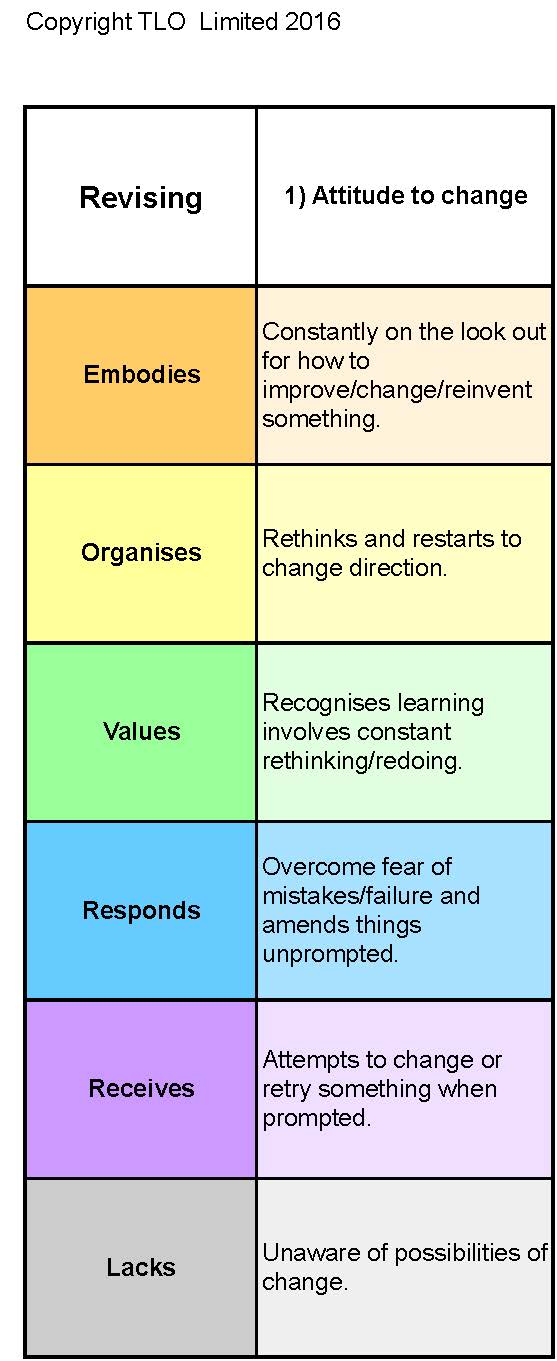
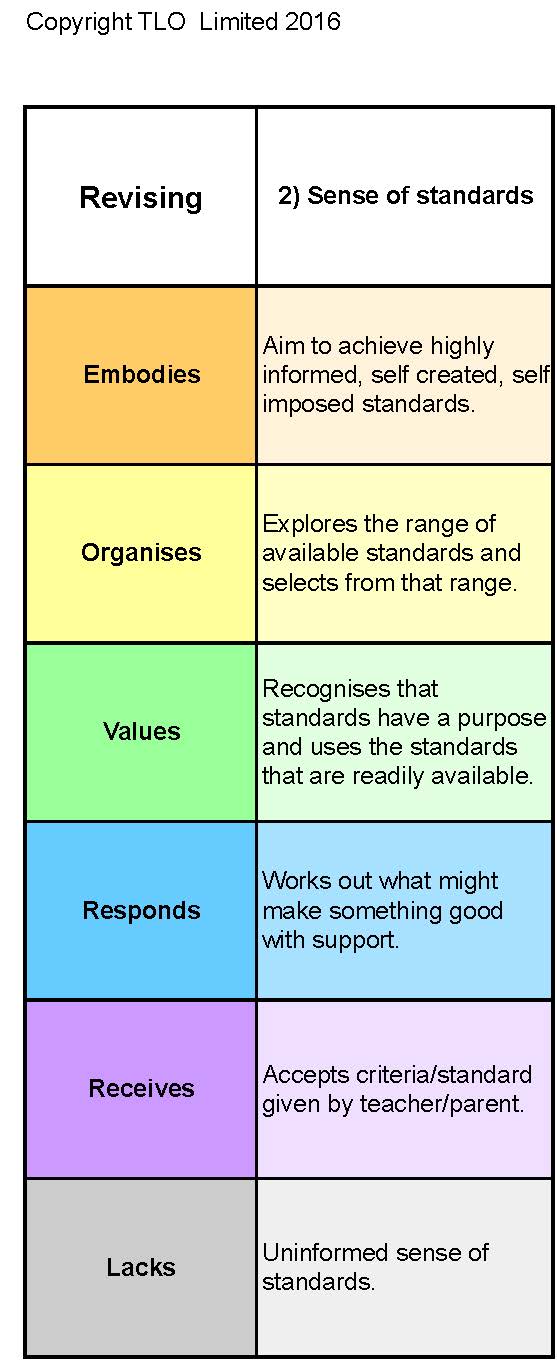
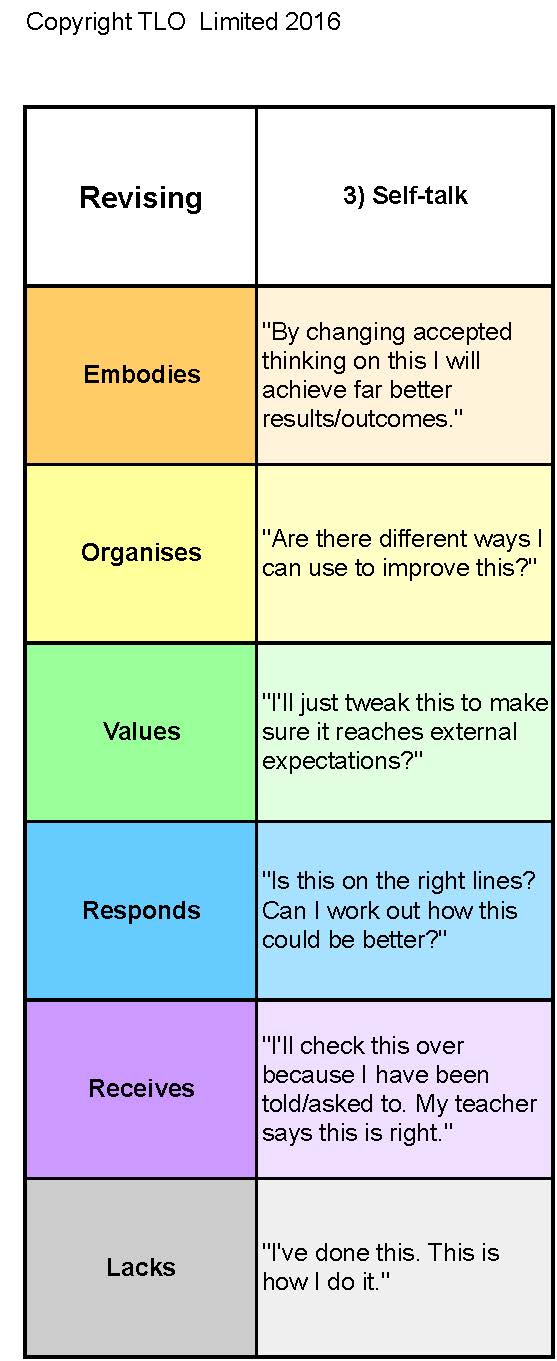
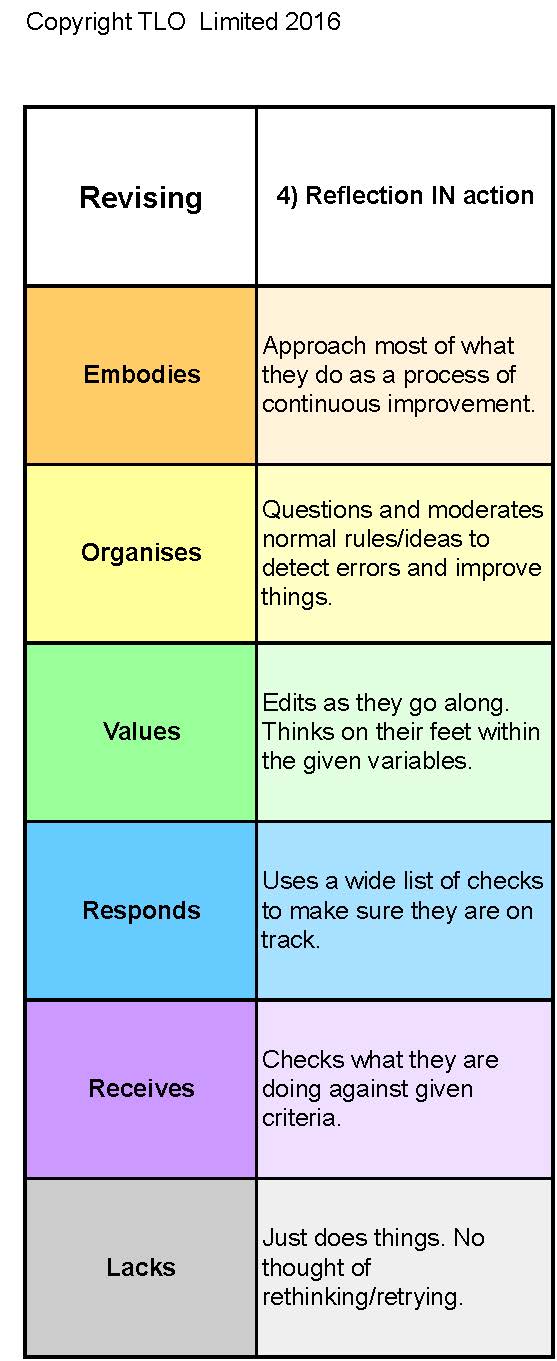
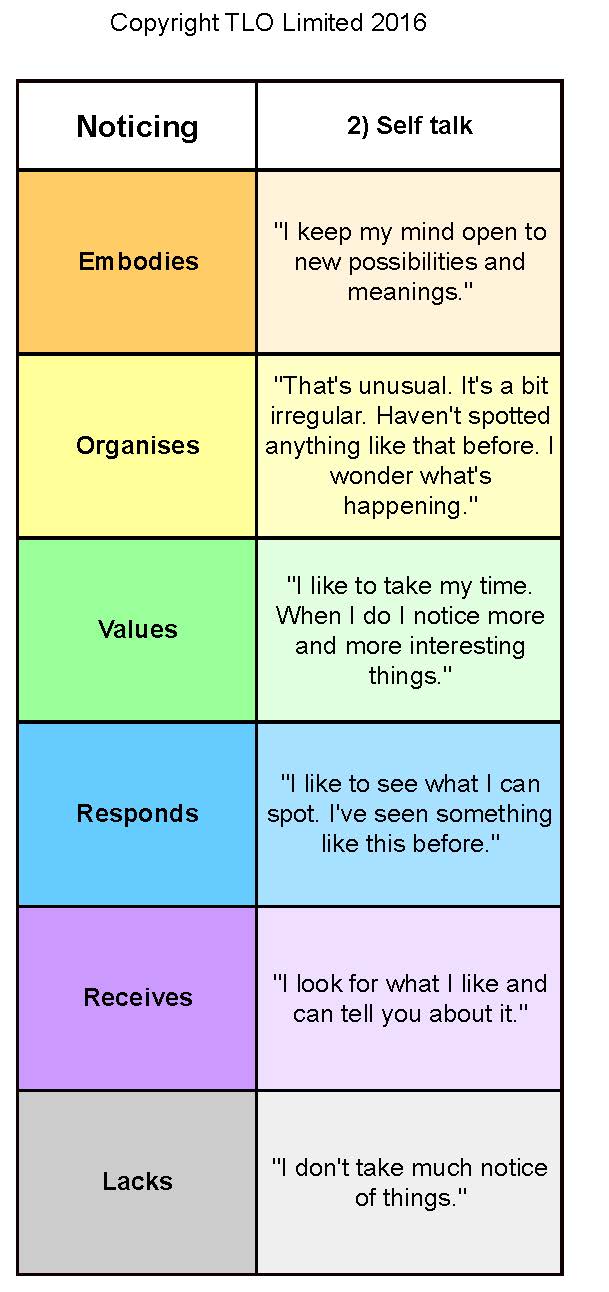
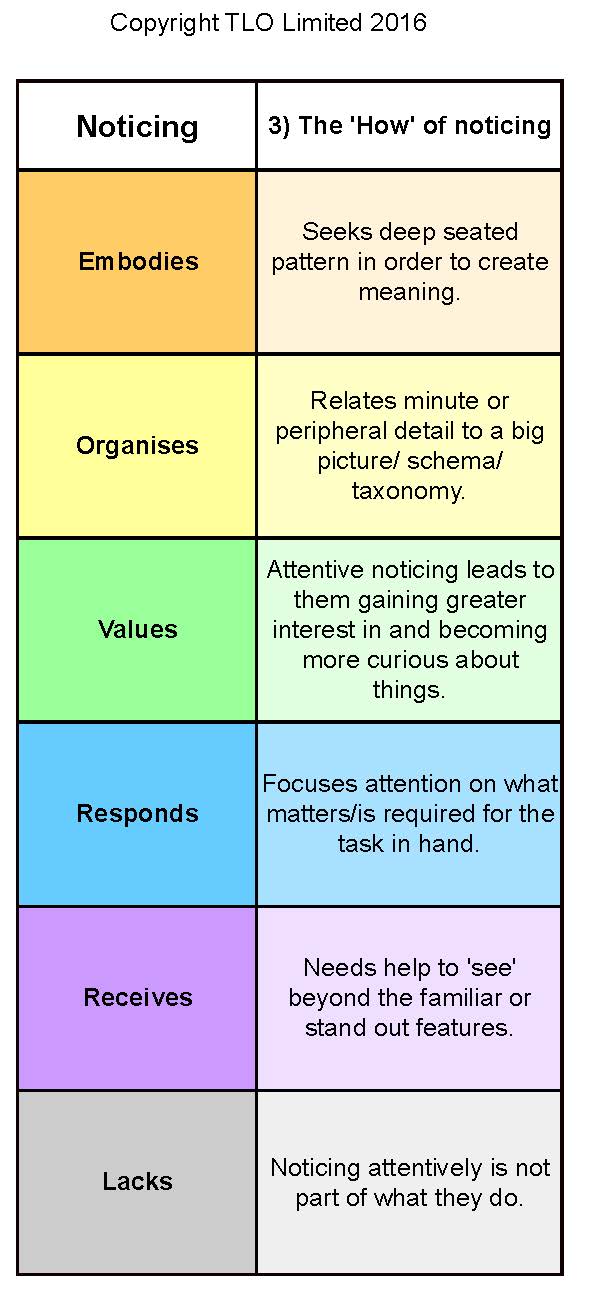
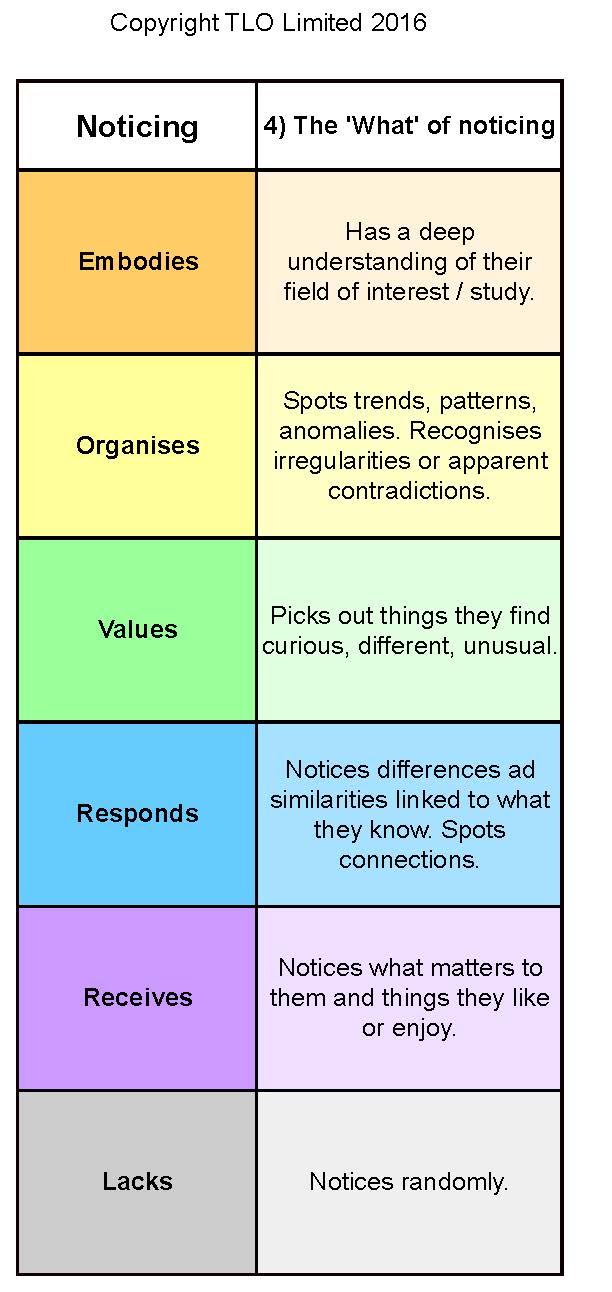
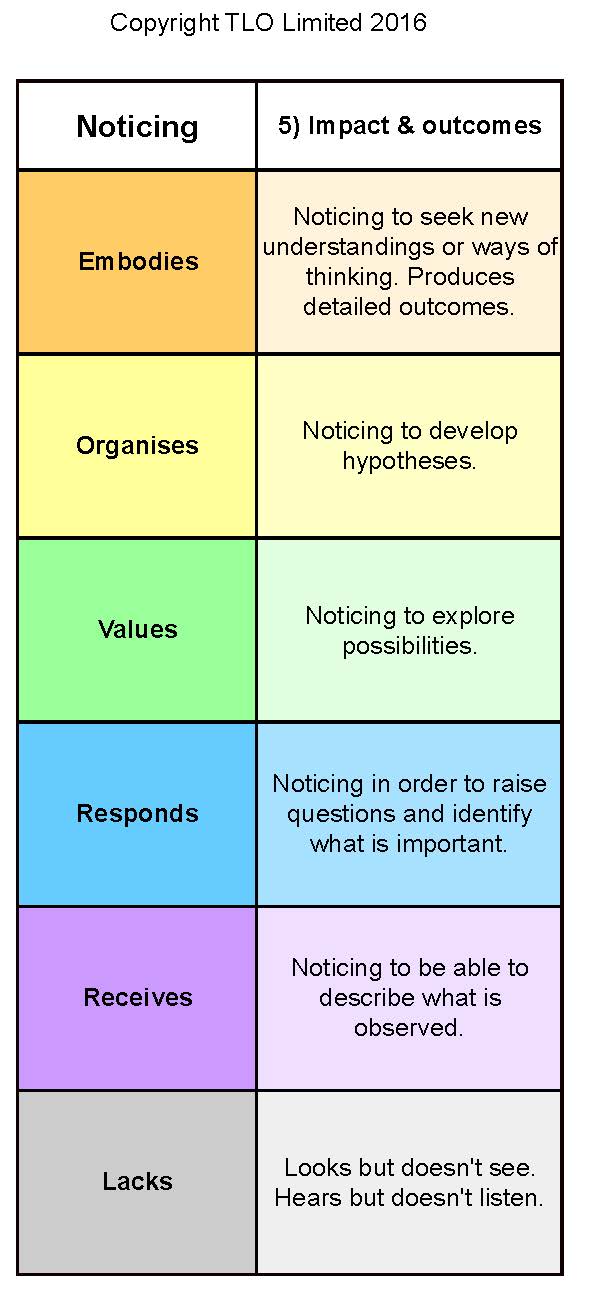
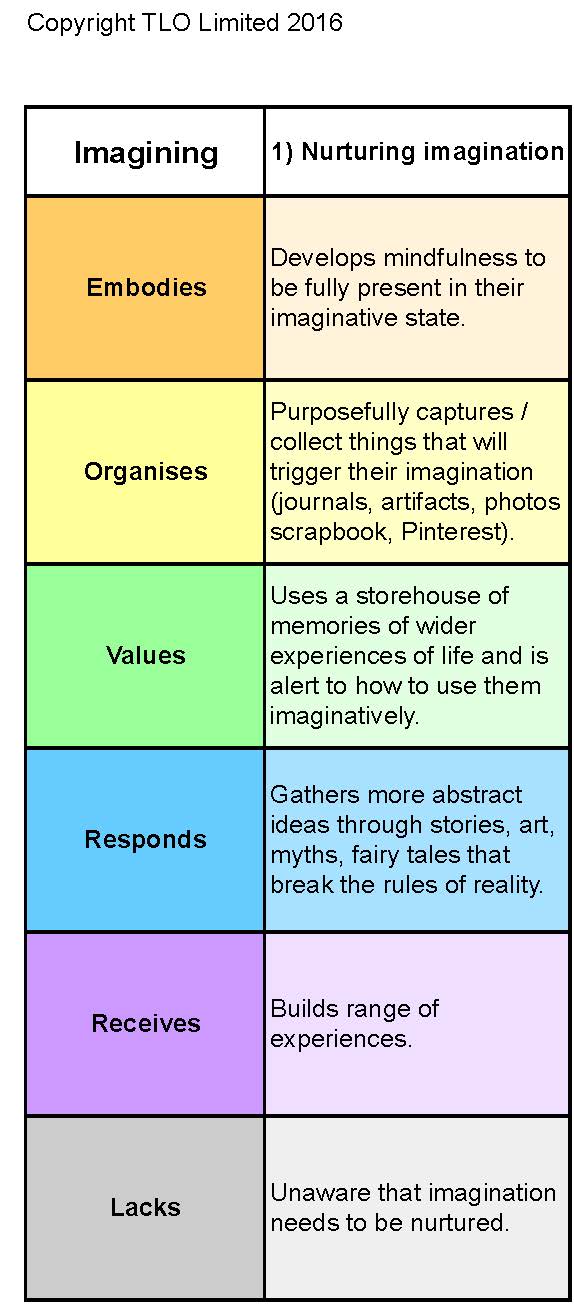
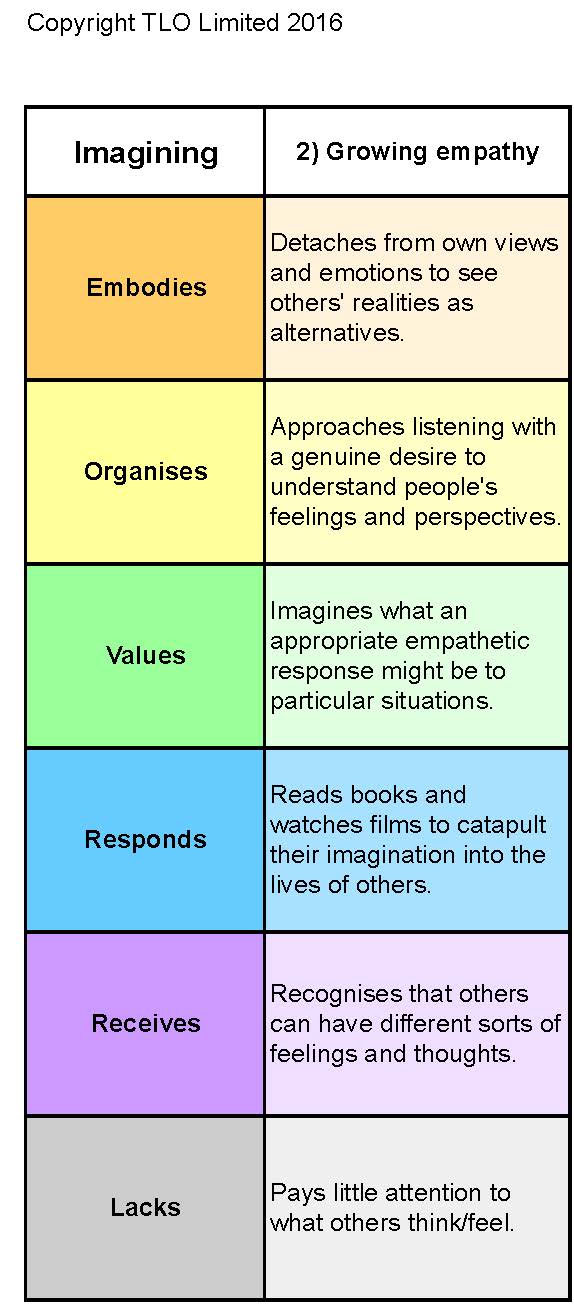
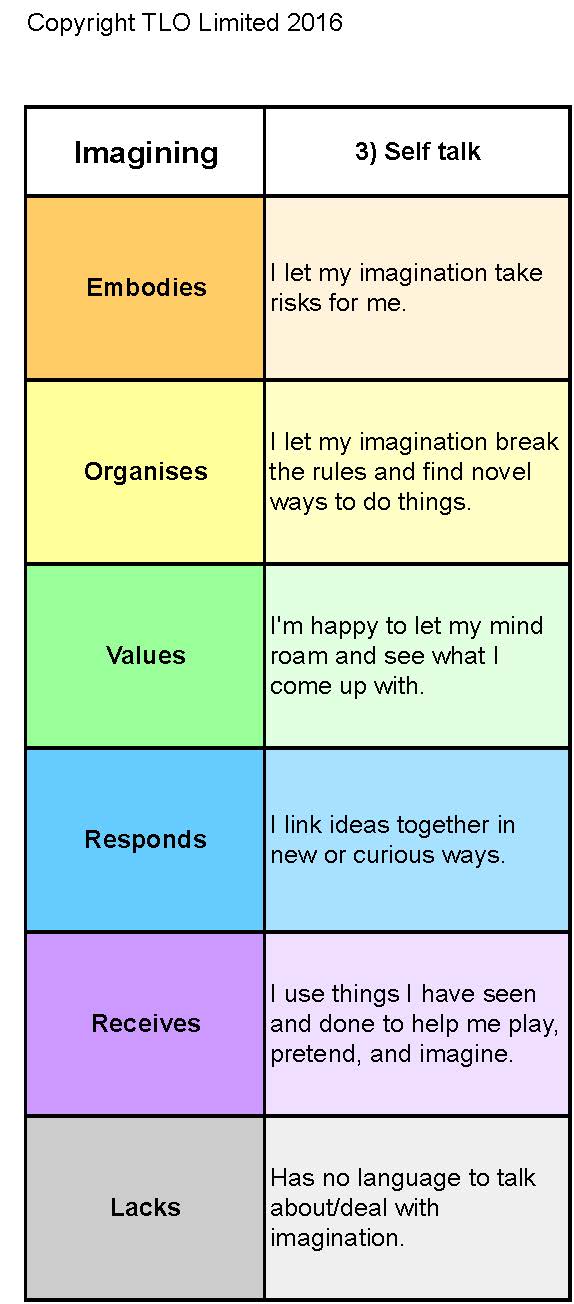
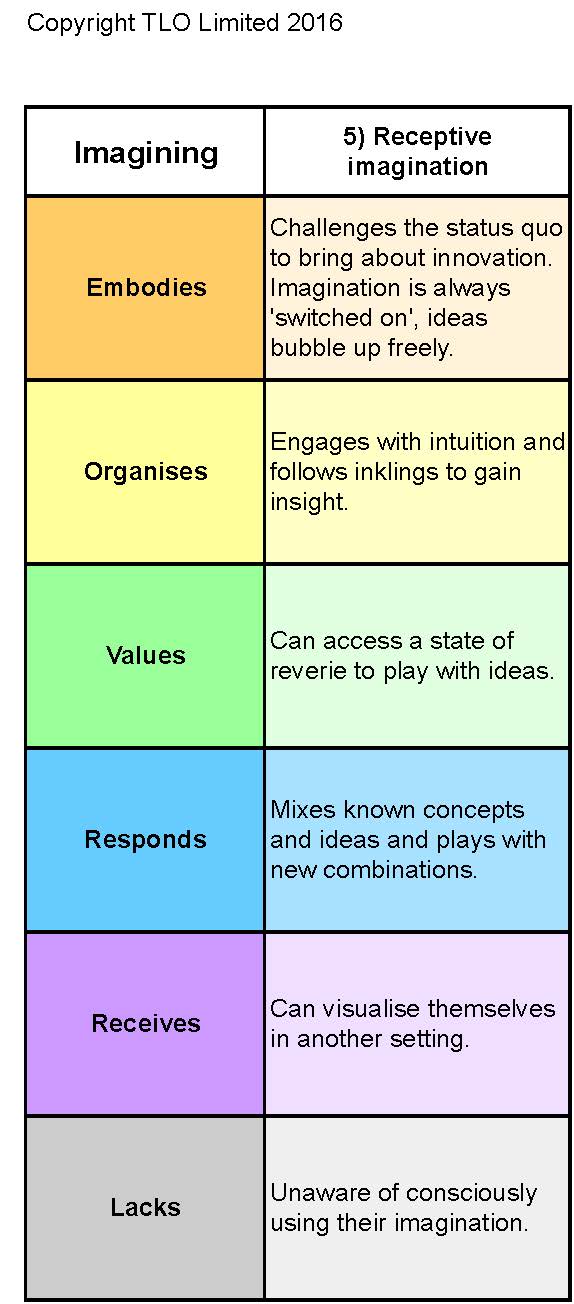
As teachers we are in the habit-forming business. What we say, what we display on classroom walls, what we celebrate, praise or dismiss, what we model or how we design learning activities will all influence the ways in which students learn, perform and behave. Classroom cultures have a huge influence on students’ learning as you will remember from the Culture unit.
Five big shifts to get you started. Ask yourself – how might you:
Encourage students to choose their own resources;
Enable students to choose which learning strategy they will use;
Harness display to celebrate successful learning strategies;
Promote greater choice, self-reliance and independence;
Alert students to the successful strategies of others.
Now look at the Learning Chart sections below where you will find plenty more ideas to try.
In the early BLP framework, it is called capitalising. It’s about being on the lookout for strategies, materials, resources and forms of support in the environment that can help you in your current learning or problem-solving. Traditional schooling assumes that intelligence is all in the head. But recent studies show that it is much fairer and more accurate to see good learners as people who are ready and able to make intelligent use of all kinds of strategies and things around them—floor space, filing cabinets, dictionaries, notebooks, personal organisers, telephones, libraries, e-mail; and, of course, other people.
1b) What does being a good Resource Learner involve?
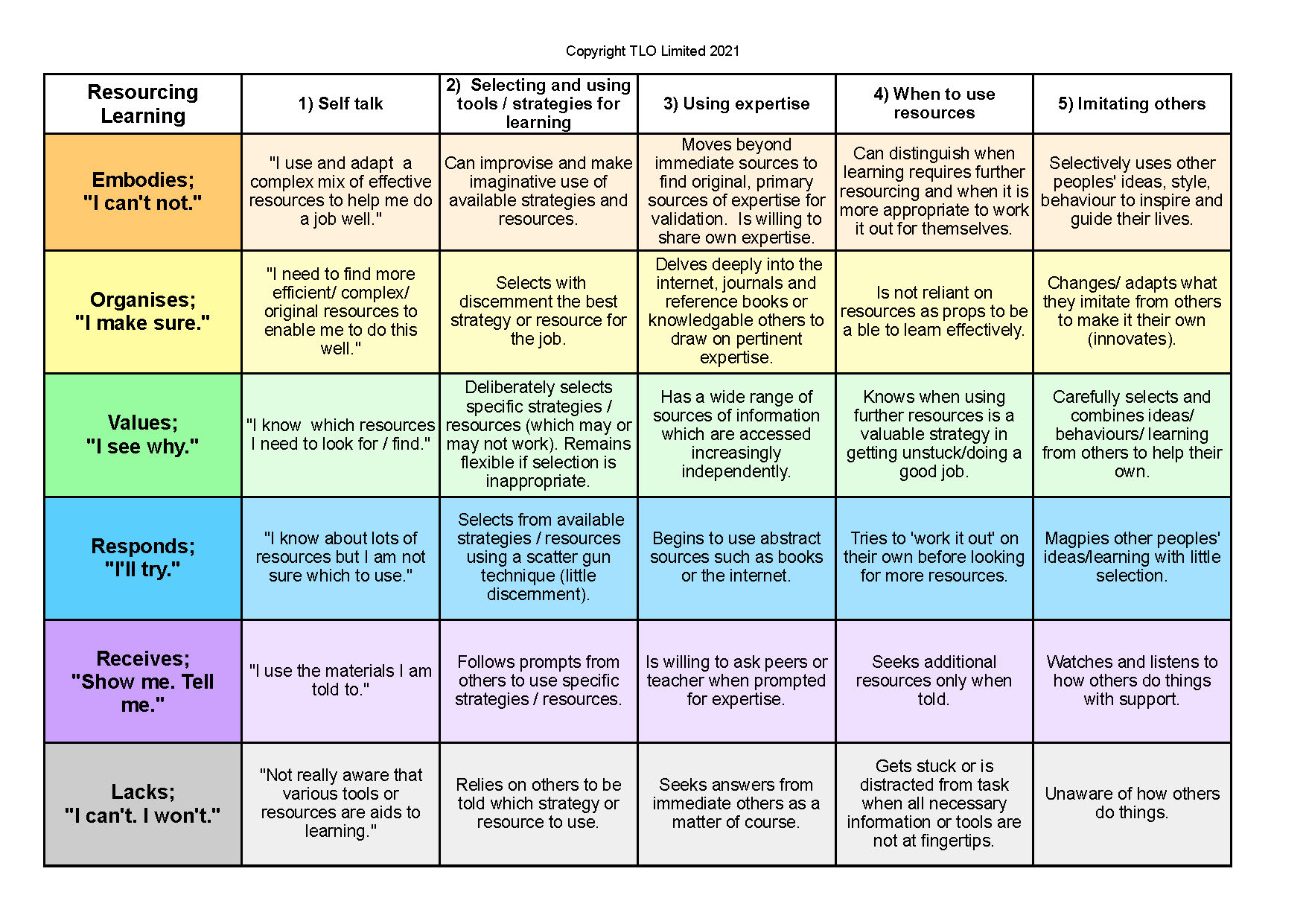
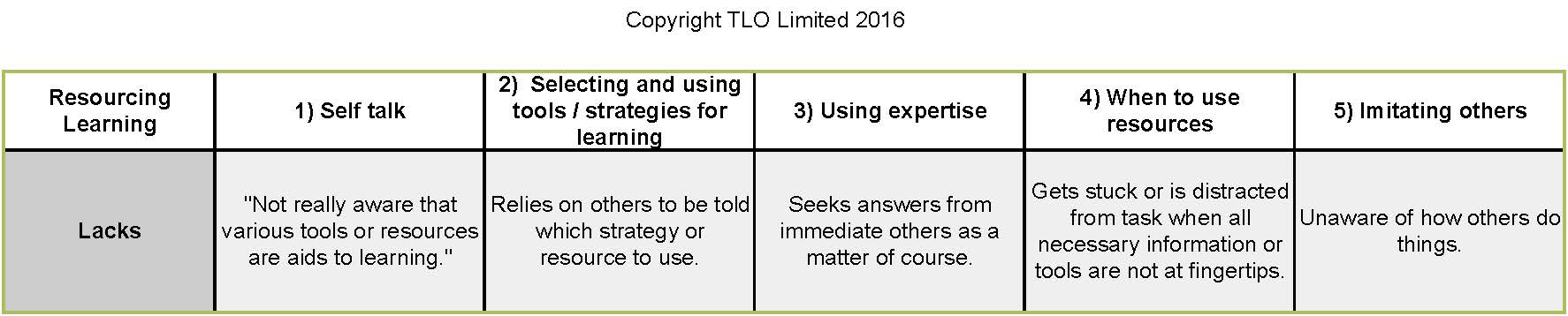
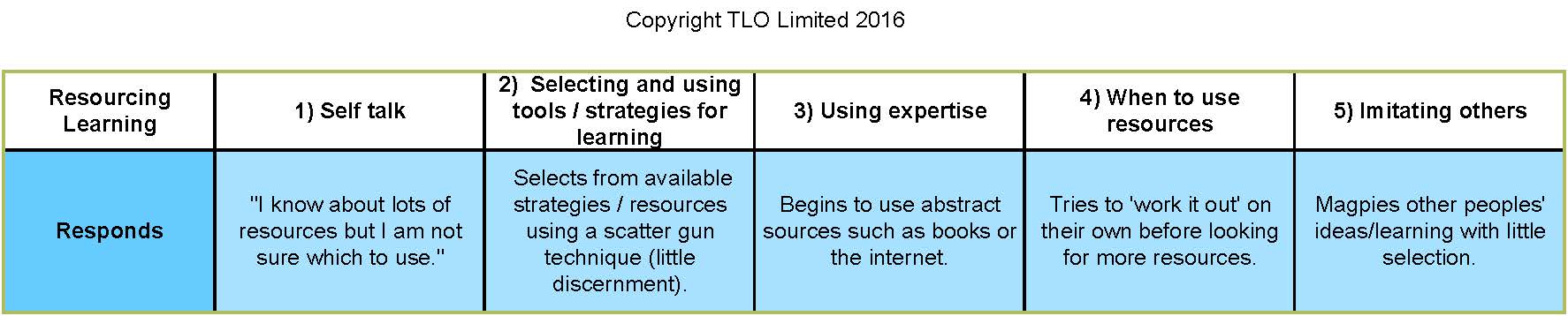
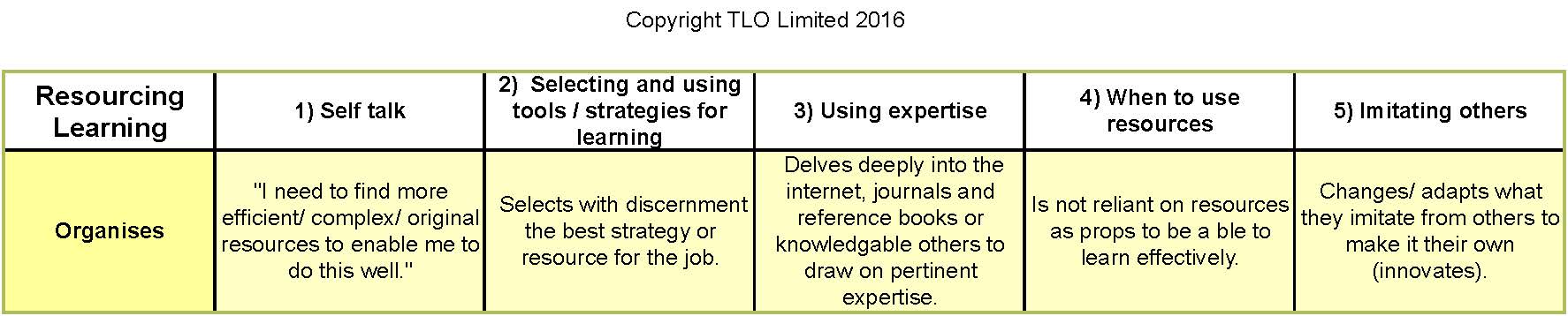
Being a good resource learner involves learning with the help of many different sources –other people, books, the internet, music, the environment, experience…and making intelligent use of all kinds of strategies and things to aid learning. In the early stages, it means selecting and making the best use of known strategies and classroom resources but this swiftly moves on to embracing a much wider and varied range of possibilities. This involves being able to seek novel ways of solving problems by exploiting the potential of known strategies and what is around them including things you may never have thought of as a resource. Importantly it includes being able to adapt and adopt the ways other people do things; taking their habits and values into your own repertoire (imitating). Gradually students can improve their physical skills, absorb ideas and thinking patterns by observing the approach and detail of how others do things. When looked at from these diverse angles, growing resourcing moves well beyond encouraging a student to ‘read pages 24 and 25’.The Resourcing Learning grid below takes account of the constituent parts of building the habit of Resourcing Learning
Our progression grid for Resourcing Learning has 5 components:
1c) Unpicking the columns; what contributes to a readiness to Resource Learning?
The grid columns are things that might combine to make up the skills and attitudes of a learner who uses resources effectively
The grid for resourcing learning covers how pupils might progress in the skill and habit selecting and using strategies and resources to help their learning. It covers how pupils grow in the selection of tools for learning, moving from a scatter gun approach to being able to select the best strategy / tool for the job. Using expertise from books or the internet and moving gradually to using original sources of expertise. Imitating others is covered in a column of its own showing how pupils might start with watching others for clues and moving towards selectively using others’ ideas to guide their own lives. But one column is devoted to being aware of whether it is needed at all to guard against the danger of resources turning into a prop which the pupil relies on too heavily
Take a closer look at what each column of the grid is about
Self-talk
The voice of self-awareness
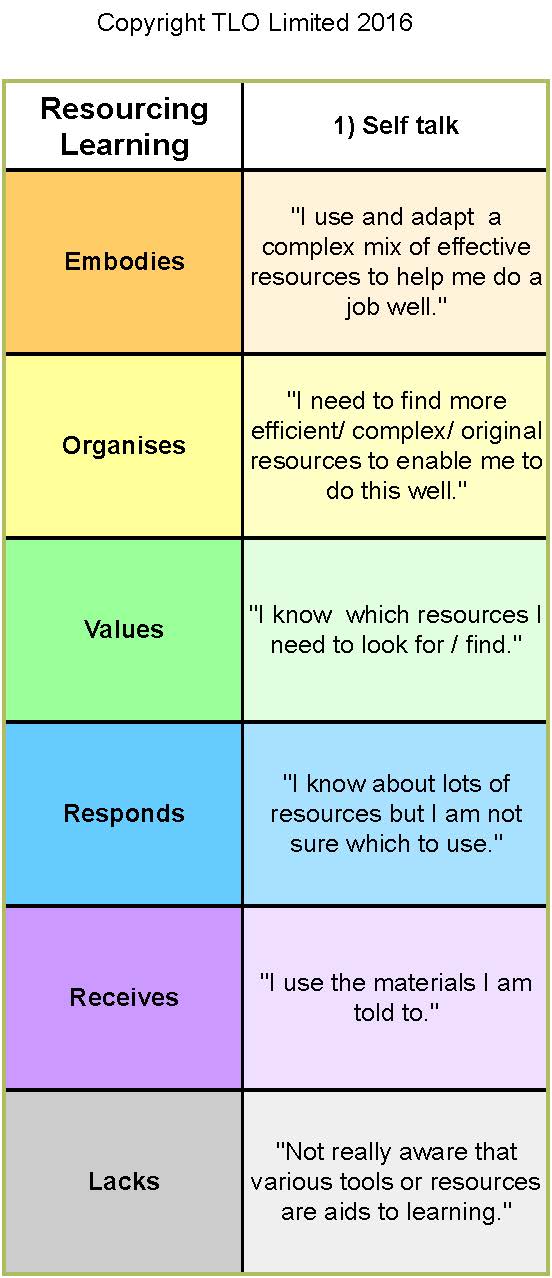
Self-talk is what we say to ourselves as we learn. The statements capture what someone in each phase of the grid might be thinking. Students may use some of these phrases when talking with you, or in writing from time to time, but mostly self-talk goes on inside their heads. We have shown a small flavour of self-talk thoughts that teachers can encourage students to imitate. Some relate to setting about learning, others to talking through which learning methods or resources might be useful, and others to monitoring and evaluating the learning being used. All such self-talk is important in building a Resourcing Learning habit.
Selecting and using strategies and tools for learning
How we build expertise in finding and selecting strategies and resources
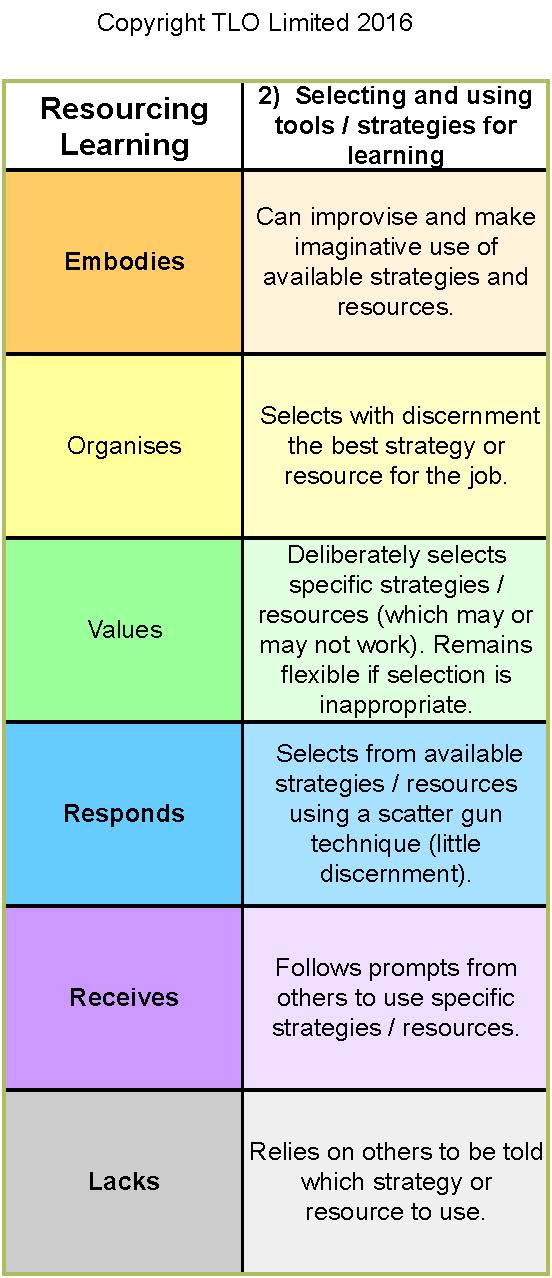
The first contributory factor in Resourcing Learning is about how students move from relying on others to provide strategies and tools to help them learn to being able to choose from a selection and on to being able to find their own strategies and tools and finally to use familiar strategies and resources imaginatively to broaden their effect.
Using expertise
How we broaden our use of sources of expertise
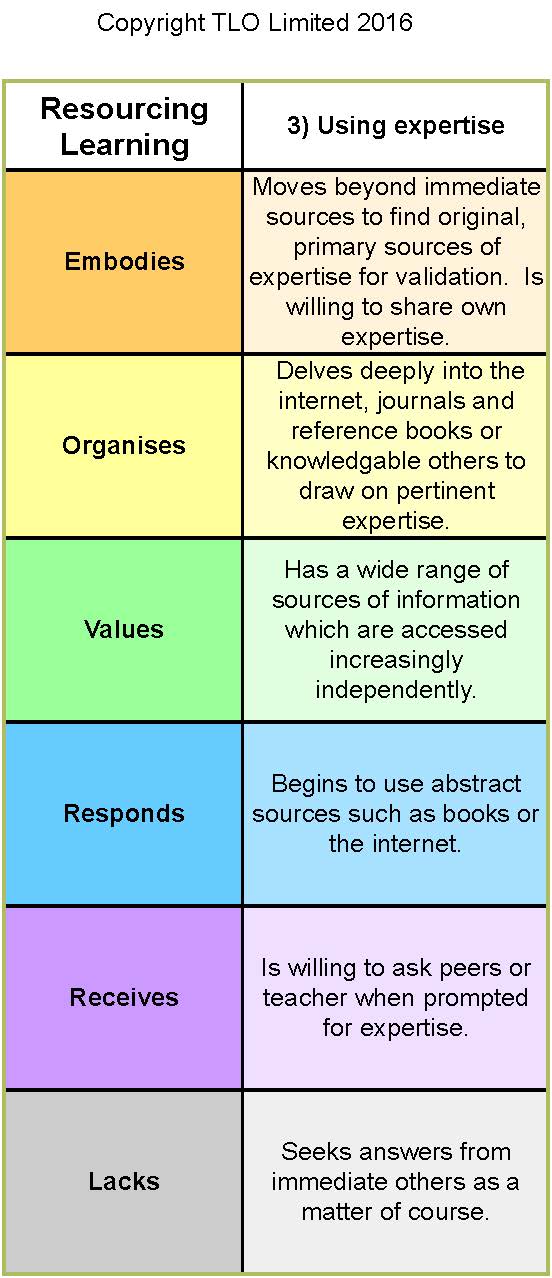
The second contributory factor in Resourcing Learning is about our use of expertise. Our first understanding of expertise may lie with people we know; we ask for information about what and why etc. But we move on to realising that there are other sources of expertise to be found in books and on the internet for example. This broad range of expertise must be used with care and discernment and moves on into more specific and complex realms. There’s a real skill to finding and being able to use high-level expertise. From this effective use of expertise we might become expert ourselves and share our understanding with others.
When to use resources
Distinguishing between resources and props
This column has been included as a bit of a caution. It’s about students being able to recognise when a resource is needed and when they could indeed work something out for themselves. There are times when learning resources become learning props; when students come to rely on them and can’t move on without them. Of course, this doesn’t happen with every subject but there comes a time when the contents of learning walls and visual prompts have to become part of a student’s understanding. Eventually, a person’s own expertise enables them to learn well from themselves.
Imitating others
Our inclination and ability to learn from others
We are all hard-wired to learn by imitating others. This is something that can be used wisely or inappropriately. In this column we explore how this moves from being unaware of how other people do things to using people’s ideas and values to help guide our own lives. The important ideas going up the column are; watching and listening; ‘magpieing’ but with little selection; selecting and combining; changing and adapting (innovating). So this is not straight copying, it’s about being stimulated by using others’ ideas but making them fully your own. It’s a valuable trait that can be transformed into an essential skill/habit.
What do you think?
What have you learned about Resourcing Learning from these descriptions?
What have you had confirmed?
What surprised you?
How have your views changed?
Make a note of…
Any ideas for practical classroom experiments that these descriptions have triggered
Which column your students are most secure in.
1d) Unpicking the rows; getting better at Resourcing Learning.
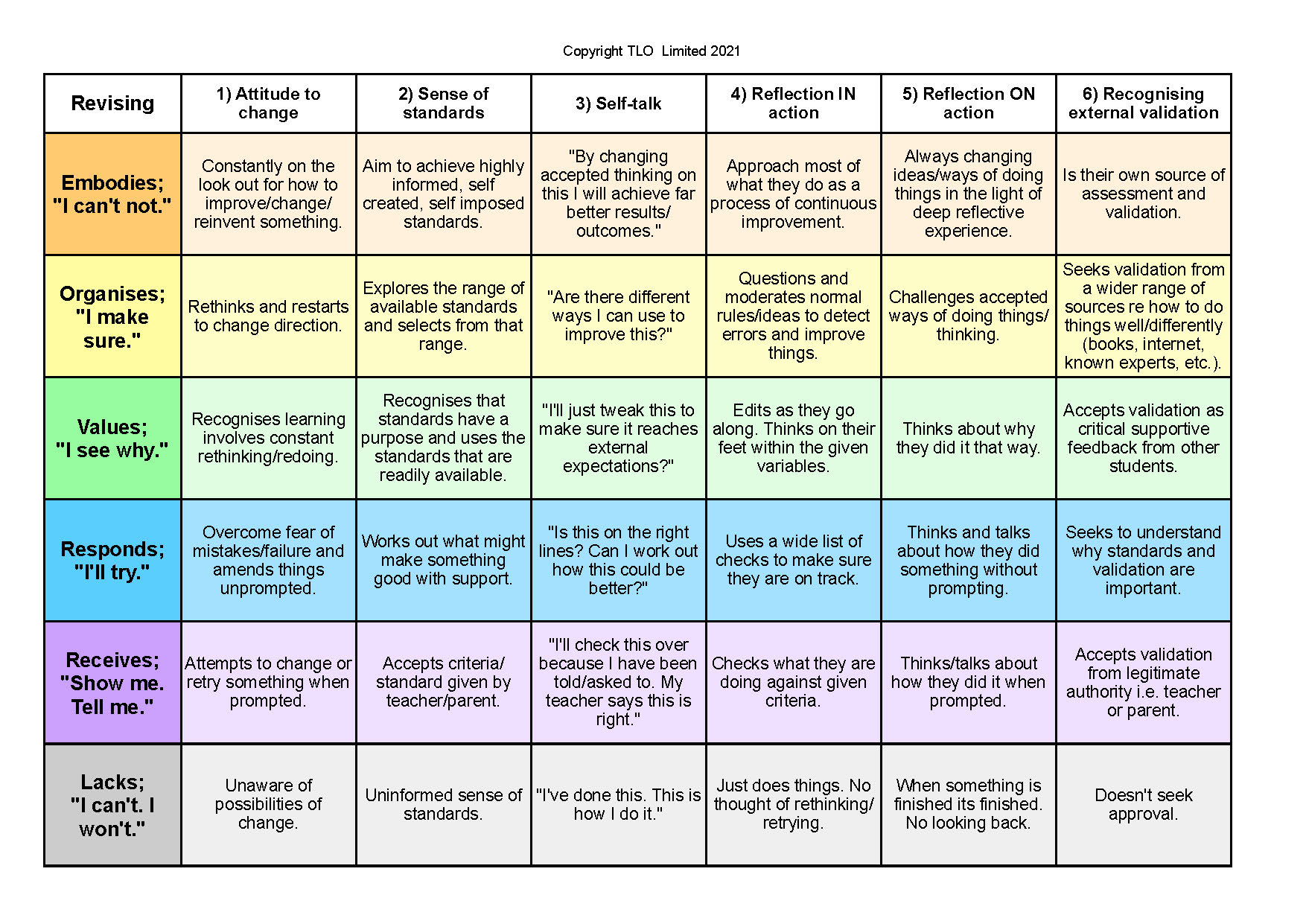
Of course, the development of Resource Learning doesn’t grow neatly up each column or evenly across the phases in the grid. The five broad phases of dispositional growth (purple – orange) are affective ways in which people may be inclined to behave: we call this inclination ‘mindedness’.
Here is our interpretation of how Resource Learning might grow.
The phases are drawn from Bloom’s taxonomy of the affective domain.
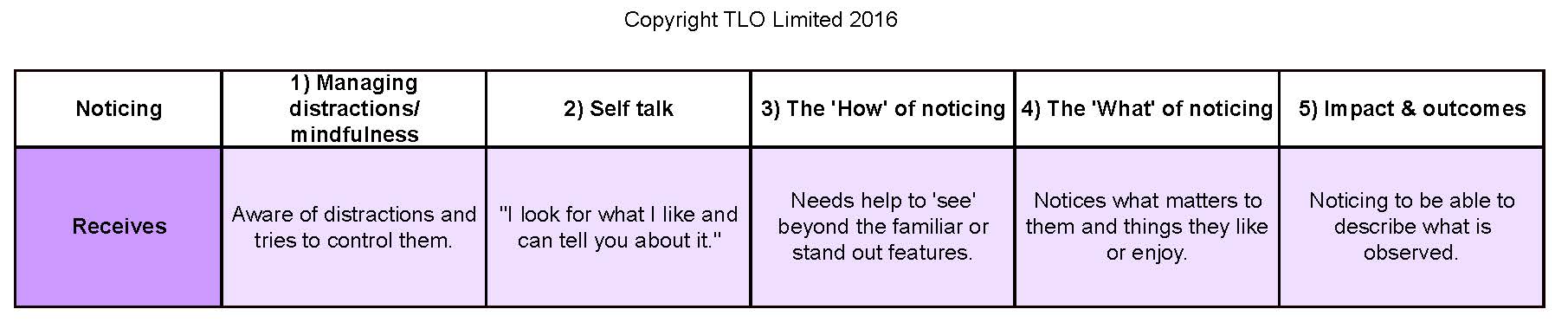
Phase ‘Receives’ (purple) is about doing something because you are told or expected to.
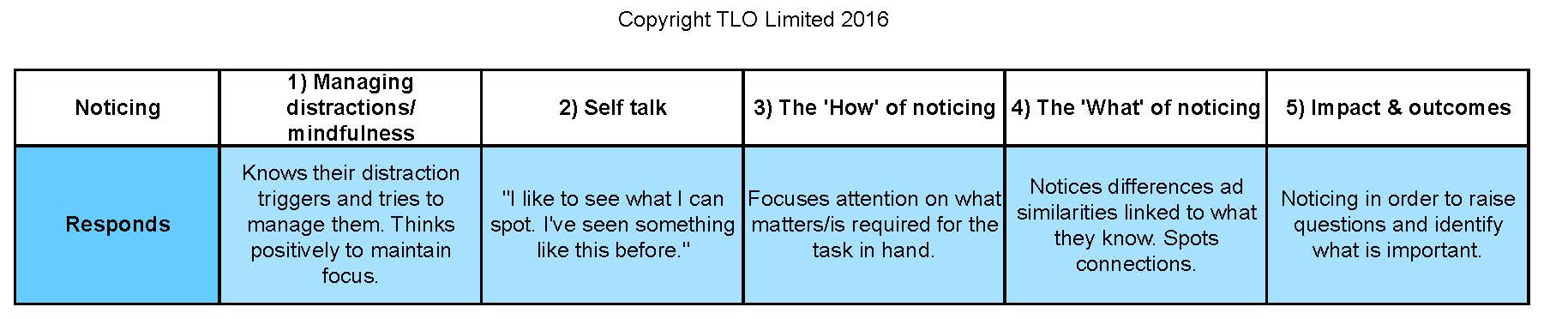
Phase ‘Responds’ (blue) is about gaining interest and doing things more willingly.
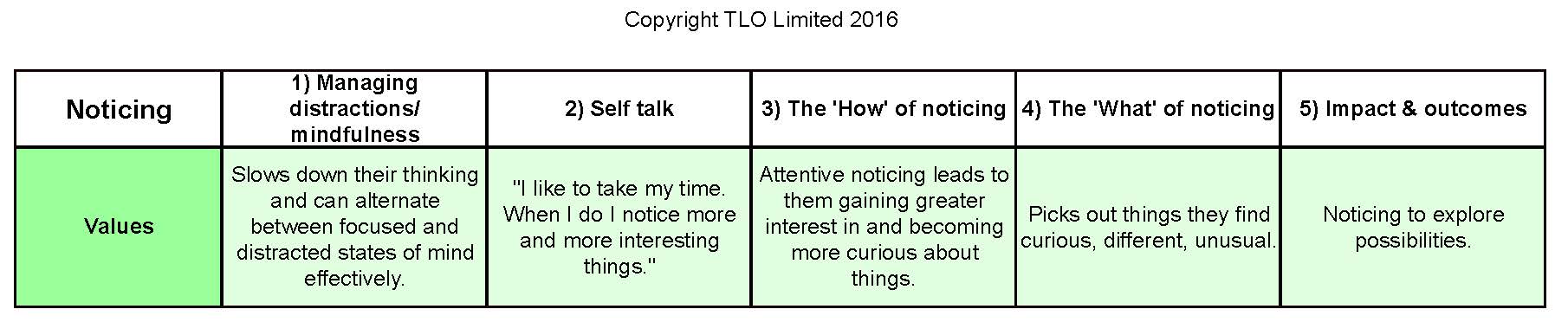
Phase ‘Values’ (green) is a key phase since the student now sees the value of behaving in this way. It’s a win for them; to behave like this is in their interest. It’s in this phase that the behaviour becomes more secure.
Phase ‘Organises’ (yellow) is the phase in which the student capitalises on this ‘in their interest’ behaviour and gets themselves organised to use it positively.
Phase ‘Embodies’ (orange), known as ‘characterised’ in the original taxonomy. In this phase, the student has made this behaviour their own. It has become part of their character; they can’t not do it and they have become highly skilled in doing it.
We urge you to see this progression as long term. Some phases will take years for people to work through; some will never be worked through. None of the phases are inevitable. There is a lifetime of development captured here. Nevertheless, the role of a teacher or parent should surely be to encourage and enable this journey.
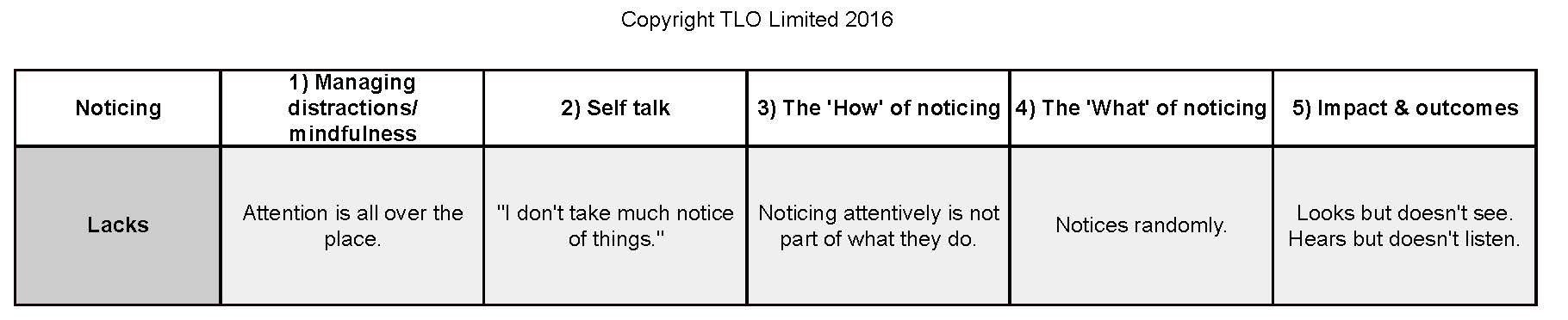
Lacks: Minded to ‘just do things’
In this ‘Lacks’ (grey) phase, students are not really aware of using strategies or resources for learning. They will use strategies and things that are around but don’t view them as something that helps them to learn. The concept of a resource for learning or a learning strategy is not yet formed.
Receives: Minded to use resources they are given and the strategies they are told to use
In the Receives (purple) phase, students begin to use the things and strategies they are given to help with their learning. The concept of resourcing learning is beginning to form. They become aware that it might be useful to watch and listen to others and that this can be useful in their own learning. They see their teachers as a source of expertise and can become too dependent on this unless supported to broaden their range of strategies and resources.
Responds: Minded to use a wider range of strategies and resources.
In the Responds (blue) phase, students have become aware of many classroom strategies and resources although have yet to learn to select them carefully for a specific need. They now begin to use other sources of expertise such as books or the internet but again their approach lacks precision.
Values: Minded to broaden the range of Learning Strategies and Resources.
In the Values (green) phase, students are fully aware of the purpose and usefulness of different strategies and resources. Here they become more skilled in selecting the right one for the job in hand. They become more skilled in using expertise and they know when they need other strategies or resources to help them further. Importantly they now select ideas or behaviours from others and combine these with their own to make/achieve new understandings.
Organises: Minded to deepen their use of Learning Strategies and Resources.
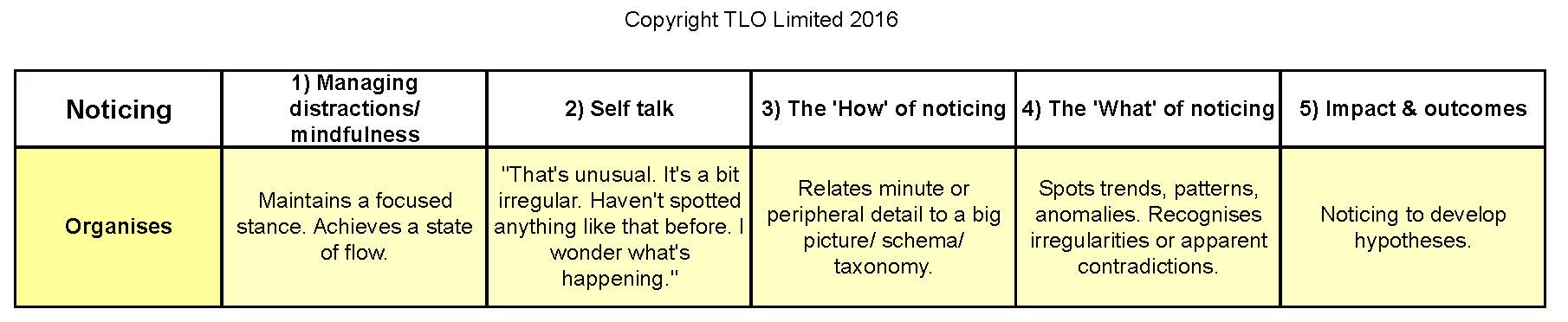
In the Organises (yellow) phase, Resourcing Learning has become a skilful habit. Now students are able to select the best strategy or tool for the job, delve deeply into pertinent sources of expertise and know when they can work things out for themselves. When imitating others they can adapt others’ ideas in an innovative way thus making a unique result.
Embodies: Minded to exploit learning strategies and resources to the full.
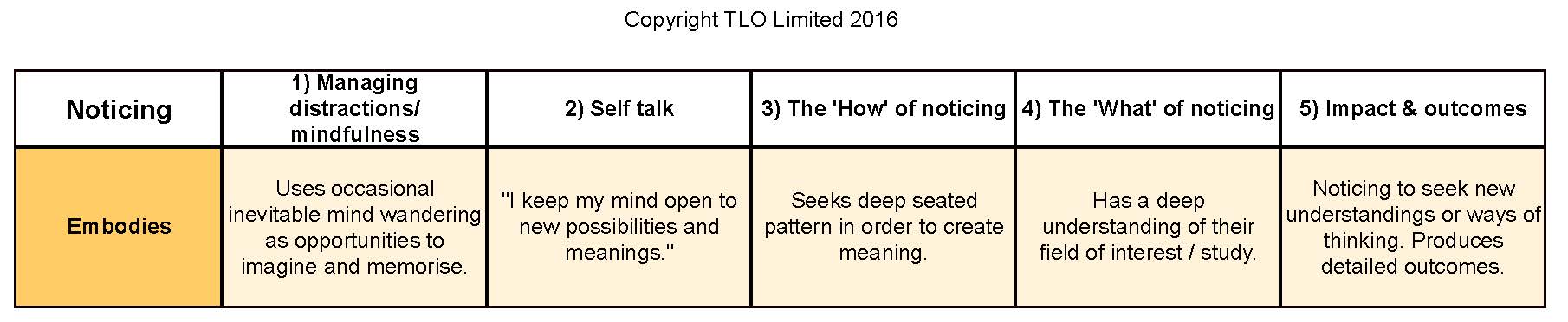
In the Embodies (orange) phase, people have become expert at finding and using appropriate strategies and resources. They can use a wide range with real expertise and can use these imaginatively to bring about different results. They now use original sources in search of validation of their ideas or to form new knowledge. They have acquired enough skill, knowledge or expertise to become an expert themselves, and their drive for expertise may be inspired by the vision, values and ideas of significant others.
What do you think?
What has struck you about the act of Resource Learning having read the descriptions above?
Which phase do you operate in?
What makes you say that?
Make a note of…
What you might do to assist your students to make headway in their Resource Learning behaviour.
Any practical ideas the text has triggered.
Preparation for the Learning Team meeting
Where are my students now?
Take a look at the Resourcing Learning progression chart in your Learning Diary or
Colour in the cells where you think your students are secure.
Some will barely be on the chart while others may be quite a way up. Neat straight lines of secure behaviours are rare. But looking at your students in this way should give you an idea of what you need to work on.
Draw a red line across the chart to denote where you think most of the school’s students could and should reach by the time they leave.
Please take the results of these tasks with you to the Professional Learning Team session shown in Section 4
If you want to read again the notes on Professional Learning Teams, click on the view notes tab in this box
Professional Learning Teams: what and how
The purpose of these meetings is for the team to act as a teacher learning community or Professional Learning Team: a small group of teachers who meet together regularly to deepen their understanding of building better learners, commit to trying out new things, reflect on and share their experiments with each other. Such learning communities are the engines of teacher development. They work best with 6-8 teachers with similar subjects or age groups, and who meet for about an hour regularly over a period of a couple of years.
The group question and probe each other’s summaries of their experiments in order to encourage analysis and deeper reflection. They use questions such as ‘What do you think is getting in the way? What would make this even better? How could this technique be modified to make it work for you? What do you think made that happen? In this way they support each other in changing and developing their practice.
Some guidelines for team reflection sessions
The delicate, hard work of changing practice requires a safe professional environment in which to explore and understand both triumphs and tribulations. These short guidelines may be helpful in setting a climate for the team itself.
Everyone is expected to report back on their classroom experiments
Coaching questions and probes of colleagues’ classroom experiments encourage deeper reflection.
The group is careful to follow their agreed ground rules which might include;
No group member can ‘pass’
Listen between the lines when it’s not your turn
Actively discuss everyone’s input
Constructive criticism – developmental not judgemental
Everyone fully engaged in the group •What is said is confidential to the group • Respect others’ views and encourage others’ ideas
IGNORE THIS SECTION – WE CAN DEAL WITH IT LATER ONCE QUESTIONING IS COMPLETED
So far, you have:
Looked at your students through the lens of the xxxxxx learning chart
Gained a sense of what becoming better at xxxxxx looks like
Considered how you might make your classroom culture nurture xxxxxx
Now we look more closely at the issues and questions you need to consider in order to blend a xxxxxx approach to learning with the content you have to teach.
There are four aspects to consider;
Aspect 1: Questions and considerations for weaving xxxxxx into the curriculum or units of work.
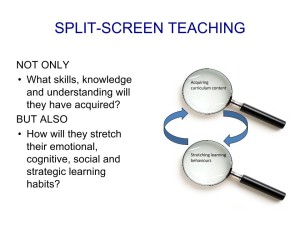
Aspect 2: Questions and considerations for putting xxxxxx into a lesson. A split-screen lesson.
Aspect 3: Questions and considerations for designing a task which uses xxxxxx to help students’ understanding.
Aspect 4: Analyse a split-screen lesson with xxxxxx in mind.
Does it help to identify the various learning behaviours that will be exercised in each episode of the lesson?
Can you see how the learning behaviours that are being triggered are a combination of the topic in hand (Creative Writing) and the activities that support it (Question Formulation Technique)?
Could you / Will you use this as a planning format?
Make a note of…
xxxxxxxxxxxxxxxxxxxxxxx.
????????????????????????????????????????????
We hope that you have enjoyed reading this material and that your Professional Learning Team session proves fruitful. You will receive a short feedback form within the next 24 hours for you to share your impressions of the Advance Organiser material with us.
As teachers we are in the habit-forming business. What we say, what we display on classroom walls, what we celebrate, praise or dismiss, what we model or how we design learning activities will all influence the ways in which pupils learn, perform and behave. Classroom cultures have a huge influence on pupil’s learning as you will remember from the Culture unit.
Five big shifts to get you started. Ask yourself – how might you:
Value and praise good questions as well as good answers
Make it safe for people to disagree…see it as an interesting situation from which to learn
Put enquiry mindedness on display…share your enthusiasms, display unfinished lines of enquiry
Develop open-end challenges
Build your lessons from intriguing questions
Now look at the Learning Chart sections below where you will find plenty more ideas to try
Colour in the cells where you think your pupils are secure.
Some will barely be on the chart while others may be quite a way up. Neat straight lines of secure classes are rare. But looking at your class in this way should give you an idea of what you need to work on.
Draw a red line across the chart to denote where you think most of the school’s pupils could and should reach by the time they leave.
Please take the results of these tasks with you to the Professional Learning Team session shown in Section 4
If you want to read again the notes on Professional Learning Teams, click on the view notes tab in this box
Professional Learning Teams: what and how
The purpose of these meetings is for the team to act as a teacher learning community or Professional Learning Team: a small group of teachers who meet together regularly to deepen their understanding of building better learners, commit to trying out new things, reflect on and share their experiments with each other. Such learning communities are the engines of teacher development. They work best with 6-8 teachers with similar subjects or age groups, and who meet for about an hour regularly over a period of a couple of years.
The group question and probe each other’s summaries of their experiments in order to encourage analysis and deeper reflection. They use questions such as ‘What do you think is getting in the way? What would make this even better? How could this technique be modified to make it work for you? What do you think made that happen? In this way they support each other in changing and developing their practice.
Some guidelines for team reflection sessions
The delicate, hard work of changing practice requires a safe professional environment in which to explore and understand both triumphs and tribulations. These short guidelines may be helpful in setting a climate for the team itself.
Everyone is expected to report back on their classroom experiments
Coaching questions and probes of colleagues’ classroom experiments encourage deeper reflection.
The group is careful to follow their agreed ground rules which might include;
No group member can ‘pass’
Listen between the lines when it’s not your turn
Actively discuss everyone’s input
Constructive criticism – developmental not judgemental
Everyone fully engaged in the group •What is said is confidential to the group • Respect others’ views and encourage others’ ideas
3. Recapping on-line materials. What did we think of the materials? ( 15 mins)
Thoughts about;
The Collaboration grid
Share where students are secure
The phase students could aspire to feel secure in before leaving the school
Ideas for activities and routines.
4. Planning what to do. What do we need to do next? ( 10 mins )
Decide
Which ideas should we all adopt as whole school strategies?
How the progression of Collaboration should be built across the school. ie how the phases of Collaboration might play out against key stages and even year groups.
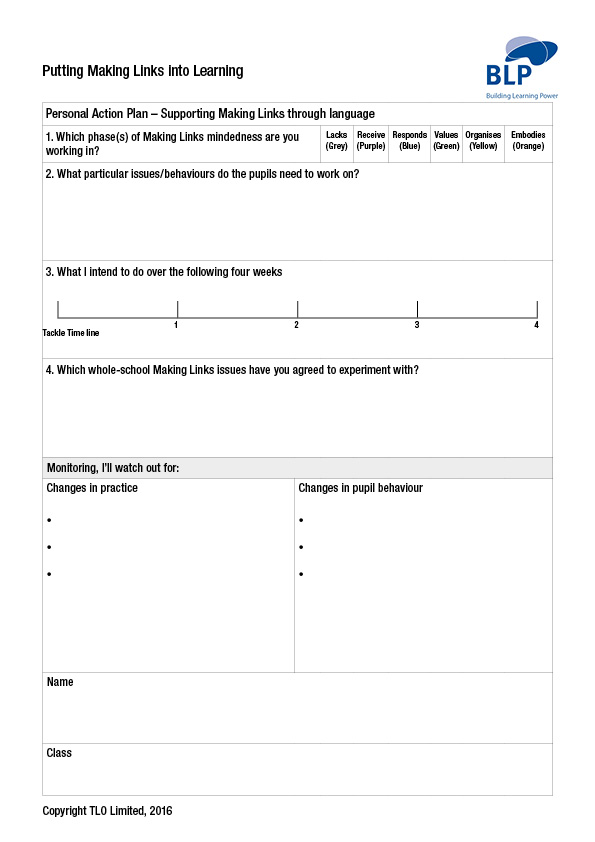
5. Personal action planning. What am I going to do? ( 20 mins )
This is important as it gives people a sacrosanct chunk of time to plan what they are going to do
The Action Plan is an important document and can of course be used as evidence in performance management
Consider
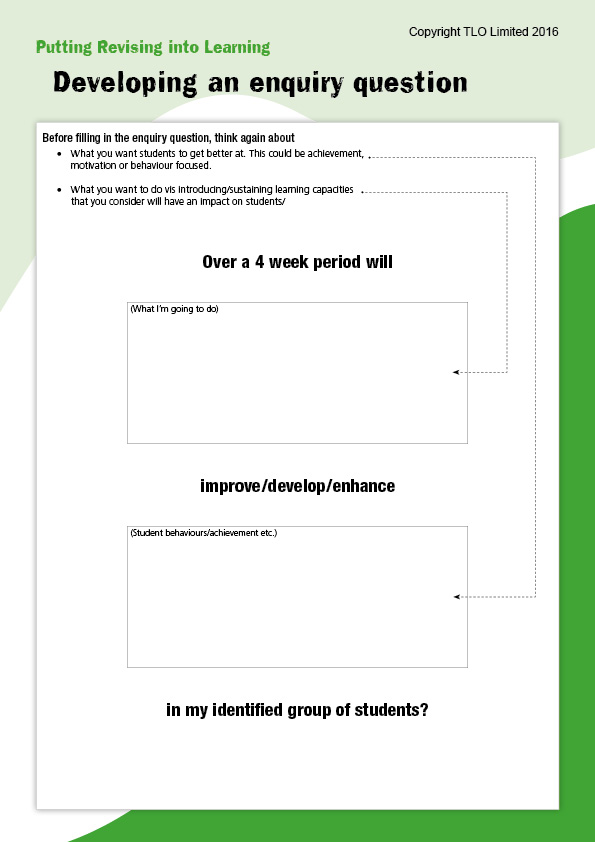
How you want your students to improve/develop/enhance their approach to Collaborating?
What you are going to do to bring this about?
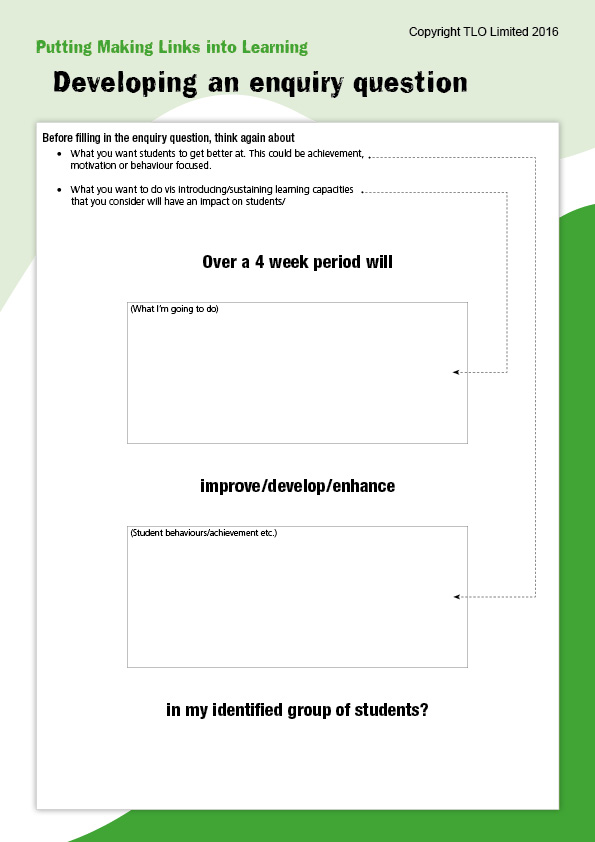
Develop an enquiry question.
Think of it like this…
If I do XXXX will it improve/develop/enhance YYYY
This is the crunch question. Your students are unlikely to change unless you change!
Looked at your students through the lens of the Collaborating learning chart
Gained a sense of what becoming better at Collaborating looks like
Explored a range of ideas and activities that will help to engage students with Collaborating
Now we look closely at how to blend improving students’ collaboration into the content you have to teach.
A. The principles behind any learning powered lesson
B. Big questions to ask about lesson design
C. Lesson planning in action…an exemplar collaboration focused task
Learning habits form through use and practice, but desirable habits survive and flourish better if students are aware of them, realise their value and strive to improve them. The curriculum through its lessons provides the rich and varied occasions for exercising learning habits.
A. The principles behind any learning powered lesson
Think of yourself as a learning power coach, helping your students to help themselves to develop their learning habits. Hence your lessons are much more likely to contain challenges and activities that get your students thinking and learning for themselves.You encourage students to explore challenging questions, problems or assertions and become observers of their own learning. You step back from telling and heavy scaffolding and instead try to mobilise your students’ learning behaviours. You are organising learning to let them take the strain.
The SIX principles that lie behind teaching for learning power
1: Visible learning…Surfacing learning
You make it clear to students which learning habits and processes they are using. You try to make every aspect of the learning process as visible as possible through the language you use and through the words and images you display on the walls.
For example:
Invite the students to develop a charter of matching rights and responsibilities or ground rules for collaboration. If everyone has a right to have their voice heard, everyone also has a responsibility to listen attentively to others and wait until they have finished speaking. Display the results prominently and refer to them frequently.
2: Dual focus teaching…blending content and process
You design activities that combine the dual objectives of ‘what’ will be learned and ‘how’ it will be learned. You make sure students know that the content they are learning is a way of giving their minds a useful workout. (The content is the vehicle for learning)
For example:
Put the ‘how’ before the ‘what’ in constructing objectives or intentions.
Research shows that objectives relating to ‘understanding xxxxx’ or ‘knowing yyyyy’ are less likely to motivate a learner to make the effort than those that start with some indication of the sort of ‘effort’ or way of doing something
For example: We are going to…
…work as a team to decide why…….
…select and use the most appropriate team rolesto complete……
…use the fairest team decision making process to work your way through ….challenge
3: Emotional engagement…Capturing attention
Your lessons are designed to intrigue your students. Students don’t put in the effort unless their energy and attention are captured by what they are doing. You capture your students’ emotional engagement by giving them more of a stake in the process of learning.
For example:
Offer students strategies so that they are able to manage their stake in the process
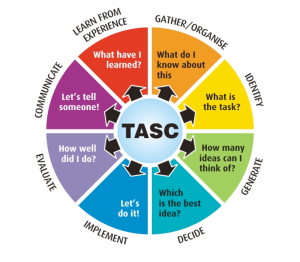
Introduce the TASC wheel to help teams/students to structure their response to a given task – start from 1 o’clock and work clockwise round the wheel. Additionally use it as a means of discussing who will be doing what at each point in the process, thereby opening up a conversation about roles and responsibilities.
4: Handling uncertainty…Challenge
You have realised from your own life that what is engaging tends to be what is challenging. Since you see education as a preparation for a learning life, you help students to learn how to handle increasing degrees of complexity and uncertainty.
For example:
Use supportive/shared processes to build shared responsibility to deal with challenge.
Provide each team member with a piece of ‘pizza’, plus one spare. Ask students to write their own ideas or responses or solutions or questions or answers etc on their own piece. Once complete, the pizza is assembled and the team together distil their thinking and complete the final piece of the pizza. Display either each team’s pizza, or of the distilled pieces from all teams to form a composite view.
Pizza the Action is a Kagan Cooperative Learning structure.
5: Relationships…Working together
Learning is both a sociable and a solitary activity, and you offer your students opportunities to experience both. You develop interdependent learners who know how to handle themselves in collaborative groups and able to move around in the social space of learning to best effect.
For example:
Introduce activities that build ‘working together’ behaviours
Prepare the way for students to build on the ideas of others when working in a group by making ‘ABC’ a routine that you use during whole-class teaching. Once a student has answered a question, ask another student to Add to it, to Build on it, to Challenge it, to Defend it, to Elaborate on it, or to Finda Flaw in it. As easy as ABC ! This improves students’ listening skills at the same time!
6: Reflection and responsibility…Taking charge
You understand that students have to learn how to manage and organise their own learning and that the way to do this is by giving them increasingly demanding opportunities to do so. You orchestrate students taking charge of their learning by expecting them to plan what they do, distil meaning from it, and revise it accordingly.
For example:
Prompt students to reflect on how they are/have been collaborating.
At the start of this process introduce learning mats to prompt the use of and reflection on collaborating.
A checklist for lesson planning based on these six principles.
Does the lesson plan:
Make it clear to students which learning behaviours are being activated?
Match and blend the learning behaviour with content?
Include a tactic to captivate students’ attention?
Have sufficiently challenging learning activities to sustain interest for all?
Offer choice on how students could interact on these tasks?
Embed aspects of planning, reflecting and revising for content and process?
What do you think?
Which of these six principles are a regular feature of your planning?
What do you make of principle 2? Is it the most tricky of the six? The following section B is mostly about this aspect of planning.
Look at the checklist in the green box above this one: Do your lesson plans capture these six aspects of an effective learning experience?
Make a note of…
Which of the six principles might need to be given greater prominence in your planning.
B. Big questions to ask about lesson design.
Skim read or leave this section if you have met it in other units because… the section applies to any learning behaviour. i.e. not specific to Collaborating.
What we teach and how we teach it (the enacted curriculum) are intertwined and offer teachers a lot of freedom. It is here that you can start applying a learning power filter and deploy a unique combination of content and learning tasks.
In conventional lessons where the teacher remains the focus of attention and the initiator of all activity, and where the epistemic dimension (the conditions for acquiring knowledge) is not acknowledged, students gain habits of compliance and dependence, rather than curiosity and self-reliance.
In developing learning power, teachers are making conscious choices about which habits to introduce and stretch and how best to couple these with content so that lessons become more interesting and challenging. Through such overt coupling of content and specific types of process, students come to know, understand and take control of their learning behaviours – they knowingly use and develop the whole range of learning behaviours.
All lessons function on two levels, they have twin intentions. On the one hand there is content to be acquired, and on the other there are learning behaviours to be exercised in pursuit of this content. The factor that differentiates a standard lesson that effectively ‘delivers the content’ from a learning powered lesson is that the teacher has to think, in advance, about:
the learning behaviours that are necessary for successful content acquisition;
the design of activities /tasks that will stimulate these behaviours;
how learners could reflect on and evaluate their use of these behaviours.
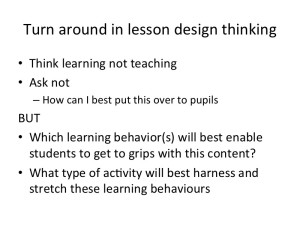
In designing such lessons you have to dare to think differently and flip round your usual lesson design thinking.
A turn-around in lesson design
Think in two dimensions at once – the content dimension and the learning behaviour dimension. It means turning your thinking around – from teaching to learning.
Or put another way
Think to yourself;
what content?
using which learning behaviour(s)?
via an activity to stretch both?
Lesson design questions… one by one
Here the general rules of lesson design have been related to the learning behaviour…collaborating.
Stage 1. What content do students need to learn?
What content has to be learned? …..Think outcomes.
Use standard lesson planning tools:
What are students going to be able to do/learn?…think objectives
How will they know if they been successful?… think success criteria
While keeping an obvious eye on
What do they already know?….think previous learning.
Stage 2. How will they best learn it?
Using which learning behaviours?
This is the new bit
Not the usual second step but nonetheless a vital second step where the aim is to weave content acquisition with learning behaviours. The content is the vehicle for exercising the learning behaviours and the learning behaviours accelerate the content acquisition.
Using which learning behaviours?…Think types of learning behaviours
Which learning behaviour(s) will help these students get closer to understanding this content?…think learning behaviour charts.
Which aspect of, say, collaborating, lends itself to achieving these outcomes?…think progression columns.
How skilled are these students in using this learning behaviour …think progression phases/rows
Say something like this to yourself .…My students need to achieve xxx. At this stage we could get closer to this content by using collaboration. Most of my students are able to use xxx phase (e.g. respond/blue) collaborating approaches confidently.
Stage 3. What type of task/activity will stretch the learning?
Which type of task…Think types of task.
Pick up your thinking from stage 2;
My students need to achieve xxx. At this stage we could get closer to this content by using collaborating. Most of my students would be able to use xxx phase (e.g. blue/responds phase) collaborating approaches confidently.
And now think about the sort of task/activity you might develop/design so as to:
orchestrate a problem-solving activity to enable students’ understanding of xyz content without telling them;
intrigue them with something that is open to several interpretations;
stimulate their curiosity;
grab their attention…visually and aurally;
allow them to stay stuck before I ask them how they are thinking;
offer as a nudge to get them thinking differently that doesn’t give the answer away;
leave it as a problem hanging in the air to which we will return later;
make links between the challenge, and what and how we are learning in this lesson.
The challenge isn’t about the inherent complexity of the subject matter but about how the content is orchestrated to encourage students to use their learning habits to resource their solution.
Think…what/how much information/content do I need to give/reveal? At what point? In what form? To what end?
Say something like this to yourself .…
my students need to achieve xxx.
at this point we could get closer to this content by using collaborating.
most of my students are able to use xxx phase (e.g. respond/blue phase) collaborating approaches confidently.
What type of task would stretch their collaboration but assist them with the content…without me just telling them!
To summarise…the heart of the lesson
It’s the question ‘using which learning behaviours?’ that causes you to think differently about the lesson planning.
You ask – as always – what are the anticipated objectives/intentions?
The verbs in your resulting objectives will give you clues about the types of task/methodology that will get students there and the sorts of learning behaviours your students will need to contribute to this learning endeavour.
You are designing the task in a way that requires students to contribute their learning ‘powers’ / behaviours. The tasks you design will hook into their learning ‘powers’ and help them to improve them.
Say something like this to yourself:
I am going to think content, learning behaviour and task together:
Collaboration will help students to better access the content;
The aspect of collaborating (column) and phase (row) that would fit best is (for example) building on and improving the ideas
The type of task/activity that would best stretch both content and learning behaviour, intrigue, challenge, bring people together and give responsibility to students is………
Think….what information do I need to reveal/give, in what form, at what point, and what do I want students to do with it?
What do you think?
What strikes you about this way of planning with learning behaviours in mind?
Where are the potential stumbling blocks?
How will you decide which learning behaviour(s) you are going to foreground in your objectives?
Consider a lesson you are about to teach…
What is the content?
Which learning behaviour(s), if missing, would make accessing the content very difficult / impossible?
How could you blend reference to this learning behaviour(s) into the learning objectives?
Can you design a task that will help students to access the content and exercise the key learning behaviour(s) you have identified?
C. Lesson planning in action – an exemplar, collaborating focused, task.
How do we design tasks that stretch Collaboration and assist students to approach the content more productively? We cover this in four ways:
1 Collaborative group-work: principles and checklists
1. Collaborative group-work: principles and checklists
Take a look at these words from an Ofsted report from a visit to an outstanding school:
‘Though students have many opportunities to work collaboratively they do not always do so effectively or understand the different roles they might play within a group. The school should ensure that students understand how to work effectively in a group and that they all have the opportunity to take on different roles.’
Here and elsewhere, there is a need to deepen students’ social learning habits to ensure that they have a robust understanding of what it means to truly collaborate and are regularly putting these habits into practice.
In many classrooms, students are required to work together – though not as frequently as one might suppose – but they are rarely set challenges that require high levels of collaboration nor are they helped to disaggregate the attributes and habits of effective collaborators.
Genuine collaboration requires:
Appraisal of the task in hand
Agreement as to the imagined outcome or goals
Systematic thinking: setting deadlines and check-points
Understanding of the roles and responsibilities that need to be discharged
Open-mindedness and creativity
Appropriate and distributed leadership
Evaluation of the time and resources needed to accomplish the task
Your job as a teacher is to ensure that these Seven principles of effective collaboration are understood and adopted by all students. This isn’t done by telling them what they are but by drawing them out in agreement with the students themselves.
Thereafter you will need to ensure that collaborative tasks lend itself to collaborative group-work. That is to say they:
Sustain long-term student engagement
Are open-ended and challenging
Depend on the use of a variety of roles and responsibilities
Involve all partners
Lead to urgent and purposeful procedures
Require choice and decision-making
Lead to prioritised action and successful outcomes
A useful checklist to set against any collaborative tasks you design.
2. Collaboration focused task.
Here we work through a lesson that aims to combine:
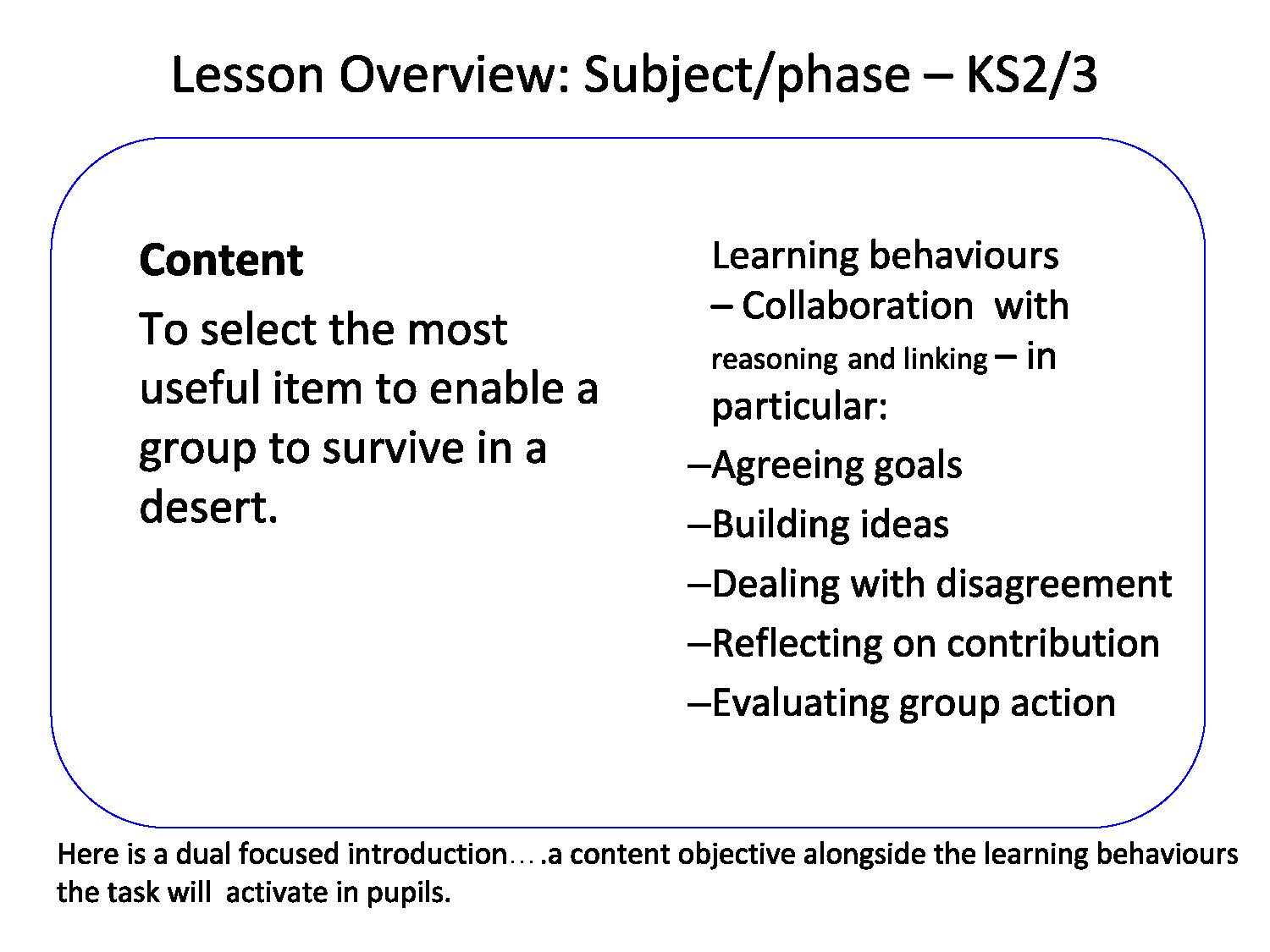
surviving in a desert (content)
collaboration, teamwork (in particular learning behaviours in the xxx phase)
a ranking order type task.
See if you can spot the collaboration principles that have been embedded.
The lesson has 7 episodes as follows:
Episode 1Noticing detail and a reminder to use teamwork ground rules
Episode 2. Sharing and building ideas
Episode 3. Agreeing a goal and dealing with controversy
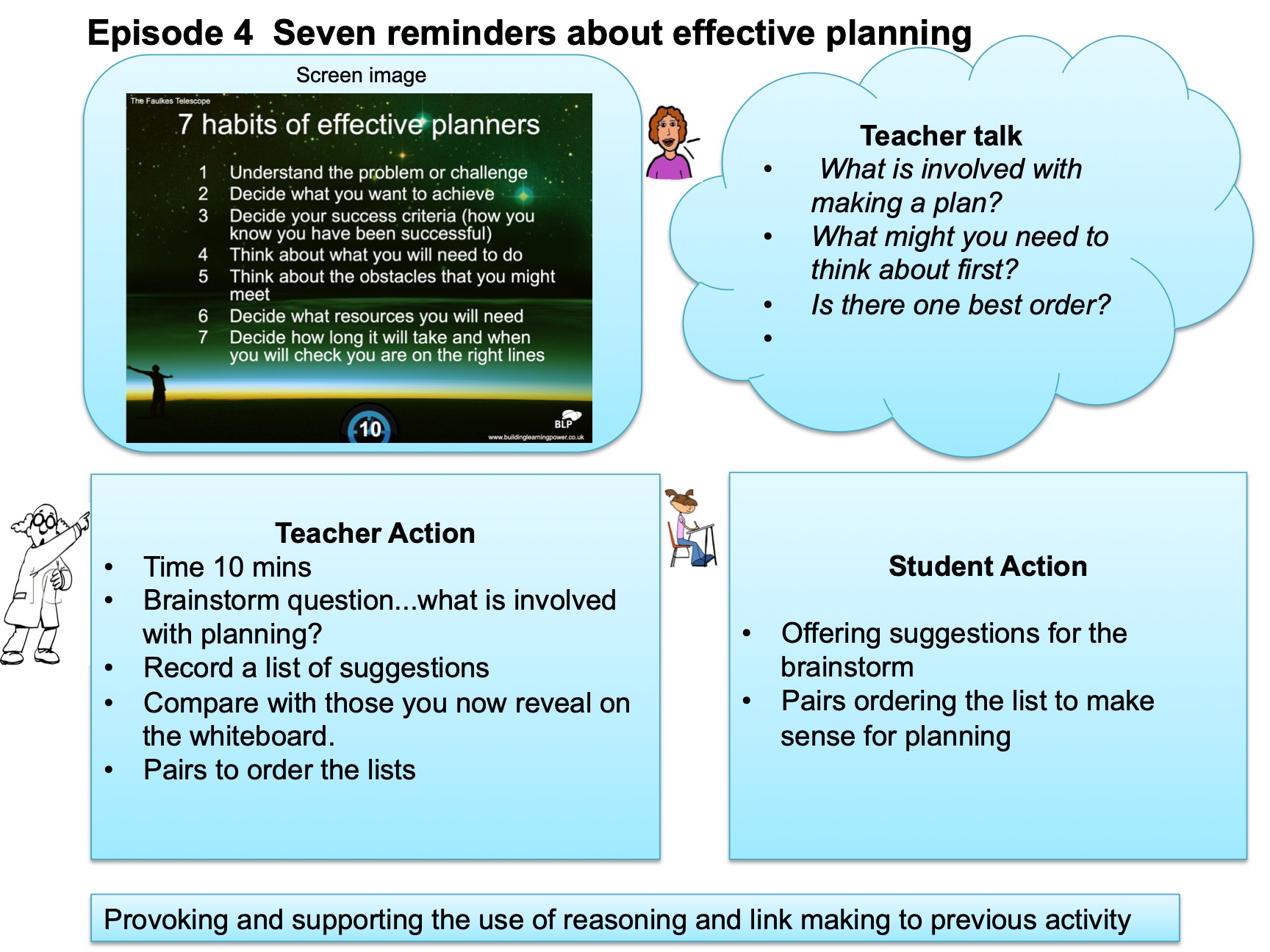
Episode 4. Making good decisions in planning and foreseeing obstacles
Episode 5. Assessing individual contributions to the team effort
Episode 6. Assessing team performance
Episode 7. Reviewing team performance in view of knowledge of the experts’ answer
All these aspects of teamwork are taken from the Collaboration chart
In this lesson the teacher is orchestrating the activity – splitting it up into episodes and guiding it along in order to highlight/stretch/provoke particular aspects of collaboration.
But you could run this activity without any structuring, i.e. just set the task, observe the action and let groups know when time is up.
Objectives and explanation of how the format works
N.B. We are activating general teamwork conventions here. These are activated through teacher talk
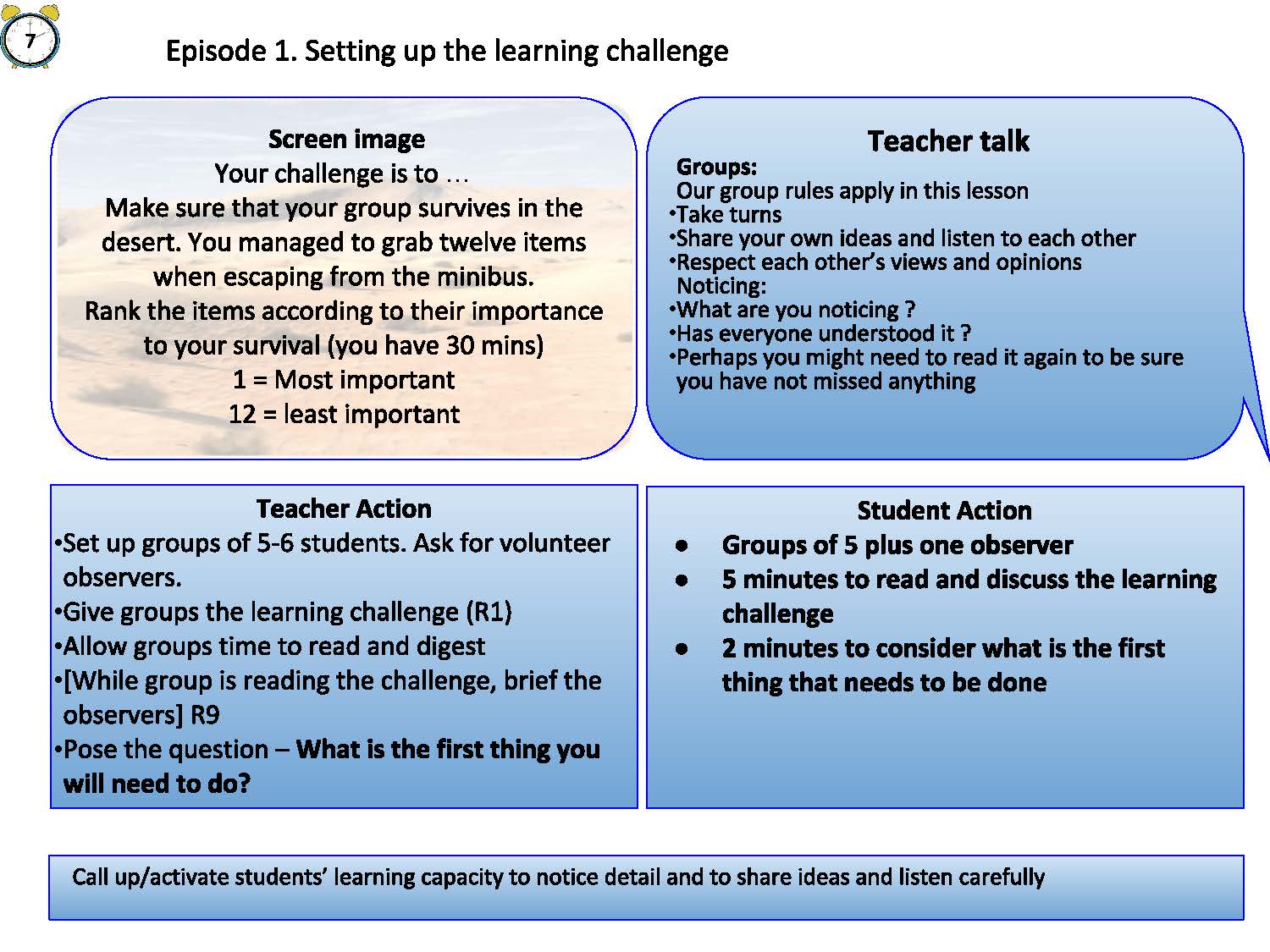
Episode 1 – Setting up the challenge
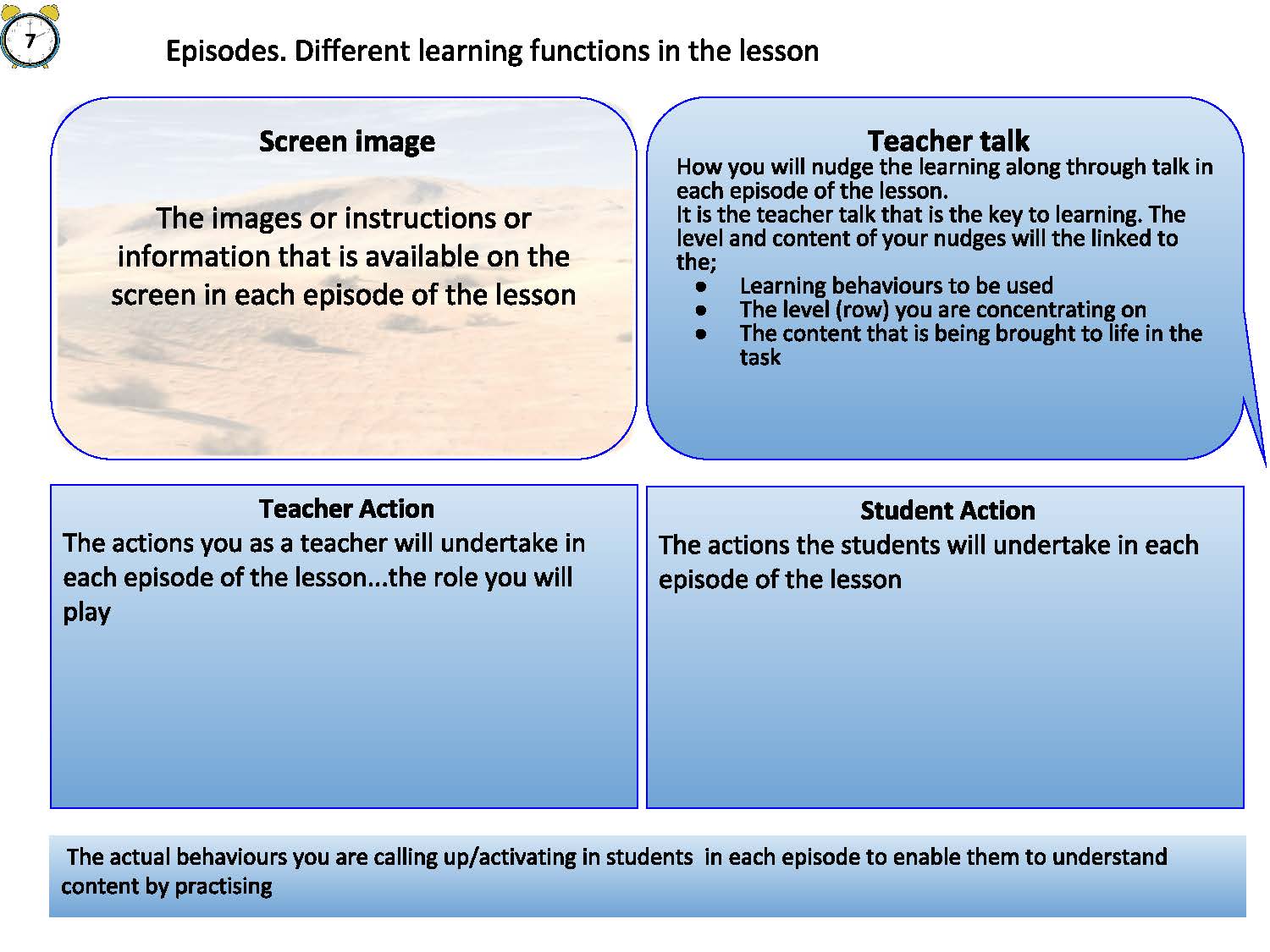
What’s happening here?
1.Time 7 minutes
2. Screen image. The hook An intriguing challenge to get students engaged. You may want briefly to summarise the task ahead.
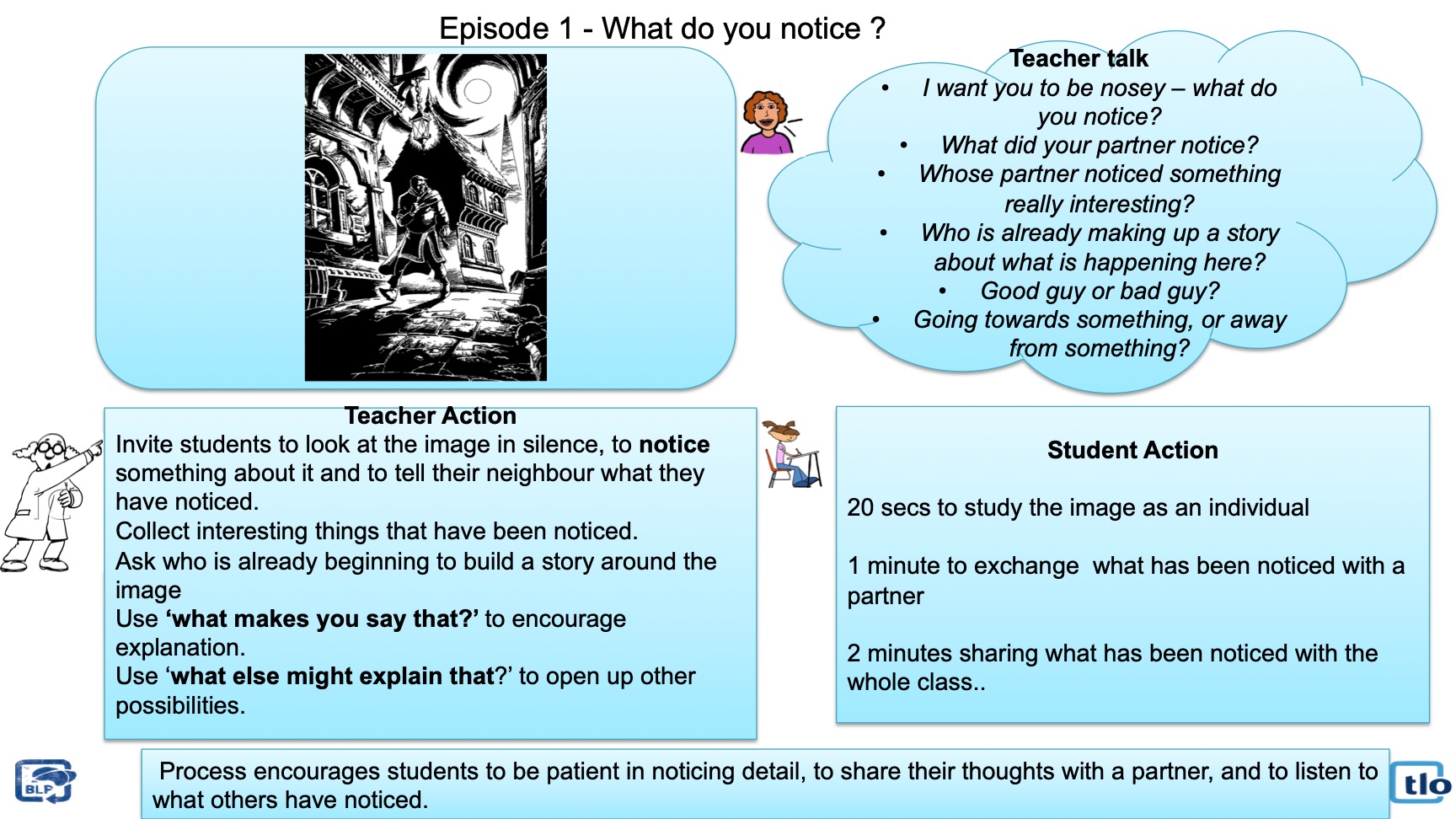
3. / 4. Teacher Action and Student Action This first episode is designed to encourage groups to become familiar with the challenge, to begin to think about how they will tackle it, and so resist the temptation to rush into action.
Resources 1 and 2: The learning Challenge – Stranded (R1) and Observation sheet (R2), 1 per group
5) Learning behaviours. In this episode students will be using their noticing skills to get under the skin of the challenge and their collaboration skills to identify what the task is about (collaboration purple) and to begin to prioritise action (collaboration green).
6) Teacher talk:- Here we suggest the sort of teacher talk that is designed to nudge the learning behaviours in the right direction, and supportive of the sort of discussion you are trying to orchestrate. This talk will of course be tailored to the age and existing learning behaviours of your group. The examples given in the teacher talk box nudge students to observe the conventions of group work and to be attentive to detail.
Episode 2 – Possible survival strategies
What’s happening here?
1) Time 8 mins
2) Screen image – Posing key questions
3/4 Teacher and Student Action. Purpose: To steer students to realise that they cannot begin to rank the relative importance of the items until they have decided together on their strategy for survival – [Walking to the ranch would make the compass and map important, whereas staying put and awaiting rescue would not]. The group activity suggests groups generate at least three possible survival strategies. (Possible strategies could be: go to ranch; stay put; retrace minibus tracks; walk in general direction of hotel; walk to try to find a road . . . . )
(A teaching point – students will usually gravitate to the ‘go to the ranch’ strategy, in the expectation of finding people, shelter and water. The unspoken assumption is that it is a working ranch with people at it who can help. To help them to avoid this course of action (which is wrong anyway) you might need to nudge their thinking with comments like ‘what do you actually know about the ranch?’ and ‘what can you be certain about?’)
5) Learning behaviours: -In this episode students will be using their imagination based on information given to generate possible courses of action. In collaboration terms, the team need to share and offer their own views (collaboration purple) and make relevant comments (collaboration blue)
6) Teacher talk:- this needs to be tailored to the age and existing level of questioning behaviours of your group. The examples given in the teacher talk box nudge towards careful consideration of various alternatives.
Episode 3 – What should we do?
What’s happening here
1) Time 5 mins
2) Screen image – Time for groups to decide on their strategy
3/4) Teacher and Student Action. Purpose – to require groups to agree on their preferred/agreed survival strategy.
5) Learning behaviours: – In episode 3 students are required to consider the strategies they thought of in episode 2, and to agree which one they intend to adopt. In collaboration terms, they are seeking agreement in setting goals and resolving potential differences of opinion, dealing with possible controversy (collaboration blue and green).
6) Teacher talk:- intervene in groups as and when necessary in order to prompt further consideration and/or to agree a way forward, or ways to resolve conflict.
Episode 4 – What do we need [most]?
What’s happening here?
1) Time 12 mins – Ensure groups are aware of the time limits in this episode.
2) Screen image – Here groups to identify precisely how they are going to use the items to ensure survival
3/4) Teacher and Student Action. Purpose – to enable groups to plan how they will use the items to give themselves the best chance of survival.
5) Learning behaviours: – In episode 4 groups are required to make good decisions to reach their goal (collaboration yellow) by making links to prior knowledge/experience and by capitalising on the potential uses of the items taken from the bus.
6) Teacher talk:- intervene in groups as and when necessary in order to prompt them to exploit the potential uses of the items.
Watch for how they pull together as a group; how they encourage others to contribute, how they contribute to making good decisions.
Episode 5 – How did I do?
What’s happening here?
1) Time 3 mins
2) Screen image – Pose the question about individual contributions to the group.
3/4) Teacher and Student Action. The main activity is now finished. Purpose now is to enable individuals to reflect on their personal contribution to, and feelings about, the process. Allow students to reflect individually. Could be done as a pair exercise if students trust each other. Try to get a sense of how honest students are being regarding their contributions
Resource 3 – Post Decision questionnaire, 1 per student
5) Learning behaviours: – In episode 5 individuals are required to think about how they have contributed (collaboration purple) to the activity, their feelings about the extent to which a good decision was made and the extent to which their views were respected (collaboration green) .
6) Teacher talk:- intervene only if necessary
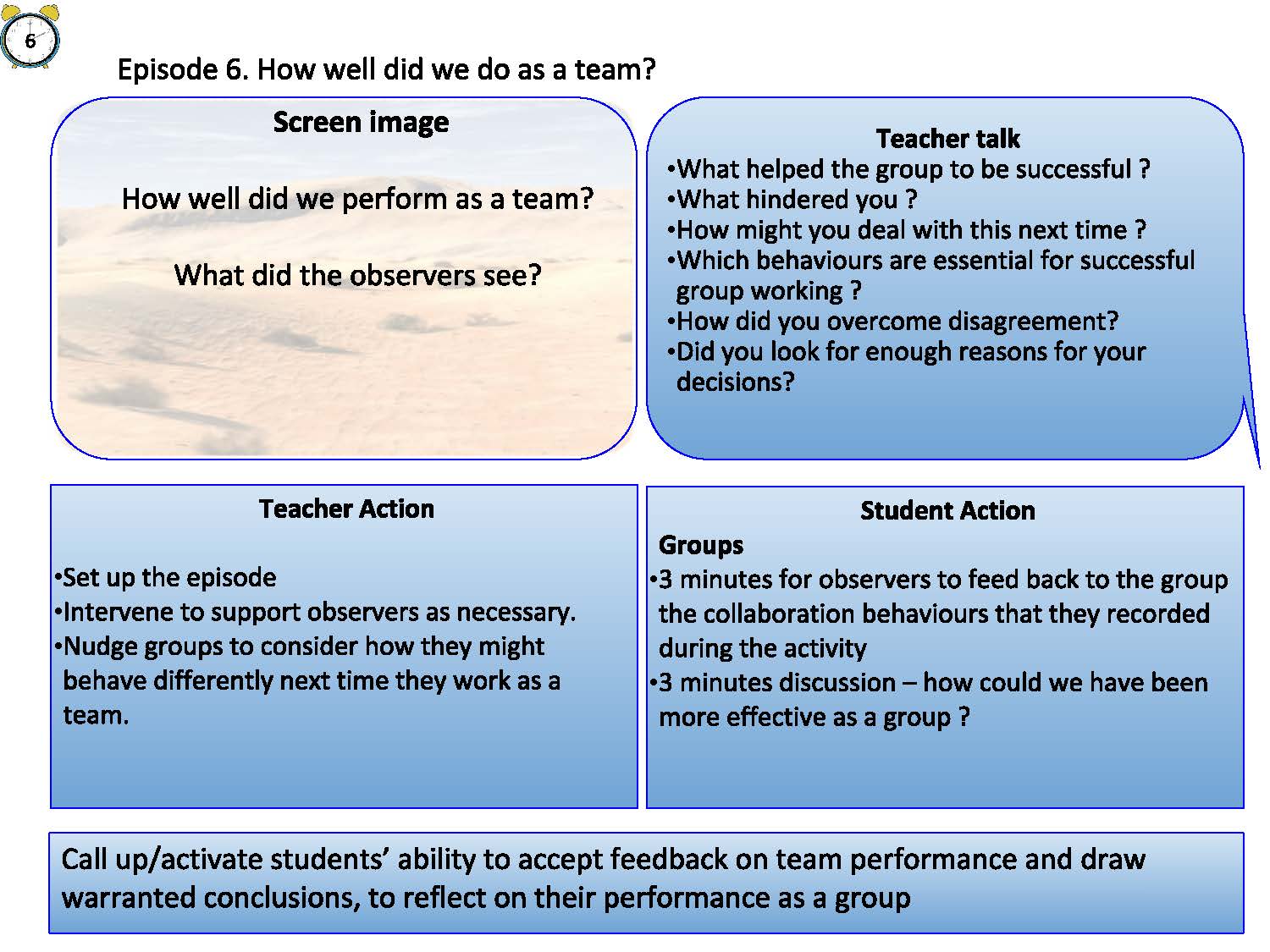
Episode 6 – How well did we do as a team?
What’s happening here?
1.Time 6 mins
2. Screen image – Time now for observers to feedback on group/individual behaviours and generate evaluative discussion.
3/4. Teacher and Student Action. Purpose – to help groups practise reflecting on their team-working during the activity.
Resource Observing a Learning challenge – stranded
5. Learning behaviours: – In episode 6 the observer/groups will offer/accept feedback on their own and group performance (collaboration blue) and evaluate team effort (collaboration yellow).
6. Teacher talk:- intervene in groups only in order to prompt groups to hear the observer’s feedback with a view to using it to improve.
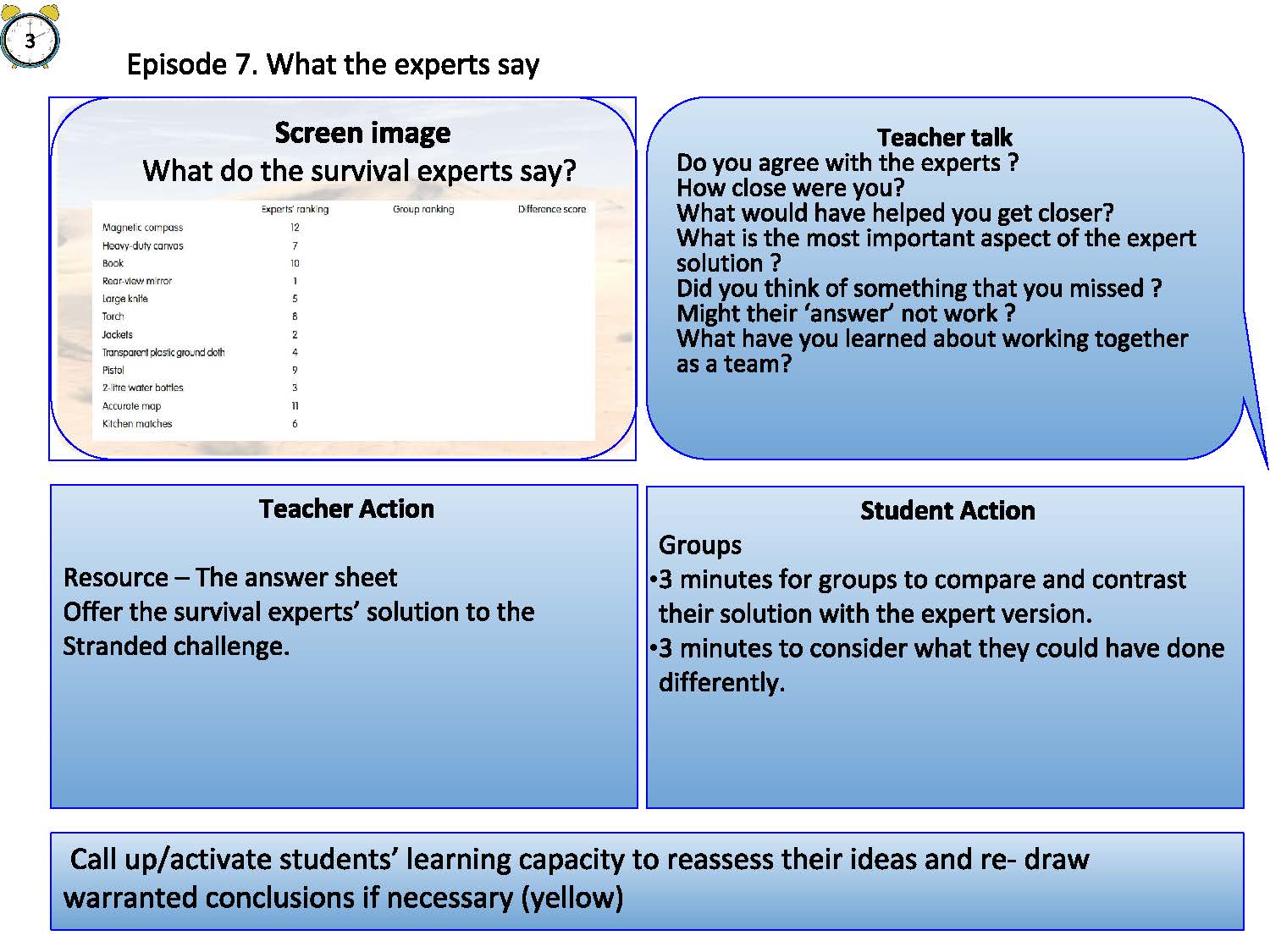
Episode 7 – What the experts say
Resource – The Learning Challenge: Answer sheet.
Let teams see the experts’ answer and estimate how close they come to this. Also encourage teams to think about what they might have done differently to achieve a closer answer.
Does planning for four aspects – teacher action, student action, learning behaviours, teacher talk – seem useful?
How does sequencing the lesson as ‘episodes’ help or hinder planning?
Make a note of…
The extent to which your existing planning template enables you to think about lessons in this way.
What you would like / need to add to it.
4 Extend your thinking about using this type of task
a) Other ways to organise this type of lesson
Allow greater freedom
The version of Stranded we have unpacked is ‘hand-held’, in other words you as the teacher did a lot of the work nudging the action along. But it is possible to run this sort of activity such that you simply set it up, let it run and concentrate on what happened in a big debrief at the end, It goes something like:
1 Set up a scenario and a goal (change the setting to suit i.e. not a desert)
2 Remove yourself from the activity and let the group get on with it
3 Leave out any help or nudges that might steer students to the right/appropriate answer
4 Dispense with the ranking task and ask students to decide on/agree only the most essential/important object/ activity to ensure safety/success
5 Allow 30 mins for this decision making process
6 Reveal the answer before reflecting on the process
7 Allow 15 minutes for reflecting on the group process. Leave out the individual reflections
Focus the activity on questioning
Set up a scenario and goal to select the most essential object to bring about the best solution
Leave out any nudging and dispense with the ranking activity
Add in rules such as only able to use open questions in making the decision or limited to 10 or 20 questions in reaching a decision
Appoint an observer with a checklist of types of questions
Allow 20 minutes for the decision making process
Orchestrate 15 minutes reflection on the use of questions using comments and observations from the observer’s analysis.
b) Where else in the curriculum might this sort of task fit
Small groups could be asked to:
design a science experiment and choose from a range of possible resources;
undertake a design and make task in D&T;
work together to create a performance in the expressive arts.
What do you think?
Where / when / why might you use Stranded or similar technique?
Where else in the curriculum would you want to give practice in group decision making?
How will you ensure that this type of group work is frequently an integral part of lessons, and not just a ‘catchy’ activity before the ‘serious’ work begins?
Make a note of…
Which class/group/subject you might try this activity with.
As teachers we are in the habit-forming business. What we say, what we display on classroom walls, what we celebrate, praise or dismiss, what we model or how we design learning activities will all influence the ways in which students learn, perform and behave. Classroom cultures have a huge influence on students’ learning as you will remember from the Culture unit.
Five big shifts to get you started. Ask yourself – how might you:
Enable students to broaden the range of people with whom they learn;
Encourage students to broaden the range of roles that they adopt when collaborating;
Create opportunities for students to resolve conflict and build consensus;
Enable groups to reflect on and evaluate their effectiveness;
Help students to reflect on and evaluate their individual contribution to the group’s progress.
Now look at the Learning Chart sections below where you will find plenty more ideas to try.
Pair work, group work or teamwork are frequent features of classroom practice across all age ranges. But what are the essential features of this way of learning? How can students improve their collaborative behaviours in order to achieve better results?
In this session, we explore the subtleties of collaboration and the skills that make up teamwork. We consider a broad order in which such skills might be explained, orchestrated, commented on and modelled by teachers in classrooms to ensure the progressive development of students as collaborative learners.
There are many ways to define collaboration. In a learning context we have come to understand collaboration as being able to manage yourself effectively in the give and take of a collaborative venture, having a range of interpersonal skills that enable you to work and learn with and from others, being willing and able to contribute constructively and with sensitivity, and adding to and drawing strength from the team itself.
At its least sophisticated, it is little more than being cooperative. At its most sophisticated and complex levels it goes beyond learning ‘in a team’ and becomes learning ‘as a team’. It is an invaluable life skill.
In short…
Collaboration: Having both the skills and the inclination to contribute positively to group work in order to learn productively with and from others.
What do you think?
Are you aware of students whose lack of social skills limits their ability to cooperate, let alone collaborate, with others?
Are you aware of students who regard group work as an opportunity to allow others do all the work? (the social loafers,)
Are you aware of students who are keen to do all of the work themselves to the exclusion of others? (the job hogs)
Make a note of…
Students who do not trust others to contribute effectively
Students who are reluctant to contribute to group work
What does a well-formed habit look like?
Effective collaborators are adept at learning with and from others. They help to: shape the ideas of the team; decide what needs to be done; contribute to getting the job done; keep an eye on how things are going; improve team performance through reflection.
At-a-glance Collaboration card [extract] – Click image to view full screen
Find out more about Collaboration:
A well-formed collaboration habit includes being ready willing and able to:
Work effectively with others towards agreed, common goals, acting flexibly in response to circumstances.
Adopt different roles and responsibilities in pursuit of agreed goals and the well-being of the team.
Hold and express opinions coherently, compromising and adapting when appropriate.
Seek to understand what others are saying; sharing, challenging, supporting and building on ideas.
What do you think?
Do your students become increasingly like this as they move through your school?
What makes you say that?
What do you currently do in school that encourages students to develop their social learning skills?
What might you be doing to inhibit collaborative learning?
Make a note of…
Things you do to support collaboration
Things you do that might hinder collaboration
1b) How Collaboration might build when we nurture it.
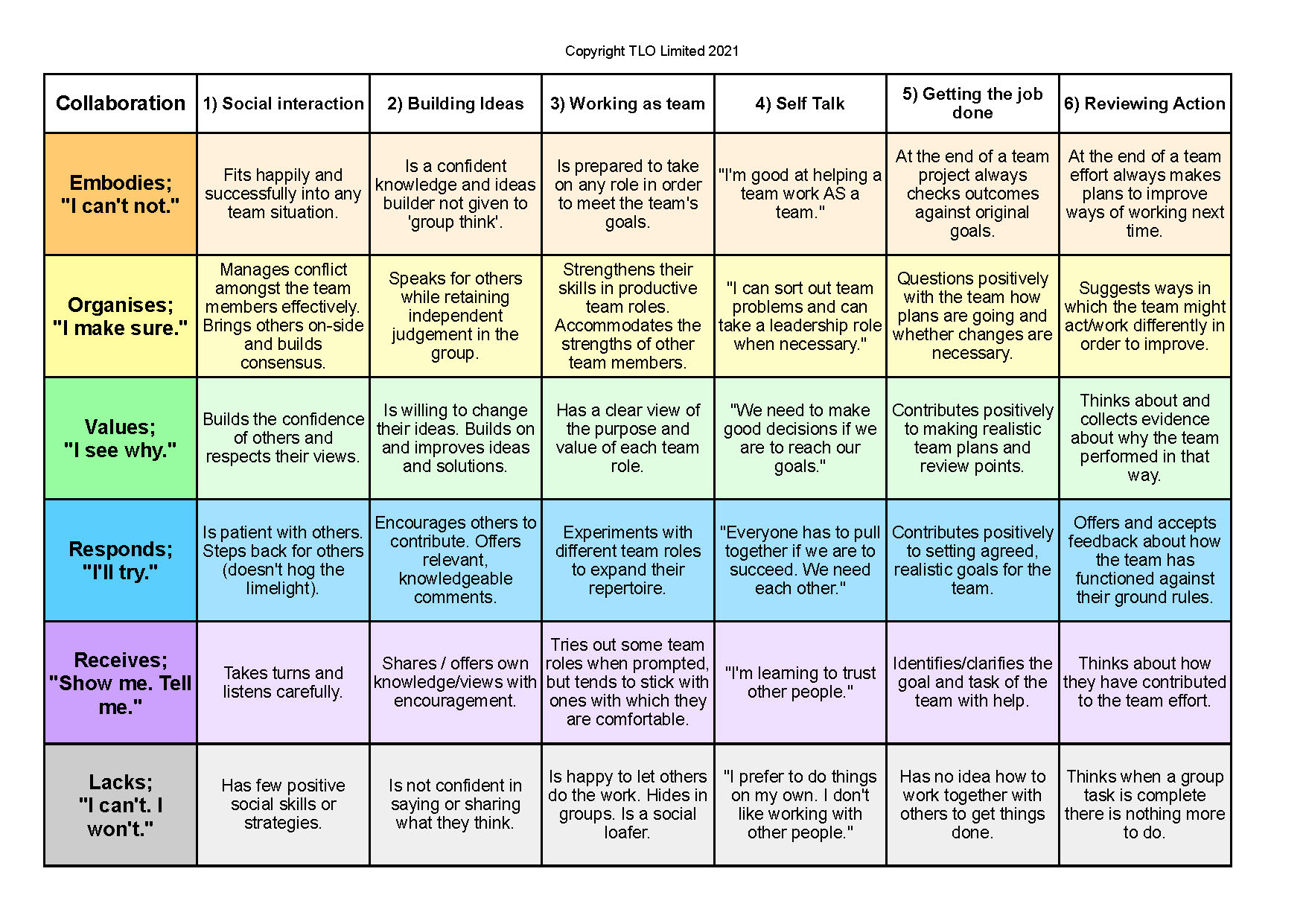
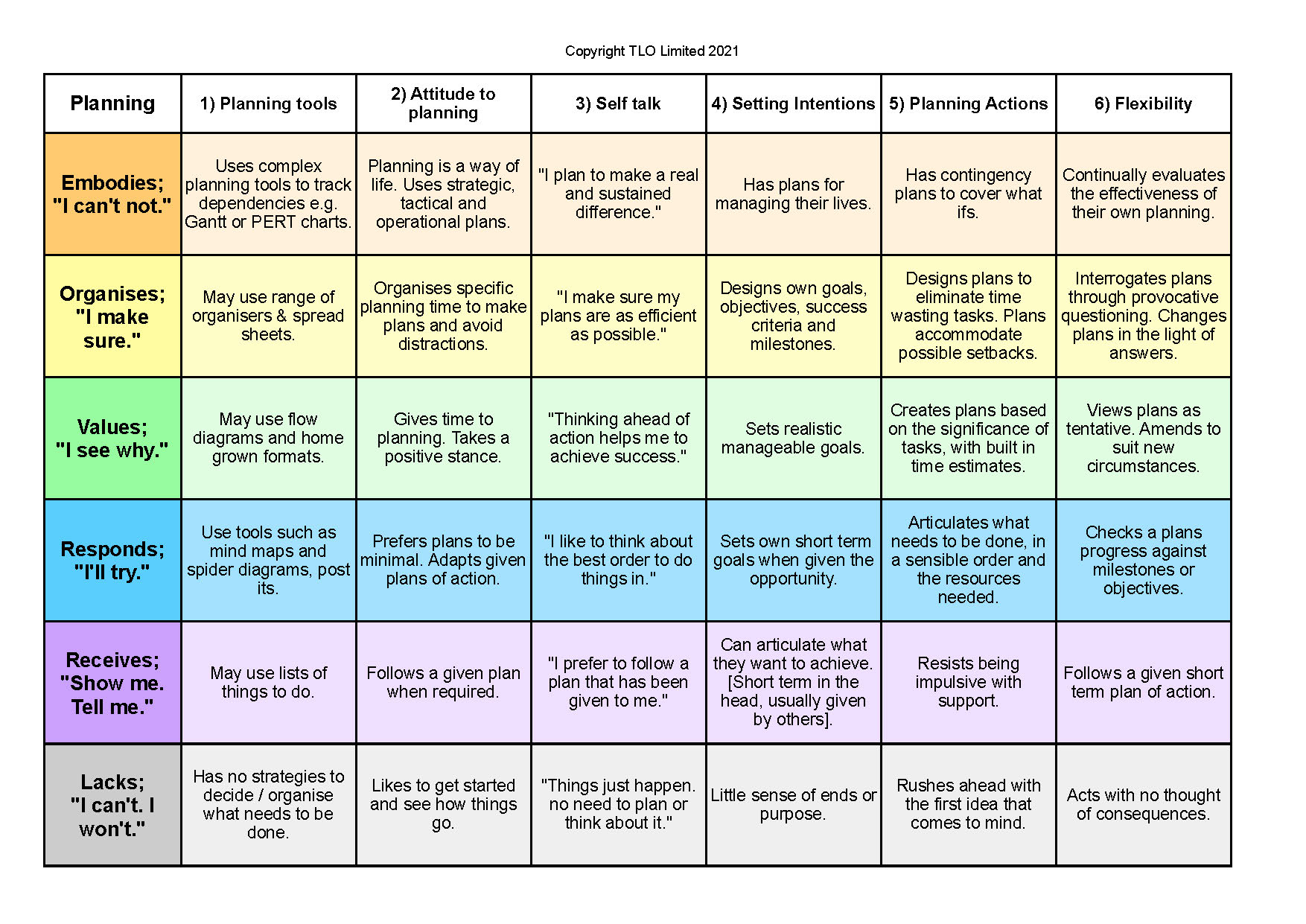
Being collaborative isn’t something that switches on on good days and off on bad days. Being a good collaborator grows and builds when it’s nurtured and supported. Furthermore, being collaborative involves gaining control of a range of linked skills and emotions. Take a look at how progression in Collaboration might grow across six contributory aspects.
Cast your eye over the ‘big picture’ of growing Collaboration below. Then move on to finding out what the columns and the rows are all about.
Collaboration involves knowing how to learn with others, as part of a team, in situations where no one person knows all parts of the puzzle. This complicated yet essential learning habit develops in several different ways. First of all it hinges on social interaction; how well we get on together, whether we are patient with others and respect their views. Then how we are able to bounce off others to build ideas; making the most of several brains rather than one. Next, how we learn to be part of a team and to perform different roles when needed. Fourthly, how we talk to ourselves about learning with others, where our real understanding of the process is revealed. Fifthly, how we contribute to the process of actually getting things done. Not just being there but doing something helpful. And lastly how we contribute to improving team performance by evaluating not just outcomes but the process of getting there.
Take a closer look at what each column of the grid is about.
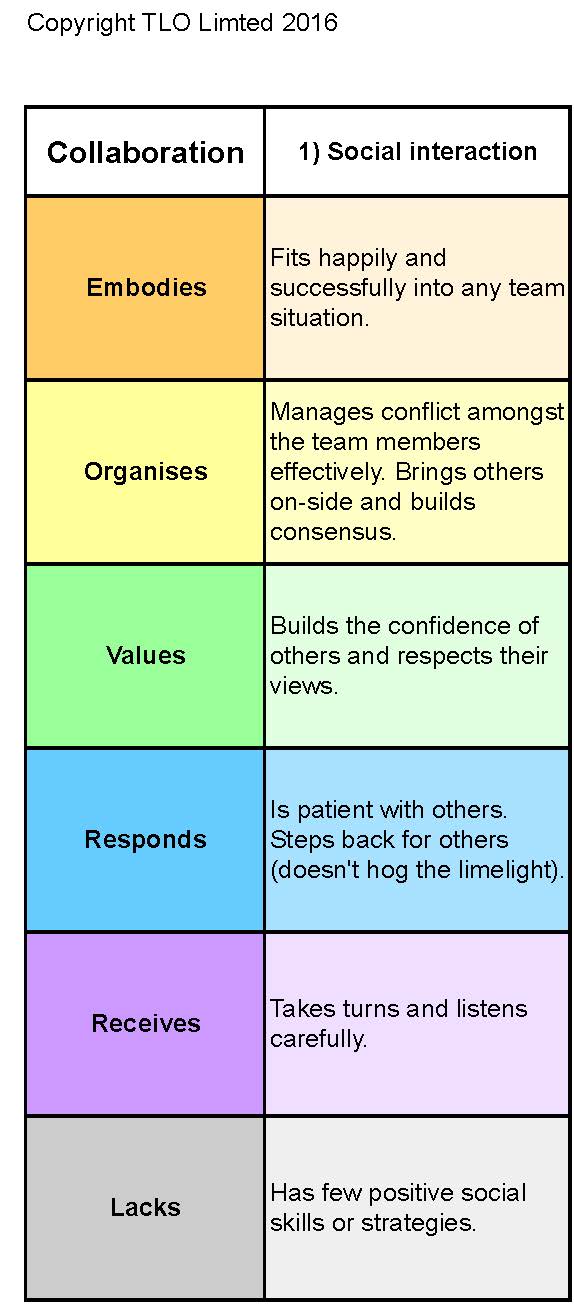
1) Social interaction
How we interact socially in learning and working with others; the way in which we learn the social conventions of behaving in a group; taking turns to speak and contribute, listening to understand others; being patient with others and not hogging the limelight; stepping outside our own concerns and building the confidence of others and respecting their views; being able to manage and overcome the inevitable controversy as teams work creatively together; and thus being able to become a valuable sociable member of any team.
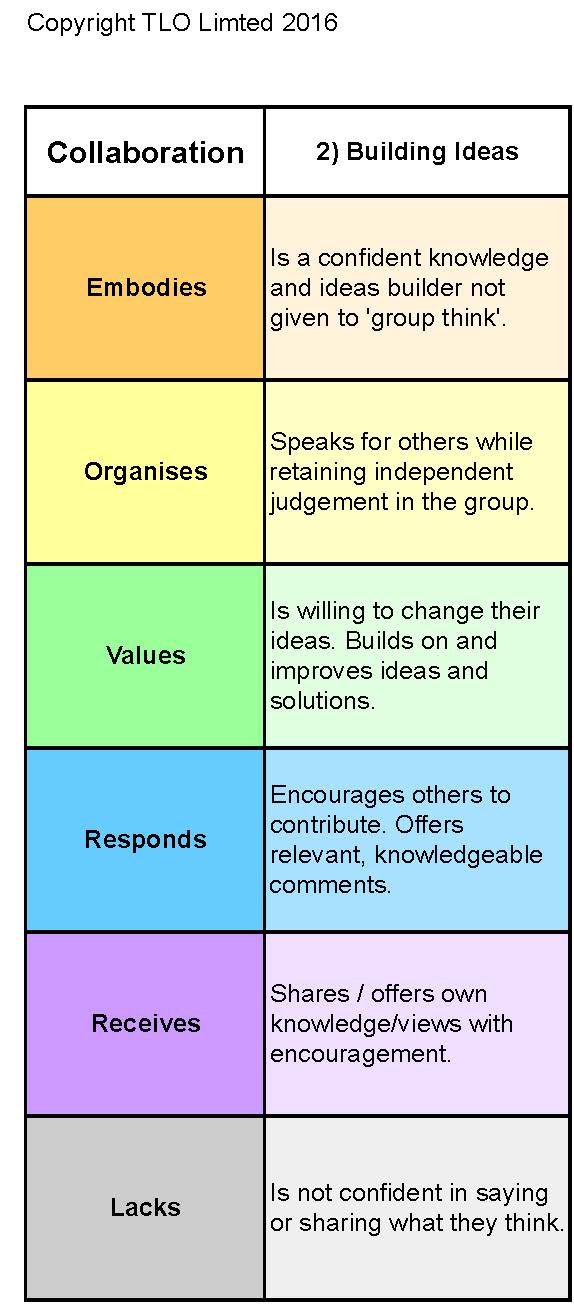
2) Building ideas
Just being good mates in a team doesn’t lead to success. Teams have to understand how to build ideas together; to draw on the ideas of others, to be able to graciously set aside ideas that wouldn’t work, to spark off others to ensure new and better ideas get an airing. And somehow, in all this ‘togetherness’ people are able to retain their independent judgement and avoid being drawn into group think. Teams share and build ideas together; growing and improving possible solutions in order to reach their goals
3) Working as a team
Working as a team is rather different to working in a team. It’s all about ‘teamness’ or ‘togetherness’. In order to work as a team people need to understand team roles, ti find out what role they are particularly good at, to take on a range of roles when needed and eventually be willing to play any role in a team to ensure the goal is reached. Being able to work as a team is influenced by how our self-perception and confidence grow, how we learn to trust, how we recognise the need for each other.
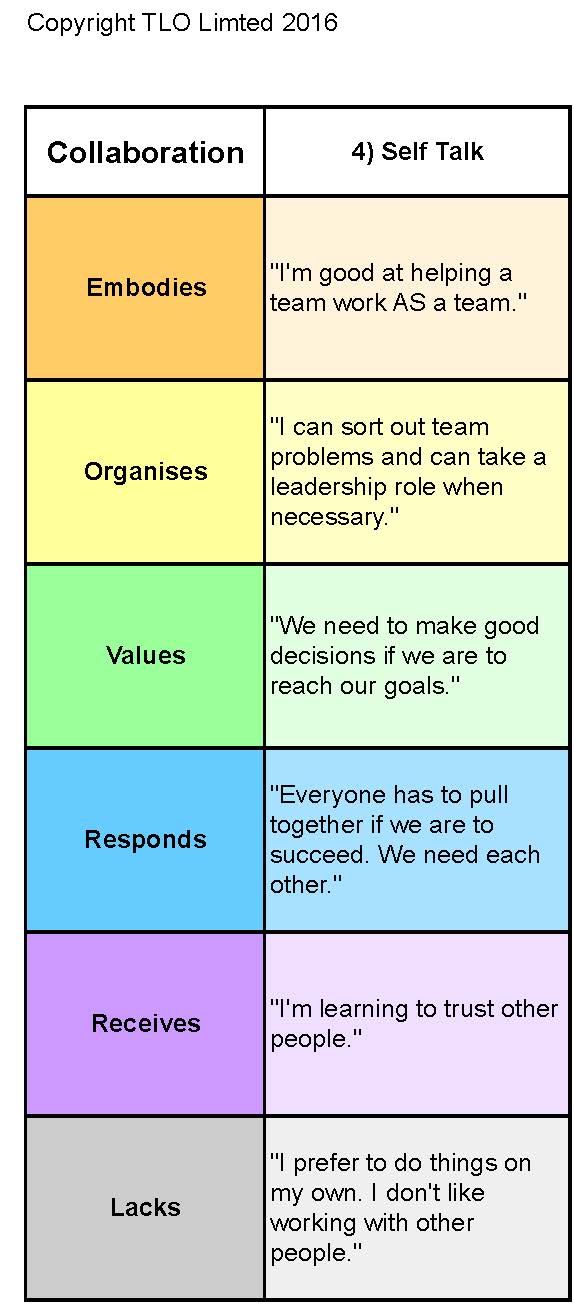
4) Self talk
The voice of self awareness
Self-talk is what we say to ourselves as we learn. The statements capture what someone in each phase of the grid might be thinking. Students may use some of these phrases when talking with you, or in writing from time to time, but mostly self-talk goes on inside their heads. We have shown a small flavour of self-talk thoughts that teachers can encourage students to imitate. Some relate to standards, others to self-monitoring, or flexibility. All such self-talk is important in building a collaborative habit.
5) Getting the job done
How teams achieve their goals by using the well-known learning process of Plan Do Review. Good teams have people who know that the first job is to be clear about what he task is really about. They are skilled in considering/creating/agreeing realistic goals to be achieved and which everyone has bought in to. Then the team have to plan how they will achieve the goal, how they will monitor their progress and methodology and how they will make sure the job is well done.
6) Reviewing action
This aspect is about how teams learn how to improve. It’s the aspect of teamwork that is frequently left out altogether or given short shrift. But it’s the aspect of teamwork that helps teams build themselves into better teams. It includes evaluating how they performed as individuals in contributing to the work of the team and how/whether the team process worked to achieving the team goal. Importantly such reflection leads to serious re-planning of their ways of working. It’s meta learning at a team level. Good teams will be looking for what has become known as marginal gains. What little things can we do better/improve that will impact on the overall performance.
What do you think?
Do these contributory features of collaboration make sense to you?
Make a note of…
Things that you think might be missing from this big picture of collaboration
What do you think?
Do you think there’s an order in which these skills develop? Would it be the same order for every student?
Do you think these behaviours develop ‘naturally’ as children mature?
Do we need to intervene in order to support this positive development?
Make a note of…
Any behaviours you think develop naturally
Any behaviours you think may be missing from this picture of collaboration
1d) Unpick the rows; getting better at Collaborating.
Of course the development of collaboration doesn’t grow neatly up each column or even across the columns. However, it is possible to look at the grid another way and group cells together into five broad phases of dispositional growth. We have based this growth on Bloom’s taxonomy of the affective domain. By looking at the development of emotion and skill, the grid yields broad ways in which people may be inclined to behave: we call this inclination ‘mindedness’.
Here is our interpretation of how Collaborating might grow.
The phases are drawn from Bloom’s taxonomy of the affective domain.
Phase ‘Receives’ (purple) is about doing something because you are told or expected to.
Phase ‘Responds’ (blue) is about gaining interest and doing things more willingly.
Phase ‘Values’ (green) is a key phase since the student now sees the value of behaving in this way. It’s a win for them; to behave like this is in their interest. It’s in this phase that the behaviour becomes more secure.
Phase ‘Organises’ (yellow) is the phase in which the student capitalises on this ‘in their interest’ behaviour and gets themselves organised to use it positively.
Phase ‘Embodies’ (orange), known as ‘characterised’ in the original taxonomy. In this phase the student has made this behaviour their own. It has become part of their character; they can’t not do it and they have become highly skilled in doing it.
We urge you to see this progression as long term. Some phases will take years for people to work through; some will never be worked through. None of the phases are inevitable. There is a lifetime of development captured here. Nevertheless the role of a teacher or parent should surely be to encourage and enable this journey.
Lacks:
In this ‘Lacks’ (grey) phase, students are often unsure of themselves in a group. They often learn and play alongside other children but collaborating together is far more tricky. Their social skill may not be conducive to working with others either tending to push themselves forward and take control or shying away and saying/contributing little. They have much learning and adapting to do before they are really ready to work in a collaborative team.
Receives: Minded to begin to collaborate with others
In the Receives (purple) phase, students are making a big leap from being wary of others, being unaware of social conventions or any of the advantages of working/learning with others. Here they are collaborating with others because they are required to. There is much to be done in this phase: social skills, sharing ideas, working out what needs doing, playing their part and even thinking about how they have contributed to the team.
Responds: Minded to be part of a team
In the Responds (blue) phase students are willing to develop their understanding of what being part of a team involves, agreeing goals together, trying out different roles, broadening social skills to opening up others.
Values: Minded to function flexibly as part of a team
In the Values (green) phase students see/appreciate the value of a team member and honing their skills in different roles, planning action more carefully, and being flexible in their own views for the sake of the team. Once this phase is secure students are likely to develop further skills by having opportunities to work in this way.
Organises: Minded to learn in and as a team
In the Organises (yellow) phase, students organise themselves to work as part of a team. They learn that skilful teams manage conflict and that conflict and controversy are positive keys to involvement and creativity; that high-performing teams frequently check their progress and adjust their practice to stay on track.
Embodies: Minded to see Collaborating as a way of being.
In the Embodies (orange) phase, being a skilled team player is what characterises the student. They work happily and skilfully in any team, confident in their social, task development, planning, reviewing, and team evaluation strategies. A valuable member of any team.
What do you think?
Which phase of collaboration mindedness do most of your students fit into? They may of course be developing in more than one phase at a time.
Are some in the grey zone ? – i.e. collaboration is missing altogether.
Make a note of…
The students who don’t appear to be mainly in the grey zone
Preparation for the Learning Team meeting
Where are my students now?
Take a look at the Collaboration progression chart in your Learning Diary or
Colour in the cells where you think your students are secure.
Some will barely be on the chart while others may be quite a way up. Neat straight lines of secure behaviours are rare. But looking at your students in this way should give you an idea of what you need to work on.
Draw a red line across the chart to denote where you think most of the school’s students could and should reach by the time they leave.
Please take the results of these tasks with you to the Professional Learning Team session shown in Section 4
If you want to read again the notes on Professional Learning Teams, click on the view notes tab in this box
Professional Learning Teams: what and how
The purpose of these meetings is for the team to act as a teacher learning community or Professional Learning Team: a small group of teachers who meet together regularly to deepen their understanding of building better learners, commit to trying out new things, reflect on and share their experiments with each other. Such learning communities are the engines of teacher development. They work best with 6-8 teachers with similar subjects or age groups, and who meet for about an hour regularly over a period of a couple of years.
The group question and probe each other’s summaries of their experiments in order to encourage analysis and deeper reflection. They use questions such as ‘What do you think is getting in the way? What would make this even better? How could this technique be modified to make it work for you? What do you think made that happen? In this way they support each other in changing and developing their practice.
Some guidelines for team reflection sessions
The delicate, hard work of changing practice requires a safe professional environment in which to explore and understand both triumphs and tribulations. These short guidelines may be helpful in setting a climate for the team itself.
Everyone is expected to report back on their classroom experiments
Coaching questions and probes of colleagues’ classroom experiments encourage deeper reflection.
The group is careful to follow their agreed ground rules which might include;
No group member can ‘pass’
Listen between the lines when it’s not your turn
Actively discuss everyone’s input
Constructive criticism – developmental not judgemental
Everyone fully engaged in the group •What is said is confidential to the group • Respect others’ views and encourage others’ ideas
improvements in the ‘feel’ of the classroom culture
increased time on task
less low level disruption
more talk about learning
greater enjoyment in learning
more/renewed interest in the subject
more harmony in the classroom
greater willingness to try, and try different ways
Less/more avoidance of…..
Improvements in……
Increases in…….
Little of no change in…
Impact (specific)
Or…consider the behaviour-specific improvement indicators for the learning habit you were improving. (i.e. as shown for this behaviour in section 5c below)
3. Recapping on-line materials
What did we think of the materials? ( 15 mins)
Reactions to
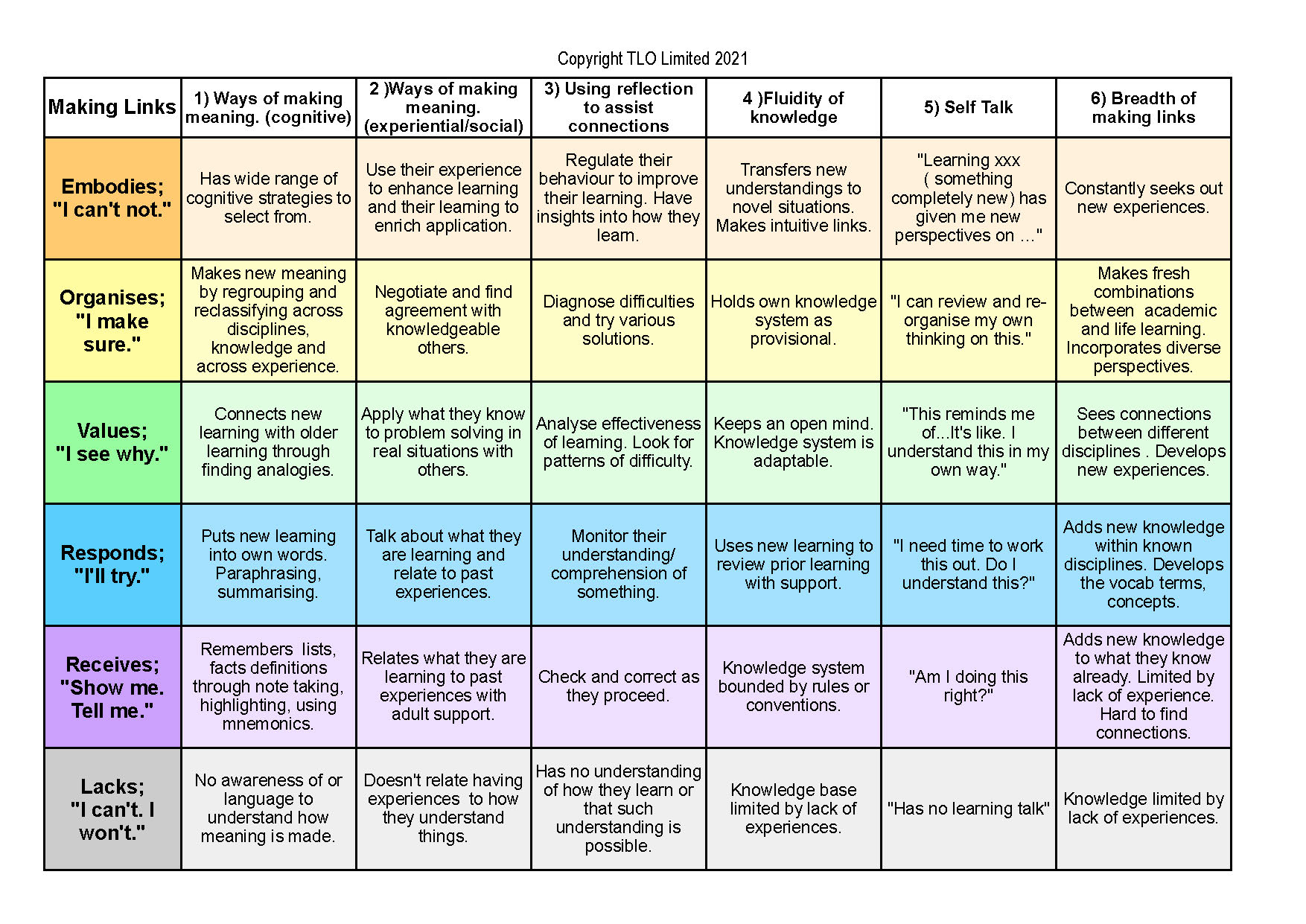
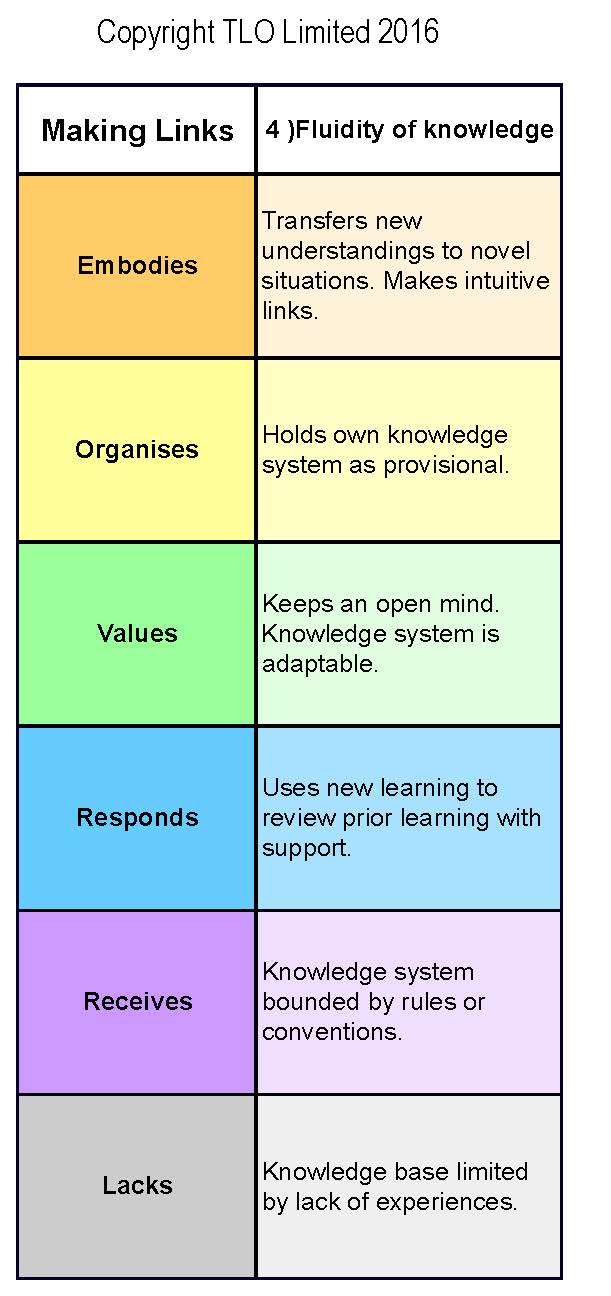
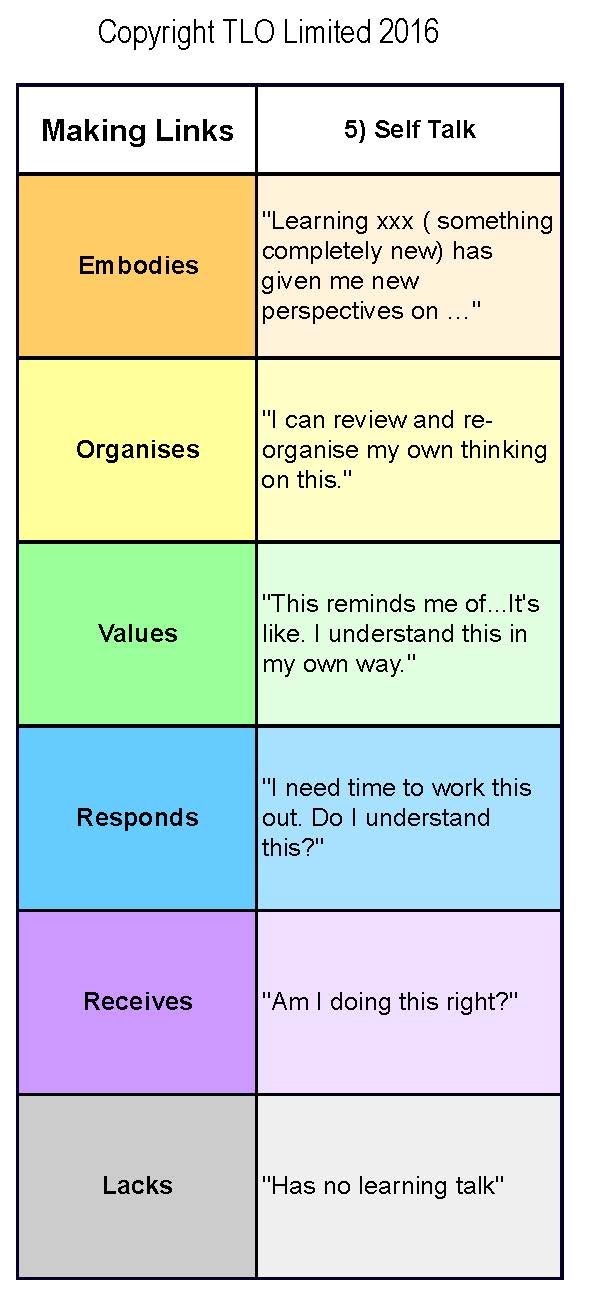
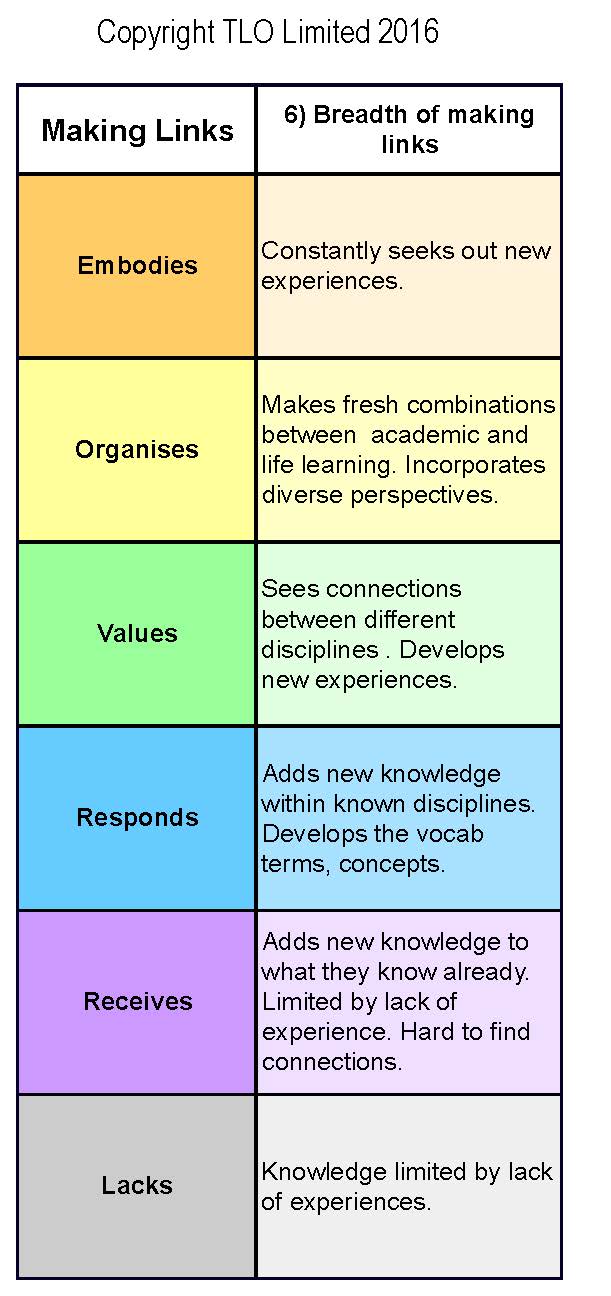
The Making Links grid
Where students are secure
Where the students could be secure when they leave secondary schooL
Activities and talk ideas
4. Planning what to do
What do we need to do next? ( 10 mins )
Decide
Which ideas should we all adopt as a school strategy?
How the progression of Making Links should be built across the school. ie how the phases of Making Links might play out against key stages and even year groups.
5. Personal action planning
What am I going to do? ( 20 mins )
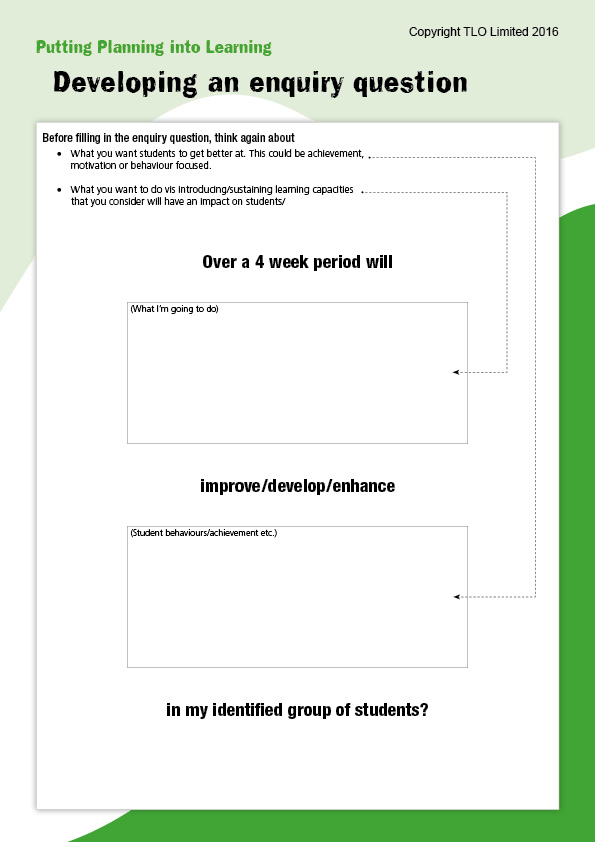
5a.Consider
how you want your students to improve/develop/enhance their approach to Making Links
what you are going to do to bring this about
develop your enquiry question.
Think of it like this…
If I do XXXX will it improve/develop/enhance YYYY
This is the crunch question. Your students are unlikely to change unless you change!
Looked at your students through the lens of the Making Links learning chart
Gained a sense of what becoming better at Making Links looks like
Explored a range of ideas and activities that will help to engage students with Making Links
Now we look closely at how to blend improving students’ making links into the content you have to teach.
A. The principles behind any learning powered lesson
B. Big questions to ask about lesson design
C. Lesson planning in action…an exemplar making links focused task
Learning habits form through use and practice, but desirable habits survive and flourish better if students are aware of them, realise their value and strive to improve them. The curriculum through its lessons provides the rich and varied occasions for exercising learning habits.
A. The principles behind any learning powered lesson
Think of yourself as a learning power coach, helping your students to help themselves to develop their learning habits. Hence your lessons are much more likely to contain challenges and activities that get your students thinking and learning for themselves. You encourage students to explore challenging questions, problems or assertions and become observers of their own learning. You step back from telling and heavy scaffolding and instead try to mobilise your students’ learning behaviours. You are organising learning to let them take the strain.
The SIX principles that lie behind teaching for learning power
1: Visible learning…Surfacing learning
You make it clear to students which learning habits and processes they are using. You try to make every aspect of the learning process as visible as possible through the language you use and through the words and images you display on the walls.
For example:
Use display
Show connections between ideas, characters, objects that are being studied through the use of classroom wall displays. Refer to them and encourage students to add new connections as they emerge.
2: Dual focus teaching…blending content and process
You design activities that combine the dual objectives of ‘what’ will be learned and ‘how’ it will be learned. You make sure students know that the content they are learning is a way of giving their minds a useful workout. (The content is the vehicle for learning)
For example:
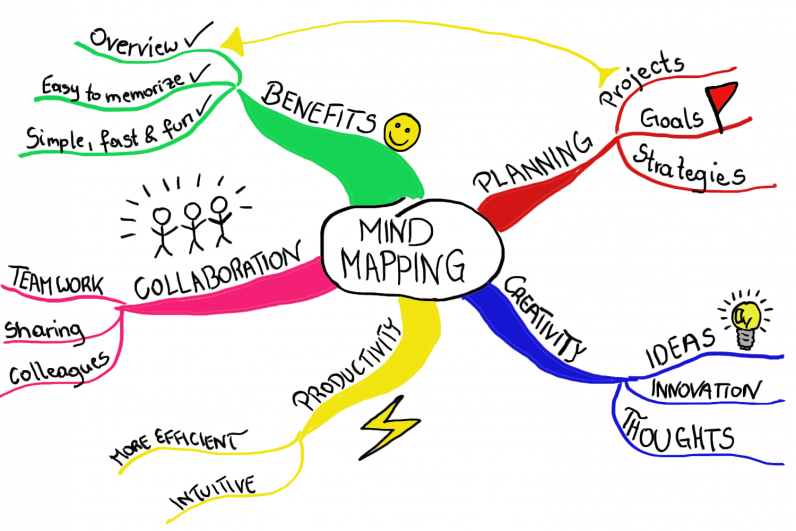
Mind Maps
Use mind maps to encourage students to link and explain how information and ideas seem to be associated.
Use mind mapping at the beginning, middle and end of a unit of study to show how links and understanding change as knowledge grows.
Use at the end of a module of learning as a synthesising tool.
Use a ‘thought shower mind map’ at the outset of a lesson to connect with prior learning and activate link making.
3: Emotional engagement…Capturing attention
Your lessons are designed to intrigue your students. Students don’t put in the effort unless their energy and attention are captured by what they are doing. You capture your students’ emotional engagement by giving them more of a stake in the process of learning.
For example:
Word Play
_________ is like (a) ________ because….
The first blank is for the subject-related topic, concept etc.
The second blank is for the random (?) noun.
e.g. Punctuation is like a river because . . .
Use as an engaging starter or a reflective, plenary activity
It stimulates students to make links between what they have just learned and things they already know.
Use it more generally towards the end of a topic as a transferring or distilling activity.
You could… choose the noun at random; structure more carefully and choose a noun to help scaffold the learning; encourage students to choose their own (random ?) noun. It could be an end of topic homework.
4: Handling uncertainty…Challenge
You have realised from your own life that what is engaging tends to be what is challenging. Since you see education as a preparation for a learning life, you help students to learn how to handle increasing degrees of complexity and uncertainty.
For example:
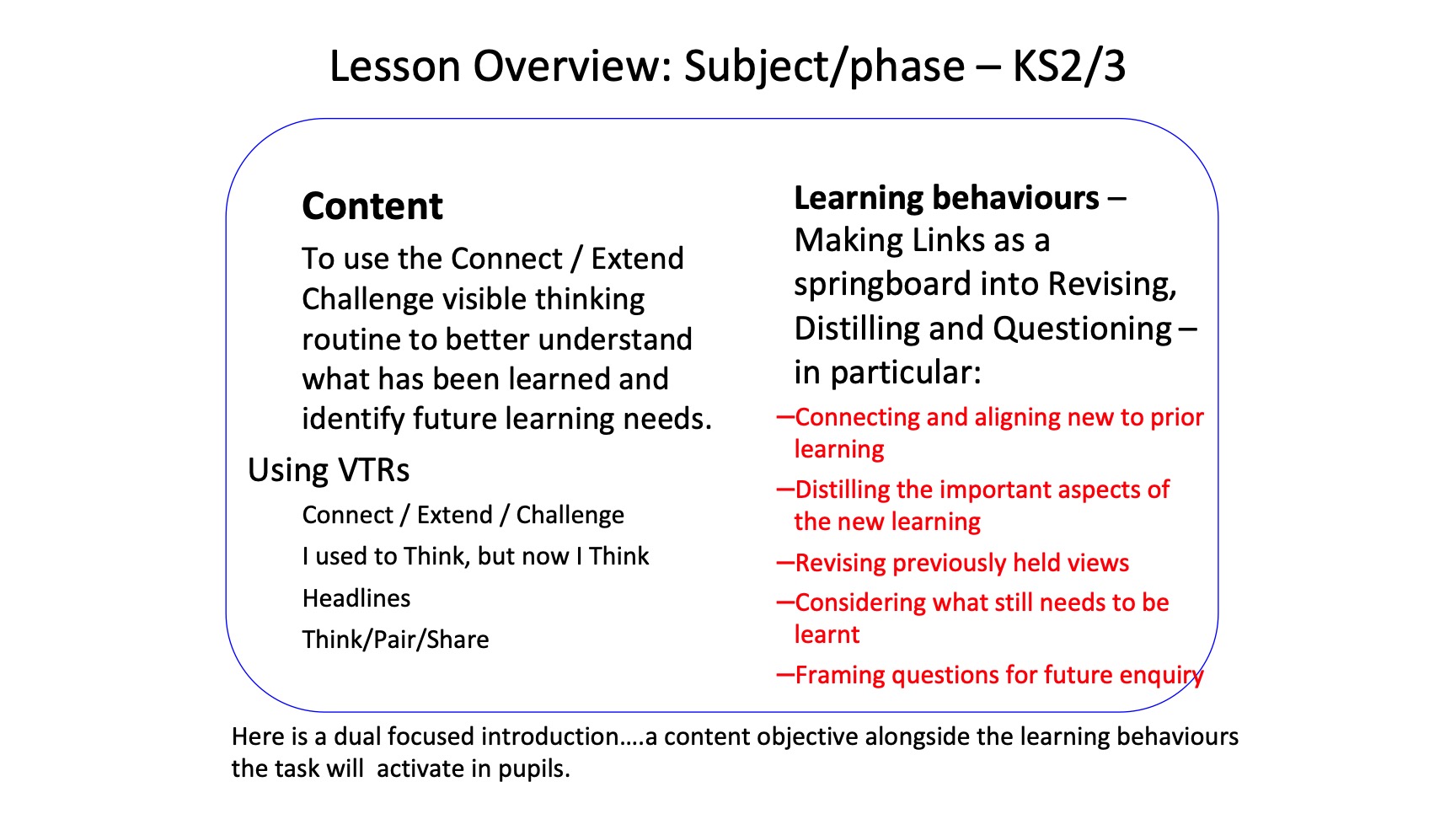
Visible Thinking Routine
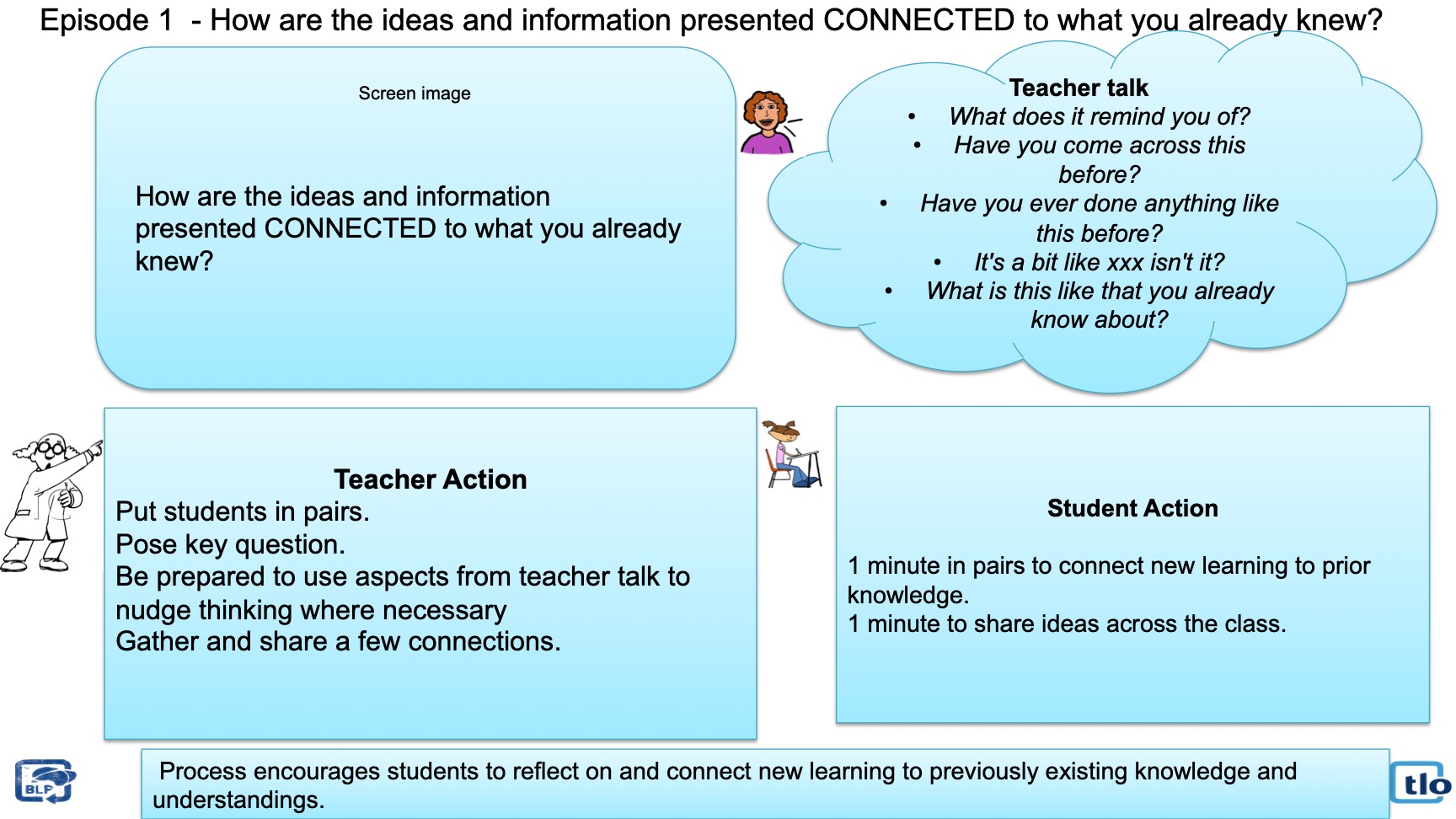
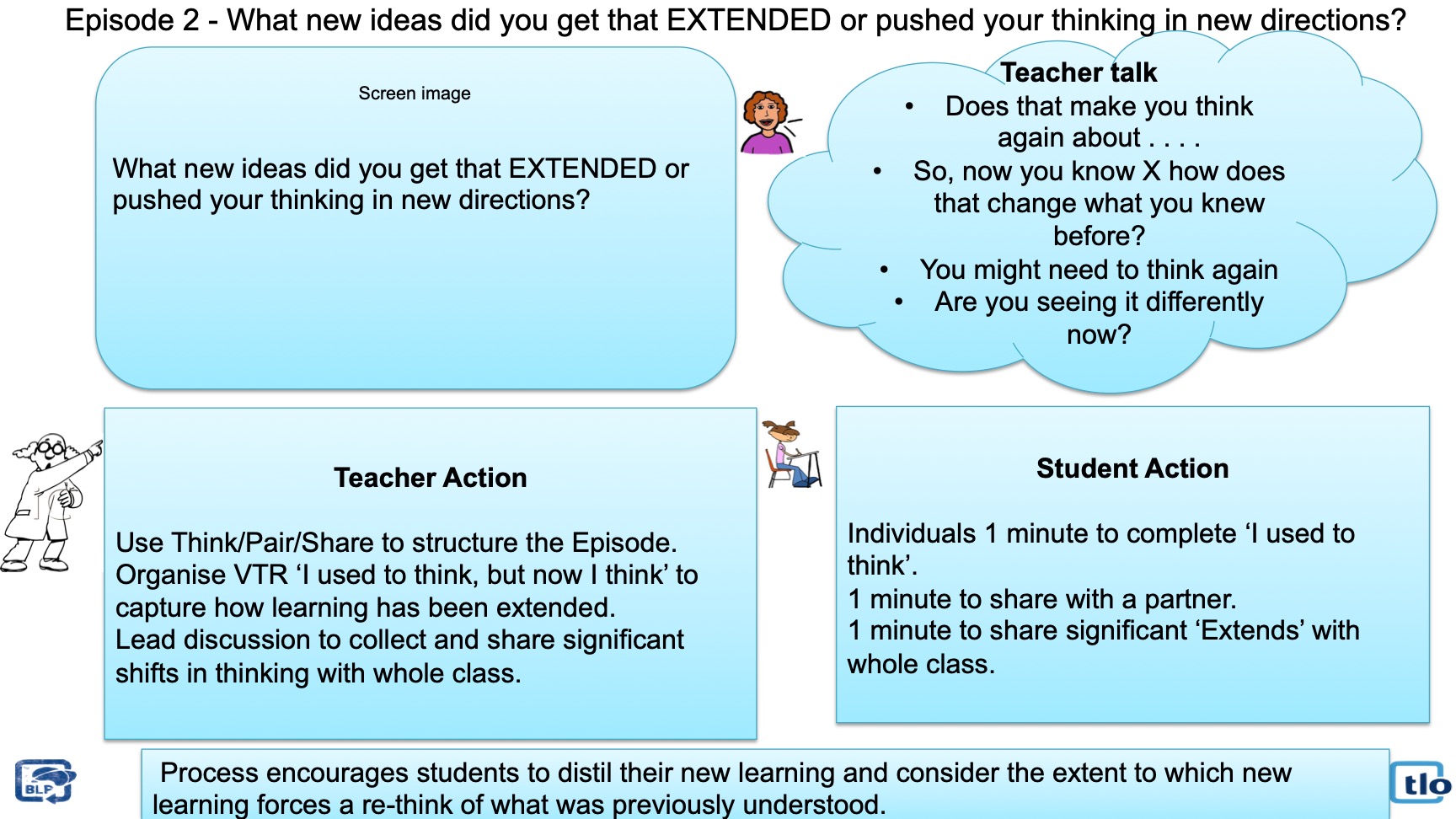
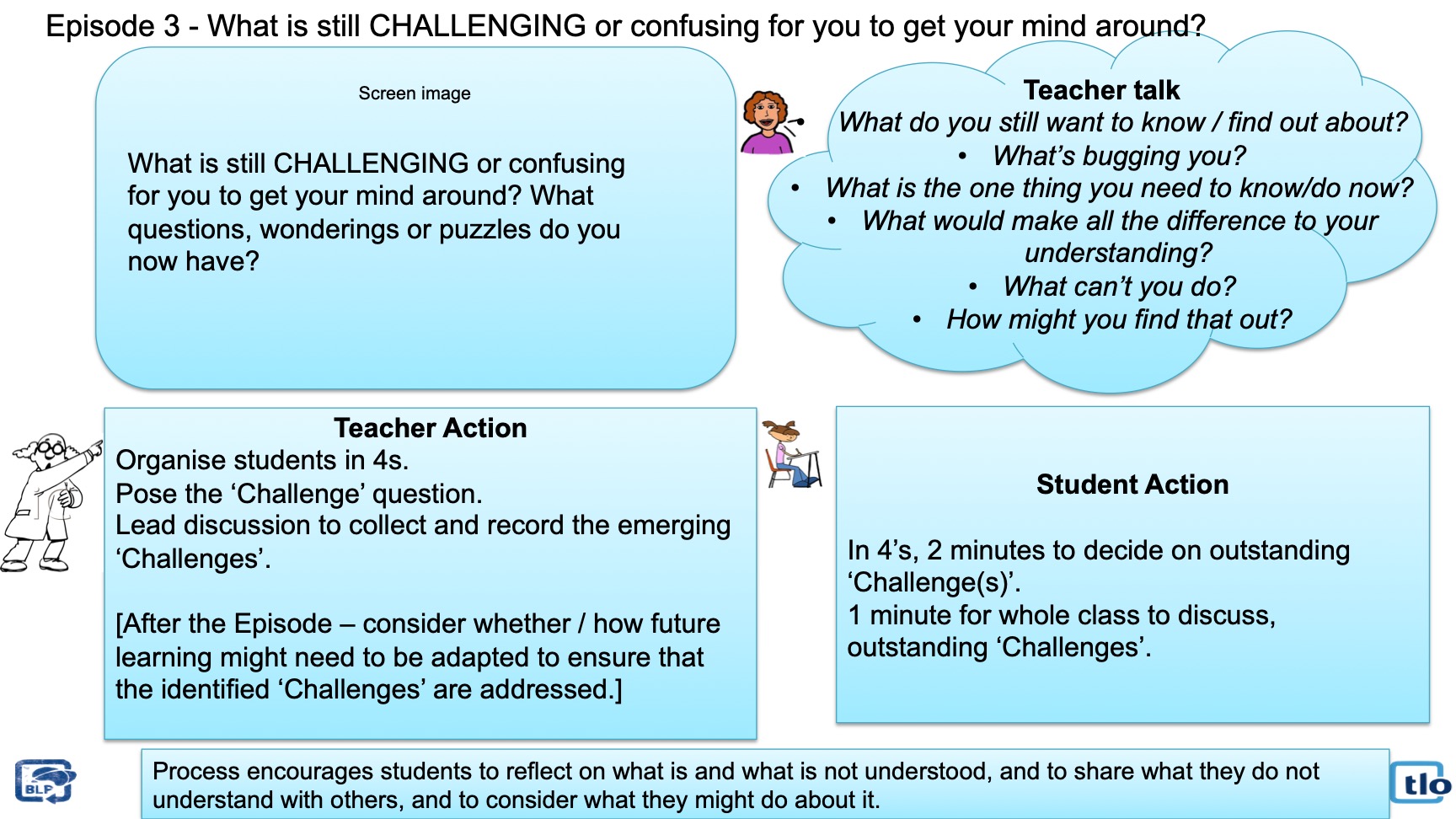
Connect, Extend, Challenge
Helps students make connections between new ideas and prior knowledge. Also encourages them to take stock of ongoing questions, puzzles and difficulties as they reflect on what they are learning.
Connect…how are the ideas and information presented connected to what you already know?
Extend…what new ideas did you get that extended or pushed your thinking in new directions?
Challenge…what is still challenging you or confusing for you to get your mind round? What questions, wondering or puzzles do you now have?
The natural place to use this routine is after students have learned something new. For example: after exploring a work of art, a theory, a method, a piece of evidence. Try it as a reflection during a lesson, after a longer project, or when completing a unit of study.
The routine works just as well with the whole class, small groups or individually.
5: Relationships…Working together
Learning is both a sociable and a solitary activity, and you offer your students opportunities to experience both. You develop interdependent learners who know how to handle themselves in collaborative groups and able to move around in the social space of learning to best effect.
For example:
Invite groups of four to consider the different ways we connect ideas —logical, diverse, lateral, etc. Give each group a bag of items that are connected or linked in some sort of way. Students have to work out how they are linked. Nudge with “What’s happening here and what makes you say that?”
Debrief through discussion “What is happening in our minds when we make connections between things?” “Sometimes it is important to think logically and systematically, and sometimes we need to allow ourselves to imagine possibilities.” “Why is it important to make connections?” “What does making connections help us to do?”
Alternatives Run activity with all groups having the same articles OR with all groups having different articles. OR having bags of items with no obvious links. Students make up their own.
6: Reflection and responsibility…Taking charge
You understand that students have to learn how to manage and organise their own learning and that the way to do this is by giving them increasingly demanding opportunities to do so. You orchestrate students taking charge of their learning by expecting them to plan what they do, distil meaning from it, and revise it accordingly.
For example:
Learning Logs
Introduce Learning Logs to encourage students to reflect on how they are making links in order to build understanding. Ensure link making ideas stretch beyond school and subjects
A checklist for lesson planning based on these six principles.
Does the lesson plan:
Make it clear to students which learning behaviours are being activated?
Match and blend the learning behaviour with content?
Include a tactic to captivate students’ attention?
Have sufficiently challenging learning activities to sustain interest for all?
Offer choice on how students could interact on these tasks?
Embed aspects of planning, reflecting and revising for content and process?
What do you think?
Which of these six principles are a regular feature of your planning?
What do you make of principle 2? Is it the most tricky of the six? The following section B is mostly about this aspect of planning.
Look at the checklist in the green box above this one: Do your lesson plans capture these six aspects of an effective learning experience?
Make a note of…
Which of the six principles might need to be given greater prominence in your planning.
B. Big questions to ask about lesson design.
What we teach and how we teach it (the enacted curriculum) are intertwined and offer teachers a lot of freedom. It is here that you can start applying a learning power filter and deploy a unique combination of content and learning tasks.
In conventional lessons where the teacher remains the focus of attention and the initiator of all activity, and where the epistemic dimension (the conditions for acquiring knowledge) is not acknowledged, students gain habits of compliance and dependence, rather than curiosity and self-reliance.
In developing learning power, teachers are making conscious choices about which habits to introduce and stretch and how best to couple these with content so that lessons become more interesting and challenging. Through such overt coupling of content and specific types of process, students come to know, understand and take control of their learning behaviours – they knowingly use and develop the whole range of learning behaviours.
All lessons function on two levels, they have twin intentions. On the one hand there is content to be acquired, and on the other there are learning behaviours to be exercised in pursuit of this content. The factor that differentiates a standard lesson that effectively ‘delivers the content’ from a learning powered lesson is that the teacher has to think, in advance, about:
the learning behaviours that are necessary for successful content acquisition;
the design of activities /tasks that will stimulate these behaviours;
how learners could reflect on and evaluate their use of these behaviours.
In designing such lessons you have to dare to think differently and flip round your usual lesson design thinking.
A turn-around in lesson design
Think in two dimensions at once – the content dimension and the learning behaviour dimension. It means turning your thinking around – from teaching to learning.
Or put another way
Think to yourself;
what content?
using which learning behaviour(s)?
via an activity to stretch both?
Lesson design questions… one by one
Here the general rules of lesson design have been related to the learning behaviour…making links.
Stage 1. What content do students need to learn?
What content has to be learned? …..Think outcomes.
Use standard lesson planning tools:
What are students going to be able to do/learn?…think objectives
How will they know if they been successful?… think success criteria
While keeping an obvious eye on
What do they already know?….think previous learning.
Stage 2. How will they best learn it?
Using which learning behaviours?
This is the new bit
Not the usual second step but nonetheless a vital second step where the aim is to weave content acquisition with learning behaviours. The content is the vehicle for exercising the learning behaviours and the learning behaviours accelerate the content acquisition.
Using which learning behaviours?…Think types of learning behaviours
Which learning behaviour(s) will help these students get closer to understanding this content?…think learning behaviour charts.
Which aspect of, say, making links, lends itself to achieving these outcomes?…think progression columns.
How skilled are these students in using this learning behaviour …think progression phases/rows
Say something like this to yourself .…My students need to achieve xxx. At this stage we could get closer to this content by using making links. Most of my students are able to use xxx phase (e.g. respond/blue) making links approaches confidently.
Stage 3. What type of task/activity will stretch the learning?
Which type of task…Think types of task.
Pick up your thinking from stage 2;
My students need to achieve xxx. At this stage we could get closer to this content by using making links. Most of my students would be able to use xxx phase (e.g. blue/responds phase) making links approaches confidently.
And now think about the sort of task/activity you might develop/design so as to:
orchestrate a problem-solving activity to enable students’ understanding of xyz content without telling them;
intrigue them with something that is open to several interpretations;
stimulate their curiosity;
grab their attention…visually and aurally;
allow them to stay stuck before I ask them how they are thinking;
offer as a nudge to get them thinking differently that doesn’t give the answer away;
leave it as a problem hanging in the air to which we will return later;
make links between the challenge, and what and how we are learning in this lesson.
The challenge isn’t about the inherent complexity of the subject matter but about how the content is orchestrated to encourage students to use their learning habits to resource their solution.
Think…what/how much information/content do I need to give/reveal? At what point? In what form? To what end?
Say something like this to yourself .…
my students need to achieve xxx.
at this point we could get closer to this content by using making links.
most of my students are able to use xxx phase (e.g. respond/blue phase) making links approaches confidently.
What type of task would stretch their making links but assist them with the content…without me just telling them!
To summarise…the heart of the lesson
It’s the question ‘using which learning behaviours?’ that causes you to think differently about the lesson planning.
You ask – as always – what are the anticipated objectives/intentions?
The verbs in your resulting objectives will give you clues about the types of task/methodology that will get students there and the sorts of learning behaviours your students will need to contribute to this learning endeavour.
You are designing the task in a way that requires students to contribute their learning ‘powers’ / behaviours. The tasks you design will hook into their learning ‘powers’ and help them to improve them.
Say something like this to yourself:
I am going to think content, learning behaviour and task together:
Making links will help students to better access the content;
The aspect of making links (column) and phase (row) that would fit best is (for example) “Remembers lists, facts definitions through note taking, highlighting, using mnemonics” (Ways of Making Meaning column, Purple phase)
The type of task/activity that would best stretch both content and learning behaviour, intrigue, challenge, bring people together and give responsibility to students is………
Think….what information do I need to reveal/give, in what form, at what point, and what do I want students to do with it?
What do you think?
What strikes you about this way of planning with learning behaviours in mind?
Where are the potential stumbling blocks?
How will you decide which learning behaviour(s) you are going to foreground in your objectives?
Consider a lesson you are about to teach…
What is the content?
Which learning behaviour(s), if missing, would make accessing the content very difficult / impossible?
How could you blend reference to this learning behaviour(s) into the learning objectives?
Can you design a task that will help students to access the content and exercise the key learning behaviour(s) you have identified?
C. Lesson planning in action – an exemplar, link making, task.
How do we design tasks that stretch Link Making and assist students to approach the content more productively? We cover this in four ways:
1 describes the Connect/Extend/Challenge visible thinking routine;
2 shows the phases of a lesson where Connect/Extend/Challenge is embedded;
3 considers a simple lesson plan template that can be used for any lesson and distils the Link Making lesson into this format;
4 invites you to extend your thinking about the Connect/Extend/Challenge technique into other aspects of the curriculum.
[Follow the link to see C/E/C and all of the other Visible Thinking routines.]
Connect Extend Challenge – A routine for connecting new ideas to prior knowledge.
The routine uses three questions:
How are the ideas and information presented CONNECTED to what you already knew?
What new ideas did you get that EXTENDED or pushed your thinking in new directions?
What is still CHALLENGING or confusing for you to get your mind around? What questions, wonderings or puzzles do you now have?
Purpose: What kind of thinking does this routine encourage? The routine helps students make connections between new ideas and prior knowledge. It also encourages them to take stock of ongoing questions, puzzles and difficulties as they reflect on what they are learning.
Application: When and Where can it be used?
The natural place to use the Connect-Extend-Challenge routine is after students have learned something new. It doesn’t matter how much they have learned – it can be a lesson’s worth, or a unit’s worth. The routine is broadly applicable: Use it after students have explored a work of art, or anything else in the curriculum. Try it as a reflection during a lesson, after a longer project, or when completing a unit of study.
Launch: Some tips for starting and using this routine.
This routine works well with the whole class, in small groups or individually. Keep a visible record of students’ ideas. If you are working in a group, ask students to share some of their thoughts and collect a list of ideas in each of the three categories Or have students write their individual responses on post-it notes and add them to a class chart. Keep students’ visible thinking alive over time: Continually add new ideas to the lists and revisit the ideas and questions on the chart as students’ understanding around a topic develops
2. A lesson that has uses Connect / Extend / Challenge to support curriculum understanding.
Overview of lesson plan:
[Previous Episodes – Learning some curriculum content
What is happening here?
This is standard fayre – your class have been studying something and you want them to reflect on what they have learned, how it changes what they previously thought they knew, and what they still need to understand. The duration of this study may simply be a lesson, or it may be a series of lessons.
The critical aspect is that Connect/Extend/Challenge is used after some new learning has happened, otherwise it is impossible to access the Connect and Extend aspects.
Timings for the 3 Episodes depend on how much new learning has been achieved, which must, in part at least, be a consequence of the duration of the learning experience. Using Connect/Extend/Challenge as a review point towards the end of a lesson might only be a 5 minute plenary activity designed to alert students to what has been learned and to look forward to the upcoming learning in the next lesson. However if used after an extended project, the routine might well extend to 30 minutes due to the amount of new learning to be considered.
In the lesson illustrated below, we assume the 5 minute plenary format. Simply extend the timings if you are applying it to a more substantial piece of learning.]
Episode 1 – How are the ideas and information presented CONNECTED to what you already knew?
What is happening here?
In this Episode, students are encouraged to think back to their prior understanding of the content / topic.
[This would obviously not work if they had no prior knowledge of the topic being studied. It may have been worth checking this out before embarking on the lesson/topic by asking students to record their answers to the question: ‘what do you think you already know about . . . . . ?’ – It is a classic way of identifying misconceptions that can be addressed through the upcoming session(s). It is also the first step in the visible thinking routine Think/ Puzzle/ Explore – more of which later].
Here, students are invited to connect their new learning to their prior understandings, so helping them to see learning as an integrated whole rather than a series of unconnected ‘facts’ to be memorised.
In the bottom blue box, the Learning Behaviours being activated aresimply identified as:
To reflect on and connect new learning to previously existing knowledge and understandings.
In Link Making terms, it moves learners from ‘knowing stuff’ to thinking about how the new learning connects to what they already know/knew. It encourages them to ‘Relate what they are learning to past experiences with adult support’ [Making Links grid, Ways of Making Meaning column, Receives/Purple phase].
Episode 2 – What new ideas did you get that EXTENDED or pushed your thinking in new directions?
What is happening here?
Having used the Connect phase to remind students of a) what they used to know and b) what they now know about a topic, the Extend phase encourages students to reflect on how the new learning may force a change in what they thought they knew previously. It is a revising activity where learners have to connect and align their prior understandings with their new learning. It is the point at which the gap between what was known at the outset and what is known now is identified (progress, as we would call it), and also where earlier misconceptions are refined in light of the new learning.
In the bottom blue box, the Learning Behaviours being activated are summarised as:
To distil their new learning and consider the extent to which new learning forces a re-think of what was previously understood.
Essentially, the addition of the ‘Extend’ aspect of CEC lifts the requirements further. Episode 2 encourages students to ‘Use new learning to review prior learning’ (Making Links, Responds/Blue phase), and also to ‘link new information to what they already know and develop new ways of thinking about it’ (Meta Learning, Responds/Blue phase) in order to ‘Recognise learning involves constant rethinking / redoing’ (Revising, Values/Green phase).
Episode 3 – What is still CHALLENGING or confusing for you to get your mind around? What questions, wonderings or puzzles do you now have?
What is happening here?
Having used the Connect phase to remind students of a) what they used to know and b) what they now know about a topic, and the Extend phase to refine thinking in the light of new learning, the previous 2 Episodes were focusing on what was previously, and what is now, known.
In the Challenge phase, students are encouraged to consider what it is they donot yet know.
Students find it relatively easy to say what it is they know they do not know (the known unknowns), but cannot possibly say what they don’t know they do not know (the unknown unknowns). It is here that the skilled teacher judges how many more ‘unknowns’ it is sensible to throw into the mix.
In the bottom blue box, the Learning Behaviours being activated are summarised as:
To reflect on what is and what is not understood, and to share what they do not understand with others, and to consider what they might do about it.
The ‘Challenge’ aspect of CEC encourages students to consider ‘What do I need to know’ (Meta Learning grid, Responds/Blue phase), to explain what they do and do not understand, and, ideally, to identify and think about how to bridge the gap between what they do know and what they need to know – all high level meta-cognitive skills.
The powerpoint can be downloaded here if you wish:
Can you think of a situation in which you could use Connect/Extend/Challenge to advantage in your own classroom?
Make a note of…
When you might try this.
How you capture the ‘challenges’.
How you will adapt your planning to address them.
3 Using a lesson plan template to distil this lesson.
Given that there are hundreds of lesson plan formats we will use a few different types of planning tools over the course of these units. This one is a simple streamlined useable tool that includes:
What you do (teacher action);
What students do (student action);
What the learning behaviours being called upon are (learning behaviours);
What you say (learning talk) to nudge the learning behaviour along.
The format is divided into episodes to show the change of purpose, action and use of learning behaviour across the course of the lesson.
Download a blank lesson plan as a MS Word document: Lesson Planning Grid [.DOC 33KB]
If we now populate the template with the episodes explored in section 2 above, we get the completed lesson plan. . .
What are your first reactions to this lesson plan template?
Does planning for four aspects – teacher action, student action, learning behaviours, teacher talk – seem useful?
How does sequencing the lesson as ‘episodes’ help or hinder planning?
Make a note of…
The extent to which your existing planning template enables you to think about lessons in this way.
What you would like / need to add to it.
4 Extend your thinking about the Connect/Extend/Challenge visible thinking routine
Why use Connect/Extend/Challenge?
The whole point of the strategy is not that it should be used occasionally at the end of a project as a sort of topic plenary, rather it should be used frequently so that it should in time become habituated so that students’ responses to all new learning is to use it to further enhance and refine their web of understanding. Furthermore, the ‘challenges’ that arise help to focus the next steps for both teaching and learning.
Going beyond Connect/Extend/Challenge to Think/Puzzle/Explore
The visible thinking routine Think/Puzzle/Explore has three driving questions:
What do you think you know about this topic?
What questions or puzzles do you have?
How can you explore this topic?
[Think/Puzzle/Explore is detailed in ‘Moving beyond Green’ in section 2. It is designed to help students connect to prior knowledge, to stimulate curiosity and to lay the groundwork for independent inquiry.]
It is similar to but subtly different from Connect/Extend/Challenge. On the surface, ‘Connect’ and ‘Think’ are similar, as are ‘Challenge’ and ‘Puzzles’. Extend is missing from T/P/E because it is designed to be used before the new learning takes place, whereas C/E/C is used after new learning has taken place. The addition of ‘Explore’ encourages and sets the scene for higher levels of learner independence than C/E/C, which is more heavily teacher directed.
As learners mature, it should be possible to use T/P/E as a stimulus to independent enquiry, and C/E/C as an ongoing review tool during such enquiry.
Going beyond Connect/Extend/Challenge to 3-2-1 Bridge
The visible thinking routine 3-2-1 Bridge is a routine for activating prior knowledge and making connections.
Prior to embarking on a new topic, students are asked for 3 Thoughts, 2 Questions and 1 Analogy about the topic.
After studying the topic, students are again asked the same 3-2-1, and this time with the addition of Bridge, when they are asked to explain how their new responses connect to their initial responses.
Unlike Think, Puzzle Explore which takes place before learning and Connect/Extend/Challenge which is undertaken after learning, 3-2-1 Bridge occurs both before and after new learning.
It lacks the Explore aspect of T/P/E, and the Extend aspect of C/E/C, but otherwise is very similar to both in terms of helping students to activate prior knowledge and link it to new learning.
What do you think?
Where / when / why might you use T/P/E?
Where / when / why might you use 3-2-1 Bridge?
Which of the three routines do you think would work best with your students? How will you find out?
How will you use the ‘puzzles’ that are generated?
How will these ‘puzzles’ inform your planning?
How will you enable students to undertake what they would like to ‘Explore’ so as to support their growth as independent enquirers?
Make a note of…
Which class you might try these visible thinking routines with.
As teachers we are in the habit-forming business. What we say, what we display on classroom walls, what we celebrate, praise or dismiss, what we model or how we design learning activities will all influence the ways in which students learn, perform and behave. Classroom cultures have a huge influence on students’ learning as you will remember from the Culture unit.
Five big shifts to get you started. Ask yourself – how might you:
Help students to connect new learning with prior knowledge;
Encourage students to consider where else new learning might be applied;
Employ metaphors and analogies to explain new learning;
Enable students to explore the overlap between different subject areas;
Ensure that students build their own web of understanding for themselves.
Now look at the Learning Chart sections below where you will find plenty more ideas to try.
Making links between different things comprises not only the ability to see or make relationships but also the inclination to look for them.
Trying to hook up new experiences with what you already know is what some people call ‘making meaning’.
New ideas become meaningful to the extent that we can incorporate them within our own mental webs of associations and significances. When the patterns of relationships to be discovered are rather complex or subtle, business guru Peter Senge calls it ‘systems thinking’. Good learners get pleasure from seeing how things fit together. They are interested in the big picture, and how new learning expands it.
Good learners can make all kinds of different links. They can link together this lesson’s physics topic with what they were doing in maths last week. They can look for links to their own goals and interests, to discover the relevance of the new learning to their own lives. They find links to their own real-life experience—using new ideas or theories to make sense of past impressions. They weave new events into their developing autobiographical story relating them to their sense of self. They can connect new learning with their own opinions and beliefs, so that they come out not just knowing something new, but looking at the world in a different way. And—very importantly for creativity—they may look for analogies in their own memory that give them a handle on a complicated new domain.‘What’s it like?’they ask themselves.
Extract from Building Learning Power by Guy Claxton
1b) What does being a good Link Maker involve?
Learning is about making connections – you will experience them through the ‘ah ha’ experience of seeing a connection between two previously isolated concepts, or the satisfaction of seeing the connection between an abstract idea and a ‘hands-on’ concrete experience. It’s how you make sense of the world. To be a good link maker you need to keep stimulating your brain and enriching your experiences because through active learning you quite literally ‘build’ your own mind. This is done in many ways; through having a repertoire of cognitive strategies; through the social process of constructing knowledge; by connecting experience and learning; through how you direct the work of learning, sometimes called meta-learning or simply reflection (see the module on Me-Learning). And at the heart of all this is your attitude to knowledge; whether it is bound up in rules and ‘is-language’, or whether you see knowledge as provisional, ever building and changing. When looked at from these diverse angles growing link making moves well beyond encouraging a student to ‘look for a link’.
The Making Links grid below attempts to capture these constituent parts of building the habit of Making Links.
Our progression grid for Making Links has 6 components:
Making Links is about how you understand and make meaning of the world. Your brain develops schema (plural, schemata): this is a cognitive structure that organises collections of bits of information that build together to form a concept of something. This working structure changes and grows throughout life. Each new event, filtered by perception, is organised and connected to the existing structure to create meaning. We as teachers cannot transfer our own knowledge ready-made to students. They remember what they understand – what they have connected in their own schemata. When a schema is very sparse for a particular subject, connections are hard to find and make. Teachers should always be helping children to make the connections that lead to deeper understanding. We can help students to become effective learners through cognitive (col 1) and meta-cognitive strategies (col 3) to gain insight into the how of learning. But to make connections more easily across different disciplines, or linking the obvious with the more obscure, we need to get beyond being bound by early rules and conventions and view our knowledge system as open and flexible, allowing all manner of possibilities (col 4). It is in this way that our minds truly grow.
“ Moment by moment throughout our lifetime, our brains hum with the work of making meaning: weaving together many thousands of threads of information into all manner of thoughts, feelings, memories and ideas.” Daniel Tammet
Take a closer look at what each column of the grid is about
Ways of making meaning (cognitive)
Building cognitive understanding
The first contributory factor is how we retain and organise information or content; the ‘what’ of learning. Firstly how we remember facts, lists, definitions etc., and bring it into working memory. Then how we actively connect the new information with what we already know and develop an organisational framework for that subject. Then how we construct connections and develop relationships between the ideas. It’s the nuts and bolts of how we construct meaning.
Ways of making meaning (experiential and social)
Building understanding through experience and with other people.
The next contributory factor in Making Links is how we make meaning by ‘learning by doing’ and learning with others. (Worthy of two columns, perhaps, but we didn’t have the space!) It’s about how we learn by doing real things, often with others (problem solving, simulations, gaming, role playing, being an apprentice); how we use experience to improve learning; how we use learning to improve our performance; how we construct meanings with other people. Experiential learning is at the heart of collaborative learning teams and learning communities. It links strongly with the next column, since reflecting on action is what brings about improvement.
Using reflection to assist connections
Meta-learning
The next contributory factor is about how we reflect on the action of learning itself. Research suggests that good learners are more effective in their use of these strategies. Learners become more aware of their own cognitive strategies and analyse the effectiveness of their learning as they go along. It plays a big part in scaffolding how we construct our minds rather than passively receiving information.
Fluidity of knowledge
Open mindedness
This is an important column in that it concerns how we view what we know; how open we are to information and experiences. If we have dogmatic views about things, or our views are fixed, we are unlikely to add more. If we are a stickler for rules our understanding will be limited by that stance. The more open minded one is the easier it is to make interesting, unusual, imaginative, comical and even absurd links between ideas. This is where ‘could be’ language wins over ‘is language’.
Self talk
The voice of self knowledge
Self talk is what we say to ourselves as we learn. The statements capture what someone in each phase of the grid might be thinking. Students may use some of these phrases when talking with you, or in writing from time to time, but mostly self-talk goes on inside their heads. We have shown a small flavour of self-talk thoughts that teachers can encourage students to imitate. The examples indicate how link making grows more sophisticated over time.
Breadth of making links
How extensive our link making is
The last constituent of making links has to do with the breadth of our link making. Whereas column one was more about storing knowledge, this column is about linking that knowledge together in a broad sense. The key to being able to link things together is the breadth of experience we have. If you have never had experience of the sea or learned Latin you won’t be able to draw on that body of knowledge and experience to influence your understanding the world. When you have little knowledge of something you will struggle to make links within the subject let alone between subjects.
What do you think?
What have you learned about making links from these descriptions?
What have you had confirmed?
What surprised you?
How have your views changed?
Make a note of…
Any ideas for practical classroom experiments that these descriptions have triggered
Which column your students are most secure in.
1d) Unpicking the rows: getting better at Making Links.
Of course the development of making links does not grow neatly up each column or evenly across the phases in the grid. The five broad phases of dispositional growth (purple – orange) are affective ways in which people may be inclined to behave: we call this inclination ‘mindedness’.
Here is our interpretation of how Making links might grow.
The phases are drawn from Bloom’s taxonomy of the affective domain.
Phase ‘Receives’ (purple) is about doing something because you are told or expected to.
Phase ‘Responds’ (blue) is about gaining interest and doing things more willingly.
Phase ‘Values’ (green) is a key phase since the student now sees the value of behaving in this way. It’s a win for them; to behave like this is in their interest. It’s in this phase that the behaviour becomes more secure.
Phase ‘Organises’ (yellow) is the phase in which the student capitalises on this ‘in their own interest’ behaviour and gets themselves organised to use it positively.
Phase ‘Embodies’ (orange), known as ‘characterised’ in the original taxonomy. In this phase the student has made this behaviour their own. It has become part of their character; they can’t not do it and they have become highly skilled in doing it.
We urge you to see this progression as long term. Some phases will take years for people to work through; some will never be worked through. None of the phases are inevitable. There is a lifetime of development captured here. Nevertheless the role of a teacher or parent should surely be to encourage and enable this journey.
Lacks: Minded to ‘just do things’
In this ‘Lacks’ (grey) phase, students are unaware of making links. Their experience of the world and life is limited and they have no language to help them understand learning. These various limitations mean link making will be limited and certainly not conscious. It’s a low level to build from but even at the start of schooling children will arrive with very different levels of experience and knowledge. Having these experiences secured by talking about them offers a good start.
Receives: Minded to build up knowledge.
In the Receives (purple) phase, students are still unaware of making links unless it is pointed out to them. They concentrate on learning more but without worrying how things might fit together. Their link making is limited by lack of knowledge and experiences if this isn’t nurtured.
Responds: Minded to develop understanding.
In the Responds (blue) phase, students are enjoying adding to their knowledge store. They secure their new learning by talking about it and putting it into their own words. This is further refined by monitoring whether they understand something and how it fits with what they already know. Here they are developing the vocabulary and specialised terms of a discipline.
Values: Minded to broaden the scope of learning.
In the Values (green) phase, students understand the need to learn from previous experiences and realise that learning is all about changing understandings, not just knowing stuff. They might connect new learning to previous learning through the use of analogies and extend what they know through problem-solving with others.
Organises: Minded to actively reorganise their understanding.
In the Organises (yellow) phase, making links has become a skilful habit. Students are relaxed about reorganising their ideas and linking between disciplines. They can work with others to get their heads around tricky problems, and reflection now moves up a gear to analysing the difficulties they are having in learning. All this is assisted by accumulating diverse perspectives on life.
Embodies: Minded to exploit experiences to the full
In the Embodies (orange) phase, students adapt readily to changing circumstances and regulate their behaviour with the explicit intention of doing it better, more efficiently/differently. They have plenty of cognitive strategies to help them learn efficiently and these are made more effective through their breadth of experience and knowledge. They build their own complex understanding of the world which is drawn from a web of associations between knowing, doing and reflecting.
What do you think?
What has struck you about the act of link making, having read the descriptions above?
Which phase do you operate in?
What makes you say that?
Make a note of…
What you might do to assist your students to make headway in their link making behaviour.
Any practical ideas the text has triggered.
Preparation for the Learning Team meeting
Where are my students now?
Take a look at the Making Links progression chart in your Learning Diary or
Colour in the cells where you think your students are secure.
Some will barely be on the chart while others may be quite a way up. Neat straight lines of secure behaviours are rare. But looking at your students in this way should give you an idea of what you need to work on.
Draw a red line across the chart to denote where you think most of the school’s students could and should reach by the time they leave.
Please take the results of these tasks with you to the Professional Learning Team session shown in Section 4
Where students could be secure when they leave our school
Classroom culture ideas
Activities and talk ideas
4. Planning what to do
What do we need to do next? ( 10 mins )
Decide
Which ideas should we all adopt as a school strategy?
How the progression of Planning should be built across the school. ie how the phases of Planning might play out against key stages and even year groups.
5. Personal action planning
What am I going to do? (20 mins )
5a.Consider
how you want your pupils to improve/develop/enhance their approach to Planning?
what you are going to do to bring this about?
How you want to consolidate/develop your classroom culture for planning?
What you are going to do to bring this about?
develop your enquiry question.
Think of it like this…
If I do XXXX will it improve/develop/enhance YYYY
This is the crunch question. Your pupils are unlikely to change unless you change!
Looked at your students through the lens of the Planning learning chart
Gained a sense of what becoming better at Planning looks like
Explored a range of ideas and activities that will help to engage students with Planning
Now we look closely at how to blend improving students’ planning into the content you have to teach.
A. The principles behind any learning powered lesson
B. Big questions to ask about lesson design
C. Lesson planning in action…an exemplar planning focused task
Learning habits form through use and practice, but desirable habits survive and flourish better if students are aware of them, realise their value and strive to improve them. The curriculum through its lessons provides the rich and varied occasions for exercising learning habits.
A. The principles behind any learning powered lesson
Think of yourself as a learning power coach, helping your students to help themselves to develop their learning habits. Hence your lessons are much more likely to contain challenges and activities that get your students thinking and learning for themselves. You encourage students to explore challenging questions, problems or assertions and become observers of their own learning. You step back from telling and heavy scaffolding and instead try to mobilise your students’ learning behaviours. You are organising learning to let them take the strain.
The SIX principles that lie behind teaching for learning power
1: Visible learning…Surfacing learning
You make it clear to students which learning habits and processes they are using. You try to make every aspect of the learning process as visible as possible through the language you use and through the words and images you display on the walls.
For example:
Praise, display and recognise.
Key ideas for encouraging students to value the ability to think ahead.
Praise any ‘thinking ahead’ behaviour.
Praise any resistance to being impulsive.
Wall display a simple planning sheet/tool
Talk with students about planning the course of the day
Prompt students to think about what they might do next
Review how students’ plans have gone
2: Dual focus teaching…blending content and process
You design activities that combine the dual objectives of ‘what’ will be learned and ‘how’ it will be learned. You make sure students know that the content they are learning is a way of giving their minds a useful workout. (The content is the vehicle for learning)
For example:
‘What will it look like when it’s finished?’ (WWILLWIF)
Set a task — physical, dramatic, written, practical, spoken, visual — that has clear parameters but which is open-ended.
Make WWILLWIF the regular precursor to any action.
Ask students to determine WWILLWIF for themselves in conjunction with others.
Help them to visualise this in an appropriate form.
3: Emotional engagement…Capturing attention
Your lessons are designed to intrigue your students. Students don’t put in the effort unless their energy and attention are captured by what they are doing. You capture your students’ emotional engagement by giving them more of a stake in the process of learning.
For example:
A Thinking Routine. How long will it take ?
Get into the habit of asking students ‘how long do you think it will take ?’
This requires students to think about the task(s) ahead, think what may or may not be tricky, question whether what they are attempting is realistic and manageable, and stops them ‘doing it’ and makes them ‘think about doing it’.
4: Handling uncertainty…Challenge
You have realised from your own life that what is engaging tends to be what is challenging. Since you see education as a preparation for a learning life, you help students to learn how to handle increasing degrees of complexity and uncertainty.
For example:
Challenge plan
Enable students to create their own plans for seeking and engaging with challenge:
What’s the goal?
What are the success criteria?
What is the timeframe?
Gather information about the tasks
Link new information to what I already know
Where am I expecting difficulties – blocks and obstacles?
Are there any dependencies? If this….then that….
Use the expert knowledge of others to help distil and refine my ideas
Review where I’ve got to and check my thinking against the original success criteria
Evaluate emerging outcomes against my expectations
Amend the plan or goal if necessary
5: Relationships…Working together
Learning is both a sociable and a solitary activity, and you offer your students opportunities to experience both. You develop interdependent learners who know how to handle themselves in collaborative groups and able to move around in the social space of learning to best effect.
For example:
Planning together
Set students the challenge of organising, for example, a Christmas Party for the elderly – ask them to consider the features that they will need to take into consideration?
Suggest they divide the tasks into critical areas – Timing… Invitations… Refreshments…Entertainment… Publicity… Health and Safety… Transport… with a separate group to organise each area. Groups send envoys to the other groups to ensure all the areas meld together. Do not provide the scaffolding
Distil the results as a timeline with allocated responsibilities.
6: Reflection and responsibility…Taking charge
You understand that students have to learn how to manage and organise their own learning and that the way to do this is by giving them increasingly demanding opportunities to do so. You orchestrate students taking charge of their learning by expecting them to plan what they do, distil meaning from it, and revise it accordingly.
For example:
Monitoring planning
Use Learning Mats at the start of this process to prompt the use of and reflection on planning.
A checklist for lesson planning based on these six principles.
Does the lesson plan:
Make it clear to students which learning behaviours are being activated?
Match and blend the learning behaviour with content?
Include a tactic to captivate students’ attention?
Have sufficiently challenging learning activities to sustain interest for all?
Offer choice on how students could interact on these tasks?
Embed aspects of planning, reflecting and revising for content and process?
What do you think?
Which of these six principles are a regular feature of your planning?
What do you make of principle 2? Is it the most tricky of the six? The following section B is mostly about this aspect of planning.
Look at the checklist in the green box above this one: Do your lesson plans capture these six aspects of an effective learning experience?
Make a note of…
Which of the six principles might need to be given greater prominence in your planning.
B. Big questions to ask about lesson design.
Skim read or leave this section if you have met it in other units because… the section applies to any learning behaviour. i.e. not specific to Planning.
What we teach and how we teach it (the enacted curriculum) are intertwined and offer teachers a lot of freedom. It is here that you can start applying a learning power filter and deploy a unique combination of content and learning tasks.
In conventional lessons where the teacher remains the focus of attention and the initiator of all activity, and where the epistemic dimension (the conditions for acquiring knowledge) is not acknowledged, students gain habits of compliance and dependence, rather than curiosity and self-reliance.
In developing learning power, teachers are making conscious choices about which habits to introduce and stretch and how best to couple these with content so that lessons become more interesting and challenging. Through such overt coupling of content and specific types of process, students come to know, understand and take control of their learning behaviours – they knowingly use and develop the whole range of learning behaviours.
All lessons function on two levels, they have twin intentions. On the one hand there is content to be acquired, and on the other there are learning behaviours to be exercised in pursuit of this content. The factor that differentiates a standard lesson that effectively ‘delivers the content’ from a learning powered lesson is that the teacher has to think, in advance, about:
the learning behaviours that are necessary for successful content acquisition;
the design of activities /tasks that will stimulate these behaviours;
how learners could reflect on and evaluate their use of these behaviours.
In designing such lessons you have to dare to think differently and flip round your usual lesson design thinking.
A turn-around in lesson design
Think in two dimensions at once – the content dimension and the learning behaviour dimension. It means turning your thinking around – from teaching to learning.
Or put another way
Think to yourself;
what content?
using which learning behaviour(s)?
via an activity to stretch both?
Lesson design questions… one by one
Here the general rules of lesson design have been related to the learning behaviour…planning.
Stage 1. What content do students need to learn?
What content has to be learned? …..Think outcomes.
Use standard lesson planning tools:
What are students going to be able to do/learn?…think objectives
How will they know if they been successful?… think success criteria
While keeping an obvious eye on
What do they already know?….think previous learning.
Stage 2. How will they best learn it?
Using which learning behaviours?
This is the new bit
Not the usual second step but nonetheless a vital second step where the aim is to weave content acquisition with learning behaviours. The content is the vehicle for exercising the learning behaviours and the learning behaviours accelerate the content acquisition.
Using which learning behaviours?…Think types of learning behaviours
Which learning behaviour(s) will help these students get closer to understanding this content?…think learning behaviour charts.
Which aspect of, say, planning, lends itself to achieving these outcomes?…think progression columns.
How skilled are these students in using this learning behaviour …think progression phases/rows
Say something like this to yourself .…My students need to achieve xxx. At this stage we could get closer to this content by using planning. Most of my students are able to use xxx phase (e.g. respond/blue) planning approaches confidently.
Stage 3. What type of task/activity will stretch the learning?
Which type of task…Think types of task.
Pick up your thinking from stage 2;
My students need to achieve xxx. At this stage we could get closer to this content by using planning. Most of my students would be able to use xxx phase (e.g. blue/responds phase) planning approaches confidently.
And now think about the sort of task/activity you might develop/design so as to:
orchestrate a problem-solving activity to enable students’ understanding of xyz content without telling them;
intrigue them with something that is open to several interpretations;
stimulate their curiosity;
grab their attention…visually and aurally;
allow them to stay stuck before I ask them how they are thinking;
offer as a nudge to get them thinking differently that doesn’t give the answer away;
leave it as a problem hanging in the air to which we will return later;
make links between the challenge, and what and how we are learning in this lesson.
The challenge isn’t about the inherent complexity of the subject matter but about how the content is orchestrated to encourage students to use their learning habits to resource their solution.
Think…what/how much information/content do I need to give/reveal? At what point? In what form? To what end?
Say something like this to yourself .…
my students need to achieve xxx.
at this point we could get closer to this content by using planning.
most of my students are able to use xxx phase (e.g. respond/blue phase) planning approaches confidently.
What type of task would stretch their planning but assist them with the content…without me just telling them!
To summarise…the heart of the lesson
It’s the question ‘using which learning behaviours?’ that causes you to think differently about the lesson planning.
You ask – as always – what are the anticipated objectives/intentions?
The verbs in your resulting objectives will give you clues about the types of task/methodology that will get students there and the sorts of learning behaviours your students will need to contribute to this learning endeavour.
You are designing the task in a way that requires students to contribute their learning ‘powers’ / behaviours. The tasks you design will hook into their learning ‘powers’ and help them to improve them.
Say something like this to yourself:
I am going to think content, learning behaviour and task together:
Planning will help students to better access the content;
The aspect of planning (column) and phase (row) that would fit best is (for example) “Articulate what needs to be done, in a sensible order and the resources needed” (Planning Actions column, Blue/Responds phase).
The type of task/activity that would best stretch both content and learning behaviour, intrigue, challenge, bring people together and give responsibility to students is………
Think….what information do I need to reveal/give, in what form, at what point, and what do I want students to do with it?
What do you think?
What strikes you about this way of planning with learning behaviours in mind?
Where are the potential stumbling blocks?
How will you decide which learning behaviour(s) you are going to foreground in your objectives?
Consider a lesson you are about to teach…
What is the content?
Which learning behaviour(s), if missing, would make accessing the content very difficult / impossible?
How could you blend reference to this learning behaviour(s) into the learning objectives?
Can you design a task that will help students to access the content and exercise the key learning behaviour(s) you have identified?
C. Lesson planning in action – an exemplar, planning focused, task.
How do we design lessons that stretch Planning and assist students to approach the content more productively? We cover this in four ways:
1 offers a reminder about the importance of planning
2 shows the phases of a lesson where Planning and learning to plan is the driving behaviour;
3 considers the simple lesson plan template that can be used for any lesson and distils the Planning lesson into this format;
Planning is the ability to take a strategic overview of your learning and make sensible decisions. It’s a much bigger idea than… ‘what needs to be done in what order’. It means:
taking stock of the problem and the parameters within which you must work
assessing the available resources, both inner and outer, and deciding which you think are going to be needed
making an estimate of the time learning will take, and the competing priorities that have to be delayed or sacrificed
imagining a route map for the learning, anticipating hurdles and problems that may arise alongside
Good learners like to take the responsibility for planning and organising their learning. They welcome opportunities to decide when, where, and how they will learn. Research shows that people who can make a reasonable estimate of how long a task will take are more likely to finish on time and produce better work.
Planning your own learning is a sophisticated task. It involves a personal, silent assessment of your learning skills (‘What can I feasibly achieve? What am I capable of doing? What resources would bolster my chances of success?’). The more timid, less confident or lower achieving students may find such planning a daunting prospect. Introducing and requiring students to work learning out for themselves will take time and careful planning on the part the teacher. When looked at from these diverse angles growing planning mindsets moves well beyond encouraging a student to ‘think ahead’
2. Planning used in a lesson.
The lesson below uses follows a fairly traditional pattern;
linking to prior learning;
reminders about ways of doing things;
warm-up tasks;
a main activity;
reflecting on the process.
The content of the lesson is about using a telescope to take pictures of Mars. Although this may sound sophisticated it is a real possibility for students. The Faulkes Telescopes are available for schools to book to use them.
The Faulkes Telescope Project offers schools free use of two astronomical telescopes (one in Hawaii and one in Australia, so the telescopes have night sky to observe during the UK’s school hours). The telescopes can be controlled in real time over the Internet using a web browser.
The project is based in the School of Physics and Astronomy at Cardiff University, and is run by Dr Paul Roche; Dr Sarah Roberts is the project’s education officer. Extensive further information can be found at www.faulkes-telescope.com
However the lesson doesn’t require the students to be able to do this for real since the information cards used in the lesson offer all the information necessary for this level of planning i.e. it is heavily scaffolded in order to reinforce critical planning skills. Students will need several opportunities of this type in order to reinforce such behaviours before they are likely to be able to plan accurately for themselves.
Overview of lesson plan:
Episode 1 – An outline plan of the lesson
What is happening here?
This brief introduction simply sets the scene for the learning opportunity. The importance a thinking ahead, having a plan for the lesson, and reminding learners of previous learning show from the start how planning is brought into practical use in the classroom.
Episode 2 – features of managing your own learning
What is happening here?
This 5 minute slot is simply to help students recall previous learning and experience of being a self-regulating learner. Since the class has been engaged in something of a space theme the relevant information is captured on moon shapes circulating around a reflective planet. Asking students to try and remember the terms and distil what they mean to no more than 5 words is quite a big ask. But their whiteboard explanations will enable you to get a feel for where they are with understanding the ideas of reflection and self-regulation.
Episode 3 – Warm up activity…mirroring
What is happening here?
This warm up activity is included simply to help students switch into using the main behaviours to be used in the lesson i.e. activated or provoked by the lesson/task design. Of course you could use quite different ideas than teeth cleaning and preparing a meal for an astronaut, but the idea is to start the planning mindset going. Note too that students are encouraged to review what they have planned. So however inconsequential something appears to be it’s a good idea to review action!
Episode 4- Seven reminders about effective planning.
What is happening here?
Before the activity itself this teacher decided to remind students of the planning behaviours they had been working on and learning about in previous sessions. Although we have shown these on the screen here it’s best not to reveal them to students until after they have done their own thinking. So the question about planning behaviours is posed and students think back to the previous activity and venture ideas. One of the students might do this using a flip chart or similar. Now it’s time for the big reveal when the teacher shows the list one at a time. It’s a good idea to show this list without numbers and jumbled up so that you can ask students to un-jumble to list and put it into a workable order.. There’s a lot of link making, noticing and reasoning going on here.
Episode 5- In search of a planet
What is happening here?
Now, after some throat clearing and reminders we come to the main activity of the lesson… that of putting a plan together. This lesson turns on the planning cards and the outline plan.
Planning cards. Each group of four students will require a set of these cards which they should then distribute equally amongst them. There are success criteria, information and decision cards and unless you have used this idea before you will need to explain the purpose or function of each card. You could of course make this a slightly more difficult task by removing the function label of the card. Download these resource cards below and you will quickly see how they work
Planning sheet. Each group will need one sheet which provides more scaffolding for the task. The task is basically to arrange the cards in a relevant order on the planning sheet one they have decided their goals, sorted out which information is relevant and made some decisions. You can download the Planning sheets below.
After about 20 minutes planning time ask students to gallery their plans and then, as a group look for and explore similarities and differences. This leads into the next episode of the lesson.
Episode 6- Being adaptable
What is happening here?
In this interlude we begin to consider checking and possibly revising the plans. There are 3 views of a telescope to be revealed on the screen and you might ask students to work in pairs and try to draw what they see and work out what it might be. Of course this isn’t a drawing exercise but rather through sketching and thinking about something we come to understand more about it. Understanding more may cause us to change our mind about what it is or what’s going on. So this exercise is simply warming students up into thinking about their previous plans and whether after looking at them carefully they may want to amend them. Notice here there is no hint of the plans being shown up as wrong or incorrect but that editing, amending, reshaping etc. is all part and parcel of planning
Episode 7- Revising your plans
What is happening here?
With the benefit of the previous episode invite students to relook at their plans and make any necessary amends.
Episode 8- Reflecting on planning
What is happening here?
And finally the lesson might conclude with a short session focussing on students evaluating their planning behaviours. Pose questions such as ‘What have you found out about planning? What was easy or tricky about it? What was the benefit of reviewing your plans?’ You might use the ubiquitous Think Pair Share here but make sure the questions are thought through alone before students share their ideas with others. This is about beginning to understand what you think by articulating it and then trying it out on someone else. The class might come up with a suitable consensus worthy of public display.
Resources to download
Please find below the PPt presentation used to scaffold the lesson for students. Notes are given under each slide.
Please find below all the paper resources you need for the lesson…planning cards, planning sheet and sky-maps
What do you think?
Can you think of a curriculum-related subject that might be suitable for this sort of planning treatment? i.e. information cards. decision cards etc
Make a note of…
Which subject you might try this with,and how could you adapt it to make it easier or more demanding?
3 Using a lesson plan template to distil this lesson.
There are hundreds of lesson plan formats but we have used one that is a simple streamlined useable tool that includes:
What you do (teacher action);
What students do (student action);
What the learning behaviours being called upon are (learning behaviours);
What you say (learning talk) to nudge the learning behaviour along.
The format is divided into episodes to show the change of purpose, action and use of learning behaviour across the course of the lesson. The thing that will drive the lesson is your talk…how much you say, when you choose to say it, the tone and register you use, the ‘could be’ nature of it, whether you are in telling or coaching mode.
Download a blank lesson plan as a MS Word document: Lesson Planning Grid [.DOC 33KB]
If we now populate the template with the episodes explored in section 2 above, we get the completed lesson plan. . .
What do you think?
What are your first reactions to this lesson plan template?
Does planning for four aspects – teacher action, student action, learning behaviours, teacher talk – seem useful?
How does sequencing the lesson as ‘episodes’ help or hinder planning?
Make a note of…
The extent to which your existing planning template enables you to think about lessons in this way.
As teachers we are in the habit-forming business. What we say, what we display on classroom walls, what we celebrate, praise or dismiss, what we model or how we design learning activities will all influence the ways in which students learn, perform and behave. Classroom cultures have a huge influence on students’ learning as you will remember from Playing the Learning Power Game.
Creating a Planning-friendly classroom culture
As a result of section 1 of this module . . .
You have learned about Planning and how it grows. You have met the planning progression chart (opposite) and considered the skills that your students have already mastered and those that might need some further attention.
This section offers a catalogue of teaching ideas, organised in relation to the phases of development in the progression chart, that you can use to sharpen your students’ planning skills.
But before you dip into the catalogue, let’s take a moment to consider whether your existing classroom culture is sufficiently planning-friendly to allow students’ planning skills to flourish and develop.
Is your classroom culture ready for Planning?
Let’s go back to a diagram you may have met in the latter stages of Phase 1 Playing the Learning Power Game.
It is a reminder of what a planning-friendly classroom culture looks like in terms of the 4 aspects of classroom culture (Relating, Talking, Constructing, Celebrating).
A planning-friendly classroom culture
Here is a selection of features that might begin to shape the emotional climate of your classroom to encourage planning.
The diagram has 4 sections:
Top – strategies you could build into the way you teach to stimulate planning;
Right – indications of the sort of language you might use to stimulate planning;
Bottom – ways in which you might celebrate / praise students’ use of planning;
Left – things that you need to enable students to do.
Take time to download the diagram and consider which of these aspects are already a regular feature in your classroom, and which could easily be introduced to make the culture even more planning-friendly.
How might you harness some or more of the ideas in the planning-friendly culture diagram . . .
to ready your classroom for building your students’ planning skills
As you begin to explore the teaching ideas for each phase of development, keep these big 4 ideas in mind. Ask yourself – how might you:
Slow the pace of lessons to ensure there is enough time for students to plan for themselves;
Enable and encourage talk about planning to ensure students understand the how and why of planning;
Design activities that exercise and develop students’ planning skills, and ensure they reflect on how it is developing;
Display, praise and reward the use and growth of planning.
And if you do embed these 4 big ideas . . .
A quick look back to progression in classroom culture.
You have met this diagram in various formats during Phase 1, Playing the Learning Power Game. It charts progression in the 4 aspects of classroom culture (Relating, Talking, Constructing and Celebrating) from a teacher-focused classroom culture at the bottom to a fully-fledged learning-focused culture at the top.
If you are able to keep these 4 big ideas above in mind and embed them in your classroom culture, you will see that your classroom culture is around the fourth row, well on the way to being learning-friendly.
Planning, is the ability to take a strategic overview of your learning, and make sensible decisions. It means:
taking stock of the problem and the parameters within which you must work
assessing the available resources, both inner and outer, and deciding which you think are going to be needed
making an estimate of the time the learning will take, and the competing priorities that may have to be delayed or sacrificed
imagining a route-map for the learning
anticipating hurdles or problems that may arise along the way.
Good learners like taking responsibility for planning and organising their learning. They welcome opportunities to decide for themselves when, where, why and how they are going to learn—and to get better at doing so. Research shows, for example, that people who can make a reasonable estimate of how long a task will take are more likely to finish on time, and to do better work.
Extract from Building Learning Power. Guy Claxton 2002
1b) What does being a good Planner involve?
Being able to think ahead isn’t the whole story of Planning. Becoming an effective Planner of your own learning needs you to know something about yourself as a learner; your interests, your needs, your wishes. Training the process of thinking ahead often starts simply by asking students to find the resources they will need to carry out a task. But planning your own learning is a sophisticated task. It involves a personal, silent assessment of your learning skills (‘What can I feasibly achieve? What am I capable of doing? What resources would bolster my chances of success?’) The more timid, less confident or lower achieving students may find such planning a daunting prospect. Introducing and requiring students to work learning out for themselves will take time and careful planning on the part the teacher. When looked at from these diverse angles growing planning moves well beyond encouraging a student to ‘think ahead’
The Planning grid below takes account of the constituent parts of building the habit of Planning. As a grid it is probably one of the most straightforward and even boring! The emphasis we would like to stress is not so much the growing sophistication of a plan but rather the move growing move towards giving students the opportunity and power to plan learning for themselves. Without such habits they will never become independent learners.
Our progression grid for Planning has 6 components:
Planning is an important aspect of becoming an independent learner. It’s about how we prepare for what we want to learn and the ways we want to do it. Students’ attitude to planning is captured in column two. Without a positive attitude they are unlikely to undertake, let alone perfect, a planning habit, and their attitude can be influenced by how they view themselves as learners. Planning might start out as mere lists in our heads or on paper but as the habit picks up and plans become more complex there are many tools that may be used assist the process. This aspect of planning is picked up in column one. Column four picks up on how students expand and refine goal setting, and the contents of plans themselves are picked up in column five. The final column charts how plans may be monitored and evaluated and how this influences the development of planning over time.
The learning guru Stephen Covey is famous for his: “Start with the end in mind”
Take a closer look at what each column of the grid is about
Planning tools
Tools we might use to help us plan
Our planning may simply start in our heads but as it gets more complex we may need tools to help us work out what to do when and which activities are dependent on others being done first. So the progress of planning tools runs from simple lists to spider diagrams and Post its to flow diagrams to spreadsheets and so on. The suggestions don’t give a full array of such tools. You will be familiar with others. The point here is about moving from simple to complex tools.
Attitude to planning
How we relate to the process of planning
Attitudes are central to whether we do something willingly or not. Here we capture the journey from following a given plan, because they have been required to do so, to planning being a key part of how a person runs their life. As usual, it’s in the Value phase that the process of planning is beginning to make sense and shown to be worthwhile. This is often largely because students discover that good initial planning can help to save time and inefficiencies in the process of learning itself. But these attitudes are also tied up with how a student views themselves as a learner; whether they think they have the skills to carry through with a plan; whether they are brave enough to set themselves challenging targets. And some students may well make a plan but lack the perseverance or commitment to carry it through. So, helping students to get good at planning is a hearts as well as a minds job.
Self-talk
The voice of self-awareness
Self-talk is what we say to ourselves as we learn. The statements capture what someone in each phase of the grid would be thinking. Students may use some of these phrases when talking with you, or in writing from time to time, but mostly self-talk goes on inside their heads. We have shown a small flavour of self-talk thoughts that teachers can encourage students to imitate. Some relate to how they feel, others to what they are doing in a phase. All such self-talk is important in building a Planning habit. Helping to develop such talk is a critical part of a teacher’s role.
Setting intentions
Goal setting
This column is about how we become more sophisticated at setting out our end goals. This may start with simple statements about what we want something to look like, a visualisation of something we might be working on. As we come to know ourselves and our intentions we become more skilled in estimating what is possible, what’s realistic within time constraints and how such a view of the end result could be measured/assessed; how you would know whether you have achieved the goal.
Planning Actions
The components of plans
This column captures the sort of things commonly associated with a plan; the actions, the order of things, the timing, the resourcing, the contingencies. These elements of a plan grow to become more sophisticated and accurate over time.
Flexibility
How we monitor and change our plans
The last constituent of Planning has to do with how we keep an eye on a plan as it moves along. Because it takes time to plan, this often triggers a feeling that the plan deserves to be checked as it goes along. Such checking may simply be ‘have I met or will I meet that target/milestone ?’ – i.e. is the plan going to plan? Later, as students become more used to carrying plans through they learn that plans often don’t go smoothly and that they have to be amended as circumstances change. This level of understanding and flexibility begins in the value phase and grows to become meta-evaluation; ‘is this method of planning itself effective? Do I need to tweak the process of planning?’
What do you think?
What have you learned about Planning from these descriptions?
What have you had confirmed?
What surprised you?
How have your views changed?
Make a note of…
Any ideas for practical classroom experiments that these descriptions have triggered
Which column your students are most secure in.
1d) Unpicking the rows; getting better at Planning.
Of course, the development of Planning does not grow neatly up each column or evenly across the phases in the grid. The five broad phases of dispositional growth (purple – orange) are affective ways in which people may be inclined to behave: we call this inclination ‘mindedness’.
Here is our interpretation of how Planning might grow.
The phases are drawn from Bloom’s taxonomy of the affective domain.
Phase ‘Receives’ (purple) is about doing something because you are told or expected to.
Phase ‘Responds’ (blue) is about gaining interest and doing things more willingly.
Phase ‘Values’ (green) is a key phase since the student now sees the value of behaving in this way. It’s a win for them; to behave like this is in their interest. It’s in this phase that the behaviour becomes more secure.
Phase ‘Organises’ (yellow) is the phase in which the student capitalises on this ‘in their interest’ behaviour and gets themselves organised to use it positively.
Phase ‘Embodies’ (orange), known as ‘characterised’ in the original taxonomy. In this phase, the student has made this behaviour their own. It has become part of their character; they can’t not do it and they have become highly skilled in doing it.
We urge you to see this progression as long term. Some phases will take years for people to work through; some will never be worked through. None of the phases are inevitable. There is a lifetime of development captured here. Nevertheless, the role of a teacher or parent should surely be to encourage and enable this journey.
Lacks: Minded to just rush into doing things
In this ‘Lacks’ (grey) phase, students are simply not aware of the concept of planning. They just get on and do things. There is no forethought to their actions and no organisation to how things are done. They enjoy the spontaneity of what they are doing and may, in some cases, feel constrained by even a rudimentary plan.
Receives: Minded to follow a given plan.
In the Receives (purple) phase, students are now using short given plans. They know what a plan is for and like following the steps. They can articulate what they want to achieve (start with the end in mind) and could make a list of what they think they need to do. These are short term plans but solid beginnings have been established.
Responds: Minded to have a sense of short-term purpose.
In the Responds (blue) phase, students can now set or describe their own short term goals. (I want to be able to …) They can also decide what needs to be done in order to reach the goal. They can also sequence the actions sensibly and decide what resources might help. Mind maps are likely to help them think things out and they can check how things are going as they work through their plan. This level of planning sophistication is a big step from the receive phase (purple) and this will take time to achieve.
Values: Minded to value the efficiency of Planning
In the Values (green) phase, students now realise the value of planning and in particular the time it can save. Their own goals are now much more realistic, they have understood which tasks in a plan are significant and how long they might take. Their planning tools have become more complex or indeed they may have designed their own tools. They also realise that plans aren’t set in stone and may have to be amended to fit changing circumstances.
Organises: Minded to seriously organise longer term plans
In the Organises (yellow) phase, Planning has become a skilful well-organised habit. The changes in this phase are about making longer-term plans, building in a range of assessment criteria such as goals, objectives, success criteria and milestones and planning that anticipates possible setbacks. This sophistication may require the use of digital planning tools and has been made possible by relentlessly evaluating and learning from past plans.
Embodies: Minded to cover all eventualities in plans
In the Embodies (orange) phase, planning has almost become a way of life. Life planning features highly in this phase but this person also approaches and manages life through a plethora of plans; short-term, long-term, strategic, operational. They use sophisticated planning tools that track the various dependencies within a plan, and there’s always a contingency plan to cover changing circumstances. Few people ever reach this level of planning and indeed some would say it was undesirable.
What do you think?
What has struck you about the act of Planning having read the descriptions above?
Which phase do you operate in?
What makes you say that?
Make a note of…
What you might do to assist your students to make headway in their Planning behaviour.
Any practical ideas the text has triggered.
Preparation for the Learning Team meeting
Where are my students now?
Take a look at the Planning progression chart in your Learning Diary or
Colour in the cells where you think your students are secure.
Some will barely be on the chart while others may be quite a way up. Neat straight lines of secure behaviours are rare. But looking at your students in this way should give you an idea of what you need to work on.
Draw a red line across the chart to denote where you think most of the school’s students could and should reach by the time they leave.
Please take the results of these tasks with you to the Professional Learning Team session shown in Section 4
If you want to read again the notes on Professional Learning Teams, click on the view notes tab in this box
Professional Learning Teams: what and how
The purpose of these meetings is for the team to act as a teacher learning community or Professional Learning Team: a small group of teachers who meet together regularly to deepen their understanding of building better learners, commit to trying out new things, reflect on and share their experiments with each other. Such learning communities are the engines of teacher development. They work best with 6-8 teachers with similar subjects or age groups, and who meet for about an hour regularly over a period of a couple of years.
The group question and probe each other’s summaries of their experiments in order to encourage analysis and deeper reflection. They use questions such as ‘What do you think is getting in the way? What would make this even better? How could this technique be modified to make it work for you? What do you think made that happen? In this way they support each other in changing and developing their practice.
Some guidelines for team reflection sessions
The delicate, hard work of changing practice requires a safe professional environment in which to explore and understand both triumphs and tribulations. These short guidelines may be helpful in setting a climate for the team itself.
Everyone is expected to report back on their classroom experiments
Coaching questions and probes of colleagues’ classroom experiments encourage deeper reflection.
The group is careful to follow their agreed ground rules which might include;
No group member can ‘pass’
Listen between the lines when it’s not your turn
Actively discuss everyone’s input
Constructive criticism – developmental not judgemental
Everyone fully engaged in the group •What is said is confidential to the group • Respect others’ views and encourage others’ ideas
You could consider the behaviour-specific improvement indicators for the learning habit you were improving. (i.e. as shown for this behaviour in section 5c below)
3. Recapping on-line materials
What did we think of the materials? ( 15 mins)
Reactions to
The revising grid
Where students are secure
Where the students could be when they leave secondary school
Activities and talk ideas
4. Planning what to do
What do we need to do next? ( 10 mins )
Decide
Which ideas should we all adopt as a school strategy?
How the progression of revising should be built across the school. ie how the phases of revising might play out against key curriculum stages and even year groups.
5 Personal action planning
What am I going to do? ( 20 mins )
5a Consider
how you want your students to improve/develop/enhance their approach to revising?
what you are going to do to bring this about?
develop your enquiry question.
Think of it like this…
If I do XXXX will it improve/develop/enhance YYYY
This is the crunch question. Your students are unlikely to change unless you change!
Looked at your students through the lens of the Revising learning chart
Gained a sense of what becoming better at Revising looks like
Explored a range of ideas and activities that will help to engage students with Revising
Now we look closely at how to blend improving students’ revising into the content you have to teach.
A. The principles behind any learning powered lesson
B. Big questions to ask about lesson design
C. Lesson planning in action…an exemplar revising focused task
Learning habits form through use and practice, but desirable habits survive and flourish better if students are aware of them, realise their value and strive to improve them. The curriculum through its lessons provides the rich and varied occasions for exercising learning habits.
A. The principles behind any learning powered lesson
Think of yourself as a learning power coach, helping your students to help themselves to develop their learning habits. Hence your lessons are much more likely to contain challenges and activities that get your students thinking and learning for themselves. You encourage students to explore challenging questions, problems or assertions and become observers of their own learning. You step back from telling and heavy scaffolding and instead try to mobilise your students’ learning behaviours. You are organising learning to let them take the strain.
The SIX principles that lie behind teaching for learning power
1: Visible learning…Surfacing learning
You make it clear to students which learning habits and processes they are using. You try to make every aspect of the learning process as visible as possible through the language you use and through the words and images you display on the walls.
For example:
Help students to become reflective and thoughtful about goals.
To evaluate progress towards the goal, display phrases like:
Do I think that’s coming along well.
Have I checked my emerging outcome against my original goals?
Am I still on track?
Did I have to amend my goals part way through? Why was that?
What am I going to do about . . . . . ?
Is there anything I could have done better, differently?
How might I get better at that? What would be a better/alternative way of doing it.
Am I satisfied with how it is going?
2: Dual focus teaching…blending content and process
You design activities that combine the dual objectives of ‘what’ will be learned and ‘how’ it will be learned. You make sure students know that the content they are learning is a way of giving their minds a useful workout. (The content is the vehicle for learning)
For example:
Use the visible thinking routine
I used to think . . . . ., Now I think . . . ,
Use routine to help students to reflect on how and why their thinking/understanding is changing:
Remind students of the topic you have been working on.
Ask them to respond to each of the sentence stems: I used to think…, Now, I think…
Alternatively ask students to write down their views at the beginning of a topic. Invite them to revisit & update their answer during and at the end in light of what has been learned.
Or, at the beginning of a lesson ask students to write down what they understand by a particular term that will be explored in the coming lesson (e.g. Phrase (English); Proof (Maths); Power (Science) etc). At the end of the lesson ask them to write down what they now understand by the term.
3: Emotional engagement…Capturing attention
Your lessons are designed to intrigue your students. Students don’t put in the effort unless their energy and attention are captured by what they are doing. You capture your students’ emotional engagement by giving them more of a stake in the process of learning.
For example:
Try a range of Thunks at the start of a lesson to capture attention and force a rethink
For example: If cows were cleverer, would we still eat them?
There are plenty to choose from in The Little Book of Thunks by Ian Gilbert
What is a Thunk? A Thunk is a beguiling question about everyday things that stops you in your tracks but helps you start to look at the world in a whole new light.
4: Handling uncertainty…Challenge
You have realised from your own life that what is engaging tends to be what is challenging. Since you see education as a preparation for a learning life, you help students to learn how to handle increasing degrees of complexity and uncertainty.
For example:
Use success criteria to revise their learning
Make it clear to students what you are looking for in a piece of learning and give them opportunities to check their ‘work ‘against the criteria, either individually or in pairs. Ensure the criteria are linked to the original learning intention. Knowing what is expected encourages students to stay on focus and to revise their work to meet the criteria. Invite students to create success criteria themselves in order to encourage ownership. Include
what students should know
how much, and how, they should include opinions, judgements and their own thinking
what skills they should be able to demonstrate
how to link the outcome to the original learning intention.
5: Relationships…Working together
Learning is both a sociable and a solitary activity, and you offer your students opportunities to experience both. You develop interdependent learners who know how to handle themselves in collaborative groups and able to move around in the social space of learning to best effect.
For example:
Use this as a ‘working together’ plenary session.
Invite pairs or small groups of students to predict what the next lesson will focus on, based on their reflections from this and previous series of lessons.
Answers could be given in as the students leave the lesson and the answer revealed at the start of the next. You could even introduce a regular ‘predict-the-learning’ segment in your teaching.
Extend this idea by asking students to connect and sequence a series of lessons together
6: Reflection and responsibility…Taking charge
You understand that students have to learn how to manage and organise their own learning and that the way to do this is by giving them increasingly demanding opportunities to do so. You orchestrate students taking charge of their learning by expecting them to plan what they do, distil meaning from it, and revise it accordingly.
For example:
Use learning mats
at the start of this process to prompt the use of and reflection on revising.
A checklist for lesson planning based on these six principles.
Does the lesson plan:
Make it clear to students which learning behaviours are being activated?
Match and blend the learning behaviour with content?
Include a tactic to captivate students’ attention?
Have sufficiently challenging learning activities to sustain interest for all?
Offer choice on how students could interact on these tasks?
Embed aspects of planning, reflecting and revising for content and process?
What do you think?
Which of these six principles are a regular feature of your planning?
What do you make of principle 2? Is it the most tricky of the six? The following section B is mostly about this aspect of planning.
Look at the checklist in the green box above this one: Do your lesson plans capture these six aspects of an effective learning experience?
Make a note of…
Which of the six principles might need to be given greater prominence in your planning.
B. Big questions to ask about lesson design.
Skim read or leave this section if you have met it in other units because… the section applies to any learning behaviour. i.e. not specific to Revising.
What we teach and how we teach it (the enacted curriculum) are intertwined and offer teachers a lot of freedom. It is here that you can start applying a learning power filter and deploy a unique combination of content and learning tasks.
In conventional lessons where the teacher remains the focus of attention and the initiator of all activity, and where the epistemic dimension (the conditions for acquiring knowledge) is not acknowledged, students gain habits of compliance and dependence, rather than curiosity and self-reliance.
In developing learning power, teachers are making conscious choices about which habits to introduce and stretch and how best to couple these with content so that lessons become more interesting and challenging. Through such overt coupling of content and specific types of process, students come to know, understand and take control of their learning behaviours – they knowingly use and develop the whole range of learning behaviours.
All lessons function on two levels, they have twin intentions. On the one hand there is content to be acquired, and on the other there are learning behaviours to be exercised in pursuit of this content. The factor that differentiates a standard lesson that effectively ‘delivers the content’ from a learning powered lesson is that the teacher has to think, in advance, about:
the learning behaviours that are necessary for successful content acquisition;
the design of activities /tasks that will stimulate these behaviours;
how learners could reflect on and evaluate their use of these behaviours.
In designing such lessons you have to dare to think differently and flip round your usual lesson design thinking.
A turn-around in lesson design
Think in two dimensions at once – the content dimension and the learning behaviour dimension. It means turning your thinking around – from teaching to learning.
Or put another way
Think to yourself;
what content?
using which learning behaviour(s)?
via an activity to stretch both?
Lesson design questions… one by one
Here the general rules of lesson design have been related to the learning behaviour…revising.
Stage 1. What content do students need to learn?
What content has to be learned? …..Think outcomes.
Use standard lesson planning tools:
What are students going to be able to do/learn?…think objectives
How will they know if they been successful?… think success criteria
While keeping an obvious eye on
What do they already know?….think previous learning.
Stage 2. How will they best learn it?
Using which learning behaviours?
This is the new bit
Not the usual second step but nonetheless a vital second step where the aim is to weave content acquisition with learning behaviours. The content is the vehicle for exercising the learning behaviours and the learning behaviours accelerate the content acquisition.
Using which learning behaviours?…Think types of learning behaviours
Which learning behaviour(s) will help these students get closer to understanding this content?…think learning behaviour charts.
Which aspect of, say, revising, lends itself to achieving these outcomes?…think progression columns.
How skilled are these students in using this learning behaviour …think progression phases/rows
Say something like this to yourself .…My students need to achieve xxx. At this stage we could get closer to this content by using revising. Most of my students are able to use xxx phase (e.g. respond/blue) revising approaches confidently.
Stage 3. What type of task/activity will stretch the learning?
Which type of task…Think types of task.
Pick up your thinking from stage 2;
My students need to achieve xxx. At this stage we could get closer to this content by using revising. Most of my students would be able to use xxx phase (e.g. blue/responds phase) revising approaches confidently.
And now think about the sort of task/activity you might develop/design so as to:
orchestrate a problem-solving activity to enable students’ understanding of xyz content without telling them;
intrigue them with something that is open to several interpretations;
stimulate their curiosity;
grab their attention…visually and aurally;
allow them to stay stuck before I ask them how they are thinking;
offer as a nudge to get them thinking differently that doesn’t give the answer away;
leave it as a problem hanging in the air to which we will return later;
make links between the challenge, and what and how we are learning in this lesson.
The challenge isn’t about the inherent complexity of the subject matter but about how the content is orchestrated to encourage students to use their learning habits to resource their solution.
Think…what/how much information/content do I need to give/reveal? At what point? In what form? To what end?
Say something like this to yourself .…
my students need to achieve xxx.
at this point we could get closer to this content by using revising.
most of my students are able to use xxx phase (e.g. respond/blue phase) revising approaches confidently.
What type of task would stretch their revising but assist them with the content…without me just telling them!
To summarise…the heart of the lesson
It’s the question ‘using which learning behaviours?’ that causes you to think differently about the lesson planning.
You ask – as always – what are the anticipated objectives/intentions?
The verbs in your resulting objectives will give you clues about the types of task/methodology that will get students there and the sorts of learning behaviours your students will need to contribute to this learning endeavour.
You are designing the task in a way that requires students to contribute their learning ‘powers’ / behaviours. The tasks you design will hook into their learning ‘powers’ and help them to improve them.
Say something like this to yourself:
I am going to think content, learning behaviour and task together:
Revising will help students to better access the content;
The aspect of revising (column) and phase (row) that would fit best is (for example) Reflection in Action, Purple phase, “Checks what they are doing against given criteria”.
The type of task/activity that would best stretch both content and learning behaviour, intrigue, challenge, bring people together and give responsibility to students is………
Think….what information do I need to reveal/give, in what form, at what point, and what do I want students to do with it?
What do you think?
What strikes you about this way of planning with learning behaviours in mind?
Where are the potential stumbling blocks?
How will you decide which learning behaviour(s) you are going to foreground in your objectives?
Consider a lesson you are about to teach…
What is the content?
Which learning behaviour(s), if missing, would make accessing the content very difficult / impossible?
How could you blend reference to this learning behaviour(s) into the learning objectives?
Can you design a task that will help students to access the content and exercise the key learning behaviour(s) you have identified?
C. Lesson planning in action – an exemplar, revising focused, task.
How do we design tasks that stretch Revising and assist students to approach the content more productively? We cover this in three ways:
1 shows the phases of a lesson where revising is the driving behaviour;
2 considers a simple lesson plan template that can be used for any lesson and distils the Twin Towers lesson into this format;
3 invites you to extend your thinking about the technique into other aspects of the curriculum.
1. A description of the phases of a lesson built around Revising
Look through the lesson below. It uses a slow-reveal strategy to encourage students to speculate based on limited information, only to have to reappraise those thoughts as further information is revealed. To work effectively, it needs an image that contains a surprise, a contradiction, something misleading so that first impressions are unlikely to be correct.
The lesson focuses primarily on the first column of the Revising chart – Attitude to Change. It creates a situation in which a change of mind is almost inevitable.
Notice how, despite the focus on learners changing their views as the evidence is revealed, other learning behaviours ‘bubble up’ as the lesson proceeds. It reminds us that learning behaviours don’t function in isolation, that an effective learner not only has a wide range of learning behaviours to call on but also the flexibility to move seamlessly from one to another as required.
Firstly, the lesson plan layout that we are using here:
What’s happening here?
This lesson plan template looks at a lesson episode by episode, as in the other modules. There are sections for Teacher Action,(what you do) Student Action,(what you are expecting students to do) Teacher talk (what you will say to nudge learning along) and Learning Behaviours activated (the learning behaviours that this type of activity/nudging comments will stretch). The image/information that is being used by the teacher at each stage of the lesson is shown in the box top left.
NB. The Learning Behaviours identified in the banner at the bottom of the slides identify the learning behaviours the episode will stretch. Note that they can change from episode to episode since none of the behaviours act in isolation.
2. Now to the lesson itself:
Episode 1
What’s happening here?
Students are invited to speculate on a range of possibilities based on very limited information,. Just think about this for a minute… asking students to speculate activates a blend of noticing, imagining, inferential reasoning, and group working skills. There’s a lot going on in students heads! But it’s the way you are doing this, through slow reveal, that will encourage students to develop as flexible learners.
In order to scaffold and nourish this noticing and speculation this episode uses Think, Pair, Share together with the VTR ‘What makes you say that?’
Think/ Pair /Share gives students time to think about it for themselves before they get caught up in the cut and thrust of group work, a chance to refine their thoughts in the Pair stage, and again in the Share phase. The visible thinking routine ‘what makes you say that’ encourages students to offer explanations and evidence to justify what they are speculating.
In the bottom blue box, the Learning Behaviours being activated are identified as:
To notice detail, speculate on possibilities and to explain their ideas to each other.
But what you are working towards in terms of the Revising disposition is ‘Recognises learning involves constant rethinking/redoing’. (Green/Values level)
Episode 2
What’s happening here?
This is a key part of the lesson. The addition of a new perspective gives the learner cause to, possibly, amend their first idea. The second reveal provides evidence to support some speculations (it is a river bank in a city) and to dispel others (it is looking out to sea). How does this second bit of the picture change how you are seeing the three people in Episode 1?
In the bottom blue box, the Learning Behaviours are, at this stage, identified as:
To change (revise) their outlook in light of new information.
However, by looking at information in the progression charts the behaviours you are activating could be described much more deeply as:
To attempt to change or rethink something and amend things
Such augmented explanations can be found in the:
Revising chart, Receives and Responds phases: ‘To attempt to change or rethink something and amend things’
Episode 3
What’s happening here?
The teacher is encouraging speculation here. The evidence is flimsy and inconclusive, but is in contrast to the weather shown in Episodes 1 and 2. The use of ‘Could Be’ language encourages students to come up with a range of possible explanations. The teacher may well say things like: “That’s an interesting idea, but if that is not true, what else might explain it” to gain alternative interpretations.
In the bottom blue box, the Learning Behaviours are, at this stage, identified as:
To speculate (and listen) about a range of possibilities
In terms of the revising progression chart your wider purpose is to help students to work towards being able to ‘Edits as they go along. Thinks on their feet within the given variables.’ Green/values.
Episode 4
What’s happening here?
A shift of focus here, away from what students could see in the previous Episodes, towards speculation that requires Empathy, and ‘seeing’ beyond the image. Who are these people? What can we infer from the way they are sitting? What might this mean? Do they know the first three people in Episode 1?
In the bottom blue box, the Learning Behaviours are, at this stage, identified as:
To use their noticing and empathy skills to speculate on the relationships
In terms of the revising progression chart your wider purpose could be to help students to work towards being able to ‘Rethink and restart to change direction’. Yellow/organises.
Episode 5
What’s happening here?
This is the key slide – it either dispels or supports the hypotheses that have been developing. Thus far the teacher has been encouraging speculation and accepting all answers as possible, but now there is a focus for what the observers in Episodes 1 and 4 are looking at, there is an explanation of the cloud in Episode 3. Few students will have seen this coming – the relaxed demeanour of the observers on this bank is in stark contrast to the tragedy unfolding on the opposite bank. The visible thinking routine: “I used to think . . . . . . But now I think . . . . .” is used here to help students to structure an explanation about how their views have changed.
In the bottom blue box, the Learning Behaviours are, at this stage, identified as:
To make links to what they already know in order to understand what is going on in the image, and challenges them to refine their initial thinking in light of this.
In terms of the revising progression chart your aspiration for your students could be to help them to work towards being able to be ‘Constantly on the look out for how to improve/change/reinvent something’. Orange/Embodies.
Episode 6
What’s happening here?
Putting it all together. Using the visible thinking routine See/Think/Wonder helps students to notice, reason and/or imagine, and question. Prioritising the best STW’s is an evaluation activity. Beginning to seek answers to the best ‘Wonders’ frames future enquiry.
The underlying message to be distilled here is that first impressions, based on partial or incomplete information, are invariably less than perfect. As more information becomes available, views are refined and clarity slowly emerges, but only if we are prepared to let go of those first impressions.
In the bottom blue box, the Learning Behaviours are, at this stage, identified as:
To distil their thinking, to reflect on how additional information frequently forces a change of perspective, or gives rise to a further range of questions.
In terms of the revising progression chart your aspiration for your students could be to help them to work towards being able to ‘Question and moderate normal rules/ideas to detect errors and improve things’ Yellow/Organises.
What do you think?
Have you thought of a lesson as a blend of teacher actions, student actions, learning behaviours, and teacher talk before?
The key box is the learning behaviours box across the bottom. Could you write the contents of that box for each Episode in one of your lessons?
How could you use the slow reveal strategy to advantage in your own classroom?
What image would you choose?
Make a note of…
Your initial reactions to the slow reveal strategy.
A situation in which you might use it.
2 A distillation of this lesson.
This is a simple streamlined use-able tool that includes:
What you do (teacher action);
What students do (student action);
What the learning behaviours being called upon are (learning behaviours);
What you say (learning talk) to nudge the learning behaviour along.
The format is divided into episodes to show the change of purpose, action and use of learning behaviour across the course of the lesson.
Download a blank lesson plan as a MS Word document: Lesson Planning Grid
Here you will find the template populated with the episodes explored in section 1 above. This format helps you to gain a swift overview of the lesson from the various perspectives.
What do you think?
What are your reactions to this lesson plan template?
Does planning for four aspects – teacher action, student action, learning behaviours, teacher talk – seem useful?
How does sequencing the lesson as ‘episodes’ help or hinder planning?
Which do you prefer – the blue box approach in section 1 or the grid in this section.
Make a note of…
The extent to which your existing planning template enables you to think about lessons in this way.
What you would like / need to add to it.
3 Extend your thinking about this slow revealtechnique
Consider the 4 images below. They are:
“An Experiment on a Bird in the Air Pump” by Joseph Wright;
Street art by Julian Beever – all of the Batman bit is painted on the pavement;
A b&w photo of the great 1906 earthquake in San Francisco;
An image from Erik Johansson’s website.
Consider each in turn. How would you carve each image up – what would you reveal first, then second . . .
Can you find a reveal sequence that gives very little away in the early stages, or even better that initially misleads the viewer?
Which curriculum area might make use of each of these images?
Do you know of any other images that relate to your planned curriculum that can be treated in the same way?
What do you think?
Where / when / why might you use the slow reveal strategy?
How will you ensure that the slow reveal is an integral part of the lesson, and not just a ‘catchy’ activity before the ‘serious’ work begins?
As teachers we are in the habit-forming business. What we say, what we display on classroom walls, what we celebrate, praise or dismiss, what we model or how we design learning activities will all influence the ways in which students learn, perform and behave. Classroom cultures have a huge influence on students’ learning as you will remember from the Culture unit.
Five big shifts to get you started. Ask yourself – how might you:
Harness display to illustrate that first attempts are rarely the finished article;
Ensure that students act on your feedback and do things differently next time;
Encourage students to monitor how things are going, and change tack if necessary;
Encourage students to evaluate the extent to which they have met the required standards;
Deliberately create situations that require a change of mind.
Now look at the Learning Chart sections below where you will find plenty more ideas to try.
However well prepared learners are, they have to expect the unexpected. They have to have the readiness to revise as they go along. Good learners are able to change their plans and think on their feet. They are able to be flexible. To be effective at revising, learners need to monitor how things are going and periodically review where they have got to.
Monitoring is the art of looking over your own shoulder as you’re working away at a problem, asking yourself how it’s going.
Getting better at monitoring (‘reflection in action’) involves cultivating the little voice of self-awareness that keeps the strategic goals in mind, and is ready to change tack if it seems appropriate. A teacher who decides to throw away the lesson plan on the spur of the moment and go with the interesting discussion which is developing, is monitoring. Students can pick up the habit from people who can model it; who have learnt how to learn aloud, i.e. to externalise the thought processes of the vigilant monitor.
Reviewing (‘reflection on action’) means stopping every so often to take stock of progress, and to ensure that any emerging product—an artwork, an essay, a draft business plan—is on track. Reviewing requires the ability to look at your own work with the critical eye of an editor, and not be afraid of the possibility that some corrections may be needed. A writer may put a piece of work aside for a while and then come back to look at it afresh. An athlete may sit down and look at the video of her starting technique to see if any adjustments need to be made. But reviewing is what the low-achieving maths student, for example, is very often unable to do.
Extract from Building Learning Power. Guy Claxton 2002
1b) What does being a good Reviser involve?
A well formed Revising habit involves being ready, willing, and able to:
Self-monitor how things are going, keeping an eye on the goal
Expect the unexpected, having a readiness to re-shape, re-order, re-form plans to take account of new circumstances.
Remain alive to new, unforeseen opportunities and ideas
Look at what you are doing with a critical eye
Strive to be the best you can be
Make sure things are on track and make improvements along the way.
So at a less abstract level, students need to learn how to deal with change, emotionally and practically. With an inflexible frame of mind they are unlikely to recognise the need to change their ideas or the way they do something. They also need to know what ‘good’ looks like; how to keep an eye on how things are going and the willingness to evaluate how things went against external standards. When looked at from these diverse angles, growing revising moves well beyond encouraging a student to ‘have another go’.
The Revising grid below takes account of the constituent parts of building the habit of Revising
Our progression grid for Revising has 6 components:
Revising is about the way we work on something to improve it. Whether it be icing a cake, solving a tricky maths problem or creating a well-crafted essay, all require effort, retries and determination to satisfy ourselves that the result pleases us. How we tackle such a job isn’t just a case of monitoring as we go along or reviewing the result: it will be influenced by other qualities. Our attitude to change, whether we have a sense of quality and what sort of validation we need. The grid intertwines these important contributors to our growth in the habit of Revising.
The learning guru Royce Sadler put it like this: “Students need to be able to judge the quality of what they are producing and be able to regulate what they are doing during the doing itself”.
Take a closer look at what each column of the grid is about
1) Attitude to change
How we relate to the change process
For many of us, doing things differently is scary and only for the bold and confident. But if we want students to enjoy achieving their best learning outcomes, we need to scaffold that process by building confidence – helping students move beyond their comfort zone and becoming more flexible as a learner. In the early phases students adapt what they are doing because they are being told and/or supported to do so. But this support pays off at the ‘value’ phase (green) when students feel positive about their efforts and realise learning is all about rethinking and adjusting and redoing, rather than getting it right first time. By the ‘organises’ phase (yellow), students are ready, willing, and able to move beyond making relatively small changes to making wholesale changes or starting again on a different tack.
2) Sense of standards
How we relate to standards of excellence, quality, and correctness
The next contributory factor in revising what we are doing has to do with how we view quality; whether we have a sense of standards; our view of what’s good, bad or indifferent. In the early phases students accept what they are told about by teachers; what something needs to look like, be like, feel like. Schools are full of them – objectives, criteria, steps to success, outcomes – and constantly trying to achieve them can be dispiriting. But with support and encouragement students are able to begin to think for themselves what makes something good and determine their own standards.
3) Self-talk
The voice of self awareness
Self-talk is what we say to ourselves as we learn. The statements capture what someone in each phase of the grid would be thinking. Students may use some of these phrases when talking with you, or in writing from time to time, but mostly self-talk goes on inside their heads. We have shown a small flavour of self-talk thoughts that teachers can encourage students to imitate. Some relate to standards, others to self-monitoring, or flexibility. All such self-talk is important in building a revising habit.
4) Reflection IN action
Checking of how things are going
This column is about how we monitor what’s happening as we go along; keeping a weather eye on how things are going. Students need help to do this well. They need to know what they are looking for, what they are tracking. Should they look for good things or bad, for feelings, for whether they understand…? It’s a minefield. The early phases shown here relate to monitoring what you are doing against known criteria, and checking the process of doing something itself. Students need these props in the early phases. It’s only in the ‘valuing’ ( green) phase that they become skilled at editing as they go along, having had practice with checklists and criteria in earlier phases.
Look particularly at the difference between ‘value’ and ‘organised’. In the ‘value’ phase the amends, revisions, and re-tries are being done with the original aim/goal/ objective in mind. In the ‘organised’ phase students are prepared to ditch the original plan, ask hard questions, change the rules and change direction. It’s a big and important shift in becoming an independent learner.
5) Reflection ON action
The inclination to reflect on what we have achieved
This is the essence of learning from experience although sadly it is not a common inclination. The key here is not simply reflecting on what happened and whether we could have improved, but whether we take heed of such lessons and behave differently next time. This is not a natural skill and will need careful structuring and nurturing. Notice that the early phases are about what happened and are heavily scaffolded. By green students are asking why they did it that way, and by yellow they are challenging those familiar ways of working and rethinking the how in order to achieve better outcomes. It’s a breakout moment.
6) Recognising external validation
How we relate to external validation.
The last constituent of revising has to do with how we need and use external validation – the need for a legitimate authority source to confirm that what we are doing is right. When we are chasing facts we need to be sure they are correct. When we are using standards we need to be sure they are sound. In the early phases this authority normally comes from parents and teachers. As students move through the phases there is a move to seeking out experts, dictionaries and original sources. (The internet invariably plays a role here but while it might be a great place to start it’s a terrible place to finish! It needs to be used with discernment.) Sources of legitimate authority plays into how we revise and improve our learning.
What do you think?
What have you learned about revising from these descriptions?
What have you had confirmed?
What surprised you?
How have your views changed?
Make a note of…
Any ideas for practical classroom experiments that these descriptions have triggered
Which column your students are most secure in.
1d) Unpicking the rows; getting better at Revising.
Of course the development of revising does not grow neatly up each column or evenly across the phases in the grid. The five broad phases of dispositional growth (purple – orange) are affective ways in which people may be inclined to behave: we call this inclination ‘mindedness’.
Here is our interpretation of how Revising might grow.
The phases are drawn from Bloom’s taxonomy of the affective domain.
Phase ‘Receives’ (purple) is about doing something because you are told or expected to. Phase ‘Responds’ (blue) is about gaining interest and doing things more willingly. Phase ‘Values’ (green) is a key phase since the student now sees the value of behaving in this way. It’s a win for them; to behave like this is in their interest. It’s in this phase that the behaviour becomes more secure. Phase ‘Organises’ (yellow) is the phase in which the student capitalises on this ‘in their interest’ behaviour and gets themselves organised to use it positively. Phase ‘Embodies’ (orange), known as ‘characterised’ in the original taxonomy. In this phase the student has made this behaviour their own. It has become part of their character; they can’t not do it and they have become highly skilled in doing it.
We urge you to see this progression as long term. Some phases will take years for people to work through; some will never be worked through. None of the phases are inevitable. There is a lifetime of development captured here. Nevertheless the role of a teacher or parent should surely be to encourage and enable this journey.
Lacks: Minded to ‘just do things’
In this ‘Lacks’ (grey) phase, students are not necessarily aware of doing things well or differently. Once they get going on something they may change it but more for the joy of just doing it. Outcomes maybe rushed or lack finesse, but once completed there may be little interest in revisiting it or in any comments they are offered. External standards are not yet a feature of their world.
Receives: Minded to check what they do.
In the Receives (purple) phase, students begin to make checks on how they are doing against given criteria when prompted. They can talk about what they did and sometimes how. They rely on their teachers or parents to validate what they do/have done.
Responds: Minded to understand standards.
In the Responds (blue) phase students have overcome a fear of mistakes and are more able and willing to monitor what they are doing. They begin to develop the idea of ‘good’ themselves and to understand why given standards are important. They respond positively to supportive feedback and talk reflectively about how they could improve with encouragement.
Values: Minded to value revising
In the Values (green) phase, students understand the importance of keeping a close eye on progress in order to achieve high-quality outcomes that meet their goals. They see the point in making changes in the light of the original goal or external standard or internal feedback. They understand the need to learn from previous experiences and realise that learning is all about changing understandings; not just knowing stuff. In so doing they widen the scope of external validation.
Organises: Minded to actively seek alternative strategies
In the Organises (yellow) phase revising has become a skilful habit; where revising itself raises more questions than answers. Yes, progress is kept under review but now students question the original goal of the activity. They look more widely for validation and may well change to a more productive strategy or a different goal. They use critical feedback positively and are keen to look back on what and how they achieved what they did in order to learn from the experience.
Embodies: Minded to exploit previous experience to the full
In the Embodies (orange) phase, students make ongoing checks and amends, and major rethinking, in order to meet their own, often more exacting, standards of achievement. Now they tend not to need the validation of others (marks, grades, exams, quality feedback) because their own critical sense of standards acts as their barometer. They adapt readily to changing circumstances and always reflect on what and how they have done something with the explicit intention of doing it better, more efficiently / differently in the future.
What do you think?
What has struck you about the act of revising having read the descriptions above?
Which phase do you operate in?
What makes you say that?
Make a note of…
What you might do to assist your students to make headway in their revising behaviour.
Any practical ideas the text has triggered.
Preparation for the Learning Team meeting
Where are my students now?
Take a look at the Revising progression chart in your Learning Diary or
Colour in the cells where you think your students are secure.
Some will barely be on the chart while others may be quite a way up. Neat straight lines of secure behaviours are rare. But looking at your students in this way should give you an idea of what you need to work on.
Draw a red line across the chart to denote where you think most of the school’s students could and should reach by the time they leave.
Please take the results of these tasks with you to the Professional Learning Team session shown in Section 4
If you want to read again the notes on Professional Learning Teams, click on the view notes tab in this box
Professional Learning Teams: what and how
The purpose of these meetings is for the team to act as a teacher learning community or Professional Learning Team: a small group of teachers who meet together regularly to deepen their understanding of building better learners, commit to trying out new things, reflect on and share their experiments with each other. Such learning communities are the engines of teacher development. They work best with 6-8 teachers with similar subjects or age groups, and who meet for about an hour regularly over a period of a couple of years.
The group question and probe each other’s summaries of their experiments in order to encourage analysis and deeper reflection. They use questions such as ‘What do you think is getting in the way? What would make this even better? How could this technique be modified to make it work for you? What do you think made that happen? In this way they support each other in changing and developing their practice.
Some guidelines for team reflection sessions
The delicate, hard work of changing practice requires a safe professional environment in which to explore and understand both triumphs and tribulations. These short guidelines may be helpful in setting a climate for the team itself.
Everyone is expected to report back on their classroom experiments
Coaching questions and probes of colleagues’ classroom experiments encourage deeper reflection.
The group is careful to follow their agreed ground rules which might include;
No group member can ‘pass’
Listen between the lines when it’s not your turn
Actively discuss everyone’s input
Constructive criticism – developmental not judgemental
Everyone fully engaged in the group •What is said is confidential to the group • Respect others’ views and encourage others’ ideas
greater willingness to try, and try different ways
more deliberate looking
Avoidance of…..
Improvements in……
Increases in…….
Little of no changes in…
3. Recapping on-line materials
What did we think of the materials? (15 mins)
Reactions to
The Noticing grid
Where students are secure
Where students could be secure when they leave secondary school
Activities and talk ideas
4. Planning what to do
What do we need to do next? (10 mins)
Decide
Which ideas should we all adopt as a school strategy?
How the progression of Noticing should be built across the school. ie how the phases of Noticing might play out against key stages and even year groups.
5. Personal action planning
What am I going to do? (20 mins)
5a. Consider
How you want your students to improve/develop/enhance their approach to Noticing?
What are you going to do to bring this about?
Develop your enquiry question.
Think of it like this…
If I do XXXX will it improve/develop/enhance YYYY
This is the crunch question. Your students are unlikely to change unless you change!
Looked at your students through the lens of the Noticing learning chart
Gained a sense of what becoming better at Noticing looks like
Explored a range of ideas and activities that will help to engage students with Noticing
Now we look closely at how to blend improving students’ noticing into the content you have to teach.
A. The principles behind any learning powered lesson
B. Big questions to ask about lesson design
C. Lesson planning in action…an exemplar noticing focused task
Learning habits form through use and practice, but desirable habits survive and flourish better if students are aware of them, realise their value and strive to improve them. The curriculum through its lessons provides the rich and varied occasions for exercising learning habits.
A. The principles behind any learning powered lesson
Think of yourself as a learning power coach, helping your students to help themselves to develop their learning habits. Hence your lessons are much more likely to contain challenges and activities that get your students thinking and learning for themselves. You encourage students to explore challenging questions, problems or assertions and become observers of their own learning. You step back from telling and heavy scaffolding and instead try to mobilise your students’ learning behaviours. You are organising learning to let them take the strain.
The SIX principles that lie behind teaching for learning power
1: Visible learning…Surfacing learning
You make it clear to students which learning habits and processes they are using. You try to make every aspect of the learning process as visible as possible through the language you use and through the words and images you display on the walls.
For example:
Noticing what works
Ask some students to watch how others play team games. It might be throwing bean bags into buckets, jumping through hoops or balancing on bars. Their job is to notice what works, what doesn’t work and what seems to work best. Model this regularly… the noticing and coaching makes a real difference to their learning. Capture examples of effective learning on camera / video. Build the outcomes into a display that helps all students to become more aware of the effective habits of others.
2: Dual focus teaching…blending content and process
You design activities that combine the dual objectives of ‘what’ will be learned and ‘how’ it will be learned. You make sure students know that the content they are learning is a way of giving their minds a useful workout. (The content is the vehicle for learning)
For example:
Activities that use tools to highlight the learning behaviour being used
Use sets of interesting pictures together with cards with a viewing window cut into them. Students place the viewing card over the picture in seeking a range of different features. The more complex the picture/diagram the better
Variety of subject possibilities:
poems. Use the viewer to find the stanza that is most descriptive, that makes them happy, that uses the best simile…
geometrical images, use the viewer to find corresponding angles, perpendicular lines, a reflex angle…
image of the water cycle, use the viewer to find where water vapour is rising, where water is moving downwards, where it would be best to site a farm, a village,a wind turbine…
3: Emotional engagement…Capturing attention
Your lessons are designed to intrigue your students. Students don’t put in the effort unless their energy and attention are captured by what they are doing. You capture your students’ emotional engagement by giving them more of a stake in the process of learning.
For example:
Introduce intriguing pictures to provoke noticing
4: Handling uncertainty…Challenge
You have realised from your own life that what is engaging tends to be what is challenging. Since you see education as a preparation for a learning life, you help students to learn how to handle increasing degrees of complexity and uncertainty.
For example:
Noticing the important
The VTR ‘Headlines’ is a useful strategy for encouraging students to notice what is most important. It is how Noticing contributes to students distilling what they have learned and identifying the salient features.
The routine uses the idea of newspaper-type headlines as a vehicle for summing up and capturing the essence of an event, idea, concept, topic, etc. It asks one core question:
If you were to write a headline for this topic or issue right now, that captured the most important aspect that should be remembered, what would that headline be?
Then write the first paragraph of the newspaper article with all the key information.
5: Relationships…Working together
Learning is both a sociable and a solitary activity, and you offer your students opportunities to experience both. You develop interdependent learners who know how to handle themselves in collaborative groups and able to move around in the social space of learning to best effect.
For example:
Becoming aware of body language.
Observing, discussing and using body language to improve relationships. The meanings of shoulder shrugs,( I don’t know) open palms (ancient display of honesty) pointed fingers, fake smiles, raised eyebrows, mirroring body language and so forth.
6: Reflection and responsibility…Taking charge
You understand that students have to learn how to manage and organise their own learning and that the way to do this is by giving them increasingly demanding opportunities to do so. You orchestrate students taking charge of their learning by expecting them to plan what they do, distil meaning from it, and revise it accordingly.
For example:
Use learning mats
at the start of this process to prompt the use of and reflection on noticing.
A checklist for lesson planning based on these six principles.
Does the lesson plan:
Make it clear to students which learning behaviours are being activated?
Match and blend the learning behaviour with content?
Include a tactic to captivate students’ attention?
Have sufficiently challenging learning activities to sustain interest for all?
Offer choice on how students could interact on these tasks?
Embed aspects of planning, reflecting and revising for content and process?
What do you think?
Which of these six principles are a regular feature of your planning?
What do you make of principle 2? Is it the most tricky of the six? The following section B is mostly about this aspect of planning.
Look at the checklist in the green box above this one: Do your lesson plans capture these six aspects of an effective learning experience?
Make a note of…
Which of the six principles might need to be given greater prominence in your planning.
B. Big questions to ask about lesson design.
What we teach and how we teach it (the enacted curriculum) are intertwined and offer teachers a lot of freedom. It is here that you can start applying a learning power filter and deploy a unique combination of content and learning tasks.
In conventional lessons where the teacher remains the focus of attention and the initiator of all activity, and where the epistemic dimension (the conditions for acquiring knowledge) is not acknowledged, students gain habits of compliance and dependence, rather than curiosity and self-reliance.
In developing learning power, teachers are making conscious choices about which habits to introduce and stretch and how best to couple these with content so that lessons become more interesting and challenging. Through such overt coupling of content and specific types of process, students come to know, understand and take control of their learning behaviours – they knowingly use and develop the whole range of learning behaviours.
All lessons function on two levels, they have twin intentions. On the one hand there is content to be acquired, and on the other there are learning behaviours to be exercised in pursuit of this content. The factor that differentiates a standard lesson that effectively ‘delivers the content’ from a learning powered lesson is that the teacher has to think, in advance, about:
the learning behaviours that are necessary for successful content acquisition;
the design of activities /tasks that will stimulate these behaviours;
how learners could reflect on and evaluate their use of these behaviours.
In designing such lessons you have to dare to think differently and flip round your usual lesson design thinking.
A turn-around in lesson design
Think in two dimensions at once – the content dimension and the learning behaviour dimension. It means turning your thinking around – from teaching to learning.
Or put another way
Think to yourself;
what content?
using which learning behaviour(s)?
via an activity to stretch both?
Lesson design questions… one by one
Here the general rules of lesson design have been related to the learning behaviour…noticing.
Stage 1. What content do students need to learn?
What content has to be learned? …..Think outcomes.
Use standard lesson planning tools:
What are students going to be able to do/learn?…think objectives
How will they know if they been successful?… think success criteria
While keeping an obvious eye on
What do they already know?….think previous learning.
Stage 2. How will they best learn it?
Using which learning behaviours?
This is the new bit
Not the usual second step but nonetheless a vital second step where the aim is to weave content acquisition with learning behaviours. The content is the vehicle for exercising the learning behaviours and the learning behaviours accelerate the content acquisition.
Using which learning behaviours?…Think types of learning behaviours
Which learning behaviour(s) will help these students get closer to understanding this content?…think learning behaviour charts.
Which aspect of, say, noticing, lends itself to achieving these outcomes?…think progression columns.
How skilled are these students in using this learning behaviour …think progression phases/rows
Say something like this to yourself .…My students need to achieve xxx. At this stage we could get closer to this content by using noticing. Most of my students are able to use xxx phase (e.g. respond/blue) noticing approaches confidently.
Stage 3. What type of task/activity will stretch the learning?
Which type of task…Think types of task.
Pick up your thinking from stage 2;
My students need to achieve xxx. At this stage we could get closer to this content by using noticing. Most of my students would be able to use xxx phase (e.g. blue/responds phase) noticing approaches confidently.
And now think about the sort of task/activity you might develop/design so as to:
orchestrate a problem-solving activity to enable students’ understanding of xyz content without telling them;
intrigue them with something that is open to several interpretations;
stimulate their curiosity;
grab their attention…visually and aurally;
allow them to stay stuck before I ask them how they are thinking;
offer as a nudge to get them thinking differently that doesn’t give the answer away;
leave it as a problem hanging in the air to which we will return later;
make links between the challenge, and what and how we are learning in this lesson.
The challenge isn’t about the inherent complexity of the subject matter but about how the content is orchestrated to encourage students to use their learning habits to resource their solution.
Think…what/how much information/content do I need to give/reveal? At what point? In what form? To what end?
Say something like this to yourself .…
my students need to achieve xxx.
at this point we could get closer to this content by using noticing.
most of my students are able to use xxx phase (e.g. respond/blue phase) noticing approaches confidently.
What type of task would stretch their noticing but assist them with the content…without me just telling them!
To summarise…the heart of the lesson
It’s the question ‘using which learning behaviours?’ that causes you to think differently about the lesson planning.
You ask – as always – what are the anticipated objectives/intentions?
The verbs in your resulting objectives will give you clues about the types of task/methodology that will get students there and the sorts of learning behaviours your students will need to contribute to this learning endeavour.
You are designing the task in a way that requires students to contribute their learning ‘powers’ / behaviours. The tasks you design will hook into their learning ‘powers’ and help them to improve them.
Say something like this to yourself:
I am going to think content, learning behaviour and task together:
Noticing will help students to better access the content;
The aspect of noticing (column) and phase (row) that would fit best is (for example), “Notice differences and similarities linked to what they know” (‘The What of Noticing’ column, Blue phase).
The type of task/activity that would best stretch both content and learning behaviour, intrigue, challenge, bring people together and give responsibility to students is………
Think….what information do I need to reveal/give, in what form, at what point, and what do I want students to do with it?
What do you think?
What strikes you about this way of planning with learning behaviours in mind?
Where are the potential stumbling blocks?
How will you decide which learning behaviour(s) you are going to foreground in your objectives?
Consider a lesson you are about to teach…
What is the content?
Which learning behaviour(s), if missing, would make accessing the content very difficult / impossible?
How could you blend reference to this learning behaviour(s) into the learning objectives?
Can you design a task that will help students to access the content and exercise the key learning behaviour(s) you have identified?
C. Lesson planning in action – an exemplar, noticing focused, task.
How do we design tasks that stretch Noticing and assist students to approach the content more productively? We cover this in four ways:
1 describes the See Think Wonder visible thinking routine;
2 shows the phases of a lesson where noticing is the driving behaviour;
3 considers a simple lesson plan template that can be used for any lesson and distils the Noticing lesson into this format;
4 invites you to extend your thinking about the See / Think /Wonder technique into other aspects of the curriculum.
See Think Wonder – A routine for exploring works of art and other interesting things.
The routine uses three questions:
What do you see?
What do you think about that?
What does it make you wonder?
Purpose: What kind of thinking does this routine encourage? This routine encourages students to make careful observations and thoughtful interpretations. It helps stimulate curiosity and sets the stage for inquiry.
Application: When and Where can it be used? Use this routine when you want students to think carefully about why something looks the way it does or is the way it is. Use the routine at the beginning of a new unit to motivate student interest or try it with an object that connects to a topic during the unit of study. Consider using the routine with an interesting object near the end of a unit to encourage students to further apply their new knowledge and ideas.
Launch: Some tips for starting and using this routine. Ask students to make an observation about an object–it could be an artwork, image, artefact or topic–and follow up with what they think might be going on or what they think this observation might be. Encourage students to back up their interpretation with reasons. Ask students to think about what this makes them wonder about the object or topic.
The routine works best when a student responds by using the three stems together at the same time, i.e., “I see…, I think…, I wonder….”
However, you may find that students begin by using one stem at a time, and that you need to scaffold each response with a follow up question for the next stem. [This is why we build up See, See/Think, and See/Think/Wonder over Episodes 1/2/3 below.]
The routine works well in a group discussion but in some cases you may want to ask students to try the routine individually on paper or in their heads before sharing out as a class. Student responses to the routine can be written down and recorded so that a class chart of observations, interpretations and wonderings are listed for all to see and return to during the course of study.
2. An introduction to a unit of work on The Fire of London based around See / Think / Wonder.
Overview of lesson plan:
Episode 1 – What can you see?
What is happening here?
The use of viewing frames is surprisingly powerful, and has the effect of removing the Think and Wonder aspects of S/T/W so that students focus only on the Noticing aspect. It elevates Noticing beyond ‘looking/scanning’ to ‘attention to detail’.
Download a template for creating your own viewing frames here.
Because many students find it hard to structure their responses in the STW style, in Episode 1 we focus only on the ‘See’ aspect.
When you distribute the image and the viewing frames, challenge students to find the part of the painting that best shows:
heat
light
wood
danger
alarm/concern
NB.The things you ask students to look for determine the content depth and direction of the lesson. We leave you, as subject experts, to make best use of your subject expertise using this VTR. You decided i.e. what information and meaning students could absorb/learn about a subject by looking at/interrogating pictures/artefacts using a VTR.
The viewing frames help to ‘fix’ the whole image, even though a limited number of things were sought. Deep noticing, or shallow looking?
In the bottom blue box, the Learning Behaviours being activated are identified as:
Process encourages students to make careful observations and to describe what they can see to others and the whole class
which corresponds to the Receives / Purple phase, Impact & Outcomes column.
Episode 2 – What can you see, and what do you think about it?
What is happening here?
In this Episode, we extend the Noticing to include the cognitive aspects of Reasoning and Imagining. See and Think.
Via the powerpoint, you do the ‘viewing frame’ aspect for them i.e. selecting which aspects/parts of the picture you want students to interrogate/see and think. Their job is to describe what they see/notice, and then to say what they think about it.
You might model this to get them going:
“I see a woman, I think she is worried” or
“I see a woman, I think she is holding something”
[This is revealed on the first click. Students then do See/Think themselves on 1) the two people looking towards the right, shielding their eyes; 2) the two buckets; 3) the main holding his hat; 4) the three men; 5) the complete image.]
Force the issue here. Students need to both say what they Notice,and what they Think. You are seeking a 2-part response. Do not allow students to ask questions at this stage, that comes in Episode 3.
You might use ‘what makes you say that?’ or ‘what else might explain that?’ to encourage students to sharpen their observations/thoughts, or you may choose to take all of the See/Thinks without comment.
This Episode is about encouraging students to notice detail and to elaborate on their observations. It starts to build the bridge between Noticing and Cognition.
In the bottom blue box, the Learning Behaviours being activated aresimply identified as:
To Notice detail and offer explanations about what they have Noticed using a blend of hypothesis and speculation and to stimulate curiosity.
The addition of the ‘Think’ aspect of STW lifts the requirements significantly. In Noticing terms, it moves learners from describing what they have noticed in Episode 1, to speculating and hypothesising about what has been noticed. It moves Reasoning beyond describing towards explaining and justifying, and moves Imagining beyond ‘what is’ to ‘what could be’.
Episode 3 – Using See/Think/Wonder to interrogate an image and to set the scene for deeper enquiry.
What can you see, what do you think, what does it make you wonder?
What is happening here?
In this Episode, you extend See/Think to See / Think / Wonder.
Via the powerpoint, again you are doing the ‘viewing frame’ aspect for the students. Their job is to describe what they see, and then to say what they think about it, and finally to ask a question about it.
You might model this to get them going: “I see a man with a ladder, I think he is going to rescue someone, I wonder if he knows them?’ or ”I see a box under his arm, I think it contains his valuables, I wonder if they belong to him?’
Force the issue here. Students need to both say what they Notice, what they Think, and to pose a question about what they have noticed. You are seeking a 3-part response.
You might use ‘what makes you say that?’ or ‘what else might explain that?’ or ‘what is puzzling you?’ or ‘what would you like to know / ask about . . . . ?’ to encourage students to sharpen their observations/thoughts/questions.
This Episode is about encouraging students to notice detail, to elaborate on the observation and to pose a question that arises from the observation. It sets the scene for further, deeper enquiry.
Take time to consider how you would capture and subsequently use the ‘Wonders’ that arise during the See / Think / Wonder activity. How might they inform your planning? How might you use them to enable students to pursue their own lines of enquiry?
In the bottom blue box, the Learning Behaviours being activated are identified as:
To attend to detail, to say what they think about what they can see and to raise questions about what they have noticed.This sets the stage for enquiry..
The addition of the ‘Wonder’ aspect of STW lifts the requirements further. The noticing, reasoning and imagining aspects of Episode 2 are still present, and the addition of the requirement to frame a question sets the scene for deeper enquiry. Where Episode 1 required Purple phase Noticing skills, Episode 3 is engaging a minimum of green phase Noticing, Reasoning, Imagining and Questioning behaviours.
Can you think of a curriculum-related image that you could use instead of the Fire of London painting?
Make a note of…
Which class you might try this with, using which image(s).
3 Using a lesson plan template to distil this lesson.
Given that there are hundreds of lesson plan formats we will use a few different types of planning tools over the course of these units. This one is a simple streamlined useable tool that includes:
What you do (teacher action);
What students do (student action);
What the learning behaviours being called upon are (learning behaviours);
What you say (learning talk) to nudge the learning behaviour along.
The format is divided into episodes to show the change of purpose, action and use of learning behaviour across the course of the lesson.
Download a blank lesson plan as a MS Word document: Lesson Planning Grid [.DOC 33KB]
If we now populate the template with the episodes explored in section 2 above, we get the completed lesson plan. . .
What do you think?
What are your first reactions to this lesson plan template?
Does planning for four aspects – teacher action, student action, learning behaviours, teacher talk – seem useful?
How does sequencing the lesson as ‘episodes’ help or hinder planning?
Make a note of…
The extent to which your existing planning template enables you to think about lessons in this way.
What you would like / need to add to it.
4 Extend your thinking about the See/Think/Wonder visible thinking routine
Why use See / Think / Wonder?
The whole point of the See Think Wonder strategy is not that it should be used occasionally at the start of a project as an engaging lesson starter, rather that it should in time become habituated so that students’ responses to all situations become more thoughtful, evidence based and enquiry focused. It lifts their responses beyond merely describing what they can see (the Noticing bit) and stimulates the cognitive aspects of Reasoning, Imagining, Making Links and Questioning (the Thinking and Wondering bits).
Taking Noticing beyond Seeing . .
We used images as the basis for this section as they are easy to put into a powerpoint. But in your own classroom you could adapt the strategy to include Hear/Think/Wonder (maybe listening to the soundtrack of part of a film without the visuals? Or a conversation? Or one side of a phone conversation?), or Read/Think/Wonder (maybe used on an extract from some text?).
Ask yourself – How might you use Smell/Think/Wonder? Or Touch/Think/Wonder? Or Taste/Think/Wonder in your classroom?
What do you think?
Where / when / why might you use S/T/W?
How will you use the questions that are generated?
How will these questions inform your planning?
How will you ensure that S/T/W is an integral part of the lesson, and not just a ‘catchy’ activity before the ‘serious’ work begins?
As teachers we are in the habit-forming business. What we say, what we display on classroom walls, what we celebrate, praise or dismiss, what we model or how we design learning activities will all influence the ways in which students learn, perform and behave. Classroom cultures have a huge influence on students’ learning as you will remember from the Culture unit.
Five big shifts to get you started. Ask yourself – how might you:
Slow the pace down to afford time to notice detail and to reflect on what has been noticed;
Reward attention to detail and accuracy;
Design learning activities that call for searching for patterns and identifying significant detail;
Engage all of the other senses to heighten noticing skills;
Encourage students to hypothesise about what they have noticed.
Now look at the Learning Chart sections below where you will find plenty more ideas to try.
Learning often relies on being able to pay attention to what you are interested in: not necessarily thinking about it, just really noticing how it looks, what it is made of, or how it behaves. Many professionals, from poets to scientists to business managers, rely on this quality of attentive noticing: being able to identify the significant detail, or to let an underlying pattern of connections emerge into their minds. Sometimes you have to be patient before the detail or the pattern will reveal itself to you, like looking for sea creatures in a rock pool. And this is a skill that can be strengthened with practice. We often pick up this skill from people around us. Babies very soon learn to work out what their mother is focusing on, and to ‘share joint attention’ with her. It helps to be around people who are demonstrating this ability to watch carefully and turn their observations into accurate descriptions. Getting a really clear sense of what, before starting to think about how or why, is very useful.
From Building Learning Power by Guy Claxton 2002
1b) What does being a good Noticer involve?
A well formed Noticing habit involves being ready, willing, and able to:
Be attentive to details and subtleties in seeking to understand things
Seek underlying patterns patiently, understanding that connections may take time to emerge.
Actively use all the senses to gather information to build understanding of the world around.
Gain a clear sense of the ‘what’ of something before considering the ‘why’ and ‘how’.
Recognise that learning is often complex and difficult and takes time and effort to accomplish.
So, at a less abstract level, students need to learn how to focus their attention; to look patiently beyond the obvious to see detail and subtlety; to be able to identify the relative importance of what they are observing; to develop the ability to see detail in the context of the bigger picture; and to develop the ability to explain, hypothesise about and explore what is being noticed. When looked at from these diverse angles, growing noticing moves well beyond encouraging a student to ‘look carefully’.
Our progression grid for Noticing has 5 components:
Noticing is basically about paying attention, and how or how well you pay attention depends on how you are feeling. So this learning behaviour is, to a large extent, controlled by our emotions. Paying close attention, looking for detail, through any of the senses, takes time, needs focus and above all requires patience. In being able to do this well several strands come into play. Column one deals with being able to manage distraction and focus attention. Column two is about self-talk; what students may be saying to themselves in growing their self-awareness about noticing. Column three is about the ‘how’ of noticing; for the familiar, to a given brief, for interest, for fine grained detail. Column four is about what we are noticing, from things that matter to them, or similarities and differences or for unusual or curious etc. The last column concerns the outcome of the noticing; to simply describe what has been noticed or to raise more questions or to seek new understandings.
The difference between something good and something great is attention to detail.” – Charles R Swindoll
Managing distractions/mindfulness
Securing and maintaining a focus
The first development strand concerns being focused and absorbed, with an emphasis on managing distraction. It moves from moving attentiveness from being all over the place to using mind wandering purposefully. This may seem a strange and short journey but it turns out that being able to train the mind to use mind-wandering effectively takes a while. In the receives phase students are aware of being distracted and take steps to try and ignore them. In the next phase students become aware of the particular things that trigger their distraction. Triggers may be loud sounds, or flashing lights or countless others, but the student has become aware of particular triggers and try to manage them. By the values phase they know that the mind naturally slips in and out of focus and they have learned how to slide back into an absorbed state rapidly. In the organises phase people are able to achieve a state of flow, a state of complete concentration ‘that leads to a feeling of spontaneity’. Flow is performing at high levels of challenge and yet feeling ‘effortless’ like ‘you don’t have to think about it, you’re just doing it’. And in the highest phase the person is able to use their inevitable mind-wandering to imagine possibilities and put their new noticing into memory.
Self-talk
The voice is self-awareness
Self-talk is what we say to ourselves as we learn. The statements capture what someone in each phase of the grid would be thinking. Students may use some of these phrases when talking with you, or in writing from time to time, but mostly self-talk goes on inside their heads. We have shown a small flavour of self-talk thoughts that teachers can encourage students to imitate. Some relate to what is noticed, where others relate to why it is noticed. All such self-talk is important in building a noticing habit
The ‘How’ of noticing.
How we notice what is happening
In the early phases of developing noticing, we notice things we are familiar with and things that are obvious, that stand out in some way. Then we draw on noticing particular things related to a task we have been given. But the more we notice about anything the more interesting it becomes making us to want to notice/discover more. Our noticing grows more comprehensive, we differentiate between the big picture and the finer details and gain insights into what’s really going on. Finally the ‘how’ of noticing has become highly skilful and very rewarding as we seek the deep-seated patterns to create new meanings. Such noticing adds much to the way we understand things.
The ‘What’ of noticing
What are we looking for?
In the early stages, we tend to notice things that are interesting to us, that we know about and that are familiar. Later we may start noting similarities and differences between things or how they were previously and how they are now. But as we become more familiar with something we might notice what’s missing or things that are curious or new. When we have spent a long time noticing say, a particular habitat, or a group of people, or musical compositions we become able to spot trends, patterns or anomalies, irregularities or contradictions. Thus we become expert in an interest or field of study.
Impact & outcomes
The results of attentive noticing.
So what can we do with these ways and hows of noticing? In the early stages, we can describe what we have noticed. Not well at first but with more detail later. Later our noticing brings forth questions what’s that? what’s it called? what is happening? and so on. Later still, as our interest and curiosity increases, we notice with the intention of exploring possibilities, finding what’s important or constructing hypotheses. And as we become highly skilled our noticing leads to new understandings of the world.
What do you think?
What have you learned about Noticing from these descriptions?
What have you had confirmed?
What surprised you?
How have your views changed?
Make a note of…
Any ideas for practical classroom experiments that these descriptions have triggered
Which column your students are most secure in.
1d) Unpicking the rows; getting better at Noticing
Of course, the development of Noticing doesn’t grow neatly up each column or evenly across the phases in the grid. The five broad phases of dispositional growth (purple – orange) are affective ways in which people may be inclined to behave: we call this inclination ‘mindedness’.
Here is our interpretation of how Noticing might grow.
The phases are drawn from Bloom’s taxonomy of the affective domain.
Phase ‘Receives’ (purple) is about doing something because you are told or expected to.
Phase ‘Responds’ (blue) is about gaining interest and doing things more willingly.
Phase ‘Values’ (green) is a key phase since the student now sees the value of behaving in this way. It’s a win for them; to behave like this is in their interest. It’s in this phase that the behaviour becomes more secure.
Phase ‘Organises’ (yellow) is the phase in which the student capitalises on this ‘in their interest’ behaviour and gets themselves organised to use it positively.
Phase ‘Embodies’ (orange), known as ‘characterised’ in the original taxonomy. In this phase, the student has made this behaviour their own. It has become part of their character; they can’t, not do it and they have become highly skilled in doing it.
We urge you to see this progression as long term. Some phases will take years for people to work through; some will never be worked through. None of the phases are inevitable. There is a lifetime of development captured here. Nevertheless, the role of a teacher or parent should surely be to encourage and enable this journey.
Lacks: Minded to look rather than see.
In this ‘Lacks’ (grey) phase, students do of course look at things but take little notice. Their focus is blurred for they like to look at everything, but nothing in particular without a lot of support. Close attention for specific purposes is yet to come.
Receives: Minded to look for what they like.
In the Receives (purple) phase, students need help to notice attentively. They readily the see the familiar or obvious but needs help to go further. They can describe what they have seen but this too lacks detail. Students know that being distracted isn’t helpful to noticing attentively and do try to ignore common distractions.
Responds: Minded to notice for what’s needed.
In the Responds (blue) phase, students know more about distractions and what in particular distracts them. They know the triggers and take steps to divert or diminish them. Their focus now is on the task in-hand, usually one set by teachers or parents. They strive to notice what is required and look for first, differences, and then similarities in what they know about. Such noticing usually causes them to ask questions as their interest grows.
Values: Minded to notice with real interest, slowly.
In the Values (green) phase, students come to understand what attentive noticing is really about. They know that it takes slow seeing and when they get distracted they can bring themselves back to focusing quickly. The more they notice the more fascinated they become. Now they are seeing or hearing or feeling not just the obvious or the differences but the unexpected, the unusual; the things that seem slightly odd in that context. Through this they are able to explore new possibilities.
Organises: Minded to notice for patterns and anomalies.
In the Organises (yellow) phase noticing has become a skilful habit. They see noticing as an important skill deserving of time, and their focus is such that they experience a state of flow where high challenge appears effortless. Now, from noticing irregularities or the unexpected they can see patterns emerging; how things hang together, or not.
Embodies: Minded to enjoy deep attentive noticing.
In the Embodies (orange) phase, attentive noticing is part of their character; it’s a way they approach learning, it’s a permanent piece of their deck of learning cards. They have a deep understanding of their interest or field of study. Their attention is held by their knowledge and understanding but through continuing attentive noticing they continue to seek new understandings. Their deep insight fuels their intuition.
What do you think?
What has struck you about the act of Noticing having read the descriptions above?
Which phase do you operate in?
What makes you say that?
Make a note of…
What you might do to assist your students to make headway in their Noticing behaviour.
Any practical ideas the text has triggered.
Preparation for the Learning Team meeting
Where are my students now?
Take a look at the Noticing progression chart in your Learning Diary or
Colour in the cells where you think your students are secure.
Some will barely be on the chart while others may be quite a way up. Neat straight lines of secure behaviours are rare. But looking at your students in this way should give you an idea of what you need to work on.
Draw a red line across the chart to denote where you think most of the school’s students could and should reach by the time they leave.
Please take the results of these tasks with you to the Professional Learning Team session shown in Section 4
If you want to read again the notes on Professional Learning Teams, click on the view notes tab in this box
Professional Learning Teams: what and how
The purpose of these meetings is for the team to act as a teacher learning community or Professional Learning Team: a small group of teachers who meet together regularly to deepen their understanding of building better learners, commit to trying out new things, reflect on and share their experiments with each other. Such learning communities are the engines of teacher development. They work best with 6-8 teachers with similar subjects or age groups, and who meet for about an hour regularly over a period of a couple of years.
The group question and probe each other’s summaries of their experiments in order to encourage analysis and deeper reflection. They use questions such as ‘What do you think is getting in the way? What would make this even better? How could this technique be modified to make it work for you? What do you think made that happen? In this way they support each other in changing and developing their practice.
Some guidelines for team reflection sessions
The delicate, hard work of changing practice requires a safe professional environment in which to explore and understand both triumphs and tribulations. These short guidelines may be helpful in setting a climate for the team itself.
Everyone is expected to report back on their classroom experiments
Coaching questions and probes of colleagues’ classroom experiments encourage deeper reflection.
The group is careful to follow their agreed ground rules which might include;
No group member can ‘pass’
Listen between the lines when it’s not your turn
Actively discuss everyone’s input
Constructive criticism – developmental not judgemental
Everyone fully engaged in the group •What is said is confidential to the group • Respect others’ views and encourage others’ ideas
Where students could be secure when they leave secondary school
Activities and talk ideas
4. Planning what to do.
What do we need to do next? (10 mins)
Decide
Which ideas should we all adopt as a school strategy?
How the progression of Imagining should be built across the school. ie how the phases of Imagining might play out against key stages and even year groups.
5. Personal action planning.
What am I going to do? (20 mins)
5a. Consider
how you want your students to improve/develop/enhance their approach to Imagining?
what are you going to do to bring this about?
develop your enquiry question.
Think of it like this… If I do XXXX will it improve/develop/enhance YYYY This is the crunch question. Your students are unlikely to change unless you change!
Looked at your students through the lens of the Imagining learning chart
Gained a sense of what becoming better at Imagining looks like
Explored a range of ideas and activities that will help to engage students with Imagining
Now we look closely at how to blend improving students’ imagining into the content you have to teach.
A. The principles behind any learning powered lesson
B. Big questions to ask about lesson design
C. Lesson planning in action…an exemplar imagining focused task
Learning habits form through use and practice, but desirable habits survive and flourish better if students are aware of them, realise their value and strive to improve them. The curriculum through its lessons provides the rich and varied occasions for exercising learning habits.
A. The principles behind any learning powered lesson
Think of yourself as a learning power coach, helping your students to help themselves to develop their learning habits. Hence your lessons are much more likely to contain challenges and activities that get your students thinking and learning for themselves. You encourage students to explore challenging questions, problems or assertions and become observers of their own learning. You step back from telling and heavy scaffolding and instead try to mobilise your students’ learning behaviours. You are organising learning to let them take the strain.
The SIX principles that lie behind teaching for learning power
1: Visible learning…Surfacing learning
You make it clear to students which learning habits and processes they are using. You try to make every aspect of the learning process as visible as possible through the language you use and through the words and images you display on the walls.
For example:
Create a setting where students are more likely to engage the imagination and wonder.
Give the students the opportunity to ‘incubate’ their ideas, e.g. change the ‘home corner’ into a ‘Creativity Corner’ by dint of making a dark tent with a black sheet, decked out with fairy lights and CDs of relaxing music.
Designate a table for a ‘Clever Creations’ display. Each week display different things the students have made during the week, an unusual lego structure, a play dough pot or a painting. Celebrate these pieces and award ‘Good imagination’ badges/stickers.
2: Dual focus teaching…blending content and process
You design activities that combine the dual objectives of ‘what’ will be learned and ‘how’ it will be learned. You make sure students know that the content they are learning is a way of giving their minds a useful workout. (The content is the vehicle for learning)
For example:
Introduce surprising and unpredictable elements into lessons
Link experiences to life across and beyond the curriculum
Design extended learning opportunities
Welcome unlikely and unusual suggestions
Allow time for group explorations of possibilities
Provide rich and varied stimuli
Demonstrate your own creativity
3: Emotional engagement…Capturing attention
Your lessons are designed to intrigue your students. Students don’t put in the effort unless their energy and attention are captured by what they are doing. You capture your students’ emotional engagement by giving them more of a stake in the process of learning.
For example:
The Mind’ s Eye
Regularly start a session using the mind’s eye technique. Ask students to relax and sit quietly with their eyes closed. Talk quietly about whatever it is and ask the students to picture it in their mind’s eye. It can become a very powerful habit.
4: Handling uncertainty…Challenge
You have realised from your own life that what is engaging tends to be what is challenging. Since you see education as a preparation for a learning life, you help students to learn how to handle increasing degrees of complexity and uncertainty.
For example:
If / Then Targets
Put ‘If-then’ planning into action in your classroom to make goal setting more effective.
If we want students to change their behaviour we need to help them to think much more closely about the ‘hows’ and the ‘whats’. Motivation research proposes an effective solution called ‘if-then’ or ‘when-then’ planning.
‘Ifs’ are the situations you want to remind yourself about. They are the triggers that stimulate the ‘Thens’.
‘Thens’ are what you will do about something, the action you will take whenever the ‘If’ happens.
5: Relationships…Working together
Learning is both a sociable and a solitary activity, and you offer your students opportunities to experience both. You develop interdependent learners who know how to handle themselves in collaborative groups and able to move around in the social space of learning to best effect.
For example:
Explore the emotions of others
Use images or paintings or videos that shows a mix of emotions. Encourage students to speculate about how the individuals might be feeling/thinking.
The painting is called ‘An experiment with a bird in an air pump’ – look closely at the picture and explain the emotions in the light of this title.
6: Reflection and responsibility…Taking charge
You understand that students have to learn how to manage and organise their own learning and that the way to do this is by giving them increasingly demanding opportunities to do so. You orchestrate students taking charge of their learning by expecting them to plan what they do, distil meaning from it, and revise it accordingly.
For example:
Use learning mats
at the start of this process to prompt the use of and reflection on imagining.
A checklist for lesson planning based on these six principles.
Does the lesson plan:
Make it clear to students which learning behaviours are being activated?
Match and blend the learning behaviour with content?
Include a tactic to captivate students’ attention?
Have sufficiently challenging learning activities to sustain interest for all?
Offer choice on how students could interact on these tasks?
Embed aspects of planning, reflecting and revising for content and process?
What do you think?
Which of these six principles are a regular feature of your planning?
What do you make of principle 2? Is it the most tricky of the six? The following section B is mostly about this aspect of planning.
Look at the checklist in the green box above this one: Do your lesson plans capture these six aspects of an effective learning experience?
Make a note of…
Which of the six principles might need to be given greater prominence in your planning.
B. Big questions to ask about lesson design.
What we teach and how we teach it (the enacted curriculum) are intertwined and offer teachers a lot of freedom. It is here that you can start applying a learning power filter and deploy a unique combination of content and learning tasks.
In conventional lessons where the teacher remains the focus of attention and the initiator of all activity, and where the epistemic dimension (the conditions for acquiring knowledge) is not acknowledged, students gain habits of compliance and dependence, rather than curiosity and self-reliance.
In developing learning power, teachers are making conscious choices about which habits to introduce and stretch and how best to couple these with content so that lessons become more interesting and challenging. Through such overt coupling of content and specific types of process, students come to know, understand and take control of their learning behaviours – they knowingly use and develop the whole range of learning behaviours.
All lessons function on two levels, they have twin intentions. On the one hand there is content to be acquired, and on the other there are learning behaviours to be exercised in pursuit of this content. The factor that differentiates a standard lesson that effectively ‘delivers the content’ from a learning powered lesson is that the teacher has to think, in advance, about:
the learning behaviours that are necessary for successful content acquisition;
the design of activities /tasks that will stimulate these behaviours;
how learners could reflect on and evaluate their use of these behaviours.
In designing such lessons you have to dare to think differently and flip round your usual lesson design thinking.
A turn-around in lesson design
Think in two dimensions at once – the content dimension and the learning behaviour dimension. It means turning your thinking around – from teaching to learning.
Or put another way
Think to yourself;
what content?
using which learning behaviour(s)?
via an activity to stretch both?
Lesson design questions… one by one
Here the general rules of lesson design have been related to the learning behaviour…imagining.
Stage 1. What content do students need to learn?
What content has to be learned? …..Think outcomes.
Use standard lesson planning tools:
What are students going to be able to do/learn?…think objectives
How will they know if they been successful?… think success criteria
While keeping an obvious eye on
What do they already know?….think previous learning.
Stage 2. How will they best learn it?
Using which learning behaviours?
This is the new bit
Not the usual second step but nonetheless a vital second step where the aim is to weave content acquisition with learning behaviours. The content is the vehicle for exercising the learning behaviours and the learning behaviours accelerate the content acquisition.
Using which learning behaviours?…Think types of learning behaviours
Which learning behaviour(s) will help these students get closer to understanding this content?…think learning behaviour charts.
Which aspect of, say, imagining, lends itself to achieving these outcomes?…think progression columns.
How skilled are these students in using this learning behaviour …think progression phases/rows
Say something like this to yourself .…My students need to achieve xxx. At this stage we could get closer to this content by using imagining. Most of my students are able to use xxx phase (e.g. respond/blue) imagining approaches confidently.
Stage 3. What type of task/activity will stretch the learning?
Which type of task…Think types of task.
Pick up your thinking from stage 2;
My students need to achieve xxx. At this stage we could get closer to this content by using imagining. Most of my students would be able to use xxx phase (e.g. blue/responds phase) imagining approaches confidently.
And now think about the sort of task/activity you might develop/design so as to:
orchestrate a problem-solving activity to enable students’ understanding of xyz content without telling them;
intrigue them with something that is open to several interpretations;
stimulate their curiosity;
grab their attention…visually and aurally;
allow them to stay stuck before I ask them how they are thinking;
offer as a nudge to get them thinking differently that doesn’t give the answer away;
leave it as a problem hanging in the air to which we will return later;
make links between the challenge, and what and how we are learning in this lesson.
The challenge isn’t about the inherent complexity of the subject matter but about how the content is orchestrated to encourage students to use their learning habits to resource their solution.
Think…what/how much information/content do I need to give/reveal? At what point? In what form? To what end?
Say something like this to yourself .…
my students need to achieve xxx.
at this point we could get closer to this content by using imagining.
most of my students are able to use xxx phase (e.g. respond/blue phase) imagining approaches confidently.
What type of task would stretch their imagining but assist them with the content…without me just telling them!
To summarise…the heart of the lesson
It’s the question ‘using which learning behaviours?’ that causes you to think differently about the lesson planning.
You ask – as always – what are the anticipated objectives/intentions?
The verbs in your resulting objectives will give you clues about the types of task/methodology that will get students there and the sorts of learning behaviours your students will need to contribute to this learning endeavour.
You are designing the task in a way that requires students to contribute their learning ‘powers’ / behaviours. The tasks you design will hook into their learning ‘powers’ and help them to improve them.
Say something like this to yourself:
I am going to think content, learning behaviour and task together:
Imagining will help students to better access the content;
The aspect of imagining (column) and phase (row) that would fit best is (for example) ‘Pulls ideas together and turns ‘what is’ into ‘what could be’.
The type of task/activity that would best stretch both content and learning behaviour, intrigue, challenge, bring people together and give responsibility to students is………
Think….what information do I need to reveal/give, in what form, at what point, and what do I want students to do with it?
What do you think?
What strikes you about this way of planning with learning behaviours in mind?
Where are the potential stumbling blocks?
How will you decide which learning behaviour(s) you are going to foreground in your objectives?
Consider a lesson you are about to teach…
What is the content?
Which learning behaviour(s), if missing, would make accessing the content very difficult / impossible?
How could you blend reference to this learning behaviour(s) into the learning objectives?
Can you design a task that will help students to access the content and exercise the key learning behaviour(s) you have identified?
C. Lesson planning in action – an exemplar, imagining focused, task.
How do we design tasks that stretch Imagining and assist students to approach the content more productively? We cover this in three ways:
1 shows the phases of a lesson where imagining is the driving behaviour;
2 considers a simple lesson plan template that can be used for any lesson and distils the ‘Walker’ lesson into this format;
3 invites you to extend your thinking into other aspects of the curriculum.
1) The phases of a lesson where imagining is the driving behaviour.
Engaging all the senses to trigger the imagination
Episode 1 – What do you notice?:
What is going on here?
Say ‘I want you to be nosy – notice anything about the picture, and when you have done that, share what you have noticed with your partner’
What have you done?
Encouraged idea of nosiness, inquisitiveness, curiosity . . .
Given a very precise task – notice something, and tell your partner.
Used word notice rather than see – why?
Started with a low challenge task
Used the word ‘when’ – it presupposes success
Does anyone want to say what they think is happening here? In each case, ask the respondent to look again at the picture to identify the clues that led them to that conclusion. Use ‘what makes you say that’ or ‘because’ to deepen thinking. Conversely, seek alternative explanations. Ask ‘what else could that be?’ Use the ‘maybe hand’ as you go, raise fingers as you illicit alternative explanations until you have a handful of possibilities.
[You will return to the ‘what do you think is happening’ in Episode 5]
Episode 2 – Turn up the colours:
What is going on here?
Ask students to study the picture in silence for 20 secs. This time, invite them to see the picture in colour – ‘turn up the colours in your head and tell me what you notice’. Ask who can see colours (some can, some can’t!).
Ask them what they can see in colour.
Respond to answers by probing for more detail to deepen thinking – is it a dark blue? How would you describe it?
[At this stage, the responses generally focus on the colour of the tunic / braiding and the colour of the light coming from the lamp. Once this has been explored, widen it to include the colour of the cobble stones, of the moon, of the rats, of the bottle . . . . ]
Episode 3 – Turn up the sounds:
What is going on here?
Again 20 secs silence before responding.
Now turn up the sounds coming out of the picture – and when you have heard them, tell me what you hear.
Probe detail – how long is the sound? Broken or continuous? Volume? Pitch? What can you compare it to?
(ie “I can hear his footsteps” – probe with ‘Is he moving quickly?’, ‘Hard or soft soles on his shoes?’,
or “I can hear the wind blowing / the lamp chain creaking in the wind” – probe with ‘Is it howling?’, ‘Is it blowing towards us or away from us?’,
or ” I can hear people talking” (this is usually from a pub or from behind the Walker in the square at the back of the image – probe with ‘Can you hear what they are saying?’, ‘How many people are talking?’.)
[Try, if possible, to start with those who could not see colour, but could hear sounds].
Experience tells us that this is the most imaginative and creative phase of this lesson. Usually most students can hear sounds, even the ones who could not see colours. Be prepared to spend time on this Episode, and ready yourself with a range of probing questions so that you are not flying blind all of the time.
Episode 4 – Jump into the picture:
What is going on here?
Look at the image again. Now I am going to count to 3. On the count of 3 I want you to jump into the picture and stand somewhere in the picture.
Ok 1,2,3 Go !
As they are looking in silence, quietly nudge their thinking – what can they see and hear, how do they feel?
Share ideas in whole group. Probe with:
Where did you stand? Why there?
What can you smell?
How do you feel?
If the opportunity presents itself, try to cross-reference the senses: If someone says it is cold, ask what is the shape of cold; or the taste of cold, or the sound etc.
Episode 5 – What do you think is going on here?
What is going on here?
This is where you get one or two students to tell their narrative of what they think is happening.
Give them time to distil their thoughts and create their individual ‘story’. Then move to sharing with a partner.
Finally, ask who has heard a really interesting story (ie the partner recommends someone to share their story with the whole class).
Have questions to hand to sharpen their explanations:
Is he a goodie or a baddie ?
Is he walking towards something, or away from something.
What has he got in his left hand ?
Why the look over the shoulder ?
What’s on the paper on the wall of the building to the left ?
2) Using a lesson plan template to distil this lesson.
Given that there are hundreds of lesson plan formats we will use a few different types of planning tools over the course of these units. This one is a simple streamlined useable tool that includes:
What you do (teacher action);
What students do (student action);
What the learning behaviours being called upon are (learning behaviours);
What you say (learning talk) to nudge the learning behaviour along.
The format is divided into episodes to show the change of purpose, action and use of learning behaviour across the course of the lesson.
Download a blank lesson plan as a MS Word document:
As teachers we are in the habit-forming business. What we say, what we display on classroom walls, what we celebrate, praise or dismiss, what we model or how we design learning activities will all influence the ways in which students learn, perform and behave. Classroom cultures have a huge influence on students’ learning as you will remember from the Culture unit.
Five big shifts to get you started. Ask yourself – how might you:
Use tentative, ‘Could Be’, ‘What If’ language to promote imagination and speculation;
Encourage students to take risks in pursuit of novel, creative outcomes;
Enable students to consider problems from multiple perspectives to stimulate new approaches and solutions;
Use guided visualisation to help students to explore possibilities and to create their own scenarios;
Model your own creativity and imaginative responses when faced with challenge.
Now look at the Learning Chart sections below where you will find plenty more ideas to try.
Imagining is an important way of thinking but one that seems to be afforded too few opportunities in classrooms. Imagination isn’t just a cute faculty that children use to weave fantasies: it is one of the most effective tools in the learner’s toolbox. Scientists, designers and executives need a powerful imagination just as much as painters and novelists, and it can either be developed, through appropriate experience and encouragement, or left to shrivel up. Good learners are ready and able to look at things in different ways. They like playing with ideas and possibilities and adopting different perspectives (even though they may not have a clear idea of where their imagination is leading them). They use pictures and diagrams to help them think and learn.
There are two kinds of imagination: active and receptive. In active imagination, you deliberately create a scenario to run in your mind’s eye. Sports people use this kind of mental rehearsal and experiments have shown it to be very effective at improving their level of skill.
The second kind of imagination is more receptive, like daydreaming: letting a problem slip to the back of your mind, and then just sliding into a kind of semi-awake reverie, where the mind plays with ideas and images without much control on your part. Successful learners and inventors know how to make good use of this kind of creative intuition. They are interested in inklings and ideas that just bubble up into their minds.
Extract from Building Learning Power. Guy Claxton 2002
1b) What does being a good Imaginer involve?
A well formed Imagining habit involves being ready, willing, and able to:
Use the mind as a theatre in which to play out ideas and possible actions experimentally.
Use a rich variety of visual, aural and sensory experiences to trigger creative and lateral thinking.
Explore possibilities speculatively, saying ‘What might …’, ‘What could …’ and ‘What if …?’ rather than being constrained by what is.
Retain a childlike playfulness when confronted with challenges and difficulties.
Be aware of intended outcomes whilst adopting a flexible approach to realising goals.
Rehearse actions in the mind before performing them in reality.
So, at a less abstract level, students need to have a wide range of experiences on which to base their imaginations; to have the bravery to take imaginative risks; to have the ability to visualise what they will do in advance of taking action; to be happy to allow their minds to explore intuitions and possible lines of enquiry; and to create innovative creative outcomes. When looked at from these diverse angles growing imagination moves well beyond encouraging a student to ‘be creative’.
Our progression grid for Imagining has 6 components:
Imagining in all its forms is about using the mind as a theatre in which to play with ideas. It’s about stepping outside the reality of now and thinking about ‘could be’, ‘what if’. Such thinking can be enriched through a range of experiences or it can be left to atrophy. This grid has a number of perhaps surprising features; how the imagination can be nurtured; how the growth of empathy is important in imagination; what outcomes emerge from different frames of mind and how the two types of imagining grow. At the root of it all lies the range of experiences children are afforded. The richer the range of experience, both actual and through stories, art, music etc. the richer the bedrock for the imagination to play with. Imagination has strong connections with Making Links for it relies on linking possibilities, and indeed impossibilities, in new, unusual and absurd ways. The grid attempts to intertwine these important contributors to growing the habit of Imagining.
“ Logic will get you from A to B. Imagination will take you everywhere.”– Albert Einstein
Take a closer look at what each column of the grid is about
Nurturing imagination
How growing experience fuels imagination
Without rich experiences of life and indeed other imaginations we have little raw material to fuel our imagination. This column is about building that experience from day to day living, to purposefully gathering ideas to trigger the imagination. Affording, building and helping children to retrieve such experiences becomes an important role for teachers and parents
Growing empathy
Seeing things from other viewpoints
Empathy enables our mind to detach itself from oneself and see the world from other viewpoints, seeing other realities not as absolutes but just alternatives. Hence growing empathy fuels our imagination as we learn to see things in ways that are different to our own. We might do this from meeting and talking with others but we can also get a feel for such differences through film or television where we are often put into the lives of others.
Self-talk
The voice of self awareness
Self talk is what we say to ourselves as we learn. The statements capture what someone in each phase of the grid would be thinking. Students may use some of these phrases when talking with you, or in writing from time to time, but mostly self-talk goes on inside their heads. We have shown a small flavour of self-talk thoughts that teachers can encourage students to imitate. All such self-talk is important in building a Imagining habit.
Active imagination
Deliberate creation of imaginative scenarios
Here we can see the growth of a conscious use of imagination. It may begin with being based in concrete experiences eg imaginative play in classrooms where children transfer their experiences of life into a child sized setting. But it moves on to pulling ideas together (linking) and asking ‘what if?’ From there we might move to being able to visualise what we want to achieve or make or create. We consciously imagine an end point and even a way of doing it. We are able to imagine ourselves through an experience using all the ways of doing it that we know will work; we rehearse it in our mind before actually doing it. This is very different from simply imagining ourselves ‘winning’, this is living the process that will, hopefully, lead us to ‘winning’. Imagining such a process is almost as good as actually practising it in reality.
Receptive imagination
Generating a state of reverie
This type of imagining is about shifting a problem to the back of your mind and entering an almost dreamlike state to play with ideas. You follow your intuition, follow inklings and hunches and let things just bubble up in your mind. It’s a state of wondering, shifting, sifting, juxtaposing, just to see where it goes.
Imaginative outcomes
Growing the outcomes of imagination.
The last constituent of Imagining has to do with how the growth of our way of imagining leads to different sorts of outcomes. In the early stages, our limited experiences lead to predictable and cautious outcomes. When our imagination allows us to suspend reality and abandon our inhibitions the outcomes are more independent and constructive. Yet later, when our imagination lets us break normal rules and distort reality the outcomes are more original, more playful, more innovative.
What do you think?
What have you learned about Imagining from these descriptions?
What have you had confirmed?
What surprised you?
How have your views changed?
Make a note of…
Any ideas for practical classroom experiments that these descriptions have triggered
Which column your students are most secure in.
1d) Unpicking the rows; getting better at Imagining.
Of course, the development of Imagining doesn’t grow neatly up each column or evenly across the phases in the grid. The five broad phases of dispositional growth (receives – embodies) are affective ways in which people may be inclined to behave: we call this inclination ‘mindedness’.
Here is our interpretation of how Imagining might grow.
The phases are drawn from Bloom’s taxonomy of the affective domain.
Phase ‘Receives’ (purple) is about doing something because you are told or expected to. Phase ‘Responds’ (blue) is about gaining interest and doing things more willingly. Phase ‘Values’ (green) is a key phase since the student now sees the value of behaving in this way. It’s a win for them; to behave like this is in their interest. It’s in this phase that the behaviour becomes more secure. Phase ‘Organises’ (yellow) is the phase in which the student capitalises on this ‘in their interest’ behaviour and gets themselves organised to use it positively. Phase ‘Embodies’ (orange), known as ‘characterised’ in the original taxonomy. In this phase, the student has made this behaviour their own. It has become part of their character; they can’t not do it and they have become highly skilled in doing it. We urge you to see this progression as long term. Some phases will take years for people to work through; some will never be worked through. None of the phases are inevitable. There is a lifetime of development captured here. Nevertheless, the role of a teacher or parent should surely be to encourage and enable this journey.
Lacks: Minded to pretend a little
In this ‘Lacks’ (grey) phase, students are unaware of the concept of imagining. They may play at being another (known) character but rarely ascribe the label of imagining. Their experience of the world is somewhat limited and this limitation affects the richness of their early imaginative play. They tend to stick to the ‘rules’ of reality.
Receives: Minded to re-play reality.
In the Receives (purple) phase, students are busy building up their range of experiences of the world and this in large part prescribes how they imagine things to be. Their imaginative state is still often suggested by adults but they are recognising that others can and do have different kinds of feelings and thoughts to themselves. This can be the source of some discomfort.
Responds: Minded to imagine beyond the rules of reality .
In the Responds (blue) phase, students are broadening their range of experiences not only of and in real life settings but also through stories and myths and art and fairy tales. Such stories allow them to appreciate that at least in stories the rules of reality can be broken or disregarded. In the growth of empathy, they are again stepping out of their more restricted world and into the lives of others through film or the internet. This allows them an insight into the lives of others. So their growing experiences lead to more imitative and responsive imaginative outcomes.
Values: Minded to put their imagination to practical use
In the Values (green) phase, students know how to use their memories of experiences and stories to achieve their own imaginative writing. They are able to abandon their inhibitions and create other worlds. They can see that in the world of imagination they can ‘get’ things to act differently and this frees them to think more boldly.
Organises: Minded to let their imagination run wild
In the Organises (yellow) phase, Imagining has become a skilful habit – they are organising themselves to fuel their imagination further. They often collect pictures or songs or poems or artefacts that they may use to trigger their imagination in the future. Their listening habits have shifted to being focused on understanding other viewpoints and all this combines to give them insights into other real and imaginary worlds. This gives them what they need to achieve original outcomes.
Embodies: Minded to use imagination as a default setting to solve problems
In the Embodies (orange) phase, we are genuinely able to detach from our own views and emotions and appreciate those of others as alternatives, even when we disagree with them. In this phase, we use our imaginations freely to solve problems innovatively. The constraints of our world as we know it, our inhibitions, our conscious criticism (telling ourselves that’s a silly idea) have been dropped as inhibitors and our imagination helps us to solve problems, entertain, provoke further thought.
What do you think?
What has struck you about the act of Imagining having read the descriptions above?
Which phase do you operate in?
What makes you say that?
Make a note of…
What you might do to assist your students, to make headway in their Imagining behaviour.
Any practical ideas the text has triggered.
Preparation for the Learning Team meeting
Where are my pupils now?
Take a look at the Imagining progression chart in your Learning Diary or
Colour in the cells where you think your students are secure.
Some will barely be on the chart while others may be quite a way up. Neat straight lines of secure behaviours are rare. But looking at your students in this way should give you an idea of what you need to work on.
Draw a red line across the chart to denote where you think most of the school’s students could and should reach by the time they leave.
Please take the results of these tasks with you to the Professional Learning Team session shown in Section 4