If you want to read again the notes on Professional Learning Teams, click on the view notes tab in this box
Professional Learning Teams: what and how
The purpose of these meetings is for the team to act as a teacher learning community or Professional Learning Team: a small group of teachers who meet together regularly to deepen their understanding of building better learners, commit to trying out new things, reflect on and share their experiments with each other. Such learning communities are the engines of teacher development. They work best with 6-8 teachers with similar subjects or age groups, and who meet for about an hour regularly over a period of a couple of years.
The group question and probe each other’s summaries of their experiments in order to encourage analysis and deeper reflection. They use questions such as ‘What do you think is getting in the way? What would make this even better? How could this technique be modified to make it work for you? What do you think made that happen? In this way they support each other in changing and developing their practice.
Some guidelines for team reflection sessions
The delicate, hard work of changing practice requires a safe professional environment in which to explore and understand both triumphs and tribulations. These short guidelines may be helpful in setting a climate for the team itself.
Everyone is expected to report back on their classroom experiments
Coaching questions and probes of colleagues’ classroom experiments encourage deeper reflection.
The group is careful to follow their agreed ground rules which might include;
No group member can ‘pass’
Listen between the lines when it’s not your turn
Actively discuss everyone’s input
Constructive criticism – developmental not judgemental
Everyone fully engaged in the group •What is said is confidential to the group • Respect others’ views and encourage others’ ideas
greater willingness to try, and try different ways
Avoidance of…..
Improvements in……
Increases in…….
Little of no changes in…
3. Recapping on-line materials.
What did we think of the materials? ( 15 mins)
Reactions to
The Reasoning grid
Where students are secure
Where the students could be secure when they leave secondary school
Activities and talk ideas
4. Planning what to do.
What do we need to do next? ( 10 mins )
Decide
Which ideas should we all adopt as a school strategy?
How the progression of Reasoning should be built across the school. ie how the phases of Reasoning might play out against key stages and even year groups.
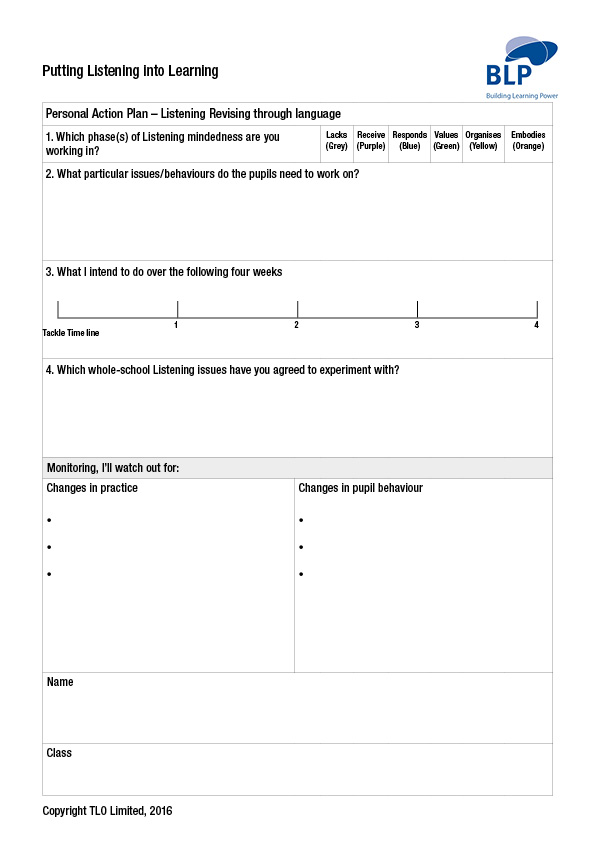
5. Personal action planning.
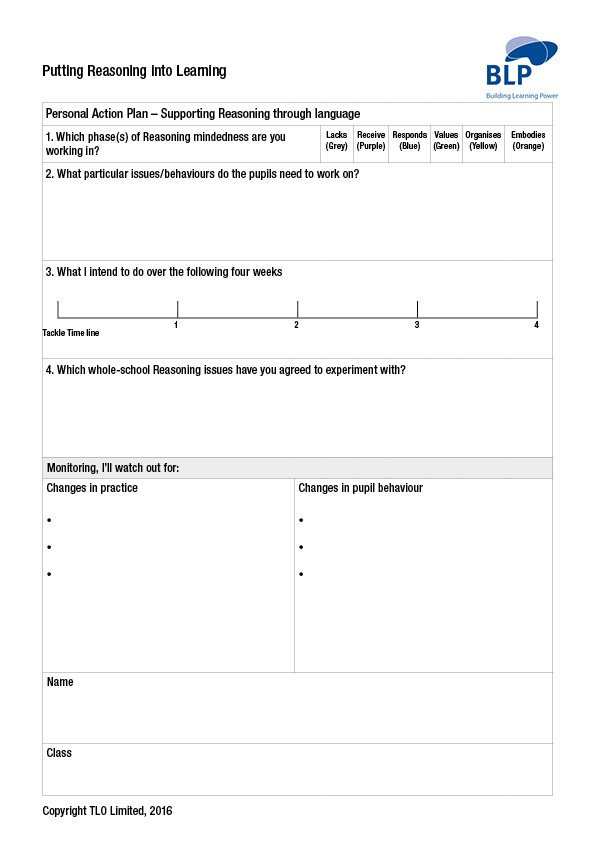
What am I going to do? ( 20 mins )
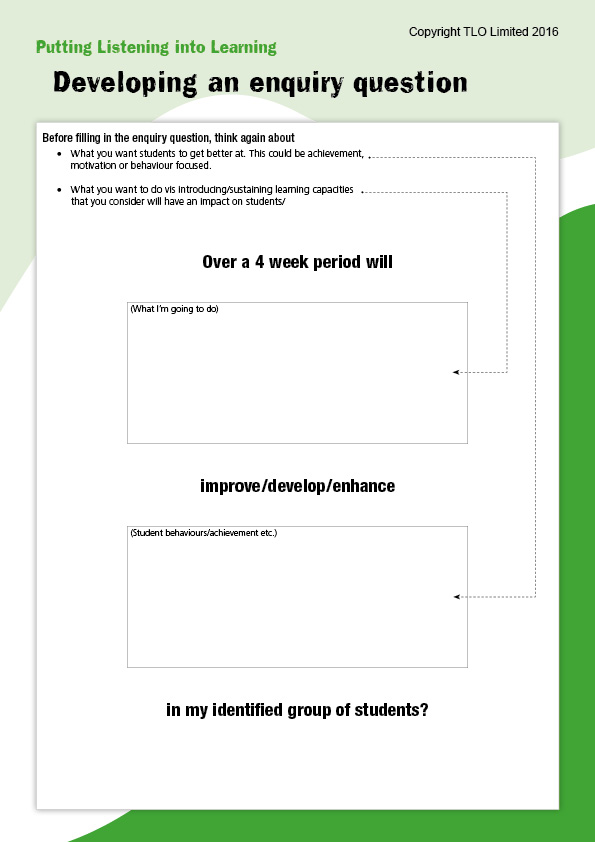
5a. Consider
how you want your students to improve/develop/enhance their approach to Reasoning?
what are you going to do to bring this about?
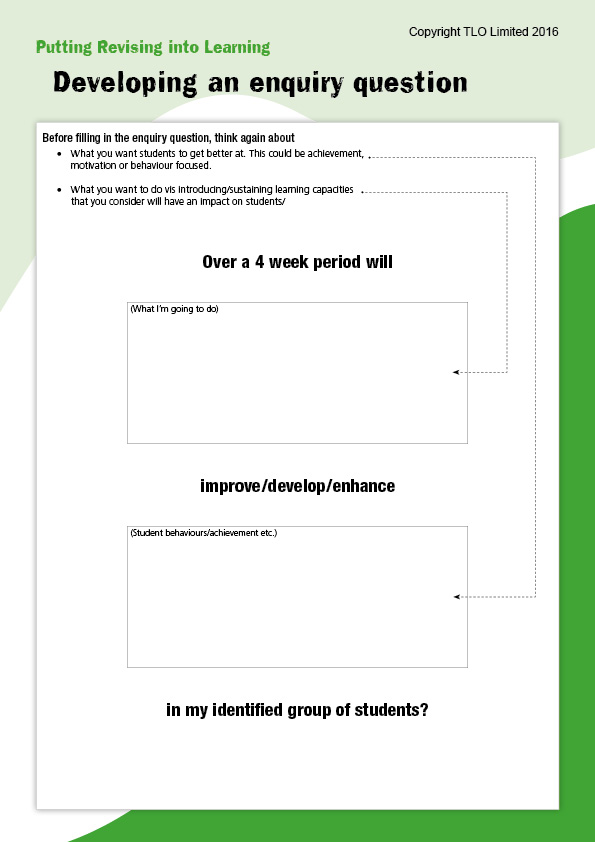
develop your enquiry question.
Think of it like this…
If I do XXXX will it improve/develop/enhance YYYY
This is the crunch question. Your students are unlikely to change unless you change!
Looked at your students through the lens of the Reasoning learning chart
Gained a sense of what becoming better at Reasoning looks like
Explored a range of ideas and activities that will help to engage students with Reasoning
Now we look closely at how to blend improving students’ reasoning into the content you have to teach.
A.The principles behind any learning powered lesson
B. Big questions to ask about lesson design
C. Lesson planning in action…an exemplar reasoning focused task
Learning habits form through use and practice, but desirable habits survive and flourish better if students are aware of them, realise their value and strive to improve them. The curriculum through its lessons provides the rich and varied occasions for exercising learning habits.
A. The principles behind any learning powered lesson
Think of yourself as a learning power coach, helping your students to help themselves to develop their learning habits. Hence your lessons are much more likely to contain challenges and activities that get your students thinking and learning for themselves. You encourage students to explore challenging questions, problems or assertions and become observers of their own learning. You step back from telling and heavy scaffolding and instead try to mobilise your students’ learning behaviours. You are organising learning to let them take the strain.
The SIX principles that lie behind teaching for learning power
1: Visible learning…Surfacing learning
You make it clear to students which learning habits and processes they are using. You try to make every aspect of the learning process as visible as possible through the language you use and through the words and images you display on the walls.
For example:
Use displays of reasoning behaviours such as:
If – Then suggestions:
If I believe that I have proved something, then I will go back over it to check that I have not made any errors or false assumptions.
If I feel certain about an issue, then I will check for any counter evidence.
Or useful reminders such as:
2: Dual focus teaching…blending content and process
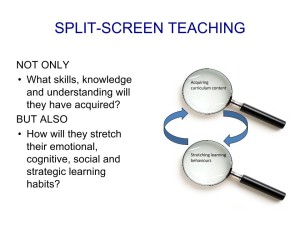
You design activities that combine the dual objectives of ‘what’ will be learned and ‘how’ it will be learned. You make sure students know that the content they are learning is a way of giving their minds a useful workout. (The content is the vehicle for learning)
For example:
A simple, straightforward way of showing the purpose of learning objectives or goals…simply add SO THAT at the end of the objective. The SO THAT is similar to the why. It aims to offer a wider reason for pursuing the learning objective. So an objective becomes…
Be able to xxxxxxx So That. . . . add the wider purpose
Continue to put the ‘how’ before the ‘what’ in constructing objectives or intentions.
As a team, using xxx reasoning (the how) be able to….(the what.)…. so that…(the relevance)……
3: Emotional engagement…Capturing attention
Your lessons are designed to intrigue your students. Students don’t put in the effort unless their energy and attention are captured by what they are doing. You capture your students’ emotional engagement by giving them more of a stake in the process of learning.
For example:
Quick learning challenges to warm up/ tune-in to relevant learning muscles
Challenge: “ There are nine little pigs in a field.
By drawing two squares how can you give each pig its own pen?”
5 minutes to complete
Use Coaching Questions with “could be” or “might be” language. “How differently can we draw the squares?” “Can we draw squares outside the box?”
You have realised from your own life that what is engaging tends to be what is challenging. Since you see education as a preparation for a learning life, you help students to learn how to handle increasing degrees of complexity and uncertainty.
For example:
Spot the mistake.
Offer students examples of written work with different numbers of mistakes in them. Challenge them to work in pairs to correctly identify the mistakes in each example. When complete tell pairs if they have found the right number of mistakes but if not don’t discuss which, if any, they have overlooked. Ask for explanations of the errors and how they can be avoided.
5: Relationships…Working together
Learning is both a sociable and a solitary activity, and you offer your students opportunities to experience both. You develop interdependent learners who know how to handle themselves in collaborative groups and able to move around in the social space of learning to best effect.
For example:
Sorting how decisions are made.
What could groups do when they can’t agree on the logic of the situation? Try this three stage approach to reaching a consensus.
Once a range of alternative ideas/strategies have been identified:
Stage 1 – a few minutes whole group discussion. If one idea emerges as everyone’s favourite, then a consensus has been reached. If no single idea has everyone’s support, move to stage 2
Stage 2 – Now, try for a compromise involving some ‘give and take’. Look at two or three of the most popular ideas, and encourage students to ask:
What changes are needed for one of these ideas to be acceptable to everyone?, or failing that . .
Which one would we all be willing to try, for a short time, to see how it works out. Then back to stage 1. Decide: pursue/ change tack. If there is still no agreement. . . .
Stage 3 – the last resort – voting. Show of hands, or a secret vote. Or:
Label the different possibilities A/B/C/D etc
Each person nominates their top three
Tally scores and the idea with the greatest number of ‘hits’ is the group’s preferred solution.
6: Reflection and responsibility…Taking charge
You understand that students have to learn how to manage and organise their own learning and that the way to do this is by giving them increasingly demanding opportunities to do so. You orchestrate students taking charge of their learning by expecting them to plan what they do, distil meaning from it, and revise it accordingly.
For example:
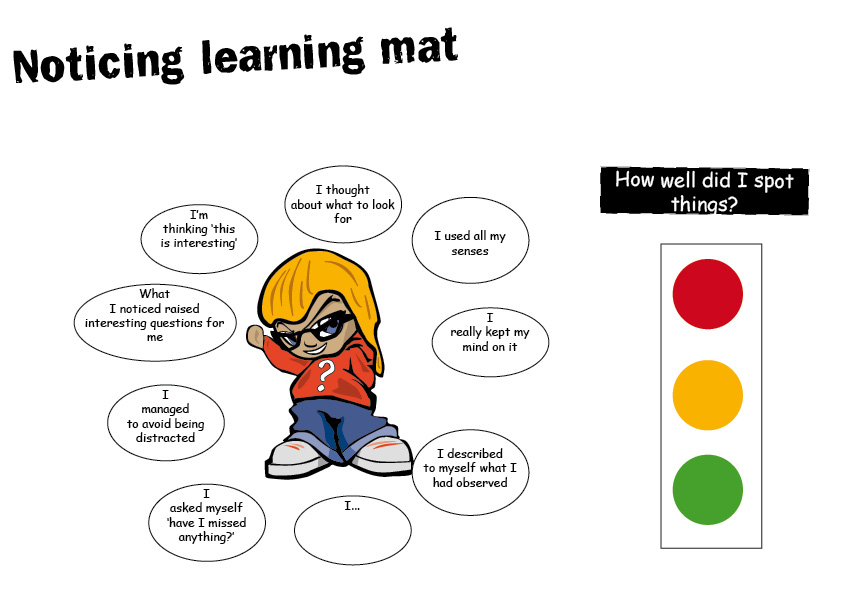
Use learning mats
at the start of this process to prompt the use of and reflection on reasoning.
A checklist for lesson planning based on these six principles.
Does the lesson plan:
Make it clear to students which learning behaviours are being activated?
Match and blend the learning behaviour with content?
Include a tactic to captivate students’ attention?
Have sufficiently challenging learning activities to sustain interest for all?
Offer choice on how students could interact on these tasks?
Embed aspects of planning, reflecting and revising for content and process?
What do you think?
Which of these six principles are a regular feature of your planning?
What do you make of principle 2? Is it the most tricky of the six? The following section B is mostly about this aspect of planning.
Look at the checklist in the green box above this one: Do your lesson plans capture these six aspects of an effective learning experience?
Make a note of…
Which of the six principles might need to be given greater prominence in your planning.
B. Big questions to ask about lesson design.
Skim read or leave this section if you have met it in other units because… the section applies to any learning behaviour. i.e. not specific to Reasoning.
What we teach and how we teach it (the enacted curriculum) are intertwined and offer teachers a lot of freedom. It is here that you can start applying a learning power filter and deploy a unique combination of content and learning tasks.
In conventional lessons where the teacher remains the focus of attention and the initiator of all activity, and where the epistemic dimension (the conditions for acquiring knowledge) is not acknowledged, students gain habits of compliance and dependence, rather than curiosity and self-reliance.
In developing learning power, teachers are making conscious choices about which habits to introduce and stretch and how best to couple these with content so that lessons become more interesting and challenging. Through such overt coupling of content and specific types of process, students come to know, understand and take control of their learning behaviours – they knowingly use and develop the whole range of learning behaviours.
All lessons function on two levels, they have twin intentions. On the one hand there is content to be acquired, and on the other there are learning behaviours to be exercised in pursuit of this content. The factor that differentiates a standard lesson that effectively ‘delivers the content’ from a learning powered lesson is that the teacher has to think, in advance, about:
the learning behaviours that are necessary for successful content acquisition;
the design of activities /tasks that will stimulate these behaviours;
how learners could reflect on and evaluate their use of these behaviours.
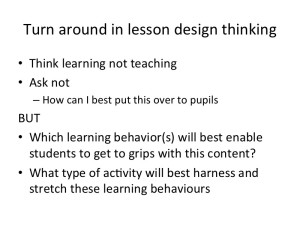
In designing such lessons you have to dare to think differently and flip round your usual lesson design thinking.
A turn-around in lesson design
Think in two dimensions at once – the content dimension and the learning behaviour dimension. It means turning your thinking around – from teaching to learning.
Or put another way
Think to yourself;
what content?
using which learning behaviour(s)?
via an activity to stretch both?
Lesson design questions… one by one
Here the general rules of lesson design have been related to the learning behaviour…reasoning.
Stage 1. What content do students need to learn?
What content has to be learned? …..Think outcomes.
Use standard lesson planning tools:
What are students going to be able to do/learn?…think objectives
How will they know if they been successful?… think success criteria
While keeping an obvious eye on
What do they already know?….think previous learning.
Stage 2. How will they best learn it?
Using which learning behaviours?
This is the new bit
Not the usual second step but nonetheless a vital second step where the aim is to weave content acquisition with learning behaviours. The content is the vehicle for exercising the learning behaviours and the learning behaviours accelerate the content acquisition.
Using which learning behaviours?…Think types of learning behaviours
Which learning behaviour(s) will help these students get closer to understanding this content?…think learning behaviour charts.
Which aspect of, say, reasoning, lends itself to achieving these outcomes?…think progression columns.
How skilled are these students in using this learning behaviour …think progression phases/rows
Say something like this to yourself .…My students need to achieve xxx. At this stage we could get closer to this content by using reasoning. Most of my students are able to use xxx phase (e.g. respond/blue) reasoning approaches confidently.
Stage 3. What type of task/activity will stretch the learning?
Which type of task…Think types of task.
Pick up your thinking from stage 2;
My students need to achieve xxx. At this stage we could get closer to this content by using reasoning. Most of my students would be able to use xxx phase (e.g. blue/responds phase) reasoning approaches confidently.
And now think about the sort of task/activity you might develop/design so as to:
orchestrate a problem-solving activity to enable students’ understanding of xyz content without telling them;
intrigue them with something that is open to several interpretations;
stimulate their curiosity;
grab their attention…visually and aurally;
allow them to stay stuck before I ask them how they are thinking;
offer as a nudge to get them thinking differently that doesn’t give the answer away;
leave it as a problem hanging in the air to which we will return later;
make links between the challenge, and what and how we are learning in this lesson.
The challenge isn’t about the inherent complexity of the subject matter but about how the content is orchestrated to encourage students to use their learning habits to resource their solution.
Think…what/how much information/content do I need to give/reveal? At what point? In what form? To what end?
Say something like this to yourself .…
my students need to achieve xxx.
at this point we could get closer to this content by using reasoning.
most of my students are able to use xxx phase (e.g. respond/blue phase) reasoning approaches confidently.
What type of task would stretch their reasoning and assist them with the content…without me just telling them!
To summarise…the heart of the lesson
It’s the question ‘using which learning behaviours?’ that causes you to think differently about the lesson planning.
You ask – as always – what are the anticipated objectives/intentions?
The verbs in your resulting objectives will give you clues about the types of task/methodology that will get students there and the sorts of learning behaviours your students will need to contribute to this learning endeavour.
You are designing the task in a way that requires students to contribute their learning ‘powers’ / behaviours. The tasks you design will hook into their learning ‘powers’ and help them to improve them.
Say something like this to yourself:
I am going to think content, learning behaviour and task together:
Reasoning will help students to better access the content;
The aspect of reasoning (column) and phase (row) that would fit best is (for example) “reduce uncertainty using justifiable evidence” (Frames of Mind column, Green phase).
The type of task/activity that would best stretch both content and learning behaviour, intrigue, challenge, bring people together and give responsibility to students is………
Think….what information do I need to reveal/give, in what form, at what point, and what do I want students to do with it?
What do you think?
What strikes you about this way of planning with learning behaviours in mind?
Where are the potential stumbling blocks?
How will you decide which learning behaviour(s) you are going to foreground in your objectives?
Consider a lesson you are about to teach…
What is the content?
Which learning behaviour(s), if missing, would make accessing the content very difficult / impossible?
How could you blend reference to this learning behaviour(s) into the learning objectives?
Can you design a task that will help students to access the content and exercise the key learning behaviour(s) you have identified?
C. Lesson planning in action – an exemplar, reasoning focused, task.
How do we design tasks that stretch Reasoning and assist students to approach the content more productively? We cover this in four ways:
A description of the phases of a lesson designed to explore a type of reasoning
1. A description of the phases of a lesson designed to explore a type of reasoning.
Look through the lesson below. It uses spot the difference to encourage students to speculate based on limited information, using inferential reasoning to analyse evidence and counter evidence.
The lesson focuses on the Frames of Mind and the Applying Reasoning columns of the Reasoning chart, mostly at the blue through yellow phases. It creates a situation in which students have to do the best they can with a range of inconclusive and sometimes contradictory evidence.
Notice how, despite the focus on learners amending their ideas as the evidence is found, other learning behaviours ‘bubble up’ as the lesson proceeds. It reminds us that given effective support learning behaviours don’t function in isolation, that learners not only have a wide range of learning behaviours to call on but that they can move seamlessly from one to another as required.
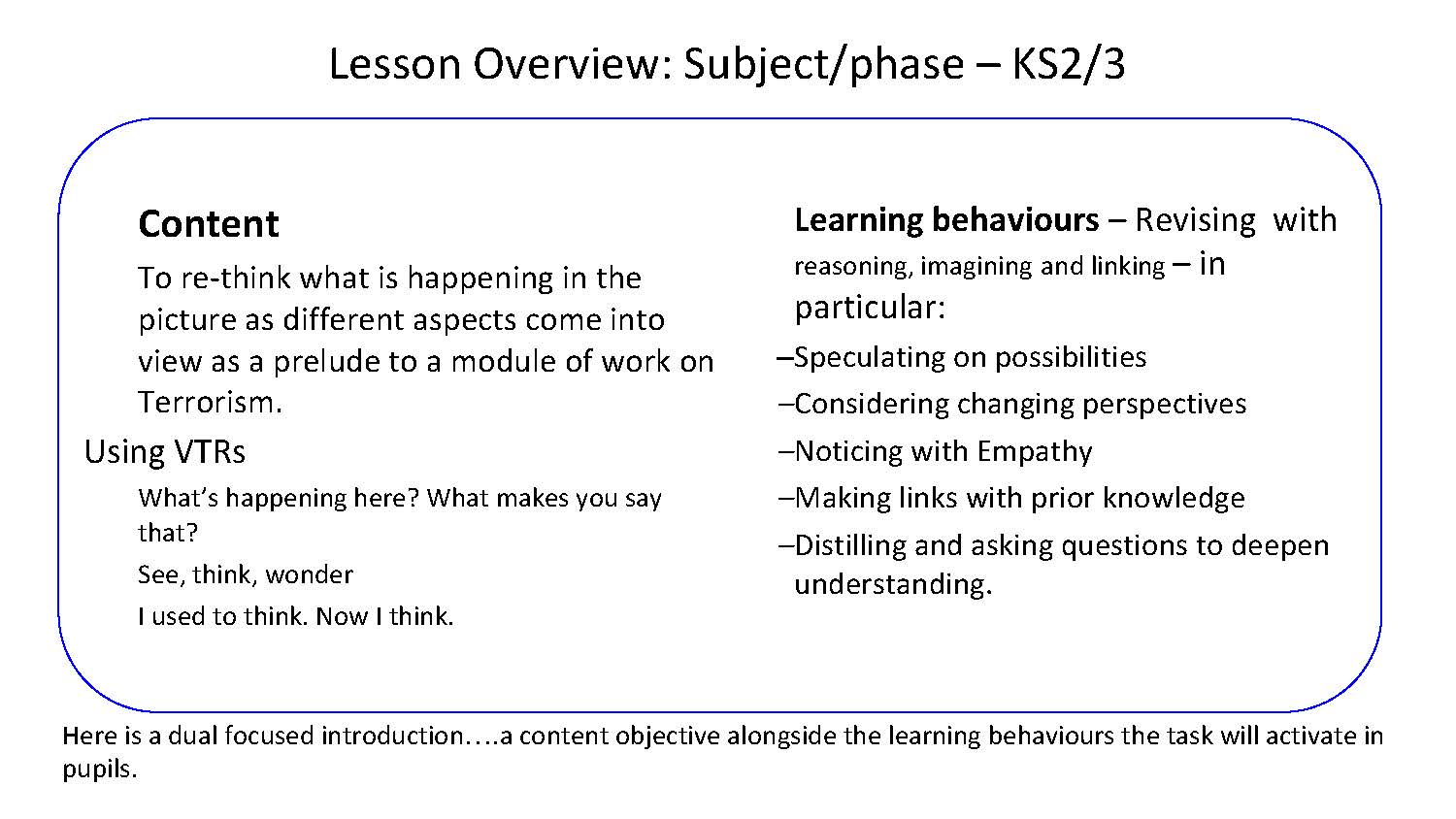
Firstly, an overview of the lesson:
Using inferential reasoning to analyse evidence and counter evidence
Episode 1 – What time of day is this?
What is going on here?
At this stage, students can see only one of the 2 images.
The question ‘What time of day is this?’ encourages students to hypothesise based on precious little evidence.
About the only thing we know for certain is that it is not at night. Beyond that, it is educated guesswork.
Clues that might yield some insight:
people;
clothing;
the woman’s watch;
light and shadow;
the white shopping bag;
others?
The important thing here is that students try to support their view with evidence of some kind, however flimsy.
Use the visible thinking routine ‘what makes you say that?’ to encourage explanation and justification.
Vary it with:
Can you give me a bit more on why you think that?
Convince me;
How can you be sure?
[Hints:
The woman on the right has a white bag tucked behind her. Has she been shopping? If yes, then it must be late enough for her to have already been to the shops.
Try as you might, the dial on her watch is not visible.
The light appears bright – does that suggest towards the middle of the day?
The atmosphere is fairly relaxed – is this lunchtime, or thereabouts ?]
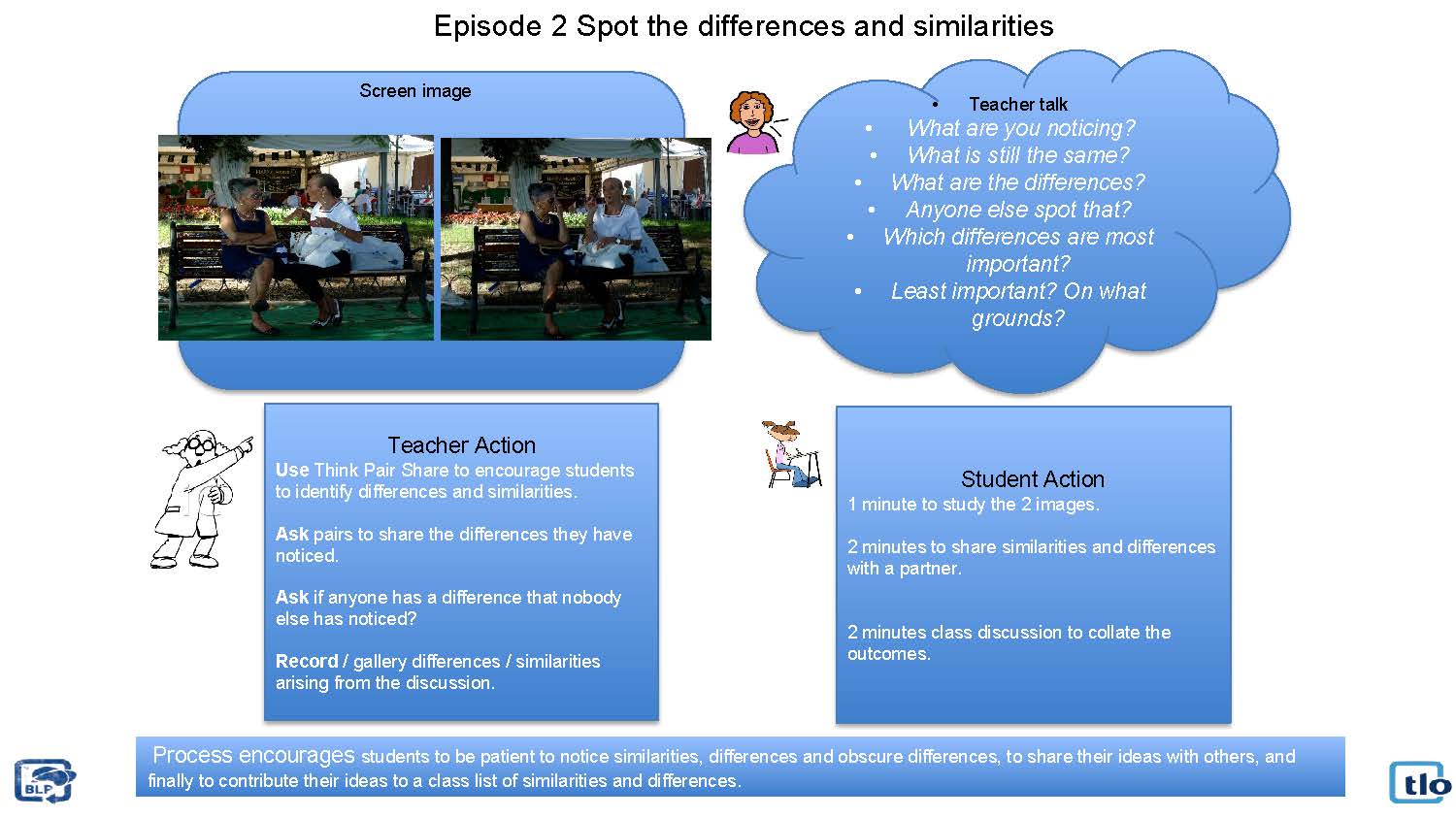
Episode 2 – Spot the differences:
What is going on here?
They now see both images, side by side.
Be careful not to hint at the time difference – simply say that the 2 pictures are of the same scene, taken at different times.
Episode 2 is a noticing activity, looking to identify similarity and, more importantly, subtle/obscure differences.
Conduct as a Think / Pair / Share activity on tables.
Gallery students’ differences and similarities.
[Hints:
If students need help, get them to focus on the 2 central characters, the people in the background, where the sunlight and shadows are.]
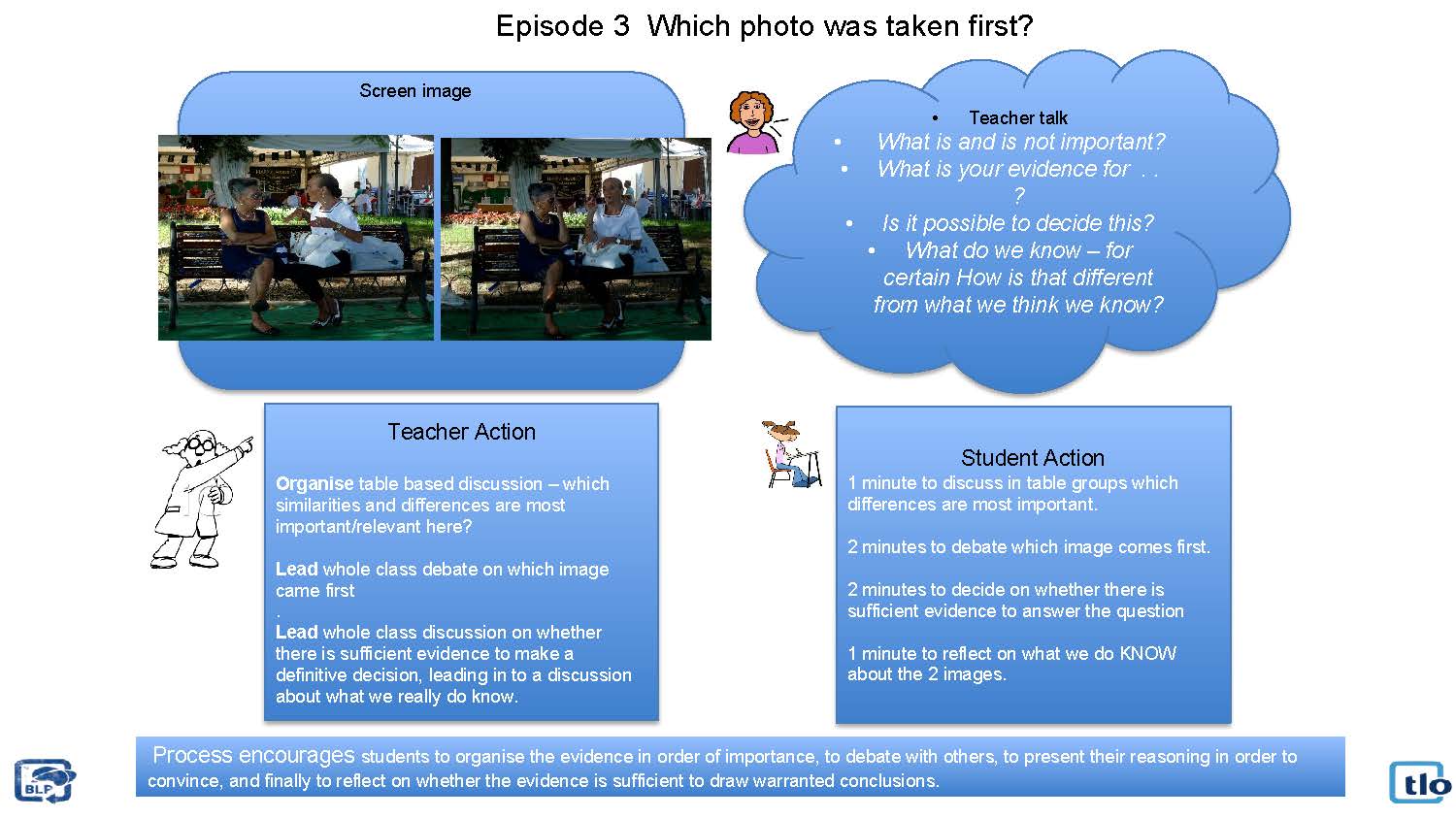
Episode 3 – Which photo was taken first?:
What is going on here?
Begin by exploring which of the differences and similarities identified in Episode 2 might be important, and which might not be relevant.
As with Episode 1, the evidence is again inconclusive, but this time totally so. Lengthening shadows from one image to the next might tell you something – but only if we know it is afternoon. Otherwise they could be the shortening shadows of the morning.
There is simply too little evidence here to justify a conclusive answer. Even an educated guess is little more than a guess.
The key point here is not to answer the question ‘Which photo was taken first?’, but to help students to realise that reasoning without evidence to back it up is nothing more than a personal opinion.
However there is one thing that we do know for certain – that the differences identified in Episode 2 must mean that the 2 photos were not taken at the same time. Which leads into Episode 4. . .
[Hints:
We can find no evidence that either image precedes the other. Let us know if you spot something that we have missed!]
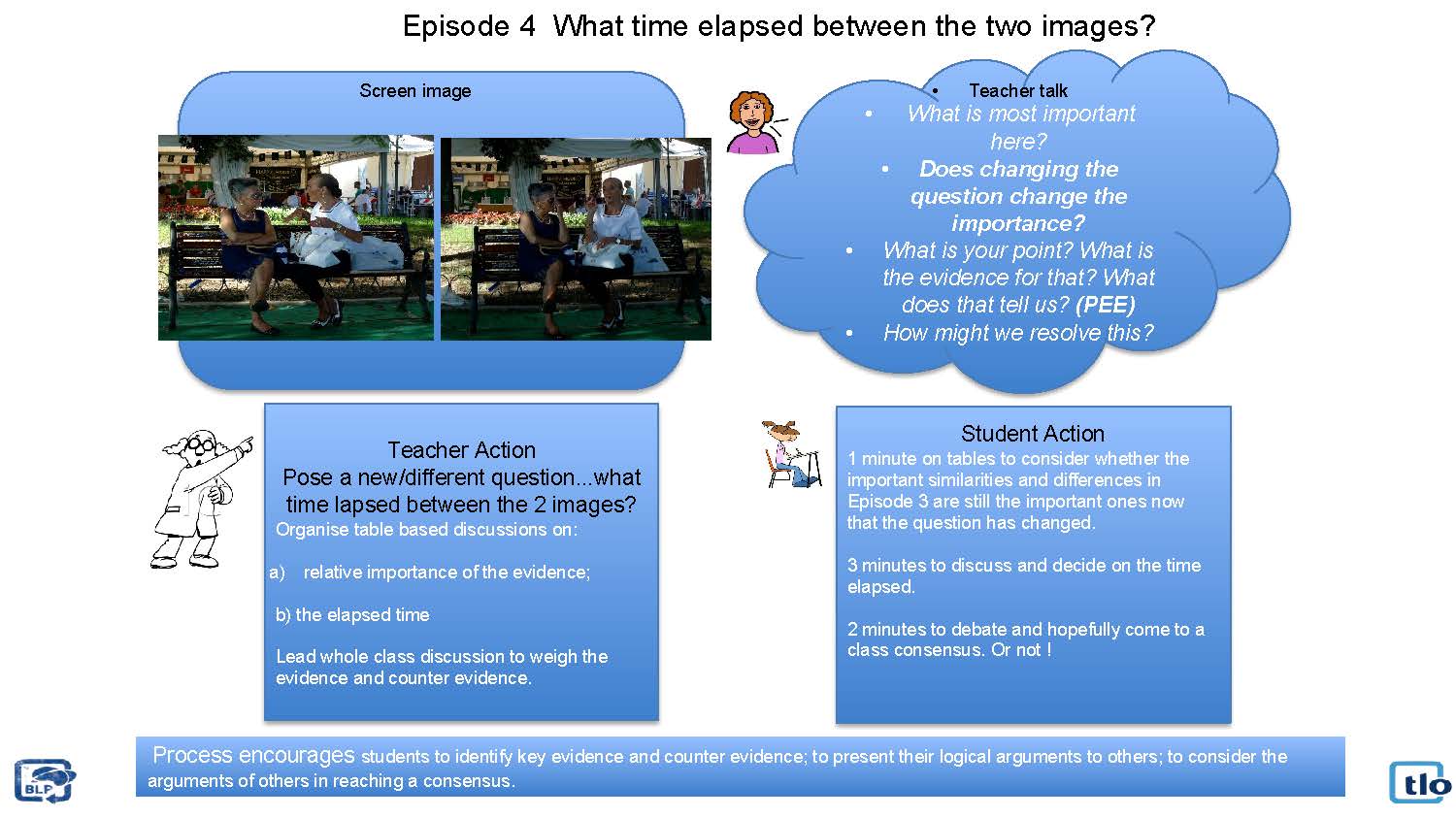
Episode 4 – What time elapsed between these two images?:
What is going on here?
More like Episode 1 than Episode 3, this time there is evidence that students can use.
Begin by going back to the gallery of differences and similarities – are the ones that appeared important in relation to deciding which photo was taken first also the ones that are important in deciding on the elapsed time? You are leading them to see that evidence needs to be relevant to the question being asked.
What they can be certain of is that sufficient time must have elapsed for all of the differences to have occurred. The differences suggest a longer elapsed time. Conversely, all of the similarities (ie the things that have not changed) are counter evidence suggesting a shorter elapsed time. Here students have to balance evidence and counter evidence to come to a hypothesis that is supported by all of the ‘facts’.
If students need help, nudge them consider the implications of:
The rearranged shopping bag behind the woman on the right;
The (dis)appearance of the man in the red shirt (top left);
The continued presence of the man in the white shirt (over left shoulder of woman on the right);
The sunlight striking the flowers middle left.
Use the visible thinking routine Point / Evidence / Explain to help students to structure their arguments (See section 2, Purple to Blue)
[Hints:
The differences need to have sufficient time to happen – all of the background people need time to change positions / appear / disappear; the woman to the right needs time to rearrange the white bag behind her (does she show her friend what she has bought, and then put the bag back behind her?); critically, the light falling on the flowers to the left of the women has changed, and the flowers in full sunlight have changed – this is the key piece of evidence that confirms an elapsed time of more than a minute or two.]
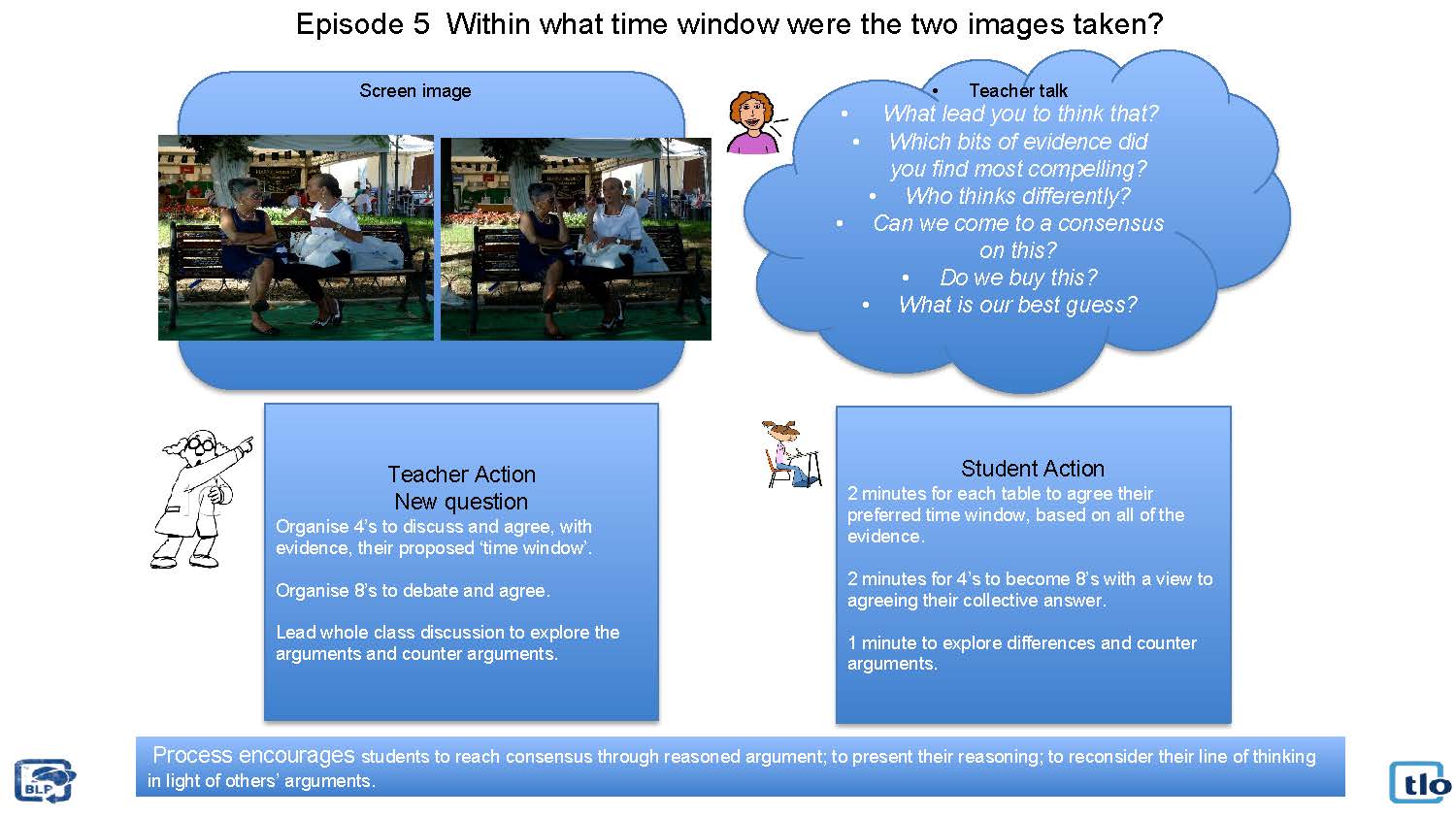
Episode 5 – Agreeing within what time window these two images were taken
What is going on here?
Given that students were unable to give a definitive answer in Episode 4 because of lack of firm evidence, they are now encouraged to consider all of the available evidence to decide on the most probable minimum and maximum times within which the two images were taken.
The argument will centre on which difference probably took longest to happen – could it be that the woman on the right has done something with the bag behind herself? Did she open it to show her friend what she had bought? Or it could be combination of events all of which are unlikely to have happened simultaneously?
It will also have to take into account the similarities that are least likely to be sustained – the women are unlikely to sit there for an hour and the guy in the white shirt also sit in the same place for an hour.
Students are being encouraged to do the best they can with all of the circumstantial evidence available to come up with their best guess.
The message here is that even when we have to make a guess, we can at least make a guess that is both plausible and consistent with the available evidence.
[Hints:
The two key things to balance are a) the shifting sunlight and b) those things that have not changed. The time window has to be large enough for the shift in sunlight to have occurred, and yet short enough for the women and the guy in the white shirt to have remained in almost identical positions.
So what would your answer be? A minimum of 30 minutes for the sun to shift position, and a maximum of an hour for the 2 women and the man to not move?
Can you do any better – on the available evidence?]
Episode 6 – Distilling what has been learned about Reasoning
What is going on here?
Time to reflect on the activity and to tease out the key learning points.
These might include:
Opinions need to be backed by evidence;
Sometimes the evidence is inconclusive;
It takes time to gather the necessary evidence;
We need to be logical in order to convince others;
We have to careful when we make assumptions;
We cannot prove everything;
[PS – If you are hoping that at some point we are going to give the correct answers, dream on ! We don’t know either!!]
2. The lesson plan shown as a simple grid
This simple streamlined useable grid captures the lesson just shown above and includes:
What you do (teacher action)
What students do (student action)
The types of learning behaviours being called upon
What you say (learning talk) to nudge the learning behaviour along.
The format is divided into episodes to show the change of purpose, action and use of learning behaviour across the course of the lesson.
Here is the grid lesson template for the reasoning lesson shown and analysed above:
Download a blank lesson plan as a MS Word document: Lesson Planning Grid [.DOC 33KB]
What do you think?
What are your first reactions to this lesson?
The lesson activates high level reasoning skills – Which phase of Reasoning best represents the skills needed for success?
Does the fact that there is no definitive ‘answer’ detract from or enhance the activity?
Make a note of…
A class that you teach with sufficiently high levels of reasoning skills to access this lesson.
As teachers we are in the habit-forming business. What we say, what we display on classroom walls, what we celebrate, praise or dismiss, what we model or how we design learning activities will all influence the ways in which students learn, perform and behave. Classroom cultures have a huge influence on students’ learning as you will remember from the Culture unit.
Five big shifts to get you started. Ask yourself – how might you:
Enable students to go beyond describing and explaining to justifying and proving;
Create opportunities for students to present their reasoning to others;
Make students aware of different types of reasoning;
Ensure that students value rigour and precision;
Encourage students to support their ideas with evidence, and to reconsider ideas in light of counter evidence.
Now look at the Learning Chart sections below where you will find plenty more ideas to try.
Reasoning is the kind of logical, analytical, explicit disciplined thinking that schools often focus on (sometimes to the exclusion of some of the other elements). There is a lot of interest at the moment in ways of teaching thinking, and there are many materials for teaching thinking on the market. In BLP, such ‘Show your working’kinds of thinking are a very important part of the good learner’s toolkit, but they are not the be-all and end-all of learning. In fact, research suggests that secondary schools have not been very successful at developing students’ ability to think logically in real life.
It turns out to be quite difficult to free any kind of thinking or learning skill from its ties to the particular setting and subject matter in which it was originally practised.
Nevertheless, being able to construct logical arguments or make practical use of Venn diagrams, for example, is very useful, and good learners need practice at using such tools in the context of their real-life concerns.
Extract from Building Learning Power. Guy Claxton 2002
1b) What does being a good Reasoner involve?
A well formed Reasoning habit involves being ready, willing, and able to:
Resist jumping to conclusions
Seek justifiable evidence to shape sound, well-honed arguments.
Scrutinise your assumptions
Seek evidence and counter evidence, look for false steps and carefully draw conclusions.
Remain suspicious, doubting and self-doubting in order to avoid unwarranted certainty.
Convey your logical thinking clearly, through dialogue, symbols, analogies, prose and pictures.
So, at a less abstract level, students need to learn the inclination to resist impulsive responses; to respond logically and thoughtfully; to apply logic by explaining, justifying and, ultimately, proving what they think; to utilise a range of reasoning tools; and to develop strategies for presenting their reasoning to others persuasively. When looked at from these diverse angles growing reasoning moves well beyond encouraging a student to ‘think it through’.
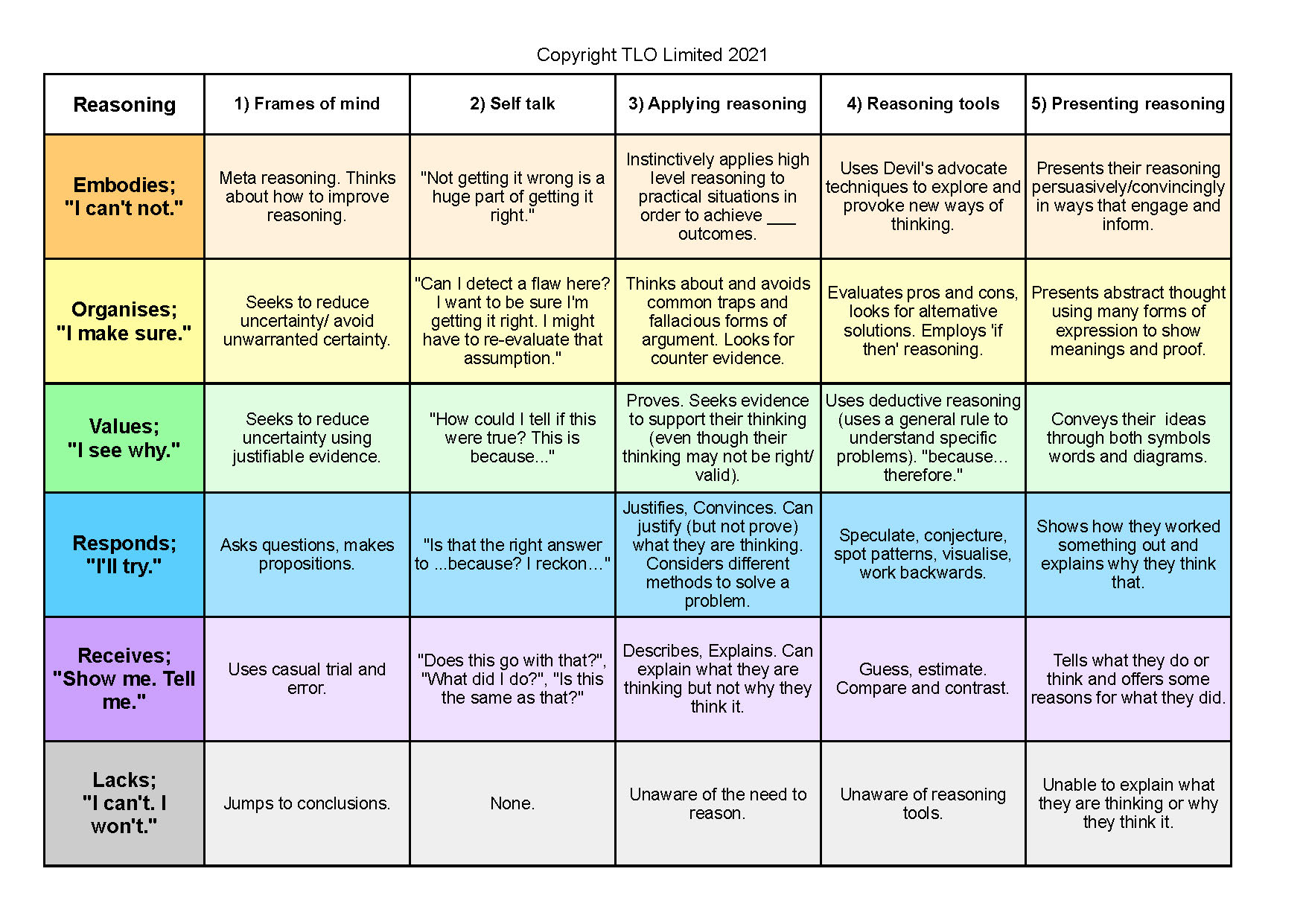
The Reasoning grid below takes account of the constituent parts of building the habit of Reasoning
Our progression grid for Reasoning has 5 components:
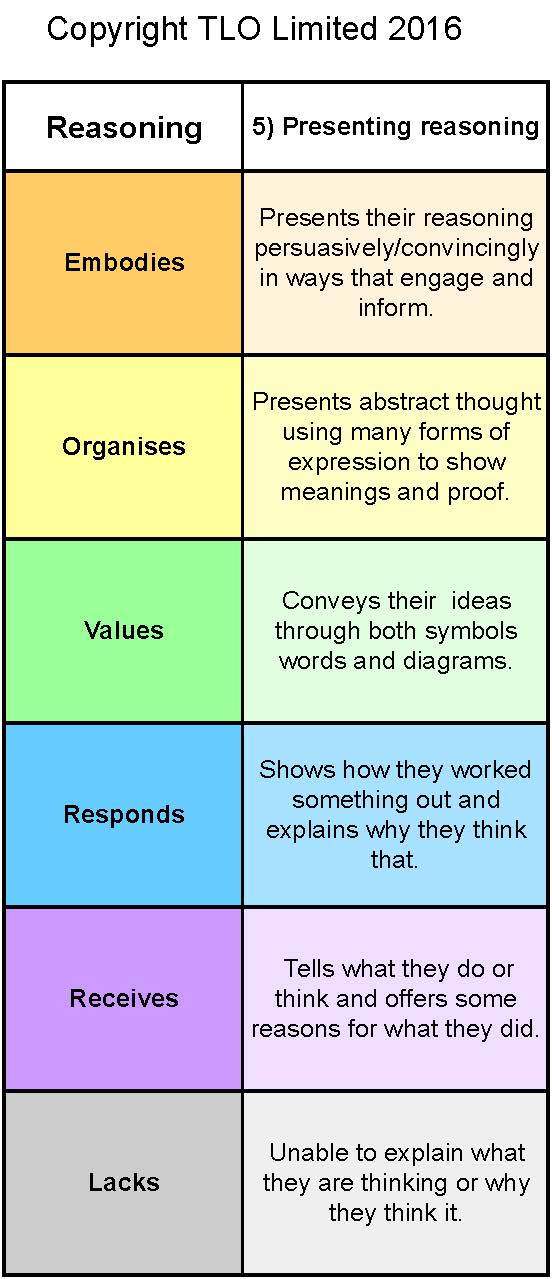
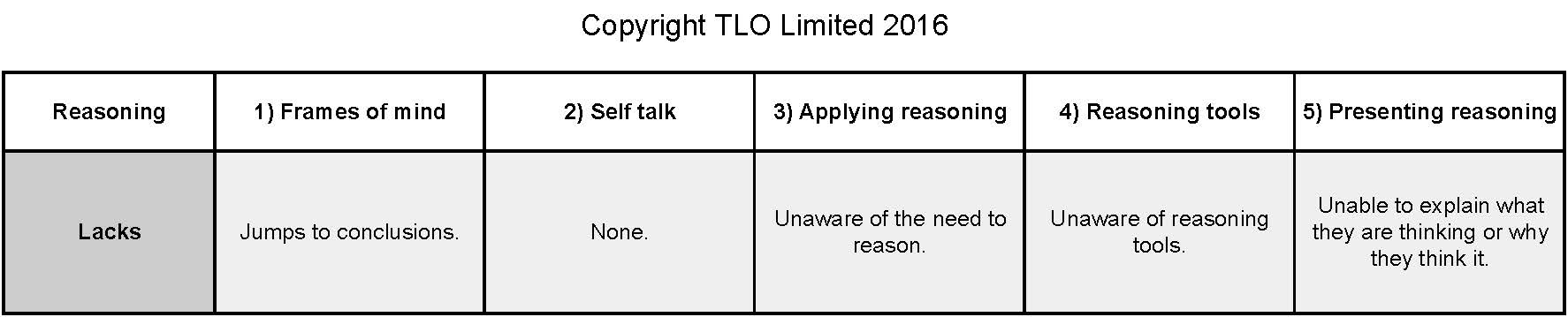
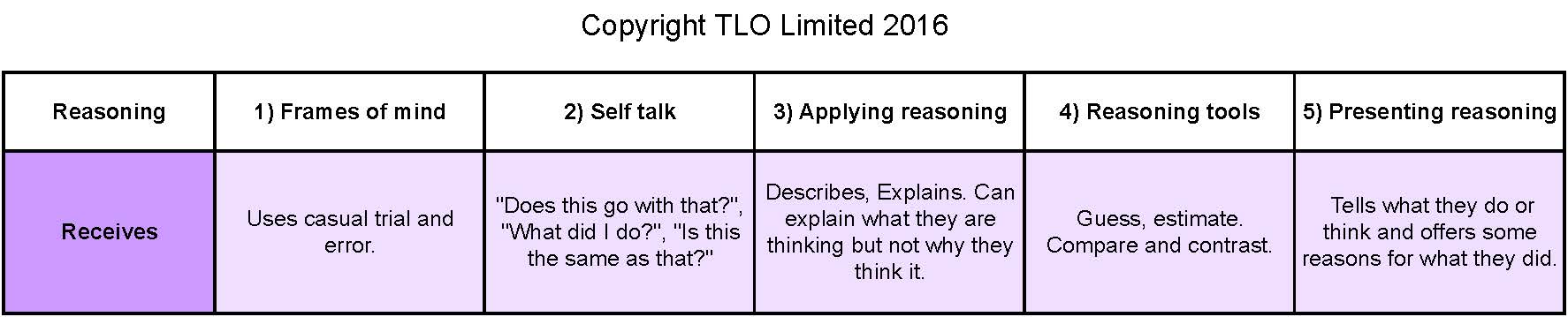
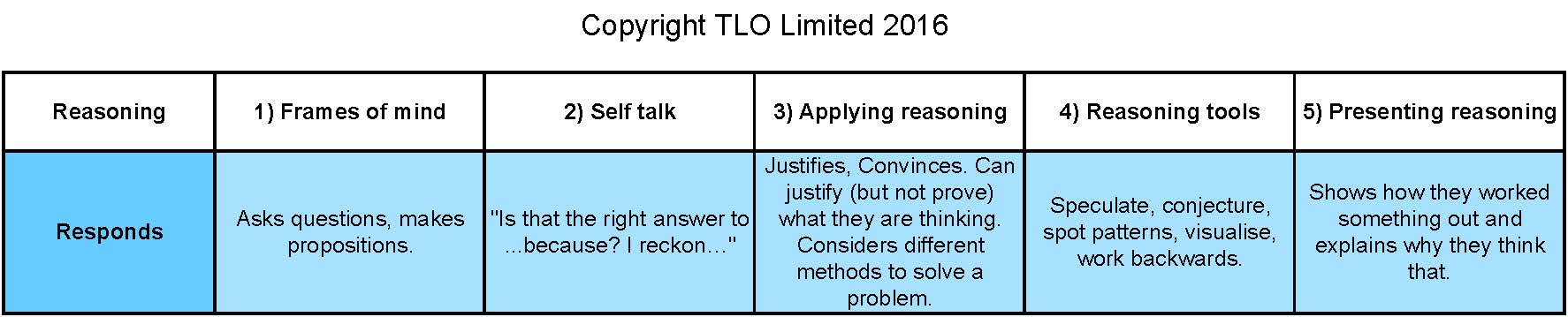
Reasoning is about disciplined thinking, making logical arguments and backing them up with proof. It’s a complex process in itself as well as in its development. The first column shows how our disposition or inclination to reason might develop; how this manifests itself from using trial and error thinking to high-level meta-reasoning (thinking about how we reason). Column two shows how we might talk about these phases and column three shows what we might actually do when we apply the disposition in each phase of growth. Column four suggests the sort of reasoning tools we would be using and column five suggests how we might present our reasoning to others.
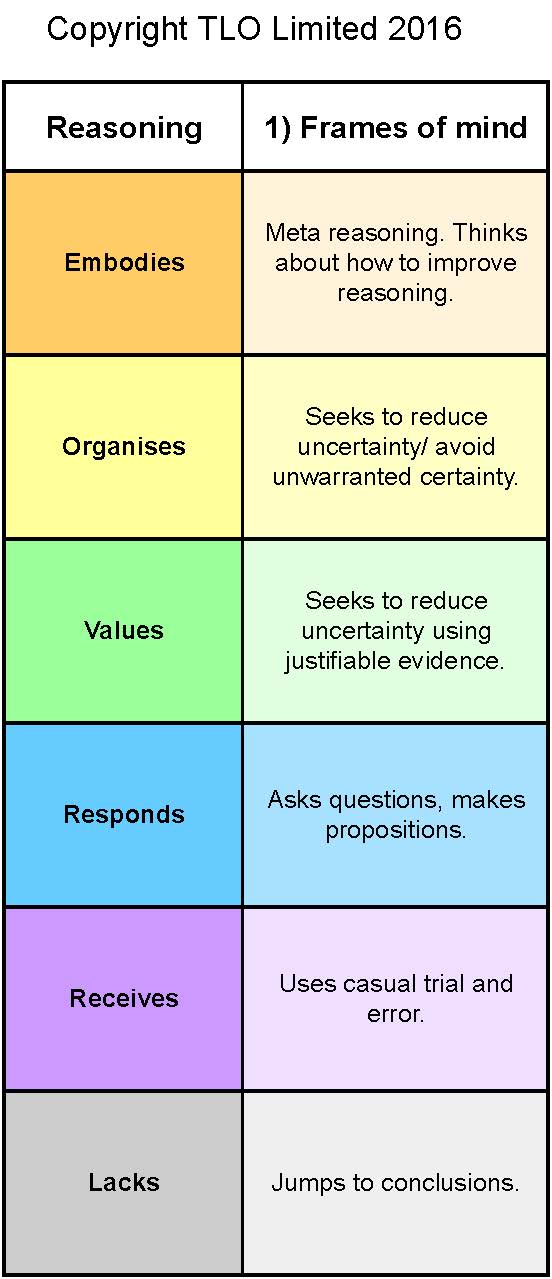
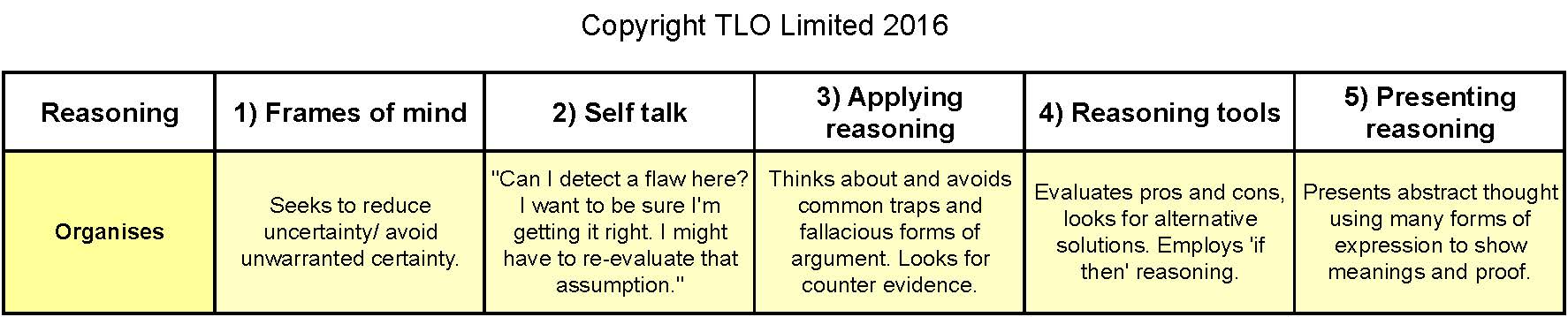
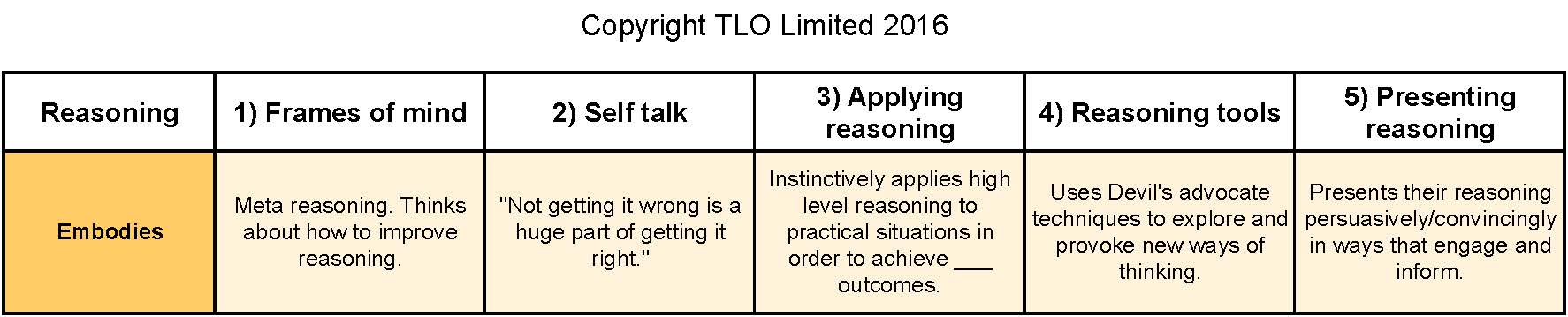
Frames of mind
How we are disposed to reason
The first column shows a broad sweep of our dispositions to reason. At first, we might approach reasoning in a haphazard way using a trial and error frame of mind. We move on to asking questions and making propositions. what’s this really about? Is this because? What do I know about this? We might move on to seeking evidence to try to justify or prove our point and then on again to wanting to make even more sure of our evidence and maybe question our original assumptions. Finally, at the Embodies phase we are able to reason about reasoning and how we can improve the process. So the range moves from being impulsive to being super cautious, where not getting thinking wrong is a huge part of getting it right.
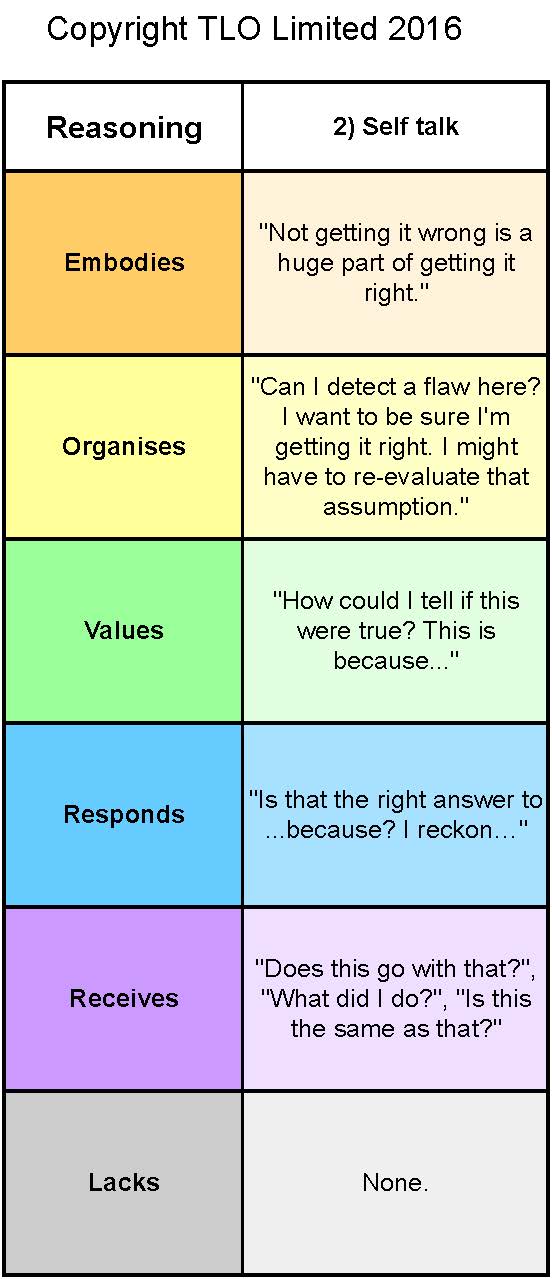
Self-talk
The voice of self-awareness
Self-talk is what we say to ourselves as we learn. The statements here capture what someone in each phase of the grid would be thinking. Students may use some of these phrases when talking with you, or in writing from time to time, but mostly self-talk goes on inside their heads. We have shown a small flavour of self-talk thoughts that teachers can encourage students to imitate. All such self-talk is important in building a Reasoning habit.
Applying reasoning
What we do when we reason
In the first phase of reasoning, we might be able to describe or explain what we are thinking but not why we are thinking in this way. Later we can justify and say why we are thinking something but we aren’t able to prove it. We might though be able to convince others of our point. Later we are able to prove our thinking through solid evidence. One might think that would be enough but good reasoners go further to check for false steps and check their original assumptions. And finally, the super reasoner knows about and seeks to avoid common traps in logic and fallacious arguments.
Reasoning tools
The thinking tools we use in reasoning.
In the first phases of reasoning, we might just guess at things or compare and contrast things. Is this like that? How is this different from that? Later we might speculate about things, try to spot patterns, visualise next steps or solutions. In the next phase, we use deductive reasoning where we apply a general rule to specific problems. In the later phases, we evaluate pros and cons and look for alternative solutions. And in the final phase, we try to provoke new ways of thinking about things.
If you are interested in a brief glance at different types of reasoning refer to 6) Types of Reasoning.
Presenting Reasoning
Ways of showing our reasoning
The point of reasoning is not merely to convince ourselves, but to convince others of our thinking. This applies to a mathematical proof as much as it does to a philosophical argument or an analysis of a newspaper column. We might start simply by telling what we did and maybe why we did this. We move forward to being able to show how we worked something out and later show this through symbols and diagrams as well as words. Lastly, we are able to make convincing presentations of our views, arguments and proofs in terms that would suit any audience.
Reasoning within an argument gives the rationale behind why one choice, for example, should be selected over another. The main two types of reasoning are:
Deductive Reasoning: starting from the general rule and moving to specifics.
Inductive Reasoning: starting from specifics and deriving a general rule.
And other types that are variants on deductive or inductive reasoning are:
Abduction: the process of creating explanatory hypotheses.
Backwards Reasoning: Start from what you want and work back.
Butterfly Logic: How people often argue.
Analogical Reasoning: relating things to novel other situations.
Cause-and-Effect Reasoning: showing causes and resulting effect.
Cause-to-Effects Reasoning: starting from the cause and going forward.
Effects-to-Cause Reasoning: starting from the effect and working backward.
Comparative Reasoning: comparing one thing against another.
Conditional Reasoning: using if…then…
Criteria Reasoning: comparing against established criteria.
Decompositional Reasoning: understand the parts to understand the whole.
Exemplar Reasoning: using an example.
Modal Logic: arguing about necessity and possibility.
Pros-vs-cons Reasoning: using arguments both for and against a case.
Residue Reasoning: Removing first what is not logical.
Set-based Reasoning: based on categories and membership relationships.
Systemic Reasoning: the whole is greater than the sum of its parts.
Syllogistic Reasoning: drawing conclusions from premises.
Traditional Logic: assuming premises are correct.
Note that these are not all mutually exclusive methods and several give different lenses onto overlapping areas. In classical argument, for example, all arguments are framed as either inductive or deductive.
If you are interested in a brief glance at different types of reasoning click here
What do you think?
What have you learned about Reasoning from these descriptions?
What have you had confirmed?
What surprised you?
How have your views changed?
Make a note of…
Any ideas for practical classroom experiments that these descriptions have triggered
Which column your students are most secure in.
1d) Unpicking the rows; getting better at Reasoning
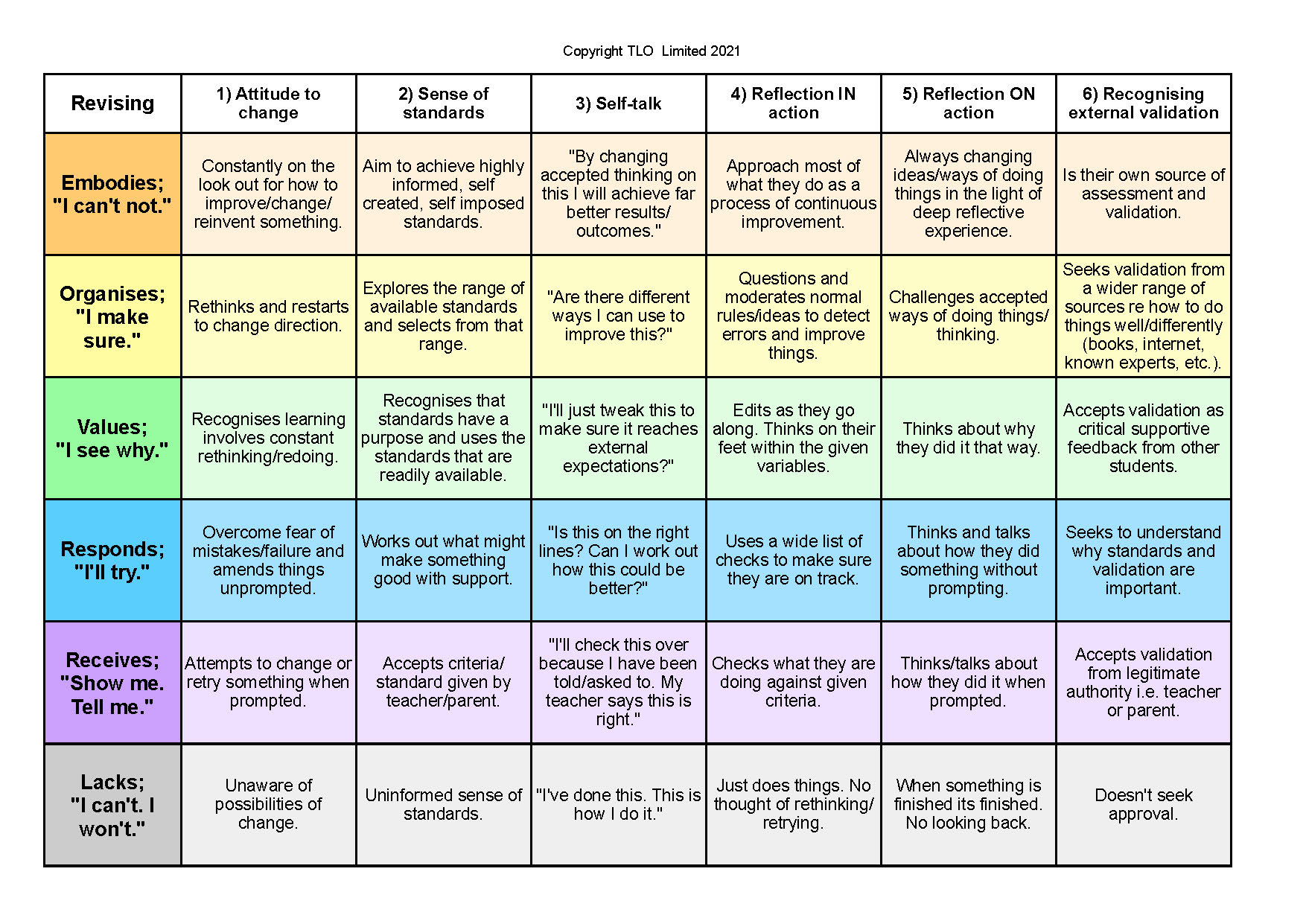
Of course, the development of Reasoning doesn’t grow neatly up each column or evenly across the phases in the grid. The five broad phases of dispositional growth (purple – orange) are affective ways in which people may be inclined to behave: we call this inclination ‘mindedness’.
Here is our interpretation of how Reasoning might grow.
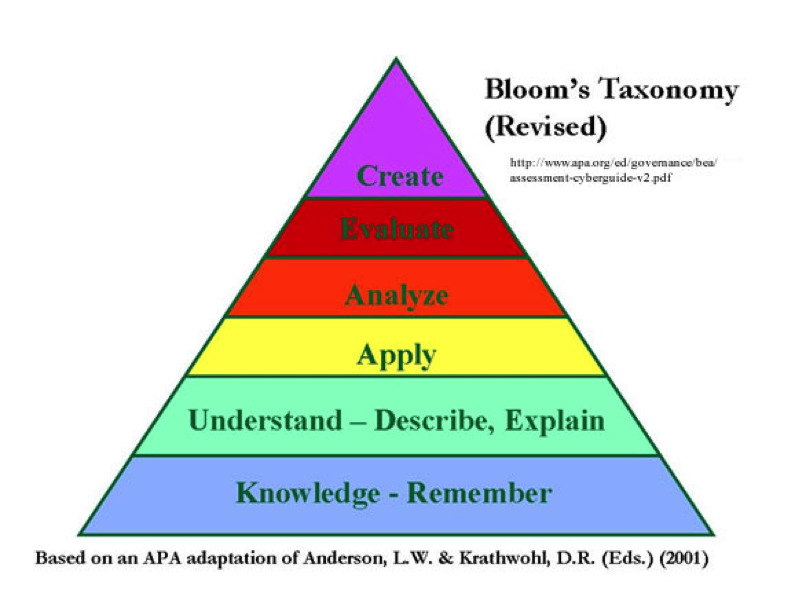
The phases are drawn from Bloom’s taxonomy of the affective domain.
Phase ‘Receives’ (purple) is about doing something because you are told or expected to.
Phase ‘Responds’ (blue) is about gaining interest and doing things more willingly.
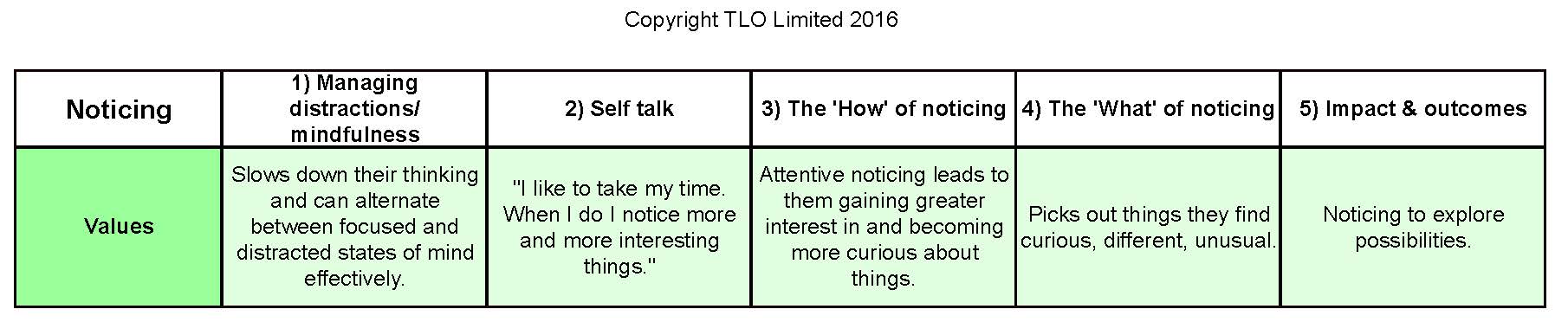
Phase ‘Values’ (green) is a key phase since the student now sees the value of behaving in this way. It’s a win for them; to behave like this is in their interest. It’s in this phase that the behaviour becomes more secure.
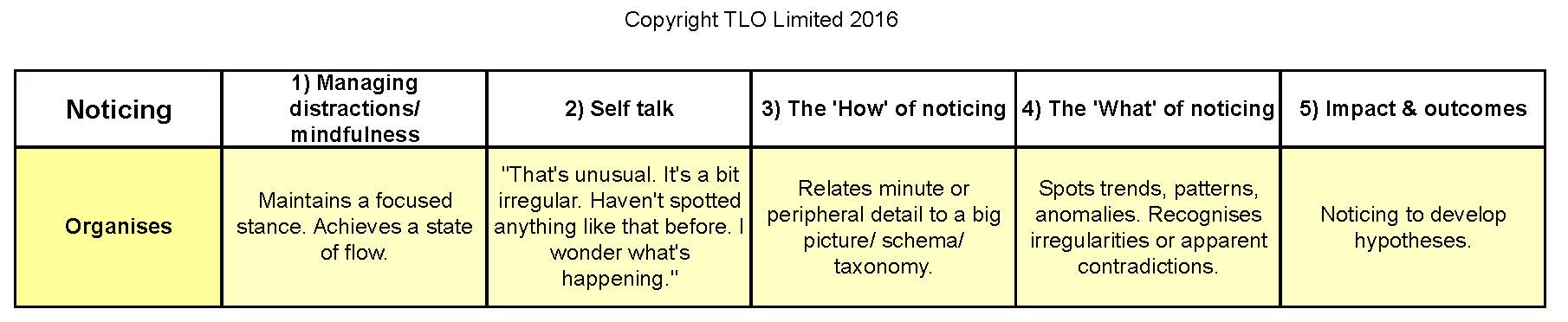
Phase ‘Organises’ (yellow) is the phase in which the student capitalises on this ‘in their interest’ behaviour and gets themselves organised to use it positively.
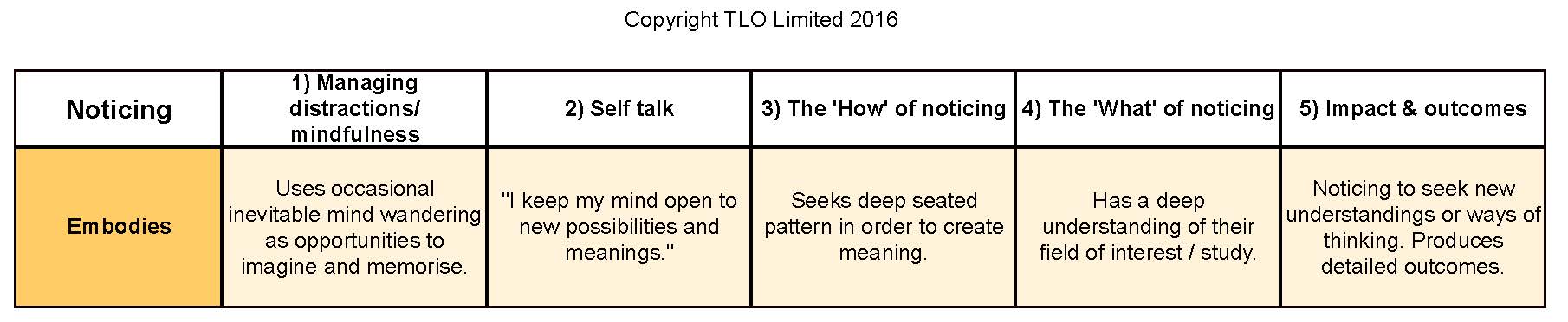
Phase ‘Embodies’ (orange), known as ‘characterised’ in the original taxonomy. In this phase, the student has made this behaviour their own. It has become part of their character; they can’t not do it and they have become highly skilled in doing it.
We urge you to see this progression as long term. Some phases will take years for people to work through; some will never be worked through. None of the phases are inevitable. There is a lifetime of development captured here. Nevertheless, the role of a teacher or parent should surely be to encourage and enable this journey.
Lacks: Minded to use what they think they know
In this ‘Lacks’ (grey) phase, students talk about what they know. They don’t consider having to prove or justify what they say, in their view they just ‘know stuff’. They probably have little cause to have to explain why they think something and their quick thinking based on limited experiences means that they often jump to conclusions. There are many people who don’t get far from this starting point or fall back to it.
Receives: Minded to say why.
In the Receives (purple) phase, pupils become more curious about things. They may enjoy talking about (describing) what they are thinking but as yet find it hard to explain why they think it. ‘Describes’ is seen as a step 1 in reasoning, while ‘Explaining’…offering some reasons for what they did (correct or incorrect) is seen as step 2. They will enjoy the challenge of comparing and contrasting things or guessing or estimating how things might be. Precision isn’t yet part of their bag.
Responds: Minded to form a line of argument.
In the Responds (blue) phase, students have more confidence in their reasoning although they may not be correct. In ‘convincing’ they may use the words ‘I reckon’ or ‘without-doubt’. They are also then able to justify forming a correct logical chain of argument. They use words like ‘because’ or ‘therefore’ or ‘and so’.
Values: Minded to prove a point or argument
In the Values (green) phase, students understand the importance of needing to show how they worked something out. Now they can give a watertight argument based on generalisations (deductive reasoning). There is an assumption at this phase that students can communicate their solutions in a written form
Organises: Minded to check and counter check for accuracy/logic
In the Organises (yellow) phase Reasoning has become a skilful habit. By this stage proofs have been made but then thinking begins again…’is this proof good enough?’, Is there a flaw in this argument that I haven’t spotted? Is there any counter evidence I need to consider? This is a highly cautious phase.
Embodies: Minded to be a meta reasoner
In the Embodies (orange) phase, it’s fair to say that few people make it that far. High-level Reasoning is much more complex than we have been able to indicate here but in essence, this phase is about thinking deeply about the reasoning or logic process itself and how it might be improved. Such people are highly skilled in making and presenting complex logical arguments in a way that many audiences will understand.
What do you think?
What has struck you about the act of Reasoning having read the descriptions above?
Which phase do you operate in?
What makes you say that?
Make a note of…
What you might do to assist your students to make headway in their Reasoning behaviour.
Any practical ideas the text has triggered.
Preparation for the Learning Team meeting
Where are my pupils now?
Take a look at the Reasoning progression chart in your Learning Diary or
Colour in the cells where you think your students are secure.
Some will barely be on the chart while others may be quite a way up. Neat straight lines of secure behaviours are rare. But looking at your students in this way should give you an idea of what you need to work on.
Draw a red line across the chart to denote where you think most of the school’s students could and should reach by the time they leave.
Please take the results of these tasks with you to the Professional Learning Team session shown in Section 4
If you want to read again the notes on Professional Learning Teams, click on the view notes tab in this box
Professional Learning Teams: what and how
The purpose of these meetings is for the team to act as a teacher learning community or Professional Learning Team: a small group of teachers who meet together regularly to deepen their understanding of building better learners, commit to trying out new things, reflect on and share their experiments with each other. Such learning communities are the engines of teacher development. They work best with 6-8 teachers with similar subjects or age groups, and who meet for about an hour regularly over a period of a couple of years.
The group question and probe each other’s summaries of their experiments in order to encourage analysis and deeper reflection. They use questions such as ‘What do you think is getting in the way? What would make this even better? How could this technique be modified to make it work for you? What do you think made that happen? In this way they support each other in changing and developing their practice.
Some guidelines for team reflection sessions
The delicate, hard work of changing practice requires a safe professional environment in which to explore and understand both triumphs and tribulations. These short guidelines may be helpful in setting a climate for the team itself.
Everyone is expected to report back on their classroom experiments
Coaching questions and probes of colleagues’ classroom experiments encourage deeper reflection.
The group is careful to follow their agreed ground rules which might include;
No group member can ‘pass’
Listen between the lines when it’s not your turn
Actively discuss everyone’s input
Constructive criticism – developmental not judgemental
Everyone fully engaged in the group •What is said is confidential to the group • Respect others’ views and encourage others’ ideas
As teachers we are in the habit-forming business. What we say, what we display on classroom walls, what we celebrate, praise or dismiss, what we model or how we design learning activities will all influence the ways in which pupils learn, perform and behave. Classroom cultures have a huge influence on pupil’s learning as you will remember from the Culture unit.
Five big shifts to get you started. Ask yourself – how might you:
Value and praise good questions as well as good answers
Make it safe for people to disagree…see it as an interesting situation from which to learn
Put enquiry mindedness on display…share your enthusiasms, display unfinished lines of enquiry
Develop open-end challenges
Build your lessons from intriguing questions
Now look at the Learning Chart sections below where you will find plenty more ideas to try
Colour in the cells where you think your students are secure.
Some will barely be on the chart while others may be quite a way up. Neat straight lines of secure behaviours are rare. But looking at your students in this way should give you an idea of what you need to work on.
Draw a red line across the chart to denote where you think most of the school’s students could and should reach by the time they leave.
Please take the results of these tasks with you to the Professional Learning Team session shown in Section 4
If you want to read again the notes on Professional Learning Teams, click on the view notes tab in this box
Professional Learning Teams: what and how
The purpose of these meetings is for the team to act as a teacher learning community or Professional Learning Team: a small group of teachers who meet together regularly to deepen their understanding of building better learners, commit to trying out new things, reflect on and share their experiments with each other. Such learning communities are the engines of teacher development. They work best with 6-8 teachers with similar subjects or age groups, and who meet for about an hour regularly over a period of a couple of years.
The group question and probe each other’s summaries of their experiments in order to encourage analysis and deeper reflection. They use questions such as ‘What do you think is getting in the way? What would make this even better? How could this technique be modified to make it work for you? What do you think made that happen? In this way they support each other in changing and developing their practice.
Some guidelines for team reflection sessions
The delicate, hard work of changing practice requires a safe professional environment in which to explore and understand both triumphs and tribulations. These short guidelines may be helpful in setting a climate for the team itself.
Everyone is expected to report back on their classroom experiments
Coaching questions and probes of colleagues’ classroom experiments encourage deeper reflection.
The group is careful to follow their agreed ground rules which might include;
No group member can ‘pass’
Listen between the lines when it’s not your turn
Actively discuss everyone’s input
Constructive criticism – developmental not judgemental
Everyone fully engaged in the group •What is said is confidential to the group • Respect others’ views and encourage others’ ideas
greater willingness to try, and try different ways
Avoidance of…..
Improvements in……
Increases in…….
Little of no change in…
Also…consider the behaviour-specific improvement indicators for the learning habit you were improving. (i.e. as shown for this behaviour in section 5c below)
3. Recapping on-line materials
What did we think of the materials? ( 15 mins)
Reactions to
The listening grid
Where students are secure
Where the students could be secure when they leave secondary school
Activities and talk ideas
4. Planning what to do
What do we need to do next? ( 10 mins )
Decide
Which ideas should we all adopt as a school strategy?
How the progression of listening should be built across the school. ie how the phases of listening might play out against key stages and even year groups.
5. Personal action planning
What am I going to do? ( 20 mins )
5a.Consider
how you want your students to improve/develop/enhance their approach to listening?
what you are going to do to bring this about?
develop your enquiry question.
Think of it like this…
If I do XXXX will it improve/develop/enhance YYYY
This is the crunch question. Your students are unlikely to change unless you change!
Looked at your students through the lens of the Listening learning chart
Gained a sense of what becoming better at Listening looks like
Explored a range of ideas and activities that will help to engage students with Listening
Now we look closely at how to blend improving students’ listening into the content you have to teach.
A. The principles behind any learning powered lesson
B. Big questions to ask about lesson design
C. Lesson planning in action…an exemplar listening focused task
Learning habits form through use and practice, but desirable habits survive and flourish better if students are aware of them, realise their value and strive to improve them. The curriculum through its lessons provides the rich and varied occasions for exercising learning habits.
A. The principles behind any learning powered lesson
Think of yourself as a learning power coach, helping your students to help themselves to develop their learning habits. Hence your lessons are much more likely to contain challenges and activities that get your students thinking and learning for themselves. You encourage students to explore challenging questions, problems or assertions and become observers of their own learning. You step back from telling and heavy scaffolding and instead try to mobilise your students’ learning behaviours. You are organising learning to let them take the strain.
The SIX principles that lie behind teaching for learning power
1: Visible learning…Surfacing learning
You make it clear to students which learning habits and processes they are using. You try to make every aspect of the learning process as visible as possible through the language you use and through the words and images you display on the walls.
For example:
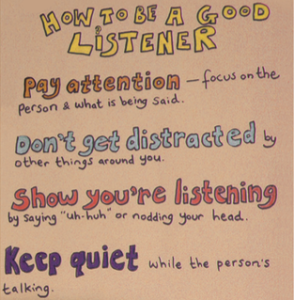
Good listener prompts
Have the students make suggestions about good listening
Pay attention. Focus on the person and what is being said
Don’t get distracted by other things around you
Show you’re listening by saying uh-huh or nodding your head
Keep quiet while the other person’s talking
Wait to ask a question or give comments that show others that you care about what they’re saying.
Make these into a public display and refer to them often. Here is an example from a group of 9 year olds.
2: Dual focus teaching…blending content and process
You design activities that combine the dual objectives of ‘what’ will be learned and ‘how’ it will be learned. You make sure students know that the content they are learning is a way of giving their minds a useful workout. (The content is the vehicle for learning)
For example:
Make the listening intentions in any lesson clear
In order to teach with listening in mind, it is a good idea to set up the lesson with a specific listening purpose. For example,
in one lesson it may be appropriate to require students merely to listen with relaxed enjoyment to appreciate the experience for itself;
on another occasion the focus may be on listening with discernment,
whilst another may require listening in order to generate counter arguments.
3: Emotional engagement…Capturing attention
Your lessons are designed to intrigue your students. Students don’t put in the effort unless their energy and attention are captured by what they are doing. You capture your students’ emotional engagement by giving them more of a stake in the process of learning.
For example:
Start lessons with an aural challenge…from time to time
Provide complex directions or instructions. For example…
A sense of direction exercises:
You are facing east, you make an about-face, and then you turn left. Which direction is now on your left?
Castle Street is parallel to St John’s Street. The Avenue is perpendicular to Purley Road. Purley Road is parallel to St. John’s Street. Is The Avenue parallel or perpendicular to Castle Street?
4: Handling uncertainty…Challenge
You have realised from your own life that what is engaging tends to be what is challenging. Since you see education as a preparation for a learning life, you help students to learn how to handle increasing degrees of complexity and uncertainty.
For example:
There’s something wrong here
Teacher reads a sentence or statement without expression, then reads it again with changes – no repetition. Students are asked to spot the changes. This can work particularly well when using a foreign language.
Examples:
Karen takes the train to work but Katherine always drives / Clare takes the bus to work but Kim sometimes drives.
Next year Christine is going on holiday to France / Next week Christina is going to work in France.
After Easter, Lynn and Drew are going to Switzerland to visit Drew’s mother / During Easter, Linda and Drew are going to Swansea to visit Linda’s mother.
5: Relationships…Working together
Learning is both a sociable and a solitary activity, and you offer your students opportunities to experience both. You develop interdependent learners who know how to handle themselves in collaborative groups and able to move around in the social space of learning to best effect.
For example:
Enable students to define how best to listen when working with others
Agree common goals (‘Let’s make sure we know what we’re trying to do…’)
Use encouraging language (‘That’s a good idea…that’s interesting…’)
Ask for clarification (‘I don’t quite get what you mean by that…’)
Paraphrase (‘Let’s just say that again…’)
Remember quiet people are also listening and have valuable things to say – draw them in
Don’t talk over each other
Don’t undermine other people – no put downs
6: Reflection and responsibility…Taking charge
You understand that students have to learn how to manage and organise their own learning and that the way to do this is by giving them increasingly demanding opportunities to do so. You orchestrate students taking charge of their learning by expecting them to plan what they do, distil meaning from it, and revise it accordingly.
For example:
Use learning mats
at the start of this process to prompt the use of and reflection on listening.
A checklist for lesson planning based on these six principles.
Does the lesson plan:
Make it clear to students which learning behaviours are being activated?
Match and blend the learning behaviour with content?
Include a tactic to captivate students’ attention?
Have sufficiently challenging learning activities to sustain interest for all?
Offer choice on how students could interact on these tasks?
Embed aspects of planning, reflecting and revising for content and process?
What do you think?
Which of these six principles are a regular feature of your planning?
What do you make of principle 2? Is it the most tricky of the six? The following section B is mostly about this aspect of planning.
Look at the checklist in the green box above this one: Do your lesson plans capture these six aspects of an effective learning experience?
Make a note of…
Which of the six principles might need to be given greater prominence in your planning.
B. Big questions to ask about lesson design.
Skim read or leave this section if you have met it in other units because… the section applies to any learning behaviour. i.e. not specific to Listening.
What we teach and how we teach it (the enacted curriculum) are intertwined and offer teachers a lot of freedom. It is here that you can start applying a learning power filter and deploy a unique combination of content and learning tasks.
In conventional lessons where the teacher remains the focus of attention and the initiator of all activity, and where the epistemic dimension (the conditions for acquiring knowledge) is not acknowledged, students gain habits of compliance and dependence, rather than curiosity and self-reliance.
In developing learning power, teachers are making conscious choices about which habits to introduce and stretch and how best to couple these with content so that lessons become more interesting and challenging. Through such overt coupling of content and specific types of process, students come to know, understand and take control of their learning behaviours – they knowingly use and develop the whole range of learning behaviours.
All lessons function on two levels, they have twin intentions. On the one hand there is content to be acquired, and on the other there are learning behaviours to be exercised in pursuit of this content. The factor that differentiates a standard lesson that effectively ‘delivers the content’ from a learning powered lesson is that the teacher has to think, in advance, about:
the learning behaviours that are necessary for successful content acquisition;
the design of activities /tasks that will stimulate these behaviours;
how learners could reflect on and evaluate their use of these behaviours.
In designing such lessons you have to dare to think differently and flip round your usual lesson design thinking.
A turn-around in lesson design
Think in two dimensions at once – the content dimension and the learning behaviour dimension. It means turning your thinking around – from teaching to learning.
Or put another way
Think to yourself;
what content?
using which learning behaviour(s)?
via an activity to stretch both?
Lesson design questions… one by one
Here the general rules of lesson design have been related to the learning behaviour…listening.
Stage 1. What content do students need to learn?
What content has to be learned? …..Think outcomes.
Use standard lesson planning tools:
What are students going to be able to do/learn?…think objectives
How will they know if they been successful?… think success criteria
While keeping an obvious eye on
What do they already know?….think previous learning.
Stage 2. How will they best learn it?
Using which learning behaviours?
This is the new bit
Not the usual second step but nonetheless a vital second step where the aim is to weave content acquisition with learning behaviours. The content is the vehicle for exercising the learning behaviours and the learning behaviours accelerate the content acquisition.
Using which learning behaviours?…Think types of learning behaviours
Which learning behaviour(s) will help these students get closer to understanding this content?…think learning behaviour charts.
Which aspect of, say, listening, lends itself to achieving these outcomes?…think progression columns.
How skilled are these students in using this learning behaviour …think progression phases/rows
Say something like this to yourself .…My students need to achieve xxx. At this stage we could get closer to this content by using listening. Most of my students are able to use xxx phase (e.g. respond/blue) listening approaches confidently.
Stage 3. What type of task/activity will stretch the learning?
Which type of task…Think types of task.
Pick up your thinking from stage 2;
My students need to achieve xxx. At this stage we could get closer to this content by using listening. Most of my students would be able to use xxx phase (e.g. blue/responds phase) listening approaches confidently.
And now think about the sort of task/activity you might develop/design so as to:
orchestrate a problem-solving activity to enable students’ understanding of xyz content without telling them;
intrigue them with something that is open to several interpretations;
stimulate their curiosity;
grab their attention…visually and aurally;
allow them to stay stuck before I ask them how they are thinking;
offer as a nudge to get them thinking differently that doesn’t give the answer away;
leave it as a problem hanging in the air to which we will return later;
make links between the challenge, and what and how we are learning in this lesson.
The challenge isn’t about the inherent complexity of the subject matter but about how the content is orchestrated to encourage students to use their learning habits to resource their solution.
Think…what/how much information/content do I need to give/reveal? At what point? In what form? To what end?
Say something like this to yourself .…
my students need to achieve xxx.
at this point we could get closer to this content by using listening.
most of my students are able to use xxx phase (e.g. respond/blue phase) listening approaches confidently.
What type of task would stretch their listening but assist them with the content…without me just telling them!
To summarise…the heart of the lesson
It’s the question ‘using which learning behaviours?’ that causes you to think differently about the lesson planning.
You ask – as always – what are the anticipated objectives/intentions?
The verbs in your resulting objectives will give you clues about the types of task/methodology that will get students there and the sorts of learning behaviours your students will need to contribute to this learning endeavour.
You are designing the task in a way that requires students to contribute their learning ‘powers’ / behaviours. The tasks you design will hook into their learning ‘powers’ and help them to improve them.
Say something like this to yourself:
I am going to think content, learning behaviour and task together:
Listening will help students to better access the content;
The aspect of listening (column) and phase (row) that would fit best is (for example) ‘Listen actively for intention, emotion and mixed messages’. (Conventions of Listening column, Values/Green phase).
The type of task/activity that would best stretch both content and learning behaviour, intrigue, challenge, bring people together and give responsibility to students is………
Think….what information do I need to reveal/give, in what form, at what point, and what do I want students to do with it?
What do you think?
What strikes you about this way of planning with learning behaviours in mind?
Where are the potential stumbling blocks?
How will you decide which learning behaviour(s) you are going to foreground in your objectives?
Consider a lesson you are about to teach…
What is the content?
Which learning behaviour(s), if missing, would make accessing the content very difficult / impossible?
How could you blend reference to this learning behaviour(s) into the learning objectives?
Can you design a task that will help students to access the content and exercise the key learning behaviour(s) you have identified?
C. Lesson planning in action – how do we build Listening into lesson design?
This section differs radically from the same section in other modules in that the lesson is one for you to do, rather than one that you can teach to your students. In section 4 we pick up how you can apply the ideas to your own lesson planning.
How do we design tasks that stretch Listening and assist students to approach the content more productively? We cover this in four ways:
1 Preliminary thinking about the lesson;
2 Planning the Episodes of the lesson;
3 Distilling the plan on to a single sheet of paper;
4 Extending your thinking about Listening for different purposes into other aspects of the curriculum.
When we talk to teachers about their students’ listening abilities, many say that poor listening skills limit students’ ability to access the content. Much like Noticing, which is frequently confused with ‘looking’, so Listening is mistaken for ‘hearing’. The confusion arises because both looking and hearing are involuntary and something that we do without effort or intentionality, whereas Noticing and Listening require effort, time, patience and perseverance.
The progression chart for Listening, and in particular (but not exclusively) the column entitled ‘Informational listening to gain understanding’ identifies a range of things that might be listened for:
basic understanding of the idea as presented;
the quality / importance of the idea;
the extent to which the idea engages interest and curiosity;
facts and information about the idea;
the big ideas and the main points;
the speaker’s intentions, values and emotions;
ideas to put into one’s own words;
to formulate questions to better understand what is being said;
to listen for what is not being said.
Little wonder that with so much going on, students find it hard to listen on all of these fronts simultaneously. But, we can help students to become more effective listeners by practising these different skills separately, before attempting to combine them.
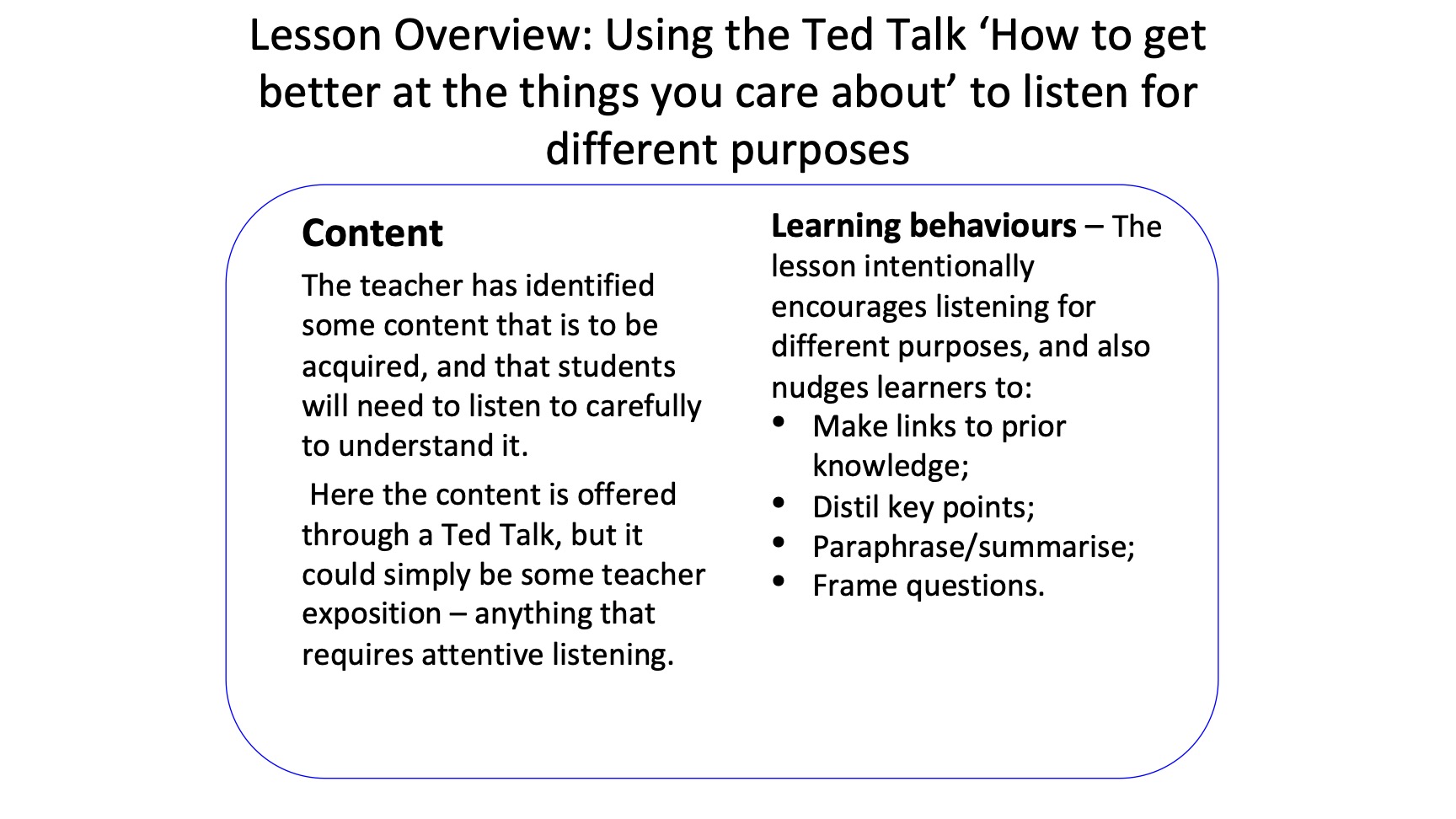
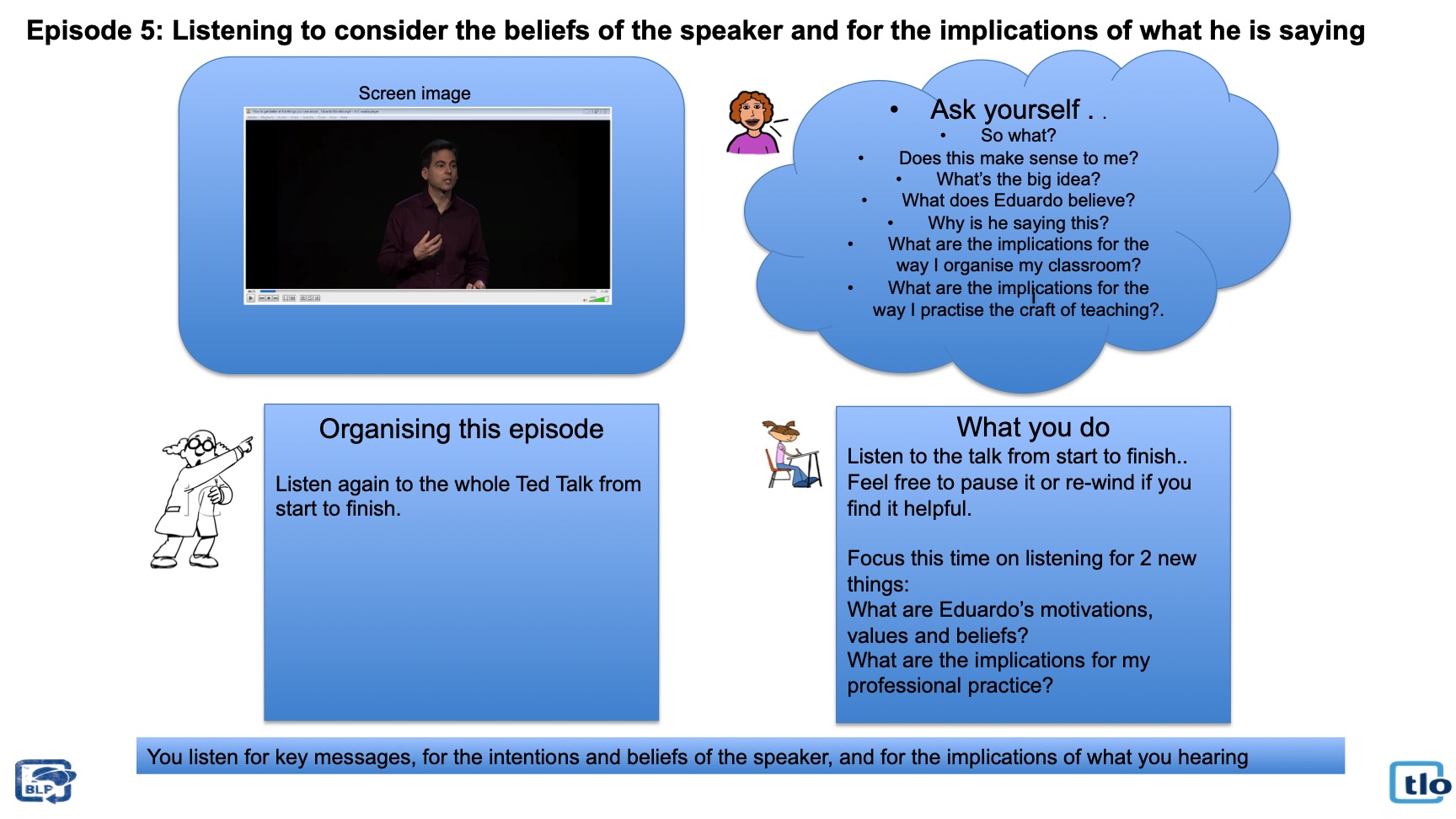
The following lesson focuses on listening to the Ted Talk by Eduardo Briceno – How to get better at the things you care about – and invites you to listen to parts of it, focusing on one aspect of listening at a time. We guarantee that you will find this difficult but fascinating.
2. Listening for different purposes in a lesson.
The lesson below uses the audio for the Ted Talk to practise listening for different purposes.
You are invited to follow this lesson through yourself to get the feel of what listening for different purposes feels like, and perhaps to deepen your understanding of how complex listening really is.
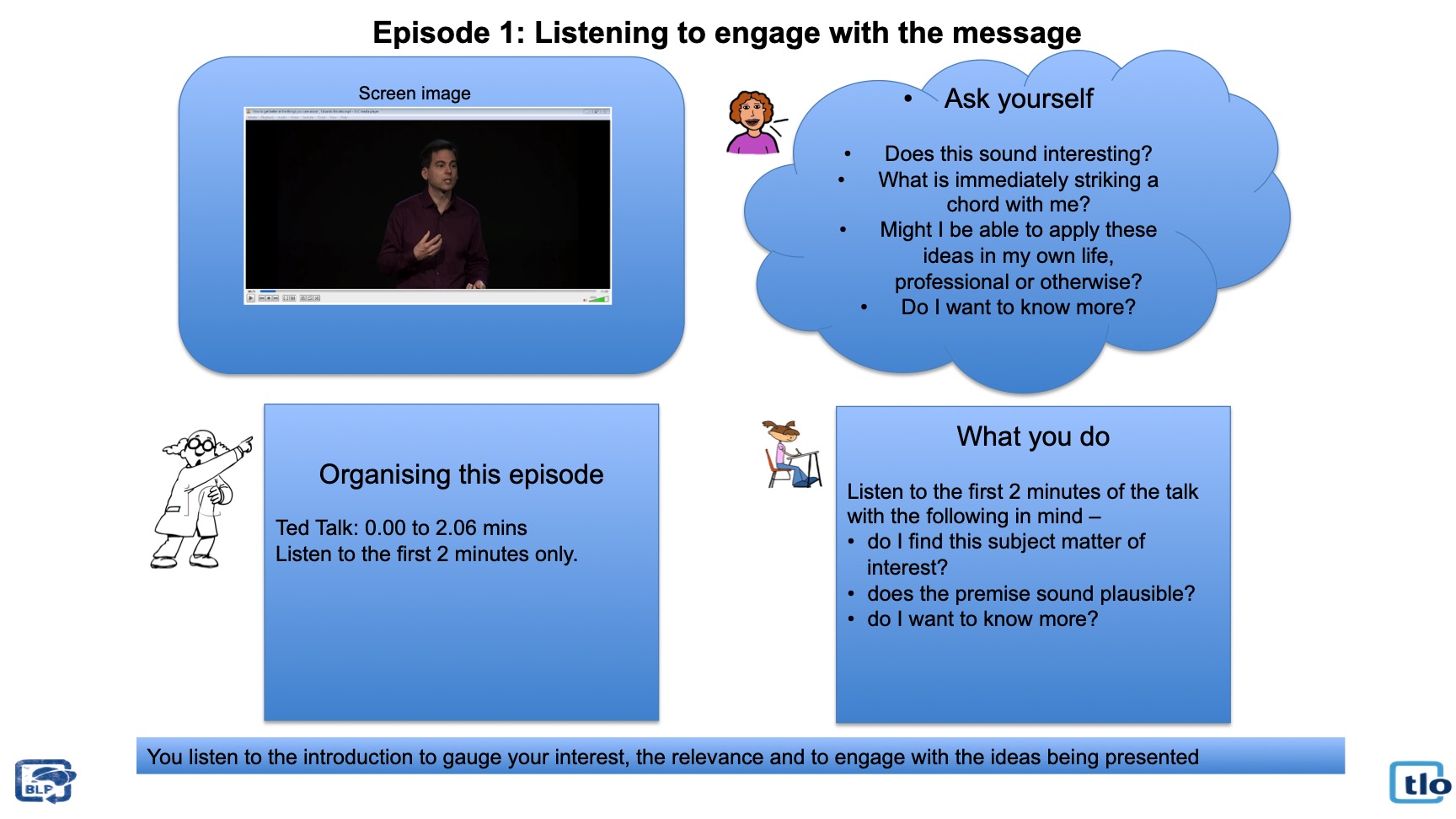
Episode 1 – Listening to engage with the message
What is happening here?
Eduardo lays out the idea of Performance and Learning Zones in the 2 minute introduction to the Ted Talk. At this stage the listener is invited to use purple and blue phase listening skills to determine whether the idea is relevant and likely to engage their interest.
In particular, the listener is ‘trying hard to make sense of the messages; showing interest in understanding the message as it was intended, and the quality of the message/idea’. (Listening Purple phase skills) and ‘showing curiosity and genuine interest in what is being said’ (Listening Blue phase skill).
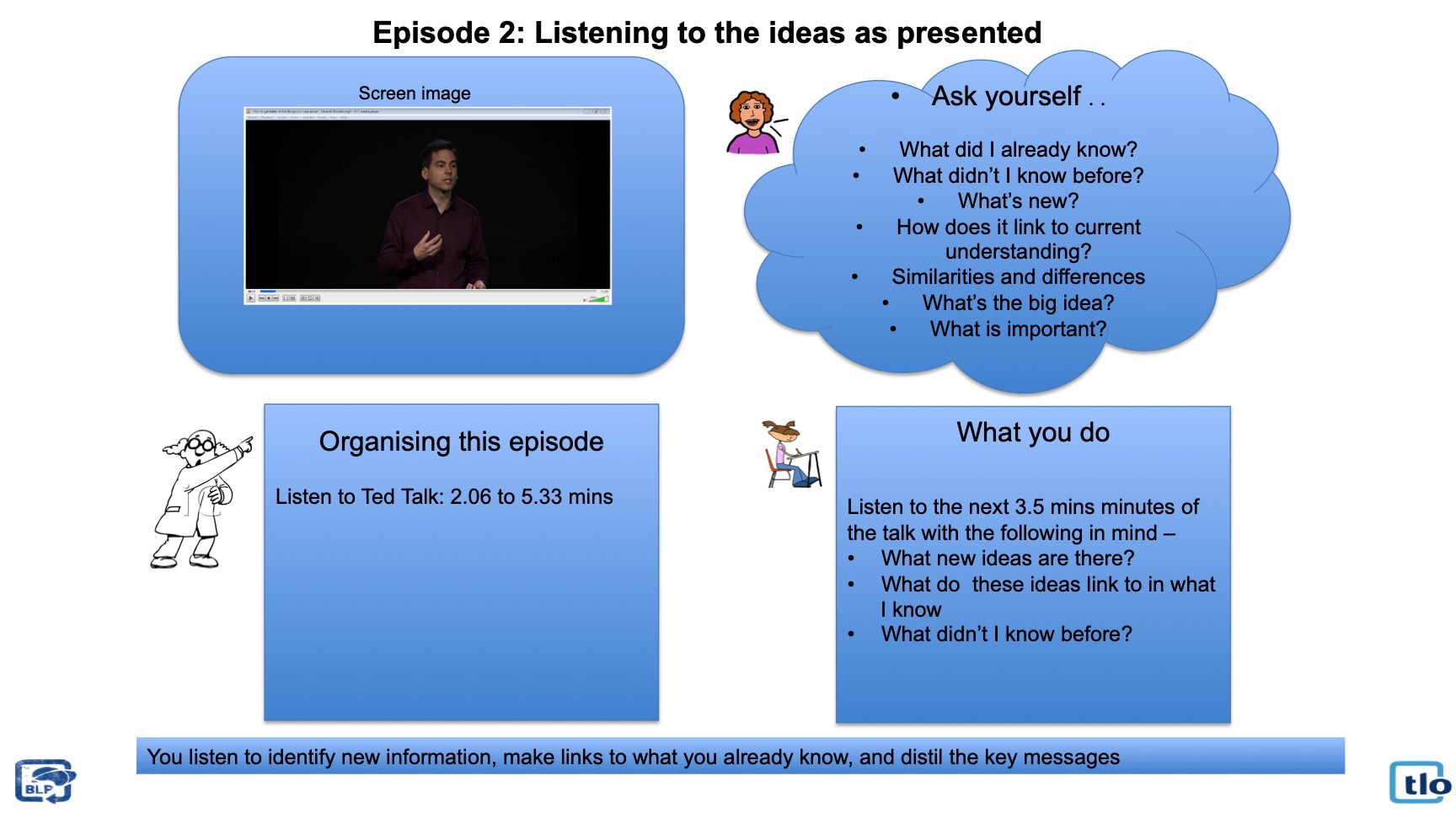
Episode 2 – Listening to the ideas presented
What is happening here?
Here we are encouraging you, the listener, to focus on the information that is being presented, and in particular on new information that was previously unknown or only dimly understood. For example, the idea that in many professions people cease to improve after the first couple of years in post. Or, that deliberate practice means breaking the skills down and practising each separately.
In listening terms, the listener is ‘beginning to listen for different purposes, seeking to identify the big ideas and main points, looking for the golden nugget of information, and listening for information about the idea’. (Listening Blue phase skills).
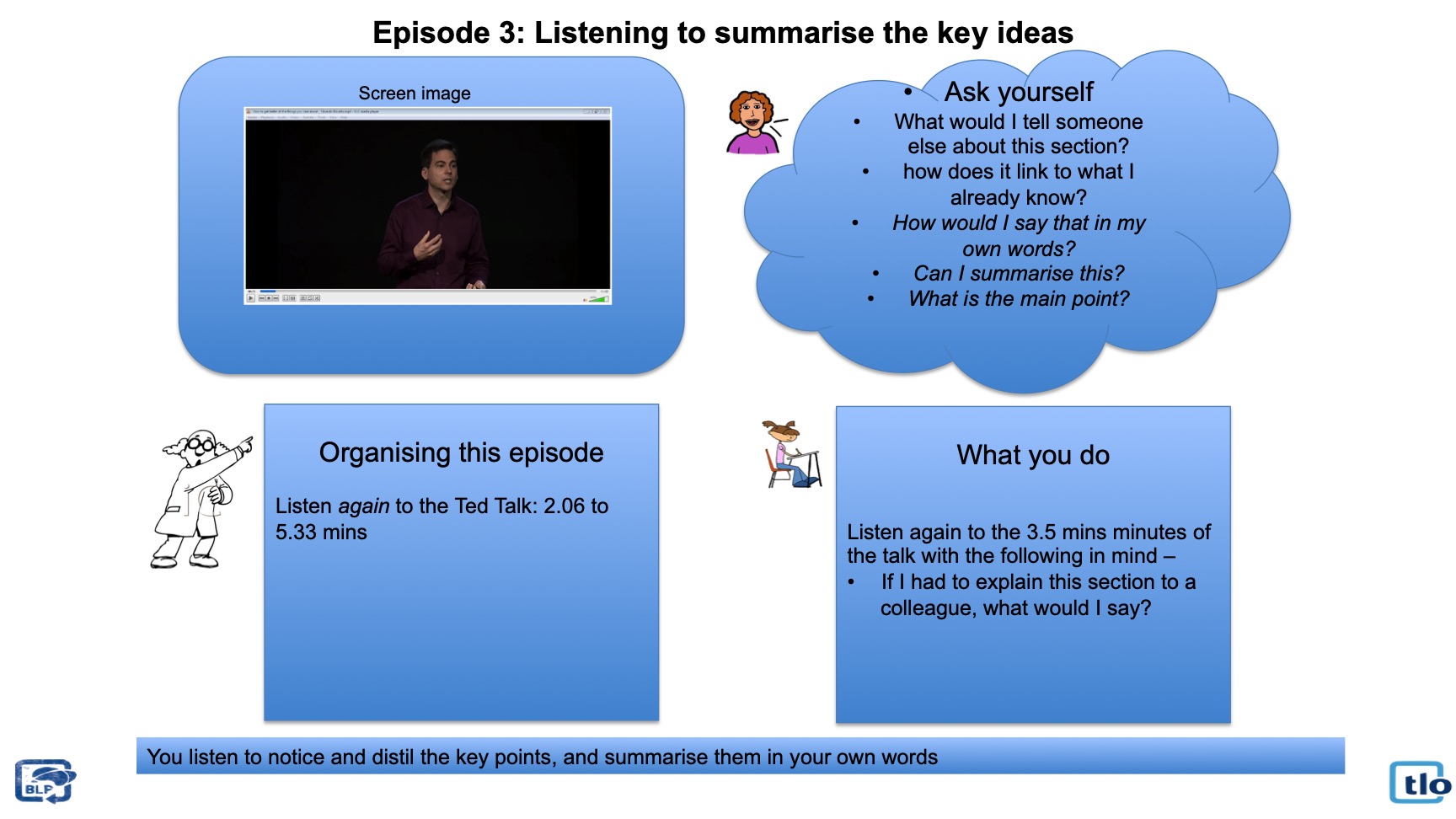
Episode 3 – Listening to summarise the key ideas
What is happening here?
Here we ask you to listen again to the same 3 minute section of the Ted Talk. This time the task is to listen for the main points and key ideas, and then to put them into your own words. It requires listening, noticing and distilling skills.
In listening terms, the listener ‘paraphrases in their own words what they believe the speaker said’. (Listening Green phase skills)
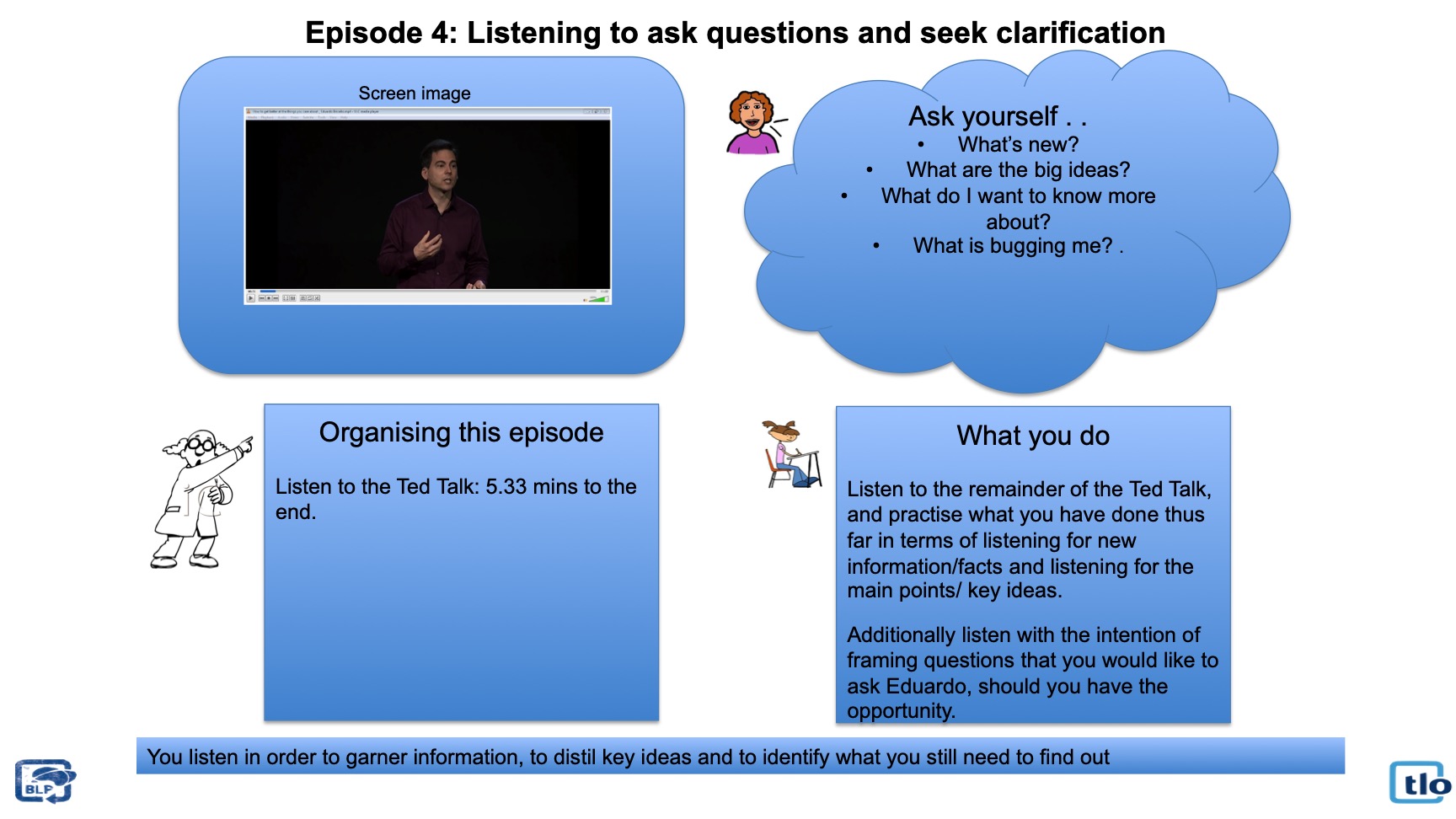
Episode 4- Listening to ask questions and seek clarification.
What is happening here?
While listening to the remainder of the Ted Talk, you, the listener, practises the skills exercised in Episodes 1/2/3, and undertake a further high level listening skill – listening in order to ask questions and to delve further. It blends our listening, noticing, distilling and questioning skills.
In listening terms, the listener ‘seeks information and ideas, looks to identify key messages, and considers what they do not yet understand and need further clarification on’. Listeners ‘use open ended questions to get closer to understanding the message’ (Listening Yellow phase).
So, having now heard the whole talk:
what questions do you have?
what clarification might you need?
what is not yet resolved for you?
At that point when the speaker says ‘does anyone have any questions?’ what would your open ended question be?
Episode 5- Listening to consider the beliefs of the speaker and for the implications of what he is saying.
What is happening here?
Listen now to the complete Ted Talk, this time practising the effective listening habits used in previous Episodes and extending listening to include considering the values and beliefs of the speaker and how the content of the message might have implications for your professional practice.
In listening terms, the listener ‘listens actively for intention, emotion and beliefs’ (Listening Green phase) and ‘listens sensitively in order to pick up messages ‘between the lines’ and look beyond the words’ (Listening Gold phase).
Eduardo’s talk challenges teachers to consider 2 substantial questions:
In my classroom;
What is the balance of time that my students spend in their performance and learning zones,
is that balance correct,
and do they know which they are doing when?
2. In my professional life:
How much time do I, as a professional, spend in my performance zone, and how much in my learning zone,
and is this balance correct/appropriate?
How would you respond to these 2 questions? How might your answers impact on you and on your classroom?
And finally, after Episode 5, reflect on how often you felt the need to pause and consider, or to re-wind and listen again. If we find listening easier when we can pause and/or re-wind, what about our students who are probably less skilful listeners?
What do you think?
Can you think of a curriculum-related video/audio that could be treated in this way?
Do you think that practising listening skills in isolation (deliberate practice) would help your students to become more effective listeners?
Make a note of…
Which class you might try this with, using which video/audio?
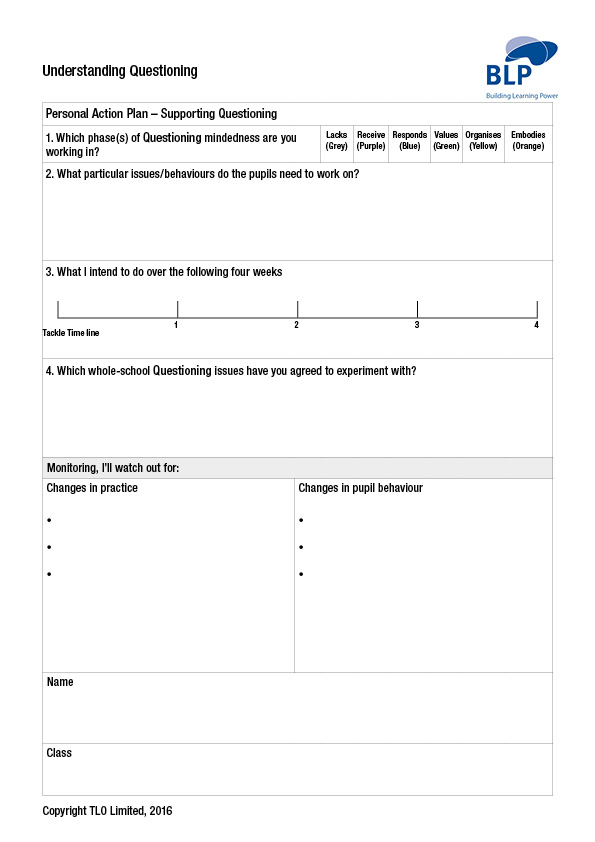
3 Using a lesson plan template to distil this lesson.
Here is the simple streamlined useable lesson plan tool that includes:
how the learning is organised;
what you do;
What the learning behaviours being called upon are (learning behaviours);
What you ask yourself as each Episode unfolds.
The format is divided into episodes to show the change of purpose, action and use of learning behaviour across the course of the lesson.
What do you think?
What are your first reactions to this lesson plan template?
Does planning for four aspects – teacher action, student action, learning behaviours, teacher talk – seem useful?
How does sequencing the lesson as ‘episodes’ help or hinder planning?
Make a note of…
The extent to which your existing planning template enables you to think about lessons in this way.
What you would like / need to add to it.
4 Extend your thinking about listening for different purposes
When do your students need to listen attentively?
The lesson described above uses audio from a Ted Talk, but any audio will suffice – it could even be yourself doing some teacher input to a class.
Ask yourself – is it easier to listen for just one or two things at a time, rather than trying to capture everything at once? And if so – how can I give my students the chance to practise these skills separately?
Consider splitting the class into two or three groups –
one group to listen for facts/information
another to seek ‘the big ideas’
another to consider the values and intentions of the speaker.
Then each group explains what they ‘heard’ to the other groups.
Or perhaps use Jigsaw listening (See Section 2, Purple to Blue in this unit) to share and synthesise what has been heard.
Or, as in the Ted Talk lesson, get them all listening for just one aspect at a time, repeating the audio to listen for other aspects as necessary.
A word of warning: Practising listening once will always be ineffective – the whole point of deliberate practice is the practice bit. Teachers need to use these strategies repeatedly to build student listening skills over time, progressively and cumulatively. And, unlike the Ted Talk lesson which was aimed at adults who may already possess good listening skills, students probably need to secure purple and blue phase listening behaviours before you introduce higher level listening skills.
What do you think?
Is it worth practising these listening skills one at a time?
Which particular skills are most lacking in your learners, and therefore most in need of attention?
Do you already use video/audio that you could harness to build listening skills?
As teachers we are in the habit-forming business. What we say, what we display on classroom walls, what we celebrate, praise or dismiss, what we model or how we design learning activities will all influence the ways in which students learn, perform and behave. Classroom cultures have a huge influence on students’ learning as you will remember from the Culture unit.
Five big shifts to get you started. Ask yourself – how might you:
Model, discuss and critique the habits of Active Listening;
Create situations that require students to listen for various, different types of information;
Construct opportunities for students to view situations through others’ eyes;
Encourage students to keep an open mind, resisting the inclination to jump to conclusions on partial information;
Help students to listen ‘beyond the words’, to what is not being said, to the values, beliefs and emotions of the speaker.
Now look at the Learning Chart sections below where you will find plenty more ideas to try.
Empathy and listening are core skills. We bracket them together because listening is the main medium through which empathy is generated and communicated. Students can quite readily be coached in the art of being a good listener, and can be given games and exercises that help them develop the ability to hear what someone else has said and, if necessary, play it back to them. Teachers sometimes complain that students will not listen, either to them or to each other; but the habit of listening can be cultivated in most classes inside a term. The most powerful way to do this is for the teachers to model good listening. Extract from Building Learning Power. Guy Claxton 2002
1b) What does being a good Listener involve?
Understanding how to listen effectively is an essential skill that benefits everything from family life to business. It’s one of the most critical skills for working effectively in teams. Hearing and listening are different. Whereas hearing is an automatic and effortless process when sound waves strike the ear drum and cause vibrations in the brain, listening is about the brain giving those sounds meaning. It’s unnatural, and it requires effort. There’s all sorts of faulty listening. Sometimes we fake it or pretend to listen; sometimes we only respond to the remarks we are interested in and reject the rest. Sometimes we listen defensively and take innocent remarks as personal attacks. Or, we listen to collect information to use to attack the speaker, or we avoid particular topics, or we listen insensitively and can’t look beyond the words for other meanings, or we turn the conversation to ourselves. So, listening is indeed hard and requires effort. To be a good listener you need to be able to listen for information, listen to judge the quality of the information and listen empathetically to build a relationship and help solve a problem. When looked at from these diverse angles growing Listening moves well beyond encouraging a student to ‘do good listening’.
The Listening grid below takes account of the constituent parts of building the habit of being a good listener.
Our progression grid for Listening has 5 components:
Listening is not just a communication action, it’s a human action. Successful listening has four stages. Firstly we have to pay attention to what is being said and then make sense of it. We have to respond to the speaker showing you care both verbally and non-verbally. And finally we have to remember the message. In trying to encapsulate this effortful skill the grid looks at the normal conventions of this social process and the growth of skills in the three key listening habits; informational listening; critical listening; empathetic listening. Most of these ideas are gleaned from the work of Stephen Covey,
“Seek first to understand…Then to be understood”. Stephen Covey 1997
Take a closer look at what each column of the grid is about
Conventions of listening
The social conventions of listening
How we move from the convention of taking turns when listening rather than hogging a conversation, to being curious and respecting the speaker. Moving on to listening actively and picking up intentions and emotions in the speaker and knowing how best to respond when people think differently, both from yourself and others, in a conversation
Self-talk
The voice of self-awareness
Self-talk is what we say to ourselves as we learn. The statements capture what someone in each phase of the grid would be thinking. Students may use some of these phrases when talking with you, or in writing from time to time, but mostly self-talk goes on inside their heads. We have shown a small flavour of self-talk thoughts that teachers can encourage students to imitate. Some relate to understanding the message while others relate to responding to the speaker. All such self-talk is important in building a listening habit.
Informational listening to gain understanding
Trying to understand ideas
The key here is to separate the message from the speaker, being open to finding the golden nugget of the message by looking for the big ideas and main points, asking questions to gain more information ( closed and open) and paraphrasing in your own words to check what was meant. And finally being able to listen between the lines, looking beyond the words to find meaning.
Critical listening
Judging the quality of ideas
This column is about judging the quality of the message and deciding whether to accept it or reject it. The first stage is to concentrate on listening. It’s important not to make a judgement too early, to separate the message from the speaker and to ignore information that may lead you to verbally attack the speaker. It’s important through sensitive questioning to evaluate the speaker’s credibility and check the source of the information. The conversation may then move on to examining the evidence and using reasoning skills before making a decision to accept or reject the argument/ information/ idea. Finally being able to respond empathetically when rejecting an idea with your counter arguments.
Empathetic listening
Helping people to sort out problems
Empathetic listening is the first step to understanding someone. The goal here is to build a relationship or to help someone solve a problem. This style of listening demands you show the most respect for the other person’s point of view. The thrust of such conversation is to help the speaker draw conclusions for themselves. Your role is to question in order to sort out problems, offer supportive responses, prompt the speaker to make suggestions for themselves and paraphrase their words to check understanding. Having said that you will have to choose the best style to meet the other person’s likely reaction to your help. Some appreciate direct advice, others may want you to make a decision for them, some may be defensive and want to lash out and “kill the messenger”, while others can’t think through the problems even with sensitive probing and paraphrasing. This is the hardest listening skill and takes lots of practice.
What do you think?
What have you learned about Listening from these descriptions?
What have you had confirmed?
What surprised you?
How have your views changed?
Make a note of…
Any ideas for practical classroom experiments that these descriptions have triggered
Which column your students are most secure in.
1d) Unpicking the rows; getting better at Listening
Of course, the development of Listening doesn’t grow neatly up each column or evenly across the phases in the grid. The five broad phases of dispositional growth (purple – orange) are affective ways in which people may be inclined to behave: we call this inclination ‘mindedness’.
Here is our interpretation of how Listening might grow.
The phases are drawn from Bloom’s taxonomy of the affective domain.
Phase ‘Receives’ (purple) is about doing something because you are told or expected to.
Phase ‘Responds’ (blue) is about gaining interest and doing things more willingly.
Phase ‘Values’ (green) is a key phase since the student now sees the value of behaving in this way. It’s a win for them; to behave like this is in their interest. It’s in this phase that the behaviour becomes more secure.
Phase ‘Organises’ (yellow) is the phase in which the student capitalises on this ‘in their interest’ behaviour and gets themselves organised to use it positively.
Phase ‘Embodies’ (orange), known as ‘characterised’ in the original taxonomy. In this phase, the student has made this behaviour their own. It has become part of their character; they can’t not do it and they have become highly skilled in doing it.
We urge you to see this progression as long term. Some phases will take years for people to work through; some will never be worked through. None of the phases are inevitable. There is a lifetime of development captured here. Nevertheless, the role of a teacher or parent should surely be to encourage and enable this journey.
Lacks: Minded to talk rather than listen
In this ‘Lacks’ (grey) phase, students are not necessarily aware of listening even when told to listen. They tend to think listening is about hearing. They have no understanding of the fact that listening is a skill demanding a lot of effort.
Receives: Minded to show an interest in others’ talk
In the Receives (purple) phase, students are aware of how to behave when listening to someone else and are showing an interest in what people have to say. They might ask you to repeat something or ask you to say what you mean by something. They may want to know whether what is said is right and try to keep friends with people.
Responds: Minded to sort the message from the messenger
In the Responds (blue) phase, students have a genuine interest in what is being said. They want to know more, they can sort out what the speaker is saying and from this interest they don’t attempt to turn the conversation to themselves. They have learned the important skill of decoupling the information from the messenger
Values: Minded to listen to understand ideas and emotions
In the Values (green) phase, students listen more deeply for both the message/idea and the emotions that might go with it. They are able to check what is being said through paraphrasing and check the quality of an idea by checking for evidence and reasoning questions. They are aware that the speaker must be treated civilly and can empathise with the person’s view without necessarily agreeing with it.
Organises: Minded to sensitively explore what the speaker is saying/conveying
In the Organises (yellow) phase, the listener can gently probe people’s problems and use open-ended questions skilfully to gain a better understanding of both the speaker and their ideas. The skill here is to remove the emotion out of critical listening but not to duck any tricky issues. It’s about keeping a conversation on an even keel despite differences of opinion or values.
Embodies: Minded to listen and respond empathetically
In the Embodies (orange) phase, students always maintain respect for the speaker. They can pick up nuances and read between the lines for what is really being conveyed. They always respond with sensitivity to the speaker while at the same time rejecting their ideas. They never put themselves in danger of being “lashed out at” by the speaker and are well equipped to offer advice in a way that will suit the needs of the other person.
What do you think?
What has struck you about the act of listening having read the descriptions above?
Which phase do you operate in?
What makes you say that?
Make a note of…
What you might do to assist your students to make headway in their listening behaviour.
Any practical ideas the text has triggered.
Preparation for the Learning Team meeting
Where are my students now?
Take a look at the Listening progression chart in your Learning Diary or
Colour in the cells where you think your students are secure.
Some will barely be on the chart while others may be quite a way up. Neat straight lines of secure behaviours are rare. But looking at your students in this way should give you an idea of what you need to work on.
Draw a red line across the chart to denote where you think most of the school’s students could and should reach by the time they leave.
Please take the results of these tasks with you to the Professional Learning Team session shown in Section 4
If you want to read again the notes on Professional Learning Teams, click on the view notes tab in this box
Professional Learning Teams: what and how
The purpose of these meetings is for the team to act as a teacher learning community or Professional Learning Team: a small group of teachers who meet together regularly to deepen their understanding of building better learners, commit to trying out new things, reflect on and share their experiments with each other. Such learning communities are the engines of teacher development. They work best with 6-8 teachers with similar subjects or age groups, and who meet for about an hour regularly over a period of a couple of years.
The group question and probe each other’s summaries of their experiments in order to encourage analysis and deeper reflection. They use questions such as ‘What do you think is getting in the way? What would make this even better? How could this technique be modified to make it work for you? What do you think made that happen? In this way they support each other in changing and developing their practice.
Some guidelines for team reflection sessions
The delicate, hard work of changing practice requires a safe professional environment in which to explore and understand both triumphs and tribulations. These short guidelines may be helpful in setting a climate for the team itself.
Everyone is expected to report back on their classroom experiments
Coaching questions and probes of colleagues’ classroom experiments encourage deeper reflection.
The group is careful to follow their agreed ground rules which might include;
No group member can ‘pass’
Listen between the lines when it’s not your turn
Actively discuss everyone’s input
Constructive criticism – developmental not judgemental
Everyone fully engaged in the group •What is said is confidential to the group • Respect others’ views and encourage others’ ideas
IGNORE THIS SECTION – WE CAN DEAL WITH IT LATER ONCE QUESTIONING IS COMPLETED
So far, you have:
Looked at your students through the lens of the xxxxxx learning chart
Gained a sense of what becoming better at xxxxxx looks like
Considered how you might make your classroom culture nurture xxxxxx
Now we look more closely at the issues and questions you need to consider in order to blend a xxxxxx approach to learning with the content you have to teach.
There are four aspects to consider;
Aspect 1: Questions and considerations for weaving xxxxxx into the curriculum or units of work.
Aspect 2: Questions and considerations for putting xxxxxx into a lesson. A split-screen lesson.
Aspect 3: Questions and considerations for designing a task which uses xxxxxx to help students’ understanding.
Aspect 4: Analyse a split-screen lesson with xxxxxx in mind.
Does it help to identify the various learning behaviours that will be exercised in each episode of the lesson?
Can you see how the learning behaviours that are being triggered are a combination of the topic in hand (Creative Writing) and the activities that support it (Question Formulation Technique)?
Could you / Will you use this as a planning format?
Make a note of…
yyyyyyyyy.
????????????????????????????????????????????
We hope that you have enjoyed reading this material and that your Professional Learning Team session proves fruitful. You will receive a short feedback form within the next 24 hours for you to share your impressions of the Advance Organiser material with us.
As teachers we are in the habit-forming business. What we say, what we display on classroom walls, what we celebrate, praise or dismiss, what we model or how we design learning activities will all influence the ways in which pupils learn, perform and behave. Classroom cultures have a huge influence on pupil’s learning as you will remember from the Culture unit.
Five big shifts to get you started. Ask yourself – how might you:
Value and praise good questions as well as good answers
Make it safe for people to disagree…see it as an interesting situation from which to learn
Put enquiry mindedness on display…share your enthusiasms, display unfinished lines of enquiry
Develop open-end challenges
Build your lessons from intriguing questions
Now look at the Learning Chart sections below where you will find plenty more ideas to try
Colour in the cells where you think your pupils are secure.
Some will barely be on the chart while others may be quite a way up. Neat straight lines of secure classes are rare. But looking at your class in this way should give you an idea of what you need to work on.
Draw a red line across the chart to denote where you think most of the school’s pupils could and should reach by the time they leave.
Please take the results of these tasks with you to the Professional Learning Team session shown in Section 4
If you want to read again the notes on Professional Learning Teams, click on the view notes tab in this box
Professional Learning Teams: what and how
The purpose of these meetings is for the team to act as a teacher learning community or Professional Learning Team: a small group of teachers who meet together regularly to deepen their understanding of building better learners, commit to trying out new things, reflect on and share their experiments with each other. Such learning communities are the engines of teacher development. They work best with 6-8 teachers with similar subjects or age groups, and who meet for about an hour regularly over a period of a couple of years.
The group question and probe each other’s summaries of their experiments in order to encourage analysis and deeper reflection. They use questions such as ‘What do you think is getting in the way? What would make this even better? How could this technique be modified to make it work for you? What do you think made that happen? In this way they support each other in changing and developing their practice.
Some guidelines for team reflection sessions
The delicate, hard work of changing practice requires a safe professional environment in which to explore and understand both triumphs and tribulations. These short guidelines may be helpful in setting a climate for the team itself.
Everyone is expected to report back on their classroom experiments
Coaching questions and probes of colleagues’ classroom experiments encourage deeper reflection.
The group is careful to follow their agreed ground rules which might include;
No group member can ‘pass’
Listen between the lines when it’s not your turn
Actively discuss everyone’s input
Constructive criticism – developmental not judgemental
Everyone fully engaged in the group •What is said is confidential to the group • Respect others’ views and encourage others’ ideas
1. Session objectives. What do we want to achieve? ( 5 mins)
Share and unpick our learning enquiries in ( whatever you experimented with last)
Develop a common understanding of the on-line materials about questioning
Decide the strategic language issues that everyone needs to apply in their classroom re questioning
Plan some do-able shifts in developing question friendly classrooms
2. Sharing learning enquiries
Share
the changes in practice you tried
how students reacted
what you learned
what next as a result
Probe
what was getting in the way?
what seemed difficult?
what would make it easier?
what made it work particularly well?
why it was successful?
changes in your behaviour
Impact on students
Greater willingness to try…
Avoidance of…..
Improvements in……
Increases in…….
Little or no changes in…
3. Recapping on-line materials: What did we think of the materials? (15 mins)
Thoughts about:
The Questioning grid
Where students are secure
The phase students could aspire to feel secure in before leaving the school
Classroom culture ideas for questioning
Ideas for activities and routines for questioning
4. Planning what to do: What do we all adopt? (15 mins)
Decide
Which ideas should we all adopt as whole school strategies?
How the progression of Questioning should be built across the school. ie how the phases of Questioning might play out against key stages and even year groups.
5. Personal action planning. What am I going to do? (20 mins)
Consider
How you want your students to improve/develop/enhance their approach to Questioning?
What you are going to do to bring this about?
Develop an enquiry question.
Think of it like this:
If I do XXXX will it improve/develop/enhance YYYY?
This is the crunch question. Your students are unlikely to change unless you change!
As teachers we are in the habit-forming business. What we say, what we display on classroom walls, what we celebrate, praise or dismiss, what we model or how we design learning activities will all influence the ways in which students learn, perform and behave. Classroom cultures have a huge influence on students’ learning as you will remember from the Culture unit.
Five big shifts to get you started. How might you:
Value and praise good questions as well as good answers;
Make it safe for people to disagree…see it as an interesting situation from which to learn;
Put enquiry mindedness on display…share your enthusiasms, display unfinished lines of enquiry;
Develop open-end challenges;
Build your lessons from intriguing questions.
Now look at the Learning Chart sections below where you will find plenty more ideas to try.
‘Wonder is the beginning of wisdom.’ So stated Socrates, considered by some to be ‘the father of questioning’. Even through nearly 2,500 years of human development and societal ‘progression’, those words still hold true. In growing the habit of questioning, it is important to acknowledge that questioning itself is rooted in curiosity, that great driver of engagement, of seeking, of asking, and asking again.
Good learners like to wonder about things. For them, it often really is a wonder-ful world. The phrases ‘How come?’ and ‘What if?’ are never far from their lips.
They value getting below the surface of things, and are less likely to accept uncritically what they are told. They like to come to their own conclusions. They are more willing to reveal their questions and uncertainties if they think it will help them learn.
Questioning can be as much non-verbal as it is verbal. Playing around with materials or ideas just to see what happens is a powerful way of asking questions. It is what artists and inventors spend a lot of their time doing. The inclination to ask questions flourishes when you are around people who are also asking questions, and who encourage and appreciate your questions too.
Extract from Building Learning Power. Guy Claxton 2002
What do you think? How well do you know your children as questioners?
Think of the pupils that you teach. Who amongst them is irrepressibly curious?
Which of your pupils are reticent in asking questions?
Why this might be?
Have you ever considered the quality of the questions that your pupils ask?
Make a note of...
How ‘good’ are they at asking questions?
Do they ask ‘good’ questions?
Your definition of a ‘good’ question?
A well-formed habit
Let’s dig a little deeper into questioning. Effective questioners are motivated and not afraid to ask questions about the past, the present and to explore the future. They have an extensive range of question types and techniques at their disposal, which they use with discernment and sensitivity to occasion.
A well-formed questioning habit involves being ready, willing and able to
Not take things at face value
Be less likely to accept answers uncritically
Ask questions of oneself as well as of others
Dig beneath the surface
Get under the surface of things
Be comfortable with uncertainty and ambiguity
Not be afraid of the ‘don’t know’ state of mind
Be playful, yet systematic and analytical
Be socially aware of the impact that questions may have on others
Challenge others’ thinking
Understand and use different types of question for different purposes
Recognise that revealing their own uncertainties helps them learn.
What do you think?
Do you detect that your students are becoming increasingly like this as they move through your school?
How do you know? What makes you say that?
What do you currently do in school to develop an insatiable appetite to find out more?
Make a note of…
What you might be doing at the moment that inhibits curiosity?
1.2 How Questioning might build when we nurture it.
Being good at questioning isn’t something that switches on on good days and off on bad days. Questioning grows and builds when it’s nurtured and supported. Furthermore, being an effective questioner involves gaining control of a range of linked skills and emotions.
Cast your eye over the ‘big picture’ of growing Questioning below. Then move on to finding out what the columns (1.3) and the rows (1.4) are all about.
We tend to think of questioning as a common everyday skill that we all use and indeed it is. But questioning is rooted in curiosity and is therefore big driver of learning. But as with any learning behaviour it can wither and atrophy if left unattended. If children are made to feel stupid for asking questions, or told that questioning is cheeky, or that questioning is time wasting they are more than likely to give it up…it has little value to them. So this grid draws together all the aspects of learning that might contribute to questioning becoming a vital, well-honed skill for navigating life. It deals with the details of questioning skill but also touches on search skills and indeed how we ask questions of others such that it’s accepted and generously answered.
Take a closer look at what each column of the grid is about
1) Attentiveness
The first column is about how we actually attend to being curious; what is it that piques our curiosity and how we keep it going. In the early phases, this might involve looking carefully for the issues or details that our questions raise, using this information to go deeper, becoming fully involved/absorbed in a quest to uncover possibilities or answers. The more we ask, the more we find out, and the more curious we become to find out yet more. In the later phases we might become more picky about the information we are uncovering/seeking, making sure it is valid for our purposes. We become fascinated by both the big picture as well as the small details of an enquiry and seeking new experiences and information becomes a way of life.
2) Search skills
Being curious, finding things out, seeking information requires the ability to search effectively. This may start with asking questions of others or using a book index and library skills or reading a map. But these days searching rapidly embraces the internet and a whole new range of focused questioning skills come into play. Finding information may have become rapid and simple but discerning relevant, reliable and robust information calls for yet more new skills. How we seek, question and capitalise on a variety of resources, from books, to the internet, to physical tools is a vital aspect of any ‘finding out’ quest.
3) Self-talk
The voice of self awareness
Self-talk is what we say to ourselves as we learn. The statements capture what someone in each phase of the grid might be thinking. Students may use some of these phrases when talking with you, or in writing from time to time, but mostly self-talk goes on inside their heads. We have shown a small flavour of self-talk, thoughts that teachers can encourage students to imitate. How might we talk to ourselves in shaping our questioning behaviour. How does this talk move from the ‘need for help’, to enjoying the challenge of finding out, to taking a questioning approach to everything we do.
4) Questioning to focus on depth and detail (convergent)
In column four we get serious about types of questions and in this case the type of questions that are designed to seek more detail and depth. Here the questioning is more focused moving from simply knowing about closed questions and using them to find things out; to developing questions that will sift and filter information; to being about to use question frameworks purposefully; to being able to construct incisive and generative questions to probe the essence of something. In brief, how adept are we at posing questions that will uncover specific details and converge on and getting to the heart of the matter.
5) Questioning to open possibilities (divergent)
In column five we consider a different sort of questioning; that of opening possibilities (divergent). Here our questioning approach gets braver as we move from opening possibilities when prompted, probing for more expansive information, to asking ‘what if’ questions. This expansive questioning leads to exploring possibilities, thinking about things differently, stimulating new ideas, daring to be different, exploring hunches, being creative. It’s a line of questioning that leads us into the unknown.
6) The art of asking questions of others
The last column is about the aspect of asking questions of others. Questioning others, even through the lens of being curious, is a skilful business. It’s easy to upset people without realising it. It might be by using the wrong tone, or putting the emphasis in the wrong place. Building rapport with people is a really important aspect of being able to ask questions, and especially when, for one reason or another, the questions have to be tough. In the later phases of developing this skill we learn how to prepare a set of questions that will make an argument/case, or uncover a problem, or develop a story. (much as you may do in preparing a set of questions for guiding a lesson.) Eventually we become skilled enough to know just what sort of question to ask, in the right way, in the appropriate setting. Thus we have become sensitive to the potential impact of posing questions as much as to the quality of the question itself.
What do you think?
In what order do you think these skills might develop?
Will it be the same for all students?
Do you think these skills will develop ‘naturally’ as children mature?
Do we need to intervene in some way order to support the development?
Do you think that there are any missing skills? Where would you add them?
Make a note of . . . .
Skills you think happen naturally
Any skills you think are missing
1.4 Unpick the rows; getting better at Questioning
Of course the development of Questioning does not grow neatly up each column or evenly across the phases in the grid. The five broad phases of dispositional growth (purple – orange) are affective ways in which people may be inclined to behave: we call this inclination ‘mindedness’.
Here is our interpretation of how Questioning might grow.
The phases are drawn from Bloom’s taxonomy of the affective domain.
Phase ‘Receives’ (purple) is about doing something because you are told or expected to.
Phase ‘Responds’ (blue) is about gaining interest and doing things more willingly.
Phase ‘Values’ (green) is a key phase since the student now sees the value of behaving in this way. It’s a win for them – to behave like this is in their interest. It’s in this phase that the behaviour becomes more secure.
Phase ‘Organises’ (yellow) is the phase in which the student capitalises on this ‘in their interest’ behaviour and gets themselves organised to use it positively.
Phase ‘Embodies’ (orange), known as ‘characterised’ in the original taxonomy. In this phase the student has made this behaviour their own. It has become part of their character; they can’t not do it and they have become highly skilled in doing it.
We urge you to see this progression as long term. Some phases will take years for people to work through; some will never be worked through. None of the phases are inevitable. There is a lifetime of development captured here. Nevertheless the role of a teacher or parent should surely be to encourage and enable this journey.
Lacks: Minded to give up easily and be needy for support
In the lacks or grey phase there are a range of possible negative or controlling issues to overcome. Not all children will display all of these but these are the type of behaviours that need to be remedied. The first issue is that students need to feel that asking questions is the most important part of learning and not something to be afraid of. They need to be encouraged to find things out for themselves and to be interested in the answer as much as the question. Moving out of the lacks phase is the first stage of encouraging children to think and find things out for themselves. There are of course children who have a constant stream of questions and perhaps in this case they need help with looking at/caring more about the answers.
Receives: Minded to try out aspects of finding things out when required
In the Receives (purple) phase, students are shifting from perhaps a general lack of awareness of the role and power of questioning to trying out questioning because they are being required or encouraged or reminded to do so. Here they need help; to ask a ‘good’ question (i.e. generative, will get them somewhere); to become aware of what the questions uncover and whether it was sufficient/good enough/unexpected; to practise using open and closed questions and know what they are for, and to begin to use some simple search techniques.
Responds: Minded to be interested in things to better focus finding out.
In the Responds (blue) phase, students show more willingness to find things out and learn to focus their questioning efforts more effectively. They become very interested in and aware of the detail or meaning of what their questions reveal. Their search skills are becoming more specific and their convergent and divergent questioning are becoming more profitable. And alongside these closer questioning skills they can vary the tone and emphasis of their questioning in order to build rapport with others.
Values: Minded dig deeper into things and develop the search and questioning skills to match
In the Values (green) phase, students have really understood the value of the skill of asking questions. They like and are able to dig more deeply or expansively to satisfy their curiosity. With greater skill comes more risk taking and questioning that ventures into the unknown. This phase is about honing their detective skills.
Organises: Minded to ensure their curiosity and questioning skills pay off.
In the Organises (yellow) phase students organise themselves to keep on track. They have become highly skilled in various search skills, they know how to prepare the right sort of questions for pursuing their lines of enquiry. They are familiar with various question frameworks and their lines of enquiry may have become more risky or provocative.
Embodies: Minded to take a questioning approach to learning and life
In the Embodies (orange) phase people have become skilled and seasoned ‘finder-outers’. They are fully and skilfully absorbed in seeking new ideas or experiences and their questioning style and demeanour has become sensitive to any occasion. So while their curiosity would lead them to want to ask questions in almost any situation they know when and where and how not to.
Preparation for the Learning Team meeting
Where are my students now?
Take a look at the questioning progression chart in your Learning Diary or
Colour in the cells where you think your students are secure.
Some will barely be on the chart while others may be quite a way up. Neat straight lines of secure behaviours are rare. But looking at your students in this way should give you an idea of what you need to work on.
Draw a red line across the chart to denote where you think most of the school’s students could and should reach by the time they leave.
Please take the results of these tasks with you to the Professional Learning Team session shown in Section 4
If this team session is your first one in Stepping Stones phase 2, miss out item 2
How did our experiments go? (20 mins)
Share
the changes in practice you tried
how students reacted
what you learned
what next as a result
Probe
what was getting in the way?
what seemed difficult?
what would make it easier?
what made it work particularly well?
why was it successful?
changes in your behaviour
Talk about impact
improvements in concentration
increased time on task
more enjoyment in learning
more/renewed interest in the subject
greater willingness to try, and try different ways
more deliberate looking
Avoidance of…..
Improvements in……
Increases in…….
Little of no changes in…
3. Recapping on-line materials
What did we think of the materials? (15 mins)
Reactions to
The Noticing grid
Where pupils are secure
Where the pupils could be secure when they leave for secondary school
Classroom culture ideas
Activities and talk ideas
4. Planning what to do
What do we need to do next? (10 mins)
Decide
Which ideas should we all adopt as a school strategy?
How the progression of Noticing should be built across the school. ie how the phases of Noticing might play out against key stages and even year groups.
5. Personal action planning
What am I going to do? (20 mins)
5a. Consider
How you want your pupils to improve/develop/enhance their approach to Noticing?
What are you going to do to bring this about?
Develop your enquiry question.
Think of it like this…
If I do XXXX will it improve/develop/enhance YYYY
This is the crunch question. Your pupils are unlikely to change unless you change!
Looked at your students through the lens of the Noticing learning grid
Gained a sense of what becoming better at Noticing looks like
Considered how you might shift the culture of the classroom to nurture Noticing
Now we look more closely at classroom activities and language to provoke and guide students to get better at Noticing; to build
Go to the phase that you have already identified as the one that most of your students need to develop next.
In each Tab box below you will find; an overview of the teacher’s role; a couple of ‘quick wins’ or introductory activities; a couple of activities to surface Noticing; routines (must haves) to encourage noticing; some suggestions for teacher talk and If- Then statements; a review/reflection mat.
In the Receives (purple) phase, students need help to notice attentively. They readily the see the familiar or obvious but need help to go further. They can describe what they have seen but this too lacks detail. Students know that being distracted isn’t helpful to noticing attentively and do try to ignore common distractions.
In pursuing this phase, the role of the teacher becomes one of:
Introducing the idea of Noticing
Helping students to better focus their noticing
Insisting students describe what they see/hear/smell/feel
Invite some students to be Learning Detectives. Task them with seeking and capturing examples of effective learning on camera / video. Build the outcomes into a display that helps all students to become more aware of the effective habits of others.
Teacher Talk
To nudge students from Grey to Purple, use language like this to nudge each column of the grid:
To control distractions
When you look carefully what sort of things do you find out about . . . ?
Well done, you were looking at that very carefully.
What takes you off task? Is there anything you can do about it?
You spent a long time noticing those details. Well done.
To describe what is noticed
What do you notice when you do that? How does it feel?
How did it feel when you jumped/stretched/rolled/balanced ?
You were really good at noticing things today!
Tell me what you can see
Describe it to me
To notice beyond the familiar
What kind of things do you find out by feeling or touching something
What about smelling and tasting?
And what can you find out by listening or hearing?
Can you think about times when you shouldn’t touch, smell or taste?
To notice what they are interested in
Why do you like this?
Is this important to you? Why?
What do you enjoy?
To describe what they have observed
How does this colour/music/picture make you feel?
Did you notice what happened then?
Can you see any patterns in that?
How is this different from that? Can you see how these two … are alike?
An If – Then suggestion:
If Inotice something unusual, then I tell my friend about it.
If I feel that I am becoming distracted, then I will take a deep breath and look carefully at what I am doing.
Learning Mat
A Learning Mat is a simple tool to encourage pupils to become more self-aware of how they are using a learning habit. Basically, it’s an A3 or A4 laminated sheet that is kept on tables or used as part of wall display. It shows various aspects of a learning habit. Pupils refer to them during lessons, using them as prompts about the finer aspects of a learning habit that are being stretched. They help pupils to be able to join in meta-cognitive talk.
This mat is blank. You will find one that has suggested behaviours on in the Value/Green section. In this one you and your pupils could fill in some ideas for specific Receive/Purple behaviours that you want your pupils to start using. They can of course be individualised for specific pupils.
In the Responds (blue) phase, students know more about distractions and what in particular distracts them. They know the triggers and take steps to divert or diminish them. Their focus now is on the task in-hand, usually on set by teachers or parents. They strive to notice what is required and look for first, differences, and then similarities in what they know about. Such noticing usually causes them to ask questions as their interest grows.
In pursuing this phase, the role of the teacher becomes one of:
Helping pupils explore their distraction triggers
Assists pupils in focusing attention on the requirements of the task/enquiry
Offers opportunities to raise questions linked to what is being noticed.
Use pairs of objects, images, sounds or concepts etc. Invite students to identify as many similarities and differences as they can. Challenge them to find at least 10 of each and to find one that nobody else has noticed. Encourage students to represent these similarities and differences on a Venn diagram (similarities in the overlap, differences outside), or in other ways they feel appropriate.
Visible Thinking Routine
See, Think, Wonder
Invite students to make an observation about an object (artwork, image, artifact) or topic. Follow up with what they think might be going on. Encourage backing up their interpretation with reasons.
Ask students to think about what this makes them wonder about the object or topic.
The routine works best when a student responds by using the three stems together at the same time, i.e., “I see…, I think…, I wonder…”. If not you need to scaffold each response with a follow-up question for the next stem.
This routine encourages careful observations and thoughtful interpretations. It helps stimulate curiosity and sets the stage for inquiry. Use it at the beginning of a new unit to motivate student interest. Try it with an object that connects to a topic during the unit of study. Use the routine with an interesting object near the end of a unit to encourage students to further apply their new knowledge and ideas.
Go to visiblethinkingpz.org for more examples and information about visible thinking routines.
To see this routine on the Visible Thinking Website, go to:
To nudge students from Purple to Blue, use language like this to nudge each column of the grid:
To maintain focus
What might distract you?
What puts you off?
What happens when you lose focus?
How did you keep going?
Did . . . put you off?
What did you do to keep going?
What can we do when we feel that we are losing focus?
How did/will you re-focus?
To notice the familiar
What does this remind you of?
Ring any bells?
Have you seen anything like this before?
To focus noticing
What would you like / need to know more about
What would you like to find out?
What must you find out?
To notice differences and similarities
How is this different from that?
Can you see how these two … are alike?
Can you agree which are the 3 most important differences / similarities?
To create questions about what is noticed
What are you asking yourself about …
How is this puzzling you ?
What’s really happening here?
Having noticed X what questions does this cause you to ask?
An If – Then suggestion:
If I notice something interesting/important, then I will ask my friend a question about it to see what (s)he thinks.
If I notice how things are different, then I will look for similarities also.
Learning Mat
A Learning Mat is a simple tool to encourage pupils to become more self-aware of how they are using a learning habit. Basically, it’s an A3 or A4 laminated sheet that is kept on tables or used as part of wall display. It shows various aspects of a learning habit. Pupils refer to them during lessons, using them as prompts about the finer aspects of a learning habit that are being stretched. They help pupils to be able to join in meta-cognitive talk.
This mat is blank. You will find one that has suggested behaviours on in the Value/Green section. In this one you and your pupils could fill in some ideas for specific Responds/Blue behaviours that you want your pupils to start using. They can of course be individualised for specific pupils.
Values: Minded to notice with real interest, slowly
In the Values ( green) phase, students come to understand what attentive noticing is really about. They know that it takes slow seeing and when they get distracted they can bring themselves back to focusing quickly. The more they notice the more fascinated they become. Now they are seeing not just the obvious or the differences but the unexpected, the unusual; the things that seem slightly odd in that context. Through this, they are able to explore new possibilities.
In pursuing this phase, the role of the teacher becomes one of:
Offering opportunities to notice beyond the obvious/different/same to the curious and unusual.
Allowing plenty of time for noticing, so awarding it status as a learning behaviour.
Use images where everything is not quite as it seems at first glance as starter activities to get students in the noticing frame of mind. You might use:
Escher drawings
Images from Joan Steiner’s book ‘Look-Alikes’
Optical illusions [there are hundreds on the net – just google ‘optical illusions for kids’ and enjoy !
Revealing pictures
Reveal images on the interactive white board bit by bit.
Ask ‘What do you think…
this might be?’
is happening here?’
will fit in this bit?’
comes next?’
seems unusual?’ and so on.
Students work in pairs or triads. After each bit is revealed, students note what they think and whether/how their ideas have changed as a result. Mind Maps:
Use mind maps to encourage students to link and explain how information and ideas seem to be associated.
Use mind mapping at the beginning, middle and end of a unit of study to show how links and understanding change as knowledge grows.
Use at the end of a module of learning as a synthesising tool.
Use a ‘thought shower mind map’ at the outset of a lesson to connect with prior learning and activate link making.
Discuss Noticing Others
Set up a display area where students share strategies or ‘top tips’ that they have found particularly helpful in their own learning. For those offering the ‘top-tip’ this is a distilling activity; the resulting gallery of ‘top tips’ invites students to notice (and adopt) the successful strategies of others.
Teacher talk
To nudge students from Blue to Green, use language like this to nudge each column of the grid:
To notice patiently
You spent a long time noticing those details. Well done.
Look really closely, what else can you see?
You kept at it until you fully understood it
To notice more and more
Look again – Is there anything you have missed?
Let’s be patient a little longer and see what else we can notice about…
Just watch/listen to this for a while. What happens? Wait a little longer.
Great! You waited patiently, watched carefully, and now you’ve found a pattern.
To become more curious about what is noticed
What does it make you wonder?
What questions are you asking yourself about . . .
Hmmm – that’s puzzling, isn’t it
What is interesting you?
To find the unexpected
Were you expecting that?
What might explain that?
What could be going on?
Is that always like that? Does this seem irregular?
That’s an anomaly!
Why do you say that/think this is unusual?
Is it something you should look into further?
What’s getting your intuition twitching here?
To notice possibilities
How else could you explain that?
How might that fit the big picture?
What could that be?
That opens up a range of possibilities
What are the alternative explanations?
An If – Then suggestion:
If I am looking at something, then I will take my time and let the detail emerge.
If I see something unusual, curious or different, then I will ask myself what it might mean.
Learning Mats
A Learning Mat is a simple tool to encourage pupils to become more self-aware of how they are using a learning habit. Basically, they are A3 or A4 laminated sheets kept on tables or used as part of wall display, that show various aspects of a learning habit. Pupils refer to them during lessons, using them as prompts about the finer aspects of a learning habit that is being stretched. They help pupils to be able to join in meta-cognitive talk
As pupils become more proficient at noticing the statements could be upgraded to reflect later phases of the progression grid. Students often enjoy making their own learning mats describing the particular skills they are working on.
You could also use Learning Mats (in ‘teacher speak’ or ‘student speak):
To raise awareness of the habit
To spread the school’s common language for learning
As an aide memoire for students and teachers
As a self-assessment support for students
As an audit tool to support teacher planning. i.e. which of the noticing skills are implied in the lesson plan and therefore how will they be surfaced in what you draw attention to/orchestrate the lesson.
Organises: Minded to notice for patterns and anomalies
In the Organises (yellow) phase noticing has become a skilful habit. They see noticing as an important skill deserving of time and their focus is such that they experience a state of flow where high challenge appears effortless. Now, from noticing irregularities or the unexpected they can see patterns emerging; how things hang together, or not.
In pursuing this phase, the role of the teacher becomes one of:
Nudging the spotting of irregularities or contradictions
Reminding pupils of the big picture of the subject/ discipline/ taxonomy
Provoking the development of hypotheses
XXXXXXXXXXXXXXXXXXXXXX
Still Image
Summary of the activity on page 158 from The Teacher’s Toolkit: Raise Classroom Achievement with Strategies for Every Learner by Paul Ginnis
Students work in small groups
Explain that a still image is like a photograph – it captures action, but is silent and motionless. Still images can be realistic or symbolic, but the image must have significance: it should capture a crucial or poignant moment, or an essential idea.
Provide groups with a photograph. The groups can then re-create the photograph as a still image, inventing names and life histories of the characters. Alternatively, if they don’t want to be tied to the picture, they can use it as a prompt to inspire their own image (based on the learning objectives). For older students, images can be created from imagination, arise from a text (for example, a moment from a play in English to study a theme or character in more depth), or come from research into technical knowledge (for instance, in science, the vaccination of a boy by Edward Jenner).
Groups have time to prepare – how much time will depend on whether the image they are to create is research-based or spontaneous.
Groups display their image long enough for the audience to work out what it is portraying. Then players can relax their positions a little without losing the overall shape of the picture.
Either: Audience ask questions of specific characters. Or: The teacher takes the lead, tapping players in turn who then say what their character is thinking and feeling (thought tracking), followed by questions from the audience.
Applications: This exercise can be used to portray significant moments in history or literature; to bring to life a photograph, drawing or painting; to provide a human angle on technical knowledge; as a starting point for creative writing; to portray abstract ideas symbolically, e.g. chemical reactions, mathematical truths, laws of physics
Why?: This task is great for developing emotional intelligence, independent, and interdependent thinking. Many students gain easier access to sophisticated ideas once they are set in a human context. Reading and writing abilities are not required.
Variations: Two or three still images could be used in a sequence to show a story or process. The exercise can be done at the beginning of a topic so that the questions that cannot be answered by students can be used to set the teacher’s agenda for the next couple of lessons. Alternatively you could use it after research as a means for students to express their learning.
A Visible Learning Routine
The visible thinking routine ‘The Explanation Game’ is a useful strategy to encourage students to notice subtle detail and to generate hypotheses about what they are noticing.
In the Embodies ( orange) phase, attentive noticing is part of their character; it’s a way they approach learning, it’s a permanent piece of their deck of learning cards. They have a deep understanding of their interest or field of study. Their attention is held by their knowledge and understanding but through continuing attentive noticing they continue to seek new understandings. Their deep insight fuels their intuition.
By and large, students who are able to, reach this embodies phase for themselves; it’s the nature of the phase. But there may be relatively few people who naturally and characteristically behave like this in virtually any circumstance. The classroom and home cultures established at the previous phases aim to give people the best chances of achieving this phase, hence there is little need for directteacher intervention. Rather, the role of the teacher/ coach/mentor becomes one of:
ensuring there are sufficient opportunities available to display these high level behaviours;
nudging, praising and supporting people to exercise them;
modelling these behaviours themselves in their everyday interactions.
Ask yourself:
Does the classroom culture actively support noticing at this level ?
Does it need to?
Is my own ‘nudging noticing’ language precise enough to keep nudging students to become highly-skilled noticers ?
How well do I model these highly skilled noticing behaviours myself ?
What phase of noticing behaviour have I reached?
Remember most people don’t ever reach these highly skilled phases.
Teacher talk
To nudge students from Yellow to Gold, use language like this to nudge each column of the grid:
To get lost in your imagination
Close your eyes and . . .
Ah! how could you use what you have just noticed to create new ideas?
What can you see in your mind’s eye?
Take a bit of time to mull this over.
Need to store that bit of noticed xx deep in the memory
To be open to new possibilities
Does that change your thinking?
What might that mean?
Does that change what you were thinking?
That’s thrown a spanner in the works!
How else might you look at this?
To create meaning
What is really happening here?
Is there an underlying pattern?
Have you noticed a pattern change?
Is it always like that?
Are there patterns like that in other disciplines/ways of thinking
Where have you seen something like this before, in different circumstances
What does this mean for how you understand xxx ?
To further deepen understanding
Do you need to go in even more deeply?
Does this encourage you to go further?
Wow – I didn’t know that
To produce highly detailed outcomes
How does this add to what you already know?
How can/will you use this insight?
Does this change how you think about xxx ?
Do you think you have enough detail now?
In this phase, and maybe the one before, students should be capable of setting their own, personal if/then targets to secure aspects of their learning skills that they wish to develop.
2a) Activity 2: How well does my classroom climate encourage Noticing?
As teachers, we are in the habit-forming business. Those habits that we model in front of young people influence the ways in which they perform and behave. Therefore, we need to be sure to foster productive learning habits. If we frequently require students to work at pace, we are not building their ability or inclination to take time and to notice subtlety and nuance. In such ways do good teachers, albeit inadvertently, stifle the very behaviours they are seeking to promote.
A classroom climate that supports and nourishes an inclination to notice attentively is characterised by calm, patience and a spirit of curiosity. Attending to detail can be a slow but fascinating journey.
To enable this, teachers will need to believe that;
Attentive noticing of and for detail provokes insight and builds understanding
Students need time to notice detail and discern underlying patterns
Noticing has to be done by students, not for students
And in shaping a noticing friendly classroom you will develop students who come to believe that;
Attention to detail is a stepping stone to deeper understanding, but takes time.
Looking or sensing the deeper detail adds fascination and interest to subjects/discipline.
Noticing is not only about looking
Get a feel for your classroom culture and how it may be working for or against becoming increasingly noticing friendly. Look through the culture ideas carefully and consider whether you already use some and whether any appeal to you to try.
Learning often relies on being able to pay attention to what you are interested in: not necessarily thinking about it, just really noticing how it looks, what it is made of, or how it behaves. Many professionals, from poets to scientists to business managers, rely on this quality of attentive noticing: being able to identify the significant detail, or to let an underlying pattern of connections emerge into their minds. Sometimes you have to be patient before the detail or the pattern will reveal itself to you, like looking for sea creatures in a rock pool. And this is a skill that can be strengthened with practice. We often pick up this skill from people around us. Babies very soon learn to work out what their mother is focusing on, and to ‘share joint attention’ with her. It helps to be around people who are demonstrating this ability to watch carefully and turn their observations into accurate descriptions. Getting a really clear sense of what, before starting to think about how or why, is very useful.
From Building Learning Power by Guy Claxton 2002
1b) What does being a good Noticer involve?
A well formed Noticing habit involves being ready, willing, and able to:
Be attentive to details and subtleties in seeking to understand things
Seek underlying patterns patiently, understanding that connections may take time to emerge.
Actively use all the senses to gather information to build understanding of the world around.
Gain a clear sense of the ‘what’ of something before considering the ‘why’ and ‘how’.
Recognise that learning is often complex and difficult and takes time and effort to accomplish.
So, at a less abstract level, students need to learn how to focus their attention; to look patiently beyond the obvious to see detail and subtlety; to be able to identify the relative importance of what they are observing; to develop the ability to see detail in the context of the bigger picture; and to develop the ability to explain, hypothesise about and explore what is being noticed. When looked at from these diverse angles, growing noticing moves well beyond encouraging a student to ‘look carefully’.
Our progression grid for Noticing has 6 components:
Noticing is basically about paying attention, and how or how well you pay attention depends on how you are feeling. So this learning behaviour is, to a large extent, controlled by our emotions. Paying close attention, looking for detail, through any of the senses, takes time, needs focus and above all requires patience. In being able to do this well several strands come into play. Column one deals with being able to manage distraction and focus attention. Column two is about self-talk; what students may be saying to themselves in growing their self-awareness about noticing. Column three is about the ‘how’ of noticing; for the familiar, to a given brief, for interest, for fine grained detail. Column four is about what we are noticing, from things that matter to them, or similarties and differences or for unusual or curious etc. The last column concerns the outcome of the noticing; to simply describe what has been noticed or to raise more questions or to seek new understandings.
The difference between something good and something great is attention to detail.” – Charles R Swindoll
Managing distractions/mindfulness
Securing and maintaining a focus
The first development strand concerns being focused and absorbed, with an emphasis on managing distraction. It moves from moving attentiveness from being all over the place to using mind wandering purposefully. This may seem a strange and short journey but it turns out that being able to train the mind to use mind-wandering effectively takes a while. In the receives phase students are aware of being distracted and take steps to try and ignore them. In the next phase students become aware of the particular things that trigger their distraction. Triggers may be loud sounds, or flashing lights or countless others, but the student has become aware of particular triggers and try to manage them. By the values phase they know that the mind naturally slips in and out of focus and they have learned how to slide back into an absorbed state rapidly. In the organises phase people are able to achieve a state of flow, a state of complete concentration ‘that leads to a feeling of spontaneity’. Flow is performing at high levels of challenge and yet feeling ‘effortless’ like ‘you don’t have to think about it, you’re just doing it’. And in the highest phase the person is able to use their inevitable mind-wandering to imagine possibilities and put their new noticing into memory.
Self-talk
The voice is self-awareness
Self-talk is what we say to ourselves as we learn. The statements capture what someone in each phase of the grid would be thinking. Students may use some of these phrases when talking with you, or in writing from time to time, but mostly self-talk goes on inside their heads. We have shown a small flavour of self-talk thoughts that teachers can encourage students to imitate. Some relate to standards, others to self-monitoring or flexibility. All such self-talk is important in building a noticing habit
The ‘How’ of noticing.
How we notice what is happening
In the early phases of developing noticing, we notice things we are familiar with and things that are obvious, that stand out in some way. Then we draw on noticing particular things related to a task we have been given. But the more we notice about anything the more interesting it becomes making us to want to notice/discover more. Our noticing grows more comprehensive, we differentiate between the big picture and the finer details and gain insights into what’s really going on. Finally the ‘how’ of noticing has become highly skilful and very rewarding as we seek the deep-seated patterns to create new meanings. Such noticing adds much to the way we understand things.
The ‘What’ of noticing
What are we looking for?
In the early stages, we tend to notice things that are interesting to us, that we know about and that are familiar. Later we may start noting similarities and differences between things or how they were previously and how they are now. But as we become more familiar with something we might notice what’s missing or things that are curious or new. When we have spent a long time noticing say, a particular habitat, or a group of people, or musical compositions we become able to spot trends, patterns or anomalies, irregularities or contradictions. Thus we become expert in an interest or field of study.
Impact & outcomes
The results of attentive noticing.
So what can we do with these ways and hows of noticing? In the early stages, we can describe what we have noticed. Not well at first but with more detail later. Later our noticing brings forth questions ‘what’s that?’ what’s it called? what is happening? and so on. Later still, as our interest and curiosity increases, we notice with the intention of exploring possibilities, finding what’s important or constructing hypotheses. And as we become highly skilled our noticing leads to new understandings of the world.
What do you think?
What have you learned about Noticing from these descriptions?
What have you had confirmed?
What surprised you?
How have your views changed?
Make a note of…
Any ideas for practical classroom experiments that these descriptions have triggered
Which column your students are most secure in.
1d) Unpicking the rows; getting better at Noticing
Of course, the development of Noticing doesn’t grow neatly up each column or evenly across the phases in the grid. The five broad phases of dispositional growth (purple – orange) are affective ways in which people may be inclined to behave: we call this inclination ‘mindedness’.
Here is our interpretation of how Noticing might grow.
The phases are drawn from Bloom’s taxonomy of the affective domain.
Phase ‘Receives’ (purple) is about doing something because you are told or expected to.
Phase ‘Responds’ (blue) is about gaining interest and doing things more willingly.
Phase ‘Values’ (green) is a key phase since the student now sees the value of behaving in this way. It’s a win for them; to behave like this is in their interest. It’s in this phase that the behaviour becomes more secure.
Phase ‘Organises’ (yellow) is the phase in which the student capitalises on this ‘in their interest’ behaviour and gets themselves organised to use it positively.
Phase ‘Embodies’ (orange), known as ‘characterised’ in the original taxonomy. In this phase, the student has made this behaviour their own. It has become part of their character; they can’t, not do it and they have become highly skilled in doing it.
We urge you to see this progression as long term. Some phases will take years for people to work through; some will never be worked through. None of the phases are inevitable. There is a lifetime of development captured here. Nevertheless, the role of a teacher or parent should surely be to encourage and enable this journey.
Lacks: Minded to look rather than see.
In this ‘Lacks’ (grey) phase, students do of course look at things but take little notice. Their focus is blurred for they like to look at everything, but nothing in particular without a lot of support. Close attention for specific purposes is yet to come.
Receives: Minded to look for what they like.
In the Receives (purple) phase, students need help to notice attentively. They readily the see the familiar or obvious but needs help to go further. They can describe what they have seen but this too lacks detail. Students know that being distracted isn’t helpful to noticing attentively and do try to ignore common distractions.
Responds: Minded to notice for what’s needed.
In the Responds (blue) phase, students know more about distractions and what in particular distracts them. They know the triggers and take steps to divert or diminish them. Their focus now is on the task in-hand, usually one set by teachers or parents. They strive to notice what is required and look for first, differences, and then similarities in what they know about. Such noticing usually causes them to ask questions as their interest grows.
Values: Minded to notice with real interest, slowly.
In the Values ( green) phase, students come to understand what attentive noticing is really about. They know that it takes slow seeing and when they get distracted they can bring themselves back to focusing quickly. The more they notice the more fascinated they become. Now they are seeing or hearing or feeling not just the obvious or the differences but the unexpected, the unusual; the things that seem slightly odd in that context. Through this they are able to explore new possibilities.
Organises: Minded to notice for patterns and anomalies.
In the Organises (yellow) phase noticing has become a skilful habit. They see noticing as an important skill deserving of time, and their focus is such that they experience a state of flow where high challenge appears effortless. Now, from noticing irregularities or the unexpected they can see patterns emerging; how things hang together, or not.
Embodies: Minded to enjoy deep attentive noticing.
In the Embodies (orange) phase, attentive noticing is part of their character; it’s a way they approach learning, it’s a permanent piece of their deck of learning cards. They have a deep understanding of their interest or field of study. Their attention is held by their knowledge and understanding but through continuing attentive noticing they continue to seek new understandings. Their deep insight fuels their intuition.
What do you think?
What has struck you about the act of Noticing having read the descriptions above?
Which phase do you operate in?
What makes you say that?
Make a note of…
What you might do to assist your students to make headway in their Noticing behaviour.
If you want to read again the notes on Professional Learning Teams that were in the Perseverance session, click on the view notes tab in this box
Professional Learning Teams: what and how
The purpose of these meetings is for the team to act as a teacher learning community or Professional Learning Team: a small group of teachers who meet together regularly to deepen their understanding of building better learners, commit to trying out new things, reflect on and share their experiments with each other. Such learning communities are the engines of teacher development. They work best with 6-8 teachers with similar subjects or age groups, and who meet for about an hour regularly over a period of a couple of years.
The group question and probe each other’s summaries of their experiments in order to encourage analysis and deeper reflection. They use questions such as ‘What do you think is getting in the way? What would make this even better? How could this technique be modified to make it work for you? What do you think made that happen? In this way they support each other in changing and developing their practice.
Some guidelines for team reflection sessions
The delicate, hard work of changing practice requires a safe professional environment in which to explore and understand both triumphs and tribulations. These short guidelines may be helpful in setting a climate for the team itself.
Everyone is expected to report back on their classroom experiments
Coaching questions and probes of colleagues’ classroom experiments encourage deeper reflection.
The group is careful to follow their agreed ground rules which might include;
No group member can ‘pass’
Listen between the lines when it’s not your turn
Actively discuss everyone’s input
Constructive criticism – developmental not judgemental
Everyone fully engaged in the group •What is said is confidential to the group • Respect others’ views and encourage others’ ideas
1. Session objectives. What do we want to achieve? ( 5 mins)
Share and unpick our learning enquiries in ( whatever you experimented with last)
Develop a common understanding of the on-line materials about the questioning
Decide the strategic language issues that everyone needs to apply in their classroom re questioning
Plan some do-able shifts in developing question friendly classrooms
2. Sharing learning enquiries
Share
the changes in practice you tried
how students reacted
what you learned
what next as a result
Probe
what was getting in the way?
what seemed difficult?
what would make it easier?
what made it work particularly well?
why it was successful?
changes in your behaviour
Impact on pupils
Greater willingness to try…
Avoidance of…..
Improvements in……
Increases in…….
Little or no changes in…
3. Recapping on-line materials: What did we think of the materials? (15 mins)
Thoughts about:
The Questioning grid
Where pupils are secure
The phase pupils could aspire to feel secure in before leaving the school
Classroom culture ideas for questioning
Ideas for activities and routines for questioning
4. Planning what to do: What do we all adopt? (15 mins)
Decide
Which ideas should we all adopt as whole school strategies?
How the progression of Questioning should be built across the school. ie how the phases of Questioning might play out against key stages and even year groups.
5. Personal action planning. What am I going to do? (20 mins)
Consider
How you want your pupils to improve/develop/enhance their approach to Questioning?
What you are going to do to bring this about?
Develop an enquiry question.
Think of it like this:
If I do XXXX will it improve/develop/enhance YYYY?
This is the crunch question. Your pupils are unlikely to change unless you change!
Looked at your students through the lens of the Questioning learning chart
Gained a sense of what becoming better at Questioning looks like
Considered how you might make your classroom culture nurture Questioning
Now we look more closely at activities and routines you could blend with content so as to provoke, guide and support pupils in becoming better Questioners; to build their curiosity.
There are three sections.
Section 1 offers a rich selection of classroom activities divided into xxx activities,.thinking routines and search skills
Section 2 offers a generic framework for designing split-screen lessons
Section 3 offers an exemplar lesson linked to questioning
Consider if, how and where pupils are using questioning skills
Identify how these skills and tendencies need to be improved
Select appropriate activities from the selections below
Blend the activities with appropriate curriculum content into lessons
We have attempted to order the activities from easy to more sophisticated. We leave it to you to decide whether your pupils would benefit from them
See Think WonderROUTINE
See Think Wonder is a Visible Thinking Routine that encourages students to make careful observations and thoughtful interpretations. It is the ‘Wonder’ part that helps to stimulate curiosity and sets the stage for inquiry. When looking at an object, image, artefact etc, pupils are asked three questions: What do you See ? What do you Think about that ? What does it make you Wonder ? Moreover, it is a useful reminder, for teachers, that curiosity is often an outcome of attentive noticing. For more detail on See/Think/Wonder, visit the Visible Thinking website:
‘What do I know about this already?’ ‘What do I need to know?’ ‘What questions could I ask, to find out?’
Make regular opportunities for students to generate their own questions.
Build in moments when students are required to say ‘What am I asking myself about this?’
Promote peer assessment so that students pose questions of each other.
Question Starts
Question Starts is a Visible Thinking Routine that provides students with the opportunity to practise developing good questions that provoke thinking and inquiry into a topic by offering a range of interesting question stems, including: How would it be different if…?, Suppose that…? What if…?, What would change if… For more detail on Question Starts, visit the Visible Thinking website:
Think, Puzzle, Explore is a Visible Thinking Routine that encourages students to connect to prior knowledge, to stimulate curiosity and to lay the groundwork for independent inquiry. The 3 questions are: What do you think you know about this topic? What questions or puzzles do you have? How can you explore this topic? For more detail on Think/Puzzle/Explore visit the Visible Thinking website:
Creative Questions is a visible thinking routine that encourages students to students create interesting questions and then imaginatively mess around with them for a while in order to explore their creative possibilities. It begins with a standard question generation strategy, but then helps students to ‘improve’ their original questions to further challenge the imagination. For more detail on Creative Questions, visit the Visible Thinking website:
From the book How to Solve it, mathematician George Polya lays out a framework of progressively penetrating questions for solving problems.
What are you asked to find out or show?
Can you restate the problem in your own words?
Can you think of a picture or diagram that might help you to understand the problem?
Is there enough information to enable you to find the solution?
Do you understand all the words used in stating the problem.?
Do you need to ask a question to get to the answer?
Question sortsROUTINES
Question sorts is a Visible Thinking Routine that helps students to identify powerful questions that are both generative (that take us somewhere) and genuine (that we care about). It begins with a standard question generator activity, but then requires students to agree where to place the questions on a grid in terms of how likely or unlikely they are to generate interesting lines of enquiry and how much or little they care about the answer to the question. For more detail on Question Sorts, visit the Visible Thinking website:
Start a story with an opening line. Encourage the pupils to keep on asking each other Why? and giving answers until they have created a story. Opening lines can be simple “The red van roared down the street” but lead to all sorts of questions —“Why was the van red?” “Why was it roaring?” which lead on to other ‘Why?’ questions. Vary the game by starting with a riddle or conundrum, or requiring different types of questions.
[
Question focused research (ages 4-10)Research
Ask pupils to
research possible types of questions using the Internet
record and analyse the types of questions used in their peer group
compare their research findings and their observations.
Use this to expand the range of questions used in class and to create guidelines for asking good questions.
Information Hunt (ages 4-10)Searching
Information Hunt: Each student [or pair or group] is given a ‘fact finder’ sheet – this could be a ‘hunter’s map, showing where in the classroom, or wider, information can be found. The materials where the information can be found [books, posters, maps, images, video etc..] are scattered around the classroom. You could build in riddles or puzzles for the students to ‘crack’. This could also be in the form of a game e.g. complete a line of four pieces of information in a 4×4 grid.
See page 118 in The Teacher’s Toolkit: Raise classroom achievement with strategies for every Learner by Paul Ginnis .
Search skills SEARCH
Establish a topic which the pupils could research on the Internet. Ask them to use search engines to find out what they need to know, without being precise about what the outcome should be. Find out which key words have been most successful in helping them to access useful information. In pairs, use these key words to construct good questions. Try typing those questions into a search engine to see if they produce different or more focused information. Discuss the different ways that questions might need to be structured in different contexts and for different audiences.
What question would you need to type to find that out?
What would be a better question for this search?
Can we narrow it down?
Is this relevant?
Is it reliable?
Teach deep internet search skills.
Can you think of a unique term that is specific to xxxx
Will you use quotation marks?
Might you need to use the Advance Search button?
How can you customise your search?
Enhance search skills
What do you want to find out about?
How will you go about finding that out?
What strategies do you have available?
Who are the experts on this and how might you find out what they think?
Enhancing search skills
Where else could you look?
What else might you ask?
What else might you do?
Who else might be able to help ?
Who is the leading expert on this ? Have you asked them ?
Maybe this requires a completely new approach
Curiosity is the mother of all inventions
insert teaching ideas
Explore the different effects of closed and open questions
Can you think of a closed question to ask?
What kind of answers do closed questions give us?
Can you think of an open question to ask?
What kind of answers do open questions give us?
Is that a closed or an open question?
When might we use a closed question?
What are closed questions useful for?
When might we use open questions?
What are open questions useful for?
Can you change this closed question into an open question?
Focus on sorting, sifting, filtering, clarifying, probing questions
Sorting/sifting
Which parts of this data are worth keeping? Will this information shed light on any of my questions? Is this information reliable? How much of this information do I need to retain? How can I summarize the best information and ideas?
Filtering
Having sorted that out, what shall we ask next to go further? If he believes/does not believe that, what will I ask next? How can I pursue this line of enquiry? Do I have any supplementary questions I can use and how will they be affected by the first I response I get?
Clarifying
What does this actually mean? / How did they get to this point? / do the ideas follow logically? / What is the sequence of ideas, and how do they work? Might there be more to it? What is it we’re not seeing? What do we need more clarity about?
Probing
What should we ask to get to the bottom of it? What is at the heart of this? Can we clear away everything that is not necessary? How can we separate the critical from the unimportant?
Explore question funnels
What else might you want to know?
What does that question lead you to ask next?
When we find that out, what might we ask next?
Can you think of five questions that would give us the answer to this puzzle?
Let’s not drift off the point
Plan and evaluate question strategies
What types of question will you need in order to find out?
Would that strategy make it harder?
Think ahead of the questions you need to find answers to.
How will you go about finding out?
Which question framework might be useful here?
Which framework would be easier/more straightforward?
Which questions proved to be the most powerful? Why is that?
Which questions failed to uncover what you needed?
Construct incisive questions.
Which one question, if answered, would tell us what we need to find out?
If there was one thing that hasn’t yet been asked, what would that be?
Does this get to the heart of it?
What, precisely, do we need more clarity about?
What’s in the centre of the table?
What question, if answered, could make the most difference to this
Cut to the chase . .
insert teaching ideas
Explore the different effects of closed and open questions
Can you think of a closed question to ask?
What kind of answers do closed questions give us?
Can you think of an open question to ask?
What kind of answers do open questions give us?
Is that a closed or an open question?
When might we use a closed question?
What are closed questions useful for?
When might we use open questions?
What are open questions useful for?
Can you change this closed question into an open question?
Developing questions that open up possibilities
Can you give me a bit more on that?
What do you think about . . .
Can you expand on that?
What is your opinion?
What do you think might happen next?
What is your hypothesis?
So what do you expect will happen then?
What are the possibilities? Are there any others?
Develop hypothetical questions and explore hunches
What if . . . .
What if that is not the case?
What do you think might be going on?
Hypothetically, . . . .
What if you could . . . .
Why not see where it takes you
What are your instincts telling you?
Gut feeling
Develop new lines of enquiry
What are we not asking ?
What are we avoiding ?
What would someone who had a very different set of beliefs than we do say about it?
What question, if answered, would move this on ?
What’s missing from this picture so far? What is it we’re not seeing?
If there was one thing that hasn’t yet been said in order to reach a deeper level of understanding/clarity, what would that be?
If our success was completely guaranteed, what bold steps might we choose?
What question could ripple out in a way that created new possibilities for the future?
Play Devil’s advocate & explore its value.
Who will argue the opposite?
What would someone who had a very different set of beliefs than us say about it?
Why is it useful to consider it from another perspective?
On the other hand . .
Have you considered . . .
But what about . .
insert teaching ideas
Asking questions of people carefully
Have a think about what you really want to know about
Why was that a useful question to ask xxx?
Did you notice how XXX looked at you when you asked that question?
Do you think it was appropriate/useful?
Who might know that?
Will the answer to that question tell you what you need to find out?
How will knowing that help you?
Explore the effects of the manner of asking questions
Does it matter how you ask your question?
What happens if you ask that question with a softer voice?
What difference does a cross voice make?
What would happen if you asked in a different way?
Is your question likely to get the answer you need?
It’s not what you ask, it’s how you ask it !
Explore asking tough questions
What is the question we are not asking?
What can’t we ask?
How might we ask that without causing offence?
Why are some questions more challenging/difficult to ask than others/
Explore ‘challenging’ questions
How can we possibly ask that?
What makes that a challenging question?
Is it the question, or the way we ask it, that is challenging?
What can we not ask?
Why can’t we ask it?
How might we ask it?
What if we don’t ask it?
Exploring ‘sensitivity to occasion’.
What question might move things on right now?
Are there any questions we would find it difficult to ask? Why?
What’s the best thing to ask in this situation?
Who might be offended by this question? How might that be avoided?
ALL THIS NEEDS TO BE SORTED INTO SECTIONS
Guess Who
Guess Who: A pack of cards is developed with key events, items, facts, processes, arguments for the topic. The first player in the group takes a card and the others have to ask questions about this. The holder of the card can only answer ‘yes’ or ‘no’ once the item has been identified then the turn passes to the next player.
See page 109 in The Teacher’s Toolkit: Raise classroom achievement with strategies for every Learner by Paul Ginnis.
Question time (ages 4-10)
Choose one group to be the Question Time panel as a plenary to a lesson. Sit them at the front, around a table like the real thing, and invite the rest of the class to ask questions about what they have been doing.
How could you encourage good questioning…
When preparing for a visit
At the start of a new topic
During Show and Tell sessions
Hot seating
In the Hot Seat-Student in Hot Seat takes on role of character from fiction/history or person from another part of world facing a particular challenge. Student must answer questions from characters’ perspective
See page 116 in The Teacher’s Toolkit: Raise classroom achievement with strategies for every Learner by Paul Ginnis.
If this is the answer, what is the question
“Taken from [the BBC television show] ‘Mock the Week’, this simple little technique sparks the inquisitiveness within students – just by quickly reversing the standard question and answer dichotomy it can deepen their thinking. It could be a relatively closed answer, like ‘3.14159265359’ (the numerical value of pi); or something more open and abstract, like ‘religion’ (a potential powder-keg that one!). They can be given the idea by showing a short clip of ‘Mock the Week from’ on YouTube – but I would advise you to vet the video carefully first!
Distribute, for example, a piece of direct marketing material for students to critique.
Invite the students to wear the six thinking hats:
White Hat — Facts and information: What do I know…what’s happening?
Yellow Hat — Positive judgment: What are the positive features and why?
Black Hat — Critical judgment: What are the negative features and why?
Green Hat — Alternatives and learning: What is possible?
Red Hat — Feelings and emotions: How do I feel about this?
Blue Hat — The big picture: What hat should we use now?
Make sure that students take enough time wearing one hat before moving on to another. Coach your students in thinking in this way when faced with unfamiliar material. ‘Six Hats’ in Wikipedia gives an excellent introduction to using the hats; or buy the book!
Question Generator (ages 4-10)
Describe the topic and then ask the students to generate as many questions as they can [individually, in pairs or in groups]. Then sort the questions into a hierarchy of interest. The teaching input is then built around these questions. Minority questions can be answered via the subject blog / website.
See page 141 in The Teacher’s Toolkit: Raise classroom achievement with strategies for every Learner by Paul Ginnis.
[/one_third]
Hinge point questions – This simple but effective question approach does what it says on the tin, but in terms of progress, planning using hinge point questions can be pivotal for formative assessment. These questions really are crucial to identifying formative progress. These can be relatively closed questions, such as in this History exemplar question: In which year did World War Two begin? A: 1919 B: 1938 C: 1939 D: 1940 This allows for a very swift hinge point diagnosis of student progress. But, you can deepen the thinking by asking a ‘Why’ question about the origins of World War Two. You can ask students to orally explain their rationale, or you can add further complexity by having two ‘right’ answers to a question. Regardless of the strategy, again the precision of the question is key to the answer, and the subsequent direction of the learning. Too often teachers plough on regardless to meet the demands of their brilliant lesson plan, when all the formative assessment shouts at them (sometimes literally) to move in another direction. We should not be frightened by going back steps to consolidate the learning – repetition is at the heart of acquiring knowledge – and without knowledge, skills become meaningless. Like the Green Cross Code tells us, we need to ‘stop, look and listen’ to the quality of the question, and the quality of the answer, before we go anywhere.
Famous People
Developing students’ ability to narrow down their thinking from an infinite number of possibilities. Get students into the habit of asking the best strategic questions to help manage their enquiries.
Set a task through question not instruction (ages 4-10)
Key Questions as Learning Objectives: what better way to foster a culture of inquiry than to spark the whole shooting match off with a big question that gets students thinking critically about what they are going to learn? By asking a big question you can initiate thinking and group discussion that immediate engages students in their prospective learning. By framing it as a question, it can raise motivation, as students feel like they have invested choice in their learning – and by getting students to subsequently formulate the learning objective they really begin to think about the nuances of what they are to learn and why.”
Is your question important (ages 4-10)EARLY ORDERING COULD ALSO BE REASONING, REVISING OR META!
Identify a project which the class might investigate. Write a series of questions on separate pieces of cards and give each group a set of the cards. The group shuffle the cards and deal each student one card. They have to decide:
the best order for the questions, to do the project well
if they have to ask all the questions or whether some are irrelevant in the context
whether there are any missing questions and if so, what they might be
what they have learnt about questions from this.
The Question wall ALREADY IN SECTION2
The ‘Question Wall’ in this instance is a working space for students to communicate questions about their learning. By giving students post it notes and asking them to commit questions to writing typically eliminates those questions that reflect a sense of ‘learnt helplessness’ – the ‘how does you spell such and such’, when they have a dictionary on their table; or, ‘what do we have to do’, in response to your lengthy and erudite explanation you have only just imparted! The question wall helps foster independence and, once more, makes the students think a little more about their questions. To add a level of nuance to the wall, consider creating simple quadrants with simple labels: students can be advised that closed questions are placed on the left of the wall, whereas more open questions are placed progressively to the right hand side. A vertical axis could indicate the timer he student would expect was needed for explanation: placing questions that need a high degree of support, and therefore time, higher up the wall than those shorter, typically more closed questions. This simple visual representation of their questions allows the teacher to make a quick visual judgement about what questions they have time to address, or may want to prioritise. It helpfully indicates the level of ‘stuckness’ of the student, which is important feedback.”
Students will appreciate the value of questioning in learning. Deepen understanding of what it is to ask questions. Students take a strategic approach to questioning.
Draw a pyramid, take some non-fiction text, then big idea goes at the apex, main points at the next layer, key vocabulary in the next layer and then details at the base.
See page 113 in The Teacher’s Toolkit: Raise classroom achievement with strategies for every Learner by Paul Ginnis.
Build a three-level questioning habit
‘ReQuest’ is a structured process for deepening questions. For example, start with the painting The Arnolfini Wedding by Jan van Eyck:
On-the-line questions: ask questions about the picture for which the answers can be seen just by looking closely at the picture: ‘How many candles are there?’ ‘What kind of room is it?’ ‘What is on the wall behind the people?’
Between-the-lines questions: questions whose answers can be inferred by looking at the picture: E.g. ‘What is the relationship between the two people?’ ‘How long ago was the picture painted?’ ‘What time of day is it?’
Beyond-the-line questions: questions whose answers need to be elicited by making interpretive links from the picture: E.g. ‘What did the artist think of his subjects?’ Is the number of candles significant?’ How does perspective work in the painting?’
Just one more Question…
‘Just One More Question…’ (said in the style of Columbo!): Given any topic or subject, they have to work collaboratively in groups to create an array of quality questions. They can then be given a series of challenging question stems to broaden their range of questions, using the following: What if…?; Suppose we knew…?; What would change if…? Suppose we knew…? If they write the questions on post it notes then they can be collated and saved – with the teacher returning to them further thrown the learning line. As the topic develops students can add ‘just one more question’, as well as answering the initial questions as their understanding grows. By following this method you can continue to foster the crucial culture of inquiry in the classroom – encouraging questions as a matter of course. Generating a range of such questions is a great way to initiate a topic, as it helps highlight miscomprehension immediately; it can foster collaboration and it can give the teacher precise and immediate formative feedback to shape their subsequent planning for the topic.”
Question continuum – The continuum involves the students first devising questions, in pairs or groups, on any given topic or idea. Then the continuum is created very visibly, either on the whiteboard, or more semi-permanently on a display board (great to resume the strategy in future lessons) – with student questions being on post it notes for added flexibility. The horizontal axis would represent the ‘Interest Level’ generated by each question – that is how likely the question is to inspire new thinking and new possibilities, and simply the interest level it generates from the group. Then the vertical axis could be flexible in a variety of ways, should you wish to include a vertical axis. The vertical axis could represent ‘Complexity‘ (from ‘closed factual questions’ to ‘open, conceptual questions’) – that is how far the question would deepen their understanding and generate complex thinking. Students could feedback their opinions, shaped by the teacher, to identify the best questions – which then could be the subject of further exploration. Having the questions very visible means you can also flexibly rearrange, such as selecting the ‘best’ nine questions and creating a new ‘diamond nine’ formation. As you can see, the possibilities are endless.”
In order to strengthen learning habits, it is important for students and their teachers to reflect on the specific attributes that contribute to a well-formed habit.
Ipsative and formative approaches to reviewing learning habits place students at the centre of the process of developing their learning habits and recognising progress.
Students appreciate that there are a range of strategies that can be used to improve questioning. Sometimes we ask open and exploratory questions and at other times we try and limit the focus in order to tie things down. Good questioners are strategic about their questioning — they stop, distil what they know and refocus themselves.
Teachers are already well aware that there are different question stems that produce differing outcomes:
What based questions tend to lead to answers about an event
Where and When based questions lead to answers about a situation
Which based questions require a choice to be made
Who based questions lead to answers about the person
Why based questions require reasons to be explained
How based questions require the means to be identified/explained.
All standard stuff, and people use these question stems to start the majority of their questions.
But have you ever considered the importance of the verb that is attached to the question word?
“Is” will generate an answer about the present
“Was/Did” will generate an answer about the past
“Can/Could” requires pupils to explore possibilities
“Would” requires pupils to consider what is probable
“Will/Should” requires pupils to predict/hypothesise
“Might” requires pupils to imagine/speculate
The first 2 verbs tend to activate lower-order thinking skills, the last 4 the higher-order ones.
6 question stems, 6 verbs. Combine them to create 36 different types of question thus:
What Questions can I ask?
Event
Situation
Choice
Person
Reason
Means
Present
What is?
Where is? When did?
Which is?
Who is?
Why is?
How is?
Past
What did?
Where did? When did?
Which did?
Who did?
Why did?
How did?
Possibility
What can? What could?
Where can? When can? Where could? When could?
Which can? Which could?
Who can? Who could?
Why can? Why could?
How can? How could?
Probability
What would?
Where would? When would?
Which would?
Who would?
Why would?
How would?
Prediction
What will? What should?
Where will? When will? Where should? When should?
Which will? Which should?
Who will? Who should?
Why will? Why should?
How will? How should?
Imagination
What might?
Where might? When might?
Which might?
Who might?
Why might?
How might?
How/why might you use this in your classroom?
To stimulate students to ask a wider range of questions:
Towards the end of a lesson/module of work, generate question stems comprising a question word and a verb (both chosen at random). Require pupils to create a question about the topic in hand using the question stem as a starting point.
Example – you are studying World War 1. The random question stem generated is “Who could”. Pupils have to create a “Who could” question relating WW1. Then repeat for “How should” etc etc.
Given the six-ness of both dimensions, why not create a pair of question dice, one with the question words on, the other with the verbs. Roll the 2 dice to generate the question stem. Or google ‘Question Dice’ and buy yourself a pair of foam dice.
To evaluate the effectiveness and range of your own questioning strategies
Get a friend to monitor the questions you regularly ask in your classroom. Do your questions cover the full range, or do you tend to ask questions from a restricted set (ie you use ‘is’ a lot, but rarely use ‘might’, and/or you use what frequently, but use which rarely.
Question Dice 2
Bloom’s Taxonomy identifies six ‘levels’ of activity – Remembering, Understanding, Applying, Analysing, Evaluating and Creating.
Questions relating to the remembering phase include: Who is; What is; Why does; Where was etc.
(Worryingly, research indicates that between 80 and 90% of all teacher questions fall into this category !)
But what could teachers ask to activate the other (higher) levels ?
Google ‘Thinking Dice’ and buy a set of dice that will support higher-order questioning.
Use the dice to expand your own questioning repertoire, but also use the dice with students to help them to frame their own, increasingly sophisticated questions.
Socratic Questioning
Socrates himself believed that questioning was at the root of all learning – and it is hard to disagree. The six steps of Socratic questioning creates a critical atmosphere that probes thinking and once more gets the students questioning in a structured way. There are six main categories:
Q1. Get your students to clarify their thinking, for instance: “Why do you say that?” ….“Could you explain that further?” Q2. Challenging students about assumptions, for instance: “Is this always the case? Why do you think that this assumption holds here?” Q3. Evidence as a basis for argument, questions such as: “Why do you say that?” or “Is there reason to doubt this evidence?” Q4. Viewpoints and perspectives, this challenges the students to investigate other ways of looking at the same issue, for example: “What is the counter argument for…?” or Can/did anyone see this another way?” Q5. Implications and consequences, given that actions have consequences, this is an area ripe for questioning, for instance: “But if that happened, what else would result?” or “How does… affect ….?” By investigating this, students may analyse more carefully before jumping to an opinion Q6. Question the question, just when students think they have a valid answer this is where you can tip them back into the pit: “Why do you think I asked that question?” or “Why was that question important?””
Encourage pupils to keep a log of questions that really uncover important information or lines of enquiry
Nudge pupils with questions that encourage them to suspend their current view of things in order to move their thinking on – for example: “If that were not the case, then how might you . . . ?”
Ask “Which one question, if answered, would really get you to the heart of this issue ?”
Open up conversations with pupils about the difference between surveying the scenery, much as one would with flood lights, and looking closely at detail, much as one would with a torch.
Understand the power of playing Devil’s AdvocateALREADY IN SECTION 2
Model playing Devil’s Advocate to challenge their thinking
Encourage pupils to argue against their own point of view
Nudge pupils to explore a situation from the perspective of someone who has sharply differing beliefs from their own
On occasion, ask unanswerable questions
Use ‘Thunks’ to stimulate unexpected lines of enquiry, and explore them alongside your pupils
Explore ‘sensitivity to occasion’.ALREADY IN SECTION2
Remind pupils to consider the likely impact of their questions before they ask them
Ask “how else could you have broached this ?”
Encourage discussion about questions that cannot / should not be asked
Discuss / research strategies for exploring delicate lines of enquiry – try googling ‘Asking difficult questions’ for more.
Model sensitivity to occasion yourself and explore with them the extent to which you are successful
Which behaviours will work best with your class or group of pupils?
Which of the ideas are you thinking of trying out?
Please take your ideas to the Professional Learning Team session.
We hope that you have enjoyed reading this material and that your Professional Learning Team session proves fruitful. You will receive a short feedback form within the next 24 hours for you to share your impressions of the Advance Organiser material with us.
As teachers we are in the habit-forming business. What we say, what we display on classroom walls, what we celebrate, praise or dismiss, what we model or what we xxxx will all influence the ways in which pupils learn, perform and behave. Classroom cultures have a huge influence on pupil’s learning and you will remember from the Culture unit that it’s about roles and relationships in the classroom, how learning is organised, the vocabulary of learning, and what gets celebrated
The key question:
Does my classroom culture enable pupils to use and develop their questioning skills to full advantage?
A classroom culture that supports and nourishes the inclination for pupils to frame their own questions is characterised by enquiry mindedness and confident uncertainty. This includes a healthy sceptical curiosity about all things and the enjoyment of ‘not knowing’ that lead pupils to pursue their own lines of enquiry. Curiosity drives learning, but pupils need to overcome the feeing that asking questions makes them look stupid.
Look through the ideas below carefully and consider whether you already use some, and whether any appeal to you to try. They are arranged under the culture headings of Relating for learning.Talking for learning and Celebrating learning. NB. all the activities for lesson activities themselves can be found in section 3.
BRIAN PLEASE CAN YOU PUT CLOSE BUTTONS AT THE END OF THE ACCORDIONS. ITS IRRITATING TO GET TO THE BOTTOM AND THEN HAVE TO SCROLL ALL THE WAY BACK UP TO CLOSE IT AGAIN
Relate
Relating for learning: the changing roles and responsibilities of teachers and learners, where learning becomes a shared responsibility. Over time students are given more responsibility for their own learning, the role of the teacher changes from ‘the sage on the stage’ to ‘the guide by your side’; the role of the student moves from ‘passenger’ to ‘crew’ and ultimately ‘pilots of their own learning’.
We have coloured titles of the ideas below to indicate the progression phase they might suit to.i.e. purple, blue, green etc.
‘Adopt’ a character – real, imaginary, human or animal – that exhibits the best features of questioning. Talk about the character until your pupils become familiar with its attributes. When you set a group a learning task – numeracy, reading, writing etc., leave this character (actual or picture) on their table as a simple reminder to use questions to find out more.
Show and talk about an animation.
This 1 minute animation illustrates an aspect of Questioning.
Use it to talk about trying other ways to achieve what you want to do.
Make your own class animations for different aspects of Questioning.
Need the animation, a picture would be good
Use question spotters
SEEM TO HAVE LOST THE PICTURE HERE!
Appoint ‘question spotters’ when you having a class discussion time and get the children listening for great questions.
Guessing what
Find a couple of visual aids for a story before you share it with the children and get them to think about what the story is about first. Model this with ‘I wonder if you can guess what this story might be about?’
Curiosity corners
Create a Curiosity Corner with magnifying glasses and interesting objects …. shells, coins, dead insects, flowers …… and lots more! Spend a few minutes each day for children to report what new things they have noticed and the questions they have asked themselves about the objects.
Discovery questions
Pull together a range of objects which are examples of old and new, especially objects which may be unfamiliar e.g. a teabag and tea strainer. Invite the children to think of ‘I wonder…?’ or ‘What might …?’ questions to discover how the two things differ or are the same..
I spy with my little eye
Try this starter activity to introduce pupils to Questioning. Useful at the start of any lesson.
Key Questions as Learning Objectives: what better way to foster a culture of inquiry than to spark the whole shooting match off with a big question that gets students thinking critically about what they are going to learn? By asking a big question you can initiate thinking and group discussion that immediate engages students in their prospective learning. By framing it as a question, it can raise motivation, as students feel like they have invested choice in their learning – and by getting students to subsequently formulate the learning objective they really begin to think about the nuances of what they are to learn and why.”
A Learning Mat is a simple tool to encourage students to become more self-aware of how they are using a learning habit. An A3 or A4 laminated sheet that’s kept on tables or used as part of wall display. Students refer to them during lessons, using them as prompts about the finer aspects of a learning habit and helping students them to join in meta-cognitive talk.NEED FILLED IN MAT HERE
Give a student (or pair) the responsibility to track and monitor the frequency of questions: teacher and student – open or closed: factual or conceptual. Have them monitor
for a given task,
to relate more cumulative research over a week or two of lessons.
By exploring the evidence you are signalling to the students that you value evidence, and you are diagnosing the quality of your questioning, and that of the students. You will then have the evidence to know whether you really do have a culture of enquiry – and if not, it illuminates some of the steps you need to take to develop one. The activity sends very powerful messages to students about how highly you value quality questioning.”
The ‘Question Wall’ here is a working space for students to communicate questions about their learning. Give students post-it notes and ask them to write their questions. This eliminates a sense of ‘learnt helplessness’ – e.g. ‘how do you spell such and such’, when they have a dictionary on their table; or, ‘what do we have to do’, in response to your explanation. The question wall helps foster independence and, makes the students think a little more about their questions. Consider creating simple quadrants with simple labels:
closed questions are placed on the left of the wall
more open questions placed progressively to the right
a vertical axis could indicate the time the student would expect was needed for explanation: placing questions that need a high degree of support, and therefore time, higher up the wall than those shorter, typically more closed questions.
This simple visual representation of their questions allows the teacher to make a quick visual judgement about what questions they have time to address, or may want to prioritise. It helpfully indicates the level of ‘stuckness’ of the student, which is important feedback.”
Model playing Devil’s Advocate to challenge students’ thinking
Encourage students to argue against their own point of view
Nudge students to explore a situation from the perspective of someone who has sharply differing beliefs from their own
On occasion, ask unanswerable questions
Use ‘Thunks’ to stimulate unexpected lines of enquiry, and explore them alongside your pupils
NEED A LINK OR REF TO THUNKS
Explore ‘sensitivity to occasion’
Remind students to consider the likely impact of their questions before they ask them
Ask “how else could you have broached this ?”
Encourage discussion about questions that cannot / should not be asked
Discuss / research strategies for exploring delicate lines of enquiry – try googling ‘Asking difficult questions’ for more.
Model ‘sensitivity to occasion’ yourself and explore with students the extent to which you are successful
Talk Steve I can’t remember what we said we would do with the talk stuff. There’s some good lists but how best to use?
All I have done here is to move the purple to blue stuff up the list so that it is now in phase order. Intend using this in section 3.
Talking for learning: the sort of language content and style to enhance learning, making learning the object of conversation. The way we express ourselves in the classroom creates a powerful linguistic environment that teaches young people the best of what we know about learning. The language of learning helps students to discuss, understand, and become conscious of using their learning behaviours.
We have coloured titles of the ideas below to indicate the progression phase they might suit to.i.e. purple, blue, green etc.
To nudge students from Grey to Purple, use language like this to nudge each column of the grid:
Understand questioning and encourage them to become intrigued
What do we mean when we say,,,Let’s ask a question?
What are questions for?
Asking questions helps us to find out things.
You can ask questions in your head. It doesn’t need to be out loud.
If you never ask, you never find out!
What would you like to find out about….?
That’s a great/useful question …
Can you think of any more questions?
Introduce ‘finding out’ search skills
How could we go about finding this out?
How will we know where to find that?
Where, other than the internet, could we look?
How is the information organised in this book?
What does the contents page show us?
What does an index do? How do we use it?
Have you used the contents / index pages?
Notice what the answers to questions reveal.
What is this telling you?
Does this change your thinking?
In light of that . . .
What do you think the answers might reveal?
Is this what you expected?
So, what would you want to ask next?
Does this confirm your first idea?
Explore the different effects of closed and open questions
Can you think of a closed question to ask?
What kind of answers do closed questions give us?
Can you think of an open question to ask?
What kind of answers do open questions give us?
Is that a closed or an open question?
When might we use a closed question?
What are closed questions useful for?
When might we use open questions?
What are open questions useful for?
Can you change this closed question into an open question?
Asking questions of people carefully
Have a think about what you really want to know about
Why was that a useful question to ask xxx?
Did you notice how XXX looked at you when you asked that question?
Do you think it was appropriate/useful?
Who might know that?
Will the answer to that question tell you what you need to find out?
How will knowing that help you?
Teacher talk
To nudge students from Purple to Blue, use language like this to nudge each column of the grid
Build awareness of greater subtlety in what questions reveal
What else is this telling you?
What are the implications . .
What can you infer from . .
What do you induce
Develop internet search skills
Can the internet help?
What question would you need to type to find that out?
What would be a better question for this search?
Can we narrow it down?
Is this relevant?
Is it reliable?
Focus on sorting, sifting, filtering, clarifying, probing questions
Sorting/sifting
Which parts of this data are worth keeping? Will this information shed light on any of my questions? Is this information reliable? How much of this information do I need to retain? How can I summarize the best information and ideas?
Filtering
Having sorted that out, what shall we ask next to go further? If he believes/does not believe that, what will I ask next? How can I pursue this line of enquiry? Do I have any supplementary questions I can use and how will they be affected by the first I response I get?
Clarifying
What does this actually mean? / How did they get to this point? / do the ideas follow logically? / What is the sequence of ideas, and how do they work? Might there be more to it? What is it we’re not seeing? What do we need more clarity about?
Probing
What should we ask to get to the bottom of it? What is at the heart of this? Can we clear away everything that is not necessary? How can we separate the critical from the unimportant?
Developing questions that open up possibilities
Can you give me a bit more on that?
What do you think about . . .
Can you expand on that?
What is your opinion?
What do you think might happen next?
What is your hypothesis?
So what do you expect will happen then?
What are the possibilities? Are there any others?
Explore the effects of the manner of asking questions
Does it matter how you ask your question?
What happens if you ask that question with a softer voice?
What difference does a cross voice make?
What would happen if you asked in a different way?
Is your question likely to get the answer you need?
It’s not what you ask, it’s how you ask it !
Teacher talk
To nudge students from Blue to Green, use language like this to nudge each column of the grid:
Assess the validity of evidence/information
Do we believe this?
Does that seem reasonable?
Does this have to be true in all circumstances?
Can we prove this?
Why are we having some doubts about this?
What assumptions do we need to test or challenge here in thinking about it?
Teach deep internet search skills.
Can you think of a unique term that is specific to xxxx
Will you use quotation marks?
Might you need to use the Advance Search button?
How can you customise your search?
Explore question funnels
What else might you want to know?
What does that question lead you to ask next?
When we find that out, what might we ask next?
Can you think of five questions that would give us the answer to this puzzle?
Let’s not drift off the point
Develop hypothetical questions and explore hunches
What if . . . .
What if that is not the case?
What do you think might be going on?
Hypothetically, . . . .
What if you could . . . .
Why not see where it takes you
What are your instincts telling you?
Gut feeling
Explore asking tough questions
What is the question we are not asking?
What can’t we ask?
How might we ask that without causing offence?
Why are some questions more challenging/difficult to ask than others/
Teacher talk
To nudge students from Green to Yellow, use language like this to nudge each column of the grid:
Discern big pictures and relevant detail
What’s really important here?
Have we got enough detail?
You need to see both the wood and the trees
Have you got sufficient detail to understand the bigger picture?
Does the big picture help you to organise and understand the detail?
Are you paying attention to both the big picture and the underlying detail in equal measure?
Enhance search skills
What do you want to find out about?
How will you go about finding that out?
What strategies do you have available?
Who are the experts on this and how might you find out what they think?
Plan and evaluate question strategies
What types of question will you need in order to find out?
Would that strategy make it harder?
Think ahead of the questions you need to find answers to.
How will you go about finding out?
Which question framework might be useful here?
Which framework would be easier/more straightforward?
Which questions proved to be the most powerful? Why is that?
Which questions failed to uncover what you needed?
Develop new lines of enquiry
What are we not asking ?
What are we avoiding ?
What would someone who had a very different set of beliefs than we do say about it?
What question, if answered, would move this on ?
What’s missing from this picture so far? What is it we’re not seeing?
If there was one thing that hasn’t yet been said in order to reach a deeper level of understanding/clarity, what would that be?
If our success was completely guaranteed, what bold steps might we choose?
What question could ripple out in a way that created new possibilities for the future?
Explore ‘challenging’ questions
How can we possibly ask that?
What makes that a challenging question?
Is it the question, or the way we ask it, that is challenging?
What can we not ask?
Why can’t we ask it?
How might we ask it?
What if we don’t ask it?
Helping students to construct incisive questions.
Exploring the value of playing Devil’s Advocate.
Exploring ‘sensitivity to occasion’.
Teacher talk
To nudge students from Yellow to Orange, use language like this to nudge each column of the grid:
Encourage undertaking new experiences
What might you try next ?
Have you ever tackled something like this before ?
This is uncharted territory – it’s exciting !
I can see that you are completely absorbed in what you are doing
If you can just crack this . . . . . .
Just imagine how you will feel if/when you can get to the bottom of this
That’s a novel way of going about it
You clearly enjoy breaking new ground !
This is intriguing
Enhancing search skills
Where else could you look?
What else might you ask?
What else might you do?
Who else might be able to help ?
Who is the leading expert on this ? Have you asked them ?
Maybe this requires a completely new approach
Curiosity is the mother of all inventions
Construct incisive questions.
Which one question, if answered, would tell us what we need to find out?
If there was one thing that hasn’t yet been asked, what would that be?
Does this get to the heart of it?
What, precisely, do we need more clarity about?
What’s in the centre of the table?
What question, if answered, could make the most difference to this
Cut to the chase . .
Play Devil’s advocate & explore its value.
Who will argue the opposite?
What would someone who had a very different set of beliefs than us say about it?
Why is it useful to consider it from another perspective?
On the other hand . .
Have you considered . . .
But what about . .
Exploring ‘sensitivity to occasion’.
What question might move things on right now?
Are there any questions we would find it difficult to ask? Why?
What’s the best thing to ask in this situation?
Who might be offended by this question? How might that be avoided?
In this story Gemma, Callum and their mum talk about knowing things. They realise that no-one can know everything and that the important part of learning new things is to come up with good questions. After the story explore using Connecting and Transferring questions.
Exploring questioning think this should be split in 2. like we have done for Helping your learners to…. Top half in talk section, bottom in relate…self monitoring…maybe blue??
Encourage pupils to keep a log of questions that really uncover important information or lines of enquiry
Nudge pupils with questions that encourage them to suspend their current view of things in order to move their thinking on – for example: “If that were not the case, then how might you . . . ?”
Ask “Which one question, if answered, would really get you to the heart of this issue ?”
Open up conversations with pupils about the difference between surveying the scenery, much as one would with flood lights, and looking closely at detail, much as one would with a torch.
Celebrate
we don’t seem to have much in here and those that are there should maybe fit elsewhere
Celebrating learning: the outward signs of the values that underpin the culture, making learning the object of attention. In this dimension common notions of classroom learning are flipped or re-defined – being stuck is seen as interesting and mistakes valuable. Effort, questioning and taking risks are recognised, attended to, acknowledged and praised. These and the recognition of the development of learning habits serve to make visible and public the underlying values of the learning friendly environment.
We have coloured titles of the ideas below to indicate the progression phase they might suit to.i.e. purple, blue, green etc.
Help pupils to value the phrase ‘I wonder…’ as showing genuine curiosity. Start a class Wonder Book. Encourage the children to use ‘I wonder’ questions and record them in the book. Regularly share the book with the class and suggest that pupils try to find answers to some of the ‘I wonder’ questions. Remember to focus on praising the good ‘I wonders’ before the answers. Opportunities will arise to emphasise the fact that there is not always one simple answer to a question and that children will come up with a variety of responses.
Put questions on display
Create question walls in the classroom to illustrate and prompt questioning. Display, for example:
Student-posted questions about current topics that need resolution.
‘The Question of The Day’
Different types and purposes of questions.
Questioning routines that the class have defined.
A lexicon of questions for use when exploring and enquiring.
A list of questions for use to get started, or unstuck.
Annotated student work and pictures to provoke questioning.
Question walls
At the start of a topic call for and display questions which pupils think might be answered during a topic. Go on to;
Discuss what sort of questions these are — open, closed, speculative, divergent, clarifying, essential, subsidiary
how they might lead to different types of information/reactions/strategies to gather information.
Draw up and display lists of generic questions to use whenever pupils undertake certain types of task, e.g. scientific investigation.
Refer to and extend these question groups regularly.
Key Task
Which of the above ideas will work best with your class or group of pupils?
Which of the ideas are you thinking of trying out?
Try inserting the ideas you want to try onto the Question progression chart in the Learning Diary.
Please take your ideas to the Professional Learning Team session.
Now continue on to the next section where you will find ideas to blend with content into lessons. such lesson will engage pupils attention and help them to better understand the content.
How does your picture of classroom culture contribute to pupils’ approaches to Questioning?
Is this broadly negative or positive?
What insightful ‘Ah ha’ moments did you have as you read through the list?
How have these changed your view of Questioning?
Make a note of…
An idea on the list you want to stop doing.
An idea on the list you want to start doing.
Any ideas that look as if they might help pupils to become better at Questioning.
The why game SECTION 3
Start a story with an opening line. Encourage the pupils to keep on asking each other Why? and giving answers until they have created a story. Opening lines can be simple “The red van roared down the street” but lead to all sorts of questions —“Why was the van red?” “Why was it roaring?” which lead on to other ‘Why?’ questions. Vary the game by starting with a riddle or conundrum, or requiring different types of questions.
‘Wonder is the beginning of wisdom.’ So stated Socrates, considered by some to be ‘the father of questioning’. Even through nearly 2,500 years of human development and societal ‘progression’, those words still hold true. In growing the habit of questioning, it is important to acknowledge that questioning itself is rooted in curiosity, that great driver of engagement, of seeking, of asking, and asking again.
Good learners like to wonder about things. For them, it often really is a wonder-ful world. The phrases ‘How come?’ and ‘What if?’ are never far from their lips.
They value getting below the surface of things, and are less likely to accept uncritically what they are told. They like to come to their own conclusions. They are more willing to reveal their questions and uncertainties if they think it will help them learn.
Questioning can be as much non-verbal as it is verbal. Playing around with materials or ideas just to see what happens is a powerful way of asking questions. It is what artists and inventors spend a lot of their time doing. The inclination to ask questions flourishes when you are around people who are also asking questions, and who encourage and appreciate your questions too.
Extract from Building Learning Power. Guy Claxton 2002
What do you think? How well do you know your children as questioners?
Think of the pupils that you teach. Who amongst them is irrepressibly curious?
Which of your pupils are reticent in asking questions?
Why this might be?
Have you ever considered the quality of the questions that your pupils ask?
Make a note of...
How ‘good’ are they at asking questions?
Do they ask ‘good’ questions?
Your definition of a ‘good’ question?
A well-formed habit
Let’s dig a little deeper into questioning. Effective questioners are motivated and not afraid to ask questions about the past, the present and to explore the future. They have an extensive range of question types and techniques at their disposal, which they use with discernment and sensitivity to occasion.
A well-formed questioning habit involves being ready, willing and able to
Not take things at face value
Be less likely to accept answers uncritically
Ask questions of oneself as well as of others
Dig beneath the surface
Get under the surface of things
Be comfortable with uncertainty and ambiguity
Not be afraid of the ‘don’t know’ state of mind
Be playful, yet systematic and analytical
Be socially aware of the impact that questions may have on others
Challenge others’ thinking
Understand and use different types of question for different purposes
Recognise that revealing their own uncertainties helps them learn.
What do you think?
Do you detect that your pupils are becoming increasingly curious as they move through your school?
How do you know? What makes you say that?
What do you currently do in school to develop an insatiable appetite to find out more?
Make a note of…
What you might be doing at the moment that inhibits curiosity?
1.2 How Questioning might build when we nurture it.
Being good at questioning isn’t something that switches on on good days and off on bad days. Questioning grows and builds when it’s nurtured and supported. Furthermore, being an effective questioner involves gaining control of a range of linked skills and emotions.
Cast your eye over the ‘big picture’ of growing Questioning below. Then move on to finding out what the columns (1.3) and the rows (1.4) are all about.
We tend to think of questioning as a common everyday skill that we all use and indeed it is. But questioning is rooted in curiosity and is therefore big driver of learning. But as with any learning behaviour it can wither and atrophy if left unattended. If children are made to feel stupid for asking questions, or told that questioning is cheeky, or that questioning is time wasting they are more than likely to give it up…it has little value to them. So this grid draws together all the aspects of learning that might contribute to questioning becoming a vital, well honed skill for navigating life. It deals with the details of questioning skill but also touches on search skills and indeed how we ask questions of others such that it’s accepted and generously answered.
Take a closer look at what each column of the grid is about
1) Attentiveness
The first column is about how we actually attend to being curious; what is it that piques our curiosity and how we keep it going. In the early phases this might involve looking carefully for the issues or details that our questions raise, using this information to go deeper, becoming fully involved/absorbed in a quest to uncover possibilities or answers. The more we ask, the more we find out, and the more curious we become to find out yet more. In the later phases we might become more picky about the information we are uncovering/seeking, making sure it is valid for our purposes. We become fascinated by both the big picture as well as the small details of an enquiry and seeking new experiences and information becomes a way of life.
2) Search skills
Being curious, finding things out, seeking information requires the ability to search effectively. This may start with asking questions of others or using a book index and library skills or reading a map. But these days searching rapidly embraces the internet and a whole new range of focused questioning skills come into play. Finding information may have become rapid and simple but discerning relevant, reliable and robust information calls for yet more new skills. How we seek, question and capitalise on a variety of resources, from books, to the internet, to physical tools is a vital aspect of any ‘finding out’ quest.
3) Self-talk
The voice of self awareness
Self-talk is what we say to ourselves as we learn. The statements capture what someone in each phase of the grid might be thinking. Pupils may use some of these phrases when talking with you, or in writing from time to time, but mostly self-talk goes on inside their heads. We have shown a small flavour of self talk thoughts that teachers can encourage pupils to imitate. How might we talk to ourselves in shaping our questioning behaviour. How does this talk move from the ‘need for help’, to enjoying the challenge of finding out, to taking a questioning approach to everything we do.
4) Questioning to focus on depth and detail (convergent)
In column four we get serious about types of questions and in this case the type of questions that are designed to seek more detail and depth. Here the questioning is more focused moving from simply knowing about closed questions and using them to find things out; to developing questions that will sift and filter information; to being about to use question frameworks purposefully; to being able to construct incisive and generative questions to probethe essence of something. In brief, how adept are we at posing questions that will uncover specific details and converge on and getting to the heart of the matter.
5) Questioning to open possibilities (divergent)
In column five we consider a different sort of questioning; that of opening possibilities ( divergent). Here our questioning approach gets braver as we move from opening possibilities when prompted, probing for more expansive information, to asking ‘what if’ questions. This expansive questioning leads to exploring possibilities, thinking about things differently, stimulating new ideas, daring to be different, exploring hunches,being creative. Its a line of questioning that leads us into the unknown.
6) The art of asking questions of others
The last column is about the aspect of asking questions of others. Questioning others, even through the lens of being curious , is a skilful business. It’s easy to upset people without realising it. It might be by using the wrong tone, or putting the emphasis in the wrong place.Building rapport with people is a really important aspect of being able to ask questions. and especially when, for one reason or another, the questions have to be tough. In the later phases of developing this skill we learn how to prepare a set of questions that will make an argument/case, or uncover a problem, or develop a story. ( much as you may do in preparing a set of questions for guiding a lesson. Eventually we become skilled enough to know just what sort of question to ask, in the right way, in the appropriate setting. Thus we have become sensitive to the potential impact of posing questions as much as to the quality of the question itself.
What do you think?
Do these big features of questioning make sense to you?
Can you think of any others?
Make a note of…
Things that you think might be missing from this big picture of questioning
What do you think?
In what order do you think these skills might develop?
Will it be the same for all pupils?
Do you think these skills will develop ‘naturally’ as children mature?
Do we need to intervene in some way order to support the development?
Do you think that there are any missing skills? Where would you add them?
Make a note of . . . .
Skills you think happen naturally
Any skills you think are missing
1.4 Unpick the rows; getting better at Questioning
Of course the development of Questioning does not grow neatly up each column or evenly across the phases in the grid. The five broad phases of dispositional growth (purple – orange) are affective ways in which people may be inclined to behave: we call this inclination ‘mindedness’.
Here is our interpretation of how Questioning might grow.
The phases are drawn from Bloom’s taxonomy of the affective domain.
Phase ‘Receives’ (purple) is about doing something because you are told or expected to.
Phase ‘Responds’ (blue) is about gaining interest and doing things more willingly.
Phase ‘Values’ (green) is a key phase since the student now sees the value of behaving in this way. It’s a win for them – to behave like this is in their interest. It’s in this phase that the behaviour becomes more secure.
Phase ‘Organises’ (yellow) is the phase in which the student capitalises on this ‘in their interest’ behaviour and gets themselves organised to use it positively.
Phase ‘Embodies’ (orange), known as ‘characterised’ in the original taxonomy. In this phase the student has made this behaviour their own. It has become part of their character; they can’t not do it and they have become highly skilled in doing it.
We urge you to see this progression as long term. Some phases will take years for people to work through; some will never be worked through. None of the phases are inevitable. There is a lifetime of development captured here. Nevertheless the role of a teacher or parent should surely be to encourage and enable this journey.
Lacks: Minded to give up easily and be needy for support
In the lacks or grey phase there are a range of possible negative or controlling issues to overcome.Not all children will display all of these but these are the type of behaviours that need to be remedied. The first issue is that pupils need to feel that asking questions is the most important part of learning and not something to be afraid of. They need to be encouraged to find things out for themselves and to be interested in the answer as much as the question. Moving out of the lacks phase is the first stage of encouraging children to think and find things out for themselves. There are of course children who have a constant stream of questions and perhaps in this case they need help with looking at/caring more about the answers.
Receives: Minded to try out aspects of finding things out when required
In the Receives (purple) phase, pupils are shifting from perhaps a general lack of awareness of the role and power of questioning to trying out questioning because they are being required or encouraged or reminded to do so. Here they need help; to ask a ‘good’ question (i.e. generative, will get them somewhere); to become aware of what the questions uncover and whether it was sufficient/good enough/unexpected; to practise using open and closed questions and know what they are for, and to begin to use some simple search techniques.
Responds: Minded to be interested in things to better focus finding out.
In the Responds (blue) phase, pupils show more willingness to find things out and learn to focus their questioning efforts more effectively. They become very interested in and aware of the the detail or meaning of what their questions reveal.Their search skills are becoming more specific and their convergent and divergent questioning are becoming more profitable. And alongside these closer questioning skills they can vary the tone and emphasis of their questioning in order to build rapport with others.
Values: Minded dig deeper into things and develop the search and questioning skills to match
In the Values (green) phase, pupils have really understood the value of the skill of asking questions. They like and are able to dig more deeply or expansively to satisfy their curiosity. With greater skill comes more risk taking and questioning that ventures into the unknown. This phase is about honing their detective skills.
Organises: Minded to ensure their curiosity and questioning skills pay off.
In the Organises (yellow) phase pupils organise themselves to keep on track. They have become highly skilled in various search skills, they know how to prepare the right sort of questions for pursuing their lines of enquiry. They are familiar with various question frameworks and their lines of enquiry may have become more risky or provocative.
Embodies: Minded to take a questioning approach to learning and life
In the Embodies (orange) phase people have become skilled and seasoned ‘finder-outers’. They are fully and skilfully absorbed in seeking new ideas or experiences and their questioning style and demeanour has become sensitive to any occasion. So while their curiosity would lead them to want to ask questions in almost any situation they know when and where and how not to.
What do you think?
Which phases of questioning mindedness do most of your pupils fit into?
Are some in the grey zone, where questioning and curiosity are largely missing?
Make a note of…
The pupils who are mainly in the grey zone
Activity 1: Where are my pupils now?
Take a look at the questioning progression chart in your Learning Diary or
Colour in the cells where you think your pupils are secure.
Of course you won’t achieve neat straight lines, not all pupils are going to be roughly the same. But looking at your class in this way should give you an idea of what you need to work on.
Draw a red line across the grid to denote where you think most of the school’s pupils could and should reach by the time they leave.
Please take the results of these tasks with you to the Professional Learning Team session shown in Section 4
If this team session is your first one in Stepping Stones phase 2, miss out item 2.
1. Session objectives
What do we want to achieve? ( 5 mins)
2 Sharing classroom experiments
How did our experiments go? ( 20 mins)
Share
the changes in practice you tried
how students reacted
what you learned
what next as a result
Probe
what was getting in the way?
what seemed difficult?
what would make it easier?
what made it work particularly well?
why it was successful?
changes in your behaviour
Impact (general)
improvements in students’ behaviour
increased focus
more enjoyment in learning
more/renewed interest in the subject
greater harmony in the classroom
more willingness to try, and try different ways
more positive about themselves as learners
Avoidance of…..
Improvements in……
Increases in…….
Little of no changes in…
Impact ( specific)
You could consider the behaviour-specific improvement indicators for the learning habit you were improving. (i.e. as shown for this behaviour in section 5c below)
3. Recapping on-line materials
What did we think of the materials? ( 15 mins)
Reactions to
The revising grid
Where students are secure
Where the students could be when they leave for secondary school
Classroom culture ideas
Activities and talk ideas
4. Planning what to do
What do we need to do next? (10 mins )
Decide
Which ideas should we all adopt as a school strategy?
How the progression of revising should be built across the school. ie how the phases of revising might play out against key curriculum stages and even year groups.
5. Personal action planning
What am I going to do? ( 20 mins )
5a Consider
how you want your pupils to improve/develop/enhance their approach to revising?
what you are going to do to bring this about?
develop your enquiry question.
Think of it like this…
If I do XXXX will it improve/develop/enhance YYYY
This is the crunch question. Your pupils are unlikely to change unless you change!
We wish you well with your rich activity/learning enquiry. Do let us know how it went… Maybe you would like to write a blog about it to feature on our website for the benefit of the Building Learning Power community.
Looked at your students through the lens of the Revising learning grid
Gained a sense of what becoming better at revising looks like
Considered how you might shift the culture of the classroom to nurture revising
Now we look more closely at classroom activities and language to provoke and guide students to get better at revising; to build the phases of revising mindedness.
Go to the phase that you have already identified as the one that most of your students need to develop next. In each Tab box below you will find; an overview of the teacher’s role; a couple of ‘quick wins’ or introductory activities; a couple of activities to surface Revising; some ideas for positive routines you might use ( things that should be common across all classrooms); some suggestions for teacher talk and If- Then statements; a reflection/review mat.

 Some guidelines for team reflection sessions