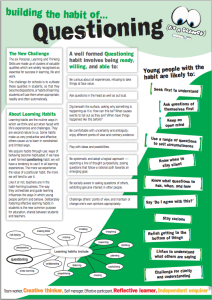
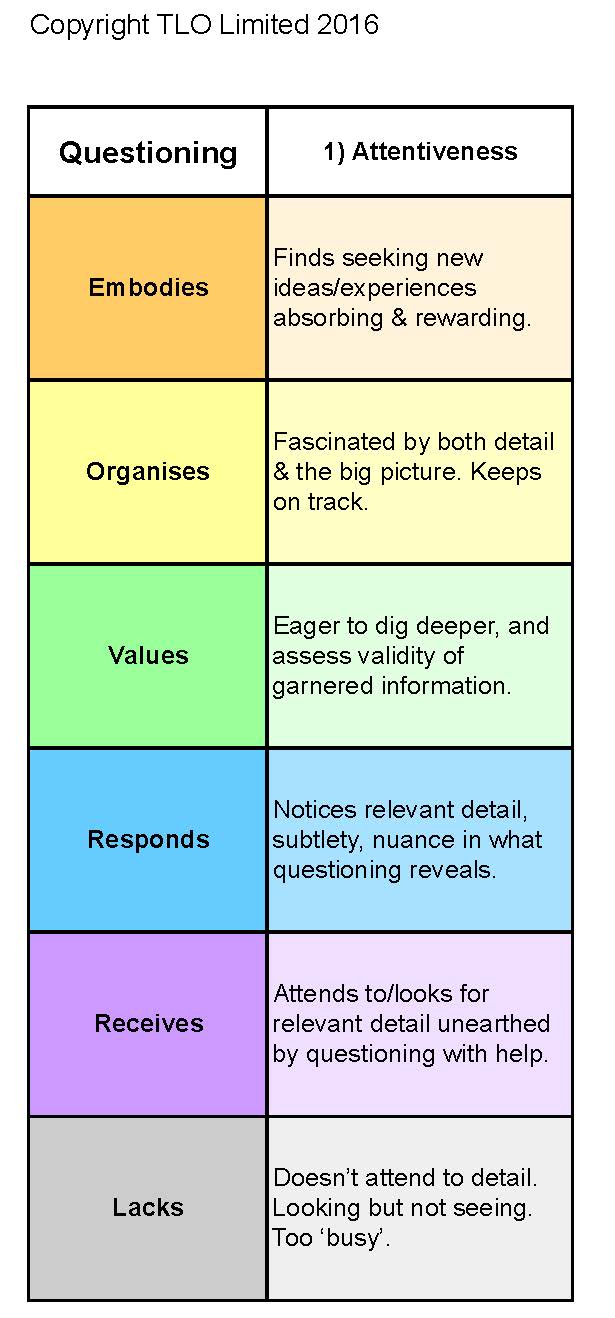
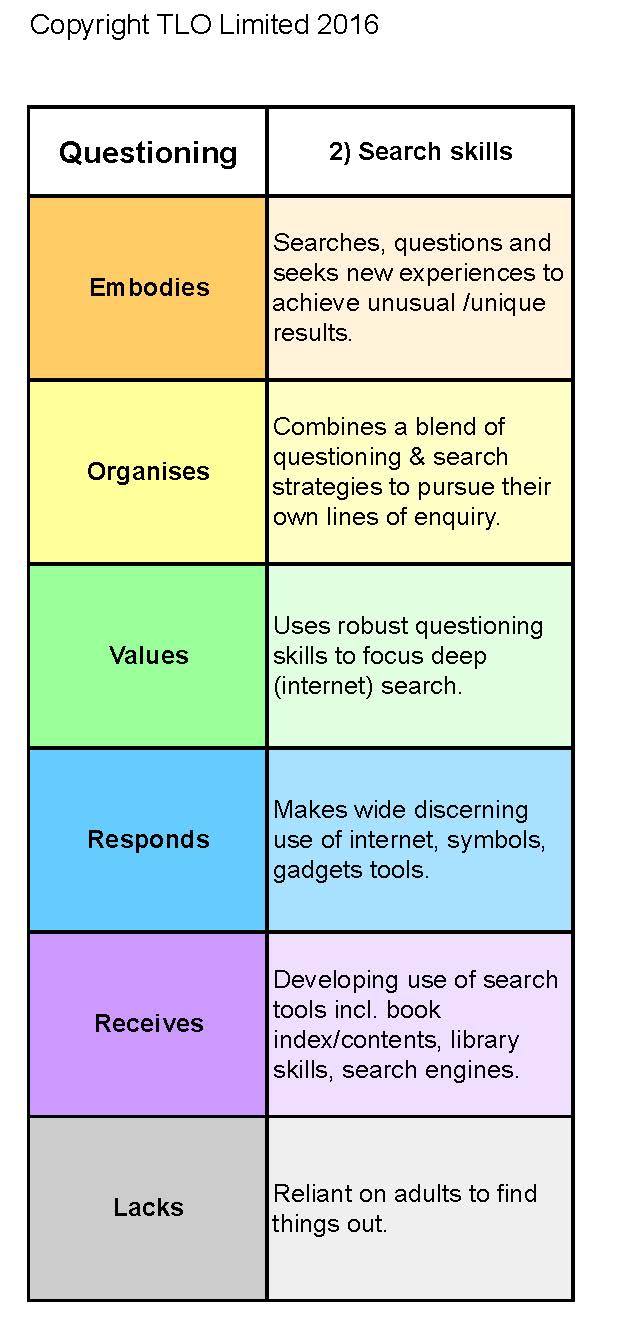
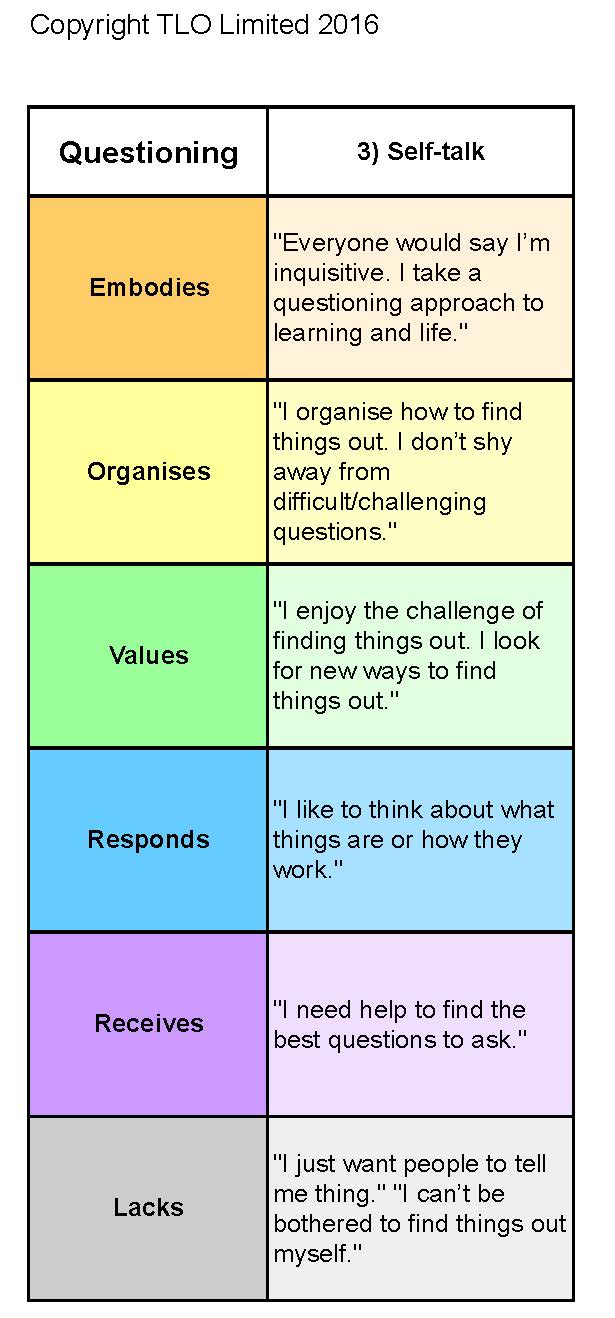
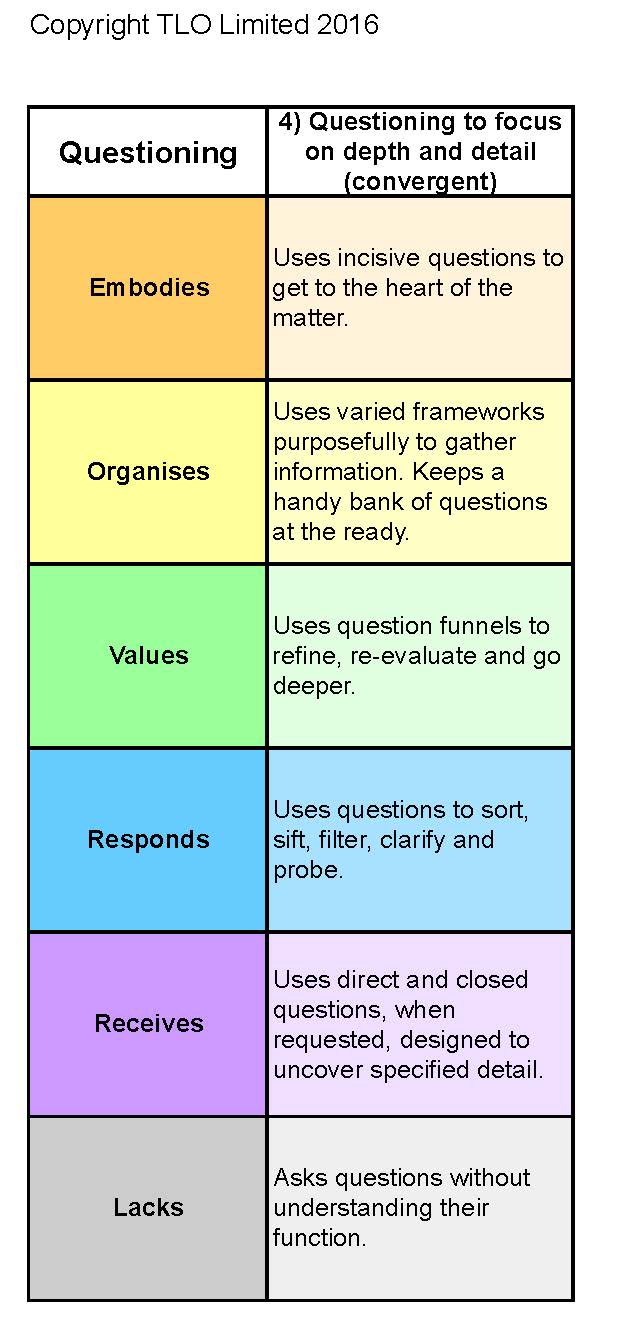
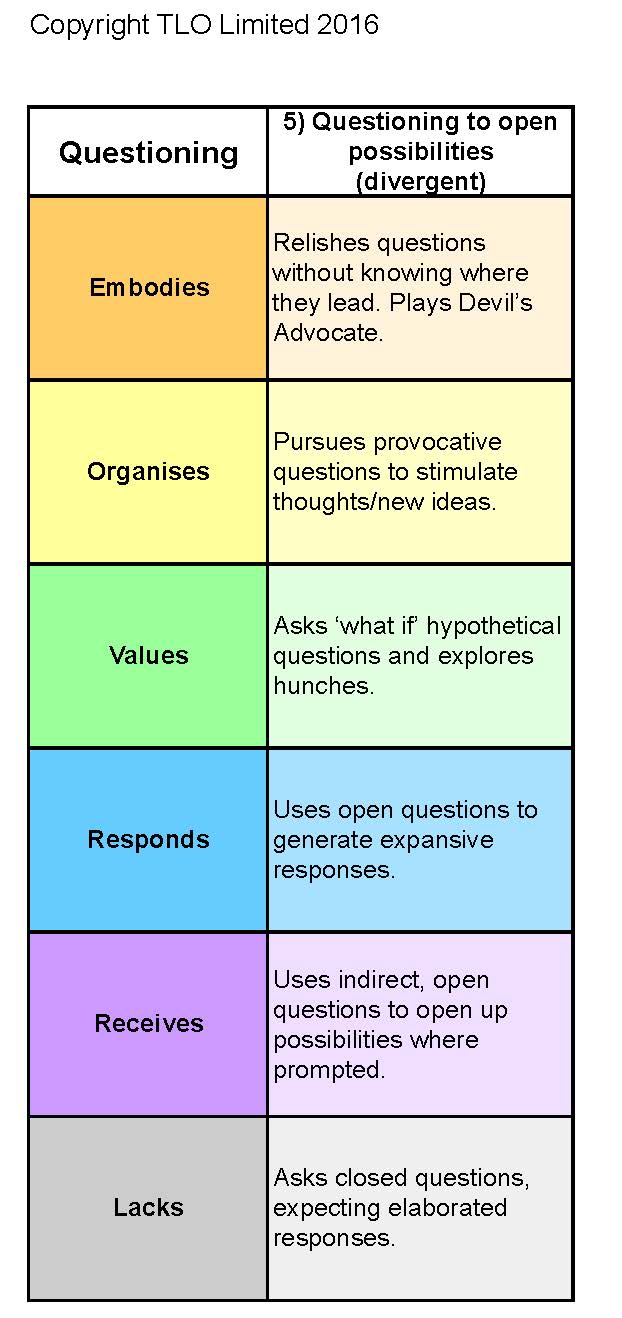
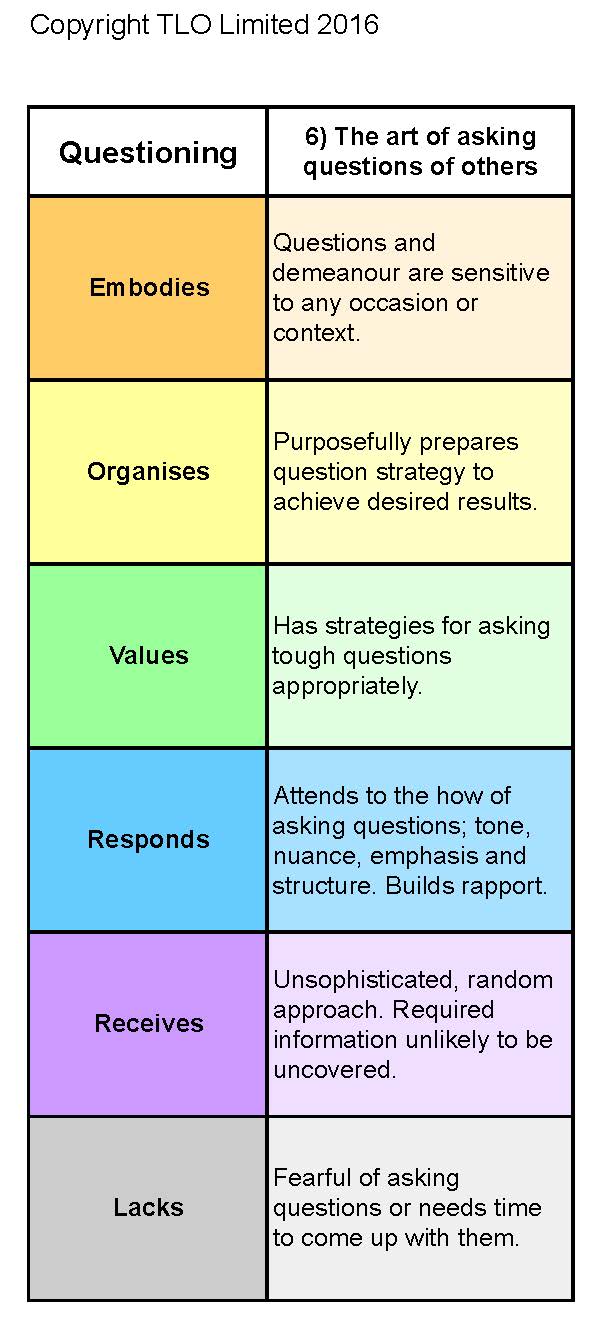
As teachers we are in the habit-forming business. What we say, what we display on classroom walls, what we celebrate, praise or dismiss, what we model or how we design learning activities will all influence the ways in which pupils learn, perform and behave. Classroom cultures have a huge influence on pupil’s learning as you will remember from the Culture unit.
The key question:
Does my classroom culture enable pupils to use and develop their questioning skills to full advantage?
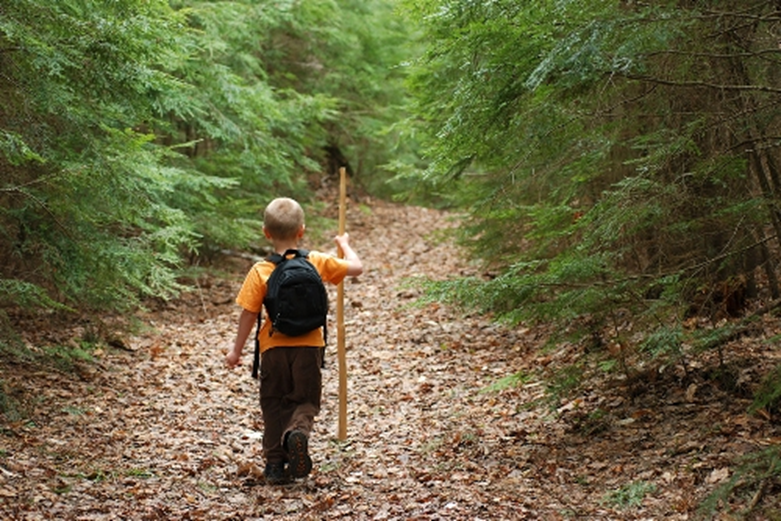
A classroom culture that supports and nourishes the inclination for pupils to frame their own questions is characterised by enquiry mindedness and confident uncertainty. This includes a healthy sceptical curiosity about all things and the enjoyment of ‘not knowing’ that lead pupils to pursue their own lines of enquiry. Curiosity drives learning, but pupils need to overcome the feeing that asking questions makes them look stupid.
BRIAN PLEASE CAN YOU PUT CLOSE BUTTONS AT THE END OF THE ACCORDIONS. ITS IRRITATING TO GET TO THE BOTTOM AND THEN HAVE TO SCROLL ALL THE WAY BACK UP TO CLOSE IT AGAIN
Key Task
Which of the above ideas will work best with your class or group of pupils?
Which of the ideas are you thinking of trying out?
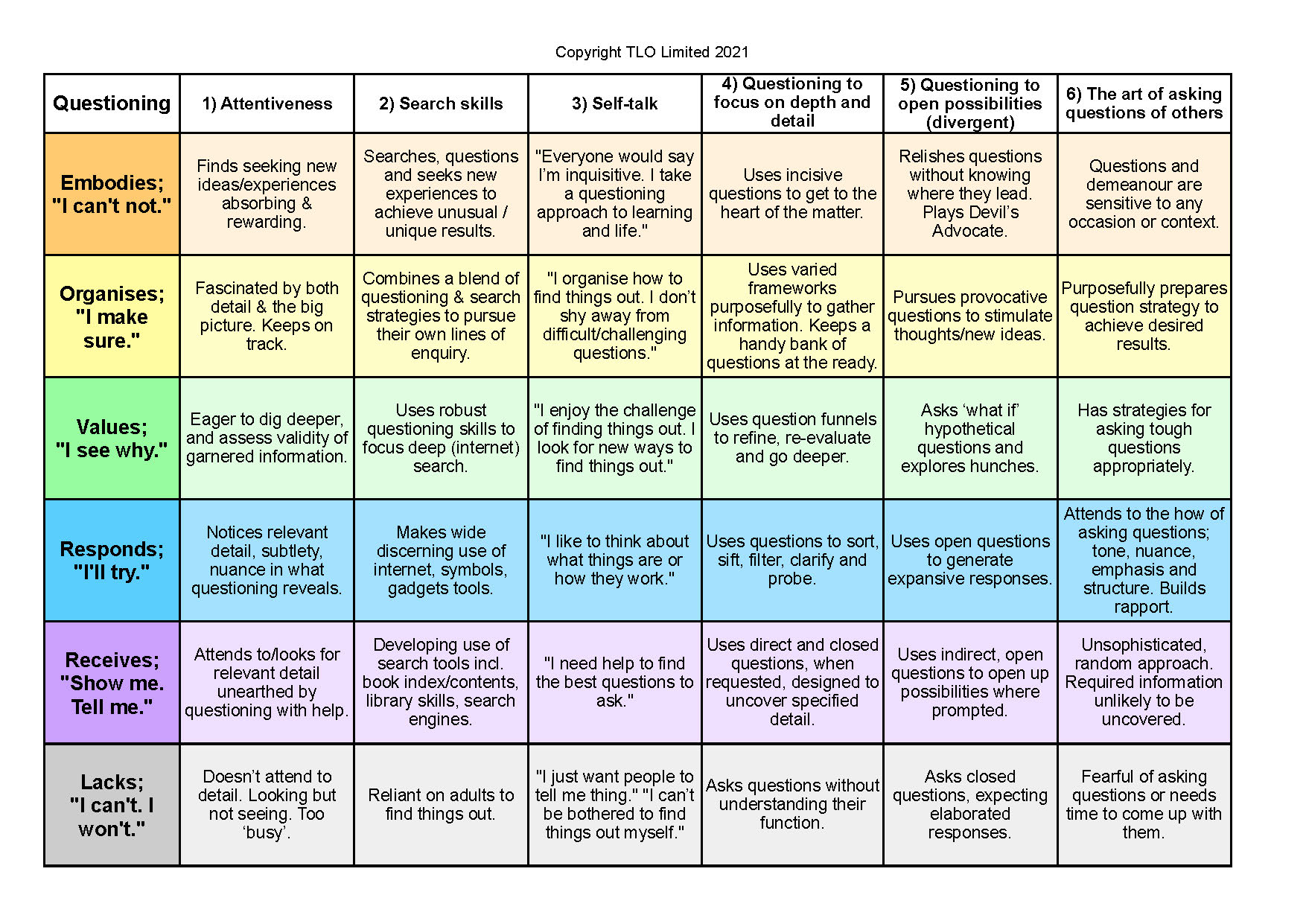
Try inserting the ideas you want to try onto the Question progression chart in the Learning Diary.
Please take your ideas to the Professional Learning Team session.
Now continue on to the next section where you will find ideas to blend with content into lessons. such lesson will engage pupils attention and help them to better understand the content.
However well prepared learners are, they have to expect the unexpected. They have to have the readiness to revise as they go along. Good learners are able to change their plans and think on their feet. They are able to be flexible. To be effective at revising, learners need to monitor how things are going and periodically review where they have got to. Monitoring is the art of looking over your own shoulder as you’re working away at a problem, asking yourself how it’s going. Getting better at monitoring ( ‘reflection in action’ ) involves cultivating the little voice of self-awareness that keeps the strategic goals in mind, and is ready to change tack if it seems appropriate. A teacher who decides to throw away the lesson plan on the spur of the moment and go with the interesting discussion which is developing, is monitoring. Students can pick up the habit from people who can model it; who have learnt how to learn aloud, i.e. to externalise the thought processes of the vigilant monitor. Reviewing (‘reflection on action’) means stopping every so often to take stock of progress, and to ensure that any emerging product—an artwork, an essay, a draft business plan—is on track. Reviewing requires the ability to look at your own work with the critical eye of an editor, and not be afraid of the possibility that some corrections may be needed. A writer may put a piece of work aside for a while and then come back to look at it afresh. An athlete may sit down and look at the video of her starting technique to see if any adjustments need to be made. But reviewing is what the low-achieving maths student, for example, is very often unable to do. Extract from Building Learning Power. Guy Claxton 2002
2. What does being a good Reviser involve?
A well formed Revising habit involves being ready, willing, and able to:
Self-monitor how things are going, keeping an eye on the goal
Expect the unexpected, having a readiness to re-shape, re-order, re-form plans to take account of new circumstances.
Remain alive to new, unforeseen opportunities and ideas
Look at what you are doing with a critical eye
Strive to be the best you can be
Make sure things are on track and make improvements along the way.
So at a less abstract level, students need to learn how to deal with change, emotionally and practically. With an inflexible frame of mind they are unlikely to recognise the need to change their ideas or the way they do something. They also need to know what ‘good’ looks like; how to keep an eye on how things are going and the willingness to evaluate how things went against external standards. When looked at from these diverse angles, growing revising moves well beyond encouraging a student to ‘have another go’.
The Revising grid below takes account of the constituent parts of building the habit of Revising
Our progression grid for Revising has 6 components:
Revising is about the way we work on something to improve it. Whether it be icing a cake, solving a tricky maths problem or creating a well crafted essay, all require effort, retries and determination to satisfy ourselves that the result pleases us. How we tackle such a job isn’t just a case of monitoring as we go along or reviewing the result: it will be influenced by other qualities. Our attitude to change, whether we have a sense of quality and what sort of validation we need. The grid intertwines these important contributors to our growth in the habit of Revising.
The learning guru Royce Sadler put it like this: “Students need to be able to judge the quality of what they are producing and be able to regulate what they are doing during the doing itself”.
Take a closer look at what each column of the grid is about
1) Attitude to change
How we relate to the change process
For many of us, doing things differently is scary and only for the bold and confident. But if we want students to enjoy achieving their best learning outcomes, we need to scaffold that process by building confidence – helping students move beyond their comfort zone and becoming more flexible as a learner. In the early phases students adapt what they are doing because they are being told and/or supported to do so. But this support pays off at the ‘value’ phase (green) when students feel positive about their efforts and realise learning is all about rethinking and adjusting and redoing, rather than getting it right first time. By the ‘organises’ phase (yellow), students are ready, willing, and able to move beyond making relatively small changes to making wholesale changes or starting again on a different tack.
2) Sense of standards
How we relate to standards of excellence, quality, and correctness
The next contributory factor in revising what we are doing has to do with how we view quality; whether we have a sense of standards; our view of what’s good, bad or indifferent. In the early phases students accept what they are told about by teachers; what something needs to look like, be like, feel like. Schools are full of them – objectives, criteria, steps to success, outcomes – and constantly trying to achieve them can be dispiriting. But with support and encouragement students are able to begin to think for themselves what makes something good and determine their own standards.
3) Self-talk
The voice of self awareness
Self talk is what we say to ourselves as we learn. The statements capture what someone in each phase of the grid would be thinking. Students may use some of these phrases when talking with you, or in writing from time to time, but mostly self talk goes on inside their heads. We have shown a small flavour of self talk thoughts that teachers can encourage students to imitate. Some relate to standards, others to self monitoring, or flexibility. All such self talk is important in building a revising habit.
4) Reflection IN action
Checking of how things are going
This column is about how we monitor what’s happening as we go along; keeping a weather eye on how things are going. Students need help to do this well. They need to know what they are looking for, what they are tracking. Should they look for good things or bad, for feelings, for whether they understand…? It’s a minefield. The early phases shown here relate to monitoring what you are doing against known criteria, and checking the process of doing something itself. Students need these props in the early phases. It’s only in the ‘valuing’ ( green) phase that they become skilled at editing as they go along, having had practice with checklists and criteria in earlier phases.
Look particularly at the difference between ‘value’ and ‘organised’. In the ‘value’ phase the amends, revisions, and re-tries are being done with the original aim/goal/ objective in mind. In the ‘organised’ phase students are prepared to ditch the original plan, ask hard questions, change the rules and change direction. It’s a big and important shift in becoming an independent learner.
5) Reflection ON action
The inclination to reflect on what we have achieved
This is the essence of learning from experience although sadly it is not a common inclination. The key here is not simply reflecting on what happened and whether we could have improved, but whether we take heed of such lessons and behave differently next time. This is not a natural skill and will need careful structuring and nurturing. Notice that the early phases are about what happened and are heavily scaffolded. By green students are asking why they did it that way, and by yellow they are challenging those familiar ways of working and rethinking the how in order to achieve better outcomes. It’s a breakout moment.
6) Recognising external validation
How we relate to external validation.
The last constituent of revising has to do with how we need and use external validation – the need for a legitimate authority source to confirm that what we are doing is right. When we are chasing facts we need to be sure they are correct. When we are using standards we need to be sure they are sound. In the early phases this authority normally comes from parents and teachers. As students move through the phases there is a move to seeking out experts, dictionaries and original sources. (The internet invariably plays a role here but while it might be a great place to start it’s a terrible place to finish! It needs to be used with discernment.) Sources of legitimate authority plays into how we revise and improve our learning.
What do you think?
What have you learned about revising from these descriptions?
What have you had confirmed?
What surprised you?
How have your views changed?
Make a note of…
Any ideas for practical classroom experiments that these descriptions have triggered
Which column your students are most secure in.
4. Unpicking the rows; getting better at Revising.
Of course the development of revising does not grow neatly up each column or evenly across the phases in the grid. The five broad phases of dispositional growth (purple – orange) are affective ways in which people may be inclined to behave: we call this inclination ‘mindedness’.
Here is our interpretation of how Revising might grow.
The phases are drawn from Bloom’s taxonomy of the affective domain.
Phase ‘Receives’ (purple) is about doing something because you are told or expected to. Phase ‘Responds’ (blue) is about gaining interest and doing things more willingly. Phase ‘Values’ (green) is a key phase since the student now sees the value of behaving in this way. It’s a win for them; to behave like this is in their interest. It’s in this phase that the behaviour becomes more secure. Phase ‘Organises’ (yellow) is the phase in which the student capitalises on this ‘in their interest’ behaviour and gets themselves organised to use it positively. Phase ‘Embodies’ (orange), known as ‘characterised’ in the original taxonomy. In this phase the student has made this behaviour their own. It has become part of their character; they can’t not do it and they have become highly skilled in doing it.
We urge you to see this progression as long term. Some phases will take years for people to work through; some will never be worked through. None of the phases are inevitable. There is a lifetime of development captured here. Nevertheless the role of a teacher or parent should surely be to encourage and enable this journey.
Lacks: Minded to ‘just do things’
In this ‘Lacks’ (grey) phase, students are not necessarily aware of doing things well or differently. Once they get going on something they may change it but more for the joy of just doing it. Outcomes maybe rushed or lack finesse, but once completed there may be little interest in revisiting it or in any comments they are offered. External standards are not yet a feature of their world.
Receives: Minded to check what they do.
In the Receives (purple) phase, students begin to make checks on how they are doing against given criteria when prompted. They can talk about what they did and sometimes how. They rely on their teachers or parents to validate what they do/have done.
Responds: Minded to understand standards.
In the Responds (blue) phase students have overcome a fear of mistakes and are more able and willing to monitor what they are doing. They begin to develop the idea of ‘good’ themselves and to understand why given standards are important. They respond positively to supportive feedback and talk reflectively about how they could improve with encouragement.
Values: Minded to value revising
In the Values ( green) phase, students understand the importance of keeping a close eye on progress in order to achieve high-quality outcomes that meet their goals. They see the point in making changes in the light of the original goal or external standard or internal feedback. They understand the need to learn from previous experiences and realise that learning is all about changing understandings; not just knowing stuff. In so doing they widen the scope of external validation.
Organises: Minded to actively seek alternative strategies
In the Organises (yellow) phase revising has become a skilful habit; where revising itself raises more questions than answers. Yes, progress is kept under review but now students question the original goal of the activity. They look more widely for validation and may well change to a more productive strategy or a different goal. They use critical feedback positively and are keen to look back on what and how they achieved what they did in order to learn from the experience.
Embodies: Minded to exploit previous experience to the full
In the Embodies ( orange) phase, students make ongoing checks and amends, and major rethinking, in order to meet their own, often more exacting, standards of achievement. Now they tend not to need the the validation of others (marks, grades, exams, quality feedback) because their own critical sense of standards acts as their barometer. They adapt readily to changing circumstances and always reflect on what and how they have done something with the explicit intention of doing it better, more efficiently / differently in the future.
What do you think?
What has struck you about the act of revising having read the descriptions above?
Which phase do you operate in?
What makes you say that?
Make a note of…
What you might do to assist your students to make headway in their revising behaviour.
The purpose of these meetings is for the team to act as a teacher learning community or as we term them, a Professional Learning Team: a small group of teachers who meet together regularly to deepen their understanding of an approach, commit to trying out new things, reflect on and share their experiments with each other. Such learning communities are the engines of teacher development. They work best with 6-8 teachers with similar subjects or age groups, and who meet regularly for about an hour over a period of a couple of years.
The group question and probe each other’s summaries of their experiments in order to encourage analysis and deeper reflection. They use questions such as ‘What do you think is getting in the way? What would make this even better? How could this technique be modified to make it work for you? What do you think made that happen? In this way they support each other in changing and developing their practice.
Some guidelines for team reflection sessions
The delicate, hard work of changing practice requires a safe professional environment in which to explore and understand both triumphs and tribulations. These short guidelines may be helpful in setting a climate for the team itself.
Everyone is expected to report back on their classroom experiments
Coaching questions and probes of colleagues’ classroom experiments encourage deeper reflection.
The group is careful to follow their agreed ground rules which might include;
No group member can ‘pass’
Listen between the lines when it’s not your turn
Actively discuss everyone’s input
Constructive criticism – developmental not judgemental
Everyone fully engaged in the group • What is said is confidential to the group • Respect others’ views and encourage others’ ideas
This team session is your first one in Stepping Stones phase 1 so it is important to spend the first part of the meeting considering the purpose and working guidelines of the team.
Agreeing objectives and agenda (5mins)
Sharing learning enquiries (20mins)
Re-capping the on-line materials (15mins)
Deciding what’s to be done (15mins)
Personal Action Planning (20mins)
Evaluating the meeting process (5mins)
1. Session objectives. What do we want to achieve? ( 5 mins)
Feel able to apply the on-line materials in the classroom
Decide the strategic cultural issues that everyone needs to apply in their classroom
Plan some do-able shifts in classroom practice
2. Sharing learning enquiries
Share
the changes in practice you tried
how students reacted
what you learned
what next as a result
Probe
what was getting in the way?
what seemed difficult?
what would make it easier?
what made it work particularly well?
why it was successful?
changes in your behaviour
Impact on pupils
Greater willingness to try…
Avoidance of…..
Improvements in……
Increases in…….
Little or no changes in…
3. Recapping on-line materials. What did we think of the materials? ( 15 mins)
Thoughts about;
The Collaboration grid
Share where pupils are secure
The phase pupils could aspire to feel secure in before leaving the school
Classroom culture ideas
Ideas for activities and routines.
4. Planning what to do. What do we need to do next? ( 10 mins )
Decide
Which ideas should we all adopt as whole school strategies?
How the progression of Collaboration should be built across the school. ie how the phases of Collaboration might play out against key stages and even year groups.
5. Personal action planning. What am I going to do? ( 20 mins )
This is important as it gives people a sacrosanct chunk of time to plan what they are going to do
The Action Plan is an important document and can of course be used as evidence in performance management
Consider
How you want your pupils to improve/develop/enhance their approach to Collaborating?
What you are going to do to bring this about?
Develop an enquiry question.
Think of it like this…
If I do XXXX will it improve/develop/enhance YYYY
This is the crunch question. Your pupils are unlikely to change unless you change!
Looked at your pupils through the lens of the Collaboration learning grid
Gained a sense of what becoming better at Collaborating looks like
Considered how you might shift the culture of the classroom to nurture Collaboration
Now we look more closely at things you can actually do in the classroom to provoke, guide and support pupils to get better at Collaborating; to build the phases of Collaboration mindedness.
Go to the phase that you have already identified as the one that most of your pupils need to develop next.
In each Tab box below you will find an overview of the teacher’s role followed by a range of suggestions linked to making the classroom culture more Collaboration friendly. After each suggestion you will see a brief statement in green that reinforces the cultural aspect of the idea. While some suggestions are one off ideas many can be used several times during a year or indeed be made into a classroom routine and thereby shift the culture.
Receives: Minded to begin to collaborate with others
In the Receives (purple) phase, pupils are making a big leap from being wary of others, being unaware of social conventions or any of the advantages of working/learning with others. Here they are collaborating with others because they are required to. There is much to be done in this phase: social skills, sharing ideas, working out what needs doing, playing their part and even thinking about how they have contributed to the team.
Behaviours to secure, Moving from Grey to Purple
Collaboration can be promoted both by how you structure the learning environment and how you help pupils to think of themselves as learners.
Your role as a teacher in this phase is to:
Introduce the concept of Collaboration to encourage trust in relating to others
Focus on sharing, turn taking and listening
Introduce the idea of different roles in a group
Encourage self reflection
In other words you are beginning to make learning visible: uncovering and exploring how it feels, what makes it work, and what the pupil’s role in the process is to be.
Introducing the concepts of collaboration and teamwork.
Read a story (ages 4-8)
A ready-made story – Jay and Milly and their mum and dad find out that you can get things done when everyone works together.
Reinforce good collaborative behaviours by capturing them on camera as they happen.
Take photographs when you notice children playing and working well. Place them on a ‘Collaboration Wall’ in the classroom or in a special book that you look at and talk about regularly with the children.
Adapt a familiar song (ages 4-8)
Try this song to the tune Twinkle Twinkle Little Star.
Help each other as you learn.
Listen, share and take your turn.
Pull together, work in teams,
Learn with others, build your dreams
Help each other as you learn,
Listen, share and take your turn
Rights and responsibilities (KS1,2,3)
Work in pairs and small groups to suggest a charter of matching rights and responsibilities or ground rules for collaboration. If everyone has a right to have their voice heard, everyone also has a responsibility to listen attentively to others and wait until they have finished speaking. What else might be important and why?
Building trust (KS2,3)
Play some quick trust games and discuss what pupils learn from this about working with others. What do they have to be aware of in a group? How could they transfer their learning to a different context?
One person stands in the centre of a close circle of other pupils, who are all facing inwards. The central person falls in any direction, without giving prior warning. S/he trusts the others to catch, support and lift her/him up again safely.
A group of people stand closely in a circle, with their backs to each other. At a given signal, all sit down on each others knees.
Think of an icon (ages 4-11)
Adopt a character – real, imaginary, human or animal – that implies or illustrates collaboration. Talk about the character and how they work and learn alongside others.
Talk about roles (ages 4-14)
Use this one minute animation to illustrate collaboration. Use it to talk about how members of a team have different roles in getting a job done.
Link collaboration to life (ages 8-12)
A range of short ideas to help pupils link collaboration to the world more generally.
Use as a start-up activity for introducing collaboration.
An activity that requires pupils to share what they have in order to finish the task. Use this also to encourage children to think about what they are trying to achieve.
Work with small groups of children to create a listening page so that they can then go on a listening walk together around the school. Use a sheet of A4 paper subdivided into 12 or 16 boxes and in each box draw a picture of something the children might hear on their walk. As they walk around they can put a tick or cross in the box each time they hear the sound. This is great fun with clipboards and pencils and can be used for a nature trail, local walk or anywhere you would really like the children to focus on what can be heard around them. Regular short listening walks will definitely help them become really familiar with how ‘active listening’ feels. This will help children understand that they can learn something about birds and animals by listening carefully.
Build listening skills (KS2/3)
Listen and Draw
Deepen listening skills by requiring students to attend to each other and supplement what they are hearing and understanding through focused questions.
Capture collaborative incidents across a week (ages 8-12)
My learning log
A log to capture positive and could-be ways of collaborating. Part of a learning log for students. Creates greater awareness of their collaborative tendencies.
The big shift from grey to purple requires students to begin to develop their social skills, and in particular listening to others and taking turns. Discuss, agree and display basic classroom ‘rules’ like:
Don’t interrupt or talk over others
Look at the speaker
No shouting out
Give others a chance to say what they think
etc etc
Remember – these students have already been exposed to ‘good listening’ and encouraged to ‘take turns’, and yet they still do neither. It will take time to turn this round.
These basic agreed rules need to be referred to very regularly and explored at every opportunity. Keep asking them how they feel when someone else does not follow the ‘rules’ ?
Teacher talk
To nudge students from Grey to Purple, use language like this to nudge each column of the grid: Focus on sharing, turn taking and listening
Did you hear what xxx said ?
Tell the others what you think.
When someone else is talking we all need to listen carefully
Listen carefully – xxx is talking.
Who hasn’t had a go yet?
Why do we need to take turns?
Why is it fairer to take turns?
Well done for taking turns and sharing.
What does xxx think ?
Be patient – one at a time!
It was great to see you listening carefully as you did that task together
If you all talk at the same time you won’t hear everyone’s ideas
Developing the inclination to share their ideas
What do you think?
Tell your friend what you are thinking?
What do you know about this?
Tell us about . . .
Who would like to tell us . . . .
What does xxx think
Say what you think
Introducing the idea of different roles in a group
What sorts of jobs are there to do in a team?
How can we each do a special job to help get things done?
What is your role going to be?
I would like you to be the ……today
What does the ……(role)… do in /for the team?
What will you do to make a contribution to the team ?
What else needs doing, and who will do it ?
You don’t all have to do the same thing !
Identifying goals and tasks
What do you all need to do?
What are you hoping to achieve?
Can you visualise what it might look like when you’ve finished?
How are you going to work together?
What is this task all about?
What are you really being asked to do?
What will you do first? Next?
Beginning to think about their own contribution
Were you a good team player? What makes you say that?
How did you play your role? What did you do? How did that help the team?
What did you like about that role?
How did you help the team today/ meet its goal ?
Do you think you did a good job/ made a good contribution ?
What more/else could you have done ?
What could you have done differently?
How do you think that job/role helps a team to do better?
Why did the team need someone to do that role?
Who did the most ? The least ?
Who felt they were successful?
An If – Then suggestion,
If a friend does not allow me to have my turn → Then I will remind them that is fair that we all have a go. If I am working with a partner → Then I will make sure that I say what I think. If we are working together → Then I will do what the team needs me to do. If we don’t seem to know what to do → Then I will suggest that we need to work out what the task is really about. If after I have been in a team → Then I will think about how well I contributed.
Learning Mats
A Learning Mat is a simple tool to encourage students to become more self-aware of how they are using a learning habit. Basically, it’s an A3 or A4 laminated sheet that is kept on tables or used as part of wall display. It shows various aspects of a learning habit. Students refer to them during lessons, using them as prompts about the finer aspects of a learning habit that are being stretched. They help students to be able to join in meta-cognitive talk.
This mat is blank. You will find one that has suggested behaviours on in the Value/Green section. In this one you and your students could fill in some ideas for specific Receive/Purple behaviours that you want your students to start using. They can of course be individualised for specific students.
Using Learning Mats
You could also use Learning Mats (in ‘teacher speak’ or ‘student speak):
To raise awareness of the habit
To spread the school’s common language for learning
As an aide memoire for students and teachers
As a self-assessment support for students
As an audit tool to support teacher planning. i.e. which of the skills are implied in the lesson plan and therefore how will they be surfaced in what you draw attention to/orchestrate the lesson.
In the Responds (blue) phase pupils are willing to develop their understanding of what being part of a team involves, agreeing goals together, trying out different roles, broadening social skills to open up others.
Behaviours to secure, moving from Purple to Blue
Collaboration can be promoted both by how you structure the learning environment and how you help pupils to think of themselves as learners.
Your role as a teacher in this phase is to:
Stress the ‘teamness’ of teams.
Focus on ways of agreeing relevant goals.
Make role trialling a routine.
Explore working together (KS1)
Look out for physical tasks that will only succeed if pupils actively cooperate – a see-saw for example, or catching games, or hide and seek, or ‘What’s the time Mister Wolf’ ?’, etc. Treat it as an opportunity to discuss how success can only come if everyone plays their part.
Jigsaw listening (KS1/2/3)
Assign pupils letters A-E into groups to listen to a short story. In each group A listens for one type of information (eg types of transport used), B listens for something else etc etc.
At the end of the story, ask them to reconstruct the story together by each putting in the information that they know.
Reflect on
whether this helped to get a fuller understanding of the story ?
how this might shape the way pupils approach tasks outside school ?”
what this way of working tells pupils about using the skills of all team members
Jigsaw research (KS2)
“Assign ‘expert’ groups of pupils different aspects of a topic to research. They then share the information they have gathered with the wider group to create the whole picture. Discuss how to ensure that each ‘expert group’ has an equal voice in putting forward their point of view, even though the whole group outcome may emphasise one aspect over another.” – another way of building interdependence.
Teamness of teams (ages 8-12)
Machines – creating a machine with moving parts using pupils.
Follows up with discussion about the ‘teamness’ of teams and everyone contributing.
TPS is a well-known strategy for ensuring that pupils build up to learning in a team.
One way of using this might be to;
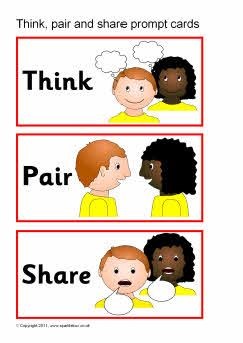
Pose a question or problem, give pupils 1 minute to think individually about their own personal response; give 2 minutes in pairs to compare their first reactions with a partner; give fours 3 minutes to share their views in a group.
Use as a simple strategy to prepare pupils for working together in teams.
As an alternative, try Think/Link/Together which achieves the same outcomes.
A useful way of knowing who is contributing what, although not a means of ensuring everyone contributes!
Draw the mat onto a large piece of sugar paper (the one shown would be suitable for a group of 4 – adjust for smaller/larger groups). Each individual writes their personal response/views/solution in the section immediately in front of them. Once all individuals have made their contribution the group agree the group response, which is written in the central panel.
Provide each team member with a piece of ‘pizza’, plus one spare. Ask students to write their own ideas or responses or solutions or questions or answers etc on their own piece. Once complete, the pizza is assembled and the team together distil their thinking and complete the final piece of the pizza. Display either each team’s pizza, or of the distilled pieces from all teams to form a composite view.
Pizza the Action is a Kagan Cooperative Learning structure:
Offer activities where the goals are not immediately apparent. These may be in the form of fragmented information where each pupil has some key information, but no pupil has sufficient information, but no pupil has sufficient information to solve the problem by themselves, or simply where the group is not given a clear steer on what is to be achieved. Insist the group have agreed their goal before making a start on the task.
Sorting the goal (KS2/3)
Offer goal planning tools for groups to complete before deciding what to do
With older students you might want to consider the group roles identified by Belbin. At this stage, students are probably looking only at the ‘To Do’ column, and the language may well need to be made age-appropriate. Also, think about whether it is wise to introduce all of these roles at the same time. If they are to be phased in, what is the most sensible order ? For example the people orientated roles first (coordinator/team-worker/resource-investigator), the action orientated roles next (shaper/implementer/completer-finisher), and finally the thought orientated roles (plant/monitor-evaluator/specialist).
To nudge students from Purple to Blue, use language like this to nudge each column of the grid: Showing patience and concern for others
Be patient – one at a time !
It was great to see you listening carefully as you did that task together
If you all talk at the same time you won’t hear everyone’s ideas
Listen – xxx has a really good idea
We can’t always be the star of the group !
Let’s all go with xxx’s great idea
Offering their own ideas and encouraging others to do the same
Let xxx say what (s)he is thinking
I think xxx might have a good idea here
Does anyone have an idea that might help us here?
Let’s take turns to say what we each think
Are you sure that everyone is making a contribution?
Do you have something useful / relevant to add?
How will you make sure that everybody’s voice is heard?
Enable students to try different roles
What else might you do to help the group ?
Who is going to do what ?
Who is going to make sure the team’s plan is on track?
Who would like to take the role of making sure everything is finished well?
What other roles might be needed ?
What other roles are there ?
Who will be the resource finder?
Who will make sure everyone has a job to do?
Why not try a different role this time ?
Which role do you feel most comfortable with ? Ditto least ?
Agree Relevant Goals
What do we think we have to do ?
What’s this task really about?
What are we trying to end up with?
What will that look like?
How will we know we have been successful?
Which is the best idea so far?
So, what is our goal?
Does this goal sound do-able/worthwhile/right for us?
What do we need to do together ?
How will you agree what needs to be done ?
What will the end product be ?
Does/will that answer the question / solve the problem
Offering and accepting feedback
Can I tell you what I noticed about your teamwork ?
Have you asked your team what they feel about your contribution?
Who made the greatest/least contribution? Why do you think that?
On a scale of 1-10, how well did you contribute?
We all need to listen to our team mates
On a scale of 1-10, how do you think you did as a team?
An If – Then suggestion,
If I’m losing patience with what someone is saying → Then I will take a deep breath and keep quiet. If a group member is not saying anything → Then I will ask them what they want to say. If I’m working as a team → Then I will ask to take on a different role from last time. If we are deciding what to do → Then I will make certain that what we are suggesting is realistic. If others suggest how I might have contributed more effectively → Then I will listen patiently and think carefully about what they have said.
Learning Mats
Learning mats are tools to encourage students to become more self-aware of how they are using a learning habit. Basically, they are A3 or A4 laminated sheets that are kept on tables or used as part of wall display. They show various aspects of a learning habit and students refer to them during lessons, using them as prompts about the finer aspects of a learning habit that is being stretched. They help students to be able to join in meta-cognitive talk
This mat is blank. You will find one that has suggested behaviours on in the Value/Green section. In this one you and your students could fill in some ideas for specific Receive/Purple behaviours that you want your students to start using. They can of course be individualised for specific students.
You could also use Learning Mats (in ‘teacher speak’ or ‘student speak):
To raise awareness of the habit
To spread the school’s common language for learning
As an aide memoire for students and teachers
As a self-assessment support for students
As an audit tool to support teacher planning. i.e. which of the skills are implied in the lesson plan and therefore how will they be surfaced in what you draw attention to/orchestrate the lesson.
Values: Minded to function flexibly as part of a team
In the Values ( green) phase pupils see/appreciate the value of a team member and honing their skills in different roles, planning action more carefully, and being flexible in their own views for the sake of the team. Once this phase is secure pupils are likely to develop further skills by having opportunities to work in this way.
Behaviours to secure…moving from Blue to Green
Collaboration can be promoted both by how you structure the learning environment and how you help pupils to think of themselves as learners.
Your role as a teacher in this phase is to:
Encourage careful planning
Train ideas building
Home in on team evaluation
Groups organising themselves (KS 2/3)
A carousel
Invite pupils to work through a series of set tasks, in an order of their choosing, within a given time frame. This trains pupils to manage time; use a range of resources; operate in a range of roles; move unprompted from task to task; prioritise what needs to be done; make choices about how to organise themselves to meet a given goal. Sometimes called a Carousel (of activities), or in the Teacher’s Toolkit (Paul Ginnis) it is called Circus Time.
Circus time is embedded in this pdf which is freely available online
Require groups to devise a plan of action in advance of starting the task in hand. Include: what needs to be done; the order in which it will be done; who will do what; how long each step might take; success criteria; possible obstacles; when progress will be reviewed.
The TASC wheels (KS1 and KS2/3) are planning tools to help groups/pupils to structure their response to a given task – start from 1 o’clock and work clockwise round the wheel. Additionally you could use it as a means of discussing who will be doing what at each point in the process, thereby opening up a conversation about roles and responsibilities.
Encourage flexibility
Messing up plans
Set pupils off on a group task and deliberately feed in some information after a while that requires the group to change their approach and rethink their plans.
[Adapt this activity for a closer/more relevant venue]
Prepare the way for pupils to build on the ideas of others when working in a group by making ‘ABC’ a routine that you use during whole-class teaching. Once a pupil has answered a question, ask another pupil to Add to it, to Build on it, to Challenge it, to Defend it, to Elaborate on it, or to Finda Flaw in it. As easy as ABC ! This improves pupils’ listening skills at the same time !
Building on the answers of others (KS2/3)
Have pupils work in pairs for 5 minutes to begin a draft answer to a tricky question. Once time is up, partially completed answers are passed to the next pair to be built upon, refined or redrafted, and the process is repeated as many times as necessary. At the end of the process, answers are returned to the original pair who are tasked with using all of the suggestions to draft their final polished version of the answer.
For more on this, read The Teacher’s Toolkit (Paul Ginnis), pages 139/140
Use groupwork observers to watch a group in action and to feedback on what they have seen. Depending on your pupils, you might need to offer a checklist of behaviours that will help to focus the observation and feedback.
After students have completed a group task, invite them individually to reflect on what they did to help the group or indeed hinder the group. Then to consider what they think others did to help or to hinder the process. Once they have reflected individually, pupils pool their views with the focus on ‘what we can do differently next time’ rather than ‘who was at fault’. Finally the group draw up an action plan that identifies what the group agree to do in future, and individuals make personal commitments about how they will contribute in future. The action plan is reviewed subsequently at intervals to monitor the extent to which the group and individuals are meeting their targets.
Inform students that at the end of the group work task each group member will be expected to judge the relative percentage contribution of themselves and others. Once the group task is completed, each student completes their form. Depending on your pupils and how you wish to use the information, this can be done individually and submitted to the teacher; or completed individually and then became subject to group discussion; or agreed and completed by the team as a whole.
At the end of a group task, the whole group reflects together on how they functioned as a group and agree a development target. Choose the review tool that best fits your students’ current collaborative behaviours.
To nudge students from Blue to Green, use language like this to nudge each column of the grid:
Building confidence and respect
How can you show that you are respecting someone else’s viewpoint?
What do/can you say if you disagree?
How does it feel when someone does not like your idea ?
Remember – no put downs!
That’s a fantastic idea!
I wish I had thought of that . . .
Build on the ideas of others
Can you add your ideas to this ?
What can you add to what xxx said?
Who can build on xxx’s idea ?
Can we make that a bigger idea/expand it?
Do we need to think smaller?
What ideas can you add to this discussion ?
That’s interesting – who could take it further ?
Could you link those two ideas together?
Who would like to challenge that idea ?
Who would be able to defend that ?
Is there a flaw in this line of thinking ?
If that is true, what would it mean for . . .
How does it feel when someone does not like your idea ?
Understanding team roles
Why do we need different roles?
What are the different roles involved in team working?
Are all of them always necessary?
Which roles are most important? Why do you think that?
Are you an ‘expert’ in any particular role?
Are there any roles that you avoid? Why?
How are you broadening your team working skills?
Making realistic team plans
Who is going to be responsible for how the group gets on?
What are you planning to do?
Have we agreed our goal?
How did you decide on that goal?
What might need doing differently?
Do we think this will be possible?
What is the most important thing we have to do?
What is the most urgent ?
What order are we going to do this in?
Is that the best sequence of actions?
How long do we think this will take?
What might stop us?
Time to check you are still on track
Evaluate the performance of the team
How well did you do as a team ?
What have you learned about yourself and your team ?
How might you do it differently next time ?
Can I tell you what I noticed about your teamwork ?
How well did you make the most of everyone’s talents ?
Did you meet your own targets ?
Did you complete on time ?
Was the outcome as you had hoped /planned ?
An If – Then suggestion,
If a team member makes a really good comment → Then I will make sure that I congratulate them for it. If I hear a good idea → Then I will try to help to improve the idea further. If our team is working together → Then I will suggest how I can be of most help to the group. If we are making plans → Then I will remind others that we need to decide on the order we intend to do things. If we have finished → Then I will remind myself and others to think about how well we worked together.
Learning Mats
Learning mats are tools to encourage students to become more self-aware of how they are using a learning habit. Basically, they are A3 or A4 laminated sheets that show various aspects of a learning habit. They are kept on tables or used as part of wall display. Students refer to them during lessons, using them as prompts about the finer aspects of a learning habit that is being stretched. They help students to be able to join in meta-cognitive talk
As students become more proficient at understanding themselves as learners the statements could be upgraded to reflect later phases of the progression grid. Students often enjoy making their own learning mats describing the particular skills they are working on.
In the Organises (yellow) phase, pupils organise themselves to work as part of a team. They learn that skilful teams manage conflict and that conflict and controversy are positive keys to involvement and creativity; that high-performing teams frequently check their progress and adjust their practice to stay on track.
Behaviours to secure … moving from Green to Yellow
Collaboration can be promoted both by how you structure the learning environment and how you help pupils to think of themselves as learners.
Your role as a teacher in this phase is to:
Train conflict resolution skills
Explore controversy and creatively seeking consensus
Strengthen empathy
Make use of fairy tales (KS2/3)
Fairy tales are loaded with conflict – think of the Wolf and the Three Little Pigs; Goldilocks; Cinderella. Can we help these characters to resolve their conflict in a healthier way ?
Choose a conflict-heavy fairy tale that the children already know. Read it to them, challenging them to spot the conflicts. Address the questions: What is the main conflict ?; How does each character feel ?; What does each character need or want ?
Then imagine you could convince the characters to work together to solve their problem. List possible solutions that would benefit everyone. Be creative – it is only a fairy tale !
Use I-Messages (KS1/2)
Children often blame others when a problem arises, (i.e. “He won’t work/agree with me !”) – and so the conflict begins. Coaching children to recognise emotions, both in themselves and others, can be very useful. Using an I-statement, such as “I feel sad when you don’t work with me,” allows children to identify their emotion instead of blaming others. Guide children through the process of talking through their conflict with I-messages before discussing possible solutions. In time, children will become better at using I-statements without adult guidance.
Stranded (KS2/3+)
Put your students into the desert and challenge them to survive. Stranded is a team task that invariably produces conflicts, especially if the teacher actively spreads a bit of dissent ! Use the activity to encourage students to reflect on how they successfully (or otherwise) dealt with differences of opinion.
[Pizza the Action was introduced at Blue level: Provide each team with a piece of ‘pizza’ for each team member, plus one spare. Ask students to write their own ideas, responses, solutions, questions, answers etc on their own piece. Once complete, the pizza is assembled and the team together distil their thinking by completing the final piece of the pizza. Display could be either of each team’s pizza, or of the distilled pieces from all teams to form a composite view.]
Alternatively the groups could be formed after pupils have completed their personal ‘pizza’ piece. You then form groups deliberately putting pupils with opposing ideas into the same group, thereby creating the need for seeking consensus.
Alternatively, the teacher could form groups of like-minded pupils, so that when it comes to forming the composite class view there are polarised group views that need to be accommodated.
This illustrates an important and occasionally neglected aspect of group work – minor shifts in how you handle the activity can impact significantly on the teamworking behaviours that it activates.
Consider how can you deliberately adapt team-working strategies that you currently use in order to build in disagreement and the need for resolving it through seeking consensus.
How do we make decisions ?
.
What could groups do when they can’t agree ? Try this three stage approach to reaching a consensus.
Pupils work in pairs to solve a problem, and then move into fours to agree a shared point of view. Add some spice by forming pairs with very different outlooks into fours.
Most practitioners would agree that imaginative play strengthens communication, problem solving and creativity. But do we realise its importance in encouraging empathy ? As children play act different roles, they have to put themselves in someone else’s shoes and imagine what they might be feeling.
Children who frequently immerse themselves in imaginative play are often especially sensitive to their playmates’ feelings. When children understand the feelings of others, it helps them to build positive relationships. So an environment that inspires imaginative play can also foster empathy.
Empathy specs (KS2/3)
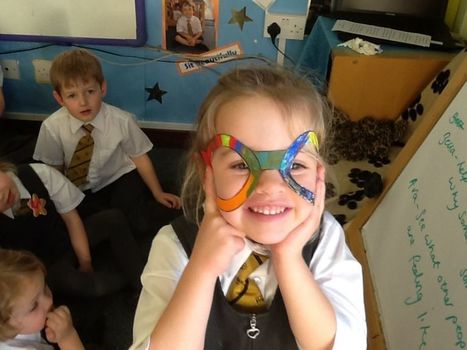
Make (or buy) ‘empathy specs’ that are worn when a pupil makes a conscious decision to see/describe/explain something from someone else’s perspective.
What is empathy ?
.
Definition – “the ability to share someone else’s feelings or experiences by imagining what it would be like to be in that person’s situation”.
But what does it look like in the classroom ?
Empathy is a slippery concept. It is something that appears to grow naturally in most people, to a greater or lesser extent, and very young children are developing empathy long before they attend school. Embryonic in the child’s early years, empathy (or its absence !) is readily visible in KS1 pupils. The dictionary definition is “the ability to share someone else’s feelings or experiences by imagining what it would be like to be in that person’s situation”, which is sometimes reduced to “seeing the world through someone else’s eyes or from their point of view”, or “putting yourself in their shoes”. That said it is occasionally confused with sympathy, which relates to the “expression of understanding and care for someone else’s suffering”, perhaps because empathy might be inferred from an expression of sympathy.
Research indicates that children who are empathic tend to do better in school, in social situations, and in their adult careers. Children and teenagers who have the greatest amount of skill at empathy are viewed as leaders by their peers. So it would appear that this is a skill that is well worth cultivating and strengthening, but what does it look like in the classroom?
There are curriculum areas that appear to lend themselves to activating empathy in pupils – it is hard to imagine successfully appreciating the human effects of a tsunami, or the motives of Chamberlain, or the belief systems of Muslims, without trying to see the world through their eyes. Likewise trying to discern a writer’s intentions, or a speaker’s values and belief systems, or performing in front of an audience.
But what of other curriculum areas – the ones that do not seem to lend themselves so readily? Empathy in D&T might relate to understanding the customer for whom a product is being designed; in maths it might relate to thinking about how convincing others would find a line of reasoning; in science it might relate to how others would view the clarity of a poster/presentation that is being produced; in Art it might relate to how others will view the artefact that is being produced; in all subjects it might relate to how the teacher will view the work being undertaken.
In other words, empathy looks different in different subjects.
Delve into books (Early Years)
Stories are opportunities for pupils to practise perspective-taking skills. What do the characters think, believe, want, or feel? And how do we know it?
What could we make of the collaborative behaviours of the dog, cat, frog and bird in Room on the Broom when they combine to save the witch from the dragon ?
Which of the books you are currently reading with your pupils could be used in this way ?
Discover what we have in common (KS2/3)
Experiments suggest that children are more likely to feel empathy for individuals who are familiar and/or similar to them. Help your pupils to discover the many things they have in common with other people to foster empathy. For example, show an image of another person and ask pupils to find 10 similarities between themselves and the person in the image.
Turn mirrors to windows (KS3)
When teenagers identify or feel that another person is similar to them, they are more likely to feel empathy for that individual. So one way to help teenagers develop their empathic skills would be to help them discover what they have in common with other individuals. Moreover, in this age of “cyber-ism” the line between “real” and the “imaginary” is blurred and there are seldom direct consequences for their actions. The more teachers can humanise the victim’s distress, the better our teenagers will be able to respond with empathy. Teaching teenagers empathy is like turning their “mirrors” into “windows”. A mirror symbolizes self-centeredness, where some teenagers see only themselves and care only for their own feelings. Windows symbolize empathy, where the teenager is able to look beyond their own needs and put themselves in another person’s position.
Create opportunities for teenagers to explore the similarities between themselves and others, especially people with whom they do not have great empathy.
Establish a routine and some ground rules
Agree with your class a routine to be followed when conflict arises, and ground rules for how students should behave. This could form the basis of a display to help students to remember what they have signed up to do.
You might end up with a variation on . . . .
Resolving Conflicts – Without Fighting
STOP Don’t let the conflict get worse.
SAY What the conflict is about.
SAY What each of us want.
THINK of positive things we could do.
CHOOSE a positive option that both of us can agree on.
ASK someone for help if we can’t agree
Ground Rules
Listen to each other, try to understand how they feel
Take turns, don’t interrupt
Say how you feel and be truthful
Brains, not hands
Teacher talk
To nudge students from Green to Yellow, use language like this to nudge each column of the grid:
Managing conflict and building consensus
How can you show that you respect the person but disagree with their idea?
Explain carefully why you disagree
It’s OK to disagree, but how could you handle it better?
What will you do if you cannot agree?
What about the conflict resolution strategies we talked about. Have you tried any?
What’s the best decision making process here?
Have you thought of the various voting methods?
Anyone not happy with how things are going?
What’s the basis of the disagreement here?
What can you all agree on?
How can you make the best of this difficult situation?
How might you move forward?
You may have to agree to disagree
Speak for others
Can you say what your team is thinking?
What is xxx thinking?
Who will speak up for xxx’s idea, even though they disagree ?
How do/should you react when you do not agree with your team?
Can you / Do you understand how your opponents are thinking?
How do you hang on to your own ideas when faced with opposition?
Have you asked xxx what she thinks ?
How do you think xxx feels ?
What is xxx not saying?
Strengthen team roles
How are you getting better at contributing to your team’s efforts?
What is your best / favourite role?
Why is it important to be able to undertake all / most roles in the team?
I notice that you are expanding the roles that you volunteer for
Who is good at xxx (team role)? Why do you think that? Could you take on that role yourself?
How will you utilise the skills of all team members ?
What will you do to ensure that others enjoy working alongside you ?
Questioning how things are going
Who is going to be responsible for how the group gets on?
Have you got everything covered?
Have you missed anything vital?
Have you built in sufficient review points?
If it is not going to plan, what will you do?
Maybe you need to think this through from scratch
Are you flogging a dead horse?
Consider alternative ways of working
How well did that go ?
Was the outcome as you had hoped /planned ?
Did you meet your own targets ? If not, why ?
What did you learn from doing it that way?
How well did you do ‘as a team’?
Is there anything else you could have done as a team?
How else could you have tackled this?
Did you all take on the role you are comfortable with?
If you had would that have helped?
How might you do it differently next time?
An If – Then suggestion,
If someone is getting angry → Then I will remind them that we have ways of managing conflict. If someone is having trouble saying what they think → Then I will try to help them, even if I do not fully agree with them. If our team is deciding roles → Then I will ask to undertake a role that I wish to get better at. If we are working together → Then I will suggest that we check to see how things are going. If we have finished → Then I will ask how the way we worked helped us to achieve our goals.
Embodies: Minded to see Collaborating as a way of being not a chore.
In the Embodies (orange) phase, being a skilled team player is what characterises the student. They work happily and skilfully in any team, confident in their social, task development, planning, reviewing, and team evaluation strategies. A valuable member of any team.
Behaviours to secure … moving from Yellow to Orange
Collaboration can be promoted both by how you structure the learning environment and how you help pupils to think of themselves as learners.
Your role as a teacher in this phase is to:
By and large, students access this level for themselves. The classroom culture established at the previous phases supports this, and there is little need for direct teacher intervention. Rather, the role of the teacher becomes one of:
ensuring there are sufficient opportunities available to display these high level behaviours;
nudging, praising and supporting students to exercise them;
modelling these behaviours themselves in their everyday interactions.
Consider the following behaviours and what you might need to do to create the conditions in which they can flourish, and in particular to secure those that you consider most in need of attention:
Students have progressed way beyond working well in a group
Their social skills, which are highly developed, are sensitively and flexibly deployed
their ability to build consensus ensures that others’ experience of teamworking is positive
They assume a leadership when necessary, tempered with a willingness to allow others to lead on other occasions
As a consequence, the individual is considered a valuable member of any team by others
What do you think?
Adults you know to whom this would not apply
Think about the teams in the school – who are the individuals that exhibit these collaborative skills ?
Are there any students (perhaps lead learners, or student representatives) who could be used as role models for other students ?
Students now think of themselves as natural team players and relish working in that way
Even when working alone, their thoughts are directed to the contribution that their individual effort can bring to others
They are generous and sociable, the greater good of the greater number drives their learning, which is viewed as a collective endeavour.
The success of the team is far more important than individual success
What do you think?
People you know who are like this
How the school might harness such individuals to greater effect ?
Whether these attitudes extend to individual teachers ? Or to teams of teachers ? Or even to the school as an organisation ?
The student is willing and keen to ‘run with’ and develop the ideas of others
They see a good idea as a good idea, whatever the source, it doesn’t have to be their’s
They are alert to the possibility of ‘collective mediocrity’ or ‘pooled ignorance’ and work hard to avoid it.
What do you think?
What might you say to students to encourage them to value and build on the ideas of others ?
Which of your students currently exhibit this behaviour ?
How can their attitudes be used as a model for other students ?
Here the student is striving for excellence, want ting to ensure that the original goals are achieved and if not, to find out why. Hence monitoring what is happening is essential to keeping a team on the intended trajectory
This ongoing monitoring keeps a team responsive and flexible as the task proceeds, ensuring that the team goals are not lost in the cut and thrust of getting the job done.
What do you think?
Do you need to build in more time for monitoring to happen ?
What might you say to encourage teams to do this for themselves ?
Why are so many ‘improvement plans’ merely a list of noble intentions that are never quite realised ? Could it be that ‘checks the outcomes of the process against original team goals’ is in need of attention at the team and whole school level ?
Now the student never insists on having a particular role. Thye don’t need to be the leader or the resource finder or the plant, or whatever. They are happy to be part of a team fulfilling any role that is needed.
This ability to function flexibly in the best interests of the team is ingrained, as is the generosity of spirit required to stand back on occasion to let others take centre stage
The feelings are more about wanting to be in the best team rather than to be the best in the team.
What do you think?
Of course you have moved well past the point of having to assign roles to individual students, but are they actually doing it, equitably, for themselves ?
What would an analysis of the roles that individuals undertake reveal ?
Might you need to reconfigure teams occasionally so as to ensure that students don’t drift into assuming the same role every time ?
So often after finishing a job a team walks away and never thinks about their process again. Thus they never ask themselves how well they worked together and whether they need to do it differently/better next time.This key step to improvement requires a reflective approach to the performance of the team as a whole and goes beyond evaluating their own, individual contribution
This reflection after the event, rather than in the heat of battle yields profound insights into how teams work and calls for great maturity of spirit and a strong self belief.
What do you think?
Do you encourage students to undertake such evaluations ?
Is time built in for this to happen ?
What might you say to nudge students to reflect in this way ?
Could you and your students devise a checklist against which to evaluate team performance ?
In this phase, students are unable to work other than in collaborative ways. Their high-level social and interpersonal skills mean that they learn together with a sense of shared endeavour. The teacher’s role in this instance is to enable students to co-construct the learning and to learn alongside them.
Teacher talk
To nudge students from Yellow to Orange, use language like this to nudge each column of the grid:
Joining another team
Could you work in another team today, please?
What will you bring to your new team?
What might you learn from your new team?
How will you deal with any resentment at you joining the group?
Avoiding group think
Just because most of you believe it does not necessarily mean it is true
What if everything you think / believe about this is wrong?
Beware of pooled ignorance!
To every complex problem there is a simple solution that is almost always wrong !
How can / will you develop this idea further?
What more do you need to know / find out ?
Adopt any role as required
Can you adopt any role as necessary?
Is it a good idea to rotate roles regularly? Why?
Do you enjoy doing a role that takes you out of your comfort zone?
When did you last volunteer to take on the role that nobody really wanted?
Sometimes we have to take one for the team
Check outcomes against goals
Before moving on . . . .
Does this meet your team’s aspirations?
Did you achieve what you set out to achieve?
Was your plan effective in helping you?
Did your goals change as the task unfolded?
Give yourselves marks out of 10
Plan to improve next time
How well did you do as a team ? What makes you say that?
How could you have done it even better?
What could you do differently next time?
What will you do differently next time?
How will you make certain that you make good use of the lessons you have learned?
Can you set an ‘If/Then’ target for your team in light of this experience?
An If – Then suggestion,
If a job needs doing → Then I will volunteer to do it myself if no one else offers. If I think we can do it even better → Then I will try to convince others that we should make some changes. If I am in a new team → Then I will do my best to support the team in any way that I can. If we have nearly finished → Then I will remind the team to check that we have achieved what we set out to do. If we have finished → Then I will ask how we could do it even better next time.
[/tab] [/tabs]
Key Task
Which behaviours will work best with your class or group of pupils?
Which of the ideas are you thinking of trying out?
Please take your ideas to the Professional Learning Team session.
We hope that you have enjoyed reading this material and that your Professional Learning Team session proves fruitful. You will receive a short feedback form within the next 24 hours for you to share your impressions of the Advance Organiser material with us. The next Advance Organiser in this module will be available in about four weeks.
As teachers we are in the habit-forming business. What we say, what we display on classroom walls, what we celebrate, praise or dismiss, what we model or how we design learning activities will all influence the ways in which pupils learn, perform and behave. Classroom cultures have a huge influence on pupil’s learning as you will remember from the Culture unit.
The key question:
Does my classroom culture enable pupils to use and develop their questioning skills to full advantage?
A classroom culture that supports and nourishes the inclination for pupils to frame their own questions is characterised by enquiry mindedness and confident uncertainty. This includes a healthy sceptical curiosity about all things and the enjoyment of ‘not knowing’ that lead pupils to pursue their own lines of enquiry. Curiosity drives learning, but pupils need to overcome the feeing that asking questions makes them look stupid.
BRIAN PLEASE CAN YOU PUT CLOSE BUTTONS AT THE END OF THE ACCORDIONS. ITS IRRITATING TO GET TO THE BOTTOM AND THEN HAVE TO SCROLL ALL THE WAY BACK UP TO CLOSE IT AGAIN
Talk Steve I can’t remember what we said we would do with the talk stuff. There’s some good lists but how best to use?
Key Task
Which of the above ideas will work best with your class or group of pupils?
Which of the ideas are you thinking of trying out?
Try inserting the ideas you want to try onto the Question progression chart in the Learning Diary.
Please take your ideas to the Professional Learning Team session.
Now continue on to the next section where you will find ideas to blend with content into lessons. such lesson will engage pupils attention and help them to better understand the content.
Pair work, group work or teamwork are frequent features of classroom practice across all age ranges. But what are the essential features of this way of learning? How can students improve their collaborative behaviours in order to achieve better results?
In this session, we explore the subtleties of collaboration and the skills that make up teamwork. We consider a broad order in which such skills might be explained, orchestrated, commented on and modelled by teachers in classrooms to ensure the progressive development of students as collaborative learners.
There are many ways to define collaboration. In a learning context we have come to understand collaboration as being able to manage yourself effectively in the give and take of a collaborative venture, having a range of interpersonal skills that enable you to work and learn with and from others, being willing and able to contribute constructively and with sensitivity, and adding to and drawing strength from the team itself.
At its least sophisticated, it is little more than being cooperative. At its most sophisticated and complex levels it goes beyond learning ‘in a team’ and becomes learning ‘as a team’. It is an invaluable life skill.
In short…
Collaboration: Having both the skills and the inclination to contribute positively to group work in order to learn productively with and from others.
What do you think?
Are you aware of pupils whose lack of social skills limits their ability to cooperate, let alone collaborate, with others?
Are you aware of pupils who regard group work as an opportunity to allow others do all the work? (the social loafers,)
Are you aware of pupils who are keen to do all of the work themselves to the exclusion of others? (the job hogs)
Make a note of…
Pupils who do not trust others to contribute effectively
Pupils who are reluctant to contribute to group work
What does a well-formed habit look like?
Effective collaborators are adept at learning with and from others. They help to: shape the ideas of the team; decide what needs to be done; contribute to getting the job done; keep an eye on how things are going; improve team performance through reflection.
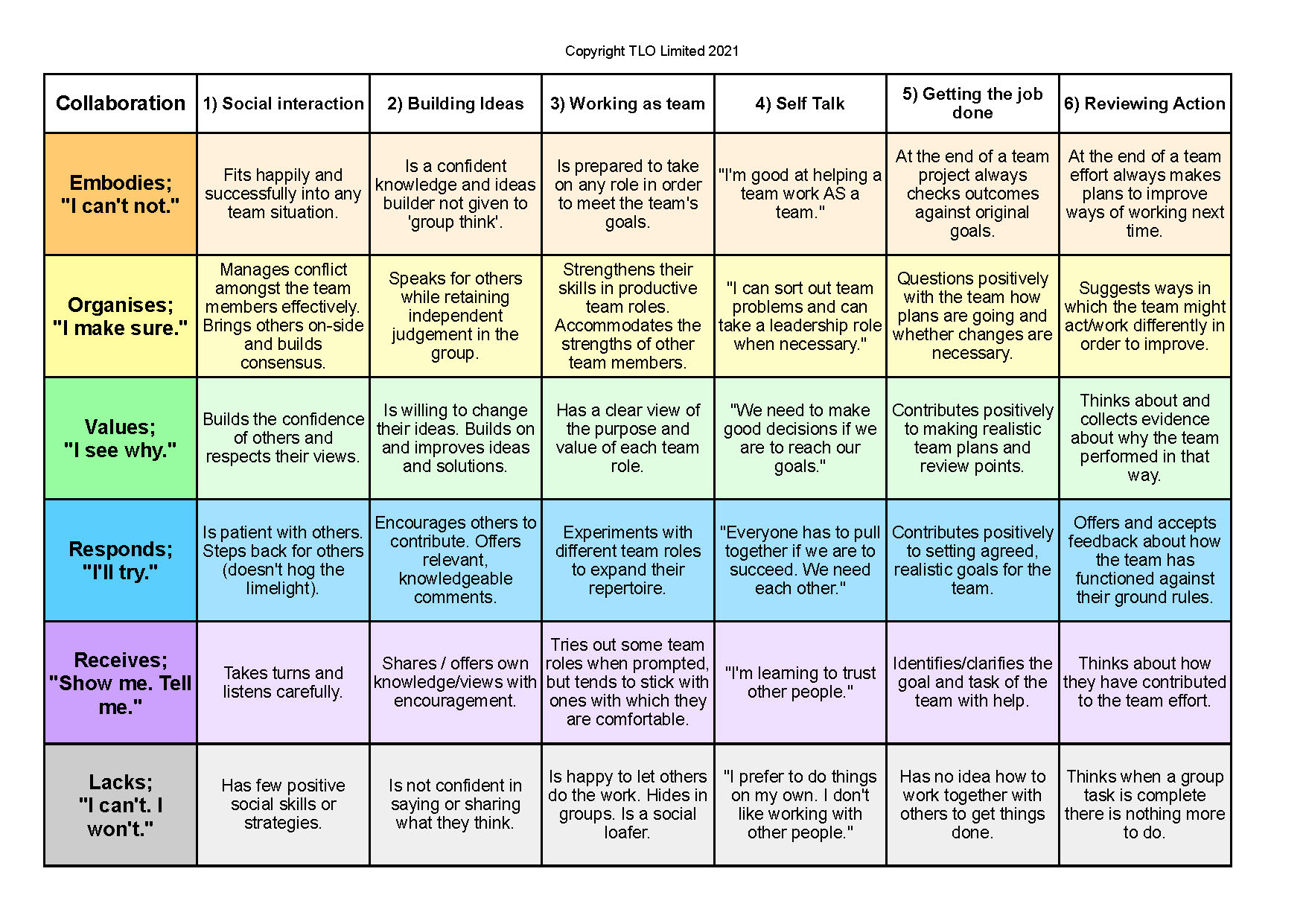
At-a-glance Collaboration card [extract] – Click image to view full screen
Find out more about Collaboration:
A well-formed collaboration habit includes being ready willing and able to:
Work effectively with others towards agreed, common goals, acting flexibly in response to circumstances.
Adopt different roles and responsibilities in pursuit of agreed goals and the well-being of the team.
Hold and express opinions coherently, compromising and adapting when appropriate.
Seek to understand what others are saying; sharing, challenging, supporting and building on ideas.
What do you think?
Do your pupils become increasingly like this as they move through your school?
What makes you say that?
What do you currently do in school that encourages pupils to develop their social learning skills?
What might you be doing to inhibit collaborative learning?
Make a note of…
Things you do to support collaboration
Things you do that might hinder collaboration
1.2 How Collaboration might build when we nurture it.
Being collaborative isn’t something that switches on on good days and off on bad days. Being a good collaborator grows and builds when it’s nurtured and supported. Furthermore, being collaborative involves gaining control of a range of linked skills and emotions. Take a look at how progression in Collaboration might grow across six contributory aspects.
Cast your eye over the ‘big picture’ of growing Collaboration below. Then move on to finding out what the columns (1.3) and the rows (1.4) are all about.
Collaboration involves knowing how to learn with others, as part of a team, in situations where no one person knows all parts of the puzzle. This complicated yet essential learning habit develops in several different ways. First of all it hinges on social interaction; how well we get on together, whether we are patient with others and respect their views. Then how we are able to bounce off others to build ideas; making the most of several brains rather than one. Next, how we learn to be part of a team and to perform different roles when needed. Fourthly, how we talk to ourselves about learning with others, where our real understanding of the process is revealed. Fifthly, how we contribute to the process of actually getting things done. Not just being there but doing something helpful. And lastly how we contribute to improving team performance by evaluating not just outcomes but the process of getting there.
Take a closer look at what each column of the grid is about
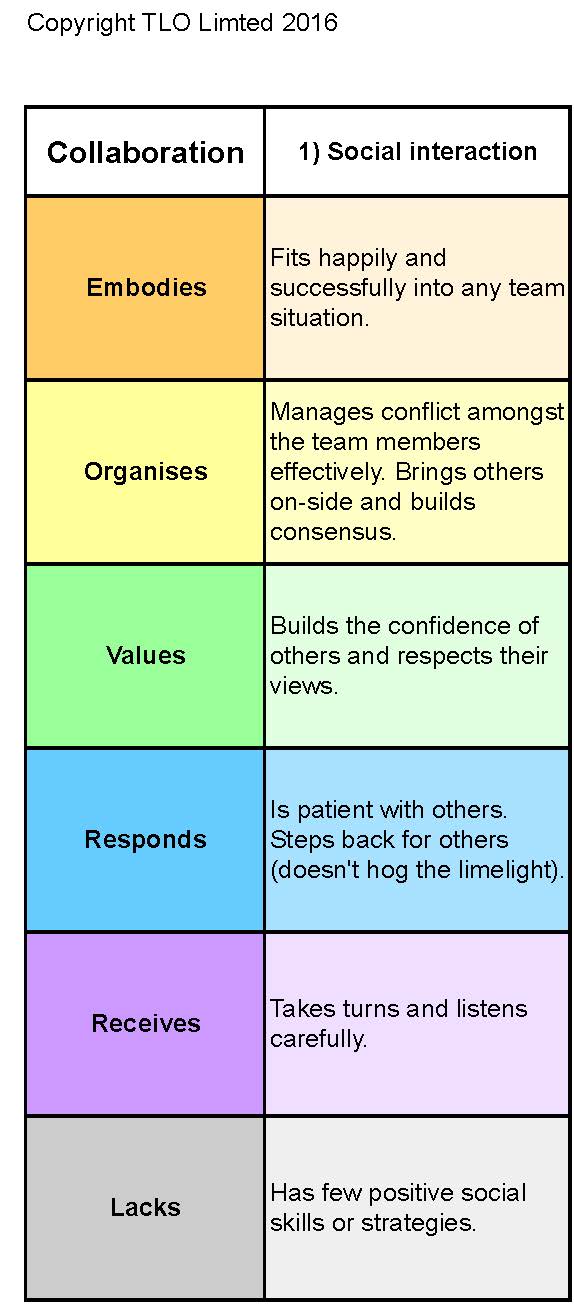
1) Social interaction
How we interact socially in learning and working with others.The way in which we learn the social conventions of behaving in a group; taking turns to speak and contribute, listening to understand others; being patient with others and not hogging the limelight; stepping outside our own concerns and building the confidence of others and respecting their views; being able to manage and overcome the inevitable controversy as teams work creatively together; and thus being able to become a valuable sociable member of any team.
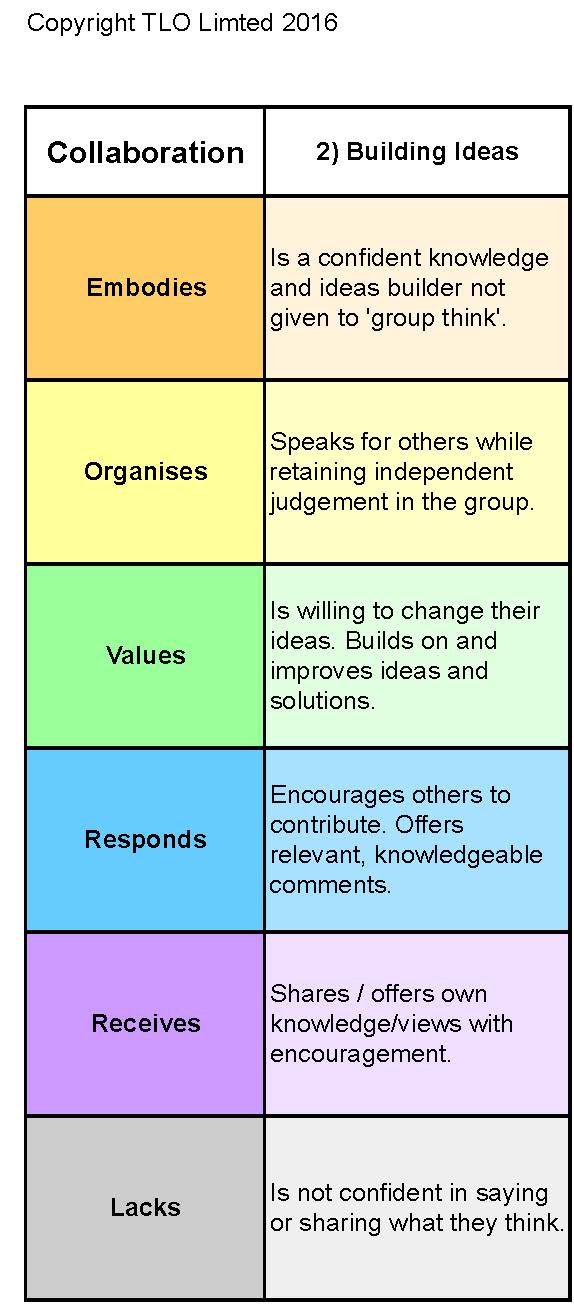
2) Building ideas
Just being good mates in a team doesn’t lead to success. Teams have to understand how to build ideas together; to draw on the ideas of others, to be able to graciously set aside ideas that wouldn’t work, to spark off others to ensure new and better ideas get an airing.And somehow, in all this ‘togetherness’ people are able to retain their independent judgement and avoid being drawn into group think. Teams share and build ideas together; growing and improving possible solutions in order to reach their goals
3) Working as a team
Working as a team is rather different to working in a team. It’s all about ‘teamness’ or ‘togetherness’. In order to work as a team people need to understand team roles, to find out what role they are particularly good at, to take on a range of roles when needed and eventually be willing to play any role in a team to ensure the goal is reached.Being able to work as a team is influenced by how our self perception and confidence grow, how we learn to trust, how we recognise the need for each other.
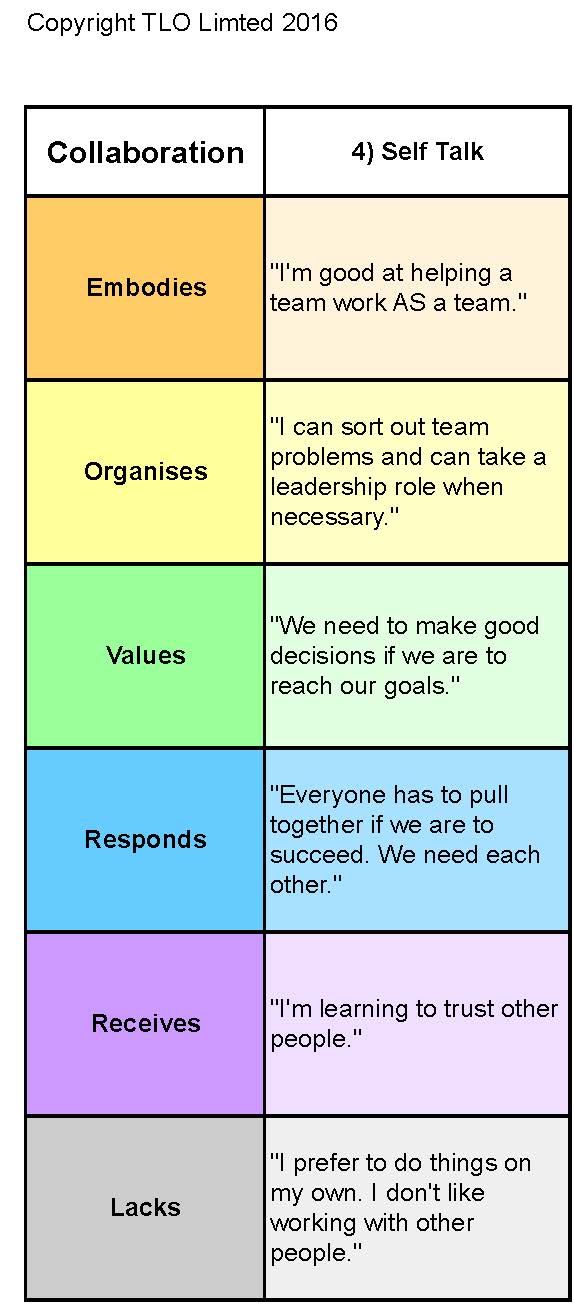
4) Self talk
The voice of self awareness
Self-talk is what we say to ourselves as we learn. The statements capture what someone in each phase of the grid might be thinking. Students may use some of these phrases when talking with you, or in writing from time to time, but mostly self-talk goes on inside their heads. We have shown a small flavour of self talk thoughts that teachers can encourage students to imitate. Some relate to standards, others to self monitoring, or flexibility. All such self-talk is important in building a persevering habit.
5) Getting the job done
How teams achieve their goals by using the well known learning process of Plan Do Review. Good teams have people who know that the first job is to be clear about what the task is really about. They are skilled in considering/creating/agreeing realistic goals to be achieved and which everyone has bought in to. Then the team have to plan how they will achieve the goal, how they will monitor their progress and methodology and how they will make sure the job is well done.
6) Reviewing action
This aspect is about how teams learn how to improve. It’s the aspect of teamwork that is frequently left out altogether or given short shrift. But it’s the aspect of teamwork that helps teams build themselves into better teams. It includes evaluating how they performed as individuals in contributing to the work of the team and how/whether the team process worked to achieve the team goal. Importantly such reflection leads to serious re-planning of their ways of working. It’s meta learning at a team level. Good teams will be looking for what has become know as marginal gains, those little things can we do better/improve that will impact on the overall performance.
What do you think?
Do these contributory features of collaboration make sense to you?
Make a note of…
Things that you think might be missing from this big picture of collaboration
What do you think?
Do you think there’s an order in which these skills develop? Would it be the same order for every pupil?
Do you think these behaviours develop ‘naturally’ as children mature?
Do we need to intervene in order to support this positive development?
Make a note of…
Any behaviours you think develop naturally
Any behaviours you think may be missing from this picture of collaboration
1.4 Unpick the rows; getting better at Collaborating.
Of course the development of collaboration doesn’t grow neatly up each column or even across the columns. However, it is possible to look at the grid another way and group cells together into five broad phases of dispositional growth. We have based this growth on Bloom’s taxonomy of the affective domain. By looking at the development of emotion and skill, the grid yields broad ways in which people may be inclined to behave: we call this inclination ‘mindedness’. Pupils may be:
Here is our interpretation of how Collaborating might grow.
The phases are drawn from Bloom’s taxonomy of the affective domain.
Phase ‘Receives’ (purple) is about doing something because you are told or expected to.
Phase ‘Responds’ (blue) is about gaining interest and doing things more willingly.
Phase ‘Values’ (green) is a key phase since the student now sees the value of behaving in this way. It’s a win for them; to behave like this is in their interest. It’s in this phase that the behaviour becomes more secure.
Phase ‘Organises’ (yellow) is the phase in which the student capitalises on this ‘in their interest’ behaviour and gets themselves organised to use it positively.
Phase ‘Embodies’ (orange), known as ‘characterised’ in the original taxonomy. In this phase the student has made this behaviour their own. It has become part of their character; they can’t not do it and they have become highly skilled in doing it.
We urge you to see this progression as long term. Some phases will take years for people to work through; some will never be worked through. None of the phases are inevitable. There is a lifetime of development captured here. Nevertheless the role of a teacher or parent should surely be to encourage and enable this journey.
Lacks:
In this ‘Lacks’ (grey) phase, pupils are often unsure of themselves in a group. They often learn and play alongside other children but collaborating together is far more tricky. their social skill may not be conducive to working with others either tending to push themselves forward and take control or shying away and saying/contributing little. They have much learning and adapting to do before they are really ready to work in a collaborative team.
Receives: Minded to begin to collaborate with others
In the Receives (purple) phase, pupils are making a big leap from being wary of others, being unaware of social conventions or any of the advantages of working/learning with others. Here they are collaborating with others because they are required to. There is much to be done in this phase: social skills, sharing ideas, working out what needs doing, playing their part and even thinking about how they have contributed to the team.
Responds: Minded to be part of a team
In the Responds (blue) phase pupils are willing to develop their understanding of what being part of a team involves, agreeing goals together, trying out different roles, broadening social skills to opening up others.
Values: Minded to function flexibly as part of a team
In the Values ( green) phase pupils see/appreciate the value of a team member and honing their skills in different roles, planning action more carefully, and being flexible in their own views for the sake of the team. Once this phase is secure pupils are likely to develop further skills by having opportunities to work in this way.
Organises: Minded to learn in and as a team
In the Organises (yellow) phase, pupils organise themselves to work as part of a team. They learn that skilful teams manage conflict and that conflict and controversy are positive keys to involvement and creativity; that high-performing teams frequently check their progress and adjust their practice to stay on track.
Embodies: Minded to see Collaborating as a way of being.
In the Embodies (orange) phase, being a skilled team player is what characterises the student. They work happily and skilfully in any team, confident in their social, task development, planning, reviewing, and team evaluation strategies. A valuable member of any team.
What do you think?
Which phase of collaboration mindedness do most of your pupils fit into? They may of course be developing in more than one phase at a time.
Are some in the grey zone ? – i.e. collaboration is missing altogether.
Make a note of…
The pupils who don’t appear to be mainly in the grey zone
If you want to read again the notes on Professional Learning Teams that were in the Learning Friendly Culture session, click on the view notes tab in this box
Professional Learning Teams: what and how
The purpose of these meetings is for the team to act as a teacher learning community or Professional Learning Team: a small group of teachers who meet together regularly to deepen their understanding of building better learners, commit to trying out new things, reflect on and share their experiments with each other. Such learning communities are the engines of teacher development. They work best with 6-8 teachers with similar subjects or age groups, and who meet for about an hour regularly over a period of a couple of years.
The group question and probe each other’s summaries of their experiments in order to encourage analysis and deeper reflection. They use questions such as ‘What do you think is getting in the way? What would make this even better? How could this technique be modified to make it work for you? What do you think made that happen? In this way they support each other in changing and developing their practice.
Some guidelines for team reflection sessions
The delicate, hard work of changing practice requires a safe professional environment in which to explore and understand both triumphs and tribulations. These short guidelines may be helpful in setting a climate for the team itself.
Everyone is expected to report back on their classroom experiments
Coaching questions and probes of colleagues’ classroom experiments encourage deeper reflection.
The group is careful to follow their agreed ground rules which might include;
No group member can ‘pass’
Listen between the lines when it’s not your turn
Actively discuss everyone’s input
Constructive criticism – developmental not judgemental
Everyone fully engaged in the group •What is said is confidential to the group • Respect others’ views and encourage others’ ideas
1. Session objectives. What do we want to achieve? ( 5 mins)
Share and unpick our learning enquiries in ( whatever you experimented with last)
Develop a common understanding of the on-line materials about questioning
Decide the strategic language issues that everyone needs to apply in their classroom re questioning
Plan some do-able shifts in developing question friendly classrooms
2. Sharing learning enquiries
Share
the changes in practice you tried
how students reacted
what you learned
what next as a result
Probe
what was getting in the way?
what seemed difficult?
what would make it easier?
what made it work particularly well?
why it was successful?
changes in your behaviour
Impact on pupils
Greater willingness to try…
Avoidance of…..
Improvements in……
Increases in…….
Little or no changes in…
3. Recapping on-line materials: What did we think of the materials? (15 mins)
Thoughts about:
The Questioning chart
Where pupils are secure
The phase pupils could aspire to feel secure in before leaving the school
Classroom culture ideas for questioning
Ideas for activities and routines for questioning
4. Planning what to do: What do we all adopt? (15 mins)
Decide
Which ideas should we all adopt as whole school strategies?
How the progression of Questioning should be built across the school. ie how the phases of Questioning might play out against key stages and even year groups.
5. Personal action planning. What am I going to do? (20 mins)
Consider
How you want your pupils to improve/develop/enhance their approach to Questioning?
What you are going to do to bring this about?
Develop an enquiry question.
Think of it like this:
If I do XXXX will it improve/develop/enhance YYYY?
This is the crunch question. Your pupils are unlikely to change unless you change!
Looked at your pupils through the lens of the Questioning progression chart
Gained a sense of what becoming better at Questioning looks like
Explored a range of ideas and activities that will help to engage pupils with Questioning
Now we look closely at how to blend improving pupils’ questioning into the content you have to teach.
A. The principles behind any learning powered lesson
B. Big questions to ask about lesson design
C. Lesson planning in action…an exemplar questioning focused task
Learning habits form through use and practice, but desirable habits survive and flourish better if pupils are aware of them, realise their value and strive to improve them. The curriculum through its lessons provides the rich and varied occasions for exercising learning habits.
A. The principles behind any learning powered lesson
Think of yourself as a learning power coach, helping your pupils to help themselves to develop their learning habits. Hence your lessons are much more likely to contain challenges and activities that get your pupils thinking and learning for themselves. You encourage pupils to explore challenging questions, problems or assertions and become observers of their own learning. You step back from telling and heavy scaffolding and instead try to mobilise your pupils’ learning behaviours. You are organising learning to let them take the strain.
The SIX principles that lie behind teaching for learning power
1: Visible learning…Surfacing learning
You make it clear to pupils which learning habits and processes they are using. You try to make every aspect of the learning process as visible as possible through the language you use and through the words and images you display on the walls.
For example:
Use displays of exploratory questions such as:
We are thinking about the different effects of closed and open questions:
What kind of answers do closed questions give us?
What kind of answers do open questions give us?
When might we use a closed question?
What are closed questions useful for?
When might we use open questions?
What are open questions useful for?
Can you change a closed question into an open question?
2: Dual focus teaching…blending content and process
You design activities that combine the dual objectives of ‘what’ will be learned and ‘how’ it will be learned. You make sure pupils know that the content they are learning is a way of giving their minds a useful workout. (The content is the vehicle for learning)
For example:
Put the ‘how’ before the ‘what’ in constructing objectives or intentions.
Research shows that objectives relating to ‘understanding xxxxx’ or ‘knowing yyyyy’ are less likely to motivate a learner to make the effort than those that start with some indication of the sort of ‘effort’ or way of doing something
For example: We are going to…
…work as a team to decide why…….
…use open questions to design……
…conjure up your imagination to ….
3: Emotional engagement…Capturing attention
Your lessons are designed to intrigue your pupils. Pupils don’t put in the effort unless their energy and attention are captured by what they are doing. You capture your pupils’ emotional engagement by giving them more of a stake in the process of learning.
For example:
Give pupils opportunities to design projects
At the start of a class project…. write a series of questions on separate pieces of cards and give each group a set of the cards to share equally. Pupils then decide:
the best order for the questions in order to do the project well;
whether they need all the questions or if some are irrelevant in the context;
whether there are any missing questions and if so, what they might be;
and later, what they have learnt about questions from this.
Thus pupils are given a real stake and sense of involvement in the process of learning both immediately and into the future of the project.
4: Handling uncertainty…Challenge
You have realised from your own life that what is engaging tends to be what is challenging. Since you see education as a preparation for a learning life, you help pupils to learn how to handle increasing degrees of complexity and uncertainty.
For example:
Use the ‘support to continue‘ technique: questions not answers.
If pupils freeze when something is tricky, offer supportive questions not answers. A basic support to continue is ‘What might you do next?’, and when this has been done simply ask the question again. To extend the ‘support to continue’ approach, try using phrases like:
What have you already tried? What else might work?;
Why is this proving difficult? What is it that you can’t do?;
What did you do last time? I wonder what you did to move on?.
5: Relationships…Working together
Learning is both a sociable and a solitary activity, and you offer your pupils opportunities to experience both. You develop interdependent learners who know how to handle themselves in collaborative groups and able to move around in the social space of learning to best effect.
For example:
Use Think, Pair, Share – purposefully
Offer pupils a problem or question which is more substantial than simple recall.
Think – Allow plenty of individual think time to engage with the issue.
Pair – Pupils then try out their ideas, (discuss, clarify, challenge) with a ‘Learning Partner’.
Share – The pair share with another pair, and subsequently with the whole class to arrive at a range of possible answers. They come to know and shape their views by collaborating with others.
Use as a simple strategy to prepare pupils for working together in teams, having first thought it through for themselves (Think), checked their ideas out with a talk partner (Pair), before moving on to contributing to a group (Share). At each point pupils are exposed to the views of others which encourages them to revise and refine their initial thinking.
6: Reflection and responsibility…Taking charge
You understand that pupils have to learn how to manage and organise their own learning and that the way to do this is by giving them increasingly demanding opportunities to do so. You orchestrate pupils taking charge of their learning by expecting them to plan what they do, distil meaning from it, and revise it accordingly.
For example:
Use learning prompt mats . .
at the start of this process to prompt the use of and reflection on questioning.
A checklist for lesson planning based on these six principles.
Does the lesson plan:
Make it clear to pupils which learning behaviours are being activated?
Match and blend the learning behaviour with content?
Include a tactic to captivate pupils’ attention?
Have sufficiently challenging learning activities to sustain interest for all?
Offer choice on how pupils could interact on these tasks?
Embed aspects of planning, reflecting and revising for content and process?
What do you think?
Which of these six principles are a regular feature of your planning?
What do you make of principle 2? Is it the most tricky of the six? The following section B is mostly about this aspect of planning.
Look at the checklist in the green box above this one: Do your lesson plans capture these six aspects of an effective learning experience?
Make a note of…
Which of the six principles might need to be given greater prominence in your planning.
B. Big questions to ask about lesson design.
Skim or leave this section if you have met it in other units because… the section applies to any learning behaviour. i.e. not specific to Questioning.
What we teach and how we teach it (the enacted curriculum) are intertwined and offer teachers a lot of freedom. It is here that you can start applying a learning power filter and deploy a unique combination of content and learning tasks.
In conventional lessons where the teacher remains the focus of attention and the initiator of all activity, and where the epistemic dimension (the conditions for acquiring knowledge) is not acknowledged, pupils gain habits of compliance and dependence, rather than curiosity and self-reliance.
In developing learning power, teachers are making conscious choices about which habits to introduce and stretch and how best to couple these with content so that lessons become more interesting and challenging. Through such overt coupling of content and specific types of process, pupils come to know, understand and take control of their learning behaviours – they knowingly use and develop the whole range of learning behaviours.
All lessons function on two levels, they have twin intentions. On the one hand there is content to be acquired, and on the other there are learning behaviours to be exercised in pursuit of this content. The factor that differentiates a standard lesson that effectively ‘delivers the content’ from a learning powered lesson is that the teacher has to think, in advance, about:
the learning behaviours that are necessary for successful content acquisition;
the design of activities /tasks that will stimulate these behaviours;
how learners could reflect on and evaluate their use of these behaviours.
In designing such lessons you have to dare to think differently and flip round your usual lesson design thinking.
A turn-around in lesson design
Think in two dimensions at once – the content dimension and the learning behaviour dimension. It means turning your thinking around – from teaching to learning.
Or put another way
Think to yourself;
what content?
using which learning behaviour(s)?
via an activity to stretch both?
Lesson design questions… one by one
Here the general rules of lesson design have been related to the learning behaviour…questioning.
Stage 1. What content do pupils need to learn?
What content has to be learned? …..Think outcomes.
Use standard lesson planning tools:
What are pupils going to be able to do/learn?…think objectives
How will they know if they been successful?… think success criteria
While keeping an obvious eye on
What do they already know?….think previous learning.
Stage 2. How will they best learn it?
Using which learning behaviours?
This is the new bit
Not the usual second step but nonetheless a vital second step where the aim is to weave content acquisition with learning behaviours. The content is the vehicle for exercising the learning behaviours and the learning behaviours accelerate the content acquisition.
Using which learning behaviours?…Think types of learning behaviours
Which learning behaviour(s) will help these pupils get closer to understanding this content?…think learning behaviour charts.
Which aspect of, say, questioning, lends itself to achieving these outcomes?…think progression columns.
How skilled are these pupils in using this learning behaviour …think progression phases/rows
Say something like this to yourself .…My pupils need to achieve xxx. At this stage we could get closer to this content by using questioning. Most of my pupils are able to use xxx phase (e.g. respond/blue) questioning approaches confidently.
Stage 3. What type of task/activity will stretch the learning?
Which type of task…Think types of task.
Pick up your thinking from stage 2;
My pupils need to achieve xxx. At this stage we could get closer to this content by using questioning. Most of my pupils would be able to use xxx phase (e.g. blue/responds phase) questioning approaches confidently.
And now think about the sort of task/activity you might develop/design so as to:
orchestrate a problem-solving activity to enable pupils’ understanding of xyz content without telling them;
intrigue them with something that is open to several interpretations;
stimulate their curiosity;
grab their attention…visually and aurally;
allow them to stay stuck before I ask them how they are thinking;
offer as a nudge to get them thinking differently that doesn’t give the answer away;
leave it as a problem hanging in the air to which we will return later;
make links between the challenge, and what and how we are learning in this lesson.
The challenge isn’t about the inherent complexity of the subject matter but about how the content is orchestrated to encourage pupils to use their learning habits to resource their solution.
Think…what/how much information/content do I need to give/reveal? At what point? In what form? To what end?
Say something like this to yourself .…
my pupils need to achieve xxx.
at this point we could get closer to this content by using questioning.
most of my pupils are able to use xxx phase (e.g. respond/blue phase) questioning approaches confidently.
What type of task would stretch their questioning but assist them with the content…without me just telling them!
To summarise…the heart of the lesson
It’s the question ‘using which learning behaviours?’ that causes you to think differently about the lesson planning.
You ask – as always – what are the anticipated objectives/intentions?
The verbs in your resulting objectives will give you clues about the types of task/methodology that will get pupils there and the sorts of learning behaviours your pupils will need to contribute to this learning endeavour.
You are designing the task in a way that requires pupils to contribute their learning ‘powers’ / behaviours. The tasks you design will hook into their learning ‘powers’ and help them to improve them.
Say something like this to yourself:
I am going to think content, learning behaviour and task together:
Questioning will help pupils to better access the content;
The aspect of questioning (column) and phase (row) that would fit best is (for example) using open and closed questioning;
The type of task/activity that would best stretch both content and learning behaviour, intrigue, challenge, bring people together and give responsibility to pupils is………
Think….what information do I need to reveal/give, in what form, at what point, and what do I want pupils to do with it?
What do you think?
What strikes you about this way of planning with learning behaviours in mind?
Where are the potential stumbling blocks?
How will you decide which learning behaviour(s) you are going to foreground in your objectives?
Consider a lesson you are about to teach…
What is the content?
Which learning behaviour(s), if missing, would make accessing the content very difficult / impossible?
How could you blend reference to this learning behaviour(s) into the learning objectives?
Can you design a task that will help pupils to access the content and exercise the key learning behaviour(s) you have identified?
C. Lesson planning in action – an exemplar, questioning focused, task.
How do we design tasks that stretch Questioning and assist pupils to approach the content more productively? We cover this in four ways:
1 describes the Question Formulation Technique (QFT) used in the lesson;
2 shows the phases of a lesson where questioning is the driving behaviour;
3 considers a simple lesson plan template that can be used for any lesson and distils the QFT lesson into this format;
4 invites you to extend your thinking about the QFT technique into other aspects of the curriculum.
1. A description of the Question Formulation Technique
The intriguing technique used in the lesson below has been developed by the Right Question Institute over several years. The technique puts pupils into the driving seat of asking their own questions. It helps pupils to learn how to produce their own questions, improve them, and think how best to use them. During this process pupils practice divergent and convergent thinking and metacognition (thinking about thinking). When pupils know how to ask their own questions, they take greater ownership of their learning, have deeper comprehension and make new connections and discoveries on their own.
The teacher begins the technique with a sharp enough hook to start the pupils’ questioning process. In brief the process goes like this.
The RQI’s Question Formulation Technique
Stage 1:Produce Your Own Questions
Stage 2:ImproveYour Questions
Stage 3:Prioritise Your Questions
Stage 1: Produce your Questions
Four essential rules for producing your own questions:
Ask as many questions as you can;
Do not stop to discuss, judge or answer the questions;
Write down every question exactly as it is stated;
Change any statement into a question.
Stage 2: Improve Your Questions
Categorise the questions as closed – or open-ended:
Working together, categorise your questions as either closed (C) or open (O);
Agree if any of your open questions would be better if they were closed, and if any of your closed questions would be better if they were open;
Change any of the questions from one type to another in light of the above discussion.
Stage 3: Prioritise the Questions
Choose your three most important questions:
Why did you choose these three as the most important?
2. The Question Formulation Technique used in a lesson.
Look through the lesson below. It uses the rigorous Question Formulation Technique (QFT) process to stimulate creative writing.
We observed this lesson being delivered by a Yr 5 teacher at Blakesley Hall Primary School in Birmingham. We had never witnessed questioning being ‘taught’ like this before and the questions pupils generated using this method were very impressive!
The objective of the lesson was to…. work together, using imagination and QFT , generate questions to inspire and stimulate a piece of creative writing.
Notice how, despite the focus on learners creating their own questions, other learning behaviours ‘bubble up’ as the lesson proceeds. It reminds us that learning behaviours don’t function in isolation, that an effective learner not only has a wide range of learning behaviours to call on but also the flexibility to move seamlessly from one to another as required.
Now let’s look at the lesson episode by episode.
Episode 1
Teacher action
Pupil Action
Learning behaviours
Teacher talk
Present pupils, in groups of 4/5, with an image in the centre of a large piece of paper. Invite them to ask as many questions as they can about the image, following the rules in the pupil action box.
In groups of 6-7 generate as many as possible questions, using the rules:
a) Ask as many questions as you can; b) Do not stop to answer/discuss the questions; c) Write the question exactly as it is stated; d) Change any statements into questions;
Listening, imagining, questioning
Divergent thinking challenge.
Following a structured process (managing distraction)
Guide pupils through the rules, but don’t offer suggestions, comments of approval etc.. Encourage rapid production of questions
What’s happening here?
Time:Ten minutes. Resource: An interesting picture secured to a large sheet of sugar paper. 1 per table. This is the Question Focus.
Teacher action: Invite pupils to generate questions about the picture. Explain the rules.
Pupil action: The pupils have to generate their own questions using the following rules:
Produce their own questions;
As many as they can;
Don’t stop, don’t judge, don’t answer the questions;
Write each one exactly as stated;
Change any statement into a question.
Learning behaviours:
Questioning, divergent thinking, keeping to a structured process.
Teacher talk: Not to get involved. Not to be drawn into pupils’ discussions. Not to influence. Simply guide pupils through the rules.
Episode 2
Teacher action
Pupil Action
Learning behaviours
Teacher talk
Invite pupils to categorise their questions into open (O) and closed (C). Explain types if necessary. Lead discussion re advantage/role of both.
Improving Questions. Pupils categorise questions as closed or open throughdiscussion
Making Links;Collaboration
What are the advantages of closed questions? Ditto open questions? What do closed/open questions do? Dittoopen?
What’s happening here?
The point here is to classify and improve the questions.
Pupils are asked to categorise questions into open and closed – causing discussion. The teacher may need to introduce a definition of closed and open questions. Closed – can only be answered with yes or no or one word. Open – require an explanation and cannot be answered with yes or no or one word.
The teacher then leads a discussion of the advantages and disadvantages of the different types of questions. This causes pupils to think of the role and purpose of questions.
Episode 3
Teacher action
Pupil Action
Learning behaviours
Teacher talk
Invite pupils to change at least one question from closed to open and vice versa.
Review their questions and discuss what happens when you re-frame them. Identify whether they need to re-frame others.
Making links. Reasoning, compare and contrast. Convergent thinking.
What happens when you change that question? What different sorts of information will it give you now? Which of your questions might need changing?
What’s happening here?
The point here is to appreciate how changing a question makes a difference to the information it yields.
Here the teacher invites pupils to change at least one open question into a closed question and vice versa. This causes pupils to consider how manipulating the wording of the question can block or yield certain information. The discovery of the nature of questions allows them to think about the enquiry process in a new way. As pupils work on changing the form of a question they think about what they will find out, how it meets their needs. In other words they begin to think convergently.
Episode 4
Teacher action
Pupil Action
Learning behaviours
Teacher talk
Share the objectives of the lesson and what the questions are for. Challenge pupils to identify 4 or 5 questions. .
Prioritising questions. Discuss and agree on their most useful questions for making a story.
Distilling. Identifying appropriate questions.
Which of these questions are most useful? Which, if answered, would best guide your story?
What’s happening here?
The point here is to look at the relative merits of questions.
Pupils are asked to prioritise their questions for the job in hand. This stage is linked to the objectives of the lesson. Prioritisation will differ according to the lesson plan in mind, the nature of the enquiry; the purpose of using QFT.
This causes pupils to compare their questions and assess which will be most helpful. They also begin to sequence the questions; which would need to be answered first before others could be even considered. Looking at the sequential nature of the questions – in this case for a story – that offers a possible storyline. Used in a different context this episode gives rise to a more focused enquiry.
Episode 5
Teacher action
Pupil Action
Learning behaviours
Teacher talk
Invite pupils to use their questions (and the answers that they create) as a stimulus for a piece of creative writing. Use Story Mountain as planning tool.
Story to be written in next lesson.
Using the questions. Work together to place their top questions on the Story Mountain planning tool (Introduction, Build Up, Problem, Resolution,Ending).
Making Links, collaborating to seek consensus.
Which bit of the story mountain will the answer to this question apply to? Are there bit(s) of the Story Mountain with no question attached? Can you find a question from your brainstorm to fill in any gap(s). How will you agree on the best questions?
What’s happening here?
The point here is to work out how best to use the questions informed by the prioritisation process.
In this case for a story. This is now more familiar territory. In this lesson the pupils began to arrange their questions on a Story Mountain planning tool.
The story was to be written during the next lesson.
Episode 6
Teacher action
Pupil Action
Learning behaviours
Teacher talk
Give pupils time to consider, individually,howtheywould answer theirquestions.
Pupils work individually to think up answers to their questions for writing their story later.
Imagination, planning, makinglinks.
Close your eyes – what can you see? What are you feeling? What can you hear? Are your answers beginning to link together? How are you planning to begin and end your story? What would you, as the reader, like to know?
What’s happening here?
Episode 6 in this lesson was used to encourage pupils to think up/imagine answers to their questions in readiness for writing their story in the next lesson.
Episode 7
Teacher action
Pupil Action
Learning behaviours
Teacher talk
Reflection invite pupils to think about what and how they have learned…about questioning and about story content.
Pupils to reflect on the process. What they have learned, which was the most useful bit of learning for them.
Reflection, meta-cognition, divergent and convergent thinking.
What do you know now about questions that you didn’t know before. How might you use this again?
What’s happening here?
The point here is to reflect on the process of generating, improving and prioritising questions.
The teacher guides a discussion about what pupils have learned, how they have learned, what is different about what they know now than at the start of the lesson, how they can use what they know now in terms of content and questioning skills.
Here the pupils are engaged in thinking about their thinking and learning process – metacognition.
Lastly they might be asked to name the most important thing they learned.
What do you think?
Have you thought of a lesson as a blend of teacher actions, pupil actions, learning behaviours, and teacher talk before?
How could you use the QFT to advantage in your own classroom?
Make a note of…
Your initial reactions to the Question Formulation Technique.
A little more about this technique
There is much more detail and sophistication to this technique than we have been able to show here. It has multiple uses across the curriculum. It’s an ideal problem solving tool.
The technique provides:
A clear disciplined structure
Open space for different pupil and learning and talking styles
Respect for pupil ideas and ability to work together
High expectations that pupils can think at very high levels
It will take several go’s at it to begin to reap real benefits but such benefits are well worth the wait. In their book, Make just one change, Dan Rothstein and Luz Santana report that pupils themselves recognised three categories of change in themselves;
better understanding of content
increased confidence, becoming self-started, more engaged, take ownership of their learning.
developed lifelong thinking skills
We would urge you to buy their book, learn more about the process in detail and try the ideas with your pupils.
3 Using a lesson plan template to distil this lesson.
Given that there are hundreds of lesson plan formats we will use a few different types of planning tools over the course of these units. This one is a simple, streamlined, useable tool that includes:
What you do (teacher action);
What pupils do (pupil action);
What the learning behaviours being called upon are (learning behaviours);
What you say (learning talk) to nudge the learning behaviour along.
The format is divided into episodes to show the change of purpose, action and use of learning behaviour across the course of the lesson.
Download a blank lesson plan as a MS Word document: Lesson Planning Grid [.DOC 33KB]
If we now populate the template with the episodes explored in section 2 above, we get the completed lesson plan. . .
What do you think?
What are your first reactions to this lesson plan template?
Does planning for four aspects – teacher action, pupil action, learning behaviours, teacher talk – seem useful?
How does sequencing the lesson as ‘episodes’ help or hinder planning?
Make a note of…
The extent to which your existing planning template enables you to think about lessons in this way.
What you would like / need to add to it.
4 Extend your thinking about this QFT technique
Here you will find an eclectic range of provocations to extend your thinking about when and how to use this technique.
Here are some images that the teacher may have used as her trigger.
Which of these images would you have chosen to put in the middle of the paper to trigger the Question Formulation Technique?
Of course, if you had been intending to do some creative writing entitled ‘A day at the beach’ you would have selected from other images.
But the Question Formulation Technique can be used well beyond creative writing . . .
What image / artefact / word / concept would you use if you were planning to use QFT in a module of work on:
The use of the semi-colon;
The artwork of Piet Mondrian;
Life in the Middle Ages;
Electricity;
Prime numbers.
And if you were going to use QFT, why would you use it?
What would you do with the questions that the pupils generate?
How might you use their questions to shape your planning?
To understand their misconceptions?
To give them ownership of what they are learning?
To focus their thinking?
To generate agreed success criteria for the module?
And, finally, A Challenge Question.
How could you adapt the Question Formulation Technique to intentionally develop questioning skills that are higher up the progression map for Questioning, like . . .
Question Funnels, or
Hypothetical Questions, or
Devil’s Advocate?
What do you think?
Where / when / why might you use the Question Formulation Technique?
How will you use the questions that are generated?
How will these questions inform your planning?
How will you ensure that the QFT is an integral part of the lesson, and not just a ‘catchy’ activity before the ‘serious’ work begins?
As teachers we are in the habit-forming business. What we say, what we display on classroom walls, what we celebrate, praise or dismiss, what we model or how we design learning activities will all influence the ways in which pupils learn, perform and behave. Classroom cultures have a huge influence on pupils’ learning as you will remember from the Culture unit.
Five big culture shifts to get you started. Ask yourself – how might you:
Value and praise good questions as well as good answers?
Make it safe for people to disagree…see it as an interesting situation from which to learn?
Put enquiry mindedness on display…share your enthusiasms, display unfinished lines of enquiry?
Develop open-end challenges?
Build your lessons from intriguing questions?
Now look at the Learning Activity sections below where you will find plenty more ideas to try.
Wonder is the beginning of wisdom.’ So stated Socrates, considered by some to be ‘the father of questioning’. Even through nearly 2,500 years of human development and societal ‘progression’, those words still hold true. In growing the habit of questioning, it is important to acknowledge that questioning itself is rooted in curiosity, that great driver of engagement, of seeking, of asking, and asking again.
‘Good learners like to wonder about things. For them, it often really is a wonder-ful world. The phrases ‘How come?’ and ‘What if?’ are never far from their lips.
They value getting below the surface of things, and are less likely to accept uncritically what they are told. They like to come to their own conclusions. They are more willing to reveal their questions and uncertainties if they think it will help them learn.
Questioning can be as much non-verbal as it is verbal. Playing around with materials or ideas just to see what happens is a powerful way of asking questions. It is what artists and inventors spend a lot of their time doing. The inclination to ask questions flourishes when you are around people who are also asking questions, and who encourage and appreciate your questions too’.
Extract from Building Learning Power. Guy Claxton 2002
What do you think? How well do you know your children as questioners?
Think of the pupils that you teach:
Who amongst them is irrepressibly curious?
Which of your pupils are reticent in asking questions?
Why this might be?
Have you ever considered the quality of the questions that your pupils ask?
Make a note of...
How ‘good’ are they at asking questions?
Do they ask ‘good’ questions?
Your definition of a ‘good’ question?
A well-formed habit
Let’s dig a little deeper into questioning. Effective questioners are motivated and not afraid to ask questions about the past, the present and to explore the future. They have an extensive range of question types and techniques at their disposal, which they use with discernment and sensitivity to occasion.
A well-formed questioning habit involves being ready, willing and able to;
Not take things at face value
Be less likely to accept answers uncritically
Ask questions of oneself as well as of others
Get under the surface of things
Be comfortable with uncertainty and ambiguity
Not be afraid of the ‘don’t know’ state of mind
Be playful, yet systematic and analytical
Be socially aware of the impact that questions may have on others
Challenge others’ thinking
Understand and use different types of question for different purposes
Recognise that revealing their own uncertainties helps them learn.
What do you think?
Do you detect that your pupils are becoming increasingly curious as they move through your school?
How do you know? What makes you say that?
What do you currently do in school to develop an insatiable appetite to find out more?
Make a note of…
What you might be doing at the moment that inhibits curiosity?
1.2 How Questioning might build when we nurture it.
Being good at questioning isn’t something that switches on on good days and off on bad days but like all learning behaviours it is sensitive to the learning culture. Questioning grows and builds when it’s nurtured and supported where pupils also learn to gain control of a range of linked skills and emotions.
Cast your eye over the ‘big picture’ of growing Questioning below. Then move on to finding out what the columns (1.3) and the rows (1.4) are all about.
We tend to think of questioning as a common everyday skill that we all use and indeed it is. But questioning is rooted in curiosity and is therefore big driver of learning. But as with any learning behaviour it can wither and atrophy if left unattended. If children are made to feel stupid for asking questions, or told that questioning is cheeky, or that questioning is time wasting they are more than likely to give it up…it has little value to them. So this grid draws together all the aspects of learning that might contribute to questioning becoming a vital, well-honed skill for navigating life. It deals with the details of questioning skill but also touches on search skills and indeed how we ask questions of others such that it’s accepted and generously answered.
Take a closer look at what each column of the grid is about
1) Attentiveness
The first column is about how we actually attend to being curious; what is it that piques our curiosity and how we keep it going. In the early phases this might involve looking carefully for the issues or details that our questions raise, using this information to go deeper, becoming fully involved/absorbed in a quest to uncover possibilities or answers. The more we ask, the more we find out, and the more curious we become to find out yet more. In the later phases we might become more picky about the information we are uncovering/seeking, making sure it is valid for our purposes. We become fascinated by both the big picture as well as the small details of an enquiry and seeking new experiences and information becomes a way of life.
2) Search skills
Being curious, finding things out, seeking information requires the ability to search effectively. This may start with asking questions of others or using a book index and library skills or reading a map. But these days searching rapidly embraces the internet and a whole new range of focused questioning skills come into play. Finding information may have become rapid and simple but discerning relevant, reliable and robust information calls for yet more new skills. How we seek, question and capitalise on a variety of resources, from books, to the internet, to physical tools is a vital aspect of any ‘finding out’ quest.
3) Self-talk
The voice of self awareness
Self-talk is what we say to ourselves as we learn. The statements capture what someone in each phase of the grid might be thinking. Pupils may use some of these phrases when talking with you, or in writing from time to time, but mostly self-talk goes on inside their heads. We have shown a small flavour of self talk thoughts that teachers can encourage pupils to imitate. How might we talk to ourselves in shaping our questioning behaviour. How does this talk move from the ‘need for help’, to enjoying the challenge of finding out, to taking a questioning approach to everything we do.
4) Questioning to focus on depth and detail (convergent)
In column four we get serious about types of questions and in this case the type of questions that are designed to seek more detail and depth. Here the questioning is more focused moving from simply knowing about closed questions and using them to find things out; to developing questions that will sift and filter information; to being about to use question frameworks purposefully; to being able to construct incisive and generative questions to probe the essence of something. In brief, how adept are we at posing questions that will uncover specific details and converge on and getting to the heart of the matter.
5) Questioning to open possibilities (divergent)
In column five we consider a different sort of questioning; that of opening possibilities (divergent). Here our questioning approach gets braver as we move from opening possibilities when prompted, probing for more expansive information, to asking ‘what if’ questions. This expansive questioning leads to exploring possibilities, thinking about things differently, stimulating new ideas, daring to be different, exploring hunches, being creative. It’s a line of questioning that leads us into the unknown.
6) The art of asking questions of others
The last column is about the aspect of asking questions of others. Questioning others, even through the lens of being curious, is a skilful business. It’s easy to upset people without realising it. It might be by using the wrong tone, or putting the emphasis in the wrong place. Building rapport with people is a really important aspect of being able to ask questions. and especially when, for one reason or another, the questions have to be tough. In the later phases of developing this skill we learn how to prepare a set of questions that will make an argument/case, or uncover a problem, or develop a story. (much as you may do in preparing a set of questions for guiding a lesson. Eventually we become skilled enough to know just what sort of question to ask, in the right way, in the appropriate setting. Thus we have become sensitive to the potential impact of posing questions as much as to the quality of the question itself.
What do you think?
In what order do you think these skills might develop?
Will it be the same for all pupils?
Do you think these skills will develop ‘naturally’ as children mature?
Do we need to intervene in some way order to support the development?
Do you think that there are any missing skills? Where would you add them?
Make a note of . . . .
Skills you think happen naturally
Any skills you think are missing
1.4 Unpick the rows; getting better at Questioning
Of course the development of Questioning does not grow neatly up each column or evenly across the phases in the grid. The five broad phases of dispositional growth (purple – orange) are affective ways in which people may be inclined to behave: we call this inclination ‘mindedness’.
Here is our interpretation of how Questioning might grow.
The phases are drawn from Bloom’s taxonomy of the affective domain.
Phase ‘Receives’ (purple) is about doing something because you are told or expected to.
Phase ‘Responds’ (blue) is about gaining interest and doing things more willingly.
Phase ‘Values’ (green) is a key phase since the student now sees the value of behaving in this way. It’s a win for them – to behave like this is in their interest. It’s in this phase that the behaviour becomes more secure.
Phase ‘Organises’ (yellow) is the phase in which the student capitalises on this ‘in their interest’ behaviour and gets themselves organised to use it positively.
Phase ‘Embodies’ (orange), known as ‘characterised’ in the original taxonomy. In this phase the student has made this behaviour their own. It has become part of their character; they can’t not do it and they have become highly skilled in doing it.
We urge you to see this progression as long term. Some phases will take years for people to work through; some will never be worked through. None of the phases are inevitable. There is a lifetime of development captured here. Nevertheless the role of a teacher or parent should surely be to encourage and enable this journey.
Lacks: Minded to give up easily and be needy for support
In the lacks or grey phase there are a range of possible negative or controlling issues to overcome. Not all children will display all of these but these are the type of behaviours that need to be remedied. The first issue is that pupils need to feel that asking questions is the most important part of learning and not something to be afraid of. They need to be encouraged to find things out for themselves and to be interested in the answer as much as the question. Moving out of the lacks phase is the first stage of encouraging children to think and find things out for themselves. There are of course children who have a constant stream of questions and perhaps in this case they need help with looking at/caring more about the answers.
Receives: Minded to try out aspects of finding things out when required
In the Receives (purple) phase, pupils are shifting from perhaps a general lack of awareness of the role and power of questioning to trying out questioning because they are being required or encouraged or reminded to do so. Here they need help; to ask a ‘good’ question (i.e. generative, will get them somewhere); to become aware of what the questions uncover and whether it was sufficient/good enough/unexpected; to practise using open and closed questions and know what they are for, and to begin to use some simple search techniques.
Responds: Minded to be interested in things to better focus finding out.
In the Responds (blue) phase, pupils show more willingness to find things out and learn to focus their questioning efforts more effectively. They become very interested in and aware of the detail or meaning of what their questions reveal. Their search skills are becoming more specific and their convergent and divergent questioning are becoming more profitable. And alongside these closer questioning skills they can vary the tone and emphasis of their questioning in order to build rapport with others.
Values: Minded to dig deeper into things and develop the search and questioning skills to match
In the Values (green) phase, pupils come to really understand the value of the skill of asking questions. They like and are able to dig more deeply or expansively to satisfy their curiosity. With greater skill comes more risk taking with questioning that ventures into the unknown. This phase is about honing their detective skills.
Organises: Minded to ensure their curiosity and questioning skills pay off.
In the Organises (yellow) phase pupils organise themselves to keep on track. They have become highly skilled in various search skills, they know how to prepare the right sort of questions for pursuing their lines of enquiry. They are familiar with various question frameworks and their lines of enquiry may have become more risky or provocative.
Embodies: Minded to take a questioning approach to learning and life
In the Embodies (orange) phase people have become skilled and seasoned ‘finder-outers’. They are fully and skilfully absorbed in seeking new ideas or experiences and their questioning style and demeanour has become sensitive to any occasion. So while their curiosity would lead them to want to ask questions in almost any situation they know when and where and how not to.
Preparation for the Learning Team meeting
Where are my pupils now?
Take a look at the questioning progression chart in your Learning Diaryor
Colour in the cells where you think your pupils are secure.
Some will barely be on the chart while others may be quite a way up. Neat straight lines of secure classes are rare. But looking at your class in this way should give you an idea of what you need to work on.
Draw a red line across the chart to denote where you think most of the school’s pupils could and should reach by the time they leave.
Please take the results of these tasks with you to the Professional Learning Team session shown in Section 4
Providing rich and varied occasions for exercising learning habits;
Infusing learning habits into lessons to enhance content understanding;
Recognising and celebrating the use and growth of learning habits;
Expecting students to take ownership of and responsibility for their own learning habits;
Exploring the development of learning habits with students over time.
As a teacher you are an influential character builder and so need to be mindful of how you help students form, replace, re-form and strengthen their learning habits.
But don’t worry, you’re not there yet. It takes most teachers between 2 and 3 years to become really fluent with this way of teaching. So, go easy on yourself. Feel determined because small steps often prove to be big levers for change. Have a think about what you might do…
What to stop and start
Here are a few ideas you might want to try. Take it steady, this way of teaching can be a big but exciting shift so it’s worth doing it slowly and thoughtfully.
Look first at the Stop/avoid ideas. Some of these are far from trivial but it’s best to try to remove them before starting on the Start/do more of, Start slowly and Experiment with ideas.
What do you think?
Which of the ideas appealed to you most?
Can you see ways of incorporating these into your subject/class routines?
Which would make the biggest difference to your students?
Which would make your life easier?
Make a note of…
Ideas that you want to try and the impact you hope they will have on your teaching and on your students.
Here is a range of things you can say to nudge interdependence. When you use this kind of language you are talking as a learning coach, encouraging students to think for themselves. Using such statements encourages your students to:
imitate you;
start to think in this way;
become conscious of these phrases and their meaning.
Eventually you will hear some of the questions pop up in students’ self-talk….in speech or even in writing from time to time, but mostly these will go on inside their heads. As your work on interdependence gathers pace see if you can detect students who talk, or think, in these ways.
My learning talk nudges to encourage Interdependence
Teacher talk – as a learning coach
(To ensure students do the thinking for themselves)
Talk to nudge
What kinds of things do you like doing with other people?
How do you think it would be best to do this – by yourself or with someone else?
Is there someone you like to learn with? Why do you think you learn well together?
You stuck to your ideas really well in that group. Did you think your ideas were the best? What made you think that?
Listen to each other’s ideas and then choose which is best.
When is it a good idea to learn by yourself?
How might you help . . . . to . . . . . ?
Who could help you to . . . . . . ?
Is it always right to hang on to your own ideas when faced with opposition?
(How) can you find a way forward together?
What do you think?
Which of these interdependence nudges might you start using?
In which particular lessons would such nudging be most useful?
How will most of your students respond to such nudges?
Will this way of engaging be more popular with girls or boys?
What other nudging ideas might you add to the list?
Make a note of…
Students’ reactions to the nudges.
Ideas about why this might be.
Ways in which you could further encourage students to imitate this meta-cognitive self-talk.
Any positive or negative impact of these interdependent behaviours.
Some ideas to encourage an Interdependent frame of mind
Firstly… make students aware of interdependence…when, where, why.
Then… explore interdependence a little more through the language of interdependence
Try… using interdependence as a lesson starter to tune students into using it
Then start… blending interdependence into the way you teach the content. Use specific interdependence strategies to deepen content understanding.
Ensure… students reflect on the success or otherwise of their interdependent mindframe.
1. Making students aware of Interdependence
How you make students aware of the words that describe the behaviour and why it is important to use it.
Primary
Catch them at it
Notice when the children choose to work with others or by themselves and discuss their choices with them.
Ask them:
When is it better to do it by yourself?
When is it better to work with a friend?
What can’t you do by yourself?
When do you need more than one friend to work with?
Secondary
Building on others’ ideas
Prepare the way for students to build on the ideas of others when working in a group by making ‘ABC’ a routine that you use during whole-class teaching. Once a student has answered a question, ask another student to Add to it, to Build on it, to Challenge it, to Defend it, to Elaborate on it, or to Find a Flaw in it.
As easy as ABC! This improves students’ listening skills at the same time.
Primary
Displaying Interdependence
Take photographs of the children playing and learning in different groups or on their own. Try and find pictures in magazines or newspapers showing collaboration or people working alone. Take photographs at your staff meeting and governors’ meeting and of teachers and teaching assistants engaged in activities before and after school. Then make a colourful display entitled ‘Ones, Twos, Threes or More?’
Secondary
Divide and Conquer
Design activities where no one person has all of the information to ensure that they MUST work together to solve the problem. Try splitting information on to different cards that pupils can tell (but not show) each other.
2. Exploring the language of Interdependence
How you might extend the language and understanding of this behaviour
Primary
Happy Birthday Mum
A story to introduce the idea of Interdependence and to get children talking about Interdependence.
It’s almost mum’s birthday and grandma thinks this is a good time for Soli and his little sister Tasha to make birthday cards for her. Before they start making their cards there are decisions to be made . . . . .
Collect words that tell you how people learn to become Interdependent.
Explore well known sayings
What do we mean when we say …
Two heads are better than one
More than the sum of the parts
3. Using Interdependence as a lesson starter
Use a quick starter to key students into the learning behaviour you want to concentrate on in the lesson. i.e. here you are starting up the need to demonstrate interdependence.
Primary and Secondary
Visible Thinking Routine – Think, Pair, Share
The structure of Think/Pair/Share embodies thinking it through by yourself (the ‘Think’ bit), followed by small group (Pair) and larger group (Share) collaborative learning, but it is frequently used as a precursor to group work.
However if at the end of the Share bit, learners are invited, individually, to decide how they now wish to learn – alone or with others – the responsibility is moved to them. They have experienced both individual and team effort, and can now decide what will work best for them in this particular circumstance.
As you get deeper into a lesson you will need activities which, by their very nature, will develop students’ interdependence AND their understanding of the content.
Here is an idea where, by using interdependence, students will gain an understanding of the content AND will develop an interdependent habit.
4. Focusing on Interdependence as a learning strategy
Draw out the interdependent behaviours being used in a thinking routine.
Primary and Secondary
Who can you ask? Who can you help?
In most situations there is someone in the room (other than the teacher!) who knows how to do something that you have not yet mastered or knows / understands something that you have not yet understood. Who could that be? Who could you ask?
Equally, in most situations, there are things that you know, understand or can do that others have yet to master. Who could that be? Who can you help?
In either case, the teacher is fostering peer teaching and learner independence.
The point here is to help students to recognise that:
the teacher is not the only source of expertise in the room;
peers can play an active role in your own learning;
you can play an active role in the learning of others.
And here is an idea that will help students to understand the interdependence processes.
5. An activity to highlight and strengthen Interdependence
Design specific activities to highlight and strengthen the behaviour
Passing the bucket.
Divide class into groups of seven and provide them with a bucket filled with water (best done outdoors!).
Provide instructions: “The bucket has to pass smoothly round the circle of seven in a clockwise direction while the circle rotates smoothly in an anti-clockwise direction. You may not discuss how to do this. You have exactly five minutes.”
Use the activity to help students to recognise that individuals need to work together in an efficient and purposeful way if they are to overcome an apparently insuperable problem.
Can you see a use for any of the suggested activities?
Have you raised awareness of interdependence with your students?
Does your class have an agreed set of good interdependent behaviours?
Which two ideas from above do you want to try out?
How long will you keep them going before you decide whether they have worked or not?
Make a note of…
What happens in your classroom in response to any of the above ideas.
How students’ behaviour changes over about 3 weeks of becoming more familiar and talking about the behaviour.
How your behaviour in the classroom changes as you use these ideas over time.
NB. None of the behaviours above will lead to instant understanding in students nor instant changes of behaviour. You will need to drip them in over time and keep building and refreshing your language of learning.
Building Learning Power is about creating a culture in classrooms – that systematically cultivates habits and attitudes that enable young people to face difficulty calmly, confidently and creatively. By a ‘culture’ we mean all the little habits, routines and practices that implicitly convey ‘what we believe and value round here’.
So ‘culture’ concerns the details of the micro-climate that you create in your classrooms. What you do and say, what you notice and commend and what you don’t, what kind of role model of a learner you offer – all these are of the essence. The micro-climate of a classroom can inadvertently stifle, or specifically enhance, the very behaviours you are seeking to promote.
Does my classroom climate encourage interdependence?
Here is a selection of features which might begin to shape the emotional climate of the classroom to encourage interdependence.
Apply your own attentive noticing and consider whether you already use any of these features and which you fancy trying.
What do you think?
What do your answers suggest?
How does your classroom culture contribute to students’ reactions or approaches to interdependence?
Is this broadly negative or positive?
What insightful ‘Ah Ha’ moments did you have as you read through the list?
How have these changed your view of interdependence?
Make a note of…
Any ideas that look as if they might help students to become better at interdependence.
An idea on the list you want to start doing.
An idea that interests you, but you are uncertain what it means or how you might do it.
Building Learning Power is about creating a culture in classrooms – that systematically cultivates habits and attitudes that enable young people to face difficulty calmly, confidently and creatively. By a ‘culture’ we mean all the little habits, routines and practices that implicitly convey ‘what we believe and value round here’.
So ‘culture’ concerns the details of the micro-climate that you create in your classrooms. What you do and say, what you notice and commend and what you don’t, what kind of role model of a learner you offer – all these are of the essence. The micro-climate of a classroom can inadvertently stifle, or specifically enhance, the very behaviours you are seeking to promote.
What do we mean by Interdependence ?
Not to be confused with Independence, Interdependence is the ability to ‘rub along’ with others, to balance rights with responsibilities, willing and able to take personal responsibility for the actions they take and the choices they make, willing and able to offer support to others when necessary, so contributing to the greater good. It is about working constructively with others while retaining our own individuality – a balancing act that requires high levels of empathy for others.
What does being an Interdependent learner involve?
A well formed interdependence habit involves being ready, willing, and able to:
Balance sociability and self-reliance, knowing when it is appropriate to learn on one’s own or with others;
Maintain one’s own judgement while remaining open to others’ views, resisting ‘group think’ when necessary, but contributing to ‘group thinking’;
Build consensus and defuse conflict, looking for win/win outcomes that benefit everybody;
Spotting the Interdependent learners in your classes
Just to get you tuned in – have a quick think about ‘Interdependent learners you may know’. Make a note of students you know who display these characteristics.
Being a learning powered teacher means developing a keen awareness of the subtleties of your students’ learning behaviours.
What do you think?
How many students come to mind when looked at through the lens of interdependence?
Is there a gender balance or have you noted down more girls than boys or vice versa?
Are the students you have noted from across all age groups or do some dominate?
How do these interdependent characteristics help these students to be better learners?
Make a note of…
Those groups or classes that seem to have lots of good interdependent characteristics.
How you think you might capitalise on this.
Does my classroom climate encourage interdependence?
Here is a selection of features which might begin to shape the emotional climate of the classroom to encourage interdependence.
Apply your own attentive noticing and consider whether you already use any of these features and which you fancy trying.
What do you think?
What do your answers suggest?
How does your classroom culture contribute to students’ reactions or approaches to interdependence?
Is this broadly negative or positive?
What insightful ‘Ah Ha’ moments did you have as you read through the list?
How have these changed your view of interdependence?
Providing rich and varied occasions for exercising learning habits;
Infusing learning habits into lessons to enhance content understanding;
Recognising and celebrating the use and growth of learning habits;
Expecting students to take ownership of and responsibility for their own learning habits;
Exploring the development of learning habits with students over time.
As a teacher you are an influential character builder and so need to be mindful of how you help students form, replace, re-form and strengthen their learning habits.
But don’t worry, you’re not there yet. It takes most teachers between 2 and 3 years to become really fluent with this way of teaching. So, go easy on yourself. Feel determined because small steps often prove to be big levers for change. Have a think about what you might do…
What to stop and start
Here are a few ideas you might want to try. Take it steady, this way of teaching can be a big but exciting shift so it’s worth doing it slowly and thoughtfully.
Look first at the Stop/avoid ideas. Some of these are far from trivial but it’s best to try to remove them before starting on the Start/do more of, Start slowly and Experiment with ideas.
What do you think?
Which of the ideas appealed to you most?
Can you see ways of incorporating these into your subject/class routines?
Which would make the biggest difference to your students?
Which would make your life easier?
Make a note of…
Ideas that you want to try and the impact you hope they will have on your teaching and on your students.
Here is a range of things you can say to nudge empathy. When you use this kind of language you are talking as a learning coach, encouraging students to think for themselves. Using such statements encourages your students to:
imitate you;
start to think in this way;
become conscious of these phrases and their meaning.
Eventually you will hear some of the questions pop up in students’ self-talk….in speech or even in writing from time to time, but mostly these will go on inside their heads. As your work on empathy gathers pace see if you can detect students who talk, or think, in these ways.
My learning talk nudges to encourage Empathy
Teacher talk – as a learning coach
(To ensure students do the thinking for themselves)
Talk to nudge
How do you think (s)he feels about what you just said?
What would someone who had a very different set of beliefs than we do feel about it?
Put yourself in his/her shoes – how would you have reacted?
Do you wonder what (s)he really means?
What is (s)he not saying?
What does (s)he believe?
How did that make you feel?
Look at her face and listen to her voice, how do you think she is feeling?
What might have made her feel angry/sad/happy/scared?
Why do you think xxxx is feeling like that?
What do you think?
Which of these empathy nudges might you start using?
In which particular lessons would such nudging be most useful?
How will most of your students respond to such nudges?
Will this way of engaging be more popular with girls or boys?
What other nudging ideas might you add to the list?
Make a note of…
Students’ reactions to the nudges.
Ideas about why this might be.
Ways in which you could further encourage students to imitate this metacognitive self-talk.
Any positive or negative impact of these empathy behaviours.
Make cardboard spectacles and cover the lens space with coloured film. These are empathy specs. When a pupil puts them on, they have to see the world, problem, or event, from a different point of view.
You could use different colour specs for different points of view – ‘Today the blue specs are for land owners, the red specs are for tenant farmers, the green specs are for animals, the yellow specs are for . . . .’
Secondary
Contentious Issues – To encourage students to consider different sides of an issue.
Stimulate debate with provocative statements:
‘Experimenting on animals is not an option in a civilised society’
‘This island has room enough for many more people’
‘Live for today since tomorrow is unknown’
‘If cows were more intelligent, would we still eat them?’
2. Exploring the language of Empathy
How you might extend the language and understanding of this behaviour
Primary
The colour of feelings
Discuss with the children the colour that certain feelings make them think of and then do some ‘Mood Paintings’ using these colours. These kind of associations will help the children build a vocabulary of feelings.
Secondary
A way with words
Explore well known sayings.
What do we mean when we say …
Put yourself in my shoes
Listening between the lines
I feel your pain
3. Using Empathy as a lesson starter
Use a quick starter to key students into the learning behaviour you want to concentrate on in the lesson. i.e. here you are starting up the need to demonstrate interdependence.
Primary
Big Feet
Make two enormous feet out of coloured card or material. Choose two volunteers, each stands on one of the feet. The first talks about a situation or problem from their point of view. The second talks about the same situation / problem from his/her point of view. Then they each move to stand on the other foot and talk about the same situation from the other person’s point of view.
Secondary
Exploring different perspectives
Offer students different pictures, or descriptions, of the same event.
Ask students to build the full picture. This is usually more effective done in pairs or small groups than individually.
Compare two groups’ views of the same event. Explore how such different views may come about.
As you get deeper into a lesson you will need activities which, by their very nature, will develop students’ empathy AND their understanding of the content.
Here is an idea where, by using empathy, students will gain an understanding of the content AND will develop an empathetic habit.
4. Focusing on Empathy as a learning strategy
Draw out the empathy behaviours being used in a thinking routine.
Primary and Secondary
Visible Thinking Routine
The visible thinking routine ‘Step Inside: Perceive, Know, Care about‘ helps students to explore different perspectives and viewpoints as they try to imagine things, events, problems, or issues differently.
Three core questions guide students in this routine:
• What can the person perceive? • What might the person know about or believe? • What might the person care about?
The routine asks students to step inside the role of a character or object—from a picture they are looking at, a story they have read, an element in a work of art, an historical event being discussed, and so on—and to imagine themselves inside that point of view. Students are asked to then speak or write from that chosen point of view. This routine works well when you want students to open up their thinking and look at things differently. It can be used as an initial kind of problem-solving brainstorm that open ups a topic, issue, or item. It can also be used to help make abstract concepts, pictures, or events come more to life for students.
And here is an idea that will help students to understand the empathy processes.
5. An activity to highlight and strengthen Empathy
Design specific activities to highlight and strengthen the behaviour
Balloon Challenge
Building the capacity to identify with others and see things from their emotional point of view.
You are all in a hot air balloon escaping from a contaminated area. Each of you is an expert — a doctor, a market gardener, and electrician, a builder, an accountant, a computer programmer. BUT, the balloon is falling and one person must jump out if the others are to survive. Acting in role, each person must make a case and try to convince the other group members as to why they should be allowed to survive.
Can you see a use for any of the suggested activities?
Have you raised awareness of empathy with your students?
Does your class have an agreed set of good empathetic behaviours?
Which two ideas from above do you want to try out?
How long will you keep them going before you decide whether they have worked or not?
Make a note of…
What happens in your classroom in response to any of the above ideas.
How students’ behaviour changes over about 3 weeks of becoming more familiar and talking about the behaviour.
How your behaviour in the classroom changes as you use these ideas over time.
NB. None of the behaviours above will lead to instant understanding in students nor instant changes of behaviour. You will need to drip them in over time and keep building and refreshing your language of learning.
Building Learning Power is about creating a culture in classrooms – that systematically cultivates habits and attitudes that enable young people to face difficulty calmly, confidently and creatively. By a ‘culture’ we mean all the little habits, routines and practices that implicitly convey ‘what we believe and value round here’.
So ‘culture’ concerns the details of the micro-climate that you create in your classrooms. What you do and say, what you notice and commend and what you don’t, what kind of role model of a learner you offer – all these are of the essence. The micro-climate of a classroom can inadvertently stifle, or specifically enhance, the very behaviours you are seeking to promote.
Does my classroom climate encourage Empathy?
Here is a selection of features which might begin to shape the emotional climate of the classroom to encourage empathy.
Apply your own attentive noticing and consider whether you already use any of these features and which you fancy trying.
What do you think?
What do your answers suggest?
How does your classroom culture contribute to students’ reactions or approaches to empathy?
Is this broadly negative or positive?
What insightful ‘Ah Ha’ moments did you have as you read through the list?
How have these changed your view of empathy?
Make a note of…
Any ideas that look as if they might help students to become better at empathy.
An idea on the list you want to start doing.
An idea that interests you, but you are uncertain what it means or how you might do it.
Empathy involves being able to see the world through the eyes of others, putting yourself in their shoes. Empathetic learners understand that others may hold different views from themselves and are interested in these alternative views on reality. It is an essential skill in creating and sustaining positive relationships, it is the oil that lubricates all of our relationships.
What does being an empathetic learner involve?
A well formed Empathy habit involves being ready, willing, and able to:
Be genuinely interested in others and in understanding their point of view, engaging with them with curiosity and respect;
Contribute to others’ experiences and learning by seeking to understand issues from their perspective;
Seek to understand and value what others are saying; sharing, challenging, supporting and building on ideas;
Interact effectively and appropriately in a range of different situations with sensitivity to occasion.
Spotting the Empathetic learners in your classes
Just to get you tuned in – have a quick think about ‘Empathetic learners you may know’. Make a note of students you know who display these characteristics.
Being a learning powered teacher means developing a keen awareness of the subtleties of your students’ learning behaviours.
What do you think?
How many students come to mind when looked at through the lens of empathy?
Is there a gender balance or have you noted down more girls than boys or vice versa?
Are the students you have noted from across all age groups or do some dominate?
How do these empathy characteristics help these students to be better learners?
Make a note of…
Those groups or classes that seem to have lots of good empathy characteristics.
How this BLP introductory DIY resource pack is organised.
The sort of things you will find in each section.
How the school can make best use the resources.
The pack is structured into four sections;
Shaping the future of learning in your school. ….this section concentrates on the Why and the What of learning and the need for change
The supple learning mind...this section looks at the framework of learning behaviours of successful learners; what they are, why they are powerful and how they work together
Learning friendly cultures…this section takes a detailed look at the sort of learning culture that best supports the development of learning habits; the How of building learning power
Growing learning habits… this section explores how learning behaviours strengthen into habits and how learning powered teachers support such growth.
Each of these sections is approached through three perspectives;
The strategic issues, the big ideas
The implications of those issues for classroom practice
The management issues involved in making the big ideas, and their implications, happen over time.
Drop down into the three perspectives below to find out more about what they consist of and how they work.
Perspective 1: strategic issues
Key points captured in PPt slides
In each of the four sections of this resource pack you will find the main, big, strategic issues picked out in a set of PPt slides at the top of the page.
Presentation 1.1
This resource could be used;
just as it is to introduce the ideas to governors
to help structure a learning conversation amongst senior leaders.
added to the introductory presentation for teachers ( see Presentation 1.2 below)
This format aims to convey the big issues swiftly. Further information can be found underneath each slide.
Discussion points
In this spot we offer questions worthy of consideration on relation to the the big ideas
They are given simply as examples not as must dos
Further information
Here we offer links to further information to deepen or extend the key issues. These are offered to quench people’s critical curiosity, not as must read/view items. Here there may be;
a link to an appropriate blog
a link to specific information from our extensive banks of resources
suggestions for further reading
Perspective 2: implications for classroom practice
Key ideas and illustrations PPt slides.
Here the implications of the strategic issues raised above are unpacked for teachers and classroom practitioners; what they may mean at classroom level; the how to’s.
Presentation 1.2
This resource could be used;
just as it is to introduce the ideas to staff
to structure learning conversations in teams
added to the strategic issues PPt above to offer staff a holistic picture
Interactive activities
Further PPt slides offering activities designed to tease out issues; learning by experiencing and doing.
Presentation 1.3
These slides could be added to the set above to provide a xxx resource for an in-school introductory day.
Links to Online units
In some sections we offer links to short online units that serve to enhance the information covered on the PPt slides. Staff can view and reflect on these at their own pace, in their own time.
Unit link
Further information
Here we offer links to further information. Offered to quench critical curiosity not as must dos. Here there may be;
a link to an appropriate blog
a link to specific information from our extensive banks of resources
suggestions for further reading
Perspective 3: Management issues in supporting the change
Issues and discussion points PPt slides
Here we raise the management implications of supporting the strategic and classroom practice issues raised above. Without strong and sustained management support the development of learning powered learners is unlikely to take hold.
This resource could be used;
to structure learning conversations with and for managers
to inform managers of what has worked elsewhere
Activities and data gathering materials
Monitoring the developments across the school is a key management role in making the development of learning power successful. To this end we offer useful, downloadable questionnaires and other review materials.
Further information
Here we offer links to further relevant information. Offered as curiosity quenchers not the answers to everything. Here there may be;
a link to an appropriate blog
a link to specific information from our extensive banks of resources
Building better learners is about creating a culture in classrooms – and the school more widely – that systematically cultivates habits and attitudes that enable young people to develop supple learning minds.
This section explores the look and feel of learning-friendly classroom cultures and the practical steps schools have taken to develop them.
Learning friendly cultures
Perspective 1: strategic issues
Key point PPt slides BRIAN THIS PPT SHOULD BE IN SECTION 4 PERSPECTIVE STRATEGIC
Link 1 BLOG Creating meta-cognitive cultures.BRIAN LINK TO BLOG CREATING METACOGNITIVE CULTURES
Link 2What is a learning friendly culture. An overview about shifting the classroom culture to learning friendlyBRIAN LINK TO WHAT IS A LEARNING FRIENDLY CLASSROOM (FIRST STEPS 3.1)
Link 3 Section xx Building Learning Power with elli. A swift overview of the learning culture models. BRIAN LINK TO THIS SECTION PLEASE
Supple learning minds
Perspective 2: implications for classroom practice
LINK 1What does a learning friendly classroom look like?. A short online unit to help consolidate information about learning friendly classroom cultures. The module has 5 sections. These could be used to structure team meetings or for staff to consolidation the ideas after they have been introduced at a school run training day.BRIAN LINK TO MODULE 3 OF FIRST STEPS…3.1 to 3.5
Further information
Link 2 A quick read about the learning culture models. Building Learning Power with elli.BRIAN LINK TO SECTION XX IN BLP WITH elli.
Learning friendly cultures
Perspective 3: Management issues in supporting the change
Monitoring practice. As the programme begins to take hold you may find these downloadable monitoring tools useful.
The Learning Culture Amble
Learning Amble….perseverance
Learning Amble…questioning
Learning Amble…collaborating
Steve are there any more? different? but at starter level.
Further information
Link 1 What sort of culture will help build betters learners. This introduces a range of classroom cultures, from traditional to learning centred, and invites you to consider and analyse the learning cultures of your school.BRIAN LINK TO FIRST STEPS 1.3
Link 1 What does it take to shift the culture.This explores what is entailed in shifting from the dominant teacher culture to the richer learning culture.
Link 3 How might we review learning in classrooms.This introduces a different range of strategies for viewing classrooms….. through the lens of learning behaviours rather than teaching behaviours. Tools provided here will enable senior leaders to be analytical in assessing which learning behaviours are regularly exercised in classrooms.BRIAN LINK TO FIRST STEPS 5.6 HOW MIGHT WE REVIEW LEARNING IN CLASSROOMS
How can teachers support the growth of learning habits?
Being a better learner isn’t something that switches from being a poor learner one day and a good one as soon as you know it’s possible. Learning behaviours build and strengthen when they are nurtured, but they can just as easily atrophy when disregarded or put down. But in a learning friendly climate how do these learning behaviours get better? Can we describe that ‘betterness’? What does ‘betterness’ consist of? Does ‘betterness’ look the same in all children?
In this section we explore how learners’ behaviours might progress, build and become stronger: what ‘betterness’ might look like.
Growing learning habits
Perspective 1: strategic issues
Key point PPt slides BRIAN THIS IS THE WRONG PPT. THIS ONE LIVES IN SECTION 3 PERSPECTIVE STRATEGIC.
LINK 1How do pupils grow and develop as learners?. A short online unit to help consolidate information about learning friendly classroom cultures. There is just one section which explores how learners’ behaviours might progress, build and become stronger: what ‘betterness’ might look like. This could be used to structure team meetings or for staff to consolidation the ideas after they have been introduced at a school run training day.Brian link to How do pupils grow and develop as learners ( First Steps 2.7)
Chapter
Section
Growing learning habits
Perspective 3: Management issues in supporting the change
STEVE CAN YOU SUGGEST SOME OF OUR STOCK OF QUESTIONNAIRES OR MONITORING SCHEDULES or are they all covered in the online stuff?
Further information
Link 1 Tracking learners progress as learners. A short online unit that explores the issues around generating and recording evidence that pupils are becoming better at learning over time. https://www.buildinglearningpower.com/lesson/5-5-tracking-learners-progress-as-learners/
Link 2 Walking the walk.A quick read blogBriAN LINK TO BLOG WALKING THE WALK
Link 3 A deeper read explorationinto the practical issues of assessing for learningBRIAN LINK TO CHAPTER 7 pages 150,151, 152, 153, 154, 155, 156, 160 161, 162 163 164 165 IN LaLPS
What constellation of learning habits could we develop?
What sort of learners are we trying to grow?
Building Learning Power puts at the heart of education the development of psychological characteristics that are judged to be of the highest value in young people growing up in a turbulent and increasingly complex world.
Section 2 explores the framework for those high value characteristics, its language and how it translates into the classroom.
LINK 1All about learning habits. A short online module to help consolidate information about the supple learning mind. The module has 5 sections. These could be used to structure team meetings or as individual consolidation of the basic ideas after they have been introduced to through a school run training day. BRIAN LINK TO FIRST STEPS MODULE 2 FROM 2.2 TO 2.6.
Further information
Link 2 Further reading. Putting learning power back together. A short read on how the learning behaviours weave together; the warp and the weft.BRIAN LINK TO PAGES 50 and 51 IN BLP IN ACTION
The supple learning mind
Perspective 3: Management issues in supporting the change
Monitoring practice. As the programme begins to take hold you may find these downloadable monitoring tools useful.
The Learning Amble
Learning Amble….perseverance
Learning Amble…questioning
Learning Amble…collaborating
Steve CAN YOU SUGGEST SOME FOR HERE? will these be ok? Should the culture monitoring tool fit in here?
Further information
Link 1 Online Module. Making the blended learning programme work. Developing students as better learners is a long term innovation requiring far more than an Inservice training day. It has implications not just for student learning, but for staff learning too. Teachers’ habits as learners have to become part of the picture; how they go about changing is as relevant as what changes they want to bring about.
Senior leaders should read section 1. The whole module of four sections should be shared with staff who are to act as leaders of the Professional Learning teams. BRIAN LINK TO THE RESOURCE..BUILDING BETTER LEARNERS. MAKING THE BLENDED LEARNING PROGRAMME Work.
How could we help all learners to flourish in the 21st century?
The job of schools is to prepare all youngsters for their future lives. However, there’s a disconnect between education systems and the increasingly complex needs of the 21st Century. Students need not only exam results but ALSO a set of generic skills and attitudes to deal with complexity; learning dispositions such as inquisitiveness, experimentation, reflectiveness and sociability.
Research in the learning sciences shows that learning is itself a learnable craft; that we can all learn to get better at learning. This means that schools, teachers and parents can enable young people to help themselves to develop as better, more effective learners.
STEVE CAN YOU SUGGEST ANY? IN 5.1 BELOW IT SUGGESTS THE AMBLE. ARE THERE OTHERS WE COULD USE HERE? Downloadable questionnaires and other review materials likely to be useful to managers
Further information
LINK 1. Here you will find a line of argument in support of embedding learning how to learn into how the curriculum is taught.
LINK 2. Here we address the crucial issue of the sort of school leadership that will be effective in embedding the approach to create real-life learners. It’s more than a technical matter or personality approach. Vision, stimulating dialogue, creating a culture of enquiry, and keeping an eye on what’s working are all involved here.
LINK 3. Here we introduce the strategic model of putting learning at the heart of the school and shine a light on the key principles and models of thinking.
RE-ORDER THESE 1.2, 1.5, 5.1. AND LINK TO DESCRIPTORS ABOVE


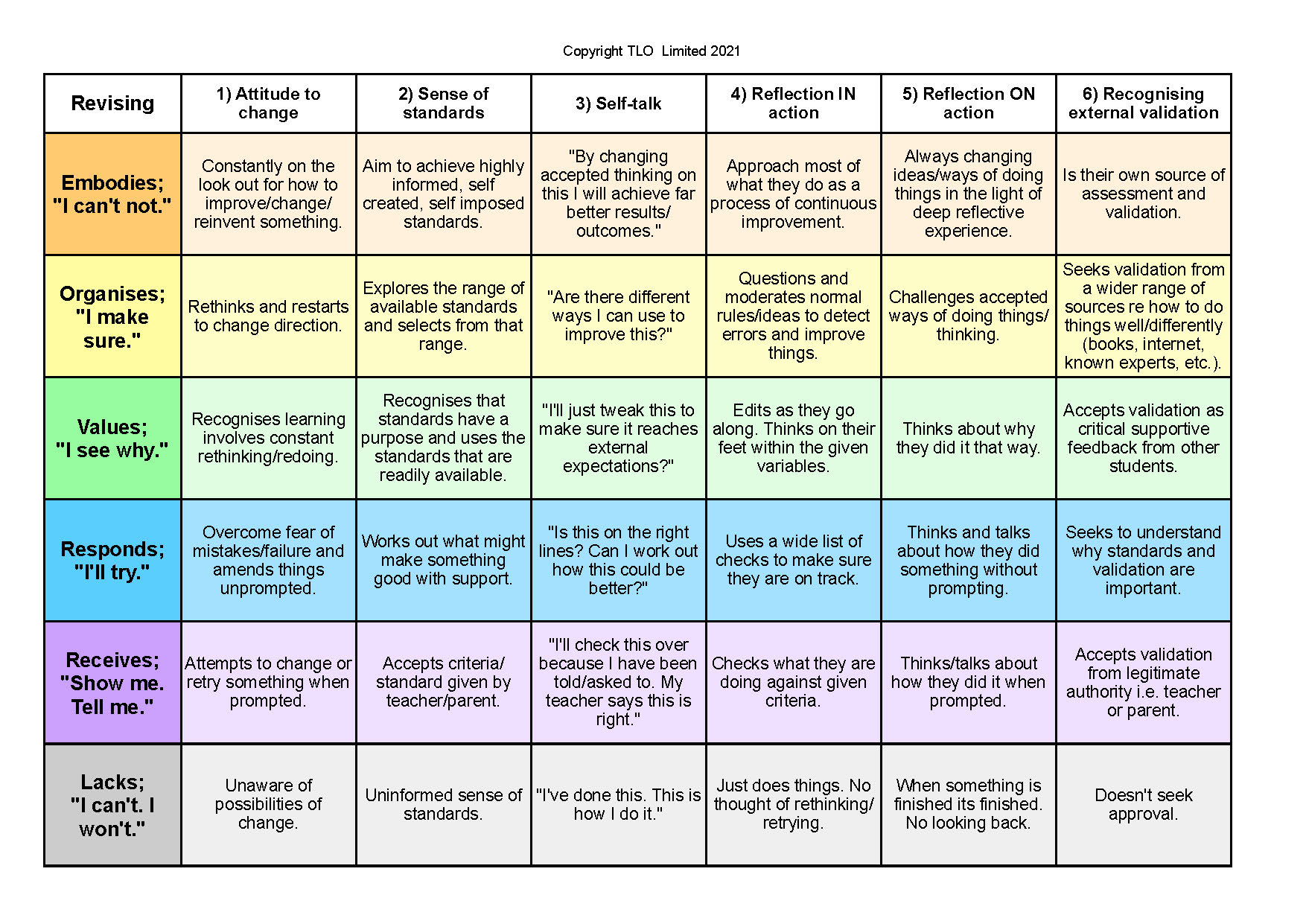
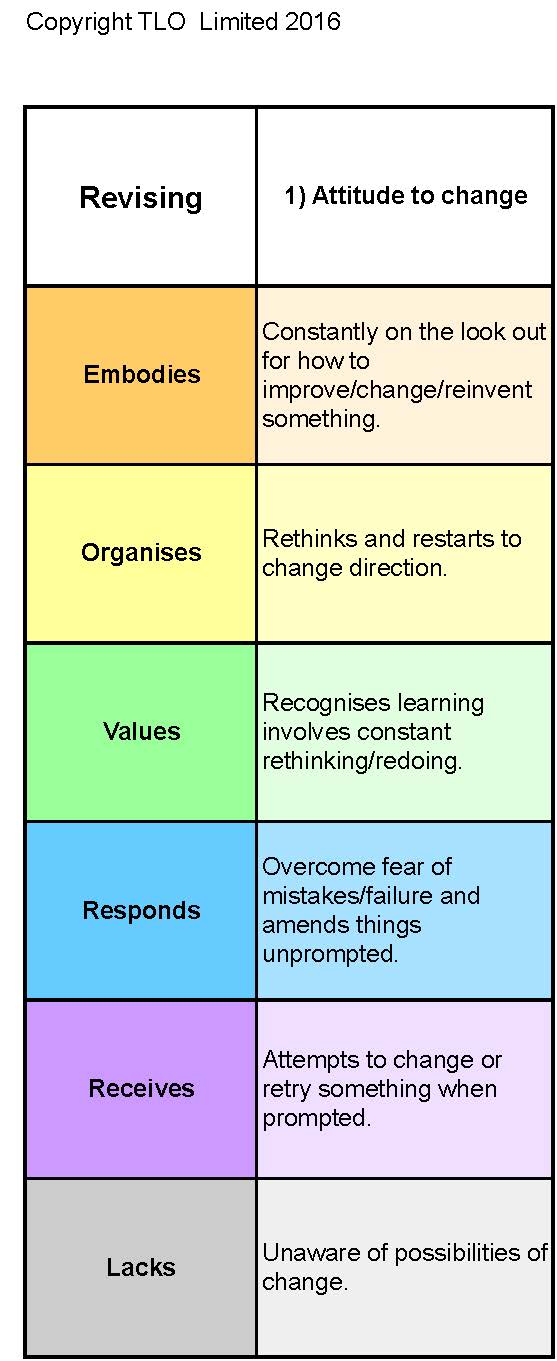
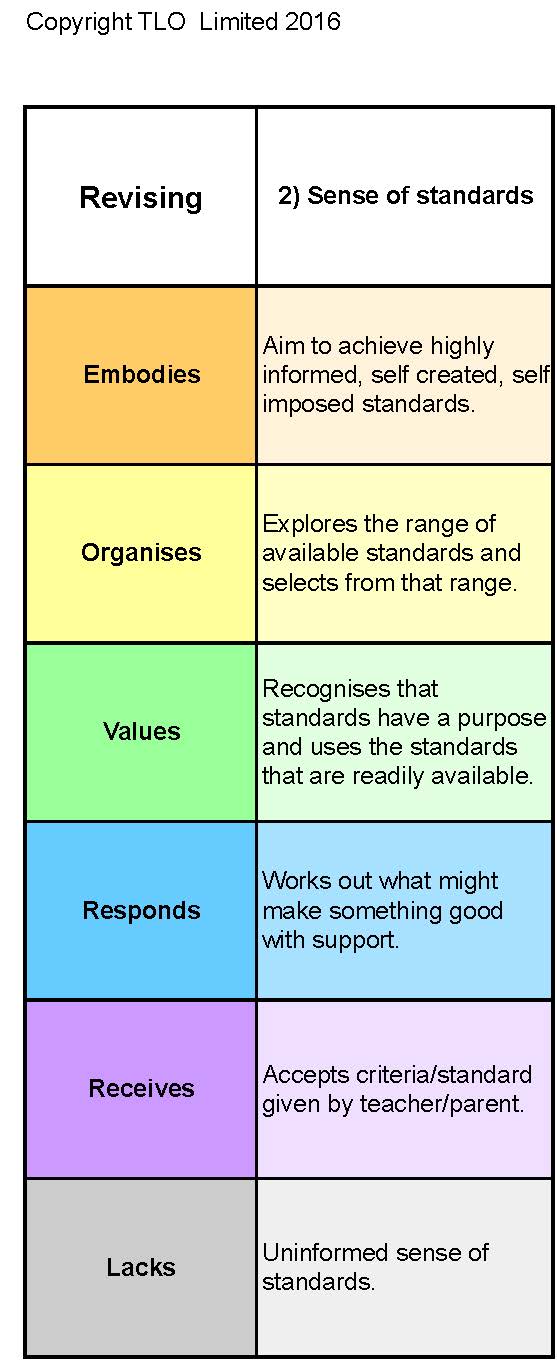
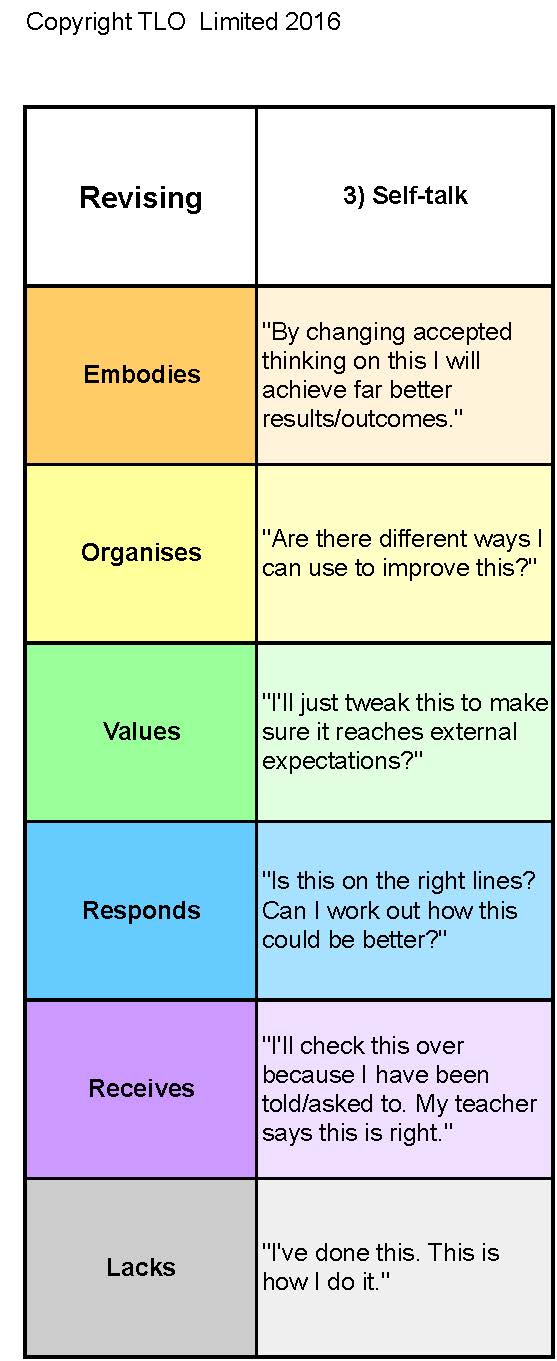
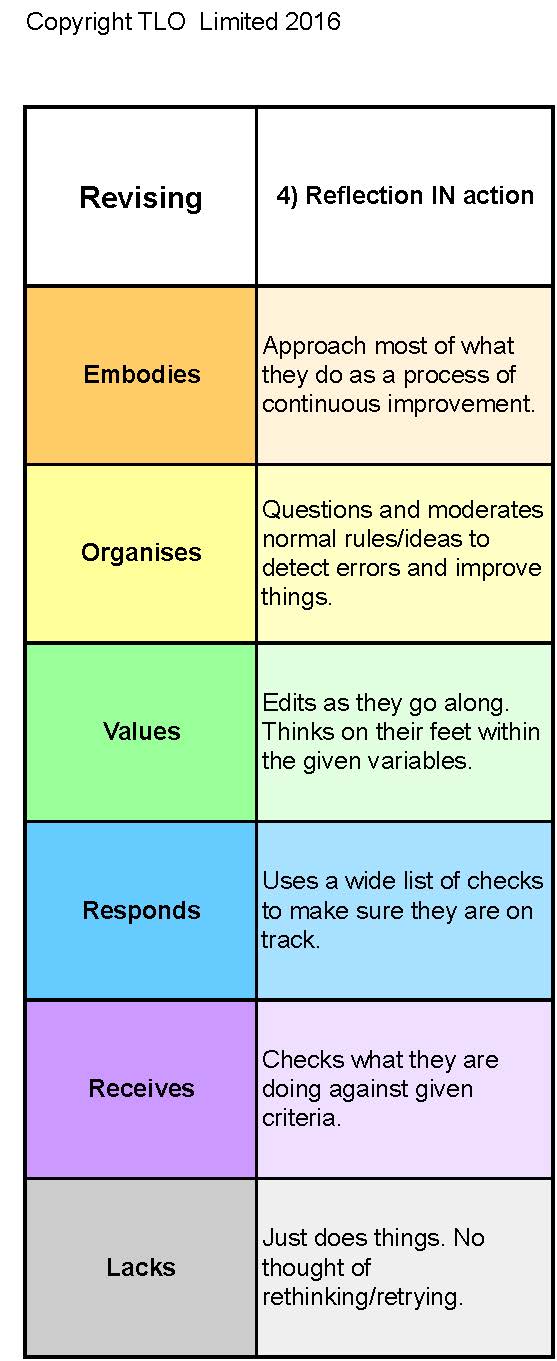
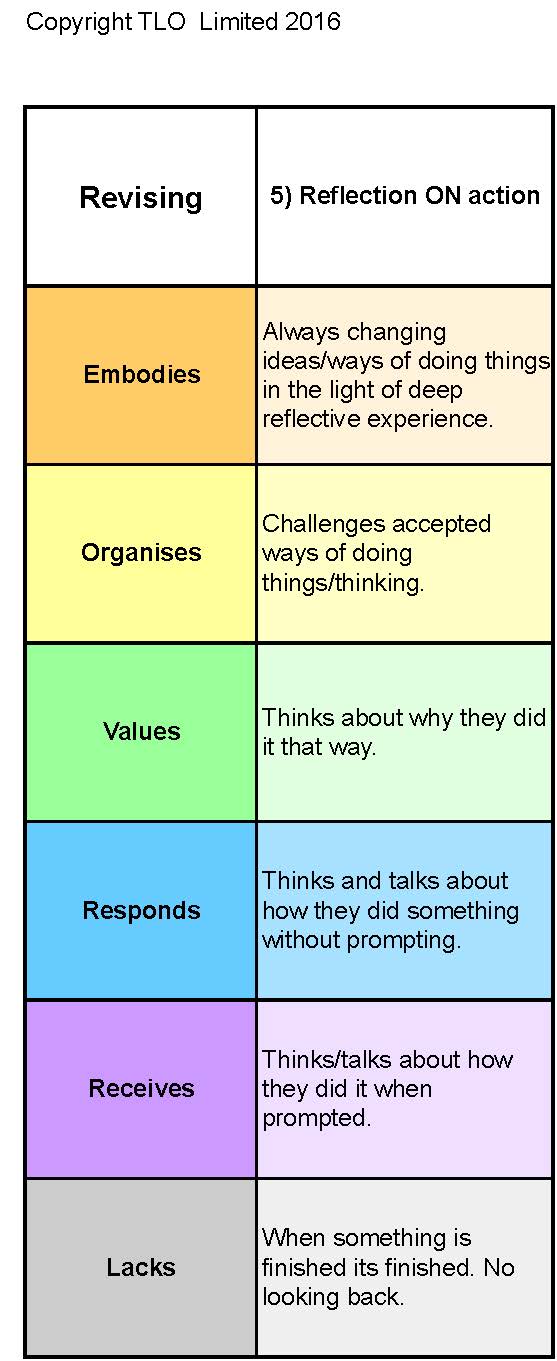
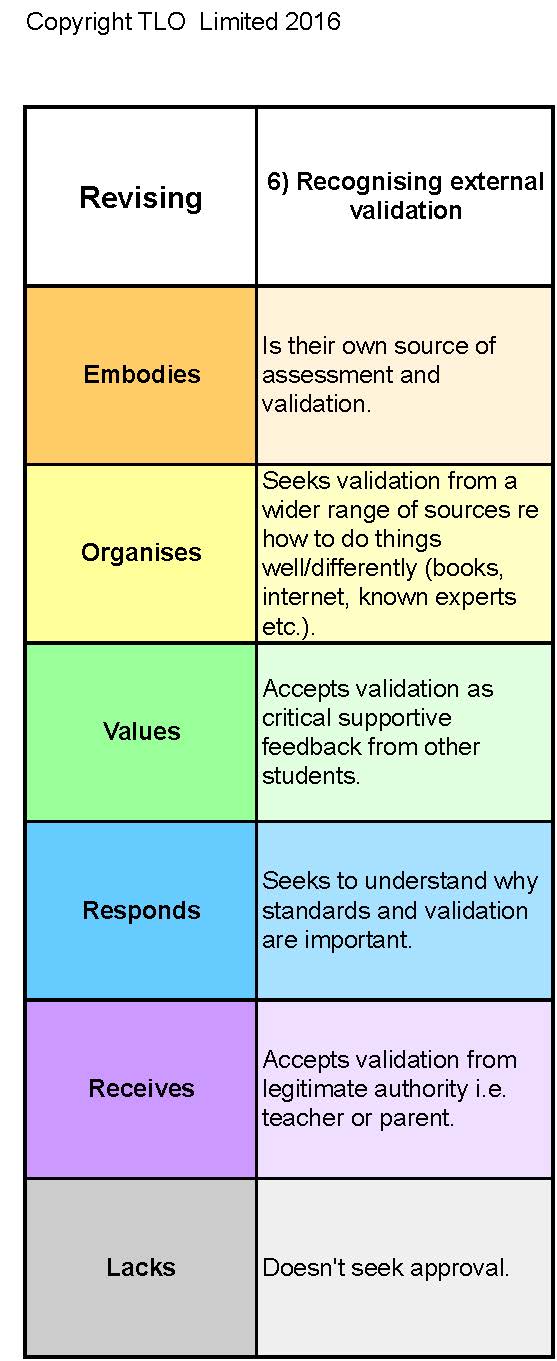









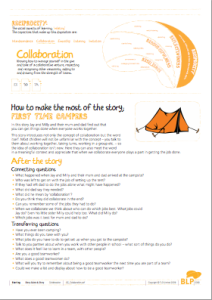
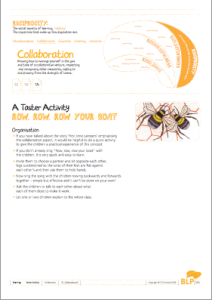


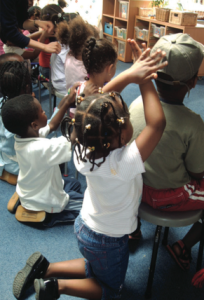

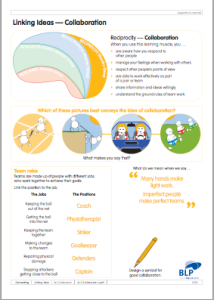
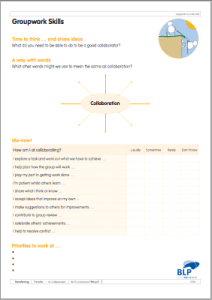
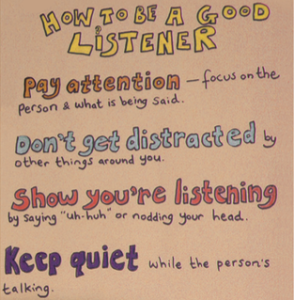
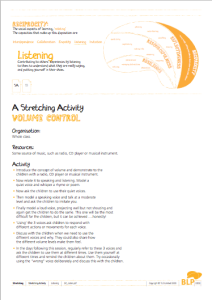

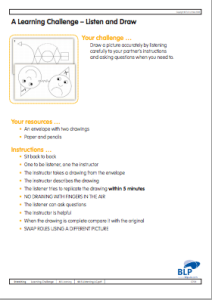
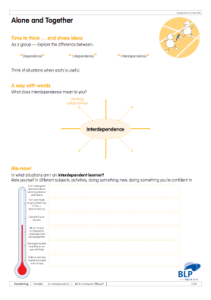
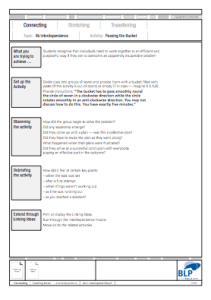
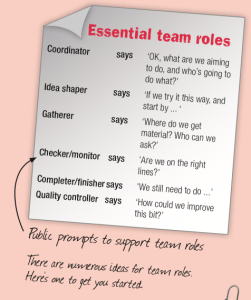
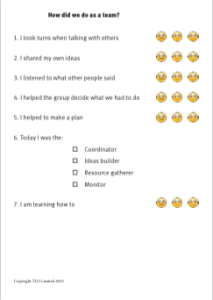
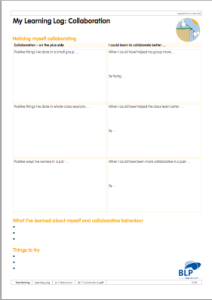
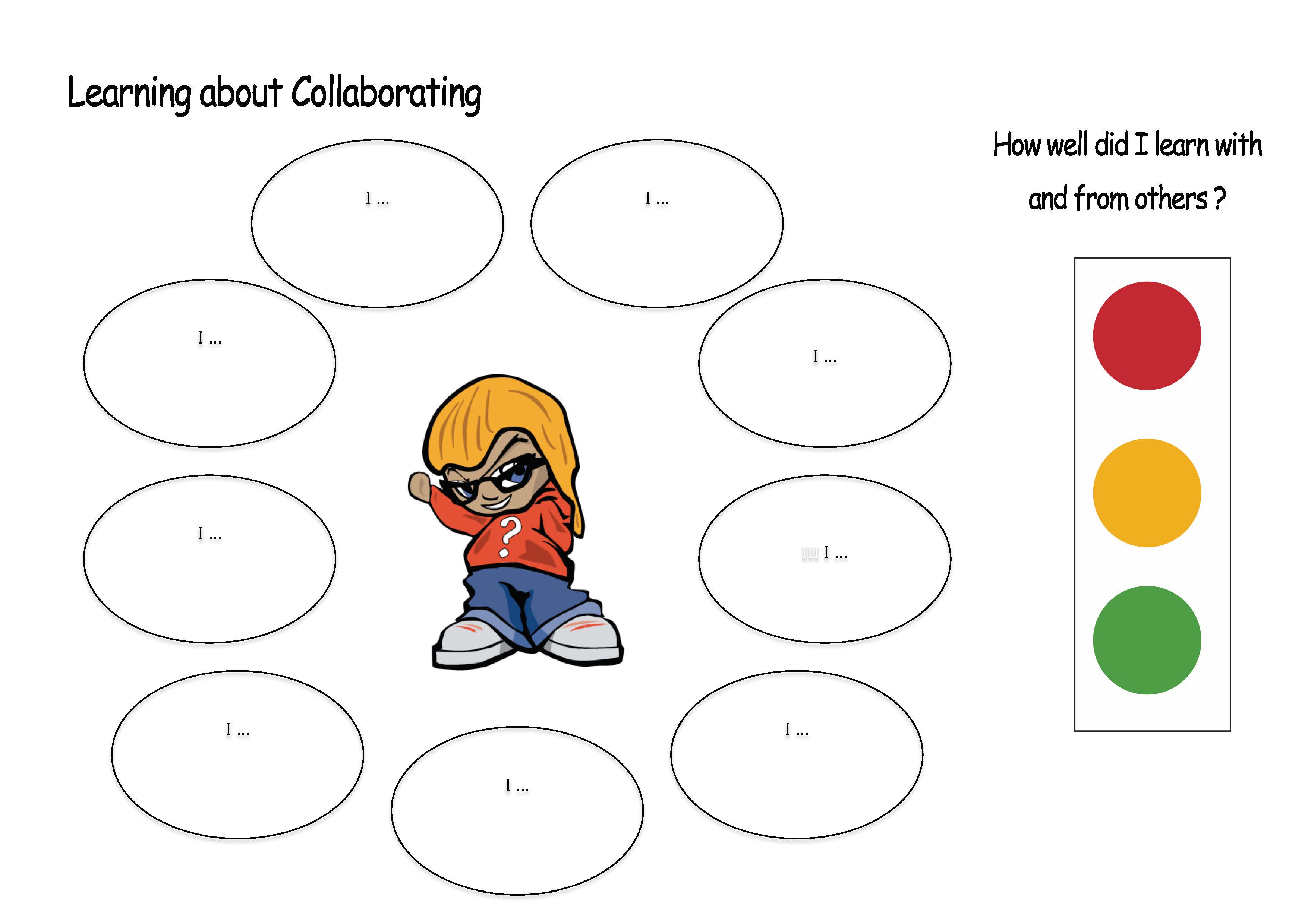




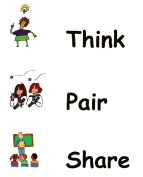





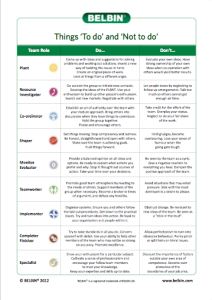



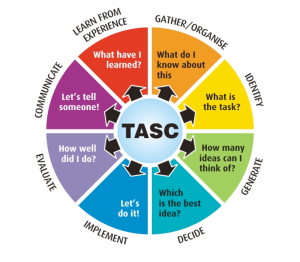


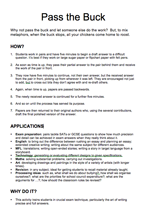
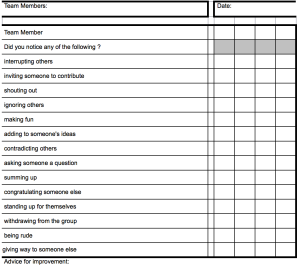
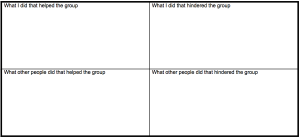

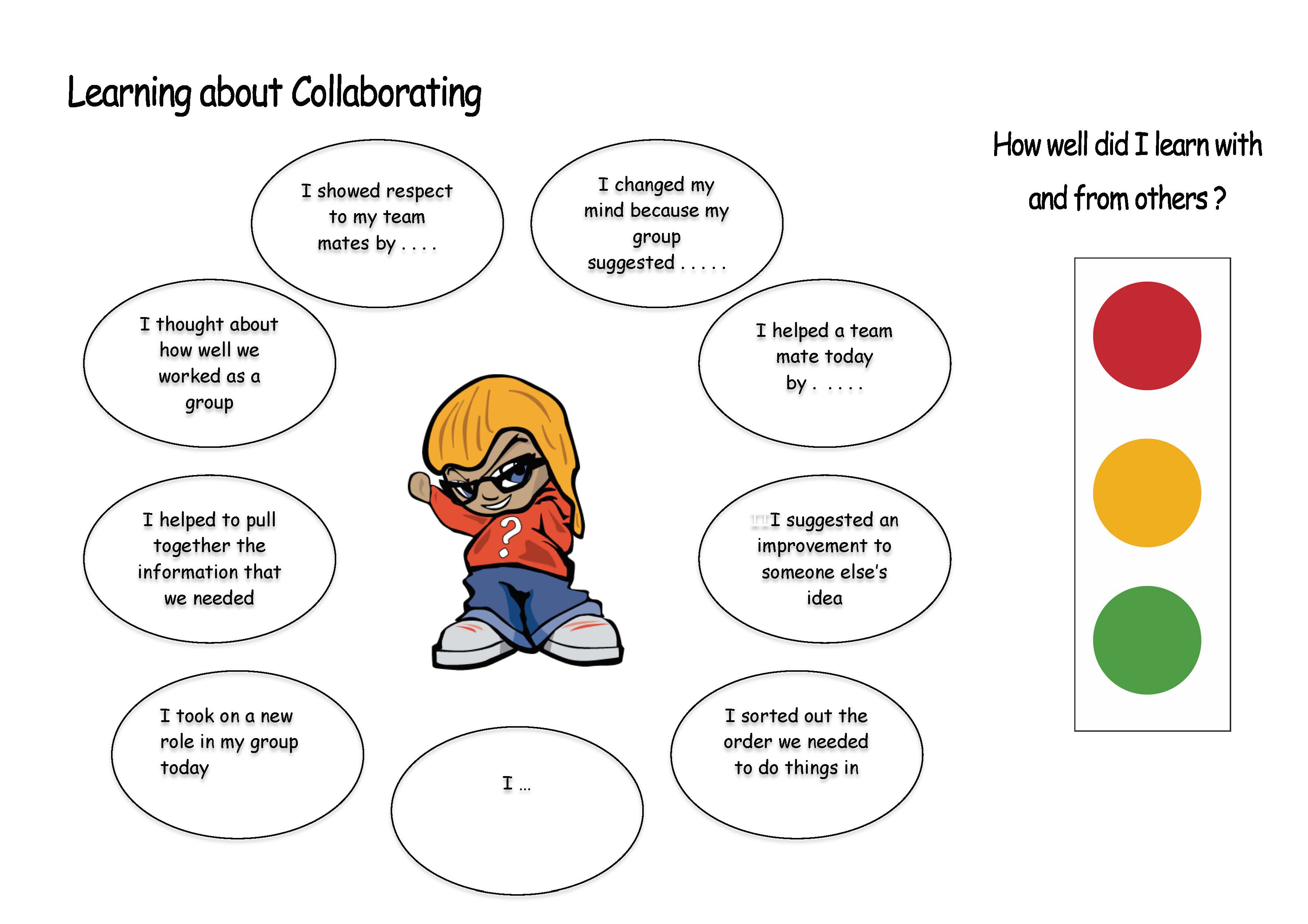


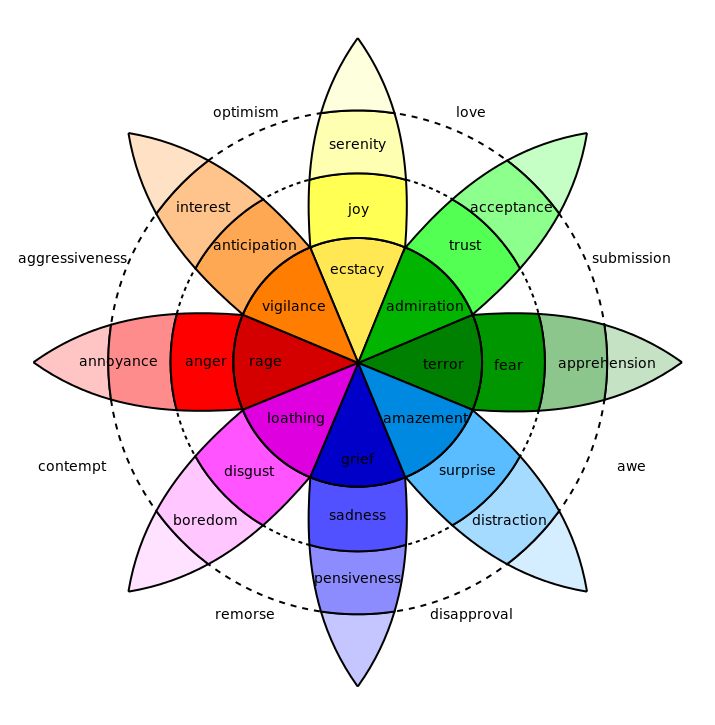
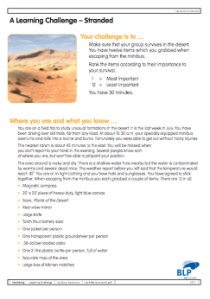






_1.jpg)