This unit explores how you might build the habit of Reasoning in your students.
Sections 1 – 4 look at;
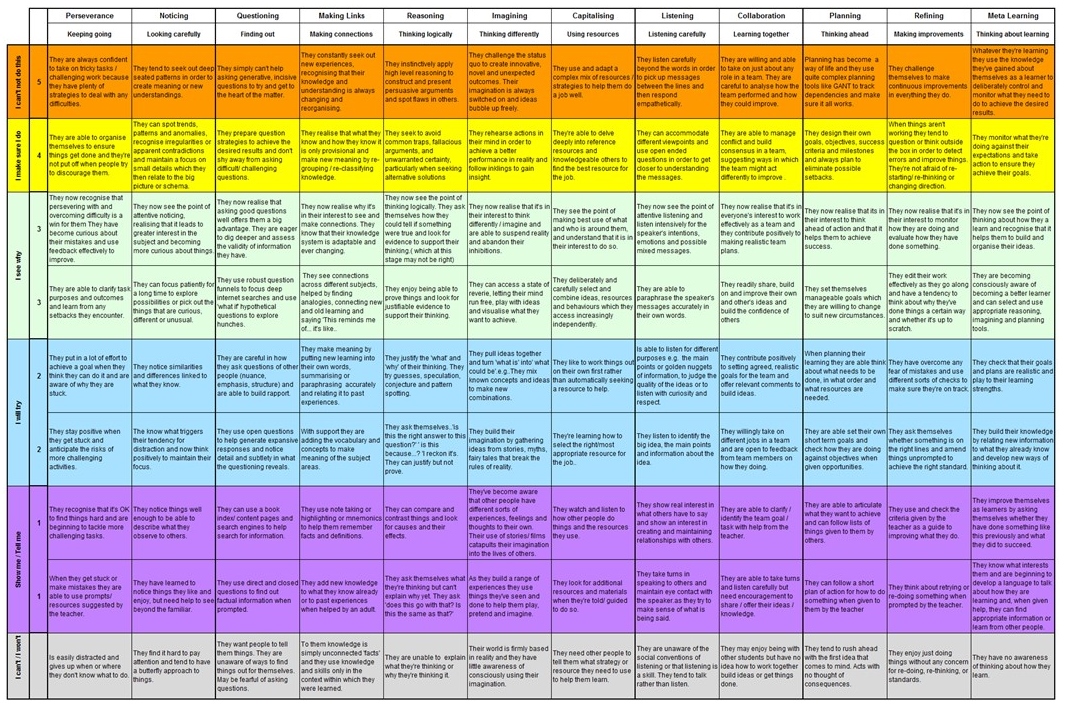
Reasoning and how it develops. The Reasoning Chart. Unpick the meaning of Reasoning, how it develops over time and use the Reasoning chart to plot where your students are now.
Taking Reasoning into classroom culture. Activities for Reasoning. Offers numerous suggestions to develop a Reasoning friendly culture and build students’ Reasoning skills.
Blending Reasoning with content.Dual Focused Lesson ideas. Suggests a series of questions and steps you might use to ensure the development of Reasoning claims its place in the curriculum and is designed into lesson/activities to aid understanding.
Team reflection and planning. Share the impact of your experiments with colleagues and plan what you need to do next.
The resource materials in the Learning Diary: Reasoning help you to distil important messages, home in on the key bits of information and design learning experiments specifically for you.
You will probably need to spend 50-75 mins on sections 1-3. Section 1 may take about 15 minutes to get your head round. Section 2 should take you about 20 minutes. Section 3 needs at least a 40 minutes of hard thinking. Section 4 is a linked Professional Learning Team session which will have been organised to take place sometime after this on-line session, and should take about 75 minutes.
This unit explores how you might build the habit of Planning in your students.
Sections 1 – 4 look at;
Planning and how it develops. Unpick the meaning of Planning, how it develops over time and use the Planning chart to plot where your students are now.
Taking Planning into classroom culture. Offers numerous suggestions to develop a questioning friendly culture and build students’ Planning skills.
Blending Planning with content. Suggests a series of questions and steps you might use to ensure the development of Planning claims its place in the curriculum and is designed into lesson/activities to aid understanding.
Team reflection and planning. Share the impact of your experiments with colleagues and plan what you need to do next.
The resource materials in the Learning Diary: Planning help you to distil important messages, home in on the key bits of information and design learning experiments specifically for you.
You will probably need to spend a bit over an hour on sections 1-3. Section 1 may take about 20 minutes to get your head round. Section 2 should take you about another 20 minutes to browse through. Section 3 needs at least a 30 minutes of hard thinking. Section 4 is a linked Professional Learning Team session which will have been organised to take place sometime after this on-line session, and should take about 75 minutes.
This unit explores how you might build the habit of Noticing in your students.
Sections 1 – 4 look at;
Noticing and how it develops. The Noticing Chart. Unpick the meaning of Noticing, how it develops over time and use the Noticing chart to plot where your students are now.
Taking Noticing into classroom culture. Activities for Noticing. Offers numerous suggestions to develop a Noticing friendly culture and build students’ Noticing skills.
Blending Noticing with content.Dual Focused Lesson ideas. Suggests a series of questions and steps you might use to ensure the development of Noticing claims its place in the curriculum and is designed into lesson/activities to aid understanding.
Team reflection and planning. Share the impact of your experiments with colleagues and plan what you need to do next.
The resource materials in the Learning Diary: Noticing help you to distil important messages, home in on the key bits of information and design learning experiments specifically for you.
You will probably need to spend about an hour on sections 1-3. Section 1 may take about 20 minutes to get your head round. Section 2 should take you about 20 minutes to browse. Section 3 needs at least 20 minutes hard thinking . Section 4 is a linked Professional Learning Team session which will have been organised to take place sometime after this on-line session, and should take about 75 minutes.
This unit explores how you might build the habit of Making Links in your students.
Sections 1 – 4 look at;
Making Links and how it develops. Unpick the meaning of Making Links, how it develops over time and use the Making Links chart to plot where your students are now.
Taking Making Links into classroom culture. Offers numerous suggestions to develop a questioning friendly culture and build students’ Making Links skills.
Blending Making Links with content. Suggests a series of questions and steps you might use to ensure the development of Making Links claims its place in the curriculum and is designed into lesson/activities to aid understanding.
Team reflection and planning. Share the impact of your experiments with colleagues and plan what you need to do next.
The resource materials in the Learning Diary: Making Links help you to distil important messages, home in on the key bits of information and design learning experiments specifically for you.
You will probably need to spend more than an hour on sections 1-3. Section 1 may take about 20 minutes to get your head round. Section 2 should take you about 20 minutes to browse through. Section 3 needs at least a 35 minutes hard thinking. Section 4 is a linked Professional Learning Team session which will have been organised to take place sometime after this on-line session, and should take about 75 minutes.
This unit explores how you might build the habit of Listening in your students.
Sections 1 – 4 look at;
Listening and how it develops. Unpick the meaning of Listening, how it develops over time and use the Listening chart to plot where your students are now.
Taking Listening into classroom culture. Offers numerous suggestions to develop a questioning friendly culture and build students’ Listening skills.
Blending Listening with content. Suggests a series of questions and steps you might use to ensure the development of Listening claims its place in the curriculum and is designed into lesson/activities to aid understanding.
Team reflection and planning. Share the impact of your experiments with colleagues and plan what you need to do next.
The resource materials in the Learning Diary: Listening help you to distil important messages, home in on the key bits of information and design learning experiments specifically for you.
You will probably need to spend more than an hour on sections 1-3. Section 1 may take about 20 minutes to get your head round. Section 2 should take you about 20 minutes to brows. Section 3 needs at least a 35 minutes hard thinking and head scratching. Section 4 is a linked Professional Learning Team session which will have been organised to take place sometime after this on-line session, and should take about 75 minutes.
This unit explores how you might build the habit of Imagining in your students.
Sections 1 – 4 look at;
Imagining and how it develops. The Imagining Chart. Unpick the meaning of Imagining, how it develops over time and use the Imagining chart to plot where your students are now.
Taking Imagining into classroom culture. Activities for Imagining. Offers numerous suggestions to develop an Imagining friendly culture and build students’ Imagining skills.
Blending Imagining with content.Dual Focused Lesson ideas. Suggests a series of questions and steps you might use to ensure the development of Imagining claims its place in the curriculum and is designed into lesson/activities to aid understanding.
Team reflection and planning. Share the impact of your experiments with colleagues and plan what you need to do next.
The resource materials in the Learning Diary: Imagining help you to distil important messages, home in on the key bits of information and design learning experiments specifically for you.
You will probably need to spend 75 mins on sections 1-3. Section 1 may take about 20 minutes to get your head round. Section 2 should take you about 20 minutes to browse. Section 3 needs at least a 30 minutes of hard thinking and head scratching. Section 4 is a linked Professional Learning Team session which will have been organised to take place sometime after this on-line session, and should take about 75 minutes.
This unit explores how you might build the habit of Collaboration in your students.
Sections 1 – 4 look at;
Collaboration and how it develops. The Collaboration Chart. Unpick the meaning of Collaboration, how it develops over time and use the Collaboration chart to plot where your students are now.
Taking Collaboration into classroom culture. Activities for Collaboration. Offers numerous suggestions to develop a Collaboration friendly culture and build students’ Collaboration skills.
Blending Collaboration with content. Dual Focused Lesson ideas. Suggests a series of questions and steps you might use to ensure the development of Collaboration claims its place in the curriculum and is designed into lesson/activities to aid understanding.
Team reflection and planning. Share the impact of your experiments with colleagues and plan what you need to do next.
The resource materials in the Learning Diary: Collaboration help you to distil important messages, home in on the key bits of information and design learning experiments specifically for you.
You will probably need to spend 45-50 mins on sections 1-3. Section 1 may take about 10 minutes to get your head round. Section 2 might take you about 20 minutes to browse. Section 3 needs at least 20 minutes of hard thinking . Section 4 is a linked Professional Learning Team session which will have been organised to take place sometime after this on-line session, and should take about 75 minutes.
This unit explores how you might build the habit of Meta Learning in your students.
Sections 1 – 4 look at;
Meta Learning and how it develops. The Meta Learning Chart. Unpick the meaning of Meta Learning, how it develops over time and use the Meta Learning chart to plot where your students are now.
Taking Meta Learning into classroom culture. Activities for Meta Learning. Offers numerous suggestions to develop a Meta Learning friendly culture and build students’ Meta Learning skills.
Blending Meta Learning with content.Dual Focused Lesson ideas. Suggests a series of questions and steps you might use to ensure the development of Meta Learning claims its place in the curriculum and is designed into lesson/activities to aid understanding.
Team reflection and planning. Share the impact of your experiments with colleagues and plan what you need to do next.
The resource materials in the Learning Diary: Meta Learning help you to distil important messages, home in on the key bits of information and design learning experiments specifically for you.
You will probably need to spend over an hour on sections 1-3. Section 1 may take about 20 minutes to get your head round. Section 2 should take you about 20 minutes to browse through Section 3 needs at least a half an hour hard thinking and head-scratching. Section 4 is a linked Professional Learning Team session which will have been organised to take place sometime after this on-line session, and should take about 75 minutes.
This unit explores how you might build the habit of Questioning in your students.
Sections 1 – 4 look at;
Questioning and how it develops. The Questioning Chart.Unpick the meaning of Questioning, how it develops over time and use the Questioning chart to plot where your students are now.
Taking Questioning into classroom culture. Questioning activities. Offers numerous suggestions to develop a questioning friendly culture and build students’ questioning skills.
Blending questioning with content.Example dual focused lesson. Suggests a series of questions and steps you might use to ensure the development of questioning claims its place in the curriculum and is designed into lesson/activities to aid understanding.
Team reflection and planning. Share the impact of your experiments with colleagues and plan what you need to do next.
The resource materials in the Learning Diary: Questioning help you to distil important messages, home in on the key bits of information and design learning experiments specifically for you.
You will probably need to spend about an hour on sections 1-3. Section 1 may take about 15 minutes to get your head round. Section 2 should take you about 20 minutes to browse through the suggested activities. Section 3 needs about 25 minutes of hard thinking and head scratching. Section 4 is a linked Professional Learning Team session which will have been organised to take place sometime after this on-line session, and should take about 75 minutes.
This unit explores how you might build the habit of Perseverance in your students.
Sections 1 – 4 look at;
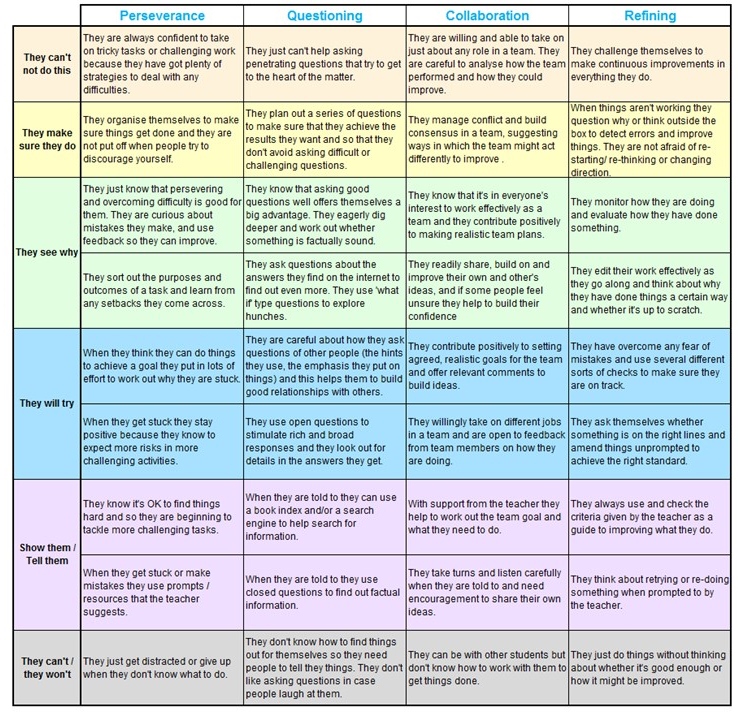
Perseverance and how it develops. Progression Chart Unpick the meaning of Perseverance, how it develops over time and use the Perseverance chart to plot where your students are now.
Taking Perseverance into classroom culture. Classroom Activities Offers numerous suggestions to develop a Perseverance friendly culture and build students’ Perseverance skills.
Blending Perseverance with content.Dual Focus lesson ideas Suggests a series of questions and steps you might use to ensure the development of Perseverance claims its place in the curriculum and is designed into lesson/activities to aid understanding.
Team reflection and planning. Share the impact of your experiments with colleagues and plan what you need to do next.
The resource materials in the Learning Diary: Perseverancehelp you to distil important messages, home in on the key bits of information and design learning experiments specifically for you.
You will probably need to spend more than an hour on sections 1-3. Section 1 may take about 20 minutes to get your head round. Section 2 should take you about 20 minutes to browse through. Section 3 needs at least a 35 minutes hard thinking. Section 4 is a linked Professional Learning Team session which will have been organised to take place sometime after this on-line session, and should take about 75 minutes.
The school you have recently joined is on an intriguing journey to develop their students’ learning power. What you are reading now is the first unit of an induction programme titled Coming on board that’s designed to help you understand and ease into the school’s learning power culture. The other eight modules of Coming on board are explained in brief after 7 glimpses of learning power below.
This unit aims to give you a quick overview of learning power by exploring seven questions that capture the essence of why, what and how.
What is learning power? Why do we need it? What are the essential ideas, values and practicalities of building students’ learning power?
7 Big Questions…
to explore the purpose and meaning of learning power before making a start on putting it into practice.
Developing students’ learning power involves engaging your students consciously with the ideas and processes of their own learning in the knowledge that learning itself is learnable.
Glimpse 1: Why do we need to bother developing students’ learning power?
The future…and learning
Building Learning Power—BLP for short—is an attempt to focus schools on preparing young people better for an uncertain future. Schools today need to be educating not just for exam results but for lifelong learning. To thrive in the twenty-first century, it’s not enough to leave school with a clutch of examination certificates. Students need to have learnt how to be tenacious and resourceful, imaginative and logical, self-disciplined and self-aware, collaborative and inquisitive as learners.
‘Students throughout the world need now to reach higher levels of achievement, not only to find fulfilling work but also to empower themselves to thrive in an increasingly complex world’ – Dylan Wiliam
Employment requires being able to enhance and transfer knowledge and to operate collaboratively
The capacity to learn and adapt needs to be lifelong because change is a permanent state, and the pace of change is moving much more rapidly
Learning habits have strong effects on educational attainment but have additional effects on important life outcomes beyond their effects on schooling.
The core purpose of education is to prepare young people for life after school; to get them ready, as Art Costa, an American educator with similar views, says, ‘not just for a life of tests, but for the tests of life’. This means helping them build up the mental, emotional, and social resources to enjoy challenge and cope well with uncertainty and complexity. If you strip away political dogma, the evidence is overwhelming that this aim is not currently being achieved for very many students. Of course, this has to be done in a way that also develops literacy and numeracy, and gets young people the best test results possible. That is the challenge that BLP schools and teachers are willing to take up.
Glimpse 2: What’s different about learning power?
We now think of learning…
… not as a performance but of being an interesting process going on in children’s brains. When we all believed that ‘intelligence’ was fixed at birth there seemed little point in trying to cultivate it. Now we know just how learnable learning is we are realising that there’s a place for developing how we learn. Research uncovered some dimensions or energies or powers that can be used to shape how we learn. They could shape, for example, the growth of our resilience in learning, our learning relationships, our thinking behaviours and how we manage our learning.
Underlying this approach is a recognition that learning how to learn involves more than skills, it involves students’ attitudes, values, interests and beliefs as well. It’s about helping students to help themselves to be disposed to persist, to question and be curious, to collaborate harmoniously and to be open to new ideas.
” I can’t think of anything more worth learning than learning to learn. It’s like having money in the bank at compound interest” David Perkins. Project Zero, Harvard University
Glimpse 3: Which learning behaviours are we seeking to establish?
The Supple Learning Mind
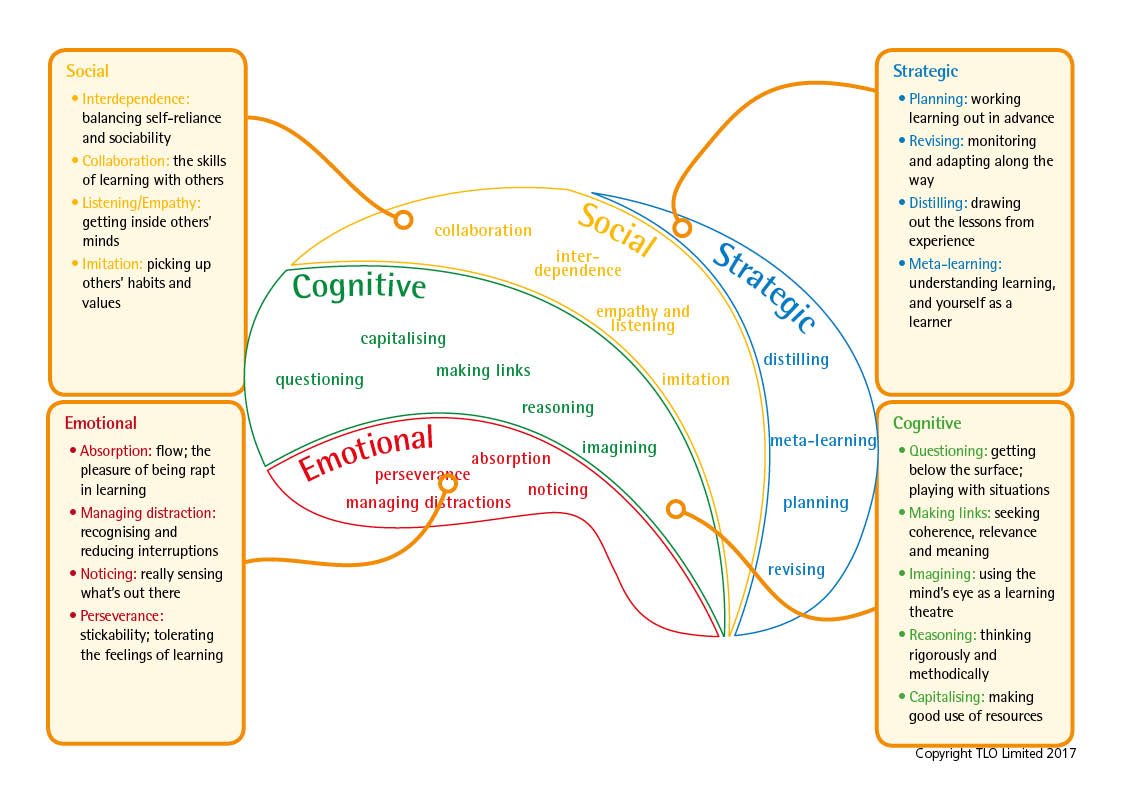
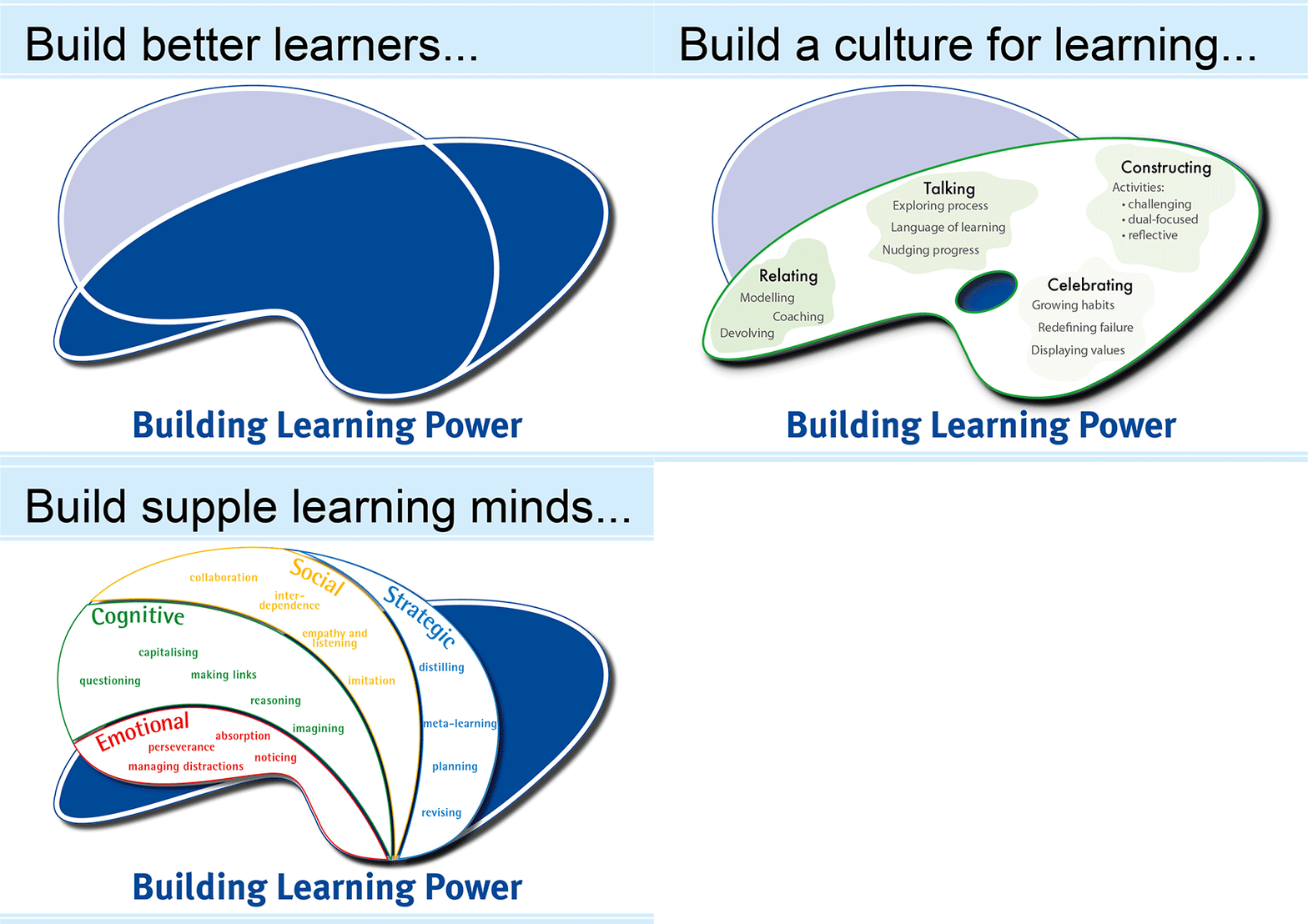
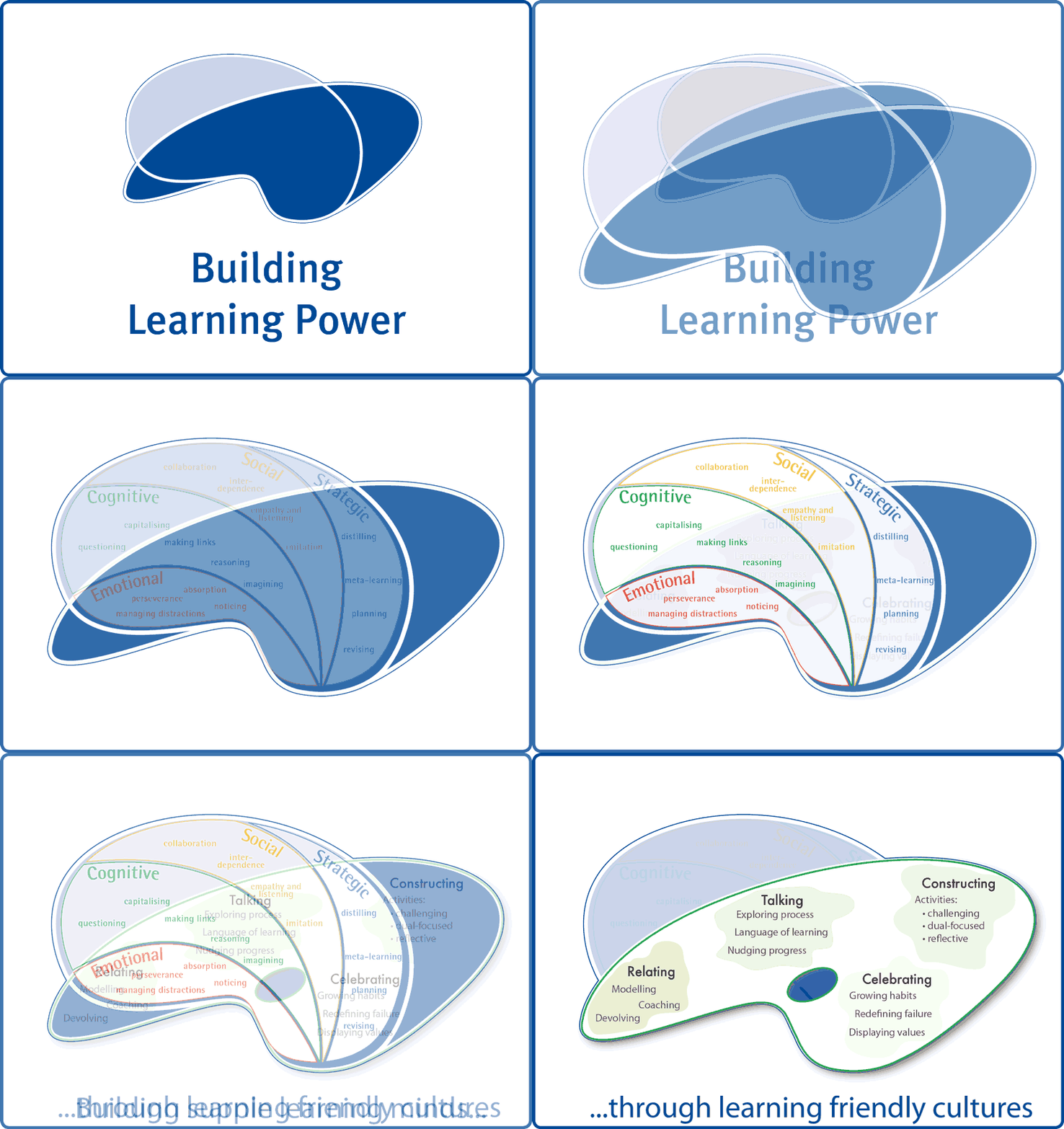
The Supple Learning Mind framework was conceived and researched by Professor Guy Claxton. It captures the key psychological characteristics that are judged to be of the highest value in helping students to learn and thrive in a complex world. The framework clusters these characteristics into four domains of learning:
The Emotional domain of learning (sometimes described as Resilience)
The Cognitive domain of learning (sometimes described as Resourcefulness)
The Social domain of learning (sometimes described as Reciprocity)
The Strategic domain of learning (sometimes described as Reflectiveness)
The supple learning mind, four domains of learning, seventeen learning characteristics
Model 1. The Supple Learning Mind framework of high value learning behaviours
A rich framework for learning
The Supple Learning Mind framework embraces each of the domains of learning and these are shown in its four parts:
The Emotional domain of learning (sometimes described as Resilience)
The Cognitive domain of learning (sometimes described as Resourcefulness)
The Social domain of learning (sometimes described as Reciprocity)
The Strategic domain of learning (sometimes described as Reflectiveness)
This learning framework shows that learning isn’t just about having a good memory; it includes how we feel, how we think, how we learn with others and how we manage the process of learning. It shows that learning is a complex process. Furthermore it provides a language that helps teachers to think about how they cultivate each of the learning behaviours and helps students to gain a better personalised understanding of how they learn content.
Each domain clusters together the high value learning behaviours that best make that domain work well. For example the social domain is made up of the learning behaviours of interdependence, collaboration, listening and empathy and imitation.
Glimpse 4: What small changes make a big difference?
Small changes: big difference
Teachers are influential habit formers. The way they orchestrate and guide learning influences the ways in which students perform and behave. So they need to be mindful of how they help students to form, replace, re-form and strengthen their learning habits. The approach encourages teachers to think about:
Things to give away: transferring responsibility for learning to students, offering them more control
Things to say: using language that helps pupils understand and talk about learning as a process, enabling them to take more control of their own learning
Things to do every day: the kind of classroom routines and activities that will nurture more independent learners
Things to display: the look and feel of a classroom, its walls and reward systems, that can serve to strengthen students’ learning.
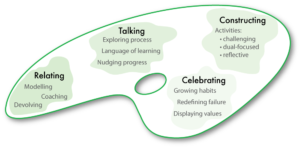
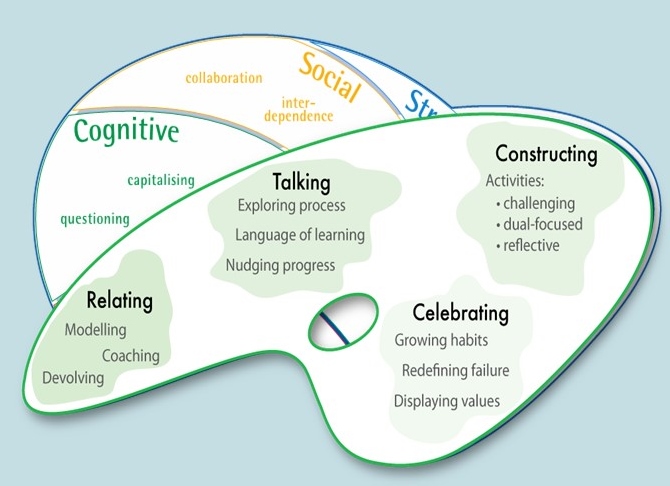
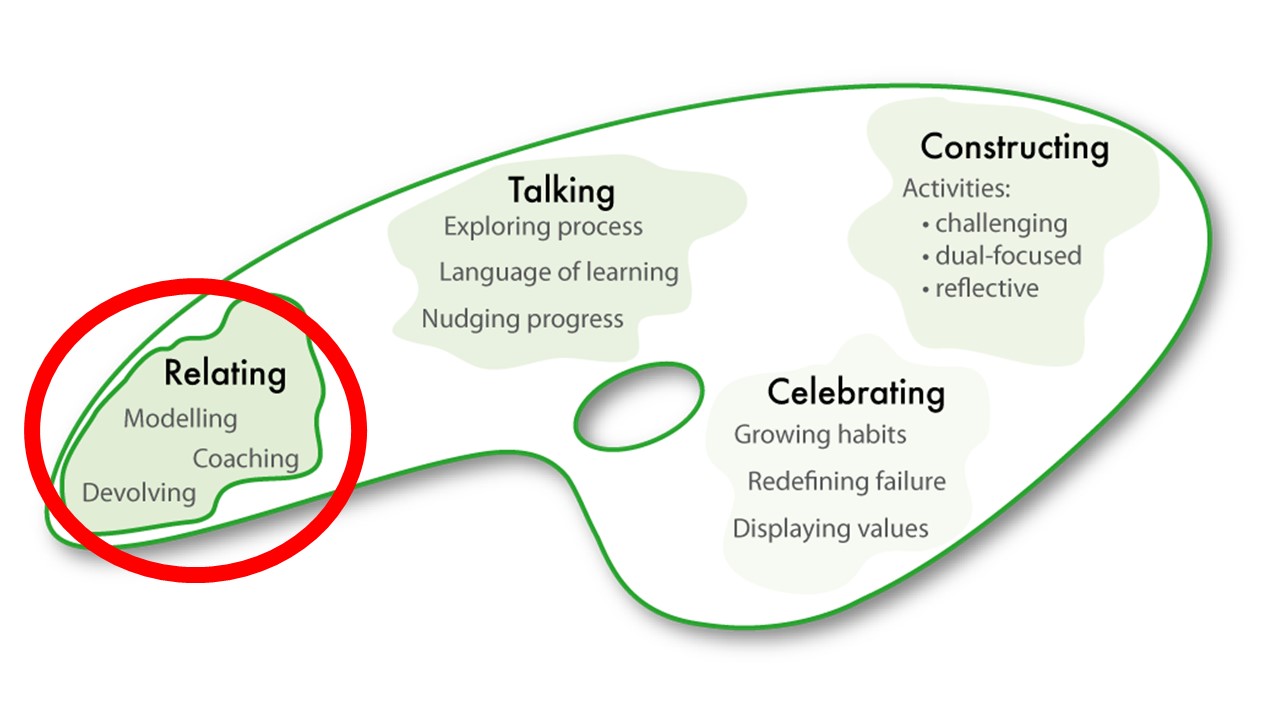
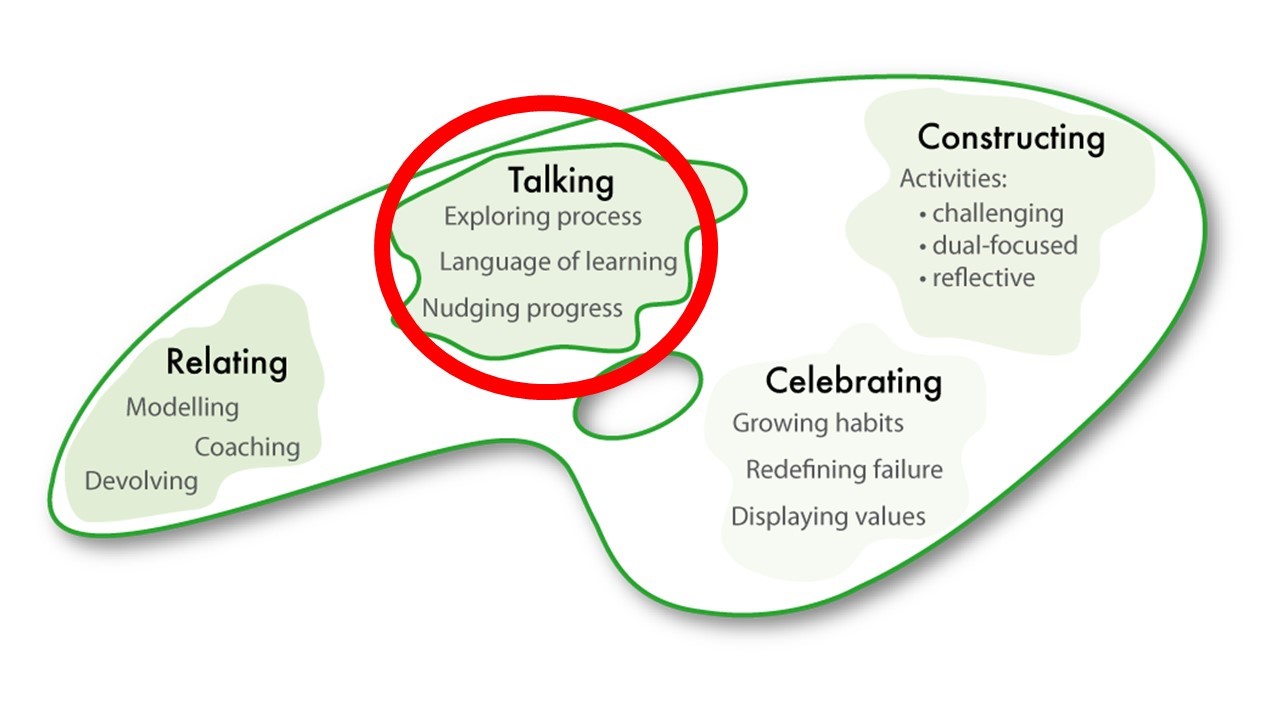
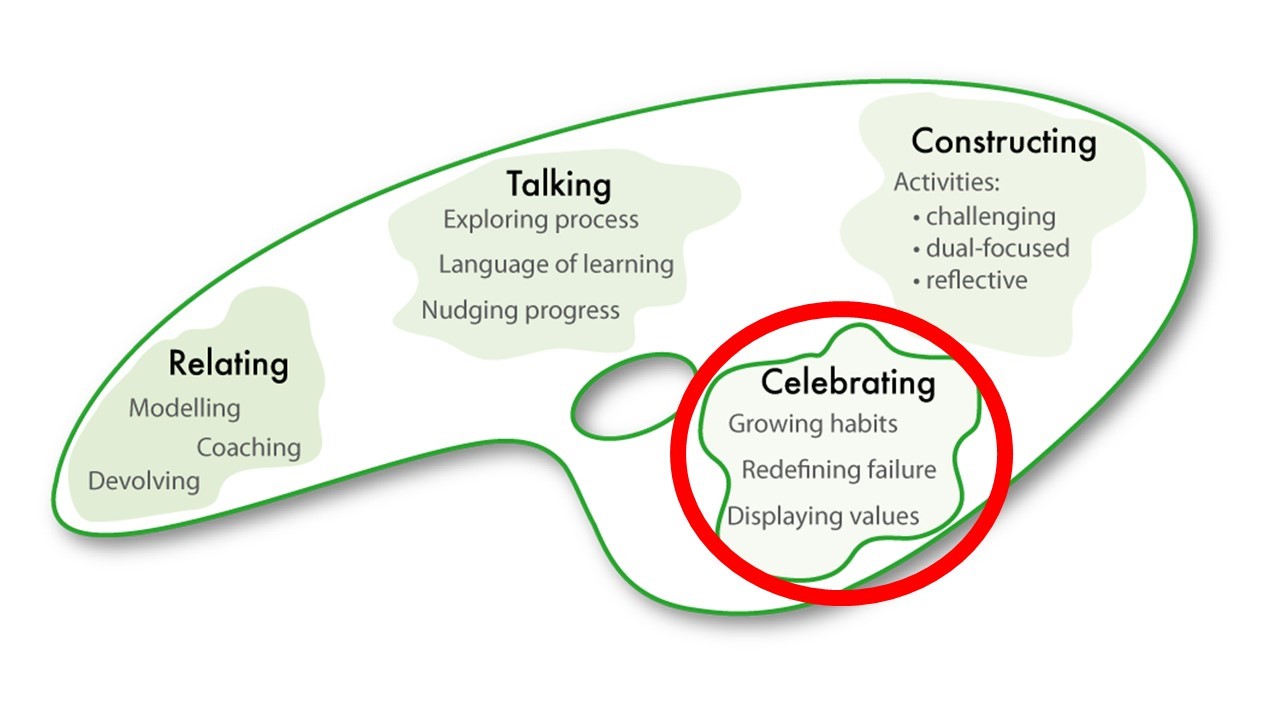
Model 2. The Teachers’ Palette. A Transforming Culture
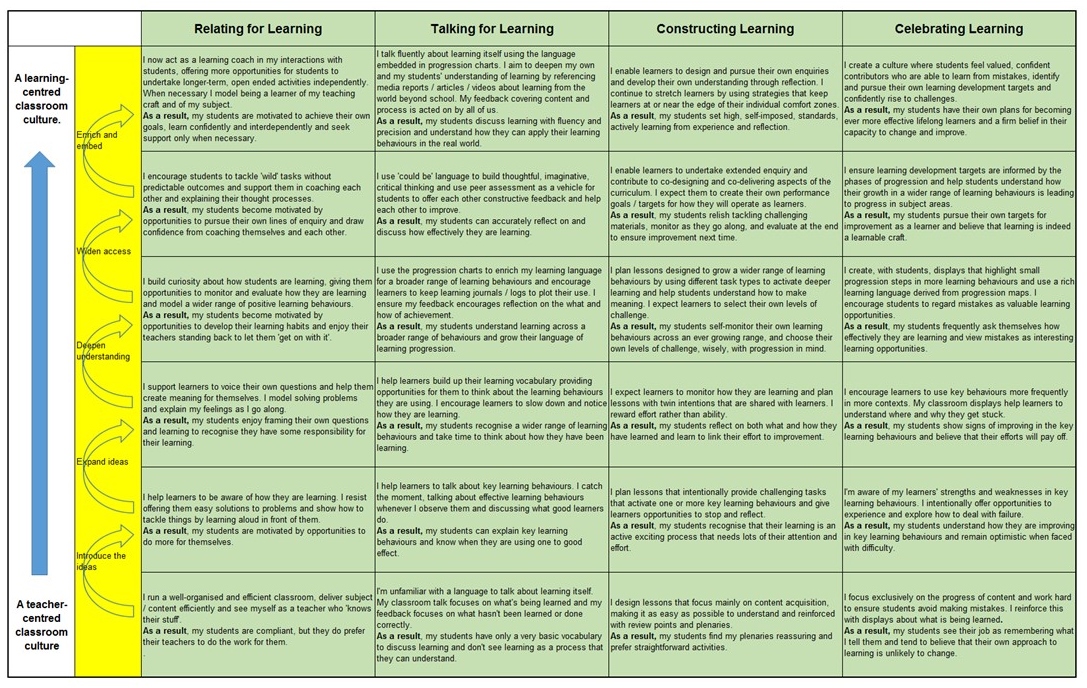
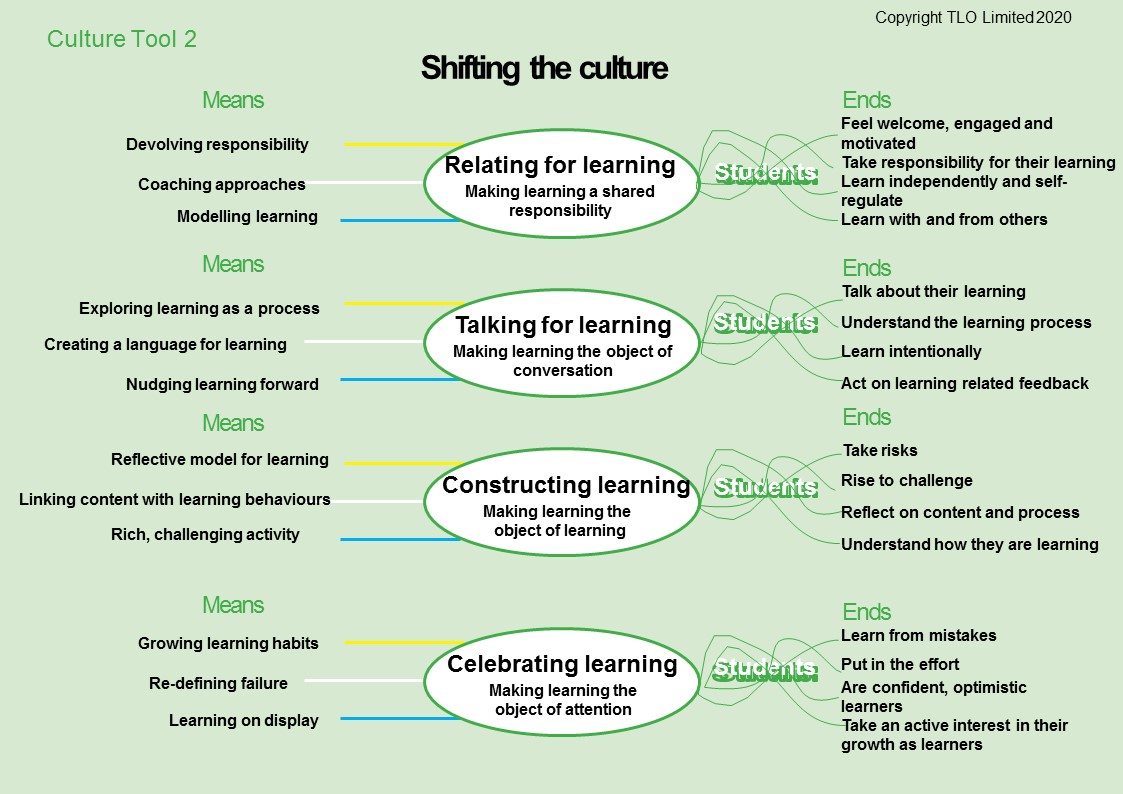
Making learning power work involves transforming the culture of the classroom. A common language for learning is adopted; staff shift responsibility for learning to students and model learning by sharing their own difficulties, frustrations and triumphs; students come to understand themselves as growing learners and consciously improve their learning habits; teachers assume the role of learning-power coach, offering students interesting, real and challenging activities to enable them to create their own knowledge and stretch their learning habits. Underpinning this is the obvious reality that students will only change their behaviours once their teachers have changed theirs’.
The culture of the classroom is determined by how teachers are, the relationships that exist between the teacher and the learners, the ways in which the teacher talks and what the teacher talks about, the extent to which teaching is designed to ensure both content acquisition and the development of learning behaviours, and the often subliminal messages about what the teacher really thinks is important.
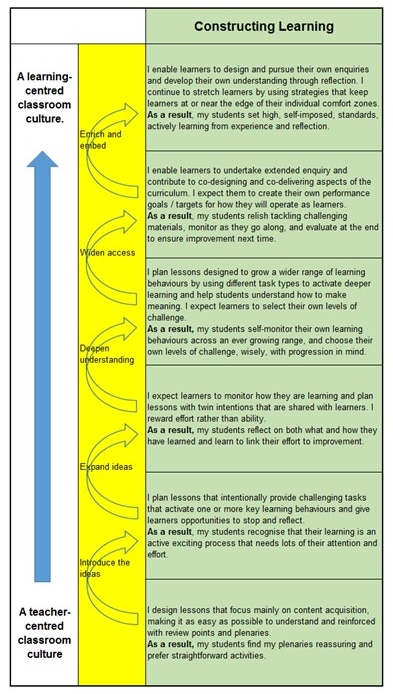
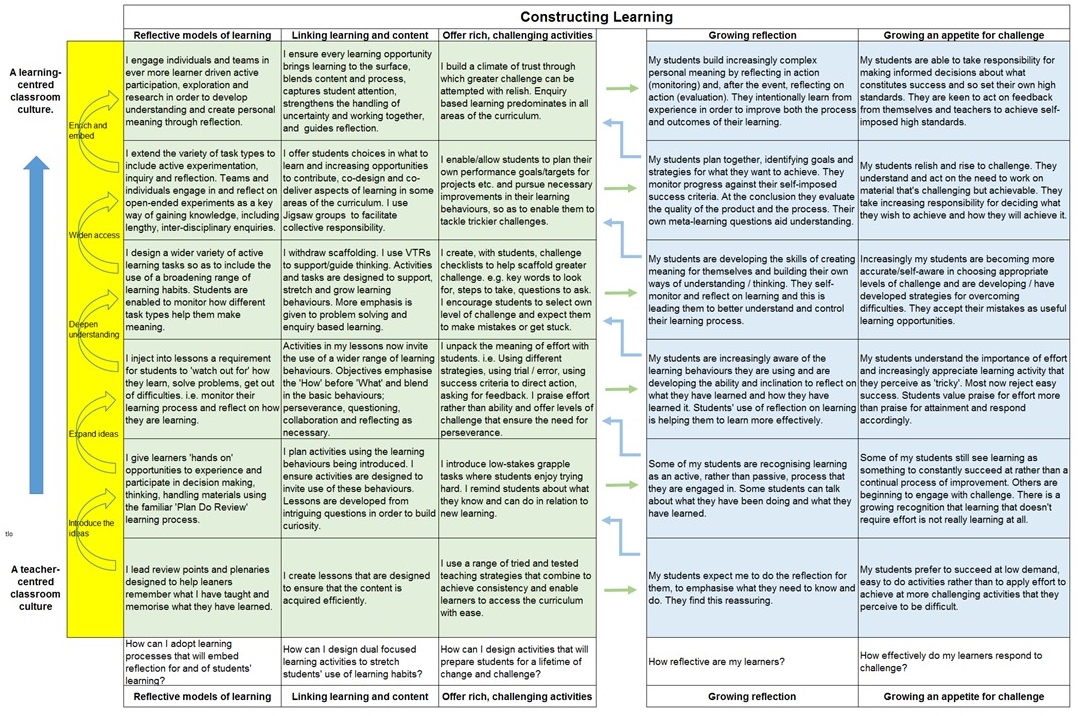
These 4 aspects of culture – Relating, Talking, Constructing and Celebrating – form the basis of The Teachers’ Palette, the second of two key models in Building Learning Power.
Glimpse 5: Are there any fast track tactics?
Understanding Visible Thinking Routines
VTRs are simple routines that apply across a wide range of subjects and contexts, and which require students to think in a variety of different ways. They are used so regularly by teachers that they become woven into the fabric of the classroom culture and progressively hard-wired into the thinking practices of students. They are ways in which different ways of thinking can become routine in classrooms. They become part of the learning culture.
To be effective such routines need to be;
Direct, guide, support, encourage thinking
Short, memorable with few steps
Used over and over again
Useful in a variety of contexts
Facilitate connections, generating ideas, using knowledge
Teacher talk
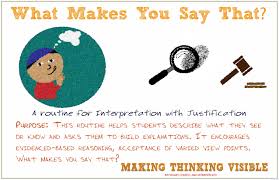
Why is that?
What evidence can you give to support that?
Do you have good reasons for…?
How do you mean?
Glimpse 6: What sort of language nudges learning habits?
Discussing and nudging the learning process
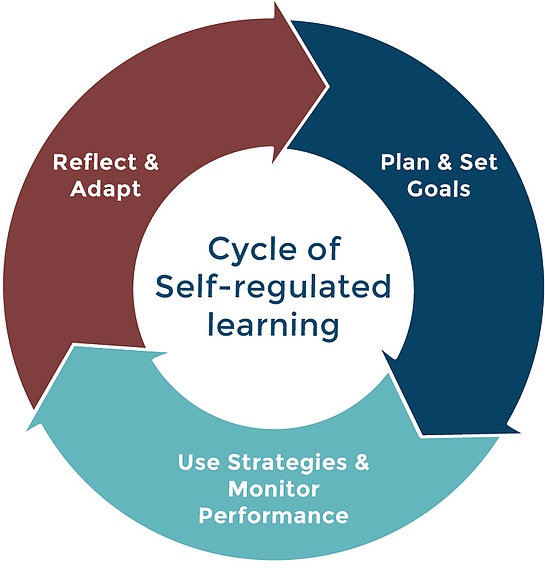
The questions opposite illustrate the kinds of things that teachers can encourage students to pay attention to. Instead of skipping quickly on to ‘the right answer’, students are asked to slow down and notice and appraise the strategies and steps they are using along the way. This helps them to become more reflective and thoughtful about their own learning. They are being encouraged to explore and compare different strategies for making progress. This helps them become more flexible and resourceful in the face of difficulty, and to get into the habit of looking for alternative ways of proceeding if their first tack turns out not to work. They are being encouraged to develop the habit of thinking for themselves about what helpful knowledge or strategies they might already possess that could help them out in this situation, and thus to become more independent and resourceful.This is meta-cognition and self-regulation in action.
Glimpse 7: What does progression in learning habits look like?
Building the powers to learn
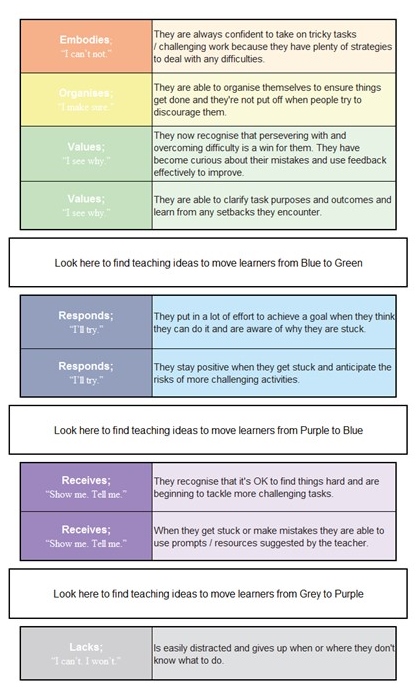
The whole point of building learning power is to do just that, to build the learning behaviours, not just name them. The diagram alongside – Learning: Poles Apart – offers an outline view of this journey. It’s about building students’ emotional learning habits, their cognitive/thinking habits, their social learning habits and their ability to manage their learning process itself.
The reluctant learner on the left and the learning powered learner on the right. It’s a long but exciting journey.
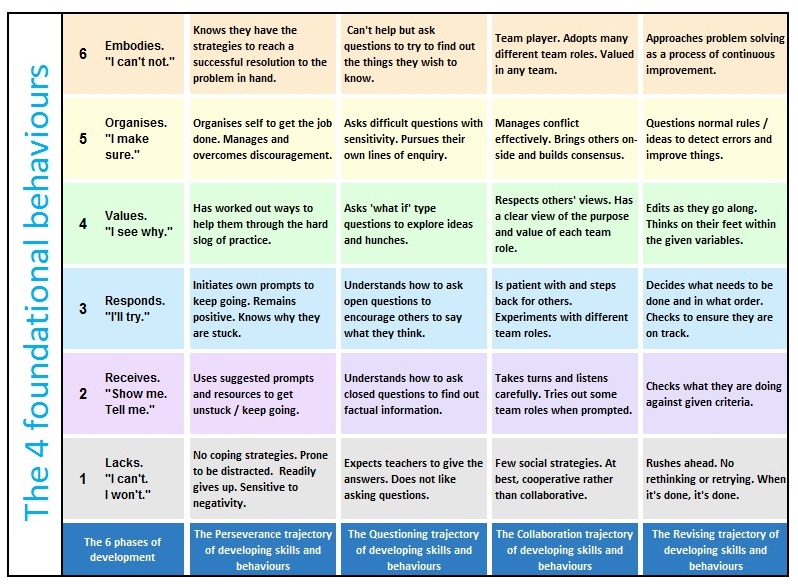
There are three key facets to the progression of learning behaviours – firstly the frequency/how often the behaviour is being used; secondly the range/scope of contexts in which it is used; and thirdly the skilfulness with which it is employed.
There are 8 further units in this Coming on board induction package.
You are free to give them a skim read if you wish, but your new school may well suggest that you take around a term to do them full justice – ie about a fortnight each to study, to reflect on, to discuss the contents, and to consider how you might introduce changes into your classroom.
There is no prescribed order of these units, but we would suggest that it might be best to begin with the culture units before moving on to the learning behaviour units.
See Glimpse #4 above:
There are four culture units, one for each aspect of the Teachers’ Palette, Relating, Talking, Constructing and Celebrating.
See Glimpse #3 above:
There are four learning behaviour units, one for each domain of the Supple Learning Mind, Emotional, Cognitive, Social and Strategic.
Helping your new teachers access and benefit from Coming on board
This short resource is the companion to Welcome to…Coming on board, a 7 section, self-study induction pack for teachers new to your school.
This resource offers you, as a senior leader, a description of the self-study pack for new teachers and some suggestions for ways to support and ease those teachers into the learning powered culture of your school.
As you will know, teachers often find it difficult to absorb the culture and practices of a school that’s new to them. This is as true for experienced teachers as it is for new entrants who are just starting out and it’s particularly so if the ‘new school’ has an approach to learning that may be somewhat different to what they are familiar.
The purpose of this introductory programme is to:
furnish teachers with a considered broad brush outline of the approach;
offer particular practical support to teachers new to a school during their first term;
but it is not a substitute for ‘Playing the Learning Power Game’ or ‘The Professional Learning Power Game‘;
indeed, we would recommend that once new teachers have experienced this short introductory programme, they should be enabled to join the professional learning teams who are exploring the full ‘Playing the Learning Power Game’ programmes.
1. What does the Coming on board pack contain?
The Coming on board resource pack has two bits and two functions:
an introductory resource for teachers new to any school that is working through, or has already completed aspects of a learning power programme. e.g. ‘Playing the LearningPower Game‘ and/or ‘The Professional Learning Power Game‘;
a supportive resource for senior leaders responsible for the induction of new teachers (i.e. what you are reading now).
For teachers:
1 online quick read unit titled ‘Coming on board, an introductory read’. This offers an overview of the key ideas about building better learners, supple learning minds and classroom cultures;
1 online unit called ‘Welcome to…Coming on board’, made up of 7 sections which provide a quick start on understanding the nature of learning power and the classroom culture that enables learning power to flourish.
For leaders responsible for induction (this unit):
advice on how the 7 sections might best be tackled;
training materials to help you to introduce ‘The Supple Learning Mind’ and ‘Learning-Friendly Classroom Cultures’ (should you wish to do so).
2. Start with some gentle ‘holiday reading’
Developing students’ learning power involves engaging your students consciously with the ideas and processes of their own learning in the knowledge that learning itself is learnable. It sounds enticing but how to do it is far from obvious. Hence it’s important to offer new staff a considered route to understanding the basics such as: What is learning power? Why we need it. What are the essential ideas, values and practicalities of building students’ learning power?
An online overview:
‘Coming on board, an introductory read‘ offers seven glimpses of learning power that capture the essence of why, what and how. Through 7 big questions teachers can explore the purpose and meaning of learning power before making a start on putting it into practice;
This might usefully be introduced as essential ‘holiday reading’ before the teacher joins your school at the start of a term.
This introductory unit offers:
an overview of the key ideas;
background research on dispositional learning;
the two interlinking frameworks that underpin building better learners;
examples of how the two frameworks work in practice.
It’s wise to ensure this is the first unit that new teachers engage with because it sets the scene for the substantial online unit titled ‘Welcome to… Coming on board’.
However if senior leaders would rather introduce these ideas themselves, there are materials in section 5d (below) to support you in doing so.
You could send the link to incoming teachers if you have been unable to set up their Learning Power account prior to them taking up post.
3. Coming on board. The self-study pack to support teachers new to the school.
The Coming on board resource is available to schools that have already begun working on Phase 1 ‘Playing the Learning Power Game’ and/or Phase 2 ‘The Professional Learning Game’ and want to provide specialised induction activities for teachers joining the school. The resource is designed as a self-study pack but with aspects that will help new teachers to join an established professional learning team after a couple of months.
Here’s a rundown of the sections
Section 1 What makes a difference in learning?…introduces and explores the meaning, purpose and attributes of learning power.
Section 2 Up close and personal with learning…invites teachers to look at themselves and a couple of students through the lens of learning behaviours.
Section 3 Finding learning characteristics…explains how a teacher, and the school, can gather evidence to profile students’ learning characters and use this as a basis for selecting appropriate activities. Material in this section should be completed in full after discussion with the school. See 4.3 below.
Section 4Shift classroom culture…explores how teachers’ classroom practice can encourage the growth of learning behaviours.
Section 5 Start with the basics…explains the first ‘must do’ aspects of learning activities that strengthen learning behaviours.
Section 6 A catalogue of ideas…offers a range of practical classroom solutions that are directly linked to phases of learning behaviours to blend into their teaching.
Section 7 What is the impact?…suggests how to assess the impact of their interventions on their classroom culture, students learning and their attainment. This material should be considered during induction but acted on at the end of the educational year.
4. The substantial 7 section unit, ‘Welcome to…Coming on board’.
While each section could easily take teachers a couple of weeks to read, digest and act on, some sections are more action packed than others. Hence we hope the unit will fit comfortably into half a term and prepare new teachers to join the school’s existing professional learning communities fairly quickly.
Section 1 – ‘What makes a difference in learning?’
Section 1 introduces the key ideas of learning power. It looks at The Supple Learning Mind, explores its origins and rationale.
The section takes a whistle stop tour through the what and why of learning power. It’s an approach to learning that looks at the building blocks of learning, what they are, the part they play and why they matter. The basic learning behaviour framework, known as the supple learning mind, itemises the high value learning behaviours most of which will be broken down in detail in section 2 to become learning journeys in their own right.
Section 2 – ‘Up close and personal with learning’.
Section 2 invites teachers to consider their own learning behaviours through the lens of learning power, and begins the process of thinking about the learning behaviours of students in their own class. Here for the first time the level of detail about learning behaviours is uncovered to enable teachers to:
discover and understand the learning behaviour features of students;
learn about the possible learning behaviour differences of students;
become familiar with students’ growth in learning power behaviours;
feel confident to introduce students to their own learning behaviours;
adapt their teaching so as to strengthen growth in learning behaviours;
monitor and evaluate their own practice and the subsequent growth in students’ learning behaviours.
Having got the idea by looking at themselves as a learner they are invited to look at just a couple of their students; a low and a high attaining student. This gives them a glimpse into what it is that makes the difference in how students approach and achieve in learning
The slimmed down learning power growth chart
Section 3 – ‘Finding learning characteristics’
Section 3 invites teachers to complete a learning profile for each member of their class and to reflect on what these profiles might be telling them about sub-groups of learners. This is one of the best ways for teachers to really understand learning power in their students.
Although this section, on the preparation of learning profiles for the class or group, logically fits here in the sequence of topics, the timing might not coincide with the school’s collection of this data. Senior leaders will need to inform new staff when the school intends to schedule the collection of students’ learning profiles. New staff might use this section to best advantage by looking at it carefully in the induction period, but complete all the student profiles when they are required to by the school.
Student profiles
Section 4 – ‘Shifting your classroom culture’
If we want students to become better learners we first need to offer them more opportunities to use and cultivate their learning powers. This obvious truth often involves shifting the culture of the classroom so that it systematically cultivates the positive learning habits and attitudes of young people. ‘Culture’ is about all the little habits, routines and practices that implicitly convey ‘what we believe and value round here’; where, hour by hour, day by day, term by term students experience the values and practices that are embodied in the school.
Section 4 introduces the idea of classroom culture and how it can help, or hinder, learning power. It looks at the 4 aspects of classroom culture – Relating, Talking, Constructing and Celebrating – and introduces the ideas around teacher’s progression in making classroom culture happen.
Section 5 – ‘Starting with the basics’
Fostering students’ learning dispositions is a wide ranging and multifarious business. However, there are a few straightforward things teachers can do to start engaging their students in developing their learning dispositions.
Section 5 identifies 11 basic strategies or ‘quick wins’ that can underpin classrooms where learning power can flourish. It invites teachers to consider changing their practice to incorporate one or more of these quick-start basics. Its premise is that small changes in teaching practice can create big changes in learners.
While all the suggestions are fairly standard your school may already have particular ways of interpreting them. We have suggested it would be wise to check which of the 11 ideas are common features of classrooms and whether the school has some common formats that they should follow (e.g. Learning mats no 11). They will also need to know which learning behaviours students are already familiar with as they’ve already been introduced throughout the school.
Section 6 – A catalogue of ideas: Decide where to start.
Section 6 is a substantial section and is obviously worthy of several weeks of study. The catalogue offers teaching ideas in the 12 learning behaviours, organised by phase of learner development. It invites teachers to look at the learner profiles created in Section 3, to seek and implement teaching ideas relating to a chosen learning behaviour at an appropriate level for their learners.
While it is not expected that teachers will access ideas for all 12 learning behaviours, they should be encouraged to explore beyond one behaviour. Maybe it would be an idea to challenge them to look at one from each of the 4 domains of learning – Emotional, Cognitive, Social, Strategic.
Section 7 – ‘What is the impact?’
Section 7 is a nod to the future. There is no expectation that the small-scale changes made during the hurly burly of the first term in a new school will have resulted in measurable changes in such a short period of time. It illustrates the direction of travel and could be returned to at the end of teachers’ first year of engagement.
However, it would be good to end with a less formal opportunity to review the impact of the first 6 sections of the unit. Why not conclude the term using the visible thinking routine ‘Connect, Extend, Challenge’?
Invite your new teachers to discuss 3 questions:
How are the online materials connected to what they already knew?
How have the online materials extended their thinking?
What challenges do they now face, what questions are they asking themselves?
5. Issues to be considered by leaders
As mentioned at the outset, teachers often find it difficult to absorb the culture and practices of a school that’s new to them. This is particularly so if the ‘new school’ has an approach to learning that may be somewhat different to what they are familiar. The purpose of the introductory programme is to support teachers new to a school during their first term. However, it is not a substitute for ‘Playing the Learning Power Game’ or ‘The Professional Learning Power Game‘ and we recommend that once new teachers have experienced this short introductory programme, they should be enabled to join the professional learning teams who are exploring the full ‘Playing the Learning Power Game’ programmes.
5a. Supporting the introductory programme
Things to think about:
how and when might you find time to support new colleagues to work through these materials;
whether you need to have the occasional twilight meeting with new staff?
whether you need, say, an ‘induction afternoon’ to kick start the process?
whether it might be a good idea to support new colleagues to form their own new Professional Learning Community (if numbers allow);
and/or whether each new colleague should be assigned an experienced mentor / coach to guide them through translating these materials into practice.
5b. Ongoing support for new teachers . . .
Two aspects to think about:
How you will support them during the first half term (6/7 weeks) using these materials;
How you will support them thereafter.
Active support. Think about. . .
Establishing a cycle of read / act / reflect so that the 7 sections can be covered appropriately.
Build in meetings to share ideas and reflect on the key messages to:
explore how teachers found the materials and
critically, how they intend to alter their practice;
explore teachers’ experiences of and thoughts about the changes they have made.
Decide who will lead these review meetings, when they will be held etc.
After they have made a solid start…
you won’t want them to continue working at this overview level indefinitely
offer them access to either
the full Phase 1 ‘Playing the Learning Power Game’ materials to help them expand their teaching repertoire or
to Phase 2 ‘The Professional Learning Power Game‘ if the school has got that far
enable them to move from being ‘a new teacher’ to working with the appropriate Professional Learning Team.
To do this:
contact TLO and ask for new teachers to be given access to either Phase 1 or Phase 2 materials, whichever the school is currently working with.
0117 937 8080
[note – deleting ex members of staff and inserting new ones is done at no cost to the school].
5d. Support materials for leaders
The Coming on board online unit forms a self-study pack for teachers new to the school. However if senior leaders would prefer to take a more hands-on approach and launch the key ideas themselves, we have gathered some materials and slide presentations you may find useful. There is nothing here that you have not already met during your own engagement with ‘Playing the Learning Power Game‘, but they are clustered here for convenience.
Introducing classroom culture
Downloads to the right:
A powerpoint presentation about classroom cultures – download it and edit it to create your own introductory session;
Guidance notes will support your delivery;
A resource book for teachers to accompany the ppt.
This unit is somewhat different in that you may find it useful to undertake sections of it at several points during Phase 2 of the programme. Since Phase 2 The Professional Learning Power Game is likely to take a school at least two years to work through, Reviewing our Progress would offer teams and individual teachers a good steer for navigating the second year. The unit is designed to help you review your progress in both:
developing a learning culture in your classrooms and
the impact this has had on your students’ learning dispositions.
Here you’ll find review tools to help you look at changes in your learning culture, as well as tools that will show whether and how your students have grown in confidence and competence as learners.
Unit sections
Section 1 Reviewing classroom culture
1a A basic review tool
Section 1 looks back to the review tool that you may have used in Phase 1 ‘Playing the Learning Power Game’ and invites you to compare your classroom culture now with how it was when you were setting out on the programme. This section encourages you to reflect on your changing practice and to address the questions “How far have I come?” and “How have the changes in classroom culture impacted on student learning dispositions?”
Schools that worked through a pre-2022 edition of ‘Playing the Learning Power Game’ will not have seen this review tool and are advised to use it by at least the mid point of Phase 2
1b. A deep review tool
Section 1b introduces more detailed trajectories for the development of classrooms as you move from teacher focused to learning friendly, and likewise more detailed trajectories for how students’ learning dispositions may respond. Section 1b invites you to assess your current classroom culture and student learning dispositions against these trajectories and to reflect on both what you have already achieved and consider what you might need to do next.
These trajectories are new. That is to say they have not appeared in any previous units. We suggest you use them towards the end of Phase 2.
Section 2 Team reflection on classroom culture
2. Team reflection on classroom culture reviews
Section 2 This team session is specifically designed to enable teams to use their review data from the review tools shown in section 1 and to answer the questions “How are we doing, how are our students doing and where do we need to go next?”. The design of this team session is such that you can use the format one two or threes occasions to discuss different aspects of the review data being collected.
Section 3 Reviewing student growth
3a. Growing skilfulness as shown in Phase 2 progression charts
Section 3a invites you to reflect on how the Professional Game of Learning Power has enabled your students to become more skilful learners. We offer two possibilities here. The first asks you to consider the extent to which students have progressed through the lens of the progression charts introduced in Phase 2, helping you to answer the question “Are my students becoming increasingly skilful learners?”
3b Growing skilfulness as shown in the Finding Learning charts
Section 3b The second returns to the streamlined progression chart that you met in the resource Finding Learning Power and used to assess skill development at the very beginning of Phase 1 and your adventure with Playing the learning Power Game.
Schools that worked on a pre-2022 edition of Playing the Learning Power Game or have not subsequently obtained the resource Finding Learning Power will, nevertheless, be able to use the instrument as shown in the downloads. However, they won’t have the advantage of being able to compare this new and previous data.
Section 4 Team reflection on student growth
4. Team session. Reviewing the growth of students as learners
Section 4 This team session encourages teams to use their review data to answer the questions “How are our students progressing?”. The design of this team session is such that you might want to return to use the format on two or threes occasions in the future to discuss different aspects of the review data being collected.
5. What’s next?
What’s next? – is simply a reminder that you have thus far probably only scratched the surface of the 12 Professional Learning Power Game modules. Revisit them, seek out higher order teaching behaviours that will further up-skill students’ learning behaviours, or expand your repertoire by tackling modules you have yet to address.
This module is designed to help you review your progress in developing a learning culture in your classrooms. It will help you to reflect on how you have changed the learning culture of your classrooms, how your learners have grown in confidence as learners.
Contents
Work through sections 1 – 5 where you will:
Reflect on your changing practice.Look at what you have done, how your classroom culture has changed, and the extent to which student learning behaviours have developed. This section answers the question “How far have I come?”
Give pupils a voice.Find out how your students have benefited. This section answers the question “To what extent have students discerned a culture shift in classrooms”.
Learn with and from colleaguesLearn from learning walks and observations. This section answers the question “How have learning cultures been interpreted differently in classrooms?”
Team session: Learning together.Put your heads together and think “what next?” This team session answers the questions “How are we doing, how are our pupils doing and where do we need to go next?”
Title / Image
Main Title
Text across the top
LHS Title
Within the sections of this session we have offered at least six ways in which you might reflect on your changing practice and collect evidence to support or question your views. We don’t expect you to use all of these tools – time would prohibit this. However, we suggest you look at all the ideas and consult with other members of your team before deciding which tools to select. Using the Learning Amble in Section 3 will certainly involve a whole team or school decision.
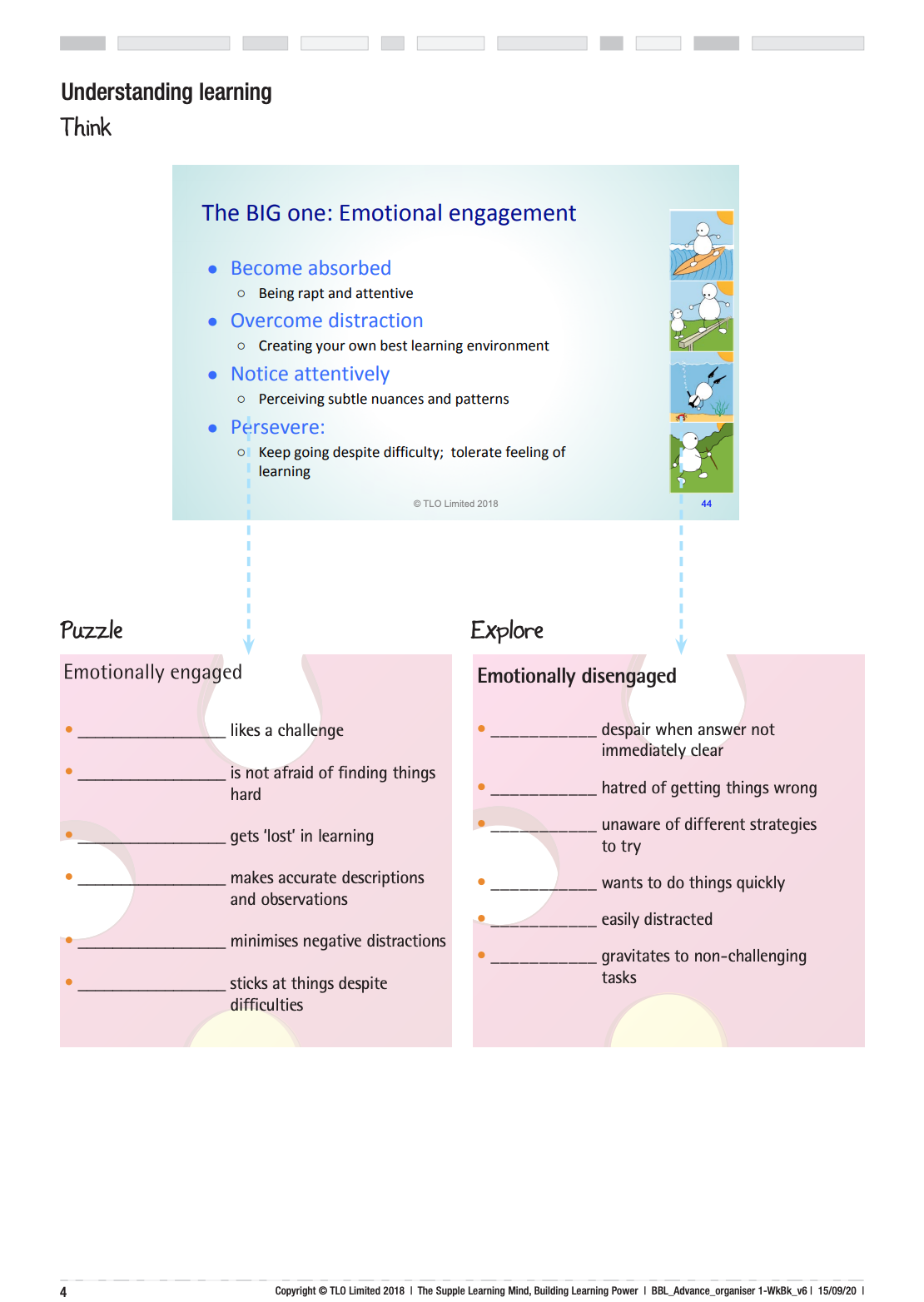
notice how things look, what they are made of, or how they behave
are patient, knowing that details may take time to emerge
can identify significant detail
get a clear sense of what, before starting to think why or how
The activities, think pieces and questions in this online unit aim to help you, as a teacher, to make a start on:
introducing your students to one of the key learning behaviours;
using the language of learning effectively with your students;
designing the use of learning behaviours into the way you teach;
developing the confidence and skill in helping your students to grow their learning habits.
The purpose of building your students’ Learning Power is to facilitate the growth of high value psychological characteristics and strengthen their learning characters. These skills, attitudes and values, when used with increasing competence and confidence across many learning opportunities, become learning habits; the characteristics of successful lifelong learners.
Ideas in this module may take you into a new way of thinking about learning. The notes below will help you gain a coherent feel for how the material fits together and apply in your classroom practice.
Take it slowly and try to avoid any inclination to skim through the whole resource. Spend about 15 mins on each of the 5 steps below; sufficient time to both read, think about and note down your learning.
Start with section 1.
Read – ‘What is . . . ?’ Maybe go over it again because there may well be some features of this behaviour that you haven’t met before. Spot the xxxxxxxxxx in a class you know well and fill in the names of your learners. Ask yourself: Which of my learners appear to do all / most of these things already? Which of my learners don’t appear to exhibit any of these positive learning behaviours? What you’re discovering.
Make a note of your musings ready for discussion at the Professional Learning Team meeting.
Now go to section 3.
Carefully read ‘Understand how Xxxxxxx grows’, this is likely to be brand new information Take time to find out how the phases of growth work (see toggle box) Focus on the class you know well and think about where they might fit on this trajectory Think through the questions shown below the trajectory but don’t assume higher achievers will automatically be further up the trajectory than lower achievers Ask yourself the hard question – could my learners make progress up this trajectory this year? If yes, how might I help make this happen? If no, what might I do to make learners more secure at their current stage?
Make a note of your musings ready for discussion at the Professional Learning Team meeting.
Now go to section 2.
Get a sense of what is meant by classroom culture and look at the diagram that shows some aspects of culture that encourage and enable xxxxxxxx to flourish. . . ‘ Think about your own classroom culture: which of these aspects are a regular feature in your own classroom? which might you consider introducing into your classroom? which sound interesting but you do not understand what they might look like in practice?
Make a note of your musings ready for discussion at the Professional Learning Team meeting.
You’ve now looked at the nature of the learning behaviour, considered how it might grow, and looked at features the classroom culture that supports it.
Now turn to section 4 to explore some teaching ideas that could be used to build these behaviours in your own classroom.
Read through section 4 – Ideas to Practise look at both the primary and secondary columns because many of the ideas can be amended to fit different ages Which of these ideas might fit your needs or simply appeal to you? Which do you already use? Which might work well in your own classroom?
Make a note of your musings ready for discussion at the Professional Learning Team meeting.
Section 5 Develop your talk
Take a look at a few statements you could use to nudge the behaviour. Using this language can be a big shift for many teachers because what you are doing here is talking in a way that will nudge the use of a particular learning behaviour. This is intentional and precise learning language.
Ask yourself:
How much do you currently talk about the process of learning, as opposed to the outcomes of learning? Have you ever considered, in advance, how you might talk about the process of learning, or do you tend to just ‘trust yourself to say the right thing at the right time’? Might you need to make a conscious decision to prepare in advance the language that you use? Which of the suggested phrases/comments would best resonate with your students and fit with any of the teaching ideas you might try from section 4?
Make a note of your musings ready for discussion at the Professional Learning Team meeting.
The purpose of this series of resources is to help you to build and strengthen your child’s learning character. Learning character is about those attitudes, inclinations, values and skills that, when used with increasing competence and confidence across many learning opportunities, become learning habits; they are characteristics of successful lifelong learners.
These resources are not trying to turn you into your child’s teacher nor lay the groundwork for home schooling……
A quick look at learning itself
Learning is an interesting process that goes on in people’s brains. We used to think that ‘intelligence’ was fixed at birth so there seemed little point in trying to cultivate it. But now research has shown that learning is learnable and we are realising that there are some energies or powers that can be used to shape how we learn. Learning how to learn involves more than skills, it involves peoples’ attitudes, their dispositions, values, interests and beliefs as well. So, this approach is about helping children to help themselves to be disposed to persist, or to be inclined to question and be curious, to be able to collaborate harmoniously and learn well with other people, to be open to new ideas, or to manage their learning effectively.
The good thing is that these dispositions, inherent in all of us, are not fixed at birth. They can be developed by all of us regardless of ‘ability’, social background or age. They have a significant impact on how you learn and your progress through life. Extending our learning power has no limits.
The hidden aspect of learning
What if some of the girls you knew tended to believe that ‘Maths isn’t for girls’ or some other children you knew thought that ‘If you can’t solve it in a minute, you can’t solve it at all’ or even that ‘Bright people never have to try’. All these erroneous ideas cause children to be disposed to give up easily, or to feel stupid, or to disengage. You might think of ‘dispositions’ as indicators of the degree to which one is disposed to make use of a skill or knowledge.
xxxxxx
LOOK IN FOUNDATION PACK
‘Wonder is the beginning of wisdom.’ So stated Socrates, considered by some to be ‘the father of questioning’. Even through nearly 2,500 years of human development and societal ‘progression’, those words still hold true. In growing the habit of questioning, it is important to acknowledge that questioning itself is rooted in curiosity, that great driver of engagement, of seeking, of asking, and asking again.
‘Good learners like to wonder about things. For them, it often really is a wonder-ful world. The phrases ‘How come?’ and ‘What if?’ are never far from their lips.
They value getting below the surface of things, and are less likely to accept uncritically what they are told. They like to come to their own conclusions. They are more willing to reveal their questions and uncertainties if they think it will help them learn.
When you use this learning habit, you …
from HYLT
are not afraid of not knowing
are curious about things and people
like to get below the surface of things and come up with your own conclusions
often wonder why
play with ideas, asking “How come?” and “What if?”
Your supple learning mind
The explanations and activities, in this online unit aim to help you, as a parent, to make a start on:
introducing your child to one of the key learning behaviours;
using the language of learning effectively with your child;
trying some activities into your family life;
developing your child’s confidence and skill to grow their own xxxxxx habits.
The notes below will be amended when we have finished shaping the whole module
The purpose of this series of resources is to help you to build and strengthen your child’s learning character. Learning character is about those attitudes, inclinations, values and skills that, when used with increasing competence and confidence across many learning opportunities, become learning habits; they are characteristics of successful lifelong learners.
These resources are not trying to turn you into your child’s teacher nor lay the groundwork for home schooling……
A quick look at learning itself
Learning is an interesting process that goes on in people’s brains. We used to think that ‘intelligence’ was fixed at birth so there seemed little point in trying to cultivate it. But now research has shown that learning is learnable and we are realising that there are some energies or powers that can be used to shape how we learn. Learning how to learn involves more than skills, it involves peoples’ attitudes, their dispositions, values, interests and beliefs as well. So, this approach is about helping children to help themselves to be disposed to persist, or to be inclined to question and be curious, to be able to collaborate harmoniously and learn well with other people, to be open to new ideas, or to manage their learning effectively.
The good thing is that these dispositions, inherent in all of us, are not fixed at birth. They can be developed by all of us regardless of ‘ability’, social background or age. They have a significant impact on how you learn and your progress through life. Extending our learning power has no limits.
The hidden aspect of learning
What if some of the girls you knew tended to believe that ‘Maths isn’t for girls’ or some other children you knew thought that ‘If you can’t solve it in a minute, you can’t solve it at all’ or even that ‘Bright people never have to try’. All these erroneous ideas cause children to be disposed to give up easily, or to feel stupid, or to disengage. You might think of ‘dispositions’ as indicators of the degree to which one is disposed to make use of a skill or knowledge.
Questioning
‘Wonder is the beginning of wisdom.’ So stated Socrates, considered by some to be ‘the father of questioning’. Even through nearly 2,500 years of human development and societal ‘progression’, those words still hold true. In growing the habit of questioning, it is important to acknowledge that questioning itself is rooted in curiosity, that great driver of engagement, of seeking, of asking, and asking again.
‘Good learners like to wonder about things. For them, it often really is a wonder-ful world. The phrases ‘How come?’ and ‘What if?’ are never far from their lips.
They value getting below the surface of things, and are less likely to accept uncritically what they are told. They like to come to their own conclusions. They are more willing to reveal their questions and uncertainties if they think it will help them learn.
When you use this learning habit, you …
are not afraid of not knowing
are curious about things and people
like to get below the surface of things and come up with your own conclusions
often wonder why
play with ideas, asking “How come?” and “What if?”
Your supple learning mind
The explanations and activities in this online unit aim to help you, as a parent, to make a start on:
introducing your child to one of the key learning behaviours;
using the language of learning effectively with your child;
trying some activities in your family life;
developing your child’s confidence and skill to grow their own questioning habits.
The notes below will be amended when we have finished shaping the whole module
Ideas in this module is likely to take you into a new way of thinking about learning. The notes below will help you gain a coherent feel for how the material fits together and apply in your classroom practice.
Take it slowly and try to avoid any inclination to skim through the whole resource. Spend about 15 mins on each of the 5 steps below; sufficient time to both read, think about and note down your learning.
Start with section 1.
Read – ‘What is . . . ?’ Maybe go over it again because there may well be some features of this behaviour that you haven’t met before. Spot the Questioners in a class you know well and fill in the names of your learners. Ask yourself: Which of my learners appear to do all / most of these things already? Which of my learners don’t appear to exhibit any of these positive learning behaviours? What you’re discovering.
Make a note of your musings ready for discussion at the Professional Learning Team meeting.
Now go to section 3.
Carefully read ‘Understand how Questioning grows’, this is likely to be brand new information Take time to find out how the phases of growth work (see toggle box) Focus on the class you know well and think about where they might fit on this trajectory Think through the questions shown below the trajectory but don’t assume higher achievers will automatically be further up the trajectory than lower achievers Ask yourself the hard question – could my learners make progress up this trajectory this year? If yes, how might I help make this happen? If no, what might I do to make learners more secure at their current stage?
Make a note of your musings ready for discussion at the Professional Learning Team meeting.
Now go to section 2.
Get a sense of what is meant by classroom culture and look at the diagram that shows some aspects of culture that encourage and enable Questioning to flourish. . . ‘ Think about your own classroom culture: which of these aspects are a regular feature in your own classroom? which might you consider introducing into your classroom? which sound interesting but you do not understand what they might look like in practice?
Make a note of your musings ready for discussion at the Professional Learning Team meeting.
You’ve now looked at the nature of the learning behaviour, considered how it might grow, and looked at features the classroom culture that supports it.
Now turn to section 4 to explore some teaching ideas that could be used to build these behaviours in your own classroom.
Read through section 4 – Ideas to Practise look at both the primary and secondary columns because many of the ideas can be amended to fit different ages Which of these ideas might fit your needs or simply appeal to you? Which do you already use? Which might work well in your own classroom?
Make a note of your musings ready for discussion at the Professional Learning Team meeting.
Section 5 Develop your talk
Take a look at a few statements you could use to nudge the behaviour. Using this language can be a big shift for many teachers because what you are doing here is talking in a way that will nudge the use of a particular learning behaviour. This is intentional and precise learning language.
Ask yourself:
How much do you currently talk about the process of learning, as opposed to the outcomes of learning? Have you ever considered, in advance, how you might talk about the process of learning, or do you tend to just ‘trust yourself to say the right thing at the right time’? Might you need to make a conscious decision to prepare in advance the language that you use? Which of the suggested phrases/comments would best resonate with your students and fit with any of the teaching ideas you might try from section 4?
Make a note of your musings ready for discussion at the Professional Learning Team meeting.
[/dropshadowbox]
[/toggle]
You’re not currently enrolled in this unit and can’t access the sections of the unit below. Please contact us if you have any questions about accessing this unit.
Think this first page needs a paragraph about what we are talking about i.e. dispositions which of course pave the way for skill. Haven’t found quite what we need yet from our past stuff yet.
This is too obscure for here. Maybe move it to somewhere in topic 1.
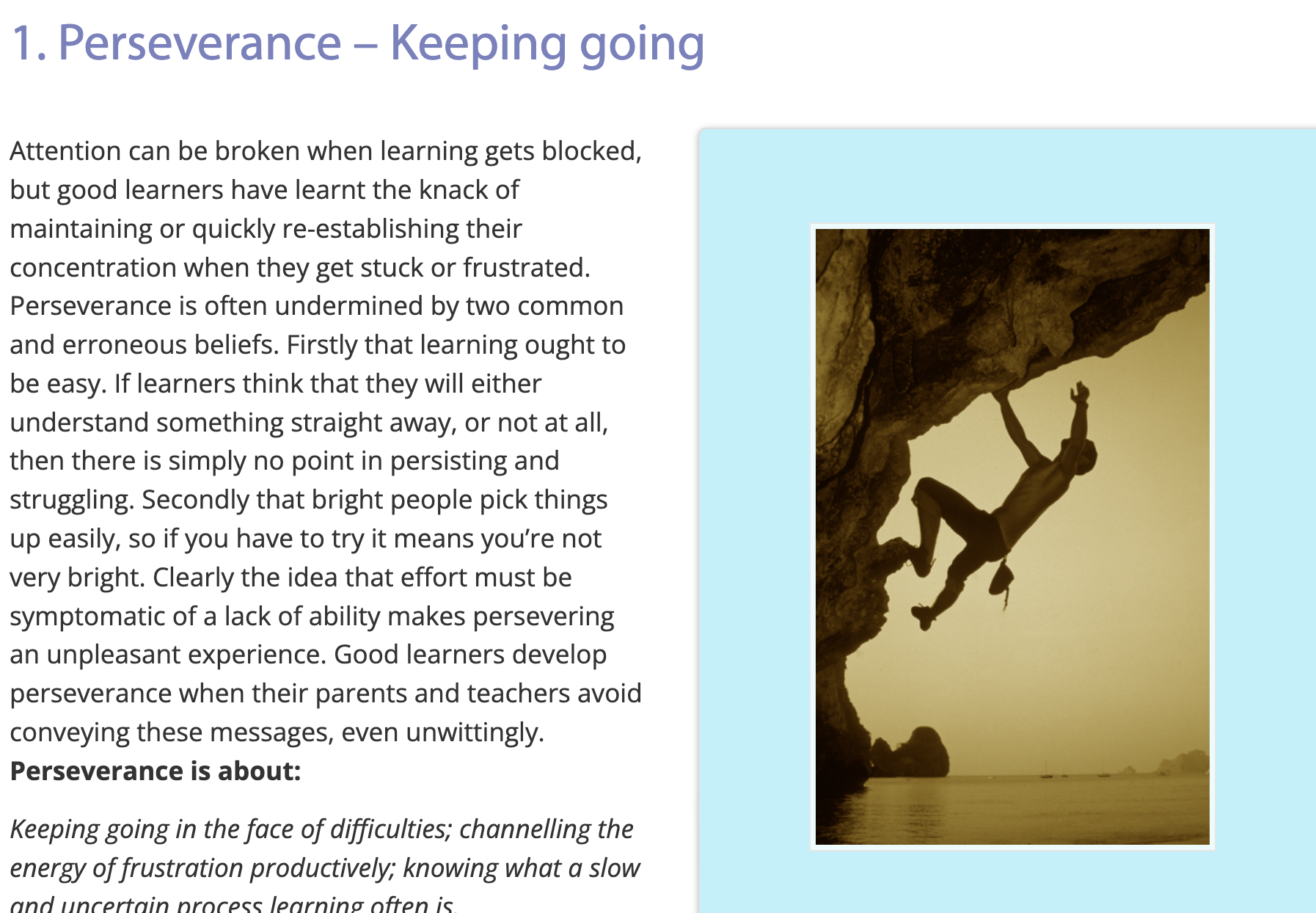
Perseverance
When you use this learning muscle, you …
are not put off by being stuck
tolerate feelings of apprehension, frustration or confusion without getting upset
recognise that learning can be a struggle
keep on going despite difficulties and find ways to overcome them
This para needs amending to make it parent friendly. it means a rewrite but keeping the meaning
The purpose of this resourceis to help parents to help/facilitate their children grow the high value psychological characteristics in order to strengthen their learning characters. These skills, attitudes and values, when used with increasing competence and confidence across many learning opportunities, become learning habits; the characteristics of successful lifelong learners.
‘A person’s Learning Power determines, even dictates, their propensity for change, and directs those behaviours that influence and underpin performance throughout life.
The power to learn is the essential ingredient in implementing strategies for change i.e. to learn.‘
The activities, think pieces and questions in this online unit aim to help parents make a start on:
introducing children to one of the key learning behaviours;
using the language of learning effectively with children;
designing the use of learning behaviours into the way they teach;
developing the confidence and skill in helping children to grow their learning power.
Below needs taking out of a toggle box and amending for parents
Ideas in this module will take you into a new way of thinking about learning. The notes below will help you gain a coherent feel for how the material fits together and apply in your classroom practice.
Take it slowly and try to avoid any inclination to skim through the whole resource. Spend about 15 mins on each of the 5 steps below; sufficient time to both read, think about and note down your learning.
Start with section 1.This will be amended after all the sections have been rewritten
Read – ‘What is . . . ?’ Maybe go over it again because there may well be some features of this behaviour that you haven’t met before. Spot the Perseverers in a class you know well and fill in the names of your learners. Ask yourself: Which of my learners appear to do all / most of these things already? Which of my learners don’t appear to exhibit any of these positive learning behaviours? What you’re discovering.
Make a note of your musings ready for discussion at the Professional Learning Team meeting.
Now go to section 3.
Carefully read ‘Understand how Perseverance grows’, this is likely to be brand new information Take time to find out how the phases of growth work (see toggle box) Focus on the class you know well and think about where they might fit on this trajectory Think through the questions shown below the trajectory but don’t assume higher achievers will automatically be further up the trajectory than lower achievers Ask yourself the hard question – could my learners make progress up this trajectory this year? If yes, how might I help make this happen? If no, what might I do to make learners more secure at their current stage?
Make a note of your musings ready for discussion at the Professional Learning Team meeting.
Now go to section 2.
Get a sense of what is meant by classroom culture and look at the diagram that shows some aspects of culture that encourage and enable Perseverance to flourish. . . ‘ Think about your own classroom culture: which of these aspects are a regular feature in your own classroom? which might you consider introducing into your classroom? which sound interesting but you do not understand what they might look like in practice?
Make a note of your musings ready for discussion at the Professional Learning Team meeting.
You’ve now looked at the nature of the learning behaviour, considered how it might grow, and looked at features the classroom culture that supports it.
Now turn to section 4 to explore some teaching ideas that could be used to build these behaviours in your own classroom.
Read through section 4 – Ideas to Practise look at both the primary and secondary columns because many of the ideas can be amended to fit different ages Which of these ideas might fit your needs or simply appeal to you? Which do you already use? Which might work well in your own classroom?
Make a note of your musings ready for discussion at the Professional Learning Team meeting.
Section 5 Develop your talk
Take a look at a few statements you could use to nudge the behaviour. Using this language can be a big shift for many teachers because what you are doing here is talking in a way that will nudge the use of a particular learning behaviour. This is intentional and precise learning language.
Ask yourself:
How much do you currently talk about the process of learning, as opposed to the outcomes of learning? Have you ever considered, in advance, how you might talk about the process of learning, or do you tend to just ‘trust yourself to say the right thing at the right time’? Might you need to make a conscious decision to prepare in advance the language that you use? Which of the suggested phrases/comments would best resonate with your students and fit with any of the teaching ideas you might try from section 4?
Make a note of your musings ready for discussion at the Professional Learning Team meeting.
You’re not currently enrolled in this unit and can’t access the sections of the unit below. Please contact us if you have any questions about accessing this unit.
1. The Standard Induction Pack – 8 modules to support teachers new to the school, plus this module to support senior leaders.
This bundle of resources is only available to schools who have already begun working on ‘Playing the Learning Power Game’ and who are seeking help with designing induction activities for teachers who subsequently join the school. It is designed as a self-study pack for teachers joining the school, and may well take a term to work through before such teachers access ‘Playing the Learning Power Game’ materials.
What and who is the pack for?
This pack is designed to serve 2 functions:
As an introductory programme for teachers new to a school that is doing, or has already done, ‘Playing the Learning Power Game’;
As a support for senior leaders responsible for the induction of such new teachers.
What does it contain?
For teachers:
1 online module introducing the key ideas about building better learners, the supple learning mind, and classroom culture;
3 online modules that focus on classroom culture;
4 online modules that give an overview of the 4 key learning behaviours – Questioning; Perseverance; Collaboration; and Revising.
For leaders responsible for induction (this module):
advice on how and in what order the modules could / should be tackled;
training materials to help you to introduce ‘The Supple Learning Mind’ and ‘Learning-friendly classroom cultures’ (should you wish to do so.)
2. For Information – The contents for teachers
There is an introductory module that offers an overview of learning power and learning-friendly classroom culture. Additionally there are modules that introduce teachers to 3 issues around classroom cultures and 4 modules that introduce the 4 key learning behaviours.
The overview module is:
Pathways to ‘Playing the Learning Power Game’
Why this particular module?
This module offers an overview of the key ideas:
background research on dispositional learning
the two interlinking frameworks that underpin building better learners
examples of how the two frameworks work in practice
the four foundational learning behaviours to make a start on
the essential aspects of classroom culture that can make a difference
Ensure that this is the first module that new teachers engage with as it sets the scene for the other 7 modules. However if senior leaders would rather introduce these ideas themselves, there are materials in section 4 (below) to support them in doing so.
The 3 online culture modules are:
Building Active Participation
Building Shared Responsibility
Building Dialogue and Collaboration
Why these particular modules?
think back to the model of classroom cultures that you saw in the early stages of your own engagement with ‘Playing the Learning Power Game’:
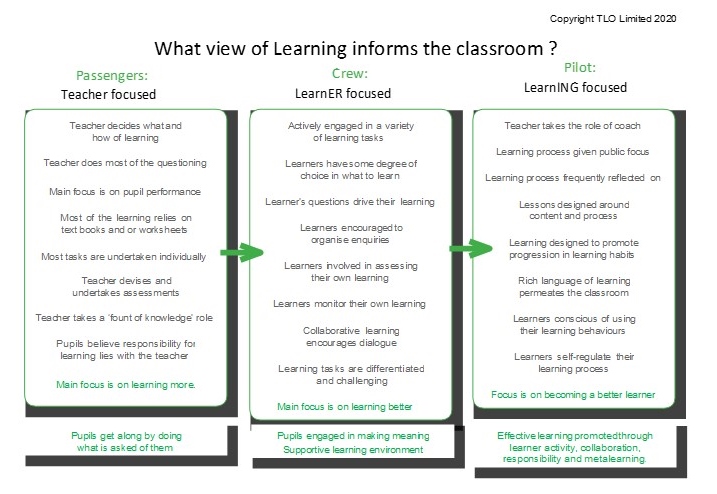
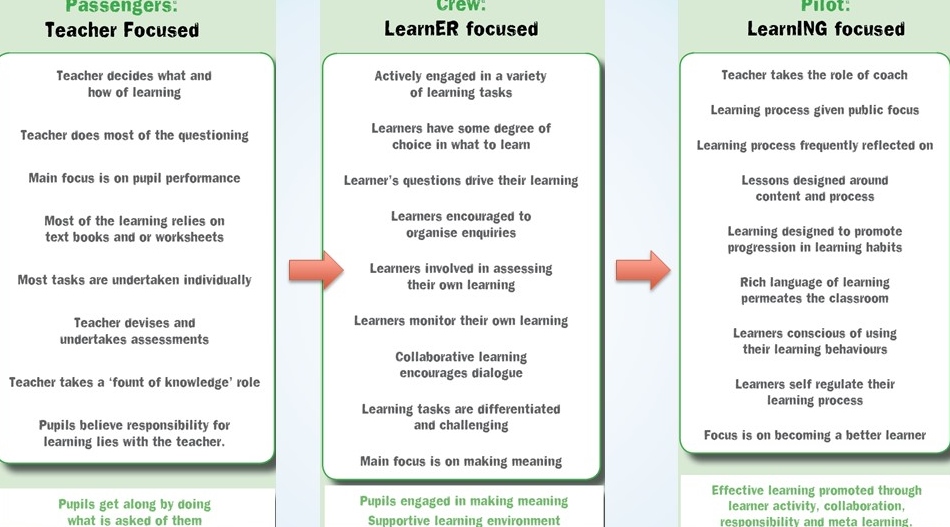
The key differences between ‘panel 1’ and ‘panel 2’ are that in panel 2 learners are: more actively engaged; take more responsibility; do more collaborative learning.
In other words, these 3 online modules help classrooms to become more learnER-friendly and so pave the way for learnING-friendly classroom cultures.
The 4 online overview modules are:
Helping your learners to Question;
Helping your learners to Persevere;
Helping your learners to Collaborate;
Helping your learners to Revise / Refine;
Why these 4 modules?
these are four introductory modules to the 4 key learning behaviours that were explored in Playing the Learning Power Game;
they are designed as a speedy way of introducing the 4 learning behaviours to teachers new to the ideas;
but they do not contain the depth and range of ideas developed in Playing the Learning Power Game;
Hence – use these modules to gain a quick overview rather than deep understanding.
3. Issues to be considered by leaders
As a teacher, it is difficult to absorb the culture and practices of a school that you are new to. This is as true for experienced teachers moving to a new school as it is for a new entrant who is just starting out. This is particularly so if the ‘new school’ has an approach to learning that may be at odds with what you are familiar.
The purpose of these modules
is to support teachers new to a school during their first term;
it is not a substitute for ‘Playing the Learning Power Game’;
indeed, we would recommend that once new teachers have experienced this short introductory programme, they should be enabled to explore the full ‘Playing the Learning Power Game’ programme.
Consider:
how and when you might find time to support new colleagues to work through these materials;
should these be twilight meetings?
do you need an ‘induction day’ to kick start the process?
how you will support new colleagues to form their own Professional Learning Community;
whether each new colleague should be assigned an experienced mentor / coach to guide them through these materials.
4. Support materials for leaders
The 8 online modules form a self-study pack for teachers new to the school. However if senior leaders would prefer to take a more hands-on approach and launch the key ideas themselves, we have gathered some materials and powerpoints you may find useful. There is nothing here that you have not already met during your own engagement with ‘Playing the Learning Power Game’, but they are clustered here for convenience. If senior leaders choose to do the launch themselves, they will cover almost all of the content of the first module – Pathways to ‘Playing the Learning Power Game’.
Once the key ideas and overview are introduced . . .
Consider – would you prefer to begin with your new teachers looking at the 3 classroom culture modules, or at the 4 key learning behaviour modules? Either route has both advantages and disadvantages, and we would recommend doing one or the other.
But we would advise against starting out on all 7 modules at the same time!
Introducing classroom culture and the 3 culture modules
Downloads to the right:
A powerpoint presentation about classroom cultures – download it and edit it to create your introductory session;
Guidance notes to support your delivery;
A resource book for teachers to accompany the ppt.
Professional development day for all staff: Lesson design for learning power
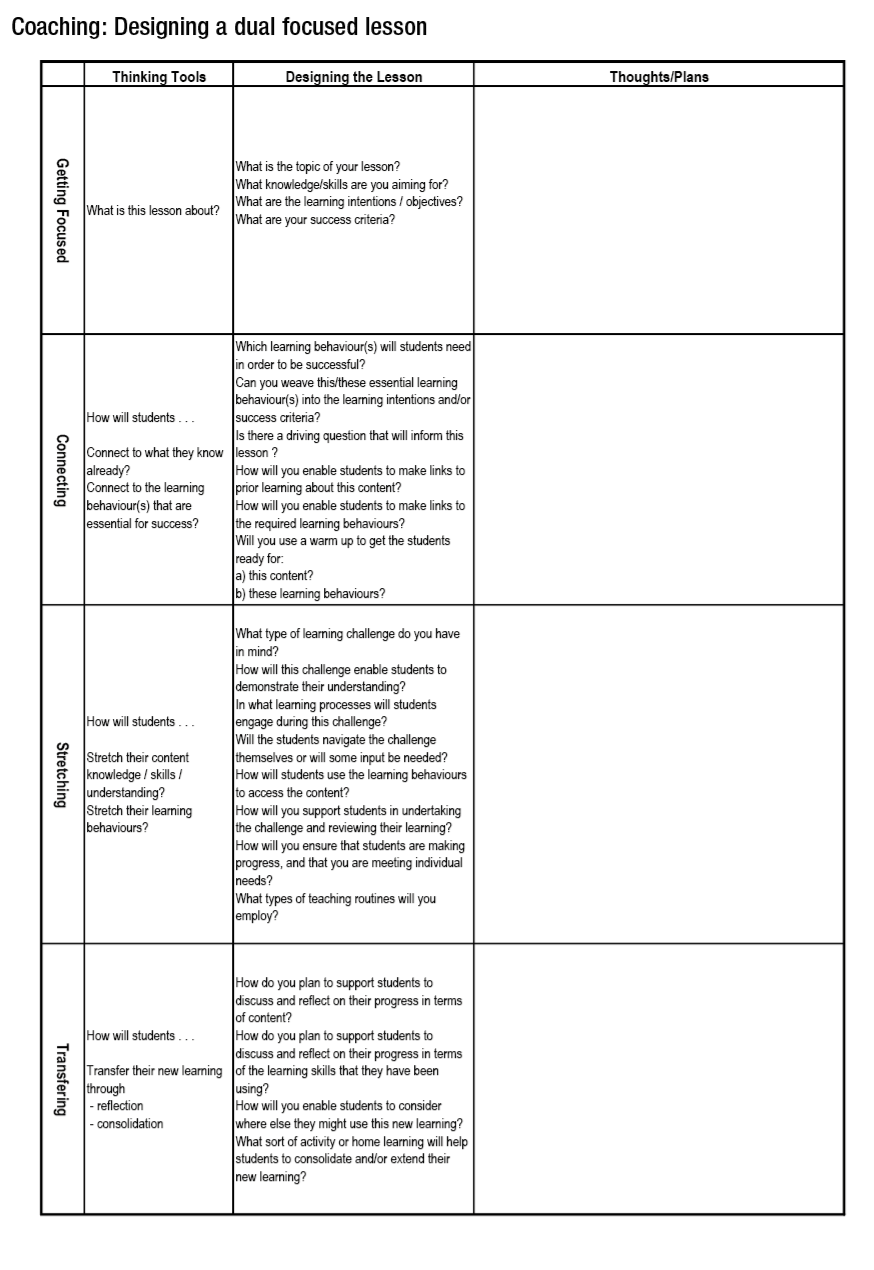
This resource has been compiled to ensure the ambitious training day with all staff of Mount Annan Christian College goes as smoothly as possible. Below you will find lots of information relating to the professional development day training which concentrates on the design of dual focused lessons.
The resource includes:
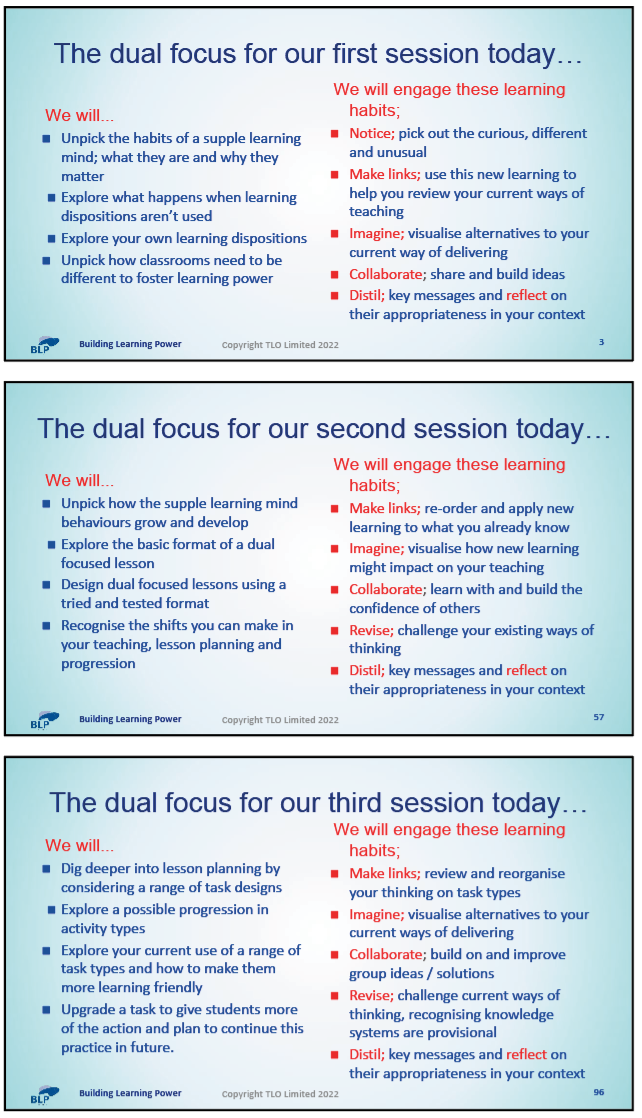
the content and learning objectives of the day’s three sessions
copies of all the resources that will need to be printed
an indication of the nature of the activities to be undertaken
1. What the training aims to achieve
The nature of the training
The full day training has been constructed as a result of discussions with Andrew Toovey, Director of Teaching and Learning. It is designed to briefly remind or introduce staff to the two frameworks that underpin Learning Power, and then moves on to the more practical skill of designing lessons that engage students’ learning power. The sessions look at the growth of learning behaviours, a plan for incorporating them into lessons and a close-up dissection of task design. Alongside the theory and practice we have added complementary examples and stories from schools to show how the ideas actually work in the field.
Session 1 8.30 to 10.30.
Unpicks the habits of a supple learning mind; what they are and why they matter
Explores what happens when learning dispositions aren’t used
Explores staffs’ own learning dispositions
Unpicks how classrooms need to be different to foster learning power
Session 2 11.00 to 12.30
Unpicks how the supple learning mind behaviours grow and develop
Explores the basic format of a dual focused lesson
Offers opportunities to design dual focused lessons using a tried and tested format
Session 3 1.15 to 3.30
Digs deeper into lesson planning by considering activity/task designs and reflection practice
Explores a possible progression in activity/task types
Explores staffs’ current use of a range of activity/task types and how to make them more learning friendly
Offers opportunities to upgrade an activity to give students more of the action.
Each session knits together interesting knowledge based inputs, with engaging interactive activities that serve to reinforce new ideas by applying them to the practical reality of the classroom.
From the start staff are encouraged to contribute aspects of their own learning habits to ensure the session is a rich learning opportunity for everyone.
2. Preparing for the session
We would be grateful of your help in making the session work to best advantage. We have designed and made available the essential resources for the session, namely Resource books and activity resources (see below). We ask you to print sufficient copies for the number of staff attending.
2a The Resource Book
The session is supported by a 23 page Resource Book of training material.
The Resource Book is made available as PDFs (colour) for the school to print for staff. It works best when bound with comb binders or similar. It contains the key PPt slides used in the presentations, and the resources for group session tasks. Please ensure that every member of staff has a copy of the Resource Book at the start of the morning session…but not before!
The training works best when the room is laid out ‘cabaret style’, i.e. tables of 6-8 participants. We leave the grouping of staff with you. It might be stimulating to mix primary and secondary staff for at least part of the day.
We would just like to confirm that you are expecting us to provide the Zoom link.
We have taken action to try and ensure a better sound connection with Steve’s computer
Room setup for training & presentations
3. The learning activities throughout the day
Session 1
During session one there will be 9 activities interspersed with inputs, pair chats and whole school discussion.
Activity 1 (only 1 min per group of behaviours )
Although this is a very useful activity, which aims to help staff become more aware of their students as learners, we will have to whizz through it and leave staff to continue this as a piece of ‘homework’; thinking about students’ tendencies, dispositions and habits and muse on their students’ positive and negative characteristics. Participants will be invited to;
Think about the learning behaviours associated with the emotional, cognitive, social and strategic domains of learning
Puzzle over what it means to be without these learning behaviours, how not having them gets in the way of learning
Note the names of students who appear to use or not use each behaviour.
For each of the tasks below it would help if a specific member of staff was assigned to distil the feedback/findings and report back on behalf of a group. We won’t be able to take feedback from all groups because of time but the spokesperson will have at least captured the groups’ learning.
Activity 2 (25 Mins including discussion on solutions and patterns of habits used)
This activity involves staff looking at comic book pictures, considering clues and putting them into an order to make a credible story line. This task is about staff applying their own learning habits to reason and imagine a solution. Each group of 7 teachers will require a complete pack of 23 pictures.
We will ask for at least one teacher in each group to act as an observer, using the Rating wheel provided in the Resource book.
Activity 3 Learning culture tool 1 (10 mins including whole group discussion)
This activity sees a shift in focus from students’ learning behaviours to classroom cultures. It highlights 3 different learning cultures and emphasises the teachers’ and students’ role in each one. Participants are invited to;
Highlight all aspects of culture that are a regular feature in their classroom.
Discuss with their neighbour
Ask what is this telling them about their teaching
Similarities / differences
Surprises
Delights
Shortfalls
Activity 4 Learning culture tool 2 (10 mins including whole group discussion)
As the one above, this activity centres on the research of Chris Watkins (London Institute of Education). The diagram emphasises the outcomes or ends schools might aspire to in the 21st century, and the means/ways teachers will need to use to ensure these outcomes. Participants are invited to;
Discuss together;
What they understand by each of the ‘Ends` statements
If they want their students to be like this? Why?
Whether students become more like this as they pass through the school? How do they know?
How do the Ends statements chime with the school’s values/vision?
Session 2
Activity 5 Learning Poles apart– filling in the gaps (15 mins to both build progression charts and discuss more widely.)
This activity embraces a number of actions and discussions which look at how learning behaviours grow and how this will influence lesson design.
5.1 Having been given a set of 28 mixed up cards staff are invited to discuss and build their own trajectories for the 4 key learning behaviours with 7 in each column.
5.2 Having done so staff are asked to think where the majority of their learners are now. Are they moving up these trajectories as they move through the school? Why do you think this is happening?
5.3 Staff are asked to consider where their higher attaining students are on the charts and what is that telling them?
5.4 Staff are asked which chart colour best describes the majority of their youngest and oldest learners? How high up these trajectories might they expect / hope their students will get by the time they leave the school? And finally, to think about their role as a teacher and how their role as a teacher changes as students move up the trajectories.
Activity 6 Using 9 thinks to make your lesson dual focused (30 mins plus whole group discussion)
After a significant input on a method of designing dual focused lessons (content and process) staff are invited to form a coaching pair and, with the help of prompts, coach each other to apply the 9 Thinks approach to a lesson they have taught recently or are about to teach. Pairs made up of teachers from different phases might be most interesting.
As a pair they have 30 minutes, 15 minutes each.
This is perhaps the most significant activity of the day.
Activity 7 Looking closely at Thinks 7 & 9 (15 mins plus whole group discussion)
This activity draws attention to Thinks 7 and 9 where students are being asked to monitor their own behaviours and to review how they got on with them.
Participants are invited to create a set of behaviours for perseverance / questioning / revising.
This is a demanding task which draws on specific aspects of the behaviours being brought into play. It covers how these may be expressed so that students;
become aware of them
monitor how and when they use them
reflect on how they use them
develop them as useful learning behaviours.
Participants are invited to look back to the progression ladders they created earlier for inspiration.
And a provocative question to consider – will you need different statements for different phases?
Session 3
Activity 8 Upgrade your tasks giving students more control (15 mins plus whole group discussion)
After a significant input of activity types we return to the coaching pair of Activity 6 they are asked to look at the learning challenge they designed for Think 5 earlier, to assess what task type it is and then try to lift the task type by one level.
We ask that they’re prepared to share the results and difficulties of their discussion.
Activity 9 Surveying your curriculum for task types (xx mins plus whole group discussion)
This is the final activity of the day and it’s a challenging one which we hope will cause much discussion about curriculum structure and lesson design long after the end of the day.
Participants are asked to take a look at a unit of work. One that they have recently taught or are about to teach. Then, using the Task Type wheel (shown in the resource book), try to estimate how/if / where they are making use of the different task types.
This may be a good opportunity for subject or phase teams to work together after the course if not on the day. The challenge is to consider what might need to change in order to bring more of these task types into play across the curriculum.
In a sense it’s a cliff hanger activity which we leave with the school to resolve.
This resource is designed to support you, as a learning champion nominated by your school, to:
get to grips with the concepts and practicalities of developing students’ learning power
engage with and learn from a blended learning programme with colleagues, in preparation for…
helping other teachers to take part in the programme and develop their teaching to develop better learners.
This resource accompanies two online resources to which you will be given access:
‘Playing the Learning Power Game‘, a whole school staff development programme to develop students as metacognitive, self-regulated learners
‘Finding Learning Power’, an online resource offering teachers a set of tools to collect and analyse information about their students’ learning character.
This resource is designed to help you:
Gain an overview of what the development of learning power is all about;
Look at your own class using the ‘Finding Learning Power’ resource and consider how it might be used to stimulate learning conversations with colleagues;
Understand how the Playing the Learning Power Game programme is designed to work across the school;
Experience how Professional Learning Teams work by forming one with fellow Learning Champions;
Decide how, as a team, you might introduce, and support the programme, to teachers throughout the school;
Take part in monitoring and supporting the effects of the programme as it moves along.
Navigating the modules – an important read.
As a Learning Champion you have access to 3 online modules –
this one, Learning Power Champions
‘Finding Learning Power’ and
‘Playing the Learning Power Game’.
This Champions resource aims to make this interesting role manageable and is best approached in 4 stages as your role develops.
Stage 1
We suggest that initially you become familiar with the first 4 sections of this module:
What is Learning Power all about?
How does Finding Learning Power work?
How does Playing the Learning Power Game work?
Becoming a Professional Learning Team
Stage 2
Then, as a team of ‘Champions’, work through ‘Finding Learning Power‘ and begin working through ‘The Learning Power Game’. No need to finish it at this stage, but give it at least 3 months of sustained effort to give you experience of;
reading and digesting the online course content
learning together as a professional learning team
undertaking learning enquiries in your classroom(s).
If you’ve had input in advance about the why and what of learning power, use section 1 of Playing the Learning Power Game as a reminder rather than a section to be worked through together.
Stage 3
When you have been learning on the job for a couple of months and become familiar with the programme’s routines, begin to look at section 5 and 6 of this module. These will help you to begin to think about, and plan for, bringing your colleagues on board.
Stage 4
When the programme is well on its way across the school revisit the ideas and resources in section 6 (monitoring and evaluating progress) and begin to introduce them into your own practice before using more widely with staff.
This resource, designed for senior leaders, accompanies the online programme ‘Playing the Learning Power game‘ for staff. It aims to support senior leaders to introduce teachers to their programme and thereafter to take a strategic approach to sustaining momentum as the teachers’ programme develops.
You might assume that, as this is a DIY resource for senior leaders, it will fall to you to lead this development, and launch ‘Playing the Learning Power Game’ to your colleagues. However, many schools have found the idea enlisting champions a good way to spread responsibility and expertise.
Enlisting the help of Learning Champions.
Larger junior and all secondary schools prefer to spread the load of managing the programme by selecting a group of the staff, often known as ‘Learning Champions’. The Learning Champions learn together and work their way through part of the Playing the Learning Power Game course before using that experience to involve all staff and manage the Professional Learning Team sessions. This route requires the module ‘Learning Champions’ – which is available on request at no additional cost.
This approach:
needs time for Learning Champions to become familiar with ‘Playing the Learning Power Game‘ and allows opportunities to iron out any practical problems;
creates practical experience of the approach within the school which can act as a ‘go to’ resource for other staff;
offers senior leaders a significant group of teachers ready, willing and able to promote / support / encourage others.
If you are considering the Champion route, the composition of your group of Learning Champions is of critical importance.
Below are some ‘must do’s’. You should ensure that:
all subject areas / phases are represented;
a wide range of experience is represented;
champions are widely regarded as sound / excellent practitioners if they are to have credibility;
you have sufficient Champions to lead the Professional Learning Teams you plan to create (see Section 3 of this module for more on PLTs and how they function);
some senior leaders need to be Champions to demonstrate SLT commitment and to provide a conduit between the Champions and SLT;
you exploit the opportunity to involve a couple of colleagues who might need to be brought on-side early, rather than leaving them to snipe from the sidelines – most schools have one or two of these;
directed time is found to enable the group of Champions to meet;
you consider how you will maintain the morale, engagement and interest in those who are not designated Champions of Learning.
So that, when Playing the Learning Power Game is launched to all colleagues, you have already built a wide network of committed teachers willing and able to support their colleagues.
If this way of working appeals, feel free to contact TLO for further advice / guidance and materials.
Accessing expert advice and support
Whichever route you choose you might consider adding support via Zoom conversations to ensure that you have access to expert advice and a named consultant who can act as critical friend as you move through the programme. If this is of interest, contact TLO to explore possibilities.
The contents of this resource.
This companion resource has 7 sections:
Overview: strategic issues and a programme for staff
This resource, designed for senior leaders, accompanies the online programme ‘Playing the Learning Power Game‘ for staff. It aims to support senior leaders to introduce teachers to their programme and thereafter to take a strategic approach to sustaining momentum as the teachers’ programme develops.
You might assume that since this is a DIY resource for senior leaders it will naturally fall to you to lead this development, and launch ‘Playing the Learning Power Game’ to your colleagues. However, larger junior and most secondary schools often prefer to spread the load of managing the programme by selecting a group of the staff, often known as ‘Learning Champions’. The Learning Champions learn together and work their way through part of the Playing the Learning Power game course before using that experience to involve all staff and manage the Professional Learning Team sessions. This route:
needs time for Learning Champions to become familiar with ‘Playing the Learning Power Game‘ before launching it in school and allows opportunities to iron out any practical problems;
creates practical experience of the approach within the school which can act as a ‘go to’ resource for other staff;
offers senior leaders a significant group of teachers ready, willing and able to promote / support / encourage others.
There is a module specially designed for ‘Learning Champions’ – available on request at no additional cost.
If you are considering the Champion route, the composition of your group of Learning Champions is of critical importance.
Below are some ‘must do’s’. Experience shows you should ensure that:
all subject areas / faculties are represented;
a wide range of experience is represented;
champions are widely regarded as sound / excellent practitioners if they are to have credibility;
you have sufficient Champions to lead the Professional Learning Teams you plan to create (see Section 3 of this module for more on PLTs and how they function);
some senior leaders need to be Champions to demonstrate SLT commitment and to provide a conduit between the Champions and SLT;
you exploit the opportunity to involve a couple of colleagues who might need to be brought on-side early, rather than leaving them to snipe from the sidelines – most schools have one or two of these;
directed time is found to enable the group of Champions to meet;
you consider how you will maintain the morale, engagement and interest in those who are not designated Champions of Learning.
So that, when The Learning Power Game is launched to all colleagues, you have already built a wide network of committed teachers willing and able to support their colleagues.
If this way of working appeals, feel free to contact TLO for further advice / guidance and materials.
Accessing expert advice and support
Whichever route you choose you might consider adding support via Zoom conversations to ensure that you have access to expert advice and a named consultant who can act as critical friend as you move through the programme. If this is of interest, contact TLO to explore possibilities.
The contents of this resource.
This leadership resource has 7 sections:
Overview: strategic issues and a programme for staff
The leadership resource for Finding Learning Power
This is a companion to the ‘Finding Learning Power’ resource. It is your guide to enabling your teachers to use Finding Learning Powerand to enable you to consider the associated strategic implications of its findings.
Your school is taking a new path – same ideas, new angles
Building Learning Power has been around for about twenty years and while many schools took the ideas to their hearts it has never really captured the zeitgeist… until now. Why? Because until now we couldn’t really tell whether recommended changes in classroom practice were actually helping students to grow their learning habits.
However, after further research into how learning habits grow, you can now start by estimating where students’ learning characteristics are now and then link, more precisely, any shifts in classroom practice to phases of students’ dispositional growth.
What this means in practice is:
start the process by gathering data about students’ current phases of dispositional growth
make shifts in classroom practice linked to phases of growth
monitor the shifts in classroom culture and their effects on students’ growth as learners
re-estimate and record students’ phases of growth
Stages 1 and 4 (above) use Finding Learning Power resource.
Stages 2 and 3 use the first year professional development programme Playing the Learning Power Game.
The journey can then continue in years two and three using the Progressing the Learning Power Game professional development programme and using the Finding Learning Power resource at intervals to suit the school.
How this resource is organised
There are 4 sections:
Section 1 is simply a repeat of the section in the teachers’ resource ‘Finding Learning Power’ – it is included here for ease of reference and because you, as senior leaders, really do need to work your way through it in advance of launching it in the school
Section 2 identifies the strategic considerations for senior leaders, both before making a start, in how the information might be managed, and how it might impact the school in the longer term
Section 3 contains some useful training materials you might care to use to launch using this resource and the need to develop students’ learning power
Section 4 signposts the content of the follow-on development programme for teachers, ‘Playing the Learning Power Game’.
The leadership resource for Finding Learning Power
This is your guide to enabling your teachers to use Finding Learning Powerand to enable you to consider the associated strategic implications of its findings.
Your school is taking a new path – same ideas, new angles
Building Learning Power has been around for about twenty years and while many schools took the ideas to their hearts it has never really captured the zeitgeist… until now. Why? Because until now we couldn’t really tell whether recommended changes in classroom practice were actually helping students to grow their learning habits.
However, after further research into how learning habits grow, you can now start by estimating where students’ learning characteristics are now and then link, more precisely, any shifts in classroom practice to phases of students’ dispositional growth.
What this means in practice is:
start the process by gathering data about students’ current phases of dispositional growth
make shifts in classroom practice linked to phases of growth
monitor the shifts in classroom culture and their effects on students’ growth as learners
re-estimate and record students’ phases of growth
For Stages 1 and 4 (above) you need to use the resourceFinding Learning Power.
For Stages 2 and 3 you need to use the first year professional development programmePlaying the Learning Power Game.
The journey can then continue in years two and three using the Professional Learning Power Game professional development programme and using the Finding Learning Power resource at intervals to suit the school.
How this resource is organised
There are 4 sections:
Section 1 is simply a repeat of the section in the teachers’ resource ‘Finding Learning Power’ – it is included here for ease of reference and because you, as senior leaders, really do need to work your way through it in advance of launching it in the school
Section 2 identifies the strategic considerations for senior leaders, both before making a start, in how the information might be managed, and how it might impact the school in the longer term
Section 3 contains some useful training materials you might care to use to launch using this resource and the need to develop students’ learning power
Section 4 signposts the content of the follow-on development programme for teachers, ‘Playing the Learning Power Game’.
a manageable set of tools to enable schools/teachers to uncover, collect and analyse information about their students’ learning character;
an outline of the research, value, makeup and growth of peoples’ learning character.
These tools aim to help your school discover and analyse your students’ learning behaviours and use this information as an essentialstarting point for helping students become better learners. In other words this resource will help you and your school to;
use a rich picture of your students’ learning behaviours, rather than attainment, to underpin your approach to helping them to improve, develop or catch up on their learning.
2. The why of this resource
What are your students like as learners…now?
Do they have a learning character and can this be moulded?
What are my students’ learning strengths or limitations
Which learning behaviours do our students need to strengthen…now?
Does learning character play any part in influencing the attainment of higher vs lower performing students?
These unusual yet vital and urgent questions form the stimulus for this resource; a practical tool to help teachers and schools uncover their students’ learning character and use this, usually hidden and unknown information, as the very basis for developing and strengthening them as learners.
Our growing understanding of how learning habits build has led us to ask how schools might use such information to help shape teachers’, or even whole school, plans. What does growth in learning habits look like? How might teachers estimate students’ phase of growth? Might schools use this information in strategic plans of action (Intent)? What sort of activities would teachers need to use to strengthen the growth of learning habits? (Implementation) What would count as evidence of impact and how might that be captured and reviewed? (Impact).
3. The how of this resource
Each section deals with a key aspect of understanding and using the tool and reading the results.
Section 1 What makes a difference in learning?…offers you a brief introduction to the meaning, purpose and attributes of learning character /learning power.
Section 2 Uncover the mysteries of learning behaviours...offers rich descriptions of the learning behaviours that form part of this measuring tool.
Section 3 Up close and personal with learning…invites you to start considering learning behaviours seriously by looking at yourself as a learner, followed by a couple of students.
Section 4 Finding learning characteristics….suggests how you might go about gathering, recording and interpreting the evidence for just one class and then for the whole school
Section 5 Where now, what’s next? explores the changes you might make based on the data collected and the routes you might take to ensure growth in pupil’s learning behaviours.
4. The where from of this resource
The idea of learning behaviours that are explained and analysed using this resource comes from a vision of twenty-first century education and the new sciences of learning that underpin it. It starts from first principles: that we now know an individual’s ability isn’t fixed; that the brain is like a muscle; that its intelligence grows with exercise. Selling this idea to learners brings, in itself, far more enthusiasm for engaging with the potential delights of learning, helping students to become more independent, more reflective, and better able to plan and evaluate their own learning. This, as John Hattie’s research has shown, is a better way of boosting students’ attainment than more drilling in the subject-matter.
The great strength of this approach is that there is already a wealth of tried and tested strategies that teachers can introduce immediately to begin to transform the learning experience of their students, and give them a language with which to think about the process of learning.
This resource affords teachers an insight into the skills and attitudes their students use when learning…
This is the companion resource to ‘Playing the Learning Power game‘ online programme for staff. It is designed to support you as a senior leader to introduce your teachers to their blended learning programme and to take a strategic approach to sustaining momentum as the teachers’ programme develops.
This companion resource has 8 sections:
Overview: strategic issues and a programme for staff
The first 3 sections of this module are identical to the resource for classroom teachers. Section 4 addresses the strategic issues for leaders, and section 5 considers where this might lead.
The what, why and how of this resource.
1. The what of this resource
This resource offers teachers and schools:
a manageable set of tools to enable schools/teachers to uncover, collect and analyse information about their students’ learning character;
an outline of the research, value, makeup and growth of peoples’ learning character;
a spreadsheet package to help schools monitor, evaluate and manage their students’ learning behaviour data;
These tools aim to help your school discover and analyse your students’ learning behaviours and use this information as an essentialstarting point for helping students become better learners. In other words this resource will help you and your school to;
use a rich picture of your students’ learning behaviours, rather than attainment, to underpin your approach to helping them to improve, develop or catch up on their learning.
2. The why of this resource
What are your students like as learners…now?
Do they have a learning character and can this be moulded?
What are my students’ learning strengths or limitations
Which learning behaviours do our students need to strengthen…now?
Does learning character play any part in influencing the attainment of higher vs lower performing students?
These unusual yet vital and urgent questions form the stimulus for this resource; a practical tool to help teachers and schools uncover their students’ learning character and use this, usually hidden and unknown information, as the very basis for developing and strengthening them as learners.
Our growing understanding of how learning habits build has led us to ask how schools might use such information to help shape teachers’, or even whole school, plans. What does growth in learning habits look like? How might teachers estimate students’ phase of growth? Might schools use this information in strategic plans of action (Intent)? What sort of activities would teachers need to use to strengthen the growth of learning habits? (Implementation) What would count as evidence of impact and how might that be captured and reviewed? (Impact).
3. The how of this resource
Each section deals with a key aspect of understanding and using the tool and reading the results.
Section 1 What makes a difference in learning?…offers you a brief introduction to the meaning, purpose and attributes of learning character /learning power.
Section 2 Uncover the mysteries of learning behaviours...offers rich descriptions of the learning behaviours that form part of this measuring tool.
Section 3 Up close and personal with learning…invites you to start considering learning behaviours seriously by looking at yourself as a learner, followed by a couple of students.
Section 4 Finding learning characteristics….suggests how you might go about gathering, recording and interpreting the evidence for just one class and then for the whole school
Section 5 Where now, what’s next? explores the changes you might make based on the data collected and the routes you might take to ensure growth in pupil’s learning behaviours.
4. The where from of this resource
The idea of learning behaviours that are explained and analysed using this resource comes from a vision of twenty-first century education and the new sciences of learning that underpin it. It starts from first principles: that we now know an individual’s ability isn’t fixed; that the brain is like a muscle; that its intelligence grows with exercise. Selling this idea to learners brings, in itself, far more enthusiasm for engaging with the potential delights of learning, helping students to become more independent, more reflective, and better able to plan and evaluate their own learning. This, as John Hattie’s research has shown, is a better way of boosting students’ attainment than more drilling in the subject-matter.
The great strength of this approach is that there is already a wealth of tried and tested strategies that teachers can introduce immediately to begin to transform the learning experience of their students, and give them a language with which to think about the process of learning.
This resource affords teachers an insight into the skills and attitudes their students use when learning…
This course picks up on your discoveries about your students’ learning behaviours (using the learning charts in Finding Learning Power). Following this course enables you, as a teacher, to fashion your classroom culture and teaching methodology to ensure students become better learners and grow a wide range of powerful learning habits.
1. This online course in a nutshell
The Big Picture of Playing the Learning Power Game.
This chart shows the big ambition of the course and distils what it’s all about.
the yellow boxes capture what leaders, teachers and learners will need to do in:
recognising the role of learning behaviours;
beginning to shift classroom cultures to strengthen 4 key learning behaviours;
beginning to shift how the curriculum is delivered in order to build 4 key learning behaviours;
beginning to expand the number of learning behaviours consciously being used by students;
the blue boxes capture the outcomes such changes could make to classrooms cultures and curriculum delivery.
the green boxes capture the anticipated outcomes for leaders, teachers and learners.
The vertical axis to the left shows the 4 main aims or thrusts of the course. These four components involve:
The formative work of finding out about your students’ learning behaviours. You may have already done this using the module Finding Learning Power;
The practical work of shifting classroom culture to better accommodate learning behaviours, using 4 foundational behaviours to get you started;
The practical work of purposefully blending the use of learning behaviours into lesson design, again focusing on just four foundational behaviours;
The blended work of gradually adding more of the original charted learning behaviours into the mix.
The horizontal axis across the top shows the 3 main groups of players in the game and what they will need to do to make it all work.
The central 12 cells
These cells serve 2 purposes. Firstly:
The text in each cell gives an indication of who needs to do what, in very broad terms, at each stage of this journey;
When looked at vertically down the page, they map out the 4 stages of the first part of the learning power journey;
When looked at horizontally across the page, they show the players in the game and how what they do needs to interact.
The cells to the bottom and to the right
The green cells across the bottom give an outline of how the school’s players will have developed by the time you have finished this first stage course. The blue cells to the far right give an indication of the anticipated outcomes for each part of the journey from; discovering students learning behaviours, to shifts in classroom cultures to support their growth, to early shifts in lesson design accommodating learning behaviours, to the beginning of using a much broader range of learning behaviours across the curriculum.
2. How the online course is designed
Section structure…
Each section deals with a key aspect of understanding learning power and has:
an introduction to what it is about … followed by some suggestions about how to ‘navigate’ the content;
part 1 aims to give you an idea of the sort of practice you are aiming for;
part 2 highlights the main ideas of the section’s content;
part 3 offers a few practical ideas to start things off;
part 4 offers a couple of tools to help you evaluate what you have read;
part 5 offers an agenda for a Professional Learning Team meeting.
Section 1 Two starting points for building better learners
The three subsections of this section draw together previous learning, helping you to link your analyses of your students’ learning power with a teaching framework to help students grow their learning power.
Here you will find:
a brief exploration of your research into your students’ dispositional learning powers
an introduction to a classroom culture framework that builds learning behaviours;
descriptions of 12 learning powers and how they grow. (as section 2 in the Finding Learning Power resource).
Section 2 Shifting the culture of classroom relationships
Important shifts in classroom roles
Here you will find:
examples of the sort of responsibilities teachers might devolve to learners;
examples of different ways to be as a teacher;
modelling the process of learning;
acting as a coach; asking not telling;
enabling greater learner responsibility;
examples of things to try out with your learners to enhance perseverance, questioning, collaboration and revising;
suggestions of ways to plan to expand devolving responsibility to students.
Section 3 Shifting the culture of talking about learning
How and when to talk about learning.
Here you will find:
examples of how learners can talk about themselves as learners;
examples of different ways to talk about learning;
nudging the process;
offering feedback;
encouraging reflective self-talk;
examples of things to try out with your learners to enhance perseverance, questioning, collaborating and revising;
suggestions of ways to plan to expand your learning language.
Section 4 Shifting the culture of celebrating learning
What’s seen as important in learning friendly classrooms.
Here you will find:
examples of how learners can celebrate their learning;
examples of different ways to celebrate learning;
in the growth of learning behaviours;
in re-defining failure;
in displays in the classroom;
encouragement to try things out with your learners;
suggestions of ways to plan to expand what you celebrate about learning.
Section 5 Shifting the design learning powered lessons
How to begin to put dual-focused lessons together.
Here you will find:
examples of how teachers manage learning in their lessons;
a format to assist in planning dual-focused lessons;
activities to help start this journey;
examples of things to try out with your learners to enhance the foundational four learning behaviours;
suggestions of ways to plan to expand your lesson design.
Section 6 A closer look at students’ learning
Extending your thinking on progression in learning.
Here you’ll find:
explanations of three aspects of progression – frequency, scope and skilfulness in use;
deeper guidance on interpreting the phases of growth for;
perseverance
questioning
collaboration
revising
encouragement to consider the impact of shifts in culture on students
an opportunity to reassess your class learning profiles
Section 7 Broadening the range of learning behaviours: a catalogue of ideas
An opportunity to spread your wings and begin to work across all 12 of the learning behaviours.
Here you will find;
A rich catalogue of teaching ideas:
for each of the 12 learning behaviour progression tables
each classified into the specific phases of growth where they may be most useful
and shorthand diagrams that summarise how this all plays out in classroom cultures.
The contents of this section offers enough material to start working across many more learning behaviours and makes this easier to focus more precisely on the phase on development. It helps you work ‘between the lines’
We would suggest you spend 2 or 3 months exploring this catalogue.
Section 8 Impacts on cultures and learners
Here you will find:
a reflection tool to help you consider how your classroom culture has developed and how your students have responded;
a reflection tool to help you to consider how your students’ learning behaviours may have changed;
a reflection tool inviting you to evaluate the impact of the changes you have made on progress and attainment.
Section 9 Where now: where next?
Here you will find:
explorations of ways forward;
descriptions of the next phase of online courses to support teachers’ journey to becoming a skilled learning power practitioner.
3. How the wider blended learning programme works
‘Playing the Learning Power Game’ is simply the online content aspect of the blended learning programme which, unless it’s blended with Professional Learning Teams and Classroom Based Enquiries it’s unlikely to help you achieve the desired outcomes.
A Professional Learning Team is your support mechanism in the blended learning cycle. We hope that time for PLTs has been built into the rhythm of the school’s meeting cycle, and offer you a safe, supportive space to discuss and explore the craft of the classroom. We hope too that PLTs will encourage you to learn with and from your colleagues – to become, in John Hattie’s words, ‘learners of their own teaching’.
Classroom Based Enquiries are the third aspect of the blended learning programme. Sometimes known as Action Research, classroom based enquiries involve changing aspects of your practice in order to develop student learning behaviours. Enquiries are likely to involve you in making small changes, monitoring the impact of those changes, and sharing these outcomes at the next team meeting for professional discussion. Most schools tend to blend these 3 aspects into a 4-week cycle.
3a. Talk, support and plan with colleagues
Professional Learning Teams; small groups of teachers who meet together regularly (usually monthly) to deepen their understanding of learning and how, by developing their classroom practice, they can make the learning process more visible and relevant to students.
The team learns and develops by:
discussing and unpacking the online information;
planning how to make use of it in their classrooms;
questioning and probing their classroom experiments.
The delicate, hard work of changing practice requires a safe professional environment in which to explore and understand classroom triumphs and tribulations. The short guidelines (see download) are designed to be help a team set a collaborative, working climate to support the conversion of information and ideas in the online materials into “lived” practices in classrooms. The format of a meeting agenda below is based on research into teacher learning communities by Dylan Wiliam, of Assessment for Learning (AfL) fame.
This team session is your first one in Playing the Learning Power game so it will be essential to spend the first part of the meeting considering the purpose and working guidelines for the team.
Session agenda
Agreeing objectives and agenda (5 mins)
Considering working practices (15 mins)
Re-capping the on-line materials (15 mins)
Personal Action Planning (20 mins)
Evaluating the meeting process (5 mins)
1. Session objectives: What do we want to achieve? (5 mins)
Feel confident about working as a team
Feel able to apply the on-line materials in the classroom
Decide the strategic cultural issues that everyone needs to apply in their classroom
Plan some do-able shifts in classroom practice
2. Consider the working practices of the team (15 mins)
Purposes of the group
Format of the sessions
Ground rules for working
Expectations of outcomes
See What-Why-How of PLT notes above for ideas
3. Recapping on-line materials: What did the content make us think? (15 mins)
Thoughts about:
what we thought about the online content
where do most classrooms operate in relation to this?
which of the four learning behaviours need most assistance? (perseverance, questioning, collaborating, revising)
things that are in place, things that need attention now/soon, things that will take longer to establish.
ideas you picked up from the content that you could use immediately.
4. Personal action planning: What am I going to do? (20 mins)
While we haven’t highlighted any specific ideas to try in this section the material will have triggered some…’what if I tried’.. thoughts.
Think of;
how you want to strengthen your classroom culture to encourage students to become more learning friendly?
What you are going to do to bring this about?
Develop an enquiry question.
You’ll gain more value from a plan by creating it around a question. Why a question? Because this is an enquiry, you want to find out if something will change (student behaviour) when you change something specific. Think of it like this:
If I do XXXX will it improve/develop/enhance YYYY?
This is the crunch question – the moment of truth. Students are unlikely to change unless your behaviour changes! Visualise how you want your students to be and then think about what you might do, or say, or model, or celebrate, or whatever…. differently to bring about this change in students. Developing an enquiry question – .pdf
The learning enquiry plan is a record of what you intend to do. It takes your enquiry question from what to how. The format below may help you think through the planning process. You can fill in your Personal Action Plan using the word document version.
For the monitoring bits of your plan you might want to look out for:
an improvement in how students engage with learning
improvement in behaviour
showing less stress or worry about learning generally
increased focus when working with other students
reduced reliance on teacher support
5. Evaluate team session: How did we do as a team? (5 mins)
Did we achieve our objectives?
Are we comfortable with what we are trying to achieve?
Any concerns at this point?
Next meeting date and time.
3b. Classroom based enquiries
Classroom based enquiries operate in the spirit of enquiry or some would say action research. It’s a quest to find out more, to consider what needs to change, to wonder what might work, to track what happens and to refine practice. It’s a process in which you, as a teacher, investigate teaching and learning so as to improve your own and your students’ learning. In effect you become a researcher of your own practice. It helps you to develop new knowledge about your classroom, you become a reflective teacher who broadens your own teaching repertoire. Importantly it puts you in charge of how you teach and become very aware of the links between how you teach and how your students learn and achieve.
4. Why a learning power ‘game’?
Why? you might wonder, have we titled this course Playing the Learning Power Game?
Games can be used as a metaphor for learning anything and you tend to get better at anything if you treat it as a game. This programme is about learning to play the familiar game of learning but with an additional ingredient which you discovered in Finding Learning Power; that of your students’ learning dispositions or powers. This subtle addition changes the game of education to one of building learning character at the same time as building knowledge. So the programme explores certain guidelines and conventions that help to frame learning in ways that allow positive learning dispositions to flourish…how you might set up the game, get to grips with some new rules and tactics and learn to appreciate how you score it’s all important new endgame…that of the self-managed learner.
As with any game, it helps if you’re enabled to play the whole game from the start. If you were learning to play Scrabble you wouldn’t get far if all you were given to learn were lists of three, four and five letter words. Far better to start straight away by playing ‘Junior Scrabble’, so you get the feel for the whole game, and then build up your sophistication as you play.
So you might look on the programme you’re about to follow as the junior game of learning power. It has all the elements you will need to introduce the values and activities of building your students’ learning power. This junior game lays the foundation for greater sophistication in further programmes.







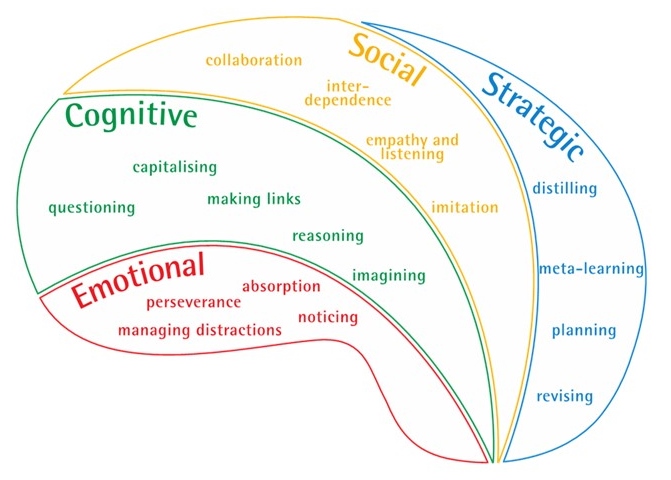
![BLP_Brain_Generic_no-Rs-[Converted]](https://www.buildinglearningpower.com/wp-content/uploads/2016/12/BLP_Brain_Generic_no-Rs-Converted.png)