THINK THIS NEEDS A PREFACE DESCRIBING WHAT THIS MODULE IS AND HOW IT INTRODUCES THE KEY IDEAS OF PLAYING THE LEARNING POWER GAME.
PROBABLY MEANS THAT THE BIT AT THE VERY END OF THIS UNIT PAGE (READY TO MAKE A START?) NEEDS AMENDING.
Why a learning power ‘game’?
Games can be used as a metaphor for learning anything and you tend to get better at anything if you treat it as a game. This programme is about learning to play the familiar game of learning but with an additional ingredient; that of learning dispositions or powers. This subtle addition changes the game of education to one of building learning character at the same time as building knowledge. So the programme explores certain guidelines and conventions that help to frame learning in ways that allow positive learning dispositions to flourish…how you might set up the game, get to grips with some new rules and tactics and learn to appreciate how you score it’s all important new endgame…that of the self-managed learner.
As with any game, it helps if you’re enabled to play the whole game from the start. If you were learning to play Scrabble you wouldn’t get far if all you were given to learn were lists of three, four and five letter words. Far better to start straight away by playing ‘Junior Scrabble’, so you get the feel for the whole game, and then build up your sophistication as you play.
So you might look on the programme as the junior game of learning power. It has all the elements you will need to introduce the values and activities of building your students’ learning power. This junior game lays the foundation for greater sophistication in further programmes.
1. How the online course is designed
Section structure…
Each section deals with a key aspect of understanding learning power and has:
an introduction to what it is about … followed by some suggestions about how to ‘navigate’ the content
part 1 aims to give you an idea of the sort of practice you are aiming for
part 2 highlights the main ideas of the section’s content
part 3 offers a few practical ideas to start things off
part 4 offers a couple of tools to help you evaluate what you have read
part 5 offers an agenda for a Professional Learning Team meeting
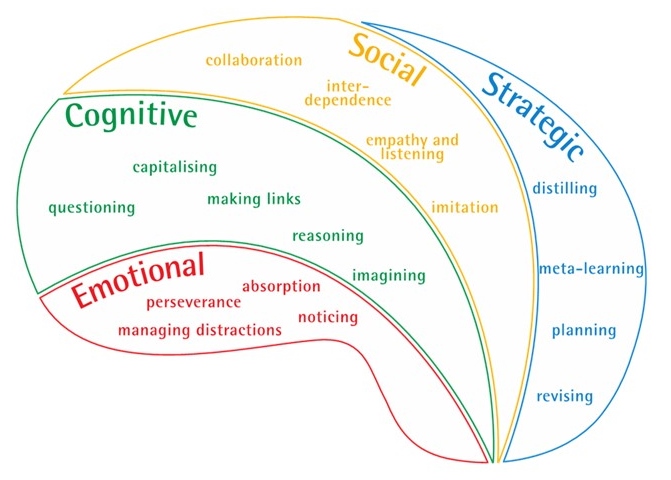
the two interlinking models of building better learners
examples of how the models work in practice;
the four learning behaviours to make a start on – perseverance, questioning, collaborating and revising
the essential aspects of classroom practice
links with educational research
encouragement to try things out with your learners
suggestions for how amendments to your teaching will help students to be better learners
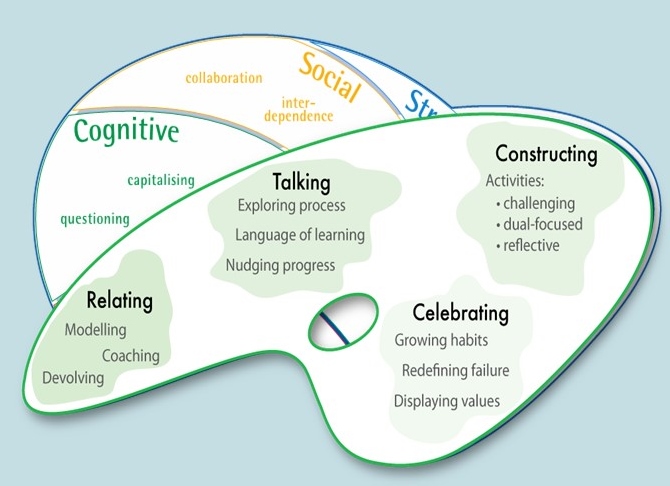
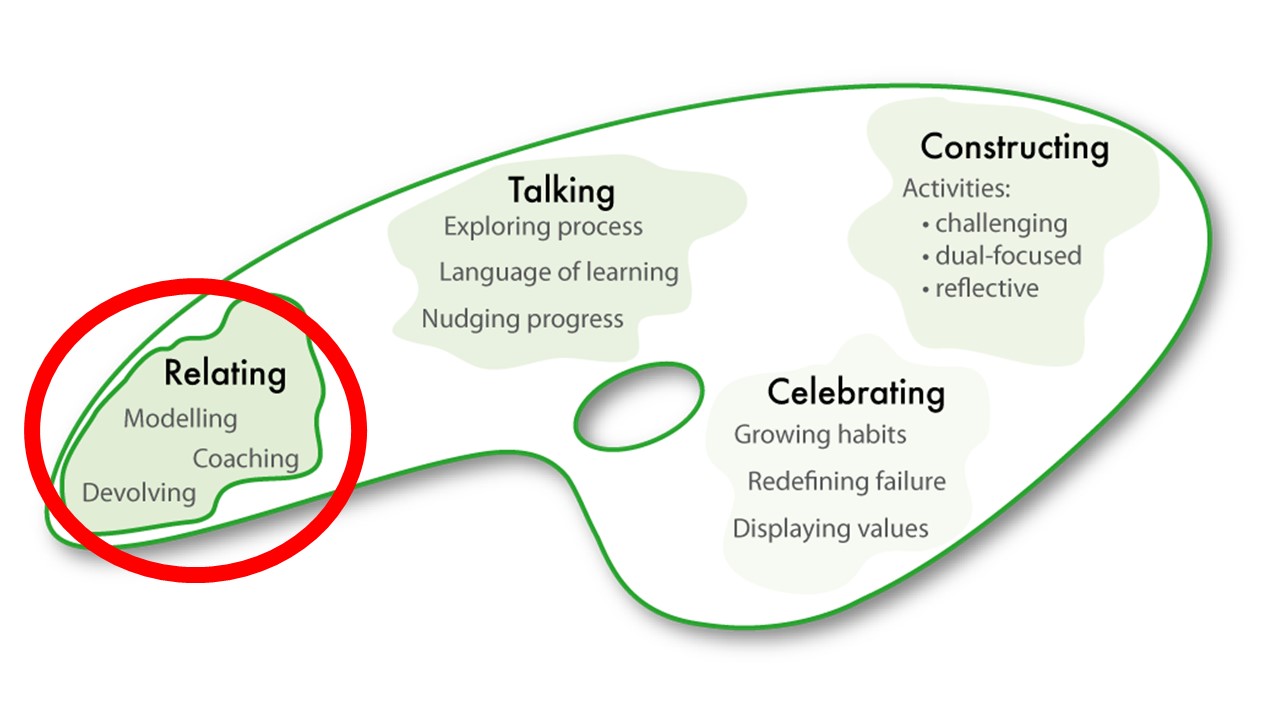
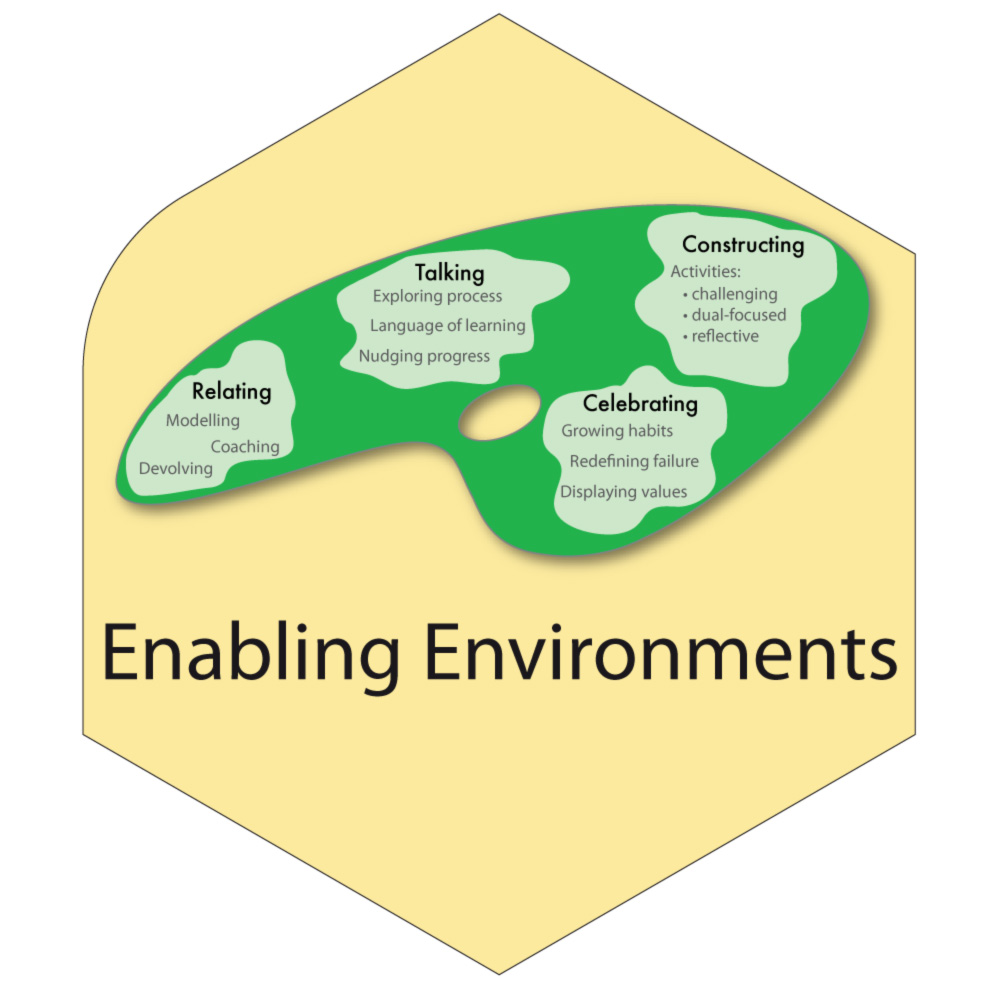
Section 2 Classroom relationships
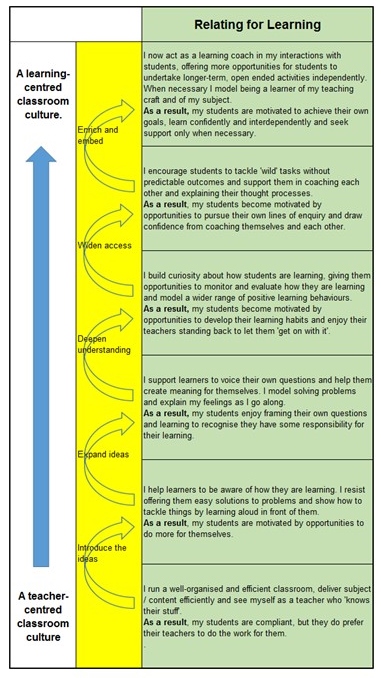
Important shifts in classroom roles
Here you will find:
examples of the sort of responsibilities teachers might devolve to learners
examples of different ways to be as a teacher
modelling the process of learning
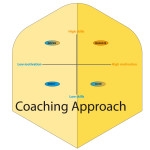
acting as a coach; asking not telling
enabling greater learner responsibility
examples of things to try out with your learners to enhance perseverance, questioning, collaboration and revising
suggestions of ways to plan to expand devolving responsibility to students
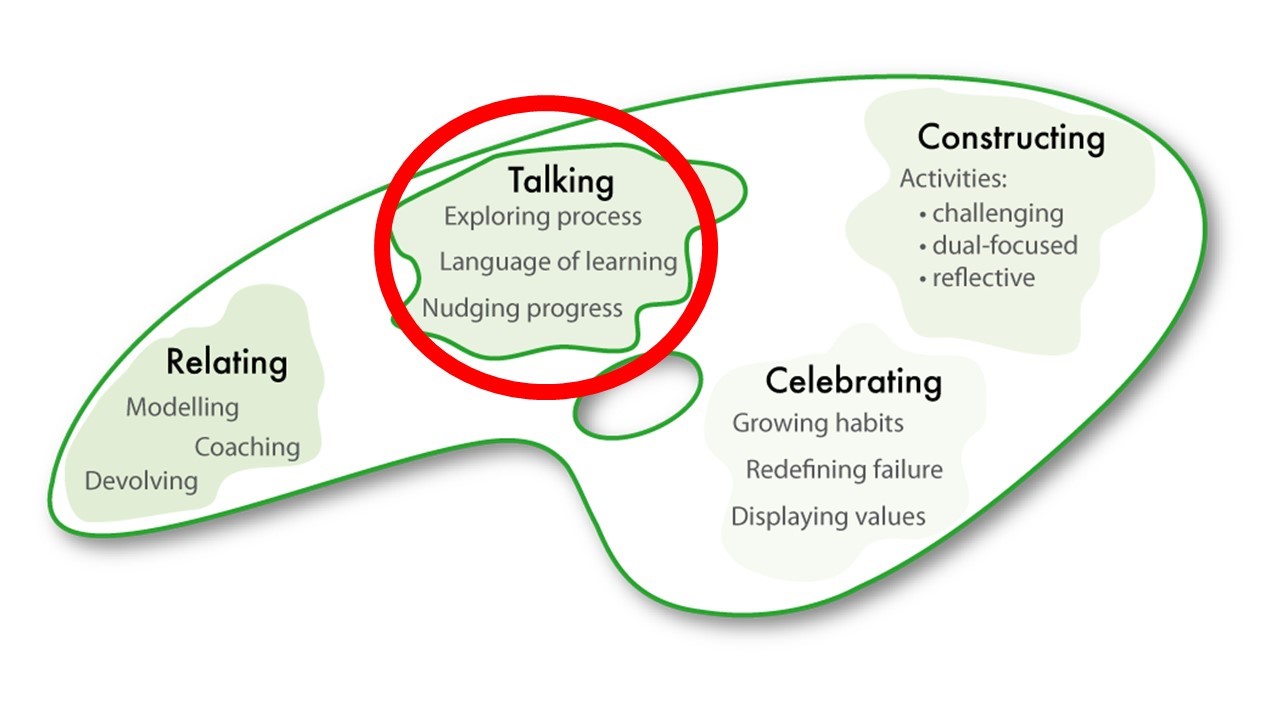
Section 3 Talking about learning power
How and when to talk about learning.
Here you will find:
examples of how learners can talk about themselves as learners
examples of different ways to talk about learning
nudging the process
offering feedback
encouraging reflective self-talk
examples of things to try out with your learners to enhance perseverance, questioning, collaborating and revising
suggestions of ways to plan to expand your learning language
Section 4 Designing learning powered lessons
How to begin to put dual-focused lessons together
Here you will find:
examples of how teachers manage learning in their lessons
a format to assist in planning dual-focused lessons
activities to help start this journey
examples of things to try out with your learners to enhance the foundational four learning behaviours
suggestions of ways to plan to expand your lesson design
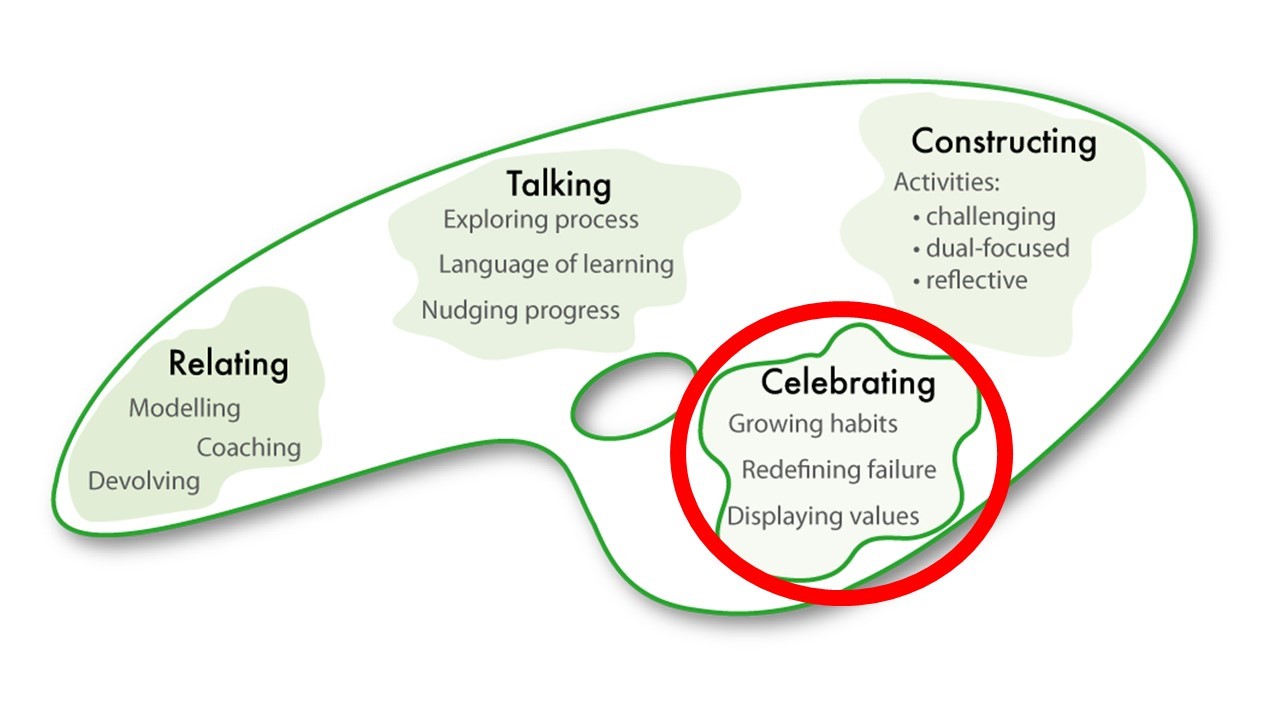
Section 5 Celebrating learning power
What’s seen as important in learning friendly classrooms
Here you will find:
examples of how learners can celebrate their learning
examples of different ways to celebrate learning
in the growth of learning behaviours
in re-defining failure
in displays in the classroom
encouragement to try things out with your learners
suggestions of ways to plan to expand what you celebrate about learning
Section 6 How are our classrooms and our learners developing?
Section 6a. How is my classroom culture developing?
What to look for and record about your classroom culture
Here you will find:
Charts showing what the phases of growth look like in relation to;
relating
talking
constructing
celebrating
with links to the anticipated outcomes for learners
ideas for developing further developing your classroom culture
in order to create increasingly learning-friendly classrooms
Section 6b. How are my learners developing?
What to look for and record about better learning
Here you will find:
explanations of three aspects of progression – frequency, scope and skilfulness in use
Charts showing what the phases of growth look like in relation to;
perseverance
questioning
collaboration
revising
examples of things to try out with your learners
ways of tracking the growth of learning dispositions over time
suggestions of ways to plan to expand what you might track about learning
Section 7 Where now: what next?
Here you will find:
explorations of ways forward
tools to help you consider your growth and development as a teacher
descriptions of the next stage online courses to support teachers’ journey to becoming a skilled learning power practitioner
a quick look at professional development approaches you might use in furthering your journey
2. How the wider blended learning programme works
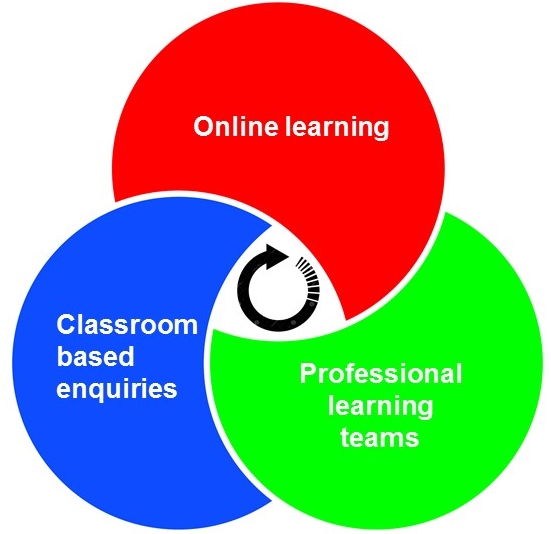
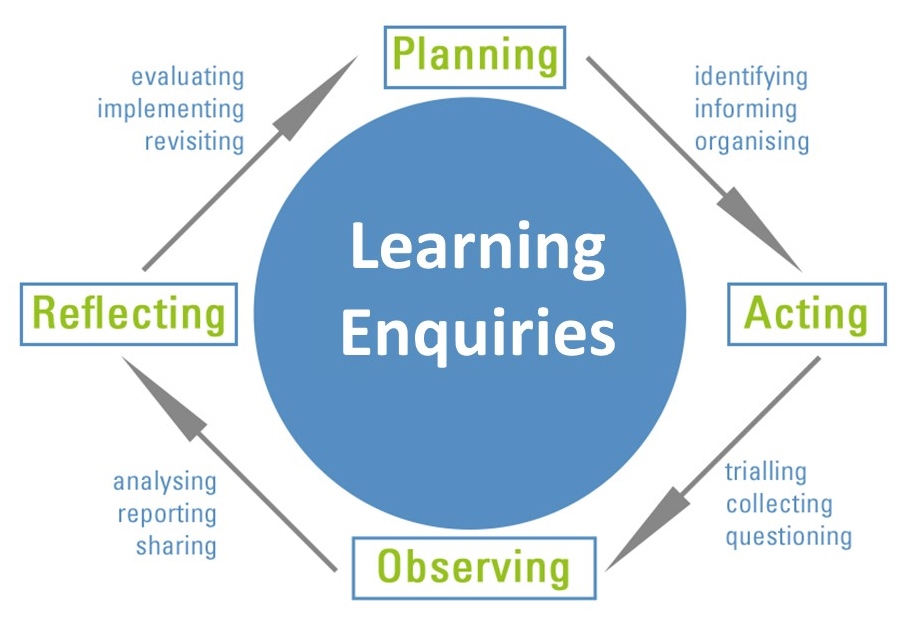
‘Playing the Learning Power Game’ is simply the online content aspect of the blended learning programme which, unless it’s blended with Professional Learning Teams and Classroom Based Enquiries is unlikely to help you achieve the desired outcomes. A Professional Learning Team is your support mechanism in the blended learning cycle. We hope that time for PLTs has been built into the rhythm of the school’s meeting cycle, and offer you a safe, supportive space to discuss and explore the craft of the classroom. We hope to that PLTs will encourage you to learn with and from your colleagues – to become, in John Hattie’s words, ‘learners of their own teaching’. Classroom Based Enquiries are the third aspect of the blended learning programme. Sometimes known as Action Research, classroom based enquiries involve changing aspects of your practice in order to develop student learning behaviours. Enquiries are likely to involve you in making small changes, monitoring the impact of those changes, and sharing these outcomes at the next team meeting for professional discussion. Most schools tend to blend these 3 aspects into a 4-week cycle.
2a. Talk, support and plan with colleagues
Professional Learning Teams; small groups of teachers who meet together regularly (usually monthly) to deepen their understanding of learning and how, by developing their classroom practice, they can make the learning process more visible and relevant to students.
The team learns and develops by:
discussing and unpacking the online information;
planning how to make use of it in their classrooms;
questioning and probing their classroom experiments.
The delicate, hard work of changing practice requires a safe professional environment in which to explore and understand classroom triumphs and tribulations. There are short guidelines that are designed to be help a team set a collaborative, working climate to support the conversion of information and ideas in the online materials into “lived” practices in classrooms. The format of a meeting agenda below is based on research into teacher learning communities by Dylan Wiliam, of Assessment for Learning (AfL) fame.
SUGGEST THE FOLLOWING TOGGLE IS TOO MUCH DETAIL AT THIS STAGE AND CAN BE DELETED
This team session is your first one in Playing the Learning Power game so it will be essential to spend the first part of the meeting considering the purpose and working guidelines for the team.
Session agenda
Agreeing objectives and agenda (5 mins)
Considering working practices (15 mins)
Re-capping the on-line materials (15 mins)
Personal Action Planning (20 mins)
Evaluating the meeting process (5 mins)
1. Session objectives: What do we want to achieve? (5 mins)
Feel confident about working as a team
Feel able to apply the on-line materials in the classroom
Decide the strategic cultural issues that everyone needs to apply in their classroom
Plan some do-able shifts in classroom practice
2. Consider the working practices of the team (15 mins)
Purposes of the group
Format of the sessions
Ground rules for working
Expectations of outcomes
See What-Why-How of PLT notes above for ideas
3. Recapping on-line materials: What did the content make us think? (15 mins)
Thoughts about:
what we thought about the online content
where do most classrooms operate in relation to this?
which of the four learning behaviours need most assistance? (perseverance, questioning, collaborating, revising)
things that are in place, things that need attention now/soon, things that will take longer to establish.
ideas you picked up from the content that you could use immediately.
4. Personal action planning: What am I going to do? (20 mins)
While we haven’t highlighted any specific ideas to try in this section the material will have triggered some…’what if I tried’.. thoughts.
Think of;
how you want to strengthen your classroom culture to encourage students to become more learning friendly?
What you are going to do to bring this about?
Develop an enquiry question.
You’ll gain more value from a plan by creating it around a question. Why a question? Because this is an enquiry, you want to find out if something will change (student behaviour) when you change something specific. Think of it like this:
If I do XXXX will it improve/develop/enhance YYYY?
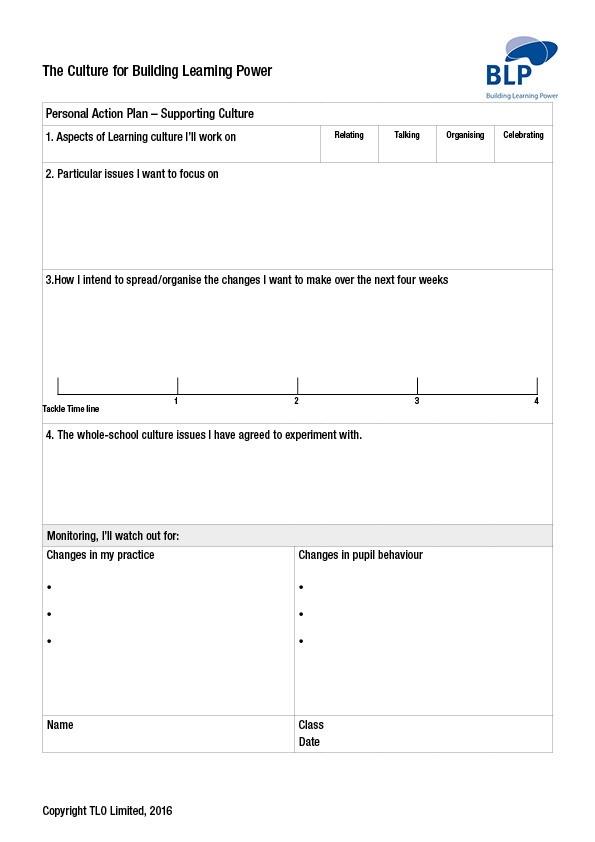
This is the crunch question – the moment of truth. Students are unlikely to change unless your behaviour changes! Visualise how you want your students to be and then think about what you might do, or say, or model, or celebrate, or whatever…. differently to bring about this change in students. Developing an enquiry question – .pdfThe learning enquiry plan is a record of what you intend to do. It takes your enquiry question from what to how. The format below may help you think through the planning process. You can fill in your Personal Action Plan using the word document version.
For the monitoring bits of your plan you might want to look out for:
an improvement in how students engage with learning
improvement in behaviour
showing less stress or worry about learning generally
increased focus when working with other students
reduced reliance on teacher support
5. Evaluate team session: How did we do as a team? (5 mins)
Did we achieve our objectives?
Are we comfortable with what we are trying to achieve?
Any concerns at this point?
Next meeting date and time.
2b. Classroom based enquiries
Classroom based enquiries operate in the spirit of enquiry or some would say action research. It’s a quest to find out more, to consider what needs to change, to wonder what might work, to track what happens and to refine practice. It’s a process in which you, as a teacher, investigate teaching and learning so as to improve your own and your students’ learning. In effect you become a researcher of your own practice. It helps you to develop new knowledge about your classroom, you become a reflective teacher who broadens your own teaching repertoire. Importantly it puts you in charge of how you teach and become very aware of the links between how you teach and how your students learn and achieve.
3. The online course in a nutshell
For those of you who like to see big pictures before the detail here is…
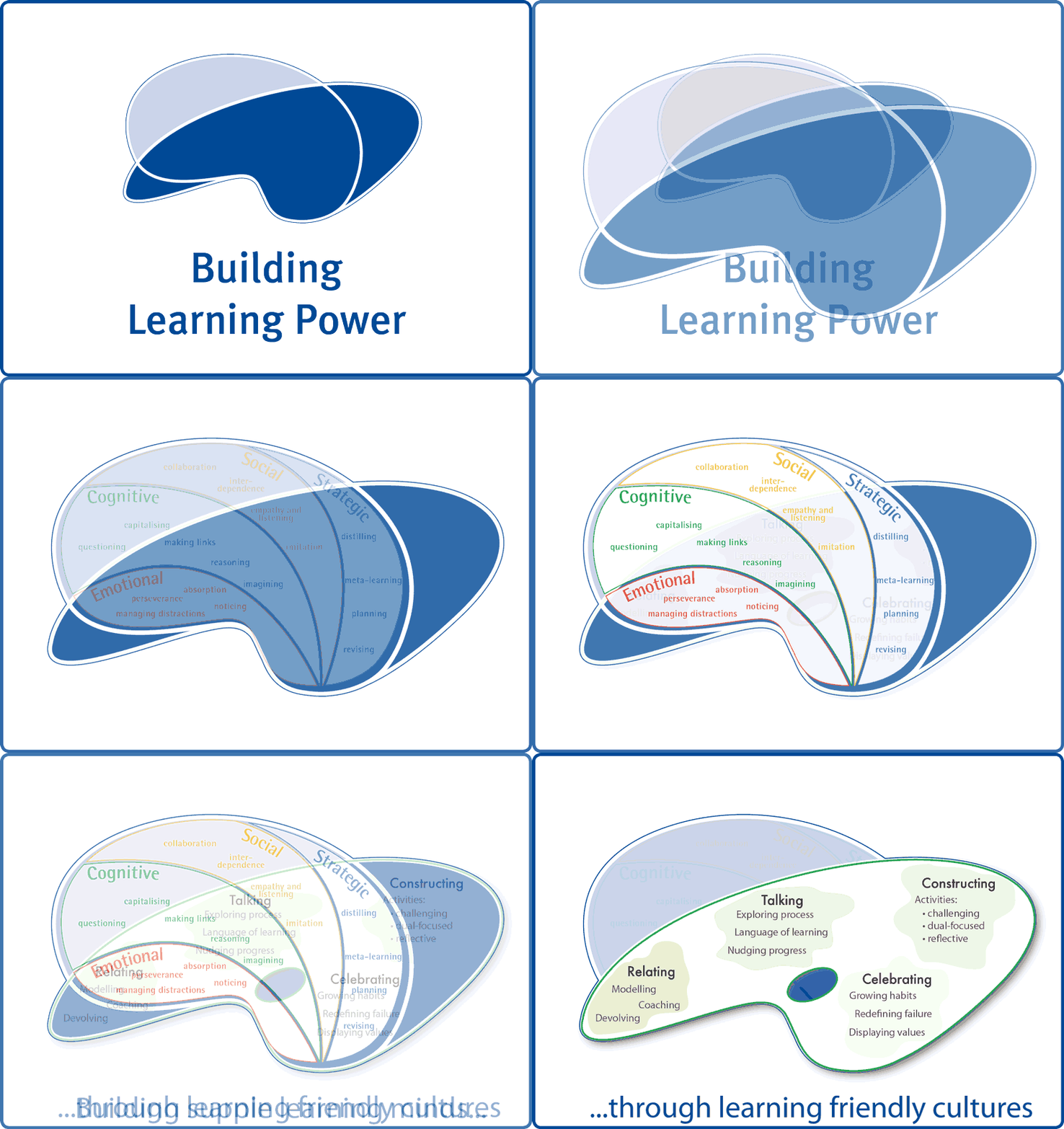
3a. The Big Picture of Playing the (Junior) Learning Power Game.
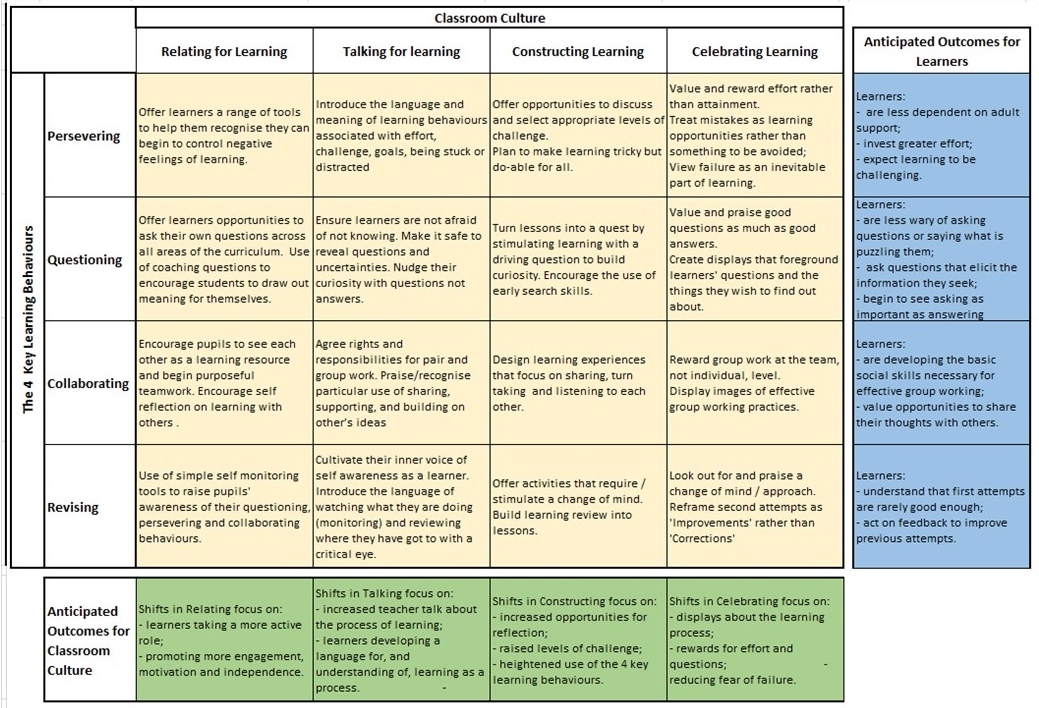
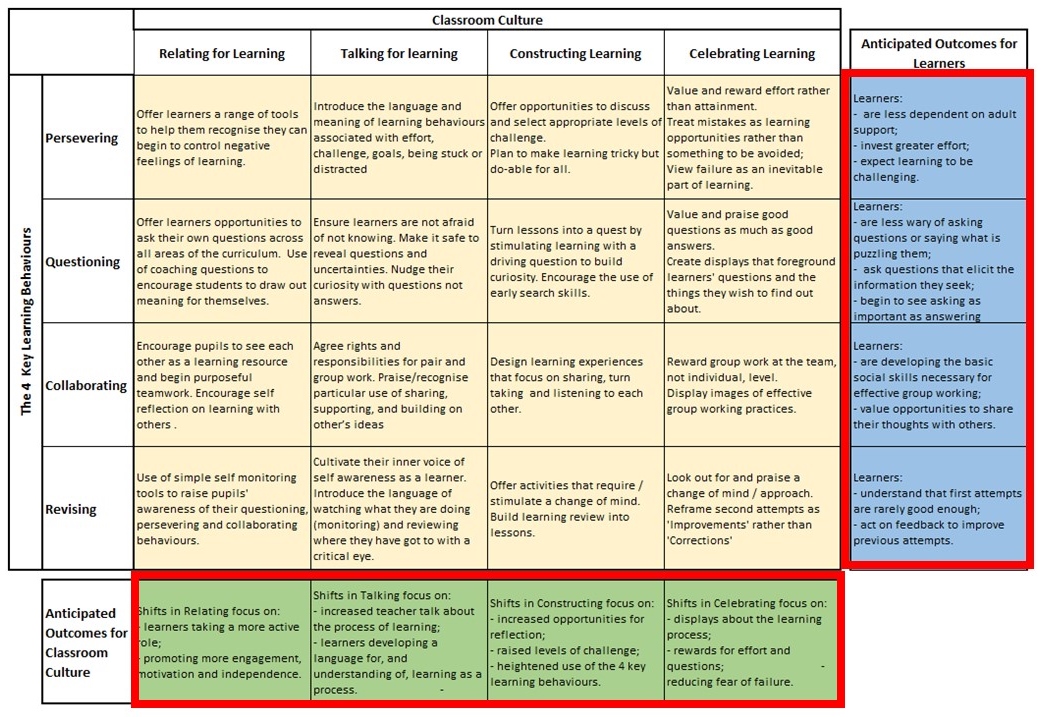
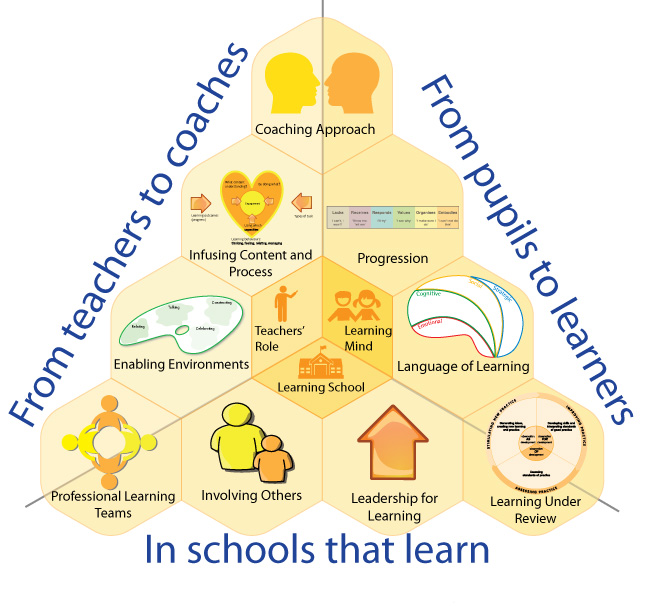
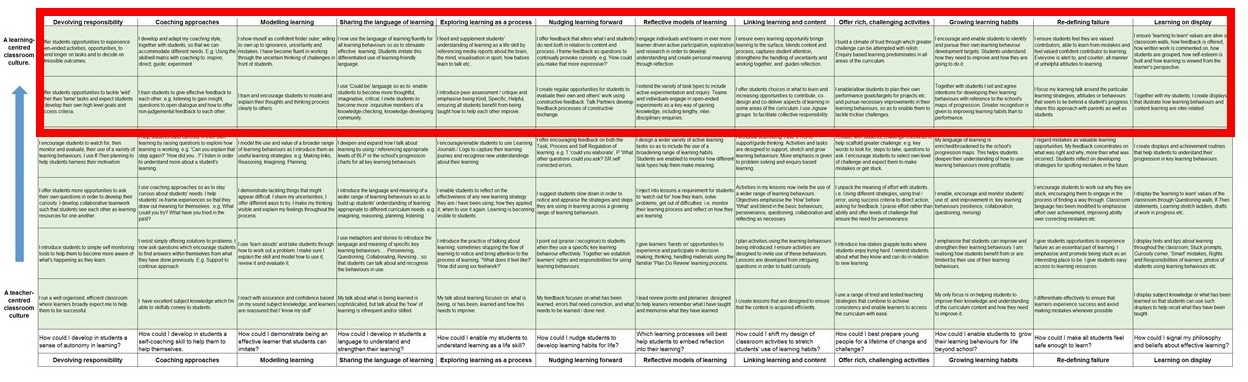
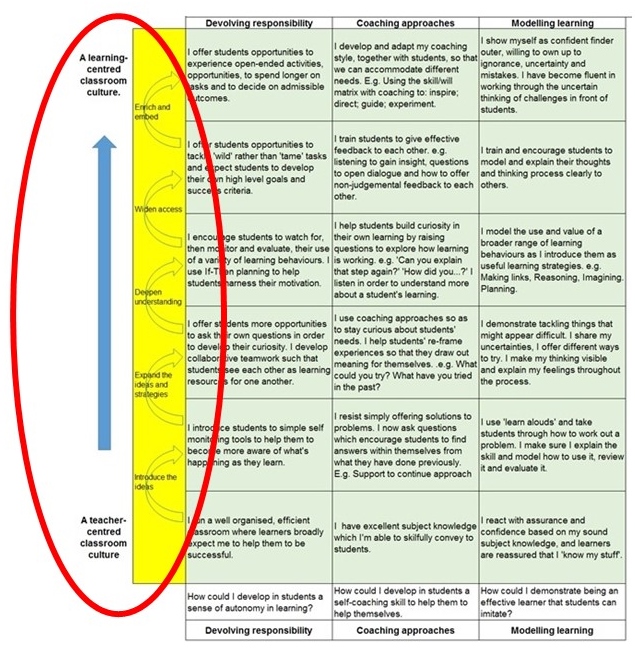
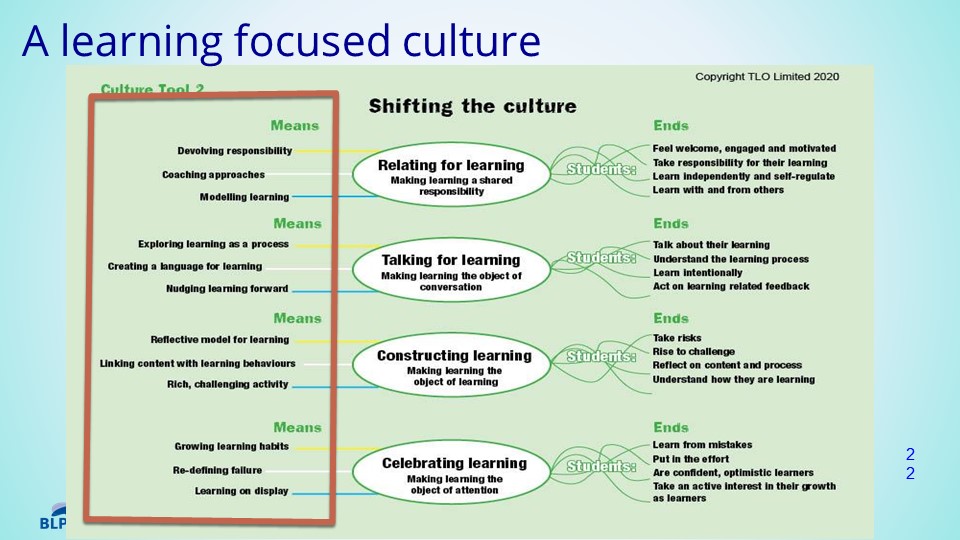
This chart distils what this course is all about;
what it hopes to enable teachers to do (in the yellow boxes)
what outcomes such changes could make in the classroom culture (in green boxes)
the anticipated outcomes for learners (in blue boxes)
The downloadable spreadsheet will also reveal a practical idea for each yellow box. So this chart offers you an ‘at a glance’ resource to help you reflect on what and how you may be adapting your teaching over the next few months. See below for more details.
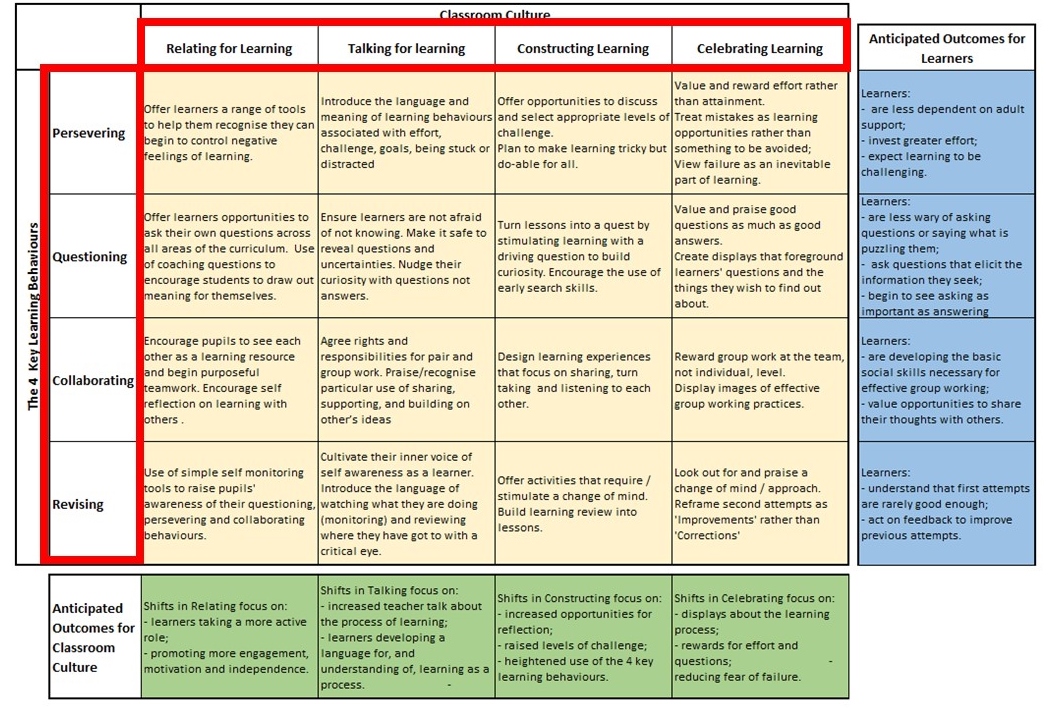
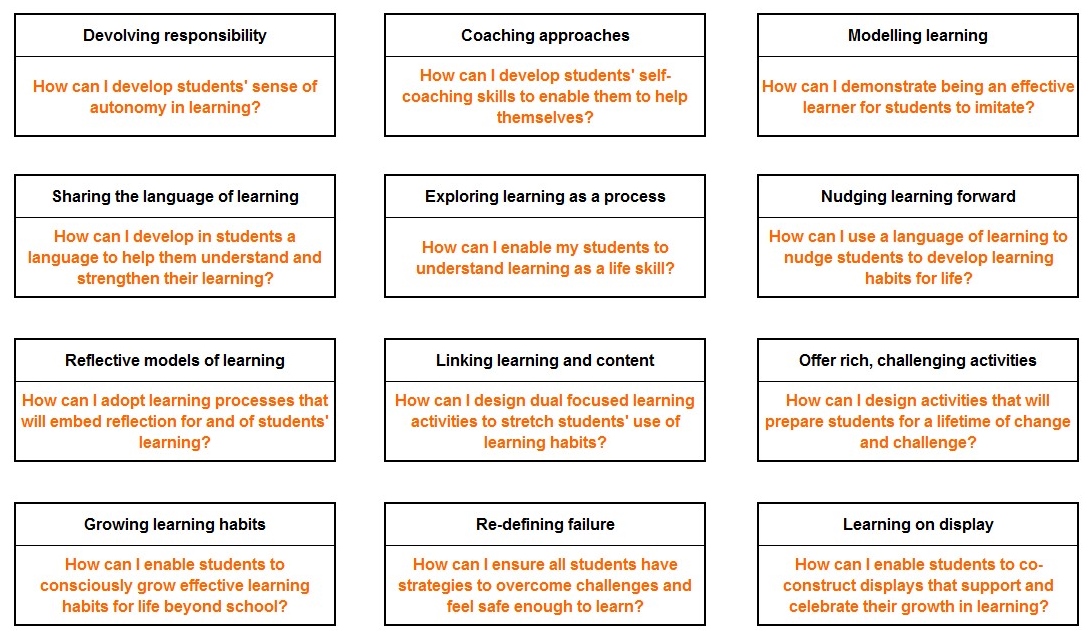
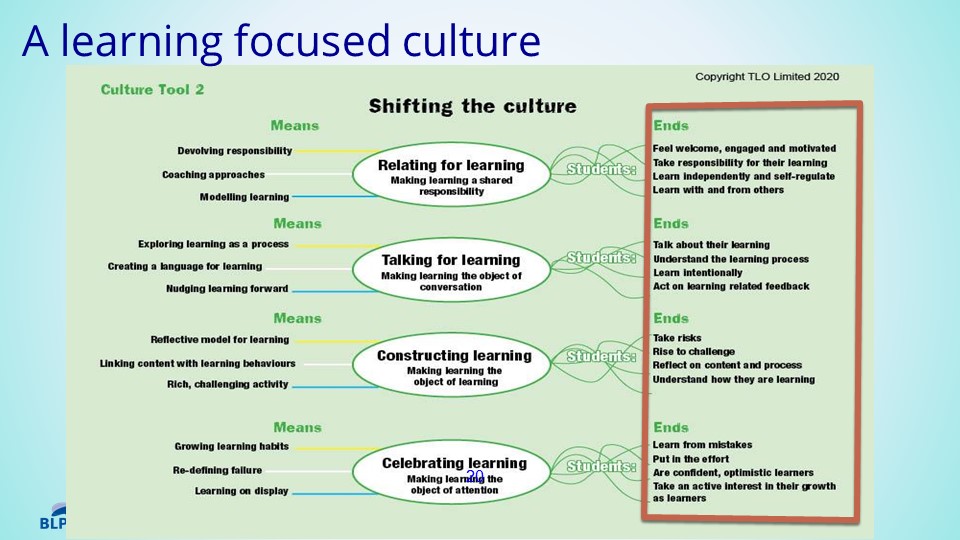
The vertical axis to the left shows the 4 learning habits you will be working to improve. The horizontal axis across the top shows the 4 aspects of classroom culture that you will be shifting. On the downloaded spreadsheet, click on the Enable Editing tab to reveal reminders by hovering over the cells.
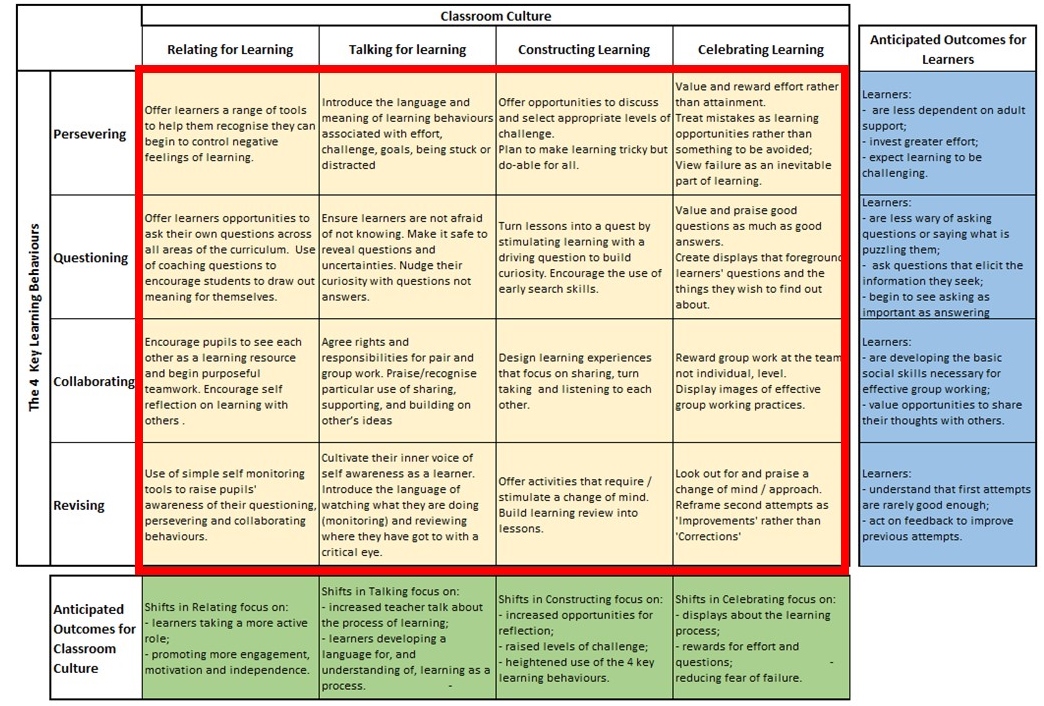
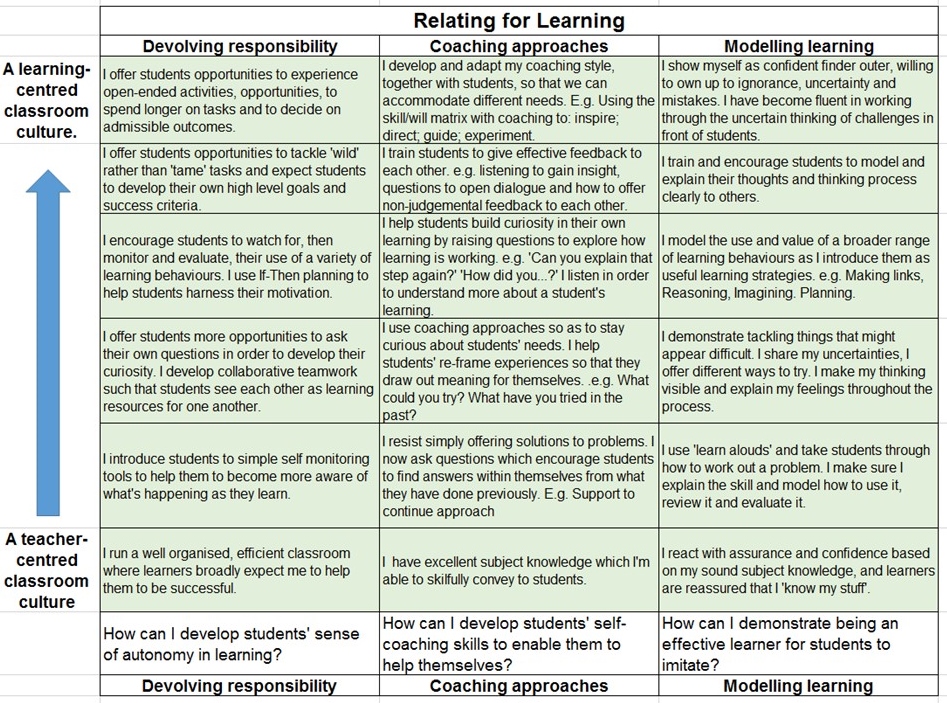
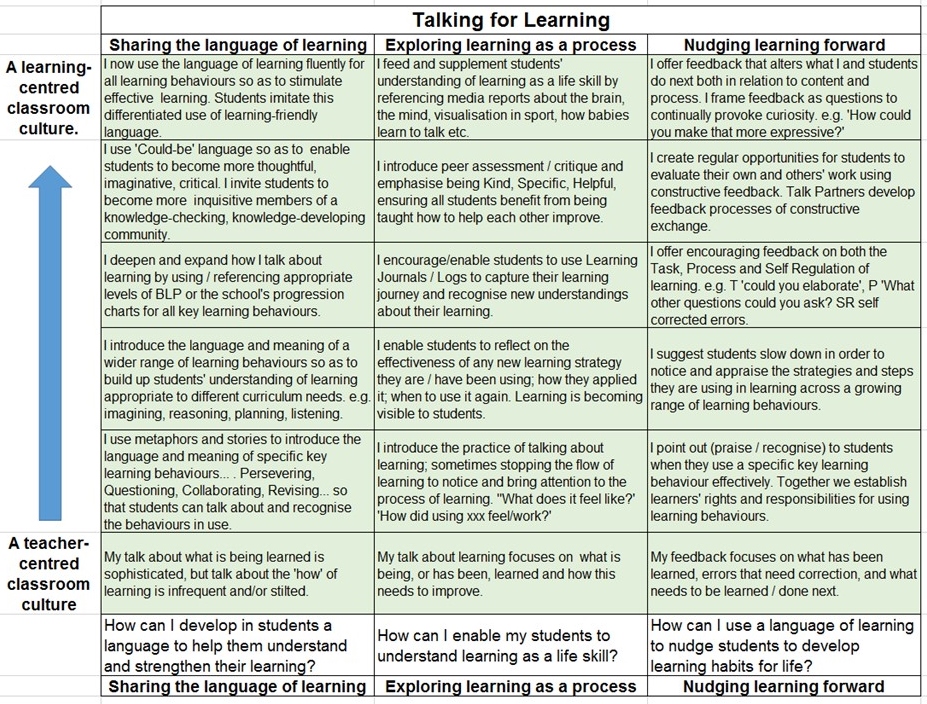
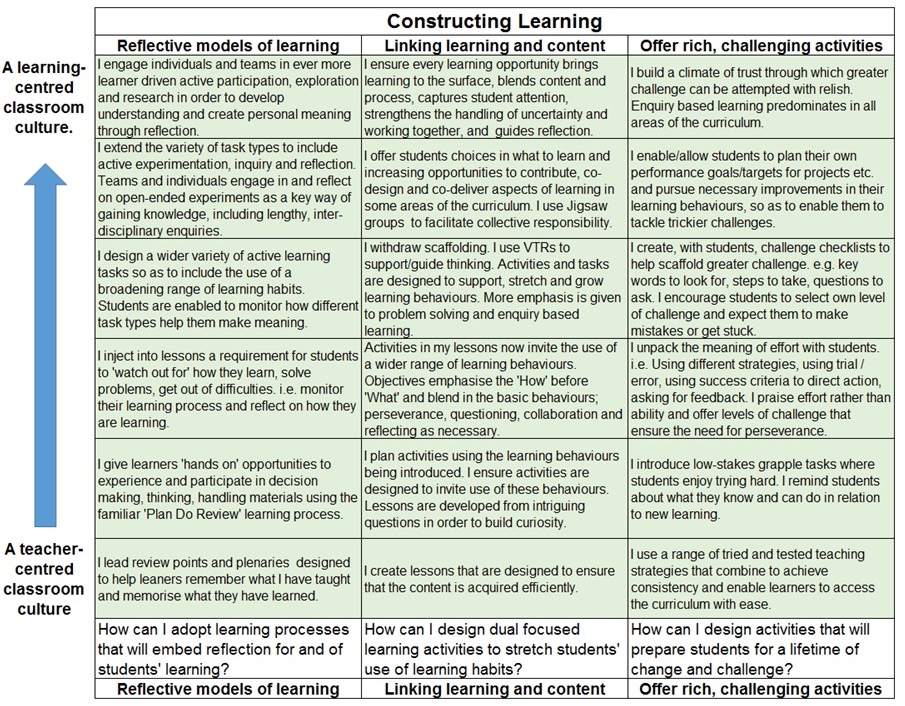
3c. The central 16 cells
These cells serve 2 purposes. Firstly:
The text in each cell gives an indication of the classroom culture that needs to be in place for learners to learn how to learn.
When looked at vertically down the page, they map out the 4 aspects of classroom culture.
When looked at horizontally across the page, they hint at the ways in which classrooms need to change to enable the 4 key learning behaviours to flourish.
Secondly:
On the downloaded spreadsheet, hovering over each cell reveals a teaching idea taken from The Learning Power Game module.
These teaching ideas are key to unlocking each cell. There are many other ideas in the module for each cell, but these are the ‘must do’ strategies.
3d. The cells to the bottom and to the right
The green cells across the bottom give an outline of how the teacher’s role develops as they make changes in how they relate and talk to learners and how they construct and celebrate learning. Hovering over each cell gives more detail. The blue cells to the far right give an indication of the anticipated outcomes for learners in terms of the 4 important learning behaviours and hovering over each cell suggests what you might look for in students. As you hover over these cells, you will gain a sense of what you might look out for in terms of classroom culture and student learning behaviours.
SUGGEST THE FOLLOWING IS AMENDED IN LIGHT OF THE STARTING PARAGRAPH
So – are you ready to make a start?
The first section of online learning is called ‘What do we mean by learning power?’ You can access it by using the ‘Unit Navigation’ box (top right on your screen). Resist the temptation to skim read other sections – focus your efforts on ‘What do we mean by learning power?’ in preparation for your first Professional Learning Team meeting.
a manageable set of tools to enable them to uncover, collect and analyse information about their students’ learning character
an outline of the research, value, makeup and growth of peoples’ learning character.
These tools aim to help your school discover and analyse your students’ learning behaviours and use this information as an essentialstarting point for helping students become better learners. In other words this resource will help you and your school to;
use a rich picture of your students’ learning behaviours, rather than attainment, to underpin your approach to helping them to improve, develop or catch up on their learning.
2. The why of this resource
What are your students like as learners…now?
Do they have a learning character and can this be moulded?
What are my students’ learning strengths or limitations
Which learning behaviours do our students need to strengthen…now?
Does learning character play any part in influencing the attainment of higher vs lower performing students?
These unusual yet vital and urgent questions form the stimulus for this resource; a practical tool to help teachers and schools uncover their students’ learning character and use this, usually hidden and unknown information, as the very basis for developing and strengthening them as learners.
Our growing understanding of how learning habits build has led us to ask how schools might use such information to help shape teachers’, or even whole school, plans. What does growth in learning habits look like? How might teachers estimate students’ phase of growth? Might schools use this information in strategic plans of action (Intent)? What sort of activities would teachers need to use to strengthen the growth of learning habits? (Implementation) What would count as evidence of impact and how might that be captured and reviewed? (Impact).
3. The how of this resource
Each section deals with a key aspect of understanding and using the tool and reading the results.
Section 1 What makes a difference in learning?…offers you a brief introduction to the meaning, purpose and attributes of learning character /learning power.
Section 2 Uncover the mysteries of learning behaviours...offers rich descriptions of the learning behaviours that form part of this measuring tool.
Section 3 Up close and personal with learning…invites you to start considering learning behaviours seriously by looking at yourself as a learner, followed by a couple of students.
Section 4 Finding learning characteristics….suggests how you might go about gathering, recording and interpreting the evidence for just one class and then for the whole school
Section 5 Where now, what’s next? explores the changes you might make based on the data collected and the routes you might take to ensure growth in pupil’s learning behaviours.
4. The where from of this resource
The idea of learning behaviours that are explained and analysed using this resource comes from a vision of twenty-first century education and the new sciences of learning that underpin it. It starts from first principles: that we now know an individual’s ability isn’t fixed; that the brain is like a muscle; that its intelligence grows with exercise. Selling this idea to learners brings, in itself, far more enthusiasm for engaging with the potential delights of learning, helping students to become more independent, more reflective, and better able to plan and evaluate their own learning. This, as John Hattie’s research has shown, is a better way of boosting students’ attainment than more drilling in the subject-matter.
The great strength of this approach is that there is already a wealth of tried and tested strategies that teachers can introduce immediately to begin to transform the learning experience of their students, and give them a language with which to think about the process of learning.
This resource affords teachers an insight into the skills and attitudes their students use when learning…
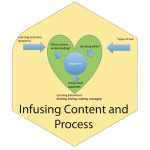
All lessons function on two levels, they have twin intentions. On the one hand there is content to be acquired, and on the other there are learning behaviours to be exercised in pursuit of this content. The factor that differentiates a standard lesson that effectively ‘delivers the content’ from a learning powered lesson is that the teacher has to think, in advance, about:
the learning behaviours that are necessary for successful content acquisition;
the design of activities or tasks that will stimulate these behaviours;
how learners could reflect on and evaluate their use of these behaviours.
The cultural shift is about understanding how students are learning as well as what they are learning.
In this section you will find:
examples of how teachers manage learning
explanations of different ways to plan for learning
long term planning
medium term planning
lesson planning
a format to assist in planning dual-focused lessons
activities to help start this journey
encouragement to try things out with your learners
suggestions of ways to plan to expand your lesson design
The key features of dual-focused teaching
Learning, rather than performance is made the object of learning.
Reflecting on learning and reviewing learning are designed into lessons
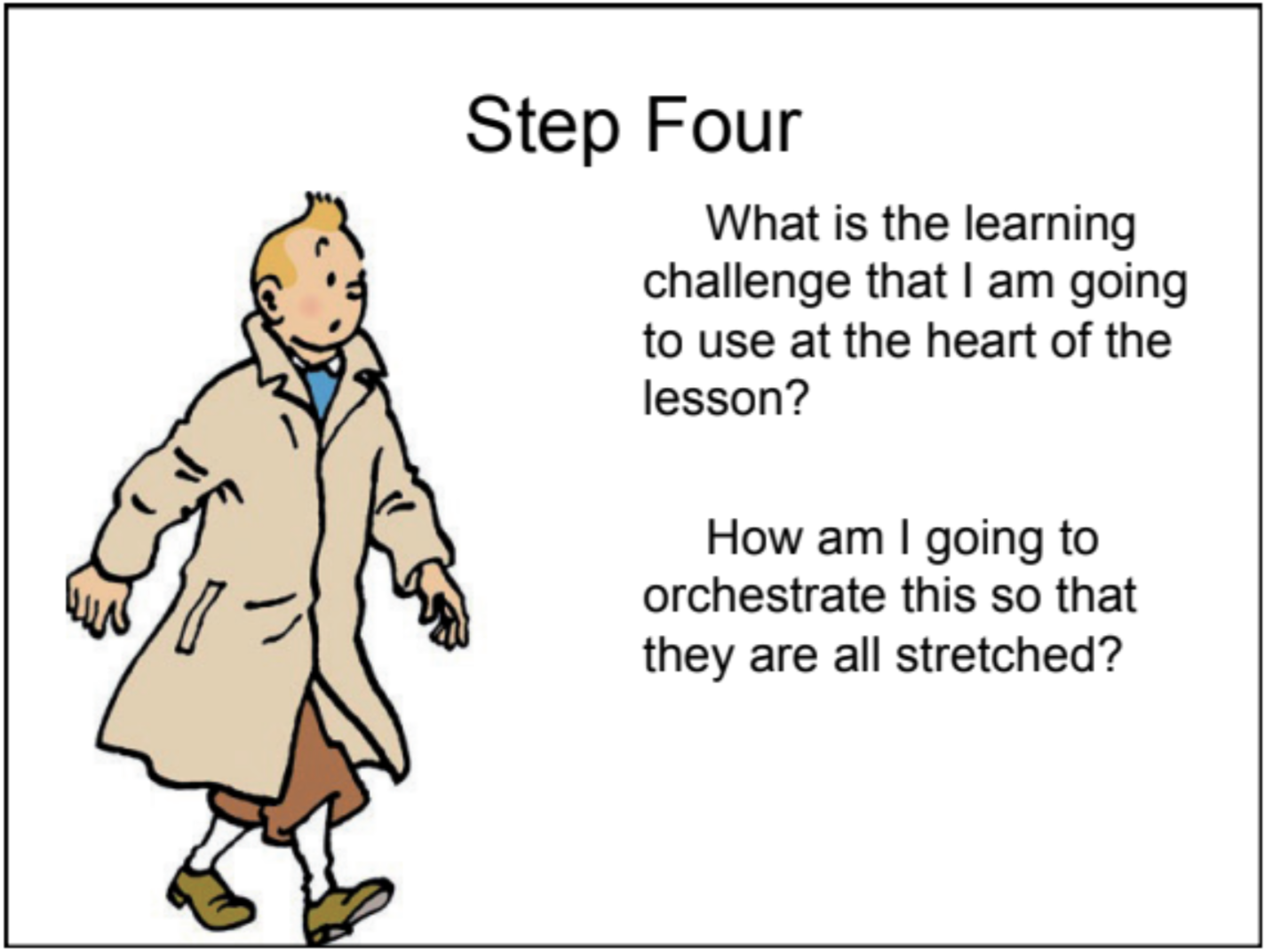
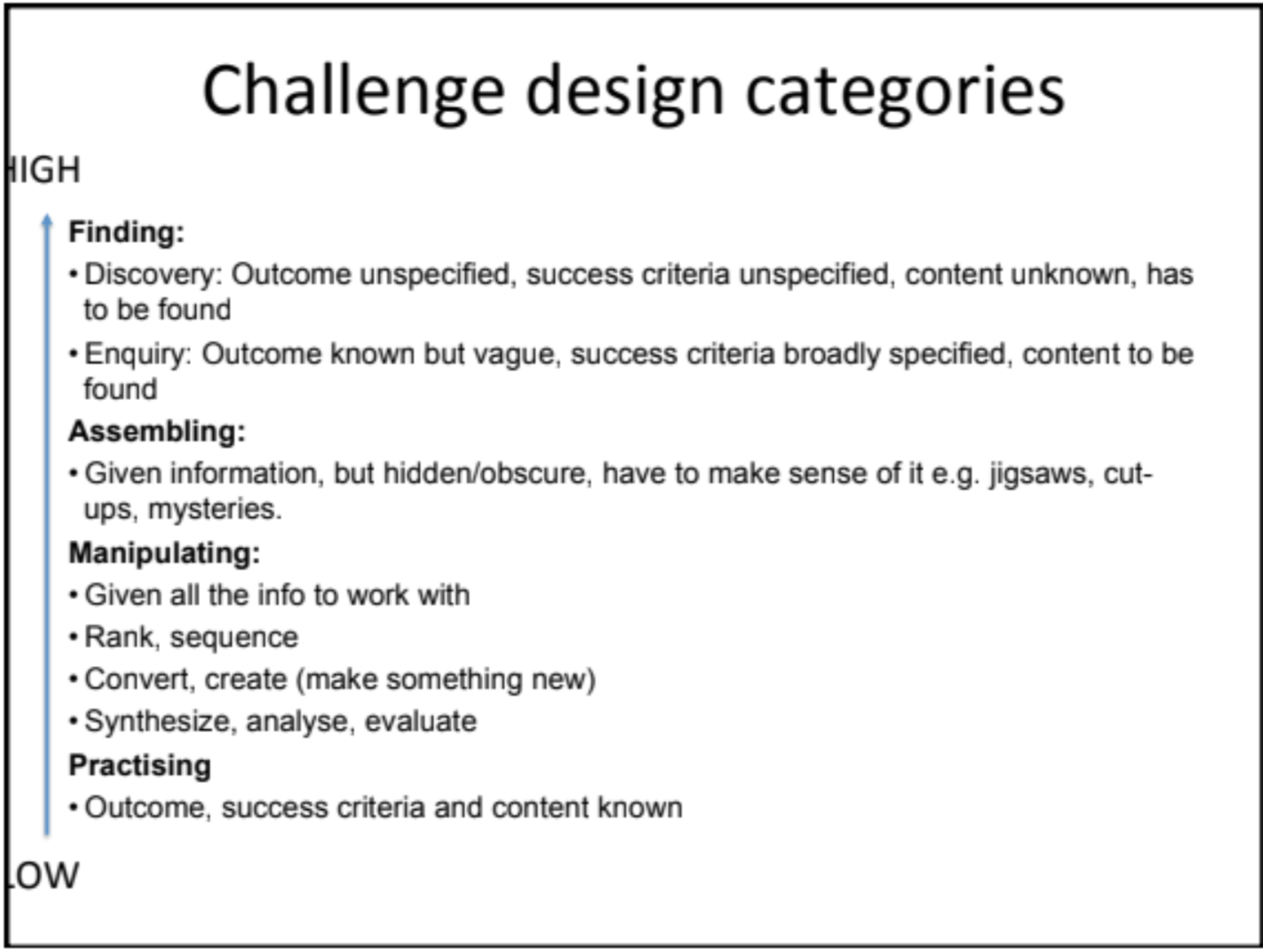
Learning activities are designed to stretch and challenge content acquisition and learning behaviours.
Lessons become more interesting and challenging by how teachers consciously choose learning behaviours to couple with content.
Aspect 1: Lessons with a dual focus – lessons are designed intentionally to deliver content and to exercise learning behaviours, and students are made aware of both. The learning behaviours drive the content acquisition, the content is the exercise regime for the learning behaviours, each enhancing the other.
Linking content with learning behaviours
Whether we realise it or not, all lessons have a dual purpose:
The content dimension, with material to be mastered
The ‘epistemic’ dimension, with some learning skills and habits being exercised.
In conventional lessons where the teacher remains the focus of attention and the initiator of all activity, and where the epistemic dimension is not acknowledged, students gain habits of compliance and dependence, rather than curiosity and self-reliance. In developing learning power, teachers are making conscious choices about which habits to introduce and stretch and how best to couple these with content so that lessons become more interesting and challenging. Through such overt coupling of content and specific types of process, students come to know, understand and take control of their learning behaviours – they knowingly use and develop the whole range of learning behaviours. Ask yourself:
Do I ask myself “How are students going to learn it?” instead of ‘How am I going to teach it?”?
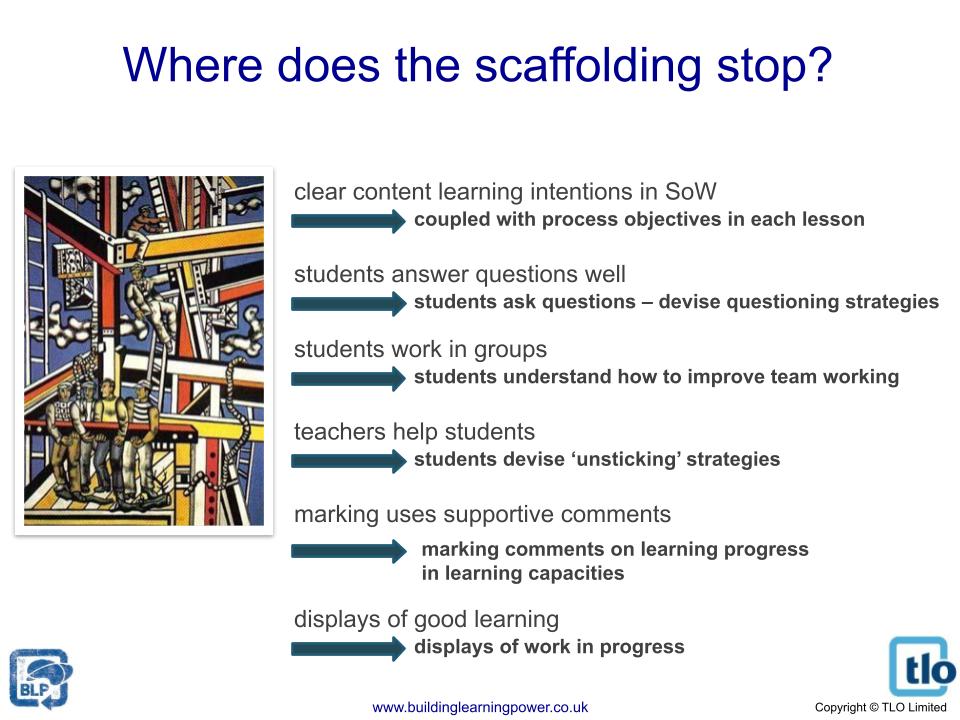
Aspect 2: Rich and challenging activities – increasingly open-ended activities are designed to engage, to stretch and to challenge. The learning is not over-scaffolded, and the inherent difficulties are not avoided or diluted by overly-helpful teachers. The activities stretch and challenge both content understanding and learning behaviours.
Rich, challenging activity
Learning is always an emotional business and learning how to manage this is best done ‘on the job’ in the course of learning rather than as a separate stand-alone activity. Emotional engagement is a prerequisite of powerful learning, it’s what gets you interested enough to be willing to put in the effort to get better and see the value of pushing yourself. So lessons aren’t just designed to make use of different kinds of learning behaviours but to give those behaviours a good work-out. Activities are designed to:
be challenging and where being stuck and confused are regular and fruitful experiences.
give students the opportunity to ‘learn what to do when they don’t know what to do’ – to work on wild tasks, rather than tame ones, where there’s plenty of scope to get lost and perplexed.
“The presence of challenging learning intentions has multiple consequences. Students can be induced to invest greater effort, and invest more of their total capacity than under low demand conditions.”
(Hattie, Visible Learning)
Ask yourself:
What proportion of tasks in my classroom are rich and challenging?
Aspect 3: Lessons with in-built reflection – reflection on content and reflection on learning behaviours is routinely built into lessons. Review points, rather than the formulaic plenary, focus students on what they have learned and how they have learned it. Reflection is done by students for themselves, not by teachers on their behalf.
Build in lesson review points – so that students reflect for themselves
The importance of reflection in the learning process is well documented. We do not learn simply by doing, we learn by doing and by reflecting on what we have done and how we have done it. But lesson review points (or plenaries) are often teacher-led. Too often they are a recap of what the teacher wanted students to learn – little more than a restating of the learning intentions and a quick check of student understanding. Necessary, maybe, but not the opportunity for students to reflect for themselves on what they have learned and how they have learned it. Try the simple method of students talking in pairs to distil:
three things they have learned today;
three things they still need to find out;
three ways they learned today;
three things they hope to do next lesson.
One or two pairs are selected to feed their opinions back to the rest of the class. Advantages for the teacher:
You get to hear what they think they have learned, as opposed to them getting to hear what you think you have taught them;
You get a rest at the end of the lesson while they do their reflection activity.
Ask yourself:
To what extent is Reflection on either content or process a consistent feature in your classroom?
This is the companion resource to ‘Narrowing the Learning Gaps‘ online programme for staff. It is designed to support you as a senior leader to introduce your teachers to their blended learning programme and to take a strategic approach to sustaining momentum as the teachers’ programme develops.
This companion resource has 8 sections:
Overview: strategic issues and a programme for staff
This online resource and its companion booklet (available in printed or electronic format) came into being to help meet cries for help from schools. Many schools, both primary and secondary, are wrestling with the growing challenge of a widening attainment gap between, most notably, disadvantaged and looked after children (Pupil Premium), and other students. The schools that contacted us had an inkling that maybe, just maybe, helping students to become aware of and improve their learning habits could offer an effective way to tackle the problem.
Having seen the positive effect of a learning power approach on students’ learning for several years now we agreed wholeheartedly with their ‘inkling’, but it raised some complex questions. Our understanding of the progression of learning habits led us to ask; which learning habits would schools need to concentrate on; at what sort of level; how would they know their starting points; how might they put a plan together (Intent); what sort of activities would teachers need to implement; what would they be monitoring to keep plans on track; how could schools and teachers keep it manageable (Implementation); what would count as evidence; how would they look for it (Impact)?
So what has arisen here comes from intriguing links between school inquiries about how to generate evidence of impact of building powerful learners and our work on students’ progression in all aspects of learning power.
The approach to building students’ learning habits explored here is commonly applied in primary schools as a whole school strategy. But the whole school approach has proved trickier to achieve in secondary schools where teachers meet students far less frequently and for less time. Nevertheless, this resource attempts to overcome this problem and offers individual teachers and schools a manageable way forward.
And because we know this work is so essential to schools and the lives of millions of children we have written it to enable any school, learning power knowledgeable or not, to be able to take it on and run with it.
2. The what of this resource
This resource offers teachers and schools;
clear information about the power of learning behaviours and how they grow
a manageable tool to enable schools to analyse their students’ learning behaviours
guidance on teacher talk, lesson design and classroom cultures to help strengthen learning habits
tools to enable teachers to assess and amend their classroom culture and teaching styles
a spreadsheet package to help schools to monitor, evaluate and manage their data
…in order to help schools narrow the achievement gap, ensure students don’t fall further behind and enable their students to become lifelong learners.
Schools that are subject to Ofsted could regard sections 1, 2 and 3 as laying out your Intent, what you are intending to achieve; sections 4, 5 and 6 your strategies for Implementation, what you are intending to do to achieve it; and section 7 as generating evidence of Impact, what you have achieved.
Or, put another way, this resource will help you to;
put students’ learning behaviours (not attainment) front and centre in the school’s approach to improving learning,
use the basic tools and techniques to raise students’ awareness of how they can take control and build their learning behaviours,
understand and apply the teaching approaches needed to strengthen learning behaviours,
explore, explain, estimate and record students’ growth in learning behaviours and the impact on their learning.
3. The how of this on-line resource
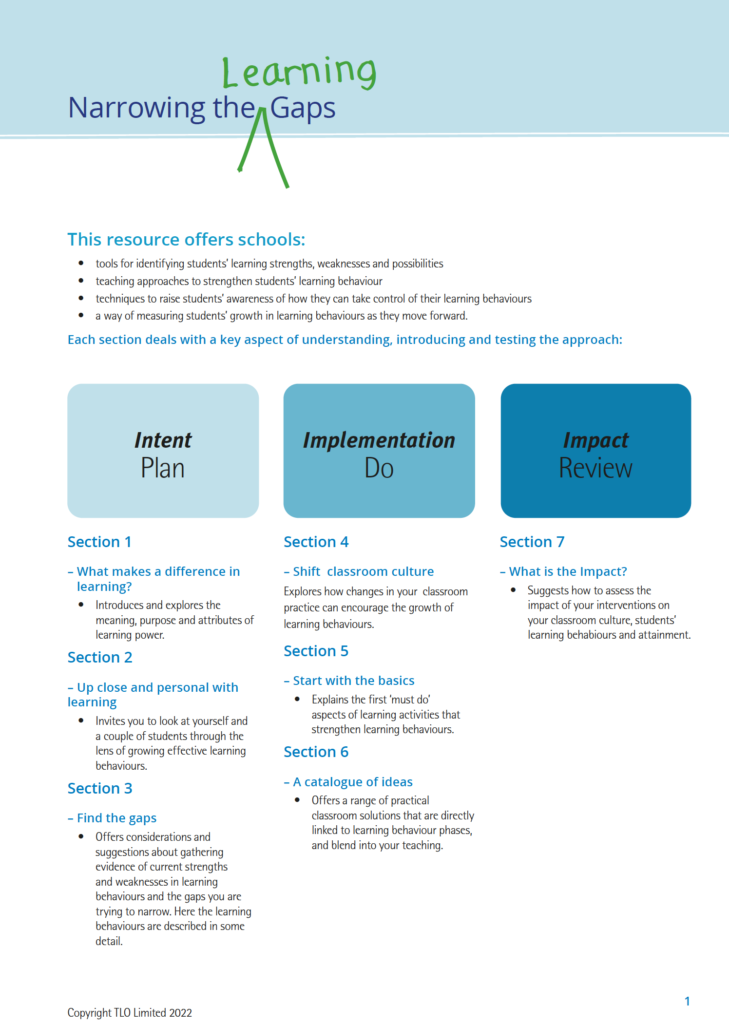
Each section is based around the points raised in the Narrowing the learning gap booklet but adds more detail and features of interest. Looking at the numbered sections will lead you through the basic story but there are also toggle boxes which add richer information and could be returned to later.
Each section deals with a key aspect of understanding, introducing and testing the approach.
Intent (Plan)
Section 1 What makes a difference in learning?…introduces and explores the meaning, purpose and attributes of learning power.
Section 2 Up close and personal with learning…invites you to look at yourself and a couple of students through the lens of learning behaviours.
Section 3 Find the gaps…offers serious considerations about gathering evidence with regard to the gap in learning you are trying to narrow.
Page 2-11
Implement (Do)
Section 4Shift classroom culture…explores how your classroom practice can encourage the growth of learning behaviours.
Section 5 Start with the basics…explains the first ‘must do’ aspects of learning activities that strengthen learning behaviours.
Section 6 A catalogue of ideas…offers a range of practical classroom solutions that are directly linked to phases of learning behaviours and blend into your teaching.
Pages 12-19
Impact (Review)
Section 7 What is the impact?…suggests how to assess the impact of your interventions on your classroom culture, students learning and attainment.
Pages 20-21
4. The where from of this resource
The approach to learning explored here comes from the vision of twenty-first century education and the new sciences of learning that underpin it. It starts from first principles: that we now know an individual’s ability isn’t fixed; that the brain is like a muscle; that its intelligence grows with exercise. Selling this idea to learners brings, in itself, far more enthusiasm for engaging with the potential delights of learning, helping students to become more independent, more reflective, and better able to plan and evaluate their own learning. This, as John Hattie’s research has shown, is a better way of boosting students’ attainment than more drilling in the subject-matter.
The great strength of this approach is that there is already a wealth of tried and tested strategies that teachers can introduce immediately to begin to transform the learning experience of their students, and give them a language with which to think about the process of learning. You can boost the development of students’ confidence, capacity and appetite for learning itself.
This resource affords teachers an insight into the skills and attitudes their students use when learning… and how to fix them.
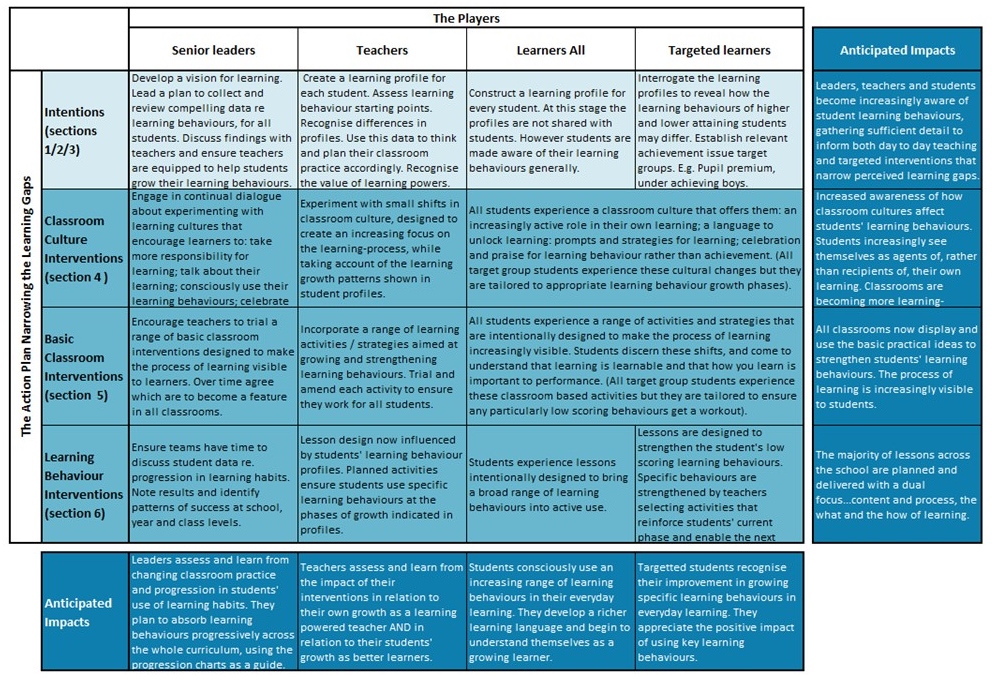
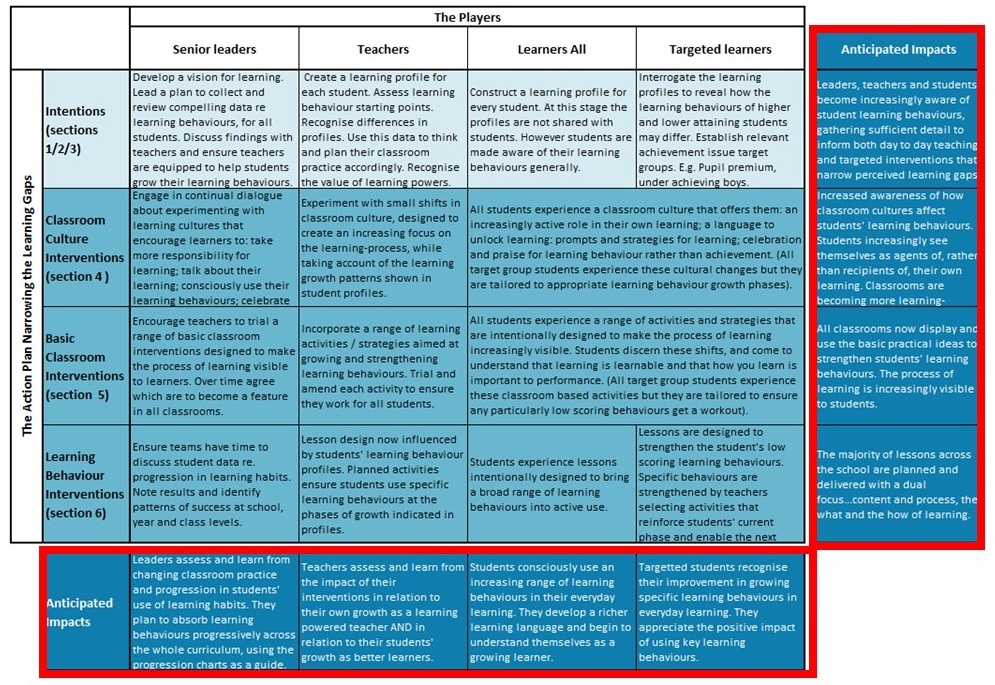
5. For the big picture thinkers who want a overview, this is the Big Picture of the course.
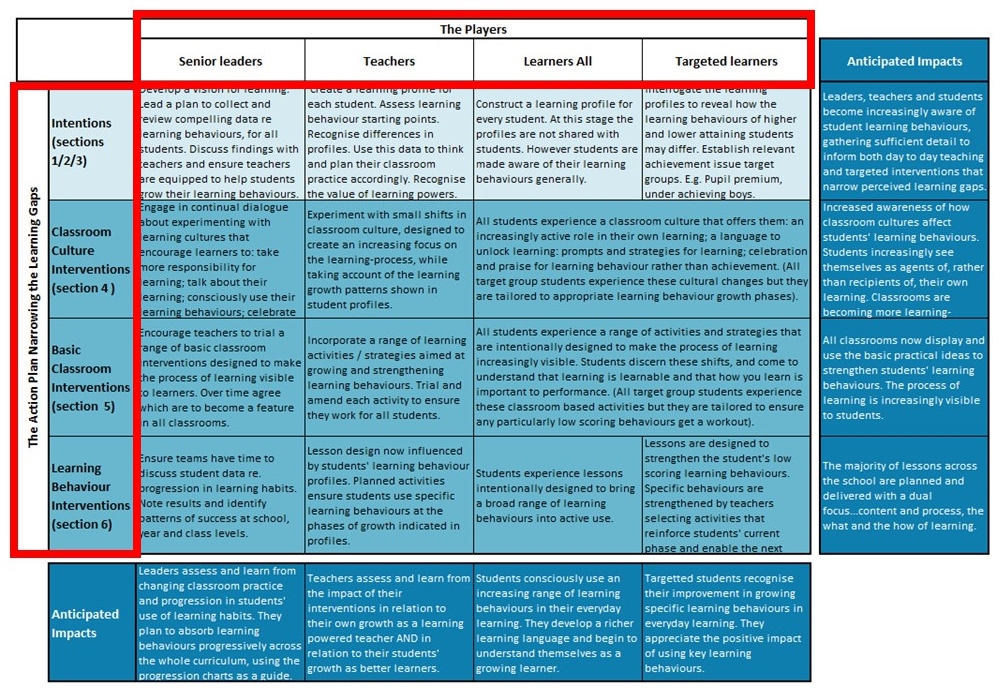
The vertical axis to the left shows 4 aspects of development process – intentions, cultural interventions, basic teaching interventions; learning behaviour interventions.
The horizontal axis across the top shows 4 groups that are involved and impacted – leaders, teachers, all learners, and targeted learners.
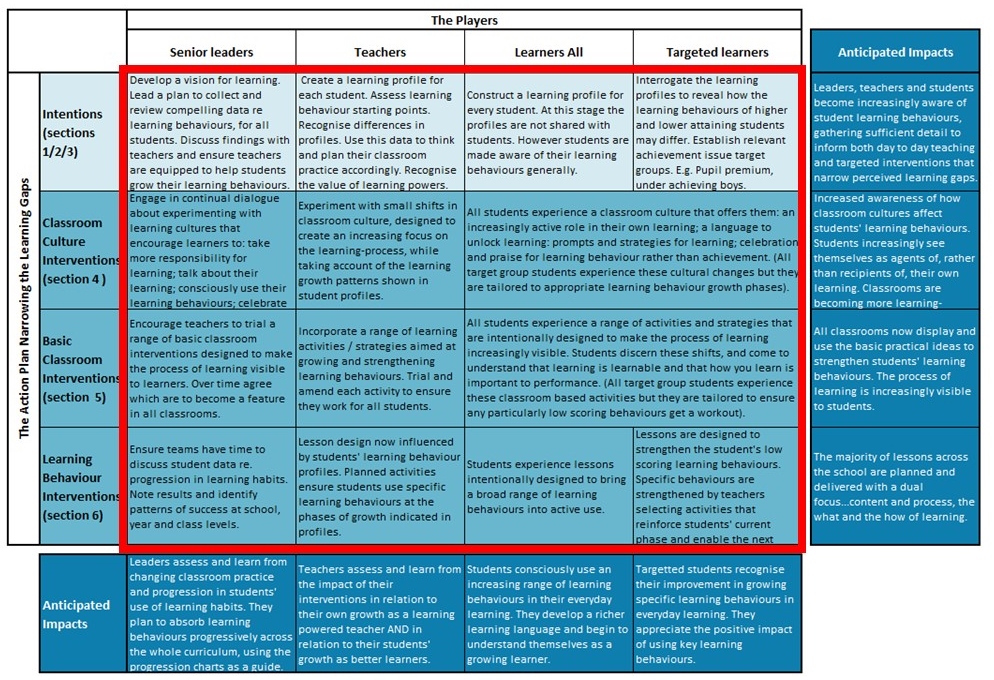
The central 16 cells:
The text in each cell gives an indication of what needs to done and by whom;
When looked at vertically down the page, they map out the developing role of leaders, teachers and learners;
When looked at horizontally across the page, they hint at the ways in which the intentions and interventions will play out in practice.
The cells to the bottom and to the right
The dark blue cells across the bottom offer an outline of the intended impact on leaders, teachers and learners.
The dark blue cells to the far right offer an indication of the intended impact of the intentions and interventions on classroom practice.
This is the companion resource to ‘Narrowing the Learning Gaps‘ online programme for staff. It is designed to support you as a senior leader to introduce your teachers to their blended learning programme and to take a strategic approach to sustaining momentum as the teachers’ programme develops.
This companion resource has 8 sections:
Overview: strategic issues and a programme for staff
Games can be used as a metaphor for learning anything and you tend to get better at anything if you treat it as a game. This programme is about learning to play the familiar game of learning but with an additional ingredient; that of learning dispositions or powers. This subtle addition changes the game of education to one of building learning character at the same time as building knowledge. So the programme explores certain guidelines and conventions that help to frame learning in ways that allow positive learning dispositions to flourish…how you might set up the game, get to grips with some new rules and tactics and learn to appreciate how you score it’s all important new endgame…that of the self-managed learner.
As with any game, it helps if you’re enabled to play the whole game from the start. If you were learning to play Scrabble you wouldn’t get far if all you were given to learn were lists of three, four and five letter words. Far better to start straight away by playing ‘Junior Scrabble’, so you get the feel for the whole game, and then build up your sophistication as you play.
So you might look on the programme you’re about to follow as the junior game of learning power. It has all the elements you will need to introduce the values and activities of building your students’ learning power. This junior game lays the foundation for greater sophistication in further programmes.
1. How the online course is designed
Section structure…
Each section deals with a key aspect of understanding learning power and has:
an introduction to what it is about … followed by some suggestions about how to ‘navigate’ the content
part 1 aims to give you an idea of the sort of practice you are aiming for
part 2 highlights the main ideas of the section’s content
part 3 offers a few practical ideas to start things off
part 4 offers a couple of tools to help you evaluate what you have read
part 5 offers an agenda for a Professional Learning Team meeting
the two interlinking models of building better learners
examples of how the models work in practice;
the four learning behaviours to make a start on – perseverance, questioning, collaborating and revising
the essential aspects of classroom practice
links with educational research
encouragement to try things out with your learners
suggestions for how amendments to your teaching will help students to be better learners
Section 2 Classroom relationships
Important shifts in classroom roles
Here you will find:
examples of the sort of responsibilities teachers might devolve to learners
examples of different ways to be as a teacher
modelling the process of learning
acting as a coach; asking not telling
enabling greater learner responsibility
examples of things to try out with your learners to enhance perseverance, questioning, collaboration and revising
suggestions of ways to plan to expand devolving responsibility to students
Section 3 Talking about learning power
How and when to talk about learning.
Here you will find:
examples of how learners can talk about themselves as learners
examples of different ways to talk about learning
nudging the process
offering feedback
encouraging reflective self-talk
examples of things to try out with your learners to enhance perseverance, questioning, collaborating and revising
suggestions of ways to plan to expand your learning language
Section 4 Celebrating learning power
What’s seen as important in learning friendly classrooms
Here you will find:
examples of how learners can celebrate their learning
examples of different ways to celebrate learning
in the growth of learning behaviours
in re-defining failure
in displays in the classroom
encouragement to try things out with your learners
suggestions of ways to plan to expand what you celebrate about learning
Section 5 Designing learning powered lessons
How to begin to put dual-focused lessons together
Here you will find:
examples of how teachers manage learning in their lessons
a format to assist in planning dual-focused lessons
activities to help start this journey
examples of things to try out with your learners to enhance the foundational four learning behaviours
suggestions of ways to plan to expand your lesson design
Section 6 How are our classrooms and our learners developing?
Section 6a. How is my classroom culture developing?
What to look for and record about your classroom culture
Here you will find:
Charts showing what the phases of teachers’ growth look like in relation to;
relating
talking
constructing
celebrating
with links to the anticipated outcomes for learners
ideas for developing further developing your classroom culture
in order to create increasingly learning-friendly classrooms
Section 6b. How are my learners developing?
What to look for and record about better learning
Here you will find:
explanations of three aspects of progression – frequency, scope and skilfulness in use
Charts showing what the phases of growth look like in relation to;
perseverance
questioning
collaboration
revising
examples of things to try out with your learners
ways of tracking the growth of learning dispositions over time
suggestions of ways to plan to expand what you might track about learning
Section 7 Where now: what next?
Here you will find:
explorations of ways forward
tools to help you consider your growth and development as a teacher
descriptions of the next stage online courses to support teachers’ journey to becoming a skilled learning power practitioner
a quick look at professional development approaches you might use in furthering your journey
2. How the wider blended learning programme works
‘Playing the Learning Power Game’ is simply the online content aspect of the blended learning programme which, unless it’s blended with Professional Learning Teams and Classroom Based Enquiries is unlikely to help you achieve the desired outcomes. A Professional Learning Team is your support mechanism in the blended learning cycle. We hope that time for PLTs has been built into the rhythm of the school’s meeting cycle, and offer you a safe, supportive space to discuss and explore the craft of the classroom. We hope to that PLTs will encourage you to learn with and from your colleagues – to become, in John Hattie’s words, ‘learners of their own teaching’. Classroom Based Enquiries are the third aspect of the blended learning programme. Sometimes known as Action Research, classroom based enquiries involve changing aspects of your practice in order to develop student learning behaviours. Enquiries are likely to involve you in making small changes, monitoring the impact of those changes, and sharing these outcomes at the next team meeting for professional discussion. Most schools tend to blend these 3 aspects into a 4-week cycle.
2a. Talk, support and plan with colleagues
Professional Learning Teams; small groups of teachers who meet together regularly (usually monthly) to deepen their understanding of learning and how, by developing their classroom practice, they can make the learning process more visible and relevant to students.
The team learns and develops by:
discussing and unpacking the online information;
planning how to make use of it in their classrooms;
questioning and probing their classroom experiments.
The delicate, hard work of changing practice requires a safe professional environment in which to explore and understand classroom triumphs and tribulations. The short guidelines (see download) are designed to be help a team set a collaborative, working climate to support the conversion of information and ideas in the online materials into “lived” practices in classrooms. The format of a meeting agenda below is based on research into teacher learning communities by Dylan Wiliam, of Assessment for Learning (AfL) fame.
This team session is your first one in Playing the Learning Power game so it will be essential to spend the first part of the meeting considering the purpose and working guidelines for the team.
Session agenda
Agreeing objectives and agenda (5 mins)
Considering working practices (15 mins)
Re-capping the on-line materials (15 mins)
Personal Action Planning (20 mins)
Evaluating the meeting process (5 mins)
1. Session objectives: What do we want to achieve? (5 mins)
Feel confident about working as a team
Feel able to apply the on-line materials in the classroom
Decide the strategic cultural issues that everyone needs to apply in their classroom
Plan some do-able shifts in classroom practice
2. Consider the working practices of the team (15 mins)
Purposes of the group
Format of the sessions
Ground rules for working
Expectations of outcomes
See What-Why-How of PLT notes above for ideas
3. Recapping on-line materials: What did the content make us think? (15 mins)
Thoughts about:
what we thought about the online content
where do most classrooms operate in relation to this?
which of the four learning behaviours need most assistance? (perseverance, questioning, collaborating, revising)
things that are in place, things that need attention now/soon, things that will take longer to establish.
ideas you picked up from the content that you could use immediately.
4. Personal action planning: What am I going to do? (20 mins)
While we haven’t highlighted any specific ideas to try in this section the material will have triggered some…’what if I tried’.. thoughts.
Think of;
how you want to strengthen your classroom culture to encourage students to become more learning friendly?
What you are going to do to bring this about?
Develop an enquiry question.
You’ll gain more value from a plan by creating it around a question. Why a question? Because this is an enquiry, you want to find out if something will change (student behaviour) when you change something specific. Think of it like this:
If I do XXXX will it improve/develop/enhance YYYY?
This is the crunch question – the moment of truth. Students are unlikely to change unless your behaviour changes! Visualise how you want your students to be and then think about what you might do, or say, or model, or celebrate, or whatever…. differently to bring about this change in students. Developing an enquiry question – .pdf
The learning enquiry plan is a record of what you intend to do. It takes your enquiry question from what to how. The format below may help you think through the planning process. You can fill in your Personal Action Plan using the word document version.
For the monitoring bits of your plan you might want to look out for:
an improvement in how students engage with learning
improvement in behaviour
showing less stress or worry about learning generally
increased focus when working with other students
reduced reliance on teacher support
5. Evaluate team session: How did we do as a team? (5 mins)
Did we achieve our objectives?
Are we comfortable with what we are trying to achieve?
Any concerns at this point?
Next meeting date and time.
2b. Classroom based enquiries
Classroom based enquiries operate in the spirit of enquiry or some would say action research. It’s a quest to find out more, to consider what needs to change, to wonder what might work, to track what happens and to refine practice. It’s a process in which you, as a teacher, investigate teaching and learning so as to improve your own and your students’ learning. In effect you become a researcher of your own practice. It helps you to develop new knowledge about your classroom, you become a reflective teacher who broadens your own teaching repertoire. Importantly it puts you in charge of how you teach and become very aware of the links between how you teach and how your students learn and achieve.
3. The online course in a nutshell
3a. The Big Picture of Playing the (Junior) Learning Power Game.
This chart distils what this course is all about;
what it hopes to enable teachers to do (in the yellow boxes)
what outcomes such changes could make in the classroom culture (in green boxes)
the anticipated outcomes for learners (in blue boxes)
The downloadable spreadsheet will also reveal a practical idea for each yellow box. So this chart offers you an ‘at a glance’ resource to help you reflect on what and how you may be adapting your teaching over the next few months. See below for more details.
The vertical axis to the left shows the 4 learning habits you will be working to improve. The horizontal axis across the top shows the 4 aspects of classroom culture that you will be shifting. On the downloaded spreadsheet, click on the Enable Editing tab to reveal reminders by hovering over the cells.
3c. The central 16 cells
These cells serve 2 purposes. Firstly:
The text in each cell gives an indication of the classroom culture that needs to be in place for learners to learn how to learn.
When looked at vertically down the page, they map out the 4 aspects of classroom culture.
When looked at horizontally across the page, they hint at the ways in which classrooms need to change to enable the 4 key learning behaviours to flourish.
Secondly:
On the downloaded spreadsheet, hovering over each cell reveals a teaching idea taken from The Learning Power Game module.
These teaching ideas are key to unlocking each cell. There are many other ideas in the module for each cell, but these are the ‘must do’ strategies.
3d. The cells to the bottom and to the right
The green cells across the bottom give an outline of how the teacher’s role develops as they make changes in how they relate and talk to learners and how they construct and celebrate learning. Hovering over each cell gives more detail. The blue cells to the far right give an indication of the anticipated outcomes for learners in terms of the 4 important learning behaviours and hovering over each cell suggests what you might look for in students. As you hover over these cells, you will gain a sense of what you might look out for in terms of classroom culture and student learning behaviours.
So – are you ready to make a start?
The first section of online learning is called ‘What do we mean by learning power?’ You can access it by using the ‘Unit Navigation’ box (top right on your screen). Resist the temptation to skim read other sections – focus your efforts on ‘What do we mean by learning power?’ in preparation for your first Professional Learning Team meeting.
This online resource and its companion booklet (available in printed or electronic format) came into being to help meet cries for help from schools. Many schools, both primary and secondary, are wrestling with the growing challenge of a widening attainment gap between, most notably, disadvantaged and looked after children (Pupil Premium), and other students. The schools that contacted us had an inkling that maybe, just maybe, helping students to become aware of and improve their learning habits could offer an effective way to tackle the problem.
Having seen the positive effect of a learning power approach on students’ learning for several years now we agreed wholeheartedly with their ‘inkling’, but it raised some complex questions. Our understanding of the progression of learning habits led us to ask; which learning habits would schools need to concentrate on; at what sort of level; how would they know their starting points; how might they put a plan together (Intent); what sort of activities would teachers need to implement; what would they be monitoring to keep plans on track; how could schools and teachers keep it manageable (Implementation); what would count as evidence; how would they look for it (Impact)?
So what has arisen here comes from intriguing links between school inquiries about how to generate evidence of impact of building powerful learners and our work on students’ progression in all aspects of learning power.
The approach to building students’ learning habits explored here is commonly applied in primary schools as a whole school strategy. But the whole school approach has proved trickier to achieve in secondary schools where teachers meet students far less frequently and for less time. Nevertheless, this resource attempts to overcome this problem and offers individual teachers and schools a manageable way forward.
And because we know this work is so essential to schools and the lives of millions of children we have written it to enable any school, learning power knowledgeable or not, to be able to take it on and run with it.
2. The what of this resource
This resource offers teachers and schools;
clear information about the power of learning behaviours and how they grow
a manageable tool to enable schools to analyse their students’ learning behaviours
guidance on teacher talk, lesson design and classroom cultures to help strengthen learning habits
tools to enable teachers to assess and amend their classroom culture and teaching styles
a spreadsheet package to help schools to monitor, evaluate and manage their data
…in order to help schools narrow the achievement gap, ensure students don’t fall further behind and enable their students to become lifelong learners.
Schools that are subject to Ofsted could regard sections 1, 2 and 3 as laying out your Intent, what you are intending to achieve; sections 4, 5 and 6 your strategies for Implementation, what you are intending to do to achieve it; and section 7 as generating evidence of Impact, what you have achieved.
Or, put another way, this resource will help you to;
put students’ learning behaviours (not attainment) front and centre in the school’s approach to improving learning,
use the basic tools and techniques to raise students’ awareness of how they can take control and build their learning behaviours,
understand and apply the teaching approaches needed to strengthen learning behaviours,
explore, explain, estimate and record students’ growth in learning behaviours and the impact on their learning.
3. The how of this on-line resource
Each section is based around the points raised in the Narrowing the learning gap booklet but adds more detail and features of interest. Looking at the numbered sections will lead you through the basic story but there are also toggle boxes which add richer information and could be returned to later.
Each section deals with a key aspect of understanding, introducing and testing the approach.
Intent (Plan)
Section 1 What makes a difference in learning?…introduces and explores the meaning, purpose and attributes of learning power.
Section 2 Up close and personal with learning…invites you to look at yourself and a couple of students through the lens of learning behaviours.
Section 3 Find the gaps…offers serious considerations about gathering evidence with regard to the gap in learning you are trying to narrow.
Page 2-11
Implement (Do)
Section 4Shift classroom culture…explores how your classroom practice can encourage the growth of learning behaviours.
Section 5 Start with the basics…explains the first ‘must do’ aspects of learning activities that strengthen learning behaviours.
Section 6 A catalogue of ideas…offers a range of practical classroom solutions that are directly linked to phases of learning behaviours and blend into your teaching.
Pages 12-19
Impact (Review)
Section 7 What is the impact?…suggests how to assess the impact of your interventions on your classroom culture, students learning and attainment.
Pages 20-21
4. The where from of this resource
The approach to learning explored here comes from the vision of twenty-first century education and the new sciences of learning that underpin it. It starts from first principles: that we now know an individual’s ability isn’t fixed; that the brain is like a muscle; that its intelligence grows with exercise. Selling this idea to learners brings, in itself, far more enthusiasm for engaging with the potential delights of learning, helping students to become more independent, more reflective, and better able to plan and evaluate their own learning. This, as John Hattie’s research has shown, is a better way of boosting students’ attainment than more drilling in the subject-matter.
The great strength of this approach is that there is already a wealth of tried and tested strategies that teachers can introduce immediately to begin to transform the learning experience of their students, and give them a language with which to think about the process of learning. You can boost the development of students’ confidence, capacity and appetite for learning itself.
This resource affords teachers an insight into the skills and attitudes their students use when learning… and how to fix them.
5. This is the ambition or Big Picture of the resource.
The vertical axis to the left shows 4 aspects of development – intentions, cultural interventions, basic teaching interventions; learning behaviour interventions.
The horizontal axis across the top shows 4 groups that are impacted – leaders, teachers, all learners, and targeted learners.
The central 16 cells:
The text in each cell gives an indication of what needs to done and by whom;
When looked at vertically down the page, they map out the developing role of leaders, teachers and learners;
When looked at horizontally across the page, they hint at the ways in which the intentions and interventions will play out in practice.
The cells to the bottom and to the right
The dark blue cells across the bottom give an outline of the intended impact on leaders, teachers and learners.
The dark blue cells to the far right give an indication of the intended impact of the intentions and interventions on classroom practice.
This is the companion resource to ‘Narrowing the Learning Gaps‘ online programme for staff. It is designed to support you as a senior leader to introduce your teachers to their blended learning programme and to take a strategic approach to sustaining momentum as the teachers’ programme develops.
This companion resource has 8 sections:
Overview: strategic issues and a programme for staff
Make sufficient (re-named) copies of this sheet, one for each of your year 6 classes.
2. Gathering learning behaviour data
Each Year 6 teacher should:
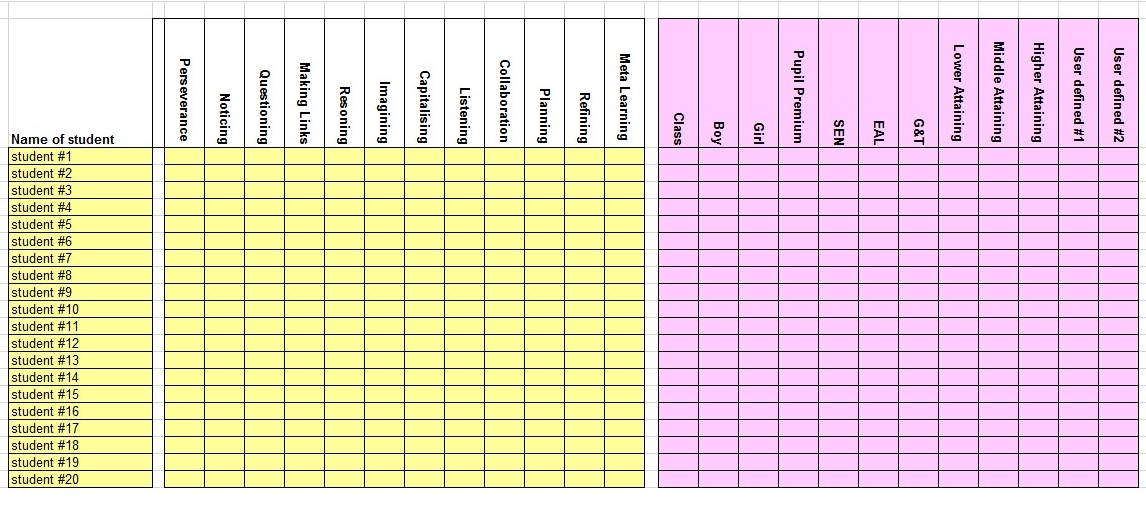
Download and print a copy of the learning chart (opposite) for each of their year 6 students.
[Hint – It is better to use the A3 option if you have an A3 printer.
If not, use the A4 option which prints the chart over 2 A4 sheets.]
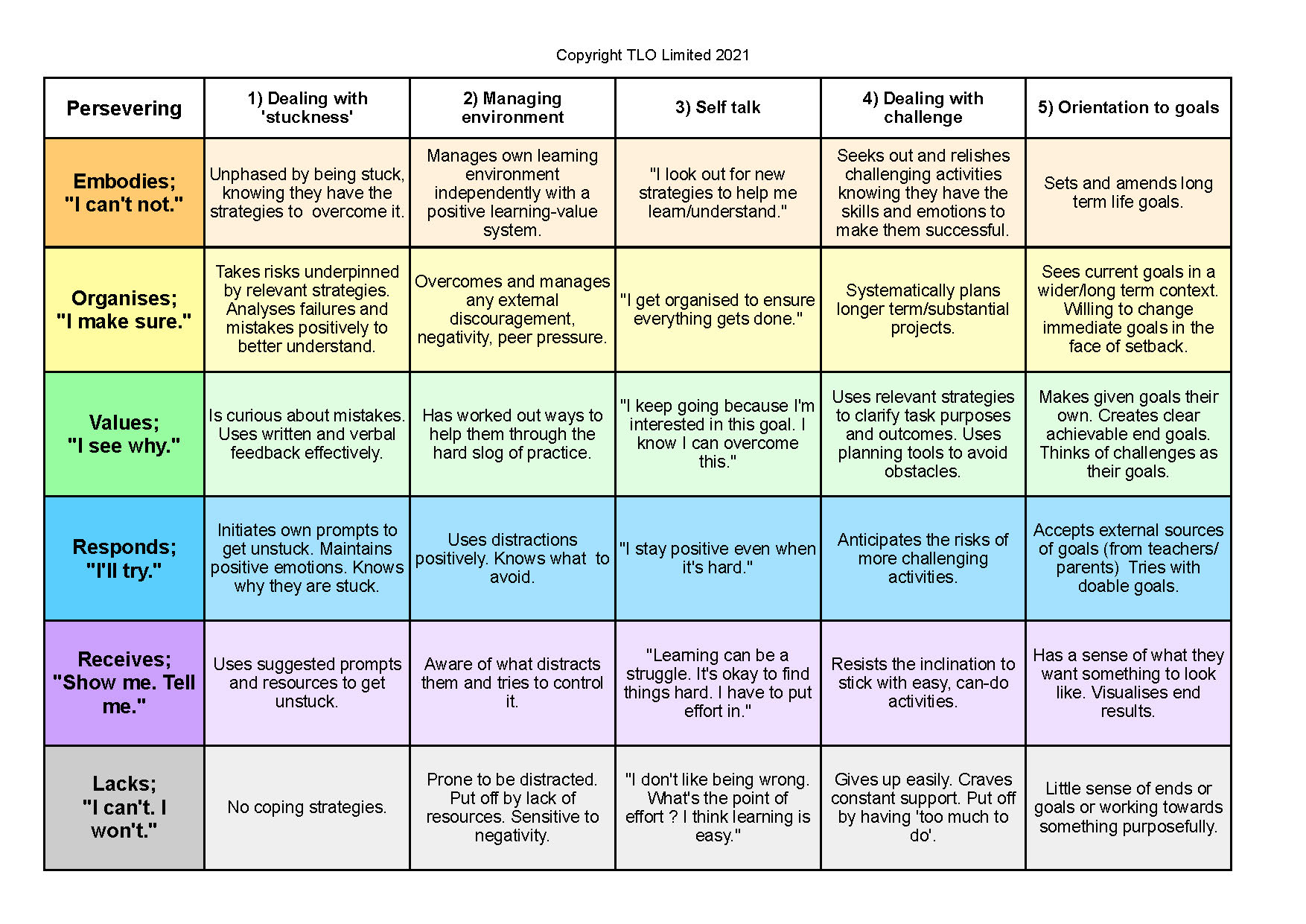
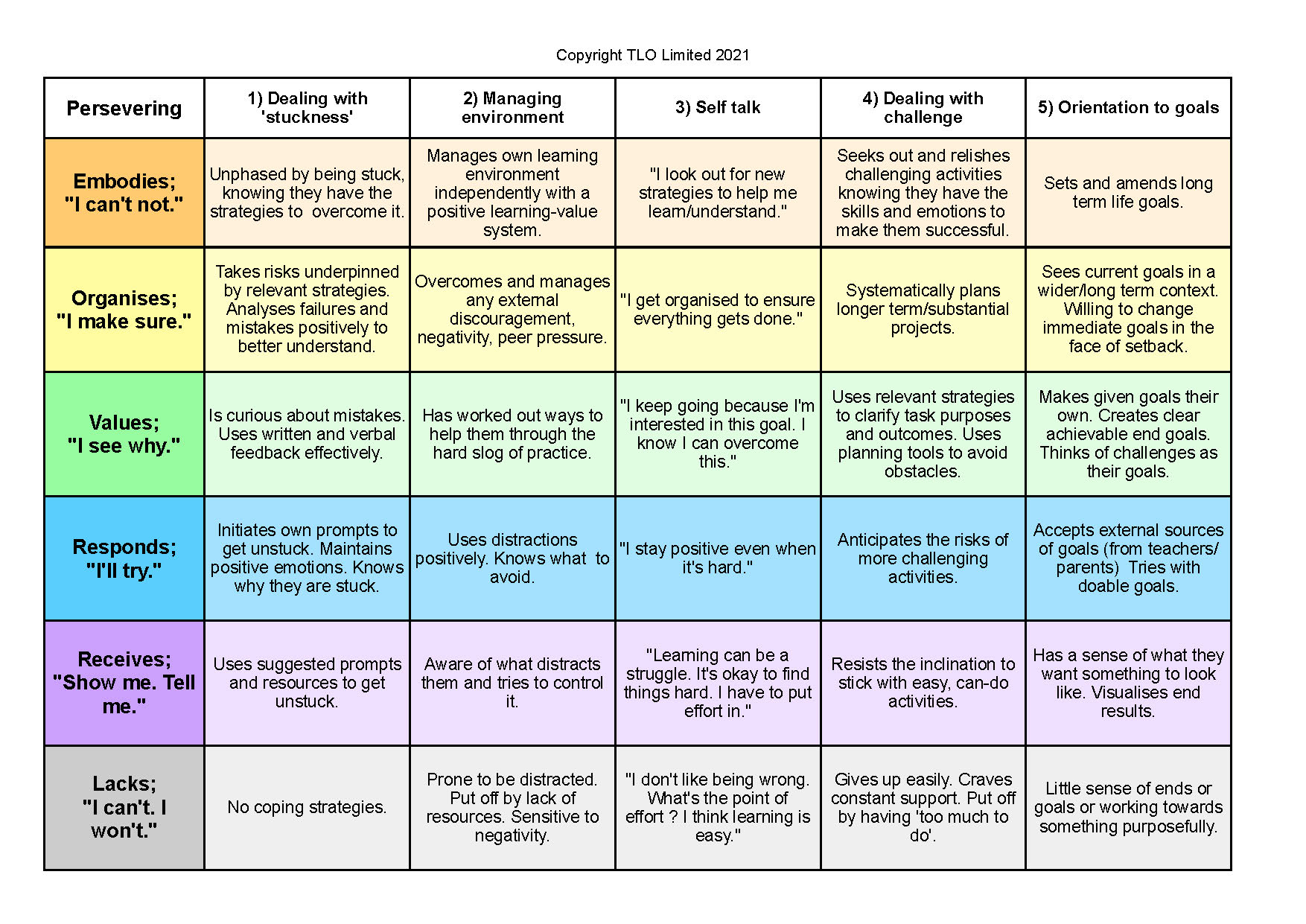
For each student in your class, colour in cells in the chart that describe the student’s secure learning behaviours.
the colours of the rows carry a meaning linked to students’ attitudes and emotions. If you need a quick reminder take a look at the table in the toggle box below.
If you’re unsure about what constitutes secure behaviour, read section 2a (below) for further information.
Start at the foot of each column and work upwards, stopping once the behaviours described are clearly beyond the student’s current skill set.
If you need more detail on how to go about this, go to sections 2 and 3 of the full, online Narrowing the Learning Gaps resource.
The phases are drawn from Bloom’s taxonomy of the affective domain.
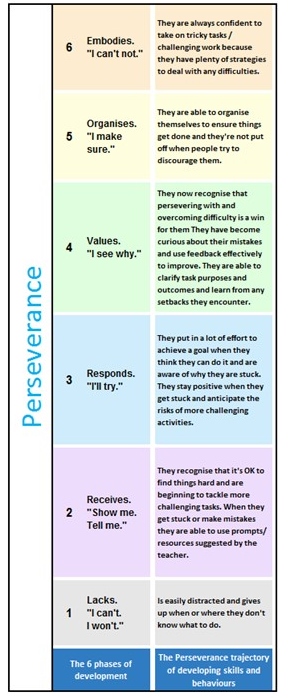
Phase 1 ‘Lacks’ (grey) In this ‘Lacks’ (grey) phase, students are minded to give up easily. There are all sorts of reasons for this; they may just be constantly distracted from the activity in hand; they may just need constant adult support; they may not know what might help them. Many students will need to be eased into learning how to learn in a classroom setting. A straightforward way to understand this phase is when students tend to say ‘I can’t’ or ‘I won’t’
Phase ‘Receives’ (purple) learners are beginning to explore the behaviour and are moving from a negative to a neutral mindset, often employing the skill or doing something because they are being told to or expected to. A straightforward way to understand this phase is when students tend to say ‘Show me’ or ‘Tell me’
Phase ‘Responds’ (blue) is about gaining interest and doing things more willingly, building the skills and the willingness to deploy them. A straightforward way to understand this phase is when students tend to say ‘I’ll try’.
Phase ‘Values’ (green) is a key phase since the student now sees the value of behaving in this way. It’s a win for them; to behave like this is in their interest. It’s in this phase that the behaviour becomes more secure. A straightforward way to understand this phase is when students tend to say ‘I see why’
Phase ‘Organises’ (yellow) is the phase in which the student capitalises on this ‘in their interest’ behaviour and gets themselves organised to use it positively. A straightforward way to understand this phase is when students tend to say ‘I make sure I do’
Phase ‘Embodies’ (orange), In this phase the student has made this behaviour their own. It has become part of their character; they can’t not do it and they have become highly skilled in doing it. A straightforward way to understand this phase is when students tend to say ‘I can’t not do this’
We urge you to see this progression as long term. Some phases will take years for people to work through; some will never be worked through. None of the phases are inevitable. There is a lifetime of development captured here. Nevertheless your role as a teacher or parent should surely be to encourage and enable this journey.
IF YOU WANT THE CHART ITSELF, I DON’T HAVE IT IN A COPYABLE FORMAT
2a. What is a ‘secure’ behaviour?
For each cell in the learning chart, ask yourself;
‘is the student like this in most circumstances – does the cell describe what they usually do?’
If yes, colour the cell.
If no, or if they only do it occasionally, leave the cell blank.
So – ‘secure’ means ‘they can do this and they do do this’.
2b. Creating learning behaviour ‘scores’
Once the learning charts have been completed to show a ‘learning profile’ for each student, it is time to convert that ‘profile’ into a ‘score’.
Consider each column in turn:
Score zero if nothing is coloured in or the very bottom row (the Grey phase) is coloured in;
Score 1 for each of the coloured-in cells in the purple, blue and green phases;
Score 2 for each of the coloured-in cells in the yellow or gold phases.
For example, the ‘score’ for the learning profile opposite would be 2:2:0:4:5:5:8:6:3:10:1:3.
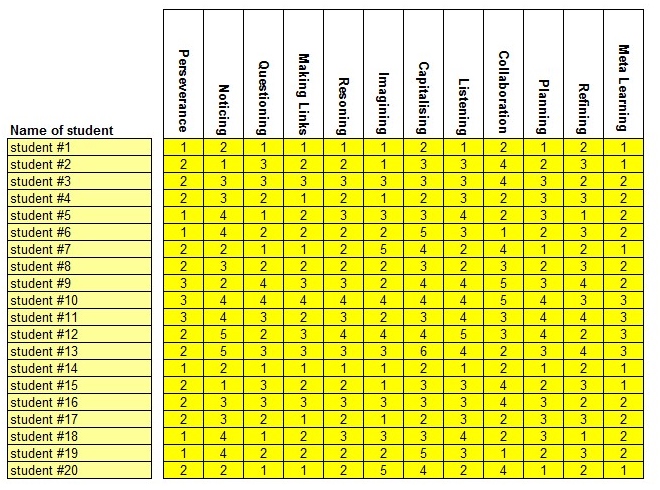
For each student, you will end up with 12 ‘scores’, one for each of the 12 learning behaviours.
Record each student’s ‘scores’ in the bottom row of the learning chart.
2c. Entering learning behaviour ‘scores’ on the class spreadsheet
Once you have created learning behaviour ‘scores’ for all of the students in your class, open the spreadsheet for your class.
For each student, enter their name in column B, and transfer their 12 ‘scores’ into columns D to O.
Save the file.
3. Gathering the contextual data
The contextual data may well be things that the class teacher already knows, or perhaps this data will be generated from your admin system.
In either case, proceed as follows :-
On the class spreadsheet, find the tab at the bottom called ‘contextual print only’.
This tab cannot be edited, but you can print it so that you can record your contextual data. If you have completed step 2c (above), your print-out will already be populated with your students’ names.
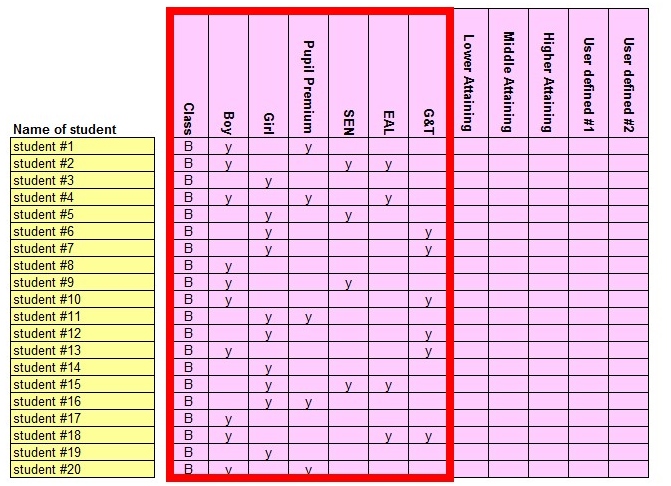
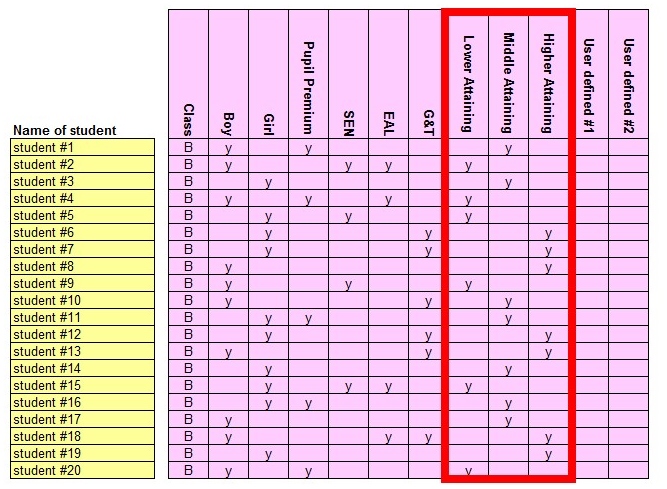
Firstly, add the basic contextual information that the class teacher will already know:
Class Code: a unique identifier for the student’s class. You can use any symbols you like here, so if your class is called 6 Beech, use ‘B’ etc. Just be sure that no other year 6 class is using the same code;
Boy: enter ‘y’ if a boy, leave blank if a girl;
Girl: enter ‘y’ if a girl, leave blank if a boy;
Pupil Premium: enter a ‘y’ if the student attracts PP funding, leave blank if not;
SEN: enter a ‘y’ if the student is on your special needs register, leave blank if not;
EAL: enter a ‘y’ if the student has English as an Additional Language, leave blank if not;
G&T: enter a ‘y’ if the student is identified as being Gifted and Talented, leave blank if not;
This data goes into the first 7 columns of the grid (see opposite).
3a. Considerations in relation to ‘lower / middle / higher’ attainment
Entering the attainment data:
Lower / Middle / Higher attaining: enter a ‘y’ in just one of these 3 columns, and leave the other 2 columns blank (but read below for guidance)
Guidance:
This step almost certainly requires to be coordinated centrally. You are aiming to split your entire year 6 cohort into three evenly balanced groups – the lower attaining third, the middle attaining third, and the higher attaining third.
No need to be too precise – plus or minus one or 2 students either way will not matter.
Whoever is overseeing the collection of data will need to consider how this can be most easily achieved.
Do you have centrally held attainment data that can be used?
Or could you ask each year 6 teacher for information –
if yes, how will you ensure a consistency of approach?
Record these judgements in the next 3 columns of the grid (see opposite).
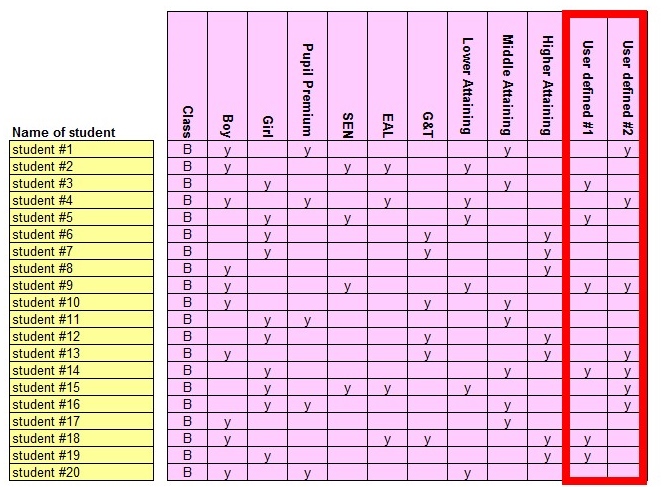
3b. User defined categories – to identify any school-specific issues you might want feedback on
Entering the ‘User defined’ data:
User Defined #1: enter a ‘y’ if the student is a member of this #1 subgroup, leave blank if not;
User Defined #2: Repeat if the student is a member of the #2 subgroup (but read below for guidance)
Guidance:
It’s up to the school to decide whether it wishes to use these ‘User defined’ categories.
If you do, it will be up to the person overseeing the data collection to decide what these ‘User defined’ categories are.
For example:
Suppose you have a suspicion that students from a particular ethnic background are under-performing their peers, you could choose that as one of your user defined options;
Or you might be interested in looking at the learning behaviours of those students who survived lockdown relatively unscathed compared with their peers;
Or you might have another issue that would be of interest to you!
Decide if you wish to take advantage of the ‘User Defined’ option. If yes, decide what the criterion is for each of the ‘User Defined’ options.
Enter the data in the final 2 columns of the sheet – see opposite.
3c. Entering the data in the class spreadsheet
Open the spreadsheet for your class, navigate to the ‘data collection sheet’ tab, and enter the contextual data in columns Q to AB for all of your students.
Remember that, aside from your class name, all entries will either be a y (yes) or left blank.
Save the spreadsheet and give a copy to the person overseeing the data collection.
4. Collating the data into the master spreadsheet
The person overseeing the process should:
Open the master spreadsheet, ensuring you are on the ‘data collection sheet’ tab;
Open each class spreadsheet in turn, highlight the data in columns B to AB, right click, copy, and paste the data into the master sheet;
Repeat with each year 6 class in turn, pasting the data for each class starting in the next empty row;
Save this master spreadsheet.
5. Sending TLO your completed spreadsheet
Make a copy of the master spreadsheet you created in section 4 above, but in this new copy we suggest that you delete all of the student names. While the names may be of use for your internal in-school purposes, the names will be irrelevant to TLO’s analysis and the removal of student names anonomises the data and removes any confidentiality issues.
Of course you should keep a copy of your own Master spreadsheet with the student names in, just in case you want it later.
For example, you might want to interrogate this data against your end of year assessments in the future.
You could look at end of KS levels against learning behaviour data. For example, comparing the behaviour ‘scores’ with the final Maths grade. This means you would be looking at learning behaviours in relation to a particular aspect of the curriculum.
Email your completed master spreadsheet, with the names removed, to . . .
Include in this email whether / how you have decided to use the ‘User Defined’ categories.
Equally, let us know if any of the columns are irrelevant – for example you may not identify G&T students and hence the whole column will be empty and can be ignored in the analysis.
Thank you for agreeing to take part in this research. When we have received the results from all the participating schools we hope to be able to report on the findings within one month.
Do they have a learning character and can this be moulded?
What are my students’ learning strengths or limitations
Which learning behaviours do our students need to strengthen…now?
Does learning character play any part in influencing the attainment of higher vs lower performing students?
These unusual yet vital and urgent questions form the stimulus for this online resource and its companion booklet (available in printed or electronic format) to help meet cries for help from schools. It’s a practical tool to help teachers and schools uncover their students’ learning character and use this, usually hidden and unknown information, as the very basis for developing and strengthening them as learners.
Our growing understanding of how learning habits build has led us to ask how schools might use such information to help shape teachers’, or even whole school, plans. What does growth in learning habits look like? How might teachers estimate students’ phase of growth? Might schools use this information in strategic plans of action (Intent)? What sort of activities would teachers need to use to strengthen the growth of learning habits? (Implementation) What would count as evidence of impact and how might that be captured and reviewed? (Impact).
We know this work is essential to schools and the lives of millions of children so we have written it to enable any school, learning power knowledgeable or not, to be able to take it on and run with it.
2. The what of this resource
This resource offers teachers and schools;
clear information about the power of learning behaviours and how they grow
a manageable tool to enable schools to analyse their students’ learning behaviours
guidance on teacher talk, lesson design and classroom cultures to help strengthen learning habits
tools to enable teachers to assess and amend their classroom culture and teaching styles
a spreadsheet package to help schools to monitor, evaluate and manage their data
…in order to help schools narrow the achievement gap, ensure students don’t fall further behind and enable their students to become lifelong learners.
Schools that are subject to Ofsted could regard sections 1, 2 and 3 as laying out your Intent, what you are intending to achieve; sections 4, 5 and 6 your strategies for Implementation, what you are intending to do to achieve it; and section 7 as generating evidence of Impact, what you have achieved.
Or, put another way, this resource will help you to;
put students’ learning behaviours (not attainment) front and centre in the school’s approach to improving learning,
use the basic tools and techniques to raise students’ awareness of how they can take control and build their learning behaviours,
understand and apply the teaching approaches needed to strengthen learning behaviours,
explore, explain, estimate and record students’ growth in learning behaviours and the impact on their learning.
3. The how of this on-line resource
Each section is based around the points raised in the Narrowing the learning gap booklet but adds more detail and features of interest. Looking at the numbered sections will lead you through the basic story but there are also toggle boxes which add richer information and could be returned to later.
Each section deals with a key aspect of understanding, introducing and testing the approach.
Intent (Plan)
Section 1 What makes a difference in learning?…introduces and explores the meaning, purpose and attributes of learning power.
Section 2 Up close and personal with learning…invites you to look at yourself and a couple of students through the lens of learning behaviours.
Section 3 Find the gaps…offers serious considerations about gathering evidence with regard to the gap in learning you are trying to narrow.
Page 2-11
Implement (Do)
Section 4Shift classroom culture…explores how your classroom practice can encourage the growth of learning behaviours.
Section 5 Start with the basics…explains the first ‘must do’ aspects of learning activities that strengthen learning behaviours.
Section 6 A catalogue of ideas…offers a range of practical classroom solutions that are directly linked to phases of learning behaviours and blend into your teaching.
Pages 12-19
Impact (Review)
Section 7 What is the impact?…suggests how to assess the impact of your interventions on your classroom culture, students learning and attainment.
Pages 20-21
4. The where from of this resource
The approach to learning explored here comes from the vision of twenty-first century education and the new sciences of learning that underpin it. It starts from first principles: that we now know an individual’s ability isn’t fixed; that the brain is like a muscle; that its intelligence grows with exercise. Selling this idea to learners brings, in itself, far more enthusiasm for engaging with the potential delights of learning, helping students to become more independent, more reflective, and better able to plan and evaluate their own learning. This, as John Hattie’s research has shown, is a better way of boosting students’ attainment than more drilling in the subject-matter.
The great strength of this approach is that there is already a wealth of tried and tested strategies that teachers can introduce immediately to begin to transform the learning experience of their students, and give them a language with which to think about the process of learning. You can boost the development of students’ confidence, capacity and appetite for learning itself.
This resource affords teachers an insight into the skills and attitudes their students use when learning… and how to fix them.
The vertical axis to the left shows 4 aspects of development process – intentions, cultural interventions, basic teaching interventions; learning behaviour interventions.
The horizontal axis across the top shows 4 groups that are involved and impacted – leaders, teachers, all learners, and targeted learners.
The central 16 cells:
The text in each cell gives an indication of what needs to done and by whom;
When looked at vertically down the page, they map out the developing role of leaders, teachers and learners;
When looked at horizontally across the page, they hint at the ways in which the intentions and interventions will play out in practice.
The cells to the bottom and to the right
The dark blue cells across the bottom offer an outline of the intended impact on leaders, teachers and learners.
The dark blue cells to the far right offer an indication of the intended impact of the intentions and interventions on classroom practice.
Appreciate the full extent of the Every Child Matters (ECM) agenda in a holistic way
Diagnose your practice in the light of the holistic ECM framework
Integrate ECM into your long- and short-term plans
Inform and improve Sections 3, 4 and 5 of your SEF.
Our approach has been to link the five major ECM outcomes with a range of known good practice and national strategies to form a holistic framework for school development. This guards against ECM being seen as a bolt-on, or as something to be largely contained within Section 4 of the SEF. The tools will help you to ensure that your improvement / development plan(s) address the ECM agenda, while avoiding the repetitions that will arise from structuring such plans under the five ECM outcome headings. These diagnostic tools will also help you to make more evaluative, rather than descriptive, statements in Sections 3, 4 and 5 of your SEF.
0.1b – The Contents of this CD-ROM
ECM Overview:
Find out what ECM really means for schools and how the tools can help you.
Using the Tools: Find out what the three diagnostic tools consist of and how to make best use of them.
Using the results: Explore how you can make sense of your data, and use the results of your diagnosis to inform your school improvement plan and your SEF.
Further assistance: Some suggestions about how TLO can help you maximise the benefits of using these tools.
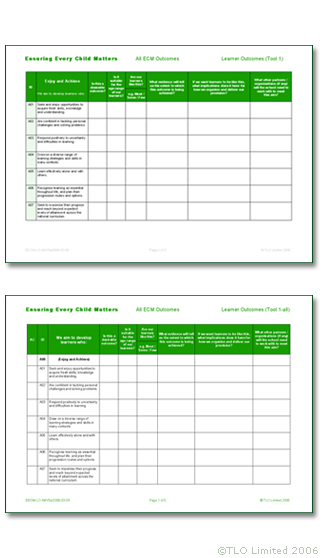
Learner Outcomes – Tool 1: A tool to help you consider possible ECM outcomes for learners. A flexible Word document to guide your thinking.
Find the Gaps – Tool 2: A tool to help you diagnose the school’s provision against the five outcome areas of ECM. A flexible Word document to guide your thinking.
The Long View – Tool 3: An audit tool to diagnose provision in depth and plan a way forward. A flexible Word document to guide your thinking.
1.1 – ECM Overview – Coming together
Changing services for children and young people
Every Child Matters aims to support every child to
Be healthy
Stay safe
Enjoy and achieve
Make a positive contribution
Achieve economic well-being
These outcomes are believed to be the key to well-being in childhood and later life. In order to make these outcomes real, the organisations involved in providing services for children and families are coming together in new ways, to share information and work together to give more integrated, accessible and personalised services built around the needs of the child. This means that children and their parents or carers will have a greater involvement and say in how the services work. —
1.2 – ECM Overview – Change in schools
What does this mean for schools? Schools have always been concerned with the whole child and therefore already pay regard to the ECM outcomes. However, you are now faced with a much wider framework through which to look at the school and plan for its future. Furthermore, the common inspection framework across children’s services will look for the school’s impact on and provision for the ECM programme.
How will schools be different? Although the major ECM outcomes have always been your concern, the ECM programme will mean changes for schools in both WHAT you provide and HOW you provide it. Most of the WHATs and HOWs of ECM provision have come at you in the form of separately labelled strategies and initiatives; some of these have been around for longer than ECM, while others have been created within it. Programmes, initiatives and buzz-words that have been brought within ECM include Extended Schools (including wrap-around care), workforce remodelling, Healthy Schools Standard, Primary and Secondary Learning Strategies, personalised learning (including assessment for learning), and student voice. The central role of schools remains that of raising educational standards. However, schools are no longer expected to do this largely alone, but rather in collaboration with other services to remove barriers to learning. This culture of collaboration is being encouraged not only between services but within the school, where children and parents / carers are not just being present, or taking part in, but having an influence on decisions and actions. Learners become co-creators of their educational experience, through being empowered to engage with and become responsible for the how and what of their own learning and well-being.
1.3 – ECM Overview – The materials
How these materials can help you The materials are designed to help you see how the essence of various strategies fits within the ECM agenda, and to keep control of your school’s cycle of self evaluation and planning in the context of ECM. Firstly, in Tool 1 we have tried to describe how a learner might be as a result of being involved in a school influenced by the integrated ECM agenda. We have expanded and humanised the ECM outcomes and the ‘Aims’ that lie under them. The tool invites you to consider the learner outcomes in relation to your learners, how you would track their achievements, what such outcomes would mean in practice for your school, and whether the school could best achieve this alone or in collaboration with other schools and services. Secondly, in Tool 2 we have listed a wide range of statements of good practice, under the five ECM outcome areas. These statements have been influenced but not dictated by a range of the current strategies, programmes and initiatives, and written to reflect participation and empowerment of learners, and collaboration with other services. We have organised the statements into broad categories that a school might use in thinking about itself – ethos, environment, curriculum, curriculum delivery, enriched and extended curriculum, partnerships with others, and how a school monitors its provision and outcomes. This tool should give you a sense of the scope of ECM and of how different strategies fit within it. You can use it to quickly review where you are now and see where there may be gaps in your provision relative to the ECM framework. Thirdly, Tool 3 has the five sets of good-practice statements reconfigured into a single list, with space for you to record more detailed information about your practice, and to note actions that you may want to consider in your planning. The tool is designed to allow you to sort and rearrange the list in ways that suit your own interests. All the tools are provided as tables in Word files, so that you can edit and manipulate them to suit your purposes. You may wish to tailor some of our statements to reflect your practice more specifically; you may wish to delete some that are not relevant (e.g. there are several that relate to 14-19 concerns, which will not interest primary schools); you may wish to add your own, in the same general spirit.
2.1 – Using the tools – Overview of the tools
There are three diagnostic tools. You can use them together or separately.
Learner Outcomes – Tool 1 This contains some suggested learner outcomes for each area of ECM. You can use this to:
Understand the impact that ECM should have on your learners
Use the outcomes as standards against which to evaluate the impact of your provision. (This will help you to produce a much stronger, evaluative SEF)
Think about what you do now to enable learners to achieve such outcomes, and where you might collaborate with other services or schools.
Find the Gaps – Tool 2 This is a checklist of good practice drawn from a range of national strategies and divided into the five ECM outcome areas. You can use this to:
Gain an overview of ECM in action
Understand how practice relates to outcome areas
Complete a quick review of your provision practice.
The Long View – Tool 3 This is an audit tool for a deeper analysis of your current practice. You can use it to:
Analyse your whole school practice
Record the extent of your development in each area
Note your ideas for action
Sort your action statements for use in your planning – this will help you to produce a Plan against the five outcome areas (as some LAs are now proposing).
—-
2.2 – Tool 1 – Learner Outcomes
[A Word document table showing what ECM means in terms of outcomes for learners. For each of the 5 ECM areas we have developed a set of statements that describe how a learner might appear when viewed through the ECM framework. Against each statement the tool provides a number of mostly open-ended questions with spaces for your responses. In the light of these, you may want to adapt our learner outcomes or add some of your own. Think of this as a thinking tool rather than as something where you must fill in every box.
Using Tool 1 You could use this in several ways, for example:
Look at the learner outcome statements to get a feel for what ECM is really about (the holistic model).
Share the learner outcome statements with staff and governors and decide whether they are appropriate for your school and how you might improve or adapt them.
Develop a set of indicators (things that will tell you whether the outcomes are being achieved) for each group of learner outcome statements. Collect data against the indicators. Use this data to produce a stronger evaluative SEF (see section “Using the results” – “Informing your SEF”).
Consider the implications of these outcomes for the school’s provision and practice, and whether the school could best achieve this alone or in collaboration with others.
Note that two versions of Tool 1 are provided, one with filename containing LearnerOutcomesS and the other LearnerOutcomesT. The ‘S’ and ‘T’ can be thought of as standing for ‘separate’ and ‘together’. The first contains five tables, each with the learner outcome statements for just one of the ECM outcome areas; the second has the same statements, but all in one big table.
One important difference between them is that the ‘T’ version has an analysis column which you can use to code and sort the statements, so that they do not have to be isolated under their ECM headings. See the description of Tool 3 for more about analysis columns.
—-
2.3 – Tool 2 – Find the Gaps
A Word document table using the 5 ECM outcome areas and showing suggested learner outcomes (see Tool 1), and statements of good practice that will contribute to the achievement of the outcomes. The statements for each area of practice are shown together across the five ECM outcome areas. This enables you to see how good practice links together across the five areas.
What Tool 2 consists of The good practice statements are drawn from or implied by a range of national strategies. They are classified under the following categories:
School Ethos This covers the underlying values that will pervade the school.
School Environment This includes aspects of the school environment implied by ECM.
Curriculum Content This covers content you may need to check or include as a result of ECM.
Curriculum Delivery This covers a wide range of curriculum delivery practice which is implied or made overt through ECM (including related strategies).
Extended Curriculum This covers extra-curricular and enrichment activities that are implied or explicit in national strategies.
Partners – Parents and Carers Partner Organisations and Services These cover the types and nature of partnerships that the school will be developing in order to fulfil ECM.
Monitoring and Evaluation This covers a range of things that the school might check and monitor in order to show progress in ECM outcomes and improvements in provision. A range of school policies and success criteria are included here, which the school may need to monitor.
Using Tool 2 We recommend that you print out the table on A3 paper to get an efficient overview (or onto A4 and use your photocopier to magnify it!). It is not as daunting as it may look at first sight. It is designed to help you find your gaps quickly. You could use this in several ways, for example:
Simply scan the statements to get a feel for ECM and how practice relates to the five outcome areas. Complete a desk-top review to check which practice statements the school is covering and which might need attention. You might use highlighters to identify:
Those areas you feel secure about
Those that need further work
Those that are not yet in place
Invite appropriate members of staff to complete a review of practice using this tool. Compare results and then consider whether Tool 3 might be useful to help you look more deeply into specific areas of practice.
2.4.1 – Using Tool 3
Using Tool 3 You can use this tool in several ways. Here are three suggestions to spark your own ideas:
Leadership team review Invite members of the senior leadership team to work through all the statements, or a selection of them.
Compare results, and rationalise into one document.
Agree how best to sort the action statements to help your planning.
Involve middle leaders Divide the document into meaningful sections and invite relevant members of staff to respond to statements in that section (e.g. SENCO, curriculum managers, assessment coordinator, Key Stage coordinators, etc.).
Compare results, rationalise into one document and integrate into current plans.
Involve everyone Select areas of the document linked to curriculum delivery, or monitoring, or extended curriculum, etc.
Invite all, or selected, members of staff to respond to the statements.
Arrange for team meetings to discuss individual findings, agree a team response, and rationalise into a team-based document to inform team planning.
Later, team leaders could meet to discuss each team’s findings, agree collaborative actions, and rationalise into one document to inform whole-school planning.
Using the analysis columns, AC1 and AC2
NB: If you don’t understand this next piece, don’t panic — you don’t have to use the feature!
The table contains two columns intended to be used for analysis codes. These allow you to classify your action statements, using any scheme you like for grouping the statements together, with short codes to indicate the grouping: at the simplest, perhaps ‘y’ or blank to indicate a yes / no selection.
Once you have entered codes in a column, you can use Word’s feature for sorting data in a table, according to the codes. You can request a sort on up to three columns – the Cat and ID columns that are already filled in may well be of use in creating meaningful arrangements of the statements. We leave you to decide the details of how and when to use this possibility, but offer some suggestions in the section ‘Using the results’.
2.4 – Tool 3 – The Long View
A Word document table that rearranges all the good practice statements from Tool 2 into one holistic list.
The list is initially organised by the categories used in Tool 2 – School ethos, School environment, Curriculum content, Curriculum delivery, Extended curriculum, Partnerships (two categories), and Monitoring and evaluation.
Space is provided for you to note the extent of the school’s development, and action you might want to take, against each statement.
How the Tool is made up
Statement Bank (see A in the figure)
The tool centres on a bank of all the good practice statements in tool 2, here combined into a single list (rather than five), in order to avoid duplication and give a holistic feel.
The statements help you to consider your current practice and give pointers to possible future practice.
The list is not exhaustive but rather gives a flavour of good ECM practice.
Add to the statements where you feel things are missing.
Category and Identifier codes (B) Each statement is labelled by:
an identifier (ID column) linked to one of the ECM areas and as used in Tool 2
a short code representing the category (Cat column): e.g. 1-Eth for ethos, 4-D for curriculum delivery.
The initial letter of each ID value allows it to be related to one of the ECM outcome areas.
Stage Now (C) Use this column to rate the development stage your current practice has reached. The suggested codes are:
F = Focusing We need to or are just starting to get to grips with this. It has substantial planning/resource implications.
D = Developing An area we are currently developing/experimenting with. Very mixed across the school. Has further resource implications. Has coaching and sharing implications.
E = Establishing Area quite well developed, being established across the school but not yet a natural part of what we do. Has minor resource implications.
H = EnHancing This area is a natural part of what we do. High measure of consistency of practice across the school. Continuing to improve. Few or no resource implications.
Evidence (D) Use this column to make a note about the evidence that supports your rating code (this is not a SEF in disguise, so don’t think you have to justify the evidence source).
Development Action (E) Use this column to note the action you might take, in response to your development rating.
Analysis-code columns (F) You can insert your own codes here, allowing you to re-order your action list for inclusion into your improvement plans (see “Using the Tools” – “Using Tool 3”, “Using the analysis columns…”). sub_2-4.jpg
—- 3.1 – Using the Results – Menu
In this section we look at two ways in which you might use the results of your diagnosis:
Planning your way forward, both long-term and short-term.
Informing and improving Sections 3, 4 and 5 of your SEF.
You may well think of more uses for the diagnostic results.
sub_3-1.jpg
3.2.1 – Planning A Way Forward – General Guidance
Your ‘to do’ list from the diagnosis is categorised into:
School ethos (‘Cat’ code = 1-Eth)
School environment (Cat = 2-Env)
Curriculum content (Cat = 3-CC)
Curriculum delivery (Cat = 4-D)
Extended curriculum (Cat = 5-EC)
Partners – parents and carers (Cat = 6-PC)
Partner oganisations and services (Cat = 7-OP)
Monitoring and evaluation (Cat = 8-M)
You will need to put the ‘to do’ action statements through your own ‘planning sieves or filters’ so that you can incorporate them into your plans.
sub_3-2-1.jpg
3.2.2 – Planning A Way Forward – Long & Short-Term
Planning – long-term, strategic Look for patterns and relationships. Look through your ‘to do’ action statements and:
Firstly, Select individual actions or clusters of actions that naturally fit into one or more of your current long-term strategies. Use the analysis-code columns to select these actions.
Secondly, Select actions or clusters of actions that you identified as being at the Focusing stage. This suggests that long-term action is needed. Consider their urgency and importance and whether any amount to a new strategy. If so, develop a strategy by grouping the actions into year 1, 2 or 3 of the strategy; identify resource implications, e.g. CPD, workforce remodelling, IT needs, etc.
Thirdly, Select actions that you have secured or designated funding for; e.g. personalised learning:
Use this as a clustering heading
Identify all the ‘to do’ actions that cluster under this heading
Make sure you have a coherent set of actions
Use an analysis-code column to select these items, and sort them together
Turn them into a time-lined plan.
Planning – short-term, operational Look for short-term gains in the ‘to do’ action statements.
Think operationally – when, what, how, who
Scan for: Urgent and important actions. those actions or clusters of actions that need to be dealt with swiftly (within the next year). Break these down into ‘must do’ next term / ‘can wait’ for term two or three. Turn into project plans, using your usual planning formats, thinking about outcomes, success criteria, when, how and who.
sub_3-2-2.jpg
3.2 – Using the Results – Planning a way forward
You have two starting points:
Identified Actions and Current Plans
What we suggest you do now is:
integrate ECM actions into your normal planning formats.
What we suggest you avoid is:
having a separate ECM plan;
changing the structure of your plans to follow the ECM areas: this will lead to a disjointed plan with many overlaps.
(The coding system in Tool 3’s ID column indicates which ECM outcome area each statement could be linked to; so if you really must put your planning into five artificially separated areas, sorting the table rows on the ID column will help you to do that.)
Your ‘to do’ list from the diagnosis is categorised into:
School ethos (‘Cat’ code = 1-Eth)
School environment (Cat = 2-Env)
Curriculum content (Cat = 3-CC)
Curriculum delivery (Cat = 4-D)
Extended curriculum (Cat = 5-EC)
Partners – parents and carers (Cat = 6-PC)
Partner oganisations and services (Cat = 7-OP)
Monitoring and evaluation (Cat = 8-M)
You will need to put the ‘to do’ action statements through your own ‘planning sieves or filters’ so that you can incorporate them into your plans.
sub_3-2.jpg
3.3.1 – Informing your SEF – Section 3
SEF Section 3: Achievement and Standards Firstly, state your strategic learner outcomes. Those below are as suggested in Tool 1; you may have others.
We aim to develop learners who
Seek and enjoy opportunities to acquire fresh skills, knowledge and understanding.
Are confident in tackling personal challenges and solving problems.
Respond positively to uncertainty and difficulties in learning.
Draw on a diverse range of learning strategies and skills in many contexts.
Learn effectively alone and with others.
Recognise learning as essential throughout life, and plan their progression routes and options.
Seek to maximise their progress and reach beyond expected levels of attainment across the national curriculum.
Secondly, state the evidence that shows the extent to which the outcomes are being achieved. For example:
analysis of data on progress and achievement against targets
surveys of learner perceptions of their learning habits
surveys of parent / carer perceptions of their children’s learning habits
analysis of other indicators that you monitor relating to the above outcomes
You will find other suggestions for monitoring data under the monitoring section of Tool 2.
Thirdly, state the action you intend to take to improve the outcomes. Use your ‘to do’ actions linked to Enjoy and Achieve statements, together with other actions linked to specific aspects of the curriculum.
sub_3-3-1.jpg
3.3.2 – Informing your SEF – Section 4
SEF Section 4: Personal development and well-being of learners 4a) To what extent do learners adopt healthy lifestyles?
Firstly, state your strategic learner outcomes; for example (from Tool 1, again): We aim to develop learners who
Display high levels of self-esteem and personal worth.
Make choices consistent with a healthy life-style.
Exercise emotional intelligence in dealing with self and others.
Maintain self-belief in challenging circumstances.
Are capable of nurturing productive and loving relationships.
Address the spiritual dimension of their lives.
Secondly, state the evidence that shows the extent to which the outcomes are being achieved. This could include surveys of learner or parent / carer perceptions related to the above outcomes; analyses of indicators such as lunch preferences; participation in sports activities; attitudes to drugs; and so on, and what this tells you about the extent to which this aspect is being met or achieved. You will find other suggestions for monitoring data in the Monitoring section in Tool 2.
Thirdly, state the action you intend to take to improve the outcomes. Use your ‘to do’ actions linked to the Be Healthy category. State whether you intend to take the action alone or with other partners.
4b) To what extent do learners feel safe and adopt safe practices?
Firstly, state your strategic learner outcomes. For example, We aim to develop learners who
Understand the importance and purpose of moral codes, rules and laws.
Relate to others in ways that build trust and understanding.
Recognise dangerous situations and have strategies to avoid or cope with them.
Know where to turn for help in school, their local community and wider society.
Know the value of taking calculated risks.
Possess the skills of conflict resolution.
Secondly, state the evidence you collect to show how well the outcomes are being achieved. This will include data on bullying, anti-social behaviour, etc.; and surveys of learner perceptions related to the outcomes and what this tells you about the extent to which this aspect is being met or achieved.
Thirdly, state the action you intend to take to improve the outcomes. Use your ‘to do’ actions from the Stay Safe category. State whether you intend to take these actions alone or with other partners or services.
4c) How much do learners enjoy their education?
Take account of Learners’ attitudes, behaviour and attendance
Learners’ spiritual, moral, social, emotional and cultural development
This section might include something along these lines.
Analysis of attendance levels, truancy rates and exclusions with comparisons with previous year and trends.
Analysis of detention rates – % of students detained.
Evidence from student surveys and formal conversations about their enjoyment of their education.
Evidence of charitable activities involving students.
State what these tell you about the extent to which this aspect is being met or achieved.
Include the action you intend to take as a consequence of the evidence.
4d) How well do learners make a positive contribution to the community?
Firstly, state your strategic learner outcomes. For example, We aim to develop learners who
Believe they have a voice in determining outcomes for themselves and others.
Take responsibility for their own actions.
Form their own opinions and state them with confidence.
Respond to the attitudes and opinions of others with empathy and tolerance.
Engage enthusiastically in a range of activities and opportunities.
Are able and willing to honour commitments to others, groups, teams and their community.
Contribute constructively to the experience of other people.
Exercise their rights as individuals in a socially acceptable way.
Secondly, state the evidence the you collect to show how well the outcomes are being achieved. Use a range of indicators, e.g. from those suggested in the Monitoring section of Tool 2. Include indicators linked to transition, School Council and other ways in which students make a contribution to the school, community projects, etc. State what this evidence tells you about the extent to which this aspect is being met or achieved.
Thirdly, state the action that you intend to take to improve the outcomes. Use your ‘to do’ actions from the Making a Positive Contribution category. State whether you will take these actions alone as a school or in collaboration with other partners or services.
4e) How well do learners prepare for their future economic well-being?
Firstly, state your strategic learner outcomes. For example, We aim to develop learners who
Adopt an enterprising frame of mind, are proactive, self-directing and goal oriented.
Recognise that they will need to be lifelong learners to deal with a changing world of work.
Can make informed choices about their learning pathways and progression towards marketable qualifications, based on an understanding of their strengths, aptitudes and weaknesses.
Expect to invest in learning to improve their material circumstances.
Are able to defer gratification in pursuit of their learning goals.
Are willing and able to source and act upon professional advice in pursuit of life goals.
Secondly, state and discuss the evidence you collect to show how well the outcomes are being met.
Thirdly, state the action that you intend to take to improve the outcomes. State whether the action is internal to the school or is to be developed with other partners.
On the basis of your evaluation, what are your key priorities for development?
This is where the essence of your strategic development plan resides!
sub_3-3-2.jpg —
3.3.3 – Informing your SEF – Section 5
SEF Section 5: The Quality of provision 5a) How good is the quality of teaching and learning?
Firstly, state what you are helping learners to become. For example, – independent and interdependent in learning – collaborative – etc. You could use the same outcomes as expressed in Section 3.
Secondly, state how you monitor the quality of provision, including surveys of student and parent / carer perceptions, classroom observations, etc. State what this evidence tells you about the extent to which this aspect is being met or achieved.
Thirdly, state what you intend to do to improve, extend, and develop the quality of provision.
5b) How well do the curriculum and other activities meet the range of needs and interests of learners?
Firstly, state what the curriculum and other activities aim to provide.
Secondly, describe evidence of monitoring and state what this tells you about the extent to which student needs are being met.
Thirdly, state what actions you intend to take as a result.
5c) How well are learners guided and supported?
Firstly, state what your guidance and support programmes are designed to achieve. For example, To support and respond to all individuals in order to ensure that everyone maximises their potential and overcomes difficulties.
Secondly, show how you monitor these programmes and what the evidence is telling you about the extent to which this aspect is being met or achieved.
Thirdly, state what actions you intend to take as a result of analysing the evidence.
5d) Where relevant, what is the quality of provision in the foundation stage or sixth form?
Firstly, state the outcomes you aim to achieve.
Secondly, show how you monitor the quality of provision and state what the evidence tells you about the extent to which this aspect is being met or achieved.
Thirdly, state what you intend to do as a result.
5e) On the basis of your evaluation, what are your key priorities for development? This is where you identify the key features of your strategic improvement/development plan.
sub_3-3-3.jpg —
3.3 – Using the Results – Informing your SEF
General guidance
Meeting ECM outcomes for every child means a long-term course of action.
Your SEF needs to reflect this longer-term approach.
Each section of your SEF should be outcomes-driven.
Using these tools enables you to identify the development of provision required to meet the outcomes and is a legitimate source of evidence of careful diagnostic evaluation.
Incorporating the above issues will naturally lead to the production of a strategic, evaluative SEF which shows your clear strategic intent as a school.
The subsections suggest how you might use Tool 3 to inform sections of your SEF. We realise that many of you have found that the SEF proposes some artificial boundaries, leading to repetition across some of the sections, particularly Section 3 and Section 4c. The challenge still remains, as achievement, progress and progression, and the enjoyment of learning are inseparable.
sub_3-3.jpg —
4.1 – Further Assistance
Having used these diagnostic tools, you may find that there are areas of development that your school needs to look at more closely. Perhaps you are already aware of gaps in the ways you deliver a secure entitlement for all young people. Without doubt, you will want to enhance your leadership role within the local community and the ways in which you harness the energies of all the children’s services.
In building a cohesive response to Every Child Matters that ensures that all young people are equipped to take greater responsibility for themselves by the time they leave your school, you may need to look further at some of the following:
Your vision for lifelong learning and achievement throughout the school
Securing a strategic plan that ensures improved outcomes and provision for all
Defining policies that will assure consistent services for young people
Understanding what is meant by personalising learning and how this can impact on your school
Developing the leadership potential of all young people in your organisation
Enhancing the part played by parents in their children’s learning
Responding coherently to workforce remodelling
Building partnerships with external agencies
TLO Limited may be able to help you realise your aspirations in the following ways:
Training
Strategic planning for school leaders and governors
A common language for learning through Building Learning Power
Developing the coaching capacity of all staff
Training in new leadership roles for school leaders, teachers and associate staff
Consultancy Support
Working through the Every Child Matters agenda for change
Evaluating the quality of leadership and learning across the school
Developing the school’s capacity to self-evaluate
Managing change constructively
Publications Visit www.tloshop.co.uk or www.tloltd.co.uk for access to details of TLO’s highly regarded publications for schools, including:
Building Learning Power by Guy Claxton Building Learning Power in Action by Sarah Gornall, Maryl Chambers and Guy Claxton Pathways to Coaching by Graham Powell, Maryl Chambers and Gillian Baxter Managing Support Staff Performance by Gillian Baxter and Maryl Chambers
Tool 1 comes in two versions: one with filename containing LearnerOutcomesS and the other LearnerOutcomesT. The ‘S’ and ‘T’ can be thought of as standing for ‘separate’ and ‘together’. The first file contains five tables, each with the learner outcome statements for just one of the ECM outcome areas; the second file has the same statements, but all in one big table.
To access either version, click on the relevant button in the Download Menu (top right of screen). When the file is open in Word, save a copy to your computer.
Both versions are also provided as PDF files for convenient printing. Again, click on the relevant link in the Download Menu to open the file in Acrobat Reader.
To access Tool 2, click on the button in the Download Menu (top right of screen). When the file is open in Word, save a copy to your computer.
Tool 2 is also provided as PDF files for convenient printing: one at the full A3 paper size, and one reduced to A4. Again, click on the PDF button in the Download Menu to open the file in Acrobat Reader.
This resource is designed to meet cries for help from schools as they combat a growing challenge of widening attainment gaps between some groups of students, most notably disadvantaged and looked after children (Pupil Premium), and other students.
Our approach to building better learners, explored in this resource, is commonly applied in primary schools as a whole school strategy. However, the whole school approach has proved to be trickier to achieve in secondary schools where teachers meet students much less frequently and for far less time.
The resource helps individual teachers to:
analyse their students’ current development of learning power behaviours;
introduce their students to their learning dispositions and skills;
amend their own teaching to better cultivate the skill and strength of students’ learning behaviours;
monitor and evaluate how their practice is changing and how the growth in students’ learning behaviours…
. . . in order to narrow the achievement gap, avoid students falling further behind and enable their students to become lifelong learners.
Building independent learners
2. The how of this resource
The approach to learning advocated here comes from the vision of twenty-first century education and the new sciences of learning that underpin it. It starts from first principles; that we now know an individual’s ability isn’t fixed; that the brain is like a muscle; that its intelligence grows with exercise. Selling this idea to learners brings, in itself, far more enthusiasm for engaging with the potential delights of learning, helping students to become more independent, more reflective, and better able to plan and evaluate their own learning. This, as John Hattie’s research has shown, is a better way of boosting students’ attainment than more drilling in the subject-matter.
The great strength of this approach is that there is already a wealth of tried and tested strategies that teachers can introduce immediately to begin to transform the learning experience of their students, and give them a language with which to think about the process of learning. You can boost the development of students’ confidence, capacity and appetite for learning itself.
This resource affords teachers an insight into the skills and attitudes their students use when learning… and how to fix them.
3. The what of this resource
This resource offers teachers;
the basic tools and techniques of an approach that aims to raise students’ awareness of how they can begin to take control of their learning behaviours.
ways of looking at students’ behaviour in order to understand which teaching approaches might be needed to strengthen them
a way of explaining and estimating the students’ growth in learning behaviours and how to move forward.
Section structure…
Each section deals with a key aspect of understanding, introducing and testing the approach:
Section 1 Why learning power makes a difference...introduces you to the meaning and attributes of learning power
Section 2 Up close and personal with learning…invites you to look at students through the lens of learning behaviours and hints at the sort of change in practice you are aiming for
Section 3 Finding the gaps…offers serious considerations about gathering evidence with regard to the gap in learning you are trying to narrow
Section 4Changing expectations...offers practical ideas about how your practice is likely to have to shift to start things off
Section 5 Starting with the key basics...offers suggestions for how to first introduce the approach to your students
Section 6 Catalogue of ideas for cultivating learning behaviours...offers practical suggestions for blending aspects of any of the 12 behaviours into your teaching
Section 7 What is the Impact. . . invites you to assess the impact of your interventions on your own classroom culture; on the learning behaviours of your students; and on the attainment of your students.
In terms of Ofsted, you should regard sections 1, 2 and 3 as laying out your Intent, what you are intending to achieve; sections 4, 5 and 6 your strategies for Implementation, how you are intending to achieve it; and section 7 as generating evidence of Impact, what you have achieved.
Culture is the curriculum of the classroom, frequently hidden from the external observer, but always all too evident to learners. It is the minute by minute, hour by hour, day by day way that learners come to understand their role as a learner. Culture is the enacted values of the teacher, not the espoused ones – it is the shadow that the teacher casts in the classroom in terms of what they do do and what they do not do, what they say and do not say, what they believe and do not believe, what they value and do not value.
NEEDS UPDATE BELOW
There are four units dealing with shifting to a learning friendly classroom culture:
Helping your learners to . . . take responsibility for their own learning [This unit]
Helping your learners to . . . develop a language of learning
Helping your learners to . . . learn about learning
Helping your learners to . . . celebrate and value their learning behaviours
In the early stages of building your students’ learning power your role is to: make them aware of the behaviour; talk about it (what, how, why, when, if); celebrate its use; give opportunities to practise it, both in lessons and elsewhere; reflect on it to improve it. This staged start is reflected below…
Firstly… make students aware of the use and importance of planning…when, where, why, how they are or could use it
Then… explore planning a little more through the language of planning
Try… using planning as a lesson starter to tune students into using it
Then start… blending planning into the way you teach the content. Use specific planning strategies to deepen content understanding.
Ensure… students reflect on the success or otherwise of their planning frame of mind.
1. Make students aware of Planning
How you make students aware of the words that describe the behaviour and why it is important to use it.
*Jumbled up planning
click to enlarge
Can you put these jumbled aspects of planning into a sensible order? Could you use the outcomes to create a planning flowchart with your class to guide future planning?
Timetables . .
Click to enlarge
Ask students to think of other things that need a timetable or plan. Start a display table and board of anything they suggest or collect. You could find some bus and train timetables, a plan of the school and playground or a dinner menu for the term or a recipe and so on.
*Structure an extended project
Give students a pack of cards that describe the 10 or so sections in an extended project based on the Driving Question: Where’s the safest place to live? Ask them to sequence the material to make clearest sense. Ask them to give each section a generic heading.
Challenge students to prepare the outline structure for a response to other Driving Questions, for example, ‘Is Planet Earth injury prone?’ ‘Where did the dinosaurs go?’ ‘Why don’t people stay at home?’ ‘Should we choose to end a human life?’ ‘Is the idea of God more trouble than it’s worth?’
Agree with the class the generic headings for an extended piece of work – display it as an aide-memoire in the future.
2. Explore the language of Planning
How you might extend the language and understanding of this behaviour
*Discuss planning
Design a planning sheet to use with students when you are planning an activity with them. You might include these and other headings:
What are we trying to achieve? (agreed goal, outcome)
How will we know we have been successful? (success criteria)
What do we need to do? (actions, jobs)
What will help us? (resources)
What might be a problem? (traps, obstacles)
What will we do about it? (What- if or contingency plans)
Who will do what? (roles) [Simplify according to age range.]
Extend the language of planning
Collect words that tell you how people plan.
click to enlarge
Relate planning to well-known sayings …
If you fail to plan, you plan to fail.
Hit the ground running.
Cross that bridge when you come to it.
3. Use Planning as a lesson starter
Use a quick starter to key students into the learning behaviour you want to concentrate on in the lesson. i.e. here you are starting up the planning behaviour
*’What will it look like when it’s finished?’
Too often students start a task without giving thought to what it will look like when it has been completed, what a good one will look like. Some find it easier to plan ‘in reverse’ – working backwards from the finished article to where they are now to establish a sensible plan of action.
Make WWILLWIF the regular precursor to any action. Ask students to determine WWILLWIF for themselves in conjunction with others. Help them to visualise this in an appropriate form.
As you develop greater understanding of planning you will need to design learning activities which, by their very nature, will deepen students’ ability to plan AND their understanding of the content.
Here is an idea where, by using planning, students will gain an understanding of the content AND will develop a planning habit.
4. Focus on Planning as a learning strategy
Draw out the planning behaviour being used in a thinking routine.
*Visible Thinking Routine
How long will it take ?
This routine helps students to anticipate what needs doing and how long it might take. It also encourages them to consider the sequencing of the activity. There are three questions:
What needs to be done ?
What order will you do it in ?
How long do you think it might take ?
The natural place to use this routine is prior to embarking on a piece of extended work in order to slow the impulse to ‘get on with it’ and to encourage a more strategic approach.
And here is an idea that will help students to understand the planning process.
5. An activity to experience and strengthen Planning
Design specific activities to highlight and strengthen the behaviour
The London Game
Your challenge is to plan a two-day visit to London for a group from the school.
Seven events are to be scheduled over two days, and two of the events are already fixed. Creating a plan is not too difficult, but then one of the venues has to close unexpectedly…
How will you need to revise your plan in light of this?
NB. None of the suggestions above will lead to instant understanding nor instant changes in student’s behaviour. You will need to drip them in over time and keep building and refreshing your language of learning.
Some ideas to encourage a Revising frame of mind
In the early stages of building your students’ learning power your role is to; make them aware of the behaviour; talk about it (what, how, why, when, if); celebrate its use; give opportunities to practise it, both in lessons and elsewhere; reflect on it to improve it. This staged start is reflected below…
Firstly… make students aware of the use and importance of revising…what, when, where, why, how they are or could be doing it
Then… explore revising a little more through the language of revising
Try… using revising as a lesson starter to tune students into using it
Then start… blending revising into the way you teach the content. Use specific revising strategies to deepen content understanding.
Ensure… students reflect on the success or otherwise of their revising activities.
1. Make students aware of Revising
How you make students aware of the words that describe the behaviour and why it is important to use it.
Explore what it means to revise.
Invite the students to move around a big open space then stop and make the shape you call out. When they have all made their shape, ask them to look around at each other and then have another go at making the same shape differently.
Do this several times.
Talk about thinking again and changing one’s first idea of how to do something.
Over time get the children to start asking themselves whether they want/need to improve their first go at making the shape -so gaining a sense of an internal ‘good enough’ measure.
*Give revising a high profile
Display work in progress
Collect and display work at different stages of development. Use arrows and notes to highlight the changes and their impact.
Renew and refer to these frequently to encourage students to review and amend their work.
Show that learning isn’t about perfection at the first attempt!
Give revising a special place
The Editor’s Desk
Create an area of the classroom which is dedicated to and celebrates the skills of reviewing and improving.
Set aside a table in the classroom, and equip it as if it were an office – writing equipment, computer, office chair etc.
This is called the ‘Editor’s Desk’, which is set aside for a student to use when they are in editing, drafting, redrafting, correcting or improving mode.
*Make monitoring checklists
Construct checklists with students itemising the important things to check before they consider something is finished. Here’s just one example:
2. Exploring the language of Revising
How you might extend the language and understanding of this behaviour
*Focus on monitoring: checking as you go along
Extend the language of Revising
Collect words that describe what a good reviser does. How else might we talk about Revising?
Relate Revising to well known sayings
What do we mean when we say …
Change tack Think on your feet Fine tuning Back to the drawing board Keep an open mind
3. Use Revising as a lesson starter
Use a quick starter to key students into the learning behaviour you want to concentrate on in the lesson. i.e. here you are starting up the revising (Re-thinking) behaviour
*Optical Illusions
Use Optical Illusions to remind students that once we have seen something from one perspective, it is hard to change our minds and see it / think about it differently.
*What do you see here?
Ready students’ minds for adjusting their point of view, changing their mind or revising their ideas. The technique, illustrated here through the picture of a dog leaping over First World War trenches, can be applied to any image where there is some kind of unexpected juxtaposition of conflicting aspects within the same picture. The purpose is to draw students into speculating about various parts of the image before revealing the full image. This will necessarily require them to revise and build on their first impressions. The underlying message is that new information often forces us to change our original understandings.
4. Focus on Revising as a learning strategy
Use an appropriate thinking routine to practice the behaviour.
*Visible Thinking Routine
I used to think . . . . . Now I think.
This routine helps students to reflect on how and why their thinking/understanding is changing.
Remind students of the topic you have been working on. Ask them to respond to each of the sentence stems: I used to think…, Now, I think…
Alternatively ask students to write down their views at the beginning of a topic. Invite them to revisit & update their answer during and at the end in light of what has been learned.
Or, at the beginning of a lesson ask students to write down what they understand by a particular term that will be explored in the coming lesson (e.g. Phrase (English); Proof (Maths); Power (Science) etc). At the end of the lesson, ask them to write down what they now understand by the term.
Develop classroom activities that put the behaviour centre stage, helping students to understand the content by using the behaviour i.e. revising.
5. An activity to highlight and strengthen Revising
*An activity that enhances content understanding by using the behaviour in question
Per-verse
Use this activity to demonstrate how opinions and hypotheses change and are revised as more information becomes available. Underline the importance of speculative thinking that is unlikely to be right first time.
Groups of three or four. One stanza of a poem to each group. DO NOT REVEAL THE POEM’s TITLE! Explain: The group has to make assumptions about what they are reading based on the limited information they have.
Ask groups to:
Distil what they know so far, and
List the questions to which they need answers.
Next, exchange stanzas with another group
Does the new information answer any questions?
Are there new questions to find out about?
How do the verses fit together — which comes first?
Repeat the process about four times. Run a formative plenary: What do we know so far? Now issue all groups with the complete but cut up poem and ask students to work towards a sequence that makes sense.
Extend understanding of revising by exploring;
How did opinions change as more information became available?
Were group members willing and able to revise their views?
How flexible was people’s thinking?
What is the wider importance of keeping an open mind?
We have found Mushrooms by Sylvia Plath a useful poem to start with. Download it in cut up form here
Learning mats are A4 laminated sheets that show various aspects of a learning habit. Keep them on desks/tables or as part of a wall display. Use them during lessons as prompts to promote use. Refer to them at the end of a lesson to assess which were used, which worked and why.
*Get a handle on excellence
The Rating Wheel describes an expert ‘Reviser’. Use the wheel as a reflection tool for students to consider which skills they know about, which they have used and which might need improvement.
NB. None of the suggestions above will lead to instant understanding in students nor instant changes of behaviour. You will need to drip them in over time and keep building and refreshing your language of learning.
Some ideas to encourage a Meta Learning frame of mind.
In the early stages of building your students’ learning power your role is to; make them aware of the behaviour; talk about it (what, how, why, when, if); celebrate its use; give opportunities to practise it, both in lessons and elsewhere; reflect on it to improve it. This staged start is reflected below…
Firstly… make students aware of the use and importance of meta-learning…when, where, why, how they are or could be doing it. Model being a meta-learner.
Then… explore meta learning a little more through the language of meta learning
Try… using meta learning as a lesson starter to tune students into using it
Then start… blending meta learning into the way you teach the content. Encourage learners to plan, monitor and evaluate their learning.
Ensure… students reflect on the success or otherwise of their meta learning frame of mind
For example:
Teach approaches to encourage learners to plan, monitor and evaluate their learning …first with support and later independently
Determine the metacognitive skills needed in a lesson or unit. Build them into your what you say and notice, and how you design the lesson
Model being a learner. Use Think Alouds.
Have students work collaboratively so as to scaffold each others’ learning.
Introduce Visible Thinking Routines (VTR). Any will do.
Use some metacognitive strategies such as: self-assessment, “I wonder if”. Reflection time, Traffic lights, Jigsaw groups, Exit tickets, Find your favourite mistake.
1. Make students aware of Meta-Learning
How you make students aware of the words that describe the behaviour and why it is important to use it.
*Find out what students know about themselves as learners
A learning fitness quiz
Use this quiz to get students thinking about the process of learning and how they are as learners.
The purpose of this story is to introduce thinking about learning. It doesn’t by any means introduce all the learning ‘muscles’ but it begins to focus thinking about how we learn and what it is that good learners do. It offers a way to introduce the idea that there are very particular things that we can learn how to do that will help us to become better learners.
*Pay equal attention to what has been learned and how it has been learned in plenaries and review points. Encourage students to describe and discuss the learning behaviours they have been employing. Build in such moments for reflection whenever possible.
You might use a Rating Wheel to capture their thinking – colour in the segments according to how much they feel they have used the learning behaviour.
How you might extend the language and understanding of this behaviour
Encourage pupils to see themselves as learners
Invite pupils to make themselves a ‘Things I have Learned in my Life’ scroll or book.
Encourage them to get as much help as they can from friends and family in order to make the most comprehensive list they could.
Give them time to share their lists with one another so that one idea inspires another until they feel their list is as complete as it can be.
Each time they learn something new, in or out of school, they add it to their list.
This can prove be a super weekly celebration to hear about, talk about and congratulate additions.
*Explore successful learning
Time to think … and share ideas
In a small group — Think of something that one of you is good at that the others would like to learn … could be a sport or a school subject, playing an instrument, playing a game, making a drawing.
Interview this person about what goes on in their head when they are practising the skill.
Try questions like;
“ What have you tried that didn’t work? ”
“ Can you describe what ‘better’ means? ”
“ What goes on in your head when you are doing it? ”
“ Do you talk to yourself whilst you are learning? – What do you say? ”
“ How do you get better at this? ”
“ What different ways do you try?”
” When is it best?”
“What hinders your learning?”
“What helps you to learn?”
3. Use Meta Learning as a lesson starter
Use a quick starter to key students into the learning behaviour you want to concentrate on in the lesson. i.e. here you are starting up the meta learning behaviour
*Linking ‘Learning Objectives’ and ‘Learning Behaviours’
Rather than telling students how they will need to be as learners to be successful, share your Learning Objectives / Success Criteria and invite them to discuss and agree the types of learning behaviours that they expect they will need to use in the upcoming lesson / activity.
Ask:
Why did they choose those particular behaviours?
Have they missed any key ones?
How precisely will they use these key behaviours?
How will they monitor the use?
What are their Success Criteria for the use of these key behaviours?
What are my own?
As you develop greater understanding of learning you might design learning activities which, by their very nature, will deepen students’ tendency to become more aware of how they are learning and the effect this is having on their understanding of the content.
4. Focusing on Meta Learning as a learning strategy
Draw out the meta learning behaviour being used in a thinking routine.
Visible Thinking Routine
*Establish reflecting as a classroom routine
Begin each lesson with ‘Tell me Three … things we learned last lesson; ways we learned last lesson; things we still need to find out; things you hope to achieve today’.
End each lesson with ‘Tell me Three … things we learned today; learning skills we used today; things we need to do next lesson; ways you could become a more effective learner’ etc.
Ensure that pupils tell you three. Do not lapse into doing it for them!
Teacher talk to make it work
Have we remembered the 3 most important things?
What else do you want to find out about this?
So, what are you trying to achieve next?
What learning behaviours did you use in achieving that?
Which behaviour was most successful/useful/redundant?
Have you made a habit of that behaviour yet?
And here is an idea that will help students to consider how they plan to improve as a learner.
5. An activity to highlight and strengthen Meta Learning
*How do you want / need to improve as a learner?
The question itself is deep and searching. It requires the student to have an accurate assessment of their existing learning strengths and weaknesses, and to have identified particular aspects on which they wish / need to work.
Supplementary questions along the lines of ‘what are you actually going to do to achieve that?’ forces the move from wishful thinking to action planning. Such questions, asked to students who understand their learning strengths and relative weaknesses, should elicit fluent responses. But for many, initially, you will need to be prepared to scaffold the conversation, to provide suggestions and to offer strategies that might be employed.
Teacher talk
What about your perseverance levels? What do you find tricky there?
What do you usually try to do to overcome that?
What else might you try to do to overcome that?
Who do you know who seems to be good at persevering?
followed by 2 supplementary questions . . .
What do they do that you don’t?
What do you do that they don’t?
What will you try to do differently in future?
[The same sequence of questions could also be used for any other learning behaviour].
6. Reflecting on Meta Learning
*Make reflecting on Meta Learning part of everyday lessons
Here is a very practical example of how you might develop the emotional climate of the classroom and make it Meta Learning friendly
Learning mats are A4 laminated sheets that show various aspects of a learning habit. Keep them on desks/tables or as part of a wall display.
Taking reflection to another level . . . .
Thus far students have been reflecting on whether and / or how frequently they have been using various learning behaviours. Use this Rating Wheel to get them reflecting on how well they have used these behaviours. Challenge them to explain why they believe they have used the behaviour effectively. How could you use their answers to build definitions of effective learning behaviours?
NB. None of the suggestions above will lead to instant understanding in students nor instant changes of behaviour. You will need to drip these and other ideas in over time and keep building and refreshing your language of learning.
This resource has been designed to meet a cry for help from secondary schools as they combat a growing challenge of widening attainment gaps between some groups of students, most notably Pupil Premium, and other students.
Our approach to building better learners, explained in this resource, is commonly applied in primary schools as a whole school strategy. This whole school approach has proved to be far more difficult to achieve in secondary schools where teachers meet students much less frequently and for much less time.
The resource aims to narrow the achievement gap, and avoid students falling further behind, by enabling teachers with responsibility for assisting their target group of students to;
analyse students’ current growth in learning power behaviours
introduce students to their learning behaviours
adapt their teaching to better accommodate growth in learning behaviours
monitor and evaluate their own practise and the subsequent growth in students learning behaviours
2. The how of this resource
The approach to learning advocated here comes from the vision of twenty-first century education and the new sciences of learning that underpin it. It starts from first principles; that we now know an individual’s ability isn’t fixed; that the brain is like a muscle; that its intelligence grows with exercise. Selling this idea to learners brings, in itself, far more enthusiasm for engaging with the potential delights of learning, helping students to become more independent, more reflective, and better able to plan and evaluate their own learning. This, as John Hattie’s research has shown, is a better way of boosting students’ attainment than more drilling in the subject-matter.
The great strength of this approach is that there is already a wealth of tried and tested strategies that teachers can introduce immediately to begin to transform the learning experience of their students, and give them a language with which to think about the process of learning. You can boost the development of students’ confidence, capacity and appetite for learning itself.
3. The what of this resource
This resource offers teachers;
the basic tools and techniques of an approach that aims to raise students’ awareness of how they can begin to take control of their learning behaviours.
ways of looking at students’ behaviour in order to understand which approaches might be needed
a way of estimating the students’ growth in learning behaviours and how to move forward.
Section structure…
Each section deals with a key aspect of understanding, introducing and testing the approach:
Section 1 Why learning power makes a difference...introduces you to the meaning and attributes of learning power
Section 2 Start with the end in mind…aims to give you an idea of the sort of change in practice you’re aiming for
Section 3 Exploring the gap you wish to narrow…offers serious considerations concerning the gap in learning you are trying to close
Section 4Changing expectations...offers practical ideas about how your practice is likely to change to start things off
Section 5 Introducing learning is learnable...makes suggestions for how to first introduce the approach to your students
Section 6 Planning your teaching...introduces practical ways of planning your teaching
Section 7 Tools and resource banks…gives you the most useful tools to enable you to take the approach more widely
Section 8 What’s working: what next? encourages you to find out what and how what you are doing is working
4. Using this resource seriously
High road…doing it seriously with before and after testing see section 3
the lower road….Stuff on what to tackle when and how
5. It won’t be an overnight success
All this may be worthwhile but no one said it would be easy…worthwhile things rarely are…and that’s why you need to keep your eye on your students’ ‘dispositional’ progress. Seeing their dispositions change will be your reward.
In the early days of introducing learning power the typical progress of a teacher followed 3 stages ( as shown opposite). We think this is worth sharing with you in the hope that you can grasp the teaching ideas more rapidly.
Stage 1 Starting out
You signal the learning behaviour to be used in a lesson, but no more
Stage 2 Improving
You signal and reflect on the learning behaviour and link to content used in a lesson
Stage 3 Nearly there
You signal the behaviour, link it to a suitable activity , behaviour directs the learning and students reflect on its use.
Find out more on this progression in section xxxxxx
In the early stages of building your students’ learning power your role is to; make them aware of the behaviour; talk about it (what, how, why, when, if); celebrate its use; give opportunities to practise it, both in lessons and elsewhere; reflect on it to improve it. This staged start is reflected below…
Firstly… make students aware of the use and importance of noticing…when, where, why, how they are or could be doing it
Then… explore noticing a little more through the language of noticing
Try… using noticing as a lesson starter to tune students into using it
Then start… blending noticing into the way you teach the content. Use specific noticing strategies to deepen content understanding.
Ensure… students reflect on the success or otherwise of their noticing frame of mind.
1. Make students aware of Noticing
How you make your students aware of the words that describe the behaviour and why it is important to use it.
*Give time to think … and share ideas
What do experts notice? – A painter will notice subtle differences in colour, shape or texture. What about other experts … gardeners, doctors, musicians, drivers, sports-people, actors, cooks, mechanics?
Choose a couple of experts from the list or from your own ideas and think about what they notice and how and why they might have learned this.
*Introduce games that require noticing behaviours
For example… use the familiar Kim’s game where students have to look carefully for a given time and then try to remember the group of articles. This simple format has numerous variations…what’s missing, what’s been added, what’s the odd one out?
Introduce intriguing pictures to provoke noticing
2. Explore the language of Noticing
How you might extend the language and understanding of this behaviour
Discuss noticing others
Invite some students to be Learning Detectives. Task them with watching how students play team games. Their job is to watch out for how to do the activity best, what works and what doesn’t work. You will need to model this regularly, it won’t matter whether they are throwing bean bags into buckets, jumping through hoops or balancing on bars, the noticing and coaching will make a real difference to their learning. If possible capture examples of effective learning on camera / video. Build the outcomes into a display that helps all students to become more aware of the effective habits of others.
Extend the language of noticing
Collect words that tell you how people learn to notice detail.
Relate noticing to well-known sayings
What do we mean when we say …
Eagle-eyed.
I’ve gone through it with a fine-tooth comb.
Keep your eyes peeled
3. Use Noticing as a lesson starter
Use a quick starter to key your students into the learning behaviour you want to concentrate on in the lesson. i.e. here you are starting up their noticing behaviour
Intriguing Images
For example have an intriguing picture ready on the whiteboard before the lesson starts. Students look forward to looking carefully at pictures where all is not as it seems.
**Finding shapes
Offer students a random set of dots (or picture of the night sky). Invite them to seek items such as:
A letter of the alphabet
An animal
A regular shape
A face
Or something linked to the content of the forthcoming lesson
As you develop greater understanding of noticing you will need to design learning activities which, by their very nature, will deepen students’ tendency to Notice AND their understanding of the content.
Here is an idea where, by using noticing, students will gain an understanding of the content AND will develop a Noticing habit.
4. Focus on Noticing as a learning strategy
Draw out the noticing behaviour being used in a thinking routine.
Visible Thinking Routine
See, Think, Wonder:
Invite students to make an observation (see) about an object (artwork, image, artifact) or topic.
Follow up with what they think might be going on. Encourage backing up their interpretation with reasons.
Ask students to think about what this makes them wonder about the object or topic.
The routine works best when a student responds by using the three stems together at the same time, i.e., “I see…, I think…, I wonder…”. If not you need to scaffold each response with a follow up question for the next stem.
This routine encourages careful observations and thoughtful interpretations. It helps stimulate curiosity and sets the stage for inquiry. Use it at the beginning of a new unit to motivate student interest. Try it with an object that connects to a topic during the unit of study. Use the routine with an interesting object near the end of a unit to encourage students to further apply their new knowledge and ideas. Go to visible thinking website for more examples and information about thinking routines.
And here is an idea that will help students to understand the noticing process.
5. An activity to highlight and strengthen Noticing
Design specific activities to highlight and strengthen the behaviour
*Viewing Frames:
Use sets of interesting pictures together with cards with a viewing window cut into them. Students place the viewing card over the picture in seeking a range of different features. E.g. something red, made of xx, something denoting happiness, something which suggests what might happen next. It’s a good idea to look firstly for concrete features before moving on to abstract features. You could:
use a poem. Use the viewer to find the stanza that is most descriptive, that makes them happy, that uses the best simile…
or use a geometrical image, use the viewer to find corresponding angles, perpendicular lines, a reflex angle…
or an image of the water cycle, use the viewer to find where water vapour is rising, where water is moving downwards, where it would be best to site a farm, a village, a wind turbine…
or . . . .
6. Reflect on Noticing
Make reflecting on noticing part of everyday lessons
Here is a very practical example of how you might develop the emotional climate of the classroom and make it Noticing friendly
Learning mats are A4 laminated sheets that show various aspects of a learning habit. Keep them on desks/tables or as part of a wall display.
*Alert students to noticing across subjects
A useful resource for tutor time to guide a wide ranging discussion
What do you think?
Can you see a use for any of the suggested activities?
Have you raised awareness of attentive noticing with your students?
Does your class have an agreed set of good noticing behaviours?
Which two ideas from above do you want to try out?
How long will you keep them going before you decide whether they have worked or not?
Make a note of…
What happens in your classroom in response to any of the above ideas.
How students’ behaviour changes over about 3 weeks of becoming more familiar and talking about the behaviour.
How your behaviour in the classroom changes as you use these ideas over time.
NB. None of the suggestions above will lead to instant understanding in students nor instant changes of behaviour. You will need to drip them in over time and keep building and refreshing your language of learning.
Some ideas to encourage a Reasoning frame of mind.
In the early stages of building your students‘ learning power your role is to; make them aware of the capacity; talk about it (what, how, why, when, if); celebrate its use; give opportunities to practise it, both in lessons and elsewhere; reflect on it to improve it. This staged start is reflected below…
Firstly… make students aware of the use and importance of reasoning…when, where, why, how they are or could be using it
Then… explore reasoning a little more through the language of reasoning
Try… using reasoning as a lesson starter to tune students into using it
Then start… blending reasoning into the way you teach the content. Use specific reasoning strategies to deepen content understanding.
Ensure… students reflect on the success or otherwise of their reasoning frame of mind.
1. Make students aware of Reasoning
How you make students aware of the words that describe the behaviour and why it is important to use it.
Draw out reasoning in Strategy Games
Use games that require strategy and logical thinking. From noughts and crosses to chess, from hangman to backgammon, such games help to develop and refine reasoning skills.
Many appear in the form of maths investigations and problems: Frogs; Tower of Hanoi; Nim; Connect 4; etc.
Code Breaking
Present students with coded messages and require them to work them out using their deductive skills.
Start with simple substitution codes where, for example, each letter is replaced by the one after it in the alphabet. (i.e. b replaces a, c replaces b etc. etc.) Increase difficulty by using more complex ciphers.
2. Explore the language of Reasoning
How you might extend the language and understanding of this behaviour
Explore the meaning of reasoning
Collect words that tell you how people learn to Reason.
Relate reasoning to well-known sayings
What do we mean when we say …
On the one hand . . .
One step at a time
It adds up
3. Use Reasoning as a lesson starter
Use a quick starter to key students into the learning behaviour you want to concentrate on in the lesson. i.e. here you are starting up the Reasoning behaviour
Sequencing
Cut up;
a cartoon,
series of pictures of a production process,
a flow diagram,
a mathematical proof,
a story line,
a musical score,
a poem,
a sequence of events, and so on.
Invite students to reassemble the pieces in what they think is a viable order and explain their reasons for this. Model and listen for the language of reasoning to strengthen the process.
[Lift the level of challenge by omitting one or two of the pieces, or by including a red herring or two, or by interleaving two sequences that need to be separated before the sequencing can be completed.]
Ranking
Offer students pieces of information or ideas or pictures or statements as a set of separate items, usually on cards.
The subject could be: possible causes of global warming; the sayings of a religious leader; discoveries of the last 20 years; the music of Gershwin; causes of WW1; poems of Sylvia Plath; healthy lifestyle indicators; famous people etc.
The criterion for ranking the cards is given or negotiated with students. For example rank the cards in order of;
importance
appeal
relevance
how controversial
any other appropriate criterion.
The point of the activity is to debate the relative merits, place them in rank order according to the chosen criterion, and to be able to explain and justify the ranking based on evidence rather than opinion.
As you develop greater understanding of reasoning you will need to design learning activities which, by their very nature, will deepen students’ tendency to Reason AND their understanding of the content.
4. Focus on Reasoning as a learning strategy
Draw out the reasoning behaviour being used in a thinking routine.
The first question in this routine is flexible: it is useful when looking at objects such as works of art or historical artefacts, but it can also be used to explore a poem, make scientific observations and hypotheses, or investigate more conceptual ideas (i.e., democracy). The first question invites students to describe what they notice, see or know, but it is the supplementary question (What makes you say that?) that requires them to build explanations. It promotes evidence-based reasoning and when the students share their interpretations it encourages them to understand alternatives and multiple perspectives.
And here is an idea that will help students to understand the reasoning process.
5. An activity to highlight and strengthen Reasoning
Liepz & Bounz
A jumble of clues to unravel and make sense of. Are there any red herrings? Did we make any assumptions, and were they valid? Did we miss anything vital? Did we ‘get it right’? Can we convince others that our answer is correct?
Use Liepz and Bounz to explore how we have to use our reasoning skills to solve problems.
Learning mats are A4 laminated sheets that show various aspects of a learning habit. Keep them as prompts on desks/tables or as part of a wall display.
A Learning Log to alert students to Reasoning across various aspects of their learning lives
A useful resource for tutor time to guide reflection and a wide ranging discussion
Can you see a use for any of the suggested activities?
Have you raised awareness of reasoning with your students?
Does your class have an agreed set of good reasoning behaviours?
Which two ideas from above do you want to try out?
How long will you keep them going before you decide whether they have worked or not?
Make a note of…
What happens in your classroom in response to any of the above ideas.
How students’ behaviour changes over about 3 weeks of becoming more familiar and talking about the behaviour.
How your behaviour in the classroom changes as you use these ideas over time.
NB. None of the suggestions above will lead to instant understanding in students nor instant changes in their behaviour. You will need to drip them in over time and keep building and refreshing your language of learning.
Some ideas to enable students to become more perseverant
Firstly… make students aware of the use and importance of perseverance…what, when, where, why, if, how they are or could be using it.
Then… explore perseverance a little more through the language of persevering.
Try… strengthening more positive feelings about being stuck, the value of mistakes or the exhilaration of challenge.
Then start… blending the above aspects of perseverance into the way you teach the content. Teach perseverance strategies.
Ensure… students reflect on the success or otherwise of their ‘sticking at it’ efforts.
1. Make students aware of Persevering
How you make students aware of the words that describe the behaviour and why it is important to use it.
Explore strategies for getting unstuck…
…by looking at the hows of being stuck. Different sorts of stuck call for different strategies:
*Develop prompts to nudge students’ self-talk:
You have forgotten the next step in a process – what might I try next.
You tried something that didn’t work- what would be an alternative strategy?
You don’t understand the problem/objective/goal – I need to re-read the ‘question’.
The problem is presented differently – what does this remind me of? What did I do then?
You don’t know which remedy to choose – what’s the range of possible strategies I could use?
You can’t find a way out, you are in a blind alley – I’ll retrace my steps back to where I first ‘got lost’.
You don’t know where to find more information – where else might I look?
Introduce the Learning Pit to explore the stuck/struggle journey
Use the ‘Learning Pit’ as a means of opening up a conversation around the feelings involved with being stuck, and the journey towards getting unstuck – the struggle. It is essential that students know:
that the ‘pit’ is only one staging post on the learning journey
they can get out by using ‘stuck strategies’ and tools
It is also worth noting that the pit is not necessarily inevitable for all students in all learning – some will fly over the pit in some topics or curriculum areas.
2. Explore the language of Persevering
How you might extend the language and understanding of this behaviour
Develop ‘stuck prompts’ together
Work with students to find useful questions to ask themselves and helpful strategies for them to use when they are stuck.
Ensure that there are plenty of options that come higher on the list than “Ask the teacher”.
Create stuck prompts as reminders around the classroom.
These are, in effect, low-risk, low-investment levers for creating a shift in students’ sense of what is valued, what is normal, and what is the point of their learning — and thus in the quality of their engagement.
Consider the postage stamp: its usefulness consists of the ability to stick to one thing ‘til it gets there
Fall seven times, stand up eight
Perseverance is the hard work you do after you get tired of doing the hard work you already did
3. Counter attitudes that limit perseverance; strengthen the positives.
Consider what your students feel about being stuck, facing challenge, and risking failure. Think how you might adjust your language to re-frame their outlook.
Explore the meaning of effort
Effort is a word that teachers use frequently, but what does it mean? How might students decode this and begin to do it purposefully?
Explore what is meant by ‘effort’ with your students, and discuss with them the ways in which they might apply it.
Encourage them to come up with a definition of effort and specific examples of what it might look like in the classroom – for example by;
trying different strategies to solve a problem,
using a Visible Thinking Routine (VTR)
aiming to achieve challenging goals, or
using different un-sticking techniques when something is tricky.
paying attention to whoever is speaking
Targeted Effort is now seen as a path to mastery. Students need to be aware of a connection between effort and improvement; that the sort of effort being used is causing their improvement. This is why it is important to give effort meaning. Meaning often underpins motivation which in turn drives behaviour.
Model getting unstuck
Model being a learner and show how you work things out, get unstuck, learn from mistakes.
Take on the role of an intelligent novice
Model getting unstuck at a slightly higher, more coherent and informed level than is characteristic of your students
Model your ‘think alouds’
If students freeze when perplexed offer supportive questions NOT answers.
‘What do you do next?’
and ‘Then what do you do next’
and ‘Then what do you do next’
Thus you are encouraging students to take over the job for themselves
Remind students that uncertainty shouldn’t lead to paralysis!
Re-frame Challenge
Give Mistakes a status, a key role in learning
Give mistake quotas. Tell students you expect them to make, say 3 in a lesson. If not, the challenges they are tackling are too easy and they should move to harder ones.
Explore the concept of ‘Good mistakes’ – where the student has misunderstood something thus enabling you and the student to track the issue.
Offer a range of ‘good mistakes’ at the start of a lesson for students to find, explore and correct.
Give time in lessons for students to Trial and Improve something. Discard ‘trial and error’.
4. Focusing on Persevering as a learning strategy
Draw out the persevering behaviour being used in a thinking routine.
Visible Thinking Routine
From ‘I’m stuck ‘ To ‘I’m stuck because …‘
When a student says ‘I’m stuck’, resist the temptation to ask ‘what are you stuck on?’ – you know only too well they will probably reply ‘everything’. Better to explore ‘why’ they are stuck . . . .
Encourage students to identify the cause of their stuckness. Move students from saying “I’m stuck” to ” I’m stuck because…” Naming the problem will often suggest a reasonable next step.
It’s also useful to insist that students can’t call themselves ‘stuck’ unless they have tried to apply at least 1 solution.
And here is an idea that will help students to understand the persevering process.
5. An activity to highlight and strengthen Persevering
*Use Origami to help students explore keeping going with a challenge.
A seemingly simple task that frequently leads to frustration and the need to have another go. Some students may do it fairly easily, others will give up, and some will struggle through and achieve, almost to their surprise, the desired outcome. Use the task to explore the feelings around stuck, challenge, potential distractions, and trying to achieve a goal.
Use it as an opportunity to explore further with the group — what makes us give up, what helps us keep going?
Learning mats are A4 laminated sheets that show various aspects of a learning habit. Keep them on desks/tables or as part of a wall display.
Students refer to them during lessons, using them as prompts about the finer aspects of a learning habit that is being stretched.
*A Perseverance Learning Log
Use learning logs such as this to encourage students to reflect on when they did and didn’t persevere, and what happened as a consequence. Use as the basis of discussion.
Can you see a use for any of the suggested activities?
Have you raised awareness of perseverance with your students?
Does your class have an agreed set of good persevering behaviours?
Which two ideas from above do you want to try out?
How long will you keep them going before you decide whether they have worked or not?
Make a note of…
What happens in your classroom in response to any of the above ideas.
How students’ behaviour changes over about 3 weeks of becoming more familiar and talking about the behaviour.
How your behaviour in the classroom changes as you use these ideas over time.
NB. None of the suggestions above will lead to instant understanding in students nor instant changes in their behaviour. You will need to drip them in over time and keep building and refreshing your language of learning.
Some ideas to enable students to become better questioners.
In the early stages of building your students’ learning power your role is to: make them aware of the behaviour; talk about it (what, how, why, when, if); celebrate its use; give opportunities to practise it, both in lessons and elsewhere; reflect on it to improve it. This staged start is reflected below…
Firstly… make students aware of the use and importance of questioning…when, where, why, how they are or could be doing it
Then… explore questioning a little more through the language of questioning
Try… using questioning as a lesson starter to tune students into using it
Then start… blending questioning into the way you teach the content. Use specific questioning strategies to deepen content understanding
Ensure… students reflect on the success or otherwise of their questioning mindframe.
1. Make students aware of Questioning
How you make your students aware of the actions and words that describe the behaviour and why it is important to use it.
*Engage with a ‘mystery’ object in a bag
Invite students to ask questions to find out what the mystery object is.
Vary the complexity according to age and experience of class. Use clues to narrow down the possibilities for younger students e.g. it’s something you’d find in the garden. Young students will tend to want to ‘guess’. They will need encouragement to ask questions before offering solutions.
Ask talk partners to come up with two ‘I wonder’ questions e.g.” I wonder what it’s made of?”
Set a limit, say 10/15/20 questions allowing the students to guess before showing the object.
Key is to focus on the questions; acknowledge and reward good questions.
At the end compile a list of some of the useful/unusual/interesting questions that were asked.
Question focused research
Ask students to;
research possible types of questions using the Internet.
record and analyse the types of questions used in their peer group
compare their research findings and their observations.
Use this to expand the range of questions used in class and to create guidelines for asking good (search) questions.
*Put questions on display
Click to enlarge
Create a Question Wall in the classroom to illustrate and prompt questioning. For example, the question wall might focus on student generated questions about the topic in hand. Use their questions to help to focus / shape their enquiry.
Establish ground rules for asking questions e.g. speaking clearly, think before you ask…is this an important/relevant question? Do I know the answer? Get to the point. Listen to the answer.
Questions on display
Click to enlarge
Create displays to support students’ questioning skills. Go on to
Discuss what sort of questions these are — open, closed, speculative, divergent, clarifying, essential, subsidiary
How they might lead to different types of information/reactions/strategies to gather information.
Draw up and display lists of generic questions to use whenever students undertake certain types of task, e.g. scientific investigation.
Refer to and extend these question groups regularly.
Create, with students, a set of questions they might ask when they are stuck. These might include; What did I do last time when . . . . ? What do I already know about this? What should I do first? And next? I am finding this tricky because . . . . Who might know? Where can I look?
2. Exploring the language of Questioning
How you might extend the language and understanding of this behaviour
*The why game
Start a story with an opening line. Encourage the students to keep on asking each other Why? and giving answers until they have created a story. Opening lines can be a simple
“The red van roared down the street”
but lead to all sorts of questions —“Why was the van red?” “Why was it roaring?” which lead on to other ‘Why?’ questions.
Vary the game by starting with a riddle or conundrum, or requiring different types of questions.
Use a quick starter to key students into the learning behaviour you want to concentrate on in the lesson. i.e. here you are starting up the questioning behaviour
*Is your question important?
Identify a project which the class might investigate. Write a series of questions on separate pieces of cards and give each group a set of the cards. The group shuffle the cards and deal each student one card. They have to decide:
the best order for the questions, to do the project well
if they have to ask all the questions or whether some are irrelevant in the context
whether there are any missing questions and if so, what they might be
what they have learnt about questions from this.
*Questions you would like to ask
Tell students:
‘In 5 minutes, ‘something’ related to the upcoming lesson will walk in.
What are the three questions that we should ask it?’
[The ‘something’ might be: a full stop; an improper fraction; osmosis; the Bible; a data base; the renaissance . . . . ]
[The ‘three’ is important – it encourages students to prioritise their questions and consider which are most likely to uncover the information they require and discourages ‘random’ asking.]
Here is an idea where, by using questioning, students will gain an understanding of the content AND will develop a questioning habit.
4. Focus on Questioning as a learning strategy
Draw out the questioning behaviour being used in a thinking routine.
Visible Thinking Routine
Question Starts is a Visible Thinking Routine that provides students with the opportunity to practise developing good questions that provoke thinking and inquiry into a topic by offering a range of interesting question stems. For example:
Brainstorm a list of at least 12 questions about the topic, concept or object. Use these question-starts to help you think of interesting questions:
Why…?
How would it be different if…?
What are the reasons…?
Suppose that…?
What if…?
What if we knew…?
What is the purpose of…?
What would change if…?
Review the brainstormed list and star the questions that seem most interesting. Then, select one or more of the starred questions to discuss for a few moments.
Reflect: What new ideas do you have about the topic, concept or object that you didn’t have before?
5. An activity to highlight and strengthen curiosity
Design specific activities to highlight and strengthen the behaviour
*An activity to learn about questioning
Build a three-level ‘questioning habit‘
‘ReQuest’ is a structured process for deepening questions.
For example, start with the painting The Arnolfini Wedding by Jan van Eyck:
On-the-line questions: ask questions about the picture for which the answers can be seen just by looking closely at the picture: ‘How many candles are there?’ ‘What kind of room is it?’ ‘What is on the wall behind the people?’
Between-the-lines questions: questions whose answers can be inferred by looking at the picture: E.g. ‘What is the relationship between the two people?’ ‘How long ago was the picture painted?’ ‘What time of day is it?’
Beyond-the-line questions: questions whose answers need to be elicited by making interpretive links from the picture: E.g. ‘What did the artist think of his subjects?’ Is the number of candles significant?’ How does perspective work in the painting?
6. Reflect on Questioning
Make reflecting on questioning part of everyday lessons
Here is a practical example of how you might develop the emotional climate of the classroom and make it questioning friendly
Learning mats are A4 laminated sheets that show various aspects of a learning habit. Keep them on desks/tables or as part of a wall display. Students refer to them during lessons, using them as prompts about the finer aspects of a learning habit that is being stretched.
*Reflect and build a powerful Question Bank
Give students time to reflect on the questions that students ask of themselves and of others in different situations. Which of these questions, when answered, proved to be the most powerful? Why was that? Which question, if asked, would be most likely to move thinking forward? Encourage students to build a bank of powerful questions that they can refer back to when necessary.
NB. None of the suggestions above will lead to instant understanding in students nor instant changes in their behaviour. You will need to drip them in over time and keep building and refreshing your language of learning.
Some ideas to encourage a Link Making frame of mind.
In the early stages of building your students’ learning power your role is to; make them aware of the capacity; talk about it (what, how, why, when, if); celebrate its use; give opportunities to practise it, both in lessons and elsewhere; reflect on it to improve it. This staged start is reflected below…
Firstly… make students aware of the use and importance of making links…when, where, why, how they are or could be doing it.
Then… explore making links a little more through the language of making links
Try… using link making as a lesson starter to tune students into using it
Then start… blending making links into the way you teach the content. Use specific link making strategies to deepen content understanding.
Ensure… students reflect on the success or otherwise of their link making frame of mind.
1. Make students aware of Making Links
How you make your students aware of the words that describe the behaviour and why it is important to use it.
*My Grandma went shopping . . .
Recommend group of no more than 12-15
Start by saying “My grandma went shopping and she bought…” and say an item. Let students take turns and each time one of them adds another item, they have to explain their link to everyone else.
Encourage the students to think of lots of different ways of linking items and reward their ingenuity.
To take the learning a little bit further, it could be useful to share a real shopping list with your students and discuss the links that help you when actually shopping.
For example, perhaps you list all the fruit and vegetables first, if they are found in the first aisle etc. Or perhaps you list all the breakfast foods together…
*Mind Maps for link making
Use mind maps to encourage students to link and explain how information and ideas seem to be associated.
Use mind mapping at the beginning, middle and end of a unit of study to show how links and understanding change as knowledge grows.
Use a ‘thought shower mind map’ at the outset of a lesson to connect with prior learning and activate link making. Use in the middle to monitor shifts in understanding. Use at the end of a module of learning as a synthesising tool.
Think and Link
Organisation: For groups of 5/6 students.
Print out and photocopy the Odd One Out series of pictures. (see resource).
Each row has 5 pictures in it. Four can be linked together easily but one doesn’t fit readily with the others.
Encourage the students to find an odd one out and perhaps invent a reason or story about how/why the odd one could be made to ‘fit’.
Spend plenty of time discussing why the pictures fit together and what the links are. It’s fine if the students can think of different ways to link them as long as they can explain their rationale to you and the other students.
Keep praising and rewarding the ‘making links’ bit of the activity rather than focusing on getting it right.
To extend this activity a little and assess their understanding, ask the students to devise a row of pictures of their own and give them to each other as a fresh challenge.
Join in yourself and model your link making by thinking aloud.
*Match Them Up BRIAN PUT THIS IN STRATEGY
Offer students a set of cards that need to be matched up or linked in some way.
It might be:
a set of pairs of cards like ‘It has been raining’ and ‘The river is flowing fast’ where the student is challenged to decide whether there Must be a connection between the two events, Could be a connection, or No possible connection;
a problem to select a substance (metal, clay, wax, salt, ice, …) and a change (freezes, dissolves, melts, burns, …) and decide if the change is Reversible or Irreversible;
a set of cards that students are required to match into pairs – it could be 5 graphs and 5 equations; 5 characters and 5 attitudes; 5 words and 5 definitions etc.
[The ‘Thinking Through’ series edited by David Leat has individual books for Geography, History, RE, MFL, English, Maths, Science and PSHE which all contain subject specific examples.]
2. Explore the language of Making Links
How you might extend the language and understanding of this behaviour
*Discuss making links
Gather together a really good assortment of shapes: 2D and 3D shapes and different sizes and colours. Using small hoops or different coloured paper circles ask students to take turns to sort the shapes by putting them in the hoops and explain their reasoning for sorting them this way. It should be possible to rearrange the shapes in several different ways as different students take a turn. This can help the students understand that there are often many different ways to link things together.
Extend the language of Making Links
Collect words that tell you how people learn to make links.
Relate link making to well-known sayings
What do we mean when we say …
Chain reaction
Cause and effect
Seeing the wood and the trees
3. Use Making Links as a lesson starter
Use a quick starter to key your students into the learning behaviour you want to concentrate on in the lesson. i.e. here you are starting up the link making behaviour
*Similarity and Difference
Find two images with both similarities and differences. Invite students to work in pairs to identify at least 5 of each, and then work as a four to decide the 3 most important similarities and differences.
Timings could be around 1 minute for the pair work, and 2 minutes for the work in fours.
This will also support the skills of noticing, collaborating, and distilling.
*Odd One Out
Identify four ‘things’ related to your own subject area – this could be 4 images, 4 words, 4 techniques, or anything else that links to your own subject and/or what students are currently learning about.
Invite them to identify the odd one out, and to explain why they think this.
When you can, construct lists where it is possible to justify that each of the items are, in fact, the odd one out.
As you develop greater understanding of making links you will need to design learning activities which, by their very nature, will deepen students’ tendency to Make Links AND their understanding of the content.
Here is an idea where, by using making links, students will gain an understanding of the content AND will develop a making links habit.
4. Focus on Making Links as a learning strategy
Draw out the making links behaviour being used in a thinking routine.
*Visible Thinking Routine
Connect, Extend, Challenge
This routine helps students make connections between new ideas and prior knowledge. It also encourages them to take stock of ongoing questions, puzzles and difficulties as they reflect on what they are learning.
Connect: How are the ideas and information presented connected to what you already know?
Extend: What new ideas did you get that extended or pushed your thinking in new directions?
Challenge: What is still challenging you or confusing for you to get your mind round? What questions, wondering or puzzles do you now have?
The natural place to use this routine is after students have learned something new. For example: after exploring a work of art, a theory, a method, a piece of evidence. Try it as a reflection during a lesson, after a longer project, or when completing a unit of study. The routine works just as well with the whole class, small groups or individually.
And here is an idea that will help students to understand the link making process.
5. An activity to highlight and strengthen Making Links
*And or So
An activity to encourage students to make imaginative links between seemingly unconnected objects. Who can find the most novel / humorous / unexpected link? Are some objects not linked in any way at all?
Use to explore how most things can be linked together in some way, and how making the links helps us to remember things and maybe see things in new ways.
NB. None of the suggestions above will lead to instant understanding in students nor instant changes of behaviour. You will need to drip them in over time and keep building and refreshing your language of learning.
Some ideas to encourage an Imagining frame of mind.
In the early stages of building your students’ learning power your role is to; make them aware of the behaviour; talk about it (what, how, why, when, if); celebrate its use; give opportunities to practise it, both in lessons and elsewhere; reflect on it to improve it. This staged start is reflected below…
Firstly… make your students aware of the use and importance of imagining…when, where, why, how they are or could be using it
Then… explore imagining a little more through the language of imagining
Try… using imagining as a lesson starter to tune students into using it
Then start… blending imagining into the way you teach the content. Use specific imagining strategies to deepen content understanding.
Ensure… students reflect on the success or otherwise of their imagining frame of mind.
1. Make students aware of Imagining
How you make your students aware of the words that describe the behaviour and why it is important to use it.
*The Mind’s Eye
Introduce students to the idea of the mind’s eye: Talk about the fact that we all have 2 eyes which we use all the time but that everyone also has a third, hidden, mind’s eye. Talk about how we can use this secret third eye to imagine and create pictures and ideas inside our minds.
Invite students to close their eyes and imagine they are using their third eye. Describe something in great detail and ask them to try and see it with their third eye.
For example: Close your eyes tightly and imagine my alien. It has a large, round, green body with lots of arms and legs. On the top of the round, green body is a huge pink and purple head with spiky yellow hair and 4 great big blue eyes. It has long, pink fingers on its hands and short, purple toes on its big feet. When it walks along it makes a high squeaky sound and it smells just like fish and chips!
You could ask students to draw their idea of the alien, concentrating on their ideas rather than an exact representation of your description.
Ask students to imagine something for themselves- unprompted by you. Invite them to describe what they are imagining.
Talk about what seems to happen in their mind when they imagine.
Talk about when our ability to imagine can be useful.
Ask, “When do you use your imagination?”
Guided Visualisation
Invite students to visualise, for example, a snowy mountain peak until the image fades – discuss how long this could be sustained.
Now visualise hovering over the mountain and exploring the terrain by helicopter – the experience will have lasted longer.
Now provide students with a guided visualisation of the mountain that triggers their imaginative faculties – discuss the features of this experience.
Enable students to identify the ways of triggering their own imaginations when provided with stimuli. Invite them into a city at night, or the alimentary canal, . . .
Stimulating the imagination
Use music to create atmosphere and stimulate imaginative thinking.
Provide varied, unexpected and ever-changing visual experiences — on whiteboards, classroom walls, in ideas banks, through web-links, etc.
Read vivid prose and poetry that captures details, moods and atmospheres.
*Capture ideas
Encourage students to brainstorm or mind-map and keep notebooks or Post-its of interesting ideas to feed their creativity. Do this collectively and individually.
Elect one student as ‘Plant of the Day’, whose job it is to suggest unlikely ideas.
Play the prediction game, emphasise mental rehearsal
Show video clips of e.g. rugby or football heroes preparing to kick a ball, as well as other sports and entertainment people rehearsing ahead of action.
Discuss what they are doing to ‘play the movie’ in their heads before they act.
Explore occasions when this could be useful in students’ own lives. Identify the triggers and habits required when anticipating the right action.
2. Explore the language of Imagining
How you might extend the language and understanding of this behaviour
*Talk about how things might look, feel, sound.
Give students a familiar object – a pencil, hairbrush, scissors, toilet roll, cushion – whatever comes to hand.
Then pose the question: ‘What else could it be?’ or ‘What could this become’
Discuss and praise the most imaginative ideas.
What you are trying to develop in young learners is:
An awareness of the power of imagination;
The ability to use their imagination to picture how things might look, sound, feel or be;
The willingness to talk imaginatively about situations, events, characters, etc.
Expand the vocabulary of imagining
Click to enlarge
Collect words that tell you how people learn to imagine.
Relate imagining to well-known sayings
What do we mean when we say …
In my mind’s eye
Thinking outside the box
3. Use Imagining as a lesson starter
Use a quick starter to key your students into the learning behaviour you want to concentrate on in the lesson. i.e. here you are starting up their imagining behaviour
*Extend imaginative thinking by telling stories
Provide a stem statement…
A man walks into a room with a suitcase in his hand…
Invite one student to carry it on. Each student continues from where the previous one left off.
Or . .
Create a scenario…There are no windows, water drips into a bucket, two people are seated back to back…what might be happening? What might happen next? Can you improvise the dialogue between the people?
*Trigger imagination with ‘What if …’ challenges
Provoke students to think ‘What if… we ran out of oil in 25 years… we lived in a two-dimensional world… we all lived for exactly 70 years… tennis balls were heavier… we had two moons…’
Encourage students to build collaborative spider diagrams that explore the possible ramifications of such eventualities. Extend the imagining in creative presentations using a variety of media.
As you develop greater understanding of imagining you will need to design learning activities which, by their very nature, will deepen students’ tendency to be imaginative AND their understanding of the content.
4. Focus on Imagining as a learning strategy
Draw out the Imagining behaviour being used in a thinking routine.
Primary and Secondary
Visible Thinking Routine
Creative Questions
Creative Questions is a visible thinking routine that encourages students to create interesting questions and then imaginatively mess around with them for a while in order to explore their creative possibilities:
Pick an everyday object or topic and brainstorm a list of questions about it.
Look over the list and transform some of the questions into questions that challenge the imagination. Do this by transforming questions along the lines of:
What would it be like if…
How would it be different if…
Suppose that …
What would change if …
How would it look differently if …
Choose a question to imaginatively explore. Explore it by imaginatively playing out its possibilities. Do this by: Writing a story or essay, drawing a picture, creating a play or dialogue, inventing a scenario, conducting an imaginary interview, conducting a thought experiment . . . .
Reflect: What new ideas do you have about the topic, concept or object that you didn’t have before?
Learning mats are A4 laminated sheets that show various aspects of a learning habit. Keep them on desks/tables or as part of a wall display.
Alert students to how they use their Imaginations
Click to enlarge
A useful resource for tutor time to guide a wide ranging discussion.
NB. None of the suggestions above will lead to instant understanding in students nor instant changes in their behaviours. You will need to drip them in over time and keep building and refreshing your language of learning.
Some ideas to encourage a Capitalising frame of mind.
In the early stages of building your students’ learning power your role is to; make them aware of the behaviour; talk about it (what, how, why, when, if); celebrate its use; give opportunities to practise it, both in lessons and elsewhere; reflect on it to improve it. This staged start is reflected below…
Firstly… make students aware of the use and importance of capitalising…when, where, why, how they are or could be doing it
Then… explore capitalising a little more through the language of capitalising
Try… using capitalising as a lesson starter to tune students into using it
Then start… blending capitalising into the way you teach the content. Use specific capitalising strategies to deepen content understanding.
Ensure… students reflect on the success or otherwise of their capitalising frame of mind.
1. Make students aware of Capitalising
How you make students aware of the words that describe the behaviour and why it is important to use it.
*Learn from expert interviews
Set up interviews with people who can do something really well. Develop a series of questions with students to uncover exactly what the ‘expert’ does. E.g. What sort of preparation is there? What resources are needed? What does it feel like? What sort of thinking, habits of mind, values or beliefs are helpful?
Create a checklist of key aspects to imitate.
Extend with students in the role of real or imaginary expert, encouraging them to assess their own subconscious knowledge of how to succeed.
*Use display to share key learning
Set aside an area of display where students are asked to share any strategies or ‘top tips’ that they have found particularly helpful in their own learning.
Set up a Helpful Habit board for tips from students to others about habits which might help them to achieve their long or short term goals. For those offering the ‘top tip’ it is a distilling activity, but the resulting gallery of ‘top tips’ invites students to adopt the successful strategies of others.
Explore how things can be used
Collect a pile of unrelated objects, or ask students to bring in one object each and mix them in random groupings – eg a copper tube, piece of cloth, felt pen, blu-tack.
Challenge students to make as many things as they can from the objects, using all of them but nothing else.
Discuss examples of particularly imaginative / effective use of materials and whether these ideas can be used in another context.
2. Exploring the language of Capitalising
How you might extend the language and understanding of this behaviour
*Discuss capitalising
Use language to encourage thinking about capitalising. Build these into your learning language:
Have you thought about what would help you to do this?
Just think about all the things we have in the classroom that might be useful.
How else might you do it?
What is everyone else doing?
Is there anything else that you could use?
There may be other people who could help you with this.
Who do you think might know something about this?
Where could you find out more about this?
Which of the things you used did you find the most useful?
If you had to do this again is there anything else you might use to help you?
Extend the language of capitalising
click to enlarge
Collect words and phrases that tell you how people learn to Capitalise on what is around them.
Relate capitalising to well-known sayings
There is more than one way to skin a cat
Making the best of a bad job
A bit ‘Heath Robinson’
3. Using Capitalising as a lesson starter
Use a quick starter to key students into the learning behaviour you want to concentrate on in the lesson. i.e. here you are starting up the Capitalising behaviour
*How might we tackle this?
At the beginning of a session talk with the students about the strategies and things they might use to help them with their learning.
Talk to students frequently about where they might find information or help.
Offer students a rich and varied curriculum so that they can start to appreciate that they are learning from lots of different sources using a range of learning strategies.
How many uses for . . . .
To get students thinking about how resources can be used in many different ways.
As you develop greater understanding of capitalising you will need to design learning activities which, by their very nature, will deepen students’ tendency to capitalise AND their understanding of the content.
4. Focusing on Capitalising as a learning strategy
Visible Thinking Routine
How will you find that out ? This routine helps students to take stock of what they need to find out and to consider the strategies they might use to achieve it. It encourages metacognitive thinking about which learning strategy is most likely to lead to success. The routine has two questions:
What do you need to know / understand?
Which strategy is most likely to be successful?
The natural place to use this routine is when students understand what they need to find out but before they make a choice from a range of learning strategies.
And here is an idea that will help students to understand the capitalising process.
5. An activity to highlight and strengthen Capitalising
Design specific activities to highlight and strengthen the behaviour
*Icarus All-Sorts
Show a painting or picture or passage of text or diagram.
Don’t give its title.
Ask students to examine the picture/passage/score etc, and notice and make observations.
Accept observations from paired discussion – encourage curiosity – take all offers at face value.
Ask class to consider “What could we find out about this picture/object etc. ?”
“Where could we find out about it?”
Capitalise on using resources available in the school (internet, library, the relevant department …)
Develop by offering the artist’s/composer’s name and encourage further research possibilities.
Offer, or allow the discovery of, the object’s title. Ask: “What does the title mean? How can we find out …?”
As suggestions and realisations occur prompt curiosity about subject (e.g. Icarus – as the myth emerges)
[Encourage enquiries into what the myth has to do with the picture … and what the artist may have had in mind.]
Distil all of the resources – from memory, to other people, to books and the internet, that have been used or could be used to fully explore what challenges are offered by the picture/diagram/score.
Go on to discuss… internal capacities students drew and the external resources they turned to?
How were external resources used – by being selective – skimming for information – going deeper to find out more – linking ideas and information?
What are the first things to do when set a challenge that requires you to capitalise on all possible sources? We have an image, but we do not know what it is called. Where might we look? How might we find out?
The activity leads to a recognition of the range of resources that can be called upon when seeking to acquire new knowledge, understand the unfamiliar and respond to challenges.
NB. None of the behaviours above will lead to instant understanding in students nor instant changes of behaviour. You will need to drip them in over time and keep building and refreshing your language of learning.
Some ideas to encourage a Collaborative frame of mind
In the early stages of building your students’ learning power your role is to; make them aware of the capacity; talk about it (what, how, why, when, if); celebrate its use; give opportunities to practise it, both in lessons and elsewhere; reflect on it to improve it. This staged start is reflected below…
Firstly… make students aware of the use and importance of collaborating…when, where, why, how they are or could be doing it.
Then… explore collaborating a little more through the language of collaboration
Try… using collaboration as a lesson starter or short activity to tune students into using it
Then start… blending collaboration into the way you teach the content. Use specific collaboration strategies to deepen content understanding.
Ensure… students reflect on the success or otherwise of their collaborative mindframe.
1. Make students aware of Collaborating
How you make students aware of the words that describe the behaviour and why it is important to use it.
*Give time to think… and share ideas
An idea to get students thinking about collaboration.
In pairs – Think of a time when each of you has learned something with others. Take turns to interview each other about;
Where you were.
How many people were in the group.
What you learned from them.
How the group worked out the best way forward
What you were trying to do.
What you did to add to the group’s learning
Who you were with.
Whether you were able to pick up any good learning habits.
Where the group’s best idea came from.
Introduce games that require collaborative behaviours
Give students challenges which can only be achieved through collaboration. For example; Ask a group of 10 to stand on a bench and put themselves in order of height without anyone stepping off and on again. They will have to work cooperatively as a team to meet this challenge.
An activity that enables students to recognise that working collaboratively means everyone having a role in success.
*Use activities to show everyone has a role in success
Four teams of seven. Explain: “Create a machine with moving parts using yourselves. Each of you is to be part of the machine or something that the machine makes. When you have made it work you will demonstrate it working to the class. You have 10 minutes. The class will try and guess what your machine makes.”
Debrief...how the group work together. Whether a leader emerged? How decisions were made about what the machine should make. How it was decided when the machine would start. How machine parts were assigned. What different people contributed to the team effort? What has been learned about working in a team?
2. Explore the language of Collaboration
How you might extend the language and scope of collaborating in a team
*Explore and use team roles
click to enlarge
Open up a conversation about different team roles with students. Introduce students to a few essential team roles, for example.
Coordinator
Resource gatherer
Finisher
Many students will, initially, have a preferred role, but over time encourage them to try out other roles to broaden their team working skills. Experiment with allowing individuals to choose their own roles, assigning roles yourself, and allowing teams to assign roles.
3. Use Collaboration as a way of organising learning
Use a quick starter to key students into the learning behaviour you want to concentrate on in the lesson. i.e. here you are starting up the collaborating behaviour
Getting ready for teamwork
Try a sharing activity
An activity that requires students to share what they have in order to finish the task. Use this also to encourage them to think about what they are trying to achieve.
Use harder jigsaws, or groups of information, with older students.
*Building on the answers of others
Have students work in pairs for 5 minutes to begin a draft answer to a tricky question. Once time is up, partially completed answers are passed to the next pair to be built upon, refined or redrafted, and the process is repeated as many times as necessary. At the end of the process, answers are returned to the original pair who are tasked with using all of the suggestions to draft their final polished version of the answer.
For more on this, read The Teacher’s Toolkit (Paul Ginnis), pages 139/140
Improve collaborating behaviour through the use of a thinking routine.
*Visible Thinking Routine
Think, Pair, Share
Offer students a problem or question which is more substantial than simple recall.
Think – Allow plenty of individual think time to engage with the issue.
Pair – Students then try out their ideas, (discuss, clarify, challenge) with a ‘Learning Partner’.
Share – The pair share with another pair, and subsequently with the whole class to arrive at a range of possible answers. They come to know and shape their views by collaborating with others.
Use as a simple strategy to prepare students for working together in teams, having first thought it through for themselves (Think), checked their ideas out with a trusted friend (Pair), before moving on to contributing to a group (Share).
At each point students are exposed to the views of others which encourages them to revise and refine their initial thinking.
And here is an activity that will help students to understand more about collaboration and team work.
5. An activity to highlight and strengthen Collaboration
Design specific activities to highlight, strengthen and improve collaboration itself. Use collaboration to help students to better understand the content.
Stranded!
This take on a classic exercise encourages students to listen, share ideas and, hopefully, come to an agreed solution.
Learning mats are A4 laminated sheets that show various aspects of a learning habit. Keep them on desks/tables or as part of a wall display.
Students can refer to them during lessons as prompts about the finer aspects of collaborating and later for self-reflection on what they have used, whether it was successful and how to improve it.
*Encourage self reflection on collaboration
click to enlarge
Me-now! is a self-reflective tool to focus a discussion. It is useful in encouraging students to consider several aspects of the learning behaviour in question. There are some fairly sophisticated attributes in the list.
How am I at collaborating? Answer with Usually/Sometimes/Rarely/Don’t Know
I explore a task and work out what we have to achieve …
I help plan how the group will work …
I play my part in getting work done …
I’m patient whilst others learn …
I share what I think or know …
I accept ideas that improve on my own …
I make suggestions to others for improvements …
I contribute to group review …
I celebrate others’ achievements …
I help to resolve conflict …
NB. None of the suggestions above will lead to instant understanding in students nor instant changes of behaviour. You will need to drip them in over time and keep building and refreshing your language of learning.
Some ideas to encourage a Listening frame of mind
In the early stages of building your students’ learning power your role is to; make them aware of the capacity; talk about it (what, how, why, when, if); celebrate its use; give opportunities to practise it, both in lessons and elsewhere; reflect on it to improve it. This staged start is reflected below…
Firstly… make students aware of the use and importance of listening…when, where, why, how they are or could be doing it
Then… explore listening a little more through the language of listening
Try… using listening as a lesson starter to tune students into using it
Then start… blending listening into the way you teach the content. Use specific listening strategies to deepen content understanding.
Ensure… students reflect on the success or otherwise of their listening frame of mind.
1. Make students aware of Listening
How you make your students aware of the words that describe the behaviour and why it is important to use it.
Make pupils aware of listening
*Who said “Sausages”?
An activity to encourage good listening skills.
First, try a quiet activity to help students focus on the physical sensation of intent listening.
Ask the students to move round to sit in a circle.
Ask them to close their eyes and clasp their hands gently on their laps.
Tell them you are going to chime an Indian bell and that they should listen as carefully as they can and only open their eyes when they can no longer hear the sound.
Ask them to be very, very quiet so that they do not disturb each other.
Now move on to a simple listening game.
Students remain sitting in their circle. They take turns to sit blindfolded in the middle.
Point to a student in the circle who then says “sausages.” The blindfolded student has to guess whose voice it is.
As they become more familiar with this game, they will deliberately alter their voices and it can be a lot of fun.
Regularly remind them of the skills they are using and reward really good listening!
After playing this game, you may be able to agree some good listening tips with the students.
Offer ways to focus on listening
What Can You Hear?
A short listening activity to help students to recognise that attentive listening enables them to centre themselves, focus on what is really happening and take possession of themselves as learners.
Explore sentences spoken with different stress, tone, pace and emphasis, to yield different meanings.
For example:
‘I don’t know why you didn’t go.’
‘How can I answer that?’
*Become aware of the effect of sounds
Silent Film Show
Play a two-minute scene from a film, without the visuals.
Listen for clues in sound effects, voices, soundtrack.
Predict / speculate what is happening.
Show the film and attend to the way in which sounds contributed to meaning.
2. Explore the language of Listening
How you might extend the language and understanding of this behaviour
*Discuss listening and tone of voice.
Model different tones of voice. Start with ones that are easy to recognise and understand, like a cross voice or a scared one. Gradually build up this repertoire of voices and use them in stories and songs. Talk about when we use these different tones of voice and why. Ask the children to listen carefully to the way people talk at different times and spot their feelings.
Expand further by inventing voices that you can use for different activities: imagine the voices for different toys or puppets you may have in the classroom; count like robots of a day; recite a rhyme like the big bad wolf. The children will have fun inventing a wide and wonderful assortment of voices whilst refining their listening skills.
Expand the listening vocabulary
Collect words that tell you how people learn to listen attentively.
Relate listening to well-known sayings
What do we mean when we say …
Being all ears
Listening between the lines
3. Use Listening as a lesson starter
Use a quick starter to key your students into the learning behaviour you want to concentrate on in the lesson. i.e. here you are starting up their listening behaviour.
*Centring Activities
Use centring activities at the beginning of lessons to focus minds before the learning begins. Play music and ask students to focus on the associations that it conjures about places, people, moods and atmospheres.
Something wrong here?
Read a sentence or statement without expression, then read it again, once, with changes; no further repetition. Students have to spot the changes.
Listen for inference and understanding
Play recordings of, for example:
One end of a telephone conversation: Who’s on the other end… What’s being said… How do you know?
A dialogue: What’s just happened… What happens next… How do you know?
Recognisable people: Who are they… What’s the evidence… How do you know?
Unknown individuals talking: What do you know… Who could they be… How do you know?
As you develop greater understanding of listening you will need to design learning activities which, by their very nature, will deepen students’ tendency to Listen AND their understanding of the content.
Here is an idea where, by using listening students will gain an understanding of the content AND will develop a listening habit.
4. Focusing on Listening as a learning strategy
Draw out the listening behaviour being used in a thinking routine.
*Visible Thinking Routine
What did (s)he say ?
This routine helps students to listen carefully for and to understand important factual information. It also encourages them to distil key points as they listen for key messages. The routine has two questions:
What are the big ideas?
What are the big ideas in your own words?
The natural place to use this routine is before students are about to listen to something – it could be a video, a You Tube clip, or even teacher exposition. The routine works just as well with small groups or individually.
And here is an idea that will help students to understand the listening process.
5. An activity to highlight and strengthen Listening
Design specific activities to highlight and strengthen the behaviour
*Listen and Draw
A short and enjoyable task that can only be achieved through careful explanation and attentive listening. Use it to stimulate a discussion about jumping to conclusions based on partial information.
NB. None of the suggestions above will lead to instant understanding in students nor instant changes of behaviour. You will need to drip them in over time and keep building and refreshing your language of learning.
This resource is designed to meet cries for help from schools as they combat a growing challenge of widening attainment gaps between some groups of students, most notably Pupil Premium, and other students.
Our approach to building better learners, explained in this resource, is commonly applied in primary schools as a whole school strategy. However the whole school approach has proved to be trickier to achieve in secondary schools where teachers meet students much less frequently and for far less time.
The resource helps individual secondary teachers to:
analyse their students’ current development of learning power behaviours;
introduce their students to their learning dispositions and skills;
amend their teaching to better cultivate students’ kill and strength in learning behaviours;
monitor and evaluate how their practise is changing and how the growth in students’ learning behaviours…
is narrowing the achievement gap, avoiding students falling further behind and enabling their students to become lifelong learners.
Building independent learners
2. The how of this resource
The approach to learning advocated here comes from the vision of twenty-first century education and the new sciences of learning that underpin it. It starts from first principles; that we now know an individual’s ability isn’t fixed; that the brain is like a muscle; that its intelligence grows with exercise. Selling this idea to learners brings, in itself, far more enthusiasm for engaging with the potential delights of learning, helping students to become more independent, more reflective, and better able to plan and evaluate their own learning. This, as John Hattie’s research has shown, is a better way of boosting students’ attainment than more drilling in the subject-matter.
The great strength of this approach is that there is already a wealth of tried and tested strategies that teachers can introduce immediately to begin to transform the learning experience of their students, and give them a language with which to think about the process of learning. You can boost the development of students’ confidence, capacity and appetite for learning itself.
Affords teachers an insight into the skills and attitudes their students use when learning… and how to fix them.
3. The what of this resource
This resource offers teachers;
the basic tools and techniques of an approach that aims to raise students’ awareness of how they can begin to take control of their learning behaviours.
ways of looking at students’ behaviour in order to understand which approaches might be needed
a way of estimating the students’ growth in learning behaviours and how to move forward.
Section structure…
Each section deals with a key aspect of understanding, introducing and testing the approach:
Section 1 Why learning power makes a difference...introduces you to the meaning and attributes of learning power
Section 2 Close up and personal with learning…invites you to look at students through the lens of learning behaviours and hints at the sort of change in practice you are aiming for
Section 3 Finding the gaps…offers serious considerations about gathering evidence concerning the gap in learning you are trying to narrow
Section 4Changing expectations...offers practical ideas about how your practice is likely to have to change to start things off
Section 5 Starting with the key basics...offers suggestions for how to first introduce the approach to your students
Section 6 Catalogue of ideas for cultivating learning behaviours...offers practical suggestions for blending aspects of any of the 12 behaviours into your teaching
Section 7 What’s working: what next? encourages you to find out how what you are doing is working and how you might extend the approach.
4. It won’t be an overnight success
All this may be worthwhile but no one said it would be easy…worthwhile things rarely are…and that’s why you need to keep your eye on your students’ ‘dispositional’ progress. Seeing their learning dispositions become more positive and then grow will be your reward.
In the early days of introducing learning power the typical progress of a teacher followed 3 stages (as shown opposite). We think this is worth sharing this with you in the hope that you will avoid this slow start and grasp the essential teaching ideas more rapidly.
Stage 1 Starting out
Teachers would say (signal) which learning behaviour was to be used in a lesson, but would do no more
Stage 2 Improving
Teachers would signal the behaviour to be used and have students reflect on the learning behaviour and link the learning behaviour to the content used in a lesson
Stage 3 Nearly there
Teachers signal the behaviour to be used, link it to a suitable activity, the behaviour, rather than the content, directs the learning, and students reflect on its use.
This resource offers sufficient guidance and practical examples to enable you to start confidently at step 2!
Serious, worthwhile books have been written about the why, what and how of students’ need to develop their learning dispositions into profitable learning habits. Hundreds of snippets of good practical ideas have been used in thousands of schools, increasingly, across the world. Over the last five years we have managed to have a go at documenting the growth of learning power in students. This has given teachers a more day to day purpose for their efforts and added rigour to their approach. But teachers were still left to rummage about looking for appropriate ways of ‘being’ in the classroom with little sense of their own progression. This itch of a problem led us to asking some tricky and difficult questions. What of a teacher’s development? Can a teacher build themselves into becoming a teacher of learning power? Is there a route? Do some skills come before others? Is there progression? A progression in what? Would it be possible to capture this as a trajectory? Now, after almost 20 years of enabling and documenting teachers’ practice that is designed to build their students’ learning power, we are ready to offer our findings in a way that teachers can try out, argue about, change, and help them to clarify and make sense of their own journey as a teacher of learning power.
Finding your way through this section
This resource lays out a possible route for teachers who are seeking to become a learning power practitioner
Its purpose is to help you to;
appreciate the whole game of developing students’ learning power
analyse your current practice across four aspects of teaching
select what you need from a vast range of staged teaching ideas
make renewed headway in your practice
re-check this growth chart and re-new your teaching as and when…
Re-acquaint yourself with the the Teachers’ Palette (Section1)
Get a feel for the Teachers’ Growth Charts (it’s easier than it looks!)
Estimate, roughly, where your teaching is pitched now on the chart
Over the last 20 years of research and development in schools, TLO has offered, supported, provoked and harvested a great deal of information about classroom practice all to support the development of teaching that would build students as powerful learners. You might well wonder why such content has merited documentation and online modules let alone any further clarification for teachers. Why can’t you just go to conferences and be inspired, read a book about it and get on with it and chat with other teachers who are giving it a go. We’ve discovered over time that:
this level of innovation in classroom culture, which, in some sense, is working against the grain of current ‘knowledge rich curricula’, is harder and more complicated than it appears
schools in the past have had a tendency to think of the approach as merely a few tweaks in classroom practice, to make light of its potential and translate ‘lite’ versions of it in schools…which inevitably fizzle out
research by Chris Watkins and others has revealed just what it takes to shift classroom cultures to become more learning friendly. This has given the search for learning power a richer, more concrete vision of how to implement it across a school;
our unique research into how learners could grow and progress as learners…what the ‘building’ bit of Building Learning Power looks like at different phases, has made the ‘how to’ aspect of the approach more purposeful. Not an approach but a way of being. All this new research has continued to add purpose and rigour.
The rich ideas now embedded into building powerful learners are far too extensive and deep to be dealt with in once in a blue moon school training days or even carefully focused online modules. The online programmes and modules attempt to:
chop a big complex innovation into more bite size chunks for schools
suggest which chunks are best to tackle and make sense of first
faithfully offer the researched content in a do-able form i.e. so that schools only get the bits we know work which saves you time twiddling about with stuff that may sound good but doesn’t do the job
couple the researched online content with professional learning team sessions in schools because these are the best ways of supporting and delivering changes in classroom practice.
And now we are adding another organising strand; that of the conscious development of teachers’ practice. You see, there is:
no point in just knowing more stuff unless you can use it to change/improve your practice purposefully
AND
no point in changing your practice unless you know more about how it builds on what you do already, what sort of change is likely to work and where it might go next.
Together the progression in your teaching behaviours will assist students to build their learning behaviours all facilitated by the vast range of teaching ideas in the learning programmes. This combination will enable a school to build better learners right not lite, make a complex set of ideas work on a practical level, and achieve the outcomes you want for your learners efficiently and effectively.
Changing professional habits
A critical aspect of our carefully blended programmes is the school’s support for Professional Learning Teams; teams designed to turn researched ideas into practice in classrooms. When teachers want or need to improve it actually involves them in changing their teaching habits. It’s not just about knowing new stuff, it is about doing what you do differently. That’s much harder. It involves changes to;
what you know – knowledge
what you believe – feelings or attitudes
what you can do – your skills
what you actually do – putting it all into practice
So changing how you teach is a delicate, complex process……...that’s why it’s hard! And the hardest thing isn’t getting new ideas into teachers’ heads It’s getting the old ones out…….that’s why it takes time and effort. It takes time and practice to undo old habits and become graceful at new ones……that’s why these learning programmes are based on how adults learn and the researched professional development approach of teacher learning communities.
Keeping going in the face of difficulties; channelling the energy of frustration productively; knowing what a slow and uncertain process learning often is.
A mature learner understands that real learning requires effort and persistence, relishes opportunities to struggle with challenge, and believes that with effort they can become a more effective learner.
Perseverance grows and builds when it’s nurtured and supported. Furthermore, being perseverant involves gaining control of a range of linked skills and emotions. Take a look at how progression in Perseverance might grow across five components.
Overview of the grid
Perseverance is about the way we stick at things even when they are difficult. It’s one of the most useful but neglected learning behaviours. What makes us able to persevere more and more usefully? We think several things come into play here. How you are willing and able to deal with being stuck, how you are able to manage distractions and manage the learning environment, how you relate to a challenge and whether you are influenced by goals whether they be your own or imposed by others. All these things contribute to being able to persevere. And lastly there’s your own little voice of self-awareness: what you say to yourself and how this influences your beliefs and values.
Take a closer look at what each column of the grid is about
Unpick the rows; getting better at Perseverance
Of course the development of Perseverance does not grow neatly up each column or evenly across the phases in the grid. The five broad phases of dispositional growth (purple – orange) are affective ways in which people may be inclined to behave: we call this inclination ‘mindedness’.
Meaning behind the phases
The phases are drawn from Bloom’s taxonomy of the affective domain.
Phase ‘Receives’ (purple) is about doing something because you are told or expected to.
Phase ‘Responds’ (blue) is about gaining interest and doing things more willingly.
Phase ‘Values’ (green) is a key phase since the student now sees the value of behaving in this way. It’s a win for them; to behave like this is in their interest. It’s in this phase that the behaviour becomes more secure.
Phase ‘Organises’ (yellow) is the phase in which the student capitalises on this ‘in their interest’ behaviour and gets themselves organised to use it positively.
Phase ‘Embodies’ (orange), known as ‘characterised’ in the original taxonomy. In this phase the student has made this behaviour their own. It has become part of their character; they can’t not do it and they have become highly skilled in doing it.
We urge you to see this progression as long term. Some phases will take years for people to work through; some will never be worked through. None of the phases are inevitable. There is a lifetime of development captured here. Nevertheless the role of a teacher or parent should surely be to encourage and enable this journey.
How does developing better learners impact on learners, teaching, and leadership?
Find out about:
The strategic model for putting learning at the heart of the school;
How learners build supple learning minds;
How teaching creates a classroom culture that supports this;
How leadership develops and sustains a culture of learning.
The big picture
If having a focus on learning is to work, it’s important to understand its principles and potential impact on everyone in the school. Focusing on learning is rather different in scale and scope from introducing a new examination syllabus – it has repercussions for student learning, for teacher and support staff practice and for school policy and practice.
Here we explore the strategic model of putting learning at the heart of the school and shine a light on the key principles and models of thinking.
Linking it all together
The holistic model shows aspects of student learning, teacher practice and school processes fitting together and influencing each other to make learning at the heart of the school a reality. We would be kidding ourselves if we thought that “doing learning power” meant little more than a few tweaks in classroom practice. Doing it ‘right’ rather than ‘lite’ takes us deep into how supple learning minds grow, how teachers’ everyday practice needs to be developed, what it means to ‘lead learning’ and how parents can be brought into the action.
A rich and evolving language of learning, recognising its emotional, cognitive, social and strategic dimensions, permeates learning across the school and its community.
Students are confident and fluent in using the language of learning to describe and understand themselves as learners in a wide range of contexts.
Building the skills of powerful learners and broadening where and how often they use them.
A broad map of progression in the development of learning dispositions is infused into the curriculum, built into the design of lessons and motivates students to improve.
Students record, reflect on and articulate their growth as supple-learning minded, independent, learners.
NEED TO LOOK CAREFULLY AT THIS TO MAKE SURE IT DOESN’T NEED THEM TO KNOW ABOUT OTHER MODELS TO BE ABLE TO FOLLOW IT. DON’T WE HAVE A PPt FOR THIS ?
Putting learning at the heart of the school.
REST OF THIS SECTION NEEDS THE CORRECT THUMBNAILS INSERTING
[/fourcol_three]
[/dropshadowbox]
[/fivecol_four]
What students do
Do our students have a sufficiently subtle language for explaining the learning process ?
Do they have an understanding of progression that enables them to understand how they are growing as learners ?
Teachers help students to stretch and develop their supple learning minds by:
Creating rich learning environments in classrooms
The learning environment is used constructively to promote positive learning behaviours and reinforce positive messages about the nature of learning.
Classroom cultures promote; speculative approaches, challenging learning, the growth of learning mindsets, collaborative activity and positive messages about learning.
Teaching the how with the what of learning
Teaching methodologies and learning opportunities intrigue and motivate learners, develop effective learning habits and enhance content acquisition.
Teachers explain the nature of learning habits, train students to use them, design lessons to exercise them, generate feedback on the use of learning habits and model them confidently.
Using a coaching approach to learning
Teachers use a coaching approach with students; they stay curious, their questioning helps to unearth and progress students’ learning behaviours, they join in a quest of discovery, they offer commentary and re-frame learning experiences and they secure a commitment to learning.
Students too are trained to act as coaches to each other and thereby encourage others to go beyond what they thought they were capable of.
What classroom practitioners do
Are our classrooms designed for teaching or for learning ?
Is there a good balance between how we learn and what we learn ?
To what extent is coaching the prevailing classroom culture ?
The school develops and sustains a culture of learning by:
Leading to empower learning
The school has a vision for learning (predicated on ‘learning is learnable’) which is embedded in its culture, policies and recognised outcomes.
Leading the development of learning becomes everyone’s concern. School leaders, teachers and students work towards becoming leaders of their own learning in a school that learns
Leadership styles foster dialogue and exploration, empower risk taking and self-monitoring becomes an act of discovery for improvement
Creating a culture of enquiry for staff
The school supports teachers to form and sustain formal Professional Learning Communities to share, probe and deepen the learning how to learn culture and classroom practice
Teacher learning enquiries help drive the school’s development.
Keeping Learning under review
Reviews of learning engage all staff and students to provide valuable evaluative data on which to build future development
Learning Reviews include observations of learning in classrooms, interviews with teachers, surveys of the learning environment. They are viewed as an important collaborative vehicle for teacher development
Involving parents in building their child’s zest for learning
The school works in partnership with parents and carers to develop learning dispositions in students.
Parents are kept informed effectively of their child’s progress in developing learning habits. The school offers guidelines and examples of how parents can best support the development of their child’s learning habits in life outside school.
What schools do
Does leadership build in teachers the very habits we seek to instil in students ?
Do teachers take risks in developing their own practice ?
What evidence do we have that learning habits are being developed in classrooms ?
How have we engaged parents as partners in the process of building students’ learning habits ?
This is the companion resource to ‘Playing the Learning Power game‘ online programme for staff. It is designed to support you as a senior leader to introduce your teachers to their blended learning programme and to take a strategic approach to sustaining momentum as the teachers’ programme develops.
This companion resource has 8 sections:
Overview: strategic issues and a programme for staff
One of your Learning Champions wishes to seek accreditation as a ‘Lead Practitioner of Learning Power’, and you have agreed to act as their ‘verifier’.
This module contains:
An overview of the criteria for being accredited as a ‘Lead Practitioner of Learning Power’ and the role of the verifier (this section)
Section 1 – a guide for verifiers – the nuts and bolts of the verification process, the do’s and the don’t’s
Section 2 – a copy of all of the materials that your colleague is accessing (in addition to ‘Playing the Deeper Learning Power Game’)
What is ‘a Lead Practitioner of Learning Power’?
The award of ‘Lead Practitioner is a new departure for The Learning Organisation (TLO). It is currently restricted to teachers who have acted / are acting as Learning Champions for Playing the Learning Power Game / Playing the Deeper Learning Power Game. It is designed to be a means of accrediting the very best practitioners who are seeking to further improve their teaching skills and their classroom culture – to build a learning-friendly classroom.
As such, the process should be a celebration of the best things that are happening in a school.
The criteria to be met
Your colleague is seeking to evidence their growth as a learning power practitioner and to build a portfolio of evidence that will confirm that their practice lies in the top 2 rows of the growth chart opposite.
The rows move from the bottom row (the teacher-focused classroom) through 5 phases of development as the classroom becomes increasingly learning-friendly.
The grid has 12 columns – each column refers to one of the aspects from the Teachers’ Palette (opposite).
Engagement with ‘Playing the Learning Power Game’ should have already moved practice to the 2nd and 3rd rows. Engaging with the ‘Deeper Game’ will provide the impetus to continue the journey.
[You can read more detail about this by opening the following toggle box.]
Here we consider the three aspects of Relating for Learning – Devolving Responsibility; Coaching approaches; Modelling learning – and begin to explore how each might change as the classroom becomes increasingly learning friendly.
Just take a quick look:
Consider the bottom row. These cells should remind you of the teacher-focused classroom you met early in ‘Playing the Learning Power Game’?
What about the next line up? Do those statements, and maybe the ones in the next row up, reflect what teachers have been doing to build students’ learning power as they worked their way through ‘Playing the Learning Power Game’?
Here we consider the three aspects of Talking for Learning – Sharing a language of learning; Exploring learning as a process; Nudging learning forward – and begin to explore how each might change as the classroom becomes increasingly learning friendly.
Here we consider the three aspects of Constructing Learning – Reflective models of learning; Linking learning and content; Offering rich, challenging activities – and begin to explore how each might change as the classroom becomes increasingly learning friendly.
And finally we consider the three aspects of Celebrating Learning – Growing learning habits; Re-defining failure; Learning on display – and begin to explore how each might change as the classroom becomes increasingly learning friendly.
Take a look at the what and how of jobs to be done.
Each column has a simple label such as ‘Devolving responsibility’ or ‘Linking content and process’ that denotes the job to be done. The job to be done is followed by the question ‘How can I develop students’ sense of autonomy?’ ‘How can I design dual focused learning activities to stretch students’ use of learning habits?’ The questions explore what has to be done and for what reason. In other words the orange questions uncover why you are making these changes; in order to do what; in order to achieve what? This thrust of what, how and why has helped teachers keep hold of the bigger purpose as they try out and perfect the small practical ideas on a daily basis.
The what and how of teachers’ growth.
Take a look at the stages of growth pattern
Here we try to capture a sense of progression in teachers’ practice. At the foot of the column lies a description of a traditional classroom where the power and responsibility for learning lies solely with the teacher. At the top of the columns lies a brief description of a full-on learning-friendly, learning-centred classroom.
Reading across the tops of the columns gives a clear picture of the practice teachers are ultimately aiming for. The cumulative steps in between describe the journey and how it changes in focus. In the early stages you are probably dealing with a carefully chosen but limited set of learning behaviours. Later you will add more learning behaviours to your range, increase your skill and fluency and turn your attention to helping the students use and benefit from the same ideas.
[These ‘early stages’ were explored as teachers worked with ‘Playing the Learning Power Game’. The programme ‘Playing the Deeper Learning Power Game’ will help teachers to access the upper rows of the progression chart.]
Cumulative growth in teachers’ practice.
A closer look at the stages of the journey.
Introducing the ideas
The first stage of the journey is simply to introduce the idea of learning powers. This is often limited to four major LP behaviours – perseverance, collaboration, questioning and revising. i.e. the behaviours that you were introduced to in the programme Playing the Learning Power Game.
At this introductory stage, across all the columns, you are only dealing with four key behaviours. You are developing learning talk for these four. You are setting up displays with students to capture their growth in these behaviours. You are developing lessons that use and stretch these behaviours.
Expanding the ideas and the strategies
At the second stage of the journey you add more learning behaviours to the mix. It might be those that are obvious players in your subject i.e. reasoning in Maths or imagining in English or listening in MFL. This is a tricky stage because you are becoming more familiar with a wider range of behaviours and becoming more skilful in each of the columns. It’s a lengthy stage.
Deepening understanding
At this third stage progress across the board hots up. You have got many of the learning behaviours in play now and within any of the columns you are deepening the behaviours. You are more aware of students growing their habits and this is proudly displayed. You are becoming bolder in how much responsibility you are allowing students. Your lessons use a greater variety of active learning tasks and the learning language is richer and mapped with the student progression charts. In areas of assessment too students are taking an active role in assessing each other and critiquing learning.
Widen access
At this fourth stage students are being encouraged and enabled to get in on the act. Coaching isn’t just you coaching students but now includes students coaching each other. In teaching each other, students have a role in co-designing and co-delivering lessons. Students are offered far more open ended or wild tasks and enquiry based learning opportunities. There’s an emphasis on being inquisitive and devolving responsibility to learners.
Enrich and embed
The final fifth stage students are in charge of their own learning. Teachers and students are able to adapt their coaching style to fit different needs. The language of learning is familiar to everyone and even formal feedback is framed as questions rather than suggestions or answers. All lessons are designed to deal with content and stretch learning behaviours with much of the curriculum covered through enquiry based learning. In such classrooms everyone feels a valued contributor, everyone is alert to and counters unhelpful attitudes to learning and all are becoming experienced independent learners.
To gain accreditation as a ‘Lead Practitioner of Learning Power’, practice needs to be at the ‘wider access’ or ‘enrich & embed’ rows of these growth charts.
What does a ‘Verifier’ do?
A verifier is the member of the senior leadership team tasked with considering whether the portfolio of evidence produced by the Learning Champion provides secure and complete evidence that the criteria for being a Lead Practitioner have been met.
But . .
It should not be a quasi-inspection exercise.
Treat it as an opportunity to learn alongside a colleague, to support them to refine and hone their practice, to act as critical friend, to help them to become a ‘Lead Practitioner’.
Senior leaders spend much of their time trying to improve relatively weaker practice. Treat this as the opposite – the chance to build excellence alongside an already good practitioner.
Welcome to the final session of ‘Playing the Deeper Learning Power Game’
This session is a little different. It is designed to help you review your progress in developing a learning culture in your classrooms and the impact it has had on your students’ learning dispositions. Here you will reflect on how you have changed your learning culture, and how your learners have grown in confidence and competence as learners.
Work through sections 1 – 5 where you will:
Learn more about the learning friendly classroom. Consider the shift from teacher-centred to learning-centred classrooms, and how these changes impact on student learning dispositions. This section answers the questions: “What is the Big Picture’ of making progress with Learning Power?” and encourages you to reflect on your changing practice to address the question “How far have I come?”
Reflect on students’ changing learning behaviours. Consider how your students have changed as learners. This section answers the question “How have the changes in classroom culture impacted on student learning behaviours?”
Reflect on how the Deeper Game has enabled students to become more skilful learners. Consider the extent to which students have progressed through the lens of the progression charts. This section answers the question “Are my students becoming increasingly skilful learners?”
Team session: Learning together. Put your heads together and think “what next?” This team session answers the questions “How are we doing, how are our students doing and where do we need to go next?”
What’s next? – is a reminder that you have thus far only scratched the surface of the 12 Deeper Game modules. Revisit them, seek out higher order teaching behaviours that will further up-skill student learning behaviours, or expand your repertoire by tackling modules you have yet to address.
Within the sections of this session we have offered many ways in which you might reflect on your changing practice and collect evidence to support or question your views. We don’t expect you to use all of these tools – time would prohibit this. However, we suggest you look at all the ideas and consult with other members of your team before deciding which tools to select.
This is a companion resource for The Professional Learning Power Game online programme for staff. It is designed to support you as a senior leader and /or a learning champion to support teachers’ understanding, momentum and enthusiasm for Phase 2 of the blended learning programme The Professional Learning Power Game. The programme is likely to take a school at least two years to complete and carries the possibility of making a significant improvement in students learning habits. It’s worth saying at the start, that while Phase 1 emphasised shifting classroom culture, all units in Phase 2 are woven around one particular learning behaviour. The hope is that the foundation of learning friendly classroom cultures laid in Phase 1 can now be used to focus on strengthening and building a broader range of learning characteristics.
This companion resource has 5 sections:
The big ambition
A distillation of key messages
Leadership strategies to ensure success
Keeping an eye on progress
Where now: where next?
In essence ‘The Professional Learning Power Game‘ aims to…
enable teachers to broaden and improve their skills in the 12 aspects of classroom culture to create a richer learning-friendly classroom culture . . .
ensuring that their students become increasingly disposed to achieve the joy of learning . . .
by widening the range of learning behaviours that they recognise, discuss, understand and use successfully. . .
and deepening that understanding through the use of deeper behaviour-specific progression charts.
Growing your Teaching – A route map for learning champions
A bridge to the next stage of your journey as a lead practitioner of learning power
At this stage, the school has explored the online resource ‘Playing the Learning Power Game’, and you have acted as Learning Champion, supporting your colleagues to access the materials. The school is now moving on to ‘Playing the Deeper Learning Power Game’ to deepen and broaden understanding, and you will no doubt want to continue to act as Learning Champion. You have chosen to build on your experience as champion to become accredited as a ‘Lead Practitioner of Learning Power’?
This module entitled ‘Growing your Teaching’ uses many of the same materials as ‘Playing the Deeper Learning Game’, but in a quite different way. Whereas the Deeper Game focuses on broadening and deepening student learning behaviours, ‘Growing your Teaching’ is all about you, as a Learning Champion, honing your skills and how you might grow into a beacon of learning power excellence.
Through engaging with ‘Growing your Teaching’, you will develop a deep understanding of classroom culture, how it grows, and the anticipated outcomes for learners. It helps you to build systematically a learning-focused classroom culture and have your efforts accredited.
The accreditation route is that you will build a portfolio of evidence relating to your teaching behaviours and classroom culture; one of your senior leaders will verify that the minimum standards have been met; and The Learning Organisation (the owners of Building Learning Power and authors of these modules) will accredit you as a ‘Lead Practitioner of Learning Power’. [Guidance relating to minimum standards and what a portfolio might look like is in section 6 of this module].
This ‘Growing Your Teaching’ resource lays out a possible route for champions who are seeking to become a lead practitioner of learning power. What it’s trying to help you achieve is an understanding of where you are now, what you want to achieve next and possible ways to get there.
It has three very practical aims:
To help you grow your practice in a deliberate and measured way, across every aspect of the Teachers’ Palette. It draws on the effective practice we have observed over almost 20 years of BLP practice in schools and these descriptions have been ordered to offer a growth pattern – from traditional good teaching to the highly effective practice of the seasoned learning power practitioner. These witnessed growth pathways are something we hope you will debate, share, try out, add to or tweak, as you work to develop your practice.
To help you find a way through and select from a massive range of classroom based ideas. In support of phase 2 of your journey, Playing the Deeper Learning Game, there are detailed online modules to help you activate and build many more learning dispositions. This resource nudges you to find appropriate activities for both yourself and your students.
To support you as you to seek to become accredited as a ‘Lead Practitioner of Learning Power’. Unlike the Deeper Game, it invites, rather than requires, a professional learning team approach, and can if necessary be accessed by individual learning champions.
‘Growing Your Teaching’ has six sections:
Section 1 explores the big picture of teachers’ behaviour and talk that strengthen students’ power to learn over time.
Sections 2,3,4 and 5 home in on developing your practice across the four aspects of creating learning-friendly classrooms:
Relating for Learning; gradual steps you might take in devolving more responsibility to learners
Talking for Learning; gradual changes you might use to influence how learning is understood
Constructing Learning; how you might gradually shift your design of learning to enable independence
Celebrating Learning; how you might transform the look and feel of the classroom to encourage the growth of students’ learning habits
Section 6 establishes the criteria for becoming a Lead Practitioner of Learning Power; describes how you might build a portfolio of evidence; and offers guidance on the accreditation process. [If you are interested in becoming a Lead Practitioner, it might be worth having a quick read of section 6 before delving into sections 1 to 5.]
Each section first offers you just a few teaching ideas, some of which you may have tried already, and goes on to steer you towards other ideas and activities from across the range of Deeper Learning Game modules, helping you to move your classroom culture forward and sharpen your own practice.
This unit explores how you might build the habit of Perseverance in your students.
Sections 1 – 4 look at;
Perseverance and how it develops. Progression Chart Unpick the meaning of Perseverance, how it develops over time and use the Perseverance chart to plot where your students are now.
Taking Perseverance into classroom culture. Classroom Activities Offers numerous suggestions to develop a Perseverance friendly culture and build students’ Perseverance skills.
Blending Perseverance with content.Dual Focus lesson ideas Suggests a series of questions and steps you might use to ensure the development of Perseverance claims its place in the curriculum and is designed into lesson/activities to aid understanding.
Team reflection and planning. Share the impact of your experiments with colleagues and plan what you need to do next.
The resource materials in the Learning Diary: Perseverancehelp you to distil important messages, home in on the key bits of information and design learning experiments specifically for you.
Learning Diary: Perseverance
To print a copy of the Learning Diary, firstly open it in full screen. Then look for the tiny grey bar across the bottom of the screen – the grey ‘down arrow’ (second from the right hand side of the bar) downloads a PDF of the Diary so that you can print a copy.
You will probably need to spend more than an hour on sections 1-3. Section 1 may take about 20 minutes to get your head round. Section 2 should take you about 20 minutes to browse through. Section 3 needs at least a 35 minutes hard thinking. Section 4 is a linked Professional Learning Team session which will have been organised to take place sometime after this on-line session, and should take about 75 minutes.