My menu

Sections Archive

Teaching for learning; activities and talk

So far, you have:

  • Looked at your students through the lens of the Listening learning grid
  • Gained a sense of what becoming better at listening looks like
  • Considered how you might shift the culture of the classroom to nurture listening

Now we look more closely at classroom activities and language to provoke and guide students to become better at listening; to build the phases of listening mindedness.

Learn more about listening from our article on listening from our website.

Now go to the phase that you have already identified as the one that most of your students need to develop next.

In each Tab box below you will find; an overview of the teacher’s role; a couple of  ‘quick wins’ or introductory activities; a couple of activities to surface listening; some suggestions for teacher talk and If- Then statements; a learning mat.

Moving from Grey → Purple

Receives: Minded to show an interest in others’ talk.

Listening grid may 2016.xls_Page_12

In the ‘Lacks’ (grey) phase, students are not necessarily aware of  listening even when told to listen. They tend to think listening is about hearing. They have no understanding of the fact that listening is a skill demanding a lot of effort.

Whereas….

In the Receives (purple) phase, students are aware of how to behave when listening to someone else and are showing an interest in what people have to say. They might ask you to repeat something or ask you to say what you mean by something. They may want to know whether what is said is right and try to keep friends with people.

So the first thing to achieve is the all-important shift from hearing to listening and the social conventions that make that listening easier.

In pursuing this phase, the role of the teacher becomes one of:

  • Introducing the idea of listening
  • Establishing the social conventions that make listening easier
  • Introducing students to checking they have heard what was intended.

More ideas

More Ideas

Show and talk about this animation

Try these suggestions for introducing listening

School for Pirates

Screen Shot 2016-07-22 at 16.21.46Story and guide


Volume control

imgres-6Stretching activity


Who said “Sausages”?

imgres-7Taster activity


Go on a listening walk

images-1Work with small groups of children to create a listening page so that they can then go on a listening walk together around the school. Use a sheet of A4 paper subdivided into 12 or 16 boxes and in each box draw a picture of something the children might hear on their walk. As they walk around they can put a tick or cross in the box each time they hear the sound. This is great fun with clipboards and pencils and can be used for a nature trail, local walk or anywhere you would really like the children to focus on what can be heard around them. Regular short listening walks will definitely help them become really familiar with how ‘active listening’ feels. This will help children understand that they can learn something about birds and animals by listening carefully.

Find well-known stories that encapsulate listening carefully

imgres-8


Listening prompts

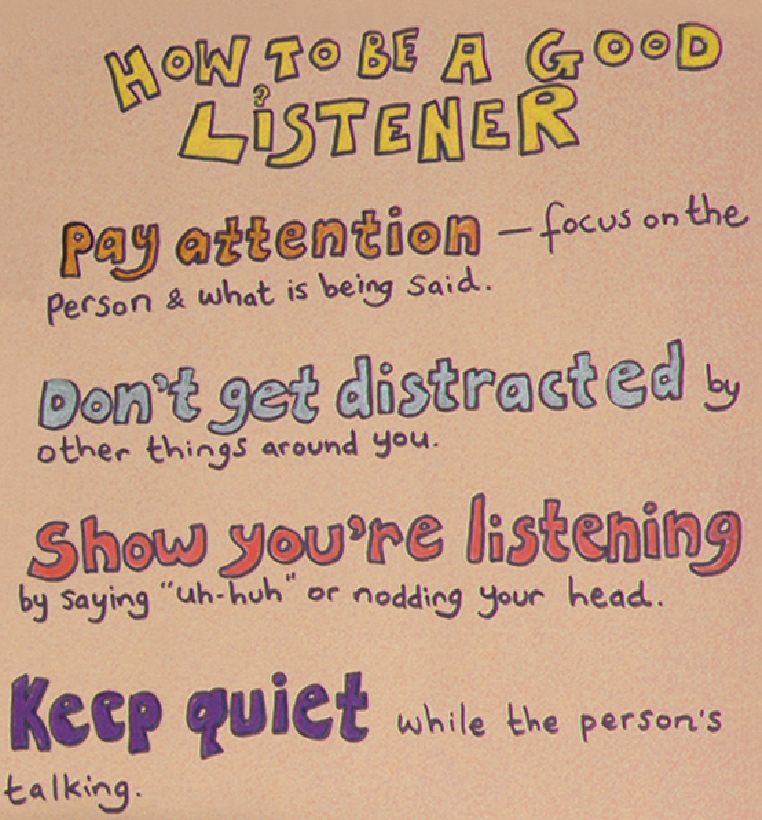
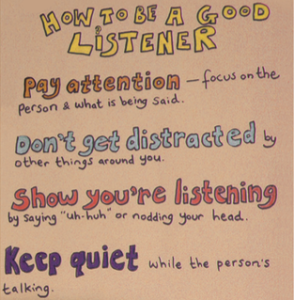
Screen Shot 2016-07-15 at 14.44.56Here are a few listening prompts for class discussion or a wall display. What would you add? How would you rephrase or up-grade these for your students?

  • Pay attention. Focus on the person and what is
    being said
  • Don’t get distracted by other things around you
  • Show you’re listening by saying uh-huh or nodding your head
  • Keep quiet while the other person’s talking
  • Wait to ask a question or give comments that show others that you care about what they’re saying.

Praise and recognise the listening behaviours identified by the pupils and incorporated in wall displays

Teacher talk

To nudge students from Grey to Purple, use language like this to nudge each column of the grid:

To take turns and mainain eye contact

  • I felt you were listening because you kept your eyes on me
  • How can you tell that someone is listening to you?
  • Thank you for waiting for me to finish
  • What do good listeners do?
  • Who needs to listen to be able to do their jobs?
  • I found it easier to work out what I wanted to say because you waited for me to finish

To nudge patience

  • Try not to rush to a judgement about what someone is saying.
  • Keep an open mind
  • Thank you for listening so carefully
  • Can you show me that you are ready to listen?

To listen for the message

  • Let’s give  . . . the chance to tell us what (s)he thinks
  • Are you paying enough attention?
  • What did  . . just say?

To listen for the quality of the message

  • Does that sound right?
  • What makes you think that that is true?
  • Do you believe that?

To begin to develop empathy

  • What is (s)he trying to say?
  • Listen very carefully
  • When do you find it hard to listen to someone else?
  • What makes it hard for you to listen?
  • How does what he’s saying make you feel?
  • How do you think (s)he feels about what you just said?

To set an If/Then target from Grey to Purple, try:

If ,someone is talking to me then I will remember to look at them to show I am interested.

Learning Mat

A Learning Mat is a simple tool to encourage pupils to become more self-aware of how they are using a learning habit. Basically, it’s an A3 or A4 laminated sheet that is kept on tables or used as part of wall display. It shows various aspects of a learning habit. Pupils refer to them during lessons, using them as prompts about the finer aspects of a learning habit that are being stretched. They help pupils to be able to join in meta-cognitive talk.

This mat is blank. You will find one that has suggested behaviours on in the Responds/Blue section. In this one you and your pupils could fill in some ideas for specific Receive/Purple behaviours that you want your pupils to start using. They can of course be individualised for specific pupils
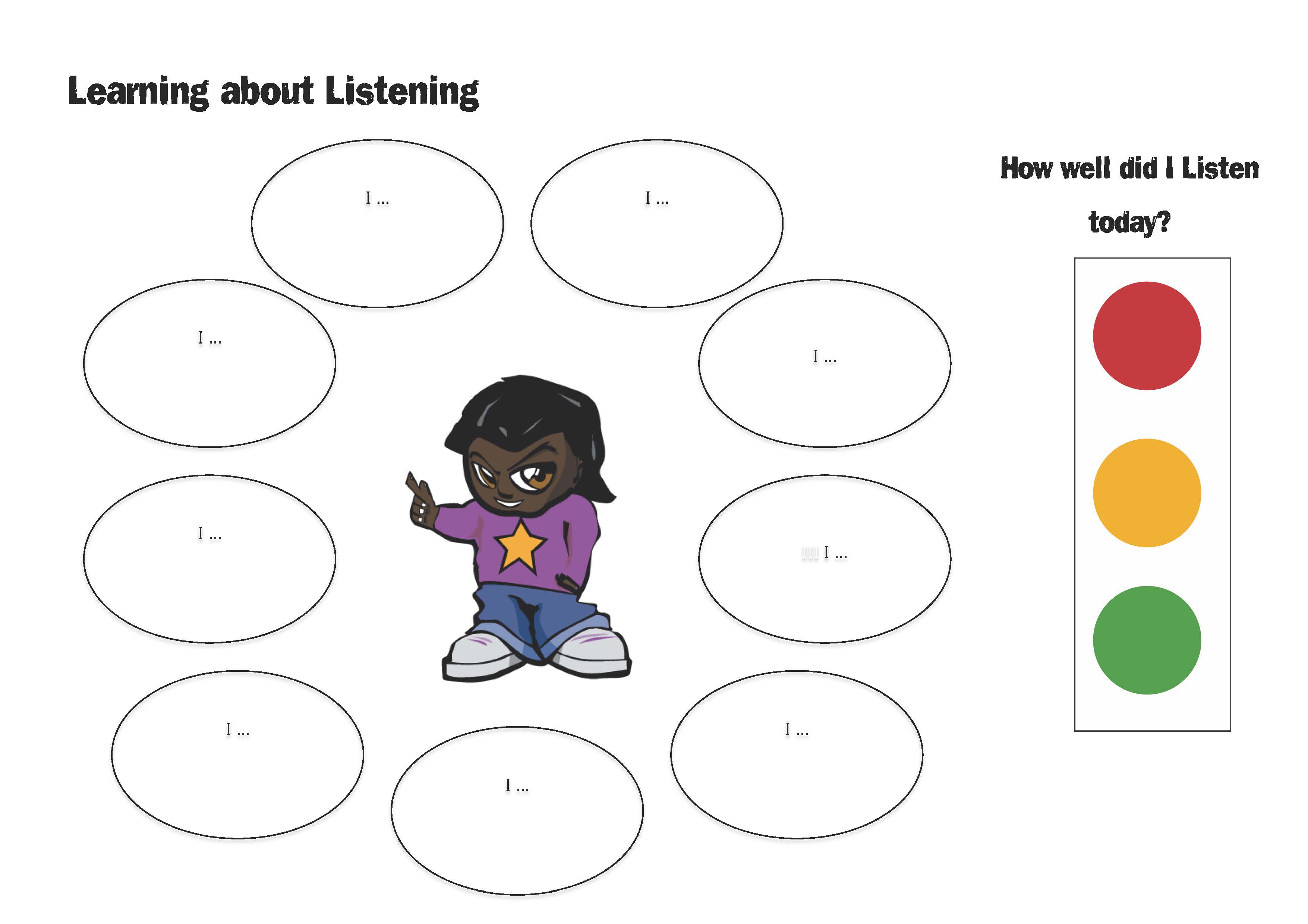
Download a blank version to make your own

Moving from Purple → Blue

Responds: Minded to sort the message from the messenger.

Listening grid may 2016.xls_Page_11

In the Responds (blue) phase, students have a genuine interest in what is being said. They want to know more, they can sort out what the speaker is saying and from this interest they don’t attempt to turn the conversation to themselves. They have learned the important skill of decoupling the information from the messenger.

In pursuing this phase, the role of the teacher becomes one of:

  • Helping students to show curiosity in and repect for what people say.
  • Enabling students to practise listening for the key messages of information
  • Enabling students to show/indicate that they care about the speaker

Something wrong here
imgres-6Read a sentence or statement without expression, then read it again, once, with changes; no further repetition. Students have to spot the changes.


Listening for inference and understanding

Explore sentences spoken with different stress, tone, pace and emphasis, to yield different meanings; for example: ‘I don’t know why you didn’t go.’ “How can I answer that?’

Play tapes of, for example:

  • One end of a telephone conversation
    Who’s on the other end… What’s being said… How do you know?
  • A dialogue
    What’s just happened… What happens next… How do you know?
  • Recognisable people
    Who are they… What’s the evidence… How do you know?
  • Unknown individuals talking
    What do you know… Who could they be… How do you know?

Making Faces

Experiment with facial expressions, asking pupils to show their feelings when they step in a pool of mud, eat a chocolate, watch a fight. Discuss whether everyone reacts in the same way. Take photos of different expressions. Discuss what the people in them might be feeling and why. Paint pictures to express particular feelings and discuss the use of colour in relation to emotional content. What can we tell from people’s expressions and choice of colours?

Think pair share

  • Offer students a problem or question which is more substantial than simple recall.think share pair 2
  • Allow individual think time to engage with the question.
  • Students turn to their ‘Learning Partner’ and share ideas, discuss, clarify, challenge etc.
  • The pair share with another pair, and subsequently with the whole class to arrive at a range of possible answers.
  • At each point students are exposed to the views of others which encourages them to revise and refine their initial thinking.

Using ‘Could be’ language

The importance of using ‘Could-Be’ language is well researched. It encourages more genuine engagement with what is being taught; how students will question and solve problems more readily if  knowledge is presented as provisional. It’s about shifting the tone to more tentative, less cut and dried. The opposite is ‘Is’ language which positions the learner as knowledge consumers where their job is to try and understand and remember. ‘Could be’ language immediately invites students to be more thoughtful, critical or imaginative about what they are hearing or reading.

Could be language includes phrase like;

In most cases; may include; may on occasion; wide variety; could be; probably; possibly; most often; there are other ways; one of which….

For more on using ‘could be’ language, see page 69-71 in  The Learning Powered School


Praise, recognise and display the identification of key pieces of information…the golden nuggets.

Teacher talk

To nudge students from Purple to Blue, use language like this to nudge each column of the grid:

To nudge interest

  • What should we / do you want to ask … ?
  • How will you show that you are interested?

To begin to listen for different purposes

  • What are you listening for?
  • Why are you listening?
  • What else might you listen for?

To listen for the main ideas

  • I wonder what is important in what  … is saying ?
  • What does this mean?
  • Could you repeat the bit about … ?
  • What is the big idea?
  • What is (s)he saying that is most important?
  • What do we still need to find out?

To listen beyond the speaker

  • Don’t shoot the messenger
  • That’s an interesting idea
  • What is this telling us?

To show interest in what is being said

  • Can you expand on that for me, please?
  • Go on . . .
  • That is really interesting
  • Give me a bit more on . . . .

An If – Then suggestion,

If I am trying to understand something tricky, then I’ll  listen to sort out what the important bits are; the main points.

Learning Mats

Learning mats are tools to encourage students to become more self-aware of how they are using a learning habit. Basically, they are A3 or A4 laminated sheets that show various aspects of a learning habit. They are kept on tables or used as part of wall display. Pupils refer to them during lessons, using them as prompts about the finer aspects of a learning habit that is being stretched. They help pupils to be able to join in meta-cognitive talk

As pupils become more proficient at listening the statements could be upgraded to reflect later phases of the progression grid. Pupils often enjoy making their own learning mats describing the particular skills they are working on.
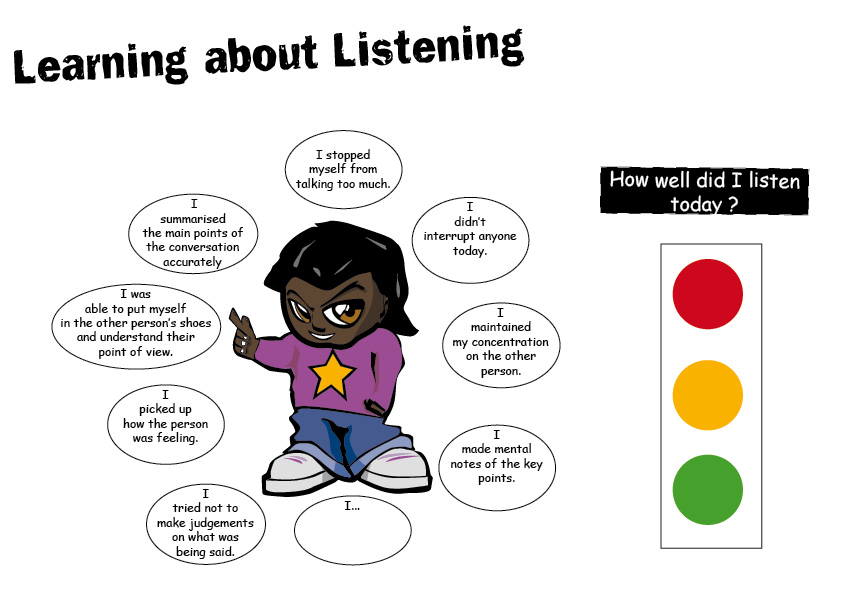
Learning about Listening

Learning-about-Listening.pdf

Using Learning Mats

You could also use Learning Mats (in ‘teacher speak’ or ‘student speak):

  • To raise awareness of  the habit
  • To spread the school’s common language for learning
  • As an aide-memoire for students and teachers
  • As a self-assessment support for students
  • As an audit tool to support teacher planning. i.e. which of the listening skills are implied in the lesson plan and therefore how will they be surfaced in what you draw attention to/orchestrate the lesson.

Moving from Blue → Green

Values: Minded to listen to understand ideas and emotions.

Listening grid may 2016.xls_Page_10

In the Values (green) phase, students listen more deeply for both the message/idea and the emotions that might go with it. They are able to check what is being said through paraphrasing and check the quality of an idea by checking for evidence and reasoning questions. They are aware that the speaker must be treated civilly and can empathise with the person’s view without necessarily agreeing with it.

In pursuing this phase, the role of the teacher becomes one of:

  • Encouraging students to paraphrase what is being said to check understanding
  • Encouraging students  to start thinking about the quality of messages and checking for evidence by asking the speaker how they know X or what makes them say Y
  • Helping students to show empathy for others’ views when they don’t agree with them

Blind filmshow

Play a two-minute scene from a film, without the visuals.

  • Listen for cues in sound effects, voices, soundtrack.
  • Predict what is happening.
  • Show the film and discuss the way in which sounds contributed to meaning.

Use centring activities at the beginning of lessons to focus minds before the learning begins. Play music and ask students to focus on the associations that it conjures about places, people, moods and atmospheres.

Whose voice is it?: One student stands in the centre of a circle, eyes closed. He or she calls out a phrase such as ‘Read all about it…Shock last minute equaliser’, while pointing to someone in the circle. That person echoes what has been said, and the person in the middle has to try to recognise the voice, (only one try). If correct, they then change places.

Listening to ask the right questions

Place students back to back in pairs with one student facing an image on the interactive whiteboard; or give one student an image on a card that the other can’t see. The image could be a complex diagram, an abstract shape, or a graph.

  • Give the unsighted people a piece of paper and pencil and ask them to pose questions to discover what the other can see so that they can recreate it.
  • The sighted person has to give clear and helpful instructions in response to what s/he is asked – without seeing what it is being produced.
  • Once the pair believe they have finished, compare the result with the original. What do they think they are looking at?

Listening with empathy and engagement

Show video of people talking about sensitive issues. For example, based on people talking about cystic fibrosis on YouTube at: “Current TV presents ‘Dying Young’”

Invite students to note down all they know as separate points on Post-its – pool these collectively on the Learning Wall. Share knowledge together.

  • Now ask students – in pairs – to note down the questions that they would ask about Cystic fibrosis if they had been told that their unborn child was likely to have the disease.
  • Show a supplementary video for students to answer some of their questions. Provide arresting information about the genetic causes and the longevity of the disease.
  • Engage in a debate over the rights of the unborn child. Learning to listen to other people’s points of view.

Train students as learning coaches

Teach your students to coach each other. Coaching is basically a structured conversation where one person, the coach, helps the other person, the coachee, to find out their own answers. The coach asks questions and listens but does not offer suggestions. The GROW structure is widely used — set the Goal, find out the Reality, think of Options, commit to the Way forward. E.g. “What is it that you want to do?” “What’s it like at the moment?” “What might you do to improve?” “So what are you going to do and when are you going to do it?” Speed coaching lasting 10 minutes each way can be really effective.


Develop this whole class listening habit as a routine.

Question & Answer sessions

Q&A sessions happen quite frequently in classrooms. Teachers may be trying to gauge understanding, to conduct a plenary or review point, to move thinking forward etc. The effectiveness of such points in the lesson relies on students listening to what each other has to say, otherwise it is one student ‘on the spot’ as answerer and 25 others having a bit of intellectual down-time until it is their turn to answer a question.

To encourage students to listen carefully to what their peers are saying, ‘bounce’ their answers on to other students for comment. Use supplementary questions like:

  • Do you agree (or disagree) with that ?
  • Can you add anything to what xxx said ?
  • Who can build on that ?
  • Are you convinced by what xxx said ?
  • Can you explain what xxx meant ?
  • Can you find a flaw in that argument ?
  • Can you defend that view ?
  • How would you challenge that viewpoint ?
  • Could you summarise what xxx just said ?
  • Do you think (s)he is right / wrong ?

No repetition of the student response, just passing one answer on to another student for comment. And because the teacher does not repeat the original answer, students have to listen to their peers’ answers or put themselves at risk of being caught out.

Teacher talk

To nudge students from Blue to Green, use language like this to nudge each column of the grid:

To listen actively for the speaker’s intentions / emotions

  • Look at their faces – what do you think they are feeling?
  • What does (s)he mean?
  • How is (s)he feeling?
  • Does (s)he believe what she is saying?

To nudge the inclination to listen beyond the words

  • What does the tone of voice tell you?
  • How do you think saying that made   . . .feel?
  • What does (s)he believe?
  • How is (s)he feeling?

To check understanding

  • What I’m hearing is . . . .
  • So, what you are saying is . . .
  • Let me play that back
  • You have just told me  . . .
  • Can I just check out that I’ve got it right? What I think you said is …
  • Can I summarise what you just said?
  • So, can I put it this way ?

To check whether you believe what is being said

  • Am I getting this right?
  • Have I got that right?
  • What do you think might be the reasons that ….. thinks that?
  • I don’t quite get what you mean by that
  • What are the principles? Do I agree?
  • Do I believe what she’s saying?

To offer support to the speaker

  • That’s interesting – go on . .
  • Not sure that I agree, but tell me more
  • Can you give me some more on this ?
  • Listen to understand
  • How do you think  . . . feels?
  • What is (s)he trying to say ?

An If-Then suggestion:

If I someone tells me something I disagree with, then I’ll try to understand why they think that.

Learning Mat

A Learning Mat is a simple tool to encourage pupils to become more self-aware of how they are using a learning habit. Basically, it’s an A3 or A4 laminated sheet that is kept on tables or used as part of wall display. It shows various aspects of a learning habit. Pupils refer to them during lessons, using them as prompts about the finer aspects of a learning habit that are being stretched. They help pupils to be able to join in meta-cognitive talk.

This mat is blank. You will find one that has suggested behaviours on in the Responds/Blue section. In this one you and your pupils could fill in some ideas for specific Value/Green behaviours that you want your pupils to start using. They can of course be individualised for specific pupils

Download a blank version to make your own

Moving from Green → Yellow

Organises: Minded to sensitively explore what the speaker is saying/conveying

Listening grid may 2016.xls_Page_09

In the Organises (yellow) phase, the listener can gently probe people’s problems and use open-ended questions skilfully to gain a better understanding of both the speaker and their ideas. The skill here is to remove the emotion out of critical listening but not to duck any tricky issues. It’s about keeping a conversation on an even keel despite differences of opinion or values.

In pursuing this phase, the role of the teacher becomes one of;

  • Help listeners to develop questioning strategies to better understand
  • Providing opportunities to listen for different viewpoint
  • Offering listeners opportunities to manage their emotions when listening to and probing tricky issues.

 Directions and instructions:

A sense of direction: Try:

  • You are facing east, you make an about-face, and then you turn left.
    Which direction is now on your left?

Or:

  • Castle Street is parallel to St John’s Street.
  • The Avenue is perpendicular to Purley Road.
  • Purley Road is parallel to St. John’s Street.
  • Is The Avenue parallel or perpendicular to Castle Street?

Developing listening skills through coaching

The following is an extract from Pathways to Coaching. The list form a sound base for discussion about the the listening and interactive skills of the coach

Coaches who are curious:

  • listen in order to understand
  • absorb what is being said
  • comment in order to affirm and clarify
  • pick up nuances and respond to them
  • stay silent until speaking is useful
  • ask questions to open possibilities, generate a search, create learning
  • trust themselves to say the right thing
  • build safe relationships
  • allow people to reveal themselves in an unchallenged way
  • allow people to explore and discover
  • do not have all the answers

Teacher talk

To nudge students from Green to Yellow, use language like this to nudge each column of the grid:

To consider alternative viewpoints

  • How do their points of view differ?
  • How might that change your point of view?
  • What would someone who had a very different set of beliefs than we do feel about it?
  • What can we agree on?
  • Leaving that aside, what do we have in common?
  • How can we come together on this?

To respond appropriately

  • How should I respond?
  • What would be appropriate?
  • I need to pay attention
  • I listen to understand

To question to deepen understanding

  • Can you give me a bit more on that
  • Go on . . . .
  • Give me a bit more on that
  • And . . . .

To tackle disagreements

  • I’m not sure I agree with that
  • I know this is tough for both of us, but . . .

To create forward movement

  • How could we move forward?
  • Ok. So what can we do about it?

An If – Then suggestion.

If my question provokes anger then I will not argue, I’ll explain and try to re-direct my question

Moving from Yellow → Orange

Embodies: Minded to listen and respond empathetically.

Listening grid may 2016.xls_Page_08

In the Embodies (orange) phase, students always maintain respect for the speaker. They can pick up nuances and read between the lines for what is really being conveyed. They always respond with sensitivity to the speaker while at the same time rejecting their ideas. They never put themselves in danger of being “lashed out at” by the speaker and are well equipped to offer advice in a way that will suit the needs of the other person

By and large, students who are able to, reach this embodies phase for themselves; it’s the nature of the phase. But there may be relatively few people who naturally and characteristically behave like this in virtually any circumstance. The classroom and home cultures established at the previous phases aim to give people the best chances of achieving this phase, hence there is little need for direct teacher intervention. Rather, the role of the teacher/ coach/mentor becomes one of:

  • ensuring there are sufficient opportunities available to display these high level behaviours;
  • nudging, praising and supporting people to exercise them;
  • modelling these behaviours themselves in their everyday interactions.

Ask yourself:

  • Does the classroom culture actively support listening at this level ?
  • Does it need to?
  • Is my own ‘nudging listening’ language precise enough to keep nudging students to become highly-skilled listeners ?
  • How well do I model these highly skilled listening behaviours myself ?
  • What phase of listening behaviour have I reached?

Remember most people don’t ever reach these highly skilled phases.

Teacher talk

To nudge students from Yellow to Orange, use language like this to nudge each column of the grid:

To nudge productive engagement

  • How is (s)he feeling?
  • I listen to others carefully and attentively
  • How can we do this together?

To defuse negativity

  • Why might (s)he say that?
  • I’m sure you didn’t mean to offend, but . . . .
  • Remember to give the benefit of the doubt

To listen between the lines

  • Can you hear what she’s really saying?
  • What is the sub-text here ?
  • What is not being said?

To reject ideas with sensitivity

  • While I understand what you are saying, I’m not sure I agree
  • Have we considered . . . . . ?
  • Does this take account of . . . . ?
  • On the other hand . . . .
  • It’s ok to disagree
  • We both need to be able to live with this
  • Out of our disagreements will emerge a better understanding for both of us

To help the speaker to say what they are thinking

  • What are you wishing to achieve?
  • What is holding you back?
  • How might you move forward on this ?
  • What will you be doing next?

In this phase, and maybe the one before, students should be capable of setting their own, personal if/then targets to secure aspects of their learning skills that they wish to develop.
Continue Reading

Taking listening into classroom culture

As teachers, we are in the habit-forming business. Those habits that we model in front of young people influence the ways in which they perform and behave. Therefore, we need to be sure to foster productive learning habits. If we frequently repeat ourselves, we are not building our students’ listening habits. In such ways do good teachers, albeit inadvertently, stifle the habit of listening.

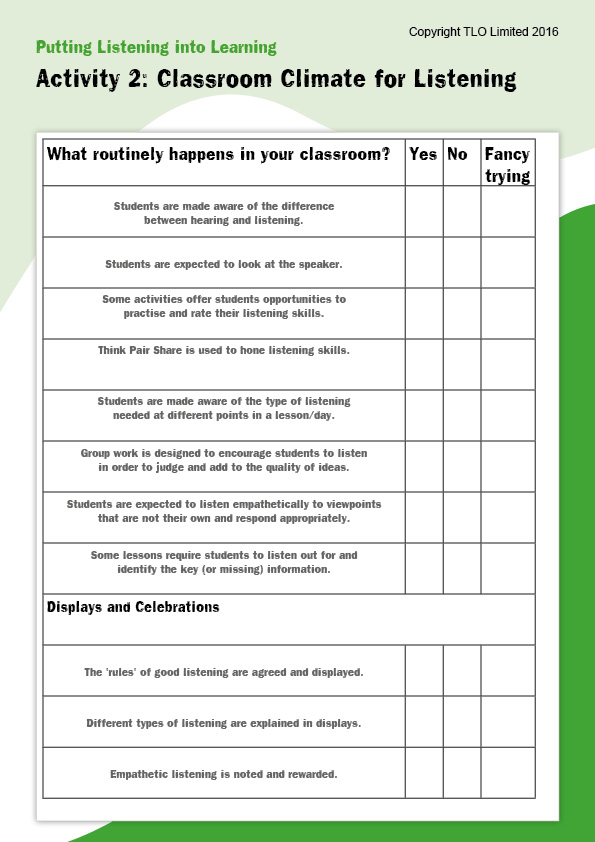
Activity 2: How well does my classroom climate encourage Listening?

A classroom climate that supports and nourishes the habit of  listening attentively is characterised by an understanding of what listening is about and an empathetic interest in the views, values and emotions of others.

To develop a listening friendly culture teachers need to believe that:

  • Effective listening is an essential life skill that benefits learning at school, in family relationships and later, in life at work
  • Attentive, active listening is an acquired skill that can be trained and needs to be practised
  • Listening and being quiet are not the same.

And through such a listening friendly culture students will come to believe that:

  • In order to understand, I first need to listen
  • Listening is not about waiting for my turn to talk
  • I need to listen for what’s not said as well as what is said.

Get a feel for your classroom culture and how it may be working for or against students becoming increasingly willing and able to listen.
Look through the ideas carefully and consider whether you already use some and whether any appeal to you to try.


SS2-Activity 2 Classroom Climate for Listening
Activity 2 Classroom Climate for Listening

What do you think?

  • What do your answers suggest?
  • How does your picture of classroom culture contribute to students’  approaches to listening?
  • Is this broadly negative or positive?
  • What insightful ‘Ah ha’ moments did you have as you read through the list?
  • How have these changed your view of listening?

Make a note of…Little_r

  • An idea on the list you want to start doing
  • Any  ideas that look as if they might help students to become better at listening.


Continue Reading

Listening and how it develops

1a) What do we mean by Listening?

Empathy and listening are core skills. We bracket them together because listening is the main medium through which empathy is generated and communicated. Students can quite readily be coached in the art of being a good listener, and can be given games and exercises that help them develop the ability to hear what someone else has said and, if necessary, play it back to them. Teachers sometimes complain that students will not listen, either to them or to each other; but the habit of listening can be cultivated in most classes inside a term. The most powerful way to do this is for the teachers to model good listening.
Extract from Building Learning Power. Guy Claxton 2002

1b) What does being a good Listener involve?

Understanding how to listen effectively is an essential skill that benefits everything from family life to business. It’s one of the most critical skills for working effectively in teams. Hearing and listening are different. Whereas hearing is a automatic and effortless process when sound waves strike the ear drum  and cause vibrations in the brain, listening is about the brain giving those sounds meaning. It’s unnatural, and it requires effort. There’s all sorts of faulty listening. Sometimes we fake it or pretend to listen; sometimes we only respond to the remarks we are interested in and reject the rest. Sometimes we listen defensively and take innocent remarks as personal attacks. Or, we listen to collect information to use to attack the speaker, or we avoid particular topics, or we listen insensitively and can’t look beyond the words for other meanings, or we  turn the conversation to ourselves. So, listening is indeed hard and requires effort. To be a good listener you need  to be able to listen for information,  listen to judge the quality of the information and listen empathetically to build a relationship and help solve a problem. When looked at from these diverse angles growing Listening moves well beyond encouraging a student to ‘do good listening’.

The Listening grid below takes account of the constituent parts of building the habit of being a good listener.

Our progression grid for Listening has 6 components:

Listening grid may 2016.xls_Page_02

Download grid as a pdf

1c) Unpicking the columns; what contributes to effective listening?

The grid columns are things that might combine to make up the skills and attitudes of an effective listener.

Overview of the grid

Listening grid may 2016.xls_Page_02Listening is not just a communication action, it’s a human action. Successful listening has four stages. Firstly we have to pay attention to what is being said and then make sense of it. We have to respond to the speaker showing you care both verbally and non-verbally. And finally we have to remember the message. In trying to encapsulate this effortful skill the grid looks at the normal conventions of this social process and the growth of skills in the three key listening habits; informational listening; critical listening; empathetic listening. Most of these ideas are gleaned from the work of Stephen Covey,

“Seek first to understand…Then to be understood”. Stephen Covey 1997

Take a closer look at what each column of the grid is about

Listening grid may 2016.xls_Page_03Conventions of listening

The social conventions of listening

How we move from the convention of taking turns when listening rather than hogging a conversation, to being curious and respecting the speaker. Moving on to listening actively and picking up intentions and emotions in the speaker and knowing how best to respond when people think differently, both from yourself and others, in a conversation

Listening grid may 2016.xls_Page_04Self-talk

The voice of self-awareness

Self-talk is what we say to ourselves as we learn. The statements capture what someone in each phase of the grid would be thinking. Students may use some of these phrases when talking with you, or in writing from time to time, but mostly self-talk goes on inside their heads. We have shown a small flavour of self-talk thoughts that teachers  can encourage students to imitate. Some relate to understanding the message while others relate to responding to the speaker. All such self-talk is important in building a listening habit.

Listening grid may 2016.xls_Page_05Informational listening to gain understanding

Trying to understand ideas


The key here is to separate the message from the speaker, being open to finding the golden nugget of the message by looking for the big ideas and main points,  asking questions to gain more information  ( closed and open) and paraphrasing in your own words to check what was meant. And finally being able to listen between the lines, looking beyond the words to find meaning.

Listening grid may 2016.xls_Page_06Critical listening

Judging the quality of ideas

This column is about judging the quality of the message and deciding whether to accept it or reject it. The first stage is to concentrate on listening. It’s important not to make a judgement too early, to separate the message from the speaker and to ignore information that may lead you to verbally attack the speaker. It’s important through sensitive questioning to evaluate the speaker’s credibility and check the source of the information. The conversation may then move on to examining the evidence and using reasoning skills before making a decision to accept or reject the argument/ information/idea. Finally being able to respond empathetically when rejecting an idea with your counter arguments.

Listening grid may 2016.xls_Page_07Empathetic listening

Helping people to sort out problems

Empathetic listening is the first step to understanding someone. The goal here is to build a relationship or to help someone solve a problem. This style of listening demands you show the most respect for the other person’s point of view. The thrust of such conversation is to help the speaker draw conclusions for themselves. Your role is to question in order to sort out problems, offer supportive responses, prompt the speaker to make suggestions for themselves and paraphrase their words to check understanding. Having said that you will have to choose the best style to meet the other person’s likely reaction to your help. Some appreciate direct advice, others may want you to make a decision for them, some may be defensive and want to lash out and “kill the messenger”, while others can’t think through the problems even with sensitive probing and paraphrasing. This is the hardest listening skill and takes lots of practice.
 

What do you think?

  • What have you learned about Listening from these descriptions?
  • What have you had confirmed?
  • What surprised you?
  • How have your views changed?

Make a note of…Little_r

  • Any ideas for practical classroom experiments that these descriptions have triggered
  • Which column your students are most secure in.

1d) Unpicking the rows; getting better at Listening

Of course, the development of Listening doesn’t grow neatly up each column or evenly across the phases in the grid. The five broad phases of dispositional growth (purple – orange) are affective ways in which people may be inclined to behave: we call this inclination ‘mindedness’.

Here is our interpretation of how Revising might grow.

Listening grid may 2016.xls_Page_02

Meaning behind the phases

The phases are drawn from Bloom’s taxonomy of the affective domain.

Phase ‘Receives’ (purple) is about doing something because you are told or expected to.

Phase ‘Responds’ (blue) is about gaining interest and doing things more willingly.

Phase ‘Values’ (green) is a key phase since the student now sees the value of behaving in this way. It’s a win for them; to behave like this is in their interest. It’s in this phase that the behaviour becomes more secure.

Phase ‘Organises’ (yellow) is the phase in which the student capitalises on this ‘in their interest’ behaviour and gets themselves organised to use it positively.

Phase ‘Embodies’ (orange), known as ‘characterised’ in the original taxonomy. In this phase, the student has made this behaviour their own. It has become part of their character; they can’t not do it and they have become highly skilled in doing it.

We urge you to see this progression as long term. Some phases will take years for people to work through; some will never be worked through. None of the phases are inevitable. There is a lifetime of development captured here. Nevertheless, the role of a teacher or parent should surely be to encourage and enable this journey.

Lacks: Minded to talk rather than listen

Listening grid may 2016.xls_Page_13

In this ‘Lacks’ (grey) phase, students are not necessarily aware of  listening even when told to listen. They tend to think listening is about hearing. They have no understanding of the fact that listening is a skill demanding a lot of effort.

Receives: Minded to show an interest in others’ talk

Listening grid may 2016.xls_Page_12

In the Receives (purple) phase, students are aware of how to behave when listening to someone else and are showing an interest in what people have to say. They might ask you to repeat something or ask you to say what you mean by something. They may want to know whether what is said is right and try to keep friends with people.

Responds: Minded to sort the message from the messenger

Listening grid may 2016.xls_Page_11

In the Responds(blue) phase, students have a genuine interest in what is being said. They want to know more, they can sort out what the speaker is saying and from this interest they don’t attempt to turn the conversation to themselves. They have learned the important skill of decoupling the information from the messenger

Values: Minded to listen to understand ideas and emotions

Listening grid may 2016.xls_Page_10

In the Values ( green) phase, students listen more deeply for both the message/idea and the emotions that might go with it. They are able to check what is being said through paraphrasing and check the quality of an idea by checking for evidence and reasoning questions. They are aware that the speaker must be treated civilly and can empathise with the person’s view without necessarily agreeing with it.

Organises: Minded to sensitively explore what the speaker is saying/conveying

Listening grid may 2016.xls_Page_09

In the Organises (yellow) phase, the listener can gently probe people’s problems and use open-ended questions skillfully to gain a better understanding of both the speaker and their ideas. The skill here is to remove the emotion out of critical listening but not to duck any tricky issues. It’s about keeping a conversation on an even keel despite differences of opinion or values.

Embodies: Minded to listen and respond empathetically

Listening grid may 2016.xls_Page_08

In the Embodies (orange) phase, students always maintain respect for the speaker. They can pick up nuances and read between the lines for what is really being conveyed. They always respond with sensitivity to the speaker while at the same time rejecting their ideas. They never put themselves in danger of being “lashed out at” by the speaker and are well equipped to offer advice in a way that will suit the needs of the other person.

What do you think?

  • What has struck you about the act of listening having read the descriptions above?
  • Which phase do you operate in?
  • What makes you say that?

Make a note of…Little_r

  • What you might do to assist your students to make headway in their listening behaviour.
  • Any practical ideas the text has triggered.

Activity 1

Download the blank Listening Grid
  • Colour in the cells where you think your pupils are secure.
  • Draw a red line across the grid to denote where you think most of the school’s students could and should reach by the time they leave.
  • Please take the results of these tasks with you to the Professional Learning Team session shown in Section 4
Continue Reading

Reflectiveness – (Planning, Revising, Distilling, Meta-learning)

Building Reflectiveness

Being ready, willing and able to become more strategic about learning. Reflectiveness: The strategic aspects of learning (Managing).

Planning

Working learning out in advance

Revising

Monitoring and adapting along the way

Distilling

Drawing out the lessons from experience

Meta-learning

Understanding learning, and yourself as a learner

Continue Reading

Section 1. Reflect on your changing practice

Three ways to gauge your progress ...

An essential aspect of a community of enquiry, of which you are a part, is keeping practice under review and researching the effects of changing practice. This accurate and continual self-reflection gives you and the school a real picture of itself as a learning organisation and the information can used to plan further improvement action.

Here you ask yourself “How far have I come in relation to

  • 1a working towards a secure learner centred classroom culture ( Culture Tool 1)
  • 1b looking back and getting closer to the action
  • 1c consider which of your enquiries was most successful
  • 1d make an overall assessment of the changes you have made

1a Culture tool 1

Towards learner centred classrooms ...

In the first session of this programme you looked at the idea of a learning friendly classroom culture. You explored the differences between teacher centred, learner centred and learning centred classrooms. Here are some quick reminders of these cultures.

.

Teacher centred classrooms

Many classrooms could be thought of as teacher centred. Here the overriding emphasis is on what the teacher is doing or saying. Learners have little to do but listen and be told what to do. Students have a ‘thin’ view of themselves as learners.

.

Learner centred classrooms

The learner centred classroom is where students take a more active part in deciding what to do. Here there is more collaborative learning where students have dialogues about what they are learning and create meaning together.

.

Learning centred classrooms

Here a language about learning itself is added for students and teachers alike, and learners practise reflecting on the learning process. Students come to see themselves as learners, develop stories about their experiences, understand the learning behaviours they are using and develop and propose improvements. They consciously grow their learning habits.

.

 How learning positive is my classroom culture?

Download a copy of Culture Tool 1. Spend a little time thinking about your own classroom culture against the indicators for the three classroom cultures. Where would you say your classroom culture is now?

Now find the highlighting you did when you first used this tool. If you have lost it just take your memory back to where you were then and imagine how you probably completed it.

Culture tool 1

Look at the tools side by side and ask yourself:

  • How different/similar are the assessments?
  • On which aspects have I made most progress?
  • Is this progress in the aspects I decided to focus on ‘way back then’?
  • To what extent has my working on Nutshells modules helped to nudge the classroom culture in learning positive ways?
  • On which aspects do I wish I had made more progress?
  • What broad aspect of learning culture needs further improvement / development in my classroom?

1b. Looking back: getting closer to the action

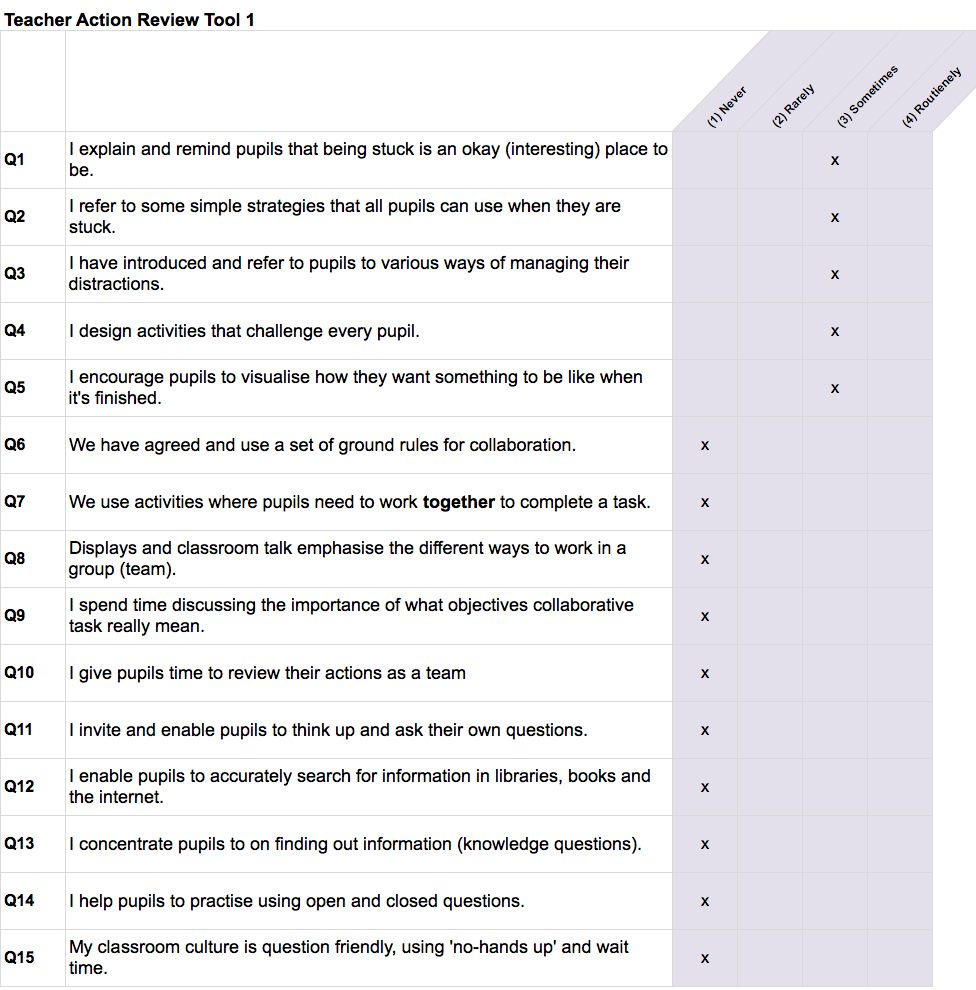
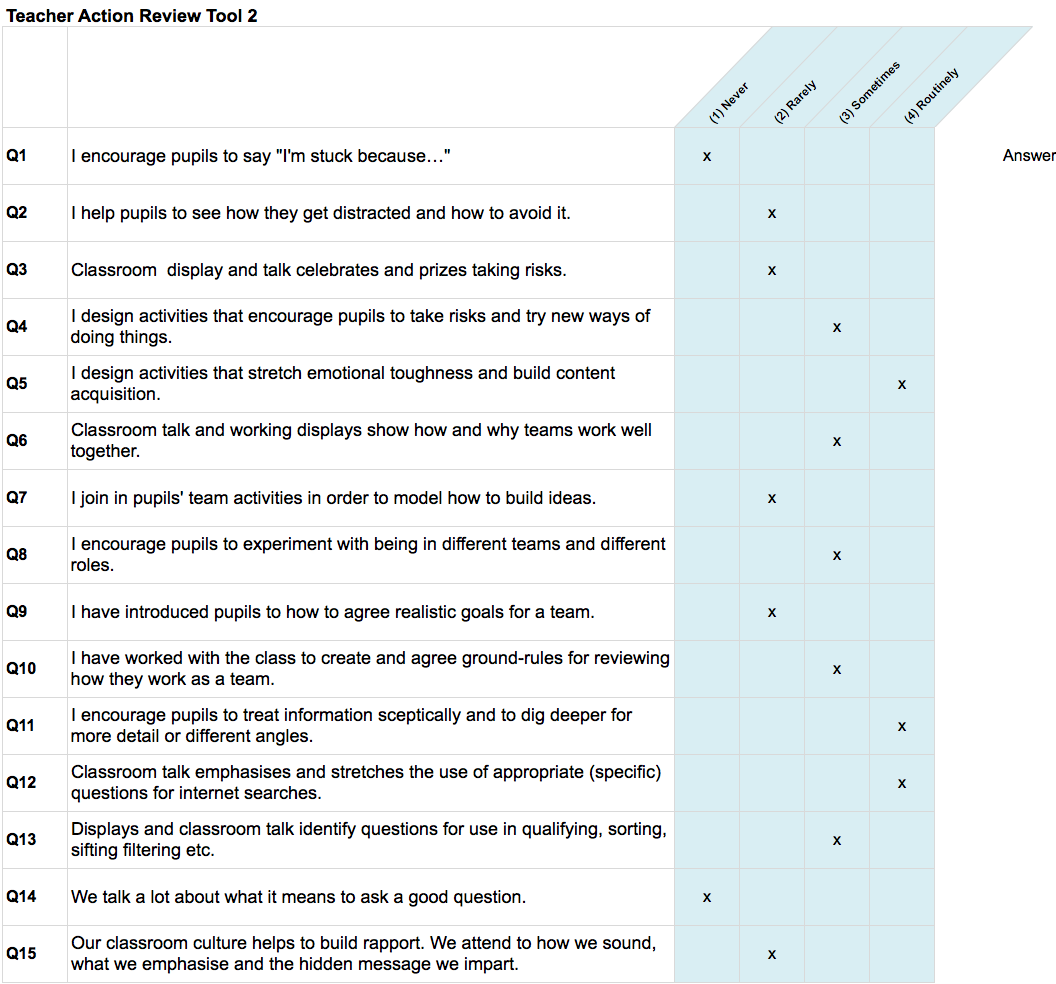
It’s time now to ask yourself some harder edged questions that link directly with the three key learning behaviours you have been working on in the last few months.  Below you will find a questionnaire that identifies the type of actions you may have taken in pursuit of a more learning friendly classroom. This teacher action questionnaire is linked to a pupil re-action questionnaire in Section 2.2. Take a look and try it out and reflect on the results.

What detailed changes have I routinised?

The questionnaires below suggest the type of actions you may be taking in your classroom by way of introducing and enhancing pupils’ use of the three key behaviours.  If you have been working mainly in the grey to purple phases (Lacks to Receives) select Tool 1. If you have been working at the purple to blue phases then select Tool 2

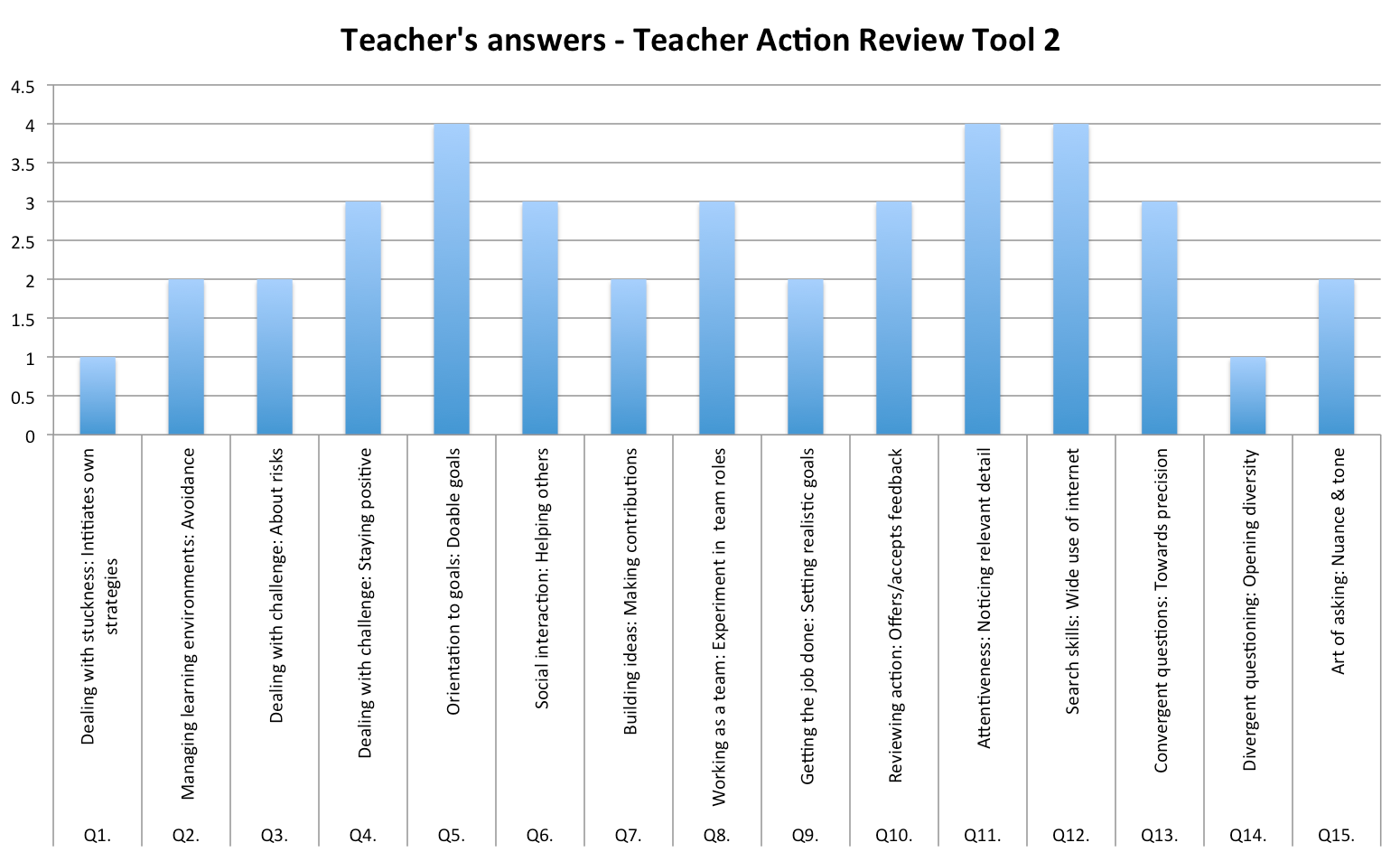
The first two sheets of the tools form the Teacher Action Review Tool. The review tool has 15 questions: 5 for each of the three learning behaviours. You are invited to estimate how much/often you use or refer to these strategies – how much they have become routinised. Completing it is easy. The tool is available in Excel format. The Excel spreadsheet file will present your results as graphs for your analysis (see below), and will also generate graphs linking with the pupils’ results (see Section 2.2).

When you have completed the questionnaire you can access your results as a chart in the excel spreadsheet.

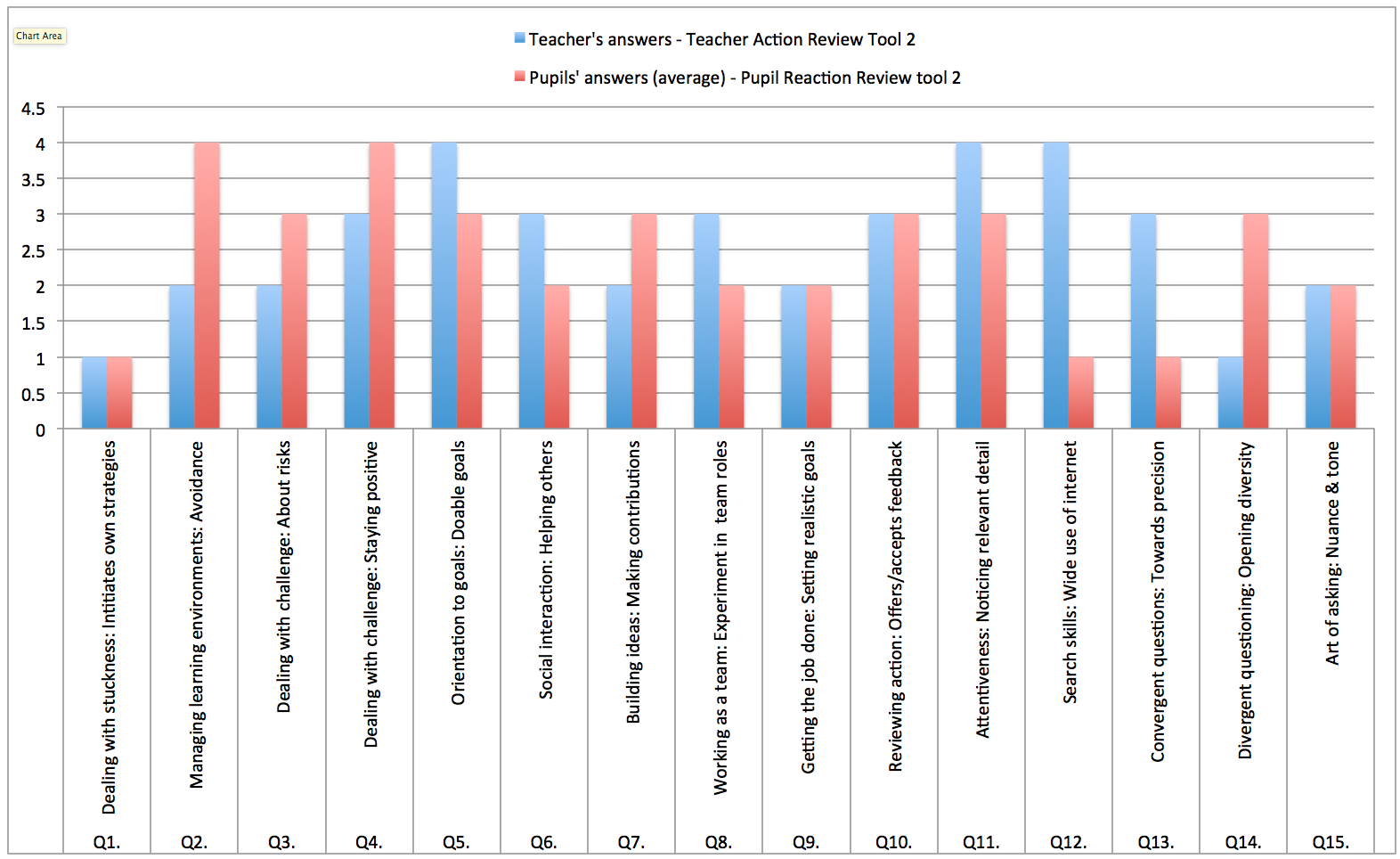
The blue columns show the strength of your answers. The higher the column the more you feel you have routinised this feature in your classroom. The statements below show the aspect of learning power the question was getting at. Questions 1-5 relate to Perseverance, 6-10 to Collaboration, 10-15 to Questioning.

Ask yourselfscreen-shot-2016-11-08-at-12-21-27

  • Which leaning behaviour do I seem to have routinised most?
  • Are these the ones I intentionally set out to work on with my pupils?
  • Which learning behaviour do I seem to have routinised least?
  • Which individual aspect(s) of each learning behaviour (collection of 5 questions) have I made most progress with?
  • Is there any evidence that progress takes time (i.e. that I have made more progress with Perseverance, which was tackled first, than with Questioning, which was third)?
  • Or is it the other way round? (The most recent ones are showing progress, but the impact of the earlier ones is beginning to evaporate?)
  • What are your answers telling you?

Make a note of…

Little_r

  • Key answers to the questions above
  • Aspects of your changing practice that the questions seem not to cover, i.e. things the quiz has missed out.
  • The extent to which answers to these questions illustrate the thrust of the changes you made ( i.e. Which the quiz has missed.)


1c and d Analysis and Evaluation

Take a step back ...

Here you ask yourself “How far have I come in relation to

  • 1c my enquiries that were most successful
  • 1d make an overall evaluation of the changes you have made

 Looking back on enabling learning cultures

Look more closely at what you have changed about your way of working in order to improve students’ independence as a learner.

Look back at your learning enquiry plans.

Take a helicopter view of what you have been doing.

Download the pentagon and think about:

  • Things you started doing that you hadn’t done previously
  • Things that you stopped doing in order to shift the culture
  • Things you did more often and less often in order to hone the culture
  • Things you were already doing and kept on doing because they were on the right track

wwh_hdcntbd_diag_pentagon_past-tense

Download as a PDF

Now using the three baskets, offer an overall evaluation of the changes you have made. Identify:

  • Things that worked really well. The ones you feel most satisfied with.
  • Things that worked okay but still need a bit of finessing.
  • Things that didn’t seem to work and you quietly stopped doing them.


Continue Reading

Section 2 Give pupils a voice

2.1 Activativing pupil voice: up close and personal

Asking students what they think ...

Answering the question “To what extent have students discerned a culture shift in classrooms”.

Think about recording and analysing conversations

Before beginning to talk with students about learning, it might be worth organising a recording of what they say. You could use IRIS if the school has this technology, but a simple video camera will do the job. If everyone made such recordings they could be used further down the line to sense longitudinal change in your students’ ability to discuss the process of learning – whether they are becoming increasingly fluent in ‘talking learnish’.

Conduct conversations with a mixed group of about 6 students for about 15 minutes.

When conducting such conversations it will be important to:

  • Put students at ease
  • Explain what you are doing
  • Assure them that there are no right answers
  • Ask them to just answer honestly etc.
  • Follow up open-ended questions with prompts like
    • what makes you say that?
    • how do you know that?
    • how do you feel about that?
    • how often does that happen?
    • when does that happen? etc
  • Take care not to influence or lead
  • Try not to agree or disagree
  • Refrain from asking leading questions
  • Show empathy by saying ‘Yes I understand’
  • Check your understanding by “Do you mean…” “I’m not sure I understood that, are you saying…”
  • Avoid wandering by saying “Let’s move on to the next point/another idea”
  • Thank them for their time and thoughts at the end. Make them feel valued

Key questions you might  pose in the learning conversation (and/or add some of your own):

  • How would you describe most of your lessons?
  • Who does the majority of the work?
  • Who asks the questions ?
  • To what extent would you say your learning is active ? (this will need explanation from you about the differences between being cognitively active and cognitively passive. The question is not about being physically active)
  • Have you noticed any changes in how teachers organise your lessons recently?
  • Are you able to make some choices in your lessons?
  • How much of your time is spent learning on your own, and how much learning with others?
  • What do you do when you don’t know what to do  / when you are stuck?
  • Do you enjoy doing things that you find challenging?
  • What advice would you give the school in order to improve the learning experience for you?

Important. Before undertaking the conversation please read the section ‘Analysing student responses’. This will help you to become aware of what you are hoping to glean from these conversations and hence make it easier to devise supplementary probing/exploratory questions to the ones above, as conversations unfold.

Analysing student responses:

Watch your recording, listening carefully to what and, importantly, how students are talking about learning and the shifts that they have perceived

Ask yourself:

How do my students perceive the culture of my classroom?

  • To what extent do students believe the culture is teacher focused?
  • Have they sensed a shift in recent months?
  • Do they prefer it now to previously?
  • How would they describe your classroom?
  • Do they believe they are able to exercise more choice than was previously the case?
  • Are they aware of what you have been trying to achieve?
  • Do responses indicate that students are aware of and prepared to accept a growing responsibility for their own learning?
  • Are they able to describe how they are better able to persevere now ?
  • Do they understand that work should be challenging, and do they enjoy this ?
  • What advice do they offer for further developments?

A chance to speculate

  • Had you conducted this learning conversation a year ago with the same students, what do you think the responses would have been?

Overall

  • What are students saying about learning and your classroom culture?
  • How convincingly are they saying it?
  • Are there links between what they are saying and the analysis and reflections that you have just undertaken?
  • Are there any surprises?

2.2 Activating pupil voice: at a distance

Using questionnaires

Pupils, of course, may see it a little differently. You can check out how their views of themselves as learners relate to your view of changes in practice. Invite your class to complete the quiz online. Older pupils will be able to do it for themselves, while younger ones will need to be talked through it by an adult.

The quizzes look at grey to purple (lacks to receive) and purple to blue phases of Perseverance, Collaboration and Questioning.

What are pupils learning about learning?

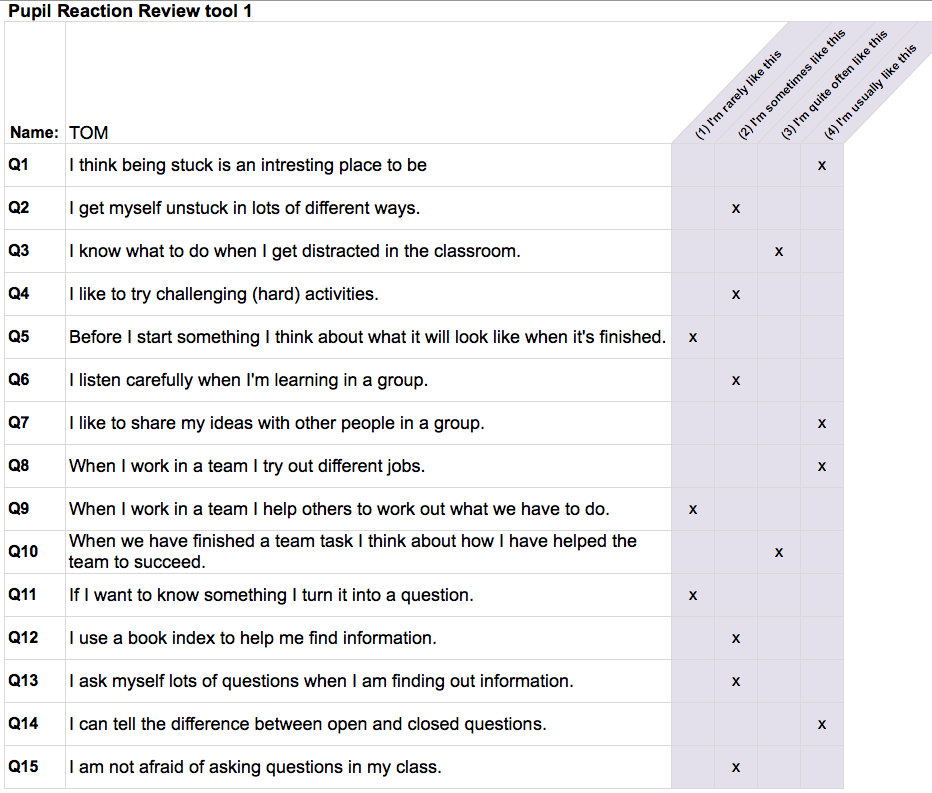
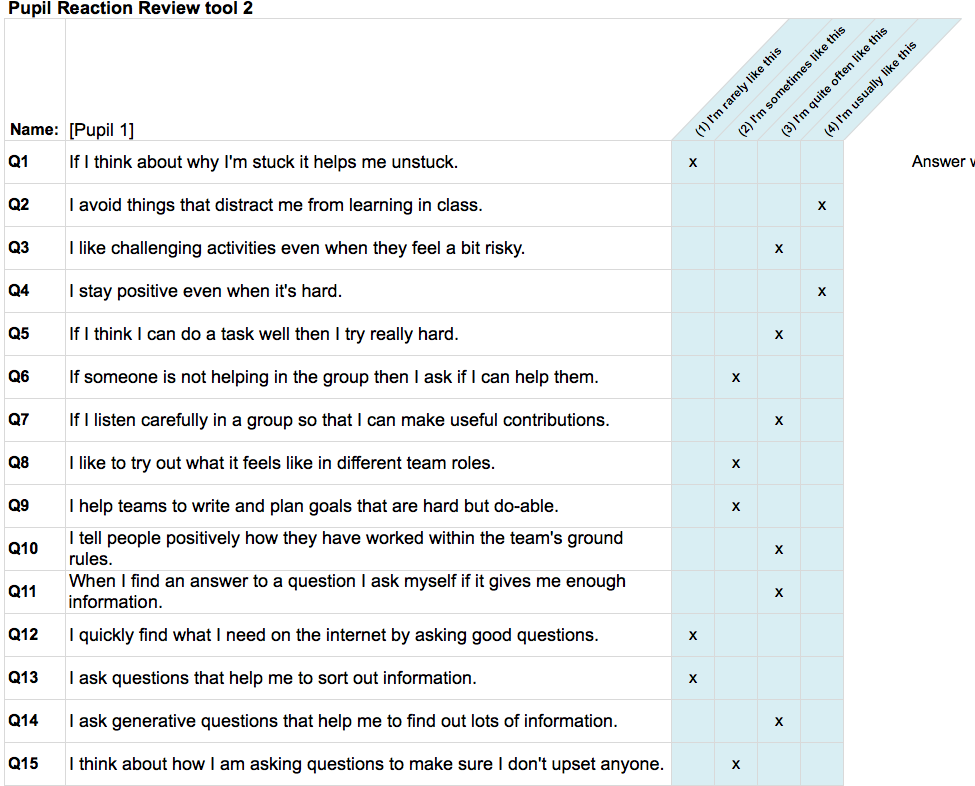
Make the Pupil Reaction review survey available on a computer in your classroom. Have the class complete it over the course of a day. Please ensure you select the survey tool that matches the Teacher Action tool you used (1 Grey to purple or 2 Purple to blue) There are 32 identical questionnaires pre-prepared. All pupils have to do is to type their names at the top of the questionnaire (or leave the generic [pupil 1] name), read the questions and put an x in the appropriate column.

Pupil Reaction review tool 1 – Grey to Purple

screen-shot-2016-11-08-at-12-25-27

You can find this tool in the same Classroom Practice Review Review tool 1 excel spreadsheet as the Grey to Purple Teacher Action tool 1.

Pupil Reaction review tool 2 – Purple to blue

screen-shot-2016-11-08-at-12-20-27

You can find this tool in the same Classroom Practice Review tool 2 excel spreadsheet as the Purple to Blue Teacher Action tool 2


Once you have collected your pupils’ views you can access a spreadsheet that combines your answers with pupils’ answers. to each of the 15 questions.  The blue columns are your results and the red columns are pupil results. The taller the red column the more the pupil agrees with the statement. Look carefully at these intriguing results.

Ask yourself:

  • screen-shot-2016-11-08-at-12-24-04To what extent do my views and pupil views coincide?
  • Where are they different?
  • Why might that be?
  • Are differences in some way related to the three different learning behaviours (i.e. is there a stronger relationship for Perseverance (1-5) than for Collaboration (6-10) for example)?
  • Do pupil results match my feeling for how they are progressing in their learning behaviours? (See questions in Task 4)
  • Are differences due to pupils having, in my opinion, an unrealistic/inaccurate view of themselves as learners?
  • If so, which learners have this unrealistic view? Is there a gender bias? Attainment bias?
  • What might I need to do to alter/improve these unrealistic/inaccurate views?

Make a note of…

Little_r

  • What you think are the three most important differences in how your pupils are as Perseverers, Collaborators and Questioners
  • What you discovered from the Pupil Reaction quiz


Continue Reading

Section 3 Learn with and from colleagues

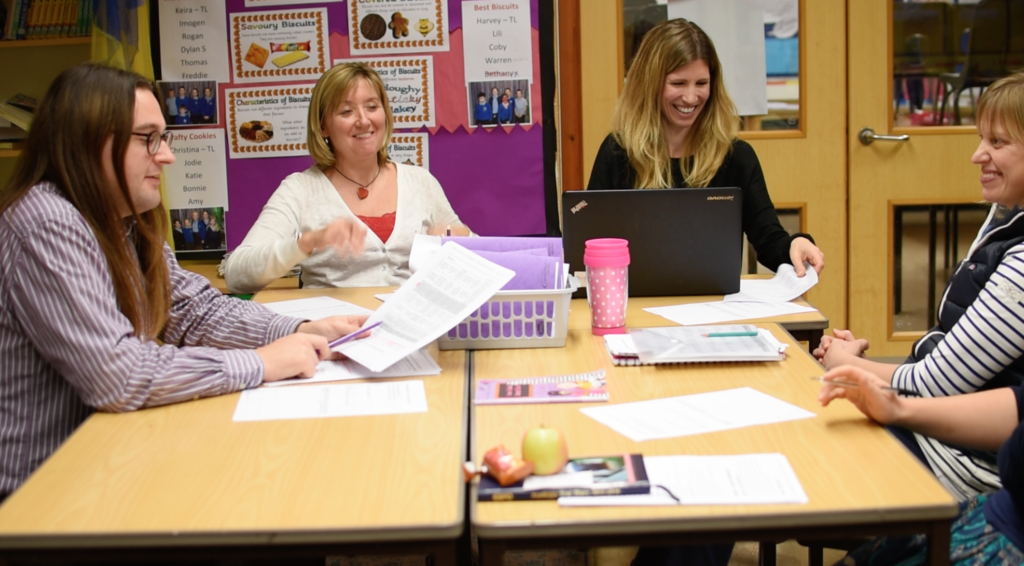
3.1 Take a focussed learning amble

Take a learning walk ...

Learn with and from colleagues

This section aims to answer the question “How have aspects of culture been interpreted differently in classrooms?”

 Learning Walks….well, more of an amble really.

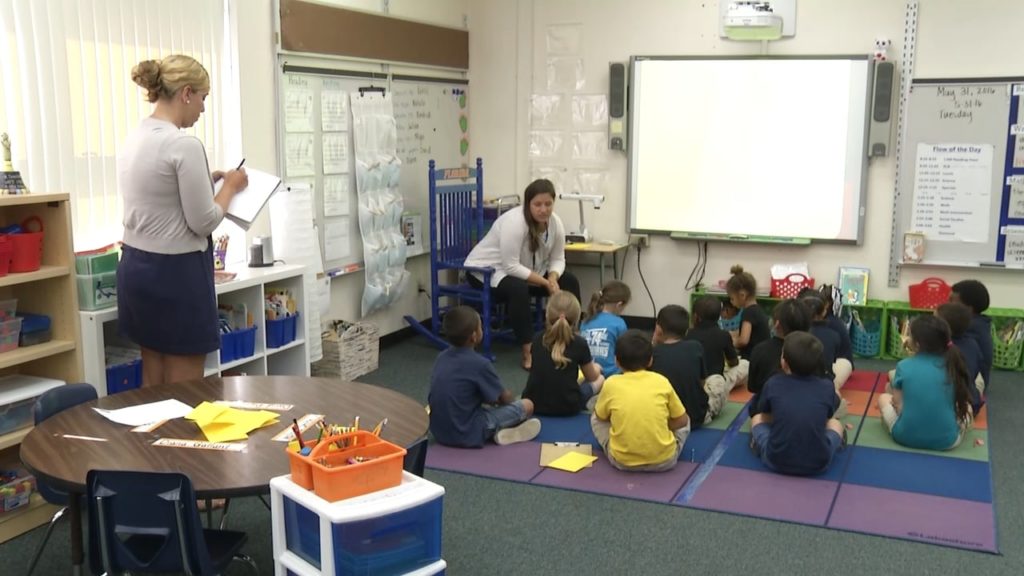
Learning Walks are sometimes given a bad press and have been abandoned in some schools. We view such experiences as important professional development opportunities. However, we prefer to use the word ‘Amble’ rather than ‘Walk’ and stress that they are best undertaken in a spirit of curiosity, enquiry, ruminative discussion, evolving understanding. NOT monitoring or checking up.

How you organise such Ambles we leave to your team and the school. However, we would like to suggest that you each have an opportunity to visit other classrooms, preferably with other colleagues, when learning is in progress.

Some ‘how to’ reminders

For those of you who are about to amble, here are some ‘how to’ reminders.

  • Share any observation checklists with the teacher in advance
  • Meet for 5 mins beforehand if ambling with other colleagues to discuss the precise focus
  • Make sure your documented evidence is as free of judgement as is possible
  • Spend at least 15 minutes in each classroom
  • Don’t disrupt the learning in the classroom
  • Don’t chat to each other whilst in the classroom
  • Don’t make any judgemental comments
  • Meet outside the classroom afterwards for a quick learning conversation about what you saw

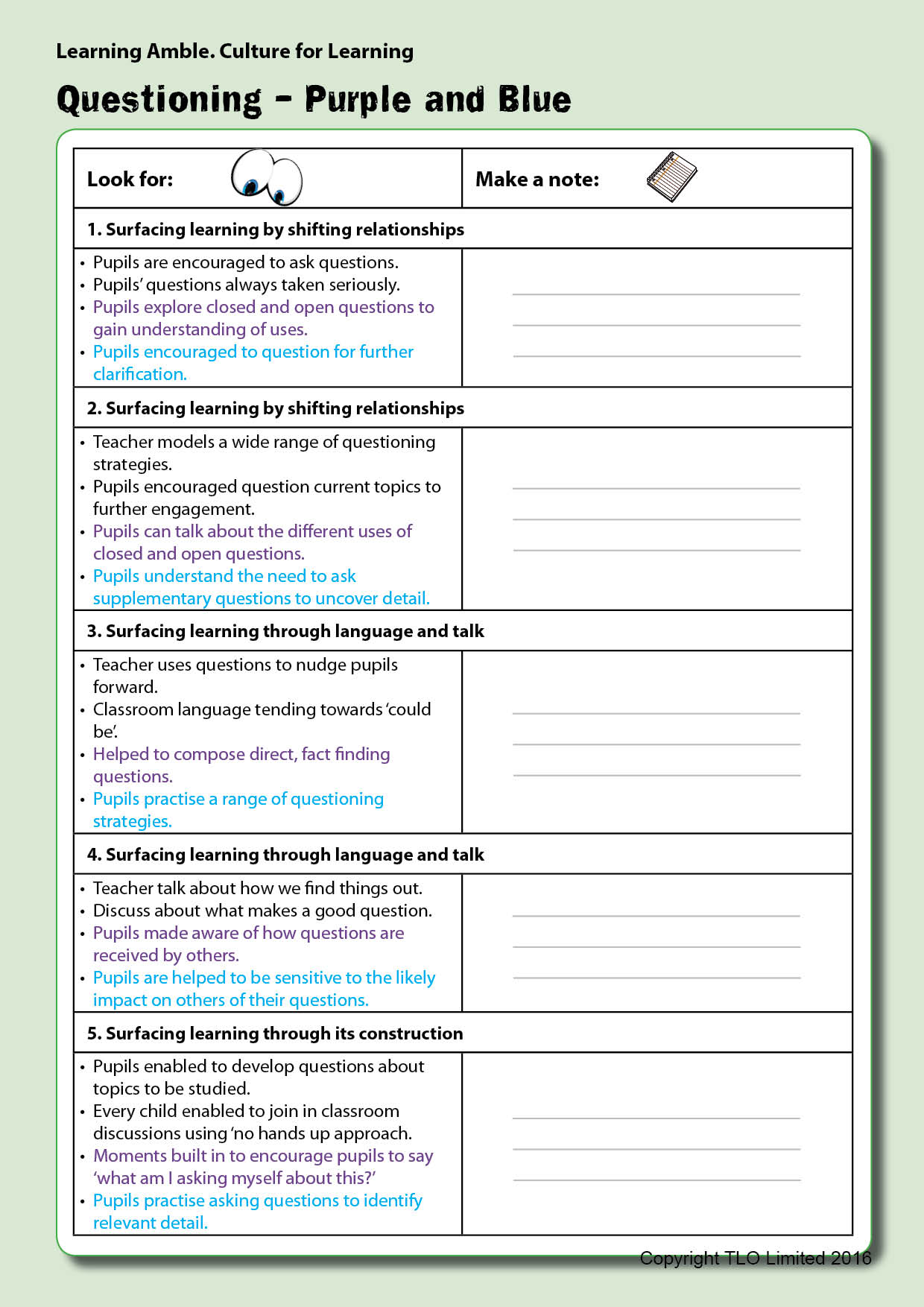
These are organised around the four dimensions of a learning culture and how learning is surfaced through each dimension. For example Surfacing learning by shifting relationships; Surfacing learning through language and talk.

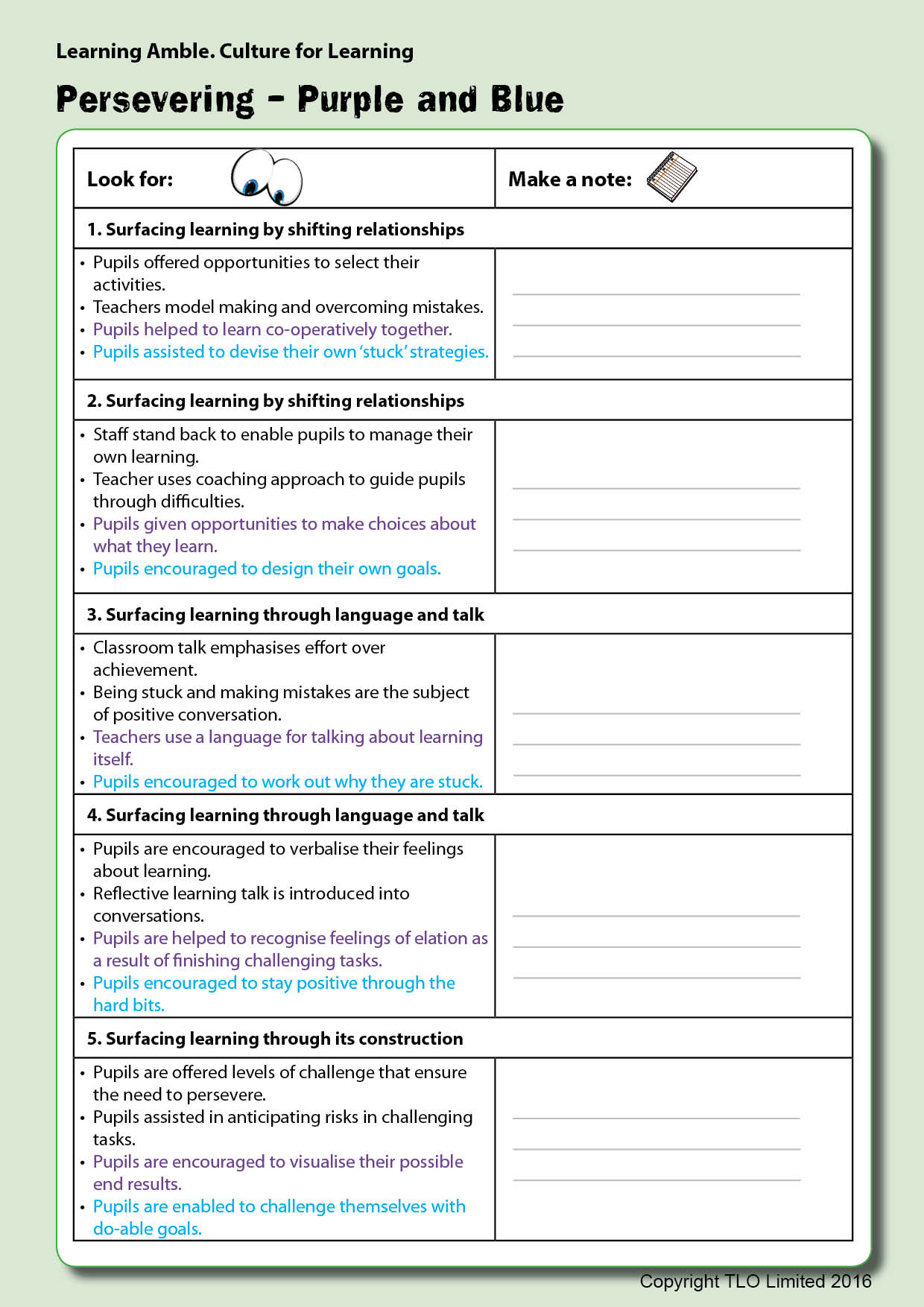
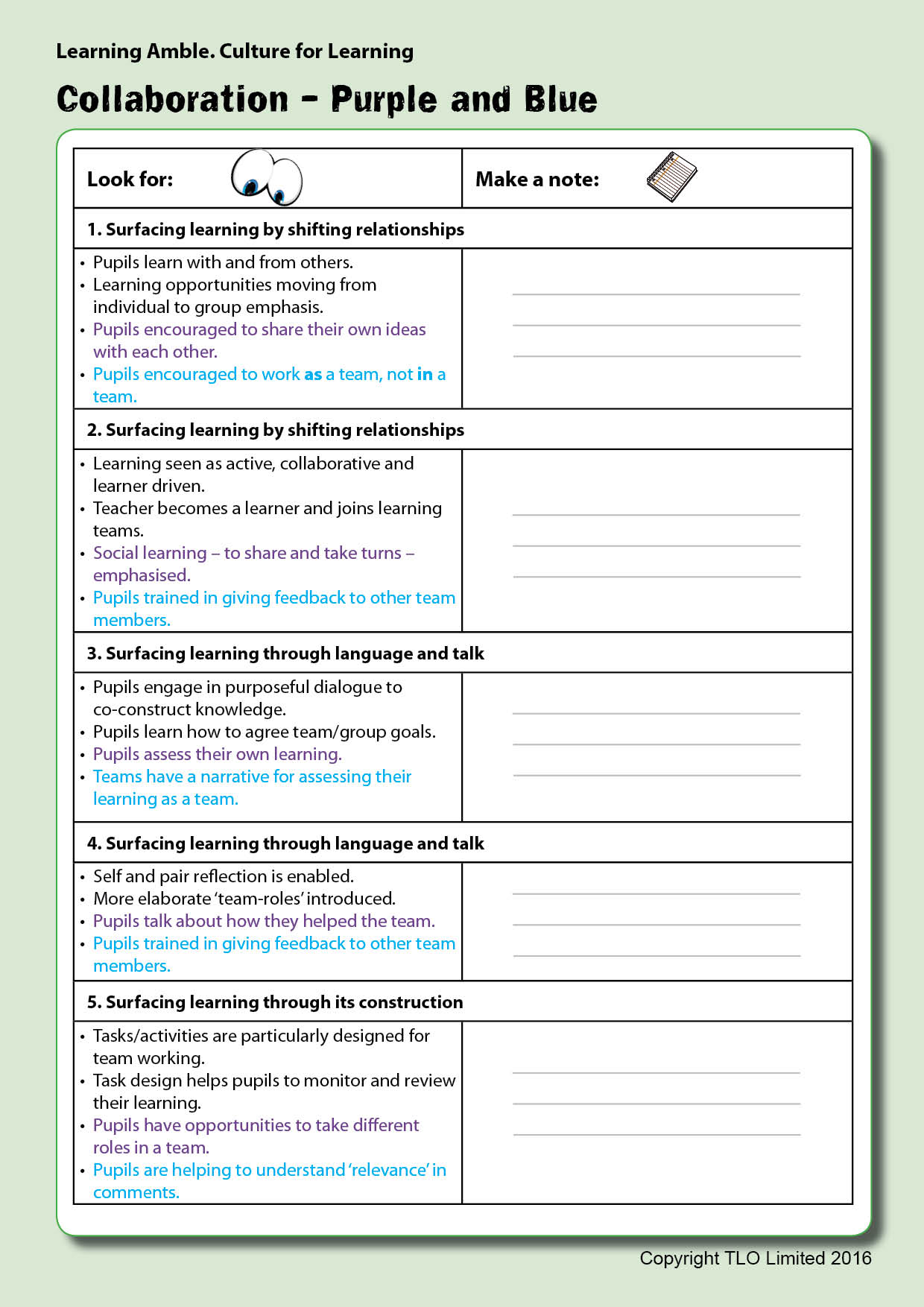
Each of the first 8 sections (glimpses) of  learning consist of two general cultural statements (in black) followed by statements in purple and blue which specifically reflect classroom action at that phase of development. Glimpses 9 and 10 show outcome statements for pupils at purple and blue phases.

Download the most appropriate tool for your amble

Learning Amble. Perseverance Culture. Purple and Blue.


learning-amble_persevering_v3

Download as a pdf

Learning Amble. Collaboration Culture. Purple and Blue

learning-amble_collaboration_v3

Download as a pdf

Learning Amble. Questioning Culture. Purple and Blue


learning-amble_questioning_v3

Download as a pdf


What are your observations telling you?

Talk with your colleagues, and compare and contrast:

  • Are there any variations across year groups/phases?
  • Where were the gains largest? Smallest?
  • Which of the three learning behaviours are given the greatest attention?
  • Speculate why that might be.
  • To what extent are teachers’ comments focused to support pupils’ learning process?
  • To what extent are teachers using phase-appropriate language with their pupils, i.e. are grey to purple pupils hearing purple phase language?
  • Are any facets of Perseverance/Collaboration/Questioning receiving more attention than others, i.e. is there lots of talk about distractions, but little about getting unstuck?

And finally consider

  • What are the three most important things you have learned about the ability of pupils to talk about the learning process?
  • What are the three most important things you have learned about the fluidity of teacher talk about learning?


Make a note of…

Little_r

  • Key points from your Learning Amble that you want to share in the team meeting


Continue Reading

Section 4. Team Reflection and Planning

Team reflection meeting ...

This team session is the final one in Nutshells phase 1. The format has been altered to accommodate the various evidence collection and analysis that team members may have been engaged in. NB All the review tools have a slot in this agenda. Simply select the ones that team members have used.

  1. Agreeing objectives and the items to be covered (5mins)
  2. Self reflection analysis (20mins)
  3. Student voice assessment (20mins)
  4. Learning Ambles (20mins)
  5. Where next as a team and school? (15mins)

1. Session objectives. What do we want to achieve? (5 mins)

  • Share and unpick personal reflections on the ‘what and how well’ of our changing classrooms
  • Share and analyse our students’ views
  • Develop a common understanding of what is happening in our classrooms
  • Decide the strategic issues that emerge from the various reviews 

2. Reflect on your changing practice: how far have I come? (20 mins)

Share everyone’s personal findings

  • People’s analysis of changes in practice using Culture Tool 1
  • People’s analysis of deeper classroom practice. Questionnaires
  • People’s analysis of changes in practice using the Pentagon
  • People’s analysis of changes in practice using the 3 baskets

Probe

  • What was getting in the way?
  • What seemed difficult?
  • What would make it easier?
  • What made things work particularly well?
  • What made something successful?
  • Ways in which everyone’s behaviour has changed.

3. Give students a voice: how well have students taken to this way of learning? What impact has it had on them? (20 mins)

Share everyone’s personal findings

  • People’s experience of talking with students about classroom culture
  • People’s reactions to and analysis of learning conversations with students
  • People’s experience of using the student questionnaires

Explore impact on students

  • What are students saying about the culture of classrooms?
  • Are there links between what they are saying/doing and the analysis and reflections that you have just undertaken?
  • Are there any surprises?
  • What seems to be working best?

4. Learn with and from colleagues: what are the variations on the learning culture theme and what can we learn from these variations? (20 mins)

Share findings from Learning Ambles

  • What are the similarities and differences in cultural elements of classrooms?
  • Why might this be?
  • Which of the ideas we have seen would we each like to imitate and/or see more widely spread?
  • Which variations do we think should be reduced?

6 Learning together: where do we need to go next? (15 mins)

Distilling our thoughts and findings

Evaluations and reflections have focused on:

  • The extent to which our classroom cultures are learning friendly
  • The extent to which we have achieved a coherent learning culture across the school
  • The extent to which our classroom experiments have impacted on student learning behaviours

Key questions

  • What are the three most important aspects of culture shift in our classrooms?
  • What are the three most important differences in how our students are as learners ?
 
Continue Reading

Section 6. What’s next ?

Image result for what next ?

Next steps ...

The section addresses the question “What might we do after completing Nutshells 2?”

Through your endeavours over the past year, your students have (hopefully !) changed as learners. Your year 8 students now are different from last year’s year 8 students – they have benefited from the interventions you made during year 7. What you did with last year’s year 8 students will not be the same you do with next year’s year 8s.

The question is . . .

How will you consolidate the changes that have already been made and, importantly, build on them ?

The answer is . . .

Go back to the Nutshells modules, assess where your students now are, and look out some more, higher level, teaching ideas.  


LQF_Logo_Final_Main_250x250

A number of schools find it helpful to seek guidance in the development of a learning-powered culture. The Learning Quality Framework [LQF] offers a set of staged descriptions of the development of a school whose prime educational goal is to develop better learners. The LQF tries to capture the essence of what a learning school does to ensure that all of its people become better learners.

The LQF is organised under twelve principles which are concerned with different aspects of a school’s culture, such as the school’s vision for learning, how leaders lead learning, how classroom practice works, how assessment and the curriculum need to be designed in order to build learning habits, and how the school acts on its own learning. In other words many of the issues that have been explored a little in this resource pack.

LQF aims to serve three useful functions:

As a diagnostic instrument, the LQF enables schools to assess where it is now on its learning journey. By matching current practice against the twelve LQF principles, schools can assess where they have reached thus far and so identify areas of development.

As a formative instrument, the LQF provides a school with a clear set of guidelines for planning their way forward. From the analysis of ‘what is’, which the framework provides, the school can develop a strategic overview of next steps.

As a summative instrument, it gives schools an external view of their progress through an external assessment and the award of a LQF quality mark. Developing a culture in which real world learning thrives is not an insignificant job, so stages along the way are worth recognising and celebrating. A school’s progress can be publicly validated and accredited by The Learning Organisation, as and when it feels ready to seek accreditation.

Learn more about the LQF 

A quiz to get you going . . . 

LQF_Quiz_v2-2017

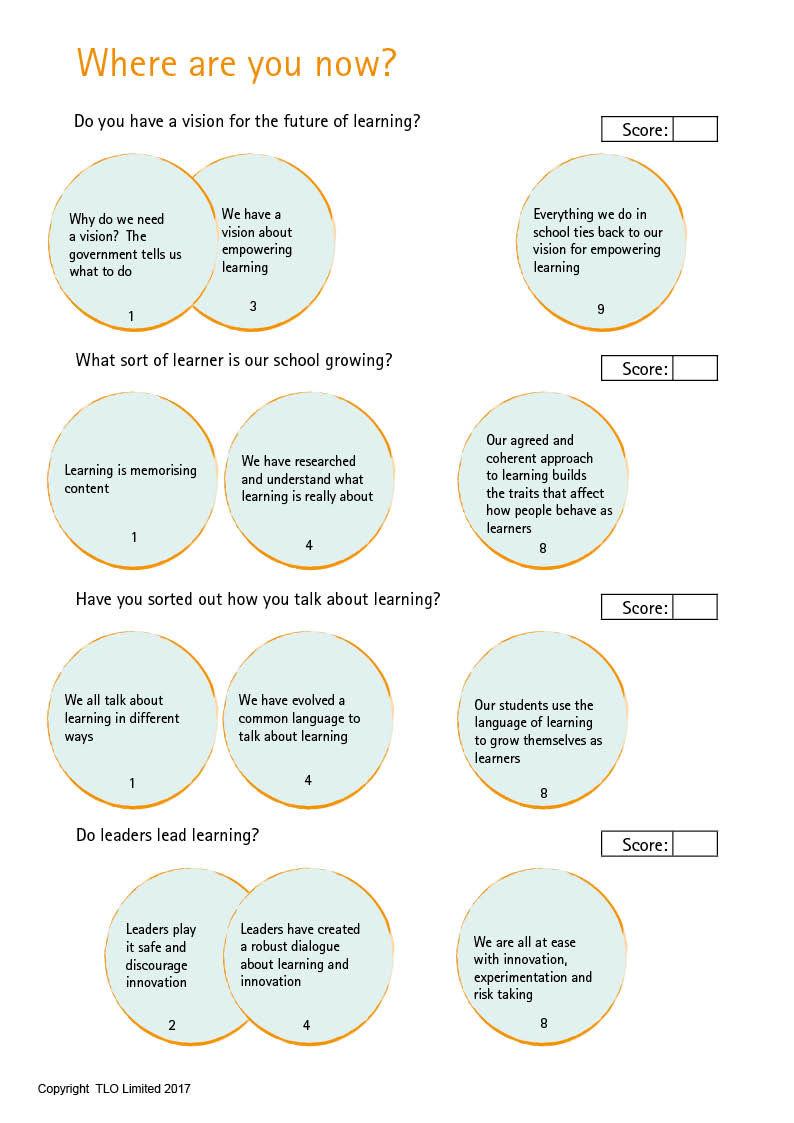
To get a glimpse of the LQF principles and to consider the extent to which your school currently meets them, try this informal self-evaluation against the 12 principles. The quiz is a useful starter activity for leadership teams to undertake together to gain a sense of the direction of travel and to review the school as it currently is.

Download as a pdf
Continue Reading

Section 1. Reflect on your changing practice

Ways to gauge your progress ...

Answering the question “How much has my classroom culture shifted ?”

An essential aspect of a community of enquiry, of which you are a part, is keeping practice under review and researching the effects of changing practice. This accurate and continual self-reflection gives you and the school a real picture of itself as a learning organisation and the information can used to plan further improvement action.

Here you ask yourself  “How far have I come in relation to

  • 1a working towards a secure learning-centred classroom culture
  • 1b considering which of your enquiries was most successful
  • 1c making an overall assessment of the changes you have made”

1a A Culture for Learning

Towards learning centred classrooms ...

In the first session of this programme you looked at the idea of a learning friendly classroom culture. You explored the differences between teacher centred, learner centred and learning centred classrooms. Here are some quick reminders of these cultures.

.

Teacher centred classrooms

Many classrooms could be thought of as teacher centred. Here the overriding emphasis is on what the teacher is doing or saying. Learners have little to do but listen and be told what to do. Students have a ‘thin’ view of themselves as learners.

.

Learner centred classrooms

The learner centred classroom is where students take a more active part in deciding what to do. Here there is more collaborative learning where students have dialogues about what they are learning and create meaning together.

.

Learning centred classrooms

Here a language about learning itself is added for students and teachers alike, and learners practise reflecting on the learning process. Students come to see themselves as learners, develop stories about their experiences, understand the learning behaviours they are using and develop and propose improvements. They consciously grow their learning habits.

.

 How learning positive is my classroom culture?

Download a copy of Culture Tool 1. Spend a little time thinking about your own classroom culture against the indicators for the three classroom cultures. Where would you say your classroom culture is now?

Now find the highlighting you did when you first used this tool. If you have lost it just take your memory back to where you were then and imagine how you probably completed it.

Culture tool 1

Look at the tools side by side and ask yourself:

  • How different/similar are the assessments?
  • On which aspects have I made most progress?
  • Is this progress in the aspects I decided to focus on ‘way back then’?
  • To what extent has my working on Nutshells modules helped to nudge the classroom culture in learning positive ways?
  • On which aspects do I wish I had made more progress?
  • What broad aspect of learning culture needs further improvement / development in my classroom?


1b and c Analysis and Evaluation

Take a step back ...

Here you ask yourself “How far have I come in relation to

  • 1b my enquiries that were most successful
  • 1c make an overall evaluation of the changes you have made

 Looking back on enabling learning cultures

Look more closely at what you have changed about your way of working in order to improve students’ independence as a learner.

Look back at your learning enquiry plans.

Take a helicopter view of what you have been doing.

Download the pentagon and think about:

  • Things you started doing that you hadn’t done previously
  • Things that you stopped doing in order to shift the culture
  • Things you did more often and less often in order to hone the culture
  • Things you were already doing and kept on doing because they were on the right track

wwh_hdcntbd_diag_pentagon_past-tense

Download as a PDF

Now using the three baskets, offer an overall evaluation of the changes you have made. Identify:

  • Things that worked really well. The ones you feel most satisfied with.
  • Things that worked okay but still need a bit of finessing.
  • Things that didn’t seem to work and you quietly stopped doing them.
Continue Reading

Section 2 Give students a voice

Asking students what they think ...

Answering the questions “To what extent have students discerned a culture shift in classrooms” and “How fluently can students talk about learning ?”.

Think about recording and analysing conversations

Before beginning to talk with students about learning, it might be worth organising a recording of what they say. You could use IRIS if the school has this technology, but a simple video camera will do the job. If everyone made such recordings they could be used further down the line to sense longitudinal change in your students’ ability to discuss the process of learning – whether they are becoming increasingly fluent in ‘talking learnish’.

Conduct conversations with a mixed group of about 6 students for about 15 minutes.

When conducting such conversations it will be important to:

  • Put students at ease
  • Explain what you are doing
  • Assure them that there are no right answers
  • Ask them to just answer honestly etc.
  • Follow up open-ended questions with prompts like
    • what makes you say that?
    • how do you know that?
    • how do you feel about that?
    • how often does that happen?
    • when does that happen? etc
  • Take care not to influence or lead
  • Try not to agree or disagree
  • Refrain from asking leading questions
  • Show empathy by saying ‘Yes I understand’
  • Check your understanding by “Do you mean…” “I’m not sure I understood that, are you saying…”
  • Avoid wandering by saying “Let’s move on to the next point/another idea”
  • Thank them for their time and thoughts at the end. Make them feel valued

Please don’t undertake the conversation without first reading the section ‘Analysing student responses’. This will help you to become aware of what you are hoping to glean from these conversations and hence devise supplementary probing/exploratory questions to the ones below, as conversations unfold.

Key questions you might care to pose in the learning conversation (and/or add some of your own):

  • How would you describe most of your lessons ?
  • Have you noticed that your teachers prefer to help you to discover things for yourself rather than tell you things? Do you like this?
  • Who is most responsible for you as a learner?
  • Do your teachers talk to you about how you are learning? Can you give me some examples?
  • How often do you get the chance to stop what you are doing and talk about what you have learned?
  • How often do you get the chance to stop what you are doing and talk about how you have learned it?
  • Do your teachers tell you which learning behaviours you will be / are using? Give me some examples.
  • Are your teachers interested in the mistakes you make and why you make them?
  • Do displays help you to understand how you are learning? Can you give me examples of how you have used these displays?
  • How do you learn best – on your own or with others? Why do you say that?
  • Can you tell me what really effective learners do?
  • Let’s be a bit more specific – what do highly effective collaborators do? (or planners, or questioners, or listeners etc)
  • Are you becoming a more effective learner? How do you know? Tell me some things you can do now that you could not do before.

Analysing student responses:

Watch your recording, listening carefully to what and, importantly, how students are talking about learning and the shifts that they have perceived. Ask yourself:

Do teachers:

  • Coach whenever possible?
  • Share responsibility for learning?
  • Talk about learning using language from the school’s progression map?
  • Show an interest in how students are learning?
  • Create time for reflection on the learning process?
  • Make it clear how content and learning behaviours are linked?
  • Show an interest in student mistakes?
  • Create displays that support students’ understanding of the learning process?

Do students:

  • Understand and accept responsibility for their own learning?
  • Value opportunities to learn with and from their peers?
  • Talk about learning fluently using the school’s language of progression?
  • Understand how their learning improves?
  • Know which learning behaviours they are using?
  • Value and learn from mistakes?

A chance to speculate

  • Had you conducted this learning conversation a year ago with the same students, what do you think the responses would have been?

Overall

  • What are students saying about your classroom culture?
  • what are students saying about learning?
  • How convincingly are they saying it?
  • Are there links between what they are saying and the analysis and reflections that you have just undertaken?
  • Are there any surprises?
Continue Reading

Section 3 Learning with and from colleagues

Take a learning walk ...

Learning with and from colleagues

This section aims to answer the question “Which learning behaviours are being activated in classrooms?”

 Learning Walks….well, more of an amble really.

Learning Walks are sometimes given a bad press and have been abandoned in some schools. We view such experiences as important professional development opportunities. However, we prefer to use the word ‘Amble’ rather than ‘Walk’ and stress that they are best undertaken in a spirit of curiosity, enquiry, ruminative discussion, evolving understanding. NOT monitoring or checking up.

How you organise such Ambles we leave to your team and the school. But we would like to suggest that you each have an opportunity to visit other classrooms, preferably with other colleagues, when learning is in progress.

Some ‘how to’ reminders

For those of you who are about to amble, here are some ‘how to’ reminders.

  • Share the observation proforma with the teacher in advance
  • Meet for 5 mins beforehand if ambling with other colleagues to discuss the precise focus
  • Make sure your documented evidence is as free of judgement as is possible
  • Spend at least 15 minutes in each classroom
  • Don’t disrupt the learning in the classroom
  • Don’t chat to each other whilst in the classroom
  • Don’t make any judgemental comments
  • Meet outside the classroom afterwards for a quick learning conversation about what you saw

Going into classrooms to look at the learning behaviours that pupils are being enabled to exercise.

Firstly, remember that in any lesson, no matter how sensational, not all of the learning behaviours will be enabled. Different subject matter and different learning activities will exercise a unique blend of behaviours. Indeed some fantastic lessons may exercise only a few of these behaviours – sometimes a few behaviours exercised extensively is preferable to many behaviours exercised fleetingly, or a few behaviours exercised skilfully trump many behaviours exercised simplistically.

However, we would hope that over time students get to practise all of these behaviours in various aspects of their learning.

So, the question becomes, ‘Are you confident that your students are being enabled to exercise the full range of learning behaviours ?’ And the subsidiary, ‘How are you going to find out ?’

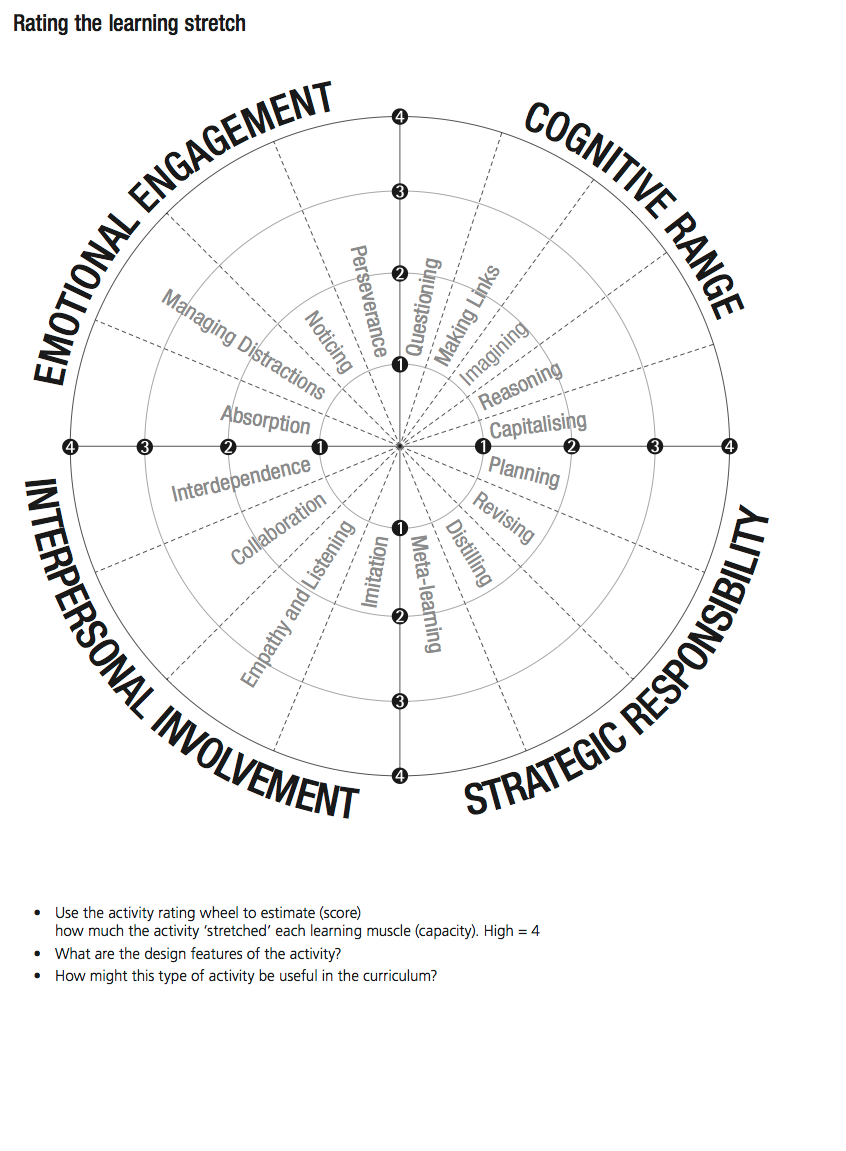
Traditional observation tools are highly unlikely to provide sufficient evidence. Why not try going in to classrooms with this Rating Wheel as your observation tool ?

Screen Shot 2017-01-26 at 11.38.27Senior leaders could use the Rating Wheel as an observation tool in classrooms. Middle leaders might use it when looking at learning in their department. Individual teachers could use it to analyse their own lessons, or perhaps they could pair up with a colleague to observe learning in each other’s lessons.

Download as a pdf

How to use it:

  • Spend around 20/30 minutes in a classroom,
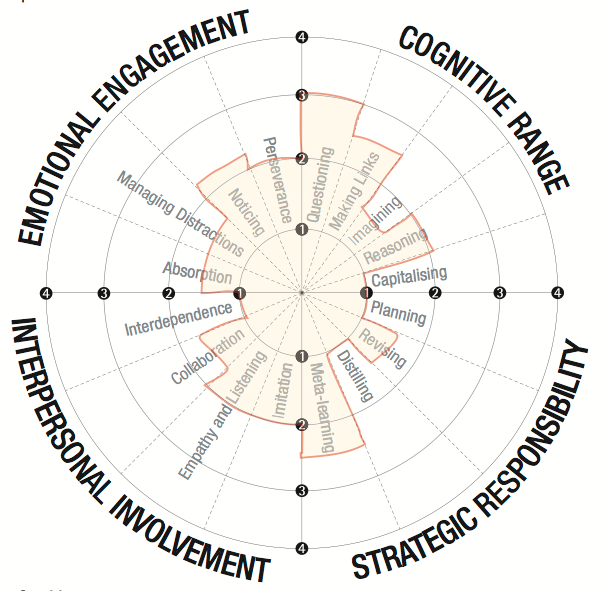
  • Towards the end of your time in the lesson, colour in the spokes of the wheel in line with the frequency with which the behaviour has been exercised. If, for example, pupils have used their planning skills extensively, then colour in most of the planning spoke. If only a bit, then colour in the inner bit of the spoke. If they have not been required to plan, simply leave the spoke blank.
  • Repeat for all of the spokes.Screen Shot 2017-01-31 at 15.30.00

You end up with a ‘picture’ of which behaviours were (and were not) exercised. On its own, one of these completed wheels tells us little of the bigger picture. It is a useful document on which to base a discussion with the teacher, but beyond that it has minimal meaning.

However, once you have completed a sufficient number of these, clear patterns begin to emerge – some behaviours are getting regular exposure, others less so. Indeed, some of the 4 domains of learning may be gaining more attention than others.

[Do be sure not to visit only predominantly the early parts or later parts of lessons – reflection, for example, frequently occurs towards the end of lessons and hence you need a good balance between 1st half and 2nd half of lessons to avoid bias.]

Once you know which behaviours are and are not being exercised, you can begin to ask how you might better foreground the ones gaining less exposure.

Moreover, such research done early in your involvement with Building Better Learners will give a baseline measure that you can re-visit later to track the progress you make in expanding the range of behaviours that pupils are currently being enabled to exercise.

What are your observations telling you?

Talk with your colleagues, and compare and contrast:

  • Which learning behaviours are most frequently activated in lessons ?
  • Least frequently ?
  • Is any domain of learning getting more attention than others ?
  • What are the variations across subjects ?
  • What are the variations across year groups ?
  • What are the three most important things you have learned about the learning behaviours that ar being activated ?

Make a note of…

Little_r

  • Key points from your Learning Ambles that you want to share in the team meeting
Continue Reading

Section 4. Reflecting on changes in student learning behaviours

Image result for changing behaviour images

Changes in student learning behaviours ...

Reflecting on changes in student learning behaviours

This section aims to answer the question “Are students becoming better learners ?”

Each of the 12 Nutshells modules begins with a progression chart.

Your first task was to think where most of your students were currently operating and colour in a copy of the progression chart. If you can find these original colouring-ins, please do.

Also, remind yourself of the changes you made by looking back over your actions plans from these modules.

How are students as learners ?

Firstly, download and print the progression charts for the learning behaviours that you have personally explored.

[Use the down-arrow in the grey bar at the bottom of the Collaboration grid above to download all 12 grids]

Think about your students now, and repeat the colouring-in process. As before, ask yourself where the majority of learners are.

How much have they changed ?

  • If you were able to find your original colouring-in sheets, compare them with your current assessment of student learning behaviours. Alternatively . . 
  • ‘Guesstimate’ how you would have coloured this in before you engaged with the Nutshells modules.
  • Is there any evidence that student learning behaviours have become stronger over this period ?
  • Which behaviours have shown the greatest improvement ? Least improvement ?

What are your reflections telling you?

  • Which learning behaviours have changed the most ?
  • Which have changed the least ?
  • Speculate why that might be.
  • To what extent are student learning behaviours changing in the way you had hoped ?
  • Are there any variations across year groups ?
  • What are the three most important things you have learned about growing student learning behaviours ?

Make a note of…

Little_r

  • Key points from your reflections that you want to share in the team meeting.


Continue Reading

Section 5. Team Reflection and Planning

Team reflection meeting ...

This team session is the final one in Nutshells phase 2. The format has been altered to accommodate the various evidence collection and analysis that team members may have been engaged in. NB All the review tools have a slot in this agenda. Simply select the ones that team members have used.

  1. Agreeing objectives and the items to be covered (5mins)
  2. Self reflection analysis (20mins)
  3. Student voice assessment (20mins)
  4. Learning Ambles (20mins)
  5. Progression charts (20 mins)
  6. Where next as a team and school? (15mins)

    1. Session objectives. What do we want to achieve? (5 mins)

  • Share and unpick personal reflections on the ‘what and how well’ of our changing classrooms

  • Share and analyse our students’ views

  • Develop a common understanding of what is happening in our classrooms

  • Decide the strategic issues that emerge from the various reviews


2. Reflecting on your changing practice: how far have I come? (20 mins)

Share everyone’s personal findings

  • People’s analysis of changes in classroom culture
  • People’s analysis of changes in practice using the Pentagon
  • People’s analysis of changes in practice using the 3 baskets

Probe

  • What was getting in the way?
  • What seemed difficult?
  • What would make it easier?
  • What made things work particularly well?
  • What made something successful?
  • Ways in which everyone’s behaviour has changed.

3. Giving students a voice: how well have students taken to this way of learning? What impact has it had on them? (20 mins)

Share everyone’s personal findings

  • People’s experience of talking with students about classroom culture and learning
  • People’s reactions to and analysis of learning conversations with students

Explore impact on students

  • What are students saying about the culture of classrooms?
  • How fluently do students talk about learning?
  • Are there links between what they are saying/doing and the analysis and reflections that you have just undertaken?
  • Are there any surprises?

4. Learning with and from colleagues: which learning behaviours are being activated in classrooms? (20 mins)

Share findings from Learning Ambles

  • Which behaviours are getting greatest / least attention?
  • What are the cross-subject variations ?
  • What are the differences between year groups ?

5. How have student learning behaviours changed as a result of our interventions ? (20 mins)

Share findings from your reflections

  • Which learning behaviours appear to have shown the greatest improvements ?
  • Which appear to be showing less sign of improvement ?
  • In both cases, Why might this be ?
  • What might we now do to secure and build on these improvements ?
  • What might we need to do to address those behaviours that have yet to show the kinds of improvements we were hoping to see ?

6 Learning together: where do we need to go next? (15 mins)

Distilling our thoughts and findings

Evaluations and reflections have focused on:

  • The extent to which our classroom culture is learning friendly
  • How students talk about learning
  • Which behaviours are / are not being activated
  • The extent to which behaviours are /are not developing

Key questions

  • What are the three most important aspects of culture shift in our classrooms?
  • What are the three most important differences in how our students are as learners ?
 
Continue Reading

Section 4. Team Reflection and Planning

Read more about ...

Essentially, Professional Learning Teams are small groups of teachers who meet together regularly (usually monthly) to deepen their understanding of learning. The purpose is to improve your students as learners by how you surface the learning process in your teaching.

The team will learn and develop by:

  • discussing and unpacking the online information;
  • planning how to make use of it in your classrooms;
  • questioning and probing your classroom experiments.

The delicate, hard work of changing practice requires a safe professional environment in which to explore and understand both triumphs and tribulations. These short guidelines may be helpful in setting a climate for the team itself.

What Why How of PLT_Page_1

This team session is your first one in Nutshells 1  so it will be worthwhile spending the first part of the meeting considering the purpose and working guidelines for the team.

Session agenda

  1. Agreeing objectives and agenda (5 mins)
  2. Considering working practices (15 mins)
  3. Re-capping the on-line materials (15 mins)
  4. Planning strategic changes (15 mins)
  5. Personal Action Planning (20 mins)
  6. Evaluating the meeting process (5 mins)

1. Session objectives: What do we want to achieve? (5 mins)

  • Feel confident about working as a team
  • Feel able to apply the on-line materials in the classroom
  • Decide the strategic cultural issues that everyone needs to apply in their classroom
  • Plan some do-able shifts in classroom practice

2. Consider the working practices of the team (15 mins)

  • Purposes of the group
  • Format of the sessions
  • Ground rules for working
  • Expectations of outcomes

3. Recapping on-line materials: What did we think of the materials? (15 mins)

Thoughts about:

  • The progression from teacher focused cultures to learning focused cultures
  •  Culture review tool 1 ( three panels)
  • Where most classroom cultures operate in relation to Culture Review 1
  • The Learning Culture Tool 2.
  • Things that are in place, things that need attention now/soon, things that will take longer to establish. i.e. things you recorded on the Learning Culture Review sheet
  • Ideas for beginning the shift to a learning culture ….activities and routines.
  • Ideas we can use immediately.

4. Planning strategic change: What do we all need to do? (15 mins)

Decide

  • Which ideas should we all adopt as whole school strategies?
  • How the progression towards a learning culture might be built across the school. ie which of the four aspects of  culture need most attention at whole school level. Relating, Talking, Constructing, Celebrating.

5. Personal action planning: What am I going to do? (20 mins)

Consider

  •  How you want to strengthen your classroom culture to become more learning friendly?
  •  What you are going to do to bring this about?
  • Develop an enquiry question.

Think of it like this:

If I do  XXXX will it improve/develop/enhance YYYY?


This is the crunch question. Your classroom culture is unlikely to change unless you change!

Capture your learning enquiry as a question

Download as pdf 

Put a little enquiry plan together

Download MS Word version 

Things you might want to look out for that result from your classroom experiment:

  • an improvement in how students engage with learning
  •  growing understanding of what learning is about.
  •  recognition of their role in the learning process
  • showing less stress or worry about learning generally
  • increased focus when working with other students
  • reduced reliance on teacher support
  • greater confidence in themselves
  • improvement in their belief about themselves as learners (growth mindset)
  • others you may have observed…

6. Evaluate team session: How did we do as a team? ( 5 mins )

  • Did we achieve our objectives?
  • Are we comfortable with what we are trying to achieve?
  • Any concerns at this point?
  • Next meeting date and time.


Continue Reading

Section 3. Your classroom culture. Some first step ideas to get you started.

Read more about ...

Section 3. Your classroom culture. Some first step ideas to get you started. Look for ideas to strengthen your learner/learning classroom culture.

In the ‘More Ideas’ sections we offer some relatively small and practical ideas that you could try over the next few weeks to ready your classroom culture for learning. If your culture is already tending to learning friendly these little starters will be too easy, already well embedded in your classroom culture.

Relating for learning is about making learning a shared responsibility to avoid learners becoming over dependent on teachers and building their skills as independent learners. In the early stages, devolving more responsibility to learners might simply include:

  • creating opportunities for students ask more questions;
  • building in opportunities for collaborative learning; 
  • offering students ways of getting themselves unstuck;
  • giving students responsibility for monitoring their learning.

Despite giving more responsibility to learners it still leaves you with plenty to do! Your role becomes one of modelling learning processes and styling your teaching as a learning coach.

Of course there are numerous ways of ‘unhooking’ a dependency relationship between teacher and students. 

1. Starting a learning community

The basic building block of a learning community is pair work. Through brief and focused conversations students get the opportunity to voice their thoughts and start to dialogue about them. Such practices have many names;’chatterboxes’, ‘talk partners’, ‘study buddies’ and so on. Pair work forms the bridge between private thoughts and public discussion.Students develop their own thoughts, crystalising them as they talk about them, and testing them against the ideas of others. All students are acting as learning coaches.

Thus this often used, but misunderstood, activity gives students a voice, and represents a tiny shift the relationship between teacher and student.

  • Think Pair Share  (Lyman 1988) In its original version this starts with a teacher question

Think about the question individually
Pair up with a partner. Explain your answer, listen to your partner’s response, and use this opportunity to clarify their thinking
Share your answer or your partner’s if called upon.

think share pair 2

You can go on from there varying the structure of thinking. e.g. Question, Summarise, Clarify, Predict for a group discussing a text. The collaborative structure of pairs and small groups is built up using high level meaning making tasks; everyone is teaching everyone else. Along the way you will have been encouraging students to use prompts with each other such as:

Why is this important?‘ ‘What would happen if?‘    to focus thought provoking
What do you think of my idea?‘ ‘It might be that…‘  ‘It seems that....’     to handle differences that might arise
I’m confused about...’  ‘I don’t see why...’  ‘It would help me if you could explain….’       to become effective help givers and receivers.
I feel…when you….because…..’      to support emotional aspects of interaction.

2. Question Generator (ages 4-10)

Rotterdam_Ahoy_Europort_2011_(14)Describe the topic and then ask the students to generate as many questions as they can [individually, in pairs or in groups]. Then sort the questions into a hierarchy of interest. The teaching input is then built around these questions. Minority questions can be answered via the subject blog / website.

See page 141 in The Teacher’s Toolkit: Raise classroom achievement with strategies for every Learner by Paul Ginnis.


Talk for learning is about the gradual introduction of a learning language that helps students to become conscious of using their learning behaviours and so build the confident self-talk of improving learners. The early stages of introducing a learning language might simply include:

  • using a range of physical hooks on which to hang learning talk;
  • mention use of learning behaviours in your written feedback;
  • start using the word ‘learning’ rather than ‘work’;
  • foster learning dialogue in groups;
  • have students relate their learning stories.

1. Talking about learning

One of the key elements in collaborative learning is the promotion of dialogue. Dialogue in which learners explain things to  each other enhances understanding. As learners become more adept in talking themselves through problems and contexts, their “outer speech” develops, and so does their “inner speech”, giving greater power of self direction.

If you have not been used to talking about learning try opening a discussion about learning itself. What it is, how it feels, what it’s for etc. Here are some starters to think about:

  • What is learning about?
  • What is it not?
  • When is it best?
  • Where is it best?
  • What helps your learning?
  • What steps do you take in learning?
  • How does it feel?
  • What surprises have you found?
  • What hinders learning?
  • What do you learn for?
  • What do you do with your learning?

2. Thinking for themselves about getting unstuck

  • What could you do if you get stuck?
  • What did you do when you got stuck before?
  • I wonder what you did to move on?
  • Look around – who is managing this okay?
  • What is around that might help you?
  • How about taking a short break and coming back to it later.
  • I can see that [this task] us important to you. Well done for keeping going.

Constructing learning firstly involves integrating reflection and review into the way learning is organised; where activities are designed to stretch and challenge not just in outcome terms but in the very nature of ‘doing’ the task (dual focus of content and process).  The early stages of making a shift in this aspect of the learning friendly classroom might simply include:

  • plan lessons to explicitly include reflection and review purposefully;
  • offer students opportunities to make choices;
  • help students to build on the ideas of others;
  • making challenge fun and available in forms other than activities;
  • introducing a couple of Visible Thinking Routines.

1. Offer learners more choices

Every time you are able to offer learners a choice their engagement is likely to increase and learners set themselves a level of challenge that’s right for them. This doesn’t mean turning lock stock and barrel to child initiated learning overnight. It is possible to start with small-scale choices, fitting within current practices.

Choices in what to learn.
  • Which of this set of problems will you begin with?
  • Where in this text will you start reading?
  • Which story shall we read to the class at the end of the day?
  • What questions do you want to address in this topic?
Choices in how to learn.
  • Which reading place will you choose in the classroom?
  • Will you present your account to others?
  • How much shall we operate alone, in small groups, as a class?
  • What activities will help us learn this the best?


2. Building on others’ ideas (KS2/3+)

abc

Prepare the way for students to build on the ideas of others when working in a group by making ‘ABC’ a routine that you use during whole-class teaching. Once a student has answered a question, ask another student to Add to it, to Build on it, to Challenge it, to Defend it, to Elaborate on it, or to Find a Flaw in it.  As easy as ABC ! This improves students’ listening skills at the same time !

Celebrating learning is about making learning the object of attention. Here the values of learning bubble up and show themselves in what you attend to, what you recognise, what you praise, what you display and celebrate. In learning friendly classrooms failure, mistakes, being stuck and applyin;g effort have been re-framed so that learners come to view these old adversaries as valuable, interesting and essential.  In the early stages re-defining the quest-like values of learning might simply include:

  • ensuring students (and parents) understand ‘being stuck’ as an interesting not shameful position, with tactics to get unstuck ensuring students (and yourself and parents) understand what is meant by effort;
  • ensuring students (and parents) understand the value of mistakes;
  • celebrating students’ using and making progress in learning behaviours;
  • celebrating ‘work in progress’.

The success of this shift will depend on consistency and strong emphasis. You have to make these ideas/values obvious, big and overblown. Whispering them quietly won’t work. They have to be shouted about and put ‘in-your-face’ if they are to stick, be believed, be understood and capitalised on.

1. Capture learning in pictures

Take a few photographs of students learning. Try to capture feelings, concentration, joy, puzzlement, satisfaction, downheartedness. Use the pictures to start a dialogue about learning. Later on students themselves can capture themselves and others learning. Build up a learning picture gallery on a display board.

2. Review table

Encourage students to set things aside when they have run out of steam and return to them later with more ideas and vigour.72CC1E0D-D7F7-425D-89F7-0DC99F32DCB3

Create displays to highlight changes i.e. revisions.

  • Collect and display work at different stages of development.
  • Use arrows and notes to highlight the changes and their impact. Renew and refer to these frequently to encourage students to review and amend their work.
  • Show that you do not expect perfection at the first attempt!

Bridging the gap in teaching

Read more

The diagram above offers glimpses of the difference between traditional good teaching and teaching that enables learners to become better learners throughout their lives. Look through the following tabs to find out more about bridging this gap.

Making the shift from traditional good teaching to teaching for learning power.

Developing students as learning powered learners is a long term innovation.  It requires more than reading a BLP book or At a Glance card, having a ‘stuck’ poster, displaying a picture of the Supple Learning Mind, using a visible thinking routine or two, adding ‘yet’ to ‘I can’t do it’. Even the traditional Inservice training day can only scratch the surface. This is because the approach has implications not just for student learning, but for staff learning too. Teachers’ habits as learners have to become part of the picture – how they go about changing is as relevant as what changes they want to bring about. This isn’t just about teachers knowing more about teaching, it’s about teaching differently.

So, what does this ‘teaching differently’ look like? 

Basically, as a teacher you are going to become more forensic about learning, talking about the learning behaviours, stretching them through activities you offer, modelling them, and valuing them as you see learners using and developing them.

Look at the statements and work out:

  • how often you try to help students develop such behaviours by the way that you teach at present;
  • how many of your students display these behaviours in the classroom (without knowing it).

Having completed the quiz ask yourself:

From the left hand column:

  • Which behaviours did you denote OFTEN?
  • Which do you RARELY attend to?
  • Which psychological domain receives most attention? (emotional, cognitive, social, strategic)
  • What might this reveal about your teaching?
  • Key Question: How do you know if/how students are improving in these behaviours?

From the right hand column:

  • Which behaviour was most difficult to assign students to? i.e. the things you may not know about your students
  • What patterns are emerging?
  • Is there a link between what you do and how students are as learners?
  • What is this making you wonder?

How subtle is subtle? Where am I now?


This tool shows just some of the small, yet profound, shifts teachers make when they are surfacing learning.

Statements in the lefthand column are about conventional ‘good’ teaching. Those in the righthand column show the subtle shift to developing students’ learning behaviours.

Estimate where you tend to function along the scale.

  • Ponder on the statements and estimate which of the statements you are already working on
  • Which others might you find it easy to try?
  • Are these shifts the ones you want to make?
  • Do they fit with your views of good teaching and learning?
  • Are you willing to change your professional habits?

Making subtle shifts in practice takes a big effort in unlearning.

When teachers want different outcomes for their students it actually involves them in changing their teaching habits. It’s not simply about knowing about new techniques, it is about doing what you do differently. That’s much harder. It involves changes to:

  • what you know – knowledge;
  • what you believe – feelings or attitudes;
  • what you can do – your skills;
  • what you actually do – putting it all into practice.

So changing how you teach is a delicate, complex process……...that’s why it’s hard!

And the hardest thing isn’t getting new ideas into teachers’ heads

It’s getting the old ones out…….that’s why it takes time and effort.

It takes time and practice to undo old habits and become graceful at new ones……that’s why we have based our learning programmes on research into how adults learn and the professional value of teacher learning communities. You will find out more about this in the next section.


Continue Reading

Section 2. Learning friendly cultures; Lots of little shifts

Read more about ...

Section 2. Learning friendly cultures; Lots of little shifts. Find out about the four big dimensions of culture and use the culture tool to estimate the sorts of shift your classroom culture would benefit from.

What

Moving to more learning-friendly cultures takes lots of little shifts in thinking and action. To establish learning-friendliness it’s useful to think about four types of shift. A shift in relationships, a shift in the language, a shift in how learning is constructed and a shift in what is celebrated – what is seen to matter:

Why

The more structured we make the environment the more structure the students need.
The more we decide for students the more they expect us to decide.
The more motivation we provide the less they find within themselves.
The more responsibility for learning we try to assume the less they accept on their own.
The more control we exert the more restive their response.

Weimar 2002.

Relating for learning: the changing roles and responsibilities of teachers and learners, where learning becomes a shared responsibility. Students are given more responsibility for their own learning, the role of the teacher changes from ‘the sage on the stage’ to ‘the guide by your side’; the role of the student moves from ‘passenger’ to ‘crew’ and ultimately ‘pilots of their own learning’.

See more details below in a. Relating for learning

Talking for learning: the sort of language content and style to enhance learning, making learning the object of conversation. The way we express ourselves in the classroom creates a powerful linguistic environment that teaches young people the best of what we know about learning. The language of learning helps students to discuss, understand, and become conscious of using their learning behaviours.

See more details below in b.Talking for learning

Constructing learning: activities and classroom routines feed learning habits and learning becomes the object of learning. Learning challenging activities are designed to enable students to understand both the content and the process of learning. They do this by having a dual focus – to explore content and stretch students’ use of their learning behaviours. There is a strong underpinning of not just ‘doing’ learning but reviewing and reflecting on the process in order to make meaning and apply it elsewhere (transfer).

See more details below in c. Constructing learning

Celebrating learning: the outward signs of the values that underpin the culture, making learning the object of attention. In this dimension common notions of classroom learning are flipped or re-defined – being stuck is seen as interesting and mistakes valuable. Effort, questioning and taking risks are recognised, attended to, acknowledged and praised. These and the recognition of the development of learning habits serve to make visible and public the underlying values of the learning friendly environment.

See more details below in d.Celebrating learning

The teacher’s role becomes one of surfacing learning; to make learning public; to train some of the tricky bits; to talk about it; to recognise and celebrate it as it happens; to nudge it along, assisting students to grow their learning capacities; and to design activity to stretch a wide range of learning habits. This uncovering of learning ensures students discover, use, understand and grow their learning habits. There is a shift in emphasis from performance to learning, from content to process, from teaching to coaching

Screen Shot 2017-02-02 at 13.58.57

A learning friendly culture

Read more about ...

Cast your eye over the ‘big picture’ of a learning friendly culture above. Then move on to finding out what each of the dimensions are about in practice. Relating for learning (a) Talking for learning (b) Constructing  learning (c) Celebrating learning (d).

The ‘means’ are the inputs that teachers can make to create a learning focused classroom culture.

The ‘ends’ are the outcomes we plan to achieve for learners.

 a. Relating for learning

culture-tool-2_shifting-the-culture_v7_cutup-1

Making learning a shared responsibility

The classroom as a learning community where everyone learns from each other and become more confident  as learners as a result.

Modelling learning; showing what it means to be a learner

One of the first ways of surfacing learning, putting it on show, is to focus on how you are modelling being a good learner to students. Modelling is all the ways in which teachers demonstrate how they are a learner too; a confident finder outer.

  • Take your students behind the scenes of learning and share with them some of the uncertain thinking of learning.
  • Learning aloud is a good place to start: take students through how you would work out a problem. Modelling the thought processes (including emotional) that learners go through is important because a lot of the skill of learning only manifests itself in the inner world of the learner.
  • Expose the thinking, feeling and decision making of a learner-in-action to help students actually see and hear how learning works.

Ask yourself

  • How much do I learn aloud– externalise my own exploratory thinking– in front of students?
  • How much could I reveal about my own learning projects with all their ups and downs?

Devolving responsibility

Another important way of surfacing learning is to let students do more of it; to become more active in the learning process. Active learners are not only offered more opportunities to decide what to do, but are also actively learning through the explicit review of their own experience.

The focus on students’ activity is learning rather than performing, hence the teacher makes sure that:

  • there’s plenty of collaborative activity, since this helps students to see each other as resources (not rivals) for learning
  • students can make choices about what and how to learn (high levels of learner autonomy)
  • students experience failure as a necessary and useful part of learning (tolerating uncertainty, mess, error and initial failure)
  • students are given a chance to talk more – and adults talking less
  • students experience more open-ended activities – and create their own
  • students have more opportunity to spend longer on an activity, to feed their interest/engagement in it
  • students establish high-level goals for their own learning, based on challenge and quality feedback including their own
  • students have access to learning experiences that are under- rather than over engineered, with elements of ambiguity
  • students can decide on admisable outcomes

This shift to more learner involvement offers deep professional satisfaction and a new set of learning relationships.

Ask yourself :

  • How many of the above do I use in order to enable my students to become better learners?
  • How frequently do I offer such opportunities?

Coaching approaches

Expert tutors often do not help very much. They hang back, letting the student manage as much as possible. And when things go awry, rather than help directly they raise questions: ‘Could you explain this step again? How did you… ?’” (Mark Lepper)

When we are curious we are genuinely interested in learning. Curiosity lies at the heart of coaching, hence coaches are effective listeners and ask questions to open dialogue without sounding like an interrogation. Coaching aims to enable people to see what they are doing more clearly and discover their own ways to improve. A coaching approach:

  • helps people to explore their challenges, problems and goals
  • provides an objective view of peoples actions to enable them to see things as as they really are
  • enhances motivation and raises self esteem
  • builds curiosity and encourages learning

Above all, coaches resist offering solutions. Offering solutions does little to secure learning as the student hasn’t been allowed to confront and engage with the problem and find their way forward. Learning powered teachers adopt a coaching role.

Ask yourself:

  • What is the balance between telling and coaching in my classroom currently?

b. Talking for learning

culture-tool-2_shifting-the-culture_v7_cutup-2

Making learning the object of conversation

The more richly children come to relate their own learning the more they see and take hold of their own role in it.

Exploring learning as a process

Deep talk about learning is what sets learning powered classrooms apart. Learning and how it works isn’t just talked about at the beginning of a term or year but is embedded in the everyday conversations of the classroom.

Conversations will include noticing things about learning:

  • What do we mean when we say learning?
  • When and where is it best?
  • What helps you to do it?
  • How does it feel? What hinders your learning?
It goes on into encouraging students to talk about their learning:

  • What made it so good?
  • What did you contribute?
  • How did you make sense of that?

explorer-binocularsAnd later learners can be enabled to become meta-learners with questions such as:

  • How do you plan to go about learning?
  • How will you monitor how it’s going?
  • How can you review how your learning has gone?

All the while a general interest in learning can be kept fresh by references to media reports and articles about the brain and the mind…. visualisation in sport coaching, or what happens to learning in Alzheimer’s Disease, or how babies learn to talk.

Learning as a process is brought to life by making it the subject of conversations.

Ask yourself:

How much do you talk with students about the process (not content) of learning itself?

Creating a language for learning

The Supple Learning Mind ingredients

Building Learning Power is all about being able to:

  • name
  • recognise
  • talk about using
  • select for use when appropriate
  • become skilled in using
  • evaluate the effect of

key learning behaviours

Using and extending the language of learning adds breadth and depth to how teachers and learners talk about, understand and improve learning.

Emotional language – how we feel
The first aspect of the language framework is about helping students to lock onto learning; to resist distraction; to become absorbed and to stay engaged despite the ebb and flow of learning.
Learning behaviours include; absorption, managing distraction, attentive noticing, perseverance.

Cognitive language – how we think
The second aspect of the learning powered mind is about being able to draw on a wide range of learning methods or ways of thinking.
Learning behaviours include; questioning, making links, imagination, reasoning, capitalising.

Social language – how we relate
The next aspect of the supple learning mind is about being able to make use of relationships in the pursuit of learning.
Learning behaviours include; inter-dependence, collaboration, empathy and attentive listening, imitation.

Strategic language – how we manage our learning
The fourth aspect of a supple learning mind is about  building the ability to be reflective, to manage the learning process, to think profitably about learning and ourselves as learners; to become meta-learners.
Learning behaviours include; planning, revising or refining, distilling, meta-learning.

Use of the language becomes essential in what people notice about learning. When used abundantly it makes learning visible and public.

Ask yourself:

Would using and extending this language framework be useful in my classroom?

Nudging learning forward

Prompting learning

The language of learning can help teachers to think about how they might talk in a way that helps to cultivate the learning behaviours and help students to gain a better personalised understanding of content.

  • Teachers can turn each of the learning behaviours into sets of casual prompts or nudges to move students along in learning. For example, to nudge curiosity/questioning: “What’s odd about that? What does that make you wonder? What do you want to find out? How else could you do that?”
  • Teachers’ classroom talk is all focused on the process and experience of learning itself. Sometimes teacher comments encourage students to pay attention to how they are learning. Teacher comments ask them to slow down and notice and appraise the strategies and steps they are using along the way. E.g. “What would have made this easier for you? Where else could you use that?” This helps students to become more reflective and thoughtful about their own learning.

Promoting self-talk

Since we want young people to turn out to be robust confident learners we have to talk with them in terms of a growth mindset.

  • Teachers develop their students’ interest in the learnable skills and strategies.
  • Teacher comments focus on effort, habit and disposition, focusing students on how to get better by looking for ways to try harder or differently.
  • Students are steered away from carving the world into things they are ‘good at’ or ‘not good at’.

Feedback prompts

In the learning centred classroom feedback can be seen at three levels. Notice that all the prompts ask rather than tell.

Task-Level Feedback Prompts (adapted from Nuckles et al, 2009)

• Does this answer meet the success criteria? • Is this right? • Could you elaborate on this answer? • What aspect of your response to this assignment are you pleased with/unhappy about? • What other information do you need to meet the criteria? • What’s the sticking point in this task?

Process-Level Feedback Prompts (adapted from Nuckles et al, 2009)

• What strategies are you using? • Are there more efficient strategies you could use? • What other Qs could you ask about this task? • Do you grasp the concept underpinning this task? • Have you done anything similar to this before?

Self-Regulation-Level Feedback prompts (adapted from Nuckles et al, 2009)

• What would be the best way of checking your work? • How could you reflect on these answers? • What happened when you …? • How can you account for …? • What learning goals have you achieved? • How have your ideas changed? • What aspect of this work could you now teach to others?

Ask yourself:

What proportion of my feedback is on the same lines as the examples above?

What would happen if I started using feedback like this?


c. Constructing learning

culture-tool-2_shifting-the-culture_v7_cutup-3

Making learning the object of learning

The classroom becomes a place where young people learn that to struggle with a problem is ultimately satisfying and brings its own rewards.

Models of learning

Active Learning cycle

This familiar  learning cycle highlights what is needed in order to learn from experience. By active learning we mean active engagement with materials, with ideas, with relationships and with other resources.

The teacher’s role is to facilitate the cycle using questions such as;

1 In the DO phase

  • What’s happening?
  • What do you notice?
  • How are you feeling about this?
  • What else is happening?
2 In the REVIEW phase

  • What struck you?
  • What did you see operating?
  • How was that significant?
  • What seemed effective?
3 In the LEARN/SO WHAT phase

  • How did you make sense of that?
  • What does that mean to you?
  • What might help explain that?
4 In the APPLY/ NOW WHAT phase

  • Where does this leave you?
  • Where does this take you?
  • Do you know other situations like this?

Meta cycle

It’s not sufficient to simply have an experience in order to learn. Without reflecting on the experience it may quickly be forgotten or its learning potential lost (Gibbs 1988). This is the model that best drives the learning in learner and learning focused classrooms.

Ask yourself:

  • To what extent is Reflection on either content or process a consistent feature in your classroom?

Rich, challenging activity

Learning is always an emotional business and learning how to manage this is best done ‘on the job’ in the course of learning rather than as a separate stand alone activity. Emotional engagement is a prerequisite of powerful learning, it’s what gets you interested enough to be willing to put in the effort to get better and see the value of pushing yourself. So lessons aren’t just designed to make use of different kinds of learning behaviours but to give those behaviours a good work-out. Activities are designed to:

  • be challenging and where being stuck and confused are regular and fruitful experiences.
  • give students the opportunity to ‘learn what to do when they don’t know what to do’ –  to work on wild tasks, rather than tame ones, where there’s plenty of scope to get lost and perplexed.

“The presence of challenging learning intentions has multiple consequences. Students can be induced to invest greater effort, and invest more of their total capacity than under low demand conditions.”

(Hattie, Visible Learning)

Ask yourself:

  • What proportion of tasks in my classroom are rich and challenging?

Linking content with learning behaviours

Whether we realise it or not, all lessons have a dual purpose:

  1. The content dimension, with material to be mastered
  2. The ‘epistemic’ dimension, with some learning skills and habits being exercised.

In conventional lessons where the teacher remains the focus of attention and the initiator of all activity, and where the epistemic dimension is not acknowledged, students gain habits of compliance and dependence, rather than curiosity and self reliance. In developing learning power, teachers are making conscious choices about which habits to introduce and stretch and how best to couple these with content so that lessons become more interesting and challenging. Through such overt coupling of content and specific types of process, students come to know, understand and take control of their learning behaviours – they knowingly use and develop the whole range of learning behaviours.

Ask yourself:

  • Do I ask myself “How are students going to learn it?” instead of ‘How am I going to teach it?”?

d. Celebrating learning

culture-tool-2_shifting-the-culture_v7_cutup-4

Making learning the object of attention

Focus is on the learning rather than performance. By concentrating on the learning the performance takes care of itself.

Growing learning habits

The whole point of everything described in the previous sections is to enable young people to become better learners, to grow a supple learning mind, to become a life long learner. So the growth of learning behaviours is attended to closely. Successful growth or progression means that not only can students make use of reflection, or imagination, or managing their distractions, but that over time they spontaneously make more and better use of these learning skills and tools and secure them as habits. It is this type of growth, improvement that is acknowledged, recognised, celebrated or praised in some way.

Learning powered classrooms look out for and celebrate three dimensions of progress:

  • the frequency and strength of the habit – how often it is used spontaneously as the need arises;
  • the scope of its use – the range of contexts within which the skill is used (from the familiar to new uncharted territory);
  • the skilfulness of the habit – how the skill becomes more subtle, more appropriate to circumstances, more sophisticated.

In other words, students ask more and more questions not only in one subject but across all subjects and moreover they ask increasingly better, more searching, more generative questions. They take a questioning stance to learning.

Learning behaviours take time to recognise and grow, and it’s important to develop maps or progression ‘trajectories’ that surface the steps between, for example, the natural curiosity of a three year-old and the sophisticated skill-set of the consummate questioner. The trajectories allow teachers to identify, nudge and design activity to help students build progressively the fine grain learning behaviours of the effective learner.

What is being celebrated here is how young people are getting better at how, when and where they are using their learning behaviours. It’s the Building  bit of Building Learning Power. There would be little point in introducing such learning behaviours if we didn’t attend to having them grow.

Ask yourself:

  • Are students in our school becoming increasingly skilful as learners during their time with us?
  • What evidence do you have to support this view?

Re-defining classroom learning; new ways to view learning

“The hallmark of successful individuals is that they love learning, they seek challenges,  they value effort, and they persist in the face of obstacles.” (Carol Dweck, 2000)

Mistakes or errors

‘Errors represent invaluable aids with the potential to help us learn.  When we see failure in a new light, success becomes a new and exhilarating concept’. Black Box Thinking: The Surprising Truth About Success. Matthew Syed

Making mistakes, and more importantly covering them up – or rubbing them out – is now viewed as wasteful. Mistakes are a natural part of learning and recognised as valuable; something to learn from, something to improve on, something to change and try new ways, taking a risk and then learning from it if it doesn’t work. Mistakes are having a makeover not just in classrooms but in wide range of progressive institutions.

Redefining failure is and will be an essential part of reversing students’ fixed mindsets

Stuck

Similarly ‘stuck’ is promoted as an interesting place to be rather than a place of shame. Getting stuck, coming against a brick wall, not knowing what to do next is a natural part of learning.If you don’t get stuck the learning is probably not challenging enough. Being stuck is where real learning begins. Students who never experience being stuck or struggle with learning can become fragile learners unable to cope emotionally with the inevitable difficulty of learning and life.

Viewing learning as interesting, challenging, stimulating and worthy of effort needs to feed into changing students’ fixed mindsets

Effort

Effort is a word we use often without really thinking about what it means. What do children understand by ‘effort’ or ‘try harder’? Using learning power language helps teachers to be much more specific about what sort of effort they suggest students make. As one teacher put it;

I often used to just tell students to make more effort, and got blank stares back. But when I started using Building Learning Power language I realised I could be much more specific about “making more effort.” I could turn my prompts and nudges into really useful statements. So now I watch students carefully through the Building Learning Power lens and say things like “how could you use your imagination to…?”, Or, “what questions might be helpful to take you further with this?”. I’ve started defining the sort of effort I want them to make’

Praise

The negative value of too much general ability praise, uncovered by Carole Dweck in her research into Growth Mindsets, has caused teachers to think differently about giving praise. Suggested shifts in giving praise include:

  • Praise the effort, not the ‘ability’;
  • Praise the process not the outcome;
  • Praise in specifics of learning behaviours, not generalities;
  • Praise privately;
  • Praise authentically, and not too much;
  • Praise should be seen as separate from feedback; ( praise is evaluation)
  • If using stickers, awards, treats etc (concrete tokens of recognition), make sure they’re given for accomplishing specific process or product goals.

Ask yourself:

How do I treat ‘stuck’, ‘mistakes’ and praise in my classroom?

How much have we re-defined failure?

Learning on display

In a learning powered classroom learning will be on display in what you will see, hear and feel. In other words learning is visible in all sorts of ways.

You might find several ways of acknowledging learning on the walls:

  • useful prompts for use when stuck;
  • a list of agreed ground rules for the social habits the class have created and are focusing on;
  • displays of students efforts showing drafts and examples of work in progress to emphasise the idea of learning as a process;
  • a humorous display of mistakes of the week;
  • a display showing a partly completed class plan for their next school assembly;20160216-2016-02-16 11.49.34
  • a five point scale students have devised about levels of distraction;
  • some If -Then statements to encourage habit formation;
  • whiteboard display of icons showing the learning behaviours they are focusing just now;
  • photographs taken by some of the students which capture their peers displaying some learning behaviours;
  • statements showing what superpower learners say;
  • a ladder or learning line showing descriptions of how students might feel about the activities and their learning stretch just completed (low, good, high, overstretched) around which the students gather at the end of a session to reflect on their efforts.

At the side of the room there may be a review table with a label “Put your learning here if you want to come back to it, improve it or review it with the class”. There may be a pile of ‘learning journals’ which children use to illustrate and record the difficulties they are having, or indeed the triumphs.

You will see students moving freely around the classroom selecting resources they think they may need for their tasks. On the a flip chart is today’s selection of tasks at different levels of challenge, but all challenging, for students to choose from. Some children are working on their own, some with their teacher, some in teams. They are focused, engaged, enthusiastic and excited about what they are doing. There’s no hint of anxiety or pressure or boredom. They are learning to handle uncertainty, learn together and embrace challenge. No one has told them ‘this is hard’, they are knowingly using their imagination, generative questioning, different sorts of resources, listening for the key points and so forth.

The language is enquiring, propelling the learning forward…what if, how come, now what.; every so often a group will stop and check if they are on track and if they need to try another way to tackle their task; at the end of the session one group reflects on their learning process and its outcomes with their teacher, other groups do this for themselves.

The classroom is humming with the language and imagery of learning. The natural process of learning has been unearthed and given high status. Attention to the environment can be a powerful culture builder. An environment the provokes curiosity and stimulates learning becomes a ‘teacher’ in itself.

NB. All of the ideas above are covered in detail in later modules of the Stepping Stones programme.

Ask yourself:

What does the display in my classroom reveal about my priorities and my commitment to keeping the process of learning in the foreground?

Where is my classroom culture now?

  • Download the deeper Learning Culture tool 2 and Learning Culture Review sheet.
  • Look carefully at the Culture tool 2 in relation to your classroom.
  • Ring the statements which describe aspects of the culture that you think are secure.
  • Underline in red those statements that would most benefit your students now.
  • Record your analysis and musings on the Learning Culture Review sheet.
  • Please take the results of these tasks with you to the Professional Learning Team session shown in Section 4

Continue Reading

Section 1. Learning cultures: a big shift?

Read more about ...

Section 1. Learning cultures. A big shift? Unpick the meaning of classroom cultures, what they might consist of and the big shifts that may be needed to develop better learning. Use the culture tool to estimate where your classroom culture is now.

Building Learning Power is about creating a culture in classrooms – and in the school more widely – that systematically cultivates habits and attitudes that enable young people to face difficulty calmly, confidently and creatively. By a ‘culture’ we mean all the little habits, routines and practices that implicitly convey ‘what we believe and value round here’. The medium of a school is its most powerful message, and the most important messages are conveyed to students in classrooms. Classrooms are the places where, hour by hour, students experience the values and practices that are embodied in the school, rather than just the ones that are espoused.

As Ron Ritchhart observes in ‘Creating Cultures of Thinking‘:

“The culture of the classroom teaches. It not only sets the tone for learning but also determines what gets learned. The messages sent through the culture of the classroom communicate to students what it means to think and learn well. These messages are a curriculum in themselves, teaching students how to learn and ways of thinking.” 

So ‘culture’ concerns the details of the micro-climate that teachers create in their classrooms. What they do and say, what they notice and commend and what they don’t, what kind of role model of a learner they offer: all these are of the essence. And what really matters is how they design and present activities so that, over the course of a term or a year, their students are cumulatively getting a really good all-round mental work-out. All the learning bits of their brains are being stretched and strengthened, one by one and all together.

So what does a culture shift mean? What sort of classroom cultures are there and which one do we need if students are going to understand and improve themselves as learners?

Moving towards a culture that is ripe for students to learn about learning can take a while. Research undertaken by Chris Watkins, at the London Institute of Education, suggests three different types of classroom culture.

As you read on, think of these descriptions as stages in a journey you may need to travel.

Teacher centred classrooms

Firstly, many classrooms could be thought of as teacher centred. Here the overriding emphasis is on what the teacher is doing or saying. Learners have little to do but listen and be told what to do. In these classrooms students can see themselves as isolated, passive and dependent on the teacher for the acquisition of knowledge. Here the conception of learning is “learning = being taught”. The teacher and teaching are dominant. Students have what’s been called a ‘thin’ description of their own learning and they have an impoverished view of their own role in learning.

Learner centred classrooms

The learner centred classroom is where students take a more active part in deciding what to do. The purpose is seen as the learner making meaning. So ‘content’ is not just stuff to be taught but for connecting to previous knowledge, extending understanding and helping learners to see things in new ways. Here there will be more collaborative learning where students have dialogues about what they are learning and create meaning together. There will also be more learner-driven learning where learners might have a role in the agenda through questioning or organising an enquiry and evaluating the products.

Learning centred classrooms

It’s only when the above dimensions are present to some extent that it becomes realistic to add another – that of learning about learning itself. Learners collaborating, taking a role in learning, using questions to drive learning and so forth give a firm platform on which to build powerful learners. Now we can add a language about learning for students and teachers alike, and practise meta-learning. Through such practices students come to see themselves as learners, develop stories about their experiences, understand the learning behaviours they are using and develop and propose improvements. They are able consciously to grow their learning habits.

Culture Tool 1

Read more about ...

The image above offers some broad descriptors of the learning cultures just described. The gap between teacher and learning centred cultures is considerable. To move from a teacher focused to a learning focused culture requires learners to become increasingly more active and collaborative. If you try and add learning-centred (BLP) ideas to teacher focused regimes the change won’t stick and indeed could backfire and be detrimental. Where is your culture now?

Culture tool 1

Download a copy of this informal classroom culture review tool.( Culture Tool 1 ) Spend a little time thinking about your own classroom culture against the indicators for each classroom culture. Where would you say your classroom culture is now?

Highlight the indicators that best describe your classroom culture now. NB. There will probably be a mixture of teacher and learner focused features.

So where is your classroom culture just now?

  • Which panel has most statements highlighted?
  • What does that imply?
  • Would your students see it the same way?
  • Which statement in the middle panel would you most want to be able to highlight to make your classroom more learner friendly? i.e. in place in your classroom.
  • OR
  • What do you need to work on first in the right hand panel to make your classroom more learning friendly?

Make a note of…

Little_r

  • The statement you most want to be able to highlight.
Continue Reading

Section 5: Individual planning and reflection

This section is for those teachers who are undertaking this unit alone and are not part of a Teacher Learning Community structure. The section provides well researched ways for planning and reflecting on your changing classroom practice

When teachers want or need to improve it actually involves them in changing their teaching habits. It’s not just about knowing new stuff, like reading the previous sections, it is about doing what you do differently. That’s much harder. It involves changes to;

  • what you know – knowledge
  • what you believe – feelings or attitudes
  • what you can do – your skills
  • what you actually do – putting it all into practice

So changing how you teach is a delicate, complex process……...that’s why it’s hard!

And the hardest thing isn’t getting new ideas into teachers’ heads

It’s getting the old ones out…….that’s why it takes time and effort.

It takes time and practice to undo old habits and become graceful at new ones……that’s why we have provided materials here to help you to plan the changes you want to make, monitor what happens in your classroom as the changes happen, and reflect on the impact of those changes; their worth and value.


Continue Reading

Section 4: Team planning and reflection

This section offers a framework for supporting a productive Teacher Learning Community

Teacher learning communities have the potential to provide you, as teachers and support staff, with the information and support you need to develop your practice in deep and lasting ways. They provide a forum for supporting you in converting the information and ideas in the online learning sessions into “lived” practices within your specific subjects and classrooms. They provide a safe forum in which to;

  • kick around ideas from the online content,
  • unpack it’s meaning when it’s unclear,
  • consider what’s do-able and appropriate for your pupils
  • make plans for what and how you might incorporate the ideas into your practice
  • share and unpack what you have tried in the classroom
  • relate your triumphs and tribulations
  • support colleagues through changes in practice
  • reflect on what you hope you might do, or have done, differently

 The format of the agenda is based on research into teacher learning communities by Dylan Wiliam, of Assessment for Learning (AfL) fame. Teacher learning communities are the engines of teacher development. 


Continue Reading

Section 3: Ideas to practise

Building shared responsibility

Overview

Here are some ideas you might  try in your own classroom. They are split into four sections:

  • Some teaching ideas;
  • A routine you might adopt;
  • Ways in which you might talk to support the behaviour;
  • A learning mat to help students to reflect on the behaviour.

Use the tabs to navigate the sections.

Develop ‘stuck prompts’ together.

So-called stuck  prompts come in various shapes and sizes, but essentially they are simply home-made lists of what students can try when they get stuck with their learning: ‘Read the question again’, ‘Split the question into smaller bits’, ‘Try sounding the word out letter by letter’, ‘Ask your neighbour’ — that kind of thing. If the teacher were simply to photocopy the list from a L2L manual and stick it on the wall it wouldn’t work. But in a learning powered classroom, the ideas are generated by the students themselves, and are the subject of continual debate and refinement.


“Instead of simply dishing out more good advice to students-as-consumers, classrooms are becoming places of day-by-day knowledge generation about learning”

  •  Work with students to find useful questions for them to ask themselves and helpful strategies for them to use when they are stuck.
  • Ensure that there are plenty of options that come higher on the list than “Ask the teacher”.
  • Create displays as reminders.
  • Every classroom needs stuck prompts in one form or another.
  • They could be of a general nature or made relevant to a subject or topic.
  • It’s important to ensure that they ‘grow up’ through the school, reflecting the curriculum expectations. In essence they represent the level of independence expected in different year groups.

It can be used as an effective, low-risk, low-investment lever for creating a shift in students’ sense of what is valued, what is normal, and what is the point of their learning — and thus in the quality of their engagement.

Building Learning Power in Action

Read more in Building Learning Power in Action, by Sarah Gornall, Maryl Chambers, Guy Claxton

Learn more in the online session ‘Engaging students in getting unstuck’


Use routines that put responsibility on students to do things for themselves before asking the teacher for help.

Brain / Book / Board / Buddy / Boss

C3B4Me can be used in conjunction with the stuck posters displayed in the classroom. Students should try three strategies from their stuck posters before seeking help from the teacher.

Another alternative to the stuck poster, BBBBB invites students to:

  • use their Brain
  • check in “the Book” (or other resources). This implies that students are allowed to get out of their seats to find these resources, and that those resources are available.
  • look on the (White/Smart)Board
  • ask their partner/friend/another student (“Buddy“)
  • before finally turning to the ‘Boss‘ (teacher) for help.

Make sure you talk with students about the 5 Bs. Just putting posters on the wall won’t work.

Help students to monitor and check their own work

Construct checklists with students itemising the important things to check before they consider something is finished. Use such checklists as they work through something, and use it again as a final check before they submit work for assessment.
Screen Shot 2016-05-09 at 13.56.32
Screen Shot 2016-05-06 at 14.34.55


How we relate to standards of excellence, quality, and correctness is key.  It is about developing a sense of standards; a view of what’s good, bad or indifferent. Initially students accept what they are told by teachers about what something needs to look like, be like, feel like. But with support and encouragement students are able to begin to think for themselves about what makes something good and eventually determine their own standards.

Offer learners more choices

Every time you are able to offer learners a choice their engagement is likely to increase and learners set themselves a level of challenge that’s right for them. This doesn’t mean turning lock stock and barrel to child-initiated learning overnight. It is possible to start with small-scale choices, fitting within current practices.

Choices in what to learn.Image result for making choices
  • Which of this set of problems will you begin with?
  • Where in this text will you start reading?
  • Which story shall we read to the class at the end of the day?
  • What questions do you want to address in this topic?
Choices in how to learn.
  • Which reading place will you choose in the classroom?
  • Will you present your account to others?
  • How much shall we operate alone, in small groups, as a class?
  • What activities will help us learn this the best?

From ‘I’m stuck ‘              To ‘I’m stuck because …’Image result for because

When a student says ‘I’m stuck’, resist the temptation to ask ‘what are you stuck on ?’ – you know only too well they will probably reply ‘everything’. Better to explore ‘why’ they are stuck . . . .

Encourage students to identify the cause of their stuckness. Move students from saying “I’m stuck” to ” I’m stuck because…” Naming the problem will often suggest a reasonable next step.

It’s also useful at this stage to insist that students can’t call themselves ‘stuck’ unless they have tried to apply at least 1 solution.

A Visible Thinking Routine – Think, Puzzle, Explore – A routine that sets the stage for deeper, independent inquiry

At the outset of a topic, ask these three questions:Image result for think puzzle explore

  1. What do you think you know about this topic?

  2. What questions or puzzles do you have?

  3. How can you explore this topic?

The first helps students to connect with prior knowledge, allowing you to understand what they do and do not already know/understand. This aspect alone helps us to shape the upcoming learning to their existing understandings and so they are making an input in to curriculum design.

The second invites curiosity and begins to identify lines of enquiry that they might wish to pursue. Their questions, not ours !

The third (which you may choose to delay until questions 1 and 2 have been sorted) offers them the opportunity to make decisions about what they want to explore and how they want to explore it.

To read more:

Think Puzzle Explore

The language of ownership and communityImage result for my classroom

How are you most likely to describe your usual classroom ?

  1. My classroom ?
  2. Our classroom ?
  3. Their classroom ?

And does it make any difference ?

In his book, ‘Creating Cultures of Thinking’, Ron Ritchhart argues that the pronouns we use, like my/your/our and 1/you/we/us, betray our deep-seated views and belief systems. Most of us are completely oblivious to how we talk in terms of the pronouns we use, but our choices, he argues, convey a powerful if hidden message to students.

Consider for a moment the teacher who asks:

What are you noticing ?

[This may be a question of an individual (the singular ‘you’) or of more than one person (the plural ‘you’). Some students even interpret it as a question for other people, but not for them.]

Contrast that with essentially the same question:

What are we noticing ?

[This time it is definitely plural, and includes the teacher. It is a clear invitation to shared endeavour.]

Likewise the phrases ‘your success criteria’ or ‘the success criteria’ are very similar to, but subtly different from, ‘our success criteria’

Will marginal shifts in language like this make a significant difference on their own ?  Almost certainly not, Ritchhart argues. But if we are serious about beginning to share responsibility with students we need to make sure that our language reflects that commitment rather than, unintentionally, undermining it.

Learning Mat

A Learning Mat is a simple tool to encourage students to become more self-aware of how they are using a learning habit. Basically, it’s an A3 or A4 laminated sheet that is kept on tables or used as part of wall display. It shows various aspects of a learning habit. Students refer to them during lessons, using them as prompts about the finer aspects of a learning habit that are being stretched. They help students to be able to join in meta-cognitive talk.

Click below to download a PDF copy of the above mat.

Download as a PDF

If you prefer you can download the mat with the speech bubbles left blank for you to fill in with your own ideas.

Download as a Word Document Download as a PDF


Continue Reading

Section 2: To what extent do your learners take responsibility for their learning?

Reflect on where you are now.

To what extent do your learners take responsibility for their learning?

Teachers as habit formers.

As teachers we are in the habit-forming business. Those habits that we model in front of young people influence the ways in which they perform and behave. Therefore, we need to be sure to foster productive learning habits. If, for example, we help students too much, they become overly reliant and dependent on us. If, on the other hand we expect too much of them and fail to support when necessary, they may begin to lose their trust in us to help them to do their best.

In such ways can good teachers, albeit inadvertently, stifle the very behaviours they are seeking to promote.

 The pros and the cons

Distribution - Retail - Omni Channel - Conveyco Technologies Inc

As with most things, devolving responsibility to students may be a double-edged sword. On the plus side, students who accept and rise to these increased levels of responsibility become increasingly able to steer their own learning development. On the other hand, many students (and their parents) see their learning development as our responsibility and not something that they have the experience or knowledge to do for themselves. As one Governor, many years ago, said to a school proposing to devolve more responsibility to learners that ‘it sounds like the inmates are taking over the asylum’ !

What do you think?

  • What arguments would you mount in favour of devolving more responsibility to learners ?
  • What arguments would you mount against so doing ?
  • On balance, which of these lines of argument do you find most persuasive ?

Activity: How do students see themselves as learners?

Have a quick think about how your students see themselves in the learning relationship between you and them. 

What do you think?

  • Which classes/groups come to mind when looked at through this lens?
  • Which students seem to have a more negative reaction to taking such personal responsibility ?
  • Why might this be?
  • How do reactions to a shift in responsibility seem to relate to different levels of attainment or gender?
  • Who attain most highly, the students who take responsibility for their own learning or those who prefer not to?
  • Who do you prefer teaching? 

Make a note of…Little_r

  • Students who expect and want you to retain responsibility for their development as learners
  • Students who accept and rise to such responsibility
  • The things that students who accept responsibility do that others do not. 
  • Behaviours you would like to change or improve in your students’ ability to accept increased responsibility for themselves a learners


Continue Reading

Section 1: What do we mean by sharing responsibility?

Sharing responsibility – how relationships may change.

An important way of devolving or sharing responsibility for learning is to let students do more of it, to become more active in the learning process. Active learners are not only offered more opportunities to decide what to do, but are also actively learning by explicitly reviewing of their own experience.

As Weimar (2002) warns us:

“The more structured we make the environment the more structure the students need.
The more we decide for students the more they expect us to decide.
The more motivation we provide the less they find within themselves.
The more responsibility for learning we try to assume the less they accept on their own.
The more control we exert the more restive their response.”

As teachers begin to share responsibility, they work towards students:

  •  making more choices about what and how to learn (high levels of learner autonomy)
  •  experiencing failure as a necessary and useful part of learning 
  •  using strategies for getting themselves out of difficulty and stuckness
  •  being given a chance to talk more – and adults talking less
  •  experiencing more open-ended activities – and creating their own
  •  having more opportunity to spend longer on an activity, to feed their interest/engagement in it
  •  establishing high-level goals for their own learning, based on challenge and quality feedback, including their own
  •  having access to learning experiences that are under- rather than over engineered, with elements of ambiguity
  •  deciding on success criteria / admissible outcomes

This shift to more learner involvement offers deep professional satisfaction and a new set of learning relationships. At its heart, it requires students to do more for themselves as they slowly develop the skills and attitudes necessary for a lifetime of self-directed learning.

What do you think?

  • Do your students become increasingly like this as they move through your school?
  • What makes you say that?
  • What do you currently do in school that encourages students to take responsibility for themselves as learners?

Make a note of…Little_r

  • Things you do to share responsibility for learning
  • Things you might think of trying
Continue Reading

Section 5: Individual planning and reflection

This section is for those teachers who are undertaking this unit alone and are not part of a Teacher Learning Community structure. The section provides well researched ways for planning and reflecting on your changing classroom practice

When teachers want or need to improve it actually involves them in changing their teaching habits. It’s not just about knowing new stuff, like reading the previous sections, it is about doing what you do differently. That’s much harder. It involves changes to;

  • what you know – knowledge
  • what you believe – feelings or attitudes
  • what you can do – your skills
  • what you actually do – putting it all into practice

So changing how you teach is a delicate, complex process……...that’s why it’s hard!

And the hardest thing isn’t getting new ideas into teachers’ heads

It’s getting the old ones out…….that’s why it takes time and effort.

It takes time and practice to undo old habits and become graceful at new ones……that’s why we have provided materials here to help you to plan the changes you want to make, monitor what happens in your classroom as the changes happen, and reflect on the impact of those changes; their worth and value.


Continue Reading

Section 4: Team planning and reflection

This section offers a framework for supporting a productive Teacher Learning Community

Teacher learning communities have the potential to provide you, as teachers and support staff, with the information and support you need to develop your practice in deep and lasting ways. They provide a forum for supporting you in converting the information and ideas in the online learning sessions into “lived” practices within your specific subjects and classrooms. They provide a safe forum in which to;

  • kick around ideas from the online content,
  • unpack it’s meaning when it’s unclear,
  • consider what’s do-able and appropriate for your pupils
  • make plans for what and how you might incorporate the ideas into your practice
  • share and unpack what you have tried in the classroom
  • relate your triumphs and tribulations
  • support colleagues through changes in practice
  • reflect on what you hope you might do, or have done, differently

 The format of the agenda is based on research into teacher learning communities by Dylan Wiliam, of Assessment for Learning (AfL) fame. Teacher learning communities are the engines of teacher development. 

Continue Reading

Section 3: Ideas to practise

Building Dialogue and Collaboration

Overview

Here are some ideas you might try in your own classroom. They are split into four sections:

  • Some teaching ideas;
  • A routine you might adopt;
  • Ways in which you might talk to support the behaviour;
  • A learning mat to help students to reflect on the behaviour. 

Use the tabs to navigate the sections.

Developing basic social skills

To make the shift towards collaborative learning requires students to begin to develop their social skills, and in particular listening to others and taking turns. Discuss, agree and display basic classroom ‘rules’ like:

  • Don’t interrupt or talk over others
  • Look at the speaker
  • No shouting out
  • Give others a chance to say what they think
  • etc etc

Remember – these students have been exposed to ‘good listening’ and encouraged to ‘take turns’ for years, and yet many still do neither. It will take time to turn this round.

These basic agreed rules need to be referred to very regularly and explored at every opportunity. Keep asking them how they feel when someone else does not follow the ‘rules’ ?

Rights and responsibilities

misc-teleportation-script-imbued

Work in pairs and small groups to suggest a charter of matching rights and responsibilities or ground rules for collaboration. If everyone has a right to have their voice heard, everyone also has a responsibility to listen attentively to others and wait until they have finished speaking. What else might be important and why?

Good listener prompts

Screen Shot 2015-04-16 at 16.59.49

  • Have the students make suggestions about good listening
  • Pay attention. Focus on the person and what is being said
  • Don’t get distracted by other things around you
  • Show you’re listening by saying uh-huh or nodding your head
  • Keep quiet while the other person’s talking
  • Wait to ask a question or give comments that show others that you care about what they’re saying

Make these into a public display and refer to them often. Here is an example from a group of 11 year olds.

Assign Group Roles

Below are two ‘levels’ of group roles – choose the one that best fits your students’ current needs.

Group roles (younger students)

images-2

Assign roles to group members prior to beginning a task, ensuring that over time students experience a range of roles.

For younger students, consider these group work role cards

https://www.buildinglearningpower.com/wp-content/uploads/2017/11/team-notesimages.pdf


Everyone contributing

Screen Shot 2015-04-14 at 17.21.56

Teamworking mat

A useful way of knowing who is contributing what, although not a means of ensuring everyone contributes!

Draw the mat onto a large piece of sugar paper (the one shown would be suitable for a group of 4 – adjust for smaller/larger groups). Each individual writes their personal response/views/solution in the section immediately in front of them. Once all individuals have made their contribution the group agree the group response, which is written in the central panel.

teamworking mat

Starting a learning community

The basic building block of a learning community is pair work. Through brief and focused conversations students get the opportunity to voice their thoughts and start a dialogue about them. Such practices have many names: ‘chatterboxes’, ‘talk partners’, ‘study buddies’ and so on. Pair work forms the bridge between private thoughts and public discussion. Students develop their own thoughts, crystallising them as they talk about them, and testing them against the ideas of others. All students are acting as learning coaches.

Thus this often used, but misunderstood, activity gives students a voice, and represents a tiny shift in the relationship between teacher and pupil.

  • Think Pair Share  (Lyman 1988) In its original version this starts with a teacher question

Think about the question individually
Pair up with a partner. Explain your answer, listen to your partner’s response, and use this opportunity to clarify their thinking
Share your answer or your partner’s if called upon.


You can go on from there varying the structure of thinking. E.g. Question, Summarise, Clarify, Predict for a group discussing a text. The collaborative structure of pairs and small groups is built up using high-level meaning-making tasks; everyone is teaching everyone else. 

Along the way you will have been encouraging students to use prompts with each other such as:

Why is this important?‘ ‘What would happen if?‘    to focus thought provoking;
What do you think of my idea?‘ ‘It might be that…‘  ‘It seems that....’     to handle differences that might arise;
I’m confused about...’  ‘I don’t see why...’  ‘It would help me if you could explain….’       to become effective help givers and receivers;
I feel…when you….because…..’      to support emotional aspects of interaction.

Teacher talk

To nudge students to think about the basic social skills that they need to exhibit, use language like this:

To focus on sharing, turn taking and listening

  • Did you hear what xxx said?
  • Tell the others what you think.
  • When someone else is talking we all need to listen carefully
  • Listen carefully – xxx is talking.
  • Who hasn’t had a go yet?
  • Why do we need to take turns?
  • Why is it fairer to take turns?
  • Well done for taking turns and sharing.
  • What does xxx think?
  • Be patient – one at a time!
  • It was great to see you listening carefully as you did that task together
  • If you all talk at the same time you won’t hear everyone’s ideas

Learning Mat

A Learning Mat is a simple tool to encourage students to become more self-aware of how they are using a learning habit. Basically, it’s an A3 or A4 laminated sheet that is kept on tables or used as part of wall display. It shows various aspects of a learning habit. Students refer to them during lessons, using them as prompts about the finer aspects of a learning habit that are being stretched. They help students to be able to join in meta-cognitive talk.

Click below to download a PDF copy of the above mat.

Download as a PDF

If you prefer you can download the mat with the speech bubbles left blank for you to fill in with your own ideas.

Download as a Word document Download as a pdf


Continue Reading