This resource, designed for senior leaders, accompanies the online programme ‘Playing the Learning Power Game‘ for staff. It aims to support senior leaders to introduce teachers to their programme and thereafter to take a strategic approach to sustaining momentum as the teachers’ programme develops.
You might assume that since this is a DIY resource for senior leaders it will naturally fall to you to lead this development, and launch ‘Playing the Learning Power Game’ to your colleagues. However, larger junior and most secondary schools often prefer to spread the load of managing the programme by selecting a group of the staff, often known as ‘Learning Champions’. The Learning Champions learn together and work their way through part of the Playing the Learning Power game course before using that experience to involve all staff and manage the Professional Learning Team sessions. This route;
needs time for Learning Champions to become familiar with ‘Playing the Learning Power Game‘ before launching it in school and allows opportunities to iron out any practical problems
creates practical experience of the approach within the school which can act as a ‘go to’ resource for other staff
offers senior leaders a significant group of teachers ready, willing and able to promote / support / encourage others
There is a module specially designed for ‘Learning Champions’ – available on request at no additional cost.
If you are considering the Champion route, the composition of your group of Learning Champions is of critical importance.
Below are some ‘must do’s’. Experience shows you should ensure that:
all subject areas / faculties are represented;
a wide range of experience is represented;
champions are widely regarded as sound / excellent practitioners if they are to have credibility;
you have sufficient Champions to lead the Professional Learning Teams you plan to create (see Section 3 of this module for more on PLTs and how they function);
some senior leaders need to be Champions to demonstrate SLT commitment and to provide a conduit between the Champions and SLT;
you exploit the opportunity to involve a couple of colleagues who might need to be brought on-side early, rather than leaving them to snipe from the sidelines – most schools have one or two of these;
directed time is found to enable the group of Champions to meet;
you consider how you will maintain the morale, engagement and interest in those who are not designated Champions of Learning.
So that, when The Learning Power Game is launched to all colleagues, you have already built a wide network of committed teachers willing and able to support their colleagues.
If this way of working appeals, feel free to contact TLO for further advice / guidance and materials.
This leadership resource has 7 sections:
Overview: strategic issues and a programme for staff
The new curriculum for Wales (Successful Futures) is being put into practice in order to reliably prepare young people for a learning life. In this information-rich and fast moving world, knowledge alone is no longer the reliable source of advantage it once was: it must now be partnered by the development of learning dispositions or habits. — This means helping students build up the mental, emotional and social resources to enjoy challenge and cope well with uncertainty and complexity.
LHS title:
The curriculum will prepare students for the changes they’ll need to embrace in their lives after school. Preparing for a complex life involves the development of the habits or dispositions of learning…those attributes of character that make you more or less likely to; persevere and learn well with others; check out and change you’re learning as you go along; think carefully and question things critically… the ‘hows’ of being a successful learner. Research shows these learning habits have strong effects on educational attainment andadditional positive effects on life outcomes beyond school. It’s the school and it’s classroom cultures that will have a major influence on developing students’ learning character.
Making it work
Proposed new content combinations and approaches to assessment will help structure the future of learning but much is left for the school to shape. At the heart of it all, the engine that will make it work, will be learning friendly classroom cultures; cultures that will ensure students intentionally learnhow to be tenacious and resourceful, imaginative and logical, self-disciplined and self-aware, collaborative and inquisitive.
Making it work
pic
Title
Text across top
LHS title:
LHS text
Living the purposes
It is important that as children and young people move through the education system in Wales they are not viewed as aiming towards the four purposes, but rather seen as living the four purposes during their time at school.
Dylan Jones and Jane Waters. CfW Blog. IoE UWTSD
Title
Text across top
LHS title:
LHS text Ambitious, capablelearners; enterprising, creative contributors; ethical, informed citizens; healthy, confidentindividuals. Sometimes these ambitious purposes sound too grand and vague to get a practical handle on but the behaviours in the learning power framework can help to underpin and clarify. Being Capable, Creative, Informed, Confident, for example all require good questioning skills. Being ambitious, enterprising, ethical and healthy all draw on the ability to draw on multiple perspectives and see the world from other people’s eyes (empathy). In this way the same learning habit can contribute to several ‘high order’ competencies’. By the same token each wider skill is itself a composite. Take the wider skill of Creativity and innovation. Research suggests that becoming a creative thinker involves being able to notice details and patterns, taking risks, questioning and playing, learning by imitating others, revising your ideas, and imagining possibilities. Each of these is treated in the Supple Learning Mind framework (see above) as a separate learning behaviour, each of which is capable of being stretched and strengthened. Thus learning dispositions make explicit and coachable the very foundations of those qualities of mind the new curriculum for Wales is trying to secure. They form the very roots of learning, enabling students to develop wider skills throughout the programmes of study and experience and the flowering of the four purposes.
Games can be used as a metaphor for learning anything and you tend to get better at anything if you treat it as a game. This programme is about learning to play the familiar game of learning but with an additional ingredient; that of learning dispositions or powers. This subtle addition changes the game of education to one of building learning character at the same time as building knowledge. So the programme explores certain guidelines and conventions that help to frame learning in ways that allow positive learning dispositions to flourish…how you might set up the game, get to grips with some new rules and tactics and learn to appreciate how you score it’s all important new endgame…that of the self-managed learner.
As with any game, it helps if you’re enabled to play the whole game from the start. If you were learning to play Scrabble you wouldn’t get far if all you were given to learn were lists of three, four and five letter words. Far better to start straight away by playing ‘Junior Scrabble’, so you get the feel for the whole game, and then build up your sophistication as you play.
So you might look on the programme you’re about to follow as the junior game of learning power. It has all the elements you will need to introduce the values and activities of building your students’ learning power. This junior game lays the foundation for greater sophistication in further programmes.
pic
1. How the online course is designed
Section structure…
Each section deals with a key aspect of understanding learning power and has:
an introduction to what it is about … followed by some suggestions about how to ‘navigate’ the content
part 1 aims to give you an idea of the sort of practice you are aiming for
part 2 highlights the main ideas of the section’s content
part 3 offers a few practical ideas to start things off
part 4 offers a couple of tools to help you evaluate what you have read
part 5 offers an agenda for a Professional Learning Team meeting
the two interlinking models of the 4 Core Purposes and Classroom Cultures
examples of how the models work in practice;
the four learning behaviours to make a start on – questioning, collaborating, perseverance and revising
the essential aspects of classroom practice
links with educational research
encouragement to try things out with your learners
suggestions for how amendments to your teaching will help students to be better learners
Section 2 Classroom relationships
Important shifts in classroom roles
Here you will find:
examples of the sort of responsibilities teachers might devolve to learners
examples of different ways to be as a teacher
modelling the process of learning
acting as a coach; asking not telling
enabling greater learner responsibility
examples of things to try out with your learners to grow the 4 Core Purposes
suggestions of ways to plan to expand devolving responsibility to students
Section 3 Talking about learning power
How and when to talk about learning.
Here you will find:
examples of how learners can talk about themselves as learners
examples of different ways to talk about learning
nudging the process
offering feedback
encouraging reflective self-talk
examples of things to try out with your learners to grow the 4 Core Purposes
suggestions of ways to plan to expand your learning language
Section 4 Designing learning powered lessons
How to begin to put dual-focused lessons together
Here you will find:
examples of how teachers manage learning in their lessons
explanations of different ways to plan for learning
long term planning
medium term planning
lesson planning
a format to assist in planning dual-focused lessons
activities to help start this journey
examples of things to try out with your learners to grow the 4 Core Purposes
suggestions of ways to plan to expand your lesson design
Section 5 Celebrating learning power
What’s seen as important in learning friendly classrooms
Here you will find:
examples of how learners can celebrate their learning
examples of different ways to celebrate learning
in the growth of learning behaviours
in re-defining failure
in displays in the classroom
encouragement to try things out with your learners
suggestions of ways to plan to expand what you celebrate about learning
Section 6 How are our learners developing?
What to look for and record about better learning
Here you will find:
explanations of three aspects of progression – frequency, scope and skilfulness in use
Charts showing what the phases of growth look like in relation to;
questioning
collaboration
perseverance
revising
examples of things to try out with your learners
ways of tracking the growth of learning dispositions over time
suggestions of ways to plan to expand what you might track about learning
Section 7 Where now: what next?
Here you will find:
explorations of ways forward
tools to help you consider your growth and development as a teacher
descriptions of the next stage online courses to support teachers’ journey to becoming a skilled learning practitioner
a quick look at professional development approaches you might use in furthering your journey
2. How the wider blended learning programme works
‘Playing the Learning Power Game’ is simply the online, content aspect of the blended learning programme which, unless it’s blended with Professional Learning Teams and Classroom Based Enquiries is unlikely to help you achieve the desired outcomes. A Professional Learning Team is your support mechanism in the blended learning cycle. We hope that time for PLTs has been built into the rhythm of the school’s meeting cycle, and offer you a safe, supportive space to discuss and explore the craft of the classroom. We hope to that PLTs will encourage you to learn with and from your colleagues – to become, in John Hattie’s words, ‘learners of their own teaching’. Classroom Based Enquiries are the third aspect of the blended learning programme. Sometimes known as Action Research, classroom based enquiries involve changes aspects of you practice in order to develop student learning behaviours. Enquiries involve are likely to involve you in making small changes, monitoring the impact of those changes, and sharing these outcomes at the next team meeting for professional discussion. Most schools tend to blend these 3 aspects into a 4-week cycle.
2a. Talk, support and plan with colleagues
Professional Learning Teams; small groups of teachers who meet together regularly (usually monthly) to deepen their understanding of learning and how, by developing their classroom practice, they can make the learning process more visible and relevant to students.
The team learns and develops by:
discussing and unpacking the online information;
planning how to make use of it in their classrooms;
questioning and probing their classroom experiments.
The delicate, hard work of changing practice requires a safe professional environment in which to explore and understand classroom triumphs and tribulations. The short guidelines (see download) are designed to be help a team set a collaborative, working climate to support the conversion of information and ideas in the online materials into “lived” practices in classrooms. The format of a meeting agenda below is based on research into teacher learning communities by Dylan Wiliam, of Assessment for Learning (AfL) fame.
This team session is your first one in Playing the Learning Power game so it will be essential to spend the first part of the meeting considering the purpose and working guidelines for the team.
Session agenda
Agreeing objectives and agenda (5 mins)
Considering working practices (15 mins)
Re-capping the on-line materials (15 mins)
Personal Action Planning (20 mins)
Evaluating the meeting process (5 mins)
1. Session objectives: What do we want to achieve? (5 mins)
Feel confident about working as a team
Feel able to apply the on-line materials in the classroom
Decide the strategic cultural issues that everyone needs to apply in their classroom
Plan some do-able shifts in classroom practice
2. Consider the working practices of the team (15 mins)
Purposes of the group
Format of the sessions
Ground rules for working
Expectations of outcomes
See What-Why-How of PLT notes above for ideas
3. Recapping on-line materials: What did the content make us think? (15 mins)
Thoughts about:
the progression from teacher focused cultures to learning focused cultures (section 2e) Culture review tool 1 (three panels)
where do most classrooms operate in relation to the three panels?
which of the four learning behaviours need most assistance? (questioning, collaborating, perseverance, revising)
things that are in place, things that need attention now/soon, things that will take longer to establish.
ideas you picked up from the content that you could use immediately.
4. Personal action planning: What am I going to do? (20 mins)
While we haven’t highlighted any specific ideas to try in this section the material will have triggered some…’what if I tried’.. thoughts.
Think of;
how you want to strengthen your classroom culture to encourage students to become more learning friendly?
What you are going to do to bring this about?
Develop an enquiry question.
You’ll gain more value from a plan by creating it around a question. Why a question? Because this is an enquiry, you want to find out if something will change (student behaviour) when you change something specific. Think of it like this:
If I do XXXX will it improve/develop/enhance YYYY?
This is the crunch question – the moment of truth. Students are unlikely to change unless your behaviour changes! Visualise how you want your students to be and then think about what you might do, or say, or model, or celebrate, or whatever…. differently to bring about this change in students. Developing an enquiry question – .pdfThe learning enquiry plan is a record of what you intend to do. It takes your enquiry question from what to how. The format below may help you think through the planning process. You can fill in your Personal Action Plan using the word document version.
For the monitoring bits of your plan you might want to look out for:
an improvement in how students engage with learning
improvement in behaviour
showing less stress or worry about learning generally
increased focus when working with other students
reduced reliance on teacher support
5. Evaluate team session: How did we do as a team? (5 mins)
Did we achieve our objectives?
Are we comfortable with what we are trying to achieve?
Any concerns at this point?
Next meeting date and time.
2b. Classroom based enquiries
Classroom based enquiries operate in the spirit of enquiry or some would say action research. It’s a quest to find out more, to consider what needs to change, to wonder what might work, to track what happens and to refine practice. It’s a process in which teachers investigate teaching and learning so as to improve their own and their students’ learning. In effect teachers become researchers of their own practice. It helps them to develop new knowledge about their classroom, they become reflective teachers who broaden their teaching repertoire. Importantly it puts them in charge of how they teach and become very aware of the links between how they teach and how students learn and achieve.
3. The online course in a nutshell
For those of you who like to see big pictures before the detail here is…
3a. The Big Picture of Playing the (Junior) Learning Power Game.
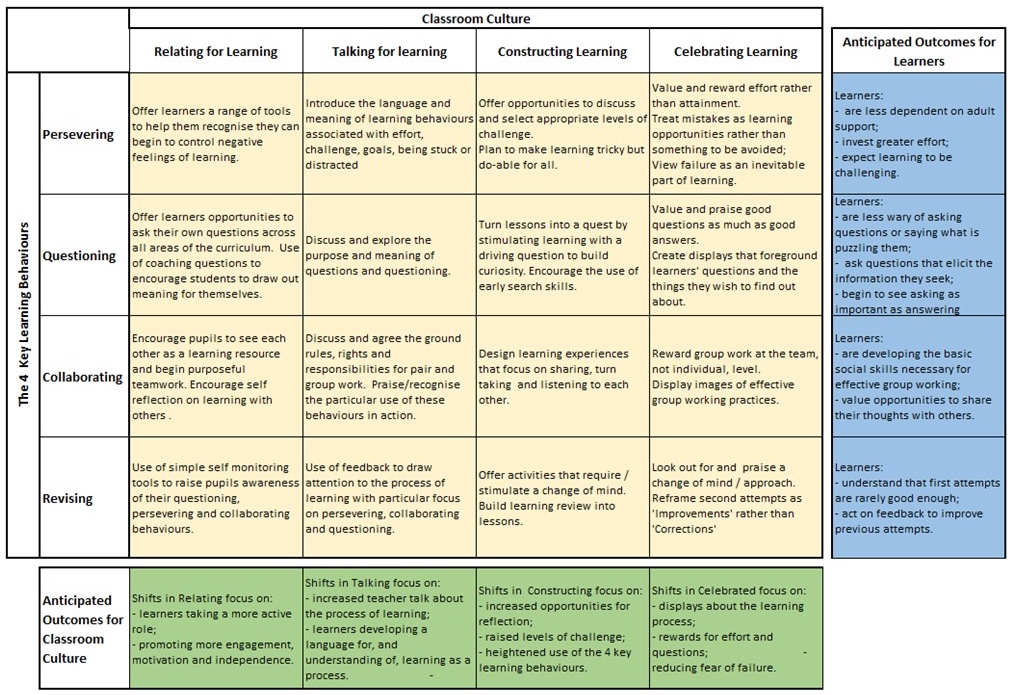
This chart distils what this course is all about;
what it hopes to enable teachers to do (in the yellow boxes)
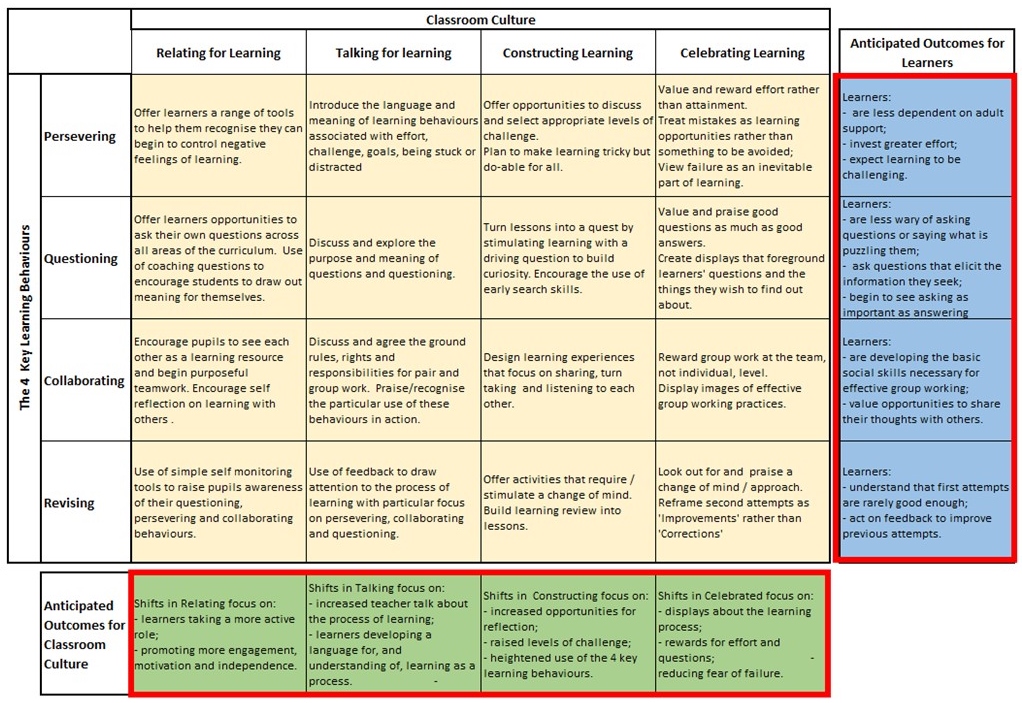
what outcomes such changes could make in the classroom culture (in green boxes)
the anticipated outcomes for learners (in blue boxes)
The downloadable spreadsheet will also reveal a practical idea for each yellow box. So this chart offers you an ‘at a glance’ resource to help you reflect on what and how you may be adapting your teaching over the next few months. See below for more details.
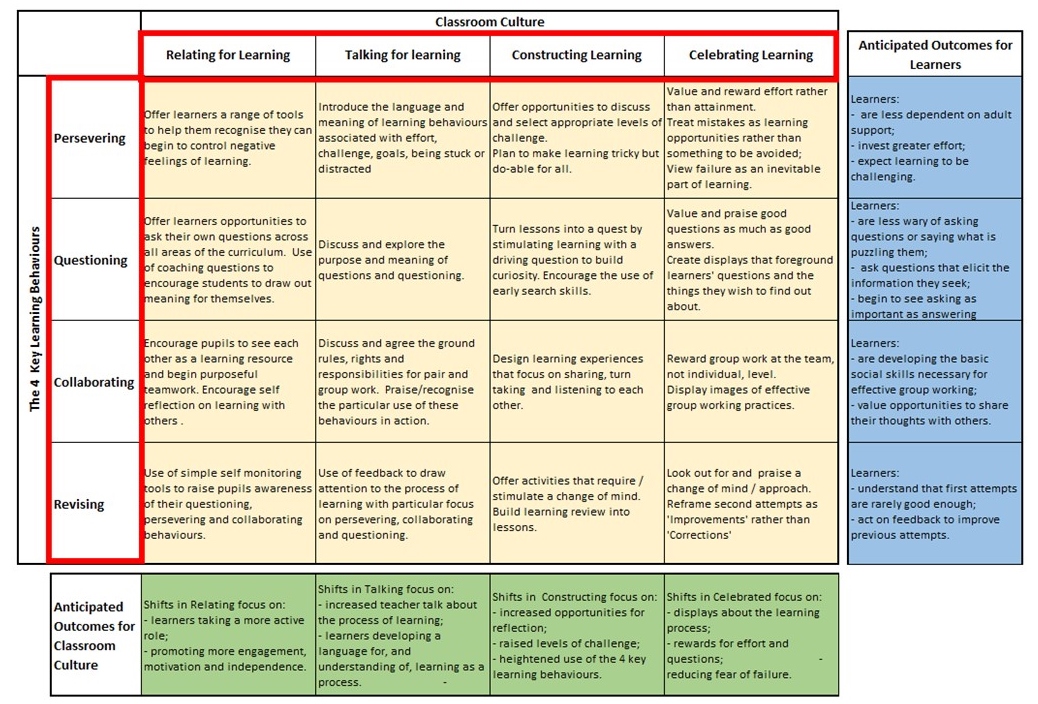
The vertical axis to the left shows the 4 learning habits you will be working to improve. The horizontal axis across the top shows the 4 aspects of classroom culture that you will be shifting. On the downloaded spreadsheet, click on the Enable Editing tab to reveal reminders by hovering over the cells.
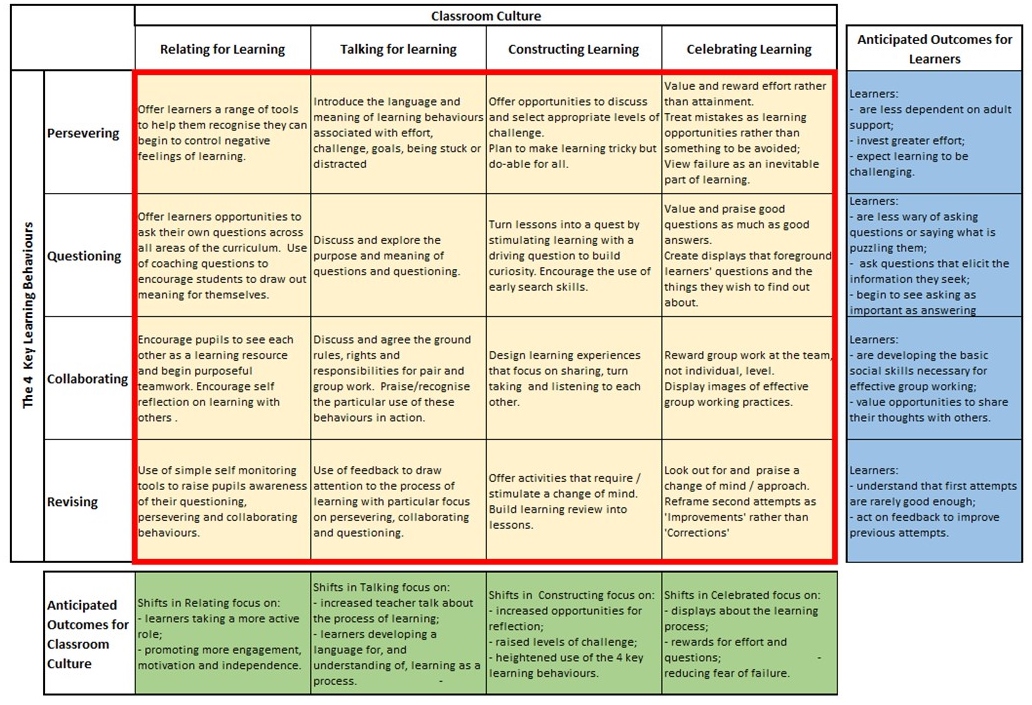
3c. The central 16 cells
These cells serve 2 purposes. Firstly:
The text in each cell gives an indication of the classroom culture that needs to be in place for learners to learn how to learn.
When looked at vertically down the page, they map out the 4 aspects of classroom culture.
When looked at horizontally across the page, they hint at the ways in which classrooms need to change to enable the 4 key learning behaviours to flourish.
Secondly:
On the downloaded spreadsheet, hovering over each cell reveals a teaching idea taken from The Learning Power Game module.
These teaching ideas are key to unlocking each cell. There are many other ideas in the module for each cell, but these are the ‘must do’ strategies.
3d. The cells to the bottom and to the right
The green cells across the bottom give an outline of how the teacher’s role develops as they make changes in how they relate and talk to learners and how they construct and celebrate learning. Hovering over each cell gives more detail. The blue cells to the far right give an indication of the anticipated outcomes for learners in terms of the 4 important learning behaviours and hovering over each cell suggests what you might look for in students. As you hover over these cells, you will gain a sense of what you might look out for in terms of classroom culture and student learning behaviours.
So – are you ready to make a start?
The first section of online learning is called ‘What do we mean by learning power?’ You can access it by using the ‘Unit Navigation’ box (top right on your screen). Resist the temptation to skim read other sections – focus you efforts on ‘What do we mean by learning power?’ in preparation for your first Professional Learning Team meeting.
Games can be used as a metaphor for learning anything and you tend to get better at anything if you treat it as a game. This programme is about learning to play the familiar game of learning but with an additional ingredient; that of learning dispositions or powers. This subtle addition changes the game of education to one of building learning character at the same time as building knowledge. So the programme explores certain guidelines and conventions that help to frame learning in ways that allow positive learning dispositions to flourish…how you might set up the game, get to grips with some new rules and tactics and learn to appreciate how you score it’s all important new endgame…that of the self-managed learner.
As with any game, it helps if you’re enabled to play the whole game from the start. If you were learning to play Scrabble you wouldn’t get far if all you were given to learn were lists of three, four and five letter words. Far better to start straight away by playing ‘Junior Scrabble’, so you get the feel for the whole game, and then build up your sophistication as you play.
So you might look on the programme you’re about to follow as the junior game of learning power. It has all the elements you will need to introduce the values and activities of building your students’ learning power. This junior game lays the foundation for greater sophistication in further programmes.
Developing your professional habits involves un-learning and re-learning: unpicking, readjusting, trying things out and seeing what works. It’s about you using your own learning power to effect changes in yourself. And the desired change is not just in what you think and believe; it is in how you spontaneously talk and act and plan.
In this unit you will find:
a reflection piece to help you consider your growth and development as a teacher with a focus on classroom culture;
a reflection piece to help you to consider how your students’ learning behaviours may have changed;
descriptions of a broader set of modules that make up the next phase of the programme;
brief explanations of why and how the next phase of the programme enables students to become better learners.
Key points in thinking where now and what next
understanding and progressing your own learning dispositions is a game-changer for yourself as well as your students
your habits as a learner become part of the picture; how you go about changing is as relevant as the changes you are aiming to bring about in students
exploring yourself as a learner helps you to design learning experiences that support you and your students
tracking your own progression as a learning powered teacher provides you with a way of seeing yourself both as a learner and a teacher beyond any academic performance.
Now that you have got amending your classroom culture underway we can begin to explore the nature of progression and how things might develop over time. Understanding progression shifts the focus, it allows you to move beyond ‘Are they doing this?’ and consider ‘How well are they doing this?’.
In this unit you will find 2 substantial sections:
You will explore progression in relation to:
the 4 aspects of classroom culture – relating, talking, constructing, and celebrating.
the 4 key learning behaviours – perseverance, questioning, collaboration, and revising.
Understanding progression
Understanding progression in relation to classroom culture provides you as a teacher with a way of understanding and tracking developments in your own classroom culture as it becomes increasingly learning-friendly.
Understanding progression in relation to learning behaviours offers students a way of seeing themselves as a learner beyond present academic performance indicators, and teachers with a framework against which to intentionally grow students’ learning behaviours.
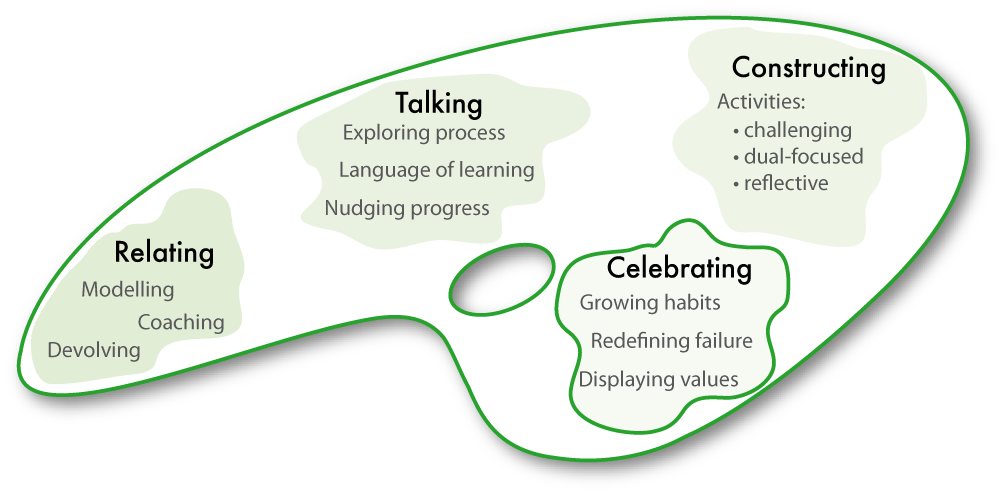
Celebrating and valuing learning is about making learning the object of attention. The values of learning bubble up and show themselves in what you attend to, what you recognise, what you praise, what you display and celebrate. In learning friendly classrooms failure, mistakes, being stuck and effort are re-framed so that learners come to view these old adversaries as valuable, interesting and essential. Furthermore, in the learning friendly classroom the development and growth of learning behaviours themselves is given attention, praise and recognition.
In this unit you will find:
examples of how learners can celebrate their learning
examples of different ways to celebrate learning
in the growth of learning behaviours
in re-defining failure
in displays in the classroom
encouragement to try things out with your learners
suggestions of ways to plan to expand what you celebrate about learning
Key points in celebrating Learning Power growth
The process of learning is the object of attention
The underlying values of learning become visible through what is enabled, recognised, praised, displayed.
Failure is re-defined and mistakes, effort and being stuck are recognised as valuable
Good questions are recognised as important as good answers.
Metacognitive behaviours are given their essential place in the learning process
Growth in learning behaviours is provided for, looked for and celebrated
Aspect 1: Growing Learning habits – finding ways to notice, track, record and celebrate learning behaviour growth. It implies that teachers and learners have a good understanding of themselves as learners and of what ‘getting better’ at learning looks and feels like. In the same way that attainment is routinely tracked, recorded and celebrated, so is learning itself.
Ask yourself:
Are students in our school becoming increasingly skilful as learners during their time with us?
What evidence do we have for this?
Aspect 2: Re-defining failure – turning the lens around: mistakes become learning opportunities; difficulty is when learning happens; struggle is to be expected; asking questions shows curiosity, not a lack of intelligence; effort not just talent is what leads to success. It is about ensuring that hard won gains over the difficult are preferable to effortless success over the easy. Ask yourself:
How do I treat ‘stuck’, ‘mistakes’ and praise in my classroom?
How much have we re-defined failure?
Aspect 3: Displaying values – the process of learning (as opposed to the finished outcomes of learning) are on display. Annotated work in progress, first attempts, revisions, failed lines of enquiry, leading, of course, to the finished article. What we choose to display tells students a lot about what we truly believe: displaying/praising only the finished article suggests that whatever we might say, we are more interested in the outcome than the process. In such ways are the underlying values of the classroom revealed to learners. Ask yourself:
What does the display in my classroom reveal about my priorities and my commitment to keeping the process of learning in the foreground?
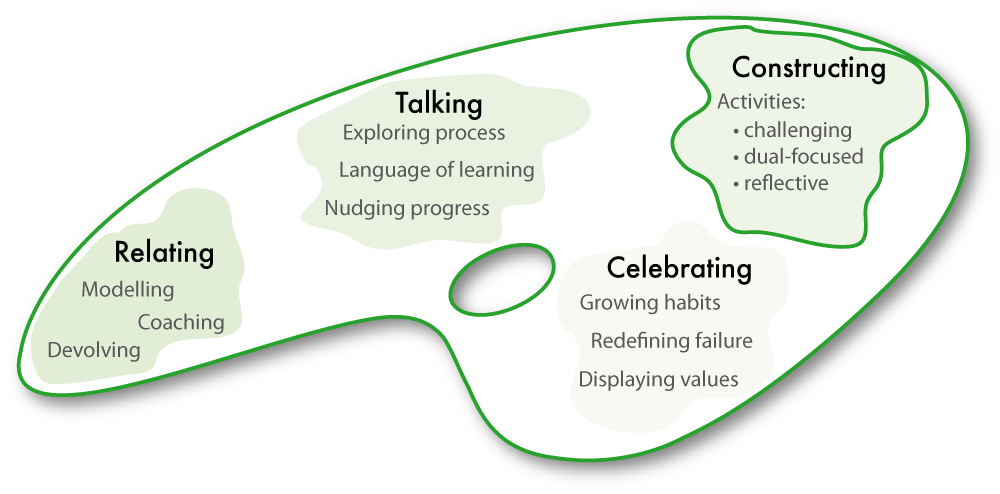
Whether we are aware of it or not all our lessons function on two levels, they have twin intentions. On the one hand there is content to be acquired, and on the other there are learning behaviours being exercised in pursuit of this content. What differentiates a standard lesson that effectively ‘delivers the content’ from a learning powered lesson is that you, as a teacher, have to think, in advance, about:
the learning behaviours that are necessary for successful content acquisition;
the design of activities or tasks that will stimulate these learning behaviours;
how learners could reflect on and evaluate their use of these behaviours.
The culture shift here is about understanding how students are learning as well as what they are learning. i.e. a learning powered lesson has a dual focus.
In this unit we start to zoom in on what you need to do: how to design lessons and activities, and how to orchestrate the classroom environment, so that your students stretch their learning muscles and gradually build their learning power.
In this unit you will find:
explanations of the three fundamentals of dual focused lessons
linking content and process
rich and challenging activities
building in reflection
a format to assist planning dual-focused lessons
activities to help start this journey
encouragement to try things out with your learners
examples from teachers in classrooms
The key features of dual-focused teaching
Lessons exercise both the what and the how of learning
The how of learning, rather than performance, is made the object of learning
Reflecting on learning and reviewing learning become part and parcel of how we learn
Learning activities are designed to stretch and challenge content acquisition and learning behaviours
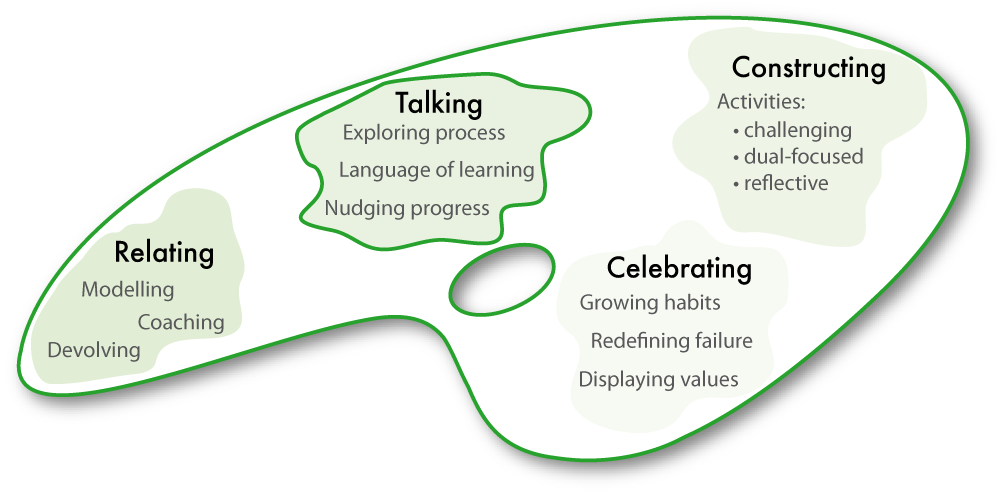
Learning Power invokes a language for understanding and discussing the learning process. Having this language enables you as a teacher to plan lessons that deliberately stretch learning behaviours one or two at a time and talk about learning in a way that enhances it. The way you express yourself in the classroom creates a powerful linguistic environment that teaches young people the best of what we know about learning. The language of learning helps students to discuss, understand, and become conscious of using and improving their learning behaviours.
In this unit you will find:
examples of how learners can talk about learning
examples of ways to talk about learning by:
nudging the process
encouraging reflective self-talk
offering feedback
encouragement to try things out with your learners
suggestions of ways to plan to expand your learning language
Key points of developing Learning Power language
The process of learning becomes the object of conversation.
This helps students to become conscious of using their learning behaviours.
Extending the learning language helps learners talk about, understand and improve how they learn.
Encouraging learners to notice, talk about and assess how their learning is going helps them become meta-learners.( meta-cognitive and self-regulating)
Multiple functions of learning language
Having a language that captures the richness of learning helps teachers and students to uncover learning as a visible process that can improve. The learning language offers you, as a teacher, and your students a way of talking about what learners actually do, and this in itself enables them to expand their capacity and appetite for learning.
The language of learning has many uses. It helps;
The Supple Learning Mind ingredients
you to think about how you might talk in a way that helps to cultivate each of the learning behaviours.
students to notice and recognise learning behaviours they were unaware of.
students to gain a better personalised understanding of content by consciously engaging the behaviours.
to name learning behaviours explicitly so that students (and their parents) know what it is you are noticing and valuing.
to know which learning habits and attitudes are being exercised by the way subjects are being presented, taught and assessed.
you to become aware of which learning behaviours you routinely require students to use in lessons — and then to think more carefully about whether there might be others you could profitably call on instead.
you todesign activities that stretch and strengthen learning behaviours so that they become student’s learning habits. You begin to think;
How is learning happening?
What habits of mind am I cultivating in students by the way we I’m designing and delivering the curriculum/this lesson?
Which learning behaviours need to be used more often so that they become habits?
It’s not only the words themselves that are powerful but the variety of functions they have in making learning behaviours visible, learnable and habitual. The learning behaviours themselves become even more useful when brought to life through everyday phrases that promote, encourage and strengthen them.
If we want children to become better learners we first need to offer them more opportunities to use and cultivate their learning powers This involves shifting the culture of classrooms so that they systematically cultivate the positive learning habits and attitudes of young people. ‘Culture’ is about all the little habits, routines and practices that implicitly convey ‘what we believe and value round here’; where, hour by hour, day by day, term by term students experience the values and practices that are embodied in the school.
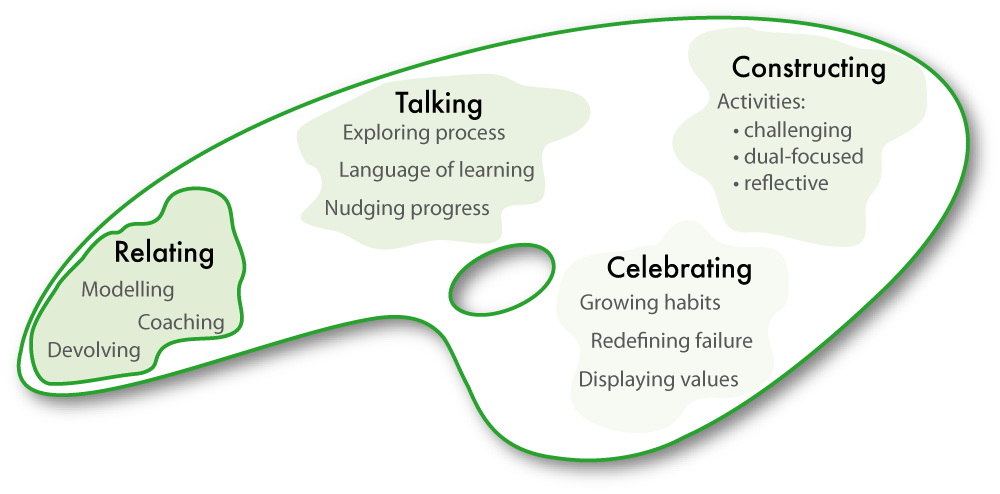
Here we look at the teacher’s role through:
examples of the sort of responsibilities teachers might devolve to learners
examples of different ways to be as a teacher
modelling the process of learning
acting as a coach; asking not telling
enabling greater learner responsibility
encouragement to try things out with your learners
suggestions of ways to plan to expand devolving responsibility to students
Key points in devolving responsibility for learning:
Give students more of a stake in the process of their own learning
Become the learning coach; enable students to find their own ways to improve
Help students to see each other as resources for learning by using collaborative activities
Offer students choices about what and how to learn
Encourage students to talk more; adults talk less
Model being a learner
Promote, enable and support the best of what we know about learning
A useful list of ways to devolve responsibility
Ways to devolve responsibility
An important way of bringing learning to the surface is to let students do more of it; to become more active in the learning process. Active learners are not only offered more opportunities to decide what to do, but are also actively learning through the explicit review of their own experience. The focus on students’ activity as learning rather than performing, hence the teacher makes sure that:
plenty ofcollaborative activity, since this helps students to see each other as resources (not rivals) for learning
students can make choices about what and how to learn (high levels of learner autonomy)
students experience failure as a necessary and useful part of learning (tolerating uncertainty, mess, error and initial failure)
students are given a chance to talk more – and adults talking less
students experience more open-ended activities – and create their own
students have more opportunity to spend longer on an activity, to feed their interest/engagement in it
students establish high-level goals for their own learning, based on challenge and quality feedback including their own
students have access to learning experiences that are under-, rather than over-engineered, with elements of ambiguity
students can decide on admissible outcomes
This shift to more learner involvement offers deep professional satisfaction and a new set of learning relationships. Ask yourself :
How many of the above do I use in order to enable my students to become better learners?
Please note: many of the ideas and exercises in Unit 1 may have been introduced to you in our introductory training sessions or those provided by your school leaders. If so, please use Section 1 as a revision exercise to remind yourself of the big ideas and your own feelings about them. You are likely to find some deeper material here than in the face to face training sessions.
What do we mean by learning power?
This first unit explores: the nature of and beliefs about learning; the learning behaviours of highly effective learners; and the types of classroom culture within which these behaviours can grow and flourish. These ideas are explored in 3 separate sections.
In the 3 sections of unit 1 you will find:
background research on dispositional learning
the two interlinking frameworks that underpin building better learners
examples of how the two frameworks work in practice
the four foundational learning behaviours to make a start on
the essential aspects of classroom culture that can make a difference
links with classroom based enquiry research
Navigating the content in the following 3 sections
In each of the sections you will find notes and tips to help you gain a coherent feel for how the material fits together and applies to your classroom practice.
Ideas in this module may take you into a new way of thinking about learning.
Make notes of your musings
Take it slowly and try to avoid any inclination to skim through the whole resource.
Keep any completed downloads and take them to your first Professional Learning Team meeting.
To explore the 3 sections:
Access them via the Unit Navigation box (top right of this screen).
Tackle them in order, and undertake all of the suggested activities as you go..
These 3 sections are the essential preparation for your first Professional Learning Team meeting.
3 sections to explore:
Building Better Learners – what is it? should it be done? how could it be done? what does it look and feel like?
Exploring the Supple Learning Mind – what are the building blocks of effective learning? where are my students now? where could we start?
Exploring the Teachers’ Palette – what are the three types of classroom culture? where is my classroom now? what might I do differently in the future?
Hello again. Thanks for your interest in building powerful learners in your school. As promised I’ve pulled together some specific information and questions designed to help you consider;
the need for and nature of Learning Power
the culture of the school’s classroom practice and
possible ways forward you might want to take.
Take a look, have a think and then we’ll chat about it on our Zoom call.
1. Reminders of the basics of building powerful learners
Find the right lines…
Here’s a quick rundown of the various facets of learning power. Take time…at your leisure… to recap on its whys, whats and hows. Use this link for exploring BLP quickly 7 BIG QUESTIONS – a quick read
If you decide that BLP is right for your school and think the Seven Big Questions would be a useful resource for introducing it to your staff and/or governors just let me know and we’ll share it with them when you think the time is right.
If you have never seen the development of learning power in action in classrooms you might find it useful to read a couple of our blogs. Any one of the following might be interesting:
In order to enrich a conversation about how our programmes might assist you to develop your staff there’s a bit of hard thinking to do about what your classroom cultures are like now.
Classroom cultures
Download the culture diagram (opposite).
Think about your own classrooms . . .
Of the three types of classroom culture – teacher focused, learner focused, learning focused – which best describes classrooms in your school?
Which of the individual facets of classroom culture would you like to embed further?
4. Question yourself about how well your learners are learning
Helping pupils to understand that learning is learnable and that they command their learning behaviours, gives them greater enthusiasm and power for engaging with learning. ‘Doing’ learning power is all very well, but getting better at doing it; more often; more widely; more skilfully, is quite another. So take a quick look at this trajectory from low use (can’t/won’t) to high use (skilful and frequent) in relation to your pupils now.
Learning – Poles Apart
Download the Poles Apart diagram (opposite).
Think about the children in your school:
Where do you ‘guesstimate’ the majority are on each of the 4 trajectories?
Is any trajectory lagging behind (or surging ahead) of the others?
Critically – do you think that your pupils move towards the right as they pass through your school?
And if so – is this progression the result of planned interventions?
Despite your best efforts, are some pupils remaining on the left-hand side?
When learners become aware of their learning behaviours through structured opportunities to improve it, they become:
more reflective and aware of themselves as learners
more confident and motivated to learn
more willing and able to take responsibility by ‘owning’ their learning for themselves
more intentional in their learning
keener to carry on learning as they move beyond school
more likely to realise their potential and gain grades that were previously regarded as beyond them
more confident socially and able to learn with, and from, one another
more able to manage transitions and take change in their stride throughout their lives.
5. Recognise learning power as a serious undertaking
Building the learning habits of students involves amending / changing / growing / adapting the teaching habits of staff. It’s not just about knowing new stuff, or buffing up on content knowledge, it is about doing what they do differently. That’s much harder and involves changes to;
what teachers know – knowledge about learning
what they believe – feelings or attitudes about learning and schooling
what they can do – their skills in enabling learning
what they actually do – putting it all into practice
So changing how teachers teach is a delicate, complex process……...that’s why it’s hard! And the hardest thing isn’t getting new ideas into teachers’ heads. It’s getting the old ones out…….that’s why it takes time and effort.
It takes time, practice and support to undo old habits and become graceful at new ones……that’s why our programmes embrace blended learning, based on how adults learn. The programmes include; researched classroom approaches offered in the online modules; an adaptation of the well-known professional development approach – Professional Learning Communities with agendas mapped out in the online modules and advice on designing enquiry questions for classroom research.
6. Our chat about possibilities for your school
During our arranged zoom meeting I hope we’ll be able to explore the thoughts you’ve had about your classroom cultures and pupil progression and consider the nature of the online courses and which might be appropriate for your school.
Basically there are two options to consider and these are described below;
Option 1 Building Better Learners (6a)
Option 2 Helping your learners to… (6b)
6a. Option 1: Building better learners
Phase 1 Playing the Learning Power game. This introductory course is likely to take at least a couple of terms to work through. The course is accompanied by a resource for strategic leaders which we have given you access to.
Phase 2 Stepping Stones (we have given you access to Putting Perseverance into Learning which is one of the 12 modules that make up this course) These modules go much deeper, specifically in relation to the growth of learning powers. This phase is likely to take a couple of years to work through.
Phase 1. ‘Playing the Learning Power game’ helps a school to take a school-wide, strategic approach to building better learners and develop learning-friendly classroom cultures.
The phase is about the ‘whole game’ of learning power rather than just bits and pieces so it introduces all the key learning behaviours before focusing on the four most important for your students’ emotional engagement, their cognitive range, their social adeptness and, critically, their strategic awareness or self-regulation: Perseverance; Questioning; Collaboration and Revising. This solid foundation takes a couple of terms to accomplish but enables a school to build wider and more sophisticated approaches in phase 2.
Phase 2 Stepping Stones (primary) or Nutshells (secondary) enables a school to build on the solid base of Phase 1, strengthening classroom practice and particularly making sure pupils grow and develop their learning behaviours. Each of the 12 modules is based on a progression chart that describes the various features of a behaviour and how it might grow when supported by a learning friendly culture. The many and various classroom activities are linked to the phases of growth, together with appropriate teacher talk. This organisation of the material enables the learning behaviours to be used with greater purpose and precision by teachers.
6b. Option 2: Helping your learners to…
Phase 1 The Foundational 9 covering perseverance, questioning, collaboration, revising, absorption, listening, making links, imagining, noticing. We have given you access to Helping your learners to imagine.
Phase 2 The Finessing 8 covering reasoning, meta-learning, managing distraction, resourcing learning, interdependence, empathy, planning and distilling.
Modules in this route take a straightforward approach without a strong emphasis on progression. However it’s likely to take a couple of years to work through all the modules.
Helping your learners to…
each online module offers classroom activities, think pieces and questions to help teachers:
introduce students to one learning behaviour;
use the language of learning effectively with students;
get a feel for how learning behaviours gradually grow
design the use of learning behaviours into the way they teach;
develop the confidence and skill to help students grow their learning power.
The modules are suitable for both primary and secondary schools with example activities for both.
This course is accompanied by a resource for senior leaders.
To give you a flavour of a ‘Helping your learners to’ module, take a look at this one free of charge. It addresses how teachers might help learners to develop the habit of attentive noticing.
All these modules tackle introducing learning behaviours, spotting them in your students, a brief introduction into how the behaviour develops, using them productively in lessons, talking about them confidently and planning their use alongside colleagues. Tackling the full set of behaviours will take a school about two years, and you can return to them again and again.
Bundle #1: The Foundational 9. Helping your learners to . . . . . Persevere, Become Absorbed, Notice, Question, Make links, Imagine, Collaborate, Revise and Listen.
This bundle of 9 online modules serves to help teachers develop a basic suite of dispositions and inclinations and provides the ‘soil’ in which to develop others.
Bundle #2: The Finessing 8. Helping your learners to . . . . . Reason, Manage distraction, Become Interdependent, Resource learning (Capitalising and Imitation), Empathise, Plan, Distil and Meta-learn.
This bundle of 8 online modules helps teachers develop dispositions and inclinations in more specific ways of learning.
help you navigate and make sense of the online module Helping your Learners to Imagine;
assist you in considering how you might translate the ideas into your classroom practice;
support you in preparing for a Learning Team meeting where I will join you via zoom.
You’ll find the module Helping your Learners to Imagine alongside this resource in My Courses.
Ideas in this module may take you into new ways of thinking about learning. You’ll find notes below to help you map ideas together and use them in your classroom practice.
1. Just a reminder about the blend of learning approaches
For the school to take on wholeheartedly the new ideas that minute-to-minute and day-by-day will build better learners requires far more than just a quick exposure to its principles and methods. Development of this magnitude asks a lot of you as teachers, often involving amending / changing / growing / adapting your teaching habits. So this blended learning programme offers a rhythm of different learning elements that help you to become researchers of your own practice.
The programme the school is about to embark on is a careful blend of:
online learning sessions….that faithfully disseminate the researched content for building better learners;
professional learning team sessions …… that provide sustained, meaningful assistance; learning with and from colleagues;
trying things out for yourselves in classrooms……because “learning by doing” is integral to the development of expertise and expertise cannot be developed quickly. It can only be developed if you have ample opportunity for practice, reflection, and adjustment.
This trio of learning opportunities gives you time, practice and support to undo old habits and become graceful at new ones.
The monthly blended learning cycle
2. Making sense of the content: Helping your learners to imagine
We encourage you to:
Take it slowly and try to avoid any inclination to just skim through the whole resource;
Spend about 15 mins on each of the 5 steps below; sufficient time to read, think and note down your learning.
Start with section 1.
Read – ‘What is imagining?’
Go over it again because there may well be some features of this behaviour that you haven’t met before.
Take time to think about the learning behaviours in a class you know well and fill in the names of the learners.
Ask yourself:
Which of my learners appear to do all / most of these things already?
Which of my learners don’t appear to exhibit any of these positive learning behaviours?
What am I discovering?
Note your musings ready for discussion at the Professional Learning Team meeting.
Then skip to section 3.
Carefully read ‘Understand how imagination grows’, this is likely to be new to you.
Take time to find out how the phases of growth work (see toggle box in that section).
Focus on the class you know well and think about where your pupils might fit on this trajectory.
Think through the questions shown below the trajectory but don’t assume higher achievers will automatically be further up the trajectory than lower achievers.
Ask yourself the hard question – could my learners make progress up this trajectory over the next year?
If yes, look out for helpful ideas to make it happen as you work through the content.
If no, look out for ideas that could make learners more secure at their current stage.
Note your musings ready for discussion at the Professional Learning Team meeting.
Now turn back to section 2.
Get a sense of what is meant by classroom culture and look at the diagram showing some aspects of culture that enables imagining to flourish.
Think about your own classroom culture:
which of these aspects are a regular feature in your own classroom?
which might you consider introducing into your classroom?
which sound interesting but you’re not sure what some of the phrases might look like in practice?
You’ve now looked at the nature of the learning behaviour (imagining), considered how it might grow, and looked at features of the classroom culture that supports it.
Note your musings ready for discussion at the Professional Learning Team meeting.
Now turn to section 4 to explore some teaching ideas that could be used to build these behaviours in your own classroom.
Read through section 4 – Ideas to Practise
look at both the primary and secondary columns because many of the ideas can be amended to fit different ages.
Which of these ideas might fit your needs or simply appeal to you?
Which do you already use?
Which might work well in your own classroom?
Note your musings ready for discussion at the Professional Learning Team meeting.
Section 5 Develop your talk
You’ll find about 10 statements here that you could use to nudge imagining. Using this language can be a big shift for many teachers because what you’re doing here is talking in a way that will nudge the use of imagining. In other words you’re using intentional and precise learning language.
Ask yourself:
How much do you currently talk about the process of learning, as opposed to the outcomes of learning?
Have you ever considered, in advance, how you might talk about the process of learning, or do you tend to just trust yourself to say the right thing at the right time?
Might you need to make a conscious decision to prepare in advance the language that you use?
Which of the suggested phrases / comments would best resonate with your students and fit with any of the teaching ideas you might try from section 4?
Note your musings ready for discussion at the Professional Learning Team meeting.
3. Putting the bits together: making connections
In preparation for the meeting you’ll find it useful to gather up all your musings from working your way through the module…your sense of what imagining means; your feel for the imaginers in your class; your estimate of where most pupils are on the imagination journey; your selection of things you might need to do differently to help pupils use their imagination more; your three favourite picks of the activities you might try; your choice of imagination friendly language to go with the activities; your hopes of how your pupils might change…what could they become?
Making it all make sense for you
From your big collection of features about imagination ask yourself;
which subject area would be a safe place to start?
could the ideas I’m toying with be useful in another subject?
which subject would I be cautious about using imagining in?
what aspect of imagining would I want pupils to reflect on after using it (see learning mat).
would it be possible to design a lesson or project using all the features shown on the learning mat?
4. A learning team meeting: what to expect.
Professional Learning Teams provide a forum for supporting you in converting the information and ideas in the online learning sessions into “lived” practices within classrooms.
They are safe forums in which to;
kick around ideas from the online content,
unpack it’s meaning when it’s unclear,
consider what’s do-able and appropriate for your students
make plans for what and how you might incorporate the ideas into your practice
share and unpack what you have tried in the classroom
relate your triumphs and tribulations
reflect on what you hope you might do differently
Such learning communities provide a time and place where you’ll hear real-life classroom stories from colleagues. These stories provide local reassurances that the ideas work, that they can be tweaked, that pupils in our school benefit from them. It’s the support you need to take such risks.
5. How the team meeting will work
The culture of a learning team is sometimes described as ‘Supportive Accountability’ where everyone should be supportive and feel supported. The accountability bit has to do with making the team feel serious and legitimate rather than casual, here today, gone tomorrow. To make it work people need to feel accountable to themselves, to each other and to the school.
A tight agenda to scaffold and focus change
Session agendas follow these stages
Agreeing objectives and agenda (5mins)
Sharing learning enquiries (20mins)
Re-capping the on-line materials (15mins)
Deciding what’s to be done (15mins)
Personal Action Planning (20mins)
Evaluating the meeting process (5mins)
The flow of the meeting moves from ‘settling down'(1) to ‘how have you been doing?'(2) to ‘what did we learn online that we can use?'(3&4) to ‘ what am I planning to do next?'(5) to ‘how did our meeting go?'(6). It’s a logical flow that scaffolds the work of the team.
In the first meeting agenda item 2 is replaced with discussing the role and function of the team, how it will operate and drawing up its ground rules. Here’s a short paper about this.
Rather than simply deciding to introduce something new into the classroom because it sounds interesting we strongly recommend you focus your developments by making use of enquiry questions and plans.
Enquiry questions and plans
Please download yourself a copy of the Enquiry question and the Enquiry plan and bring them to the meeting.
Enquiry questions
Why start with a question? Because this is an enquiry, you want to find out if something will change (student behaviour) if you change something specific.
If I do XXXX will it improve/develop/enhance YYYY?
Enquiry plans
The learning enquiry plan creates a record of what will be done and as such is an important document. It represents a promise to do it and this promise keeps the plan as a priority in your mind.
The plan should also record what you will watch out for over the next few weeks. What you’ll monitor how you change your practice and what you’ll monitor about changes in your pupils. When you note such changes it motivates you to carry on since the change is almost always positive.
A Senior Leader Resource: Supporting teachers embarking on the 5 ‘Helping your learners to . . . ‘ units.
There are five units in this suite of units for teachers (plus this resource for senior leaders).
The first unit is an introduction to classroom culture and an invitation to teachers to reflect on their own classroom culture.
This is followed by four units dealing with shifting to a learning friendly classroom culture:
Helping your learners to . . . take responsibility for their own learning
Helping your learners to . . . develop a language of learning
Helping your learners to . . . learn about learning
Helping your learners to . . . celebrate and value their learning behaviours
Helping teachers to make best use of the units
Start with the unit ‘Helping teachers to understand classroom culture’
This introductory unit considers three types of classroom culture – teacher focused, learner focused, and learning focused – and readies the way to explore how teachers might create an enabling classroom culture through practising some of the teaching ideas in the 4 main units.
Go to the section ‘Getting Started’ in the unit navigation box (top right of this screen) for guidance on how you might support teachers to get going.
And once this has been read, digested and discussed, move teachers on to the first of the 4 main units –
‘Helping your learners to take responsibility for their own learning’. Again, guidance in how to do this is the second item in the unit navigation box.
Culture is the curriculum of the classroom, frequently hidden from the external observer, but always all too evident to learners. It is the minute by minute, hour by hour, day by day way that learners come to understand their role as a learner. Culture is the enacted values of the teacher, not the espoused ones – it is the shadow that the teacher casts in the classroom in terms of what they do do and what they do not do, what they say and do not say, what they believe and do not believe, what they value and do not value.
There are five units in this suite.
The first [this one] is an introduction to classroom culture and an invitation to reflect on your own classroom culture.
Followed by four units dealing with shifting to a learning friendly classroom culture:
Helping your learners to . . . take responsibility for their own learning
Helping your learners to . . . develop a language of learning
Helping your learners to . . . learn about learning
Helping your learners to . . . celebrate and value their learning behaviours
Find out what this unit is about
This introductory unit considers three types of classroom culture – teacher focused, learner focused, and learning focused – and readies the way to explore how you might create an enabling classroom culture through practising some of the teaching ideas in the 4 main units.
Culture is the curriculum of the classroom, frequently hidden from the external observer, but always all too evident to learners. It is the minute by minute, hour by hour, day by day way that learners come to understand their role as a learner. Culture is the enacted values of the teacher, not the espoused ones – it is the shadow that the teacher casts in the classroom in terms of what they do do and what they do not do, what they say and do not say, what they believe and do not believe, what they value and do not value.
There are four units dealing with shifting to a learning friendly classroom culture:
Helping your learners to . . . take responsibility for their own learning
Helping your learners to . . . develop a language of learning
Helping your learners to . . . learn about learning
Helping your learners to . . . celebrate and value their learning behaviours [This unit]
Find out what this unit is about
‘Helping your learners to . . . celebrate and value their learning behaviours.
This module focuses on just one aspect of classroom culture – celebrating and valuing learning behaviours.
The format of the module will be familiar to you if you have done other modules in this suite:
Section 1 explores what we mean by ‘celebrating and valuing learning’, details the three aspects of it, and offers some further background reading in the ‘Read More’ sections;
Section 2 offers some quick wins to practise;
Section 3 offers you a short cut to making your plan of action, with advice on things to stop doing, things that are worth starting quickly and things you could take your time over doing.
Background information
This short section summarises the two key models of Building Better Learners, the supple learning mind and the teachers’ palette.
It outlines the basic values, ideas and research that inform all the practical ‘how to’ ideas for use in classrooms. It’s an essential read if you are new to these units but skip it if you are familiar with its content.
What do the 2 frameworks of Learning Power look like?
Building Learning Power puts at the heart of education the development of psychological characteristics that are judged to be of the highest value in young people growing up in a turbulent and increasingly complex world. There are two main parts to the approach:
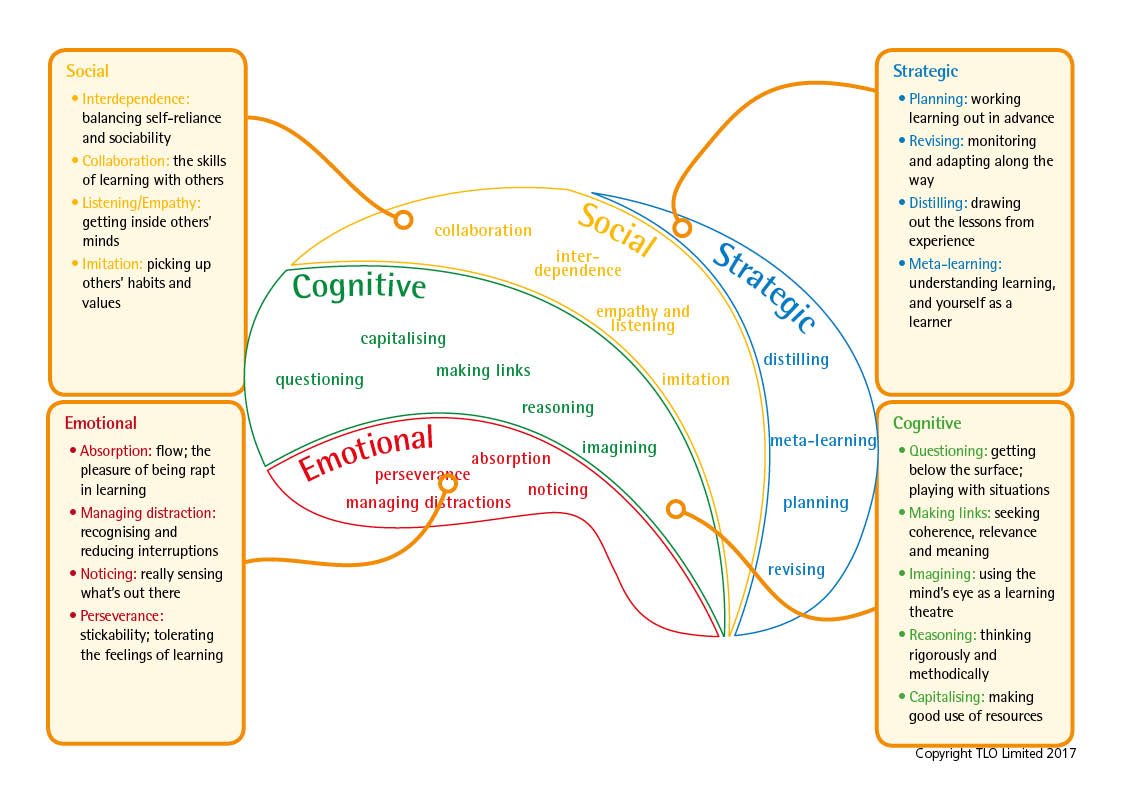
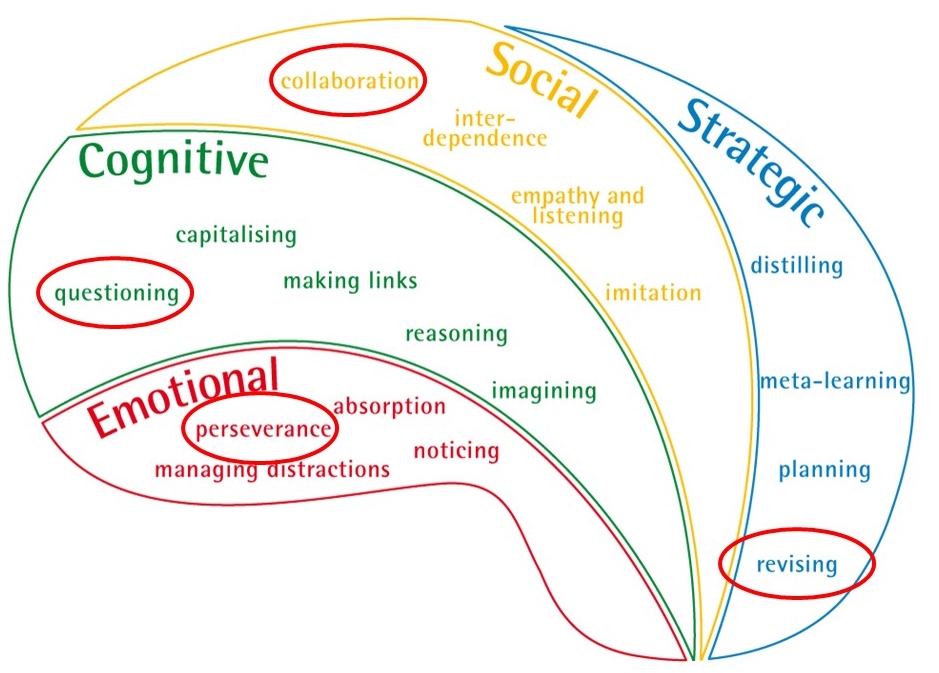
A: a model of a learner and learning, in terms of a set of characteristics that work together to make a person a highly capable learner; we use ‘learning power’ to describe the effect. [the supple learning mind]
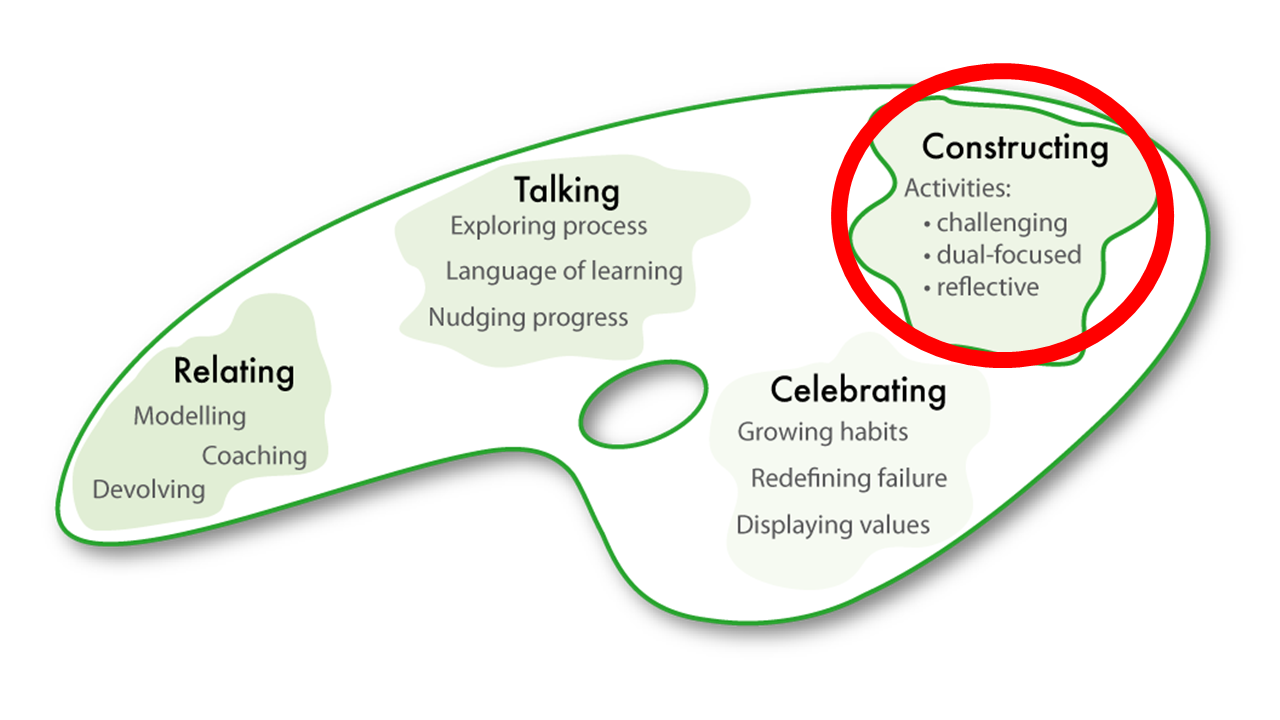
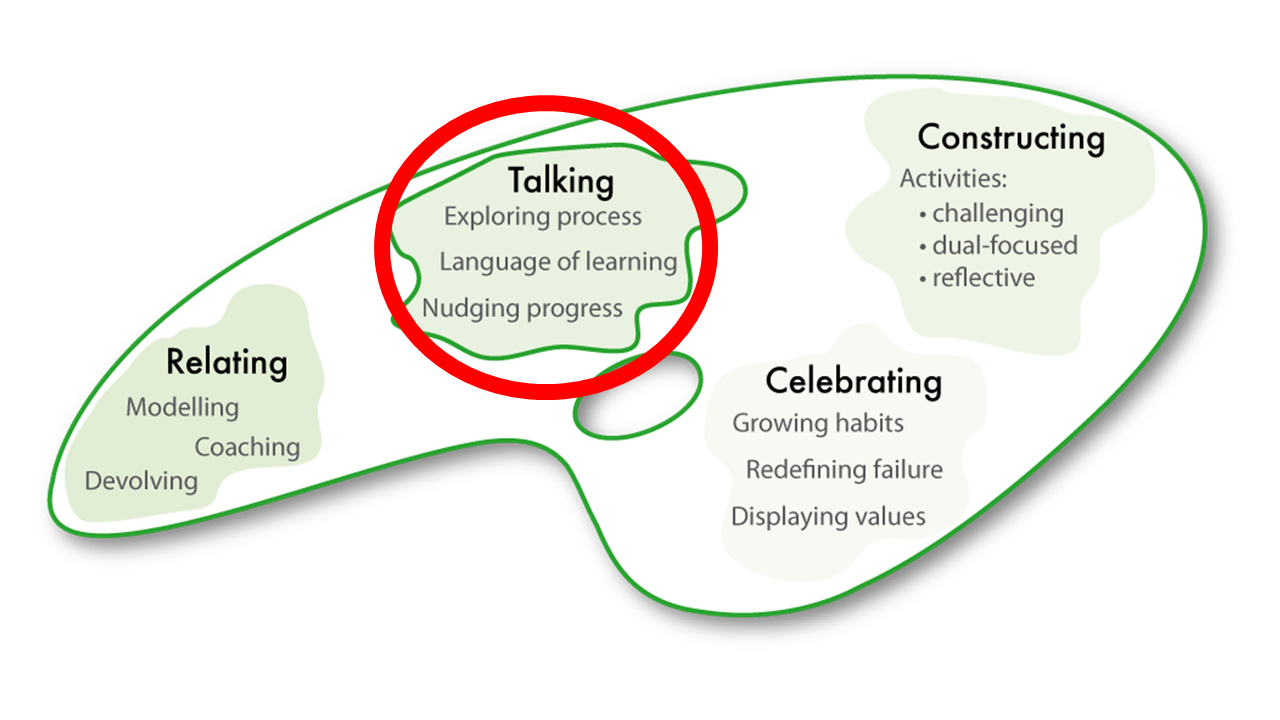
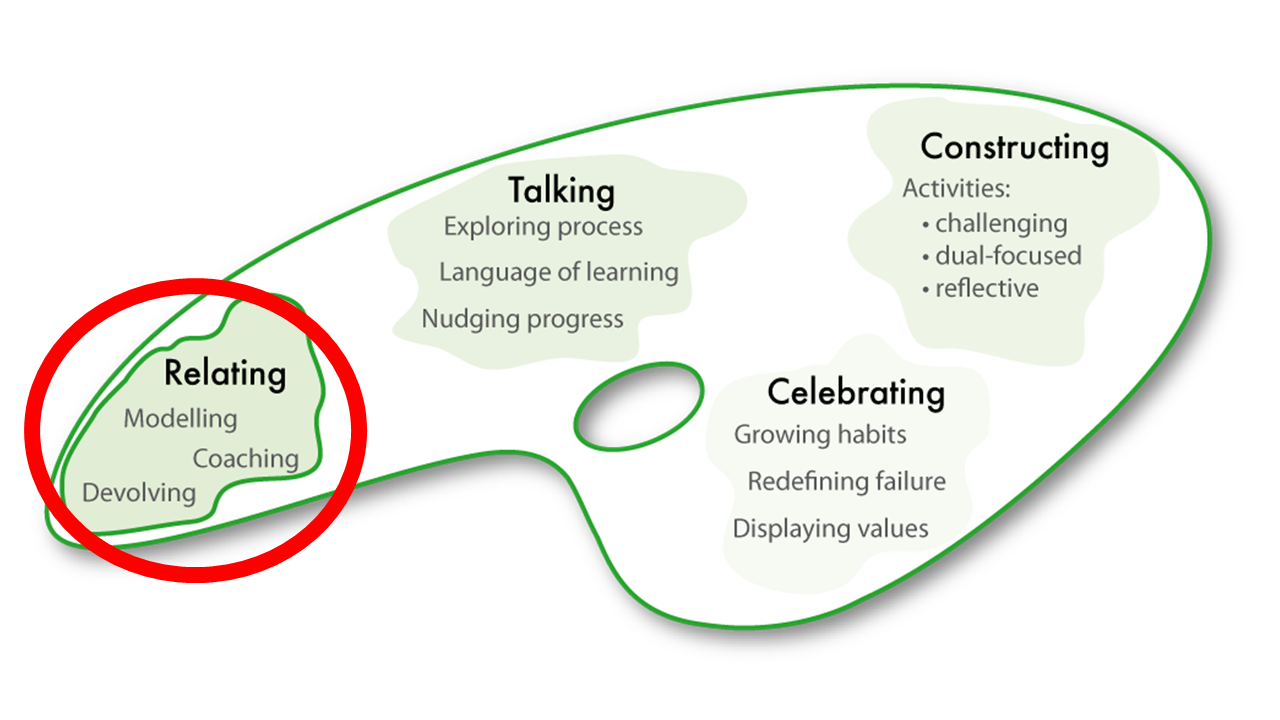
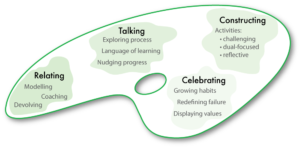
B: a view of the kind of pedagogy that will nurture and strengthen the learning characteristics in young people. [the teachers’ palette]
These are bound together by the fundamental idea that ‘learning is a learnable craft’, and by explicit, detailed discussion of how learning works, supported by a rich repertoire of words and action.
What constitutes a supple learning mind?
The Supple Learning Mind framework, originally conceived and researched by Professor Guy Claxton, reveals learning as a complex process that isn’t just about thinking and having a good memory; it includes how we feel, how we think, how we learn with and from others and how we manage the process of learning. It gives the beginnings of a learning language that helps teachers think about how learning behaviours enable students to grow as learners and tackle the curriculum more profitably.
Each domain of learning…social, cognitive, social and strategic… clusters together the high value learning behaviours that best make that domain work well. For example the social domain is made up of interdependence, collaboration, listening and empathy and imitation.
What does the teachers’ palette consist of?
The Teachers’ Palette provides an overview of aspects of a learning friendly culture that combine to create the seedbed for building powerful learners. It includes the types of teacher action that create the conditions necessary for such learning to become habituated – how they relate to students, the language they use, the types of tasks they design, and the things that they truly value.
The teachers’ palette distils the key teacher behaviours associated with a learning friendly-culture within which the 4 purposes of Successful Futures can flourish.
The central argument is that effective learning requires a unique blend of the learning behaviours identified in the Supple Learning Mind, learning behaviours that can flourish only in learning-friendly classrooms as outlined in the teachers’ palette.
Questions you might ask yourself
Something to think about
Does your curriculum and its expected delivery . . . .
already go beyond the transmission of a centrally defined set of knowledge, skills and understandings and intentionally build the learning behaviours outlined in the supple learning mind?
enable students to take responsibility for their own learning?
Culture is the curriculum of the classroom, frequently hidden from the external observer, but always all too evident to learners. It is the minute by minute, hour by hour, day by day way that learners come to understand their role as a learner. Culture is the enacted values of the teacher, not the espoused ones – it is the shadow that the teacher casts in the classroom in terms of what they do do and what they do not do, what they say and do not say, what they believe and do not believe, what they value and do not value.
There are four units dealing with shifting to a learning friendly classroom culture:
Helping your learners to . . . take responsibility for their own learning
Helping your learners to . . . develop a language of learning
Helping your learners to . . . learn about learning [This unit]
Helping your learners to . . . celebrate and value their learning behaviours
Find out what this unit is about
‘Helping your learners to . . . learn about learning.
This module unit focuses on just one aspect of classroom culture – learning about learning.
The format of the module will be familiar to you if you have done other modules in this suite:
Section 1 explores what we mean by ‘learning about learning’, details the three aspects of it, and offers some further background reading in the ‘Read More’ sections;
Section 2 offers some quick wins to practise;
Section 3 offers you a short cut to making your plan of action, with advice on things to stop doing, things that are worth starting quickly and things you could take your time over doing.
SUGGEST WE USE THE BITS BELOW IN A UNIT 1 AS A SUPPORT FOR FIRST SESSION.
Background information
This short section summarises the two key models of Building Better Learners, the supple learning mind and the teachers’ palette.
It outlines the basic values, ideas and research that inform all the practical ‘how to’ ideas for use in classrooms. It’s an essential read if you are new to these units but skip it if you are familiar with its content.
What do the 2 frameworks of Learning Power look like?
Building Learning Power puts at the heart of education the development of psychological characteristics that are judged to be of the highest value in young people growing up in a turbulent and increasingly complex world. There are two main parts to the approach:
A: a model of a learner and learning, in terms of a set of characteristics that work together to make a person a highly capable learner; we use ‘learning power’ to describe the effect. [the supple learning mind]
B: a view of the kind of pedagogy that will nurture and strengthen the learning characteristics in young people. [the teachers’ palette]
These are bound together by the fundamental idea that ‘learning is a learnable craft’, and by explicit, detailed discussion of how learning works, supported by a rich repertoire of words and action.
What constitutes a supple learning mind?
The Supple Learning Mind framework, originally conceived and researched by Professor Guy Claxton, reveals learning as a complex process that isn’t just about thinking and having a good memory; it includes how we feel, how we think, how we learn with and from others and how we manage the process of learning. It gives the beginnings of a learning language that helps teachers think about how learning behaviours enable students to grow as learners and tackle the curriculum more profitably.
Each domain of learning…emotional, cognitive, social and strategic… clusters together the high value learning behaviours that best make that domain work well. For example the social domain is made up of interdependence, collaboration, listening and empathy and imitation.
What does the teachers’ palette consist of?
The Teachers’ Palette provides an overview of aspects of a learning friendly culture that combine to create the seedbed for building powerful learners. It includes the types of teacher action that create the conditions necessary for such learning to become habituated – how they relate to students, the language they use, the types of tasks they design, and the things that they truly value.
The teachers’ palette distils the key teacher behaviours associated with a learning friendly-culture within which the 4 purposes of Successful Futures can flourish.
The central argument is that effective learning requires a unique blend of the learning behaviours identified in the Supple Learning Mind, learning behaviours that can flourish only in learning-friendly classrooms as outlined in the teachers’ palette.
Questions you might ask yourself
Something to think about
Does your curriculum and its expected delivery . . . .
already go beyond the transmission of a centrally defined set of knowledge, skills and understandings and intentionally build the learning behaviours outlined in the supple learning mind?
enable students to take responsibility for their own learning?
Culture is the curriculum of the classroom, frequently hidden from the external observer, but always all too evident to learners. It is the minute by minute, hour by hour, day by day way that learners come to understand their role as a learner. Culture is the enacted values of the teacher, not the espoused ones – it is the shadow that the teacher casts in the classroom in terms of what they do do and what they do not do, what they say and do not say, what they believe and do not believe, what they value and do not value.
There are four units dealing with shifting to a learning friendly classroom culture:
Helping your learners to . . . take responsibility for their own learning
Helping your learners to . . . develop a language of learning [This unit]
Helping your learners to . . . learn about learning
Helping your learners to . . . celebrate and value their learning behaviours
Find out what this unit is about
‘Helping your learners to . . .develop a language of learning.
This unit focuses on – talking about the ‘how’ of learning.
The format of the module will be familiar to you if you have done other modules in this suite:
Section 1 explores what we mean by ‘talking about the ‘how’ of learning’, details the three aspects of it, and offers some further background reading in the ‘Read More’ sections;
Section 2 offers some quick wins to practise;
Section 3 offers you a short cut to making your plan of action, with advice on things to stop doing, things that are worth starting quickly and things you could take your time over doing.
Background information
This short section summarises the two key models of Building Better Learners, the supple learning mind and the teachers’ palette.
It outlines the basic values, ideas and research that inform all the practical ‘how to’ ideas for use in classrooms. It’s an essential read if you are new to these units but skip it if you are familiar with its content.
What do the 2 frameworks of Learning Power look like?
Building Learning Power puts at the heart of education the development of psychological characteristics that are judged to be of the highest value in young people growing up in a turbulent and increasingly complex world. There are two main parts to the approach:
A: a model of a learner and learning, in terms of a set of characteristics that work together to make a person a highly capable learner; we use ‘learning power’ to describe the effect. [the supple learning mind]
B: a view of the kind of pedagogy that will nurture and strengthen the learning characteristics in young people. [the teachers’ palette]
These are bound together by the fundamental idea that ‘learning is a learnable craft’, and by explicit, detailed discussion of how learning works, supported by a rich repertoire of words and action.
What constitutes a supple learning mind?
The Supple Learning Mind framework, originally conceived and researched by Professor Guy Claxton, reveals learning as a complex process that isn’t just about thinking and having a good memory; it includes how we feel, how we think, how we learn with and from others and how we manage the process of learning. It gives the beginnings of a learning language that helps teachers think about how learning behaviours enable students to grow as learners and tackle the curriculum more profitably.
Each domain of learning…social, cognitive, social and strategic… clusters together the high value learning behaviours that best make that domain work well. For example the social domain is made up of interdependence, collaboration, listening and empathy and imitation.
What does the teachers’ palette consist of?
The Teachers’ Palette provides an overview of aspects of a learning friendly culture that combine to create the seedbed for building powerful learners. It includes the types of teacher action that create the conditions necessary for such learning to become habituated – how they relate to students, the language they use, the types of tasks they design, and the things that they truly value.
The teachers’ palette distils the key teacher behaviours associated with a learning friendly-culture within which the 4 purposes of Successful Futures can flourish.
The central argument is that effective learning requires a unique blend of the learning behaviours identified in the Supple Learning Mind, learning behaviours that can flourish only in learning-friendly classrooms as outlined in the teachers’ palette.
Questions you might ask yourself
Something to think about
Does your curriculum and its expected delivery . . . .
already go beyond the transmission of a centrally defined set of knowledge, skills and understandings and intentionally build the learning behaviours outlined in the supple learning mind?
enable students to take responsibility for their own learning?
Culture is the curriculum of the classroom, frequently hidden from the external observer, but always all too evident to learners. It is the minute by minute, hour by hour, day by day way that learners come to understand their role as a learner. Culture is the enacted values of the teacher, not the espoused ones – it is the shadow that the teacher casts in the classroom in terms of what they do do and what they do not do, what they say and do not say, what they believe and do not believe, what they value and do not value.
There are four units dealing with shifting to a learning friendly classroom culture:
Helping your learners to . . . take responsibility for their own learning [This unit]
Helping your learners to . . . develop a language of learning
Helping your learners to . . . learn about learning
Helping your learners to . . . celebrate and value their learning behaviours
Find out what this unit is about and how to get the best from it
‘Helping your learners to . . . take responsibility for their own learning.
This module focuses on just one aspect of classroom culture – taking responsibility for their own learning.
The format of the module is the same as others in this suite:
Section 1 explores what we mean by‘taking responsibility for their own learning’, details the three aspects of it, and offers some further background reading in the ‘Read More’ sections;
Section 2 offers some quick wins to practise;
Section 3 offers you a short cut to making your plan of action, with advice on things to stop doing, things that are worth starting quickly and things you could take your time over doing.
To navigate this unit:
Begin by reading Section 1 to gain an overview of the ways in which teachers can enable learners to take greater responsibility for their own learning.
Read Section 2, Ideas to Practise, and identify teaching ideas that you might fancy trying.
Read Section 3 to refine your ideas and to focus where you might make a start.
At this point, you may well have discovered a change that you wish to make, but your classroom culture will remain unchanged until you start to do things differently in your own classroom.
So – Take your time, try things out, monitor the impact, talk to colleagues and share ideas. Classroom cultures are slow to change and you will have to be patient to realise the full impact of your interventions. Be prepared to work on this for at least half a term before you consider moving on to another unit.
Background information
This short section summarises the two key models of Building Better Learners, the supple learning mind and the teachers’ palette.
It outlines the basic values, ideas and research that inform all the practical ‘how to’ ideas for use in classrooms. It’s essential background reading before you get going with the rest of this unit.
What do the 2 frameworks of Learning Power look like?
Building Learning Power puts at the heart of education the development of psychological characteristics that are judged to be of the highest value in young people growing up in a turbulent and increasingly complex world. There are two main parts to the approach:
A: a model of a learner and learning, in terms of a set of characteristics that work together to make a person a highly capable learner; we use ‘learning power’ to describe the effect. [the supple learning mind]
B: a view of the kind of pedagogy that will nurture and strengthen the learning characteristics in young people. [the teachers’ palette]
These are bound together by the fundamental idea that ‘learning is a learnable craft’, and by explicit, detailed discussion of how learning works, supported by a rich repertoire of words and action.
What constitutes a supple learning mind?
The Supple Learning Mind framework, originally conceived and researched by Professor Guy Claxton, reveals learning as a complex process that isn’t just about thinking and having a good memory; it includes how we feel, how we think, how we learn with and from others and how we manage the process of learning. It gives the beginnings of a learning language that helps teachers think about how learning behaviours enable students to grow as learners and tackle the curriculum more profitably.
Each domain of learning…social, cognitive, social and strategic… clusters together the high value learning behaviours that best make that domain work well. For example the social domain is made up of interdependence, collaboration, listening and empathy and imitation.
What does the teachers’ palette consist of?
The Teachers’ Palette provides an overview of aspects of a learning friendly culture that combine to create the seedbed for building powerful learners. It includes the types of teacher action that create the conditions necessary for such learning to become habituated – how they relate to students, the language they use, the types of tasks they design, and the things that they truly value.
The teachers’ palette distils the key teacher behaviours associated with a learning friendly-culture within which the 4 purposes of Successful Futures can flourish.
The central argument is that effective learning requires a unique blend of the learning behaviours identified in the Supple Learning Mind, learning behaviours that can flourish only in learning-friendly classrooms as outlined in the teachers’ palette.
Questions you might ask yourself
Something to think about
Does your curriculum and its expected delivery . . . .
already go beyond the transmission of a centrally defined set of knowledge, skills and understandings and intentionally build the learning behaviours outlined in the supple learning mind?
enable students to take responsibility for their own learning?
The job of any teacher is to give learners as real or as ‘whole’ an experience of learning as possible. So as writers of this introductory course to help you build better learners we wanted to do just that. We don’t think you would gain a deep sense of your role in developing students’ Learning Power if we simply provided you with examples of three or four things to do in your classroom. If you were learning to play Scrabble you wouldn’t get far if all you were given to learn were lists of three, four and five letter words. Far better to start straight away by playing ‘Junior Scrabble’, so you get the feel for the whole game, and then build up your sophistication as you play.
So you might think of this course as the junior game of learning power. Here you will find all the key elements you will need to introduce the values and activities of building your students’ learning power.
1. How the online course is designed
Section structure…
Each section deals with a key aspect of understanding learning power and has:
an introduction to what it is about … followed by some suggestions about how to ‘navigate’ the content
part 1 aims to give you an idea of the sort of practice you are aiming for
part 2 highlights the main ideas of the section’s content
part 3 offers a few practical ideas to start things off
part 4 offers tools to help you evaluate what you have read and an agenda for a Professional Learning Team
the two interlinking models of building better learners
examples of how the models work in practice;
the four learning behaviours to make a start on – perseverance, questioning, collaborating and revising
the essential aspects of classroom practice
links with educational research
encouragement to try things out with your learners
suggestions for how amendments to your teaching will help students to be better learners
Section 2 Classroom relationships
Important shifts in classroom roles
Here you will find:
examples of the sort of responsibilities teachers might devolve to learners
examples of different ways to be as a teacher
modelling the process of learning
acting as a coach; asking not telling
enabling greater learner responsibility
examples of things to try out with your learners to enhance perseverance, questioning, collaboration and revising
suggestions of ways to plan to expand devolving responsibility to students
Section 3 Talking about learning power
How and when to talk about learning.
Here you will find:
examples of how learners can talk about themselves as learners
examples of different ways to talk about learning
nudging the process
offering feedback
encouraging reflective self-talk
examples of things to try out with your learners to enhance perseverance, questioning, collaborating and revising
suggestions of ways to plan to expand your learning language
Section 4 Designing learning powered lessons
How to begin to put dual-focused lessons together
Here you will find:
examples of how teachers manage learning in their lessons
explanations of different ways to plan for learning
long term planning
medium term planning
lesson planning
a format to assist in planning dual-focused lessons
activities to help start this journey
examples of things to try out with your learners to enhance the foundational four learning behaviours
suggestions of ways to plan to expand your lesson design
Section 5 Celebrating learning power
What’s seen as important in learning friendly classrooms
Here you will find:
examples of how learners can celebrate their learning
examples of different ways to celebrate learning
in the growth of learning behaviours
in re-defining failure
in displays in the classroom
encouragement to try things out with your learners
suggestions of ways to plan to expand what you celebrate about learning
Section 6 How are our learners developing?
What to look for and record about better learning
Here you will find:
explanations of three aspects of progression – frequency, scope and skilfulness in use
Charts showing what the phases of growth look like in relation to;
questioning
collaboration
perseverance
revising
examples of things to try out with your learners
ways of tracking the growth of learning dispositions over time
suggestions of ways to plan to expand what you might track about learning
Section 7 Where now: what next?
Here you will find:
explorations of ways forward
tools to help you consider your growth and development as a teacher
descriptions of the next stage online courses to support teachers’ journey to becoming a skilled learning power practitioner
a quick look at professional development approaches you might use in furthering your journey
2. The wider blended learning programme
‘Playing the Learning Power Game’ is simply the online aspect of the blended learning programme which, unless it’s blended with Professional Learning Teams and Classroom Based Enquiries is unlikely to achieve the desired outcomes.
A Professional Learning Team is the support mechanism in the blended learning cycle. Time for PLTs is built into the rhythm of the school’s meeting cycle, and offers teachers a safe, supportive space to discuss and explore the craft of the classroom. PLTs encourage teachers to learn with and from their colleagues – to become ‘learners of their own teaching’ in John Hattie’s words. They become the engine of teachers’ development.
Classroom Based Enquiries are the third aspect of the blended learning programme. Sometimes known as Action Research, classroom based enquiries involve teachers changing aspects of their practice in order to further develop student learning behaviours. Enquiries involve teachers making small changes, monitoring the impact of those changes, and sharing these outcomes at the next team meeting for professional discussion.
Most schools tend to blend these 3 aspects into a 4-week cycle.
Talk, support and plan with colleagues
Professional Learning Teams; small groups of teachers who meet together regularly (usually monthly) to deepen their understanding of learning and how, by developing their classroom practice, they can make the learning process more visible and relevant to students.
The team learns and develops by:
discussing and unpacking the online information;
planning how to make use of it in their classrooms;
questioning and probing their classroom experiments.
The delicate, hard work of changing practice requires a safe professional environment in which to explore and understand classroom triumphs and tribulations. The short guidelines (see download) are designed to be help a team set a collaborative, working climate to support the conversion of information and ideas in the online materials into “lived” practices in classrooms.
The format of a meeting agenda below is based on research into teacher learning communities by Dylan Wiliam, of Assessment for Learning (AfL) fame.
This team session is your first one in Playing the Learning Power game so it will be essential to spend the first part of the meeting considering the purpose and working guidelines for the team.
Session agenda
Agreeing objectives and agenda (5 mins)
Considering working practices (15 mins)
Re-capping the on-line materials (15 mins)
Personal Action Planning (20 mins)
Evaluating the meeting process (5 mins)
1. Session objectives: What do we want to achieve? (5 mins)
Feel confident about working as a team
Feel able to apply the on-line materials in the classroom
Decide the strategic cultural issues that everyone needs to apply in their classroom
Plan some do-able shifts in classroom practice
2. Consider the working practices of the team (15 mins)
Purposes of the group
Format of the sessions
Ground rules for working
Expectations of outcomes
See What-Why-How of PLT notes above for ideas
3. Recapping on-line materials: What did the content make us think? (15 mins)
Thoughts about:
the progression from teacher focused cultures to learning focused cultures (section 2e)Culture review tool 1 ( three panels)
where do most classrooms operate in relation to the three panels?
which of the four learning behaviours need most assistance? (perseverance, questioning, collaborating, revising)
things that are in place, things that need attention now/soon, things that will take longer to establish.
ideas you picked up from the content that you could use immediately.
4. Personal action planning: What am I going to do? (20 mins)
While we haven’t highlighted any specific ideas to try in this section the material will have triggered some…’what if I tried’.. thoughts.
Think of;
how you want to strengthen your classroom culture to encourage students to become more learning friendly?
What you are going to do to bring this about?
Develop an enquiry question.
You’ll gain more value from a plan by creating it around a question. Why a question? Because this is an enquiry, you want to find out if something will change (student behaviour) when you change something specific. Think of it like this:
If I do XXXX will it improve/develop/enhance YYYY?
This is the crunch question – the moment of truth. Students are unlikely to change unless your behaviour changes! Visualise how you want your students to be and then think about what you might do, or say, or model, or celebrate, or whatever…. differently to bring about this change in students. Developing an enquiry question – .pdfThe learning enquiry plan is a record of what you intend to do. It takes your enquiry question from what to how. The format below may help you think through the planning process. You can fill in your Personal Action Plan using the word document version.
For the monitoring bits of your plan you might want to look out for:
an improvement in how students engage with learning
improvement in behaviour
showing less stress or worry about learning generally
increased focus when working with other students
reduced reliance on teacher support
5. Evaluate team session: How did we do as a team? (5 mins)
Did we achieve our objectives?
Are we comfortable with what we are trying to achieve?
Any concerns at this point?
Next meeting date and time.
Classroom based enquiries
Classroom based enquiries operate in the spirit of enquiry or some would say action research. It’s a quest to find out more, to consider what needs to change, to wonder what might work, to track what happens and to refine practice. It’s a process in which teachers investigate teaching and learning so as to improve their own and their students’ learning. In effect teachers become researchers of their own practice. It helps them to develop new knowledge about their classroom, they become reflective teachers who broaden their teaching repertoire. Importantly it puts them in charge of how they teach and become very aware of the links between how they teach and how students learn and achieve.
3. The online course in a nutshell
For those of you who like to see big pictures before the detail here is…
3a. The Big Picture of Playing the (Junior) Learning Power Game.
This chart distils what this course is all about;
what it hopes to enable teachers to do (in the yellow boxes)
what outcomes such changes could make in the classroom culture (in green boxes)
the anticipated outcomes for learners (in blue boxes)
The downloadable spreadsheet will also reveal a practical idea for each yellow box. So this chart offers you an ‘at a glance’ resource to help you reflect on what and how you may be adapting your teaching over the next few months. See below for more details.
The vertical axis to the left shows the 4 learning habits you will be working to improve. The horizontal axis across the top shows the 4 aspects of classroom culture that you will be shifting. On the downloaded spreadsheet, click on the Enable Editing tab to reveal reminders by hovering over the cells.
3c. The central 16 cells
These cells serve 2 purposes. Firstly:
The text in each cell gives an indication of the classroom culture that needs to be in place for learners to learn how to learn.
When looked at vertically down the page, they map out the 4 aspects of classroom culture.
When looked at horizontally across the page, they hint at the ways in which classrooms need to change to enable the 4 key learning behaviours to flourish.
Secondly:
On the downloaded spreadsheet, hovering over each cell reveals a teaching idea taken from The Learning Power Game module.
These teaching ideas are key to unlocking each cell. There are many other ideas in the module for each cell, but these are the ‘must do’ strategies.
3d. The cells to the bottom and to the right
The green cells across the bottom give an outline of how the teacher’s role develops as they make changes in how they relate and talk to learners and how they construct and celebrate learning. Hovering over each cell gives more detail. The blue cells to the far right give an indication of the anticipated outcomes for learners in terms of the 4 important learning behaviours and hovering over each cell suggests what you might look for in students. As you hover over these cells, you will gain a sense of what you might look out for in terms of classroom culture and student learning behaviours.
So – are you ready to make a start?
The first section of online learning is called ‘What do we mean by learning power?’
You can access it by using the ‘Unit Navigation’ box (top right on your screen).
Resist the temptation to skim read other sections – focus you efforts on ‘What do we mean by learning power?’ in preparation for your first Professional Learning Team meeting.
ORIGINAL IS BELOW
The Junior Game
The job of any teacher is to give learners as real or as ‘whole’ an experience of learning as possible. So as writers of this introductory course about building better learners we wanted to do just that. We don’t think you would gain a deep sense of your role in developing students’ Learning Power if we simply provided you with examples of three or four things to do in your classroom. If you were learning to play Scrabble you wouldn’t get far if all you were given to learn were lists of three, four and five letter words. Far better to start straight away by playing ‘Junior Scrabble’, so you get the feel for the whole game, and then build up your sophistication as you play.
So you might think of this course as the junior game of learning power. Here you will find all the key elements you will need to introduce the values and activities of building your students’ learning power.
How the course is designed
Sections 1–6…
have exactly the same structure in order to ease your familiarity with the material and guard against getting lost. Each deals with a key aspect of understanding learning power and has:
an introduction to what it is about … take particular note of the key points
part 1 aims to give you an idea of the sort of practice you are aiming for
part 2 highlights the main ideas of the section’s content
part 3 offers a few practical ideas to start things off
part 4 broaches the idea of redesigning your practice and invites you to make a plan
For those of you who like to see big pictures before the detail here is…
1. The Big Picture of Playing the (Junior) Learning Power Game.
This chart distils what this course is all about; what it hopes to enable teachers to do (in the yellow boxes); what outcomes such changes could make in the classroom culture (in green boxes); and the anticipated outcomes for learners (in blue boxes). The spreadsheet you can download will also reveal a practical idea for each yellow box. So this chart offers you an ‘at a glance’ resource to help you reflect on what and how you may be adapting your teaching over the next few months. See below for more details.
The vertical axis to the left shows the 4 learning habits you will be working to improve. The horizontal axis across the top shows the 4 aspects of classroom culture that you will be shifting. On the downloaded spreadsheet, click on the Enable Editing tab to reveal reminders by hovering over the cells.
1b. The central 16 cells
These cells serve 2 purposes. Firstly:
The text in each cell gives an indication of the classroom culture that needs to be in place for learners to learn how to learn.
When looked at vertically down the page, they map out the 4 aspects of classroom culture.
When looked at horizontally across the page, they hint at the ways in which classrooms need to change to enable the 4 key learning behaviours to flourish.
Secondly:
On the downloaded spreadsheet, hovering over each cell reveals a teaching idea taken from The Learning Power Game module.
These teaching ideas are key to unlocking each cell. There are many other ideas in the module for each cell, but these are the ‘must do’ strategies.
1c. The cells to the bottom and to the right
The green cells across the bottom give an outline of how the teacher’s role develops as they make changes in how they relate and talk to learners and how they construct and celebrate learning. Hovering over each cell gives more detail. The blue cells to the far right give an indication of the anticipated outcomes for learners in terms of the 4 important learning behaviours and hovering over each cell suggests what you might look for in students. As you hover over these cells, you will gain a sense of what you might look out for in terms of classroom culture and student learning behaviours.
For those of you who are detail first learners…
Look through the sections below to gain a sense of the what, why and how of the course. We estimate each section will take about an hour to read and digest and has enough material for you to trial and perfect in your classroom over several weeks. You are unlikely to need deeper material for a couple of terms.
2.The content of each section of the course
2.1 Section 1 What do we mean by learning power?
The underlying ideas, research and models
Here you will find:
the two interlinking models of building better learners
examples of how the models work in practice;
the four learning behaviours to make a start on – perseverance, questioning, collaborating and revising
the essential aspects of classroom practice
links with educational research
encouragement to try things out with your learners
suggestions for how amendments to your teaching will help students to be better learners
2.2 Section 2 Classroom relationships
Important shifts in classroom roles
Here you will find:
examples of the sort of responsibilities teachers might devolve to learners
examples of different ways to be as a teacher
modelling the process of learning
acting as a coach; asking not telling
enabling greater learner responsibility
examples of things to try out with your learners to enhance perseverance, questioning, collaboration and revising
suggestions of ways to plan to expand devolving responsibility to students
2.3 Section 3 Talking about learning power
How and when to talk about learning.
Here you will find:
examples of how learners can talk about themselves as learners
examples of different ways to talk about learning
nudging the process
offering feedback
encouraging reflective self-talk
examples of things to try out with your learners to enhance perseverance, questioning, collaborating and revising
suggestions of ways to plan to expand your learning language
2.4 Section 4 Designing learning powered lessons
How to begin to put dual-focused lessons together
Here you will find:
examples of how teachers manage learning in their lessons
explanations of different ways to plan for learning
long term planning
medium term planning
lesson planning
a format to assist in planning dual-focused lessons
activities to help start this journey
examples of things to try out with your learners to enhance the foundational four learning behaviours
suggestions of ways to plan to expand your lesson design
2.5 Section 5 Celebrating learning power
What’s seen as important in learning friendly classrooms
Here you will find:
examples of how learners can celebrate their learning
examples of different ways to celebrate learning
in the growth of learning behaviours
in re-defining failure
in displays in the classroom
encouragement to try things out with your learners
suggestions of ways to plan to expand what you celebrate about learning
2.6 Section 6 How are our learners developing?
What to look for and record about better learning
Here you will find:
explanations of three aspects of progression – frequency, scope and skilfulness in use
Charts showing what the phases of growth look like in relation to;
questioning
collaboration
perseverance
revising
examples of things to try out with your learners
ways of tracking the growth of learning dispositions over time
suggestions of ways to plan to expand what you might track about learning
2.7 Section 7 Where now: what next?
Here you will find:
explorations of ways forward
tools to help you consider your growth and development as a teacher
descriptions of the next stage online courses to support teachers’ journey to becoming a skilled learning power practitioner
a quick look at professional development approaches you might use in furthering your journey
This resource is designed to support senior leaders to introduce and manage ‘Helping your Learners to . . ‘ modules.
Contents
The 3 sections cover:
Section 1 The content of the Helping your Learners to… so that you to get to grips with how the content is structured and its underlying framework, the Supple Learning Mind.
Section 2 Two ways to useHelping your Learners to… so that you can consider how you might use the modules to best effect.
Section 3 Practical resources – so that you are equipped with everything you might need to:
3a encourage teachers thinking about learning
3b introduce how the online programme will be blended with professional development support
3c introduce the key learning power model (Supple Learning Mind) to teachers
3d ensure teachers make the most of their first engagement with a ‘Helping your Learners to‘ module.
Use the ‘Unit Navigation’ box (top right) to access these sections and subsections.
This is the companion resource to ‘Playing the Learning Power game’ online programme for staff. It is designed to support senior leaders in introducing teachers to their programme and to take a strategic approach to sustaining momentum as the teachers’ programme develops.
NOTE THAT THIS MODULE IS FOR DEMONSTRATION ONLY AND AS SUCH CONTAINS PPT DOWNLOADS THAT OFFER A GLIMPSE OF THE CONTENT IN THE FULL MODULE.
This companion resource has 7 sections:
Overview: strategic issues and a programme for staff
Seven glimpses of learning power that capture the essence of why, what and how
What is learning power? Why do we need it? What are the essential ideas, values and practicalities of building students’ learning power?
7 Big Questions
to explore the purpose and meaning of learning power before making a start on putting it into practice.
Glimpse 1: Why do we need to develop students’ learning power?
The future…and learning
Building Learning Power—BLP for short—aims to focus schools on preparing young people better for an uncertain future. Schools today need to be educating not just for exam results but for lifelong learning. To thrive in the twenty-first century, which has altered even more dramatically since the COVID pandemic, it’s not enough to leave school with a clutch of examination certificates. Students need to have learnt how to be tenacious and resourceful, imaginative and logical, self-disciplined and self-aware, collaborative and inquisitive as learners.
‘Students throughout the world need now to reach higher levels of achievement, not only to find fulfilling work but also to empower themselves to thrive in an increasingly complex world’ – Dylan Wiliam
Employment requires being able to enhance and transfer knowledge and to operate collaboratively
The capacity to learn and adapt needs to be lifelong because change is a permanent state, and the pace of change is moving much more rapidly
Learning habits have strong effects on educational attainment but have additional effects on important life outcomes beyond their effects on schooling.
The core purpose of education is to prepare young people for life after school; to get them ready, as Art Costa, an American educator with similar views, says, ‘not just for a life of tests, but for the tests of life’. This means helping them build up the mental, emotional, and social resources to enjoy challenge and cope well with uncertainty and complexity. If you strip away political dogma, the evidence is overwhelming that this aim is not currently being achieved for very many students. Of course, this has to be done in a way that also develops literacy and numeracy, and gets young people the best test results possible. It is this challenge that Learning Powered schools and teachers are taking up.
Glimpse 2: What’s different about learning power?
We now think of learning…
… not as a performance but of being an interesting process going on in children’s brains. When we all believed that ‘intelligence’ was fixed at birth there seemed little point in trying to cultivate it. Now we know just how learnable learning is we are realising that there’s a place for developing how we learn. Research uncovered some dimensions or energies or powers that can be used to shape how we learn. They could shape, for example, the growth of our resilience in learning, our learning relationships, our thinking skills and how we manage our learning.
Underlying this approach is a recognition that learning how to learn involves more than skills, it involves students’ attitudes, values, interests and beliefs as well. It’s about helping students to help themselves to be disposed to persist, to question and be curious, to collaborate harmoniously and to be open to new ideas.
” I can’t think of anything more worth learning than learning to learn. It’s like having money in the bank at compound interest” David Perkins. Project Zero, Harvard University
Glimpse 3: Where might we start?
Habits to make a start on
The Supple Learning Mind framework was conceived and researched by Professor Guy Claxton. It captures the key psychological characteristics that are judged to be of the highest value in helping students to learn and thrive in a complex world. In making a start, experience in schools has found it’s best to select one key learning behaviour from each aspect of learning; From Cognitive aspects – Questioning, From Social aspects – Collaboration, From Emotional aspects – Perseverance and from Strategic aspects – Revising. These are the Foundational Four.
Why? Perseverance because teachers find that it’s the disposition to keep going, to remain engaged, to relish challenge that’s most lacking in many students. Questioning because this is the driver of learning; wanting to know why, how, if, when and so forth connects us with learning. Collaboration because ‘working together’ is a familiar classroom activity but few students know how best to learn profitably together. Revising ( the heart of meta-cognition) because learning is a process and like any process it needs managing and adapting to work really well. This foundational set of four offer the soil in which other dispositions can take root more easily.
The supple learning mind and its four foundational learning behaviours
Model 1. The Supple Learning Mind framework of high value learning behaviours
A rich framework for learning
The Supple Learning Mind framework embraces each of the domains of learning and these are shown in its four parts:
The Emotional domain of learning (sometimes described as Resilience)
The Cognitive domain of learning (sometimes described as Resourcefulness)
The Social domain of learning (sometimes described as Reciprocity)
The Strategic domain of learning (sometimes described as Reflectiveness)
This learning framework shows that learning isn’t just about having a good memory; it includes how we feel, how we think, how we learn with others and how we manage the process of learning. It shows that learning is a complex process. Furthermore it provides a language that helps teachers to think about how they cultivate each of the learning behaviours and helps students to gain a better personalised understanding of how they learn content.
Each domain clusters together the high value learning behaviours that best make that domain work well. For example the social domain is made up of the learning behaviours of interdependence, collaboration, listening and empathy and imitation.
Glimpse 4: What does ‘getting better’ at learning look like?
Building the powers to learn
The whole point of building learning power is to do just that, to build student’s learning behaviours, not just name them. The diagram alongside – Learning: Poles Apart – offers an outline view of this journey. It’s about building students’ emotional learning habits, their cognitive/thinking habits, their social learning habits and their ability to manage their learning process itself.
The reluctant learner on the left and the learning powered learner on the right. It’s a long journey and by no means inevitable.
You might think of the stages of progress in learning behaviours as the stages of how students feel about them. Some students may start by feeling they ‘can’t or won’t’ do something; others may jump in with a willingness to try it; others need to understand why before doing it; ultimately ‘doing it’ can become part of their character. But you need to see this progression as long term, certainly not inevitable, and often curtailed. We see the teachers’ role as one of helping students to understand why as well as how key learning behaviours work.
The whole point of building learning powers is to do just that, to build the learning behaviours, not simply to name them.
Our understanding of what the journey to build students’ learning habits might look like in practice has developed over the past ten years based on the stages of a journey ‘borrowed’ from Bloom’s taxonomy of the affective domain of learning. It is this scaling of the learning dispositions that increases teachers’ confidence and focuses their influence over time.
We’ve borrowed ideas from Benjamin Bloom’s Taxonomy of Objectives of the Affective Domain to generate a very condensed version of the five main phases of growth, namely:
Receiving. (purple)..which involves giving attention to something; becoming aware, not avoiding or rejecting it; being alert to something.
Responding. (blue)…which involves going beyond merely attending to actively attending; complying; taking more responsibility for and enjoyment in initiating action.
Valuing. (green)..which involves accepting the worth of something; preferring something; being committed to the value of something.
Organisation.(yellow)..which involves adding to, formulating and organising their values into how they live their life.
Embodies. (Characterisation in the original)(orange)…which involves behaving consistently in accordance with their values, living what they stand for.
We have simplified and applied these ideas to the affective development (emotional) of learning behaviours. We’ve also added a negative first phase labelled Lacks where learners are unaware, show no interest in, avoid, or reject the learning behaviour.
Take a look at the phases shown alongside, but start at the bottom and work up.
We urge you to see this progression as long term.
Some phases may take years for people to work through.
Some will never be worked through or achieved.
None of the phases are inevitable.
There is a lifetime of development captured here.
Nevertheless your role as a teacher or parent should surely be to encourage and enable this journey.
It’s worth getting your head around the outline of these phases of development. They apply to any of the learning behaviours.
Glimpse 5: What small changes make a big difference?
Small changes: big difference
Teachers are influential habit formers. The way they orchestrate and guide learning influences the ways in which students perform and behave. Hence they need to be mindful of how they help students to form, replace, re-form and strengthen their learning habits. The approach encourages teachers to think about:
Things to ‘give away’: transferring responsibility for learning to students, offering them more control
Things to say: using language that helps students understand and talk about learning as a process, enabling them to take more control of their own learning
Things to do every day: the kind of classroom routines and activities that will nurture more independent learners
Things to display: the look and feel of a classroom, its walls and reward systems, that can serve to strengthen students’ learning.
Model 2. The Teachers’ Palette. A Transforming Culture
Making learning power work involves transforming the culture of the classroom. A common language for learning is adopted; staff shift responsibility for learning to students and model learning by sharing their own difficulties, frustrations and triumphs; students come to understand themselves as growing learners and consciously improve their learning habits; teachers assume the role of learning-power coach, offering students interesting, real and challenging activities to enable them to create their own knowledge and stretch their learning habits. Underpinning this is the obvious reality that students will only change their behaviours once their teachers have changed theirs’.
The culture of the classroom is determined by how teachers are, the relationships that exist between the teacher and the learners, the ways in which the teacher talks and what the teacher talks about, the extent to which teaching is designed to ensure both content acquisition and the development of learning behaviours, and the often subliminal messages about what the teacher really thinks is important.
These 4 aspects of culture – Relating, Talking, Constructing and Celebrating – form the basis of The Teachers’ Palette, the second of two key models in Building Learning Power.
Glimpse 6: What sort of language nudges learning habits?
Discussing and nudging the learning process
The questions alongside illustrate the kinds of things that teachers can encourage students to pay attention to. Instead of skipping quickly on to ‘the right answer’ students are asked to slow down and notice and appraise the strategies and steps they are using along the way. This helps them to become more reflective and thoughtful about their own learning. They are being encouraged to explore and compare different strategies for making progress. This helps them become more flexible and resourceful in the face of difficulty, and to get into the habit of looking for alternative ways of proceeding if their first tack turns out not to work. They are being encouraged to develop the habit of thinking for themselves about what helpful knowledge or strategies they might already possess that could help them out in this situation, and thus to become more independent and resourceful.This is meta-cognition and self-regulation in action.
VTRs are simple routines that apply across a wide range of subjects and contexts, and which require students to think in a variety of different ways. To be effective they need to be used so regularly by teachers that they become woven into the fabric of the classroom culture and progressively hard-wired into the thinking practices of students. VTRs offer a way of introducing thinking using different combinations of actions. Used frequently they become routine in classrooms and an active part of the learning culture.
To be effective such routines need to be;
Direct, guide, support, encourage thinking
Short, memorable with few steps
Used over and over again
Useful in a variety of contexts
Facilitate connections, generating ideas, using knowledge
Teacher talk
Why is that?
What evidence can you give to support that?
Do you have good reasons for…?
How do you mean?
Developing students’ learning power involves engaging your students consciously with the ideas and processes of their own learning in the knowledge that learning itself is learnable.
Seven glimpses of learning power that capture the essence of why, what and how
What is learning power? Why do we need this valuable commodity? What are the essential ideas, values and practicalities of building students’ learning power? Gain a broad sense of what learning power is all about through…
7 Big Questions
and explore what these mean for making a start on putting it into practice by:
considering how teachers help students to become better learners;
appreciating how the culture of learning-powered classrooms makes a difference;
developing ideas for building your students’ learning power;
recognising the development of learning power as a gradual, long term, whole school culture change.
Developing students’ learning power involves engaging your students consciously with the ideas and processes of their own learning in the knowledge that learning itself is learnable.

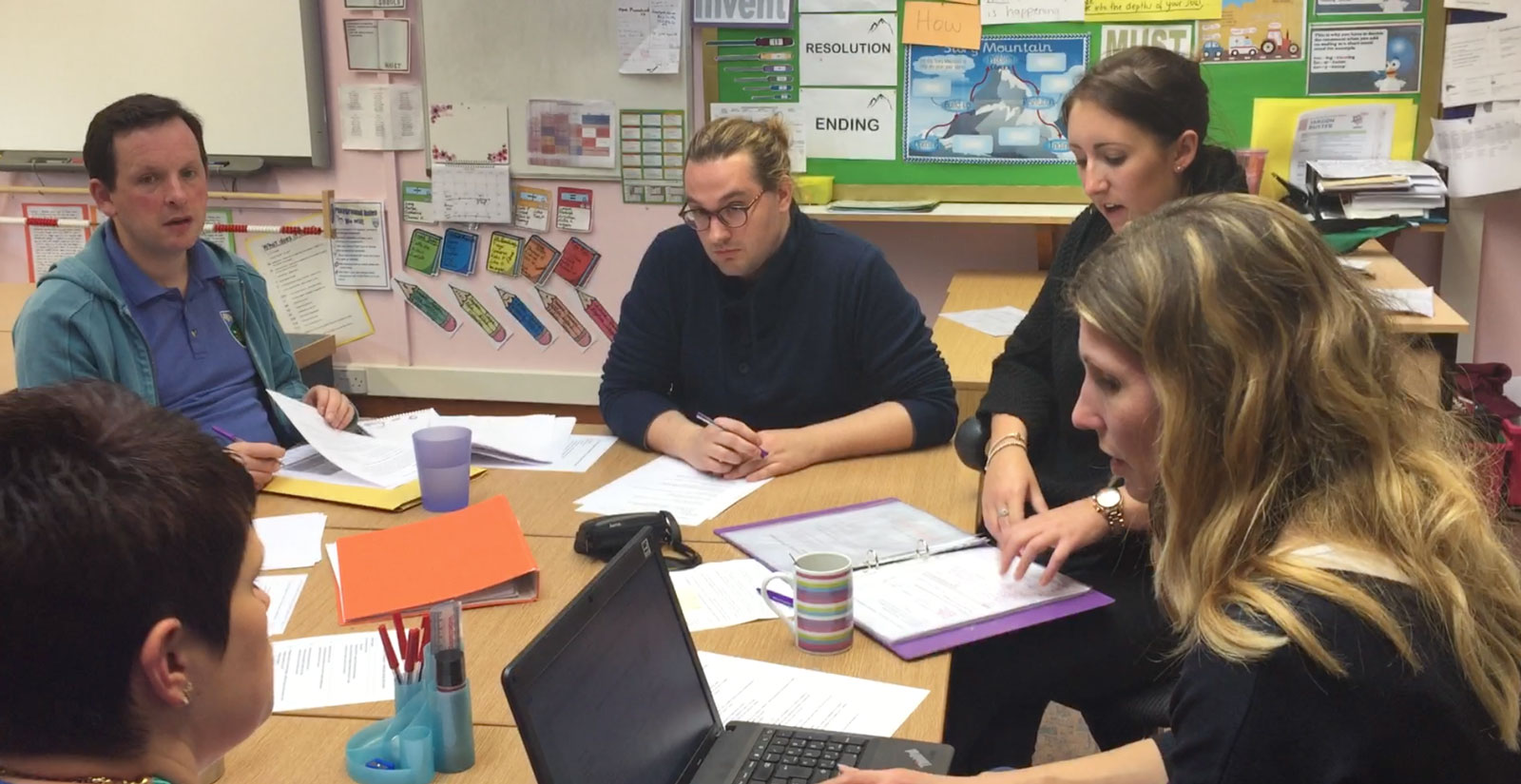
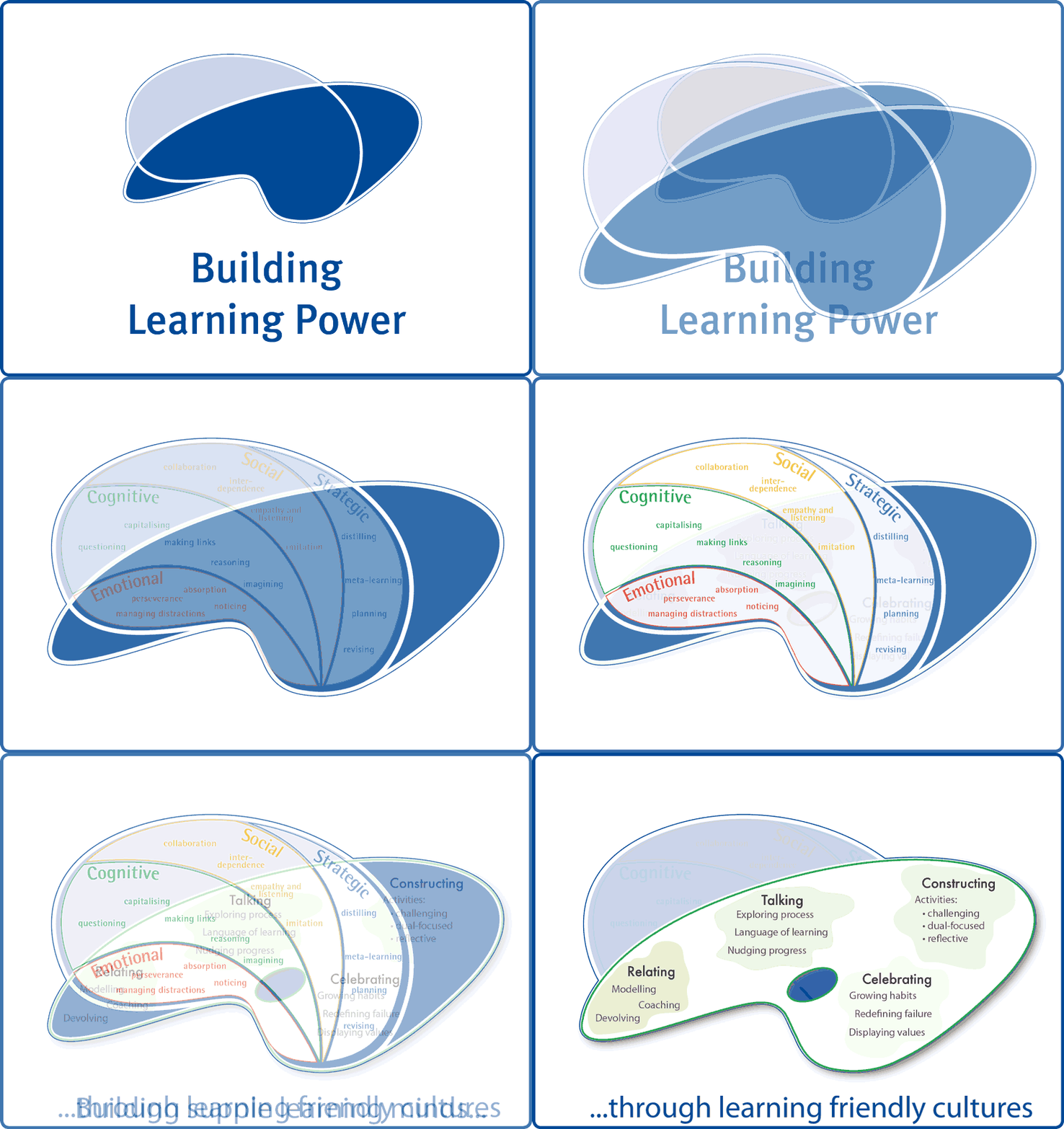

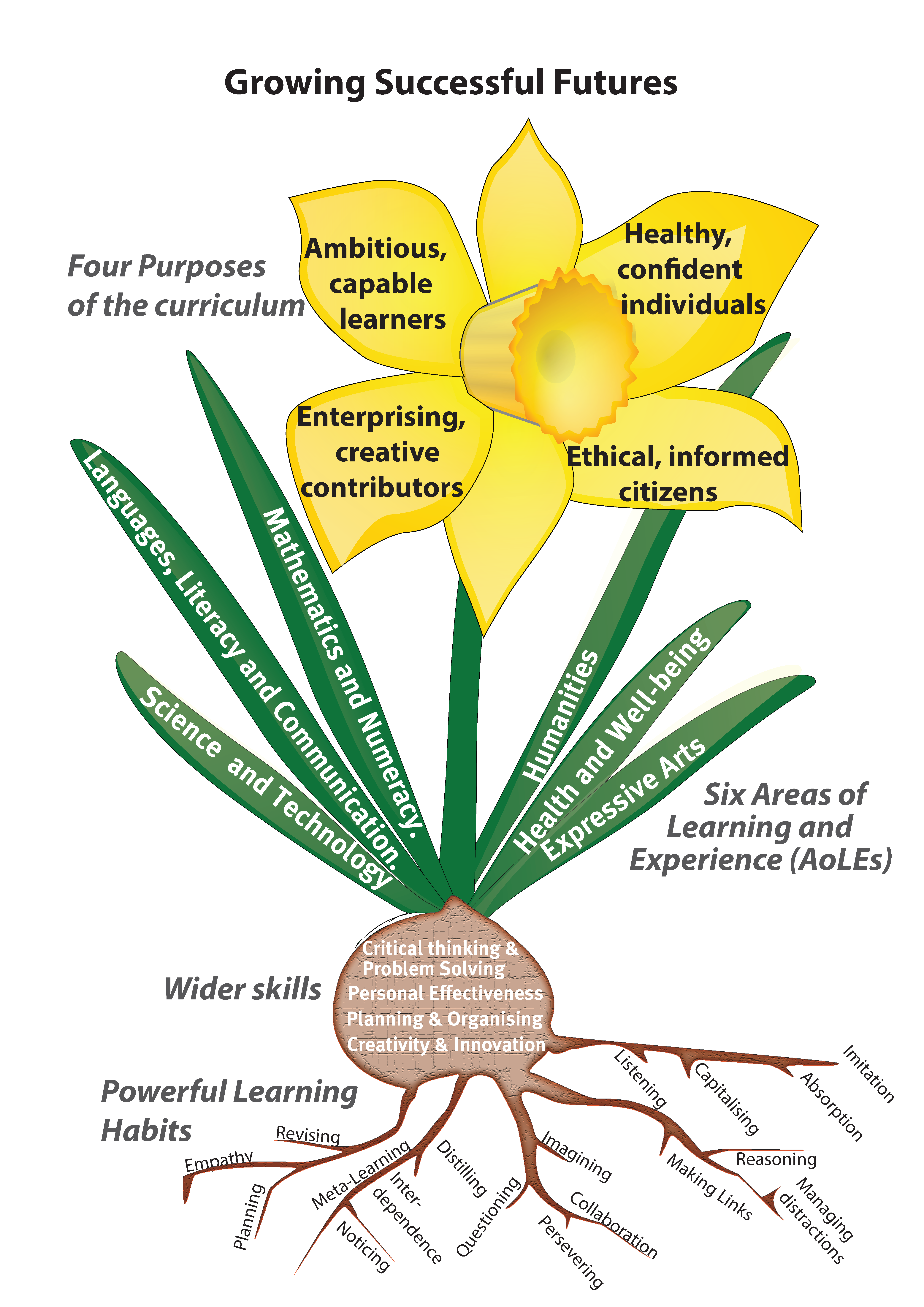
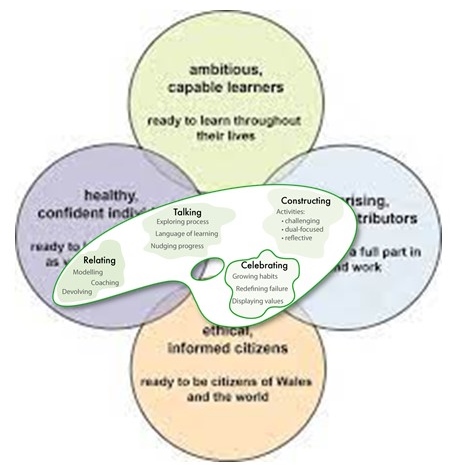
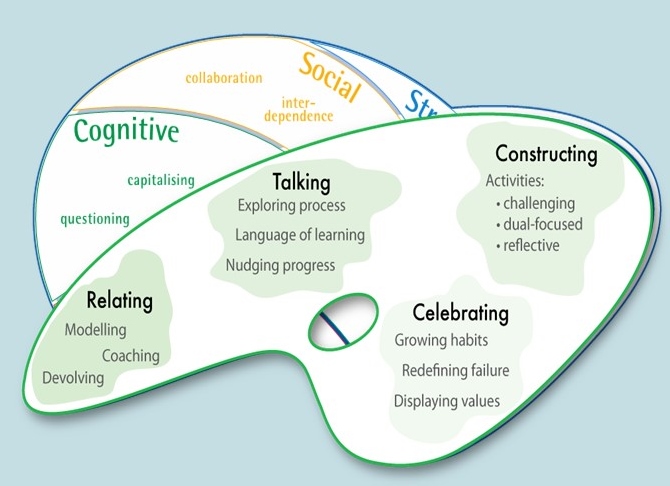
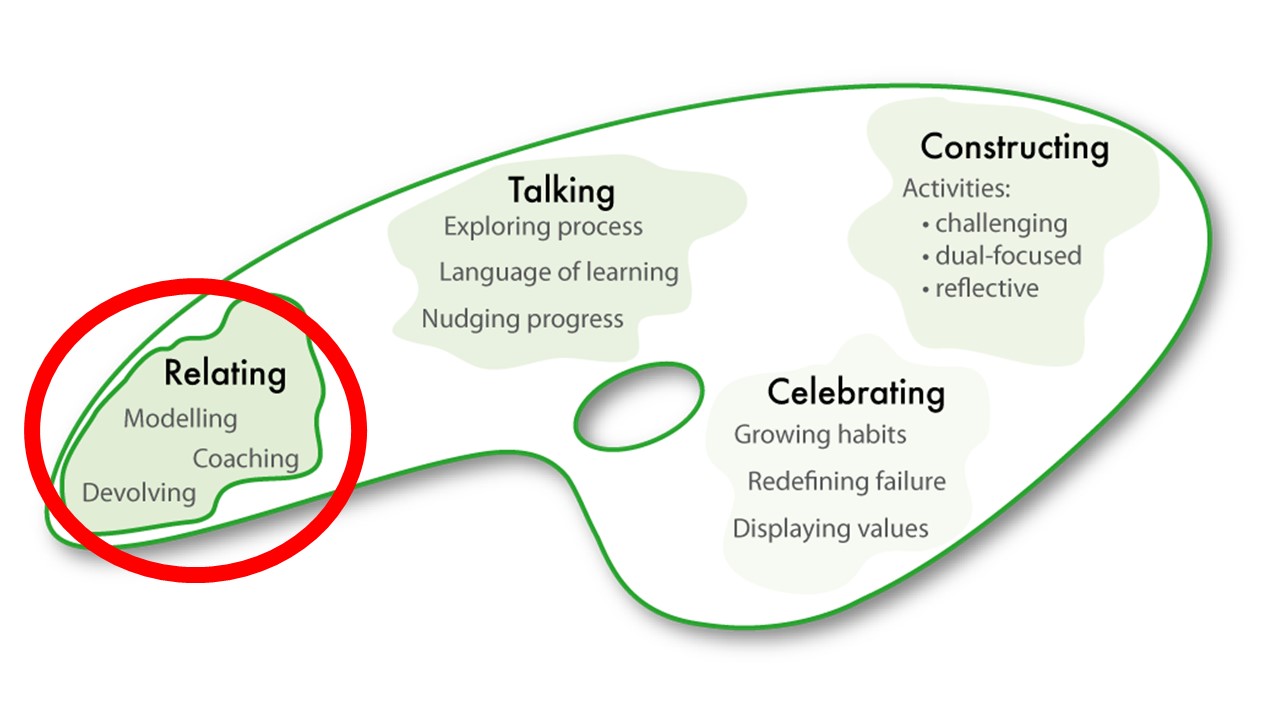
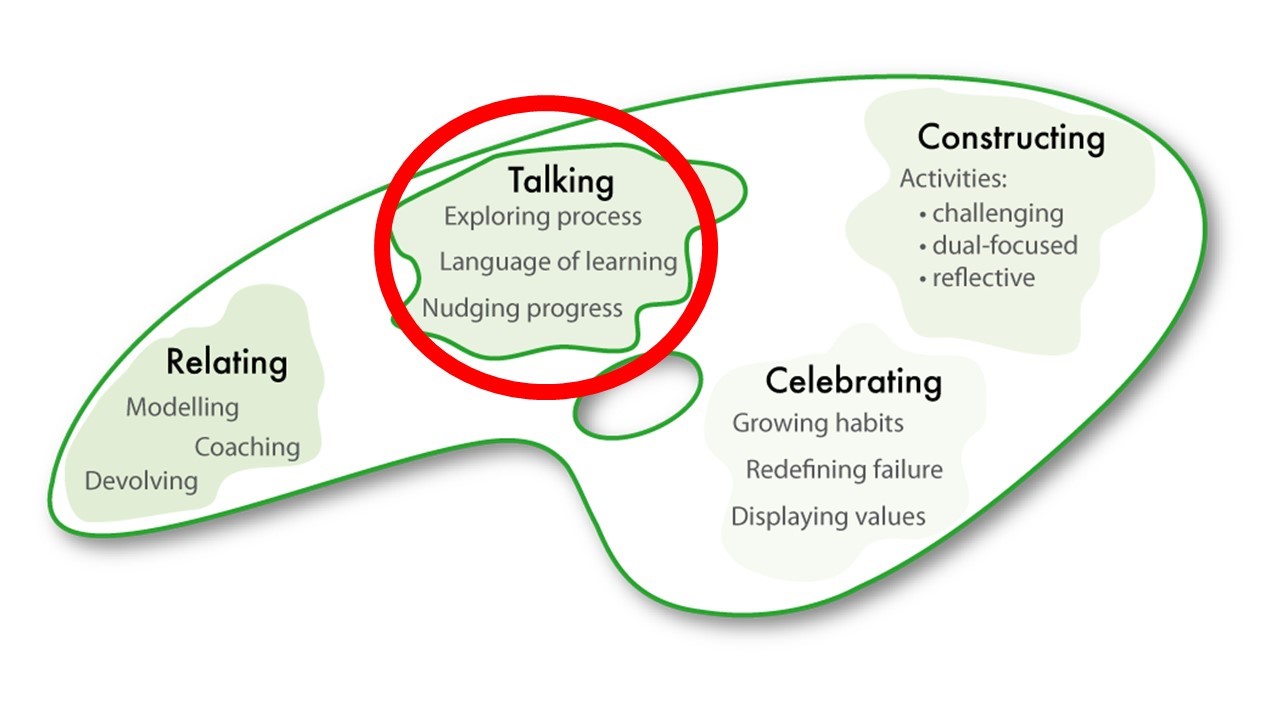

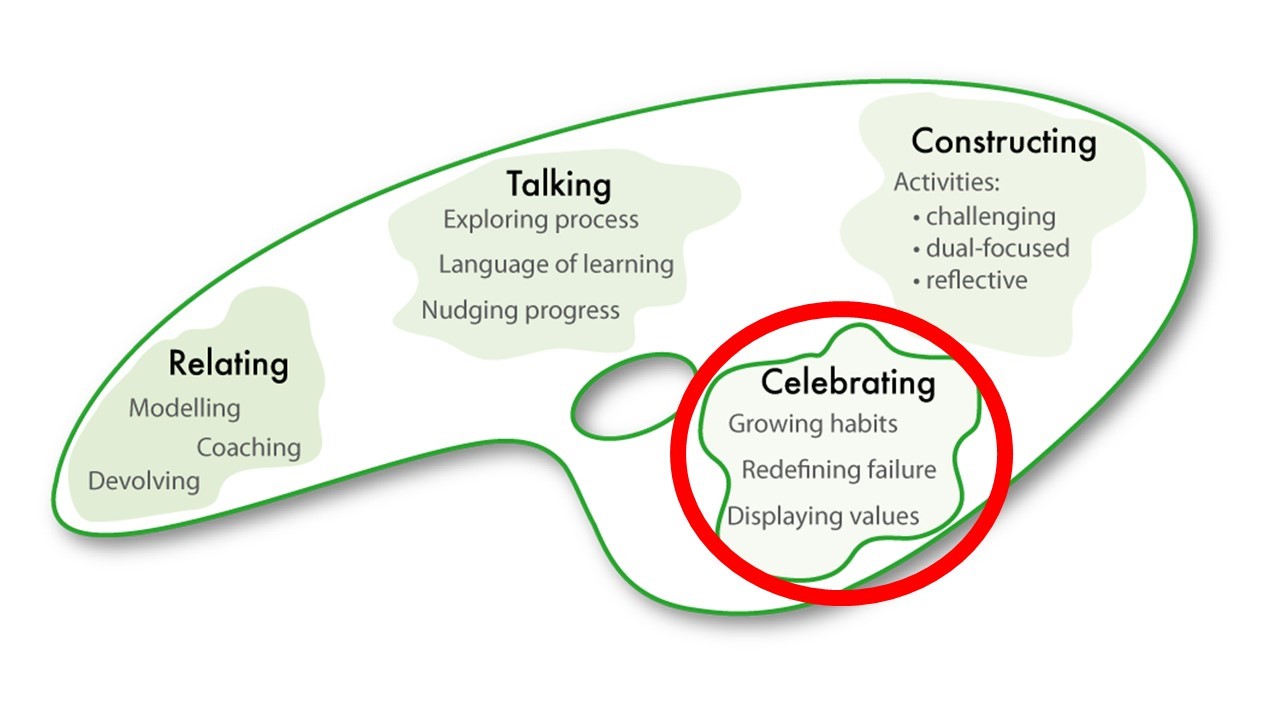
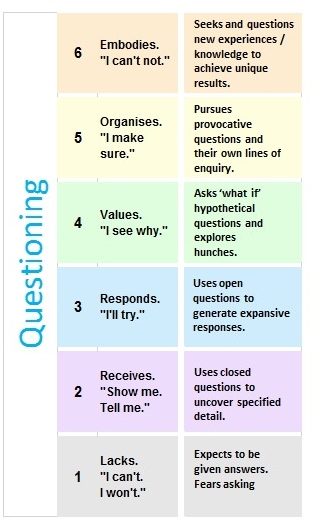

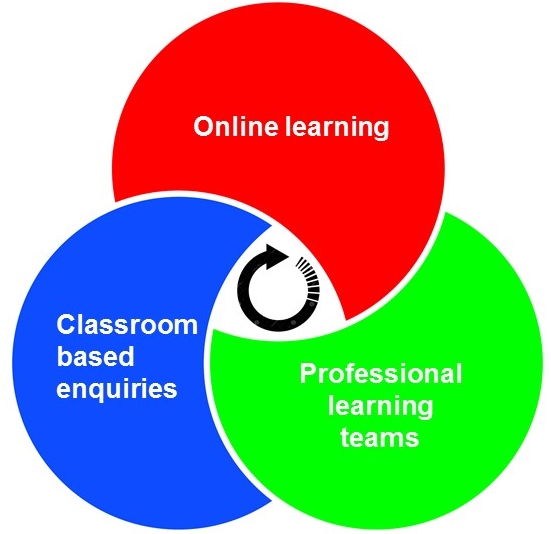
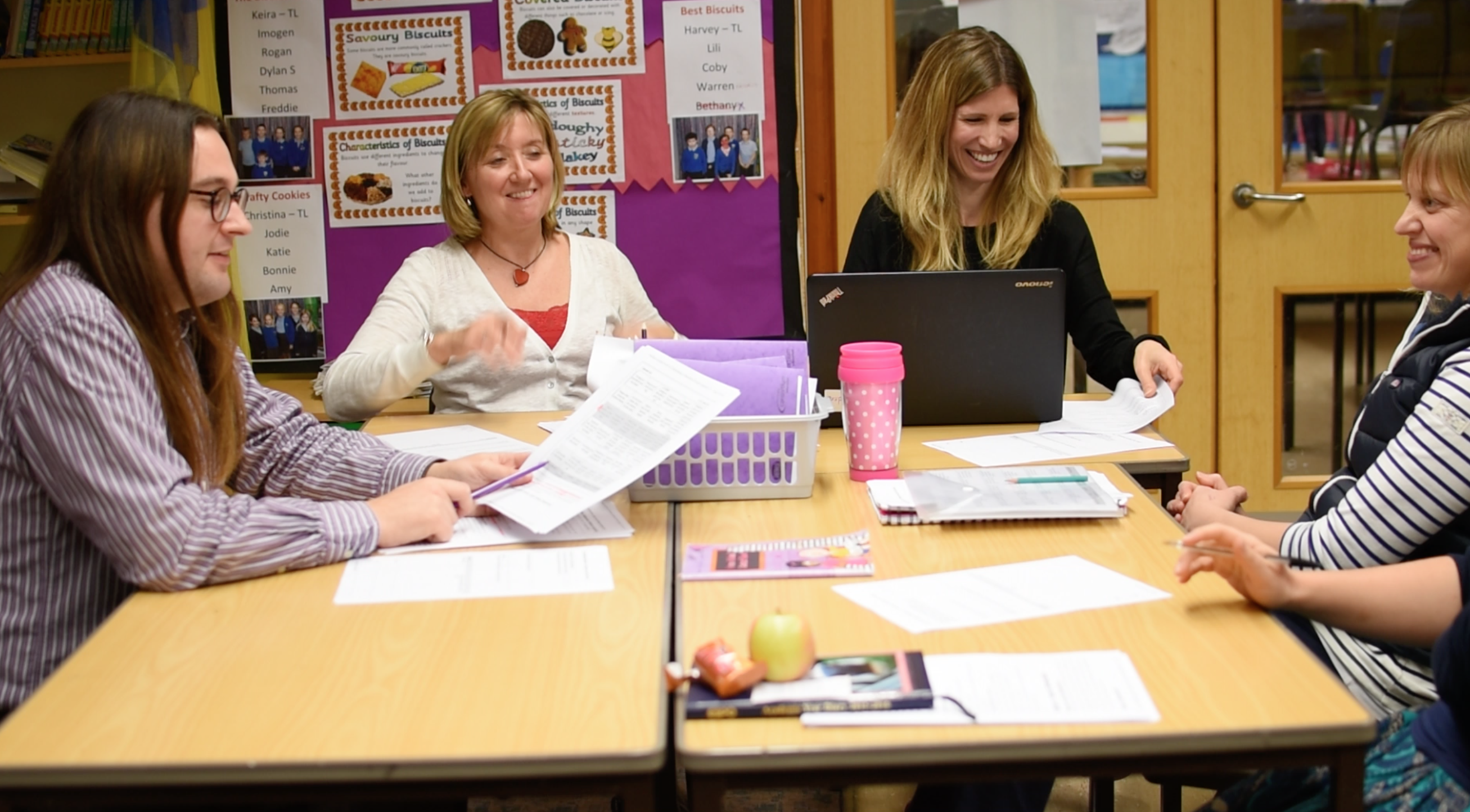
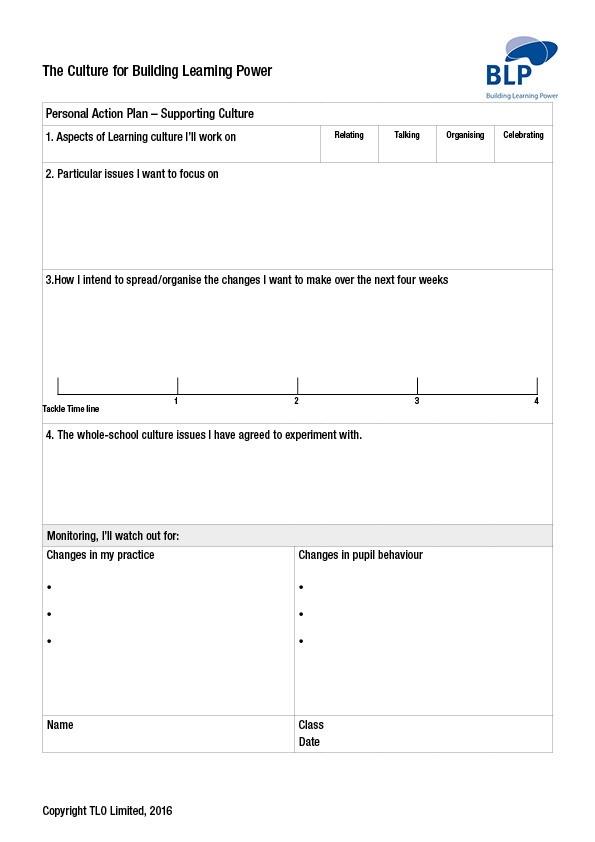
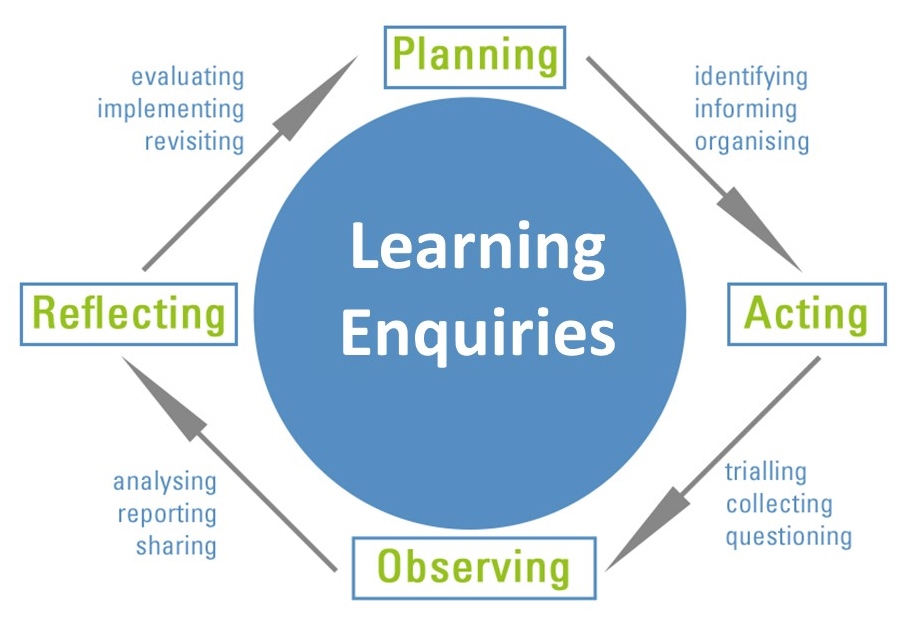
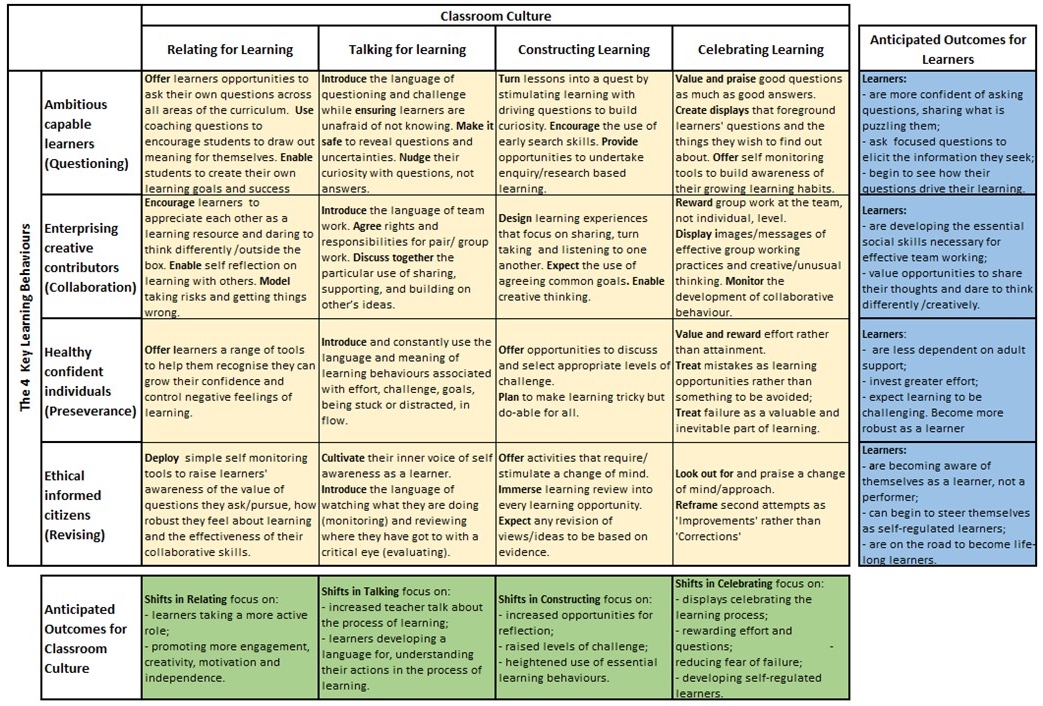
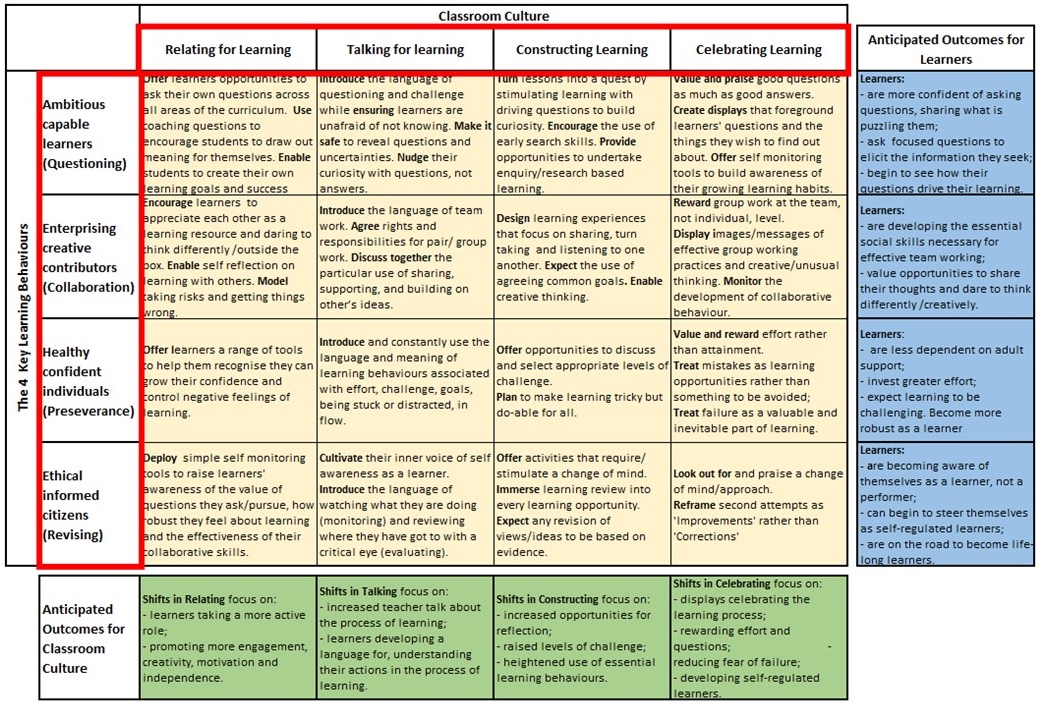
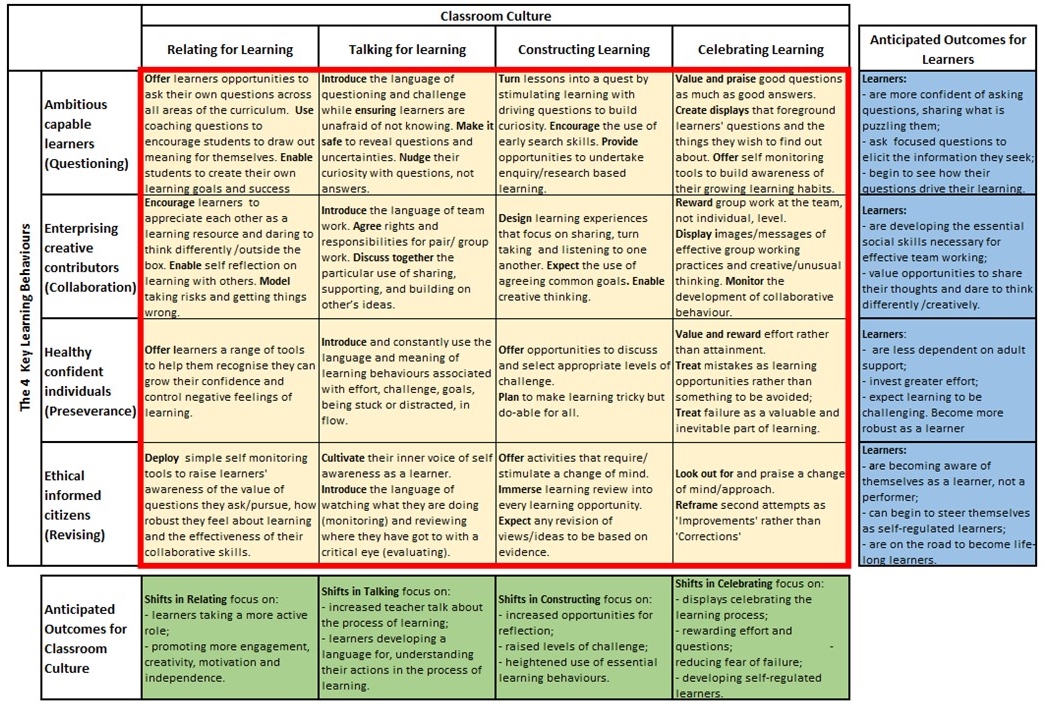
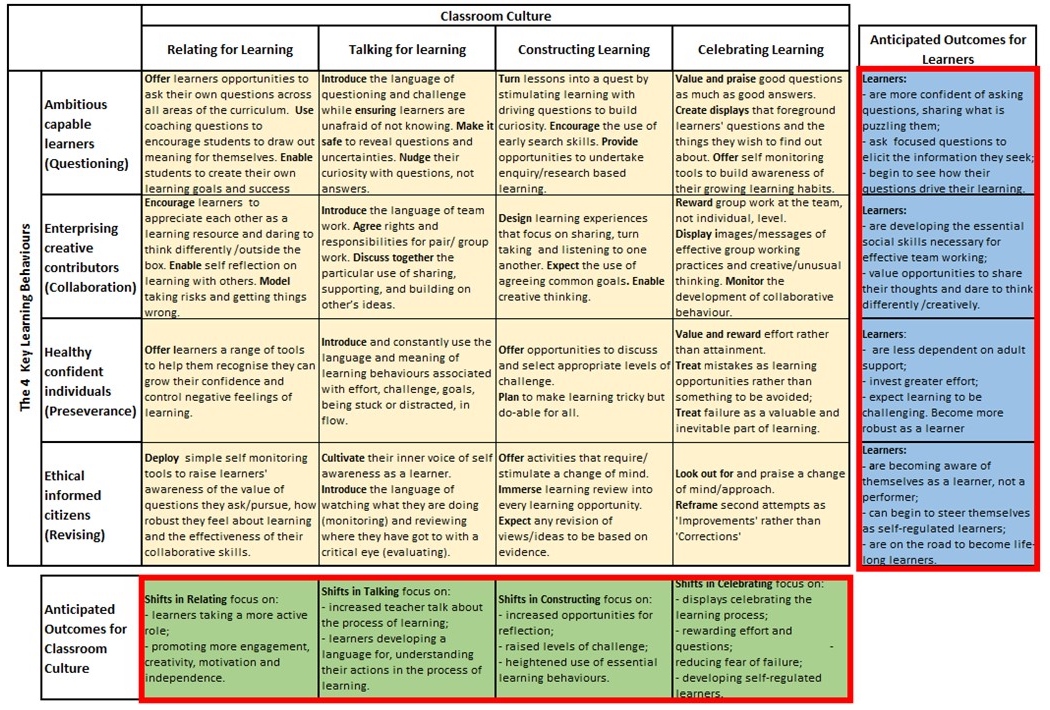

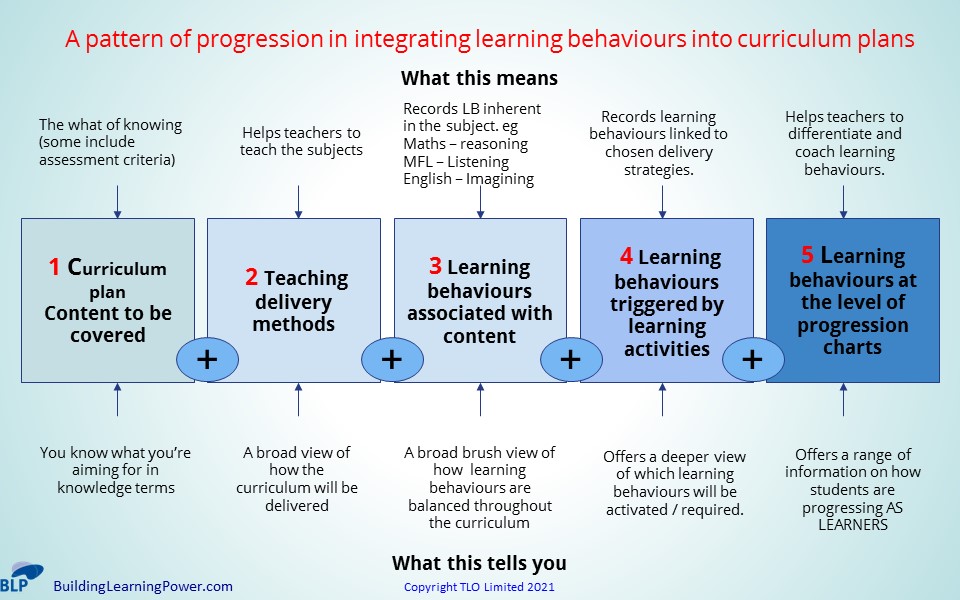


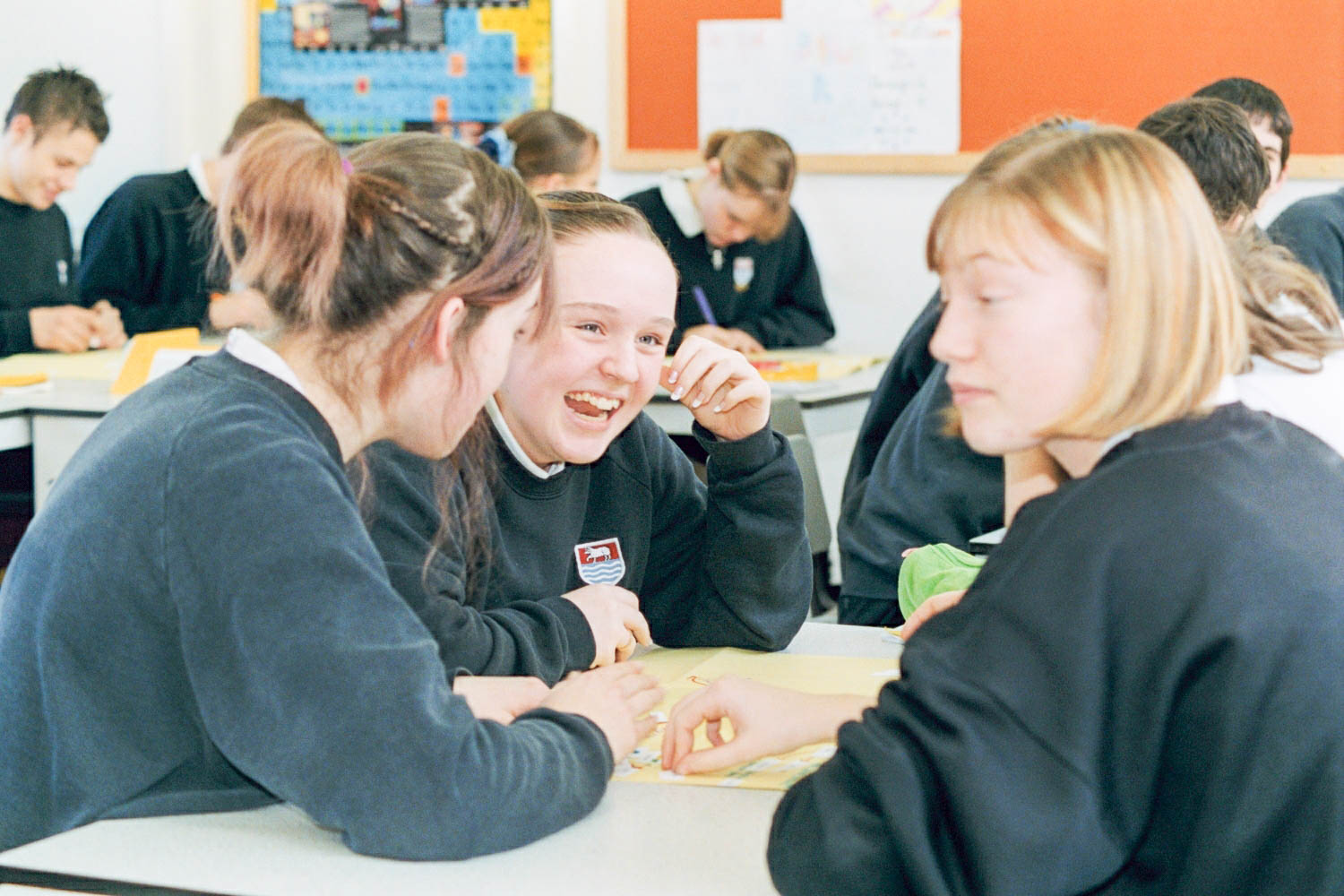


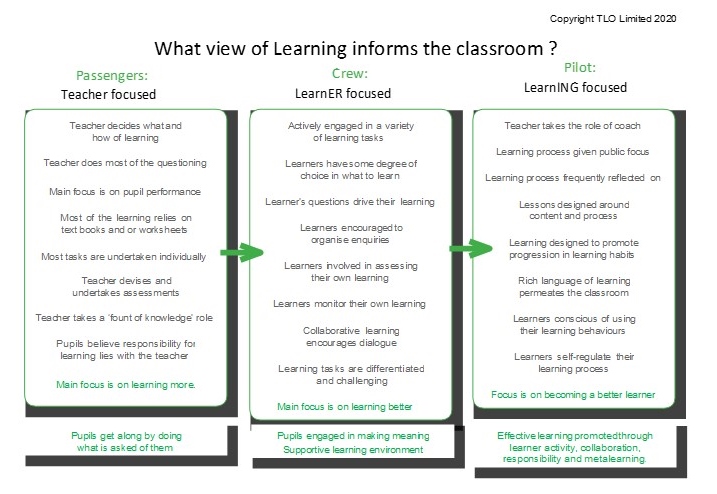

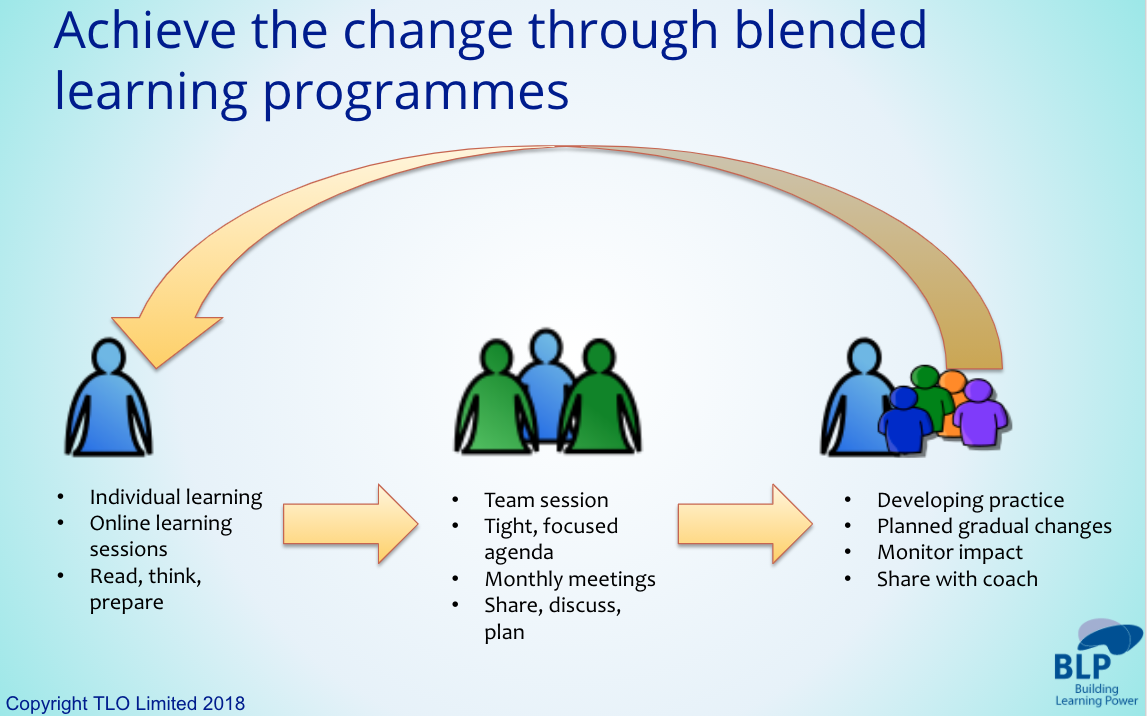



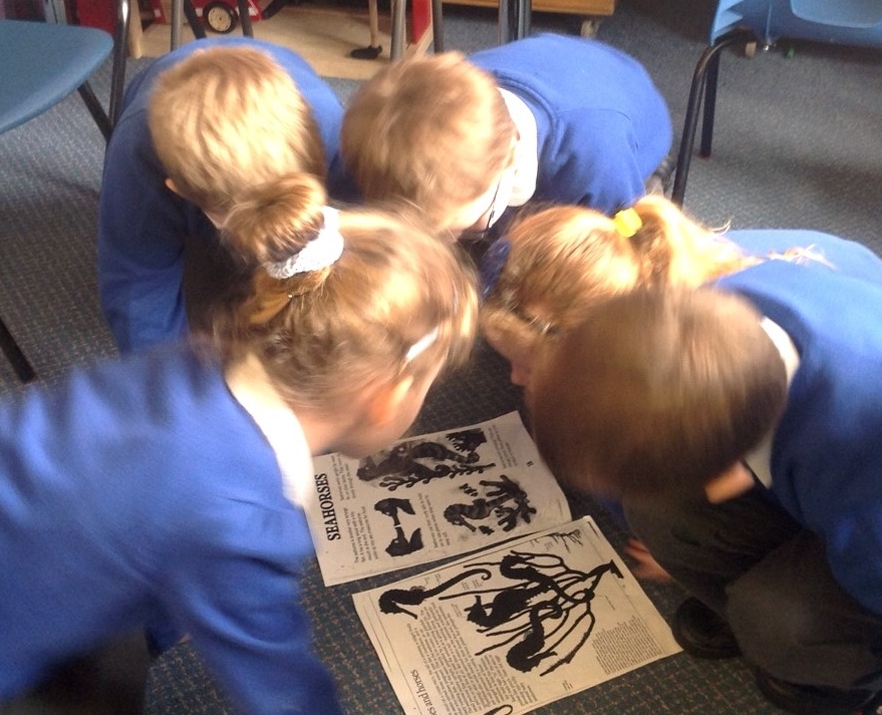










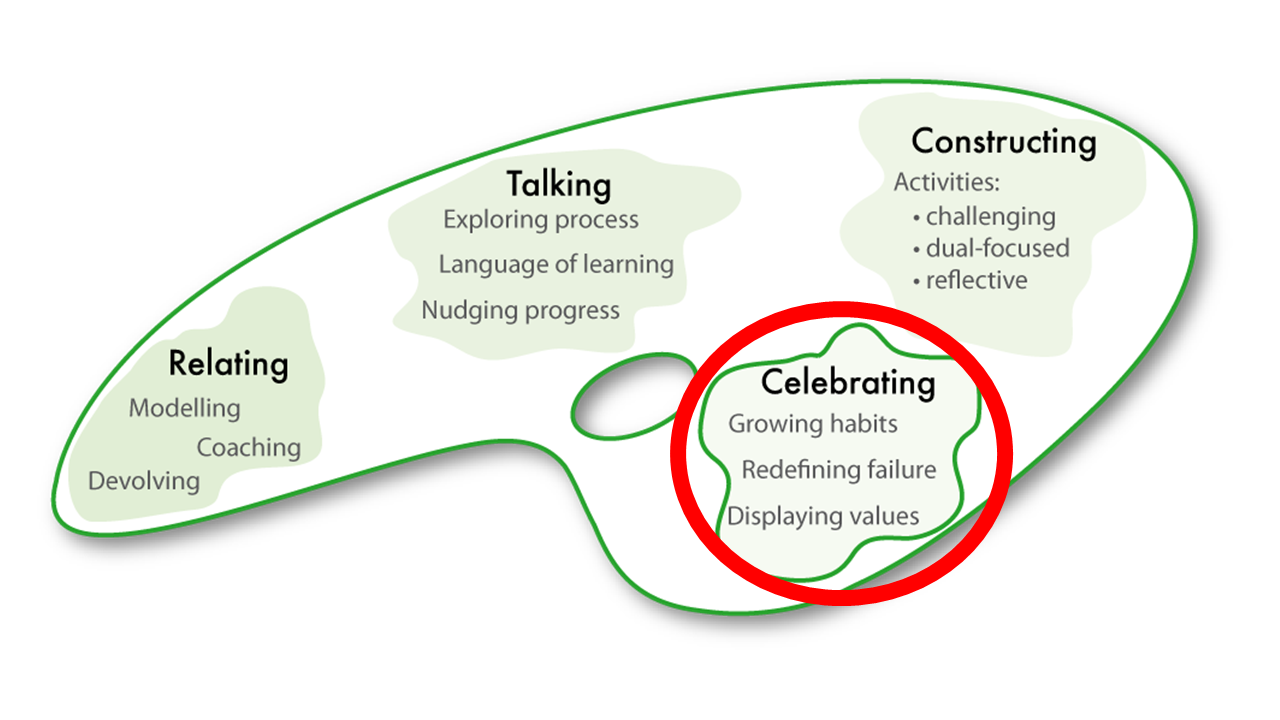
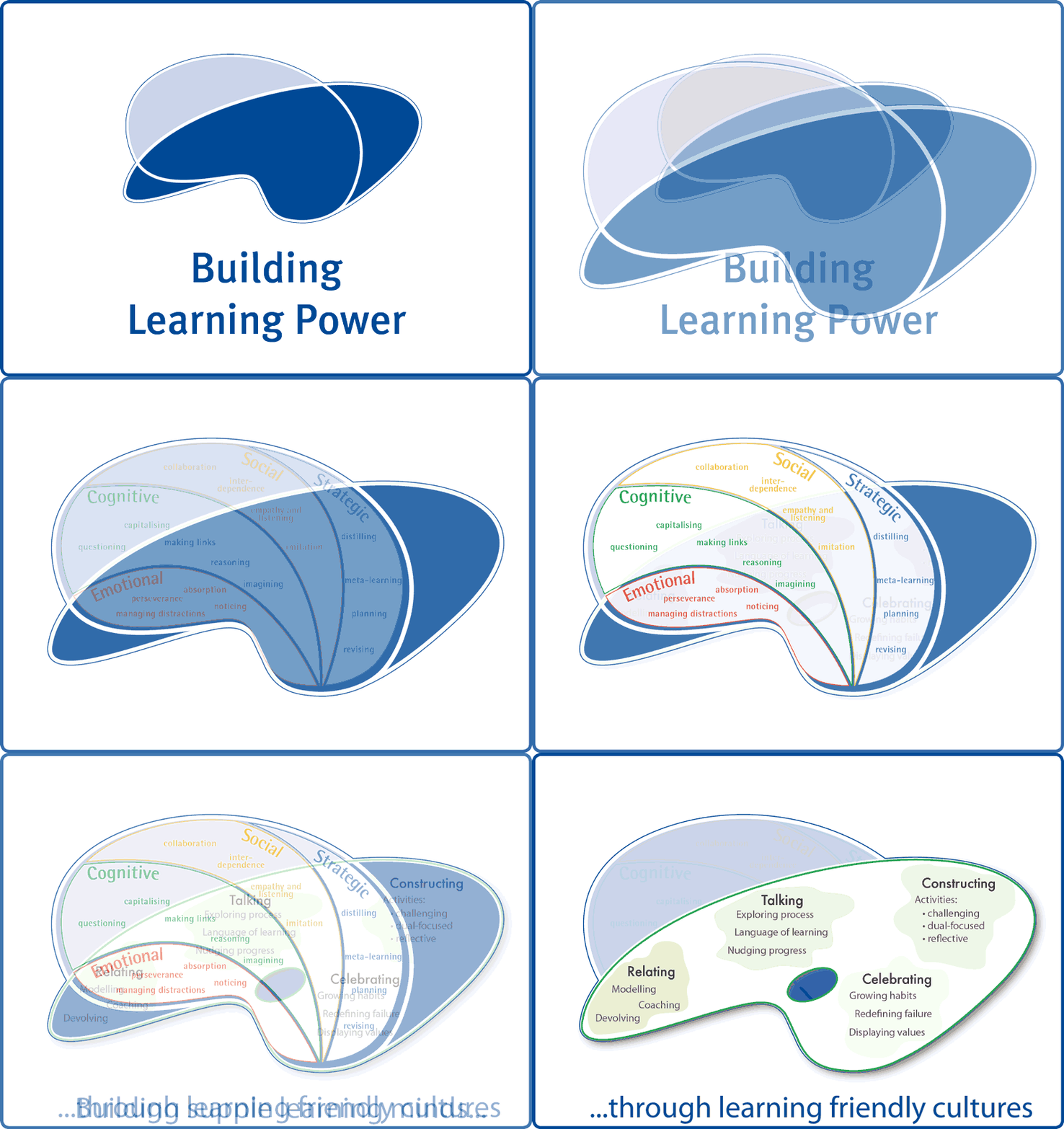
![BLP_Brain_Generic_no-Rs-[Converted]](https://www.buildinglearningpower.com/wp-content/uploads/2016/12/BLP_Brain_Generic_no-Rs-Converted.png)