2 possible versions – the first an edit of Brian’s intro to the at a glance cards, the second the same stuff arranged more like ‘Nigel’
A quick introduction to the basic ideas, language and initial classroom practice of developing five key learning behaviours in students – Perseverance, Noticing, Making Links, Interdependence and Distilling.
These five learning behaviours are drawn from the 18 learning behaviours in the supple learning mind. It is a starter pack, an introduction, something to get you going in the right direction. A good place to start, but a terrible place to finish!
There is an introductory section about the supple learning mind, plus the five modules that each cover a key learning habit, with information about what the habit looks like when it’s being used in a well-formed way, useful lesson starters and classroom activities to encourage use of the habit, teacher talk to help develop each habit, and the features of a conducive classroom climate to nurture the habit.
Available online, on any internet-enabled device, you can browse the modules whenever and wherever you want. Ideas for learning, available on your phone / laptop, in an instant.
The bundle of modules is available to individual teachers who wish to explore Building Learning Power for themselves, perhaps in a school that is thinking about doing so but have not as yet ‘made the leap’. Alternatively schools can purchase a site licence so that all teachers can access the materials.
The resources will also help you sort out:
Students’ learning behaviours – whether they are alive and well or not;
Students’ understanding of how to be a successful learner – whether students have a clue about the links between learning habits and success in learning.
Use the modules to;
Embed learning behaviours in your classroom;
Review classroom culture;
Deepen understanding of the learning behaviours;
and, if you purchase a site licence:
Become a foundation for CPD about learning to enhance performance.
Introduce new staff to building students as powerful learners.
ALTERNATIVELY:
Helping your learners to learn about learning
What is it?
A quick introduction to the basic ideas, language and initial classroom practice of developing five key learning behaviours in students – Perseverance, Noticing, Making Links, Interdependence and Distilling.
What do I get?
There is an introductory section about the supple learning mind, plus the five modules that each cover a key learning habit, with information about what the habit looks like when it’s being used in a well-formed way, useful lesson starters and classroom activities to encourage use of the habit, teacher talk to help develop each habit, and the features of a conducive classroom climate to nurture the habit.
Who is it for?
The bundle of modules is available to individual teachers who wish to explore Building Learning Power for themselves, perhaps in a school that is thinking about doing so but have not as yet ‘made the leap’. Alternatively schools can purchase a site licence so that all teachers can access the materials.
Where/when does it happen?
Available online, on any internet-enabled device, you can browse the modules whenever and wherever you want. Ideas for learning, available on your phone / laptop, in an instant.
How might I use it?
The resources will also help you sort out:
Students’ learning behaviours – whether they are alive and well or not;
Students’ understanding of how to be a successful learner – whether students have a clue about the links between learning habits and success in learning.
Use the modules to;
Embed learning behaviours in your classroom;
Review classroom culture;
Deepen understanding of the learning behaviours;
and, if you purchase a site licence:
Become a foundation for CPD about learning to enhance performance.
Introduce new staff to building students as powerful learners.
Why does it exist?
These five learning behaviours are drawn from the 18 learning behaviours in the supple learning mind. It is a starter pack, an introduction, something to get you going in the right direction. A good place to start, but a terrible place to finish!
It is designed to give you a flavour of Building Better Learners before you (and your school) commit to going in deeper.
Helping your learners to access Successful Futures – a start up package
What is it?
Helping your learners to access Successful Futures is a set of 12 online modules that explore the 4 core purposes of the Welsh curriculum, the 4 integral skills, and the 4 aspects of classroom culture within which they can flourish.
Who is it for?
The online modules are for teachers in schools wrestling with how to begin to implement Successful Futures in schools and classrooms. If you want to develop your classroom so that it both delivers the curriculum and builds Successful Futures, work through the modules in whatever order best suits your school.
Where does it happen?
It happens in your school or elsewhere, at times you choose, on any internet enabled devices.
How does it work?
The 12 modules each explore an aspect of Successful Futures. Once purchased, schools and teachers can access the modules at times to suit. The modules are a one-off purchase and will be available for a minimum of XXXX years.
When does it start?
It has already started! Some schools in Wales are already accessing the modules and integrating the extensive ideas into their curriculum and classroom practice, creating a school within which Successful Futures can begin to move from aspiration to reality.
Why does it exist?
We created ‘Helping your learners to access Successful Futures’ to bridge the gap between the aspirations of Successful Futures and the realities of everyday classroom practice, to help busy teachers to ensure that their classroom practice builds successful futures.
A quick introduction to the basic ideas, language and initial classroom practice of developing key learning behaviours in students.
Each card covers a key learning habit, with information about what the habit looks like when it’s being used in a well-formed way, useful lesson starters and classroom activities to encourage use of the habit, and teacher talk to help develop each habit. The features of a conducive classroom climate to nurture the habit, and the basics of progression in each habit are also included.
As downloadable PDFs, you can print off as many copies as you like, whenever you need them. No more coffee stains or incomplete sets. The PDF files can also be put on your school’s intranet for teachers to access electronically – instant and simple.
The resource will also help you sort out:
Students’ learning behaviours – whether they are alive and well or not
Students’ understanding of how to be a successful learner – whether students have a clue about the links between learning habits and success in learning.
Use the cards to;
Embed learning behaviours in your classroom.
Review classroom culture.
Deepen understanding of the learning behaviours.
Introduce new staff to building students as powerful learners.
Become a foundation for CPD about learning to enhance performance.
The focus of this unit is on the development of the integral skill of Personal Effectiveness.
Personal Effectiveness
When you display personal effectiveness you engage a blend of learning behaviours.
You …
understand yourself as a person and as a learner
know what is, and is not, important and of value
make enterprising use of the people, strategies and things available
engage positively and constructively with others
behave in ways that contribute to the greater good
control your own destiny
The activities, think pieces and questions in this online unit aim to help you to make a start on:
introducing students to the key behaviours of learners who exhibit personal effectiveness ;
using the language of personal effectiveness with students;
designing the use of personal effectiveness skills into the way you teach;
developing the confidence and skill in helping students to grow their personal effectiveness.
The following sections will help you to tailor your classroom practice to support the development of these dispositions.
Section 1 explores the learning behaviours of learners who exhibit personal effectiveness
Section 2 discusses the classroom culture that supports the development of personal effectiveness
Section 3 offers ideas to practise in your own classroom
Section 4 contains some suggestions about how you might talk to encourage personal effectiveness
Section 5 makes suggestions to move practice on.
About ‘Helping learners to access Successful Futures’ – a reminder
This is one of 12 units in the suite ‘Helping learners to access Successful Futures’. The units address the 4 purposes of the Successful Futures curriculum and the 4 integral skills for modern life and work, and set these requirements into 4 aspects of a learning-friendly classroom culture within which they can thrive.
The 4 purposes of the curriculum as defined in Successful Futures are that young people should develop as:
Ambitious, capable learners;
Enterprising, creative contributors;
Healthy, confident individuals;
Ethical, informed citizens.
The 4 integral skills necessary for modern life and work are defined as:
critical thinking and problem solving
planning and organising
creativity and innovation
personal effectiveness – this unit
The 4 aspects of classroom culture within which these core purposes and wider skills can develop and thrive are:
The focus of this unit is on the development of the integral skills of Creativity and Innovation
Creativity and Innovation
When you are creative and innovative you engage a blend of learning behaviours.
You …
identify / accept a problem that you wish to solve
explore a range of possible, imaginative ways of proceeding
decide on a course of action
respond with flexibility
do the hard work of turning a creative idea into an innovative outcome.
The activities, think pieces and questions in this online unit aim to help you to make a start on:
introducing students to the key behaviours of creative, innovative learners;
using the language of creativity and innovation effectively with students;
designing the use of creative, innovative learning behaviours into the way you teach;
developing the confidence and skill in helping students to grow their creativity and innovation skills.
The following sections will help you to tailor your classroom practice to support the development of these dispositions.
Section 1 explores the learning behaviours of creative, innovative learners
Section 2 discusses the classroom culture that supports the development of creative, innovative learners
Section 3 offers ideas to practise in your own classroom
Section 4 contains some suggestions about how you might talk to encourage creativity and innovation
Section 5 makes suggestions to move practice on.
About ‘Helping learners to access Successful Futures’ – a reminder
This is one of 12 units in the suite ‘Helping learners to access Successful Futures’. The units address the 4 purposes of the Successful Futures curriculum and the 4 integral skills for modern life and work, and set these requirements into 4 aspects of a learning-friendly classroom culture within which they can thrive.
The 4 purposes of the curriculum as defined in Successful Futures are young people should develop as:
Ambitious, capable learners;
Enterprising, creative contributors;
Healthy, confident individuals;
Ethical, informed citizens.
The 4 integral skills necessary for modern life and work are defined as:
critical thinking and problem solving
planning and organising
creativity and innovation – this unit
personal effectiveness
The 4 aspects of classroom culture within which these core purposes and wider skills can develop and thrive are:
The focus of this unit is on the development of the integral skills of Planning and Organising.
Planning and Organising
When you plan and organise you engage a blend of learning behaviours.
You …
think ahead of taking action
decide what needs doing, in what order
anticipate potential difficulties
balance a logical approach with the need to imagine possible ways forward
maintain focus on ‘getting the job completed’
The activities, think pieces and questions in this online unit aim to help you to make a start on:
introducing students to the key behaviours of learners who plan and organise;
using the language of planning and organising effectively with students;
designing the use of planning and organising learning behaviours into the way you teach;
developing the confidence and skill in helping students to grow their planning and organising skills.
The following sections will help you to tailor your classroom practice to support the development of these dispositions.
Section 1 explores the learning behaviours of learners who plan and organise
Section 2 discusses the classroom culture that supports the development of learners who plan and organise
Section 3 offers ideas to practise in your own classroom
Section 4 contains some suggestions about how you might talk to encourage planning and organisation
Section 5 makes suggestions to move practice on.
About ‘Helping learners to access Successful Futures’ – a reminder
This is one of 12 units in the suite ‘Helping learners to access Successful Futures’. The units address the 4 purposes of the Successful Futures curriculum and the 4 integral skills for modern life and work, and set these requirements into 4 aspects of a learning-friendly classroom culture within which they can thrive.
The 4 purposes of the curriculum as defined in Successful Futures are that young people should develop as:
Ambitious, capable learners;
Enterprising, creative contributors;
Healthy, confident individuals;
Ethical, informed citizens.
The 4 integral skills necessary for modern life and work are defined as:
critical thinking and problem solving
planning and organising – this unit
creativity and innovation
personal effectiveness
The 4 aspects of classroom culture within which these core purposes and wider skills can develop and thrive are:
The focus of this unit is on the development of Healthy, Confident Individuals . . .
who have a strong, positive view of self, understand how, through their efforts, they achieve success in all areas of their lives, are able to discover what they need to know and apply this knowledge appropriately, and who have the skill and disposition to manage themselves, to be self-regulators.
Healthy, confident individuals engage a blend of learning behaviours:
They …
have a range of strategies for overcoming difficulties
are alert to how they might apply their learning elsewhere
think carefully ahead of taking action
value and respect both themselves and others
have a positive self-image born of a clear understanding of themselves as learners.
The activities, think pieces and questions in this online unit aim to help you to make a start on:
introducing students to the key behaviours of healthy, confident individuals;
using the language of healthy, confident learning effectively with students;
designing the use of healthy, confident learning behaviours into the way you teach;
developing the confidence and skill in helping students to grow their health and confidence.
The following sections will help you to tailor your classroom practice to support the development of these dispositions.
Section 1 explores the learning behaviours of healthy, confident learners
Section 2 discusses the classroom culture that supports the development of healthy, confident learners
Section 3 offers ideas to practise in your own classroom
Section 4 contains some suggestions about how you might talk to encourage healthy, confident individuality
Section 5 makes suggestions to move practice on.
About ‘Helping learners to access Successful Futures’ – a reminder
This is one of 12 units in the suite ‘Helping learners to access Successful Futures’. The units address the 4 purposes of the Successful Futures curriculum and the 4 integral skills for modern life and work, and set these requirements into 4 aspects of a learning-friendly classroom culture within which they can thrive.
The 4 purposes of the curriculum as defined in Successful Futures are that young people should develop as:
Ambitious, capable learners;
Enterprising, creative contributors;
Healthy, confident individuals – this unit
Ethical, informed citizens.
The 4 integral skills necessary for modern life and work are defined as:
critical thinking and problem solving
planning and organising (closely linked integral skill)
creativity and innovation
personal effectiveness (closely linked integral skill)
The 4 aspects of classroom culture within which these core purposes and wider skills can develop and thrive are:
The focus of this unit is on the development of Ethical, Informed Citizens . . .
who take responsibility for their actions; are attentive, open and empathetic to different ideas and views; maintain a principled, questioning stance in considering the worth and value of something.
Ethical, informed citizens engage a blend of learning behaviours:
They …
are attentive and open to others
are interested in those who how views different from their own
consider the potential impact of their actions on others
take responsibility for their actions
balance self-interest and the greater good.
The activities, think pieces and questions in this online unit aim to help you to make a start on:
introducing students to the key behaviours of ethical, informed learners;
using the language of ethical, informed learning effectively with students;
designing the use of ethical, informed learning behaviours into the way you teach;
developing the confidence and skill in helping students to grow their own ethical, informed outlook.
The following sections will help you to tailor your classroom practice to support the development of these dispositions.
Section 1 explores the learning behaviours of ethical, informed learners
Section 2 discusses the classroom culture that supports the development of ethical, informed learners
Section 3 offers ideas to practise in your own classroom
Section 4 contains some suggestions about how you might talk to encourage ethical, informed learning behaviours
Section 5 makes suggestions to move practice on.
About ‘Helping learners to access Successful Futures’ – a reminder
This is one of 12 units in the suite ‘Helping learners to access Successful Futures’. The units address the 4 purposes of the Successful Futures curriculum and the 4 integral skills for modern life and work, and set these requirements into 4 aspects of a learning-friendly classroom culture within which they can thrive.
The 4 purposes of the curriculum as defined in Successful Futures are that young people should develop as:
Ambitious, capable learners;
Enterprising, creative contributors;
Healthy, confident individuals;
Ethical, informed citizens – this unit
The 4 integral skills necessary for modern life and work are defined as:
critical thinking and problem solving
planning and organising
creativity and innovation
personal effectiveness (closely linked integral skill)
The 4 aspects of classroom culture within which these core purposes and wider skills can develop and thrive are:
The focus of this unit is on the development of Enterprising, Creative Contributors . . .
who have social awareness; are effective team players with the ability to lead and manage others through difficulties; are willing to take risks; who tackle problems from novel perspectives to create original solutions.
Enterprising, creative contributors engage a blend of learning behaviours:
They …
are prepared to take risks
make best use of the available resources / others
work well with others and on their own as necessary
prefer new experiences to the tried and tested
think ‘outside the box’
show flexibility when situations change.
The activities, think pieces and questions in this online unit aim to help you to make a start on:
introducing students to the key behaviours of enterprising, creative contributors;
using the language of enterprising, creative learning effectively with students;
designing the use of enterprising, creative learning behaviours into the way you teach;
developing the confidence and skill in helping students to grow their enterprise and creativity.
The following sections will help you to tailor your classroom practice to support the development of these dispositions.
Section 1 explores the learning behaviours of enterprising, creative learners
Section 2 discusses the classroom culture that supports the development of enterprising, creative learners
Section 3 offers ideas to practise in your own classroom
Section 4 contains some suggestions about how you might talk to encourage enterprising, creative learning behaviours
Section 5 makes suggestions to move practice on.
About ‘Helping learners to access Successful Futures’ – a reminder
This is one of 12 units in the suite ‘Helping learners to access Successful Futures’. The units address the 4 purposes of the Successful Futures curriculum and the 4 integral skills for modern life and work, and set these requirements into 4 aspects of a learning-friendly classroom culture within which they can thrive.
The 4 purposes of the curriculum as defined in Successful Futures are that young people should develop as:
Ambitious, capable learners;
Enterprising, creative contributors – this unit
Healthy, confident individuals;
Ethical, informed citizens.
The 4 wider skills necessary for modern life and work are defined as:
critical thinking and problem solving (closely linked integral skill)
planning and organising (closely linked integral skill)
creativity and innovation (closely linked integral skill)
personal effectiveness
The 4 aspects of classroom culture within which these core purposes and wider skills can develop and thrive are:
The focus of this unit is on the development of Ambitious, Capable Learners who . .
are interested in, enthusiastic about, and persistent in learning; take responsibility for their own learning; are informed and understand how things fit together; and are able to explain their thinking to others.
Ambitious, capable learners engage a blend of learning behaviours:
They …
pursue their goals with tenacity
see learning as an interconnected whole
balance curiosity, logic and imagination
communicate effectively
learn from experience
The activities, think pieces and questions in this online unit aim to help you to make a start on:
introducing students to the key behaviours of ambitious, capable learners;
using the language of ambitious, capable learning effectively with students;
designing the use of ambitious, capable learning behaviours into the way you teach;
developing the confidence and skill in helping students to grow their ambitions and capabilities.
The following sections will help you to tailor your classroom practice to support the development of these dispositions.
Section 1 explores the learning behaviours of ambitious, capable learners
Section 2 discusses the classroom culture that supports the development of ambitious, capable learners
Section 3 offers ideas to practise in your own classroom
Section 4 contains some suggestions about how you might talk to encourage ambition and capability
Section 5 makes suggestions to move practice on.
About ‘Helping learners to access Successful Futures’ – a reminder
This is one of 12 units in the suite ‘Helping learners to access Successful Futures’. The units address the 4 purposes of the Successful Futures curriculum and the 4 integral skills for modern life and work, and set these requirements into 4 aspects of a learning-friendly classroom culture within which they can thrive.
The 4 purposes of the curriculum as defined in Successful Futures are that young people should develop as:
Ambitious, capable learners – this unit
Enterprising, creative contributors;
Healthy, confident individuals;
Ethical, informed citizens.
The 4 integral skills necessary for modern life and work are defined as:
critical thinking and problem solving (closely linked integral skill)
planning and organising (closely linked integral skill)
creativity and innovation
personal effectiveness
The 4 aspects of classroom culture within which these core purposes and wider skills can develop and thrive are:
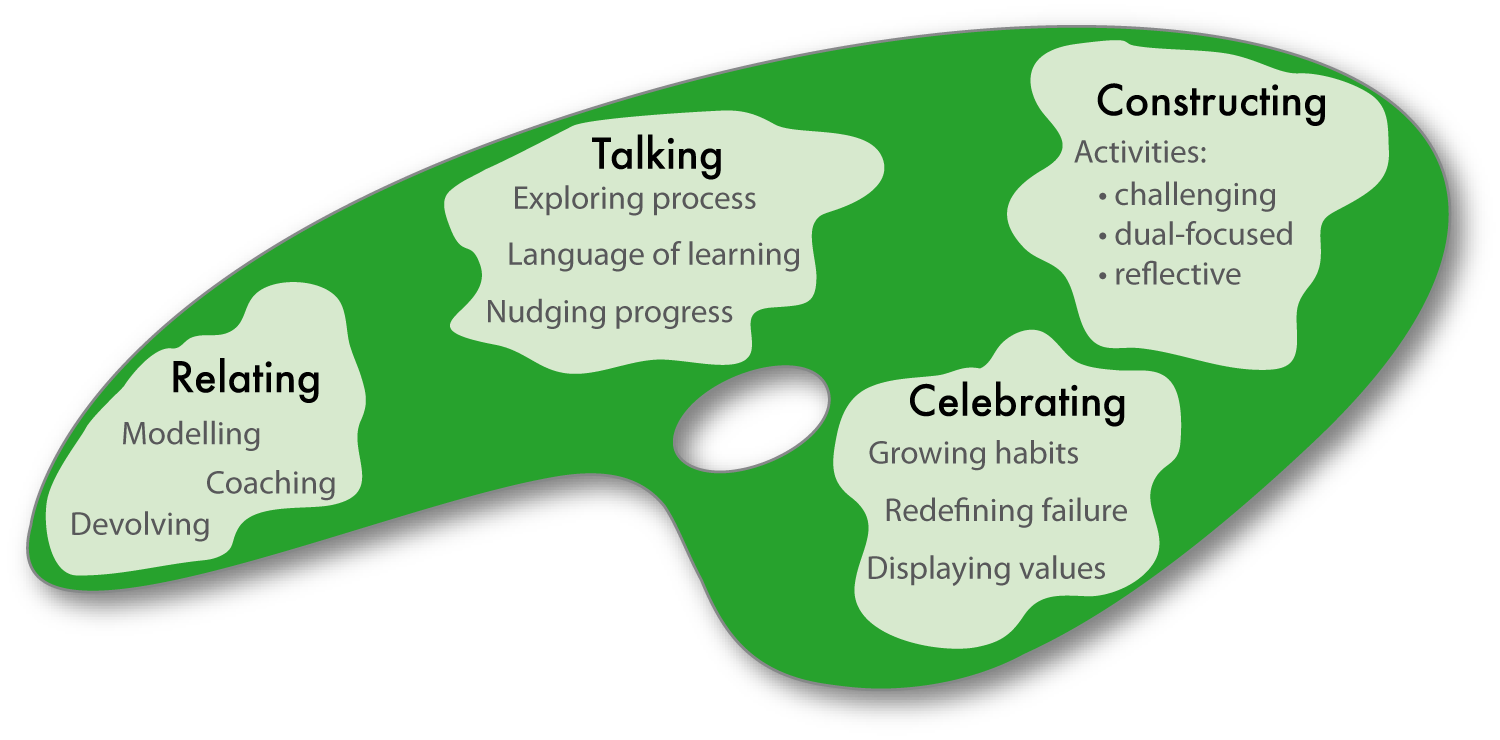
Classroom learning relationships;
Classroom talk for learning;
How learning is constructed;
How learning is celebrated and grown.
Getting deeper, getting wider
The new curriculum is endeavouring to achieve a wide range of outcomes for its citizens. The 4 core purposes are, by and large, the intended outcomes of Successful Futures, and the wider skills are the means to achieve these ends. That said, the core purposes also imply some of the means, just as the wider skills imply some of the ends. The message is ‘build these wider skills to achieve the core purposes’.
The problem with this is that the wider skills are very broad-brush statements that are difficult to translate into classroom practice. Nobody would question the importance, for example, of students developing their personal effectiveness, but how teachers do that, intentionally, progressively, over time, is largely shrouded in mystery. Developing personal effectiveness is not just about what learners know and can do, it is about developing their character as a learner. To achieve this we need to dig more deeply into these ‘wider skills’ to understand the blend of learning skills and attitudes that combine, over time, to build them, and the types of classroom culture within which they can flourish. Together these will help to shape how the curriculum is delivered.
Going deeper . . . . .
The Supple Learning Mind framework of high value learning behaviours.
A rich framework for learning
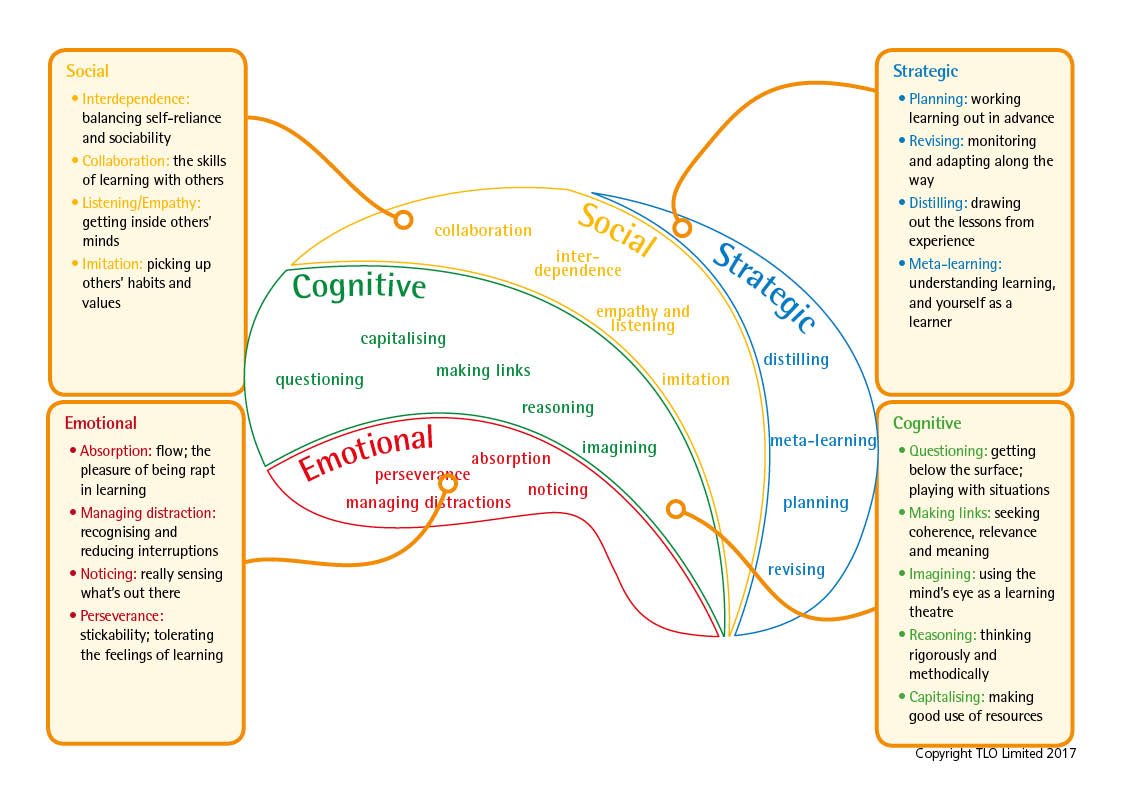
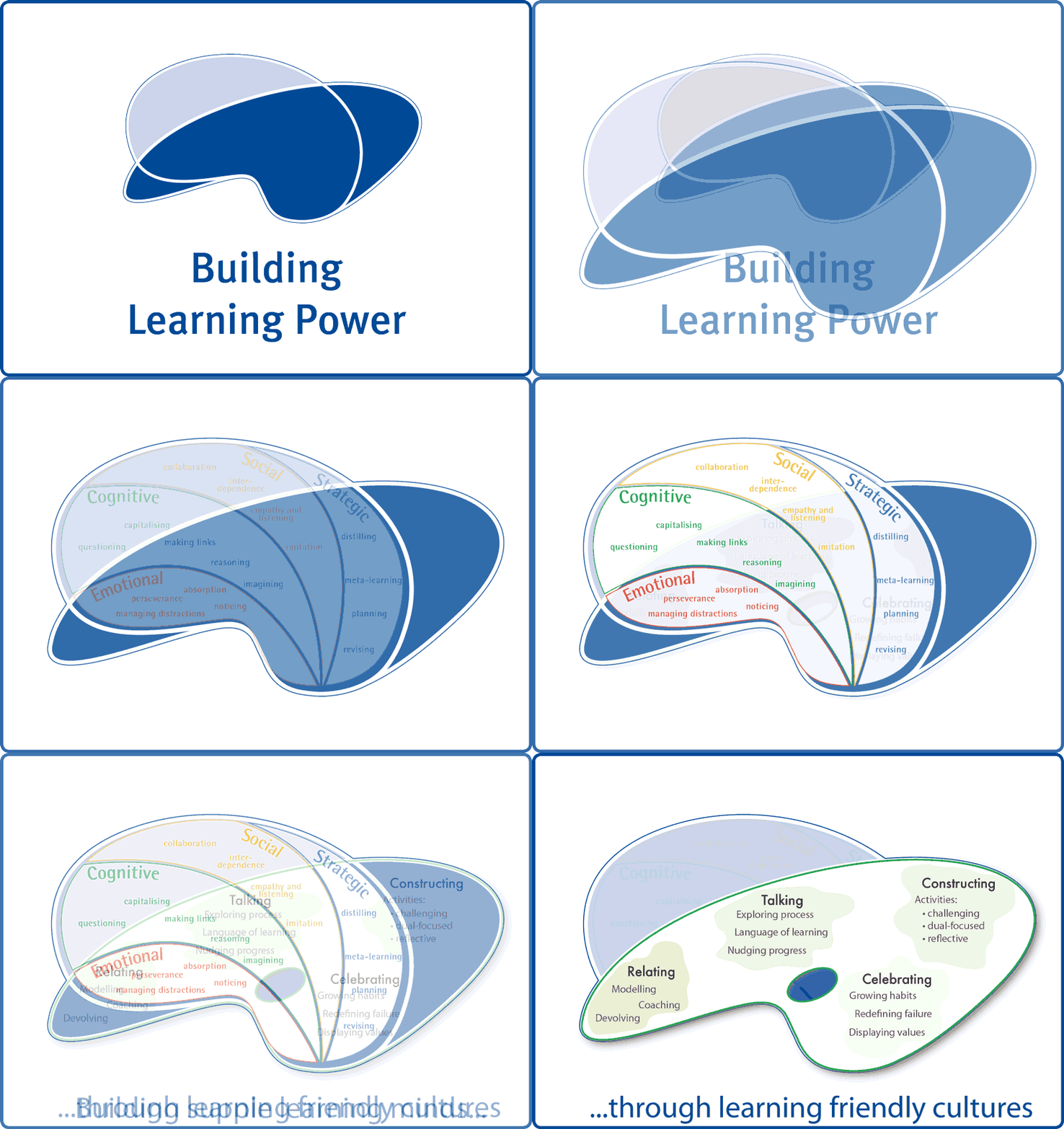
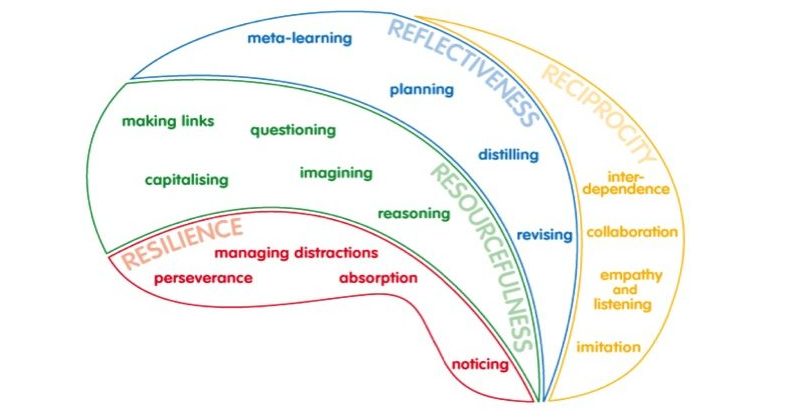
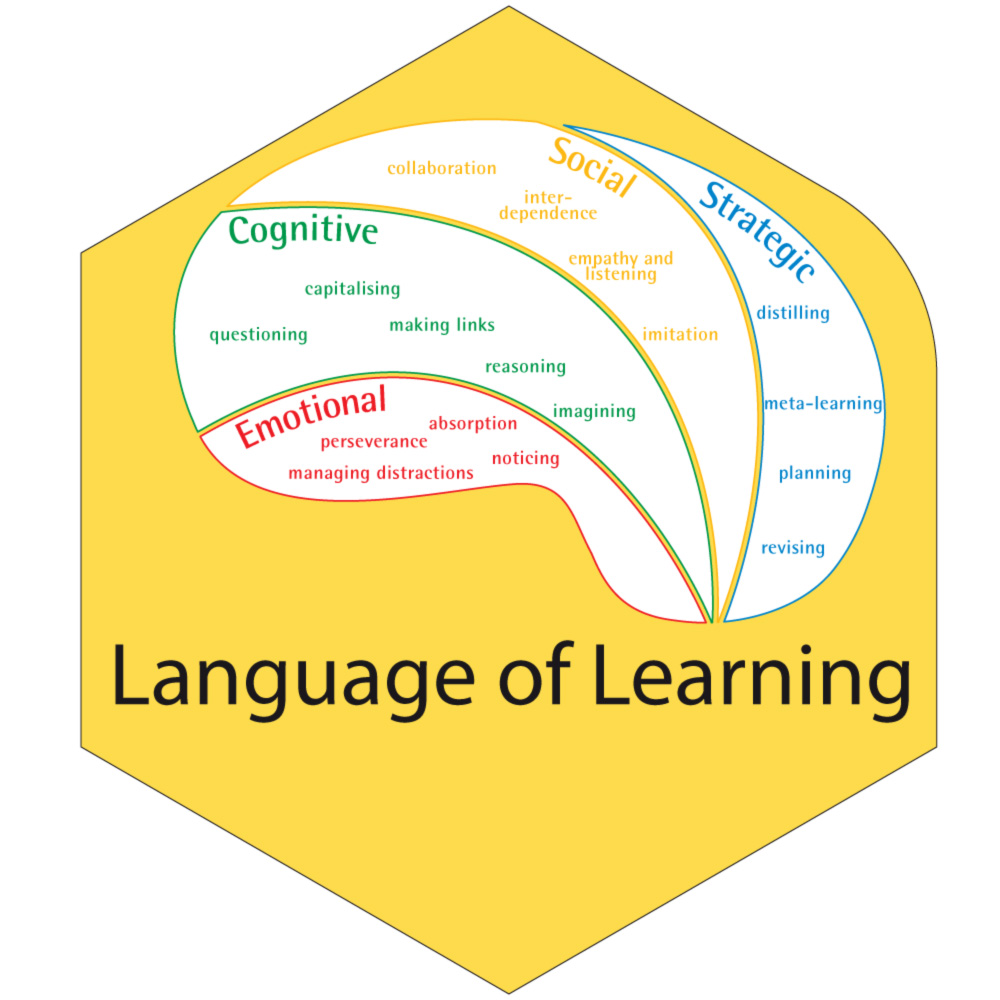
The Supple Learning Mind framework was originally conceived and researched by Professor Guy Claxton. It captures the key psychological characteristics that are judged to be of the highest value in helping students to learn and thrive in a complex world. The framework embraces each of the domains of learning and these are shown in its four parts:
The Emotional domain of learning (sometimes described as Resilience)
The Cognitive domain of learning (sometimes described as Resourcefulness)
The Social domain of learning (sometimes described as Reciprocity)
The Strategic domain of learning (sometimes described as Reflectiveness)
This learning framework shows that learning isn’t just about having a good memory; it includes how we feel, how we think, how we learn with others and how we manage the process of learning. It shows that learning is a complex process. Furthermore it provides a language that helps teachers to think about how they cultivate each of the learning behaviours and helps students to gain a better personalised understanding of how they learn content.
Each domain clusters together the high value learning behaviours that best make that domain work well. For example the social domain is made up of the learning behaviours of interdependence, collaboration, listening and empathy and imitation.
Getting wider . . . .
Taken together, these 4 domains of learning, exemplified by the associated 17 high-value learning behaviours, and further refined by a clear understanding of how these skills and behaviours grow and develop over time, provide the depth of understanding to enable teachers to:
Make the given wider skills more understandable and applicable to both learning in the classroom and to life;
Offer more shape/ nuance to a learning friendly classroom and learning friendly teaching;
Give a more practical expression to the core purposes that Successful Futures seeks to achieve.
You’re not currently enrolled in this unit and can’t access the sections of the unit below. Please contact us if you have any questions about accessing this unit.
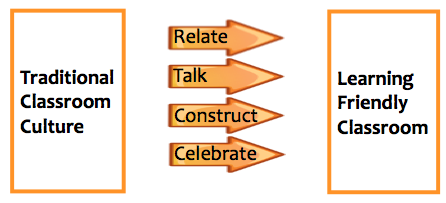
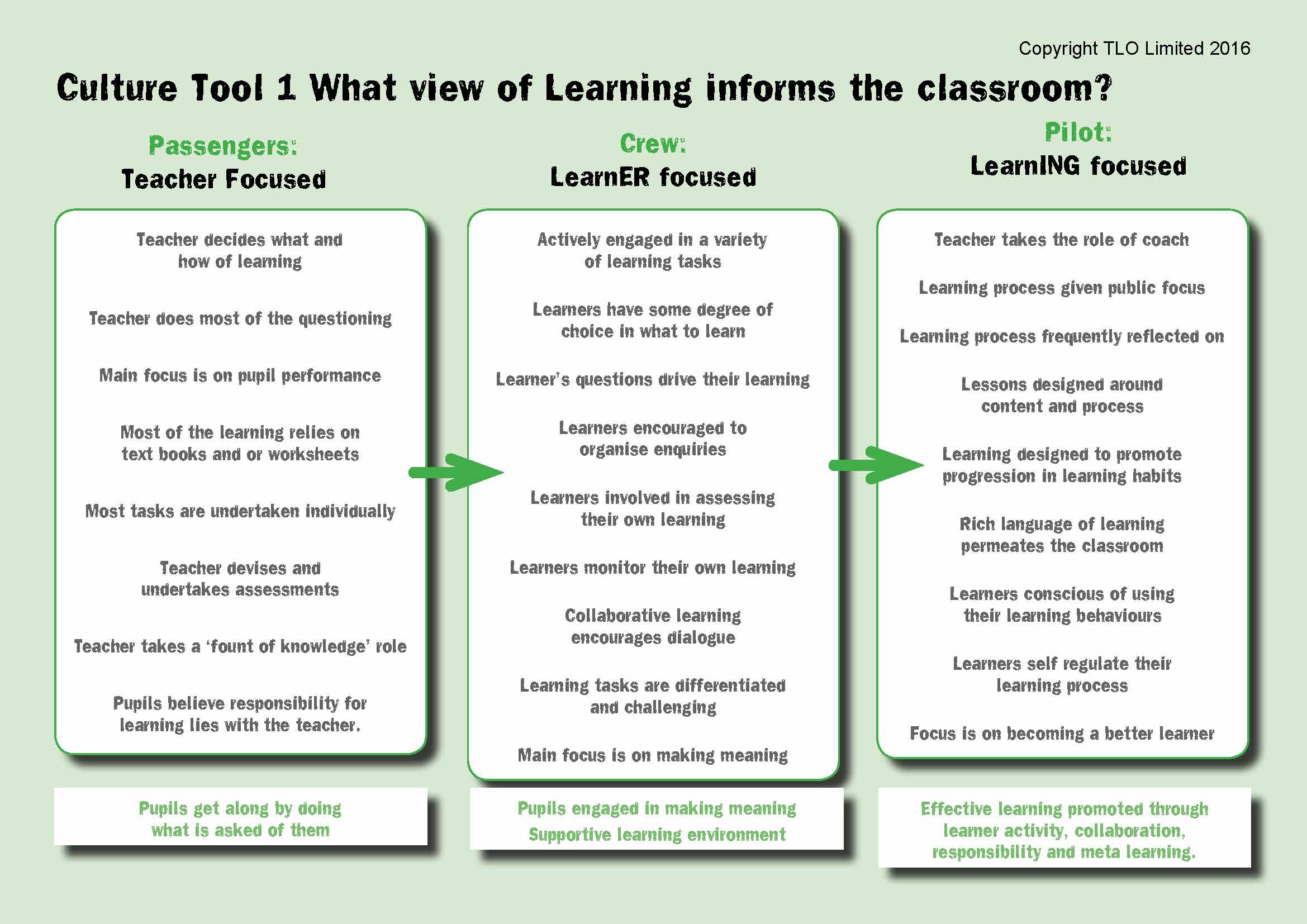
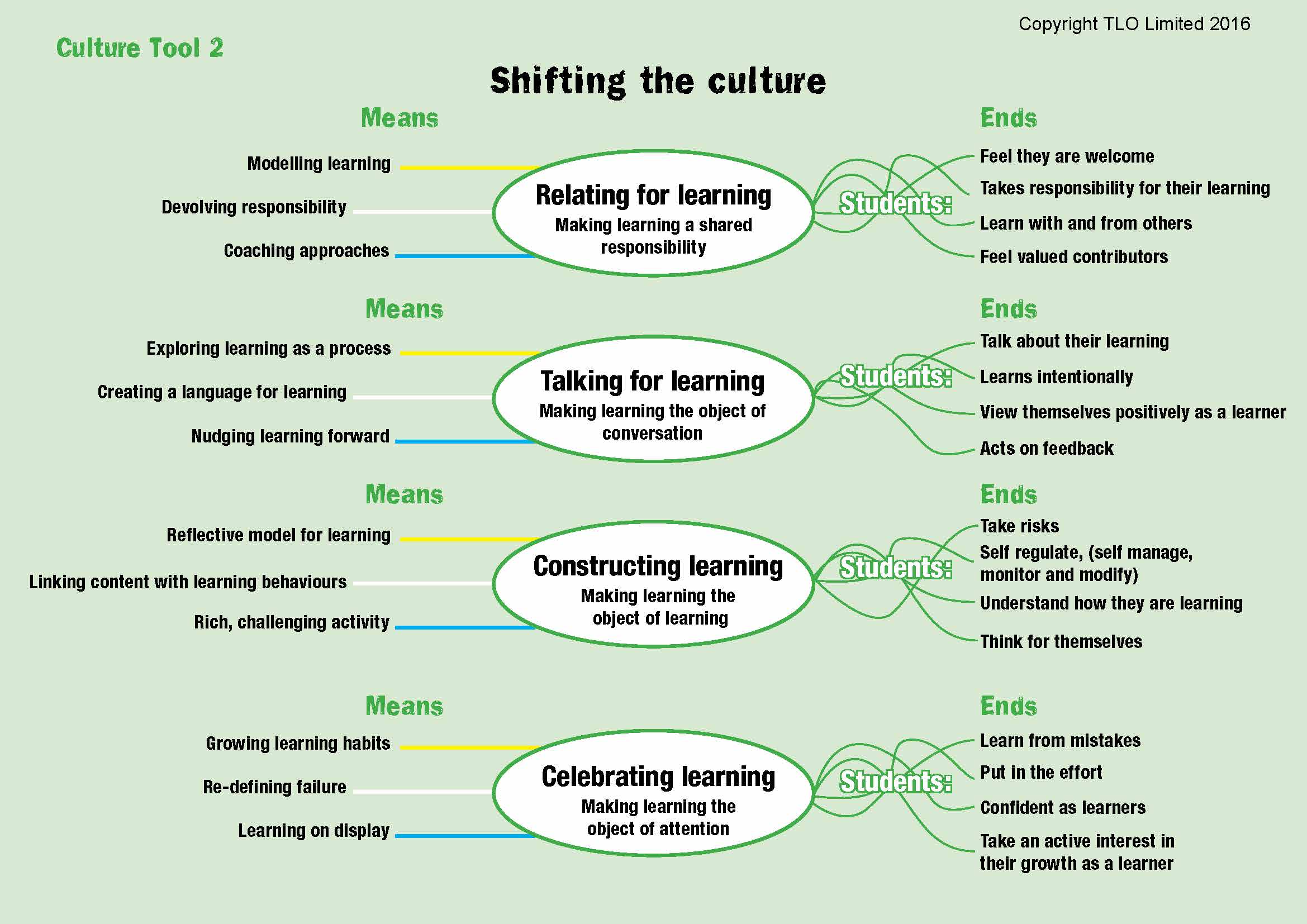
Building powerful learners involves shifting classroom cultures from teacher-focused to learning-friendly.
Find out about the 4 aspects of classroom culture:
The relationships in the classroom;
What is talked about;
How lessons are designed;
What is celebrated.
and gain an overview what these look like in teacher-focused classroom and learning-friendly classrooms.
If you are reading this as a senior leader… reflect on classroom cultures across the school.
If you are reading this as a classroom practitioner… reflect on your own classroom culture.
A Transforming Culture
Making learning power work involves transforming the culture of the classroom. A common language for learning is adopted; staff shift responsibility for learning to students and model learning by sharing their own difficulties, frustrations and triumphs; students come to understand themselves as growing learners and consciously improve their learning habits; teachers assume the role of learning-power coach, offering students interesting, real and challenging activities to enable them to create their own knowledge and stretch their learning habits. Underpinning this is the obvious reality that students will only change their behaviours once their teachers have changed theirs’.
The culture of the classroom is determined by how teachers are, the relationships that exist between the teacher and the learners, the ways in which the teacher talks and what the teacher talks about, the extent to which teaching is designed to ensure both content acquisition and the development of learning behaviours, and the often subliminal messages about what the teacher really thinks is important.
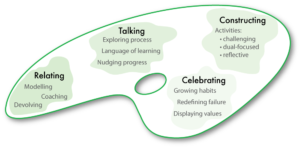
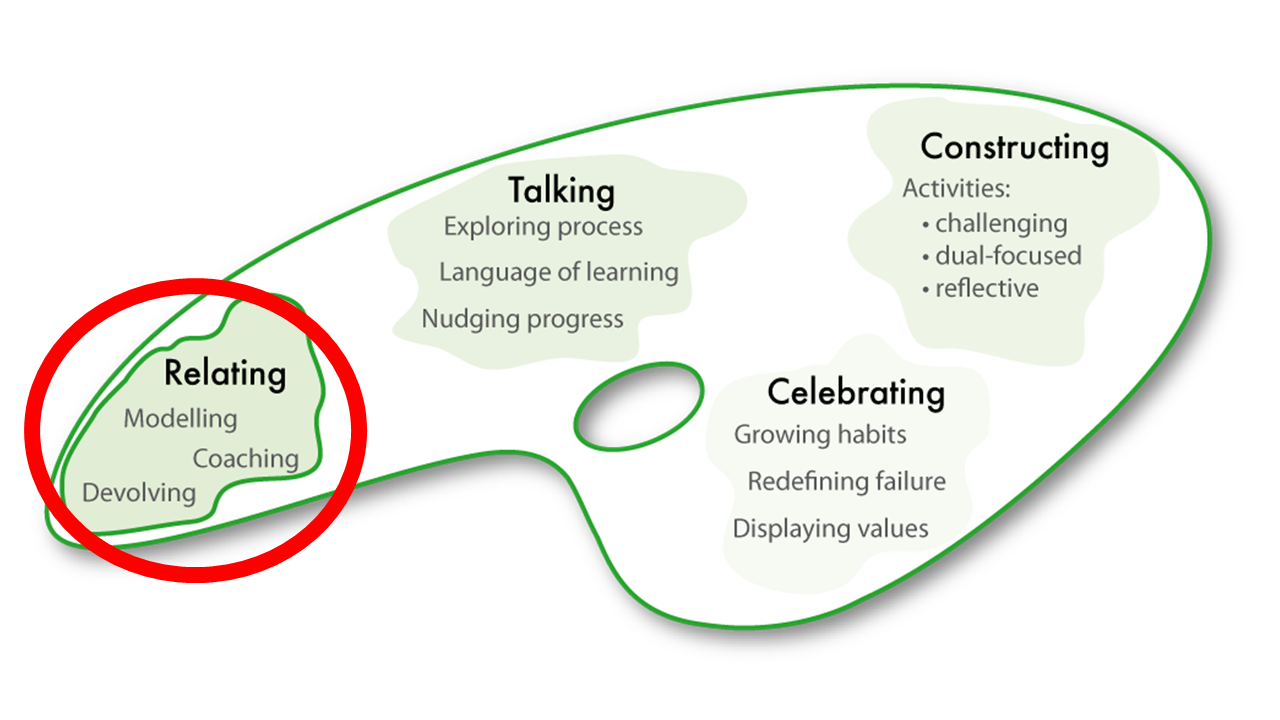
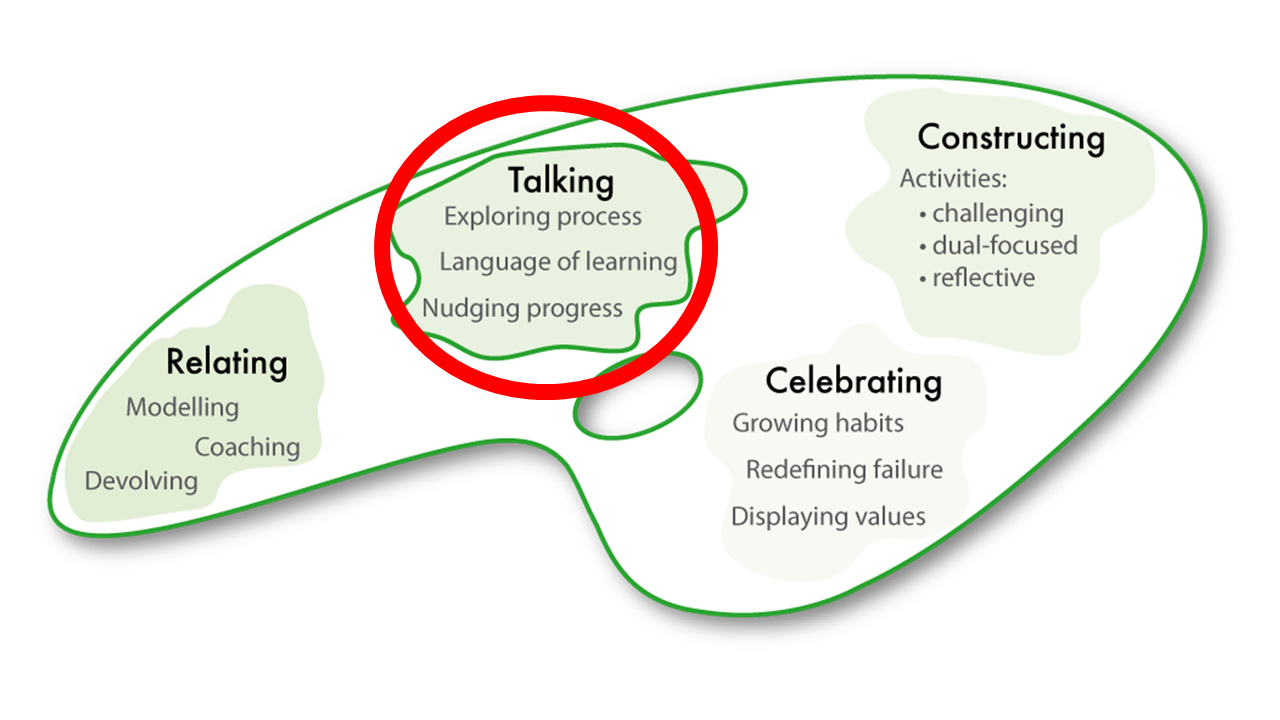
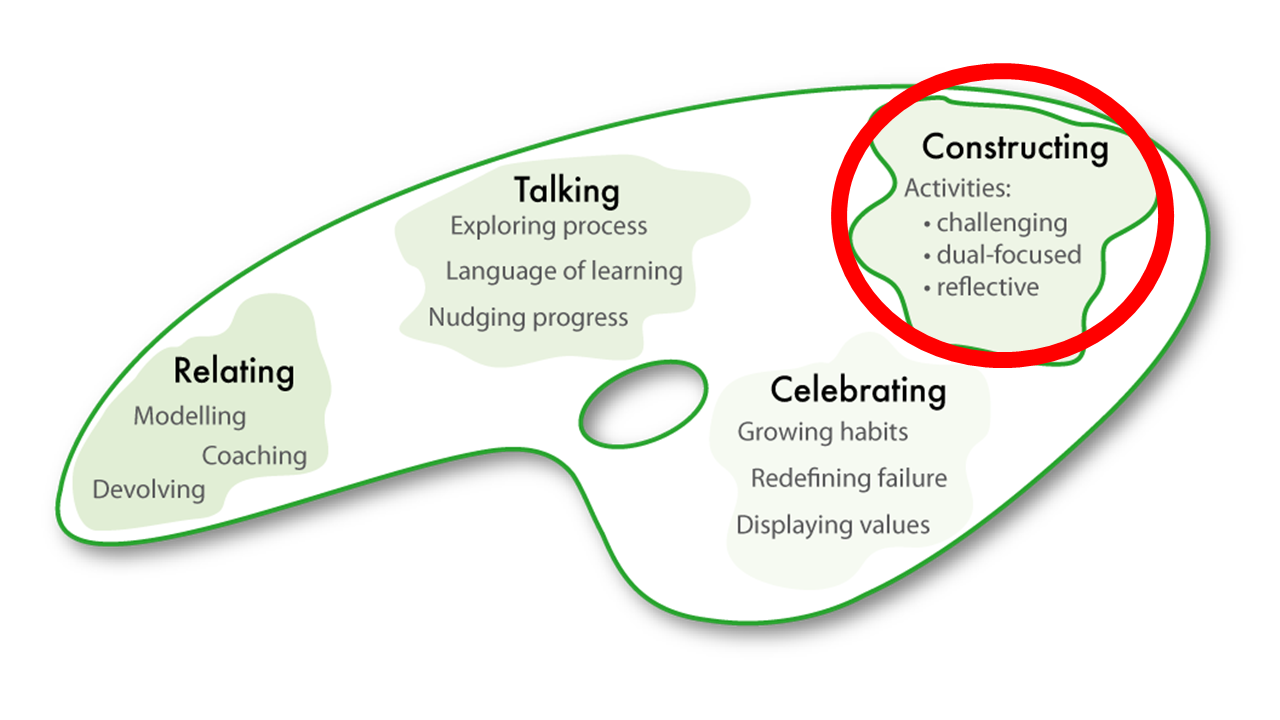
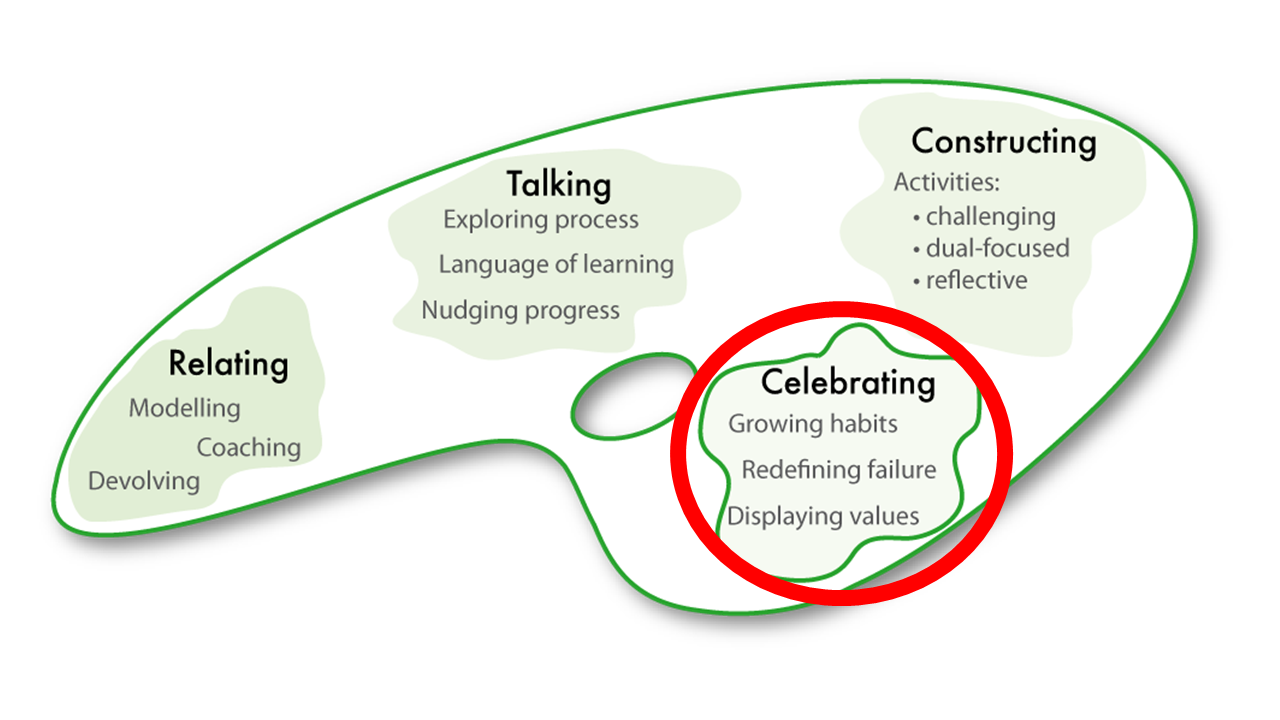
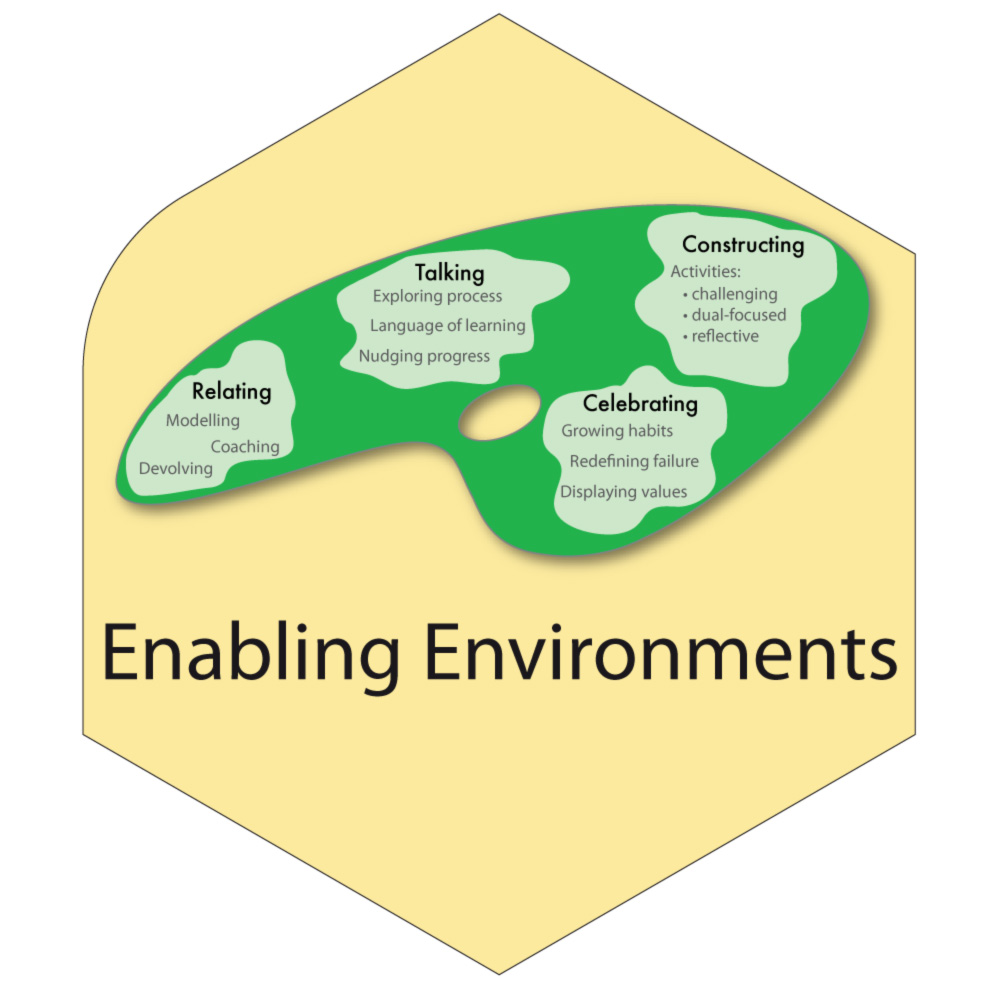
These 4 aspects of culture – Relating, Talking, Constructing and Celebrating – form the basis of The Teachers’ Palette, one of the two key models in Building Learning Power.
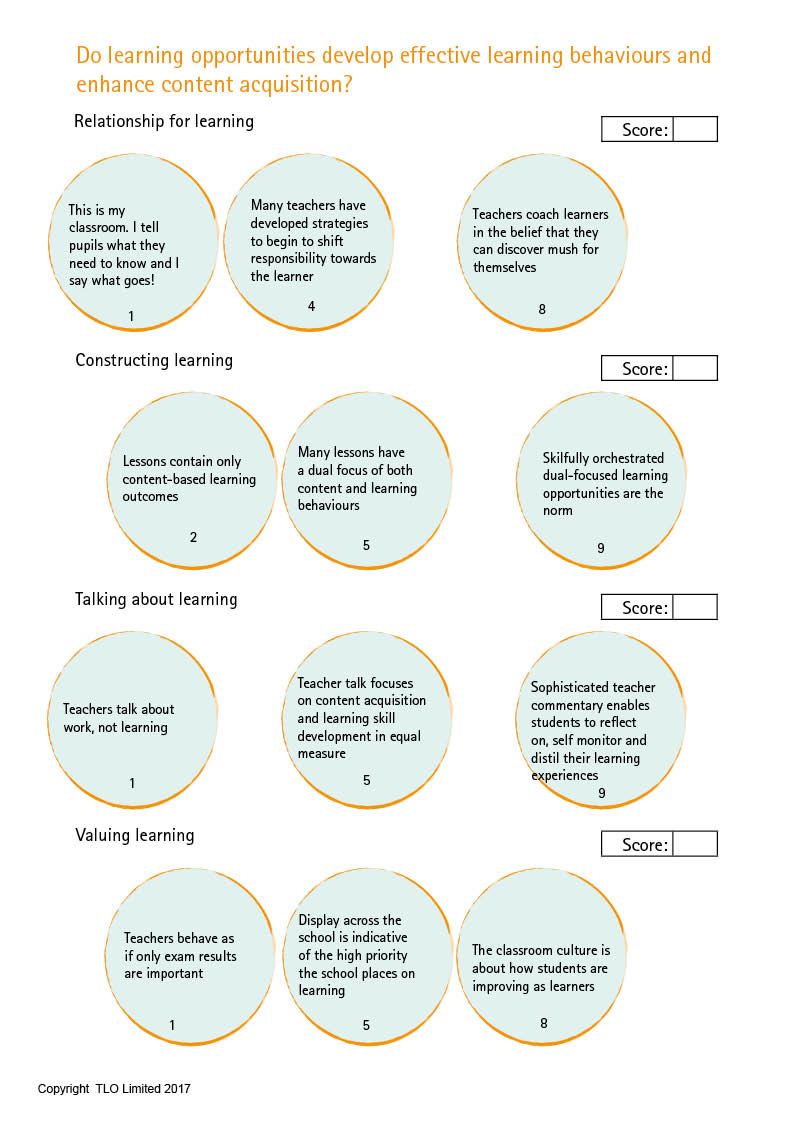
Which of these descriptions of teacher-focused and learning-friendly cultures better describes your classroom(s)?
Relating for Learning
Consider these two descriptions, the former of a classroom where relationships for learning are teacher-centred, and the latter of a classroom where responsibility is shared.
Relating in a teacher-focused classroom
The classroom is heavily teacher-led and responsibility for learning lies almost exclusively with the teacher. Teachers teach efficiently and students make good content progress. Students have little influence on the direction of their own learning. They go to school to be taught things by an expert. The underlying culture is ‘teacher knows best’.
Relating in a learning-friendly classroom
Responsibility is genuinely shared, teachers and learners learn together, with and from each other. Teachers are skilful coaches who value discovery over instruction in the belief that students can discover much for themselves. Students exercise choice and pursue their own lines of enquiry. The line between teacher and learner is increasingly blurred.
Talking for Learning
Consider these two descriptions, the former of a classroom where talk is almost exclusively about content, and the latter of a classroom where talk is about how students are learning.
Talk in a teacher-focused classroom
Talk is mostly about content and ‘working hard’, teachers are inclined to discuss ‘the right way of doing things’ to get things right. Supportive comments and feedback focus on subject knowledge. Discussion about learning, when it happens, is often ill-focused and relates, for example, to ‘doing your best’ or ‘working in a group’.
Talk in a learning-friendly classroom
A rich and differentiated language of learning permeates classroom discourse, teachers and students together explore and reflect on the process of learning and how it can be improved. Both exhibit fluency and deep understanding. Teacher comments are differentiated and supportive and nudge students to focus on the what and on the how of learning, and how they are linked.
Constructing Learning
Consider these two descriptions, the former of a classroom that focuses on understanding the content, and the latter of a classroom that focuses equally on developing content understanding and growing learning behaviours.
Lesson design in a teacher-focused classroom
Attainment and examination success are the key drivers, teachers design lessons to ensure effective content acquisition. Activities are designed to address the content to be learned. Reflection is confined to reflection on what content has been learned, and is frequently done by teachers for learners.
Lesson design in a learning-friendly classroom
Teaching is constructed with learning in mind, teachers skilfully orchestrate lessons to ensure progression in content and the acquisition of effective learning habits. Activity is characterised by a range of rich, challenging, open ended tasks or problems. Reflection focuses on what was learned and how it was learned and how well it was learned and how it might be applied elsewhere.
Celebrating Learning
Consider these two descriptions, the former of a classroom that prizes knowledge acquisition, and the latter of a classroom that demonstrates a commitment to building better learners.
Celebration in a teacher-focused classroom
Classroom culture focuses on ‘knowing stuff’, teachers act to improve content learning without focusing on the process of learning. Improvements in students’ learning behaviours come about by chance and without direct teacher intervention. Teaching is frequently risk-averse, and display focuses almost totally on content. Rewards tend to be given for high attainment or progress rather than for effective learning behaviours.
Celebration in a learning-friendly classroom
Classroom culture prizes students’ growth as learners as highly as their curriculum attainment, and teachers take action to help individual students to grow as learners. They ensure that learning is sufficiently challenging to induce errors from which learning about content and learning about learning can be achieved. Creative, interactive display enables students to understand how learning behaviours support and enhance content acquisition.
Which of the four aspects of culture is most learning-friendly in your classroom/school?
What more needs to be done?
Which of the four aspects is least learning friendly? What could you do differently?
If you were to look back on this in six month’s time, which aspect would you most like to have progressed?
Building Better Learners is about creating a culture in classrooms – and the school more widely – that systematically cultivates habits and attitudes that enable young people to develop supple learning minds.
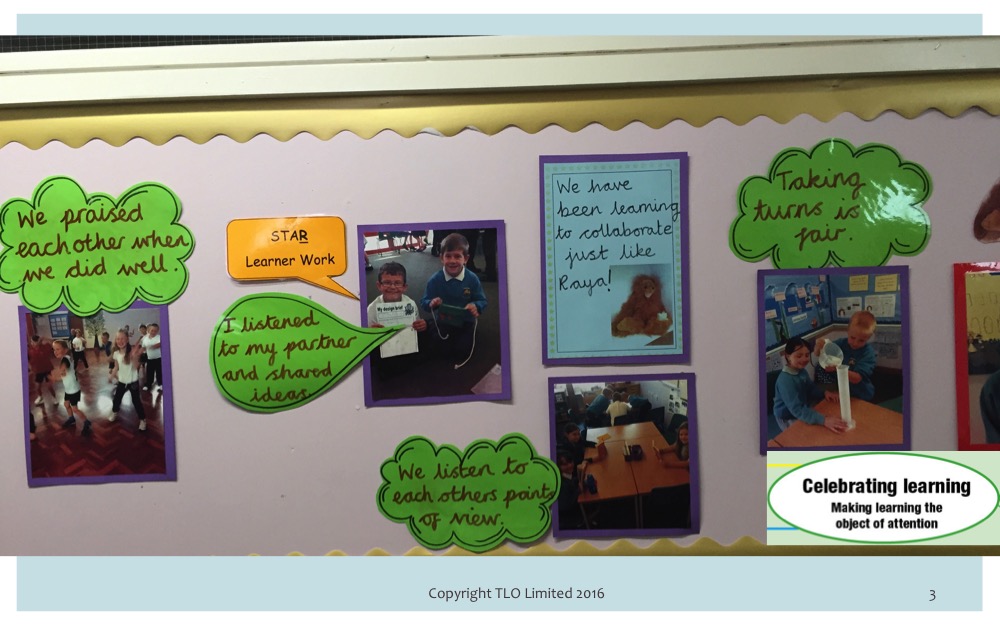
This section explores what is entailed in making learning the object of attention, where the values of learning become clear in what is celebrated (praised, recognised, displayed) day in and day out in the classroom thus generating a rich learning friendly culture.
Key Learning Question:
How might we start showing the learning values of the classroom more clearly?
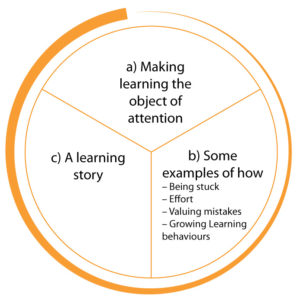
a) Making learning the object of attention
As we saw in section 3.1 Celebrating learning is about making learning the object of attention. Here the values of learning bubble up and show themselves in what you attend to, what you recognise, what you praise, what you display and celebrate. In learning friendly classrooms failure, mistakes, being stuck and applying effort have been re-framed so that learners come to view these old adversaries as valuable, interesting and essential. Furthermore the other major shift here is that the development and growth in learning behaviours themselves are given attention, praise and recognition. In the early stages re-defining the quest-like values of learning might simply include:
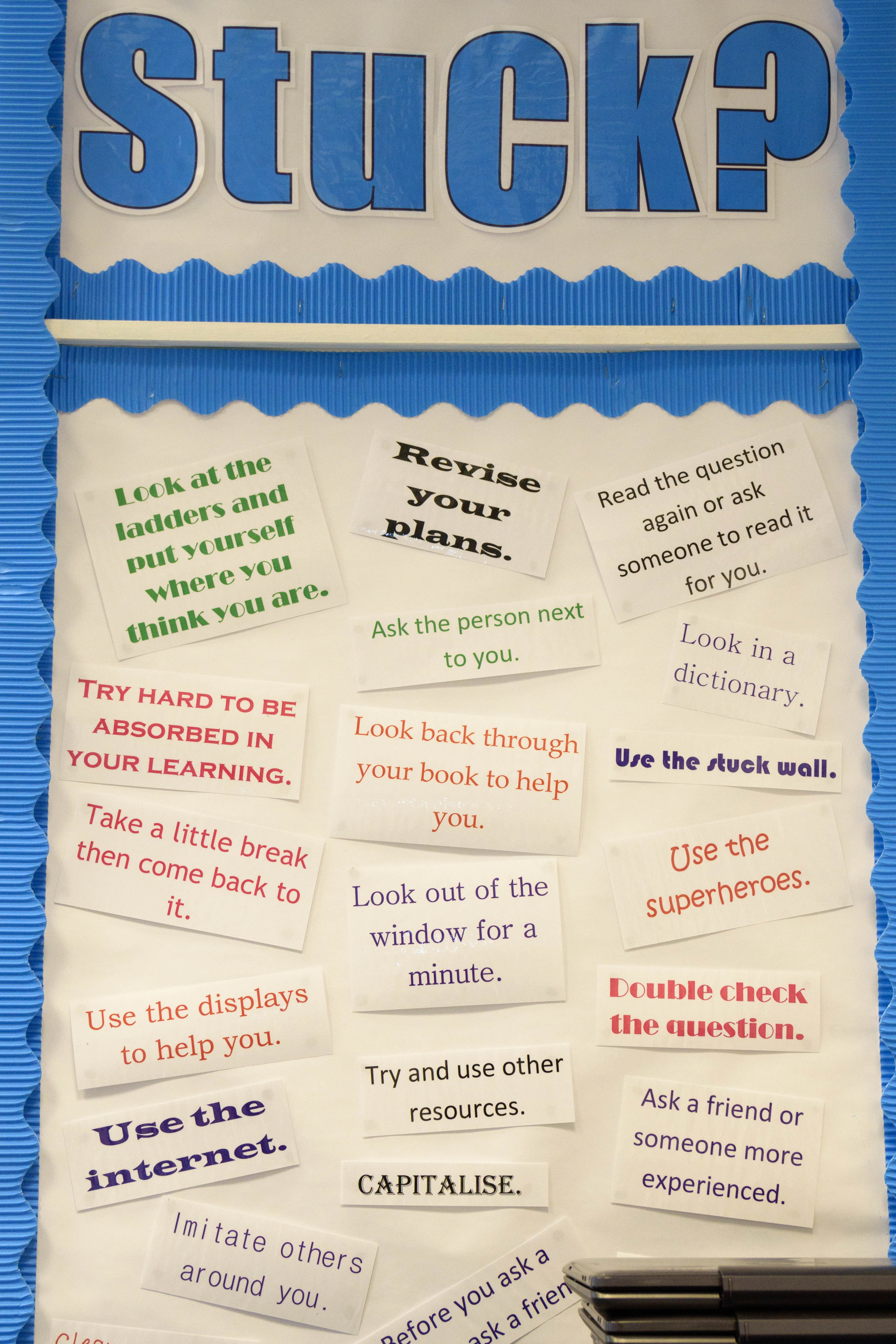
ensuring students (and parents) understand ‘being stuck’ as an interesting not shameful position, with tactics to get unstuck (see 3.2);
ensuring students (and yourself and parents) understand what is meant by effort;
ensuring students (and parents) understand the value of mistakes;
celebrating students’ progress in learning behaviours.
The success of this shift will depend on consistency and strong emphasis. You have to make these ideas/values obvious, big and overblown. Whispering them quietly won’t work. They have to be shouted about and put ‘in-your-face’ if they are to stick, be believed, be understood and capitalised on.
Have learners identify the obstacle to their progress. I’m stuck because.
Model and talk through the ‘getting unstuck process.
Use the Visible Thinking Routine ‘What do I know? What do I need to know? What techniques do I have to bridge the gap?’
If students freeze, offer supportive questions, not answers. ‘What do you do next?’, ‘What could you try?’, ‘What worked last time?’ etc. You are encouraging students to take over the job of thinking it through for themselves.
What to do when you don’t know what to do
2) Attending to what you mean by effort
Teachers often call for more effort from students but what do we mean by this?
Effort: it’s about focusing and re-focusing the mind on the work you are doing. Something is directing students’ attention.
For example the following could be used to focus the mind:
looking for different strategies;
using trial and error to deal with challenge;
using success criteria to direct what you do;
asking for feedback on how to improve/apply;
attending to working memory – free-up space via scraps of paper, verbalising thoughts, scaffolding tasks.
Say something more useful than ‘try harder’
3) Attending to valuing mistakes
Give mistakes high status, a key role in learning
Say that you expect students to make, for example, 3 in a lesson. If they haven’t made the quota of mistakes they are to ask for harder work
Make a ‘Mistakes of the Week’ display.
identify Good mistakes – as misconceptions and discuss them
Offer a range of examples of good mistakes as lesson starters for students to find and discuss.
Model making mistakes and how you learn from them.
Good mistakes
4) Attending to growing learning behaviours
How might secondary schools demonstrate their commitment to growing learning behaviours through display ?
The first imperative is to gain a sense of what ‘getting better’ means. Some schools have taken our progression maps, as illustrated in module 2.7, but that is only the first step. These grids are written in ‘professional speak’ and need to be adapted for a student audience. Moreover, some cells contain more than one key idea and these ideas might need to be disaggregated. Hence one progression map could give rise to well over 30 progression steps ! Clearly some editing will be necessary.
Having generated, perhaps in consultation with students, a manageable number of steps in student speak, where to display it ? The question is further complicated by the fact that there are a dozen such progression grids, each giving rise to what some schools call ‘learning lines’.
Twelve such learning lines, in every classroom ? Bedford High in Leigh, and Landau Forte in Derby, have both decided to display these learning lines in public circulation areas, thereby illustrating their interest in and commitment to growing learning behaviours.
Read the Learning Story that follows to see the impact at Bedford High.
Catch them ‘doing it’ and display it
c) A learning story
Below is part of a Learning Quality Framework report on Bedford High that had developed its own learning lines as detailed in the previous section ‘Attending to growing learning behaviours’
“The school is considering a variety of formative methods of assessing, recording and reporting progression in learning habits. Senior leaders have already detected students becoming better able to self-evaluate and use the language to describe their learning. The planned Year 7 Assessment and Progress document will deepen students’ ability to track and record their own learning development.
The school’s progression map as expressed by the learning lines, is in its infancy. Thus far, 8 learning lines have been developed by teachers in consultation with students, and the school is aware of the need to complete the remainder. Given that these lines were only developed in the summer term, it is not surprising that they have yet to back-wash into the school’s learning language or teacher planning. However there are encouraging signs – already many students have noticed the displays and some are being engaged in them by form tutors.
Students say:
“You can use the learning lines to create targets for yourself”;
“They help you to reflect personally”;
“The lines motivate you to get better”;
“The lines have helped me to appreciate that I am not as good as I thought I was”.
Teachers say:
“It was fantastic to be part of the learning line creative team”
“The lines have helped to improve my teaching – ten fold”.
There is already evidence of students recording and reflecting on their progress as learners within the y7/8 BLP course, and the presence of learning lines will inevitably make this more precise and effective. Senior leaders consider this to be an important factor in narrowing the performance gap between boys and girls.”
Noticing Learning
PRIMARY
Building Better Learners is about creating a culture in classrooms – and the school more widely – that systematically cultivates habits and attitudes that enable young people to develop supple learning minds.
This section explores what is entailed in making learning the object of attention, where the values of learning become clear in what is celebrated (praised, recognised, displayed) day in and day out in the classroom, thus generating a rich learning friendly culture.
Key Learning Question:
How might we start showing the learning values of the classroom more clearly?
a) Making learning the object of attention
As we saw in section 3.1 Celebrating learning is about making learning the object of attention. Here the values of learning bubble up and show themselves in what you attend to, what you recognise, what you praise, what you display and celebrate. In learning friendly classrooms failure, mistakes, being stuck and applying effort have been re-framed so that learners come to view these old adversaries as valuable, interesting and essential. Furthermore the other major shift here is that the development and growth in learning behaviours themselves are given attention, praise and recognition. In the early stages re-defining the quest-like values of learning might simply include;
ensuring pupils (and parents) understand ‘being stuck’ as an interesting not shameful position, with tactics to get unstuck (see 3.2)
ensuring pupils (and yourself and parents) understand what is meant by effort
ensuring pupils (and parents) understand the value of mistakes
celebrating pupils’ progress in learning behaviours
The success of this shift will depend on consistency and strong emphasis. You have to make these ideas/values obvious, big and overblown. Whispering them quietly won’t work. They have to be shouted about and put ‘in-your-face’ if they are to stick, be believed, be understood and capitalised on.
Have learners identify the obstacle to their progress. I’m stuck because.
Model and talk through the ‘getting unstuck process.
Use the Visible Thinking Routine ‘What do I know? What do I need to know? What techniques do I have to bridge the gap?’
If pupils freeze, offer supportive questions, not answers. ‘What do you do next?’, ‘What could you try?’, ‘What worked last time?’ etc. You are encouraging pupils to take over the job of thinking it through for themselves.
What to do when you don’t know what to do
2) Attending to what you mean by effort
Teachers often call for more effort from pupils but what do we mean by this?
Effort: it’s about focusing and re-focusing the mind on the work you are doing. Something is directing pupils’ attention.
For example the following could be used to focus the mind;
looking for different strategies
using trial and error to deal with challenge
using success criteria to direct what you do
asking for feedback on how to improve/apply
attending to working memory. Free-up space via scraps of paper, verbalising thoughts, scaffolding tasks
Say something more useful than ‘try harder’
3) Attending to valuing mistakes
Give mistakes high status, a key role in learning
Say that you expect pupils to make, for example, 3 in a lesson. If they haven’t made the quota of mistakes they are to ask for harder work
Make a ‘Mistakes of the Week’ display.
identify Good mistakes – as misconceptions and discuss them
Offer a range of examples of good mistakes as lesson starters for pupils to find and discuss.
Model making mistakes and how you learn from them.
Good mistakes
4) Attending to growing learning behaviours
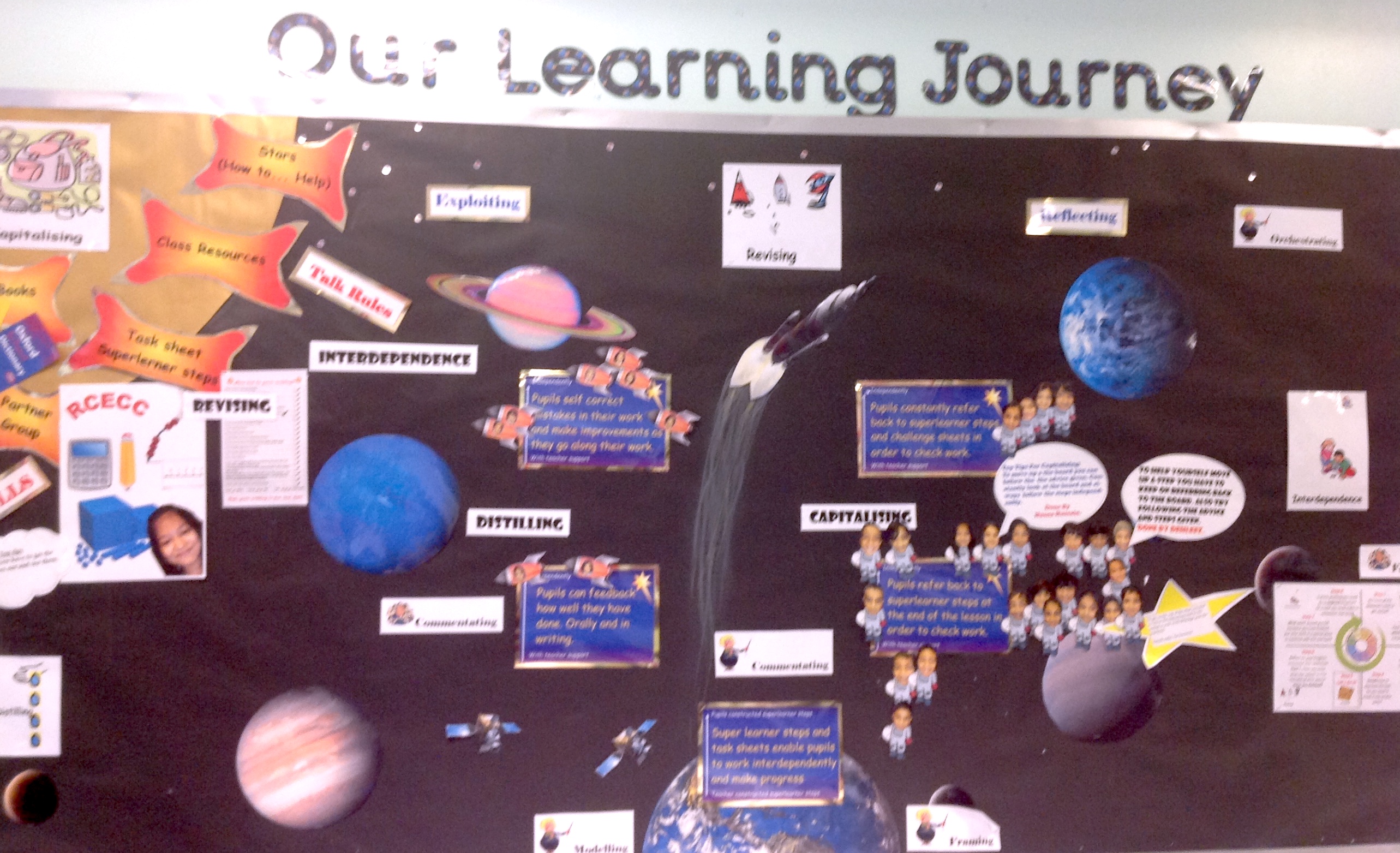
Display photographs of pupils displaying learning behaviours.
Map a learning behaviour journey and have pupils position their images to show where they have reached.
Award learners of the week in assemblies. Award use of learning behaviours rather than performance.
Catch them ‘doing it’ and display it
c) A learning story
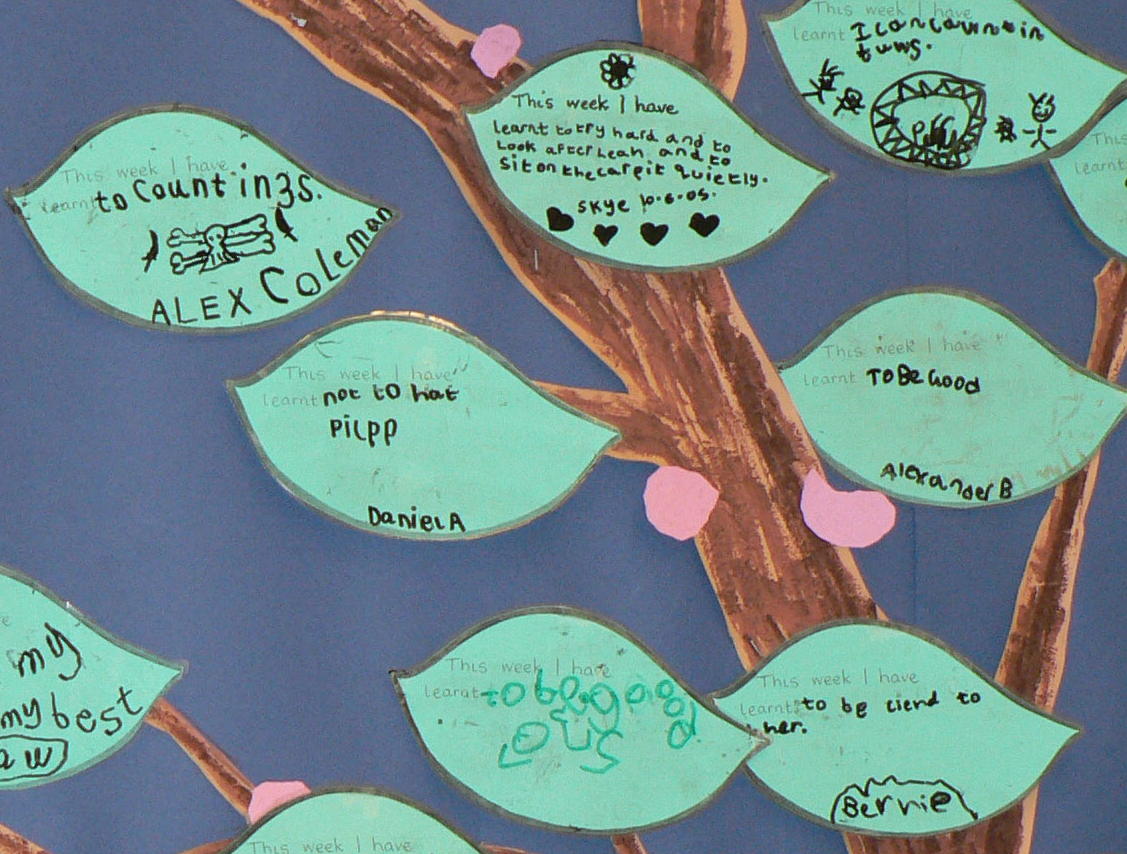
At Briar Hill Infant School near Leamington Spa you can see this process in action. As soon as a learning behaviour has been introduced the children are encouraged to notice when they use it, and to briefly record what they have done—imagined something, used a good question, managed a distraction and so on —on a sticky note which they stick on a Learning Tree wall display. Teachers are on a constant look-out for the behaviours they have been explaining, encouraging and enabling, which they, too, capture through photographs or on sticky notes and add to the Learning Tree. This ‘looking for learning’ is further enhanced by ‘learning detectives’: two children who are assigned this role each day and who look for good learning behaviours in others and again add them to the Learning Tree. At the end of the day the Learning Tree offers a rich source of information to reflect on, explain, and reinforce through a whole-class learning power discussion.
At the end of the week the sticky notes are carefully saved in a large scrapbook. This gives the teachers a running record of what the children have been doing and noticing about themselves. Although this has only been in operation for a term or so the teachers are using their analysis of the weekly data to plan further development. They are refining their professional view of how their students’ learning power behaviours can be converted into instinctive habits.
Building Better Learners is about creating a culture in classrooms – and the school more widely – that systematically cultivates habits and attitudes that enable young people to develop supple learning minds.
In this section we look briefly at how teachers begin to shift the construction of learning in order to stretch students’ use of learning behaviours.
Key Learning Question:
How does the construction of learning in the classroom change?
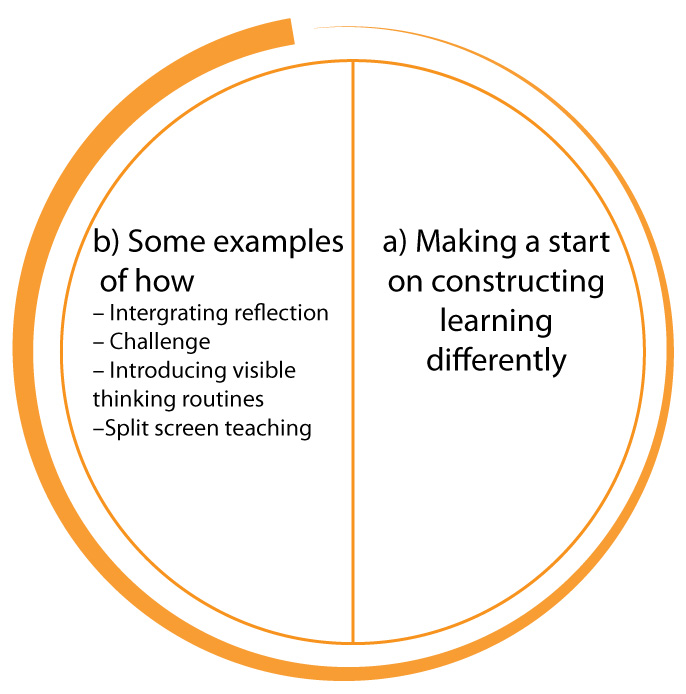
a) Making a start on constructing learning differently
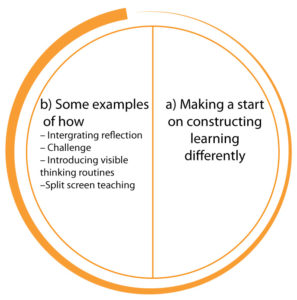
As we saw in section 3.1, Constructing learning firstly involves integrating reflection and review into the way learning is organised; where activities are designed to stretch and challenge not just in outcome terms but in the very nature of ‘doing’ the task (dual focus of content and process). students’ emotional engagement is a pre-requisite when learning is organised in these ways, and the value of learning is in pushing yourself so that your capacities are stretched and strengthened. The early stages of making a shift in this aspect of the learning friendly classroom might simply include;
plan lessons to explicitly include reflection and review purposefully
making challenge fun and available in forms other than activities
introducing a couple of Visible Thinking Routines
beginning to dabble with split screen learning
The classroom becomes a place where young people learn that to struggle with a problem is ultimately satisfying and brings its own rewards.
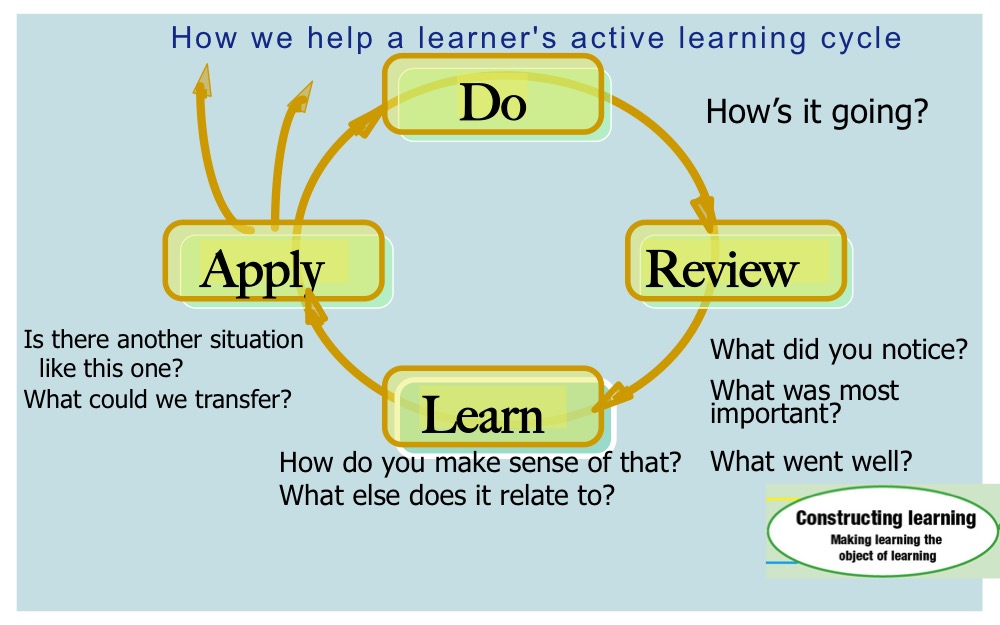
Reflection has become widely seen as part and parcel of good learning. Strategic approaches such as ‘Plan Do and Review’ have been with us for many years. More recently ‘Assessment for Learning’ has emphasised the role of reflection in improving learning and achievement. Students are now much more familiar with such techniques.
As Mike Hughes observes in ‘Closing the Gap‘
“Trying to learn without reviewing is like trying to fill the bath without putting the plug in”
And yet, reflection is still used by many schools for summative evaluation of a piece of work, rather than being woven formatively throughout the learning and production process.
Being able to reflect, review and refine your ideas is one of the key learning characteristics. Students need to be taught;
not to wait till they’ve finished before reviewing what they are doing;
to keep making small checks and revisions all the time as they go along …am I on the right track? Is there something I’m missing?.
to check what they have done at the end…is this as good as I can make it?
at the end, to think about whether there’s a better way to do it?
Reflection and review as non-negotiables
2) Making challenge available and fun
There’s a big link between emotional engagement and challenge
Learning is always an emotional business and learning how to manage this is best done ‘on the job’ in the course of learning rather than as a separate stand-alone activity. Emotional engagement is a prerequisite of powerful learning, it’s what gets you interested enough to be willing to put in the effort to get better and see the value of pushing yourself. So lessons aren’t just designed to make use of different kinds of learning behaviours but to give those behaviours a good work-out. Activities are designed to:
be challenging, where being stuck and confused are regular and fruitful experiences.
give students the opportunity to ‘learn what to do when they don’t know what to do’ – to work on wild tasks, rather than tame ones, where there’s plenty of scope to get lost and perplexed.
“The presence of challenging learning intentions has multiple consequences. Students can be induced to invest greater effort, and invest more of their total capacity than under low demand conditions.”
(John Hattie, Visible Learning)
Or, as a teacher said to us recently:
“I became a better teacher the day I stopped thinking ‘have I made it easy enough for them to understand it?’ and started thinking ‘have I made it hard enough to stretch them?'”
Try these ideas to support challenge
Make positive connections between making mistakes and challenge
Model how to think about and work through challenges
Create a challenge wall; put up questions, extension tasks, riddles, problems. A go-to place for another challenge when other learning is finished
Display work that shows students have improved mistakes etc.
Stimulate using ‘Stingray’ questions…What if...(something they thought they knew from a different angle – What if gravity was twice as strong ?)
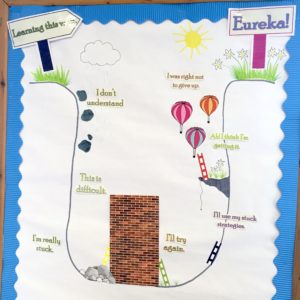
Use the ‘learning pit’ to talk through what to do to overcome/surmount a challenge.
The Learning Pit
You need to be emotionally engaged to take on challenge.
3) Introducing Visible Thinking Routines for Reflection
What are Visible Thinking Routines?
VTRs are, as they say, simple routines that apply across a wide range of subjects and contexts, and which require students to think in a variety of different ways, that are used so regularly by teachers that they become woven into the fabric of the classroom culture and progressively hard-wired into the thinking practices of students.These are ways in which different ways of thinking can become routine in classrooms. They become part of the learning culture.
To be effective such routines need to be;
Direct, guide, support, encourage thinking
Short, memorable, few steps
Used over and over again
Useful in a variety of contexts
Facilitate connections, generating ideas, using knowledge
Find out more: Google ‘Visible thinking routines’
Connect Extend Challengeis a visible thinking routine for connecting new ideas to prior learning and encourages reflection.
It goes like this;
CONNECT: How are the ideas and information presented CONNECTED to what you already knew?
EXTEND: What new ideas did you get that EXTENDED or pushed your thinking in new directions?
CHALLENGE: What is still CHALLENGING or confusing for you to get your mind around? What questions, wonderings or puzzles do you now have?
The routine helps students make connections between new ideas and prior knowledge. It also encourages them to take stock of ongoing questions, puzzles and difficulties as they reflect on what they are learning.
Make thinking visible
4) Split screen teaching
Whether we realise it or not, all lessons have a dual purpose:
The content dimension, with material to be mastered
The ‘learning’ dimension, with some learning skills and habits being exercised.
In conventional lessons where students focus exclusively on mastering content while thelearning dimension is not acknowledged; students may learn ‘stuff’, but they remain unaware of how they are learning it. Such lessons make the content very public, while the associated learning behaviours remain a closely kept secret. So students learn habits of compliance or dependence.
In developing learning power, teachers are making conscious choices about which habits to introduce and stretch and how best to couple these with content so that lessons become more interesting and challenging. Through such overt coupling of content and specific types of process, students come to know, understand and take control of their learning behaviours – they knowingly use and develop the whole range of learning behaviours.
To make a start on this, try considering your plans for the coming week or month in relation to the following questions;
Where, in these plans, can you find opportunities to:
1. Build their emotional engagement
In your series of lessons, where do you expect students to become stuck?
What prompts would help them overcome their stuckness?
Are there any opportunities to encourage noticing behaviours?
2. Stretch their cognitive range
What proportion of your lessons are spent on encouraging students to question?
Where might you encourage more student questioning or playing with ideas?
To what extent are the activities predigested – where most of the work has been done for them?
How much do the activities generate students’ own initiative, questioning, research and information processing?
Could you make more activities ‘wild’ rather than ‘tame’?
What proportion of your series of lessons calls for disciplined, logical thinking and reasoning?
Could some of the activities be amended to foster imagination, visualisation, intuition?
3. Foster their interpersonal involvement – social
What proportion of your series of lessons requires students to collaborate in order to complete a task?
Could you fit more collaborative activity into your lessons?
4. Extend their strategic responsibility (Reflectiveness)
What proportion of your series of lessons involves students in monitoring and revising their own work?
Could you include more along these lines?
Infusing learning into lessons
PRIMARY
Building Better Learners is about creating a culture in classrooms – and the school more widely – that systematically cultivates habits and attitudes that enable young people to develop supple learning minds.
In this section we look briefly at how teachers begin to shift the construction of learning in order to stretch pupils’ use of learning behaviours.
Key Learning Question:
How does the construction of learning in the classroom change?
a) Making a start on constructing learning differently
As we saw in section 3.1, Constructing learning firstly involves integrating reflection and review into the way learning is organised; where activities are designed to stretch and challenge not just in outcome terms but in the very nature of ‘doing’ the task (dual focus of content and process). Pupils’ emotional engagement is a pre-requisite when learning is organised in these ways, and the value of learning is in pushing yourself so that your capacities are stretched and strengthened. The early stages of making a shift in this aspect of the learning friendly classroom might simply include;
plan lessons to explicitly include reflection and review purposefully
making challenge fun and available in forms other than activities
introducing a couple of Visible Thinking Routines
beginning to dabble with split screen learning
The classroom becomes a place where young people learn that to struggle with a problem is ultimately satisfying and brings its own rewards.
Reflection has become widely seen as part and parcel of good learning. Strategic approaches such as ‘Plan Do and Review’ have been with us for many years and form the basis of a good deal of learning in Early Years. More recently ‘Assessment for Learning’ has emphasised the role of reflection in improving learning and achievement. Pupils are now much more familiar with such techniques.
As Mike Hughes observes in ‘Closing the Gap‘
“Trying to learn without reviewing is like trying to fill the bath without putting the plug in”
And yet, reflection is still used by many schools for summative evaluation of a piece of work, rather than being woven formatively throughout the learning and production process.
Being able to reflect, review and refine your ideas is one of the key learning characteristics. Pupils need to be taught;
not to wait till they’ve finished before reviewing what they are doing;
to keep making small checks and revisions all the time as they go along …am I on the right track? Is there something I’m missing?.
to check what they have done at the end…is this as good as I can make it?
at the end, to think about whether there’s a better way to do it?
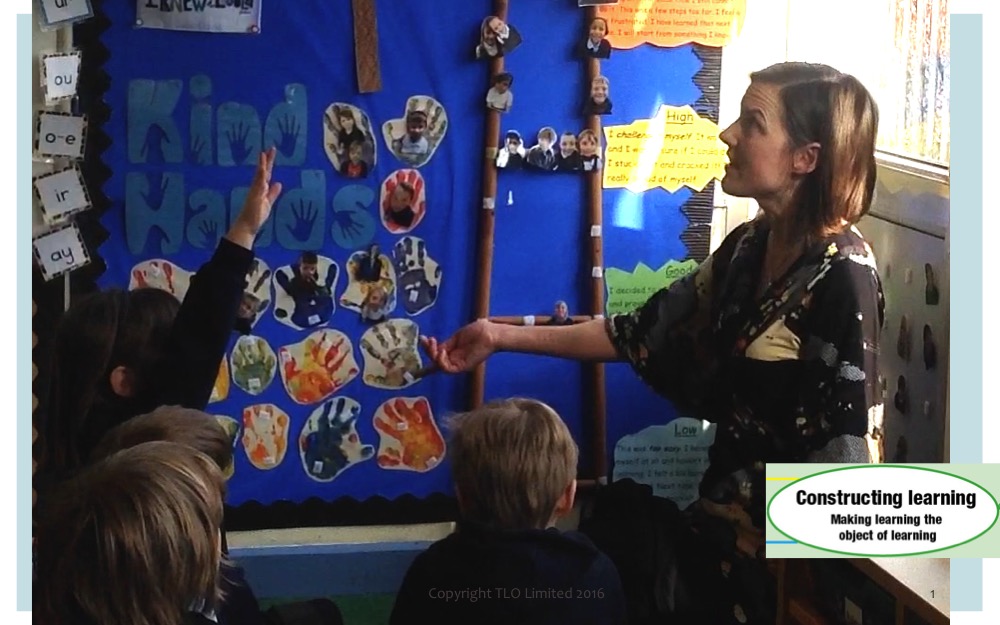
At this school in Bristol, Becky draws the children together at the end of a lesson and to review together what they have been doing. The emphasis is on whether they have stretched themselves and how that felt. The ladder shows different stages of stretch and children put their faces on the step they have been trying.
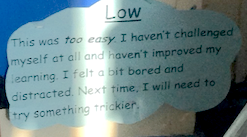
Here’s a description of the lowest stretch
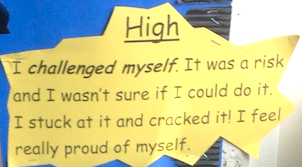
Here’s a description of a higher stretch
In this key stage one class in a small school in Cumbria the teacher Claire draws the children together to discuss what they have been doing. The puppet (Orla) is the bad learner in the class (there are no others) and the children explain to Orla what they have been doing. They produce a correct record of what they have done in a special book for Orla after their discussion (see book at end of video)
Here’s just a little reminder that you can come back to reconsider, re-edit, review your learning a while later.
Reflection and review as non-negotiables
2) Making challenge available and fun
There’s a big link between emotional engagement and challenge
Learning is always an emotional business and learning how to manage this is best done ‘on the job’ in the course of learning rather than as a separate stand-alone activity. Emotional engagement is a prerequisite of powerful learning, it’s what gets you interested enough to be willing to put in the effort to get better and see the value of pushing yourself. So lessons aren’t just designed to make use of different kinds of learning behaviours but to give those behaviours a good work-out. Activities are designed to:
be challenging, where being stuck and confused are regular and fruitful experiences.
give students the opportunity to ‘learn what to do when they don’t know what to do’ – to work on wild tasks, rather than tame ones, where there’s plenty of scope to get lost and perplexed.
“The presence of challenging learning intentions has multiple consequences. Students can be induced to invest greater effort, and invest more of their total capacity than under low demand conditions.”
(John Hattie, Visible Learning)
Or, as a teacher said to us recently:
“I became a better teacher the day I stopped thinking ‘have I made it easy enough for them to understand it?’ and started thinking ‘have I made it hard enough to stretch them?'”
Try these ideas to support challenge
Make positive connections between making mistakes and challenge
Model how to think about and work through challenges
Create a challenge wall; put up questions, extension tasks, riddles, problems. A go-to place for another challenge when other learning is finished
Display work that shows pupils have improved mistakes etc.
Stimulate using ‘Stingray’ questions…What if...(something they thought they knew from a different angle – What if gravity was twice as strong ?)
Use the ‘learning pit’ to talk through what to do to overcome/surmount a challenge.
The Learning Pit
You need to be emotionally engaged to take on challenge.
3) Introducing Visible Thinking Routines for Reflection
What are Visible Thinking Routines?
VTRs are, as they say, simple routines that apply across a wide range of subjects and contexts, and which require students to think in a variety of different ways, that are used so regularly by teachers that they become woven into the fabric of the classroom culture and progressively hard-wired into the thinking practices of students.These are ways in which different ways of thinking can become routine in classrooms. They become part of the learning culture.
To be effective such routines need to be;
Direct, guide, support, encourage thinking
Short, memorable, few steps
Used over and over again
Useful in a variety of contexts
Facilitate connections, generating ideas, using knowledge
Find out more: Google ‘Visible thinking routines’
Connect Extend Challengeis a visible thinking routine for connecting new ideas to prior learning and encourages reflection.
It goes like this;
CONNECT: How are the ideas and information presented CONNECTED to what you already knew?
EXTEND: What new ideas did you get that EXTENDED or pushed your thinking in new directions?
CHALLENGE: What is still CHALLENGING or confusing for you to get your mind around? What questions, wonderings or puzzles do you now have?
The routine helps students make connections between new ideas and prior knowledge. It also encourages them to take stock of ongoing questions, puzzles and difficulties as they reflect on what they are learning.
Make thinking visible
4) Split screen teaching
Whether we realise it or not, all lessons have a dual purpose:
The content dimension, with material to be mastered
The ‘learning’ dimension, with some learning skills and habits being exercised.
In conventional lessons where pupils focus exclusively on mastering content while thelearning dimension is not acknowledged; pupils may learn ‘stuff’, but they remain unaware of how they are learning it. Such lessons make the content very public, while the associated learning behaviours remain a closely kept secret. So pupils learn habits of compliance or dependence.
In developing learning power, teachers are making conscious choices about which habits to introduce and stretch and how best to couple these with content so that lessons become more interesting and challenging. Through such overt coupling of content and specific types of process, students come to know, understand and take control of their learning behaviours – they knowingly use and develop the whole range of learning behaviours.
To make a start on this, try considering your plans for the coming week or month in relation to the following questions;
Where, in these plans, can you find opportunities to:
1. Build their emotional engagement
In your series of lessons, where do you expect pupils to become stuck?
What prompts would help them overcome their stuckness?
Are there any opportunities to encourage noticing behaviours?
2. Stretch their cognitive range
What proportion of your lessons are spent on encouraging pupils to question?
Where might you encourage more pupil questioning or playing with ideas?
To what extent are the activities pre-digested – where most of the work has been done for them?
How much do the activities generate students’ own initiative, questioning, research and information processing?
Could you make more activities ‘wild’ rather than ‘tame’?
What proportion of your series of lessons calls for disciplined, logical thinking and reasoning?
Could some of the activities be amended to foster imagination, visualisation, intuition?
3. Foster their interpersonal involvement – social
What proportion of your series of lessons requires pupils to collaborate in order to complete a task?
Could you fit more collaborative activity into your lessons?
4. Extend their strategic responsibility (Reflectiveness)
What proportion of your series of lessons involves pupils in monitoring and revising their own work?
Building Better Learners is about creating a culture in classrooms – and the school more widely – that systematically cultivates habits and attitudes that enable young people to develop supple learning minds.
This section explores the sorts of things teachers do when starting to developing the language that helps students understand the learning process.
Key Learning Question:
What are some of the ways to begin introducing a language for learning?
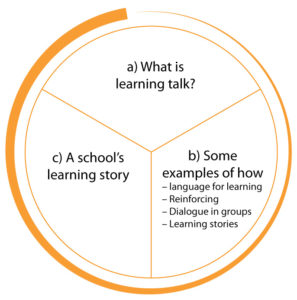
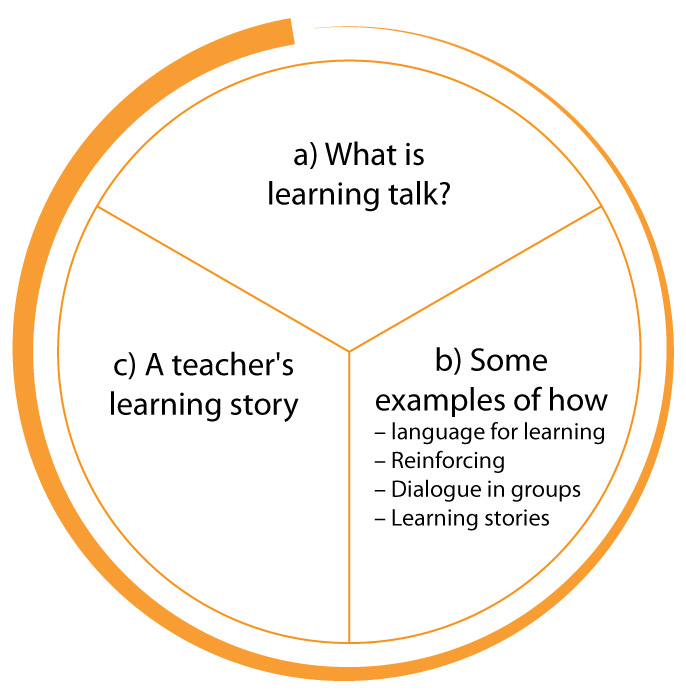
a) What is learning talk?
As we saw in Section 3.1, talk for learning is about the gradual introduction of a learning language that helps students to become conscious of using their learning behaviours and so build the confident self-talk of improving learners. Start by trying to use the word ‘learning’ at least as often as you use the word ‘work’ – it will be harder than you think !
The early stages of introducing a learning language might simply include:
making students aware of the school’s language for learning;
mention use of learning behaviours in your written feedback;
foster learning dialogue in groups;
have students relate their learning stories;
The more richly children come to talk about their own learning the more they see and take hold of their own role in it.
1) Making students aware of the language for learning
The importance of students having a language with which to discuss and understand the process of learning was explored in module 2.2, section b). But how to do it ?
To introduce the supple mind might seem a sensible starting point, maybe through engaging with the Footprints in the Snow activity suggested at the end of module 2.2.
But this does only half the job. The language is introduced, but understanding will necessarily be fairly shallow at this point. Students need to explore these learning behaviours one by one, to experience tasks that activate them, and be given the opportunity to reflect on the experience.
And even that does not work if they are not then offered repeated opportunities to exercise the behaviour in subject based lessons over the weeks following the introduction. The reason for this is two-fold: firstly they need to experience it repeatedly in order to strengthen the skill and begin to build the habit; secondly they need to see that the skill can be applied in a wide range of learning contexts.
Give them a language so that they can understand the concepts
2) Reinforcing learning behaviours in feedback
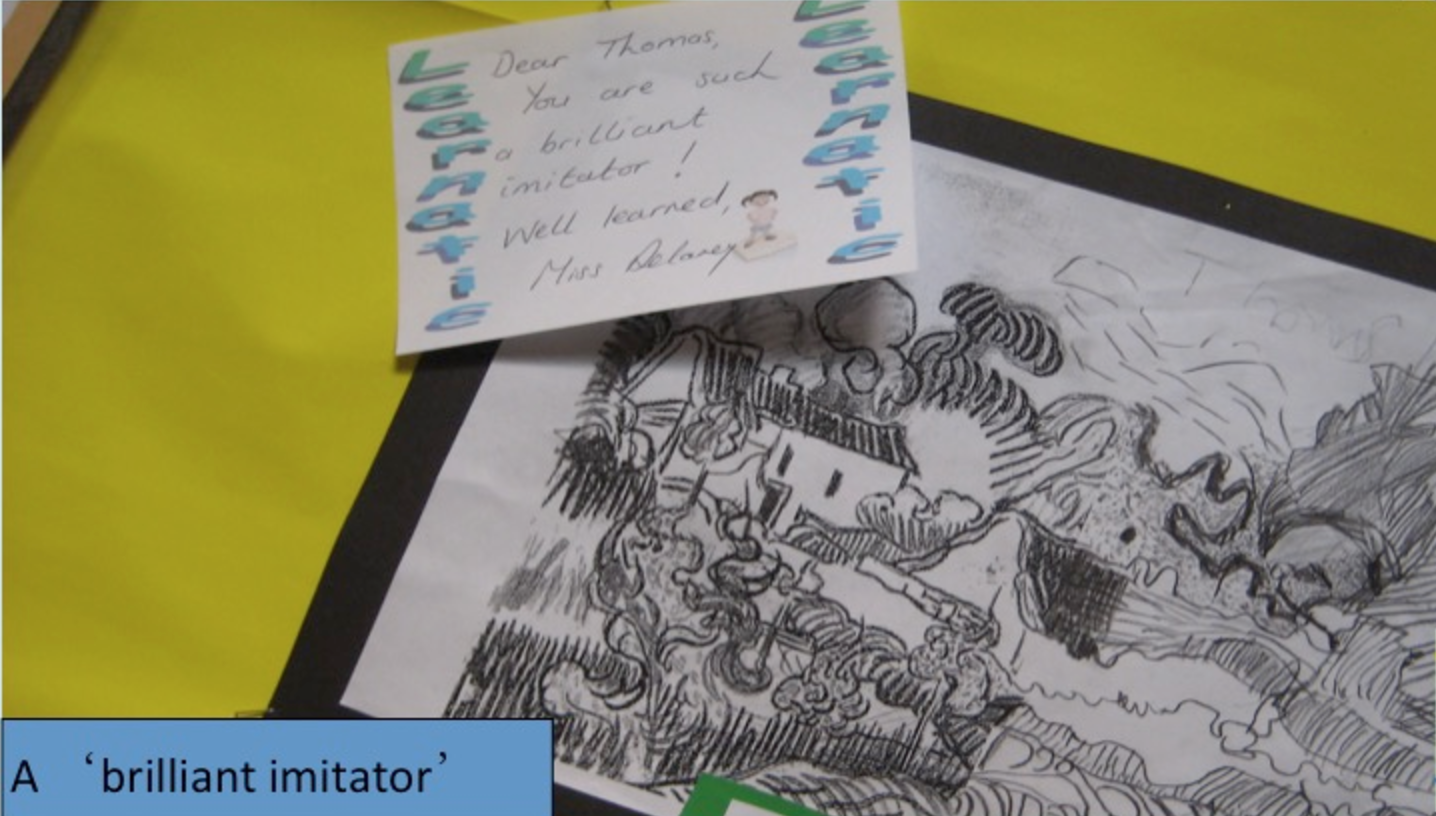
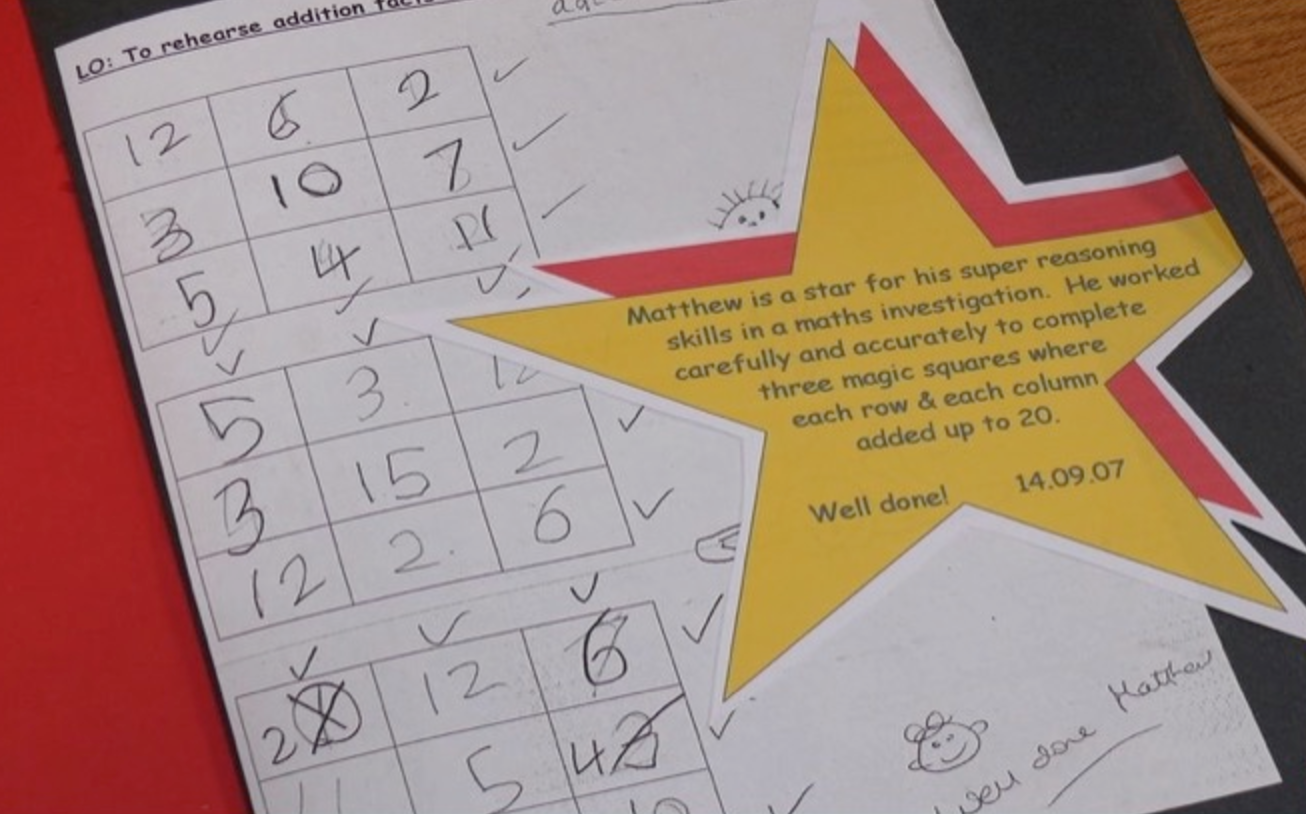
Here are a couple of examples of written feedback which name the types of learning behaviours being used. Using learning language enables teachers to be more precise about the sort of learning effort a student has used. Beneficially this means the teacher has noticed more precisely how students are learning.
Here, Miss Delaney tells Thomas he is a brilliant imitator. She has noticed that he was successful because of his skill at Imitation, is making him aware of this, and praising him for it. All well and good, but what can he do with this feedback, aside from bask in glory?
Whereas here, feedback helps Matthew to understand how his super reasoning skills helped to assure success. More useful praise, surely?
Reinforcing the learning language
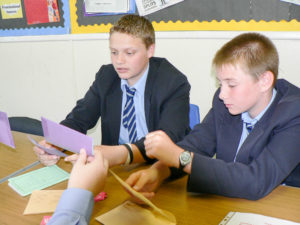
3) Fostering learning dialogue in collaborative groups
How often do we not know that we know something until we hear ourselves say it? The bottom line is that dialogue (not listening to teacher type dialogue!) is crucial. Get students talking together and they will be learning together and creating meaning for themselves.
But group work is not easy. It needs a range of positive social skills, like listening, turn taking, being prepared to share ideas etc. In the early stages, it may be necessary to agree classroom ‘ground rules’ to encourage students to afford others respect in the hurly burly of collaborative learning.
Making meaning through talk.
4) Invite students to relate their learning stories
Individual scrapbook
Students were encouraged to think about themselves as learners in all contexts — inside and outside of school time. This youngster has reflected on her ballet skills and how she had used her learning power to help her improve.
Relating learning through personal stories
c) A school’s learning story
Secondary schools should, in an ideal world, be receiving kids from their feeder schools who arrive as learning powered students, ready for the next phase of their learning journey. The reality is frequently different, with students arriving in key stage 3 with no clear idea of themselves as learners.
The secondary school then faces a dilemma. It needs to introduce year 7 students to the school’s chosen learning language, but how to do this ? Two options, each with advantages and drawbacks, immediately present themselves – either design a stand-alone Learn to Learn course, or introduce the skills/concepts through the subject curriculum.
Let’s consider each in turn:
Firstly: The stand-alone L2L course. Advantages include ease of planning, few teachers involved in delivery, all kids get the same message at broadly the same time. Disadvantages include few teachers involved in delivery, it requires dedicated curriculum / tutor time, learning is in danger of being seen as ‘something we do on Tuesday afternoon’ and is unrelated to the rest of the week.
Secondly: The integrated approach. Advantages include everyone involved in delivery, learning is better integrated into the curriculum, responsibility is shared, and nobody can opt out. Disadvantages include the nightmare of mapping learning behaviours across the curriculum, everyone is involved in delivery, shared responsibility can sometimes become ‘if everyone else is doing this, it won’t matter if I don’t’.
We have yet to find a school that has been able to jump straight to the integrated approach without first passing through the stand-alone phase.
How will your school tackle this problem ?
How would you like to be involved in helping your students to understand and discuss the learning process in greater depth and with greater precision ?
A word of warning . .
PRIMARY
Building Better Learners is about creating a culture in classrooms – and the school more widely – that systematically cultivates habits and attitudes that enable young people to develop supple learning minds.
This section explores the sorts of things teachers do when starting to developing the language that helps pupils understand the learning process.
Key Learning Question:
What are some of the ways to begin introducing a language for learning?
a) What is learning talk?
As we saw in Section 3.1, talk for learning is about the gradual introduction of a learning language that helps pupils to become conscious of using their learning behaviours and so build the confident self-talk of improving learners. The early stages of introducing a learning language might simply include:
using a range of physical hooks on which to hang learning talk
mention use of learning behaviours in your written feedback
start using the word ‘learning’ rather than ‘work’
foster learning dialogue in groups
have pupils relate their learning stories
The more richly children come to talk about their own learning the more they see and take hold of their own role in it.
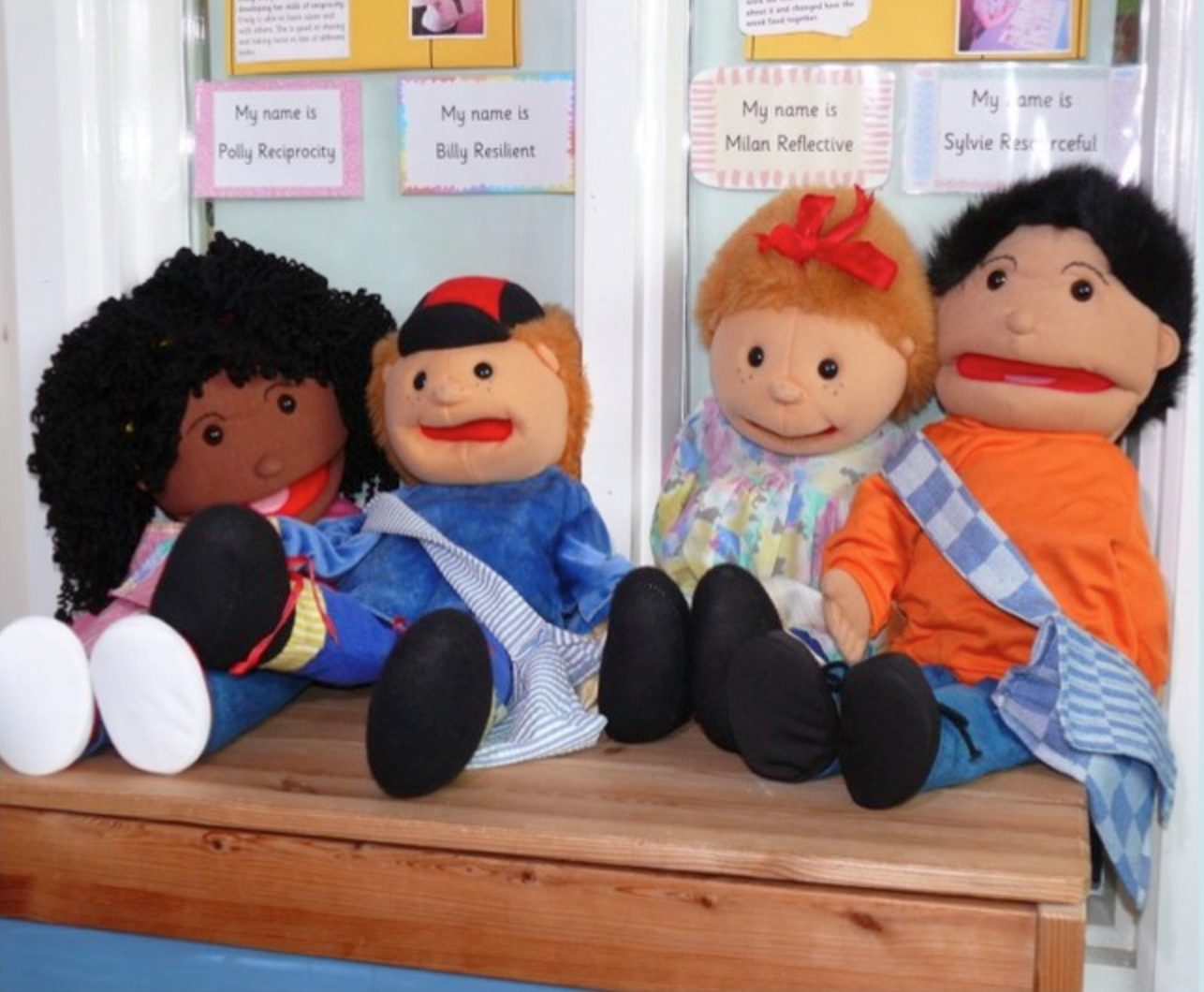
Here are a couple of examples of the sort of ‘hooks’ schools have used in the early stages to help pupils remember the learning behaviours.
A simple way to start – 4 puppets, one for each for the emotional, cognitive, social and strategic domains of learning. Note the bags on the puppets’ shoulders. These contain stickers denoting a particular learning behaviour. These are awarded to pupils when they are spotted using the behaviour appropriately. This helps pupils become more conscious of using the behaviour. It’s only when they know this that they are able to get better at it!
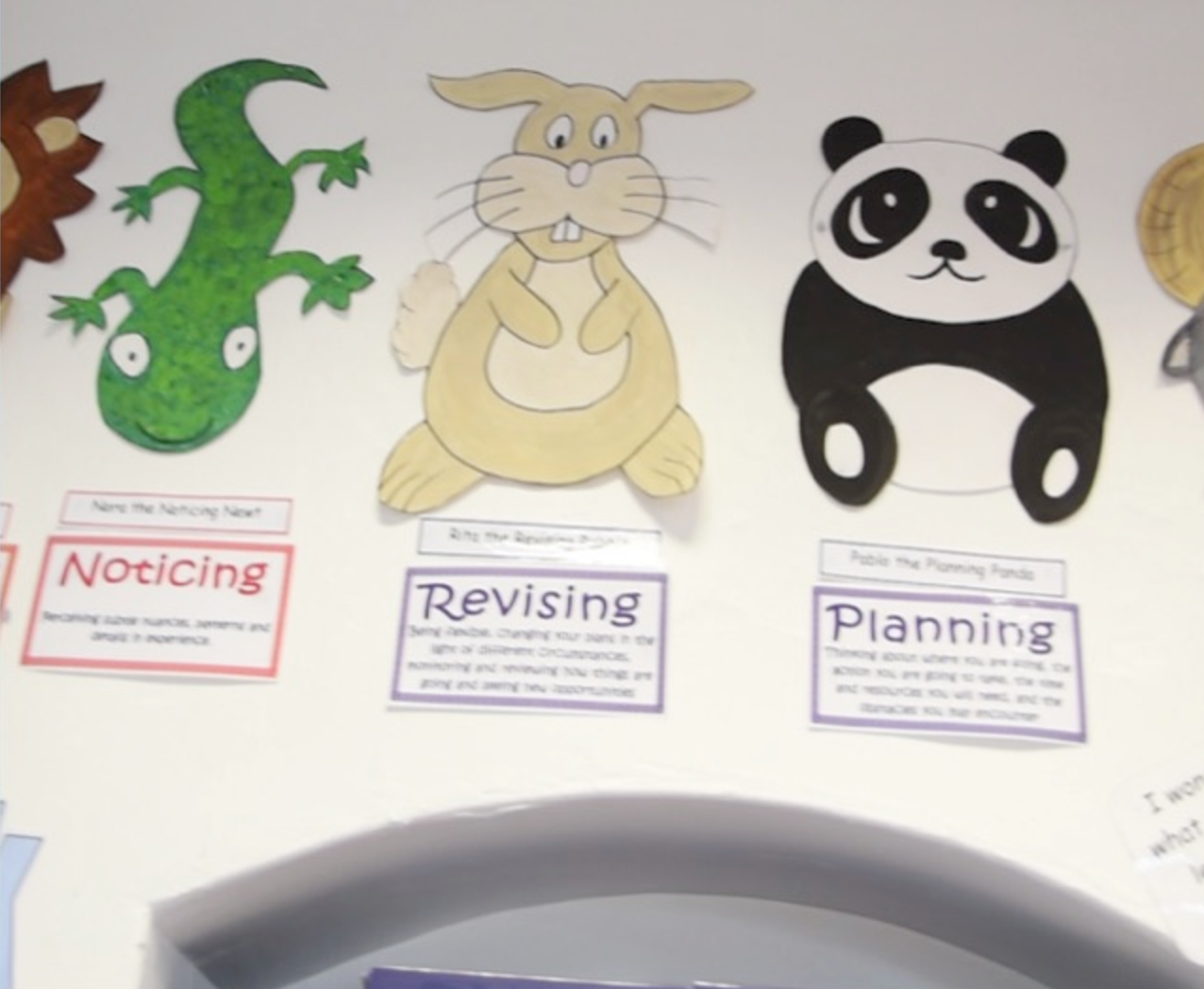
Going a bit deeper. Here the 17 learning behaviours have been linked to animals – planning panda, revising rabbit etc. Just another way of remembering the initial stages of a language for learning.
Illustrating the language of learning
2) Reinforcing learning behaviours in feedback
Here are a couple of examples of written feedback which name the types of learning behaviours being used. Using learning language enables teachers to be more precise about the sort of learning effort a pupil has used. Beneficially this means the teacher has noticed more precisely how pupils are learning.
Here, Miss Delaney tells Thomas he is a brilliant imitator. She has noticed that he was successful because of his skill at Imitation, is making him aware of this, and praising him for it. All well and good, but what can he do with this feedback, aside from bask in glory?
Whereas here, feedback helps Matthew to understand how his super reasoning skills helped to assure success. More useful praise, surely?
Here’s a quick and easy way to signal the use of a learning behaviour. In this school their learning behaviour icons have been printed onto stickers. The teacher can quickly award a sticker for appropriate use of the behaviour to achieve the outcome.
Reinforcing the learning language
3) Fostering learning dialogue in collaborative groups
How often do we not know that we know something until we hear ourselves say it? The bottom line is that dialogue (not listening to teacher type dialogue!) is crucial. Get pupils talking together and they will be learning together and creating meaning for themselves.
But group work is not easy. It needs a range of positive social skills, like listening, turn taking, being prepared to share ideas etc. In the early stages, it may be necessary to agree classroom ‘ground rules’ to encourage pupils to afford others respect in the hurly burly of collaborative learning.
The learning behaviour – collaboration – is fully explored in phase 1 of the online course.
Making meaning through talk.
4) Invite pupils to relate their learning stories
Individual scrapbook
Children were encouraged to think about themselves as learners in all contexts — inside and outside of school time. This child has reflected on her ballet skills and how she had used her learning power to help her improve.
Relating learning through personal stories
c) A teacher’s learning story
An early years teacher from Oldham relates how she introduces pupils to understanding the purpose of questions.
Please note. Sadly these frogs are no longer available!
Building Better Learners is about creating a culture in classrooms – and the school more widely – that systematically cultivates habits and attitudes that enable young people to develop supple learning minds.
This section explores how teachers could start devolving the responsibility for learning; moving from a teacher-dominated culture to a richer learning-friendly culture.
Key Learning Question:
How might we start to ensure students start taking responsibility for their learning?
Key learning question…
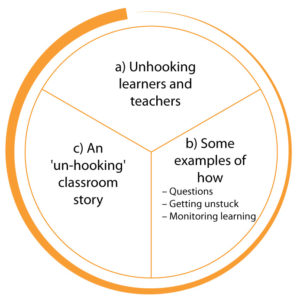
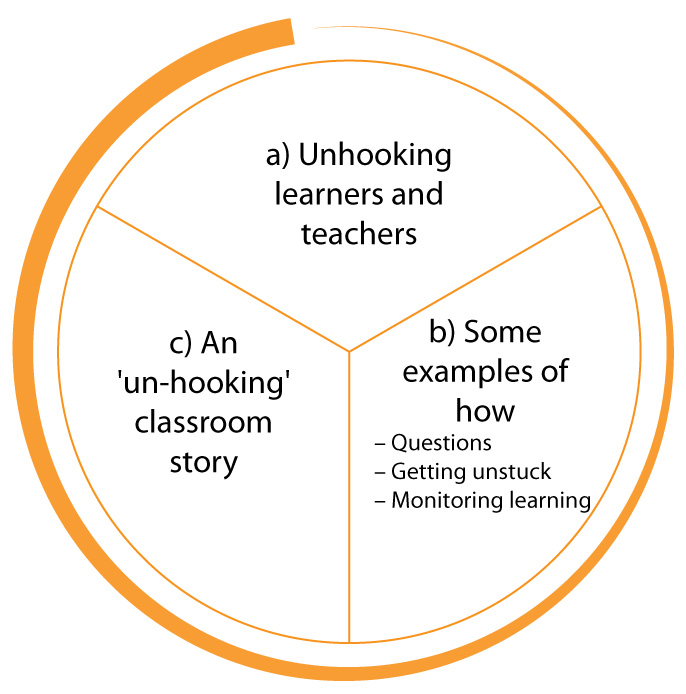
a) Unhooking learners and teachers
As we saw in section 3.1, Relating for learning is about making learning a shared responsibility to avoid learners becoming over dependent on teachers and building their skills as independent learners. In the early stages, devolving more responsibility to learners might simply include:
creating opportunities for students to ask more questions
offering students ways of getting themselves unstuck
giving students more responsibility for monitoring their own learning
Despite giving more responsibility to learners it still leaves you with plenty to do! Your role becomes one of modelling learning processes and styling your teaching as a learning coach.
Of course there are numerous ways of unhooking a dependency relationship between teacher and students. Further ideas are the subject of the Building Better Learners online programme (described in Section 4.4).
Here is a good starting point to get students involved in posing their own questions.
Question Starts
Question Starts is a Visible Thinking Routine that provides students with the opportunity to practise developing good questions that provoke thinking and inquiry into a topic by offering a range of interesting question stems, including: How would it be different if…?, Suppose that…? What if…?, What would change if… For more detail on Question Starts, visit the Visible Thinking website:
Work with students to find useful questions for them to ask themselves and helpful strategies which they might take when they are stuck. Ensure that there are plenty of options that come higher on the list than “Ask the teacher”. Create displays as reminders.
Here is an example generated by a year 7 class:
So called Stuck posters or prompts come in various shapes and sizes, but essentially they are simply home-made lists of what students can try when they get stuck with their learning.
To begin with, the teacher trains the students to make use of this information by greeting every request for prompting with; ‘Have you looked at the poster?’ After a while, looking at the poster becomes routine, and eventually, when the habit of self-unsticking becomes second nature, even the poster becomes redundant. It does not take long, in such a classroom, before ‘Ask the teacher’ becomes a last-ditch strategy, to be engaged only when all else has failed.
Growing independence
3) Giving students responsibility for monitoring their learning
Here is a way of transferring the responsibility for monitoring the learning process to students:
Require students to monitor and evaluate their own work before submitting it to be marked.
Obviously what students monitor will vary subject by subject. ‘Check your calculations’ in Maths might become ‘Check SPAG’ in English. There may be some commonality across all subjects in terms of aspects like ‘Is there anything more that I should do?’ or ‘Have I fully answered the question?’, and these will need to be agreed at whole-school level. But at this stage, just ask yourself what you would like your students to keep an eye on, or better still, work with them to construct the list.
It then becomes their responsibility to check their work against the agreed checklist. Or maybe it becomes an opportunity for peer assessment.
Below is an example from lower KS3 Maths. What would you put in yours ?
Making learning a conscious process
PRIMARY
Building Better Learners is about creating a culture in classrooms – and the school more widely – that systematically cultivates habits and attitudes that enable young people to develop supple learning minds.
This section explores how teachers could start devolving the responsibility for learning; moving from a teacher-dominated culture to a richer learning-friendly culture.
Key Learning Question:
How might we start to ensure pupils start taking responsibility for their learning?
Key learning question…
a) Unhooking learners and teachers
As we saw in section 3.1, Relating for learning is about making learning a shared responsibility to avoid learners becoming over dependent on teachers and building their skills as independent learners. In the early stages, devolving more responsibility to learners might simply include:
creating opportunities for pupils to ask more questions
offering pupils ways of getting themselves unstuck
giving pupils responsibility for monitoring their learning
Despite giving more responsibility to learners it still leaves you with plenty to do! Your role becomes one of modelling learning processes and styling your teaching as a learning coach.
Of course there are numerous ways of unhooking a dependency relationship between teacher and pupils. Further ideas are the subject of the Building Better Learners online programme (described in Section 4.4).
Here are a couple of examples of involving pupils in posing their own questions.
At the start of a learning unit on the Egyptians the class discuss what they want to find out and log this on a wall of questions. This gives pupils some ownership of this unit of work and consequently greater emotional involvement.
Here the class have a wonder wall where pupils can record their ‘wonders’, knowing that their teacher will find time to address their questions over time.
Building the skill of asking good questions
2) Ways of getting themselves unstuck
Here are a couple of examples of offering pupils unsticking strategies.
This school uses the welly boot as a metaphor for getting stuck in the mud. Helpful unsticking prompts are written on the sides of the wellies on display.
Taking it one step further, each table has two welly boots on it, one for literacy and one for numeracy. Each welly has specific suggestions like ‘Have you used full stops and capital letters?’ or ‘Have you checked your workings out?’. Pupils use the prompts to help themselves when stuck or finding it hard going.
However stuck prompts are displayed, it’s important for staff to discuss the sort of stuck prompts they are using and to make sure the prompts become more stretching from year to year.
Growing independence
3) Giving pupils responsibility for monitoring their learning
Here are a couple of examples of transferring the responsibility for monitoring the learning process to pupils.
Little strips of laminated card and a peg can put children in charge of their learning a little more. Labelled ‘Easy learning’, ‘Challenging learning’ and ‘Too hard’ on one side, pupils use them to let you know whether you are meeting their learning needs or if they could do with more extension or support. It is powerful when learners realise that challenge is an essential element of their learning; that finishing easy tasks quickly does not signal cleverness but indicates time-filling rather than real learning.
The other side of this little strip is labelled ‘Absorbed’ at one end and ‘Distracted’ at the other. Teachers use this initially to help pupils monitor their absorption in learning but children will quickly begin to use it as a visual prompt to monitor themselves.
A more elaborate monitoring tool for pupils to use before submitting work to be marked. Use it, or similar, when they say ‘I’ve finished!’
Making learning a conscious process.
c) An ‘un-hooking’ classroom story
Elaine Wade is a Year 2 teacher. She wants her pupils to understand the meaning and importance of being a good planner.
As part of their work in DT pupils have to make a vehicle using several parts. Elaine keeps the components safe and pupils have to ‘order’ the parts they need. They are given a shopping list which itemises the vehicle parts, and have to indicate what and how many of each they require. The ordered items are carefully counted out by Elaine and put into a special shopping bag. So far so good. However, on unpacking their shopping bag, many of the pupils realise that they do not have enough or, in some cases, the right parts. This provides a strongly-motivated opportunity for the children to discuss the need to plan carefully, after which the pupils thankfully accept missing parts. When the activity is used again in another context later in the year, missing parts of their order are not restored and the pupils are expected to make the best they can with what they have ordered.
So here Elaine is encouraging her pupils to think for themselves, to, anticipate what they need, to plan in advance of action. She very rarely gives her pupils the equipment they need for whatever activity. She expects them to be able to find it themselves in the classroom. She’s making sure these children don’t get too reliant on her.
Building powerful learners works HAPPENS?????? in learning-friendly classroom cultures.
Find out about the framework for building learning friendly classrooms:
frameworks for building powerful learning
the four cultural shifts that create a learning-friendly classroom culture
the outcomes of the shifts for learners and for teachers.
If you are reading this as a senior leader… reflect on classroom cultures across the school.
If you are reading this as a classroom practitioner… reflect on your own classroom culture.
The two frameworks of Learning Power
The Teachers’ Palette is the second significant framework for building better learners. Whereas the Supple Learning Mind, the first framework, identifies the types of learning behaviours we are seeking to build in our learners, the Teachers’ Palette considers the types of teacher actions that create the conditions necessary for such learning behaviours to become habituated.
Just as the Supple Learning Mind is made up of a number of interwoven behaviours, so is the classroom culture that cultivates better learners. Schools that successfully build learning behaviours have found that there are four key cultural shifts that combine to create the seedbed for building better learners – the relationships in the classroom; the ways in which learning is the object of discussion; the object of learning; and the object of celebration.
The four key cultural shifts
Moving to more learning-friendly cultures is a big shift in thinking and action. To establishing learning-friendliness comes from four shifts. A shift in relationships, a shift in the language, a shift in how learning is constructed and a shift in what is celebrated, what is seen to matter.
1. Relating for learning: the changing roles and responsibilities of teachers and learners, where learning becomes a shared responsibility. students are given more responsibility for their own learning, the role of the teacher changes from ‘the sage on the stage’ to ‘the guide by your side’; the role of the student moves from ‘passenger’ to ‘crew’ and ultimately ‘pilots of their own learning’.
2. Talking for learning: the sort of language content and style to enhance learning, making learning the object of conversation. The way we express ourselves in the classroom creates a powerful linguistic environment that teaches young people the best of what we know about learning. The language of learning helps students to discuss, understand, and become conscious of using their learning behaviours.
3. Constructing for learning: activities and classroom routines feed learning habits and learning becomes the object of learning. Learning activities are designed to stretch and challenge by having a dual focus – to explore content and stretch students’ use of their learning behaviours. There is a strong underpinning of not just ‘doing’ learning but reviewing and reflecting on the process in order to make meaning and apply it elsewhere.
4. Celebrating learning: the outward signs of the values that underpin the culture, making learning the object of attention. In this dimension failure has been redefined; being stuck is seen as interesting and mistakes valuable. Effort, questions and taking risks are recognised, attended to, acknowledged and praised. These and other things serve to make visible the underlying values of the learning environment.
The teacher’s role becomes one of surfacing learning; to make learning public; to train some of the tricky bits; to talk about it; to recognise and celebrate it as it happens; to nudge it along, assisting students to grow their learning capacities; and to design activity to stretch a wide range of learning habits. This uncovering of learning ensures students discover, use, understand and grow their learning habits. There is a shift in emphasis from performance to learning, from content to process, from teaching to coaching.
The shift leads teachers to ask how can I:
build a classroom culture that ensures that responsibility for learning is shared with and to some degree devolved to learners?;
create opportunities to discuss the learning process using the language of learning?;
construct activities that develop positive learning behaviours and help learners to acquire the necessary content?;
build learners’ commitment to becoming better learners through what is valued and recognised?
The outcomes of moving to a learning-friendly classroom culture
Learning-friendly cultures systematically cultivate habits and attitudes that enable young people to face difficulty calmly, confidently and creatively. This often means moving the focus from what teachers do to a focus on what learners do. Moving from a focus on product and performance to a focus on the process of learning. It’s a gradual, sometimes difficult, but hugely worthwhile process of culture change by schools and habit change by teachers.
So ‘culture’ concerns the details of the micro-climate that teachers create in their classrooms. What they do and say, what they notice and commend and what they don’t, what kind of role model of a learner they offer: all these are of the essence. And what really matters is how they design and present activities so that, over the course of a term or a year, their students are cumulatively getting a really good all-round mental work-out. All the learning bits of their brains are being stretched and strengthened, one by one and all together.
In short;
For learners it’s a place where their role changes from receptivity to activity:
they collaborate and talk about how they understand things
they accept responsibility for learning
they do more of the thinking
they develop curiosity, perseverance, attentiveness, and open-mindedness
they monitor and assess what they do
they talk fluently about their learning behaviours
they value mistakes, challenge, feedback
they develop their learning behaviours consciously
they regard themselves as improving learners
For teachers it’s a place where their role changes from ‘delivering’ learning to students, to the creation of situations in which students learn:
the learning process is brought to the surface, given a language, discussed, looked for, celebrated
learning processes are modelled
teachers act as learning coaches
few lessons are simply ‘talk-and chalk’
lessons contain challenges and activities that get students thinking and learning for themselves
teachers encourage students to explore a challenging question, problem or assertion
teachers enable students to become observers and regulators of their own learning
teachers keep thinking ‘What’s the least I can do to get productive learning happening (again)?’
Because learning-centred teachers have a particularly rich conception of learning and the habits that underpin it, they are able to design nudges and activities that target quite specific aspects of learning behaviours. Teaching for learning becomes more detailed and forensic.
How did you react to the learner’s list?
What about the teacher’s list?
How do-able does that feel?
Which aspects on either list feel very possible?
Which items feel more problematic?
What makes you say that?
What one thing might you do differently in your classroom to make it more learning-friendly?
Consider your own learners in relation to the Perseverance chart.
and gain an overview of the importance of progression in learning behaviours.
If you are reading this as a senior leader… reflect on how the issues raised work across the school.
If you are reading this as a classroom practitioner… reflect on how the issues raised affect your own learners.
The Big Picture: Getting better at learning – what does it mean?
Supporting students to get better at learning requires teachers to assist them to spontaneously make more, wider, and increasingly sophisticated use of the learning behaviours. Ultimately students need to be able to make these behaviours their own; intuitively see the point of them; call them to mind for themselves when needed, and become ever more skilful in their use.
There are three key facets to the growth of learning behaviours – firstly the frequency/how often the behaviour is being used; secondly the range/scope of contexts in which it is used; and thirdly the skilfulness with which it is employed.
Getting better = using it more frequently
The first dimension of progression, and easiest to activate, is frequency/how often. The distinction between skill and habit is important – skills are what you can do, whereas habits are what you do do. A skill that is only rarely employed, or only employed when adult-directed, is at best embryonic. Initially the aim is to activate the skill more frequently through direct intervention with a view to reducing the level of intervention as the skill becomes stronger through more frequent use. The target is to develop the skill into a habit that the student employs frequently, without support, as and when the need arises.
So the message here is to spot students using a learning behaviour and point this out.
Getting better = using it in different contexts
The second dimension of progression relates to the range of contexts within which the skill is deployed. The child who is tenacious and thoughtful on the play station can equally be defeatist and impulsive in the classroom – they have the skills, but fail to recognise that the perseverance that leads to success on the play station is precisely the same outlook that is needed for success in the literacy lesson. Initially the skill is used only in familiar circumstances, but the aim is to help students to recognise and exploit opportunities to utilise their leaning behaviours in new and uncharted territory.
Again the message is to look out for and comment on students using the habit, however tenuously, in different subjects or in the playground.
Getting better = becoming more skilled in its use
The third dimension, and by far the most subtle, is that of skilfulness. While we may start by encouraging students to ask more questions, more often and in different subjects, we rapidly turn our attention to the quality of the questions that are being asked. It is not too difficult to describe the attributes of a high level, sophisticated questioner who is skilled at asking incisive, generative questions, but it is very difficult to map out and sequence the steps between the natural curiosity of a three year-old and the sophisticated skill-set of the consummate question-asker/enquirer. This is the challenge, and why skilfulness is the most complex of the three dimensions. However, once mapped, the impact on how you mentor, set targets, enable self and peer assessment, design tasks, and plan the curriculum etc. is immense.
Helping students become more skilled in their learning behaviours is the role of a teacher in learning-friendly classrooms.
Looking at progression through just one learning behaviour – Perseverance.
A perseverant learner understands that effective learning requires effort and persistence, they relish opportunities to struggle with challenge, they put in effort based on a range of strategies that keep them going, they manage their environment to maintain their effectiveness. If you think about that sentence you will recognise that there are a lot of different skills tied up in that single word ‘perseverance’.
These threads that combine to make up a perseverant learner appear to be:
what you do when you get stuck or find things tricky;
how you manage distractions and things that interfere with learning;
what you believe about yourself as a learner;
how you feel about challenge and difficulty;
how motivated you are to achieve the task in hand.
These threads define the columns of our progression grid.
Having sorted out the skill columns we now need to think about what the progression steps might be that move you from ‘can’t’ to ‘can’ to ‘will do’ to ‘always do’?
Our progression steps are based on Bloom’s taxonomy of the affective domain:
Phase ‘Receives’ (purple) is about doing something because you are told or expected to;
Phase ‘Responds’ (blue) is about gaining interest and doing things more willingly;
Phase ‘Values’ (green) is a key phase since the student now sees the value of behaving in this way. It’s a win for them; to behave like this is in their interest. It’s in this phase that the behaviour becomes more secure;
Phase ‘Organises’ (yellow) is the phase in which the student capitalises on this ‘in their interest’ behaviour and organises themselves to use it positively;
Phase ‘Embodies’ (orange), is the phase in which the student has made this behaviour their own. It has become part of their character; they can’t not do it and they have become highly skilled in doing it.
These phases define the rows of our progression grid.
Putting it all together. Our Perseverance progression grid looks like this:
Consider your learners with regard to progression in perseverance:
Think about your most tenacious of learners – which skills and beliefs are already secure in them?
Think about your ready giver-uppers – where are they on this chart?
Outliers aside, where are the majority of your youngest learners?
Outliers aside, where are the majority of your oldest learners?
Wider thinking
Do students become increasingly perseverant as they move through your school?
Can you speculate on why this happens?
Which teacher behaviours might be causing this, for better or worse?
How might you use the chart to help your students to become more perseverant?
And more generally:
How does this chart/map affect your understanding of perseverance?
Progression maps, like this one, lie at the heart of Building Better Learners – they help teachers to move from wishful thinking about improving learning to an observable trajectory of effective learning skills and habits.
The first key model of Building Learning Power – the Supple Learning Mind.
Find out about the 4 dimensions of learning powered minds :
The features of a Supple Learning Mind;
How the vocabulary of learning enriches understanding of learning;
The extent to which they get regular exposure in your classroom(s).
and gain an overview of the essence of effective learning behaviours.
If you are reading this as a senior leader… reflect on how the issues raised work across the school.
If you are reading this as a classroom practitioner… reflect on how the issues raised affect your own learners.
The Supple Learning Mind framework of high value learning behaviours.
A rich framework for learning
The Supple Learning Mind framework was originally conceived and researched by Professor Guy Claxton. It captures the key psychological characteristics that are judged to be of the highest value in helping students to learn and thrive in a complex world. The framework embraces each of the domains of learning and these are shown in its four parts:
The Emotional domain of learning (sometimes described as Resilience)
The Cognitive domain of learning (sometimes described as Resourcefulness)
The Social domain of learning (sometimes described as Reciprocity)
The Strategic domain of learning (sometimes described as Reflectiveness)
This learning framework shows that learning isn’t just about having a good memory; it includes how we feel, how we think, how we learn with others and how we manage the process of learning. It shows that learning is a complex process. Furthermore it provides a language that helps teachers to think about how they cultivate each of the learning behaviours and helps students to gain a better personalised understanding of how they learn content.
Each domain clusters together the high value learning behaviours that best make that domain work well. For example the social domain is made up of the learning behaviours of interdependence, collaboration, listening and empathy and imitation.
What’s your initial reaction to the learning framework?
Which learning behaviours chime with you?
Are there others you would add?
Which of the four domains makes most sense to you?
Which domain is, arguably, the most important?
The vocabulary of the Supple Mind creates a language of learning
Having a language that captures the richness of learning can be used to understand and discuss the learning process, helping teachers and students to uncover learning as a visible process that can improve.
The learning language offers teachers and students alike a rich vocabulary for thinking and talking about what learners actually do, and this in itself enables them to expand their capacity and appetite for learning.
The language has many uses. It helps:
teachers to think about how they might talk in a way that helps to cultivate each of the learning behaviours.
students to notice and recognise learning behaviours they were unaware of.
students to gain a better personalised understanding of content by consciously engaging the behaviours.
to know which learning habits and attitudes are being exercised by the way subjects are being presented, taught and assessed.
to understand concepts such as ‘reasoning’, ‘collaborating’, or ‘managing distractions’, and to have worked on getting better at using them purposefully and routinely.
to name such things explicitly so that students (and their parents) know what it is teachers are noticing and valuing.
teachers to become aware of which learning behaviours they routinely require students to use in lessons — and then to think more carefully about whether there might be others they might profitably call on instead.
teachers to design activities that stretch and strengthen learning behaviours so that they become student’s learning habits. Teachers begin to think, ‘How is learning happening; What habits of mind am I cultivating in students by the way we I’m designing and delivering the curriculum’; Which learning behaviours need to be used more often so that they become habits?
So as we can see it’s not just the words themselves that are powerful but the variety of functions they have in making learning behaviours visible, learnable and habitual. The learning behaviours themselves become even more useful when brought to life through everyday phrases that promote, encourage and strengthen them.
Which of these functions of the learning language sound useful to you?
How could you make use of this learning vocabulary?
Have a quick look at lesson plans for last week and try to think which learning behaviours the activities required students to use (maybe without you realising it).
If you started to use this learning framework which learning behaviour would you tackle first?
Translating the Supple Mind into classroom practice
So, how does all this translate into the classroom? Basically, as a teacher, you are going to talk about the behaviours, stretch them through activities, model them, and show that you value them when you see them in use.
Have a think about some of the learning behaviours and work out;
how often you try to help students develop such behaviours in the way that you teach at present;
how many of your students display these behaviours in the classroom (even without knowing it).
Emotional Engagement
what do I do now to help students develop these behaviours?
how many of my students display these behaviours now (even without knowing it)?
Relish a challenge
Not afraid of finding things hard
Identify significant detail
Stick at things despite difficulties
Minimise negative distractions
Work for extended periods to solve a problem
Cognitive Range
what do I do now to help students develop these behaviours?
how many of my students display these behaviours now (even without knowing it)?
Become curious about possibilities
Ask questions to get to the bottom of things
See how things fit together
Are logical and systematic
Use imagination to good effect
Make use of a wide range of learning resources and strategies
Social Involvement
what do I do now to help students develop these behaviours?
how many of my students display these behaviours now (even without knowing it)?
Work well with others
Maintain own ideas in a group
Listen to what others say, showing understanding
Put themselves in others’ shoes
Absorb and use the way other people do things
Know when to learn alone or with others
Strategic Responsibility
what do I do now to help students develop these behaviours?
how many of my students display these behaviours now (even without knowing it)?
Sort out what needs to be done
Think ahead of taking action
Take stock to make sure things are on track
Change tack if necessary
Pull out key points from experience
Talk about how they learn
About your teaching, ask yourself:
Which behaviours do you regularly attend to?
Which do you rarely attend to?
Which psychological domain receives most attention in your classroom? (emotional, cognitive, social, strategic)
What does this reveal about your teaching?
About your learners, ask yourself:
Which of these behaviours are already well-developed?
Which are least well-developed?
To what extent are learners aware of using these behaviours?
Is there a link between what you do and how students are as learners?
Why and how you might observe learning rather than teaching.
A simple observation tool for capturing learning behaviours.
Why go into classrooms?
Looking at classrooms through the lens of learning behaviours rather than teaching behaviours.
Classrooms are where the school conducts its core activity of building learning behaviours. It is where all of our values, policies and procedures are made real and communicated to learners, minute by minute, hour by hour, day by day. It is where all of our intentions become reality, or not.
A key leadership responsibility
It is a key leadership responsibility to ensure that what happens in classrooms accurately reflects the school’s vision and values for learning, and as a consequence leaders need to have a very clear understanding of what is happening in classrooms rooted in first-hand experience.
Assessment for Learning offers us much to ponder. We know that there is more to assessment than grades; we know about comment only marking; we understand that feedback needs to be formative and developmental. Most schools / teachers have incorporated these ideas into their day to day assessment practice to the benefit of their learners. The same principles should, of course, apply to lesson observations.
Classroom observations of learning will succeed if and only if they stimulate a professional conversation about how students are learning and how the school might further support this. The way we do observation is critical to its success. As Carol Dweck observes:
“In fact, every word and action can send a message. It tells children—or students, or athletes [or teachers !] —how to think about themselves. It can be a fixed-mindset message that says: You have permanent traits and I’m judging them. Or it can be a growth-mindset message that says: You are a developing person and I am interested in your development.” ― Carol S. Dweck, Mindset: The New Psychology Of Success
The observation strategy suggested here is based on that simple premise.
BUT IN THINKING ABOUT THIS THIS WHEEL DOESN’T DO THAT. IT ONLY CAPTURES IF THE BEHAVIOUR IS BEING USED.IS THERE A WAY…MAYBE USING THE CIRCLES OF DIFFERENTIATING HOW USED BY TEACHER..LANGUAGE, ACTIVITY,PRAISE, RELATIONSHIPS. OR DO WE NEED ANOTHER INSTRUMENT FOR THAT?
Review learning in classrooms
Getting into classrooms to look at the learning behaviours that students are being enabled to exercise.
Firstly, remember that in any lesson, no matter how sensational, not all learning behaviours will be enabled. Different subject matter and different learning activities will exercise a unique blend of behaviours. Indeed some fantastic lessons may exercise only a few of these behaviours – sometimes a few behaviours exercised extensively is preferable to many behaviours exercised fleetingly, or a few behaviours exercised skilfully trump many behaviours exercised simplistically.
However, we would hope that over time students get to practise all of these behaviours in various aspects of their learning.
So, the question becomes, ‘Are you confident that your students are being enabled to exercise the full range of learning behaviours ?’ And the subsidiary, ‘How are you going to find out ?’
Traditional observation tools are highly unlikely to provide sufficient evidence. Why not try going in to classrooms with this Rating Wheel as your observation tool ?
How to use it:
Spend around 20/30 minutes in a classroom,
Towards the end of your time in the lesson, colour in the spokes of the wheel in line with the frequency with which the behaviour has been exercised. If, for example, students have used their planning skills extensively, then colour in most of the planning spoke. If only a bit, then colour in the inner bit of the spoke. If they have not been required to plan, simply leave the spoke blank.
Repeat for all of the spokes.
You end up with a ‘picture’ of which behaviours were (and were not) exercised. On its own, one of these completed wheels tells us little of the bigger picture. It is a useful document on which to base a discussion with the teacher, but beyond that it has minimal meaning.
However, once you have completed a sufficient number of these, clear patterns begin to emerge – some behaviours are getting regular exposure, others less so. Indeed, some of the 4 domains of learning may be gaining more attention than others.
Once you know which behaviours are and are not being exercised, you can begin to ask how you might better foreground the ones gaining less exposure.
Moreover, such research done early in your involvement with Building Better Learners will give a baseline measure that you can re-visit later to track the progress you make in expanding the range of behaviours that students are currently being enabled to exercise.
Ask yourself:
how will you introduce this proforma to colleagues?
how will you ensure that the observations are developmental rather than judgemental?
how will you analyse and share the outcomes?
Original below needs deleting
Lesson observation has had a chequered history, too often judgemental and resented, too infrequently developmental and welcomed. Most observations look at teaching, and even schools that do ‘learning walks’ sometimes lapse into ‘behaviour for learning walks’ or even, ‘management by walking about‘! Senior leaders have a responsibility for gathering evidence of how teachers are teaching, but the observations envisaged here are, as you might imagine, quite different.
This section introduces a different range of strategies for viewing classrooms….. through the lens of learning behaviours rather than teaching behaviours. Tools provided here will enable senior leaders to be analytical in assessing which learning behaviours are regularly exercised in classrooms.
Key Learning Question:
How can we assure ourselves that our classrooms are building better learners?
a) Why go into classrooms?
Classrooms are where the school conducts its core activity of building learning behaviours. It is where all of our values, policies and procedures are made real and communicated to learners, minute by minute, hour by hour, day by day. It is where all of our intentions become reality, or not.
A key leadership responsibility
It is a key leadership responsibility to ensure that what happens in classrooms accurately reflects the school’s vision and values for learning, and as a consequence leaders need to have a very clear understanding of what is happening in classrooms rooted in first-hand experience.
Assessment for Learning offers us much to ponder. We know that there is more to assessment than grades; we know about comment only marking; we understand that feedback needs to be formative and developmental. Most schools / teachers have incorporated these ideas into their day to day assessment practice to the benefit of their learners. The same principles should, of course, apply to lesson observations.
Classroom observations of learning will succeed if and only if they stimulate a professional conversation about how students are learning and how the school might further support this. The way we do observation is critical to its success. As Carol Dweck observes:
“In fact, every word and action can send a message. It tells children—or students, or athletes [or teachers !] —how to think about themselves. It can be a fixed-mindset message that says: You have permanent traits and I’m judging them. Or it can be a growth-mindset message that says: You are a developing person and I am interested in your development.” ― Carol S. Dweck, Mindset: The New Psychology Of Success
All of the observation strategies suggested here are based on that simple premise.
The ‘why’ of observation
b) Conduct a Learning Amble
Let’s start slowly with an amble around your school. No need to leave your office (yet !), just allow your mind to amble through classrooms with learning in mind. The Amble encourages you to consider to what extent your students are:
emotionally engaged (statements 1 and 2),
cognitively skilled (3, 4, and 5),
socially adept (6 and 7), and
strategically aware (8, 9, and 10).
These statements describe high quality learning behaviours, so expect to find that your students will be, at this stage, adrift of a number of these statements. However, the Amble does give a view of where you are going and hints at how you might get there.
Now we turn to actually going in to classrooms to look at the learning behaviours that students are being enabled to exercise.
Firstly, remember that in any lesson, no matter how sensational, not all of the learning behaviours outlined in sections 2.3 to 2.6 will be enabled. Different subject matter and different learning activities will exercise a unique blend of behaviours. Indeed some fantastic lessons may exercise only a few of these behaviours – sometimes a few behaviours exercised extensively is preferable to many behaviours exercised fleetingly, or a few behaviours exercised skilfully trump many behaviours exercised simplistically.
However, we would hope that over time students get to practise all of these behaviours in various aspects of their learning.
So, the question becomes, ‘Are you confident that your students are being enabled to exercise the full range of learning behaviours ?’ And the subsidiary, ‘How are you going to find out ?’
Traditional observation tools are highly unlikely to provide sufficient evidence. Why not try going in to classrooms with this Rating Wheel as your observation tool ?
Towards the end of your time in the lesson, colour in the spokes of the wheel in line with the frequency with which the behaviour has been exercised. If, for example, students have used their planning skills extensively, then colour in most of the planning spoke. If only a bit, then colour in the inner bit of the spoke. If they have not been required to plan, simply leave the spoke blank.
Repeat for all of the spokes.
You end up with a ‘picture’ of which behaviours were (and were not) exercised. On its own, one of these completed wheels tells us little of the bigger picture. It is a useful document on which to base a discussion with the teacher, but beyond that it has minimal meaning.
However, once you have completed a sufficient number of these, clear patterns begin to emerge – some behaviours are getting regular exposure, others less so. Indeed, some of the 4 domains of learning may be gaining more attention than others.
[Do be sure not to visit only predominantly the early parts or later parts of lessons – reflection, for example, frequently occurs towards the end of lessons and hence you need a good balance between 1st half and 2nd half of lessons to avoid bias.]
Once you know which behaviours are and are not being exercised, you can begin to ask how you might better foreground the ones gaining less exposure.
Moreover, such research done early in your involvement with Building Better Learners will give a baseline measure that you can re-visit later to track the progress you make in expanding the range of behaviours that students are currently being enabled to exercise.
The in-house learning review
d) Getting in deep with learning in classrooms
Suppose you hear from teachers that they feel students exhibit poor, let’s say, listening skills. What does this really mean ? What do good listening skills look like ? What might we hope to see that would convince us that listening is alive and well within a school ? And if we suspect that listening is indeed a problem, what questions might we ask ourselves during a learning walk, beyond ‘Are they listening ?’
You might go in to classrooms with the intention of asking yourself:
Do our students
Maintain eye contact with the teacher ?
Maintain eye contact with their peers ?
Encourage others to speak ?
Offer positive feedback ?
Re-cast / paraphrase to check understanding ?
Consider how others might be feeling ?
Do our students listen for:
For facts and information ?
For the main points ?
For the speaker’s intentions, emotions and values ?
For what is not being said ?
Do our students listen to:
Their teacher during whole class teaching ?
Each other during whole class discussions ?
Their talk partner ?
Others when learning in a small group ?
Observing lessons with only the above questions in mind would go a long way to identifying what students do and do not do in terms of listening, and point the way forward for further developing learning skills.
Would it be worth doing a series of observations looking only at listening in your own school ?
Going deeper, seeking more detail
Think about . . .
What you would look for if you were concerned about your students’ perseverance skills ?
Or their curiosity ?
e) Involve students in observing themselves
It is an irony, is it not, that teachers and their professional associations spend time and energy trying to limit the number of hours of formal ‘observations’ that they are obliged to have each year ? After all, lessons are observed, frequently by 25 or more discerning consumers, amounting to well over 10,000 hours of observations per teacher per year !
If we really want to know what is happening in our classrooms, we would be well-advised to consult the very people who experience them minute by minute, hour by hour basis – the students themselves.
Make learners partners in the observation process.
Rating Wheel … Did I?
The Rating Wheel below has been amended to make it more personal to them. Hence ‘Questioning’ changes to ‘Did I ask lots of questions’, ‘Collaboration’ to ‘Did I work with others’ etc. This is a tool that learners could fill in themselves. How would / could you use the outcomes of these reflections ?
This tool changes to ‘Did they ask lots of questions’ and ‘Did they work with others’ etc to become a tool for teachers to analyse the behaviours that they believe the students exercised.
What an interesting thing to compare…. how my students think they are learning with how I think they are learning. The start of an interesting conversation, perhaps ?
Alternatively, you could take students along with you when you do your own learning walks – would they be able to offer insights from their own experience to confirm, or otherwise, your observations ? Equally, think how much they would learn from the experience. Worth a go ?
Capturing learners’ views
f) View learners and learning through the lens of the Learning Quality Framework
The Learning Quality Framework was introduced in section 5.2, and here we offer a more detailed ‘Amble’, looking just at learning and learners.
Use it as:
A reflective tool for leaders ?
Or the basis of a whole-school discussion ?
Or a tool for seeking differences between phases / subjects ?
Where are your learners when viewed through the lens of the Learning Quality Framework ?
Find out about how progress in learning could be tracked:
The nature of progression in learning behaviour
Ways of tracking progress
Using the outcomes of tracking.
and gain an overview of the importance of progression in learning behaviours.
If you are reading this as a senior leader… reflect on how the issues raised could work across the school.
If you are reading this as a classroom practitioner… reflect on how the issues raised might work in your own learners.
A quick overview of progression
If a parent were to ask whether their child was more perseverant than when they arrived in the school, what would you be able to say? How would you respond beyond, hopefully, yes, or a bland statement about ‘sticking at things for longer’? How would you know? What evidence might you use and where would this come from?
A school that is interested in growing student learning behaviours will want to know the effectiveness of its strategies and the extent to which its students are growing as learners. This is not rooted in a need to label students as ‘level 3 at turn taking’ or ‘A* at conflict resolution’, but rather out of a desire to understand the small, incremental steps that will take a child from ‘can’t share’ to ‘great team worker’, so that subtle intervention can support and even speed the child’s growth as a ‘collaborator’. The same is true, obviously, for all of the other learning behaviours of a Supple Learning Mind.
There are three key facets to the progression of learning behaviours – firstly the frequency/strength with which the behaviour is used, secondly the range of contexts in which it is deployed, and thirdly the skilfulness with which it is employed.
The skilfulness of the habit:
While we may start by encouraging students to ask questions, for example, more frequently or in a wider range of contexts, once this confidence is achieved we rapidly turn our attention to the quality of the questions that are being asked. It is not too difficult to describe the attributes of a high level, sophisticated questioner who is skilled at asking incisive, generative questions, but it is very difficult to map out and sequence the steps between the natural curiosity of a three year-old and the sophisticated skill-set of the consummate question-asker/enquirer. This is the challenge, and why skilfulness is the most complex of the three dimensions. However, once mapped, the impact on mentoring, target-setting, self and peer assessment, assessment, recording, reporting, task design, and curriculum planning etc is immense.
Why track progress?
There are several reasons why schools find it useful to start documenting progression in students, far beyond being able to reassure a parent about progress. They find that it:
motivates and encourages students to put in the effort to continue improving their learning behaviours;
gives students feedback on their learning behaviour progress so that they can decide which learning; behaviours they are going to target in the next period;
encourages teachers to realise that their efforts to improve learning behaviours are being effective;
gives teachers information about individual students or classes that will enable them, the teachers, to discuss and guide learning development more precisely and helpfully;
validates the progress made by students in terms of conventional attainment measures.
All of these purposes are legitimate and useful but they suggest different kinds of information gathered over different timescales. In devising a policy for tracking the development of learning power, schools create a multifaceted portfolio of indicators rather than a single metric.
What types of evidence might we consider?
Getting students ‘doing it’ is one thing, but getting them doing it more frequently, more skilfully, in a wider range of contexts, is why you are involved. What types of evidence can teachers collect in order to make these kinds of judgements? We think of these in three broad categories: what students think of themselves as learners; what teachers observe of students as learners; what other people perceive of students as learners.
What students think about themselves as learners
Given the opportunity, students are often happy to reflect on, talk about or write about themselves as learners. Learners’ own self-reports offer a rich and legitimate source of evidence through, for example:
extracts from students’ learning logs;
digital records of personal best moments taken by students themselves;
student responses to self-report questionnaires;
evidence from self and peer assessments;
testimony recorded in their school planner.
What teachers observe of students as learners
Taking on the role of a learning coach offers teachers more time to observe students developing their learning habits. As they mark students’ work they will also be noticing and commentating on their use of various learning behaviours. They may be rewarding /praising the determined use of learning behaviour or undertaking observations of students as they grapple with a new challenge.
Such evidence might include:
students’ products or performances;
photographic records of ‘personal best’ moments;
dynamic assessment—observations and records made of students in the process of learning. When and how they ask for help. The kinds of questions they ask. The sort of self talk they venture out loud;
a record of to whom, when and why rewards/praise were given;
recognition comments that echo the progression chart statements.(e.g. the chart below)
What other people perceive of students as learners
Evidence of using their learning behaviours more widely can be drawn not only from other teachers but from people who see the students outside school. It might include:
unsolicited comments from parents;
digital records from home or school clubs or out-of-school activities;
testimony from employers regarding a student’s attitude to work during work experience;
testimony from piano teachers, sports coaches, youth club leaders, and the like.
You may have noticed that ‘students’ achievement levels’ do not feature as a source of evidence for their developing learning power. This is not because we don’t think it is important, but because it does not necessarily correlate with learning power. Students’ achievement might have improved because the school has got better at spoon-feeding, for example. Nevertheless, research tells us that greater confidence and skill at learning results in better performance.
Naturally, as you gain a clearer record of your students’ growth as learners (as opposed to knowers), you have a rich evidence base from which to report more extensively to parents about both their attainment levels and how they are developing as a learner.
Tracking deeper skills
Consider our Progression Chart for perseverance, which offers a way to understand and plot the complex journey from the ready giver-upper to the highly tenacious in pursuit of goals.
Currently such charts are written for teachers; the language too sophisticated to be useful for students and the statements often too broad to be individually tracked. However, these statements could used/adapted for use in student reports.Or, why not try breaking the statements down even further into a couple of ‘can do’ statements.
But, take a broad look at your school’s learners through the lens of this map of perseverance:
Outliers aside, where are the majority of your youngest learners?
Outliers aside, where are the majority of your oldest learners?
Do your students become increasingly perseverant as they pass through your school?
Can you speculate on why this happens?
Would plotting this progression be useful?
to teachers
to students
to parents
Do you think it would be realistic to have most of your oldest students reaching at least the Value/Green phase?
How might you use the chart to help you sort out the evidence you need to collect to show such progression robustly?
Consider:
what are the advantages of tracking learning behaviours in this way?
‘No school is an island’, as John Donne might have said, and culture change affects not just those who work in a school but all those who have a stake in it. Pre-eminent amongst those are parents. How will parents react to the school’s vision for learning, and their involvement in the endeavour?
This section explores how schools might begin to engage parents in their bigger quest of building better learners
Key Learning Question:
When and how might we engage parents in building their children as better learners?
a) Engaging with parents
Once schools have begun to develop their approach to implementing these learning frameworks to build better learners, it doesn’t take very long before they realise that there could be major implications for the way they interact with parents and carers. An overarching issue reported by all schools adopting these approaches is the need to develop effective ways of communicating and engaging with parents to ensure that:
parents understand what the school is trying to do and
what goes on at home and in the wider community complements the approaches being adopted at school.
For more than a generation now, schools have been committed to actively involve parents. This involvement is often associated with school-generated requirements like school trips or parents’ evenings or school photographs or social events. But BLP schools are looking beyond ‘involvement’ to ‘engagement’, which implies a more active and personal level of participation in their child’s learning. Schools are interested in engagement because in recent years, research has made it clear that parental engagement with their child’s learning makes a significant contribution to the child’s achievement, and that parental engagement is a much bigger factor than school in shaping achievement. Obviously, parents also have a powerful influence in shaping their children’s character, and these aspects of character are especially useful for successful learning. They are:
self-regulation—the ability to regulate emotions; not to be subject to temper tantrums and to be able to survive reasonable setbacks;
empathy—being able to imagine things from another person’s perspective; to understand where they are coming from;
persistence—being able to stick at things even when they are difficult.
Learning power approaches have much to offer on each of these three vital aspects of what it is to be a successful learner. Carol Dweck beautifully sums up the contribution of a parent intent on growing children who are powerful learners:
‘If parents want to give their children a gift, the best thing they can do is to teach their children to love challenges, be intrigued by mistakes, enjoy effort and keep on learning. That way they will have a lifelong way to build and repair their own confidence.’
The need to engage with parents
b) What parents need to know about the school’s learning intentions
The most basic thing for schools to do is communicate with parents about what they are up to—not just practical arrangements, but their vision: what it is they are trying to help their students become, and how they are going about it. In this case it means explaining to them what ‘learning power’ is, what it consists of, and why it is so important. Some schools have included parents right from the beginning, but we would recommend waiting until after trialling the approach for a term or so, when staff feel more confident about its merits and potential impact.
Information sessions The most popular way of introducing the approach to parents has been through information sessions backed up by leaflets, newsletters, and the school website. The need to make the purpose and language of BLP accessible has proved challenging for some schools. Simply explaining the 17 learning habits doesn’t seem to engage parents’ interest reliably. Schools have found it important to highlight that:
the approach is about helping children to become better learners, in school as well as out; enabling them to understand, use, and become more skilled in using a wide range of learning behaviours; making the children more responsible and independent as learners with outstanding employability skills;
the approach will take some time to really embed into the culture of the school, and that it means teachers teaching a bit differently using the language of learning;
the approach will have (or is already having) positive effects on children’s behaviour, motivation, and stickability, which feeds through to their levels of achievement;
parents too can help their children to become better learners and that the school would value their important assistance.
If you would like a more detailed agenda for such an information evening…
Questions parents need answers to
The most successful sessions have sought to answer the following questions for parents:
What is the approach (Building Learning Power) all about?
What difference might I expect to see in my child’s learning habits and language?
What will the school be doing differently?
What will the children be doing differently?
What can I do as a parent?
What habits am I nurturing by the way I behave with my children?
Which of these habits might help and which might hinder the growth of learning habits?
Why is this something I should value?
What place does the approach have in my child’s future?
So what impact is it having or expected to have?
What parents need to know
c) Keeping interest alive
One information evening may be sufficient to raise awareness, but maintaining interest subsequently requires a range of ongoing strategies.
Learning activity days Some schools hold learning activity days to help parents to understand the approach. Schools have recorded attendance of seventy or eighty parents at these events, where for past curriculum events they would have considered twenty a good turnout. These drop-in events are often organised around activities that aim to engage parents in the use of particular learning behaviours through engaging and amusing activities.
Websites and newsletters Having highlighted interest and enthusiasm through this type of introduction, schools follow it up with regular communication through newsletters and their website, updating things like the target learning behaviours for, say, a week or even a term, and encouraging parents to point them out to their children when they are using them at home.
Reception Areas The large plasma screens now so familiar in many school reception areas are being used to convey learning power messages. Snippets of video showing students using their learning behaviours, or learning focused quotes from students, have become a talking point for parents and an effective way of keeping the messages alive.
Curriculum information sheets Many schools produce half-termly information sheets that explain what students will be learning about. Some learning powered schools have extended this valuable resource to include the focus learning behaviours linked to the content areas, the associated language of learning, and things to look out for and extend at home.
Follow on strategies
d) The implications for reporting to parents
In the past
A typical end of term report of the past would usually have concentrated on a student’s progress in each subject area, and their likelihood of success in forthcoming examinations. Reports often revolved around four overworked concepts that we have come to call The Dull Quartet: Effort, Ability, Achievement and Conduct (or Behaviour). Student’s learning was often boiled down to their level of attainment, and accompanied by cryptic comments such as ‘Tom needs to improve on his connectives.’ What, we wonder, is a parent to make of such statements? What could they do to help with Tom’s connectives? Alternatively some reports do mention learning behaviours, often with ill-targeted advice like ‘Tilly needs to ask more questions in class’. How many more? When? Why? What type of questions? Sometimes it seemed as if there was little parents could do other than endorse the report and praise their children for having done well, or exhort them to do better.
The future
Learning focused reports for parents are beginning to take a different approach. They offer parents an insight into their child’s use of and progression in learning habits. This is information is written in ways that parents can readily understand and, more importantly, do something with. It offers a talking point about what the child does at school and furthermore suggests how the parent might pick up on the points and support their child to develop further. These reports support parents to become partners in building their child’s learning behaviours.
A revolution in reporting to parents
Does the Dull Quartet ring a bell ?
Look at section 5.5 to consider how you might build an evidence base from which to report
How might you harness students’ input into reports ?
e) How parents might be helped to build better learners
Schools using learning focused approaches are likely to want to focus on exactly what it is that parents can do to help their children become more powerful learners. Given that we know that what parents do at home has most impact on their children’s learning, it is not surprising that schools tend to focus next on offering ideas for parents to build their children’s learning power. Just as learning focused approaches changes the way teachers teach, so it can influence the way parents parent. For example, if parents want to help their children see the value of effort and to develop self-belief in their talents, then they may choose to praise their child specifically for those efforts which show them ‘going the extra mile’ rather than simply for ‘getting a good mark’. Or if they want them to become more resourceful, they will create situations in which children have to work things out by themselves and hold back from helping them too soon. Some schools are beginning to offer snappy hour-long sessions on specific aspects of the approach such as:
‘How to praise your child’
‘How to help your child when they are stuck’
‘Helping your child to set goals’
‘Recognising signs of distress’
’10 things to do/say with/to your child’
Obviously care needs to be taken when you begin to advise parents about parenting, but we know too well that the unguarded word from a parent at night can unintentionally undo all of the good we have done during the day. For this reason alone, finding ways to help parents to help you build better learners is important.
Should policy drive practice, or should practice be reflected in policy ? Most schools adopt a blend of the two, sometimes using policy to create change, at other times allowing practice to develop and eventually be reflected in revised policies. Whichever you choose, there is a clear intention that there are strong links between policy and practice – that we do what we say and that we say what we do. This section explores issues around both policy and practice that will need to be addressed to ensure that the school’s learning ambitions become a reality in classrooms on a lesson-by-lesson basis.
Key Learning Question:
How can we ensure that our learning intentions are translated into both policy and practice?
a) Capturing a learning focus in policies
The school’s Learning and Teaching (or Teaching and Learning) Policy should give detail on how an emphasis on learning and the school’s chosen language for learning are to be woven into everyday practice. It is this policy that will drive the school’s core activity of developing effective learners.
Which other policies might need to reflect the school’s commitment to Building Better Learners? The list will certainly include:
Assessment Recording and Reporting Policy(s) will need to be consistent;
Marking Policy if this is a separate policy;
Continuing Professional Development;
Appraisal / Performance Management;
classroom observation protocols.
And might also include:
Capability;
Behaviour Management;
Rewards and Sanctions;
Display;
the home/school agreement etc.
This list is indicative of the extensive impact of Building Better Learners where so many areas of school life are affected by it. Schools that have not attended to this diversity of effect have failed to appreciate the value, power and potential impact of learning power and quickly witnessed its demise.
The Teaching and Learning Policy
Does your L&T Policy reflect your commitment to building better learners ?
Which other policies might you want to review / update ?
b) Pulling together all the school’s learning approaches
Understanding how approaches fit together
The beauty of the learning framework you have decided to use (Building Learning Power) is that it covers all the domains of learning because its intent is to make learning a bigger game. This means that any of the other positive frameworks or ideas or approaches for learning that your school may be using will sit well under this umbrella framework, often known simply as BLP. So approaches such as Assessment for Learning, or Growth Mindset, or Philosophy for Children, or Cooperative Learning and so on, knit together with the general thrust of learning power to strengthen parts of the overall intent. How you blend, support, give attention to these influences is what will make your school unique, defining your school and its approach to its core activity of learning and teaching.
Explain the approaches you use to yourselves
Schools that burrow deeply into Building Better Learners have found that it is important to explain, to themselves, how these influences interweave, and then distil this into what might be termed the school’s Learning Framework. As a document it’s usually less detailed than the Learning and Teaching Policy, but more detailed than a vision/ mission statement. It effectively sets out the school’s values for learning and how these translate into practice. It’s an essential document for any new member of staff to understand since how they plan, deliver or assess learning will be guided by this document. It is an accessible expansion of the school’s vision for learning and, once written, should help to steer the school over the coming years.
Naturally, given the importance of the Learning Framework document, it is critical that all stakeholders are party to its development.
A Framework that explains the school’s approaches to learning
If you already have such a document:
Does it need updating ?
Is it widely used to steer developments in learning ?
Would all stakeholders say the same ?
If you do not have a Learning Framework:
Does every member of staff understand the school’s underlying approach to learning?
Are they clear about how various approaches fit together or why they use them?
Are all your approaches pointing in the same direction
Would you and educational staff be able to explain the school’s approach to learning?
How do you describe your learning philosophy on your website?
Do you need to define your Learning Framework?
Who will write it ?
How might you use it to support parental understanding ?
c) The implications for curriculum planning
Curriculum Plans, Medium Term Plans, call them what you will, describe in broad terms what will be taught, to whom, when etc etc. They are the overarching documents that inform teachers’ day to day planning. Such plans have always identified what is to be taught and, on occasion, how it is to be taught. Less frequently do such plans identify the learning behaviours that will support and enhance the content acquisition, the learning behaviours that will necessarily be exercised if the content is to be accessed.
It is not difficult to look at a Medium Term Plan and identify key learning behaviours that will be required for success. Often subjects appear to have a set of ‘go to’ behaviours that gain regular exposure – Reasoning and Making Links in Numeracy/Maths, Planning and Refining in D&T/Creative Arts, Listening and Making Links in Languages, Collaboration in P/E and Drama etc etc. Nonetheless, some modules will require students to learn in ways beyond the usual ones.
The ‘how’ of learning, if we really regard it as important, should be flagged in our curriculum plans.
Curriculum planning
d) The implications for lesson planning
Lesson planning takes many forms, from the NQT who writes extensive plans that detail minute by minute what will be happening in the lesson, to the experienced teacher who does the same between their ears on the journey to school in the morning. In most cases, the mental model is:
‘What have I got to teach ?
How am I going to teach it ?’.
(Or, worse still, ‘How did I teach it last time ?’ !!)
Learning hasn’t come into it yet.
Consider for moment adding ‘How are they going to learn it ?’ in between ‘What have I got to Teach’ and ‘How am I going to teach it’.
What have I got to teach?
How are they going to learn?
How am I going to teach it?
The ‘What I teach’ does not change, but the ‘How I teach’ may well do so. Or better still:
What do the students need to learn?
How are they going to learn it?
How am I going to help?
The questions that sit behind ‘How are they going to learn it ?’ are:
How do I want my students to be learning ?
Which learning habits do.. I want them to/ could they/do they need to… stretch in this lesson ?
What sort of learning challenge will extend or expand their learning in ways that will intrigue and challenge them and use the relevant learning habit(s)?
How competent are my students in using this learning behaviour?
Might I need to warm up the relevant learning behaviour at some point in the lesson ?
How can I really stretch this behaviour during the lesson ?
When will I build in moments to reflect on how effectively they have been learning?
As teachers get used to asking ‘What would this lesson on forces / poetry / negative numbers look like if I coupled it with Collaboration or with Imagining or with Planning ?’, a whole new world of lesson design comes into view. Lessons on the same familiar content can be transformed when viewed as an opportunity to stretch a variety of learning behaviours. Once the unfamiliarity wears off, this way of looking at lesson design captures teachers’ interest and stimulates creativity in both lesson planning and task design.
It leads to the development of engaging, challenging and intriguing lessons that are growing students’ ability to be confident, independent learners – at the same time as helping them to master the content and improve their grades.
Lesson planning
In relation to the sections on Curriculum Planning and Lesson Planning:
Do you need to change any planning proformas to support / encourage the changing emphasis?
What are the CPD implications of this shift of emphasis ?
Do we need a separate version for Wales that references the welsh agenda re learning school? See pdf from welsh govt sent on 2/3/19
The Key Aspects in this Bitesize unit:
“Does the school, as an organisation, create the conditions necessary for learning power to flourish?”
Find out about:
How the four domains of learning – the emotional, cognitive, social and strategic – apply to a school as an organisation;
The extent to which your school is a learning organisation.
Adopting a focus on learning in school involves supporting teachers to develop their practice to support students to build their learning behaviours. But changes may also be needed at an organisational level to create a climate within which such changes in teachers and students can flourish.
This unit outlines a range of organisational indicators that support the development of Building Better Learners and invites you to analyse where your school is now against these indicators.
Key Learning Question:
Does the school, as an organisation, create the conditions in which learning power can flourish?
Creating a trickle down culture
As a school you have decided that you want to develop your students as emotionally intelligent learners who are cognitively skilled, socially adept and strategically aware. However, this is unlikely to happen unless teachers themselves adopt these qualities, modelling and surfacing the behaviours they wish to instil in their students.
The Supple Learning Mind for learners, teachers and schools
Similarly, teachers will find it difficult to do this unless, the school, as an organisation, does itself display these qualities. Thus in adopting a focus on learning the school needs to act in ways that:
ensures its own improvement as an organisation;
ensures its teachers grow as confident, interdependent, risk taking professionals, who in turn..
guide students to become self-regulating learners. It’s a cascade effect.
As John Hattie says in Visible Learning for Teachers:
“The remarkable feature of the evidence is that the greatest effects on student learning occur when teachers become learners of their own teaching, and when students become their own teachers”
The school as a learning organisation
Translating the learning framework to an organisation
A school that is emotionally engaged, cognitively skilled, socially involved and strategically responsible exhibits a range of positive learning behaviours, much like the ones we are seeking to develop in learners:
The school that is Emotionally Engaged:
Takes risks in pursuit of its long-term goals;
Is tenacious;
Is resilient and optimistic in the face of difficulty;
Maintains focus on what it sees as important;
Experiments and learns from its mistakes.
The school that is cognitively skilled:
Is interested in and questions how things might be different;
Senses how things are inter-connected;
Is efficient and methodical;
Creates its own understandings for itself;
Makes enterprising, opportunistic use of what is available.
The school that is socially involved:
Is inclusive;
Is led by a team that consults and coaches;
Values all contributions and contributors;
Is outward looking and networked with other schools / professionals;
Learns and functions as a team.
The school that is strategically aware:
Has a vision and plan of action to achieve it;
Initiates;
Monitors, evaluates and and adapts;
Focuses on the important rather than the urgent, and knows the difference;
Understands how it learns.
How well does this describe your school? What might you need to do differently?
A school that learns
Where is our school on its own learning journey?
Consider these descriptions of a school’s learning culture. Which better describes your school as a learning organisation?
The emotionally engaged school
Consider these two descriptions, the former of a school with low levels of emotional engagement, and the latter of the highly emotionally engaged learning organisation.
The school is inclined to start out on things, but lacks the will to see them through to a conclusion. Sometimes things fail due to lack of attention to detail and/or poor organisation / administration. Outside influences have a disproportionate impact on the school’s own agenda, making it more reactive than proactive.
The school is tenacious in pursuing its own agendas to a successful conclusion. Leadership, management and administration combine to deliver effective change by attending to both the big picture and the necessary detail. Leaders filter outside pressures to ensure that the school retains focus on its core purposes.
The cognitively skilled school
Consider these two descriptions, the former of a school with low levels of cognitive skill, and the latter of the highly cognitively skilled learning organisation.
The school is more inclined to ask ‘why’ than ‘why not’. It lacks the curiosity to ask searching questions about how it might improve, and sometimes repeats previous errors. Development lacks imagination and creativity, and sticking to the tried and tested is preferred to innovative solutions. A lack of clear, methodical and logical thinking means that the school is prone to make decisions based more on instinct than on evidence. It finds it hard to make best use of the resources and ideas available to it.
Intensely curious, the school is forever thinking ‘what if?’ and ‘why not?’. Innovative yet methodical, creative and yet securely grounded in its recent history, willing and able to exploit the creative ideas and strategies that emerge. Enterprising in developing creative solutions to seemingly intractable problems, skilled in making too little go further than other schools, able to make limited resources achieve maximum impact.
The socially adept school
Consider these two descriptions, the former of a school with low levels of social engagement, and the latter of the highly socially adept learning organisation.
The school feels isolated and is inclined to assume that everyone / everything is against it. Is inward looking and feels that it has to ‘go it alone’. Is unaware of existing exemplary practice and so unable to replicate it. Hears what is being said, but is not alert to the underlying messages. Empathy is in short supply. Takes a top-down approach to managing employees, fearful that without this they will not do as required /expected.
The school is outward looking and connected to a number of networks from which it learns and with whom it shares best practice. It values other schools as sources of support and insight and not as potential rivals. It is alert to what is and is not being said. Treats employees with empathy and understanding, secure in the belief that together everyone will achieve more. Leaders work collaboratively with classroom practitioners, aware that their aspirations can only be realised through the efforts of those working most frequently with learners.
The strategically responsible school
Consider these two descriptions, the former of a school with low levels of strategic insight, and the latter of the highly strategic learning organisation.
The school has detailed plans, but these are based on a poorly defined vision or a vision that is not well-shared and understood. Conversely, the vision is secure, yet the plans are ill-defined and lack precision. Monitoring is undertaken, but the results sometimes fail to feed back into planning processes. Evaluation is not always undertaken. The school is prone to focus on the urgent at the expense of the important. It ‘does initiatives’. External verification / accreditation is considered more important than self-evaluation. Lack of clarity over what it is trying to achieve leaves it at the mercy of events, forever trying to bend with the prevailing wind rather than pursue its own agendas.
The vision is secure and agreed by all stakeholders. Plans are systematic and sufficiently detailed, yet open to amendment as circumstances change. Monitoring and Evaluation process are consistent and feed back into action plans. Flexibility in pursuit of goals is evident. The school is able to maintain a focus on what it agrees to be important, while dealing with the urgent as and when necessary. The school innovates, rather than ‘does initiatives’. Self-evaluation is more rigorous and yields greater insight than external assessment. The school understands itself as a learning organisation.
Schools Poles Apart
What are your first instincts ?
How far to the right is your school on each of the four aspects ?
How developing better learners impacts on learners, teaching, and leadership.
Find out about:
The strategic model for putting learning at the heart of the school;
How learners build supple learning minds;
How teaching creates a classroom culture that supports this;
How leadership develops and sustains a culture of learning.
If having a focus on learning is to work, it’s important to understand its principles and potential impact on everyone in the school. Focusing on learning is rather different in scale and scope from introducing a new examination syllabus – it has repercussions for student learning, for teacher and support staff practice and for school policy and practice.
In this unit we explore the strategic model of putting learning at the heart of the school and shine a light on the key principles and models of thinking.
NEED TO LOOK CAREFULLY AT THIS TO MAKE SURE IT DOESN’T NEED THEM TO KNOW ABOUT OTHER MODELS TO BE ABLE TO FOLLOW IT. DON’T WE HAVE A PPt FOR THIS ?
Putting learning at the heart of the school.
The holistic model below shows aspects of student learning, teacher practice and school processes fitting together and influencing each other to make learning at the heart of the school a reality. We would be kidding ourselves if we thought that “doing learning power” meant little more than a few tweaks in classroom practice. Doing it ‘right’ rather than ‘lite’ takes us deep into how supple learning minds grow, how teachers’ everyday practice needs to be developed, what it means to ‘lead learning’ and how parents can be brought into the action.
REST OF THIS SECTION NEEDS THE CORRECT THUMBNAILS INSERTING
Students build supple learning minds by:
Using a language that powers learning.
A rich and evolving language of learning, recognising its emotional, cognitive, social and strategic dimensions, permeates learning across the school and its community
Students are confident and fluent in using the language of learning to describe and understand themselves as learners in a wide range of contexts
Building the skills of powerful learners and broadening where and how often they use them.
A broad map of progression in the development of learning dispositions is infused into the curriculum, built into the design of lessons and motivates students to improve.
Students record, reflect on and articulate their growth as supple-learning minded, independent, learners.
What students do
Do our students have a sufficiently subtle language for explaining the learning process ?
Do they have an understanding of progression that enables them to understand how they are growing as learners ?
Teachers help students to stretch and develop their supple learning minds by:
Creating rich learning environments in classrooms
The learning environment is used constructively to promote positive learning behaviours and reinforce positive messages about the nature of learning.
Classroom cultures promote; speculative approaches, challenging learning, the growth of learning mindsets, collaborative activity and positive messages about learning.
Teaching the how with the what of learning
Teaching methodologies and learning opportunities intrigue and motivate learners, develop effective learning habits and enhance content acquisition.
Teachers explain the nature of learning habits, train students to use them, design lessons to exercise them, generate feedback on the use of learning habits and model them confidently.
Using a coaching approach to learning
Teachers use a coaching approach with students; they stay curious, their questioning helps to unearth and progress students’ learning behaviours, they join in a quest of discovery, they offer commentary and re-frame learning experiences and they secure a commitment to learning.
Students too are trained to act as coaches to each other and thereby encourage others to go beyond what they thought they were capable of.
What classroom practitioners do
Are our classrooms designed for teaching or for learning ?
Is there a good balance between how we learn and what we learn ?
To what extent is coaching the prevailing classroom culture ?
The school develops and sustains a culture of learning by:
Leading to empower learning
The school has a vision for learning (predicated on ‘learning is learnable’) which is embedded in its culture, policies and recognised outcomes.
Leading the development of learning becomes everyone’s concern. School leaders, teachers and students work towards becoming leaders of their own learning in a school that learns
Leadership styles foster dialogue and exploration, empower risk taking and self-monitoring becomes an act of discovery for improvement
Creating a culture of enquiry for staff
The school supports teachers to form and sustain formal Professional Learning Communities to share, probe and deepen the learning how to learn culture and classroom practice
Teacher learning enquiries help drive the school’s development.
Keeping Learning under review
Reviews of learning engage all staff and students to provide valuable evaluative data on which to build future development
Learning Reviews include observations of learning in classrooms, interviews with teachers, surveys of the learning environment. They are viewed as an important collaborative vehicle for teacher development
Involving parents in building their child’s zest for learning
The school works in partnership with parents and carers to develop learning dispositions in students.
Parents are kept informed effectively of their child’s progress in developing learning habits. The school offers guidelines and examples of how parents can best support the development of their child’s learning habits in life outside school.
What schools do
Does leadership build in teachers the very habits we seek to instil in students ?
Do teachers take risks in developing their own practice ?
What evidence do we have that learning habits are being developed in classrooms ?
How have we engaged parents as partners in the process of building students’ learning habits ?
Leadership strategies that secure and sustain a learning culture.
Find out about the need to:
create and share a vision for learning;
build dialogue;
create a culture of enquiry;
monitor progress;
track the impact on student learning.
No pun intended but this section lack bite. Lack of pictures or colour makes it more dull. It needs to be written in 2nd person addressing a HT.?
‘Leadership is about creating a sense of purpose and direction’ –Sir Michael Bichard
For school leaders, Building Better Learners is about leading for innovation – not through great fanfare, but through many and various marginal gains. As such it involves a clutch of leadership approaches that include: creating a dialogue; supporting a culture of enquiry; keeping the learning on track. It’s about slowly creating a community that thrives on investigation and enquiry.
Key Learning Question:
What sort of leadership will enable our vision for learning to be successful?
Create a vision for learning and learners
Clarity about ‘moral purpose’ is really important in leading a learning-powered school since it’s not merely about creating more efficient learning and improved exam results. The goal here is to broaden the scope of education.
Think about why you want to work on building better learners: is it about a wider scope for education and/or is it driven, in the first place, by a concern about student dependency and/or lack of resilience?
Take time to develop your own vision of building powerful real-world learners. Turn your vision into a narrative that will engage and inspire staff, who are after all, going to make that vision a reality.
You may find Chapter 1, Vision, in ‘The Learning Powered School’ useful in forming your narrative.
Build a dialogue to maintain commitment
The key difference between schools where developing the learning process has been successful and those where it has fizzled out is understanding it as:
whole-school culture change
something that will take several years to implement and sustain
not a quick fix to raise results
a struggle for some teachers
Sharing your commitment to a long-term cultural change with staff will be vital for success. Make sure throughout that you frequently, visibly and genuinely express this commitment. Give a clear message – this is not just another initiative.
And as it goes along the big lessons are:
Keep close to the developments.
Keep it high profile in school, visit classrooms regularly.
Talk with teachers about how they are weaving the ideas into their lessons.
Focus on the kinds of learning processes teachers were routinely asking students to use.
Identify where this ‘mental exercise regime’ is really taking hold or is faltering.
Create a culture of enquiry
Schools where Building Better Learners has been successful focus professional development on growing staff confidence and expertise to develop learning behaviours; usually by creating Professional Learning Communities. This serves to deepen and sustain the dialogue and empower staff to experiment and create their own solutions. A spirit of openness and enquiry increasingly pervades the school.
In the spirit of Building Better Learners teachers don’t just ‘learn how to do the approach’ they learn about it, critique it, customise and develop it through this radical rethink in Professional Development practice. This leads to regular opportunities to share experiments, successes, failures, doubts and ideas, and then go back to the classroom and have another go.
It’s the development of staff through professional learning communities that will be the engine of change.
Monitor development in classrooms
As you move further into the innovation you will need to:
keep talking about a vision for learning
maintain interest and development of this vision of learning through in-school enquiry-led professional development
Working in this culture of trust and openness, teachers and teaching assistants will become increasingly confident to experiment and take risks. But this is no free-for-all: the quality of learning in classrooms and around the school needs to be kept under regular review.
As a result: Teachers get used to being observed regularly, and come to trust that the spirit of this is a learning support for them, and not a process of judgement or appraisal. Staff don’t see this as being checked up on but as part of a dynamic, reflective process across all levels of the school. As this culture consolidates, people get used to watching out for and recording changes in their practice and changes in students’ learning behaviour, motivation and achievement.
Track the impact on student learning behaviours
There are several reasons why schools find it useful to start documenting progression in students’ learning behaviours. They find that it:
motivates and encourages students to put in the effort to continue improving their learning behaviours
gives students feedback on their learning behaviour progress so that they can decide which ‘learning muscles’ they are going to put effort into next
encourages teachers to realise that their efforts to improve learning behaviours are being effective
gives teachers information about individual students or classes that will enable them, the teachers, to discuss and guide learning development more precisely and helpfully
validates the progress made by students in terms of conventional attainment measures.
All of these purposes are legitimate and useful but they suggest different kinds of information gathered over different timescales. In devising a policy for tracking the development of learning power, schools are therefore beginning to create a multifaceted portfolio of indicators rather than a single metric.
To what extent is the school’s vision for developing learning clearly developed and widely understood / supported?
What do you say that convinces colleagues of your commitment to the school’s core purpose of developing students learning behaviours?
Do staff feel empowered to enquire into classroom practice and to innovate?
How well do you know what is happening in classrooms to build better learners?
How well do you understand the impact on learning behaviours of the school’s attempts to build better learners?
3 types of classroom culture – teacher, learner, and learning-centred;
The shifts necessary to move from teacher-centred to learner-centred;
The shifts in teacher behaviours that create a learning-centred classroom culture;
The outcomes for learners.
It reads ok but doesn’t work hard to sustain interest. Its a bit on the long side, short on the hows and no pics. Where’s the key question?
“Aside from that, Mrs Lincoln, did you enjoy the play?”
About classroom culture
Culture – all those little habits, routines and practices that implicitly convey ‘what we believe and value around here’. Classrooms are the places where, hour by hour, students experience the values and practices that are embodied in the school, rather than just the ones that are espoused.
Culture is about the micro-climate: what teachers do and say; what they notice and commend, or don’t; what kind of role model of learning they offer; how they design and present activities to build learning behaviours. Some classroom cultures are just more learning friendly than others.
Types of learning culture
Research by Chris Watkins back in 2004 suggested three types of classroom learning cultures, some more learning friendly than others.
Teacher centred; overriding emphasis on what the teacher is doing or saying.
Learning = being taught.
Students are passengers
Students have an impoverished view of their learning ability.
Learner centred; students take a more active role in deciding what to do.
The learning is making meaning.
Students are crew
Students collaborate and discuss learning
Learning centred; students learn about learning itself.
Students use a language of learning.
Become conscious of the learning process and the learning habits they command.
Students are pilots of their learning
Learning shift
Watkins argues that the shift from teacher-centred to learner-centred culture needs to be tackled before it is possible to move to a learning-centred culture. The shift from teacher-centred to learner-centred involves creating a classroom where:
learners are increasingly active participators rather than passive observers;
responsibility is increasingly shared rather than residing with the teacher;
dialogue about learning and collaboration with peers increases as teacher monologue decreases.
Hence there are often two strategic shifts to make in the journey from Teacher centred to Learning-centred cultures. Teacher centred cultures may well achieve good results but only Learning-centred cultures achieve good results PLUS curious, creative, self-regulating, independent learners.
Putting flesh on these bones:
The Culture Tool gives more detail about each of the classroom cultures.
Take a look at the resource and think about your school’s learning culture against the indicators in each panel.
Reflect on the culture of each classroom
Highlight all aspects of culture that are a regular feature in each classroom
What are the similarities and differences between phases, year groups, individual classes?
Which panels have most statements highlighted?
Does this alter from subject to subject, phase to phase?
What does this imply?
Which statements in the middle panel would you most want to work on?
If much of the middle panel is already secure, which statements in the right hand panel need to be worked on first?
It’s worth remembering that the more teacher-centred the school the longer the journey to a learning-friendly culture.
The journey towards a learning-centred culture . . .
Once there is sufficient secure practice in panel 2 of the model above, the school can turn its attention to creating a learning-centred culture, the one to the right of the diagram.
In broad terms the teachers’ role becomes one of surfacing the learning; making it public; making it visible to the learner; making students aware of their learning behaviours, thoughts and feelings. In so doing the strategic emphasis of the classroom shifts;
from performance ⟹ learning.
from content ⟹ process.
from teaching ⟹ coaching
And in order to make these strategic shifts there are four inter-related aspects of teacher behaviour to work on:
The 4 Shifts in classroom culture – Relating, Talking, Constructing and Celebrating:
1. Relating for learning is about:
Learning becoming a shared responsibility
Students being given more responsibility for their own learning
The teacher becoming the learning coach; enabling students to find their own ways to improve
Collaborative activity that helps students to see each other as resources for learning
Students being given choices about what and how to learn
Students talking more, adults talking less
Teachers modelling being a learner
Processes promoting, enabling and supporting the best of what we know about learning.
2. Talking for learning is about:
Learning, rather than performance, becoming the object of conversation
The gradual introduction of a learning language helping students to become conscious of using their learning behaviours
Using and extending the language; adding breadth and depth to how teachers and learners talk about, understand and improve learning.
Students being encouraged to notice things about how they are learning, talking about the learning process and becoming a meta-learner.
The language of learning revolves around a set of high value psychological characteristics to develop a supple learning mind. These include emotional, cognitive, social and strategic characteristics. These characteristics are unpacked in Section 2.
3. Constructing learning is about:
Learning, rather than performance, being made the object of learning.
Reflecting on learning and reviewing learning being built into the learning model used in the classroom
Learning activities being designed to stretch and challenge – by having a dual focus to explore content and stretch students’ ability to use their learning behaviours.
Teachers making conscious choices about which habits/learning behaviours to introduce and stretch and how best to couple these with content so that lessons become more interesting and challenging.
A third dimension being added to teaching: 1. Subject matter, 2. Assessment 3. The learning behaviours being used in order to learn.
4. Celebrating learning is about:
Learning, rather than performance, being made the object of attention
The underlying values about learning becoming visible through what is recognised, praised, displayed. For example:-
Being stuck being recognised as an interesting – not shameful – place to be.
Mistakes being recognised as invaluable in learning.
Effort being unpacked to show how it is channelled.
Good questions being as important as good answers.
Using learning behaviours more often and more skilfully being nudged and recognised
So the growth of learning habits is being attended to closely.
Putting these 4 shifts together . . .
The model above shows the 4 shifts necessary to create the learning-centred classroom, on the the left-hand side the 12 ‘Means’ of creating this culture, and on the right-hand side the ‘Ends’, the outcomes for learners.
Cast your eye over the model:
Which outcomes / ‘Ends’ would you want for your learners?
To what extent are they already like this?
How do you know?
Which of the ‘Means’ do you regularly see in classrooms?
Which would you like to see more of?
What insights about classroom culture have you gained from this Bitesize summary?
We illustrate our strategic line of argument . . .
But what would yours be? We invite you to build your own.
If we cannot articulate why building better learners is important, why would anyone buy into this vision for learning?
An exploration about why it makes sense to build our students to be better learners
Key Learning Question:
Why do we need to bother to pursue building better learners?
Here is our strategic line of argument. But what is yours? Why do you believe that building better learners is a core purpose of schooling?
The future…and learning
‘Students throughout the world need now to reach higher levels of achievement, not only to find fulfilling work but also to empower themselves to thrive in an increasingly complex world’ – Dylan Wiliam
Employment requires being able to enhance and transfer knowledge and to operate collaboratively
The capacity to learn and adapt needs to be lifelong because change is a permanent state.
Schools…and learning
The job of schools is to prepare all youngsters for their future lives. However, there’s a disconnect between education systems and the increasingly complex needs of the 21st Century. Students need the exam results AND a set of generic skills and attitudes to deal with complexity; learning dispositions such as curiosity, inquisitiveness, experimentation, reflectiveness and sociability.
Learning to learn…better
Research in the learning sciences shows that learning is itself a learnable craft; that we can all get better at learning. This means that schools, teachers and parents can enable young people to help themselves to develop as better, more effective learners.
Vast amounts of information is available and learners, young and old, need to know how to find and select relevant information, to process it, connect it, to understand it and use it.
Learning is increasingly taking place in different settings and with different relationships.
Learning is a way of life.
Schools’ approaches…to improving learning
Schools approach getting Good Results in one of two ways:
The traditional, transmission model
Good Results PLUS learners who are passive, dependent and anxious about failure.
OR
The learning-centred model
Good Results PLUS learners who are inquisitive, imaginative, and independent and have other such characteristics that will stand them in good stead for a complex world.
Building Better Learners is about the PLUS of the learning-centred model; how to deliver it, build it, sustain it and track it such that students are prepared as lifelong learners: able to deal with the new and complex with confident uncertainty.
Doing this involves teachers getting more precise and forensic about learning behaviours and attitudes, and shifting school cultures to becoming more learning friendly.
Given that we know how, why would we not?
Changes in learners
In learning-friendly cultures students gradually grow their learning attitudes and behaviour.
Perseverance, self-control, attentiveness, resilience to adversity, openness to experience, empathy, tolerance to diverse options. A wealth of high-value learning habits.
Where would you like your learners to be on these trajectories – towards the left, or the right? Where are they now?
And in case you are wondering why such habits matter, recent research has shown:
Achievement tests predict only a small fraction of the variance in later life success
Achievement tests don’t adequately capture such qualities
Learning habits have strong effects on educational attainment but have additional effects on important life outcomes beyond their effects on schooling
How would you make the case for making building better learners a key purpose of your school?
Is your line of argument engaging and compelling?
Who might you need to convince?
How and when will you engage with these various stakeholder groups?

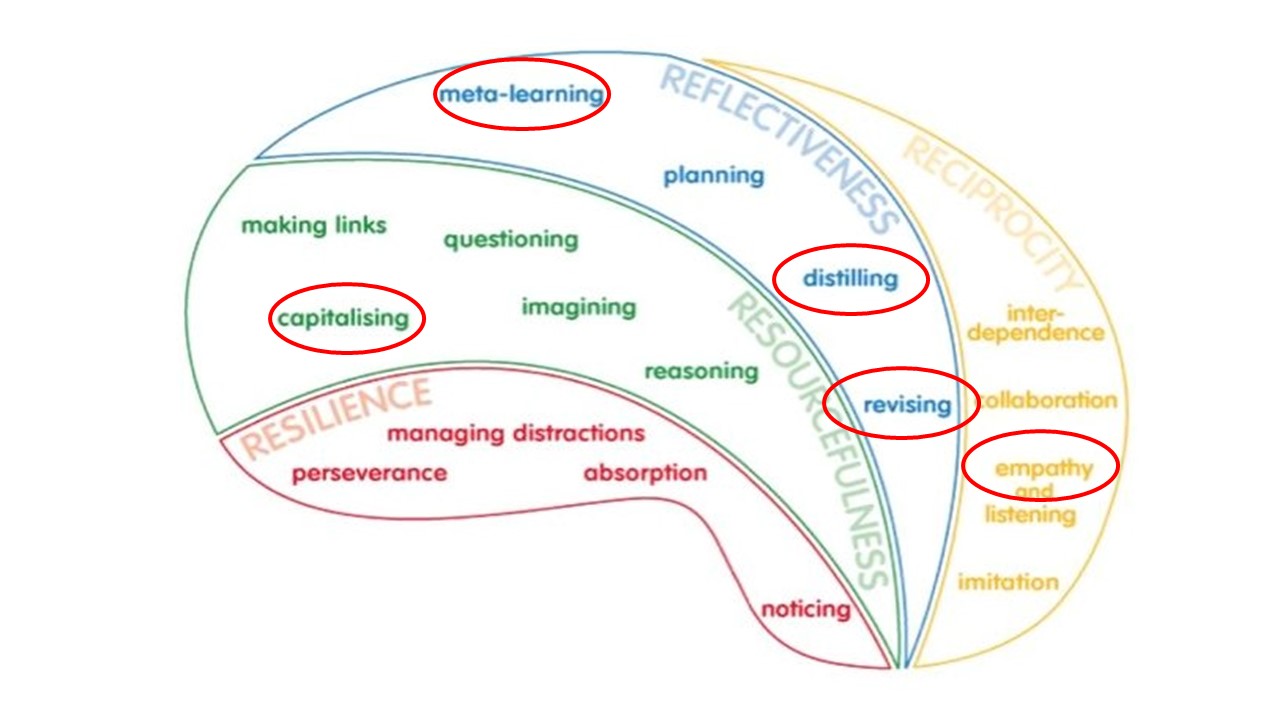
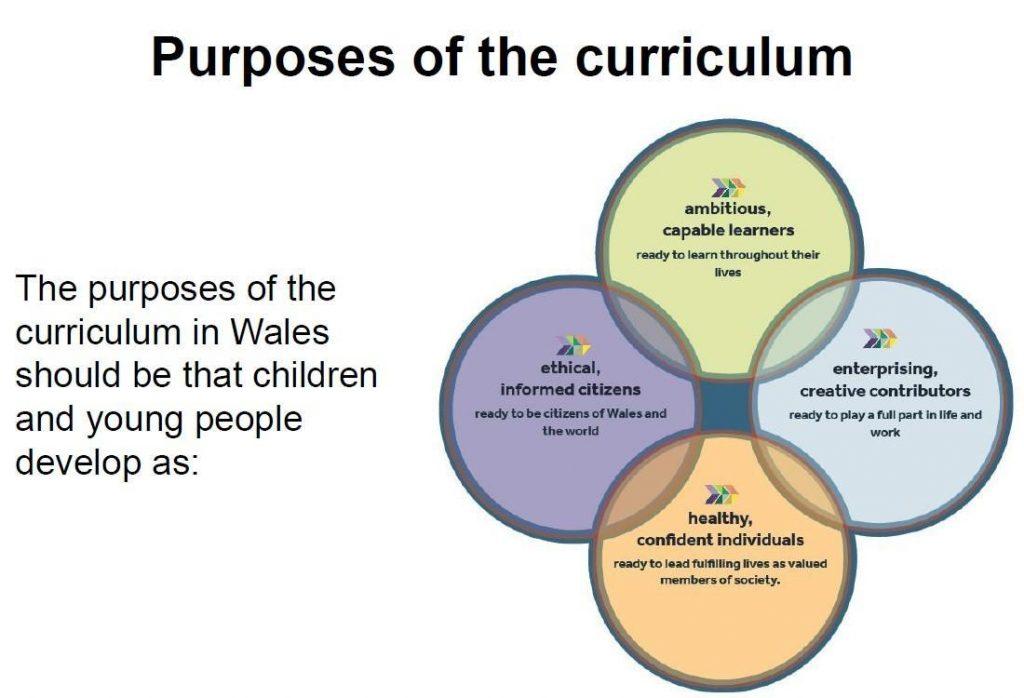

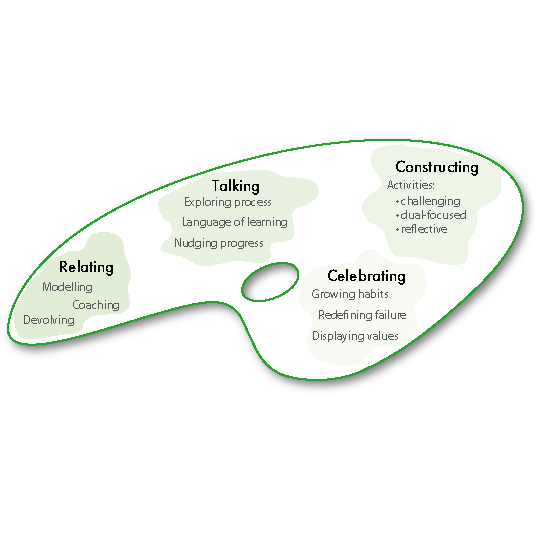
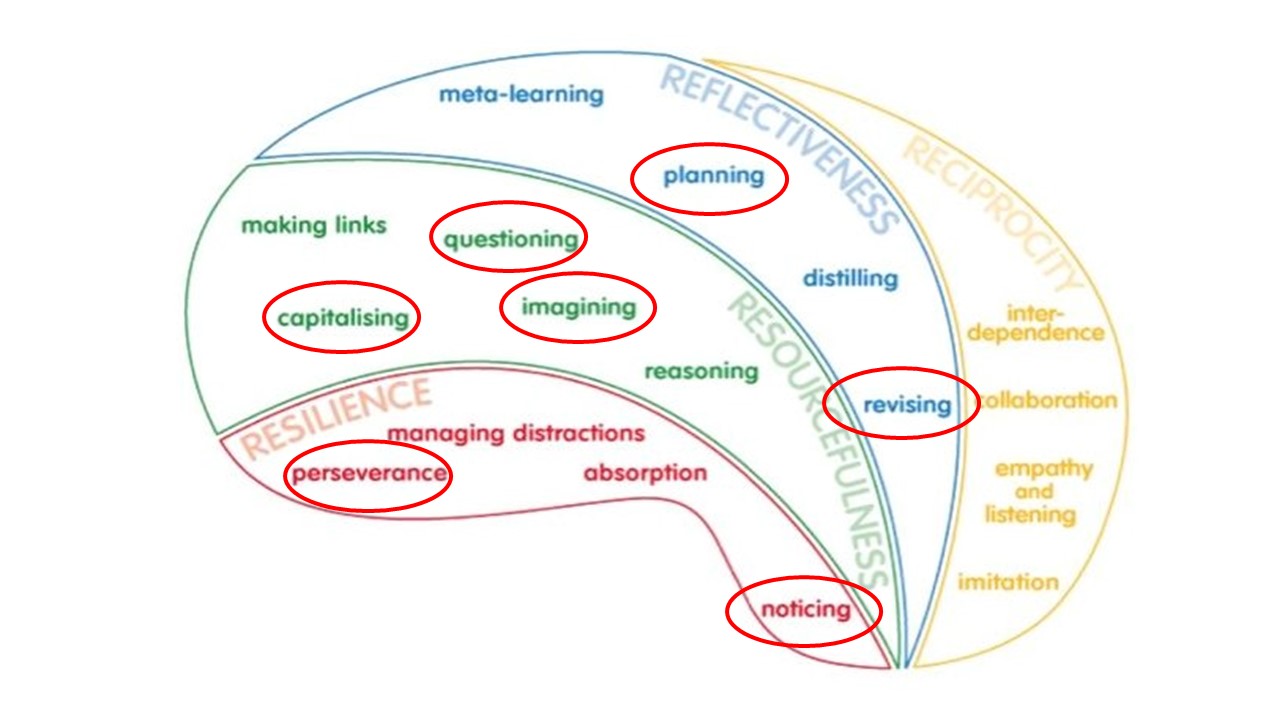
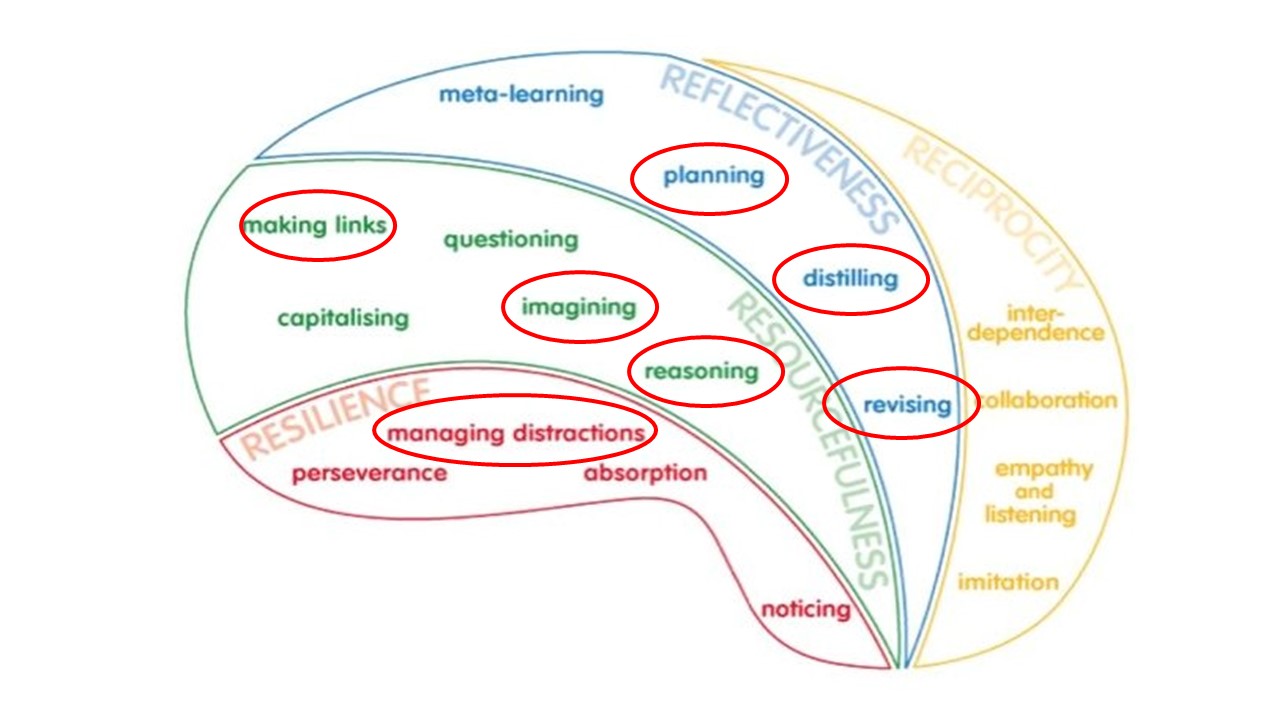
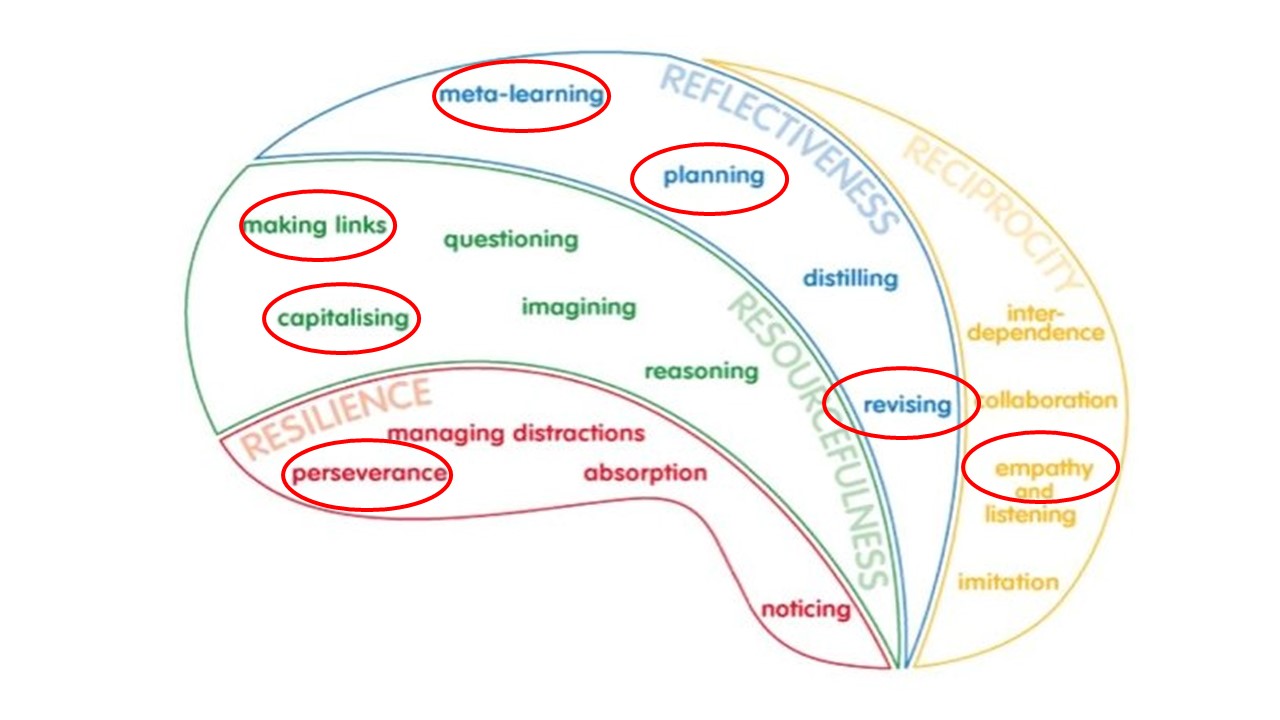
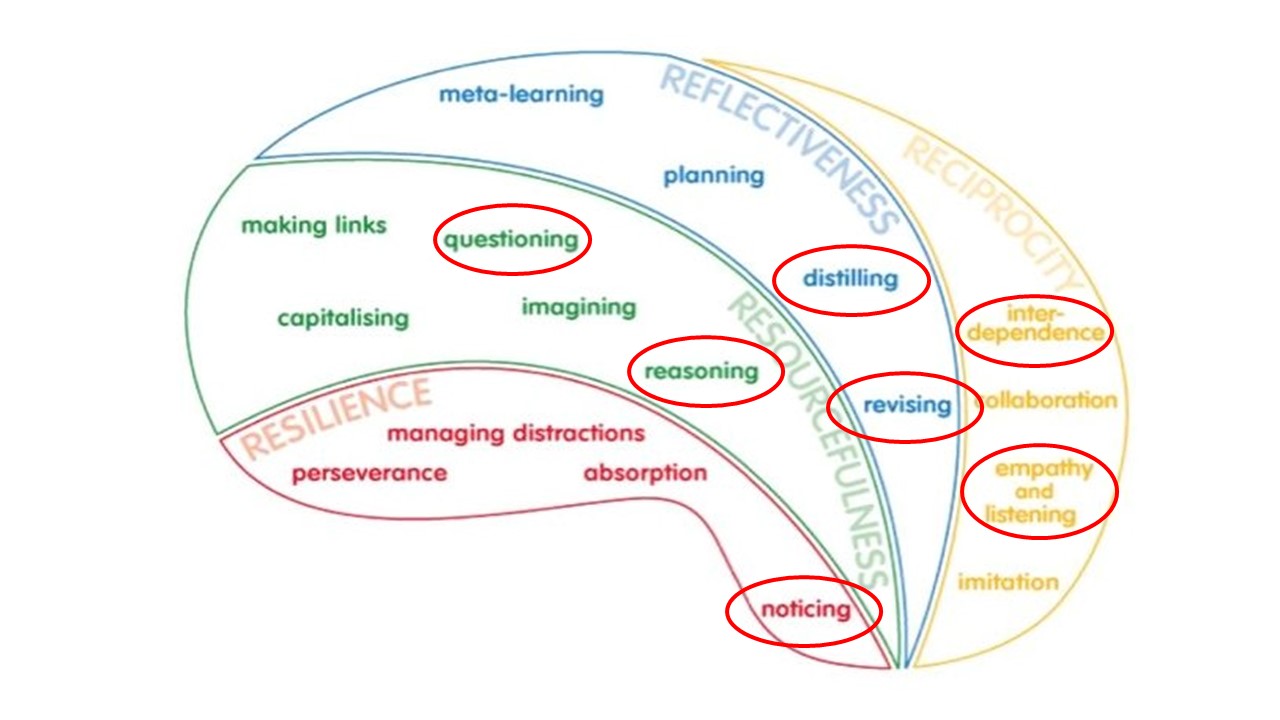

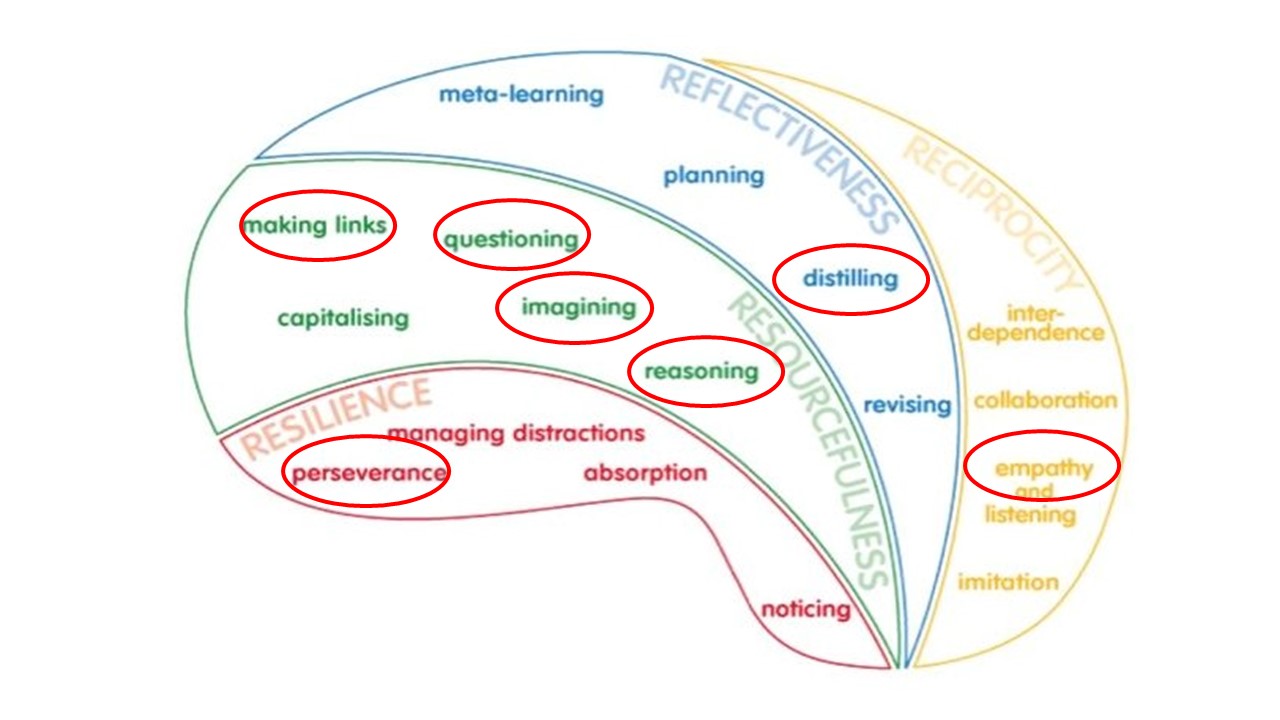
![BLP_Brain_Generic_no-Rs-[Converted]](https://www.buildinglearningpower.com/wp-content/uploads/2016/12/BLP_Brain_Generic_no-Rs-Converted.png)