About Phase 2. Inside ‘The Professional Learning Power Game‘.
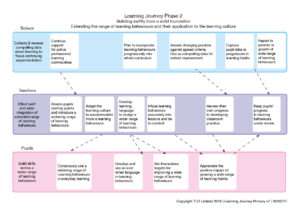
This essential second phase of the Building Better Learners programme ensures that teachers broaden and strengthen the range of learning behaviours. Having become skilled at developing the foundational learning powers now’s the perfect time widen and deepen the approach.
The Professional Learning Power Game consists of thirteen online units all of which except one explore a key learning behaviour in greater depth: how to develop and grow it over time. The units can be undertaken in any order and you can spend as long as you need to implement them in classrooms.
4 units which deepen the four behaviours introduced in Phase 1
Putting perseverance into learning
Putting questioning into learning
Putting collaboration into learning
Putting revising into learning
A further 8 units which broaden and deepen students’ learning behaviours
Putting noticing into learning
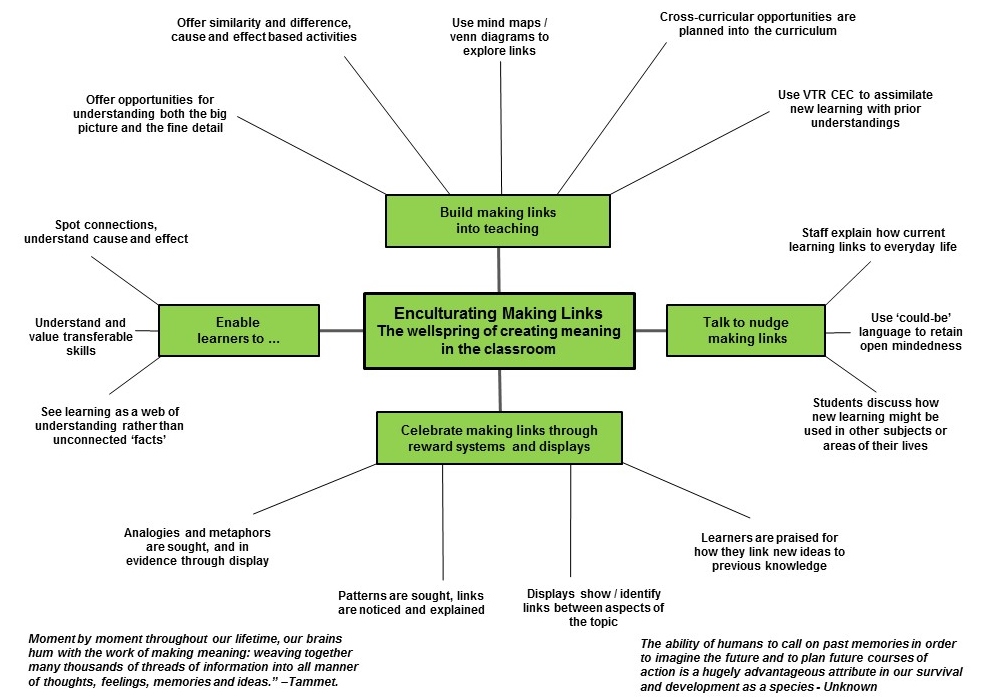
Putting making links into learning
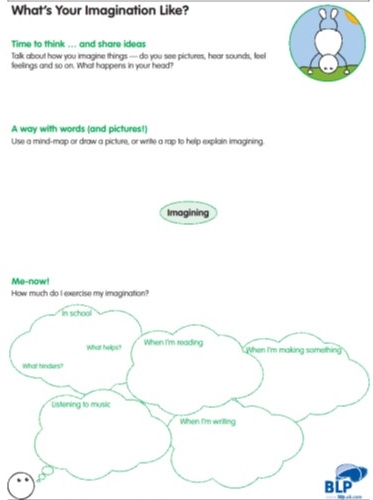
Putting imagining into learning
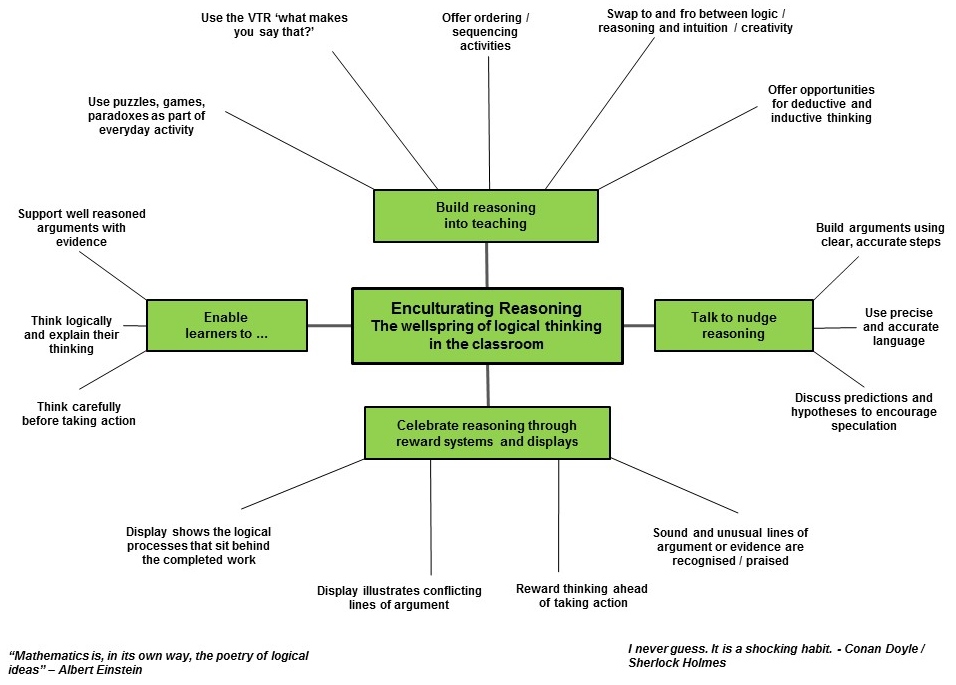
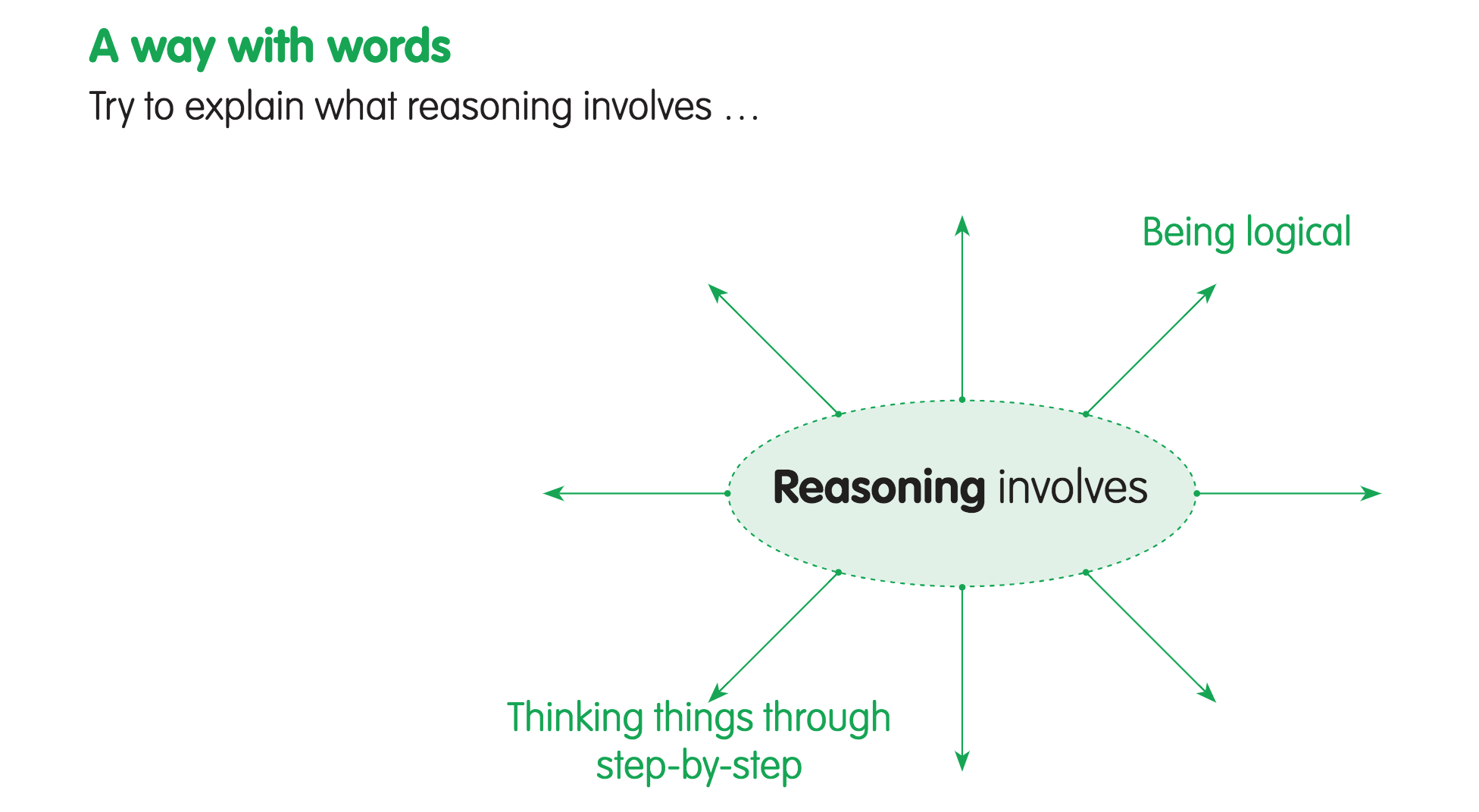
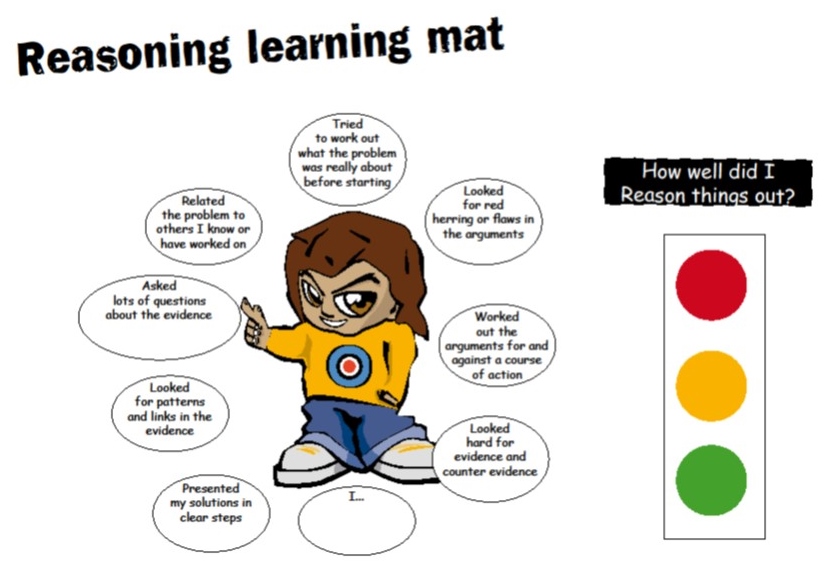
Putting reasoning into learning
Putting capitalising into learning
Putting listening into learning
Putting planning into learning
Putting meta-learning into learning
And one unit Reviewing our Progress that offers tools to review and evaluate progress in terms of classroom culture and student learning behaviours. This unit can be used as often as required and see more detail below.
You are now in the Moving on to Phase 2 section
Use the navigation bar to move from section to section
About Phase 2. The Professional Learning Power Game
1.Tailor the phase to your school
Why no recommended order?
A fair question!
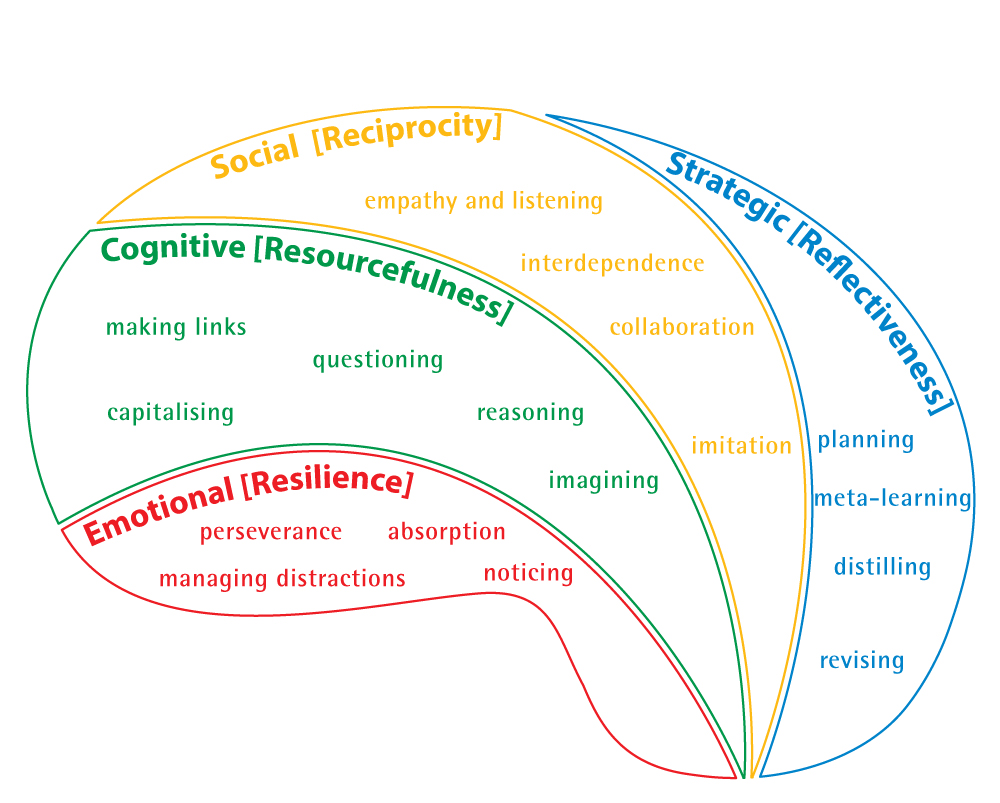
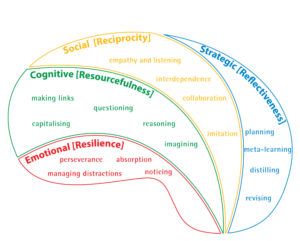
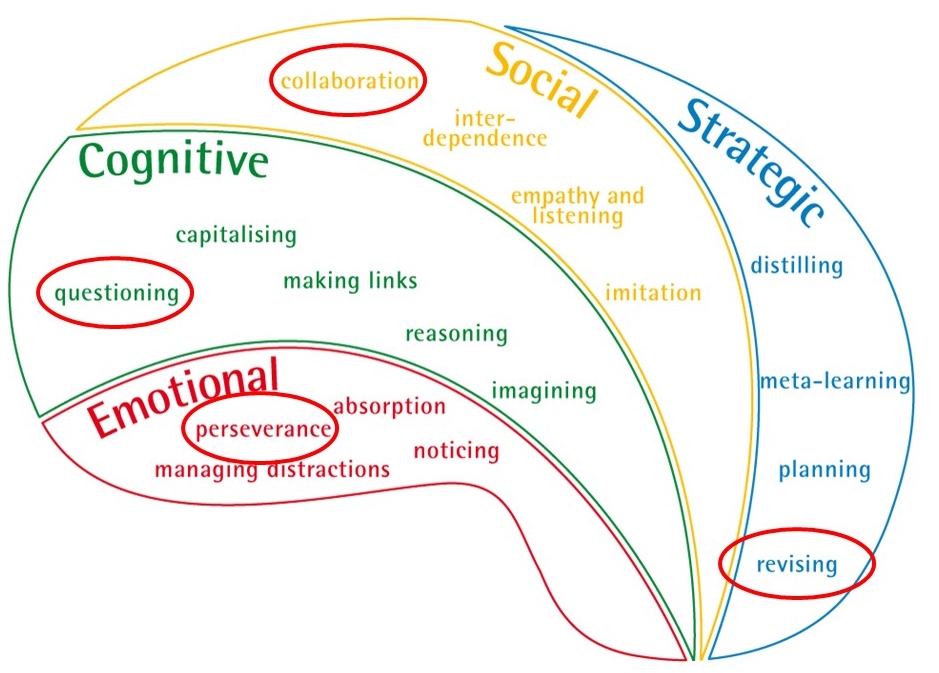
Highly effective learners have a wide range of learning dispositions and skills – they play with a full deck of learning cards. But this doesn’t mean all 12 learning behaviours are of equal importance. Perseverance, Questioning, Collaboration and Revising for example, formed the vital bedrock of Phase 1 on which other behaviours can now be successfully grafted. Some behaviours are exercised more frequently in some subjects than in others, so the blend of behaviours essential for being a scientist may differ from the blend for a linguist, or an artist etc. Secondary teachers in particular may well be attracted to the learning behaviours that figure most frequently in their own subject areas.
Equally, the existing learning strengths and weaknesses of your students should inform the decisions you make – if you are aware that Listening, for example, is a weakness that shows up in the majority of your students’ learning profiles, why would you not choose to start there?
The intention is that schools choose their own personalised route through these units in light of their unique circumstances.
2. Deepen learning behaviours
If you take a hard look at perseverance you’ll notice it’s about keeping going in the face of difficulties; channelling the energy of frustration productively; knowing what a slow and uncertain process learning often is. A mature learner understands that real learning requires effort and persistence, relishes opportunities to struggle with challenge, and believes that with effort they can become a more effective learner. This captures what we want all learners to become so there’s more to it than you might have thought.
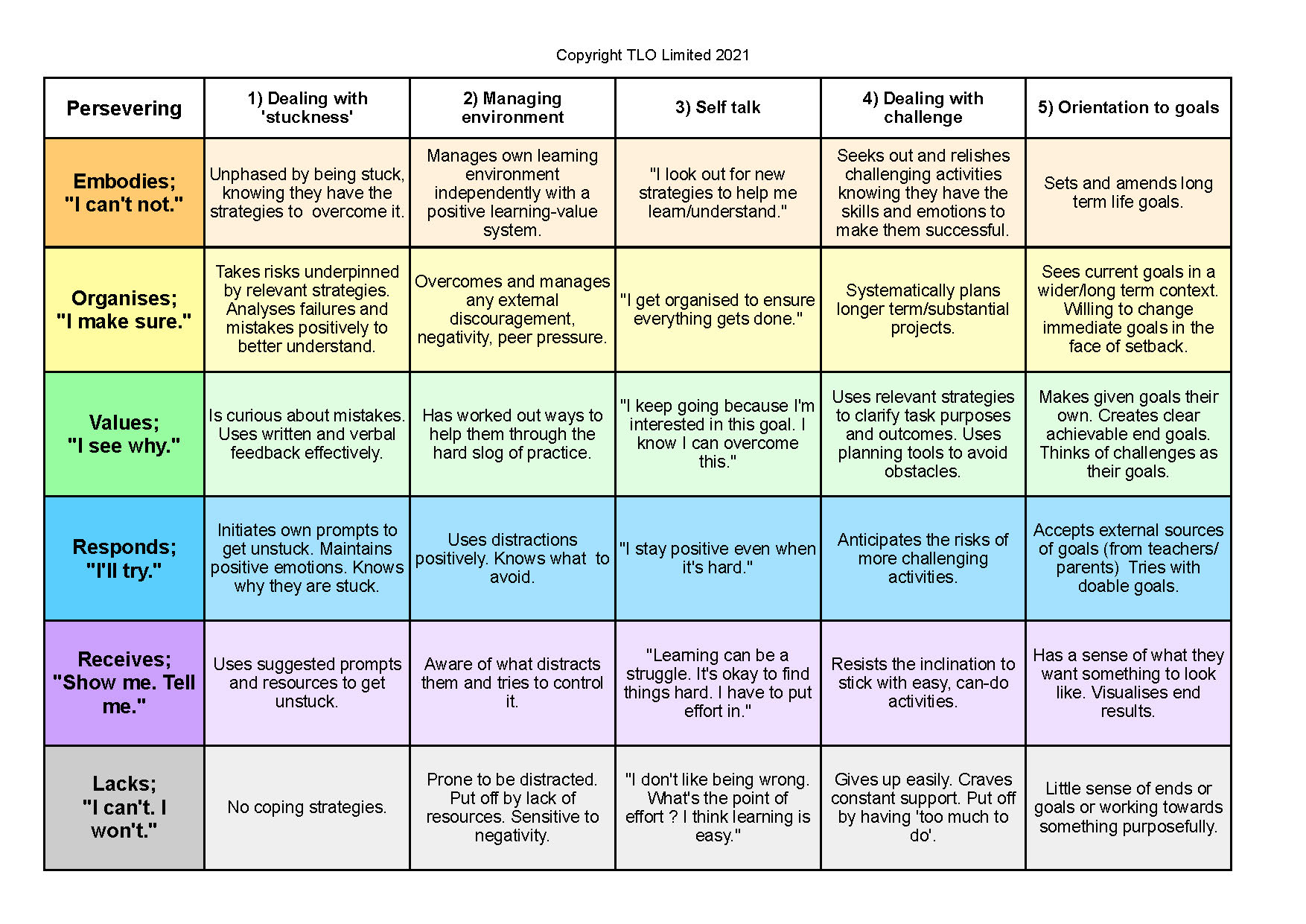
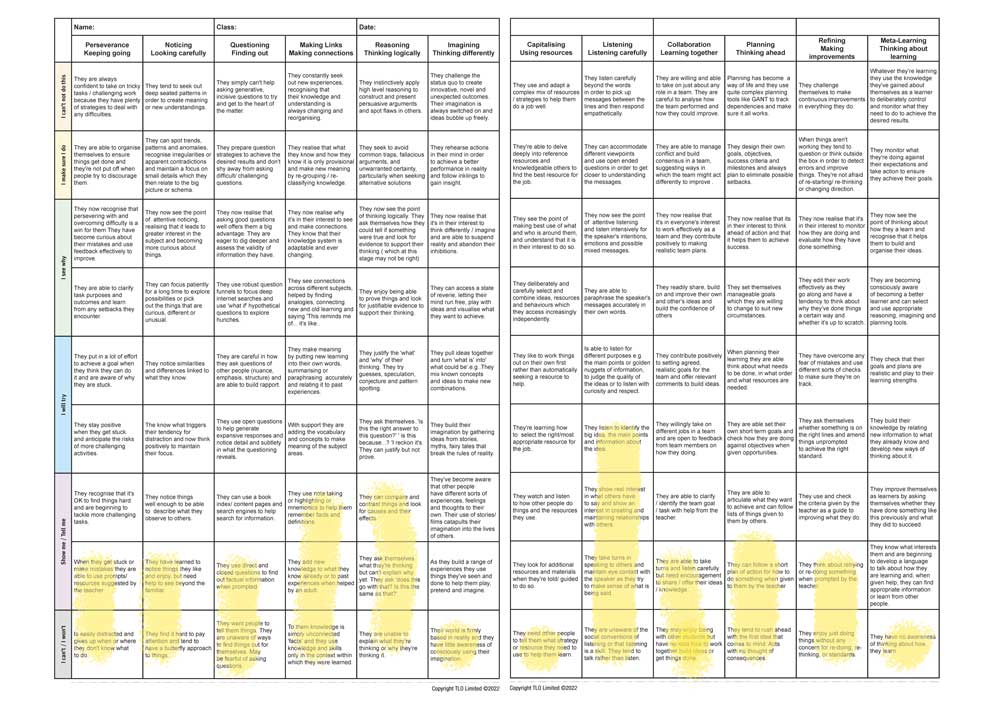
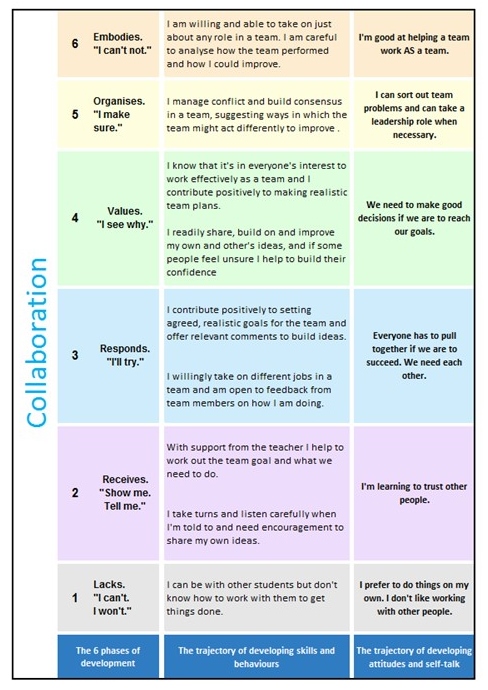
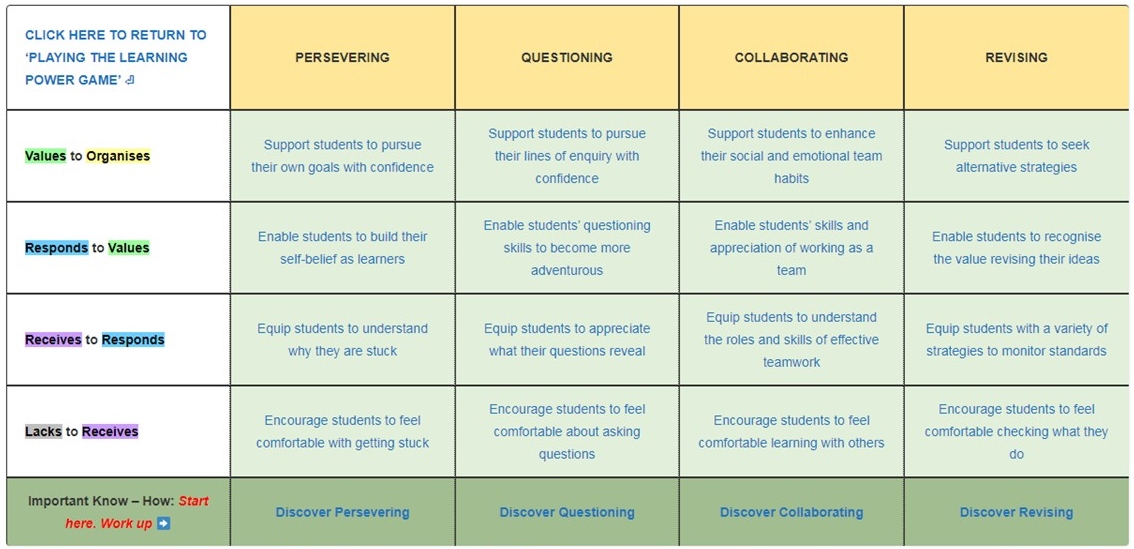
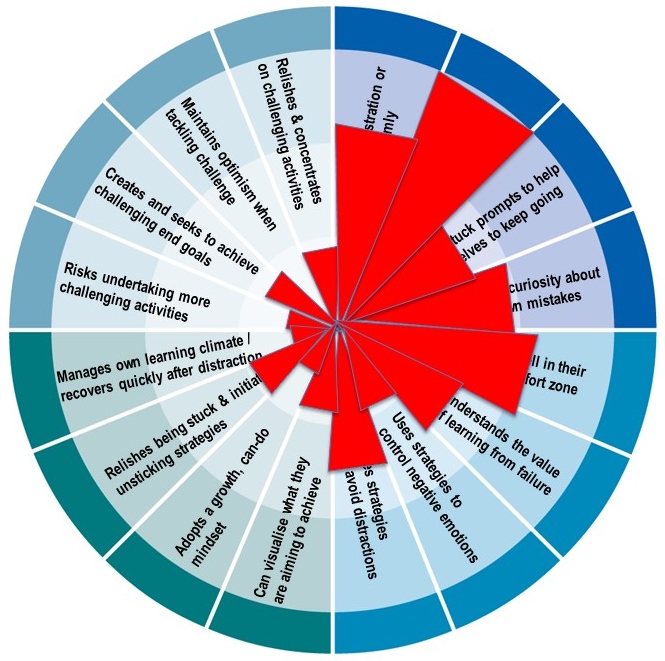
The charts in Phase 2 endeavour to pick up this deeper level of detail; take perseverance for example….
Take a look at the chart…
Perseverance is about the way we stick at things even when they are difficult. It’s one of the most useful but neglected learning behaviours. What makes us able to persevere more and more usefully? We think several things come into play here. How you are willing and able to deal with being stuck, how you are able to manage distractions and manage the learning environment, how you relate to a challenge and whether you are influenced by goals whether they be your own or imposed by others. All these things contribute to being able to persevere. And of course there’s your own little voice of self-awareness: what you say to yourself and how this influences your beliefs and values.
Being perseverant grows and builds when it’s nurtured and supported. Furthermore, being perseverant involves gaining control of a range of linked skills and emotions.
The other 11 learning behaviours in phase 2 have their own, richer progression charts. These guide teachers to better understand and coach the richer states and stages of development.
Take a look at how progression in Perseverance might grow across five components.
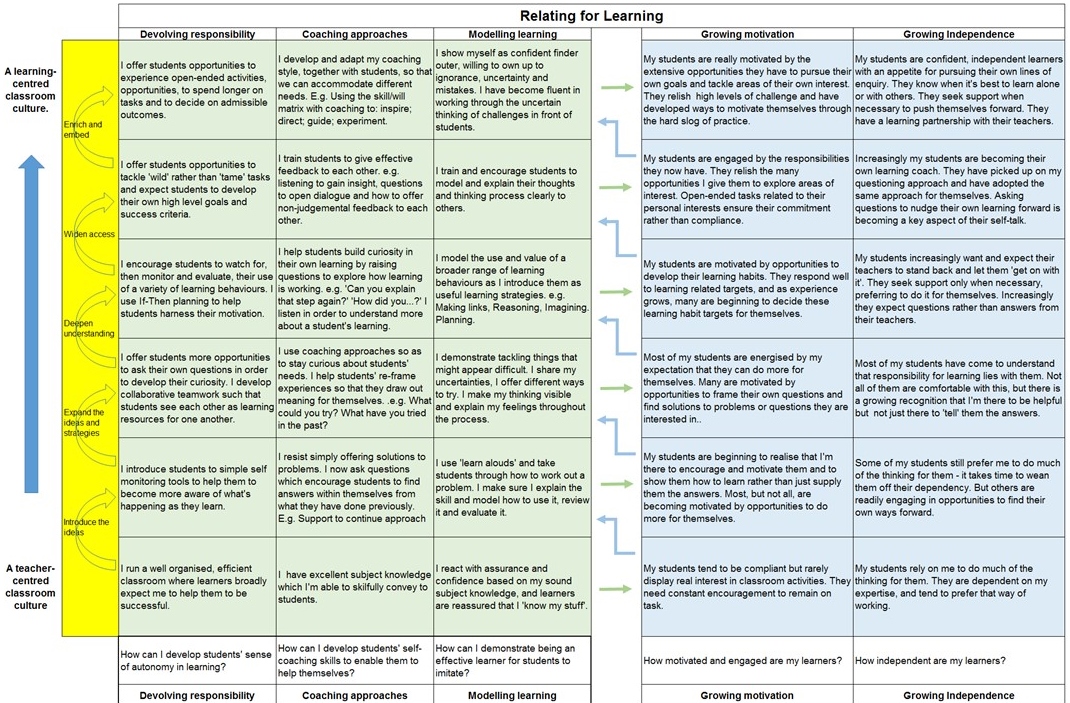
In Phase 2 we offer progression charts for teachers designed to give them a sense of their own journey as a learning power coach. By witnessing this development journey in teachers we found it was more complex than you might think!
Teacher growth is coupled to student growth
The teacher growth chart is progressive – each step builds on the preceding one, each step needs to be attended to before further ones are attempted. But in making this progression teachers need to consider carefully where their students are as learners – they really do need to;
start from where students are,
Rather Than
from where they themselves want to be.
This is because teachers’ practice will be constrained by their students’ dispositions, skills and understandings of their learning. In Phase 2 you will findbroad learner growth charts (shown here in blue) linked to teacher growth charts (green).Teachers are advised to shape their practice one step ahead of their learners’ practice, then wait for their learners to ‘catch up’. Students need time to discern, understand and act on changes the teacher is causing them to make.
A classroom where the teacher is performing at or near the top of their growth trajectory while their learners are languishing near the bottom of their growth trajectories would be a totally inappropriate and ineffective – there’s little point in changing teaching practice if it doesn’t impact on learners’ dispositions. Where learners sit on this ‘blue’ trajectory is a useful indicator of the presence and impact of the ‘green’ teacher interventions. Something’s amiss if there is not a fairly close match.
A delicate combination of teacher development and student progression
Teachers keep a step ahead enabling students to play catch-up
4. Review your Progress
This one off unit is designed to enable teachers, teams or the school more widely to review their progress so far. You can use it at any suitable point in the programme.
The unit offers a rich variety of tools help to review progress in developing a learning culture in classrooms. This review provides information to guide the approach in the next phase of building students’ learning powers. Sections 1–4 help teachers to consider:
Reflecting on their changing practice. Looking at what they have done and how their classroom has changed. This section answers the question “How far have we come?”
Giving pupils a voice. Finding out how their students have benefited. This section answers the question “How well have our students taken to this way of learning?”
Learning with and from colleagues. Learning from learning walks and observations. This section answers the question “What are the variations on the theme and what can we learn from these variations?”
Team session: Learning together. Putting their heads together and thinking “What next?” These team session answers the questions “How are we doing, how are our students doing and where do we need to go next?”
5. Unit structure — e.g. Putting Imagining into Learning.
Each unit is designed to guide teachers through a process of building the habit in students. Sections 1–4 consider:
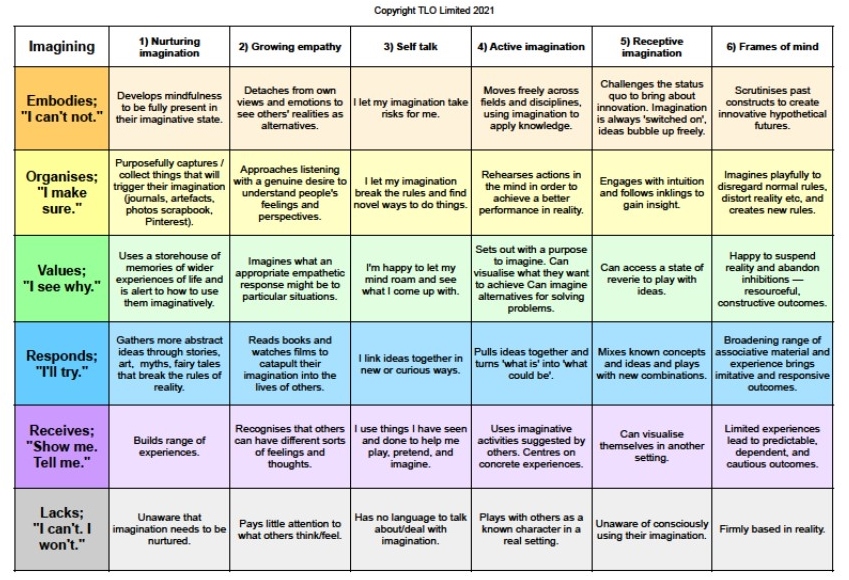
Imagining and how it develops. Includes an Imagining Progression Chart. Unpick the meaning of Imagining, how it develops over time and use the Imagining chart to consider where their students are now.
Taking Imagining into classroom culture. Includes effective classroom activities. This section offers numerous suggestions to develop a learning-friendly culture and build students’ learning skills. It includes ideas for lesson starters and quick wins; classroom activities; learning reflection tools; ideas for the appropriate learning language for each phase of progression in Imagining.
Blending learning habits with content. Example dual focused lesson. This section suggests a series of questions and steps you might use to design imagining into lessons. Here we look closely at how to blend improving students’ Imagination with the content you have to teach. The section covers: The six principles behind any learning powered lesson; Big questions to ask about lesson design; Lesson planning in action: an exemplar Imagining-focused task.
Team reflection and planning. Sharing the impact of classroom experiments with colleagues and plan what needs to be done next. It gives a skeleton plan for the Professional Learning Team session and includes downloadable enquiry questions and planning formats. In team sessions staff are invited to share the impact of their experiments with colleagues, discuss the online materials, and plan how they might use these to change their practice.
A richer view of imagining
6. Support for senior leaders and/or learning champions
Leading…The Professional Learning Power Game is the complementary resource that takes a leadership perspective on Phase 2 of developing students’ learning power. It’s designed to offer leaders a view of the strategic concerns that will arise when the school moves into Phase 2.
It offers some hard questions, think pieces, development frameworks and monitoring and review tools to help leaders:
feel reassured about the purpose, benefits and frameworks for Phase 2;
explore important leadership roles when supporting the deepening of Learning Power throughout the school;
maintain momentum into the future;
understand significant shifts in ways of working as teachers’ skills develop in the latter stages.
These strategic issues are considered over 5 sections:
Overview and an outline of the Phase 2 programme for staff
Key messages of learning power distilled
Leadership strategies to ensure success including;
Recognising the real life value of learning behaviours
Expanding classroom learning cultures
Reshaping curriculum delivery using a wide range of behaviours
Expanding the range of learning behaviours used
Evaluating the schools vision
Learning from looking
Carrying the messages to parents
Keeping an eye on progress
Where now? What next?
7. Costs and benefits
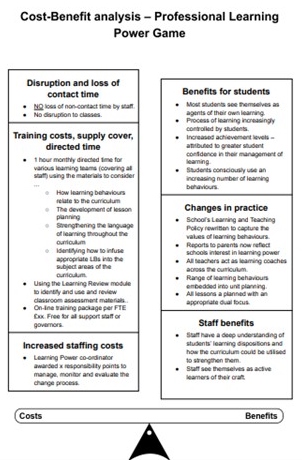
‘The Professional Learning Power Game offers material that ensures a deep consolidation of the whole Building Better Learners programme. A benefit to the school and its students for years to come. Here is a way of thinking about the wider costs and benefits of the programme.
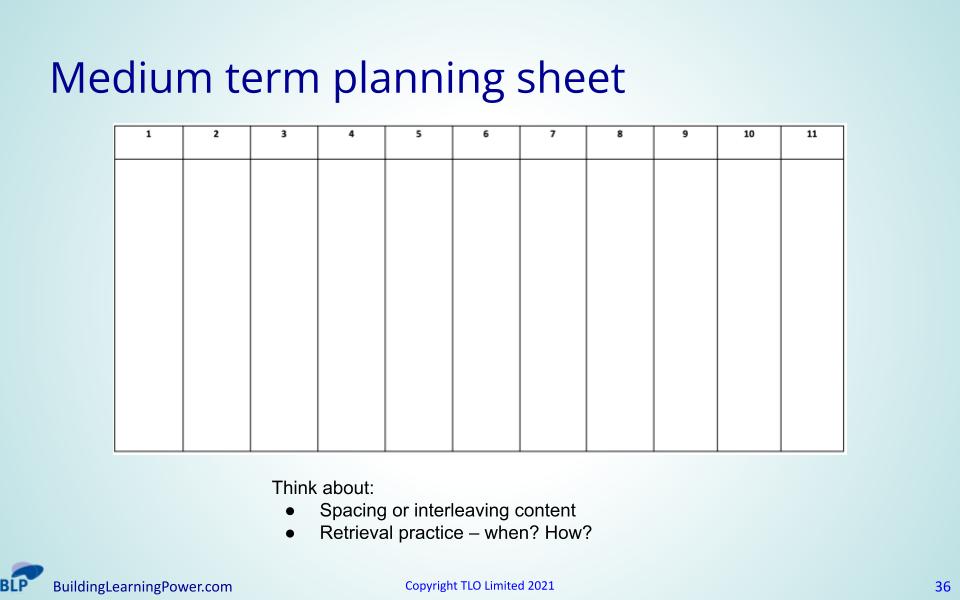
We’ve borrowed this cost benefit analysis from a school that has been working with learning power for some time. The depth of the learning behaviour charts in Phase 2 gave them far greater insight into learning and how it could be utilised by the curriculum itself. So the various professional learning teams across the school became research teams. Here they didn’t just research and perfect their own practice but took a wider angle look at the curriculum and lesson delivery and how learning behaviours could be built in at curriculum planning level alongside types of retrieval practice and the interleaving content.
Looking at learning behaviour progression influenced how both the curriculum and individual lessons changed. It led teachers to re-evaluate how their subject delivery might be made even more learning and learner focused. Classrooms have become very alive with learning.
Note that any benefit side of this type of analysis will take time to build. However, the different types of benefits provide a useful view of what the school wants to see happen as a result of the staff development efforts. It’s a valuable set of goals.
1. The intentions of Unit 4 – Broadening the range
The intention of this unit is to:
introduce and encourage teachers to branch out and play with building some of the next 8 learning behaviours, to get the feel of them in preparation for Phase 2 of the programme.
As a result it should have the following impact:
teachers will be inspired to explore two or three new learning behaviours of their choosing in anticipation of Phase 2 of the programme.
2. Tackling Unit 4 over two months
Unlike previous units that had a clear flow through the materials, Unit 4 is more an invitation to explore new learning behaviours of interest to the teacher.
Their first task will be for teachers to make a decision on where they want to start. They might:
look at their students’ learning profiles and target perceived areas of weakness;
focus on learning behaviours that link well with particular curriculum areas (ie Reasoning with Numeracy);
agree together to focus on the same behaviours that are considered cross-school priorities;
agree to tackle different behaviours so that all 8 new behaviours get explored;
or senior leaders may suggest a behaviour to start on as it is a perceived weakness based on their observations over the past months.
The next stage is to explore 2 or 3 of these behaviours over the next two months. They should plan to explore a new behaviour every 2/3 weeks, but there is no expectation of using all the materials shown in Unit 4.
There are 2 meetings scheduled for Unit 4, about one month after the start, and a final meeting at the end of the year. Both are times when teachers will share, compare and contrast the outcomes of their experiments.
If the programme started in Sept and you have managed to stick to our suggested timings, you should aim to begin Unit 4 late in year 1, possibly around Summer half term (end May)
3. Strategic concerns for leaders
What might leaders be doing?
During the online reading stage: keep the conversation going informally, show an interest in which behaviours teachers are thinking of focusing on, and why they are choosing those ones.
Before Meeting 1: As teachers begin to trial some ideas, go into classrooms to support and encourage. Look in particular to link up teachers who are exploring the same additional learning behaviour(s).
After Meeting 1 and through to the end of Unit 4: Support teachers implementing their personal action plans derived from Meeting 1. Look out for teachers trialling similar ideas and pair them up. Share ideas that are working well.
What leaders will be thinking about
What has gone well; what has gone less well; where the examples of best practice lie and how these ‘hot-spots’ can be shared more widely; what still needs consolidating; how to maintain momentum and build on these foundations.
4. Supporting development
Unit 4, Team Meeting Agenda 1
[We anticipate that Unit 4 may well take around 2/3 months to complete – as such it will probably spill over into year 2 even if you have been able to stick to our anticipated timings for Units 1,2 and 3. Two meetings are to be scheduled, this meeting one month after starting Unit 4, and a second one about 4 weeks later.]
This meeting invites teachers to share their explorations of the 8 new learning behaviours in Unit 4.
This meeting is positioned and designed to enable them to:
Look back over and discuss with colleagues the progress they have made with their personal action plans relating to Unit 3 that they devised at the previous meeting, and . . .
Share their responses to their reading in Unit 4, Broadening the range.
Draw up a personal action plan for how they will take their practice forward based on further exploration of the ideas in Unit 4.
Unit 4, Team Meeting Agenda 2
[Schedule this meeting about 6 weeks after the previous Unit 4 meeting, towards the end of the school year. The meeting looks back over the whole programme and looks forward to what might come next.]
Teachers are invited to share their explorations of some of the 8 new learning behaviours in Unit 4, invites them to look back at their learning throughout the Playing the Learning Power Game programme, and offers a glimpse of what might come next.
This meeting is positioned and designed to enable teachers to:
Discuss the progress they have made with their personal action plans for Unit 4 devised at the previous meeting, and . . .
Share responses to their reading in Unit 4, Broadening the range.
Draw up a personal action plan for how they will take their practice forward based on further exploration of the ideas in Unit 4.
Find the agendas for the meetings in the toggle boxes below.
Share reports of how learning powered lesson plans have worked (20 mins)
Discuss the online materials that people have looked at in Unit 4 (15 mins)
Consider possible policy issues for the school (5 mins)
Personal Action Planning (20 mins)
Review the meeting process (5 mins)
Item 1. Session objectives: What do we want to achieve? (5 mins)
Objectives should include:
learning from what and how our Action Plans have worked in different classrooms;
feeling confident to take forward ideas from online materials into our practice;
proposing actions that would benefit if everyone applied them in their practice;
planning further personal developments in classroom practice.
Item 2. Reports from classroom enquiries (15 mins)
(NB. based on material from Unit 3)
Share and discuss teachers’ practice; a valuable source of learning for everyone.
what you each tried to change or try out in your lesson planning and delivery, the activities you designed/used, the VTRs that worked . . . .
how they worked
what you could/did change to make them work better
how students reacted
whether there may be longer term benefits for students
Ask each other questions, offer suggestions and learn from each other.
Remember…everyone is supposed to report back to every meeting.
This isn’t a simple show-and-tell session but one where the group question and probe their colleagues’ summaries of what they have done to encourage analysis and deeper reflection.
Questions to encourage deeper thinking include:
What do you think is getting in the way?
What would make this better?
How did students react to that change?
How could this technique be modified to make it work better for you?
What do you think made that work so well?
Item 3. Recap on-line materials in Unit 4: What the materials made us think (15 mins)
You will have been exploring at least some of the 8 new learning behaviours for around a month or so. What have you been trying out? Why did you choose to start with those? What was of particular interest? What more do you want to experiment with?
Try a PMI (Plus, minus, interesting) routine to help sort out your thinking.
Think about:
how the ideas would suit your students as learners
which are realistic both for you and your students
how the ideas would impact on your classroom culture and the students view of themselves as learners
which ideas are front runners and why?
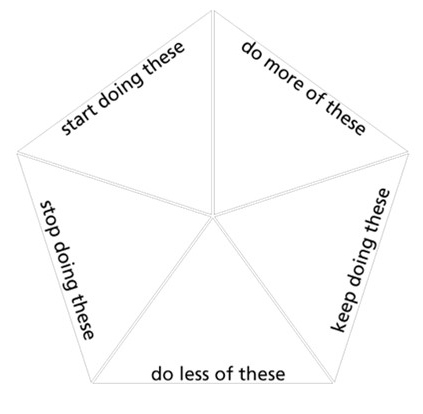
Use this decision making pentagon in deciding what to do you might try.
Note down a couple of:
things you want to start doing
things you think you need to stop doing (that’s harder)
things you want to keep doing
things you want to do more often
things you want to do less
Item 4. Propose what may be needed across the school. (5 mins)
The point here is to identify ideas that are sufficiently important that they;
should be included in everyone’s action plan
i.e. you are sufficiently keen on some of the ideas that you all want to try them in one form or another
should be adopted by everyone as a whole school strategy
i.e. when discussions over time have concluded that some ideas have proved so useful across the school they should be woven into school policies or procedures.
Some of the ideas suggested in the on-line materials are likely to make greater impact if they were to be adopted by everyone across the school.
Item 5. Personal action planning. What am I going to do? (20 mins)
Think about what you are trying to achieve.
Plans at this stage should be linked to what you are learning from Unit 4 and how your students are responding to the changes you are trialling.
Gain more value from your plan by creating it around a question. Think of it as an If:Then problem.
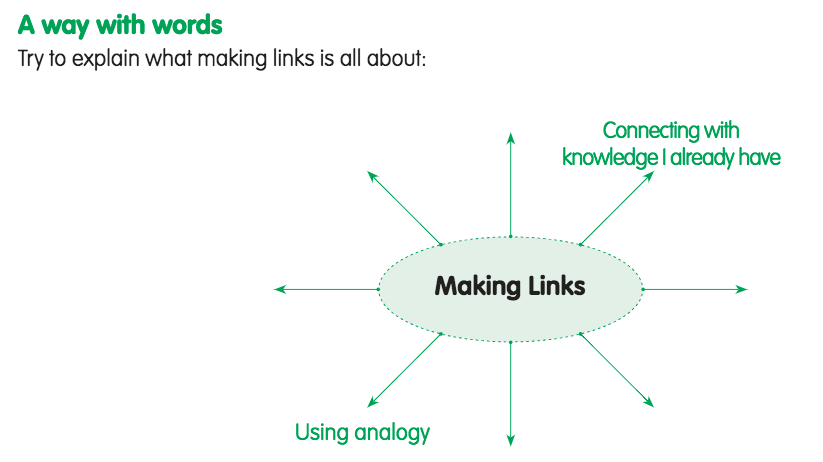
For example, if you are intending to focus on Making Links:
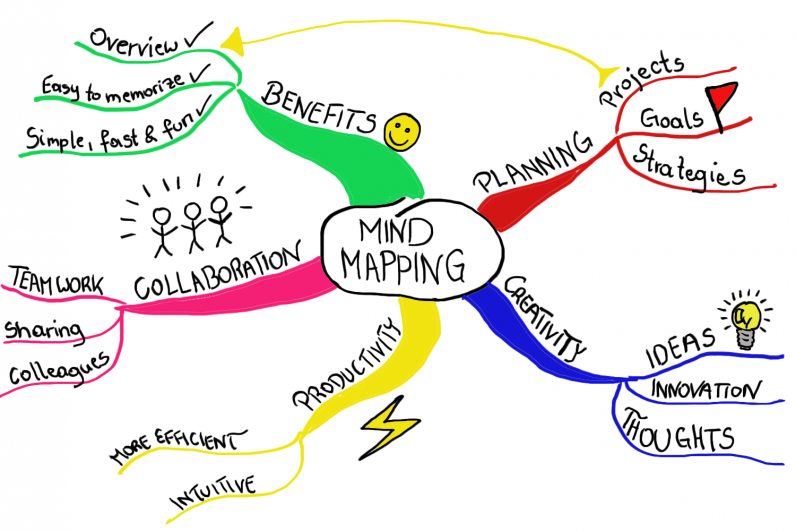
If I encourage my students to create mindmaps, will I notice any improvement in their ability to understand how ideas are/can be linked together?
Or, if you are intending to focus on Reasoning and promote evidence based reasoning:
If I use the VTR ‘What makes you say that?’ fairly frequently, will I notice any development in students’ ability to support their thinking with evidence?
The learning enquiry plan is a record of what you intend to do. It takes your enquiry question from what to how. Remember:
you can choose which aspect(s) of classroom practice to focus on;
think about the aspect that is likely to have the greatest benefit for your students;
make the plan specifically focus on development;
concentrate on no more than two or three actions;
decide how to map your actions over the next three or four weeks;
it’s useful to think about what you are going to do less of to make room for the changes.
As part of your plan it’s important to record what you will monitor over the weeks.
Changes you expect to see in your classroom practice. For example what do you expect to:
see yourself doing differently?
hear yourself saying more often, with greater commitment, more effectively?
look out for in order to find out which approach best suits most students?
feel less stressed about? What will indicate that?
monitor to make sure that the changes you are making are having an impact of your students?
Changes you expect to see in your students. For example do you expect students to:
begin to take greater responsibility for their own learning;
be more inclined / better able to talk about learning;
be better able to recognise/ describe how they are learning;
show a deeper understanding of the process of learning;
other.
Noting such changes will motivate you to continue with your experiments because the changes in students are almost always positive. The plan represents a promise to do it. This promise helps you to keep the plan as a priority in your mind.
The level of critical analysis which is part of small research projects has been designed/built into the Enquiry Question and Action Planning forms. In other words their very design helps you to develop effective research focused questions and provoke evidenced based reflection.
Item 6. Evaluate team session: How did we do as a team? (5 mins)
Did we achieve our objectives?
Are we comfortable with what we are trying to achieve?
Share reports of progress in introducing new learning behaviours from Unit 4 (20 mins)
Consider possible policy issues for the school (5 mins)
Discuss what the school should do next to further secure and grow student learning behaviours (10 mins)
Personal Action Planning (20 mins)
Review the meeting process (5 mins)
Item 1. Session objectives: What do we want to achieve? (5 mins)
Objectives should include:
learning from what has already been trialled in different classrooms;
feeling confident to take forward ideas from online materials into our practice;
proposing actions that would benefit if everyone applied them in their practice;
planning further personal developments in classroom practice.
Item 2. Reports from classroom enquiries (15 mins)
Share and discuss teachers’ practice; a valuable source of learning for everyone.
This involves thinking back to what you have been putting into practice over the last few weeks from your last Action Plan. It covers;
what you each tried to implement using ideas from Unit 4
how they worked
what you could/did change to make it work better
how students reacted
whether there may be longer term benefits for students
Ask each other questions, offer suggestions and learn from each other.
Remember…everyone is supposed to report back to every meeting.
This isn’t a simple show-and-tell session but one where the group question and probe their colleagues’ summaries of what they have done to encourage analysis and deeper reflection.
Questions to encourage deeper thinking include:
What do you think is getting in the way?
What would make this better?
How did students react to that change?
How could this technique be modified to make it work better for you?
What do you think made that work so well?
Item 3. Propose what may be needed across the school. (5 mins)
The point here is to identify ideas that are sufficiently important that they:
should be adopted by everyone as part of a whole school strategy
i.e. when discussions over time have concluded that some ideas have proved so useful across the school they should be woven into school policies or procedures.
Think back over the past year as you have engaged with Playing the Learning Power Game.
Some of the ideas have been trialled and found favour with particular teachers, but others seem to have had widespread interest from teachers due to their impact on student learning.
What are these ‘stand out’ ideas? How will they become ‘how we all do things here’?
Item 4. Personal action planning. What am I going to do? (20 mins)
This is the point when everyone in the team makes an action plan which they will implement as the programme draws to a close.
A. It starts with a question
The key to developing your practice, is to think first of the need (what needs to change in students) and then think what could be done to achieve it. The knack lies in developing enquiry questions to sort out what you want to do.
Why a question? Because this is an enquiry! You want to find out if something (student behaviour) will change/improve if you change something specific.
Research suggests that you’ll gain more value from your plan by creating it around a question. Think of it like this:
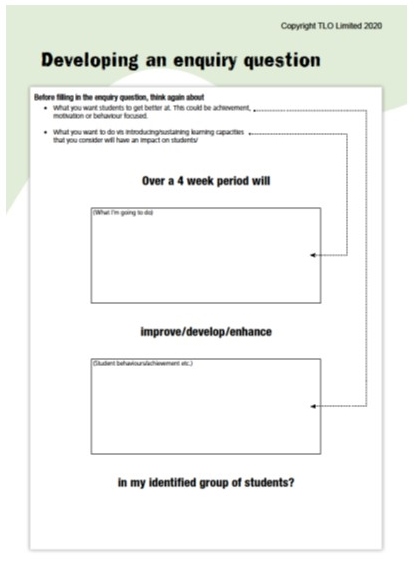
If I do/plan, try xxxx will it improve/develop/ secure/ enhance xxx?
For example, if you were planning to introduce another one of the 8 behaviours to your class, your enquiry question could be:
If I introduce my students to the idea of meta learning, will they become more aware of their learning behaviours, strengths and weaknesses?
Try the planning sheet opposite.
B. Now think about a plan
But remember what you are trying to achieve.
Plans at this stage should be linked to what you are reading in Unit 4.
The learning enquiry plan is a record of what you intend to do. It takes your enquiry question from what to how. Remember:
you can choose which aspect(s) of classroom practice to focus on;
think about the aspect that is likely to have the greatest benefit for your students;
make the plan specifically focus on development;
concentrate on no more than two or three actions;
decide how to map your actions over the next three or four weeks;
it’s useful to think about what you are going to do less of to make room for the changes.
See format alongside to help you think through the planning process. You can fill in your Personal Action Plan using the word document version.
Also record what you will monitor over the weeks.
Changes you expect to see in your classroom practice. For example what do you expect to:
see yourself doing differently?
hear yourself saying more often, with greater commitment, more effectively?
look out for in order to find out which approach best suits most students?
feel less stressed about? What will indicate that?
monitor to make sure that the changes you are making are having an impact of your students?
Changes you expect to see in your students. For example do you expect students to:
begin to take greater responsibility for their own learning;
be more inclined / better able to talk about learning;
be better able to recognise/ describe how they are learning;
show a deeper understanding of the process of learning;
other.
Noting such changes will motivate you to continue with your experiments because the changes in students are almost always positive. The plan represents a promise to do it. This promise helps you to keep the plan as a priority in your mind.
The level of critical analysis which is part of small research projects has been designed/built into the Enquiry Question and Action Planning forms. In other words their very design helps you to develop effective research focused questions and provoke evidenced based reflection.
5. Discuss what we might do next (10 mins)
The programme Playing the Learning Power Game is phase 1 of Building Learning Power. The next phase takes you much deeper into all 12 learning behaviours, allowing you to build on the excellent foundations that you have already laid. Are you, as a school, ready to begin phase 2, The Professional Learning Power Game?
Items 6. Evaluate team session: How did we do as a team? (5 mins)
Did we achieve our objectives?
Are we happy with what we have achieved?
Will we continue to learn together like this in the future?
5. Resources for bringing staff onboard
Here we offer a short powerpoint with delivery notes to introduce Unit 4, Broadening the range, to staff. It is available to any school undertaking this programme. They can be used to;
to introduce this aspect of the programme to staff if you have opted for a DIY start
reinforce any previous training e.g. remind you of the key ideas given by TLO during either Zoom or In-school programme launch sessions
Introducing Unit 4 content to your teachers
This short slide presentation aims to help teachers understand Unit 4 and how it builds naturally on from the work they have been doing thus far.
The slide deck could be used to introduce teachers to the key ideas behind Unit 4. In total it might take around 30 minutes to work through with your staff.
You might use this slide deck:
just as it is to introduce the ideas to staff;
to help structure a learning conversation amongst/in teams;
added to strategic presentation of your own to ensure staff gain a holistic picture.
Brief explanatory notes can be found under each slide.
1. The intentions of Unit 3 – Constructing Learning
The intention of each section in this unit is to:
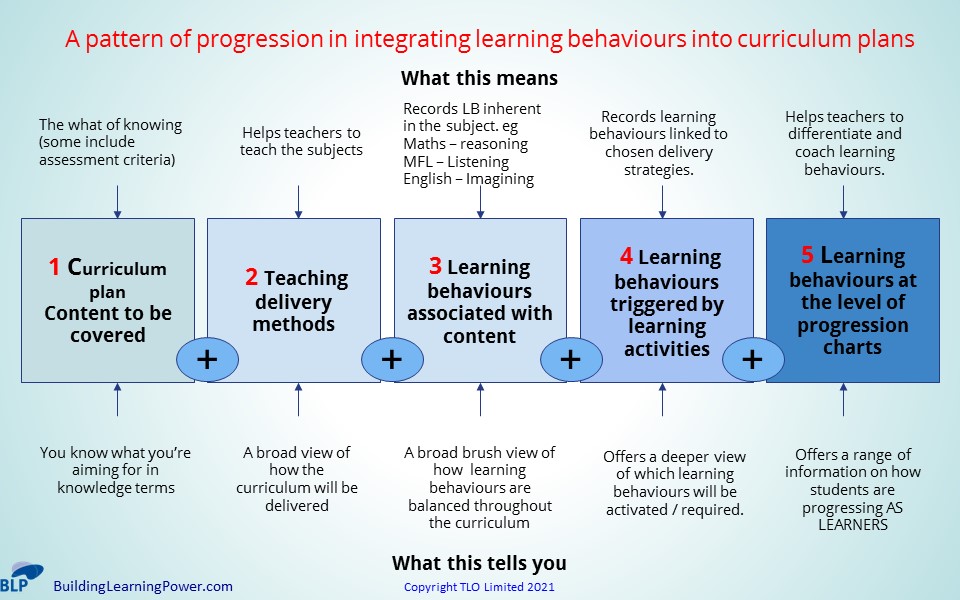
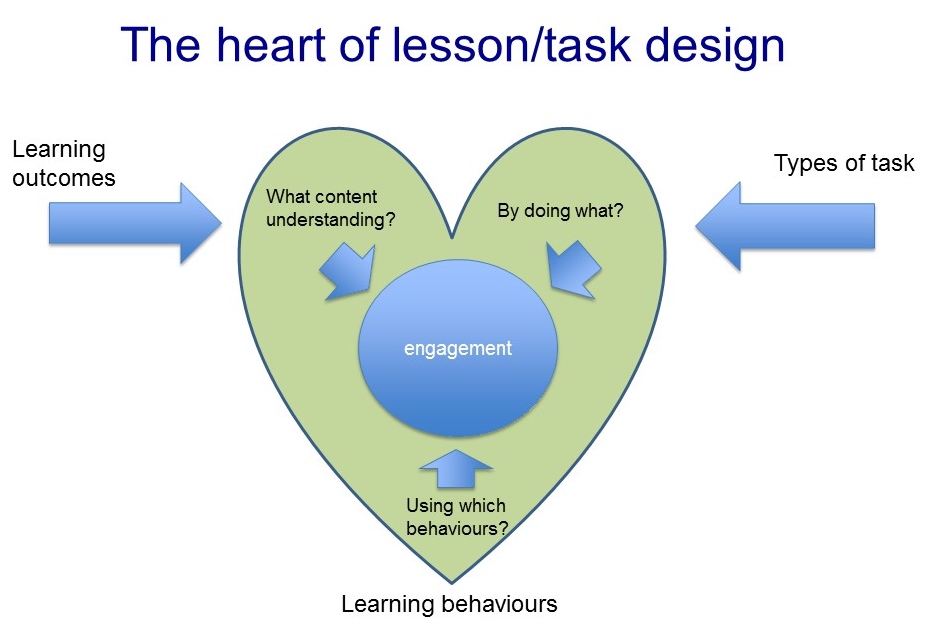
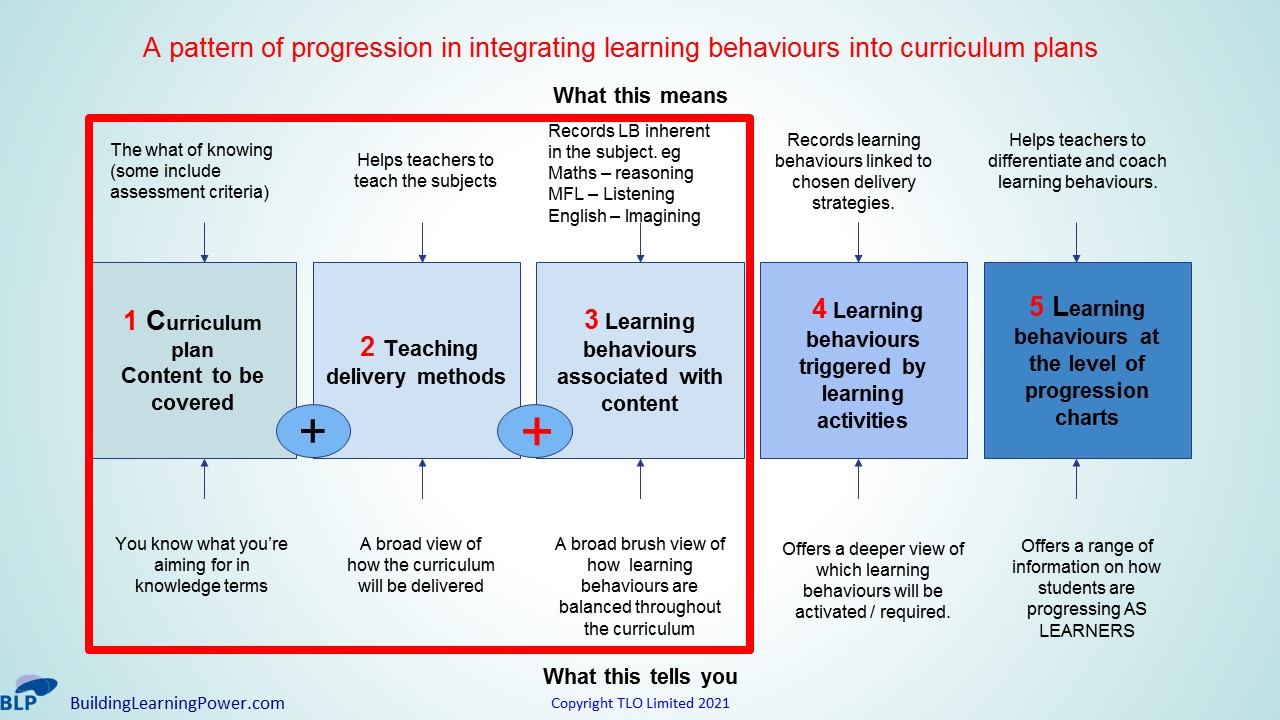
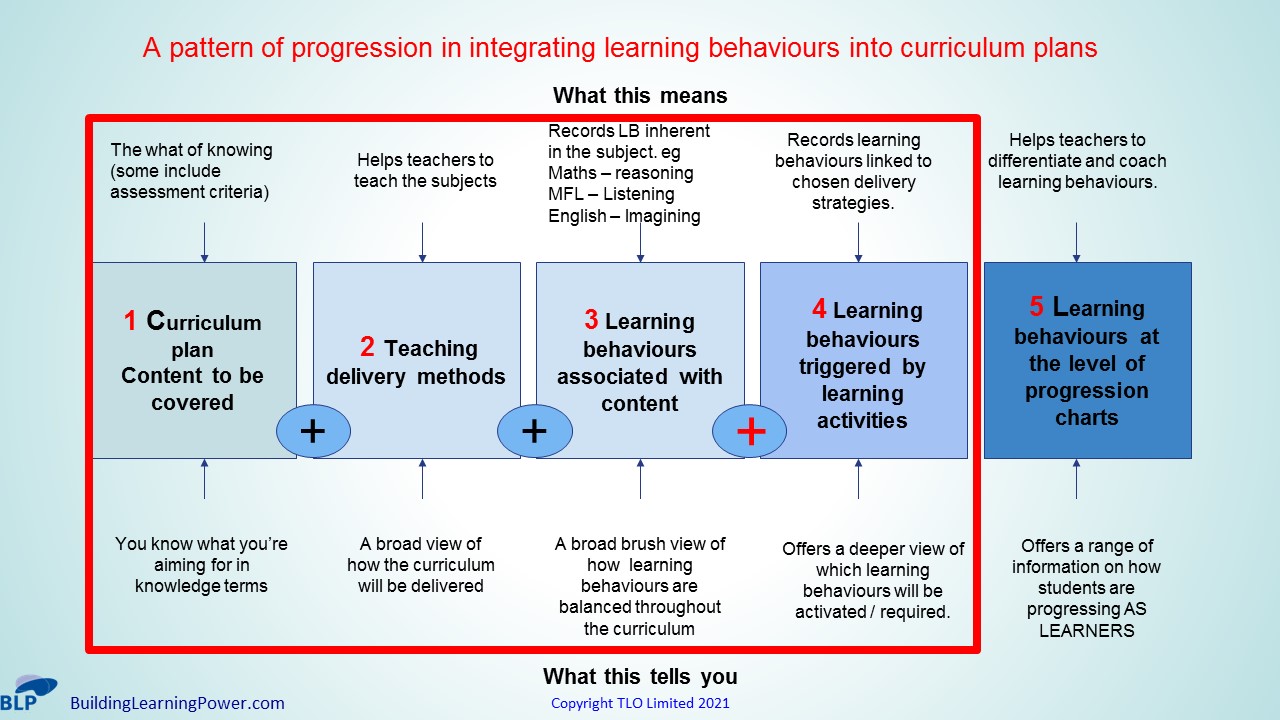
Section 3A – alert teachers to the transition from content-only planning, through to planning that weaves together the content to be acquired, the planned activities and the learning behaviours that are being developed and grown;
Section 3B – explain how teachers might begin to integrate learning behaviours into units of work and lessons;
Section 3C – introduce teachers to descriptions of different groups/types of learning activities;
Section 3D – offer a huge number and range of teaching ideas that will help teachers to blend the 4 key learning behaviours into their curriculum planning.
As a result of working through Unit 3, teachers will:
have recognised the importance of weaving content and learning behaviours into their planning;
have explored alternative ways of planning units of work and individual lessons to include learning behaviours;
have a heightened awareness of the activities they tend to gravitate to, and an understanding of how they might broaden their repertoire;
be able to intentionally blend activities that trigger, support or extend the 4 key learning behaviours into their curriculum planning.
2. Tackling Unit 3 over three months
Staff will need time to;
read sections 3A, 3B and 3C. Each section presents key ideas that will be utilised when exploring section 3D.
reflect on what each section means for how the curriculum, medium term plans, individual lessons and activities are currently planned with learning in mind. A meeting is scheduled once 3A/B/C have been explored.
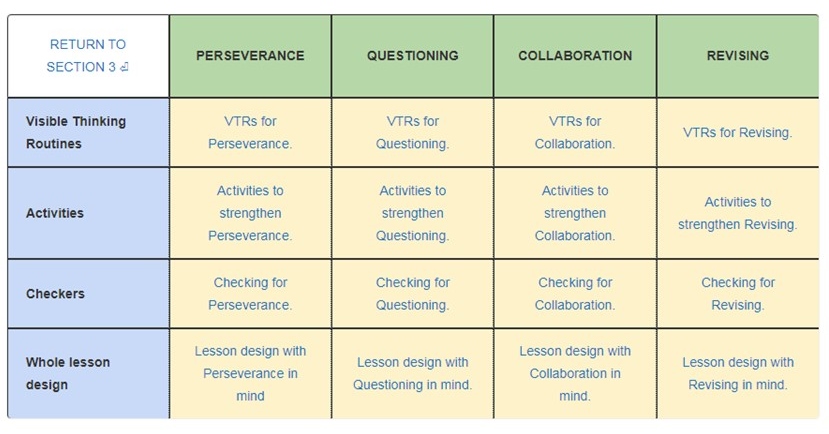
explore the interactive navigation grid in section 3D – it opens up a catalogue of teaching ideas, clustered around each of the 4 key learning behaviours, each with visible thinking routines to try; activities to build into lessons; suggestions for monitoring and self-monitoring of learning; plus a fully worked up lesson for each behaviour. It is a rich resource with over 100 ideas to weave into teachers’ planning.
pick out and trial several of these suggestions. They should plan to put a couple into action every couple of weeks and note the positives or negatives of making such a change.
Leaders should be aware that one of the outcomes from exploring these sections may be the need to overhaul planning frames and consider time frames for transitioning towards building learning behaviours into existing curriculum plans.
If the programme started in Sept you should aim to begin Unit 3 around February half term with the intention of completing it around Summer half term.
3. Strategic concerns for leaders
What might leaders be doing?
While teachers are at the online reading stage of sections 3A, 3B and 3C: keep the conversation going informally, show an interest in what they are reading, thinking and maybe even worrying about.
Leaders will be reading sections 3A/B/C alongside teachers – these sections raise significant issues that may need to be resolved at the whole-school level.
Before Learning Team Meeting 1: As teachers begin to trial some ideas, go into classrooms to support and encourage. Look in particular for teachers who are trialling linking content with learning behaviours (sections 3A and 3B) and for teachers who are trialling the use of different task types (Section 3C ).
After Meeting 1 and through to the end of Unit 3: Support teachers implementing their personal action plans derived from Section 3D. Look out for teachers trialling similar ideas and pair them up. Share ideas that are working well.
What leaders will be thinking about?
In relation to Section 3A: do we have any examples of teachers beginning to plan at the level of 3A4 and/or 3A5? (This is where teachers are beginning to link learning behaviours with content in their planning).
In relation to Section 3B: are our curriculum / lesson planning proformas fit for purpose?
In relation to Section 3C: which types of activities are usually designed, and are we seeing a wider, more imaginative range developing?
In relation to Section 3D: which VTRs, Activities and Monitoring tools appear to be having the greatest impact?
And for all 4 of these sections, how long might it take to phase in these planning ideas so that they become fully embedded? [Think in multiple months.]
4. Supporting development
Unit 3, Team Meeting Agenda 1
[We anticipate that Unit 3 may well take around 3 months to complete. Two meetings are to be scheduled, this meeting one month after starting Unit 3, and a second one about a month later. There is no ‘end of unit’ meeting, although the outcomes from Unit 3 will be explored during the first of the Unit 4 meetings.]
So far teachers have been developing their practice to ensure that their classroom culture becomes increasingly learning-friendly. This meeting begins the process of how they can construct curriculum plans that blend content and learning behaviours.
This meeting is positioned and designed to enable them to:
Look back over and discuss with colleagues the progress they have made with their personal action plans relating to Unit 2, classroom culture that they devised at the previous meeting, and . . .
Share their responses to their reading in Unit 3, sections 3A, 3B and 3C and…
Draw up a personal action plan for how they will take their practice forward based on further exploration of the ideas in 3A/B and C.
Unit 3, Team Meeting Agenda 2
[Schedule this meeting about one month after the previous Unit 3 meeting.]
This meeting explores the activities that teachers can use to blend content and learning behaviours.
This meeting is positioned and designed to enable them to:
Look back over and discuss with colleagues the progress they have made with their personal action plans relating to Unit 3, sections 3A, B and C, that they devised at the previous meeting, and . . .
Share their responses to their reading in Unit 3, section 3D.
Draw up a personal action plan for how they will take their practice forward based on further exploration of the ideas in 3D.
Find the agendas for the meetings in the toggle boxes below.
Share reports of how learning powered lesson plans have worked (20 mins)
Discuss the online materials that people have looked at in Unit 3, sections 3 A, B and C (15 mins)
Consider possible policy issues for the school (5 mins)
Personal Action Planning (20 mins)
Review the meeting process (5 mins)
1. Session objectives: What do we want to achieve? (5 mins)
Objectives should include:
learning from what and how our Action Plans have worked in different classrooms;
feeling confident to take forward ideas from online materials into our practice;
proposing actions that would benefit if everyone applied them in their practice;
planning further personal developments in classroom practice.
2. Reports from classroom enquiries (15 mins)
Share and discuss teachers’ practice; a valuable source of learning for everyone.
This involves thinking back to what you have been putting into practice over the last few weeks from your last Action Plan. It covers;
what you each tried to implement using ideas from Unit 2, section 2D, a catalogue of ideas
how they worked
what you could/did change to make it work better
how students reacted
whether there may be longer term benefits for students
Ask each other questions, offer suggestions and learn from each other.
Remember…everyone is supposed to report back to every meeting.
This isn’t a simple show-and-tell session but one where the group question and probe their colleagues’ summaries of what they have done to encourage analysis and deeper reflection.
Questions to encourage deeper thinking include:
What do you think is getting in the way?
What would make this better?
How did students react to that change?
How could this technique be modified to make it work better for you?
What do you think made that work so well?
3. Recap on-line materials in Unit 3, sections 3A, 3B and 3C: What the materials made us think (15 mins)
The materials in these sections concentrated on the stages before actually teaching i.e. giving learning behaviours recognition and value by embedding them ever more skilfully into curriculum and lesson plans.
Try a PMI (Plus, minus, interesting) routine to help sort out your thinking.
Think about:
how the different task types would suit your students as learners
which task types of curriculum planning ideas are realistic both for you and your students
how the ideas would impact on your planning and classroom culture
which ideas are front runners for you and why?
Use this decision making pentagon in deciding what to do you might try.
Note down a couple of:
things you want to start doing
things you think you need to stop doing (that’s harder)
things you want to keep doing
things you want to do more often
things you want to do less
4. Propose what may be needed across the school. (5 mins)
The point here is to identify ideas that are sufficiently important that they;
should be included in everyone’s action plan
i.e. you are sufficiently keen on some of the ideas that you all want to try them in one form or another
should be adopted by everyone as a whole school strategy
i.e. when discussions over time have concluded that some ideas have proved so useful across the school they should be woven into school policies or procedures.
Some of the ideas suggested in the on-line materials are likely to make greater impact if they were to be adopted by everyone across the school. For example if you all decide to begin planning learning behaviours into lesson plans, it may be necessary to adapt the school’s existing planning proforma to ensure a consistency of approach.
5. Personal action planning. What am I going to do? (20 mins)
Think about what you are trying to achieve.
Plans at this stage should be linked to what you learned from Unit 3 Sections A.B.C. Gain more value from your plan by creating it around a question. Think of it as an If:Then problem.
If I introduce ‘Mystery object in a bag’ will it strengthen my students’ tendency to question?
(Find this activity in the Unit 3, Section 3D, Catalogue of Activities, Activities to strengthen Questioning)
The learning enquiry plan is a record of what you intend to do. It takes your enquiry question from what to how. Remember:
you can choose which aspect(s) of classroom practice to focus on;
think about the aspect that is likely to have the greatest benefit for your students;
make the plan specifically focus on development;
concentrate on no more than two or three actions;
decide how to map your actions over the next three or four weeks;
it’s useful to think about what you are going to do less of to make room for the changes.
As part of your plan it’s important to record what you will monitor over the weeks.
Changes you expect to see in your classroom practice. For example what do you expect to:
see yourself doing differently?
hear yourself saying more often, with greater commitment, more effectively?
look out for in order to find out which approach best suits most students?
feel less stressed about? What will indicate that?
monitor to make sure that the changes you are making are having an impact of your students?
Changes you expect to see in your students. For example do you expect students to:
begin to take greater responsibility for their own learning;
be more inclined / better able to talk about learning;
be better able to recognise/ describe how they are learning;
show a deeper understanding of the process of learning;
other.
Noting such changes will motivate you to continue with your experiments because the changes in students are almost always positive. The plan represents a promise to do it. This promise helps you to keep the plan as a priority in your mind.
The level of critical analysis which is part of small research projects has been designed/built into the Enquiry Question and Action Planning forms. In other words their very design helps you to develop effective research focused questions and provoke evidenced based reflection.
6. Evaluate team session: How did we do as a team? (5 mins)
Did we achieve our objectives?
Are we comfortable with what we are trying to achieve?
Share reports of how learning powered lesson plans have worked (20 mins)
Discuss the online materials that people have looked at in Unit 3D (15 mins)
Consider possible policy issues for the school (5 mins)
Personal Action Planning (20 mins)
Review the meeting process (5 mins)
1. Session objectives: What do we want to achieve? (5 mins)
Objectives should include:
learning from what and how our Action Plans have worked in different classrooms;
feeling confident to take forward ideas from online materials into our practice;
proposing actions that would benefit if everyone applied them in their practice;
planning further personal developments in classroom practice.
2. Reports from classroom enquiries (15 mins)
Share and discuss teachers’ practice; a valuable source of learning for everyone.
what you each tried to change or try out in your lesson planning
how it worked
what you could/did change to make it work better
how students reacted
whether there may be longer term benefits for students
Ask each other questions, offer suggestions and learn from each other.
Remember…everyone is supposed to report back to every meeting.
This isn’t a simple show-and-tell session but one where the group question and probe their colleagues’ summaries of what they have done to encourage analysis and deeper reflection.
Questions to encourage deeper thinking include:
What do you think is getting in the way?
What would make this better?
How did students react to that change?
How could this technique be modified to make it work better for you?
What do you think made that work so well?
3. Recap on-line materials in Unit 3, section 3D: What the materials made us think (15 mins)
You will have been looking at and using the Catalogue of activities for a month or so now. What have you been trying out? What more do you want to experiment with?
Try a PMI (Plus, minus, interesting) routine to help sort out your thinking.
Think about:
how the ideas would suit your students as learners
which are realistic both for you and your students
how the ideas would impact on your classroom culture and the students view of themselves as learners
which ideas are front runners and why?
Use this decision making pentagon in deciding what to do you might try.
Note down a couple of:
things you want to start doing
things you think you need to stop doing (that’s harder)
things you want to keep doing
things you want to do more often
things you want to do less
4. Propose what may be needed across the school. (5 mins)
The point here is to identify ideas that are sufficiently important that they;
should be included in everyone’s action plan
i.e. you are sufficiently keen on some of the ideas that you all want to try them in one form or another
should be adopted by everyone as a whole school strategy
i.e. when discussions over time have concluded that some ideas have proved so useful across the school they should be woven into school policies or procedures.
Some of the ideas suggested in the on-line materials are likely to make greater impact if they were to be adopted by everyone across the school. For example, you could all agree to adopt 2 or 3 Visible Thinking Routines that appear to be making an impact and trial them with all classes as and when appropriate.
5. Personal action planning. What am I going to do? (20 mins)
Think about what you are trying to achieve.
Plans at this stage should be linked to what you are learning from section 3D, but also linked to what you discovered in sections 3A/B/C. Gain more value from your plan by creating it around a question. Think of it as an If:Then problem.
For example:
If I make frequent use of the VTR ‘See, Think, Wonder’, will it develop my students’ attentive noticing as a springboard into improving their thinking skills?
(See this VTR in Unit 3, Section 3D, Catalogue of Activities, VTR Questioning)
The learning enquiry plan is a record of what you intend to do. It takes your enquiry question from what to how. Remember:
you can choose which aspect(s) of classroom practice to focus on;
think about the aspect that is likely to have the greatest benefit for your students;
make the plan specifically focus on development;
concentrate on no more than two or three actions;
decide how to map your actions over the next three or four weeks;
it’s useful to think about what you are going to do less of to make room for the changes.
As part of your plan it’s important to record what you will monitor over the weeks.
Changes you expect to see in your classroom practice. For example what do you expect to:
see yourself doing differently?
hear yourself saying more often, with greater commitment, more effectively?
look out for in order to find out which approach best suits most students?
feel less stressed about? What will indicate that?
monitor to make sure that the changes you are making are having an impact of your students?
Changes you expect to see in your students. For example do you expect students to:
begin to take greater responsibility for their own learning;
be more inclined / better able to talk about learning;
be better able to recognise/ describe how they are learning;
show a deeper understanding of the process of learning;
other.
Noting such changes will motivate you to continue with your experiments because the changes in students are almost always positive. The plan represents a promise to do it. This promise helps you to keep the plan as a priority in your mind.
The level of critical analysis which is part of small research projects has been designed/built into the Enquiry Question and Action Planning forms. In other words their very design helps you to develop effective research focused questions and provoke evidenced based reflection.
6. Evaluate team session: How did we do as a team? (5 mins)
Did we achieve our objectives?
Are we comfortable with what we are trying to achieve?
Any concerns at this point?
Next meeting date and time.
5. Resources for introducing Unit 3
Here we offer a short powerpoint with delivery notes to introduce Unit 3, Constructing Learning, to staff. It is available to any school undertaking this programme. They can be used to;
to introduce this aspect of the programme to staff if you have opted for a DIY start
reinforce any previous training e.g. remind you of the key ideas given by TLO during either Zoom or In-school programme launch sessions
Introducing Unit 3 content to your teachers
This short slide presentation aims to help teachers understand Unit 3 and how it leads naturally on from the work they have been doing on Unit 2.
The slide deck could be used to introduce teachers to the key ideas behind Unit 3. In total it might take around 30 minutes to work through with your staff.
You might use this slide deck:
just as it is to introduce the ideas to staff;
to help structure a learning conversation amongst/in teams;
added to strategic presentation of your own to ensure staff gain a holistic picture.
Brief explanatory notes can be found under each slide.
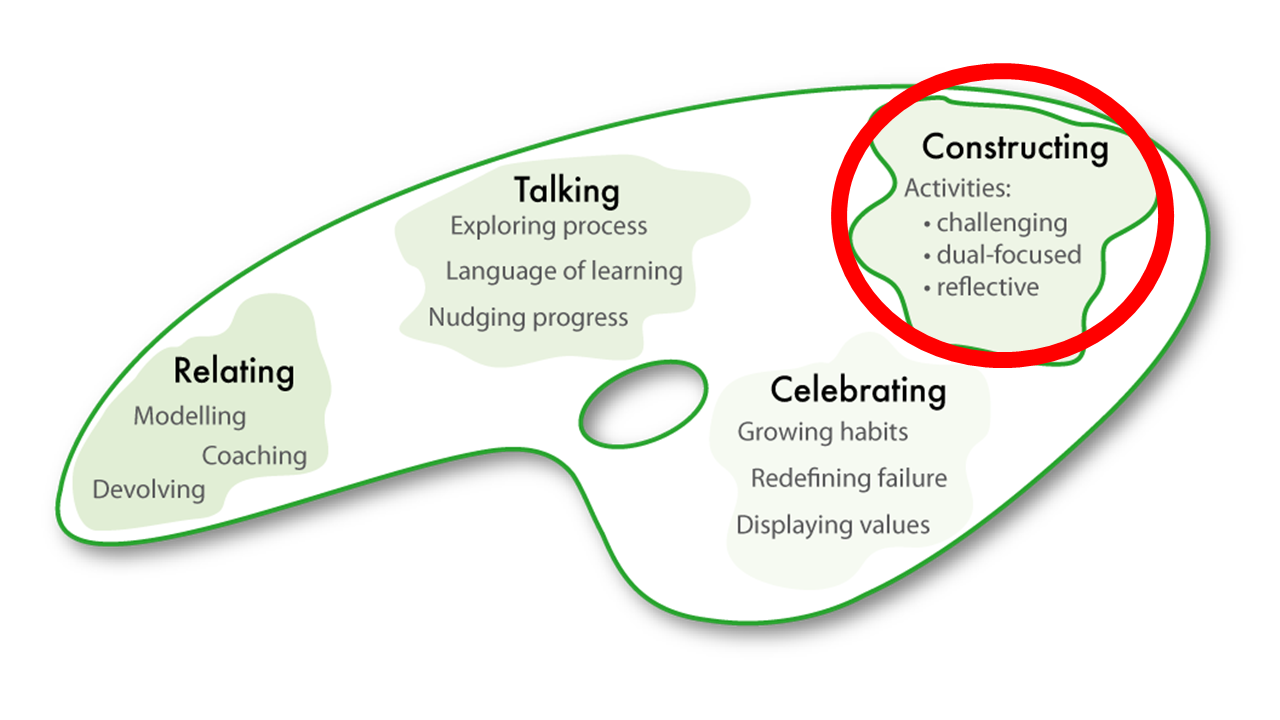
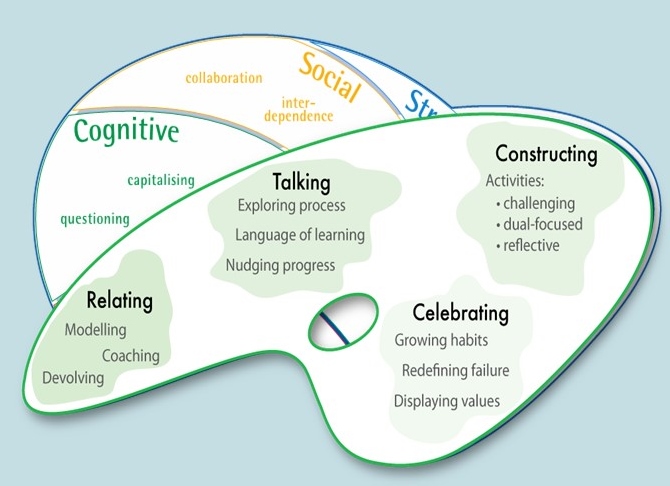
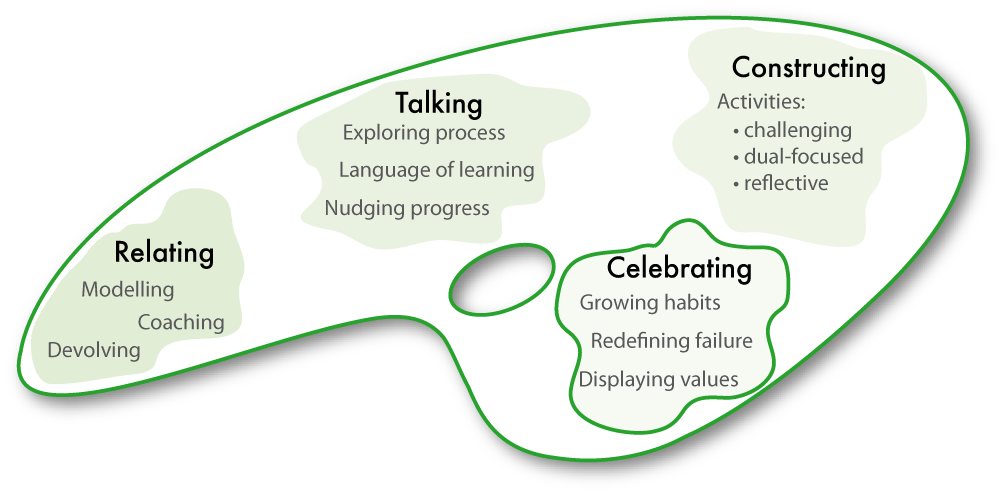
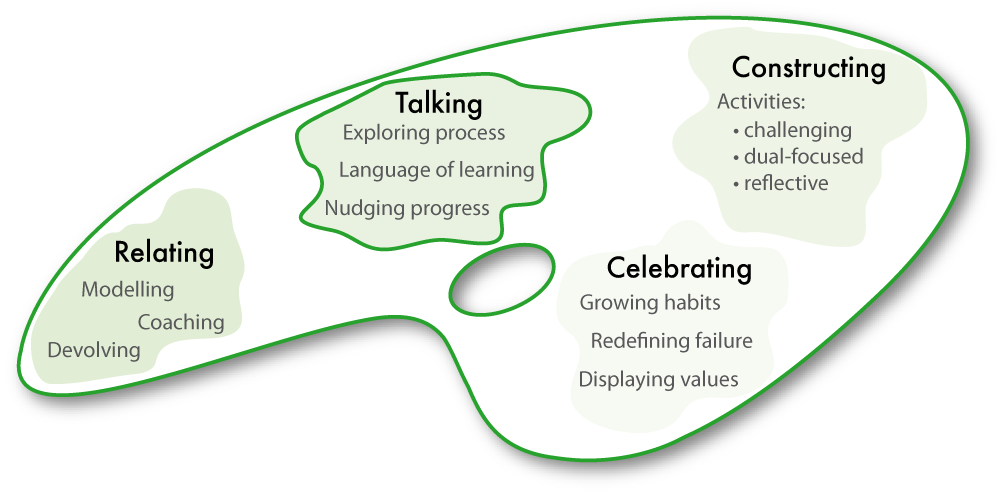
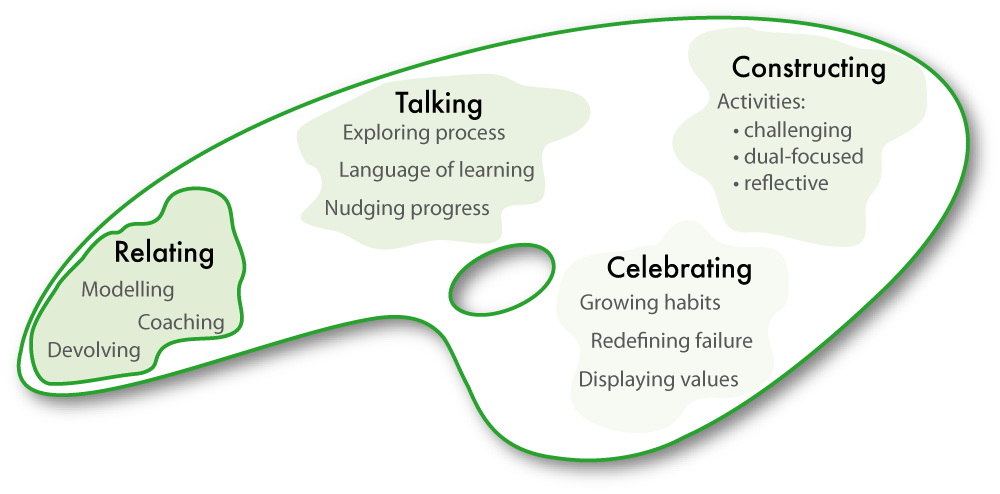
explore three aspects of the Teachers’ Palette framework – Relating, Talking and Celebrating and their impact on classroom culture;
deepen understanding of the 4 key learning behaviours – Perseverance, Questioning, Collaboration, Revising.
The content builds on what staff discovered about their students’ learning characteristics in Unit 1 and suggests classroom culture interventions tailored to particular levels of learner development.
As a result it should have the following impact:
Classrooms will be well on the way to being able to cultivate learning behaviours – it is about readying classroom culture for intentionally blending content with learning behaviours, which we tackle in Unit 3.
2. Tackling Unit 2 over three months
Staff will need time to;
read sections 2A, 2B and 2C to gain an overview of 3 aspects of the Teachers’ Palette – Relating, Talking and Celebrating.
consider which of these aspects of classroom culture are already in evidence in their classrooms.
explore how to begin to integrate some ideas into their everyday practice. This may take an hour or two.
The next step is to;
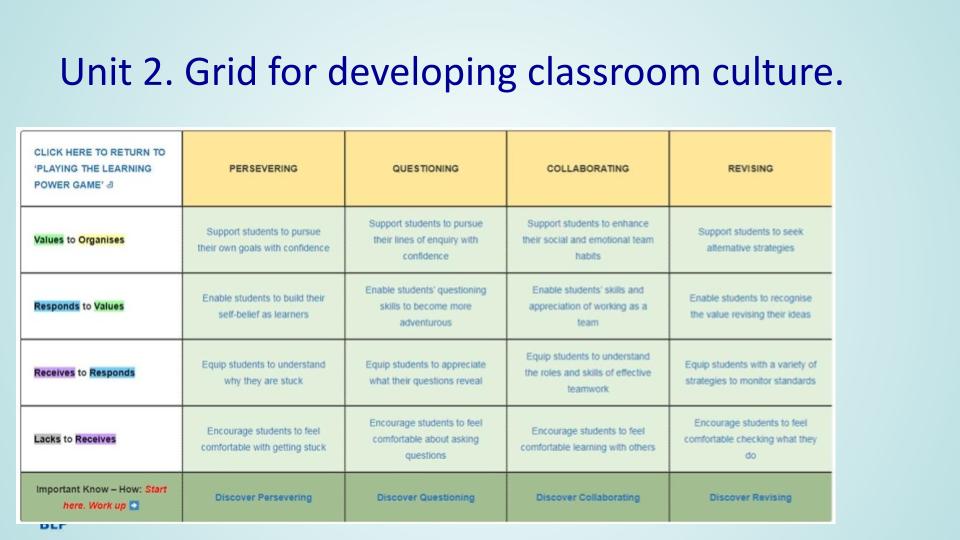
explore the interactive navigation grid in section 2D.
start with dark green ‘Discovering’ cells first.
select ideas they want to try based on the analysis of students’ progress in learning habits.
Over the next three months staff are expected to pick out several classroom culture ideas that will benefit their students. They should plan to put a couple into action every couple of weeks and note the positives or negatives of making such a change.
If the programme started in Sept you should aim to begin Unit 2 around October half term with the intention of moving on by around February half term. (England)
3. Strategic concerns for leaders
What might leaders be doing?
During the online reading stage: keep the conversation going informally, show an interest in what staff are reading, thinking and maybe planning
Before Meeting 1: As teachers begin to trial some ideas, go into classrooms to support and encourage.
After Meeting 1 and through to the end of Unit 2: Support teachers as they implement their personal action plans derived from Section 2D. Look out for teachers trialling similar ideas and pair them up. Share ideas that are working well.
What leaders will be thinking about?
Were our preliminary views about classroom culture accurate (see the activity in ‘Leadership Questions’, 2b)?
Can we sense a shift in classroom cultures beginning to take place?
Are there any ideas that seem worthy of everybody adopting?
Which areas of the school / teachers are ‘on fire’ and can act as beacons for others?
Which areas or teachers are struggling and may need additional support?
4. Supporting development
Unit 2, Team Meeting Agenda 1
[We anticipate that Unit 2 may well take around 3 months to complete. Two meetings are to be scheduled, this meeting one month after starting Unit 2, and a second one a month later. There is no ‘end of unit’ meeting, although the outcomes from Unit 2 will be explored during the first of the Unit 3 meetings.]
So far teachers have been developing their understanding of learning power and their students’ learning behaviours. Here they begin to create action plans for developing their practice in order to make their classrooms increasingly learning-friendly.
This meeting is positioned and designed to enable them to:
Share their responses to their reading thus far in Unit 2, and…
Draw up a personal action plan for how they will take their practice forward based on their exploration of section 2D in light of what they have already learned about their students’ learning behaviours in Unit 1.
Unit 2, Team Meeting Agenda 2
[Schedule this meeting about one month after the previous Unit 2 meeting.]
So far teachers have been developing their practice to ensure that their classroom culture becomes increasingly learning-friendly.
This meeting is positioned and designed to enable them to:
Look back over and discuss with colleagues the progress they have made with their personal action plans, relating to classroom culture, that they devised at the previous meeting, and . . .
Share their responses to their further reading in Unit 2, section 2D and…
Draw up a personal action plan for how they will take their practice forward based on further exploration of the catalogue of ideas in section 2D.
Find the agendas for the meetings in the toggle boxes below.
Discuss the online materials that people have looked at and trialled in Unit 2 (15 mins)
Consider possible policy issues for the school (5 mins)
Personal Action Planning (20 mins)
Review the meeting process (5 mins)
Item 1. Session objectives: What do we want to achieve? (5 mins)
Objectives should include:
learning from what has already been trialled in different classrooms;
feeling confident to take forward ideas from online materials into our practice;
proposing actions that would benefit if everyone applied them in their practice;
planning further personal developments in classroom practice.
Item 2. Recap on-line materials in Unit 2: What the materials made us think (15 mins)
This is an opportunity to check out what you have been reading and absorbing from the on-line materials. It’s a chance to share or check out your understanding. It is these ideas that will be absorbed into your next Action Plan.
Try a PMI (Plus, minus, interesting) routine to help sort out your thinking.
Think about:
what was fairly clear or tricky to understand;
how the ideas would suit your students as learners;
which are realistic for both you and your students;
how the ideas would impact on your classroom culture;
which ideas are front runners and why?
which aspect of relating, teacher talk or celebration seems the best place to start?
Use this decision making pentagon in deciding what you might try.
Note down a couple of:
things you want to start doing
things you think you need to stop doing (that’s harder)
things you want to keep doing
things you want to do more often
things you want to do less
Item 3. Propose what may be needed across the school. (5 mins)
The point here is to identify ideas that are sufficiently important that they;
should be included in everyone’s action plan
i.e. you are sufficiently keen on some of the ideas that you all want to try them in one form or another
should be adopted by everyone as a whole school strategy
i.e. when discussions over time have concluded that some ideas have proved so useful across the school they should be woven into school policies or procedures.
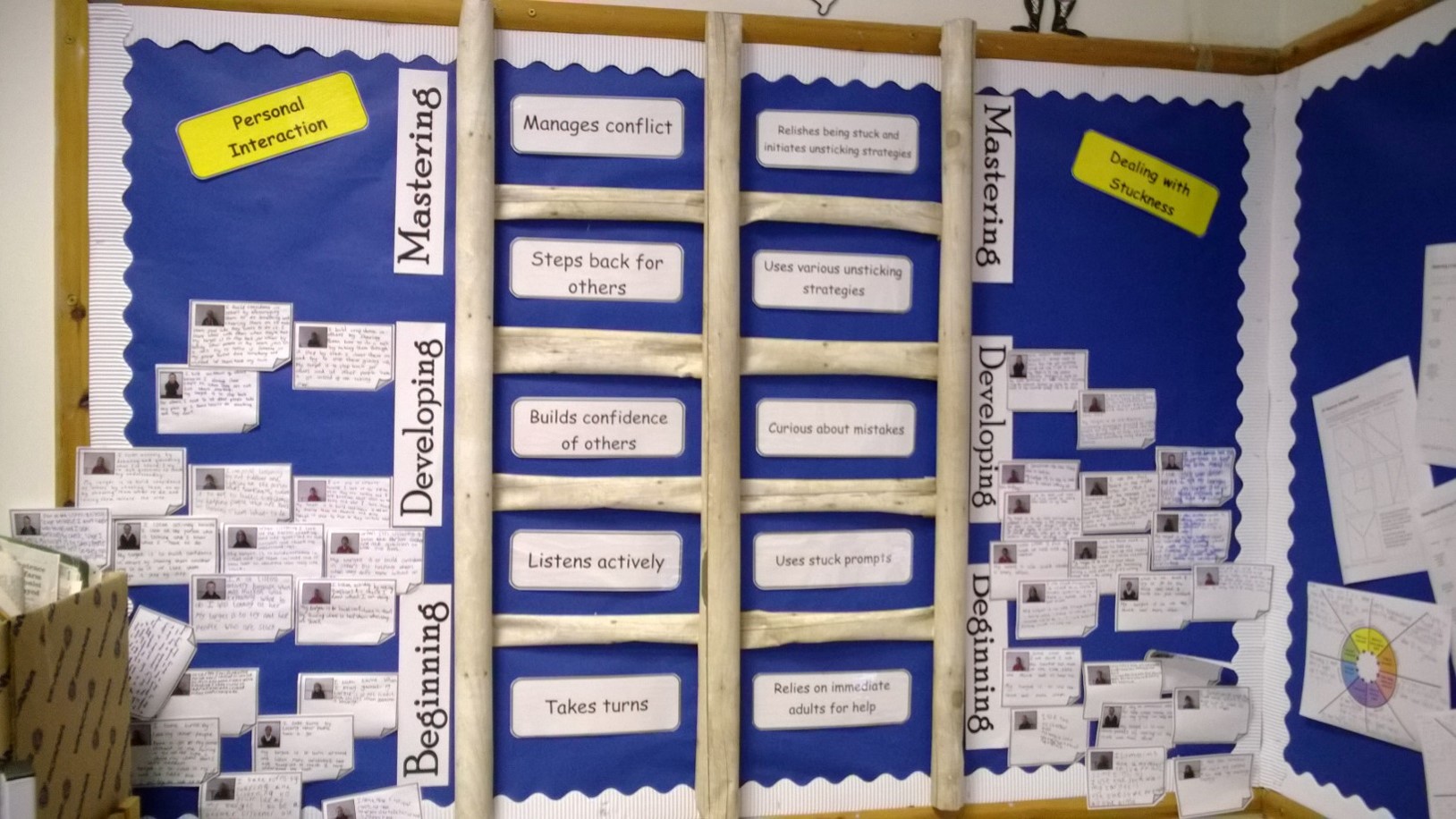
Some of the ideas suggested in the on-line materials are likely to make more impact if they were to be adopted by everyone across the school. For example, if someone has already trialled an idea from section 2D that worked really well (for example, the introduction of a ‘Stuck’ poster), it may be worth everyone agreeing to give it a go with their own class. Of course they don’t need to look the same in every classroom but the ideas they contain need to ‘grow up’ through the age ranges. What do you expect students to be able to try for themselves as they grow up through the school?
Item 4. Personal action planning. What am I going to do? (20 mins)
This is the point when everyone in the team makes an action plan which they will implement over the next few weeks.
A. It starts with a question
The key to developing your practice, is to think first of the need (what needs to change in students) and then think what could be done to achieve it. The knack lies in developing enquiry questions to sort out what you want to do.
Why a question? Because this is an enquiry! You want to find out if something (student behaviour) will change/improve if you change something specific.
Research suggests that you’ll gain more value from your plan by creating it around a question. Think of it like this:
If I do/plan, try xxxx will it improve/develop/ secure/ enhance xxx?
For example, if you were planning to have a go with the ‘Stuck Poster’ idea above, your enquiry question could be:
If I develop ‘Stuck’ prompts with my class, will it reduce my students’ dependency on my help?
(Find ideas in Unit 2. Section 2D. Perseverance, Lacks to Receives)
Try the planning sheet opposite.
B. Now think about a plan
But remember what you are trying to achieve.
Plans at this stage should be linked to what you are reading in Unit 2.
The learning enquiry plan is a record of what you intend to do. It takes your enquiry question from what to how. Remember:
you can choose which aspect(s) of classroom practice to focus on;
think about the aspect that is likely to have the greatest benefit for your students;
make the plan specifically focus on development;
concentrate on no more than two or three actions;
decide how to map your actions over the next three or four weeks;
it’s useful to think about what you are going to do less of to make room for the changes.
See format alongside to help you think through the planning process. You can fill in your Personal Action Plan using the word document version.
Also record what you will monitor over the weeks.
Changes you expect to see in your classroom practice. For example what do you expect to:
see yourself doing differently?
hear yourself saying more often, with greater commitment, more effectively?
look out for in order to find out which approach best suits most students?
feel less stressed about? What will indicate that?
monitor to make sure that the changes you are making are having an impact of your students?
Changes you expect to see in your students. For example do you expect students to:
begin to take greater responsibility for their own learning;
be more inclined / better able to talk about learning;
be better able to recognise/ describe how they are learning;
show a deeper understanding of the process of learning;
other.
Noting such changes will motivate you to continue with your experiments because the changes in students are almost always positive. The plan represents a promise to do it. This promise helps you to keep the plan as a priority in your mind.
The level of critical analysis, which is part of small research projects, has been designed/built into the Enquiry Question and Action Planning forms. In other words their very design helps you to develop effective research focused questions and provoke evidenced based reflection.
Item 5. Evaluate team session: How did we do as a team? (5 mins)
Did we achieve our objectives?
Are we comfortable with what we are trying to achieve?
Share reports of how learning powered lesson plans have worked (20 mins)
Discuss the online materials that people have looked at in Unit 2 (15 mins)
Consider possible policy issues for the school (5 mins)
Personal Action Planning (20 mins)
Review the meeting process (5 mins)
Item 1. Session objectives: What do we want to achieve? (5 mins)
Objectives should include:
learning from what and how our Action Plans have worked in different classrooms;
feeling confident to take forward ideas from online materials into our practice;
proposing actions that would benefit if everyone applied them in their practice;
planning further personal developments in classroom practice.
Item 2. Reports from classroom enquiries (15 mins)
This is the first time this item has appeared on the agenda. It will remain for the rest of the series.
Share and discuss teachers’ practice; a valuable source of learning for everyone.
This involves thinking back to what you have been putting into practice over the last few weeks from your last Action Plan. It covers;
what you each tried to implement using ideas from Unit 2 Classroom Culture
how they worked
what you could/did change to make it work better
how students reacted
whether there may be longer term benefits for students
Ask each other questions, offer suggestions and learn from each other.
Remember…everyone is supposed to report back to every meeting.
This isn’t a simple show-and-tell session but one where the group question and probe their colleagues’ summaries of what they have done to encourage analysis and deeper reflection.
Questions to encourage deeper thinking include:
What do you think is getting in the way?
What would make this better?
How did students react to that change?
How could this technique be modified to make it work better for you?
What do you think made that work so well?
Item 3. Recap on-line materials in Unit 2: What the materials made us think (15 mins)
This is an opportunity to check out what you have been reading and absorbing from the on-line materials. It’s a chance to share or check out your understanding. It is these ideas that will be absorbed into your next Action Plan.
Try a PMI (Plus, minus, interesting) routine to help sort out your thinking.
Think about:
what was understandable or tricky to understand;
how the ideas would suit your students as learners;
which are realistic both for you and your students;
how the ideas would impact on your classroom culture for developing the language;
which ideas are front runners and why?
which aspect of relating, teacher talk or celebration seems the place to start?
Use this decision making pentagon in deciding what you might try.
Note down a couple of:
things you want to start doing
things you think you need to stop doing (that’s harder)
things you want to keep doing
things you want to do more often
things you want to do less
4. Propose what may be needed across the school. (5 mins)
The point here is to identify ideas that are sufficiently important that they;
should be included in everyone’s action plan
i.e. you are sufficiently keen on some of the ideas that you all want to try them in one form or another
should be adopted by everyone as a whole school strategy
i.e. when discussions over time have concluded that some ideas have proved so useful across the school they should be woven into school policies or procedures.
Some of the ideas suggested in the on-line materials are likely to make more impact if they were to be adopted by everyone across the school. If we want students to change their behaviour we need to help them to think much more closely about the ‘hows’ and the ‘whats’. Motivation research proposes an effective solution to this called ‘if-then’ planning. ‘Ifs’ are the situations you want to remind yourself about. In the case getting unstuck it’s useful to list all the sorts of places this tends happen. ‘Thens’ are what you will do about something; the action you will take. This simple approach (shown in Perseverance, Receives to Responds) would have a far greater impact if it were replicated in every classroom; it’s a strategic approach that can be calibrated for different ages and stages.
Item 5. Personal action planning. What am I going to do? (20 mins)
This is the point when everyone in the team makes an action plan which they will implement over the next few weeks.
A. It starts with a question
The key to developing your practice, is to think first of the need (what needs to change in students) and then think what could be done to achieve it. The knack lies in developing enquiry questions to sort out what you want to do.
Why a question? Because this is an enquiry! You want to find out if something (student behaviour) will change/improve if you change something specific.
Research suggests that you’ll gain more value from your plan by creating it around a question. Think of it like this:
If I do/plan, try xxxx will it improve/develop/ secure/ enhance xxx?
For example:
If I select and implement 5 ideas about ‘learning on display’ will this provoke curiosity and make learning more visible to my students?
(Find ideas for Learning on Display in Unit 2, Section 2D. Perseverance, Responds to Values, Things to Display 3.)
Try the planning sheet opposite.
B. Now think about a plan
But remember what you are trying to achieve.
Plans at this stage should be linked to what you learned from Unit 2.
The learning enquiry plan is a record of what you intend to do. It takes your enquiry question from what to how. Remember:
you can choose which aspect(s) of classroom practice to focus on;
think about the aspect that is likely to have the greatest benefit for your students;
make the plan specifically focus on development;
concentrate on no more than two or three actions;
decide how to map your actions over the next three or four weeks;
it’s useful to think about what you are going to do less of to make room for the changes.
See format alongside to help you think through the planning process. You can fill in your Personal Action Plan using the word document version.
Also record what you will monitor over the weeks.
Changes you expect to see in your classroom practice. For example what do you expect to:
see yourself doing differently?
hear yourself saying more often, with greater commitment, more effectively?
look out for in order to find out which approach best suits most students?
feel less stressed about? What will indicate that?
monitor to make sure that the changes you are making are having an impact of your students?
Changes you expect to see in your students. For example do you expect students to:
begin to take greater responsibility for their own learning;
be more inclined / better able to talk about learning;
be better able to recognise/ describe how they are learning;
show a deeper understanding of the process of learning;
other.
Noting such changes will motivate you to continue with your experiments because the changes in students are almost always positive. The plan represents a promise to do it. This promise helps you to keep the plan as a priority in your mind.
The level of critical analysis which is part of small research projects has been designed/built into the Enquiry Question and Action Planning forms. In other words their very design helps you to develop effective research focused questions and provoke evidenced based reflection.
Item 6. Evaluate team session: How did we do as a team? (5 mins)
Did we achieve our objectives?
Are we comfortable with what we are trying to achieve?
Any concerns at this point?
Next meeting date and time.
5. Resources for introducing staff to classroom culture
This slide -deck is available to any school undertaking this programme. They can be used to;
to introduce this aspect of the programme to staff if you have opted for a DIY start
reinforce any previous training e.g. remind you of the key ideas given by TLO during either Zoom or In-school programme launch sessions
Introducing Unit 2 content to your teachers
This 24 slide presentation aims to help teachers explore the Teachers’ Palette, the second model central to building learning powers. Three types of classroom culture are explained, explored and reflected upon, and consideration is given to strategies to make classroom cultures ‘learning friendly’.
The slide deck and associated resources could be used to introduce teachers to the key ideas behind finding out more about classroom culture. In total it might take around 60 / 75 minutes to work through with your staff.
You might use this slide deck:
just as it is to introduce the ideas to staff;
to help structure a learning conversation amongst/in teams;
added to strategic presentation of your own to ensure staff gain a holistic picture.
Brief explanatory notes can be found under each slide. Fuller supporting resources are offered as downloads in the toggle box below.
The slides in the presentation cover the following key issues:
different types of classroom culture;
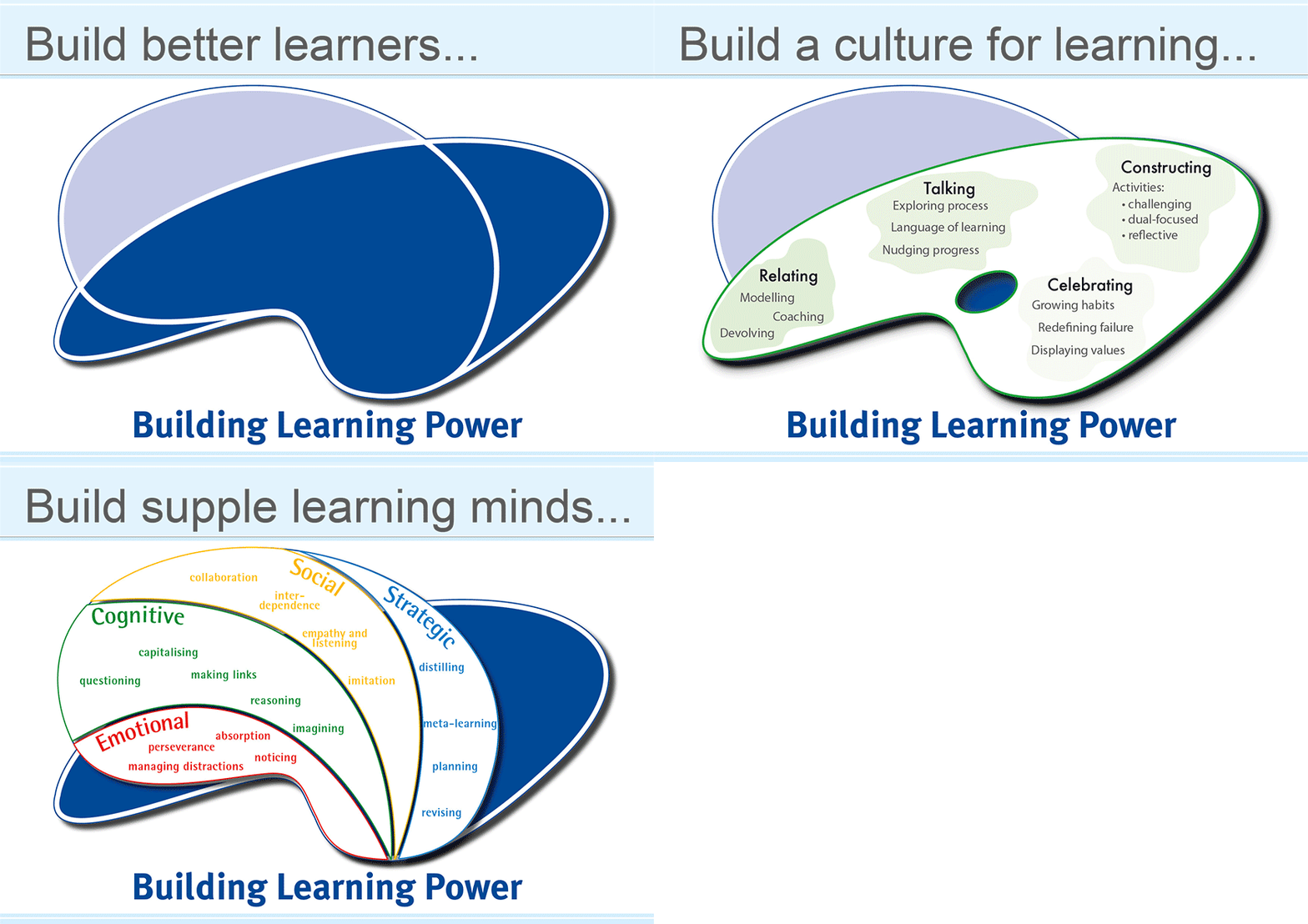
the Teachers’ Palette, the second key model of Learning Power;
2) If the school is using the presentation as a basis for a whole staff training session to introduce classroom culture, staff will find these 4 images helpful to have as hard copy.
We urge you first to look at your own learning through the learning power lens and then to think it through with a couple of students in mind. This is your chance to relate the quite detailed descriptions of learning behaviours to real students. It’s an essential part of the process so best not to skip it.
Here you have opportunities to…
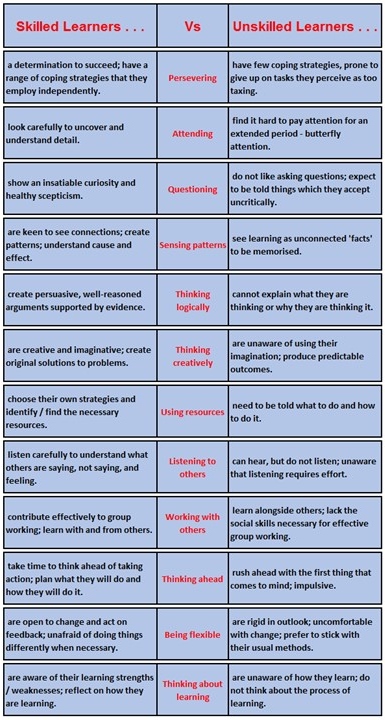
discover and understand what ‘good learners’ tend to be like
look at yourself through a learning behaviour lens
tentatively consider the learning behaviours of a couple of students
remind yourself of how learning behaviours progress
Perhaps the best way of really getting to grips with the growth of learning power is to take a personal look at yourself as a learner and the learning behaviours you tend to use. What might your learning profile look like; where are your strengths; what are the behaviours you find tricky; which would you like to improve?
Having got the idea we then invite you to look at just a couple of your students; a low and a high attaining student. This should give you a glimpse of what it is that makes the difference in how students approach and achieve in learning
1. How learning behaviours progress
Being an effective learner isn’t something that switches on on good days and off on bad days; it grows and builds when it’s nurtured and supported. Furthermore, being a learning powered learner involves gaining control of a range of linked dispositions and skills and emotions.
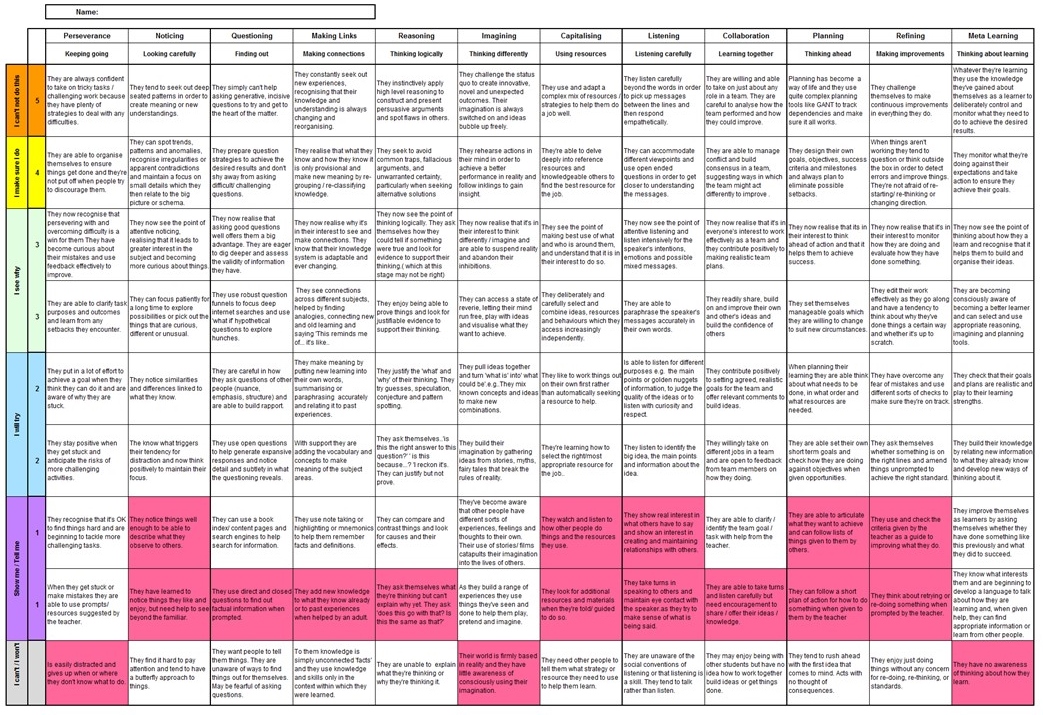
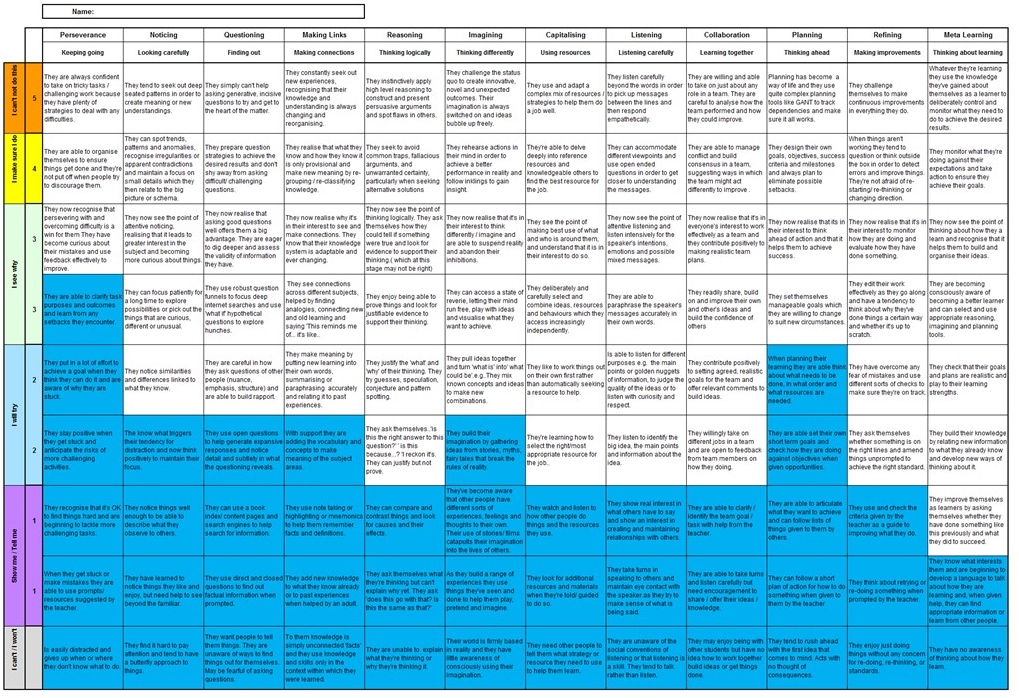
Over the last ten years we’ve tried to capture the essence of that growth and make it useful for teachers and learners. Take a look at the progressionchart alongside. Here you can see all 12 key learning behaviours together.
Each of the 12 learning behaviours are briefly described at one of 5 levels of proficiency shown in the rows. These levels of proficiency grow and flourish when they are cultivated by teachers in learning friendly classrooms and supported by families.
Download the chart and take a closer look at it. You’ve probably never considered yourself, let alone any students, in this way before. Take your time just absorbing what you see. Don’t think too hard about the progression levels at this stage, but rather try to absorb the nature of the descriptions of learning behaviours and the different areas of learning.
Twelve learning behaviours with five levels of proficiency.
Download as pdf [When printing this pdf, it is best done on A3 paper, landscape (in the print settings)]
2. Discover yourself as a learner
To get a better sense of these learning behaviours and their growth use the chart to think about yourself as a learner. Start slowly. Refer to the learning behaviour descriptions and progression notes in section 1.2 for help. Now just think:
where would I place myself on each of these 12 trajectories?
do I understand the statements well enough to answer? Which ones will I need to check?
can I really say that this/that statement is secure? Does it actually describe what I do most of the time, or does it describe something I can do but tend not to? (what I do do, rather than what I can do).
have I ever thought about myself like this before?
would my partner / colleagues see me in the same way?
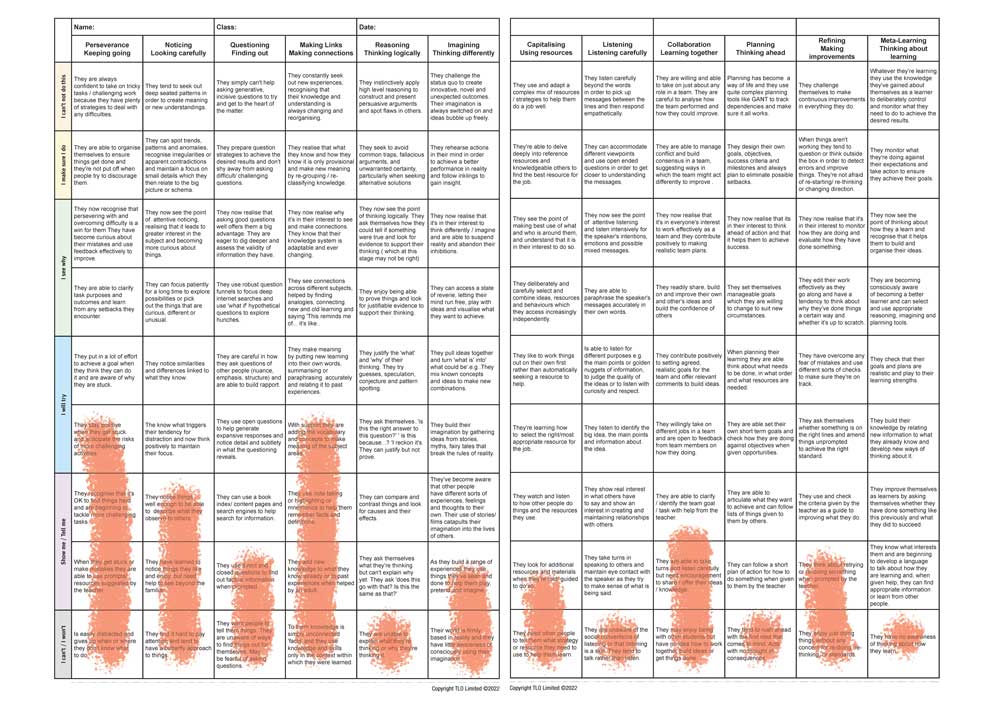
colour in your secure statements on The Learning Behaviour Chart. This becomes your Learning Behaviour Profile. Now ask…
which learning domain seems to be the strongest? (emotional, cognitive, social, strategic)
which learning domain appears the weakest?
which particular learning behaviour is strong or weak?
am I substantially lower or higher in some? Which?
are there any surprises or disappointments?
what questions is this raising for me?
where would I like to improve?
what may have shaped my current learning characteristics?
Learning behaviour charts to learning behaviour profiles.
When you think you understand the progression charts well enough try using them to consider a couple of students.
Think of two students you know fairly well, but whose attainment differs.
Download two learning behaviour charts (describing 12 learning behaviours) and indicate which descriptors seem best to describe each student’s current secure behaviours.
Come back to the charts after a day or so and check them again to convince yourself that you’ve identified the most appropriate descriptors.
It might be useful to have a word with a colleague who also knows the student well, especially if you’re uncertain about your answers.
The profiles opposite illustrate:
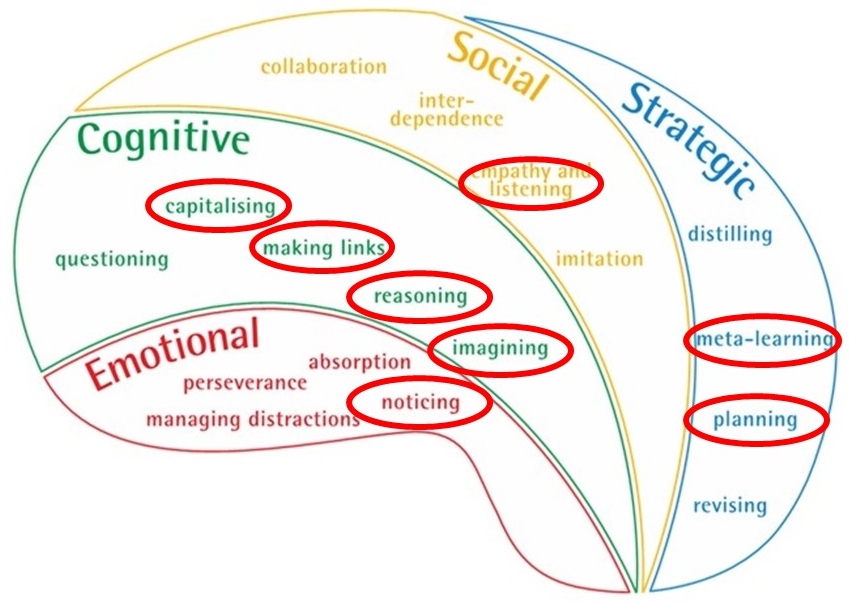
Pink… a relatively weak learner, still negative aspects of learning (perseverance, imagining, meta learning) and elsewhere in need of adult support (ie they are broadly just into the purple phase);
Blue…illustrates a well-rounded learner, secure at the purple and blue phases, and moving into the green phase for some behaviours. This might be typical of a well-rounded, high attaining learner who is disposed to behave in learning-positive ways. Do not expect to see much beyond the green phase, as the uppermost 2 phases require levels of maturity and independence rarely accessed by younger learners.]
Ask yourself:
what do these profiles tell me about these students as learners?
do the students appear to do things differently?
do any of the columns seem to show use of later phases of growth for the higher achieving student?
which learning behaviours appear to make the higher attaining student more successful?
does any learning domain (emotional, cognitive, social, strategic) dominate for either student?
which learning behaviours appear to need boosting most for either student?
2. What teachers are being asked to do across two months
In tackling this first unit teachers are invited to:
Read through Sections 1A and 1B to explore the big ideas that underpin Learning Power and give them confidence in the approach;
settle down, maybe one evening, and explore their own learning habits (Section 1C);
undertake the fascinating exercise of completing a learning profile for each of their students. This could be done over a couple of weeks (Sections 1D and 1E).
We suggest teachers give themselves a couple of months to understand, collect and analyse this data. Their deep view of their students’ learning behaviours will henceforth influence and shape their practice.
If the programme started in Sept you should aim to complete this unit by the end of the first half term. (e.g. Sept to end Oct)
Section 1E is where the practical action for teachers really begins. It’s about them generating the data, filling in the charts and interpreting what they’ve found. It is on this data that teachers will later build their learning power culture and interventions. Be prepared to be fascinated by data gathered by your teachers.
Which learning characteristics do our students display?
The growth charts you used in the last section have the power to reveal interesting and vital information about students’ learning. They are suitable for use with any class or a sub-group of students.
This section helps you to answer the question:
What are the learning strengths and weaknesses of my/our students?
Gaps to discover
Understand your students as learners using a new type of data
In this section we ask teachers to give the same consideration to all the students in their class and keep an eye out for any emerging patterns;
for areas of learning strength
for areas of learning weakness
for fallow areas
for significant variations for some students or groups of students.
for things that just make you feel uneasy
They are to ask themselves – ‘What questions are bubbling up in my mind?’ as they work through their class one by one. They’ll find themselves beginning to form some tentative hypotheses about their students’ learning behaviours.
1 Generate data for each student
Download and print sufficient charts – one for each student in your group. You’ll need to think carefully about each student in relation to each of their 12 learning behaviours. Colour in the behaviours that you think are secure. By secure, we mean that these are behaviours that the student consistently exhibits in a range of different circumstances. BUT if they use a behaviour in, say, maths but not in other subject areas you cannot count it as secure. You might find it easier later if you use different colours for say, boys and girls etc.
Things to consider in gathering the data:
can / will I involve TA’s and other staff in order to gain other perspective(s)?
if so will we do it together or at different times?
might I need to discuss these students with their previous or other teachers?
am I confident about what is ‘a secure behaviour’? How frequently, and in how many different circumstances, do I need to see a behaviour to consider it ‘secure’?
Download as pdf [When printing this pdf, it is best done on A3 paper, landscape (in the print settings)]
2. Interpret individual student profiles
When completed the learning behaviour profiles for each of your students will look something like the one to the right – some cells identified as ‘this is a secure skill / behaviour’ with others left blank. (Here the ‘secure’ cells are coloured pink).
[You may even have some of the grey ‘Lacks’ cells coloured in where there are no secure positive behaviours. Where the ‘Lacks’ stage is not coloured in, it indicates that the student no longer behaves in this negative way.]
Ultimately you need to be able to answer the question:
What is this profile telling me about this student?
Explore each student profile and ask yourself:
Which behaviours appear relatively weaker/stronger? Well developed, hardly started?
Which behaviours appear to explain why this student is successful / unsuccessful, effective/ineffective?
Which is the weakest domain for this student (emotional, cognitive, social, strategic)?
How might I help this student to help themselves to become a more effective learner?
What does this profile tell me?
3. Begin to notice and wonder about your class as a whole
Now that you have had a close look at each individual student you will have noticed several things, more of an inkling really, that seem to be showing up across the group. So before getting into a rigorous class analysis it will be useful to let you mind go into that receptive kind of imagination that’s a bit like daydreaming. Let the problem slip to the back of your mind and let your mind play with ideas and images about your class of students and their learning behaviours.
Play with what you have recorded and wonder:
are there any patterns that I’m picking up?
what if I just think about girls and boys?
are there really any significant differences?
what if I just imagine summer borns?
do they seem disadvantaged?
which column has scored lowest on most charts?
which colour (phase) is the most prevalent across the class?
which colour (phase) is the least prevalent across the class?
what are my overall thoughts about the learning characteristics of the class?
In the next section we will help you build on this reverie and make a close interrogation of the patterns.
4. Interpret your profiles for groups of students and the class
Having been through the important stage of reverie it’s now time to take a hard look and jot a few things down. First, you’ll need to interrogate your data through the lens of different groups of students. It might be an idea to take your pile of charts and divide them firstly into girls and boys, then into high and low attainers (however you designate that label), then isolate, separately, groups like Pupil Premium. EAL, SEND, G&T, (if you still use this), and other groups that may have significance in your area.
Ultimately you need to be able to answer the question:
Can I discern any patterns across groups of learning profiles?
Ask yourself:
What questions would I want to ask myself about each of these groups?
What do I suspect might be happening?
What are the learning behaviours of successful learners that appear lacking in less successful learners?
Is there a phase of learning behaviour that seems to help students make confident moves forward?
You might be thinking:
How do my higher attaining learners differ from my lower attaining learners?
i.e. do they score higher in the columns? Is the range of higher scoring columns different in the 2 groups?
How do my boys’ learning behaviours seem to differ from my girls’?
use the same ways of looking as above.
Do my pupil premium learners’ behaviours differ from other students?
if so how? Is this more about progress in learning behaviours or using a different range of learning behaviours?
Move on to look at other groups if you are interested or think they may be relevant in your school
Do my EAL learners’ behaviours differ from others?
Do my SEND learners’ behaviours differ from others?
Do my G&T learners’ behaviours differ from others?
Are there any ethnicity related differences?
Do my summer-born learners differ from older learners?
Or you may want to explore another pattern that you suspect might be relevant to your class.
Whatever your area of interest, shuffle the profiles and look for common features in one group of profiles that are different from the other group of profiles.
What do these profiles tell me about a particular group of learners?
Do my pupil premium learners’ behaviours differ from other students?
What sort of learning patterns can I detect between high and low attainers?
5. Interpret your profiles through a learning domain lens
The second way you will find interesting to interrogate your data is through the lens of different learning domains, i.e. emotional, cognitive, social and strategic, and their learning behaviours. Ultimately you want to be able to answer the question:
Can I discern any patterns across groups of learning behaviours?
Some big questions:
Which of the learning domains (emotional (feeling), cognitive (thinking), social (relating) and strategic (managing)) seems consistently low across most groups of students?
Which of the learning domains (emotional, cognitive, social and strategic) seems consistently high?
Which learning behaviour overall, across all groups, comes out weakest?
What do I suspect might be happening?
What are the learning behaviours of successful learners that appear lacking in less successful learners?
Further interesting questions might include:
Which learning domain is strong in higher attaining learners?
How does this differ in lower attaining learners?
Which learning domain do my boys seem to be strong in?
Is there a different pattern of learning domain strength in my girls?
Is there a different pattern of learning domain strength in my pupil premium learners?
Is there a different pattern of learning domain strength in my EAL/SEND/G&T learners?
Are there any ethnicity related differences?
How do my summer-born learners differ from older learners in term of stronger or weaker domains of learning?
Or explore any other pattern that you suspect might be relevant to your class.
Whatever your area of interest, shuffle the profiles and look for common features in one group of profiles that are different from the other group of profiles.
Which learning behaviour overall, across all groups, comes out weakest?
Having spent an interesting hour or so looking at your students’ learning charts it would be well worth your while to try and capture some of your main findings. You will have discovered far more than you can capture in your short term memory so a quick synthesising exercise would be well worthwhile.
Summarise your findings about:
What you noticed about the individual learning profiles of your students? E.g. Which phase of behaviours appear to be more / less secure across the board? Which learning behaviour is the least well developed across the whole class?
What you have learned about groups of students. E.g. boys/girls, pupil premium, and others. Have you noticed any significant differences that merit further investigation? E.g. the differences in types and phases of learning behaviours used by high and low achieving students?
Share with colleagues, find out more and become totally intrigued. Ask yourself:
What are the main similarities between your impressions of student learning behaviours and those of your colleagues?
Ditto the main differences?
Are others sensing the same issues for groups of students as you are?
Are students becoming better learners as they move through the school? E.g.. are the phases of growth used by Yr 6 students higher than Yr 3?
What questions does this raise for you?
These are just a few questions to set you off. As you get going, your data and interest will stimulate an almost never ending stream of them.
See opposite for an example Learning Development summary document just to start you off.
In the next section we look at how the school might make strategic use of this data across the school.
Our learning from other schools suggests you need to have:
A clear view of
the 3 guiding frameworks of the approach
the nature of the progression charts and
when these need to be completed by
Decided how the programme will be launched/introduced
Section 5 below contains a presentation that may help.
Decided when the learning profiles need to be completed by.
Considered how you will keep a check on how the learning profiles are coming on
Decided and publicised the date of the first Professional Learning Teams meeting
The most important job for programme leaders during Unit 1 is to;
chat to staff individually or in small groups to get a feel for how they are progressing with the Unit;
offer support where needed;
make sure that it is not being left to the last minute;
ensure that their Summary is completed in advance of the PLT meetings
pick up on and support staff who are struggling to engage with the programme.
Having received the Summaries of class profiles:
be on the lookout for possible trends in your students’ learning profiles.
think particularly about any differences between sub-groups (ie are the profiles of boys different from girls?), and how this might link to whole-school attainment patterns.
ask what questions is this data beginning to raise for us as a school?
4. Supporting development
This first Professional Learning Team meeting is positioned and designed to enable teams to:
Agree ground rules for this and all following Learning Team meetings;
Discuss people’s responses to their reading in Unit 1, section 1A, (i.e. the guiding frameworks of the approach);
Discuss their findings and reactions arising from Unit 1 sections, 1B to 1E (developing your students’ learning profiles).
NB. As this is the first such meeting the agenda below is unique in the Learning Team meeting series. Prior to this meeting, all of the data collection, analysis and summary should be complete. Teachers who have not reached this point will find it difficult to contribute to the meeting.
Find the agenda for the meeting in the toggle box below.
Agree ground rules, objectives and agenda (15 mins only for 1st meeting)
Discuss your first impressions of Unit 1, section 1A, the Warp and Weft of Learning (10 mins)
Re-cap and reflect on the online materials from Unit 1, sections 1B to 1E (20 mins)
Consider possible strategic consequences across the school (5 mins)
Review the meeting process (5 mins)
Reading in advance of the meeting.
[As this is the team’s first meeting please read these guidelines beforehand]
The delicate, hard work of changing practice requires a safe professional environment in which to explore and understand both triumphs and tribulations. These short guidelines may be helpful in setting a climate for the team itself.
NB. This first meeting does not follow all the aspects of Learning Team meetings as described in this paper. The full meeting pattern will be in operation at the next meeting. Unit 2 Section 2D.
Item 1. Ground rules and objectives.
What ground rules should we adopt and what do we want to achieve? (15 mins)
This first item invites you to explore how you want to be as a learning team. See download above for some suggested ground rules
Meeting objectives might include:
learn from how our actions have worked;
feel confident to take forward ideas from online materials into our practice;
propose actions that would benefit if everyone applied them in their practice;
plan further personal developments in classroom practice.
Outcome. You have decided how your learning team will operate henceforth.
Item 2. Reports from the Warp and Weft of Learning (15 mins)
Explore together your initial understanding of and reaction to the three frameworks… the brain diagram, the progression charts and the palette diagram. (Unit 1 section 1A)
what were your first impressions?
what do you still need to get your head around?
what excites you about this?
what worries you?
speculate on how these 2 models might change your teaching.
Outcome. You will have a clearer understanding of the foundational thinking behind the ideas of Learning Power.
Item 3. Reports from class profile data (30 mins)
Share and discuss teachers’ practice; making your own experience a valuable source of learning for everyone.
what you each experienced in completing each student’s learning profile. i.e. trying to implement Unit 1, section 1E, Finding Learning Characteristics
how the process worked
what you could/did change to make it work better
what you have discovered about your learners
what surprised or baffled you
how valuable you think this information to be i.e. the point of collecting and recording it
whether you feel there may be longer term benefits for students
Ask each other questions, offer suggestions and learn from each other. At this stage it’s valuable to note which of the foundational four learning behaviours your own class need to work on. Which stage from say grey to green (From ‘I can’t’ TO ‘I see why’) do most of your students work at?
Outcome. You will have begun to understand your learners’ deeper behaviours and challenges. This will focus your looking when you start Unit 2, Classroom culture.
Item 4. Consider what may be needed across the school. (5 mins)
Think about;
As a result of recording and analysing the learner profiles consider;
Are there easier ways of doing this?
Are there ways of doing it we could all learn from and adopt?
Do we feel confident about our results
Should this idea be woven into school policies/directed time?
At this stage it’s valuable to note ideas arising from this discussion. Those relating to the final point could be passed to school managers just for discussion at this point.
Outcome. You will have a considered view of how such student data might be collected and stored.
While there are many ideas suggested in the on-line materials that will make a greater impact if they were adopted by everyone across the school the actual collection and storage of student data remains a school organisation issue. But the use of student learning profile data is a key factor in shaping the programme’s central idea of building students’ learning power. Without this data you’d never know how best to select activities. However, even at this early stage, you may be realising that your students’ learning profiles will need to be kept up to date so that they can act as a transfer document when they move on next year. This might be an area to raise tentatively at this point.
Item 5. Evaluate team session: How did we do as a team? (5 mins)
Did we achieve our objectives?
Are we comfortable with what we are trying to achieve?
Any concerns at this point?
Next meeting date and time.
We suggest that you schedule two team meetings now for your work in Unit 2 about classroom culture. You will find their agendas in Unit 2 Section 3C and Section 3D
5. Resources to introduce Unit 1
This resource is available here for any of the following functions;
to introduce the programme to staff if you have opted for a DIY start
to reinforce any previous training e.g. remind you of the key ideas given by TLO during either Zoom or In-school programme launch sessions
to act as initial training immediately before staff begin to use Unit 1 of the online programme
When introducing Unit 1 content to your teachers
The slide-deck and notes below are specifically concerned with Unit 1 content. It concentrates on the content and purpose of Unit 1, describes what is to be done, and explains the anticipated timings. NB. This slide-deck takes about an hour to talk through depending on how much detail you wish to add to the suggested commentary.
You might use this slide deck:
just as it is to introduce the ideas to staff;
to help structure a learning conversation amongst/in teams;
added to strategic presentation of your own to ensure staff gain a holistic picture.
Brief explanatory notes can be found under each slide.
The slides in the presentation cover the following key issues:
unpicking the key area and habits of a supple learning mind
a look at how these habits might grow and develop
an invite to look at their own learning behaviours
Essential leadership considerations – laying the foundations of success.
This is a critically important section. It outlines all of the leadership considerations necessary for the successful implementation of ‘Playing the Learning Power Game’.
Take your time to reflect on all 7 aspects – it is only when you address all 7 that you will have laid the foundations of success.
You are now in the Leadership Questions section
Use the navigation bar to move from section to section
1. How does this programme chime/fit with our school values?
Having read through the outline of the programme content and approach the first questions you will want to muse on are;
How does Playing the Learning Power Game fit with our school’s ethos?
Will this programme strengthen our values and organisation?
How will we ensure stakeholders buy in to it?
Shared values govern a school’s health and when implementing change the expectation is often that teachers will change/adapt their teaching behaviours. As research has told us, this is only possible where there’s a change culture and real, lived school values. So whatever you decide as a result of considering all the questions below, they should all be seen to fit with your school’s values. Shared values is not so much a place to start but the one that will have a guiding influence over all your other questions.
Question – How does Playing the Learning Power Game fit with our school’s ethos?
Issues to consider:
It might first be reassuring to consider the ‘Playing the Learning Power Game’ programme itself to make sure it fits with the school’s values. School values can be gleaned from a school’s vision and/or mission statements, from your goals or anticipated outcomes or even current targets.
One reason for taking on ‘Playing the Learning Power Game‘ is to help prepare students for a lifetime of learning, to:
grow learner independence;
help learners to understand the process of learning, how they learn, and how they can get better at learning;
empower learners to lead a productive lifetime of learning.
Solutions:
The key here is to ask:
Do these points chime with our school values?
Does this fit well with our vision of the purposes of education?
If our vision / mission statement does match, is our vision lived in the day to day life of the school, or is it more aspirational and indicative of a direction of travel?
If our vision is at odds with Playing the Learning Power Game, do we need to open up a conversation about the core purposes of education?
Question – Will this programme strengthen our values and organisation?
Issues to consider:
Many teachers would like their students to be more independent, less needy, better motivated, more engaged, curious, perseverant . . . .
Fewer teachers are ready to face up to the reality that to change their learners’ learning behaviours, teachers must first change their teaching behaviours!
Ask yourself – Are our teachers ready for these changes?
Who will buy in?
Who might resist?
Who will find it easiest to tweak their teaching behaviours?
Who will find it harder?
Solutions:
Remain aware that changing practice is hard and takes both time and deliberate practice.
It’s not just about knowingnew stuff, it is about doing what you do differently. That’s much harder. It involves changes to:
what you know – knowledge;
what you believe – feelings or attitudes;
what you can do – your skills;
what you actually do – putting it all into practice.
So changing how you teach is a delicate, complex process……...that’s why it’s hard!
And the hardest thing isn’t getting new ideas into teachers’ heads . . .
It’s getting the old ones out…….that’s why it takes time and effort.
It takes time and practice to undo old habits and become graceful at new ones.
All the evidence shows that teachers change their practice when they work together and support each other in trying out new teaching strategies, within a culture of classroom based action research. It is about teachers being empowered to explore together to find out what works with their students, in this context, at this time. As a consequence, the school learns its way forward, together.
All of these principles are embedded into the very design of Playing the Learning Power Game programme.
Question – How will we ensure stakeholders buy in to it?
Issues to consider:
Who are the stakeholders that might need to be informed about Playing the Learning Power Game?
Your list might include:
Members of SLT;
Learning Champions;
Teachers;
TA’s;
Governors;
Parents.
Solutions:
We would not presume to tell you how to do this, as you know your audience and will want to tailor what you say to them.
The powerpoint contained in the section ‘Leading Playing the Learning Power Game’ is designed to introduce the programme to staff, but it can easily be shortened for a different audience.
2. What sort of skills/competencies would the programme enhance?
Having thought about how the programme fits with school values your next questions may well revolve around your staff and your learners’ competencies, wondering how you can assess what your teachers’ classroom cultures and your students’ learning behaviours are really like now?
You may want to muse on;
What are our students’ learning behaviours like now?
Question – What are our students’ learning behaviours like now?
The key here is the word ‘learning’ being associated with behaviours. All schools have broad views of their students’ behaviours; timid, outgoing, shy, troublesome, keen, engaged and so forth. But many schools would find it hard to go much deeper other than perhaps to refer to a child’s test or exam results. Researchers at Bristol University uncovered key psychological characteristics that were and are judged to be of the highest value in helping students to learn and thrive in a complex world. It is these learning behaviours that can be developed by everyone regardless of ‘ability’, social background, or age, that are of interest here.
Issues to consider:
Take a look at the first model of ‘Playing the Learning Power Game’ – the Supple Learning Mind:
Ask… what do we know about our students’ learning behaviours at present?
Do we have any systems in place in relation to tracking student learning behaviours?
[Once teachers have completed Unit 1 and built their students’ Learning Profiles, you will have a rich resource to interrogate and so begin to answer these questions.]
Solutions:
To get you going – Have a discussion about the students in your school.
No need for any research – just go on your instincts at this stage. Unit 1 will provide richer data that you can analyse later.
Download the short questionnaire. Ask yourselves:
Leaving aside obvious ‘outliers’, where do we think the majority of our learners are on this Skilled / Unskilled scale? Broadly skilled or unskilled?
As learners progress through our school, do they seem to become more skilled or is there no difference with age?
Are there any gender differences?
Are our higher attainers more skilled than our lower attainers? What might this be telling us?
Do we have any evidence to support our views, or is this really a gut instinct?
What might all of this mean for us?
And finally – What strategies do we currently have in place to:
gather information about our students’ learning behaviours?
intervene to help students to grow their learning behaviours?
Question – What are our classroom cultures like now?
Issues to consider:
Now look at the second model of ‘Playing the Learning Power Game’ – the Teachers’ Palette:
Ask yourself …What do we know about our classroom cultures at present?
Do we have any monitoring systems in place that explore classroom cultures?
How will we know if our classroom cultures are changing as teachers engage with ‘Playing the Learning Power Game‘?
Solutions:
To get you going – Have a discussion about the prevailing classroom culture in your school.
No need for any research – just go on your instincts at this stage. You will gather richer data as ‘Playing the Learning Power Game’ becomes embedded in everyday practice.
Download the short questionnaire. Ask yourselves:
On each of the 12 indicators, are our classrooms closer to being Teacher Focused or closer to Learning Friendly?
Are there any exceptions to this? Are some classrooms more learning friendly than others? Why might this be? Are some classrooms less learning friendly than others? Why might this be?
Is there any variation across year groups?
Do we already have examples of learning friendly classrooms that others may learn from?
What might all of this mean for us?
And finally – What strategies do we currently have in place to:
3. How could we accommodate the staff development approaches suggested?
Having mused on the skills and competencies that the programme will enhance you might then wonder how you go about enhancing staff skills and whether the school could support the staff development approaches that are embedded in the programme. You may want to consider;
What’s the best way to organise the development of staff across the school?
How will we achieve high levels of engagement with the programme?
Question – What’s the best way to organise the development of staff across the school?
Issues to consider:
The way that the school decides to organise staff to engage with the programme and learn together impacts on how the programme will be led, who will lead it, and how it will be resourced in terms of directed time. As such, this is a decision that will inform many aspects of the strategy.
Central to the programme is that staff will blend 3 ways of engaging with the learning programme: by exploring the online materials individually ( available at any time of day); by learning collaboratively with and from colleagues to identify ways forward; and by initiating small scale enquiries in their own classrooms. This idea is explored in the previous section of this module, and is developed further in ‘Playing the Learning Power Game‘ (see copy below).
The school will have to decide how it will structure the teams of staff who will learn together. In our preferred order, the choices are:
adopting the full Professional Learning Team approach;
using a number of ‘learning champions’ to lead the thinking of small teams of staff – maybe one champion steering the learning of, say, 3 colleagues;
small groups of 2 or 3 staff working as a coaching partnership of equals, learning their way forward together;
giving staff access to the online materials and just hoping that somehow learning conversations will arise as a result.
Solutions:
Adopting the full Professional Learning Team approach:-
Is our preferred option. The benefits are well researched and we recommend that you work in this way, unless there are powerful, local reasons for doing otherwise. Think very carefully about the composition of the teams you create – is it best to create teams with a blend of experience, openness to change, subject / age group specialism, or might a simpler structure like ‘all KS2 staff together’ be preferable? The choice is yours, and you will make it based on your knowledge of your staff.
Using a number of ‘learning champions’ to lead the thinking of small teams of staff – maybe one champion steering the learning of, say, 3 colleagues:-
Is an attractive alternative to the PLT approach above. It is effectively PLTs, but half the size. The downside is it limits the number of colleagues individuals will be learning with and from. Coordination and lines of communication will need attention. The size of the school may be important – a small primary school may be able to make such an approach work, but even a three form entry primary would need more than 10 champions if TA’s are included in the programme.
Small groups of 2 or 3 staff working as a coaching partnership of equals, learning their way forward together:-
Is a democratic strategy that may work well but the composition of the coaching partnerships is critical. One less than enthusiastic voice may have a disproportionate impact on other members and you will need to construct the partnerships carefully. Beware simple solutions like ‘we are a 2 form entry school, so let’s pair up the two year 1 class teachers etc’ – you risk building in insularity.
Giving staff access to the online materials and just hoping that somehow learning conversations will arise as a result:-
Is more wishful thinking than a strategy! You almost guarantee that the programme will have limited if any impact across the school. Some individual teachers may engage, but that’s about the most you can hope for. Don’t go there!
Question – How will we achieve high levels of engagement with the programme?
Issues to consider:
Playing the Learning Power Game is a programme designed to help teachers to intentionally build their students’ learning power. This necessarily involves teachers changing their teaching behaviours to enable students to change their learning behaviours.
But – changing working practices is hard and delicate work. Research shows it works best when you can meet in a safe professional environment in which to explore and plan how you could change, and then share and probe the triumphs, tribulations and outcomes of the classroom experiments. [Hence why we advocate PLTs as the most powerful approach.]
In terms of engaging with the programme, think about your colleagues and how they may need to be handled differently. You may need to be prepared to:
direct the activities of the most inexperienced and rule bound practitioners;
coach those with limited experience but with openness to change;
allow those with experience and openness to change to forge their own pathway to developing their practice;
and perhaps most tricky, find ways to re-ignite the interests of those with experience coupled with a reluctance to change their practice.
Openness to change is the key to engagement – without such openness, engagement is likely to be weaker. Ask yourself – how will we sell the need for change to our staff? What is the itch of dissatisfaction felt by everyone that can be harnessed to drive the need for ‘doing things differently’? (This may be ‘pupils are not the same post Covid’ or ‘catch-up is not working as expected’ or ‘our kids are too needy / passive’ or whatever it is that is making it impossible to apply old solutions to new problems).
Solutions:
This is a whole-school initiative. Engagement levels will be impacted by how the programme is launched to staff, how it fits with the school’s ethos and values, how effectively it is led and managed, and how it meets their personal and professional priorities. Careful attention to all of the other ‘Questions’ explored in this section will lay the foundations for engagement.
But ultimately it is the ‘Team’ nature of the preferred Professional Learning Team approach that cements engagement – the responsibility to ‘not let the team down’ proves to be more powerful than any attempts at forcing engagement.
What will you do if it becomes apparent that a member of staff is still failing to engage with the programme, is not pulling their weight in team meetings, etc? A one to one conversation will be a starting point – there may be personal reasons that are making participation difficult that you are not aware of.
But some things are non-negotiable – this is a whole-school initiative, it is an expectation that all staff engage purposefully, and given that you will have removed all obstacles like workload issues, you do whatever you would normally do to address a failure to adequately fulfil a professional responsibility. Experienced leaders make extensive use of carrots, but also have sticks when needed!
This ‘Playing the Learning Power Game’ online programme provides you with the research and ideas to work with but it can’t in itself bring about change in classrooms. To make these ideas work best in classrooms across the school you’ll need to discuss and tease out what you have read, think things through with your colleagues and then try some of the ideas out for real with students.
Useful types of CPD include:
Teacher learning communities, or as we refer to them, Professional Learning Teams (see below)
Coaching partnerships
Small-scale learning enquiries
Classroom observations and personal review
Learning walks.
We can’t insist on particular ways of enabling these ideas to become a reality in your classrooms, but, learning with your colleagues will give you and your students a far greater chance of success.
Learning Team Meetings
Changing working practices is hard and delicate work. Research shows it works best when you can meet in a safe professional environment in which to explore and plan how you could change, and then share and probe the triumphs, tribulations and outcomes of the classroom experiments. Research into teacher learning communities by Dylan Wiliam, of Assessment for Learning (AfL) fame, describes such teams as:
a small group of teachers who meet together regularly
to deepen their understanding of an approach,
to commit to trying out new things,
to reflect on and share their experiments with each other.
If the school decides to adopt this professional learning approach we have provided 7 customised team meeting agendas at key points in the programme.
A quick look at learning together.
Professional Learning Teams
Discussions with colleagues are often known as Professional Learning Teams. What they aim to plan and support are thought of as Classroom Based Enquiries.
PLTs are groups of 8-10 teachers (and TA’s?) who meet together regularly to deepen their understanding of an approach. They try out ideas offered in the programme and reflect on and share their experiments with each other. Such communities work best when they are voluntary, grouping similar subjects or age groups and meet monthly for about 75 minutes over a couple of years. Such communities support and scaffold teachers’ habit change. In short this approach:
deepens staff understanding of learning;
draws on the support of colleagues;
unpacks the ‘how to’ together when it’s unclear;
results in a plan to try out new things, considering what’s doable for their students;
benefits from reflection on and sharing of data from their experiments with each other;
draws on sharing trials and tribulations and what they will do differently.
The typical session agenda follows this pattern;
Agreeing objectives and agenda (5mins)
Sharing learning enquiries (20mins) from 2nd meeting on
Re-capping the on-line materials (15mins)
Deciding what’s to be done (15mins) at whole school and individual level
Personal Action Planning (20mins)
Evaluating the meeting process (5mins)
This agenda format also works when you prefer to use learning partnerships such as;
pairs of teachers acting as a coaching partnership
one member of staff (learning champion) leading and coaching other staff
In Units 1, 2, 3 and 4 you will find suggested detailed meeting agendas aimed to keep you on track.
4. How do we prevent it becoming a workload issue?
Of course the school has all sort of instructions for how staff need to go about completing certain tasks and processes to ensure all runs smoothly. However, when thinking about changing your school’s systems, it’s sometimes necessary to assess the different types of project management and workflows which are currently in place. You might want to ask yourself;
How will we prevent Playing the Learning Power Game becoming a workload issue for teachers, support staff, the programme lead, and senior leaders?
What will need to be changed to create the necessary directed time for ongoing engagement with the online learning aspects of the programme?
What will need to be changed to create the necessary directed time for the 7 programme related meetings?
Question – How will we prevent Playing the Learning Power Game becoming a workload issue for teachers, support staff, the programme lead, and senior leaders?
Issues to consider:
The Playing the Learning Power Game programme requires participants to engage with the online materials, to plan for and implement small scale learning enquiries in their classrooms, and to meet with colleagues to reflect on the impact and plan for further developments.
This may well amount to in excess of 20 hours in a calendar year.
Failure to address these time requirements will simply add to teacher workload, and moreover such a failure gives the message that the programme is not of sufficient importance to merit dedicated directed time.
You cannot will the ends without willing the means.
Solutions:
Take a hard look at your existing directed time budget – is there any flexibility?
Ask yourself the hard question – what are we going to stop doing in order to make time for this programme ?
Utilise all (or almost all) of the directed time you would ordinarily earmark for staff development to Playing the Learning Power Game.
Question – What will need to be changed to create the necessary directed time for ongoing engagement with the online learning aspects of the programme?
Issues to consider:
Accessing and acting on the online materials is an essential component of the programme. The online materials frame the CPD and ensure that teachers are working together on the same materials at the same time. This may amount to 3 or 4 hours reading and exploration for each of the 4 units – something around 12/16 hours spread over an academic year.
Access can be at any time the teacher wishes (assuming they are online). Is there any particular advantage in trying to ensure that all teachers access the materials simultaneously, or will you expect them to access the materials at a time they find suitable within a time frame determined by the programme leader?
Solutions:
Think about how you intend using your INSET time for the year.
Since engagement with the online materials is in-service training, why not use 3 of these INSET days flexibly – 3 closure days when teachers are not required to attend school, giving each teacher 18 hours of development time to access the online aspects of the programme across the year, at times that fit their personal circumstances.
You would need to have a clear plan of which materials have to be accessed when to ensure that the staff can move forward together.
Question – What will need to be changed to create the necessary directed time for the 7 programme related meetings?
Issues to consider:
In effect there will be six such meetings in the academic year (as the 7th one will almost certainly fall in the next academic year).
The timing of these meetings is fairly tightly defined (assuming that the school is following our suggested timings).
Schedule them into your annual meeting cycle and you are leaving minimal room for ‘slippage’. Leave timings to chance and you almost certainly build in time-slippage as these meetings act as ‘staging points’, deadlines for getting things done so that teachers are ready for the meeting.
Will these 6 meetings be additional to the normal weekly meeting cycle throughout the 38 weeks of the year? If additional, where is the directed time coming from? Will teachers really want 2 meetings in the same week 6 times a year?
If the meetings are going to be 6 of your normal 38 meeting cycle, you now have only 32 meetings available for ‘other business’ – which meetings will you do without to accommodate the 6 for the programme?
Solutions:
These meetings have to be scheduled in advance to establish the ‘rhythm’ for the programme over the year.
Schedule them as part of the weekly programme of meetings at the outset of the year and you are committing to following our recommended timings in terms of how long each unit will take. Fixed meetings drive the programme forward as planned and inject urgency.
Schedule them ‘flexibly’, moving meetings by a couple of weeks here and there to accommodate unexpected pinch points etc, and you will almost certainly end up with a programme that lasts somewhat more than one year. This may or may not be a bad thing! You may take the view that following the programme at a more leisurely pace at times that work best for your school is the way to go.
The choice is yours. But choose you must!
5. Who will lead it and what accountability may be needed?
Clear chains of command avoid chaos & confusion and the school will have a simple structure because it creates a sense of accountability within the school. You may like to consider;
Who will lead this change strategy and what accountability may be needed in the system?
How will the programme leader keep senior leaders informed of developments? How will senior leaders support the programme leader?
Question – Who will lead this change strategy and what accountability may be needed in the system?
Issues to consider:
The programme will need to be overseen by someone, or maybe by a small group of people. Whether it is an individual or a small team may well be determined by the staff development approach that you decided in 3 above.
There may be someone on your staff who already holds a responsibility for teaching and learning, or perhaps staff development – will they lead the programme?
You may consider a programme leader from outside of the school leadership team – is there someone you have in mind?
If you are going down a learning champion route – how will you select your learning champions? Will you choose / nominate them? Will you invite expressions of interest from teachers?
Whoever you choose to lead the programme, how will you ensure that they have sufficient time to familiarise themselves with Playing the Learning Power Game before it is launched to staff?
Will there be a written job description for the programme leader?
Remember – the issues raised in 4 above in relation to teacher workload apply equally to the programme leader. How will you ensure that the programme lead has sufficient time to discharge their responsibilities?
Solutions:
Once the programme leader(s) have been identified, discuss with them their development needs and the time that they need to lead the programme successfully. Don’t expect to be able to answer this immediately – regard it as an ongoing issue that will need to be re-visited as the programme moves forward.
Consider if any fixed term incentives need to be offered for the duration of the programme.
Remember – it is a false economy to invest in the programme itself but neglect making adequate provision for its leadership.
Question – How will the programme leader keep senior leaders informed of developments? How will senior leaders support the programme leader?
Issues to consider:
If the programme lead is already a member of the leadership team, then it is likely that existing communication routes will be sufficient.
If the programme lead is not on the leadership team, an alternative solution will be required.
If you have decided to use a small team to lead the programme (learning champions), again an alternative solution will be required.
Solutions:
Ensure that Playing the Learning Power Game is a consistent item on senior leadership team meetings.
Either invite the programme lead to join SLT for programme related agenda items, or preferably make a clear statement of the importance of the programme by making the lead an SLT member for the duration.
Probably the most time-efficient way is to ensure that at least one member of the leadership team is one of the learning champions.
6. How are we going to support the programme?
Leadership and Management behaviour patterns
The school will have its own leadership / management styles and indeed it is this style that often decides the level of staff productivity and satisfaction in an organisation. Hence you will have been wondering;
How will leaders create the conditions where teachers are encouraged to take risks, to try things out, to fail in safety?
How will leaders demonstrate an ongoing interest in the enquiries that teachers are undertaking?
[Here, ‘leaders’ includes members of the senior leadership team and the programme lead (if not an SLT member).]
Question – How will leaders create the conditions where teachers are encouraged to take risks, to try things out, to fail in safety?
Issues to consider:
Flawless execution of tried and tested teaching routines is at odds with a programme that intentionally seeks to help teachers to adjust their classroom practice to focus more explicitly on growing students’ learning behaviours.
Teachers are being asked to take risks, to see what happens, to explore possibilities. Inevitably some things will work well, but others less so.
This will not fit well in a system that is risk averse, that prides itself on not making mistakes.
To what extent is your school (and your leadership team) risk averse?
Solutions:
There are 2 key leadership behaviours that support innovation:
Dialogue – because what leaders talk about reveals their true priorities. If leaders are going to support innovation, risk taking and change, they need to make talking about it their priority. They need to model it in the way that they lead the school, and in the ways in which they embrace (or resist) change. Teachers will find it hard to innovate in a school led by risk-averse leaders. Take a hard look at how teachers view senior leaders – do teachers feel safe to make mistakes and learn from them, and if not, how can senior leaders change the narrative?
Enabling exploration – because ‘permission to act’ needs to be devolved to teachers. In a top-down leadership structure within which senior leaders define ‘good practice’ and how things are to be done in classrooms, permission to innovate is denied teachers because they are required to follow agreed procedures / systems / methods. This may be appropriate if practice is poor and is in need of greater consistency, but it acts directly against the individual teacher innovation envisaged by this programme. How can leaders make it clear that teachers are responsible for seeking their own solutions, rather than slavishly following orthodoxy? How can they / do they model this in their own everyday leadership practices?
Question – How will leaders demonstrate an ongoing interest in the enquiries that teachers are undertaking?
Issues to consider:
How frequently do leaders currently find time to get into classrooms, and for what purpose?
How will leaders separate their ongoing responsibility to monitor practice and quality assure the provision with the need to maintain an ongoing interest in teacher enquiries?
What would ‘interest in the enquiries’ look and feel like? Will there be any paper records? Why? For whom?
Who will initiate these conversations – leaders undertaking a ‘learning walk’ at a time of their choosing, or teachers inviting senior leaders into their classroom to observe / support the enquiry they are undertaking?
What will leaders do with the outcomes from their ‘interest in the enquiries’?
Solutions:
Keep all existing observation systems, especially those that have a judgemental element to them (ie Performance Management, Capability) separate from these developmental observations.
Move towards teachers inviting leaders into their classroom at a time of their choosing. This may have to begin with leaders asking to be invited in to observe something that is being trialled, but if the observation is formative, non-threatening and supportive, teacher initiated invites will surely follow.
Leaders must allow plenty of time to discuss what has been observed with the teacher after the lesson. This is the opportunity for the teacher and the leader to exchange views and learn with and from each other. It is this discussion that shifts the observation towards the developmental.
The overview that this affords leaders enables them to share emerging innovative practice, to pair up teachers working on similar lines of enquiry, to encourage teachers to showcase their experiments.
As this innovation goes along, the big lessons for leaders are to:
keep close to the developments;
keep it high profile in school, visit classrooms regularly;
talk with teachers about how they are weaving the ideas into their lessons;
focus on the kinds of learning processes teachers are routinely asking students to use;
identify where the new practice is really taking hold or is faltering.
7. How do we expect it to work? How will we create a plan to pull all this together?
The purpose and organisation of the change
The Playing the Learning Power game programme is a strategy and will have a place in the school’s plan to implement change and so gain improved outcomes for students. A well-crafted strategy will draw together the answers from the other six questions dealt with above. You may find yourself musing on;
What is our strategy for implementing ‘Playing the Learning Power Game’?
Is the plan sufficiently detailed to show time frames, responsibilities of key players, monitoring checkpoints, contingencies, funding/time implications?
Question – What is our strategy for implementing ‘Playing the Learning Power Game’?
Issues to consider:
Any strategy needs to take into account all of the preceding 6 sections:
How Playing the Learning Power Game fits with our school ethos;
Where we are now and the direction of travel;
How we will organise staff learning;
How we will adjust school systems to make this achievable;
The leadership of the programme;
How sensitive leadership will support the programme.
Neglecting any of the 6 at this stage will limit the potential impact of Playing the Learning Power Game.
Consider how your plan will inform your Self Evaluation form – you should already be able to describe what you are Intending to achieve and how you plan to Implement it. The Impact of these plans will be evidenced by ongoing monitoring as the programme develops over the next year or so.
Solutions:
Decide how your plan will link to the school improvement plan – will the Playing the Learning Power Game plan be embedded in the SIP, or a plan in its own right that is cross referenced into the SIP?
Whichever you decide, use your SIP planning format since the investment that the school is making in the programme should receive the same treatment as other whole-school priorities.
Keep a close eye on your SEF and how you will weave Playing the Learning Power Game into it.
Question – Is the plan sufficiently detailed to show time frames, responsibilities of key players, monitoring checkpoints, contingencies, funding/time implications?
Issues to consider:
The level of detail contained in your plan is important. It sends a message to staff and to Governors that you have considered a wide range of programme related issues and provides a route map for implementation.
On first meeting Playing the Learning Power Game, it may be difficult to sense how the programme will play out over the first year or so. Who will be doing what, when etc. This will be as true for leaders as it will be for members of staff.
Would it be worth trying to capture how/when the Units will be phased in; when staff will be reading the online materials; when they will be meeting with colleagues to discuss and plan; when they will be trialling enquiries in their own classrooms? In other words, is it worth fleshing out the ‘rhythm of the year’?
Solutions:
You have already met the ‘Big Ambition’ of the programme. Each row of yellow cells describes one of the phases of the programme and describes what the key players will be doing:
Use this to populate the year plan below – it will help you to get your head around all of the elements of the programme and how they will fit together and play out over time as the year progresses.
You are now in Unit 4, Broadening the range, Meta Learning
A. The intention of this section is to..
..help you to introduce the learning behaviour of Meta Learningto your students. The suggested activities could be introduced singly, in various combinations or in the staged start suggested. Together they make up gentle start to introducing a new learning behaviour into the mix.
B. The best way of tackling this section is to..
..simply read through the suggestions and use them to decide when would be a useful time to begin using them.
C. As a result it should have the following impact.
You are now confident about introducing a further learning behaviour, Meta Learning, to enrich the learning language of the classroom and enhance students’ understanding of learning.
Meta Learning – Thinking about learning
Becoming a meta-learner is about being able to assess the effectiveness of your own learning process and regulate it for greater success. It has several strands; how you become and stay motivated and plan your learning, how you build and organise your ideas; how you learn with and from others; how you manage your learning environment and how you monitor your learning process itself in order to improve. When looked at from these diverse angles, growing meta-learning moves well beyond encouraging a student to ‘think about your learning’.
Firstly, take a quick look at your classroom culture to discover whether it has features that encourage Meta Learning.
Some ideas to encourage a Meta Learning frame of mind.
In the early stages of building your students’ learning power your role is to;
make them aware of the behaviour
talk about it (what, how, why, when, if)
celebrate its use
give opportunities to practise it, both in lessons and elsewhere
reflect on it to improve it.
This staged start is reflected below…
Firstly... make students aware of the use and importance of meta-learning…when, where, why, how they are or could be doing it. Model being a meta-learner.
Then... explore meta learning a little more through the language of meta learning
Try... using meta learning as a lesson starter to tune students into using it
Then start… blending meta learning into the way you teach the content. Encourage learners to plan, monitor and evaluate their learning.
Ensure… students reflect on the success or otherwise of their meta learning frame of mind
1. Make students aware of Meta-Learning
How you make your students aware of the words that describe the behaviour, why it is important to use it and what it helps them to do.
Younger students
Give pupils a practical understanding of tools for learning
Discuss learning behaviours and link each one with a practical tool, following children’s ideas about the links. Display pictures of the tools labelled with the behaviour they represent. Collect real tools to be handled in class. When talking about learning behaviours ask pupils which tool would help them to learn something and why.
They will soon able to go and fetch say, a notebook representing planning, before going outdoors to build a rocket, or the mirror of imitation if they were going to learn by watching someone else first.
Older students
Find out what students know about themselves as learners
A learning fitness quiz
Use this quiz to get students thinking about the process of learning and how they are as learners.
The purpose of this story is to introduce thinking about learning. It doesn’t by any means introduce all the learning ‘muscles’ but it begins to focus thinking about how we learn and what it is that good learners do. It offers a way to introduce the idea that there are very particular things that we can learn how to do that will help us to become better learners.
Pay equal attention to what has been learned and how it has been learned in plenaries and review points. Encourage students to describe and discuss the learning behaviours they have been employing. Build in such moments for reflection whenever possible.
You might use a Rating Wheel to capture their thinking – colour in the segments according to how much they feel they have used the learning behaviour.
How you might extend the language and understanding of this behaviour
Younger students
Encourage pupils to see themselves as learners
Invite pupils to make themselves a ‘Things I have Learned in my Life’ scroll or book.
Encourage them to get as much help as they can from friends and family in order to make the most comprehensive list they could.
Give them time to share their lists with one another so that one idea inspires another until they feel their list is as complete as it can be.
Each time they learn something new, in or out of school, they add it to their list.
This can prove be a super weekly celebration to hear about, talk about and congratulate additions.
Older students
Explore successful learning
Time to think … and share ideas
In a small group — Think of something that one of you is good at that the others would like to learn … could be a sport or a school subject, playing an instrument, playing a game, making a drawing.
Interview this person about what goes on in their head when they are practising the skill.
Try questions like;
“ What have you tried that didn’t work? ”
“ Can you describe what ‘better’ means? ”
“ What goes on in your head when you are doing it? ”
“ Do you talk to yourself whilst you are learning? – What do you say? ”
“ How do you get better at this? ”
“ What different ways do you try?”
” When is it best?”
“What hinders your learning?”
“What helps you to learn?”
3. Use Meta Learning as a lesson starter
Use a quick starter to key students into the learning behaviour you want to concentrate on in the lesson. i.e. here you are starting up the meta learning behaviour
All students
Linking ‘Learning Objectives’ and ‘Learning Behaviours’
Rather than telling students how they will need to be as learners to be successful, share your Learning Objectives / Success Criteria and invite them to discuss and agree the types of learning behaviours that they expect they will need to use in the upcoming lesson / activity.
Ask:
Why did they choose those particular behaviours?
Have they missed any key ones?
How precisely will they use these key behaviours?
How will they monitor the use?
What are their Success Criteria for the use of these key behaviours?
What are my own?
As you develop greater understanding of learning you might design learning activities which, by their very nature, will deepen students’ tendency to become more aware of how they are learning and the effect this is having on their understanding of the content.
4. Focusing on Meta Learning as a learning strategy
Draw out the meta learning behaviour being used in a thinking routine.
All students
Visible Thinking Routine
Establish reflecting as a classroom routine
Begin each lesson with ‘Tell me Three … things we learned last lesson; ways we learned last lesson; things we still need to find out; things you hope to achieve today’.
End each lesson with ‘Tell me Three … things we learned today; learning skills we used today; things we need to do next lesson; ways you could become a more effective learner’ etc.
Ensure that pupils tell you three. Do not lapse into doing it for them!
Teacher talk to make it work
Have we remembered the 3 most important things?
What else do you want to find out about this?
So, what are you trying to achieve next?
What learning behaviours did you use in achieving that?
Which behaviour was most successful/useful/redundant?
Have you made a habit of that behaviour yet?
And here is an idea that will help students to consider how they plan to improve as a learner.
5. An activity to highlight and strengthen Meta Learning
How do you want / need to improve as a learner?
The question itself is deep and searching. It requires the student to have an accurate assessment of their existing learning strengths and weaknesses, and to have identified particular aspects on which they wish / need to work.
Supplementary questions along the lines of ‘what are you actually going to do to achieve that?’ forces the move from wishful thinking to action planning. Such questions, asked to students who understand their learning strengths and relative weaknesses, should elicit fluent responses. But for many, initially, you will need to be prepared to scaffold the conversation, to provide suggestions and to offer strategies that might be employed.
Teacher talk
What about your perseverance levels? What do you find tricky there?
What do you usually try to do to overcome that?
What else might you try to do to overcome that?
Who do you know who seems to be good at persevering?
followed by 2 supplementary questions . . .
What do they do that you don’t?
What do you do that they don’t?
What will you try to do differently in future?
[The same sequence of questions could also be used for any other learning behaviour].
6. Reflecting on Meta Learning
Younger students
Make reflecting on Meta Learning part of everyday lessons
Here is a very practical example of how you might develop the emotional climate of the classroom and make it Meta Learning friendly
Learning Mats
Learning mats are A4 laminated sheets that show various aspects of a learning habit. Keep them on desks/tables or as part of a wall display.
Thus far students have been reflecting on whether and / or how frequently they have been using various learning behaviours. Use this Rating Wheel to get them reflecting on how well they have used these behaviours. Challenge them to explain why they believe they have used the behaviour effectively. How could you use their answers to build definitions of effective learning behaviours?
Can you see a use for any of the suggested activities?
Have you raised awareness of meta learning with your students?
Does your class have an agreed set of good meta learning behaviours?
Which two ideas from above do you want to try out?
How long will you keep them going before you decide whether they have worked or not?
Make a note of…
What happens in your classroom in response to any of the above ideas.
How students’ behaviour changes over about 3 weeks of becoming more familiar and talking about the behaviour.
How your behaviour in the classroom changes as you use these ideas over time.
NB. None of the suggestions above will lead to instant understanding in students nor instant changes of behaviour. You will need to drip these and other ideas in over time and keep building and refreshing your language of learning.
You are now in Unit 4, Broadening the range, Planning
A. The intention of this section is to..
..help you to introduce the learning behaviour of Planningto your students. The suggested activities could be introduced singly, in various combinations or in the staged start suggested. Together they make up gentle start to introducing a new learning behaviour into the mix.
B. The best way of tackling this section is to..
..simply read through the suggestions and use them to decide when would be a useful time to begin using them.
C. As a result it should have the following impact.
You are now confident about introducing a further learning behaviour, Planning, to enrich the learning language of the classroom and enhance students’ understanding of learning.
Planning – Thinking ahead
Training the process of thinking ahead often starts simply by asking students to find the resources they will need to carry out a task. But planning your own learning is a sophisticated task. It involves a personal, silent assessment of your learning skills (‘What can I feasibly achieve? What am I capable of doing? What resources would bolster my chances of success?’) The more timid, less confident or lower achieving students may find such planning a daunting prospect. Introducing and requiring students to work learning out for themselves will take time and careful planning on the part the teacher.
Firstly, take a quick look at your classroom culture to discover whether it has features that encourage Planning.
In the early stages of building your students’ learning power your role is to:
make them aware of the behaviour
talk about it (what, how, why, when, if)
celebrate its use
give opportunities to practise it, both in lessons and elsewhere
reflect on it to improve it.
This staged start is reflected below…
Firstly… make students aware of the use and importance of planning…when, where, why, how they are or could use it
Then... explore planning a little more through the language of planning
Try... using planning as a lesson starter to tune students into using it
Then start... blending planning into the way you teach the content. Use specific planning strategies to deepen content understanding.
Ensure... students reflect on the success or otherwise of their planning frame of mind.
1. Make students aware of Planning
How you make your students aware of the words that describe the behaviour, why it is important to use it and what it helps them to do.
Younger students
Plan a picnic for teddies
Ask children to suggest things that might need doing and record on flip chart using picture prompts. They may well come up with ideas like food, games, music, invitations…
Have different groups to plan each part. Support each group in turn
Discuss what needs doing for one aspect of the picnic and act as their scribe. Summarise their plan back to them when everything is agreed.
Bring everyone back together and share each aspect of the plan.
Ask the children how they think they can work together to get everything ready for the party. Keep referring to the plan.
This is also a very good exercise in collaboration and will offer lots of opportunities for revising as well when things need changing from the original idea.
Older students
Jumbled up planning
click to enlarge
Can you put these jumbled aspects of planning into a sensible order? Could you use the outcomes to create a planning flowchart with your class to guide future planning?
Younger students
Timetables . .
Click to enlarge
Ask the children to think of other things that need a timetable or plan. Start a display table and board of anything the children suggest or collect. You could find some bus and train timetables, a plan of the school and playground or a dinner menu for the term and so on.
Follow a treasure map
Plan a treasure hunt around the school. This could have a seasonal theme or simply be a fun one. Use a small area of the school and make a very simple large scale plan. Attach photographs or drawings to help the children follow the plan. Take them on the treasure hunt in small groups and regularly refer to the Treasure Map as a plan.
Older students
Structure an extended project
Give students a pack of cards that describe the 10 or so sections in an extended project based on the Driving Question: Where’s the safest place to live? Ask them to sequence the material to make clearest sense. Ask them to give each section a generic heading.
Challenge students to prepare the outline structure for a response to other Driving Questions, for example, ‘Is Planet Earth injury prone?’ ‘Where did the dinosaurs go?’ ‘Why don’t people stay at home?’ ‘Should we choose to end a human life?’ ‘Is the idea of God more trouble than it’s worth?’
Agree with the class the generic headings for an extended piece of work – display it as an aide-memoire in the future.
2. Explore the language of Planning
How you might extend the language and understanding of this behaviour
Younger students
Discuss planning
Design a planning sheet to use with the children when you are planning an activity with them. You might include these and other headings:
What are we trying to achieve? (agreed goal, outcome)
How will we know we have been successful? (success criteria)
What do we need to do? (actions, jobs)
What will help us? (resources)
What might be a problem? (traps, obstacles)
What will we do about it? (What- if or contingency plans)
Who will do what? (roles) [Simplify according to age range.]
Older students
Extend the language of planning
Collect words that tell you how people plan.
click to enlarge
Relate planning to well-known sayings …
If you fail to plan, you plan to fail.
Hit the ground running.
Cross that bridge when you come to it.
3. Use Planning as a lesson starter
Use a quick starter to key students into the learning behaviour you want to concentrate on in the lesson. i.e. here you are starting up the planning behaviour
Younger students
Clapping a pattern
Planning a short rhythm
Sit pupils in a circle. You are going to clap a short rhythm for them, but first of all you are going to plan it.
Think aloud as you plan what you are going to do. Mention “Beginning”, “Middle” and “End”. Then clap the pattern you have planned.
Ask if they want to listen again and then have a go with you. Explain you remember it because you planned.
Pupils to work in pairs to plan a short clapping pattern of their own. Practise with their fingertips on their palms so that they don’t disturb each other too much.
Ask them to perform their rhythm in pairs for everyone to listen to. Some may also like to try to teach it!
The emphasis is on planning what they are going to clap rather than just clapping straight off.
You may want to encourage pupils to make some kind of paper plan with a mark for every clap.
Older students
‘What will it look like when it’s finished?’
Too often students start a task without giving thought to what it will look like when it has been completed, what a good one will look like. Some find it easier to plan ‘in reverse’ – working backwards from the finished article to where they are now to establish a sensible plan of action.
Make WWILLWIF the regular precursor to any action. Ask students to determine WWILLWIF for themselves in conjunction with others. Help them to visualise this in an appropriate form.
As you develop greater understanding of planning you will need to design learning activities which, by their very nature, will deepen students’ ability to plan AND their understanding of the content.
Here is an idea where, by using planning, students will gain an understanding of the content AND will develop a planning habit.
4. Focus on Planning as a learning strategy
Draw out the planning behaviour being used in a thinking routine.
All students
Visible Thinking Routine
How long will it take ?
This routine helps students to anticipate what needs doing and how long it might take. It also encourages them to consider the sequencing of the activity. There are three questions:
What needs to be done ?
What order will you do it in ?
How long do you think it might take ?
The natural place to use this routine is prior to embarking on a piece of extended work in order to slow the impulse to ‘get on with it’ and to encourage a more strategic approach.
And here is an idea that will help students to understand the planning process.
5. An activity to experience and strengthen Planning
Design specific activities to highlight and strengthen the behaviour
The London Game
Your challenge is to plan a two-day visit to London for a group from the school.
Seven events are to be scheduled over two days, and two of the events are already fixed. Creating a plan is not too difficult, but then one of the venues has to close unexpectedly…
How will you need to revise your plan in light of this?
Can you see a use for any of the suggested activities?
Have you raised awareness of planning with your students?
Does your class have an agreed set of good planning behaviours?
Which two ideas from above do you want to try out?
How long will you keep them going before you decide whether they have worked or not?
Make a note of…
What happens in your classroom in response to any of the above ideas.
How students’ behaviour changes over about 3 weeks of becoming more familiar and talking about the behaviour.
How your behaviour in the classroom changes as you use these ideas over time.
NB. None of the suggestions above will lead to instant understanding nor instant changes in student’s behaviour. You will need to drip these and others in over time and keep building and refreshing your language of learning.
You are now in Unit 4, Broadening the range, Listening
A. The intention of this section is to..
..help you to introduce the learning behaviour of Listeningto your students. The suggested activities could be introduced singly, in various combinations or in the staged start suggested. Together they make up gentle start to introducing a new learning behaviour into the mix.
B. The best way of tackling this section is to..
..simply read through the suggestions and use them to decide when would be a useful time to begin using them.
C. As a result it should have the following impact.
You are now confident about introducing a further learning behaviour, Listening, to enrich the learning language of the classroom and enhance students’ understanding of learning.
Listening – Listening carefully
To be a good listener you need to be able to listen for information, listen to judge the quality of the information and listen empathetically to build a relationship and help solve a problem. When looked at from these diverse angles, growing Listening moves well beyond encouraging a student to ‘do good listening’ or ‘now listen carefully’.
Firstly, take a quick look at your classroom culture to discover whether it has features that encourage Listening.
In the early stages of building your students’ learning power your role is to;
make them aware of the capacity;
talk about it (what, how, why, when, if);
celebrate its use;
give opportunities to practise it, both in lessons and elsewhere;
reflect on it to improve it.
This staged start is reflected below…
Firstly... make students aware of the use and importance of listening…when, where, why, how they are or could be doing it
Then… explore listening a little more through the language of listening
Try... using listening as a lesson starter to tune students into using it
Then start… blending listening into the way you teach the content. Use specific listening strategies to deepen content understanding.
Ensure… students reflect on the success or otherwise of their listening frame of mind.
1. Make students aware of Listening
How you make your students aware of the words that describe the behaviour, why it is important to use it and what it helps them to do.
Younger students
Make students aware of listening
Who said “Sausages”?
An activity to encourage good listening skills.
First, try a quiet activity to help the children focus on the physical sensation of intent listening.
Ask the children to move round to sit in a circle.
Ask them to close their eyes and clasp their hands gently on their laps.
Tell them you are going to chime an Indian bell and that they should listen as carefully as they can and only open their eyes when they can no longer hear the sound.
Ask them to be very, very quiet so that they do not disturb each other.
Now move on to a simple listening game.
Children remain sitting in their circle. They take turns to sit blindfolded in the middle.
Point to a child in the circle who then says “sausages.” The blindfolded child has to guess whose voice it is.
As the children become more familiar with this game, they will deliberately alter their voices and it can be a lot of fun.
Regularly remind the children of the skills they are using and reward really good listening!
After playing this game, you may be able to agree some good listening tips with the children.
Now think about how you could extend this into other listening activities.
Older students
Offer ways to focus on listening
What Can You Hear?
A short listening activity to help students to recognise that attentive listening enables them to centre themselves, focus on what is really happening and take possession of themselves as learners.
Explore sentences spoken with different stress, tone, pace and emphasis, to yield different meanings.
For example:
‘I don’t know why you didn’t go.’
‘How can I answer that?’
Older students
Become aware of the effect of sounds
Silent Film Show
Play a two-minute scene from a film, without the visuals.
Listen for clues in sound effects, voices, soundtrack.
Predict / speculate what is happening.
Show the film and attend to the way in which sounds contributed to meaning.
2. Explore the language of Listening
How you might extend the language and understanding of this behaviour
Younger students
Discuss listening and tone of voice.
Model different tones of voice. Start with ones that are easy to recognise and understand, like a cross voice or a scared one. Gradually build up this repertoire of voices and use them in stories and songs. Talk about when we use these different tones of voice and why. Ask the children to listen carefully to the way people talk at different times and spot their feelings.
Expand further by inventing voices that you can use for different activities: imagine the voices for different toys or puppets you may have in the classroom; count like robots of a day; recite a rhyme like the big bad wolf. The children will have fun inventing a wide and wonderful assortment of voices whilst refining their listening skills.
Older students
Expand the listening vocabulary
Collect words that tell you how people learn to listen attentively.
Relate listening to well known sayings
What do we mean when we say …
Being all ears
Listening between the lines
3. Use Listening as a lesson starter
Use a quick starter to key your students into the learning behaviour you want to concentrate on in the lesson. i.e. here you are starting up their listening behaviour.
Younger students
Centring Activities
Use centring activities at the beginning of lessons to focus minds before the learning begins. Play music and ask students to focus on the associations that it conjures about places, people, moods and atmospheres.
Something wrong here ?
Read a sentence or statement without expression, then read it again, once, with changes; no further repetition. Students have to spot the changes.
Older students
Listen for inference and understanding
Play recordings of, for example:
One end of a telephone conversation: Who’s on the other end… What’s being said… How do you know?
A dialogue: What’s just happened… What happens next… How do you know?
Recognisable people: Who are they… What’s the evidence… How do you know?
Unknown individuals talking: What do you know… Who could they be… How do you know?
As you develop greater understanding of listening you will need to design learning activities which, by their very nature, will deepen students’ tendency to Listen AND their understanding of the content.
Here is an idea where, by using listening students will gain an understanding of the content AND will develop a listening habit.
4. Focusing on Listening as a learning strategy
Draw out the listening behaviour being used in a thinking routine.
All students
Visible Thinking Routine
What did (s)he say ?
This routine helps students to listen carefully for and to understand important factual information. It also encourages them to distil key points as they listen for key messages. The routine has two questions:
What are the big ideas ?
What are the big ideas in your own words ?
The natural place to use this routine is before students are about to listen to something – it could be a video, a You Tube clip, or even teacher exposition. The routine works just as well with small groups or individually.
And here is an idea that will help students to understand the listening process.
5. An activity to highlight and strengthen Listening
Design specific activities to highlight and strengthen the behaviour
Listen and Draw
A short and enjoyable task that can only be achieved through careful explanation and attentive listening. Use it to stimulate a discussion about jumping to conclusions based on partial information.
Can you see a use for any of the suggested activities?
Have you raised awareness of attentive listening with your students?
Does your class have an agreed set of good listening behaviours?
Which two ideas from above do you want to try out?
How long will you keep them going before you decide whether they have worked or not?
Make a note of…
What happens in your classroom in response to any of the above ideas.
How students’ behaviour changes over about 3 weeks of becoming more familiar and talking about the behaviour.
How your behaviour in the classroom changes as you use these ideas over time.
NB. None of the suggestions above will lead to instant understanding in students nor instant changes of behaviour. You will need to drip these and others in over time and keep building and refreshing your language of learning.
You are now in Unit 4, Broadening the range, Capitalising
A. The intention of this section is to..
..help you to introduce the learning behaviour of Capitalisingto your students. The suggested activities could be introduced singly, in various combinations or in the staged start suggested. Together they make up gentle start to introducing a new learning behaviour into the mix.
B. The best way of tackling this section is to..
..simply read through the suggestions and use them to decide when would be a useful time to begin using them.
C. As a result it should have the following impact.
You are now confident about introducing a further learning behaviour, Capitalising, to enrich the learning language of the classroom and enhance students’ understanding of learning.
Capitalising – Using resources
Effective resource users learn with the help of many different sources –other people, books, the internet, music, the environment, experience…and making intelligent use of all kinds of strategies and things to aid learning. In the early stages, it means selecting and making the best use of known strategies and classroom resources but this swiftly moves on to embracing a much wider and varied range of possibilities. This involves being able to seek novel ways of solving problems by exploiting the potential of known strategies and what is around them including things they may never have thought of as a resource.
In order to capitalise on what other people have to offer, skilful capitalisers are attentive to what others are doing and how they are doing it. They look out for the successful attitudes and strategies of others so that they can adapt them, adopt them and make them their own.
Firstly, take a quick look at your classroom culture to discover whether it has features that encourage Capitalising.
Some ideas to encourage a Capitalising frame of mind.
In the early stages of building your students’ learning power your role is to;
make them aware of the behaviour; talk about it (what, how, why, when, if);
celebrate its use;
give opportunities to practise it, both in lessons and elsewhere;
reflect on it to improve it.
This staged start is reflected below…
Firstly… make students aware of the use and importance of capitalising…when, where, why, how they are or could be doing it
Then... explore capitalising a little more through the language of capitalising
Try... using capitalising as a lesson starter to tune students into using it
Then start… blending capitalising into the way you teach the content. Use specific capitalising strategies to deepen content understanding.
Ensure… students reflect on the success or otherwise of their capitalising frame of mind.
1. Make students aware of Capitalising
How you make your students aware of the words that describe the behaviour, why it is important to use it and what it helps them to do.
Younger students
Organise the classroom for easy access to resources
The obvious starting point is to organise classrooms in such a way that students are able to select, get and return the resources they need.
Design tasks that require the use of a range of resources and gradually expect the children to select what they need.
At the beginning of a session talk with the children about the things they might use to help them with their learning.
As the students’ understanding grows introduce the idea of “learning tools” and start filling a plastic toolbox with things like a ruler, calculator, notepad and pencil. Keep asking the children for new ideas and regularly look through it together.
Older students
Learn from expert interviews
Set up interviews with people who can do something really well. Develop a series of questions with students to uncover exactly what the ‘expert’ does. E.g. What sort of preparation is there? What resources are needed? What does it feel like? What sort of thinking, habits of mind, values or beliefs are helpful?
Create a checklist of key aspects to imitate.
Extend with students in the role of real or imaginary expert, encouraging them to assess their own subconscious knowledge of how to succeed.
Younger students
Use display to share key learning
Set aside an area of display where students are asked to share any strategies or ‘top tips’ that they have found particularly helpful in their own learning.
Set up a Helpful Habit board for tips from students to others about habits which might help them to achieve their long or short term goals. For those offering the ‘top tip’ it is a distilling activity, but the resulting gallery of ‘top tips’ invites students to adopt the successful strategies of others.
Older students
Explore how things can be used
Collect a pile of unrelated objects, or ask students to bring in one object each and mix them in random groupings – eg a copper tube, piece of cloth, felt pen, blu-tack.
Challenge students to make as many things as they can from the objects, using all of them but nothing else.
Discuss examples of particularly imaginative / effective use of materials and whether these ideas can be used in another context.
2. Exploring the language of Capitalising
How you might extend the language and understanding of this behaviour
Younger students
Discuss capitalising
Use language to encourage thinking about capitalising. Build these into your learning language:
Have you thought about what would help you to do this?
Just think about all the things we have in the classroom that might be useful.
How else might you do it?
What is everyone else doing?
Is there anything else that you could use?
There may be other people who could help you with this.
Who do you think might know something about this?
Where could you find out more about this?
Which of the things you used did you find the most useful?
If you had to do this again is there anything else you might use to help you?
Older students
Extend the language of capitalising
click to enlarge
Collect words and phrases that tell you how people learn to Capitalise on what is around them.
Relate capitalising to well known sayings
There is more than one way to skin a cat
Making the best of a bad job
A bit ‘Heath Robinson’
3. Using Capitalising as a lesson starter
Use a quick starter to key students into the learning behaviour you want to concentrate on in the lesson. i.e. here you are starting up the Capitalising behaviour
Younger students
How might we tackle this?
At the beginning of a session talk with the children about the strategies and things they might use to help them with their learning.
Talk to the children frequently about where they might find information or help.
Offer the children a rich and varied curriculum so that they can start to appreciate that they are learning from lots of different sources using a range of learning strategies.
Older students
How many uses for . . . .
To get students thinking about how resources can be used in many different ways.
As you develop greater understanding of capitalising you will need to design learning activities which, by their very nature, will deepen students’ tendency to capitalise AND their understanding of the content.
4. Focusing on Capitalising as a learning strategy
Draw out the capitalising behaviour being used in a thinking routine.
All students
Visible Thinking Routine
How will you find that out ? This routine helps students to take stock of what they need to find out and to consider the strategies they might use to achieve it. It encourages metacognitive thinking about which learning strategy is most likely to lead to success. The routine has two questions:
What do you need to know / understand?
Which strategy is most likely to be successful?
The natural place to use this routine is when students understand what they need to find out but before they make a choice from a range of learning strategies.
And here is an idea that will help students to understand the capitalising process.
5. An activity to highlight and strengthen Capitalising
Design specific activities to highlight and strengthen the behaviour
Icarus All-Sorts
Show a painting or picture or passage of text or diagram.
Don’t give its title.
Ask students to examine the picture/passage/score etc, and notice and make observations.
Accept observations from paired discussion – encourage curiosity – take all offers at face value.
Ask class to consider “What could we find out about this picture/object etc. ?”
“Where could we find out about it?”
Capitalise on using resources available in the school (internet, library, the relevant department …)
Develop by offering the artist’s/composer’s name and encourage further research possibilities.
Offer, or allow the discovery of, the object’s title. Ask: “What does the title mean? How can we find out …?”
As suggestions and realisations occur prompt curiosity about subject (e.g. Icarus – as the myth emerges)
[Encourage enquiries into what the myth has to do with the picture … and what the artist may have had in mind.]
Distil all of the resources – from memory, to other people, to books and the internet, that have been used or could be used to fully explore what challenges are offered by the picture/diagram/score.
Go on to discuss… internal capacities students drew and the external resources they turned to?
How were external resources used – by being selective – skimming for information – going deeper to find out more – linking ideas and information?
What are the first things to do when set a challenge that requires you to capitalise on all possible sources?We have an image, but we do not know what it is called. Where might we look? How might we find out?
The activity leads to a recognition of the range of resources that can be called upon when seeking to acquire new knowledge, understand the unfamiliar and respond to challenges.
Can you see a use for any of the suggested activities?
Have you raised awareness of capitalising with your students?
Does your class have an agreed set of good capitalising behaviours?
Which two ideas from above do you want to try out?
How long will you keep them going before you decide whether they have worked or not?
Make a note of…
What happens in your classroom in response to any of the above ideas.
How students’ behaviour changes over about 3 weeks of becoming more familiar and talking about the behaviour.
How your behaviour in the classroom changes as you use these ideas over time.
NB. None of the behaviours above will lead to instant understanding in students nor instant changes of behaviour. You will need to drip them in over time and keep building and refreshing your language of learning.
You are now in Unit 4, Broadening the range, Imagining
A. The intention of this section is to..
..help you to introduce the learning behaviour of Imagining to your students. The suggested activities could be introduced singly, in various combinations or in the staged start suggested. Together they make up gentle start to introducing a new learning behaviour into the mix.
B. The best way of tackling this section is to..
..simply read through the suggestions and use them to decide when would be a useful time to begin using them.
C. As a result it should have the following impact.
You are now confident about introducing a further learning behaviour, Imagining, to enrich the learning language of the classroom and enhance students’ understanding of learning.
Imagining – Thinking differently
A well formed Imagining habit involves being ready, willing, and able to: use the mind as a theatre in which to play out ideas and possible actions experimentally; use a rich variety of visual, aural and sensory experiences to trigger creative and lateral thinking: explore possibilities speculatively, saying ‘What might …’, ‘What could …’ and ‘What if …?’ rather than being constrained by what is; retain a childlike playfulness when confronted with challenges and difficulties; be aware of intended outcomes whilst adopting a flexible approach to realising goals; rehearse actions in the mind before performing them in reality.
Firstly, take a quick look at your classroom culture to discover whether it has features that encourage Imagining.
Some ideas to encourage an Imagining frame of mind.
In the early stages of building your students’ learning power your role is to;
make them aware of the behaviour;
talk about it (what, how, why, when, if);
celebrate its use;
give opportunities to practise it, both in lessons and elsewhere;
reflect on it to improve it.
This staged start is reflected below…
First... make your students aware of the use and importance of imagining…when, where, why, how they are or could be using it
Then... explore imagining a little more through the language of imagining
Try... using imagining as a lesson starter to tune students into using it
Then start… blending imagining into the way you teach the content. Use specific imagining strategies to deepen content understanding.
Ensure... students reflect on the success or otherwise of their imagining frame of mind.
1. Make students aware of Imagining
How you make your students aware of the words that describe the behaviour, why it is important to use it and what it helps them to do.
Younger students
The Mind’s Eye
Introduce pupils to the idea of the mind’s eye: Talk about the fact that we all have 2 eyes which we use all the time but that everyone also has a third, hidden, mind’s eye. Talk about how we can use this secret third eye to imagine and create pictures and ideas inside our minds.
Invite pupils to close their eyes and imagine they are using their third eye. Describe something in great detail and ask them to try and see it with their third eye.
For example: Close your eyes tightly and imagine my alien. It has a large, round, green body with lots of arms and legs. On the top of the round, green body is a huge pink and purple head with spiky yellow hair and 4 great big blue eyes. It has long, pink fingers on its hands and short, purple toes on its big feet. When it walks along it makes a high squeaky sound and it smells just like fish and chips!
You could ask pupils to draw their idea of the alien, concentrating on their ideas rather than an exact representation of your description.
Ask pupils to imagine something for themselves- unprompted by you. Invite them to describe what they are imagining.
Talk about what seems to happen in their mind when they imagine.
Talk about when our ability to imagine can be useful.
Ask, “When do you use your imagination?”
Older students
Guided Visualisation
Invite students to visualise, for example, a snowy mountain peak until the image fades – discuss how long this could be sustained.
Now visualise hovering over the mountain and exploring the terrain by helicopter – the experience will have lasted longer.
Now provide students with a guided visualisation of the mountain that triggers their imaginative faculties – discuss the features of this experience.
Enable students to identify the ways of triggering their own imaginations when provided with stimuli. Invite them into a city at night, or the alimentary canal, . . .
Stimulating the imagination
Use music to create atmosphere and stimulate imaginative thinking.
Provide varied, unexpected and ever-changing visual experiences — on whiteboards, classroom walls, in ideas banks, through web-links, etc.
Read vivid prose and poetry that captures details, moods and atmospheres.
Younger students
Capture ideas
Encourage pupils to brainstorm or mind-map and keep notebooks or Post-its of interesting ideas to feed their creativity. Do this collectively and individually.
Elect one pupil as ‘Plant of the Day’, whose job it is to suggest unlikely ideas.
Older students
Play the prediction game, emphasise mental rehearsal
Show video clips of e.g. rugby or football heroes preparing to kick a ball, as well as other sports and entertainment people rehearsing ahead of action.
Discuss what they are doing to ‘play the movie’ in their heads before they act.
Explore occasions when this could be useful in students’ own lives. Identify the triggers and habits required when anticipating the right action.
2. Explore the language of Imagining
How you might extend the language and understanding of this behaviour
Younger students
Talk about how things might look, feel, sound.
Give pupils a familiar object – a pencil, hairbrush, scissors, toilet roll, cushion – whatever comes to hand.
Then pose the question: ‘What else could it be?’ or ‘What could this become’
Discuss and praise the most imaginative ideas.
What you are trying to develop in young learners is:
An awareness of the power of imagination;
The ability to use their imagination to picture how things might look, sound, feel or be;
The willingness to talk imaginatively about situations, events, characters, etc.
Older students
Expand the vocabulary of imagining
A way with words . . .
Visualise, Envisage, Picture, See in the Mind’s Eye, Conjure up, Dream up, Think up, Make up, Create, Pretend, Fanatacize, Day dream . . .
How many more can students find?
Relate imagining to well known sayings
What do we mean when we say …
In my mind’s eye
Thinking outside the box
3. Use Imagining as a lesson starter
Use a quick starter to key your students into the learning behaviour you want to concentrate on in the lesson. i.e. here you are starting up their imagining behaviour
Younger students
Extend imaginative thinking by telling stories
Provide a stem statement…
A man walks into a room with a suitcase in his hand…
Invite one student to carry it on. Each student continues from where the previous one left off.
Or . .
Create a scenario…There are no windows, water drips into a bucket, two people are seated back to back…what might be happening? What might happen next? Can you improvise the dialogue between the people?
Older students
Trigger imagination with ‘What if …’ challenges
Provoke students to think ‘What if… we ran out of oil in 25 years… we lived in a two-dimensional world… we all lived for exactly 70 years… tennis balls were heavier… we had two moons…’
Encourage students to build collaborative spider diagrams that explore the possible ramifications of such eventualities. Extend the imagining in creative presentations using a variety of media.
As you develop greater understanding of imagining you will need to design learning activities which, by their very nature, will deepen students’ tendency to be imaginative AND their understanding of the content.
4. Focus on Imagining as a learning strategy
Draw out the Imagining behaviour being used in a thinking routine.
All students
Visible Thinking Routine
Creative Questions
Creative Questions is a visible thinking routine that encourages students to create interesting questions and then imaginatively mess around with them for a while in order to explore their creative possibilities:
Pick an everyday object or topic and brainstorm a list of questions about it.
Look over the list and transform some of the questions into questions that challenge the imagination. Do this by transforming questions along the lines of:
What would it be like if…
How would it be different if…
Suppose that …
What would change if …
How would it look differently if …
Choose a question to imaginatively explore. Explore it by imaginatively playing out its possibilities. Do this by: Writing a story or essay, drawing a picture, creating a play or dialogue, inventing a scenario, conducting an imaginary interview, conducting a thought experiment . . . .
Reflect: What new ideas do you have about the topic, concept or object that you didn’t have before?
Can you see a use for any of the suggested activities?
Have you raised awareness of imagining with your students?
Does your class have an agreed set of good imaginative behaviours?
Which two ideas from above do you want to try out?
How long will you keep them going before you decide whether they have worked or not?
Make a note of…
What happens in your classroom in response to any of the above ideas.
How students’ behaviour changes over about 3 weeks of becoming more familiar and talking about the behaviour.
How your behaviour in the classroom changes as you use these ideas over time.
NB. None of the suggestions above will lead to instant understanding in students nor instant changes in their behaviours. You will need to drip these and other activities in over time and keep building and refreshing your language of learning.
You are now in Unit 4, Broadening the range, Reasoning
A. The intention of this section is to..
..help you to introduce the learning behaviour of Reasoning to your students. The suggested activities could be introduced singly, in various combinations or in the staged start suggested. Together they make up gentle start to introducing a new learning behaviour into the mix.
B. The best way of tackling this section is to..
..simply read through the suggestions and use them to decide when would be a useful time to begin using them.
C. As a result it should have the following impact.
You are now confident about introducing a further learning behaviour, Reasoning, to enrich the learning language of the classroom and enhance students’ understanding of learning.
Reasoning – Thinking logically
A well formed Reasoning habit involves being ready, willing, and able to: resist jumping to conclusions; seek justifiable evidence to shape sound, well-honed arguments; scrutinise your assumptions; seek evidence and counter evidence, look for false steps and carefully draw conclusions; remain suspicious, doubting and self-doubting in order to avoid unwarranted certainty; convey your logical thinking clearly, through dialogue, symbols, analogies, prose and pictures. So, at a less abstract level, students need to learn the inclination to resist impulsive responses; to respond logically and thoughtfully; to apply logic by explaining, justifying and, ultimately, proving what they think; to utilise a range of reasoning tools; and to develop strategies for presenting their reasoning to others persuasively.
Firstly, take a quick look at your classroom culture to discover whether it has features that encourage Reasoning.
Some ideas to encourage a Reasoning frame of mind.
In the early stages of building your students‘ learning power your role is to;
make them aware of the capacity;
talk about it (what, how, why, when, if);
celebrate its use; give opportunities to practise it, both in lessons and elsewhere;
reflect on it to improve it.
This staged start is reflected below…
First… make students aware of the use and importance of reasoning…when, where, why, how they are or could be using it
Then… explore reasoning a little more through the language of reasoning
Try... using reasoning as a lesson starter to tune students into using it
Then start… blending reasoning into the way you teach the content. Use specific reasoning strategies to deepen content understanding.
Ensure… students reflect on the success or otherwise of their reasoning frame of mind.
1. Make students aware of Reasoning
How you make your students aware of the words that describe the behaviour, why it is important to use it and what it helps them to do.
Younger students
Get a feel for thinking logically using Mazes
Have a go at solving some simple mazes with small groups of children. Finding the way through a maze is a fun approach to helping young children with logical thinking.
You could also ask your Y5 or Y6 colleagues to engage their children in planning and designing 3D mazes for the younger children to solve. This would be an excellent open ended design DT project guaranteed to need lots of planning and revising!
You might also be lucky enough to find real mazes near enough for a visit with your class.
Older students
Draw out reasoning in Strategy Games
Use games that require strategy and logical thinking. From noughts and crosses to chess, from hangman to backgammon, such games help to develop and refine reasoning skills.
Many appear in the form of maths investigations and problems: Frogs; Tower of Hanoi; Nim; Connect 4; etc.
Younger students
Explore reasoning through stories
Hide and Seek
In this story about Aneeta and Nanda, Aneeta loses her very special doll, Maya. The whole family has to do some good thinking to discover where she is. This story is a reminder that the best thinking is done when we are calm and focused. To find out where Maya is, dad starts everyone thinking logically by working backwards, step by step. We see how that approach helps Aneeta, Nanda and their mum to remember what was going on, so that eventually they are able to find Maya. Clear thinking and this ‘step by step’ approach can help us solve all kinds of problems.
Present students with coded messages and require them to work them out using their deductive skills.
Start with simple substitution codes where, for example, each letter is replaced by the one after it in the alphabet. (i.e. b replaces a, c replaces b etc. etc.) Increase difficulty by using more complex ciphers.
2. Explore the language of Reasoning
How you might extend the language and understanding of this behaviour
Younger students
Draw out the language of reasoning through jigsaws
Sit at the jigsaw table with groups of children and work on the jigsaws together. Model your reasoning out loud to the children explaining what you did first second, third, etc. so that they begin to understand a methodical, step by step approach. Explain why you put a piece in a certain place and why it couldn’t go elsewhere. Develop conversations around…What can we see? Why does this fit here? What tells you it is right? Does this make sense? and so on.
Older students
Explore the meaning of reasoning
Collect words that tell you how people learn to Reason.
Relate reasoning to well known sayings
What do we mean when we say …
On the one hand . . .
One step at a time
It adds up
3. Use Reasoning as a lesson starter
Use a quick starter to key students into the learning behaviour you want to concentrate on in the lesson. i.e. here you are starting up the Reasoning behaviour
Younger students
Sequencing
Cut up;
a cartoon,
series of pictures of a production process,
a flow diagram,
a mathematical proof,
a story line,
a musical score,
a poem,
a sequence of events, and so on.
Invite students to reassemble the pieces in what they think is a viable order and explain their reasons for this. Model and listen for the language of reasoning to strengthen the process.
[Lift the level of challenge by omitting one or two of the pieces, or by including a red herring or two, or by interleaving two sequences that need to be separated before the sequencing can be completed.]
Older students
Ranking
Offer students pieces of information or ideas or pictures or statements as a set of separate items, usually on cards.
The subject could be: possible causes of global warming; the sayings of a religious leader; discoveries of the last 20 years; the music of Gershwin; causes of WW1; poems of Sylvia Plath; healthy lifestyle indicators; famous people etc.
The criterion for ranking the cards is given or negotiated with students. For example rank the cards in order of;
importance
appeal
relevance
how controversial
any other appropriate criterion.
The point of the activity is to debate the relative merits, place them in rank order according to the chosen criterion, and to be able to explain and justify the ranking based on evidence rather than opinion.
As you develop greater understanding of reasoning you will need to design learning activities which, by their very nature, will deepen students’ tendency to Reason AND their understanding of the content.
4. Focus on Reasoning as a learning strategy
Draw out the reasoning behaviour being used in a thinking routine.
The first question in this routine is flexible: it is useful when looking at objects such as works of art or historical artefacts, but it can also be used to explore a poem, make scientific observations and hypotheses, or investigate more conceptual ideas (i.e., democracy). The first question invites students to describe what they notice, see or know, but it is the supplementary question (What makes you say that?) that requires them to build explanations. It promotes evidence-based reasoning and when the students share their interpretations it encourages them to understand alternatives and multiple perspectives.
And here is an idea that will help students to understand the reasoning process.
5. An activity to highlight and strengthen Reasoning
Liepz & Bounz
A jumble of clues to unravel and make sense of. Are there any red herrings? Did we make any assumptions, and were they valid? Did we miss anything vital? Did we ‘get it right’? Can we convince others that our answer is correct?
Use Liepz and Bounz to explore how we have to use our reasoning skills to solve problems.
Make reflecting on Reasoning part of everyday lessons
Here is a very practical example of how you might develop the emotional climate of the classroom and make it reasoning friendly
Learning Mats
Learning mats are A4 laminated sheets that show various aspects of a learning habit. Keep them as prompts on desks/tables or as part of a wall display.
Can you see a use for any of the suggested activities?
Have you raised awareness of reasoning with your students?
Does your class have an agreed set of good reasoning behaviours?
Which two ideas from above do you want to try out?
How long will you keep them going before you decide whether they have worked or not?
Make a note of…
What happens in your classroom in response to any of the above ideas.
How students’ behaviour changes over about 3 weeks of becoming more familiar and talking about the behaviour.
How your behaviour in the classroom changes as you use these ideas over time.
NB. None of the suggestions above will lead to instant understanding in students nor instant changes of behaviour. You will need to drip these and similar ideas in over time and keep building and refreshing your language of learning.
You are now in Unit 4, Broadening the range, Making Links
A. The intention of this section is to..
..help you to introduce the learning behaviour of Making Linksto your students. The suggested activities could be introduced singly, in various combinations or in the staged start suggested. Together they make up gentle start to introducing a new learning behaviour into the mix.
B. The best way of tackling this section is to..
..simply read through the suggestions and use them to decide when might be a useful time to begin using them.
C. As a result it should have the following impact.
You are now confident about introducing a further learning behaviour, Making Links, to enrich the learning language of the classroom and enhance students’ understanding of learning.
Making Links – Making connections
Learning is about making connections – you will experience them through the ‘ah ha’ experience of seeing a connection between two previously isolated concepts, or the satisfaction of seeing the connection between an abstract idea and a ‘hands-on’ concrete experience. It’s how you make sense of the world. To be a good link maker you need to keep stimulating your brain and enriching your experiences because through active learning you quite literally ‘build’ your own mind. At the heart of all this is your attitude to knowledge; whether it is bound up in rules and ‘is-language’, or whether you see knowledge as provisional, ever building and changing.
Firstly, take a quick look at your classroom culture to discover whether it has features that encourage Making Links.
Some ideas to encourage a Link Making frame of mind.
In the early stages of building your students’ learning power your role is to; make them aware of the capacity; talk about it (what, how, why, when, if); celebrate its use; give opportunities to practise it, both in lessons and elsewhere; reflect on it to improve it. This staged start is reflected below…
Firstly… make students aware of the use and importance of making links…when, where, why, how they are or could be doing it.
Then… explore making links a little more through the language of making links
Try... using link making as a lesson starter to tune students into using it
Then start… blending making links into the way you teach the content. Use specific link making strategies to deepen content understanding.
Ensure... students reflect on the success or otherwise of their link making frame of mind.
1. Make students aware of Making Links
How you make your students aware of the words that describe the behaviour, why it is important to use it and what it helps them to do.
Younger students
My Grandma went shopping . . .
Recommend group of no more than 12-15
Start by saying “My grandma went shopping and she bought…” and say an item. Let pupils take turns and each time one of them adds another item, they have to explain their link to everyone else.
Encourage the children to think of lots of different ways of linking items and reward their ingenuity.
To take the learning a little bit further, it could be useful to share a real shopping list with your children and discuss the links that help you when actually shopping.
For example, perhaps you list all the fruit and vegetables first, if they are found in the first aisle etc. Or perhaps you list all the breakfast foods together…
Older students
Mind Maps for link making
Use mind maps to encourage students to link and explain how information and ideas seem to be associated.
Use mind mapping at the beginning, middle and end of a unit of study to show how links and understanding change as knowledge grows.
Use a ‘thought shower mind map’ at the outset of a lesson to connect with prior learning and activate link making. Use in the middle to monitor shifts in understanding. Use at the end of a module of learning as a synthesising tool.
Younger students
Think and Link
Organisation: For groups of 5/6 children.
Print out and photocopy the Odd One Out series of pictures. (see resource).
Each row has 5 pictures in it. Four can be linked together easily but one doesn’t fit readily with the others.
Encourage the children to find an odd one out and perhaps invent a reason or story about how/why the odd one could be made to ‘fit’.
Spend plenty of time discussing why the pictures fit together and what the links are. It’s fine if the children can think of different ways to link them as long as they can explain their rationale to you and the other children.
Keep praising and rewarding the ‘making links’ bit of the activity rather than focusing on getting it right.
To extend this activity a little and assess their understanding, ask the children to devise a row of pictures of their own and give them to each other as a fresh challenge.
Join in yourself and model your link making by thinking aloud.
Older students
Match Them Up
Offer students a set of cards that need to be matched up or linked in some way.
It might be:
a set of pairs of cards like ‘It has been raining’ and ‘The river is flowing fast’ where the student is challenged to decide whether there Must be a connection between the two events, Could be a connection, or No possible connection;
a problem to select a substance (metal, clay, wax, salt, ice, …) and a change (freezes, dissolves, melts, burns, …) and decide if the change is Reversible or Irreversible;
a set of cards that students are required to match into pairs – it could be 5 graphs and 5 equations; 5 characters and 5 attitudes; 5 words and 5 definitions etc.
[The ‘Thinking Through’ series edited by David Leat has individual books for Geography, History, RE, MFL, English, Maths, Science and PSHE which all contain subject specific examples.]
2. Explore the language of Making Links
How you might extend the language and understanding of this behaviour
Younger students
Discuss making links
Gather together a really good assortment of shapes: 2D and 3D shapes and different sizes and colours. Using small hoops or different coloured paper circles ask pupils to take turns to sort the shapes by putting them in the hoops and explain their reasoning for sorting them this way. It should be possible to rearrange the shapes in several different ways as different children take a turn. This can help the children understand that there are often many different ways to link things together.
Older students
Extend the language of Making Links
Collect words that tell you how people learn to make links.
Relate link making to well known sayings
What do we mean when we say …
Chain reaction
Cause and effect
Seeing the wood and the trees
3. Use Making Links as a lesson starter
Use a quick starter to key your students into the learning behaviour you want to concentrate on in the lesson. i.e. here you are starting up the link making behaviour
Younger students
Similarity and Difference
Find two images with both similarities and differences. Invite students to work in pairs to identify at least 5 of each, and then work as a four to decide the 3 most important similarities and differences.
Timings could be around 1 minute for the pair work, and 2 minutes for the work in fours.
This will also support the skills of noticing, collaborating, and distilling.
Older students
Odd One Out
Identify four ‘things’ related to your own subject area – this could be 4 images, 4 words, 4 techniques, or anything else that links to your own subject and/or what students are currently learning about.
Invite them to identify the odd one out, and to explain why they think this.
When you can, construct lists where it is possible to justify that each of the items are, in fact, the odd one out.
As you develop greater understanding of making links you will need to design learning activities which, by their very nature, will deepen students’ tendency to Make Links AND their understanding of the content.
Here is an idea where, by using making links, students will gain an understanding of the content AND will develop a making links habit.
4. Focus on Making Links as a learning strategy
Draw out the making links behaviour being used in a thinking routine.
All students
Visible Thinking Routine
Connect, Extend, Challenge
This routine helps students make connections between new ideas and prior knowledge. It also encourages them to take stock of ongoing questions, puzzles and difficulties as they reflect on what they are learning.
Connect: How are the ideas and information presented connected to what you already know?
Extend: What new ideas did you get that extended or pushed your thinking in new directions?
Challenge: What is still challenging you or confusing for you to get your mind round? What questions, wondering or puzzles do you now have?
The natural place to use this routine is after students have learned something new. For example: after exploring a work of art, a theory, a method, a piece of evidence. Try it as a reflection during a lesson, after a longer project, or when completing a unit of study. The routine works just as well with the whole class, small groups or individually.
And here is an idea that will help students to understand the link making process.
5. An activity to highlight and strengthen Making Links
And or So
An activity to encourage students to make imaginative links between seemingly unconnected objects. Who can find the most novel / humorous / unexpected link ? Are some objects not linked in any way at all ?
Use to explore how most things can be linked together in some way, and how making the links helps us to remember things and maybe see things in new ways.
Can you see a use for any of the suggested activities?
Have you raised awareness of making links with your students?
Does your class have an agreed set of good link making behaviours?
Which two ideas from above do you want to try out?
How long will you keep them going before you decide whether they have worked or not?
Make a note of…
What happens in your classroom in response to any of the above ideas.
How students’ behaviour changes over about 3 weeks of becoming more familiar and talking about the behaviour.
How your behaviour in the classroom changes as you use these ideas over time.
NB. None of the suggestions above will lead to instant understanding in students nor instant changes of behaviour. You will need to drip these and similar ideas in over time and keep building and refreshing your language of learning..
You are now in Unit 4, Broadening the range, Noticing
A. The intention of this section is to..
..help you to introduce the learning behaviour of noticing to your students. The suggested activities could be introduced singly, in various combinations or in the staged start suggested. Together they make up gentle start to introducing a new learning behaviour into the mix.
B. The best way of tackling this section is to..
..simply read through the suggestions and use them to decide when would be a useful time to begin using them.
C. As a result it should have the following impact.
You are now confident about introducing a further learning behaviour, Noticing, to enrich the learning language of the classroom and enhance students’ understanding of learning.
Noticing – Looking carefully
Noticing involves being ready, willing, and able to: be attentive to details and subtleties in seeking to understand things; seek underlying patterns patiently, understanding that connections may take time to emerge; actively use all the senses to gather information to build understanding of the world around; gain a clear sense of the ‘what’ of something before considering the ‘why’ and ‘how’; recognise that learning is often complex and difficult and takes time and effort to accomplish. So students need to learn how to focus their attention; to look patiently beyond the obvious to see detail and subtlety; to be able to identify the relative importance of what they are observing; to develop the ability to see detail in the context of the bigger picture; and to develop the ability to explain, hypothesise about and explore what is being noticed. When looked at from these diverse angles, growing noticing moves well beyond encouraging a student to ‘look carefully’.
Take a quick look at your classroom culture to discover whether it has features that encourage Noticing.
In the early stages of building your students’ learning power your role is to;
make them aware of the behaviour;
talk about it (what, how, why, when, if);
celebrate its use;
give opportunities to practise it, both in lessons and elsewhere;
reflect on it to improve it.
This staged start is reflected below…
Firstly… make students aware of the use and importance of noticing…when, where, why, how they are or could be doing it
Then... explore noticing a little more through the language of noticing
Try... using noticing as a lesson starter to tune students into using it
Then start... blending noticing into the way you teach the content. Use specific noticing strategies to deepen content understanding.
Ensure… students reflect on the success or otherwise of their noticing frame of mind.
1. Make students aware of Noticing
How you make your students aware of the words that describe the behaviour, why it is important to use it and what it helps them to do.
Younger students
Give noticing a high profile
For example, create a Noticing table with magnifying glasses and interesting objects …. shells, coins, dead insects, flowers …… and lots more! Spend a few minutes each day for children to report on what new things they have noticed about the objects.
Older students
Give time to think … and share ideas
What do experts notice? – A painter will notice subtle differences in colour, shape or texture. What about other experts … gardeners, doctors, musicians, drivers, sports-people, actors, cooks, mechanics?
Choose a couple of experts from the list or from your own ideas and think about what they notice and how and why they might have learned this.
Younger students
Introduce games that require noticing behaviours
For example… use the familiar Kim’s game where students have to look carefully for a given time and then try to remember the group of articles. This simple format has numerous variations…what’s missing, what’s been added, what’s the odd one out?
Older students
Introduce intriguing pictures to provoke noticing
2. Explore the language of Noticing
How you might extend the language and understanding of this behaviour
Younger students
Discuss noticing others
Invite some students to be Learning Detectives. Task them with watching how children play team games. Their job is to watch out for how to do the activity best, what works and what doesn’t work. You will need to model this regularly, it won’t matter whether they are throwing bean bags into buckets, jumping through hoops or balancing on bars, the noticing and coaching will make a real difference to their learning. If possible capture examples of effective learning on camera / video. Build the outcomes into a display that helps all students to become more aware of the effective habits of others.
Older students
Extend the language of noticing
Collect words that tell you how people learn to notice detail.
Relate noticing to well known sayings
What do we mean when we say …
Eagle-eyed.
I’ve gone through it with a fine-tooth comb.
Keep your eyes peeled
3. Use Noticing as a lesson starter
Use a quick starter to key your students into the learning behaviour you want to concentrate on in the lesson. i.e. here you are starting up their noticing behaviour
Younger students
Intriguing Images
For example have an intriguing picture ready on the whiteboard before the lesson starts. Students look forward to looking carefully at pictures where all is not as it seems.
Older students
Finding shapes
Offer students a random set of dots (or picture of the night sky). Invite them to seek items such as:
A letter of the alphabet
An animal
A regular shape
A face
Or something linked to the content of the forthcoming lesson
As you develop greater understanding of noticing you will need to design learning activities which, by their very nature, will deepen students’ tendency to Notice AND their understanding of the content.
Here is an idea where, by using noticing, students will gain an understanding of the content AND will develop a Noticing habit.
4. Focus on Noticing as a learning strategy
Draw out the noticing behaviour being used in a thinking routine.
All students
Visible Thinking Routine
See, Think, Wonder:
Invite students to make an observation (see) about an object (artwork, image, artifact) or topic.
Follow up with what they think might be going on. Encourage backing up their interpretation with reasons.
Ask students to think about what this makes them wonder about the object or topic.
The routine works best when a student responds by using the three stems together at the same time, i.e., “I see…, I think…, I wonder…”. If not you need to scaffold each response with a follow up question for the next stem.
This routine encourages careful observations and thoughtful interpretations. It helps stimulate curiosity and sets the stage for inquiry. Use it at the beginning of a new unit to motivate student interest. Try it with an object that connects to a topic during the unit of study. Use the routine with an interesting object near the end of a unit to encourage students to further apply their new knowledge and ideas. Go to visible thinking website for more examples and information about thinking routines.
And here is an idea that will help students to understand the noticing process.
5. An activity to highlight and strengthen Noticing
Design specific activities to highlight and strengthen the behaviour
Viewing Frames:
Use sets of interesting pictures together with cards with a viewing window cut into them. Students place the viewing card over the picture in seeking a range of different features. E.g. something red, made of xx, something denoting happiness, something which suggests what might happen next. It’s a good idea to look firstly for concrete features before moving on to abstract features. You could:
use a poem. Use the viewer to find the stanza that is most descriptive, that makes them happy, that uses the best simile…
or use a geometrical image, use the viewer to find corresponding angles, perpendicular lines, a reflex angle…
or an image of the water cycle, use the viewer to find where water vapour is rising, where water is moving downwards, where it would be best to site a farm, a village, a wind turbine…
or . . . .
6. Reflect on Noticing
Younger students
Make reflecting on noticing part of everyday lessons
Here is a very practical example of how you might develop the emotional climate of the classroom and make it Noticing friendly
Learning mats are A4 laminated sheets that show various aspects of a learning habit. Keep them on desks/tables or as part of a wall display.
Older students
Alert students to noticing across subjects
A useful resource for tutor time to guide a wide ranging discussion
Time to reflect
What do you think?
Can you see a use for any of the suggested activities?
Have you raised awareness of attentive noticing with your students?
Does your class have an agreed set of good noticing behaviours?
Which two ideas from above do you want to try out?
How long will you keep them going before you decide whether they have worked or not?
Make a note of…
What happens in your classroom in response to any of the above ideas.
How students’ behaviour changes over about 3 weeks of becoming more familiar and talking about the behaviour.
How your behaviour in the classroom changes as you use these ideas over time.
NB. None of the suggestions above will lead to instant understanding in students nor instant changes of behaviour. You will need to drip these and similar ideas in over time and keep building and refreshing your language of learning.
You are now in Unit 3, section 3D. A catalogue of activities
A. The intention of this section is to..
…offer a huge number and range of teaching ideas that will help you to blend the 4 key learning behaviours into your curriculum planning.
The catalogue of ideas is organised into 4 sections – Activities to try; Visible Thinking Routines; Reviewing/Checking strategies; plus a fully worked up lesson plan – for each of the 4 key learning behaviours.
B. The best way of tackling this section is to..
…begin by exploring the encyclopaedia of ideas. Spend an hour or so having look at what is there, maybe picking out a couple of things you might fancy trying out in your classroom.
In the longer term, you will become more forensic in your approach and return here time and again to find an activity, a VTR or a checking tool to fit a particular purpose.
Timing. This section lies at the heart of Unit 3. It may take you 2 or 3 months to familiarise yourself with the materials and begin to strategically integrate them into your planning and practice. And even then, you will return here for ideas as you work on unit 4.
Unit 3, Team Meeting 2. Scheduled about a month after starting on section 3D.
C. As a result it should have the following impact.
You will be able to intentionally blend activities that trigger, support or extend the 4 key learning behaviours into your curriculum planning.
Constructing lessons with learning in mind
Use the interactive grid below to navigate this section. Clicking on any of the cells with blue text takes you to one of the 16 sections – 4 learning behaviours, each with 4 categories.
For each of the 4 foundational learning behaviours you will find 4 categories:
Some visible thinking routines to activate each behaviour;
Some activities to strengthen each behaviour;
Some strategies for checking how each behaviour is developing;
And a complete lesson designed to activate each behaviour.
Explore over 100 ideas that help you to blend learning behaviours into lesson design.
This meeting explores the activities that you can use to blend content and learning behaviours.
This meeting is positioned and designed to enable you to:
Look back over and discuss with colleagues the progress you have made with your personal action plans relating to Unit 3, sections 3A, B and C, that you devised at the previous meeting, and . . .
Share your responses to your reading in Unit 3, section 3D.
Draw up a personal action plan for how you will take your practice forward based on further exploration of the ideas in 3D.
Share reports of how learning powered lesson plans have worked (20 mins)
Discuss the online materials that people have looked at in Unit 3D (15 mins)
Consider possible policy issues for the school (5 mins)
Personal Action Planning (20 mins)
Review the meeting process (5 mins)
1. Session objectives: What do we want to achieve? (5 mins)
Objectives should include:
learning from what and how our Action Plans have worked in different classrooms;
feeling confident to take forward ideas from online materials into our practice;
proposing actions that would benefit if everyone applied them in their practice;
planning further personal developments in classroom practice.
2. Reports from classroom enquiries (15 mins)
Share and discuss teachers’ practice; a valuable source of learning for everyone.
what you each tried to change or try out in your lesson planning
how it worked
what you could/did change to make it work better
how students reacted
whether there may be longer term benefits for students
Ask each other questions, offer suggestions and learn from each other.
Remember…everyone is supposed to report back to every meeting.
This isn’t a simple show-and-tell session but one where the group question and probe their colleagues’ summaries of what they have done to encourage analysis and deeper reflection.
Questions to encourage deeper thinking include:
What do you think is getting in the way?
What would make this better?
How did students react to that change?
How could this technique be modified to make it work better for you?
What do you think made that work so well?
3. Recap on-line materials in Unit 3, section 3D: What the materials made us think (15 mins)
You will have been looking at and using the Catalogue of activities for a month or so now. What have you been trying out? What more do you want to experiment with?
Try a PMI (Plus, minus, interesting) routine to help sort out your thinking.
Think about:
how the ideas would suit your students as learners
which are realistic both for you and your students
how the ideas would impact on your classroom culture and the students view of themselves as learners
which ideas are front runners and why?
Use this decision making pentagon in deciding what to do you might try.
Note down a couple of:
things you want to start doing
things you think you need to stop doing (that’s harder)
things you want to keep doing
things you want to do more often
things you want to do less
4. Propose what may be needed across the school. (5 mins)
The point here is to identify ideas that are sufficiently important that they;
should be included in everyone’s action plan
i.e. you are sufficiently keen on some of the ideas that you all want to try them in one form or another
should be adopted by everyone as a whole school strategy
i.e. when discussions over time have concluded that some ideas have proved so useful across the school they should be woven into school policies or procedures.
Some of the ideas suggested in the on-line materials are likely to make greater impact if they were to be adopted by everyone across the school. For example, you could all agree to adopt 2 or 3 Visible Thinking Routines that appear to be making an impact and trial them with all classes as and when appropriate.
5. Personal action planning. What am I going to do? (20 mins)
Think about what you are trying to achieve.
Plans at this stage should be linked to what you are learning from section 3D, but also linked to what you discovered in sections 3A/B/C. Gain more value from your plan by creating it around a question. Think of it as an If:Then problem.
For example:
If I make frequent use of the VTR ‘See, Think, Wonder’, will it develop my students’ attentive noticing as a springboard into improving their thinking skills?
(See this VTR in Unit 3, Section 3D, Catalogue of Activities, VTR Questioning)
The learning enquiry plan is a record of what you intend to do. It takes your enquiry question from what to how. Remember:
you can choose which aspect(s) of classroom practice to focus on;
think about the aspect that is likely to have the greatest benefit for your students;
make the plan specifically focus on development;
concentrate on no more than two or three actions;
decide how to map your actions over the next three or four weeks;
it’s useful to think about what you are going to do less of to make room for the changes.
As part of your plan it’s important to record what you will monitor over the weeks.
Changes you expect to see in your classroom practice. For example what do you expect to:
see yourself doing differently?
hear yourself saying more often, with greater commitment, more effectively?
look out for in order to find out which approach best suits most students?
feel less stressed about? What will indicate that?
monitor to make sure that the changes you are making are having an impact of your students?
Changes you expect to see in your students. For example do you expect students to:
begin to take greater responsibility for their own learning;
be more inclined / better able to talk about learning;
be better able to recognise/ describe how they are learning;
show a deeper understanding of the process of learning;
other.
Noting such changes will motivate you to continue with your experiments because the changes in students are almost always positive. The plan represents a promise to do it. This promise helps you to keep the plan as a priority in your mind.
The level of critical analysis which is part of small research projects has been designed/built into the Enquiry Question and Action Planning forms. In other words their very design helps you to develop effective research focused questions and provoke evidenced based reflection.
6. Evaluate team session: How did we do as a team? (5 mins)
Did we achieve our objectives?
Are we comfortable with what we are trying to achieve?
Any concerns at this point?
Next meeting date and time.
You are now in Unit 3, section 3D.
Use the Section Navigation Bar below to find your way around the sections of Unit 3.
You are now in Unit 3, section 3C. Activity design to stimulate learning habits
A. The intention of this section is to..
…introduce you to descriptions of different groups/types of learning activities, and to invite you to reflect on the types of activities that you routinely organise for your students. The different activity types are ordered to illustrate increasing levels of learner independence.
B. The best way of tackling this section is to..
…read through the descriptions of activity types, thinking about which activity types you tend to favour in your own planning.
Timing. This will be a relatively quick read, but the analysis of activities in a unit of work (3C.8) might take a little longer and may benefit from being undertaken with a colleague.
While this looks like a relatively quick and interesting read it’s packed with information you may not have come across in this form previously. It’s a section you may want to return to for reminders again and again.
Unit 3, Team Meeting 1. Scheduled at the end of this section, considering Unit 3, Sections 3A, 3B and 3C.
C. As a result it should have the following impact.
You will have a heightened awareness of the activities you tend to gravitate to, and an understanding of how you might broaden your repertoire .i.e. your learning here is for later use.
3C1. Activity design categories
Types of Activities
All teachers design activities to help their students to access and understand the content of the lesson. These activities lie at the heart of lesson planning, linking what is to be learned with how it will be learned. While it is impossible to list all such activities, is it possible to discern some different types of activities, to identify some overarching categories or groups of activities?
Here we try to suggest a hierarchy of activity types, going from ‘Listening’, through to ‘Discovery’. This progression of activities: demands more of students; activates a wider/richer range of learning behaviours; and is underpinned by a shift of responsibility from the teacher towards the learner.
As you read through this section, think of the activities that you plan for your students and ask yourself which activity types you tend to favour. Also consider how you might adapt/tweak your usual activity types to offer students greater responsibility for their own learning.
3C2. Activity Type – ‘Listening’
The characteristics of a ‘Listening’ type activity are that:
the outcomes, success criteria and content known to the teacher;
students learn by listening to teacher exposition.
Essentially a relatively passive experience for learners unless the teacher overlays an activity that requires students to do more than simply listen. Nonetheless the fact that the activity is rooted in the exposition of ‘an expert’ (this ‘expert’ could be the teacher, or a U tube clip, or some other source of ‘expertise’) means that levels of learner independence are limited and the classroom culture is heavily teacher-focused.
This is not necessarily a bad thing – there are occasions when teachers must tell students ‘stuff’, and this is particularly the case when students would have no way of discovering the information for themselves. Used sparingly and only when necessary it is a valuable tool in the teacher’s arsenal, but used excessively or when not necessary it reduces students to being spectators rather than participators.
3C3. Activity Type – ‘Practising’
The characteristics of a ‘Practising’ type activity are that:
the outcome, success criteria and content are known to learners;
students engage in rehearsal or reinforcement or retrieval of content/skill.
Strategies might include: Past papers; Practice tests; Multiple choice tests; Quizzes; Writing an essay; Answering a spoken question; Testing yourself on your notes / flash cards; Creating (and answering) your own questions; Testing others and/or being tested by others.
Used for consolidation rather than new learning, ‘Practising’ is about helping students to struggle to recall something. When we struggle to remember something, it primes our brain to remember it more easily the next time we look. The brain gets the message that this memory must be important because we are looking for it. The more times we try and retrieve something, the stronger the memory gets. But it is the struggle that is important. If we reteach content instead of getting students to try and retrieve stuff they’ve probably forgotten, the memory does not get strengthened in the same way. It seems kinder but actually does students no favours.
The retrieval effect is stronger if we allow a bit of forgetting to happen before getting students to retrieve. Memories get stronger once retrieved if we have had time to forget them – bizarre as that sounds. Hence the need to spread such activities out into future lessons, spaced learning as it is sometimes called.
3C4. Activity Type – ‘Manipulating’
The characteristics of a ‘Manipulating’ type activity are that:
students are given all of the information to work with;
students have to manipulate the information by organising / sorting / ranking / sequencing.
Students begin ‘Manipulating’ type activities having been given all of the necessary information, usually broken up into smaller pieces. The task is to make sense of these pieces and to re-build the whole. Re-building may require students to: sequence the information (a story or poem or historical events etc.); rank the information using some agreed criteria (Ranking); sort any information with an underlying pattern that can be discerned or created (Mushrooms – see ‘Activities to strengthen Revising’ in section 3d for detail on this activity).
For more ideas, there are a number of ‘Manipulating’ type activities in The Teachers’ Toolkit (by Paul Ginnis), including ‘Ranking’.
The characteristics of an ‘Assembling’ type activity are that:
the information is given but is hidden / obscured;
students have to sort the information, judge its relevance, and make sense of it for themselves.
Like ‘Manipulating’ in some ways, ‘Assembling’ differs in that although all the information is provided, it is obscured and students need to make judgements about its importance / relevance. It is this need for a critical appraisal of the information provided that sets ‘Assembling’ apart from ‘Manipulating’.
Consider the example given opposite – building a credible account from a range of sometimes conflicting eye witness statements. Remove all of the conflicting or possibly biased statements and the task is reduced to synthesising similar statements into a credible account. No need to think critically about the statements, just create a summary. The effect is to reduce an ‘Assembling’ type task into a ‘Manipulating’ task.
‘Murder Hunt’ (see below) is an ‘Assembling’ activity because students need to identify and eliminate all of the irrelevant information and red herrings. Remove the irrelevant information in advance and it becomes a ‘Manipulating’ activity, organising the relevant clues without the need to think critically about their relevance.
Likewise, a ‘Manipulating’ activity can be turned into an ‘Assembling’ activity with a few tweaks. In its ‘Manipulating’ format, Tin Tin is little more than a jigsaw puzzle. But – adding a couple of pieces from a similar but different Tin Tin cartoon, or even removing a couple of key pieces and inviting students to create their own replacements, introduces the need for a more critical, ‘Assembling’ type approach.
For more ideas, there are a number of ‘Assembling’ type activities in The Teachers’ Toolkit (by Paul Ginnis), including ‘Murder Hunt’.
The characteristics of an ‘Enquiry’ type activity are that:
the outcome is known, success criteria are known, content is known, but the method is unknown;
students determine their method for themselves.
The ‘Rock Salt’ activity was planned by a teacher in Glasgow who was exploring how he could give more control to his students. Read more about it and the impact it had on both himself and his students in the toggle below.
What price control? How one school is starting to do things differently.
One of our consultants was working recently with a school that provides education for secondary aged children with social, emotional and behavioural needs, on full and part time placements. Additionally it offers support for primary aged pupils on a similar basis. They had undertaken a couple of days training, and the 12 teachers were set the challenge of undertaking a learning enquiry.
Typically such an enquiry is conducted in an area of interest for the individual teacher, and might be along the lines of:
‘If I assign roles to individuals before starting group work, will their inclination to engage purposefully with each other improve?’ or ‘If I stop repeating myself, will their listening skills improve?’ etc.
Notice that the teacher makes a conscious decision to change one of their existing teaching behaviours and monitors the impact that this has on their students.
The third day began with all 12 feeding back on their enquiries and the impact on their students. The feedback was fascinating in that all teachers had devised, quite independently, an enquiry that required students to take a greater responsibility for themselves as learners.
A science teacher described one of the enquiries thus:
“I’ve got my kids to do the experiment where they make salt from rock salt for years. Thus far I would tell them all they need to know to be successful, demonstrate the experiment to the whole class, and then ask them to repeat the experiment exactly as I had done it. It gave me control, took care of safety issues, and was as boring as it can get! Why, if you have just seen someone else do the experiment, would anyone be motivated to repeat it for themselves?
I explored my rationale for teaching in this way, and realised that, control aside, I believed that it enabled me to ‘deliver the course’, to ‘make sure’ they all had the revision notes they need, and to ‘convince myself’ that I had taught it well so that they simply must have learned it well. On reflection, this strategy was failing on all counts. Either I would have to re-double my efforts and ‘teach’ even more/better, or maybe there was another way . . . .
With trepidation, I went in with a lump of rock salt and a bowl of salt, and set them the challenge ‘I want you to find out how to make this (salt) from that (rock salt)’. I then sat down, refused to answer any further questions or offer guidance – and it was agony for someone so used to being the font of information in the classroom!
(I admit to making a couple of interventions relating to the safe use of Bunsen burners, but that aside I just let them get on with it.)
What a revelation! They all devised ways to make salt; they discovered the science behind it; they needed minimal external control; and I got a bit of a rest.
The students reported increased enjoyment levels, I reported reduced stress levels, and tests revealed a deeper scientific understanding than was previously the case.
My kids are challenging and frequently disruptive, so much so that mainstream schooling cannot handle them. How amazing that I gained more control and they achieved deeper learning when I stopped teaching for control and started letting them learn.
I realised that these kids need challenge and engagement, not control and instruction. I was afraid this change of approach would slow content learning down, but I was wrong. The learning was deeper and faster because they had done it for themselves, rather than observed it through the eyes of a science teacher. My kids were being scientists, not learning science.”
The room erupted with similar stories of potentially difficult students rising to challenge and ‘doing it for themselves’. One teacher commented “We never really believed our students could do this, but we were wrong!”
When asked what the common threads were through all of their enquiries, one teacher simply said “student power – give them responsibility and they will rise to it”.
Ask yourself what a comparable enquiry type activity in your own classroom might look like. What might be holding you back from giving it a go, or from using an activity of this type more frequently?
3C7. Activity Type – ‘Finding – Discovery’
The characteristics of a ‘Discovery’ type activity are that:
the outcomes are unknown, the success criteria are unknown, the content is unknown, or at most loosely defined;
students determine their own intended outcomes, success criteria, content and method for themselves.
Designing ‘wild tasks’.
Much of the time, classrooms are structured to ‘deliver’ the curriculum. Tasks are carefully designed by teachers to ensure that every child gets their pre-determined dose of curriculum content, content that can be assessed so that progress can be evidenced. But what if we occasionally design tasks that are ‘wild’, that have no pre-determined outcomes, that give learners free rein to explore areas of their own interest?
Begin by asking students to identify questions to which they would like to know the answer – as one school calls them, ‘big awe and wonder questions’. You may choose to sift them so that everyone chooses from a range of questions that the class consider of greatest interest rather than allow complete freedom of choice. Students then design and undertake their own enquiry into their preferred area of interest as a home learning project. Agreed, you could not operate like this all of the time (or could you??!!), but once in a while? What could possibly go wrong? What might the benefits be?
3C8. Survey your curriculum for task types
Take a look at a unit of work you have taught recently or are about to. Use this task type wheel to try and estimate how much use you make of these different types of tasks.
What might the ideal pattern look like for a unit of work for different subjects?
If your results show mainly listening and practising how might you start thinking more widely? Take a look at the selection of teaching activities shown in section 3D.
So far you have been developing your practice to ensure that your classroom culture becomes increasingly learning-friendly. This meeting begins the process of how you can construct curriculum plans that blend content and learning behaviours.
This meeting is positioned and designed to enable you to:
Look back over and discuss with colleagues the progress you have made with your personal action plans relating to Unit 2, classroom culture that you devised at the previous meeting, and . . .
Share your responses to your reading in Unit 3, sections 3A, 3B and 3C and…
Draw up a personal action plan for how you will take your practice forward based on further exploration of the ideas in 3A/B and C.
Share reports of how learning powered lesson plans have worked (20 mins)
Discuss the online materials that people have looked at in Unit 3, sections 3 A, B and C (15 mins)
Consider possible policy issues for the school (5 mins)
Personal Action Planning (20 mins)
Review the meeting process (5 mins)
1. Session objectives: What do we want to achieve? (5 mins)
Objectives should include:
learning from what and how our Action Plans have worked in different classrooms;
feeling confident to take forward ideas from online materials into our practice;
proposing actions that would benefit if everyone applied them in their practice;
planning further personal developments in classroom practice.
2. Reports from classroom enquiries (15 mins)
Share and discuss teachers’ practice; a valuable source of learning for everyone.
This involves thinking back to what you have been putting into practice over the last few weeks from your last Action Plan. It covers;
what you each tried to implement using ideas from Unit 2, section 2D, a catalogue of ideas
how they worked
what you could/did change to make it work better
how students reacted
whether there may be longer term benefits for students
Ask each other questions, offer suggestions and learn from each other.
Remember…everyone is supposed to report back to every meeting.
This isn’t a simple show-and-tell session but one where the group question and probe their colleagues’ summaries of what they have done to encourage analysis and deeper reflection.
Questions to encourage deeper thinking include:
What do you think is getting in the way?
What would make this better?
How did students react to that change?
How could this technique be modified to make it work better for you?
What do you think made that work so well?
3. Recap on-line materials in Unit 3, sections 3A, 3B and 3C: What the materials made us think (15 mins)
The materials in these sections concentrated on the stages before actually teaching i.e. giving learning behaviours recognition and value by embedding them ever more skilfully into curriculum and lesson plans.
Try a PMI (Plus, minus, interesting) routine to help sort out your thinking.
Think about:
how the different task types would suit your students as learners
which task types of curriculum planning ideas are realistic both for you and your students
how the ideas would impact on your planning and classroom culture
which ideas are front runners for you and why?
Use this decision making pentagon in deciding what to do you might try.
Note down a couple of:
things you want to start doing
things you think you need to stop doing (that’s harder)
things you want to keep doing
things you want to do more often
things you want to do less
4. Propose what may be needed across the school. (5 mins)
The point here is to identify ideas that are sufficiently important that they;
should be included in everyone’s action plan
i.e. you are sufficiently keen on some of the ideas that you all want to try them in one form or another
should be adopted by everyone as a whole school strategy
i.e. when discussions over time have concluded that some ideas have proved so useful across the school they should be woven into school policies or procedures.
Some of the ideas suggested in the on-line materials are likely to make greater impact if they were to be adopted by everyone across the school. For example if you all decide to begin planning learning behaviours into lesson plans, it may be necessary to adapt the school’s existing planning proforma to ensure a consistency of approach.
5. Personal action planning. What am I going to do? (20 mins)
Think about what you are trying to achieve.
Plans at this stage should be linked to what you learned from Unit 3 Sections A.B.C. Gain more value from your plan by creating it around a question. Think of it as an If:Then problem.
If I introduce ‘Mystery object in a bag’ will it strengthen my students’ tendency to question?
(Find this activity in the Unit 3, Section 3D, Catalogue of Activities, Activities to strengthen Questioning)
The learning enquiry plan is a record of what you intend to do. It takes your enquiry question from what to how. Remember:
you can choose which aspect(s) of classroom practice to focus on;
think about the aspect that is likely to have the greatest benefit for your students;
make the plan specifically focus on development;
concentrate on no more than two or three actions;
decide how to map your actions over the next three or four weeks;
it’s useful to think about what you are going to do less of to make room for the changes.
As part of your plan it’s important to record what you will monitor over the weeks.
Changes you expect to see in your classroom practice. For example what do you expect to:
see yourself doing differently?
hear yourself saying more often, with greater commitment, more effectively?
look out for in order to find out which approach best suits most students?
feel less stressed about? What will indicate that?
monitor to make sure that the changes you are making are having an impact of your students?
Changes you expect to see in your students. For example do you expect students to:
begin to take greater responsibility for their own learning;
be more inclined / better able to talk about learning;
be better able to recognise/ describe how they are learning;
show a deeper understanding of the process of learning;
other.
Noting such changes will motivate you to continue with your experiments because the changes in students are almost always positive. The plan represents a promise to do it. This promise helps you to keep the plan as a priority in your mind.
The level of critical analysis which is part of small research projects has been designed/built into the Enquiry Question and Action Planning forms. In other words their very design helps you to develop effective research focused questions and provoke evidenced based reflection.
6. Evaluate team session: How did we do as a team? (5 mins)
Did we achieve our objectives?
Are we comfortable with what we are trying to achieve?
Any concerns at this point?
Next meeting date and time.
You are now in Unit 3, section 3C.
Use the Section Navigation Bar below to find your way around the sections of Unit 3.
You are now in Unit 3, section 3B. Designing units and lessons
A. The intention of this section is to..
..explain how you might begin to integrate learning behaviours into units of work and lessons. In a sense it lies at the core of learning power.
It’s a significant content rich section and essential pre-reading before looking at the Activity Catalogue in section 3D.
B. The best way of tackling this section is to..
Read it straight through first. Identify how this process differs from the one you currently use for lesson design. Work through it again and identify any sticking points.
Note the questions you may have about this process and discuss these at your next Team meeting.
C. As a result it should have the following impact.
Try this unit and lesson planning process when you come to section 3D, the Catalogue of Activities where you will find lots of suggestions.
It’s fair to say that learning to integrate the development of learning power into lessons will take some time and may feel strange at first. Be kind to yourself and allow yourself plenty of time to become skilful.
3B1. Shaping schemes of work
Planning schemes or units of work has become more complicated over the last few years of the ‘knowledge rich’ curriculum. Time must now be given to the ideas of interleaving, retrieval practice and meta-cognition to name but three. With all this to accommodate in a crowded curriculum one can be forgiven for thinking there can’t possibly be room for more. How and where can we give room to building learners learning power?
In sections 3B3 to 3B5 we tackle schemes of work
In sections 3B6 to 3B10 we tackle lesson planning
The complexity of planning!
3B2. Making a start
Many schools have adopted the interesting planning sequence shown on this diagram. Firstly the block of time (say 6 weeks or 12 weeks) is broken into three types of purpose;
Connecting to (or Finding) content using an open ended challenge to find out what students know already
Stretching.. ways of delivering content using all sorts of activities but which stretch the students’ learning behaviours (see section 3C)
Transfer… which is an open ended task used to see if students can apply what they have learned.
So the broad sequence of a scheme of work consists of …
a connecting activity to start it off
a block of time using both connecting and stretching activities to build knowledge
a transfer activity somewhere in the middle to see how things are going
the addition of trips or visits to enhance the learning activities
another block of time for stretching activities
ending with an open ended transfer activity to evaluate, knowledge, skills, concepts
The broad curriculum function map.
3B3. Stages of making Unit and Lesson plans
The stages of planning, with learning behaviours added in, goes like this;
Scope the content…what has to be covered?…what do we need to teach?
Scope broad curriculum learning goals…what do students need to learn, be able to do?
Incorporate interleaving and retrieval practice…how can we ensure students’ learning is sound?
Add broad brush learning behaviours suggested by learning goals…which learning behaviours fit best, where?
Add learning activities…what types of activities, using these behaviours, will challenge students?
NOW Move into lesson planning (see3B6 below)
Develop learning goals linked to learning behaviours
Include learning activities (increasingly open-ended)
Deepen learning behaviours to the level of the progression charts
Routinely include reflection
So that students strengthen as independent, self-regulated learners and so learn how to manage a knowledge rich curriculum.
The daunting yet exciting challenge of filling this in!
3B4. Map in content, goals, and retrieval practice
Take a look at the plan alongside. Notice first that the columns, each relating to a period of time (e.g. a lesson, or 2 lesson block or an afternoon) have been divided into the Connect, Stretch, Transfer phases. This gives you an idea of what type of learning activities you might be looking for in those slots.
Areas of content are carefully structured into the time slots and then divided into content to be taught and content for retrieval practice (content to be checked). Hence content on Circulation is taught in slot 4 and then recalled again in slots 5,6,7 and assessed in slot 8. Finally circulation is the subject of a Transfer task in slot 10 which means an open ended task that will show whether students can apply what they have learned. This sort of pattern is replicated for some other content areas across the unit.
Retrieval practice
Retrieval practice is a strategy in which bringing information to mind enhances and boosts learning. Deliberately recalling information forces us to pull our knowledge “out” and examine what we know.
Most importantly, any retrieval practice exercises should always be low stakes – they are not graded.
Notice how spacing, interleaving and retrieval practice spaced across content and time slots
3B5. Add broad brush learning behaviours
A later iteration of the unit plan shows slight changes in checking learning with more emphasis being given to assessment in slot 5 and 8. But the big addition here is the addition of learning behaviours. Although not evident in this paperwork the learning behaviours to be used have emerged from the learning goals for each slot. Teachers asked themselves ‘if we want students to achieve xxx what sort of learning behaviour(s) will they need to use to really understand this content?’. Note that at this stage all we know is the name of the learning behaviour to be used but not how it will be used.
As you may have noticed from section 3A we are now at stage 4 planning. We need to move into planning for each session to move into stage 5 planning.
The addition of learning behaviours
3B6. Move into lesson design
All lessons function on two levels, they have twin intentions. On the one hand there’s content to be acquired, and on the other there are learning behaviours being exercised in pursuit of this content. What differentiates learning powered lessons is that teachers actively plan for both.
Three fundamentals of lesson design
Fundamental 1: Ask just one more question
The diagram alongside shows the questions teachers need to ask themselves when designing learning activities;
1. What do students need to understand about/from this content? i.e. the learning outcomes or goals
2. Using which learning behaviour? i.e. which behaviour would be the most useful/valuable
3. By doing what? What sort/type of learning activity fits best here?
You are used to asking questions 1 and 3 but question 2 is new; it forces you to think about which learning behaviour would be the most appropriate.
Fundamental 2: Design increasingly open-ended activities
to engage, to stretch and to challenge. Try not to over-scaffold the learning, making sure the inherent difficulties in the learning are not avoided or diluted by an overly-helpful teacher. The activities you offer should stretch and challenge both content understanding and learning behaviours.
Fundamental 3: Routinely build in reflection
on content and reflection on learning behaviours into lessons. Review points, rather than the formulaic plenary, should focus students on what they have learned and how they have learned it. Try to ensure reflection is undertaken by students for themselves, not by you on their behalf.
Design your lessons so that they intentionally deliver content and to exercise learning behaviours, and make your students aware of both. The learning behaviours drive the content acquisition, the content is the exercise regime for the learning behaviours, each enhancing the other.
Whether we realise it or not, all lessons have a dual purpose:
The content dimension, with material to be mastered
The ‘epistemic’ dimension, with some learning skills and habits being exercised.
But which learning behaviours do we need to exercise?
In conventional lessons where a teacher remains the focus of attention and the initiator of all activity, and where the epistemic dimension is not acknowledged, students can gain habits of compliance and dependence, rather than curiosity and self-reliance.
In developing learning power, you, the teacher, are making conscious choices about which habits to introduce and stretch and how best to couple these with content so that lessons become more interesting and challenging. Through such overt coupling of content and specific types of process, students come to know, understand and take control of their learning behaviours – they knowingly use and develop the whole range of learning behaviours.
Ask yourself:
‘How are my students going to learn it?’ rather than ‘How am I going to teach it?’
2: Rich and challenging activities
Here the idea is to gradually design more open-ended activities to engage, to stretch and to challenge. Try not to over-scaffold the learning, making sure the inherent difficulties in the learning are not avoided or diluted by you being overly-helpful. The activities you offer should stretch and challenge both content understanding and learning behaviours.
Learning is always an emotional business and learning how to manage this is best done in the course of learning. Emotional engagement is a prerequisite of powerful learning, it’s what gets you interested enough to be willing to put in the effort to get better and see the value of pushing yourself. So your lessons aren’t just designed to make use of different kinds of learning behaviours but to give those behaviours a good work-out. Activities are designed to:
be challenging, where being stuck and confused are regular and fruitful experiences.
give students the opportunity to ‘learn what to do when they don’t know what to do’ – to work on wild tasks, rather than tame ones, where there’s plenty of scope to get lost and perplexed.
“The presence of challenging learning intentions has multiple consequences. Students can be induced to invest greater effort, and invest more of their total capacity than under low demand conditions.”
(Hattie, Visible Learning)
Ask yourself:
What proportion of tasks in my lessons are rich and challenging?
3: Lessons with in-built reflection
Build in reflection on content and reflection on learning behaviours routinely into lessons. Review points, rather than the formulaic plenary, should focus students on what they have learned and how they have learned it. Reflection should be done by students for themselves, not by you on their behalf.
Build in lesson review points – so that students reflect for themselves
The importance of reflection in the learning process is well documented. We don’t learn simply by doing, we learn by doing and by reflecting on what we have done and how we have done it. But lesson review points (or plenaries) are often teacher-led. Too often reflections are a just a recap of what teachers wanted students to learn – little more than a restating of the learning intentions and a quick check of student understanding. Students need the opportunity to reflect for themselves on what they have learned and how they have learned it.
It might be as simple as students talking in pairs to distil:
three things they have learned today;
three things they still need to find out;
three ways they learned today;
three things they hope to do next lesson.
Select a couple of pairs to feed their opinions back to the class. The advantages for you are:
You get to hear what students think they have learned, as opposed to them getting to hear what you think you have taught them;
You get a rest at the end of the lesson while they do their reflection activity.
Ask yourself:
To what extent is Reflection on either content or process a consistent feature in your classroom?
3B7. A note about learning goals
Link goals and activity
Evidence shows that goals that relate to doing something or researching something, or creating something . . . are better motivators than goals that relate to knowing something. Hence, in putting a lesson together the 3 key questions are;
what is to be learned? (goals)
by students using which learning behaviour (s)?
by doing what sort of activity?
Put the ‘how’ before the ‘what’.
A goal relating to ‘understanding xxxxx’ or ‘knowing yyyyy’ is less likely to motivate a learner to make the effort than a goal that starts with some indication of the sort of ‘effort’ or way of doing something. For lessons where you are engaging students’ questioning habits, set the lesson off with goals that start by picking out the questioning skills they will need to use to complete the task effectively. For example;
using your xxx (closed/open/sifting) questioning skills work out/identify…
Use 5 closed questions to see what you can discover about…..using xxx resource
use at least 5 open questions and xxx resource to find out why…….
using no more than 10 ‘what if’ questions, see if, together, you can improve this account of…
work out your questioning strategy to work out the truth about…
Goals should start with the sort of effort you want them to make.
Learning intentions need to pay attention to how students will be learning as well as what they will be learning.
3B8. Activities
Section 3C explores different activity types, and considers how these activity types trigger and require varying levels of learner independence. From highly teacher-focused activities that demand little more than attentive listening of the learner, through to ‘Finding’ type activities that depend on both high levels of learner independence and that learners are capable of accessing the content with minimal direct instruction, the activities that teachers choose are critical to the success of their lessons.
To select appropriately challenging activities you, the teacher, need to have a good understanding of the content matter and where the tricky bits are likely to lie, and also a deep understanding of your learners’ current understandings and levels of independence. The holy grail is to select learning activities that make accessing the content both demanding and achievable.
As one teacher said to us recently, “I became a better teacher the day I stopped thinking ‘have I made it easy enough for them to understand?’ and started thinking ‘have I made it hard enough to stretch them?'”
The greatest mistake that teachers can make when selecting activities is to depend too heavily on the types of activities that sit well with their preferred teaching style – variety is key, so that the chosen activities are well-matched to learners and offer the full range of activity types over a series of lessons.
Go to section 3C for more detail on activity types.
3B9. Deepening progression levels
The first of the 3 fundamentals of lesson design in section 3B6 above, is that all lessons have a dual purpose:
The content dimension, with material to be mastered
The ‘epistemic’ dimension, with some learning skills and habits being exercised.
Itemising these ‘learning skills and habits’ at the unit planning stage is likely to be at the ‘broad brush’ level, whereas planning at the level of individual lessons requires greater precision. While it may be sufficient to identify ‘Collaboration’ as a learning behaviour in the unit plan, once teachers are planning at the level of the individual lesson, simply saying ‘and today we will need to use our collaboration skills’ is not overly helpful. Students need to be aware of which particular collaboration skills are required.
In other words, the unit plan may mention a learning skill like ‘collaboration’, but the lesson plan will identify specific learning skills drawn from the collaboration progression chart.
Read more about planning that infuses learning behaviours into lessons in section 3A.
3B10. Make reflection routine
In the last few years teachers have come to know and understand much about meta-cognition and self-regulation.
Metacognition…is about monitoring and controlling your thought processes.
Self-regulation…is about monitoring and controlling your feelings and behaviours.
The two come together in Self-regulated learning…the application of metacognition and self-regulation to learning.
These approaches, which have always been at the heart of developing learning power, aim to help students think about their own learning more explicitly, often by teaching them specific strategies for planning, monitoring and evaluating their learning.
The resource alongside, which may sit on a table or be displayed on the classroom wall, is designed to enable students to reflect on their use of their collaborative learning behaviours in a lesson or over a day.
In the catalogue of activities in 3D you’ll find several similar useful tools to aid meta-cognition.
You are already highly skilled in putting together and delivering lessons that are planned to enhance and further your students’ knowledge. So, you may well ask what more is needed, what more is worthwhile? The ‘what more’ has to do with helping students to become better learners; to unlock their learning behaviours so that students become aware of what these behaviours are, know how they work, sense when to use them and want to improve them. All you have to do to your lesson planning is to become aware of which different types of activities stimulate which learning behaviours and plan them into your lessons!
It sounds straightforward, even easy, but we have learned from experience that it takes a while to become graceful at designing and running such lessons. To help you out we put together a self-coaching sheet offering you the questions you need to ask yourself in designing a learning powered lesson. We have also added some suggestions of where to go looking for solutions in the Catalogue of Activities in Section 3D.
Some pointers
Aim to build knowledge and offer students more control i.e.help them become meta-cognitive, self-regulated learners.
Be clear about which learning behaviours you want students to use and match your language to them.
Ensure students are actively engaged and curious to make sense of what is happening.
Start with a Connect task to find out what students can do.
Grapple Tasks are useful when you make sure it relates to and tees up the upcoming learning.
Think Pair Share can encourage students to think about and discuss their grappling efforts.
New and extending information can be delivered via teacher exposition but also via a range of ‘manipulating’ and ‘assembling’ activities.
Tune your language to student questions, what they notice, how they work in a group, how their understanding develops as they wrestle with further examples.
Ensure reflection and review focuses on their use of learning behaviours as well as content understanding.
You are now in Unit 3, section 3A. The big picture of curriculum planning
A. The intention of this section is to..
…alert you to the transition from content-only planning, through to planning that weaves together the content to be acquired, the planned activities and the learning behaviours that are being developed and grown. Ultimately it is about the content being the vehicle for growing learning behaviours, while the developing learning behaviours aid and speed the content acquisition.
B. The best way of tackling this section is to..
…read it through, thinking about your own curriculum planning and where it fits in this pattern of progression in integrating learning behaviours into curriculum plans.
Timing. A short read and awareness raising section.
C. As a result it should have the following impact.
In the longer-term there are implications for how you plan your curriculum, medium term plans, and individual lessons as you become increasingly aware of the learning behaviours needed to access the curriculum and/or activated by the planned activities.
Essentially you will come to a stark reality….that unless you plan as described by level 5 (shown in 3A6 below) the delivery of your curriculum will have little impact on students’ learning behaviours.
3A1. The whole picture
Traditionally curriculum planning has identified what is going to be taught, how it is going to be taught, and how success is going to be assessed. Such planning has traditionally been wholly content and teaching related, with no reference to the learning behaviours necessary for accessing the content.
In this section we consider the transitionfrom content-only planning through to curriculum planning that integrates progression in content with progression in learning behaviours.
Here’s an outline of the whole transitional journey.
3A2. Knowledge you are aiming for.
Planning at this simplistic level describes what is to be taught, and in what order. The content is defined and sequenced. There’s little reference to how the curriculum might be delivered or how it might be assessed, and certainly no reference to the learning behaviours necessary for success.
In terms of the teachers’ palette diagram:
Outcomes for teaching…responsibility for learning lies exclusively with the teacher, talk is about content, lessons are constructed to ‘deliver’ the curriculum according to individual teacher’s preferred delivery styles, performance is celebrated.
Outcomes for learning…students are there to be taught what they need to know, students don’t think about or know how they learn, learning is about knowing stuff and getting it right.
3A3. The ‘how’ of delivery
Adding the ‘how’ of delivery to the content to be delivered serves to guide teaching and maybe define the activities that will be undertaken. This level of planning ensures greater consistency of delivery across different teaching groups, but is still teaching-focused.
In terms of classroom culture, this level of planning creates a teacher-focused classroom, and depending on the nature of the planned activities, some limited elements of the learner-focused classroom.
Outcomes for teaching…responsibility still lies exclusively with the teacher, talk is still about content, lessons are constructed to ‘deliver’ the curriculum, but delivery is less dependent on individual teacher’s preferred delivery styles and activities are planned / agreed in advance of delivery, successful content acquisition is celebrated.
Outcomes for learning…learning is still focused on content, learners have no awareness of the learning behaviours they are exercising, learning activities are becoming more consistent and engaging.
3A4. Linking subjects and learning behaviours
Linking subjects and learning behaviours can be seen as a step-change in terms of curriculum planning.
At this level, consideration is given in advance to how students will need to be as learners in order to access the prescribed content.
Mostly this is at the level of identifying the key learning behaviours necessary for or activated by different subjects. For example, Mathematics frequently requires students to employ their reasoning and their pattern seeking skills, but some maths topics may also require attentive noticing, or critical curiosity etc. Other subjects will have a different blend of learning behaviours that they exercise on a regular basis.
Still at an early stage, planning now links content with learning behaviours, but at a fairly simplistic level. Subject planning is beginning to include ‘go-to’ learning behaviours, but at least these behaviours are being identified in advance and as such it is now possible to alert students to the learning behaviours that they are expected to employ – it fosters the beginning of dual-focused teaching (sometimes called split-screen teaching), in which both the content to be studied and the learning behaviours to be employed can be built into lesson planning.
Learning is brought out of the shadows and made visible, to both students and teachers.
[A short lesson plan which is part of a unit on ‘Blood and the Circulatory System’ is shown opposite, with learning behaviours shown highlighted yellow.]
Outcomes for teaching…responsibility is beginning to shift towards the learner, talk is predominantly about content, but learning behaviours are beginning to figure in classroom discourse, lessons are constructed to help students to understand how they will be learning the content and learning behaviours are built into lesson objectives. There is a growing recognition that lessons have twin intentions – to learn content and to exercise specific learning behaviours. Successful learning behaviours are discussed and celebrated.
Outcomes for learning…learners are becoming aware of the learning behaviours they are expected to exercise and are coming to understand that there is more to learning than just ‘knowing stuff’. They are beginning to be able to talk about the process of learning, although in relatively simple terms at this stage. Their role is changing as they begin to understand that success is dependent on their learning behaviours.
3A5. Learning behaviours linked to delivery strategies
Linking learning behaviours to delivery strategies takes planning beyond linking learning behaviours to the content that is to be delivered. It recognises that the way that the content is delivered also activates / requires learning behaviours that could / should be identified, planned for and made visible in advance.
Consider a Science curriculum that involves, at some stage, students undertaking a practical experiment.
The skills required to observe the teacher conduct the experiment and then faithfully recreate the experiment as an individual requires skills of observation, listening, attention to detail, following a prescribed plan etc.
Contrast that with the skills required when the teacher puts students into small groups and challenges them to work together to plan how to do the experiment, to identify and gather the resources needed, to conduct the experiment, and to reflect together on how they could have planned it more efficiently.
Same experiment – with different learning behaviours stimulated by how the teacher chooses to organise the activity.
At this phase, the learning behaviours identified will be drawn from a framework like the Supple Learning Mind.
[The same lesson, which is part of a unit on ‘Blood and the Circulatory System’, is shown opposite, with content related learning behaviours and activity related behaviours shown highlighted yellow.]
Outcomes for teaching…responsibility is becoming increasingly shared, teachers are expecting more of learners, direct teaching is diminishing, and teachers increasingly see their role as a learning coach, guiding both content acquisition and understanding of learning, talk is a balance between what is being learned and how it is being learned, and the learning language is becoming ever more sophisticated, lesson construction is dual-focused and makes both the content to be learned and the learning behaviours to be employed visible to learners. A wide range of learning behaviours are noticed, discussed and celebrated.
Outcomes for learning…learners have sensed a shift of focus, away from ‘being taught’, towards taking responsibility for their own learning, they are increasingly aware of their learning strengths and relative weaknesses, they are coming to understand the learning process and themselves as learners, and understand that learning about learning is at least as important as ‘knowing stuff’.
Learning behaviours of the supple learning mind
3A6. Learning behaviours linked to their progress
The holy grail of curriculum planning is: carefully sequenced content related planning that ensures that students’ understanding of their growth as a learner is of equal importance as their progressive understanding of the content matter.
Consider the example of the science planning in 3A5, above. The second strategy included ‘working together’ [or Collaboration as we would call it in terms of the Supple Learning Mind].
But we have a much more elaborated understanding of ‘Collaboration’ through the collaboration progression chart. Depending on the collaboration skill levels of learners, ‘working together’ might become ‘listen carefully to others and share your own ideas’ or ‘contribute to creating and agreeing a realistic team plan’ etc.
At this depth of planning, both the content specific learning behaviours and the activity specific learning behaviours are differentiated by reference to learning behaviours drawn from the relevant progression trajectories.
In terms of making learning visible, planning has moved beyond ‘today you will need your reasoning skills’ to ‘today you will need to able explain your thinking to neighbour and offer evidence to support your thinking’. We have moved beyond simply naming the skill to identifying a particular aspect of the learning behaviour.
Where 3A5, above, was a little blunt-edged, here references to learning behaviours are specific and differentiated to support learner progress.
[The same lesson, which is part of a unit on ‘Blood and the Circulatory System’, is shown opposite, with content related learning behaviours and activity related behaviours drawn from progression charts shown highlighted yellow.]
Outcomes for teaching… learning is a shared responsibility, and has become a shared endeavour between teachers and learners. Teachers make learning and how to get better at learning visible to learners – through talk, feedback and display. Teachers ensure that the curriculum is constructed so that it stretches both content and learning behaviours. Teachers value the growth of learning behaviours equally alongside progress and attainment. The growth in a wide range of learning behaviours is noticed, discussed and celebrated.
Outcomes for learning…learners have taken control their own development as learners. They have a deep understanding of, and can talk fluently about, the process of learning. They are aware of their learning strengths and which aspects of learning behaviours they are seeking to improve, and understand how improving as a learner supports and strengthens their progress and attainment.
You are now in Unit 3, section 3A.
Use the Section Navigation Bar below to find your way around the sections of Unit 3.
You are now in Unit 2, section 2D. Readying your classroom culture
A. The intention of this section is to..
offer a catalogue of teaching ideas, clustered into the 4 foundational learning behaviours . . .
differentiated by the phases of learner development.
It builds on what you discovered about your students’ learning characteristics in Unit 1 and suggests interventions tailored to particular levels of learner development.
B. The best way of tackling this section is to..
Explore the interactive navigation grid. Start with the dark green ‘Discovering’ cells, before homing in on the suggestions for your own students’ levels of learning development (this is informed by your research in finding your students’ learning characteristics in Unit 1, section 1E, Finding Learning Characteristics).
As you read try to pick out several little shifts your classroom culture might benefit from. Plan to put one into action every couple of weeks and note the positives or negatives of making such a change.
Unit 2, Team Meeting 1. (One month after starting unit 2)
Unit 2, Team Meeting 2. (Two months after starting unit 2)
Timing. This is the substantial part of Unit 2, as you begin to integrate some ideas into your everyday practice. It’s worth taking a term or three months over this ‘integrating’ phase. As you trial ideas, undertake small enquiries, evaluate impact, talk with colleagues, and slowly begin to make your classroom increasingly learning-friendly. Remember – culture shift takes time!
C. As a result it should have the following impact.
Your classroom will be well on the way to being able to cultivate learning behaviours – it is about readying your classroom culture for intentionally blending content and with learning behaviours, which we tackle in Unit 3.
Getting started in your classroom . . .
The table below is the means of navigating this section about classroom culture and it only appears in this section. The light and dark green cells are interactive; clicking on the text will take you to where you think you want to go. Clicking top left will bring you back to this page.
Importantly, before you dive in, please start each column with the dark green cell in the bottom row – labelled ‘Discover xxx’. It offers useful starting points for exploring the classroom culture ideas that lie behind the 16 light green cells.
Four stages of developing students’ learning attitudes;
Lacks to Receives (grey to purple)
Receives to Responds (purple to blue)
Responds to Values (blue to green)
Values to Organises (green to yellow)
Within each cell you will find ‘how-to’ ideas;
organised into three aspects of teaching;
relating, talking, celebrating
Clicking on any one of the sixteen light green cells will take you into the corresponding package. The pattern of these activities is consistent across all sixteen packages, so you will quickly become familiar with the approach.
NB. The ‘Constructing’ aspect of the Teachers’ Palette has a section all of its own…Unit 3, ‘Constructing learning’.
So far you have been developing your understanding of learning power and your students’ learning behaviours. Here you begin to create action plans for developing your practice in order to make your classroom increasingly learning-friendly.
This meeting is positioned and designed to enable you to:
Share your responses to your reading thus far in Unit 2, and…
Draw up a personal action plan for how you will take your practice forward based on your exploration of section 2D in light of what you have already learned about your students’ learning behaviours in Unit 1.
Discuss the online materials that people have looked at and trialled in Unit 2 (15 mins)
Consider possible policy issues for the school (5 mins)
Personal Action Planning (20 mins)
Review the meeting process (5 mins)
Item 1. Session objectives: What do we want to achieve? (5 mins)
Objectives should include:
learning from what has already been trialled in different classrooms;
feeling confident to take forward ideas from online materials into our practice;
proposing actions that would benefit if everyone applied them in their practice;
planning further personal developments in classroom practice.
Item 2. Recap on-line materials in Unit 2: What the materials made us think (15 mins)
This is an opportunity to check out what you have been reading and absorbing from the on-line materials. It’s a chance to share or check out your understanding. It is these ideas that will be absorbed into your next Action Plan.
Try a PMI (Plus, minus, interesting) routine to help sort out your thinking.
Think about:
what was understandable or tricky to understand;
how the ideas would suit your students as learners;
which are realistic both for you and your students;
how the ideas would impact on your classroom culture;
which ideas are front runners and why?
which aspect of relating, teacher talk or celebration seems the place to start?
Use this decision making pentagon in deciding what you might try.
Note down a couple of:
things you want to start doing
things you think you need to stop doing (that’s harder)
things you want to keep doing
things you want to do more often
things you want to do less
Item 3. Propose what may be needed across the school. (5 mins)
The point here is to identify ideas that are sufficiently important that they;
should be included in everyone’s action plan
i.e. you are sufficiently keen on some of the ideas that you all want to try them in one form or another
should be adopted by everyone as a whole school strategy
i.e. when discussions over time have concluded that some ideas have proved so useful across the school they should be woven into school policies or procedures.
Some of the ideas suggested in the on-line materials are likely to make more impact if they were to be adopted by everyone across the school. For example, if someone has already trialled an idea from section 2D that worked really well (for example, the introduction of a ‘Stuck’ poster), it may be worth everyone agreeing to give it a go with their own class. Of course they don’t need to look the same in every classroom but the ideas they contain need to ‘grow up’ through the age ranges. What do you expect students to be able to try for themselves as they grow up through the school?
Item 4. Personal action planning. What am I going to do? (20 mins)
This is the point when everyone in the team makes an action plan which they will implement over the next few weeks.
A. It starts with a question
The key to developing your practice, is to think first of the need (what needs to change in students) and then think what could be done to achieve it. The knack lies in developing enquiry questions to sort out what you want to do.
Why a question? Because this is an enquiry! You want to find out if something (student behaviour) will change/improve if you change something specific.
Research suggests that you’ll gain more value from your plan by creating it around a question. Think of it like this:
If I do/plan, try xxxx will it improve/develop/ secure/ enhance xxx?
For example, if you were planning to have a go with the ‘Stuck Poster’ idea above, your enquiry question could be:
If I develop ‘Stuck’ prompts with my class, will it reduce my students’ dependency on my help?
(Find ideas in Unit 2. Section 2D. Perseverance, Lacks to Receives)
Try the planning sheet opposite.
B. Now think about a plan
But remember what you are trying to achieve.
Plans at this stage should be linked to what you are reading in Unit 2.
The learning enquiry plan is a record of what you intend to do. It takes your enquiry question from what to how. Remember:
you can choose which aspect(s) of classroom practice to focus on;
think about the aspect that is likely to have the greatest benefit for your students;
make the plan specifically focus on development;
concentrate on no more than two or three actions;
decide how to map your actions over the next three or four weeks;
it’s useful to think about what you are going to do less of to make room for the changes.
See format alongside to help you think through the planning process. You can fill in your Personal Action Plan using the word document version.
Also record what you will monitor over the weeks.
Changes you expect to see in your classroom practice. For example what do you expect to:
see yourself doing differently?
hear yourself saying more often, with greater commitment, more effectively?
look out for in order to find out which approach best suits most students?
feel less stressed about? What will indicate that?
monitor to make sure that the changes you are making are having an impact of your students?
Changes you expect to see in your students. For example do you expect students to:
begin to take greater responsibility for their own learning;
be more inclined / better able to talk about learning;
be better able to recognise/ describe how they are learning;
show a deeper understanding of the process of learning;
other.
Noting such changes will motivate you to continue with your experiments because the changes in students are almost always positive. The plan represents a promise to do it. This promise helps you to keep the plan as a priority in your mind.
The level of critical analysis which is part of small research projects has been designed/built into the Enquiry Question and Action Planning forms. In other words their very design helps you to develop effective research focused questions and provoke evidenced based reflection.
Item 5. Evaluate team session: How did we do as a team? (5 mins)
Did we achieve our objectives?
Are we comfortable with what we are trying to achieve?
Any concerns at this point?
Next meeting date and time.
Unit 2, Team Meeting Agenda 2
So far you have been developing your practice to ensure that your classroom culture becomes increasingly learning-friendly.
This meeting is positioned and designed to enable you to:
Look back over and discuss with colleagues the progress you have made with your personal action plans, relating to classroom culture, that you devised at the previous meeting, and . . .
Share your responses to your further reading in Unit 2, section 2D and…
Draw up a personal action plan for how you will take your practice forward based on further exploration of the catalogue of ideas in section 2D.
Share reports of how learning powered lesson plans have worked (20 mins)
Discuss the online materials that people have looked at in Unit 2 (15 mins)
Consider possible policy issues for the school (5 mins)
Personal Action Planning (20 mins)
Review the meeting process (5 mins)
Item 1. Session objectives: What do we want to achieve? (5 mins)
Objectives should include:
learning from what and how our Action Plans have worked in different classrooms;
feeling confident to take forward ideas from online materials into our practice;
proposing actions that would benefit if everyone applied them in their practice;
planning further personal developments in classroom practice.
Item 2. Reports from classroom enquiries (15 mins)
This is the first time this item has appeared on the agenda. It will remain for the rest of the series.
Share and discuss teachers’ practice; a valuable source of learning for everyone.
This involves thinking back to what you have been putting into practice over the last few weeks from your last Action Plan. It covers;
what you each tried to implement using ideas from Unit 2 Classroom Culture
how they worked
what you could/did change to make it work better
how students reacted
whether there may be longer term benefits for students
Ask each other questions, offer suggestions and learn from each other.
Remember…everyone is supposed to report back to every meeting.
This isn’t a simple show-and-tell session but one where the group question and probe their colleagues’ summaries of what they have done to encourage analysis and deeper reflection.
Questions to encourage deeper thinking include:
What do you think is getting in the way?
What would make this better?
How did students react to that change?
How could this technique be modified to make it work better for you?
What do you think made that work so well?
Item 3. Recap on-line materials in Unit 2: What the materials made us think (15 mins)
This is an opportunity to check out what you have been reading and absorbing from the on-line materials. It’s a chance to share or check out your understanding. It is these ideas that will be absorbed into your next Action Plan.
Try a PMI (Plus, minus, interesting) routine to help sort out your thinking.
Think about:
what was understandable or tricky to understand;
how the ideas would suit your students as learners;
which are realistic both for you and your students;
how the ideas would impact on your classroom culture for developing the language;
which ideas are front runners and why?
which aspect of relating, teacher talk or celebration seems the place to start?
Use this decision making pentagon in deciding what you might try.
Note down a couple of:
things you want to start doing
things you think you need to stop doing (that’s harder)
things you want to keep doing
things you want to do more often
things you want to do less
4. Propose what may be needed across the school. (5 mins)
The point here is to identify ideas that are sufficiently important that they;
should be included in everyone’s action plan
i.e. you are sufficiently keen on some of the ideas that you all want to try them in one form or another
should be adopted by everyone as a whole school strategy
i.e. when discussions over time have concluded that some ideas have proved so useful across the school they should be woven into school policies or procedures.
Some of the ideas suggested in the on-line materials are likely to make more impact if they were to be adopted by everyone across the school. If we want students to change their behaviour we need to help them to think much more closely about the ‘hows’ and the ‘whats’. Motivation research proposes an effective solution to this called ‘if-then’ planning. ‘Ifs’ are the situations you want to remind yourself about. In the case getting unstuck it’s useful to list all the sorts of places this tends happen‘Thens’ are what you will do about something; the action you will take. This simple approach (shown in Perseverance, Receives to Responds) would have a far greater impact if it were replicated in every classroom; it’s a strategic approach that can be calibrated for different ages and stages.
Item 5. Personal action planning. What am I going to do? (20 mins)
This is the point when everyone in the team makes an action plan which they will implement over the next few weeks.
A. It starts with a question
The key to developing your practice, is to think first of the need (what needs to change in students) and then think what could be done to achieve it. The knack lies in developing enquiry questions to sort out what you want to do.
Why a question? Because this is an enquiry! You want to find out if something (student behaviour) will change/improve if you change something specific.
Research suggests that you’ll gain more value from your plan by creating it around a question. Think of it like this:
If I do/plan, try xxxx will it improve/develop/ secure/ enhance xxx?
For example:
If I select and implement 5 ideas about ‘learning on display’ will this provoke curiosity and make learning more visible to my students?
(Find ideas for Learning on Display in Unit 2, Section 2D. Perseverance, Responds to Values, Things to Display 3.)
Try the planning sheet opposite.
B. Now think about a plan
But remember what you are trying to achieve.
Plans at this stage should be linked to what you learned from Unit 2.
The learning enquiry plan is a record of what you intend to do. It takes your enquiry question from what to how. Remember:
you can choose which aspect(s) of classroom practice to focus on;
think about the aspect that is likely to have the greatest benefit for your students;
make the plan specifically focus on development;
concentrate on no more than two or three actions;
decide how to map your actions over the next three or four weeks;
it’s useful to think about what you are going to do less of to make room for the changes.
See format alongside to help you think through the planning process. You can fill in your Personal Action Plan using the word document version.
Also record what you will monitor over the weeks.
Changes you expect to see in your classroom practice. For example what do you expect to:
see yourself doing differently?
hear yourself saying more often, with greater commitment, more effectively?
look out for in order to find out which approach best suits most students?
feel less stressed about? What will indicate that?
monitor to make sure that the changes you are making are having an impact of your students?
Changes you expect to see in your students. For example do you expect students to:
begin to take greater responsibility for their own learning;
be more inclined / better able to talk about learning;
be better able to recognise/ describe how they are learning;
show a deeper understanding of the process of learning;
other.
Noting such changes will motivate you to continue with your experiments because the changes in students are almost always positive. The plan represents a promise to do it. This promise helps you to keep the plan as a priority in your mind.
The level of critical analysis which is part of small research projects has been designed/built into the Enquiry Question and Action Planning forms. In other words their very design helps you to develop effective research focused questions and provoke evidenced based reflection.
Item 6. Evaluate team session: How did we do as a team? (5 mins)
Did we achieve our objectives?
Are we comfortable with what we are trying to achieve?
You are now in Unit 2, section 2C. Celebrating Learning
A. The intention of this section is to. . .
deepen your understanding of Celebrating Learning . . .
by exploring the 3 aspects of Celebrating Learning.
B. The best way of tackling this section is to..
Read through the section. As you read, think which of these aspects of classroom culture are already in evidence in your classroom. Spend time to reflect on the extent to which your own classroom celebrates learning as opposed to performance.
Timing. This is a short read in preparation for section 2D, the substantial part of Unit 2.
C. As a result it should have the following impact.
You will begin to reflect on how your classroom already celebrates learning.
Celebrating learning
Celebrating and valuing learning is about making learning the object of attention. The values of learning bubble up and show themselves in what you attend to, what you recognise, what you praise, what you display and celebrate. In learning friendly classrooms failure, mistakes, being stuck and effort are re-framed so that learners come to view these old adversaries as valuable, interesting and essential. Furthermore, in the learning friendly classroom the development and growth of learning behaviours themselves is given attention, praise and recognition.
3a. Aspects of celebrating
Aspect 1: Growing Learning habits – finding ways to notice, track, record and celebrate learning behaviour growth. It implies that teachers and learners have a good understanding of themselves as learners and of what ‘getting better’ at learning looks and feels like. In the same way that attainment is routinely tracked, recorded and celebrated, so is learning itself.
Ask yourself:
Are students in our school becoming increasingly skilful as learners during their time with us?
What evidence do we have for this?
Aspect 2: Re-defining failure– turning the lens around: mistakes become learning opportunities; difficulty is when learning happens; struggle is to be expected; asking questions shows curiosity, not a lack of intelligence; effort not just talent is what leads to success. It is about ensuring that hard won gains over the difficult are preferable to effortless success over the easy.
Ask yourself:
How do I treat ‘stuck’, ‘mistakes’ and praise in my classroom?
How much have we re-defined failure?
Aspect 3: Displaying values – the process of learning (as opposed to the finished outcomes of learning) are on display. Annotated work in progress, first attempts, revisions, failed lines of enquiry, leading, of course, to the finished article. What we choose to display tells students a lot about what we truly believe: displaying/praising only the finished article suggests that whatever we might say, we are more interested in the outcome than the process. In such ways are the underlying values of the classroom revealed to learners.
Ask yourself:
What does the display in my classroom reveal about my priorities and my commitment to keeping the process of learning in the foreground?
A small primary school near Carlisle has been developing its students’ learning power for more than ten years. This tiny school offers a first class example of what it takes to ensure its students become lifelong learners. Let’s start with something obvious like the use of wall displays – often easy to dismiss as simply wallpaper. Displays across the school illustrate just how deeply the school understands and is committed to learning; turning its students into lifelong learners. Ideas from the Building Learning Power stable blend perfectly with the ideas from Growth Mindsets – both woven together to show a picture of a powerful learner.
Here we see the school’s interpretation of growth mindset on a display in the hall. The fixed mindset brain is dull and uninteresting while the growth mindset brain is bold and varied. Both sides show what the learner might be saying to themselves; the voice of self-awareness.
Deeper into the school on a classroom door we catch a glimpse of two learning characters: Orla the orangutan who is a ‘bad’ learner, and Colin the crow who is a ‘good’ learner – and again the display shows the things these learners say to themselves; how they see themselves as learners.
In this KS1 classroom, every day, Orla the ‘bad’ learner is brought to life through their teacher Clare. Orla sets the children a problem which she can’t manage – Are the numbers in the right order? And off the students go to work it out for themselves.
In this short video clip from the end of this maths lesson Orla is wanting to know what’s been going on. The children gather together to discuss what and how they have been learning. Can the children explain to Orla how they have done something? Notice that Orla wears a school shirt, she’s seen as one of them. Through the use of Orla’s questions this relaxed and purposeful metacognitive activity is helping the children to reflect, revise, reinforce and understand their learning. The what and the how. The language of learning is being skilfully and fluently brought to life by the teacher, Orla and the pupils. It all looks effortless, but as usual when you see experts at work, it’s all the result of lots of purposeful practice and rigorous, careful planning.
And as we watch transfixed, we notice a class book on the floor which the teacher sometimes refers to. This is Orla’s maths book and the children record the answer and how they found out about it each day.
Looking at displays elsewhere we see the all-familiar original Building Learning Power learning behaviours have been depicted as animals. They are high up on the wall now because the children are familiar with them all – what they mean, how they use them, where they are useful and even how to get better at them.
On another wall we see these same learning characters but here the dry conceptual language explaining a learning behaviour is brought to life again in a sentence to show what they say – the self-talk that teachers are trying to cultivate in establishing pupils’ growth mindset.
And furthermore, in the KS2 classroom we notice Self-Talk translated into a progression of statements – ever more sophisticated and skilful things to say to yourself when you are persevering or listening or noticing or collaborating. It is this type of learning language – born out of learning behaviours – that you hear children using and understanding in this school. Wall displays prompt and stimulate them into taking learning action and grow their learning mindsets.
You could look at the walls and see a lot of apparently disconnected bright, colourful displays about growth mindset, or learning behaviours, or independent learning or learning outside school or learning ladders. But as you look closely and make links you see a long and powerful learning journey. From the standard learning behaviour concepts, to a translation of learning behaviours into simple self-talk statements, which become ever more searching and sophisticated; acting as something for students to aim for as their self-awareness grows. And in talking to the children you realise that what is on the walls has fully migrated into how they think about themselves and act as learners. However, while the wall displays may reveal the journey of the language of learning in this school, it’s the classroom culture and the coaching based teaching that make that journey happen. This is but a snippet of what sophisticated learning powered classrooms are about. It takes time, commitment and perseverance to cultivate but even seeing the pictures maybe enough to inspire your own learning journey.
What view of Learning informs these classrooms?
Consider 3 different types of classroom cultures:
A teacher focused classroom, where effective teaching is paramount;
A learner focused classroom that engages and supports learners to learn better;
A learning focused classroom with a focus on becoming a better learner.
Download a copy of the classroom culture diagram on the right. Think about the aspects of classroom culture in the three panels, and reflect on how classrooms at Hallbankgate are learning focused.
You are now in Unit 2, section 2B. Talking for Learning
A. The intention of this section is to..
deepen your understanding of Talking for Learning . .
by exploring the 3 aspects of Talking for Learning.
B. The best way of tackling this section is to..
Read through the section. As you read, think which of these aspects of classroom culture are already in evidence in your classroom.
Timing. This is a short read in preparation for section 2D, the substantial part of Unit 2.
C. As a result it should have the following impact.
You will begin to reflect on how your classroom already develops Talking for Learning.
Talking for learning
Talking for learning – making learning the object of conversation: the sort of language content and style to enhance learning. The way we express ourselves in the classroom creates a powerful linguistic environment that teaches young people the best of what we know about learning. The language of learning helps students to discuss, understand, and become conscious of using their learning behaviours.
2a. Aspects of talking
How might you catch learners actually learning, alert them to it, remind them about it, and suggest how they might get better at it?
You could consider:
Aspect 1 Nudging the process. Turn each of the learning behaviours into sets of casual prompts or nudges to move students along in learning.
Aspect 2 Encouraging reflective self-talk. Encourage your students to pay attention to how they are learning, to slow down and notice steps they are using along the way.
Aspect 3 Offering feedback. Angle your feedback prompts at three levels…about the task, about the process, about self-regulation Notice that all the prompts ask rather than tell. [Read more in ‘feedback talk’ below].
For example, to nudge curiosity/questioning:
What’s odd about that?
What does that make you wonder?
What do you want to find out?
How else could you do that?
See more ideas in Nudges download
For example to slow learners down
What would have made this easier for you?
Where else could you use that?
What’s making you do it that way?
This helps students to become more reflective and thoughtful about their own learning.
For example: You might reinforce getting unstuck with supportive marking comments that focus on the process used rather than the outcome:I know that you found this tricky. I can see that you used . . . [one of the stuck prompts] . . to get through it – well done!Even though this was difficult, you remained upbeat and positive. It was this that led to your success – great stuff!
Having a language that captures the richness of learning helps you and your students to uncover learning as a visible process that can improve. The learning language offers you, and your students, a way of talking about what learners actually do, and this in itself enables them to expand their capacity and appetite for learning.
The language of learning has many uses. It helps;
The Supple Learning Mind ingredients
you to think about how you might talk in a way that helps to cultivate each of the learning behaviours.
students to notice and recognise learning behaviours they were unaware of.
students to gain a better personalised understanding of content by consciously engaging the behaviours.
to name learning behaviours explicitly so that students (and their parents) know what it is you are noticing and valuing.
to know which learning habits and attitudes are being exercised by the way subjects are being presented, taught and assessed.
you to become aware of which learning behaviours you routinely require students to use in lessons — and then to think more carefully about whether there might be others you could profitably call on instead.
you todesign activities that stretch and strengthen learning behaviours so that they become student’s learning habits. You begin to think;
How is learning happening?
What habits of mind am I cultivating in students by the way we I’m designing and delivering the curriculum/this lesson?
Which learning behaviours need to be used more often so that they become habits?
It’s not only the words themselves that are powerful but the variety of functions they have in making learning behaviours visible, learnable and habitual. The learning behaviours themselves become even more useful when brought to life through everyday phrases that promote, encourage and strengthen them.
You are now in Unit 2, section 2A. Relating for Learning
A. The intention of this section is to..
deepen your understanding of Relating for Learning . .
by exploring the 3 aspects of Relating for Learning.
B. The best way of tackling this section is to..
Read through the section. As you read, think which of these aspects of classroom culture are already in evidence in your classroom.
Timing. This is a short read in preparation for section 2D, the substantial part of Unit 2.
C. As a result it should have the following impact.
You will begin to reflect on how your classroom already develops Relating for Learning.
Relating for learning
Relating for learning – making learning a shared responsibility: the changing roles and responsibilities of teachers and learners, where learning becomes a shared responsibility. Students are given more responsibility for their own learning, the role of the teacher changes from ‘the sage on the stage’ to ‘the guide by your side’; the role of the student moves from ‘passenger’ to ‘crew’ and ultimately ‘pilots of their own learning’.
The teachers’ palette to build classroom culture.
1a. Aspects of Relating
How might you cultivate learners to take responsibility for their learning, alert them to productive learning attitudes, remind them about it, and suggest how they might get better at it?
You could consider:
Devolving responsibility – by shifting the emphasis towards learners taking increasing responsibility for their own development. It includes a shift towards students asking more of the questions, monitoring their own learning, doing more of the work, making more choices, pursuing their own lines of enquiry.
Using a coaching approach – by moving away from ‘telling’ whenever possible. It is one of the hardest of balancing acts: knowing when you can coach and when you have to tell requires the teacher to have a deep understanding of both the subject matter and the learner.
Modelling the learning process – by showing ways in which you, too, are a learner. It’s a shift away from teachers being ‘all-knowing subject specialists’ to displaying uncertainty, to sharing their own learning stories, to learning ‘aloud’, to learning alongside your students.
“Expert tutors often do not help very much. They hang back, letting the student manage as much as possible. And when things go awry, rather than help directly they raise questions: ‘Could you explain this step again? How did you… ?’” (Mark Lepper) When we are curious we are genuinely interested in learning. Curiosity lies at the heart of coaching, hence coaches are effective listeners and ask questions to open dialogue without sounding like an interrogation. Coaching aims to enable people to see what they are doing more clearly and discover their own ways to improve. A coaching approach:
helps people to explore their challenges, problems and goals
provides an objective view of peoples actions to enable them to see things as they really are
enhances motivation and raises self-esteem
builds curiosity and encourages learning
Above all, coaches resist offering solutions. Offering solutions does little to secure learning as the student hasn’t been allowed to confront and engage with the problem and find their way forward. Learning powered teachers adopt a coaching role. But…
the content /skill needs to be discoverable so teachers need to know the subject well
the learner needs to be able to discover it for themselves hence teachers need to know learners well.
The key is knowing when to coach and when to teach/tell. Hence coaching is one of the highest teaching skills, requiring both a deep understanding of both subject content and the students as learners.
The skills of effective coaches.
Effective coaches create learning by:
Asking permission to give feedback—‘I’d like your permission to. . . ‘
Offering information in a form that students can make use of: structuring it from their viewpoint, breaking it up into digestible chunks.
Being specific and objective. Concentrating on the issues, not the person—what happened, when, how—in order to avoid appearing judgemental.
Owning the feedback—‘I saw’, ‘I heard’, ‘I found’, and allowing students to choose how to use the information.
Encouraging dialogue about the evidence—‘What might this mean?’ ‘Why do you think that happened?’ ‘How does this relate to that?’
Building up confidence, giving encouragement and combating self-criticism: confident people learn better.
Being prepared to address problems and difficulties, and allowing students to be open about their feelings.
Allowing time for students to generate their own suggestions, alternatives, solutions.
Offering suggestions only when requested.
Using their knowledge of a student’s skills, experience in other aspects of their life to draw out possible solutions—‘I know you have … before. How might that experience contribute to this issue?’
Coaching is at its most effective when the person being coached has the skills and inclination to find out for themselves. Mentoring, which is frequently confused with coaching, is employed to raise skill and/or inclination so that coaching can resume. Highly effective coaches are alert to when they can afford to coach and when they have to mentor. It is about striking the balance between teachers teaching and learners learning.
Modelling ‘how to’
By Lori Yerdon
Whatever the subject, modelling ‘how to’ is given added value when linked to the learning behaviours that make for successful performance. Take on the role of an intelligent novice and model performance at a slightly higher, more coherent and informed level than is characteristic of your students. Model your ‘think alouds’.
Try the following steps for whatever skill you are modelling;
introduce the skill e.g. how to find something in an index;
explain the skill, explaining why the information is important;
model the skill, showing how you do it;
review what you have done, ask students to tell you what you did;
reflect on the use of the skill, where else the skill can be applied.
..introduce the two foundational frameworks of Learning Power . . the Supple Learning Mind, and the Teachers’ Palette . . the warp and the weft of learning.
..introduce teachers to the intriguing prospect of growing and developing learning habits
…offer teachers a chance to explore yourself as a learner and complete their own learning profile
…start teachers on a journey of understanding their students’ learning by compiling and analysing their learning profiles
Sections 1D and 1E are vitally important because the results will shape their practice thereafter.
The best way of tackling this unit is to..
Read through Section 1A to explore the big ideas that underpin Learning Power
Read through Section 1B just to give teachers confidence about the approach
Settle down, maybe one evening, and explore their own learning habits (Section 1C)
Undertake the fascinating exercise of completing a learning profile for each of their students. Teachers might do 3 or 4 a day over a couple of weeks (Sections 1D and 1E)
Slowly unpack what the data in the profiles is telling you.
Timing. We suggest teachers give yourselves a couple of months to understand, collect and analyse this data. Their view of their students learning behaviours will henceforth influence and shape their practice. If their programme started in Sept teachers should aim to complete this unit by the end of the first half term. (e.g. Sept to end Oct)
Team Meeting 1 is scheduled for the end of Unit 1, after Section 1E
As a result it should have the following impact.
Teachers will have become familiar with the underlying concepts of Learning Power
Teachers will have gained interesting insights into themselves as a learner.
Their student learning profiles will be giving teachers some of the most influential data they’ve ever had to shape their classroom practice.
.. is a tapestry of activities on the part of both teachers and learners. The warp of Learning Power is made up of the learning behaviours teachers want students to develop. And these are being developed and woven together by the weft of all the different methods that teachers have at their disposal: the language teachers use and the explicit attention teachers pay to the ‘how’ of learning; the activities teachers make available, and the way these are framed for students; and the aspects of learning power that teachers model in a dozen different ways, throughout the school day.
This section introduces and explores the 2 models that underpin Learning Power:
The Supple Learning Mind – the key learning behaviours that were and are judged to be of the highest value in helping students to learn and thrive in a complex world;
The Teachers’ Palette – the ways that teachers: shift responsibility for learning towards students; talk about the process of learning; plan lessons that consciously develop positive learning behaviours; celebrate the growth of learning.
Section 1B. Why learning habits matter
‘Why learning habits matter’ explores the background, heritage and research behind learning to learn and why it is so important for 21st Century learners.
Schools today need to be educating not just for exam results but for a life of learning. To thrive in the twenty-first century, it is not enough to leave school with a clutch of examination certificates. Students need to have learnt how to be tenacious and resourceful, imaginative and logical, self-disciplined and self-aware, collaborative and inquisitive.
The core purpose of education is to prepare young people for life after school; to get them ready, as Art Costa, an American educator with similar views, says, ‘not just for a life of tests, but for the tests of life’.
Section 1C. Uncover the mysteries of learning behaviours
‘Uncover the mysteries of learning behaviours’ explores 12 important learning behaviours and introduces teachers to how these behaviours might grow. It is the first step in moving from Learning Power to Building Learning Power.
Now that we have moved beyond seeing learning as a performance to it being an interesting process going on in our brains, we turn towards the growth of this supple learning mind. The whole point of building learning powers is to do just that, to build the learning behaviours, not simply to name them.
To help schools make the collection of learning data more manageable we have selected 12 of the original 17 characteristics for teachers to take a closer look at over time. In this section teachers can find out more about these fascinating learning characteristics and how they grow under the influence of a learning friendly environment.
Section 1D. Up close and personal with learning
‘Up close and personal with learning’ pulls together the growth trajectories introduced in the previous section into one progression chart covering all 12 learning behaviours.
Perhaps the best way of really getting to grips with the growth of learning power is to take a personal look at yourself as a learner and the learning behaviours you tend to use. What might you learning profile look like; where are your strengths, what are the behaviours you find tricky; which would you like to improve?
Having got the idea we then invite teachers to look at just a couple of their students; a low and a high attaining student. This should give teachers a glimpse of what it is that makes the difference in how students approach and achieve in learning.
Section 1E. Finding learning characteristics
‘Finding learning characteristics’ invites teachers to turn their attention to their class and to build learning profiles for each of them individually.
And once these profiles are completed, to begin to explore patterns:
How do girls’ profiles differ from boys’ profiles?
More able profiles with less able profiles?
Pupil premium profiles with others?
Which learning behaviours appear most secure across my class?
Which are least secure?
It is a key step in seeing their students through the lens of learning power and understanding their strengths and relative weaknesses.
Team meeting 1
This is the first of 7 team sessions that are built into the online programme. The first meeting is scheduled to take place after completing Section 1E.
The agenda is carefully structured and timed to take an hour although this first meeting will take longer because the team will need to discuss the ground rules for how they want the meeting to work.
The agenda structure thereafter aims to ensure the main purposes of the meeting are accomplished. It’s a structure informed by significant research into teacher learning groups.
Unit 2. Classroom culture.
The intention of this Unit is to..
explore three aspects of the Teachers’ Palette framework – Relating, Talking and Celebrating and their impact on classroom culture.
deepen understanding of the 4 key learning behaviours – Perseverance, Questioning, Collaboration, Revising . .
This content builds on what teachers discovered about their students’ learning characteristics in Unit 1 and suggests interventions tailored to particular levels of learner development.
The best way of tackling this Unit is to..
Read sections 2A, 2B and 2C to gain an overview of the Teachers’ Palette and the 3 aspects – Relating, Talking and Celebrating. As they read, teachers consider which of these aspects of classroom culture are already in evidence in their classroom.
Then explore the interactive navigation grid in section 2D. Start with the dark green ‘Discovering’ cells, before homing in on the suggestions for their own students’ levels of learning development (this is informed by their research in finding your students’ learning characteristics in Unit 1, section 1E, Finding Learning Characteristics).
As they read, try to pick out several little shifts your classroom culture might benefit from. Plan to put one into action every couple of weeks and note the positives or negatives of making such a change.
Timing. While reading and exploring sections 2A, 2B and 2C may take an hour or two, the bigger task is to begin to integrate some ideas into everyday practice. It’s worth taking a term or three months over this ‘integrating’ phase, as teachers trial ideas, undertake small enquiries, evaluate impact, talk with colleagues, and slowly begin to make their classroom increasingly learning-friendly. Remember – culture shift takes time!
Unit 2, Team Meeting 1. (One month after starting unit 2)
Unit 2, Team Meeting 2. (Two months after starting unit 2)
As a result it should have the following impact.
Classrooms will be well on the way to being able to cultivate learning behaviours – it is about readying the classroom culture for intentionally blending content and with learning behaviours, which we tackle in Unit 3.
Relating for learning – making learning a shared responsibility: the changing roles and responsibilities of teachers and learners, where learning becomes a shared responsibility. Students are given more responsibility for their own learning, the role of the teacher changes from ‘the sage on the stage’ to ‘the guide by your side’; the role of the student moves from ‘passenger’ to ‘crew’ and ultimately ‘pilots of their own learning’.
Aspects of Relating for Learning
Devolving responsibility – by shifting the emphasis towards learners taking increasing responsibility for their own development. It includes a shift towards students asking more of the questions, monitoring their own learning, doing more of the work, making more choices, pursuing their own lines of enquiry.
Using a coaching approach – by moving away from ‘telling’ whenever possible. It is one of the hardest of balancing acts: knowing when to coach and when to tell requires the teacher to have a deep understanding of both the subject matter and the learner.
Modelling the learning process – by showing ways in which teachers, too, are learners. It’s a shift away from teachers being ‘all-knowing subject specialists’ to displaying uncertainty, to sharing their own learning stories, to learning ‘aloud’, to learning alongside their students.
The teachers’ palette to build classroom culture.
Section 2B. Talking for learning
Talking for learning – making learning the object of conversation: the sort of language content and style to enhance learning. The way teachers express ourselves in the classroom creates a powerful linguistic environment that teaches young people the best of what is known about learning. The language of learning helps students to discuss, understand, and become conscious of using their learning behaviours.
Aspects of talking for learning
Aspect 1 Nudging the process. Turn each of the learning behaviours into sets of casual prompts or nudges to move students along in learning.
Aspect 2 Encouraging reflective self-talk. Encourage students to pay attention to how they are learning, to slow down and notice steps they are using along the way.
Aspect 3 Offering feedback. Angle feedback prompts at three levels…about thetask, about the process, about self-regulation.
Section 2C. Celebrating learning
Celebrating and valuing learning is about making learning the object of attention. The values of learning bubble up and show themselves in what teachers attend to, what they recognise, what they praise, what they display and celebrate. In learning friendly classrooms failure, mistakes, being stuck and effort are re-framed so that learners come to view these old adversaries as valuable, interesting and essential. Furthermore, in the learning friendly classroom the development and growth of learning behaviours themselves is given attention, praise and recognition.
Aspects of Celebrating
Aspect 1: Growing Learning habits – finding ways to notice, track, record and celebrate learning behaviour growth. In the same way that attainment is routinely tracked, recorded and celebrated, so is learning itself.
Aspect 2: Re-defining failure – turning the lens around: mistakes become learning opportunities; difficulty is when learning happens; struggle is to be expected; asking questions shows curiosity, not a lack of intelligence; effort not just talent is what leads to success.
Aspect 3: Displaying values – the process of learning (as opposed to the finished outcomes of learning) are on display. What teachers choose to display tells students a lot about what they truly believe: displaying/praising only the finished article suggests that whatever they might say, they are more interested in the outcome than the process.
Section 2D. Readying your classroom culture
At the heart of Section 2D lies a catalogue of ideas, organised around the 4 foundational learning habits, differentiated by 4 stages of learning growth development.
It enables teachers to target their interventions based on what they discovered about their students’ learning behaviours in Unit 1.
The interactive table is made up of four columns of;
Four stages of developing students’ learning attitudes;
Lacks to Receives (grey to purple)
Receives to Responds (purple to blue)
Responds to Values (blue to green)
Values to Organises (green to yellow)
Within each cell teachers find ‘how-to’ ideas;
organised into three aspects of teaching;
relating, talking, celebrating
Clicking on any one of the sixteen light green cells will take teachers into the corresponding package. The pattern of these activities is consistent across all sixteen packages, so they will quickly become familiar with the approach.
Unit 2, Team Meeting Agenda 1
So far teachers have been developing their understanding of learning power and their students’ learning behaviours. Here they begin to create action plans for developing their practice in order to make their classroom increasingly learning-friendly.
This meeting is positioned and designed to enable teachers to:
Share responses to their reading thus far in Unit 2, and…
Draw up a personal action plan for how they will take their practice forward based on their exploration of section 2D in light of what they have already learned about their students’ learning behaviours in Unit 1.
Unit 2, Team Meeting Agenda 2
So far teachers have been developing their practice to ensure that their classroom culture becomes increasingly learning-friendly.
This meeting is positioned and designed to enable them to:
Look back over and discuss with colleagues the progress they have made with their personal action plans, relating to classroom culture, that they devised at the previous meeting, and . . .
Share responses to their further reading in Unit 2, section 2D and…
Draw up a personal action plan for how they will take your practice forward based on further exploration of the catalogue of ideas in section 2D.
Unit 3 – Constructing Learning
The intention of this unit is to..
alert teachers to the transition from content-only planning, through to planning that weaves together the content to be acquired, the planned activities and the learning behaviours that are being developed and grown (Section 3A);
explain how teachers might begin to integrate learning behaviours into units of work and lessons (Section 3B);
introduce teachers to descriptions of different groups/types of learning activities (Section 3C);
offer a huge number and range of teaching ideas that will help teachers to blend the 4 key learning behaviours into their curriculum planning (Section 3D).
The best way of tackling this Unit is to..
Read sections 3A, 3B and 3C. Each looks at a different aspect of how teachers construct learning experiences.
3A looks at 5 different ‘depths’ of planning for learning, from content-only planning through to planning that weaves content and learning growth together;
3B explores both medium term planning and individual lesson planning to support content delivery and learning behaviour development;
3C considers different types of learning activities, and how each requires / develops a different blend of learning behaviours.
Then explore the interactive navigation grid in section 3D. Here teachers will find over 100 teaching ideas, grouped by the 4 foundation learning behaviours, containing visible thinking routines, activities, monitoring tools and exemplar lessons.
Timing. While reading through and exploring sections 3A, 3B and 3C may take a couple of hours, the bigger task is to begin to integrate some of these planning ideas into everyday practice. It’s worth taking a term or three months over this ‘integrating’ phase, as teachers trial ideas, undertake small enquiries, evaluate impact, talk with colleagues, and slowly begin create lessons that intentionally teach content and stretch learning behaviours.
Unit 3, Team Meeting 1. (One month after starting unit 3, after teachers have worked through Sections 3A, B & C)
Unit 3, Team Meeting 2. (Two months after starting unit 3)
As a result it should have the following impact – teachers will . .
have recognised the importance of weaving content and learning behaviours into their planning;
have explored alternative ways of planning units of work and individual lessons to include learning behaviours;
have a heightened awareness of the activities they tend to gravitate to, and an understanding of how they might broaden their repertoire;
be able to intentionally blend activities that trigger, support or extend the 4 key learning behaviours into their curriculum planning.
Section 3A. The big picture of curriculum planning
Absorbing learning habits into the whole curriculum
The level of detail in curriculum plans varies in part due to the time-frame of the plan. A yearly plan for a subject or year group will necessarily be more broad-brush than a medium term plan for a unit of work, which in turn will be less detailed than an individual lesson plan. All such plans identify what is to be taught, and most will indicate how it will be taught and assessed, but fewer identify and plan for the learning behaviours that students will require to access this content, nor for the development of those learning behaviours.
In section 3A we consider the transition from content-only planning through to curriculum planning that integrates progression in content with progression in learning behaviours.
Section 3B. Designing units and lessons
Absorbing learning habits into units of work and lessons
In this section we look at how teachers might plan a unit of work and then just one lesson to ensure learning behaviours are firmly embedded. In fact without the use of learning behaviours the plan would be unsuccessful. What are the stages of filling in blank unit plans like the one shown here? What are the must haves and top tips to planning a worthwhile lesson? We offer tips, formats and examples to get them going.
Section 3C. Activity types to stimulate learning habits
Absorbing learning-rich activities into lessons
Activities come in all shapes and sizes – some are highly structured by the teacher, while others encourage learners to engage in independent enquiry; some are brief events in a part of a lesson, while others may extend over a period of days or weeks. No activity type is particularly ‘better’ than any other as each serves a different purpose and requires/activates different levels of learner independence. As with most things, variety is key and planning should range across all activity types over a period of time/unit of work.
In section 3C we explore different types of learning activities and the learning behaviours that they stimulate.
Section 3D. A catalogue of activities
Absorbing the foundational four learning behaviours into lessons
Here we offer a unique catalogue to explore. It has over 100 ideas that teachers might blend into their lesson designs.
These ideas are organised into 4 categories for each of the 4 foundational learning behaviours. The 4 categories are:
Visible Thinking Routines – Some visible thinking routines to activate each of these learning behaviours;
Classroom Activities – Some activities to strengthen each of these learning behaviours;
Monitoring Strategies – Some strategies for checking how each of these learning behaviours are developing;
Exemplar Lessons – A lesson plan that integrates each of the four learning behaviours into a complete lesson.
It’s the must-have pick and mix. Expect to come back to it frequently.
Unit 3, Team Meeting Agenda 1
So far teachers have been developing their practice to ensure that their classroom culture becomes increasingly learning-friendly. This meeting begins the process of how they can construct curriculum plans that blend content and learning behaviours.
This meeting is positioned and designed to enable teachers to:
Look back over and discuss with colleagues the progress they have made with their personal action plans relating to Unit 2, classroom culture that they devised at the previous meeting, and . . .
Share responses to their reading in Unit 3, sections 3A, 3B and 3C and…
Draw up a personal action plan for how they will take their practice forward based on further exploration of the ideas in 3A/B and C.
Unit 3, Team Meeting Agenda 2
This meeting explores the activities that teachers can use to blend content and learning behaviours.
This meeting is positioned and designed to enable them to:
Look back over and discuss with colleagues the progress they have made with their personal action plans relating to Unit 3, sections 3A, B and C, that they devised at the previous meeting, and . . .
Share responses to their reading in Unit 3, section 3D.
Draw up a personal action plan for how they will take their practice forward based on further exploration of the ideas in 3D.
Unit 4 – Broadening the range
The intention of this unit is to..
…introduce and encourage teachers to branch out and play with building some of the next 8 learning behaviours, just to get the feel of them in preparation for Phase 2 of the programme.
The best way of tackling this unit is to..
Skim read a couple of the sections to understand the shape of them. Consider which of the eight behaviours, according to students’ progression charts, appear to be most needed.
Timing. If you have kept with suggested timings you should reach here by May or June. This gives teachers several weeks to try two or maybe three of these learning behaviours in their classrooms.
Unit 4, Team Meeting 1. (One month after starting Unit 4)
Unit 4, Team Meeting 2. (Towards the end of Unit 4)
As a result it should have the following impact.
There is no expectation for teachers to activate all eight of the behaviours but we hope they will be inspired to try two or three and be set up in readiness for Phase 2 of the programme.
Unit 4 offers teachers an opportunity to spread their wings and begin to work across another 8 of the learning behaviours.
What does Unit 4 contain?
It has 8 small sections, each based on one learning behaviour – Noticing; Making links; Reasoning; Imagining; Capitalising; Listening; Planning, Meta Learning.
There is no prescribed order for tackling these sections, and teachers are invited to decide for themselves which one(s) they wish to explore. They may:
start by looking at those behaviours that apply more generally and are linked to students’ attention...(perseverance), noticing, listening, refining. These alone may account for any under-performance.
look particularly at imagining. Imagining motivates students to explore and engage, whereas students lacking imagination maybe more rigid, having fewer ideas to play with in their learning.
remember too, that it’s well-researched that students with well-developed meta-cognitive skills attain more highly than those who don’t. So maybe think hard about including meta learning too.
consider data that suggests an area of under-performance – for example suppose that outcomes for Maths and for Science are causing concern across the school. This might well lead teachers to begin with Reasoning and Making Links, key behaviours for Maths/Science.
alternatively, teachers concerned about creative writing may choose to start with Imagining.
Select three or four behaviours that seem most appropriate to work on first for your students.
How are the sections structured?
The section for every learning behaviour is structured in the same way:
a short description of the learning behaviour;
an invitation to reflect on the classroom culture that encourages the behaviour and to consider the extent to which the teacher’s classroom culture already has features that will encourage the behaviour to flourish;
and a staged way to introduce the behaviour.
Firstly… making students aware of the use and importance of a habit…when, where, why, how they could be using it
Then... explore the learning habit a little more through its language
Try... using the behaviour as a lesson starter to tune students into using it
Then start... blending the behaviour into the way teachers teach content. Use specific strategies to deepen content understanding.
Ensure… students reflect on the success or otherwise of their new frame of mind.
Unit 4, Team Meeting Agenda 1
This meeting invites teachers to share their explorations of the 8 new learning behaviours in Unit 4.
This meeting is positioned and designed to enable teachers to:
Look back over and discuss with colleagues the progress they have made with their personal action plans relating to Unit 3 that they devised at the previous meeting, and . . .
Share responses to their reading in Unit 4, Broadening the range.
Draw up a personal action plan for how they will take their practice forward based on further exploration of the ideas in Unit 4.
Unit 4, Team Meeting Agenda 2
This meeting invites teachers to share their explorations of the 8 new learning behaviours in Unit 4, invites them to look back over their learning over the course of the Playing the Learning Power Game programme, and offers a glimpse of what might come next.
This meeting is positioned and designed to enable teachers to:
Look back over and discuss with colleagues the progress they have made with their personal action plans relating to Unit 4 that they devised at the previous meeting, and . . .
Share responses to their reading in Unit 4, Broadening the range.
Draw up a personal action plan for how they will take their practice forward based on further exploration of the ideas in Unit 4.
In order to make the most of the ‘Playing the learning power game‘ programme you’ll need to think about not only its potential in the classroom but how, at an operational level, it will best marry with the school’s beliefs and operating systems; it’s about managing the why, how, where and when questions across the school.
A helpful model
The ‘Playing the learning power game’ programme is packed full of interesting and often new ideas for many teachers. As such it’s designed to be investigated and consulted collaboratively by the teachers across a school. Taking the programme on board throws up some vital leadership questions:
how will the school benefit from this programme?
what impact will it have on students?
what sort of time and effort will staff need to make?
what changes to the school’s operations will need to be accommodated?
To help structure these leadership and management issues we have borrowed the successful McKinsey 7-S Change Management Model which is often used to plan and implement organisational change.
The McKinsey 7-S Model combines seven components of an organisation that must work together for effective change management, namely its : Structure, Strategy, Staff, Style, Systems, Shared Values, and Skills.
Senior leaders will want to be sure that any organisational changes won’t act in adverse ways across their concerns in the school. A useful way of doing just that is by running the adoption of the ‘Playing the learning power game’ programme through the 7- S model, focusing on making the most of the resource.
It’s worth saying here that while each aspect of the 7-S model should be attended to, each will vary in size of importance depending on the nature of the organisational change being considered.
Below we describe the 7-S and how they interface.
Successful change means aligning Shared Values, Structures, Strategy, Staff, Style, Systems, and Skills.
1. Shared Values
Shared values govern an organisation’s health. While implementing a change, schools often expect their teachers to change their teaching behaviours but this is only possible where there’s a strong change culture and real, lived school values. Shared values links all the aspects of the 7-S model. Whatever is decided as a result of considering the other 6 parts of the model, they should all be seen to fit with the school’s values. Shared values is not so much a place to start but the one that has a guiding influence over the other 6.
2. Strategy
The purpose and organisation of the change
The strategy element of the 7-S model is a detailed plan that organisations e.g. schools, create to implement change successfully and gain improved outcomes, e.g. for students. A well-crafted strategy draws together the other six elements of the 7-S model and is reinforced by the organisation’s strong vision, mission, and values.
Without a clear organisational strategy describing the purpose of the change and how you expect it to work in the school, it can be difficult to convince your staff or governors that changes, in general, are absolutely necessary.
3. Style
Leadership and Management behaviour patterns
This element refers to the leadership / management style that’s prevalent in an organisation. Indeed it is this style that often decides the level of staff productivity and satisfaction in an organisation. Hence its importance.
4. Structure
Task distribution
Structure or organisational structure refers to having a clear chain of command to avoid chaos & confusion. Structure is a simple yet crucial element because it creates a sense of accountability within the school.
5. Systems
Systems refer to the school processes and operational procedures used to complete a school’s routine activities. These are the school’s standard operating procedures, the instructions for how staff need to go about completing certain tasks and processes in the organisation that are there to ensure all runs smoothly.
When thinking about changing your school’s systems, it might be necessary to assess the different types of project management and workflows which are currently in place.
6. Skills
Competencies
Skills refer to the abilities of employees to complete tasks. There are many studies that suggest that skill gaps cause a loss of productivity and overburden experienced colleagues who have to pick up the slack of inexperience. It’s thought to be essential to identify skill gaps and shape development programmes to bridge these gaps.
7. Staff
Human resources
This element of the 7-S model represents the talent pool the organisation needs, the size of the existing workforce, and their motivations. It also considers how they are trained, developed and rewarded within the organisation.
( full-width text e.g. Heading )
Successful change requires that these 7 aspects are aligned, that each complements the other, that none of the 7 S act in opposition to the others. Neglect any of them, and change becomes at best problematic, and at worst impossible.
Structures, Strategy and Systems are seen as the ‘hard elements’ of the 7-S. They generally refer to ‘things’ and as such are easier to control and change if necessary. They require precise management.
Shared Values, Staff, Style and Skills are seen as the ‘soft elements’ of the 7-S. They generally refer to ‘people’ and as such are harder to control and change. They require leadership that offers direction, leadership that wins hearts and minds.
I have put the primary version of 7-S in here. I’m not sure if this is the right place.
The first problem is what to call the programme this relates to. I’m changing ‘resource’ to programme throughout and will leave HELP notes where needed.
In order to make the most of the ‘Playing the learning power game‘ programme you’ll need to think about not only its potential in the classroom but how, at an operational level, it will best marry with the school’s beliefs and operating systems; it’s about managing the why, how, where and when questions across the school.
A helpful model
The ‘Playing the learning power game’ programme is packed full of interesting and often new ideas for many teachers. As such it’s designed to be investigated and consulted collaboratively by the teachers across a school. Taking the programme on board throws up some vital leadership questions:
how will the school benefit from this programme?
what impact will it have on students?
what sort of time and effort will staff need to make?
what changes to the school’s operations will need to be accommodated?
To help structure these leadership and management issues we have borrowed the successful McKinsey 7-S Change Management Model which is often used to plan and implement organisational change.
The McKinsey 7-S Model combines seven components of an organisation that must work together for effective change management, namely its : Structure, Strategy, Staff, Style, Systems, Shared Values, and Skills.
Senior leaders will want to be sure that any organisational changes won’t act in adverse ways across their concerns in the school. A useful way of doing just that is by running the adoption of the ‘Playing the learning power game’ programme through the 7- S model, focusing on making the most of the resource.
It’s worth saying here that while each aspect of the 7-S model should be attended to, each will vary in size of importance depending on the nature of the organisational change being considered.
Below we have attempted to show how applying 7-S to ‘Playing the learning power game’ programme might work.
How will taking on this programme influence and be influenced by Structure, Strategy, Staff, Style, Systems, Shared Values, and Skills?
1. Shared Values
Shared values govern an organisation’s health. While implementing a change, schools often expect their teachers to change their teaching behaviours but this is only possible where there’s a strong change culture and real, lived school values. Shared values links all the aspects of the 7-S model. Whatever is decided as a result of considering the other 6 parts of the model, they should all be seen to fit with the school’s values. Shared values is not so much a place to start but the one that has a guiding influence over the other 6.
Check against school values
It might first be reassuring to consider the ‘Playing the learning power game’ programme itself to make sure it fits with the school’s values. School values can be gleaned from a school’s vision and/or mission statements, from your goals or anticipated outcomes or even current targets.
One reason for taking on ‘Playing the learning power game‘ is to help prepare students for a lifetime of learning and to:
address dwindling levels of engagement
equip students with the strategies to keep going when the going gets tough;
enable students to manage their own learning environment and avoid competing distractions;
ensure that students come to relish tackling work that they find challenging;
encourage students to pursue their learning goals with tenacity
xxxx
xxxxx
xxxxxxx
The key here is to ask:
Do the points above chime with our school values? Is this how we view a teacher’s role?
How will pursuing the ‘Playing the learning power game‘ programme positively influence or strengthen our values and organisational health?
How might we emphasise these points when we introduce the programme to staff?
We wouldn’t presume to ‘tell’ you how to do this – you know your school, its teachers and values, and can guess what will trigger staff interest. But if you enjoyed the Engaged vs Disengaged activity above, you could consider using it to open up a conversation with staff.
Getting the discussions going . .
You might use the PPt, see right, or download and adapt it to your needs, to stimulate a conversation with staff.
The outcomes will be of interest to you as senior leaders. Ask yourselves:
do teachers perceive learning as the leadership team do?
what do staff perceive the issues to be?
are staff up for doing something different?
where are the movers and shakers: teachers who’ll want to press ahead and explore the materials?
how will you harness their energy?
who’re likely to be the resistors – those who’ll want resilient students but are unlikely change their practice!
how will you ensure that these teachers engage?
do teachers’ responses help us to focus the starting place?
And finally – think through how you’ll answer or deal with potential obstacles such as:
we are so close to SATs that we can’t spend time on this:
students have been out of school for months and just need to catch up;
I have no problems with learners’ engagement levels, so what has it got to do with me?
we have so much to do so how can we find the time to fit this in?
why worry – it’s yet another SLT initiative. They will soon get bored and move on to something else!
The strategy element of the 7-S model is a detailed plan that organisations e.g. schools, create to implement change successfully and gain improved outcomes, e.g. for students. A well-crafted strategy draws together the other six elements of the 7-S model and is reinforced by the organisation’s strong vision, mission, and values.
Without a clear organisational strategy describing the purpose of ‘Playing the learning power game’ and how you expect it to work in the school, it can be difficult to convince your staff or governors that changes, in general, are absolutely necessary.
The ‘Playing the learning power game‘ strategy
The ‘Playing the learning power game’ online programme can be accessed by any member of staff at any time of day and such personal exploration should be encouraged. But simply relying on individuals to take a look and try a few of the ideas now and then will have little effect on classrooms or students. Leaders will need to organise how this rich source of practical information might best be utilised as a central resource so that it affects classroom cultures, develops teachers’ teaching habits and strengthens students’ learning habits. As such it’s surely worth a plan!
The detail of any such strategy will of course be different for every school but here we offer the key questions that will need ironing out in order to build the strategy:
Style issues…how will we use our cooperative management style to ensure success across the school?
by promoting; dialogue, experimentation and self-monitoring.
Structure issues…who will lead the change strategy and what accountability may be needed in the system?
by agreeing role responsibilities, introducing ‘Playing the learning power game’ to staff, managing the monitoring system.
Systems issues…. what changes are needed in school systems to accommodate the change strategy?
by considering directed time, adjusting meeting patterns and agendas to support the change strategy.
Skills issues…. how can we assess what our students’ learning and teachers’ classroom cultures are like now?
by discovering baselines for students’ learning, baselines for learning cultures, to shape how the programme is used.
Staff issues… what’s the best way to organise the development of staff across the school using a common programme?
by considering small scale enquiries or professional learning teams or coaching partnerships.
NEED THIS CHANGING TO PLAYING – now updated july 23
Interaction between the programme and its management
2a. Key features of the programme and their management consequences
A model of choices
The way in which the programme is designed does not force how you should use it. It offers four foundational learning behaviours but doesn’t force you to use these in any particular order. It shows four stages of growth of each learning behaviour but doesn’t force you to start with a particular stage. In Units 2 and 3 each yellow cell in a chart shows between 6-8 classroom based ideas, but teachers are left to choose what’s right for their classroom?????. The blue cells on the right offer a useful feel for what the outcomes should look like but you are left to decide how to monitor or evaluate such actions or results. The resource allows a diversity of management approaches which means it will fit any school, regardless of size, age of students and strength of the learning, or leadership culture. This leaves leaders to recognise the potential of the programme, decide how to organise its staff development potential and so to make best use of it across school.
Sections 2-5 of this 7S leadership resource offers further support and management tools to ensure success
The only request regarding use of the programme is that people should start any column in dark green cells at the bottom. This enables teachers to explore baselines of current practice in relation to:
the level of their students’ resilience;
the type of classroom culture they themselves generate.
CHANGES NEEDED HERE TO REFLECT THE BIG PROGRAMME NOT A LITTLE RESOURCE
What’s the best way to tackle the programme for greatest effect?
Answering this key question will help leaders to form the bare bones of the strategy.
Where are we now? What do the outcomes of the Engaged vs Disengaged activity suggest across the school? Does this suggest a possible starting point in terms of stuck, distractions, challenge or goals?
Do we, as senior leaders, want to give this steer to staff because we’re confident that we know where to start? Or are we happy to ‘go with the flow’?
If we left every teacher to decide for themselves where to start, how would that affect students or fit with a collaborative staff development culture?
How could we balance the need a whole school focus that everybody works on simultaneously, without stifling individual exploration and innovation?
How long is each section/column of the resource likely to take? (Probably much longer than we think it will)
Senior leaders introduce the ideas to staff (see resources in 1b above) WILL NEED MORE RESOURCES
Give teachers access to unit 1 of the programme inviting them to explore it, but not to start doing anything at this stage;
Set up the appropriate staff development approach for your school (see 7 below);
Invite staff to focus discussions on the first section of the resource – FindingLearning Power– using the following 3 questions:
How do the ideas presented Connect with what you already know?
How did it Extend your thinking?
What Challenges or puzzles do you now have?
Emphasise that the 4 main sections (stuck / distraction / challenge / goals) can be tackled in any order but where to start must be a team decision.
A possible action sequence for a staff team:
Decide as a team which of the 4 aspects of resilience (stuck / distractions / challenge / goals) to focus on;
Individual teachers do the 2 quizzes to get a feel for where learners are and where classroom culture is (sections 6a/b);
Teachers start with the section relevant to their individual quiz outcomes. E.g. if most learners are in the Purple / Tell me, Show me Phase, look for teaching ideas to move learners from Purple to Blue (6a);
Select a teaching idea (or two) that appeal;
Plan what’s to be done – using a Small Scale Enquiry structure (7c);
Incorporate the teaching ideas into the classroom culture repeatedly over the next few (maybe 4?) weeks, giving time for learners to respond;
Analyse how the classroom culture and learning behaviours have changed. (see e.g. monitoring tools in section 4a below).
Report back to colleagues via whatever team structure has been utilised.
You’ll immediately sense that just to get this far will take about half a term to complete.
It follows that to make a start on all 4 sections may well take the best part of a school year.
3. Style
Leadership and Management behaviour patterns
This element refers to the leadership / management style that’s prevalent in an organisation. Indeed it is this style that often decides the level of staff productivity and satisfaction in an organisation. Hence its importance.
What sort of leadership / management style will be needed to support the programme?
All school leaders establish their own leadership style in the hope of matching or shaping the school’s values. The beliefs and values lying at the heart of ‘Playing the learning power game’ is a cooperative style of teaching where the teacher’s role is to help students to help themselves become better learners.
Hence leadership styles that are more likely to sustain the school in using the programme are low in directives and high in a supportive style. Our experience across many schools over many years suggests change management of this sort works best when leaders:
Create a dialogue about learning across the school;
Enable staff to experiment with the ideas without fear of failure;
Encourage and support teachers to self-monitor their experiments and their impact on students.
To create the kind of culture change that is necessary, you’ll need to read, and think, and argue, and experiment, and adjust, and try again. In short, you create a dialogue about learning, you actively encourage experimentation, and you involve everyone in monitoring improvements that are not always measurable in the traditional ways of measuring attainment.
3a. Create a dialogue about learning
Critically, what leaders choose to talk about, and not talk about, reveals where their true interests lie. Hence if ‘Playing the learning power game’ is to be successful it will help if you engage teachers in discussing learning; ways of learning, learning habits, learning character, learning styles etc. The emphasis becomes the how of learning, the process rather than the result.
Schools that have been particularly successful with generating an interest in developing learning habits have:
ensured that managers frequently, visibly and genuinely expressed their commitment to learning through their actions and dialogues;
introduced the programme not through big fanfares or guest speakers but by talking with staff about learning; This in itself represented a subtle shift in the school’s approach to staff learning; ‘its a learning journey no-one can do for us’;
created dialogues about learning were through informal staffroom chat, or having colleagues take a learning walk around the school to look at learning (not at teaching, or at students’ ‘work’).
Examples of approaches to creating deeper research-based dialogue include:
creating a staff ‘learning research club’ where all teachers read the same piece of research and meet to share their reactions;
enabling and encouraging staff to enrol for higher degrees;
producing a digest of teacher reports into their enquiries.
And as this innovation goes along, the big lessons for senior leaders are to:
keep close to the developments;
keep it high profile in school, visit classrooms regularly;
talk with teachers about how they are weaving the ideas into their lessons;
focus on the kinds of learning processes teachers are routinely asking students to use;
identify where the new practice is really taking hold or is faltering.
Ensure that phase / curriculum leaders pick up on this and support such discussions. This will stimulate an emerging debate about why and how things might need to be done differently.
3b. Enable exploration
Use of the ‘Playing the learning power game’ programme has been found to be more successful when leaders enable teachers to seek and try out creative and innovative ways of working and overcome barriers to change.
Teachers’ habits as learners have to become part of the picture; how they go about changing as well as those changes they are aiming to bring about. In other words, staff learning has to undergo the same sort of shifts as students’ learning. So the school needs to think of professional development in terms of ‘what’ has to be learned and ‘how’ it might be learned. Critically – Learning Walks, regularly undertaken, are focused on learning from, rather than judging, what is observed.
Key ideas include:
encouraging staff to actively experiment in their classrooms;
supporting the freedom to take risks and learn from mistakes;
emphasising the school is learning its way forward;
promoting the idea of teachers being leaders of their own learning.
Ask yourselves:
how does our culture encourage teachers to experiment and take risks in their classroom?
do teachers feel able to try things out, get things wrong and learn from them?
is there a feeling that it is through experimentation against agreed and known indicators of good practice that learning develops?
can teachers share what they are wanting to find out either through school wide formal professional groups or within their team?
are the outcomes from the resulting experiments (both positive and negative) shared and learned from?
critically – are we as leaders modelling experimentation and adopting ‘no blame’ attitudes to risk taking?
3c. Self-monitoring
As this new culture consolidates, people get used to watching out for and recording changes in their practice, and changes in students’ learning behaviour, motivation, or achievement. They might note, for example, the extent to which students are:
showing greater interest in learning;
taking more responsibility for learning;
becoming less dependent;
asking deeper, more insightful, or more frequent questions;
showing more confidence in tackling difficulty.
This is teachers self-monitoring the results of their changing practice.???
NEED TO REFERENCE THE OTHER BITS OF THIS RESOURCE WHERE THEY WILL FIND MONITORING
Teachers may also undertake an annual self-review of their practice against indicators such as those shown opposite.
Structure or organisational structure refers to having a clear chain of command to avoid chaos & confusion. Structure is a simple yet crucial element because it creates a sense of accountability within the school.
In a school this includes:
who will lead the change strategy and what accountability may be needed in the system?
agreeing role responsibilities, introducing ‘Playing the learning power game‘ to staff, managing the monitoring system.
Structural tweaks to accommodate ‘Playing the learning power game’
All schools have a leadership and management structure with clearly defined roles and responsibilities. Many have someone who holds a responsibility for ‘teaching and learning’, or maybe even ‘learning and teaching’, but few schools have a leadership role that focuses on the planning for and delivery of interventions to improve students’ learning behaviours.
Ask yourself:
Who is best placed to take the lead on ‘Playing the learning power game‘?
Will you add it to someone’s existing responsibilities? Or do it yourself?
Or could this be a role for an untested mover and shaker?
What information will they need to run the change strategy effectively?
And for whoever you decide to lead on this:
How will you make time available for ongoing monitoring and the sharing of best practice?
Working in a culture of trust and openness, teachers will become increasingly confident to experiment and take risks. But this is no free-for-all: the quality of learning in classrooms and around the school will benefit from being kept under regular review.
It’s important that teachers get used to being observed regularly, and come to trust that such observation is in the spirit of learning support for them, and not a process of judgement or appraisal. Staff need to see classroom observation as part of a dynamic, reflective and development process across all levels of the school. As the new culture consolidates, people will get used to watching out for and recording changes both in their practice and in students’ learning behaviours, motivation and achievement.
Key idea:
Regular classroom reviews are conducted in a spirit of learning enquiry and support, NOT judgement or appraisal.
As leaders you’ll be instrumental in setting up and being involved in monitoring learning practice across the school. Such monitoring will give you a valuable handle on how the overall development of students’ resilience and perseverance as a learner is progressing and will feed back into planning to steer individual, team and school developments.
We offer 2 possible observation tools which take differing approaches to monitoring progress – use either or both to look for resilience in classrooms.
The ‘Rating Wheel’ is a lesson observation tool that focuses on resilient behaviours. Take a copy into lessons to record what you are seeing and hearing. By its nature, this tool shifts the observation focus away from observing teaching behaviours to observing students’ learning behaviours.
At the end of the observation, simply shade in each of the 16 segments depending on how evident the resilient behaviour was during the lesson. You might do this on your own, or in consultation with the teacher.
You could end up with something like the one shown alongside.
The Lesson Observation Proforma is a more formal observation tool than the ‘Rating Wheel’.
The 12 aspects of resilience are organised in 3’s – the first 3 relate to how students deal with being Stuck, the next 3 relate to Managing Distractions and so on.
The majority of these ‘observations’ will result from discussions with students and their teacher rather than by you simply ‘looking around’. In the download below we provide a crib sheet for completing this format.
Systems refer to the school processes and operational procedures used to complete a school’s routine activities. In businesses these are known as SOP’s (Standard Operating Procedures); instructions for how staff need to go about completing certain tasks and processes in the organisation that are there to ensure all runs smoothly.
When thinking about changing your school’s systems, it might be necessary to assess the different types of project management and workflows which are currently in place.
System tweaks to accommodate ‘Playing the learning power game’.
Schools can do anything they want. But they can’t do everything they want!
If a school wishes to introduce ‘Playing the learning power game’ and for it not to become an additional workload issue for staff, some adjustments may well be necessary.
Schools have standard ways of operating on a day to day, week to week, term to term, even on a year to year basis – a ‘usual’ way of organising the school day, a weekly meeting cycle, a termly curriculum plan, a yearly reporting structure, a directed time budget that changes little year on year etc.
These ‘standard’ ways of operating, the ‘way we do things around here’, may, or may not, be helpful in terms of ‘Playing the learning power game‘.
One of the problems is that while schools are adept at taking on new ideas, they are sometimes poor at moving on from earlier ones. Systems that were designed for one purpose are ‘tweaked’ (or not!) to accommodate changing times.
It’s worth giving time to think about whether your existing systems, your ways of organising the learning year, need adjustment to give ‘Playing the learning power game‘ the best chance of successful implementation.
The problem schools have, and rightly so, is that there are only 1265 hours specified as directed time. This means that if/when you want to add something new it usually means having to adjust regular routines keeping within the specified hours. The question then becomes…
5b. What are the implications of ‘Playing the learning power game‘ for the directed time budget?
Subsequent questions might include;
which members of staff should be involved?
all teachers and TA’s
just teachers
how do we see this project operating beyond teaching timetables?
through our usual meeting structure
or through newly formed teacher learning community meetings (7b)
how much time will this need?
one meeting dedicated to it each month
or squeezed in as an agenda item in usual meetings
where will that time come from?
Also allow for time to set up the project…
For an introductory meeting to get things going.
For maybe having a 4 week ‘try something out’ period with a short ‘how is it going?’ catch up meeting.
After about half term, a meeting to distil:
what has been learned;
which ideas gave the greatest traction;
which strategies would be worth adopting school-wide;
and to decide what to do next.
So – perhaps 2 and a half meetings each half term?
How will you find time for this? Will you need to use some INSET time?
A hard question: Ask yourself – which meetings / agenda items that currently form part of your directed time budget are less important than addressing ‘Playing the learning power game’?
Answer – Ditch them – they are less important! You cannot do everything, and some things may just have to wait.
Or maybe add one week to the usual weekly meeting cycle to add a staff development meeting to accommodate this project?
The problem schools have, and rightly so, is that there are only 1265 hours specified as directed time. This means that if/when you want to add something new it usually means having to adjust regular routines keeping within the specified hours. The question then becomes…
5b. What are the implications of‘Playing the learning power game‘ for the directed time budget?
Subsequent questions might include;
how many members of staff should be involved?
all staff, all year groups
staff who teach designated year groups
some staff for a pilot project
how do we see this project operating beyond teaching timetables?
through usual faculty or tutor or other group meetings
or through newly formed teacher learning community meetings
how much time will this need?
one meeting dedicated to it each month
or squeezed in as an agenda item in usual meetings
where will that time come from?
Also allow for time to set up the project…
For an introductory meeting to get things going.
For maybe having a 4 week ‘try something out’ period with a short ‘how is it going?’ catch up meeting.
After about half term, a meeting to distil:
what has been learned;
which ideas gave the greatest traction;
which strategies would be worth adopting school-wide;
and to decide what to do next.
So – perhaps 2 and a half meetings each half term?
How will you find time for this? Will you use some INSET time?
A hard question: Ask yourself – which meetings that currently form part of your directed time budget are less important than addressing ‘Playing the learning power game’?
Answer – Ditch them – they are less important! You cannot do everything, and some things may just have to wait.
Or maybe move from a ‘usual’ 3 weekly meeting cycle to a 4 weekly cycle and add a staff development meeting to accommodate this project?
6. Skills
Competencies
Skills refer to the abilities of employees to complete tasks. There are many studies that suggest that skill gaps cause a loss of productivity and overburden experienced colleagues who have to pick up the slack of inexperience. It’s thought to be essential to identify skill gaps and shape development programmes to bridge the gaps. Since education is at the forefront of developing the citizens of tomorrow, schools must surely find ways to ensure teachers are learning about and using the new sciences of learning.
Skills issues in relation to ‘Playing the learning power game‘.
There are 2 considerations:
Student learning behaviours / skills: How can we establish a measure of our students’ current learning behaviours to act as a baseline against which to evaluate the impact of ‘Playing the learning power game‘?
Teaching behaviours / classroom cultures: How do we view our existing classroom cultures, and how might they need to adapt in light of ‘Playing the learning power game’?
These important because:
your evaluation of student learning behaviours may well guide your decisions about the order in which you tackle the 4 sections of ‘Playing the learning power game’;
your evaluation of classroom cultures will yield insight into those areas of the school where integrating learning behaviours will most readily take root, and those classrooms that may well struggle to blend learning behaviours into everyday practice.
Use the 8 quizzes in the following toggle box (4 relating to students and 4 for classroom culture) to explore these 2 considerations further.
As teachers embark on the bottom 4 dark green key cells of ‘Playing the learning power game‘ (stuck / distraction / challenge / goals) they are invited to undertake 2 quizzes in each one – 8 quizzes in total. The first of these quizzes explore how they perceive their learners, and the second how they view their classroom culture. They will, of course, complete these quizzes in relation to their own students / classroom.
6a. Establish a baseline – student skills
As a senior leadership team, you could also complete these quizzes, but thinking at whole-school level.
To gain an insight into your students’ current learning behaviours, undertake the 4 quizzes (to the right).
No need to go into classes, just trust your instincts. Ignore the outliers, the ‘golden children’ who are already highly resilient learners, and also ignore those students who have yet to develop many positive resilient behaviours – just focus on your ‘average’ students. You may even choose to do these quizzes for each year group rather than for the whole school.
Ask yourselves:
how can we capture the outcomes of these quizzes to establish a baseline measure of where our students’ resilient behaviours are now, with a view to repeating the quizzes after a year or so to gain a sense of the impact of teachers’ interventions?
whether these quizzes are raising any questions for us?
whether there’s any suggestion that student skill levels are rising as students move through the school?
[For ease of access, links to the 4 quizzes relating to students’ resilient behaviours are reproduced opposite. You can use these quizzes as many times as you like.]
The second set of 4 quizzes concerns the classroom culture. Each question describes a fairly traditional, teacher-focused classroom culture and invites you to compare it with the features of a more learning-friendly classroom culture.
Ask yourselves – how can we capture the outcomes of the quiz to establish a baseline measure of where our classroom cultures are now, with a view to repeating the quiz after a year or so to gain a sense of the impact of interventions? As with the learning behaviour quizzes, focus on your ‘average’ classroom culture – this will inevitably lead you into identifying classrooms where classroom cultures are more (or less) learning-friendly.
[For ease of access, links to the 4 culture related quizzes are reproduced opposite.]
This element of the 7-S model represents the talent pool the organisation needs, the size of the existing workforce, and their motivations. It also considers how they are trained and rewarded within the organisation so it is here that we consider a range of staff development options for use with ‘Playing the learning power game‘
Staff development opportunities to generate ‘Playing the learning power game’.
The ‘Playing the learning power game‘ online resource can of course be accessed by any member of staff at any time of day and such personal exploration should be encouraged; teachers’ habits as learners become part of the picture. However, rather than simply relying on staff to look at and act on ‘Playing the learning power game’school leaders have to organise how this rich, practical source of information might best be utilised as a professional development resource; answering the questions ‘what’ has to be learned and ‘how’ it might be learned?
In any school there will be enthusiasts, early adopters, cautious observers (waiting to be reassured or convinced), and maybe a few who actively resist changing their ways. You may need to work with different groups in different ways for a while. It’s important to see using ‘Playing the learning power game’ as a process of gradual, cumulative culture change across the whole school that might take several terms to really embed.
One or more of following types of professional development could be built into the CPD programmes of your school. The more you activate professional development opportunities to affect change, the more the school will become a culture of enquiry. Useful types of CPD include:
Teacher learning communities, or as we refer to them, Professional Learning Teams;
Coaching partnerships;
Small-scale learning enquiries;
Classroom observations and personal review;
Learning walks.
Your strategic managing change plan will need to explain which of the various alternative staff development routes will be utilised to support ‘Playing the learning power game’.
7a. Why is changing teachers’ practice so difficult?
When teachers want or need to improve it actually involves them in changing their teaching habits. It’s not just about knowingnew stuff, it is about doing what you do differently. That’s much harder. It involves changes to:
what you know – knowledge;
what you believe – feelings or attitudes;
what you can do – your skills;
what you actually do – putting it all into practice.
So changing how you teach is a delicate, complex process……...that’s why it’s hard!
And the hardest thing isn’t getting new ideas into teachers’ heads . . .
It’s getting the old ones out…….that’s why it takes time and effort.
It takes time and practice to undo old habits and become graceful at new ones.
All the evidence shows that teachers change their practice when they work together and support each other in trying out new teaching strategies, within a culture of classroom based action research. It is about teachers being empowered to explore together to find out what works with their students, in this context, at this time. As a consequence, the school learns its way forward, together.
7b. How Professional Learning Communities work
PLCs are groups of 8-10 teachers (and TA’s?) who meet together regularly to deepen their understanding of an approach. They try out ideas offered in ‘Playing the learning power game‘ and reflect on and share their experiments with each other. Such communities work best when they are voluntary, grouping similar subjects or age groups and meet monthly for about 75 minutes over a couple of years. Such communities support and scaffold teachers’ habit change. In short this approach:
deepens staff understanding of learning;
draws on the support of colleagues;
unpacks the ‘how to’ together when it’s unclear;
results in a plan to try out new things, considering what’s doable for their students;
benefits from reflection on and sharing of data from their experiments with each other;
draws on sharing trials and tribulations and what they will do differently.
The ‘Playing the learning power game’ resource could easily take teams 3 or 4 terms to complete.
7c. Small Scale Enquiries
Small scale enquiries are action research, with a small ‘r’, not the kind of ‘R’esearch undertaken at universities. They are about teachers making a small change to their practice, and monitoring the impact of this change on themselves and their learners. Small scale enquiries invite teachers to explore what works, at this time, with our learners.
This approach involves individual teachers, experimenting in their classrooms to see what happens. They may then share the outcomes of these experiments with other colleagues in a team meeting or other safe learning environment.
Formalising Learning Enquiries: an intentional and systematic attempt to explore how changes in teacher behaviours can lead to positive changes in student learning behaviours.
1) Typically, such enquiries begin with an itch of dissatisfaction – ie my students give up too readily.
2) It may be that the teacher wonders whether they are contributing to this by the way they behave – ie by providing too much support.
3) Teachers may explore relevant sections of ‘Playing the learning power game‘ for any ideas as to what might be done differently?
4) From this, the enquiry question emerges, usually in the form ‘if I do ‘x’, will students do ‘y’?
– ie If I enable my students to develop and use Stuck Posters, will their inclination to persevere improve?
5) They monitor these changes in terms of both the changes they made and the resulting changes in student behaviours. Both are decided before the intervention starts.
As John Hattie says:
The biggest effects on student learning occur when teachers become learners of their own teaching, and students become their own teachers.
7d. Classroom observations and personal review
As schools push on into developing teachers’ learning habits, they come to question how and why they undertake classroom observation, especially where it is currently viewed as part of an appraisal leading to a graded assessment of performance and linked to a performance management system that sets targets for teachers. This view limits the learning that can take place – none of us is at our most open-minded when we feel we are being judged – and inhibits teachers from engaging in professional dialogue about how students learn.
A powerful way of developing teachers is by using classroom observation as a developmental entitlement of self-organised improvement. Here the observer is often as much of a learner as the observed colleague is, and the observation ‘schedule’ is designed in a more open-ended way, to encourage reflection and imagination by both parties.
Before an observation takes place teachers themselves:
identify what learning habits they will be focusing on;
generate the most appropriate tools for capturing data to stimulate the ensuing discussion.
Many of the observation tools shown in previous sections could be used in this sort of reflective classroom observation. It is observation as development, as shown in the diagram alongside. Such an approach readily supports peer to peer observation.
Am expecting this to be the ‘things you must decide on / do’ in advance of launching JG to staff.
Need this updated but put in somewhere
Because change takes time, and because students changing their learning behaviours only happens as a result of teachers changing their teaching habits, expect the school to take a considerable time working through the ‘Playing the Learning Power game’. It would be impossible to do all sections justice in 6 months. It may well take a couple of terms for the ideas to begin to embed and be ready for deeper work thereafter.
In making a start it’s important that;
staff do not feel that this drive for better learning is in any way due to inadequate or poor teaching
everyone feels that such an approach to learning will benefit children both in school and beyond (i.e. the bigger educational game) and feel proud to be involved
people appreciate this as long term innovation, not an initiative
staff believe they will be supported in making, what may be seen at first as, risky changes in practice
everyone feels that they want to be involved and have a contributory role to play in transforming the culture
staff know what to expect in and from the online materials of the programme
staff feel familiar with the two basic frameworks – the supple learning mind and the learning friendly culture shift.
I’ve always liked this one but not sure where we could put it.Schools find it vey helpful. I updated the diagram not long before lockdown but it may need updating again.
Wherever it goes, it must not be in this section. This section is about leading/managing Playing the LPG (ie phase 1). Nothing to do with the 2 other phases. Also the phase 1 description risks muddying the big ambition for PtLPG cos it also describes (but differently) what key players will be doing in phase 1.
6. Phases in the innovation process
Building powerful learners is a serious innovation that takes time and as such can be staged through several phases. Below you will find the essence of each phase and what happens at:
the school leadership level;
staff and classroom practice level;
pupil understanding and use level.
The three levels work in concert, each influencing the other.
Phase 1 is about finding your feet, understanding what it’s all about and getting the change process in gear. This will include the preparatory vision work of the senior team, the sharing of the ideas with staff, the setting up of Professional Learning Teams and the tentative, then strengthening, development in classrooms. Hence this phase concentrates on securing a strong beginning by limiting the learning behaviours being identified and strengthened in classrooms to four: perseverance, because without this emotional engagement little will be learned; collaboration, because it is a ubiquitous method of teaching which could benefit students far more by knowing how to do it well; questioning which is the driving behaviour of learning and which benefits from knowing how to do this well; revising, which is about being a flexible learner, willing to rethink, monitor and try things differently.
By concentrating on these key behaviours teachers polish their use of a learning language and blend this into making the classroom more learning friendly. Although this phase deals with fewer learning behaviours it is the phase of greatest change.
The important aspects towards the end of the phase is the review of progress in the classroom and in students themselves. An analysis of this data shapes the development of the following phase.
Phase 2 picks up the pace on the introduction of learning behaviours. Building on the solid based of phase 1 learning behaviours are added quickly and in an order that suits the school. A school might start with imagination because it recognises that students need more exposure to this flavour of thinking. It may go on to listening and empathy because again this seemed to be a need. So the ordering structure is in the hands of the school. The main shifts in teaching here is in split-screen or dual focused lessons. Now the behaviours are not simply signalled or noticed or talked about or celebrated but they are infused into how the lesson or a piece of content is structured and delivered.
Senior leaders start to look at how different learning behaviours fit best with aspects of the curriculum and how this grows through the years. Another shift in this phase is that the school now begins to report to parents on the development of pupil’s learning behaviours.
Big shifts
Rapid introduction of wide variety of learning behaviours
Ordering the introduction of learning behaviours to meet the needs of the school
An emphasis on dual focus designed teaching
Learning language deepened
Infusing developing learning behaviours into the curriculum
Reporting to parents on the growth of learning behaviours
Phase 3
Phase 3 is about consolidation. Greater fluency of the learning language. More purposeful infusion of learning behaviours into the curriculum and individual learning episodes. Involvement of parents not just in knowing about how their children are progressing in learning behaviours but offering them ways of supporting such behaviours at home. Students come to value their use of such behaviours in a way that they are likely to sustain using them in less supportive milieux, their learning powers have become portable. Furthermore aspects of the school’s infrastructure are adapted to support the culture shift long term; policies such as Learning and Teaching, Assessment, Recording and Reporting, Professional Development, Performance Management and Classroom observation. Classroom observation, the what and the how, undergo a radical rethink to put the spotlight on learning rather than the teacher.
Big shifts
Purposeful infusion of learning behaviours across the curriculum
Pupils consciously valuing the use of the behaviours
School policies adapted to support the approach
Classroom observation looks for learning
Learning becomes visible across the school from hour to hour and day to day